US9856213B2 - Processes for the preparation of prostaglandin amides - Google Patents
Processes for the preparation of prostaglandin amides Download PDFInfo
- Publication number
- US9856213B2 US9856213B2 US14/965,515 US201514965515A US9856213B2 US 9856213 B2 US9856213 B2 US 9856213B2 US 201514965515 A US201514965515 A US 201514965515A US 9856213 B2 US9856213 B2 US 9856213B2
- Authority
- US
- United States
- Prior art keywords
- group
- bimatoprost
- mixture
- preparation
- solution
- Prior art date
- Legal status (The legal status is an assumption and is not a legal conclusion. Google has not performed a legal analysis and makes no representation as to the accuracy of the status listed.)
- Active
Links
- 0 *N([1*])C(=O)CCCccCc1c(-ccC(O)C[Y][3*])-c(C)cC1C Chemical compound *N([1*])C(=O)CCCccCc1c(-ccC(O)C[Y][3*])-c(C)cC1C 0.000 description 7
- JYZKDDLKSOKDHZ-WBDINVRZSA-N CCCC(=O)CCC/C=C\C[C@H]1[C@@H](O)C[C@@H](O)[C@@H]1/C=C/[C@@H](O)CCC1=CC=CC=C1 Chemical compound CCCC(=O)CCC/C=C\C[C@H]1[C@@H](O)C[C@@H](O)[C@@H]1/C=C/[C@@H](O)CCC1=CC=CC=C1 JYZKDDLKSOKDHZ-WBDINVRZSA-N 0.000 description 6
- JJDFMKVLOUBCMG-WADKYOAMSA-N O=C(CCC/C=C\C[C@H]1[C@@H](O)C[C@@H](O)[C@@H]1/C=C/[C@@H](O)CCC1=CC=CC=C1)ON1C(=O)CCC1=O Chemical compound O=C(CCC/C=C\C[C@H]1[C@@H](O)C[C@@H](O)[C@@H]1/C=C/[C@@H](O)CCC1=CC=CC=C1)ON1C(=O)CCC1=O JJDFMKVLOUBCMG-WADKYOAMSA-N 0.000 description 5
- KGVNAKLDSQPLJE-UVYTUWQVSA-N CC.CC[C@H](O)CC[C@H]1C(OC(=O)C2=CC=C(C3=CC=CC=C3)C=C2)C[C@@H]2OC(O)C[C@@H]21 Chemical compound CC.CC[C@H](O)CC[C@H]1C(OC(=O)C2=CC=C(C3=CC=CC=C3)C=C2)C[C@@H]2OC(O)C[C@@H]21 KGVNAKLDSQPLJE-UVYTUWQVSA-N 0.000 description 2
- MCTWTZJPVLRJOU-UHFFFAOYSA-N CN1C=CN=C1 Chemical compound CN1C=CN=C1 MCTWTZJPVLRJOU-UHFFFAOYSA-N 0.000 description 2
- JMNHKEREZIBCHW-XWIZYLFUSA-N O=C(CCC/C=C\C[C@H]1[C@@H](O)C[C@@H](O)[C@@H]1/C=C/[C@@H](O)CCC1=CC=CC=C1)ON1C(=O)C2=C(C=CC=C2)C1=O Chemical compound O=C(CCC/C=C\C[C@H]1[C@@H](O)C[C@@H](O)[C@@H]1/C=C/[C@@H](O)CCC1=CC=CC=C1)ON1C(=O)C2=C(C=CC=C2)C1=O JMNHKEREZIBCHW-XWIZYLFUSA-N 0.000 description 2
- YFHHIZGZVLHBQZ-KDACTHKWSA-N O=C(O)CCC/C=C\C[C@H]1[C@@H](O)C[C@@H](O)[C@@H]1/C=C/[C@@H](O)CCC1=CC=CC=C1 Chemical compound O=C(O)CCC/C=C\C[C@H]1[C@@H](O)C[C@@H](O)[C@@H]1/C=C/[C@@H](O)CCC1=CC=CC=C1 YFHHIZGZVLHBQZ-KDACTHKWSA-N 0.000 description 2
- RNAMHSGURHWMND-WDZZDFEJSA-N OC1C[C@H]2[C@H](C[C@@H](O)[C@@H]2/C=C/[C@@H](O)CCC2=CC=CC=C2)O1 Chemical compound OC1C[C@H]2[C@H](C[C@@H](O)[C@@H]2/C=C/[C@@H](O)CCC2=CC=CC=C2)O1 RNAMHSGURHWMND-WDZZDFEJSA-N 0.000 description 2
- AQOKCDNYWBIDND-FTOWTWDKSA-N [H]N(CC)C(=O)CCC/C=C\C[C@@]1([H])[C@@H](O)C[C@@H](O)[C@]1([H])/C=C/[C@@H](O)CCC1=CC=CC=C1 Chemical compound [H]N(CC)C(=O)CCC/C=C\C[C@@]1([H])[C@@H](O)C[C@@H](O)[C@]1([H])/C=C/[C@@H](O)CCC1=CC=CC=C1 AQOKCDNYWBIDND-FTOWTWDKSA-N 0.000 description 2
- FARFWNUOAZRSLU-FOGRLDMOSA-N CC.CC[C@H](O)CC[C@H]1C(O)C[C@@H]2OC(O)C[C@@H]21 Chemical compound CC.CC[C@H](O)CC[C@H]1C(O)C[C@@H]2OC(O)C[C@@H]21 FARFWNUOAZRSLU-FOGRLDMOSA-N 0.000 description 1
- QWDZUDHKFHTVQE-OIWBKYFBSA-N CC.CC[C@H](O)CC[C@H]1C(OC(=O)C2=CC=C(C3=CC=CC=C3)C=C2)C[C@@H]2OC(=O)C[C@@H]21 Chemical compound CC.CC[C@H](O)CC[C@H]1C(OC(=O)C2=CC=C(C3=CC=CC=C3)C=C2)C[C@@H]2OC(=O)C[C@@H]21 QWDZUDHKFHTVQE-OIWBKYFBSA-N 0.000 description 1
- DHIORAUPXUWWOG-UHFFFAOYSA-N CC.CN1C(=O)C2=CC=CC=C2C1=O.CN1C(=O)C2C3C=CC(C3)C2C1=O.CN1C(=O)CCC1=O.CN1N=NC2=CC=CC=C21 Chemical compound CC.CN1C(=O)C2=CC=CC=C2C1=O.CN1C(=O)C2C3C=CC(C3)C2C1=O.CN1C(=O)CCC1=O.CN1N=NC2=CC=CC=C21 DHIORAUPXUWWOG-UHFFFAOYSA-N 0.000 description 1
- NRFUVAYQIZYCNT-KUOJLINUSA-N CCCC(=O)CCC/C=C\C[C@H]1[C@@H](O)C[C@@H](O)[C@@H]1/C=C/CC[C@@H](O)CCC1=CC=CC=C1 Chemical compound CCCC(=O)CCC/C=C\C[C@H]1[C@@H](O)C[C@@H](O)[C@@H]1/C=C/CC[C@@H](O)CCC1=CC=CC=C1 NRFUVAYQIZYCNT-KUOJLINUSA-N 0.000 description 1
- DWYOGMIEGILPSK-LSLURRSKSA-N O=C(CCC/C=C\C[C@H]1[C@@H](O)C[C@@H](O)[C@@H]1/C=C/[C@@H](O)CCC1=CC=CC=C1)N1C=CN=C1 Chemical compound O=C(CCC/C=C\C[C@H]1[C@@H](O)C[C@@H](O)[C@@H]1/C=C/[C@@H](O)CCC1=CC=CC=C1)N1C=CN=C1 DWYOGMIEGILPSK-LSLURRSKSA-N 0.000 description 1
- HNPFPERDNWXAGS-NFVOFSAMSA-N O=C(O)CCC/C=C\C[C@H]1[C@@H](O)C[C@@H](O)[C@@H]1CC[C@@H](O)CCC1=CC=CC=C1 Chemical compound O=C(O)CCC/C=C\C[C@H]1[C@@H](O)C[C@@H](O)[C@@H]1CC[C@@H](O)CCC1=CC=CC=C1 HNPFPERDNWXAGS-NFVOFSAMSA-N 0.000 description 1
- JQULCTUIOOEZAK-IOJDPJPLSA-N O=C(O[C@@H]1C[C@@H]2CC(O)C[C@@H]2[C@H]1/C=C/[C@@H](O)CCC1=CC=CC=C1)C1=CC=C(C2=CC=CC=C2)C=C1 Chemical compound O=C(O[C@@H]1C[C@@H]2CC(O)C[C@@H]2[C@H]1/C=C/[C@@H](O)CCC1=CC=CC=C1)C1=CC=C(C2=CC=CC=C2)C=C1 JQULCTUIOOEZAK-IOJDPJPLSA-N 0.000 description 1
- SXADHRIREHPQTN-MWBCMDMXSA-N O=C(O[C@@H]1C[C@@H]2OC(O)C[C@@H]2[C@H]1/C=C/[C@@H](O)CCC1=CC=CC=C1)C1=CC=C(C2=CC=CC=C2)C=C1 Chemical compound O=C(O[C@@H]1C[C@@H]2OC(O)C[C@@H]2[C@H]1/C=C/[C@@H](O)CCC1=CC=CC=C1)C1=CC=C(C2=CC=CC=C2)C=C1 SXADHRIREHPQTN-MWBCMDMXSA-N 0.000 description 1
- ONMMRZIJKPIGTG-UAFSWDGMSA-N O=C1C[C@H]2[C@H](C[C@@H](OC(=O)C3=CC=C(C4=CC=CC=C4)C=C3)[C@@H]2/C=C/[C@@H](O)CCC2=CC=CC=C2)O1 Chemical compound O=C1C[C@H]2[C@H](C[C@@H](OC(=O)C3=CC=C(C4=CC=CC=C4)C=C3)[C@@H]2/C=C/[C@@H](O)CCC2=CC=CC=C2)O1 ONMMRZIJKPIGTG-UAFSWDGMSA-N 0.000 description 1
Images


Classifications
-
- C—CHEMISTRY; METALLURGY
- C07—ORGANIC CHEMISTRY
- C07C—ACYCLIC OR CARBOCYCLIC COMPOUNDS
- C07C405/00—Compounds containing a five-membered ring having two side-chains in ortho position to each other, and having oxygen atoms directly attached to the ring in ortho position to one of the side-chains, one side-chain containing, not directly attached to the ring, a carbon atom having three bonds to hetero atoms with at the most one bond to halogen, and the other side-chain having oxygen atoms attached in gamma-position to the ring, e.g. prostaglandins ; Analogues or derivatives thereof
- C07C405/0008—Analogues having the carboxyl group in the side-chains replaced by other functional groups
- C07C405/0016—Analogues having the carboxyl group in the side-chains replaced by other functional groups containing only hydroxy, etherified or esterified hydroxy groups
-
- C—CHEMISTRY; METALLURGY
- C07—ORGANIC CHEMISTRY
- C07C—ACYCLIC OR CARBOCYCLIC COMPOUNDS
- C07C405/00—Compounds containing a five-membered ring having two side-chains in ortho position to each other, and having oxygen atoms directly attached to the ring in ortho position to one of the side-chains, one side-chain containing, not directly attached to the ring, a carbon atom having three bonds to hetero atoms with at the most one bond to halogen, and the other side-chain having oxygen atoms attached in gamma-position to the ring, e.g. prostaglandins ; Analogues or derivatives thereof
-
- C—CHEMISTRY; METALLURGY
- C07—ORGANIC CHEMISTRY
- C07C—ACYCLIC OR CARBOCYCLIC COMPOUNDS
- C07C405/00—Compounds containing a five-membered ring having two side-chains in ortho position to each other, and having oxygen atoms directly attached to the ring in ortho position to one of the side-chains, one side-chain containing, not directly attached to the ring, a carbon atom having three bonds to hetero atoms with at the most one bond to halogen, and the other side-chain having oxygen atoms attached in gamma-position to the ring, e.g. prostaglandins ; Analogues or derivatives thereof
- C07C405/0008—Analogues having the carboxyl group in the side-chains replaced by other functional groups
- C07C405/0041—Analogues having the carboxyl group in the side-chains replaced by other functional groups containing nitrogen
-
- C—CHEMISTRY; METALLURGY
- C07—ORGANIC CHEMISTRY
- C07D—HETEROCYCLIC COMPOUNDS
- C07D207/00—Heterocyclic compounds containing five-membered rings not condensed with other rings, with one nitrogen atom as the only ring hetero atom
- C07D207/46—Heterocyclic compounds containing five-membered rings not condensed with other rings, with one nitrogen atom as the only ring hetero atom with hetero atoms directly attached to the ring nitrogen atom
-
- C—CHEMISTRY; METALLURGY
- C07—ORGANIC CHEMISTRY
- C07D—HETEROCYCLIC COMPOUNDS
- C07D209/00—Heterocyclic compounds containing five-membered rings, condensed with other rings, with one nitrogen atom as the only ring hetero atom
- C07D209/02—Heterocyclic compounds containing five-membered rings, condensed with other rings, with one nitrogen atom as the only ring hetero atom condensed with one carbocyclic ring
- C07D209/44—Iso-indoles; Hydrogenated iso-indoles
- C07D209/48—Iso-indoles; Hydrogenated iso-indoles with oxygen atoms in positions 1 and 3, e.g. phthalimide
-
- C—CHEMISTRY; METALLURGY
- C07—ORGANIC CHEMISTRY
- C07D—HETEROCYCLIC COMPOUNDS
- C07D209/00—Heterocyclic compounds containing five-membered rings, condensed with other rings, with one nitrogen atom as the only ring hetero atom
- C07D209/02—Heterocyclic compounds containing five-membered rings, condensed with other rings, with one nitrogen atom as the only ring hetero atom condensed with one carbocyclic ring
- C07D209/44—Iso-indoles; Hydrogenated iso-indoles
- C07D209/50—Iso-indoles; Hydrogenated iso-indoles with oxygen and nitrogen atoms in positions 1 and 3
-
- C—CHEMISTRY; METALLURGY
- C07—ORGANIC CHEMISTRY
- C07D—HETEROCYCLIC COMPOUNDS
- C07D233/00—Heterocyclic compounds containing 1,3-diazole or hydrogenated 1,3-diazole rings, not condensed with other rings
- C07D233/54—Heterocyclic compounds containing 1,3-diazole or hydrogenated 1,3-diazole rings, not condensed with other rings having two double bonds between ring members or between ring members and non-ring members
- C07D233/56—Heterocyclic compounds containing 1,3-diazole or hydrogenated 1,3-diazole rings, not condensed with other rings having two double bonds between ring members or between ring members and non-ring members with only hydrogen atoms or radicals containing only hydrogen and carbon atoms, attached to ring carbon atoms
-
- C—CHEMISTRY; METALLURGY
- C07—ORGANIC CHEMISTRY
- C07D—HETEROCYCLIC COMPOUNDS
- C07D233/00—Heterocyclic compounds containing 1,3-diazole or hydrogenated 1,3-diazole rings, not condensed with other rings
- C07D233/54—Heterocyclic compounds containing 1,3-diazole or hydrogenated 1,3-diazole rings, not condensed with other rings having two double bonds between ring members or between ring members and non-ring members
- C07D233/56—Heterocyclic compounds containing 1,3-diazole or hydrogenated 1,3-diazole rings, not condensed with other rings having two double bonds between ring members or between ring members and non-ring members with only hydrogen atoms or radicals containing only hydrogen and carbon atoms, attached to ring carbon atoms
- C07D233/60—Heterocyclic compounds containing 1,3-diazole or hydrogenated 1,3-diazole rings, not condensed with other rings having two double bonds between ring members or between ring members and non-ring members with only hydrogen atoms or radicals containing only hydrogen and carbon atoms, attached to ring carbon atoms with hydrocarbon radicals, substituted by oxygen or sulfur atoms, attached to ring nitrogen atoms
-
- C—CHEMISTRY; METALLURGY
- C07—ORGANIC CHEMISTRY
- C07D—HETEROCYCLIC COMPOUNDS
- C07D307/00—Heterocyclic compounds containing five-membered rings having one oxygen atom as the only ring hetero atom
- C07D307/77—Heterocyclic compounds containing five-membered rings having one oxygen atom as the only ring hetero atom ortho- or peri-condensed with carbocyclic rings or ring systems
- C07D307/93—Heterocyclic compounds containing five-membered rings having one oxygen atom as the only ring hetero atom ortho- or peri-condensed with carbocyclic rings or ring systems condensed with a ring other than six-membered
- C07D307/935—Not further condensed cyclopenta [b] furans or hydrogenated cyclopenta [b] furans
-
- C—CHEMISTRY; METALLURGY
- C07—ORGANIC CHEMISTRY
- C07B—GENERAL METHODS OF ORGANIC CHEMISTRY; APPARATUS THEREFOR
- C07B2200/00—Indexing scheme relating to specific properties of organic compounds
- C07B2200/13—Crystalline forms, e.g. polymorphs
-
- C—CHEMISTRY; METALLURGY
- C07—ORGANIC CHEMISTRY
- C07C—ACYCLIC OR CARBOCYCLIC COMPOUNDS
- C07C2601/00—Systems containing only non-condensed rings
- C07C2601/06—Systems containing only non-condensed rings with a five-membered ring
- C07C2601/08—Systems containing only non-condensed rings with a five-membered ring the ring being saturated
-
- Y—GENERAL TAGGING OF NEW TECHNOLOGICAL DEVELOPMENTS; GENERAL TAGGING OF CROSS-SECTIONAL TECHNOLOGIES SPANNING OVER SEVERAL SECTIONS OF THE IPC; TECHNICAL SUBJECTS COVERED BY FORMER USPC CROSS-REFERENCE ART COLLECTIONS [XRACs] AND DIGESTS
- Y02—TECHNOLOGIES OR APPLICATIONS FOR MITIGATION OR ADAPTATION AGAINST CLIMATE CHANGE
- Y02P—CLIMATE CHANGE MITIGATION TECHNOLOGIES IN THE PRODUCTION OR PROCESSING OF GOODS
- Y02P20/00—Technologies relating to chemical industry
- Y02P20/50—Improvements relating to the production of bulk chemicals
- Y02P20/55—Design of synthesis routes, e.g. reducing the use of auxiliary or protecting groups
Definitions
- the subject of the invention is a process for the preparation of prostaglandin amides of the general formula (I).
- the bonds marked with dotted lines may be single or double bonds, in the case of double bounds in positions 5,6 and 13,14 they may be in cis or in trans orientation
- Q represents hydroxy-group and Z represents hydroxy- or oxo-group
- R 1 and R 2 independently represent hydrogen atom or a straight or branched C 1-10 alkyl- or aralkyl-group, optionally substituted with —ONO 2 group, or an aralkyl- or aryl-group, which contains heteroatom
- R 3 represents a straight or branched, saturated or unsaturated C 4-6 hydrocarbon group, or a C 4-10 alkylcycloalkyl- or cycloalkyl-group, or optionally with alkyl group or halogen atom substituted phenyl-, C 7-10 alkylaryl- or hetaryl-group
- the appropriately substituted prostan acid has to be activated.
- carboxylic acids may be activated by transformation into their salt
- these compounds may then be further transformed into the desired prostaglandin amide derivatives by reaction with the appropriate amines.
- the starting ester is formed with the help of alkyl halogenides and the ester is then reacted with the appropriate amine to give the amide function.
- the resulting ester has to be treated with the appropriate amine at a high temperature for a long time and conversion rarely exceeds 50% (EP0660716 page 42.
- Example 12 Considering the known temperature-sensitivity of prostaglandins, their treatment at high temperature unfavourably influences the impurity profile and the yield of the prostaglandin derivatives obtained in this way.
- the compounds of the general formula (I) can be prepared under mild reaction conditions in high yield and purity.
- the compounds of the general formula (I) according to the invention can be prepared by reacting an acid of the general formula (II),
- bonds marked with dotted lines may be single or double bonds, in the case of double bounds at positions 5,6 and 13,14 they may be in cis or in trans orientation
- Q represents hydroxy-group and Z represents hydroxy- or oxo-group
- R 3 represents a straight or branched, saturated or unsaturated C 4-6 hydrocarbon group, or a C 4-10 alkylcycloalkyl- or cycloalkyl-group, or optionally with alkyl group or halogen atom substituted phenyl-, C 7-10 alkylaryl- or hetaryl-group
- the compounds of the general formula (I) according to the invention can also be prepared by reacting a compound of the general formula (II) with a compound of the general formula (IV)—where in the formulae the meanings of the substituents are as defined above—in the presence of 2-chloro-1,3-dimethylimidazolinium chloride and a base (method iii.).
- a compound suitable to introduce group R 4 preferably 1,1′-carbonyldiimidazole (DCI) or 1,1′-thiocarbonyldiimidazole, to introduce group R 5 , in a given case in the presence of an activating agent, N-hydroxysuccinimide, N-hydroxyphthalimide, N-hydroxy-5-norben-endo-2,3-dicarboxamide, 1-hydroxybenzotriazole, (benzotriazol-1-yloxy)tris(dimethylamino)phosphonium hexafluorophosphate, N,N′-disuccinimidyl carbonate (DSC) or N,N′-disuccinimidyl oxalate, especially N,N′-disuccinimidyl carbonate may be applied.
- DCI 1,1′-carbonyldiimidazole
- 1,1′-thiocarbonyldiimidazole 1,1′-thiocarbonyldiimidazole
- N,N′-diisopropylcarbodiimide N,N′-dicyclohexylcarbodiimide or 2-chloro-1,3-dimethylimidazolinium chloride, preferably N,N′-diisopropylcarbodiimide may be applied.
- group R 4 can be introduced in an ether-type solvent or aromatic solvent or polar aprotic solvent or in their mixtures, using for example diisopropyl ether, tert-butyl methyl ether, 2-methyltetrahydofuran, toluene, anisole, dimethylformamide, dimethylsulfoxide, N-methylpyrrolidone, especially tetrahydrofuran.
- the resulting activated amide of the general formula (III) is reacted with the amine of the general formula (IV) after or without isolation.
- the reaction temperature during the introduction of group R 4 is between 20-80° C., preferably 70° C., while the reaction of the compounds of formula (III) and (IV) is carried out between 20-80° C., preferably at room temperature.
- the introduction of group R 5 is carried out in an ether-type solvent or in an aromatic or polar aprotic solvent or in their mixtures, using for example diisopropyl ether, tert-butyl methyl ether, 2-methyltetrahydofuran, toluene, anisole, dimethylformamide, dimethylsulfoxide, N-methylpyrrolidone, especially tetrahydrofuran.
- the resulting activated ester of the general formula (V) is reacted with the amine of the general formula (IV) after or without isolation.
- the reaction temperature during the introduction of group R 5 is between 0-80° C., preferably at room temperature, while the reaction of the compounds of formula (V) and (IV) is carried out between 20-80° C., preferably at room temperature.
- the reaction is performed in an ether-type solvent or in an aromatic or polar aprotic solvent or in their mixtures, using for example diisopropyl ether, tert-butyl methyl ether, 2-methyltetrahydofuran, toluene, anisole, dimethylformamide, dimethylsulfoxide, N-methylpyrrolidone or tetrahydrofuran.
- the usually applied bases like pyridine, N-methylmorpholine, diisopropylethylamine, 1,5-diazabicyclo[4,3,0]non-5-ene, 1,8-diazabicyclo[5,4,0]undec-7-ene or triethylamine may be employed.
- the reaction is carried out at a temperature between 0-70° C., in such a way that to the solution of the compound of the general formula (II) in an organic solvent are added at 0-70° C., preferably at 30° C., the compound of the general formula (IV), the 2-chloro-1,3-dimethylimidazolinium chloride and 2 molar equivalent amount of the base.
- the mixture is first stirred at that temperature and then gradually heated until the starting material disappears.
- the reaction is followed by TLC.
- Methods i., ii or iii may be carried out also under “one pot” conditions.
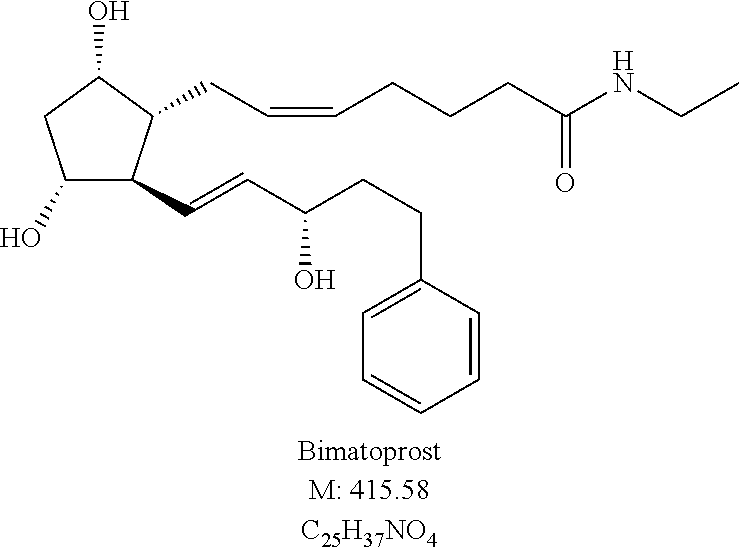
- the amine of the general formula (IV) the amine appropriate for the final compound, in the case of bimatoprost ethylamine may be used.
- R 3 represents a straight or branched, saturated or unsaturated C 4-6 hydrocarbon group, or a C 4-10 alkylcycloalkyl- or cycloalkyl-group, or optionally with alkyl group or halogen atom substituted phenyl-, C 7-10 alkylaryl- or hetaryl-group
- Reduction of the compounds of the general formula (XII) may be carried out by known methods, for example with diisobutylaluminium hydride in tetrahydrofuran medium.
- the protecting group can be removed by known methods in acidic or alkaline medium, preferably in alkaline medium.
- R 3 represents a straight or branched, saturated or unsaturated C 4-6 hydrocarbon group, or a C 4-10 alkylcycloalkyl- or cycloalkyl-group, or optionally with alkyl group or halogen atom substituted phenyl-, C 7-10 alkylaryl- or hetaryl-group
- the special compound of the general formula IIA where R 3 stands for a phenyl group and Y stands for a —(CH 2 )-group
- compound of the formula (IIB) can be prepared also in crystalline form.
- the compound of the formula (IIB) can be prepared in crystalline form, in such a way that to a mixture containing the compound of the formula (IIB) a mixture of ester type and ether type solvents is added.
- dimethyl ether, diethyl ether, diisopropyl ether, preferably diethyl-ether and diisopropyl ether are used as ether-type solvents, and ethyl-acetate, methyl-acetate, isopropyl-acetate, preferably isopropyl-acetate as ester-type solvents.
- the crystallisation is performed between ( ⁇ )30° C. and 30° C., preferably between 0-25° C.
- the suspension of crystals, thus obtained is stirred 1-24 hours, preferably 8 hours, then filtered and washed with ether type solvent, preferably with diisopropyl ether.
- the filtered crystals are dried under vacuum between 25-50° C., preferably at 35-40° C.
- the compounds of the general formulae (II) and (XII) may be prepared by known methods, for example as described in U.S. Pat. No. 5,359,095, WO 93/00329.
- the desired bimatoprost final product—if desired— may be synthetized through a crystalline bimatoprost acid.
- the desired final product is synthetized through a novel intermediate, a crystalline, activated ester or amide, which—if desired—can be isolated and —if desired— can be purified by crystallisation or chromatography. Due to the applied carboxylic acid activating agents (e.g.
- the crystalline activated carboxylic acid derivatives of the invention can be easily purified by crystallisation processes for eliminating the impurities and can also be transformed into the desired amide final product simply, under mild reaction conditions and in high yield.
- FIG. 1 Further embodiment of our invention is a process for the preparation of a high melting crystal form II of bimatoprost of the formula (IB).
- Example 30 of US 2005/0209337 A1 the high melting point crystal form of bimatoprost (DSC peak read value 79° C.) (further on: crystal form II.) is characterized by its X-ray diffraction, by its IR spectrum in KBr pellet and by its DSC and TGA curves.
- WO 2009/153206 describes the purification of bimatoprost product by preparative HPLC, followed by crystallisation. Crystallisation is carried out from acetonitrile solvent or from acetonitrile as dissolution and TBME (tert-butyl methyl ether) as precipitating solvent. According to the description, by that method the high melting point crystal form of bimatoprost (DSC peak read value 79° C.) can be prepared. By reproducing the method we did not succeed to obtain the high melting point crystal form of bimatoprost.
- US 2009/0163596 discloses crystal form I. of bimatoprost and its preparation. Crystal form I. of bimatoprost is characterized by its melting point (62-64° C.), by DSC, X-ray diffraction and IR investigation. It describes in details the crystallisation process, such as the dissolution process (in an organic solvent or in the mixture of an organic dissolution- and precipitation-solvent at a temperature near the boiling point), the cooling process, the separation of the precipitated crystals from the mother liquor and the drying process (in vacuum at low temperature). The high melting point crystal form (DSC peak read value 79° C.) of bimatoprost cannot be prepared by the methods described in US 2009/0163596.
- Form II. is characterized by its melting point (72-78° C.), by DSC investigation and by IR and X-ray powder diffraction studies.
- the essence of the process is, that from a bimatoprost-containing reaction mixture after work-up and evaporation, or from any crystalline or non-crystalline form of bimatoprost or from their mixtures of any ratio, through crystallisation from a protic or ether-type solvent the thermodynamically stabile, pure form II. is prepared.
- the crystallisation process is the following: to the oily or crystalline crude bimatoprost calculated amount of the solvent is added, then it is dried and periodically exposed to mechanical effect.
- our invention relates to a process for the preparation of form II. of bimatoprost of formula (IB), characterized in that to a bimatoprost-containing reaction mixture after work-up and evaporation, or to any crystalline or non-crystalline form of bimatoprost or to their mixtures of any ratio, calculated amount of an ether-type or protic solvent is added, if desired the resulting mixture is exposed to mechanical effect, then it is dried and homogenized.
- the melting point of crystal form II. obtained in the above process is between 72-78° C.
- the endothermic peak, based on DSC investigation, is between 73-79° C. and the melting heat is higher than 75 J/g.
- FIG. 1 shows the IR spectrum of the lactoltriol of example 1a.
- FIG. 2 shows the IR spectrum of the obtained Bimatoprost acid.
- FIG. 3 presents the IR spectrum of crystal form I.
- FIG. 4 presents the IR spectrum of crystal form II. obtained in the process according to the invention.
- FIG. 5 presents the DSC curve of crystal form I.
- FIG. 6 presents the DSC curve of crystal form II. obtained in the process according to the invention.
- FIG. 7 presents the X-ray powder diffraction curve of crystal form I.
- FIG. 8 presents the X-ray powder diffraction curve of crystal form II. obtained in the process according to the invention.
- FIG. 9 shows the X-ray powder diffraction curve of the obtained Bimatoprost acid.
- FIG. 10 shows the DSC curve of the obtained Bimatoprost acid.
- FIG. 11A shows the MS spectrum for positive ionization of Example 5.
- FIG. 11B shows the MSMS (precursor ion: 438.26) data of Example 5.
- protic solvent especially alcohols like methanol, ethanol and/or water.
- protic solvent especially alcohols like methanol, ethanol and/or water.
- water is used as protic solvent.
- ether-type solvent we apply calculated amount, preferably 2000-8000 mass % amount of dimethyl ether, diethyl ether, diisopropyl ether, preferably diethyl ether.
- the added solvent is removed by drying. Drying is performed at low temperature, preferably between 0-( ⁇ )50° C. by passing through nitrogen gas.
- NMR spectra were recorded by Bruker-Avance III-500 MHz instrument, DSC curves by Mettler-Toledo DSC 1/700 instrument, IR spectra by Perkin-Elmer Spektrum 400 FT-IR spectrophotometer, MS spectra by Shimadzu LC-MS-IT-TOF instrument. Melting points were determined by BUM Melting Point B-545 apparatus.
- IR spectrum of the lactoltriol of example 1a. is shown in FIG. 1 .
- the precipitated crystals are filtered off and washed with methanol:water mixture.
- the mother liquor is evaporated, extracted with ethyl acetate, the organic phase is dried over Na 2 SO 4 , the drying material is filtered off and the product is crystallized by the addition of hexane. 26 g of white crystalline material is obtained.
- the united organic phase is washed with 15% NaCl solution, dried over Na 2 SO 4 , filtered and evaporated.
- the residue is crystallized from the mixture of ethyl acetate and diisopropyl ether. The crystals are filtered off and washed, the filtrate solution is evaporated.
- the resulting yellow oil is purified by chromatography on silica gel using diisopropyl ether-acetone eluent. 25.5 g oil is obtained.
- bimatoprost acid 27.5 g is dissolved in 270 ml of THF and to the solution are added at room temperature 13.7 g N,N′-diisopropylcarbodiimide and then 13.7 g of N-hydroxysuccinimide. The mixture is stirred at room temperature. The resulting activated ester is not isolated.
- the MS spectrum for positive ionization is shown in FIG. 11A .
- the MSMS (precursor ion: 438.26) data is shown in FIG. 11B .
- HPLC 99.6% bimatoprost, less than 0.3% trans-bimatoprost, 0.1% other impurity
- the mixture is poured onto the mixture of 1N NaHSO 4 solution and isopropyl acetate (iPrOAc).
- the organic phase is washed with 1N NaHCO 3 solution, the aqueous-alkaline phase is extracted with iPrOAc.
- the united organic phase is washed with NaCl solution and dried over Na 2 SO 4 .
- the drying material is filtered off and the filtrate is evaporated to obtain 1.41 g of oil.
- the crude bimatoprost prepared according to Example 5 is dissolved under heating in 3000-fold amount of diethyl ether. The solvent is then removed at ( ⁇ )20-( ⁇ )30° C. by slowly passing through nitrogen gas. The resulting crystals are homogenized, or first exposed to mechanical effect and then homogenized.
Landscapes
- Chemical & Material Sciences (AREA)
- Organic Chemistry (AREA)
- Organic Low-Molecular-Weight Compounds And Preparation Thereof (AREA)
- Pharmaceuticals Containing Other Organic And Inorganic Compounds (AREA)
- Furan Compounds (AREA)
- Pyrrole Compounds (AREA)
- Indole Compounds (AREA)
Abstract

-
- where in the formula the bonds marked with dotted lines may be single or double bonds, in the case of double bounds at positions 5,6 and 13,14 they may be in cis or in trans orientation, Q stands for a hydroxyl-group and Z stands for a hydroxyl- or oxo-group, R1 and R2 independently represent hydrogen atom or a straight or branched C1-10 alkyl- or aralkyl-group, optionally substituted with —ONO2 group, or an aralkyl- or aryl-group, which contains heteroatom, R3 represents a straight or branched, saturated or unsaturated C4-6 hydrocarbon group, or a C4-10 alkylcycloalkyl- or cycloalkyl-group, or an optionally with alkyl group or halogen atom substituted phenyl-, C7-10 alkylaryl- or hetaryl-group, Y represents (CH2)n group or O atom or S atom, and where n=0-3.
Description

the meanings of the substituents are as follows:
the bonds marked with dotted lines may be single or double bonds, in the case of double bounds in
Q represents hydroxy-group and Z represents hydroxy- or oxo-group,
R1 and R2 independently represent hydrogen atom or a straight or branched C1-10 alkyl- or aralkyl-group, optionally substituted with —ONO2 group, or an aralkyl- or aryl-group, which contains heteroatom,
R3 represents a straight or branched, saturated or unsaturated C4-6 hydrocarbon group, or a C4-10 alkylcycloalkyl- or cycloalkyl-group, or optionally with alkyl group or halogen atom substituted phenyl-, C7-10 alkylaryl- or hetaryl-group,
Y represents (CH2)n group or O atom or S atom, and
n=0-3.

where in the formula
the bonds marked with dotted lines may be single or double bonds, in the case of double bounds at
Q represents hydroxy-group and Z represents hydroxy- or oxo-group,
R3 represents a straight or branched, saturated or unsaturated C4-6 hydrocarbon group, or a C4-10 alkylcycloalkyl- or cycloalkyl-group, or optionally with alkyl group or halogen atom substituted phenyl-, C7-10 alkylaryl- or hetaryl-group,
Y represents (CH2)n group or O atom or S atom, and
n=0-3,
-
- i.) with a compound suitable for the introduction of group R4, where R4 represents

-
-
- a group of formula a.),
- and reacting the amide of the general formula (III), thus obtained
-

-
-
- where the meanings of Q, Z, R3, R4, Y and n are as defined above, with an amine of the general formula (IV),
NHR1R2 IV. - where the meanings of R1 and R2 are as defined above, or
- where the meanings of Q, Z, R3, R4, Y and n are as defined above, with an amine of the general formula (IV),
- ii.) with a compound suitable for the introduction of group R5, where R5 represents
-

-
-
- a group of formula b.), c.), d.) or e.), where X stands for halogen or hydrogen atom, and reacting the activated ester of the general formula (V), thus obtained
-

-
-
- where the meanings of Q, Z, R3, R5, Y and n are as defined above, with an amine of the general formula (IV), where the meanings of R1 and R2 are as defined above.
-

where in the formula the meanings of R1, R2, R3, Y and n are as defined above,
the compounds of the general formula (IIA) according to the invention are used as starting materials.

where in the formula
R3 represents a straight or branched, saturated or unsaturated C4-6 hydrocarbon group, or a C4-10 alkylcycloalkyl- or cycloalkyl-group, or optionally with alkyl group or halogen atom substituted phenyl-, C7-10 alkylaryl- or hetaryl-group,
Y represents (CH2)n group or O atom or S atom, and
n=0-3,
may be prepared according to the invention by reducing the lactondiol of the general formula (XII),

where in the meanings of R3, Y and n are defined above, to the lactoltriol of the general formula (XIII),

where the meanings of R3, Y and n are defined above, the protecting group of the compound of formula (XIII) is then removed, and the compound of the general formula (XIV), thus obtained,

where the meanings of R3, Y and n are defined above, is transformed by Wittig reaction into the compound of the general formula (IIA).

where R3 represents a straight or branched, saturated or unsaturated C4-6 hydrocarbon group, or a C4-10 alkylcycloalkyl- or cycloalkyl-group, or optionally with alkyl group or halogen atom substituted phenyl-, C7-10 alkylaryl- or hetaryl-group,
Y represents (CH2)n group or O atom or S atom, and n=0-3,
are novel compounds.


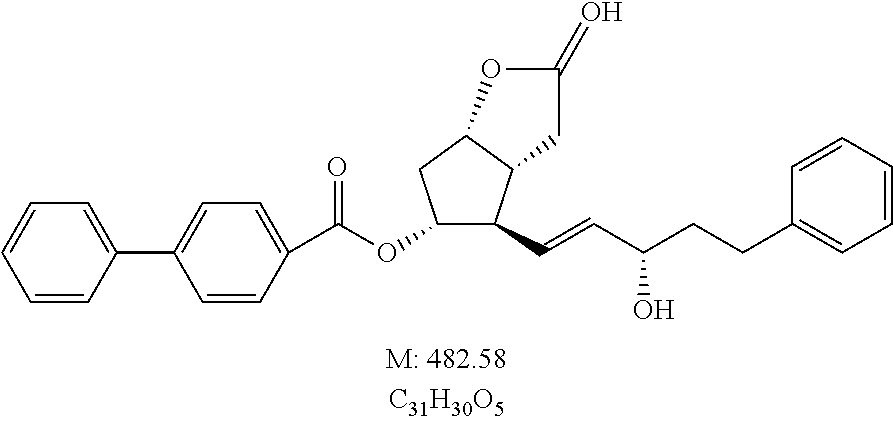
is reduced in 1000 ml of tetrahydrofuran (THF) solvent at (−)65-(−)85° C. with the hexane solution of 422 ml diisobutyl aluminium hydride (DIBAL-H). The reaction mixture is destroyed with NaHSO4 solution, the aqueous phase is extracted with ethyl acetate, the organic phase is washed with NaHCO3 solution and the solvent is removed at 40-50° C. The crude material is evaporated to obtain 46.2 g oil.


| Number | |||||
| of the | |||||
| Position | 13C (ppm) | 1H (ppm) | protons | Multiplicity | Coupling (Hz) |
| 6; OH | 99.72; 100.64 | 5.57* (20H); 5.49 | 1 | m | J6,OH = 4.65; 3.6 |
| OH: 6.05; 6.28 | 1 | d | |||
| 7 | 38.14; 38.44 | 2.57* (32H); 1.77 (39H) | 1; 1 | m; m | 2.3-2.9; 7.0; |
| 1.78* (39H) | J7α,7β = 14.0 | ||||
| 8 | 46.26; 45.69 | 2.57* (32H); 2.43 | 1 | m | —; J8,9 = 8.85-9.1 |
| 9 | 80.19; 80.92 | 4.60; 4.50 | 1 | m | J8,9 = 9.1; 2.7-3.3; |
| 7.3-7.4; J9,10 = 5.25 | |||||
| 10 | 40.12**; 40.37** | 1.98; 1.93; | 1; 1 | m; m | J9,10 = 5.5; |
| 2.69; | J10α,10β = 13.6-13.65 | ||||
| 11; OR | 80.54; 79.03 | 5.12; 5.05 | 1 | m | 7.1-7.3 |
| 7.4-7.55; 9.8 | |||||
| 12 | 54.12; 53.22 | 2.55* (33H); 3.11 | 1 | m | —; 9.85-10.1; 7.55 |
| 13 | 129.38; 129.62 | 5.59* (19-20H); 5.59* (19-20H) | 1 | m | 6.3; J13,14 = 15.3 |
| 14 | 136.66; 136.69 | 5.65* (17-18H); 5.65* (17-18H) | 1 | m | J14,15 = 5.15; J13,14 = 15.45 |
| 15; OH | 70.47; 70.39 | 3.98* (28H); 3.98* (28H) | 1 | m | J14,15 = 5.2-5.5 |
| OH: 4.80* (24H); 4.79* (25H) | 1 | d | J15,OH = 4.7; 4.8 | ||
| 16 | 40.09** | 1.71-1.61* (40H) | 1; 1 | m; m | |
| 17 | 31.86; 31.80 | 2.57* (32H); 2.55* (33H) | 2 | m | |
| 18 | 143.14 | — | — | — | — |
| 19, 19′ | 129.06 | 7.10; 7.06 | 1 | d | J19,20 = 7.3; 7.2 |
| 20, 20′ | 129.09 | 7.23* (9H); 7.20* (10H) | 1 | t | J19,20 = J20,21 = 7.4; 7.5 |
| 21 | 126.41; 126.37 | 7.14* (11H); 7.13* (12H) | 1 | t | J20,21 = 7.3-7.45 |
| 22 | 166.07; 166.16 | — | — | — | — |
| 23 | 129.52; 129.48 | — | — | — | — |
| 24, 24′ | 130.71 | 8.04* (2H); 8.06* (1H) | 1 | d | J24,25 = 8.3; 8.4 |
| 25, 25′ | 127.86 | 7.83* (3H); 7.81* (4H) | 1 | d | J24,25 = 8.5; 8.4 |
| 26 | 145.64 | — | — | — | — |
| 27 | 139.77 | — | — | — | — |
| 28, 28′ | 127.90 | 7.75* (5H); 7.73* (6H) | 1 | d | J28,29 = 7.6; 7.95 |
| 29, 29′ | 130.01 | 7.55 | 1 | t | J28,29 = J29,30 = 7.4-7.8 |
| 30 | 129.33 | 7.47 | 1 | t | J29,30 = 7.3-7.35 |
| *Overlapping 1H NMR signals (The number in brackets signifies the position number of the signal group in the PMR spectrum, direction: towards decreasing shifts) | |||||
| **13C NMR signals overlapping with the multiplett of the DMSO solvent. | |||||


| Number | |||||
| of the | |||||
| Position | 13C (ppm) | 1H (ppm) | protons | Multiplicity | Coupling (Hz) |
| 6; OH | 99.65; 100.48 | 5.46* (8H); 5.40 | 1 | m | J6,OH = 4.65; 3.8 |
| OH: 5.92; 6.13 | 1 | d | |||
| 7 | 39.94; 38.77 | 1.81* (26H) | 1; 1 | m; m | |
| 1.97* (25H); 1.66* (27H) | |||||
| 8 | 45.63; 45.81 | 2.29* (22H); 2.22* (24H) | 1 | m | |
| 9 | 79.20; 80.97 | 4.38; 4.32 | 1 | m | J9,10a = 6.9; 7.3-7.55 |
| 10 | 41.53; 43.795 | 2.27* (23H); 1.48 | 1; 1 | m; m | J9,10a = 6.4-6.8; 7.1-7.4 |
| 2.30* (22H); 1.76* (27H) | |||||
| 11; OH | 77.62; 77.06 | 3.70; 3.61 | 1 | m | J11,OH = 5.95; 5.85 |
| OH: 4.75; 4.80 | 1 | d | |||
| 12 | 56.80; 55.86 | 1.97* (25H); 2.53* (21H) | 1 | m | |
| 13 | 131.46; 132.11 | 5.54* (6H); 5.54* (6H) | 1 | m | J13,14 = 15.3 |
| 14 | 135.39; 135.16 | 5.49* (7H); 5.49* (7H) | 1 | m | J13,14 = 16 |
| 15; OH | 71.14; 71.22 | 3.94* (16H); 3.94* (16H) | 1 | m | J15,OH = 4.75; 4.35 |
| OH: 4.72* (12H); 4.71* | 1 | d | |||
| (13H) | |||||
| 16 | 40.26 | 1.74* (27H); 1.66* (27H) | 1; 1 | m; m | |
| 17 | 32.24; 32.27 | 2.63* (20H); 2.63* (20H) | 1; 1 | m | |
| 18 | 143.23 | — | — | — | — |
| 21* | 129.20 | 7.22* (2H) | 1 | d | J21,22 = 7.3 |
| 22* | 129.18 | 7.30 | 1 | t | J21,22 = J22,23 = 7.4-7.6 |
| 23* | 126.48 | 7.19* (3H) | 1 | t | J22,23 = J23,24 = 7.25 |
| 24* | 129.18 | 7.30 | 1 | t | J23,24 = J24,25 = 7.4-7.6 |
| 25* | 129.20 | 7.22* (2H) | 1 | d | J24,25 = 7.3 |
| *Overlapping 1H NMR signals. (The number in brackets signifies the position number of the signal group in the PMR spectrum, direction: towards decreasing shifts). | |||||


| Number | |||||
| of the | |||||
| Position | 13C (ppm) | 1H (ppm) | protons | Multiplicity | Coupling (Hz) |
| 1; COOH | 175.30 | —; COON: 12.02 | —; COOH: 1 | —; COOH: broad | |
| 2 | 34.10 | 2.23* (21H); 2.16* (22H) | 1; 1 | m; m | |
| 3 | 25.45 | 1.54* (26H) | 2 | m | |
| 4 | 27.09 | 2.01* (24H) | 2 | m | J4,5 = 6.8-7.0 |
| 5 | 129.53 | 5.29 | 1 | td | J4,5 = 7.2 J5,6 = 10.8 |
| 6 | 130.64 | 5.50* (7H) | 1 | td | J6,7 = 7.8 J5,6 = 10.6 |
| 7 | 25.74 | 2.15* (22H); 2.04* (24H) | 1; 1 | m; m | |
| 8 | 49.81 | 1.34 | 1 | m | J8,9 = 5.75 |
| 9; OH | 70.47 | 3.95* (13H); OH: 4.40 | 1 | m; broad | J8,9 = 5.75 |
| 10 | 44.89 | 2.24* (21H); 1.48* (26H) | 1; 1 | m; ddd | J10α,10β = 14.1; 5.65-5.85; |
| 2.3-2.4 | |||||
| 11; OH | 76.69 | 3.71; OH: 4.55 | 1; OH: 1 | m (ddd); broad | J11,12 = 7.5 |
| 12 | 55.22 | 2.19* (21H) | 1 | m | |
| 13 | 133.05 | 5.40* (7H) | 1 | dd | J12,13 = 7.7-8.15; |
| J13,14 = 15.45 | |||||
| 14 | 136.09 | 5.47* (7H) | 1 | dd | J14,15 = 6.2-6.35; |
| J13,14 = 15.4 | |||||
| 15; OH | 71.53 | 3.94* (13H); OH: 4.71 | 1; OH: 1 | m; broad | J14,15 = 6.4 |
| 16 | 40.45* | 1.75* (25H); 1.69* (25H) | 1; 1 | m; m | |
| 17 | 32.29 | 2.64 | 2 | m | |
| 18 | 143.24 | — | — | — | — |
| 19* | 129.15 | 7.21* (5H) | 1 | d | J19,20 = 6.9 |
| 20* | 129.20 | 7.30 | 1 | t | J19,20 = J20,21 = 7.5-7.55 |
| 21* | 126.51 | 7.19* (5H) | 1 | t | J20,21 = J21,22 = 6.7-7.3 |
| 22* | 129.20 | 7.30 | 1 | t | J21,22 = J22,23 = 7.5-7.55 |
| 23* | 129.15 | 7.21* (5H) | 1 | d | J22,23 = 6.9 |
| *Partly or fully overlapping 1H NMR signals. (The number in brackets signifies the position number of the signal group in the PMR spectrum, direction: towards decreasing shifts). | |||||


| Coupling constant | |||||
| (Hz) | |||||
| Numbering | 13C (ppm) | 1H (ppm) | Number of 1H | Multiplicity | (+/−0.2 Hz) |
| 1 | 168.80 | — | — | — | |
| 2 | 29.70 | 2.55** | 2 | t | J2,3 = 7.4 |
| 3 | 24.29 | 1.61*** | 2 | m (tt) | J3,4 = 7.4 |
| 4 | 25.70 | 2.06 | 2 | m | J4,5 = 7.2 |
| 5 | 127.87 | 5.28 | 1 | dt | J5,6 = 10.7 |
| 6 | 130.27 | 5.48+ | 1 | dt (ddd) | J6,7 = 7.4 |
| 7 | 24.83 | 7a: 2.14++ | 1 | m | |
| 7b: 2.00 | 1 | m | |||
| 8 | 48.78 | 1.32 | 1 | m (dddd) | 10.4; 10.4; 5.1; 5.1 |
| 9 | 69.53 | 3.915+++ | 1 | m | |
| 9-OH | 4.35 | 1 | d | J9,OH = 5.0 | |
| 10 | 43.94 | β: 2.20++ | 1 | m(ddd) | Jgem = 14.1; 8.2; 5.9 |
| α: 1.44 | 1 | ddd | 5.6; 2.3 | ||
| 11 | 75.37 | 3.68 | 1 | m (dddd) | ~7.9; ~7.9; ~5.8; ~5.8 |
| 11-OH | 4.50 | 1 | d | J11,OH = 5.8 | |
| 12 | 54.22 | 2.16++ | 1 | m | 7.8; 3.8 |
| 13 | 132.02 | 5.37 | 1 | dd | J13,14 = 15.4; J12,13 = 8.1 |
| 14 | 135.16 | 5.44+ | 1 | m (dd) | J14,15 = 6.3 |
| 15 | 70.56 | 3.909+++ | 1 | m | |
| 15-OH | 4.65 | 1 | d | J15,OH = 4.7 | |
| 16 | 39.49* | 1.71*** | 1 | m | |
| 1.65*** | 1 | m | |||
| 17 | 31.35 | 2.60** | 2 | m | |
| 18 | 142.31 | — | — | — | |
| 19, 23 | 128.19/128.24 | 7.17# | 2 | d | J19,20 = 7.4 |
| 20, 22 | 128.24/128.19 | 7.26 | 2 | t | J20,21 = 7.4 |
| 21 | 125.55 | 7.15# | 1 | t | |
| 24, 27 | 170.18 | — | — | — | |
| 25, 26 | 25.42 | 2.80 | 4 | s | |
| *Overlapped 13C NMR by the DMSO signal. | |||||
| **,***,+,++,+++,#Overlapped 1H NMR signals. | |||||


| Coupling constant (Hz) | |||||
| Numbering | 13C (ppm) | 1H (ppm) | Number of 1H | Multiplicity | (+/−0.2 Hz) |
| 1 | 169.82 | — | — | — | |
| 2 | 29.63 | 2.64 | 2 | t | J2,3 = 7.4 |
| 3 | 24.29 | 1.65* | 2 | m (tt) | J3,4 = 7.4 |
| 4 | 25.71 | 2.09 | 2 | m | J4,5 = 7.2 |
| 5 | 127.84 | 5.30 | 1 | dt | J5,6 = 10.5 |
| 6 | 130.33 | 5.50 | 1 | dt (ddd) | J6,7 = 7.5 |
| 7 | 24.83 | a: 2.16** | 1 | m | Jgem = 12.6 |
| b: 2.01 | 1 | m (ddd) | |||
| 8 | 48.79 | 1.325 | 1 | m (dddd/tt) | 10.7, 10.0; 5.3; 4.7 |
| 9 | 69.52 | 3.92*** | 1 | m | |
| 9-OH | 4.38 | 1 | d | J9,OH = 4.9 | |
| 10 | 43.95 | β: 2.205** | 1 | m(ddd) | Jgem = 14.1; J10β = 8.4 and 6.0 |
| α: 1.44 | 1 | ddd | J10α = 5.6 and 2.1 | ||
| 11 | 75.74 | 3.68 | 1 | m (dddd/tt) | ~7.8; ~7.8; ~6.0; ~6.0 |
| 11-OH | 4.52 | 1 | d | J11,OH = 5.8 | |
| 12 | 54.23 | 2.165** | 1 | m | |
| 13 | 132.08 | 5.37 | 1 | dd | J13,14 = 15.4; J12,13 = 8.3 |
| 14 | 135.18 | 5.44 | 1 | m (dd) | J14,15 = 6.4 |
| 15 | 70.56 | 3.89*** | 1 | m | |
| 15-OH | 4.66 | 1 | d | J15,OH = 4.6 | |
| 16 | 39.47$ | a: 1.69* | 1 | m | |
| b: 1.64* | 1 | m | |||
| 17 | 31.34 | 2.58** | 2 | m (td) | 10.1 and 6.3 |
| 18 | 142.28 | — | — | — | |
| 19, 23 | 128.16$/128.20 | 7.15+ | 2 | d | J19,20 = 7.5 |
| 20, 22 | 128.20/128.16$ | 7.24 | 2 | t | J20,21 = 7.3 |
| 21 | 125.52 | 7.13+ | 1 | t | |
| 24, 31 | 161.81 | — | — | — | |
| 25, 30 | ~128.1$ | — | — | — | |
| 26, 29 | 123.97 | 7.97++ | 2 | m | |
| 27, 30 | 135.51 | 7.94++ | 2 | m | |
| $Overlapped 13C NMR by the DMSO signal. | |||||
| $$Overlapped 13C NMR signals. | |||||
| *,**,***,+,++Overlapped 1H NMR signals. | |||||


| Number of | Coupling (Hz) | ||||
| Position | 13C (ppm) | 1H (ppm) | the protons | Multiplicity | (+/−0.2 Hz) |
| 1 | 172.51 | — | — | — | |
| 2 | 35.88 | 2.02** | 2 | t | J2,3 = 7.5 |
| 3 | 26.27 | 1.53*** | 2 | m (tt) | J3,4 = 7.5 |
| 4 | 27.25 | 1.99** | 2 | m | J4,5 = 7.2 |
| 5 | 129.78 | 5.30 | 1 | dt | J5,6 = 10.5 |
| 6 | 130.38 | 5.48+ | 1 | Dt (ddd) | |
| 7 | 25.72 | 2.15++ | 1 | m | |
| 2.03** | 1 | m | |||
| 8 | 49.78 | 1.35 | 1 | m (dddd) | 10.6; 10.6; 4.7; 4.7 |
| 9 | 70.45 | 3.95+++ | 1 | m | |
| 9-OH | 4.40 | 1 | d | J9,OH = 4.9 | |
| 10 | 44.85 | β: 2.23++ | 1 | m | |
| α: 1.48*** | 1 | ddd | Jgem = 14.2; 5.5; 2.2 | ||
| 11 | 76.67 | 3.71 | 1 | m (dddd) | ~7.5; ~7.5; ~7.5; 6.5 |
| 11-OH | 4.54 | 1 | d | J11,OH = 5.8 | |
| 12 | 55.15 | 2.19++ | 1 | m | |
| 13 | 132.91 | 5.41 | 1 | dd | J13,14 = 15.4; J12,13 = 8.0 |
| 14 | 136.00 | 5.47+ | 1 | M (dd) | |
| 15 | 71.41 | 3.94+++ | 1 | m | |
| 15-OH | 4.71 | 1 | d | J15,OH = 4.6 | |
| 16 | 40.36* | 1.74# | 1 | m | |
| 1.70# | 1 | m | |||
| 17 | 32.25 | 2.61 | 1 | m | |
| 2.675 | 1 | m | |||
| 18 | 143.21 | — | — | — | |
| 19, 23 | 129.13 | 7.21## | 2 | d | J19,20 = 7.4 |
| 20, 22 | 129.15 | 7.30 | 2 | t | J20,21 = 7.4 |
| 21 | 126.46 | 7.19## | 1 | t | |
| 24 (NH) | 7.72 | 1 | broad, t | J24,25 = 5.5 | |
| 25 | 34.13 | 3.07 | 2 | qd | J25,26 = 7.2 |
| 26 | 15.70 | 1.02 | 3 | t | |



Claims (3)

Priority Applications (1)
| Application Number | Priority Date | Filing Date | Title |
|---|---|---|---|
| US14/965,515 US9856213B2 (en) | 2011-06-02 | 2015-12-10 | Processes for the preparation of prostaglandin amides |
Applications Claiming Priority (7)
| Application Number | Priority Date | Filing Date | Title |
|---|---|---|---|
| HUP1100291 | 2011-06-02 | ||
| HU1100292A HU231134B1 (en) | 2011-06-02 | 2011-06-02 | A process for preparing a chemically stable new crystalline form of bimatoprost |
| HU1100291A HU230703B1 (en) | 2011-06-02 | 2011-06-02 | Process for the preparation of prostaglandin amides |
| HUP1100292 | 2011-06-02 | ||
| US14/123,497 US9238621B2 (en) | 2011-06-02 | 2012-05-25 | Processes for the preparation of prostaglandin amides |
| PCT/HU2012/000045 WO2012164324A1 (en) | 2011-06-02 | 2012-05-25 | Novel processes for the preparation of prostaglandin amides |
| US14/965,515 US9856213B2 (en) | 2011-06-02 | 2015-12-10 | Processes for the preparation of prostaglandin amides |
Related Parent Applications (2)
| Application Number | Title | Priority Date | Filing Date |
|---|---|---|---|
| US14/123,497 Division US9238621B2 (en) | 2011-06-02 | 2012-05-25 | Processes for the preparation of prostaglandin amides |
| PCT/HU2012/000045 Division WO2012164324A1 (en) | 2011-06-02 | 2012-05-25 | Novel processes for the preparation of prostaglandin amides |
Publications (2)
| Publication Number | Publication Date |
|---|---|
| US20160145207A1 US20160145207A1 (en) | 2016-05-26 |
| US9856213B2 true US9856213B2 (en) | 2018-01-02 |
Family
ID=89990312
Family Applications (3)
| Application Number | Title | Priority Date | Filing Date |
|---|---|---|---|
| US14/123,497 Active US9238621B2 (en) | 2011-06-02 | 2012-05-25 | Processes for the preparation of prostaglandin amides |
| US14/965,489 Active US9573892B2 (en) | 2011-06-02 | 2015-12-10 | Processes for the preparation of prostaglandin amides |
| US14/965,515 Active US9856213B2 (en) | 2011-06-02 | 2015-12-10 | Processes for the preparation of prostaglandin amides |
Family Applications Before (2)
| Application Number | Title | Priority Date | Filing Date |
|---|---|---|---|
| US14/123,497 Active US9238621B2 (en) | 2011-06-02 | 2012-05-25 | Processes for the preparation of prostaglandin amides |
| US14/965,489 Active US9573892B2 (en) | 2011-06-02 | 2015-12-10 | Processes for the preparation of prostaglandin amides |
Country Status (17)
| Country | Link |
|---|---|
| US (3) | US9238621B2 (en) |
| EP (1) | EP2723714B1 (en) |
| JP (3) | JP6212485B2 (en) |
| KR (3) | KR102038048B1 (en) |
| CN (4) | CN106278982B (en) |
| BR (3) | BR122021008918B1 (en) |
| CA (3) | CA3209613A1 (en) |
| ES (1) | ES2636756T3 (en) |
| HU (1) | HUE033642T2 (en) |
| IL (1) | IL229647A (en) |
| MX (1) | MX341839B (en) |
| PL (1) | PL2723714T3 (en) |
| PT (1) | PT2723714T (en) |
| RU (1) | RU2618223C2 (en) |
| TW (3) | TWI653223B (en) |
| WO (1) | WO2012164324A1 (en) |
| ZA (1) | ZA201309357B (en) |
Families Citing this family (10)
| Publication number | Priority date | Publication date | Assignee | Title |
|---|---|---|---|---|
| HU231203B1 (en) | 2011-12-21 | 2021-10-28 | CHINOIN Gyógyszer és Vegyészeti Termékek Gyára Zrt. | New process for the production of travoprost |
| EP2911623B1 (en) | 2012-10-26 | 2019-08-14 | Forsight Vision5, Inc. | Ophthalmic system for sustained release of drug to eye |
| US9120738B2 (en) * | 2012-12-28 | 2015-09-01 | Allergan, Inc. | Crystalline forms of bimatoprost acid, methods for preparation, and methods for use thereof |
| US9447014B2 (en) * | 2012-12-28 | 2016-09-20 | Allergan, Inc. | Tromethamine salt of bimatoprost acid in crystalline form, methods for preparation, and methods for use thereof |
| HU231214B1 (en) * | 2014-03-13 | 2021-11-29 | CHINOIN Gyógyszer és Vegyészeti Termékek Gyára Zrt. | A new process for the production of high purity prostaglandins |
| US10273206B2 (en) | 2014-06-27 | 2019-04-30 | Allergan, Inc. | Tromethamine salt of bimatoprost acid in crystalline form 1, methods for preparation, and methods for use thereof |
| WO2015199729A1 (en) * | 2014-06-27 | 2015-12-30 | Allergan, Inc. | Tromethamine salt of bimatoprost acid in crystalline form 1, methods for preparation, and methods for use thereof |
| US20160296532A1 (en) | 2015-04-13 | 2016-10-13 | Forsight Vision5, Inc. | Ocular Insert Composition of a Semi-Crystalline or Crystalline Pharmaceutically Active Agent |
| HU231185B1 (en) * | 2017-07-11 | 2021-07-28 | CHINOIN Gyógyszer és Vegyészeti Termékek Gyára Zrt. | Process for preparation and purification of misoprostol |
| CN113548993B (en) * | 2021-09-01 | 2022-05-27 | 河北化工医药职业技术学院 | A kind of preparation method of carboprost |
Citations (15)
| Publication number | Priority date | Publication date | Assignee | Title |
|---|---|---|---|---|
| US4257962A (en) | 1977-09-26 | 1981-03-24 | Chinoin Gyogyszer Es Vegyeszeti Termekek Gyara Rt. | Derivatives of bicyclic lactols |
| WO1994006750A1 (en) | 1992-09-11 | 1994-03-31 | Merck & Co., Inc. | Prostaglandin analog for treating osteoporosis |
| WO1994006433A1 (en) | 1992-09-21 | 1994-03-31 | Allergan, Inc. | Non-acidic cyclopentane heptanoic acid, 2-cycloalkyl or arylalkyl derivatives as therapeutic agents |
| WO2002096868A2 (en) | 2001-05-31 | 2002-12-05 | Finetech Laboratories Ltd. | Preparation of 17-phenyl- 18, 19, 20- trinor-pgf2a and its derivatives |
| WO2005058812A2 (en) | 2003-12-19 | 2005-06-30 | Johnson Matthey Public Limited Company | Prostaglandin synthesis |
| US20050209337A1 (en) | 2000-01-27 | 2005-09-22 | Finetech Laboratories Ltd | Process for the preparation of prostaglandin derivatives |
| US20090163596A1 (en) | 2006-08-29 | 2009-06-25 | Arie Gutman | Bimatoprost crystalline form I |
| US20090259058A1 (en) | 2008-04-09 | 2009-10-15 | Scinopharm Taiwan Ltd. | Process for the Preparation of Prostaglandin Analogues and Intermediates Thereof |
| WO2009153206A2 (en) | 2008-06-20 | 2009-12-23 | Sandoz Ag | Improved Process for the Production of Bimatoprost |
| US20100105771A1 (en) | 2008-10-29 | 2010-04-29 | Delong Mitchell A | Amino acid salts of prostaglandins |
| WO2011046569A1 (en) | 2009-10-16 | 2011-04-21 | Cayman Chemical Company | Process for the preparation of f-series prostaglandins |
| WO2011050638A1 (en) | 2009-11-02 | 2011-05-05 | 上海天伟生物制药有限公司 | A crystalline form of bimatoprost, preparation method and use thereof |
| WO2011055377A1 (en) | 2009-11-05 | 2011-05-12 | Biocon Limited | A novel process for the preparation of prostaglandins and intermediates thereof |
| WO2011063276A1 (en) | 2009-11-23 | 2011-05-26 | Allergan, Inc. | 7-[3,5-dihydroxy-2- (3-hydroxy-5-phenyl-pent-1-enyl)- cyclopentyl]-n-ethyl-hept-5-enamide (bimatoprost) in crystalline form ii, methods for preparation, and methods for use thereof |
| EP2495235A1 (en) | 2011-03-04 | 2012-09-05 | Newchem S.p.A. | Process for the synthesis of prostaglandins and intermediates thereof |
Family Cites Families (22)
| Publication number | Priority date | Publication date | Assignee | Title |
|---|---|---|---|---|
| US3954741A (en) * | 1972-06-07 | 1976-05-04 | Pfizer Inc. | N-substituted prostaglandin carboxamides |
| US3984424A (en) * | 1972-11-08 | 1976-10-05 | Pfizer Inc. | P-biphenyl esters of 15-substituted-ω-pentanorprostaglandins |
| HU171155B (en) * | 1973-04-30 | 1977-11-28 | Pfizer | Process for preparing oxa-prostaglandines |
| HU175889B (en) | 1976-04-08 | 1980-11-28 | Chinoin Gyogyszer Es Vegyeszet | New process for preparing lactol-alcohol derivatives |
| HU175217B (en) * | 1977-08-03 | 1980-06-28 | Chinoin Gyogyszer Es Vegyeszet | New process for preparing bicyclic lactol methyl ethers |
| FR2550799B1 (en) * | 1983-08-17 | 1986-02-21 | Commissariat Energie Atomique | COMPOUND MARKED BY AN ENZYME, ITS PREPARATION METHOD AND ITS USE IN ENZYMOIMMUNOLOGY |
| EP1348437A3 (en) * | 1988-09-06 | 2003-11-19 | Pharmacia Aktiebolag | Prostaglandin derivatives for the treatment of glaucoma or ocular hypertension |
| SE9002596D0 (en) * | 1990-08-08 | 1990-08-08 | Pharmacia Ab | A METHOD OF SYNTHESIS OF PROSTAGLANDIN DERIVATIVES |
| US5359095A (en) | 1990-08-08 | 1994-10-25 | Pharmacia Ab | Method for synthesis of prostaglandin derivatives |
| GB9025509D0 (en) * | 1990-11-23 | 1991-01-09 | Fujisawa Pharmaceutical Co | New amide derivatives,processes for the preparation thereof and pharmaceutical composition comprising the same |
| HU212570B (en) * | 1991-06-24 | 1996-08-29 | Chinoin Gyogyszer Es Vegyeszet | Process for producing 13,14-dihydro-15(r)-17-phenyl-18,19,20-trinor-pgf2alfa-isopropylester |
| JPH10298446A (en) * | 1997-04-25 | 1998-11-10 | Mitsui Chem Inc | Production of yellow vat dye |
| CA2453631A1 (en) * | 2001-07-17 | 2003-01-30 | Pharmacia & Upjohn Company | Process and intermediates to prepare latanoprost |
| DE10226942A1 (en) * | 2002-06-17 | 2003-12-24 | Symrise Gmbh & Co Kg | Use of mandelic acid alkyl amides as flavorings |
| MXPA05009059A (en) * | 2003-02-26 | 2005-10-19 | Banyu Pharma Co Ltd | Heteroarylcarbamoylbenzene derivative. |
| FR2889523B1 (en) * | 2005-08-03 | 2007-12-28 | Servier Lab | NOVEL CRYSTALLINE FORM V OF AGOMELATIN, PROCESS FOR PREPARING THE SAME AND PHARMACEUTICAL COMPOSITIONS CONTAINING THE SAME |
| GB0819182D0 (en) * | 2008-10-20 | 2008-11-26 | Actelion Pharmaceuticals Ltd | Crystalline forms |
| JP2012507552A (en) * | 2008-10-29 | 2012-03-29 | アエリエ・ファーマシューティカルズ・インコーポレーテッド | Amino acid salt of prostaglandin |
| KR101736169B1 (en) * | 2009-03-16 | 2017-05-16 | 닛산 가가쿠 고교 가부시키 가이샤 | Base material for spraying comprising low-molecular gelling agent |
| US8519178B2 (en) * | 2009-06-22 | 2013-08-27 | Johnson Matthey Public Limited Company | Method for the purification of prostaglandins |
| GB0911000D0 (en) * | 2009-06-25 | 2009-08-12 | Givaudan Sa | Compounds |
| HU231203B1 (en) * | 2011-12-21 | 2021-10-28 | CHINOIN Gyógyszer és Vegyészeti Termékek Gyára Zrt. | New process for the production of travoprost |
-
2012
- 2012-05-25 CN CN201610657048.9A patent/CN106278982B/en active Active
- 2012-05-25 PL PL12730027T patent/PL2723714T3/en unknown
- 2012-05-25 HU HUE12730027A patent/HUE033642T2/en unknown
- 2012-05-25 JP JP2014513258A patent/JP6212485B2/en active Active
- 2012-05-25 CN CN201280027006.7A patent/CN103649047B/en active Active
- 2012-05-25 PT PT127300275T patent/PT2723714T/en unknown
- 2012-05-25 KR KR1020147000085A patent/KR102038048B1/en active Active
- 2012-05-25 ES ES12730027.5T patent/ES2636756T3/en active Active
- 2012-05-25 BR BR122021008918-3A patent/BR122021008918B1/en active IP Right Grant
- 2012-05-25 CN CN201610630836.9A patent/CN106349138A/en active Pending
- 2012-05-25 WO PCT/HU2012/000045 patent/WO2012164324A1/en not_active Ceased
- 2012-05-25 EP EP12730027.5A patent/EP2723714B1/en active Active
- 2012-05-25 RU RU2013158952A patent/RU2618223C2/en active
- 2012-05-25 US US14/123,497 patent/US9238621B2/en active Active
- 2012-05-25 CA CA3209613A patent/CA3209613A1/en active Pending
- 2012-05-25 CA CA3094762A patent/CA3094762C/en active Active
- 2012-05-25 KR KR1020197031340A patent/KR102135550B1/en active Active
- 2012-05-25 BR BR112013030973-3A patent/BR112013030973B1/en active IP Right Grant
- 2012-05-25 MX MX2013014034A patent/MX341839B/en active IP Right Grant
- 2012-05-25 CN CN201610603047.6A patent/CN106316910A/en active Pending
- 2012-05-25 KR KR1020207019850A patent/KR102277188B1/en active Active
- 2012-05-25 CA CA2837261A patent/CA2837261C/en active Active
- 2012-05-25 BR BR122021008946-9A patent/BR122021008946B1/en active IP Right Grant
- 2012-06-01 TW TW105137756A patent/TWI653223B/en active
- 2012-06-01 TW TW105137755A patent/TWI653222B/en active
- 2012-06-01 TW TW101119665A patent/TWI632131B/en active
-
2013
- 2013-11-26 IL IL229647A patent/IL229647A/en active IP Right Grant
- 2013-12-11 ZA ZA2013/09357A patent/ZA201309357B/en unknown
-
2015
- 2015-12-10 US US14/965,489 patent/US9573892B2/en active Active
- 2015-12-10 US US14/965,515 patent/US9856213B2/en active Active
-
2016
- 2016-12-02 JP JP2016234693A patent/JP6487410B2/en active Active
- 2016-12-02 JP JP2016234694A patent/JP6693859B2/en active Active
Patent Citations (20)
| Publication number | Priority date | Publication date | Assignee | Title |
|---|---|---|---|---|
| US4257962A (en) | 1977-09-26 | 1981-03-24 | Chinoin Gyogyszer Es Vegyeszeti Termekek Gyara Rt. | Derivatives of bicyclic lactols |
| WO1994006750A1 (en) | 1992-09-11 | 1994-03-31 | Merck & Co., Inc. | Prostaglandin analog for treating osteoporosis |
| WO1994006433A1 (en) | 1992-09-21 | 1994-03-31 | Allergan, Inc. | Non-acidic cyclopentane heptanoic acid, 2-cycloalkyl or arylalkyl derivatives as therapeutic agents |
| EP0660716A1 (en) | 1992-09-21 | 1995-07-05 | Allergan, Inc. | Non-acidic cyclopentane heptanoic acid, 2-cycloalkyl or arylalkyl derivatives as therapeutic agents |
| US20050209337A1 (en) | 2000-01-27 | 2005-09-22 | Finetech Laboratories Ltd | Process for the preparation of prostaglandin derivatives |
| WO2002096868A2 (en) | 2001-05-31 | 2002-12-05 | Finetech Laboratories Ltd. | Preparation of 17-phenyl- 18, 19, 20- trinor-pgf2a and its derivatives |
| WO2005058812A2 (en) | 2003-12-19 | 2005-06-30 | Johnson Matthey Public Limited Company | Prostaglandin synthesis |
| US20090163596A1 (en) | 2006-08-29 | 2009-06-25 | Arie Gutman | Bimatoprost crystalline form I |
| US20090259058A1 (en) | 2008-04-09 | 2009-10-15 | Scinopharm Taiwan Ltd. | Process for the Preparation of Prostaglandin Analogues and Intermediates Thereof |
| US8742143B2 (en) | 2008-04-09 | 2014-06-03 | Scinopharm Taiwan, Ltd. | Process for the preparation of prostaglandin analogues |
| US20110178340A1 (en) * | 2008-06-20 | 2011-07-21 | Sandoz Ag | Improved process for the production of bimatoprost |
| WO2009153206A2 (en) | 2008-06-20 | 2009-12-23 | Sandoz Ag | Improved Process for the Production of Bimatoprost |
| US8772544B2 (en) * | 2008-06-20 | 2014-07-08 | Sandoz Ag | Process for the production of bimatoprost |
| US20100105771A1 (en) | 2008-10-29 | 2010-04-29 | Delong Mitchell A | Amino acid salts of prostaglandins |
| WO2011046569A1 (en) | 2009-10-16 | 2011-04-21 | Cayman Chemical Company | Process for the preparation of f-series prostaglandins |
| WO2011050638A1 (en) | 2009-11-02 | 2011-05-05 | 上海天伟生物制药有限公司 | A crystalline form of bimatoprost, preparation method and use thereof |
| US20120270946A1 (en) | 2009-11-02 | 2012-10-25 | Shanghai Techwell Biopharmaceutical Co., Ltd. | Crystalline form of bimatoprost, preparation method and use thereof |
| WO2011055377A1 (en) | 2009-11-05 | 2011-05-12 | Biocon Limited | A novel process for the preparation of prostaglandins and intermediates thereof |
| WO2011063276A1 (en) | 2009-11-23 | 2011-05-26 | Allergan, Inc. | 7-[3,5-dihydroxy-2- (3-hydroxy-5-phenyl-pent-1-enyl)- cyclopentyl]-n-ethyl-hept-5-enamide (bimatoprost) in crystalline form ii, methods for preparation, and methods for use thereof |
| EP2495235A1 (en) | 2011-03-04 | 2012-09-05 | Newchem S.p.A. | Process for the synthesis of prostaglandins and intermediates thereof |
Non-Patent Citations (8)
| Title |
|---|
| Akamatsu et al., "Synthesis and biodistribution study of liver-specific prostaglandin E, polymeric conjugate," International Journal of Pharmaceutics 155, 1997, pp. 65-74. |
| Caira et al., "Crystalline Polymorphism of Organic Compounds," XP-001156954, 1998, pp. 163-208. |
| CAIRA M R: "CRYSTALLINE POLYMORPHISM OF ORGANIC COMPOUNDS", TOPICS IN CURRENT CHEMISTRY., SPRINGER, BERLIN., DE, vol. 198, 1 January 1998 (1998-01-01), DE, pages 163 - 208, XP001156954, ISSN: 0340-1022, DOI: 10.1007/3-540-69178-2_5 |
| Gil et al. "Postaglandin E2-Bisphosphonate Conjugates: Potential Agents for Treatment of Osteoporosis," Bioorganic & Medicinal Chemistry 7, 1999, pp. 901-919. |
| Han et al. "Recent development of peptide coupling reagents in organic synthesis," Elsevier Tetrahedron 60, 2004, pp. 2447-2467. |
| International Search Report issued in PCT/HU2012/000045, dated Jul. 11, 2012. |
| PCT/ISA/237—dated Jul. 11, 2012, issued in PCT/HU2012/000045. |
| Serkov et al., "Nitroanadamide, Nitroprostamides E2 and F2a, and Their Analogs," Chemistry of Natural Compounds, 2010 vol. 46, No. 5, pp. 696-700. |
Also Published As
Similar Documents
| Publication | Publication Date | Title |
|---|---|---|
| US9573892B2 (en) | Processes for the preparation of prostaglandin amides | |
| EP2448916B1 (en) | Production of trans-4-aminocyclopent-2-ene-1-carboxylic acid derivatives | |
| HK1192556A (en) | Novel processes for the preparation of prostaglandin amides | |
| HK1192556B (en) | Novel processes for the preparation of prostaglandin amides | |
| EP2938595A1 (en) | Method for the synthesis of a hydrazine that can be used in the treatment of the papilloma virus |
Legal Events
| Date | Code | Title | Description |
|---|---|---|---|
| STCF | Information on status: patent grant |
Free format text: PATENTED CASE |
|
| MAFP | Maintenance fee payment |
Free format text: PAYMENT OF MAINTENANCE FEE, 4TH YEAR, LARGE ENTITY (ORIGINAL EVENT CODE: M1551); ENTITY STATUS OF PATENT OWNER: LARGE ENTITY Year of fee payment: 4 |
|
| AS | Assignment |
Owner name: EUROAPI HUNGARY LIMITED LIABILITY COMPANY, HUNGARY Free format text: ASSIGNMENT OF ASSIGNORS INTEREST;ASSIGNOR:CHINOIN PHARMACEUTICAL AND CHEMICAL WORKS PRIVATE CO. LTD.;REEL/FRAME:066182/0073 Effective date: 20211101 |
|
| FEPP | Fee payment procedure |
Free format text: MAINTENANCE FEE REMINDER MAILED (ORIGINAL EVENT CODE: REM.); ENTITY STATUS OF PATENT OWNER: LARGE ENTITY |
|
| FEPP | Fee payment procedure |
Free format text: 7.5 YR SURCHARGE - LATE PMT W/IN 6 MO, LARGE ENTITY (ORIGINAL EVENT CODE: M1555); ENTITY STATUS OF PATENT OWNER: LARGE ENTITY |
|
| MAFP | Maintenance fee payment |
Free format text: PAYMENT OF MAINTENANCE FEE, 8TH YEAR, LARGE ENTITY (ORIGINAL EVENT CODE: M1552); ENTITY STATUS OF PATENT OWNER: LARGE ENTITY Year of fee payment: 8 |