US9845830B2 - Profiled adjustment nut - Google Patents

Profiled adjustment nut Download PDF

Info

Publication number
US9845830B2
US9845830B2 US14/874,552 US201514874552A US9845830B2 US 9845830 B2 US9845830 B2 US 9845830B2 US 201514874552 A US201514874552 A US 201514874552A US 9845830 B2 US9845830 B2 US 9845830B2
Authority
US
United States
Prior art keywords
adjustment nut
lobes
slip clutch
driven member
clutch apparatus
Prior art date
Legal status (The legal status is an assumption and is not a legal conclusion. Google has not performed a legal analysis and makes no representation as to the accuracy of the status listed.)
Expired - Fee Related, expires
Application number
US14/874,552
Other versions
US20170097050A1 (en
Inventor
Alexander Brian Vitou
Thomas Eric Kuckhoff
Current Assignee (The listed assignees may be inaccurate. Google has not performed a legal analysis and makes no representation or warranty as to the accuracy of the list.)
Dodge Industrial Inc
Original Assignee
ABB Schweiz AG
Priority date (The priority date is an assumption and is not a legal conclusion. Google has not performed a legal analysis and makes no representation as to the accuracy of the date listed.)
Filing date
Publication date
Application filed by ABB Schweiz AG filed Critical ABB Schweiz AG
Priority to US14/874,552 priority Critical patent/US9845830B2/en
Assigned to ABB TECHNOLOGY AG reassignment ABB TECHNOLOGY AG ASSIGNMENT OF ASSIGNORS INTEREST (SEE DOCUMENT FOR DETAILS). Assignors: KUCKHOFF, THOMAS ERIC, VITOU, Alexander Brian
Assigned to ABB SCHWEIZ AG reassignment ABB SCHWEIZ AG MERGER (SEE DOCUMENT FOR DETAILS). Assignors: ABB TECHNOLOGY LTD.
Publication of US20170097050A1 publication Critical patent/US20170097050A1/en
Application granted granted Critical
Publication of US9845830B2 publication Critical patent/US9845830B2/en
Assigned to DODGE ACQUISITION CO. reassignment DODGE ACQUISITION CO. ASSIGNMENT OF ASSIGNORS INTEREST (SEE DOCUMENT FOR DETAILS). Assignors: ABB ASEA BROWN BOVERI LTD, ABB MOTORS AND MECHANICAL INC., ABB SCHWEIZ AG
Assigned to WELLS FARGO BANK, NATIONAL ASSOCIATION, AS COLLATERAL AGENT reassignment WELLS FARGO BANK, NATIONAL ASSOCIATION, AS COLLATERAL AGENT SECURITY INTEREST (SEE DOCUMENT FOR DETAILS). Assignors: DODGE ACQUISITION CO.
Assigned to DODGE INDUSTRIAL, INC. reassignment DODGE INDUSTRIAL, INC. ASSIGNMENT OF ASSIGNORS INTEREST (SEE DOCUMENT FOR DETAILS). Assignors: ABB MOTORS AND MECHANICAL INC., RBC BEARINGS INCORPORATED, ABB ASEA BROWN BOVERI LTD, ABB SCHWEIZ AG
Expired - Fee Related legal-status Critical Current
Adjusted expiration legal-status Critical

Links

Images

Classifications

    • FMECHANICAL ENGINEERING; LIGHTING; HEATING; WEAPONS; BLASTING
    • F16ENGINEERING ELEMENTS AND UNITS; GENERAL MEASURES FOR PRODUCING AND MAINTAINING EFFECTIVE FUNCTIONING OF MACHINES OR INSTALLATIONS; THERMAL INSULATION IN GENERAL
    • F16DCOUPLINGS FOR TRANSMITTING ROTATION; CLUTCHES; BRAKES
    • F16D7/00Slip couplings, e.g. slipping on overload, for absorbing shock
    • F16D7/02Slip couplings, e.g. slipping on overload, for absorbing shock of the friction type
    • F16D7/024Slip couplings, e.g. slipping on overload, for absorbing shock of the friction type with axially applied torque limiting friction surfaces
    • F16D7/025Slip couplings, e.g. slipping on overload, for absorbing shock of the friction type with axially applied torque limiting friction surfaces with flat clutching surfaces, e.g. discs
    • FMECHANICAL ENGINEERING; LIGHTING; HEATING; WEAPONS; BLASTING
    • F16ENGINEERING ELEMENTS AND UNITS; GENERAL MEASURES FOR PRODUCING AND MAINTAINING EFFECTIVE FUNCTIONING OF MACHINES OR INSTALLATIONS; THERMAL INSULATION IN GENERAL
    • F16DCOUPLINGS FOR TRANSMITTING ROTATION; CLUTCHES; BRAKES
    • F16D13/00Friction clutches
    • F16D13/58Details
    • F16D13/72Features relating to cooling
    • FMECHANICAL ENGINEERING; LIGHTING; HEATING; WEAPONS; BLASTING
    • F16ENGINEERING ELEMENTS AND UNITS; GENERAL MEASURES FOR PRODUCING AND MAINTAINING EFFECTIVE FUNCTIONING OF MACHINES OR INSTALLATIONS; THERMAL INSULATION IN GENERAL
    • F16DCOUPLINGS FOR TRANSMITTING ROTATION; CLUTCHES; BRAKES
    • F16D2300/00Special features for couplings or clutches
    • F16D2300/02Overheat protection, i.e. means for protection against overheating
    • F16D2300/021Cooling features not provided for in group F16D13/72 or F16D25/123, e.g. heat transfer details
    • F16D2300/0212Air cooling
    • Y10T464/10

Definitions

  • This disclosure concerns torque limiting devices, and in particular drive shaft mounted slip clutch or safety clutch devices.
  • Slip clutches also termed safety clutches or torque limiters, allow for transmission of maximum allowable torques and also protect the drivetrain by slipping when excessively high torques are encountered.
  • a slip clutch mounted to a driving shaft can transfer torque between a motor and the equipment coupled to the drive shaft.
  • the slip clutch decouples the movement of the motor from the drive shaft, and in the process protects the entire mechanism from transferring undesirably high torques and damaging the motor, drive shaft and other elements of the drive train.
  • An example of such a slip clutch is the Baldor-DODGE TORQUE-TAMERTM.
  • Heat is typically produced in the clutch during slippage. With increased heat, the clutch can break down faster. Further, the operation of such slip clutches depends on the coefficient of friction between components of the clutch that transfer motion. The coefficient of friction itself has temperature dependency, such that at higher temperatures, the clutch may slip at different torques than it would at lower temperatures. Heat dissipation is limited, in part, by lack of airflow through the clutch mechanism.
  • a slip clutch includes a driven member, a spring, at least one friction plate interfacing with the driven member and an adjustment nut.
  • the friction plate is pressed against the driven member through the combination of the spring and adjustment nut.
  • the adjustment nut has multiple lobes and profiled surfaces between the lobes having a smaller radius from the axis of rotation of the clutch than the lobes.
  • a hub extends along the axis through the driven member, spring, friction plate, and adjustment nut. The adjustment nut is rotationally fixed with respect to the hub.
  • FIG. 1 illustrates a perspective view of the drive train apparatus 100 .
  • FIG. 2 illustrates a side view of apparatus 100 .
  • FIG. 3 illustrates a second perspective view of the drive train apparatus 100 .
  • FIG. 4 illustrates an exploded view of adjustment nut 104 .
  • FIG. 5 illustrates a front view of adjustment nut body 124 .
  • FIG. 6 illustrates a front view of an adjustment nut body 600 .
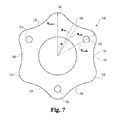
  • FIG. 7 illustrates a front view of an adjustment nut body 700 .
  • a drive train device 100 includes a slip clutch 102 .
  • the slip clutch 102 has an adjustment nut 104 that can be manipulated to adjust the contact forces or normal forces between friction plates 106 and a driven member 108 .
  • the driven member 108 is depicted as a sprocket, but can also take the form of a cog, gearwheel, pinion, sprocket, sheave or other mechanism producing or transferring rotational motion.
  • a hub 110 extends along an axis A, representing the axis of rotation of the device 100 during operation. The hub 110 extends through the adjustment nut 104 , friction plates 106 , driven member 108 , and spring 112 .
  • the spring 112 includes two compression springs 114 stacked one against the other.
  • the spring 112 can have one or more compression springs 114 that apply biasing force toward the adjustment nut 104 .
  • Drive train device 100 includes two friction plates 106 on opposite sides of the driven member 108 .
  • the friction plates 106 include friction discs 116 and pressure plates 118 .
  • the friction discs 116 are disposed between driven member 108 and its corresponding pressure plate 118 .
  • a surface 119 , 120 of the friction discs 116 can be in contact with a respective surface 121 , 122 of the driven member 108 .
  • the surfaces 119 , 120 of the friction discs 116 and surfaces 121 , 122 of the driven member 108 are annular flat surfaces.
  • the surfaces 119 , 120 of the friction discs 116 and surfaces 121 , 122 of the driven member 108 can take different shapes including different complementary annular shapes.
  • the adjustment nut 104 is in contact with one of the friction plates 106 .
  • the adjustment nut 104 includes an adjustment nut body 124 and tensioning members 126 that extend through the adjustment nut body 124 in a direction parallel to the axis A, which direction is also referred to herein as the axial direction.
  • the three tensioning members 126 are axially adjustable with respect to the adjustment nut body 124 and are in contact with the friction plate 106 closer to the nut body 122 .
  • the adjustment nut 104 can be adjustably fixed with respect to hub in the rotational direction and in the axial direction.
  • the adjustment nut 104 can be secured in a particular rotational and axial position with respect to the hub 110 .
  • the adjustment nut 104 rotates with the hub 110 .
  • the hub 110 and driven member 108 rotate at the same speed and when the drive train apparatus 100 is driven at torques having a value under which slippage occurs between the friction plates 106 and driven member 108 .
  • the friction plates 106 can also be rotationally secured to the hub 110 , for example by incorporating a keyed hole through with a complementarily keyed hub 110 is inserted.
  • the keyed hole and hub could prevent rotational motion of the plates 106 with respect to the hub 110 .
  • the depicted driven member 108 remains rotationally free with respect to the hub 110 except for circumstances where the friction plates 106 are in contact with the driven member 108 with sufficient force.
  • a collar can be inserted between the hub 110 and driven member 108 . Like the driven member 108 , the collar can also rotate about the hub 110 freely, or can be rotationally fixed with respect to the hub 110 , for example in a manner similar to the plates 106 .
  • the driven member 108 rotates freely with respect to the hub 110 and intermediate collars.
  • the spring 112 sits between a stop 130 and friction plate 106 .
  • the stop 130 limits the movement of the spring 112 in the axial direction.
  • the stop 130 is depicted including six radial protrusions 132 against which the spring 112 makes contact.
  • the stop 130 supplies the opposing force against the biased spring 112 .
  • a stop according to the present teachings can take other forms, too, such as a flange or other forms of radial protrusions at the end of the hub 110 .
  • the tensioning members 126 are hex-headed threaded bolts that are inserted into threaded holes 140 at the lobes 150 .
  • the lobes 150 accommodate the tensioning members 126 , and their placement, which is further from axis A than the profiled surfaces 160 , allows desired placement of the tensioning members 126 relative to the friction plates 106 while minimizing the overall amount of material in the nut body 124 .
  • the profiled surfaces 160 between the lobes 150 have a reduced radius relative to the lobes 150 .
  • the radially outer surface 170 defines, in part, both the lobes 150 and profiled surfaces 160 .
  • the internal opening 180 of adjustment nut body 124 can be threaded to meet a threaded surface of a hub 110 .
  • the adjustment nut 104 has three lobes 150 extending radially further from the axis of rotation A than the profiled surfaces 160 between the lobes 150 .
  • An adjustment nut 104 according to the present teachings can have two or more lobes 150 , and according to one aspect of the present teachings has at least three lobes 150 .
  • the radially outer surface 170 of the adjustment nut 104 defines the radially outermost location of the nut 104 from the axis A when viewing the nut 104 along the axis A of rotation.
  • the radially outer surface 170 has a maximum distance from the axis of rotation A, R MAX , at the lobes 150 .
  • a line segment from the axis of rotation A through the center of the threaded holes 140 to the point on the outer surface 170 furthest from the axis A measures R MAX .
  • the adjustment nut 104 has the radius R MAX at each of the three lobes 150 .
  • the lobes 150 and the lines labelled R MAX are about circumferentially equidistant from one another, spaced apart by 2 ⁇ /3 radians. The symmetric placement of the lobes 150 , and therefore of the tensioning members 126 , allows for more evenly distributed force applied to the pressure plate 118 .
  • the outer surface 160 defines a shape symmetric over rotations of 2 ⁇ /3 radians about the axis A.
  • the contour formed by the outer surface 170 as viewed along the axis A will appear the same before and after rotation of the nut 104 about A by 2 ⁇ /3 radians.
  • the adjustment nut 104 can have an outer surface 170 having a shape that is n-fold symmetric, appearing the same after rotations of 2 ⁇ /n about the axis of rotation A.
  • the three-fold symmetry of the nut body 124 corresponds to the symmetry over rotations of 2 ⁇ /3.
  • the distance R( ⁇ ) is the radial distance from the axis A to the outer surface 170 at the angle ⁇ measured from the vertical line Z.
  • R( ⁇ ) has a smaller value smaller than R MAX over the entire profiled surface 160 .
  • R( ⁇ ) also has a smaller average value than R MAX over the entire profiled surface 160 , which average value can be determined by integrating the distance R( ⁇ ) over the domain of ⁇ .
  • the profiled surface 160 need not have a distance R( ⁇ ) less than R MAX over the entire profiled surface 160 , but instead can have such a reduced radius surface over at least a portion of the outer surface 170 between the lobes 150 .
  • the lobes 150 extend radially outwardly from the axis A relative to the adjacent profiled surfaces 160 .
  • the adjustment nut 104 has a reduced radius at the profiled surfaces 160 relative to the lobes 150 .
  • the smallest value of R( ⁇ ) over the outer surface 170 is R MIN , which occurs at each of the three profiled surfaces 160 , including where marked by lines R MIN .
  • the lines R MIN are spaced equidistantly from each of the adjacent lines R MAX by an angular distance of ⁇ /3 radians, and equidistantly 2 ⁇ /3 radians from one another.
  • the profiled surface 160 is defined in part by a portion of the outer surface 170 having a fixed radius R( ⁇ ) of R MIN as viewed along axis A over a range of angles ⁇ .
  • the profiled surface 160 has a constant radial distance R MIN from the axis A between the inflections 162 , at which point the radius of the profiled surface 160 begins to increase as it transitions to the lobe 150 . Due to their fixed radius relative to axis A, the profiled surfaces are cylindrically shaped in the region between inflections 162 .
  • Each of the profiled surfaces 160 has a radius R( ⁇ ) of R MIN over a range of about ⁇ /3 radians between adjacent lobes 150 . The total range of the three profiled surfaces 160 totals about ⁇ radians.
  • the profiled surfaces 160 can have a reduced size and volume relative to the lobes 150 by several measures, including but not limited to having an average radius that is less than the peak value of the radius of the adjustment nut body 124 , having an average radius than is less than the average radius of the lobes 150 , having a minimum radius that is less than the peak value of the radius of the adjustment nut body 124 , or having a minimum radius that is less than the average value of the radius of the adjustment nut body 124 at lobes 150 .
  • the profiled surfaces 160 can have a reduced radius relative to an individual lobe 150 or a combined measure of their radii from axis A.
  • the reduction in total material in the nut 104 due to the shape of the profiled surfaces 160 can improve airflow to other components of the slip clutch 102 and allow heat to dissipate more quickly, which can in turn improve longevity of the overall drive train component 100 .
  • the absence of additional material where the profiled surfaces 160 are located permits increased airflow through those regions, which would otherwise be blocked but for the profiled surfaces 160 .
  • a fanning effect is also exhibited as the rotating lobes 150 and profiled surfaces 160 disturb the surrounding air.
  • the lack of non-essential material at the profiled surfaces allows for convective heat dissipation rather than relying primarily on conductive and radiative dissipation.
  • the adjustment nut body 124 can be formed from casting, machining, forging, and forming.
  • the adjustment nut body 124 can be made partially or entirely from powdered metal, which can exhibit greater heat dissipation characteristics than certain solid metals such as cast iron. It should be noted that the adjustment nut body 124 can be made of a variety of materials, including but not limited to powdered or solid cast or machined metals.
  • Assembly of the component 100 can include sliding the spring 112 to stop 130 , and then sliding one of the friction plates 106 onto the hub 110 , whether as an individual unit or separate friction disk 116 and pressure plate 118 , such that the friction disk 116 is contact with the driven member 108 and the pressure plate 118 is in contact with the springs.
  • the friction plates 106 can have a keyed opening complementary to the hub 110 such that the plates 106 are rotationally fixed with respect to the hub 110 .
  • the driven member 108 is then slid over the hub 110 , which can be followed by an additional friction plate 106 , again with the friction disk 116 facing and in contact with the driven member 108 , and the pressure plate 118 on the opposite side of the friction disk 116 relative to the driven member 108 .
  • the adjustment nut 104 is then threaded over the end of the hub 110 , and rotationally secured with setscrew 128 , which can be screwed into an available spline on hub 110 .
  • the nut 104 is also axially fixed due to the threaded interface with hub 110 . Fixed both axially and rotationally, the nut 104 can be adjusted to apply force in the axial direction against springs 112 . By tightening the tensioning members 126 the contact force increases, which increases the frictional force between the intervening components, and in particular between the friction discs 116 and driven member 108 .
  • the nut 104 can be selectively placed along the hub 110 such that the tensioning members 126 can be adjusted, to press on the adjacent friction plate 106 with a desired force. As the tensioning members 126 are adjusted to provide greater or lesser force on the friction plate 106 , the spring 112 on the distal side of the hub 110 applies and equal and opposite force to its respective friction plate 106 .
  • the driven member 108 can then be driven with an appropriate chain or belt, and the entire clutch 102 will rotate, transferring the rotational motion synchronously until a torque higher than the slippage threshold occurs, in which case the clutch will slip until the torque returns to a suitable level.
  • the slippage torque can be increased by tightening the friction plates 106 against the driven member 108 , which can be done by tightening tensioning members 126 .
  • Slippage torque can be decreased by lowering the contact force between the friction plates 106 and the driven member 108 by loosening the tensioning members 126 of the adjustment nut 104 .
  • FIG. 6 depicts an adjustment nut body 600 where the lobes 602 are block shaped protrusions extending further radially from an axis A than any point on adjacent profiled surfaces 604 .
  • Each of the lobes 602 includes an end surface 606 that can be an arcuate surface a constant distance R MAX from axis A, and sides 608 that can be collinear with lines extending from the axis A.
  • the lobes 608 need not be this specific shape and can alternatively be square, rectangular, trapezoidal, or other geometric shapes.
  • Holes 610 permit insertion of tensioning members such as members 126 at the lobes 602 .
  • the profiled surfaces 604 are cylindrical in shape, having a radius of R MIN measured from axis A over the entirety of each profiled surface 604 .
  • the profiled surfaces 604 need not be so shaped, and could take other shapes, such as other curved shapes having a variable distance R( ⁇ ) smaller than R MAX between the lobes 602 .
  • the lobes 602 and profiled surfaces 604 depicted in FIG. 6 are clearly demarcated, with the profiled surface 604 ending at the sides 608 , at which point the lobes 602 begin. However, the division between profiled surfaces 604 and lobes 602 need not be so clearly demarked.
  • a transition surface 190 can bridge the area between and overlap with profiled surfaces and lobes, such as profiled surfaces 160 and lobes 150 .
  • lobes such as lobes 602 can be configured to hold more than one tension member 126 .
  • another adjustment nut 700 includes three lobes 702 , each having a hole 704 for insertion of a tensioning member such as member 126 .
  • Profiled surfaces 706 and protrusions 708 are found between the lobes 702 and are defined at least in part by radially outer surface 710 .
  • the lobes 702 extend outwardly from adjacent profiled surfaces 706 and have a maximum radius R( ⁇ ) of R LOBE .
  • the profiled surfaces 706 have a radius R( ⁇ ) that is less than R LOBE , including where the radius is R MIN , the minimum distance from axis A to the outer surface 710 .
  • the profiled surfaces 706 are interrupted by protrusions 708 that extend outwardly by a maximum distance R PROT , which distance can be less than, equal to or be greater than R LOBE . As shown in FIG. 7 , two profiled surfaces 706 can be found between lobes 702 with a reduced radius relative to an adjacent lobe 702 . Moreover, according to the present teachings, two or more profiled surfaces, such as profiled surfaces 706 , can be found between lobes, such as lobes 702 , with a reduced radius relative to a lobe.
  • adjustment nut 104 provided increased airflow relative to prior designs, which did not include profiled surfaces 160 but instead had an annularly shaped adjustment nut with a generally cylindrical outer surfaces. Further, use of the nut 104 resulted in lower operating temperatures measured at the friction plates 106 , in one case reducing operating temperature from 147° to 116° Fahrenheit.

Landscapes

  • Engineering & Computer Science (AREA)
  • General Engineering & Computer Science (AREA)
  • Mechanical Engineering (AREA)
  • Mechanical Operated Clutches (AREA)

Abstract

A slip clutch includes a driven member, a spring, at least one friction plate interfacing with the driven member and an adjustment nut. The friction plate is pressed against the driven member through the combination of the spring and adjustment nut. The adjustment nut has multiple lobes and profiled surfaces between the lobes having a smaller radius from the axis of rotation of the clutch than the lobes. A hub extends along the axis through the driven member, spring, friction plate, and adjustment nut. The adjustment nut is rotationally fixed with respect to the hub and has a reduced profile to improve airflow to other components of the slip clutch.

Description

FIELD OF INVENTION
This disclosure concerns torque limiting devices, and in particular drive shaft mounted slip clutch or safety clutch devices.
BACKGROUND
Slip clutches, also termed safety clutches or torque limiters, allow for transmission of maximum allowable torques and also protect the drivetrain by slipping when excessively high torques are encountered. Under normal operation, a slip clutch mounted to a driving shaft can transfer torque between a motor and the equipment coupled to the drive shaft. When the equipment enters a mode of operation where excessive torque is experienced, for example when the equipment becomes jammed with a foreign objects or during intermittent torque overload conditions, the slip clutch decouples the movement of the motor from the drive shaft, and in the process protects the entire mechanism from transferring undesirably high torques and damaging the motor, drive shaft and other elements of the drive train. An example of such a slip clutch is the Baldor-DODGE TORQUE-TAMER™.
Heat is typically produced in the clutch during slippage. With increased heat, the clutch can break down faster. Further, the operation of such slip clutches depends on the coefficient of friction between components of the clutch that transfer motion. The coefficient of friction itself has temperature dependency, such that at higher temperatures, the clutch may slip at different torques than it would at lower temperatures. Heat dissipation is limited, in part, by lack of airflow through the clutch mechanism.
SUMMARY OF THE INVENTION
A slip clutch includes a driven member, a spring, at least one friction plate interfacing with the driven member and an adjustment nut. The friction plate is pressed against the driven member through the combination of the spring and adjustment nut. The adjustment nut has multiple lobes and profiled surfaces between the lobes having a smaller radius from the axis of rotation of the clutch than the lobes. A hub extends along the axis through the driven member, spring, friction plate, and adjustment nut. The adjustment nut is rotationally fixed with respect to the hub.
BRIEF DESCRIPTION OF THE DRAWINGS
In the accompanying drawings, structures and methods are illustrated that, together with the detailed description provided below, describe aspects of a profiled adjustment nut. It will be noted that a single component may be implemented as multiple components or that multiple components may be implemented as a single component. The figures are not drawn to scale and the proportions of certain parts have been exaggerated for convenience of illustration. Further, in the accompanying drawings and description that follow, like parts are indicated throughout the drawings and written description with the same reference numerals, respectively.
FIG. 1 illustrates a perspective view of the drive train apparatus 100.
FIG. 2 illustrates a side view of apparatus 100.
FIG. 3 illustrates a second perspective view of the drive train apparatus 100.
FIG. 4 illustrates an exploded view of adjustment nut 104.
FIG. 5 illustrates a front view of adjustment nut body 124.
FIG. 6 illustrates a front view of an adjustment nut body 600.
FIG. 7 illustrates a front view of an adjustment nut body 700.
DETAILED DESCRIPTION
With reference to FIGS. 1 through 3, a drive train device 100 includes a slip clutch 102. The slip clutch 102 has an adjustment nut 104 that can be manipulated to adjust the contact forces or normal forces between friction plates 106 and a driven member 108. The driven member 108 is depicted as a sprocket, but can also take the form of a cog, gearwheel, pinion, sprocket, sheave or other mechanism producing or transferring rotational motion. A hub 110 extends along an axis A, representing the axis of rotation of the device 100 during operation. The hub 110 extends through the adjustment nut 104, friction plates 106, driven member 108, and spring 112. The spring 112 includes two compression springs 114 stacked one against the other. The spring 112 can have one or more compression springs 114 that apply biasing force toward the adjustment nut 104. Drive train device 100 includes two friction plates 106 on opposite sides of the driven member 108. The friction plates 106 include friction discs 116 and pressure plates 118. The friction discs 116 are disposed between driven member 108 and its corresponding pressure plate 118. A surface 119, 120 of the friction discs 116 can be in contact with a respective surface 121, 122 of the driven member 108. In the depicted device the surfaces 119, 120 of the friction discs 116 and surfaces 121, 122 of the driven member 108 are annular flat surfaces. However, the surfaces 119, 120 of the friction discs 116 and surfaces 121, 122 of the driven member 108 can take different shapes including different complementary annular shapes.
The adjustment nut 104 is in contact with one of the friction plates 106. The adjustment nut 104 includes an adjustment nut body 124 and tensioning members 126 that extend through the adjustment nut body 124 in a direction parallel to the axis A, which direction is also referred to herein as the axial direction. The three tensioning members 126 are axially adjustable with respect to the adjustment nut body 124 and are in contact with the friction plate 106 closer to the nut body 122. The adjustment nut 104 can be adjustably fixed with respect to hub in the rotational direction and in the axial direction. For example, by selectively loosening or tightening a setscrew 128 that can engage the hub 110, the adjustment nut 104 can be secured in a particular rotational and axial position with respect to the hub 110. When fixed to the hub 110 in this way, the adjustment nut 104 rotates with the hub 110. The hub 110 and driven member 108 rotate at the same speed and when the drive train apparatus 100 is driven at torques having a value under which slippage occurs between the friction plates 106 and driven member 108.
The friction plates 106 can also be rotationally secured to the hub 110, for example by incorporating a keyed hole through with a complementarily keyed hub 110 is inserted. The keyed hole and hub could prevent rotational motion of the plates 106 with respect to the hub 110. The depicted driven member 108 remains rotationally free with respect to the hub 110 except for circumstances where the friction plates 106 are in contact with the driven member 108 with sufficient force. A collar can be inserted between the hub 110 and driven member 108. Like the driven member 108, the collar can also rotate about the hub 110 freely, or can be rotationally fixed with respect to the hub 110, for example in a manner similar to the plates 106. The driven member 108 rotates freely with respect to the hub 110 and intermediate collars.
The spring 112 sits between a stop 130 and friction plate 106. The stop 130 limits the movement of the spring 112 in the axial direction. The stop 130 is depicted including six radial protrusions 132 against which the spring 112 makes contact. The stop 130 supplies the opposing force against the biased spring 112. A stop according to the present teachings can take other forms, too, such as a flange or other forms of radial protrusions at the end of the hub 110. When the spring 112 is in contact with the stop 130, pressing the spring toward the stop 130 in the axial direction increases the biasing force of the spring in the direction of the adjustment nut 104.
With regard to FIG. 4, the tensioning members 126 are hex-headed threaded bolts that are inserted into threaded holes 140 at the lobes 150. The lobes 150 accommodate the tensioning members 126, and their placement, which is further from axis A than the profiled surfaces 160, allows desired placement of the tensioning members 126 relative to the friction plates 106 while minimizing the overall amount of material in the nut body 124. The profiled surfaces 160 between the lobes 150 have a reduced radius relative to the lobes 150. The radially outer surface 170 defines, in part, both the lobes 150 and profiled surfaces 160. The internal opening 180 of adjustment nut body 124 can be threaded to meet a threaded surface of a hub 110.
With reference to FIG. 5, the adjustment nut 104 has three lobes 150 extending radially further from the axis of rotation A than the profiled surfaces 160 between the lobes 150. An adjustment nut 104 according to the present teachings can have two or more lobes 150, and according to one aspect of the present teachings has at least three lobes 150. The radially outer surface 170 of the adjustment nut 104 defines the radially outermost location of the nut 104 from the axis A when viewing the nut 104 along the axis A of rotation. The radially outer surface 170 has a maximum distance from the axis of rotation A, RMAX, at the lobes 150. In particular, a line segment from the axis of rotation A through the center of the threaded holes 140 to the point on the outer surface 170 furthest from the axis A measures RMAX. The adjustment nut 104 has the radius RMAX at each of the three lobes 150. The lobes 150 and the lines labelled RMAX are about circumferentially equidistant from one another, spaced apart by 2π/3 radians. The symmetric placement of the lobes 150, and therefore of the tensioning members 126, allows for more evenly distributed force applied to the pressure plate 118.
As seen in FIG. 5, viewed along the axis A the outer surface 160 defines a shape symmetric over rotations of 2π/3 radians about the axis A. Thus, the contour formed by the outer surface 170 as viewed along the axis A will appear the same before and after rotation of the nut 104 about A by 2π/3 radians. According to one aspect of the present teachings, the adjustment nut 104 can have an outer surface 170 having a shape that is n-fold symmetric, appearing the same after rotations of 2π/n about the axis of rotation A. In the illustrated case, the three-fold symmetry of the nut body 124 corresponds to the symmetry over rotations of 2π/3.
With continued reference to FIG. 5, the distance R(Θ) is the radial distance from the axis A to the outer surface 170 at the angle Θ measured from the vertical line Z. R(Θ) has a smaller value smaller than RMAX over the entire profiled surface 160. R(Θ) also has a smaller average value than RMAX over the entire profiled surface 160, which average value can be determined by integrating the distance R(Θ) over the domain of Θ. It should be noted that the profiled surface 160 need not have a distance R(Θ) less than RMAX over the entire profiled surface 160, but instead can have such a reduced radius surface over at least a portion of the outer surface 170 between the lobes 150.
The lobes 150 extend radially outwardly from the axis A relative to the adjacent profiled surfaces 160. The adjustment nut 104 has a reduced radius at the profiled surfaces 160 relative to the lobes 150. The smallest value of R(Θ) over the outer surface 170 is RMIN, which occurs at each of the three profiled surfaces 160, including where marked by lines RMIN. The lines RMIN are spaced equidistantly from each of the adjacent lines RMAX by an angular distance of π/3 radians, and equidistantly 2π/3 radians from one another. The profiled surface 160 is defined in part by a portion of the outer surface 170 having a fixed radius R(Θ) of RMIN as viewed along axis A over a range of angles Θ. The profiled surface 160 has a constant radial distance RMIN from the axis A between the inflections 162, at which point the radius of the profiled surface 160 begins to increase as it transitions to the lobe 150. Due to their fixed radius relative to axis A, the profiled surfaces are cylindrically shaped in the region between inflections 162. Each of the profiled surfaces 160 has a radius R(Θ) of RMIN over a range of about π/3 radians between adjacent lobes 150. The total range of the three profiled surfaces 160 totals about π radians.
The profiled surfaces 160 can have a reduced size and volume relative to the lobes 150 by several measures, including but not limited to having an average radius that is less than the peak value of the radius of the adjustment nut body 124, having an average radius than is less than the average radius of the lobes 150, having a minimum radius that is less than the peak value of the radius of the adjustment nut body 124, or having a minimum radius that is less than the average value of the radius of the adjustment nut body 124 at lobes 150. For lobes 150 having different heights, the profiled surfaces 160 can have a reduced radius relative to an individual lobe 150 or a combined measure of their radii from axis A.
The reduction in total material in the nut 104 due to the shape of the profiled surfaces 160 can improve airflow to other components of the slip clutch 102 and allow heat to dissipate more quickly, which can in turn improve longevity of the overall drive train component 100. The absence of additional material where the profiled surfaces 160 are located permits increased airflow through those regions, which would otherwise be blocked but for the profiled surfaces 160. During rotation, a fanning effect is also exhibited as the rotating lobes 150 and profiled surfaces 160 disturb the surrounding air. The lack of non-essential material at the profiled surfaces allows for convective heat dissipation rather than relying primarily on conductive and radiative dissipation. The adjustment nut body 124 can be formed from casting, machining, forging, and forming. The adjustment nut body 124 can be made partially or entirely from powdered metal, which can exhibit greater heat dissipation characteristics than certain solid metals such as cast iron. It should be noted that the adjustment nut body 124 can be made of a variety of materials, including but not limited to powdered or solid cast or machined metals.
Assembly of the component 100 can include sliding the spring 112 to stop 130, and then sliding one of the friction plates 106 onto the hub 110, whether as an individual unit or separate friction disk 116 and pressure plate 118, such that the friction disk 116 is contact with the driven member 108 and the pressure plate 118 is in contact with the springs. The friction plates 106 can have a keyed opening complementary to the hub 110 such that the plates 106 are rotationally fixed with respect to the hub 110. The driven member 108 is then slid over the hub 110, which can be followed by an additional friction plate 106, again with the friction disk 116 facing and in contact with the driven member 108, and the pressure plate 118 on the opposite side of the friction disk 116 relative to the driven member 108. The adjustment nut 104 is then threaded over the end of the hub 110, and rotationally secured with setscrew 128, which can be screwed into an available spline on hub 110. Once rotationally fixed, the nut 104 is also axially fixed due to the threaded interface with hub 110. Fixed both axially and rotationally, the nut 104 can be adjusted to apply force in the axial direction against springs 112. By tightening the tensioning members 126 the contact force increases, which increases the frictional force between the intervening components, and in particular between the friction discs 116 and driven member 108. The nut 104 can be selectively placed along the hub 110 such that the tensioning members 126 can be adjusted, to press on the adjacent friction plate 106 with a desired force. As the tensioning members 126 are adjusted to provide greater or lesser force on the friction plate 106, the spring 112 on the distal side of the hub 110 applies and equal and opposite force to its respective friction plate 106. The driven member 108 can then be driven with an appropriate chain or belt, and the entire clutch 102 will rotate, transferring the rotational motion synchronously until a torque higher than the slippage threshold occurs, in which case the clutch will slip until the torque returns to a suitable level. The slippage torque can be increased by tightening the friction plates 106 against the driven member 108, which can be done by tightening tensioning members 126. Slippage torque can be decreased by lowering the contact force between the friction plates 106 and the driven member 108 by loosening the tensioning members 126 of the adjustment nut 104.
The lobes 150 and profiled surfaces 160 of an adjustment nut 104 can both take different shapes than that depicted in FIGS. 1-5. As just one non-limiting example, FIG. 6 depicts an adjustment nut body 600 where the lobes 602 are block shaped protrusions extending further radially from an axis A than any point on adjacent profiled surfaces 604. Each of the lobes 602 includes an end surface 606 that can be an arcuate surface a constant distance RMAX from axis A, and sides 608 that can be collinear with lines extending from the axis A. The lobes 608 need not be this specific shape and can alternatively be square, rectangular, trapezoidal, or other geometric shapes. Holes 610 permit insertion of tensioning members such as members 126 at the lobes 602. The profiled surfaces 604 are cylindrical in shape, having a radius of RMIN measured from axis A over the entirety of each profiled surface 604. The profiled surfaces 604 need not be so shaped, and could take other shapes, such as other curved shapes having a variable distance R(Θ) smaller than RMAX between the lobes 602. The lobes 602 and profiled surfaces 604 depicted in FIG. 6 are clearly demarcated, with the profiled surface 604 ending at the sides 608, at which point the lobes 602 begin. However, the division between profiled surfaces 604 and lobes 602 need not be so clearly demarked. For example, a transition surface 190, as shown in FIGS. 1-5 can bridge the area between and overlap with profiled surfaces and lobes, such as profiled surfaces 160 and lobes 150. In addition, lobes such as lobes 602 can be configured to hold more than one tension member 126.
With reference to FIG. 7, another adjustment nut 700 according to the present teachings includes three lobes 702, each having a hole 704 for insertion of a tensioning member such as member 126. Profiled surfaces 706 and protrusions 708 are found between the lobes 702 and are defined at least in part by radially outer surface 710. The lobes 702 extend outwardly from adjacent profiled surfaces 706 and have a maximum radius R(Θ) of RLOBE. The profiled surfaces 706 have a radius R(Θ) that is less than RLOBE, including where the radius is RMIN, the minimum distance from axis A to the outer surface 710. The profiled surfaces 706 are interrupted by protrusions 708 that extend outwardly by a maximum distance RPROT, which distance can be less than, equal to or be greater than RLOBE. As shown in FIG. 7, two profiled surfaces 706 can be found between lobes 702 with a reduced radius relative to an adjacent lobe 702. Moreover, according to the present teachings, two or more profiled surfaces, such as profiled surfaces 706, can be found between lobes, such as lobes 702, with a reduced radius relative to a lobe.
Testing of clutch 102 assembly including an adjustment nut such as nut 104 formed from cast iron concluded that adjustment nut 104 provided increased airflow relative to prior designs, which did not include profiled surfaces 160 but instead had an annularly shaped adjustment nut with a generally cylindrical outer surfaces. Further, use of the nut 104 resulted in lower operating temperatures measured at the friction plates 106, in one case reducing operating temperature from 147° to 116° Fahrenheit.
Unless otherwise specified, “a” or “an” means “one or more.” To the extent that the term “includes” or “including” is used, it is intended to be inclusive in a manner similar to the term “comprising” as that term is interpreted when employed as a transitional word in a claim. The term “or” (e.g., A or B) means “A or B or both.” When the applicants intend to indicate “only A or B but not both” then the term “only A or B but not both” will be employed. As used herein, “about” will be understood by persons of ordinary skill in the art and will vary to some extent depending upon the context in which it is used. If there are uses of the term which are not clear to persons of ordinary skill in the art, given the context in which it is used, “about” will mean up to plus or minus 10% of the particular term. From about A to B is intended to mean from about A to about B, where A and B are the specified values.
The description of various embodiments and the details of those embodiments is illustrative and is not intended to restrict or in any way limit the scope of the claimed invention to those embodiments and details. Additional advantages and modifications will be apparent to those skilled in the art. Therefore, the invention, in its broader aspects, is not limited to the specific details and illustrative examples shown and described. Accordingly, departures may be made from such details without departing from the spirit or scope of the applicant's claimed invention.

Claims (15)

The invention claimed is:
1. A slip clutch apparatus comprising:
a driven member;
a spring;
at least one friction plate in contact with the driven member;
an adjustment nut in contact with the at least one friction plate, the adjustment nut having a plurality of lobes and a plurality of profiled surfaces between the lobes, the adjustment nut being rotatable about an axis of rotation; and,
a hub extending along the axis of rotation through the driven member, the spring, the friction plate and adjustment nut, the adjustment nut rotationally fixed with respect to the hub, wherein the adjustment nut includes an adjustment nut body and at least one tensioning member extending from the adjustment nut body along the axis of rotation in contact with the at least on friction plate, the at least one tensioning member being axially adjustable relative to the adjustment nut body to provide greater or lesser force between the at least one friction plate and the driven member.
2. The slip clutch apparatus of claim 1, wherein at least one tensioning member is disposed at each of the plurality of lobes.
3. The slip clutch apparatus of claim 1, wherein the adjustment nut has a maximum radial distance from the axis of rotation at one or more of the lobes, the profiled surfaces having a smaller radial distance from the axis of rotation than the maximum radial distance.
4. The slip clutch apparatus of claim 3, wherein the adjustment nut has three lobes.
5. The slip clutch apparatus of claim 1, wherein the adjustment nut has three lobes.
6. The slip clutch apparatus of claim 1, wherein the plurality of lobes are disposed circumferentially equidistantly about the adjustment nut body.
7. The slip clutch apparatus of claim 1, wherein the adjustment nut has a maximum radial distance from the axis of rotation at each of the lobes, the profiled surfaces having a smaller radial distance from the axis of rotation than the maximum radial distance.
8. The slip clutch apparatus of claim 1, wherein the plurality of profiled surfaces include cylindrical portions having a constant radial distance from the axis of rotation.
9. The slip clutch apparatus of claim 1, further comprising:
a first friction plate and a second friction plate each having a friction surface in contact with the driven member, and,
a first surface and a second surface of the driven member wherein the friction surface of the first friction plate is in contact with the first surface, the friction surface of the second friction plate is in contact with the second surface, and wherein the adjustment nut is in biasing contact with the first friction plate.
10. The slip clutch apparatus of claim 1, wherein the spring biases the driven member and adjustment nut against the friction plate.
11. The slip clutch apparatus of claim 10, wherein the spring biases the driven member with enough force to rotate the hub synchronously with the driven member up to a slip torque.
12. The slip clutch apparatus of claim 1, wherein the adjustment nut includes an adjustment nut body that is made from a powdered metal.
13. The slip clutch apparatus of claim 12, wherein the adjustment nut body is made entirely from powdered metal.
14. The slip clutch apparatus of claim 1, wherein the at least one tensioning member is threadingly engaged with the adjustment nut body.
15. The slip clutch apparatus of claim 14, wherein the at least one tensioning member is a hex-headed threaded bolt.
US14/874,552 2015-10-05 2015-10-05 Profiled adjustment nut Expired - Fee Related US9845830B2 (en)

Priority Applications (1)

Application Number Priority Date Filing Date Title
US14/874,552 US9845830B2 (en) 2015-10-05 2015-10-05 Profiled adjustment nut

Applications Claiming Priority (1)

Application Number Priority Date Filing Date Title
US14/874,552 US9845830B2 (en) 2015-10-05 2015-10-05 Profiled adjustment nut

Publications (2)

Publication Number Publication Date
US20170097050A1 US20170097050A1 (en) 2017-04-06
US9845830B2 true US9845830B2 (en) 2017-12-19

Family

ID=58446703

Family Applications (1)

Application Number Title Priority Date Filing Date
US14/874,552 Expired - Fee Related US9845830B2 (en) 2015-10-05 2015-10-05 Profiled adjustment nut

Country Status (1)

Country Link
US (1) US9845830B2 (en)

Citations (5)

* Cited by examiner, † Cited by third party
Publication number Priority date Publication date Assignee Title
US2753703A (en) * 1953-05-25 1956-07-10 Morse Chain Co Clutch with slip indicating device
US2939301A (en) * 1959-03-09 1960-06-07 Int Harvester Co Warning device
US3111824A (en) * 1961-10-30 1963-11-26 Dodge Mfg Corp Torque limiting mechanism
US3605443A (en) * 1969-08-04 1971-09-20 Interlake Steel Corp Torque limiter
US20150114785A1 (en) * 2013-10-28 2015-04-30 Gkn Driveline International Gmbh Plate carrier

Patent Citations (5)

* Cited by examiner, † Cited by third party
Publication number Priority date Publication date Assignee Title
US2753703A (en) * 1953-05-25 1956-07-10 Morse Chain Co Clutch with slip indicating device
US2939301A (en) * 1959-03-09 1960-06-07 Int Harvester Co Warning device
US3111824A (en) * 1961-10-30 1963-11-26 Dodge Mfg Corp Torque limiting mechanism
US3605443A (en) * 1969-08-04 1971-09-20 Interlake Steel Corp Torque limiter
US20150114785A1 (en) * 2013-10-28 2015-04-30 Gkn Driveline International Gmbh Plate carrier

Non-Patent Citations (2)

* Cited by examiner, † Cited by third party
Title
Excerpt titled "Features/Benefits; Torque-Tamer" from Baldor-Dodge 2010 PT Components Engineering Catalog; Baldor Electric Company; Aug. 2010.
Instruction Manual for Torque-Tamer(TM); Baldor Electric Company; Mar. 2011.

Also Published As

Publication number Publication date
US20170097050A1 (en) 2017-04-06

Similar Documents

Publication Publication Date Title
EP2984359B1 (en) Isolator decoupler
KR101643029B1 (en) Pulley with asymmetric torque-sensitive clutching
CA2723044A1 (en) Pulley with torque-sensitive clutching
CN203702922U (en) Diagonal bracing type overrun clutch, coupler, hinge and transmission wheel
US6958025B2 (en) Belt tensioner for use with torque converter
EP2938897B1 (en) Torque limiting assembly
US20140113732A1 (en) Power Transmission Device And Compressor Equipped With Power Transmission Device
US9845830B2 (en) Profiled adjustment nut
EP2971833B1 (en) Accessory drive decoupler
US8978856B2 (en) Over-torque protector device for a compressor
US20130192950A1 (en) Raised bearing surface clutch friction plate machine
CN209654464U (en) A kind of antioverloading shaft coupling
US11708886B2 (en) Single spring, torsionally compliant, overrunning decoupler
CN1231649A (en) Overload Clutch Device
JP6393540B2 (en) One-way clutch
CN212202904U (en) Locking strip for limiting torque
EP2707626B1 (en) Improved over-torque protector device for a compressor
CN105736592A (en) Frictional coupler
JP4196967B2 (en) Power transmission mechanism
US7578759B2 (en) Torque limiting mechanism
US9488232B1 (en) Externally adjustable clutch
US2569593A (en) Clutch head
CN111486184A (en) Locking strip for limiting torque
JP2022030900A (en) Torque limit structure and transmission
EP3208479B1 (en) Vehicle driveline coupling

Legal Events

Date Code Title Description
AS Assignment

Owner name: ABB TECHNOLOGY AG, SWITZERLAND

Free format text: ASSIGNMENT OF ASSIGNORS INTEREST;ASSIGNORS:VITOU, ALEXANDER BRIAN;KUCKHOFF, THOMAS ERIC;REEL/FRAME:038447/0847

Effective date: 20150831

AS Assignment

Owner name: ABB SCHWEIZ AG, SWITZERLAND

Free format text: MERGER;ASSIGNOR:ABB TECHNOLOGY LTD.;REEL/FRAME:040621/0853

Effective date: 20160509

STCF Information on status: patent grant

Free format text: PATENTED CASE

MAFP Maintenance fee payment

Free format text: PAYMENT OF MAINTENANCE FEE, 4TH YEAR, LARGE ENTITY (ORIGINAL EVENT CODE: M1551); ENTITY STATUS OF PATENT OWNER: LARGE ENTITY

Year of fee payment: 4

AS Assignment

Owner name: DODGE ACQUISITION CO., CONNECTICUT

Free format text: ASSIGNMENT OF ASSIGNORS INTEREST;ASSIGNORS:ABB SCHWEIZ AG;ABB MOTORS AND MECHANICAL INC.;ABB ASEA BROWN BOVERI LTD;REEL/FRAME:058001/0201

Effective date: 20211101

Owner name: DODGE ACQUISITION CO., CONNECTICUT

Free format text: ASSIGNMENT OF ASSIGNOR'S INTEREST;ASSIGNORS:ABB SCHWEIZ AG;ABB MOTORS AND MECHANICAL INC.;ABB ASEA BROWN BOVERI LTD;REEL/FRAME:058001/0201

Effective date: 20211101

AS Assignment

Owner name: WELLS FARGO BANK, NATIONAL ASSOCIATION, AS COLLATERAL AGENT, COLORADO

Free format text: SECURITY INTEREST;ASSIGNOR:DODGE ACQUISITION CO.;REEL/FRAME:058099/0286

Effective date: 20211101

AS Assignment

Owner name: DODGE INDUSTRIAL, INC., CONNECTICUT

Free format text: ASSIGNMENT OF ASSIGNORS INTEREST;ASSIGNORS:ABB SCHWEIZ AG;ABB ASEA BROWN BOVERI LTD;ABB MOTORS AND MECHANICAL INC.;AND OTHERS;SIGNING DATES FROM 20220308 TO 20220322;REEL/FRAME:059859/0375

Owner name: DODGE INDUSTRIAL, INC., CONNECTICUT

Free format text: ASSIGNMENT OF ASSIGNOR'S INTEREST;ASSIGNORS:ABB SCHWEIZ AG;ABB ASEA BROWN BOVERI LTD;ABB MOTORS AND MECHANICAL INC.;AND OTHERS;SIGNING DATES FROM 20220308 TO 20220322;REEL/FRAME:059859/0375

FEPP Fee payment procedure

Free format text: MAINTENANCE FEE REMINDER MAILED (ORIGINAL EVENT CODE: REM.); ENTITY STATUS OF PATENT OWNER: LARGE ENTITY

LAPS Lapse for failure to pay maintenance fees

Free format text: PATENT EXPIRED FOR FAILURE TO PAY MAINTENANCE FEES (ORIGINAL EVENT CODE: EXP.); ENTITY STATUS OF PATENT OWNER: LARGE ENTITY

STCH Information on status: patent discontinuation

Free format text: PATENT EXPIRED DUE TO NONPAYMENT OF MAINTENANCE FEES UNDER 37 CFR 1.362