US9835176B2 - Fan inlet air handling apparatus and methods - Google Patents
Fan inlet air handling apparatus and methods Download PDFInfo
- Publication number
- US9835176B2 US9835176B2 US14/245,947 US201414245947A US9835176B2 US 9835176 B2 US9835176 B2 US 9835176B2 US 201414245947 A US201414245947 A US 201414245947A US 9835176 B2 US9835176 B2 US 9835176B2
- Authority
- US
- United States
- Prior art keywords
- fan
- flow
- latticed
- per
- proximal
- Prior art date
- Legal status (The legal status is an assumption and is not a legal conclusion. Google has not performed a legal analysis and makes no representation as to the accuracy of the status listed.)
- Active, expires
Links
Images





Classifications
-
- F—MECHANICAL ENGINEERING; LIGHTING; HEATING; WEAPONS; BLASTING
- F04—POSITIVE - DISPLACEMENT MACHINES FOR LIQUIDS; PUMPS FOR LIQUIDS OR ELASTIC FLUIDS
- F04D—NON-POSITIVE-DISPLACEMENT PUMPS
- F04D29/00—Details, component parts, or accessories
- F04D29/66—Combating cavitation, whirls, noise, vibration or the like; Balancing
- F04D29/661—Combating cavitation, whirls, noise, vibration or the like; Balancing especially adapted for elastic fluid pumps
- F04D29/663—Sound attenuation
- F04D29/665—Sound attenuation by means of resonance chambers or interference
-
- F—MECHANICAL ENGINEERING; LIGHTING; HEATING; WEAPONS; BLASTING
- F04—POSITIVE - DISPLACEMENT MACHINES FOR LIQUIDS; PUMPS FOR LIQUIDS OR ELASTIC FLUIDS
- F04D—NON-POSITIVE-DISPLACEMENT PUMPS
- F04D29/00—Details, component parts, or accessories
- F04D29/66—Combating cavitation, whirls, noise, vibration or the like; Balancing
- F04D29/661—Combating cavitation, whirls, noise, vibration or the like; Balancing especially adapted for elastic fluid pumps
- F04D29/663—Sound attenuation
-
- F—MECHANICAL ENGINEERING; LIGHTING; HEATING; WEAPONS; BLASTING
- F04—POSITIVE - DISPLACEMENT MACHINES FOR LIQUIDS; PUMPS FOR LIQUIDS OR ELASTIC FLUIDS
- F04D—NON-POSITIVE-DISPLACEMENT PUMPS
- F04D29/00—Details, component parts, or accessories
- F04D29/66—Combating cavitation, whirls, noise, vibration or the like; Balancing
- F04D29/661—Combating cavitation, whirls, noise, vibration or the like; Balancing especially adapted for elastic fluid pumps
- F04D29/667—Combating cavitation, whirls, noise, vibration or the like; Balancing especially adapted for elastic fluid pumps by influencing the flow pattern, e.g. suppression of turbulence
-
- F—MECHANICAL ENGINEERING; LIGHTING; HEATING; WEAPONS; BLASTING
- F04—POSITIVE - DISPLACEMENT MACHINES FOR LIQUIDS; PUMPS FOR LIQUIDS OR ELASTIC FLUIDS
- F04D—NON-POSITIVE-DISPLACEMENT PUMPS
- F04D29/00—Details, component parts, or accessories
- F04D29/70—Suction grids; Strainers; Dust separation; Cleaning
- F04D29/701—Suction grids; Strainers; Dust separation; Cleaning especially adapted for elastic fluid pumps
- F04D29/703—Suction grids; Strainers; Dust separation; Cleaning especially adapted for elastic fluid pumps specially for fans, e.g. fan guards
Definitions
- Fans whether applied in an industrial, residential, or other setting, generate noise during operation. Not only can a motor powering a fan generate noise, but the interaction of the air moved by the fan with the fan blades (e.g., the impact between the air and the fan blades), can also generate noise. At times, fan noise is not problematic—for example, even significant amounts of noise in an industrial setting may be of no concern. But at other times, and perhaps in other applications, fan noise is problematic, and a reduction, or attenuation thereof, may afford benefits to those in the area of the fan. More particularly, those within “aural” range of the fan may find a reduction in fan noise reduces disturbance caused by the fan.
- Benefits other than human disturbance mitigation may also flow from reduction, or even elimination of fan noise—improvement in security (certain applications may benefit if individuals are not given aural clues as to the location of a fan (and perhaps equipment it may cool) and/or when it turns on and off); and mitigation of disturbance to wildlife and/or animals.
- reducing which includes eliminating
- fan noise achieved by embodiments of the inventive technology.
- inventive technology disclosed herein does not focus on reduction of fan motor generated noise, but instead on reduction of that component of fan noise that is attributable to the movement of air by the fan blades (e.g., by the impact of the air with the fan blades).
- fan may include, but is not limited to, the fan blades, and any motor, casing or housing therefor, in addition to inlet cones.
- the overall fan inlet flow may have a greater component thereof that is parallel with the fan rotation axis.
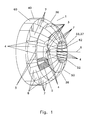
- FIG. 1 shows a perspective view of an embodiment of the inventive technology, from outside of it, unattached to a fan.
- FIG. 2 shows a perspective view of an embodiment of the inventive technology, from below it, unattached to a fan.
- FIG. 3 shows a perspective view of an embodiment of the inventive technology attached to a fan.
- FIG. 4 shows a perspective view of an embodiment of the inventive technology.
- FIG. 5 shows a perspective view of an embodiment of the inventive technology attached to a fan.
- FIG. 6 shows a side view of an embodiment of the inventive technology (note that only the outer surface thereof is shown).
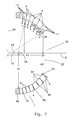
- FIG. 7 shows a cross-sectional view (in a plane that contains the axis of fan rotation) of an embodiment of the inventive technology. Note that, for clarity purposes, acoustic material is shown only on the lower half of the cross-sectional view.
- FIG. 8 shows a view from outside of a shroud of two cells as they may appear in an embodiment of the inventive technology.
- FIG. 9A shows a cross-sectional view (in a plane that is orthogonal to the axis of fan rotation) of an embodiment of the inventive technology. It shows radial direction flow deflectors, and vectors of re-directed flow (realigned flow) as compared with flow vectors of flow as it would appear in the absence of the inventive apparatus; vectors start at the innermost point of the deflectors.
- FIG. 9B shows a cross-sectional view (in a plane that is orthogonal to the axis of fan rotation) of an embodiment of the inventive technology. It shows radial direction flow deflectors that are curved, and vectors of re-directed flow (realigned flow) as compared with flow vectors of flow as it would appear in the absence of the inventive apparatus; vectors start at the innermost point of the deflectors.
- FIG. 9C shows a cross-sectional view (in a plane that is orthogonal to the axis of fan rotation) of an embodiment of the inventive technology. Note that even these entirely radially aligned structures may serve to better align (make “more radial”) flow that exhibits swirl.
- FIG. 10 shows a fan. It is an example of one of the many different types and designs of fans to which the inventive technology may be applied.
- FIG. 11 shows a graph of fan efficiency observed with one embodiment of the inventive technology used on a fan.
- FIG. 12 shows a graph of fan static pressure observed with one embodiment of the inventive technology used on a fan.
- FIG. 13 shows a graph of the amount of noise reduction (for both high and low flow) effected upon use of an embodiment of the inventive technology used on a fan.
- the present invention includes a variety of aspects, which may be combined in different ways.
- the following descriptions are provided to list elements and describe some of the embodiments of the present invention. These elements are listed with initial embodiments, however it should be understood that they may be combined in any manner and in any number to create additional embodiments.
- the variously described examples and preferred embodiments should not be construed to limit the present invention to only the explicitly described systems, techniques, and applications. Further, this description should be understood to support and encompass descriptions and claims of all the various embodiments, systems, techniques, methods, devices, and applications with any number of the disclosed elements, with each element alone, and also with any and all various permutations and combinations of all elements in this or any subsequent application.
- At least one embodiment of the inventive technology may be described as an inlet flow realignment shroud 1 for a fan 2 , the shroud comprising: a plurality of flow deflectors 3 , each having a flow deflect surface 4 (that flow impacts and that diverts such impacted flow, thereby re-aligning it as desired), and each established in a locationally different, respective flow realignment cell 5 [which includes structure (e.g., flow deflector and support therefor), where such structure realigns flow as desired], wherein each the flow realignment cell is upflow of a fan rotation plane 20 (i.e., the plane in which the fan blades move, and relative to which the fan rotation axis is perpendicular) and radially outward from a fan rotation axis 6 (note also that different cells may be differently located relative to at least one of: distance upflow from fan along fan rotation axis; radial outward distance from fan rotation axis; and angular orientation, with vertex on the fan rotation axi
- each cell defines an opening 60 through which flow may pass.
- Each flow realignment cell 5 may include a flow deflector 3 (or flow re-aligner, because it re-aligns flow) of sorts; the shroud 1 effects realignment of a portion of the fan input flow using physical structure that makes up the cell.
- the shroud may further include flow deflector supports 7 (including but not limited to support ribs 8 that perhaps are established longitudinally) that support the flow deflectors, wherein the flow deflectors each deflect incoming flow so that it is more closely aligned with the fan rotation axis; such supports may form part of the cell.
- a flow deflector may be the entire two sided component having perhaps only one side that is the flow deflect surface. Note that only a few of the several flow realignment cells shown in the figures (see, e.g., FIGS. 1-5 ) are called out with a reference number (number 5 ). Note also that the cells that are called out are shaded, merely to clarify which components are parts of the single identified cell.
- the flow deflectors may be either axial direction flow deflectors 9 (because they deflect flow so as to increase its component that is parallel with the axis of fan rotation) as shown in FIG. 1 , (in applications without swirl) or radial direction flow deflectors 10 (because they deflect flow so as to increase its component that is parallel with a radius emanating from and normal to the axis of fan rotation; see FIGS. 9A, 9B and 9C ).
- a structure is a flow deflector or not may depend on the application (for example, if there is no swirl induced by a fan in a particular application, there is no need for radial direction flow deflection by a shroud; however, that same shroud may indeed effect radial direction flow deflection in a different application that does suffer from swirl).
- Even radially disposed structures may act as radial direction flow deflectors (see, e.g., FIG. 9C ).
- Some embodiments may include both axial direction and radial direction flow deflectors; some may include only one or the other (see, e.g., FIG. 1 , which, in applications without swirl, shows a shroud with only axial direction flow deflectors).
- some other embodiments include no flow deflectors (but achieve goals of the inventive technology merely by creating a zone of increased resistance to fan input flow in a general area that is proximate the fan, thereby increasing fan input flow that is naturally more parallel with the fan rotation axis, at and/or beyond the most distal portions of the shroud's physical structure).
- a structure that is oriented such that the drag it causes is minimal is not considered a flow deflector.
- shroud is a broad term and generally includes any structure that allows passage of flow through it.
- latticed apparatus has a similar meaning when established relative to the inlet of a fan; it also includes any structure that allows flow therethrough, regardless of the grid pattern.
- At least one of the flow deflectors in a shroud may be termed an axially distal flow deflector 11 (distal, and proximal, are relative to the fan rotation plane) and is in a respective flow realignment cell that is radially outward from a point on the fan rotation axis that is an axially distal deflector distance 12 from the fan rotation plane, and at least one of the flow deflectors is an axially proximal flow deflector 13 and is in a respective flow realignment cell that is radially outward from a point on the fan rotation axis that is an axially proximal distance 14 from the fan rotation plane.
- FIG. 7 shows exemplary axially distal and axially proximal flow deflectors 11 and 13 .
- the axially distal flow deflector 11 particularly if it is an axial direction flow deflector (as shown in FIG.
- the characteristic axially distal flow deflector angle 15 may be less than the characteristic axially proximal flow deflector angle 16 .
- characteristic is used to account for curved deflector surfaces (whose characteristic angle would be the tailing edge angle of the deflector surface, because such angle is the angle of the realigned flow); of course, flat, non-curved surfaces have a characteristic angle also.
- each such deflect surface may be oriented (e.g., angled) depending on where on the shroud it appears. More particularly, the closer it is to the fan rotation axis, the greater the angle such surface may make with the fan rotation axis (note that such angles are measured such that angle opens away from the fan rotation axis, so that the angles are acute).
- Certain embodiments in order (if intended) to divert flow through all sectors of the shroud a substantially equal amount, may feature flow deflect surfaces that are oriented (angled relative to the fan rotation axis) so as to have characteristic angles that are slightly less (perhaps by substantially equal amounts), such as 3-15 degrees in certain merely exemplary embodiments, than angles of corresponding flow lines that would be observed in the absence of a shroud (i.e., non-deflected input flow angles).
- the greater the deviation of the respective deflect surface's angle from the angular direction of corresponding flowlines that would be observed in the absence of the shroud the greater the resistance that flow deflector has to flow therethrough.
- FIG. 7 (for axial direction flow deflectors) and FIGS. 9A and 9B (for radial direction flow deflectors) each show a comparison of deflected flow lines (approximated as vectors 25 ) with flowlines 26 as they would appear in the absence of flow-deflecting embodiments of the apparatus.
- the apparatus components may have any of a variety of shapes.
- cells may be (in cross-section, when viewed using a line of sight that is outside and normal to the shroud) circular, oval, multi-sided, triangular, square, rectangular (see FIGS. 1 and 4 ), pentagonal shaped, and/or hexagonal shaped, as but a few of several possible shapes (note that a single shroud may have cells of different shapes).
- the shroud/latticed apparatus itself may also have any of a variety of shapes, including but not limited to hemispherical (e.g., igloo shape, such as shown in FIG. 1 ), and cylindrical (see FIG. 4 ), even where such shapes have or define a hole at an area that is most distal from the fan (as shown in FIGS. 1 and 4 ).
- any of such shapes may be viewed as having certain components established substantially latitudinally 30 (often such components, or perhaps a plane that bisects such components, would each define a plane that is substantially parallel to the fan rotation plane) and certain components established longitudinally 31 (often such components would each define a plane that is substantially normal to the fan rotation plane).
- the latitudinally established components are the axial flow diverters (and/or as the supports for those designs with radial flow diverters), and the longitudinally established components act as either the supports 7 for the axial flow diverters (and/or as radial flow diverters).
- a cell may share certain components with another cell (e.g., a left support for a first cell may be a right support for a second, neighboring cell that is left of the first cell).
- another cell e.g., a left support for a first cell may be a right support for a second, neighboring cell that is left of the first cell.
- some designs may even involve structure that is established at or centered on a “pole” 32 defined by the shroud (the pole would be the sector that is furthest from the fan); this may be a lower resistance-per-area sector 33 .
- radial or radius does not necessarily mandate a circle (indeed, e.g., a hexagon (or other shape) could have a radius; it would be a characteristic radius and would be the radius of a circle having the same area as the hexagon (or other shape)).
- a radial line merely means a straight line from an object or location to the axis; the object or location need not be on a circle in order to define or have a radial line.
- the sector may, and indeed in certain preferred embodiments is, a hole (i.e., devoid of structure).
- Such may be preferred because it results in no resistance posed to flow that, because it is far from the fan itself (or perhaps more particularly, because there are other intake areas that are closer to the fan's plane of rotation), already has a relatively larger component that is parallel to the axis of the fan; the more flow through the pole, the less noise during operation.
- even certain structure if configured properly (e.g., relatively larger openings in a grid pattern of structure) can be established in the lower resistance-per-area sector and can result in a lower resistance-per-area at the pole.
- the term substantially includes exactly, and deviations from such exactness by up to 10%.
- latitudinally arranged structure may define circles that have center on the fan axis of rotation 6 .
- Such structures may define a plurality of circles whose respective radius reduces as distance from the fan (along the fan rotation axis) increases (see, e.g., FIG. 1 ).
- Such designs may (perhaps other than at the polar region) mimic the shape of a hemisphere quite closely (see, e.g., FIG. 1 ).
- Other designs e.g., FIG. 4
- FIG. 4 while still benefiting from a hemisphere analogy, may more closely approximate a cylinder.
- each locationally different, respective flow realignment cell is defined by at least four distinct surfaces (e.g., distinct surfaces that are disposed in the shape of a box or rectangle open at both ends), where at least one of each of the four surfaces is a flow deflect surface (see, e.g., FIGS. 1 and 4 ).
- at least some of the flow deflectors are axial direction flow deflectors, meaning that they realign flow coming into the shroud so that its direction, upon leaving the deflector, has a greater axial component.
- Such axial direction flow deflectors may be established latitudinally.
- certain embodiments may include radial direction flow deflectors, which realign flow coming into the shroud so that, upon leaving the deflector, has a greater radial component (where radial is normal to the fan rotation axis).
- radial direction flow deflectors may be established longitudinally (even where they extend only half way, from pole to equator).
- FIGS. 9A, 9B and 9C show examples of radial direction flow deflectors. They may act to reduce swirl that exists in fan input flow before it “hits” the shroud (and that would exist, at least unabated, until, and perhaps even after, it hits the fan, in the absence of the shroud, in particular embodiments).
- swirl may be particularly problematic when wall surfaces in the general inlet area for the fan are asymmetrically disposed around the extended axis of rotation of the fan.
- the surfaces of such radial direction flow deflectors define planes that are entirely radial (see, e.g., FIG. 9C )
- such surfaces may indeed effect deflection of flow such that it leaves the surface having a greater radial component, particularly where flow before it hits such surface has a component that, while in a radial plane, is not along a radius (i.e., a radius emanating normally from the fan rotation axis).
- 9A and 9B show a comparison of deflected flow lines (approximated as vectors) with flowlines as they would appear in the absence of flow-deflecting embodiments of the apparatus for radial direction flow deflectors. Note that such radial deflection, when used, may be used in addition to axial direction deflectors, or they may be the only deflectors in the shroud. In other designs, indeed, those designs that are expected to be most common, the axial direction deflectors may be the only deflectors in the shroud.
- a flow realignment cell mentioned above includes, e.g., circular structure (such that air passing through the cell passes through circular structure, such as a cylinder shape that is open at both ends), such structure, in certain embodiments, may still be viewed as including different components, at least one of which may be a flow deflector (having a flow deflect surface). Other components may act to support such flow deflector.
- an inlet flow handling shroud for a fan comprising a plurality of flow passage cells established in neighboring fashion so as to extend upstream of a fan and around a fan rotation axis, wherein at least some (or one) of the cells that are furthest from said fan are closer to a fan rotation axis than are cell(s) that are most proximal said fan (when the shroud is attached to the fan).
- “Furthest” and “closer” may be the distance between the fan rotation plane and the point on the fan rotation axis that is on a line that is normal to that axis and that includes a center of the particular cell.
- flow passage cells may instead be more generally termed flow realignment cells.
- a flow realignment cell is a more specific type of flow passage cell.
- a latticed apparatus 35 configured for establishment at an inlet of a fan, the apparatus comprising: a latticed, fan-proximal structure 36 that effects a first resistance-per-area to fan inlet flow passing therethrough and towards the fan, the fan-proximal structure extending upstream or upflow of the fan rotation plane (on the fan air input side) and substantially surrounding a fan rotation axis; and a lower resistance-per-area sector 33 that is further from the fan along the fan rotation axis than is the latticed, fan proximal structure (and thus may be termed a fan distal, lower resistance-per-area sector), the lower resistance-per-area sector characterized by a second resistance-per-area to fan inlet flow passing therethrough and towards the fan, wherein the first resistance-per-area is greater than the second resistance-per-area.
- this resistance-per-area may be, for example, a drag force (e.g., lbs) per square inch. Such redistributive change in the flow pattern alone may help to achieve one or more goals of the inventive technology.
- this aspect of the inventive technology may, but need not necessarily, include flow deflectors (whether axial direction deflectors or radial direction flow deflectors).
- a flow resisting element such as the latticed, fan-proximal structure to merely to reduce overall radial flow while allowing relatively free axial flow (such as through a pole defined by the apparatus), without deflecting flow (through use of flow deflectors).
- flow deflectors may be used to further realign flow as desired (whether axially and/or radially).
- fan proximal means nothing more than it is closer to a fan (more proximate the fan) than is a different element or sector (which may be referred to as a distal element or sector).
- lattice refers to any grid type, patterned, meshed, or screened framework through which air may flow. It may, but need not, involve repetitions of identical structure (e.g., a repeated “box” or other cell, even if it changes in size within the apparatus, formed by structure as shown in FIGS. 1, 4 and 6 ).
- the referenced area is the area that flow is normal to and of a size that corresponds to the referenced item (e.g., the area of the resistance-per-area of a cell is smaller than the area of the resistance-per-area of an entire structure). It may be an average for a certain structure or portion thereof.
- the resistance referred to is resistance, i.e., drag force, caused by structure; it does not account for resistance related to dynamic (or shear) viscosity attributable to the fluid itself and viscous forces that portions of it exert on other neighboring portions.
- the lower resistance-per-area sector 33 includes no structure (i.e., the sector may be a hole 37 ), and the second resistance-per-area is substantially zero (see, e.g., FIGS. 1, 3, 4 and 6 ).
- the second resistance-per-area is substantially zero (see, e.g., FIGS. 1, 3, 4 and 6 ).
- there may be some sort of fan-distal structure at the lower resistance-per-area sector e.g., latticed structure at the pole of the latticed apparatus).
- Such structure may be established within the lower resistance per area sector 33 and may effect a second resistance-per-area [that perhaps is not substantially zero, but that is still effects a resistance-per-area to flow that is less than the first resistance-per-area (which, again, is effected by the latticed, fan-proximal structure)].
- a second resistance-per-area that perhaps is not substantially zero, but that is still effects a resistance-per-area to flow that is less than the first resistance-per-area (which, again, is effected by the latticed, fan-proximal structure)].
- openings e.g., individual flow areas of individual cells
- such structure might be as insignificant as wires, perhaps in a plane that is parallel with the fan rotation axis, that cross from one distal edge of latticed, fan-proximal structure to another, where such wires may provide some form of support for the latticed, fan proximal structure.
- wires may provide some form of support for the latticed, fan proximal structure.
- a few wires would provide a deminimus amount of resistance to flow.
- the first resistance-per-area to fan inlet flow passing through the latticed, fan proximal structure may be substantially the same at all parts of the structure (e.g., through all cells), but this need not be the case.
- the first resistance-per-area may be an average resistance-per-area for the entire latticed, fan proximal structure.
- cells of the fan proximal structure that are further from the fan than other cells may intentionally have a lower resistance-per-area to flow. This may be achieved, e.g., via decreasing the depth (i.e., the distance from the outer surface of the cell to the inner surface of the cell) of such cells and/or increasing the opening size of the cells, thereby decreasing drag.
- this is an optional design feature.
- the latitudinally arranged elements may increase the axial component of flow entering the fan (perhaps via an inlet cone attached to and forming part of the fan) either by realigning flow through their respective cell (and thus making overall flow through the entire fan proximal structure have a greater component that is parallel the fan rotation axis), and/or by creating resistance to such flow (the second mechanism increasing the flow through the lower resistance-per-area sector (which may, but need not, be a hole)).
- the shroud may increase flow through a lower resistance-per-area sector at the “pole” of the inlet surface, and such flow has a greater component that is parallel with the fan axis (so that overall, the total flow into the fan has a greater component that is parallel with the fan rotation axis).
- the inventive technology preferably increases the component of flow (flow into the inlet cone of the fan) that is in line with the axis of the fan (e.g., parallel to it) without creating turbulent eddies and separation cells (or unacceptable amounts thereof) that can create tonal noise when they impact the fan blades.
- a flow obstructer 40 may be established at the base of the shroud (proximally the fan) to help to prevent or reduce flow that is perpendicular to the axis of rotation from separating as it attempts to make a sharp turn into the inlet.
- FIG. 1 Another aspect of the inventive technology—which does not necessarily include flow deflectors (or deflecting vanes), but certainly may—may be described as an inlet shroud for a fan that defines a fan rotation axis and a fan rotation plane, the apparatus including: a substantially annular shaped latticed structure 50 through which a first flow of air passes when the shroud is attached to the fan (and the fan is activated such that it's on, of course); and attachment componentry 51 for attaching the shroud to the fan (or other structure, such that it is securely positioned relative to the fan), wherein the substantially annular shaped latticed structure has a fan distal edge 52 that defines a hole (whether the edge is circular or not) through which a second flow of air passes when the shroud is attached in fixed position relative to the fan.
- a substantially annular shaped latticed structure 50 through which a first flow of air passes when the shroud is attached to the fan (and the fan is activated such that it'
- the fan distal edge is the edge of the shroud that is furthest from, or nearly so (see FIG. 7 ), the fan rotation plane.
- the substantially annular shaped latticed structure may (but need not necessarily), through the use of flow deflectors, deflect the first flow of air so that it is more closely aligned with (including parallel to) the fan rotation axis than it would be in the absence the substantially annular shaped latticed structure.
- the second flow of air (that flows through the hole defined by the fan distal edge of the substantially annular shaped latticed structure) may be increased (over what would be seen without the structure in place) merely by the presence of the substantially annular shaped latticed structure, because such structure will act as a sector of resistance, in response to which more air flow (as compared to the case where no structure is in place) will pass through the aforementioned hole 37 .
- Such fan input flow redistribution may alone, by itself, help to achieve benefits of the inventive technology. When combined with flow realignment (e.g., via axial direction flow deflectors and/or radial direction flow deflectors), these goals may be achieved to an even greater degree.
- attachment componentry is very broad—while it certainly includes holes, and perhaps tabs on which the holes are located (holes for fasteners), it could even be just space on the proximal portion of the shroud that allows one to drill a hole through (so it can be fastened to a fan). It could also simply be a surface that allows for adhesive attachment to a fan, for example. It could be magnetic attachment. Note that the inventive technology, when attached in any manner such that it is configured to condition (i.e., change the condition of) or handle air entering the fan, is considered attached in some manner (often, but certainly not necessarily, that would involve attachment to a fan).
- an annular portion 60 (of the substantially annular shaped latticed structure) that is most proximal the fan rotation plane may be said to define a first radius 61 and the hole (defined by the distal edge of the structure) may be said to define a second radius 62 ; the first radius may be larger than the second radius.
- certain embodiments may have a sort of frusto-conical shape (see, e.g., FIGS. 1, 4 and 7 ).
- any of the embodiments disclosed herein may further include an (annular) flow obstructer 40 that may be established substantially at an (annular) portion on the shroud that is most axially proximal the fan rotation plane.
- an (annular) flow obstructer 40 that may be established substantially at an (annular) portion on the shroud that is most axially proximal the fan rotation plane.
- blocking of the radial flow that would otherwise enter the fan inlet at the face of the inlet cone may be a goal of certain embodiments of the inventive technology, and may be achieved by the flow obstructor (e.g., a cylindrical wall) at the fan end of the apparatus (in certain embodiments).
- the flow obstructor e.g., a cylindrical wall
- the most proximal flow entering the shroud, nearest the fan may tend to have a greater component in a direction that is parallel the fan rotation axis 6 (as explained, radial components of flow enter the fan may contribute to the problem of fan noise; reducing the magnitude of such components may reduce such fan-generated noise).
- any embodiments may also find benefit from the use of sound absorptive material (or acoustic treatment) 70 on and as part of flow deflectors (and perhaps other components, such as supports thereof, or the latticed structure, or shroud generally). Indeed, in certain embodiments, the entire shroud may be layered with acoustic material (perhaps applied to all the surfaces in order to interact with the acoustic energy coming from the fan); the flow deflect surface may actually be a surface of acoustic material. Note that absorptive material/acoustic treatment is inherently broad band.
- the inventive shroud reduces the so-called fan tone, which is the result of the interaction of the blades with some turbulent wakes.
- acoustic treatment may be advisable if it does not reduce fan performance by an unacceptable degree.
- one of the attractive features of embodiments of the inventive technology is that it does not reduce (by an unacceptably large amount) fan performance (e.g., in terms of pressure output, flow, or efficiency).
- acoustic treatment used optionally on the shroud or latticed apparatus may further help to achieve additional noise attenuation, perhaps at frequencies other than the blade pass tone frequency.
- inventive technology in particular embodiments, is, preferably, most effective at the blade pass tone.
- sound reduction may be achieved by reducing sound at the blade pass frequency (and perhaps harmonics thereof).
- Noise at the blade pass frequency is caused by: (1) fan blades cutting across wakes or turbulence entering the fan; and/or (2) pressure pulsations caused by the boundary layer wakes leaving the fan.
- Particular embodiments of the inventive technology disclosed herein may act on the first cause by making the flow entering the fan more uniform and by eliminating turbulent wakes. Such wakes may be eliminated by preventing the airflow from making sharp turns before entering the inlet of the fan.
- the disadvantage of this approach is the significant pressure loss as air passes through the grid. My invention has no significant impact on the performance of the fan.
- the fan tone (blade pass frequency) is often low frequency—125 to 250 hertz (as an exemplary range).
- a thin absorptive layer (see, e.g., FIG. 7 )—a type of acoustic treatment—that one could put on the surfaces of the invention could reduce predominantly high frequency sound (2000 hertz or higher).
- inventive methods are also considered as being within the ambit of the inventive technology. They may involve steps such as “establishing” (which may include simply manufacturing), and passing flow through an indicated sector(s), for example. Particular embodiments of the inventive method technology may track, or correlate with certain apparatus embodiments.
- any of the various aspects of the inventive technology may be sold attached to a fan (or in a kit alongside a fan), or instead may be sold alone so that they may be retrofitted onto a fan.
- the fans that may find application of the inventive technology described herein include but are not necessarily limited to propeller fans and radial fans.
- Various embodiments may achieve goals simply by improving the flow into the fan, perhaps, at least in part, by flow redirection, reducing flow separation, avoiding or reducing the creation of additional wakes in fan input flow, reducing tangential flow (input flow that is perpendicular to the fan axis of rotation and that is typically near the base of the fan on the inlet side, in the area where the shroud may attach; see, e.g., FIG.
- aspects of the inventive technology may reduce blade tone, but doing so in a way that does not impact (at least not to an unacceptable degree) fan performance and/or fan efficiency.
- Particular embodiments may generally improve fan flow, and achieve attendant disclosed herein advantages.
- the opening is too large the structure of that cell will not exert control over the entering air. However, if it is too small, it will increase the frictional losses to an unacceptable degree (via adding resistance posed by the additional structure) without improving the flow guidance.
- the optimal size may be viewed as just small enough (i.e., as large as possible), while still controlling (realigning and/or redistributing) the flow. As such, there would be minimal use of material and minimal resistance, while still achieving the goals of the invention.
- a balance may be achieved such that enough resistance on air flow is effected (caused) by the shroud, such that more flow is through a lower resistance sector, but not so much resistance that the sharp turn that would otherwise (i.e., without the shroud) be seen proximal the fan is simply re-located to just outside the distal edge of the shroud (further upstream of the fan). Determining such optimal size would be well within the ken of one of ordinary skill in the art and may depend on the particular application (note that well known tests for efficiency and performance (see FIGS. 11, 12 and 13 ) could be use to test different candidate designs for their negative impacts (if any) on fan performance and/or efficiency, and for their ability to achieve a desired degree of fan noise reduction).
- any of the designed, inventive apparatus would be within the ken of one of ordinary skill in the art; exemplary manufacturing methods include injection molding, 3-D printing, laminate layup, material removal methods, as but a few examples. Materials that may be used include but are not limited to: plastic, fiberglass, recycled materials, laminate, and carbon (or other) fiber.
- each of the various elements of the invention and claims may also be achieved in a variety of manners.
- an element is to be understood as encompassing individual as well as plural structures that may or may not be physically connected.
- This disclosure should be understood to encompass each such variation, be it a variation of an embodiment of any apparatus embodiment, a method or process embodiment, or even merely a variation of any element of these.
- the words for each element may be expressed by equivalent apparatus terms or method terms—even if only the function or result is the same. Such equivalent, broader, or even more generic terms should be considered to be encompassed in the description of each element or action.
- the disclosure of a “deflector” or “re-aligner” should be understood to encompass disclosure of the act of “deflecting” or “re-aligning”—whether explicitly discussed or not—and, conversely, were there effectively disclosure of the act of “deflecting” or “re-aligning”, such a disclosure should be understood to encompass disclosure of a “deflector” and even a “means for deflecting”, and of a “re-aligner” and even a “means for re-aligning.”
- Such changes and alternative terms are to be understood to be explicitly included in the description.
- each such means should be understood as encompassing all elements that can perform the given function, and all descriptions of elements that perform a described function should be understood as a non-limiting example of means for performing that function.
- each of the air handling devices as herein disclosed and described ii) the related methods disclosed and described, iii) similar, equivalent, and even implicit variations of each of these devices and methods, iv) those alternative designs which accomplish each of the functions shown as are disclosed and described, v) those alternative designs and methods which accomplish each of the functions shown as are implicit to accomplish that which is disclosed and described, vi) each feature, component, and step shown as separate and independent inventions, vii) the applications enhanced by the various systems or components disclosed, viii) the resulting products produced by such systems or components, ix) each system, method, and element shown or described as now applied to any specific field or devices mentioned, x) methods and apparatuses substantially as described hereinbefore and with reference to any of the accompanying examples, xi) an apparatus for performing the methods described herein comprising means for performing the steps, xii) the various combinations and permutations of each of the elements disclosed
- any claims set forth at any time are hereby incorporated by reference as part of this description of the invention, and the applicant expressly reserves the right to use all of or a portion of such incorporated content of such claims as additional description to support any of or all of the claims or any element or component thereof, and the applicant further expressly reserves the right to move any portion of or all of the incorporated content of such claims or any element or component thereof from the description into the claims or vice-versa as necessary to define the matter for which protection is sought by this application or by any subsequent continuation, division, or continuation-in-part application thereof, or to obtain any benefit of, reduction in fees pursuant to, or to comply with the patent laws, rules, or regulations of any country or treaty, and such content incorporated by reference shall survive during the entire pendency of this application including any subsequent continuation, division, or continuation-in-part application thereof or any reissue or extension thereon.
Landscapes
- Engineering & Computer Science (AREA)
- Mechanical Engineering (AREA)
- General Engineering & Computer Science (AREA)
- Structures Of Non-Positive Displacement Pumps (AREA)
Abstract
Description
Claims (14)
Priority Applications (1)
| Application Number | Priority Date | Filing Date | Title |
|---|---|---|---|
| US14/245,947 US9835176B2 (en) | 2013-04-05 | 2014-04-04 | Fan inlet air handling apparatus and methods |
Applications Claiming Priority (2)
| Application Number | Priority Date | Filing Date | Title |
|---|---|---|---|
| US201361809261P | 2013-04-05 | 2013-04-05 | |
| US14/245,947 US9835176B2 (en) | 2013-04-05 | 2014-04-04 | Fan inlet air handling apparatus and methods |
Publications (2)
| Publication Number | Publication Date |
|---|---|
| US20150104294A1 US20150104294A1 (en) | 2015-04-16 |
| US9835176B2 true US9835176B2 (en) | 2017-12-05 |
Family
ID=52809826
Family Applications (1)
| Application Number | Title | Priority Date | Filing Date |
|---|---|---|---|
| US14/245,947 Active 2036-08-01 US9835176B2 (en) | 2013-04-05 | 2014-04-04 | Fan inlet air handling apparatus and methods |
Country Status (1)
| Country | Link |
|---|---|
| US (1) | US9835176B2 (en) |
Cited By (3)
| Publication number | Priority date | Publication date | Assignee | Title |
|---|---|---|---|---|
| US11255346B2 (en) * | 2017-06-01 | 2022-02-22 | Ziehl-Abegg Se | Fan and inlet guide grid for a fan |
| US11261881B2 (en) * | 2015-09-03 | 2022-03-01 | Lg Electronics Inc. | Suction unit |
| US11603848B2 (en) | 2019-11-14 | 2023-03-14 | Acoustiflo, Ltd. | Automated fan inlet damper closure apparatus |
Families Citing this family (7)
| Publication number | Priority date | Publication date | Assignee | Title |
|---|---|---|---|---|
| DE202014105284U1 (en) * | 2014-11-04 | 2014-12-08 | Ebm-Papst Mulfingen Gmbh & Co. Kg | Protective grille with improved efficiency and noise behavior |
| CN110017302A (en) * | 2018-01-10 | 2019-07-16 | 青岛海尔智慧厨房电器有限公司 | Fan and range hood |
| CN207795691U (en) * | 2018-01-13 | 2018-08-31 | 广东美的环境电器制造有限公司 | A kind of axial flow blower ducting assembly |
| DE102018204978A1 (en) * | 2018-04-03 | 2019-10-10 | Siemens Healthcare Gmbh | Cooling system for an imaging device with a gantry |
| DE102018205300A1 (en) * | 2018-04-09 | 2019-10-10 | Ziehl-Abegg Se | Fan and inflow grille for a fan |
| US11746798B2 (en) * | 2020-11-24 | 2023-09-05 | Delta Electronics, Inc. | Centrifugal fan |
| CN217421645U (en) * | 2022-03-03 | 2022-09-13 | 阳光电源股份有限公司 | Cowl and fan device |
Citations (69)
| Publication number | Priority date | Publication date | Assignee | Title |
|---|---|---|---|---|
| US3096080A (en) * | 1959-10-30 | 1963-07-02 | Willems Peter | Apparatus for generating oscillations in fluid |
| US3485443A (en) | 1968-12-12 | 1969-12-23 | Trane Co | Fan scroll |
| US3980912A (en) | 1975-05-27 | 1976-09-14 | Lord Corporation | Silencer for a fan-cooled electric motor |
| US4077206A (en) | 1976-04-16 | 1978-03-07 | The Boeing Company | Gas turbine mixer apparatus for suppressing engine core noise and engine fan noise |
| US4174020A (en) | 1975-07-01 | 1979-11-13 | Challis Louis A | Acoustic treatment for fans |
| USD313468S (en) | 1989-08-07 | 1991-01-01 | The W. B. Marvin Manufacturing Company | Grill for a convertible fan assembly |
| US5088886A (en) | 1990-08-28 | 1992-02-18 | Sinko Kogyo Co., Ltd. | Inlet air flow conditioning for centrifugal fans |
| US5124600A (en) | 1989-12-04 | 1992-06-23 | General Electric Company | Integral silencer for electric motors |
| US5279515A (en) | 1992-12-21 | 1994-01-18 | American Standard Inc. | Air handling unit with improved acoustical performance |
| US5336046A (en) | 1991-10-09 | 1994-08-09 | Hatachi, Ltd. | Noise reduced centrifugal blower |
| US5502869A (en) | 1993-02-09 | 1996-04-02 | Noise Cancellation Technologies, Inc. | High volume, high performance, ultra quiet vacuum cleaner |
| US5508477A (en) | 1993-12-22 | 1996-04-16 | Ricoh Co., Ltd. | Apparatus for acoustic noise reduction of office automation devices utilizing Helmholtz resonance theory |
| US5526228A (en) | 1994-08-31 | 1996-06-11 | International Business Machines Corporation | Computer system unit with acoustic dampening cooling fan shroud panel |
| USD386579S (en) | 1995-11-13 | 1997-11-18 | Duracraft Corp. | Front grill for a portable electric fan |
| USD391359S (en) | 1997-04-14 | 1998-02-24 | Carrier Corporation | Fan grille of an air conditioning unit |
| USD394521S (en) | 1997-07-10 | 1998-05-19 | Catalina Lighting, Inc. | Retrofit grid for halogen torchiere lamp |
| USD400544S (en) | 1997-11-03 | 1998-11-03 | Allen Engineering Corp. | Guard for walk behind trowel |
| USD420442S (en) | 1998-12-11 | 2000-02-08 | Holmes Products Corp. | Fan grill |
| USD427674S (en) | 1999-08-05 | 2000-07-04 | Lakewood Engineering And Manufacturing Co. | Front face of a grill for an electric fan |
| USD429328S (en) | 1999-12-22 | 2000-08-08 | The Holmes Group, Inc. | Fan grill |
| US6104608A (en) | 1997-10-30 | 2000-08-15 | Emc Corporation | Noise reduction hood for an electronic system enclosure |
| USD432742S (en) | 1999-04-07 | 2000-10-24 | Wildlife insulating guard | |
| USD459468S1 (en) | 2001-08-10 | 2002-06-25 | Lakewood Engineering And Manufacturing Co. | Fan blade cage |
| USD460978S1 (en) | 2001-03-29 | 2002-07-30 | Pelco | Dome guard for dome camera system |
| USD471971S1 (en) | 2001-03-20 | 2003-03-18 | Flettner Ventilator Limited | Ventilation cover |
| USD480710S1 (en) | 2002-07-17 | 2003-10-14 | Metra Electronics Corporation | Dome loudspeaker grille |
| USD481790S1 (en) | 2001-08-10 | 2003-11-04 | Lakewood Engineering And Manufacturing Co. | Combination fan blade cage and motor housing |
| USD482779S1 (en) | 2002-07-24 | 2003-11-25 | Lasko Holdings, Inc. | Circular fan grill |
| USD483028S1 (en) | 2002-10-15 | 2003-12-02 | Shure Incorporated | Microphone grille (HF800/HF900) |
| US6896095B2 (en) | 2002-03-26 | 2005-05-24 | Ford Motor Company | Fan shroud with built in noise reduction |
| US20050271516A1 (en) * | 2004-06-07 | 2005-12-08 | Chang S C | Fan louver having its outlet grill and inlet grill each consisting of detachable sectors |
| USD513437S1 (en) | 2004-03-04 | 2006-01-03 | Lasko Holdings, Inc. | Circular fan grill |
| US20060013694A1 (en) * | 2004-07-13 | 2006-01-19 | Eubank Gerry E | Motor fan guard |
| US7172387B2 (en) * | 2002-11-08 | 2007-02-06 | Daikin Industries, Ltd. | Fan guard for blower unit |
| US20070104569A1 (en) | 2005-11-09 | 2007-05-10 | Tsai Ming S | Fan with time indication |
| US20070214956A1 (en) | 2006-03-17 | 2007-09-20 | Carlson Casey L | Control interface for a variable speed fan device |
| USD582541S1 (en) | 2008-07-02 | 2008-12-09 | Air Cool Industrial Co., Ltd | Fan grill |
| USD586456S1 (en) | 2008-04-04 | 2009-02-10 | Hunter Fan Company | Combined ventilation fan and light housing |
| US20090180877A1 (en) * | 2008-01-15 | 2009-07-16 | Chun-Ju Lin | Fan device |
| US20090208353A1 (en) * | 2006-10-05 | 2009-08-20 | Exhart Environmental Systems, Inc. | Motorized fan with whimsical figure appearance |
| USD615557S1 (en) | 2007-12-28 | 2010-05-11 | Briggs And Stratton Corporation | Rewind cover for an engine |
| US7856837B2 (en) | 2002-02-10 | 2010-12-28 | Mitsubishi Denki Kabushiki Kaisha | Air conditioning equipment, fan equipment, method of reducing noise of equipment, pressure pulsation reducer for refrigeration cycle equipment, pressure pulsation reducer for pump equipment and method of reducing pressure pulsation of equipment |
| US20100329857A1 (en) | 2008-02-19 | 2010-12-30 | Ebm-Papst Mulfingen Gmbh & Co. Kg | Compact Fan |
| US20110017427A1 (en) * | 2008-04-22 | 2011-01-27 | Mitsubishi Electric Corporation | Blower and heatpump using the same |
| US20110150632A1 (en) | 2009-12-22 | 2011-06-23 | Thomas Heli | Fan Unit for Filter Fans |
| US8033358B2 (en) | 2007-04-26 | 2011-10-11 | Lord Corporation | Noise controlled turbine engine with aircraft engine adaptive noise control tubes |
| USD650225S1 (en) | 2009-09-14 | 2011-12-13 | Orion Energy Systems, Inc. | Guard for a lighting apparatus |
| US8182218B2 (en) * | 2005-05-12 | 2012-05-22 | Allan Pearce | Vent and grilles |
| US20120156064A1 (en) * | 2010-12-20 | 2012-06-21 | Walter Birdsell | Orbital oscillation fan |
| US20120205350A1 (en) * | 2009-09-04 | 2012-08-16 | Uwe Stadtmueller | Method and device for welding parts with spot contact or short line contact in the joining region and joining device |
| US20130017073A1 (en) | 2011-07-12 | 2013-01-17 | Thomas Sauer | Wall ring for axial fan |
| US8376884B2 (en) * | 2004-11-30 | 2013-02-19 | Spal Automotive S.R.L. | Ventilating system for motor vehicles |
| US20130045085A1 (en) | 2011-08-18 | 2013-02-21 | Ziehl-Abegg Ag | Motor suspension for fans, preferably axial-flow fans, as well as method for manufacturing an air grille of such a motor suspension |
| USD681799S1 (en) | 2012-10-02 | 2013-05-07 | Jye Liang PAN | Fan grill |
| US20130302153A1 (en) | 2012-05-10 | 2013-11-14 | Ching-Wen Liu | Air circulation fan used in light steel frame |
| USD695059S1 (en) | 2012-08-31 | 2013-12-10 | Tropitone Furniture Co., Inc. | Cooking grill |
| USD699834S1 (en) | 2013-03-11 | 2014-02-18 | Jye Liang PAN | Fan grill |
| US20140053793A1 (en) | 2012-08-23 | 2014-02-27 | Briggs & Stratton Corporation | Rotating screen for centrifugal fan |
| US20140154095A1 (en) * | 2012-11-30 | 2014-06-05 | Plasticos y Alambres, S.A. DE C.V. | Fan guard for air conditioning machine |
| US20140209275A1 (en) | 2013-01-28 | 2014-07-31 | Ebm-Papst Mulfingen Gmbh & Co. Kg | Ventilation Device, In Particular For Heating, Cooling, and/or Humidifying Air In Residential Buildings |
| USD729449S1 (en) | 2013-07-19 | 2015-05-12 | Jemella Group Limited | Grille |
| US9097261B2 (en) | 2011-06-29 | 2015-08-04 | Ebm-Papst Mulfingen Gmbh & Co. Kg | Axial fan with flow guide body |
| USD761412S1 (en) | 2014-11-04 | 2016-07-12 | Ebm-Papst Mulfingen Gmbh & Co. Kg | Fan grid |
| USD764652S1 (en) | 2014-01-06 | 2016-08-23 | Ebm-Papst Mulfingen Gmbh & Co. Kg | Diffuser grid |
| US9494162B2 (en) | 2011-07-22 | 2016-11-15 | Ebm-Papst Mulfingen Gmbh & Co. Kg | Axial fan with additional flow channel |
| USD775321S1 (en) | 2014-08-25 | 2016-12-27 | Ebm-Papst Mulfingen Gmbh & Co. Kg | Ventilation grid |
| USD775721S1 (en) | 2015-09-11 | 2017-01-03 | Ebm-Papst Mulfingen Gmbh & Co. Kg | Flow grid |
| USD776250S1 (en) | 2015-09-11 | 2017-01-10 | Ebm-Papst Mulfingen Gmbh & Co. Kg | Flow grid |
| USD782645S1 (en) | 2015-05-26 | 2017-03-28 | Ebm-Papst Mulfingen Gmbh & Co. Kg | Fan flow grid |
-
2014
- 2014-04-04 US US14/245,947 patent/US9835176B2/en active Active
Patent Citations (73)
| Publication number | Priority date | Publication date | Assignee | Title |
|---|---|---|---|---|
| US3096080A (en) * | 1959-10-30 | 1963-07-02 | Willems Peter | Apparatus for generating oscillations in fluid |
| US3485443A (en) | 1968-12-12 | 1969-12-23 | Trane Co | Fan scroll |
| US3980912A (en) | 1975-05-27 | 1976-09-14 | Lord Corporation | Silencer for a fan-cooled electric motor |
| US4174020A (en) | 1975-07-01 | 1979-11-13 | Challis Louis A | Acoustic treatment for fans |
| US4279325A (en) | 1975-07-01 | 1981-07-21 | Challis Louis A | Acoustic treatment for fans |
| US4077206A (en) | 1976-04-16 | 1978-03-07 | The Boeing Company | Gas turbine mixer apparatus for suppressing engine core noise and engine fan noise |
| USD313468S (en) | 1989-08-07 | 1991-01-01 | The W. B. Marvin Manufacturing Company | Grill for a convertible fan assembly |
| US5124600A (en) | 1989-12-04 | 1992-06-23 | General Electric Company | Integral silencer for electric motors |
| US5088886A (en) | 1990-08-28 | 1992-02-18 | Sinko Kogyo Co., Ltd. | Inlet air flow conditioning for centrifugal fans |
| US5336046A (en) | 1991-10-09 | 1994-08-09 | Hatachi, Ltd. | Noise reduced centrifugal blower |
| US5279515A (en) | 1992-12-21 | 1994-01-18 | American Standard Inc. | Air handling unit with improved acoustical performance |
| US5502869A (en) | 1993-02-09 | 1996-04-02 | Noise Cancellation Technologies, Inc. | High volume, high performance, ultra quiet vacuum cleaner |
| US5508477A (en) | 1993-12-22 | 1996-04-16 | Ricoh Co., Ltd. | Apparatus for acoustic noise reduction of office automation devices utilizing Helmholtz resonance theory |
| US5526228A (en) | 1994-08-31 | 1996-06-11 | International Business Machines Corporation | Computer system unit with acoustic dampening cooling fan shroud panel |
| USD386579S (en) | 1995-11-13 | 1997-11-18 | Duracraft Corp. | Front grill for a portable electric fan |
| USD391359S (en) | 1997-04-14 | 1998-02-24 | Carrier Corporation | Fan grille of an air conditioning unit |
| USD394521S (en) | 1997-07-10 | 1998-05-19 | Catalina Lighting, Inc. | Retrofit grid for halogen torchiere lamp |
| US6104608A (en) | 1997-10-30 | 2000-08-15 | Emc Corporation | Noise reduction hood for an electronic system enclosure |
| USD400544S (en) | 1997-11-03 | 1998-11-03 | Allen Engineering Corp. | Guard for walk behind trowel |
| USD420442S (en) | 1998-12-11 | 2000-02-08 | Holmes Products Corp. | Fan grill |
| USD432742S (en) | 1999-04-07 | 2000-10-24 | Wildlife insulating guard | |
| USD427674S (en) | 1999-08-05 | 2000-07-04 | Lakewood Engineering And Manufacturing Co. | Front face of a grill for an electric fan |
| USD429328S (en) | 1999-12-22 | 2000-08-08 | The Holmes Group, Inc. | Fan grill |
| USD471971S1 (en) | 2001-03-20 | 2003-03-18 | Flettner Ventilator Limited | Ventilation cover |
| USD460978S1 (en) | 2001-03-29 | 2002-07-30 | Pelco | Dome guard for dome camera system |
| USD488861S1 (en) | 2001-08-10 | 2004-04-20 | Lakewood Engineering And Manufacturing Co. | Fan blade cage |
| USD459468S1 (en) | 2001-08-10 | 2002-06-25 | Lakewood Engineering And Manufacturing Co. | Fan blade cage |
| USD481790S1 (en) | 2001-08-10 | 2003-11-04 | Lakewood Engineering And Manufacturing Co. | Combination fan blade cage and motor housing |
| US7856837B2 (en) | 2002-02-10 | 2010-12-28 | Mitsubishi Denki Kabushiki Kaisha | Air conditioning equipment, fan equipment, method of reducing noise of equipment, pressure pulsation reducer for refrigeration cycle equipment, pressure pulsation reducer for pump equipment and method of reducing pressure pulsation of equipment |
| US6896095B2 (en) | 2002-03-26 | 2005-05-24 | Ford Motor Company | Fan shroud with built in noise reduction |
| USD480710S1 (en) | 2002-07-17 | 2003-10-14 | Metra Electronics Corporation | Dome loudspeaker grille |
| USD492402S1 (en) | 2002-07-24 | 2004-06-29 | Lasko Holdings, Inc. | Circular fan grill |
| USD482779S1 (en) | 2002-07-24 | 2003-11-25 | Lasko Holdings, Inc. | Circular fan grill |
| USD483028S1 (en) | 2002-10-15 | 2003-12-02 | Shure Incorporated | Microphone grille (HF800/HF900) |
| US7172387B2 (en) * | 2002-11-08 | 2007-02-06 | Daikin Industries, Ltd. | Fan guard for blower unit |
| USD513437S1 (en) | 2004-03-04 | 2006-01-03 | Lasko Holdings, Inc. | Circular fan grill |
| US20050271516A1 (en) * | 2004-06-07 | 2005-12-08 | Chang S C | Fan louver having its outlet grill and inlet grill each consisting of detachable sectors |
| US20060013694A1 (en) * | 2004-07-13 | 2006-01-19 | Eubank Gerry E | Motor fan guard |
| US8376884B2 (en) * | 2004-11-30 | 2013-02-19 | Spal Automotive S.R.L. | Ventilating system for motor vehicles |
| US8182218B2 (en) * | 2005-05-12 | 2012-05-22 | Allan Pearce | Vent and grilles |
| US20070104569A1 (en) | 2005-11-09 | 2007-05-10 | Tsai Ming S | Fan with time indication |
| US20070214956A1 (en) | 2006-03-17 | 2007-09-20 | Carlson Casey L | Control interface for a variable speed fan device |
| US20090208353A1 (en) * | 2006-10-05 | 2009-08-20 | Exhart Environmental Systems, Inc. | Motorized fan with whimsical figure appearance |
| US8033358B2 (en) | 2007-04-26 | 2011-10-11 | Lord Corporation | Noise controlled turbine engine with aircraft engine adaptive noise control tubes |
| USD615557S1 (en) | 2007-12-28 | 2010-05-11 | Briggs And Stratton Corporation | Rewind cover for an engine |
| US20090180877A1 (en) * | 2008-01-15 | 2009-07-16 | Chun-Ju Lin | Fan device |
| US20100329857A1 (en) | 2008-02-19 | 2010-12-30 | Ebm-Papst Mulfingen Gmbh & Co. Kg | Compact Fan |
| USD586456S1 (en) | 2008-04-04 | 2009-02-10 | Hunter Fan Company | Combined ventilation fan and light housing |
| US20110017427A1 (en) * | 2008-04-22 | 2011-01-27 | Mitsubishi Electric Corporation | Blower and heatpump using the same |
| USD582541S1 (en) | 2008-07-02 | 2008-12-09 | Air Cool Industrial Co., Ltd | Fan grill |
| US20120205350A1 (en) * | 2009-09-04 | 2012-08-16 | Uwe Stadtmueller | Method and device for welding parts with spot contact or short line contact in the joining region and joining device |
| USD650225S1 (en) | 2009-09-14 | 2011-12-13 | Orion Energy Systems, Inc. | Guard for a lighting apparatus |
| US20110150632A1 (en) | 2009-12-22 | 2011-06-23 | Thomas Heli | Fan Unit for Filter Fans |
| US20120156064A1 (en) * | 2010-12-20 | 2012-06-21 | Walter Birdsell | Orbital oscillation fan |
| US9097261B2 (en) | 2011-06-29 | 2015-08-04 | Ebm-Papst Mulfingen Gmbh & Co. Kg | Axial fan with flow guide body |
| US20130017073A1 (en) | 2011-07-12 | 2013-01-17 | Thomas Sauer | Wall ring for axial fan |
| US9494162B2 (en) | 2011-07-22 | 2016-11-15 | Ebm-Papst Mulfingen Gmbh & Co. Kg | Axial fan with additional flow channel |
| US20130045085A1 (en) | 2011-08-18 | 2013-02-21 | Ziehl-Abegg Ag | Motor suspension for fans, preferably axial-flow fans, as well as method for manufacturing an air grille of such a motor suspension |
| US20130302153A1 (en) | 2012-05-10 | 2013-11-14 | Ching-Wen Liu | Air circulation fan used in light steel frame |
| US20140053793A1 (en) | 2012-08-23 | 2014-02-27 | Briggs & Stratton Corporation | Rotating screen for centrifugal fan |
| USD695059S1 (en) | 2012-08-31 | 2013-12-10 | Tropitone Furniture Co., Inc. | Cooking grill |
| USD681799S1 (en) | 2012-10-02 | 2013-05-07 | Jye Liang PAN | Fan grill |
| US20140154095A1 (en) * | 2012-11-30 | 2014-06-05 | Plasticos y Alambres, S.A. DE C.V. | Fan guard for air conditioning machine |
| US20140209275A1 (en) | 2013-01-28 | 2014-07-31 | Ebm-Papst Mulfingen Gmbh & Co. Kg | Ventilation Device, In Particular For Heating, Cooling, and/or Humidifying Air In Residential Buildings |
| USD699834S1 (en) | 2013-03-11 | 2014-02-18 | Jye Liang PAN | Fan grill |
| EP2778432B1 (en) * | 2013-03-15 | 2015-10-14 | ebm-papst Mulfingen GmbH & Co. KG | Ventilator assembly with flow rectifier |
| USD729449S1 (en) | 2013-07-19 | 2015-05-12 | Jemella Group Limited | Grille |
| USD764652S1 (en) | 2014-01-06 | 2016-08-23 | Ebm-Papst Mulfingen Gmbh & Co. Kg | Diffuser grid |
| USD775321S1 (en) | 2014-08-25 | 2016-12-27 | Ebm-Papst Mulfingen Gmbh & Co. Kg | Ventilation grid |
| USD761412S1 (en) | 2014-11-04 | 2016-07-12 | Ebm-Papst Mulfingen Gmbh & Co. Kg | Fan grid |
| USD782645S1 (en) | 2015-05-26 | 2017-03-28 | Ebm-Papst Mulfingen Gmbh & Co. Kg | Fan flow grid |
| USD775721S1 (en) | 2015-09-11 | 2017-01-03 | Ebm-Papst Mulfingen Gmbh & Co. Kg | Flow grid |
| USD776250S1 (en) | 2015-09-11 | 2017-01-10 | Ebm-Papst Mulfingen Gmbh & Co. Kg | Flow grid |
Non-Patent Citations (1)
| Title |
|---|
| EP 2778432 B1 English Translation. * |
Cited By (3)
| Publication number | Priority date | Publication date | Assignee | Title |
|---|---|---|---|---|
| US11261881B2 (en) * | 2015-09-03 | 2022-03-01 | Lg Electronics Inc. | Suction unit |
| US11255346B2 (en) * | 2017-06-01 | 2022-02-22 | Ziehl-Abegg Se | Fan and inlet guide grid for a fan |
| US11603848B2 (en) | 2019-11-14 | 2023-03-14 | Acoustiflo, Ltd. | Automated fan inlet damper closure apparatus |
Also Published As
| Publication number | Publication date |
|---|---|
| US20150104294A1 (en) | 2015-04-16 |
Similar Documents
| Publication | Publication Date | Title |
|---|---|---|
| US20150104294A1 (en) | Fan Inlet Air Handling Apparatus and Methods | |
| KR102139575B1 (en) | Air purifier and its ventilation structure | |
| EP1087146B1 (en) | Impeller for fan, fan using the same, and air conditioner using the same | |
| CN205190352U (en) | Install airflow fence on suction side of fan | |
| JP6681535B2 (en) | Fan | |
| WO2019065679A1 (en) | Fan | |
| TWI648470B (en) | Blade deflector | |
| CN109667795B (en) | A fan collector, centrifugal fan and air conditioning system | |
| JP6770591B2 (en) | Noise reduction device for floating humidifiers using caps | |
| CN108953223A (en) | A kind of centrifugal impeller | |
| EP3108184A1 (en) | Ventilation device with varying air velocity | |
| WO2020024401A1 (en) | Oblique flow fan | |
| JP3133302U (en) | Pressure jet fan | |
| WO2023186082A1 (en) | Fan cover and fan | |
| CN208059154U (en) | A kind of air conditioning exhausting grid and air-conditioner outdoor unit | |
| CN209557337U (en) | A kind of blower collector, centrifugal blower and air-conditioning system | |
| CN115875279B (en) | Axial fans and air conditioners | |
| CN110595033B (en) | Guide ring, fan assembly and air conditioner having the same | |
| CN209704924U (en) | A kind of collector for centrifugal blower | |
| CN211573863U (en) | Axial flow fan blade, ventilation device and air conditioner | |
| JPH05296495A (en) | Outdoor unit for air conditioner | |
| CN220017603U (en) | Fresh air module and air conditioner | |
| CN110017302A (en) | Fan and range hood | |
| CN209501129U (en) | A kind of air filter | |
| CN223550559U (en) | Grille structure and air conditioner outdoor unit with same |
Legal Events
| Date | Code | Title | Description |
|---|---|---|---|
| AS | Assignment |
Owner name: ACOUSTIFLO, LLC, COLORADO Free format text: ASSIGNMENT OF ASSIGNORS INTEREST;ASSIGNOR:HUSTVEDT, DAVID CHARLES;REEL/FRAME:032617/0762 Effective date: 20140404 |
|
| STCF | Information on status: patent grant |
Free format text: PATENTED CASE |
|
| MAFP | Maintenance fee payment |
Free format text: PAYMENT OF MAINTENANCE FEE, 4TH YR, SMALL ENTITY (ORIGINAL EVENT CODE: M2551); ENTITY STATUS OF PATENT OWNER: SMALL ENTITY Year of fee payment: 4 |
|
| AS | Assignment |
Owner name: ACOUSTIFLO, LTD., COLORADO Free format text: CORRECTION BY DECLARATION TO CLARIFY OWNERSHIP OF AN ERRONEOUS TRANSACTION FILED AGAINST REEL 044985 FRAME 0378 AND REEL 032617 FRAME 0762;ASSIGNOR:HUSTVEDT, DAVID;REEL/FRAME:070149/0855 Effective date: 20171121 |
|
| AS | Assignment |
Owner name: U.S. BANK NATIONAL ASSOCIATION, OHIO Free format text: SECURITY INTEREST;ASSIGNOR:ACOUSTIFLO, LTD.;REEL/FRAME:070237/0633 Effective date: 20250214 |
|
| AS | Assignment |
Owner name: GOLDMAN SACHS BANK USA, AS COLLATERAL AGENT, NEW YORK Free format text: PATENT SECURITY AGREEMENT;ASSIGNOR:ACOUSTIFLO, LTD.;REEL/FRAME:070379/0221 Effective date: 20250214 |
|
| FEPP | Fee payment procedure |
Free format text: ENTITY STATUS SET TO UNDISCOUNTED (ORIGINAL EVENT CODE: BIG.); ENTITY STATUS OF PATENT OWNER: LARGE ENTITY |
|
| MAFP | Maintenance fee payment |
Free format text: PAYMENT OF MAINTENANCE FEE, 8TH YEAR, LARGE ENTITY (ORIGINAL EVENT CODE: M1552); ENTITY STATUS OF PATENT OWNER: LARGE ENTITY Year of fee payment: 8 |