US9831445B2 - Condensed cyclic compound and organic light-emitting device including the same - Google Patents

Condensed cyclic compound and organic light-emitting device including the same Download PDF

Info

Publication number
US9831445B2
US9831445B2 US14/724,357 US201514724357A US9831445B2 US 9831445 B2 US9831445 B2 US 9831445B2 US 201514724357 A US201514724357 A US 201514724357A US 9831445 B2 US9831445 B2 US 9831445B2
Authority
US
United States
Prior art keywords
group
substituted
salt
fluorenyl
unsubstituted
Prior art date
Legal status (The legal status is an assumption and is not a legal conclusion. Google has not performed a legal analysis and makes no representation as to the accuracy of the status listed.)
Expired - Fee Related, expires
Application number
US14/724,357
Other versions
US20160172594A1 (en
Inventor
Haejin Kim
Samil KHO
Kwanghyung KIM
Youngkook Kim
Seokhwan Hwang
Current Assignee (The listed assignees may be inaccurate. Google has not performed a legal analysis and makes no representation or warranty as to the accuracy of the list.)
Samsung Display Co Ltd
Original Assignee
Samsung Display Co Ltd
Priority date (The priority date is an assumption and is not a legal conclusion. Google has not performed a legal analysis and makes no representation as to the accuracy of the date listed.)
Filing date
Publication date
Application filed by Samsung Display Co Ltd filed Critical Samsung Display Co Ltd
Assigned to SAMSUNG DISPLAY CO., LTD. reassignment SAMSUNG DISPLAY CO., LTD. ASSIGNMENT OF ASSIGNORS INTEREST (SEE DOCUMENT FOR DETAILS). Assignors: HWANG, SEOKHWAN, KHO, Samil, KIM, HAEJIN, KIM, Kwanghyun, KIM, YOUNGKOOK
Publication of US20160172594A1 publication Critical patent/US20160172594A1/en
Application granted granted Critical
Publication of US9831445B2 publication Critical patent/US9831445B2/en
Expired - Fee Related legal-status Critical Current
Adjusted expiration legal-status Critical

Links

Images

Classifications

    • CCHEMISTRY; METALLURGY
    • C07ORGANIC CHEMISTRY
    • C07DHETEROCYCLIC COMPOUNDS
    • C07D311/00Heterocyclic compounds containing six-membered rings having one oxygen atom as the only hetero atom, condensed with other rings
    • C07D311/02Heterocyclic compounds containing six-membered rings having one oxygen atom as the only hetero atom, condensed with other rings ortho- or peri-condensed with carbocyclic rings or ring systems
    • C07D311/78Ring systems having three or more relevant rings
    • C07D311/80Dibenzopyrans; Hydrogenated dibenzopyrans
    • H01L51/008
    • CCHEMISTRY; METALLURGY
    • C07ORGANIC CHEMISTRY
    • C07FACYCLIC, CARBOCYCLIC OR HETEROCYCLIC COMPOUNDS CONTAINING ELEMENTS OTHER THAN CARBON, HYDROGEN, HALOGEN, OXYGEN, NITROGEN, SULFUR, SELENIUM OR TELLURIUM
    • C07F5/00Compounds containing elements of Groups 3 or 13 of the Periodic Table
    • C07F5/02Boron compounds
    • C07F5/027Organoboranes and organoborohydrides
    • CCHEMISTRY; METALLURGY
    • C09DYES; PAINTS; POLISHES; NATURAL RESINS; ADHESIVES; COMPOSITIONS NOT OTHERWISE PROVIDED FOR; APPLICATIONS OF MATERIALS NOT OTHERWISE PROVIDED FOR
    • C09KMATERIALS FOR MISCELLANEOUS APPLICATIONS, NOT PROVIDED FOR ELSEWHERE
    • C09K11/00Luminescent, e.g. electroluminescent, chemiluminescent materials
    • C09K11/06Luminescent, e.g. electroluminescent, chemiluminescent materials containing organic luminescent materials
    • H01L51/006
    • H01L51/0073
    • HELECTRICITY
    • H10SEMICONDUCTOR DEVICES; ELECTRIC SOLID-STATE DEVICES NOT OTHERWISE PROVIDED FOR
    • H10KORGANIC ELECTRIC SOLID-STATE DEVICES
    • H10K85/00Organic materials used in the body or electrodes of devices covered by this subclass
    • H10K85/30Coordination compounds
    • H10K85/321Metal complexes comprising a group IIIA element, e.g. Tris (8-hydroxyquinoline) gallium [Gaq3]
    • H10K85/322Metal complexes comprising a group IIIA element, e.g. Tris (8-hydroxyquinoline) gallium [Gaq3] comprising boron
    • HELECTRICITY
    • H10SEMICONDUCTOR DEVICES; ELECTRIC SOLID-STATE DEVICES NOT OTHERWISE PROVIDED FOR
    • H10KORGANIC ELECTRIC SOLID-STATE DEVICES
    • H10K85/00Organic materials used in the body or electrodes of devices covered by this subclass
    • H10K85/60Organic compounds having low molecular weight
    • H10K85/631Amine compounds having at least two aryl rest on at least one amine-nitrogen atom, e.g. triphenylamine
    • H10K85/633Amine compounds having at least two aryl rest on at least one amine-nitrogen atom, e.g. triphenylamine comprising polycyclic condensed aromatic hydrocarbons as substituents on the nitrogen atom
    • HELECTRICITY
    • H10SEMICONDUCTOR DEVICES; ELECTRIC SOLID-STATE DEVICES NOT OTHERWISE PROVIDED FOR
    • H10KORGANIC ELECTRIC SOLID-STATE DEVICES
    • H10K85/00Organic materials used in the body or electrodes of devices covered by this subclass
    • H10K85/60Organic compounds having low molecular weight
    • H10K85/649Aromatic compounds comprising a hetero atom
    • H10K85/657Polycyclic condensed heteroaromatic hydrocarbons
    • H10K85/6574Polycyclic condensed heteroaromatic hydrocarbons comprising only oxygen in the heteroaromatic polycondensed ring system, e.g. cumarine dyes
    • HELECTRICITY
    • H10SEMICONDUCTOR DEVICES; ELECTRIC SOLID-STATE DEVICES NOT OTHERWISE PROVIDED FOR
    • H10KORGANIC ELECTRIC SOLID-STATE DEVICES
    • H10K85/00Organic materials used in the body or electrodes of devices covered by this subclass
    • H10K85/60Organic compounds having low molecular weight
    • H10K85/658Organoboranes
    • CCHEMISTRY; METALLURGY
    • C09DYES; PAINTS; POLISHES; NATURAL RESINS; ADHESIVES; COMPOSITIONS NOT OTHERWISE PROVIDED FOR; APPLICATIONS OF MATERIALS NOT OTHERWISE PROVIDED FOR
    • C09KMATERIALS FOR MISCELLANEOUS APPLICATIONS, NOT PROVIDED FOR ELSEWHERE
    • C09K2211/00Chemical nature of organic luminescent or tenebrescent compounds
    • C09K2211/10Non-macromolecular compounds
    • C09K2211/1003Carbocyclic compounds
    • C09K2211/1007Non-condensed systems
    • CCHEMISTRY; METALLURGY
    • C09DYES; PAINTS; POLISHES; NATURAL RESINS; ADHESIVES; COMPOSITIONS NOT OTHERWISE PROVIDED FOR; APPLICATIONS OF MATERIALS NOT OTHERWISE PROVIDED FOR
    • C09KMATERIALS FOR MISCELLANEOUS APPLICATIONS, NOT PROVIDED FOR ELSEWHERE
    • C09K2211/00Chemical nature of organic luminescent or tenebrescent compounds
    • C09K2211/10Non-macromolecular compounds
    • C09K2211/1003Carbocyclic compounds
    • C09K2211/1014Carbocyclic compounds bridged by heteroatoms, e.g. N, P, Si or B
    • CCHEMISTRY; METALLURGY
    • C09DYES; PAINTS; POLISHES; NATURAL RESINS; ADHESIVES; COMPOSITIONS NOT OTHERWISE PROVIDED FOR; APPLICATIONS OF MATERIALS NOT OTHERWISE PROVIDED FOR
    • C09KMATERIALS FOR MISCELLANEOUS APPLICATIONS, NOT PROVIDED FOR ELSEWHERE
    • C09K2211/00Chemical nature of organic luminescent or tenebrescent compounds
    • C09K2211/10Non-macromolecular compounds
    • C09K2211/1018Heterocyclic compounds
    • C09K2211/1025Heterocyclic compounds characterised by ligands
    • C09K2211/1088Heterocyclic compounds characterised by ligands containing oxygen as the only heteroatom
    • CCHEMISTRY; METALLURGY
    • C09DYES; PAINTS; POLISHES; NATURAL RESINS; ADHESIVES; COMPOSITIONS NOT OTHERWISE PROVIDED FOR; APPLICATIONS OF MATERIALS NOT OTHERWISE PROVIDED FOR
    • C09KMATERIALS FOR MISCELLANEOUS APPLICATIONS, NOT PROVIDED FOR ELSEWHERE
    • C09K2211/00Chemical nature of organic luminescent or tenebrescent compounds
    • C09K2211/10Non-macromolecular compounds
    • C09K2211/1018Heterocyclic compounds
    • C09K2211/1025Heterocyclic compounds characterised by ligands
    • C09K2211/1092Heterocyclic compounds characterised by ligands containing sulfur as the only heteroatom
    • CCHEMISTRY; METALLURGY
    • C09DYES; PAINTS; POLISHES; NATURAL RESINS; ADHESIVES; COMPOSITIONS NOT OTHERWISE PROVIDED FOR; APPLICATIONS OF MATERIALS NOT OTHERWISE PROVIDED FOR
    • C09KMATERIALS FOR MISCELLANEOUS APPLICATIONS, NOT PROVIDED FOR ELSEWHERE
    • C09K2211/00Chemical nature of organic luminescent or tenebrescent compounds
    • C09K2211/18Metal complexes
    • C09K2211/188Metal complexes of other metals not provided for in one of the previous groups
    • H01L51/5012
    • HELECTRICITY
    • H10SEMICONDUCTOR DEVICES; ELECTRIC SOLID-STATE DEVICES NOT OTHERWISE PROVIDED FOR
    • H10KORGANIC ELECTRIC SOLID-STATE DEVICES
    • H10K50/00Organic light-emitting devices
    • H10K50/10OLEDs or polymer light-emitting diodes [PLED]
    • H10K50/11OLEDs or polymer light-emitting diodes [PLED] characterised by the electroluminescent [EL] layers

Definitions

  • Embodiments relate to a condensed cyclic compound and an organic light-emitting device including the same.
  • Organic light emitting devices are self-emission devices that have wide viewing angles, high contrast ratios, short response times, and excellent brightness, driving voltage, and response speed characteristics, and produce full-color images.
  • the organic light-emitting device may include a first electrode disposed on a substrate, and a hole transport region, an emission layer, an electron transport region, and a second electrode, which are sequentially disposed on the first electrode. Holes provided from the first electrode may move toward the emission layer through the hole transport region, and electrons provided from the second electrode may move toward the emission layer through the electron transport region. Carriers, such as holes and electrons, may be recombined in the emission layer to produce excitons. These excitons change from an excited state to a ground state, thereby generating light.
  • X 1 is O or S
  • L 1 and L 2 are each independently selected from a substituted or unsubstituted C 3 -C 10 cycloalkylene, a substituted or unsubstituted C 1 -C 10 heterocycloalkylene, a substituted or unsubstituted C 3 -C 10 cycloalkenylene, a substituted or unsubstituted C 1 -C 10 heterocycloalkenylene, a substituted or unsubstituted C 6 -C 60 arylene, a substituted or unsubstituted C 1 -C 60 heteroarylene, a substituted or unsubstituted divalent non-aromatic condensed polycyclic group, and a substituted or unsubstituted divalent non-aromatic condensed heteropolycyclic group;
  • a1 and a2 may be each independently selected from 0, 1, 2 and 3, when a1 is 2 or more, two or more L 1 may be identical or different, and when a2 is 2 or more, two or more L 2 may be identical or different.
  • Ar 1 to Ar 4 may be each independently selected from a substituted or unsubstituted C 3 -C 10 cycloalkyl group, a substituted or unsubstituted C 1 -C 10 heterocycloalkyl group, a substituted or unsubstituted C 3 -C 10 cycloalkenyl group, a substituted or unsubstituted C 1 -C 10 heterocycloalkenyl group, a substituted or unsubstituted C 6 -C 60 aryl group, a substituted or unsubstituted C 1 -C 60 heteroaryl group, a substituted or unsubstituted monovalent non-aromatic condensed polycyclic group, and a substituted or unsubstituted monovalent non-aromatic condensed heteropolycyclic group;
  • R 1 to R 14 may be each independently selected from a group represented by Formula 2, a group represented by Formula 3, a hydrogen, a deuterium, —F, —Cl, —Br, —I, a hydroxyl group, a cyano group, a nitro group, an amino group, an amidino group, a hydrazine group, a hydrazone group, a carboxylic acid or a salt thereof, a sulfonic acid or a salt thereof, a phosphoric acid or a salt thereof, a substituted or unsubstituted C 1 -C 60 alkyl group, a substituted or unsubstituted C 2 -C 60 alkenyl group, a substituted or unsubstituted C 2 -C 60 alkynyl group, a substituted or unsubstituted C 1 -C 60 alkoxy group, a substituted or unsubstituted C 3 -C 10 cycloalkyl group,
  • R 1 to R 14 is a group represented by Formula 2
  • at least one selected from R 1 to R 14 is a group represented by Formula 3:
  • substituted C 3 -C 10 cycloalkylene group substituted C 1 -C 10 heterocycloalkylene group, substituted C 3 -C 10 cycloalkenylene group, substituted C 1 -C 10 heterocycloalkenylene group, substituted C 6 -C 60 arylene group, substituted C 1 -C 60 heteroarylene group, substituted divalent non-aromatic condensed polycyclic group, substituted divalent non-aromatic condensed heteropolycyclic group, substituted C 1 -C 60 alkyl group, substituted C 2 -C 60 alkenyl group, substituted C 2 -C 60 alkynyl group, substituted C 1 -C 60 alkoxy group, substituted C 3 -C 10 cycloalkyl group, substituted C 1 -C 10 heterocycloalkyl group, substituted C 3 -C 10 cycloalkenyl group, substituted C 1 -C 10 heterocycloalkenyl group, substituted C 1 -
  • a deuterium —F, —Cl, —Br, —I, a hydroxyl group, a cyano group, a nitro group, an amino group, an amidino group, a hydrazine group, a hydrazone group, a carboxylic acid or a salt thereof, a sulfonic acid or a salt thereof, a phosphoric acid or a salt thereof, a C 1 -C 60 alkyl group, a C 2 -C 60 alkenyl group, a C 2 -C 60 alkynyl group, and a C 1 -C 60 alkoxy group;
  • a C 1 -C 60 alkyl group, a C 2 -C 60 alkenyl group, a C 2 -C 60 alkynyl group, and a C 1 -C 60 alkoxy group each substituted with at least one selected from a deuterium, —F, —Cl, —Br, —I, a hydroxyl group, a cyano group, a nitro group, an amino group, an amidino group, a hydrazine group, a hydrazone group, a carboxylic acid group or a salt thereof, a sulfonic acid group or a salt thereof, a phosphoric acid group or a salt thereof, a C 3 -C 10 cycloalkyl group, a C 1 -C 10 heterocycloalkyl group, a C 3 -C 10 cycloalkenyl group, a C 1 -C 10 heterocycloalkenyl group, a C 6 -C 60 aryl group
  • Q 1 to Q 3 , Q 11 to Q 13 , Q 21 to Q 23 , and Q 31 to Q 33 may be each independently selected from a hydrogen, a deuterium, —F, —Cl, —Br, —I, a hydroxyl group, a cyano group, a nitro group, an amino group, an amidino group, a hydrazine group, a hydrazone group, a carboxylic acid or a salt thereof, a sulfonic acid or a salt thereof, a phosphoric acid or a salt thereof, a C 1 -C 60 alkyl group, a C 2 -C 60 alkenyl group, a C 2 -C 60 alkynyl group, a C 1 -C 60 alkoxy group, a C 3 -C 10 cycloalkyl group, a C 1 -C 10 heterocycloalkyl group, a C 3 -C 10 cycloalkenyl group, a C 3
  • an organic light-emitting device that includes: a first electrode; a second electrode facing the first electrode; and an organic layer that is disposed between the first electrode and the second electrode and includes an emission layer, wherein the organic layer includes at least one of the condensed cyclic compound described above.
  • FIG. 1 illustrates is a schematic view of an organic light-emitting device according to an embodiment.
  • a condensed cyclic compound according to an embodiment may be represented by Formula 1 below.
  • X 1 in Formula 1 may be, e.g., O or S. In an implementation, X 1 may be O.
  • R 1 to R 14 in Formula 1 may each independently be selected from or include, e.g., a group represented by Formula 2, a hydrogen, a deuterium, —F, —Cl, —Br, —I, a hydroxyl group, a cyano group, a nitro group, an amino group, an amidino group, a hydrazine group, a hydrazone group, a carboxylic acid or a salt thereof, a sulfonic acid or a salt thereof, a phosphoric acid or a salt thereof, a substituted or unsubstituted C 1 -C 60 alkyl group, a substituted or unsubstituted C 2 -C 60 alkenyl group, a substituted or unsubstituted C 2 -C 60 alkynyl group, a substituted or unsubstituted C 1 -C 60 alkoxy group, a substituted or unsubstituted C 3 -C 10 cyclo
  • At least one of R 1 to R 14 in Formula 1 may be a group represented by the following Formula 2, and at least one of R 1 to R 14 may be a group represented by the following Formula 3.
  • L 1 and L 2 may each independently be selected from or include, e.g., a substituted or unsubstituted C 3 -C 10 cycloalkylene, a substituted or unsubstituted C 1 -C 10 heterocycloalkylene, a substituted or unsubstituted C 3 -C 10 cycloalkenylene, a substituted or unsubstituted C 1 -C 10 heterocycloalkenylene, a substituted or unsubstituted C 6 -C 60 arylene, a substituted or unsubstituted C 1 -C 60 heteroarylene, a substituted or unsubstituted divalent non-aromatic condensed polycyclic group, and a substituted or unsubstituted divalent non-aromatic condensed heteropolycyclic group.
  • L 1 to L 2 in Formulae 2 and 3 may each independently be selected from:
  • L 1 and L 2 in Formulae 2 and 3 may each independently be a group represented by one of the following Formulae 3-1 to 3-35.
  • Y 1 may be, e.g., O, S, C(Z 3 )(Z 4 ), N(Z 5 ), or Si(Z 6 )(Z 7 );
  • Z 1 to Z 7 may each independently be selected from, e.g., a hydrogen, a deuterium, —F, —Cl, —Br, —I, a hydroxyl group, a cyano group, a nitro group, an amino group, an amidino group, a hydrazine group, a hydrazone group, a carboxylic acid or a salt thereof, a sulfonic acid or a salt thereof, a phosphoric acid or a salt thereof, a C 1 to C 20 alkyl group, a C 1 to C 20 alkoxy group, a phenyl group, a naphthyl group, a fluorenyl group, a spiro-fluorenyl group, a benzofluorenyl group, a dibenzofluorenyl group, a phenanthrenyl group, an anthracenyl group, a pyrenyl group, a chryseny
  • d1 may be an integer selected from 1, 2, 3, and 4, d2 may be an integer selected from 1, 2, and 3, d3 may be an integer selected from 1, 2, 3, 4, 5, and 6, d4 may be an integer selected from 1, 2, 3, 4, 5, 6, 7, and 8, d5 may be 1 or 2, d6 may be an integer selected from 1, 2, 3, 4, and 5, and * and *′ indicate binding sites to a neighboring atom.
  • L 1 and L 2 in Formulae 2 and 3 may each independently be selected from:
  • a phenylene group a naphthylene group, a pyridinylene group, a dibenzofuranylene group, and a dibenzothiophenylene group;
  • a phenylene group, a naphthylene group, a pyridinylene group, a dibenzofuranylene group, and a dibenzothiophenylene group each substituted with at least one selected from a deuterium, —F, —Cl, —Br, —I, a hydroxyl group, a cyano group, a nitro group, an amino group, an amidino group, a hydrazine group, a hydrazone group, a carboxylic acid or a salt thereof, a sulfonic acid or a salt thereof, a phosphoric acid or a salt thereof, a C1-C10 alkyl group, a phenyl group, a naphthyl group, a pyridinyl group, a pyrimidinyl group, and a triazinyl group.
  • L 1 and L 2 in Formulae 2 and 3 may each independently be a group represented by one of the following Formulae 4-1 to 4-29.
  • * and *′ in Formulae 4-1 to 4-29 each indicate a binding site to a neighboring atom.
  • a1 and a2 in Formulae 2 and 3 may be selected from 0, 1, 2, and 3.
  • a1 indicates the number of L 1 in Formula 2, and when a1 is 2 or more, a plurality of L 1 may be identical or different.
  • a2 indicates the number of L 2 in Formula 3, and when a2 is 2 or more, a plurality of L 2 may be identical or different.
  • *-(L 2 ) a2 -*′ is a single bond.
  • a1 and a2 may be each independently 0, 1, or 2.
  • a1 and a2 may be each independently 0 or 1.
  • Ar 1 to Ar 4 in Formulae 2 and 3 may each independently be selected from or include, e.g., a substituted or unsubstituted C 3 -C 10 cycloalkylene, a substituted or unsubstituted C 1 -C 10 heterocycloalkylene, a substituted or unsubstituted C 3 -C 10 cycloalkenylene, a substituted or unsubstituted C 1 -C 10 heterocycloalkenylene, a substituted or unsubstituted C 6 -C 60 arylene, a substituted or unsubstituted C 1 -C 60 heteroarylene, a substituted or unsubstituted divalent non-aromatic condensed polycyclic group, and a substituted or unsubstituted divalent non-aromatic condensed heteropolycyclic group.
  • a substituted or unsubstituted C 3 -C 10 cycloalkylene e.g., a
  • Ar 1 to Ar 4 in Formulae 2 and 3 may each independently be selected from:
  • Q 31 to Q 33 may each independently be selected from a C 1 -C 10 alkyl group, a C 1 -C 10 alkoxy group, a phenyl group, a naphthyl group, a fluorenyl group, a spiro-fluorenyl group, a benzofluorenyl group, a dibenzofluorenyl group, a phenanthrenyl group, an anthracenyl group, a triphenylenyl group, a pyrenyl group, a chrysenyl group, a pyrrolyl group, a thiophenyl group, a furanyl group, an imidazolyl group, a pyrazolyl group, a thiazolyl group, an isothiazolyl group, an oxazolyl group, an isoxazolyl group, a pyridinyl group, a pyrazinyl group, a pyrimi
  • Ar 1 to Ar 4 in Formulae 2 and 3 may each independently be selected from:
  • Q 31 to Q 33 may each independently be selected from a C 1 -C 10 alkyl group, a C 1 -C 10 alkoxy group, a phenyl group, and a naphthyl group.
  • Ar 1 to Ar 4 in Formulae 2 and 3 may each independently be selected from:
  • a phenyl group a naphthyl group, a fluorenyl group, a phenanthrenyl group, a pyridinyl group, a pyrimidinyl group, a triazinyl group, a dibenzofuranyl group, and a dibenzothiophenyl group;
  • Q 31 to Q 33 may each independently be selected from a C 1 -C 10 alkyl group, a C 1 -C 10 alkoxy group, a phenyl group, and a naphthyl group.
  • R 1 to R 14 in Formula 1 may each independently be selected from:
  • a group represented by Formula 2 a group represented by Formula 3, a hydrogen, a deuterium, —F, —Cl, —Br, —I, a hydroxyl group, a cyano group, a nitro group, an amino group, an amidino group, a hydrazine group, a hydrazone group, a carboxylic acid or a salt thereof, a sulfonic acid or a salt thereof, a phosphoric acid or a salt thereof, a C 1 -C 20 alkyl group, and a C 1 -C 20 alkoxy group;
  • Q 1 to Q 3 and Q 31 to Q 33 may be each independently selected from a C 1 -C 10 alkyl group, a C 1 -C 10 alkoxy group, a phenyl group, and a naphthyl group.
  • R 1 to R 14 in Formula 1 may each independently be selected from
  • a group represented by Formula 2 a group represented by Formula 3, a hydrogen, a deuterium, —F, —Cl, —Br, —I, a hydroxyl group, a cyano group, a nitro group, an amino group, an amidino group, a hydrazine group, a hydrazone group, a carboxylic acid or a salt thereof, a sulfonic acid or a salt thereof, a phosphoric acid or a salt thereof, a C 1 -C 10 alkyl group, and a C 1 -C 10 alkoxy group;
  • a phenyl group a naphthyl group, a pyrimidinyl group, and a triazinyl group
  • a phenyl group, a naphthyl group, a pyridinyl group, a pyrimidinyl group, and a triazinyl group each substituted with at least one selected from a deuterium, —F, —Cl, —Br, —I, a hydroxyl group, a cyano group, a nitro group, an amino group, an amidino group, a hydrazine group, a hydrazone group, a carboxylic acid or a salt thereof, a sulfonic acid or a salt thereof, a phosphoric acid or a salt thereof, a C 1 -C 10 alkyl group, a C 1 -C 10 alkoxy group, a phenyl group, a naphthyl group, a pyridinyl group, a pyrimidinyl group, a triazinyl group, and —Si(Q 31 )(Q 32 )(Q 33
  • Q 1 to Q 3 and Q 31 to Q 33 may each independently be selected from a C 1 -C 10 alkyl group, a C 1 -C 10 alkoxy group, a phenyl group, and a naphthyl group.
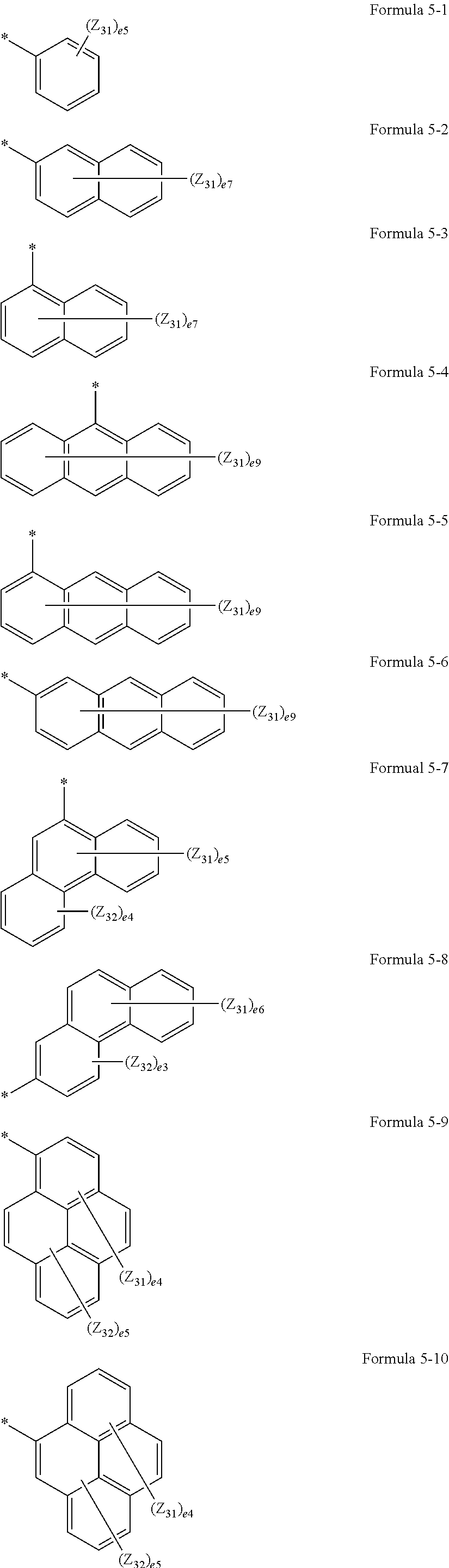
  • Ar 1 to Ar 4 may each independently be a group represented by one of the following Formulae 5-1 to 5-43.
  • R 1 to R 14 may each independently be selected from a group represented by Formula 2, a group represented by Formula 3, a hydrogen, a deuterium, —F, —Cl, —Br, —I, a hydroxyl group, a cyano group, a nitro group, an amino group, an amidino group, a hydrazine group, a hydrazone group, a carboxylic acid or a salt thereof, a sulfonic acid or a salt thereof, a phosphoric acid or a salt thereof, a C 1 -C 20 alkyl group, a C 1 -C 20 alkoxy group, —Si(Q 1 )(Q 2 )(Q 3 ), and a group represented by one of Formulae 5-1 to 5-43, and Q 1 to Q 3 may each independently be selected from a C 1 -C 10 alkyl group, a C 1 -C 10 alkoxy group, a phenyl group, and a naphth
  • Y 31 may be O, S, C(Z 33 )(Z 34 ), N(Z 35 ), or Si(Z 36 )(Z 37 );
  • Z 31 to Z 37 may each independently be selected from a hydrogen, a deuterium, —F, —Cl, —Br, —I, a hydroxyl group, a cyano group, a nitro group, an amino group, an amidino group, a hydrazine group, a hydrazone group, a carboxylic acid or a salt thereof, a sulfonic acid or a salt thereof, a phosphoric acid or a salt thereof, a C 1 to C 20 alkyl group, a C 1 to C 20 alkoxy group, a phenyl group, a naphthyl group, a fluorenyl group, a spiro-fluorenyl group, a benzofluorenyl group, a dibenzofluorenyl group, a phenanthrenyl group, an anthracenyl group, a pyrenyl group, a chrysenyl group, a pyr
  • e3 may be an integer selected from 1, 2, and 3, e4 may be an integer selected from 1, 2, 3, and 4, e5 may be an integer selected from 1, 2, 3, 4, and 5, e6 may be an integer selected from 1, 2, 3, 4, 5, and 6, e7 may be an integer selected from 1, 2, 3, 4, 5, 6, and 7, e8 may be an integer selected from 1, 2, 3, 4, 5, 6, 7, and 8, e9 may be an integer selected from 1, 2, 3, 4, 5, 6, 7, 8, and 9, and * indicates a binding site to a neighboring atom.
  • Ar 1 to Ar 4 may each independently be a group represented by one of the following Formulae 6-1 to 6-40, and
  • R 1 to R 14 may each independently be selected from a group represented by Formula 2, a group represented by Formula 3, a hydrogen, a deuterium, —F, —Cl, —Br, —I, a hydroxyl group, a cyano group, a nitro group, an amino group, an amidino group, a hydrazine group, a hydrazone group, a carboxylic acid or a salt thereof, a sulfonic acid or a salt thereof, a phosphoric acid or a salt thereof, a C 1 -C 20 alkyl group, a C 1 -C 20 alkoxy group, —Si(Q 1 )(Q 2 )(Q 3 ), a phenyl group, a naphthyl group, a pyridinyl group, a pyrimidinyl group, and a triazinyl group, and Q 1 to Q 3 may be each independently selected from a C 1 -C 10 alkyl group
  • * in Formulae 6-1 to 6-40 indicates a binding site to a neighboring atom.
  • two substituents of R 1 to R 12 in Formula 1 may each independently be selected from a group represented by Formula 2 and a group represented by Formula 3.
  • the condensed cyclic compound represented by Formula 1 may be represented by one of the following Formulae 1-1 to 1-8.
  • a1 may be 0 and a2 may be 0;
  • a1 may be 0 and a2 may be 1 or 2;
  • a1 may be 1 or 2 and a2 may be 0;
  • a1 may be 1 and a2 may be 1;
  • a1 may be 1 and a2 may be 2;
  • a1 may be 2 and a2 may be 1; or
  • a1 may be 2 and a2 may be 2.
  • a1 may be 0 and a2 may be 0;
  • a1 may be 0 and a2 may be 1;
  • a1 may be 1 and a2 may be 0; or
  • a1 may be 1 and a2 may be 1.
  • Ar 1 Ar 3 and, Ar 2 ⁇ Ar 4 and, Ar 2 ⁇ Ar 3 ; or
  • R 1 to R 14 may each independently be selected from a hydrogen, a deuterium, —F, —Cl, —Br, —I, a hydroxyl group, a cyano group, a nitro group, an amino group, an amidino group, a hydrazine group, a hydrazone group, a carboxylic acid or a salt thereof, a sulfonic acid or a salt thereof, a phosphoric acid or a salt thereof, a C 1 -C 20 alkyl group, a C 1 -C 20 alkoxy group, a phenyl group, a naphthyl group, a pyridinyl group, a pyrimidinyl group, and a triazinyl group,
  • L 1 and L 2 may each independently be a group represented by one of Formulae 3-1 to 3-35,
  • a1 and a2 may each independently be 0, 1, or 2;
  • Ar 1 to Ar 4 may each independently be a group represented by one of Formula 5-1 to 5-43.
  • R 1 to R 4 , R 6 to R 12 , and R 14 may be hydrogens
  • L 1 and L 2 may each independently be a group represented by one of Formulae 4-1 to 4-29,
  • a1 and a2 may each independently be 0 or 1,
  • Ar 1 to Ar 4 may each independently be a group represented by one of Formula 6-1 to 6-40.
  • the condensed cyclic compound represented by Formula 1 may be represented by one of Formulae 1-1(1) to 1-1(4) below.
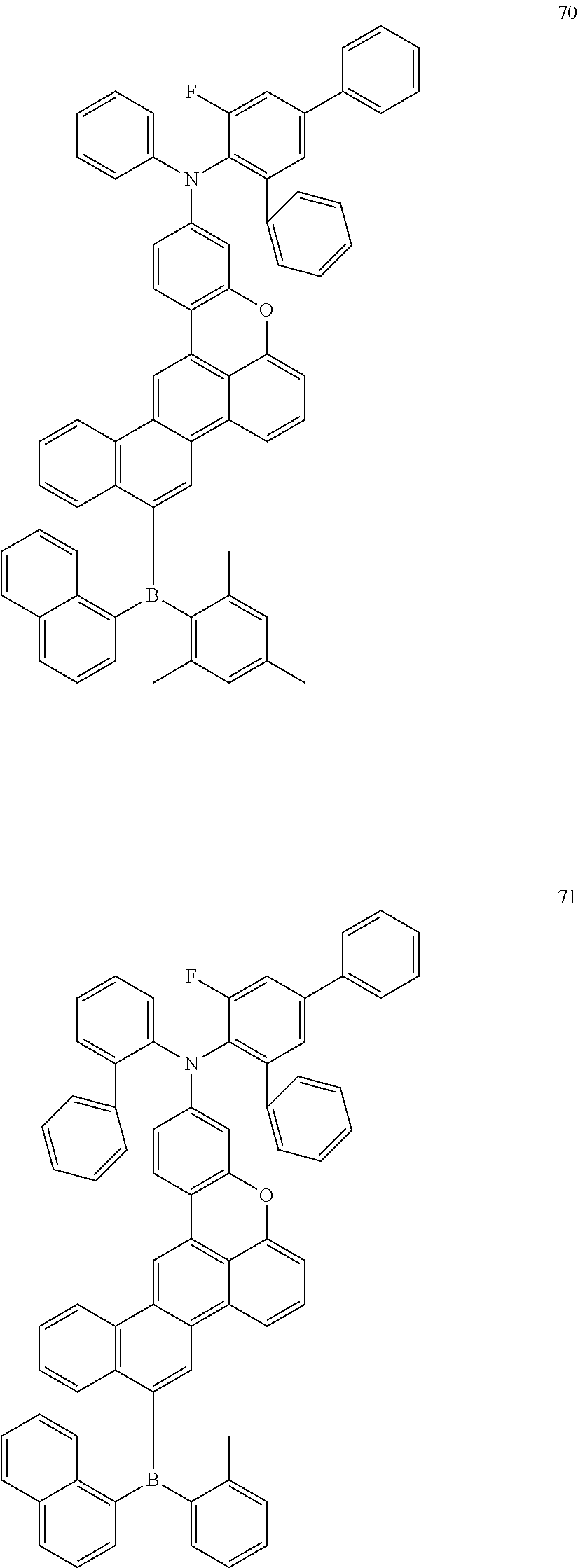
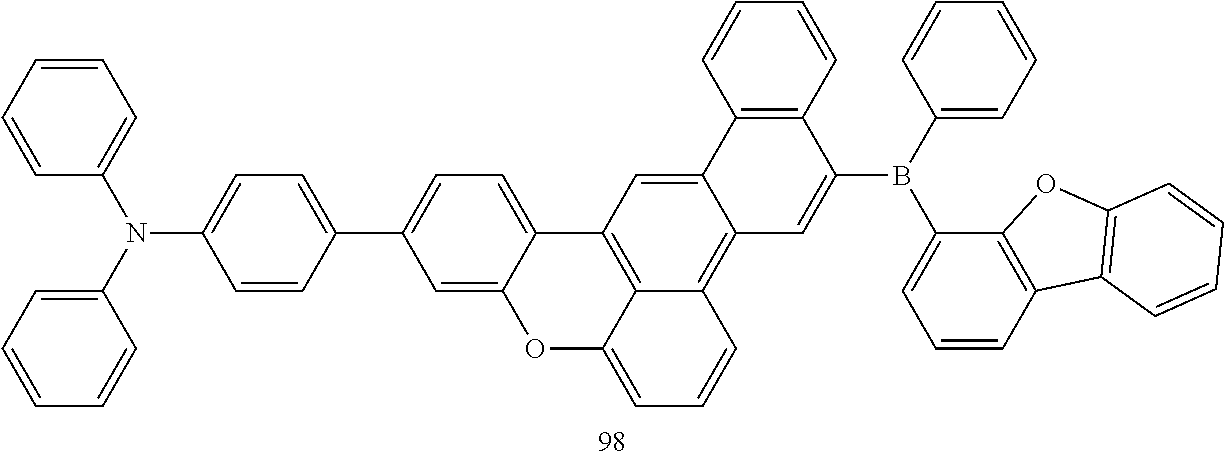
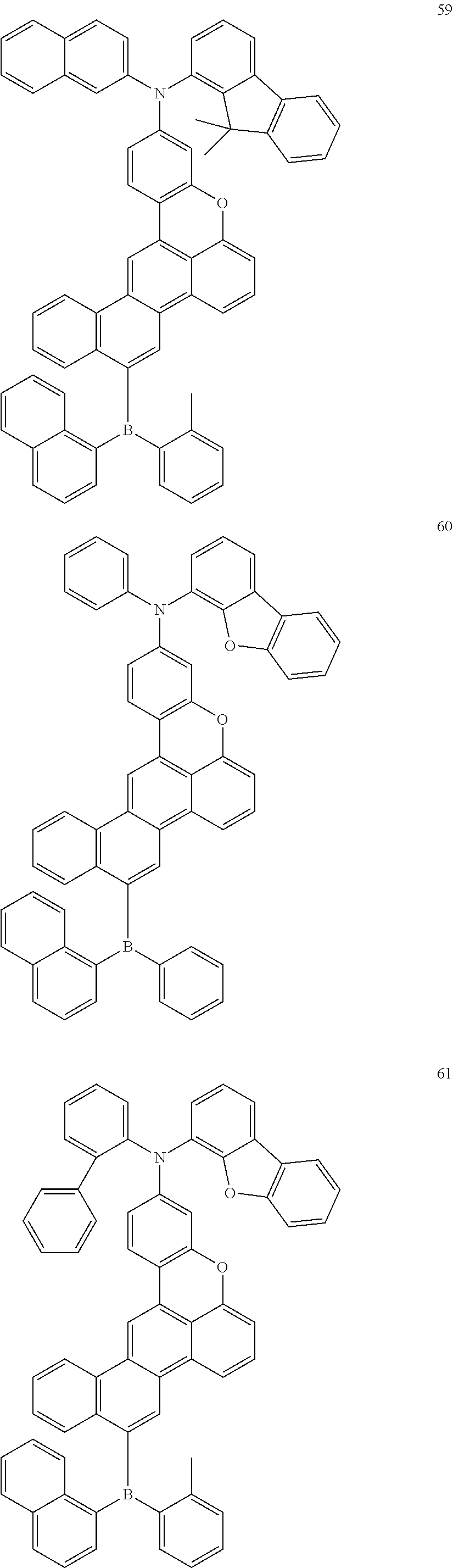
  • the condensed cyclic compound represented by Formula 1 may be one of Compounds 1 to 104 below.
  • the condensed cyclic compound represented by Formula 1 may have an amine group and a boryl group in its molecular structure. Due to the inclusion of these groups, the condensed cyclic compound may have a high glass transition temperature (Tg) or a high melting point. Accordingly, a heat resistance to Joule heat (which may occur inside an organic layer or between an organic layer and an electrode) and a resistance to high temperature environments may increase, and thus, an organic light-emitting device including the condensed cyclic compound represented by Formula 1 may have high durability during preserving and driving.
  • Tg glass transition temperature
  • a heat resistance to Joule heat which may occur inside an organic layer or between an organic layer and an electrode
  • a resistance to high temperature environments may increase, and thus, an organic light-emitting device including the condensed cyclic compound represented by Formula 1 may have high durability during preserving and driving.
  • a boron atom has an empty p orbital. Accordingly, an electron withdrawing property of the condensed cyclic compound represented by Formula 1 having a boryl group in its molecular structure may be increased, and thus, an electron injection capability and an electron transport capability may be increased. Thus, an organic light-emitting device including the condensed cyclic compound may have high luminescent efficiency.
  • a core of the condensed cyclic compound represented by Formula 1 may have many n-conjugation systems. Accordingly, the condensed cyclic compound may have high luminescent efficiency. Also, the core of the condensed cyclic compound represented by Formula 1 may include an oxygen atom (which is a hetero atom), and due to the interaction with a boryl group or an amine group, the electron injection capability and an electron transport capability may all be increased.
  • the condensed cyclic compound represented by Formula 1 may be synthesized by using a suitable organic synthetic method.
  • a synthesis method of the condensed cyclic compound may be recognizable in view of the following embodiments.
  • At least one of the condensed cyclic compound of Formula 1 may be used or included between a pair of electrodes of an organic light-emitting device.
  • the condensed cyclic compound may be included in a hole transport region, e.g., a hole transport layer.
  • the condensed cyclic compound may be included in an emission layer.
  • an organic light-emitting device may include, e.g., a first electrode; a second electrode facing the first electrode; and an organic layer that is disposed between the first electrode and the second electrode and includes an emission layer, wherein the organic layer includes at least one of the condensed cyclic compounds described above.
  • (an organic layer) includes at least one condensed cyclic compound” used herein may include a case in which “(an organic layer) includes identical condensed cyclic compounds represented by Formula 1 and a case in which (an organic layer) includes two or more different condensed cyclic compounds represented by Formula 1.
  • the organic layer may include, as the condensed cyclic compound, only Compound 1.
  • Compound 1 may exist in an emission layer of the organic light-emitting device.
  • the organic layer may include, as the condensed cyclic compound, Compound 1 and Compound 2.
  • Compound 1 and Compound 2 may exist in an identical layer (for example, Compound 1 and Compound 2 may all exist in an emission layer), or different layers (for example, Compound 1 may exist in a hole transport layer and Compound 2 may exist in an emission layer).
  • the organic layer may include, e.g., i) a hole transport region that is disposed between the first electrode (anode) and the emission layer and includes at least one of a hole injection layer, a hole transport layer, a buffer layer, and an electron blocking layer, and ii) an electron transport region that is disposed between the emission layer and the second electrode (cathode) and includes at least one selected from a hole blocking layer, an electron transport layer, and an electron injection layer.
  • At least one of the hole transport region and the emission layer may include at least one of the condensed cyclic compound represented by Formula 1.
  • the hole transport region may include the hole transport layer
  • the hole transport layer may include at least one of the condensed cyclic compound represented by Formula 1.
  • organic layer refers to a single layer and/or a plurality of layers disposed between the first electrode and the second electrode of an organic light-emitting device.
  • a material included in the “organic layer” is not limited to an organic material.
  • FIG. 1 illustrates a schematic view of an organic light-emitting device 10 according to an embodiment.
  • the organic light-emitting device 10 may include a first electrode 110 , an organic layer 150 , and a second electrode 190 .
  • a substrate may be additionally disposed under the first electrode 110 or above the second electrode 190 .
  • the substrate may be a glass substrate or transparent plastic substrate, each with excellent mechanical strength, thermal stability, transparency, surface smoothness, ease of handling, and water-resistance.
  • the first electrode 110 may be formed by depositing or sputtering a material for forming the first electrode on the substrate.
  • the material for the first electrode may be selected from materials with a high work function to facilitate hole injection.
  • the first electrode 110 may be a reflective electrode or a transmissive electrode.
  • the material for the first electrode may be a transparent and highly conductive material, and examples of such a material may include indium tin oxide (ITO), indium zinc oxide (IZO), tin oxide (SnO 2 ), and zinc oxide (ZnO).
  • the first electrode 110 is a semi-transmissive electrode or a reflective electrode
  • a material for forming the first electrode at least one of magnesium (Mg), aluminum (Al), aluminum-lithium (Al—Li), calcium (Ca), magnesium-indium (Mg—In), magnesium-silver (Mg—Ag) may be used.
  • the first electrode 110 may have a single-layer structure, or a multi-layer structure including two or more layers.
  • the first electrode 110 may have a three-layered structure of ITO/Ag/ITO.
  • An organic layer 150 may be disposed on the first electrode 110 .
  • the organic layer 150 may include an emission layer.
  • the organic layer 150 may further include a hole transport region disposed between the first electrode and the emission layer, and an electron transport region disposed between the emission layer and the second electrode.
  • the hole transport region may include at least one selected from a hole injection layer (HIL), a hole transport layer (HTL), a buffer layer, and an electron blocking layer (EBL), and the electron transport region may include at least one selected from a hole blocking layer (HBL), an electron transport layer (ETL), and an electron injection layer (EIL).
  • HIL hole injection layer
  • HTL hole transport layer
  • EBL electron blocking layer
  • EIL electron injection layer
  • the hole transport region may have a single-layered structure formed of a single material, a single-layered structure formed of a plurality of different materials, or a multi-layered structure having a plurality of layers formed of a plurality of different materials.
  • the hole transport region may have a single-layered structure formed of a plurality of different materials, or a structure of hole injection layer/hole transport layer, a structure of hole injection layer/hole transport layer/buffer layer, a structure of hole injection layer/buffer layer, a structure of hole transport layer/buffer layer, or a structure of hole injection layer/hole transport layer/electron blocking layer, wherein layers of each structure are sequentially stacked from the first electrode 110 in this stated order.
  • the hole injection layer may be formed on the first electrode 110 by using various methods, such as vacuum deposition, spin coating casting, a Langmuir-Blodgett (LB) method, ink-jet printing, laser-printing, or laser-induced thermal imaging.
  • various methods such as vacuum deposition, spin coating casting, a Langmuir-Blodgett (LB) method, ink-jet printing, laser-printing, or laser-induced thermal imaging.
  • the vacuum deposition may be performed at a temperature of a deposition temperature of about 100 to about 500° C. at a vacuum degree of about 10 ⁇ 8 to about 10 ⁇ 3 torr, and at a deposition rate of about 0.01 to about 100 ⁇ /sec in consideration of a compound for a hole injection layer to be deposited, and the structure of a hole injection layer to be formed.
  • the spin coating may be performed at a coating rate of about 2000 rpm to about 5000 rpm, and at a temperature of about 80° C. to 200° C. in consideration of a compound for a hole injection layer to be deposited, and the structure of a hole injection layer to be formed.
  • the hole transport layer may be formed on the first electrode 110 or the hole injection layer by using various methods, such as vacuum deposition, spin coating, casting, a LB method, ink-jet printing, laser-printing, or laser-induced thermal imaging.
  • deposition and coating conditions for the hole transport layer may be determined by referring to the deposition and coating conditions for the hole injection layer.
  • the hole transport region may include the condensed cyclic compound represented by Formula 1.
  • the hole transport region may include the hole transport layer, wherein the hole transport layer includes the condensed cyclic compound represented by Formula 1.
  • the hole transport region may include at least one selected from m-MTDATA, TDATA, 2-TNATA, NPB, ⁇ -NPB, TPD, Spiro-TPD, Spiro-NPB, ⁇ -NPB, TAPC, HMTPD, 4,4′,4′′-tris(N-carbazolyl)triphenylamine (TCTA), polyaniline/dodecylbenzenesulfonic acid (Pani/DBSA), poly(3,4-ethylenedioxythiophene)/poly(4-styrenesulfonate) (PEDOT/PSS), polyaniline/camphor sulfonicacid (PANI/CSA), (polyaniline)/poly(4-styrenesulfonate) (Pani/PSS), a compound represented by Formula 201 below, and a compound represented by Formula 202 below:
  • L 201 to L 205 may be the same as explained in connection with L 1 ;
  • xa1 to xa4 may each independently be selected from 0, 1, 2, and 3;
  • xa5 may be selected from 1, 2, 3, 4, and 5;
  • R 201 to R 204 may each independently be selected from a substituted or unsubstituted C 3 -C 10 cycloalkyl group, a substituted or unsubstituted C 1 -C 10 heterocycloalkyl group, a substituted or unsubstituted C 3 -C 10 cycloalkenyl group, a substituted or unsubstituted C 1 -C 10 heterocycloalkenyl group, a substituted or unsubstituted C 6 -C 60 aryl group, a substituted or unsubstituted C 6 -C 60 aryloxy group, a substituted or unsubstituted C 6 -C 60 arylthio group, a substituted or unsubstituted C 1 -C 60 heteroaryl group, a substituted or unsubstituted monovalent non-aromatic condensed polycyclic group, and a substituted or unsubstituted monovalent non-aromatic condensed
  • L 201 to L 205 may each independently be selected from
  • xa1 to xa4 may each independently be 0, 1, or 2;
  • xa5 may be 1, 2, or 3;
  • R 201 to R 204 may each independently be selected from
  • the compound represented by Formula 201 may be represented by Formula 201A:
  • the compound represented by Formula 201 may be represented by Formula 201A-1 below:
  • the compound represented by Formula 202 may be represented by Formula 202A below:
  • R 2 11 is the same as defined in connection with R 203
  • R 213 to R 216 may each independently be selected from a hydrogen, a deuterium, —F, —Cl, —Br, —I, a hydroxyl group, a cyano group, a nitro group, an amino group, an amidino group, a hydrazine group, a hydrazone group, a carboxylic acid group or a salt thereof, a sulfonic acid or a salt thereof, a phosphoric acid or a salt thereof, a C 1 -C 60 alkyl group, a C 2 -C 60 alkenyl group, a C 2 -C 60 alkynyl group, a C 1 -C 60 al
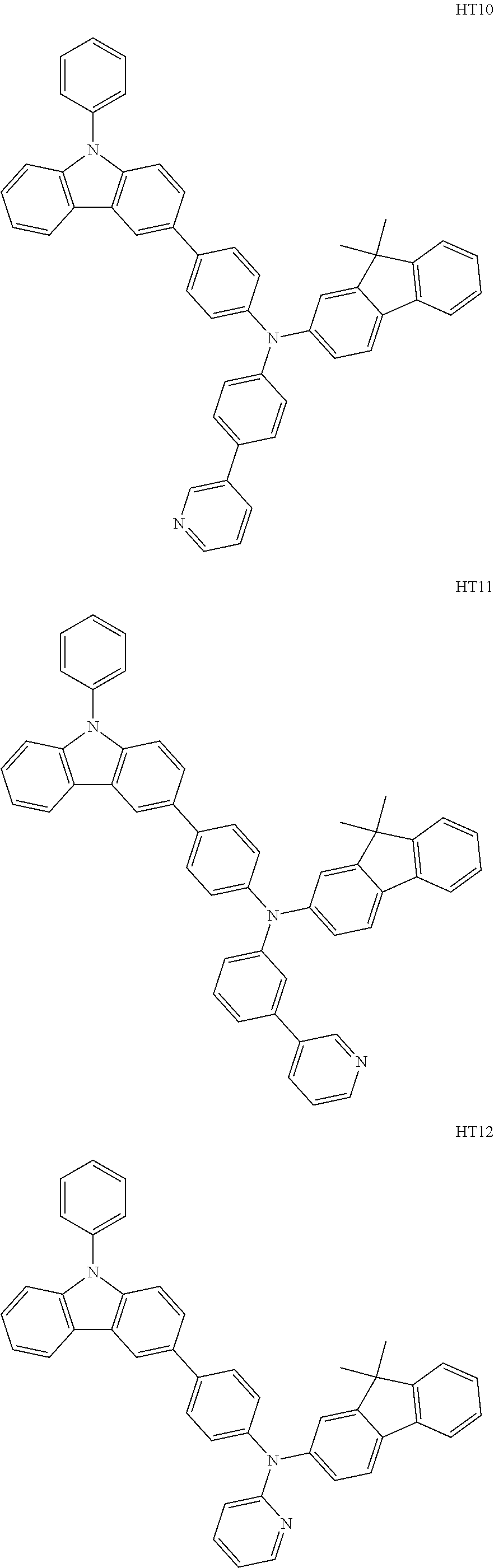
  • the compound represented by Formula 201, and the compound represented by Formula 202 may each include compounds HT1 to HT20 illustrated below.
  • a thickness of the hole transport region may be in a range of about 100 ⁇ to about 10000 ⁇ , e.g., about 100 ⁇ to about 1000 ⁇ .
  • the thickness of the hole injection layer may be in a range of about 100 ⁇ to about 10000 ⁇ , e.g., about 100 ⁇ to about 1000 ⁇
  • the thickness of the hole transport layer may be in a range of about 50 ⁇ to about 2000 ⁇ , e.g., about 100 ⁇ to about 1500 ⁇ .
  • the hole transport region may further include, in addition to these materials, a charge-generation material for the improvement of conductive properties.
  • the charge-generation material may be homogeneously or unhomogeneously dispersed in the hole transport region.
  • the charge-generation material may be, e.g., a p-dopant.
  • the p-dopant may be one selected from a quinone derivative, a metal oxide, and a cyano group-containing compound.
  • a quinone derivative such as tetracyanoquinonedimethane (TCNQ) or 2,3,5,6-tetrafluoro-tetracyano-1,4-benzoquinonedimethane (F4-TCNQ)
  • a metal oxide such as a tungsten oxide or a molybdenum oxide
  • Compound HT-D1 illustrated below Compound HT-D1 illustrated below.
  • the hole transport region may further include, in addition to the hole injection layer and the hole transport layer, at least one of a buffer layer and an electron blocking layer. Since the buffer layer may compensate for an optical resonance distance according to a wavelength of light emitted from the emission layer, light-emission efficiency of a formed organic light-emitting device may be improved. For use as a material included in the buffer layer, materials that are included in the hole transport region may be used.
  • the electron blocking layer prevents injection of electrons from the electron transport region.
  • a material for the electron blocking layer may be mCP.
  • An emission layer may be formed on the first electrode 110 or the hole transport region by using various methods, e.g., vacuum deposition, spin coating, casting, a LB method, ink-jet printing, laser-printing, or laser-induced thermal imaging.
  • deposition and coating conditions for the emission layer may be determined by referring to the deposition and coating conditions for the hole injection layer.
  • the emission layer may be patterned into a red emission layer, a green emission layer, or a blue emission layer, according to a sub pixel.
  • the emission layer may have a stacked structure of a red emission layer, a green emission layer, and a blue emission layer, or may include a red-light emission material, a green-light emission material, and a blue-light emission material, which are mixed with each other in a single layer, to emit white light.
  • the emission layer may include the condensed cyclic compound represented by Formula 1.
  • the emission layer may include a host and a dopant.
  • the dopant may include the condensed cyclic compound represented by Formula 1.
  • the host may include, e.g., at least one selected from TPBi, TBADN, ADN (also referred to as “DNA”), CBP, CDBP, and TCP.
  • TPBi TPBi
  • TBADN TBADN
  • ADN also referred to as “DNA”
  • CBP CBP
  • CDBP CDBP
  • TCP TCP
  • the host may include a compound represented by Formula 301 below.
  • Ar 301 may be selected from
  • L 301 may be the same as explained in connection with L 1 ;
  • R 301 may be selected from
  • a C 1 -C 20 alkyl group and a C 1 -C 20 alkoxy group each substituted with at least one selected from a deuterium, —F, —Cl, —Br, —I, a hydroxyl group, a cyano group, a nitro group, an amino group, an amidino group, a hydrazine group, a hydrazone group, a carboxylic acid or a salt thereof, a sulfonic acid or a salt thereof, a phosphoric acid or a salt thereof, a phenyl group, a naphthyl group, a fluorenyl group, a spiro-fluorenyl group, a benzofluorenyl group, a dibenzofluorenyl group, a phenanthrenyl group, an anthracenyl group, a pyrenyl group, a chrysenyl group, a pyridinyl group
  • xb1 may be selected from 0, 1, 2, and 3;
  • xb2 may be selected from 1, 2, 3, and 4.
  • L 301 may be selected from
  • a phenylene group a naphthylene group, a fluorenylene group, a spiro-fluorenylene group, a benzofluorenylene group, a dibenzofluorenylene group, a phenanthrenylene group, an anthracenylene group, a pyrenylene group, and a chrysenylene group;
  • R 301 may be selected from
  • a C 1 -C 20 alkyl group and a C 1 -C 20 alkoxy group each substituted with at least one selected from a deuterium, —F, —Cl, —Br, —I, a hydroxyl group, a cyano group, a nitro group, an amino group, an amidino group, a hydrazine group, a hydrazone group, a carboxylic acid or a salt thereof, a sulfonic acid or a salt thereof, a phosphoric acid or a salt thereof, a phenyl group, a naphthyl group, a fluorenyl group, a spiro-fluorenyl group, a benzofluorenyl group, a dibenzofluorenyl group, a phenanthrenyl group, an anthracenyl group, a pyrenyl group, and a chrysenyl group;
  • a phenyl group a naphthyl group, a fluorenyl group, a spiro-fluorenyl group, a benzofluorenyl group, a dibenzofluorenyl group, a phenanthrenyl group, an anthracenyl group, a pyrenyl group, and a chrysenyl group;
  • the host may include a compound represented by Formula 301A below.
  • the compound represented by Formula 301 may include at least one of Compounds H1 to H42.
  • the host may include at least one of Compounds H43 to H49 below.
  • the dopant may include at least one selected from a fluorescent dopant and a phosphorescent dopant.
  • the fluorescent dopant may include the condensed cyclic compound represented by Formula 1.
  • the fluorescent dopant may include, in addition to the condensed cyclic compound represented by Formula 1, at least one selected from DPAVBi, BDAVBi, TBPe, DCM, DCJTB, Coumarin 6, and C545T.
  • An amount of the dopant in the emission layer may be, e.g., in a range of about 0.01 to about 15 parts by weight based on 100 parts by weight of the host.
  • a thickness of the emission layer may be in a range of about 100 ⁇ to about 1000 ⁇ , for example, about 200 ⁇ to about 600 ⁇ . When the thickness of the emission layer is within this range, excellent light-emission characteristics may be obtained without a substantial increase in driving voltage.
  • an electron transport region may be disposed on the emission layer.
  • the electron transport region may include at least one selected from a hole blocking layer, an electron transport layer (ETL), and an electron injection layer.
  • a hole blocking layer an electron transport layer (ETL)
  • ETL electron transport layer
  • the electron transport region may have a structure of electron transport layer/electron injection layer or a structure of hole blocking layer/electron transport layer/electron injection layer, wherein layers of each structure are sequentially stacked from the emission layer in the stated order, but is not limited thereto.
  • the organic layer 150 of the organic light-emitting device may include an electron transport region disposed between the emission layer and the second electrode 190 .
  • the hole blocking layer may be formed on the emission layer by using various methods, such as vacuum deposition, spin coating casting, a LB method, ink-jet printing, laser-printing, or laser-induced thermal imaging.
  • deposition and coating conditions for the hole blocking layer may be determined by referring to the deposition and coating conditions for the hole injection layer.
  • the hole blocking layer may include, e.g., at least one of BCP and Bphen.
  • a thickness of the hole blocking layer may be in a range of about 20 ⁇ to about 1000 ⁇ , e.g., about 30 ⁇ to about 300 ⁇ . When the thickness of the hole blocking layer is within these ranges, the hole blocking layer may have improved hole blocking ability without a substantial increase in driving voltage.
  • the electron transport region may include an electron transport layer.
  • the electron transport layer may be formed on the emission layer or the hole blocking layer by using various methods, such as vacuum deposition, spin coating casting, a LB method, ink-jet printing, laser-printing, or laser-induced thermal imaging.
  • deposition and coating conditions for the electron transport layer may be determined by referring to the deposition and coating conditions for the hole injection layer.
  • the electron transport layer may include at least one compound selected from a compound represented by Formula 601 and a compound represented by Formula 602 illustrated below.
  • Ar 601 may be selected from:
  • L 601 may be the same as explained in connection with L 201 ;
  • E 601 may be selected from:
  • xe1 may be selected from 0, 1, 2, and 3;
  • xe2 may be selected from 1, 2, 3, and 4.
  • X 611 may be N or C-(L 611 ) xe611 -R 611
  • X 612 may be N or C-(L 612 ) xe612 -R 612
  • X 613 may be N or C-(L 613 ) xe613 -R 613 and, at least one of X 611 to X 613 may be N;
  • L 11 to L 616 may be the same as explained in connection with L 1 ;
  • R 611 to R 616 may each independently be selected from
  • xe611 to xe616 may each independently be selected from 0, 1, 2, and 3.
  • the compound represented by Formula 601 and the compound represented by Formula 602 may each independently be selected from Compounds ET1 to ET15 illustrated below:
  • the electron transport layer may further include at least one selected from BCP, Bphen, Alq 3 , Balq, TAZ, and NTAZ.
  • a thickness of the electron transport layer may be in a range of about 100 ⁇ to about 1000 ⁇ , e.g., about 150 ⁇ to about 500 ⁇ . When the thickness of the electron transport layer is within the range described above, the electron transport layer may have satisfactory electron transport characteristics without a substantial increase in driving voltage.
  • the electron transport layer may further include, in addition to the materials described above, a metal-containing material.
  • the metal-containing material may include a Li complex.
  • the Li complex may include, e.g., Compound ET-D1 (lithium quinolate, LiQ) or ET-D2.
  • the electron transport region may include an electron injection layer that facilitates electron injection from the second electrode 190 .
  • the electron injection layer may be formed on the electron transport layer by using various methods, such as vacuum deposition, spin coating casting, a LB method, ink-jet printing, laser-printing, or laser-induced thermal imaging.
  • deposition and coating conditions for the electron injection layer may be determined by referring to the deposition and coating conditions for the hole injection layer.
  • the electron injection layer may include at least one selected from, LiF, NaCl, CsF, Li 2 O, BaO, and LiQ.
  • a thickness of the electron injection layer may be in a range of about 1 ⁇ to about 100 ⁇ , e.g., about 3 ⁇ to about 90 ⁇ . When the thickness of the electron injection layer is within the range described above, the electron injection layer may have satisfactory electron injection characteristics without a substantial increase in driving voltage.
  • the second electrode 190 may be disposed on the organic layer 150 having such a structure.
  • the second electrode 190 may be a cathode that is an electron injection electrode, and in this regard, a material for forming the second electrode 190 may be a material having a low work function, and such a material may include metal, alloy, an electrically conductive compound, or a mixture thereof.
  • Examples of the material for the second electrode 190 may include lithium (Li), magnesium (Mg), aluminum (Al), aluminum-lithium (Al—Li), calcium (Ca), magnesium-indium (Mg—In), or magnesium-silver (Mg—Ag).
  • the material for forming the second electrode 190 may be ITO or IZO.
  • the second electrode 190 may be a semi-transmissive electrode or a transmissive electrode.
  • a C 1 -C 60 alkyl group used herein refers to a linear or branched aliphatic hydrocarbon monovalent group having 1 to 60 carbon atoms, and detailed examples thereof are a methyl group, an ethyl group, a propyl group, an isobutyl group, a sec-butyl group, a ter-butyl group, a pentyl group, an iso-amyl group, and a hexyl group.
  • a C 1 -C 60 alkylene group used herein refers to a divalent group having the same structure as the C 1 -C 60 alkyl group.
  • a C 1 -C 60 alkoxy group used herein refers to a monovalent group represented by —OA 101 (wherein A 101 is the C 1 -C 60 alkyl group), and detailed examples thereof are a methoxy group, an ethoxy group, and an isopropyloxy group.
  • a C 2 -C 60 alkenyl group used herein refers to a hydrocarbon group formed by substituting at least one carbon double bond in the middle or at the terminal of the C 2 -C 60 alkyl group, and detailed examples thereof are an ethenyl group, a prophenyl group, and a butenyl group.
  • a C 2 -C 60 alkylene group used herein refers to a divalent group having the same structure as the C 2 -C 60 alkyl group.
  • a C 2 -C 60 alkynyl group used herein refers to a hydrocarbon group formed by substituting at least one carbon trip bond in the middle or at the terminal of the C 2 -C 60 alkyl group, and detailed examples thereof are an ethynyl group, and a propynyl group.
  • a C 2 -C 60 alkylene group used herein refers to a divalent group having the same structure as the C 2 -C 60 alkyl group.
  • a C 3 -C 10 cycloalkyl group used herein refers to a monovalent hydrocarbon monocyclic group having 3 to 10 carbon atoms, and detailed examples thereof are a cyclopropyl group, a cyclobutyl group, a cyclopentyl group, a cyclohexyl group, and a cycloheptyl group.
  • a C 3 -C 10 cycloalkylene group used herein refers to a divalent group having the same structure as the C 3 -C 10 cycloalkyl group.
  • a C 1 -C 10 heterocycloalkyl group used herein refers to a monovalent monocyclic group having at least one hetero atom selected from N, O, Si, P, and S as a ring-forming atom and 1 to 10 carbon atoms, and detailed examples thereof are a tetrahydrofuranyl group, and a tetrahydrothiophenyl group.
  • a C 1 -C 10 heterocycloalkylene group used herein refers to a divalent group having the same structure as the C 1 -C 10 heterocycloalkyl group.
  • a C 3 -C 10 cycloalkenyl group used herein refers to a monovalent monocyclic group that has 3 to 10 carbon atoms and at least one double bond in the ring thereof and does not have aromacity, and detailed examples thereof are a cyclopentenyl group, a cyclohexenyl group, and a cycloheptenyl group.
  • a C 3 -C 10 cycloalkenylene group used herein refers to a divalent group having the same structure as the C 3 -C 10 cycloalkenyl group.
  • a C 1 -C 10 heterocycloalkenyl group used herein refers to a monovalent monocyclic group that has at least one hetero atom selected from N, O, Si, P, and S as a ring-forming atom, 1 to 10 carbon atoms, and at least one double bond in its ring.
  • Detailed examples of the C 1 -C 10 heterocycloalkenyl group are a 2,3-hydrofuranyl group and a 2,3-hydrothiophenyl group.
  • a C 1 -C 10 heterocycloalkenylene group used herein refers to a divalent group having the same structure as the C 1 -C 10 heterocycloalkenyl group.
  • a C 6 -C 60 aryl group used herein refers to a monovalent group having a carbocyclic aromatic system having 6 to 60 carbon atoms
  • a C 6 -C 60 arylene group used herein refers to a divalent group having a carbocyclic aromatic system having 6 to 60 carbon atoms.
  • the C 6 -C 60 aryl group are a phenyl group, a naphthyl group, an anthracenyl group, a phenanthrenyl group, a pyrenyl group, and a chrysenyl group.
  • the C 6 -C 60 aryl group and the C 6 -C 60 arylene group each include two or more rings, the rings may be fused to each other.
  • a C 1 -C 60 heteroaryl group used herein refers to a monovalent group having a carbocyclic aromatic system that has at least one hetero atom selected from N, O, Si, P, and S as a ring-forming atom, and 1 to 60 carbon atoms.
  • a C 1 -C 60 heteroarylene group used herein refers to a divalent group having a carbocyclic aromatic system that has at least one hetero atom selected from N, O, P, and S as a ring-forming atom, and 1 to 60 carbon atoms.
  • Examples of the C 1 -C 60 heteroaryl group are a pyridinyl group, a pyrimidinyl group, a pyrazinyl group, a pyridazinyl group, a triazinyl group, a quinolinyl group, and an isoquinolinyl group.
  • the C 1 -C 60 heteroaryl group and the C 1 -C 60 heteroarylene group each include two or more rings, the rings may be fused to each other.
  • a C 6 -C 60 aryloxy group used herein indicates —OA 102 (wherein A 102 is the C 6 -C 60 aryl group), and a C 6 -C 60 arylthio group used herein indicates —SA 103 (wherein A 103 is the C 6 -C 60 aryl group).
  • a monovalent non-aromatic condensed polycyclic group used herein refers to a monovalent group (for example, having 8 to 60 carbon atoms) that has two or more rings condensed to each other, only carbon atoms as a ring forming atom, and non-aromacity in the entire molecular structure.
  • a detailed example of the monovalent non-aromatic condensed polycyclic group is a fluorenyl group.
  • a divalent non-aromatic condensed polycyclic group used herein refers to a divalent group having the same structure as the monovalent non-aromatic condensed polycyclic group.
  • a monovalent non-aromatic condensed heteropolycyclic group used herein refers to a monovalent group (for example, having 2 to 60 carbon atoms) that has two or more rings condensed to each other, has a heteroatom selected from N, O, Si, P, and S, other than carbon atoms, as a ring forming atom, and has non-aromacity in the entire molecular structure.
  • An example of the monovalent non-aromatic condensed heteropolycyclic group is a carbazolyl group.
  • a divalent non-aromatic condensed heteropolycyclic group used herein refers to a divalent group having the same structure as the monovalent non-aromatic condensed heteropolycyclic group.
  • a deuterium —F, —Cl, —Br, —I, a hydroxyl group, a cyano group, a nitro group, an amino group, an amidino group, a hydrazine group, a hydrazone group, a carboxylic acid or a salt thereof, a sulfonic acid or a salt thereof, a phosphoric acid or a salt thereof, a C 1 -C 60 alkyl group, a C 2 -C 60 alkenyl group, a C 2 -C 60 alkynyl group, and a C 1 -C 60 alkoxy group;
  • a C 1 -C 60 alkyl group, a C 2 -C 60 alkenyl group, a C 2 -C 60 alkynyl group, and a C 1 -C 60 alkoxy group each substituted with at least one selected from a deuterium, —F, —Cl, —Br, —I, a hydroxyl group, a cyano group, a nitro group, an amino group, an amidino group, a hydrazine group, a hydrazone group, a carboxylic acid group or a salt thereof, a sulfonic acid group or a salt thereof, a phosphoric acid group or a salt thereof, a C 3 -C 10 cycloalkyl group, a C 1 -C 10 heterocycloalkyl group, a C 3 -C 10 cycloalkenyl group, a C 1 -C 10 heterocycloalkenyl group, a C 6 -C 60 aryl group
  • Q 1 to Q 3 , Q 11 to Q 3 , Q 21 to Q 23 , and Q 31 to Q 33 may be each independently selected from a hydrogen, a deuterium, —F, —Cl, —Br, —I, a hydroxyl group, a cyano group, a nitro group, an amino group, an amidino group, a hydrazine group, a hydrazone group, a carboxylic acid or a salt thereof, a sulfonic acid or a salt thereof, a phosphoric acid or a salt thereof, a C 1 -C 60 alkyl group, a C 2 -C 60 alkenyl group, a C 2 -C 60 alkynyl group, a C 1 -C 60 alkoxy group, a C 3 -C 10 cycloalkyl group, a C 1 -C 10 heterocycloalkyl group, a C 3 -C 10 cycloalkenyl group, a C 3
  • Ph refers to a phenyl group
  • Me refers to a methyl group
  • Et refers to an ethyl group
  • ter-Bu or “Bu t ” used herein refers to a tert-butyl group.
  • Intermediate A-6 was obtained in a yield of 70% in the same manner as used to synthesize Intermediate A-2, except that (2,4-dimethylphenyl)(3,5-dimethylphenyl)fluoroborane was used instead of fluorodiphenylborane.
  • Intermediate A-7 was obtained in a yield of 83% in the same manner as used to synthesize Intermediate A-3, except that Intermediate A-6 was used instead of Intermediate A-2 and N-phenylnaphthalen-2-amine was used instead of diphenylamine.
  • Intermediate A-10 was obtained in a yield of 79% in the same manner as used to synthesize Intermediate A-3, except that Intermediate A-9 was used instead of Intermediate A-2 and ([1,1′-biphenyl]-2-yl)-9,9-dimethyl-9H-fluoren-3-amine was used instead of diphenylamine.
  • Intermediate A-13 was obtained in a yield of 81% in the same manner as used to synthesize Intermediate A-3, except that Intermediate A-12 was used instead of Intermediate A-2 and 2,6-dimethyl-N-phenylaniline was used instead of diphenylamine.
  • Intermediate A-15 was obtained in a yield of 80% in the same manner as used to synthesize Intermediate A-2, except that fluoro(naphthalen-2-yl)(phenyl)borane was used instead of fluorodiphenylborane.
  • Intermediate A-19 was obtained in a yield of 79% in the same manner as used to synthesize Intermediate A-3, except that Intermediate A-18 was used instead of Intermediate A-2 and N-([1,1′-biphenyl]-2-yl)-9,9-dimethyl-9H-fluoren-3-amine was used instead of diphenylamine.
  • Intermediate A-21 was obtained in a yield of 70% in the same manner as used to synthesize Intermediate A-3, except that Intermediate A-18 was used instead of Intermediate A-2 and 5′-fluoro-N-phenyl-[1,1′: 3′,1′′-terphenyl]-4′-amine was used instead of diphenylamine.
  • Intermediate A-23 was obtained in a yield of 78% in the same manner as used to synthesize Intermediate A-2, except that fluoro(naphthalen-1-yl)(phenyl)borane was used instead of fluorodiphenylborane.
  • Intermediate A-24 was obtained in a yield of 76% in the same manner as used to synthesize Intermediate A-3, except that Intermediate A-23 was used instead of Intermediate A-2 and N-(4-(trimethylsilyl)phenyl)naphthalen-2-amine was used instead of diphenylamine.
  • Compound 53 was obtained in a yield of 82% in the same manner as used to synthesize Compound 1, except that Intermediate A-25 was used instead of Intermediate A-4.
  • Intermediate A-26 was obtained in a yield of 81% in the same manner as used to synthesize Intermediate A-2, except that (3,5-dimethylphenyl)fluoro(naphthalen-1-yl)borane was used instead of fluorodiphenylborane.
  • Intermediate A-27 was obtained in a yield of 76% in the same manner as used to synthesize Intermediate A-3, except that Intermediate A-26 was used instead of Intermediate A-2 and N-(4-(trimethylsilyl)phenyl)naphthalen-2-amine was used instead of diphenylamine.
  • Compound 64 was obtained in a yield of 85% in the same manner as used to synthesize Compound 1, except that Intermediate A-28 was used instead of Intermediate A-4.
  • Intermediate C-2 was obtained in a yield of 70% in the same manner as used to synthesize Intermediate A-3, except that Intermediate C-1 was used instead of Intermediate A-2 and (4-(diphenylamino)phenyl)boronic acid was used instead of diphenylamine.
  • Intermediate D-1 was obtained in a yield of 66% in the same manner as used to synthesize Intermediate B-1, except that dimesityl(4-(4,4,5,5-tetramethyl-1,3-dioxolan-2-yl)phenyl)borane was used instead of fluorodiphenylborane.
  • Intermediate D-2 was obtained in a yield of 74% in the same manner as used to synthesize Intermediate A-3, except that Intermediate D-1 was used instead of Intermediate A-2 and (4-(diphenylamino)phenyl)boronic acid was used instead of diphenylamine.
  • a 15 ⁇ cm 2 (1,200 ⁇ ) ITO glass substrate (a product of Corning) was cut to a size of 50 mm ⁇ 50 mm ⁇ 0.7 mm, and was ultrasonically cleaned by using isopropyl alcohol and pure water for 5 minutes each, and then UV light was irradiated thereto for 30 minutes and exposed to ozone to clean. Then, the resultant structure was loaded into a vacuum deposition apparatus.
  • ADN 9,10-di-naphthalene-2-yl-anthracene
  • Compound 1 as a dopant, were co-deposited on the hole transport region at a weight ratio of 98:2 to form an emission layer having a thickness of 300 ⁇ .
  • Alq 3 was vacuum-deposited on the emission layer to form an electron transport layer having a thickness of 300 ⁇ , and LiF was deposited on the electron transport layer to form an electron injection layer having a thickness of 10 ⁇ , thereby completing the formation of an electron transport region.
  • Al was vacuum-deposited on the electron transport region to form a cathode having a thickness of 3,000 ⁇ , thereby completing the manufacture of an organic light-emitting device.
  • An organic light-emitting device was manufactured in the same manner as in Example 1, except that in forming the emission layer, as a dopant, Compound 4 was used instead of Compound 1.
  • An organic light-emitting device was manufactured in the same manner as in Example 1, except that in forming the emission layer, as a dopant, Compound 14 was used instead of Compound 1.
  • An organic light-emitting device was manufactured in the same manner as in Example 1, except that in forming the emission layer, as a dopant, Compound 22 was used instead of Compound 1.
  • An organic light-emitting device was manufactured in the same manner as in Example 1, except that in forming the emission layer, as a dopant, Compound 25 was used instead of Compound 1.
  • An organic light-emitting device was manufactured in the same manner as in Example 1, except that in forming the emission layer, as a dopant, Compound 33 was used instead of Compound 1.
  • An organic light-emitting device was manufactured in the same manner as in Example 1, except that in forming an emission layer, as a dopant, Compound 46 was used instead of Compound 1.
  • An organic light-emitting device was manufactured in the same manner as in Example 1, except that in forming the emission layer, as a dopant, Compound 53 was used instead of Compound 1.
  • An organic light-emitting device was manufactured in the same manner as in Example 1, except that in forming the emission layer, as a dopant, Compound 64 was used instead of Compound 1.
  • An organic light-emitting device was manufactured in the same manner as in Example 1, except that in forming the emission layer, as a dopant, Compound 90 was used instead of Compound 1.
  • An organic light-emitting device was manufactured in the same manner as in Example 1, except that in forming the emission layer, as a dopant, Compound 98 was used instead of Compound 1.
  • An organic light-emitting device was manufactured in the same manner as in Example 1, except that in forming an emission layer, as a dopant, Compound 102 was used instead of Compound 1.
  • An organic light-emitting device was manufactured in the same manner as in Example 1, except that in forming the emission layer, as a dopant, Compound A was used instead of Compound 1.
  • An organic light-emitting device was manufactured in the same manner as in Example 1, except that in forming the emission layer, as a dopant, Compound B was used instead of Compound 1.
  • the driving voltage, current density, brightness, efficiency, and half-lifespan of the organic light-emitting devices manufactured according to Examples 1 to 12, and Comparative Examples 1 and 2 were measured by using Kethley SMU 236 and a brightness photometer PR650, and results thereof are shown in Table 2.
  • the half-lifespan is a period of time that lapses until the brightness of the organic light-emitting device was 50% of initial brightness.
  • An organic light-emitting device including the compound according to an embodiment may have a low driving voltage, high efficiency, high brightness, and long lifespan.

Landscapes

  • Chemical & Material Sciences (AREA)
  • Engineering & Computer Science (AREA)
  • Materials Engineering (AREA)
  • Organic Chemistry (AREA)
  • Physics & Mathematics (AREA)
  • Spectroscopy & Molecular Physics (AREA)
  • Inorganic Chemistry (AREA)
  • Electroluminescent Light Sources (AREA)

Abstract

A condensed cyclic compound and an organic light-emitting device, the compound being represented by Formula 1 below:
Figure US09831445-20171128-C00001

Description

CROSS-REFERENCE TO RELATED APPLICATION
Korean Patent Application No. 10-2014-0179366, filed on Dec. 12, 2015, in the Korean Intellectual Property Office, and entitled: “Condensed Cyclic Compound and Organic Light-Emitting Device Including The Same,” is incorporated by reference herein in its entirety.
BACKGROUND
1. Field
Embodiments relate to a condensed cyclic compound and an organic light-emitting device including the same.
2. Description of the Related Art
Organic light emitting devices are self-emission devices that have wide viewing angles, high contrast ratios, short response times, and excellent brightness, driving voltage, and response speed characteristics, and produce full-color images.
The organic light-emitting device may include a first electrode disposed on a substrate, and a hole transport region, an emission layer, an electron transport region, and a second electrode, which are sequentially disposed on the first electrode. Holes provided from the first electrode may move toward the emission layer through the hole transport region, and electrons provided from the second electrode may move toward the emission layer through the electron transport region. Carriers, such as holes and electrons, may be recombined in the emission layer to produce excitons. These excitons change from an excited state to a ground state, thereby generating light.
SUMMARY
Embodiments are directed to a condensed cyclic compound and an organic light-emitting device including the same
An aspect provides a condensed cyclic compound represented by Formula 1 below:
Figure US09831445-20171128-C00002
wherein in Formulae 1 to 3,
X1 is O or S;
L1 and L2 are each independently selected from a substituted or unsubstituted C3-C10 cycloalkylene, a substituted or unsubstituted C1-C10 heterocycloalkylene, a substituted or unsubstituted C3-C10cycloalkenylene, a substituted or unsubstituted C1-C10 heterocycloalkenylene, a substituted or unsubstituted C6-C60 arylene, a substituted or unsubstituted C1-C60 heteroarylene, a substituted or unsubstituted divalent non-aromatic condensed polycyclic group, and a substituted or unsubstituted divalent non-aromatic condensed heteropolycyclic group;
a1 and a2 may be each independently selected from 0, 1, 2 and 3, when a1 is 2 or more, two or more L1 may be identical or different, and when a2 is 2 or more, two or more L2 may be identical or different.
Ar1 to Ar4 may be each independently selected from a substituted or unsubstituted C3-C10 cycloalkyl group, a substituted or unsubstituted C1-C10 heterocycloalkyl group, a substituted or unsubstituted C3-C10 cycloalkenyl group, a substituted or unsubstituted C1-C10 heterocycloalkenyl group, a substituted or unsubstituted C6-C60 aryl group, a substituted or unsubstituted C1-C60 heteroaryl group, a substituted or unsubstituted monovalent non-aromatic condensed polycyclic group, and a substituted or unsubstituted monovalent non-aromatic condensed heteropolycyclic group;
R1 to R14 may be each independently selected from a group represented by Formula 2, a group represented by Formula 3, a hydrogen, a deuterium, —F, —Cl, —Br, —I, a hydroxyl group, a cyano group, a nitro group, an amino group, an amidino group, a hydrazine group, a hydrazone group, a carboxylic acid or a salt thereof, a sulfonic acid or a salt thereof, a phosphoric acid or a salt thereof, a substituted or unsubstituted C1-C60 alkyl group, a substituted or unsubstituted C2-C60 alkenyl group, a substituted or unsubstituted C2-C60 alkynyl group, a substituted or unsubstituted C1-C60 alkoxy group, a substituted or unsubstituted C3-C10 cycloalkyl group, a substituted or unsubstituted C1-C10 heterocycloalkyl group, a substituted or unsubstituted C3-C10cycloalkenyl group, a substituted or unsubstituted C1-C10 heterocycloalkenyl group, a substituted or unsubstituted C6-C60 aryl group, a substituted or unsubstituted C6-C60 aryloxy group, a substituted or unsubstituted C6-C60 arylthio group, a substituted or unsubstituted C1-C60 heteroaryl group, a substituted or unsubstituted monovalent non-aromatic condensed polycyclic group, a substituted or unsubstituted monovalent non-aromatic condensed heteropolycyclic group, and —Si(Q1)(Q2)(Q3);
at least one selected from R1 to R14 is a group represented by Formula 2, and at least one selected from R1 to R14 is a group represented by Formula 3:
at least one substituent of the substituted C3-C10 cycloalkylene group, substituted C1-C10 heterocycloalkylene group, substituted C3-C10 cycloalkenylene group, substituted C1-C10 heterocycloalkenylene group, substituted C6-C60 arylene group, substituted C1-C60 heteroarylene group, substituted divalent non-aromatic condensed polycyclic group, substituted divalent non-aromatic condensed heteropolycyclic group, substituted C1-C60 alkyl group, substituted C2-C60 alkenyl group, substituted C2-C60 alkynyl group, substituted C1-C60 alkoxy group, substituted C3-C10cycloalkyl group, substituted C1-C10 heterocycloalkyl group, substituted C3-C10 cycloalkenyl group, substituted C1-C10 heterocycloalkenyl group, substituted C6-C60 aryl group, substituted C6-C60 aryloxy group, substituted C6-C60 arylthio group, substituted C1-C60 heteroaryl group, substituted monovalent non-aromatic condensed polycyclic group, and substituted monovalent non-aromatic condensed heteropolycyclic group may be selected from
a deuterium, —F, —Cl, —Br, —I, a hydroxyl group, a cyano group, a nitro group, an amino group, an amidino group, a hydrazine group, a hydrazone group, a carboxylic acid or a salt thereof, a sulfonic acid or a salt thereof, a phosphoric acid or a salt thereof, a C1-C60 alkyl group, a C2-C60 alkenyl group, a C2-C60 alkynyl group, and a C1-C60 alkoxy group;
a C1-C60 alkyl group, a C2-C60 alkenyl group, a C2-C60 alkynyl group, and a C1-C60 alkoxy group, each substituted with at least one selected from a deuterium, —F, —Cl, —Br, —I, a hydroxyl group, a cyano group, a nitro group, an amino group, an amidino group, a hydrazine group, a hydrazone group, a carboxylic acid group or a salt thereof, a sulfonic acid group or a salt thereof, a phosphoric acid group or a salt thereof, a C3-C10cycloalkyl group, a C1-C10 heterocycloalkyl group, a C3-C10cycloalkenyl group, a C1-C10 heterocycloalkenyl group, a C6-C60 aryl group, a C6-C60 aryloxy group, a C6-C60 arylthio group, a C1-C60 heteroaryl group, a monovalent non-aromatic condensed polycyclic group, a monovalent non-aromatic condensed heteropolycyclic group, and —Si(Q11)(Q12)(Q13);
a C3-C10 cycloalkyl group, a C1-C10 heterocycloalkyl group, a C3-C10 cycloalkenyl group, a C1-C10 heterocycloalkenyl group, a C6-C60 aryl group, a C6-C60 aryloxy group, a C6-C60 arylthio group, a C1-C60 heteroaryl group, a monovalent non-aromatic condensed polycyclic group, and a monovalent non-aromatic heterocondensed polycyclic group;
a C3-C10 cycloalkyl group, a C1-C10 heterocycloalkyl group, a C3-C10cycloalkenyl group, a C1-C10 heterocycloalkenyl group, a C6-C60 aryl group, a C6-C60 aryloxy group, a C6-C60 arylthio group, a C1-C60 heteroaryl group, a monovalent non-aromatic condensed polycyclic group, and a monovalent non-aromatic heterocondensed polycyclic group, each substituted with at least one selected from a deuterium, —F, —Cl, —Br, —I, a hydroxyl group, a cyano group, a nitro group, an amino group, an amidino group, a hydrazine group, a hydrazone group, a carboxylic acid group or a salt thereof, a sulfonic acid group or a salt thereof, a phosphoric acid group or a salt thereof, a C1-C60 alkyl group, a C2-C60 alkenyl group, a C2-C60 alkynyl group, a C1-C60 alkoxy group, a C3-C10cycloalkyl group, a C1-C10 heterocycloalkyl group, a C3-C10 cycloalkenyl group, a C1-C10 heterocycloalkenyl group, a C6-C60 aryl group, a C6-C60 aryloxy group, a C6-C60 arylthio group, a C1-C60 heteroaryl group, a monovalent non-aromatic condensed polycyclic group, a monovalent non-aromatic heterocondensed polycyclic group, and —Si(Q21)(Q22)(Q23); and
—Si(Q31)(Q32)(Q33),
wherein Q1 to Q3, Q11 to Q13, Q21 to Q23, and Q31 to Q33 may be each independently selected from a hydrogen, a deuterium, —F, —Cl, —Br, —I, a hydroxyl group, a cyano group, a nitro group, an amino group, an amidino group, a hydrazine group, a hydrazone group, a carboxylic acid or a salt thereof, a sulfonic acid or a salt thereof, a phosphoric acid or a salt thereof, a C1-C60 alkyl group, a C2-C60 alkenyl group, a C2-C60 alkynyl group, a C1-C60 alkoxy group, a C3-C10cycloalkyl group, a C1-C10 heterocycloalkyl group, a C3-C10 cycloalkenyl group, a C1-C10 heterocycloalkenyl group, a C6-C60 aryl group, a C1-C60 heteroaryl group, a monovalent non-aromatic condensed polycyclic group, and a monovalent non-aromatic condensed heteropolycyclic group.
Another aspect provides an organic light-emitting device that includes: a first electrode; a second electrode facing the first electrode; and an organic layer that is disposed between the first electrode and the second electrode and includes an emission layer, wherein the organic layer includes at least one of the condensed cyclic compound described above.
BRIEF DESCRIPTION OF THE DRAWING
Features will be apparent to those of skill in the art by describing in detail exemplary embodiments with reference to the attached drawings in which:
FIG. 1 illustrates is a schematic view of an organic light-emitting device according to an embodiment.
DETAILED DESCRIPTION
Example embodiments will now be described more fully hereinafter with reference to the accompanying drawing; however, they may be embodied in different forms and should not be construed as limited to the embodiments set forth herein. Rather, these embodiments are provided so that this disclosure will be thorough and complete, and will fully convey exemplary implementations to those skilled in the art.
In the drawing FIGURE, the dimensions of layers and regions may be exaggerated for clarity of illustration. Like reference numerals refer to like elements throughout.
A condensed cyclic compound according to an embodiment may be represented by Formula 1 below.
Figure US09831445-20171128-C00003
X1 in Formula 1 may be, e.g., O or S. In an implementation, X1 may be O.
R1 to R14 in Formula 1 may each independently be selected from or include, e.g., a group represented by Formula 2, a hydrogen, a deuterium, —F, —Cl, —Br, —I, a hydroxyl group, a cyano group, a nitro group, an amino group, an amidino group, a hydrazine group, a hydrazone group, a carboxylic acid or a salt thereof, a sulfonic acid or a salt thereof, a phosphoric acid or a salt thereof, a substituted or unsubstituted C1-C60 alkyl group, a substituted or unsubstituted C2-C60 alkenyl group, a substituted or unsubstituted C2-C60 alkynyl group, a substituted or unsubstituted C1-C60 alkoxy group, a substituted or unsubstituted C3-C10 cycloalkyl group, a substituted or unsubstituted C1-C10 heterocycloalkyl group, a substituted or unsubstituted C3-C10 cycloalkenyl group, a substituted or unsubstituted C1-C10 heterocycloalkenyl group, a substituted or unsubstituted C6-C60 aryl group, a substituted or unsubstituted C6-C60 aryloxy group, a substituted or unsubstituted C6-C60 arylthio group, a substituted or unsubstituted C1-C60 heteroaryl group, a substituted or unsubstituted monovalent non-aromatic condensed polycyclic group, a substituted or unsubstituted monovalent non-aromatic condensed heteropolycyclic group, and —Si(Q1)(Q2)(Q3).
In an implementation, at least one of R1 to R14 in Formula 1 may be a group represented by the following Formula 2, and at least one of R1 to R14 may be a group represented by the following Formula 3.
Figure US09831445-20171128-C00004
In Formulae 2 and 3,
L1 and L2 may each independently be selected from or include, e.g., a substituted or unsubstituted C3-C10 cycloalkylene, a substituted or unsubstituted C1-C10 heterocycloalkylene, a substituted or unsubstituted C3-C10 cycloalkenylene, a substituted or unsubstituted C1-C10 heterocycloalkenylene, a substituted or unsubstituted C6-C60 arylene, a substituted or unsubstituted C1-C60 heteroarylene, a substituted or unsubstituted divalent non-aromatic condensed polycyclic group, and a substituted or unsubstituted divalent non-aromatic condensed heteropolycyclic group.
For example, L1 to L2 in Formulae 2 and 3 may each independently be selected from:
a phenylene group, a pentalenylene group, an indenylene group, a naphthylene group, an azulenylene group, a heptalenylene group, an indacenylene group, an acenaphthylene group, a fluorenylene group, a spiro-fluorenylene group, a benzofluorenylene group, a dibenzofluorenylene group, a phenalenylene group, a phenanthrenylene group, an anthracenylene group, a fluoranthenylene group, a triphenylenylene group, a pyrenylene group, a chrysenylene group, a naphthacenylene group, a picenylene group, a perylenylene group, a pentaphenylene group, a hexacenylene group, a pentacenylene group, a rubicenylene group, a coronenylene group, an ovalenylene group, a pyrrolylene group, a thiophenylene group, a furanylene group, an imidazolylene group, a pyrazolylene group, a thiazolylene group, an isothiazolylene group, an oxazolylene group, a isoxazolylene group, a pyridinylene group, a pyrazinylene group, a pyrimidinylene group, a pyridazinylene group, an isoindolylene group, an indolylene group, an indazolylene group, a purinylene group, a quinolinylene group, an isoquinolinylene group, a benzoquinolinylene group, a phthalazinylene group, a naphthyridinylene group, a quinoxalinylene group, a quinazolinylene group, a cinnolinylene group, a carbazolylene group, a phenanthridinylene group, an acridinylene group, a phenanthrolinylene group, a phenazinylene group, a benzoimidazolylene group, a benzofuranylene group, a benzothiophenylene group, an isobenzothiazolylene group, a benzoxazolylene group, an isobenzoxazolylene group, a triazolylene group, a tetrazolylene group, an oxadiazolylene group, a triazinylene group, a dibenzofuranylene group, a dibenzothiophenylene group, a benzocarbazolylene group, a dibenzocarbazolylene group, a thiadiazolylene group, an imidazopyridinylene group, and an imidazopyrimidinylene group; and
a phenylene group, a pentalenylene group, an indenylene group, a naphthylene group, an azulenylene group, a heptalenylene group, an indacenylene group, an acenaphthylene group, a fluorenylene group, a spiro-fluorenylene group, a benzofluorenylene group, a dibenzofluorenylene group, a phenalenylene group, a phenanthrenylene group, an anthracenylene group, a fluoranthenylene group, a triphenylenylene group, a pyrenylene group, a chrysenylene group, a naphthacenylene group, a picenylene group, a perylenylene group, a pentaphenylene group, a hexacenylene group, a pentacenylene group, a rubicenylene group, a coronenylene group, ovalenylene group, a pyrrolylene group, a thiophenylene group, a furanylene group, an imidazolylene group, a pyrazolylene group, a thiazolylene group, an isothiazolylene group, an oxazolylene group, a isoxazolylene group, a pyridinylene group, a pyrazinylene group, a pyrimidinylene group, a pyridazinylene group, an isoindolylene group, an indolylene group, an indazolylene group, a purinylene group, a quinolinylene group, an isoquinolinylene group, a benzoquinolinylene group, a phthalazinylene group, a naphthyridinylene group, a quinoxalinylene group, a quinazolinylene group, a cinnolinylene group, a carbazolylene group, a phenanthridinylene group, an acridinylene group, a phenanthrolinylene group, a phenazinylene group, a benzoimidazolylene group, a benzofuranylene group, a benzothiophenylene group, an isobenzothiazolylene group, a benzoxazolylene group, an isobenzoxazolylene group, a triazolylene group, a tetrazolylene group, an oxadiazolylene group, a triazinylene group, a dibenzofuranylene group, a dibenzothiophenylene group, a benzocarbazolylene group, a dibenzocarbazolylene group, a thiadiazolylene group, an imidazopyridinylene group, and an imidazopyrimidinylene group, each substituted with at least one selected from a deuterium, —F, —Cl, —Br, —I, a hydroxyl group, a cyano group, a nitro group, an amino group, an amidino group, a hydrazine group, a hydrazone group, a carboxylic acid or a salt thereof, a sulfonic acid or a salt thereof, a phosphoric acid or a salt thereof, a C1-C20 alkyl group, a C1-C20 alkoxy group, a cyclopentyl group, a cyclohexyl group, a cycloheptyl group, a cyclopentenyl group, a cyclohexenyl group, a phenyl group, a pentalenyl group, an indenyl group, a naphthyl group, an azulenyl group, a heptalenyl group, an indacenyl group, an acenaphthyl group, a fluorenyl group, a spiro-fluorenyl group, a benzofluorenyl group, a dibenzofluorenyl group, a phenalenyl group, a phenanthrenyl group, an anthracenyl group, a fluoranthenyl group, a triphenylenyl group, a pyrenyl group, a chrysenyl group, a naphthacenyl group, a picenyl group, a perylenyl group, a pentaphenyl group, a hexacenyl group, a pentacenyl group, a rubicenyl group, a coronenyl group, an ovalenyl group, a pyrrolyl group, a thiophenyl group, a furanyl group, an imidazolyl group, a pyrazolyl group, a thiazolyl group, an isothiazolyl group, an oxazolyl group, an isoxazolyl group, a pyridinyl group, a pyrazinyl group, a pyrimidinyl group, a pyridazinyl group, an isoindolyl group, an indolyl group, an indazolyl group, a purinyl group, a quinolinyl group, an isoquinolinyl group, a benzoquinolinyl group, a phthalazinyl group, a naphthyridinyl group, a quinoxalinyl group, a quinazolinyl group, a cinnolinyl group, a carbazolyl group, a phenanthridinyl group, an acridinyl group, a phenanthrolinyl group, a phenazinyl group, a benzoimidazolyl group, a benzofuranyl group, a benzothiophenyl group, an isobenzothiazolyl group, a benzoxazolyl group, an isobenzoxazolyl group, a triazolyl group, a tetrazolyl group, an oxadiazolyl group, a triazinyl group, a dibenzofuranyl group, a dibenzothiophenyl group, a benzocarbazolyl group, a dibenzocarbazolyl group, a thiadiazolyl group, an imidazopyridinyl group, and an imidazopyrimidinyl group.
In an embodiment, L1 and L2 in Formulae 2 and 3 may each independently be a group represented by one of the following Formulae 3-1 to 3-35.
Figure US09831445-20171128-C00005
Figure US09831445-20171128-C00006
Figure US09831445-20171128-C00007
Figure US09831445-20171128-C00008
Figure US09831445-20171128-C00009
In Formulae 3-1 to 3-35,
Y1 may be, e.g., O, S, C(Z3)(Z4), N(Z5), or Si(Z6)(Z7);
Z1 to Z7 may each independently be selected from, e.g., a hydrogen, a deuterium, —F, —Cl, —Br, —I, a hydroxyl group, a cyano group, a nitro group, an amino group, an amidino group, a hydrazine group, a hydrazone group, a carboxylic acid or a salt thereof, a sulfonic acid or a salt thereof, a phosphoric acid or a salt thereof, a C1 to C20 alkyl group, a C1 to C20 alkoxy group, a phenyl group, a naphthyl group, a fluorenyl group, a spiro-fluorenyl group, a benzofluorenyl group, a dibenzofluorenyl group, a phenanthrenyl group, an anthracenyl group, a pyrenyl group, a chrysenyl group, a pyridinyl group, a pyrazinyl group, a pyrimidinyl group, a pyridazinyl group, a quinolinyl group, an isoquinolinyl group, a quinoxalinyl group, a quinazolinyl group, a carbazolyl group, and a triazinyl group,
d1 may be an integer selected from 1, 2, 3, and 4, d2 may be an integer selected from 1, 2, and 3, d3 may be an integer selected from 1, 2, 3, 4, 5, and 6, d4 may be an integer selected from 1, 2, 3, 4, 5, 6, 7, and 8, d5 may be 1 or 2, d6 may be an integer selected from 1, 2, 3, 4, and 5, and * and *′ indicate binding sites to a neighboring atom.
In some embodiments, L1 and L2 in Formulae 2 and 3 may each independently be selected from:
a phenylene group, a naphthylene group, a pyridinylene group, a dibenzofuranylene group, and a dibenzothiophenylene group; and
a phenylene group, a naphthylene group, a pyridinylene group, a dibenzofuranylene group, and a dibenzothiophenylene group, each substituted with at least one selected from a deuterium, —F, —Cl, —Br, —I, a hydroxyl group, a cyano group, a nitro group, an amino group, an amidino group, a hydrazine group, a hydrazone group, a carboxylic acid or a salt thereof, a sulfonic acid or a salt thereof, a phosphoric acid or a salt thereof, a C1-C10 alkyl group, a phenyl group, a naphthyl group, a pyridinyl group, a pyrimidinyl group, and a triazinyl group.
In some embodiments, L1 and L2 in Formulae 2 and 3 may each independently be a group represented by one of the following Formulae 4-1 to 4-29.
Figure US09831445-20171128-C00010
Figure US09831445-20171128-C00011
Figure US09831445-20171128-C00012
Figure US09831445-20171128-C00013
* and *′ in Formulae 4-1 to 4-29 each indicate a binding site to a neighboring atom.
a1 and a2 in Formulae 2 and 3 may be selected from 0, 1, 2, and 3. a1 indicates the number of L1 in Formula 2, and when a1 is 2 or more, a plurality of L1 may be identical or different. For example, when a1 is 0, *-(L1)a1-*′ is a single bond. a2 indicates the number of L2 in Formula 3, and when a2 is 2 or more, a plurality of L2 may be identical or different. When a2 is 0, *-(L2)a2-*′ is a single bond. In some embodiments, a1 and a2 may be each independently 0, 1, or 2. In some embodiments, a1 and a2 may be each independently 0 or 1.
Ar1 to Ar4 in Formulae 2 and 3 may each independently be selected from or include, e.g., a substituted or unsubstituted C3-C10 cycloalkylene, a substituted or unsubstituted C1-C10 heterocycloalkylene, a substituted or unsubstituted C3-C10 cycloalkenylene, a substituted or unsubstituted C1-C10 heterocycloalkenylene, a substituted or unsubstituted C6-C60 arylene, a substituted or unsubstituted C1-C60 heteroarylene, a substituted or unsubstituted divalent non-aromatic condensed polycyclic group, and a substituted or unsubstituted divalent non-aromatic condensed heteropolycyclic group.
For example, Ar1 to Ar4 in Formulae 2 and 3 may each independently be selected from:
a phenyl group, a pentalenyl group, an indenyl group, a naphthyl group, an azulenyl group, a heptalenyl group, an indacenyl group, an acenaphthyl group, a fluorenyl group, a spiro-fluorenyl group, a benzofluorenyl group, a dibenzofluorenyl group, a phenalenyl group, a phenanthrenyl group, an anthracenyl group, a fluoranthenyl group, a triphenylenyl group, a pyrenyl group, a chrysenyl group, a naphthacenyl group, a picenyl group, a perylenyl group, a pentaphenyl group, a hexacenyl group, a pentacenyl group, a rubicenyl group, a coronenyl group, an ovalenyl group, a pyrrolyl group, a thiophenyl group, a furanyl group, an imidazolyl group, a pyrazolyl group, a thiazolyl group, an isothiazolyl group, an oxazolyl group, an isoxazolyl group, a pyridinyl group, a pyrazinyl group, a pyrimidinyl group, a pyridazinyl group, an isoindolyl group, an indolyl group, an indazolyl group, a purinyl group, a quinolinyl group, an isoquinolinyl group, a benzoquinolinyl group, a phthalazinyl group, a naphthyridinyl group, a quinoxalinyl group, a quinazolinyl group, a cinnolinyl group, a carbazolyl group, a phenanthridinyl group, an acridinyl group, a phenanthrolinyl group, a phenazinyl group, a benzoimidazolyl group, a benzofuranyl group, a benzothiophenyl group, an isobenzothiazolyl group, a benzoxazolyl group, an isobenzoxazolyl group, a triazolyl group, a tetrazolyl group, an oxadiazolyl group, a triazinyl group, a dibenzofuranyl group, a dibenzothiophenyl group, a benzocarbazolyl group, a dibenzocarbazolyl group, a dibenzosilolyl group), a thiadiazolyl group, an imidazopyridinyl group, and an imidazopyrimidinyl group;
a phenyl group, a pentalenyl group, an indenyl group, a naphthyl group, an azulenyl group, a heptalenyl group, an indacenyl group, an acenaphthyl group, a fluorenyl group, a spiro-fluorenyl group, a benzofluorenyl group, a dibenzofluorenyl group, a phenalenyl group, a phenanthrenyl group, an anthracenyl group, a fluoranthenyl group, a triphenylenyl group, a pyrenyl group, a chrysenyl group, a naphthacenyl group, a picenyl group, a perylenyl group, a pentaphenyl group, a hexacenyl group, a pentacenyl group, a rubicenyl group, a coronenyl group, an ovalenyl group, a pyrrolyl group, a thiophenyl group, a furanyl group, an imidazolyl group, a pyrazolyl group, a thiazolyl group, an isothiazolyl group, an oxazolyl group, an isoxazolyl group, a pyridinyl group, a pyrazinyl group, a pyrimidinyl group, a pyridazinyl group, an isoindolyl group, an indolyl group, an indazolyl group, a purinyl group, a quinolinyl group, an isoquinolinyl group, a benzoquinolinyl group, a phthalazinyl group, a naphthyridinyl group, a quinoxalinyl group, a quinazolinyl group, a cinnolinyl group, a carbazolyl group, a phenanthridinyl group, an acridinyl group, a phenanthrolinyl group, a phenazinyl group, a benzoimidazolyl group, a benzofuranyl group, a benzothiophenyl group, an isobenzothiazolyl group, a benzoxazolyl group, an isobenzoxazolyl group, a triazolyl group, a tetrazolyl group, an oxadiazolyl group, a triazinyl group, a dibenzofuranyl group, a dibenzothiophenyl group, a benzocarbazolyl group, a dibenzosilolyl group), a dibenzocarbazolyl group, a thiadiazolyl group, an imidazopyridinyl group, and an imidazopyrimidinyl group, each substituted with at least one selected from a deuterium, —F, —Cl, —Br, —I, a hydroxyl group, a cyano group, a nitro group, an amino group, an amidino group, a hydrazine group, a hydrazone group, a carboxylic acid or a salt thereof, a sulfonic acid or a salt thereof, a phosphoric acid or a salt thereof, a C1-C20 alkyl group, a C1-C20 alkoxy group, a cyclopentyl group, a cyclohexyl group, a cycloheptyl group, a cyclopentenyl group, a cyclohexenyl group, a phenyl group, a pentalenyl group, an indenyl group, a naphthyl group, an azulenyl group, a heptalenyl group, an indacenyl group, an acenaphthyl group, a fluorenyl group, a spiro-fluorenyl group, a benzofluorenyl group, a dibenzofluorenyl group, a phenalenyl group, a phenanthrenyl group, an anthracenyl group, a fluoranthenyl group, a triphenylenyl group, a pyrenyl group, a chrysenyl group, a naphthacenyl group, a picenyl group, a perylenyl group, a pentaphenyl group, a hexacenyl group, a pentacenyl group, a rubicenyl group, a coronenyl group, an ovalenyl group, a pyrrolyl group, a thiophenyl group, a furanyl group, an imidazolyl group, a pyrazolyl group, a thiazolyl group, an isothiazolyl group, an oxazolyl group, an isoxazolyl group, a pyridinyl group, a pyrazinyl group, a pyrimidinyl group, a pyridazinyl group, an isoindolyl group, an indolyl group, an indazolyl group, a purinyl group, a quinolinyl group, an isoquinolinyl group, a benzoquinolinyl group, a phthalazinyl group, a naphthyridinyl group, a quinoxalinyl group, a quinazolinyl group, a cinnolinyl group, a carbazolyl group, a phenanthridinyl group, an acridinyl group, a phenanthrolinyl group, a phenazinyl group, a benzoimidazolyl group, a benzofuranyl group, a benzothiophenyl group, an isobenzothiazolyl group, a benzoxazolyl group, an isobenzoxazolyl group, a triazolyl group, a tetrazolyl group, an oxadiazolyl group, a triazinyl group, a dibenzofuranyl group, a dibenzothiophenyl group, a benzocarbazolyl group and a dibenzocarbazolyl group, a thiadiazolyl group, an imidazopyridinyl group, an imidazopyrimidinyl group, and —Si(Q31)(Q32)(Q33); and
Q31 to Q33 may each independently be selected from a C1-C10 alkyl group, a C1-C10 alkoxy group, a phenyl group, a naphthyl group, a fluorenyl group, a spiro-fluorenyl group, a benzofluorenyl group, a dibenzofluorenyl group, a phenanthrenyl group, an anthracenyl group, a triphenylenyl group, a pyrenyl group, a chrysenyl group, a pyrrolyl group, a thiophenyl group, a furanyl group, an imidazolyl group, a pyrazolyl group, a thiazolyl group, an isothiazolyl group, an oxazolyl group, an isoxazolyl group, a pyridinyl group, a pyrazinyl group, a pyrimidinyl group, a pyridazinyl group, a quinolinyl group, an isoquinolinyl group, a benzoquinolinyl group, a quinoxalinyl group, a quinazolinyl group, a carbazolyl group, a phenanthrolinyl group, a benzoimidazolyl group, a benzofuranyl group, a benzothiophenyl group, an isobenzothiazolyl group, a benzoxazolyl group, an isobenzoxazolyl group, a triazolyl group, an oxadiazolyl group, a triazinyl group, a dibenzofuranyl group, a dibenzothiophenyl group, a benzocarbazolyl group, a dibenzocarbazolyl group, a dibenzosilolyl group, a thiadiazolyl group, an imidazopyridinyl group, and an imidazopyrimidinyl group.
In some embodiments, Ar1 to Ar4 in Formulae 2 and 3 may each independently be selected from:
a phenyl group, a naphthyl group, a fluorenyl group, a spiro-fluorenyl group, a benzofluorenyl group, a dibenzofluorenyl group, a phenanthrenyl group, an anthracenyl group, a triphenylenyl group, a pyrenyl group, a chrysenyl group, a pyrrolyl group, a thiophenyl group, a furanyl group, an imidazolyl group, a pyrazolyl group, a thiazolyl group, an isothiazolyl group, an oxazolyl group, an isoxazolyl group, a pyridinyl group, a pyrazinyl group, a pyrimidinyl group, a pyridazinyl group, a quinolinyl group, an isoquinolinyl group, a benzoquinolinyl group, a quinoxalinyl group, a quinazolinyl group, a carbazolyl group, a benzoimidazolyl group, a benzofuranyl group, a benzothiophenyl group, an isobenzothiazolyl group, a benzoxazolyl group, an isobenzoxazolyl group, an oxadiazolyl group, a triazinyl group, a dibenzofuranyl group, a dibenzothiophenyl group, an imidazopyridinyl group, and an imidazopyrimidinyl group; and
a phenyl group, a naphthyl group, a fluorenyl group, a spiro-fluorenyl group, a benzofluorenyl group, a dibenzofluorenyl group, a phenanthrenyl group, an anthracenyl group, a triphenylenyl group, a pyrenyl group, a chrysenyl group, a pyrrolyl group, a thiophenyl group, a furanyl group, an imidazolyl group, a pyrazolyl group, a thiazolyl group, an isothiazolyl group, an oxazolyl group, an isoxazolyl group, a pyridinyl group, a pyrazinyl group, a pyrimidinyl group, a pyridazinyl group, a quinolinyl group, an isoquinolinyl group, a benzoquinolinyl group, a quinoxalinyl group, a quinazolinyl group, a carbazolyl group, a benzoimidazolyl group, a benzofuranyl group, a benzothiophenyl group, an isobenzothiazolyl group, a benzoxazolyl group, an isobenzoxazolyl group, an oxadiazolyl group, a triazinyl group, a dibenzofuranyl group, a dibenzothiophenyl group, an imidazopyridinyl group, and an imidazopyrimidinyl group, each substituted with at least one selected from a deuterium, —F, —Cl, —Br, —I, a hydroxyl group, a cyano group, a nitro group, an amino group, an amidino group, a hydrazine group, a hydrazone group, a carboxylic acid or a salt thereof, a sulfonic acid or a salt thereof, a phosphoric acid or a salt thereof, a C1-C10 alkyl group, a C1-C10 alkoxy group, a phenyl group, a naphthyl group, a fluorenyl group, a spiro-fluorenyl group, a benzofluorenyl group, a dibenzofluorenyl group, a phenanthrenyl group, an anthracenyl group, a triphenylenyl group, a pyrenyl group, a chrysenyl group, a pyrrolyl group, a thiophenyl group, a furanyl group, an imidazolyl group, a pyrazolyl group, a thiazolyl group, an isothiazolyl group, an oxazolyl group, an isoxazolyl group, a pyridinyl group, a pyrazinyl group, a pyrimidinyl group, a pyridazinyl group, a quinolinyl group, an isoquinolinyl group, a benzoquinolinyl group, a quinoxalinyl group, a quinazolinyl group, a carbazolyl group, a benzoimidazolyl group, a benzofuranyl group, a benzothiophenyl group, an isobenzothiazolyl group, a benzoxazolyl group, an isobenzoxazolyl group, an oxadiazolyl group, a triazinyl group, a dibenzofuranyl group, a dibenzothiophenyl group, an imidazopyridinyl group, an imidazopyrimidinyl group, and —Si(Q31)(Q32)(Q33),
Q31 to Q33 may each independently be selected from a C1-C10 alkyl group, a C1-C10 alkoxy group, a phenyl group, and a naphthyl group.
In some embodiments, Ar1 to Ar4 in Formulae 2 and 3 may each independently be selected from:
a phenyl group, a naphthyl group, a fluorenyl group, a phenanthrenyl group, a pyridinyl group, a pyrimidinyl group, a triazinyl group, a dibenzofuranyl group, and a dibenzothiophenyl group; and
a phenyl group, a naphthyl group, a fluorenyl group, a phenanthrenyl group, a pyridinyl group, a pyrimidinyl group, a triazinyl group, a dibenzofuranyl group, and a dibenzothiophenyl group, each substituted with at least one selected from a deuterium, —F, —Cl, —Br, —I, a hydroxyl group, a cyano group, a nitro group, an amino group, an amidino group, a hydrazine group, a hydrazone group, a carboxylic acid or a salt thereof, a sulfonic acid or a salt thereof, a phosphoric acid or a salt thereof, a C1-C10 alkyl group, a C1-C10 alkoxy group, a phenyl group, a naphthyl group, a fluorenyl group, a phenanthrenyl group, a pyridinyl group, a pyrimidinyl group, a triazinyl group, a dibenzofuranyl group, a dibenzothiophenyl group, and —Si(Q31)(Q32)(Q33),
Q31 to Q33 may each independently be selected from a C1-C10 alkyl group, a C1-C10alkoxy group, a phenyl group, and a naphthyl group.
In an implementation, R1 to R14 in Formula 1 may each independently be selected from:
a group represented by Formula 2, a group represented by Formula 3, a hydrogen, a deuterium, —F, —Cl, —Br, —I, a hydroxyl group, a cyano group, a nitro group, an amino group, an amidino group, a hydrazine group, a hydrazone group, a carboxylic acid or a salt thereof, a sulfonic acid or a salt thereof, a phosphoric acid or a salt thereof, a C1-C20 alkyl group, and a C1-C20 alkoxy group;
a phenyl group, a naphthyl group, a fluorenyl group, a spiro-fluorenyl group, a benzofluorenyl group, a dibenzofluorenyl group, a phenanthrenyl group, an anthracenyl group, a triphenylenyl group, a pyrenyl group, a chrysenyl group, a pyrrolyl group, a thiophenyl group, a furanyl group, an imidazolyl group, a pyrazolyl group, a thiazolyl group, an isothiazolyl group, an oxazolyl group, an isoxazolyl group, a pyridinyl group, a pyrazinyl group, a pyrimidinyl group, a pyridazinyl group, a quinolinyl group, an isoquinolinyl group, a benzoquinolinyl group, a quinoxalinyl group, a quinazolinyl group, a carbazolyl group, a benzoimidazolyl group, a benzofuranyl group, a benzothiophenyl group, an isobenzothiazolyl group, a benzoxazolyl group, an isobenzoxazolyl group, an oxadiazolyl group, a triazinyl group, a dibenzofuranyl group, a dibenzothiophenyl group, an imidazopyridinyl group, and an imidazopyrimidinyl group;
a phenyl group, a naphthyl group, a fluorenyl group, a spiro-fluorenyl group, a benzofluorenyl group, a dibenzofluorenyl group, a phenanthrenyl group, an anthracenyl group, a triphenylenyl group, a pyrenyl group, a chrysenyl group, a pyrrolyl group, a thiophenyl group, a furanyl group, an imidazolyl group, a pyrazolyl group, a thiazolyl group, an isothiazolyl group, an oxazolyl group, an isoxazolyl group, a pyridinyl group, a pyrazinyl group, a pyrimidinyl group, a pyridazinyl group, a quinolinyl group, an isoquinolinyl group, a benzoquinolinyl group, a quinoxalinyl group, a quinazolinyl group, a carbazolyl group, a benzoimidazolyl group, a benzofuranyl group, a benzothiophenyl group, an isobenzothiazolyl group, a benzoxazolyl group, an isobenzoxazolyl group, an oxadiazolyl group, a triazinyl group, a dibenzofuranyl group, a dibenzothiophenyl group, an imidazopyridinyl group, and an imidazopyrimidinyl group, each substituted with at least one selected from a deuterium, —F, —Cl, —Br, —I, a hydroxyl group, a cyano group, a nitro group, an amino group, an amidino group, a hydrazine group, a hydrazone group, a carboxylic acid or a salt thereof, a sulfonic acid or a salt thereof, a phosphoric acid or a salt thereof, a C1-C10 alkyl group, a C1-C10 alkoxy group, a phenyl group, a naphthyl group, a fluorenyl group, a spiro-fluorenyl group, a benzofluorenyl group, a dibenzofluorenyl group, a phenanthrenyl group, an anthracenyl group, a triphenylenyl group, a pyrenyl group, a chrysenyl group, a pyrrolyl group, a thiophenyl group, a furanyl group, an imidazolyl group, a pyrazolyl group, a thiazolyl group, an isothiazolyl group, an oxazolyl group, an isoxazolyl group, a pyridinyl group, a pyrazinyl group, a pyrimidinyl group, a pyridazinyl group, a quinolinyl group, an isoquinolinyl group, a benzoquinolinyl group, a quinoxalinyl group, a quinazolinyl group, a carbazolyl group, a benzoimidazolyl group, a benzofuranyl group, a benzothiophenyl group, an isobenzothiazolyl group, a benzoxazolyl group, an isobenzoxazolyl group, an oxadiazolyl group, a triazinyl group, a dibenzofuranyl group, a dibenzothiophenyl group, an imidazopyridinyl group, an imidazopyrimidinyl group, and —Si(Q31)(Q32)(Q33); and
—Si(Q1)(Q2)(Q3),
wherein Q1 to Q3 and Q31 to Q33 may be each independently selected from a C1-C10 alkyl group, a C1-C10 alkoxy group, a phenyl group, and a naphthyl group.
For example, R1 to R14 in Formula 1 may each independently be selected from
a group represented by Formula 2, a group represented by Formula 3, a hydrogen, a deuterium, —F, —Cl, —Br, —I, a hydroxyl group, a cyano group, a nitro group, an amino group, an amidino group, a hydrazine group, a hydrazone group, a carboxylic acid or a salt thereof, a sulfonic acid or a salt thereof, a phosphoric acid or a salt thereof, a C1-C10 alkyl group, and a C1-C10alkoxy group;
a phenyl group, a naphthyl group, a pyrimidinyl group, and a triazinyl group;
a phenyl group, a naphthyl group, a pyridinyl group, a pyrimidinyl group, and a triazinyl group, each substituted with at least one selected from a deuterium, —F, —Cl, —Br, —I, a hydroxyl group, a cyano group, a nitro group, an amino group, an amidino group, a hydrazine group, a hydrazone group, a carboxylic acid or a salt thereof, a sulfonic acid or a salt thereof, a phosphoric acid or a salt thereof, a C1-C10 alkyl group, a C1-C10 alkoxy group, a phenyl group, a naphthyl group, a pyridinyl group, a pyrimidinyl group, a triazinyl group, and —Si(Q31)(Q32)(Q33); and
—Si(Q)(Q2)(Q3),
wherein Q1 to Q3 and Q31 to Q33 may each independently be selected from a C1-C10 alkyl group, a C1-C10 alkoxy group, a phenyl group, and a naphthyl group.
In an implementation, Ar1 to Ar4 may each independently be a group represented by one of the following Formulae 5-1 to 5-43.
In an implementation, R1 to R14 may each independently be selected from a group represented by Formula 2, a group represented by Formula 3, a hydrogen, a deuterium, —F, —Cl, —Br, —I, a hydroxyl group, a cyano group, a nitro group, an amino group, an amidino group, a hydrazine group, a hydrazone group, a carboxylic acid or a salt thereof, a sulfonic acid or a salt thereof, a phosphoric acid or a salt thereof, a C1-C20 alkyl group, a C1-C20 alkoxy group, —Si(Q1)(Q2)(Q3), and a group represented by one of Formulae 5-1 to 5-43, and Q1 to Q3 may each independently be selected from a C1-C10 alkyl group, a C1-C10 alkoxy group, a phenyl group, and a naphthyl group.
Figure US09831445-20171128-C00014
Figure US09831445-20171128-C00015
Figure US09831445-20171128-C00016
Figure US09831445-20171128-C00017
Figure US09831445-20171128-C00018
In Formulae 5-1 to 5-43,
Y31 may be O, S, C(Z33)(Z34), N(Z35), or Si(Z36)(Z37);
Z31 to Z37 may each independently be selected from a hydrogen, a deuterium, —F, —Cl, —Br, —I, a hydroxyl group, a cyano group, a nitro group, an amino group, an amidino group, a hydrazine group, a hydrazone group, a carboxylic acid or a salt thereof, a sulfonic acid or a salt thereof, a phosphoric acid or a salt thereof, a C1 to C20 alkyl group, a C1 to C20 alkoxy group, a phenyl group, a naphthyl group, a fluorenyl group, a spiro-fluorenyl group, a benzofluorenyl group, a dibenzofluorenyl group, a phenanthrenyl group, an anthracenyl group, a pyrenyl group, a chrysenyl group, a pyridinyl group, a pyrazinyl group, a pyrimidinyl group, a pyridazinyl group, a quinolinyl group, an isoquinolinyl group, a quinoxalinyl group, a quinazolinyl group, a carbazolyl group, and a triazinyl group,
e3 may be an integer selected from 1, 2, and 3, e4 may be an integer selected from 1, 2, 3, and 4, e5 may be an integer selected from 1, 2, 3, 4, and 5, e6 may be an integer selected from 1, 2, 3, 4, 5, and 6, e7 may be an integer selected from 1, 2, 3, 4, 5, 6, and 7, e8 may be an integer selected from 1, 2, 3, 4, 5, 6, 7, and 8, e9 may be an integer selected from 1, 2, 3, 4, 5, 6, 7, 8, and 9, and * indicates a binding site to a neighboring atom.
In some embodiments, regarding Formulae 1 to 3,
Ar1 to Ar4 may each independently be a group represented by one of the following Formulae 6-1 to 6-40, and
R1 to R14 may each independently be selected from a group represented by Formula 2, a group represented by Formula 3, a hydrogen, a deuterium, —F, —Cl, —Br, —I, a hydroxyl group, a cyano group, a nitro group, an amino group, an amidino group, a hydrazine group, a hydrazone group, a carboxylic acid or a salt thereof, a sulfonic acid or a salt thereof, a phosphoric acid or a salt thereof, a C1-C20 alkyl group, a C1-C20 alkoxy group, —Si(Q1)(Q2)(Q3), a phenyl group, a naphthyl group, a pyridinyl group, a pyrimidinyl group, and a triazinyl group, and Q1 to Q3 may be each independently selected from a C1-C10 alkyl group, a C1-C10 alkoxy group, a phenyl group, and a naphthyl group.
Figure US09831445-20171128-C00019
Figure US09831445-20171128-C00020
Figure US09831445-20171128-C00021
Figure US09831445-20171128-C00022
Figure US09831445-20171128-C00023
* in Formulae 6-1 to 6-40 indicates a binding site to a neighboring atom.
In an implementation, two substituents of R1 to R12 in Formula 1 may each independently be selected from a group represented by Formula 2 and a group represented by Formula 3.
For example, the condensed cyclic compound represented by Formula 1 may be represented by one of the following Formulae 1-1 to 1-8.
Figure US09831445-20171128-C00024
Figure US09831445-20171128-C00025
Descriptions of X1, L1, L2, a1, a2, Ar1 to Ar4, and R1 to R14 in Formula 1-1 to Formula 1-8 may be the same as described above.
In some embodiments, regarding Formulae 1-1 to 1-8,
a1 may be 0 and a2 may be 0;
a1 may be 0 and a2 may be 1 or 2;
a1 may be 1 or 2 and a2 may be 0;
a1 may be 1 and a2 may be 1;
a1 may be 1 and a2 may be 2;
a1 may be 2 and a2 may be 1; or
a1 may be 2 and a2 may be 2.
In some embodiments, regarding Formulae 1-1 to 1-8,
a1 may be 0 and a2 may be 0;
a1 may be 0 and a2 may be 1;
a1 may be 1 and a2 may be 0; or
a1 may be 1 and a2 may be 1.
In some embodiments, regarding Formulae 1-1 to 1-8,
Ar1=Ar2=Ar3=Ar4
Ar1=Ar3 and, Ar2=Ar4 and, Ar2≠Ar3;
Ar1=Ar3 and, Ar2≠Ar4 and, Ar2≠Ar3; or
Ar1≠Ar2≠Ar3≠Ar4.
In some embodiments, regarding Formulae 1-1 to 1-8,
R1 to R14 may each independently be selected from a hydrogen, a deuterium, —F, —Cl, —Br, —I, a hydroxyl group, a cyano group, a nitro group, an amino group, an amidino group, a hydrazine group, a hydrazone group, a carboxylic acid or a salt thereof, a sulfonic acid or a salt thereof, a phosphoric acid or a salt thereof, a C1-C20 alkyl group, a C1-C20 alkoxy group, a phenyl group, a naphthyl group, a pyridinyl group, a pyrimidinyl group, and a triazinyl group,
L1 and L2 may each independently be a group represented by one of Formulae 3-1 to 3-35,
a1 and a2 may each independently be 0, 1, or 2;
Ar1 to Ar4 may each independently be a group represented by one of Formula 5-1 to 5-43.
In some embodiments, regarding Formulae 1-1 to 1-8,
R1 to R4, R6 to R12, and R14 may be hydrogens,
L1 and L2 may each independently be a group represented by one of Formulae 4-1 to 4-29,
a1 and a2 may each independently be 0 or 1,
Ar1 to Ar4 may each independently be a group represented by one of Formula 6-1 to 6-40.
In some embodiments, the condensed cyclic compound represented by Formula 1 may be represented by one of Formulae 1-1(1) to 1-1(4) below.
Figure US09831445-20171128-C00026
Descriptions of X1, L1, L2, Ar1 to Ar4, R1 to R4, R6 to R12 and R14 in Formulae 1-1(1) to 1-1(4) may be the same as described above.
For example, the condensed cyclic compound represented by Formula 1 may be one of Compounds 1 to 104 below.
Figure US09831445-20171128-C00027
Figure US09831445-20171128-C00028
Figure US09831445-20171128-C00029
Figure US09831445-20171128-C00030
Figure US09831445-20171128-C00031
Figure US09831445-20171128-C00032
Figure US09831445-20171128-C00033
Figure US09831445-20171128-C00034
Figure US09831445-20171128-C00035
Figure US09831445-20171128-C00036
Figure US09831445-20171128-C00037
Figure US09831445-20171128-C00038
Figure US09831445-20171128-C00039
Figure US09831445-20171128-C00040
Figure US09831445-20171128-C00041
Figure US09831445-20171128-C00042
Figure US09831445-20171128-C00043
Figure US09831445-20171128-C00044
Figure US09831445-20171128-C00045
Figure US09831445-20171128-C00046
Figure US09831445-20171128-C00047
Figure US09831445-20171128-C00048
Figure US09831445-20171128-C00049
Figure US09831445-20171128-C00050
Figure US09831445-20171128-C00051
Figure US09831445-20171128-C00052
Figure US09831445-20171128-C00053
Figure US09831445-20171128-C00054
Figure US09831445-20171128-C00055
Figure US09831445-20171128-C00056
Figure US09831445-20171128-C00057
Figure US09831445-20171128-C00058
Figure US09831445-20171128-C00059
Figure US09831445-20171128-C00060
Figure US09831445-20171128-C00061
Figure US09831445-20171128-C00062
Figure US09831445-20171128-C00063
Figure US09831445-20171128-C00064
Figure US09831445-20171128-C00065
Figure US09831445-20171128-C00066
Figure US09831445-20171128-C00067
Figure US09831445-20171128-C00068
Figure US09831445-20171128-C00069
Figure US09831445-20171128-C00070
Figure US09831445-20171128-C00071
The condensed cyclic compound represented by Formula 1 may have an amine group and a boryl group in its molecular structure. Due to the inclusion of these groups, the condensed cyclic compound may have a high glass transition temperature (Tg) or a high melting point. Accordingly, a heat resistance to Joule heat (which may occur inside an organic layer or between an organic layer and an electrode) and a resistance to high temperature environments may increase, and thus, an organic light-emitting device including the condensed cyclic compound represented by Formula 1 may have high durability during preserving and driving.
A boron atom has an empty p orbital. Accordingly, an electron withdrawing property of the condensed cyclic compound represented by Formula 1 having a boryl group in its molecular structure may be increased, and thus, an electron injection capability and an electron transport capability may be increased. Thus, an organic light-emitting device including the condensed cyclic compound may have high luminescent efficiency.
A core of the condensed cyclic compound represented by Formula 1 may have many n-conjugation systems. Accordingly, the condensed cyclic compound may have high luminescent efficiency. Also, the core of the condensed cyclic compound represented by Formula 1 may include an oxygen atom (which is a hetero atom), and due to the interaction with a boryl group or an amine group, the electron injection capability and an electron transport capability may all be increased.
The condensed cyclic compound represented by Formula 1 may be synthesized by using a suitable organic synthetic method. A synthesis method of the condensed cyclic compound may be recognizable in view of the following embodiments.
At least one of the condensed cyclic compound of Formula 1 may be used or included between a pair of electrodes of an organic light-emitting device. In some embodiments, the condensed cyclic compound may be included in a hole transport region, e.g., a hole transport layer. In some embodiments, the condensed cyclic compound may be included in an emission layer. Accordingly, an organic light-emitting device according to an embodiment may include, e.g., a first electrode; a second electrode facing the first electrode; and an organic layer that is disposed between the first electrode and the second electrode and includes an emission layer, wherein the organic layer includes at least one of the condensed cyclic compounds described above.
The expression that “(an organic layer) includes at least one condensed cyclic compound” used herein may include a case in which “(an organic layer) includes identical condensed cyclic compounds represented by Formula 1 and a case in which (an organic layer) includes two or more different condensed cyclic compounds represented by Formula 1.
For example, the organic layer may include, as the condensed cyclic compound, only Compound 1. In this regard, Compound 1 may exist in an emission layer of the organic light-emitting device. In some embodiments, the organic layer may include, as the condensed cyclic compound, Compound 1 and Compound 2. In this regard, Compound 1 and Compound 2 may exist in an identical layer (for example, Compound 1 and Compound 2 may all exist in an emission layer), or different layers (for example, Compound 1 may exist in a hole transport layer and Compound 2 may exist in an emission layer).
The organic layer may include, e.g., i) a hole transport region that is disposed between the first electrode (anode) and the emission layer and includes at least one of a hole injection layer, a hole transport layer, a buffer layer, and an electron blocking layer, and ii) an electron transport region that is disposed between the emission layer and the second electrode (cathode) and includes at least one selected from a hole blocking layer, an electron transport layer, and an electron injection layer. At least one of the hole transport region and the emission layer may include at least one of the condensed cyclic compound represented by Formula 1. For example, the hole transport region may include the hole transport layer, and the hole transport layer may include at least one of the condensed cyclic compound represented by Formula 1.
The term “organic layer” used herein refers to a single layer and/or a plurality of layers disposed between the first electrode and the second electrode of an organic light-emitting device. A material included in the “organic layer” is not limited to an organic material.
FIG. 1 illustrates a schematic view of an organic light-emitting device 10 according to an embodiment. The organic light-emitting device 10 may include a first electrode 110, an organic layer 150, and a second electrode 190.
Hereinafter, the structure of an organic light-emitting device according to an embodiment and a method of manufacturing an organic light-emitting device according to an embodiment will be described in connection with FIG. 1.
In FIG. 1, a substrate may be additionally disposed under the first electrode 110 or above the second electrode 190. The substrate may be a glass substrate or transparent plastic substrate, each with excellent mechanical strength, thermal stability, transparency, surface smoothness, ease of handling, and water-resistance.
The first electrode 110 may be formed by depositing or sputtering a material for forming the first electrode on the substrate. When the first electrode 10 is an anode, the material for the first electrode may be selected from materials with a high work function to facilitate hole injection. The first electrode 110 may be a reflective electrode or a transmissive electrode. The material for the first electrode may be a transparent and highly conductive material, and examples of such a material may include indium tin oxide (ITO), indium zinc oxide (IZO), tin oxide (SnO2), and zinc oxide (ZnO). When the first electrode 110 is a semi-transmissive electrode or a reflective electrode, as a material for forming the first electrode, at least one of magnesium (Mg), aluminum (Al), aluminum-lithium (Al—Li), calcium (Ca), magnesium-indium (Mg—In), magnesium-silver (Mg—Ag) may be used.
The first electrode 110 may have a single-layer structure, or a multi-layer structure including two or more layers. For example, the first electrode 110 may have a three-layered structure of ITO/Ag/ITO.
An organic layer 150 may be disposed on the first electrode 110. The organic layer 150 may include an emission layer.
The organic layer 150 may further include a hole transport region disposed between the first electrode and the emission layer, and an electron transport region disposed between the emission layer and the second electrode.
The hole transport region may include at least one selected from a hole injection layer (HIL), a hole transport layer (HTL), a buffer layer, and an electron blocking layer (EBL), and the electron transport region may include at least one selected from a hole blocking layer (HBL), an electron transport layer (ETL), and an electron injection layer (EIL).
The hole transport region may have a single-layered structure formed of a single material, a single-layered structure formed of a plurality of different materials, or a multi-layered structure having a plurality of layers formed of a plurality of different materials.
For example, the hole transport region may have a single-layered structure formed of a plurality of different materials, or a structure of hole injection layer/hole transport layer, a structure of hole injection layer/hole transport layer/buffer layer, a structure of hole injection layer/buffer layer, a structure of hole transport layer/buffer layer, or a structure of hole injection layer/hole transport layer/electron blocking layer, wherein layers of each structure are sequentially stacked from the first electrode 110 in this stated order.
When the hole transport region includes a hole injection layer, the hole injection layer may be formed on the first electrode 110 by using various methods, such as vacuum deposition, spin coating casting, a Langmuir-Blodgett (LB) method, ink-jet printing, laser-printing, or laser-induced thermal imaging.
When a hole injection layer is formed by vacuum deposition, for example, the vacuum deposition may be performed at a temperature of a deposition temperature of about 100 to about 500° C. at a vacuum degree of about 10−8 to about 10−3 torr, and at a deposition rate of about 0.01 to about 100 Å/sec in consideration of a compound for a hole injection layer to be deposited, and the structure of a hole injection layer to be formed.
When a hole injection layer is formed by spin coating, the spin coating may be performed at a coating rate of about 2000 rpm to about 5000 rpm, and at a temperature of about 80° C. to 200° C. in consideration of a compound for a hole injection layer to be deposited, and the structure of a hole injection layer to be formed.
When the hole transport region includes a hole transport layer, the hole transport layer may be formed on the first electrode 110 or the hole injection layer by using various methods, such as vacuum deposition, spin coating, casting, a LB method, ink-jet printing, laser-printing, or laser-induced thermal imaging. When the hole transport layer is formed by vacuum deposition or spin coating, deposition and coating conditions for the hole transport layer may be determined by referring to the deposition and coating conditions for the hole injection layer.
The hole transport region may include the condensed cyclic compound represented by Formula 1. For example, the hole transport region may include the hole transport layer, wherein the hole transport layer includes the condensed cyclic compound represented by Formula 1.
The hole transport region may include at least one selected from m-MTDATA, TDATA, 2-TNATA, NPB, β-NPB, TPD, Spiro-TPD, Spiro-NPB, α-NPB, TAPC, HMTPD, 4,4′,4″-tris(N-carbazolyl)triphenylamine (TCTA), polyaniline/dodecylbenzenesulfonic acid (Pani/DBSA), poly(3,4-ethylenedioxythiophene)/poly(4-styrenesulfonate) (PEDOT/PSS), polyaniline/camphor sulfonicacid (PANI/CSA), (polyaniline)/poly(4-styrenesulfonate) (Pani/PSS), a compound represented by Formula 201 below, and a compound represented by Formula 202 below:
Figure US09831445-20171128-C00072
Figure US09831445-20171128-C00073
Figure US09831445-20171128-C00074
Figure US09831445-20171128-C00075
In Formulae 201 and 202,
L201 to L205 may be the same as explained in connection with L1;
xa1 to xa4 may each independently be selected from 0, 1, 2, and 3;
xa5 may be selected from 1, 2, 3, 4, and 5; and
R201 to R204 may each independently be selected from a substituted or unsubstituted C3-C10 cycloalkyl group, a substituted or unsubstituted C1-C10 heterocycloalkyl group, a substituted or unsubstituted C3-C10 cycloalkenyl group, a substituted or unsubstituted C1-C10 heterocycloalkenyl group, a substituted or unsubstituted C6-C60 aryl group, a substituted or unsubstituted C6-C60 aryloxy group, a substituted or unsubstituted C6-C60 arylthio group, a substituted or unsubstituted C1-C60 heteroaryl group, a substituted or unsubstituted monovalent non-aromatic condensed polycyclic group, and a substituted or unsubstituted monovalent non-aromatic condensed heteropolycyclic group.
In some embodiments, in Formulae 201 and 202,
L201 to L205 may each independently be selected from
a phenylene group, a naphthylene group, a fluorenylene group, a spiro-fluorenylene group, a benzofluorene group, a dibenzofluorene group, a phenanthrenylene group, an anthracenylene group, a pyrenylene group, a chrysenylene group, a pyridinylene group, a pyrazinylene group, a pyrimidinylene group, a pyridazinylene group, a quinolinylene group, an isoquinolinylene group, a quinoxalinylene group, a quinazolinylene group, a carbazolylene group, and a triazinylene group; and
a phenylene group, a naphthylene group, a fluorenylene group, a spiro-fluorenylene group, a benzofluorene group, a dibenzofluorene group, a phenanthrenylene group, an anthracenylene group, a pyrenylene group, a chrysenylene group, a pyridinylene group, a pyrazinylene group, a pyrimidinylene group, a pyridazinylene group, a quinolinylene group, an isoquinolinylene group, a quinoxalinylene group, a quinazolinylene group, a carbazolylene group, and a triazinylene group, each substituted with at least one selected from a deuterium, —F, —Cl, —Br, —I, a hydroxyl group, a cyano group, a nitro group, an amino group, an amidino group, a hydrazine group, a hydrazone group, a carboxylic acid or a salt thereof, a sulfonic acid or a salt thereof, a phosphoric acid or a salt thereof, a C1-C20 alkyl group, a C1-C20 alkoxy group, a phenyl group, a naphthyl group, a fluorenyl group, a spiro-fluorenyl group, a benzofluorenyl group, a dibenzofluorenyl group, a phenanthrenyl group, an anthracenyl group, a pyrenyl group, a chrysenyl group, a pyridinyl group, a pyrazinyl group, a pyrimidinyl group, a pyridazinyl group, an isoindolyl group, a quinolinyl group, an isoquinolinyl group, a quinoxalinyl group, a quinazolinyl group, a carbazolyl group, and a triazinyl group;
xa1 to xa4 may each independently be 0, 1, or 2;
xa5 may be 1, 2, or 3;
R201 to R204 may each independently be selected from
a phenyl group, a naphthyl group, a fluorenyl group, a spiro-fluorenyl group, a benzofluorenyl group, a dibenzofluorenyl group, a phenanthrenyl group, an anthracenyl group, a pyrenyl group, a chrysenyl group, a pyridinyl group, a pyrazinyl group, a pyrimidinyl group, a pyridazinyl group, a quinolinyl group, an isoquinolinyl group, a quinoxalinyl group, a quinazolinyl group, a carbazolyl group, and a triazinyl group; and
a phenyl group, a naphthyl group, a fluorenyl group, a spiro-fluorenyl group, a benzofluorenyl group, a dibenzofluorenyl group, a phenanthrenyl group, an anthracenyl group, a pyrenyl group, a chrysenyl group, a pyridinyl group, a pyrazinyl group, a pyrimidinyl group, a pyridazinyl group, a quinolinyl group, an isoquinolinyl group, a quinoxalinyl group, a quinazolinyl group, a carbazolyl group, and a triazinyl group, each substituted with at least one selected from a deuterium, —F, —Cl, —Br, —I, a hydroxyl group, a cyano group, a nitro group, an amino group, an amidino group, a hydrazine group, a hydrazone group, a carboxylic acid or a salt thereof, a sulfonic acid or a salt thereof, a phosphoric acid or a salt thereof, a C1-C20 alkyl group, a C1-C20 alkoxy group, a phenyl group, a naphthyl group, an azulenyl group, a fluorenyl group, a spiro-fluorenyl group, a benzofluorenyl group, a dibenzofluorenyl group, a phenanthrenyl group, an anthracenyl group, a pyrenyl group, a chrysenyl group, a pyridinyl group, a pyrazinyl group, a pyrimidinyl group, a pyridazinyl group, a quinolinyl group, an isoquinolinyl group, a quinoxalinyl group, a quinazolinyl group, a carbazolyl group, and a triazinyl group, but they are not limited thereto.
The compound represented by Formula 201 may be represented by Formula 201A:
Figure US09831445-20171128-C00076
For example, the compound represented by Formula 201 may be represented by Formula 201A-1 below:
Figure US09831445-20171128-C00077
For example, the compound represented by Formula 202 may be represented by Formula 202A below:
Figure US09831445-20171128-C00078
Descriptions of L201 to L203, xa1 to xa3, xa5, and R202 to R204 in Formulae 201A, 201A-1, and 202A are the same as described above, a description of R211 is the same as defined in connection with R203, and R213 to R216 may each independently be selected from a hydrogen, a deuterium, —F, —Cl, —Br, —I, a hydroxyl group, a cyano group, a nitro group, an amino group, an amidino group, a hydrazine group, a hydrazone group, a carboxylic acid group or a salt thereof, a sulfonic acid or a salt thereof, a phosphoric acid or a salt thereof, a C1-C60 alkyl group, a C2-C60 alkenyl group, a C2-C60 alkynyl group, a C1-C60 alkoxy group, a C3-C10 cycloalkyl group, a C1-C10 heterocycloalkyl group, a C3-C10cycloalkenyl group, a C1-C10 heterocycloalkenyl group, a C6-C60 aryl group, a C6-C60 aryloxy group, a C6-C60 arylthio group, a C1-C60 heteroaryl group, a monvalent non-aromatic condensed polycyclic group, and a monvalent non-aromatic condensed heteropolycyclic group.
The compound represented by Formula 201, and the compound represented by Formula 202 may each include compounds HT1 to HT20 illustrated below.
Figure US09831445-20171128-C00079
Figure US09831445-20171128-C00080
Figure US09831445-20171128-C00081
Figure US09831445-20171128-C00082
Figure US09831445-20171128-C00083
Figure US09831445-20171128-C00084
A thickness of the hole transport region may be in a range of about 100 Å to about 10000 Å, e.g., about 100 Å to about 1000 Å. When the hole transport region includes a hole injection layer and a hole transport layer, the thickness of the hole injection layer may be in a range of about 100 Å to about 10000 Å, e.g., about 100 Å to about 1000 Å, and the thickness of the hole transport layer may be in a range of about 50 Å to about 2000 Å, e.g., about 100 Å to about 1500 Å. When the thicknesses of the hole transport region, the hole injection layer, and the hole transport layer are within these ranges, satisfactory hole transporting characteristics may be obtained without a substantial increase in driving voltage.
The hole transport region may further include, in addition to these materials, a charge-generation material for the improvement of conductive properties. The charge-generation material may be homogeneously or unhomogeneously dispersed in the hole transport region.
The charge-generation material may be, e.g., a p-dopant. The p-dopant may be one selected from a quinone derivative, a metal oxide, and a cyano group-containing compound. For example, non-limiting examples of the p-dopant are a quinone derivative, such as tetracyanoquinonedimethane (TCNQ) or 2,3,5,6-tetrafluoro-tetracyano-1,4-benzoquinonedimethane (F4-TCNQ); a metal oxide, such as a tungsten oxide or a molybdenum oxide, and Compound HT-D1 illustrated below.
Figure US09831445-20171128-C00085
The hole transport region may further include, in addition to the hole injection layer and the hole transport layer, at least one of a buffer layer and an electron blocking layer. Since the buffer layer may compensate for an optical resonance distance according to a wavelength of light emitted from the emission layer, light-emission efficiency of a formed organic light-emitting device may be improved. For use as a material included in the buffer layer, materials that are included in the hole transport region may be used. The electron blocking layer prevents injection of electrons from the electron transport region.
For example, a material for the electron blocking layer may be mCP.
Figure US09831445-20171128-C00086
An emission layer may be formed on the first electrode 110 or the hole transport region by using various methods, e.g., vacuum deposition, spin coating, casting, a LB method, ink-jet printing, laser-printing, or laser-induced thermal imaging. When the emission layer is formed by vacuum deposition or spin coating, deposition and coating conditions for the emission layer may be determined by referring to the deposition and coating conditions for the hole injection layer.
When the organic light-emitting device 10 is a full color organic light-emitting device, the emission layer may be patterned into a red emission layer, a green emission layer, or a blue emission layer, according to a sub pixel. In some embodiments, the emission layer may have a stacked structure of a red emission layer, a green emission layer, and a blue emission layer, or may include a red-light emission material, a green-light emission material, and a blue-light emission material, which are mixed with each other in a single layer, to emit white light.
The emission layer may include the condensed cyclic compound represented by Formula 1.
The emission layer may include a host and a dopant. The dopant may include the condensed cyclic compound represented by Formula 1.
The host may include, e.g., at least one selected from TPBi, TBADN, ADN (also referred to as “DNA”), CBP, CDBP, and TCP.
Figure US09831445-20171128-C00087
Figure US09831445-20171128-C00088
In some embodiments, the host may include a compound represented by Formula 301 below.
Ar301-[(L301)xb1-R301]xb2  <Formula 301>
In Formula 301,
Ar301 may be selected from
a naphthalene, a heptalene, a fluorenene, a spiro-fluorenene, a benzofluorenene, a dibenzofluorenene, a phenalene, a phenanthrene, an anthracene, a fluoranthene, a triphenylene, a pyrene, a chrysene, a naphthacene, a picene, a perylene, a pentaphene, and an indenoanthracene;
a naphthalene, a heptalene, a fluorenene, a spiro-fluorenene, a benzofluorenene, a dibenzofluorenene, a phenalene, a phenanthrene, an anthracene, a fluoranthene, a triphenylene, a pyrene, a chrysene, a naphthacene, a picene, a perylene, a pentaphene, and an indenoanthracene, each substituted with at least one selected from a deuterium, —F, —Cl, —Br, —I, a hydroxyl group, a cyano group, a nitro group, an amino group, an amidino group, a hydrazine group, a hydrazone group, a carboxylic acid or a salt thereof, a sulfonic acid or a salt thereof, a phosphoric acid or a salt thereof, a C1-C60 alkyl group, a C2-C60 alkenyl group, a C2-C60 alkynyl group, a C1-C60 alkoxy, a C3-C10 cycloalkyl group, a C1-C10 heterocycloalkyl group, a C3-C10 cycloalkenyl group, a C1-C10 heterocycloalkenyl group, a C6-C60 aryl group, a C6-C60 aryloxy, a C6-C60 arylthio group, a C1-C60 heteroaryl group, a monovalent non-aromatic condensed polycyclic group, a monovalent non-aromatic condensed heteropolycyclic group, and —Si(Q301)(Q302)(Q303) (wherein Q301 to Q303 are each independently selected from a hydrogen, a C1-C60 alkyl group, a C2-C60 alkenyl group, a C1-C60 aryl group, and a C1-C60 heteroaryl group);
L301 may be the same as explained in connection with L1;
R301 may be selected from
a C1-C20 alkyl group and a C1-C20 alkoxy group;
a C1-C20 alkyl group and a C1-C20 alkoxy group, each substituted with at least one selected from a deuterium, —F, —Cl, —Br, —I, a hydroxyl group, a cyano group, a nitro group, an amino group, an amidino group, a hydrazine group, a hydrazone group, a carboxylic acid or a salt thereof, a sulfonic acid or a salt thereof, a phosphoric acid or a salt thereof, a phenyl group, a naphthyl group, a fluorenyl group, a spiro-fluorenyl group, a benzofluorenyl group, a dibenzofluorenyl group, a phenanthrenyl group, an anthracenyl group, a pyrenyl group, a chrysenyl group, a pyridinyl group, a pyrazinyl group, a pyrimidinyl group, a pyridazinyl group, a quinolinyl group, an isoquinolinyl group, a quinoxalinyl group, a quinazolinyl group, a carbazolyl group, and a triazinyl group;
a phenyl group, a naphthyl group, a fluorenyl group, a spiro-fluorenyl group, a benzofluorenyl group, a dibenzofluorenyl group, a phenanthrenyl group, an anthracenyl group, a pyrenyl group, a chrysenyl group, a pyridinyl group, a pyrazinyl group, a pyrimidinyl group, a pyridazinyl group, a quinolinyl group, an isoquinolinyl group, a quinoxalinyl group, a quinazolinyl group, a carbazol group, and a triazinyl group; and
a phenyl group, a naphthyl group, a fluorenyl group, a spiro-fluorenyl group, a benzofluorenyl group, a dibenzofluorenyl group, a phenanthrenyl group, an anthracenyl group, a pyrenyl group, a chrysenyl group, a pyridinyl group, a pyrazinyl group, a pyrimidinyl group, a pyridazinyl group, a quinolinyl group, an isoquinolinyl group, a quinoxalinyl group, a quinazolinyl group, a carbazolyl group and a triazinyl group, each substituted with at least one selected from a deuterium, —F, —Cl, —Br, —I, a hydroxyl group, a cyano group, a nitro group, an amino group, an amidino group, a hydrazine group, a hydrazone group, a carboxylic acid or a salt thereof, a sulfonic acid or a salt thereof, a phosphoric acid or a salt thereof, a C1-C20 alkyl group, a C1-C20 alkoxy group, a phenyl group, a naphthyl group, a fluorenyl group, a spiro-fluorenyl group, a benzofluorenyl group, a dibenzofluorenyl group, a phenanthrenyl group, an anthracenyl group, a pyrenyl group, a chrysenyl group, a pyridinyl group, a pyrazinyl group, a pyrimidinyl group, a pyridazinyl group, a quinolinyl group, an isoquinolinyl group, a quinoxalinyl group, a quinazolinyl group, a carbazolyl group, and a triazinyl group;
xb1 may be selected from 0, 1, 2, and 3;
xb2 may be selected from 1, 2, 3, and 4.
wherein in Formula 301,
L301 may be selected from
a phenylene group, a naphthylene group, a fluorenylene group, a spiro-fluorenylene group, a benzofluorenylene group, a dibenzofluorenylene group, a phenanthrenylene group, an anthracenylene group, a pyrenylene group, and a chrysenylene group; and
a phenylene group, a naphthylene group, a fluorenylene group, a spiro-fluorenylene group, a benzofluorenylene group, a dibenzofluorenylene group, a phenanthrenylene group, an anthracenylene group, a pyrenylene group, and a chrysenylene group, each substituted with at least one selected from a deuterium, —F, —Cl, —Br, —I, a hydroxyl group, a cyano group, a nitro group, an amino group, an amidino group, a hydrazine group, a hydrazone group, a carboxylic acid or a salt thereof, a sulfonic acid or a salt thereof, a phosphoric acid or a salt thereof, a C1-C20 alkyl group, a C1-C20 alkoxy group, a phenyl group, a naphthyl group, a fluorenyl group, a spiro-fluorenyl group, a benzofluorenyl group, a dibenzofluorenyl group, a phenanthrenyl group, an anthracenyl group, a pyrenyl group, and a chrysenyl group;
R301 may be selected from
a C1-C20 alkyl group and a C1-C20 alkoxy group;
a C1-C20 alkyl group and a C1-C20 alkoxy group, each substituted with at least one selected from a deuterium, —F, —Cl, —Br, —I, a hydroxyl group, a cyano group, a nitro group, an amino group, an amidino group, a hydrazine group, a hydrazone group, a carboxylic acid or a salt thereof, a sulfonic acid or a salt thereof, a phosphoric acid or a salt thereof, a phenyl group, a naphthyl group, a fluorenyl group, a spiro-fluorenyl group, a benzofluorenyl group, a dibenzofluorenyl group, a phenanthrenyl group, an anthracenyl group, a pyrenyl group, and a chrysenyl group;
a phenyl group, a naphthyl group, a fluorenyl group, a spiro-fluorenyl group, a benzofluorenyl group, a dibenzofluorenyl group, a phenanthrenyl group, an anthracenyl group, a pyrenyl group, and a chrysenyl group; and
a phenyl group, a naphthyl group, a fluorenyl group, a spiro-fluorenyl group, a benzofluorenyl group, a dibenzofluorenyl group, a phenanthrenyl group, an anthracenyl group, a pyrenyl group, and a chrysenyl group, each substituted with at least one selected from a deuterium, —F, —Cl, —Br, —I, a hydroxyl group, a cyano group, a nitro group, an amino group, an amidino group, a hydrazine group, a hydrazone group, a carboxylic acid or a salt thereof, a sulfonic acid or a salt thereof, a phosphoric acid or a salt thereof, a C1-C20 alkyl group, a C1-C20 alkoxy group, a phenyl group, a naphthyl group, a fluorenyl group, a spiro-fluorenyl group, a benzofluorenyl group, a dibenzofluorenyl group, a phenanthrenyl group, an anthracenyl group, a pyrenyl group, and a chrysenyl group, but is not limited thereto.
For example, the host may include a compound represented by Formula 301A below.
Figure US09831445-20171128-C00089
Descriptions of substituents of Formula 301A may be understood by referring to the descriptions provided herein.
The compound represented by Formula 301 may include at least one of Compounds H1 to H42.
Figure US09831445-20171128-C00090
Figure US09831445-20171128-C00091
Figure US09831445-20171128-C00092
Figure US09831445-20171128-C00093
Figure US09831445-20171128-C00094
Figure US09831445-20171128-C00095
Figure US09831445-20171128-C00096
Figure US09831445-20171128-C00097
Figure US09831445-20171128-C00098
Figure US09831445-20171128-C00099
In some embodiments, the host may include at least one of Compounds H43 to H49 below.
Figure US09831445-20171128-C00100
Figure US09831445-20171128-C00101
The dopant may include at least one selected from a fluorescent dopant and a phosphorescent dopant. When the dopant includes a fluorescent dopant, the fluorescent dopant may include the condensed cyclic compound represented by Formula 1.
The fluorescent dopant may include, in addition to the condensed cyclic compound represented by Formula 1, at least one selected from DPAVBi, BDAVBi, TBPe, DCM, DCJTB, Coumarin 6, and C545T.
Figure US09831445-20171128-C00102
Figure US09831445-20171128-C00103
An amount of the dopant in the emission layer may be, e.g., in a range of about 0.01 to about 15 parts by weight based on 100 parts by weight of the host.
A thickness of the emission layer may be in a range of about 100 Å to about 1000 Å, for example, about 200 Å to about 600 Å. When the thickness of the emission layer is within this range, excellent light-emission characteristics may be obtained without a substantial increase in driving voltage.
Then, an electron transport region may be disposed on the emission layer.
The electron transport region may include at least one selected from a hole blocking layer, an electron transport layer (ETL), and an electron injection layer.
For example, the electron transport region may have a structure of electron transport layer/electron injection layer or a structure of hole blocking layer/electron transport layer/electron injection layer, wherein layers of each structure are sequentially stacked from the emission layer in the stated order, but is not limited thereto.
According to an embodiment, the organic layer 150 of the organic light-emitting device may include an electron transport region disposed between the emission layer and the second electrode 190.
When the electron transport region includes a hole blocking layer, the hole blocking layer may be formed on the emission layer by using various methods, such as vacuum deposition, spin coating casting, a LB method, ink-jet printing, laser-printing, or laser-induced thermal imaging. When the hole blocking layer is formed by vacuum deposition or spin coating, deposition and coating conditions for the hole blocking layer may be determined by referring to the deposition and coating conditions for the hole injection layer.
The hole blocking layer may include, e.g., at least one of BCP and Bphen.
Figure US09831445-20171128-C00104
A thickness of the hole blocking layer may be in a range of about 20 Å to about 1000 Å, e.g., about 30 Å to about 300 Å. When the thickness of the hole blocking layer is within these ranges, the hole blocking layer may have improved hole blocking ability without a substantial increase in driving voltage.
The electron transport region may include an electron transport layer. The electron transport layer may be formed on the emission layer or the hole blocking layer by using various methods, such as vacuum deposition, spin coating casting, a LB method, ink-jet printing, laser-printing, or laser-induced thermal imaging. When an electron transport layer is formed by vacuum deposition or spin coating, deposition and coating conditions for the electron transport layer may be determined by referring to the deposition and coating conditions for the hole injection layer.
In some embodiments, the electron transport layer may include at least one compound selected from a compound represented by Formula 601 and a compound represented by Formula 602 illustrated below.
Ar601-[(L601)xe1-E601]xe2  <Formula 601>
In Formula 601,
Ar601 may be selected from:
a naphthalene, a heptalene, a fluorenene, a spiro-fluorenene, a benzofluorenene, a dibenzofluorenene, a phenalene, a phenanthrene, an anthracene, a fluoranthene, a triphenylene, a pyrene, a chrysene, a naphthacene, a picene, a perylene, a pentaphene, and an indenoanthracene;
a naphthalene, a heptalene, a fluorenene, a spiro-fluorenene, a benzofluorenene, a dibenzofluorenene, a phenalene, a phenanthrene, an anthracene, a fluoranthene, a triphenylene, a pyrene, a chrysene, a naphthacene, a picene, a perylene, a pentaphene, and an indenoanthracene, each substituted with at least one selected from a deuterium, —F, —Cl, —Br, —I, a hydroxyl group, a cyano group, a nitro group, an amino group, an amidino group, a hydrazine group, a hydrazone group, a carboxylic acid group or a salt thereof, a sulfonic acid or a salt thereof, a phosphoric acid or a salt thereof, a C1-C60 alkyl group, a C2-C60 alkenyl group, a C2-C60 alkynyl group, a C1-C60 alkoxy, a C3-C10cycloalkyl group, a C1-C10 heterocycloalkyl group, a C3-C10cycloalkenyl group, a C1-C10 heterocycloalkenyl group, a C6-C60 aryl group, a C6-C60 aryloxy, a C6-C60 arylthio group, a C1-C60 heteroaryl group, a monovalent non-aromatic condensed polycyclic group, a monovalent non-aromatic condensed heteropolycyclic group, and —Si(Q301)(Q302)(Q303) (wherein Q301 to Q303 are each independently a hydrogen, a C1-C60 alkyl group, a C2-C60 alkenyl group, a C6-C60 aryl group, or a C1-C60 heteroaryl group);
L601 may be the same as explained in connection with L201;
E601 may be selected from:
a pyrrolyl group, a thiophenyl group, a furanyl group, an imidazolyl group, a pyrazolyl group, a thiazolyl group, an isothiazolyl group, an oxazolyl group, an isoxazolyl group, a pyridinyl group, a pyrazinyl group, a pyrimidinyl group, a pyridazinyl group, an isoindolyl group, an indolyl group, an indazolyl group, a purinyl group, a quinolinyl group, an isoquinolinyl group, a benzoquinolinyl group, a phthalazinyl group, a naphthyridinyl group, a quinoxalinyl group, a quinazolinyl group, a cinnolinyl group, a carbazolyl group, a phenanthridinyl group, an acridinyl group, a phenanthrolinyl group, a phenazinyl group, a benzoimidazolyl group, a benzofuranyl group, a benzothiophenyl group, an isobenzothiazolyl group, a benzoxazolyl group, an isobenzoxazolyl group, a triazolyl group, a tetrazolyl group, an oxadiazolyl group, a triazinyl group, a dibenzofuranyl group, a dibenzothiophenyl group, a benzocarbazolyl group, a dibenzocarbazolyl group, an imidazopyridinyl group, and an imidazopyrimidinyl group; and
a pyrrolyl group, a thiophenyl group, a furanyl group, an imidazolyl group, a pyrazolyl group, a thiazolyl group, an isothiazolyl group, an oxazolyl group, an isoxazolyl group, a pyridinyl group, a pyrazinyl group, a pyrimidinyl group, a pyridazinyl group, an isoindolyl group, an indolyl group, an indazolyl group, a purinyl group, a quinolinyl group, an isoquinolinyl group, a benzoquinolinyl group, a phthalazinyl group, a naphthyridinyl group, a quinoxalinyl group, a quinazolinyl group, a cinnolinyl group, a carbazolyl group, a phenanthridinyl group, an acridinyl group, a phenanthrolinyl group, a phenazinyl group, a benzoimidazolyl group, a benzofuranyl group, a benzothiophenyl group, an isobenzothiazolyl group, a benzoxazolyl group, an isobenzoxazolyl group, a triazolyl group, a tetrazolyl group, an oxadiazolyl group, a triazinyl group, a dibenzofuranyl group, a dibenzothiophenyl group, a benzocarbazolyl group, a dibenzocarbazolyl group, an imidazopyridinyl group, and an imidazopyrimidinyl group, each substituted with at least one selected from a deuterium, —F, —Cl, —Br, —I, a hydroxyl group, a cyano group, a nitro group, an amino group, an amidino group, a hydrazine group, a hydrazone group, a carboxylic acid or a salt thereof, a sulfonic acid or a salt thereof, a phosphoric acid or a salt thereof, a C1-C20 alkyl group, a C1-C20 alkoxy group, a phenyl group, a pentalenyl group, an indenyl group, a naphthyl group, an azulenyl group, a heptalenyl group, an indacenyl group, an acenaphthyl group, a fluorenyl group, a spiro-fluorenyl group, a benzofluorenyl group, a dibenzofluorenyl group, a phenalenyl group, a phenanthrenyl group, an anthracenyl group, a fluoranthenyl group, a triphenylenyl group, a pyrenyl group, a chrysenyl group, a naphthacenyl group, a picenyl group, a perylenyl group, a pentaphenyl group, a hexacenyl group, a pentacenyl group, a rubicenyl group, a coronenyl group, an ovalenyl group, a pyrrolyl group, a thiophenyl group, a furanyl group, an imidazolyl group, a pyrazolyl group, a thiazolyl group, an isothiazolyl group, an oxazolyl group, an isoxazolyl group, a pyridinyl group, a pyrazinyl group, a pyrimidinyl group, a pyridazinyl group, an isoindolyl group, an indolyl group, an indazolyl group, a purinyl group, a quinolinyl group, an isoquinolinyl group, a benzoquinolinyl group, a phthalazinyl group, a naphthyridinyl group, a quinoxalinyl group, a quinazolinyl group, a cinnolinyl group, a carbazolyl group, a phenanthridinyl group, an acridinyl group, a phenanthrolinyl group, a phenazinyl group, a benzoimidazolyl group, a benzofuranyl group, a benzothiophenyl group, an isobenzothiazolyl group, a benzoxazolyl group, an isobenzoxazolyl group, a triazolyl group, a tetrazolyl group, an oxadiazolyl group, a triazinyl group, a dibenzofuranyl group, a dibenzothiophenyl group, a benzocarbazolyl group, a dibenzocarbazolyl group, an imidazopyridinyl group, and an imidazopyrimidinyl group;
xe1 may be selected from 0, 1, 2, and 3; and
xe2 may be selected from 1, 2, 3, and 4.
Figure US09831445-20171128-C00105
In Formula 602,
X611 may be N or C-(L611)xe611-R611, X612 may be N or C-(L612)xe612-R612, X613 may be N or C-(L613)xe613-R613 and, at least one of X611 to X613 may be N;
L11 to L616 may be the same as explained in connection with L1;
R611 to R616 may each independently be selected from
a phenyl group, a naphthyl group, a fluorenyl group, a spiro-fluorenyl group, a benzofluorenyl group, a dibenzofluorenyl group, a phenanthrenyl group, an anthracenyl group, a pyrenyl group, a chrysenyl group, a pyridinyl group, a pyrazinyl group, a pyrimidinyl group, a pyridazinyl group, a quinolinyl group, an isoquinolinyl group, a quinoxalinyl group, a quinazolinyl group, a carbazolyl group, and a triazinyl group; and
a phenyl group, a naphthyl group, a fluorenyl group, a spiro-fluorenyl group, a benzofluorenyl group, a dibenzofluorenyl group, a phenanthrenyl group, an anthracenyl group, a pyrenyl group, a chrysenyl group, a pyridinyl group, a pyrazinyl group, a pyrimidinyl group, a pyridazinyl group, a quinolinyl group, an isoquinolinyl group, a quinoxalinyl group, a quinazolinyl group, a carbazolyl group, and a triazinyl group, each substituted with at least one selected from a deuterium, —F, —Cl, —Br, —I, a hydroxyl group, a cyano group, a nitro group, an amino group, an amidino group, a hydrazine group, a hydrazone group, a carboxylic acid or a salt thereof, a sulfonic acid or a salt thereof, a phosphoric acid or a salt thereof, a C1-C20 alkyl group, a C1-C20 alkoxy group, a phenyl group, a naphthyl group, an azulenyl group, a fluorenyl group, a spiro-fluorenyl group, a benzofluorenyl group, a dibenzofluorenyl group, a phenanthrenyl group, an anthracenyl group, a pyrenyl group, a chrysenyl group, a pyridinyl group, a pyrazinyl group, a pyrimidinyl group, a pyridazinyl group, a quinolinyl group, an isoquinolinyl group, a quinoxalinyl group, a quinazolinyl group, a carbazolyl group, and a triazinyl group;
xe611 to xe616 may each independently be selected from 0, 1, 2, and 3.
The compound represented by Formula 601 and the compound represented by Formula 602 may each independently be selected from Compounds ET1 to ET15 illustrated below:
Figure US09831445-20171128-C00106
Figure US09831445-20171128-C00107
Figure US09831445-20171128-C00108
Figure US09831445-20171128-C00109
Figure US09831445-20171128-C00110
In some embodiments, the electron transport layer may further include at least one selected from BCP, Bphen, Alq3, Balq, TAZ, and NTAZ.
Figure US09831445-20171128-C00111
A thickness of the electron transport layer may be in a range of about 100 Å to about 1000 Å, e.g., about 150 Å to about 500 Å. When the thickness of the electron transport layer is within the range described above, the electron transport layer may have satisfactory electron transport characteristics without a substantial increase in driving voltage.
In an implementation, the electron transport layer may further include, in addition to the materials described above, a metal-containing material.
The metal-containing material may include a Li complex. The Li complex may include, e.g., Compound ET-D1 (lithium quinolate, LiQ) or ET-D2.
Figure US09831445-20171128-C00112
The electron transport region may include an electron injection layer that facilitates electron injection from the second electrode 190.
The electron injection layer may be formed on the electron transport layer by using various methods, such as vacuum deposition, spin coating casting, a LB method, ink-jet printing, laser-printing, or laser-induced thermal imaging. When an electron injection layer is formed by vacuum deposition or spin coating, deposition and coating conditions for the electron injection layer may be determined by referring to the deposition and coating conditions for the hole injection layer.
The electron injection layer may include at least one selected from, LiF, NaCl, CsF, Li2O, BaO, and LiQ.
A thickness of the electron injection layer may be in a range of about 1 Å to about 100 Å, e.g., about 3 Å to about 90 Å. When the thickness of the electron injection layer is within the range described above, the electron injection layer may have satisfactory electron injection characteristics without a substantial increase in driving voltage.
The second electrode 190 may be disposed on the organic layer 150 having such a structure. The second electrode 190 may be a cathode that is an electron injection electrode, and in this regard, a material for forming the second electrode 190 may be a material having a low work function, and such a material may include metal, alloy, an electrically conductive compound, or a mixture thereof. Examples of the material for the second electrode 190 may include lithium (Li), magnesium (Mg), aluminum (Al), aluminum-lithium (Al—Li), calcium (Ca), magnesium-indium (Mg—In), or magnesium-silver (Mg—Ag). In some embodiments, the material for forming the second electrode 190 may be ITO or IZO. The second electrode 190 may be a semi-transmissive electrode or a transmissive electrode.
Hereinbefore, the organic light-emitting device has been described with reference to FIG. 1.
A C1-C60 alkyl group used herein refers to a linear or branched aliphatic hydrocarbon monovalent group having 1 to 60 carbon atoms, and detailed examples thereof are a methyl group, an ethyl group, a propyl group, an isobutyl group, a sec-butyl group, a ter-butyl group, a pentyl group, an iso-amyl group, and a hexyl group. A C1-C60 alkylene group used herein refers to a divalent group having the same structure as the C1-C60 alkyl group.
A C1-C60 alkoxy group used herein refers to a monovalent group represented by —OA101 (wherein A101 is the C1-C60 alkyl group), and detailed examples thereof are a methoxy group, an ethoxy group, and an isopropyloxy group.
A C2-C60 alkenyl group used herein refers to a hydrocarbon group formed by substituting at least one carbon double bond in the middle or at the terminal of the C2-C60 alkyl group, and detailed examples thereof are an ethenyl group, a prophenyl group, and a butenyl group. A C2-C60 alkylene group used herein refers to a divalent group having the same structure as the C2-C60 alkyl group.
A C2-C60 alkynyl group used herein refers to a hydrocarbon group formed by substituting at least one carbon trip bond in the middle or at the terminal of the C2-C60 alkyl group, and detailed examples thereof are an ethynyl group, and a propynyl group. A C2-C60 alkylene group used herein refers to a divalent group having the same structure as the C2-C60 alkyl group.
A C3-C10 cycloalkyl group used herein refers to a monovalent hydrocarbon monocyclic group having 3 to 10 carbon atoms, and detailed examples thereof are a cyclopropyl group, a cyclobutyl group, a cyclopentyl group, a cyclohexyl group, and a cycloheptyl group. A C3-C10 cycloalkylene group used herein refers to a divalent group having the same structure as the C3-C10 cycloalkyl group.
A C1-C10 heterocycloalkyl group used herein refers to a monovalent monocyclic group having at least one hetero atom selected from N, O, Si, P, and S as a ring-forming atom and 1 to 10 carbon atoms, and detailed examples thereof are a tetrahydrofuranyl group, and a tetrahydrothiophenyl group. A C1-C10 heterocycloalkylene group used herein refers to a divalent group having the same structure as the C1-C10 heterocycloalkyl group.
A C3-C10 cycloalkenyl group used herein refers to a monovalent monocyclic group that has 3 to 10 carbon atoms and at least one double bond in the ring thereof and does not have aromacity, and detailed examples thereof are a cyclopentenyl group, a cyclohexenyl group, and a cycloheptenyl group. A C3-C10 cycloalkenylene group used herein refers to a divalent group having the same structure as the C3-C10 cycloalkenyl group.
A C1-C10 heterocycloalkenyl group used herein refers to a monovalent monocyclic group that has at least one hetero atom selected from N, O, Si, P, and S as a ring-forming atom, 1 to 10 carbon atoms, and at least one double bond in its ring. Detailed examples of the C1-C10 heterocycloalkenyl group are a 2,3-hydrofuranyl group and a 2,3-hydrothiophenyl group. A C1-C10 heterocycloalkenylene group used herein refers to a divalent group having the same structure as the C1-C10 heterocycloalkenyl group.
A C6-C60 aryl group used herein refers to a monovalent group having a carbocyclic aromatic system having 6 to 60 carbon atoms, and a C6-C60 arylene group used herein refers to a divalent group having a carbocyclic aromatic system having 6 to 60 carbon atoms. Detailed examples of the C6-C60 aryl group are a phenyl group, a naphthyl group, an anthracenyl group, a phenanthrenyl group, a pyrenyl group, and a chrysenyl group. When the C6-C60 aryl group and the C6-C60 arylene group each include two or more rings, the rings may be fused to each other.
A C1-C60 heteroaryl group used herein refers to a monovalent group having a carbocyclic aromatic system that has at least one hetero atom selected from N, O, Si, P, and S as a ring-forming atom, and 1 to 60 carbon atoms. A C1-C60 heteroarylene group used herein refers to a divalent group having a carbocyclic aromatic system that has at least one hetero atom selected from N, O, P, and S as a ring-forming atom, and 1 to 60 carbon atoms. Examples of the C1-C60 heteroaryl group are a pyridinyl group, a pyrimidinyl group, a pyrazinyl group, a pyridazinyl group, a triazinyl group, a quinolinyl group, and an isoquinolinyl group. When the C1-C60 heteroaryl group and the C1-C60 heteroarylene group each include two or more rings, the rings may be fused to each other.
A C6-C60 aryloxy group used herein indicates —OA102 (wherein A102 is the C6-C60 aryl group), and a C6-C60 arylthio group used herein indicates —SA103 (wherein A103 is the C6-C60 aryl group).
A monovalent non-aromatic condensed polycyclic group used herein refers to a monovalent group (for example, having 8 to 60 carbon atoms) that has two or more rings condensed to each other, only carbon atoms as a ring forming atom, and non-aromacity in the entire molecular structure. A detailed example of the monovalent non-aromatic condensed polycyclic group is a fluorenyl group. A divalent non-aromatic condensed polycyclic group used herein refers to a divalent group having the same structure as the monovalent non-aromatic condensed polycyclic group.
A monovalent non-aromatic condensed heteropolycyclic group used herein refers to a monovalent group (for example, having 2 to 60 carbon atoms) that has two or more rings condensed to each other, has a heteroatom selected from N, O, Si, P, and S, other than carbon atoms, as a ring forming atom, and has non-aromacity in the entire molecular structure. An example of the monovalent non-aromatic condensed heteropolycyclic group is a carbazolyl group. A divalent non-aromatic condensed heteropolycyclic group used herein refers to a divalent group having the same structure as the monovalent non-aromatic condensed heteropolycyclic group.
at least one of substituents of the substituted C3-C10 cycloalkylene group, substituted C1-C10 heterocycloalkylene group, substituted C3-C10 cycloalkenylene group, substituted C1-C10 heterocycloalkenylene group, substituted C6-C60 arylene group, substituted C1-C60 heteroarylene group, substituted divalent non-aromatic condensed polycyclic group, substituted divalent non-aromatic condensed heteropolycyclic group, substituted C1-C60 alkyl group, substituted C2-C60 alkenyl group, substituted C2-C60 alkynyl group, substituted C1-C60 alkoxy group, substituted C3-C10 cycloalkyl group, substituted C1-C10 heterocycloalkyl group, substituted C3-C10 cycloalkenyl group, substituted C1-C10 heterocycloalkenyl group, substituted C6-C60 aryl group, substituted C6-C60 aryloxy group, substituted C6-C60 arylthio group, substituted C1-C60 heteroaryl group, substituted monovalent non-aromatic condensed polycyclic group, and substituted monovalent non-aromatic condensed heteropolycyclic group may be selected from
a deuterium, —F, —Cl, —Br, —I, a hydroxyl group, a cyano group, a nitro group, an amino group, an amidino group, a hydrazine group, a hydrazone group, a carboxylic acid or a salt thereof, a sulfonic acid or a salt thereof, a phosphoric acid or a salt thereof, a C1-C60 alkyl group, a C2-C60 alkenyl group, a C2-C60 alkynyl group, and a C1-C60 alkoxy group;
a C1-C60 alkyl group, a C2-C60 alkenyl group, a C2-C60 alkynyl group, and a C1-C60 alkoxy group, each substituted with at least one selected from a deuterium, —F, —Cl, —Br, —I, a hydroxyl group, a cyano group, a nitro group, an amino group, an amidino group, a hydrazine group, a hydrazone group, a carboxylic acid group or a salt thereof, a sulfonic acid group or a salt thereof, a phosphoric acid group or a salt thereof, a C3-C10 cycloalkyl group, a C1-C10 heterocycloalkyl group, a C3-C10 cycloalkenyl group, a C1-C10 heterocycloalkenyl group, a C6-C60 aryl group, a C6-C60 aryloxy group, a C6-C60 arylthio group, a C1-C60 heteroaryl group, a monovalent non-aromatic condensed polycyclic group, a monovalent non-aromatic condensed heteropolycyclic group, and —Si(Q11)(Q12)(Q13);
a C3-C10 cycloalkyl group, a C1-C10 heterocycloalkyl group, a C3-C10 cycloalkenyl group, a C1-C10 heterocycloalkenyl group, a C6-C60 aryl group, a C6-C60 aryloxy group, a C6-C60 arylthio group, a C1-C60 heteroaryl group, a monovalent non-aromatic condensed polycyclic group, and a monovalent non-aromatic heterocondensed polycyclic group;
a C3-C10 cycloalkyl group, a C1-C10 heterocycloalkyl group, a C3-C10 cycloalkenyl group, a C1-C10 heterocycloalkenyl group, a C6-C60 aryl group, a C6-C60 aryloxy group, a C6-C60 arylthio group, a C1-C60 heteroaryl group, a monovalent non-aromatic condensed polycyclic group, and a monovalent non-aromatic heterocondensed polycyclic group, each substituted with at least one selected from a deuterium, —F, —Cl, —Br, —I, a hydroxyl group, a cyano group, a nitro group, an amino group, an amidino group, a hydrazine group, a hydrazone group, a carboxylic acid group or a salt thereof, a sulfonic acid group or a salt thereof, a phosphoric acid group or a salt thereof, a C1-C60 alkyl group, a C2-C60 alkenyl group, a C2-C60 alkynyl group, a C1-C60 alkoxy group, a C3-C10 cycloalkyl group, a C1-C10 heterocycloalkyl group, a C3-C10 cycloalkenyl group, a C1-C10 heterocycloalkenyl group, a C6-C60 aryl group, a C6-C60 aryloxy group, a C6-C60 arylthio group, a C1-C60 heteroaryl group, a monovalent non-aromatic condensed polycyclic group, a monovalent non-aromatic heterocondensed polycyclic group, —Si(Q21)(Q22)(Q23), and —B(Q24)(Q25); and
—Si(Q31)(Q32)(Q33),
wherein Q1 to Q3, Q11 to Q3, Q21 to Q23, and Q31 to Q33 may be each independently selected from a hydrogen, a deuterium, —F, —Cl, —Br, —I, a hydroxyl group, a cyano group, a nitro group, an amino group, an amidino group, a hydrazine group, a hydrazone group, a carboxylic acid or a salt thereof, a sulfonic acid or a salt thereof, a phosphoric acid or a salt thereof, a C1-C60 alkyl group, a C2-C60 alkenyl group, a C2-C60 alkynyl group, a C1-C60 alkoxy group, a C3-C10 cycloalkyl group, a C1-C10 heterocycloalkyl group, a C3-C10cycloalkenyl group, a C1-C10 heterocycloalkenyl group, a C6-C60 aryl group, a C1-C60 heteroaryl group, a monovalent non-aromatic condensed polycyclic group, and a monovalent non-aromatic condensed heteropolycyclic group.
The term “Ph” used herein refers to a phenyl group, the term “Me” used herein refers to a methyl group, the term “Et” used herein refers to an ethyl group, and the term “ter-Bu” or “But” used herein refers to a tert-butyl group.
Hereinafter, an organic light-emitting device according to an embodiment will be described in detail with reference to Synthesis Examples and Examples. The wording “B was used instead of A” used in describing Synthesis Examples means that a molar equivalent of A was identical to a molar equivalent of B.
The following Examples and Comparative Examples are provided in order to highlight characteristics of one or more embodiments, but it will be understood that the Examples and Comparative Examples are not to be construed as limiting the scope of the embodiments, nor are the Comparative Examples to be construed as being outside the scope of the embodiments. Further, it will be understood that the embodiments are not limited to the particular details described in the Examples and Comparative Examples.
EXAMPLE Synthesis Example 1 Synthesis of Compound 1
Figure US09831445-20171128-C00113
Figure US09831445-20171128-C00114
Synthesis of Intermediate A-1
6,12-dibromochrysene (38.6 g, 100 mmol) was dissolved in 1.5 L of o-xylene and then the result was heated. When 6,12-dibromochrysene was completely dissolved, PdPPh4 (2.3 g, 5 mmol), K3PO4 (42.4 g, 200 mmol), and (4-chloro-2-methoxyphenyl)boronic acid (22.4 g, 120 mmol) were added thereto, and the resultant mixture was reflux-stirred for 1 hour at a temperature of 140° C. When the temperature was dropped to ambient temperature, an extraction process was performed thereon by using methylenechloride (MC). Column chromatography was performed thereon to obtain Intermediate A-1 (24.6 g, 55 mmol, yield of 55%).
Synthesis of Intermediate A-2
Intermediate A-1 (24.6 g, 55 mmol) was dissolved in 1.5 L of THF, and then, the result was cooled to a temperature of −78° C. n-BuLi was slowly added thereto, and then stirred for 1 hour. Fluorodiphenylborane (11.0 g, 60 mmol) dissolved in 300 ml of tetrahydrofuran (THF) was added to the mixture, and then, slowly heated to ambient temperature, the resultant solution was stirred for 12 hours. Once the reaction was complete, the resultant solution was neutralized by using a HCl aqueous solution until a pH thereof reached 5. Subsequently, a solvent was evaporated therefrom and an extraction process was performed thereon by using MC. A column chromatography was performed thereon to obtain Intermediate A-2 (20.5 g, 38 mmol, yield of 70%).
Synthesis of Intermediate A-3
Intermediate A-2 (10.6 g, 15 mmol), diphenylamine (3.0 g, 18 mmol), tris(dibenzylideneacetone)dipalladium(0) (275 mg, 0.3 mmol), tri(tert-butyl)phosphine (121 mg, 0.6 mmol), and sodium tert-butoxide (2.9 mg, 30 mmol) were dissolved in 50 ml of toluene, and then, the mixture was stirred at a temperature of 80° C. for 2 hours. The temperature was dropped to ambient temperature, and then an extraction process was performed thereon using ethyl acetate. Column chromatography was performed thereon to obtain Intermediate A-3 (8.0 g, 12 mmol, yield 80%).
Synthesis of Intermediate A-4
Intermediate A-3 (8.0 g, 12 mmol) and sodium ethanethiolate (2.0 g, 24 mmol) were dissolved in 100 mL of DMF, and then, the result was reflux-stirred at a temperature of 150° C. for 4 hours. The temperature was dropped to ambient temperature, and then an extraction process was performed thereon using ethyl acetate. Column chromatography was performed thereon to obtain Intermediate A-4 (5.4 g, 8.4 mmol, yield of 70%).
Synthesis of Compound 1
Intermediate A-4 (5.4 g, 8.4 mmol) and Cu2O (6.0 g, 42 mmol) were dissolved in 50 mL of nitrobenzene, and then, the result was reflux-stirred at a temperature of 180° C. for 12 hours. The temperature was dropped to ambient temperature, and then an extraction process was performed thereon using ethyl acetate. Column chromatography was performed thereon to obtain Compound 1 (4.9 g, 7.6 mmol, yield of 90%).
Synthesis Example 2 Synthesis of Compound 4
Figure US09831445-20171128-C00115
Synthesis of Intermediate A-1
6,12-dibromochrysene (38.6 g, 100 mmol) was dissolved in 1.5 L of o-xylene and then the result was heated. When 6,12-dibromochrysene was completely dissolved, PdPPh4 (2.3 g, 5 mmol), K3PO4 (42.4 g, 200 mmol), and (4-chloro-2-methoxyphenyl)boronic acid (22.4 g, 120 mmol) were added thereto, and the resultant mixture was reflux-stirred for 1 hour at a temperature of 140° C. When the temperature was dropped to ambient temperature, an extraction process was performed thereon using methylene chloride (MC). Column chromatography was performed thereon to obtain Intermediate A-1 (24.6 g, 55 mmol, yield of 55%).
Synthesis of Intermediate A-6
Intermediate A-6 was obtained in a yield of 70% in the same manner as used to synthesize Intermediate A-2, except that (2,4-dimethylphenyl)(3,5-dimethylphenyl)fluoroborane was used instead of fluorodiphenylborane.
Synthesis of Intermediate A-7
Intermediate A-7 was obtained in a yield of 83% in the same manner as used to synthesize Intermediate A-3, except that Intermediate A-6 was used instead of Intermediate A-2 and N-phenylnaphthalen-2-amine was used instead of diphenylamine.
Synthesis of Intermediate A-8
Intermediate A-8 was obtained in a yield of 70% in the same manner as used to synthesize Intermediate A-4, except that Intermediate A-7 was used instead of Intermediate A-3.
Synthesis of Compound 4
Compound 4 was obtained in a yield of 85% in the same manner as used to synthesize Compound 1, except that Intermediate A-8 was used instead of Intermediate A-4.
Synthesis Example 3 Synthesis of Compound 14
Figure US09831445-20171128-C00116
Figure US09831445-20171128-C00117
Synthesis of Intermediate A-1
6,12-dibromochrysene (38.6 g, 100 mmol) was dissolved in 1.5 L of o-xylene and then the result was heated. When 6,12-dibromochrysene was completely dissolved, PdPPh4 (2.3 g, 5 mmol), K3PO4 (42.4 g, 200 mmol), and (4-chloro-2-methoxyphenyl)boronic acid (22.4 g, 120 mmol) were added thereto, and the resultant mixture was reflux-stirred for 1 hour at a temperature of 140° C. When the temperature was dropped to ambient temperature, an extraction process was performed thereon using methylene chloride (MC). Column chromatography was performed thereon to obtain Intermediate A-1 (24.6 g, 55 mmol, yield of 55%).
Synthesis of Intermediate A-9
Intermediate A-9 was obtained in a yield of 72% in the same manner as used to synthesize Intermediate A-2, except that [1,1′-biphenyl]-2-yl(9,9-dimethyl-9H-fluoren-3-yl)fluoroborane was used instead of fluorodiphenylborane.
Synthesis of Intermediate A-10
Intermediate A-10 was obtained in a yield of 79% in the same manner as used to synthesize Intermediate A-3, except that Intermediate A-9 was used instead of Intermediate A-2 and ([1,1′-biphenyl]-2-yl)-9,9-dimethyl-9H-fluoren-3-amine was used instead of diphenylamine.
Synthesis of Intermediate A-11
Intermediate A-11 was obtained in a yield of 73% in the same manner as used to synthesize Intermediate A-4, except that Intermediate A-10 was used instead of Intermediate A-3.
Synthesis of Compound 14
Compound 14 was obtained in a yield of 80% in the same manner as used to synthesize Compound 1, except that Intermediate A-11 was used instead of Intermediate A-4.
Synthesis Example 4 Synthesis of Compound 22
Figure US09831445-20171128-C00118
Synthesis of Intermediate A-1
6,12-dibromochrysene (38.6 g, 100 mmol) was dissolved in 1.5 L of o-xylene and then the result was heated. When 6,12-dibromochrysene was completely dissolved, PdPPh4 (2.3 g, 5 mmol), K3PO4 (42.4 g, 200 mmol), and (4-chloro-2-methoxyphenyl)boronic acid (22.4 g, 120 mmol) were added thereto, and the resultant mixture was reflux-stirred for 1 hour at a temperature of 140° C. When the temperature was dropped to ambient temperature, an extraction process was performed thereon using methylene chloride (MC). Column chromatography was performed thereon to obtain Intermediate A-1 (24.6 g, 55 mmol, yield of 55%).
Synthesis of Intermediate A-12
Intermediate A-12 was obtained in a yield of 75% in the same manner as used to synthesize Intermediate A-2, except that [1,1′-biphenyl]-2-ylfluoro(phenyl)borane was used instead of fluorodiphenylborane.
Synthesis of Intermediate A-13
Intermediate A-13 was obtained in a yield of 81% in the same manner as used to synthesize Intermediate A-3, except that Intermediate A-12 was used instead of Intermediate A-2 and 2,6-dimethyl-N-phenylaniline was used instead of diphenylamine.
Synthesis of Intermediate A-14
Intermediate A-14 was obtained in a yield of 77% in the same manner as used to synthesize Intermediate A-4, except that Intermediate A-13 was used instead of Intermediate A-3.
Synthesis of Compound 22
Compound 22 was obtained in a yield of 88% in the same manner as used to synthesize Compound 1, except that Intermediate A-14 was used instead of Intermediate A-4.
Synthesis Example 5 Synthesis of Compound 25
Figure US09831445-20171128-C00119
Synthesis of Intermediate A-1
6,12-dibromochrysene (38.6 g, 100 mmol) was dissolved in 1.5 L of o-xylene and then the result was heated. When 6,12-dibromochrysene was completely dissolved, PdPPh4 (2.3 g, 5 mmol), K3PO4 (42.4 g, 200 mmol), and (4-chloro-2-methoxyphenyl)boronic acid (22.4 g, 120 mmol) were added thereto, and the resultant mixture was reflux-stirred for 1 hour at a temperature of 140° C. When the temperature was dropped to ambient temperature, an extraction process was performed thereon using methylene chloride (MC). Column chromatography was performed thereon to obtain Intermediate A-1 (24.6 g, 55 mmol, yield of 55%).
Synthesis of Intermediate A-15
Intermediate A-15 was obtained in a yield of 80% in the same manner as used to synthesize Intermediate A-2, except that fluoro(naphthalen-2-yl)(phenyl)borane was used instead of fluorodiphenylborane.
Synthesis of Intermediate A-16
Intermediate A-16 was obtained in a yield of 88% in the same manner as used to synthesize Intermediate A-3, except that Intermediate A-12 was used instead of Intermediate A-2.
Synthesis of Intermediate A-17
Intermediate A-17 was obtained in a yield of 81% in the same manner as used to synthesize Intermediate A-4, except that Intermediate A-16 was used instead of Intermediate A-3.
Synthesis of Compound 25
Compound 25 was obtained in a yield of 87% in the same manner as used to synthesize Compound 1, except that Intermediate A-17 was used instead of Intermediate A-4.
Synthesis Example 6 Synthesis of Compound 33
Figure US09831445-20171128-C00120
Figure US09831445-20171128-C00121
Synthesis of Intermediate A-1
6,12-dibromochrysene (38.6 g, 100 mmol) was dissolved in 1.5 L of o-xylene and then the result was heated. When 6,12-dibromochrysene was completely dissolved, PdPPh4 (2.3 g, 5 mmol), K3PO4 (42.4 g, 200 mmol), and (4-chloro-2-methoxyphenyl)boronic acid (22.4 g, 120 mmol) were added thereto, and the resultant mixture was reflux-stirred for 1 hour at a temperature of 140° C. When the temperature was dropped to ambient temperature, an extraction process was performed thereon using methylene chloride (MC). Column chromatography was performed thereon to obtain Intermediate A-1 (24.6 g, 55 mmol, yield of 55%).
Synthesis of Intermediate A-18
Intermediate A-18 was obtained in a yield of 75% in the same manner as used to synthesize Intermediate A-2, except that fluorodimesitylborane was used instead of fluorodiphenylborane.
Synthesis of Intermediate A-19
Intermediate A-19 was obtained in a yield of 79% in the same manner as used to synthesize Intermediate A-3, except that Intermediate A-18 was used instead of Intermediate A-2 and N-([1,1′-biphenyl]-2-yl)-9,9-dimethyl-9H-fluoren-3-amine was used instead of diphenylamine.
Synthesis of Intermediate A-20
Intermediate A-20 was obtained in a yield of 75% in the same manner as used to synthesize Intermediate A-4, except that Intermediate A-19 was used instead of Intermediate A-3.
Synthesis of Compound 33
Compound 33 was obtained in a yield of 83% in the same manner as used to synthesize Compound 1, except that Intermediate A-20 was used instead of Intermediate A-4.
Synthesis Example 7 Synthesis of Compound 46
Figure US09831445-20171128-C00122
Figure US09831445-20171128-C00123
Synthesis of Intermediate A-1
6,12-dibromochrysene (38.6 g, 100 mmol) was dissolved in 1.5 L of o-xylene and then the result was heated. When 6,12-dibromochrysene was completely dissolved, PdPPh4(2.3 g, 5 mmol), K3PO4 (42.4 g, 200 mmol), and (4-chloro-2-methoxyphenyl)boronic acid (22.4 g, 120 mmol) were added thereto, and the resultant mixture was reflux-stirred for 1 hour at a temperature of 140° C. When the temperature was dropped to ambient temperature, an extraction process was performed thereon using methylene chloride (MC). Column chromatography was performed thereon to obtain Intermediate A-1 (24.6 g, 55 mmol, yield of 55%).
Synthesis of Intermediate A-21
Intermediate A-21 was obtained in a yield of 70% in the same manner as used to synthesize Intermediate A-3, except that Intermediate A-18 was used instead of Intermediate A-2 and 5′-fluoro-N-phenyl-[1,1′: 3′,1″-terphenyl]-4′-amine was used instead of diphenylamine.
Synthesis of Intermediate A-22
Intermediate A-22 was obtained in a yield of 71% in the same manner as used to synthesize Intermediate A-4, except that Intermediate A-21 was used instead of Intermediate A-3.
Synthesis of Compound 46
Compound 46 was obtained in a yield of 72% in the same manner as used to synthesize Compound 1, except that Intermediate A-22 was used instead of Intermediate A-4.
Synthesis Example 8 Synthesis of Compound 53
Figure US09831445-20171128-C00124
Figure US09831445-20171128-C00125
Synthesis of Intermediate A-1
6,12-dibromochrysene (38.6 g, 100 mmol) was dissolved in 1.5 L of o-xylene and then the result was heated. When 6,12-dibromochrysene was completely dissolved, PdPPh4 (2.3 g, 5 mmol), K3PO4 (42.4 g, 200 mmol), and (4-chloro-2-methoxyphenyl)boronic acid (22.4 g, 120 mmol) were added thereto, and the resultant mixture was reflux-stirred for 1 hour at a temperature of 140° C. When the temperature was dropped to ambient temperature, an extraction process was performed thereon using methylene chloride (MC). Column chromatography was performed thereon to obtain Intermediate A-1 (24.6 g, 55 mmol, yield of 55%).
Synthesis of Intermediate A-23
Intermediate A-23 was obtained in a yield of 78% in the same manner as used to synthesize Intermediate A-2, except that fluoro(naphthalen-1-yl)(phenyl)borane was used instead of fluorodiphenylborane.
Synthesis of Intermediate A-24
Intermediate A-24 was obtained in a yield of 76% in the same manner as used to synthesize Intermediate A-3, except that Intermediate A-23 was used instead of Intermediate A-2 and N-(4-(trimethylsilyl)phenyl)naphthalen-2-amine was used instead of diphenylamine.
Synthesis of Intermediate A-25
Intermediate A-25 was obtained in a yield of 79% in the same manner as used to synthesize Intermediate A-4, except that Intermediate A-24 was used instead of Intermediate A-3.
Synthesis of Compound 53
Compound 53 was obtained in a yield of 82% in the same manner as used to synthesize Compound 1, except that Intermediate A-25 was used instead of Intermediate A-4.
Synthesis Example 9 Synthesis of Compound 64
Figure US09831445-20171128-C00126
Figure US09831445-20171128-C00127
Synthesis of Intermediate A-1
6,12-dibromochrysene (38.6 g, 100 mmol) was dissolved in 1.5 L of o-xylene and then the result was heated. When 6,12-dibromochrysene was completely dissolved, PdPPh4 (2.3 g, 5 mmol), K3PO4 (42.4 g, 200 mmol), and (4-chloro-2-methoxyphenyl)boronic acid (22.4 g, 120 mmol) were added thereto, and the resultant mixture was reflux-stirred for 1 hour at a temperature of 140° C. When the temperature was dropped to ambient temperature, an extraction process was performed thereon using methylene chloride (MC). Column chromatography was performed thereon to obtain Intermediate A-1 (24.6 g, 55 mmol, yield of 55%).
Synthesis of Intermediate A-26
Intermediate A-26 was obtained in a yield of 81% in the same manner as used to synthesize Intermediate A-2, except that (3,5-dimethylphenyl)fluoro(naphthalen-1-yl)borane was used instead of fluorodiphenylborane.
Synthesis of Intermediate A-27
Intermediate A-27 was obtained in a yield of 76% in the same manner as used to synthesize Intermediate A-3, except that Intermediate A-26 was used instead of Intermediate A-2 and N-(4-(trimethylsilyl)phenyl)naphthalen-2-amine was used instead of diphenylamine.
Synthesis of Intermediate A-28
Intermediate A-28 was obtained in a yield of 80% in the same manner as used to synthesize Intermediate A-4, except that Intermediate A-27 was used instead of Intermediate A-3.
Synthesis of Compound 64
Compound 64 was obtained in a yield of 85% in the same manner as used to synthesize Compound 1, except that Intermediate A-28 was used instead of Intermediate A-4.
Synthesis Example 10 Synthesis of Compound 90
Figure US09831445-20171128-C00128
Figure US09831445-20171128-C00129
Synthesis of Intermediate A-1
6,12-dibromochrysene (38.6 g, 100 mmol) was dissolved in 1.5 L of o-xylene and then the result was heated. When 6,12-dibromochrysene was completely dissolved, PdPPh4 (2.3 g, 5 mmol), K3PO4 (42.4 g, 200 mmol), and (4-chloro-2-methoxyphenyl)boronic acid (22.4 g, 120 mmol) were added thereto, and the resultant mixture was reflux-stirred for 1 hour at a temperature of 140° C. When the temperature was dropped to ambient temperature, an extraction process was performed thereon using methylene chloride (MC). Column chromatography was performed thereon to obtain Intermediate A-1 (24.6 g, 55 mmol, yield of 55%).
Synthesis of Intermediate B-1
Intermediate A-1 (4.5 g, 10 mmol) was dissolved in 100 mL of THF:H2O (9:1 mixture) and then the mixture was heated. When Intermediate A-1 was completely dissolved, PdPPh4 (222.9 mg, 0.5 mmol), K2CO3 (5.5 g, 40 mmol), dimesityl(4-(4,4,5,5-tetramethyl-1,3-dioxolan-2-yl)phenyl)borane (6.8 g, 15 mol) were added thereto, and then reflux-stirred for 1 hour at a temperature of 100° C. The temperature was dropped to ambient temperature, and then an extraction process was performed thereon using MC. Column chromatography was performed thereon to obtain Intermediate B-1 (4.5 g, 6.5 mmol, yield of 65%).
Synthesis of Intermediate B-2
Intermediate B-2 was obtained in a yield of 84% in the same manner as used to synthesize Intermediate A-3, except that Intermediate B-1 was used instead of Intermediate A-2.
Synthesis of Intermediate B-3
Intermediate B-3 was obtained in a yield of 88% in the same manner as used to synthesize Intermediate A-4, except that Intermediate B-2 was used instead of Intermediate A-3.
Synthesis of Compound 90
Compound 90 was obtained in a yield of 88% in the same manner as used to synthesize Compound 1, except that Intermediate B-3 was used instead of Intermediate A-4.
Synthesis Example 11 Synthesis of Compound 98
Figure US09831445-20171128-C00130
Figure US09831445-20171128-C00131
Synthesis of Intermediate A-1
6,12-dibromochrysene (38.6 g, 100 mmol) was dissolved in 1.5 L of o-xylene and then the result was heated. When 6,12-dibromochrysene was completely dissolved, PdPPh4 (2.3 g, 5 mmol), K3PO4 (42.4 g, 200 mmol), and (4-chloro-2-methoxyphenyl)boronic acid (22.4 g, 120 mmol) were added thereto, and the resultant mixture was reflux-stirred for 1 hour at a temperature of 140° C. When the temperature was dropped to ambient temperature, an extraction process was performed thereon using methylene chloride (MC). Column chromatography was performed thereon to obtain Intermediate A-1 (24.6 g, 55 mmol, yield of 55%).
Synthesis of Intermediate C-1
Intermediate C-1 was obtained in a yield of 83% in the same manner as used to synthesize Intermediate A-2, except that dibenzo[b,d]furan-4-ylfluoro(phenyl)borane was used instead of fluorodiphenylborane.
Synthesis of Intermediate C-2
Intermediate C-2 was obtained in a yield of 70% in the same manner as used to synthesize Intermediate A-3, except that Intermediate C-1 was used instead of Intermediate A-2 and (4-(diphenylamino)phenyl)boronic acid was used instead of diphenylamine.
Synthesis of Intermediate C-3
Intermediate C-3 was obtained in a yield of 81% in the same manner as used to synthesize Intermediate A-4, except that Intermediate C-2 was used instead of Intermediate A-3.
Synthesis of Compound 98
Compound 98 was obtained in a yield of 88% in the same manner as used to synthesize Compound 1, except that Intermediate C-3 was used instead of Intermediate A-4.
Synthesis Example 12 Compound 102
Figure US09831445-20171128-C00132
Figure US09831445-20171128-C00133
Synthesis of Intermediate A-1
6,12-dibromochrysene (38.6 g, 100 mmol) was dissolved in 1.5 L of o-xylene and then the result was heated. When 6,12-dibromochrysene was completely dissolved, PdPPh4 (2.3 g, 5 mmol), K3PO4 (42.4 g, 200 mmol), and (4-chloro-2-methoxyphenyl)boronic acid (22.4 g, 120 mmol) were added thereto, and the resultant mixture was reflux-stirred for 1 hour at a temperature of 140° C. When the temperature was dropped to ambient temperature, an extraction process was performed thereon using methylene chloride (MC). Column chromatography was performed thereon to obtain Intermediate A-1 (24.6 g, 55 mmol, yield of 55%).
Synthesis of Intermediate D-1
Intermediate D-1 was obtained in a yield of 66% in the same manner as used to synthesize Intermediate B-1, except that dimesityl(4-(4,4,5,5-tetramethyl-1,3-dioxolan-2-yl)phenyl)borane was used instead of fluorodiphenylborane.
Synthesis of Intermediate D-2
Intermediate D-2 was obtained in a yield of 74% in the same manner as used to synthesize Intermediate A-3, except that Intermediate D-1 was used instead of Intermediate A-2 and (4-(diphenylamino)phenyl)boronic acid was used instead of diphenylamine.
Synthesis of Intermediate D-3
Intermediate D-3 was obtained in a yield of 85% in the same manner as used to synthesize Intermediate A-4, except that Intermediate D-2 was used instead of Intermediate A-3.
Synthesis of Compound 102
Compound 102 was obtained in a yield of 82% in the same manner as used to synthesize Compound 1, except that Intermediate D-3 was used instead of Intermediate A-4.
The compounds synthesized according to Synthesis Examples 1-12 were confirmed by 1H NMR and MS/FAB. Results thereof are shown in Table 1 below.
TABLE 1
MS/FAB
Compound 1H NMR (CDCl3, 400 MHz) calc. found
1 δ = 9.28(s, 1H), 8.94(s, 1H), 8.56(d, 1H), 8.4(d, 1H), 649.60 649.26
7.88(d, 1H), 7.68(dd, 1H), 7.59(d, 1H), 7.51-7.31(m,
8H), 7.30-7.02(m, 9H), 6.82-6.53(m, 4H), 6.43-
6.42(m, 4H)
4 δ = 9.15(s, 1H), 8.84(s, 1H), 8.5(d, 1H), 8.26(d, 1H), 755.77 755.34
7.96-7.87(m, 2H), 7.74-7.69(m, 2H), 7.65-7.56(m,
3H), 7.54-7.47(m, 4H), 7.38-7.16(m, 3H), 7.03(d, 1H),
6.99-6.9(m, 7H), 6.84-6.7(m, 2H), 6.54(d, 1H), 6.53(d,
1H), 2.81(s, 6H), 2.72(s, 6H)
14 δ = 9.15(d, 1H), 9.13(d, 1H), 8.48(d, 1H), 8.33(d, 1H), 1033.45 1033.12
7.98(d, 1H), 7.8(dd, 1H), 7.71-7.56(m, 8H), 7.54-
7.45(m, 8H), 7.43-7.36(m, 5H), 7.34(d, 1H), 7.25-
7.14(m, 7H), 7.1-7.03(m, 3H), 6.89(dd, 1H), 6.75(dd,
1H), 6.66-6.59(m, 2H), 6.57-6.53(m, 1H), 6.35(d, 1H),
2.35(s, 6H), 2.31(s, 6H)
22 δ = 9.16(s, 1H), 8.84(s, 1H), 8.49(d, 1H), 8.33(d, 1H), 753.75 753.32
7.98(d, 1H), 7.74(d, 1H), 7.68(dd, 1H), 7.64-7.53(m,
4H), 7.5-7.46(m, 3H), 7.44-7.4(m, 3H), 7.33-7.3(m,
5H), 7.24-7.22(m, 2H), 7.13-7.1(m, 3H), 6.95-6.91(m,
2H), 6.74(d, 1H), 6.59(d, 1H), 6.46(dd, 1H), 6.27(dd,
1H), 6.18(dd, 1H), 2.7(s, H)
25 δ = 9.16(s, 1H), 8.85(s, 1H), 8.49(d, 1H), 8.36(d, 1H), 699.66 699.27
7.94(d, H), 7.88-7.85(m, 2H), 7.86(d, 1H), 7.86(d,
1H), 7.68(d, 1H), 7.62-7.58(m, 2H), 7.57-7.4(m, 8H),
7.34-7.31(m, 3H), 7.15-7.13(m, 4H), 6.86(d, 1H),
6.77(d, 1H), 6.77(d, 1H), 6.64(d, 1H), 6.45-6.41(m,
4H)
33 δ = 9.24(s, 1H), 8.83(s, 1H), 8.54(d, 1H), 8.28(d, 1H), 926.02 925.45
8.1(d, 1H), 7.76(d, 1H), 7.69-7.66(m, 1H), 7.63-
7.52(m, 7H), 7.5-7.45(m, 2H), 7.43-7.4(m, 1H), 7.31-
7.25(m, 2H), 7.19-7.07(m, 3H), 7.05-6.78(m, 7H),
6.6(dd, 1H), 6.54(dd, 1H), 6.37(dd, 1H), 2.49(s, 3H),
2.49(s, 3H), 2.44(s, 3H), 2.44(s, 3H), 2.39(s, 3H),
2.39(s, 3H), 1.99(s, 6H)
46 δ = 8.84(s, 1H), 8.54(d, 1H), 8.29(d, 1H), 8.1(d, 1H), 903.95 903.40
7.72-7.62(m, 6H), 7.55-7.53(m, 5H), 7.48-7.43(m,
3H), 7.38-7.29(m, 2H), 7.17-7.08(m, 3H), 6.89-
6.84(m, 4H), 6.7-6.29(m, 5H), 2.49(s, 3H), 2.49(s,
3H), 2.49(s, 3H), 2.49(s, 3H), 2.47(s, 3H), 2.47(s, 3H)
53 δ = 9.22(s, 1H), 8.89(s, 1H), 8.52(d, 1H), 8.35(d, 1H), 821.90 821.33
8.2(d, 1H), 7.99-7.74(m, 5H), 7.67-7.5(m, 5H), 7.48-
7.42(m, 5H), 7.41-7.36(m, 5H), 7.31-7.26(m, 5H), 6.9-
6.84(m, 2H), 6.79-6.76(m, 2H), 6.62(dd, 1H), 0.24(s,
9H)
64 δ = 9.23(s, 1H), 8.9(s, 1H), 8.53(d, 1H), 8.38(d, 1H), 893.89 893.35
8.23(d, 1H), 7.99-7.91(m, 2H), 7.82-7.75(m, 3H),
7.71-7.55(m, 8H), 7.5-7.36(m, 8H), 7.29-7.14(m, 3H),
7.14-6.85(m, 5H), 6.74-6.71(m, 2H), 6.52-6.38(m,
2H), 2.4(s, 6H)
90 δ = 9.24(s, 1H), 9.01(s, 1H), 8.83(d, 1H), 8.43(d, 1H), 809.86 809.38
7.83(d, 1H), 7.78-7.56(m, 6H), 7.43-7.29(m, 3H),
7.11-6.81(m, 9H), 6.72-6.58(m, 3H), 6.39-6.29(m,
4H), 2.19(s, 3H), 2.19(s, 3H), 2.19(s, 3H), 2.19(s, 3H),
2.18(s, 3H), 2.18(s, 3H)
98 δ = 9.42(s, 1H), 9.06(s, 1H), 8.56(d, 1H), 8.31(d, 1H), 891.88 891.33
8-7.83(m, 4H), 7.69-7.53(m, 7H), 7.49-7.42(m, 6H),
7.41-7.33(m, 6H), 7.29-7.24(m, 3H), 7.21-7.14(m,
3H), 7.06-6.85(m, 4H), 6.66(dd, 1H), 6.39-6.33(m,
2H), 6.1-6.04(m, 2H), 6.04(, H)
102 δ = 9.8(s, 1H), 9.04(s, 1H), 8.85(d, 1H), 8.44(d, 1H), 885.96 885.41
7.98(d, 1H), 7.82-7.51(m, 7H), 7.44-7.36(m, 5H),
7.17-7.07(m, 5H), 6.88-6.65(m, 8H), 6.19-6.14(m,
4H), 2.19(s, 3H), 2.19(s, 3H), 2.19(s, 3H), 2.19(s, 3H),
2.18(s, 3H), 2.18(s, 3H)
Example 1
A 15 Ωcm2 (1,200 Å) ITO glass substrate (a product of Corning) was cut to a size of 50 mm×50 mm×0.7 mm, and was ultrasonically cleaned by using isopropyl alcohol and pure water for 5 minutes each, and then UV light was irradiated thereto for 30 minutes and exposed to ozone to clean. Then, the resultant structure was loaded into a vacuum deposition apparatus.
4,4′-Bis[N-phenyl-N-(9-phenylcarbazol-3-yl)amino]-1,1′-biphenyl (HT13) was vacuum deposited on the ITO glass substrate to form a hole injection layer having a thickness of 600 Å, and N-[1,1′-biphenyl]-4-yl-9,9-dimethyl-N-[4-(9-phenyl-9H-carbazol-3-yl)phenyl]-9H-fluorene-2-amine (HT3) was vacuum deposited on the hole injection layer to form a hole transport layer having a thickness of 300 Å, thereby completing the formation of a hole transport region.
9,10-di-naphthalene-2-yl-anthracene (ADN), as a host, Compound 1, as a dopant, were co-deposited on the hole transport region at a weight ratio of 98:2 to form an emission layer having a thickness of 300 Å.
Alq3 was vacuum-deposited on the emission layer to form an electron transport layer having a thickness of 300 Å, and LiF was deposited on the electron transport layer to form an electron injection layer having a thickness of 10 Å, thereby completing the formation of an electron transport region.
Al was vacuum-deposited on the electron transport region to form a cathode having a thickness of 3,000 Å, thereby completing the manufacture of an organic light-emitting device.
Figure US09831445-20171128-C00134
Example 2
An organic light-emitting device was manufactured in the same manner as in Example 1, except that in forming the emission layer, as a dopant, Compound 4 was used instead of Compound 1.
Example 3
An organic light-emitting device was manufactured in the same manner as in Example 1, except that in forming the emission layer, as a dopant, Compound 14 was used instead of Compound 1.
Example 4
An organic light-emitting device was manufactured in the same manner as in Example 1, except that in forming the emission layer, as a dopant, Compound 22 was used instead of Compound 1.
Example 5
An organic light-emitting device was manufactured in the same manner as in Example 1, except that in forming the emission layer, as a dopant, Compound 25 was used instead of Compound 1.
Example 6
An organic light-emitting device was manufactured in the same manner as in Example 1, except that in forming the emission layer, as a dopant, Compound 33 was used instead of Compound 1.
Example 7
An organic light-emitting device was manufactured in the same manner as in Example 1, except that in forming an emission layer, as a dopant, Compound 46 was used instead of Compound 1.
Example 8
An organic light-emitting device was manufactured in the same manner as in Example 1, except that in forming the emission layer, as a dopant, Compound 53 was used instead of Compound 1.
Example 9
An organic light-emitting device was manufactured in the same manner as in Example 1, except that in forming the emission layer, as a dopant, Compound 64 was used instead of Compound 1.
Example 10
An organic light-emitting device was manufactured in the same manner as in Example 1, except that in forming the emission layer, as a dopant, Compound 90 was used instead of Compound 1.
Example 11
An organic light-emitting device was manufactured in the same manner as in Example 1, except that in forming the emission layer, as a dopant, Compound 98 was used instead of Compound 1.
Example 12
An organic light-emitting device was manufactured in the same manner as in Example 1, except that in forming an emission layer, as a dopant, Compound 102 was used instead of Compound 1.
Comparative Example 1
An organic light-emitting device was manufactured in the same manner as in Example 1, except that in forming the emission layer, as a dopant, Compound A was used instead of Compound 1.
Figure US09831445-20171128-C00135
Comparative Example 2
An organic light-emitting device was manufactured in the same manner as in Example 1, except that in forming the emission layer, as a dopant, Compound B was used instead of Compound 1.
Figure US09831445-20171128-C00136
Evaluation Example 1
The driving voltage, current density, brightness, efficiency, and half-lifespan of the organic light-emitting devices manufactured according to Examples 1 to 12, and Comparative Examples 1 and 2 were measured by using Kethley SMU 236 and a brightness photometer PR650, and results thereof are shown in Table 2. The half-lifespan is a period of time that lapses until the brightness of the organic light-emitting device was 50% of initial brightness.
TABLE 2
Driving Current Half lifespan
voltage density Brightness Efficiency Emission (hr@100
Emission layer (V) (mA/cm2) (cd/m2) (cd/A) color mA/cm2)
Example 1 Compound 1 6.82 50 3,311 6.43 Blue 378
Example 2 Compound 4 6.67 50 3,429 6.65 Blue 351
Example 3 Compound 14 5.71 50 3,263 6.37 Blue 299
Example 4 Compound 22 5.88 50 3,443 6.66 Blue 354
Example 5 Compound 25 5.68 50 3,312 6.42 Blue 332
Example 6 Compound 33 6.65 50 3,388 6.57 Blue 362
Example 7 Compound 46 6.63 50 3,491 6.75 Blue 385
Example 8 Compound 53 6.60 50 3,483 6.73 Blue 390
Example 9 Compound 64 5.99 50 3,432 6.69 Blue 352
Example 10 Compound 90 5.85 50 3,369 6.51 Blue 365
Example 11 Compound 98 6.73 50 3,150 6.30 Blue 331
Example 12 Compound 102 6.76 50 3,170 6.34 Blue 309
Comparative Compound A 7.01 50 2,645 5.29 Blue 258
Example 1
Comparative Compound B 6.99 50 2,950 5.3 Blue 295
Example 2
From Table 2, it may be seen that the organic light-emitting devices manufactured according to Examples 1 to 11 had higher driving voltage, higher brightness, higher efficiency, and longer half-lifespan than the organic light-emitting devices manufactured according to Comparative Examples 1 and 2.
An organic light-emitting device including the compound according to an embodiment may have a low driving voltage, high efficiency, high brightness, and long lifespan.
Example embodiments have been disclosed herein, and although specific terms are employed, they are used and are to be interpreted in a generic and descriptive sense only and not for purpose of limitation. In some instances, as would be apparent to one of ordinary skill in the art as of the filing of the present application, features, characteristics, and/or elements described in connection with a particular embodiment may be used singly or in combination with features, characteristics, and/or elements described in connection with other embodiments unless otherwise specifically indicated. Accordingly, it will be understood by those of skill in the art that various changes in form and details may be made without departing from the spirit and scope of the present invention as set forth in the following claims.

Claims (20)

What is claimed is:
1. A condensed cyclic compound represented by Formula 1 below:
Figure US09831445-20171128-C00137
wherein, in Formula 1,
X1 is O or S;
R1 to R14 are each independently selected from a group represented by the following Formula 2, a group represented by the following Formula 3, a hydrogen, a deuterium, —F, —Cl, —Br, —I, a hydroxyl group, a cyano group, a nitro group, an amino group, an amidino group, a hydrazine group, a hydrazone group, a carboxylic acid or a salt thereof, a sulfonic acid or a salt thereof, a phosphoric acid or a salt thereof, a substituted or unsubstituted C1-C60 alkyl group, a substituted or unsubstituted C2-C60 alkenyl group, a substituted or unsubstituted C2-C60 alkynyl group, a substituted or unsubstituted C1-C60 alkoxy group, a substituted or unsubstituted C3-C10 cycloalkyl group, a substituted or unsubstituted C1-C10 heterocycloalkyl group, a substituted or unsubstituted C3-C10 cycloalkenyl group, a substituted or unsubstituted C1-C10 heterocycloalkenyl group, a substituted or unsubstituted C6-C60 aryl group, a substituted or unsubstituted C6-C60 aryloxy group, a substituted or unsubstituted C6-C60 arylthio group, a substituted or unsubstituted C1-C60 heteroaryl group, a substituted or unsubstituted monovalent non-aromatic condensed polycyclic group, a substituted or unsubstituted monovalent non-aromatic condensed heteropolycyclic group, and —Si(Q1)(Q2)(Q3);
at least one of R1 to R14 is a group represented by Formula 2, and at least one of R1 to R14 is a group represented by Formula 3:
Figure US09831445-20171128-C00138
wherein in Formulae 2 and 3,
L1 and L2 are each independently selected from a substituted or unsubstituted C3-C10 cycloalkylene, a substituted or unsubstituted C1-C10 heterocycloalkylene, a substituted or unsubstituted C3-C10 cycloalkenylene, a substituted or unsubstituted C1-C10 heterocycloalkenylene, a substituted or unsubstituted C6-C60 arylene, a substituted or unsubstituted C1-C60 heteroarylene, a substituted or unsubstituted divalent non-aromatic condensed polycyclic group, and a substituted or unsubstituted divalent non-aromatic condensed heteropolycyclic group;
a1 and a2 are each independently selected from 0, 1, 2 and 3, when a1 is 2 or more, two or more L1 are identical or different from one another, and when a2 is 2 or more, two or more L2 are identical or different from one another;
Ar1 to Ar4 are each independently selected from a substituted or unsubstituted C3-C10 cycloalkyl group, a substituted or unsubstituted C1-C10 heterocycloalkyl group, a substituted or unsubstituted C3-C10 cycloalkenyl group, a substituted or unsubstituted C1-C10 heterocycloalkenyl group, a substituted or unsubstituted C6-C60 aryl group, a substituted or unsubstituted C1-C60 heteroaryl group, a substituted or unsubstituted monovalent non-aromatic condensed polycyclic group, and a substituted or unsubstituted monovalent non-aromatic condensed heteropolycyclic group;
wherein at least one substituent of the substituted C3-C10 cycloalkylene group, substituted C1-C10 heterocycloalkylene group, substituted C3-C10 cycloalkenylene group, substituted C1-C10 heterocycloalkenylene group, substituted C6-C60 arylene group, substituted C1-C60 heteroarylene group, substituted divalent non-aromatic condensed polycyclic group, substituted divalent non-aromatic condensed heteropolycyclic group, substituted C1-C60 alkyl group, substituted C2-C60 alkenyl group, substituted C2-C60 alkynyl group, substituted C1-C60 alkoxy group, substituted C3-C10 cycloalkyl group, substituted C1-C10 heterocycloalkyl group, substituted C3-C10 cycloalkenyl group, substituted C1-C10 heterocycloalkenyl group, substituted C6-C60 aryl group, substituted C6-C60 aryloxy group, substituted C6-C60 arylthio group, substituted C1-C60 heteroaryl group, substituted monovalent non-aromatic condensed polycyclic group, and substituted monovalent non-aromatic condensed heteropolycyclic group is selected from:
a deuterium, —F, —Cl, —Br, —I, a hydroxyl group, a cyano group, a nitro group, an amino group, an amidino group, a hydrazine group, a hydrazone group, a carboxylic acid or a salt thereof, a sulfonic acid or a salt thereof, a phosphoric acid or a salt thereof, a C1-C60 alkyl group, a C2-C60 alkenyl group, a C2-C60 alkynyl group, and a C1-C60 alkoxy group;
a C1-C60 alkyl group, a C2-C60 alkenyl group, a C2-C60 alkynyl group, and a C1-C60 alkoxy group, each substituted with at least one selected from a deuterium, —F, —Cl, —Br, —I, a hydroxyl group, a cyano group, a nitro group, an amino group, an amidino group, a hydrazine group, a hydrazone group, a carboxylic acid group or a salt thereof, a sulfonic acid group or a salt thereof, a phosphoric acid group or a salt thereof, a C3-C10 cycloalkyl group, a C1-C10 heterocycloalkyl group, a C3-C10 cycloalkenyl group, a C1-C10 heterocycloalkenyl group, a C6-C60 aryl group, a C6-C60 aryloxy group, a C6-C60 arylthio group, a C1-C60 heteroaryl group, a monovalent non-aromatic condensed polycyclic group, a monovalent non-aromatic condensed heteropolycyclic group, and —Si(Q11)(Q12)(Q13);
a C3-C10cycloalkyl group, a C1-C10 heterocycloalkyl group, a C3-C10 cycloalkenyl group, a C1-C10 heterocycloalkenyl group, a C6-C60 aryl group, a C6-C60 aryloxy group, a C6-C60 arylthio group, a C1-C60 heteroaryl group, a monovalent non-aromatic condensed polycyclic group, and a monovalent non-aromatic heterocondensed polycyclic group;
a C3-C10 cycloalkyl group, a C1-C10 heterocycloalkyl group, a C3-C10 cycloalkenyl group, a C1-C10 heterocycloalkenyl group, a C6-C60 aryl group, a C6-C60 aryloxy group, a C6-C60 arylthio group, a C1-C60 heteroaryl group, a monovalent non-aromatic condensed polycyclic group, and a monovalent non-aromatic heterocondensed polycyclic group, each substituted with at least one selected from a deuterium, —F, —Cl, —Br, —I, a hydroxyl group, a cyano group, a nitro group, an amino group, an amidino group, a hydrazine group, a hydrazone group, a carboxylic acid group or a salt thereof, a sulfonic acid group or a salt thereof, a phosphoric acid group or a salt thereof, a C1-C60 alkyl group, a C2-C60 alkenyl group, a C2-C60 alkynyl group, a C1-C60 alkoxy group, a C3-C10cycloalkyl group, a C1-C10 heterocycloalkyl group, a C3-C10 cycloalkenyl group, a C1-C10 heterocycloalkenyl group, a C6-C60 aryl group, a C6-C60 aryloxy group, a C6-C60 arylthio group, a C1-C60 heteroaryl group, a monovalent non-aromatic condensed polycyclic group, a monovalent non-aromatic heterocondensed polycyclic group, and —Si(Q21)(Q22)(Q23); and

—Si(Q31)(Q32)(Q33),   
wherein Q1 to Q3, Q11 to Q13, Q21 to Q23, and Q31 to Q33 are each independently selected from a hydrogen, a deuterium, —F, —Cl, —Br, —I, a hydroxyl group, a cyano group, a nitro group, an amino group, an amidino group, a hydrazine group, a hydrazone group, a carboxylic acid or a salt thereof, a sulfonic acid or a salt thereof, a phosphoric acid or a salt thereof, a C1-C60 alkyl group, a C2-C60 alkenyl group, a C2-C60 alkynyl group, a C1-C60 alkoxy group, a C3-C10cycloalkyl group, a C1-C10 heterocycloalkyl group, a C3-C10cycloalkenyl group, a C1-C10 heterocycloalkenyl group, a C6-C60 aryl group, a C1-C60 heteroaryl group, a monovalent non-aromatic condensed polycyclic group, and a monovalent non-aromatic condensed heteropolycyclic group.
2. The condensed cyclic compound as claimed in claim 1, wherein L1 and L2 are each independently selected from:
a phenylene group, a pentalenylene group, an indenylene group, a naphthylene group, an azulenylene group, a heptalenylene group, an indacenylene group, an acenaphthylene group, a fluorenylene group, a spiro-fluorenylene group, a benzofluorenylene group, a dibenzofluorenylene group, a phenalenylene group, a phenanthrenylene group, an anthracenylene group, a fluoranthenylene group, a triphenylenylene group, a pyrenylene group, a chrysenylene group, a naphthacenylene group, a picenylene group, a perylenylene group, a pentaphenylene group, a hexacenylene group, a pentacenylene group, a rubicenylene group, a coronenylene group, an ovalenylene group, a pyrrolylene group, a thiophenylene group, a furanylene group, an imidazolylene group, a pyrazolylene group, a thiazolylene group, an isothiazolylene group, an oxazolylene group, a isoxazolylene group, a pyridinylene group, a pyrazinylene group, a pyrimidinylene group, a pyridazinylene group, an isoindolylene group, an indolylene group, an indazolylene group, a purinylene group, a quinolinylene group, an isoquinolinylene group, a benzoquinolinylene group, a phthalazinylene group, a naphthyridinylene group, a quinoxalinylene group, a quinazolinylene group, a cinnolinylene group, a carbazolylene group, a phenanthridinylene group, an acridinylene group, a phenanthrolinylene group, a phenazinylene group, a benzoimidazolylene group, a benzofuranylene group, a benzothiophenylene group, an isobenzothiazolylene group, a benzoxazolylene group, an isobenzoxazolylene group, a triazolylene group, a tetrazolylene group, an oxadiazolylene group, a triazinylene group, a dibenzofuranylene group, a dibenzothiophenylene group, a benzocarbazolylene group, a dibenzocarbazolylene group, a thiadiazolylene group, an imidazopyridinylene group, and an imidazopyrimidinylene group; and
a phenylene group, a pentalenylene group, an indenylene group, a naphthylene group, an azulenylene group, a heptalenylene group, an indacenylene group, an acenaphthylene group, a fluorenylene group, a spiro-fluorenylene group, a benzofluorenylene group, a dibenzofluorenylene group, a phenalenylene group, a phenanthrenylene group, an anthracenylene group, a fluoranthenylene group, a triphenylenylene group, a pyrenylene group, a chrysenylene group, a naphthacenylene group, a picenylene group, a perylenylene group, a pentaphenylene group, a hexacenylene group, a pentacenylene group, a rubicenylene group, a coronenylene group, ovalenylene group, a pyrrolylene group, a thiophenylene group, a furanylene group, an imidazolylene group, a pyrazolylene group, a thiazolylene group, an isothiazolylene group, an oxazolylene group, a isoxazolylene group, a pyridinylene group, a pyrazinylene group, a pyrimidinylene group, a pyridazinylene group, an isoindolylene group, an indolylene group, an indazolylene group, a purinylene group, a quinolinylene group, an isoquinolinylene group, a benzoquinolinylene group, a phthalazinylene group, a naphthyridinylene group, a quinoxalinylene group, a quinazolinylene group, a cinnolinylene group, a carbazolylene group, a phenanthridinylene group, an acridinylene group, a phenanthrolinylene group, a phenazinylene group, a benzoimidazolylene group, a benzofuranylene group, a benzothiophenylene group, an isobenzothiazolylene group, a benzoxazolylene group, an isobenzoxazolylene group, a triazolylene group, a tetrazolylene group, an oxadiazolylene group, a triazinylene group, a dibenzofuranylene group, a dibenzothiophenylene group, a benzocarbazolylene group, a dibenzocarbazolylene group, a thiadiazolylene group, an imidazopyridinylene group, and an imidazopyrimidinylene group, each substituted with at least one selected from a deuterium, —F, —Cl, —Br, —I, a hydroxyl group, a cyano group, a nitro group, an amino group, an amidino group, a hydrazine group, a hydrazone group, a carboxylic acid or a salt thereof, a sulfonic acid or a salt thereof, a phosphoric acid or a salt thereof, a C1-C20 alkyl group, a C1-C20 alkoxy group, a cyclopentyl group, a cyclohexyl group, a cycloheptyl group, a cyclopentenyl group, a cyclohexenyl group, a phenyl group, a pentalenyl group, an indenyl group, a naphthyl group, an azulenyl group, a heptalenyl group, an indacenyl group, an acenaphthyl group, a fluorenyl group, a spiro-fluorenyl group, a benzofluorenyl group, a dibenzofluorenyl group, a phenalenyl group, a phenanthrenyl group, an anthracenyl group, a fluoranthenyl group, a triphenylenyl group, a pyrenyl group, a chrysenyl group, a naphthacenyl group, a picenyl group, a perylenyl group, a pentaphenyl group, a hexacenyl group, a pentacenyl group, a rubicenyl group, a coronenyl group, an ovalenyl group, a pyrrolyl group, a thiophenyl group, a furanyl group, an imidazolyl group, a pyrazolyl group, a thiazolyl group, an isothiazolyl group, an oxazolyl group, an isoxazolyl group, a pyridinyl group, a pyrazinyl group, a pyrimidinyl group, a pyridazinyl group, an isoindolyl group, an indolyl group, an indazolyl group, a purinyl group, a quinolinyl group, an isoquinolinyl group, a benzoquinolinyl group, a phthalazinyl group, a naphthyridinyl group, a quinoxalinyl group, a quinazolinyl group, a cinnolinyl group, a carbazolyl group, a phenanthridinyl group, an acridinyl group, a phenanthrolinyl group, a phenazinyl group, a benzoimidazolyl group, a benzofuranyl group, a benzothiophenyl group, an isobenzothiazolyl group, a benzoxazolyl group, an isobenzoxazolyl group, a triazolyl group, a tetrazolyl group, an oxadiazolyl group, a triazinyl group, a dibenzofuranyl group, a dibenzothiophenyl group, a benzocarbazolyl group, a dibenzocarbazolyl group, a thiadiazolyl group, an imidazopyridinyl group, and an imidazopyrimidinyl group.
3. The condensed cyclic compound as claimed in claim 1, wherein L1 and L2 are each independently a group represented by one of the following Formulae 3-1 to 3-35:
Figure US09831445-20171128-C00139
Figure US09831445-20171128-C00140
Figure US09831445-20171128-C00141
Figure US09831445-20171128-C00142
wherein, in Formulae 3-1 to 3-35,
Y1 is O, S, C(Z3)(Z4), N(Z5), or Si(Z6)(Z7);
Z1 to Z7 are each independently selected from a hydrogen, a deuterium, —F, —Cl, —Br, —I, a hydroxyl group, a cyano group, a nitro group, an amino group, an amidino group, a hydrazine group, a hydrazone group, a carboxylic acid or a salt thereof, a sulfonic acid or a salt thereof, a phosphoric acid or a salt thereof, a C1 to C20 alkyl group, a C1 to C20 alkoxy group, a phenyl group, a naphthyl group, a fluorenyl group, a spiro-fluorenyl group, a benzofluorenyl group, a dibenzofluorenyl group, a phenanthrenyl group, an anthracenyl group, a pyrenyl group, a chrysenyl group, a pyridinyl group, a pyrazinyl group, a pyrimidinyl group, a pyridazinyl group, a quinolinyl group, an isoquinolinyl group, a quinoxalinyl group, a quinazolinyl group, a carbazolyl group, and a triazinyl group,
d1 is an integer selected from 1, 2, 3, and 4, d2 is an integer selected from 1, 2, and 3, d3 is an integer selected from 1, 2, 3, 4, 5, and 6, d4 is an integer selected from 1, 2, 3, 4, 5, 6, 7, and 8, d5 is 1 or 2, and d6 is an integer selected from 1, 2, 3, 4, and 5, and * and *′ indicate binding sites to a neighboring atom.
4. The condensed cyclic compound as claimed in claim 1, wherein L1 and L2 are each independently a group represented by one of the following Formulae 4-1 to 4-29:
Figure US09831445-20171128-C00143
Figure US09831445-20171128-C00144
Figure US09831445-20171128-C00145
wherein, in Formulae 4-1 to 4-29, * and *′ indicate a binding site to a neighboring atom.
5. The condensed cyclic compound as claimed in claim 1, wherein a1 and a2 are each independently 0 or 1.
6. The condensed cyclic compound as claimed in claim 1, wherein Ar1 to Ar4 are each independently selected from:
a phenyl group, a pentalenyl group, an indenyl group, a naphthyl group, an azulenyl group, a heptalenyl group, an indacenyl group, an acenaphthyl group, a fluorenyl group, a spiro-fluorenyl group, a benzofluorenyl group, a dibenzofluorenyl group, a phenalenyl group, a phenanthrenyl group, an anthracenyl group, a fluoranthenyl group, a triphenylenyl group, a pyrenyl group, a chrysenyl group, a naphthacenyl group, a picenyl group, a perylenyl group, a pentaphenyl group, a hexacenyl group, a pentacenyl group, a rubicenyl group, a coronenyl group, an ovalenyl group, a pyrrolyl group, a thiophenyl group, a furanyl group, an imidazolyl group, a pyrazolyl group, a thiazolyl group, an isothiazolyl group, an oxazolyl group, an isoxazolyl group, a pyridinyl group, a pyrazinyl group, a pyrimidinyl group, a pyridazinyl group, an isoindolyl group, an indolyl group, an indazolyl group, a purinyl group, a quinolinyl group, an isoquinolinyl group, a benzoquinolinyl group, a phthalazinyl group, a naphthyridinyl group, a quinoxalinyl group, a quinazolinyl group, a cinnolinyl group, a carbazolyl group, a phenanthridinyl group, an acridinyl group, a phenanthrolinyl group, a phenazinyl group, a benzoimidazolyl group, a benzofuranyl group, a benzothiophenyl group, an isobenzothiazolyl group, a benzoxazolyl group, an isobenzoxazolyl group, a triazolyl group, a tetrazolyl group, an oxadiazolyl group, a triazinyl group, a dibenzofuranyl group, a dibenzothiophenyl group, a benzocarbazolyl group, a dibenzocarbazolyl group, a dibenzosilolyl group, a thiadiazolyl group, an imidazopyridinyl group, and an imidazopyrimidinyl group;
a phenyl group, a pentalenyl group, an indenyl group, a naphthyl group, an azulenyl group, a heptalenyl group, an indacenyl group, an acenaphthyl group, a fluorenyl group, a spiro-fluorenyl group, a benzofluorenyl group, a dibenzofluorenyl group, a phenalenyl group, a phenanthrenyl group, an anthracenyl group, a fluoranthenyl group, a triphenylenyl group, a pyrenyl group, a chrysenyl group, a naphthacenyl group, a picenyl group, a perylenyl group, a pentaphenyl group, a hexacenyl group, a pentacenyl group, a rubicenyl group, a coronenyl group, an ovalenyl group, a pyrrolyl group, a thiophenyl group, a furanyl group, an imidazolyl group, a pyrazolyl group, a thiazolyl group, an isothiazolyl group, an oxazolyl group, an isoxazolyl group, a pyridinyl group, a pyrazinyl group, a pyrimidinyl group, a pyridazinyl group, an isoindolyl group, an indolyl group, an indazolyl group, a purinyl group, a quinolinyl group, an isoquinolinyl group, a benzoquinolinyl group, a phthalazinyl group, a naphthyridinyl group, a quinoxalinyl group, a quinazolinyl group, a cinnolinyl group, a carbazolyl group, a phenanthridinyl group, an acridinyl group, a phenanthrolinyl group, a phenazinyl group, a benzoimidazolyl group, a benzofuranyl group, a benzothiophenyl group, an isobenzothiazolyl group, a benzoxazolyl group, an isobenzoxazolyl group, a triazolyl group, a tetrazolyl group, an oxadiazolyl group, a triazinyl group, a dibenzofuranyl group, a dibenzothiophenyl group, a benzocarbazolyl group, a dibenzosilolyl group, a dibenzocarbazolyl group, a thiadiazolyl group, an imidazopyridinyl group, and an imidazopyrimidinyl group, each substituted with at least one selected from a deuterium, —F, —Cl, —Br, —I, a hydroxyl group, a cyano group, a nitro group, an amino group, an amidino group, a hydrazine group, a hydrazone group, a carboxylic acid or a salt thereof, a sulfonic acid or a salt thereof, a phosphoric acid or a salt thereof, a C1-C20 alkyl group, a C1-C20 alkoxy group, a cyclopentyl group, a cyclohexyl group, a cycloheptyl group, a cyclopentenyl group, a cyclohexenyl group, a phenyl group, a pentalenyl group, an indenyl group, a naphthyl group, an azulenyl group, a heptalenyl group, an indacenyl group, an acenaphthyl group, a fluorenyl group, a spiro-fluorenyl group, a benzofluorenyl group, a dibenzofluorenyl group, a phenalenyl group, a phenanthrenyl group, an anthracenyl group, a fluoranthenyl group, a triphenylenyl group, a pyrenyl group, a chrysenyl group, a naphthacenyl group, a picenyl group, a perylenyl group, a pentaphenyl group, a hexacenyl group, a pentacenyl group, a rubicenyl group, a coronenyl group, an ovalenyl group, a pyrrolyl group, a thiophenyl group, a furanyl group, an imidazolyl group, a pyrazolyl group, a thiazolyl group, an isothiazolyl group, an oxazolyl group, an isoxazolyl group, a pyridinyl group, a pyrazinyl group, a pyrimidinyl group, a pyridazinyl group, an isoindolyl group, an indolyl group, an indazolyl group, a purinyl group, a quinolinyl group, an isoquinolinyl group, a benzoquinolinyl group, a phthalazinyl group, a naphthyridinyl group, a quinoxalinyl group, a quinazolinyl group, a cinnolinyl group, a carbazolyl group, a phenanthridinyl group, an acridinyl group, a phenanthrolinyl group, a phenazinyl group, a benzoimidazolyl group, a benzofuranyl group, a benzothiophenyl group, an isobenzothiazolyl group, a benzoxazolyl group, an isobenzoxazolyl group, a triazolyl group, a tetrazolyl group, an oxadiazolyl group, a triazinyl group, a dibenzofuranyl group, a dibenzothiophenyl group, a benzocarbazolyl group and a dibenzocarbazolyl group, a thiadiazolyl group, an imidazopyridinyl group, an imidazopyrimidinyl group, and —Si(Q31)(Q32)(Q33); and
wherein Q31 to Q33 are each independently selected from a C1-C10 alkyl group, a C1-C10alkoxy group, a phenyl group, a naphthyl group, a fluorenyl group, a spiro-fluorenyl group, a benzofluorenyl group, a dibenzofluorenyl group, a phenanthrenyl group, an anthracenyl group, a triphenylenyl group, a pyrenyl group, a chrysenyl group, a pyrrolyl group, a thiophenyl group, a furanyl group, an imidazolyl group, a pyrazolyl group, a thiazolyl group, an isothiazolyl group, an oxazolyl group, an isoxazolyl group, a pyridinyl group, a pyrazinyl group, a pyrimidinyl group, a pyridazinyl group, a quinolinyl group, an isoquinolinyl group, a benzoquinolinyl group, a quinoxalinyl group, a quinazolinyl group, a carbazolyl group, a phenanthrolinyl group, a benzoimidazolyl group, a benzofuranyl group, a benzothiophenyl group, an isobenzothiazolyl group, a benzoxazolyl group, an isobenzoxazolyl group, a triazolyl group, an oxadiazolyl group, a triazinyl group, a dibenzofuranyl group, a dibenzothiophenyl group, a benzocarbazolyl group, a dibenzocarbazolyl group, a dibenzosilolyl group, a thiadiazolyl group, an imidazopyridinyl group, and an imidazopyrimidinyl group.
7. The condensed cyclic compound as claimed in claim 1, wherein Ar1 to Ar4 are each independently selected from:
a phenyl group, a naphthyl group, a fluorenyl group, a spiro-fluorenyl group, a benzofluorenyl group, a dibenzofluorenyl group, a phenanthrenyl group, an anthracenyl group, a triphenylenyl group, a pyrenyl group, a chrysenyl group, a pyrrolyl group, a thiophenyl group, a furanyl group, an imidazolyl group, a pyrazolyl group, a thiazolyl group, an isothiazolyl group, an oxazolyl group, an isoxazolyl group, a pyridinyl group, a pyrazinyl group, a pyrimidinyl group, a pyridazinyl group, a quinolinyl group, an isoquinolinyl group, a benzoquinolinyl group, a quinoxalinyl group, a quinazolinyl group, a carbazolyl group, a benzoimidazolyl group, a benzofuranyl group, a benzothiophenyl group, an isobenzothiazolyl group, a benzoxazolyl group, an isobenzoxazolyl group, an oxadiazolyl group, a triazinyl group, a dibenzofuranyl group, a dibenzothiophenyl group, an imidazopyridinyl group, and an imidazopyrimidinyl group; and
a phenyl group, a naphthyl group, a fluorenyl group, a spiro-fluorenyl group, a benzofluorenyl group, a dibenzofluorenyl group, a phenanthrenyl group, an anthracenyl group, a triphenylenyl group, a pyrenyl group, a chrysenyl group, a pyrrolyl group, a thiophenyl group, a furanyl group, an imidazolyl group, a pyrazolyl group, a thiazolyl group, an isothiazolyl group, an oxazolyl group, an isoxazolyl group, a pyridinyl group, a pyrazinyl group, a pyrimidinyl group, a pyridazinyl group, a quinolinyl group, an isoquinolinyl group, a benzoquinolinyl group, a quinoxalinyl group, a quinazolinyl group, a carbazolyl group, a benzoimidazolyl group, a benzofuranyl group, a benzothiophenyl group, an isobenzothiazolyl group, a benzoxazolyl group, an isobenzoxazolyl group, an oxadiazolyl group, a triazinyl group, a dibenzofuranyl group, a dibenzothiophenyl group, an imidazopyridinyl group, and an imidazopyrimidinyl group, each substituted with at least one selected from a deuterium, —F, —Cl, —Br, —I, a hydroxyl group, a cyano group, a nitro group, an amino group, an amidino group, a hydrazine group, a hydrazone group, a carboxylic acid or a salt thereof, a sulfonic acid or a salt thereof, a phosphoric acid or a salt thereof, a C1-C10 alkyl group, a C1-C10 alkoxy group, a phenyl group, a naphthyl group, a fluorenyl group, a spiro-fluorenyl group, a benzofluorenyl group, a dibenzofluorenyl group, a phenanthrenyl group, an anthracenyl group, a triphenylenyl group, a pyrenyl group, a chrysenyl group, a pyrrolyl group, a thiophenyl group, a furanyl group, an imidazolyl group, a pyrazolyl group, a thiazolyl group, an isothiazolyl group, an oxazolyl group, an isoxazolyl group, a pyridinyl group, a pyrazinyl group, a pyrimidinyl group, a pyridazinyl group, a quinolinyl group, an isoquinolinyl group, a benzoquinolinyl group, a quinoxalinyl group, a quinazolinyl group, a carbazolyl group, a benzoimidazolyl group, a benzofuranyl group, a benzothiophenyl group, an isobenzothiazolyl group, a benzoxazolyl group, an isobenzoxazolyl group, an oxadiazolyl group, a triazinyl group, a dibenzofuranyl group, a dibenzothiophenyl group, an imidazopyridinyl group, an imidazopyrimidinyl group, and —Si(Q31)(Q32)(Q33),
wherein Q31 to Q33 are each independently selected from a C1-C10 alkyl group, a C1-C10alkoxy group, a phenyl group, and a naphthyl group.
8. The condensed cyclic compound as claimed in claim 1, wherein Ar1 to Ar4 are each independently selected from:
a phenyl group, a naphthyl group, a fluorenyl group, a phenanthrenyl group, a pyridinyl group, a pyrimidinyl group, a triazinyl group, a dibenzofuranyl group, and a dibenzothiophenyl group; and
a phenyl group, a naphthyl group, a fluorenyl group, a phenanthrenyl group, a pyridinyl group, a pyrimidinyl group, a triazinyl group, a dibenzofuranyl group, and a dibenzothiophenyl group, each substituted with at least one selected from a deuterium, —F, —Cl, —Br, —I, a hydroxyl group, a cyano group, a nitro group, an amino group, an amidino group, a hydrazine group, a hydrazone group, a carboxylic acid or a salt thereof, a sulfonic acid or a salt thereof, a phosphoric acid or a salt thereof, a C1-C10 alkyl group, a C1-C10 alkoxy group, a phenyl group, a naphthyl group, a fluorenyl group, a phenanthrenyl group, a pyridinyl group, a pyrimidinyl group, a triazinyl group, a dibenzofuranyl group, a dibenzothiophenyl group, and —Si(Q31)(Q32)(Q33),
wherein Q31 to Q33 are each independently selected from a C1-C10 alkyl group, a C1-C10 alkoxy group, a phenyl group, and a naphthyl group.
9. The condensed cyclic compound as claimed in claim 1, wherein R1 to R14 are each independently selected from:
a group represented by Formula 2, a group represented by Formula 3, a hydrogen, a deuterium, —F, —Cl, —Br, —I, a hydroxyl group, a cyano group, a nitro group, an amino group, an amidino group, a hydrazine group, a hydrazone group, a carboxylic acid or a salt thereof, a sulfonic acid or a salt thereof, a phosphoric acid or a salt thereof, a C1-C20 alkyl group, and a C1-C20 alkoxy group;
a phenyl group, a naphthyl group, a fluorenyl group, a spiro-fluorenyl group, a benzofluorenyl group, a dibenzofluorenyl group, a phenanthrenyl group, an anthracenyl group, a triphenylenyl group, a pyrenyl group, a chrysenyl group, a pyrrolyl group, a thiophenyl group, a furanyl group, an imidazolyl group, a pyrazolyl group, a thiazolyl group, an isothiazolyl group, an oxazolyl group, an isoxazolyl group, a pyridinyl group, a pyrazinyl group, a pyrimidinyl group, a pyridazinyl group, a quinolinyl group, an isoquinolinyl group, a benzoquinolinyl group, a quinoxalinyl group, a quinazolinyl group, a carbazolyl group, a benzoimidazolyl group, a benzofuranyl group, a benzothiophenyl group, an isobenzothiazolyl group, a benzoxazolyl group, an isobenzoxazolyl group, an oxadiazolyl group, a triazinyl group, a dibenzofuranyl group, a dibenzothiophenyl group, an imidazopyridinyl group, and an imidazopyrimidinyl group;
a phenyl group, a naphthyl group, a fluorenyl group, a spiro-fluorenyl group, a benzofluorenyl group, a dibenzofluorenyl group, a phenanthrenyl group, an anthracenyl group, a triphenylenyl group, a pyrenyl group, a chrysenyl group, a pyrrolyl group, a thiophenyl group, a furanyl group, an imidazolyl group, a pyrazolyl group, a thiazolyl group, an isothiazolyl group, an oxazolyl group, an isoxazolyl group, a pyridinyl group, a pyrazinyl group, a pyrimidinyl group, a pyridazinyl group, a quinolinyl group, an isoquinolinyl group, a benzoquinolinyl group, a quinoxalinyl group, a quinazolinyl group, a carbazolyl group, a benzoimidazolyl group, a benzofuranyl group, a benzothiophenyl group, an isobenzothiazolyl group, a benzoxazolyl group, an isobenzoxazolyl group, an oxadiazolyl group, a triazinyl group, a dibenzofuranyl group, a dibenzothiophenyl group, an imidazopyridinyl group, and an imidazopyrimidinyl group, each substituted with at least one selected from a deuterium, —F, —Cl, —Br, —I, a hydroxyl group, a cyano group, a nitro group, an amino group, an amidino group, a hydrazine group, a hydrazone group, a carboxylic acid or a salt thereof, a sulfonic acid or a salt thereof, a phosphoric acid or a salt thereof, a C1-C10 alkyl group, a C1-C10 alkoxy group, a phenyl group, a naphthyl group, a fluorenyl group, a spiro-fluorenyl group, a benzofluorenyl group, a dibenzofluorenyl group, a phenanthrenyl group, an anthracenyl group, a triphenylenyl group, a pyrenyl group, a chrysenyl group, a pyrrolyl group, a thiophenyl group, a furanyl group, an imidazolyl group, a pyrazolyl group, a thiazolyl group, an isothiazolyl group, an oxazolyl group, an isoxazolyl group, a pyridinyl group, a pyrazinyl group, a pyrimidinyl group, a pyridazinyl group, a quinolinyl group, an isoquinolinyl group, a benzoquinolinyl group, a quinoxalinyl group, a quinazolinyl group, a carbazolyl group, a benzoimidazolyl group, a benzofuranyl group, a benzothiophenyl group, an isobenzothiazolyl group, a benzoxazolyl group, an isobenzoxazolyl group, an oxadiazolyl group, a triazinyl group, a dibenzofuranyl group, a dibenzothiophenyl group, an imidazopyridinyl group, an imidazopyrimidinyl group, and —Si(Q31)(Q32)(Q33); and
—Si(Q1)(Q2)(Q3),
wherein Q1 to Q3 and Q31 to Q33 are each independently selected from a C1-C10alkyl group, a C1-C10alkoxy group, a phenyl group, and a naphthyl group.
10. The condensed cyclic compound as claimed in claim 1, wherein R1 to R14 are each independently selected from
a group represented by Formula 2, a group represented by Formula 3, a hydrogen, a deuterium, —F, —Cl, —Br, —I, a hydroxyl group, a cyano group, a nitro group, an amino group, an amidino group, a hydrazine group, a hydrazone group, a carboxylic acid or a salt thereof, a sulfonic acid or a salt thereof, a phosphoric acid or a salt thereof, a C1-C10 alkyl group, and a C1-C10 alkoxy group;
a phenyl group, a naphthyl group, a pyrimidinyl group, and a triazinyl group;
a phenyl group, a naphthyl group, a pyridinyl group, a pyrimidinyl group, and a triazinyl group, each substituted with at least one selected from a deuterium, —F, —Cl, —Br, —I, a hydroxyl group, a cyano group, a nitro group, an amino group, an amidino group, a hydrazine group, a hydrazone group, a carboxylic acid or a salt thereof, a sulfonic acid or a salt thereof, a phosphoric acid or a salt thereof, a C1-C10 alkyl group, a C1-C10 alkoxy group, a phenyl group, a naphthyl group, a pyridinyl group, a pyrimidinyl group, a triazinyl group, and —Si(Q31)(Q32)(Q33); and
—Si(Q1)(Q2)(Q3),
wherein Q1 to Q3 and Q31 to Q33 are each independently selected from a C1-C10 alkyl group, a C1-C10 alkoxy group, a phenyl group, and a naphthyl group.
11. The condensed cyclic compound as claimed in claim 1, wherein
Ar1 to Ar4 are each independently a group represented by one of the following Formulae 5-1 to 5-43, and
R1 to R14 are each independently selected from a group represented by Formula 2, a group represented by Formula 3, a hydrogen, a deuterium, —F, —Cl, —Br, —I, a hydroxyl group, a cyano group, a nitro group, an amino group, an amidino group, a hydrazine group, a hydrazone group, a carboxylic acid or a salt thereof, a sulfonic acid or a salt thereof, a phosphoric acid or a salt thereof, a C1-C20 alkyl group, a C1-C20 alkoxy group, —Si(Q1)(Q2)(Q3), and a group represented by one of the following Formulae 5-1 to 5-43, wherein Q1 to Q3 are each independently selected from a C1-C10 alkyl group, a C1-C10 alkoxy group, a phenyl group, and a naphthyl group:
Figure US09831445-20171128-C00146
Figure US09831445-20171128-C00147
Figure US09831445-20171128-C00148
Figure US09831445-20171128-C00149
wherein, in Formulae 5-1 to 5-43,
Y31 is O, S, C(Z33)(Z34), N(Z35), or Si(Z36)(Z37);
Z31 to Z37 are each independently selected from a hydrogen, a deuterium, —F, —Cl, —Br, —I, a hydroxyl group, a cyano group, a nitro group, an amino group, an amidino group, a hydrazine group, a hydrazone group, a carboxylic acid or a salt thereof, a sulfonic acid or a salt thereof, a phosphoric acid or a salt thereof, a C1 to C20 alkyl group, a C1 to C20 alkoxy group, a phenyl group, a naphthyl group, a fluorenyl group, a spiro-fluorenyl group, a benzofluorenyl group, a dibenzofluorenyl group, a phenanthrenyl group, an anthracenyl group, a pyrenyl group, a chrysenyl group, a pyridinyl group, a pyrazinyl group, a pyrimidinyl group, a pyridazinyl group, a quinolinyl group, an isoquinolinyl group, a quinoxalinyl group, a quinazolinyl group, a carbazolyl group, and a triazinyl group,
e3 is an integer selected from 1, 2, and 3, e4 is an integer selected from 1, 2, 3, and 4, e5 is an integer selected from 1, 2, 3, 4, and 5, e6 is an integer selected from 1, 2, 3, 4, 5, and 6, e7 is an integer selected from 1, 2, 3, 4, 5, 6, and 7, e8 is an integer selected from 1, 2, 3, 4, 5, 6, 7, and 8, e9 is an integer selected from 1, 2, 3, 4, 5, 6, 7, 8, and 9, and * indicates a binding site to a neighboring atom.
12. The condensed cyclic compound as claimed in claim 1, wherein:
R1 to R14 are each independently selected from a group represented by Formula 2, a group represented by Formula 3, a hydrogen, a deuterium, —F, —Cl, —Br, —I, a hydroxyl group, a cyano group, a nitro group, an amino group, an amidino group, a hydrazine group, a hydrazone group, a carboxylic acid or a salt thereof, a sulfonic acid or a salt thereof, a phosphoric acid or a salt thereof, a C1-C20 alkyl group, a C1-C20 alkoxy group, —Si(Q1)(Q2)(Q3), a phenyl group, a naphthyl group, a pyridinyl group, a pyrimidinyl group, and a triazinyl group, wherein Q1 to Q3 are each independently selected from a C1-C10 alkyl group, a C1-C10 alkoxy group, a phenyl group, and a naphthyl group, and
Ar1 to Ar4 are each independently a group represented by one of the following Formulae 6-1 to 6-40,
Figure US09831445-20171128-C00150
Figure US09831445-20171128-C00151
Figure US09831445-20171128-C00152
Figure US09831445-20171128-C00153
wherein, in Formulae 6-1 to 6-40, * indicates a binding site to a neighboring atom.
13. The condensed cyclic compound as claimed in claim 1, wherein the condensed cyclic compound represented by Formula 1 is represented by one of the following Formulae 1-1 to 1-8:
Figure US09831445-20171128-C00154
Figure US09831445-20171128-C00155
wherein, X1, L1, L2, a1, a2, Ar1 to Ar4, and R1 to R14 in Formula 1-1 to Formula 1-8 are defined the same as X1, L1, L2, a1, a2, Ar1 to Ar4, and R1 to R14 of Formulae 1 to 3.
14. The condensed cyclic compound as claimed in claim 1, wherein the condensed cyclic compound represented by Formula 1 is represented by one of the following Formulae 1-1(1) to 1-1(4):
Figure US09831445-20171128-C00156
wherein, in Formulae 1-1(1) to 1-1(4), X1, L1, L2, Ar1 to Ar4, R1 to R4, R6 to R12 and R14 are defined the same as X1, L1, L2, Ar1 to Ar4, R1 to R4, R6 to R12 and R14 of Formulae 1 to 3.
15. The condensed cyclic compound as claimed in claim 14, wherein:
R1 to R4, R6 to R12, and R14 are each independently selected from a hydrogen, a deuterium, —F, —Cl, —Br, —I, a hydroxyl group, a cyano group, a nitro group, an amino group, an amidino group, a hydrazine group, a hydrazone group, a carboxylic acid or a salt thereof, a sulfonic acid or a salt thereof, a phosphoric acid or a salt thereof, a C1-C20 alkyl group, a C1-C20 alkoxy group, a phenyl group, a naphthyl group, a pyridinyl group, a pyrimidinyl group, and a triazinyl group,
L1 and L2 are each independently a group represented by one of the following Formulae 3-1 to 3-35,
Figure US09831445-20171128-C00157
Figure US09831445-20171128-C00158
Figure US09831445-20171128-C00159
Figure US09831445-20171128-C00160
wherein, in Formulae 3-1 to 3-35,
Y1 is O, S, C(Z3)(Z4), N(Z5), or Si(Z6)(Z7);
Z1 to Z7 are each independently selected from a hydrogen, a deuterium, —F, —Cl, —Br, —I, a hydroxyl group, a cyano group, a nitro group, an amino group, an amidino group, a hydrazine group, a hydrazone group, a carboxylic acid or a salt thereof, a sulfonic acid or a salt thereof, a phosphoric acid or a salt thereof, a C1 to C20 alkyl group, a C1 to C20 alkoxy group, a phenyl group, a naphthyl group, a fluorenyl group, a spiro-fluorenyl group, a benzofluorenyl group, a dibenzofluorenyl group, a phenanthrenyl group, an anthracenyl group, a pyrenyl group, a chrysenyl group, a pyridinyl group, a pyrazinyl group, a pyrimidinyl group, a pyridazinyl group, a quinolinyl group, an isoquinolinyl group, a quinoxalinyl group, a quinazolinyl group, a carbazolyl group, and a triazinyl group,
d1 is an integer selected from 1, 2, 3, and 4, d2 is an integer selected from 1, 2, and 3, d3 is an integer selected from 1, 2, 3, 4, 5, and 6, d4 is an integer selected from 1, 2, 3, 4, 5, 6, 7, and 8, d5 is 1 or 2, and d6 is an integer selected from 1, 2, 3, 4, and 5, and * and *′ indicate binding sites to a neighboring atom,
a1 and a2 are each independently 0, 1, or 2; and
Ar1 to Ar4 are each independently a group represented by one of the following Formulae 5-1 to 5-43,
Figure US09831445-20171128-C00161
Figure US09831445-20171128-C00162
Figure US09831445-20171128-C00163
Figure US09831445-20171128-C00164
wherein, in Formulae 5-1 to 5-43,
Y31 is O, S, C(Z33)(Z34), N(Z35), or Si(Z36)(Z37);
Z31 to Z37 are each independently selected from a hydrogen, a deuterium, —F, —Cl, —Br, —I, a hydroxyl group, a cyano group, a nitro group, an amino group, an amidino group, a hydrazine group, a hydrazone group, a carboxylic acid or a salt thereof, a sulfonic acid or a salt thereof, a phosphoric acid or a salt thereof, a C1 to C20 alkyl group, a C1 to C20 alkoxy group, a phenyl group, a naphthyl group, a fluorenyl group, a spiro-fluorenyl group, a benzofluorenyl group, a dibenzofluorenyl group, a phenanthrenyl group, an anthracenyl group, a pyrenyl group, a chrysenyl group, a pyridinyl group, a pyrazinyl group, a pyrimidinyl group, a pyridazinyl group, a quinolinyl group, an isoquinolinyl group, a quinoxalinyl group, a quinazolinyl group, a carbazolyl group, and a triazinyl group,
e3 is an integer selected from 1, 2, and 3, e4 is an integer selected from 1, 2, 3, and 4, e5 is an integer selected from 1, 2, 3, 4, and 5, e6 is an integer selected from 1, 2, 3, 4, 5, and 6, e7 is an integer selected from 1, 2, 3, 4, 5, 6, and 7, e8 is an integer selected from 1, 2, 3, 4, 5, 6, 7, and 8, e9 is an integer selected from 1, 2, 3, 4, 5, 6, 7, 8, and 9, and * indicates a binding site to a neighboring atom.
16. The condensed cyclic compound as claimed in claim 1, wherein the compound represented by Formula 1 is one of the following Compounds 1 to 104:
Figure US09831445-20171128-C00165
Figure US09831445-20171128-C00166
Figure US09831445-20171128-C00167
Figure US09831445-20171128-C00168
Figure US09831445-20171128-C00169
Figure US09831445-20171128-C00170
Figure US09831445-20171128-C00171
Figure US09831445-20171128-C00172
Figure US09831445-20171128-C00173
Figure US09831445-20171128-C00174
Figure US09831445-20171128-C00175
Figure US09831445-20171128-C00176
Figure US09831445-20171128-C00177
Figure US09831445-20171128-C00178
Figure US09831445-20171128-C00179
Figure US09831445-20171128-C00180
Figure US09831445-20171128-C00181
Figure US09831445-20171128-C00182
Figure US09831445-20171128-C00183
Figure US09831445-20171128-C00184
Figure US09831445-20171128-C00185
Figure US09831445-20171128-C00186
Figure US09831445-20171128-C00187
Figure US09831445-20171128-C00188
Figure US09831445-20171128-C00189
Figure US09831445-20171128-C00190
Figure US09831445-20171128-C00191
Figure US09831445-20171128-C00192
Figure US09831445-20171128-C00193
Figure US09831445-20171128-C00194
Figure US09831445-20171128-C00195
Figure US09831445-20171128-C00196
Figure US09831445-20171128-C00197
Figure US09831445-20171128-C00198
Figure US09831445-20171128-C00199
Figure US09831445-20171128-C00200
Figure US09831445-20171128-C00201
Figure US09831445-20171128-C00202
17. An organic light-emitting device, comprising:
a first electrode;
a second electrode facing the first electrode; and
an organic layer between the first electrode and the second electrode, the organic layer including an emission layer,
wherein the organic layer includes the condensed cyclic compound as claimed in claim 1.
18. The organic light-emitting device as claimed in claim 17, wherein
the first electrode is an anode,
the second electrode is a cathode, and
the organic layer includes:
a hole transport region between the first electrode and the emission layer, the hole transport region including at least one of a hole injection layer, a hole transport layer, a buffer layer, and an electron blocking layer, and
an electron transport region between the emission layer and the second electrode, the electron transport region including at least one selected from a hole blocking layer, an electron transport layer, and an electron injection layer.
19. The organic light-emitting device as claimed in claim 17, wherein the emission layer includes the condensed cyclic compound.
20. The organic light-emitting device as claimed in claim 19, wherein the emission layer further includes a compound represented by the following Formula 301:

Ar301-[(L301)xb1-R301]xb2  <Formula 301>
wherein in Formula 301,
Ar301 is selected from:
a naphthalene, a heptalene, a fluorenene, a spiro-fluorenene, a benzofluorenene, a dibenzofluorenene, a phenalene, a phenanthrene, an anthracene, a fluoranthene, a triphenylene, a pyrene, a chrysene, a naphthacene, a picene, a perylene, a pentaphene, and an indenoanthracene;
a naphthalene, a heptalene, a fluorenene, a spiro-fluorenene, a benzofluorenene, a dibenzofluorenene, a phenalene, a phenanthrene, an anthracene, a fluoranthene, a triphenylene, a pyrene, a chrysene, a naphthacene, a picene, a perylene, a pentaphene, and an indenoanthracene, each substituted with at least one selected from a deuterium, —F, —Cl, —Br, —I, a hydroxyl group, a cyano group, a nitro group, an amino group, an amidino group, a hydrazine group, a hydrazone group, a carboxylic acid or a salt thereof, a sulfonic acid or a salt thereof, a phosphoric acid or a salt thereof, a C1-C60 alkyl group, a C2-C60 alkenyl group, a C2-C60 alkynyl group, a C1-C60 alkoxy, a C3-C10 cycloalkyl group, a C1-C10 heterocycloalkyl group, a C3-C10 cycloalkenyl group, a C1-C10 heterocycloalkenyl group, a C6-C60 aryl group, a C6-C60 aryloxy, a C6-C60 arylthio group, a C1-C60 heteroaryl group, a monovalent non-aromatic condensed polycyclic group, a monovalent non-aromatic condensed heteropolycyclic group, and —Si(Q301)(Q302)(Q303), in which Q301 to Q303 are each independently selected from a hydrogen, a C1-C60 alkyl group, a C2-C60 alkenyl group, a C1-C60 aryl group, and a C1-C60 heteroaryl group;
each L30 is independently selected from a substituted or unsubstituted C3-C10 cycloalkylene group, a substituted or unsubstituted C1-C10 heterocycloalkylene group, a substituted or unsubstituted C3-C10 cycloalkenylene group, a substituted or unsubstituted C1-C10 heterocycloalkenylene group, a substituted or unsubstituted C6-C60 arylene group, a substituted or unsubstituted C1-C60 heteroarylene group, a substituted or unsubstituted divalent non-aromatic condensed polycyclic group, and a substituted or unsubstituted divalent non-aromatic condensed heteropolycyclic group;
R301 is selected from:
a C1-C20 alkyl group and a C1-C20 alkoxy group;
a C1-C20 alkyl group and a C1-C20 alkoxy group, each substituted with at least one selected from a deuterium, —F, —Cl, —Br, —I, a hydroxyl group, a cyano group, a nitro group, an amino group, an amidino group, a hydrazine group, a hydrazone group, a carboxylic acid or a salt thereof, a sulfonic acid or a salt thereof, a phosphoric acid or a salt thereof, a phenyl group, a naphthyl group, a fluorenyl group, a spiro-fluorenyl group, a benzofluorenyl group, a dibenzofluorenyl group, a phenanthrenyl group, an anthracenyl group, a pyrenyl group, a chrysenyl group, a pyridinyl group, a pyrazinyl group, a pyrimidinyl group, a pyridazinyl group, a quinolinyl group, an isoquinolinyl group, a quinoxalinyl group, a quinazolinyl group, a carbazolyl group, and a triazinyl group;
a phenyl group, a naphthyl group, a fluorenyl group, a spiro-fluorenyl group, a benzofluorenyl group, a dibenzofluorenyl group, a phenanthrenyl group, an anthracenyl group, a pyrenyl group, a chrysenyl group, a pyridinyl group, a pyrazinyl group, a pyrimidinyl group, a pyridazinyl group, a quinolinyl group, an isoquinolinyl group, a quinoxalinyl group, a quinazolinyl group, a carbazol group, and a triazinyl group; and
a phenyl group, a naphthyl group, a fluorenyl group, a spiro-fluorenyl group, a benzofluorenyl group, a dibenzofluorenyl group, a phenanthrenyl group, an anthracenyl group, a pyrenyl group, a chrysenyl group, a pyridinyl group, a pyrazinyl group, a pyrimidinyl group, a pyridazinyl group, a quinolinyl group, an isoquinolinyl group, a quinoxalinyl group, a quinazolinyl group, a carbazolyl group and a triazinyl group, each substituted with at least one selected from a deuterium, —F, —Cl, —Br, —I, a hydroxyl group, a cyano group, a nitro group, an amino group, an amidino group, a hydrazine group, a hydrazone group, a carboxylic acid or a salt thereof, a sulfonic acid or a salt thereof, a phosphoric acid or a salt thereof, a C1-C20 alkyl group, a C1-C20 alkoxy group, a phenyl group, a naphthyl group, a fluorenyl group, a spiro-fluorenyl group, a benzofluorenyl group, a dibenzofluorenyl group, a phenanthrenyl group, an anthracenyl group, a pyrenyl group, a chrysenyl group, a pyridinyl group, a pyrazinyl group, a pyrimidinyl group, a pyridazinyl group, a quinolinyl group, an isoquinolinyl group, a quinoxalinyl group, a quinazolinyl group, a carbazolyl group, and a triazinyl group;
xb1 is selected from 0, 1, 2, and 3; and
xb2 is selected from 1, 2, 3, and 4.
US14/724,357 2014-12-12 2015-05-28 Condensed cyclic compound and organic light-emitting device including the same Expired - Fee Related US9831445B2 (en)

Applications Claiming Priority (2)

Application Number Priority Date Filing Date Title
KR10-2014-0179366 2014-12-12
KR1020140179366A KR102322013B1 (en) 2014-12-12 2014-12-12 Condensed-cyclic compound and organic light emitting device comprising the same

Publications (2)

Publication Number Publication Date
US20160172594A1 US20160172594A1 (en) 2016-06-16
US9831445B2 true US9831445B2 (en) 2017-11-28

Family

ID=56112009

Family Applications (1)

Application Number Title Priority Date Filing Date
US14/724,357 Expired - Fee Related US9831445B2 (en) 2014-12-12 2015-05-28 Condensed cyclic compound and organic light-emitting device including the same

Country Status (2)

Country Link
US (1) US9831445B2 (en)
KR (1) KR102322013B1 (en)

Cited By (1)

* Cited by examiner, † Cited by third party
Publication number Priority date Publication date Assignee Title
US10121974B2 (en) * 2014-12-31 2018-11-06 Samsung Display Co., Ltd. Condensed-cyclic compound and organic light-emitting device comprising the same

Families Citing this family (2)

* Cited by examiner, † Cited by third party
Publication number Priority date Publication date Assignee Title
KR102238701B1 (en) 2015-02-03 2021-04-08 주식회사 엘지화학 Electroactive material
CN106749198A (en) * 2016-11-22 2017-05-31 长春海谱润斯科技有限公司 A kind of compound containing pyridine groups and the organic luminescent device using the compound

Citations (22)

* Cited by examiner, † Cited by third party
Publication number Priority date Publication date Assignee Title
JP2000294373A (en) 1999-04-05 2000-10-20 Toyo Ink Mfg Co Ltd Organic electroluminescent device material and organic electroluminescent device using the same
EP1142895A1 (en) 1999-01-08 2001-10-10 Chisso Corporation Borane derivatives and organic electroluminescents
US20030157366A1 (en) * 2001-12-06 2003-08-21 Konica Corporation Organic electroluminescence element and display
US20050156164A1 (en) 2003-04-28 2005-07-21 Fujitsu Limited Organic electroluminescence element
KR20050086518A (en) 2002-11-12 2005-08-30 이데미쓰 고산 가부시키가이샤 Material for organic electroluminescent device and organic electroluminescent device using same
US20050238910A1 (en) 2004-04-26 2005-10-27 Ionkin Alex S Electroluminescent silylated pyrenes, and devices made with such compounds
KR20060006760A (en) 2005-04-04 2006-01-19 후지쯔 가부시끼가이샤 Organic electroluminescent element
US7053255B2 (en) 2000-11-08 2006-05-30 Idemitsu Kosan Co., Ltd. Substituted diphenylanthracene compounds for organic electroluminescence devices
JP2007123863A (en) 2005-09-30 2007-05-17 Chisso Corp Material for light emitting device and organic electroluminescent device using the same
US20070237984A1 (en) 2002-07-19 2007-10-11 Idemitsu Kosan Co., Ltd. Organic electroluminescence device and organic light emitting medium
US20090004485A1 (en) 2007-06-27 2009-01-01 Shiying Zheng 6-member ring structure used in electroluminescent devices
KR20100007780A (en) 2008-07-14 2010-01-22 다우어드밴스드디스플레이머티리얼 유한회사 Novel organic electroluminescent compounds and organic electroluminescent device using the same
US20100052526A1 (en) 2008-08-26 2010-03-04 Sfc Co., Ltd. Pyrene compounds and organic electroluminescent devices using the same
KR20100097182A (en) 2007-12-28 2010-09-02 이데미쓰 고산 가부시키가이샤 Aromatic diamine derivative and organic electroluminescent device using the same
KR20110015213A (en) 2009-08-07 2011-02-15 에스에프씨 주식회사 Blue light emitting compound and organic light emitting device using the same
KR20110094271A (en) 2009-12-16 2011-08-23 이데미쓰 고산 가부시키가이샤 Organic light emitting medium
KR101132635B1 (en) 2008-08-26 2012-04-03 에스에프씨 주식회사 Pyrene compound and organic electroluminescent device using the same
WO2012070226A1 (en) 2010-11-22 2012-05-31 出光興産株式会社 Oxygenated fused ring derivative and organic electroluminescence element containing the same
JP2013063931A (en) 2011-09-16 2013-04-11 Idemitsu Kosan Co Ltd Aromatic amine derivative, and organic electroluminescent element using the same
JP2013063930A (en) 2011-09-16 2013-04-11 Idemitsu Kosan Co Ltd Aromatic amine derivative, and organic electroluminescent element using the same
US20140346482A1 (en) 2011-09-16 2014-11-27 Idemitsu Kosan Co., Ltd. Aromatic amine derivative and organic electroluminescence element using same
US20150171337A1 (en) * 2013-12-12 2015-06-18 Samsung Display Co., Ltd. Amine-based compounds and organic light-emitting devices comprising the same

Family Cites Families (1)

* Cited by examiner, † Cited by third party
Publication number Priority date Publication date Assignee Title
KR102285382B1 (en) * 2014-10-23 2021-08-04 삼성디스플레이 주식회사 Condensed-cyclic compound and organic light emitting device comprising the same

Patent Citations (32)

* Cited by examiner, † Cited by third party
Publication number Priority date Publication date Assignee Title
EP1142895A1 (en) 1999-01-08 2001-10-10 Chisso Corporation Borane derivatives and organic electroluminescents
JP2000294373A (en) 1999-04-05 2000-10-20 Toyo Ink Mfg Co Ltd Organic electroluminescent device material and organic electroluminescent device using the same
US7053255B2 (en) 2000-11-08 2006-05-30 Idemitsu Kosan Co., Ltd. Substituted diphenylanthracene compounds for organic electroluminescence devices
US20030157366A1 (en) * 2001-12-06 2003-08-21 Konica Corporation Organic electroluminescence element and display
US20070237984A1 (en) 2002-07-19 2007-10-11 Idemitsu Kosan Co., Ltd. Organic electroluminescence device and organic light emitting medium
US20100277061A1 (en) 2002-07-19 2010-11-04 Idemitsu Kosan Co., Ltd. Organic electroluminescence device and organic light emitting medium
US8324802B2 (en) 2002-07-19 2012-12-04 Idemitsu Kosan, Co., Ltd. Organic electroluminescence device and organic light emitting medium
KR20090111355A (en) 2002-07-19 2009-10-26 이데미쓰 고산 가부시키가이샤 Organic electroluminescent device and organic light emitting medium
JP4221050B2 (en) 2002-07-19 2009-02-12 出光興産株式会社 Organic electroluminescence device and organic light emitting medium
KR20050086518A (en) 2002-11-12 2005-08-30 이데미쓰 고산 가부시키가이샤 Material for organic electroluminescent device and organic electroluminescent device using same
US20060052641A1 (en) 2002-11-12 2006-03-09 Masakazu Funahashi Material for organic electroluminescent device and organic electroluminescent device using same
US20050156164A1 (en) 2003-04-28 2005-07-21 Fujitsu Limited Organic electroluminescence element
US7233019B2 (en) 2004-04-26 2007-06-19 E. I. Du Pont De Nemours And Company Electroluminescent silylated pyrenes, and devices made with such compounds
US20050238910A1 (en) 2004-04-26 2005-10-27 Ionkin Alex S Electroluminescent silylated pyrenes, and devices made with such compounds
KR20060006760A (en) 2005-04-04 2006-01-19 후지쯔 가부시끼가이샤 Organic electroluminescent element
JP2007123863A (en) 2005-09-30 2007-05-17 Chisso Corp Material for light emitting device and organic electroluminescent device using the same
US20090004485A1 (en) 2007-06-27 2009-01-01 Shiying Zheng 6-member ring structure used in electroluminescent devices
US20110006289A1 (en) 2007-12-28 2011-01-13 Idemitsu Kosan Co., Ltd. Aromatic diamine derivative and organic electroluminescent device using the same
KR20100097182A (en) 2007-12-28 2010-09-02 이데미쓰 고산 가부시키가이샤 Aromatic diamine derivative and organic electroluminescent device using the same
US20100032658A1 (en) 2008-07-14 2010-02-11 Gracel Display Inc. Novel organic electroluminescent compounds and organic electroluminescent device using the same
KR20100007780A (en) 2008-07-14 2010-01-22 다우어드밴스드디스플레이머티리얼 유한회사 Novel organic electroluminescent compounds and organic electroluminescent device using the same
US20100052526A1 (en) 2008-08-26 2010-03-04 Sfc Co., Ltd. Pyrene compounds and organic electroluminescent devices using the same
KR101132635B1 (en) 2008-08-26 2012-04-03 에스에프씨 주식회사 Pyrene compound and organic electroluminescent device using the same
KR20110015213A (en) 2009-08-07 2011-02-15 에스에프씨 주식회사 Blue light emitting compound and organic light emitting device using the same
KR20110094271A (en) 2009-12-16 2011-08-23 이데미쓰 고산 가부시키가이샤 Organic light emitting medium
US20120056165A1 (en) 2009-12-16 2012-03-08 Idemitsu Kosan Co., Ltd. Organic luminescent medium
WO2012070226A1 (en) 2010-11-22 2012-05-31 出光興産株式会社 Oxygenated fused ring derivative and organic electroluminescence element containing the same
US20130306958A1 (en) 2010-11-22 2013-11-21 Idemitsu Kosan Co., Ltd. Oxygen-containing fused ring derivative and organic electroluminescence device comprising the same
JP2013063931A (en) 2011-09-16 2013-04-11 Idemitsu Kosan Co Ltd Aromatic amine derivative, and organic electroluminescent element using the same
JP2013063930A (en) 2011-09-16 2013-04-11 Idemitsu Kosan Co Ltd Aromatic amine derivative, and organic electroluminescent element using the same
US20140346482A1 (en) 2011-09-16 2014-11-27 Idemitsu Kosan Co., Ltd. Aromatic amine derivative and organic electroluminescence element using same
US20150171337A1 (en) * 2013-12-12 2015-06-18 Samsung Display Co., Ltd. Amine-based compounds and organic light-emitting devices comprising the same

Cited By (1)

* Cited by examiner, † Cited by third party
Publication number Priority date Publication date Assignee Title
US10121974B2 (en) * 2014-12-31 2018-11-06 Samsung Display Co., Ltd. Condensed-cyclic compound and organic light-emitting device comprising the same

Also Published As

Publication number Publication date
US20160172594A1 (en) 2016-06-16
KR102322013B1 (en) 2021-11-05
KR20160072343A (en) 2016-06-23

Similar Documents

Publication Publication Date Title
US10193074B2 (en) Amine-based compound and organic light-emitting device including the same
US9905781B2 (en) Condensed cyclic compound and organic light-emitting device including the same
US9711736B2 (en) Condensed cyclic compound and organic light-emitting device comprising the same
US9741939B2 (en) Condensed cyclic compound and organic light-emitting device including the same
US10026906B2 (en) Condensed cyclic compound and organic light-emitting device including the same
US9722191B2 (en) Organic light-emitting device
US11038113B2 (en) Organic light-emitting device
US9818952B2 (en) Condensed cyclic compound and organic light emitting device including the same
US10170703B2 (en) Condensed cyclic compound and organic light-emitting device including the same
US10121974B2 (en) Condensed-cyclic compound and organic light-emitting device comprising the same
US9809743B2 (en) Condensed-cyclic compound and organic light-emitting device including the same
US20160233428A1 (en) Organic light-emitting device
US20160308144A1 (en) Condensed cyclic compound and organic light-emitting device comprising the same
US20160190450A1 (en) Condensed-cyclic compound and organic light emitting device including the same
US9957441B2 (en) Amine-based compound and organic light-emitting device including the same
US11223018B2 (en) Condensed cyclic compound and organic light-emitting device including the same
US9991452B2 (en) Condensed-cyclic compound and organic light-emitting device including the same
US10224491B2 (en) Amine-based compound and organic light-emitting device including the same
US20170062727A1 (en) Organic light-emitting device
US9831445B2 (en) Condensed cyclic compound and organic light-emitting device including the same
US10205103B2 (en) Condensed cyclic compound and organic light-emitting device including the same
US10519174B2 (en) Amine-based compound and organic light-emitting device including the same
US9793500B2 (en) Condensed cyclic compound and organic light-emitting device including the same
US9780313B2 (en) Carbazole-based compound and organic light-emitting device including the same
US10170706B2 (en) Amine-based compound and organic light-emitting device including the same

Legal Events

Date Code Title Description
AS Assignment

Owner name: SAMSUNG DISPLAY CO., LTD., KOREA, REPUBLIC OF

Free format text: ASSIGNMENT OF ASSIGNORS INTEREST;ASSIGNORS:KIM, HAEJIN;KHO, SAMIL;KIM, KWANGHYUN;AND OTHERS;REEL/FRAME:035736/0272

Effective date: 20150521

STCF Information on status: patent grant

Free format text: PATENTED CASE

MAFP Maintenance fee payment

Free format text: PAYMENT OF MAINTENANCE FEE, 4TH YEAR, LARGE ENTITY (ORIGINAL EVENT CODE: M1551); ENTITY STATUS OF PATENT OWNER: LARGE ENTITY

Year of fee payment: 4

FEPP Fee payment procedure

Free format text: MAINTENANCE FEE REMINDER MAILED (ORIGINAL EVENT CODE: REM.); ENTITY STATUS OF PATENT OWNER: LARGE ENTITY

LAPS Lapse for failure to pay maintenance fees

Free format text: PATENT EXPIRED FOR FAILURE TO PAY MAINTENANCE FEES (ORIGINAL EVENT CODE: EXP.); ENTITY STATUS OF PATENT OWNER: LARGE ENTITY

STCH Information on status: patent discontinuation

Free format text: PATENT EXPIRED DUE TO NONPAYMENT OF MAINTENANCE FEES UNDER 37 CFR 1.362

FP Lapsed due to failure to pay maintenance fee

Effective date: 20251128