US9828348B2 - Benzimidazole derivatives and use thereof - Google Patents
Benzimidazole derivatives and use thereof Download PDFInfo
- Publication number
- US9828348B2 US9828348B2 US14/534,257 US201414534257A US9828348B2 US 9828348 B2 US9828348 B2 US 9828348B2 US 201414534257 A US201414534257 A US 201414534257A US 9828348 B2 US9828348 B2 US 9828348B2
- Authority
- US
- United States
- Prior art keywords
- alkyl
- compound
- optionally substituted
- group
- pain
- Prior art date
- Legal status (The legal status is an assumption and is not a legal conclusion. Google has not performed a legal analysis and makes no representation as to the accuracy of the status listed.)
- Active
Links
- 0 [8*]C(CC(C)(C)C)C(C)=O Chemical compound [8*]C(CC(C)(C)C)C(C)=O 0.000 description 15
- XTVMZZBLCLWBPM-UHFFFAOYSA-N CC(C)(C)C1CCCCC1 Chemical compound CC(C)(C)C1CCCCC1 XTVMZZBLCLWBPM-UHFFFAOYSA-N 0.000 description 3
- UXFNYLYKEKGFBR-UHFFFAOYSA-N CC(C)(C)CC1=CC=CC=C1.C[Y]C Chemical compound CC(C)(C)CC1=CC=CC=C1.C[Y]C UXFNYLYKEKGFBR-UHFFFAOYSA-N 0.000 description 3
- IQMWYNPBLXFFKB-UHFFFAOYSA-N CC(=O)N1N=NN=C1CC1=NC2=CC=CC=C2N1C1=CC=C(OC2=CC=C(F)C=C2)C=C1 Chemical compound CC(=O)N1N=NN=C1CC1=NC2=CC=CC=C2N1C1=CC=C(OC2=CC=C(F)C=C2)C=C1 IQMWYNPBLXFFKB-UHFFFAOYSA-N 0.000 description 2
- CIJWDMSJYJIYCG-UHFFFAOYSA-N CC(C)(C)OC(=O)N1CCC(/C2=N/C3=CC=CC=C3N2C2=CC=C(OC3=CC=C(F)C=C3)C=C2)CC1 Chemical compound CC(C)(C)OC(=O)N1CCC(/C2=N/C3=CC=CC=C3N2C2=CC=C(OC3=CC=C(F)C=C3)C=C2)CC1 CIJWDMSJYJIYCG-UHFFFAOYSA-N 0.000 description 2
- SBVYEVGXRBVDTO-UHFFFAOYSA-N CC(NC(CO)C(N)=O)C1=NC2=CC=CC=C2N1C1=CC=C(OC2=CC=C(C(F)(F)F)C=C2)C=C1 Chemical compound CC(NC(CO)C(N)=O)C1=NC2=CC=CC=C2N1C1=CC=C(OC2=CC=C(C(F)(F)F)C=C2)C=C1 SBVYEVGXRBVDTO-UHFFFAOYSA-N 0.000 description 2
- KYENGIUJNQFRAC-UHFFFAOYSA-N CC.CC(C)(C)CC1=CC=CC=C1.C[Y]C Chemical compound CC.CC(C)(C)CC1=CC=CC=C1.C[Y]C KYENGIUJNQFRAC-UHFFFAOYSA-N 0.000 description 2
- OHSWGWIRAMECFE-UHFFFAOYSA-N CCC1=NC2=CC=CC=C2N1[U] Chemical compound CCC1=NC2=CC=CC=C2N1[U] OHSWGWIRAMECFE-UHFFFAOYSA-N 0.000 description 2
- XVBUXRCDZRNRDD-UHFFFAOYSA-N FC1=CC=C(OC2=CC=C(N3C4=CC=CC=C4/N=C\3C3CCNCC3)C=C2)C=C1 Chemical compound FC1=CC=C(OC2=CC=C(N3C4=CC=CC=C4/N=C\3C3CCNCC3)C=C2)C=C1 XVBUXRCDZRNRDD-UHFFFAOYSA-N 0.000 description 2
- GITNWLURKBVVEK-QHCPKHFHSA-N NC(=O)CN1CCC[C@H]1C1=NC2=CC=CC=C2N1C1=CC=C(OC2=CC=C(F)C=C2)C=C1 Chemical compound NC(=O)CN1CCC[C@H]1C1=NC2=CC=CC=C2N1C1=CC=C(OC2=CC=C(F)C=C2)C=C1 GITNWLURKBVVEK-QHCPKHFHSA-N 0.000 description 2
- ABQXNKOYSRYEMW-NRFANRHFSA-N [H][C@@]1(/C2=N/C3=CC=CC=C3N2C2=CC=C(OC3=CC=C(F)C=C3)C=C2)CCCN1 Chemical compound [H][C@@]1(/C2=N/C3=CC=CC=C3N2C2=CC=C(OC3=CC=C(F)C=C3)C=C2)CCCN1 ABQXNKOYSRYEMW-NRFANRHFSA-N 0.000 description 2
- UDQROGDPFKXWNK-AOZJVWGDSA-N *.B.C.CC1=CC=CC=C1[N+](=O)[O-].NC1=CC=CC=C1N[U].N[U].O=[N+]([O-])C1=CC=CC=C1N[U].[2HH] Chemical compound *.B.C.CC1=CC=CC=C1[N+](=O)[O-].NC1=CC=CC=C1N[U].N[U].O=[N+]([O-])C1=CC=CC=C1N[U].[2HH] UDQROGDPFKXWNK-AOZJVWGDSA-N 0.000 description 1
- JDKHMTHDPRLENO-UHFFFAOYSA-N C.C.C.C.C.CC(C)(C)C1=CC=CC=N1.CC(C)(C)C1=CC=CN1.CC(C)(C)C1=CC=NC=C1.CC(C)(C)C1=CN=CC=C1.CC(C)(C)C1=CN=CC=N1.CC(C)(C)C1=CN=CN1.CC(C)(C)C1=CN=NC=N1.CC(C)(C)C1=CNC=C1.CC(C)(C)C1=NC=CC=N1.CC(C)(C)C1=NC=CN1.CC(C)(C)C1=NC=NC=N1.CC(C)(C)C1=NCC=C1.CC(C)(C)C1=NN=CC=N1.CC(C)(C)C1=NN=CN1.CC(C)(C)C1=NN=NN1.CC(C)(C)N1C=CC=C1 Chemical compound C.C.C.C.C.CC(C)(C)C1=CC=CC=N1.CC(C)(C)C1=CC=CN1.CC(C)(C)C1=CC=NC=C1.CC(C)(C)C1=CN=CC=C1.CC(C)(C)C1=CN=CC=N1.CC(C)(C)C1=CN=CN1.CC(C)(C)C1=CN=NC=N1.CC(C)(C)C1=CNC=C1.CC(C)(C)C1=NC=CC=N1.CC(C)(C)C1=NC=CN1.CC(C)(C)C1=NC=NC=N1.CC(C)(C)C1=NCC=C1.CC(C)(C)C1=NN=CC=N1.CC(C)(C)C1=NN=CN1.CC(C)(C)C1=NN=NN1.CC(C)(C)N1C=CC=C1 JDKHMTHDPRLENO-UHFFFAOYSA-N 0.000 description 1
- FKRBQGOSUBEPAY-UHFFFAOYSA-N C.CC(=O)CCC(CC(C)C)C(N)=O.CC(=O)CCC(CC(C)C)C(N)=O.CC(C)CC(CO)C(N)=O.CC(C)CCC(N)=O Chemical compound C.CC(=O)CCC(CC(C)C)C(N)=O.CC(=O)CCC(CC(C)C)C(N)=O.CC(C)CC(CO)C(N)=O.CC(C)CCC(N)=O FKRBQGOSUBEPAY-UHFFFAOYSA-N 0.000 description 1
- SCYOKAXICXKLAQ-UHFFFAOYSA-N C1=CC=C2CCCC2=C1.C1=CC=C2OCCOC2=C1.C1=CC=C2OCOC2=C1.CC(C)C.CC(C)C.CC(C)C Chemical compound C1=CC=C2CCCC2=C1.C1=CC=C2OCCOC2=C1.C1=CC=C2OCOC2=C1.CC(C)C.CC(C)C.CC(C)C SCYOKAXICXKLAQ-UHFFFAOYSA-N 0.000 description 1
- AIIXOHMORIVZCV-UHFFFAOYSA-N C=C(N)CN1CCCC1C(C)C.C=C1CC(C(C)(C)C)CN1.CC(=O)CN1CCC(C(C)C)CC1.CC(C)C1CCCC(=O)N1.CC(C)C1CCCN1C(=O)OC(C)(C)C.CC(C)N1CCC1=O.CC(C)N1CCCC1C(N)=O.CCN(CC)C(=O)CN1CCC(C(C)C)CC1 Chemical compound C=C(N)CN1CCCC1C(C)C.C=C1CC(C(C)(C)C)CN1.CC(=O)CN1CCC(C(C)C)CC1.CC(C)C1CCCC(=O)N1.CC(C)C1CCCN1C(=O)OC(C)(C)C.CC(C)N1CCC1=O.CC(C)N1CCCC1C(N)=O.CCN(CC)C(=O)CN1CCC(C(C)C)CC1 AIIXOHMORIVZCV-UHFFFAOYSA-N 0.000 description 1
- KZOCWLOSTUFKOM-UHFFFAOYSA-N C=C1CC(C(C)(C)C)CN1.C=C1CCC(C(C)(C)C)N1.C=C1NCCC1C(C)(C)C.CC(C)(C)C1CCC(=O)CC1.CC(C)(C)C1CCCC(=O)C1.CC(C)(C)C1CCCCN1.CC(C)(C)C1CCCCO1.CC(C)(C)C1CCCN1.CC(C)(C)C1CCCNC1.CC(C)(C)C1CCCOC1.CC(C)(C)C1CCN1.CC(C)(C)C1CCNC1.CC(C)(C)C1CCNCC1.CC(C)(C)C1CCOCC1.CC(C)(C)C1CN1.CC(C)(C)C1CNC1.CC(C)(C)N1CC1.CC(C)(C)N1CCCC1=O.CC(C)(C)N1CCCCC1.CC(C)(C)N1CCCCC1=O.CC(C)N1CCCC1 Chemical compound C=C1CC(C(C)(C)C)CN1.C=C1CCC(C(C)(C)C)N1.C=C1NCCC1C(C)(C)C.CC(C)(C)C1CCC(=O)CC1.CC(C)(C)C1CCCC(=O)C1.CC(C)(C)C1CCCCN1.CC(C)(C)C1CCCCO1.CC(C)(C)C1CCCN1.CC(C)(C)C1CCCNC1.CC(C)(C)C1CCCOC1.CC(C)(C)C1CCN1.CC(C)(C)C1CCNC1.CC(C)(C)C1CCNCC1.CC(C)(C)C1CCOCC1.CC(C)(C)C1CN1.CC(C)(C)C1CNC1.CC(C)(C)N1CC1.CC(C)(C)N1CCCC1=O.CC(C)(C)N1CCCCC1.CC(C)(C)N1CCCCC1=O.CC(C)N1CCCC1 KZOCWLOSTUFKOM-UHFFFAOYSA-N 0.000 description 1
- JHDOUZZXICTNMY-UHFFFAOYSA-N CC(=O)N1N=NN=C1CC1=NC2=CC=CC=C2N1C1=CC=C(OC2=CC=C(F)C=C2)C=C1.CCC(=O)N1N=NN=C1CC1=NC2=CC=CC=C2N1C1=CC=C(OC2=CC=C(F)C=C2)C=C1.CN1N=NN=C1CC1=NC2=CC=CC=C2N1C1=CC=C(OC2=CC=C(F)C=C2)C=C1.CS(=O)(=O)N1N=NN=C1CC1=NC2=CC=CC=C2N1C1=CC=C(OC2=CC=C(F)C=C2)C=C1 Chemical compound CC(=O)N1N=NN=C1CC1=NC2=CC=CC=C2N1C1=CC=C(OC2=CC=C(F)C=C2)C=C1.CCC(=O)N1N=NN=C1CC1=NC2=CC=CC=C2N1C1=CC=C(OC2=CC=C(F)C=C2)C=C1.CN1N=NN=C1CC1=NC2=CC=CC=C2N1C1=CC=C(OC2=CC=C(F)C=C2)C=C1.CS(=O)(=O)N1N=NN=C1CC1=NC2=CC=CC=C2N1C1=CC=C(OC2=CC=C(F)C=C2)C=C1 JHDOUZZXICTNMY-UHFFFAOYSA-N 0.000 description 1
- UKHRKDCFBCMMKI-ULLTWGJYSA-N CC(=O)O.NC1=C(NC2=CC=C(OC3=CC=C(F)C=C3)C=C2)C=CC=C1.O=C=O.[H]C1([H])CCC(=O)N1.[H][C@@]1(C(=O)CC2=C(NC3=CC=C(OC4=CC=C(F)C=C4)C=C3)C=CC=C2)CCC(=O)N1.[H][C@@]1(C2=NC3=CC=CC=C3N2C2=CC=C(OC3=CC=C(F)C=C3)C=C2)CCC(=O)N1 Chemical compound CC(=O)O.NC1=C(NC2=CC=C(OC3=CC=C(F)C=C3)C=C2)C=CC=C1.O=C=O.[H]C1([H])CCC(=O)N1.[H][C@@]1(C(=O)CC2=C(NC3=CC=C(OC4=CC=C(F)C=C4)C=C3)C=CC=C2)CCC(=O)N1.[H][C@@]1(C2=NC3=CC=CC=C3N2C2=CC=C(OC3=CC=C(F)C=C3)C=C2)CCC(=O)N1 UKHRKDCFBCMMKI-ULLTWGJYSA-N 0.000 description 1
- CLOPSSAHPRHRSR-UHFFFAOYSA-N CC(C)(C)CC1CCCC1 Chemical compound CC(C)(C)CC1CCCC1 CLOPSSAHPRHRSR-UHFFFAOYSA-N 0.000 description 1
- ZRVBIXLCBDUOGQ-UHFFFAOYSA-N CC(C)(C)OC(=O)N1CCC(C2=NC3=CC=CC=C3N2C2=CC=C(OC3=CC=C(F)C=C3)C=C2)CC1.Cl.FC1=CC=C(OC2=CC=C(N3C4=CC=CC=C4N=C3C3CCNCC3)C=C2)C=C1 Chemical compound CC(C)(C)OC(=O)N1CCC(C2=NC3=CC=CC=C3N2C2=CC=C(OC3=CC=C(F)C=C3)C=C2)CC1.Cl.FC1=CC=C(OC2=CC=C(N3C4=CC=CC=C4N=C3C3CCNCC3)C=C2)C=C1 ZRVBIXLCBDUOGQ-UHFFFAOYSA-N 0.000 description 1
- UCXXHCJRJDVMAM-UHFFFAOYSA-N CC(C)C1CCC(C(N)=O)CC1.CC(C)C1CCC(C2=CC=CC=C2)CC1.CC1CCC(C(C)C)CC1 Chemical compound CC(C)C1CCC(C(N)=O)CC1.CC(C)C1CCC(C2=CC=CC=C2)CC1.CC1CCC(C(C)C)CC1 UCXXHCJRJDVMAM-UHFFFAOYSA-N 0.000 description 1
- ZARCEKTWXZFGPX-UHFFFAOYSA-N CC(C1=NC2=CC=CC=C2N1C1=CC=C(OC2=CC=C(C(F)(F)F)C=C2)C=C1)N1CCCC1C(N)=O Chemical compound CC(C1=NC2=CC=CC=C2N1C1=CC=C(OC2=CC=C(C(F)(F)F)C=C2)C=C1)N1CCCC1C(N)=O ZARCEKTWXZFGPX-UHFFFAOYSA-N 0.000 description 1
- JHFBTHSSJSBDPM-UHFFFAOYSA-N CC(C1=NC2=CC=CC=C2N1C1=CC=C(OC2=CC=C(C(F)(F)F)C=C2)C=C1)N1CCCC1C(N)=O.CC(NC(CO)C(N)=O)C1=NC2=CC=CC=C2N1C1=CC=C(OC2=CC=C(C(F)(F)F)C=C2)C=C1.NC(=O)C(CO)NCC1=NC2=CC=CC=C2N1C1=CC=C(OC2=CC=C(C(F)(F)F)C=C2)C=C1.NC(=O)C1CCCN1CC1=NC2=CC=CC=C2N1C1=CC=C(OC2=CC=C(C(F)(F)F)C=C2)C=C1 Chemical compound CC(C1=NC2=CC=CC=C2N1C1=CC=C(OC2=CC=C(C(F)(F)F)C=C2)C=C1)N1CCCC1C(N)=O.CC(NC(CO)C(N)=O)C1=NC2=CC=CC=C2N1C1=CC=C(OC2=CC=C(C(F)(F)F)C=C2)C=C1.NC(=O)C(CO)NCC1=NC2=CC=CC=C2N1C1=CC=C(OC2=CC=C(C(F)(F)F)C=C2)C=C1.NC(=O)C1CCCN1CC1=NC2=CC=CC=C2N1C1=CC=C(OC2=CC=C(C(F)(F)F)C=C2)C=C1 JHFBTHSSJSBDPM-UHFFFAOYSA-N 0.000 description 1
- XYULFZWOYXSASC-UHFFFAOYSA-N CC(CC(CCC(=O)O)C(N)=O)/C1=N/C2=CC=CC=C2N1C1=CC=C(OC2=CC=C(C(F)(F)F)C=C2)C=C1 Chemical compound CC(CC(CCC(=O)O)C(N)=O)/C1=N/C2=CC=CC=C2N1C1=CC=C(OC2=CC=C(C(F)(F)F)C=C2)C=C1 XYULFZWOYXSASC-UHFFFAOYSA-N 0.000 description 1
- MOYKWORUWLSYSG-UHFFFAOYSA-N CC(CC(CCC(=O)O)C(N)=O)/C1=N/C2=CC=CC=C2N1C1=CC=C(OC2=CC=C(C(F)(F)F)C=C2)C=C1.CC(NC(CCC(N)=O)C(N)=O)/C1=N/C2=CC=CC=C2N1C1=CC=C(OC2=CC=C(C(F)(F)F)C=C2)C=C1.NC(=O)C(CCC(=O)O)CC/C1=N/C2=CC=CC=C2N1C1=CC=C(OC2=CC=C(C(F)(F)F)C=C2)C=C1.NC(=O)CCC(CC/C1=N/C2=CC=CC=C2N1C1=CC=C(OC2=CC=C(C(F)(F)F)C=C2)C=C1)C(N)=O Chemical compound CC(CC(CCC(=O)O)C(N)=O)/C1=N/C2=CC=CC=C2N1C1=CC=C(OC2=CC=C(C(F)(F)F)C=C2)C=C1.CC(NC(CCC(N)=O)C(N)=O)/C1=N/C2=CC=CC=C2N1C1=CC=C(OC2=CC=C(C(F)(F)F)C=C2)C=C1.NC(=O)C(CCC(=O)O)CC/C1=N/C2=CC=CC=C2N1C1=CC=C(OC2=CC=C(C(F)(F)F)C=C2)C=C1.NC(=O)CCC(CC/C1=N/C2=CC=CC=C2N1C1=CC=C(OC2=CC=C(C(F)(F)F)C=C2)C=C1)C(N)=O MOYKWORUWLSYSG-UHFFFAOYSA-N 0.000 description 1
- DIUAJIBUCFANAR-UHFFFAOYSA-N CC(NC(C)C1=NC2=CC=CC=C2N1C1=CC=C(OC2=CC=C(C(F)(F)F)C=C2)C=C1)C(N)=O Chemical compound CC(NC(C)C1=NC2=CC=CC=C2N1C1=CC=C(OC2=CC=C(C(F)(F)F)C=C2)C=C1)C(N)=O DIUAJIBUCFANAR-UHFFFAOYSA-N 0.000 description 1
- ATKSCOHZHAITRB-UHFFFAOYSA-N CC(NC(C)C1=NC2=CC=CC=C2N1C1=CC=C(OC2=CC=C(C(F)(F)F)C=C2)C=C1)C(N)=O.CC(NCC(N)=O)C1=NC2=CC=CC=C2N1C1=CC=C(OC2=CC=C(C(F)(F)F)C=C2)C=C1.CC(NCC1=NC2=CC=CC=C2N1C1=CC=C(OC2=CC=C(C(F)(F)F)C=C2)C=C1)C(N)=O.NC(=O)CNCC1=NC2=CC=CC=C2N1C1=CC=C(OC2=CC=C(C(F)(F)F)C=C2)C=C1 Chemical compound CC(NC(C)C1=NC2=CC=CC=C2N1C1=CC=C(OC2=CC=C(C(F)(F)F)C=C2)C=C1)C(N)=O.CC(NCC(N)=O)C1=NC2=CC=CC=C2N1C1=CC=C(OC2=CC=C(C(F)(F)F)C=C2)C=C1.CC(NCC1=NC2=CC=CC=C2N1C1=CC=C(OC2=CC=C(C(F)(F)F)C=C2)C=C1)C(N)=O.NC(=O)CNCC1=NC2=CC=CC=C2N1C1=CC=C(OC2=CC=C(C(F)(F)F)C=C2)C=C1 ATKSCOHZHAITRB-UHFFFAOYSA-N 0.000 description 1
- DNHJYRRXITZOFB-UHFFFAOYSA-N CC(NC(CCC(N)=O)C(N)=O)C1=NC2=CC=CC=C2N1C1=CC=C(OC2=CC=C(C(F)(F)F)C=C2)C=C1 Chemical compound CC(NC(CCC(N)=O)C(N)=O)C1=NC2=CC=CC=C2N1C1=CC=C(OC2=CC=C(C(F)(F)F)C=C2)C=C1 DNHJYRRXITZOFB-UHFFFAOYSA-N 0.000 description 1
- GTPUNWFXBVZJAJ-UHFFFAOYSA-N CC(NCC(N)=O)C1=NC2=CC=CC=C2N1C1=CC=C(OC2=CC=C(C(F)(F)F)C=C2)C=C1 Chemical compound CC(NCC(N)=O)C1=NC2=CC=CC=C2N1C1=CC=C(OC2=CC=C(C(F)(F)F)C=C2)C=C1 GTPUNWFXBVZJAJ-UHFFFAOYSA-N 0.000 description 1
- TUTCZTSJZNGNNQ-UHFFFAOYSA-N CC(NCC1=NC2=CC=CC=C2N1C1=CC=C(OC2=CC=C(C(F)(F)F)C=C2)C=C1)C(N)=O Chemical compound CC(NCC1=NC2=CC=CC=C2N1C1=CC=C(OC2=CC=C(C(F)(F)F)C=C2)C=C1)C(N)=O TUTCZTSJZNGNNQ-UHFFFAOYSA-N 0.000 description 1
- IRGCJIIEJVEBKK-UHFFFAOYSA-N CC1=NN=C(CC2=NC3=CC=CC=C3N2C2=CC=C(OC3=CC=C(F)C=C3)C=C2)N1 Chemical compound CC1=NN=C(CC2=NC3=CC=CC=C3N2C2=CC=C(OC3=CC=C(F)C=C3)C=C2)N1 IRGCJIIEJVEBKK-UHFFFAOYSA-N 0.000 description 1
- MAOJCLCGDDUUJV-VWIQTUQXSA-N CC1=NN=C(CC2=NC3=CC=CC=C3N2C2=CC=C(OC3=CC=C(F)C=C3)C=C2)N1.FC1=CC=C(OC2=CC=C(N3C4=CC=CC=C4N=C3CC3=NNN=N3)C=C2)C=C1.FC1=CC=C(OC2=CC=C(N3C4=CC=CC=C4N=C3CCN3CCCCC3)C=C2)C=C1.[H][C@@]1(C2=NC3=CC=CC=C3N2C2=CC=C(OC3=CC=C(F)C=C3)C=C2)CCCN1C(=O)OC(C)(C)C Chemical compound CC1=NN=C(CC2=NC3=CC=CC=C3N2C2=CC=C(OC3=CC=C(F)C=C3)C=C2)N1.FC1=CC=C(OC2=CC=C(N3C4=CC=CC=C4N=C3CC3=NNN=N3)C=C2)C=C1.FC1=CC=C(OC2=CC=C(N3C4=CC=CC=C4N=C3CCN3CCCCC3)C=C2)C=C1.[H][C@@]1(C2=NC3=CC=CC=C3N2C2=CC=C(OC3=CC=C(F)C=C3)C=C2)CCCN1C(=O)OC(C)(C)C MAOJCLCGDDUUJV-VWIQTUQXSA-N 0.000 description 1
- ZRMMHMCHYHBCIJ-MUVCKWPESA-N CCC(=O)CC1=CC=CC=C1N[U].CCC1=NC2=CC=CC=C2N1[U].CCOC.F.NC1=CC=CC=C1N[U].O=C=O.[2HH].[HH].[H]CC Chemical compound CCC(=O)CC1=CC=CC=C1N[U].CCC1=NC2=CC=CC=C2N1[U].CCOC.F.NC1=CC=CC=C1N[U].O=C=O.[2HH].[HH].[H]CC ZRMMHMCHYHBCIJ-MUVCKWPESA-N 0.000 description 1
- IDZZZTULAAFRRG-UHFFFAOYSA-N CCC(=O)N1N=NN=C1CC1=NC2=CC=CC=C2N1C1=CC=C(OC2=CC=C(F)C=C2)C=C1 Chemical compound CCC(=O)N1N=NN=C1CC1=NC2=CC=CC=C2N1C1=CC=C(OC2=CC=C(F)C=C2)C=C1 IDZZZTULAAFRRG-UHFFFAOYSA-N 0.000 description 1
- JQGVLWOGQNUJEP-UHFFFAOYSA-N CCC(C(=O)NC)C(C)(C)C.CCC(NC(C)=O)C(C)(C)C Chemical compound CCC(C(=O)NC)C(C)(C)C.CCC(NC(C)=O)C(C)(C)C JQGVLWOGQNUJEP-UHFFFAOYSA-N 0.000 description 1
- ZHGDVVWXMUWUGA-UHFFFAOYSA-N CCN(CC)C(=O)CN1CCC(C2=NC3=CC=CC=C3N2C2=CC=C(OC3=CC=C(F)C=C3)C=C2)CC1 Chemical compound CCN(CC)C(=O)CN1CCC(C2=NC3=CC=CC=C3N2C2=CC=C(OC3=CC=C(F)C=C3)C=C2)CC1 ZHGDVVWXMUWUGA-UHFFFAOYSA-N 0.000 description 1
- ICQSJMJGTLZKQV-UHFFFAOYSA-N CCN(CC)C(=O)CN1CCC(C2=NC3=CC=CC=C3N2C2=CC=C(OC3=CC=C(F)C=C3)C=C2)CC1.CN1=NN=C(CC2=NC3=CC=CC=C3N2C2=CC=C(OC3=CC=C(F)C=C3)C=C2)N1.FC1=CC=C(OC2=CC=C(N3C4=CC=CC=C4N=C3CC3=NN=NN3)C=C2)C=C1.FC1=CC=C(OC2=CC=C(N3C4=CC=CC=C4N=C3CCN3CCCCC3)C=C2)C=C1.NC(=O)CN1CCC(C2=NC3=CC=CC=C3N2C2=CC=C(OC3=CC=C(F)C=C3)C=C2)CC1 Chemical compound CCN(CC)C(=O)CN1CCC(C2=NC3=CC=CC=C3N2C2=CC=C(OC3=CC=C(F)C=C3)C=C2)CC1.CN1=NN=C(CC2=NC3=CC=CC=C3N2C2=CC=C(OC3=CC=C(F)C=C3)C=C2)N1.FC1=CC=C(OC2=CC=C(N3C4=CC=CC=C4N=C3CC3=NN=NN3)C=C2)C=C1.FC1=CC=C(OC2=CC=C(N3C4=CC=CC=C4N=C3CCN3CCCCC3)C=C2)C=C1.NC(=O)CN1CCC(C2=NC3=CC=CC=C3N2C2=CC=C(OC3=CC=C(F)C=C3)C=C2)CC1 ICQSJMJGTLZKQV-UHFFFAOYSA-N 0.000 description 1
- GWIKPODIHMUWCX-JKMJLQEGSA-N CCN(CC)C(=O)CN1CCC(C2=NC3=CC=CC=C3N2C2=CC=C(OC3=CC=C(F)C=C3)C=C2)CC1.[H][C@@]1(C2=NC3=CC=CC=C3N2C2=CC=C(OC3=CC=C(F)C=C3)C=C2)CCCN1CC(N)=O Chemical compound CCN(CC)C(=O)CN1CCC(C2=NC3=CC=CC=C3N2C2=CC=C(OC3=CC=C(F)C=C3)C=C2)CC1.[H][C@@]1(C2=NC3=CC=CC=C3N2C2=CC=C(OC3=CC=C(F)C=C3)C=C2)CCCN1CC(N)=O GWIKPODIHMUWCX-JKMJLQEGSA-N 0.000 description 1
- NUNWEDYMXXILLB-UHFFFAOYSA-N CN1C=C(Cl)C(C2=NC3=CC=CC=C3N2C2=CC=C(OC3=CC=C(F)C=C3)C=C2)=N1 Chemical compound CN1C=C(Cl)C(C2=NC3=CC=CC=C3N2C2=CC=C(OC3=CC=C(F)C=C3)C=C2)=N1 NUNWEDYMXXILLB-UHFFFAOYSA-N 0.000 description 1
- YNLNENCNMPNFFQ-TWYAEJNZSA-N CN1C=C(Cl)C(C2=NC3=CC=CC=C3N2C2=CC=C(OC3=CC=C(F)C=C3)C=C2)=N1.FC1=CC=C(OC2=CC=C(N3C4=CC=CC=C4/N=C\3C3=CNC=N3)C=C2)C=C1.FC1=CC=C(OC2=CC=C(N3C4=CC=CC=C4N=C3C3CCOCC3)C=C2)C=C1.O=C1CC[C@@H](C2=NC3=CC=CC=C3N2C2=CC=C(OC3=CC=C(F)C=C3)C=C2)N1 Chemical compound CN1C=C(Cl)C(C2=NC3=CC=CC=C3N2C2=CC=C(OC3=CC=C(F)C=C3)C=C2)=N1.FC1=CC=C(OC2=CC=C(N3C4=CC=CC=C4/N=C\3C3=CNC=N3)C=C2)C=C1.FC1=CC=C(OC2=CC=C(N3C4=CC=CC=C4N=C3C3CCOCC3)C=C2)C=C1.O=C1CC[C@@H](C2=NC3=CC=CC=C3N2C2=CC=C(OC3=CC=C(F)C=C3)C=C2)N1 YNLNENCNMPNFFQ-TWYAEJNZSA-N 0.000 description 1
- HDPNDVLNQBFZNL-UHFFFAOYSA-N CN1C=C(Cl)C(C2=NC3=CC=CC=C3N2C2=CC=C(OC3=CC=C(F)C=C3)C=C2)=N1.FC1=CC=C(OC2=CC=C(N3C4=CC=CC=C4N=C3C3=CNC=N3)C=C2)C=C1 Chemical compound CN1C=C(Cl)C(C2=NC3=CC=CC=C3N2C2=CC=C(OC3=CC=C(F)C=C3)C=C2)=N1.FC1=CC=C(OC2=CC=C(N3C4=CC=CC=C4N=C3C3=CNC=N3)C=C2)C=C1 HDPNDVLNQBFZNL-UHFFFAOYSA-N 0.000 description 1
- MDIOGVONKGMVIT-UHFFFAOYSA-N CN1N=NN=C1CC1=NC2=CC=CC=C2N1C1=CC=C(OC2=CC=C(F)C=C2)C=C1 Chemical compound CN1N=NN=C1CC1=NC2=CC=CC=C2N1C1=CC=C(OC2=CC=C(F)C=C2)C=C1 MDIOGVONKGMVIT-UHFFFAOYSA-N 0.000 description 1
- WHCBXIREIUEFQI-UHFFFAOYSA-N COC1CCOCC1.FC1=CC=C(OC2=CC=C(N3C4=CC=CC=C4N=C3C3CCOCC3)C=C2)C=C1.NC1=C(NC2=CC=C(OC3=CC=C(F)C=C3)C=C2)C=CC=C1 Chemical compound COC1CCOCC1.FC1=CC=C(OC2=CC=C(N3C4=CC=CC=C4N=C3C3CCOCC3)C=C2)C=C1.NC1=C(NC2=CC=C(OC3=CC=C(F)C=C3)C=C2)C=CC=C1 WHCBXIREIUEFQI-UHFFFAOYSA-N 0.000 description 1
- JQLWFDLMIFODLX-UHFFFAOYSA-N CS(=O)(=O)N1N=NN=C1CC1=NC2=CC=CC=C2N1C1=CC=C(OC2=CC=C(F)C=C2)C=C1 Chemical compound CS(=O)(=O)N1N=NN=C1CC1=NC2=CC=CC=C2N1C1=CC=C(OC2=CC=C(F)C=C2)C=C1 JQLWFDLMIFODLX-UHFFFAOYSA-N 0.000 description 1
- BNGHUNRLFSYVKN-UHFFFAOYSA-N FC1=CC=C(OC2=CC=C(N3C4=CC=CC=C4N=C3C3=CNC=N3)C=C2)C=C1 Chemical compound FC1=CC=C(OC2=CC=C(N3C4=CC=CC=C4N=C3C3=CNC=N3)C=C2)C=C1 BNGHUNRLFSYVKN-UHFFFAOYSA-N 0.000 description 1
- AMKZQDAQLZUUJQ-PBJKEDEQSA-N FC1=CC=C(OC2=CC=C(N3C4=CC=CC=C4N=C3C3CCNCC3)C=C2)C=C1.NC(=O)CBr.NC(=O)CN1CCC(C2=NC3=CC=CC=C3N2C2=CC=C(OC3=CC=C(F)C=C3)C=C2)CC1.[2H]CF Chemical compound FC1=CC=C(OC2=CC=C(N3C4=CC=CC=C4N=C3C3CCNCC3)C=C2)C=C1.NC(=O)CBr.NC(=O)CN1CCC(C2=NC3=CC=CC=C3N2C2=CC=C(OC3=CC=C(F)C=C3)C=C2)CC1.[2H]CF AMKZQDAQLZUUJQ-PBJKEDEQSA-N 0.000 description 1
- HYPMHEVNRVDZMA-UHFFFAOYSA-N FC1=CC=C(OC2=CC=C(N3C4=CC=CC=C4N=C3C3CCOCC3)C=C2)C=C1 Chemical compound FC1=CC=C(OC2=CC=C(N3C4=CC=CC=C4N=C3C3CCOCC3)C=C2)C=C1 HYPMHEVNRVDZMA-UHFFFAOYSA-N 0.000 description 1
- INCVMYSYZWONSJ-UHFFFAOYSA-N FC1=CC=C(OC2=CC=C(N3C4=CC=CC=C4N=C3CC3=NN=NN3)C=C2)C=C1 Chemical compound FC1=CC=C(OC2=CC=C(N3C4=CC=CC=C4N=C3CC3=NN=NN3)C=C2)C=C1 INCVMYSYZWONSJ-UHFFFAOYSA-N 0.000 description 1
- IOKWUMGOBJQCAO-UHFFFAOYSA-N FC1=CC=C(OC2=CC=C(N3C4=CC=CC=C4N=C3CCN3CCCCC3)C=C2)C=C1 Chemical compound FC1=CC=C(OC2=CC=C(N3C4=CC=CC=C4N=C3CCN3CCCCC3)C=C2)C=C1 IOKWUMGOBJQCAO-UHFFFAOYSA-N 0.000 description 1
- KCKRCCGCKNSZBR-UHFFFAOYSA-N NC(=O)C(CCC(=O)O)CC/C1=N/C2=CC=CC=C2N1C1=CC=C(OC2=CC=C(C(F)(F)F)C=C2)C=C1 Chemical compound NC(=O)C(CCC(=O)O)CC/C1=N/C2=CC=CC=C2N1C1=CC=C(OC2=CC=C(C(F)(F)F)C=C2)C=C1 KCKRCCGCKNSZBR-UHFFFAOYSA-N 0.000 description 1
- HIODLYDQGMFKDF-UHFFFAOYSA-N NC(=O)C(CO)NCC1=NC2=CC=CC=C2N1C1=CC=C(OC2=CC=C(C(F)(F)F)C=C2)C=C1 Chemical compound NC(=O)C(CO)NCC1=NC2=CC=CC=C2N1C1=CC=C(OC2=CC=C(C(F)(F)F)C=C2)C=C1 HIODLYDQGMFKDF-UHFFFAOYSA-N 0.000 description 1
- SXHKBZZKQZDQTO-UHFFFAOYSA-N NC(=O)C1CCC(=O)N1CC1=NC2=CC=CC=C2N1C1=CC=C(OC2=CC=C(C(F)(F)F)C=C2)C=C1 Chemical compound NC(=O)C1CCC(=O)N1CC1=NC2=CC=CC=C2N1C1=CC=C(OC2=CC=C(C(F)(F)F)C=C2)C=C1 SXHKBZZKQZDQTO-UHFFFAOYSA-N 0.000 description 1
- JZBPAABFAMMDNL-UHFFFAOYSA-N NC(=O)C1CCCN1CC1=NC2=CC=CC=C2N1C1=CC=C(OC2=CC=C(C(F)(F)F)C=C2)C=C1 Chemical compound NC(=O)C1CCCN1CC1=NC2=CC=CC=C2N1C1=CC=C(OC2=CC=C(C(F)(F)F)C=C2)C=C1 JZBPAABFAMMDNL-UHFFFAOYSA-N 0.000 description 1
- RSDAIOINCBZFRY-UHFFFAOYSA-N NC(=O)CCC(CC/C1=N/C2=CC=CC=C2N1C1=CC=C(OC2=CC=C(C(F)(F)F)C=C2)C=C1)C(N)=O Chemical compound NC(=O)CCC(CC/C1=N/C2=CC=CC=C2N1C1=CC=C(OC2=CC=C(C(F)(F)F)C=C2)C=C1)C(N)=O RSDAIOINCBZFRY-UHFFFAOYSA-N 0.000 description 1
- XJGPJBCBWRQJMD-UHFFFAOYSA-N NC(=O)CN1CCC(C2=NC3=CC=CC=C3N2C2=CC=C(OC3=CC=C(F)C=C3)C=C2)CC1 Chemical compound NC(=O)CN1CCC(C2=NC3=CC=CC=C3N2C2=CC=C(OC3=CC=C(F)C=C3)C=C2)CC1 XJGPJBCBWRQJMD-UHFFFAOYSA-N 0.000 description 1
- SODWDXIFNNIVMX-UHFFFAOYSA-N NC(=O)CNCC1=NC2=CC=CC=C2N1C1=CC=C(OC2=CC=C(C(F)(F)F)C=C2)C=C1 Chemical compound NC(=O)CNCC1=NC2=CC=CC=C2N1C1=CC=C(OC2=CC=C(C(F)(F)F)C=C2)C=C1 SODWDXIFNNIVMX-UHFFFAOYSA-N 0.000 description 1
- UQZRWPUQTXKXIZ-UHFFFAOYSA-N NC1=C(NC2=CC=C(OC3=CC=C(F)C=C3)C=C2)C=CC=C1.NC1=CC=C(OC2=CC=C(F)C=C2)C=C1.O=[N+]([O-])C1=C(NC2=CC=C(OC3=CC=C(F)C=C3)C=C2)C=CC=C1.O=[N+]([O-])C1=CC=C(F)C=C1.O=[N+]([O-])C1=CC=C(OC2=CC=C(F)C=C2)C=C1.O=[N+]([O-])C1=CC=CC=C1F.OC1=CC=C(F)C=C1.[HH].[HH] Chemical compound NC1=C(NC2=CC=C(OC3=CC=C(F)C=C3)C=C2)C=CC=C1.NC1=CC=C(OC2=CC=C(F)C=C2)C=C1.O=[N+]([O-])C1=C(NC2=CC=C(OC3=CC=C(F)C=C3)C=C2)C=CC=C1.O=[N+]([O-])C1=CC=C(F)C=C1.O=[N+]([O-])C1=CC=C(OC2=CC=C(F)C=C2)C=C1.O=[N+]([O-])C1=CC=CC=C1F.OC1=CC=C(F)C=C1.[HH].[HH] UQZRWPUQTXKXIZ-UHFFFAOYSA-N 0.000 description 1
- LWVYJSBODSCOQH-UHFFFAOYSA-N O=C(O)C1CCC(=O)N1CC1=NC2=CC=CC=C2N1C1=CC=C(OC2=CC=C(C(F)(F)F)C=C2)C=C1 Chemical compound O=C(O)C1CCC(=O)N1CC1=NC2=CC=CC=C2N1C1=CC=C(OC2=CC=C(C(F)(F)F)C=C2)C=C1 LWVYJSBODSCOQH-UHFFFAOYSA-N 0.000 description 1
- OSOXFPQDRNJFFO-FQEVSTJZSA-N O=C1CC[C@@H](C2=NC3=CC=CC=C3N2C2=CC=C(OC3=CC=C(F)C=C3)C=C2)N1 Chemical compound O=C1CC[C@@H](C2=NC3=CC=CC=C3N2C2=CC=C(OC3=CC=C(F)C=C3)C=C2)N1 OSOXFPQDRNJFFO-FQEVSTJZSA-N 0.000 description 1
- SZNUAGCLSXOCDT-VWLOTQADSA-N [H][C@@]1(C2=NC3=CC=CC=C3N2C2=CC=C(OC3=CC=C(F)C=C3)C=C2)CCCN1C(=O)OC(C)(C)C Chemical compound [H][C@@]1(C2=NC3=CC=CC=C3N2C2=CC=C(OC3=CC=C(F)C=C3)C=C2)CCCN1C(=O)OC(C)(C)C SZNUAGCLSXOCDT-VWLOTQADSA-N 0.000 description 1
Classifications
-
- C—CHEMISTRY; METALLURGY
- C07—ORGANIC CHEMISTRY
- C07D—HETEROCYCLIC COMPOUNDS
- C07D235/00—Heterocyclic compounds containing 1,3-diazole or hydrogenated 1,3-diazole rings, condensed with other rings
- C07D235/02—Heterocyclic compounds containing 1,3-diazole or hydrogenated 1,3-diazole rings, condensed with other rings condensed with carbocyclic rings or ring systems
- C07D235/04—Benzimidazoles; Hydrogenated benzimidazoles
- C07D235/06—Benzimidazoles; Hydrogenated benzimidazoles with only hydrogen atoms, hydrocarbon or substituted hydrocarbon radicals, directly attached in position 2
- C07D235/14—Radicals substituted by nitrogen atoms
-
- C—CHEMISTRY; METALLURGY
- C07—ORGANIC CHEMISTRY
- C07D—HETEROCYCLIC COMPOUNDS
- C07D401/00—Heterocyclic compounds containing two or more hetero rings, having nitrogen atoms as the only ring hetero atoms, at least one ring being a six-membered ring with only one nitrogen atom
- C07D401/02—Heterocyclic compounds containing two or more hetero rings, having nitrogen atoms as the only ring hetero atoms, at least one ring being a six-membered ring with only one nitrogen atom containing two hetero rings
- C07D401/04—Heterocyclic compounds containing two or more hetero rings, having nitrogen atoms as the only ring hetero atoms, at least one ring being a six-membered ring with only one nitrogen atom containing two hetero rings directly linked by a ring-member-to-ring-member bond
-
- C—CHEMISTRY; METALLURGY
- C07—ORGANIC CHEMISTRY
- C07D—HETEROCYCLIC COMPOUNDS
- C07D403/00—Heterocyclic compounds containing two or more hetero rings, having nitrogen atoms as the only ring hetero atoms, not provided for by group C07D401/00
- C07D403/02—Heterocyclic compounds containing two or more hetero rings, having nitrogen atoms as the only ring hetero atoms, not provided for by group C07D401/00 containing two hetero rings
- C07D403/04—Heterocyclic compounds containing two or more hetero rings, having nitrogen atoms as the only ring hetero atoms, not provided for by group C07D401/00 containing two hetero rings directly linked by a ring-member-to-ring-member bond
-
- C—CHEMISTRY; METALLURGY
- C07—ORGANIC CHEMISTRY
- C07D—HETEROCYCLIC COMPOUNDS
- C07D403/00—Heterocyclic compounds containing two or more hetero rings, having nitrogen atoms as the only ring hetero atoms, not provided for by group C07D401/00
- C07D403/02—Heterocyclic compounds containing two or more hetero rings, having nitrogen atoms as the only ring hetero atoms, not provided for by group C07D401/00 containing two hetero rings
- C07D403/06—Heterocyclic compounds containing two or more hetero rings, having nitrogen atoms as the only ring hetero atoms, not provided for by group C07D401/00 containing two hetero rings linked by a carbon chain containing only aliphatic carbon atoms
-
- C—CHEMISTRY; METALLURGY
- C07—ORGANIC CHEMISTRY
- C07D—HETEROCYCLIC COMPOUNDS
- C07D405/00—Heterocyclic compounds containing both one or more hetero rings having oxygen atoms as the only ring hetero atoms, and one or more rings having nitrogen as the only ring hetero atom
- C07D405/02—Heterocyclic compounds containing both one or more hetero rings having oxygen atoms as the only ring hetero atoms, and one or more rings having nitrogen as the only ring hetero atom containing two hetero rings
- C07D405/04—Heterocyclic compounds containing both one or more hetero rings having oxygen atoms as the only ring hetero atoms, and one or more rings having nitrogen as the only ring hetero atom containing two hetero rings directly linked by a ring-member-to-ring-member bond
Definitions
- VSCs Voltage-gated sodium channels
- CNS central nervous system
- PNS peripheral nervous system
- sodium channels are primarily responsible for generating the rapid upstroke of the action potential.
- CNS central nervous system
- PNS peripheral nervous system
- sodium channels are essential to the initiation and propagation of electrical signals in the nervous system.
- Proper function of sodium channels is therefore necessary for normal function of the neuron. Consequently, aberrant sodium channel function is thought to underlie a variety of medical disorders (See Hubner et al., Hum. Mol. Genet. 11:2435-2445 (2002) for a general review of inherited ion channel disorders) including epilepsy (Yogeeswari et al, Curr.
- VGSCs are composed of one ⁇ -subunit, which forms the core of the channel and is responsible for voltage-dependent gating and ion permeation, and several auxiliary ⁇ -subunits (see, e.g., Chahine et al., CNS & Neurological Disorders - Drug Targets 7:144-158 (2008) and Kyle and Ilyin, J. Med. Chem. 50:2583-2588 (2007)).
- ⁇ -Subunits are large proteins composed of four homologous domains. Each domain contains six ⁇ -helical transmembrane spanning segments. There are currently nine known members of the family of voltage-gated sodium channel ⁇ -subunits.
- Names for this family include SCNx, SCNAx, and Na v x.x (see Table 1, below).
- the VGSC family has been phylogenetically divided into two subfamilies Na v 1.x (all but SCN6A) and Na v 2.x (SCN6A).
- the Na v 1.x subfamily can be functionally subdivided into two groups, those which are sensitive to blocking by tetrodotoxin (TTX-sensitive or TTX-s) and those which are resistant to blocking by tetrodotoxin (TTX-resistant or TTX-r).
- the SCN5A gene product (Na v 1.5, Hl) is almost exclusively expressed in cardiac tissue and has been shown to underlie a variety of cardiac arrhythmias and other conduction disorders (Liu et al., Am. J. Pharmacogenomics 3:173-179 (2003)). Consequently, blockers of Na v 1.5 have found clinical utility in treatment of such disorders (Srivatsa et al., Curr. Cardiol. Rep. 4:401-410 (2002)).
- TTX-resistant sodium channels Na v 1.8 (SCN10A, PN3, SNS) and Na v 1.9 (SCN11A, NaN, SNS2) are expressed in the peripheral nervous system and show preferential expression in primary nociceptive neurons.
- Human genetic variants of these channels have not been associated with any inherited clinical disorder.
- aberrant expression of Na v 1.8 has been found in the CNS of human multiple sclerosis (MS) patients and also in a rodent model of MS (Black et al., Proc. Natl. Acad. Sci. USA 97:11598-115602 (2000)).
- Evidence for involvement in nociception is both associative (preferential expression in nociceptive neurons) and direct (genetic knockout).
- Na v 1.8-null mice exhibited typical nociceptive behavior in response to acute noxious stimulation but had significant deficits in referred pain and hyperalgesia (Laird et al., J. Neurosci. 22:8352-8356 (2002)).
- the Na v 1.7 (PN1, SCN9A) VGSC is sensitive to blocking by tetrodotoxin and is preferentially expressed in peripheral sympathetic and sensory neurons.
- the SCN9A gene has been cloned from a number of species, including human, rat, and rabbit and shows ⁇ 90% amino acid identity between the human and rat genes (Toledo-Aral et al., Proc. Natl. Acad. Sci. USA 94:1527-1532 (1997)).
- Na v 1.7 plays a key role in various pain states, including acute, inflammatory and/or neuropathic pain.
- Sodium channel-blocking agents have been reported to be effective in the treatment of various disease states, and have found particular use as local anesthetics, e.g., lidocaine and bupivacaine, and in the treatment of cardiac arrhythmias, e.g., propafenone and amiodarone, and epilepsy, e.g., lamotrigine, phenyloin and carbamazepine (see Clare et al., Drug Discovery Today 5:506-510 (2000); Lai et al., Annu. Rev. Pharmacol. Toxicol. 44:371-397 (2004); Anger et al., J. Med. Chem. 44:115-137 (2001), and Catterall, Trends Pharmacol. Sci. 8:57-65 (1987)). Each of these agents is believed to act by interfering with the rapid influx of sodium ions.
- local anesthetics e.g., lidocaine and bupivacaine
- sodium channel-blocking agents can be useful in the treatment of pain, including acute, chronic, inflammatory, neuropathic, and other types of pain such as rectal, ocular, and submandibular pain typically associated with paroxysmal extreme pain disorder; see, for example, Kyle and Ilyin., J. Med. Chem. 50:2583-2588 (2007); Wood et al., J. Neurobiol.
- carbamazepine, lidocaine and phenyloin are used to treat neuropathic pain, such as from trigeminal neuralgia, diabetic neuropathy and other forms of nerve damage (Taylor and Meldrum, Trends Pharmacol. Sci. 16:309-316 (1995)). Furthermore, based on a number of similarities between chronic pain and tinnitus, (Moller, Am. J. Otol. 18:577-585 (1997); Tonndorf, Hear. Res.
- tinnitus should be viewed as a form of chronic pain sensation (Simpson, et al., Tip. 20:12-18 (1999)). Indeed, lidocaine and carbamazepine have been shown to be efficacious in treating tinnitus (Majumdar, B. et al., Clin. Otolaryngol. 8:175-180 (1983); Donaldson, Laryngol. Otol. 95:947-951 (1981)).
- the invention provides compounds that are useful as blockers of sodium (Na + ) channels.
- the invention provides compounds as represented by the formulae infra., and the pharmaceutically acceptable salts, solvates, hydrates, and diastereomers thereof (also referred to herein as “the Compounds of the Invention”).
- the Compounds of the Invention can act as blockers of sodium (Na + ) channels.
- the invention provides novel compounds of any one of Formulae I to V as set forth below, and the pharmaceutically acceptable salts, solvates, hydrates, and diastereomers thereof.
- the invention also provides a method of treating a disorder responsive to the blockade of sodium channels in a mammal suffering from excess activity of said channels by administering an effective amount of a Compound of the Invention as described herein.
- a further aspect of the invention is to provide a method for treating pain (e.g., acute pain, chronic pain, which includes but is not limited to, neuropathic pain, postoperative pain, and inflammatory pain, or surgical pain) by administering an effective amount of a Compound of the Invention to a mammal in need of such treatment.
- pain e.g., acute pain, chronic pain, which includes but is not limited to, neuropathic pain, postoperative pain, and inflammatory pain, or surgical pain
- the invention provides a method for preemptive or palliative treatment of pain by administering an effective amount of a Compound of the Invention to a mammal in need of such treatment.
- a further aspect of the invention is to provide a method for treating stroke, neuronal damage resulting from head trauma, epilepsy, seizures, general epilepsy with febrile seizures, severe myoclonic epilepsy in infancy, neuronal loss following global and focal ischemia, migraine, familial primary erythromelalgia, paroxysmal extreme pain disorder, cerebellar atrophy, ataxia, dystonia, tremor, mental retardation, autism, a neurodegenerative disorder (e.g., Alzheimer's disease, amyotrophic lateral sclerosis (ALS), or Parkinson's disease), manic depression, tinnitus, myotonia, a movement disorder, or cardiac arrhythmia, or providing local anesthesia, by administering an effective amount of a Compound of the Invention to a mammal in need of such treatment.
- ALS amyotrophic lateral sclerosis
- a further aspect of the invention provides a pharmaceutical composition useful for treating a disorder responsive to blockade of sodium ion channels, said pharmaceutical composition containing an effective amount of a Compound of the Invention in a mixture with one or more pharmaceutically acceptable diluent and/or carriers.
- an aspect of the invention provides a method of modulating sodium channels in a mammal, wherein said method comprises administering to the mammal an effective amount of at least one Compound of the Invention.
- the invention relates to the use of the compounds of the formulae provided infra. and their pharmaceutically acceptable salts, diastereomers, hydrates, and solvates, as blockers of sodium channels.
- a further aspect of the invention provides a Compound of the Invention for use in treating pain in a mammal, e.g., acute pain, chronic pain, which includes but is not limited to, neuropathic pain, postoperative pain, and inflammatory pain, or surgical pain.
- a mammal e.g., acute pain, chronic pain, which includes but is not limited to, neuropathic pain, postoperative pain, and inflammatory pain, or surgical pain.
- Yet another aspect of the invention provides a Compound of the Invention for use in treating stroke, neuronal damage resulting from head trauma, epilepsy, seizures, general epilepsy with febrile seizures, severe myoclonic epilepsy in infancy, neuronal loss following global and focal ischemia, migraine, familial primary erythromelalgia, paroxysmal extreme pain disorder, cerebellar atrophy, ataxia, dystonia, tremor, mental retardation, autism, a neurodegenerative disorder (e.g., Alzheimer's disease, amyotrophic lateral sclerosis (ALS), or Parkinson's disease), manic depression, tinnitus, myotonia, a movement disorder, or cardiac arrhythmia, or providing local anesthesia, in a mammal.
- a neurodegenerative disorder e.g., Alzheimer's disease, amyotrophic lateral sclerosis (ALS), or Parkinson's disease
- ALS amyotrophic lateral sclerosis
- a neurodegenerative disorder
- Still another aspect of the invention provides radiolabeled Compounds of the Invention and the use of such compounds as radioligands in any appropriately selected competitive binding assays and screening methodologies.
- the invention further provides a method for screening a candidate compound for its ability to bind to a sodium channel or sodium channel subunit using a radiolabeled Compound of the Invention.
- the compound is radiolabeled with 3 H, 11 C, or 14 C.
- This competitive binding assay can be conducted using any appropriately selected methodology.
- the screening method comprises: i) introducing a fixed concentration of the radiolabeled compound to an in vitro preparation comprising a soluble or membrane-associated sodium channel, subunit or fragment under conditions that permit the radiolabeled compound to bind to the channel, subunit or fragment, respectively, to form a conjugate; ii) titrating the conjugate with a candidate compound; and iii) determining the ability of the candidate compound to displace the radiolabeled compound from said channel, subunit or fragment.
- a further aspect of the invention provides the use of a Compound of the Invention in the manufacture of a medicament for treating pain in a mammal.
- the invention provides the use of a Compound of the Invention in the manufacture of a medicament for palliative or preemptive treatment of pain, such as acute pain, chronic pain, or surgical pain.
- the invention provides the use of a Compound of the Invention in the manufacture of a medicament for treating stroke, neuronal damage resulting from head trauma, epilepsy, seizures, general epilepsy with febrile seizures, severe myoclonic epilepsy in infancy, neuronal loss following global and focal ischemia, migraine, familial primary erythromelalgia, paroxysmal extreme pain disorder, cerebellar atrophy, ataxia, dystonia, tremor, mental retardation, autism, a neurodegenerative disorder (e.g., Alzheimer's disease, amyotrophic lateral sclerosis (ALS), or Parkinson's disease), manic depression, tinnitus, myotonia, a movement disorder, or cardiac arrhythmia, or providing local anesthesia, in a mammal.
- a neurodegenerative disorder e.g., Alzheimer's disease, amyotrophic lateral sclerosis (ALS), or Parkinson's disease
- ALS amyotrophic lateral sclerosis
- alkyl by itself or as part of another group refers to a straight- or branched-chain aliphatic hydrocarbon containing one to twelve (i.e. 1, 2, 3, 4, 5, 6, 7, 8, 9, 10, 11, or 12) carbon atoms (i.e., C 1-12 alkyl) or the number of carbon atoms designated (i.e., a C 1 alkyl such as methyl, a C 2 alkyl such as ethyl, a C 3 alkyl such as propyl or isopropyl, etc.).
- alkyl as used herein also includes an alkanediyl functional group, for example, an alkyl group that has two points of connection, such as, —CH 2 — and —CH 2 CH 2 —. Nevertheless, the term “alkyl” as used in the present disclosure does not expressly include unsaturated aliphatic hydrocarbon chains (e.g., alkenyl and alkynyl groups).
- C 0 alkyl refers to a bond (i.e., absent) or H.
- the alkyl group is chosen from a straight chain C 1-10 alkyl group. In another embodiment, the alkyl group is chosen from a branched chain C 1-10 alkyl group. In another embodiment, the alkyl group is chosen from a straight chain C 1-6 alkyl group. In another embodiment, the alkyl group is chosen from a branched chain C 3-6 alkyl group. In another embodiment, the alkyl group is chosen from a straight chain C 1-4 alkyl group. In another embodiment, the alkyl group is chosen from a straight chain C 2-4 alkyl group. In another embodiment, the alkyl group is chosen from a branched chain C 3-4 alkyl group.
- Non-limiting exemplary alkyl groups include methyl, ethyl, propyl, butyl, pentyl, hexyl, heptyl, octyl, nonyl, decyl, -iso-propyl, -sec-butyl, -iso-butyl, -tert-butyl, -iso-pentyl, -neopentyl, 1-methylbutyl, 2-methylbutyl, 3-methylbutyl, 1,1-dimethylpropyl, 1,2-dimethylpropyl, 1-methylpentyl, 2-methylpentyl, 3-methylpentyl, 4-methylpentyl, 1-ethylbutyl, 2-ethylbutyl, 3-ethylbutyl, 1,1-dimethylbutyl, 1,2-dimethylbutyl, 1,3-dimethylbutyl, 2,2-dimethylbutyl, 2,3-dimethylbutyl,
- the term “optionally substituted alkyl” as used by itself or as part of another group means that the alkyl as defined above is either unsubstituted or substituted with one or more substituents independently chosen from amide, (amido)alkyl, hydroxyl, carboxy, alkoxy, ureido, nitro, halogen, alkyl, alkylcarbonyl, alkylsulfonyl, arylsulfonyl, sulfonamide, guanidino, carboxyalkyl, cycloalkyl, heterocyclyl, heteroaryl, haloalkoxy, aryloxy, aralkyloxy, alkylthio, arylcarbonyl, and the like.
- substituents independently chosen from amide, (amido)alkyl, hydroxyl, carboxy, alkoxy, ureido, nitro, halogen, alkyl, alkylcarbonyl, alkylsulfonyl,
- the optionally substituted alkyl is substituted with two substituents. In another embodiment, the optionally substituted alkyl is substituted with one substituent.
- Non-limiting exemplary optionally substituted alkyl groups include —CH 2 CH 2 NO 2 , —CH 2 CH 2 CO 2 H, —CH 2 CH 2 SO 2 CH 3 , —CH 2 CH 2 COPh, and the like.
- cycloalkyl by itself or as part of another group refers to saturated, partially unsaturated (e.g. cycloalkenyl that contains one or two double bonds), and partially-oxidized (e.g., containing a carbon atom out of a carbonyl group as a ring building block) cyclic aliphatic hydrocarbons containing one to three rings with or without the number of carbons designated.
- the term “cycloalkyl” as used herein has from three to twelve carbon atoms (i.e., C 3-12 cycloalkyl).
- the cycloalkyl group is saturated.
- the cycloalkyl group is unsaturated.
- the cycloalkyl group is oxidized (e.g., a cyclohexanone group).
- the cycloalkyl group has two-fused rings. In one embodiment, the cycloalkyl group has one ring. In another embodiment, the cycloalkyl group is chosen from a C 3-8 cycloalkyl group. In another embodiment, the cycloalkyl group is chosen from a C 4-8 cycloalkyl group. In another embodiment, the cycloalkyl group is chosen from a C 3-6 cycloalkyl group.
- Non-limiting exemplary cycloalkyl groups include cyclopropyl, cyclobutyl, cyclopentyl, cyclohexyl, cycloheptyl, cyclooctyl, norbornyl, decalin, adamantyl, cyclohexenyl, cycloheptenyl, cyclooctenyl, cyclooctadienyl, cyclooctatrienyl, and the like.
- cycloalkyl as used by itself or as part of another group means that the cycloalkyl as defined above is either unsubstituted or substituted with or more substituents independently chosen from halo, nitro, cyano, hydroxy, amino, alkylamino, dialkylamino, haloalkyl, hydroxyalkyl, dihydroxyalkyl, alkoxy, haloalkoxy, aryloxy, aralkyloxy, alkylthio, carboxamido, sulfonamido, alkylcarbonyl, arylcarbonyl, alkylsulfonyl, arylsulfonyl, ureido, guanidino, carboxy, carboxyalkyl, alkyl, cycloalkyl, alkenyl, alkynyl, aryl, heteroaryl, heterocyclyl, alkoxyalkyl, (amino)alkyl, hydroxy
- the optionally substituted cycloalkyl is substituted with one to three substituents.
- non-limiting exemplary optionally substituted cycloalkyl groups include:
- cycloalkenyl refers to a cycloalkyl group as defined above containing one, two, or three carbon-to-carbon double bonds. In one embodiment, the cycloalkenyl has one carbon-to-carbon double bond. In another embodiment, the cycloalkenyl group is chosen from a C 4-8 cycloalkenyl group. Exemplary cycloalkenyl groups include cyclopentenyl, cyclohexenyl, cycloheptenyl, cyclooctenyl, cyclooctenyl, cyclooctadienyl, cyclooctatrienyl, and the like.
- alkenyl as used by itself or as part of another group refers to an alkyl group as defined above containing one, two or three carbon-to-carbon double bonds.
- the alkenyl group is chosen from a C 2-6 alkenyl group.
- the alkenyl group is chosen from a C 2-4 alkenyl group.
- Non-limiting exemplary alkenyl groups include ethenyl, propenyl, isopropenyl, butenyl, sec-butenyl, -iso-butylenyl, -1-pentenyl, -2-pentenyl, -3-methyl-1-butenyl, -2-methyl-2-butenyl, -2,3-dimethyl-2-butenyl, -1-hexenyl, -2-hexenyl, -3-hexenyl, -1-heptenyl, -2-heptenyl, -3-heptenyl, -1-octenyl, -2-octenyl, -3-octenyl, -1-nonenyl, -2-nonenyl, -3-nonenyl, -1-decenyl, -2-decenyl, -3-decenyl, and the like.
- alkynyl as used by itself or as part of another group refers to an alkyl group as defined above containing one to three carbon-to-carbon triple bonds. In one embodiment, the alkynyl has one carbon-to-carbon triple bond. In one embodiment, the alkynyl group is chosen from a C 2-6 alkynyl group. In another embodiment, the alkynyl group is chosen from a C 2-4 alkynyl group.
- Non-limiting exemplary alkynyl groups include ethynyl, propynyl, butynyl, 2-butynyl, -1-pentynyl, -2-pentynyl, -3-methyl-1-butynyl, -4-pentynyl, -1-hexynyl, -2-hexynyl, 3-hexynyl, -5-hexynyl, -1-heptynyl, -2-heptynyl, -6-heptynyl, -1-octynyl, -2-octynyl, -7-octynyl, -1-nonynyl, -2-nonynyl, -8-nonynyl, -1-decynyl, -2-decynyl, -9-decynyl, and the like.
- haloalkyl as used by itself or as part of another group refers to an alkyl group as defined above substituted by one or more fluorine, chlorine, bromine and/or iodine atoms.
- the alkyl group is substituted by one, two, or three fluorine and/or chlorine atoms.
- the haloalkyl group is chosen from a C 1-4 haloalkyl group.
- Non-limiting exemplary haloalkyl groups include fluoromethyl, difluoromethyl, trifluoromethyl, pentafluoroethyl, 1,1-difluoroethyl, 2,2-difluoroethyl, 2,2,2-trifluoroethyl, 3,3,3-trifluoropropyl, 4,4,4-trifluorobutyl, and trichloromethyl groups.
- hydroxyalkyl as used by itself or as part of another group refers to an alkyl group as defined above substituted with a hydroxyl group (i.e., —OH).
- alkoxy by itself or as part of another group refers to an optionally substituted alkyl as above defined, an optionally substituted cycloalkyl as above defined, an optionally substituted heterocyclyl (defined infra.), an optionally substituted aryl (defined infra.), or an optionally substituted heteroaryl (defined infra.) that is attached to an oxygen atom, i.e., —OR c (wherein R c is alkyl, cycloalkyl, heterocyclyl, aryl or heteroaryl, each of which is optionally substituted).
- Exemplified alkoxy groups include methoxy, ethoxy, tert-butoxy, cyclohexanoxy, and the like.
- —S-alkyl or “alkylthio” as used by itself or as part of another group refers to a sulfur atom substituted by an optionally substituted alkyl group as above defined.
- Non-limiting exemplary —S-alkyl or alkylthio groups include —SCH 3 , and —SCH 2 CH 3 .
- alkoxyalkyl refers to any of the above-mentioned alkyl groups substituted with any of the above-mentioned alkoxy groups.
- Non-limiting exemplary alkoxyalkyl groups include, but are not limited to, methoxymethyl, methoxyethyl, methoxypropyl, methoxybutyl, ethoxymethyl, ethoxyethyl, ethoxypropyl, ethoxybutyl, propoxymethyl, iso-propoxymethyl, propoxyethyl, propoxypropyl, butoxymethyl, tert-butoxymethyl, isobutoxymethyl, sec-butoxymethyl, and pentyloxymethyl.
- haloalkoxy refers to an alkoxy group as above defined that is substituted by one or more same or different halogen atoms (i.e., fluorine, chlorine, bromine and iodine atoms).
- halogen atoms i.e., fluorine, chlorine, bromine and iodine atoms.
- Non-limiting exemplary haloalkoxy groups include fluoromethoxy, difluoromethoxy, trifluoromethoxy, and 2,2,2-trifluoroethoxy.
- aryl by itself or as part of another group refers to a monocyclic or bicyclic aromatic ring system having from six to fourteen carbon atoms (i.e., C 6 -C 14 aryl).
- Non-limiting exemplary aryl groups include phenyl (abbreviated as “Ph”), naphthyl, phenanthryl, anthracyl, indenyl, azulenyl, biphenyl, biphenylenyl, and fluorenyl groups.
- aryl as used herein by itself or as part of another group means that the aryl as defined above is either unsubstituted or substituted with one to five substituents independently chosen from halo, nitro, cyano, hydroxy, amino, alkylamino, dialkylamino, haloalkyl, hydroxyalkyl, dihydroxyalkyl, alkoxy, haloalkoxy, aryloxy, aralkyloxy, alkylthio, carboxamido, sulfonamido, alkylcarbonyl, arylcarbonyl, alkylsulfonyl, arylsulfonyl, ureido, guanidino, carboxy, carboxyalkyl, alkyl, cycloalkyl, alkenyl, alkynyl, aryl, heteroaryl, heterocyclyl, alkoxyalkyl, (amino)alkyl, hydroxyalkyla
- the optionally substituted aryl is an optionally substituted phenyl that has one to five substituents.
- Non-limiting exemplary substituted aryl groups include 2-methylphenyl, 2-methoxyphenyl, 2-fluorophenyl, 2-chlorophenyl, 2-bromophenyl, 3-methylphenyl, 3-methoxyphenyl, 3-fluorophenyl, 3-chlorophenyl, 4-methylphenyl, 4-ethylphenyl, 4-methoxyphenyl, 4-fluorophenyl, 4-chlorophenyl, 2,6-di-fluorophenyl, 2,6-di-chlorophenyl, 2-methyl, 3-methoxyphenyl, 2-ethyl, 3-methoxyphenyl, 3,4-di-methoxyphenyl, 3,5-di-fluorophenyl 3,5-di-methylphenyl and 3,5-dimethoxy, 4-methylphenyl, 2-fluoro-3-
- aryloxy as used by itself or as part of another group refers to an optionally substituted aryl attached to a terminal oxygen atom.
- a non-limiting exemplary aryloxy group is PhO—.
- aralkyloxy refers to an aralkyl group attached to a terminal oxygen atom.
- a non-limiting exemplary aralkyloxy group is PhCH 2 O—.
- heteroaryl or “heteroaromatic” refers to monocyclic and bicyclic aromatic ring systems having 1, 2, 3, or 4 heteroatoms.
- the heteroatoms are independently selected from the group consisting of oxygen, nitrogen, and sulfur.
- the heteroaryl is a 5-membered or 6-membered heteroaryl.
- Non-limiting exemplary heteroaryl groups include thienyl, benzo[b]thienyl, naphthol[2,3-b]thienyl, thianthrenyl, furyl, benzofuryl, pyranyl, isobenzofuranyl, benzooxazonyl, chromenyl, xanthenyl, 2H-pyrrolyl, pyrrolyl, imidazolyl, pyrazolyl, pyridyl, pyrazinyl, pyrimidinyl, pyridazinyl, isoindolyl, 3H-indolyl, indolyl, indazolyl, purinyl, isoquinolyl, quinolyl, phthalazinyl, naphthyridinyl, cinnolinyl, quinazolinyl, pteridinyl, 4aH-carbazolyl, carbazolyl, ⁇ -carboliny
- the heteroaryl is chosen from thienyl (e.g., thien-2-yl and thien-3-yl), furyl (e.g., 2-furyl and 3-furyl), pyrrolyl (e.g., 1H-pyrrol-2-yl and 1H-pyrrol-3-yl), imidazolyl (e.g., 2H-imidazol-2-yl and 2H-imidazol-4-yl), pyrazolyl (e.g., 1H-pyrazol-3-yl, 1H-pyrazol-4-yl, and 1H-pyrazol-5-yl), pyridyl (e.g., pyridin-2-yl, pyridin-3-yl, and pyridin-4-yl), pyrimidinyl (e.g., pyrimidin-2-yl, pyrimidin-4-yl, pyrimidin-5-yl, and pyrimidin-5-yl
- heteroaryl as used by itself or as part of another group means that the heteroaryl as defined above is either unsubstituted or substituted with one to four substituents, e.g., one or two substituents, independently chosen from halo, nitro, cyano, hydroxy, amino, alkylamino, dialkylamino, haloalkyl, monohydroxyalkyl, dihydroxyalkyl, alkoxy, haloalkoxy, aryloxy, aralkyloxy, alkylthio, carboxamido, sulfonamido, alkylcarbonyl, arylcarbonyl, alkylsulfonyl, arylsulfonyl, ureido, guanidino, carboxy, carboxyalkyl, alkyl, cycloalkyl, alkenyl, alkynyl, aryl, heteroaryl, heterocyclyl, alkoxyalkyl, (a)-2 substituents, independently
- the optionally substituted heteroaryl has one substituent.
- the optionally substituted is an optionally substituted pyridyl, i.e., 2-, 3-, or 4-pyridyl. Any available carbon or nitrogen atom can be substituted.
- the optionally substituted heteroaryl is an optionally substituted indole.
- heterocyclyl refers to saturated and partially unsaturated (e.g., containing one or two double bonds) cyclic groups containing one, two, or three rings having from 3 to 14 ring members and at least one heteroatom.
- heterocyclyl or “heterocycle” as used herein is meant to include cyclic groups that are partially oxidized, for example, 2-imidazolidinone, and pyrrolidin-2-one, etc.
- a 3-membered heterocyclyl can contain up to 1 heteroatom, a 4-membered heterocyclyl can contain up to 2 heteroatoms, a 5-membered heterocyclyl can contain up to 4 heteroatoms, and a 6-membered heterocyclyl can contain up to 4 heteroatoms, and a 7-membered heterocyclyl can contain up to 5 heteroatoms.
- Each heteroatom is independently selected from the group consisting of oxygen, sulfur (including sulfoxide and sulfone), and/or nitrogen atoms that can be quaternized.
- the heterocyclyl or heterocycle group is chosen from a 5- or 6-membered cyclic group containing one ring and one or two oxygen and/or nitrogen atoms.
- the heterocyclyl or heterocycle group is chosen from a 4- to 8-membered heterocycle. In another embodiment, the heterocyclyl or heterocycle group is chosen from a 4- to 12-membered heterocycle. In another embodiment, the heterocyclyl or heterocycle group is chosen from a 3- to 8-membered heterocycle.
- the heterocyclyl or heterocycle can be optionally linked to the rest of the molecule through a carbon or hetero atom.
- Non-limiting exemplary heterocyclyl or heterocycle groups include 2-imidazolidinone, piperidinyl, morpholinyl, piperazinyl, and pyrrolidinyl.
- heterocyclyl or heterocycle as used herein by itself or part of another group means the heterocyclyl or heterocycle as defined above is either unsubstituted or substituted with one to five substituents independently selected from halo, nitro, cyano, hydroxy, amino, alkylamino, dialkylamino, haloalkyl, monohydroxyalkyl, dihydroxyalkyl, alkoxy, haloalkoxy, aryloxy, aralkyloxy, alkylthio, carboxamido, sulfonamido, alkylcarbonyl, arylcarbonyl, alkylsulfonyl, arylsulfonyl, ureido, guanidino, carboxy, carboxyalkyl, alkyl, cycloalkyl, alkenyl, alkynyl, aryl, heteroaryl, heterocyclyl, alkoxyalkyl, (a)
- Substitution may occur on any available carbon or nitrogen atom.
- An optionally substituted heterocyclyl or heterocycle can be fused to an aryl group to provide an optionally substituted aryl as described above.
- Non-limiting exemplary optionally substituted heterocyclyl or heterocycle groups include:
- amino as used herein by itself or as part of another group refers to —NH 2 .
- amino by itself or as part of another group means that the amino as defined above is either unsubstituted or substituted with one or two substituents independently selected from (amido)alkyl, carboxy, carboxamido, alkyl, alkylcarbonyl, alkylsulfonyl, arylsulfonyl, carboxyalkyl, cycloalkyl, heterocyclyl, heteroaryl, arylcarbonyl, (cycloalkyl)carbonyl, and the like.
- substituents independently selected from (amido)alkyl, carboxy, carboxamido, alkyl, alkylcarbonyl, alkylsulfonyl, arylsulfonyl, carboxyalkyl, cycloalkyl, heterocyclyl, heteroaryl, arylcarbonyl, (cycloalkyl)carbonyl, and the like.
- substituents independently selected from (amido)alkyl, carboxy, carboxa
- (amino)alkyl or “aminoalkyl” as used herein by itself or as part of another group refers to any of the above-mentioned alkyl groups substituted with an amino group.
- Non-limiting exemplary amino alkyl groups include —CH 2 NH 2 , —CH 2 CH 2 NH 2 , —CH 2 CH 2 CH 2 NH 2 , —CH 2 CH 2 CH 2 CH 2 NH 2 and the like.
- alkylamino or “(alkyl)amino” as used herein by itself or as part of another group refers to an amino group substituted by an alkyl group as above mentioned.
- Non-limiting exemplary alkylamino or (alkyl)amino groups include —NHCH 3 , —NHCH 2 CH 3 , and the like.
- dialkylamino or “(dialkyl)amino” as used herein by itself or as part of another group refers to an amino group substituted by two alkyl groups as above mentioned, which can be the same or different.
- Non-limiting exemplary dialkylamino groups include —N(CH 3 ) 2 , —N(CH 3 )(CH 2 CH 3 ), and the like.
- arylamino as used herein by itself or as part of another group refers to an amino group substituted by an aryl group as above mentioned.
- Non-limiting exemplary dialkylamino groups include —NHPh and the like.
- cycloalkylamino as used by itself or as part of another group refers to an amino group substituted by a cycloalkyl group as above mentioned.
- Non-limiting exemplary cycloalkylamino groups include
- cyano by itself or as part of another group stands for a —CN group.
- amide or “amido” by itself or as part of another group refers to a radical having the formula of —C( ⁇ O)NR a R b (i.e., —C(O)NR a R b ) or —N(R a )C(O)—, wherein R a and R b are each independently hydrogen, optionally substituted alkyl, optionally substituted aryl, or optionally substituted heteroaryl; or R a and R b taken together with the nitrogen to which they are attached form a 3- to 8-membered heterocycle group.
- Non-limiting exemplary amide or amido groups include —C(O)NH 2 , —NHC(O)CH 3 , and the like.
- carboxamido by itself or as part of another group refers to a radical of formula —C( ⁇ O)NR a R b , wherein R a and R b are each independently hydrogen, optionally substituted alkyl, optionally substituted aryl, or optionally substituted heteroaryl; or R a and R b taken together with the nitrogen to which they are attached form a 3- to 8-membered heterocycle group.
- Non-limiting exemplary carboxamido groups include —C(O)NH 2 , —C(O)N(H)CH 3 , —C(O)N(CH 3 ) 2 , and —C(O)N(H)Ph.
- (amido)alkyl by itself or as part of another group refers to an alkyl group that is substituted by an amido group as above defined.
- Non-limiting exemplary (amido)alkyl groups include —CH 2 CONH 2 ,
- sulfonamide or “sulfonamido” as used herein by itself or as part of another group refers to a radical of the formula —SO 2 N(R 2a R 2b ), wherein R 2a and R 2b are each independently hydrogen, optionally substituted alkyl, optionally substituted cycloalkyl, optionally substituted aryl, or optionally substituted heteroaryl; or R 2a and R 2b taken together with the nitrogen to which they are attached form a 3- to 8-membered heterocyclyl group.
- Non-limiting exemplary sulfonamido groups include —SO 2 NH 2 , —SO 2 N(H)CH 3 , —SO 2 N(H)Ph, and the like.
- carbonyl as used by itself or as part of another group refers to —C( ⁇ O)— (i.e, —C(O)—).
- alkylsulfonyl as used herein by itself or as part of another group refers to a sulfonyl group, i.e., —SO 2 —, substituted by any of the above-mentioned optionally substituted alkyl groups.
- a non-limiting exemplary alkylsulfonyl group is —SO 2 CH 3 .
- arylsulfonyl by itself or as part of another group refers to a sulfonyl group, i.e., —SO 2 —, substituted by any of the above-mentioned optionally substituted aryl groups.
- a non-limiting exemplary arylsulfonyl group is —SO 2 Ph.
- mercaptoalkyl as used by itself or as part of another group refers to any of the above-mentioned alkyl groups substituted by a —SH group.
- sulfinyl as used by itself or as part of another group refers to a —S( ⁇ O)-group substituted by any of the above-mentioned optionally substituted alkyl groups.
- a non-limiting exemplary alkylsulfinyl group is —S( ⁇ O)CH 3 .
- nitro as used herein by itself or as part of another group refers to a radical of the formula —NO 2 .
- hydroxy or “hydroxyl” as used herein by itself or as part of another group refers to a radical of the formula —OH.
- aralkyl by itself or as part of another group refers to any of the above-mentioned alkyl groups substituted with one, two, or three optionally substituted aryl groups.
- the aralkyl group is a C 1-4 alkyl substituted with one optionally substituted aryl group.
- Non-limiting exemplary aralkyl groups include benzyl, trityl, and phenethyl.
- ureido refers to a radical of the formula —NR 3a —C(O)—NR 3b R 3d , wherein R 3a , R 3b and R 3d , each independently, are hydrogen, optionally substituted alkyl, optionally substituted cycloalkyl, optionally substituted aryl, or optionally substituted heteroaryl; or R 3b and R 3d taken together with the nitrogen to which they are attached form a 4- to 8-membered heterocyclyl group.
- Non-limiting exemplary ureido groups include —NH—C( ⁇ O)—NH 2 and NH—C( ⁇ O)—NHCH 3 .
- guanidino refers to a radical of the formula —NR 4a —C( ⁇ NR 4b )—NR 4c R 4d , wherein R 4a , R 4c , and R 4d are each independently hydrogen, optionally substituted alkyl, optionally substituted cycloalkyl, optionally substituted aryl, or optionally substituted heteroaryl; and R 4b is hydrogen, alkyl, cyano, alkylsulfonyl, alkylcarbonyl, carboxamido, or sulfonamido.
- Non-limiting exemplary guanidino groups include —NH—C(C ⁇ NH)—NH 2 , —NH—C(C ⁇ NCN)—NH 2 , —NH—C(C ⁇ NH)—NHCH 3 and the like.
- chiral refers to molecules which have the property of non-superimposability of their mirror image partner, which the term “achiral” refers to molecules which are superimposable on their mirror image partner.
- diastereomer refers to stereoisomers with two or more centers of dissymmetry and whose structures are not mirror images of each other.
- enantiomer and “enantiomeric” refer to a molecule that cannot be superimposed on its mirror image and hence is optically active wherein the enantiomer rotates the plane of polarized light in one direction and its mirror image compound rotates the plane of polarized light in the opposite direction.
- An equimolar mixture of two enantiomers is called a “racemic mixture” or a “racemate”.
- modulate refers to increasing or decreasing in a test parameter in response to exposure to a Compound of the Invention.
- stereoisomers is a general term for all isomers of individual molecules that differ only in the orientation of their atoms in space. It includes enantiomers and isomers of compounds with more than one chiral center that are not mirror images of one another (diastereomers).
- chiral center refers to a carbon atom to which four different groups are attached.
- resolution refers to the separation or concentration or depletion of one of the two enantiomeric forms of a molecule.
- treat is meant to encompass administering to a subject a Compound of the Invention for the purposes of amelioration or cure, including preemptive and palliative treatment.
- the invention provides compounds as delineated infra.
- the Compounds of the Invention act as blockers of Na + channels. Accordingly, these compounds are useful for treating disorders responsive to blockade of sodium ion channels.
- the invention provides a compound of Formula I, or a pharmaceutically acceptable salt, solvate, hydrate, or diastereomer thereof:
- n 0, 1, 2, 3, 4, 5, or 6;
- n 0, 1, 2, 3, or 4;
- Each of W 1 , W 2 , W 3 , and W 4 is C(R 3 ) or N, provided that at least one of W 1 , W 2 , W 3 , and W 4 is C(R 3 );
- G is H, alkyl, alkoxy, amino, amide, aryl, cycloalkyl, R 6 OC(O)—, R 6 C(O)O—, (R 6 ) 2 NC(O)O—, heterocyclyl, heteroaryl, or sulfonamide, wherein each of the alkyl, alkoxy, amino, amide, aryl, cycloalkyl, heterocyclyl, heteroaryl, R 6 OC(O)—, R 6 C(O)O—, (R 6 ) 2 NC(O)O—, and sulfonamide is optionally substituted;
- U is optionally-substituted naphthyl or
- Each of Z 1 , Z 2 , Z 3 , Z 4 , and Z 5 is CH or N, provided that at most three of Z 1 , Z 2 , Z 3 , Z 4 , and Z 5 can be N at the same time;
- —Y—X is selected from the group consisting of
- X is optionally-substituted aryl or optionally-substituted heteroaryl
- E is a bond (i.e., absent) or carbonyl
- R 1 and R 2 are H, alkyl, amide, amino, cyano, alkoxy, hydroxyl, halogen, cycloalkyl, aryl, heteroaryl, or heterocyclyl, wherein each of the alkyl, alkoxy, amide, amino, cycloalkyl, aryl, heteroaryl, and heterocyclyl is optionally substituted;
- R 3 and R 4 are H, alkyl, alkoxy, amide, amino, R 6 OC(O)—, R 6 C(O)O—, (R 6 ) 2 NC(O)O—, cyano, cycloalkyl, heterocyclyl, hydroxyl, halogen, sulfonamide, or nitro, wherein each of said alkyl, alkoxy, amide, amino, R 6 OC(O)—, R 6 C(O)O—, (R 6 ) 2 NC(O)O—, cycloalkyl, heterocyclyl, and sulfonamide groups is optionally substituted;
- R 5 on each occurrence, independently is H, alkyl, cycloalkyl, heterocyclyl, (alkyl)carbonyl, or (amino)carbonyl, wherein each of the alkyl, cycloalkyl, heterocyclyl, (alkyl)carbonyl, and (amino)carbonyl is optionally substituted; and
- R 6 on each occurrence, independently is H, alkyl, aryl, cycloalkyl, heteroaryl, or heterocyclyl, wherein each of said alkyl, aryl, cycloalkyl, heteroaryl, and heterocyclyl is optionally substituted;
- Optionally-substituted —O—(C 0-3 )alkyl-X means that the alkyl group therein is optionally substituted by one or more (e.g., one to six) same or different substituents as provided in the definition section.
- the compounds of Formula I have at least three of Z 1 , Z 2 , Z 3 , Z 4 , and Z 5 being CH.
- Z 1 , Z 2 , Z 3 , Z 4 , and Z 5 is CH.
- At least three of W 1 , W 2 , W 3 , and W 4 , independently, are C(R 3 ). In another embodiment, each of W 1 , W 2 , W 3 , and W 4 , independently, is C(R 3 ). In one embodiment, each of W 1 , W 2 , W 3 , and W 4 is CH.
- G is alkyl, alkoxy, amino, amide, aryl, cycloalkyl, R 6 OC(O)—, R 6 C(O)O—, (R 6 ) 2 NC(O)O—, heterocyclyl, heteroaryl, or sulfonamide, which is further optionally substituted by one or more (e.g., one to three) substituents independently (when applicable) selected from the group consisting of halogen, hydroxyl, alkoxy, nitro, cyano, haloalkoxy, alkyl, (amino)alkyl, haloalkyl, hydroxyalkyl, (dihydroxy)alkyl (also referred to as “diolalkyl”), (alkyl)carbonyl, (alkyl)sulfonyl, (aryl)sulfonyl, carboxamido, (carboxamido)alkyl, (carboxy)alkyl, (al
- all of the above optional substituents for G are further optionally substituted by one or more (e.g., one to three) moieties independently selected from halogen, (hydroxyl)alkyl, alkoxy, (carboxy)alkyl, (sulfonamido)alkyl, (carboxamido)alkyl, and the like.
- non-limiting exemplary G groups include those delineated infra. and those provided as follows:
- R 8 is H, (C 1-3 )alkyl, —(C 1-3 )alkyl-OH, —(C 1-3 ) alkyl-C(O)OH, or —(C 1-3 )alkyl-C(O)N(R 7 ) 2 (definitions for R 7 are provided infra.);
- G is a 5- or 6-membered heterocyclyl group optionally substituted by carboxamido, (carboxamido)alkyl, alkyl, (alkyl)sulfonyl, (alkyl)carbonyl, carboxy, (alkoxy)carbonyl, or halogen; for example, G is
- R 9 is H, —(C 1-3 )alkyl-C(O)NH 2 , —C( 1-3 )alkyl-C(O)N((C 1-3 )alkyl) 2 , —C(O)OH, —C(O)NH 2 , —C(O)(C 1-3 )alkyl, C(O)O(C 1-4 )alkyl, —S(O) 2 (C 1-3 )alkyl, (C 1-3 )alkyl, or halogen;
- R 10 is H, (C 1-3 )alkyl, (carboxamido)(C 1-3 )alkyl (e.g., —(C 1-3 )alkyl-C(O)NH 2 ), or —C(O)NH 2 ; and R 11 is H, halogen, (C 1-3 )alkyl, halo(C 1-3 )alkoxy, or halo(C 1-3 )alkyl.
- X is an aryl group optionally substituted by one or more (e.g., one to three) substituents as above defined.
- the substituents are also referred to as “M” groups infra.
- X is a heteroaryl group optionally substituted by one or more (e.g., one to three) substituents (also referred to as “M” groups herein) as above defined.
- the invention provides a compound of Formula II, or a pharmaceutically acceptable salt, solvate, hydrate, or diastereomer thereof:
- n 0, 1, 2, 3, 4, 5, or 6;
- —Y—X is selected from the group consisting of
- X is optionally-substituted aryl or optionally-substituted heteroaryl
- E is a bond or carbonyl
- G is alkoxy, amino, amide, aryl, cycloalkyl, R 6 OC(O)—, R 6 C(O)O—, (R 6 ) 2 NC(O)O—, heterocyclyl, heteroaryl, or sulfonamide, wherein each of the alkoxy, amino, amide, aryl, cycloalkyl, heterocyclyl, heteroaryl, R 6 OC(O)—, R 6 C(O)O—, (R 6 ) 2 NC(O)O—, and sulfonamide is optionally substituted;
- R 1 and R 2 are H, alkyl, amide, amino, cyano, alkoxy, hydroxyl, halogen, cycloalkyl, aryl, heteroaryl, or heterocyclyl, wherein each of the alkyl, alkoxy, amide, amino, cycloalkyl, aryl, heteroaryl, and heterocyclyl is optionally substituted;
- R 3 and R 4 are H, alkyl, alkoxy, amide, amino, R 6 OC(O)—, R 6 C(O)O—, cyano, cycloalkyl, heterocyclyl, hydroxyl, halogen, sulfonamide, or nitro, wherein each of said alkyl, alkoxy, amide, amino, R 6 OC(O)—, R 6 C(O)O—, cycloalkyl, heterocyclyl, and sulfonamide groups is optionally substituted; and
- R 6 on each occurrence, independently is H, alkyl, aryl, cycloalkyl, heteroaryl, or heterocyclyl, wherein each of said alkyl, aryl, cycloalkyl, heteroaryl, and heterocyclyl is optionally substituted;
- the Compounds of the Invention are compounds of any one of Formulae I and II, wherein E is a bond, and pharmaceutically acceptable salts, solvates, hydrates, or diastereomers thereof.
- R 4 is H.
- the invention provides a compound of Formula III, or a pharmaceutically acceptable salt, solvate, hydrate, or diastereomer thereof:
- n 0, 1, 2, 3, or 4;
- —Y—X is selected from the group consisting of
- X is optionally-substituted aryl or optionally-substituted heteroaryl
- G is alkoxy, amino, amide, aryl, cycloalkyl, R 6 OC(O)—, R 6 C(O)O—, (R 6 ) 2 NC(O)O—, heterocyclyl, heteroaryl, or sulfonamide, wherein each of the alkoxy, amino, amide, aryl, cycloalkyl, heterocyclyl, heteroaryl, R 6 OC(O)—, R 6 C(O)O—, (R 6 ) 2 NC(O)O—, and sulfonamide is optionally substituted;
- R 1 and R 2 are H, alkyl, amide, amino, cyano, alkoxy, hydroxyl, halogen, cycloalkyl, aryl, heteroaryl, or heterocyclyl, wherein each of the alkyl, alkoxy, amide, amino, cycloalkyl, aryl, heteroaryl, and heterocyclyl is optionally substituted;
- R 3 each independently is H, alkyl, alkoxy, amide, amino, R 6 OC(O)—, R 6 C(O)O—, cyano, cycloalkyl, heterocyclyl, hydroxyl, halogen, sulfonamide, or nitro, wherein each of said alkyl, alkoxy, amide, amino, R 6 OC(O)—, R 6 C(O)O—, cycloalkyl, heterocyclyl, and sulfonamide groups is optionally substituted; and
- R 6 on each occurrence, independently is H, alkyl, aryl, cycloalkyl, heteroaryl, or heterocyclyl, wherein each of said alkyl, aryl, cycloalkyl, heteroaryl, and heterocyclyl is optionally substituted;
- At least three of R 3 s are hydrogen.
- the Compounds of the Invention are compounds of Formula IV, and pharmaceutically acceptable salts, solvates, hydrates, and diastereomers thereof:
- n 0, 1, 2, or 3;
- —Y—X is —O—(C 0-3 )alkyl-X
- X is optionally-substituted aryl or optionally-substituted heteroaryl
- R 1 and R 2 are H, optionally-substituted 3 to 7-membered heterocyclyl, or optionally-substituted (C 1-6 )alkyl;
- G is selected from the group consisting of alkoxy, amino, cycloalkyl, heterocyclyl, and heteroaryl, and
- each of the alkoxy, cycloalkyl, heterocyclyl, and heteroaryl is further optionally substituted by one or more (e.g., one to three) substituents independently selected from the group consisting of:
- G is amino
- said amino is further optionally substituted by one or two substituents independently selected from the group consisting of:
- R 7 each independently, is H or (C 1-6 )alkyl
- R 3 is H, (C 1-6 )alkyl, (C 1-6 )alkoxy, amide, amino, R 6 OC(O)—, R 6 C(O)O—, cyano, (C 3-7 )cycloalkyl, 4- to 8-membered heterocyclyl, hydroxyl, halogen, sulfonamide, or nitro, wherein each of said (C 1-6 )alkyl, (C 1-6 )alkoxy, amide, amino, R 6 OC(O)—, R 6 C(O)O—, (C 3-7 )cycloalkyl, 4- to 8-membered heterocyclyl, and sulfonamide groups is optionally substituted; and
- R 6 on each occurrence, independently is H, (C 1-6 )alkyl, 6- to 10-membered aryl, (C 3-7 )cycloalkyl, 5- to 6-membered heteroaryl, or 4- to 8-membered heterocyclyl, wherein each of said (C 1-6 )alkyl, said 6- to 10-membered aryl, said (C 3-7 )cycloalkyl, said 5- to 6-membered heteroaryl, and said 4- to 8-membered heterocyclyl is optionally substituted;
- —Y—X is —O—X.
- —Y—X is —O—(C 1-3 )alkyl-X.
- one of R 1 and R 2 is H, and the other is H, optionally-substituted 3- to 7-membered heterocyclyl (e.g.,
- R 12 is H, (C 1-3 )alkyl, or carboxamido), or (C 1-3 )alkyl (e.g., methyl and ethyl).
- the invention provides the compounds of any one of Formulae I to IV, and pharmaceutically acceptable salts, solvates, hydrates, and diastereomers thereof, wherein X is phenyl or 6-membered heteroaryl, with each of said phenyl and said 6-membered heteroaryl being optionally substituted.
- X can be phenyl, pyridyl, or pyrimidyl, wherein each of said phenyl, pyridyl, and pyrimidyl is optionally substituted.
- X is phenyl that is optionally substituted by one to three same or different substituents.
- the substituents include any aryl substituents as above discussed.
- the substituents are selected from the group consisting of halogen, haloalkyl, haloalkoxy, (alkyl)amino, amino, and (dialkyl)amino.
- the Compounds of the Invention are compounds of Formula V, and pharmaceutically acceptable salts, solvates, hydrates, and diastereomers thereof:
- Y is —O— or —O—CH 2 —
- M is halogen, haloalkyl, haloalkoxy, (alkyl)amino, amino, or (dialkyl)amino;
- R 3 is H, (C 1-3 )alkyl, (C 1-3 )alkoxy, amino, hydroxyl, or halogen;
- G is selected from the group consisting of
- R 7 independently is H or (C 1-3 )alkyl.
- the Compounds of the Invention are compounds of any one of Formula I to V, and pharmaceutically acceptable salts, solvates, hydrates, and diastereomers thereof, wherein Y is —O—.
- the compounds of Formula V have M as halogen (e.g., F).
- M is haloalkyl (such as, —CF 3 ).
- R 1 and R 2 are H, and the other is (C 1-3 )alkyl.
- the Compounds of the Invention are compounds of any one of the above formulae, and pharmaceutically acceptable salts, solvates, hydrates, and diastereomers thereof, wherein G is optionally-substituted 3- to 7-membered heterocyclyl (including those discussed supra.).
- non-limiting exemplary 3- to 7-membered heterocyclyl groups that can be used herein as a G group include oxiranyl, aziridinyl, azetidinyl, oxo-azetidinyl, tetrahydrofuranyl, tetrahydro-pyranyl, pyrrolidinyl, oxo-pyrrolidinyl, piperidyl, oxo-piperidyl, and the like.
- G can be a 3- to 7-membered heterocyclyl moiety that is optionally substituted by one or more (e.g., one, two, or three) substituents independently selected from the group consisting of halogen, optionally-substituted (C 1-3 )alkyl, —C(O)O(C 1-3 ) alkyl, —C(O)C( 1-3 )alkyl, —S(O) 2 (C 1-3 )alkyl, and optionally-substituted —(C 0-3 )alkyl-C(O)N(R 7 ) 2 .
- substituents independently selected from the group consisting of halogen, optionally-substituted (C 1-3 )alkyl, —C(O)O(C 1-3 ) alkyl, —C(O)C( 1-3 )alkyl, —S(O) 2 (C 1-3 )alkyl, and optionally-substituted
- G is a 3- to 7-membered heterocyclyl moiety selected from the group consisting of:
- any one of the above 3- to 7-membered heterocyclyl moieties is further optionally substituted by one or two same or different substituents selected from the group consisting of halogen, —(C 0-3 )alkyl-C(O)N(R 7 ) 2 , —C(O)O(C 1-3 )alkyl, —C(O)(C 1-3 )alkyl, —SO 2 (C 1-3 )alkyl, and (C 1-3 )alkyl.
- R 7 each independently, is H or (C 1-3 )alkyl.
- G is a 5- or 6-membered heterocyclyl group optionally substituted by carboxamido, (carboxamido)alkyl, alkyl, (alkyl)sulfonyl, (alkyl)carbonyl, or halogen.
- G is
- R 9 is H, —C( 1-3 )alkyl-C(O)NH 2 , —C( 1-3 )alkyl-C(O)N((C 1-3 )alkyl) 2 , —C(O)OH, —C(O)NH 2 , —C(O)(C 1-3 )alkyl, —C(O)O(C 1-4 )alkyl, —S(O) 2 (C 1-3 )alkyl, C( 1-3 )alkyl, or halogen.
- G is H, —C( 1-3 )alkyl-C(O)NH 2 , —C( 1-3 )alkyl-C(O)N((C 1-3 )alkyl) 2 , —C(O)OH, —C(O)NH 2 , —C(O)(C 1-3 )alkyl, —C(O)O(C 1-4 )alkyl, —S(O) 2
- G is
- R 9 is H, —C( 1-3 )alkyl-C(O)NH 2 , —C( 1-3 )alkyl-C(O)N((C 1-3 )alkyl) 2 , or —C(O)O(C 1-4 )alkyl.
- G is
- R 9 is H, —C( 1-3 )alkyl-C(O)NH 2 , —C(O)NH 2 , or —C(O)O(C 1-4 )alkyl.
- G is
- R 9 is H, —C(O)NH 2 , or —C(O)OH.
- the Compounds of the Invention are compounds of any one of the above formulae, and pharmaceutically acceptable salts, solvates, hydrates, and diastereomers thereof, wherein G is a heteroaryl group including those discussed supra.
- G is an optionally-substituted 5- to 6-membered heteroaryl moiety selected from the group consisting of furanyl, thiophenyl, imidazyl, triazolyl, triazinyl, tetrazolyl, pyrazolyl, pyridinyl, and pyrimidyl, each of which is further optionally substituted by one or more (e.g., one to three) substituents independently selected from the group consisting of halogen, optionally-substituted (C 1-3 )alkyl, halo(C 1-3 )alkoxy, and optionally-substituted —(C 0-3 )alkyl-C(O)N(R 7 ) 2 .
- R 7 as used herein, each independently, is H or (C 1-3 )alkyl.
- Non-limiting exemplary 5- to 6-membered heteroaryl groups that can be used as G include those provided as follows:
- G is a 5- or 6-membered heteroaryl group optionally substituted by one or two substituents independently selected from the group consisting of carboxamido, (carboxamido)alkyl, haloalkoxy, haloalkyl, halo, and alkyl.
- G is a first ⁇ ⁇ ⁇ ⁇ ⁇ ⁇ ⁇ ⁇ ⁇ ⁇ ⁇ ⁇ ⁇ ⁇ ⁇ ⁇ ⁇ ⁇ ⁇ ⁇ ⁇ ⁇ ⁇ ⁇ ⁇ ⁇ ⁇ ⁇ ⁇ ⁇ ⁇ ⁇ ⁇ ⁇ ⁇ ⁇ ⁇ ⁇ ⁇ ⁇ ⁇ ⁇ ⁇ ⁇ ⁇ ⁇ ⁇ ⁇ ⁇ ⁇ ⁇ ⁇ ⁇ ⁇ [0, a second ⁇ ⁇ ⁇ ⁇ ⁇ ⁇ ⁇ ⁇ ⁇ ⁇ ⁇ ⁇ ⁇ ⁇ ⁇ ⁇ ⁇ ⁇ ⁇ ⁇ ⁇ ⁇ ⁇ ⁇ ⁇ ⁇ ⁇ ⁇ ⁇ ⁇ ⁇ ⁇ ⁇ ⁇ ⁇ ⁇ ⁇ ⁇ ⁇ ⁇ ⁇ ⁇ ⁇ ⁇ ⁇ ⁇ ⁇ ⁇ ⁇ ⁇ ⁇ ⁇ ⁇ ⁇ ⁇ ⁇ ⁇ ⁇ ⁇ ⁇ ⁇ ⁇ ⁇ ⁇ ⁇ ⁇ ⁇
- R 10 is H, (C 1-3 )alkyl, —(C 1-3 )alkyl-C(O)NH 2 , or —C(O)NH 2 ; and R H is H, halogen, (C 1-3 )alkyl, halo(C 1-3 )alkoxy, or halo(C 1-3 )alkyl.
- the Compounds of the Invention are compounds of any one of the above formulae, and pharmaceutically acceptable salts, solvates, hydrates, and diastereomers thereof, wherein G is optionally-substituted amino (including those above delineated).
- G is —NH(C 1-3 )alkyl that may be further optionally substituted by one or more (e.g., one to three) substituents, which can be the same or different.
- Non-limiting exemplary substituents include (C 1-3 )alkyl, —C(O)N(R 7 ) 2 , —OH, and —C(O)OH.
- R 7 as used herein, each independently, is H or (C 1-3 )alkyl.
- G is an amino group substituted by (carboxamido)alkyl, which is further optionally substituted by one or more (e.g., one to three) substitutents selected from the group consisting of (C 1-3 )alkyl, —(C 1-3 )alkyl-OH, —(C 0-3 )alkyl-C(O)OH, and —(C 0-3 )alkyl-C(O)N(R 7 ) 2 .
- G is a first ⁇ ⁇ ⁇ ⁇ ⁇ ⁇ ⁇ ⁇ ⁇ ⁇ ⁇ ⁇ ⁇ ⁇ ⁇ ⁇ ⁇ ⁇ ⁇ ⁇ ⁇ ⁇ ⁇ ⁇ ⁇ ⁇ ⁇ ⁇ ⁇ ⁇ ⁇ ⁇ ⁇ ⁇ ⁇ ⁇ ⁇ ⁇ ⁇ ⁇ ⁇ ⁇ ⁇ ⁇ ⁇ ⁇ ⁇ ⁇ ⁇ ⁇ ⁇ ⁇ ⁇ ⁇ [0, a second ⁇ ⁇ ⁇ ⁇ ⁇ ⁇ ⁇ ⁇ ⁇ ⁇ ⁇ ⁇ ⁇ ⁇ ⁇ ⁇ ⁇ ⁇ ⁇ ⁇ ⁇ ⁇ ⁇ ⁇ ⁇ ⁇ ⁇ ⁇ ⁇ ⁇ ⁇ ⁇ ⁇ ⁇ ⁇ ⁇ ⁇ ⁇ ⁇ ⁇ ⁇ ⁇ ⁇ ⁇ ⁇ ⁇ ⁇ ⁇ ⁇ ⁇ ⁇ ⁇ ⁇ ⁇ ⁇ ⁇ ⁇ ⁇ ⁇ ⁇ ⁇ ⁇ ⁇ ⁇ ⁇ ⁇ ⁇
- R 8 is H, (C 1-3 )alkyl, —(C 1-3 )alkyl-OH, —(C 1-3 )alkyl-C(O)OH, or —(C 1-3 )alkyl-C(O)N(R 7 ) 2 .
- R 7 is H.
- the Compounds of the Invention are compounds having any one of the above formulae, wherein R 3 is H, and the pharmaceutically acceptable salts, solvates, hydrates, and diastereomers thereof.
- the Compounds of the Invention include exemplary compounds provided in TABLE 2 as follows:
- the Compounds of the Invention include the following compounds:
- the Compounds of the Invention include the following compounds:
- the invention provides the following compounds:
- Some of the compounds disclosed herein may contain one or more asymmetric centers and may thus give rise to enantiomers, diastereomers, and other stereoisomeric forms.
- the invention is meant to encompass the use of all such possible forms, as well as their racemic and resolved forms and mixtures thereof.
- the individual enantiomers can be separated according to methods well known in the art in view of the present disclosure.
- the compounds described herein contain olefinic double bonds or other centers of geometric asymmetry, and unless specified otherwise, it is intended that they include both E and Z geometric isomers. All tautomers are intended to be encompassed by the present invention as well.
- the invention also encompasses any of the disclosed compounds being isotopically-labelled (i.e., radiolabeled) by having one or more atoms replaced by an atom having a different atomic mass or mass number.
- isotopes that can be incorporated into the disclosed compounds include isotopes of hydrogen, carbon, nitrogen, oxygen, phosphorous, fluorine and chlorine, such as 2 H, 3 H, 11 C, 13 C, 14 C, 15 N, 18 O, 17 O, 31 P, 32 P, 35 S, 18 F, and 36 Cl, respectively, and preferably 3 H, 11 C, and 14 C.
- Isotopically-labeled compounds of the present invention can be prepared by methods known in the art.
- the invention is also directed to 3 H, 11 C, or 14 C radiolabeled compounds of any of the above formulae, as well as their pharmaceutically acceptable salts, solvates, hydrates, diastereomers, and prodrugs thereof, and the use of any such compounds as radioligands for their ability to bind to the sodium channel.
- one use of the labeled Compounds of the Invention is the characterization of specific receptor binding.
- Another use of a labeled Compound of the Invention is an alternative to animal testing for the evaluation of structure-activity relationships.
- the receptor assay can be performed at a fixed concentration of a labeled Compound of the Invention and at increasing concentrations of a test compound in a competition assay.
- a tritiated compound of any of Formulae I to V can be prepared by introducing tritium into the particular compound, for example, by catalytic dehalogenation with tritium.
- This method may include reacting a suitably halogen-substituted precursor of the compound with tritium gas in the presence of a suitable catalyst, for example, Pd/C, in the presence or absence of a base.
- a suitable catalyst for example, Pd/C
- Other suitable methods for preparing tritiated compounds can be found in Filer, Isotopes in the Physical and Biomedical Sciences, Vol. 1 , Labeled Compounds ( Part A ), Chapter 6 (1987).
- 14 C-labeled compounds can be prepared by employing starting materials having a 14 C carbon.
- the invention also encompasses the use of salts of the disclosed compounds, including all non-toxic pharmaceutically acceptable salts thereof of the disclosed compounds.
- pharmaceutically acceptable addition salts include inorganic and organic acid addition salts and basic salts.
- the pharmaceutically acceptable salts include, but are not limited to, metal salts such as sodium salt, potassium salt, cesium salt and the like; alkaline earth metals such as calcium salt, magnesium salt and the like; organic amine salts such as triethylamine salt, pyridine salt, picoline salt, ethanolamine salt, triethanolamine salt, dicyclohexylamine salt, N,N′-dibenzylethylenediamine salt and the like; inorganic acid salts such as hydrochloride, hydrobromide, phosphate, sulphate and the like; organic acid salts such as citrate, lactate, tartrate, maleate, fumarate, mandelate, acetate, dichloroacetate, trifluoroacetate, oxalate, formate and the like; sulfonates such as methanesulfonate, benzenesulfonate, p-toluenesulfonate and the like; and amino acid salts such as arginate, as
- Acid addition salts can be formed by mixing a solution of the particular Compound of the Invention with a solution of a pharmaceutically acceptable non-toxic acid such as hydrochloric acid, fumaric acid, maleic acid, succinic acid, acetic acid, citric acid, tartaric acid, carbonic acid, phosphoric acid, oxalic acid, dichloroacetic acid, or the like.
- Basic salts can be formed by mixing a solution of the Compound of the Invention with a solution of a pharmaceutically acceptable non-toxic base such as sodium hydroxide, potassium hydroxide, choline hydroxide, sodium carbonate and the like.
- the invention also encompasses solvates of any of the disclosed compounds.
- Solvates typically do not significantly alter the physiological activity or toxicity of the compounds, and as such may function as pharmacological equivalents.
- the term “solvate” as used herein is a combination, physical association and/or solvation of a Compound of the Invention with a solvent molecule such as, e.g. a disolvate, monosolvate or hemisolvate, where the ratio of solvent molecule to a Compound of the Invention is 2:1, 1:1 or 1:2, respectively.
- This physical association involves varying degrees of ionic and covalent bonding, including hydrogen bonding.
- solvate can be isolated, such as when one or more solvent molecules are incorporated into the crystal lattice of a crystalline solid.
- solvate encompasses both solution-phase and isolatable solvates.
- Compounds of any of Formulae I to V can be present as solvated forms with a pharmaceutically acceptable solvent, such as water, methanol, ethanol, and the like, and it is intended that the invention includes both solvated and unsolvated forms of compounds of any of Formulae I to V.
- the invention encompasses hydrates of any of the disclosed compounds. It is appreciated that a hydrate may be considered as a specific type of solvate. In other words, it may be appreciated in the art that a “hydrate” is a particular subgroup of solvates where the solvent molecule is water.
- Solvates typically can function as pharmacological equivalents. Preparation of solvates is known in the art. See, for example, M. Caira et a.l, J. Pharmaceut. Sci., 93(3):601-611 (2004), which describes the preparation of solvates of fluconazole with ethyl acetate and with water. Similar preparation of solvates, hemisolvates, hydrates, and the like are described by E. C. van Tonder et al., AAPS Pharm. Sci. Tech., 5(1): Article 12 (2004), and A. L. Bingham et al., Chem. Commun.: 603-604 (2001).
- a typical, non-limiting, process of preparing a solvate would involve dissolving a compound of any of the formulae discussed above in a desired solvent (organic, water, or a mixture thereof) at temperatures above 20° C. to about 25° C., then cooling the solution at a rate sufficient to form crystals, and isolating the crystals by known methods, e.g., filtration.
- Analytical techniques such as infrared spectroscopy can be used to confirm the presence of the solvent in a crystal of the solvate.
- prodrugs are considered to be compounds with moieties that can be metabolized in vivo.
- prodrugs will be functional derivatives of compounds of any of the formulae delineated herein, which will be readily convertible in vivo, e.g., by being metabolized, into the required compound of any of the formulae.
- Conventional procedures for the selection and preparation of suitable prodrug derivatives are described in, for example, Design of Prodrugs , H. Bundgaard ed., Elsevier (1985); “Drug and Enzyme Targeting, Part A,” K. Widder et al. eds., Vol.
- prodrugs examples include esters or amides of Compounds of the Invention having carboxy, hydroxy or amino groups as a substituent, and these can be prepared by reacting such parent compounds with anhydrides such as succinic anhydride.
- the Compounds of the Invention act as blockers of one or more sodium (Na + ) channels. Consequently, a number of diseases and conditions mediated by sodium ion influx can be treated by employing the Compounds of the Invention.
- the invention thus provides generally a method for treating a disorder responsive to blockade of one or more sodium channels in an animal (e.g., a human) suffering from, or at risk of suffering from, said disorder.
- the method of the invention comprises a step of administering to the animal an effective amount of a Compound of the Invention.
- the invention further provides a method of modulating one or more sodium channels in an animal identified as in need thereof, said method comprising administering to the animal a modulating-effective amount of at least one Compound of the Invention.
- the invention provides a method of treating stroke, neuronal damage resulting from head trauma, epilepsy, neuronal loss following global and focal ischemia, pain (e.g., acute pain, chronic pain, which includes but is not limited to neuropathic pain, postoperative pain, and inflammatory pain, or surgical pain), a neurodegenerative disorder (e.g., Alzheimer's disease, amyotrophic lateral sclerosis (ALS), or Parkinson's disease), migraine, manic depression, tinnitus, myotonia, a movement disorder, or cardiac arrhythmia, or providing local anesthesia.
- the invention provides a method of treating pain.
- the type of pain is chronic pain. In another embodiment, the type of pain is neuropathic pain. In another embodiment, the type of pain is postoperative pain. In another embodiment, the type of pain is inflammatory pain. In another embodiment, the type of pain is surgical pain. In another embodiment, the type of pain is acute pain.
- the treatment of pain (e.g., chronic pain, such as neuropathic pain, postoperative pain, or inflammatory pain, acute pain or surgical pain) is preemptive.
- the treatment of pain is palliative.
- such method of treatment requires administering to an animal in need of such treatment an amount of a Compound of the Invention that is therapeutically effective in achieving said treatment.
- the amount of such compound is the amount that is effective to block sodium channels in vivo.
- Chronic pain includes, but is not limited to, inflammatory pain, postoperative pain, cancer pain, osteoarthritis pain associated with metastatic cancer, trigeminal neuralgia, acute herpetic and postherpetic neuralgia, diabetic neuropathy, causalgia, brachial plexus avulsion, occipital neuralgia, reflex sympathetic dystrophy, fibromyalgia, gout, phantom limb pain, burn pain, and other forms of neuralgia, neuropathic, and idiopathic pain syndromes.
- the inflammatory process is a complex series of biochemical and cellular events activated in response to tissue injury or the presence of foreign substances (Levine, Inflammatory Pain, In: Textbook of Pain , Wall and Melzack eds., 3 rd e.d., 1994). Inflammation often occurs at the site of injured tissue, or foreign material, and contributes to the process of tissue repair and healing.
- the cardinal signs of inflammation include erythema (redness), heat, edema (swelling), pain and loss of function (ibid.).
- the majority of patients with inflammatory pain do not experience pain continually, but rather experience enhanced pain when the inflamed site is moved or touched. Inflammatory pain includes, but is not limited to, that associated with osteoarthritis and rheumatoid arthritis.
- Chronic neuropathic pain is a heterogenous disease state with an unclear etiology.
- the pain can be mediated by multiple mechanisms. This type of pain generally arises from injury to the peripheral or central nervous tissue.
- the syndromes include pain associated with spinal cord injury, multiple sclerosis, post-herpetic neuralgia, trigeminal neuralgia, phantom pain, causalgia, and reflex sympathetic dystrophy and lower back pain.
- Chronic pain is different from acute pain in that patients suffer the abnormal pain sensations that can be described as spontaneous pain, continuous superficial burning and/or deep aching pain.
- the pain can be evoked by heat-, cold-, and mechano-hyperalgesia or by heat-, cold-, or mechano-allodynia.
- Neuropathic pain can be caused by injury or infection of peripheral sensory nerves. It includes, but is not limited to, pain from peripheral nerve trauma, herpes virus infection, diabetes mellitus, causalgia, plexus avulsion, neuroma, limb amputation, and vasculitis. Neuropathic pain is also caused by nerve damage from chronic alcoholism, human immunodeficiency virus infection, hypothyroidism, uremia, or vitamin deficiencies. Stroke (spinal or brain) and spinal cord injury can also induce neuropathic pain. Cancer-related neuropathic pain results from tumor growth compression of adjacent nerves, brain, or spinal cord. In addition, cancer treatments, including chemotherapy and radiation therapy, can also cause nerve injury. Neuropathic pain includes but is not limited to pain caused by nerve injury such as, for example, the pain from which diabetics suffer.
- the invention is also directed to the use of a compound represented by any one of the above formulae, or a pharmaceutically acceptable salt, hydrate, solvate, or diastereomer thereof, in the manufacture of a medicament for treating a disorder responsive to the blockade of one or more sodium channels (e.g., any of the disorders listed above) in an animal suffering from said disorder.
- a disorder responsive to the blockade of one or more sodium channels e.g., any of the disorders listed above
- the invention relates to the use of a compound represented by any one of the above formulae, or a pharmaceutically acceptable salt, hydrate, solvate, or diastereomer thereof, in the manufacture of a medicament, in particular a medicament for modulating one or more sodium channels, in an animal in need thereof.
- the compounds of Formula I can be made using conventional organic synthesis in view of this disclosure, or by the illustrative methods shown in the Schemes below.
- Compound A where Q is a suitable leaving group, such as, halogen, tosylate, mesylate or triflate, is converted to Compound C by reaction with a suitable amine (such as, Compound B) in the presence of a suitable base (such as, DIPEA) in a suitable solvent, such as, DMSO.
- a suitable amine such as, Compound B
- a suitable base such as, DIPEA
- a suitable solvent such as, DMSO.
- the nitro group in Compound C is converted to an amine, such as, the amine group in Compound D, by suitable reducing conditions (such as, hydrogenation) in a suitable solvent (such as, MeOH) in the presence of a suitable catalyst (such as, Pd/C).
- Compound D is converted to Compound F by reaction with a suitable aldehyde (such as, Compound E) in a suitable solvent (such as, aq. EtOH) in the presence of a suitable additive (such as, NaHSO 3 ).
- a suitable aldehyde such as, Compound E
- a suitable solvent such as, aq. EtOH
- a suitable additive such as, NaHSO 3
- An alternate approach is by the reaction of Compound D with a suitable acid (such as, Compound G) in the presence of a suitable coupling reagent (such as, EDCI) in a suitable solvent (such as, DCM) to give Compound H.
- Compound H is then converted to Compound F by heating in a suitable solvent (such as, toluene) in the presence of a suitable acid catalyst (such as, HOAc).
- Representative Compounds of the Invention were assessed by sodium mobilization and/or electrophysiological assays for sodium channel blocker activity.
- One aspect of the invention is based on the use of the compounds herein described as sodium channel blockers. Based upon this property, the Compounds of the Invention are considered useful in treating a condition or disorder responsive to the blockade of one or more sodium ion channels, e.g., stroke, neuronal damage resulting from head trauma, epilepsy, seizures, general epilepsy with febrile seizures, severe myoclonic epilepsy in infancy, neuronal loss following global and focal ischemia, migraine, familial primary erythromelalgia, paroxysmal extreme pain disorder, cerebellar atrophy, ataxia, dystonia, tremor, mental retardation, autism, a neurodegenerative disorder (e.g., Alzheimer's disease, amyotrophic lateral sclerosis (ALS), or Parkinson's disease), manic depression, tinnitus, myotonia, a movement disorder
- the Compounds of the Invention are effective in treating pain, e.g., acute pain, chronic pain, which includes but is not limited to, neuropathic pain, postoperative pain, and inflammatory pain, or surgical pain.
- the invention provides compounds of Formulae I to V and pharmaceutically acceptable salts, solvates, hydrates, and diastereomers thereof that are useful as blockers of one or more sodium channels.
- those compounds having useful sodium channel blocking properties exhibit an IC 50 for Na v 1.1, Na v 1.2, Na v 1.3, Na v 1.4, Na v 1.5, Na v 1.6, Na v 1.7, Na v 1.8, and/or Na v 1.9 of about 100 ⁇ M or less, e.g., about 50 ⁇ M or less, about 10 ⁇ M or less, about 5 ⁇ M or less, or about 1 ⁇ M or less, in sodium mobilization and/or electrophysiological assays.
- Compounds of the Invention exhibit an IC 50 for Na v 1.7 of 100 ⁇ M or less, about 50 ⁇ M or less, about 10 ⁇ M or less, about 5 ⁇ M or less, about 1 ⁇ M or less, about 0.5 ⁇ M or less, or about 0.1 ⁇ M or less.
- Compounds of the Invention can be tested for their Na + channel blocking activity using methods known in the art and by the following fluorescence imaging and electrophysiological in vitro assays and/or in vivo assays.
- the Compounds of the Invention demonstrate substantially no penetration across the CNS blood-brain barrier in a mammal. Such compounds are referred to as “peripherally restricted” as a means to designate their PNS versus CNS tissue selectivity.
- the PNS:CNS concentration ratio of a peripherally restricted Compound of the Invention is about 5:1, about 10:1, about 20:1, about 30:1; about 50:1; about 100:1, about 250:1, about 500:1, about 1000:1, about 5,000:1, about 10,000:1, or more.
- Compounds of the Invention can be tested for their ability to penetrate the central nervous system using in vitro and in vivo methods known in the art.
- Recombinant Na v 1.7 Cell Line In vitro assays were performed in a recombinant cell line expressing cDNA encoding the alpha subunit (Na v 1.7, SCN9a, PN1, NE) of human Na v 1.7 (Accession No. NM_002977). The cell line was provided by investigators at Yale University (Cummins et al, J. Neurosci. 18(23): 9607-9619 (1998)). For dominant selection of the Na v 1.7-expressing clones, the expression plasmid co-expressed the neomycin resistance gene.
- the cell line was constructed in the human embryonic kidney cell line, HEK293, under the influence of the CMV major late promoter, and stable clones were selected using limiting dilution cloning and antibiotic selection using the neomycin analogue, G418. Recombinant beta and gamma subunits were not introduced into this cell line. Additional cell lines expressing recombinant Na v 1.7 cloned from other species can also be used, alone or in combination with various beta subunits, gamma subunits or chaperones.
- Non-Recombinant Cell Lines Expressing Native Na v 1.7 can be performed in a cell line expressing native, non-recombinant Na v 1.7, such as the ND7 mouse neuroblastoma X rat dorsal root ganglion (DRG) hybrid cell line ND7/23, available from the European Cell Culture Collection (Cat. No. 92090903, Salisbury, Wiltshire, United Kingdom).
- the assays can also be performed in other cell lines expressing native, non-recombinant Na v 1.7, from various species, or in cultures of fresh or preserved sensory neurons, such as dorsal root ganglion (DRG) cells, isolated from various species.
- DRG dorsal root ganglion
- Primary screens or counter-screens of other voltage-gated sodium channels can also be performed, and the cell lines can be constructed using methods known in the art, purchased from collaborators or commercial establishments, and they can express either recombinant or native channels.
- the primary counter-screen is for one of the central neuronal sodium channels, Na v 1.2 (rBIIa), expressed in HEK293 host cells (Ilyin et al., Br. J. Pharmacol. 144:801-812 (2005)). Pharmacological profiling for these counter-screens is carried out under conditions similar to the primary or alternative Na v 1.7 assays described below.
- cell culture reagents were purchased from Mediatech of Herndon, Va.
- the recombinant Na v 1.7/HEK293 cells were routinely cultured in growth medium consisting of Dulbecco's minimum essential medium containing 10% fetal bovine serum (FBS, Hyclone, Thermo Fisher Scientific, Logan, Utah), 100 Um/L penicillin, 100 ⁇ g/mL streptomycin, 2-4 mM L-glutamine, and 500 mg/mL G418.
- FBS fetal bovine serum
- streptomycin 100 ⁇ g/mL streptomycin
- 2-4 mM L-glutamine 500 mg/mL G418.
- the selective antibiotic was omitted, and additional media formulations can be applied as needed.
- the assay buffer was formulated by removing 120 mL from a 1 L bottle of fresh, sterile dH 2 O (Mediatech, Herndon, Va.) and adding 100 mL of 10 ⁇ HBSS that does not contain Ca ++ or Mg ++ (Gibco, Invitrogen, Grand Island, N.Y.) followed by 20 mL of 1.0 M Hepes, pH 7.3 (Fisher Scientific, BP299-100).
- the final buffer consisted of 20 mM Hepes, pH 7.3, 1.261 mM CaCl 2 , 0.493 mM MgCl 2 , 0.407 mM Mg(SO) 4 , 5.33 mM KCl, 0.441 mM KH 2 PO 4 , 137 mM NaCl, 0.336 mM Na 2 HPO 4 and 0.556 mM D-glucose (Hanks et al., Proc. Soc. Exp. Biol. Med. 71:196 (1949)), and the simple formulation was typically the basic buffer throughout the assay (i.e., all wash and addition steps).
- CoroNaTM Green AM Na + Dye for Primary Fluorescence Assay The fluorescence indicator used in the primary fluorescence assay was the cell permeant version of CoroNaTM Green (Invitrogen, Molecular Probes, Eugene, Oreg.), a dye that emits light in the fluorescence range (Harootunian et al., J. Biol. Chem. 264(32):19458-19467 (1989)). The intensity of this emission, but not the wavelength range, is increased when the dye is exposed to Na + ions, which it can bind with partial selectivity.
- Cells expressing Na v 1.7 or other sodium channels were loaded with the CoroNaTM Green dye immediately in advance of the fluorescence assay, and then, after agonist stimulation, the mobilization of Na + ions was detected as the Na + ions flowed from the extracellular fluid into the cytoplasm through the activated sodium channel pores.
- the dye was stored in the dark as a lyophilized powder, and then an aliquot was dissolved immediately before the cell loading procedure, according to the instructions of the manufacturer to a stock concentration of 10 mM in DMSO. It was then diluted in the assay buffer to a 4 ⁇ concentrated working solution, so that the final concentration of dye in the cell loading buffer was 5 ⁇ M.
- a fluorescence indicator that can be used in alternative fluorescence assays is the blue version membrane potential dye (MDS, Molecular Devices, Sunnyvale, Calif.), a dye that detects changes in molecules following a change in membrane potential. An increase in fluorescence is expected if agonist stimulation provokes a change in membrane potential.
- Cells expressing Na v 1.7 or other sodium channels are incubated with the membrane potential dye 30-60 minutes before the fluorescence assay.
- the dye and all other components are washed out immediately before the assay, and the dye is then replaced.
- the dye In the version lacking KCl pre-stimulation, the dye remains on the cells and is not washed out or replaced.
- the dye is stored in the dark as a lyophilized powder, and then an aliquot dissolved in assay buffer to form a 20 ⁇ -concentrated stock solution that can be used for several weeks.
- veratridine is an alkaloid small molecule that facilitates the capture of channel openings by inhibiting inactivation
- scorpion venom is a natural preparation that includes peptide toxins selective for different subsets of voltage-gated sodium channels. These scorpion toxins inhibit the fast inactivation of their cognate target channels.
- Test compounds were dissolved in DMSO to yield 10 mM stock solutions. The stock solutions were further diluted using DMSO in 1:3 serial dilution steps with 10 points (10,000 ⁇ M, 3,333 ⁇ M, 1,111 ⁇ M, 370 ⁇ M, 123 ⁇ M, 41 ⁇ M, 14 ⁇ M, 4.6 ⁇ M, 1.5 ⁇ M and 0.5 ⁇ M).
- Compound dilutions were added during the dye-loading and pre-stimulation step, and then again during the fluorescence assay, early in the kinetic read. Compound dilutions were added in duplicate rows across the middle 80 wells of the 96-well plate, whereas the fully stimulated and the fully inhibited controls (positive and negative) were located in the top 4 side wells and the bottom 4 side wells, respectively, on the left and right sides of the assay plate.
- FLIPR® or FLIPR TETRA ® sodium dye assay with KCl and test article pre-incubation Cells were prepared by plating the recombinant HEK293 cells or other host cells expressing either recombinant or non-recombinant, native, Na v 1.7 alpha subunit, alone or in combination with various beta and gamma subunits at a density of ⁇ 40,000 cells/well into a 96-well black, clear-bottom, PDL-coated plate.
- the assay can be adapted to 384-well or 1,536-well format, if desired, using proportionately fewer cells and less media. The plate was then incubated in growth media, with or without selective antibiotic, overnight at 37° C.
- the media was flicked from the cells and the wells were washed once with 50 ⁇ l/well assay buffer (1 ⁇ Hank's balanced salt solution without sodium bicarbonate or phenol red, 20 mM Hepes, pH 7.3) and then pre-incubated with the test articles, CoroNaTM Green AM sodium dye (for cell loading) and KCl for re-polarization and synchronization of the channels in the entire population of cells.
- 50 ⁇ l/well assay buffer 1 ⁇ Hank's balanced salt solution without sodium bicarbonate or phenol red, 20 mM Hepes, pH 7.3
- CoroNaTM Green AM sodium dye for cell loading
- KCl for re-polarization and synchronization of the channels in the entire population of cells.
- the components were added as follows, immediately after the wash step: 1) first, the compound dilutions and controls were added as 4 ⁇ concentrates in assay buffer at 50 ⁇ L/well; 2) CoroNaTM Green AM dye was diluted from the stock solution to 20 ⁇ M in assay buffer (4 ⁇ concentrate) and added to the plate at 50 ⁇ L/well; and 3) finally, a solution of 180 mM KCl (2 ⁇ ) was prepared by diluting a 2M stock solution into assay buffer and the solution was added to the cells at 100 ⁇ l/well. The cells were incubated at 25° C. in the dark for 30 mM before their fluorescence was measured.
- the plates containing dye-loaded cells were then flicked to remove the pre-incubation components and washed once with 100 ⁇ L/well assay buffer. A 100 ⁇ L/well aliquot of assay buffer was added back to the plate, and the real-time assay was commenced.
- the assay can be performed as a screening assay as well with the test articles present in standard amounts (e.g., 10 ⁇ M) in only one or two wells of a multi-well plate during the primary screen. Hits in this screen will typically be profiled more exhaustively (multiple times), subjected to dose-response or competition assays and tested in counter screens against other voltage-gate sodium channels or other biologically relevant target molecules.
- standard amounts e.g. 10 ⁇ M
- FLIPR® or FLIPR TETRA ® membrane potential assay with KCl and test article pre-incubation Cells are prepared by plating the recombinant HEK293 cells or other host cells expressing either recombinant or non-recombinant, native, Na v 1.7 alpha subunit, alone or in combination with various beta and gamma subunits at a density of ⁇ 40,000 cells/well into a 96-well black, clear-bottom, PDL-coated plate.
- the assay can be adapted to 384-well or 1,536-well format, if desired, using proportionately fewer cells and less media. The plate is then incubated in growth media, with or without selective antibiotic, overnight at 37° C.
- the assay protocol is similar, though optimal densities of cells, media and subsequent assay components can be fine-tuned for the particular cell line or sodium channel isoform being tested.
- the media is flicked from the cells and the wells are washed once with 50 ⁇ L/well assay buffer (1 ⁇ Hank's balanced salt solution without sodium bicarbonate or phenol red, 20 mM Hepes, pH 7.3) and then pre-incubated with the test articles, the membrane potential dye (for cell loading), and the KCl for re-polarization and synchronization of the channels in the entire population of cells.
- 50 ⁇ L/well assay buffer (1 ⁇ Hank's balanced salt solution without sodium bicarbonate or phenol red, 20 mM Hepes, pH 7.3) and then pre-incubated with the test articles, the membrane potential dye (for cell loading), and the KCl for re-polarization and synchronization of the channels in the entire population of cells.
- the components are added as follows, immediately after the wash step: 1) first, the compound dilutions and controls are added as 4 ⁇ concentrates in assay buffer at 50 ⁇ L/well; 2) membrane potential dye is diluted from the stock solution in assay buffer (4 ⁇ concentrate) and added to the plate at 50 ⁇ L/well; and 3) finally, a solution of 180 mM KCl (2 ⁇ ) is prepared by diluting a 2M stock solution into assay buffer and the solution added to the cells at 100 ⁇ L/well. The cells are incubated at 37° C. in the dark for 30-60 mM before their fluorescence is measured.
- the plates containing dye-loaded cells are then flicked to remove the pre-incubation components and washed once with 50 ⁇ L/well assay buffer. A 50 ⁇ L/well aliquot of membrane potential dye is added back to the plate, and the real-time assay is commenced.
- the additions of the compounds (first) and then the channel activators (later) in this are performed on the fluorescence plate reader and the results, expressed as relative fluorescence units (RFU), are captured by means of camera shots every 1-3 sec., then displayed in real-time and stored. Generally, there is a 15 sec. base line, with camera shots taken every 1.5 sec., then the test compounds are added, then another 120 sec. baseline is conducted, with camera shots taken every 3 sec.; and finally, the agonist solution (containing veratridine and scorpion venom) is added. The amplitude of fluorescence increase, resulting from the detection of membrane potential change, is captured for ⁇ 120 sec. thereafter. Results are expressed in relative fluorescence units (RFU) and can be determined by using the maximum signal during the latter part of the stimulation; or the maximum minus the minimum during the whole stimulation period; or by taking the area under the curve for the whole stimulation period.
- REU relative fluorescence units
- the assay can be performed as a screening assay as well with the test articles present in standard amounts (e.g., 10 ⁇ M) in only one or two wells of a multi-well plate during the primary screen. Hits in this screen are typically profiled more exhaustively (multiple times), subjected to dose-response or competition assays and tested in counter screens against other voltage-gate sodium channels or other biologically relevant target molecules.
- FLIPR® or FLIPR TETRA ® sodium dye assay without kcl and test article pre-incubation Cells are prepared by plating the recombinant HEK293 cells or other host cells expressing either recombinant or non-recombinant, native, Na v 1.7 alpha subunit, alone or in combination with various beta and gamma subunits at a density of ⁇ 40,000 cells/well into a 96-well black, clear-bottom, PDL-coated plate.
- the assay can be adapted to 384-well or 1,536-well format, if desired, using proportionately fewer cells and less media. The plate is then incubated in growth media, with or without selective antibiotic, overnight at 37° C.
- the media is flicked from the cells and the wells washed once with 50 ⁇ L/well assay buffer (1 ⁇ Hank's balanced salt solution without sodium bicarbonate or phenol red, 20 mM Hepes, pH 7.3).
- Membrane potential dye is then added to each well of the 96-well plate (50 ⁇ L/well), from a freshly diluted sample of the stock (now at 4 ⁇ concentration) in the assay buffer.
- the cells are incubated at 37° C. in the dark for 30-60 mM before their fluorescence is measured.
- the 96-well plate containing dye-loaded cells is then loaded directly onto the plate reader without aspirating the dye solution and without any further washing of the cells.
- the additions of the compounds (first, 50 ⁇ L/well from a 4 ⁇ stock plate) and then the channel activators (later, 100 ⁇ L/well from a 2 ⁇ stock solution) in this kinetic assay are performed on the fluorescence plate reader and the results, expressed as relative fluorescence units (RFU), are captured by means of camera shots every 1-3 sec., then displayed in real-time and stored. Generally, there is a 15 sec. base line, with camera shots taken every 1.5 sec., then the test compounds are added, then another 120 sec. baseline is conducted, with camera shots taken every 3 sec.; and finally, the agonist solution (containing veratridine and scorpion venom) is added.
- RNU relative fluorescence units
- results are expressed in relative fluorescence units (RFU) and can be determined by using the maximum signal during the latter part of the stimulation; or the maximum minus the minimum during the whole stimulation period; or by taking the area under the curve for the whole stimulation period.
- REU relative fluorescence units
- the assay can be performed as a screening assay as well, with the test articles present in standard amounts (e.g. 10 ⁇ M) in only one or two wells of a multi-well plate during the primary screen. Hits in this screen are typically profiled more exhaustively (multiple times), subjected to dose-response or competition assays and tested in counter screens against other voltage-gate sodium channels or other biologically relevant target molecules.
- hNa v 1.7 expressing HEK-293 cells are plated on 35 mm culture dishes pre-coated with poly-D-lysine in standard DMEM culture media (Mediatech, Inc., Herndon, Va.) and incubated in a 5% CO 2 incubator at 37° C. Cultured cells are used approximately 12-48 hours after plating.
- Electrophysiology On the day of experimentation, the 35 mm dish is placed on the stage of an inverted microscope equipped with a perfusion system that continuously perfuses the culture dish with fresh recording media. A gravity driven superfusion system is used to apply test solutions directly to the cell under evaluation.
- This system consists of an array of glass pipette connected to a motorized horizontal translator. The outlet of the shooter is positioned approximately 100 ⁇ m from the cell of interest.
- Voltage Protocols After establishing the whole-cell configuration in voltage clamp mode, voltage protocols are run to establish the 1) test potential, 2) holding potential, and 3) the conditioning potential for each cell.
- a standard I-V protocol is run to determine the potential at which the maximal current (I max ) is elicited. This potential is the test potential (V t ).
- V t the test potential
- SSIN steady-state inactivation protocol is run using a series of fifteen 100 ms-long depolarizing prepulses, incrementing in 10 mV steps, immediately followed by a 5 ms testing pulse, V t , to V max . This protocol also permits determination of the holding potential at which all channels are in the resting state.
- an estimate of the affinity for the inactivated state of the channel (K i ) is generated using the following protocol. From the negative, no residual inactivation, holding potential, the cell is depolarized to the conditioning voltage for 2-5 seconds, returned to the negative holding potential for 10-20 ms to relieve fast inactivation and then depolarized to the test potential for ⁇ 15 ms. This voltage protocol is repeated every 10-15 seconds, first to establish a baseline in the absence of the test compound, then in the presence of the test compound.
- the voltage clamp protocol to examine hNa v 1.7 currents is as follows. First, the standard current-voltage relationship was tested by pulsing the cell from the holding voltage (V h ) of ⁇ 120 mV by a series of 5 msec long square-shaped test pulses incrementing in +10 mV steps over the membrane voltage range of ⁇ 90 mV to +60 mV at the pace of stimulation of 0.5 Hz. This procedure determines the voltage that elicits the maximal current (V max ).
- V h is re-set to ⁇ 120 mV and a steady-state inactivation (SSIN) curve is taken by the standard double-pulse protocol: 100 ms depolarizing pre-pulse was incremented in steps of +10 mV (voltage range from ⁇ 90 mV to 0 mV) immediately followed by the 5 ms long test pulse to ⁇ 10 mV at the pace of stimulation of 0.2 Hz. This procedure determines the voltage of full inactivation (V full ).
- the cell is repeatedly stimulated with the following protocol, first in the absence of the test compound then in its presence.
- the protocol consists of depolarizing the cell from the holding potential of ⁇ 120 mV to the V full value for 4.5 seconds then repolarizing the cell to the holding potential for 10 ms before applying the test pulse to the V max for 5 ms.
- the amount of inhibition produced by the test compound is determined by comparing the current amplitude elicited by the test pulse in the absence and presence of the compound.
- the voltage clamp protocol to examine hNa v 1.7 currents is as follows. After establishing the whole-cell configuration in voltage clamp mode, two voltage protocols were run to establish: 1) the holding potential; and 2) the test potential for each cell.
- Resting block To determine a membrane potential at which the majority of channels are in the resting state, a standard steady-state inactivation (SSIN) protocol is run using 100 ms prepulses ⁇ 10 mV depolarizing steps. The holding potential for testing resting block (Vh 1 ) is typically 20 mV more hyperpolarized than the first potential where inactivation is observed with the inactivation protocol.
- SSIN steady-state inactivation
- the compound testing protocol is a series of 10 ms depolarizations from the Vh 1 (determined from the SSIN) to the Vt (determined from the I-V protocol) repeated every 10-15 seconds. After a stable baseline is established, a high concentration of a test compound (highest concentration solubility permits or that which provides ⁇ 50% block) is applied and block of the current assessed. Washout of the compound is attempted by superfusing with control solution once steady-state block was observed.
- K r [drug]* ⁇ FR /(1 ⁇ FR ) ⁇
- [drug] is the concentration of a drug
- FR I (after drug)/ I (control)
- I is the peak current amplitude and was used for estimating resting block dissociation constant
- K app [drug]* ⁇ FR /(1 ⁇ FR ) ⁇ , Eq. 5 where [drug] is the concentration of a drug.
- K app value (1 ⁇ h )/((1 /K app ) ⁇ ( h/K r )).
- the internal pipette solution contains (in mM): NaCl (10), CsF (140), CaCl 2 (1), MgCl 2 (5), EGTA (11), HEPES (10: pH 7.4, 305 mOsm).
- Data analysis Data is analyzed off-line using Clampfit software (pClamp, v.8; Axon Instruments) and graphed using GraphPad Prizm (v. 4.0) software.
- mice Male Swiss Webster NIH mice (20-30 g; Harlan, San Diego, Calif.) can be used in all experiments. Food is withdrawn on the day of experiment. Mice are placed in Plexiglass jars for at least 1 hour to acclimate to the environment. Following the acclimation period, mice are weighed and given either the compound of interest administered i.p. or p.o., or the appropriate volume of vehicle (for example, 10% Tween-80 or 0.9% saline, and other pharmaceutically acceptable vehicles) as control. Fifteen minutes after the i.p.
- vehicle for example, 10% Tween-80 or 0.9% saline, and other pharmaceutically acceptable vehicles
- mice dosing, and 30 minutes after the p.o. dosing mice are injected with formalin (20 ⁇ L it of 5% formaldehyde solution in saline) into the dorsal surface of the right hind paw. Mice are transferred to the Plexiglass jars and monitored for the amount of time spent licking or biting the injected paw. Periods of licking and biting are recorded in 5-minute intervals for 1 hour after the formalin injection. All experiments are done in a blinded manner during the light cycle.
- the early phase of the formalin response is measured as licking/biting between 0-5 minutes, and the late phase is measured from 15-50 minutes. Differences between vehicle and drug treated groups can be analyzed by one-way analysis of variance (ANOVA). A P value ⁇ 0.05 is considered significant. Compounds are considered to be efficacious for treating acute and chronic pain if they have activity in blocking both the early and second phase of formalin-induced paw-licking activity.
- Test Animals Each experiment uses rats weighing between 200-260 g at the start of the experiment. The rats are group-housed and have free access to food and water at all times, except prior to oral administration of a test compound when food is removed for 16 hours before dosing.
- a control group acts as a comparison to rats treated with a Compound of the Invention. The control group is administered the carrier as used for the test compound. The volume of carrier administered to the control group is the same as the volume of carrier and test compound administered to the test group.
- FCA Freund's complete adjuvant
- the animal is assessed for response to noxious mechanical stimuli by determining the paw withdrawal threshold (PWT), or to noxious thermal stimuli by determining the paw withdrawal latency (PWL), as described below.
- Rats are then administered a single injection of either a test compound or 30 mg/Kg of a positive control compound (indomethacin). Responses to noxious mechanical or thermal stimuli are then determined 1, 3, 5 and 24 hours post administration (admin).
- Percentage reversal of hyperalgesia for each animal is defined as:
- % ⁇ ⁇ reversal [ ( post ⁇ ⁇ administration ⁇ ⁇ PWT ⁇ ⁇ or ⁇ ⁇ PWL ) - ( pre ⁇ - ⁇ administration ⁇ ⁇ PWT ⁇ ⁇ or ⁇ ⁇ PWL ) ] [ ( baseline ⁇ ⁇ PWT ⁇ ⁇ or ⁇ ⁇ PWL ) - ( pre ⁇ - ⁇ administration ⁇ ⁇ PWT ⁇ ⁇ or ⁇ ⁇ PWL ) ] ⁇ 100
- the partial sciatic nerve ligation model of neuropathic pain is used to produce neuropathic hyperalgesia in rats (Seltzer et al., Pain 43:205-218 (1990)).
- Partial ligation of the left sciatic nerve is performed under isoflurane/O 2 inhalation anesthesia. Following induction of anesthesia, the left thigh of the rat is shaved and the sciatic nerve exposed at high thigh level through a small incision and is carefully cleared of surrounding connective tissues at a site near the trocanther just distal to the point at which the posterior biceps semitendinosus nerve branches off of the common sciatic nerve.
- a 7-0 silk suture is inserted into the nerve with a 38 curved, reversed-cutting mini-needle and tightly ligated so that the dorsal 1 ⁇ 3 to 1 ⁇ 2 of the nerve thickness is held within the ligature.
- the wound is closed with a single muscle suture (4-0 nylon (Vicryl)) and vetbond tissue glue. Following surgery, the wound area is dusted with antibiotic powder. Sham-treated rats undergo an identical surgical procedure except that the sciatic nerve is not manipulated. Following surgery, animals are weighed and placed on a warm pad until they recover from anesthesia. Animals are then returned to their home cages until behavioral testing begins.
- the animals are assessed for response to noxious mechanical stimuli by determining PWT, as described below, prior to surgery (baseline), then immediately prior to and 1, 3, and 5 hours after drug administration for rear paw of the animal.
- Percentage reversal of neuropathic hyperalgesia is defined as:
- % ⁇ ⁇ reversal [ ( post ⁇ ⁇ administration ⁇ ⁇ PWT ) - ( pre ⁇ - ⁇ administration ⁇ ⁇ PWT ) ] [ ( baseline ⁇ ⁇ PWT ) - ( pre ⁇ - ⁇ administration ⁇ ⁇ PWT ) ] ⁇ 100
- the spinal nerve ligation model of neuropathic pain is used to produce mechanical hyperalgesia, thermal hyperalgesia and tactile allodynia in rats.
- Surgery is performed under isoflurane/O 2 inhalation anesthesia. Following induction of anesthesia a 3 cm incision is made and the left paraspinal muscles are separated from the spinous process at the L 4 -S 2 levels. The L 6 transverse process is carefully removed with a pair of small rongeurs to identify visually the L 4 -L 6 spinal nerves.
- the left L 5 (or L 5 and L 6 ) spinal nerve(s) is (are) isolated and tightly ligated with silk thread.
- a complete hemostasis is confirmed and the wound is sutured using non-absorbable sutures, such as nylon sutures or stainless steel staples.
- Sham-treated rats undergo an identical surgical procedure except that the spinal nerve(s) is (are) not manipulated.
- animals are weighed, administered a subcutaneous (s.c.) injection of saline or ringers lactate, the wound area is dusted with antibiotic powder and they are kept on a warm pad until they recover from the anesthesia. Animals are then returned to their home cages until behavioral testing begins.
- the animals are assessed for response to noxious mechanical stimuli by determining PWT, as described below, prior to surgery (baseline), then immediately prior to and 1, 3, and 5 hours after being administered a Compound of the Invention for the left rear paw of the animal.
- the animals can also be assessed for response to noxious thermal stimuli or for tactile allodynia, as described below.
- the Chung model for neuropathic pain is described in Kim et al., Pain 50(3):355-363 (1992).
- Tactile Allodynia Sensitivity to non-noxious mechanical stimuli can be measured in animals to assess tactile allodynia. Rats are transferred to an elevated testing cage with a wire mesh floor and allowed to acclimate for five to ten minutes. A series of von Frey monofilaments are applied to the plantar surface of the hindpaw to determine the animal's withdrawal threshold. The first filament used possesses a buckling weight of 9.1 gms (0.96 log value) and is applied up to five times to see if it elicits a withdrawal response. If the animal has a withdrawal response, then the next lightest filament in the series would be applied up to five times to determine if it also could elicit a response.
- PWT hind paw withdrawal thresholds
- analgesymeter Model 7200, commercially available from Ugo Basile of Italy
- Stein Biochemistry & Behavior 31: 451-455 (1988)
- the rat's paw is placed on a small platform, and weight is applied in a graded manner up to a maximum of 250 grams. The endpoint is taken as the weight at which the paw is completely withdrawn. PWT is determined once for each rat at each time point.
- PWT can be measured only in the injured paw, or in both the injured and non-injured paw.
- mechanical hyperalgesia associated with nerve injury induced pain can be assessed in rats. Rats are tested prior to surgery to determine a baseline, or normal, PWT. Rats are tested again 2 to 3 weeks post-surgery, prior to, and at different times after (e.g. 1, 3, 5 and 24 hr) drug administration. An increase in PWT following drug administration indicates that the test compound reduces mechanical hyperalgesia.
- Compounds of the Invention can be tested for in vivo anticonvulsant activity after i.v., p.o., or i.p. injection using any of a number of anticonvulsant tests in mice, including the maximum electroshock seizure test (MES).
- MES maximum electroshock seizure test
- a tonic seizure is defined as a hindlimb extension in excess of 90 degrees from the plane of the body. Results can be treated in a quantal manner.
- a Compound of the Invention can be administered to a mammal in the form of a raw chemical without any other components present, the compound is preferably administered as part of a pharmaceutical composition containing the compound combined with a suitable pharmaceutically acceptable carrier.
- a suitable pharmaceutically acceptable carrier can be selected from pharmaceutically acceptable excipients and auxiliaries.
- compositions within the scope of the invention include all compositions where a Compound of the Invention is combined with a pharmaceutically acceptable carrier.
- the compound is present in the composition in an amount that is effective to achieve its intended therapeutic purpose. While individual needs may vary, a determination of optimal ranges of effective amounts of each compound is within the skill of the art.
- a compound can be administered to a mammal, e.g., a human, orally at a dose of from about 0.0025 to about 1500 mg per kg body weight of the mammal, or an equivalent amount of a pharmaceutically acceptable salt, hydrate, diastereomer, or solvate thereof, per day to treat the particular disorder.
- a useful oral dose of a Compound of the Invention administered to a mammal is from about 0.0025 to about 50 mg per kg body weight of the mammal, or an equivalent amount of the pharmaceutically acceptable salt, hydrate, diastereomer, or solvate thereof.
- the dose is typically about one-half of the oral dose.
- a unit oral dose may comprise from about 0.01 to about 50 mg, and preferably about 0.1 to about 10 mg, of the compound.
- the unit dose can be administered one or more times daily, e.g., as one or more tablets or capsules, each containing from about 0.01 to about 50 mg of the compound, or an equivalent amount of a pharmaceutically acceptable salt, hydrate, diastereomer, or solvate thereof.
- a pharmaceutical composition of the invention can be administered to any animal that may experience the beneficial effects of a Compound of the Invention.
- animals e.g., humans and companion animals, although the invention is not intended to be so limited.
- a pharmaceutical composition of the invention can be administered by any means that achieves its intended purpose.
- administration can be by the oral, parenteral, subcutaneous, intravenous, intramuscular, intraperitoneal, transdermal, intranasal, transmucosal, rectal, intravaginal or buccal route, or by inhalation.
- the dosage administered and route of administration will vary, depending upon the circumstances of the particular subject, and taking into account such factors as age, gender, health, and weight of the recipient, condition or disorder to be treated, kind of concurrent treatment, if any, frequency of treatment, and the nature of the effect desired.
- a pharmaceutical composition of the invention can be administered orally and is formulated into tablets, dragees, capsules or an oral liquid preparation.
- the oral formulation comprises extruded multiparticulates comprising the Compound of the Invention.
- a pharmaceutical composition of the invention can be administered rectally, and is formulated in suppositories.
- composition of the invention can be administered by injection.
- composition of the invention can be administered transdermally.
- composition of the invention can be administered by inhalation or by intranasal or transmucosal administration.
- composition of the invention can be administered by the intravaginal route.
- a pharmaceutical composition of the invention can contain from about 0.01 to 99 percent by weight, and preferably from about 0.25 to 75 percent by weight, of active compound(s).
- a method of the invention such as, a method for treating a disorder responsive to the blockade of one or more sodium channels in an animal in need thereof, can further comprise administering a second therapeutic agent to the animal in combination with a Compound of the Invention.
- the other therapeutic agent is administered in an effective amount.
- Effective amounts of the other therapeutic agents are known to those skilled in the art. However, it is well within the skilled artisan's purview to determine the other therapeutic agent's optimal effective-amount range.
- a Compound of the Invention i.e., the first therapeutic agent
- the second therapeutic agent can act additively or, in one embodiment, synergistically.
- the second therapeutic agent can be used to treat a disorder or condition that is different from the disorder or condition for which the first therapeutic agent is being administered, and which disorder or condition may or may not be a condition or disorder as defined herein.
- a Compound of the Invention is administered concurrently with a second therapeutic agent; for example, a single composition comprising both an effective amount of a Compound of the Invention, and an effective amount of the second therapeutic agent can be administered.
- the invention further provides a pharmaceutical composition comprising a combination of a Compound of the Invention, the second therapeutic agent, and a pharmaceutically acceptable diluent or carrier.
- a first pharmaceutical composition comprising an effective amount of a Compound of the Invention and a second pharmaceutical composition comprising an effective amount of the second therapeutic agent can be concurrently administered.
- an effective amount of a Compound of the Invention is administered prior or subsequent to administration of an effective amount of the second therapeutic agent.
- the Compound of the Invention is administered while the second therapeutic agent exerts its therapeutic effect, or the second therapeutic agent is administered while the Compound of the Invention exerts its therapeutic effect for treating a disorder or condition.
- the second therapeutic agent can be an opioid agonist, a non-opioid analgesic, a non-steroidal anti-inflammatory agent, an antimigraine agent, a Cox-II inhibitor, a ⁇ -adrenergic blocker, an anticonvulsant, an antidepressant, an anticancer agent, an agent for treating addictive disorder, an agent for treating Parkinson's disease and parkinsonism, an agent for treating anxiety, an agent for treating epilepsy, an agent for treating a seizure, an agent for treating a stroke, an agent for treating a pruritic condition, an agent for treating psychosis, an agent for treating ALS, an agent for treating a cognitive disorder, an agent for treating a migraine, an agent for treating vomiting, an agent for treating dyskinesia, or an agent for treating depression, or a mixture thereof.
- Examples of useful opioid agonists include, but are not limited to, alfentanil, allylprodine, alphaprodine, anileridine, benzylmorphine, bezitramide, buprenorphine, butorphanol, clonitazene, codeine, desomorphine, dextromoramide, dezocine, diampromide, diamorphone, dihydrocodeine, dihydromorphine, dimenoxadol, dimepheptanol, dimethylthiambutene, dioxaphetyl butyrate, dipipanone, eptazocine, ethoheptazine, ethylmethylthiambutene, ethylmorphine, etonitazene, fentanyl, heroin, hydrocodone, hydromorphone, hydroxypethidine, isomethadone, ketobemidone, levorphanol, levophenacylmorphan, lofentan
- the opioid agonist is selected from codeine, hydromorphone, hydrocodone, oxycodone, dihydrocodeine, dihydromorphine, morphine, tramadol, oxymorphone, pharmaceutically acceptable salts thereof, and mixtures thereof.
- non-steroidal anti-inflammatory agents such as aspirin, ibuprofen, diclofenac, naproxen, benoxaprofen, flurbiprofen, fenoprofen, flubufen, ketoprofen, indoprofen, piroprofen, carprofen, oxaprozin, pramoprofen, muroprofen, trioxaprofen, suprofen, aminoprofen, tiaprofenic acid, fluprofen, bucloxic acid, indomethacin, sulindac, tolmetin, zomepirac, tiopinac, zidometacin, acemetacin, fentiazac, clidanac, oxpinac, mefenamic acid, meclofenamic acid, flufenamic acid, niflumic acid, tolfenamic acid
- non-opioid analgesics include the following, non limiting, chemical classes of analgesic, antipyretic, nonsteroidal antiinflammatory drugs: salicylic acid derivatives, including aspirin, sodium salicylate, choline magnesium trisalicylate, salsalate, diflunisal, salicylsalicylic acid, sulfasalazine, and olsalazin; para aminophennol derivatives including acetaminophen and phenacetin; indole and indene acetic acids, including indomethacin, sulindac, and etodolac; heteroaryl acetic acids, including tolmetin, diclofenac, and ketorolac; anthranilic acids (fenamates), including mefenamic acid, and meclofenamic acid; enolic acids, including oxicams (piroxicam, tenoxicam), and pyrazolidinediones (phenylbutylbut
- Cox-II inhibitors and 5-lipoxygenase inhibitors, as well as combinations thereof, are described in U.S. Pat. No. 6,136,839, which is hereby incorporated by reference in its entirety.
- useful Cox II inhibitors include, but are not limited to, rofecoxib and celecoxib.
- useful antimigraine agents include, but are not limited to, alpiropride, bromocriptine, dihydroergotamine, dolasetron, ergocornine, ergocorninine, ergocryptine, ergonovine, ergot, ergotamine, flumedroxone acetate, fonazine, ketanserin, lisuride, lomerizine, methylergonovine, methysergide, metoprolol, naratriptan, oxetorone, pizotyline, propranolol, risperidone, rizatriptan, sumatriptan, timolol, trazodone, zolmitriptan, and mixtures thereof.
- ⁇ -adrenergic blockers include, but are not limited to, acebutolol, alprenolol, amosulabol, arotinolol, atenolol, befunolol, betaxolol, bevantolol, bisoprolol, bopindolol, bucumolol, bufetolol, bufuralol, bunitrolol, bupranolol, butidrine hydrochloride, butofilolol, carazolol, carteolol, carvedilol, celiprolol, cetamolol, cloranolol, dilevalol, epanolol, esmolol, indenolol, labetalol, levobunolol, mepindolol, metipranolol, metoprolol, moprol
- useful anticonvulsants include, but are not limited to, acetylpheneturide, albutoin, aloxidone, aminoglutethimide, 4-amino-3-hydroxybutyric acid, atrolactamide, beclamide, buramate, calcium bromide, carbamazepine, cinromide, clomethiazole, clonazepam, decimemide, diethadione, dimethadione, doxenitroin, eterobarb, ethadione, ethosuximide, ethotoin, felbamate, fluoresone, gabapentin, 5-hydroxytryptophan, lamotrigine, magnesium bromide, magnesium sulfate, mephenyloin, mephobarbital, metharbital, methetoin, methsuximide, 5-methyl-5-(3-phenanthryl)-hydantoin, 3-methyl-5-phenylhydantoin, narcobar
- Examples of useful antidepressants include, but are not limited to, binedaline, caroxazone, citalopram, (S)-citalopram, dimethazan, fencamine, indalpine, indeloxazine hydrocholoride, nefopam, nomifensine, oxitriptan, oxypertine, paroxetine, sertraline, thiazesim, trazodone, benmoxine, iproclozide, iproniazid, isocarboxazid, nialamide, octamoxin, phenelzine, cotinine, rolicyprine, rolipram, maprotiline, metralindole, mianserin, mirtazepine, adinazolam, amitriptyline, amitriptylinoxide, amoxapine, butriptyline, clomipramine, demexiptiline
- useful anticancer agents include, but are not limited to, acivicin, aclarubicin, acodazole hydrochloride, acronine, adozelesin, aldesleukin, altretamine, ambomycin, ametantrone acetate, aminoglutethimide, amsacrine, anastrozole, anthramycin, asparaginase, asperlin, azacitidine, azetepa, azotomycin, batimastat, benzodepa, bicalutamide, bisantrene hydrochloride, bisnafide dimesylate, bizelesin, bleomycin sulfate, brequinar sodium, bropirimine, busulfan, cactinomycin, calusterone, caracemide, carbetimer, carboplatin, carmustine, carubicin hydrochloride, carzelesin, cedefingol, chlorambucil,
- Therapeutic agents useful for treating an addictive disorder include, but are not limited to, methadone, desipramine, amantadine, fluoxetine, buprenorphine, an opiate agonist, 3-phenoxypyridine, or a serotonin antagonist.
- Examples of useful therapeutic agents for treating Parkinson's disease and parkinsonism include, but are not limited to, carbidopalevodopa, pergolide, bromocriptine, ropinirole, pramipexole, entacapone, tolcapone, selegiline, amantadine, and trihexyphenidyl hydrochloride.
- useful therapeutic agents for treating anxiety include, but are not limited to, benzodiazepines, such as alprazolam, brotizolam, chlordiazepoxide, clobazam, clonazepam, clorazepate, demoxepam, diazepam, estazolam, flumazenil, flurazepam, halazepam, lorazepam, midazolam, nitrazepam, nordazepam, oxazepam, prazepam, quazepam, temazepam, and triazolam; non-benzodiazepine agents, such as buspirone, gepirone, ipsapirone, tiospirone, zolpicone, zolpidem, and zaleplon; tranquilizers, such as barbituates, e.g., amobarbital, aprobarbital, butabarbital, butalbital, mephobarbital
- useful therapeutic agents for treating epilepsy or seizure include, but are not limited to, carbamazepine, ethosuximide, gabapentin, lamotrigine, phenobarbital, phenyloin, primidone, valproic acid, trimethadione, benzodiazepines, gamma-vinyl GABA, acetazolamide, and felbamate.
- useful therapeutic agents for treating stroke include, but are not limited to, anticoagulants such as heparin, agents that break up clots such as streptokinase or tissue plasminogen activator, agents that reduce swelling such as mannitol or corticosteroids, and acetylsalicylic acid.
- anticoagulants such as heparin
- agents that break up clots such as streptokinase or tissue plasminogen activator
- agents that reduce swelling such as mannitol or corticosteroids
- acetylsalicylic acid acetylsalicylic acid
- useful therapeutic agents for treating a pruritic condition include, but are not limited to, naltrexone; nalmefene; danazol; tricyclics such as amitriptyline, imipramine, and doxepin; antidepressants such as those given below; menthol; camphor; phenol; pramoxine; capsaicin; tar; steroids; and antihistamines.
- useful therapeutic agents for treating psychosis include, but are not limited to, phenothiazines such as chlorpromazine hydrochloride, mesoridazine besylate, and thoridazine hydrochloride; thioxanthenes such as chloroprothixene and thiothixene hydrochloride; clozapine; risperidone; olanzapine; quetiapine; quetiapine fumarate; haloperidol; haloperidol decanoate; loxapine succinate; molindone hydrochloride; pimozide; and ziprasidone.
- phenothiazines such as chlorpromazine hydrochloride, mesoridazine besylate, and thoridazine hydrochloride
- thioxanthenes such as chloroprothixene and thiothixene hydrochloride
- clozapine risperi
- useful therapeutic agents for treating ALS include, but are not limited to, baclofen, neurotrophic factors, riluzole, tizanidine, benzodiazepines such as clonazepan and dantrolene.
- useful therapeutic agents for treating cognitive disorders include, but are not limited to, agents for treating dementia such as tacrine; donepezil; ibuprofen; antipsychotic drugs such as thioridazine and haloperidol; and antidepressant drugs such as those given below.
- useful therapeutic agents for treating a migraine include, but are not limited to, sumatriptan; methysergide; ergotamine; caffeine; and beta-blockers such as propranolol, verapamil, and divalproex.
- useful therapeutic agents for treating vomiting include, but are not limited to, 5-HT3 receptor antagonists such as ondansetron, dolasetron, granisetron, and tropisetron; dopamine receptor antagonists such as prochlorperazine, thiethylperazine, chlorpromazine, metoclopramide, and domperidone; glucocorticoids such as dexamethasone; and benzodiazepines such as lorazepam and alprazolam.
- 5-HT3 receptor antagonists such as ondansetron, dolasetron, granisetron, and tropisetron
- dopamine receptor antagonists such as prochlorperazine, thiethylperazine, chlorpromazine, metoclopramide, and domperidone
- glucocorticoids such as dexamethasone
- benzodiazepines such as lorazepam and alprazolam.
- useful therapeutic agents for treating dyskinesia include, but are not limited to, reserpine and tetrabenazine.
- useful therapeutic agents for treating depression include, but are not limited to, tricyclic antidepressants such as amitryptyline, amoxapine, bupropion, clomipramine, desipramine, doxepin, imipramine, maprotiline, nefazadone, nortriptyline, protriptyline, trazodone, trimipramine, and venlafaxine; selective serotonin reuptake inhibitors such as citalopram, (S)-citalopram, fluoxetine, fluvoxamine, paroxetine, and setraline; monoamine oxidase inhibitors such as isocarboxazid, pargyline, phenelzine, and tranylcypromine; and psychostimulants such as dextroamphetamine and methylphenidate.
- tricyclic antidepressants such as amitryptyline, amoxapine, bupropion, clomipramine, desipra
- a pharmaceutical composition of the invention is manufactured in a manner which itself will be known in view of the instant disclosure, for example, by means of conventional mixing, granulating, dragee-making, dissolving, extrusion, or lyophilizing processes.
- pharmaceutical compositions for oral use can be obtained by combining the active compound with solid excipients, optionally grinding the resulting mixture and processing the mixture of granules, after adding suitable auxiliaries, if desired or necessary, to obtain tablets or dragee cores.
- a pharmaceutical composition of the invention may contain inert diluents commonly used in the art, such as, water or other solvents, solubilizing agents and emulsifiers, such as, ethyl alcohol, isopropyl alcohol, 1,3-butylene glycol, oils (e.g., cottonseed, groundnut, corn, germ, olive, castor, and sesame oils), glycerol, tetrahydrofuryl alcohol, polyethylene glycols, and fatty acid esters of sorbitan, and mixtures thereof.
- inert diluents commonly used in the art, such as, water or other solvents, solubilizing agents and emulsifiers, such as, ethyl alcohol, isopropyl alcohol, 1,3-butylene glycol, oils (e.g., cottonseed, groundnut, corn, germ, olive, castor, and sesame oils), glycerol, tetrahydrofuryl alcohol, polyethylene glycol
- Suitable excipients include fillers such as saccharides (for example, lactose, sucrose, mannitol or sorbitol), cellulose preparations, calcium phosphates (for example, tricalcium phosphate or calcium hydrogen phosphate), as well as binders such as starch paste (using, for example, maize starch, wheat starch, rice starch, or potato starch), gelatin, tragacanth, methyl cellulose, hydroxypropylmethylcellulose, sodium carboxymethylcellulose, and/or polyvinyl pyrrolidone.
- saccharides for example, lactose, sucrose, mannitol or sorbitol
- cellulose preparations for example, calcium phosphates (for example, tricalcium phosphate or calcium hydrogen phosphate)
- binders such as starch paste (using, for example, maize starch, wheat starch, rice starch, or potato starch), gelatin, tragacanth, methyl cellulose, hydroxypropylmethyl
- one or more disintegrating agents can be added, such as the above-mentioned starches and also carboxymethyl-starch, cross-linked polyvinyl pyrrolidone, agar, or alginic acid or a salt thereof, such as sodium alginate.
- Dragee cores are provided with suitable coatings that are resistant to gastric juices.
- suitable coatings that are resistant to gastric juices.
- concentrated saccharide solutions can be used, which may optionally contain gum arabic, talc, polyvinyl pyrrolidone, polyethylene glycol and/or titanium dioxide, lacquer solutions and suitable organic solvents or solvent mixtures.
- suitable cellulose preparations such as acetylcellulose phthalate or hydroxypropymethyl-cellulose phthalate can be used.
- Dye stuffs or pigments can be added to the tablets or dragee coatings, for example, for identification or in order to characterize combinations of active compound doses.
- Examples of other pharmaceutical preparations that can be used orally include push-fit capsules made of gelatin, or soft, sealed capsules made of gelatin and a plasticizer such as glycerol or sorbitol.
- the push-fit capsules can contain a compound in the form of granules, which can be mixed with fillers such as lactose, binders such as starches, and/or lubricants such as talc or magnesium stearate and, optionally, stabilizers, or in the form of extruded multiparticulates.
- the active compounds are preferably dissolved or suspended in suitable liquids, such as fatty oils or liquid paraffin.
- stabilizers can be added.
- Possible pharmaceutical preparations for rectal administration include, for example, suppositories, which consist of a combination of one or more active compounds with a suppository base.
- Suitable suppository bases include natural and synthetic triglycerides, and paraffin hydrocarbons, among others. It is also possible to use gelatin rectal capsules consisting of a combination of active compound with a base material such as, for example, a liquid triglyceride, polyethylene glycol, or paraffin hydrocarbon.
- Suitable formulations for parenteral administration include aqueous solutions of the active compound in a water-soluble form such as, for example, a water-soluble salt, alkaline solution, or acidic solution.
- a suspension of the active compound can be prepared as an oily suspension.
- Suitable lipophilic solvents or vehicles for such as suspension may include fatty oils (for example, sesame oil), synthetic fatty acid esters (for example, ethyl oleate), triglycerides, or a polyethylene glycol such as polyethylene glycol-400 (PEG-400).
- An aqueous suspension may contain one or more substances to increase the viscosity of the suspension, including, for example, sodium carboxymethyl cellulose, sorbitol, and/or dextran.
- the suspension may optionally contain stabilizers.
Landscapes
- Chemical & Material Sciences (AREA)
- Organic Chemistry (AREA)
- Pharmaceuticals Containing Other Organic And Inorganic Compounds (AREA)
Abstract

and pharmaceutically acceptable salts, solvates, hydrates, or diastereomers thereof, wherein W1, W2, W3, W4, U, G, m, R1, and R2 are defined in the disclosure. In certain embodiments, the invention provides compounds of Formulae II to V as set forth supra. The invention also provides the use of compounds of any of the above discussed formulae to treat a disorder responsive to blockade of sodium channels. In one embodiment, Compounds of the Invention are useful for treating pain.
Description
| TABLE 1 |
| Voltage-gated sodium channel gene family |
| Tissue | TTX | Disease | |||
| Gene | Distri- | IC50 | Associ- | ||
| Type | Symbol | bution | (nM) | ation | Indications |
| Nav1.1 | SCN1A | CNS/PNS | 10 | Epilepsy | Pain, seizures, |
| neurodegen- | |||||
| eration | |||||
| Nav1.2 | SCN2A | CNS | 10 | Epilepsy | Epilepsy, |
| neurodegen- | |||||
| eration | |||||
| Nav1.3 | SCN3A | CNS | 15 | — | Pain |
| Nav1.4 | SCN4A | Skeletal | 25 | Myotonia | Myotonia |
| muscle | |||||
| Nav1.5 | SCN5A | Heart | 2,000 | Arrhythmia | Arrhythmia |
| muscle | |||||
| Nav1.6 | SCN8A | CNS/PNS | 6 | — | Pain, |
| movement | |||||
| disorders | |||||
| Nav1.7 | SCN9A | PNS | 25 | Eryther- | Pain |
| malgia | |||||
| Nav1.8 | SCN10A | PNS | 50,000 | — | Pain |
| Nav1.9 | SCN11A | PNS | 1,000 | — | Pain |


and the like.

and the like.
-
- AcOH acetic acid
- aq. aqueous
- ° C. degrees Celcius
- DCM dichloromethane
- DIPEA diisopropylethylamine
- DMF dimethylformamide
- DMSO dimethylsulfoxide
- EDCI 1-ethyl-3-(3-dimethylaminopropyl)carbodiimide)
- EtOAc ethyl acetate
- EtOH ethanol
- h hour(s)
- HOBt hydroxybenzotriazole
- MeOH methanol
- Pd/C palladium on carbon
- RT room temperature
- satd. saturated
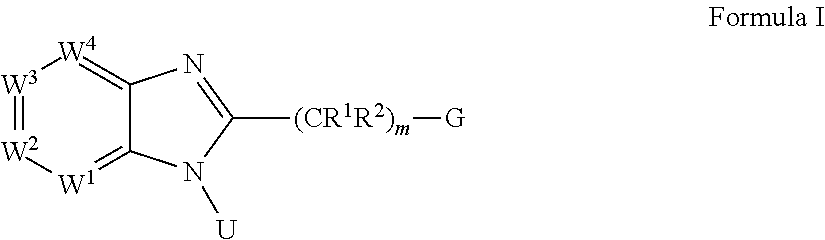
Wherein

-
- a) —O—(C0-3)alkyl-X, which is optionally substituted;
- b) —(C0-3)alkyl-S—X, which is optionally substituted;
- c) —S—(C1-3)alkyl-X, which is optionally substituted;
- d) —(C0-3)alkyl-S(O)—X, which is optionally substituted;
- e) —S(O)—(C1-3)alkyl-X, which is optionally substituted;
- f) —(C0-3)alkyl-S(O)2—X, which is optionally substituted;
- g) —S(O)2—(C1-3)alkyl-X, which is optionally substituted;
- h) —(C1-3)alkyl-N(R5)—X, which is optionally substituted;
- i) —(C1-3)alkyl-N(R5)C(O)—X, which is optionally substituted;
- j) —(C1-3)alkyl-C(O)N(R5)—X, which is optionally substituted; and
- l) —(C1-6)alkyl-X, which is optionally substituted;
-
- i) when U is

-
- and —Y—X is —O—CH2—X, then X is further substituted by a group other than H;
- ii) when U is

-
- and —Y—X is —O—X, then G is alkoxy, amino, amide, aryl, cycloalkyl, R6OC(O)—, R6C(O)O—, (R6)2NC(O)O—, heterocyclyl, heteroaryl, or sulfonamide, wherein each of said alkoxy, amino, amide, aryl, cycloalkyl, heterocyclyl, heteroaryl, R6OC(O)—, R6C(O)O—, (R6)2NC(O)O—, and sulfonamide is optionally substituted; and
- iii) when U is

-
- and —Y—X is —(C1-6)alkyl-X and X is aryl, then said (C1-6)alkyl in —Y—X is further optionally substituted by (C1-3)alkyl, hydroxyl, halogen, (C1-3)alkoxy, amide, amino, ((C1-3)alkyl)amino, halo (C1-3)alkyl, or halo(C1-3)alkoxy.


wherein R8 is H, (C1-3)alkyl, —(C1-3)alkyl-OH, —(C1-3) alkyl-C(O)OH, or —(C1-3)alkyl-C(O)N(R7)2 (definitions for R7 are provided infra.);

wherein R9 is H, —(C1-3)alkyl-C(O)NH2, —C(1-3)alkyl-C(O)N((C1-3)alkyl)2, —C(O)OH, —C(O)NH2, —C(O)(C1-3)alkyl, C(O)O(C1-4)alkyl, —S(O)2(C1-3)alkyl, (C1-3)alkyl, or halogen;

wherein R10 is H, (C1-3)alkyl, (carboxamido)(C1-3)alkyl (e.g., —(C1-3)alkyl-C(O)NH2), or —C(O)NH2; and R11 is H, halogen, (C1-3)alkyl, halo(C1-3)alkoxy, or halo(C1-3)alkyl.

Wherein
-
- a) —O—(C0-3)alkyl-X, which is optionally substituted;
- b) —(C0-3)alkyl-S—X, which is optionally substituted;
- c) —S—(C1-3)alkyl-X, which is optionally substituted; and
- d) —(C1-6)alkyl-X, which is optionally substituted;
-
- when —Y—X is —O—CH2—X, then X is further substituted (i.e., by a group other than H); and
- when —Y—X is —(C1-6)alkyl-X and X is aryl, then said (C1-6)alkyl in —Y—X is further optionally substituted by (C1-3)alkyl, hydroxyl, halogen, (C1-3)alkoxy, amide, amino, ((C1-3)alkyl)amino, halo(C1-3)alkyl, or (C1-3)alkoxy.

Wherein
-
- a) —O—(C0-3)alkyl-X, which is optionally substituted;
- b) —(C0-3)alkyl-S—X, which is optionally substituted; and
- c) —S—(C1-3)alkyl-X, which is optionally substituted;

Wherein
-
- a) —(C0-6)alkyl-C(O)N(R7)2 optionally substituted by one or more (e.g., one to three) substituents independently selected from the group consisting of —(C1-3)alkyl, —(C0-3)alkyl-OH, (C1-3)alkoxy, —(C0-3)alkyl-C(O)OH, —(C0-3)alkyl-S(O)2NH2, and —(C0-3)alkyl-C(O)N(R7)2;
- b) (C1-6)alkyl optionally substituted by one or more (e.g., one to three) substituents independently selected from the group consisting of hydroxyl, —NH2, —(C0-3)alkyl-OH, halogen, —(C0-3)alkyl-C(O)OH, and —(C0-3)alkyl-C(O)N(R7)2;
- c) (C1-6)alkoxy optionally substituted by one or more (e.g., one to three) same or different halogens;
- d) —OH;
- e) ureido;
- f) halogen;
- g) —C(O)(C1-6)alkyl;
- h) —C(O)O(C1-6)alkyl;
- i) —S(O)2(C1-6)alkyl; and
- j) —S(O)2N(R7)2;
-
- 1) —(C0-6)alkyl-C(O)N(R7)2 optionally substituted by one or more (e.g., one to three) substituents independently selected from the group consisting of (C1-3)alkyl, —(C0-3)alkyl-OH, (C1-3)alkoxy, —(C0-3)alkyl-C(O)OH, —(C0-3)alkyl-S(O)2NH2, and —(C0-3)alkyl-C(O)NH2;
- 2) (C1-6)alkyl optionally substituted by one or more (e.g., one to three) substituents independently selected from the group consisting of (C1-3)alkyl, hydroxyl, —NH2, —(C0-3)alkyl-OH, halogen, —(C0-3)alkyl-C(O)OH, and —(C0-3)alkyl-C(O)N(R7)2;
- 3) —C(O)(C1-6)alkyl;
- 4) —C(O)O(C1-6)alkyl; and
- 5) —S(O)2(C1-6)alkyl;

wherein R12 is H, (C1-3)alkyl, or carboxamido), or (C1-3)alkyl (e.g., methyl and ethyl).

Wherein
-
- i) amino optionally substituted by
- 1) —(C0-3)alkyl-C(O)N(R7)2 further optionally substituted by one or more (e.g., one to three) substituents independently selected from the group consisting of (C1-3)alkyl, —(C0-3)alkyl-OH, —(C1-3)alkoxy, —(C0-3)alkyl-C(O)OH, —(C0-3)alkyl-S(O)2NH2, and —(C0-3)alkyl-C(O)NH2;
- 2) (C1-3)alkyl optionally substituted by one or more (e.g., one to three) substituents independently selected from the group consisting of (C1-3)alkyl, hydroxyl, —NH2, —(C0-3)alkyl-OH, halogen, —(C0-3)alkyl-C(O)OH, and —(C0-3)alkyl-C(O)N(R7)2;
- 3) —C(O)O(C1-3)alkyl; or
- 4) —C(O)(C1-3)alkyl;
- ii) 3 to 7-membered heterocyclyl optionally substituted by one or more substituents independently selected from the group consisting of
- a) —(C0-3)alkyl-C(O)N(R7)2 further optionally substituted by one or more substituents independently selected from the group consisting of (C1-3)alkyl, —(C0-3)alkyl-OH, —(C1-3)alkoxy, —(C0-3)alkyl-C(O)OH, —(C0-3)alkyl-S(O)2NH2, and —(C0-3)alkyl-C(O)NH2;
- b) (C1-3)alkyl optionally substituted by one or more (e.g., one to three) substituents independently selected from the group consisting of (C1-3)alkyl, hydroxyl, —NH2, —(C0-3)alkyl-OH, halogen, —(C0-3)alkyl-C(O)OH, and —(C0-3)alkyl-C(O)N(R7)2;
- c) (C1-3)alkoxy optionally substituted by one or more (e.g., one to three) same or different halogens;
- d) halogen;
- e) —S(O)2(C1-3)alkyl;
- f) —C(O)O(C1-3)alkyl; and
- g) —C(O)(C1-3)alkyl;
- and iii) 5- to 6-membered heteroaryl optionally substituted by one or more (e.g., one to three) substituents independently selected from the group consisting of the a)-g) moieties as above defined; and
- i) amino optionally substituted by

wherein any one of the above 3- to 7-membered heterocyclyl moieties is further optionally substituted by one or two same or different substituents selected from the group consisting of halogen, —(C0-3)alkyl-C(O)N(R7)2, —C(O)O(C1-3)alkyl, —C(O)(C1-3)alkyl, —SO2(C1-3)alkyl, and (C1-3)alkyl. In certain embodiments, R7, each independently, is H or (C1-3)alkyl.

wherein R9 is H, —C(1-3)alkyl-C(O)NH2, —C(1-3)alkyl-C(O)N((C1-3)alkyl)2, —C(O)OH, —C(O)NH2, —C(O)(C1-3)alkyl, —C(O)O(C1-4)alkyl, —S(O)2(C1-3)alkyl, C(1-3)alkyl, or halogen. In one embodiment, G is

In another embodiment, G is

wherein R9 is H, —C(1-3)alkyl-C(O)NH2, —C(1-3)alkyl-C(O)N((C1-3)alkyl)2, or —C(O)O(C1-4)alkyl. In still another embodiment, G is

wherein R9 is H, —C(1-3)alkyl-C(O)NH2, —C(O)NH2, or —C(O)O(C1-4)alkyl. In another embodiment, G is

wherein R9 is H, —C(O)NH2, or —C(O)OH.

wherein each of the above exemplified 5- to 6-membered heteroaryl groups is further optionally substituted by one or more (e.g., one to three) substituents independently selected from the group consisting of halogen, (C1-3)alkyl, —(C0-3)alkyl-C(O)N(R7)2, halo(C1-3)alkyl, and halo(C1-3)alkoxy. In one embodiment, R7 as used herein, each independently, is H or (C1-3)alkyl.

wherein R10 is H, (C1-3)alkyl, —(C1-3)alkyl-C(O)NH2, or —C(O)NH2; and RH is H, halogen, (C1-3)alkyl, halo(C1-3)alkoxy, or halo(C1-3)alkyl.

wherein R8 is H, (C1-3)alkyl, —(C1-3)alkyl-OH, —(C1-3)alkyl-C(O)OH, or —(C1-3)alkyl-C(O)N(R7)2. One embodiment provides that R7 is H.

| TABLE 2 | ||
| Compd | ||
| No. | Structure | Chemical Name |
| 9 |
 |
1-(4-(4-fluorophenoxy)phenyl)-2- (tetrahydro-2H-pyran-4-yl)-1H- benzo[d]imidazole |
| 10 |
 |
2-(4-chloro-1-methyl-1H-pyrazol-3-yl)- 1-(4-(4-fluorophenoxy)phenyl)-1H- benzo[d]imidazole |
| 11 |
 |
1-(4-(4-fluorophenoxy)phenyl)-2-(1H- imidazol-4-yl)-1H-benzo[d]imidazole |
| 14 |
 |
(S)-5-(1-(4-(4-fluorophenoxy)-phenyl)- 1H-benzo[d]imidazol-2-yl)pyrrolidin-2- one |
| 15 |
 |
2-((1H-tetrazol-5-yl)methyl)-1-(4-(4- fluorophenoxy)phenyl)-1H- benzo[d]imidazole |
| 16 |
 |
1-(4-(4-fluorophenoxy)phenyl)-2-((5- methyl-4H-1,2,4-triazol-3-yl)methyl)- 1H-benzo[d]imidazole |
| 17 |
 |
1-(4-(4-fluorophenoxy)phenyl)-2-(2- (piperidin-1-yl)ethyl)-1H- benzo[d]imidazole |
| 18 |
 |
tert-butyl (S)-2-(1-(4-(4- fluorophenoxy)phenyl)-1H- benzo[d]imidazol-2-yl)pyrrolidine-1- carboxylate |
| 19 |
 |
tert-butyl 4-(1-(4-(4-fluorophenoxy) phenyl)-1H-benzo[d]imidazol-2- yl)piperidine-1-carboxylate |
| 20 |
 |
1-(4-(4-fluorophenoxy)phenyl)-2- (piperidin-4-yl)-1H-benzo[d]imidazole |
| 21 |
 |
(S)-1-(4-(4-fluorophenoxy)phenyl)-2- (pyrrolidin-2-yl)-1H-benzo[d]imidazole |
| 23 |
 |
2-(4-(1-(4-(4-fluorophenoxy)phenyl)- 1H-benzo[d]imidazol-2-yl)piperidin-1- yl)acetamide |
| 24 |
 |
N,N-diethyl-2-(4-(1-(4-(4- fluorophenoxy)phenyl)-1H- benzo[d]imidazol-2-yl)piperidin-1- yl)acetamide |
| 25 |
 |
(S)-2-(2-(1-(4-(4-fluorophenoxy) phenyl)-1H-benzo[d]imidazol-2- yl)pyrrolidin-1-yl)acetamide |
| 26 |
 |
2-(((1-(4-(4-(trifluoromethyl) phenoxy)phenyl)-1H-benzo [d]imidazol-2-yl)methyl)amino)- acetamide |
| 27 |
 |
2-((1-(1-(4-(4-(trifluoromethyl) phenoxy)phenyl)-1H-benzo [d]imidazol-2-yl)ethyl)amino) acetamide |
| 28 |
 |
2-((1-(1-(4-(4-(trifluoromethyl) phenoxy)phenyl)-1H-benzo [d]imidazol-2-yl)ethyl)amino) propanamide |
| 29 |
 |
2-(((1-(4-(4-(trifluoromethyl) phenoxy)phenyl)-1H-benzo [d]imidazol-2-yl)methyl)amino) propanamide |
| 30 |
 |
3-hydroxy-2-(((1-(4-(4- (trifluoromethyl)phenoxy)phenyl)-1H- benzo[d]imidazol-2-yl)methyl)- amino)propanamide |
| 31 |
 |
3-hydroxy-2-((1-(1-(4-(4- (trifluoromethyl)phenoxy)phenyl)-1H- benzo[d]imidazol-2- yl)ethyl)amino)propanamide |
| 32 |
 |
1-(1-(1-(4-(4-(trifluoromethyl) phenoxy)phenyl)-1H-benzo [d]imidazol-2-yl)ethyl)pyrrolidine-2- carboxamide |
| 33 |
 |
1-((1-(4-(4-(trifluoromethyl) phenoxy)phenyl)-1H-benzo [d]imidazol-2-yl)methyl)pyrrolidine-2- carboxamide |
| 34 |
 |
5-amino-5-oxo-4-((1-(1-(4-(4- (trifluoromethyl)phenoxy)phenyl)-1H- benzo[d]imidazol-2-yl)ethyl)- amino)pentanoic acid |
| 35 |
 |
2-((1-(1-(4-(4-(trifluoromethyl) phenoxy)phenyl)-1H-benzo[d]imidazol- 2-yl)ethyl) amino)pentanediamide |
| 36 |
 |
2-(((1-(4-(4-(trifluoromethyl) phenoxy)phenyl)-1H-benzo [d]imidazol-2-yl)methyl)amino) pentanediamide |
| 37 |
 |
5-amino-5-oxo-4-(((1-(4-(4- (trifluoromethyl)phenoxy)phenyl)-1H- benzo[d]imidazol-2- yl)methyl)amino)pentanoic acid |
| 38 |
 |
1-(4-(4-fluorophenoxy)phenyl)-2-((1- methyl-1H-tetrazol-5-yl)methyl)-1H- benzo[d]imidazole |
| 39 |
 |
1-(5-((1-(4-(4-fluorophenoxy)phenyl)- 1H-benzo[d]imidazol-2-yl)methyl)-1H- tetrazol-1-yl)ethan-1-one |
| 40 |
 |
1-(4-(4-fluorophenoxy)phenyl)-2-((1- (methylsulfonyl)-1H-tetrazol-5- yl)methyl)-1H-benzo[d]imidazole |
| 41 |
 |
5-((1-(4-(4-fluorophenoxy)phenyl)-1H- benzo[d]imidazol-2-yl)methyl)-N- methyl-1H-tetrazole-1-carboxamide |
| 42 |
 |
5-oxo-1-((1-(4-(4-(trifluoromethyl)- phenoxy)phenyl)-1H-benzo[d]imidazol- 2-yl)methyl)pyrrolidine-2-carboxylic acid |
| 43 |
 |
5-oxo-1-((1-(4-(4-(trifluoromethyl)- phenoxy)phenyl)-1H-benzo[d]imidazol- 2-yl)methyl)pyrrolidine-2-carboxamide |


and the pharmaceutically acceptable salts, solvates, hydrates, and diastereomers thereof.


and the pharmaceutically acceptable salts, solvates, hydrates, and diastereomers thereof.

and the pharmaceutically acceptable salts, solvates, hydrates, and diastereomers thereof.


K i=[drug]*{FR/(1−FR)}, Eq. 1
where [drug] is the concentration of a drug, and
FR=I(after drug)/I(control), Eq. 2
where I is the peak current amplitude. If multiple concentrations were used, Ki is determined from the fit of a logistic equation to FRs plotted against corresponding drug concentrations.
K r=[drug]*{FR/(1−FR)}, Eq. 3
where [drug] is the concentration of a drug, and
FR=I(after drug)/I(control), Eq. 2
where I is the peak current amplitude and was used for estimating resting block dissociation constant, Kr.
h=I @Vh2 /Imax. Eq. 4
K app=[drug]*{FR/(1−FR)}, Eq. 5
where [drug] is the concentration of a drug.
K i=(1−h)/((1/K app)−(h/K r)). Eq. 6


| TABLE 3 |
| Evaluation of compounds as sodium channel (Nav) blockers |
| Nav1.7 Activity (μM) | |||
| FLIPR assay | |||
| Compound No. | IC50 (μM) ± SEM | ||
| 9 | 0.630 ± 0.050 | ||
| 10 | 0.313 ± 0.032 | ||
| 11 | 0.102 ± 0.022 | ||
| 14 | 0.571 ± 0.070 | ||
| 16 | 0.957 ± 0.092 | ||
| 17 | 0.081 ± 0.009 | ||
| 15 | >20 | ||
| 24 | 0.516 ± 0.029 | ||
| 23 | 1.493 ± 0.225 | ||
| 25 | 1.221 ± 0.035 | ||
Claims (10)


Priority Applications (2)
| Application Number | Priority Date | Filing Date | Title |
|---|---|---|---|
| US14/534,257 US9828348B2 (en) | 2013-11-08 | 2014-11-06 | Benzimidazole derivatives and use thereof |
| US15/820,103 US9975858B2 (en) | 2013-11-08 | 2017-11-21 | Benzimidazole derivatives and use thereof |
Applications Claiming Priority (2)
| Application Number | Priority Date | Filing Date | Title |
|---|---|---|---|
| US201361901507P | 2013-11-08 | 2013-11-08 | |
| US14/534,257 US9828348B2 (en) | 2013-11-08 | 2014-11-06 | Benzimidazole derivatives and use thereof |
Related Child Applications (1)
| Application Number | Title | Priority Date | Filing Date |
|---|---|---|---|
| US15/820,103 Continuation US9975858B2 (en) | 2013-11-08 | 2017-11-21 | Benzimidazole derivatives and use thereof |
Publications (2)
| Publication Number | Publication Date |
|---|---|
| US20150133500A1 US20150133500A1 (en) | 2015-05-14 |
| US9828348B2 true US9828348B2 (en) | 2017-11-28 |
Family
ID=53044311
Family Applications (2)
| Application Number | Title | Priority Date | Filing Date |
|---|---|---|---|
| US14/534,257 Active US9828348B2 (en) | 2013-11-08 | 2014-11-06 | Benzimidazole derivatives and use thereof |
| US15/820,103 Active US9975858B2 (en) | 2013-11-08 | 2017-11-21 | Benzimidazole derivatives and use thereof |
Family Applications After (1)
| Application Number | Title | Priority Date | Filing Date |
|---|---|---|---|
| US15/820,103 Active US9975858B2 (en) | 2013-11-08 | 2017-11-21 | Benzimidazole derivatives and use thereof |
Country Status (1)
| Country | Link |
|---|---|
| US (2) | US9828348B2 (en) |
Cited By (1)
| Publication number | Priority date | Publication date | Assignee | Title |
|---|---|---|---|---|
| US11332459B2 (en) | 2017-10-19 | 2022-05-17 | Teijin Pharma Limited | Benzimidazole derivatives and their uses |
Families Citing this family (34)
| Publication number | Priority date | Publication date | Assignee | Title |
|---|---|---|---|---|
| JP2013531687A (en) | 2010-07-16 | 2013-08-08 | パーデュー、ファーマ、リミテッド、パートナーシップ | Pyridine compounds as sodium channel blockers |
| EP2616441B1 (en) | 2010-09-17 | 2019-08-07 | Purdue Pharma L.P. | Pyridine compounds and the uses thereof |
| JP2014500303A (en) | 2010-12-22 | 2014-01-09 | パーデュー、ファーマ、リミテッド、パートナーシップ | Substituted pyridines as sodium channel blockers |
| AU2012321111A1 (en) | 2011-10-31 | 2013-05-16 | Purdue Pharma L.P. | Quaternized amines as sodium channel blockers |
| AU2012324010A1 (en) | 2011-10-31 | 2013-05-16 | Purdue Pharma L.P. | Heteroaryl compounds as sodium channel blockers |
| WO2013072758A1 (en) | 2011-11-15 | 2013-05-23 | Purdue Pharma L.P. | Pyrimidine diol amides as sodium channel blockers |
| AU2013203824A1 (en) | 2012-03-16 | 2013-10-03 | Purdue Pharma L.P. | Substituted pyridines and pryimidines as sodium channel blockers |
| WO2014096941A1 (en) | 2012-12-20 | 2014-06-26 | Purdue Pharma L.P. | Cyclic sulfonamides as sodium channel blockers |
| US9120786B2 (en) | 2013-03-04 | 2015-09-01 | Purdue Pharma, L.P. | Triazine carboxamides as sodium channel blockers |
| AU2014224310B2 (en) | 2013-03-04 | 2017-02-09 | Purdue Pharma L.P. | Pyrimidine carboxamides as sodium channel blockers |
| CA3082427A1 (en) | 2013-03-15 | 2014-09-25 | Purdue Pharma L.P. | Carboxamide derivatives and use thereof |
| CA2922567A1 (en) | 2013-08-26 | 2015-03-05 | Purdue Pharma L.P. | Azaspiro[4.5]decane derivatives and use thereof |
| US9340504B2 (en) | 2013-11-21 | 2016-05-17 | Purdue Pharma L.P. | Pyridine and piperidine derivatives as novel sodium channel blockers |
| US9745287B2 (en) | 2013-12-20 | 2017-08-29 | Purdue Pharma L.P. | Pyrimidines and use thereof |
| US9695144B2 (en) | 2013-12-23 | 2017-07-04 | Purdue Pharma L.P. | Dibenzazepine derivatives and use thereof |
| AU2014370407B2 (en) | 2013-12-23 | 2018-03-29 | Purdue Pharma L.P. | Indazoles and use thereof |
| EP3089978B1 (en) | 2013-12-30 | 2018-08-29 | Purdue Pharma L.P. | Pyridone-sulfone morphinan analogs as opioid receptor ligands |
| WO2015112801A1 (en) | 2014-01-24 | 2015-07-30 | Purdue Pharma L.P. | Pyridines and pyrimidines and use thereof |
| AU2015217185B2 (en) | 2014-02-12 | 2018-04-05 | Purdue Pharma L.P. | Isoquinoline derivatives and use thereof |
| US10730866B2 (en) | 2014-04-07 | 2020-08-04 | Purdue Pharma L.P. | Indole derivatives and use thereof |
| US9975854B2 (en) | 2014-05-06 | 2018-05-22 | Purdue Pharma L.P. | Benzomorphan analogs and use thereof |
| CA2951697A1 (en) | 2014-06-13 | 2015-12-17 | Purdue Pharma L.P. | Azamophinan derivatives and use thereof |
| MA40170A (en) | 2014-06-13 | 2017-04-19 | Purdue Pharma Lp | Heterocyclic morphinan derivatives and use thereof |
| JP6768674B2 (en) * | 2015-09-11 | 2020-10-14 | 大日本住友製薬株式会社 | New benzimidazole compounds and their pharmaceutical uses |
| CN106220611A (en) * | 2016-08-08 | 2016-12-14 | 青岛科技大学 | The new preparation process of 2 (1H indole 3 base) 1H benzimidizole derivatives |
| WO2018125716A1 (en) | 2017-01-02 | 2018-07-05 | Purdue Pharma L.P. | Morphinan derivatives and use thereof |
| CA3052195A1 (en) * | 2017-02-03 | 2018-08-09 | Arizona Board Of Regents On Behalf Of The University Of Arizona | Small molecule antagonists of sumo related modification of crmp2 and uses thereof |
| EP3876930A4 (en) | 2018-11-07 | 2022-07-20 | Dana-Farber Cancer Institute, Inc. | BENZIMIDAZOLE DERIVATIVES AND AZA-BENZIMIDAZOLE DERIVATIVES AS JANUS KINASE 2 INHIBITORS AND THEIR USES |
| WO2020097400A1 (en) | 2018-11-07 | 2020-05-14 | Dana-Farber Cancer Institute, Inc. | Imidazopyridine derivatives and aza-imidazopyridine derivatives as janus kinase 2 inhibitors and uses thereof |
| EP3876939A4 (en) | 2018-11-07 | 2022-08-10 | Dana-Farber Cancer Institute, Inc. | BENZOTHIAZOLE DERIVATIVES AND 7-AZA-BENZOTHIAZOLE DERIVATIVES AS JANUS KINASE-2 INHIBITORS AND USES THEREOF |
| BR112022022409A2 (en) | 2020-05-06 | 2023-02-07 | Ajax Therapeutics Inc | 6-HETEROARYLOXY BENZIMIDAZOLES AND AZABENZIMIDAZOLES AS JAK2 INHIBITORS |
| WO2022140527A1 (en) | 2020-12-23 | 2022-06-30 | Ajax Therapeutics, Inc. | 6-heteroaryloxy benzimidazoles and azabenzimidazoles as jak2 inhibitors |
| WO2023086320A1 (en) | 2021-11-09 | 2023-05-19 | Ajax Therapeutics, Inc. | Forms and compositions of inhibitors of jak2 |
| CA3234638A1 (en) | 2021-11-09 | 2023-05-19 | Ajax Therapeutics, Inc. | 6-heteroaryloxy benzimidazoles and azabenzimidazoles as jak2 inhibitors |
Citations (65)
| Publication number | Priority date | Publication date | Assignee | Title |
|---|---|---|---|---|
| US2878248A (en) | 1956-04-02 | 1959-03-17 | Sterling Drug Inc | Carboxy-esters of hydroxybenzimidazolyl-stilbenes |
| US3271249A (en) | 1963-06-24 | 1966-09-06 | S B Penick & Co Inc | Dihalobenzimidazoles for poultry disease treatment |
| US3549754A (en) * | 1969-04-21 | 1970-12-22 | Merck & Co Inc | Combination of 2-substituted benzimidazoles and substituted phenothiazines in the treatment of helminthiasis |
| WO1991013063A1 (en) | 1990-03-01 | 1991-09-05 | Schering Aktiengesellschaft Berlin Und Bergkamen | New benzimidazole derivatives, method for preparing them and their pharmaceutical use |
| US5210091A (en) * | 1991-06-24 | 1993-05-11 | Neurosearch A/S | Imidazole compounds and their use |
| GB2263637A (en) | 1992-01-28 | 1993-08-04 | Merck & Co Inc | Substituted imidazo-fused 6-membered carbocycle or heterocycle as neurotensin antagonists |
| WO1994012461A1 (en) | 1992-12-02 | 1994-06-09 | Pfizer Inc. | Catechol diethers as selective pdeiv inhibitors |
| US6281211B1 (en) | 1999-02-04 | 2001-08-28 | Euro-Celtique S.A. | Substituted semicarbazides and the use thereof |
| US6335354B2 (en) | 2000-03-31 | 2002-01-01 | Cocensys Inc. | Aminopyridines and methods of using thereof |
| US20020037926A1 (en) | 1999-04-09 | 2002-03-28 | Lan Nancy C. | Sodium channel blocker compositions and the use thereof |
| US6414011B1 (en) | 1999-03-26 | 2002-07-02 | Euro-Celtique S.A. | Aryl substituted pyrazoles, and pyrroles, and the use thereof |
| US6479484B1 (en) | 1997-11-21 | 2002-11-12 | Euro-Celtique S.A. | Substituted 2-aminoacetamides and the use thereof |
| WO2002092575A1 (en) | 2001-05-11 | 2002-11-21 | Trimeris, Inc. | Benzimidazole compounds and antiviral uses thereof |
| US20030083315A1 (en) | 2000-01-17 | 2003-05-01 | Naoki Tsuchiya | Human chymase inhibitors |
| US6613803B1 (en) | 1997-04-22 | 2003-09-02 | Euro-Celtique S.A. | Carbocyclic and heterocyclic substituted semicarbazones and thiosemicarbazones and the use thereof |
| WO2004011439A2 (en) | 2002-07-31 | 2004-02-05 | Euro-Celtique S.A. | Aryl substituted benzimidazoles and their use as sodium channel blockers |
| US6770661B2 (en) | 2001-09-07 | 2004-08-03 | Euro-Celtique S.A. | Aryl substituted pyridines and their use |
| US20040176364A1 (en) | 2001-07-16 | 2004-09-09 | Euro-Celtique S.A. | Aryl substituted thiazinidinones and the use thereof |
| US20040192691A1 (en) | 2000-03-10 | 2004-09-30 | Euro-Celtique S.A. | Aryl substituted pyridines, pyrimidines, pyrazines and triazines and the use thereof |
| US6919363B2 (en) | 2000-03-24 | 2005-07-19 | Euro-Celtique S.A. | Aryl substituted pyrazoles, triazoles and tetrazoles, and the use thereof |
| US20050209176A1 (en) | 2002-09-06 | 2005-09-22 | Alchemia Limited | Compounds that interact with kinases |
| US20050209282A1 (en) * | 2003-10-28 | 2005-09-22 | Wilson Dean M | Benzimidazoles useful as modulators of ion channels |
| WO2006034402A2 (en) | 2004-09-21 | 2006-03-30 | Synta Pharmaceutical Corp. | Compounds for inflammation and immune-related uses |
| US7160879B2 (en) * | 2002-01-10 | 2007-01-09 | Neurogen Corporation | Melanin concentrating hormone receptor ligands: substituted 2-(4-benzyl-piperazin-1-ylmethyl)- and 2-(4-benzyl-diazepan-1-ylmethyl)-1H-benzoimidazole analogues |
| US7202232B2 (en) | 2004-03-25 | 2007-04-10 | Synta Pharmaceuticals Corp. | Acrylonitrile derivatives for inflammation and immune-related uses |
| US7229993B2 (en) | 2002-03-13 | 2007-06-12 | Euro-Celtique S.A. | Aryl substituted pyrimidines and the use thereof |
| US20070138950A1 (en) | 2005-12-02 | 2007-06-21 | Idemitsu Kosan Co., Ltd. | Nitrogenous heterocycle derivative and organic electroluminescent element employing the same |
| WO2007075629A2 (en) | 2005-12-21 | 2007-07-05 | Schering Corporation | Phenoxypiperidines and analogs thereof useful as histamine h3 antagonists |
| US20070254912A1 (en) | 2006-03-23 | 2007-11-01 | Shoujun Chen | Benzimidazolyl-pyridine compounds for inflammation and immune-related uses |
| US20090192169A1 (en) | 2006-03-31 | 2009-07-30 | Ian Egle | Bicyclic Benzimidazole Compounds and Their Use as Metabotropic Glutamate Receptor Potentiators |
| WO2010012745A2 (en) | 2008-07-29 | 2010-02-04 | Boehringer Ingelheim International Gmbh | Benzimidazoles |
| WO2010029299A1 (en) | 2008-09-12 | 2010-03-18 | Biolipox Ab | Pyrimidinone derivaties for use as medicaments |
| WO2011001115A1 (en) | 2009-07-02 | 2011-01-06 | Sanofi-Aventis | Novel 6-morpholin-4-yl-pyrimidin-4-(3h)-one derivatives, and the pharmaceutical preparation thereof as akt(pkb) phosphorylation inhibitors |
| WO2012116440A1 (en) | 2011-03-03 | 2012-09-07 | Zalicus Pharmaceuticals Ltd. | Benzimidazole inhibitors of the sodium channel |
| WO2013051672A1 (en) | 2011-10-04 | 2013-04-11 | 株式会社ヤクルト本社 | Medicinal agent comprising thiazolidine derivative or salt thereof as active ingredient |
| US20130289044A1 (en) | 2010-10-05 | 2013-10-31 | Purdue Pharma L.P. | Quinazoline Compounds as Sodium Channel Blockers |
| US20130296281A1 (en) | 2010-06-16 | 2013-11-07 | Purdue Pharma L.P. | Aryl Substituted Indoles and Their Use as Blockers of Sodium Channels |
| US20130303535A1 (en) | 2008-12-26 | 2013-11-14 | Dainippon Sumitomo Pharma Co., Ltd. | Novel bicyclic heterocyclic compound |
| US20130303526A1 (en) | 2010-09-17 | 2013-11-14 | Purdue Pharma L.P. | Pyridine Compounds and the Uses Thereof |
| US8609696B2 (en) | 2008-12-18 | 2013-12-17 | Boehringer Ingelheim International Gmbh | Serotonin 5-HT2B receptor inhibitors |
| US20130345211A1 (en) | 2010-07-16 | 2013-12-26 | Purdue Pharma L.P. | Pyridine Compounds as Sodium Channel Blockers |
| US20140005212A1 (en) | 2010-12-22 | 2014-01-02 | Purdue Pharma L.P. | Substituted Pyridines as Sodium Channel Blockers |
| US8796280B2 (en) | 2005-04-21 | 2014-08-05 | Merck Serono, S.A. | 2,3-disubstituted pyrazinesulfonamides as CRTH2 inhibitors |
| US20140249128A1 (en) | 2013-03-04 | 2014-09-04 | Purdue Pharma L.P. | Triazine carboxamides as sodium channel blockers |
| WO2014135955A1 (en) | 2013-03-04 | 2014-09-12 | Purdue Pharma L.P. | Pyrimidine carboxamides as sodium channel blockers |
| WO2014151393A2 (en) | 2013-03-15 | 2014-09-25 | Purdue Pharma L.P. | Carboxamide derivatives and use thereof |
| US20140288092A1 (en) | 2011-10-31 | 2014-09-25 | Purdue Pharma L.P. | Heteroaryl compounds as sodium channel blockers |
| US20140303139A1 (en) | 2011-09-02 | 2014-10-09 | Purdue Pharma L.P. | Pyrimidines as sodium channel blockers |
| US20140309228A1 (en) | 2011-10-31 | 2014-10-16 | Purdue Pharma L.P. | Quaternized amines as sodium channel blockers |
| US20140315783A1 (en) | 2011-11-15 | 2014-10-23 | Purdue Pharma L.P. | Pyrimidine diol amides as sodium channel blockers |
| US8945724B2 (en) | 2007-12-27 | 2015-02-03 | Idemitsu Kosan Co., Ltd. | Nitrogen-containing heterocyclic derivative and organic electroluminescent device using the same |
| US20150045397A1 (en) | 2012-03-16 | 2015-02-12 | Purdue Pharma L.P. | Substituted pyridines as sodium channel blockers |
| US20150057300A1 (en) | 2013-08-26 | 2015-02-26 | Purdue Pharma L.P. | Substituted piperidines as sodium channel blockers |
| WO2015094443A1 (en) | 2013-12-20 | 2015-06-25 | Purdue Pharma L.P. | Pyrimidines and use thereof |
| US20150175569A1 (en) | 2013-12-23 | 2015-06-25 | Purdue Pharma L.P. | Dibenzazepine derivatives and use thereof |
| WO2015112801A1 (en) | 2014-01-24 | 2015-07-30 | Purdue Pharma L.P. | Pyridines and pyrimidines and use thereof |
| US20150284383A1 (en) | 2014-04-07 | 2015-10-08 | Purdue Pharma L.P. | Indole derivatives and use thereof |
| US20150336974A1 (en) | 2012-12-20 | 2015-11-26 | Purdue Pharma L.P. | Cyclic Sulfonamides as Sodium Channel Blockers |
| US9340504B2 (en) | 2013-11-21 | 2016-05-17 | Purdue Pharma L.P. | Pyridine and piperidine derivatives as novel sodium channel blockers |
| US9340542B2 (en) | 2013-12-26 | 2016-05-17 | Purdue Pharma L.P. | Propellane-based compounds and the use thereof |
| US20160207923A1 (en) | 2013-08-26 | 2016-07-21 | Purdue Pharma L.P. | Azaspiro[4.5] decane derivatives and use thereof |
| US20160243129A1 (en) | 2015-02-19 | 2016-08-25 | Purdue Pharma L.P. | Methods and Compositions for Decreasing Gastric Emptying |
| US20170001986A1 (en) | 2013-12-23 | 2017-01-05 | Purdue Pharma L.P. | Indazoles and use thereof |
| US20170022213A1 (en) | 2013-12-26 | 2017-01-26 | Mark Youngman | Opioid receptor modulating oxabicyclo[2.2.2]octane morphinans |
| US20170057942A1 (en) | 2014-02-12 | 2017-03-02 | Purdue Pharma L.P. | Isoquinoline derivatives and use thereof |
-
2014
- 2014-11-06 US US14/534,257 patent/US9828348B2/en active Active
-
2017
- 2017-11-21 US US15/820,103 patent/US9975858B2/en active Active
Patent Citations (93)
| Publication number | Priority date | Publication date | Assignee | Title |
|---|---|---|---|---|
| US2878248A (en) | 1956-04-02 | 1959-03-17 | Sterling Drug Inc | Carboxy-esters of hydroxybenzimidazolyl-stilbenes |
| US3271249A (en) | 1963-06-24 | 1966-09-06 | S B Penick & Co Inc | Dihalobenzimidazoles for poultry disease treatment |
| US3549754A (en) * | 1969-04-21 | 1970-12-22 | Merck & Co Inc | Combination of 2-substituted benzimidazoles and substituted phenothiazines in the treatment of helminthiasis |
| WO1991013063A1 (en) | 1990-03-01 | 1991-09-05 | Schering Aktiengesellschaft Berlin Und Bergkamen | New benzimidazole derivatives, method for preparing them and their pharmaceutical use |
| US5210091A (en) * | 1991-06-24 | 1993-05-11 | Neurosearch A/S | Imidazole compounds and their use |
| GB2263637A (en) | 1992-01-28 | 1993-08-04 | Merck & Co Inc | Substituted imidazo-fused 6-membered carbocycle or heterocycle as neurotensin antagonists |
| WO1994012461A1 (en) | 1992-12-02 | 1994-06-09 | Pfizer Inc. | Catechol diethers as selective pdeiv inhibitors |
| US6696442B2 (en) | 1997-04-22 | 2004-02-24 | Euro-Celtique S.A. | Carbocyclic and heterocyclic substituted semicarbazones and thiosemicarbazones and the use thereof |
| US20030225080A1 (en) | 1997-04-22 | 2003-12-04 | Euro-Celtiques S.A. | Carbocyclic and heterocyclic substituted semicarbazones and thiosemicarbazones and the use thereof |
| US6613803B1 (en) | 1997-04-22 | 2003-09-02 | Euro-Celtique S.A. | Carbocyclic and heterocyclic substituted semicarbazones and thiosemicarbazones and the use thereof |
| US6638947B2 (en) | 1997-04-22 | 2003-10-28 | Euro-Celtique S.A. | Carbocyclic and heterocyclic substituted semicarbazones and thiosemicarbazones and the use thereof |
| US8426431B2 (en) | 1997-11-21 | 2013-04-23 | Purdue Neuroscience Company | Substituted 2-aminoacetamides and the use thereof |
| US6479484B1 (en) | 1997-11-21 | 2002-11-12 | Euro-Celtique S.A. | Substituted 2-aminoacetamides and the use thereof |
| US6500825B2 (en) | 1997-11-21 | 2002-12-31 | Euro-Celtique S.A. | Substituted 2-aminoacetamides and the use thereof |
| US7872127B2 (en) | 1997-11-21 | 2011-01-18 | Purdue Neuroscience Company | Substituted 2-aminoacetamides and the use thereof |
| US7541465B2 (en) | 1997-11-21 | 2009-06-02 | Purdue Neuroscience Company | Substituted 2-aminoacetamides and the use thereof |
| US7091210B2 (en) | 1997-11-21 | 2006-08-15 | Purdue Neuroscience Company | Substituted 2-aminoacetamides and the use thereof |
| US6281211B1 (en) | 1999-02-04 | 2001-08-28 | Euro-Celtique S.A. | Substituted semicarbazides and the use thereof |
| US6414011B1 (en) | 1999-03-26 | 2002-07-02 | Euro-Celtique S.A. | Aryl substituted pyrazoles, and pyrroles, and the use thereof |
| US6737418B2 (en) | 1999-03-26 | 2004-05-18 | Euro-Celtique S.A. | Aryl substituted pyrazoles, imidazoles, oxazoles, thiazoles and pyrroles, and the use thereof |
| US20020037926A1 (en) | 1999-04-09 | 2002-03-28 | Lan Nancy C. | Sodium channel blocker compositions and the use thereof |
| US20080318932A1 (en) | 1999-04-09 | 2008-12-25 | Purdue Pharma L.P. | Sodium Channel Blocker Compositions and the Use Thereof |
| US7393872B2 (en) | 1999-04-09 | 2008-07-01 | Euro-Celtique S.A. | Sodium channel blocker compositions and the use thereof |
| US20030083315A1 (en) | 2000-01-17 | 2003-05-01 | Naoki Tsuchiya | Human chymase inhibitors |
| US20050043305A1 (en) | 2000-03-10 | 2005-02-24 | Euro-Celtique S.A. | Aryl substituted pyridines, pyrimidines, pyrazines and triazines and the use thereof |
| US6867210B2 (en) | 2000-03-10 | 2005-03-15 | Euro-Celtique S.A. | Aryl substituted pyrimidines |
| US20040192691A1 (en) | 2000-03-10 | 2004-09-30 | Euro-Celtique S.A. | Aryl substituted pyridines, pyrimidines, pyrazines and triazines and the use thereof |
| US6919363B2 (en) | 2000-03-24 | 2005-07-19 | Euro-Celtique S.A. | Aryl substituted pyrazoles, triazoles and tetrazoles, and the use thereof |
| US7078426B2 (en) | 2000-03-24 | 2006-07-18 | Euro-Celtique S.A. | Aryl substituted pyrazoles, triazoles, and tetrazoles, and the use thereof |
| US6335354B2 (en) | 2000-03-31 | 2002-01-01 | Cocensys Inc. | Aminopyridines and methods of using thereof |
| WO2002092575A1 (en) | 2001-05-11 | 2002-11-21 | Trimeris, Inc. | Benzimidazole compounds and antiviral uses thereof |
| US7169782B2 (en) | 2001-07-16 | 2007-01-30 | Euro-Celtique S.A. | Aryl substituted thiazolidinones and the use thereof |
| US20040176364A1 (en) | 2001-07-16 | 2004-09-09 | Euro-Celtique S.A. | Aryl substituted thiazinidinones and the use thereof |
| US6770661B2 (en) | 2001-09-07 | 2004-08-03 | Euro-Celtique S.A. | Aryl substituted pyridines and their use |
| US7160879B2 (en) * | 2002-01-10 | 2007-01-09 | Neurogen Corporation | Melanin concentrating hormone receptor ligands: substituted 2-(4-benzyl-piperazin-1-ylmethyl)- and 2-(4-benzyl-diazepan-1-ylmethyl)-1H-benzoimidazole analogues |
| US7229993B2 (en) | 2002-03-13 | 2007-06-12 | Euro-Celtique S.A. | Aryl substituted pyrimidines and the use thereof |
| US7022714B2 (en) | 2002-07-31 | 2006-04-04 | Euro-Celtique S.A. | Aryl substituted benzimidazoles and their use as sodium channel blockers |
| WO2004011439A2 (en) | 2002-07-31 | 2004-02-05 | Euro-Celtique S.A. | Aryl substituted benzimidazoles and their use as sodium channel blockers |
| US20050209176A1 (en) | 2002-09-06 | 2005-09-22 | Alchemia Limited | Compounds that interact with kinases |
| US20050209282A1 (en) * | 2003-10-28 | 2005-09-22 | Wilson Dean M | Benzimidazoles useful as modulators of ion channels |
| US7202232B2 (en) | 2004-03-25 | 2007-04-10 | Synta Pharmaceuticals Corp. | Acrylonitrile derivatives for inflammation and immune-related uses |
| US8524756B2 (en) | 2004-09-21 | 2013-09-03 | Synta Pharmaceuticals Corp. | Compounds for inflammation and immune-related uses |
| WO2006034402A2 (en) | 2004-09-21 | 2006-03-30 | Synta Pharmaceutical Corp. | Compounds for inflammation and immune-related uses |
| US8796280B2 (en) | 2005-04-21 | 2014-08-05 | Merck Serono, S.A. | 2,3-disubstituted pyrazinesulfonamides as CRTH2 inhibitors |
| US20070138950A1 (en) | 2005-12-02 | 2007-06-21 | Idemitsu Kosan Co., Ltd. | Nitrogenous heterocycle derivative and organic electroluminescent element employing the same |
| WO2007075629A2 (en) | 2005-12-21 | 2007-07-05 | Schering Corporation | Phenoxypiperidines and analogs thereof useful as histamine h3 antagonists |
| US20070254912A1 (en) | 2006-03-23 | 2007-11-01 | Shoujun Chen | Benzimidazolyl-pyridine compounds for inflammation and immune-related uses |
| US20090192169A1 (en) | 2006-03-31 | 2009-07-30 | Ian Egle | Bicyclic Benzimidazole Compounds and Their Use as Metabotropic Glutamate Receptor Potentiators |
| US8945724B2 (en) | 2007-12-27 | 2015-02-03 | Idemitsu Kosan Co., Ltd. | Nitrogen-containing heterocyclic derivative and organic electroluminescent device using the same |
| WO2010012745A2 (en) | 2008-07-29 | 2010-02-04 | Boehringer Ingelheim International Gmbh | Benzimidazoles |
| WO2010029299A1 (en) | 2008-09-12 | 2010-03-18 | Biolipox Ab | Pyrimidinone derivaties for use as medicaments |
| US8609696B2 (en) | 2008-12-18 | 2013-12-17 | Boehringer Ingelheim International Gmbh | Serotonin 5-HT2B receptor inhibitors |
| US20130303535A1 (en) | 2008-12-26 | 2013-11-14 | Dainippon Sumitomo Pharma Co., Ltd. | Novel bicyclic heterocyclic compound |
| WO2011001115A1 (en) | 2009-07-02 | 2011-01-06 | Sanofi-Aventis | Novel 6-morpholin-4-yl-pyrimidin-4-(3h)-one derivatives, and the pharmaceutical preparation thereof as akt(pkb) phosphorylation inhibitors |
| US20130296281A1 (en) | 2010-06-16 | 2013-11-07 | Purdue Pharma L.P. | Aryl Substituted Indoles and Their Use as Blockers of Sodium Channels |
| US20130345211A1 (en) | 2010-07-16 | 2013-12-26 | Purdue Pharma L.P. | Pyridine Compounds as Sodium Channel Blockers |
| US20130303526A1 (en) | 2010-09-17 | 2013-11-14 | Purdue Pharma L.P. | Pyridine Compounds and the Uses Thereof |
| US20150259293A1 (en) | 2010-09-17 | 2015-09-17 | Purdue Pharma L.P. | Pyridine compounds and the uses thereof |
| US20130289044A1 (en) | 2010-10-05 | 2013-10-31 | Purdue Pharma L.P. | Quinazoline Compounds as Sodium Channel Blockers |
| US9168255B2 (en) | 2010-10-05 | 2015-10-27 | Purdue Pharma L.P. | Quinazoline compounds as sodium channel blockers |
| US20140005212A1 (en) | 2010-12-22 | 2014-01-02 | Purdue Pharma L.P. | Substituted Pyridines as Sodium Channel Blockers |
| WO2012116440A1 (en) | 2011-03-03 | 2012-09-07 | Zalicus Pharmaceuticals Ltd. | Benzimidazole inhibitors of the sodium channel |
| US20160024022A1 (en) | 2011-09-02 | 2016-01-28 | Purdue Pharma L.P. | Pyrimidines as sodium channel blockers |
| US20140303139A1 (en) | 2011-09-02 | 2014-10-09 | Purdue Pharma L.P. | Pyrimidines as sodium channel blockers |
| WO2013051672A1 (en) | 2011-10-04 | 2013-04-11 | 株式会社ヤクルト本社 | Medicinal agent comprising thiazolidine derivative or salt thereof as active ingredient |
| US20140288092A1 (en) | 2011-10-31 | 2014-09-25 | Purdue Pharma L.P. | Heteroaryl compounds as sodium channel blockers |
| US20140309228A1 (en) | 2011-10-31 | 2014-10-16 | Purdue Pharma L.P. | Quaternized amines as sodium channel blockers |
| US20160052911A1 (en) | 2011-10-31 | 2016-02-25 | Purdue Pharma L.P. | Heteroaryl compounds as sodium channel blockers |
| US20140315783A1 (en) | 2011-11-15 | 2014-10-23 | Purdue Pharma L.P. | Pyrimidine diol amides as sodium channel blockers |
| US20150335642A1 (en) | 2011-11-15 | 2015-11-26 | Purdue Pharma L.P. | Pyrimidine diol amides as sodium channel blockers |
| US20150045397A1 (en) | 2012-03-16 | 2015-02-12 | Purdue Pharma L.P. | Substituted pyridines as sodium channel blockers |
| US20160145210A1 (en) | 2012-03-16 | 2016-05-26 | Purdue Pharma L.P. | Substituted pyridines as sodium channel blockers |
| US20150336974A1 (en) | 2012-12-20 | 2015-11-26 | Purdue Pharma L.P. | Cyclic Sulfonamides as Sodium Channel Blockers |
| US20160009659A1 (en) | 2013-03-04 | 2016-01-14 | Jeffrey Lockman | Pyrimidine carboxamides as sodium channel blockers |
| WO2014135955A1 (en) | 2013-03-04 | 2014-09-12 | Purdue Pharma L.P. | Pyrimidine carboxamides as sodium channel blockers |
| US20150353512A1 (en) | 2013-03-04 | 2015-12-10 | Purdue Pharma L.P. | Triazine carboxamides as sodium channel blockers |
| US20140249128A1 (en) | 2013-03-04 | 2014-09-04 | Purdue Pharma L.P. | Triazine carboxamides as sodium channel blockers |
| US20160031873A1 (en) | 2013-03-15 | 2016-02-04 | Purdue Pharma L.P. | Carboxamide Derivatives and Use Thereof |
| US20170096421A1 (en) | 2013-03-15 | 2017-04-06 | Purdue Pharma L.P. | Carboxamide Derivatives and Use Thereof |
| WO2014151393A2 (en) | 2013-03-15 | 2014-09-25 | Purdue Pharma L.P. | Carboxamide derivatives and use thereof |
| US20160207923A1 (en) | 2013-08-26 | 2016-07-21 | Purdue Pharma L.P. | Azaspiro[4.5] decane derivatives and use thereof |
| US20150057300A1 (en) | 2013-08-26 | 2015-02-26 | Purdue Pharma L.P. | Substituted piperidines as sodium channel blockers |
| US9340504B2 (en) | 2013-11-21 | 2016-05-17 | Purdue Pharma L.P. | Pyridine and piperidine derivatives as novel sodium channel blockers |
| WO2015094443A1 (en) | 2013-12-20 | 2015-06-25 | Purdue Pharma L.P. | Pyrimidines and use thereof |
| US20150175569A1 (en) | 2013-12-23 | 2015-06-25 | Purdue Pharma L.P. | Dibenzazepine derivatives and use thereof |
| US20170001986A1 (en) | 2013-12-23 | 2017-01-05 | Purdue Pharma L.P. | Indazoles and use thereof |
| US9340542B2 (en) | 2013-12-26 | 2016-05-17 | Purdue Pharma L.P. | Propellane-based compounds and the use thereof |
| US20170022213A1 (en) | 2013-12-26 | 2017-01-26 | Mark Youngman | Opioid receptor modulating oxabicyclo[2.2.2]octane morphinans |
| US20170008882A1 (en) | 2014-01-24 | 2017-01-12 | Purdue Pharma L.P. | Pyridines and pyrimidines and use thereof |
| WO2015112801A1 (en) | 2014-01-24 | 2015-07-30 | Purdue Pharma L.P. | Pyridines and pyrimidines and use thereof |
| US20170057942A1 (en) | 2014-02-12 | 2017-03-02 | Purdue Pharma L.P. | Isoquinoline derivatives and use thereof |
| US20150284383A1 (en) | 2014-04-07 | 2015-10-08 | Purdue Pharma L.P. | Indole derivatives and use thereof |
| US20160243129A1 (en) | 2015-02-19 | 2016-08-25 | Purdue Pharma L.P. | Methods and Compositions for Decreasing Gastric Emptying |
Non-Patent Citations (40)
| Title |
|---|
| Anger. T., et al., "Medicinal Chemistry of Neuronal Voltage-Gated Sodium Channel Blockers," J. Med. Chem. 44 (2):115-137, American Chemical Society, United States (2001). |
| Axelsson et al. "Preparation of . . . " CA118:191736 (1993). * |
| Axelsson et al. "Preparation of benz . . . " CA118:191736. * |
| Baker, M.D. and Wood, J.N., "Involvement of Na+ channels in pain pathways," Trends Pharmacol. Sci. 22(1):27-31, Elsevier Science Ltd., England (2001). |
| Black, J.A., et al., "Sensory neuron-specific sodium channel SNS is abnormally expressed in the brains of mice with experimental allergic encephalomyelitis and humans with multiple sclerosis," Proc. Natl. Acad. Sci. USA 97 (21):11598-11602, National Academy of Sciences, United States (2000). |
| Brown, C.M., et al., "Neuroprotective properties of lifarizine compared with those of other agents in a mouse model of focal cerebral ischaemia," Br. J. Pharmacol. 115(8):1425-1432, Stockton Press, England (1995). |
| Cannon, S.C., "Spectrum of Sodium Channel Disturbances in the nondystrophic myotonias and periodic paralyses," Kidney Int. 57(3)172-779, International Society of Nephrology, United States (2000). |
| Catterall, W.A., "Common modes of drug action on Na+ channels: local anesthetics, antiarrhythmics and anticonvulsants," Trends Pharmacol. Sci. 8:57-65, Elsevier Science Publishers, B.V., Netherlands (1987). |
| Chahine, M., et al., "Voltage-Gated Sodium Channels in Neurological Disorders," CNS Neurol. Disord. Drug Targets 7(2):144-158, Bentham Science Publishers Ltd., United Arab Emirates (2008). |
| Clare, J.J., et al., "Voltage-gated sodium channels as therapeutic targets," Drug Discov. Today 5(11):506-520, Elsevier Science Ltd., England (2000). |
| Cooper, K., et al. "Enantiodifferentiation of Dihydropyridine Paf Antagonists" Biorganic & Medicinal Chemistry Letters 5(24): 3085-3090, Elsevier Sicence Ltd, Great Britain (1995). |
| Das et al."Preparation of substituted . . . " CA157:548642. * |
| DiNetta et al. CA RN 3367-02-0. * |
| Graham, S.H., et al., "Neuroprotective Effects of a Use-Dependent Blocker of Voltage-Dependent Sodium Channels, BW619C89, in Rat Middle Cerebral Artery Occlusion," J. Pharmacol. Exp. Ther. 269(2):854-859, The American Society for Pharmacology and Experimental Therapeutics, United States (1994). |
| Hubner, C., et al., "Ion Channel Diseases," Human Molecular Genetics 11:2435-2445, Oxford University Press (2002). |
| Hussein, F.A., et al. "1-(P- or M-Cinnamoylphenyl)-5-Nitrobenzimidazoles" Iraqi Journal of Science 23(3): 293-309, University of Baghdad, Baghdad, Iraq (1982). |
| Improper Markush, Fed. Reg. 76(27) p. 7162-7175, slide 1, 64-67 (2011). * |
| Khristich, B.I., et al., "Free-Radical Hydroxymethylation of Benzimidazole" Khimiya Geterotsiklicheskikh Soedinenii, No. 12: 1679-1681, Rostov State Universtity, Russia (1982). |
| Kyle, D.J., and Ilyin, V.I., "Sodium Channel Blockers," J. Med. Chem. 50(11):2583-2588, American Chemical Society, United States (2007). |
| Lai, J., et al., "The role of voltage-gated sodium channels in neuropathic pain," Curr. Opin. Neurobiol. 13(3):291-297, Elsevier Science Ltd., England (2003). |
| Lai, J., et al., "Voltage-Gated Sodium Channels and Hyperalgesia," Annu. Rev. Pharmacol. Toxicol. 44:371-397, Annual Reviews, United States (2004). |
| Laird, J.M.A., et al., "Deficits in Visceral Pain and Referred Hyperalgesia in Nav1.8 (SNS/PN3)-Null Mice," J. Neurosci. 22(19):8352-8356, Society for Neuroscience, United States (2002). |
| Laird, J.M.A., et al., "Deficits in Visceral Pain and Referred Hyperalgesia in Nav1.8 (SNS/PN3)—Null Mice," J. Neurosci. 22(19):8352-8356, Society for Neuroscience, United States (2002). |
| Liu, H., et al., "Mutations in Cardiac Sodium Channels: Clinical Implications," Am. J. Pharmacogenomics 3(3):173-179, Adis Data Information BV, New Zealand (2003). |
| Majumdar, B., et al., "An electrocochleographic study of the effects of lignocaine on patients with tinnitus," Clin. Otolaryngol. Allied Sci. 8(3):175-180, Blackwell Scientific Publications, England (1983). |
| Meisler, M.H. and Kearney, J.A., "Sodium channel mutations in epilepsy and other neurological disorders," J. Clin. Invest. 115(8):2010-2017, American Society for Clinical Investigation, United States (2005). |
| Moller, A., "Similiarities Between Chronic Pain and Tinnitus," The American Journal of Ontology 18:577-585 (1997). |
| Nassar, M.A., et al., "Nociceptor-specific gene deletion reveals a major role for Nav1.7 (PN1) in acute and inflammatory pain," Proc. Natl. Acad. Sci. USA 101(34):12706-12711, National Academy of Sciences, United States (2004). |
| Noble, D., "Unraveling the genetics and mechanisms of cardiac arrhythmia," Proc. Natl. Acad. Sci. USA 99 (9):5755-5756, National Academy of Sciences, United States (2002). |
| Schwalbe, C., et al. "Studies in the Carbazole Series" Proceedings of the Chemical Society, 26(340): 340, London (1911). |
| Simpson, J.J. and Davies, W.E., "Recent advances in the pharmacological treatment of innitus," Trends Pharmacol. Sci. 20(1):12-18, Elsevier Science, England (1999). |
| Srivatsa, U., et al., "Mechanisms of Antiarrhythmic Drug Actions and Their Clinical Relevance for Controlling Disorders of Cardiac Rhythm," Curr. Cardiol. Rep. 4(5):401-410, Current Science Inc., United States (2002). |
| Taylor, C.P. and Meldrum, B.S., "Na+ channels as targets for neuroprotective drugs," Trends Pharmacol. Sci. 16 (9):309-316, Elsevier Science Ltd., England (1995). |
| Toledo-Aral, J.J., et al., "Identification of PN1, a predominant voltage-dependent sodium channel expressed principally in peripheral neurons," Proc. Natl. Acad. Sci. USA 94(4):1527-1532, The National Academy of Sciences, United States (1997). |
| Tonndorf, J., "The analogy between tinnitus and pain: A suggestion for physiological basis of chronic tinnitus," Hearing Research 28(2-3):271-275, Elsevier Science Publishers B.V., Netherlands (1987). |
| Vlahakis et al. "Selective inhibition . . . " Bioorg. Med. Chemm. vo. 21, p. 6788-95 (2013). * |
| Walensky et al. "Small molecules for . . . " CA155:291909. * |
| Wood, J.N., et al., "Voltage-Gated Sodium Channels and Pain Pathways," J. Neurobiol. 61(1):55-71, Wiley Periodicals, Inc., United States (2004). |
| Yogeeswari, P., et al., "Ion Channels as Important Targets for Antiepileptic Drug Design," Curr. Drug Targets 5 (7):589-602, Bentham Science Publishers Ltd., Netherlands (2004). |
| Zhu, Y., et al. "4-Methyl-5-phenyl triazoles as selctive inhibitors of 11B-hydroxysteroid dehydrogenase type I" Biorganic & Medicinal Chemistry Letters, 18(11): 3405-3411, Elsevier Science Ltd, (2008). |
Cited By (1)
| Publication number | Priority date | Publication date | Assignee | Title |
|---|---|---|---|---|
| US11332459B2 (en) | 2017-10-19 | 2022-05-17 | Teijin Pharma Limited | Benzimidazole derivatives and their uses |
Also Published As
| Publication number | Publication date |
|---|---|
| US20180079726A1 (en) | 2018-03-22 |
| US20150133500A1 (en) | 2015-05-14 |
| US9975858B2 (en) | 2018-05-22 |
Similar Documents
| Publication | Publication Date | Title |
|---|---|---|
| US9975858B2 (en) | Benzimidazole derivatives and use thereof | |
| US9388137B2 (en) | Quaternized amines as sodium channel blockers | |
| US9718780B2 (en) | Substituted pyridines as sodium channel blockers | |
| US9340504B2 (en) | Pyridine and piperidine derivatives as novel sodium channel blockers | |
| US9539253B2 (en) | Pyrimidine diol amides as sodium channel blockers | |
| US10774050B2 (en) | Pyrimidines as sodium channel blockers | |
| US9624194B2 (en) | Heteroaryl compounds as sodium channel blockers | |
| US9765029B2 (en) | Pyridine compounds as sodium channel blockers | |
| US9656959B2 (en) | Substituted pyridines as sodium channel blockers | |
| EP2625169B1 (en) | Quinazoline compounds as sodium channel blockers | |
| AU2012327195B8 (en) | Pyrimidine diol amides as sodium channel blockers |
Legal Events
| Date | Code | Title | Description |
|---|---|---|---|
| AS | Assignment |
Owner name: PURDUE PHARMA L.P., CONNECTICUT Free format text: ASSIGNMENT OF ASSIGNORS INTEREST;ASSIGNORS:TAFESSE, LAYKEA;YAO, JIANGCHAO;ZHOU, XIAOMING;SIGNING DATES FROM 20141104 TO 20141105;REEL/FRAME:034892/0544 |
|
| STCF | Information on status: patent grant |
Free format text: PATENTED CASE |
|
| MAFP | Maintenance fee payment |
Free format text: PAYMENT OF MAINTENANCE FEE, 4TH YEAR, LARGE ENTITY (ORIGINAL EVENT CODE: M1551); ENTITY STATUS OF PATENT OWNER: LARGE ENTITY Year of fee payment: 4 |
|
| MAFP | Maintenance fee payment |
Free format text: PAYMENT OF MAINTENANCE FEE, 8TH YEAR, LARGE ENTITY (ORIGINAL EVENT CODE: M1552); ENTITY STATUS OF PATENT OWNER: LARGE ENTITY Year of fee payment: 8 |