US9825614B2 - Elimination method for common sub-expression - Google Patents
Elimination method for common sub-expression Download PDFInfo
- Publication number
- US9825614B2 US9825614B2 US14/839,623 US201514839623A US9825614B2 US 9825614 B2 US9825614 B2 US 9825614B2 US 201514839623 A US201514839623 A US 201514839623A US 9825614 B2 US9825614 B2 US 9825614B2
- Authority
- US
- United States
- Prior art keywords
- sub
- expression
- expressions
- common
- inputs
- Prior art date
- Legal status (The legal status is an assumption and is not a legal conclusion. Google has not performed a legal analysis and makes no representation as to the accuracy of the status listed.)
- Expired - Fee Related, expires
Links
Images




Classifications
-
- H—ELECTRICITY
- H03—ELECTRONIC CIRCUITRY
- H03H—IMPEDANCE NETWORKS, e.g. RESONANT CIRCUITS; RESONATORS
- H03H17/00—Networks using digital techniques
- H03H17/02—Frequency selective networks
- H03H17/0248—Filters characterised by a particular frequency response or filtering method
-
- H—ELECTRICITY
- H03—ELECTRONIC CIRCUITRY
- H03H—IMPEDANCE NETWORKS, e.g. RESONANT CIRCUITS; RESONATORS
- H03H17/00—Networks using digital techniques
- H03H17/02—Frequency selective networks
- H03H17/0223—Computation saving measures; Accelerating measures
- H03H17/0227—Measures concerning the coefficients
-
- H—ELECTRICITY
- H03—ELECTRONIC CIRCUITRY
- H03H—IMPEDANCE NETWORKS, e.g. RESONANT CIRCUITS; RESONATORS
- H03H17/00—Networks using digital techniques
- H03H17/02—Frequency selective networks
- H03H17/06—Non-recursive filters
Definitions
- aspects of embodiments of the present invention relate to an elimination method for common sub-expression.
- FIR filters need to be operated with low power using CMOS technology in mobile communication terminals.
- CSD canonical signed digit
- Structures in which multiplication is processed using only adders, subtractors, shifters, and delay elements in high-speed/low power filters are desired. Such structures may benefit from CSD-type coefficients, which have fewer nonzero digits than comparable two's complement coefficients.
- the two's complement may be represented as
- Binary numbers in two's complement may be represented in CSD by repeatedly replacing strings of consecutive nonzero digits with equivalent strings having only nonconsecutive nonzero digits.
- ⁇ 1 will be represented as n for convenience of description.
- 01111 in two's complement is represented as 1000n in CSD.
- a binary number in two's complement may be easily converted to a number in CSD as described above, and all binary numbers in two's complement may be represented as numbers in CSD.
- Embodiments of the present invention provide for a common sub-expression elimination method. Further embodiments provide for a method for simplifying a filter logic circuit by iteratively searching for common sub-expressions in a FIR filter circuit and eliminating any found common sub-expressions.
- a common sub-expression elimination method for simplifying hardware logic of a hardware filter circuit by eliminating a common sub-expression included in a plurality of sub-expressions.
- Each of the sub-expressions includes a corresponding two or more of inputs constituting a plurality of coefficients used by the hardware filter circuit.
- the method includes: identifying, on a computing device, for each coefficient of the plurality of coefficients, a combination of the inputs constituting the coefficient; counting, on the computing device, occurrences of the sub-expressions in each of the coefficients; identifying, by the computing device, one or more of the sub-expressions having a maximum one of the counts and including the corresponding two or more of the inputs; selecting, by the computing device, one of the one or more of the sub-expressions as the common sub-expression; eliminating, by the computing device, the common sub-expression; and repeating the counting of the occurrences of the sub-expressions, the identifying of the one or more of the sub-expressions having the maximum one of the counts, the selecting of the common sub-expression, and the eliminating of the common sub-expression to eliminate more of the sub-expressions common to multiple ones of the coefficients.
- the repeating of the counting of the occurrences of the sub-expressions, the identifying of the one or more of the sub-expressions having the maximum one of the counts, the selecting of the common sub-expression, and the eliminating of the common sub-expression may continue until the maximum one of the counts equals one.
- the selecting of the common sub-expression may further includes: determining, by the computing device, for each input of the corresponding two or more of the inputs of each sub-expression of the two or more of the sub-expressions, a largest one of the counts of the sub-expressions including the input but excluding the sub-expression; identifying, by the computing device, one or more of the inputs having a minimum one of the largest ones of the counts; and selecting, by the computing device, the sub-expression corresponding to one of the one or more of the inputs as the common sub-expression.
- the corresponding two or more of the inputs may include exactly two of the inputs.
- the eliminating of the common sub-expression may include: adding, by the computing device, the common sub-expression as a new input to the inputs; and replacing, by the computing device, the corresponding two or more of the inputs from the inputs constituting each of the coefficients sharing the common sub-expression with the new input.
- the hardware filter circuit may include a linear-phase filter and the coefficients may include linear-phase filter coefficients.
- the hardware filter circuit may include a finite impulse response (FIR) filter.
- FIR finite impulse response
- the sub-expressions may include sums of the corresponding two or more of the inputs.
- the inputs may include different powers of two.
- the inputs may further include sums of the powers of two corresponding to the eliminated sub-expressions common to multiple ones of the coefficients.
- the size of a circuit and manufacturing expense may be minimized with a simple circuit structure.
- a low-power/high-speed filter may be designed.
- FIG. 1 is a schematic diagram of a filter used in a common sub-expression elimination method according to an embodiment of the present invention.
- FIG. 2 is a table of example filter coefficients according to an embodiment of the present invention.
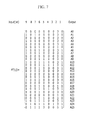
- FIG. 3 shows an input/output matrix A(i,j) of two's complement numbers generated from example filter coefficients according to an embodiment of the present invention.
- FIG. 4 shows a matrix B(i,j) obtained by applying the following equation to the matrix A(i,j) in FIG. 3 .
- FIG. 5 shows a matrix B(i,j) obtained by applying the equation of FIG. 4 to a matrix of example filter coefficients according to another embodiment of the present invention.
- FIG. 6 shows the matrix A(i, j) of FIG. 3 that is updated by eliminating a selected common sub-expression according to an embodiment of the present invention.
- FIG. 7 shows the matrix A′(i, j) of FIG. 6 to which a new column is inserted representing the eliminated common sub-expression according to an embodiment of the present invention.
- FIG. 8 is a matrix B′(i, j) that is newly obtained by applying the equation applied in FIG. 4 to the matrix A′′(i,j) of FIG. 7 according to an embodiment of the present invention.
- FIG. 9 is a flowchart illustrating a common sub-expression elimination method according to an embodiment of the present invention.
- a term such as “first” or “second” may be used to describe various elements, but the elements are not limited by the terms. The terms are used mainly for distinguishing one element from another element.
- any component when any component is referred to as being connected to or coupled to another component, it may be directly connected to or directly coupled to the other component or be connected to or coupled to the other component with one or more further components intervening therebetween.
- the elimination method for common sub-expression and filter using the elimination method and/or any other relevant devices or components according to embodiments of the present invention described herein may be implemented utilizing any suitable hardware, firmware (e.g., an application-specific integrated circuit), software, or a suitable combination of software, firmware, and hardware.
- the various components of the elimination method for common sub-expression and filter using the elimination method may be formed on one integrated circuit (IC) chip or on separate IC chips.
- the various components of the elimination method for common sub-expression and filter using the elimination method may be implemented on a flexible printed circuit film, a tape carrier package (TCP), a printed circuit board (PCB), or formed on a same substrate as the elimination method for common sub-expression and filter using the elimination method.
- the various components of the elimination method for common sub-expression and filter using the elimination method may be a process or thread, running on one or more processors, in one or more computing devices, executing computer program instructions and interacting with other system components for performing the various functionalities described herein.
- the computer program instructions are stored in a memory that may be implemented in a computing device using a standard memory device, such as, for example, a random access memory (RAM).
- the computer program instructions may also be stored in other non-transitory computer readable media such as, for example, a CD-ROM, flash drive, or the like.
- a person of skill in the art should recognize that the functionality of various computing devices may be combined or integrated into a single computing device, or the functionality of a particular computing device may be distributed across one or more other computing devices without departing from the scope of the present invention.
- FIG. 1 is a schematic diagram of a filter used in a common sub-expression elimination method according to an embodiment of the present invention.
- Equation 1 The filter is implemented by Equation 1.
- Equation 1 X(i) are input signals, Y(n) is an output signal, and
- N denotes the number of filter coefficients and M denotes a word length (e.g., number of bits in each filter coefficient).
- one bit for example, the least significant bit (LSB), is a sign bit of the coefficient, and the remaining 8 bits represent the magnitude of the coefficient.
- LSB least significant bit
- an output signal Y(n) is generated from Equation 2 and Equation 3, three additions are used for obtaining the output signal Y(n), and the filter coefficients A 0 to A 3 that correspond to input signals X(n ⁇ 3), X(n ⁇ 2), X(n ⁇ 1), and X(n) are respectively multiplied.
- the filter coefficients A i are represented as in Equation 3, where each of the a ij represents a bit value (e.g., 0 or 1) in the binary representation of A i .
- the binary representation of the filter coefficients A 0 to A 3 are multiplied by the respective input signals X(n ⁇ 3), X(n ⁇ 2), X(n ⁇ 1), and X(n).
- Y ⁇ ( n ) X ⁇ ( n ) ⁇ A 3 + X ⁇ ( n - 1 ) ⁇ A 2 + X ⁇ ( n - 2 ) ⁇ A 1 + X ⁇ ( n - 3 ) ⁇ A 0 [ Equation ⁇ ⁇ 2 ]
- Multiplication by the binary representation may be implemented by add and shift operations. Such adding and shifting in one coefficient are common in calculations involving other coefficients, and they are performed once for all coefficients rather than being separately performed for each coefficient. Such a common addition of the binary representation of the coefficient is referred to as a common sub-expression. When an addition (or adder) including two elements is used, the adder is referred to as a 2-bit common sub-expression.
- filter coefficients are provided for convenience of description, but the present invention is not limited thereto.
- numerous (for example, four or more) filter coefficients are used, it may become too difficult to manually find all of the common sub-expressions.
- At least two elements common to two or more coefficients may form a common sub-expression.
- the algorithm may be implemented on a computing device to simplify a hardware filter circuit design (e.g., reducing the size, complexity, power consumption, etc.) used to build a hardware filter circuit (such as a FIR filter circuit or a linear-phase filter circuit).
- a hardware filter circuit design e.g., reducing the size, complexity, power consumption, etc.
- a hardware filter circuit such as a FIR filter circuit or a linear-phase filter circuit
- FIG. 2 is a table of example filter coefficients according to an embodiment of the present invention.
- FIG. 3 shows an input/output matrix A(i, j) of two's complement numbers generated from example filter coefficients according to an embodiment of the present invention.
- FIG. 4 is a matrix B(i, j) obtained by applying Equation 4 to the matrix A(i, j) of FIG. 3 .
- FIG. 5 shows a matrix B(i,j) obtained by applying Equation 4 to a matrix of example filter coefficients according to another embodiment of the present invention.
- FIG. 6 shows the matrix A(i,j) of FIG. 3 that is updated by eliminating a selected common sub-expression according to an embodiment of the present invention.
- FIG. 7 shows the matrix A′(i, j) of FIG. 6 to which a new column is inserted representing the eliminated common sub-expression according to an embodiment of the present invention.
- FIG. 8 is a matrix B′(i, j) that is newly obtained by applying Equation 4 to the matrix of FIG. 7 according to an embodiment of the present invention.
- FIG. 9 is a flowchart illustrating a common sub-expression elimination method according to an embodiment of the present invention.
- the present invention is not limited thereto.
- the high precision filter coefficients a 0 to a 12 of FIG. 2 are random coefficients, but the present invention is not limited thereto.
- step S 10 the filter coefficient matrix A of FIG. 3 is generated (for example, using more precise filter coefficients, such as the high precision filter coefficients a 0 to a 25 of FIG. 2 ).
- the columns of the filter coefficient matrix A represent the different bits of the filter coefficients in their binary representations, and are henceforth referred to as inputs of the coefficient matrix A, while the rows of the filter coefficient matrix A represent the different filter coefficients A 0 to A 25 , and are henceforth referred to as outputs.
- each column of the matrix A represents a different bit of the filter coefficients, the matrix A having a number of columns that is equivalent to the number of bits of each of the coefficients, and a number of rows equivalent to the number of coefficients.
- A may be an m ⁇ n matrix of filter coefficients, where n is the number of bits of each of the coefficients and m is the number of coefficients.
- each of the columns of matrix A may correspond to a different shift amount for products involving corresponding coefficients whose column bit is set.
- additional inputs may be added to matrix A as part of the common sub-expression elimination method.
- step S 20 a diagonal symmetric matrix B is generated using the matrix A.
- the matrix B of FIG. 4 is generated using Equation 4 above.
- m denotes the number of outputs (coefficients)
- n denotes the number of inputs (which starts as the number of bits in each coefficient and grows with each common sub-expression eliminated).
- the matrix B(i,j) with respect to k that varies from 1 to m represents the number of occurrences when the i-th and j-th elements of the matrix A are both 1.
- the matrix B represents the number of common sub-expressions (number of outputs) formed by the same respective two elements of the inputs, where the larger the value of B(i,j), the more outputs (coefficients) share the common sub-expression between inputs i and j.
- the element B(i,j) of the matrix B with respect to k that varies from 1 to m represents the number of occurrences when the bits of the i-th and j-th columns (inputs) are both 1.
- the matrix B includes initial information with respect to whether the common sub-expression is generated from a combination of any two bits in i-th and j-th columns.
- matrix dimensions may be described as being indexed from 1 (e.g., 1 to 26) or from 0 (e.g., 0 to 25), sometimes interchangeably, with the meaning apparent from context to one of ordinary skill.
- step S 30 the maximum integer (or maximum count, or first maximum count) and a location of the (first) maximum count in the matrix B are determined.
- the maximum count (10) occurs at B(2,3).
- the value 10 at location (2,3) of matrix B in FIG. 4 represents the most number of outputs (coefficients) where the inputs (e.g., bit positions 2 and 3) are both 1 in matrix A of FIG. 3 .
- this common sub-expression (e.g., bits 2 and 3 in the inputs) represents the most common sub-expression in matrix A, and may be consolidated (eliminated) from the existing inputs and replaced with a new (input) column, and this process repeated with the next most common sub-expression until all of the common sub-expressions are eliminated.
- FIG. 5 depicts another example matrix B (e.g., generated from a different input/output matrix than the matrix B in FIG. 4 ), this time with numerous occurrences (four) of the maximum count (10).
- the maximum count represents a location (and the value) of the largest integer in the matrix B.
- the corresponding bit i and bit j (or inputs i and j) are two bits that may form a common sub-expression (when both are 1) according to magnitudes of the coefficients of the matrix A (used to generate B) corresponding to the i-th and j-th columns of A. If the maximum integer exists in an i-th row and a j-th column (or a j-th row and an i-th column) of the matrix B, this implies that the number of times where both bits are 1 in the same coefficient is the most in the (i,j) bit combination (or input combination) compared to the other two input combinations.
- locations of two bits of “n” (corresponding to two columns or inputs) of matrix A that include the most number of coefficients or outputs having both bits set with respect to other combinations of two bits of “n” may be determined. If “i” and “j” are those two columns, the largest (or most) common sub-expression may be formed by combining inputs “i” and “j” of “n.” As shown later, a new column (input) may be added to matrix A consolidating (eliminating) the 2-bit common sub-expression in those outputs (coefficients) corresponding to the i-th and j-th inputs. Referring to matrix B in FIG. 4 and FIG. 5 , the maximum integer is “10.”
- two bits may be combined to form a pair, and accordingly, only one bit (input) in matrix A needs to be used to represent the common sub-expression.
- This input may be a new column of matrix A, and may be set for each output (coefficient) having a 1 bit in both the i-th and j-th inputs, while the corresponding 1-bits in the i-th and j-th inputs are reset for these outputs.
- the process may then be continued with the new matrix A until all of the common sub-expressions are identified and consolidated (eliminated), leaving no value in the matrix B larger than one (that is, no more common sub-expressions).
- step S 31 it is determined whether the maximum integer (count) in matrix B is smaller than 2, and if the maximum count is less than 2, processing ends and all common sub-expressions have been identified and eliminated.
- step S 40 the maximum count is greater than or equal to 2 in the matrix B, so it is determined whether the number of integers of the matrix B having this maximum count is 1 (again, not counting symmetric duplicates). In other words, is there only one combination of indices i and j (i ⁇ j) such that B(i,j) equals the maximum count in B?
- the number of pairs of indices corresponding to the maximum count of the matrix B is 1, the common sub-expression corresponding to this set of indices is selected, the common sub-expression is eliminated, and the matrix A is updated.
- step S 41 the full matrix B (including entries above and below the main diagonal) is considered, together with all eight input combinations (four of which are symmetric duplicates of the other four) having a maximum count of 10, namely (1,4), (1,6), (2,3), (3,2), (3,4), (4,1), (4,3), and (6,1).
- a second maximum count is determined.
- steps S 20 to S 40 help identify the most common sub-expression in matrix A, when there are more than one such common sub-expressions, steps 41 and later help identify which of these common sub-expressions is the best choice for common sub-expression elimination, namely the common sub-expression whose elimination is the least impacting on the other common sub-expressions (as measured by the second maximum counts).
- step S 42 the second maximum counts are determined for each of the multiple input combinations identified in step S 41 .
- the second maximum count is set to the largest count in the j-th row of matrix B other than the symmetric entry (j,i) (which shares the same first maximum count as entry (i,j)).
- the 4th row of matrix B excluding the first entry (4,1), is examined and the largest count extracted, namely 10 (corresponding to the third entry (4,3)), which becomes the second maximum count for (1,4).
- the other input combinations having a first maximum count of 10, namely (1,6), (2,3), (3,2), (3,4), (4,1), (4,3), and (6,1) produces respective second maximum counts of 8, 10, 8, 10, 10, 10, and 10.
- step S 43 the second maximum counts are compared, the minimum second maximum count is selected, and the corresponding input combination used for common sub-expression elimination.
- the smallest second maximum count is 8, corresponding to the input combinations (1,6) and (3,2).
- input combination (1,6) (corresponding to the first and sixth inputs of matrix A) may be selected for common sub-expression elimination.
- still further criteria may be used to decide between such input combinations sharing the same first and second maximum counts (such as adding all of the counts in the j-th row for input combination (i,j) and selecting the input combination having the minimum such sum).
- step S 50 referring now to FIG. 3 , FIG. 4 , and FIG. 6 , when the common sub-expression corresponding to input combination (i,j) (e.g., combination (2,3) in the embodiment of FIG. 4 ) is selected, the matrix A (e.g., of FIG. 3 ) becomes an updated matrix A′ (e.g., of FIG. 6 ) with respect to the corresponding inputs (columns) i and j. For each output (coefficient) where both inputs i and j (e.g., columns 2 and 3 in FIG. 3 ) are set in matrix A, they are reset in matrix A′.
- step S 60 an input column (such as input n+1) corresponding to the new common sub-expression (inputs i and j, such as 2 i-1 +2 j-1 ) is added to matrix A′ and the entries are generated to produce a matrix A′′(e.g., as in FIG. 7 ).
- the corresponding entry in the new input column e.g., input n ⁇ 1, such as input 9 in FIG. 7
- A′′ is set.
- the common sub-expression elimination method is restarted from step S 20 .
- common sub-expressions are iteratively searched and eliminated until all possible common sub-expressions are generated using the common sub-expression elimination method.
- a common sub-expression recognized by bit 1 and bit 6 may be represented as 2 0 +2 5 .
- the process is returned to step S 20 to search for the next most common sub-expression until the maximum count among elements of the matrix B is no longer greater than 1.
- a newly generated matrix B′ based on the matrix A′′ of FIG. 7 is shown in FIG. 8 .
- the common sub-expression elimination method may be terminated when the maximum count in the matrix B is smaller than 2.
- the inputs of matrix A may represent all common sub-expressions that may be generated.
- Such a common sub-expression elimination method may be used, for example, in calculation of coefficients (A 0 to A 3 ) of the FIR filter of FIG. 1 .
- the sub-expression elimination may terminate sooner, such as after generating a set or predetermined number of common sub-expressions, or after reaching a maximum count in the matrix B that is smaller than a set or predetermined minimum number larger than 2.
Landscapes
- Engineering & Computer Science (AREA)
- Physics & Mathematics (AREA)
- Mathematical Physics (AREA)
- Computer Hardware Design (AREA)
- Theoretical Computer Science (AREA)
- Computing Systems (AREA)
- General Physics & Mathematics (AREA)
- Image Processing (AREA)
- Computational Mathematics (AREA)
- Mathematical Analysis (AREA)
- Mathematical Optimization (AREA)
- Pure & Applied Mathematics (AREA)
- Data Mining & Analysis (AREA)
- Algebra (AREA)
- Databases & Information Systems (AREA)
- Software Systems (AREA)
- General Engineering & Computer Science (AREA)
Abstract
Description
where aN-1=0 or −1 and ai=0 or 1 for i<N−1. The CSD representation is similar, only each ai=1, 0, or −1, with no two consecutive ai taking on nonzero values. Binary numbers in two's complement may be represented in CSD by repeatedly replacing strings of consecutive nonzero digits with equivalent strings having only nonconsecutive nonzero digits. Hereinafter, −1 will be represented as n for convenience of description. Then, 01111 in two's complement is represented as 1000n in CSD. A binary number in two's complement may be easily converted to a number in CSD as described above, and all binary numbers in two's complement may be represented as numbers in CSD.
are a set of constant filter coefficients, such as integers in binary representation. N denotes the number of filter coefficients and M denotes a word length (e.g., number of bits in each filter coefficient).
Claims (17)
Applications Claiming Priority (2)
| Application Number | Priority Date | Filing Date | Title |
|---|---|---|---|
| KR10-2014-0158329 | 2014-11-13 | ||
| KR1020140158329A KR20160057590A (en) | 2014-11-13 | 2014-11-13 | Elimination Method for Common Sub-Expression And Filter Using the Method |
Publications (2)
| Publication Number | Publication Date |
|---|---|
| US20160142042A1 US20160142042A1 (en) | 2016-05-19 |
| US9825614B2 true US9825614B2 (en) | 2017-11-21 |
Family
ID=55962627
Family Applications (1)
| Application Number | Title | Priority Date | Filing Date |
|---|---|---|---|
| US14/839,623 Expired - Fee Related US9825614B2 (en) | 2014-11-13 | 2015-08-28 | Elimination method for common sub-expression |
Country Status (2)
| Country | Link |
|---|---|
| US (1) | US9825614B2 (en) |
| KR (1) | KR20160057590A (en) |
Families Citing this family (2)
| Publication number | Priority date | Publication date | Assignee | Title |
|---|---|---|---|---|
| JP7012642B2 (en) * | 2015-11-09 | 2022-01-28 | ヴァーシテック・リミテッド | Auxiliary data for artifact-aware view composition |
| US11381227B1 (en) * | 2021-01-04 | 2022-07-05 | The Boeing Company | Variable frequency comb generation |
Citations (7)
| Publication number | Priority date | Publication date | Assignee | Title |
|---|---|---|---|---|
| KR100422443B1 (en) | 2001-02-13 | 2004-03-11 | 삼성전자주식회사 | Low power CSD Linear phase FIR filter architecture using virtual common subexpression and filter design method therefore |
| KR100422449B1 (en) | 2001-11-12 | 2004-03-11 | 삼성전자주식회사 | Low power CSD Linear phase FIR filter architecture using vertical common subexpression and filter design method therefore |
| US20070078816A1 (en) * | 2005-10-05 | 2007-04-05 | Microsoft Corporation | Common sub-expression elimination for inverse query evaluation |
| US20070083581A1 (en) * | 2005-06-12 | 2007-04-12 | Kim Jung B | Multiplierless FIR digital filter and method of designing the same |
| US20070180010A1 (en) * | 2006-01-13 | 2007-08-02 | Fujitsu Limited | System and method for iteratively eliminating common subexpressions in an arithmetic system |
| KR20090103144A (en) | 2008-03-27 | 2009-10-01 | 엘지전자 주식회사 | Method for Calculating Canonic Signed Digit Coefficients in Finite Impulse Response Filter |
| US7895420B2 (en) * | 2004-09-23 | 2011-02-22 | Fujitsu Limited | System and method for eliminating common subexpressions in a linear system |
-
2014
- 2014-11-13 KR KR1020140158329A patent/KR20160057590A/en not_active Withdrawn
-
2015
- 2015-08-28 US US14/839,623 patent/US9825614B2/en not_active Expired - Fee Related
Patent Citations (7)
| Publication number | Priority date | Publication date | Assignee | Title |
|---|---|---|---|---|
| KR100422443B1 (en) | 2001-02-13 | 2004-03-11 | 삼성전자주식회사 | Low power CSD Linear phase FIR filter architecture using virtual common subexpression and filter design method therefore |
| KR100422449B1 (en) | 2001-11-12 | 2004-03-11 | 삼성전자주식회사 | Low power CSD Linear phase FIR filter architecture using vertical common subexpression and filter design method therefore |
| US7895420B2 (en) * | 2004-09-23 | 2011-02-22 | Fujitsu Limited | System and method for eliminating common subexpressions in a linear system |
| US20070083581A1 (en) * | 2005-06-12 | 2007-04-12 | Kim Jung B | Multiplierless FIR digital filter and method of designing the same |
| US20070078816A1 (en) * | 2005-10-05 | 2007-04-05 | Microsoft Corporation | Common sub-expression elimination for inverse query evaluation |
| US20070180010A1 (en) * | 2006-01-13 | 2007-08-02 | Fujitsu Limited | System and method for iteratively eliminating common subexpressions in an arithmetic system |
| KR20090103144A (en) | 2008-03-27 | 2009-10-01 | 엘지전자 주식회사 | Method for Calculating Canonic Signed Digit Coefficients in Finite Impulse Response Filter |
Non-Patent Citations (8)
| Title |
|---|
| "A Greedy Common Subexpression Elimination Algorithm for Implementing FIR Filters;" pp. 3451-3454 2007 IEEE. * |
| Choo, H., et al., Complexity Reduction of Digital Filters Using Shift Inclusive Differential Coefficients, IEEE Transactions on Signal Processing, vol. 52, No. 6, Jun. 2004, pp. 1760-1772. |
| Hartley, R.I., Subexpression Sharing in Filters Using Canonic Signed Digit Multipliers, IEEE Transactions on Circuits and Systems-II: Analog and Digital Signal Processing, vol. 43, No. 10, Oct. 1996, pp. 677-688. |
| Lee, "Study on Performance Improvement of Digital Filter Using MDR of Binary Number and Common Subexpression Elimination", Journal of the Korea Academia-Industrial Cooperation Society, 2009, pp. 3087-3093, vol. 10, No. 11. |
| Mehendale, M., et al., Synthesis of Multiplier-less FIR Filters with Minimum Number of Additions, Proc. IEEE/ACM Int. Conf. Computer-Aided Design, 1995, pp. 668-671. |
| Vinod, A.P., et al., An improved common subexpression elimination method for reducing logic operators in FIR filter implementations without increasing logic depth, Integration, the VLSI Journal, vol. 43, (2010), pp. 124-135. |
| Vinod, A.P., et al., On the Implementation of Efficient Channel Filters for Wideband Receivers by Optimizing Common Subexpression Elimination Methods, IEEE Transactions on Computer-Aided Design of Integrated Circuits and Systems, vol. 24, No. 2, Feb. 2005, pp. 295-304. |
| Xu, F., et al., Contention Resolution Algorithm for Common Subexpression Elimination in Digital Filter Design, IEEE Transactions on Circuits and Systems-II: Express Briefs, vol. 52, No. 10, Oct. 2005, pp. 695-700. |
Also Published As
| Publication number | Publication date |
|---|---|
| US20160142042A1 (en) | 2016-05-19 |
| KR20160057590A (en) | 2016-05-24 |
Similar Documents
| Publication | Publication Date | Title |
|---|---|---|
| US12217161B2 (en) | Convolutional neural network hardware configuration | |
| US9223829B2 (en) | Interdistinct operator | |
| CN111247527B (en) | Method and apparatus for determining feature images in a convolutional neural network model | |
| WO2023065983A1 (en) | Computing apparatus, neural network processing device, chip, and data processing method | |
| CN110109646A (en) | Data processing method, device and adder and multiplier and storage medium | |
| CN103309893A (en) | Character string comparing method and device | |
| CN109740740A (en) | The fixed point accelerating method and device of convolutional calculation | |
| CN107967132A (en) | A kind of adder and multiplier for neural network processor | |
| US9825614B2 (en) | Elimination method for common sub-expression | |
| US20160371142A1 (en) | Apparatus and method for cyclic redundancy check | |
| CN110069523B (en) | Data query method, device and query system | |
| CN111178513B (en) | Convolution implementation method and device of neural network and terminal equipment | |
| CN110688094B (en) | Remainder operation circuit and method based on parallel cyclic compression | |
| US20200026998A1 (en) | Information processing apparatus for convolution operations in layers of convolutional neural network | |
| CN116090513A (en) | Operation method and device for matrix multiplication | |
| CN106505971A (en) | A Low Complexity FIR Filter Structure Based on Sequence Rearrangement of Structure Adder | |
| US20140372457A1 (en) | Method and device for processing data | |
| CN118038074A (en) | Image recognition method, image recognition device, and computer storage medium | |
| CN112667905B (en) | Behavior event sequence generation method, device, equipment and storage medium | |
| US10614260B2 (en) | Model-building method for building top interface logic model | |
| US9336579B2 (en) | System and method of performing multi-level integration | |
| US11537839B2 (en) | Arithmetic processing device and system to realize multi-layer convolutional neural network circuit to perform process with fixed-point number format | |
| Bailey | Large Poisson polynomials: Computation, results and analysis | |
| CN114581676A (en) | Characteristic image processing method and device and storage medium | |
| US20240355372A1 (en) | Circuit, multiplier-adder, and circuit optimization method |
Legal Events
| Date | Code | Title | Description |
|---|---|---|---|
| AS | Assignment |
Owner name: SAMSUNG DISPLAY CO., LTD., KOREA, REPUBLIC OF Free format text: ASSIGNMENT OF ASSIGNORS INTEREST;ASSIGNORS:KAMAL, HASSAN;HWANG, HEE CHUL;REEL/FRAME:036979/0623 Effective date: 20150627 |
|
| STCF | Information on status: patent grant |
Free format text: PATENTED CASE |
|
| MAFP | Maintenance fee payment |
Free format text: PAYMENT OF MAINTENANCE FEE, 4TH YEAR, LARGE ENTITY (ORIGINAL EVENT CODE: M1551); ENTITY STATUS OF PATENT OWNER: LARGE ENTITY Year of fee payment: 4 |
|
| FEPP | Fee payment procedure |
Free format text: MAINTENANCE FEE REMINDER MAILED (ORIGINAL EVENT CODE: REM.); ENTITY STATUS OF PATENT OWNER: LARGE ENTITY |
|
| LAPS | Lapse for failure to pay maintenance fees |
Free format text: PATENT EXPIRED FOR FAILURE TO PAY MAINTENANCE FEES (ORIGINAL EVENT CODE: EXP.); ENTITY STATUS OF PATENT OWNER: LARGE ENTITY |
|
| STCH | Information on status: patent discontinuation |
Free format text: PATENT EXPIRED DUE TO NONPAYMENT OF MAINTENANCE FEES UNDER 37 CFR 1.362 |
|
| FP | Lapsed due to failure to pay maintenance fee |
Effective date: 20251121 |