US9808073B1 - Exoskeleton system providing for a load transfer when a user is standing and kneeling - Google Patents
Exoskeleton system providing for a load transfer when a user is standing and kneeling Download PDFInfo
- Publication number
- US9808073B1 US9808073B1 US14/744,892 US201514744892A US9808073B1 US 9808073 B1 US9808073 B1 US 9808073B1 US 201514744892 A US201514744892 A US 201514744892A US 9808073 B1 US9808073 B1 US 9808073B1
- Authority
- US
- United States
- Prior art keywords
- joint
- user
- hip
- knee
- rocker arm
- Prior art date
- Legal status (The legal status is an assumption and is not a legal conclusion. Google has not performed a legal analysis and makes no representation as to the accuracy of the status listed.)
- Active - Reinstated, expires
Links
Images




Classifications
-
- A—HUMAN NECESSITIES
- A45—HAND OR TRAVELLING ARTICLES
- A45F—TRAVELLING OR CAMP EQUIPMENT: SACKS OR PACKS CARRIED ON THE BODY
- A45F5/00—Holders or carriers for hand articles; Holders or carriers for use while travelling or camping
-
- B—PERFORMING OPERATIONS; TRANSPORTING
- B25—HAND TOOLS; PORTABLE POWER-DRIVEN TOOLS; MANIPULATORS
- B25J—MANIPULATORS; CHAMBERS PROVIDED WITH MANIPULATION DEVICES
- B25J9/00—Program-controlled manipulators
- B25J9/0006—Exoskeletons, i.e. resembling a human figure
-
- A—HUMAN NECESSITIES
- A61—MEDICAL OR VETERINARY SCIENCE; HYGIENE
- A61H—PHYSICAL THERAPY APPARATUS, e.g. DEVICES FOR LOCATING OR STIMULATING REFLEX POINTS IN THE BODY; ARTIFICIAL RESPIRATION; MASSAGE; BATHING DEVICES FOR SPECIAL THERAPEUTIC OR HYGIENIC PURPOSES OR SPECIFIC PARTS OF THE BODY
- A61H3/00—Appliances for aiding patients or disabled persons to walk about
- A61H3/008—Appliances for aiding patients or disabled persons to walk about using suspension devices for supporting the body in an upright walking or standing position, e.g. harnesses
-
- A—HUMAN NECESSITIES
- A61—MEDICAL OR VETERINARY SCIENCE; HYGIENE
- A61H—PHYSICAL THERAPY APPARATUS, e.g. DEVICES FOR LOCATING OR STIMULATING REFLEX POINTS IN THE BODY; ARTIFICIAL RESPIRATION; MASSAGE; BATHING DEVICES FOR SPECIAL THERAPEUTIC OR HYGIENIC PURPOSES OR SPECIFIC PARTS OF THE BODY
- A61H3/00—Appliances for aiding patients or disabled persons to walk about
- A61H2003/007—Appliances for aiding patients or disabled persons to walk about secured to the patient, e.g. with belts
-
- A—HUMAN NECESSITIES
- A61—MEDICAL OR VETERINARY SCIENCE; HYGIENE
- A61H—PHYSICAL THERAPY APPARATUS, e.g. DEVICES FOR LOCATING OR STIMULATING REFLEX POINTS IN THE BODY; ARTIFICIAL RESPIRATION; MASSAGE; BATHING DEVICES FOR SPECIAL THERAPEUTIC OR HYGIENIC PURPOSES OR SPECIFIC PARTS OF THE BODY
- A61H2201/00—Characteristics of apparatus not provided for in the preceding codes
- A61H2201/16—Physical interface with patient
- A61H2201/1602—Physical interface with patient kind of interface, e.g. head rest, knee support or lumbar support
- A61H2201/165—Wearable interfaces
- A61H2201/1652—Harness
-
- A—HUMAN NECESSITIES
- A61—MEDICAL OR VETERINARY SCIENCE; HYGIENE
- A61H—PHYSICAL THERAPY APPARATUS, e.g. DEVICES FOR LOCATING OR STIMULATING REFLEX POINTS IN THE BODY; ARTIFICIAL RESPIRATION; MASSAGE; BATHING DEVICES FOR SPECIAL THERAPEUTIC OR HYGIENIC PURPOSES OR SPECIFIC PARTS OF THE BODY
- A61H2203/00—Additional characteristics concerning the patient
- A61H2203/04—Position of the patient
- A61H2203/0406—Standing on the feet
Definitions
- Embodiments relate to an exoskeleton and, more particularly, to a lower body exoskeleton augmentation system that transfers an external load through the exoskeleton structure to the ground, thereby reducing or eliminating the load on the user.
- Exoskeletons are known to augment the strength and stamina of users of the exoskeleton by reducing the load felt by the user while wearing an exoskeleton.
- Powered exoskeletons and unpowered exoskeletons are known.
- Powered exoskeleton can provide for assistance with walking, running, lifting and other activities where adding power at a human joint increases strength or speed or reduces metabolic cost of the user.
- Powered exoskeletons respond to user movement by actuating exoskeleton joints to move; the same is not true with unpowered exoskeletons.
- Powered exoskeletons require a power source, sensors, a computer, and actuators to make the exoskeleton perceive the movement desired by the human, determine which actuators need to actuate over a given range and duration to achieve the desired task.
- Unpowered exoskeleton systems are usually lighter in weight and agile enough to allow a user to move under their own power.
- Current unpowered exoskeletons may be lightweight enough to allow the user to move under their own power, but they are generally designed where a load transfer does not occur for all activities, such as, but not limited to, walking, standing, and kneeling, the user may take while wearing the unpowered exoskeleton and handling an external load.
- the exoskeleton no longer supports the weight load on the system.
- kneeling the load path goes through the user, negating the utility of the exoskeleton.
- the load going through the user is concentrated on the knee(s) of the user which are in contact with the ground. This may potentially cause injury to the user.
- exoskeletons Users of exoskeletons would benefit from an exoskeleton which provides for load transfer of an external weight being handled by the user wearing the exoskeleton when the user is walking, standing or kneeling.
- Embodiments relate to a system and method for transferring an external load through an exoskeleton structure to the ground, thereby reducing or eliminating the load on the user.
- the lower extremity exoskeleton system comprises a femur component and a hip joint to displace an external load experienced by a user above a waist of the user, the hip joint provides for three degrees of freedom of movement of the femur component attached to the hip joint.
- the system further comprises a knee joint, a knee joint rocker arm extending nearly horizontally from the knee joint, and a fibula component extending from the knee joint to a ground surface.
- the system also comprises a foot assembly located at a distal end of the fibula component away from the knee joint, the foot assembly further comprising a ground rocker arm that connects to the fibular component near the ground surface and providing for a foot of a user to contact the ground surface separate and apart from the foot assembly.
- a load is transferred beginning at the hip joint through the femur component, through the knee joint, and through the knee joint rocker arm when the knee joint rocker arm is in contact with the ground surface.
- the load is transferred beginning at the hip joint through the femur component, through the knee joint, through the fibular component, and through the ground rocker arm of the foot assembly when the ground rocker arm is in contact with the ground surface.
- Another exoskeleton system comprises a hip joint to provide anatomically emulating three degrees of freedom of movement of the hip joint at a hip location of a user;
- a knee joint to provide anatomically emulating flexion and extension movement of the knee joint at a knee location of the user
- an ankle joint to provide anatomically emulating forward and backward movement of the ankle joint at an ankle location of the user.
- the system also comprises a knee rocker arm as part of the knee joint to transfer a load to a ground surface when the knee rocker arm is in contact with the ground surface as manually powered by the user, and a ground rocker arm as part of the ankle joint to transfer the load to a ground surface when the ground rocker arm is in contact with the ground surface as manually powered by the user.
- the method comprises directing a load experienced by a user above a hip of the user to a hip joint that provides for anatomically correct three degrees of freedom of the hip of the user, and transferring the load from the hip joint to a knee joint that provides anatomically correct forward and backward movement at a knee location of the user.
- the method also comprises if the user places a bended knee on a ground, transferring the load from the knee joint to a knee rocker arm that is a part of the knee joint and that extends nearly horizontally from the knee joint to transfer the load to a ground when the knee rocker arm is in contact with the ground, the knee rocker arm provides a surface that allows the knee rocker arm to be rotated and translated in a forward or backward position manually by the user.
- the method also comprises if the user remains standing, transferring the load from the knee joint to a foot assembly having a ground rocker arm that is separate and apart from a base of a foot of the user, the ground rocker arm provides a surface in contact with the ground that allows the ground rocker arm to be displaced in forward and backward position manually by the user.
- Another exoskeleton system comprises a first hip joint and a second hip joint, each hip joint to provide anatomically emulating three degrees of freedom of movement of each hip joint at a respective hip location of a user, and a first knee joint and a second knee joint to provide anatomically emulating forward and backward movement of each knee joint at a respective knee location of the user.
- the system also comprises a first ankle joint and a second ankle joint to provide anatomically emulating forward and backward movement of each ankle joint at a respective ankle location of the user, and at least one knee rocker arm as part of either the first knee joint or the second knee joint to transfer a load to a ground when the at least one knee rocker arm is in contact with the ground as manually powered by the user.
- the system also comprises at least one ground rocker arm as part of either the first ankle joint and the second ankle joint to transfer the load to a ground when the at least one ground rocker arm is in contact with the ground as manually powered by the user.
- the system also comprises a harness to hold the exoskeleton system to an upper body of the user, the harness comprising a first connector and a second connector, and a first hip arc and a second hip arc, the first hip arc having a first end that terminates at the first hip joint and a second end that terminates at the first connector on the harness, the second hip arc having a first end that terminates at the second hip joint and a second end that terminates at the second connector on the harness, wherein the first hip arc and the second hip arc are separate and apart from each other.
- Another exoskeleton system comprises a first hip joint and a second hip joint, each hip joint to provide anatomically emulating three degrees of freedom of movement of each hip joint at a respective hip location of a user, and a first knee joint and a second knee joint to provide anatomically emulating forward and backward movement of each knee joint at a respective knee location of the user.
- the system also comprises a first ankle joint and a second ankle joint to provide anatomically emulating forward and backward movement of each ankle joint at a respective ankle location of the user.
- the system also comprises at least one knee rocker arm as part of either the first knee joint or the second knee joint to transfer a load to a ground when the at least one knee rocker arm is in contact with the ground as manually powered by the user.
- the system further comprises at least one ground rocker arm as part of either the first ankle joint and the second ankle joint to transfer the load to a ground when the at least one ground rocker arm is in contact with the ground as manually powered by the user.
- the system also comprises a harness to hold the exoskeleton system to an upper body of the user, the harness comprising a first connector and a second connector, and a hip arc with a first end that terminates at the first hip joint and a second end that terminates at the first connector on the harness.
- FIG. 1 shows a front perspective view of a lower body exoskeleton augmentation system
- FIG. 2 shows a side perspective view of the lower body exoskeleton augmentation system
- FIG. 3 shows a back perspective view of the lower body exoskeleton augmentation system
- FIGS. 4A-4E show different views and embodiments of a torso assembly
- FIGS. 5A-5F show another counterbalance system of the exoskeleton system
- FIG. 6A-6C show views of a hip arc assembly
- FIGS. 7A-7C show different perspective views of a hip joint
- FIGS. 8A-8B show different embodiments of an orthogonal hip joint
- FIGS. 9A-9C show different views of a tool holder
- FIGS. 10A-10D show different perspective views of a thigh support
- FIGS. 11A-11C show different views of a knee joint
- FIGS. 12A-12D show different perspective views of a calf support
- FIGS. 13A-13E show different perspective views of a foot assembly
- FIG. 14 shows flowchart illustrating an embodiment of a method disclosed herein
- FIG. 15 shows a flowchart illustrating an embodiment of another method disclosed herein
- FIG. 16 shows a flowchart illustrating an embodiment of another method disclosed herein
- FIG. 17 shows a view of a piece of equipment attached to the tool holder.
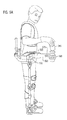
- FIG. 18 shows an embodiment of the system disclosed herein in use.
- FIGS. 1-3 illustrate perspective views of a lower body exoskeleton augmentation system.
- An outline of a user is included.
- the system 100 is configured to transfer loads through the exoskeleton system 100 to off-load the user from experiencing a weight of the load on the body of the user when within the exoskeleton.
- the load may be transferred through a support extension bar, or hip arc 120 , to the rest of the lower body exoskeleton system.
- the components of the exoskeleton may be constructed of lightweight material, such as, but not limited to, a lightweight metal.
- a harness 130 is provided.
- the harness 130 may be worn by the user on the upper body to support the lower body exoskeleton system 10 .
- the harness 130 may comprise a back support 133 .
- Upper straps 135 may be attached to the back support 133 and are configured to extend from the back support 133 over the shoulders of the user to lower straps 137 that are placed over a lower torso of the user.
- the upper straps 135 may be configured to engage with the lower straps 137 .
- an upper strap and lower strap combination 139 may be provided for each shoulder of the user.
- At least one of the upper strap 135 and the lower strap 137 may comprise a mechanism (not shown) to adjust a length of at least one of the upper strap 135 and the lower strap 137 to a length appropriate for the physical dimensions of the user.
- a torso assembly or subsystem 140 may be a part of or connected to a back part of the harness 130 .
- the torso assembly subsystem 140 may comprise a counter weight component 150 configured to keep the exoskeleton system 100 aligned with the user.
- a hip arc 120 may extend from both sides of the torso assembly subsystem 140 towards the sides of the user.
- a hip joint 600 may extend from the hip arc 120 and may be located beside a hip of the user such as, but not limited to, in a same transverse plane and transverse axis of the hip of the user.
- a tool connector 160 may be provided on the hip arc 120 or above, or as a part of, the hip joint 600 , to which a zero gravity arm 1200 (illustrated in FIG. 12 ) may be attached.
- a zero gravity arm 1200 illustrated in FIG. 12
- the torso assembly 140 specifically the counterweight component 150 , prevents the load from generally pulling the exoskeleton system 100 in an upward direction.
- FIG. 4A illustrates a perspective view of the torso assembly 140 without the back support 133 attached.
- FIG. 4B illustrates a front view of the torso assembly 140 without the back support 133 attached.
- FIG. 4C illustrates a cross section view of along B-B of FIG. 4B , but with the back support 133 attached.
- the torso assembly may be attached to the hip arc 120 .
- the hip arc 120 may extend through openings 410 in two brackets 420 of the torso assembly 140 .
- a torso articulation connector 430 is provided, with a first end secured within a securing mechanism 435 within the torso assembly 140 , located between the two brackets 420 .
- a second end may provide for the connector 430 to be configured for connecting the torso assembly to the back support 133 of the harness 130 .
- the connector 440 may be configured so that the second end of the articulation connector 430 extends through an opening in the back support 130 .
- the second end of the articulation connector 430 may comprise a mechanism 440 configured to extend beyond the opening in the back support 130 , on both sides of the back support so that the back support is placed, or sandwiched between the mechanism 440 .
- the articulation connector 430 at the mechanism 440 may be configured to allow for torso articulation. More specifically, the back support 133 of the harness 130 may be configured to allow for rotation of the upper body of the user without movement of at least the first or second hip joint and the first or second tool interface.
- the user may rotate in a left to right direction whereas the torso assembly 140 remains stationary.
- the user is also able to move the user's upper body from side to side whereas placement of the counter weight component 150 or the hip arc 120 may not move simply because the user is moving the user's upper torso.
- Such movement contemplated may include, but is not limited to, reaching or extending an arm towards a side of the user or bending of a back of the user to either side.
- a particular mechanism 440 with a particular articulation connector 430 is disclosed for providing torso articulation, other techniques/approaches may be utilized to provide for torso articulation.
- the counterweight component 150 may be provided to counteract a moment created by the arm 1200 .
- the counterweight component 150 may comprise a boom 450 which may rotate upward and downward such as, but not limited to, angles ranging from 30, 60 or 90 degrees.
- a pin system 460 may be provided to adjust the boom 450 at a desired angle.
- the boom 450 may be adjustable to ensure the user's center of gravity remains over the user's feet.
- a release mechanism 470 may be provided at an end of the boom closest to the pin system 460 and/or at a distal end from the pin system 460 to secure weights 475 in place on the boom 450 .
- a length of the boom 450 may be adjustable, such as, but not limited to, with a push-pin locking subsystem, where such a subsystem may comprise a plurality of opening on an outer surface and a detent or pin as part of an inner surface that slides or moves within the outer surface wherein the pin or detent is configured to extend into one of the plurality of openings when aligned with the opening.
- a part of the system may be powered and a part of the exoskeleton system may be non-powered.
- the boom component 450 may be powered.
- the boom 20 may be moved in a plurality of directions about a central attachment point to the back support 133 by way of the user using a controller (not shown), that may be located on the hip arc 120 at a location easily reachable by one of the user's hands.
- a power supply (not shown) may also be a part of the torso assembly 140 .
- the boom 150 may be angled off-axis of a vertical positioning of the boom 450 should the user need the weights 150 on the boom 450 displaced in a particular direction to compensate for location of the remote arm 1200 .
- the same configuration and movement disclosed above of the boom 450 with respect to FIGS. 4A-4C may also utilize the boom 450 being powered so that angling of the boom is controlled by the controller.
- FIGS. 5A-5F illustrates another counterbalance system of the exoskeleton system.
- a counterbalance arm 560 is provided.
- the counterbalance arm 560 is secured to the exoskeleton 100 by way of the tool connector 160 .
- the counterbalance arm 560 has a first end 565 and a second end 570 .
- the first end 565 is secured to the tool connector 160 .
- the second end 570 is moveable in an arcuate rotation from in front of the tool interface 160 or tool interface 710 (further initially illustrated in FIG. 8A ) to behind the tool connector 160 or tool interface 710 .
- the counterbalance arm 560 is movable about its first end 565 to allow for placement of the counterbalance arm 560 at a desired location along the arcuate rotational path of the counterbalance arm 560 may be moved.
- the counterbalance arm 570 may provide for the counterbalance arm 560 positioning a counterbalance weight 580 added to the counterbalance arm 560 at a backside of the user, as shown in FIG. 5F .
- a weight 580 may not be needed.
- the counterbalance arm 570 comprises a receiver 585 to which the weight 580 is attached or secured.
- the counterbalance arm 570 may also comprise an extension element 590 to adjust a distance of the counterbalance weight 580 or end of the counterbalance arm 570 from the user, as is shown in FIGS. 5D and 5E .
- FIG. 6A illustrates a perspective view of a first end of the hip arc assembly.
- FIG. 6B illustrates a cross-section view of the hip arc in combination with it connecting to the torso assembly.
- the hip arc 120 curves so that an end of the hip arc 120 is located towards a front of the user and terminates at the hip arc 600 . Since the hip arc 120 essentially extends, or wraps, around a backside of the user, to accommodate a plurality of differently sized users, the hip arc is adjustable. As illustrated further in FIG.
- a non-limiting example of how the hip arc 120 may be adjustable is with a telescoping tube interface assembly 510 where an inner tube 520 is connected to the torso assembly and an outer tube 530 is a part of the hip arc 120 that extends around the user's hip.
- a push-pin connection subsystem 540 where at least one pin 545 and at least one opening 547 are disclosed, may then be provided to adjust a width between each side of the hip arc 120 to fit a plurality of sized users. While adjustable, the moment arm in a sagittal plane at the hip remains the same even though the widths between each side of the hip arcs do change. This may even be true if the same width adjustment is not made with each hip arc 120 .
- FIGS. 4D, 4E, and 6C Another embodiment illustrating the hip arc attached to the torso assembly 140 , or harness 130 is provided in FIGS. 4D, 4E, and 6C .
- each hip arc 120 may be separate and apart from the other hip arc 120 .
- Respective connectors 581 are provided on the harness 130 or torso assembly 140 to which a respective hip arc 120 is attached.
- Each hip arc 120 may still comprise an adjusting element 540 , 545 to provide for fitting each hip arc 120 around the user.
- the load experienced by the tool 1200 may be primarily transferred to the hip joint 600 on the side of the user where the tool 1200 is connected while the load associated with the counterbalance arm 570 , as illustrated in FIGS.
- 5A-5F may be primarily transferred to the hip joint 600 on the other side of the user, where the counterbalance arm 570 is attached.
- the torso assembly 140 and harness 130 may be part of a same component used to attach the exoskeleton system 100 to an upper torso of the user. As such, these terms may be used interchangeably and the use of one over the other is not meant as a limitation.
- FIGS. 7A-7C illustrate perspective views of a hip joint.
- a hip joint 600 is located at the ends of the hip arc 120 .
- the hip joint 600 may comprise a first joint 610 that provides for forward and backward movement, in response to movement of the user's leg.
- the backward movement is limited to a range equivalent to how far back the user's leg may move backwards to reduce a possibility of the user hyperextending the leg.
- a stopper, or tab 770 illustrated in FIG.
- a track 775 (illustrated in FIG. 7B ) is provided with the tab 770 that prevents the joint from moving along the track beyond where the tab is located.
- the tab 770 and track 775 together may be considered an anatomically limiting device that controls backward movement of the hip joint to prevent hyperextending the leg of the user when within the system.
- the hip joint 30 may have a second joint 620 , configured to attach to the hip arc 120 , so that a user may extend the leg laterally outward or inward from a side of the user, or from left to right. How far laterally outward or inward may also be limited with a tab or stopper within the second joint 620 , or an anatomically limiting device to control lateral movement of the hip joint beyond a lateral range of the user's hip or leg.
- an adjustable femur component 650 of the exoskeleton system 100 extends from the hip joint 600 , along a side of the leg or along the femur of the user, to a knee joint 700 which is adjacent to a knee of the user.
- the hip joint 600 is further configured to provide for the hip joint 600 to rotate azimuthally about a third joint 630 with respect to femur component 650 .
- the third joint 630 may have a tab 777 or stopper and track 779 , collectively an anatomically limiting device to prevent the third joint 630 from azimuthally rotating beyond a range of the leg, or appendage, of the user when within the system 100 .
- a configuration of the first joint 610 being located between the second joint 620 and the third joint 630 , with the third joint 630 being below the first 610 provides the hip joint 600 with a configuration that most accurately emulates the anatomic characteristics of the hip and/or leg of the user, when within the system.
- Other configurations are also possible, including the first joint 610 between located between the second joint 620 and the third joint 630 with the second joint being below the first joint 610 ; the second joint 620 between the first joint 610 and the third joint 630 with either the first joint 610 or the third joint 630 being below the second joint; the third joint 630 between the first joint 610 and the second joint 620 with either the first joint 610 or the second joint 620 being beneath the third joint; or an orthogonal hip joint.
- the orthogonal hip joint provides for the first joint 610 , second joint 620 , and third joint 630 to part of a single joint.
- an extension 637 may be provided between the first joint 610 and the third joint 630 .
- no or a minimized extension may be included.
- the femur component may be considered an upper leg section or component.
- the hip joint 600 may rotate azimuthally about the femur component 650 .
- a range of rotation may be limited.
- the hip joint 600 may be configured to move in any direction the user's hip joint may move.
- the hip joint 600 may be viewed as having three degrees of freedom since it may move forward/backward (abduction and adduction around the sagittal axis), left/right (flexion and extension around a transverse axis), lateral rotation and medial rotation around a longitudinal axis (along the thigh), and a combination of these movements where the degrees of freedom and actual movement are provided to replicate a respective degree of freedom, or movement, of the hip of the user.
- FIGS. 9A-9C illustrate views of the hip joint in combination with the tool interface.
- the hip arc has a tool interface 710 for the removable tool connector 160 .
- the removable tool interface 710 may be configured as a quick connect/disconnect or release interface to facilitate the rapid attachment and removal of the interface 710 to the hip arc 120 or hip joint 600 .
- the tool connector 610 attaches to the tool interface 710 .
- the removable tool connector 160 allows various utility tools to be attached thereto. Then, the connector 160 may be subsequently attached to the interface 710 .
- the tool interface 710 may be located above the hip joint 600 .
- this interface 710 may comprise at least one guide 720 upon which the tool connector 160 connect to so that the tool connector 160 is always connected to the tool interface 710 in a same manner each time.
- a locking mechanism 730 may also be provided.
- the locking mechanism 730 may be configured to receive a pin 780 through the locking mechanism 730 and the tool interface 160 when the tool connector 160 is attached to the interface 710 , as further illustrated in FIG. 8B , thus providing for a quick release mechanism.
- FIG. 9B illustrates a cross section, taken from a side view similar to FIG. 2 , of the hip joint in combination with the hip arc and tool interface.
- the third joint 630 of the hip joint 600 may provide for an internal shaft that provides for rotation of the femur component 650 as disclosed above.
- the interface 710 which may be configured to allow for rotation of the tool interface 710 , and hence the tool connector 160 .
- a spindle 740 may be provided. In one non-limiting example, the spindle 740 and interface 710 may be built into the hip joint 600 .
- the interface 710 is a separate component which may be attached to an end of the hip arc 120 or atop the hip joint 600 .
- the spindle 740 may be a part of the interface 710 .
- FIG. 9C illustrates a cross section, taken from a front view of the exoskeleton 100 , of the components illustrated in FIG. 7B .
- the first joint 610 of the hip joint 600 may provide for a seal 785 , making the joint a seal joint.
- the pin 780 is disclosed to secure the tool connector 160 to the interface 710 .
- the tool connector 160 may be removed from the interface 710 as needed.
- FIGS. 10A-10D illustrate perspective views of a thigh support.
- the thigh support 800 may have a thigh strap 810 attached to it, as further illustrated in FIGS. 1-3 . Though illustrated, the thigh support 800 may not be needed. A possible determination on whether to use the thigh support is an anticipated load to handle with the exoskeleton 100 .
- the combination of the thigh support 800 with the thigh strap 810 may also be provided to keep the upper part of the system 100 aligned with the user's legs.
- a quick release mechanism 820 is provided on each thigh strap 810 thigh support 800 combination.
- a ratchet-based securing subsystem 820 may be provided as the quick release mechanism to secure the thigh strap 810 to the thigh of the user.
- the user When initially putting the system 100 on, the user may be in a sitting position while placing the thigh strap 810 around the thigh and connecting to the thigh support 800 .
- the user may have to further adjust the thigh strap 810 , usually by removing any additional slack between the thigh strap 810 and the thigh support 800 .
- the ratchet-based securing subsystem 820 may further comprise a quick release device, that when activated, completely frees the strap 810 from the thigh support 800 .
- a forward or backward (longitudinal) positioning of the thigh support 800 may be possible.
- a longitudinal adjustment track 850 is provided on a part of the thigh support 800 which engages a connector 870 on the femur component 650 .
- a locking pin 860 may be used to hold the thigh support 800 in place.
- Lateral placement of the thigh support 800 may also be provided where a push-pin connection subsystem 880 may be used.
- FIGS. 11A-11C illustrate views of a knee joint.
- the femur component 650 connects with the knee joint 700 .
- the knee joint 700 may have a track 183 with a tab 185 , or stopper, to prohibit the knee joint from moving in a forward direction location which may result in hyperextending the knee.
- the track 183 and tab 185 may be considered an anatomically limiting device. Though each anatomically limiting device is disclosed herein as having a track with a tab or stopper, other configurations may be used.
- the term “anatomically limiting device” includes any configuration that limits one of the above mentioned joints to function or anatomically emulate a joint of appendage of the user when within the system.
- the knee joint 700 may move beyond ninety degrees since the user's knee may bend the lower leg greater than ninety degrees.
- the knee joint 700 may also be configured to accept the load so that the load is not felt by on the knee of the user.
- the knee joint 700 may be configured to be approximately fifteen degrees, plus or minus five degrees, forward of the user's knee to further ensure that the load is not felt by the user's knee.
- the knee joint 700 may further be configured to extend forward with a rocker arm 715 . When kneeling, the knee rocker arm 715 is configured to contact a ground surface first and maintain the load transfer through the knee rocker arm 715 .
- the knee rocker arm 715 may be configured with a curved configuration so that the user may rotatably displace the arm 715 , or move along the curved configuration of the knee rocker arm 715 in a forward and backward position, such as to rock back and forth, whereas the load carried is not felt by the user upon the knee when manually positioned by the user when in contact with the ground.
- the arm 715 may be rotated and translated in a forward or backward position manually by the user.
- the knee rocker arm 715 may provide additional protection to the user's knee, such as when walking around in areas where the user's knee may ordinarily come into contact with objects in a work area. With this configuration, should a user desire to wear a knee pad while wearing the system 100 , the user may still do so without the system 100 or knee pad interfering with each other. Furthermore, with the curved shape of the knee rocker arm 715 , the user is able to move a plurality of directions upon the user's knees where the system 100 is not prohibitive of such movements.
- An adjustable fibula component 900 extends from a bottom part of the knee joint 700 down to a foot assembly 1000 .
- the adjustable fibula component 900 may also be considered a lower leg section or component.
- FIG. 11C is a cross section of the knee joint taken from a front view of the exoskeleton system. As illustrated the knee joint may have a seal 785 providing for a sealed joint. Also illustrated is a positive locking indication component 725 .
- the fibula component 900 may extend from the knee joint 700 to a ground rocker arm 1110 that may make contact with the ground when the user is in a standing position.
- the fibular component 70 transfers the load to the ground.
- FIGS. 12A-12D show perspective views of a calf support.
- the calf support 950 may be provided on the fibula component 900 . As disclosed above with respect to the thigh support 800 , the calf support 950 may be similarly constructed. As non-limiting examples, the calf support 950 may have a calf strap attached to it. The combination of the thigh support 950 with the thigh strap may also be provided to keep the system 100 aligned with the user's legs.
- a quick release mechanism 820 may be provided on each calf strap and calf support 950 combination. Since users have different sized calves, a ratchet-based securing subsystem, or mechanism, may be provided as the quick release mechanism to secure the calf strap around the calf of the user.
- a forward or backward (longitudinal) positioning of the calf support 950 may be possible.
- a longitudinal adjustment track may be provided on a part of the calf support 950 which engages a connector on the fibula component 900 .
- a locking pin 860 may be used to hold or secure the calf support 950 in place.
- Lateral placement of the calf support 950 may also be provided where a push-pin connection subsystem 880 may be used.
- FIGS. 13A-13D illustrate views of a foot assembly.
- the foot assembly 1000 may be connected to the fibula component 900 to secure the system 100 to the foot and ankle of the user.
- the foot assembly 1000 may have a back stirrup component 1120 to hold the user's foot in place.
- a strap 1130 is configured to fit around the user's shoe where a sole of the shoe still makes contact with a ground surface or ground.
- user's foot is separate and apart from the foot assembly with respect to making contact with the ground. In this configuration, the user's natural gape and angle at which the user's foot naturally contacts the ground while walking is maintained.
- the strap 1130 may have the ratchet subsystem, as disclosed above with respect to the thigh support, to secure the foot to the foot assembly 1000 .
- An ankle joint 1150 may be provided.
- the ankle joint 88 may be configured to allow the user to walk with the user's natural gape with the ground rocker arm 1110 remaining in a stationary position next to the foot.
- the ground rocker arm 1110 When no load is present, the ground rocker arm 1110 generally does not make contact with the ground. Instead, when the user's foot, secured inside the stirrup component 1120 , makes contact with the ground, the ground rocker arm 1110 also contacts the ground in unison with the user's foot. The ground rocker arm 1100 may ride slightly above the ground and move in unison with the user's foot. However, in some situations, depending on the user's stride, gape, or shoe, the ground rocker arm 1100 may inadvertently contact the ground when a load is not present. Once a load is present, the weight may cause the ground rocker arm 1100 to make contact with the ground.
- the ground rocker arm 1100 may have a curved configuration, at an end that contacts the ground, to allow the user to rock back and forth, or to provide for rotatable displacement, in a forward or backward manner, in the system 100 as manually powered by the user.
- FIG. 13E shows a cross section view of the foot assembly taken from a front of the exoskeleton system.
- a seal 785 may be provided to make this a sealed joint. Similar to the hip joint 600 and knee joint 700 movement of the ankle joint 1150 may be limited to correspond to natural movements of the user's ankle.
- the hip arc 120 may be adjustable, such as with a push-pin connection subsystem (not shown) to adjust a width between each hip arc to fit a plurality of sized users. Though adjustable, the moment arm in a sagittal plane at the hip remains the same even though the widths between the hip arcs do change.
- Both the height of the femur component 650 and the fibula component 900 may be adjustable to extend or retract to a length that corresponds to those particular lengths of the user so that the hip joint 600 is aligned with the hip, knee joint 700 is aligned with the knee, and the foot assembly 1100 is aligned with the ankle and foot.
- the location of the thigh support 800 and the calf support 950 may also be adjustable to best accommodate the user.
- a push-pin connection subsystem 880 may be provided and used to make these adjustments.
- FIG. 14 shows a flowchart illustrating an embodiment of a method disclosed herein.
- the method 1400 comprises directing a load experienced by a user above a hip of the user to a hip joint that provides for anatomically correct three degrees of freedom of the hip of the user, at 1410 .
- the method 1400 further comprises transferring the load from the hip joint to a knee joint that provides anatomically correct forward and backward movement at a knee location of the user, at 1420 .
- the method 1400 further comprises transferring the load from the knee joint to a knee rocker arm that is a part of the knee joint and that extends nearly horizontally from the second joint to transfer the load to a ground surface when the knee rocker arm is in contact with the ground surface, the knee rocker arm provides a surface that allows the knee rocker arm to be displaced in a forward or backward position manually by the user, at 1430 .
- the method 1400 further comprises transferring the load from the knee joint to a foot assembly having a ground rocker arm that is separate and apart from a base of a foot of the user, the ground rock arm provides a surface in contact with the ground that allows the ground rocker arm to be displaced in forward and backward position manually by the user, at 1440 .
- the method 1400 may further comprise transferring the load from the hip joint to the knee joint with a femur component in communication with and located between the hip joint and the knee joint, at 1425 .
- the method 1400 may further comprise transferring the load from the knee joint to the foot assembly with a fibula component in communication with and located between the knee joint and the foot assembly, at 1445 .
- FIG. 15 shows a flowchart illustrating an embodiment of another method disclosed herein.
- the method 1500 comprises locating a counterbalance arm at a back side of a user operating an exoskeleton, the counterbalance arm having a secured first end and a moveable second end, the second end of counterbalance arm is moveable in an arcuate rotation from a front side of the exoskeleton to a back side of the exoskeleton to allow for placement and removal of weight from the counterbalance arm, at 1510 .
- the method 1500 further comprises locating a forward positioned tool on a second side of the user operating the exoskeleton, the counterbalance arm countering a load experienced by the user resulting from the tool, at 1520 .
- the method 1500 further comprises transferring a load from the counterbalance arm to a first hip joint of the exoskeleton and a load from the tool to a second hip joint, transferring the load with the first hip joint is separate and distinct from transferring the load with the second hip joint, at 1530 .
- the method may further comprise transferring a second load experienced by a harness, that holds the exoskeleton to an upper body of the user, to a first hip arc and a second hip arc, each hip is located on opposite sides of the user and each hip arc is a separate hip arc and apart from the other hip arc, at 1540 .
- the method 1500 may also comprise laterally moving the harness by the user without movement of the counterbalance arm or the forward positioned tool, at 1550 .
- FIG. 16 shows another flowchart illustrating an embodiment of a method.
- the method 1600 comprises locating a counterbalance arm attached to a first side of an exoskeleton at a location to counterbalance a load from a tool attached to a second side of the exoskeleton, at 1610 .
- the method 1600 also comprises transferring a load resulting from the counterbalance arm primarily to a first hip joint of the exoskeleton located on the first side of the exoskeleton and secondarily to a second hip joint of the exoskeleton located on the second side of the exoskeleton, at 1620 .
- the method also comprises transferring a load resulting from the tool primarily to the second hip joint and secondarily to the second hip joint, at 1630 .
- both hip joints assist in transferring the load, though depending on a location of the load, one hip joint may transfer more of the load than the other, or second hip joint.
- FIG. 17 illustrates a perspective view of a piece of equipment attached to the exoskeleton system.
- the tool 1200 may be an arm.
- the type of tool used is not limited.
- Other non-limiting example may include a weapon, a drill, a paint gun, etc.
- the tool may be attached to the exoskeleton system 100 through the tool attachment 160 , interface, or holder.
- the exoskeleton system 100 is configured to be uniform on each side when worn by the user.
- a tool interface 160 and the associated components to connect the tool interface 160 , may be provided on each side of the exoskeleton system 100 .
- the hip arc 120 may extend uniformly from the torso assembly to each side.
- FIG. 18 shows an embodiment of the system disclosed herein in use.
- a lower portion, or load transfer part of the exoskeleton system may have a first hip joint 600 and a second hip joint.
- Each hip joint anatomically emulates three degrees of freedom of movement of each hip or leg of the user.
- a first knee joint 700 and a second knee joint are provided where each anatomically emulates extension and flexion movement of each knee of the user.
- a first ankle joint 1000 and a second ankle joint are provided and each anatomically emulates forward and backward movement of each ankle of the user.
- At least one knee rocker arm 715 may be as part of either the first knee joint 700 or the second knee joint 700 .
- the knee rocker arm 715 transfers a load to a ground surface when the at least one knee rocker arm is in contact with the ground surface as manually positioned or powered by the user.
- At least one ground rocker arm 1110 is included as part of either the first ankle joint 1100 or the second ankle joint 1100 .
- the ground rocker arm 1110 transfers the load to the ground when the at least one ground rocker arm is in contact with the ground as manually positioned or powered by the user.
- a harness 130 is provided to hold the exoskeleton system 100 to an upper body of the user.
- the harness comprises a first connector 135 and a second connector 137 .
- a first hip arc 120 and a second hip arc 120 are provided where a first end of each respect hip arc 120 terminates at the hip joint 600 on that side of the exoskeleton and a second end that terminates at a respective connector of the harness.
- the hip arcs 120 are connected to where it may be considered a continual hip arc that extends from a first side of the user to the opposite other side.
- the connectors 420 on the harness may separate the hip arcs when separate hip arcs are used, or further support the continual hip arc.
- the first hip arc and the second hip arc are separate and apart from each other.
- the load transfer part of the exoskeleton may comprise a first tool interface 710 located above the first hip joint 600 to direct load displacement through the first hip joint 600 , and a second tool interface located above the second hip joint to direct load displacement through the second hip joint when the arm 1200 or a tool 1210 is attached.
- the tool 1210 is shown as being attached to the arm 1200 , in other embodiments, the tool 1210 may be of a type that is attached directly to the tool connector 160 . In another embodiment, the tool 1210 may be of a configuration to attach directly to the interface 710 .
- the load transfer feature may also comprise a counterbalance arm 560 having a first end and a second end, the counterbalance arm 560 is secured to the connector 160 , that is attached to the first tool interface 710 at the first end, the second end of counterbalance arm is moveable in an arcuate rotation from in front of the tool interface to behind the tool interface.
- each rocker arm may be a rubber covering which may be configured to provide a soft surface to impact the ground and to provide for traction, such as when the ground or ground surface is wet.
Landscapes
- Engineering & Computer Science (AREA)
- Health & Medical Sciences (AREA)
- Robotics (AREA)
- Mechanical Engineering (AREA)
- Physical Education & Sports Medicine (AREA)
- Pain & Pain Management (AREA)
- Epidemiology (AREA)
- Rehabilitation Therapy (AREA)
- Life Sciences & Earth Sciences (AREA)
- Animal Behavior & Ethology (AREA)
- General Health & Medical Sciences (AREA)
- Public Health (AREA)
- Veterinary Medicine (AREA)
- Manipulator (AREA)
Abstract
Description
Claims (22)
Priority Applications (1)
| Application Number | Priority Date | Filing Date | Title |
|---|---|---|---|
| US14/744,892 US9808073B1 (en) | 2014-06-19 | 2015-06-19 | Exoskeleton system providing for a load transfer when a user is standing and kneeling |
Applications Claiming Priority (2)
| Application Number | Priority Date | Filing Date | Title |
|---|---|---|---|
| US201462014430P | 2014-06-19 | 2014-06-19 | |
| US14/744,892 US9808073B1 (en) | 2014-06-19 | 2015-06-19 | Exoskeleton system providing for a load transfer when a user is standing and kneeling |
Publications (1)
| Publication Number | Publication Date |
|---|---|
| US9808073B1 true US9808073B1 (en) | 2017-11-07 |
Family
ID=60189647
Family Applications (2)
| Application Number | Title | Priority Date | Filing Date |
|---|---|---|---|
| US14/744,892 Active - Reinstated 2035-12-18 US9808073B1 (en) | 2014-06-19 | 2015-06-19 | Exoskeleton system providing for a load transfer when a user is standing and kneeling |
| US14/744,855 Active 2038-09-18 US10561568B1 (en) | 2014-06-19 | 2015-06-19 | Exoskeleton system providing for a load transfer when a user is standing and kneeling |
Family Applications After (1)
| Application Number | Title | Priority Date | Filing Date |
|---|---|---|---|
| US14/744,855 Active 2038-09-18 US10561568B1 (en) | 2014-06-19 | 2015-06-19 | Exoskeleton system providing for a load transfer when a user is standing and kneeling |
Country Status (1)
| Country | Link |
|---|---|
| US (2) | US9808073B1 (en) |
Cited By (35)
| Publication number | Priority date | Publication date | Assignee | Title |
|---|---|---|---|---|
| US9907722B2 (en) | 2014-08-15 | 2018-03-06 | Honda Motor Co., Ltd. | Admittance shaping controller for exoskeleton assistance of the lower extremities |
| CN107811805A (en) * | 2017-11-16 | 2018-03-20 | 上海理工大学 | Wearable lower limb exoskeleton rehabilitation robot |
| US20180257216A1 (en) * | 2015-07-06 | 2018-09-13 | Rewalk Robotics Ltd. | Methods and apparatuses for exoskeleton attachment |
| CN108555886A (en) * | 2018-05-23 | 2018-09-21 | 成都飞机工业(集团)有限责任公司 | A kind of industrial ectoskeleton with vibration-damping function |
| CN108582042A (en) * | 2018-05-07 | 2018-09-28 | 河北工业大学 | A mechanical leg without power to assist sitting |
| US10118291B2 (en) * | 2016-03-10 | 2018-11-06 | Massachusetts Institute Of Technology | Robotic systems for supporting a user |
| CN109986535A (en) * | 2017-12-29 | 2019-07-09 | 沈阳新松机器人自动化股份有限公司 | A kind of hip joint structure |
| WO2019137410A1 (en) * | 2018-01-10 | 2019-07-18 | 安徽工程大学 | Variable stiffness lower extremity exoskeleton power assist robot |
| US10376402B2 (en) * | 2014-12-18 | 2019-08-13 | Ganesh Ram Jangir | Belt system for body support |
| KR20200009766A (en) * | 2018-07-20 | 2020-01-30 | 삼성중공업 주식회사 | A working assistance apparatus |
| US10561568B1 (en) * | 2014-06-19 | 2020-02-18 | Lockheed Martin Corporation | Exoskeleton system providing for a load transfer when a user is standing and kneeling |
| CN111070187A (en) * | 2019-12-31 | 2020-04-28 | 武汉大学 | Active-passive combined transient center flexible rope driven lower limb exoskeleton robot and control method |
| CN111267140A (en) * | 2020-03-19 | 2020-06-12 | 北京海益同展信息科技有限公司 | Ankle joint slewing mechanism and exoskeleton robot with same |
| US10688010B2 (en) * | 2018-01-02 | 2020-06-23 | Free Bionics Taiwan Inc. | Adjusting assembly and exoskeleton robot comprising the same |
| US10765911B1 (en) | 2019-03-01 | 2020-09-08 | Dustin Hamoy | Core exercise assembly |
| US20200397641A1 (en) * | 2019-06-20 | 2020-12-24 | Free Bionics Taiwan Inc. | Assistive device and control method thereof |
| CN112545845A (en) * | 2020-12-25 | 2021-03-26 | 顾晓豪 | Exoskeleton for medical rehabilitation and use method |
| US11000945B2 (en) | 2017-06-27 | 2021-05-11 | Massachusetts Institute Of Technology | Wearable robotic systems for supporting a load |
| US20210291354A1 (en) * | 2020-03-18 | 2021-09-23 | Jtekt Corporation | Assist device |
| CN113478466A (en) * | 2021-07-23 | 2021-10-08 | 华南理工大学 | Passive lower limb exoskeleton with load conduction and walking energy saving functions |
| US11207014B2 (en) | 2017-08-30 | 2021-12-28 | Lockheed Martin Corporation | Automatic sensor selection |
| DE102020119166A1 (en) | 2020-07-21 | 2022-01-27 | Ottobock Se & Co. Kgaa | Orthopedic device for supporting a user's lower extremity |
| USD947390S1 (en) | 2018-12-10 | 2022-03-29 | Jtekt Corporation | Motion assisting device |
| US11337878B1 (en) | 2019-04-10 | 2022-05-24 | Lockheed Martin Corporation | Mechanical joint for exoskeleton ankle |
| US11400008B2 (en) * | 2018-03-27 | 2022-08-02 | Dephy, Inc. | Dynamic mounting mechanism for an exoskeleton |
| US20220409418A1 (en) * | 2021-06-25 | 2022-12-29 | Donggwan PARK | Human body flexion and extension assist device |
| EP3880132A4 (en) * | 2018-11-15 | 2023-02-08 | StemRad Ltd. | WEIGHT DISTRIBUTION EXOSKELETON |
| EP4163904A1 (en) * | 2021-10-11 | 2023-04-12 | Consejo Superior De Investigaciones Científicas | Anatomical model for measuring the interaction of an exoskeleton with a biological limb assisted by said exoskeleton |
| CN116372897A (en) * | 2023-04-18 | 2023-07-04 | 武汉理工大学 | A transformable powered mechanical exoskeleton |
| EP4324434A1 (en) * | 2022-08-17 | 2024-02-21 | Xothotics Limited | Exoskeleton |
| WO2024038253A1 (en) * | 2022-08-17 | 2024-02-22 | Xothotics Limited | Exoskeleton |
| US12364641B2 (en) | 2021-04-16 | 2025-07-22 | Hyundai Motor Company | Walking assisting apparatus |
| USD1089854S1 (en) * | 2022-09-30 | 2025-08-19 | Hyundai Motor Company | Robotic exoskeleton suit for lifting loads |
| USD1098606S1 (en) * | 2022-09-30 | 2025-10-14 | Hyundai Motor Company | Robotic exoskeleton suit for lifting loads |
| US12465543B2 (en) | 2021-10-12 | 2025-11-11 | Arizona Board Of Regents On Behalf Of Arizona State University | Passive exoskeleton for sit-to-stand and stand-to-sit transfer |
Families Citing this family (4)
| Publication number | Priority date | Publication date | Assignee | Title |
|---|---|---|---|---|
| WO2022043862A1 (en) * | 2020-08-25 | 2022-03-03 | Iuvo S.R.L | Exoskeleton device for outdoor activities and components for use therewith |
| CN114831857B (en) * | 2022-03-21 | 2023-03-28 | 中国科学院自动化研究所 | Lower limb exoskeleton robot |
| CN115715729B (en) * | 2022-11-30 | 2024-08-02 | 河北工业大学 | A transfer and transport lower limb rehabilitation robot |
| CN116115248B (en) * | 2022-12-12 | 2024-01-26 | 苏州大学附属第二医院 | Auxiliary fixing exoskeleton for wearable imaging evaluation |
Citations (59)
| Publication number | Priority date | Publication date | Assignee | Title |
|---|---|---|---|---|
| US2010482A (en) | 1934-05-26 | 1935-08-06 | Florence M Henn | Walking motion |
| US3964182A (en) | 1973-10-31 | 1976-06-22 | Pomeret Jean Claude | Mechanical shovel |
| US4258556A (en) | 1977-11-10 | 1981-03-31 | U.S. Philips Corporation | Torsion spring clutch |
| US5016869A (en) | 1989-07-05 | 1991-05-21 | Applied Motion | Human bipedal locomotion device |
| US5020790A (en) | 1990-10-23 | 1991-06-04 | Board Of Supervisors Of Louisiana State University And Agricultural And Mechanical College | Powered gait orthosis |
| JPH03105191U (en) | 1990-02-15 | 1991-10-31 | ||
| JP3024978U (en) | 1995-10-13 | 1996-06-07 | 吉村 敏正 | Backpack-type luggage lifting device |
| US5865426A (en) | 1996-03-27 | 1999-02-02 | Kazerooni; Homayoon | Human power amplifier for vertical maneuvers |
| US5993404A (en) | 1998-06-16 | 1999-11-30 | Mc Niel; Frank T. | Walking brace |
| JP2003104682A (en) | 2001-09-30 | 2003-04-09 | Kosho Unyu Kk | Load moving auxiliary tool |
| US20030073552A1 (en) | 2001-10-11 | 2003-04-17 | Knight Michael W. | Biosensory ergonomic chair |
| US20030109817A1 (en) | 2001-12-11 | 2003-06-12 | Shimon Berl | Supplementary knee support brace |
| US20030115954A1 (en) | 2001-12-07 | 2003-06-26 | Vladimir Zemlyakov | Upper extremity exoskeleton structure and method |
| US6886812B2 (en) | 1999-05-13 | 2005-05-03 | Hamayoon Kazerooni | Human power amplifier for lifting load with slack prevention apparatus |
| US20050137717A1 (en) | 2003-12-18 | 2005-06-23 | Finn Gramnas | Prosthetic foot with rocker member |
| US6913583B2 (en) | 2003-06-19 | 2005-07-05 | Creations By B J H, Llc | Orthopedic device allows kneeling without contacting knee |
| US20060064047A1 (en) | 2004-09-21 | 2006-03-23 | Honda Motor Co., Ltd. | Walking assistance system |
| US20060107433A1 (en) * | 2004-11-19 | 2006-05-25 | Olson Keith D | Protective device |
| US20060260620A1 (en) | 2005-01-18 | 2006-11-23 | The Regents Of University Of California | Lower extremity exoskeleton |
| US7153242B2 (en) | 2001-05-24 | 2006-12-26 | Amit Goffer | Gait-locomotor apparatus |
| US7163518B1 (en) | 2003-10-20 | 2007-01-16 | Rgpartnership Llp | Walking leg support |
| US20070056592A1 (en) | 2005-04-13 | 2007-03-15 | The Regents Of University Of California | Semi-powered lower extremity exoskeleton |
| US20070123997A1 (en) | 2005-03-31 | 2007-05-31 | Massachusetts Institute Of Technology | Exoskeletons for running and walking |
| US20070233279A1 (en) | 2006-03-09 | 2007-10-04 | The Regents Of The University Of California | Power generating leg |
| US20080234608A1 (en) | 2004-03-11 | 2008-09-25 | Yoshiyuki Sankai | Wearing Type Behavior Help Device, Wearing Type Behavior Help Device Calibration Device, and Calibration Program |
| JP2009011818A (en) | 2007-06-07 | 2009-01-22 | Tokyo Univ Of Science | Lumbar assist device |
| US7571839B2 (en) | 2004-05-19 | 2009-08-11 | Hrl Laboratories, Llc | Passive exoskeleton |
| US20090210093A1 (en) | 2006-07-17 | 2009-08-20 | Jacobsen Stephen C | Contact displacement actuator system |
| US20090292369A1 (en) | 2008-05-20 | 2009-11-26 | Berkeley Bionics | Device and Method for Decreasing Energy Consumption of a Person by Use of a Lower Extremity Exoskeleton |
| US7628766B1 (en) * | 2003-10-29 | 2009-12-08 | The Regents Of The University Of California | Lower extremity enhancer |
| US20100094185A1 (en) | 2008-05-20 | 2010-04-15 | University Of California At Berkeley | Device and Method for Decreasing Oxygen Consumption of a Person During Steady Walking by Use of a Load-Carrying Exoskeleton |
| US20110105966A1 (en) | 2008-07-23 | 2011-05-05 | Berkeley Bionics | Exoskeleton and Method for Controlling a Swing Leg of the Exoskeleton |
| US20110166489A1 (en) | 2008-09-24 | 2011-07-07 | Berkeley Bionics | Hip and Knee Actuation Systems for Lower Limb Orthotic Devices |
| US20110214524A1 (en) | 2008-08-28 | 2011-09-08 | Raytheon Company | Biomimetic Mechanical Joint |
| US20110264014A1 (en) * | 2010-04-09 | 2011-10-27 | Lockheed Martin Corporation | Portable load lifting system |
| US20110266323A1 (en) | 2008-12-18 | 2011-11-03 | The Regents Of The University Of California | Wearable Material Handling System |
| US8171570B2 (en) | 2007-04-23 | 2012-05-08 | Golden Crab S.L. | Exoskeleton |
| US20120172770A1 (en) | 2009-07-01 | 2012-07-05 | Faisal Almesfer | Control System for a Mobility Aid |
| US8231688B2 (en) | 2008-06-16 | 2012-07-31 | Berkeley Bionics | Semi-actuated transfemoral prosthetic knee |
| US8257291B2 (en) | 2008-06-11 | 2012-09-04 | The Regents Of The University Of California | External walking assist device for those with lower leg injuries |
| US20120283845A1 (en) | 2011-03-11 | 2012-11-08 | Herr Hugh M | Biomimetic joint actuators |
| WO2012154580A1 (en) | 2011-05-06 | 2012-11-15 | Equipois Inc. | Exoskeleton arm interface |
| US20120292361A1 (en) * | 2011-05-16 | 2012-11-22 | Devaraj Thiruppathi | Backpack exoskeleton |
| US20130023800A1 (en) * | 2010-04-07 | 2013-01-24 | Bedard Stephane | Load distribution device for human joints |
| US8394038B2 (en) | 2008-11-06 | 2013-03-12 | Honda Motor Co., Ltd. | Walking assistance device |
| US20130150980A1 (en) | 2008-06-16 | 2013-06-13 | The Regents Of The University Of California | Powered Lower Extremity Orthotic and Method of Operation |
| US20130197408A1 (en) | 2010-09-27 | 2013-08-01 | Vanderbilt University | Movement assistance device |
| US20130231595A1 (en) | 2010-09-17 | 2013-09-05 | The Regents Of The University Of California | Human Machine Interface for Human Exoskeleton |
| US20130237884A1 (en) | 2010-10-06 | 2013-09-12 | The Regents Of The University Of California | Human Machine Interfaces for Lower Extremity Orthotics |
| US20130296746A1 (en) | 2012-02-24 | 2013-11-07 | Massachusetts Institute Of Technology | Elastic Element Exoskeleton and Method of Using Same |
| US20130303950A1 (en) | 2010-04-09 | 2013-11-14 | Ekso Bionics | Exoskeleton Load Handling System and Method of Use |
| US20140046234A1 (en) | 2012-08-09 | 2014-02-13 | Egas Jose-Joaquim DeSousa | Dynamic Load Bearing Shock Absorbing Exoskeletal Knee Brace |
| US8672865B2 (en) | 2008-11-26 | 2014-03-18 | Toad Medical Corporation | Weight-bearing lower extremity brace |
| US8702632B2 (en) | 2009-01-12 | 2014-04-22 | Iucf-Hyu (Industry-University Cooperation Foundation Hanyang University) | Wearable robot for assisting muscular strength of lower extremity |
| US20140200491A1 (en) | 2013-01-16 | 2014-07-17 | Ekso Bionics, Inc. | Fail-Safe System for Exoskeleton Joints |
| WO2014159608A1 (en) | 2013-03-14 | 2014-10-02 | Ekso Bionics, Inc. | Non-anthropomorphic hip joint locations for exoskeletons |
| US20150134080A1 (en) | 2013-11-14 | 2015-05-14 | Samsung Electronics Co., Ltd. | Wearable robot and method for controlling the same |
| US20150321340A1 (en) * | 2014-05-06 | 2015-11-12 | Sarcos Lc | Legged Robotic Device Utilizing Modifiable Linkage Mechanism |
| US9492300B2 (en) * | 2014-06-18 | 2016-11-15 | Mawashi Protective Clothing Inc. | Exoskeleton and method of using the same |
Family Cites Families (46)
| Publication number | Priority date | Publication date | Assignee | Title |
|---|---|---|---|---|
| US5054476A (en) | 1989-03-24 | 1991-10-08 | Petrofsky Research, Inc. | Orthosis for assistance in walking |
| US5476441A (en) | 1993-09-30 | 1995-12-19 | Massachusetts Institute Of Technology | Controlled-brake orthosis |
| DE19645076A1 (en) | 1996-10-31 | 1998-05-14 | Albrecht Gmbh | Device for reducing extension or flexion deficits of a distal limb compared to a proximal limb |
| US6039707A (en) | 1999-02-16 | 2000-03-21 | Crawford; Michael K. | Pelvic support and walking assistance device |
| DE10005764B4 (en) | 2000-02-10 | 2005-12-15 | Albrecht Gmbh | Orthosis with adjustment of the flexion and extension stop by rail pivoting movements |
| US6500138B1 (en) | 2000-04-07 | 2002-12-31 | Mayo Foundation For Medical Education And Research | Electromechanical joint control device with wrap spring clutch |
| US20040237351A1 (en) | 2003-05-28 | 2004-12-02 | Howell Harry Michael | Combining useful items attached to a shoe |
| US8864846B2 (en) | 2005-03-31 | 2014-10-21 | Massachusetts Institute Of Technology | Model-based neuromechanical controller for a robotic leg |
| JP4784771B2 (en) | 2007-10-01 | 2011-10-05 | 本田技研工業株式会社 | Walking assist device |
| JP5075777B2 (en) | 2008-09-23 | 2012-11-21 | 本田技研工業株式会社 | Rehabilitation equipment |
| KR101043207B1 (en) | 2008-10-22 | 2011-06-22 | 서강대학교산학협력단 | Wheelchair Walking Assistant Robot |
| JP4744589B2 (en) | 2008-12-17 | 2011-08-10 | 本田技研工業株式会社 | Walking assist device and its control device |
| US7922401B2 (en) | 2009-04-01 | 2011-04-12 | Mckay Thomas L | Camera rig with center-of-gravity correction system |
| EP3000391B1 (en) | 2010-07-01 | 2019-01-30 | Vanderbilt University | Systems for volitional control of jointed mechanical devices based on surface electromyography |
| US20120073165A1 (en) | 2010-09-29 | 2012-03-29 | Ztompz Inc. | Footwear and system for displaying collectibles |
| US9554960B2 (en) | 2010-11-24 | 2017-01-31 | Kawasaki Jukogyo Kabushiki Kaisha | Wearable motion supporting device |
| US20120192461A1 (en) | 2011-02-01 | 2012-08-02 | Chinook Trading Company | System for attaching items to footwear |
| EP2688526B1 (en) | 2011-03-21 | 2017-10-11 | B-Temia Inc. | Supportive belt assembly for lower extremity orthotic devices |
| US9872789B2 (en) | 2012-02-07 | 2018-01-23 | Ossur Iceland Ehf | Joint for rehabilitation device |
| US8887976B2 (en) * | 2012-06-27 | 2014-11-18 | Xdesign, Llc | Articulated front accessible backpack |
| ITRM20120482A1 (en) | 2012-10-09 | 2014-04-10 | Uni Campus Bio Medico Di Rom A | ROBOTIC DEVICE FOR ASSISTANCE AND REHABILITATION OF LOWER LIMBS. |
| WO2014092162A1 (en) | 2012-12-14 | 2014-06-19 | 国立大学法人名古屋工業大学 | Walking assistance machine |
| US20140207017A1 (en) | 2013-01-23 | 2014-07-24 | Altec, Inc. | Signal quality monitor for electromyographic sensors |
| ITPI20130005A1 (en) | 2013-01-28 | 2014-07-29 | Scuola Superiore Sant Anna | ROBOTIC DEVICE FOR ASSISTANCE TO HUMAN FORCE |
| CN105073069B (en) * | 2013-03-13 | 2017-07-28 | 埃克苏仿生公司 | Gait Correction System and Method for Achieving Hands Freed Stability |
| US9421143B2 (en) | 2013-03-15 | 2016-08-23 | Bionik Laboratories, Inc. | Strap assembly for use in an exoskeleton apparatus |
| EP2908685B1 (en) | 2013-04-20 | 2021-09-29 | Skia Designs Limited | Training footwear |
| US9662262B2 (en) | 2013-05-06 | 2017-05-30 | Springactive, Inc. | Joint torque augmentation system and method for gait assistance |
| US20140358053A1 (en) | 2013-05-31 | 2014-12-04 | Case Western Reserve University | Power assisted orthosis with hip-knee synergy |
| JP5880504B2 (en) | 2013-09-17 | 2016-03-09 | 株式会社安川電機 | Operation assistance device |
| TWI552743B (en) | 2013-12-19 | 2016-10-11 | Hiwin Tech Corp | Inductive force feedback mechanism |
| FR3018469B1 (en) | 2014-03-11 | 2016-04-01 | Robotiques 3 Dimensions | EXOSQUE PANTS. |
| US9782104B2 (en) | 2014-03-26 | 2017-10-10 | GestureLogic Inc. | Systems, methods and devices for acquiring and processing physiological signals |
| US9808073B1 (en) * | 2014-06-19 | 2017-11-07 | Lockheed Martin Corporation | Exoskeleton system providing for a load transfer when a user is standing and kneeling |
| KR102120960B1 (en) | 2014-07-17 | 2020-06-09 | 삼성전자주식회사 | A supporting frame and a motion assistance apparatus comprising thereof |
| KR102250260B1 (en) | 2014-07-17 | 2021-05-10 | 삼성전자주식회사 | A connecting module and a motion assist apparatus comprising thereof |
| KR102167184B1 (en) | 2014-08-07 | 2020-10-16 | 삼성전자주식회사 | A driving module, a motion assist apparatus comprising the driving module and a control method of the motion assist apparatus |
| US10751533B2 (en) | 2014-08-21 | 2020-08-25 | The Regents Of The University Of California | Regulation of autonomic control of bladder voiding after a complete spinal cord injury |
| US10231851B2 (en) | 2014-08-29 | 2019-03-19 | Conor J. MADDRY | Pneumatic electromyographic exoskeleton |
| KR101570679B1 (en) | 2014-11-18 | 2015-11-23 | (주)이미지스테크놀로지 | System and method for estimating movement using electromyogram sensor |
| CN105726266A (en) | 2014-12-24 | 2016-07-06 | 株式会社捷太格特 | Swinging joint device, walking-ability assisting device, and method for controlling rigidity of swinging joint |
| US10052062B2 (en) | 2015-02-12 | 2018-08-21 | Hrl Laboratories, Llc | System and method for assistive gait intervention and fall prevention |
| US10610440B2 (en) | 2015-03-10 | 2020-04-07 | Jtekt Corporation | Swinging joint device, walking assisting device, conveying device, manipulator, and walking-ability assisting device |
| WO2017025363A1 (en) | 2015-08-11 | 2017-02-16 | Koninklijke Philips N.V. | Apparatus and method for processing electromyography signals related to respiratory activity |
| US20170061828A1 (en) | 2015-08-24 | 2017-03-02 | Arizona Board Of Regents On Behalf Of Arizona State University | Functional prosthetic device training using an implicit motor control training system |
| CN106926218A (en) | 2015-12-24 | 2017-07-07 | 株式会社捷太格特 | Servicing unit, swinging joint device, direct acting variable stiffness unit and lathe |
-
2015
- 2015-06-19 US US14/744,892 patent/US9808073B1/en active Active - Reinstated
- 2015-06-19 US US14/744,855 patent/US10561568B1/en active Active
Patent Citations (71)
| Publication number | Priority date | Publication date | Assignee | Title |
|---|---|---|---|---|
| US2010482A (en) | 1934-05-26 | 1935-08-06 | Florence M Henn | Walking motion |
| US3964182A (en) | 1973-10-31 | 1976-06-22 | Pomeret Jean Claude | Mechanical shovel |
| US4258556A (en) | 1977-11-10 | 1981-03-31 | U.S. Philips Corporation | Torsion spring clutch |
| US5016869A (en) | 1989-07-05 | 1991-05-21 | Applied Motion | Human bipedal locomotion device |
| JPH03105191U (en) | 1990-02-15 | 1991-10-31 | ||
| US5020790A (en) | 1990-10-23 | 1991-06-04 | Board Of Supervisors Of Louisiana State University And Agricultural And Mechanical College | Powered gait orthosis |
| JP3024978U (en) | 1995-10-13 | 1996-06-07 | 吉村 敏正 | Backpack-type luggage lifting device |
| US5865426A (en) | 1996-03-27 | 1999-02-02 | Kazerooni; Homayoon | Human power amplifier for vertical maneuvers |
| US5993404A (en) | 1998-06-16 | 1999-11-30 | Mc Niel; Frank T. | Walking brace |
| US6886812B2 (en) | 1999-05-13 | 2005-05-03 | Hamayoon Kazerooni | Human power amplifier for lifting load with slack prevention apparatus |
| US7153242B2 (en) | 2001-05-24 | 2006-12-26 | Amit Goffer | Gait-locomotor apparatus |
| JP2003104682A (en) | 2001-09-30 | 2003-04-09 | Kosho Unyu Kk | Load moving auxiliary tool |
| US20030073552A1 (en) | 2001-10-11 | 2003-04-17 | Knight Michael W. | Biosensory ergonomic chair |
| US20030115954A1 (en) | 2001-12-07 | 2003-06-26 | Vladimir Zemlyakov | Upper extremity exoskeleton structure and method |
| US20030109817A1 (en) | 2001-12-11 | 2003-06-12 | Shimon Berl | Supplementary knee support brace |
| US6913583B2 (en) | 2003-06-19 | 2005-07-05 | Creations By B J H, Llc | Orthopedic device allows kneeling without contacting knee |
| US7163518B1 (en) | 2003-10-20 | 2007-01-16 | Rgpartnership Llp | Walking leg support |
| US7628766B1 (en) * | 2003-10-29 | 2009-12-08 | The Regents Of The University Of California | Lower extremity enhancer |
| US8070700B2 (en) | 2003-10-29 | 2011-12-06 | The Regents Of The University Of California | Lower extremity enhancer |
| US20050137717A1 (en) | 2003-12-18 | 2005-06-23 | Finn Gramnas | Prosthetic foot with rocker member |
| US20080234608A1 (en) | 2004-03-11 | 2008-09-25 | Yoshiyuki Sankai | Wearing Type Behavior Help Device, Wearing Type Behavior Help Device Calibration Device, and Calibration Program |
| US7571839B2 (en) | 2004-05-19 | 2009-08-11 | Hrl Laboratories, Llc | Passive exoskeleton |
| US20060064047A1 (en) | 2004-09-21 | 2006-03-23 | Honda Motor Co., Ltd. | Walking assistance system |
| US20060107433A1 (en) * | 2004-11-19 | 2006-05-25 | Olson Keith D | Protective device |
| US7947004B2 (en) * | 2005-01-18 | 2011-05-24 | The Regents Of The University Of California | Lower extremity exoskeleton |
| US20060260620A1 (en) | 2005-01-18 | 2006-11-23 | The Regents Of University Of California | Lower extremity exoskeleton |
| US20070123997A1 (en) | 2005-03-31 | 2007-05-31 | Massachusetts Institute Of Technology | Exoskeletons for running and walking |
| US20110040216A1 (en) | 2005-03-31 | 2011-02-17 | Massachusetts Institute Of Technology | Exoskeletons for running and walking |
| US20070056592A1 (en) | 2005-04-13 | 2007-03-15 | The Regents Of University Of California | Semi-powered lower extremity exoskeleton |
| US8057410B2 (en) | 2005-04-13 | 2011-11-15 | The Regents Of The University Of California | Semi-powered lower extremity exoskeleton |
| US20070233279A1 (en) | 2006-03-09 | 2007-10-04 | The Regents Of The University Of California | Power generating leg |
| US7883546B2 (en) | 2006-03-09 | 2011-02-08 | The Regents Of The University Of California | Power generating leg |
| US20090210093A1 (en) | 2006-07-17 | 2009-08-20 | Jacobsen Stephen C | Contact displacement actuator system |
| US8171570B2 (en) | 2007-04-23 | 2012-05-08 | Golden Crab S.L. | Exoskeleton |
| JP2009011818A (en) | 2007-06-07 | 2009-01-22 | Tokyo Univ Of Science | Lumbar assist device |
| US20100094185A1 (en) | 2008-05-20 | 2010-04-15 | University Of California At Berkeley | Device and Method for Decreasing Oxygen Consumption of a Person During Steady Walking by Use of a Load-Carrying Exoskeleton |
| US8945028B2 (en) | 2008-05-20 | 2015-02-03 | Ekso Bionics, Inc. | Device and method for decreasing energy consumption of a person by use of a lower extremity exoskeleton |
| US20090292369A1 (en) | 2008-05-20 | 2009-11-26 | Berkeley Bionics | Device and Method for Decreasing Energy Consumption of a Person by Use of a Lower Extremity Exoskeleton |
| US8894592B2 (en) | 2008-05-20 | 2014-11-25 | University of California at Berkekey | Device and method for decreasing oxygen consumption of a person during steady walking by use of a load-carrying exoskeleton |
| US20130102935A1 (en) | 2008-05-20 | 2013-04-25 | Berkeley Bionics | Device and Method for Decreasing Energy Consumption of a Person by Use of a Lower Extremity Exoskeleton |
| US8257291B2 (en) | 2008-06-11 | 2012-09-04 | The Regents Of The University Of California | External walking assist device for those with lower leg injuries |
| US20130150980A1 (en) | 2008-06-16 | 2013-06-13 | The Regents Of The University Of California | Powered Lower Extremity Orthotic and Method of Operation |
| US8231688B2 (en) | 2008-06-16 | 2012-07-31 | Berkeley Bionics | Semi-actuated transfemoral prosthetic knee |
| US20110105966A1 (en) | 2008-07-23 | 2011-05-05 | Berkeley Bionics | Exoskeleton and Method for Controlling a Swing Leg of the Exoskeleton |
| US8801641B2 (en) | 2008-07-23 | 2014-08-12 | Ekso Bionics, Inc. | Exoskeleton and method for controlling a swing leg of the exoskeleton |
| US20110214524A1 (en) | 2008-08-28 | 2011-09-08 | Raytheon Company | Biomimetic Mechanical Joint |
| US9011354B2 (en) | 2008-09-24 | 2015-04-21 | Ekso Bionics, Inc. | Hip and knee actuation systems for lower limb orthotic devices |
| US20110166489A1 (en) | 2008-09-24 | 2011-07-07 | Berkeley Bionics | Hip and Knee Actuation Systems for Lower Limb Orthotic Devices |
| US8394038B2 (en) | 2008-11-06 | 2013-03-12 | Honda Motor Co., Ltd. | Walking assistance device |
| US8672865B2 (en) | 2008-11-26 | 2014-03-18 | Toad Medical Corporation | Weight-bearing lower extremity brace |
| US20110266323A1 (en) | 2008-12-18 | 2011-11-03 | The Regents Of The University Of California | Wearable Material Handling System |
| US8968222B2 (en) | 2008-12-18 | 2015-03-03 | Ekso Bionics, Inc. | Wearable material handling system |
| US8702632B2 (en) | 2009-01-12 | 2014-04-22 | Iucf-Hyu (Industry-University Cooperation Foundation Hanyang University) | Wearable robot for assisting muscular strength of lower extremity |
| US20120172770A1 (en) | 2009-07-01 | 2012-07-05 | Faisal Almesfer | Control System for a Mobility Aid |
| US20130023800A1 (en) * | 2010-04-07 | 2013-01-24 | Bedard Stephane | Load distribution device for human joints |
| US20110264014A1 (en) * | 2010-04-09 | 2011-10-27 | Lockheed Martin Corporation | Portable load lifting system |
| US20130303950A1 (en) | 2010-04-09 | 2013-11-14 | Ekso Bionics | Exoskeleton Load Handling System and Method of Use |
| US20130231595A1 (en) | 2010-09-17 | 2013-09-05 | The Regents Of The University Of California | Human Machine Interface for Human Exoskeleton |
| US20130197408A1 (en) | 2010-09-27 | 2013-08-01 | Vanderbilt University | Movement assistance device |
| US20130237884A1 (en) | 2010-10-06 | 2013-09-12 | The Regents Of The University Of California | Human Machine Interfaces for Lower Extremity Orthotics |
| US20120283845A1 (en) | 2011-03-11 | 2012-11-08 | Herr Hugh M | Biomimetic joint actuators |
| WO2012154580A1 (en) | 2011-05-06 | 2012-11-15 | Equipois Inc. | Exoskeleton arm interface |
| US20150001269A1 (en) * | 2011-05-06 | 2015-01-01 | Anthony D. Sacksteder | Exoskeleton arm interface |
| US20120292361A1 (en) * | 2011-05-16 | 2012-11-22 | Devaraj Thiruppathi | Backpack exoskeleton |
| US20130296746A1 (en) | 2012-02-24 | 2013-11-07 | Massachusetts Institute Of Technology | Elastic Element Exoskeleton and Method of Using Same |
| US20140046234A1 (en) | 2012-08-09 | 2014-02-13 | Egas Jose-Joaquim DeSousa | Dynamic Load Bearing Shock Absorbing Exoskeletal Knee Brace |
| US20140200491A1 (en) | 2013-01-16 | 2014-07-17 | Ekso Bionics, Inc. | Fail-Safe System for Exoskeleton Joints |
| WO2014159608A1 (en) | 2013-03-14 | 2014-10-02 | Ekso Bionics, Inc. | Non-anthropomorphic hip joint locations for exoskeletons |
| US20150134080A1 (en) | 2013-11-14 | 2015-05-14 | Samsung Electronics Co., Ltd. | Wearable robot and method for controlling the same |
| US20150321340A1 (en) * | 2014-05-06 | 2015-11-12 | Sarcos Lc | Legged Robotic Device Utilizing Modifiable Linkage Mechanism |
| US9492300B2 (en) * | 2014-06-18 | 2016-11-15 | Mawashi Protective Clothing Inc. | Exoskeleton and method of using the same |
Non-Patent Citations (23)
| Title |
|---|
| Artemiadis, Panagiotis K. et al., "EMG-based Position and Force Estimates in Coupled Human-Robot Systems: Towards EMG-controlled Exoskeletons," Experimental Robotics: The Eleventh International Symposium (book), vol. 54, 2009, Springer Berlin Heidelberg, pp. 1-10. |
| Decision to Grant for Japanese Patent Application No. 2013-504019, dated Aug. 16, 2016, 6 pages. |
| Extended European Search Report for European Patent Application No. 11766862.4, dated May 27, 2014, 4 pages. |
| Ferris, Dan et al., "An Improved Ankle-Foot Orthosis Powered by Artificial Pneumatic Muscles," XIXth Congress of the International Society of Biomechanics: the human body in motion, Jul. 6-11, 2003, Dunedin, New Zealand, University of Otago, 17 pages. |
| Ferris, Daniel P. et al., "An Ankle-Foot Orthosis Powered by Artificial Muscles," Journal of Applied Biomechanics, vol. 21, Issue 2, May 2005, Human Kinetics, Inc., 3 pages. |
| Ferris, Daniel P. et al., "Development of a myoelectrically controlled lower limb orthosis for human locomotion," Proceedings of the NCMRR Symposium "Medical Rehab on the Move: Spotlight on BioEngineering," Abstract, Jan. 4-5, 2001, Bethesda, Maryland, Supported by NIH AR08602 and U.S. Dept. of Veterans Affairs Center Grant #A0806C, 2 pages. |
| Gordon, Keith E. et al., "Motor Adaptation During Walking with a Powered Ankle Foot Orthosis," Journal of NeuroEngineering and Rehabilitation, vol. 4, 2007, BioMed Central Ltd, 2 pages. |
| International Preliminary Report on Patentability for PCT/US2011/031956, dated Oct. 9, 2012, 6 pages. |
| International Search Report and Written Opinion for International Patent Application No. PCT/US2016/042427, dated Oct. 24, 2016, 18 pages. |
| International Search Report for PCT/US2011/031956, dated Jun. 21, 2011, 2 pages. |
| Kawamoto, Hiroaki et al., "Power Assist Method for HAL-3 using EMG-based Feedback Controller," IEEE International Conference on Systems, Man and Cybernetics, Oct. 8, 2003, IEEE, pp. 1648-1653. |
| Non-Final Office Action for U.S. Appl. No. 13/084,265, dated Sep. 10, 2015, 7 pages. |
| Notice of Reasons for Refusal for Japanese Patent Application No. 2013-504019, dated Dec. 22, 2015, 6 pages. |
| Notice of Reasons for Refusal for Japanese Patent Application No. 2013-504019, dated Feb. 24, 2015, 6 pages. |
| Sawicki, Gregory S. et al., "A Knee-Ankle-Foot Orthosis (KAFO) Powered by Artificial Pneumatic Muscles," XIXth Congress of the International Society of Biomechanics: the human body in motion, Jul. 6-11, 2003, Dunedin, New Zealand, 1 page. |
| Sawicki, Gregory S. et al., "Mechanics and energetics of level walking with powered ankle exoskeletons," The Journal of Experimental Biology, vol. 211, Feb. 19, 2009, The Company of Biologists, pp. 1402-1413. |
| Supplemental Notice of Allowability for U.S. Appl. No. 13/084,265, dated Jan. 25, 2016, 3 pages. |
| U.S. Appl. No. 13/084,265, filed Apr. 11, 2011. |
| U.S. Appl. No. 14/744,855, filed Jun. 19, 2015. |
| U.S. Appl. No. 14/801,941, filed Jul. 17, 2015. |
| U.S. Appl. No. 15/359,806, dated Nov. 23, 2016. |
| U.S. Appl. No. 15/371,709, dated Dec. 7, 2016. |
| Whitwam, Ryan, et al., "Banks now have money-grabbing robotic exoskeletons that are probably helpful for robbing banks;" PCMag Digital Group, May 9, 2015, Ziff Davis, LLC, www.geek.com/!s=japanese+banks+now+have+money+grabbing&x=0&y=0, 4 pages. |
Cited By (54)
| Publication number | Priority date | Publication date | Assignee | Title |
|---|---|---|---|---|
| US10561568B1 (en) * | 2014-06-19 | 2020-02-18 | Lockheed Martin Corporation | Exoskeleton system providing for a load transfer when a user is standing and kneeling |
| US9907722B2 (en) | 2014-08-15 | 2018-03-06 | Honda Motor Co., Ltd. | Admittance shaping controller for exoskeleton assistance of the lower extremities |
| US20180098907A1 (en) * | 2014-08-15 | 2018-04-12 | Honda Motor Co., Ltd. | Admittance shaping controller for exoskeleton assistance of the lower extremities |
| US10016332B2 (en) * | 2014-08-15 | 2018-07-10 | Honda Motor Co., Ltd. | Admittance shaping controller for exoskeleton assistance of the lower extremities |
| US10376402B2 (en) * | 2014-12-18 | 2019-08-13 | Ganesh Ram Jangir | Belt system for body support |
| US20180257216A1 (en) * | 2015-07-06 | 2018-09-13 | Rewalk Robotics Ltd. | Methods and apparatuses for exoskeleton attachment |
| US20220176548A1 (en) * | 2015-07-06 | 2022-06-09 | Rewalk Robotics Ltd. | Methods and apparatuses for exoskeleton attachment |
| US11253992B2 (en) * | 2015-07-06 | 2022-02-22 | Rewalk Robotics Ltd. | Methods and apparatuses for exoskeleton attachment |
| US10118291B2 (en) * | 2016-03-10 | 2018-11-06 | Massachusetts Institute Of Technology | Robotic systems for supporting a user |
| US11000945B2 (en) | 2017-06-27 | 2021-05-11 | Massachusetts Institute Of Technology | Wearable robotic systems for supporting a load |
| US11207014B2 (en) | 2017-08-30 | 2021-12-28 | Lockheed Martin Corporation | Automatic sensor selection |
| CN107811805A (en) * | 2017-11-16 | 2018-03-20 | 上海理工大学 | Wearable lower limb exoskeleton rehabilitation robot |
| CN109986535A (en) * | 2017-12-29 | 2019-07-09 | 沈阳新松机器人自动化股份有限公司 | A kind of hip joint structure |
| US10688010B2 (en) * | 2018-01-02 | 2020-06-23 | Free Bionics Taiwan Inc. | Adjusting assembly and exoskeleton robot comprising the same |
| WO2019137410A1 (en) * | 2018-01-10 | 2019-07-18 | 安徽工程大学 | Variable stiffness lower extremity exoskeleton power assist robot |
| US11400008B2 (en) * | 2018-03-27 | 2022-08-02 | Dephy, Inc. | Dynamic mounting mechanism for an exoskeleton |
| US12370116B2 (en) | 2018-03-27 | 2025-07-29 | Dephy, Inc. | Dynamic mounting mechanism for an exoskeleton |
| CN108582042B (en) * | 2018-05-07 | 2023-06-09 | 河北工业大学 | Unpowered sitting-assisting mechanical leg |
| CN108582042A (en) * | 2018-05-07 | 2018-09-28 | 河北工业大学 | A mechanical leg without power to assist sitting |
| CN108555886A (en) * | 2018-05-23 | 2018-09-21 | 成都飞机工业(集团)有限责任公司 | A kind of industrial ectoskeleton with vibration-damping function |
| KR20200009766A (en) * | 2018-07-20 | 2020-01-30 | 삼성중공업 주식회사 | A working assistance apparatus |
| KR102095302B1 (en) * | 2018-07-20 | 2020-03-31 | 삼성중공업 주식회사 | A working assistance apparatus |
| EP3880132A4 (en) * | 2018-11-15 | 2023-02-08 | StemRad Ltd. | WEIGHT DISTRIBUTION EXOSKELETON |
| US12329591B2 (en) | 2018-11-15 | 2025-06-17 | Stemrad Ltd. | Weight distribution exoskeleton |
| USD947388S1 (en) * | 2018-12-10 | 2022-03-29 | Jtekt Corporation | Motion assisting device |
| USD950076S1 (en) | 2018-12-10 | 2022-04-26 | Jtekt Corporation | Motion assisting device |
| USD949482S1 (en) | 2018-12-10 | 2022-04-19 | Jtekt Corporation | Motion assisting device |
| USD947390S1 (en) | 2018-12-10 | 2022-03-29 | Jtekt Corporation | Motion assisting device |
| US10765911B1 (en) | 2019-03-01 | 2020-09-08 | Dustin Hamoy | Core exercise assembly |
| US11337878B1 (en) | 2019-04-10 | 2022-05-24 | Lockheed Martin Corporation | Mechanical joint for exoskeleton ankle |
| US20200397641A1 (en) * | 2019-06-20 | 2020-12-24 | Free Bionics Taiwan Inc. | Assistive device and control method thereof |
| US12070433B2 (en) * | 2019-06-20 | 2024-08-27 | Free Bionics Taiwan Inc. | Assistive device and control method thereof |
| CN111070187B (en) * | 2019-12-31 | 2021-07-20 | 武汉大学 | An active-passive combined variable transient flexible rope-driven lower limb exoskeleton robot and its control method |
| CN111070187A (en) * | 2019-12-31 | 2020-04-28 | 武汉大学 | Active-passive combined transient center flexible rope driven lower limb exoskeleton robot and control method |
| US12186899B2 (en) * | 2020-03-18 | 2025-01-07 | Jtekt Corporation | Assist device |
| US20210291354A1 (en) * | 2020-03-18 | 2021-09-23 | Jtekt Corporation | Assist device |
| CN111267140A (en) * | 2020-03-19 | 2020-06-12 | 北京海益同展信息科技有限公司 | Ankle joint slewing mechanism and exoskeleton robot with same |
| DE102020119166A1 (en) | 2020-07-21 | 2022-01-27 | Ottobock Se & Co. Kgaa | Orthopedic device for supporting a user's lower extremity |
| WO2022018028A1 (en) | 2020-07-21 | 2022-01-27 | Ottobock Se & Co. Kgaa | Orthopaedic device for supporting a lower extremity of a user |
| CN112545845B (en) * | 2020-12-25 | 2022-08-16 | 青岛大学附属医院 | Exoskeleton for medical rehabilitation |
| CN112545845A (en) * | 2020-12-25 | 2021-03-26 | 顾晓豪 | Exoskeleton for medical rehabilitation and use method |
| US12364641B2 (en) | 2021-04-16 | 2025-07-22 | Hyundai Motor Company | Walking assisting apparatus |
| US20220409418A1 (en) * | 2021-06-25 | 2022-12-29 | Donggwan PARK | Human body flexion and extension assist device |
| US12440366B2 (en) * | 2021-06-25 | 2025-10-14 | Donggwan PARK | Human body flexion and extension assist device |
| CN113478466A (en) * | 2021-07-23 | 2021-10-08 | 华南理工大学 | Passive lower limb exoskeleton with load conduction and walking energy saving functions |
| CN113478466B (en) * | 2021-07-23 | 2023-06-20 | 华南理工大学 | A passive lower extremity exoskeleton with load conduction and walking energy saving |
| WO2023061907A1 (en) * | 2021-10-11 | 2023-04-20 | Consejo Superior De Investigaciones Científicas | An anatomical model for measuring the interaction of an exoskeleton with a biological limb assisted by said exoskeleton |
| EP4163904A1 (en) * | 2021-10-11 | 2023-04-12 | Consejo Superior De Investigaciones Científicas | Anatomical model for measuring the interaction of an exoskeleton with a biological limb assisted by said exoskeleton |
| US12465543B2 (en) | 2021-10-12 | 2025-11-11 | Arizona Board Of Regents On Behalf Of Arizona State University | Passive exoskeleton for sit-to-stand and stand-to-sit transfer |
| WO2024038253A1 (en) * | 2022-08-17 | 2024-02-22 | Xothotics Limited | Exoskeleton |
| EP4324434A1 (en) * | 2022-08-17 | 2024-02-21 | Xothotics Limited | Exoskeleton |
| USD1089854S1 (en) * | 2022-09-30 | 2025-08-19 | Hyundai Motor Company | Robotic exoskeleton suit for lifting loads |
| USD1098606S1 (en) * | 2022-09-30 | 2025-10-14 | Hyundai Motor Company | Robotic exoskeleton suit for lifting loads |
| CN116372897A (en) * | 2023-04-18 | 2023-07-04 | 武汉理工大学 | A transformable powered mechanical exoskeleton |
Also Published As
| Publication number | Publication date |
|---|---|
| US10561568B1 (en) | 2020-02-18 |
Similar Documents
| Publication | Publication Date | Title |
|---|---|---|
| US9808073B1 (en) | Exoskeleton system providing for a load transfer when a user is standing and kneeling | |
| CN107041123B (en) | Exoskeleton and methods of use thereof | |
| KR101290174B1 (en) | Wearable robot to assist muscular strength | |
| KR101290173B1 (en) | Wearable robot to assist muscular strength | |
| CA2992738C (en) | Universal tensegrity joints for human exoskeleton | |
| KR101363834B1 (en) | Assistance apparatus for movement of ankle joint | |
| US20140100493A1 (en) | Bipedal Exoskeleton and Methods of Use | |
| KR20230004403A (en) | A motion assist apparatus and a method for controlling thereof | |
| KR20180060853A (en) | Motion assist apparatus | |
| JP6120421B2 (en) | Walking support machine | |
| EP2931203B1 (en) | Rehabilitation apparatus with a shadow leg | |
| KR20170139116A (en) | Body support device | |
| CN110300642B (en) | Connections for exoskeleton structures that facilitate load-carrying while walking or running | |
| KR20170021018A (en) | Frame Structure Of Lower Limb Assistance Robot | |
| US20250303261A1 (en) | Training devices and methods | |
| KR101287346B1 (en) | Wearable robot to assist muscular strength | |
| KR102097620B1 (en) | Exoskeletal subassemblies and exoskeleton structures comprising such subassemblies | |
| KR101287349B1 (en) | Wearable robot to assist muscular strength | |
| CN105007879B (en) | Rehabilitation equipment with shadowed legs | |
| KR101787560B1 (en) | Walking assist device equipped reduction unit | |
| Teplá et al. | THE INFLUENCE OF FOOT ALIGNMENT ON KINEMATIC PARAMETERS OF GAIT IN BALLET DANCERS |
Legal Events
| Date | Code | Title | Description |
|---|---|---|---|
| AS | Assignment |
Owner name: LOCKHEED MARTIN CORPORATION, MARYLAND Free format text: ASSIGNMENT OF ASSIGNORS INTEREST;ASSIGNOR:ROBRADY INC.;REEL/FRAME:035875/0352 Effective date: 20140724 Owner name: LOCKHEED MARTIN CORPORATION, MARYLAND Free format text: ASSIGNMENT OF ASSIGNORS INTEREST;ASSIGNORS:MAXWELL, KEITH EVERETT;AELKER, PATRICIA ANN;BARNES, GAVIN A.;AND OTHERS;SIGNING DATES FROM 20140619 TO 20140627;REEL/FRAME:035988/0065 Owner name: ROBRADY INC., FLORIDA Free format text: ASSIGNMENT OF ASSIGNORS INTEREST;ASSIGNORS:BRADY, ROBERT;HOLMEN, ERIK;HUSSAIN, ALEXANDER;AND OTHERS;REEL/FRAME:035995/0380 Effective date: 20140623 |
|
| STCF | Information on status: patent grant |
Free format text: PATENTED CASE |
|
| MAFP | Maintenance fee payment |
Free format text: PAYMENT OF MAINTENANCE FEE, 4TH YEAR, LARGE ENTITY (ORIGINAL EVENT CODE: M1551); ENTITY STATUS OF PATENT OWNER: LARGE ENTITY Year of fee payment: 4 |
|
| AS | Assignment |
Owner name: ROBRADY INC., FLORIDA Free format text: ASSIGNMENT OF ASSIGNORS INTEREST;ASSIGNOR:LOCKHEED MARTIN CORPORATION;REEL/FRAME:064258/0942 Effective date: 20230603 |
|
| FEPP | Fee payment procedure |
Free format text: MAINTENANCE FEE REMINDER MAILED (ORIGINAL EVENT CODE: REM.); ENTITY STATUS OF PATENT OWNER: LARGE ENTITY |
|
| LAPS | Lapse for failure to pay maintenance fees |
Free format text: PATENT EXPIRED FOR FAILURE TO PAY MAINTENANCE FEES (ORIGINAL EVENT CODE: EXP.); ENTITY STATUS OF PATENT OWNER: LARGE ENTITY |
|
| STCH | Information on status: patent discontinuation |
Free format text: PATENT EXPIRED DUE TO NONPAYMENT OF MAINTENANCE FEES UNDER 37 CFR 1.362 |
|
| FP | Lapsed due to failure to pay maintenance fee |
Effective date: 20251107 |
|
| PRDP | Patent reinstated due to the acceptance of a late maintenance fee |
Effective date: 20260113 |
|
| FEPP | Fee payment procedure |
Free format text: SURCHARGE, PETITION TO ACCEPT PYMT AFTER EXP, UNINTENTIONAL. (ORIGINAL EVENT CODE: M2558); ENTITY STATUS OF PATENT OWNER: SMALL ENTITY Free format text: PETITION RELATED TO MAINTENANCE FEES GRANTED (ORIGINAL EVENT CODE: PMFG); ENTITY STATUS OF PATENT OWNER: SMALL ENTITY Free format text: PETITION RELATED TO MAINTENANCE FEES FILED (ORIGINAL EVENT CODE: PMFP); ENTITY STATUS OF PATENT OWNER: SMALL ENTITY Free format text: ENTITY STATUS SET TO SMALL (ORIGINAL EVENT CODE: SMAL); ENTITY STATUS OF PATENT OWNER: SMALL ENTITY |
|
| MAFP | Maintenance fee payment |
Free format text: PAYMENT OF MAINTENANCE FEE, 8TH YR, SMALL ENTITY (ORIGINAL EVENT CODE: M2552); ENTITY STATUS OF PATENT OWNER: SMALL ENTITY Year of fee payment: 8 |
|
| STCF | Information on status: patent grant |
Free format text: PATENTED CASE |