US9804698B2 - Touch device - Google Patents

Touch device Download PDF

Info

Publication number
US9804698B2
US9804698B2 US14/687,138 US201514687138A US9804698B2 US 9804698 B2 US9804698 B2 US 9804698B2 US 201514687138 A US201514687138 A US 201514687138A US 9804698 B2 US9804698 B2 US 9804698B2
Authority
US
United States
Prior art keywords
edge
contact via
touch device
insulation layer
sensing electrode
Prior art date
Legal status (The legal status is an assumption and is not a legal conclusion. Google has not performed a legal analysis and makes no representation as to the accuracy of the status listed.)
Active, expires
Application number
US14/687,138
Other versions
US20160202780A1 (en
Inventor
Chuan-Chi CHIEN
Chia-Hsiung Chang
Yang-Chen Chen
Current Assignee (The listed assignees may be inaccurate. Google has not performed a legal analysis and makes no representation or warranty as to the accuracy of the list.)
Innolux Corp
Original Assignee
Innolux Corp
Priority date (The priority date is an assumption and is not a legal conclusion. Google has not performed a legal analysis and makes no representation as to the accuracy of the date listed.)
Filing date
Publication date
Application filed by Innolux Corp filed Critical Innolux Corp
Assigned to Innolux Corporation reassignment Innolux Corporation ASSIGNMENT OF ASSIGNORS INTEREST (SEE DOCUMENT FOR DETAILS). Assignors: CHANG, CHIA-HSIUNG, Chen, Yang-Chen, CHIEN, CHUAN-CHI
Publication of US20160202780A1 publication Critical patent/US20160202780A1/en
Application granted granted Critical
Publication of US9804698B2 publication Critical patent/US9804698B2/en
Active legal-status Critical Current
Adjusted expiration legal-status Critical

Links

Images

Classifications

    • GPHYSICS
    • G06COMPUTING OR CALCULATING; COUNTING
    • G06FELECTRIC DIGITAL DATA PROCESSING
    • G06F3/00Input arrangements for transferring data to be processed into a form capable of being handled by the computer; Output arrangements for transferring data from processing unit to output unit, e.g. interface arrangements
    • G06F3/01Input arrangements or combined input and output arrangements for interaction between user and computer
    • G06F3/03Arrangements for converting the position or the displacement of a member into a coded form
    • G06F3/041Digitisers, e.g. for touch screens or touch pads, characterised by the transducing means
    • G06F3/044Digitisers, e.g. for touch screens or touch pads, characterised by the transducing means by capacitive means
    • G06F3/0443Digitisers, e.g. for touch screens or touch pads, characterised by the transducing means by capacitive means using a single layer of sensing electrodes
    • GPHYSICS
    • G06COMPUTING OR CALCULATING; COUNTING
    • G06FELECTRIC DIGITAL DATA PROCESSING
    • G06F3/00Input arrangements for transferring data to be processed into a form capable of being handled by the computer; Output arrangements for transferring data from processing unit to output unit, e.g. interface arrangements
    • G06F3/01Input arrangements or combined input and output arrangements for interaction between user and computer
    • G06F3/03Arrangements for converting the position or the displacement of a member into a coded form
    • G06F3/041Digitisers, e.g. for touch screens or touch pads, characterised by the transducing means
    • GPHYSICS
    • G06COMPUTING OR CALCULATING; COUNTING
    • G06FELECTRIC DIGITAL DATA PROCESSING
    • G06F3/00Input arrangements for transferring data to be processed into a form capable of being handled by the computer; Output arrangements for transferring data from processing unit to output unit, e.g. interface arrangements
    • G06F3/01Input arrangements or combined input and output arrangements for interaction between user and computer
    • G06F3/03Arrangements for converting the position or the displacement of a member into a coded form
    • G06F3/041Digitisers, e.g. for touch screens or touch pads, characterised by the transducing means
    • G06F3/044Digitisers, e.g. for touch screens or touch pads, characterised by the transducing means by capacitive means
    • GPHYSICS
    • G06COMPUTING OR CALCULATING; COUNTING
    • G06FELECTRIC DIGITAL DATA PROCESSING
    • G06F3/00Input arrangements for transferring data to be processed into a form capable of being handled by the computer; Output arrangements for transferring data from processing unit to output unit, e.g. interface arrangements
    • G06F3/01Input arrangements or combined input and output arrangements for interaction between user and computer
    • G06F3/03Arrangements for converting the position or the displacement of a member into a coded form
    • G06F3/041Digitisers, e.g. for touch screens or touch pads, characterised by the transducing means
    • G06F3/044Digitisers, e.g. for touch screens or touch pads, characterised by the transducing means by capacitive means
    • G06F3/0446Digitisers, e.g. for touch screens or touch pads, characterised by the transducing means by capacitive means using a grid-like structure of electrodes in at least two directions, e.g. using row and column electrodes
    • GPHYSICS
    • G06COMPUTING OR CALCULATING; COUNTING
    • G06FELECTRIC DIGITAL DATA PROCESSING
    • G06F2203/00Indexing scheme relating to G06F3/00 - G06F3/048
    • G06F2203/041Indexing scheme relating to G06F3/041 - G06F3/045
    • G06F2203/04102Flexible digitiser, i.e. constructional details for allowing the whole digitising part of a device to be flexed or rolled like a sheet of paper
    • GPHYSICS
    • G06COMPUTING OR CALCULATING; COUNTING
    • G06FELECTRIC DIGITAL DATA PROCESSING
    • G06F2203/00Indexing scheme relating to G06F3/00 - G06F3/048
    • G06F2203/041Indexing scheme relating to G06F3/041 - G06F3/045
    • G06F2203/04103Manufacturing, i.e. details related to manufacturing processes specially suited for touch sensitive devices
    • GPHYSICS
    • G06COMPUTING OR CALCULATING; COUNTING
    • G06FELECTRIC DIGITAL DATA PROCESSING
    • G06F2203/00Indexing scheme relating to G06F3/00 - G06F3/048
    • G06F2203/041Indexing scheme relating to G06F3/041 - G06F3/045
    • G06F2203/04111Cross over in capacitive digitiser, i.e. details of structures for connecting electrodes of the sensing pattern where the connections cross each other, e.g. bridge structures comprising an insulating layer, or vias through substrate

Definitions

  • the disclosure relates to a touch device, and in particular it relates to a contact via in a touch device.
  • Conventional touch devices usually include sensing electrodes and traces electrically connected thereto on a substrate.
  • the traces can be electrically connected to a bonding pad set, and the bonding pad set can be further electrically connected to an external circuit (i. e. flexible circuit board).
  • an external circuit i. e. flexible circuit board
  • the described elements are usually electrically connected through contact holes.
  • residual etchant used in the formation of the contact vias in an etching process usually remains in the corners of the bottom of the contact vias. This residual etchant may cause over-etching problems.
  • the corners of the top of the contact vias have an overly small angle (e.g. less than or equal to 90 degrees), it will cause point-discharge problems. Accordingly, a novel contact via is called for to solve the problems described above.
  • One embodiment of the disclosure provides a touch device, comprising a substrate, a first sensing electrode disposed on the substrate, an insulation layer, and a trace.
  • the insulation layer is disposed on the first sensing electrode.
  • the insulation layer includes a first contact via exposing a part of a terminal of the first sensing electrode.
  • the trace is disposed on the insulation layer and is electrically connected to the terminal of the first sensing electrode through the first contact via.
  • a corner of the first contact via includes a first edge, a second edge, and a third edge.
  • the second edge is disposed between the first edge and the third edge.
  • a line that extends from the first edge and the second edge, and a line that extends from the third edge define a region that has a first area, which is greater than 0.
  • One embodiment of the disclosure provides a touch device, comprising: a substrate; a first sensing electrode disposed on the substrate; an insulation layer disposed on the first sensing electrode, wherein the insulation layer includes a first contact via exposing a part of a terminal of the first sensing electrode; and a trace disposed on the insulation layer and electrically connected to the terminal of the first sensing electrode through the first contact via.
  • a corner of the first contact via includes a first edge, a second edge, and a third edge, and the second edge is disposed between the first edge and the third edge.
  • the first edge and the second edge have an angle therebetween of greater than 90 degrees
  • the second edge and the third edge have an angle therebetween of greater than 90 degrees.
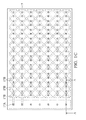
  • FIGS. 1A to 1D show top views of a touch device during manufacture in one embodiment of the disclosure
  • FIGS. 2A to 2D show cross sections of the touch device along a line A-A in FIGS. 1A to 1D , respectively;
  • FIGS. 3A to 3E show top views of a touch device during manufacture in one embodiment of the disclosure
  • FIGS. 4A to 4E show cross sections of the touch device along a line A-A in FIGS. 3A to 3D , respectively;
  • FIGS. 5A to 5C show top views of a first contact via in embodiments of the disclosure.
  • FIG. 6 shows a top view of a second contact via in one embodiment of the disclosure.
  • FIGS. 1A to 1D show top views of a touch device during manufacture in one embodiment of the disclosure.
  • FIGS. 2A to 2D show cross sections of the touch device along a line A-A in FIGS. 1A to 1D , respectively.
  • a black matrix BM is formed on a substrate 10
  • sensing electrodes 11 A and 13 A and connection electrodes 13 B are then formed on the substrate 10 .
  • Sensing electrodes 13 A in the same columns are connected by connection electrodes 13 B.
  • Sensing electrodes 11 A are separated without being connected to each other, and are not in contact with sensing electrodes 13 A and connection electrodes 13 B.
  • sensing electrodes 11 A and 13 A are rhombuses with the same area in the following embodiments and drawings, it should be understood that the sensing electrodes can be other shapes (triangle, tetragon, hexagon, or the like) with the same or different areas if necessary.
  • the substrate 10 can be glass or plastic.
  • the material of the black matrix BM can be black resin, and the black matrix BM can be formed by sputtering or printing.
  • the material of sensing electrodes 11 A and 13 A and connection electrodes 13 B can be a transparent conductive material such as indium tin oxide (ITO), and sensing electrodes 11 A and 13 A and connection electrodes 13 B can be formed by sputtering or screen printing.
  • ITO indium tin oxide
  • an insulation layer 15 is then formed on the substrate 10 , the black matrix BM, sensing electrodes 11 A and 13 A, and connection electrodes 13 B.
  • the material of the insulation layer 15 can be an inorganic material (i.e. silicon oxide or silicon nitride) or an organic material (i.e. photoresist).
  • the insulation layer 15 can be formed by chemical vapor deposition (CVD), physical vapor deposition (PVD), or sputtering.
  • first contact vias 17 A are formed to penetrate the insulation layer 15 on terminals of sensing electrodes 11 A over the black matrix BM
  • second contact vias 17 B are formed to penetrate the insulation layer 15 on two sides of sensing electrodes 11 A.
  • the first contact vias 17 A and the second contact vias 17 B can be formed by lithography and etching processes.
  • side views of the first contact vias 17 A and the second contact vias 17 B can be inverted trapezoids (narrow bottom and wide top), rectangles (bottom and top are equal in width), or trapezoids (wide bottom and narrow top). Top views of the first contact vias 17 A and the second contact vias 17 B will be described in detail below.
  • traces 19 A and connection electrodes 11 B are then formed.
  • the material of the traces 19 A and connection electrodes 11 B can be metal such as silver, copper, aluminum, an alloy thereof, or transparent conductive material such as indium tin oxide (ITO), indium zinc oxide (IZO), a combination thereof, or a multi-layered structure thereof.
  • the traces 19 A and connection electrodes 11 B can be formed by sputtering or screen printing. As shown in FIG. 2D , the trace 19 A on the insulation layer 15 is electrically connected to the terminal of the sensing electrode 11 A through the first contact via 17 A.
  • Connection electrode 11 B on the insulation layer 15 is electrically connected to the two adjacent sensing electrodes 11 A through the second contact vias 17 B, such that sensing electrodes 11 A in the same column can be electrically connected.
  • the connection electrodes 11 B can be formed on the substrate 10 , the insulation layer 15 is then formed on the substrate 10 , the black matrix BM, and the connection electrodes 11 B, and the second contact vias 17 B are formed to penetrate the insulation layer 15 on two sides of connection electrodes 11 B.
  • Sensing electrodes 11 A on the insulation layer 15 is electrically connected to the connection electrodes 11 B through the second contact vias 17 B, such that sensing electrodes 11 A in the same column can be electrically connected.
  • the traces 19 A can be also connected to bonding pads (not shown) to electrically connect to an external circuit. It should be understood that sensing electrodes 13 A can be electrically connected to the bonding pads and the external circuit with the described design of the contact vias and the traces.
  • the touch device can be integrated into a display device to complete a touch display apparatus.
  • FIGS. 3A to 3E show top views of a touch device during manufacture in one embodiment of the disclosure.
  • FIGS. 4A to 4E show cross sections of the touch device along a line A-A in FIGS. 3A to 3E , respectively.
  • a black matrix BM is formed on a substrate 10 , and sensing electrodes 13 A and connection electrodes 13 B are then formed. Sensing electrodes 13 A in the same column are electrically connected by connection electrodes 13 B.
  • the materials and methods for forming the substrate 10 , the black matrix BM, sensing electrodes 13 A, and connection electrodes 13 B are similar to that in the embodiment described above, and the related description is therefore omitted here.
  • an insulation layer 15 is then formed on the substrate 10 , the black matrix BM, sensing electrodes 13 A, and connection electrodes 13 B.
  • the material and method for forming the insulation layer 15 are similar to that in the embodiment described above, and the related description is therefore omitted here.
  • sensing electrodes 11 A and connection electrodes 11 B are then formed on the insulation layer 15 .
  • Sensing electrodes 11 A in the same column are connected by connection electrodes 11 B, and terminals of sensing electrodes 11 A are disposed on the black matrix BM.
  • the material and the method for forming sensing electrodes 11 A and connection electrodes 11 B is similar to that for sensing electrodes 13 A and connection electrodes 13 B, and the related description is therefore omitted here.
  • an insulation layer 16 is then formed on the insulation layer 15 , sensing electrodes 11 A, and connection electrodes 11 B.
  • the material and method for forming the insulation layer 16 is similar to that of the insulation layer 15 , and the related description is therefore omitted here.
  • first contact vias 17 A are defined to expose terminals of sensing electrodes 11 A on the black matrix BM.
  • the method for forming the first contact vias is similar to that in the embodiment described above, and the related description is therefore omitted here.
  • traces 19 A are then formed.
  • the material and the method for forming the traces 19 A are similar to those in the embodiment described above, and the related description is therefore omitted here.
  • the traces 19 A on the insulation layer 15 are electrically connected to the terminal of sensing electrodes 11 A through the first contact via 17 A.
  • the traces 19 A can be also connected to bonding pads (not shown) to electrically connect to an external circuit.
  • sensing electrodes 13 A can be electrically connected to the bonding pads and the external circuit with the described design of the first contact vias and the traces.
  • the touch device can be integrated into a display device to complete a touch display apparatus.
  • FIG. 5A shows a top view of the first contact via 17 A in one embodiment of the disclosure.
  • FIG. 5A is a cross section of a bottom of the first contact via 17 A, and the cross section of the first contact via 17 A is parallel to a surface of the substrate (and vertical to the direction D which is vertical to a surface of the substrate).
  • FIG. 5 is a cross section of a top of the first contact via 17 A, and the cross section of the first contact via 17 A is parallel to a surface of the substrate (and vertical to the direction D which is vertical to a surface of the substrate).
  • FIG. 5 is a cross section of any cross section between the top and the bottom of the first contact via 17 A, and the cross section of the first contact via 17 A is parallel to a surface of the substrate (and vertical to the direction D which is vertical to a surface of the substrate).
  • FIG. 5B is used to further illustrate the first contact via 17 A in FIG. 5A .
  • a corner of the first contact via 17 A is defined by a first edge 171 , a second edge 173 , and a third edge 175 .
  • the second edge 173 is disposed between the first edge 171 and the third edge 175 .
  • the cross section of the first contact via 17 A has an area A, and the cross section of the first contact via 17 A is parallel to a surface of the substrate (and vertical to the direction D which is vertical to a surface of the substrate).
  • the region defined by an extended line of the first edge 171 , the second edge 173 , and an extended line of the third edge 175 has a first area A′ of greater than 0.
  • the first area A′ and the area A of the cross section have a ratio (A′/A) of 0.4% to 0.8%.
  • An overly large first area A′ may cause an overly high contact resistance.
  • An overly small first area A′ easily results in residual etchant.
  • the first edge 171 and the second edge 173 have a first angle ⁇ therebetween of greater than 90 degrees
  • the second edge 173 and the third edge 175 have a second angle ⁇ of greater than 90 degrees.
  • the first angle ⁇ and the second angle ⁇ have a sum of 270 degrees.
  • the first angle ⁇ and the second angle ⁇ are less than 180 degrees and greater than 90 degrees, respectively. If FIG. 5B is a cross section of the bottom of the first contact via 17 A, the first angle ⁇ and the second angle ⁇ may prevent the etchant remained between the first edge 171 and the second edge 173 (or between the second edge 173 and the third edge 175 ). If FIG. 5B is a cross section of the top of the first contact via 17 A, the first angle ⁇ and the second angle ⁇ may prevent point discharge.
  • the second edge 173 is linear, as shown in FIG. 5B . In another embodiment, the second edge 173 is curved, as shown in FIG. 5C . Whether the second edge 173 is linear or curved, it may prevent the residual etchant or point discharge problems.
  • FIG. 6 shows a cross section of the second contact vias 17 B, and the cross section is vertical to the direction D of the second contact vias 17 B penetrating the substrate.
  • the cross section in FIG. 6 can be a top, a bottom, or any cross section between the top and the bottom of the second contact vias 17 B.
  • the fourth angle and the fifth angle of the corner of the second contact vias 17 B, the second area (greater than 0) of a region defined by an extended line of the fourth edge, the fifth edge, and an extended line of the sixth edge, the area ratio of the second area and the cross section area, the curved edge, and the like are similar to that of the first contact vias 17 A in FIGS. 5A to 5C , and the related description is therefore omitted here.
  • first contact vias 17 A and the second contact vias 17 B only have one cut corner, it should be understood that the contact vias may have more cut corners. For example, all four corners of the contact vias may have a first edge 171 , a second edge, and a third edge 175 .

Landscapes

  • Engineering & Computer Science (AREA)
  • General Engineering & Computer Science (AREA)
  • Theoretical Computer Science (AREA)
  • Human Computer Interaction (AREA)
  • Physics & Mathematics (AREA)
  • General Physics & Mathematics (AREA)
  • Position Input By Displaying (AREA)

Abstract

A touch device including a substrate and a sensing electrode thereon is provided. An insulation layer is disposed on the sensing electrode, wherein the insulation layer includes a first contact via exposing a part of a terminal of the sensing electrode. A trace is disposed on the insulation layer and electrically connected to the terminal of the sensing electrode through the first contact via. A corner in the first contact via includes a first edge, a second edge, and a third edge, wherein the second edge is disposed between the first edge and the third edge. The first edge and the second edge include a first angle therebetween of greater than 90 degrees, and the second edge and the third edge include a second angle therebetween of greater than 90 degrees.

Description

CROSS REFERENCE TO RELATED APPLICATIONS
This Application claims priority of Taiwan Patent Application No. 104100492, filed on Jan. 8, 2015, the entirety of which is incorporated by reference herein.
BACKGROUND
Technical Field
The disclosure relates to a touch device, and in particular it relates to a contact via in a touch device.
Description of the Related Art
Conventional touch devices usually include sensing electrodes and traces electrically connected thereto on a substrate. The traces can be electrically connected to a bonding pad set, and the bonding pad set can be further electrically connected to an external circuit (i. e. flexible circuit board). As such, the current or signals can be transferred from the external circuit to the sensing electrodes through the bonding pad set and the traces, thereby driving the touch device.
In the conventional art, the described elements are usually electrically connected through contact holes. However, residual etchant used in the formation of the contact vias in an etching process usually remains in the corners of the bottom of the contact vias. This residual etchant may cause over-etching problems. In addition, if the corners of the top of the contact vias have an overly small angle (e.g. less than or equal to 90 degrees), it will cause point-discharge problems. Accordingly, a novel contact via is called for to solve the problems described above.
BRIEF SUMMARY
One embodiment of the disclosure provides a touch device, comprising a substrate, a first sensing electrode disposed on the substrate, an insulation layer, and a trace. The insulation layer is disposed on the first sensing electrode. The insulation layer includes a first contact via exposing a part of a terminal of the first sensing electrode. The trace is disposed on the insulation layer and is electrically connected to the terminal of the first sensing electrode through the first contact via. A corner of the first contact via includes a first edge, a second edge, and a third edge. The second edge is disposed between the first edge and the third edge. A line that extends from the first edge and the second edge, and a line that extends from the third edge, define a region that has a first area, which is greater than 0.
One embodiment of the disclosure provides a touch device, comprising: a substrate; a first sensing electrode disposed on the substrate; an insulation layer disposed on the first sensing electrode, wherein the insulation layer includes a first contact via exposing a part of a terminal of the first sensing electrode; and a trace disposed on the insulation layer and electrically connected to the terminal of the first sensing electrode through the first contact via. A corner of the first contact via includes a first edge, a second edge, and a third edge, and the second edge is disposed between the first edge and the third edge. The first edge and the second edge have an angle therebetween of greater than 90 degrees, and the second edge and the third edge have an angle therebetween of greater than 90 degrees.
A detailed description is given in the following embodiments with reference to the accompanying drawings.
BRIEF DESCRIPTION
The disclosure can be more fully understood by reading the subsequent detailed description and examples with references made to the accompanying drawings, wherein:
FIGS. 1A to 1D show top views of a touch device during manufacture in one embodiment of the disclosure;
FIGS. 2A to 2D show cross sections of the touch device along a line A-A in FIGS. 1A to 1D, respectively;
FIGS. 3A to 3E show top views of a touch device during manufacture in one embodiment of the disclosure;
FIGS. 4A to 4E show cross sections of the touch device along a line A-A in FIGS. 3A to 3D, respectively;
FIGS. 5A to 5C show top views of a first contact via in embodiments of the disclosure; and
FIG. 6 shows a top view of a second contact via in one embodiment of the disclosure.
DETAILED DESCRIPTION
The following description is of the best-contemplated mode of carrying out the disclosure. This description is made for the purpose of illustrating the general principles of the disclosure and should not be taken in a limiting sense. The scope of the disclosure is determined by reference to the appended claims.
FIGS. 1A to 1D show top views of a touch device during manufacture in one embodiment of the disclosure. FIGS. 2A to 2D show cross sections of the touch device along a line A-A in FIGS. 1A to 1D, respectively. As shown in FIGS. 1A and 2A, a black matrix BM is formed on a substrate 10, and sensing electrodes 11A and 13A and connection electrodes 13B are then formed on the substrate 10. Sensing electrodes 13A in the same columns are connected by connection electrodes 13B. Sensing electrodes 11A are separated without being connected to each other, and are not in contact with sensing electrodes 13A and connection electrodes 13B. Although sensing electrodes 11A and 13A are rhombuses with the same area in the following embodiments and drawings, it should be understood that the sensing electrodes can be other shapes (triangle, tetragon, hexagon, or the like) with the same or different areas if necessary. In one embodiment, the substrate 10 can be glass or plastic. In one embodiment, the material of the black matrix BM can be black resin, and the black matrix BM can be formed by sputtering or printing. In one embodiment, the material of sensing electrodes 11A and 13A and connection electrodes 13B can be a transparent conductive material such as indium tin oxide (ITO), and sensing electrodes 11A and 13A and connection electrodes 13B can be formed by sputtering or screen printing.
As shown in FIGS. 1B and 2B, an insulation layer 15 is then formed on the substrate 10, the black matrix BM, sensing electrodes 11A and 13A, and connection electrodes 13B. The material of the insulation layer 15 can be an inorganic material (i.e. silicon oxide or silicon nitride) or an organic material (i.e. photoresist). The insulation layer 15 can be formed by chemical vapor deposition (CVD), physical vapor deposition (PVD), or sputtering.
As shown in FIGS. 1C and 2C, first contact vias 17A are formed to penetrate the insulation layer 15 on terminals of sensing electrodes 11A over the black matrix BM, and second contact vias 17B are formed to penetrate the insulation layer 15 on two sides of sensing electrodes 11A. The first contact vias 17A and the second contact vias 17B can be formed by lithography and etching processes. In general, side views of the first contact vias 17A and the second contact vias 17B can be inverted trapezoids (narrow bottom and wide top), rectangles (bottom and top are equal in width), or trapezoids (wide bottom and narrow top). Top views of the first contact vias 17A and the second contact vias 17B will be described in detail below.
As shown in FIGS. 1D and 2D, traces 19A and connection electrodes 11B are then formed. In one embodiment, the material of the traces 19A and connection electrodes 11B can be metal such as silver, copper, aluminum, an alloy thereof, or transparent conductive material such as indium tin oxide (ITO), indium zinc oxide (IZO), a combination thereof, or a multi-layered structure thereof. The traces 19A and connection electrodes 11B can be formed by sputtering or screen printing. As shown in FIG. 2D, the trace 19A on the insulation layer 15 is electrically connected to the terminal of the sensing electrode 11A through the first contact via 17A. Connection electrode 11B on the insulation layer 15 is electrically connected to the two adjacent sensing electrodes 11A through the second contact vias 17B, such that sensing electrodes 11A in the same column can be electrically connected. It should be noted that, in other embodiments, the connection electrodes 11B can be formed on the substrate 10, the insulation layer 15 is then formed on the substrate 10, the black matrix BM, and the connection electrodes 11B, and the second contact vias 17B are formed to penetrate the insulation layer 15 on two sides of connection electrodes 11B. Sensing electrodes 11A on the insulation layer 15 is electrically connected to the connection electrodes 11B through the second contact vias 17B, such that sensing electrodes 11A in the same column can be electrically connected.
The traces 19A can be also connected to bonding pads (not shown) to electrically connect to an external circuit. It should be understood that sensing electrodes 13A can be electrically connected to the bonding pads and the external circuit with the described design of the contact vias and the traces. The touch device can be integrated into a display device to complete a touch display apparatus.
FIGS. 3A to 3E show top views of a touch device during manufacture in one embodiment of the disclosure. FIGS. 4A to 4E show cross sections of the touch device along a line A-A in FIGS. 3A to 3E, respectively. As shown in FIGS. 3A and 4A, a black matrix BM is formed on a substrate 10, and sensing electrodes 13A and connection electrodes 13B are then formed. Sensing electrodes 13A in the same column are electrically connected by connection electrodes 13B. The materials and methods for forming the substrate 10, the black matrix BM, sensing electrodes 13A, and connection electrodes 13B are similar to that in the embodiment described above, and the related description is therefore omitted here.
As shown in FIGS. 3B and 4B, an insulation layer 15 is then formed on the substrate 10, the black matrix BM, sensing electrodes 13A, and connection electrodes 13B. The material and method for forming the insulation layer 15 are similar to that in the embodiment described above, and the related description is therefore omitted here.
As shown in FIGS. 3C and 4C, sensing electrodes 11A and connection electrodes 11B are then formed on the insulation layer 15. Sensing electrodes 11A in the same column are connected by connection electrodes 11B, and terminals of sensing electrodes 11A are disposed on the black matrix BM. The material and the method for forming sensing electrodes 11A and connection electrodes 11B is similar to that for sensing electrodes 13A and connection electrodes 13B, and the related description is therefore omitted here.
As shown in FIGS. 3D and 4D, an insulation layer 16 is then formed on the insulation layer 15, sensing electrodes 11A, and connection electrodes 11B. The material and method for forming the insulation layer 16 is similar to that of the insulation layer 15, and the related description is therefore omitted here. Furthermore, first contact vias 17A are defined to expose terminals of sensing electrodes 11A on the black matrix BM. The method for forming the first contact vias is similar to that in the embodiment described above, and the related description is therefore omitted here.
As shown in FIGS. 3E and 4E, traces 19A are then formed. The material and the method for forming the traces 19A are similar to those in the embodiment described above, and the related description is therefore omitted here. As shown in FIG. 3E, the traces 19A on the insulation layer 15 are electrically connected to the terminal of sensing electrodes 11A through the first contact via 17A. Similarly, the traces 19A can be also connected to bonding pads (not shown) to electrically connect to an external circuit. It should be understood that sensing electrodes 13A can be electrically connected to the bonding pads and the external circuit with the described design of the first contact vias and the traces. The touch device can be integrated into a display device to complete a touch display apparatus.
FIG. 5A shows a top view of the first contact via 17A in one embodiment of the disclosure. In one embodiment, FIG. 5A is a cross section of a bottom of the first contact via 17A, and the cross section of the first contact via 17A is parallel to a surface of the substrate (and vertical to the direction D which is vertical to a surface of the substrate). Alternatively, FIG. 5 is a cross section of a top of the first contact via 17A, and the cross section of the first contact via 17A is parallel to a surface of the substrate (and vertical to the direction D which is vertical to a surface of the substrate). In other embodiments, FIG. 5 is a cross section of any cross section between the top and the bottom of the first contact via 17A, and the cross section of the first contact via 17A is parallel to a surface of the substrate (and vertical to the direction D which is vertical to a surface of the substrate).
FIG. 5B is used to further illustrate the first contact via 17A in FIG. 5A. As shown in FIG. 5B, a corner of the first contact via 17A is defined by a first edge 171, a second edge 173, and a third edge 175. The second edge 173 is disposed between the first edge 171 and the third edge 175. The cross section of the first contact via 17A has an area A, and the cross section of the first contact via 17A is parallel to a surface of the substrate (and vertical to the direction D which is vertical to a surface of the substrate). The region defined by an extended line of the first edge 171, the second edge 173, and an extended line of the third edge 175 has a first area A′ of greater than 0. In one embodiment, the first area A′ and the area A of the cross section have a ratio (A′/A) of 0.4% to 0.8%. An overly large first area A′ may cause an overly high contact resistance. An overly small first area A′ easily results in residual etchant.
As shown in FIG. 5B, the first edge 171 and the second edge 173 have a first angle α therebetween of greater than 90 degrees, and the second edge 173 and the third edge 175 have a second angle β of greater than 90 degrees. In one embodiment, the first angle α and the second angle β have a sum of 270 degrees. The first angle α and the second angle β are less than 180 degrees and greater than 90 degrees, respectively. If FIG. 5B is a cross section of the bottom of the first contact via 17A, the first angle α and the second angle β may prevent the etchant remained between the first edge 171 and the second edge 173 (or between the second edge 173 and the third edge 175). If FIG. 5B is a cross section of the top of the first contact via 17A, the first angle α and the second angle β may prevent point discharge.
In one embodiment, the second edge 173 is linear, as shown in FIG. 5B. In another embodiment, the second edge 173 is curved, as shown in FIG. 5C. Whether the second edge 173 is linear or curved, it may prevent the residual etchant or point discharge problems.
FIG. 6 shows a cross section of the second contact vias 17B, and the cross section is vertical to the direction D of the second contact vias 17B penetrating the substrate. Similarly, the cross section in FIG. 6 can be a top, a bottom, or any cross section between the top and the bottom of the second contact vias 17B. The fourth angle and the fifth angle of the corner of the second contact vias 17B, the second area (greater than 0) of a region defined by an extended line of the fourth edge, the fifth edge, and an extended line of the sixth edge, the area ratio of the second area and the cross section area, the curved edge, and the like are similar to that of the first contact vias 17A in FIGS. 5A to 5C, and the related description is therefore omitted here.
Although the first contact vias 17A and the second contact vias 17B only have one cut corner, it should be understood that the contact vias may have more cut corners. For example, all four corners of the contact vias may have a first edge 171, a second edge, and a third edge 175.
While the disclosure has been described by way of example and in terms of the preferred embodiments, it is to be understood that the disclosure is not limited to the disclosed embodiments. On the contrary, it is intended to cover various modifications and similar arrangements (as would be apparent to those skilled in the art). Therefore, the scope of the appended claims should be accorded the broadest interpretation so as to encompass all such modifications and similar arrangements.

Claims (20)

What is claimed is:
1. A touch device, comprising:
a substrate;
a first sensing electrode disposed on the substrate;
an insulation layer disposed on the first sensing electrode, wherein the insulation layer includes a first contact via exposing a part of a terminal of the first sensing electrode; and
a trace disposed on the insulation layer and electrically connected to the terminal of the first sensing electrode through the first contact via,
wherein a corner of the first contact via includes a first edge, a second edge, and a third edge in a top-view, and the second edge is disposed between the first edge and the third edge,
wherein an extended line of the first edge, the second edge, and an extended line of the third edge define a region with a first area greater than 0.
2. The touch device as claimed in claim 1, wherein in the top-view, a cross section of the first contact via is parallel to a surface of the substrate, and the corner of the first contact via is a corner of the cross section of the first contact via.
3. The touch device as claimed in claim 2, wherein the first area and an area of the cross section of the first contact via have a ratio of 0.4% to 0.8%.
4. The touch device as claimed in claim 1, wherein the second edge is linear.
5. The touch device as claimed in claim 1, wherein the second edge is curved.
6. The touch device as claimed in claim 1, wherein the insulation layer further comprises a second contact via, and the touch device further comprises a connection electrode electrically connected to the first sensing electrode through the second contact via.
7. The touch device as claimed in claim 6, wherein a corner of the second contact via includes a fourth edge, a fifth edge, and a sixth edge in the top view, and the fifth edge is disposed between the fourth edge and the sixth edge, and
wherein an extended line of the fourth edge, the fifth edge, and an extended line of the sixth edge defines a region with a second area greater than 0.
8. The touch device as claimed in claim 6, wherein in the top-view, a cross section of the second contact via is parallel to a surface of the substrate, and the corner of the second contact via is a corner of the cross section of the second contact via.
9. The touch device as claimed in claim 8, wherein the second area and an area of the cross section of the second contact via have a ratio of 0.4% to 0.8%.
10. The touch device as claimed in claim 7, wherein the fifth edge is linear.
11. The touch device as claimed in claim 7, wherein the fifth edge is curved.
12. The touch device as claimed in claim 1, wherein the terminal of the first sensing electrode is disposed on a black matrix.
13. A touch device, comprising:
a substrate;
a first sensing electrode disposed on the substrate;
an insulation layer disposed on the first sensing electrode, wherein the insulation layer includes a first contact via exposing a part of a terminal of the first sensing electrode; and
a trace disposed on the insulation layer and electrically connected to the terminal of the first sensing electrode through the first contact via,
wherein a corner of the first contact via includes a first edge, a second edge, and a third edge in a top-view, and the second edge is disposed between the first edge and the third edge,
wherein the first edge and the second edge have an angle therebetween of greater than 90 degrees, and the second edge and the third edge have an angle therebetween of greater than 90 degrees.
14. The touch device as claimed in claim 13, wherein in the top-view, a cross section of the first contact via is parallel to a surface of the substrate, and the corner of the first contact via is a corner of the cross section of the first contact via.
15. The touch device as claimed in claim 13, wherein the second edge is linear.
16. The touch device as claimed in claim 13, wherein the second edge is curved.
17. The touch device as claimed in claim 13, wherein the insulation layer further comprises a second contact via, and the touch device further comprises a connection electrode electrically connected to the first sensing electrode through the second contact via.
18. The touch device as claimed in claim 17, wherein a corner of the second contact via includes a fourth edge, a fifth edge, and a sixth edge in the top-view, and the fifth edge is disposed between the fourth edge and the sixth edge, and
wherein the fourth edge and the fifth edge have an angle therebetween of greater than 90 degrees, and the fifth edge and the sixth edge have an angle therebetween of greater than 90 degrees.
19. The touch device as claimed in claim 18, wherein in the top-view, a cross section of the second contact via is parallel to a surface of the substrate, and the corner of the second contact via is a corner of the cross section of the second contact via.
20. The touch device as claimed in claim 18, wherein the fifth edge is curved.
US14/687,138 2015-01-08 2015-04-15 Touch device Active 2035-11-27 US9804698B2 (en)

Applications Claiming Priority (3)

Application Number Priority Date Filing Date Title
TW104100492 2015-01-08
TW104100492A TWI560838B (en) 2015-01-08 2015-01-08 Touch device
TW104100492A 2015-01-08

Publications (2)

Publication Number Publication Date
US20160202780A1 US20160202780A1 (en) 2016-07-14
US9804698B2 true US9804698B2 (en) 2017-10-31

Family

ID=53887910

Family Applications (1)

Application Number Title Priority Date Filing Date
US14/687,138 Active 2035-11-27 US9804698B2 (en) 2015-01-08 2015-04-15 Touch device

Country Status (3)

Country Link
US (1) US9804698B2 (en)
JP (1) JP3199405U (en)
TW (1) TWI560838B (en)

Families Citing this family (1)

* Cited by examiner, † Cited by third party
Publication number Priority date Publication date Assignee Title
CN104503617B (en) * 2014-12-26 2017-10-13 合肥鑫晟光电科技有限公司 Border structure and its manufacture method, the touch-screen and display device of touch-screen

Citations (6)

* Cited by examiner, † Cited by third party
Publication number Priority date Publication date Assignee Title
US7768126B2 (en) * 2006-09-29 2010-08-03 Intel Corporation Barrier formation and structure to use in semiconductor devices
US20120113042A1 (en) 2010-11-09 2012-05-10 Tpk Touch Solutions Inc. Capacitive Touch Panel And Method for Producing The Same
US20130038553A1 (en) * 2011-08-12 2013-02-14 Wintek Corporation Touch panel and method of fabricating the same, and touch-sensing display device
US20130194224A1 (en) * 2012-01-27 2013-08-01 Research In Motion Limited Electronic device with capacitive touch-sensitive display
TW201349050A (en) 2012-05-16 2013-12-01 宸鴻科技(廈門)有限公司 Touch panel and touch display device thereof
TWI463544B (en) 2012-02-25 2014-12-01 Tpk Touch Solutions Xiamen Inc Touch panel and manufacturing method thereof

Family Cites Families (3)

* Cited by examiner, † Cited by third party
Publication number Priority date Publication date Assignee Title
JP5537915B2 (en) * 2009-12-01 2014-07-02 株式会社ジャパンディスプレイ Touch panel
TWI439896B (en) * 2011-01-14 2014-06-01 Chunghwa Picture Tubes Ltd Sensing structure of touch panel
TWI439916B (en) * 2011-10-28 2014-06-01 Sentelic Corp Capacitive touch panel structure and method producing the same

Patent Citations (7)

* Cited by examiner, † Cited by third party
Publication number Priority date Publication date Assignee Title
US7768126B2 (en) * 2006-09-29 2010-08-03 Intel Corporation Barrier formation and structure to use in semiconductor devices
US20120113042A1 (en) 2010-11-09 2012-05-10 Tpk Touch Solutions Inc. Capacitive Touch Panel And Method for Producing The Same
TW201220167A (en) 2010-11-09 2012-05-16 Tpk Touch Solutions Inc Capacitive touch panel and method for producing the same
US20130038553A1 (en) * 2011-08-12 2013-02-14 Wintek Corporation Touch panel and method of fabricating the same, and touch-sensing display device
US20130194224A1 (en) * 2012-01-27 2013-08-01 Research In Motion Limited Electronic device with capacitive touch-sensitive display
TWI463544B (en) 2012-02-25 2014-12-01 Tpk Touch Solutions Xiamen Inc Touch panel and manufacturing method thereof
TW201349050A (en) 2012-05-16 2013-12-01 宸鴻科技(廈門)有限公司 Touch panel and touch display device thereof

Non-Patent Citations (1)

* Cited by examiner, † Cited by third party
Title
Chinese language office action dated Mar. 21, 2016, issued in application No. TW 104100492.

Also Published As

Publication number Publication date
JP3199405U (en) 2015-08-20
TW201626530A (en) 2016-07-16
US20160202780A1 (en) 2016-07-14
TWI560838B (en) 2016-12-01

Similar Documents

Publication Publication Date Title
US10915205B2 (en) Touch panels and methods of manufacturing touch panels
US9740344B2 (en) Touch screen and manufacturing method thereof, display device
CN105159515B (en) Touch-control structure and preparation method thereof, touch base plate and display device
CN103676386B (en) A kind of display floater and display device
US20200027903A1 (en) Array substrate and manufacturing method thereof, display substrate, and display device
US10600636B2 (en) Touch substrate and fabrication method thereof, and electronic device
US11561657B2 (en) Touch panel and manufacturing method therefor, and touch display device
US20160034076A1 (en) Touch display device
US20160041647A1 (en) Touch screen panel fabrication method and touch screen panel
CN103677406B (en) Touch panel and touch display panel
US10444911B2 (en) Flexible touch sensing unit and method of manufacturing a flexible touch sensing unit
WO2018059111A1 (en) Touch control substrate and touch control display apparatus
WO2017076071A1 (en) Array substrate and tft display device comprising array substrate
US11526241B2 (en) Flexible substrate, touch display substrate, manufacturing methods thereof, and touch display device
US11086460B2 (en) Touch substrate, method for manufacturing same, and touch device
CN104183607A (en) Array substrate, manufacturing method of array substrate and display device with array substrate
US20180188841A1 (en) Touch screen and touch sensing assembly thereof
JP2013218126A (en) Display device
US10921929B2 (en) Touch screen panel and method of manufacturing the same
US20200201507A1 (en) Touch panel and touch display device
KR102047726B1 (en) In-cell Touch Type Liquid Crystal Display and Method of fabricating the same
US9804698B2 (en) Touch device
US10359873B2 (en) Touch display screen
CN106856199B (en) Display panel and method for manufacturing the same
CN105845692A (en) Display substrate, display apparatus and manufacture method of display substrate

Legal Events

Date Code Title Description
AS Assignment

Owner name: INNOLUX CORPORATION, TAIWAN

Free format text: ASSIGNMENT OF ASSIGNORS INTEREST;ASSIGNORS:CHIEN, CHUAN-CHI;CHANG, CHIA-HSIUNG;CHEN, YANG-CHEN;REEL/FRAME:035414/0418

Effective date: 20150405

STCF Information on status: patent grant

Free format text: PATENTED CASE

MAFP Maintenance fee payment

Free format text: PAYMENT OF MAINTENANCE FEE, 4TH YEAR, LARGE ENTITY (ORIGINAL EVENT CODE: M1551); ENTITY STATUS OF PATENT OWNER: LARGE ENTITY

Year of fee payment: 4

MAFP Maintenance fee payment

Free format text: PAYMENT OF MAINTENANCE FEE, 8TH YEAR, LARGE ENTITY (ORIGINAL EVENT CODE: M1552); ENTITY STATUS OF PATENT OWNER: LARGE ENTITY

Year of fee payment: 8