US9802913B2 - Compound useful for manufacturing salacinol, method for manufacturing the compound, method for manufacturing salacinol, methods for protecting and deprotecting diol group, and protective agent for diol group - Google Patents
Compound useful for manufacturing salacinol, method for manufacturing the compound, method for manufacturing salacinol, methods for protecting and deprotecting diol group, and protective agent for diol group Download PDFInfo
- Publication number
- US9802913B2 US9802913B2 US15/268,829 US201615268829A US9802913B2 US 9802913 B2 US9802913 B2 US 9802913B2 US 201615268829 A US201615268829 A US 201615268829A US 9802913 B2 US9802913 B2 US 9802913B2
- Authority
- US
- United States
- Prior art keywords
- group
- formula
- compound
- compound represented
- amount
- Prior art date
- Legal status (The legal status is an assumption and is not a legal conclusion. Google has not performed a legal analysis and makes no representation as to the accuracy of the status listed.)
- Active
Links
- 0 [2*]C[C@H]1OC(C(C)C)OC[C@@H]1[3*] Chemical compound [2*]C[C@H]1OC(C(C)C)OC[C@@H]1[3*] 0.000 description 36
- JZMJDSHXVKJFKW-UHFFFAOYSA-N COS(=O)(=O)O Chemical compound COS(=O)(=O)O JZMJDSHXVKJFKW-UHFFFAOYSA-N 0.000 description 3
- HHVIBTZHLRERCL-UHFFFAOYSA-N CS(C)(=O)=O Chemical compound CS(C)(=O)=O HHVIBTZHLRERCL-UHFFFAOYSA-N 0.000 description 3
- GCYFVSRIIPTHDQ-UHFFFAOYSA-N CC(C)C1OCO1 Chemical compound CC(C)C1OCO1 GCYFVSRIIPTHDQ-UHFFFAOYSA-N 0.000 description 2
- YKNQGTBXWYBVLB-KVARREAHSA-N CC(C)C1OC[C@@H]2OS(=O)(=O)OC[C@H]2O1 Chemical compound CC(C)C1OC[C@@H]2OS(=O)(=O)OC[C@H]2O1 YKNQGTBXWYBVLB-KVARREAHSA-N 0.000 description 2
- VLVSFIRYIVAVKW-WDCZJNDASA-N OC[C@H]1SC[C@@H](O)[C@@H]1O Chemical compound OC[C@H]1SC[C@@H](O)[C@@H]1O VLVSFIRYIVAVKW-WDCZJNDASA-N 0.000 description 2
- ZFFMLCVRJBZUDZ-UHFFFAOYSA-N CC(C)C(C)C Chemical compound CC(C)C(C)C ZFFMLCVRJBZUDZ-UHFFFAOYSA-N 0.000 description 1
- GIVAGVIGZBVQDU-UHFFFAOYSA-N CC(C)C1OCO1.OCO Chemical compound CC(C)C1OCO1.OCO GIVAGVIGZBVQDU-UHFFFAOYSA-N 0.000 description 1
- YWFFCPALIFZEIN-KJFJCRTCSA-N CC(C)C1OC[C@H](O)[C@@H](CO)O1 Chemical compound CC(C)C1OC[C@H](O)[C@@H](CO)O1 YWFFCPALIFZEIN-KJFJCRTCSA-N 0.000 description 1
- UUOWQTJCMKGWCB-AZRBSUBLSA-N CC1OC2CSC1C2C.CC1OC2CSC1C2O.CC[C@H]1OC(OC)[C@H](OS(=O)(=O)C2=CC=C(C)C=C2)[C@H]1C Chemical compound CC1OC2CSC1C2C.CC1OC2CSC1C2O.CC[C@H]1OC(OC)[C@H](OS(=O)(=O)C2=CC=C(C)C=C2)[C@H]1C UUOWQTJCMKGWCB-AZRBSUBLSA-N 0.000 description 1
- AZRLXVPMLTZRRZ-SGYZYFFOSA-N CC1OC2CSC1C2C.C[C@H]1[C@H](O)CS[C@@H]1CO Chemical compound CC1OC2CSC1C2C.C[C@H]1[C@H](O)CS[C@@H]1CO AZRLXVPMLTZRRZ-SGYZYFFOSA-N 0.000 description 1
- CYYMNOZNFPCVGA-UHFFFAOYSA-N CC=C(C(=O)OC)C(=O)OC.COC(=O)C(C(=O)OC)C1OCC(C2=CC=CC=C2)O1.OCC(O)C1=CC=CC=C1 Chemical compound CC=C(C(=O)OC)C(=O)OC.COC(=O)C(C(=O)OC)C1OCC(C2=CC=CC=C2)O1.OCC(O)C1=CC=CC=C1 CYYMNOZNFPCVGA-UHFFFAOYSA-N 0.000 description 1
- YAJHXCXJQMGRLR-HFEUNCBUSA-N CCOC(=O)C(C(=O)OC)C1OC[C@@H]2OS(=O)(=O)OC[C@H]2O1.CCOC(=O)C(CC)C1OC[C@H](OS(=O)(=O)[O-])[C@@H](C[S@+]2C[C@@H](O)[C@H](O)[C@H]2CO)O1.CCOC(=O)C(CC)C1OC[C@H](OS(=O)(=O)[O-])[C@@H](C[S@@+]2C[C@@H](O)[C@H](O)[C@H]2CO)O1.O=C=O.O=C=O Chemical compound CCOC(=O)C(C(=O)OC)C1OC[C@@H]2OS(=O)(=O)OC[C@H]2O1.CCOC(=O)C(CC)C1OC[C@H](OS(=O)(=O)[O-])[C@@H](C[S@+]2C[C@@H](O)[C@H](O)[C@H]2CO)O1.CCOC(=O)C(CC)C1OC[C@H](OS(=O)(=O)[O-])[C@@H](C[S@@+]2C[C@@H](O)[C@H](O)[C@H]2CO)O1.O=C=O.O=C=O YAJHXCXJQMGRLR-HFEUNCBUSA-N 0.000 description 1
- RLTGCHRSBAVCCL-HEYKQNPNSA-N CCOC(=O)C(C(=O)OCC)C1OC[C@@H]2OC(C3=CC=CC=C3)OC[C@H]2O1.OC[C@@H]1OC(C2=CC=CC=C2)OC[C@H]1O Chemical compound CCOC(=O)C(C(=O)OCC)C1OC[C@@H]2OC(C3=CC=CC=C3)OC[C@H]2O1.OC[C@@H]1OC(C2=CC=CC=C2)OC[C@H]1O RLTGCHRSBAVCCL-HEYKQNPNSA-N 0.000 description 1
- WDHVGWODPHEPHP-ICVNUBSLSA-N CCOC(=O)C(C(=O)OCC)C1OC[C@@H]2OS(=O)(=O)OC[C@H]2O1.CCOC(=O)C(C(=O)OCC)C1OC[C@H](O)[C@@H](CO)O1 Chemical compound CCOC(=O)C(C(=O)OCC)C1OC[C@@H]2OS(=O)(=O)OC[C@H]2O1.CCOC(=O)C(C(=O)OCC)C1OC[C@H](O)[C@@H](CO)O1 WDHVGWODPHEPHP-ICVNUBSLSA-N 0.000 description 1
- OPXGIEAUJJIHHH-YKGXCBDTSA-N CCOC(=O)C(CC)C1OC[C@H](OS(=O)(=O)[O-])[C@@H](C[S@+]2C[C@@H](O)[C@H](O)[C@H]2CO)O1.CCOC(=O)C(CC)C1OC[C@H](OS(=O)(=O)[O-])[C@@H](C[S@@+]2C[C@@H](O)[C@H](O)[C@H]2CO)O1.O=C=O.O=C=O.O=S(=O)([O-])O[C@@H](CO)[C@H](O)C[S@+]1C[C@@H](O)[C@H](O)[C@H]1CO Chemical compound CCOC(=O)C(CC)C1OC[C@H](OS(=O)(=O)[O-])[C@@H](C[S@+]2C[C@@H](O)[C@H](O)[C@H]2CO)O1.CCOC(=O)C(CC)C1OC[C@H](OS(=O)(=O)[O-])[C@@H](C[S@@+]2C[C@@H](O)[C@H](O)[C@H]2CO)O1.O=C=O.O=C=O.O=S(=O)([O-])O[C@@H](CO)[C@H](O)C[S@+]1C[C@@H](O)[C@H](O)[C@H]1CO OPXGIEAUJJIHHH-YKGXCBDTSA-N 0.000 description 1
- OSUYNOFZHGNQGE-XNJXNPCWSA-N CC[C@@H]1[C@@H](C)[C@H](OCC2=CC=C(OC)C=C2)C[S@+]1C[C@H]1OC(C(C)C(=O)OC)OC[C@@H]1OS(=O)(=O)[O-].CC[C@@H]1[C@@H](C)[C@H](OCC2=CC=C(OC)C=C2)C[S@@+]1C[C@@H](O)[C@H](CO)OS(=O)(=O)[O-].O=C=O Chemical compound CC[C@@H]1[C@@H](C)[C@H](OCC2=CC=C(OC)C=C2)C[S@+]1C[C@H]1OC(C(C)C(=O)OC)OC[C@@H]1OS(=O)(=O)[O-].CC[C@@H]1[C@@H](C)[C@H](OCC2=CC=C(OC)C=C2)C[S@@+]1C[C@@H](O)[C@H](CO)OS(=O)(=O)[O-].O=C=O OSUYNOFZHGNQGE-XNJXNPCWSA-N 0.000 description 1
- RGUVVIFPZNYAIA-CPPJQQLSSA-N CC[C@@H]1[C@@H](C)[C@H](OCC2=CC=C(OC)C=C2)C[S@@+]1C[C@@H](O)[C@H](CO)OS(=O)(=O)[O-].O=S(=O)([O-])O[C@@H](CO)[C@H](O)C[S@+]1C[C@@H](O)[C@H](O)[C@H]1CO Chemical compound CC[C@@H]1[C@@H](C)[C@H](OCC2=CC=C(OC)C=C2)C[S@@+]1C[C@@H](O)[C@H](CO)OS(=O)(=O)[O-].O=S(=O)([O-])O[C@@H](CO)[C@H](O)C[S@+]1C[C@@H](O)[C@H](O)[C@H]1CO RGUVVIFPZNYAIA-CPPJQQLSSA-N 0.000 description 1
- VRZGKWAOSCXLOM-SXPJKVJESA-N CC[C@@H]1[C@@H](C)[C@H](OCC2=CC=C(OC)C=C2)C[S@@+]1C[C@H]1OC(C(C)C(=O)OC)OC[C@@H]1OS(=O)(=O)[O-].COC(=O)C(C(=O)OC)C1OC[C@@H]2OS(=O)(=O)OC[C@H]2O1.O=C=O Chemical compound CC[C@@H]1[C@@H](C)[C@H](OCC2=CC=C(OC)C=C2)C[S@@+]1C[C@H]1OC(C(C)C(=O)OC)OC[C@@H]1OS(=O)(=O)[O-].COC(=O)C(C(=O)OC)C1OC[C@@H]2OS(=O)(=O)OC[C@H]2O1.O=C=O VRZGKWAOSCXLOM-SXPJKVJESA-N 0.000 description 1
- JOTJFGOYRJJSTL-WJXLEYNVSA-N CC[C@@H]1[C@@H](C)[C@H](OCC2=CC=CC=C2)C[S@+]1C[C@H]1OC(C(C)C(=O)OC)OC[C@@H]1OS(=O)(=O)[O-].CC[C@@H]1[C@@H](C)[C@H](OCC2=CC=CC=C2)C[S@@+]1C[C@@H](O)[C@H](CO)OS(=O)(=O)[O-].O=C=O Chemical compound CC[C@@H]1[C@@H](C)[C@H](OCC2=CC=CC=C2)C[S@+]1C[C@H]1OC(C(C)C(=O)OC)OC[C@@H]1OS(=O)(=O)[O-].CC[C@@H]1[C@@H](C)[C@H](OCC2=CC=CC=C2)C[S@@+]1C[C@@H](O)[C@H](CO)OS(=O)(=O)[O-].O=C=O JOTJFGOYRJJSTL-WJXLEYNVSA-N 0.000 description 1
- STCCVHOZLILNQC-KXLSYMKXSA-N CC[C@@H]1[C@@H](C)[C@H](OCC2=CC=CC=C2)C[S@@+]1C[C@@H](O)[C@H](CO)OS(=O)(=O)[O-].O=S(=O)([O-])O[C@@H](CO)[C@H](O)C[S@+]1C[C@@H](O)[C@H](O)[C@H]1CO Chemical compound CC[C@@H]1[C@@H](C)[C@H](OCC2=CC=CC=C2)C[S@@+]1C[C@@H](O)[C@H](CO)OS(=O)(=O)[O-].O=S(=O)([O-])O[C@@H](CO)[C@H](O)C[S@+]1C[C@@H](O)[C@H](O)[C@H]1CO STCCVHOZLILNQC-KXLSYMKXSA-N 0.000 description 1
- JXDDPVNLCWQBRU-VAODLZCQSA-N CC[C@@H]1[C@@H](C)[C@H](OCC2=CC=CC=C2)C[S@@+]1C[C@H]1OC(C(C)C(=O)OC)OC[C@@H]1OS(=O)(=O)[O-].COC(=O)C(C(=O)OC)C1OC[C@@H]2OS(=O)(=O)OC[C@H]2O1.O=C=O Chemical compound CC[C@@H]1[C@@H](C)[C@H](OCC2=CC=CC=C2)C[S@@+]1C[C@H]1OC(C(C)C(=O)OC)OC[C@@H]1OS(=O)(=O)[O-].COC(=O)C(C(=O)OC)C1OC[C@@H]2OS(=O)(=O)OC[C@H]2O1.O=C=O JXDDPVNLCWQBRU-VAODLZCQSA-N 0.000 description 1
- WAWZDBRQROVXSA-WNMDMOKJSA-N CC[C@H]1OC(OC)[C@H](OS(=O)(=O)C2=CC=C(C)C=C2)[C@H]1C.CC[C@H]1OC(OC)[C@H](OS(=O)(=O)C2=CC=C(C)C=C2)[C@H]1C Chemical compound CC[C@H]1OC(OC)[C@H](OS(=O)(=O)C2=CC=C(C)C=C2)[C@H]1C.CC[C@H]1OC(OC)[C@H](OS(=O)(=O)C2=CC=C(C)C=C2)[C@H]1C WAWZDBRQROVXSA-WNMDMOKJSA-N 0.000 description 1
- NFSQLNOLKGTMJS-KPOFLFGISA-N CC[C@H]1OC(OC)[C@H](OS(=O)(=O)C2=CC=C(C)C=C2)[C@H]1C.OC[C@H]1OC(O)[C@H](O)[C@H]1O Chemical compound CC[C@H]1OC(OC)[C@H](OS(=O)(=O)C2=CC=C(C)C=C2)[C@H]1C.OC[C@H]1OC(O)[C@H](O)[C@H]1O NFSQLNOLKGTMJS-KPOFLFGISA-N 0.000 description 1
- OOPPBZZFQYVJTK-JSNMSPEUSA-N CC[C@H]1SC[C@@H](OCC2=CC=C(OC)C=C2)[C@@H]1C.OC[C@H]1SC[C@@H](O)[C@@H]1O Chemical compound CC[C@H]1SC[C@@H](OCC2=CC=C(OC)C=C2)[C@@H]1C.OC[C@H]1SC[C@@H](O)[C@@H]1O OOPPBZZFQYVJTK-JSNMSPEUSA-N 0.000 description 1
- FCBWQUUFKAYYME-LBFOXIFDSA-N CC[C@H]1SC[C@@H](OCC2=CC=CC=C2)[C@@H]1C.OC[C@H]1SC[C@@H](O)[C@@H]1O Chemical compound CC[C@H]1SC[C@@H](OCC2=CC=CC=C2)[C@@H]1C.OC[C@H]1SC[C@@H](O)[C@@H]1O FCBWQUUFKAYYME-LBFOXIFDSA-N 0.000 description 1
- VHOHLEJEYYSAFV-UHFFFAOYSA-N COC(=O)C(C(=O)OC)C1OCC(C2=CC=CC=C2)O1.OCC(O)C1=CC=CC=C1 Chemical compound COC(=O)C(C(=O)OC)C1OCC(C2=CC=CC=C2)O1.OCC(O)C1=CC=CC=C1 VHOHLEJEYYSAFV-UHFFFAOYSA-N 0.000 description 1
- LJKMDUDDTJKGQC-PIQXXBHASA-N COC(=O)C(C(=O)OC)C1OC[C@@H]2OC(C3=CC=CC=C3)OC[C@H]2O1.COC(=O)C(C(=O)OC)C1OC[C@H](O)[C@@H](CO)O1 Chemical compound COC(=O)C(C(=O)OC)C1OC[C@@H]2OC(C3=CC=CC=C3)OC[C@H]2O1.COC(=O)C(C(=O)OC)C1OC[C@H](O)[C@@H](CO)O1 LJKMDUDDTJKGQC-PIQXXBHASA-N 0.000 description 1
- UMOVYAZGMADEIN-FZNLKQQSSA-N COC(=O)C(C(=O)OC)C1OC[C@@H]2OC(C3=CC=CC=C3)OC[C@H]2O1.OC[C@@H]1OC(C2=CC=CC=C2)OC[C@H]1O Chemical compound COC(=O)C(C(=O)OC)C1OC[C@@H]2OC(C3=CC=CC=C3)OC[C@H]2O1.OC[C@@H]1OC(C2=CC=CC=C2)OC[C@H]1O UMOVYAZGMADEIN-FZNLKQQSSA-N 0.000 description 1
- ASUONLZHXDCFLK-DOKPHMCOSA-N COC(=O)C(C(=O)OC)C1OC[C@@H]2OS(=O)(=O)OC[C@H]2O1.COC(=O)C(C(=O)OC)C1OC[C@H](O)[C@@H](CO)O1 Chemical compound COC(=O)C(C(=O)OC)C1OC[C@@H]2OS(=O)(=O)OC[C@H]2O1.COC(=O)C(C(=O)OC)C1OC[C@H](O)[C@@H](CO)O1 ASUONLZHXDCFLK-DOKPHMCOSA-N 0.000 description 1
- YELSYSBITKFPIV-ALZDUOHMSA-N COC(=O)C(C(=O)OC)C1OC[C@@H]2OS(=O)(=O)OC[C@H]2O1.COC(=O)C(C)C1OC[C@H](OS(=O)(=O)[O-])[C@@H](C[S@+]2C[C@@H](O)[C@H](O)[C@H]2CO)O1.COC(=O)C(C)C1OC[C@H](OS(=O)(=O)[O-])[C@@H](C[S@@+]2C[C@@H](O)[C@H](O)[C@H]2CO)O1.O=C=O.O=C=O Chemical compound COC(=O)C(C(=O)OC)C1OC[C@@H]2OS(=O)(=O)OC[C@H]2O1.COC(=O)C(C)C1OC[C@H](OS(=O)(=O)[O-])[C@@H](C[S@+]2C[C@@H](O)[C@H](O)[C@H]2CO)O1.COC(=O)C(C)C1OC[C@H](OS(=O)(=O)[O-])[C@@H](C[S@@+]2C[C@@H](O)[C@H](O)[C@H]2CO)O1.O=C=O.O=C=O YELSYSBITKFPIV-ALZDUOHMSA-N 0.000 description 1
- AIWOFWOWJBPKND-SURNTGITSA-N COC(=O)C(C)C1OC[C@H](OS(=O)(=O)[O-])[C@@H](C[S@+]2C[C@@H](O)[C@H](O)[C@H]2CO)O1.COC(=O)C(C)C1OC[C@H](OS(=O)(=O)[O-])[C@@H](C[S@@+]2C[C@@H](O)[C@H](O)[C@H]2CO)O1.O=C=O.O=C=O.O=S(=O)([O-])O[C@@H](CO)[C@H](O)C[S@+]1C[C@@H](O)[C@H](O)[C@H]1CO Chemical compound COC(=O)C(C)C1OC[C@H](OS(=O)(=O)[O-])[C@@H](C[S@+]2C[C@@H](O)[C@H](O)[C@H]2CO)O1.COC(=O)C(C)C1OC[C@H](OS(=O)(=O)[O-])[C@@H](C[S@@+]2C[C@@H](O)[C@H](O)[C@H]2CO)O1.O=C=O.O=C=O.O=S(=O)([O-])O[C@@H](CO)[C@H](O)C[S@+]1C[C@@H](O)[C@H](O)[C@H]1CO AIWOFWOWJBPKND-SURNTGITSA-N 0.000 description 1
- FJQATNOTNAVOMZ-FJUPUTKGSA-N C[C@H]1[C@H](O)CS[C@@H]1CO.OC[C@H]1SC[C@@H](O)[C@@H]1O Chemical compound C[C@H]1[C@H](O)CS[C@@H]1CO.OC[C@H]1SC[C@@H](O)[C@@H]1O FJQATNOTNAVOMZ-FJUPUTKGSA-N 0.000 description 1
- SOWRVDSZMRPKRG-BGONAPSZSA-N O=S(=O)([O-])OC(CO)[C@H](O)C[S@+]1C[C@@H](O)[C@H](O)[C@H]1CO Chemical compound O=S(=O)([O-])OC(CO)[C@H](O)C[S@+]1C[C@@H](O)[C@H](O)[C@H]1CO SOWRVDSZMRPKRG-BGONAPSZSA-N 0.000 description 1
- HYUMNWSJPQKROK-JBUOLDKXSA-N OC[C@@H]([C@@H](CO1)O)OC1[Re] Chemical compound OC[C@@H]([C@@H](CO1)O)OC1[Re] HYUMNWSJPQKROK-JBUOLDKXSA-N 0.000 description 1
Classifications
-
- C—CHEMISTRY; METALLURGY
- C07—ORGANIC CHEMISTRY
- C07D—HETEROCYCLIC COMPOUNDS
- C07D333/00—Heterocyclic compounds containing five-membered rings having one sulfur atom as the only ring hetero atom
- C07D333/02—Heterocyclic compounds containing five-membered rings having one sulfur atom as the only ring hetero atom not condensed with other rings
- C07D333/46—Heterocyclic compounds containing five-membered rings having one sulfur atom as the only ring hetero atom not condensed with other rings substituted on the ring sulfur atom
-
- C—CHEMISTRY; METALLURGY
- C07—ORGANIC CHEMISTRY
- C07C—ACYCLIC OR CARBOCYCLIC COMPOUNDS
- C07C69/00—Esters of carboxylic acids; Esters of carbonic or haloformic acids
- C07C69/66—Esters of carboxylic acids having esterified carboxylic groups bound to acyclic carbon atoms and having any of the groups OH, O—metal, —CHO, keto, ether, acyloxy, groups, groups, or in the acid moiety
- C07C69/73—Esters of carboxylic acids having esterified carboxylic groups bound to acyclic carbon atoms and having any of the groups OH, O—metal, —CHO, keto, ether, acyloxy, groups, groups, or in the acid moiety of unsaturated acids
- C07C69/734—Ethers
-
- C—CHEMISTRY; METALLURGY
- C07—ORGANIC CHEMISTRY
- C07D—HETEROCYCLIC COMPOUNDS
- C07D317/00—Heterocyclic compounds containing five-membered rings having two oxygen atoms as the only ring hetero atoms
- C07D317/08—Heterocyclic compounds containing five-membered rings having two oxygen atoms as the only ring hetero atoms having the hetero atoms in positions 1 and 3
- C07D317/10—Heterocyclic compounds containing five-membered rings having two oxygen atoms as the only ring hetero atoms having the hetero atoms in positions 1 and 3 not condensed with other rings
- C07D317/14—Heterocyclic compounds containing five-membered rings having two oxygen atoms as the only ring hetero atoms having the hetero atoms in positions 1 and 3 not condensed with other rings with substituted hydrocarbon radicals attached to ring carbon atoms
- C07D317/30—Radicals substituted by carbon atoms having three bonds to hetero atoms with at the most one bond to halogen, e.g. ester or nitrile radicals
-
- C—CHEMISTRY; METALLURGY
- C07—ORGANIC CHEMISTRY
- C07D—HETEROCYCLIC COMPOUNDS
- C07D319/00—Heterocyclic compounds containing six-membered rings having two oxygen atoms as the only ring hetero atoms
- C07D319/04—1,3-Dioxanes; Hydrogenated 1,3-dioxanes
- C07D319/06—1,3-Dioxanes; Hydrogenated 1,3-dioxanes not condensed with other rings
-
- C—CHEMISTRY; METALLURGY
- C07—ORGANIC CHEMISTRY
- C07D—HETEROCYCLIC COMPOUNDS
- C07D333/00—Heterocyclic compounds containing five-membered rings having one sulfur atom as the only ring hetero atom
- C07D333/02—Heterocyclic compounds containing five-membered rings having one sulfur atom as the only ring hetero atom not condensed with other rings
- C07D333/04—Heterocyclic compounds containing five-membered rings having one sulfur atom as the only ring hetero atom not condensed with other rings not substituted on the ring sulphur atom
- C07D333/26—Heterocyclic compounds containing five-membered rings having one sulfur atom as the only ring hetero atom not condensed with other rings not substituted on the ring sulphur atom with hetero atoms or with carbon atoms having three bonds to hetero atoms with at the most one bond to halogen, e.g. ester or nitrile radicals, directly attached to ring carbon atoms
- C07D333/30—Hetero atoms other than halogen
- C07D333/32—Oxygen atoms
-
- C—CHEMISTRY; METALLURGY
- C07—ORGANIC CHEMISTRY
- C07D—HETEROCYCLIC COMPOUNDS
- C07D409/00—Heterocyclic compounds containing two or more hetero rings, at least one ring having sulfur atoms as the only ring hetero atoms
- C07D409/02—Heterocyclic compounds containing two or more hetero rings, at least one ring having sulfur atoms as the only ring hetero atoms containing two hetero rings
- C07D409/06—Heterocyclic compounds containing two or more hetero rings, at least one ring having sulfur atoms as the only ring hetero atoms containing two hetero rings linked by a carbon chain containing only aliphatic carbon atoms
-
- C—CHEMISTRY; METALLURGY
- C07—ORGANIC CHEMISTRY
- C07D—HETEROCYCLIC COMPOUNDS
- C07D493/00—Heterocyclic compounds containing oxygen atoms as the only ring hetero atoms in the condensed system
- C07D493/02—Heterocyclic compounds containing oxygen atoms as the only ring hetero atoms in the condensed system in which the condensed system contains two hetero rings
- C07D493/04—Ortho-condensed systems
-
- C—CHEMISTRY; METALLURGY
- C07—ORGANIC CHEMISTRY
- C07D—HETEROCYCLIC COMPOUNDS
- C07D497/00—Heterocyclic compounds containing in the condensed system at least one hetero ring having oxygen and sulfur atoms as the only ring hetero atoms
- C07D497/02—Heterocyclic compounds containing in the condensed system at least one hetero ring having oxygen and sulfur atoms as the only ring hetero atoms in which the condensed system contains two hetero rings
- C07D497/04—Ortho-condensed systems
-
- Y—GENERAL TAGGING OF NEW TECHNOLOGICAL DEVELOPMENTS; GENERAL TAGGING OF CROSS-SECTIONAL TECHNOLOGIES SPANNING OVER SEVERAL SECTIONS OF THE IPC; TECHNICAL SUBJECTS COVERED BY FORMER USPC CROSS-REFERENCE ART COLLECTIONS [XRACs] AND DIGESTS
- Y02—TECHNOLOGIES OR APPLICATIONS FOR MITIGATION OR ADAPTATION AGAINST CLIMATE CHANGE
- Y02P—CLIMATE CHANGE MITIGATION TECHNOLOGIES IN THE PRODUCTION OR PROCESSING OF GOODS
- Y02P20/00—Technologies relating to chemical industry
- Y02P20/50—Improvements relating to the production of bulk chemicals
- Y02P20/55—Design of synthesis routes, e.g. reducing the use of auxiliary or protecting groups
Definitions
- the present invention relates to a compound useful for manufacturing salacinol and a method for manufacturing the compound.
- the present invention also relates to a method for manufacturing salacinol, methods for protecting and deprotecting a diol group, and a protective agent for a diol group.
- Salacia reticulata which is a climbing tree of the genus Salacia is used for treating diabetes.
- Salacinol is a component contained in plants of the genus Salacia such as Salacia reticulata and has a strong ⁇ -glucosidase inhibitory activity (Tetrahedron Letters, Vol. 38, No. 48, pp. 8367-8370 (1997)).
- Salacinol is obtained from, for example, extracts of plants of the genus Salacia (JP3030008B).
- the supply of plants of the genus Salacia is small, and it is difficult to easily obtain the plants. Therefore, methods for manufacturing salacinol and analogs thereof by synthesis are being investigated in various ways (JP5053494B, JP4939934B, and JP2002-179673A).
- JP5053494B describes a manufacturing method in which a cyclic sulfuric acid ester protected with a benzylidene group is reacted with a thioarabinitol derivative protected with a benzyl group.
- JP4939934B describes a manufacturing method in which a cyclic sulfuric acid ester protected with a benzylidene group is reacted with a thioarabinitol derivative protected with a benzyl group.
- JP2002-179673A describes a manufacturing method in which a cyclic sulfuric acid ester protected with an isopropylidene group is reacted with thio-D-arabinitol.
- a protective group not only needs to stably protect a target functional group but also needs to be easily removed if necessary. Therefore, in organic synthesis, it is important to deprotect only a protective group bonded to a specific functional group under appropriate conditions.
- protective groups for an amino group, a hydroxy group, or a carboxy group various protective groups have been developed (Protective Groups in Organic Synthesis, 4 th edition, John Wiley & Sons, INC (2007)). Furthermore, as protective groups for a 1,2-diol group or a 1,3-diol group (hereinafter, referred to as a “diol group” in some cases), a cyclic acetal, a cyclic ketal, a cyclic orthoester, and the like are known.
- JP5053494B has defects such as (1) it has a low yield, and (2) a complicated operation is required because a hydrogenation reaction is used as a deprotection reaction. This is not a satisfactory method.
- JP4939934B has defects such as (1) hexafluoroisopropanol harmful to humans and imposing a great environmental load is used as a reaction solvent. This is not a satisfactory method.
- JP2002-179673A had defects such as (1) it has a low yield, and (2) the reaction time is long. This is not a satisfactory method.
- a diol group can be protected with an alkoxycarbonylethylidene group in the presence of a base.
- the deprotection reaction has defects such as (1) an excess of base is necessary, and (2) heating is required.
- the types of protective group for a diol group are less diverse than the types of protective group for a hydroxy group.
- the methods for manufacturing salacinol in the related art have problems such as (1) they have a low yield, (2) a complicated operation is required, (3) a solvent harmful to humans and imposing a great environmental load is used, and (4) the reaction time is long. Therefore, there is a strong demand for a better industrial manufacturing method of salacinol and methods for protecting and deprotecting a diol group.
- An object of the present invention is to provide a novel compound useful for manufacturing salacinol and a novel method for manufacturing salacinol.
- Another object of the present invention is to provide methods for protecting and deprotecting a diol group and a protective agent for a diol group that are useful for manufacturing salacinol or the like.
- the inventors of the present invention repeated intensive investigation. As a result, they obtained knowledge that a compound represented by Formula (1) and a compound represented by Formula (7a) are intermediates useful for manufacturing salacinol.
- the inventors of the present invention also obtained knowledge that salacinol can be industrially manufactured from a compound represented by Formula (1a) and a compound represented by Formula (7a).
- the inventors of the present invention found methods for protecting and deprotecting a diol group that are useful for manufacturing salacinol or the like. Based on the above knowledge, the inventors accomplished the present invention.
- the present invention provides the following.
- R 1a and R 1b are the same as or different from each other and each represent a hydrogen atom or a carboxy protective group; and each of R 2 and R 3 is a hydroxy group, R 2 is a group represented by Formula (2) and R 3 is a group represented by Formula (3),
- R 4a , R 4b , and R 4c are the same as or different from each other and each represent a hydrogen atom or a hydroxy protective group; and * represents a binding position), and
- R 2 and R 3 are bonded to each other and represent a group represented by Formula (4), *—O—X 1 —O—* (4)
- R 5 is an aryl group which may be substituted; and * has the same definition as described above), and
- R 4a , R 4b , and R 4c have the same definition as described above
- a method for manufacturing salacinol comprising: obtaining a compound represented by Formula (1b) by reacting a compound represented by Formula (1a) with a compound represented by Formula (7),
- each of R 1a and R 1b has the same definition as described above
- each of R 4a , R 4b , and R 4c has the same definition as described above
- each of R 1a , R 1b , R 4a , R 4b , and R 4c has the same definition as described above
- a method for manufacturing salacinol comprising: obtaining a compound represented by Formula (1c) by reacting a compound represented by Formula (8) with a compound represented by Formula (9),
- R 5 has the same definition as described above
- R 6 is a C 1-6 alkyl group which may be substituted; and each of R 1a and R 1b has the same definition as described above), and
- each of R 1a , R 1b , and R 5 has the same definition as described above);
- each of R 1a and R 1b has the same definition as described above;
- each of R 1a and R 1b has the same definition as described above;
- each of R 4a , R 4b , and R 4c has the same definition as described above
- each of R 1a , R 1b , R 4a , R 4b , and R 4c has the same definition as described above
- each of R 1a and R 1b is a carboxy protective group; and each of R 4a , R 4b , and R 4c is a hydrogen atom.
- R 4ba is a p-toluoyl group
- R 7 is a C 1-3 alkyl group which may be substituted
- each of R 4ba and R 7 has the same definition as described above;
- R 4ba has the same definition as described above
- R 8 is a C 1-3 alkylsulfonyl group which may be substituted or an arylsulfonyl group which may be substituted; and L 2 is a leaving group
- each of R 7 and R 8 has the same definition as described above
- R 9 is an acyl group which may be substituted
- each of R 7 , R 8 , and R 9 has the same definition as described above);
- each of R 7 and R 8 has the same definition as described above
- R 7 has the same definition as described above
- each of R 4ba and L 1 has the same definition as described above
- each of R 4ba and R 7 has the same definition as described above;
- R 4ba has the same definition as described above
- a method for protecting a 1,2-diol group or a 1,3-diol group comprising reacting a 1,2-diol group or a 1,3-diol group with a group represented by Formula (19) in the presence of a base,
- each of R 1a , R 1b , and * has the same definition as described above.
- a method for protecting a 1,2-diol group or a 1,3-diol group comprising manufacturing a compound represented by Formula (21) by reacting a 1,2-diol group or a 1,3-diol group of a compound represented by Formula (20) with a compound represented by Formula (9) in the presence of a base, HO—Y 1 —OH (20)
- Y 1 is a C 2-3 alkylene group which may be substituted
- each of R 1a , R 1b , and R 6 has the same definition as described above
- each of R 1a , R 1b , and Y 1 has the same definition as described above).
- a protective agent for a 1,2-diol group or a 1,3-diol group comprising a compound represented by Formula (9),
- each of R 1a , R 1b , and R 6 has the same definition as described above).
- a method for deprotecting a protected 1,2-diol group or 1,3-diol group comprising reacting a 1,2-diol group or a 1,3-diol group protected with a group represented by Formula (19) with a base,
- each of R 1a , R 1b , and * has the same definition as described above.
- a method for deprotecting a protected 1,2-diol group or 1,3-diol group comprising manufacturing a compound represented by Formula (20) by reacting a compound which is represented by Formula (21) and has a protected 1,2-diol group or a protected 1,3-diol group with a base,
- Y 1 has the same definition as described above.
- the compound of the present invention is useful as an intermediate for manufacturing salacinol.
- the manufacturing method of the present invention is useful as a method for manufacturing salacinol.
- the protective group for a diol group of the present invention is a novel protective group, and the protective group and the methods of the present invention are useful as a protective group for a diol group and as methods for protecting and deprotecting a diol group.
- % means mass percentage
- each term has the following meaning.
- a halogen atom means a fluorine atom, a chlorine atom, a bromine atom or an iodine atom.
- a C 1-3 alkyl group means a methyl, ethyl, propyl, or isopropyl group.
- a C 1-6 alkyl group means a linear or branched C 1-6 alkyl group such as methyl, ethyl, propyl, isopropyl, butyl, sec-butyl, isobutyl, tert-butyl, pentyl, and hexyl groups.
- a C 2-6 alkenyl group means a linear or branched C 2-6 alkenyl group such as vinyl, allyl, propenyl, isopropenyl, butenyl, isobutenyl, 1,3-butadienyl, pentenyl, and hexenyl groups.
- a C 2-3 alkylene group means an ethylene or propylene group or the like.
- An aryl group means a phenyl or naphthyl group or the like.
- An ar-C 1-6 alkyl group means benzyl, diphenylmethyl, trytyl, phenethyl, and naphthylmethyl groups or the like.
- a C 1-6 alkoxy group means a linear or branched C 1-6 alkoxy group such as methoxy, ethoxy, propoxy, isopropoxy, butoxy, isobutoxy, sec-butoxy, tert-butoxy, pentyloxy, and hexyloxy groups.
- a C 1-6 alkoxy C 1-6 alkyl group means methoxymethyl and 1-ethoxyethyl groups or the like.
- a C 2-6 alkanoyl group means a linear or branched C 2-6 alkanoyl group such as acetyl, propionyl, valeryl, isovaleryl, and pivalolyl groups.
- An aroyl group means a benzoyl or naphthyl group, or the like.
- An acyl group means a formyl group, a C 2-6 alkanoyl group, an aroyl group, or the like.
- a C 1-6 alkoxycarbonyl group means a linear or branched C 1-6 alkoxycarbonyl group such as methoxycarbonyl, ethoxycarbonyl, isopropoxycarbonyl, tert-butoxycarbonyl, and 1,1-dimethylpropoxycarbonyl groups.
- An aryloxycarbonyl group means a phenyloxycarbonyl or naphthyloxycarbonyl group or the like.
- a C 1-6 alkylamino group means a linear or branched C 1-6 alkylamino group such as methylamino, ethylamino, propylamino, isopropylamino, butylamino, sec-butylamino, tert-butylamino, pentylamino, and hexyl amino groups.
- a di(C 1-6 alkyl)amino group means a linear or branched di(C 1-6 alkyl)amino group such as dimethylamino, diethylamino, dipropylamino, diisopropylamino, dibutylamino, di(tert-butyl)amino, dipentylamino, dihexylamino, (ethyl)(methyl)amino, and (methyl)(propyl)amino groups.
- a C 1-6 alkylthio group means methylthio, ethylthio, propylthoi groups or the like.
- a C 1-3 alkylsulfonyl group means methylsulfonyl and ethylsulfonyl groups or the like.
- a C 1-6 alkylsulfonyl group means methylsulfonyl, ethylsulfonyl, and propynylsulfonyl groups or the like.
- An arylsulfonyl group means a benzenesulfonyl, p-toluenesulfonyl, or naphthalenesulfonyl group or the like.
- a C 1-6 alkylsulfonyloxy group means methylsulfonyloxy, ethylsulfonyloxy, and propylsulfonyloxy groups or the like.
- An arylsulfonyloxy group means a benzenesulfonyloxy, p-toluenesulfonyloxy or naphthalenesulfonyloxy group or the like.
- a monocyclic nitrogen-containing heterocyclic group means azetidinyl, pyrrolidinyl, pyrrolinyl, pyrrolyl, piperidyl, tetrahydropyridyl, pyridyl, homopiperidinyl, octahydroazocinyl, pyrazolyl, piperazinyl, pyrazinyl, pyridazinyl, pyrimidinyl, homopiperazinyl, triazolyl, and tetrazolyl groups or the like that contain only a nitrogen atom as a heteroatom forming a ring.
- a monocyclic oxygen-containing heterocyclic group means a tetrahydropyranyl, furanyl, tetrahydropyranyl, or pyranyl group or the like.
- a monocyclic sulfur-containing heterocyclic group means a thienyl group or the like.
- a monocyclic nitrogen-oxygen-containing heterocyclic group means oxazolyl, isoxazolyl, oxadiazolyl, and morpholinyl groups or the like that contain only a nitrogen atom and an oxygen atom as heteroatoms forming a ring.
- a monocyclic nitrogen-sulfur-containing heterocyclic group means thiazolyl, isothiazolyl, thiadiazolyl, thiomorpholinyl, 1-oxidothiomorpholinyl, and 1,1-dioxidothiomorpholinyl groups or the like that contain only a nitrogen atom and a sulfur atom as heteroatoms forming a ring.
- a monocyclic heterocyclic group means a monocyclic nitrogen-containing heterocyclic group, a monocyclic oxygen-containing heterocyclic group, a monocyclic sulfur-containing heterocyclic group, a monocyclic nitrogen.oxygen-containing heterocyclic group, a monocyclic nitrogen.sulfur-containing heterocyclic group, or the like.
- a bicyclic nitrogen-containing heterocyclic group means indolinyl, indolyl, isoindolinyl, isoindolyl, benzimidazolyl, indazolyl, benzotriazolyl, quinolyl, tetrahydroquinolinyl, tetrahydroisoquinolinyl, isoquinolinyl, quinolizinyl, cinnolinyl, phthalazinyl, quinazolinyl, dihydroquinoxalinyl, quinoxalinyl, naphthyridinyl, purinyl, pteridinyl, and quinuclidinyl groups or the like that contain only a nitrogen atom as a heteroatom forming a ring.
- a bicyclic oxygen-containing heterocyclic group means 2,3-dihydrobenzofuranyl, benzofuranyl, isobenzofuranyl, 1,3-benzodioxanyl, and 1,4-benzodioxanyl groups or the like that contain only an oxygen atom as a heteroatom forming a ring.
- a bicyclic sulfur-containing heterocyclic group means 2,3-dihydrobenzothienyl and enzothienyl groups or the like that contain only a sulfur atom as a heteroatom forming a ring.
- a bicyclic nitrogen-oxygen-containing heterocyclic group means benzoxazolyl, benzisoxazolyl, benzoxadiazolyl, benzomorpholinyl, dihydropyranopyridyl, dihydrodioxinopyridyl, and dihydropyridooxazinyl groups or the like that contain only a nitrogen atom and an oxygen atom as heteroatoms forming a ring.
- a bicyclic nitrogen-sulfur-containing heterocyclic group means benzothiazolyl, benzisothiazolyl, and benzothiadiazolyl groups or the like that contain only a nitrogen atom and a sulfur atom as heteroatoms forming a ring.
- a bicyclic heterocyclic group means a bicyclic nitrogen-containing heterocyclic group, a bicyclic oxygen-containing heterocyclic group, a bicyclic sulfur-containing heterocyclic group, a bicyclic nitrogen-oxygen-containing heterocyclic group, a bicyclic nitrogen-sulfur-containing heterocyclic group, or the like.
- a heterocyclic group means a monocyclic or bicyclic heterocyclic group.
- a C 3-8 cycloalkyl ring means a cyclopropane, cyclobutane, cyclopentane, cyclohexane, cycloheptane, or cyclooctane ring.
- a C 5-8 cycloalky ring means a cyclopentane, cyclohexane, cycloheptane, or cyclooctane ring.
- a non-aromatic nitrogen-containing heterocyclic ring means azetidine, pyrrolidine, piperidine, homopiperidine, piperazine, and homopiperazine rings or the like that contain only a nitrogen atom as a heteroatom forming a ring.
- a non-aromatic oxygen-containing heterocyclic ring means oxetane, tetrahydrofuran, tetrahydropyran, 1,3-dioxane, and 1,4-dioxane rings or the like that contain only an oxygen atom as a heteroatom forming a ring.
- a non-aromatic sulfur-containing heterocyclic ring means a tetrahydrothiophene ring or the like.
- a non-aromatic nitrogen-oxygen-containing heterocyclic ring means morpholine and oxazepam rings or the like that contain only a nitrogen atom and a sulfur atom as heteroatoms forming a ring.
- a non-aromatic nitrogen-sulfur-containing heterocyclic ring means a thiomorpholine ring or the like.
- a non-aromatic heterocyclic ring means a non-aromatic nitrogen-containing heterocyclic ring, a non-aromatic oxygen-containing heterocyclic ring, a non-aromatic sulfur-containing heterocyclic ring, a non-aromatic nitrogen-oxygen-containing heterocyclic ring, or a non-aromatic nitrogen-sulfur-containing heterocyclic ring.
- a silyl group means a trimethylsilyl, triethylsilyl, triisopropylsilyl, tributylsilyl, tert-butyldimethylsilyl, or tert-butyldiphenylsilyl group or the like.
- a leaving group means a halogen atom, a C 1-6 alkylsulfonyloxy group, or an arylsulfonyloxy group. These groups may be substituted with one or more groups selected from a substituent group B.
- a hydroxy protective group includes all of the groups that can be used as general protective groups for a hydroxy group, and examples thereof include the groups described in W. Greene et al, Protective Groups in Organic Synthesis, 4 th edition, pp. 16-366, 2007, John Wiley & Sons, INC.
- Specific examples thereof include a C 1-6 alkyl group, a C 2-6 alkenyl group, an ar-C 1-6 alkyl group, a C 1-6 alkoxy C 1-6 alkyl group, an acyl group, a C 1-6 alkoxycarbonyl group, a C 1-6 alkylsulfonyl group, an arylsulfonyl group, a tetrahydrofuranyl group, a tetrahydropyranyl group, a silyl group, and the like.
- These groups may be substituted with one or more groups selected from a substituent group A.
- An amino protective group includes all of the groups that can be used as general protective groups for an amino group, and examples thereof include the groups described in W. Greene et al, Protective Groups in Organic Synthesis, 4 th edition, pp. 696-926, 2007, John Wiley & Sons, INC.
- Specific examples thereof include an ar-C 1-6 alkyl group, a C 1-6 alkoxy C 1-6 alkyl group, a C 1-6 alkoxycarbonyl group, an aryloxycarbonyl group, a C 1-6 alkylsulfonyl group, an arylsulfonyl group, a silyl group, and the like. These groups may be substituted with one or more groups selected from a substituent group A.
- a carboxy protective group includes all of the groups that can be used as general protective groups for a carboxy group, and examples thereof include W. Greene et al, Protective Groups in Organic Synthesis, 4 th edition, pp. 533-646, 2007, John Wiley & Sons, INC.
- a C 1-6 alkyl group examples include a C 2-6 alkenyl group, an aryl group, an ar-C 1-6 alkyl group, a C 1-6 alkoxy C 1-6 alkyl group, a silyl group, and the like. These groups may be substituted with one or more groups selected from a substituent group A.
- each substituent group means the following.
- Substituent group A a halogen atom, a cyano group, a nitro group, an amino group which may be protected, a hydroxy group which may be protected, a carboxy group which may be protected, a C 1-6 alkyl group which may be substituted with one or more groups selected from a substituent group B, an aryl group which may be substituted with one or more groups selected from a substituent group B, a C 1-6 alkoxy group which may be substituted with one or more groups selected from a substituent group B, a C 1-6 alkylamino group which may be substituted with one or more groups selected from a substituent group B, a di(C 1-6 alkyl)amino group which may be substituted with one or more groups selected from a substituent group B, and a C 1-6 alkylthio group which may be substituted with one or more groups selected from a substituent group B.
- Substituent group B a halogen atom, a cyano group, a nitro group, a C 1-6 alkyl group which may be substituted with a halogen atom, an aryl group which may be substituted with a halogen atom, and a C 1-6 alkoxy group which may be substituted with a halogen atom.
- aliphatic hydrocarbons examples include pentane, hexane, cyclohexane, and the like.
- halogenated hydrocarbons examples include methylene chloride, chloroform, 1,2-dichloroethane, and the like.
- alcohols examples include methanol, ethanol, propanol, 2-propanol, butanol, 2-methyl-2-propanol, and the like.
- ethers include diethyl ether, diisopropylether, dioxane, tetrahydrofuran, anisole, ethylene glycol dimethyl ether, diethylene glycol dimethyl ether, diethylene glycol diethyl ether, and the like.
- esters examples include methyl acetate, ethyl acetate, propyl acetate, isopropyl acetate, butyl acetate, and the like.
- ketones include acetone, 2-butanone, 4-methyl-2-pentanone, and the like.
- nitriles examples include acetonitrile and the like.
- amides examples include N,N-dimethylformamide, N,N-dimethylacetamide, N-methylpyrrolidone, and the like.
- sulfoxides examples include dimethylsulfoxide and the like.
- aromatic hydrocarbons examples include benzene, toluene, xylene, and the like.
- ureas examples include 1,3-dimethyl-2-imidazolidinone and the like.
- An inorganic acid means hydrochloric acid, hydrobromic acid, nitric acid, phosphoric acid, sulfuric acid, boric acid, hydrofluoric acid, or the like.
- An organic acid means formic acid, acetic acid, trifluoroacetic acid, phthalic acid, fumaric acid, oxalic acid, tartaric acid, maleic acid, citric acid, succinic acid, malic acid, methanesulfonic acid, benzenesulfonic acid, p-toluene sulfonic acid, camphorsulfonic acid, or the like.
- An acid means an inorganic acid or an organic acid.
- An inorganic base means sodium hydroxide, potassium hydroxide, sodium hydrogen carbonate, sodium carbonate, potassium carbonate, cesium carbonate, tripotassium phosphate, tert-butoxypotassium, sodium ethoxide, sodium methoxide, sodium hydride, or the like.
- An organic base means propylamine, dimethylamine, dibutylamine, triethylamine, diisopropylethylamine, pyridine, 2,6-lutidine, 4-dimethylaminopyridine, tetraethylammonium hydroxide, diazabicycloundecene, diazabicyclononene, guanidine, N-methylimidazole, morpholine, N-methylmorpholine, or the like.
- a base means an inorganic base or an organic base.
- the aryl group represented by R 5 may be substituted with one or more groups selected from the substituent group A.
- the C 1-6 alkyl group represented by R 6 may be substituted with one or more groups selected from the substituent group A.
- the C 1-3 alkyl group represented by R 7 may be substituted with one or more groups selected from the substituent group A.
- Each of the C 1-3 alkylsulfonyl group and the arylsulfonyl group represented by R 8 may be substituted with one or more groups selected from the substituent group A.
- the acyl group represented by R 9 may be substituted with one or more groups selected from the substituent group A.
- the C 2-3 alkylene group represented by Y 1 may be substituted with one or more groups selected from the substituent A.
- Preferred examples of the compound represented by Formula (1) include the following compounds.
- the compound represented by Formula (1) is preferably a compound in which each of R 1a and R 1b is a carboxy protective group.
- the carboxy protective group represented by R 1a and R 1b is preferably a C 1-6 alkyl group which may be substituted with one or more groups selected from the substituent group A, a C 2-6 alkenyl group which may be substituted with one or more groups selected from the substituent group A, an aryl group which may be substituted with one or more groups selected from the substituent group A, an ar-C 1-6 alkyl group which may be substituted with one or more groups selected from the substituent group A, a C 1-6 alkoxy C 1-6 alkyl group which may be substituted with one or more groups selected from the substituent group A, or a silyl group which may be substituted with one or more groups selected from the substituent group A, more preferably a C 1-6 alkyl group which may be substituted with one or more groups selected from the substituent group A, even more preferably a C 1-6 alkyl group, and particularly preferably a C 1-3 alkyl group.
- the compound represented by Formula (1) is preferably a compound in which each of R 2 and R 3 is a hydroxy group.
- the compound represented by Formula (1) is preferably a compound in which R 2 is a group represented by Formula (2), and R 3 is a group represented by Formula (3).
- each of R 4a , R 4b , R 4c , and * has the same definition as described above.
- the compound represented by Formula (1) is preferably a compound in which each of R 4a , R 4b , and R 4c is a hydrogen atom, a C 1-6 alkyl group which may be substituted with one or more groups selected from the substituent group A, a C 2-6 alkenyl group which may be substituted with one or more groups selected from the substituent group A, an ar-C 1-6 alkyl group which may be substituted with one or more groups selected from the substituent group A, a C 1-6 alkoxy C 1-6 alkyl group which may be substituted with one or more groups selected from the substituent group A, an acyl group which may be substituted with one or more groups selected from the substituent group A, a C 1-6 alkoxycarbonyl group which may be substituted with one or more groups selected from the substituent group A, a C 1-6 alkylsulfonyl group which may be substituted with one or more groups selected from the substituent group A, an arylsulfonyl group which may be substitute
- the compound represented by Formula (1) is preferably a compound in which R 2 and R 3 are bonded to each other and represent a group represented by Formula (4). *—O—X 1 —O—* (4)
- the compound represented by Formula (1) is preferably a compound in which R 5 is an aryl group which may be substituted with one or more groups selected from the substituent group A, more preferably a compound in which R 5 is a phenyl group which may be substituted with one or more groups selected from the substituent group A, and even more preferably a compound in which R 5 is a phenyl group which may be substituted with one or more groups selected from the substituent group B.
- Preferred examples of the manufacturing method of the present invention include the following manufacturing methods.
- the manufacturing method of the present invention is preferably a manufacturing method using a compound in which each of R 1a and R 1b is a carboxy protective group.
- the carboxy protective group represented by R 1a and R 1b is preferably a C 1-6 alkyl group which may be substituted with one or more groups selected from the substituent group A, a C 2-6 alkenyl group which may be substituted with one or more groups selected from the substituent group A, an aryl group which may be substituted with one or more groups selected from the substituent group A, an ar-C 1-6 alkyl group which may be substituted with one or more groups selected from the substituent group A, a C 1-6 alkoxy C 1-6 alkyl group which may be substituted with one or more groups selected from the substituent group A, or a silyl group which may be substituted with one or more groups selected from the substituent group A, more preferably a C 1-6 alkyl group which may be substituted with one or more groups selected from the substituent group A, even more preferably a C 1-6 alkyl group, and particularly preferably a C 1-3 alkyl group.
- the manufacturing method of the present invention is preferably a manufacturing method using a compound in which each of R 4a , R 4b , and R 4c is a hydrogen atom, a C 1-6 alkyl group which may be substituted with one or more groups selected from the substituent group A, a C 2-6 alkenyl group which may be substituted with one or more groups selected from the substituent group A, an ar-C 1-6 alkyl group which may be substituted with one or more groups selected from the substituent group A, a C 1-6 alkoxy C 1-6 alkyl group which may be substituted with one or more groups selected from the substituent group A, an acyl group which may be substituted with one or more groups selected from the substituent group A, a C 1-6 alkoxycarbonyl group which may be substituted with one or more groups selected from the substituent group A, a C 1-6 alkylsulfonyl group which may be substituted with one or more groups selected from the substituent group A, an arylsulfony
- the manufacturing method of the present invention is preferably a manufacturing method using a compound in which R 5 is an aryl group which may be substituted with one or more groups selected from the substituent group A, more preferably a manufacturing method using a compound in which R 5 is a phenyl group which may be substituted with one or more groups selected from the substituent group A, and even more preferably a manufacturing method using a compound in which R 5 is a phenyl group which may be substituted with one or more groups selected from the substituent group B.
- the manufacturing method of the present invention is preferably a manufacturing method using a compound in which R 6 is a C 1-6 alkyl group which may be substituted with one or more groups selected from the substituent group A, more preferably a manufacturing method using a compound in which R 6 is a C 1-6 alkyl group which may be substituted with one or more groups selected from the substituent group B, even more preferably a manufacturing method using a compound in which R 6 is a C 1-6 alkyl group, and still more preferably a manufacturing method using a compound in which R 6 is a C 1-3 alkyl group.
- the manufacturing method of the present invention is preferably a manufacturing method using a compound in which R 7 is a C 1-3 alkyl group which may be substituted with one or more groups selected from the substituent group A, more preferably a manufacturing method using a compound in which R 7 is a C 1-3 alkyl group which may be substituted with one or more groups selected from the substituent group B, and even more preferably a manufacturing method using a compound in which R 7 is a C 1-3 alkyl group.
- the manufacturing method of the present invention is preferably a manufacturing method using a compound in which R 8 is a C 1-3 alkylsulfonyl group which may be substituted with one or more groups selected from the substituent group A or an arylsulfonyl group which may be substituted with one or more groups selected from the substituent group A, more preferably a manufacturing method using a compound in which R 8 is a C 1-3 alkylsulfonyl group which may be substituted with one or more groups selected from the substituent group B or an arylsulfonyl group which may be substituted with one or more groups selected from the substituent group B, and even more preferably a manufacturing method using a compound in which R 8 is an arylsulfonyl group which may be substituted with one or more groups selected from the substituent group B.
- the manufacturing method of the present invention is preferably a manufacturing method using a compound in which R 9 is an acyl group which may be substituted with one or more groups selected from the substituent group A, more preferably a manufacturing method using a compound in which R 9 is a C 2-6 alkanoyl group which may be substituted with one or more groups selected from the substituent group B, and even more preferably a manufacturing method using a compound in which R 9 is a C 2-6 alkanoyl group.
- each of R 1a , R 1b , R 4a , R 4b , R 4c , R 5 , and R 6 has the same definition as described above.
- the compound represented by Formula (1c) can be manufactured by reacting the compound represented by Formula (8) with the compound represented by Formula (9) in the presence of a base.
- the solvent used in this reaction is not particularly limited as long as the solvent does not affect the reaction.
- the solvent include aliphatic hydrocarbons, halogenated hydrocarbons, ethers, esters, ketones, nitriles, amides, sulfoxides, and aromatic hydrocarbons. These solvents may be used by being mixed together.
- Examples of preferred solvents include ethers, esters, ketones, nitriles, and amides, and among these, ethers are more preferable.
- the amount of the solvent used is not particularly limited.
- the amount of the solvent used may be 1 time to 50 times (v/w) as much as the amount of the compound represented by Formula (8), and preferably 1 time to 15 times (v/w) as much as the amount of the compound.
- Examples of the base used in the reaction include inorganic bases, and among these, tert-butoxypotassium, sodium ethoxide, and sodium methoxide are preferable, and tert-butoxypotassium is more preferable.
- the amount of the base used is 0.01 times to 5 times as much as the amount of the compound represented by (8) in terms of mole, preferably 0.02 times to 2 times as much as the amount of the compound in terms of mole, and more preferably 0.03 times to 1 time as much as the amount of the compound in terms of mole.
- the amount of the compound represented by Formula (9) used is 1.0 time to 2.0 times as much as the amount of the compound represented by Formula (8) in terms of mole, preferably 1.0 time to 1.5 times as much as the compound in terms of mole, and more preferably 1.0 time to 1.2 times as much as amount of the amount of the compound in terms of mole.
- the reaction temperature may be ⁇ 20° C. to 100° C., preferably ⁇ 10° C. to 80° C., and even more preferably ⁇ 5° C. to 60° C.
- the reaction time may be 5 minutes to 50 hours, preferably 5 minutes to 24 hours, and even more preferably 5 minutes to 6 hours.
- the compound represented by Formula (1d) can be manufactured by subjecting the compound represented by Formula (1c) to a deprotection reaction.
- deprotection reaction examples include the method described in W. Greene et al, Protective Groups in Organic Synthesis, 4 th edition, pp. 299-366, 2007, John Wiley & Sons, INC, and the like.
- examples of the deprotection reaction include a hydrogenation reaction using a catalyst, a hydrolysis reaction using an acid, and the like.
- the solvent used in the hydrogenation reaction is not particularly limited as long as the solvent does not affect the reaction.
- the solvent include aliphatic hydrocarbons, halogenated hydrocarbons, alcohols, ethers, esters, ketones, nitriles, amides, sulfoxides, aromatic hydrocarbons, ureas, and water. These solvents may be used by being mixed together.
- Preferred examples of the solvent include alcohols, ethers, esters, ketones, nitriles, and amides. Among these, alcohols and esters are more preferable.
- the amount of the solvent used is not particularly limited.
- the amount of the solvent used may be 1 time to 50 times (v/w) as much as the amount of the compound represented by Formula (1c), and preferably 1 time to 15 times (v/w) as much as the amount of the compound.
- Examples of the catalyst used in this reaction include ruthenium, rhodium, palladium, platinum, and nickel catalysts.
- Raney nickel, palladium-carbon (Pd/C), rhodium-carbon (Rh/C), an Adam's catalyst (PtO 2 ), and a Pearlman's catalyst (Pd(OH) 2 ) are preferable, and palladium-carbon and a Pearlman's catalyst are more preferable.
- the amount of the catalyst used is 0.001% to 10% of the amount of the compound represented by Formula (1c), and preferably 0.01% to 0.2% of the amount of the compound, and more preferably 0.05% to 0.1% of the amount of the compound.
- the reaction temperature may be ⁇ 20° C. to 100° C., preferably ⁇ 10° C. to 80° C., and more preferably ⁇ 5° C. to 60° C.
- the reaction time may be 5 minutes to 50 hours, preferably 5 minutes to 24 hours, and more preferably 5 minutes to 6 hours.
- the solvent used in the hydrolysis reaction is not particularly limited as long as the solvent does not affect the reaction.
- the solvent include halogenated hydrocarbons, alcohols, ethers, ketones, nitriles, amides, sulfoxides, and water. These solvents may be used by being mixed together.
- Preferred examples of the solvent include alcohols, ethers, nitriles, and water, and among these, alcohols are more preferable.
- the amount of the solvent used is not particularly limited.
- the amount of the solvent used may be 1 time to 50 times (v/w) as much as the amount of the compound represented by Formula (1c), and more preferably 1 time to 15 times (v/w) as much as the amount of the compound.
- Examples of the acid used in this reaction include inorganic acids and organic acids. Among these, hydrochloric acid, sulfuric acid, trifluoroacetic acid, and p-toluenesulfonic acid are preferable.
- the amount of the acid used is 0.001 times to 2 times as much as the amount of the compound represented by Formula (1c) in terms of mole, preferably 0.005 times to 1.5 times as much as the amount of the compound in terms of mole, and more preferably 0.01 times to 1 time as much as the amount of the compound in terms of mole.
- the reaction temperature may be ⁇ 20° C. to 100° C., preferably ⁇ 10° C. to 80° C., and more preferably ⁇ 5° C. to 60° C.
- the reaction time may be 5 minutes to 50 hours, preferably 5 minutes to 24 hours, and more preferably 5 minutes to 6 hours.
- R 5 has the same definition as described above
- each of R 1a , R 1b , and R 5 has the same definition as described above).
- the protective group for a diol group represented by Formula (19) is stable in a step of deprotecting the protective group for a diol group represented by Formula (A) (for example, a hydrogenation reaction using a catalyst and a hydrolysis reaction performed in the presence of an acid).
- the compound represented by Formula (1a) can be manufactured by reacting the compound represented by Formula (1d) with a sulfur-containing compound in the presence of a base and subjecting the resulting compound to an oxidation reaction if necessary.
- the solvent used is this reaction is not particularly limited as long as the solvent does not affect the reaction.
- the solvent include aliphatic hydrocarbons, halogenated hydrocarbons, ethers, nitriles, and aromatic hydrocarbons. These solvents may be used by being mixed together.
- Preferred examples of the solvent include halogenated hydrocarbons, nitriles, and aromatic hydrocarbons, and among these, halogenated hydrocarbons are more preferable.
- the amount of the solvent used is not particularly limited.
- the amount of the solvent used may be 1 time to 50 times (v/w) as much as the amount of the compound represented by Formula (1c), and preferably 1 time to 15 times (v/w) as much as the amount of the compound.
- Examples of the base used in this reaction include organic bases, and among these, triethylamine and diisopropylamine are preferable.
- the amount of the base used is 0.8 times to 5 times as much as the amount of the compound represented by Formula (1d) in terms of mole, preferably 1 time to 3 times as much as the amount of the compound in terms of mole, and more preferably 1.2 times to 2 times as much as the amount of the compound in terms of mole.
- sulfur-containing compound used in this reaction examples include sulfur dichloride, thionyl chloride, sulfuryl chloride, and sulfur trioxide, and among these, thionyl chloride is preferable.
- the amount of the sulfur-containing compound used is 0.8 times to 5 times as much as the amount of the compound represented by Formula (1d) in terms of mole, preferably 0.9 times to 3 times as much as the amount of the compound in terms of mole, and more preferably 1 time to 2 times as much as the amount of the compound in terms of mole.
- the reaction temperature may be ⁇ 20° C. to 100° C., preferably ⁇ 15° C. to 70° C., and even more preferably ⁇ 10° C. to 40° C.
- the reaction time may be 5 minutes to 50 hours, preferably 5 minutes to 24 hours, and even more preferably 5 minutes to 6 hours.
- sulfur dichloride and thionyl chloride are used as the sulfur-containing compound, it is preferable to cause an oxidation reaction.
- the solvent used in the oxidation reaction is not particularly limited as long as the solvent does not affect the reaction.
- the solvent include aliphatic hydrocarbons, halogenated hydrocarbons, ethers, nitriles, and aromatic hydrocarbons. These solvents may be used by being mixed together.
- Preferred examples of the solvent include halogenated hydrocarbons, nitriles, and aromatic hydrocarbons, and among these, halogenated hydrocarbons and nitriles are more preferable.
- the oxidant used in the oxidation reaction is not particularly limited.
- the oxidant is preferably potassium permanganate, ruthenium tetroxide, ruthenium (III) chloride-sodium periodate, or the like.
- the amount of the oxidant used is 0.005 times to 0.2 times as much as the amount of the compound represented by Formula (1d) in terms of mole, preferably 0.01 times to 0.1 times as, much as the amount of the compound in terms of mole, and more preferably 0.02 times to 0.05 times as much as the amount of the compound in terms of mole.
- the reaction temperature may be ⁇ 20° C. to 100° C., preferably ⁇ 10° C. to 80° C., and more preferably ⁇ 5° C. to 60° C.
- the reaction time may be 5 minutes to 50 hours, preferably 5 minutes to 24 hours, and more preferably 5 minutes to 6 hours.
- the compound represented by Formula (1b) can be manufactured by reacting the compound represented by Formula (1a) with the compound represented by Formula (7) in the presence of a base.
- the solvent used in this reaction is not particularly limited as long as the solvent does not affect the reaction.
- the solvent include aliphatic hydrocarbons, halogenated hydrocarbons, alcohols, ethers, esters, ketones, nitriles, amides, sulfoxides, aromatic hydrocarbons, ureas, and water. These solvents may be used by being mixed together.
- Preferred examples of the solvent include alcohols, ethers, ketones, nitriles, and sulfoxides, and among these, ketones are more preferable.
- the amount of the solvent used is not particularly limited.
- the amount of the solvent used may be 1 time to 50 times (v/w) as much as the amount of the compound represented by Formula (1a), and preferably 1 time to 15 times (v/w) as much as the amount of the compound.
- Examples of the base used in this reaction include inorganic bases and organic bases. Among these, sodium hydrogen carbonate, potassium carbonate, pyridine, 2,6-lutidine, and 4-dimethylaminopyridine are preferable, and 2,6-lutidine is more preferable.
- the amount of the base used is 0.01 times to 5 times as much as the amount of the compound represented by Formula (1a) in terms of mole, preferably 0.02 times to 2 times as much as the amount of the compound in terms of mole, and more preferably 0.03 times to 1 time as much as the amount of the compound in terms of mole.
- the amount of the compound represented by Formula (7) used is 0.5 times to 2 times as much as the amount of the compound represented by Formula (1a) in terms of mole, preferably 0.7 times to 1.2 times as much as the amount of the compound in terms of mole, and more preferably 0.8 times to 1.1 times as much as the amount of the compound in terms of mole.
- the reaction temperature may be 0° C. to 150° C., preferably 10° C. to 100° C., and more preferably 25° C. to 80° C.
- the reaction time may be 5 minutes to 72 hours, preferably 30 minutes to 50 hours, and more preferably 1 hour to 24 hours.
- the compound represented by Formula (1b) contains isomers (a trans-isomer (1b-1) and a cis-isomer (1b-2)).
- the inventors of the present invention found that the compound represented by Formula (1b-2) can be converted into the compound represented by Formula (1b-1) through heating. Therefore, these isomers may be used in the next reaction after being isolated, but it is preferable to use these isomers as they are in the next reaction without isolating them.
- Salacinol can be manufactured by subjecting the compound represented by Formula (1b) to a deprotection reaction in the presence of a base.
- the solvent used in this reaction is not particularly limited as long as the solvent does not affect the reaction.
- the solvent include aliphatic hydrocarbons, halogenated hydrocarbons, alcohols, ethers, esters, ketones, nitriles, amides, sulfoxides, aromatic hydrocarbons, ureas, and water. These solvents may be used by being mixed together.
- Preferred examples of the solvent include alcohols, ethers, esters, ketones, nitriles, and water, and among these, alcohols, ethers, esters, and water are more preferable.
- the amount of the solvent used is not particularly limited.
- the amount of the solvent used may be 1 time to 50 times (v/w) as much as the amount of the compound represented by Formula (1b), and preferably 1 time to 15 times (v/w) as much as the amount of the compound.
- Examples of the base used in this reaction include inorganic bases and organic bases.
- the amount of the base used is 0.1 times to 5 times as much as the amount of the compound represented by Formula (1b) in terms of mole, preferably 0.5 times to 2 times as much as the amount of the compound in terms of mole, and more preferably 0.8 times to 1.5 times as much as the amount of the compound in terms of mole.
- the reaction temperature may be 0° C. to 150° C., preferably 10° C. to 100° C., and more preferably 25° C. to 80° C.
- the reaction time may be 5 minutes to 72 hours, preferably 30 minutes to 50 hours, and more preferably 1 hour to 24 hours.
- the protective group for a diol group represented by Formula (19) is easily deprotected by a base.
- a methylene group, an isopropylidene group (acetonide), a benzylidene group, and the like that are widely used as protective groups for a diol group are not easily deprotected by a base.
- the isomer of salacinol is converted into salacinol by being subjected to a heating treatment as it is without being isolated.
- each of R 4ba , R 7 , R 8 , R 9 , L 1 , and L 2 has the same definition as described above.
- the compound represented by Formula (15) can be manufactured by reacting the compound represented by Formula (13) with the compound represented by Formula (14) in the presence of a base.
- the solvent used in this reaction is not particularly limited as long as the solvent does not affect the reaction.
- the solvent include aliphatic hydrocarbons, halogenated hydrocarbons, ethers, esters, ketones, nitriles, amides, sulfoxides, aromatic hydrocarbons, ureas, and water. These solvents may be used by being mixed together.
- Preferred examples of the solvent include ethers, esters, ketones, nitriles, and amides, and among these, nitriles are more preferable.
- the amount of the solvent used is not particularly limited.
- the amount of the solvent used may be 1 time to 50 times (v/w) as much as the amount of the compound represented by Formula (13), and preferably 1 time to 15 times (v/w) as much as the amount of the compound.
- Examples of the base used in this reaction include organic bases. Among these, triethylamine, diisopropylethylamine, pyridine, 4-dimethylaminopyridine, and N-methylimidazole are preferable.
- the amount of the base used is 2.7 times to 10 times as much as the amount of the compound represented by Formula (13) in terms of mole, preferably 2.8 times to 6 times as much as the amount of the compound in terms of mole, and more preferably 2.9 times to 4 times as much as the amount of the compound in terms of mole.
- the amount of the compound represented by Formula (14) used is 2.7 times to 10 times as much as the amount of the compound represented by Formula (13) in terms of mole, preferably 3 times to 6 times as much as the amount of the compound in terms of mole, and more preferably 3 times to 4 times as much as the amount of the compound in terms of mole.
- the reaction temperature may be ⁇ 10° C. to 60° C., preferably 0° C. to 50° C., and more preferably 10° C. to 40° C.
- the reaction time may be 30 minutes to 24 hours, preferably 1 hour to 12 hours, and more preferably 1.5 hours to 8 hours.
- the compound represented by Formula (17) can be manufactured by reacting the compound represented by Formula (15) with the compound represented by Formula (16).
- the solvent used in this reaction is not particularly limited as long as the solvent does not affect the reaction.
- the solvent include aliphatic hydrocarbons, halogenated hydrocarbons, ethers, esters, ketones, nitriles, amides, sulfoxides, aromatic hydrocarbons, ureas, and water. These solvents may be used by being mixed together.
- Preferred examples of the solvent include ethers, esters, ketones, nitriles, and amides, and among these, amides are more preferable.
- the amount of the solvent used is not particularly limited.
- the amount of the solvent used may be 1 time to 50 times (v/w) as much as the amount of the compound represented by Formula (15), and preferably 1 time to 15 times (v/w) as much as the amount of the compound.
- the amount of the compound represented by Formula (16) used is 0.8 times to 5 times as much as the amount of the compound represented by Formula (15) in terms of mole, preferably 0.9 times to 4 times as much as the amount of the compound in terms of mole, and more preferably 1 time to 3 times as much as the amount of the compound in terms of mole.
- the reaction temperature may be 10° C. to 200° C., preferably 20° C. to 150° C., and more preferably 30° C. to 100° C.
- the reaction times may be 30 minutes to 24 hours, preferably 1 hour to 18 hours, and more preferably 1.5 hours to 12 hours.
- the compound represented by Formula (18) can be manufactured by reacting the compound represented by Formula (17) with a base.
- the solvent used in this reaction is not particularly limited as long as the solvent does not affect the reaction.
- the solvent include aliphatic hydrocarbons, halogenated hydrocarbons, alcohols, ethers, esters, ketones, nitriles, amides, sulfoxides, aromatic hydrocarbons, ureas, and water. These solvents may be used by being mixed together.
- Preferred examples of the solvent include alcohols, ethers, esters, ketones, nitriles, amides, and sulfoxides, and among these, alcohols are more preferable.
- the amount of the solvent used is not particularly limited.
- the amount of the solvent used may be 1 time to 50 times (v/w) as much as the amount of the compound represented by Formula (17), and preferably 1 time to 15 times (v/w) as much as the amount of the compound.
- Examples of the base used in this reaction include inorganic bases and organic bases. Among these, potassium carbonate, tert-butoxypotassium, triethylamine, and pyridine are preferable.
- the amount of the base used is 0.9 times to 5 times as much as the amount of the compound represented by Formula (17) in terms of mole, preferably 0.95 times to 3 times as much as the amount of the compound in terms of mole, and more preferably 1 time to 2 times as much as the amount of the compound in terms of mole.
- the reaction temperature may be 10° C. to 200° C., preferably 20° C. to 150° C., and more preferably 30° C. to 100° C.
- the reaction time may be 30 minutes to 12 hours, preferably 1 hour to 8 hours, and more preferably 1.5 hours to 4 hours.
- the compound represented by Formula (18) may be used in the next reaction after being isolated. However, it is preferable to use the compound as it is in the next reaction without isolating it.
- the compound represented by Formula (10) can be manufactured by subjecting the compound represented by Formula (18) to a deprotection reaction.
- deprotection reaction examples include the method described in W. Greene et al, Protective Groups in Organic Synthesis, 4 th edition, pp. 272-279, 2007, John Wiley & Sons, INC., and the like.
- examples of the deprotection reaction include a hydrolysis reaction using a base, and the like.
- the solvent used in the hydrolysis reaction is not particularly limited as long as the solvent does not affect the reaction.
- the solvent include aliphatic hydrocarbons, halogenated hydrocarbons, ethers, esters, ketones, nitriles, amides, sulfoxides, aromatic hydrocarbons, ureas, and water. These solvents may be used by being mixed together.
- Preferred examples of the solvent include alcohols, ethers, esters, ketones, nitriles, amides, sulfoxides, and water, and among these, mixed solvents of alcohols and water are more preferable.
- the amount of the solvent used is not particularly limited.
- the amount of the solvent used may be 1 time to 50 times (v/w) as much as the amount of the compound represented by Formula (18), and preferably 1 time to 15 times (v/w) as much as the amount of the compound.
- Examples of the base used in the hydrolysis reaction include inorganic bases. Among these, sodium hydroxide and potassium hydroxide are preferable.
- the amount of the base used is 1 time to 20 times as much as the amount of the compound represented by Formula (18) in terms of mole, preferably 1 time to 15 times as much as the amount of the compound in terms of mole, and more preferably 1 time to 10 times as much as the amount of the compound in terms of mole.
- the reaction temperature may be 10° C. to 200° C., preferably 20° C. to 150° C., and more preferably 30° C. to 100° C.
- the reaction time may be 10 minutes to 12 hours, preferably 20 minutes to 8 hours, and more preferably 30 minutes to 4 hours.
- the compound represented by Formula (12) can be manufactured by reacting the compound represented by Formula (10) with the compound represented by Formula (11) in the presence of a base.
- the solvent used in this reaction is not particularly limited as long as the solvent does not affect the reaction.
- the solvent include aliphatic hydrocarbons, halogenated hydrocarbons, ethers, esters, ketones, nitriles, amides, sulfoxides, aromatic hydrocarbons, ureas, and water. These solvents may be used by being mixed together.
- Preferred examples of the solvent include ethers, esters, ketones, nitriles, amides, and aromatic hydrocarbons, and among these, esters and aromatic hydrocarbons are more preferable.
- the amount of the solvent used is not particularly limited.
- the amount of the solvent used may be 1 time to 50 times (v/w) as much as the amount of the compound represented by Formula (10), and preferably 1 time to 15 times (v/w) as much as the amount of the compound.
- Examples of the base used in this reaction include inorganic bases and organic bases. Among these, sodium hydroxide, potassium carbonate, sodium methoxide, triethylamine, and pyridine are preferable.
- the amount of the base used is 1 time to 10 times as much as the amount of the compound represented by Formula (10) in terms of mole, preferably 1 time to 5 times as much as the amount of the compound in terms of mole, and more preferably 1 time to 3 times as much as the amount of the compound in terms of mole.
- the amount of the compound represented by Formula (11) used is 0.9 times to 5 times as much as the amount of the compound represented by Formula (10) in terms of mole, preferably 0.95 times to 3 times as much as the amount of the compound in terms of mole, and more preferably 1 time to 2 times as much as the amount of the compound in terms of mole.
- the reaction temperature may be ⁇ 10° C. to 60° C., preferably 0° C. to 50° C., and more preferably 10° C. to 40° C.
- the reaction time may be 30 minutes to 12 hours, preferably 1 hour to 8 hours, and more preferably 1.5 hours to 4 hours.
- the compound represented by Formula (7a) can be manufactured by reacting the compound represented by Formula (12) with an acid and then subjecting the resulting compound to a reduction reaction.
- the solvent used in this reaction is not particularly limited as long as the solvent does not affect the reaction.
- the solvent include aliphatic hydrocarbons, halogenated hydrocarbons, alcohol, ethers, esters, ketones, nitriles, amides, sulfoxides, aromatic hydrocarbons, ureas, and water. These solvents may be used by being mixed together.
- Preferred examples of the solvent include alcohol, ether, and water, and among these, mixed solvents of ethers and water are more preferable.
- the amount of the solvent used is not particularly limited.
- the amount of the solvent used may be 1 time to 50 times (v/w) as much as the amount of the compound represented by Formula (12), and preferably 1 time to 15 times (v/w) as much as the amount of the compound.
- Examples of the acid used in this reaction include inorganic acids and organic acids. Among these, hydrochloric acid, sulfuric acid, p-toluenesulfonic acid, and camphorsulfonic acid are preferable.
- the amount of the acid used is 1 time to 5 times as much as the amount of the compound represented by Formula (12) in terms of mole, preferably 1 time to 3 times as much as the amount of the compound in terms of mole, and more preferably 1 time to 2 times as much as the amount of the compound in terms of mole.
- reductone used in this reaction examples include complex hydride compounds such as lithium aluminum hydride, sodium triacetoxyborohydride, sodium cyanoborohydride, and sodium borohydride; borane; sodium; and sodium amalgam. It is also possible to use electrolytic reduction using copper or platinum as a cathode; contact reduction using Raney nickel, platinum oxide, or palladium black; reduction using “zinc-acid”; and the like.
- Preferred examples of the reductone include sodium borohydride.
- a solid of sodium borohydride or a solution of sodium borohydride can be used.
- the amount of the reductone used is 1 time to 5 times as much as the amount of the compound represented by Formula (12) in terms of mole, preferably 1 time to 4 times as much as the amount of the compound in terms of mole, and more preferably 1 time to 3 times as much as the amount of the compound in terms of mole.
- the temperature of the reaction with an acid may be 0° C. to 150° C., preferably 10° C. to 100° C., and more preferably 20° C. to 80° C.
- the time of the reaction with an acid may be 10 minutes to 12 hours, preferably 20 minutes to 8 hours, and more preferably 30 minutes to 4 hours.
- the temperature of the reduction reaction may be ⁇ 10° C. to 60° C., preferably 0° C. to 50° C., and more preferably 10° C. to 40° C.
- the time of the reduction reaction may be 10 minutes to 12 hours, preferably 20 minutes to 8 hours, and more preferably 30 minutes to 4 hours.
- the compound represented by Formula (7b) can be manufactured by subjecting the compound represented by Formula (7a) to a deprotection reaction.
- deprotection reaction examples include the method described in W. Greene et al, Protective Groups in Organic Synthesis, 4 th edition, pp. 255-265, 2007, John Wiley & Sons, INC., and the like.
- examples of the deprotection reaction include a hydrolysis reaction using a base.
- the solvent used in the hydrolysis reaction is not particularly limited as long as the solvent does not affect the reaction.
- the solvent include aliphatic hydrocarbons, halogenated hydrocarbons, alcohols, ethers, esters, ketones, nitriles, amides, sulfoxides, aromatic hydrocarbons, ureas, and water. These solvents may be used by being mixed together.
- Preferred examples of the solvent include alcohols, ethers, and water, and among these, alcohols are more preferable.
- the amount of the solvent used is not particularly limited.
- the amount of the solvent used may be 1 time to 50 times (v/w) as much as the amount of the compound represented by Formula (7a), and preferably 1 time to 15 times (v/w) as much as the amount of the compound.
- Examples of the base used in the hydrolysis reaction include inorganic bases and organic bases. Among these, sodium hydroxide, potassium carbonate, and sodium methoxide are preferable.
- the amount of the base used is 0.001 times to 3 times as much as the amount of the compound represented by Formula (7a) in terms of mole, preferably 0.005 times to 1 time as much as the amount of the compound in terms of mole, and more preferably 0.01 times to 0.5 times as much as the amount of the compound in terms of mole.
- the reaction temperature may be ⁇ 10° C. to 80° C., preferably 0° C. to 60° C., and more preferably 10° C. to 40° C.
- the reaction time may be 10 minutes to 24 hours, preferably 20 minutes to 12 hours, and more preferably 30 minutes to 8 hours.
- a 1,2-diol group or a 1,3-diol group is reacted with the group represented by Formula (19) in the presence of a base, and in this way, the diol group can be protected.
- the compound represented by Formula (21) is manufactured by reacting the compound represented by Formula (20) with the compound represented by Formula (9) in the presence of a base, and in this way, a diol group can be protected. That is, the compound represented by Formula (9) is useful as a protective agent for a 1,2-diol group or a 1,3-diol group.
- each of R 1a , R 1b , R 6 , and Y 1 has the same definition as described above.
- the solvent used in this reaction is not particularly limited as long as the solvent does not affect the reaction.
- the solvent include aliphatic hydrocarbons, halogenated hydrocarbons, ethers, esters, ketones, nitriles, amides, sulfoxides, and aromatic hydrocarbons. These solvents may be used by being mixed together.
- Preferred examples of the solvent include ethers, esters, ketones, nitriles, and amides, and among these, ethers are more preferable.
- the amount of the solvent used is not particularly limited.
- the amount of the solvent used may be 1 time to 50 times (v/w) as much as the amount of the compound represented by Formula (20), and preferably 1 time to 15 times (v/w) as much as the amount of the compound.
- the compound represented by Formula (20) that is used in this reaction is not particularly limited as long as the compound has a diol group in a molecule.
- the compound represented by Formula (20) can be represented by, for example, Formula (20a).
- R A , R B , and R C are the same as or different from each other and each represent a hydrogen atom, a halogen atom, a cyano group, a nitro group, a protected amino group, a protected hydroxy group, a protected carboxy group, a C 1-6 alkyl group which may be substituted with one or more groups selected from the substituent group A, a C 2-6 alkenyl group which may be substituted with one or more groups selected from the substituent group A, an aryl group which may be substituted with one or more groups selected from the substituent group A, a C 1-6 alkoxy group which may be substituted with one or more groups selected from the substituent group A, an acyl group which may be substituted with one or more groups selected from the substituent group A, a C 1-6 alkylamino group which may be substituted with one or more groups selected from the substituent group A, a di(C 1-6 alkyl)amino group
- the compound represented by Formula (20) is preferably a compound in which R A , R B , and R C are the same as or different from each other and each represent a hydrogen atom, a halogen atom, a protected amino group, a protected hydroxy group, a protected carboxy group, a C 1-6 alkyl group which may be substituted with one or more groups selected from the substituent group A, an aryl group which may be substituted with one or more groups selected from the substituent group A, or a heterocyclic group which may be substituted with one or more groups selected from the substituent group A.
- the compound represented by Formula (20) is preferably a compound in which R A and R B are bonded to each other together with carbon atoms to which R A and R B are bonded and each represent a C 5-8 cycloalkyl ring which may be substituted with one or more groups selected from the substituent group A or a non-aromatic heterocyclic ring which may be substituted with one or more groups selected from the substituent group A.
- the compound represented by Formula (9) is preferably the following compound.
- the compound represented by Formula (9) is preferably a compound in which R 1a and R 1b each represent a carboxy protective group.
- the carboxy protective group represented by R 1a and R 1b is preferably a C 1-6 alkyl group which may be substituted with one or more groups selected from the substituent group A, a C 2-6 alkenyl group which may be substituted with one or more groups selected from the substituent group A, an aryl group which may be substituted with one or more groups selected from the substituent group A, an ar-C 1-6 alkyl group which may be substituted with one or more groups selected from the substituent group A, a C 1-6 alkoxy C 1-6 alkyl group which may be substituted with one or more groups selected from the substituent group A, or a silyl group which may be substituted with one or more groups selected from the substituent group A, more preferably a C 1-6 alkyl group which may be substituted with one or more groups selected from the substituent group A, even more preferably a C 1-6 alkyl group, and particularly preferably a C 1-3 alkyl group.
- the C 1-6 alkyl group represented by R 6 may be substituted with one or more groups selected from the substituent group A.
- the compound represented by Formula (9) is preferably a compound in which R 6 is a C 1-6 alkyl group which may be substituted with one or more groups selected from the substituent group B, more preferably a compound in which R 6 is a C 1-6 alkyl group, and even more preferably a compound in which R 6 is a C 1-3 alkyl group.
- the amount of the compound represented by Formula (9) used is 1.0 time to 2.0 times as much as the amount of the compound represented by Formula (20) in terms of mole, preferably 1.0 time to 1.5 times as much as the amount of the compound in terms of mole, and more preferably 1.0 time to 1.2 times as much as the amount of the compound in terms of mole.
- Examples of the base used in this reaction include inorganic bases. Among these, tert-butoxypotassium, sodium ethoxide, and sodium methoxide are preferable, and tert-butoxypotassium is more preferable.
- the amount of the base used is 0.01 times to 5 times as much as the amount of the compound represented by Formula (20) in terms of mole, preferably 0.02 times to 2 times as much as the amount of the compound in terms of mole, and more preferably 0.03 times to 1 time as much as the amount of the compound in terms of mole.
- the reaction temperature may be ⁇ 20° C. to 100° C., preferably ⁇ 10° C. to 80° C., and more preferably ⁇ 5° C. to 60° C.
- the reaction time may be 5 minutes to 50 hours, preferably 5 minutes to 24 hours, and more preferably 5 minutes to 6 hours.
- each of R 1a , R 1b , * has the same definition as described above.
- the protected diol group By reacting the 1,2-diol group or the 1,3-diol group, which is protected with the group represented by Formula (19), with a base, the protected diol group can be deprotected.
- the protected diol group can be deprotected.
- each of R 1a , R 1b , and Y 1 has the same definition as described above.
- the solvent used in this reaction is not particularly limited as long as the solvent does not affect the reaction.
- the solvent include aliphatic hydrocarbons, halogenated hydrocarbons, alcohols, ethers, esters, ketones, nitriles, amides, sulfoxides, aromatic hydrocarbons, ureas, and water. These solvents may be used by being mixed together.
- Preferred examples of the solvent include alcohols, ethers, esters, ketones, nitriles, and water, and among these, alcohols, ethers, esters, and water are more preferable.
- the amount of the solvent used is not particularly limited.
- the amount of the solvent used may be 1 time to 50 times (v/w) as much as the amount of the compound represented by Formula (21), and preferably 1 time to 15 times (v/w) as much as the amount of the compound.
- Examples of the base used in this reaction include inorganic bases and organic bases.
- the amount of the base used is 0.1 times to 5 times as much as the amount of the compound represented by Formula (21) in terms of mole, preferably 0.5 times to 2 times as much as the amount of the compound in terms of mole, and more preferably 0.8 times to 1.5 times as much as the amount of the compound in terms of mole.
- the reaction temperature may be 0° C. to 150° C., preferably 10° C. to 100° C., and even more preferably 25° C. to 80° C.
- the reaction time may be 5 minutes to 72 hours, preferably 30 minutes to 50 hours, and more preferably 1 hour to 24 hours.
- the protective group for a diol group represented by Formula (19) is easily deprotected by a base.
- the protective group for a diol group represented by Formula (19) is not deprotected in a step (for example, a hydrogenation reaction using a catalyst or a hydrolysis reaction performed in the presence of an acid) of deprotecting a benzylidene group widely used as a protective group for a diol group.
- the compounds obtained by the aforementioned manufacturing methods can be isolated and purified by a general method such as extraction, crystallization, distillation, or column chromatography. Furthermore, the compounds obtained by the aforementioned manufacturing methods may be used as they are in the next reaction without being isolated.
- a carrier for silica gel column chromatography an FR-260 HI-FLASTM COLUMN manufactured by YAMAZEN CORPORATION and WAKOGEL C-200 manufactured by Wako Pure Chemical Industries, Ltd. was used.
- a mixing ratio in an eluant is volume ratio.
- tert-butoxypotassium 1.1 g was added to 200 mL of a tetrahydrofuran solution containing 20.0 g of (4S,5R)-4-(hydroxymethyl)-2-phenyl-1,3-dioxan-5-ol and 18.2 g of dimethyl methoxymethylene malonate at 25° C., and the resulting mixture was stirred for 1 hour at 25° C. Toluene was added to the reaction mixture, tetrahydrofuran was distilled away under reduced pressure, and then ethyl acetate and water were added thereto.
- a mixed solution of 265 mL of methylene chloride containing the obtained residue and 265 mL of acetonitrile was added dropwise to 530 mL of water containing 159 g of sodium periodate and 1.25 g of a ruthenium (III) chloride n-hydrate at 0° C., followed by stirring for 20 minutes. Ethyl acetate was added to the reaction mixture. An organic layer was collected by separation, washed sequentially with water, a 10% aqueous sodium thiosulfate solution, and then a saturated aqueous sodium chloride solution, and anhydrous magnesium sulfate and silica gel were added thereto, followed by stirring for 5 minutes.
- the obtained residue was recrystallized from methanol, thereby obtaining 485 mg of salacinol as a white solid.
- tert-butoxypotassium 267 mg was added to 50 mL of a tetrahydrofuran solution containing 5.00 g of (4S,5R)-4-(hydroxymethyl)-2-phenyl-1,3-dioxan-5-ol and 5.7 g of diethyl ethoxymethylene malonate at 25° C., followed by stirring for 1 hour at 25° C. Toluene was added to the reaction mixture, tetrahydrofuran was distilled away under reduced pressure, and then ethyl acetate and water were added thereto.
- a mixed solution of 10 mL of methylene chloride and 10 mL of acetonitrile containing the obtained residue was added dropwise to 25 mL of an aqueous solution containing 6.64 g of sodium periodate and 52.2 mg of ruthenium (III) chloride n-hydrate at 0° C., followed by stirring for 20 minutes.
- Ethyl acetate was added to the reaction mixture.
- An organic layer was collected by separation and washed sequentially with water, a 10% aqueous sodium thiosulfate solution, and a saturated aqueous sodium chloride solution, and anhydrous magnesium sulfate and silica gel were added thereto, followed by stirring for 5 minutes.
- reaction mixture was cooled to 5° C., and 75 mL of 6 mol/L of hydrochloric acid was added dropwise thereto in a state where the internal temperature was kept at a temperature of equal to or lower than 20° C.
- Ethyl acetate and water were added to the reaction mixture.
- An organic layer was collected by separation, washed sequentially with a 25% aqueous sodium chloride solution, a mixed solution of a 7.5% aqueous sodium hydrogen carbonate solution and a 25% aqueous sodium chloride solution, and a 25% aqueous sodium chloride solution, and dried over anhydrous magnesium sulfate, and the solvent was distilled away under reduced pressure.
- tert-butoxypotassium was added to 50 mL of a tetrahydrofuran solution containing 10 g of 1-phenylethane-1,2-diol and 10.2 g of dimethyl methoxymethylene malonate at 25° C., followed by stirring for 5.5 hours at 25° C. 40 mL of toluene was added to the reaction mixture, tetrahydrofuran was distilled away under reduced pressure, and then ethyl acetate and water were added thereto.
- the compound of the present invention is useful as an intermediate for manufacturing salacinol useful as a bioactive substance, and the manufacturing method of the present invention is useful as a method for manufacturing salacinol.
Landscapes
- Chemical & Material Sciences (AREA)
- Organic Chemistry (AREA)
- Organic Low-Molecular-Weight Compounds And Preparation Thereof (AREA)
- Heterocyclic Carbon Compounds Containing A Hetero Ring Having Oxygen Or Sulfur (AREA)
- Pharmaceuticals Containing Other Organic And Inorganic Compounds (AREA)
- Heterocyclic Compounds That Contain Two Or More Ring Oxygen Atoms (AREA)
- Heterocyclic Compounds Containing Sulfur Atoms (AREA)
- Plural Heterocyclic Compounds (AREA)
Abstract

Description


*—O—X1—O—* (4)


*—O—X1—O—* (4)


R4ba-L1 (11)


R8-L2 (14)

R9—S−K+ (16)


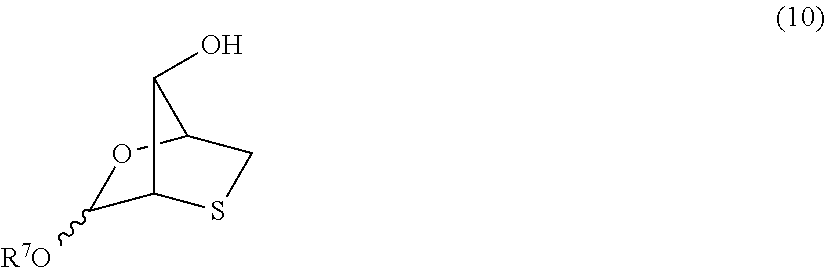
R4ba-L1 (11)


HO—Y1—OH (20)


HO—Y1—OH (20)


*—O—X1—O—* (4)


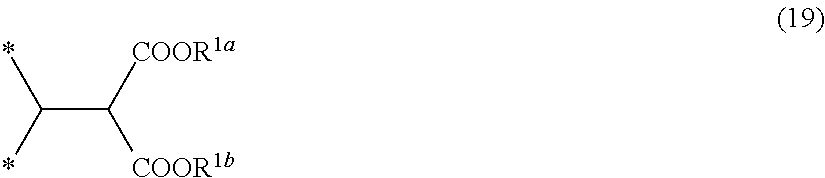


Claims (7)


*—O—X1—O—* (4)


*—O—X1—O—* (4)


Priority Applications (2)
| Application Number | Priority Date | Filing Date | Title |
|---|---|---|---|
| US15/709,794 US10059686B2 (en) | 2014-03-20 | 2017-09-20 | Compound useful for manufacturing salacinol, method for manufacturing the compound, method for manufacturing salacinol, methods for protecting and deprotecting diol group, and protective agent for diol group |
| US16/043,363 US10428042B2 (en) | 2014-03-20 | 2018-07-24 | Compound useful for manufacturing salacinol, method for manufacturing the compound, method for manufacturing salacinol, methods for protecting and deprotecting diol group, and protective agent for diol group |
Applications Claiming Priority (3)
| Application Number | Priority Date | Filing Date | Title |
|---|---|---|---|
| JP2014-057961 | 2014-03-20 | ||
| JP2014057961A JP6268014B2 (en) | 2014-03-20 | 2014-03-20 | Compounds useful for the production of salacinol and methods for producing them, methods for producing salacinol, methods for protecting and deprotecting diol groups, and protecting agents for diol groups |
| PCT/JP2015/058197 WO2015141765A1 (en) | 2014-03-20 | 2015-03-19 | Compounds useful in production of salacinol and method for producing same, method for producing salacinol, methods for protecting and deprotecting diol group, and diol group protective agent |
Related Parent Applications (1)
| Application Number | Title | Priority Date | Filing Date |
|---|---|---|---|
| PCT/JP2015/058197 Continuation WO2015141765A1 (en) | 2014-03-20 | 2015-03-19 | Compounds useful in production of salacinol and method for producing same, method for producing salacinol, methods for protecting and deprotecting diol group, and diol group protective agent |
Related Child Applications (2)
| Application Number | Title | Priority Date | Filing Date |
|---|---|---|---|
| US15/709,794 Division US10059686B2 (en) | 2014-03-20 | 2017-09-20 | Compound useful for manufacturing salacinol, method for manufacturing the compound, method for manufacturing salacinol, methods for protecting and deprotecting diol group, and protective agent for diol group |
| US15/709,794 Continuation US10059686B2 (en) | 2014-03-20 | 2017-09-20 | Compound useful for manufacturing salacinol, method for manufacturing the compound, method for manufacturing salacinol, methods for protecting and deprotecting diol group, and protective agent for diol group |
Publications (2)
| Publication Number | Publication Date |
|---|---|
| US20170001974A1 US20170001974A1 (en) | 2017-01-05 |
| US9802913B2 true US9802913B2 (en) | 2017-10-31 |
Family
ID=54144727
Family Applications (3)
| Application Number | Title | Priority Date | Filing Date |
|---|---|---|---|
| US15/268,829 Active US9802913B2 (en) | 2014-03-20 | 2016-09-19 | Compound useful for manufacturing salacinol, method for manufacturing the compound, method for manufacturing salacinol, methods for protecting and deprotecting diol group, and protective agent for diol group |
| US15/709,794 Active US10059686B2 (en) | 2014-03-20 | 2017-09-20 | Compound useful for manufacturing salacinol, method for manufacturing the compound, method for manufacturing salacinol, methods for protecting and deprotecting diol group, and protective agent for diol group |
| US16/043,363 Active US10428042B2 (en) | 2014-03-20 | 2018-07-24 | Compound useful for manufacturing salacinol, method for manufacturing the compound, method for manufacturing salacinol, methods for protecting and deprotecting diol group, and protective agent for diol group |
Family Applications After (2)
| Application Number | Title | Priority Date | Filing Date |
|---|---|---|---|
| US15/709,794 Active US10059686B2 (en) | 2014-03-20 | 2017-09-20 | Compound useful for manufacturing salacinol, method for manufacturing the compound, method for manufacturing salacinol, methods for protecting and deprotecting diol group, and protective agent for diol group |
| US16/043,363 Active US10428042B2 (en) | 2014-03-20 | 2018-07-24 | Compound useful for manufacturing salacinol, method for manufacturing the compound, method for manufacturing salacinol, methods for protecting and deprotecting diol group, and protective agent for diol group |
Country Status (5)
| Country | Link |
|---|---|
| US (3) | US9802913B2 (en) |
| EP (3) | EP3800185B1 (en) |
| JP (1) | JP6268014B2 (en) |
| CN (3) | CN106414423B (en) |
| WO (1) | WO2015141765A1 (en) |
Citations (7)
| Publication number | Priority date | Publication date | Assignee | Title |
|---|---|---|---|---|
| DE19525314A1 (en) | 1995-07-12 | 1997-01-16 | Merck Patent Gmbh | Stable liq. crystalline or mesogenic di:oxanyl di:oxane(s) and intermediates - are prepd. by reducing di:oxanyl acetal(s), di:ester(s) or di:nitrile(s) to di:ol(s) and condensing with aldehyde or acetal, useful in liq. crystalline medium e.g. for LCD |
| JPH09249690A (en) | 1995-07-14 | 1997-09-22 | Yamasa Shoyu Co Ltd | 4'-thioarabinopurine nucleoside |
| US5817639A (en) | 1995-07-14 | 1998-10-06 | Yamasa Corporation | Purine 4'-thioarabinonucleosides |
| JP3030008B2 (en) | 1997-07-07 | 2000-04-10 | 株式会社 タカマシステム | Compound having an inhibitory action on α-glucosidase |
| WO2001049674A2 (en) | 2000-01-07 | 2001-07-12 | Simon Fraser University | Glycosidase inhibitors and preparation thereof |
| JP2002179673A (en) | 2000-12-13 | 2002-06-26 | Rikogaku Shinkokai | Method for producing cyclic sulfonium compound and cyclic sulfonium compound |
| WO2004113289A2 (en) | 2002-08-22 | 2004-12-29 | Simon Fraser University | Glycosidase inhibitors and methods of synthesizing same |
Family Cites Families (7)
| Publication number | Priority date | Publication date | Assignee | Title |
|---|---|---|---|---|
| JPS4939934B1 (en) | 1969-12-18 | 1974-10-30 | ||
| NO172846C (en) * | 1987-12-25 | 1993-09-15 | Daiichi Seiyaku Co | PROCEDURE FOR PREPARING 7,8-DIHALOGEN-3-METHYL-2,3-DIHYDRO-2M-BENZOCSAZINE DERIVATIVES AND PROPOXYBENZEN DERIVATIVES FOR EXERCISING THE PROCEDURE. |
| JP2769174B2 (en) * | 1987-12-28 | 1998-06-25 | 第一製薬株式会社 | Production method of condensed oxazine |
| JPH07505875A (en) * | 1992-04-16 | 1995-06-29 | ゼネカ・リミテッド | α-Aminoboronic acid peptides and their use as elastase inhibitors |
| US8389565B2 (en) * | 2000-01-07 | 2013-03-05 | Simon Fraser University | Glycosidase inhibitors and methods of synthesizing same |
| JP5484724B2 (en) | 2005-05-25 | 2014-05-07 | メルク パテント ゲゼルシャフト ミット ベシュレンクテル ハフツング | Tetrahydropyran derivatives containing a plurality of oxygen-containing rings and method for preparing the same |
| US7674507B2 (en) | 2005-05-25 | 2010-03-09 | Merck Patent Gmbh | Pyran-dioxane derivatives, and the use thereof in liquid-crystalline media |
-
2014
- 2014-03-20 JP JP2014057961A patent/JP6268014B2/en active Active
-
2015
- 2015-03-19 CN CN201580015125.4A patent/CN106414423B/en active Active
- 2015-03-19 CN CN201811220387.6A patent/CN109369601A/en active Pending
- 2015-03-19 EP EP20208339.0A patent/EP3800185B1/en active Active
- 2015-03-19 EP EP19163120.9A patent/EP3521279B1/en active Active
- 2015-03-19 WO PCT/JP2015/058197 patent/WO2015141765A1/en not_active Ceased
- 2015-03-19 EP EP15765614.1A patent/EP3121170B1/en active Active
- 2015-03-19 CN CN201910288985.5A patent/CN110003161B/en active Active
-
2016
- 2016-09-19 US US15/268,829 patent/US9802913B2/en active Active
-
2017
- 2017-09-20 US US15/709,794 patent/US10059686B2/en active Active
-
2018
- 2018-07-24 US US16/043,363 patent/US10428042B2/en active Active
Patent Citations (11)
| Publication number | Priority date | Publication date | Assignee | Title |
|---|---|---|---|---|
| DE19525314A1 (en) | 1995-07-12 | 1997-01-16 | Merck Patent Gmbh | Stable liq. crystalline or mesogenic di:oxanyl di:oxane(s) and intermediates - are prepd. by reducing di:oxanyl acetal(s), di:ester(s) or di:nitrile(s) to di:ol(s) and condensing with aldehyde or acetal, useful in liq. crystalline medium e.g. for LCD |
| JPH09249690A (en) | 1995-07-14 | 1997-09-22 | Yamasa Shoyu Co Ltd | 4'-thioarabinopurine nucleoside |
| US5817639A (en) | 1995-07-14 | 1998-10-06 | Yamasa Corporation | Purine 4'-thioarabinonucleosides |
| JP3030008B2 (en) | 1997-07-07 | 2000-04-10 | 株式会社 タカマシステム | Compound having an inhibitory action on α-glucosidase |
| WO2001049674A2 (en) | 2000-01-07 | 2001-07-12 | Simon Fraser University | Glycosidase inhibitors and preparation thereof |
| WO2001049674A3 (en) | 2000-01-07 | 2001-11-29 | Univ Fraser Simon | Glycosidase inhibitors and preparation thereof |
| JP5053494B2 (en) | 2000-01-07 | 2012-10-17 | サイモン フレーザー ユニバーシティー | Salacinol analogues and methods for synthesizing salacinol and salacinol analogues |
| JP2002179673A (en) | 2000-12-13 | 2002-06-26 | Rikogaku Shinkokai | Method for producing cyclic sulfonium compound and cyclic sulfonium compound |
| WO2004113289A2 (en) | 2002-08-22 | 2004-12-29 | Simon Fraser University | Glycosidase inhibitors and methods of synthesizing same |
| WO2004113289A3 (en) | 2002-08-22 | 2005-04-07 | Univ Fraser Simon | Glycosidase inhibitors and methods of synthesizing same |
| JP4939934B2 (en) | 2003-06-25 | 2012-05-30 | サイモン フレーザー ユニバーシティー | Similar compounds of salacinol and method for synthesizing the same |
Non-Patent Citations (15)
| Title |
|---|
| A. Ilangovan et al, "2,2-Bis(ethoxycarbonyl)vinyl (BECV) as a Versatile Amine Protecting Group for Selective Functional-Group Transformations", Chemistry—A European Journal, vol. 16, Issue 9, Mar. 1, 2010 (3 pages total). |
| Antonio Gómez-Sánchez et al. "Synthesis and Glycosidation of 1-Deoxy-1-[(2,2-Diacyl-Vinyl) Amino] -D-Fructoses", Carbohydrate Research, vol. 149, No. 2 (1986); pp. 329-345. |
| Extended European Search Report dated Mar. 7, 2017, from the European Patent Office in counterpart European Application No. 15765614.1. |
| Greene T.W. et al., Protective Groups in Organic Synthesis, 3rd edition, 1999, pp. 199. |
| Hubert Hrebabecky et al., "Synthesis of Carba Analogues of Deoxy-4-C-(hydroxymethy) pentofuranoses, Intermediates in the Synthesis of Carbocyclic Nucleosides", Collect. Czech Chem. Commun., vol. 63, No. 12, pp. 2044-2064 (1998) (21 pages total). |
| International Preliminary Report on Patentability with translation of Written Opinion dated Sep. 29, 2016, issued by the International Searching Authority in Application No. PCT/JP2015/058197. |
| International Search Report for PCT/JP2015/058197 dated Jun. 9, 2015. |
| Masayuki Yoshikawa et al., "Salacinol, Potent Antidiabetic Principle with Unique Thiosugar Sulfonium Sulfate Structure from the Ayurvedic Traditional Medicine Salacia reticulata in Sri Lanka and India", Tetrahedron Letters, 1997, pp. 8367-8370, vol. 38, No. 48. |
| Oliver Schulze et al., "The thio-Mitsunobu reaction: a useful tool for the preparation of 2,5-anhydro-2-thio- and 3,5-anhydro-3-thiopentofuranosides", Carbohydrate Research, 2004, pp. 1787-1802, vol. 339, No. 10, Scheme 1, 3-4. |
| Partial Supplementary European Search Report dated Dec. 2, 2016 from the European Patent Office in counterpart European Application No. 15765614.1. |
| Peter G. M. Wuts and Theodora W. Greene, "Protection for the Hydroxyl Group, Including 1,2- And 1,3-Diols", Greene's Protective Groups in Organic Synthesis, Fourth Edition, 2007, pp. 16-367 (total 176 pages). |
| Protective Groups in Organic Synthesis, 4th edition, John Wiley & Sons, Inc. (2007). |
| Shinji Kato et al., "Fabrication of Multilayer Assemblies Based on a Boronate-Terminated Self-Assembled Monolayer", Langmuir 1998, vol. 14, No. 9, pp. 2372-2377. |
| Written Opinion for PCT/JP2015/058197 dated Jun. 9, 2015. |
| Xavier Ariza et al., "New Protecting Groups for 1,2-Diols (Boc- and Moc-ethylidene). Cleavage of Acetals and Bases", Organic Letters, 2000, pp. 2809-2811, vol. 2, No. 18. |
Also Published As
| Publication number | Publication date |
|---|---|
| JP6268014B2 (en) | 2018-01-24 |
| WO2015141765A1 (en) | 2015-09-24 |
| EP3121170A1 (en) | 2017-01-25 |
| EP3121170B1 (en) | 2019-11-13 |
| EP3521279A1 (en) | 2019-08-07 |
| US10059686B2 (en) | 2018-08-28 |
| CN106414423A (en) | 2017-02-15 |
| CN109369601A (en) | 2019-02-22 |
| US20180327378A1 (en) | 2018-11-15 |
| US20170001974A1 (en) | 2017-01-05 |
| CN110003161A (en) | 2019-07-12 |
| JP2015182956A (en) | 2015-10-22 |
| EP3121170A4 (en) | 2017-04-05 |
| EP3521279B1 (en) | 2021-03-03 |
| CN110003161B (en) | 2022-01-04 |
| EP3800185A1 (en) | 2021-04-07 |
| US10428042B2 (en) | 2019-10-01 |
| EP3800185B1 (en) | 2024-02-14 |
| CN106414423B (en) | 2019-11-01 |
| US20180009777A1 (en) | 2018-01-11 |
Similar Documents
| Publication | Publication Date | Title |
|---|---|---|
| US8198464B2 (en) | Method for producing C-glycoside derivative and intermediate for synthesis thereof | |
| JP6259814B2 (en) | Novel hydroxamic acid derivatives or salts thereof | |
| WO2020129899A1 (en) | Method for producing c-aryl hydroxy glycoxide derivatives | |
| US10428042B2 (en) | Compound useful for manufacturing salacinol, method for manufacturing the compound, method for manufacturing salacinol, methods for protecting and deprotecting diol group, and protective agent for diol group | |
| US20170342100A1 (en) | Processes for the preparation of ertugliflozin | |
| US10450282B2 (en) | Stereospecific process for 3-heterocyclylcycloaliphatic-1,2-diols | |
| JP6630789B2 (en) | Compounds useful for the production of salacinol and methods for their production, methods for producing salacinol, methods for protecting and deprotecting diol groups, and protecting agents for diol groups | |
| US7635782B1 (en) | Stereospecific method for the preparation of dioxa-bicyclooctane compounds | |
| JP2017214422A (en) | Compounds useful for the production of salacinol and methods for producing them, methods for producing salacinol, methods for protecting and deprotecting diol groups, and protecting agents for diol groups | |
| JP6847095B2 (en) | Nebivolol synthesis method and its intermediate compounds | |
| JP3160105B2 (en) | Psicofuranose and Psicopyranose derivatives | |
| Ogawa et al. | SYNTHESIS OF Dl-VALIDOXYLAMINE B | |
| US6392032B1 (en) | Heavily fluorinated sugar analogs | |
| CN118546183A (en) | Process for producing C-arylhydroxyglycoside derivative and other compounds | |
| Shimizu et al. | Stereospecific Synthesis of Piperidine Skeleton by (4+ 2) Cycloaddition, Leading to the Synthesis of Piperidines of Biological Interests | |
| JP6921913B2 (en) | Nebivolol synthesis method and its intermediate compounds | |
| US7994310B2 (en) | Process for preparing 2′-deoxy-2′, 2′-difluorocytidine | |
| RU2485127C2 (en) | New naphthyridine derivative monohydrate and method for preparing it | |
| D'Ambrosio | Part I. Dihydroisoxazole-based synthesis of 2-amino-2-deoxytetroses and 2, 3, 6-trideoxy-3-aminohexoses. Part II. Synthetic studies directed towards the preparation of polynitrospiropentane derivatives | |
| KR20040097191A (en) | Process for producing cyclic compound |
Legal Events
| Date | Code | Title | Description |
|---|---|---|---|
| AS | Assignment |
Owner name: FUJIFILM CORPORATION, JAPAN Free format text: ASSIGNMENT OF ASSIGNORS INTEREST;ASSIGNORS:NAKAMURA, KOKI;NAGASE, HISATO;FUJINO, YUUTA;AND OTHERS;SIGNING DATES FROM 20160818 TO 20160824;REEL/FRAME:039780/0258 |
|
| STCF | Information on status: patent grant |
Free format text: PATENTED CASE |
|
| MAFP | Maintenance fee payment |
Free format text: PAYMENT OF MAINTENANCE FEE, 4TH YEAR, LARGE ENTITY (ORIGINAL EVENT CODE: M1551); ENTITY STATUS OF PATENT OWNER: LARGE ENTITY Year of fee payment: 4 |
|
| MAFP | Maintenance fee payment |
Free format text: PAYMENT OF MAINTENANCE FEE, 8TH YEAR, LARGE ENTITY (ORIGINAL EVENT CODE: M1552); ENTITY STATUS OF PATENT OWNER: LARGE ENTITY Year of fee payment: 8 |