US9777251B2 - Liquid composition for removing titanium nitride, semiconductor-element cleaning method using same, and semiconductor-element manufacturing method - Google Patents
Liquid composition for removing titanium nitride, semiconductor-element cleaning method using same, and semiconductor-element manufacturing method Download PDFInfo
- Publication number
- US9777251B2 US9777251B2 US15/034,081 US201515034081A US9777251B2 US 9777251 B2 US9777251 B2 US 9777251B2 US 201515034081 A US201515034081 A US 201515034081A US 9777251 B2 US9777251 B2 US 9777251B2
- Authority
- US
- United States
- Prior art keywords
- group
- carbon atoms
- alkyl group
- substituted
- fluorine atom
- Prior art date
- Legal status (The legal status is an assumption and is not a legal conclusion. Google has not performed a legal analysis and makes no representation as to the accuracy of the status listed.)
- Active
Links
- 0 [1*]N([2*])[3*] Chemical compound [1*]N([2*])[3*] 0.000 description 53
Images


Classifications
-
- C11D11/0047—
-
- C—CHEMISTRY; METALLURGY
- C11—ANIMAL OR VEGETABLE OILS, FATS, FATTY SUBSTANCES OR WAXES; FATTY ACIDS THEREFROM; DETERGENTS; CANDLES
- C11D—DETERGENT COMPOSITIONS; USE OF SINGLE SUBSTANCES AS DETERGENTS; SOAP OR SOAP-MAKING; RESIN SOAPS; RECOVERY OF GLYCEROL
- C11D1/00—Detergent compositions based essentially on surface-active compounds; Use of these compounds as a detergent
- C11D1/004—Surface-active compounds containing F
- C11D1/006—Surface-active compounds containing fluorine and phosphorus
-
- C—CHEMISTRY; METALLURGY
- C11—ANIMAL OR VEGETABLE OILS, FATS, FATTY SUBSTANCES OR WAXES; FATTY ACIDS THEREFROM; DETERGENTS; CANDLES
- C11D—DETERGENT COMPOSITIONS; USE OF SINGLE SUBSTANCES AS DETERGENTS; SOAP OR SOAP-MAKING; RESIN SOAPS; RECOVERY OF GLYCEROL
- C11D1/00—Detergent compositions based essentially on surface-active compounds; Use of these compounds as a detergent
- C11D1/02—Anionic compounds
- C11D1/12—Sulfonic acids or sulfuric acid esters; Salts thereof
- C11D1/29—Sulfates of polyoxyalkylene ethers
-
- C—CHEMISTRY; METALLURGY
- C11—ANIMAL OR VEGETABLE OILS, FATS, FATTY SUBSTANCES OR WAXES; FATTY ACIDS THEREFROM; DETERGENTS; CANDLES
- C11D—DETERGENT COMPOSITIONS; USE OF SINGLE SUBSTANCES AS DETERGENTS; SOAP OR SOAP-MAKING; RESIN SOAPS; RECOVERY OF GLYCEROL
- C11D1/00—Detergent compositions based essentially on surface-active compounds; Use of these compounds as a detergent
- C11D1/02—Anionic compounds
- C11D1/34—Derivatives of acids of phosphorus
- C11D1/345—Phosphates or phosphites
-
- C—CHEMISTRY; METALLURGY
- C11—ANIMAL OR VEGETABLE OILS, FATS, FATTY SUBSTANCES OR WAXES; FATTY ACIDS THEREFROM; DETERGENTS; CANDLES
- C11D—DETERGENT COMPOSITIONS; USE OF SINGLE SUBSTANCES AS DETERGENTS; SOAP OR SOAP-MAKING; RESIN SOAPS; RECOVERY OF GLYCEROL
- C11D3/00—Other compounding ingredients of detergent compositions covered in group C11D1/00
- C11D3/0005—Other compounding ingredients characterised by their effect
- C11D3/0073—Anticorrosion compositions
-
- C—CHEMISTRY; METALLURGY
- C11—ANIMAL OR VEGETABLE OILS, FATS, FATTY SUBSTANCES OR WAXES; FATTY ACIDS THEREFROM; DETERGENTS; CANDLES
- C11D—DETERGENT COMPOSITIONS; USE OF SINGLE SUBSTANCES AS DETERGENTS; SOAP OR SOAP-MAKING; RESIN SOAPS; RECOVERY OF GLYCEROL
- C11D3/00—Other compounding ingredients of detergent compositions covered in group C11D1/00
- C11D3/02—Inorganic compounds ; Elemental compounds
- C11D3/12—Water-insoluble compounds
- C11D3/122—Sulfur-containing, e.g. sulfates, sulfites or gypsum
-
- C—CHEMISTRY; METALLURGY
- C11—ANIMAL OR VEGETABLE OILS, FATS, FATTY SUBSTANCES OR WAXES; FATTY ACIDS THEREFROM; DETERGENTS; CANDLES
- C11D—DETERGENT COMPOSITIONS; USE OF SINGLE SUBSTANCES AS DETERGENTS; SOAP OR SOAP-MAKING; RESIN SOAPS; RECOVERY OF GLYCEROL
- C11D3/00—Other compounding ingredients of detergent compositions covered in group C11D1/00
- C11D3/16—Organic compounds
- C11D3/24—Organic compounds containing halogen
- C11D3/245—Organic compounds containing halogen containing fluorine
-
- C—CHEMISTRY; METALLURGY
- C11—ANIMAL OR VEGETABLE OILS, FATS, FATTY SUBSTANCES OR WAXES; FATTY ACIDS THEREFROM; DETERGENTS; CANDLES
- C11D—DETERGENT COMPOSITIONS; USE OF SINGLE SUBSTANCES AS DETERGENTS; SOAP OR SOAP-MAKING; RESIN SOAPS; RECOVERY OF GLYCEROL
- C11D3/00—Other compounding ingredients of detergent compositions covered in group C11D1/00
- C11D3/39—Organic or inorganic per-compounds
- C11D3/3947—Liquid compositions
-
- C—CHEMISTRY; METALLURGY
- C11—ANIMAL OR VEGETABLE OILS, FATS, FATTY SUBSTANCES OR WAXES; FATTY ACIDS THEREFROM; DETERGENTS; CANDLES
- C11D—DETERGENT COMPOSITIONS; USE OF SINGLE SUBSTANCES AS DETERGENTS; SOAP OR SOAP-MAKING; RESIN SOAPS; RECOVERY OF GLYCEROL
- C11D7/00—Compositions of detergents based essentially on non-surface-active compounds
- C11D7/02—Inorganic compounds
- C11D7/04—Water-soluble compounds
- C11D7/08—Acids
-
- C—CHEMISTRY; METALLURGY
- C11—ANIMAL OR VEGETABLE OILS, FATS, FATTY SUBSTANCES OR WAXES; FATTY ACIDS THEREFROM; DETERGENTS; CANDLES
- C11D—DETERGENT COMPOSITIONS; USE OF SINGLE SUBSTANCES AS DETERGENTS; SOAP OR SOAP-MAKING; RESIN SOAPS; RECOVERY OF GLYCEROL
- C11D7/00—Compositions of detergents based essentially on non-surface-active compounds
- C11D7/02—Inorganic compounds
- C11D7/04—Water-soluble compounds
- C11D7/10—Salts
-
- C—CHEMISTRY; METALLURGY
- C11—ANIMAL OR VEGETABLE OILS, FATS, FATTY SUBSTANCES OR WAXES; FATTY ACIDS THEREFROM; DETERGENTS; CANDLES
- C11D—DETERGENT COMPOSITIONS; USE OF SINGLE SUBSTANCES AS DETERGENTS; SOAP OR SOAP-MAKING; RESIN SOAPS; RECOVERY OF GLYCEROL
- C11D7/00—Compositions of detergents based essentially on non-surface-active compounds
- C11D7/22—Organic compounds
- C11D7/32—Organic compounds containing nitrogen
- C11D7/3209—Amines or imines with one to four nitrogen atoms; Quaternized amines
-
- C—CHEMISTRY; METALLURGY
- C11—ANIMAL OR VEGETABLE OILS, FATS, FATTY SUBSTANCES OR WAXES; FATTY ACIDS THEREFROM; DETERGENTS; CANDLES
- C11D—DETERGENT COMPOSITIONS; USE OF SINGLE SUBSTANCES AS DETERGENTS; SOAP OR SOAP-MAKING; RESIN SOAPS; RECOVERY OF GLYCEROL
- C11D7/00—Compositions of detergents based essentially on non-surface-active compounds
- C11D7/22—Organic compounds
- C11D7/36—Organic compounds containing phosphorus
-
- C—CHEMISTRY; METALLURGY
- C23—COATING METALLIC MATERIAL; COATING MATERIAL WITH METALLIC MATERIAL; CHEMICAL SURFACE TREATMENT; DIFFUSION TREATMENT OF METALLIC MATERIAL; COATING BY VACUUM EVAPORATION, BY SPUTTERING, BY ION IMPLANTATION OR BY CHEMICAL VAPOUR DEPOSITION, IN GENERAL; INHIBITING CORROSION OF METALLIC MATERIAL OR INCRUSTATION IN GENERAL
- C23G—CLEANING OR DE-GREASING OF METALLIC MATERIAL BY CHEMICAL METHODS OTHER THAN ELECTROLYSIS
- C23G1/00—Cleaning or pickling metallic material with solutions or molten salts
- C23G1/02—Cleaning or pickling metallic material with solutions or molten salts with acid solutions
- C23G1/04—Cleaning or pickling metallic material with solutions or molten salts with acid solutions using inhibitors
- C23G1/06—Cleaning or pickling metallic material with solutions or molten salts with acid solutions using inhibitors organic inhibitors
- C23G1/061—Cleaning or pickling metallic material with solutions or molten salts with acid solutions using inhibitors organic inhibitors nitrogen-containing compounds
-
- C—CHEMISTRY; METALLURGY
- C23—COATING METALLIC MATERIAL; COATING MATERIAL WITH METALLIC MATERIAL; CHEMICAL SURFACE TREATMENT; DIFFUSION TREATMENT OF METALLIC MATERIAL; COATING BY VACUUM EVAPORATION, BY SPUTTERING, BY ION IMPLANTATION OR BY CHEMICAL VAPOUR DEPOSITION, IN GENERAL; INHIBITING CORROSION OF METALLIC MATERIAL OR INCRUSTATION IN GENERAL
- C23G—CLEANING OR DE-GREASING OF METALLIC MATERIAL BY CHEMICAL METHODS OTHER THAN ELECTROLYSIS
- C23G1/00—Cleaning or pickling metallic material with solutions or molten salts
- C23G1/02—Cleaning or pickling metallic material with solutions or molten salts with acid solutions
- C23G1/10—Other heavy metals
- C23G1/106—Other heavy metals refractory metals
-
- H—ELECTRICITY
- H01—ELECTRIC ELEMENTS
- H01L—SEMICONDUCTOR DEVICES NOT COVERED BY CLASS H10
- H01L21/00—Processes or apparatus adapted for the manufacture or treatment of semiconductor or solid state devices or of parts thereof
- H01L21/02—Manufacture or treatment of semiconductor devices or of parts thereof
- H01L21/02041—Cleaning
- H01L21/02057—Cleaning during device manufacture
- H01L21/0206—Cleaning during device manufacture during, before or after processing of insulating layers
- H01L21/02063—Cleaning during device manufacture during, before or after processing of insulating layers the processing being the formation of vias or contact holes
-
- H—ELECTRICITY
- H01—ELECTRIC ELEMENTS
- H01L—SEMICONDUCTOR DEVICES NOT COVERED BY CLASS H10
- H01L21/00—Processes or apparatus adapted for the manufacture or treatment of semiconductor or solid state devices or of parts thereof
- H01L21/02—Manufacture or treatment of semiconductor devices or of parts thereof
- H01L21/04—Manufacture or treatment of semiconductor devices or of parts thereof the devices having potential barriers, e.g. a PN junction, depletion layer or carrier concentration layer
- H01L21/18—Manufacture or treatment of semiconductor devices or of parts thereof the devices having potential barriers, e.g. a PN junction, depletion layer or carrier concentration layer the devices having semiconductor bodies comprising elements of Group IV of the Periodic Table or AIIIBV compounds with or without impurities, e.g. doping materials
- H01L21/30—Treatment of semiconductor bodies using processes or apparatus not provided for in groups H01L21/20 - H01L21/26
- H01L21/31—Treatment of semiconductor bodies using processes or apparatus not provided for in groups H01L21/20 - H01L21/26 to form insulating layers thereon, e.g. for masking or by using photolithographic techniques; After treatment of these layers; Selection of materials for these layers
- H01L21/3205—Deposition of non-insulating-, e.g. conductive- or resistive-, layers on insulating layers; After-treatment of these layers
- H01L21/321—After treatment
- H01L21/3213—Physical or chemical etching of the layers, e.g. to produce a patterned layer from a pre-deposited extensive layer
- H01L21/32133—Physical or chemical etching of the layers, e.g. to produce a patterned layer from a pre-deposited extensive layer by chemical means only
- H01L21/32134—Physical or chemical etching of the layers, e.g. to produce a patterned layer from a pre-deposited extensive layer by chemical means only by liquid etching only
-
- H—ELECTRICITY
- H01—ELECTRIC ELEMENTS
- H01L—SEMICONDUCTOR DEVICES NOT COVERED BY CLASS H10
- H01L21/00—Processes or apparatus adapted for the manufacture or treatment of semiconductor or solid state devices or of parts thereof
- H01L21/70—Manufacture or treatment of devices consisting of a plurality of solid state components formed in or on a common substrate or of parts thereof; Manufacture of integrated circuit devices or of parts thereof
- H01L21/71—Manufacture of specific parts of devices defined in group H01L21/70
- H01L21/768—Applying interconnections to be used for carrying current between separate components within a device comprising conductors and dielectrics
- H01L21/76801—Applying interconnections to be used for carrying current between separate components within a device comprising conductors and dielectrics characterised by the formation and the after-treatment of the dielectrics, e.g. smoothing
- H01L21/76802—Applying interconnections to be used for carrying current between separate components within a device comprising conductors and dielectrics characterised by the formation and the after-treatment of the dielectrics, e.g. smoothing by forming openings in dielectrics
- H01L21/76814—Applying interconnections to be used for carrying current between separate components within a device comprising conductors and dielectrics characterised by the formation and the after-treatment of the dielectrics, e.g. smoothing by forming openings in dielectrics post-treatment or after-treatment, e.g. cleaning or removal of oxides on underlying conductors
-
- H10P50/667—
-
- H10P70/234—
-
- H10W20/081—
-
- C—CHEMISTRY; METALLURGY
- C11—ANIMAL OR VEGETABLE OILS, FATS, FATTY SUBSTANCES OR WAXES; FATTY ACIDS THEREFROM; DETERGENTS; CANDLES
- C11D—DETERGENT COMPOSITIONS; USE OF SINGLE SUBSTANCES AS DETERGENTS; SOAP OR SOAP-MAKING; RESIN SOAPS; RECOVERY OF GLYCEROL
- C11D2111/00—Cleaning compositions characterised by the objects to be cleaned; Cleaning compositions characterised by non-standard cleaning or washing processes
- C11D2111/10—Objects to be cleaned
- C11D2111/14—Hard surfaces
- C11D2111/22—Electronic devices, e.g. PCBs or semiconductors
-
- H—ELECTRICITY
- H01—ELECTRIC ELEMENTS
- H01L—SEMICONDUCTOR DEVICES NOT COVERED BY CLASS H10
- H01L21/00—Processes or apparatus adapted for the manufacture or treatment of semiconductor or solid state devices or of parts thereof
- H01L21/02—Manufacture or treatment of semiconductor devices or of parts thereof
- H01L21/04—Manufacture or treatment of semiconductor devices or of parts thereof the devices having potential barriers, e.g. a PN junction, depletion layer or carrier concentration layer
- H01L21/18—Manufacture or treatment of semiconductor devices or of parts thereof the devices having potential barriers, e.g. a PN junction, depletion layer or carrier concentration layer the devices having semiconductor bodies comprising elements of Group IV of the Periodic Table or AIIIBV compounds with or without impurities, e.g. doping materials
- H01L21/30—Treatment of semiconductor bodies using processes or apparatus not provided for in groups H01L21/20 - H01L21/26
- H01L21/31—Treatment of semiconductor bodies using processes or apparatus not provided for in groups H01L21/20 - H01L21/26 to form insulating layers thereon, e.g. for masking or by using photolithographic techniques; After treatment of these layers; Selection of materials for these layers
- H01L21/3105—After-treatment
- H01L21/311—Etching the insulating layers by chemical or physical means
- H01L21/31144—Etching the insulating layers by chemical or physical means using masks
-
- H10P50/73—
Definitions
- the present invention relates to a liquid composition, and more specifically, relates to: a liquid composition for removing titanium nitride, which is used for a hard mask, without corroding tungsten, which is used for a wiring, or a low-k interlayer dielectric in the production process of a semiconductor device; a method for cleaning a semiconductor device using the same; and a method for producing a semiconductor device.
- Tungsten is used, for example, as a wiring material.
- titanium nitride recently, methods for using it as a hard mask have been examined.
- titanium nitride can be relatively easily removed by using a composition containing hydrogen peroxide, but it is difficult to use hydrogen peroxide because it has high tungsten corrosiveness. In addition, it is required to increase the etching selectivity of titanium nitride relative to tungsten.
- Patent Document 1 discloses corrosion preventers obtained by using quaternary ammonium and salts thereof, quaternary pyridinium and salts thereof, quaternary bipyridinium and salts thereof, and quaternary imidazolium and salts thereof.
- the corrosion preventers disclosed in Patent Document 1 do not exert sufficient effects of preventing corrosion of tungsten.
- Patent Document 2 describes that titanium nitride can be etched without corroding tungsten by using a concentrated sulfuric acid as a composition not containing hydrogen peroxide.
- the etching rate of titanium nitride is low (3 to 15 ⁇ /min). Therefore, it is not practical, for example, in the case of use for removing a titanium nitride hard mask, which usually has a thickness of several hundred ⁇ to several thousand ⁇ .
- Patent Document 3 describes that titanium nitride can be etched without corroding tungsten by using a composition containing an oxidizing agent, a fluorine compound and a corrosion preventer.
- titanium nitride removability is low, and for example, there is a problem that sufficient effects of preventing tungsten corrosion are not obtained thereby.
- One problem to be solved by the present invention is to solve at least one of the above-described conventional problems. Further, another problem to be solved by the present invention is to provide a liquid composition which can remove titanium nitride from a substrate without corroding tungsten or a low-k interlayer dielectric also present on the substrate, a method for cleaning a semiconductor device using the same, and a method for producing a semiconductor device.
- the present inventors diligently made researches in order to solve the above-described problems, and found that the above-described problems can be solved by using a specific liquid composition containing an oxidizing agent, a fluorine compound and a tungsten-corrosion preventer.
- the present invention is as follows:
- At least one oxidizing agent (A) selected from the group consisting of potassium permanganate, ammonium peroxodisulfate, potassium peroxodisulfate and sodium peroxodisulfate;
- the tungsten-corrosion preventer (C) either contains at least two different compounds selected from a group of compounds (C1) consisting of alkylamines and salts thereof, fluoroalkylamines and salts thereof, alkylamine oxides, fluoroalkylamine oxides, alkyl betaines, fluoroalkyl betaines, alkyl quaternary ammonium and salts thereof, fluoroalkyl quaternary ammonium and salts thereof, alkyl quaternary pyridinium salts, fluoroalkyl quaternary pyridinium salts, alkyl quaternary bipyridinium salts, fluoroalkyl quaternary bipyridinium salts, alkyl quaternary imidazolium salts and fluoroalkyl quaternary imidazolium salts, or contains at least one compound selected from the group of compounds (C1) and at least one compound selected from a group of compounds (C2) consisting
- concentration of potassium permanganate in the oxidizing agent (A) is 0.001 to 0.1% by mass
- concentration of the fluorine compound (B) is 0.01 to 1% by mass.
- R 1 represents an alkyl group having 8 to 18 carbon atoms or an alkenyl group having 8 to 18 carbon atoms, and a part or all of hydrogen atoms bound to the alkyl group or alkenyl group may be substituted with a fluorine atom
- R 2 and R 3 represent a hydrogen atom or an alkyl group having 1 to 4 carbon atoms, and a part or all of hydrogen atoms bound to the alkyl group may be substituted with a fluorine atom.
- alkylamine salts or fluoroalkylamine salts in the group of compounds (C1) are at least one compound selected from the group consisting of hydrochlorides, nitrates, acetates, methanesulfonates, chlorates, perchlorates, hydrofluorides, hydrobromates, hydroiodides, hydrogensulfates, sulfates, hydrogencarbonates, carbonates, dihydrogen phosphates, hydrogen phosphates and phosphates.
- alkylamine oxides or fluoroalkylamine oxides in the group of compounds (C1) are represented by general formula (2) below:
- R 1 represents an alkyl group having 8 to 18 carbon atoms or an alkenyl group having 8 to 18 carbon atoms, and a part or all of hydrogen atoms bound to the alkyl group or alkenyl group may be substituted with a fluorine atom
- R 2 and R 3 represent a hydrogen atom or an alkyl group having 1 to 4 carbon atoms, and a part or all of hydrogen atoms bound to the alkyl group may be substituted with a fluorine atom.
- R 1 represents an alkyl group having 8 to 18 carbon atoms or an alkenyl group having 8 to 18 carbon atoms, and a part or all of hydrogen atoms bound to the alkyl group or alkenyl group may be substituted with a fluorine atom
- R 2 and R 3 represent a hydrogen atom or an alkyl group having 1 to 4 carbon atoms, and a part or all of hydrogen atoms bound to the alkyl group may be substituted with a fluorine atom;
- R 1 represents an alkyl group having 8 to 18 carbon atoms or an alkenyl group having 8 to 18 carbon atoms, and a part or all of hydrogen atoms bound to the alkyl group or alkenyl group may be substituted with a fluorine atom
- R 2 and R 3 represent a hydrogen atom or an alkyl group having 1 to 4 carbon atoms, and a part or all of hydrogen atoms bound to the alkyl group may be substituted with a fluorine atom.
- R 1 represents an alkyl group having 8 to 18 carbon atoms or an alkenyl group having 8 to 18 carbon atoms, and a part or all of hydrogen atoms bound to the alkyl group or alkenyl group may be substituted with a fluorine atom
- R 2 , R 3 and R 4 represent a hydrogen atom, an alkyl group having 1 to 4 carbon atoms, a phenyl group or a benzyl group, and a part or all of hydrogen atoms bound to the alkyl group may be substituted with a fluorine atom;
- R 1 represents an alkyl group having 8 to 18 carbon atoms or an alkenyl group having 8 to 18 carbon atoms, and a part or all of hydrogen atoms bound to the alkyl group or alkenyl group may be substituted with a fluorine atom
- R 2 , R 3 and R 4 represent a hydrogen atom, an alkyl group having 1 to 4 carbon atoms, a phenyl group or a benzyl group, and a part or all of hydrogen atoms bound to the alkyl group may be substituted with a fluorine atom
- X represents a halogen atom: F, Cl, Br or I;
- R 1 represents an alkyl group having 8 to 18 carbon atoms or an alkenyl group having 8 to 18 carbon atoms, and a part or all of hydrogen atoms bound to the alkyl group or alkenyl group may be substituted with a fluorine atom
- R 2 , R 3 and R 4 represent a hydrogen atom, an alkyl group having 1 to 4 carbon atoms, a phenyl group or a benzyl group, and a part or all of hydrogen atoms bound to the alkyl group may be substituted with a fluorine atom.
- R 1 represents an alkyl group having 8 to 18 carbon atoms or an alkenyl group having 8 to 18 carbon atoms, and a part or all of hydrogen atoms bound to the alkyl group or alkenyl group may be substituted with a fluorine atom
- R 2 , R 3 , R 4 , R 5 and R 6 represent a hydrogen atom or an alkyl group having 1 to 4 carbon atoms, and a part or all of hydrogen atoms bound to the alkyl group may be substituted with a fluorine atom
- X represents a halogen atom: F, Cl, Br or I.
- R 1 and R 2 represent an alkyl group having 8 to 18 carbon atoms or an alkenyl group having 8 to 18 carbon atoms, and a part or all of hydrogen atoms bound to the alkyl group or alkenyl group may be substituted with a fluorine atom
- R 3 to R 10 represent a hydrogen atom or an alkyl group having 1 to 4 carbon atoms, and a part or all of hydrogen atoms bound to the alkyl group may be substituted with a fluorine atom
- X represents a halogen atom: F, Cl, Br or I.
- R 1 represents an alkyl group having 8 to 18 carbon atoms or an alkenyl group having 8 to 18 carbon atoms, and a part or all of hydrogen atoms bound to the alkyl group or alkenyl group may be substituted with a fluorine atom
- R 2 represents an alkyl group having 1 to 4 carbon atoms, and a part or all of hydrogen atoms bound to the alkyl group may be substituted with a fluorine atom
- R 3 to R 5 represent a hydrogen atom or an alkyl group having 1 to 4 carbon atoms, and a part or all of hydrogen atoms bound to the alkyl group may be substituted with a fluorine atom
- X represents a halogen atom: F, Cl, Br or I
- R 1 and R 2 represent an alkyl group having 8 to 18 carbon atoms or an alkenyl group having 8 to 18 carbon atoms, and a part or all of hydrogen atoms bound to the alkyl group or alkenyl group may be substituted with a fluorine atom
- R 3 to R 5 represent a hydrogen atom or an alkyl group having 1 to 4 carbon atoms, and a part or all of hydrogen atoms bound to the alkyl group may be substituted with a fluorine atom
- X represents a halogen atom: F, Cl, Br or I.
- R 1 represents an alkyl group having 8 to 18 carbon atoms or an alkenyl group having 8 to 18 carbon atoms, and a part or all of hydrogen atoms bound to the alkyl group or alkenyl group may be substituted with a fluorine atom
- R 2 and R 3 represent an alkanediyl group having 2 to 6 carbon atoms
- m and n represent an integer from 2 to 20, and m and n may be the same or different.
- R 1 represents an alkyl group having 8 to 18 carbon atoms or an alkenyl group having 8 to 18 carbon atoms, and a part or all of hydrogen atoms bound to the alkyl group or alkenyl group may be substituted with a fluorine atom
- R 2 represents an alkanediyl group having 2 to 6 carbon atoms
- n represents an integer from 2 to 20.
- R 1 represents an alkyl group having 8 to 18 carbon atoms or an alkenyl group having 8 to 18 carbon atoms, and a part or all of hydrogen atoms bound to the alkyl group or alkenyl group may be substituted with a fluorine atom
- R 2 represents an alkanediyl group having 2 to 6 carbon atoms
- n represents an integer from 2 to 20;
- R 1 and R 2 represent an alkyl group having 8 to 18 carbon atoms or an alkenyl group having 8 to 18 carbon atoms, and a part or all of hydrogen atoms bound to the alkyl group or alkenyl group may be substituted with a fluorine atom
- R 3 and R 4 represent an alkanediyl group having 2 to 6 carbon atoms
- m and n represent an integer from 2 to 20, and m and n may be the same or different.
- R 1 represents an alkyl group having 8 to 18 carbon atoms, an alkenyl group having 8 to 18 carbon atoms, a phenyl group or a benzyl group, and a part or all of hydrogen atoms bound to the alkyl group or alkenyl group may be substituted with a fluorine atom
- R 2 represents an alkanediyl group having 2 to 6 carbon atoms
- n represents a number from 2 to 20
- M represents sodium (Na), potassium (K) or ammonium (NH 4 ).
- R 1 represents an alkyl group having 8 to 18 carbon atoms or an alkenyl group having 8 to 18 carbon atoms, and a part or all of hydrogen atoms bound to the alkyl group or alkenyl group may be substituted with a fluorine atom
- M represents sodium (Na), potassium (K) or ammonium (NH 4 ).
- a method for producing a semiconductor device in which titanium nitride is removed from a substrate without corroding tungsten or a low-k interlayer dielectric also present on said substrate, said method comprising bringing the substrate having titanium nitride, tungsten and the low-k interlayer dielectric into contact with the liquid composition according to any one of items ⁇ 1> to ⁇ 19>.
- the liquid composition of the present invention can remove titanium nitride from a substrate without corroding tungsten or a low-k interlayer dielectric also present on the substrate.
- FIG. 1 is a schematic diagram showing a cross-sectional surface of a semiconductor device comprising a titanium nitride hard mask 1 , a tungsten wiring 2 and a low-k interlayer dielectric 3 .
- the liquid composition of the present invention is used for removing titanium nitride from a substrate without corroding tungsten or a low-k interlayer dielectric also present on the substrate, and the liquid composition comprises an oxidizing agent (A), a fluorine compound (B) and a tungsten-corrosion preventer (C) and has a pH of 0 to 4.
- A oxidizing agent
- B fluorine compound
- C tungsten-corrosion preventer
- the oxidizing agent contained in the liquid composition of the present invention functions as an oxidizing agent for titanium nitride.
- the component (A) functions as an oxidizing agent for titanium nitride.
- One of features of the liquid composition of the present invention is that it does not contain hydrogen peroxide. Since the liquid composition of the present invention does not contain hydrogen peroxide, there is no problem of tungsten corrosion.
- Preferred examples of the oxidizing agent include potassium permanganate, ammonium peroxodisulfate, potassium peroxodisulfate and sodium peroxodisulfate. These oxidizing agents may be used solely, or two or more of them may be used in combination.
- the content of ammonium peroxodisulfate, potassium peroxodisulfate and sodium peroxodisulfate that are the component (A) in the liquid composition of the present invention is preferably 0.1% by mass to 20% by mass, more preferably 0.1% by mass to 10% by mass, and particularly preferably 0.5% by mass to 10% by mass.
- content of ammonium peroxodisulfate, potassium peroxodisulfate and sodium peroxodisulfate in the liquid composition of the present invention is within the above-described range, titanium nitride removability is high, and tungsten and the low-k interlayer dielectric are not corroded.
- the fluorine compound contained in the liquid composition of the present invention has a function of etching titanium nitride.
- the fluorine compound is selected from compounds having a fluorine atom.
- Preferred examples of the fluorine compound include hydrofluoric acid, ammonium fluoride, acidic ammonium fluoride, tetramethylammonium fluoride, potassium fluoride, hexafluorosilicic acid, ammonium hexafluorosilicate, tetrafluoroboric acid and ammonium tetrafluoroborate. These fluorine compounds may be used solely, or two or more of them may be used in combination.
- hydrofluoric acid, ammonium fluoride, acidic ammonium fluoride, tetramethylammonium fluoride and potassium fluoride are more preferred. Particularly preferred are hydrofluoric acid, ammonium fluoride and acidic ammonium fluoride.
- the content of the fluorine compound that is the component (B) in the liquid composition of the present invention is preferably 0.01 to 1% by mass, more preferably 0.05 to 1% by mass, and particularly preferably 0.05 to 0.5% by mass.
- the content of the fluorine compound in the liquid composition of the present invention is within the above-described range, titanium nitride removability is high, and tungsten and the low-k interlayer dielectric are not corroded.
- the tungsten-corrosion preventer contained in the liquid composition of the present invention contains at least two different compounds selected from a group of compounds (C1), or contains at least one compound selected from the group of compounds (C1) and at least one compound selected from a group of compounds (C2), and accordingly has a function of preventing tungsten corrosion.
- Examples of compounds included in the group of compounds (C1) include alkylamines and salts thereof, fluoroalkylamines and salts thereof, alkylamine oxides, fluoroalkylamine oxides, alkyl betaines, fluoroalkyl betaines, alkyl quaternary ammonium and salts thereof, fluoroalkyl quaternary ammonium and salts thereof, alkyl quaternary pyridinium salts, fluoroalkyl quaternary pyridinium salts, alkyl quaternary bipyridinium salts, fluoroalkyl quaternary bipyridinium salts, alkyl quaternary imidazolium salts and fluoroalkyl quaternary imidazolium salts.
- alkylamines or fluoroalkylamines (C1) are preferably represented by general formula (1) below:
- R 1 represents an alkyl group having 8 to 18 carbon atoms or an alkenyl group having 8 to 18 carbon atoms, and a part or all of hydrogen atoms bound to the alkyl group or alkenyl group may be substituted with a fluorine atom
- R 2 and R 3 represent a hydrogen atom or an alkyl group having 1 to 4 carbon atoms, and a part or all of hydrogen atoms bound to the alkyl group may be substituted with a fluorine atom.
- the alkylamine salts or fluoroalkylamine salts (C1) are at least one compound selected from the group consisting of hydrochlorides, nitrates, acetates, methanesulfonates, chlorates, perchlorates, hydrofluorides, hydrobromates, hydroiodides, hydrogensulfates, sulfates, hydrogencarbonates, carbonates, dihydrogen phosphates, hydrogen phosphates and phosphates.
- alkylamines and salts thereof or fluoroalkylamines and salts thereof include octylamine, decylamine, dodecylamine, tetradecylamine, hexadecylamine, octadecylamine, dodecylamine hydrochloride, perfluorododecylamine, dioctylamine, didecylamine, didodecylamine, trioctylamine, tridecylamine, tridodecylamine, octyldimethylamine, decyldimethylamine and dodecyldimethylamine. Among them, dodecylamine, tetradecylamine and hexadecylamine are preferred.
- alkylamine oxides or fluoroalkylamine oxides (C1) are preferably represented by general formula (2) below:
- R 1 represents an alkyl group having 8 to 18 carbon atoms or an alkenyl group having 8 to 18 carbon atoms, and a part or all of hydrogen atoms bound to the alkyl group or alkenyl group may be substituted with a fluorine atom
- R 2 and R 3 represent a hydrogen atom or an alkyl group having 1 to 4 carbon atoms, and a part or all of hydrogen atoms bound to the alkyl group may be substituted with a fluorine atom.
- alkylamine oxides or fluoroalkylamine oxides include N-decyl-N,N-dimethylamine oxide, N-dodecyl-N,N-dimethylamine oxide, N-tetradecyl-N,N-dimethylamine oxide, N-hexadecyl-N,N-dimethylamine oxide, Surflon S-241 (trade name, perfluoroalkylamine oxide manufactured by AGC Seimi Chemical Co., Ltd.) and AMOGEN (trade name, alkylamine oxide manufactured by DKS Co. Ltd.). Among them, Surflon S-241 is preferred.
- alkyl betaines or fluoroalkyl betaines (C1) are preferably represented by general formula (3) or (4) below:
- R 1 represents an alkyl group having 8 to 18 carbon atoms or an alkenyl group having 8 to 18 carbon atoms, and a part or all of hydrogen atoms bound to the alkyl group or alkenyl group may be substituted with a fluorine atom
- R 2 and R 3 represent a hydrogen atom or an alkyl group having 1 to 4 carbon atoms, and a part or all of hydrogen atoms bound to the alkyl group may be substituted with a fluorine atom;
- R 1 represents an alkyl group having 8 to 18 carbon atoms or an alkenyl group having 8 to 18 carbon atoms, and a part or all of hydrogen atoms bound to the alkyl group or alkenyl group may be substituted with a fluorine atom
- R 2 and R 3 represent a hydrogen atom or an alkyl group having 1 to 4 carbon atoms, and a part or all of hydrogen atoms bound to the alkyl group may be substituted with a fluorine atom.
- alkyl betaines or fluoroalkyl betaines include dodecyldimethylaminoacetic acid betaine, perfluorododecyldimethylaminoacetic acid betaine, dodecyldimethylamino sulfobetaine, perfluorododecyldimethylamino sulfobetaine and AMPHITOL (trade name, alkyl betaine manufactured by DKS Co. Ltd.).
- AMPHITOL 20YB and AMPHITOL 24B are preferred.
- alkyl quaternary ammonium and salts thereof or fluoroalkyl quaternary ammonium and salts thereof (C1) are preferably represented by general formula (5), (6) or (7) below:
- R 1 represents an alkyl group having 8 to 18 carbon atoms or an alkenyl group having 8 to 18 carbon atoms, and a part or all of hydrogen atoms bound to the alkyl group or alkenyl group may be substituted with a fluorine atom
- R 2 , R 3 and R 4 represent a hydrogen atom, an alkyl group having 1 to 4 carbon atoms, a phenyl group or a benzyl group, and a part or all of hydrogen atoms bound to the alkyl group may be substituted with a fluorine atom;
- R 1 represents an alkyl group having 8 to 18 carbon atoms or an alkenyl group having 8 to 18 carbon atoms, and a part or all of hydrogen atoms bound to the alkyl group or alkenyl group may be substituted with a fluorine atom
- R 2 , R 3 and R 4 represent a hydrogen atom, an alkyl group having 1 to 4 carbon atoms, a phenyl group or a benzyl group, and a part or all of hydrogen atoms bound to the alkyl group may be substituted with a fluorine atom
- X represents a halogen atom: F, Cl, Br or I;
- R 1 represents an alkyl group having 8 to 18 carbon atoms or an alkenyl group having 8 to 18 carbon atoms, and a part or all of hydrogen atoms bound to the alkyl group or alkenyl group may be substituted with a fluorine atom
- R 2 , R 3 and R 4 represent a hydrogen atom, an alkyl group having 1 to 4 carbon atoms, a phenyl group or a benzyl group, and a part or all of hydrogen atoms bound to the alkyl group may be substituted with a fluorine atom.
- alkyl quaternary ammonium and salts thereof or fluoroalkyl quaternary ammonium and salts thereof include dodecyltrimethylammonium hydroxide, tetradecyltrimethylammonium hydroxide, hexadecyltrimethylammonium hydroxide, benzyldimethyldecylammonium hydroxide, benzyldimethyldodecylammonium hydroxide, benzyldimethyltetradecylammonium hydroxide, benzyldimethylhexadecylammonium hydroxide, dodecyl trimethylammonium hydroxide, tetradecyltrimethylammonium hydroxide, hexadecyltrimethylammonium hydroxide, dodecyltrimethylammonium chloride, tetradecyltrimethylammonium chloride, hexadecyltrimethylammonium chloride,
- alkyl quaternary pyridinium salts or fluoroalkyl quaternary pyridinium salts (C1) are preferably represented by general formula (8) below:
- R 1 represents an alkyl group having 8 to 18 carbon atoms or an alkenyl group having 8 to 18 carbon atoms, and a part or all of hydrogen atoms bound to the alkyl group or alkenyl group may be substituted with a fluorine atom
- R 2 , R 3 , R 4 , R 5 and R 6 represent a hydrogen atom or an alkyl group having 1 to 4 carbon atoms, and a part or all of hydrogen atoms bound to the alkyl group may be substituted with a fluorine atom
- X represents a halogen atom: F, Cl, Br or I.
- alkyl quaternary pyridinium salts or fluoroalkyl quaternary pyridinium salts (C1) include 1-decylpyridinium chloride, 1-dodecylpyridinium chloride, 1-tetradecylpyridinium chloride, 1-hexadecylpyridinium chloride and 1-hexadecyl-4-methylpyridinium chloride. Among them, 1-dodecylpyridinium chloride and 1-hexadecyl-4-methylpyridinium chloride are preferred.
- alkyl quaternary bipyridinium salts or fluoroalkyl quaternary bipyridinium salts (C1) are preferably represented by general formula (9) below:
- R 1 and R 2 represent an alkyl group having 8 to 18 carbon atoms or an alkenyl group having 8 to 18 carbon atoms, and a part or all of hydrogen atoms bound to the alkyl group or alkenyl group may be substituted with a fluorine atom
- R 3 to R 10 represent a hydrogen atom or an alkyl group having 1 to 4 carbon atoms, and a part or all of hydrogen atoms bound to the alkyl group may be substituted with a fluorine atom
- X represents a halogen atom: F, Cl, Br or I.
- alkyl quaternary bipyridinium salts or fluoroalkyl quaternary bipyridinium salts include 1,1′-di-n-octyl-4,4′-bipyridinium dibromide, 1-methyl-1′-tetradecyl-4,4′-bipyridinium dibromide and 1,1′-di-n-perfluorooctyl-4,4′-bipyridinium dibromide. Among them, 1,1′-di-n-octyl-4,4′-bipyridinium dibromide is preferred.
- alkyl quaternary imidazolium salts or fluoroalkyl quaternary imidazolium salts (C1) are preferably represented by general formula (10) or (11) below:
- R 1 represents an alkyl group having 8 to 18 carbon atoms or an alkenyl group having 8 to 18 carbon atoms, and a part or all of hydrogen atoms bound to the alkyl group or alkenyl group may be substituted with a fluorine atom
- R 2 represents an alkyl group having 1 to 4 carbon atoms
- R 3 to R 5 represent a hydrogen atom or an alkyl group having 1 to 4 carbon atoms, and a part or all of hydrogen atoms bound to the alkyl group may be substituted with a fluorine atom
- X represents a halogen atom: F, Cl, Br or I;
- R 1 and R 2 represent an alkyl group having 8 to 18 carbon atoms or an alkenyl group having 8 to 18 carbon atoms, and a part or all of hydrogen atoms bound to the alkyl group or alkenyl group may be substituted with a fluorine atom
- R 3 to R 5 represent a hydrogen atom or an alkyl group having 1 to 4 carbon atoms, and a part or all of hydrogen atoms bound to the alkyl group may be substituted with a fluorine atom
- X represents a halogen atom: F, Cl, Br or I.
- alkyl quaternary imidazolium salts or fluoroalkyl quaternary imidazolium salts include 1-octyl-3-methylimidazolium chloride, 1-decyl-3-methylimidazolium chloride, 1-dodecyl-3-methylimidazolium chloride, 1-tetradecyl-3-methylimidazolium chloride, 1-hexadecyl-3-methylimidazolium chloride, 1-octadecyl-3-methylimidazolium chloride, 1,3-didecyl-2-methylimidazolium chloride and 1-perfluorooctylimidazolium chloride.
- 1-dodecyl-3-methylimidazolium chloride 1-tetradecyl-3-methylimidazolium chloride, 1-hexadecyl-3-methylimidazolium chloride, I-octadecyl-3-methylimidazolium chloride and 1,3-didecyl-2-methylimidazolium chloride are preferred.
- each of the compounds is sometimes referred to as “the component (C2)”
- the component (C2) examples include polyoxyalkylene alkylamines, polyoxyalkylene fluoroalkylamines, polyoxyalkylene alkylethers, polyoxyalkylene fluoroalkylethers, polyoxyalkylene alkyl phosphates, polyoxyalkylene fluoroalkyl phosphates, polyoxyalkylene alkylether sulfates, polyoxyalkylene fluoroalkylether sulfates, alkyldiphenyl ether sulfonates and fluoroalkyldiphenyl ether sulfonates.
- polyoxyalkylene alkylamines or polyoxyalkylene fluoroalkylamines (C2) are preferably represented by general formula (12) below:
- R 1 represents an alkyl group having 8 to 18 carbon atoms or an alkenyl group having 8 to 18 carbon atoms, and a part or all of hydrogen atoms bound to the alkyl group or alkenyl group may be substituted with a fluorine atom
- R 2 and R 3 represent an alkanediyl group having 2 to 6 carbon atoms
- m and n represent an integer from 2 to 20, and m and n may be the same or different.
- polyoxyalkylene alkylamines or polyoxyalkylene fluoroalkylamines include Nymeen (trade name, polyoxyethylene alkylamine manufactured by Nippon Oil & Fats Co., Ltd.) and NOIGEN (trade name, polyoxyethylene alkylamine manufactured by DKS Co. Ltd.).
- Nymeen F-215, NOIGEN ET-189 and NOIGEN XL-140 are preferred.
- polyoxyalkylene alkylethers or polyoxyalkylene fluoroalkylethers (C2) are preferably represented by general formula (13) below:
- R 1 represents an alkyl group having 8 to 18 carbon atoms or an alkenyl group having 8 to 18 carbon atoms, and a part or all of hydrogen atoms bound to the alkyl group or alkenyl group may be substituted with a fluorine atom
- R 2 represents an alkanediyl group having 2 to 6 carbon atoms
- n represents an integer from 2 to 20.
- polyoxyalkylene alkylethers or polyoxyalkylene fluoroalkylethers include Newcol (trade name, alkylether-type nonionic surfactant manufactured by Nippon Nyukazai Co., Ltd.), Ftergent (trade name, polyoxyethylene perfluoroalkylether manufactured by Neos Company Limited) and ANTI-FROTH (trade name, special nonionic surfactant manufactured by DKS Co. Ltd.).
- Newcol 2308-LY, ANTI-FROTH M-9, Ftergent 222F, Ftergent 250 and Ftergent 251 are preferred.
- polyoxyalkylene alkyl phosphates or polyoxyalkylene fluoroalkyl phosphates (C2) are preferably represented by general formula (14) or (15) below:
- R 1 represents an alkyl group having 8 to 18 carbon atoms or an alkenyl group having 8 to 18 carbon atoms, and a part or all of hydrogen atoms bound to the alkyl group or alkenyl group may be substituted with a fluorine atom
- R 2 represents an alkanediyl group having 2 to 6 carbon atoms
- n represents an integer from 2 to 20;
- R 1 and R 2 represent an alkyl group having 8 to 18 carbon atoms or an alkenyl group having 8 to 18 carbon atoms, and a part or all of hydrogen atoms bound to the alkyl group or alkenyl group may be substituted with a fluorine atom;
- R 3 and R 4 represent an alkanediyl group having 2 to 6 carbon atoms; and
- m and n represent an integer from 2 to 20, and m and n may be the same or different.
- polyoxyalkylene alkyl phosphates or polyoxyalkylene fluoroalkyl phosphates include Phosphanol (trade name, polyoxyethylene phosphate manufactured by TOHO Chemical Industry Co., Ltd.). Among them, Phosphanol RA-600, Phosphanol RS-710, Phosphanol RL-310, Phosphanol ED-230, Phosphanol iD 10-P, Phosphanol ML-240 and Phosphanol OF-100 are preferred.
- polyoxyalkylene alkylether sulfates or polyoxyalkylene fluoroalkylether sulfates (C2) are preferably represented by general formula (16) below:
- R 1 represents an alkyl group having 8 to 18 carbon atoms, an alkenyl group having 8 to 18 carbon atoms, a phenyl group or a benzyl group, and a part or all of hydrogen atoms bound to the alkyl group or alkenyl group may be substituted with a fluorine atom
- R 2 represents an alkanediyl group having 2 to 6 carbon atoms
- n represents an integer from 2 to 20
- M represents sodium (Na), potassium (K) or ammonium (NH 4 ).
- polyoxyalkylene alkylether sulfates or polyoxyalkylene fluoroalkylether sulfates include HITENOL (trade name, polyoxyethylene alkylether sulfonic acid manufactured by DKS Co. Ltd.). Among them, HITENOL NF-08, HITENOL NF-13 and HITENOL NF-17 are preferred.
- alkyldiphenyl ether sulfonates or fluoroalkyldiphenyl ether sulfonates (C2) are preferably represented by general formula (17) below:
- R 1 represents an alkyl group having 8 to 18 carbon atoms or an alkenyl group having 8 to 18 carbon atoms, and a part or all of hydrogen atoms bound to the alkyl group or alkenyl group may be substituted with a fluorine atom; and M represents sodium (Na), potassium (K) or ammonium (NH 4 ).
- alkyldiphenyl ether sulfonates or fluoroalkyldiphenyl ether sulfonates include PELEX (trade name, alkyldiphenyl ether disulfonate manufactured by Kao Corporation). Among them, PELEX SS-H and PELEX SS-L are preferred.
- the content of the tungsten-corrosion preventer (component (C)) in the liquid composition of the present invention is preferably 0.002 to 2% by mass, more preferably 0.004 to 1.0% by mass, and particularly preferably 0.01 to 0.4% by mass.
- the content of the component (C) in the liquid composition of the present invention is within the above-described range, sufficient performance of preventing tungsten corrosion can be obtained.
- the concentration of the tungsten-corrosion preventer is less than 0.002% by weight, sufficient performance of preventing corrosion may not be obtained, and when the concentration is more than 2% by mass, it is uneconomical and unpractical.
- the content of the component (C1) that is the tungsten-corrosion preventer in the liquid composition of the present invention is preferably 0.001 to 1% by mass, more preferably 0.002 to 0.5% by mass, and particularly preferably 0.005 to 0.2% by mass.
- the content of the component (C1) in the liquid composition of the present invention is within the above-described range, sufficient performance of preventing tungsten corrosion can be obtained.
- the concentration of the tungsten-corrosion preventer is less than 0.001% by weight, sufficient performance of preventing corrosion may not be obtained, and when the concentration is more than 1% by mass, it is uneconomical and unpractical.
- the content of the component (C2) that is the tungsten-corrosion preventer in the liquid composition of the present invention is preferably 0.001 to 1% by mass, more preferably 0.001 to 0.5% by mass, and particularly preferably 0.005 to 0.2% by mass.
- the content of the component (C2) in the liquid composition of the present invention is within the above-described range, sufficient performance of preventing tungsten corrosion can be obtained.
- the concentration of the tungsten-corrosion preventer is less than 0.001% by weight, sufficient performance of preventing corrosion may not be obtained, and when the concentration is more than 1% by mass, it is uneconomical and unpractical.
- the pH value of the liquid composition of the present invention is preferably 0 to 4, more preferably 0.5 to 3.5, and particularly preferably 1 to 3.
- the pH adjuster (sometimes referred to as “the component (D)”) for adjusting the pH value is not particularly limited as long as it can adjust pH, and examples thereof include mineral acids and organic acids such as hydrochloric acid, nitric acid, sulfuric acid, phosphoric acid, perchloric acid and acetic acid, and inorganic and organic base compounds such as ammonia, potassium hydroxide, sodium hydroxide and tetramethylammonium hydroxide. These acids or base compounds may be used solely, or two or more of them may be used in combination. Among them, nitric acid, sulfuric acid, phosphoric acid, acetic acid, ammonia, potassium hydroxide and tetramethylammonium hydroxide are particularly preferred.
- the content of the pH adjuster in the liquid composition of the present invention is suitably determined based on the contents of other components so that a desired pH value of the liquid composition can be obtained.
- the liquid composition of the present invention can contain water, and other various water-soluble organic solvents and additives usually used in liquid compositions for cleaning within a range in which the effects of the liquid composition are not reduced.
- water preferred is water from which metal ions, organic impurities, particles, etc. have been removed by any of distillation, ion exchange treatment, filtering, various adsorption treatments, etc. More preferred is pure water, and particularly preferred is ultrapure water.
- the water-soluble organic solvent is not particularly limited as long as the effects of the liquid composition are not reduced.
- ethylene glycols such as diethylene glycol monomethyl ether, diethylene glycol monoethyl ether, diethylene glycol monobutyl ether and dipropylene glycol monomethyl ether; alcohols such as methanol, ethanol, 1-propanol, 2-propanol, 1-butanol and t-butanol; ethylene glycol, propylene glycol, glycerin, etc. can be suitably used.
- the method for producing a semiconductor device according to the present invention is a method for producing a semiconductor device, in which titanium nitride is removed from a substrate without corroding tungsten or a low-k interlayer dielectric also included in the substrate, comprising bringing the substrate including titanium nitride, tungsten and the low-k interlayer dielectric into contact with the above-described liquid composition.
- titanium nitride can be removed from the substrate without corroding tungsten or the low-k interlayer dielectric also included in the substrate.
- the method for producing a semiconductor device targets a substrate including titanium nitride, tungsten and a low-k interlayer dielectric.
- a product to be cleaned for example, a tungsten wiring, a low-k interlayer dielectric, a titanium nitride hard mask and a photoresist are laminated on a substrate such as a silicon wafer, then the selective exposure/development treatment is applied to the photoresist to form a photoresist pattern, and then the dry-etching treatment is applied to the titanium nitride hard mask and the low-k interlayer dielectric using the resist pattern as a mask and the photoresist is removed, thereby obtaining the product to be cleaned.
- the method for bringing the product to be cleaned into contact with the liquid composition is not particularly limited.
- cleaning can be carried out by any of such methods.
- the temperature for use of the liquid composition of the present invention is preferably 10 to 70° C., and particularly preferably 20 to 60° C.
- the temperature of the liquid composition is 10° C. or higher, excellent production efficiency can be obtained because a good etching rate is obtained.
- the temperature is 70° C. or lower, composition change of the liquid is suppressed and constant etching conditions can be maintained.
- the etching rate is increased by raising the temperature of the liquid composition, an optimum treatment temperature may be suitably determined in consideration of suppression of composition change of the liquid composition and the like.
- Titanium nitride removability, performance of preventing tungsten corrosion and performance of preventing low-k interlayer dielectric corrosion were evaluated by SEM observation.
- the cross-sectional surface of a substrate after contact with a liquid composition obtained in each of the Examples and Comparative examples was observed at an accelerating voltage of 2 kV and an emission current of 7 ⁇ A using a scanning electron microscope (“SU9000 (model number)”; Hitachi High-Tech Fielding Corporation).
- SU9000 model number
- removability of a titanium nitride hard mask, performance of preventing corrosion of a tungsten wiring and performance of preventing corrosion of a low-k interlayer dielectric were evaluated.
- a semiconductor device having a wiring structure whose cross-sectional surface is as shown in FIG. 1 was immersed in the liquid composition obtained in the above-described manner at 50° C. for 5 minutes, then rinsed with ultrapure water, and dried by dry nitrogen gas jet.
- the substrate including titanium nitride, tungsten and a low-k interlayer dielectric after subjected to the cleaning treatment was cut, and the cross-sectional surface of the substrate was observed by SEM to evaluate removability of the titanium nitride hard mask 1 and performance of preventing corrosion of the tungsten wiring 2 and the low-k interlayer dielectric 3 . Titanium nitride was completely removed, and corrosion of tungsten and corrosion of the low-k interlayer dielectric were not observed (Table 1).
- the cleaning treatment was carried out in a manner similar to that in Example 1, except that liquid compositions with blending amounts shown in Tables 1 to 7 were prepared. The evaluation results are shown in Tables 1 to 7.
- the cross-sectional surface of the substrate after subjected to the cleaning treatment was observed by SEM. Regarding all the respective substrates after subjected to the cleaning treatment with the respective liquid compositions, titanium nitride was completely removed, and corrosion of tungsten and corrosion of the low-k interlayer dielectric were not observed.
- the cleaning treatment was carried out in a manner similar to that in Example 1, except that liquid compositions with blending amounts shown in Tables 8 to 9 were prepared. The evaluation results are shown in Tables 8 to 9. The cross-sectional surface of the substrate after subjected to the cleaning treatment was observed by SEM. There was no liquid composition which satisfied all of titanium nitride removability, performance of preventing corrosion of tungsten and performance of preventing corrosion of the low-k interlayer dielectric.
- the cleaning treatment was carried out in a manner similar to that in Example 1, except that ammonium iodate as an oxidizing agent, hexafluorosilicic acid as an etching agent, and 5-phenyl-1H-tetrazole and myristyltrimethylammonium bromide as corrosion preventers were blended with blending amounts shown in Table 10.
- the evaluation results are shown in Table 10. When the cross-sectional surface of the substrate after subjected to the cleaning treatment was observed by SEM, titanium nitride removability was insufficient.
- Component A Component B: Composition of potassium ammonium
- Component D pH value of liquid permanganate (% fluoride (% Component C: C1/C2 sulfuric acid liquid composition by mass) by mass) (% by mass) (% by mass) composition I II III
- Example 1 0.032 0.15 (C1) Surflon S-241: 0.01 2.0 1.4 E E E (C2) Phosphanol RS-710: 0.01
- Example 2 0.032 0.15 (C1) Surflon S-241: 0.01 2.0 1.4 E E E (C2) Phosphanol RA-600: 0.01
- Example 3 0.032 0.15 (C1) Surflon S-241: 0.01 2.0 1.4 E E E (C2) Ftergent 250: 0.01
- Example 4 0.032 0.15 (C1) Surflon S-241: 0.01 2.0 1.4 E E E (C2) Ftergent 251: 0.01
- Example 5 0.032 0.15 (C1) Surflon S-241: 0.01 2.0 1.4 E E E (
- Phosphanol RS-710 manufactured by TOHO Chemical Industry Co., Ltd.
- . . . polyoxyethylene alkyl phosphate Ftergent 250 manufactured by Neos Company Limited
- Component A Component B: Composition of potassium ammonium
- D pH value of liquid permanganate (% fluoride
- Component C C1/C2 sulfuric acid liquid composition by mass) (% by mass) (% by mass) (% by mass) composition I II III
- Example 12 0.032 0.15 (C1) dodecylamine: 0.01 2.0 1.4 E E E (C2) Phosphanol RS-710: 0.01
- Example 13 0.032 0.15 (C1) dodecyltrimethylammonium chloride: 0.01 2.0 1.4 E E E (C2) Phosphanol RS-710: 0.01
- Example 14 0.032 0.15 (C1) hexadecyltrimethylammonium hydroxide: 0.01 2.0 1.4 E E E (C2) Phosphanol RS-710: 0.01
- Example 15 0.032 0.15 (C1) 1-dodecylpyridinium chloride: 0.01 2.0 1.4 E E E (C2) Phosphanol RS-710
- Component A Component B: Composition of potassium ammonium
- D pH value of liquid permanganate (% fluoride
- Component C C1/C2 sulfuric acid liquid composition by mass) (% by mass) (% by mass) (% by mass) composition I II III
- Example 21 0.032 0.15 (C1) dodecyltrimethylammonium chloride: 0.01 2.0 1.4 E E E (C2) Nymeen F-215: 0.01
- Example 22 0.032 0.15 (C1) 1-dodecyl-3-methylimidazolium chloride: 0.01 2.0 1.4 E E E (C2) Ftergent 250: 0.01
- Example 23 0.032 0.15 (C1) Surflon S-241: 0.01 2.0 1.4 E E E (C1) QUARTAMIN 24P: 0.01
- Example 24 0.016 0.15 (C1) Surflon S-241: 0.01 2.0 1.4 E E E (C1) QUARTAMIN 86W: 0.01 QUARTAMIN 24P (manufactured by
- Component A Component B: Composition of potassium ammonium
- Component D pH value of liquid permanganate (% fluoride (% Component C: C1/C2 sulfuric acid liquid composition by mass) by mass) (% by mass) (% by mass) composition I II III
- Example 25 0.064 0.15 (C1) Surflon S-241: 0.01 2.0 1.4 E E E (C2) Phosphanol RS-710: 0.01
- Example 26 0.016 0.15 (C1) Surflon S-241: 0.01 2.0 1.4 E E E (C2) Phosphanol RS-710: 0.01
- Example 27 0.008 0.15 (C1) Surflon S-241: 0.01 2.0 1.4 E E E (C2) Phosphanol RS-710: 0.01
- Example 28 0.032 0.1 (C1) Surflon S-241: 0.01 2.0 0.9 E E E (C2) Phosphanol RS-710: 0.01
- Example 29 0.032 0.25 (C1) Surflon S-241:
- Component A Component B: Composition of potassium ammonium
- Component D pH value of liquid permanganate (% fluoride (% Component C: C1/C2 sulfuric acid liquid composition by mass) by mass) (% by mass) (% by mass) composition I II III
- Example 32 0.032 0.15 (C1) Surflon S-241: 0.005 2.0 1.4 E E E (C2) Phosphanol RS-710: 0.01
- Example 33 0.032 0.15 (C1) Surflon S-241: 0.01 2.0 1.4 E E E (C2) Phosphanol RS-710: 0.005
- Example 34 0.032 0.15 (C1) Surflon S-241: 0.0075 2.0 1.4 E E E (C2) Phosphanol RS-710: 0.01
- Example 35 0.032 0.15 (C1) Surflon S-241: 0.01 2.0 1.4 E E E (C2) Phosphanol RS-710: 0.0075
- Component A Component B: Composition of ammonium ammonium
- Component D pH value of liquid peroxodisulfate fluoride
- Component C C1/C2 sulfuric acid liquid composition (% by mass) (% by mass) (% by mass) (% by mass) (% by mass) composition I II III
- Example 40 1.0 0.15 (C1) Surflon S-241: 0.01 2.0 1.6 E E E (C2) Phosphanol RS-710: 0.01
- Example 41 5.0 0.15 (C1) Surflon S-241: 0.01 2.0 1.6 E E E (C2) Phosphanol RS-710: 0.01
- Component A Component B: Composition of potassium ammonium
- Component D pH value of liquid permanganate (% fluoride
- Component C sulfuric acid liquid composition by mass) (% by mass) (% by mass) (% by mass) (% by mass) composition I II III
- Example 1 Comparative 0.032 0.15 (C2) Phosphanol RS-710: 0.01 2.0 1.4 E P E
- Example 2 Comparative 0.032 0.15 (C2) Nymeen F-215: 0.01 2.0 1.4 E P E
- Example 3 C2) Phosphanol RS-710: 0.01 Comparative 0.032 0.15 (C1) Surflon S-241: 0.01 2.0 1.4 E P E
- Example 4 polyethylene glycol (average molecular weight 400): 0.01 Comparative 0.2 0.15 (C1) Surflon S-241: 0.01 2.0 1.6 E P E
- Example 5 Phos
- the liquid composition of the present invention can be suitably used for cleaning a substrate including titanium nitride, tungsten and a low-k interlayer dielectric, and can remove titanium nitride at a good velocity without corroding tungsten or the low-k interlayer dielectric, thereby attaining high productivity.
Landscapes
- Chemical & Material Sciences (AREA)
- Engineering & Computer Science (AREA)
- Chemical Kinetics & Catalysis (AREA)
- Organic Chemistry (AREA)
- Life Sciences & Earth Sciences (AREA)
- Wood Science & Technology (AREA)
- Oil, Petroleum & Natural Gas (AREA)
- General Chemical & Material Sciences (AREA)
- Inorganic Chemistry (AREA)
- Mechanical Engineering (AREA)
- Metallurgy (AREA)
- Materials Engineering (AREA)
- Detergent Compositions (AREA)
- Physics & Mathematics (AREA)
- Condensed Matter Physics & Semiconductors (AREA)
- General Physics & Mathematics (AREA)
- Manufacturing & Machinery (AREA)
- Computer Hardware Design (AREA)
- Microelectronics & Electronic Packaging (AREA)
- Power Engineering (AREA)
- Cleaning Or Drying Semiconductors (AREA)
Abstract
Description
- Patent Document 1: Japanese Laid-Open Patent Publication No. 2008-285508
- Patent Document 2: Japanese Laid-Open Patent Publication No. 2003-234307
- Patent Document 3: International Publication WO2013/101907 pamphlet
<4> The liquid composition according to item <1>, wherein the alkylamines or fluoroalkylamines in the group of compounds (C1) are represented by general formula (1) below:

wherein: R1 represents an alkyl group having 8 to 18 carbon atoms or an alkenyl group having 8 to 18 carbon atoms, and a part or all of hydrogen atoms bound to the alkyl group or alkenyl group may be substituted with a fluorine atom; and R2 and R3 represent a hydrogen atom or an alkyl group having 1 to 4 carbon atoms, and a part or all of hydrogen atoms bound to the alkyl group may be substituted with a fluorine atom.
<5> The liquid composition according to item <1>, wherein the alkylamine salts or fluoroalkylamine salts in the group of compounds (C1) are at least one compound selected from the group consisting of hydrochlorides, nitrates, acetates, methanesulfonates, chlorates, perchlorates, hydrofluorides, hydrobromates, hydroiodides, hydrogensulfates, sulfates, hydrogencarbonates, carbonates, dihydrogen phosphates, hydrogen phosphates and phosphates.
<6> The liquid composition according to item <1>, wherein the alkylamine oxides or fluoroalkylamine oxides in the group of compounds (C1) are represented by general formula (2) below:

wherein: R1 represents an alkyl group having 8 to 18 carbon atoms or an alkenyl group having 8 to 18 carbon atoms, and a part or all of hydrogen atoms bound to the alkyl group or alkenyl group may be substituted with a fluorine atom; and R2 and R3 represent a hydrogen atom or an alkyl group having 1 to 4 carbon atoms, and a part or all of hydrogen atoms bound to the alkyl group may be substituted with a fluorine atom.
<7> The liquid composition according to item <1>, wherein the alkyl betaines or fluoroalkyl betaines in the group of compounds (C1) are represented by general formula (3) or (4) below:

wherein: R1 represents an alkyl group having 8 to 18 carbon atoms or an alkenyl group having 8 to 18 carbon atoms, and a part or all of hydrogen atoms bound to the alkyl group or alkenyl group may be substituted with a fluorine atom; and R2 and R3 represent a hydrogen atom or an alkyl group having 1 to 4 carbon atoms, and a part or all of hydrogen atoms bound to the alkyl group may be substituted with a fluorine atom;

wherein: R1 represents an alkyl group having 8 to 18 carbon atoms or an alkenyl group having 8 to 18 carbon atoms, and a part or all of hydrogen atoms bound to the alkyl group or alkenyl group may be substituted with a fluorine atom; and R2 and R3 represent a hydrogen atom or an alkyl group having 1 to 4 carbon atoms, and a part or all of hydrogen atoms bound to the alkyl group may be substituted with a fluorine atom.
<8> The liquid composition according to item <1>, wherein the alkyl quaternary ammonium and salts thereof or fluoroalkyl quaternary ammonium and salts thereof in the group of compounds (C1) are represented by general formula (5), (6) or (7) below:

wherein: R1 represents an alkyl group having 8 to 18 carbon atoms or an alkenyl group having 8 to 18 carbon atoms, and a part or all of hydrogen atoms bound to the alkyl group or alkenyl group may be substituted with a fluorine atom; and R2, R3 and R4 represent a hydrogen atom, an alkyl group having 1 to 4 carbon atoms, a phenyl group or a benzyl group, and a part or all of hydrogen atoms bound to the alkyl group may be substituted with a fluorine atom;

wherein: R1 represents an alkyl group having 8 to 18 carbon atoms or an alkenyl group having 8 to 18 carbon atoms, and a part or all of hydrogen atoms bound to the alkyl group or alkenyl group may be substituted with a fluorine atom; R2, R3 and R4 represent a hydrogen atom, an alkyl group having 1 to 4 carbon atoms, a phenyl group or a benzyl group, and a part or all of hydrogen atoms bound to the alkyl group may be substituted with a fluorine atom; and X represents a halogen atom: F, Cl, Br or I;

wherein: R1 represents an alkyl group having 8 to 18 carbon atoms or an alkenyl group having 8 to 18 carbon atoms, and a part or all of hydrogen atoms bound to the alkyl group or alkenyl group may be substituted with a fluorine atom; and R2, R3 and R4 represent a hydrogen atom, an alkyl group having 1 to 4 carbon atoms, a phenyl group or a benzyl group, and a part or all of hydrogen atoms bound to the alkyl group may be substituted with a fluorine atom.
<9> The liquid composition according to item <1>, wherein the alkyl quaternary pyridinium salts or fluoroalkyl quaternary pyridinium salts in the group of compounds (C1) are represented by general formula (8) below:

wherein: R1 represents an alkyl group having 8 to 18 carbon atoms or an alkenyl group having 8 to 18 carbon atoms, and a part or all of hydrogen atoms bound to the alkyl group or alkenyl group may be substituted with a fluorine atom; R2, R3, R4, R5 and R6 represent a hydrogen atom or an alkyl group having 1 to 4 carbon atoms, and a part or all of hydrogen atoms bound to the alkyl group may be substituted with a fluorine atom; and X represents a halogen atom: F, Cl, Br or I.
<10> The liquid composition according to item <1>, wherein the alkyl quaternary bipyridinium salts or fluoroalkyl quaternary bipyridinium salts in the group of compounds (C1) are represented by general formula (9) below:

wherein: R1 and R2 represent an alkyl group having 8 to 18 carbon atoms or an alkenyl group having 8 to 18 carbon atoms, and a part or all of hydrogen atoms bound to the alkyl group or alkenyl group may be substituted with a fluorine atom; R3 to R10 represent a hydrogen atom or an alkyl group having 1 to 4 carbon atoms, and a part or all of hydrogen atoms bound to the alkyl group may be substituted with a fluorine atom; and X represents a halogen atom: F, Cl, Br or I.
<11> The liquid composition according to item <1>, wherein the alkyl quaternary imidazolium salts or fluoroalkyl quaternary imidazolium salts in the group of compounds (C1) are represented by general formula (10) or (11) below:

wherein: R1 represents an alkyl group having 8 to 18 carbon atoms or an alkenyl group having 8 to 18 carbon atoms, and a part or all of hydrogen atoms bound to the alkyl group or alkenyl group may be substituted with a fluorine atom; R2 represents an alkyl group having 1 to 4 carbon atoms, and a part or all of hydrogen atoms bound to the alkyl group may be substituted with a fluorine atom; R3 to R5 represent a hydrogen atom or an alkyl group having 1 to 4 carbon atoms, and a part or all of hydrogen atoms bound to the alkyl group may be substituted with a fluorine atom; and X represents a halogen atom: F, Cl, Br or I;

wherein: R1 and R2 represent an alkyl group having 8 to 18 carbon atoms or an alkenyl group having 8 to 18 carbon atoms, and a part or all of hydrogen atoms bound to the alkyl group or alkenyl group may be substituted with a fluorine atom; R3 to R5 represent a hydrogen atom or an alkyl group having 1 to 4 carbon atoms, and a part or all of hydrogen atoms bound to the alkyl group may be substituted with a fluorine atom; and X represents a halogen atom: F, Cl, Br or I.
<12> The liquid composition according to item <1>, wherein the polyoxyalkylene alkylamines or polyoxyalkylene fluoroalkylamines in the group of compounds (C2) are represented by general formula (12) below:

wherein: R1 represents an alkyl group having 8 to 18 carbon atoms or an alkenyl group having 8 to 18 carbon atoms, and a part or all of hydrogen atoms bound to the alkyl group or alkenyl group may be substituted with a fluorine atom; R2 and R3 represent an alkanediyl group having 2 to 6 carbon atoms; and m and n represent an integer from 2 to 20, and m and n may be the same or different.
<13> The liquid composition according to item <1>, wherein the polyoxyalkylene alkylethers or polyoxyalkylene fluoroalkylethers in the group of compounds (C2) are represented by general formula (13) below:

wherein: R1 represents an alkyl group having 8 to 18 carbon atoms or an alkenyl group having 8 to 18 carbon atoms, and a part or all of hydrogen atoms bound to the alkyl group or alkenyl group may be substituted with a fluorine atom; R2 represents an alkanediyl group having 2 to 6 carbon atoms; and n represents an integer from 2 to 20.
<14> The liquid composition according to item <1>, wherein the polyoxyalkylene alkyl phosphates or polyoxyalkylene fluoroalkyl phosphates in the group of compounds (C2) are represented by general formula (14) or (15) below:

wherein: R1 represents an alkyl group having 8 to 18 carbon atoms or an alkenyl group having 8 to 18 carbon atoms, and a part or all of hydrogen atoms bound to the alkyl group or alkenyl group may be substituted with a fluorine atom; R2 represents an alkanediyl group having 2 to 6 carbon atoms; and n represents an integer from 2 to 20;

wherein: R1 and R2 represent an alkyl group having 8 to 18 carbon atoms or an alkenyl group having 8 to 18 carbon atoms, and a part or all of hydrogen atoms bound to the alkyl group or alkenyl group may be substituted with a fluorine atom; R3 and R4 represent an alkanediyl group having 2 to 6 carbon atoms; and m and n represent an integer from 2 to 20, and m and n may be the same or different.
<15> The liquid composition according to item <1>, wherein the polyoxyalkylene alkylether sulfates or polyoxyalkylene fluoroalkylether sulfates in the group of compounds (C2) are represented by general formula (16) below:

wherein: R1 represents an alkyl group having 8 to 18 carbon atoms, an alkenyl group having 8 to 18 carbon atoms, a phenyl group or a benzyl group, and a part or all of hydrogen atoms bound to the alkyl group or alkenyl group may be substituted with a fluorine atom; R2 represents an alkanediyl group having 2 to 6 carbon atoms; n represents a number from 2 to 20; and M represents sodium (Na), potassium (K) or ammonium (NH4).
<16> The liquid composition according to item <1>, wherein the alkyldiphenyl ether sulfonates or fluoroalkyldiphenyl ether sulfonates in the group of compounds (C2) are represented by general formula (17) below:

wherein: R1 represents an alkyl group having 8 to 18 carbon atoms or an alkenyl group having 8 to 18 carbon atoms, and a part or all of hydrogen atoms bound to the alkyl group or alkenyl group may be substituted with a fluorine atom; and M represents sodium (Na), potassium (K) or ammonium (NH4).
<17> The liquid composition according to item <1>, wherein the concentration of ammonium peroxodisulfate, potassium peroxodisulfate or sodium peroxodisulfate in the oxidizing agent (A) is 0.1 to 20% by mass.
<18> The liquid composition according to item <1>, wherein the concentration of the tungsten-corrosion preventer (C) is 0.002 to 2% by mass.
<19> The liquid composition according to item <1>, wherein the concentration of the compound C1 is 0.001 to 1% by mass and the concentration of the compound C2 is 0.001 to 1% by mass.
<20> A method for cleaning a semiconductor device using the liquid composition according to any one of items <1> to <19>.
<21> A method for producing a semiconductor device, in which titanium nitride is removed from a substrate without corroding tungsten or a low-k interlayer dielectric also present on said substrate, said method comprising bringing the substrate having titanium nitride, tungsten and the low-k interlayer dielectric into contact with the liquid composition according to any one of items <1> to <19>.

wherein: R1 represents an alkyl group having 8 to 18 carbon atoms or an alkenyl group having 8 to 18 carbon atoms, and a part or all of hydrogen atoms bound to the alkyl group or alkenyl group may be substituted with a fluorine atom; and R2 and R3 represent a hydrogen atom or an alkyl group having 1 to 4 carbon atoms, and a part or all of hydrogen atoms bound to the alkyl group may be substituted with a fluorine atom.

wherein: R1 represents an alkyl group having 8 to 18 carbon atoms or an alkenyl group having 8 to 18 carbon atoms, and a part or all of hydrogen atoms bound to the alkyl group or alkenyl group may be substituted with a fluorine atom; and R2 and R3 represent a hydrogen atom or an alkyl group having 1 to 4 carbon atoms, and a part or all of hydrogen atoms bound to the alkyl group may be substituted with a fluorine atom.

wherein: R1 represents an alkyl group having 8 to 18 carbon atoms or an alkenyl group having 8 to 18 carbon atoms, and a part or all of hydrogen atoms bound to the alkyl group or alkenyl group may be substituted with a fluorine atom; and R2 and R3 represent a hydrogen atom or an alkyl group having 1 to 4 carbon atoms, and a part or all of hydrogen atoms bound to the alkyl group may be substituted with a fluorine atom;

wherein: R1 represents an alkyl group having 8 to 18 carbon atoms or an alkenyl group having 8 to 18 carbon atoms, and a part or all of hydrogen atoms bound to the alkyl group or alkenyl group may be substituted with a fluorine atom; and R2 and R3 represent a hydrogen atom or an alkyl group having 1 to 4 carbon atoms, and a part or all of hydrogen atoms bound to the alkyl group may be substituted with a fluorine atom.

wherein: R1 represents an alkyl group having 8 to 18 carbon atoms or an alkenyl group having 8 to 18 carbon atoms, and a part or all of hydrogen atoms bound to the alkyl group or alkenyl group may be substituted with a fluorine atom; and R2, R3 and R4 represent a hydrogen atom, an alkyl group having 1 to 4 carbon atoms, a phenyl group or a benzyl group, and a part or all of hydrogen atoms bound to the alkyl group may be substituted with a fluorine atom;

wherein: R1 represents an alkyl group having 8 to 18 carbon atoms or an alkenyl group having 8 to 18 carbon atoms, and a part or all of hydrogen atoms bound to the alkyl group or alkenyl group may be substituted with a fluorine atom; R2, R3 and R4 represent a hydrogen atom, an alkyl group having 1 to 4 carbon atoms, a phenyl group or a benzyl group, and a part or all of hydrogen atoms bound to the alkyl group may be substituted with a fluorine atom; and X represents a halogen atom: F, Cl, Br or I;

wherein: R1 represents an alkyl group having 8 to 18 carbon atoms or an alkenyl group having 8 to 18 carbon atoms, and a part or all of hydrogen atoms bound to the alkyl group or alkenyl group may be substituted with a fluorine atom; and R2, R3 and R4 represent a hydrogen atom, an alkyl group having 1 to 4 carbon atoms, a phenyl group or a benzyl group, and a part or all of hydrogen atoms bound to the alkyl group may be substituted with a fluorine atom.

wherein: R1 represents an alkyl group having 8 to 18 carbon atoms or an alkenyl group having 8 to 18 carbon atoms, and a part or all of hydrogen atoms bound to the alkyl group or alkenyl group may be substituted with a fluorine atom; R2, R3, R4, R5 and R6 represent a hydrogen atom or an alkyl group having 1 to 4 carbon atoms, and a part or all of hydrogen atoms bound to the alkyl group may be substituted with a fluorine atom; and X represents a halogen atom: F, Cl, Br or I.

wherein: R1 and R2 represent an alkyl group having 8 to 18 carbon atoms or an alkenyl group having 8 to 18 carbon atoms, and a part or all of hydrogen atoms bound to the alkyl group or alkenyl group may be substituted with a fluorine atom; R3 to R10 represent a hydrogen atom or an alkyl group having 1 to 4 carbon atoms, and a part or all of hydrogen atoms bound to the alkyl group may be substituted with a fluorine atom; and X represents a halogen atom: F, Cl, Br or I.

wherein: R1 represents an alkyl group having 8 to 18 carbon atoms or an alkenyl group having 8 to 18 carbon atoms, and a part or all of hydrogen atoms bound to the alkyl group or alkenyl group may be substituted with a fluorine atom; R2 represents an alkyl group having 1 to 4 carbon atoms; R3 to R5 represent a hydrogen atom or an alkyl group having 1 to 4 carbon atoms, and a part or all of hydrogen atoms bound to the alkyl group may be substituted with a fluorine atom; and X represents a halogen atom: F, Cl, Br or I;

wherein: R1 and R2 represent an alkyl group having 8 to 18 carbon atoms or an alkenyl group having 8 to 18 carbon atoms, and a part or all of hydrogen atoms bound to the alkyl group or alkenyl group may be substituted with a fluorine atom; R3 to R5 represent a hydrogen atom or an alkyl group having 1 to 4 carbon atoms, and a part or all of hydrogen atoms bound to the alkyl group may be substituted with a fluorine atom; and X represents a halogen atom: F, Cl, Br or I.

wherein: R1 represents an alkyl group having 8 to 18 carbon atoms or an alkenyl group having 8 to 18 carbon atoms, and a part or all of hydrogen atoms bound to the alkyl group or alkenyl group may be substituted with a fluorine atom; R2 and R3 represent an alkanediyl group having 2 to 6 carbon atoms; and m and n represent an integer from 2 to 20, and m and n may be the same or different.

wherein: R1 represents an alkyl group having 8 to 18 carbon atoms or an alkenyl group having 8 to 18 carbon atoms, and a part or all of hydrogen atoms bound to the alkyl group or alkenyl group may be substituted with a fluorine atom; R2 represents an alkanediyl group having 2 to 6 carbon atoms; and n represents an integer from 2 to 20.

wherein: R1 represents an alkyl group having 8 to 18 carbon atoms or an alkenyl group having 8 to 18 carbon atoms, and a part or all of hydrogen atoms bound to the alkyl group or alkenyl group may be substituted with a fluorine atom; R2 represents an alkanediyl group having 2 to 6 carbon atoms; and n represents an integer from 2 to 20;

wherein: R1 and R2 represent an alkyl group having 8 to 18 carbon atoms or an alkenyl group having 8 to 18 carbon atoms, and a part or all of hydrogen atoms bound to the alkyl group or alkenyl group may be substituted with a fluorine atom; R3 and R4 represent an alkanediyl group having 2 to 6 carbon atoms; and m and n represent an integer from 2 to 20, and m and n may be the same or different.

wherein: R1 represents an alkyl group having 8 to 18 carbon atoms, an alkenyl group having 8 to 18 carbon atoms, a phenyl group or a benzyl group, and a part or all of hydrogen atoms bound to the alkyl group or alkenyl group may be substituted with a fluorine atom; R2 represents an alkanediyl group having 2 to 6 carbon atoms; n represents an integer from 2 to 20; and M represents sodium (Na), potassium (K) or ammonium (NH4).

wherein: R1 represents an alkyl group having 8 to 18 carbon atoms or an alkenyl group having 8 to 18 carbon atoms, and a part or all of hydrogen atoms bound to the alkyl group or alkenyl group may be substituted with a fluorine atom; and M represents sodium (Na), potassium (K) or ammonium (NH4).
| TABLE 1 |
| Table 1 |
| Component A: | Component B: | |||||||
| Composition of | potassium | ammonium | Component D: | pH value of | ||||
| liquid | permanganate (% | fluoride (% | Component C: C1/C2 | sulfuric acid | liquid | |||
| composition | by mass) | by mass) | (% by mass) | (% by mass) | composition | I | II | III |
| Example 1 | 0.032 | 0.15 | (C1) Surflon S-241: 0.01 | 2.0 | 1.4 | E | E | E |
| (C2) Phosphanol RS-710: 0.01 | ||||||||
| Example 2 | 0.032 | 0.15 | (C1) Surflon S-241: 0.01 | 2.0 | 1.4 | E | E | E |
| (C2) Phosphanol RA-600: 0.01 | ||||||||
| Example 3 | 0.032 | 0.15 | (C1) Surflon S-241: 0.01 | 2.0 | 1.4 | E | E | E |
| (C2) Ftergent 250: 0.01 | ||||||||
| Example 4 | 0.032 | 0.15 | (C1) Surflon S-241: 0.01 | 2.0 | 1.4 | E | E | E |
| (C2) Ftergent 251: 0.01 | ||||||||
| Example 5 | 0.032 | 0.15 | (C1) Surflon S-241: 0.01 | 2.0 | 1.4 | E | E | E |
| (C2) Ftergent 222F: 0.01 | ||||||||
| Example 6 | 0.032 | 0.15 | (C1) Surflon S-241: 0.01 | 2.0 | 1.4 | E | E | E |
| (C2) NOIGEN ET-189: 0.01 | ||||||||
| Example 7 | 0.032 | 0.15 | (C1) Surflon S-241: 0.01 | 2.0 | 1.4 | E | E | E |
| (C2) NOIGEN XL-100: 0.01 | ||||||||
| Example 8 | 0.032 | 0.15 | (C1) Surflon S-241: 0.01 | 2.0 | 1.4 | E | E | E |
| (C2) Nymeen F-215: 0.01 | ||||||||
| Example 9 | 0.032 | 0.15 | (C1) Surflon S-241: 0.01 | 2.0 | 1.4 | E | E | E |
| (C2) Newcol 2308-LY: 0.01 | ||||||||
| Example 10 | 0.032 | 0.15 | (C1) Surflon S-241: 0.01 | 2.0 | 1.4 | E | E | E |
| (C2) HITENOL NF-13: 0.01 | ||||||||
| Example 11 | 0.032 | 0.15 | (C1) Surflon S-241: 0.01 | 2.0 | 1.4 | E | E | E |
| (C2) PELEX SS-H: 0.01 | ||||||||
| Surflon S-241 (manufactured by AGC Seimi Chemical Co., Ltd.) . . . perfluoroalkylamine oxide | ||||||||
| Phosphanol RS-710 (manufactured by TOHO Chemical Industry Co., Ltd.) . . . polyoxyethylene alkyl phosphate | ||||||||
| Ftergent 250 (manufactured by Neos Company Limited) . . . polyoxyethylene (n = 22) perfluoroalkylether | ||||||||
| Ftergent 251 (manufactured by Neos Company Limited) . . . polyoxyethylene (n = 8)perfluoroalkylether | ||||||||
| Ftergent 222F (manufactured by Neos Company Limited) . . . polyoxyethylene (n = 22) perfluoroalkylether | ||||||||
| NOIGEN ET-189 (manufactured by DKS Co. Ltd.) . . . polyoxyethylene (n = 18) oleylcetyl ether | ||||||||
| NOIGEN XL-100 (manufactured by DKS Co. Ltd.) . . . polyoxyalkylene branched decyl ether | ||||||||
| Nymeen F-215 (manufactured by Nippon Oil & Fats Co., Ltd.) . . . polyoxyethylene cocoalkyl amine | ||||||||
| Newcol 2308-LY (manufactured by Nippon Nyukazai Co., Ltd.) . . . polyoxyalkylene ether | ||||||||
| HITENOL NF-13 (manufactured by DKS Co. Ltd.) . . . polyoxyethylene styrenated phenyl ether ammonium sulfate | ||||||||
| PELEX SS-H (manufactured by Kao Corporation) . . . dodecyl diphenyl ether disodium sulfonate | ||||||||
| TABLE 2 |
| Table 2 |
| Component A: | Component B: | |||||||
| Composition of | potassium | ammonium | Component D: | pH value of | ||||
| liquid | permanganate (% | fluoride | Component C: C1/C2 | sulfuric acid | liquid | |||
| composition | by mass) | (% by mass) | (% by mass) | (% by mass) | composition | I | II | III |
| Example 12 | 0.032 | 0.15 | (C1) dodecylamine: 0.01 | 2.0 | 1.4 | E | E | E |
| (C2) Phosphanol RS-710: 0.01 | ||||||||
| Example 13 | 0.032 | 0.15 | (C1) dodecyltrimethylammonium chloride: 0.01 | 2.0 | 1.4 | E | E | E |
| (C2) Phosphanol RS-710: 0.01 | ||||||||
| Example 14 | 0.032 | 0.15 | (C1) hexadecyltrimethylammonium hydroxide: 0.01 | 2.0 | 1.4 | E | E | E |
| (C2) Phosphanol RS-710: 0.01 | ||||||||
| Example 15 | 0.032 | 0.15 | (C1) 1-dodecylpyridinium chloride: 0.01 | 2.0 | 1.4 | E | E | E |
| (C2) Phosphanol RS-710: 0.01 | ||||||||
| Example 16 | 0.032 | 0.15 | (C1) 1-hexadecylpyridinium chloride: 0.01 | 2.0 | 1.4 | E | E | E |
| (C2) Phosphanol RS-710: 0.01 | ||||||||
| Example 17 | 0.032 | 0.15 | (C1) 1-dodecyl-3-methylimidazolium chloride: 0.01 | 2.0 | 1.4 | E | E | E |
| (C2) Phosphanol RS-710: 0.01 | ||||||||
| Example 18 | 0.032 | 0.15 | (C1) Surflon S-231: 0.01 | 2.0 | 1.4 | E | E | E |
| (C2) Phosphanol RS-710: 0.01 | ||||||||
| Example 19 | 0.032 | 0.15 | (C1) AMOGEN AOL: 0.01 | 2.0 | 1 4 | E | E | E |
| (C2) Phosphanol RS-710: 0.01 | ||||||||
| Example 20 | 0.016 | 0.15 | (C1) AMPHITOL 24B: 0.005 | 2.0 | 1.4 | E | E | E |
| (C2) Phosphanol RS-710: 0.005 | ||||||||
| Surflon S-231 (manufactured by AGC Seimi Chemical Co., Ltd.) . . . perfluoroalkyltrialkyl ammonium salt | ||||||||
| AMOGEN AOL (manufactured by DKS Co. Ltd.) . . . lauryldimethylamine oxide | ||||||||
| AMPHITOL 24B (manufactured by DKS Co. Ltd.) . . . lauryl betaine | ||||||||
| TABLE 3 |
| Table 3 |
| Component A: | Component B: | |||||||
| Composition of | potassium | ammonium | Component D: | pH value of | ||||
| liquid | permanganate (% | fluoride | Component C: C1/C2 | sulfuric acid | liquid | |||
| composition | by mass) | (% by mass) | (% by mass) | (% by mass) | composition | I | II | III |
| Example 21 | 0.032 | 0.15 | (C1) dodecyltrimethylammonium chloride: 0.01 | 2.0 | 1.4 | E | E | E |
| (C2) Nymeen F-215: 0.01 | ||||||||
| Example 22 | 0.032 | 0.15 | (C1) 1-dodecyl-3-methylimidazolium chloride: 0.01 | 2.0 | 1.4 | E | E | E |
| (C2) Ftergent 250: 0.01 | ||||||||
| Example 23 | 0.032 | 0.15 | (C1) Surflon S-241: 0.01 | 2.0 | 1.4 | E | E | E |
| (C1) QUARTAMIN 24P: 0.01 | ||||||||
| Example 24 | 0.016 | 0.15 | (C1) Surflon S-241: 0.01 | 2.0 | 1.4 | E | E | E |
| (C1) QUARTAMIN 86W: 0.01 | ||||||||
| QUARTAMIN 24P (manufactured by Kao Corporation) . . . lauryl trimethyl ammonium chloride | ||||||||
| QUARTAMIN 86W (manufactured by Kao Corporation) . . . stearyl trimethyl ammonium chloride | ||||||||
| TABLE 4 |
| Table 4 |
| Component A: | Component B: | |||||||
| Composition of | potassium | ammonium | Component D: | pH value of | ||||
| liquid | permanganate (% | fluoride (% | Component C: C1/C2 | sulfuric acid | liquid | |||
| composition | by mass) | by mass) | (% by mass) | (% by mass) | composition | I | II | III |
| Example 25 | 0.064 | 0.15 | (C1) Surflon S-241: 0.01 | 2.0 | 1.4 | E | E | E |
| (C2) Phosphanol RS-710: 0.01 | ||||||||
| Example 26 | 0.016 | 0.15 | (C1) Surflon S-241: 0.01 | 2.0 | 1.4 | E | E | E |
| (C2) Phosphanol RS-710: 0.01 | ||||||||
| Example 27 | 0.008 | 0.15 | (C1) Surflon S-241: 0.01 | 2.0 | 1.4 | E | E | E |
| (C2) Phosphanol RS-710: 0.01 | ||||||||
| Example 28 | 0.032 | 0.1 | (C1) Surflon S-241: 0.01 | 2.0 | 0.9 | E | E | E |
| (C2) Phosphanol RS-710: 0.01 | ||||||||
| Example 29 | 0.032 | 0.25 | (C1) Surflon S-241: 0.01 | 2.0 | 1.8 | E | E | E |
| (C2) Phosphanol RS-710: 0.01 | ||||||||
| Example 30 | 0.032 | 0.15 | (C1) Surflon S-241: 0.01 | 0.2 | 3.2 | E | E | E |
| (C2) Phosphanol RS-710: 0.01 | ||||||||
| Example 31 | 0.032 | 0.15 | (C1) Surflon S-241: 0.01 | 10 | 0.8 | E | E | E |
| (C2) Phosphanol RS-710: 0.01 | ||||||||
| TABLE 5 |
| Table 5 |
| Component A: | Component B: | |||||||
| Composition of | potassium | ammonium | Component D: | pH value of | ||||
| liquid | permanganate (% | fluoride (% | Component C: C1/C2 | sulfuric acid | liquid | |||
| composition | by mass) | by mass) | (% by mass) | (% by mass) | composition | I | II | III |
| Example 32 | 0.032 | 0.15 | (C1) Surflon S-241: 0.005 | 2.0 | 1.4 | E | E | E |
| (C2) Phosphanol RS-710: 0.01 | ||||||||
| Example 33 | 0.032 | 0.15 | (C1) Surflon S-241: 0.01 | 2.0 | 1.4 | E | E | E |
| (C2) Phosphanol RS-710: 0.005 | ||||||||
| Example 34 | 0.032 | 0.15 | (C1) Surflon S-241: 0.0075 | 2.0 | 1.4 | E | E | E |
| (C2) Phosphanol RS-710: 0.01 | ||||||||
| Example 35 | 0.032 | 0.15 | (C1) Surflon S-241: 0.01 | 2.0 | 1.4 | E | E | E |
| (C2) Phosphanol RS-710: 0.0075 | ||||||||
| TABLE 6 |
| Table |
| Component A: | ||||||||
| Composition of | potassium | Component D: | pH value of | |||||
| liquid | permanganate | Component B: | Component C: C1/C2 | sulfuric acid | liquid | |||
| composition | (% by mass) | (% by mass) | (% by mass) | (% by mass) | composition | I | II | III |
| Example 36 | 0.032 | hydrofluoric acid: 0.08 | (C1) Surflon S-241: 0.01 | 0 | 3.1 | E | E | E |
| (C2) Phosphanol RS-710: 0.01 | ||||||||
| Example 37 | 0.032 | tetramethylammonium | (C1) Surflon S-241: 0.01 | 2.0 | 1.4 | E | E | E |
| fluoride: 0.38 | (C2) Phosphanol RS-710: 0.01 | |||||||
| Example 38 | 0.032 | ammonium | (C1) Surflon S-241: 0.01 | 2.0 | 1.3 | E | E | E |
| hexafluorosilicate: 1.0 | (C2) Phosphanol RS-710: 0.01 | |||||||
| Example 39 | 0.032 | ammonium | (C1) Surflon S-241: 0.01 | 2.0 | 1.1 | E | E | E |
| tetrafluoroborate: 1.0 | (C2) Phosphanol RS-710: 0.01 | |||||||
| TABLE 7 |
| Table 7 |
| Component A: | Component B: | |||||||
| Composition of | ammonium | ammonium | Component D: | pH value of | ||||
| liquid | peroxodisulfate | fluoride | Component C: C1/C2 | sulfuric acid | liquid | |||
| composition | (% by mass) | (% by mass) | (% by mass) | (% by mass) | composition | I | II | III |
| Example 40 | 1.0 | 0.15 | (C1) Surflon S-241: 0.01 | 2.0 | 1.6 | E | E | E |
| (C2) Phosphanol RS-710: 0.01 | ||||||||
| Example 41 | 5.0 | 0.15 | (C1) Surflon S-241: 0.01 | 2.0 | 1.6 | E | E | E |
| (C2) Phosphanol RS-710: 0.01 | ||||||||
| TABLE 8 |
| Table 8 |
| Component A: | Component B: | |||||||
| Composition of | potassium | ammonium | Component D: | pH value of | ||||
| liquid | permanganate (% | fluoride | Component C: | sulfuric acid | liquid | |||
| composition | by mass) | (% by mass) | (% by mass) | (% by mass) | composition | I | II | III |
| Comparative | 0.032 | 0.15 | (C1) 1-dodecylpyridinium chloride: 0.01 | 2.0 | 1.4 | E | P | E |
| Example 1 | ||||||||
| Comparative | 0.032 | 0.15 | (C2) Phosphanol RS-710: 0.01 | 2.0 | 1.4 | E | P | E |
| Example 2 | ||||||||
| Comparative | 0.032 | 0.15 | (C2) Nymeen F-215: 0.01 | 2.0 | 1.4 | E | P | E |
| Example 3 | (C2) Phosphanol RS-710: 0.01 | |||||||
| Comparative | 0.032 | 0.15 | (C1) Surflon S-241: 0.01 | 2.0 | 1.4 | E | P | E |
| Example 4 | polyethylene glycol (average molecular weight 400): | |||||||
| 0.01 | ||||||||
| Comparative | 0.2 | 0.15 | (C1) Surflon S-241: 0.01 | 2.0 | 1.6 | E | P | E |
| Example 5 | (C2) Phosphanol RS-710: 0.01 | |||||||
| Comparative | 0.032 | 1.5 | (C1) Surflon S-241: 0.01 | 2.0 | 3.1 | E | P | P |
| Example 6 | (C2) Phosphanol RS-710: 0.01 | |||||||
| Comparative | 0 | 0.15 | (C1) Surflon S-241: 0.01 | 2.0 | 1.4 | P | E | E |
| Example 7 | (C2) Phosphanol RS-710: 0.01 | |||||||
| Comparative | 0.032 | 0 | (C1) Surflon S-241: 0.01 | 2.0 | 0.8 | P | E | E |
| Example 8 | (C2) Phosphanol RS-710: 0.01 | |||||||
| Comparative | 0.032 | 0.15 | (C1) Surflon S-241: 0.01 | 0 | 6.1 | P | E | E |
| Example 9 | (C2) Phosphanol RS-710: 0.01 | |||||||
| TABLE 9 |
| Table 9 |
| Composition of | hydrogen | benzyltrimethylammonium | 1-hexadecyl-3- | pH value of | |||
| liquid | peroxide | hydroxide | methylimidazolium chloride | liquid | |||
| composition | (% by mass) | (% by mass) | (% by mass) | composition | I | II | III |
| Comparative | 17 | 0.43 | 0.01 | 8.0 | E | P | E |
| Example 10 | |||||||
| TABLE 10 |
| Table 10 |
| ammonium | hexafluorosilicic | myristyltrimethylammonium | pH value of | |||||
| Composition of | iodate | acid | 5-phenyl-1H-tetrazole | bromide | liquid | |||
| liquid composition | (% by mass) | (% by mass) | (% by mass) | (% by mass) | composition | I | II | III |
| Comparative | 0.005 | 0.4 | 0.03 | 0.1 | 2.4 | P | E | E |
| Example 11 | ||||||||
- 1 titanium nitride
- 2 low-k interlayer dielectric
- 3 tungsten
Claims (21)


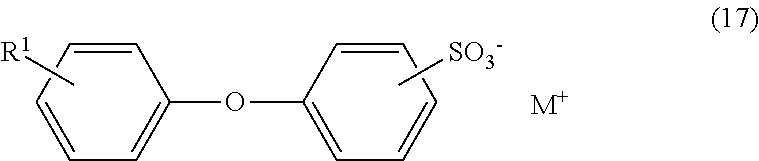
Applications Claiming Priority (3)
| Application Number | Priority Date | Filing Date | Title |
|---|---|---|---|
| JP2014012364 | 2014-01-27 | ||
| JP2014-012364 | 2014-01-27 | ||
| PCT/JP2015/051784 WO2015111684A1 (en) | 2014-01-27 | 2015-01-23 | Liquid composition for removing titanium nitride, semiconductor-element cleaning method using same, and semiconductor-element manufacturing method |
Publications (2)
| Publication Number | Publication Date |
|---|---|
| US20160281038A1 US20160281038A1 (en) | 2016-09-29 |
| US9777251B2 true US9777251B2 (en) | 2017-10-03 |
Family
ID=53681482
Family Applications (1)
| Application Number | Title | Priority Date | Filing Date |
|---|---|---|---|
| US15/034,081 Active US9777251B2 (en) | 2014-01-27 | 2015-01-23 | Liquid composition for removing titanium nitride, semiconductor-element cleaning method using same, and semiconductor-element manufacturing method |
Country Status (7)
| Country | Link |
|---|---|
| US (1) | US9777251B2 (en) |
| JP (1) | JP6455445B2 (en) |
| KR (1) | KR102200494B1 (en) |
| CN (1) | CN105981136B (en) |
| DE (1) | DE112015000506B4 (en) |
| TW (1) | TWI642763B (en) |
| WO (1) | WO2015111684A1 (en) |
Families Citing this family (12)
| Publication number | Priority date | Publication date | Assignee | Title |
|---|---|---|---|---|
| US9645497B2 (en) * | 2014-10-31 | 2017-05-09 | Taiwan Semiconductor Manufacturing Company, Ltd. | Lithography patterning technique |
| US10538846B2 (en) * | 2015-12-11 | 2020-01-21 | Dongwoo Fine-Chem Co., Ltd. | Etching solution composition for tungsten layer, method for preparing electronic device using the same and electronic device |
| JP6495230B2 (en) * | 2016-12-22 | 2019-04-03 | 花王株式会社 | Rinse agent composition for silicon wafer |
| WO2018123166A1 (en) * | 2016-12-26 | 2018-07-05 | 三菱瓦斯化学株式会社 | WET ETCHING COMPOSITION FOR SUBSTRATE HAVING SiN LAYER AND Si LAYER AND WET ETCHING METHOD USING SAME |
| KR102575928B1 (en) * | 2017-05-26 | 2023-09-07 | 미쯔비시 가스 케미칼 컴파니, 인코포레이티드 | Surface treatment method for imparting alcohol-repellent properties to semiconductor substrates |
| US11499236B2 (en) * | 2018-03-16 | 2022-11-15 | Versum Materials Us, Llc | Etching solution for tungsten word line recess |
| IL308906B2 (en) * | 2018-09-12 | 2024-12-01 | Fujifilm Electronic Mat Usa Inc | Engraving mixtures |
| EP4196546A4 (en) | 2020-08-13 | 2024-08-28 | Entegris, Inc. | Nitride etchant composition and method |
| EP4293097A4 (en) * | 2021-02-12 | 2025-01-01 | Mitsubishi Gas Chemical Company, Inc. | Composition for cleaning semiconductor substrate, method for cleaning semiconductor substrate, and method for producing semiconductor substrate |
| WO2022202646A1 (en) * | 2021-03-23 | 2022-09-29 | 三菱瓦斯化学株式会社 | Method for producing semiconductor substrate for memory elements |
| CN117581338A (en) * | 2021-07-02 | 2024-02-20 | 三菱瓦斯化学株式会社 | Etching composition for semiconductor substrate for memory element and method for manufacturing semiconductor substrate for memory element using same |
| WO2024004980A1 (en) | 2022-07-01 | 2024-01-04 | 三菱瓦斯化学株式会社 | Semiconductor substrate cleaning composition, method for cleaning semiconductor substrates, and method for producing semiconductor substrates |
Citations (10)
| Publication number | Priority date | Publication date | Assignee | Title |
|---|---|---|---|---|
| US20030119691A1 (en) * | 2000-09-12 | 2003-06-26 | Ecolab Inc. | Cleaning composition and methods for manufacturing and using |
| JP2003234307A (en) | 2002-02-12 | 2003-08-22 | Matsushita Electric Ind Co Ltd | Etching method, substrate cleaning method and semiconductor device manufacturing method |
| JP2008285508A (en) | 2007-05-15 | 2008-11-27 | Mitsubishi Gas Chem Co Inc | Cleaning composition |
| US20100112728A1 (en) * | 2007-03-31 | 2010-05-06 | Advanced Technology Materials, Inc. | Methods for stripping material for wafer reclamation |
| JP2010515246A (en) | 2006-12-21 | 2010-05-06 | アドバンスド テクノロジー マテリアルズ,インコーポレイテッド | Liquid cleaning agent to remove residues after etching |
| US20110275164A1 (en) * | 2005-11-09 | 2011-11-10 | Advanced Technology Materials, Inc. | Composition and method for recycling semiconductor wafers having low-k dielectric materials thereon |
| WO2013101907A1 (en) | 2011-12-28 | 2013-07-04 | Advanced Technology Materials, Inc. | Compositions and methods for selectively etching titanium nitride |
| US20140038420A1 (en) * | 2010-10-06 | 2014-02-06 | Advanced Technology Materials, Inc. | Composition and process for selectively etching metal nitrides |
| US8716209B2 (en) * | 2007-03-16 | 2014-05-06 | Fujitsu Limited | Agent for post-etch treatment of silicon dielectric film, method of manufacturing semiconductor device, and semiconductor device |
| US20160186058A1 (en) * | 2014-12-29 | 2016-06-30 | Air Products And Chemicals, Inc. | Etchant Solutions and Method of Use Thereof |
Family Cites Families (3)
| Publication number | Priority date | Publication date | Assignee | Title |
|---|---|---|---|---|
| CN101673672B (en) * | 2009-10-19 | 2011-07-27 | 中国电子科技集团公司第四十六研究所 | Method for preparing nitride films |
| CN102770524B (en) * | 2010-01-29 | 2015-04-22 | 高级技术材料公司 | Cleaning agent for semiconductors with metal wiring |
| WO2012154498A2 (en) * | 2011-05-06 | 2012-11-15 | Advanced Technology Materials, Inc. | Removal of metal impurities from silicon surfaces for solar cell and semiconductor applications |
-
2015
- 2015-01-16 TW TW104101427A patent/TWI642763B/en active
- 2015-01-23 JP JP2015559121A patent/JP6455445B2/en active Active
- 2015-01-23 CN CN201580005638.7A patent/CN105981136B/en active Active
- 2015-01-23 WO PCT/JP2015/051784 patent/WO2015111684A1/en not_active Ceased
- 2015-01-23 US US15/034,081 patent/US9777251B2/en active Active
- 2015-01-23 DE DE112015000506.4T patent/DE112015000506B4/en active Active
- 2015-01-23 KR KR1020167010489A patent/KR102200494B1/en active Active
Patent Citations (12)
| Publication number | Priority date | Publication date | Assignee | Title |
|---|---|---|---|---|
| US20030119691A1 (en) * | 2000-09-12 | 2003-06-26 | Ecolab Inc. | Cleaning composition and methods for manufacturing and using |
| JP2003234307A (en) | 2002-02-12 | 2003-08-22 | Matsushita Electric Ind Co Ltd | Etching method, substrate cleaning method and semiconductor device manufacturing method |
| US20110275164A1 (en) * | 2005-11-09 | 2011-11-10 | Advanced Technology Materials, Inc. | Composition and method for recycling semiconductor wafers having low-k dielectric materials thereon |
| US8642526B2 (en) * | 2005-11-09 | 2014-02-04 | Advanced Technology Materials, Inc. | Composition and method for recycling semiconductor wafers having low-k dielectric materials thereon |
| JP2010515246A (en) | 2006-12-21 | 2010-05-06 | アドバンスド テクノロジー マテリアルズ,インコーポレイテッド | Liquid cleaning agent to remove residues after etching |
| US20100163788A1 (en) | 2006-12-21 | 2010-07-01 | Advanced Technology Materials, Inc. | Liquid cleaner for the removal of post-etch residues |
| US8716209B2 (en) * | 2007-03-16 | 2014-05-06 | Fujitsu Limited | Agent for post-etch treatment of silicon dielectric film, method of manufacturing semiconductor device, and semiconductor device |
| US20100112728A1 (en) * | 2007-03-31 | 2010-05-06 | Advanced Technology Materials, Inc. | Methods for stripping material for wafer reclamation |
| JP2008285508A (en) | 2007-05-15 | 2008-11-27 | Mitsubishi Gas Chem Co Inc | Cleaning composition |
| US20140038420A1 (en) * | 2010-10-06 | 2014-02-06 | Advanced Technology Materials, Inc. | Composition and process for selectively etching metal nitrides |
| WO2013101907A1 (en) | 2011-12-28 | 2013-07-04 | Advanced Technology Materials, Inc. | Compositions and methods for selectively etching titanium nitride |
| US20160186058A1 (en) * | 2014-12-29 | 2016-06-30 | Air Products And Chemicals, Inc. | Etchant Solutions and Method of Use Thereof |
Non-Patent Citations (1)
| Title |
|---|
| International Search Report Issued Apr. 7, 2015 in PCT/JP15/51784 Filed Jan. 23, 2015. |
Also Published As
| Publication number | Publication date |
|---|---|
| DE112015000506B4 (en) | 2025-07-31 |
| KR20160111903A (en) | 2016-09-27 |
| CN105981136B (en) | 2018-09-07 |
| JP6455445B2 (en) | 2019-01-23 |
| JPWO2015111684A1 (en) | 2017-03-23 |
| WO2015111684A1 (en) | 2015-07-30 |
| DE112015000506T5 (en) | 2016-11-17 |
| CN105981136A (en) | 2016-09-28 |
| TW201533221A (en) | 2015-09-01 |
| TWI642763B (en) | 2018-12-01 |
| US20160281038A1 (en) | 2016-09-29 |
| KR102200494B1 (en) | 2021-01-08 |
Similar Documents
| Publication | Publication Date | Title |
|---|---|---|
| US9777251B2 (en) | Liquid composition for removing titanium nitride, semiconductor-element cleaning method using same, and semiconductor-element manufacturing method | |
| KR101912400B1 (en) | TiN HARD MASK AND ETCH RESIDUE REMOVAL | |
| JP5347237B2 (en) | Cleaning composition | |
| KR102338550B1 (en) | Compositions and methods for selectively etching titanium nitride | |
| EP2798669B1 (en) | Compositions and methods for selectively etching titanium nitride | |
| EP2922086B1 (en) | Composition, system, and process for TiNxOy removal | |
| KR102058679B1 (en) | Etching composition for copper/molybdenum or copper/molybdenum alloy multilayers | |
| KR100860367B1 (en) | Etch solution with improved etching selectivity relative to silicon oxide film compared to metal silicide film | |
| KR102365046B1 (en) | Composision for etching, method for etching and semiconductor device | |
| TWI600746B (en) | Selective removal of titanium nitride hard mask and removal of etch residues | |
| KR20170138929A (en) | Hydrogen peroxide stabilizer and etching composition containing them | |
| TWI542665B (en) | Titanium nitride hard mask and removal of etch residue | |
| KR102517903B1 (en) | Etchant composition, and method for etching | |
| KR20130093604A (en) | Method for producing transistor | |
| KR20220139260A (en) | Etchant composition | |
| US7309683B2 (en) | Cleaning composition and method of cleaning a semiconductor device using the same | |
| KR20140082392A (en) | Etching composition for copper-containing metal layer in display device and method of etching the metal layer with the same | |
| WO2025127048A1 (en) | Composition for semiconductor substrate cleaning, method for cleaning semiconductor substrate, and method for producing semiconductor substrate | |
| TW202546205A (en) | Components for cleaning semiconductor substrates, methods for cleaning semiconductor substrates, and methods for manufacturing semiconductor substrates. | |
| KR100906502B1 (en) | Etch solution with improved etching selectivity relative to silicon oxide film compared to metal silicide film | |
| TW201730326A (en) | Acidic semi-aqueous fluoride activated anti-reflective coating cleaner with excellent substrate compatibility and excellent bath stability | |
| KR20140122614A (en) | Etchant composition for copper-containing metal film and etching method using the same | |
| KR20090042216A (en) | Etch solution with improved etching selectivity relative to silicon oxide film compared to metal silicide film | |
| KR20080031717A (en) | Etch solution with improved etching selectivity relative to silicon oxide film compared to metal silicide film |
Legal Events
| Date | Code | Title | Description |
|---|---|---|---|
| AS | Assignment |
Owner name: MITSUBISHI GAS CHEMICAL COMPANY, INC., JAPAN Free format text: ASSIGNMENT OF ASSIGNORS INTEREST;ASSIGNORS:TAMAI, SATOSHI;SHIMADA, KENJI;REEL/FRAME:038447/0212 Effective date: 20160222 |
|
| STCF | Information on status: patent grant |
Free format text: PATENTED CASE |
|
| MAFP | Maintenance fee payment |
Free format text: PAYMENT OF MAINTENANCE FEE, 4TH YEAR, LARGE ENTITY (ORIGINAL EVENT CODE: M1551); ENTITY STATUS OF PATENT OWNER: LARGE ENTITY Year of fee payment: 4 |
|
| MAFP | Maintenance fee payment |
Free format text: PAYMENT OF MAINTENANCE FEE, 8TH YEAR, LARGE ENTITY (ORIGINAL EVENT CODE: M1552); ENTITY STATUS OF PATENT OWNER: LARGE ENTITY Year of fee payment: 8 |