US9758719B2 - Organometallic compound and organic light-emitting device including the same - Google Patents

Organometallic compound and organic light-emitting device including the same Download PDF

Info

Publication number
US9758719B2
US9758719B2 US14/676,242 US201514676242A US9758719B2 US 9758719 B2 US9758719 B2 US 9758719B2 US 201514676242 A US201514676242 A US 201514676242A US 9758719 B2 US9758719 B2 US 9758719B2
Authority
US
United States
Prior art keywords
group
sec
tert
deuterium
phenyl
Prior art date
Legal status (The legal status is an assumption and is not a legal conclusion. Google has not performed a legal analysis and makes no representation as to the accuracy of the status listed.)
Active, expires
Application number
US14/676,242
Other versions
US20160141526A1 (en
Inventor
Banglin LEE
Hyeonho CHOI
Youngjae PARK
Kyuhyun IM
Current Assignee (The listed assignees may be inaccurate. Google has not performed a legal analysis and makes no representation or warranty as to the accuracy of the list.)
Samsung Electronics Co Ltd
Original Assignee
Samsung Electronics Co Ltd
Priority date (The priority date is an assumption and is not a legal conclusion. Google has not performed a legal analysis and makes no representation as to the accuracy of the date listed.)
Filing date
Publication date
Application filed by Samsung Electronics Co Ltd filed Critical Samsung Electronics Co Ltd
Assigned to SAMSUNG ELECTRONICS CO., LTD. reassignment SAMSUNG ELECTRONICS CO., LTD. ASSIGNMENT OF ASSIGNORS INTEREST (SEE DOCUMENT FOR DETAILS). Assignors: CHOI, HYEONHO, IM, KYUHYUN, LEE, BANGLIN, PARK, YOUNGJAE
Publication of US20160141526A1 publication Critical patent/US20160141526A1/en
Application granted granted Critical
Publication of US9758719B2 publication Critical patent/US9758719B2/en
Active legal-status Critical Current
Adjusted expiration legal-status Critical

Links

Images

Classifications

    • CCHEMISTRY; METALLURGY
    • C07ORGANIC CHEMISTRY
    • C07FACYCLIC, CARBOCYCLIC OR HETEROCYCLIC COMPOUNDS CONTAINING ELEMENTS OTHER THAN CARBON, HYDROGEN, HALOGEN, OXYGEN, NITROGEN, SULFUR, SELENIUM OR TELLURIUM
    • C07F19/00Metal compounds according to more than one of main groups C07F1/00 - C07F17/00
    • CCHEMISTRY; METALLURGY
    • C07ORGANIC CHEMISTRY
    • C07FACYCLIC, CARBOCYCLIC OR HETEROCYCLIC COMPOUNDS CONTAINING ELEMENTS OTHER THAN CARBON, HYDROGEN, HALOGEN, OXYGEN, NITROGEN, SULFUR, SELENIUM OR TELLURIUM
    • C07F15/00Compounds containing elements of Groups 8, 9, 10 or 18 of the Periodic Table
    • CCHEMISTRY; METALLURGY
    • C07ORGANIC CHEMISTRY
    • C07FACYCLIC, CARBOCYCLIC OR HETEROCYCLIC COMPOUNDS CONTAINING ELEMENTS OTHER THAN CARBON, HYDROGEN, HALOGEN, OXYGEN, NITROGEN, SULFUR, SELENIUM OR TELLURIUM
    • C07F15/00Compounds containing elements of Groups 8, 9, 10 or 18 of the Periodic Table
    • C07F15/0006Compounds containing elements of Groups 8, 9, 10 or 18 of the Periodic Table compounds of the platinum group
    • C07F15/0033Iridium compounds
    • CCHEMISTRY; METALLURGY
    • C07ORGANIC CHEMISTRY
    • C07FACYCLIC, CARBOCYCLIC OR HETEROCYCLIC COMPOUNDS CONTAINING ELEMENTS OTHER THAN CARBON, HYDROGEN, HALOGEN, OXYGEN, NITROGEN, SULFUR, SELENIUM OR TELLURIUM
    • C07F7/00Compounds containing elements of Groups 4 or 14 of the Periodic Table
    • C07F7/02Silicon compounds
    • C07F7/08Compounds having one or more C—Si linkages
    • H01L51/0085
    • HELECTRICITY
    • H10SEMICONDUCTOR DEVICES; ELECTRIC SOLID-STATE DEVICES NOT OTHERWISE PROVIDED FOR
    • H10KORGANIC ELECTRIC SOLID-STATE DEVICES
    • H10K50/00Organic light-emitting devices
    • HELECTRICITY
    • H10SEMICONDUCTOR DEVICES; ELECTRIC SOLID-STATE DEVICES NOT OTHERWISE PROVIDED FOR
    • H10KORGANIC ELECTRIC SOLID-STATE DEVICES
    • H10K85/00Organic materials used in the body or electrodes of devices covered by this subclass
    • H10K85/30Coordination compounds
    • H10K85/341Transition metal complexes, e.g. Ru(II)polypyridine complexes
    • H10K85/342Transition metal complexes, e.g. Ru(II)polypyridine complexes comprising iridium
    • CCHEMISTRY; METALLURGY
    • C09DYES; PAINTS; POLISHES; NATURAL RESINS; ADHESIVES; COMPOSITIONS NOT OTHERWISE PROVIDED FOR; APPLICATIONS OF MATERIALS NOT OTHERWISE PROVIDED FOR
    • C09KMATERIALS FOR MISCELLANEOUS APPLICATIONS, NOT PROVIDED FOR ELSEWHERE
    • C09K11/00Luminescent, e.g. electroluminescent, chemiluminescent materials
    • C09K11/06Luminescent, e.g. electroluminescent, chemiluminescent materials containing organic luminescent materials
    • CCHEMISTRY; METALLURGY
    • C09DYES; PAINTS; POLISHES; NATURAL RESINS; ADHESIVES; COMPOSITIONS NOT OTHERWISE PROVIDED FOR; APPLICATIONS OF MATERIALS NOT OTHERWISE PROVIDED FOR
    • C09KMATERIALS FOR MISCELLANEOUS APPLICATIONS, NOT PROVIDED FOR ELSEWHERE
    • C09K2211/00Chemical nature of organic luminescent or tenebrescent compounds
    • C09K2211/10Non-macromolecular compounds
    • C09K2211/1003Carbocyclic compounds
    • C09K2211/1007Non-condensed systems
    • CCHEMISTRY; METALLURGY
    • C09DYES; PAINTS; POLISHES; NATURAL RESINS; ADHESIVES; COMPOSITIONS NOT OTHERWISE PROVIDED FOR; APPLICATIONS OF MATERIALS NOT OTHERWISE PROVIDED FOR
    • C09KMATERIALS FOR MISCELLANEOUS APPLICATIONS, NOT PROVIDED FOR ELSEWHERE
    • C09K2211/00Chemical nature of organic luminescent or tenebrescent compounds
    • C09K2211/10Non-macromolecular compounds
    • C09K2211/1003Carbocyclic compounds
    • C09K2211/1014Carbocyclic compounds bridged by heteroatoms, e.g. N, P, Si or B
    • CCHEMISTRY; METALLURGY
    • C09DYES; PAINTS; POLISHES; NATURAL RESINS; ADHESIVES; COMPOSITIONS NOT OTHERWISE PROVIDED FOR; APPLICATIONS OF MATERIALS NOT OTHERWISE PROVIDED FOR
    • C09KMATERIALS FOR MISCELLANEOUS APPLICATIONS, NOT PROVIDED FOR ELSEWHERE
    • C09K2211/00Chemical nature of organic luminescent or tenebrescent compounds
    • C09K2211/10Non-macromolecular compounds
    • C09K2211/1018Heterocyclic compounds
    • C09K2211/1025Heterocyclic compounds characterised by ligands
    • C09K2211/1029Heterocyclic compounds characterised by ligands containing one nitrogen atom as the heteroatom
    • CCHEMISTRY; METALLURGY
    • C09DYES; PAINTS; POLISHES; NATURAL RESINS; ADHESIVES; COMPOSITIONS NOT OTHERWISE PROVIDED FOR; APPLICATIONS OF MATERIALS NOT OTHERWISE PROVIDED FOR
    • C09KMATERIALS FOR MISCELLANEOUS APPLICATIONS, NOT PROVIDED FOR ELSEWHERE
    • C09K2211/00Chemical nature of organic luminescent or tenebrescent compounds
    • C09K2211/18Metal complexes
    • C09K2211/185Metal complexes of the platinum group, i.e. Os, Ir, Pt, Ru, Rh or Pd
    • H01L2251/552
    • H01L51/0081
    • H01L51/5016
    • HELECTRICITY
    • H10SEMICONDUCTOR DEVICES; ELECTRIC SOLID-STATE DEVICES NOT OTHERWISE PROVIDED FOR
    • H10KORGANIC ELECTRIC SOLID-STATE DEVICES
    • H10K2101/00Properties of the organic materials covered by group H10K85/00
    • H10K2101/10Triplet emission
    • HELECTRICITY
    • H10SEMICONDUCTOR DEVICES; ELECTRIC SOLID-STATE DEVICES NOT OTHERWISE PROVIDED FOR
    • H10KORGANIC ELECTRIC SOLID-STATE DEVICES
    • H10K2101/00Properties of the organic materials covered by group H10K85/00
    • H10K2101/30Highest occupied molecular orbital [HOMO], lowest unoccupied molecular orbital [LUMO] or Fermi energy values
    • HELECTRICITY
    • H10SEMICONDUCTOR DEVICES; ELECTRIC SOLID-STATE DEVICES NOT OTHERWISE PROVIDED FOR
    • H10KORGANIC ELECTRIC SOLID-STATE DEVICES
    • H10K50/00Organic light-emitting devices
    • H10K50/10OLEDs or polymer light-emitting diodes [PLED]
    • H10K50/11OLEDs or polymer light-emitting diodes [PLED] characterised by the electroluminescent [EL] layers
    • HELECTRICITY
    • H10SEMICONDUCTOR DEVICES; ELECTRIC SOLID-STATE DEVICES NOT OTHERWISE PROVIDED FOR
    • H10KORGANIC ELECTRIC SOLID-STATE DEVICES
    • H10K85/00Organic materials used in the body or electrodes of devices covered by this subclass
    • H10K85/30Coordination compounds
    • H10K85/321Metal complexes comprising a group IIIA element, e.g. Tris (8-hydroxyquinoline) gallium [Gaq3]
    • H10K85/324Metal complexes comprising a group IIIA element, e.g. Tris (8-hydroxyquinoline) gallium [Gaq3] comprising aluminium, e.g. Alq3

Definitions

  • One or more embodiments relate to an organometallic compound and an organic light-emitting device including the same.
  • OLEDs Organic light emitting devices
  • OLEDs are self-emission devices that have wide viewing angles, high contrast ratios, and short response times.
  • OLEDs exhibit excellent luminance, driving voltage, and response speed characteristics, and produce full-color images.
  • an organic light-emitting device includes an anode, a cathode, and an organic layer that is disposed between the anode and the cathode and includes an emission layer.
  • a hole transport region may be disposed between the anode and the emission layer, and an electron transport region may be disposed between the emission layer and the cathode.
  • Holes provided from the anode may move toward the emission layer through the hole transport region, and electrons provided from the cathode may move toward the emission layer through the electron transport region.
  • the holes and the electrons are recombined in the emission layer to produce excitons. These excitons change from an excited state to a ground state, thereby generating light.
  • One or more embodiments relate to a novel organometallic compound and an organic light-emitting device including the same.
  • An aspect of exemplary embodiments provides an organometallic compound represented by Formula 1:
  • CY 1 may be selected from a C 5 -C 60 carbocyclic group and a C 1 -C 60 heterocyclic group,
  • Q 1 to Q 3 may be each independently selected from
  • a C 1 -C 20 alkyl group and a phenyl group each substituted with at least one selected from a deuterium, a C 1 -C 10 alkyl group, and a phenyl group,
  • R 1 to R 8 may be each independently selected from a hydrogen, a deuterium, —CH 3 , —CDH 2 , —CD 2 H, and —CD 3 ,
  • R 11 to R 14 may be each independently selected from
  • R 21 may be selected from
  • a C 1 -C 20 alkyl group and a C 1 -C 20 alkoxy group each substituted with at least one selected from a deuterium, —F, —Cl, —Br, —I, —CD 3 , —CD 2 H, —CDH 2 , —CF 3 , —CF 2 H, —CFH 2 , a hydroxyl group, a cyano group, a nitro group, an amino group, an amidino group, a hydrazine group, a hydrazone group, a carboxylic acid group or a salt thereof, a sulfonic acid group or a salt thereof, a phosphoric acid group or a salt thereof, a C 1 -C 10 alkyl group, a C 1 -C 10 alkoxy group, a C 3 -C 10 cycloalkyl group, a C 1 -C 10 heterocycloalkyl group, a C 3 -C 10 cycloal
  • a1 and b1 may be each independently an integer selected from 0 to 4, provided that when a1 is 2 or more, two or more groups R 11 may be identical or different, and when b1 is 2 or more, 2 or more groups R 21 may be identical or different, and
  • Q 11 to Q 14 may be each independently selected from a C 1 -C 20 alkyl group, a C 1 -C 20 alkoxy group, a C 3 -C 10 cycloalkyl group, a C 1 -C 10 heterocycloalkyl group, a C 3 -C 10 cycloalkenyl group, a C 1 -C 10 heterocycloalkenyl group and a C 6 -C 14 aryl group; a C 6 -C 14 aryl group substituted with at least one selected from a C 1 -C 20 alkyl group and a C 6 -C 14 aryl group; and a C 1 -C 14 heteroaryl group, a monovalent non-aromatic condensed polycyclic group, and a monovalent non-aromatic condensed heteropolycyclic group.
  • an organic light-emitting device including:
  • organic layer disposed between the first electrode and the second electrode, wherein the organic layer includes an emission layer and includes at least one organometallic compound represented by Formula 1.
  • the emission layer may include the organometallic compound represented by Formula 1, the organometallic compound represented by Formula 1 included in the emission layer may act as a dopant, and the emission layer may further include a host, wherein an amount of the organometallic compound represented by Formula 1 in the emission layer is smaller than an amount of the host.
  • FIG. 1 is a schematic view of an organic light-emitting device according to an embodiment
  • FIG. 2 is a graph of weight (percent, %) versus temperature (degree Centigrade, ° C.) showing thermogravimetric analysis (TGA) data of Compound 3;
  • FIG. 3 is a graph of intensity (arbitrary unit, a. u.) versus wavelength (nanometer, nm) showing an ultraviolet (UV)-absorption spectrum and a photoluminescent (PL) of Compound 3 in solution;
  • FIG. 4 is a graph of intensity (arbitrary unit, a. u.) versus time (minute, min) showing high performance liquid chromatography (HPLC) data of Compound 3 to explain a purity change after a heat treatment of Compound 3;
  • FIG. 5 is a graph of intensity (arbitrary unit, a. u.) versus time (minute, min) showing HPLC data of Compound A to explain a purity change after a heat treatment of Compound A;
  • FIG. 6 is a graph of electroluminescent (EL) intensity (arbitrary unit, a. u.) versus wavelength (nanometer, nm) showing an electroluminescent (EL) spectrum of organic light-emitting devices manufactured according to Examples 1, 3, 4, and 5; and
  • FIG. 7 is a graph of luminance (percent, %) versus time (hour, hr) showing lifetime data (at 10 milliAmperes per square centimeter (mA/cm 2 )) of the organic light-emitting device manufactured according to Example 3.
  • first, second, third etc. may be used herein to describe various elements, components, regions, layers, and/or sections, these elements, components, regions, layers, and/or sections should not be limited by these terms. These terms are only used to distinguish one element, component, region, layer, or section from another element, component, region, layer, or section. Thus, a first element, component, region, layer, or section discussed below could be termed a second element, component, region, layer, or section without departing from the teachings of the present embodiments.
  • spatially relative terms such as “beneath,” “below,” “lower,” “above,” “upper” and the like, may be used herein for ease of description to describe one element or feature's relationship to another element(s) or feature(s) as illustrated in the figures. It will be understood that the spatially relative terms are intended to encompass different orientations of the device in use or operation in addition to the orientation depicted in the figures. For example, if the device in the figures is turned over, elements described as “below” or “beneath” other elements or features would then be oriented “above” the other elements or features. Thus, the exemplary term “below” can encompass both an orientation of above and below. The device may be otherwise oriented (rotated 90 degrees or at other orientations) and the spatially relative descriptors used herein interpreted accordingly.
  • “About” or “approximately” as used herein is inclusive of the stated value and means within an acceptable range of deviation for the particular value as determined by one of ordinary skill in the art, considering the measurement in question and the error associated with measurement of the particular quantity (i.e., the limitations of the measurement system). For example, “about” can mean within one or more standard deviations, or within ⁇ 30%, 20%, 10%, 5% of the stated value.
  • Exemplary embodiments are described herein with reference to cross section illustrations that are schematic illustrations of idealized embodiments. As such, variations from the shapes of the illustrations as a result, for example, of manufacturing techniques and/or tolerances, are to be expected. Thus, embodiments described herein should not be construed as limited to the particular shapes of regions as illustrated herein but are to include deviations in shapes that result, for example, from manufacturing. For example, a region illustrated or described as flat may, typically, have rough and/or nonlinear features. Moreover, sharp angles that are illustrated may be rounded. Thus, the regions illustrated in the figures are schematic in nature and their shapes are not intended to illustrate the precise shape of a region and are not intended to limit the scope of the present claims.
  • An organometallic compound according to an embodiment is represented by Formula 1 below:
  • CY 1 in Formula 1 may be selected from a C 5 -C 60 carbocyclic group and a C 1 -C 60 heterocyclic group.
  • CY 1 in Formula 1 may be selected from a benzene, a dibenzofuran, a dibenzothiophene, a fluorene, and a carbazole, but embodiments are not limited thereto.
  • Q 1 to Q 3 in Formula 1 may be each independently selected from
  • a C 1 -C 20 alkyl group and a phenyl group each substituted with at least one selected from a deuterium, a C 1 -C 10 alkyl group, and a phenyl group.
  • Q 1 to Q 3 in Formula 1 may be each independently selected from
  • a C 1 -C 10 alkyl group and a phenyl group each substituted with at least one selected from a deuterium and a C 1 -C 10 alkyl group.
  • Q 1 to Q 3 in Formula 1 may be each independently selected from
  • an n-propyl group an isopropyl group, an n-butyl group, an isobutyl group, a sec-butyl group, a tert-butyl group, an n-pentyl group, an isopentyl group, a sec-pentyl group a tert-pentyl group, and a phenyl group;
  • an n-propyl group an isopropyl group, an n-butyl group, an isobutyl group, a sec-butyl group, a tert-butyl group, an n-pentyl group, an isopentyl group, a sec-pentyl group a tert-pentyl group, and a phenyl group, each substituted with at least one selected from a deuterium and a C 1 -C 10 alkyl group, but embodiments are not limited thereto.
  • Q 1 to Q 3 in Formula 1 may all be identical;
  • Q 1 and Q 3 may be identical and Q 2 and Q 1 may be different from each other; or
  • Q 1 to Q 3 may all be different from each other.
  • Q 1 to Q 3 in Formula 1 may all be identical, and may be selected from
  • an n-propyl group an isopropyl group, an n-butyl group, an isobutyl group, a sec-butyl group, a tert-butyl group, an n-pentyl group, an isopentyl group, a sec-pentyl group a tert-pentyl group, and a phenyl group;
  • an n-propyl group an isopropyl group, an n-butyl group, an isobutyl group, a sec-butyl group, a tert-butyl group, an n-pentyl group, an isopentyl group, a sec-pentyl group a tert-pentyl group, and a phenyl group, each substituted with at least one selected from a deuterium and a C 1 -C 10 alkyl group, but they are not limited thereto.
  • Q 1 and Q 3 in Formula 1 may be each independently selected from —CH 3 , —CD 3 , —CD 2 H, —CDH 2 , —CH 2 CH 3 , —CH 2 CD 3 , —CH 2 CD 2 H, —CH 2 CDH 2 , —CHDCH 3 , —CHDCD 2 H, —CHDCDH 2 , —CHDCD 3 , —CD 2 CD 3 , —CD 2 CD 2 H, and —CD 2 CDH 2 ,
  • Q 2 may be selected from
  • an n-propyl group an isopropyl group, an n-butyl group, an isobutyl group, a sec-butyl group, a tert-butyl group, an n-pentyl group, an isopentyl group, a sec-pentyl group a tert-pentyl group, and a phenyl group;
  • an n-propyl group an isopropyl group, an n-butyl group, an isobutyl group, a sec-butyl group, a tert-butyl group, an n-pentyl group, an isopentyl group, a sec-pentyl group a tert-pentyl group, and a phenyl group, each substituted with at least one selected from a deuterium and a C 1 -C 10 alkyl group, but embodiments are not limited thereto.
  • R 1 to R 8 in Formula 1 may be each independently selected from a hydrogen, a deuterium, —CH 3 , —CDH 2 , —CD 2 H, and —CD 3 .
  • R 1 to R 8 in Formula 1 may be each independently selected from a hydrogen and a deuterium, but they are not limited thereto.
  • R 1 to R 8 may all be a hydrogen
  • R 1 , R 2 , and R 4 to R 8 may be a hydrogen and R 3 may be selected from a deuterium, —CH 3 , —CDH 2 , —CD 2 H, and —CD 3 ;
  • R 1 , R 2 , R 4 , R 5 , R 6 and R 8 may be a hydrogen, and R 3 and R 7 may be each independently selected from a deuterium, —CH 3 , —CDH 2 , —CD 2 H, and —CD 3 ;
  • R 1 to R 4 may be a hydrogen
  • R 5 to R 8 may be each independently selected from a deuterium, —CH 3 , —CDH 2 , —CD 2 H, and —CD 3 ;
  • R 1 to R 5 may be a hydrogen
  • R 6 to R 8 may be each independently selected from a deuterium, —CH 3 , —CDH 2 , —CD 2 H, and —CD 3 ;
  • R 1 to R 4 and R 8 may be a hydrogen, and R 5 to R 7 may be each independently selected from a deuterium, —CH 3 , —CDH 2 , —CD 2 H, and —CD 3 ; or
  • R 1 to R 8 may be each independently selected from a deuterium, —CH 3 , —CDH 2 , —CD 2 H, and —CD 3 , but are not limited thereto.
  • R 11 to R 14 in Formula 1 may be each independently selected from
  • a C 1 -C 10 alkyl group a C 3 -C 10 cycloalkyl group, a C 1 -C 10 heterocycloalkyl group, a C 3 -C 10 cycloalkenyl group, a C 1 -C 10 heterocycloalkenyl group, a phenyl group, and a naphthyl group, each substituted with at least one selected from a deuterium, a C 1 -C 10 alkyl group, a C 3 -C 10 cycloalkyl group, a C 1 -C 10 heterocycloalkyl group, a C 3 -C 10 cycloalkenyl group, a C 1 -C 10 heterocycloalkenyl group, a phenyl group, and a naphthyl group.
  • R 11 to R 14 in Formula 1 may be each independently selected from
  • R 11 to R 14 in Formula 1 may be each independently selected from a hydrogen, a deuterium, —CH 3 , —CD 3 , —CD 2 H, —CDH 2 , a group represented by Formulae 9-1 to 9-17, and a group represented by Formulae 10-1 to 10-12, but embodiments are not limited thereto:
  • a1 in Formula 1 may be an integer selected from 0 to 4. When a1 is 2 or more, two or more groups R 11 may be identical or different. For example, a1 in Formula 1 may be 0, 1, or 2.
  • R 1 in Formula 21 may be selected from
  • a C 1 -C 20 alkyl group and a C 1 -C 20 alkoxy group each substituted with at least one selected from a deuterium, —F, —Cl, —Br, —I, —CD 3 , —CD 2 H, —CDH 2 , —CF 3 , —CF 2 H, —CFH 2 , a hydroxyl group, a cyano group, a nitro group, an amino group, an amidino group, a hydrazine group, a hydrazone group, a carboxylic acid group or a salt thereof, a sulfonic acid group or a salt thereof, a phosphoric acid group or a salt thereof, a C 1 -C 10 alkyl group, a C 1 -C 10 alkoxy group, a C 3 -C 10 cycloalkyl group, a C 1 -C 10 heterocycloalkyl group, a C 3 -C 10 cycloal
  • Q 11 to Q 14 are each independently selected from a C 1 -C 20 alkyl group, a C 1 -C 20 alkoxy group, a C 3 -C 10 cycloalkyl group, a C 1 -C 10 heterocycloalkyl group, a C 3 -C 10 cycloalkenyl group, a C 1 -C 10 heterocycloalkenyl group, and a C 6 -C 14 aryl group; a C 6 -C 14 aryl group substituted with at least one selected from a C 1 -C 20 alkyl group and a C 6 -C 14 aryl group; and a C 1 -C 14 heteroaryl group, a monovalent non-aromatic condensed polycyclic group, and a monovalent non-aromatic condensed heteropolycyclic group.
  • R 21 in Formula 1 may be selected from
  • a C 1 -C 20 alkyl group and a C 1 -C 20 alkoxy group each substituted with at least one selected from a deuterium, —F, —Cl, —Br, —I, —CD 3 , —CD 2 H, —CDH 2 , —CF 3 , —CF 2 H, —CFH 2 , a hydroxyl group, a cyano group, a nitro group, an amino group, an amidino group, a hydrazine group, a hydrazone group, a carboxylic acid group or a salt thereof, a sulfonic acid group or a salt thereof, a phosphoric acid group or a salt thereof, a C 1 -C 10 alkyl group, a cyclopentyl group, a cyclohexyl group, a cycloheptyl group, a cyclooctyl group, an adamantyl group, a norborn
  • a cyclopentyl group a cyclohexyl group, a cycloheptyl group, a cyclooctyl group, an adamantyl group, a norbornyl group, a cyclopentenyl group, a cyclohexenyl group, a cycloheptenyl group, a phenyl group, a naphthyl group, a fluorenyl group, a phenanthrenyl group, an anthracenyl group, a fluoranthenyl group, a triphenylenyl group, a pyrenyl group, a chrysenyl group, a pyrrolyl group, a thiophenyl group, a furanyl group, an imidazolyl group, a pyrazolyl group, a thiazolyl group, an isothiazolyl group, an oxazolyl group, an isox
  • a cyclopentyl group a cyclohexyl group, a cycloheptyl group, a cyclooctyl group, an adamantyl group, a norbornyl group, a cyclopentenyl group, a cyclohexenyl group, a cycloheptenyl group, a phenyl group, a naphthyl group, a fluorenyl group, a phenanthrenyl group, an anthracenyl group, a fluoranthenyl group, a triphenylenyl group, a pyrenyl group, a chrysenyl group, a pyrrolyl group, a thiophenyl group, a furanyl group, an imidazolyl group, a pyrazolyl group, a thiazolyl group, an isothiazolyl group, an oxazolyl group, an isox
  • Q 11 to Q 14 may be each independently selected from
  • a C 1 -C 20 alkyl group a C 1 -C 20 alkoxy group, a phenyl group, a naphthyl group, a pyridinyl group, a pyrimidinyl group, a triazinyl group, and a carbazolyl group;
  • a phenyl group and a naphthyl group each substituted with at least one selected from a C 1 -C 20 alkyl group, a phenyl group, and a naphthyl group.
  • R 21 in Formula 1 may be selected from
  • Q 11 to Q 14 may be each independently selected from
  • a phenyl group and a naphthyl group each substituted with at least one selected from a C 1 -C 20 alkyl group, a phenyl group, and a naphthyl group, but they are not limited thereto.
  • R 21 in Formula 1 may be selected from a hydrogen, a deuterium, a cyano group, a nitro group, —CH 3 , —CD 3 , —CD 2 H, —CDH 2 , —CF 3 , —CF 2 H, —CFH 2 , groups represented by Formulae 9-1 to 9-17, and a group represented by Formulae 10-1 to 10-30, but embodiments are not limited thereto:
  • b1 in Formula 1 may be an integer selected from 0 to 4.
  • two or more groups R 21 may be identical or different.
  • the organometallic compound represented by Formula 1 may be represented by one of Formulae 1-1 to 1-12:
  • Q 1 to Q 3 may be each independently selected from
  • an n-propyl group an isopropyl group, an n-butyl group, an isobutyl group, a sec-butyl group, a tert-butyl group, an n-pentyl group, an isopentyl group, a sec-pentyl group a tert-pentyl group, and a phenyl group;
  • an n-propyl group an isopropyl group, an n-butyl group, an isobutyl group, a sec-butyl group, a tert-butyl group, an n-pentyl group, an isopentyl group, a sec-pentyl group a tert-pentyl group, and a phenyl group, each substituted with at least one selected from a deuterium and a C 1 -C 10 alkyl group,
  • R 1 to R 8 may all be a hydrogen
  • R 1 , R 2 , and R 4 to R 8 may be a hydrogen, and R 3 may be selected from a deuterium, —CH 3 , —CDH 2 , —CD 2 H, and —CD 3 ;
  • R 1 , R 2 , R 4 , R 5 , R 6 and R 8 may be a hydrogen, and R 3 and R 7 may be each independently selected from a deuterium, —CH 3 , —CDH 2 , —CD 2 H, and —CD 3 ;
  • R 1 to R 4 may be a hydrogen
  • R 5 to R 8 may be each independently selected from a deuterium, —CH 3 , —CDH 2 , —CD 2 H, and —CD 3 ;
  • R 1 to R 5 may be a hydrogen
  • R 6 to R 8 may be each independently selected from a deuterium, —CH 3 , —CDH 2 , —CD 2 H, and —CD 3 ;
  • R 1 to R 4 and R 8 may be a hydrogen, and R 5 to R 7 may be each independently selected from a deuterium, —CH 3 , —CDH 2 , —CD 2 H, and —CD 3 ; or
  • R 1 to R 8 may be each independently selected from a hydrogen, a deuterium, —CH 3 , —CDH 2 , —CD 2 H, and —CD 3 ,
  • R 11 , R 11a , R 11b , R 12 , R 13 and R 14 may be each independently selected from a hydrogen, a deuterium, —CH 3 , —CD 3 , —CD 2 H, —CDH 2 , groups represented by Formulae 9-1 to 9-17, and a group represented by Formulae 10-1 to 10-12 (provided that R 11 , R 11a and R 11b are not a hydrogen), and
  • R 21 may be selected from a hydrogen, a deuterium, a cyano group, a nitro group, —CH 3 , —CD 3 , —CD 2 H, —CDH 2 , —CF 3 , —CF 2 H, —CFH 2 , groups represented by Formulae 9-1 to 9-17, and groups represented by Formulae 10-1 to 10-30.
  • the organometallic compound represented by Formula 1 may be represented by one of Formulae 1(1) to 1(12):
  • X 1 may be N(R 21 ), O, or S
  • descriptions of R 22 to R 24 are the same as those of R 21 , provided that R 13 and R 21 to R 24 in Formulae 1(1) to 1(12) are not be a hydrogen.
  • Q 1 to Q 3 may be each independently selected from
  • an n-propyl group an isopropyl group, an n-butyl group, an isobutyl group, a sec-butyl group, a tert-butyl group, an n-pentyl group, an isopentyl group, a sec-pentyl group a tert-pentyl group, and a phenyl group;
  • an n-propyl group an isopropyl group, an n-butyl group, an isobutyl group, a sec-butyl group, a tert-butyl group, an n-pentyl group, an isopentyl group, a sec-pentyl group a tert-pentyl group, and a phenyl group, each substituted with at least one selected from a deuterium and a C 1 -C 10 alkyl group,
  • R 1 to R 8 may all be a hydrogen
  • R 1 , R 2 , and R 4 to R 8 may be a hydrogen, and R 3 may be selected from a deuterium, —CH 3 , —CDH 2 , —CD 2 H, and —CD 3 ;
  • R 1 , R 2 , R 4 , R 5 , R 6 and R 8 may be a hydrogen, and R 3 and R 7 may be each independently selected from a deuterium, —CH 3 , —CDH 2 , —CD 2 H, and —CD 3 ;
  • R 1 to R 4 may be a hydrogen
  • R 5 to R 8 may be each independently selected from a deuterium, —CH 3 , —CDH 2 , —CD 2 H, and —CD 3 ;
  • R 1 to R 5 may be a hydrogen
  • R 6 to R 8 may be each independently selected from a deuterium, —CH 3 , —CDH 2 , —CD 2 H, and —CD 3 ;
  • R 1 to R 4 and R 8 may be a hydrogen, and R 5 to R 7 may be each independently selected from a deuterium, —CH 3 , —CDH 2 , —CD 2 H, and —CD 3 ; or
  • R 1 to R 8 may be each independently selected from a deuterium, —CH 3 , —CDH 2 , —CD 2 H, and —CD 3 ,
  • R 11 and R 13 may be each independently selected from a hydrogen, a deuterium, —CH 3 , —CD 3 , —CD 2 H, —CDH 2 , a group represented by Formulae 9-1 to 9-17, and a group represented by Formulae 10-1 to 10-12 (provided that R 13 is not a hydrogen),
  • R 21 to R 24 may be each independently selected from a deuterium, a cyano group, a nitro group, —CH 3 , —CD 3 , —CD 2 H, —CDH 2 , —CF 3 , —CF 2 H, —CFH 2 , groups represented by Formulae 9-1 to 9-17, and groups represented by Formulae 10-1 to 10-30, and
  • a1 may be 0, 1, or 2.
  • the organometallic compound represented by Formula 2 may be represented by one of Formulae 2-1 to 2-72:
  • X 1 may be N(R 21 ), O, or S
  • descriptions of R 11a and R 11b are the same as descriptions of R 11
  • descriptions of R 22 to R 24 are the same as descriptions of R 21 .
  • R 11 , R 11a , R 11b , R 13 and R 21 to R 24 in Formulae 2-1 to 2-72 are not a hydrogen.
  • Q 1 to Q 3 may be each independently selected from
  • an n-propyl group an isopropyl group, an n-butyl group, an isobutyl group, a sec-butyl group, a tert-butyl group, an n-pentyl group, an isopentyl group, a sec-pentyl group a tert-pentyl group, and a phenyl group;
  • an n-propyl group an isopropyl group, an n-butyl group, an isobutyl group, a sec-butyl group, a tert-butyl group, an n-pentyl group, an isopentyl group, a sec-pentyl group a tert-pentyl group, and a phenyl group, each substituted with at least one selected from a deuterium and a C 1 -C 10 alkyl group,
  • R 1 to R 8 may all be a hydrogen
  • R 1 , R 2 , and R 4 to R 8 may be a hydrogen, and R 3 may be selected from a deuterium, —CH 3 , —CDH 2 , —CD 2 H, and —CD 3 ;
  • R 1 , R 2 , R 4 , R 5 , R 6 and R 8 may be a hydrogen, and R 3 and R 7 may be each independently selected from a deuterium, —CH 3 , —CDH 2 , —CD 2 H, and —CD 3 ;
  • R 1 to R 4 may be a hydrogen
  • R 5 to R 8 may be each independently selected from a deuterium, —CH 3 , —CDH 2 , —CD 2 H, and —CD 3 ;
  • R 1 to R 5 may be a hydrogen
  • R 6 to R 8 may be each independently selected from a deuterium, —CH 3 , —CDH 2 , —CD 2 H, and —CD 3 ;
  • R 1 to R 4 and R 8 may be a hydrogen, and R 5 to R 7 may be each independently selected from a deuterium, —CH 3 , —CDH 2 , —CD 2 H, and —CD 3 ; or
  • R 1 to R 8 may be each independently selected from a deuterium, —CH 3 , —CDH 2 , —CD 2 H, and —CD 3 ,
  • R 11 , R 11a , R 11b , and R 13 may be each independently selected from a deuterium, —CH 3 , —CD 3 , —CD 2 H, —CDH 2 , a group represented by Formulae 9-1 to 9-17, and a group represented by Formulae 10-1 to 10-12,
  • R 21 to R 24 may be each independently selected from a deuterium, a cyano group, a nitro group, —CH 3 , —CD 3 , —CD 2 H, —CDH 2 , —CF 3 , —CF 2 H, —CFH 2 , a group represented by Formulae 9-1 to 9-17, and a group represented by Formulae 10-1 to 10-30.
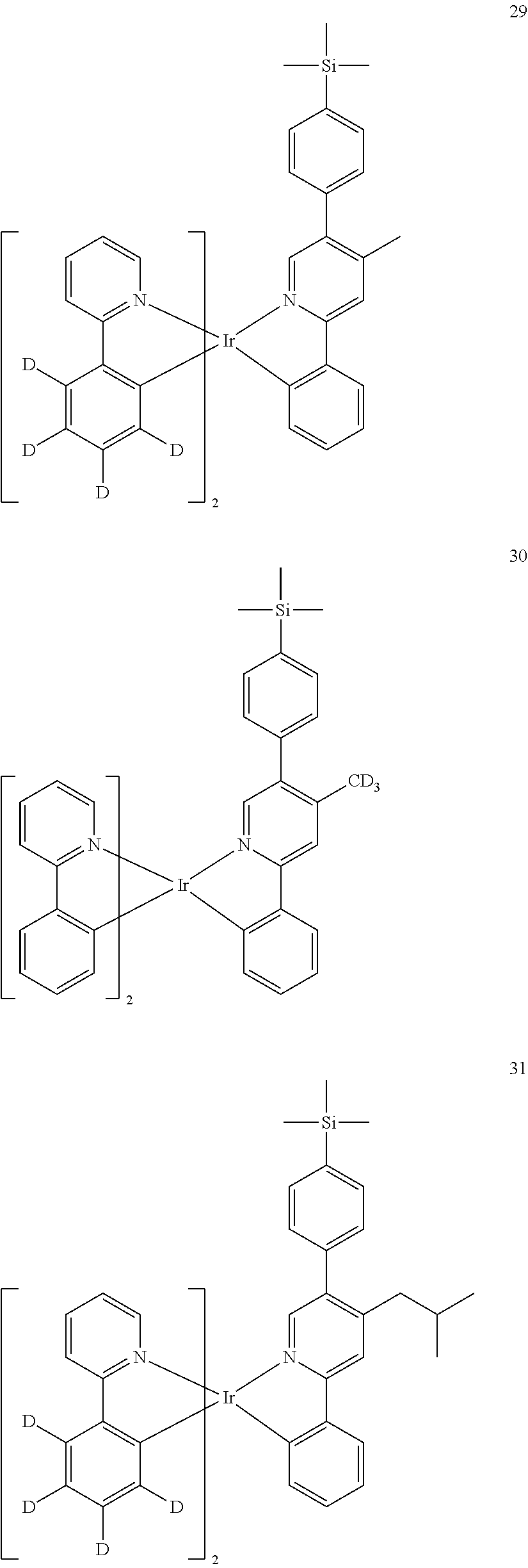
  • the organometallic compound represented by Formula 1 may be represented by one of Formulae 1 to 54 below:
  • R 1 to R 8 of Ligand A in Formula 1 may be each independently selected from a hydrogen, a deuterium, —CH 3 , —CDH 2 , —CD 2 H, and —CD 3 .
  • Ligand B in Formula 1 does not include other silyl groups than a “silyl group A.”
  • An organometallic compound represented by Formula 1 having two Ligands A and one Ligand B has excellent thermal stability and process stability. Accordingly, when the organometallic compound represented by Formula 1 is used, a high-quality organic light-emitting device may be manufactured in bulk quantities.
  • the highest occupied molecular orbital (HOMO), the lowest unoccupied molecular orbital (LUMO), and triplet (T 1 ) energy levels of Compounds 1 to 7 were evaluated by using a DFT method of Gaussian program (structurally optimized at a level of B3LYP, 6-31G(d,p)). The evaluation results are shown in Table 1 below.
  • the compound represented by Formula 1 has electric characteristics that are suitable for use as a material for manufacturing an electric device, for example, an organic light-emitting device.
  • Synthesis methods of the organometallic compounds represented by Formula 1 may be understood by one of ordinary skill in the art by referring to Synthesis Examples provided below.
  • organometallic compound represented by Formula 1 is suitable for use in an organic layer of an organic light-emitting device, for example, for use as a dopant in an emission layer of the organic layer.
  • an organic light-emitting device that includes:
  • organic layer that is disposed between the first electrode and the second electrode, wherein the organic layer includes an emission layer and at least one organometallic compound represented by Formula 1.
  • the organic light-emitting device may have, due to the inclusion of an organic layer including the organometallic compound represented by Formula 1, a low driving voltage, high efficiency, high luminance, and a long lifespan.
  • the organometallic compound of Formula 1 may be used between a pair of electrodes of an organic light-emitting device.
  • the organometallic compound represented by Formula 1 may be included in the emission layer.
  • the organometallic compound may act as a dopant, and the emission layer may further include a host (that is, an amount of the organometallic compound represented by Formula 1 is smaller than an amount of the host).
  • (an organic layer) includes at least one organometallic compounds may include an embodiment in which “(an organic layer) includes identical organometallic compounds of Formula 1 and an embodiment in which (an organic layer) includes two or more different organometallic compounds of Formula 1.
  • the organic layer may include, as the organometallic compound, only Compound 1.
  • Compound 1 may be included in an emission layer of the organic light-emitting device.
  • the organic layer may include, as the organometallic compound, Compound 1 and Compound 2.
  • Compound 1 and Compound 2 may be included in an identical layer (for example, Compound 1 and Compound 2 all may exist in an emission layer).
  • the first electrode may be an anode, which is a hole injection electrode
  • the second electrode may be a cathode, which is an electron injection electrode
  • the first electrode may be a cathode, which is an electron injection electrode
  • the second electrode may be an anode, which is a hole injection electrode.
  • the first electrode may be an anode
  • the second electrode may be a cathode
  • the organic layer includes:
  • a hole transport region that is disposed between the first electrode and the emission layer, wherein the hole transport region includes at least one selected from a hole injection layer, a hole transport layer, and an electron blocking layer, and
  • an electron transport region that is disposed between the emission layer and the second electrode, wherein the electron transport region includes at least one selected from a hole blocking layer, an electron transport layer, and an electron injection layer.
  • organic layer refers to a single layer and/or a plurality of layers disposed between the first electrode and the second electrode of an organic light-emitting device.
  • the “organic layer” may include, in addition to an organic compound, an organometallic complex including metal.
  • FIG. 1 is a schematic view of an organic light-emitting device 10 according to an embodiment.
  • the organic light-emitting device 10 includes a first electrode 11 , an organic layer 15 , and a second electrode 19 , which are sequentially stacked.
  • a substrate may be additionally disposed under the first electrode 11 or above the second electrode 19 .
  • the substrate any substrate that is used in general organic light-emitting devices may be used.
  • the substrate may be a glass substrate or transparent plastic substrate, each with excellent mechanical strength, thermal stability, transparency, surface smoothness, ease of handling, and water-resistance.
  • the first electrode 11 may be formed by depositing or sputtering a material for forming the first electrode on the substrate.
  • the first electrode 11 may be an anode.
  • the material for the first electrode 11 may be selected from materials with a high work function to readily provide holes.
  • the first electrode 11 may be a reflective electrode or a transmissive electrode.
  • the material for the first electrode may be, for example, indium tin oxide (ITO), indium zinc oxide (IZO), tin oxide (SnO 2 ), and zinc oxide (ZnO).
  • magnesium (Mg), aluminum (Al), aluminum-lithium (Al—Li), calcium (Ca), magnesium-indium (Mg—In), or magnesium-silver (Mg—Ag) may be used as the material for the first electrode.
  • the first electrode 11 may have a single-layer structure or a multi-layer structure including two or more layers.
  • the first electrode 11 may have a three-layered structure of ITO/Ag/ITO, but the structure of the first electrode 110 is not limited thereto.
  • An organic layer 15 is disposed on the first electrode 11 .
  • the organic layer 15 may include a hole transport region, an emission layer, and an electron transport region.
  • the hole transport region may be disposed between the first electrode 11 and the emission layer.
  • the hole transport region may include at least one selected from a hole injection layer, a hole transport layer, an electron blocking layer, and a buffer layer.
  • the hole transport region may include only either a hole injection layer or a hole transport layer.
  • the hole transport region may have a structure of hole injection layer/hole transport layer or hole injection layer/hole transport layer/electron blocking layer, which are sequentially stacked in this stated order from the first electrode 11 .
  • a hole injection layer hole injection layer may be formed on the first electrode 11 by using various methods, such as vacuum deposition, spin coating, casting, or Langmuir-Blodgett (LB).
  • various methods such as vacuum deposition, spin coating, casting, or Langmuir-Blodgett (LB).
  • the deposition conditions may vary depending on a material that is used to form the hole injection layer, and the structure and thermal characteristics of the hole injection layer.
  • the deposition conditions may include a deposition temperature of about 100 to about 500° C., a vacuum pressure of about 10 ⁇ 8 to about 10 ⁇ 3 torr, and a deposition rate of about 0.01 to about 100 Angstroms per second ( ⁇ /sec).
  • the deposition conditions are not limited thereto.
  • coating conditions may vary according to the material used to form the hole injection layer, and the structure and thermal properties of the hole injection layer.
  • a coating speed may be from about 2,000 revolutions per minute (rpm) to about 5,000 rpm
  • a temperature at which a heat treatment is performed to remove a solvent after coating may be from about 80° C. to about 200° C.
  • the coating conditions are not limited thereto.
  • Conditions for a hole transport layer and an electron blocking layer may be understood by referring to conditions for forming the hole injection layer.
  • the hole transport region may include at least one selected from m-MTDATA, TDATA, 2-TNATA, NPB, ⁇ -NPB, TPD, Spiro-TPD, Spiro-NPB, methylated NPB, TAPC, HMTPD, 4,4′,4′′-tris(N-carbazolyl)triphenylamine (TCTA), polyaniline/dodecylbenzenesulfonic acid (Pani/DBSA), poly(3,4-ethylenedioxythiophene)/poly(4-styrenesulfonate) (PEDOT/PSS), polyaniline/camphor sulfonic acid (PANI/CSA), (polyaniline)/poly(4-styrenesulfonate) (Pani/PSS), a compound represented by Formula 201 below, and a compound represented by Formula 202 below:
  • Ar 101 and Ar 102 in Formula 201 may be each independently selected from
  • xa and xb may be each independently an integer selected from 0 to 5, for example, an integer selected from 0, 1, and 2.
  • xa is 1 and xb is 0, but xa and xb are not limited thereto.
  • R 101 to R 108 , R 111 to R 119 and R 121 to R 124 in Formulae 201 and 202 may be each independently selected from
  • a C 1 -C 10 alkyl group or a C 1 -C 10 alkoxy group each substituted with at least one selected from a deuterium, —F, —Cl, —Br, —I, a hydroxyl group, a cyano group, a nitro group, an amino group, an amidino group, a hydrazine group, a hydrazone group, a carboxylic acid group or a salt thereof, a sulfonic acid group or a salt thereof, and a phosphoric acid group or a salt thereof;
  • a phenyl group a naphthyl group, an anthracenyl group, a fluorenyl group, and a pyrenyl group;
  • a phenyl group, a naphthyl group, an anthracenyl group, a fluorenyl group, and a pyrenyl group each substituted with at least one selected from deuterium, —F, —Cl, —Br, —I, a hydroxyl group, a cyano group, a nitro group, an amino group, an amidino group, a hydrazine group, a hydrazone group, a carboxylic acid group or a salt thereof, a sulfonic acid group or a salt thereof, a phosphoric acid group or a salt thereof, a C 1 -C 10 alkyl group, and a C 1 -C 10 alkoxy group, but they are not limited thereto.
  • R 109 in Formula 201 may be selected from
  • a phenyl group a naphthyl group, an anthracenyl group and a pyridinyl group
  • a phenyl group, a naphthyl group, an anthracenyl group and a pyridinyl group each substituted with at least one selected from a deuterium, —F, —Cl, —Br, —I, a hydroxyl group, a cyano group, a nitro group, an amino group, an amidino group, a hydrazine group, a hydrazone group, a carboxylic acid group or a salt thereof, a sulfonic acid group or a salt thereof, a phosphoric acid group or a salt thereof, a C 1 -C 20 alkyl group, a C 1 -C 20 alkoxy group, a phenyl group, a naphthyl group, an anthracenyl group, and a pyridinyl group.
  • the compound represented by Formula 201 may be represented by Formula 201A, but is not limited thereto:
  • R 101 , R 111 , R 112 , and R 109 in Formula 201A may be understood by referring to the description provided herein.
  • the compound represented by Formula 201 and the compound represented by Formula 202 may include compounds HT1 to HT20 illustrated below, but are not limited thereto.
  • a thickness of the hole transport region may be in a range of about 100 Angstroms ( ⁇ ) to about 10,000 ⁇ , for example, about 100 ⁇ to about 1,000 ⁇ .
  • the thickness of the hole injection layer may be in a range of about 100 ⁇ to about 10,000 ⁇ , for example, about 100 ⁇ to about 1,000 ⁇
  • the thickness of the hole transport layer may be in a range of about 50 ⁇ to about 2,000 ⁇ , and for example, about 100 ⁇ to about 1,500 ⁇ .
  • the hole transport region may further include, in addition to these materials, a charge-generation material for the improvement of conductive properties.
  • the charge-generation material may be homogeneously or non-homogeneously dispersed in the hole transport region.
  • the charge-generation material may be, for example, a p-dopant.
  • the p-dopant may be one selected from a quinone derivative, a metal oxide, and a cyano group-containing compound, but embodiments are not limited thereto.
  • Non-limiting examples of the p-dopant are a quinone derivative, such as tetracyanoquinonedimethane (TCNQ) or 2,3,5,6-tetrafluoro-tetracyano-1,4-benzoquinonedimethane (F4-TCNQ); a metal oxide, such as a tungsten oxide or a molybdenium oxide; and a cyano group-containing compound, such as Compound HT-D1 below, but are not limited thereto.
  • a quinone derivative such as tetracyanoquinonedimethane (TCNQ) or 2,3,5,6-tetrafluoro-tetracyano-1,4-benzoquinonedimethane (F4-TCNQ)
  • a metal oxide such as a tungsten oxide or a molybdenium oxide
  • a cyano group-containing compound such as Compound HT-D1 below, but are not limited thereto.
  • the hole transport region may include a buffer layer.
  • the buffer layer may compensate for an optical resonance distance depending on a wavelength of light emitted from the emission layer, thus improving the efficiency of a formed organic light-emitting device.
  • an emission layer may be formed on the hole transport region by vacuum deposition, spin coating, casting, LB deposition, or the like.
  • the deposition or coating conditions may be similar to those applied to form the hole injection layer. However, the deposition or coating conditions may vary according to the material that is used to form the emission layer.
  • a material for the electron blocking layer may be selected from materials for the hole transport region described above and materials for a host, that will be discussed later.
  • the material for the electron blocking layer is not limited thereto.
  • a material for the electron blocking layer may be mCP, which will also be discussed later.
  • the emission layer may include a host and a dopant, and the dopant may include the organometallic compound represented by Formula 1.
  • the host may include at least one selected form TPBi, TBADN, ADN (also referred to as “DNA”), CBP, CDBP, TCP, Mcp, Compound HSO, and Compound H51:
  • the host may further include a compound represented by Formula 301 below.
  • Ar 111 and Ar 112 in Formula 301 may be each independently selected from
  • a phenylene group a naphthylene group, a phenanthrenylene group, and a pyrenylene group
  • a phenylene group, a naphthylene group, a phenanthrenylene group, and a pyrenylene group each substituted with at least one selected from a phenyl group, a naphthyl group, and an anthracenyl group.
  • Ar 113 to Ar 116 in Formula 301 may be each independently selected from
  • a C 1 -C 10 alkyl group a phenyl group, a naphthyl group, a phenanthrenyl group, and a pyrenyl group;
  • a phenyl group, a naphthyl group, a phenanthrenyl group, and a pyrenyl group each substituted with at least one selected from a phenyl group, a naphthyl group, and an anthracenyl group.
  • g, h, I, and j in Formula 301 may be each independently an integer selected from 0 to 4, for example, an integer selected from 0, 1, and 2.
  • Ar 113 to Ar 116 in Formula 301 may be each independently selected from
  • a C 1 -C 10 alkyl group substituted with at least one selected from a phenyl group, a naphthyl group, and an anthracenyl group;
  • a phenyl group a naphthyl group, an anthracenyl group, a pyrenyl, a phenanthrenyl group, and a fluorenyl group;
  • the host may include a compound represented by Formula 302 below:
  • Ar 122 to Ar 125 in Formula 302 are the same as described in detail in connection with Ar 113 in Formula 301.
  • Ar 126 and Ar 127 in Formula 302 may be each independently a C 1 -C 10 alkyl group (for example, a methyl group, an ethyl group, or a propyl group).
  • k and l in Formula 302 may be each independently an integer selected from 0 to 4.
  • k and l may be 0, 1, or 2.
  • the compound represented by Formula 301 and the compound represented by Formula 302 may include Compounds H1 to H42 illustrated below, but are not limited thereto.
  • the emission layer may be patterned into a red emission layer, a green emission layer, and a blue emission layer.
  • the emission layer may emit white light.
  • an amount of the dopant may be in a range of about 0.01 to about 15 parts by weight based on 100 parts by weight of the host, but is not limited thereto.
  • a thickness of the emission layer may be in a range of about 100 ⁇ to about 1,000 ⁇ , for example, about 200 ⁇ to about 600 ⁇ . When the thickness of the emission layer is within this range, excellent light-emission characteristics may be obtained without a substantial increase in driving voltage.
  • an electron transport region may be disposed on the emission layer.
  • the electron transport region may include at least one selected from a hole blocking layer, an electron transport layer, and an electron injection layer.
  • the electron transport region may have a structure of hole blocking layer/electron transport layer/electron injection layer or a structure of electron transport layer/electron injection layer, but the structure of the electron transport region is not limited thereto.
  • the electron transport layer may have a single-layered structure or a multi-layer structure including two or more different materials.
  • Conditions for forming the hole blocking layer, the electron transport layer, and the electron injection layer, which constitute the electron transport region, may be understood by referring to the conditions for forming the hole injection layer.
  • the hole blocking layer may include, for example, at least one of BCP, Bphen, and Balq but is not limited thereto.
  • a thickness of the hole blocking layer may be in a range of about 20 ⁇ to about 1,000 ⁇ , for example, about 30 ⁇ to about 300 ⁇ . When the thickness of the hole blocking layer is within these ranges, the hole blocking layer may have improved hole blocking ability without a substantial increase in driving voltage.
  • the electron transport layer may further include at least one selected from BCP, Bphen, Alq 3 , Balq, TAZ, and NTAZ.
  • the electron transport layer may include at least one of ET1 and ET2, but are not limited thereto:
  • a thickness of the electron transport layer may be in a range of about 100 ⁇ to about 1,000 ⁇ , for example, about 150 ⁇ to about 500 ⁇ . When the thickness of the electron transport layer is within the range described above, the electron transport layer may have satisfactory electron transport characteristics without a substantial increase in driving voltage.
  • the electron transport layer may further include, in addition to the materials described above, a metal-containing material.
  • the metal-containing material may include a Li complex.
  • the Li complex may include, for example, Compound ET-D1 (lithium quinolate, LiQ) or ET-D2.
  • the electron transport region may include an electron injection layer (EIL) that allows electrons to be easily provided from a second electrode 19 .
  • EIL electron injection layer
  • the electron injection layer may include at least one selected from, LiF, NaCl, CsF, Li 2 O, BaO, and LiQ.
  • a thickness of the electron injection layer may be in a range of about 1 ⁇ to about 100 ⁇ , about 3 ⁇ to about 90 ⁇ . When the thickness of the electron injection layer is within the range described above, the electron injection layer may have satisfactory electron injection characteristics without a substantial increase in driving voltage.
  • the second electrode 19 is disposed on the organic layer 15 .
  • the second electrode 19 may be a cathode.
  • a material for forming the second electrode 19 may be selected from metal, an alloy, an electrically conductive compound, and a combination thereof, which have a relatively low work function.
  • lithium (Li), magnesium (Mg), aluminum (Al), aluminum-lithium (Al—Li), calcium (Ca), magnesium-indium (Mg—In), or magnesium-silver (Mg—Ag) may be formed as a material for forming the second electrode 19 .
  • a transmissive electrode formed using ITO or IZO may be used as the second electrode 19 .
  • the organic light-emitting device has been described with reference to FIG. 1 , but is not limited thereto.
  • a C 1 -C 60 alkyl group as used herein refers to a linear or branched aliphatic hydrocarbon monovalent group having 1 to 60 carbon atoms. Detailed examples thereof are a methyl group, an ethyl group, a propyl group, an isobutyl group, a sec-butyl group, a tert-butyl group, a pentyl group, an iso-amyl group, and a hexyl group.
  • a C 1 -C 60 alkylene group as used herein refers to a divalent group having the same structure as the C 1 -C 60 alkyl group.
  • a C 1 -C 60 alkoxy group as used herein refers to a monovalent group represented by —OA 101 (wherein A 101 is the C 1 -C 60 alkyl group). Detailed examples thereof are a methoxy group, an ethoxy group, and an isopropyloxy group.
  • a C 2 -C 60 alkenyl group as used herein refers to a hydrocarbon group having at least one carbon double bond in the middle or at the terminal of the C 2 -C 60 alkyl group. Detailed examples thereof are an ethenyl group, a propenyl group, and a butenyl group.
  • a C 2 -C 60 alkenylene group as used herein refers to a divalent group having the same structure as the C 2 -C 60 alkenyl group.
  • a C 2 -C 60 alkynyl group as used herein refers to a hydrocarbon group having at least one carbon trip bond in the middle or at the terminal of the C 2 -C 60 alkyl group. Detailed examples thereof are an ethynyl group, and a propynyl group.
  • a C 2 -C 60 alkynylene group as used herein refers to a divalent group having the same structure as the C 2 -C 60 alkynyl group.
  • a C 3 -C 10 cycloalkyl group as used herein refers to a monovalent hydrocarbon monocyclic group having 3 to 10 carbon atoms. Detailed examples thereof are a cyclopropyl group, a cyclobutyl group, a cyclopentyl group, a cyclohexyl group, and a cycloheptyl group.
  • a C 3 -C 10 cycloalkylene group as used herein refers to a divalent group having the same structure as the C 3 -C 10 cycloalkyl group.
  • a C 1 -C 10 heterocycloalkyl group as used herein refers to a monovalent monocyclic group having at least one hetero atom selected from N, O, P, and S as a ring-forming atom and 1 to 10 carbon atoms. Detailed examples thereof are a tetrahydrofuranyl group, and a tetrahydrothiophenyl group.
  • a C 1 -C 10 heterocycloalkylene group as used herein refers to a divalent group having the same structure as the C 1 -C 10 heterocycloalkyl group.
  • a C 3 -C 10 cycloalkenyl group as used herein refers to a monovalent monocyclic group that has 3 to 10 carbon atoms and at least one double bond in the ring thereof, and which is not aromatic. Detailed examples thereof are a cyclopentenyl group, a cyclohexenyl group, and a cycloheptenyl group.
  • a C 3 -C 10 cycloalkenylene group as used herein refers to a divalent group having the same structure as the C 3 -C 10 cycloalkenyl group.
  • a C 1 -C 10 heterocycloalkenyl group as used herein refers to a monovalent monocyclic group that has at least one hetero atom selected from N, O, P, and S as a ring-forming atom, 1 to 10 carbon atoms, and at least one double bond in its ring.
  • Detailed examples of the C 1 -C 10 heterocycloalkenyl group are a 2,3-dihydrofuranyl group and a 2,3-dihydrothiophenyl group.
  • a C 1 -C 10 heterocycloalkenylene group as used herein refers to a divalent group having the same structure as the C 1 -C 10 heterocycloalkenyl group.
  • a C 6 -C 60 aryl group as used herein refers to a monovalent group having a carbocyclic aromatic system having 6 to 60 carbon atoms
  • a C 6 -C 60 arylene group as used herein refers to a divalent group having a carbocyclic aromatic system having 6 to 60 carbon atoms.
  • the C 6 -C 60 aryl group are a phenyl group, a naphthyl group, an anthracenyl group, a phenanthrenyl group, a pyrenyl group, and a chrysenyl group.
  • the C 6 -C 60 aryl group and the C 6 -C 60 arylene group each include two or more rings, the rings may be fused to each other.
  • a C 1 -C 60 heteroaryl group as used herein refers to a monovalent group having a carbocyclic aromatic system that has at least one hetero atom selected from N, O, P, and S as a ring-forming atom, and 1 to 60 carbon atoms.
  • a C 1 -C 60 heteroarylene group as used herein refers to a divalent group having a carbocyclic aromatic system that has at least one hetero atom selected from N, O, P, and S as a ring-forming atom, and 1 to 60 carbon atoms.
  • Examples of the C 1 -C 60 heteroaryl group are a pyridinyl group, a pyrimidinyl group, a pyrazinyl group, a pyridazinyl group, a triazinyl group, a quinolinyl group, and an isoquinolinyl group.
  • the C 1 -C 60 heteroaryl group and the C 1 -C 60 heteroarylene group each include two or more rings, the rings may be fused to each other.
  • a C 6 -C 60 aryloxy group as used herein indicates —OA 102 (wherein A 102 is the C 6 -C 60 aryl group), and a C 6 -C 60 arylthio group as used herein indicates —SA 103 (wherein A 103 is the C 6 -C 60 aryl group).
  • a monovalent non-aromatic condensed polycyclic group as used herein refers to a monovalent group (for example, having 8 to 60 carbon atoms) that has two or more rings condensed to each other, only carbon atoms as a ring forming atom, and which is non-aromatic in the entire molecular structure.
  • a detailed example of the monovalent non-aromatic condensed polycyclic group is a fluorenyl group.
  • a divalent non-aromatic condensed polycyclic group as used herein refers to a divalent group having the same structure as the monovalent non-aromatic condensed polycyclic group.
  • a monovalent non-aromatic condensed heteropolycyclic group as used herein refers to a monovalent group (for example, having 2 to 60 carbon atoms) that has two or more rings condensed to each other, has a heteroatom selected from N, O, P, and S, other than carbon atoms, as a ring forming atom, and which is non-aromatic in the entire molecular structure.
  • An example of the monovalent non-aromatic condensed heteropolycyclic group is a carbazolyl group.
  • a divalent non-aromatic condensed heteropolycyclic group as used herein refers to a divalent group having the same structure as the monovalent non-aromatic condensed heteropolycyclic group.
  • 2,5-dibromopyridine (2.35 grams (g), 10 millimoles (mmol)), a phenylboronic acid (1.34 g, 11 mmol), palladium(0) acetate (Pd(OAc) 2 , (0.09 g, 0.4 mmol), triphenylphosphine (0.26 g, 1.0 mmol), and potassium carbonate (K 2 CO 3 , 3.4 g, 25 mmol) were placed into a two-neck flask. Acetonitrile (CH 3 CN, 80 milliliters (mL)) and methanol (40 mL) were added thereto, the resultant mixture was purged with nitrogen, and stirred at a temperature of 50° C. for 24 hours.
  • CH 3 CN Acetonitrile
  • methanol 40 mL
  • Compound 5 was synthesized in the same manner as in Synthesis Example 1, except that in synthesis of Intermediate (B), 2-(methyl)-4-(trimethylsilyl)phenylboronic acid was used instead of 4-(trimethylsilyl)phenylboronic acid.
  • Compound 3 was subjected to thermal analysis (N 2 atmosphere, temperature range: room temperature to 800° C. (10 degrees Centigrade per minute (° C./min))-TGA, room temperature to 450° C.-DSC, Pan Type: Pt Pan in disposable Al Pan (TGA), disposable Al pan (DSC)) using thermogravimetric analysis (TGA) and differential scanning calorimetry (DSC).
  • TGA thermogravimetric analysis
  • DSC differential scanning calorimetry
  • Evaluation Example 2 Evaluation on HOMO, LUMO, and T 1 Energy Levels
  • HOMO, LUMO and T 1 energy levels of Compound 3 were evaluated according to the method indicated in Table 3, and results thereof are shown in Table 4.
  • LUMO A potential (Volts, V)-current (Amperes, A) graph of energy each compound was obtained by using cyclic voltammetry level (CV) (electrolyte: 0.1M Bu 4 NClO 4 /solvent: evaluation CH 2 Cl 2 /electrode: 3 electrode system (working electrode: method GC, reference electrode: Ag/AgCl, auxiliary electrode: Pt)). Subsequently, from reduction onset of the graph, the LUMO energy level of the compound was calculated.
  • CV cyclic voltammetry level
  • T1 A mixture (each compound was dissolved in an amount of energy 1 milligram (mg) in 3 cubic centimeters (cc) of toluene) level of toluene and each compound was loaded into a quartz cell, evaluation and then, the resultant quartz cell was loaded into liquid method nitrogen (77 Kelvins (K)).
  • K liquid method nitrogen
  • a photoluminescence spectrum thereof was measured by using a device for measuring photoluminescence. The obtained spectrum was compared with a photoluminescence spectrum measured at room temperature, and peaks observed only at low temperature were analyzed to calculate T1 energy levels.
  • UV absorption spectrum and photoluminescence (PL) spectrum of Compound 3 were analyzed to evaluate luminance characteristics thereof.
  • Compound 3 was diluted in toluene to a concentration of 0.2 millimolar (mM), and then analyzed by Shimadzu UV-350 Spectrometer to obtain an UV absorption spectrum.
  • Compound 3 was diluted in toluene to a concentration of 10 mM, and then analyzed by Xenon-equipped ISC PC1 spectrofluorometer to obtain a PL spectrum. Results thereof are shown in Table 3.
  • Compound 3 has luminance characteristics that are suitable for use as a material for an organic light-emitting device.
  • Heat-resistant stability and process stability of Compound 3 were evaluated by analyzing purify levels before and after Compound 3 and Compound A were heat treated. First, Compound 3 and Compound A were heat treated under a nitrogen atmosphere (180° C., 100 hours), and a change in purity of Compound 3 and Compound A was measured by high performance liquid chromatography (HPLC). Results thereof are shown in FIG. 4 (Compound 3) and FIG. 5 (Compound A), and summarized in Table 5.
  • Compound 3 had heat-resistant stability. Accordingly, it was confirmed that Compound 3 had excellent process stability that minimizes the difference in characteristics of a device depending on a process time during a deposition process that is required in manufacturing an organic light-emitting device.
  • a glass substrate with ITO/Ag/ITO (70 ⁇ /1,000 ⁇ /70 ⁇ ) as an anode thereon was cut to a size of 50 millimeters (mm) ⁇ 50 mm ⁇ 0.5 mm, sonicated in isopropyl alcohol and pure water for about 5 minutes, and cleaned by irradiation of ultraviolet rays for 30 minutes and exposure to ozone.
  • the resultant structure was subsequently mounted on a vacuum deposition apparatus.
  • 2-TNATA was deposited on the anode to form a hole injection layer having a thickness of 60 nanometers (nm), and NPB was deposited on the hole injection layer to form a hole transport layer having a thickness of 100 nm.
  • CBP host
  • Compound 1 dopant
  • BCP was deposited on the emission layer to form a hole blocking layer having a thickness of 5 nm.
  • Alq 3 was deposited on the hole blocking layer to form an electron transport layer having a thickness of 35 nm.
  • LiF was deposited on the electron transport layer to form an electron injection layer having a thickness of 1 nm.
  • Mg and Ag were co-deposited on the electron injection layer at a weight ratio of 9:1 to form a cathode having a thickness of 12 nm, thereby completing manufacture of an organic light-emitting device (emission of green light).
  • An organic light-emitting device was manufactured in the same manner as in Example 1, except that in forming an emission layer, a dopant shown in Table 6 was used instead of Compound 1.
  • FIG. 7 shows a time-luminance (at 10 milliAmperes per square meter (mA/m 2 )) graph of the organic light-emitted device of Example 3.
  • the efficiency, luminance, and color coordinate of each of the organic light-emitting device were measured by using a luminance meter PR650 while power source was supplied thereto by a current-voltage meter (Kethley SMU 236).
  • a lifespan was obtained by measuring an amount of time that lapsed when luminance was reduced from 100% (initial luminance) to 97% at the current density of 10 milliAmperes per square centimeter (mA/cm 2 ).
  • the organic light-emitting devices manufactured according to Examples 1 to 5 have a lower driving voltage, higher efficiency, higher luminance, a longer lifespan, and a higher color purity than the organic light-emitting devices manufactured according to Comparative Example 1.
  • the organometallic compound according to embodiments has excellent electric characteristics and thermal stability. Accordingly, an organic light-emitting device including the organometallic compound may have a low driving voltage, high efficiency, and high color purity.

Landscapes

  • Chemical & Material Sciences (AREA)
  • Organic Chemistry (AREA)
  • Engineering & Computer Science (AREA)
  • Materials Engineering (AREA)
  • Crystallography & Structural Chemistry (AREA)
  • Inorganic Chemistry (AREA)
  • Physics & Mathematics (AREA)
  • Optics & Photonics (AREA)
  • Electroluminescent Light Sources (AREA)
  • Organic Low-Molecular-Weight Compounds And Preparation Thereof (AREA)

Abstract

An organometallic compound represented by Formula 1:
Figure US09758719-20170912-C00001
    • wherein in Formula 1, groups and variables are the same as described in the specification.

Description

CROSS-REFERENCE TO RELATED APPLICATION
This application claims priority to Korean Patent Application No. 10-2014-0158906, filed on Nov. 14, 2014, in the Korean Intellectual Property Office, and all the benefits accruing therefrom under 35 U.S.C. §119, the content of which is incorporated herein in its entirety by reference.
BACKGROUND
1. Field
One or more embodiments relate to an organometallic compound and an organic light-emitting device including the same.
2. Description of the Related Art
Organic light emitting devices (OLEDs) are self-emission devices that have wide viewing angles, high contrast ratios, and short response times. In addition, OLEDs exhibit excellent luminance, driving voltage, and response speed characteristics, and produce full-color images.
In an example, an organic light-emitting device includes an anode, a cathode, and an organic layer that is disposed between the anode and the cathode and includes an emission layer. A hole transport region may be disposed between the anode and the emission layer, and an electron transport region may be disposed between the emission layer and the cathode. Holes provided from the anode may move toward the emission layer through the hole transport region, and electrons provided from the cathode may move toward the emission layer through the electron transport region. The holes and the electrons are recombined in the emission layer to produce excitons. These excitons change from an excited state to a ground state, thereby generating light.
Various types of organic light emitting devices are known. However, there still remains a need in OLEDs having low driving voltage, high efficiency, high brightness, and long lifespan.
SUMMARY
One or more embodiments relate to a novel organometallic compound and an organic light-emitting device including the same.
Additional aspects will be set forth in part in the description which follows and, in part, will be apparent from the description, or may be learned by practice of the presented exemplary embodiments.
An aspect of exemplary embodiments provides an organometallic compound represented by Formula 1:
Figure US09758719-20170912-C00002
wherein in Formula 1,
CY1 may be selected from a C5-C60 carbocyclic group and a C1-C60 heterocyclic group,
Q1 to Q3 may be each independently selected from
a C1-C20 alkyl group and a phenyl group; and
a C1-C20 alkyl group and a phenyl group, each substituted with at least one selected from a deuterium, a C1-C10 alkyl group, and a phenyl group,
R1 to R8 may be each independently selected from a hydrogen, a deuterium, —CH3, —CDH2, —CD2H, and —CD3,
R11 to R14 may be each independently selected from
a hydrogen, a deuterium, a C1-C10 alkyl group, a C3-C10 cycloalkyl group, a C1-C10 heterocycloalkyl group, a C3-C10 cycloalkenyl group, a C1-C10 heterocycloalkenyl group, a phenyl group, and a naphthyl group; and
a C1-C10 alkyl group, a C3-C10 cycloalkyl group, a C1-C10 heterocycloalkyl group, a C3-C10 cycloalkenyl group, a C1-C10 heterocycloalkenyl group, a phenyl group, and a naphthyl group, each substituted with at least one selected from a deuterium, a C1-C10 alkyl group, a C3-C10 cycloalkyl group, a C1-C10 heterocycloalkyl group, a C3-C10 cycloalkenyl group, a C1-C10 heterocycloalkenyl group, a phenyl group, and a naphthyl group,
R21 may be selected from
a hydrogen, a deuterium, a hydroxyl group, a nitro group, an amino group, an amidino group, a hydrazine group, a hydrazone group, a carboxylic acid group or a salt thereof, a sulfonic acid group or a salt thereof, a phosphoric acid group or a salt thereof, a C1-C20 alkyl group, and a C1-C20 alkoxy group;
a C1-C20 alkyl group and a C1-C20 alkoxy group, each substituted with at least one selected from a deuterium, —F, —Cl, —Br, —I, —CD3, —CD2H, —CDH2, —CF3, —CF2H, —CFH2, a hydroxyl group, a cyano group, a nitro group, an amino group, an amidino group, a hydrazine group, a hydrazone group, a carboxylic acid group or a salt thereof, a sulfonic acid group or a salt thereof, a phosphoric acid group or a salt thereof, a C1-C10 alkyl group, a C1-C10 alkoxy group, a C3-C10 cycloalkyl group, a C1-C10 heterocycloalkyl group, a C3-C10 cycloalkenyl group, a C1-C10 heterocycloalkenyl group, a C6-C14 aryl group, a C1-C14 heteroaryl group, a monovalent non-aromatic condensed polycyclic group, and a monovalent non-aromatic condensed heteropolycyclic group;
a C3-C10 cycloalkyl group, a C1-C10 heterocycloalkyl group, a C3-C10 cycloalkenyl group, a C1-C10 heterocycloalkenyl group, a C6-C14 aryl group, a C1-C14 heteroaryl group, a monovalent non-aromatic condensed polycyclic group, and a monovalent non-aromatic condensed heteropolycyclic group;
a C3-C10 cycloalkyl group, a C1-C10 heterocycloalkyl group, a C3-C10 cycloalkenyl group, a C1-C10 heterocycloalkenyl group, a C6-C14 aryl group, a C1-C14 heteroaryl group, a monovalent non-aromatic condensed polycyclic group, and a monovalent non-aromatic condensed heteropolycyclic group, each substituted with at least one selected from a deuterium, —F, —Cl, —Br, —I, —CD3, —CD2H, —CDH2, —CF3, —CF2H, —CFH2, a hydroxyl group, a cyano group, a nitro group, an amino group, an amidino group, a hydrazine group, a hydrazone group, a carboxylic acid group or a salt thereof, a sulfonic acid group or a salt thereof, a phosphoric acid group or a salt thereof, a C1-C20 alkyl group, a C1-C20 alkoxy group, a C3-C10 cycloalkyl group, a C1-C10 heterocycloalkyl group, a C3-C10 cycloalkenyl group, a C1-C10 heterocycloalkenyl group, a C6-C14 aryl group, a C1-C14 heteroaryl group, a monovalent non-aromatic condensed polycyclic group, and a monovalent non-aromatic condensed heteropolycyclic group; and
—N(Q11)(Q12) and —P(═O)(Q13)(Q14),
a1 and b1 may be each independently an integer selected from 0 to 4, provided that when a1 is 2 or more, two or more groups R11 may be identical or different, and when b1 is 2 or more, 2 or more groups R21 may be identical or different, and
Q11 to Q14 may be each independently selected from a C1-C20 alkyl group, a C1-C20 alkoxy group, a C3-C10 cycloalkyl group, a C1-C10 heterocycloalkyl group, a C3-C10 cycloalkenyl group, a C1-C10 heterocycloalkenyl group and a C6-C14 aryl group; a C6-C14 aryl group substituted with at least one selected from a C1-C20 alkyl group and a C6-C14 aryl group; and a C1-C14 heteroaryl group, a monovalent non-aromatic condensed polycyclic group, and a monovalent non-aromatic condensed heteropolycyclic group.
Another aspect provides an organic light-emitting device including:
a first electrode;
a second electrode; and
an organic layer disposed between the first electrode and the second electrode, wherein the organic layer includes an emission layer and includes at least one organometallic compound represented by Formula 1.
The emission layer may include the organometallic compound represented by Formula 1, the organometallic compound represented by Formula 1 included in the emission layer may act as a dopant, and the emission layer may further include a host, wherein an amount of the organometallic compound represented by Formula 1 in the emission layer is smaller than an amount of the host.
BRIEF DESCRIPTION OF THE DRAWINGS
These and/or other aspects will become apparent and more readily appreciated from the following description of the exemplary embodiments, taken in conjunction with the accompanying drawings in which:
FIG. 1 is a schematic view of an organic light-emitting device according to an embodiment;
FIG. 2 is a graph of weight (percent, %) versus temperature (degree Centigrade, ° C.) showing thermogravimetric analysis (TGA) data of Compound 3;
FIG. 3 is a graph of intensity (arbitrary unit, a. u.) versus wavelength (nanometer, nm) showing an ultraviolet (UV)-absorption spectrum and a photoluminescent (PL) of Compound 3 in solution;
FIG. 4 is a graph of intensity (arbitrary unit, a. u.) versus time (minute, min) showing high performance liquid chromatography (HPLC) data of Compound 3 to explain a purity change after a heat treatment of Compound 3;
FIG. 5 is a graph of intensity (arbitrary unit, a. u.) versus time (minute, min) showing HPLC data of Compound A to explain a purity change after a heat treatment of Compound A;
FIG. 6 is a graph of electroluminescent (EL) intensity (arbitrary unit, a. u.) versus wavelength (nanometer, nm) showing an electroluminescent (EL) spectrum of organic light-emitting devices manufactured according to Examples 1, 3, 4, and 5; and
FIG. 7 is a graph of luminance (percent, %) versus time (hour, hr) showing lifetime data (at 10 milliAmperes per square centimeter (mA/cm2)) of the organic light-emitting device manufactured according to Example 3.
DETAILED DESCRIPTION
Reference will now be made in detail to exemplary embodiments, examples of which are illustrated in the accompanying drawings, wherein like reference numerals refer to like elements throughout. In this regard, the present exemplary embodiments may have different forms and should not be construed as being limited to the descriptions set forth herein. Accordingly, the exemplary embodiments are merely described below, by referring to the figures, to explain aspects. As used herein, the term “and/or” includes any and all combinations of one or more of the associated listed items. Expressions such as “at least one of,” when preceding a list of elements, modify the entire list of elements and do not modify the individual elements of the list.
It will be understood that when an element is referred to as being “on” another element, it can be directly in contact with the other element or intervening elements may be present therebetween. In contrast, when an element is referred to as being “directly on” another element, there are no intervening elements present.
It will be understood that, although the terms first, second, third etc. may be used herein to describe various elements, components, regions, layers, and/or sections, these elements, components, regions, layers, and/or sections should not be limited by these terms. These terms are only used to distinguish one element, component, region, layer, or section from another element, component, region, layer, or section. Thus, a first element, component, region, layer, or section discussed below could be termed a second element, component, region, layer, or section without departing from the teachings of the present embodiments.
The terminology used herein is for the purpose of describing particular embodiments only and is not intended to be limiting. As used herein, the singular forms “a,” “an,” and “the” are intended to include the plural forms as well, unless the context clearly indicates otherwise.
It will be further understood that the terms “comprises” and/or “comprising,” or “includes” and/or “including” when used in this specification, specify the presence of stated features, regions, integers, steps, operations, elements, and/or components, but do not preclude the presence or addition of one or more other features, regions, integers, steps, operations, elements, components, and/or groups thereof.
Spatially relative terms, such as “beneath,” “below,” “lower,” “above,” “upper” and the like, may be used herein for ease of description to describe one element or feature's relationship to another element(s) or feature(s) as illustrated in the figures. It will be understood that the spatially relative terms are intended to encompass different orientations of the device in use or operation in addition to the orientation depicted in the figures. For example, if the device in the figures is turned over, elements described as “below” or “beneath” other elements or features would then be oriented “above” the other elements or features. Thus, the exemplary term “below” can encompass both an orientation of above and below. The device may be otherwise oriented (rotated 90 degrees or at other orientations) and the spatially relative descriptors used herein interpreted accordingly.
“About” or “approximately” as used herein is inclusive of the stated value and means within an acceptable range of deviation for the particular value as determined by one of ordinary skill in the art, considering the measurement in question and the error associated with measurement of the particular quantity (i.e., the limitations of the measurement system). For example, “about” can mean within one or more standard deviations, or within ±30%, 20%, 10%, 5% of the stated value.
Unless otherwise defined, all terms (including technical and scientific terms) used herein have the same meaning as commonly understood by one of ordinary skill in the art to which this invention belongs. It will be further understood that terms, such as those defined in commonly used dictionaries, should be interpreted as having a meaning that is consistent with their meaning in the context of the relevant art and the present disclosure, and will not be interpreted in an idealized or overly formal sense unless expressly so defined herein.
Exemplary embodiments are described herein with reference to cross section illustrations that are schematic illustrations of idealized embodiments. As such, variations from the shapes of the illustrations as a result, for example, of manufacturing techniques and/or tolerances, are to be expected. Thus, embodiments described herein should not be construed as limited to the particular shapes of regions as illustrated herein but are to include deviations in shapes that result, for example, from manufacturing. For example, a region illustrated or described as flat may, typically, have rough and/or nonlinear features. Moreover, sharp angles that are illustrated may be rounded. Thus, the regions illustrated in the figures are schematic in nature and their shapes are not intended to illustrate the precise shape of a region and are not intended to limit the scope of the present claims.
An organometallic compound according to an embodiment is represented by Formula 1 below:
Figure US09758719-20170912-C00003
CY1 in Formula 1 may be selected from a C5-C60 carbocyclic group and a C1-C60 heterocyclic group.
For example, CY1 in Formula 1 may be selected from a benzene, a dibenzofuran, a dibenzothiophene, a fluorene, and a carbazole, but embodiments are not limited thereto.
Q1 to Q3 in Formula 1 may be each independently selected from
a C1-C20 alkyl group and a phenyl group; and
a C1-C20 alkyl group and a phenyl group, each substituted with at least one selected from a deuterium, a C1-C10 alkyl group, and a phenyl group.
For example, Q1 to Q3 in Formula 1 may be each independently selected from
a C1-C10 alkyl group and a phenyl group; and
a C1-C10 alkyl group and a phenyl group, each substituted with at least one selected from a deuterium and a C1-C10 alkyl group.
In some embodiments, Q1 to Q3 in Formula 1 may be each independently selected from
—CH3, —CD3, —CD2H, —CDH2, —CH2CH3, —CH2CD3, —CH2CD2H, —CH2CDH2, —CHDCH3, —CHDCD2H, —CHDCDH2, —CHDCD3, —CD2CD3, —CD2CD2H, and —CD2CDH2;
an n-propyl group, an isopropyl group, an n-butyl group, an isobutyl group, a sec-butyl group, a tert-butyl group, an n-pentyl group, an isopentyl group, a sec-pentyl group a tert-pentyl group, and a phenyl group; and
an n-propyl group, an isopropyl group, an n-butyl group, an isobutyl group, a sec-butyl group, a tert-butyl group, an n-pentyl group, an isopentyl group, a sec-pentyl group a tert-pentyl group, and a phenyl group, each substituted with at least one selected from a deuterium and a C1-C10 alkyl group, but embodiments are not limited thereto.
In some embodiments, Q1 to Q3 in Formula 1 may all be identical;
Q1 and Q3 may be identical and Q2 and Q1 may be different from each other; or
Q1 to Q3 may all be different from each other.
In some embodiments, Q1 to Q3 in Formula 1 may all be identical, and may be selected from
—CH3, —CD3, —CD2H, —CDH2, —CH2CH3, —CH2CD3, —CH2CD2H, —CH2CDH2, —CHDCH3, —CHDCD2H, —CHDCDH2, —CHDCD3, —CD2CD3, —CD2CD2H, and —CD2CDH2;
an n-propyl group, an isopropyl group, an n-butyl group, an isobutyl group, a sec-butyl group, a tert-butyl group, an n-pentyl group, an isopentyl group, a sec-pentyl group a tert-pentyl group, and a phenyl group; and
an n-propyl group, an isopropyl group, an n-butyl group, an isobutyl group, a sec-butyl group, a tert-butyl group, an n-pentyl group, an isopentyl group, a sec-pentyl group a tert-pentyl group, and a phenyl group, each substituted with at least one selected from a deuterium and a C1-C10 alkyl group, but they are not limited thereto.
In some embodiments, Q1 and Q3 in Formula 1 may be each independently selected from —CH3, —CD3, —CD2H, —CDH2, —CH2CH3, —CH2CD3, —CH2CD2H, —CH2CDH2, —CHDCH3, —CHDCD2H, —CHDCDH2, —CHDCD3, —CD2CD3, —CD2CD2H, and —CD2CDH2,
Q2 may be selected from
an n-propyl group, an isopropyl group, an n-butyl group, an isobutyl group, a sec-butyl group, a tert-butyl group, an n-pentyl group, an isopentyl group, a sec-pentyl group a tert-pentyl group, and a phenyl group; and
an n-propyl group, an isopropyl group, an n-butyl group, an isobutyl group, a sec-butyl group, a tert-butyl group, an n-pentyl group, an isopentyl group, a sec-pentyl group a tert-pentyl group, and a phenyl group, each substituted with at least one selected from a deuterium and a C1-C10 alkyl group, but embodiments are not limited thereto.
R1 to R8 in Formula 1 may be each independently selected from a hydrogen, a deuterium, —CH3, —CDH2, —CD2H, and —CD3.
For example, R1 to R8 in Formula 1 may be each independently selected from a hydrogen and a deuterium, but they are not limited thereto.
In some embodiments, in Formula 1,
R1 to R8 may all be a hydrogen;
R1, R2, and R4 to R8 may be a hydrogen and R3 may be selected from a deuterium, —CH3, —CDH2, —CD2H, and —CD3;
R1, R2, R4, R5, R6 and R8 may be a hydrogen, and R3 and R7 may be each independently selected from a deuterium, —CH3, —CDH2, —CD2H, and —CD3;
R1 to R4 may be a hydrogen, and R5 to R8 may be each independently selected from a deuterium, —CH3, —CDH2, —CD2H, and —CD3;
R1 to R5 may be a hydrogen, and R6 to R8 may be each independently selected from a deuterium, —CH3, —CDH2, —CD2H, and —CD3;
R1 to R4 and R8 may be a hydrogen, and R5 to R7 may be each independently selected from a deuterium, —CH3, —CDH2, —CD2H, and —CD3; or
R1 to R8 may be each independently selected from a deuterium, —CH3, —CDH2, —CD2H, and —CD3, but are not limited thereto.
R11 to R14 in Formula 1 may be each independently selected from
a hydrogen, a deuterium, a C1-C10 alkyl group, a C3-C10 cycloalkyl group, a C1-C10 heterocycloalkyl group, a C3-C10 cycloalkenyl group, a C1-C10 heterocycloalkenyl group, a phenyl group, and a naphthyl group; and
a C1-C10 alkyl group, a C3-C10 cycloalkyl group, a C1-C10 heterocycloalkyl group, a C3-C10 cycloalkenyl group, a C1-C10 heterocycloalkenyl group, a phenyl group, and a naphthyl group, each substituted with at least one selected from a deuterium, a C1-C10 alkyl group, a C3-C10 cycloalkyl group, a C1-C10 heterocycloalkyl group, a C3-C10 cycloalkenyl group, a C1-C10 heterocycloalkenyl group, a phenyl group, and a naphthyl group.
For example, R11 to R14 in Formula 1 may be each independently selected from
a hydrogen, a deuterium, a methyl group, an ethyl group, an n-propyl group, an isopropyl group, an n-butyl group, an isobutyl group, a sec-butyl group, a tert-butyl group, an n-pentyl group, an isopentyl group, a sec-pentyl group, a tert-pentyl group, an n-hexyl group, an isohexyl group, a sec-hexyl group, a tert-hexyl group, an n-heptyl group, an isoheptyl group, a sec-heptyl group, a tert-heptyl group, an n-octyl group, an isooctyl group, a sec-octyl group, a tert-octyl group, an n-nonyl group, an isononyl group, a sec-nonyl group, a tert-nonyl group, an n-decyl group, an isodecyl group, a sec-decyl group, a tert-decyl group, a cyclopentyl group, a cyclohexyl group, a cycloheptyl group, a cyclooctyl group, an adamantyl group, a norbornyl group, a cyclopentenyl group, a cyclohexenyl group, a cycloheptenyl group, a phenyl group, and a naphthyl group; and
a methyl group, an ethyl group, an n-propyl group, an isopropyl group, an n-butyl group, an isobutyl group, a sec-butyl group, a tert-butyl group, an n-pentyl group, an isopentyl group, a sec-pentyl group, a tert-pentyl group, an n-hexyl group, an isohexyl group, a sec-hexyl group, a tert-hexyl group, an n-heptyl group, an isoheptyl group, a sec-heptyl group, a tert-heptyl group, an n-octyl group, an isooctyl group, a sec-octyl group, a tert-octyl group, an n-nonyl group, an isononyl group, a sec-nonyl group, a tert-nonyl group, an n-decyl group, an isodecyl group, a sec-decyl group, a tert-decyl group, a cyclopentyl group, a cyclohexyl group, a cycloheptyl group, a cyclooctyl group, an adamantyl group, a norbornyl group, a cyclopentenyl group, a cyclohexenyl group, a cycloheptenyl group, a phenyl group, and a naphthyl group, each substituted with at least one selected from a deuterium, a C1-C10 alkyl group, a cyclopentyl group, a cyclohexyl group, a cycloheptyl group, a cyclooctyl group, an adamantyl group, a norbornyl group, a cyclopentenyl group, a cyclohexenyl group, a cycloheptenyl group, a phenyl group, and a naphthyl group.
In some embodiments, R11 to R14 in Formula 1 may be each independently selected from a hydrogen, a deuterium, —CH3, —CD3, —CD2H, —CDH2, a group represented by Formulae 9-1 to 9-17, and a group represented by Formulae 10-1 to 10-12, but embodiments are not limited thereto:
Figure US09758719-20170912-C00004
Figure US09758719-20170912-C00005
Figure US09758719-20170912-C00006
a1 in Formula 1 may be an integer selected from 0 to 4. When a1 is 2 or more, two or more groups R11 may be identical or different. For example, a1 in Formula 1 may be 0, 1, or 2.
R1 in Formula 21 may be selected from
a hydrogen, a deuterium, a hydroxyl group, a nitro group, an amino group, an amidino group, a hydrazine group, a hydrazone group, a carboxylic acid group or a salt thereof, a sulfonic acid group or a salt thereof, a phosphoric acid group or a salt thereof, a C1-C20 alkyl group, and a C1-C20 alkoxy group;
a C1-C20 alkyl group and a C1-C20 alkoxy group, each substituted with at least one selected from a deuterium, —F, —Cl, —Br, —I, —CD3, —CD2H, —CDH2, —CF3, —CF2H, —CFH2, a hydroxyl group, a cyano group, a nitro group, an amino group, an amidino group, a hydrazine group, a hydrazone group, a carboxylic acid group or a salt thereof, a sulfonic acid group or a salt thereof, a phosphoric acid group or a salt thereof, a C1-C10 alkyl group, a C1-C10 alkoxy group, a C3-C10 cycloalkyl group, a C1-C10 heterocycloalkyl group, a C3-C10 cycloalkenyl group, a C1-C10 heterocycloalkenyl group, a C6-C14 aryl group, a C1-C14 heteroaryl group, a monovalent non-aromatic condensed polycyclic group, and a monovalent non-aromatic condensed heteropolycyclic group;
a C3-C10 cycloalkyl group, a C1-C10 heterocycloalkyl group, a C3-C10 cycloalkenyl group, a C1-C10 heterocycloalkenyl group, a C6-C14 aryl group, a C1-C14 heteroaryl group, a monovalent non-aromatic condensed polycyclic group, and a monovalent non-aromatic condensed heteropolycyclic group;
a C3-C10 cycloalkyl group, a C1-C10 heterocycloalkyl group, a C3-C10 cycloalkenyl group, a C1-C10 heterocycloalkenyl group, a C6-C14 aryl group, a C1-C14 heteroaryl group, a monovalent non-aromatic condensed polycyclic group, and a monovalent non-aromatic condensed heteropolycyclic group, each substituted with at least one selected from a deuterium, —F, —Cl, —Br, —I, —CD3, —CD2H, —CDH2, —CF3, —CF2H, —CFH2, a hydroxyl group, a cyano group, a nitro group, an amino group, an amidino group, a hydrazine group, a hydrazone group, a carboxylic acid group or a salt thereof, a sulfonic acid group or a salt thereof, a phosphoric acid group or a salt thereof, a C1-C20 alkyl group, a C1-C20 alkoxy group, a C3-C10 cycloalkyl group, a C1-C10 heterocycloalkyl group, a C3-C10 cycloalkenyl group, a C1-C10 heterocycloalkenyl group, a C6-C14 aryl group, a C1-C14 heteroaryl group, a monovalent non-aromatic condensed polycyclic group, and a monovalent non-aromatic condensed heteropolycyclic group; and
—N(Q11)(Q12) and —P(═O)(Q13)(Q14),
wherein Q11 to Q14 are each independently selected from a C1-C20 alkyl group, a C1-C20 alkoxy group, a C3-C10 cycloalkyl group, a C1-C10 heterocycloalkyl group, a C3-C10 cycloalkenyl group, a C1-C10 heterocycloalkenyl group, and a C6-C14 aryl group; a C6-C14 aryl group substituted with at least one selected from a C1-C20 alkyl group and a C6-C14 aryl group; and a C1-C14 heteroaryl group, a monovalent non-aromatic condensed polycyclic group, and a monovalent non-aromatic condensed heteropolycyclic group.
In some embodiments, R21 in Formula 1 may be selected from
a hydrogen, a deuterium, a hydroxyl group, a cyano group, a nitro group, an amino group, an amidino group, a hydrazine group, a hydrazone group, a carboxylic acid group or a salt thereof, a sulfonic acid group or a salt thereof, a phosphoric acid group or a salt thereof, a C1-C20 alkyl group, and a C1-C20 alkoxy group;
a C1-C20 alkyl group and a C1-C20 alkoxy group, each substituted with at least one selected from a deuterium, —F, —Cl, —Br, —I, —CD3, —CD2H, —CDH2, —CF3, —CF2H, —CFH2, a hydroxyl group, a cyano group, a nitro group, an amino group, an amidino group, a hydrazine group, a hydrazone group, a carboxylic acid group or a salt thereof, a sulfonic acid group or a salt thereof, a phosphoric acid group or a salt thereof, a C1-C10 alkyl group, a cyclopentyl group, a cyclohexyl group, a cycloheptyl group, a cyclooctyl group, an adamantyl group, a norbornyl group, a cyclopentenyl group, a cyclohexenyl group, a cycloheptenyl group, a phenyl group, a naphthyl group, a pyridinyl group, and a pyrimidinyl group;
a cyclopentyl group, a cyclohexyl group, a cycloheptyl group, a cyclooctyl group, an adamantyl group, a norbornyl group, a cyclopentenyl group, a cyclohexenyl group, a cycloheptenyl group, a phenyl group, a naphthyl group, a fluorenyl group, a phenanthrenyl group, an anthracenyl group, a fluoranthenyl group, a triphenylenyl group, a pyrenyl group, a chrysenyl group, a pyrrolyl group, a thiophenyl group, a furanyl group, an imidazolyl group, a pyrazolyl group, a thiazolyl group, an isothiazolyl group, an oxazolyl group, an isoxazolyl group, a pyridinyl group, a pyrazinyl group, a pyrimidinyl group, a pyridazinyl group, an isoindolyl group, an indolyl group, an indazolyl group, a purinyl group, a quinolinyl group, an isoquinolinyl group, a benzoquinolinyl group, a quinoxalinyl group, a quinazolinyl group, a cinnolinyl group, a carbazolyl group, a phenanthrolinyl group, a benzoimidazolyl group, a benzofuranyl group, a benzothiophenyl group, an isobenzothiazolyl group, a benzoxazolyl group, an isobenzoxazolyl group, a triazolyl group, a tetrazolyl group, an oxadiazolyl group, a triazinyl group, a dibenzofuranyl group, a dibenzothiophenyl group, a benzocarbazolyl group, a dibenzocarbazolyl group, an imidazopyridinyl group, and an imidazopyrimidinyl group;
a cyclopentyl group, a cyclohexyl group, a cycloheptyl group, a cyclooctyl group, an adamantyl group, a norbornyl group, a cyclopentenyl group, a cyclohexenyl group, a cycloheptenyl group, a phenyl group, a naphthyl group, a fluorenyl group, a phenanthrenyl group, an anthracenyl group, a fluoranthenyl group, a triphenylenyl group, a pyrenyl group, a chrysenyl group, a pyrrolyl group, a thiophenyl group, a furanyl group, an imidazolyl group, a pyrazolyl group, a thiazolyl group, an isothiazolyl group, an oxazolyl group, an isoxazolyl group, a pyridinyl group, a pyrazinyl group, a pyrimidinyl group, a pyridazinyl group, an isoindolyl group, an indolyl group, an indazolyl group, a purinyl group, a quinolinyl group, an isoquinolinyl group, a benzoquinolinyl group, a quinoxalinyl group, a quinazolinyl group, a cinnolinyl group, a carbazolyl group, a phenanthrolinyl group, a benzoimidazolyl group, a benzofuranyl group, a benzothiophenyl group, an isobenzothiazolyl group, a benzoxazolyl group, an isobenzoxazolyl group, a triazolyl group, a tetrazolyl group, an oxadiazolyl group, a triazinyl group, a dibenzofuranyl group, a dibenzothiophenyl group, a benzocarbazolyl group, a dibenzocarbazolyl group, an imidazopyridinyl group, and an imidazopyrimidinyl group, each substituted with at least one selected from a deuterium, —F, —Cl, —Br, —I, —CD3, —CD2H, —CDH2, —CF3, —CF2H, —CFH2, a hydroxyl group, a cyano group, a nitro group, an amino group, an amidino group, a hydrazine group, a hydrazone group, a carboxylic acid group or a salt thereof, a sulfonic acid group or a salt thereof, a phosphoric acid group or a salt thereof, a C1-C20 alkyl group, a C1-C20 alkoxy group, a cyclopentyl group, a cyclohexyl group, a cycloheptyl group, a cyclooctyl group, an adamantyl group, a norbornyl group, a cyclopentenyl group, a cyclohexenyl group, a cycloheptenyl group, a phenyl group, a naphthyl group, a fluorenyl group, a phenanthrenyl group, an anthracenyl group, a fluoranthenyl group, a triphenylenyl group, a pyrenyl group, a chrysenyl group, a pyrrolyl group, a thiophenyl group, a furanyl group, an imidazolyl group, a pyrazolyl group, a thiazolyl group, an isothiazolyl group, an oxazolyl group, an isoxazolyl group, a pyridinyl group, a pyrazinyl group, a pyrimidinyl group, a pyridazinyl group, an isoindolyl group, an indolyl group, an indazolyl group, a purinyl group, a quinolinyl group, an isoquinolinyl group, a benzoquinolinyl group, a quinoxalinyl group, a quinazolinyl group, a cinnolinyl group, a carbazolyl group, a phenanthrolinyl group, a benzoimidazolyl group, a benzofuranyl group, a benzothiophenyl group, an isobenzothiazolyl group, a benzoxazolyl group, an isobenzoxazolyl group, a triazolyl group, a tetrazolyl group, an oxadiazolyl group, a triazinyl group, a dibenzofuranyl group, a dibenzothiophenyl group, a benzocarbazolyl group, a dibenzocarbazolyl group, an imidazopyridinyl group, and an imidazopyrimidinyl group; and
—B(Q11)(Q12) and —P(═O)(Q13)(Q14),
Q11 to Q14 may be each independently selected from
a C1-C20 alkyl group, a C1-C20 alkoxy group, a phenyl group, a naphthyl group, a pyridinyl group, a pyrimidinyl group, a triazinyl group, and a carbazolyl group; and
a phenyl group and a naphthyl group, each substituted with at least one selected from a C1-C20 alkyl group, a phenyl group, and a naphthyl group.
In some embodiments, R21 in Formula 1 may be selected from
a hydrogen, a deuterium, a cyano group, a nitro group, a methyl group, an ethyl group, an n-propyl group, an isopropyl group, an n-butyl group, an isobutyl group, a sec-butyl group, a tert-butyl group, an n-pentyl group, an isopentyl group, a sec-pentyl group, a tert-pentyl group, an n-hexyl group, an isohexyl group, a sec-hexyl group, a tert-hexyl group, an n-heptyl group, an isoheptyl group, a sec-heptyl group, a tert-heptyl group, an n-octyl group, an isooctyl group, a sec-octyl group, a tert-octyl group, an n-nonyl group, an isononyl group, a sec-nonyl group, a tert-nonyl group, an n-decyl group, an isodecyl group, a sec-decyl group, a tert-decyl group, a methoxy group, an ethoxy group, a propoxy group, a butoxy group, a pentoxy group, a cyclopentyl group, a cyclohexyl group, a cycloheptyl group, a cyclooctyl group, an adamantyl group, a norbornyl group, a cyclopentenyl group, a cyclohexenyl group, a cycloheptenyl group, a phenyl group, a naphthyl group, a pyridinyl group, a pyrimidinyl group, a carbazolyl group, a dibenzofuranyl group, and a dibenzothiophenyl group;
a methyl group, an ethyl group, an n-propyl group, an isopropyl group, an n-butyl group, an isobutyl group, a sec-butyl group, a tert-butyl group, an n-pentyl group, an isopentyl group, a sec-pentyl group, a tert-pentyl group, an n-hexyl group, an isohexyl group, a sec-hexyl group, a tert-hexyl group, an n-heptyl group, an isoheptyl group, a sec-heptyl group, a tert-heptyl group, an n-octyl group, an isooctyl group, a sec-octyl group, a tert-octyl group, an n-nonyl group, an isononyl group, a sec-nonyl group, a tert-nonyl group, an n-decyl group, an isodecyl group, a sec-decyl group, a tert-decyl group, a methoxy group, an ethoxy group, a propoxy group, a butoxy group, a pentoxy group, a cyclopentyl group, a cyclohexyl group, a cycloheptyl group, a cyclooctyl group, an adamantyl group, a norbornyl group, a cyclopentenyl group, a cyclohexenyl group, a cycloheptenyl group, a phenyl group, a naphthyl group, a pyridinyl group, a pyrimidinyl group, a carbazolyl group, a dibenzofuranyl group, and a dibenzothiophenyl group, each substituted with at least one selected from a deuterium, —F, —CD3, —CD2H, —CDH2, —CF3, —CF2H, —CFH2, a cyano group, a nitro group, a C1-C10 alkyl group, a C1-C10 alkoxy group, a cyclopentyl group, a cyclohexyl group, a cycloheptyl group, a cyclooctyl group, an adamantyl group, a norbornyl group, a cyclopentenyl group, a cyclohexenyl group, a cycloheptenyl group, a phenyl group, a naphthyl group, a pyridinyl group, and a pyrimidinyl group; and
—B(Q11)(Q12) and —P(═O)(Q13)(Q14),
Q11 to Q14 may be each independently selected from
a C1-C10 alkyl group, a C1-C10 alkoxy group, a phenyl group, and a naphthyl group; and
a phenyl group and a naphthyl group, each substituted with at least one selected from a C1-C20 alkyl group, a phenyl group, and a naphthyl group, but they are not limited thereto.
In some embodiments, R21 in Formula 1 may be selected from a hydrogen, a deuterium, a cyano group, a nitro group, —CH3, —CD3, —CD2H, —CDH2, —CF3, —CF2H, —CFH2, groups represented by Formulae 9-1 to 9-17, and a group represented by Formulae 10-1 to 10-30, but embodiments are not limited thereto:
Figure US09758719-20170912-C00007
Figure US09758719-20170912-C00008
Figure US09758719-20170912-C00009
Figure US09758719-20170912-C00010
b1 in Formula 1 may be an integer selected from 0 to 4. When b1 is 2 or more, two or more groups R21 may be identical or different.
In some embodiments, the organometallic compound represented by Formula 1 may be represented by one of Formulae 1-1 to 1-12:
Figure US09758719-20170912-C00011
Figure US09758719-20170912-C00012
Figure US09758719-20170912-C00013
Figure US09758719-20170912-C00014
In connection with Formulae 1-1 to 1-12, descriptions of CY1, Q1 to Q3, R1 to R8, R11 to R14, R21, and b1 are the same as described above, and descriptions of R11a and R11b are the same as those of R11. In this embodiment, however, R11, R11a, and R11b in Formulae 1-1 to 1-12 are not a hydrogen.
For example, in Formulae 1-1 and 1-12,
Q1 to Q3 may be each independently selected from
—CH3, —CD3, —CD2H, —CDH2, —CH2CH3, —CH2CD3, —CH2CD2H, —CH2CDH2, —CHDCH3, —CHDCD2H, —CHDCDH2, —CHDCD3, —CD2CD3, —CD2CD2H, and —CD2CDH2;
an n-propyl group, an isopropyl group, an n-butyl group, an isobutyl group, a sec-butyl group, a tert-butyl group, an n-pentyl group, an isopentyl group, a sec-pentyl group a tert-pentyl group, and a phenyl group; and
an n-propyl group, an isopropyl group, an n-butyl group, an isobutyl group, a sec-butyl group, a tert-butyl group, an n-pentyl group, an isopentyl group, a sec-pentyl group a tert-pentyl group, and a phenyl group, each substituted with at least one selected from a deuterium and a C1-C10 alkyl group,
R1 to R8 may all be a hydrogen;
R1, R2, and R4 to R8 may be a hydrogen, and R3 may be selected from a deuterium, —CH3, —CDH2, —CD2H, and —CD3;
R1, R2, R4, R5, R6 and R8 may be a hydrogen, and R3 and R7 may be each independently selected from a deuterium, —CH3, —CDH2, —CD2H, and —CD3;
R1 to R4 may be a hydrogen, and R5 to R8 may be each independently selected from a deuterium, —CH3, —CDH2, —CD2H, and —CD3;
R1 to R5 may be a hydrogen, and R6 to R8 may be each independently selected from a deuterium, —CH3, —CDH2, —CD2H, and —CD3;
R1 to R4 and R8 may be a hydrogen, and R5 to R7 may be each independently selected from a deuterium, —CH3, —CDH2, —CD2H, and —CD3; or
R1 to R8 may be each independently selected from a hydrogen, a deuterium, —CH3, —CDH2, —CD2H, and —CD3,
R11, R11a, R11b, R12, R13 and R14 may be each independently selected from a hydrogen, a deuterium, —CH3, —CD3, —CD2H, —CDH2, groups represented by Formulae 9-1 to 9-17, and a group represented by Formulae 10-1 to 10-12 (provided that R11, R11a and R11b are not a hydrogen), and
R21 may be selected from a hydrogen, a deuterium, a cyano group, a nitro group, —CH3, —CD3, —CD2H, —CDH2, —CF3, —CF2H, —CFH2, groups represented by Formulae 9-1 to 9-17, and groups represented by Formulae 10-1 to 10-30.
In some embodiments, the organometallic compound represented by Formula 1 may be represented by one of Formulae 1(1) to 1(12):
Figure US09758719-20170912-C00015
Figure US09758719-20170912-C00016
Figure US09758719-20170912-C00017
Figure US09758719-20170912-C00018
In connection with Formulae 1(1) to 1(12), descriptions of Q1 to Q3, R1 to R8, R11, a1, R13 and R21 are the same as described above, X1 may be N(R21), O, or S, and descriptions of R22 to R24 are the same as those of R21, provided that R13 and R21 to R24 in Formulae 1(1) to 1(12) are not be a hydrogen.
For example, in Formulae 1(1) and 1(12),
Q1 to Q3 may be each independently selected from
—CH3, —CD3, —CD2H, —CDH2, —CH2CH3, —CH2CD3, —CH2CD2H, —CH2CDH2, —CHDCH3, —CHDCD2H, —CHDCDH2, —CHDCD3, —CD2CD3, —CD2CD2H, and —CD2CDH2;
an n-propyl group, an isopropyl group, an n-butyl group, an isobutyl group, a sec-butyl group, a tert-butyl group, an n-pentyl group, an isopentyl group, a sec-pentyl group a tert-pentyl group, and a phenyl group; and
an n-propyl group, an isopropyl group, an n-butyl group, an isobutyl group, a sec-butyl group, a tert-butyl group, an n-pentyl group, an isopentyl group, a sec-pentyl group a tert-pentyl group, and a phenyl group, each substituted with at least one selected from a deuterium and a C1-C10 alkyl group,
R1 to R8 may all be a hydrogen;
R1, R2, and R4 to R8 may be a hydrogen, and R3 may be selected from a deuterium, —CH3, —CDH2, —CD2H, and —CD3;
R1, R2, R4, R5, R6 and R8 may be a hydrogen, and R3 and R7 may be each independently selected from a deuterium, —CH3, —CDH2, —CD2H, and —CD3;
R1 to R4 may be a hydrogen, and R5 to R8 may be each independently selected from a deuterium, —CH3, —CDH2, —CD2H, and —CD3;
R1 to R5 may be a hydrogen, and R6 to R8 may be each independently selected from a deuterium, —CH3, —CDH2, —CD2H, and —CD3;
R1 to R4 and R8 may be a hydrogen, and R5 to R7 may be each independently selected from a deuterium, —CH3, —CDH2, —CD2H, and —CD3; or
R1 to R8 may be each independently selected from a deuterium, —CH3, —CDH2, —CD2H, and —CD3,
R11 and R13 may be each independently selected from a hydrogen, a deuterium, —CH3, —CD3, —CD2H, —CDH2, a group represented by Formulae 9-1 to 9-17, and a group represented by Formulae 10-1 to 10-12 (provided that R13 is not a hydrogen),
R21 to R24 may be each independently selected from a deuterium, a cyano group, a nitro group, —CH3, —CD3, —CD2H, —CDH2, —CF3, —CF2H, —CFH2, groups represented by Formulae 9-1 to 9-17, and groups represented by Formulae 10-1 to 10-30, and
a1 may be 0, 1, or 2.
In some embodiments, the organometallic compound represented by Formula 2 may be represented by one of Formulae 2-1 to 2-72:
Figure US09758719-20170912-C00019
Figure US09758719-20170912-C00020
Figure US09758719-20170912-C00021
Figure US09758719-20170912-C00022
Figure US09758719-20170912-C00023
Figure US09758719-20170912-C00024
Figure US09758719-20170912-C00025
Figure US09758719-20170912-C00026
Figure US09758719-20170912-C00027
Figure US09758719-20170912-C00028
Figure US09758719-20170912-C00029
Figure US09758719-20170912-C00030
Figure US09758719-20170912-C00031
Figure US09758719-20170912-C00032
Figure US09758719-20170912-C00033
Figure US09758719-20170912-C00034
Figure US09758719-20170912-C00035
Figure US09758719-20170912-C00036
Figure US09758719-20170912-C00037
Figure US09758719-20170912-C00038
Figure US09758719-20170912-C00039
Figure US09758719-20170912-C00040
Figure US09758719-20170912-C00041
Figure US09758719-20170912-C00042
In connection with Formulae 2-1 to 2-72, descriptions of Q1 to Q3, R1 to R8, R11, R13, and R21 are the same as described above, X1 may be N(R21), O, or S, descriptions of R11a and R11b are the same as descriptions of R11, and descriptions of R22 to R24 are the same as descriptions of R21. In this embodiment, however, R11, R11a, R11b, R13 and R21 to R24 in Formulae 2-1 to 2-72 are not a hydrogen.
For example, in Formulae 2-1 and 2-72,
Q1 to Q3 may be each independently selected from
—CH3, —CD3, —CD2H, —CDH2, —CH2CH3, —CH2CD3, —CH2CD2H, —CH2CDH2, —CHDCH3, —CHDCD2H, —CHDCDH2, —CHDCD3, —CD2CD3, —CD2CD2H, and —CD2CDH2;
an n-propyl group, an isopropyl group, an n-butyl group, an isobutyl group, a sec-butyl group, a tert-butyl group, an n-pentyl group, an isopentyl group, a sec-pentyl group a tert-pentyl group, and a phenyl group; and
an n-propyl group, an isopropyl group, an n-butyl group, an isobutyl group, a sec-butyl group, a tert-butyl group, an n-pentyl group, an isopentyl group, a sec-pentyl group a tert-pentyl group, and a phenyl group, each substituted with at least one selected from a deuterium and a C1-C10 alkyl group,
R1 to R8 may all be a hydrogen;
R1, R2, and R4 to R8 may be a hydrogen, and R3 may be selected from a deuterium, —CH3, —CDH2, —CD2H, and —CD3;
R1, R2, R4, R5, R6 and R8 may be a hydrogen, and R3 and R7 may be each independently selected from a deuterium, —CH3, —CDH2, —CD2H, and —CD3;
R1 to R4 may be a hydrogen, and R5 to R8 may be each independently selected from a deuterium, —CH3, —CDH2, —CD2H, and —CD3;
R1 to R5 may be a hydrogen, and R6 to R8 may be each independently selected from a deuterium, —CH3, —CDH2, —CD2H, and —CD3;
R1 to R4 and R8 may be a hydrogen, and R5 to R7 may be each independently selected from a deuterium, —CH3, —CDH2, —CD2H, and —CD3; or
R1 to R8 may be each independently selected from a deuterium, —CH3, —CDH2, —CD2H, and —CD3,
R11, R11a, R11b, and R13 may be each independently selected from a deuterium, —CH3, —CD3, —CD2H, —CDH2, a group represented by Formulae 9-1 to 9-17, and a group represented by Formulae 10-1 to 10-12,
R21 to R24 may be each independently selected from a deuterium, a cyano group, a nitro group, —CH3, —CD3, —CD2H, —CDH2, —CF3, —CF2H, —CFH2, a group represented by Formulae 9-1 to 9-17, and a group represented by Formulae 10-1 to 10-30.
In some embodiments, the organometallic compound represented by Formula 1 may be represented by one of Formulae 1 to 54 below:
Figure US09758719-20170912-C00043
Figure US09758719-20170912-C00044
Figure US09758719-20170912-C00045
Figure US09758719-20170912-C00046
Figure US09758719-20170912-C00047
Figure US09758719-20170912-C00048
Figure US09758719-20170912-C00049
Figure US09758719-20170912-C00050
Figure US09758719-20170912-C00051
Figure US09758719-20170912-C00052
Figure US09758719-20170912-C00053
Figure US09758719-20170912-C00054
Figure US09758719-20170912-C00055
Figure US09758719-20170912-C00056
Figure US09758719-20170912-C00057
Figure US09758719-20170912-C00058
Figure US09758719-20170912-C00059
Figure US09758719-20170912-C00060
Figure US09758719-20170912-C00061
R1 to R8 of Ligand A in Formula 1 may be each independently selected from a hydrogen, a deuterium, —CH3, —CDH2, —CD2H, and —CD3. Ligand B in Formula 1 does not include other silyl groups than a “silyl group A.” An organometallic compound represented by Formula 1 having two Ligands A and one Ligand B has excellent thermal stability and process stability. Accordingly, when the organometallic compound represented by Formula 1 is used, a high-quality organic light-emitting device may be manufactured in bulk quantities.
In an example, the highest occupied molecular orbital (HOMO), the lowest unoccupied molecular orbital (LUMO), and triplet (T1) energy levels of Compounds 1 to 7 were evaluated by using a DFT method of Gaussian program (structurally optimized at a level of B3LYP, 6-31G(d,p)). The evaluation results are shown in Table 1 below.
TABLE 1
T1
Compound HOMO LUMO energy level
No. (eV) (eV) (eV)
1 −4.852 −1.404 2.486
2 −4.847 −1.353 2.506
3 −4.811 −1.278 2.571
4 −4.806 −1.191 2.628
5 −4.846 −1.309 2.552
6 −4.840 −1.267 2.571
7 −4.814 −1.171 2.630
From Table 1, it is confirmed that the compound represented by Formula 1 has electric characteristics that are suitable for use as a material for manufacturing an electric device, for example, an organic light-emitting device.
Synthesis methods of the organometallic compounds represented by Formula 1 may be understood by one of ordinary skill in the art by referring to Synthesis Examples provided below.
The organometallic compound represented by Formula 1 is suitable for use in an organic layer of an organic light-emitting device, for example, for use as a dopant in an emission layer of the organic layer. Thus, another aspect provides an organic light-emitting device that includes:
a first electrode;
a second electrode; and
an organic layer that is disposed between the first electrode and the second electrode, wherein the organic layer includes an emission layer and at least one organometallic compound represented by Formula 1.
The organic light-emitting device may have, due to the inclusion of an organic layer including the organometallic compound represented by Formula 1, a low driving voltage, high efficiency, high luminance, and a long lifespan.
The organometallic compound of Formula 1 may be used between a pair of electrodes of an organic light-emitting device. For example, the organometallic compound represented by Formula 1 may be included in the emission layer. In this regard, the organometallic compound may act as a dopant, and the emission layer may further include a host (that is, an amount of the organometallic compound represented by Formula 1 is smaller than an amount of the host).
The expression “(an organic layer) includes at least one organometallic compounds” as used herein may include an embodiment in which “(an organic layer) includes identical organometallic compounds of Formula 1 and an embodiment in which (an organic layer) includes two or more different organometallic compounds of Formula 1.
For example, the organic layer may include, as the organometallic compound, only Compound 1. In this regard, Compound 1 may be included in an emission layer of the organic light-emitting device. In some embodiments, the organic layer may include, as the organometallic compound, Compound 1 and Compound 2. In this regard, Compound 1 and Compound 2 may be included in an identical layer (for example, Compound 1 and Compound 2 all may exist in an emission layer).
The first electrode may be an anode, which is a hole injection electrode, and the second electrode may be a cathode, which is an electron injection electrode; or the first electrode may be a cathode, which is an electron injection electrode, or the second electrode may be an anode, which is a hole injection electrode.
For example, the first electrode may be an anode, and the second electrode may be a cathode, and the organic layer includes:
i) a hole transport region that is disposed between the first electrode and the emission layer, wherein the hole transport region includes at least one selected from a hole injection layer, a hole transport layer, and an electron blocking layer, and
ii) an electron transport region that is disposed between the emission layer and the second electrode, wherein the electron transport region includes at least one selected from a hole blocking layer, an electron transport layer, and an electron injection layer.
The term “organic layer” as used herein refers to a single layer and/or a plurality of layers disposed between the first electrode and the second electrode of an organic light-emitting device. The “organic layer” may include, in addition to an organic compound, an organometallic complex including metal.
FIG. 1 is a schematic view of an organic light-emitting device 10 according to an embodiment. Hereinafter, the structure of an organic light-emitting device according to an embodiment and a method of manufacturing an organic light-emitting device according to an embodiment will be described in connection with FIG. 1. The organic light-emitting device 10 includes a first electrode 11, an organic layer 15, and a second electrode 19, which are sequentially stacked.
In FIG. 1, a substrate may be additionally disposed under the first electrode 11 or above the second electrode 19. As the substrate, any substrate that is used in general organic light-emitting devices may be used. The substrate may be a glass substrate or transparent plastic substrate, each with excellent mechanical strength, thermal stability, transparency, surface smoothness, ease of handling, and water-resistance.
The first electrode 11 may be formed by depositing or sputtering a material for forming the first electrode on the substrate. The first electrode 11 may be an anode. The material for the first electrode 11 may be selected from materials with a high work function to readily provide holes. The first electrode 11 may be a reflective electrode or a transmissive electrode. The material for the first electrode may be, for example, indium tin oxide (ITO), indium zinc oxide (IZO), tin oxide (SnO2), and zinc oxide (ZnO). In some embodiments, magnesium (Mg), aluminum (Al), aluminum-lithium (Al—Li), calcium (Ca), magnesium-indium (Mg—In), or magnesium-silver (Mg—Ag) may be used as the material for the first electrode.
The first electrode 11 may have a single-layer structure or a multi-layer structure including two or more layers. For example, the first electrode 11 may have a three-layered structure of ITO/Ag/ITO, but the structure of the first electrode 110 is not limited thereto.
An organic layer 15 is disposed on the first electrode 11.
The organic layer 15 may include a hole transport region, an emission layer, and an electron transport region.
The hole transport region may be disposed between the first electrode 11 and the emission layer.
The hole transport region may include at least one selected from a hole injection layer, a hole transport layer, an electron blocking layer, and a buffer layer.
The hole transport region may include only either a hole injection layer or a hole transport layer. In some embodiments, the hole transport region may have a structure of hole injection layer/hole transport layer or hole injection layer/hole transport layer/electron blocking layer, which are sequentially stacked in this stated order from the first electrode 11.
A hole injection layer hole injection layer may be formed on the first electrode 11 by using various methods, such as vacuum deposition, spin coating, casting, or Langmuir-Blodgett (LB).
When a hole injection layer is formed by vacuum deposition, the deposition conditions may vary depending on a material that is used to form the hole injection layer, and the structure and thermal characteristics of the hole injection layer. For example, the deposition conditions may include a deposition temperature of about 100 to about 500° C., a vacuum pressure of about 10−8 to about 10−3 torr, and a deposition rate of about 0.01 to about 100 Angstroms per second (Å/sec). However, the deposition conditions are not limited thereto.
When the hole injection layer is formed using spin coating, coating conditions may vary according to the material used to form the hole injection layer, and the structure and thermal properties of the hole injection layer. For example, a coating speed may be from about 2,000 revolutions per minute (rpm) to about 5,000 rpm, and a temperature at which a heat treatment is performed to remove a solvent after coating may be from about 80° C. to about 200° C. However, the coating conditions are not limited thereto.
Conditions for a hole transport layer and an electron blocking layer may be understood by referring to conditions for forming the hole injection layer.
The hole transport region may include at least one selected from m-MTDATA, TDATA, 2-TNATA, NPB, β-NPB, TPD, Spiro-TPD, Spiro-NPB, methylated NPB, TAPC, HMTPD, 4,4′,4″-tris(N-carbazolyl)triphenylamine (TCTA), polyaniline/dodecylbenzenesulfonic acid (Pani/DBSA), poly(3,4-ethylenedioxythiophene)/poly(4-styrenesulfonate) (PEDOT/PSS), polyaniline/camphor sulfonic acid (PANI/CSA), (polyaniline)/poly(4-styrenesulfonate) (Pani/PSS), a compound represented by Formula 201 below, and a compound represented by Formula 202 below:
Figure US09758719-20170912-C00062
Figure US09758719-20170912-C00063
Figure US09758719-20170912-C00064
Figure US09758719-20170912-C00065
Ar101 and Ar102 in Formula 201 may be each independently selected from
a phenylene group, a pentalenylene group, an indenylene group, a naphthylene group, an azulenylene group, a heptalenylene group, an acenaphthylene group, a fluorenylene group, a phenalenylene group, a phenanthrenylene group, an anthracenylene group, a fluoranthenylene group, a triphenylenylene group, a pyrenylene group, a chrysenylenylene group, a naphthacenylene group, a picenylene group, a perylenylene group, and a pentacenylene group; and
a phenylene group, a pentalenylene group, an indenylene group, a naphthylene group, an azulenylene group, a heptalenylene group, an acenaphthylene group, a fluorenylene group, a phenalenylene group, a phenanthrenylene group, an anthracenylene group, a fluoranthenylene group, a triphenylenylene group, a pyrenylene group, a chrysenylenylene group, a naphthacenylene group, a picenylene group, a perylenylene group, and a pentacenylene group, each substituted with at least one selected from a deuterium, —F, —Cl, —Br, —I, a hydroxyl group, a cyano group, a nitro group, an amino group, an amidino group, a hydrazine group, a hydrazone group, a carboxylic acid group or a salt thereof, a sulfonic acid group or a salt thereof, a phosphoric acid group or a salt thereof, a C1-C60 alkyl group, a C2-C60 alkenyl group, a C2-C60 alkynyl group, a C1-C60 alkoxy group, a C3-C10 cycloalkyl group, a C3-C10 cycloalkenyl group, a C1-C10 heterocycloalkyl group, a C1-C10 heterocycloalkenyl group, a C6-C60 aryl group, a C6-C60 aryloxy group, a C6-C60 arylthio group, a C1-C60 heteroaryl group, a monovalent non-aromatic condensed polycyclic group, and a monovalent non-aromatic condensed heteropolycyclic group.
In Formula 201, xa and xb may be each independently an integer selected from 0 to 5, for example, an integer selected from 0, 1, and 2. For example, xa is 1 and xb is 0, but xa and xb are not limited thereto.
R101 to R108, R111 to R119 and R121 to R124 in Formulae 201 and 202 may be each independently selected from
a hydrogen, a deuterium, —F, —Cl, —Br, —I, a hydroxyl group, a cyano group, a nitro group, an amino group, an amidino group, a hydrazine group, a hydrazone group, a carboxylic acid group or a salt thereof, a sulfonic acid group or a salt thereof, a phosphoric acid group or a salt thereof, a C1-C10 alkyl group (for example, a methyl group, an ethyl group, a propyl group, a butyl group, a pentyl group, a hexyl group, and so on), and a C1-C10 alkoxy group (for example, a methoxy group, an ethoxy group, a propoxy group, a butoxy group, a pentoxy group, and so on);
a C1-C10 alkyl group or a C1-C10 alkoxy group, each substituted with at least one selected from a deuterium, —F, —Cl, —Br, —I, a hydroxyl group, a cyano group, a nitro group, an amino group, an amidino group, a hydrazine group, a hydrazone group, a carboxylic acid group or a salt thereof, a sulfonic acid group or a salt thereof, and a phosphoric acid group or a salt thereof;
a phenyl group, a naphthyl group, an anthracenyl group, a fluorenyl group, and a pyrenyl group; and
a phenyl group, a naphthyl group, an anthracenyl group, a fluorenyl group, and a pyrenyl group, each substituted with at least one selected from deuterium, —F, —Cl, —Br, —I, a hydroxyl group, a cyano group, a nitro group, an amino group, an amidino group, a hydrazine group, a hydrazone group, a carboxylic acid group or a salt thereof, a sulfonic acid group or a salt thereof, a phosphoric acid group or a salt thereof, a C1-C10 alkyl group, and a C1-C10 alkoxy group, but they are not limited thereto.
R109 in Formula 201 may be selected from
a phenyl group, a naphthyl group, an anthracenyl group and a pyridinyl group; and
a phenyl group, a naphthyl group, an anthracenyl group and a pyridinyl group, each substituted with at least one selected from a deuterium, —F, —Cl, —Br, —I, a hydroxyl group, a cyano group, a nitro group, an amino group, an amidino group, a hydrazine group, a hydrazone group, a carboxylic acid group or a salt thereof, a sulfonic acid group or a salt thereof, a phosphoric acid group or a salt thereof, a C1-C20 alkyl group, a C1-C20 alkoxy group, a phenyl group, a naphthyl group, an anthracenyl group, and a pyridinyl group.
According to an embodiment, the compound represented by Formula 201 may be represented by Formula 201A, but is not limited thereto:
Figure US09758719-20170912-C00066
R101, R111, R112, and R109 in Formula 201A may be understood by referring to the description provided herein.
For example, the compound represented by Formula 201, and the compound represented by Formula 202 may include compounds HT1 to HT20 illustrated below, but are not limited thereto.
Figure US09758719-20170912-C00067
Figure US09758719-20170912-C00068
Figure US09758719-20170912-C00069
Figure US09758719-20170912-C00070
Figure US09758719-20170912-C00071
Figure US09758719-20170912-C00072
Figure US09758719-20170912-C00073
Figure US09758719-20170912-C00074
A thickness of the hole transport region may be in a range of about 100 Angstroms (Å) to about 10,000 Å, for example, about 100 Å to about 1,000 Å. When the hole transport region includes a hole injection layer and a hole transport layer, the thickness of the hole injection layer may be in a range of about 100 Å to about 10,000 Å, for example, about 100 Å to about 1,000 Å, and the thickness of the hole transport layer may be in a range of about 50 Å to about 2,000 Å, and for example, about 100 Å to about 1,500 Å. When the thicknesses of the hole transport region, the hole injection layer, and the hole transport layer are within these ranges, satisfactory hole transporting characteristics may be obtained without a substantial increase in driving voltage.
The hole transport region may further include, in addition to these materials, a charge-generation material for the improvement of conductive properties. The charge-generation material may be homogeneously or non-homogeneously dispersed in the hole transport region.
The charge-generation material may be, for example, a p-dopant. The p-dopant may be one selected from a quinone derivative, a metal oxide, and a cyano group-containing compound, but embodiments are not limited thereto. Non-limiting examples of the p-dopant are a quinone derivative, such as tetracyanoquinonedimethane (TCNQ) or 2,3,5,6-tetrafluoro-tetracyano-1,4-benzoquinonedimethane (F4-TCNQ); a metal oxide, such as a tungsten oxide or a molybdenium oxide; and a cyano group-containing compound, such as Compound HT-D1 below, but are not limited thereto.
Figure US09758719-20170912-C00075
The hole transport region may include a buffer layer.
The buffer layer may compensate for an optical resonance distance depending on a wavelength of light emitted from the emission layer, thus improving the efficiency of a formed organic light-emitting device.
Then, an emission layer (EML) may be formed on the hole transport region by vacuum deposition, spin coating, casting, LB deposition, or the like. When the emission layer is formed by vacuum deposition or spin coating, the deposition or coating conditions may be similar to those applied to form the hole injection layer. However, the deposition or coating conditions may vary according to the material that is used to form the emission layer.
Meanwhile, when the hole transport region includes an electron blocking layer, a material for the electron blocking layer may be selected from materials for the hole transport region described above and materials for a host, that will be discussed later. However, the material for the electron blocking layer is not limited thereto. For example, when the hole transport region includes an electron blocking layer, a material for the electron blocking layer may be mCP, which will also be discussed later.
The emission layer may include a host and a dopant, and the dopant may include the organometallic compound represented by Formula 1.
The host may include at least one selected form TPBi, TBADN, ADN (also referred to as “DNA”), CBP, CDBP, TCP, Mcp, Compound HSO, and Compound H51:
Figure US09758719-20170912-C00076
Figure US09758719-20170912-C00077
In some embodiments, the host may further include a compound represented by Formula 301 below.
Figure US09758719-20170912-C00078
Ar111 and Ar112 in Formula 301 may be each independently selected from
a phenylene group, a naphthylene group, a phenanthrenylene group, and a pyrenylene group; and
a phenylene group, a naphthylene group, a phenanthrenylene group, and a pyrenylene group, each substituted with at least one selected from a phenyl group, a naphthyl group, and an anthracenyl group.
Ar113 to Ar116 in Formula 301 may be each independently selected from
a C1-C10 alkyl group, a phenyl group, a naphthyl group, a phenanthrenyl group, and a pyrenyl group; and
a phenyl group, a naphthyl group, a phenanthrenyl group, and a pyrenyl group, each substituted with at least one selected from a phenyl group, a naphthyl group, and an anthracenyl group.
g, h, I, and j in Formula 301 may be each independently an integer selected from 0 to 4, for example, an integer selected from 0, 1, and 2.
Ar113 to Ar116 in Formula 301 may be each independently selected from
a C1-C10 alkyl group substituted with at least one selected from a phenyl group, a naphthyl group, and an anthracenyl group;
a phenyl group, a naphthyl group, an anthracenyl group, a pyrenyl, a phenanthrenyl group, and a fluorenyl group;
a phenyl group, a naphthyl group, an anthracenyl group, a pyrenyl group, a phenanthrenyl group, and a fluorenyl group, each substituted with at least one selected from deuterium, —F, —Cl, —Br, —I, a hydroxyl group, a cyano group, a nitro group, an amino group, an amidino group, a hydrazine group, a hydrazone group, a carboxylic acid group or a salt thereof, a sulfonic acid group or a salt thereof, a phosphoric acid group or a salt thereof, a C1-C60 alkyl group, a C2-C60 alkenyl group, a C2-C60 alkynyl group, a C1-C60 alkoxy group, a phenyl group, a naphthyl group, an anthracenyl group, a pyrenyl group, a phenanthrenyl group, and a fluorenyl group; and
Figure US09758719-20170912-C00079

but embodiments are not limited thereto.
In some embodiments, the host may include a compound represented by Formula 302 below:
Figure US09758719-20170912-C00080
Ar122 to Ar125 in Formula 302 are the same as described in detail in connection with Ar113 in Formula 301.
Ar126 and Ar127 in Formula 302 may be each independently a C1-C10 alkyl group (for example, a methyl group, an ethyl group, or a propyl group).
k and l in Formula 302 may be each independently an integer selected from 0 to 4. For example, k and l may be 0, 1, or 2.
The compound represented by Formula 301 and the compound represented by Formula 302 may include Compounds H1 to H42 illustrated below, but are not limited thereto.
Figure US09758719-20170912-C00081
Figure US09758719-20170912-C00082
Figure US09758719-20170912-C00083
Figure US09758719-20170912-C00084
Figure US09758719-20170912-C00085
Figure US09758719-20170912-C00086
Figure US09758719-20170912-C00087
Figure US09758719-20170912-C00088
Figure US09758719-20170912-C00089
When the organic light-emitting device is a full color organic light-emitting device, the emission layer may be patterned into a red emission layer, a green emission layer, and a blue emission layer. In some embodiments, due to a stack structure including a red emission layer, a green emission layer, and/or a blue emission layer, the emission layer may emit white light.
When the emission layer includes a host and a dopant, an amount of the dopant may be in a range of about 0.01 to about 15 parts by weight based on 100 parts by weight of the host, but is not limited thereto.
A thickness of the emission layer may be in a range of about 100 Å to about 1,000 Å, for example, about 200 Å to about 600 Å. When the thickness of the emission layer is within this range, excellent light-emission characteristics may be obtained without a substantial increase in driving voltage.
Then, an electron transport region may be disposed on the emission layer.
The electron transport region may include at least one selected from a hole blocking layer, an electron transport layer, and an electron injection layer.
For example, the electron transport region may have a structure of hole blocking layer/electron transport layer/electron injection layer or a structure of electron transport layer/electron injection layer, but the structure of the electron transport region is not limited thereto. The electron transport layer may have a single-layered structure or a multi-layer structure including two or more different materials.
Conditions for forming the hole blocking layer, the electron transport layer, and the electron injection layer, which constitute the electron transport region, may be understood by referring to the conditions for forming the hole injection layer.
When the electron transport layer includes a hole blocking layer, the hole blocking layer may include, for example, at least one of BCP, Bphen, and Balq but is not limited thereto.
Figure US09758719-20170912-C00090
A thickness of the hole blocking layer may be in a range of about 20 Å to about 1,000 Å, for example, about 30 Å to about 300 Å. When the thickness of the hole blocking layer is within these ranges, the hole blocking layer may have improved hole blocking ability without a substantial increase in driving voltage.
The electron transport layer may further include at least one selected from BCP, Bphen, Alq3, Balq, TAZ, and NTAZ.
Figure US09758719-20170912-C00091
In some embodiments, the electron transport layer may include at least one of ET1 and ET2, but are not limited thereto:
Figure US09758719-20170912-C00092
A thickness of the electron transport layer may be in a range of about 100 Å to about 1,000 Å, for example, about 150 Å to about 500 Å. When the thickness of the electron transport layer is within the range described above, the electron transport layer may have satisfactory electron transport characteristics without a substantial increase in driving voltage.
Also, the electron transport layer may further include, in addition to the materials described above, a metal-containing material.
The metal-containing material may include a Li complex. The Li complex may include, for example, Compound ET-D1 (lithium quinolate, LiQ) or ET-D2.
Figure US09758719-20170912-C00093
The electron transport region may include an electron injection layer (EIL) that allows electrons to be easily provided from a second electrode 19.
The electron injection layer may include at least one selected from, LiF, NaCl, CsF, Li2O, BaO, and LiQ.
A thickness of the electron injection layer may be in a range of about 1 Å to about 100 Å, about 3 Å to about 90 Å. When the thickness of the electron injection layer is within the range described above, the electron injection layer may have satisfactory electron injection characteristics without a substantial increase in driving voltage.
The second electrode 19 is disposed on the organic layer 15. The second electrode 19 may be a cathode. A material for forming the second electrode 19 may be selected from metal, an alloy, an electrically conductive compound, and a combination thereof, which have a relatively low work function. For example, lithium (Li), magnesium (Mg), aluminum (Al), aluminum-lithium (Al—Li), calcium (Ca), magnesium-indium (Mg—In), or magnesium-silver (Mg—Ag) may be formed as a material for forming the second electrode 19. In some embodiments, to manufacture a top emission type light-emitting device, a transmissive electrode formed using ITO or IZO may be used as the second electrode 19.
Hereinbefore, the organic light-emitting device has been described with reference to FIG. 1, but is not limited thereto.
A C1-C60 alkyl group as used herein refers to a linear or branched aliphatic hydrocarbon monovalent group having 1 to 60 carbon atoms. Detailed examples thereof are a methyl group, an ethyl group, a propyl group, an isobutyl group, a sec-butyl group, a tert-butyl group, a pentyl group, an iso-amyl group, and a hexyl group. A C1-C60 alkylene group as used herein refers to a divalent group having the same structure as the C1-C60 alkyl group.
A C1-C60 alkoxy group as used herein refers to a monovalent group represented by —OA101 (wherein A101 is the C1-C60 alkyl group). Detailed examples thereof are a methoxy group, an ethoxy group, and an isopropyloxy group.
A C2-C60 alkenyl group as used herein refers to a hydrocarbon group having at least one carbon double bond in the middle or at the terminal of the C2-C60 alkyl group. Detailed examples thereof are an ethenyl group, a propenyl group, and a butenyl group. A C2-C60 alkenylene group as used herein refers to a divalent group having the same structure as the C2-C60 alkenyl group.
A C2-C60 alkynyl group as used herein refers to a hydrocarbon group having at least one carbon trip bond in the middle or at the terminal of the C2-C60 alkyl group. Detailed examples thereof are an ethynyl group, and a propynyl group. A C2-C60 alkynylene group as used herein refers to a divalent group having the same structure as the C2-C60 alkynyl group.
A C3-C10 cycloalkyl group as used herein refers to a monovalent hydrocarbon monocyclic group having 3 to 10 carbon atoms. Detailed examples thereof are a cyclopropyl group, a cyclobutyl group, a cyclopentyl group, a cyclohexyl group, and a cycloheptyl group. A C3-C10 cycloalkylene group as used herein refers to a divalent group having the same structure as the C3-C10 cycloalkyl group.
A C1-C10 heterocycloalkyl group as used herein refers to a monovalent monocyclic group having at least one hetero atom selected from N, O, P, and S as a ring-forming atom and 1 to 10 carbon atoms. Detailed examples thereof are a tetrahydrofuranyl group, and a tetrahydrothiophenyl group. A C1-C10 heterocycloalkylene group as used herein refers to a divalent group having the same structure as the C1-C10 heterocycloalkyl group.
A C3-C10 cycloalkenyl group as used herein refers to a monovalent monocyclic group that has 3 to 10 carbon atoms and at least one double bond in the ring thereof, and which is not aromatic. Detailed examples thereof are a cyclopentenyl group, a cyclohexenyl group, and a cycloheptenyl group. A C3-C10 cycloalkenylene group as used herein refers to a divalent group having the same structure as the C3-C10 cycloalkenyl group.
A C1-C10 heterocycloalkenyl group as used herein refers to a monovalent monocyclic group that has at least one hetero atom selected from N, O, P, and S as a ring-forming atom, 1 to 10 carbon atoms, and at least one double bond in its ring. Detailed examples of the C1-C10 heterocycloalkenyl group are a 2,3-dihydrofuranyl group and a 2,3-dihydrothiophenyl group. A C1-C10 heterocycloalkenylene group as used herein refers to a divalent group having the same structure as the C1-C10 heterocycloalkenyl group.
A C6-C60 aryl group as used herein refers to a monovalent group having a carbocyclic aromatic system having 6 to 60 carbon atoms, and a C6-C60 arylene group as used herein refers to a divalent group having a carbocyclic aromatic system having 6 to 60 carbon atoms. Detailed examples of the C6-C60 aryl group are a phenyl group, a naphthyl group, an anthracenyl group, a phenanthrenyl group, a pyrenyl group, and a chrysenyl group. When the C6-C60 aryl group and the C6-C60 arylene group each include two or more rings, the rings may be fused to each other.
A C1-C60 heteroaryl group as used herein refers to a monovalent group having a carbocyclic aromatic system that has at least one hetero atom selected from N, O, P, and S as a ring-forming atom, and 1 to 60 carbon atoms. A C1-C60 heteroarylene group as used herein refers to a divalent group having a carbocyclic aromatic system that has at least one hetero atom selected from N, O, P, and S as a ring-forming atom, and 1 to 60 carbon atoms. Examples of the C1-C60 heteroaryl group are a pyridinyl group, a pyrimidinyl group, a pyrazinyl group, a pyridazinyl group, a triazinyl group, a quinolinyl group, and an isoquinolinyl group. When the C1-C60 heteroaryl group and the C1-C60 heteroarylene group each include two or more rings, the rings may be fused to each other.
A C6-C60 aryloxy group as used herein indicates —OA102 (wherein A102 is the C6-C60 aryl group), and a C6-C60 arylthio group as used herein indicates —SA103 (wherein A103 is the C6-C60 aryl group).
A monovalent non-aromatic condensed polycyclic group as used herein refers to a monovalent group (for example, having 8 to 60 carbon atoms) that has two or more rings condensed to each other, only carbon atoms as a ring forming atom, and which is non-aromatic in the entire molecular structure. A detailed example of the monovalent non-aromatic condensed polycyclic group is a fluorenyl group. A divalent non-aromatic condensed polycyclic group as used herein refers to a divalent group having the same structure as the monovalent non-aromatic condensed polycyclic group.
A monovalent non-aromatic condensed heteropolycyclic group as used herein refers to a monovalent group (for example, having 2 to 60 carbon atoms) that has two or more rings condensed to each other, has a heteroatom selected from N, O, P, and S, other than carbon atoms, as a ring forming atom, and which is non-aromatic in the entire molecular structure. An example of the monovalent non-aromatic condensed heteropolycyclic group is a carbazolyl group. A divalent non-aromatic condensed heteropolycyclic group as used herein refers to a divalent group having the same structure as the monovalent non-aromatic condensed heteropolycyclic group.
Hereinafter, a compound and an organic light-emitting device according to embodiments are described in detail with reference to Synthesis Example and Examples. However, the organic light-emitting device is not limited thereto. The wording “B was used instead of A” used in describing Synthesis Examples means that an amount (molar equivalents) of A used was identical to an amount of B used.
EXAMPLE Synthesis Example 1: Synthesis of Compound 1
Synthesis of Intermediate (A)
Figure US09758719-20170912-C00094
2,5-dibromopyridine (2.35 grams (g), 10 millimoles (mmol)), a phenylboronic acid (1.34 g, 11 mmol), palladium(0) acetate (Pd(OAc)2, (0.09 g, 0.4 mmol), triphenylphosphine (0.26 g, 1.0 mmol), and potassium carbonate (K2CO3, 3.4 g, 25 mmol) were placed into a two-neck flask. Acetonitrile (CH3CN, 80 milliliters (mL)) and methanol (40 mL) were added thereto, the resultant mixture was purged with nitrogen, and stirred at a temperature of 50° C. for 24 hours. Once the reaction was complete, the reaction was cooled to room temperature and filtered to remove white solid therefrom. The obtained residual solution was concentrated under reduced pressure. The product was extracted with methylene chloride (MC)/H2O. The organic layer was washed with water and brine, and dried with magnesium sulfate (MgSO4). The crude product was purified by column chromatography (hexane/MC=1/1) to obtain Intermediate (A) (2.1 g, yield=92%) as white solid.
MS: m/z calcd 227.38; found 227.95.
Synthesis of Intermediate (B)
Figure US09758719-20170912-C00095
Intermediate (A) (4.7 g, 20 mmol), 4-(trimethylsilyl)phenylboronic acid (4.6 g, 24 mmol), tetrakis(triphenylphosphine)palladium(0) (Pd(PPh3)4, 1.6 g, 1.4 mmol) and potassium carbonate (K2CO3, 6.9 g, 50 mmol) were placed into a two-neck flask. 70 mL of tetrahydrofuran (THF) and 15 mL of H2O were added thereto, and the resultant mixture was purged with nitrogen and refluxed for 12 hours. Thereafter, the resultant mixture was cooled to room temperature. The product was extracted with methylene chloride (MC) to obtain an organic layer, which was dried with magnesium sulfate (MgSO4), concentrated, and purified with column chromatography (hexane/MC=½) to obtain Intermediate (B) (3.9 g, yield=65%).
MS: m/z calcd 302.47; found 303.35.
Synthesis of Intermediate (C)
Figure US09758719-20170912-C00096
2-phenylpyridine (12.4 g, 80 mmol), iridium chloride (12.5 g, 35 mmol), ethoxyethanol (150 mL), and water (50 mL) were placed into a round flask, and refluxed at a temperature of 120° C. for 12 hours. The temperature was decreased to room temperature, and the resultant mixture was added to water to precipitate a solid. The solid was filtered, and sequentially washed with water, methanol, ether, and hexane to obtain Intermediate (C) (13 g, yield=70%).
Synthesis of Compound 1
Figure US09758719-20170912-C00097
Intermediate (C) (4.28 g, 4 mmol), silver (I) trifluoromethane sulfonate (AgOTf, 2.56 g, 8 mmol), methylene chloride (MC) (100 mL), and methanol (30 mL) were placed into a round flask, and refluxed for 12 hours. The temperature was decreased to room temperature, and the resultant mixture was filtered to remove white solid therefrom. The solvent was removed under reduced pressure to obtain a solid (5.17 g, 7.2 mmol). The solid and Intermediate (B) (3.27 g, 10.8 mmol) were dissolved in ethanol, and refluxed for 12 hours. Once the reaction was complete, the temperature was decreased to room temperature/. The yellow solid obtained by filtration was purified by column chromatography (hexane/MC=1/1) to obtain Compound 1 (1.5 g, yield=23%).
MS: m/z calcd 803.06; found 804.00.
1H NMR (CDCl3, 300 MHz): 7.89˜7.84 (m, 3H), 7.69˜7.62 (m, 4H), 7.45˜7.41 (m, 2H), 7.38˜7.36 (m, 4H), 6.98˜6.96 (d, 2H), 6.92˜6.89 (m, 8H), 6.82˜6.77 (m, 4H), 0.21 (s, 9H).
Synthesis Example 2: Synthesis of Compound 2
Compound 2 (1.2 g, yield=30%) was synthesized in the same manner as in Synthesis Example 1, except that in synthesis of Intermediate (B), 3-(trimethylsilyl)phenylboronic acid was used instead of 4-(trimethylsilyl)phenylboronic acid.
MS: m/z calcd 817.08; found 817.94.
1H NMR (CDCl3, 300 MHz): 7.88˜7.84 (m, 3H), 7.67˜7.61 (m, 4H), 7.45˜7.42 (m, 2H), 7.37˜7.34 (m, 4H), 6.98˜6.96 (d, 2H), 6.95˜6.89 (m, 8H), 6.82˜6.78 (m, 4H), 0.21 (s, 9H).
Figure US09758719-20170912-C00098
Synthesis Example 3: Synthesis of Compound 3
Synthesis of Intermediate (D)
Figure US09758719-20170912-C00099
Intermediate (D) (yield=85%) was obtained in the same manner as Intermediate (A) in Synthesis Example 1, except that 2,5-dibromo-4-methylpyridine was used instead of 2,5-dibromopyridine.
MS: m/z calcd 248.12; found 249.01.
Synthesis of Intermediate (E)
Figure US09758719-20170912-C00100
Intermediate (E) (yield of 62%) was synthesized in the same manner as Intermediate (B) in Synthesis Example 1, except that Intermediate (D) was used instead of Intermediate (A).
MS: m/z calcd 317.50; found 318.27.
Synthesis of Compound 3
Figure US09758719-20170912-C00101
Compound 3 (yield=25%) was obtained in the same manner as Compound 1 in Synthesis Example 1, except that Intermediate (E) was used instead of Intermediate (B).
MS: m/z calcd 817.08; found 818.04.
1H NMR (CDCl3, 300 MHz): 7.78 (t, 2H), 7.67 (s, 1H), 7.64˜7.50 (m, 4H), 7.47˜7.42 (m, 2H), 7.41˜7.39 (m, 4H), 7.35 (s, 1H), 7.02˜7.00 (d, 2H), 6.89˜6.81 (m, 8H), 6.81˜6.77 (m, 2H), 2.32 (s, 3H), 0.20 (s, 9H).
Synthesis Example 4: Synthesis of Compound 4
Synthesis of Intermediate (F)
Figure US09758719-20170912-C00102
Intermediate (E) (6.3 g, 20 mmol), lithium diisopropylamide (LDA, 2.2 equivalents (eq)) (4.7 g, 44 mmol), and THF (50 mL) were placed into a two-neck flask, and the mixture was stirred at a temperature of −70° C. for 30 minutes. 2-bromopropane (5.9 g, 48 mmol) was slowly added by drops thereto. The resultant mixture was subsequently stirred at a temperature of −70° C. for 24 hours. The temperature was slowly raised to room temperature. Water was added thereto to quench the reaction. The product was extracted with methylene chloride (MC). The combined organic layers were dried with magnesium sulfate (MgSO4) and concentrated. The product was purified by column chromatography (hexane/MC=1/1) to obtain Intermediate (F) (5.2 g, yield=73%).
MS: m/z calcd 359.58; found 360.45.
Synthesis of Compound 4
Figure US09758719-20170912-C00103
Compound 4 (yield=21%) was obtained in the same manner as Compound 1 in Synthesis Example 1, except that Intermediate (F) was used instead of Intermediate (B).
MS: m/z calcd 859.16; found 860.05.
1H NMR (CDCl3, 300 MHz): 7.79 (t, 2H), 7.65 (s, 1H), 7.64˜7.50 (m, 4H), 7.47˜7.43 (m, 2H), 7.42˜7.39 (m, 4H), 7.35 (s, 1H), 7.02˜7.00 (d, 2H), 6.89˜6.81 (m, 8H), 6.81˜6.77 (m, 2H), 2.52 (d, 2H), 1.90 (m, 1H), 0.93 (d, 6H), 0.23 (s, 9H)
Synthesis Example 5: Synthesis of Compound 9
Synthesis of Intermediate (G)
Figure US09758719-20170912-C00104
Intermediate (G) (yield=82%) was obtained in the same manner as Intermediate (A) in Synthesis Example 1, except that [1,1′-biphenyl]-3-boronic acid was used instead of a phenylboronic acid.
MS: m/z calcd 324.21; found 325.15.
Synthesis of Intermediate (H)
Figure US09758719-20170912-C00105
Intermediate (H) (yield of 78%) was synthesized in the same manner as Intermediate (B) of Synthesis Example 1, except that Intermediate (G) was used instead of Intermediate (A).
MS: m/z calcd 393.60; found 394.52.
Synthesis of Compound 9
Figure US09758719-20170912-C00106
Compound 9 (yield=18%) was obtained in the same manner as Compound 1 in Synthesis Example 1, except that Intermediate (H) was used instead of Intermediate (B).
MS: m/z calcd 893.18; found 894.07.
1H NMR (CDCl3, 300 MHz): 7.80 (m, 2H), 7.64 (s, 1H), 7.62˜7.51 (m, 4H), 7.47˜7.43 (m, 2H), 7.41˜7.38 (m, 4H), 7.34 (s, 1H), 7.02˜7.00 (d, 4H), 6.89˜6.80 (m, 12H), 2.32 (s, 3H), 0.21 (s, 9H)
Synthesis Example 6: Synthesis of Compound 5
Compound 5 was synthesized in the same manner as in Synthesis Example 1, except that in synthesis of Intermediate (B), 2-(methyl)-4-(trimethylsilyl)phenylboronic acid was used instead of 4-(trimethylsilyl)phenylboronic acid.
Synthesis Example 7: Synthesis of Compound 6
Compound 6 was synthesized in the same manner as in Synthesis Example 1, except that in synthesis of Intermediate (B), 2-(t-butyl)-4-(trimethylsilyl)phenylboronic acid was used instead of 4-(trimethylsilyl)phenylboronic acid.
Synthesis Example 8: Synthesis of Compound 7
Compound 7 was synthesized in the same manner as in Synthesis Example 3, except that in synthesis of Intermediate (B), 2-(methyl)-4-(trimethylsilyl)phenylboronic acid was used instead of 4-(trimethylsilyl)phenylboronic acid.
Evaluation Example 1: Evaluation of Thermal Characteristics
Compound 3 was subjected to thermal analysis (N2 atmosphere, temperature range: room temperature to 800° C. (10 degrees Centigrade per minute (° C./min))-TGA, room temperature to 450° C.-DSC, Pan Type: Pt Pan in disposable Al Pan (TGA), disposable Al pan (DSC)) using thermogravimetric analysis (TGA) and differential scanning calorimetry (DSC). The obtained results are shown in FIG. 2 and Table 2 below. Referring to FIG. 2 and Table 2, it was confirmed that Compound 3 had excellent thermal stability.
TABLE 2
Td (° C.) Tg Tm
(1%, 5%) (° C.) (° C.)
Compound 3 374, 397 not detected. not detected.
Evaluation Example 2: Evaluation on HOMO, LUMO, and T1 Energy Levels
HOMO, LUMO and T1 energy levels of Compound 3 were evaluated according to the method indicated in Table 3, and results thereof are shown in Table 4.
TABLE 3
HOMO Each compound was diluted at a concentration of
energy 1 × 10⁻⁵ molar (M) in CHCl3, and an UV absorption
level spectrum thereof was measured at room temperature
evaluation by using a Shimadzu UV-350 spectrometer.
method The HOMO energy level thereof was
calculated by using an optical band gap (Eg)
from an edge of the absorption spectrum.
LUMO A potential (Volts, V)-current (Amperes, A) graph of
energy each compound was obtained by using cyclic voltammetry
level (CV) (electrolyte: 0.1M Bu4NClO4/solvent:
evaluation CH2Cl2/electrode: 3 electrode system (working electrode:
method GC, reference electrode: Ag/AgCl, auxiliary electrode: Pt)).
Subsequently, from reduction onset of the graph,
the LUMO energy level of the compound was calculated.
T1 A mixture (each compound was dissolved in an amount of
energy 1 milligram (mg) in 3 cubic centimeters (cc) of toluene)
level of toluene and each compound was loaded into a quartz cell,
evaluation and then, the resultant quartz cell was loaded into liquid
method nitrogen (77 Kelvins (K)). A photoluminescence spectrum
thereof was measured by using a device for measuring
photoluminescence. The obtained spectrum was compared
with a photoluminescence spectrum measured at room
temperature, and peaks observed only at low temperature
were analyzed to calculate T1 energy levels.
TABLE 4
HOMO LUMO T1
Compound (eV) (eV) energy level
No. (found) (found) (eV)
Compound 1 −5.049 −2.521 2.375
Compound 2 −5.043 −2.523 2.396
Compound 3 −5.016 −2.486 2.455
Compound 4 −5.007 −2.400 2.507
Compound 5 −5.045 −2.507 2.432
Compound 6 −5.040 −2.465 2.451
Compound 7 −5.013 −2.379 2.510
From Table 4, it was confirmed that Compounds 1 to 7 have electric characteristics that are suitable for use as a material for forming an organic light-emitting device.
Evaluation Example 3: Luminance Characteristics Evaluation
UV absorption spectrum and photoluminescence (PL) spectrum of Compound 3 were analyzed to evaluate luminance characteristics thereof. First, Compound 3 was diluted in toluene to a concentration of 0.2 millimolar (mM), and then analyzed by Shimadzu UV-350 Spectrometer to obtain an UV absorption spectrum. Compound 3 was diluted in toluene to a concentration of 10 mM, and then analyzed by Xenon-equipped ISC PC1 spectrofluorometer to obtain a PL spectrum. Results thereof are shown in Table 3.
Referring to FIG. 3, it was confirmed that Compound 3 has luminance characteristics that are suitable for use as a material for an organic light-emitting device.
Evaluation Example 4: Process Stability Evaluation
Heat-resistant stability and process stability of Compound 3 were evaluated by analyzing purify levels before and after Compound 3 and Compound A were heat treated. First, Compound 3 and Compound A were heat treated under a nitrogen atmosphere (180° C., 100 hours), and a change in purity of Compound 3 and Compound A was measured by high performance liquid chromatography (HPLC). Results thereof are shown in FIG. 4 (Compound 3) and FIG. 5 (Compound A), and summarized in Table 5.
Compound A
Figure US09758719-20170912-C00107
TABLE 5
Purity level Purity level
before the heat after the heat Purity
treatment treatment change
Compound No. (%) (%) (%)
Compound 3 99.47 99.46 0.01
Compound A 99.30 95.90 3.80
Referring to Table 5 and FIGS. 4 and 6, it was confirmed that Compound 3 had heat-resistant stability. Accordingly, it was confirmed that Compound 3 had excellent process stability that minimizes the difference in characteristics of a device depending on a process time during a deposition process that is required in manufacturing an organic light-emitting device.
Example 1
A glass substrate with ITO/Ag/ITO (70 Å/1,000 Å/70 Å) as an anode thereon was cut to a size of 50 millimeters (mm)×50 mm×0.5 mm, sonicated in isopropyl alcohol and pure water for about 5 minutes, and cleaned by irradiation of ultraviolet rays for 30 minutes and exposure to ozone. The resultant structure was subsequently mounted on a vacuum deposition apparatus.
2-TNATA was deposited on the anode to form a hole injection layer having a thickness of 60 nanometers (nm), and NPB was deposited on the hole injection layer to form a hole transport layer having a thickness of 100 nm.
CBP (host) and Compound 1 (dopant) were co-deposited on the hole transport layer at a weight ratio of 90:10 to form an emission layer having a thickness of 25 nm. BCP was deposited on the emission layer to form a hole blocking layer having a thickness of 5 nm. Alq3 was deposited on the hole blocking layer to form an electron transport layer having a thickness of 35 nm. LiF was deposited on the electron transport layer to form an electron injection layer having a thickness of 1 nm. Mg and Ag were co-deposited on the electron injection layer at a weight ratio of 9:1 to form a cathode having a thickness of 12 nm, thereby completing manufacture of an organic light-emitting device (emission of green light).
Examples 2 to 5 and Comparative Example 1
An organic light-emitting device was manufactured in the same manner as in Example 1, except that in forming an emission layer, a dopant shown in Table 6 was used instead of Compound 1.
Evaluation Example 5: Evaluation of Characteristics of Organic Light-Emitting Devices
The driving voltage, efficiency, luminance, lifespan (T97), and color purity of the organic light-emitting devices of Examples 1 to 5 and Comparative Example 1 were evaluated, and evaluation results are shown in Table 6. EL spectra of the organic light-emitting devices of Examples 1, 3, 4 and 5 are shown in Table 6. FIG. 7 shows a time-luminance (at 10 milliAmperes per square meter (mA/m2)) graph of the organic light-emitted device of Example 3. The efficiency, luminance, and color coordinate of each of the organic light-emitting device were measured by using a luminance meter PR650 while power source was supplied thereto by a current-voltage meter (Kethley SMU 236). A lifespan was obtained by measuring an amount of time that lapsed when luminance was reduced from 100% (initial luminance) to 97% at the current density of 10 milliAmperes per square centimeter (mA/cm2).
TABLE 6
T97
(hr)
Driving Effi- Lumi- (at Color
Voltage ciency nance 10 mA/ coordinate
Dopant (V) (Cd/A) (cd/m2) cm2) ClEx ClEy
Example 1 Com- 5.5  99.8 9000 123 0.37 0.59
pound 1
Example 2 Com- 5.3  92.4 9000 100 0.34 0.60
pound 2
Example 3 Com- 5.3  87.6 9000 230 0.34 0.61
pound 3
Example 4 Com- 5.5 100.4 9000 250 0.35 0.60
pound 4
Example 5 Com- 5.1  95.4 9000 114 0.36 0.59
pound 9
Com- Ir(PPY)3 5.8  90.2 9000  35 0.33 0.61
parative
Example 1
Figure US09758719-20170912-C00108
Figure US09758719-20170912-C00109
Figure US09758719-20170912-C00110
Figure US09758719-20170912-C00111
Figure US09758719-20170912-C00112
Referring to Table 6, it was confirmed that the organic light-emitting devices manufactured according to Examples 1 to 5 have a lower driving voltage, higher efficiency, higher luminance, a longer lifespan, and a higher color purity than the organic light-emitting devices manufactured according to Comparative Example 1.
The organometallic compound according to embodiments has excellent electric characteristics and thermal stability. Accordingly, an organic light-emitting device including the organometallic compound may have a low driving voltage, high efficiency, and high color purity.
It should be understood that the exemplary embodiments described therein should be considered in a descriptive sense only and not for purposes of limitation. Descriptions of features or aspects within each exemplary embodiment should typically be considered as available for other similar features or aspects in other exemplary embodiments.
While one or more exemplary embodiments have been described with reference to the figures, it will be understood by those of ordinary skill in the art that various changes in form and details may be made therein without departing from the spirit and scope of the present inventive concept as defined by the following claims.

Claims (20)

What is claimed is:
1. An organometallic compound represented by Formula 1:
Figure US09758719-20170912-C00113
wherein in Formula 1,
CY1 is selected from a C5-C60 carbocyclic group and a C1-C60 heterocyclic group,
Q1 to Q3 are each independently selected from
a C1-C20 alkyl group and a phenyl group; and
a C1-C20 alkyl group and a phenyl group, each substituted with at least one selected from a deuterium, a C1-C10 alkyl group, and a phenyl group,
R1 to R8 are each independently selected from a hydrogen, a deuterium, —CH3, —CDH2, —CD2H, and —CD3,
R11 to R14 are each independently selected from
a hydrogen, a deuterium, a C1-C10 alkyl group, a C3-C10 cycloalkyl group, a C1-C10 heterocycloalkyl group, a C3-C10 cycloalkenyl group, a C1-C10 heterocycloalkenyl group, a phenyl group, and a naphthyl group; and
a C1-C10 alkyl group, a C3-C10 cycloalkyl group, a C1-C10 heterocycloalkyl group, a C3-C10 cycloalkenyl group, a C1-C10 heterocycloalkenyl group, a phenyl group, and a naphthyl group, each substituted with at least one selected from a deuterium, a C1-C10 alkyl group, a C3-C10 cycloalkyl group, a C1-C10 heterocycloalkyl group, a C3-C10 cycloalkenyl group, a C1-C10 heterocycloalkenyl group, a phenyl group, and a naphthyl group,
R21 is selected from
a hydrogen, a deuterium, a hydroxyl group, a nitro group, an amino group, an amidino group, a hydrazine group, a hydrazone group, a carboxylic acid group or a salt thereof, a sulfonic acid group or a salt thereof, a phosphoric acid group or a salt thereof, a C1-C20 alkyl group, and a C1-C20 alkoxy group;
a C1-C20 alkyl group and a C1-C20 alkoxy group, each substituted with at least one selected from a deuterium, —F, —Cl, —Br, —I, —CD3, —CD2H, —CDH2, —CF3, —CF2H, —CFH2, a hydroxyl group, a cyano group, a nitro group, an amino group, an amidino group, a hydrazine group, a hydrazone group, a carboxylic acid group or a salt thereof, a sulfonic acid group or a salt thereof, a phosphoric acid group or a salt thereof, a C1-C10 alkyl group, a C1-C10 alkoxy group, a C3-C10 cycloalkyl group, a C1-C10 heterocycloalkyl group, a C3-C10 cycloalkenyl group, a C1-C10 heterocycloalkenyl group, a C6-C14 aryl group, a C1-C14 heteroaryl group, a monovalent non-aromatic condensed polycyclic group, and a monovalent non-aromatic condensed heteropolycyclic group;
a C3-C10 cycloalkyl group, a C1-C10 heterocycloalkyl group, a C3-C10 cycloalkenyl group, a C1-C10 heterocycloalkenyl group, a C6-C14 aryl group, a C1-C14 heteroaryl group, a monovalent non-aromatic condensed polycyclic group, and a monovalent non-aromatic condensed heteropolycyclic group;
a C3-C10 cycloalkyl group, a C1-C10 heterocycloalkyl group, a C3-C10 cycloalkenyl group, a C1-C10 heterocycloalkenyl group, a C6-C14 aryl group, a C1-C14 heteroaryl group, a monovalent non-aromatic condensed polycyclic group, and a monovalent non-aromatic condensed heteropolycyclic group, each substituted with at least one selected from a deuterium, —F, —Cl, —Br, —I, —CD3, —CD2H, —CDH2, —CF3, —CF2H, —CFH2, a hydroxyl group, a cyano group, a nitro group, an amino group, an amidino group, a hydrazine group, a hydrazone group, a carboxylic acid group or a salt thereof, a sulfonic acid group or a salt thereof, a phosphoric acid group or a salt thereof, a C1-C20 alkyl group, a C1-C20 alkoxy group, a C3-C10 cycloalkyl group, a C1-C10 heterocycloalkyl group, a C3-C10 cycloalkenyl group, a C1-C10 heterocycloalkenyl group, a C6-C14 aryl group, a C1-C14 heteroaryl group, a monovalent non-aromatic condensed polycyclic group, and a monovalent non-aromatic condensed heteropolycyclic group; and
—N(Q11)(Q12) and —P(═O)(Q13)(Q14),
a1 and b1 are each independently an integer selected from 0 to 4, provided that when a1 is 2 or more, 2 or more, groups R11 are identical or different, and when b1 is 2 or more, 2 or more groups R21 are identical or different, and
Q11 to Q14 are each independently selected from a C1-C20 alkyl group, a C1-C20 alkoxy group, a C3-C10 cycloalkyl group, a C1-C10 heterocycloalkyl group, a C3-C10 cycloalkenyl group, a C1-C10 heterocycloalkenyl group, and a C6-C14 aryl group; a C6-C14 aryl group substituted with at least one selected from a C1-C20 alkyl group and a C6-C14 aryl group; a C1-C14 heteroaryl group, a monovalent non-aromatic condensed polycyclic group, and a monovalent non-aromatic condensed heteropolycyclic group.
2. The organometallic compound of claim 1, wherein
CY1 is selected from a benzene, a dibenzofuran, a dibenzothiophene, a fluorene, and a carbazole.
3. The organometallic compound of claim 1, wherein
Q1 to Q3 are each independently selected from
a C1-C10 alkyl group and a phenyl group; and
a C1-C10 alkyl group and a phenyl group, each substituted with at least one selected from a deuterium and a C1-C10 alkyl group.
4. The organometallic compound of claim 1, wherein
Q1 to Q3 are each independently selected from
—CH3, —CD3, —CD2H, —CDH2, —CH2CH3, —CH2CD3, —CH2CD2H, —CH2CDH2, —CHDCH3, —CHDCD2H, —CHDCDH2, —CHDCD3, —CD2CD3, —CD2CD2H, and —CD2CDH2;
an n-propyl group, an isopropyl group, an n-butyl group, an isobutyl group, a sec-butyl group, a tert-butyl group, an n-pentyl group, an isopentyl group, a sec-pentyl group a tert-pentyl group, and a phenyl group; and
an n-propyl group, an isopropyl group, an n-butyl group, an isobutyl group, a sec-butyl group, a tert-butyl group, an n-pentyl group, an isopentyl group, a sec-pentyl group a tert-pentyl group, and a phenyl group, each substituted with at least one selected from a deuterium and a C1-C10 alkyl group.
5. The organometallic compound of claim 1, wherein
Q1 to Q3 are all identical;
Q1 and Q3 are identical, and Q2 and Q1 are different from each other; or
Q1 to Q3 are all different from each other.
6. The organometallic compound of claim 1, wherein
Q1 and Q3 are each independently selected from —CH3, —CD3, —CD2H, —CDH2, —CH2CH3, —CH2CD3, —CH2CD2H, —CH2CDH2, —CHDCH3, —CHDCD2H, —CHDCDH2, —CHDCD3, —CD2CD3, —CD2CD2H, and —CD2CDH2,
Q2 is selected from
an n-propyl group, an isopropyl group, an n-butyl group, an isobutyl group, a sec-butyl group, a tert-butyl group, an n-pentyl group, an isopentyl group, a sec-pentyl group a tert-pentyl group, and a phenyl group; and
an n-propyl group, an isopropyl group, an n-butyl group, an isobutyl group, a sec-butyl group, a tert-butyl group, an n-pentyl group, an isopentyl group, a sec-pentyl group a tert-pentyl group, and a phenyl group, each substituted with at least one selected from a deuterium and a C1-C10 alkyl group.
7. The organometallic compound of claim 1, wherein
R1 to R8 are all a hydrogen;
R1, R2, and R4 to R8 are a hydrogen, and R3 is selected from a deuterium, —CH3, —CDH2, —CD2H, and —CD3;
R1, R2, R4, R5, R6 and R8 are a hydrogen, and R3 and R7 are each independently selected from a deuterium, —CH3, —CDH2, —CD2H, and —CD3;
R1 to R4 are a hydrogen, and R5 to R8 are each independently selected from a deuterium, —CH3, —CDH2, —CD2H, and —CD3;
R1 to R5 are a hydrogen, and R6 to R8 are each independently selected from a deuterium, —CH3, —CDH2, —CD2H, and —CD3;
R1 to R4 and R8 are a hydrogen, and R5 to R7 are each independently selected from a deuterium, —CH3, —CDH2, —CD2H, and —CD3; or
R1 to R8 are each independently selected from a deuterium, —CH3, —CDH2, —CD2H, and —CD3.
8. The organometallic compound of claim 1, wherein
R11 to R14 are each independently selected from
a hydrogen, a deuterium, a methyl group, an ethyl group, an n-propyl group, an isopropyl group, an n-butyl group, an isobutyl group, a sec-butyl group, a tert-butyl group, an n-pentyl group, an isopentyl group, a sec-pentyl group, a tert-pentyl group, an n-hexyl group, an isohexyl group, a sec-hexyl group, a tert-hexyl group, an n-heptyl group, an isoheptyl group, a sec-heptyl group, a tert-heptyl group, an n-octyl group, an isooctyl group, a sec-octyl group, a tert-octyl group, an n-nonyl group, an isononyl group, a sec-nonyl group, a tert-nonyl group, an n-decyl group, an isodecyl group, a sec-decyl group, a tert-decyl group, a cyclopentyl group, a cyclohexyl group, a cycloheptyl group, a cyclooctyl group, an adamantyl group, a norbornyl group, a cyclopentenyl group, a cyclohexenyl group, a cycloheptenyl group, a phenyl group, and a naphthyl group; and
a methyl group, an ethyl group, an n-propyl group, an isopropyl group, an n-butyl group, an isobutyl group, a sec-butyl group, a tert-butyl group, an n-pentyl group, an isopentyl group, a sec-pentyl group, a tert-pentyl group, an n-hexyl group, an isohexyl group, a sec-hexyl group, a tert-hexyl group, an n-heptyl group, an isoheptyl group, a sec-heptyl group, a tert-heptyl group, an n-octyl group, an isooctyl group, a sec-octyl group, a tert-octyl group, an n-nonyl group, an isononyl group, a sec-nonyl group, a tert-nonyl group, an n-decyl group, an isodecyl group, a sec-decyl group, a tert-decyl group, a cyclopentyl group, a cyclohexyl group, a cycloheptyl group, a cyclooctyl group, an adamantyl group, a norbornyl group, a cyclopentenyl group, a cyclohexenyl group, a cycloheptenyl group, a phenyl group, and a naphthyl group, each substituted with at least one selected from a deuterium, a C1-C10 alkyl group, a cyclopentyl group, a cyclohexyl group, a cycloheptyl group, a cyclooctyl group, an adamantyl group, a norbornyl group, a cyclopentenyl group, a cyclohexenyl group, a cycloheptenyl group, a phenyl group, and a naphthyl group.
9. The organometallic compound of claim 1, wherein
R11 to R14 are each independently selected from a hydrogen, a deuterium, —CH3, —CD3, —CD2H, —CDH2, a group represented by Formulae 9-1 to 9-17, and a group represented by Formulae 10-1 to 10-12:
Figure US09758719-20170912-C00114
Figure US09758719-20170912-C00115
Figure US09758719-20170912-C00116
10. The organometallic compound of claim 1, wherein
R21 is selected from
a hydrogen, a deuterium, a hydroxyl group, a cyano group, a nitro group, an amino group, an amidino group, a hydrazine group, a hydrazone group, a carboxylic acid group or a salt thereof, a sulfonic acid group or a salt thereof, a phosphoric acid group or a salt thereof, a C1-C20 alkyl group, and a C1-C20 alkoxy group;
a C1-C20 alkyl group and a C1-C20 alkoxy group, each substituted with at least one selected from a deuterium, —F, —Cl, —Br, —I, —CD3, —CD2H, —CDH2, —CF3, —CF2H, —CFH2, a hydroxyl group, a cyano group, a nitro group, an amino group, an amidino group, a hydrazine group, a hydrazone group, a carboxylic acid group or a salt thereof, a sulfonic acid group or a salt thereof, a phosphoric acid group or a salt thereof, a C1-C10 alkyl group, a cyclopentyl group, a cyclohexyl group, a cycloheptyl group, a cyclooctyl group, an adamantyl group, a norbornyl group, a cyclopentenyl group, a cyclohexenyl group, a cycloheptenyl group, a phenyl group, a naphthyl group, a pyridinyl group, and a pyrimidinyl group;
a cyclopentyl group, a cyclohexyl group, a cycloheptyl group, a cyclooctyl group, an adamantyl group, a norbornyl group, a cyclopentenyl group, a cyclohexenyl group, a cycloheptenyl group, a phenyl group, a naphthyl group, a fluorenyl group, a phenanthrenyl group, an anthracenyl group, a fluoranthenyl group, a triphenylenyl group, a pyrenyl group, a chrysenyl group, a pyrrolyl group, a thiophenyl group, a furanyl group, an imidazolyl group, a pyrazolyl group, a thiazolyl group, an isothiazolyl group, an oxazolyl group, an isoxazolyl group, a pyridinyl group, a pyrazinyl group, a pyrimidinyl group, a pyridazinyl group, an isoindolyl group, an indolyl group, an indazolyl group, a purinyl group, a quinolinyl group, an isoquinolinyl group, a benzoquinolinyl group, a quinoxalinyl group, a quinazolinyl group, a cinnolinyl group, a carbazolyl group, a phenanthrolinyl group, a benzoimidazolyl group, a benzofuranyl group, a benzothiophenyl group, an isobenzothiazolyl group, a benzoxazolyl group, an isobenzoxazolyl group, a triazolyl group, a tetrazolyl group, an oxadiazolyl group, a triazinyl group, a dibenzofuranyl group, a dibenzothiophenyl group, a benzocarbazolyl group, a dibenzocarbazolyl group, an imidazopyridinyl group, and an imidazopyrimidinyl group;
a cyclopentyl group, a cyclohexyl group, a cycloheptyl group, a cyclooctyl group, an adamantyl group, a norbornyl group, a cyclopentenyl group, a cyclohexenyl group, a cycloheptenyl group, a phenyl group, a naphthyl group, a fluorenyl group, a phenanthrenyl group, an anthracenyl group, a fluoranthenyl group, a triphenylenyl group, a pyrenyl group, a chrysenyl group, a pyrrolyl group, a thiophenyl group, a furanyl group, an imidazolyl group, a pyrazolyl group, a thiazolyl group, an isothiazolyl group, an oxazolyl group, an isoxazolyl group, a pyridinyl group, a pyrazinyl group, a pyrimidinyl group, a pyridazinyl group, an isoindolyl group, an indolyl group, an indazolyl group, a purinyl group, a quinolinyl group, an isoquinolinyl group, a benzoquinolinyl group, a quinoxalinyl group, a quinazolinyl group, a cinnolinyl group, a carbazolyl group, a phenanthrolinyl group, a benzoimidazolyl group, a benzofuranyl group, a benzothiophenyl group, an isobenzothiazolyl group, a benzoxazolyl group, an isobenzoxazolyl group, a triazolyl group, a tetrazolyl group, an oxadiazolyl group, a triazinyl group, a dibenzofuranyl group, a dibenzothiophenyl group, a benzocarbazolyl group, a dibenzocarbazolyl group, an imidazopyridinyl group, and an imidazopyrimidinyl group, each substituted with at least one selected from a deuterium, —F, —Cl, —Br, —I, —CD3, —CD2H, —CDH2, —CF3, —CF2H, —CFH2, a hydroxyl group, a cyano group, a nitro group, an amino group, an amidino group, a hydrazine group, a hydrazone group, a carboxylic acid group or a salt thereof, a sulfonic acid group or a salt thereof, a phosphoric acid group or a salt thereof, a C1-C20 alkyl group, a C1-C20 alkoxy group, a cyclopentyl group, a cyclohexyl group, a cycloheptyl group, a cyclooctyl group, an adamantyl group, a norbornyl group, a cyclopentenyl group, a cyclohexenyl group, a cycloheptenyl group, a phenyl group, a naphthyl group, a fluorenyl group, a phenanthrenyl group, an anthracenyl group, a fluoranthenyl group, a triphenylenyl group, a pyrenyl group, a chrysenyl group, a pyrrolyl group, a thiophenyl group, a furanyl group, an imidazolyl group, a pyrazolyl group, a thiazolyl group, an isothiazolyl group, an oxazolyl group, an isoxazolyl group, a pyridinyl group, a pyrazinyl group, a pyrimidinyl group, a pyridazinyl group, an isoindolyl group, an indolyl group, an indazolyl group, a purinyl group, a quinolinyl group, an isoquinolinyl group, a benzoquinolinyl group, a quinoxalinyl group, a quinazolinyl group, a cinnolinyl group, a carbazolyl group, a phenanthrolinyl group, a benzoimidazolyl group, a benzofuranyl group, a benzothiophenyl group, an isobenzothiazolyl group, a benzoxazolyl group, an isobenzoxazolyl group, a triazolyl group, a tetrazolyl group, an oxadiazolyl group, a triazinyl group, a dibenzofuranyl group, a dibenzothiophenyl group, a benzocarbazolyl group, a dibenzocarbazolyl group, an imidazopyridinyl group, and an imidazopyrimidinyl group; and
—B(Q11)(Q12) and —P(═O)(Q13)(Q14),
Q11 to Q14 are each independently selected from
a C1-C20 alkyl group, a C1-C20 alkoxy group, a phenyl group, a naphthyl group, a pyridinyl group, a pyrimidinyl group, a triazinyl group, and a carbazolyl group; and
a phenyl group and a naphthyl group, each substituted with at least one selected from a C1-C20 alkyl group, a phenyl group, and a naphthyl group.
11. The organometallic compound of claim 1, wherein
R21 is selected from
a hydrogen, a deuterium, a cyano group, a nitro group, a methyl group, an ethyl group, an n-propyl group, an isopropyl group, an n-butyl group, an isobutyl group, a sec-butyl group, a tert-butyl group, an n-pentyl group, an isopentyl group, a sec-pentyl group, a tert-pentyl group, an n-hexyl group, an isohexyl group, a sec-hexyl group, a tert-hexyl group, an n-heptyl group, an isoheptyl group, a sec-heptyl group, a tert-heptyl group, an n-octyl group, an isooctyl group, a sec-octyl group, a tert-octyl group, an n-nonyl group, an isononyl group, a sec-nonyl group, a tert-nonyl group, an n-decyl group, an isodecyl group, a sec-decyl group, a tert-decyl group, a methoxy group, an ethoxy group, a propoxy group, a butoxy group, a pentoxy group, a cyclopentyl group, a cyclohexyl group, a cycloheptyl group, a cyclooctyl group, an adamantyl group, a norbornyl group, a cyclopentenyl group, a cyclohexenyl group, a cycloheptenyl group, a phenyl group, a naphthyl group, a pyridinyl group, a pyrimidinyl group, a carbazolyl group, a dibenzofuranyl group, and a dibenzothiophenyl group;
a methyl group, an ethyl group, an n-propyl group, an isopropyl group, an n-butyl group, an isobutyl group, a sec-butyl group, a tert-butyl group, an n-pentyl group, an isopentyl group, a sec-pentyl group, a tert-pentyl group, an n-hexyl group, an isohexyl group, a sec-hexyl group, a tert-hexyl group, an n-heptyl group, an isoheptyl group, a sec-heptyl group, a tert-heptyl group, an n-octyl group, an isooctyl group, a sec-octyl group, a tert-octyl group, an n-nonyl group, an isononyl group, a sec-nonyl group, a tert-nonyl group, an n-decyl group, an isodecyl group, a sec-decyl group, a tert-decyl group, a methoxy group, an ethoxy group, a propoxy group, a butoxy group, a pentoxy group, a cyclopentyl group, a cyclohexyl group, a cycloheptyl group, a cyclooctyl group, an adamantyl group, a norbornyl group, a cyclopentenyl group, a cyclohexenyl group, a cycloheptenyl group, a phenyl group, a naphthyl group, a pyridinyl group, a pyrimidinyl group, a carbazolyl group, a dibenzofuranyl group, and a dibenzothiophenyl group, each substituted with at least one selected from a deuterium, —F, —CD3, —CD2H, —CDH2, —CF3, —CF2H, —CFH2, a cyano group, a nitro group, a C1-C10 alkyl group, a C1-C10 alkoxy group, a cyclopentyl group, a cyclohexyl group, a cycloheptyl group, a cyclooctyl group, an adamantyl group, a norbornyl group, a cyclopentenyl group, a cyclohexenyl group, a cycloheptenyl group, a phenyl group, a naphthyl group, a pyridinyl group, and a pyrimidinyl group; and
—B(Q11)(Q12) and —P(═O)(Q13)(Q14), and
Q11 to Q14 are each independently selected from
a C1-C10 alkyl group, a C1-C10 alkoxy group, a phenyl group, and a naphthyl group; and
a phenyl group and a naphthyl group, each substituted with at least one selected from a C1-C10 alkyl group, a phenyl group, and a naphthyl group.
12. The organometallic compound of claim 1, wherein
R21 is selected from a hydrogen, a deuterium, a cyano group, a nitro group, —CH3, —CD3, —CD2H, —CDH2, —CF3, —CF2H, —CFH2, groups represented by Formulae 9-1 to 9-17, and groups represented by Formulae 10-1 to 10-30:
Figure US09758719-20170912-C00117
Figure US09758719-20170912-C00118
Figure US09758719-20170912-C00119
Figure US09758719-20170912-C00120
13. The organometallic compound of claim 1, wherein
the organometallic compound is represented by one of Formulae 1-1 to 1-12:
Figure US09758719-20170912-C00121
Figure US09758719-20170912-C00122
Figure US09758719-20170912-C00123
Figure US09758719-20170912-C00124
wherein in Formulae 1-1 to 1-12, CY1, Q1 to Q3, R1 to R8, R11 to R14, R21, and b1 are the same as in claim 1, and R11a and R11b are the same as R11, provided that each of R11, R11a, and R11b in Formulae 1-1 to 1-12 is not a hydrogen.
14. The organometallic compound of claim 1, wherein
the organometallic compound is represented by one of Formulae 1(1) to 1(12):
Figure US09758719-20170912-C00125
Figure US09758719-20170912-C00126
Figure US09758719-20170912-C00127
Figure US09758719-20170912-C00128
wherein in Formulae 1(1) to 1(12), Q1 to Q3, R1 to R8, R11, a1, R13 and R21 are the same as in claim 1, X1 is N(R21), O, or S, and R22 to R24 are the same as R21, provided that each of R13 and R21 to R24 in Formulae 1(1) to 1(12) is not a hydrogen.
15. The organometallic compound of claim 1, wherein
the organometallic compound is represented by one of Formulae 2-1 to 2-72:
Figure US09758719-20170912-C00129
Figure US09758719-20170912-C00130
Figure US09758719-20170912-C00131
Figure US09758719-20170912-C00132
Figure US09758719-20170912-C00133
Figure US09758719-20170912-C00134
Figure US09758719-20170912-C00135
Figure US09758719-20170912-C00136
Figure US09758719-20170912-C00137
Figure US09758719-20170912-C00138
Figure US09758719-20170912-C00139
Figure US09758719-20170912-C00140
Figure US09758719-20170912-C00141
Figure US09758719-20170912-C00142
Figure US09758719-20170912-C00143
Figure US09758719-20170912-C00144
Figure US09758719-20170912-C00145
Figure US09758719-20170912-C00146
Figure US09758719-20170912-C00147
Figure US09758719-20170912-C00148
Figure US09758719-20170912-C00149
Figure US09758719-20170912-C00150
Figure US09758719-20170912-C00151
Figure US09758719-20170912-C00152
wherein in with Formulae 2-1 to 2-72, Q1 to Q3, R1 to R8, R11, R13, and R21 are the same as in claim 1, X1 is N(R21), O, or S, R11a and R11b are the same as R11, and R22 to R24 are the same as R21, provided that, each of R11, R11a, R11b, R13 and R21 to R24 in Formulae 2-1 to 2-72 is not a hydrogen.
16. The organometallic compound of claim 1, wherein
the organometallic compound is one of Compounds 1 to 54:
Figure US09758719-20170912-C00153
Figure US09758719-20170912-C00154
Figure US09758719-20170912-C00155
Figure US09758719-20170912-C00156
Figure US09758719-20170912-C00157
Figure US09758719-20170912-C00158
Figure US09758719-20170912-C00159
Figure US09758719-20170912-C00160
Figure US09758719-20170912-C00161
Figure US09758719-20170912-C00162
Figure US09758719-20170912-C00163
Figure US09758719-20170912-C00164
Figure US09758719-20170912-C00165
Figure US09758719-20170912-C00166
Figure US09758719-20170912-C00167
Figure US09758719-20170912-C00168
Figure US09758719-20170912-C00169
Figure US09758719-20170912-C00170
17. An organic light-emitting device comprising:
a first electrode;
a second electrode; and
an organic layer disposed between the first electrode and the second electrode,
wherein the organic layer comprises an emission layer, and at least one organometallic compound of claim 1.
18. The organic light-emitting device of claim 17, wherein
the first electrode is an anode,
the second electrode is a cathode, and
the organic layer comprises:
i) a hole transport region disposed between the first electrode and the emission layer, wherein the hole transport region comprises at least one of a hole injection layer, a hole transport layer, and an electron blocking layer, and
ii) an electron transport region disposed between the emission layer and the second electrode, wherein the electron transport region comprises at least one selected from a hole blocking layer, an electron transport layer, and an electron injection layer.
19. The organic light-emitting device of claim 17, wherein the emission layer comprises the organometallic compound of claim 1.
20. The organic light-emitting device of claim 19, wherein the emission layer further comprises a host, and wherein an amount of the organometallic compound of claim 1 in the emission layer is smaller than an amount of the host.
US14/676,242 2014-11-14 2015-04-01 Organometallic compound and organic light-emitting device including the same Active 2036-01-01 US9758719B2 (en)

Applications Claiming Priority (2)

Application Number Priority Date Filing Date Title
KR10-2014-0158906 2014-11-14
KR1020140158906A KR102323210B1 (en) 2014-11-14 2014-11-14 Organometallic compound and organic light emitting device including the same

Publications (2)

Publication Number Publication Date
US20160141526A1 US20160141526A1 (en) 2016-05-19
US9758719B2 true US9758719B2 (en) 2017-09-12

Family

ID=55962479

Family Applications (1)

Application Number Title Priority Date Filing Date
US14/676,242 Active 2036-01-01 US9758719B2 (en) 2014-11-14 2015-04-01 Organometallic compound and organic light-emitting device including the same

Country Status (2)

Country Link
US (1) US9758719B2 (en)
KR (1) KR102323210B1 (en)

Cited By (1)

* Cited by examiner, † Cited by third party
Publication number Priority date Publication date Assignee Title
US11404652B2 (en) * 2017-11-29 2022-08-02 Mitsubishi Chemical Corporation Iridium complex compound, composition containing the compound and solvent, organic electroluminescent element containing the compound, display device, and illumination device

Families Citing this family (4)

* Cited by examiner, † Cited by third party
Publication number Priority date Publication date Assignee Title
US10003035B2 (en) 2014-11-28 2018-06-19 Samsung Electronics Co., Ltd. Organometallic compound and organic light-emitting device including the same
US20160164012A1 (en) 2014-11-28 2016-06-09 Samsung Electronics Co., Ltd. Organometallic compound and organic light-emitting device including the same
US12281128B2 (en) * 2019-07-30 2025-04-22 Universal Display Corporation Organic electroluminescent materials and devices
US20230117045A1 (en) * 2021-10-12 2023-04-20 Universal Display Corporation Organic electroluminescent materials and devices

Citations (8)

* Cited by examiner, † Cited by third party
Publication number Priority date Publication date Assignee Title
KR100880220B1 (en) 2004-10-04 2009-01-28 엘지디스플레이 주식회사 Iridium compound light emitting compound including phenyl pyridine group having organic silicon and organic electroluminescent device using the same as color developing material
KR20120032054A (en) 2010-07-28 2012-04-05 롬엔드하스전자재료코리아유한회사 Novel organic luminescent compounds and organic electroluminescent device using the same
US20120264936A1 (en) * 2011-04-15 2012-10-18 Semiconductor Energy Laboratory Co., Ltd. Organic Light-Emitting Element, Organometallic Complex, Light-Emitting Device, Electronic Appliance, and Lighting Device
KR20130110934A (en) 2012-03-30 2013-10-10 에스에프씨 주식회사 Organometallic compounds and organic light emitting diodes comprising the compounds
KR20130114377A (en) 2012-04-09 2013-10-17 엘지디스플레이 주식회사 Blue phosphorescent compound and organic electroluminescent device using the same
KR101344787B1 (en) 2012-07-04 2013-12-26 제일모직주식회사 Compound for organic optoelectronic device, organic light emitting diode including the same and display including the organic light emitting diode
KR20140007278A (en) 2012-07-09 2014-01-17 유니버셜 디스플레이 코포레이션 Novel silylated metal complexes
US20150073142A1 (en) * 2013-09-12 2015-03-12 Semiconductor Energy Laboratory Co., Ltd. Organometallic Iridium Complex, Light-Emitting Element, Light-Emitting Device, Electronic Device, and Lighting Device

Family Cites Families (1)

* Cited by examiner, † Cited by third party
Publication number Priority date Publication date Assignee Title
KR101820865B1 (en) * 2013-01-17 2018-01-22 삼성전자주식회사 MATERIAL FOR ORGANIC OPTOELECTRONIC DEVICE, ORGANIC LiGHT EMITTING DIODE INCLUDING THE SAME AND DISPLAY INCLUDING THE ORGANIC LiGHT EMITTING DIODE

Patent Citations (8)

* Cited by examiner, † Cited by third party
Publication number Priority date Publication date Assignee Title
KR100880220B1 (en) 2004-10-04 2009-01-28 엘지디스플레이 주식회사 Iridium compound light emitting compound including phenyl pyridine group having organic silicon and organic electroluminescent device using the same as color developing material
KR20120032054A (en) 2010-07-28 2012-04-05 롬엔드하스전자재료코리아유한회사 Novel organic luminescent compounds and organic electroluminescent device using the same
US20120264936A1 (en) * 2011-04-15 2012-10-18 Semiconductor Energy Laboratory Co., Ltd. Organic Light-Emitting Element, Organometallic Complex, Light-Emitting Device, Electronic Appliance, and Lighting Device
KR20130110934A (en) 2012-03-30 2013-10-10 에스에프씨 주식회사 Organometallic compounds and organic light emitting diodes comprising the compounds
KR20130114377A (en) 2012-04-09 2013-10-17 엘지디스플레이 주식회사 Blue phosphorescent compound and organic electroluminescent device using the same
KR101344787B1 (en) 2012-07-04 2013-12-26 제일모직주식회사 Compound for organic optoelectronic device, organic light emitting diode including the same and display including the organic light emitting diode
KR20140007278A (en) 2012-07-09 2014-01-17 유니버셜 디스플레이 코포레이션 Novel silylated metal complexes
US20150073142A1 (en) * 2013-09-12 2015-03-12 Semiconductor Energy Laboratory Co., Ltd. Organometallic Iridium Complex, Light-Emitting Element, Light-Emitting Device, Electronic Device, and Lighting Device

Non-Patent Citations (1)

* Cited by examiner, † Cited by third party
Title
Ki Ho So, et al., "Synthesis and characterization of a new iridium(III) complex with bulky trimethylsilylxylene and applications for efficient yellow-green emitting phosphorescent organic light emitting diodes", Dyes and Pigments 92 (2011) 603-609.

Cited By (1)

* Cited by examiner, † Cited by third party
Publication number Priority date Publication date Assignee Title
US11404652B2 (en) * 2017-11-29 2022-08-02 Mitsubishi Chemical Corporation Iridium complex compound, composition containing the compound and solvent, organic electroluminescent element containing the compound, display device, and illumination device

Also Published As

Publication number Publication date
KR20160057815A (en) 2016-05-24
US20160141526A1 (en) 2016-05-19
KR102323210B1 (en) 2021-11-08

Similar Documents

Publication Publication Date Title
US12089487B2 (en) Organometallic compound and organic light-emitting device including the same
US20180062088A1 (en) Organometallic compound, organic light-emitting device including the organometallic compound, and diagnostic composition including the organometallic compound
US20210050533A1 (en) Organometallic compound and organic light-emitting device including the same
US10505124B2 (en) Carbazole-based compound and organic light-emitting device including the same
US10043983B2 (en) Condensed cyclic compound and organic light-emitting device including the same
US20190140192A1 (en) Organometallic compound, organic light-emitting device including organometallic compound, and diagnostic composition including organometallic compound
US20210020839A1 (en) Organometallic compound and organic light-emitting device including the same
US10950807B2 (en) Organometallic compound, organic light-emitting device including the organometallic compound, and diagnostic composition including the organometallic compound
US11205758B2 (en) Organometallic compound, organic light-emitting device including the organometallic compound, and diagnostic composition including the organometallic compound
US11889750B2 (en) Organometallic compound, organic light-emitting device including the organometallic compound, and diagnostic composition including the organometallic compound
US9758719B2 (en) Organometallic compound and organic light-emitting device including the same
US20230050840A1 (en) Composition, layer including the composition, light-emitting device including the composition, and electronic apparatus including the light-emitting device
US12534486B2 (en) Organometallic compound, organic light-emitting device including the same, and electronic apparatus including the organic light-emitting device
US11937496B2 (en) Organometallic compound, organic light-emitting device including the same, and electronic apparatus including the organic light-emitting device
US20230025356A1 (en) Composition, layer including the composition, light-emitting device including the composition, and electronic apparatus including the light-emitting device
US20200212323A1 (en) Organometallic compound and organic light-emitting device including the same
US20230183277A1 (en) Organometallic compound, organic light-emitting device including the same, and electronic apparatus including the organic light-emitting device
US20230157152A1 (en) Organometallic compound, light-emitting device including the same, and electronic apparatus including the light-emitting device
US9670241B2 (en) Organometallic compound and organic light-emitting device including the same
US12101994B2 (en) Organometallic compound, organic light-emitting device including the organometallic compound, and diagnostic composition including the organometallic compound
US20240130217A1 (en) Light-emitting device and electronic apparatus including the light-emitting device
US20240065091A1 (en) Organometallic compound, organic light-emitting device including the same, and electronic apparatus including the organic light-emitting device
US20230309377A1 (en) Organometallic compound, light-emitting device including the same, and electronic apparatus including the light-emitting device
US12507524B2 (en) Light-emitting device and electronic apparatus including the same
US12435103B2 (en) Organometallic compound, organic light-emitting device including organometallic compound, and electronic apparatus including organic light-emitting device

Legal Events

Date Code Title Description
AS Assignment

Owner name: SAMSUNG ELECTRONICS CO., LTD., KOREA, REPUBLIC OF

Free format text: ASSIGNMENT OF ASSIGNORS INTEREST;ASSIGNORS:LEE, BANGLIN;CHOI, HYEONHO;PARK, YOUNGJAE;AND OTHERS;REEL/FRAME:035312/0849

Effective date: 20150320

STCF Information on status: patent grant

Free format text: PATENTED CASE

MAFP Maintenance fee payment

Free format text: PAYMENT OF MAINTENANCE FEE, 4TH YEAR, LARGE ENTITY (ORIGINAL EVENT CODE: M1551); ENTITY STATUS OF PATENT OWNER: LARGE ENTITY

Year of fee payment: 4

MAFP Maintenance fee payment

Free format text: PAYMENT OF MAINTENANCE FEE, 8TH YEAR, LARGE ENTITY (ORIGINAL EVENT CODE: M1552); ENTITY STATUS OF PATENT OWNER: LARGE ENTITY

Year of fee payment: 8