US9750037B2 - Interference recognition based D2D resource allocation method and apparatus therefor - Google Patents
Interference recognition based D2D resource allocation method and apparatus therefor Download PDFInfo
- Publication number
- US9750037B2 US9750037B2 US14/864,882 US201514864882A US9750037B2 US 9750037 B2 US9750037 B2 US 9750037B2 US 201514864882 A US201514864882 A US 201514864882A US 9750037 B2 US9750037 B2 US 9750037B2
- Authority
- US
- United States
- Prior art keywords
- resource
- terminal
- cellular
- information
- search
- Prior art date
- Legal status (The legal status is an assumption and is not a legal conclusion. Google has not performed a legal analysis and makes no representation as to the accuracy of the status listed.)
- Active, expires
Links
- 238000000034 method Methods 0.000 title claims abstract description 72
- 238000013468 resource allocation Methods 0.000 title claims abstract description 52
- 230000001413 cellular effect Effects 0.000 claims abstract description 158
- 230000004044 response Effects 0.000 claims description 6
- 230000006854 communication Effects 0.000 description 30
- 238000004891 communication Methods 0.000 description 29
- 230000008569 process Effects 0.000 description 12
- 230000003068 static effect Effects 0.000 description 11
- 238000010586 diagram Methods 0.000 description 10
- 238000005516 engineering process Methods 0.000 description 6
- 238000001228 spectrum Methods 0.000 description 6
- 230000005540 biological transmission Effects 0.000 description 5
- 238000004088 simulation Methods 0.000 description 4
- 230000008859 change Effects 0.000 description 3
- 238000001514 detection method Methods 0.000 description 3
- 230000001360 synchronised effect Effects 0.000 description 3
- 238000005562 fading Methods 0.000 description 2
- 230000006872 improvement Effects 0.000 description 2
- 238000005259 measurement Methods 0.000 description 2
- 230000002093 peripheral effect Effects 0.000 description 2
- 238000012827 research and development Methods 0.000 description 2
- 230000008901 benefit Effects 0.000 description 1
- 230000000295 complement effect Effects 0.000 description 1
- 230000009977 dual effect Effects 0.000 description 1
- 230000000694 effects Effects 0.000 description 1
- 238000012986 modification Methods 0.000 description 1
- 230000004048 modification Effects 0.000 description 1
- 230000008054 signal transmission Effects 0.000 description 1
Images



Classifications
-
- H04W72/082—
-
- H—ELECTRICITY
- H04—ELECTRIC COMMUNICATION TECHNIQUE
- H04W—WIRELESS COMMUNICATION NETWORKS
- H04W72/00—Local resource management
- H04W72/50—Allocation or scheduling criteria for wireless resources
- H04W72/54—Allocation or scheduling criteria for wireless resources based on quality criteria
- H04W72/541—Allocation or scheduling criteria for wireless resources based on quality criteria using the level of interference
-
- H—ELECTRICITY
- H04—ELECTRIC COMMUNICATION TECHNIQUE
- H04W—WIRELESS COMMUNICATION NETWORKS
- H04W72/00—Local resource management
- H04W72/04—Wireless resource allocation
- H04W72/044—Wireless resource allocation based on the type of the allocated resource
- H04W72/0453—Resources in frequency domain, e.g. a carrier in FDMA
-
- H04W76/043—
-
- H—ELECTRICITY
- H04—ELECTRIC COMMUNICATION TECHNIQUE
- H04W—WIRELESS COMMUNICATION NETWORKS
- H04W76/00—Connection management
- H04W76/10—Connection setup
- H04W76/14—Direct-mode setup
-
- H—ELECTRICITY
- H04—ELECTRIC COMMUNICATION TECHNIQUE
- H04W—WIRELESS COMMUNICATION NETWORKS
- H04W76/00—Connection management
- H04W76/20—Manipulation of established connections
- H04W76/23—Manipulation of direct-mode connections
-
- H04W72/1289—
-
- H—ELECTRICITY
- H04—ELECTRIC COMMUNICATION TECHNIQUE
- H04W—WIRELESS COMMUNICATION NETWORKS
- H04W72/00—Local resource management
- H04W72/20—Control channels or signalling for resource management
- H04W72/23—Control channels or signalling for resource management in the downlink direction of a wireless link, i.e. towards a terminal
Definitions
- the present invention relates to an interference recognition-based device-to-device (D2D) resource allocation method and an apparatus therefor. More particularly, the present invention relates to an interference recognition-based D2D resource allocation method and an apparatus therefor that use cooperation between a base station and a D2D.
- D2D device-to-device
- D2D device-to-device
- R&D research and development
- AP access point
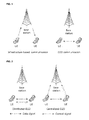
- FIG. 1 illustrates a schematic diagram of a D2D communication.
- the existing infrastructure-based communication is a method that terminals communicate each other through a base station, and the D2D communication performs direct communication between terminals without going through a base station.
- the D2D terminal shares the same frequency with the existing cellular terminal to spatially reuse the frequency, thereby improving use efficiency.
- the D2D communication enables a new service based on proximity and improves frequency efficiency of the cellular system at the same time.
- the D2D terminal shares an existing cellular frequency resource of the cellular terminal so as to improve frequency efficiency.
- a resource allocation technology that can properly control the interference is required.
- the interference control may be implemented through a resource allocation.
- a difference between the cellular-based D2D communication and the D2D communication in a non-licensed frequency bandwidth is that a base station for the cellular-based D2D communication may be involved in D2D communication control processes including a resource allocation process.
- FIG. 2 is a drawing illustrating cellular-based D2D communications classified into three types depending on a degree in which a base station is involved.
- a distributed-D2D when the data signal and the control signal are transmitted between the terminals, the base station is not involved therein.
- a centralized-D2D only the data signal is directly transmitted between the terminals, and the control signal is transmitted by the base station.
- the centralized-D2D method in which the base station collects channel information or distance information of the links and allocates D2D resource based on the collected information has good performance, a load of a signal process therefor is heavy, and it may be difficult to apply the centralized-D2D method in a situation that the base station can normally not operate as in a disaster situation.
- the distributed-D2D is a method in which the D2D terminal recognizes peripheral interference and allocates resources by itself, although there is no load burdened on the base station, since the resource allocation for a cellular user is dynamically changed, which may not be easily controlled by the D2D terminal.
- the present invention has been made in an effort to provide an interference recognition-based D2D resource allocation method and an apparatus therefor that may complement or solve problems of the centralized-D2D and distributed-D2D methods in the related art by using a hybrid D2D method in which a base station and D2D terminal cooperatively perform D2D resource allocation.
- An exemplary embodiment of the present invention provides an interference recognition-based D2D resource allocation method that uses a base station in a cellular system which includes the base station, a plurality of cellular terminals and a plurality of D2D terminals being in a cell that the base station covers, including: receiving information of a resource block of a least interference amount that a D2D receiving terminal obtains through resource search and information of search time of the resource search from the D2D receiving terminal; obtaining information of a cellular terminal corresponding to the received resource block and the search time among the plurality of cellular terminals from resource scheduling information storing allocation information of the resource block depending on time per each cellular terminal; and simultaneously allocating frequency resource of the cellular terminal to the D2D receiving terminal and a D2D transmitting terminal by using resource scheduling information corresponding to the obtained cellular terminal.
- the resource scheduling information may be a scheduling information in which an allocation value of the resource block is dynamically changed per each time period.
- the allocating of the frequency resource may simultaneously allocate resource scheduling information corresponding to the cellular terminal to the D2D receiving terminal and the D2D transmitting terminal, and the D2D receiving terminal may communicate with the D2D transmitting terminal by dynamically using a resource block equal to the resource block allocated to the cellular terminal per each time period.
- the allocating of the frequency resource may include: extracting only one resource block corresponding to a present time from in resource scheduling information corresponding to the cellular terminal; generating fixed resource scheduling information configured of only the one resource block; and simultaneously allocating the generated fixed resource scheduling information to the cellular terminal, the D2D receiving terminal, and the D2D transmitting terminal, and the D2D receiving terminal may communicate with the D2D transmitting terminal by statically using a resource block equal to the resource block allocated to the cellular terminal per each time period.
- the D2D receiving terminal may retry the resource search when a response is not transmitted thereto from the D2D transmitting terminal.
- Another embodiment of the present invention provides an interference recognition-based D2D resource allocation apparatus that uses a base station in a cellular system which includes the base station, a plurality of cellular terminals and a plurality of D2D terminals being in a cell that the base station covers, including: a search resource receiver receiving information of a resource block of a least interference amount that a D2D receiving terminal obtains through resource search and information of search time of the resource search from the D2D receiving terminal; a cellular resource searcher obtaining information of a cellular terminal corresponding to the received resource block and the search time among the plurality of cellular terminals from resource scheduling information storing allocation information of the resource block depending on time per each cellular terminal; and a resource allocator simultaneously allocating frequency resource of the cellular terminal to the D2D receiving terminal and a D2D transmitting terminal by using resource scheduling information corresponding to the obtained cellular terminal.
- a D2D terminal it is possible for a D2D terminal to effectively share dynamically changed cellular resource and to minimize influence of interference by scheduling resources of the D2D terminal so that a base station receiving feedback optimal interference recognition-based cellular resources from the D2D terminal, based on the feedback received resources, and a corresponding cellular terminal can use the same resource.
- FIG. 1 illustrates a schematic diagram of a D2D communication.
- FIG. 2 is a drawing illustrating cellular-based D2D communications classified into three types depending on a degree in which a base station is involved.
- FIG. 3 illustrates a schematic diagram of a cellular system model considered in an exemplary embodiment of the present invention.
- FIG. 4 illustrates a schematic diagram of a resource allocation apparatus according to an exemplary embodiment of the present invention.
- FIG. 5 illustrates a flowchart of a resource allocation method of using the resource allocation apparatus of FIG. 4 .
- FIG. 6 is a drawing illustrating resource allocation and data transmission flow according to an exemplary embodiment of the present invention.
- FIG. 7 illustrates an exemplary diagram for a dynamic synchronization scheduling method according to an exemplary embodiment of the present invention.
- FIG. 8 illustrates an exemplary diagram for a static synchronization scheduling method according to an exemplary embodiment of the present invention.
- FIG. 9 consists of views illustrating simulation results of a resource allocation method according to an exemplary embodiment of the present invention, by a layout option.
- FIG. 10 is a drawing illustrating a relative SINR of a CUE depending on a position of a D2D in a resource allocation method according to an exemplary embodiment of the present invention.
- FIG. 11 consists of views illustrating throughput performance results of a resource allocation method according to an exemplary embodiment of the present invention.
- the present invention provides an interference recognition-based device-to-device (D2D) resource allocation method and an apparatus therefor in which a D2D terminal shares frequency resources with a cellular terminal in a cellular system supporting a D2D communication.
- D2D device-to-device
- an exemplary embodiment of the present invention provides a hybrid D2D resource allocation method in which a base station and a D2D terminal cooperatively perform D2D resource allocation, and complements the drawbacks of the centralized-D2D method and the distributed-D2D method of the related art.
- the D2D terminal (D2D receiving terminal) recognizes an interference situation of cellular resources existing around in a cell based on an interference recognition technology, and then determines the most appropriate cellular resource to share with its own D2D link.
- the D2D terminal reports the information (the determined cellular resource) to the base station, and the base station identifies a cellular terminal corresponding to the determined cellular resource based on the information. Then, the base station allocates the same resource to the corresponding cellular terminal and the D2D terminal such that the cellular and D2D link may effectively share resources while reducing influence of interference.
- FIG. 3 illustrates a schematic diagram of a cellular system model considered in an exemplary embodiment of the present invention.
- a cellular system includes a base station (BS), a plurality of cellular terminals (cellular user equipments (CUE)) within a cell that the base station (BS) covers, and a plurality of D2D terminals (D2D UE: D2D User Equipment).
- BS base station
- CUE cellular user equipments
- D2D UE D2D User Equipment
- the cellular terminal and the D2D terminal share a cellular uplink resource in a single cell environment. This is because it is known that sharing the uplink resource is effective in transmission RF chain reuse of a terminal and interference.
- the D2D terminals consist of a pair of a D2D transmitting terminal (D2D Tx) and a D2D receiving terminal (D2D Rx), and it is assumed that the D2D transmitting terminal and the D2D receiving terminal are within a predetermined distance. Further, it is assumed that a transmitting power of each cellular terminal is set so that a receiving signal-to-noise ratio (SNR) in the base station is a predetermined target value.
- SNR signal-to-noise ratio
- the cellular uplink resource may be configured of N resource blocks (RB), and each cellular terminal (CUE) may receive one allocated RB to uplink-transmit.
- the D2D (Tx/Rx) terminals may share the RB allocated to the cellular terminal (CUE), for convenience, it is assumed that they share one RB per D2D link.
- FIG. 3 illustrates one pair of D2D terminal in the cell for convenience of description
- a plurality of pairs of D2D terminals may exist in the cell (circular cell area based on the base station) that the base station (BS) covers.
- the D2D transmitting terminal directly transmits data to the D2D receiving terminal.
- the D2D transmitting terminal and the D2D receiving terminal are not limited to a transmission or reception function, and they may have a communication function such as signal transmission and reception for a response or identification to data transmission and exchange of information with the base station.
- the D2D receiving terminal measures an amount of interference received from the cellular terminal and determines resource by which optimal communication performance may be obtained, for sharing the cellular resource.
- the D2D receiving terminal uses an interference recognition-based technology for recognizing the amount of interference received from a plurality of cellular terminals.
- the D2D receiving terminal senses the RBs of the cellular terminals to select an RB of the least interference.
- the D2D receiving terminal may search a frequency resource of the cellular terminal with the least interference among frequency resources of all peripheral cellular terminals by using a spectrum sensing method or a carrier sensing method among the interference recognition technologies.
- a representative example of the spectrum sensing method in which a sub-user determines whether a main-user uses a spectrum or not in a recognition wireless system is energy detection, signal characteristic detection, etc.
- the energy detection the least RB is searched through the detected energy. Since the spectrum sensing method and the carrier sensing method are well known in the art, a detailed description thereof will be omitted.
- FIG. 3 schematically illustrates interference applied to a specific D2D receiving terminal.
- the plurality of cellular terminals within the cell use the same transmitting power and consider only path-loss depending on a distance, the least interference will be measured at an RB allocated to the farthest cellular terminal from the D2D receiving terminal.
- a cellular terminal corresponding to the optimal RB may not be the farthest cellular terminal.
- a resource allocation apparatus described below means to be included in the base station.
- interference information for resource allocation is determined by interference recognition (ex, spectrum sensing) in the D2D terminal.
- the D2D link may effectively share the dynamically changed cellular resource through the processes.
- FIG. 4 illustrates a schematic diagram of a resource allocation apparatus according to an exemplary embodiment of the present invention
- FIG. 5 illustrates a flowchart of a resource allocation method of using the resource allocation apparatus of FIG. 4
- a resource allocation apparatus 100 includes a search resource receiver 110 , a cellular resource searcher 120 , a resource allocator 130 , and a scheduling DB 140 .
- frequency resources that cross each other according to time are allocated to the plurality of cellular terminals (CUE) in the cell.
- the base station (BS) stores RB information with respect to the resources allocated to each cellular terminal in a resource allocation map configured of a time axis and a frequency axis.
- the frequency resource of the cellular terminal in which influence of interference is minimum with respect to the D2D terminal among the plurality of cellular terminals in the cell is allocated to the D2D terminal.
- the D2D receiving terminal (D2D Rx) searches information for the resource block (RB) of the least interference amount among the resource blocks (RB) detected in the vicinity thereof by using the interference recognition (ex, spectrum sensing). Then, the D2D receiving terminal (D2D Rx), while reporting the information on the searched resource block and the searched time to the base station (BS), simultaneously requests a resource allocation to the base station (BS).
- the search resource receiver 110 in the base station (BS) receives information on the resource block of the least interference amount that the D2D receiving terminal (D2D Rx) obtains through the resource searching and information on the search time from the D2D receiving terminal (D2D Rx) (S 510 ).
- the base station (BS) previously stores resource scheduling information with respect to the respective cellular terminals in the scheduling DB 140 .
- the resource scheduling information previously stored in the scheduling DB 140 means the allocation information of the resource block depending on time with respect to the respective cellular terminals in the cell. That is, the resource scheduling information is scheduled so that a value of the resource block is dynamically allocated to one cellular terminal per time period.
- the base station may identify any cellular terminal to which the corresponding resource block is allocated at time corresponding to the search time based on the resource scheduling information stored in the scheduling DB 140 . That is, the cellular resource searcher 120 obtains information of the cellular terminal corresponding to the received resource block and the search time among the plurality of cellular terminals with reference to the resource scheduling information (S 520 ).
- the resource allocator 130 simultaneously allocates the frequency resource of the cellular terminal to the D2D receiving terminal and the D2D transmitting terminal by using the resource scheduling information corresponding to the obtained cellular terminal in the resource scheduling information of the scheduling DB 140 (S 530 ).
- the D2D receiving terminal and the D2D transmitting terminal may perform a direct data communication between the terminals by using the frequency resource allocated from the resource allocator 130 .
- the D2D terminal shares the RB of the cellular terminal having the least interference to perform communication.
- the D2D terminal substantially follows the resource scheduling information dynamically changed with respect to the corresponding cellular terminal, although the RB of the corresponding cellular terminal may be dynamically changed depending on time, the frequency resource may be shared to be corresponded to the RB.
- the RB that the D2D terminal has searched in the resource search process may be meaningless.
- the problem may be solved by using the scheduling information synchronized based on the cellular terminal to which the corresponding RB is allocated at the same time as the optimal RB of the D2D terminal depending on the help of the base station to perform the D2D and the cellular resource allocation.
- FIG. 6 is a drawing illustrating resource allocation and data transmission flow according to an exemplary embodiment of the present invention.
- the D2D receiving terminal (D2D Rx) to perform the D2D communication determines the optimal RB by the resource search through the interference recognition. Then, the D2D receiving terminal (D2D Rx) reports the information of the determined optimal RB and the information of the search time to the base station (BS), and simultaneously requests the resource allocation.
- the base station (BS) identifies one cellular terminal (CUE) corresponding to both the information of the time at which the D2D receiving terminal (D2D Rx) preforms the resource search and the information of the optimal RB from among the plurality of cellular terminals in the cell.
- the base station (BS) may be required to store the resource scheduling information for a determined time.
- the base station (BS) synchronizes the resource scheduling of the cellular terminal (CUE) and the resource scheduling of the D2D terminal (D2D Rx, D2D Tx), and broadcasts the synchronized information to the respective terminals.
- the D2D terminal may share the same RB with the cellular terminal (CUE) determined to have the least interference during the resource search process.
- the D2D receiving terminal performs re-search of resources and may receive allocation of the RB from the base station (BS) in the aforementioned same method.
- the time required for the resource search and the feedback delay required for the report to the base station may be the same as a channel quality indicator (CQI) measurement and the feedback delay of the cellular terminal. Accordingly, interference measurement having accuracy of the CQI level is possible, and change of the channel due to the feedback delay may be negligible.
- CQI channel quality indicator
- the CQI feedback delay is four subframe periods, that is, about 4 ms. Since this is a time moving a distance of about 11 cm when the terminal moves at a speed of about 100 km/hr, the change of the channel due to the feedback delay may be negligible.
- the exemplary embodiment of the present invention may be substantially divided into two.
- One is a dynamic synchronization scheduling method, and the other is a static synchronization scheduling method.
- the dynamic synchronization scheduling method allocates the resource information of the cellular terminal dynamically scheduled according to time to D2D terminal to synchronize the D2D terminal to be suitable for the allocation resource of the cellular terminal.
- the static synchronization scheduling method changes the resource scheduling information of the cellular terminal dynamically scheduled according to time to the static scheduling information with one RB, and allocates the static scheduling information to the D2D terminal and the cellular terminal to statically synchronize the D2D terminal.
- FIG. 7 illustrates an exemplary diagram for a dynamic synchronization scheduling method according to an exemplary embodiment of the present invention.
- FIG. 7 illustrates an uplink scheduling tables of the base station, which corresponds to resource scheduling information with respect to the respective cellular terminals.
- allocation values of the resource block are dynamically changed per time period (T 1 , T 2 , . . . ) for one cellular terminal.
- an RB 6 is allocated at time T 1 and time T 2
- an RB 7 is allocated at time T 3 and time T 4
- the RB 6 is allocated at time T 5
- an RB 5 is allocated at time T 6 and time T 7 .
- the D2D receiving terminal performs resource search for the time T 1 to select RB 6 , an amount of interference of which is the smallest (refer to the D2D resource search table of FIG. 7 ).
- the D2 receiving terminal (D2D Rx) reports information of the RB 6 and information of the time T 1 at which the information is searched to the base station (BS) at the time T 2 and requests resource allocation. Then, after the base station (BS) identifies information of the received RB 6 , the base station (BS) identifies that a corresponding cellular is the UE 6 by identifying the scheduling information of the previous time T 1 in the uplink scheduling table of FIG. 7 .
- the base station refers to the scheduling with respect to the cellular user at the time T 3 to simultaneously allocate the RB 7 allocated to the UE 6 at the time T 3 to the D2D terminals (D2D Tx and D2D Rx).
- the D2D terminals (D2D Tx and D2D Rx) use the RB 7 which the UE 6 uses at the time T 4 to communicate each other.
- the D2D terminals (D2D Tx and D2D Rx) identify the scheduling information from the base station (BS) per each time period to communicate each other with using an RB equal to the RB which the UE 6 uses.
- the D2D allocation resource is referred to a D2D scheduling table disposed at the right side of FIG. 7 .
- the resource scheduling information corresponding to the corresponding cellular terminal UE 6 is simultaneously allocated to two D2D terminals (D2D Tx and D2D Rx).
- the allocation value of the resource block allocated to the UE 6 per each time period is dynamically changed.
- the D2D receiving terminal (D2D Rx) dynamically uses a resource block equal to the resource block allocated to the UE 6 per each time period to communicate with the D2D transmitting terminal (D2D Tx).
- the D2D receiving terminal (D2D Rx) if it does not receive a response from the D2D transmitting terminal (D2D Tx), it retries the resource search.
- the D2D receiving terminal (D2D Rx) re-performs the resource search at the time T 8 to search the resource of the least interference as the RB 3 .
- the base station selects the UE 1 which is the cellular terminal corresponding to the time T 8 and the RB 3 resource, after this, it shares the frequency resource allocated to the UE 1 with the D2D terminal.
- FIG. 8 illustrates an exemplary diagram for a static synchronization scheduling method according to an exemplary embodiment of the present invention.
- the resource scheduling information in which an allocation value of the resource block (RB) is dynamically changed per each time period (T 1 , T 2 , . . . ) with respect to one cellular terminal is again changed into a fixed resource scheduling information configured of only one RB so as to share resource with the D2D terminal.
- the scheduling information of the cellular terminal is also synchronized to the fixed resource scheduling information.
- the D2D receiving terminal preforms the resource search at the time T 1 to select the RB 6 of the least interference amount.
- the D2 receiving terminal reports the information of the RB 6 and the information of the time T 1 at which the information is searched to the base station (BS) and requests the resource allocation.
- the base station (BS) identifies the information of the received RB 6 , it identifies that the corresponding cellular is the UE 6 by identifying the scheduling information of the previous time T 1 .
- the static synchronization scheduling method is the same as the dynamic synchronization scheduling method of FIG. 7 .
- the table with respect to the uplink scheduling of the base station shown in FIG. 8 corresponds to the fixed scheduling information, and it can be seen that it is different from that of FIG. 7 . That is, the base station (BS) refers to the fixed scheduling at the time T 3 and simultaneously allocates the RB 7 allocated to the UE 6 at the time T 3 to the D2D terminals (D2D Tx and D2D Rx). The D2D terminals (D2D Tx and D2D Rx) also uses the RB 7 that the UE 6 uses at the time T 4 to communicate each other.
- BS refers to the fixed scheduling at the time T 3 and simultaneously allocates the RB 7 allocated to the UE 6 at the time T 3 to the D2D terminals (D2D Tx and D2D Rx).
- the D2D terminals (D2D Tx and D2D Rx) also uses the RB 7 that the UE 6 uses at the time T 4 to communicate each other.
- the base station fixes the scheduling information of the UE 6 to the RB 7 and fixes the resource scheduling of the D2D to the RB 7 as well. Accordingly, the D2D terminals (D2D Tx and D2D Rx) use the RB 7 per each time period to communicate each other.
- the static synchronization scheduling method when the frequency resource is allocated, only one resource block corresponding to the present time is extracted from in the resource scheduling information corresponding to the corresponding cellular terminal UE 6 , and fixed resource scheduling information configured of only the one resource block is generated and then the generated fixed resource scheduling information is simultaneously allocated to the cellular terminal UE 6 , the D2D receiving terminal (D2D Rx), and the D2D transmitting terminal (D2D Tx).
- the D2D receiving terminal (D2D Rx) statically uses the resource block RB 7 equal to the resource block allocated to the UE 6 per each time period to communicate with the D2D transmitting terminal (D2D Tx). In this case, if the D2D receiving terminal (D2D Rx) does not receive a response from the D2D transmitting terminal (D2D Tx), it retries the resource search and repeats the above processes.
- the dynamic synchronization scheduling method shown in FIG. 7 is a method that adjusts the D2D scheduling based on the cellular scheduling information. Since the scheduling information of the cellular is dynamically changed, the scheduling of the D2D should be changed according to the dynamically changed scheduling information, and the D2D should frequently identify the resource allocation information as the cellular does.
- the static synchronization scheduling shown in FIG. 8 is a method that fixes the cellular scheduling information based on the resource search information of the D2D. Although performance of the cellular may deteriorates due to the fixed scheduling of the cellular terminal, since the D2D does not identify additional scheduling information until before re-search of resource after the first resource allocation, a load thereof may be reduced.
- the D2D terminal uses the interference recognition technology and performs the resource search by itself, thereby reducing the load of the base station than the centralized-D2D.
- the distributed-D2D method of the related art has the control problem due to the dynamic change of the cellular scheduling
- the present exemplary embodiment uses the synchronization scheduling between the cellular terminal and the D2D terminal by receiving assistance of the base station, thereby solving the control problem.
- Option 1 Urban macro (500 m ISD)+1 RRH/Indoor Hotzone per cell
- Option 3 Urban macro (500 m ISD) (all UEs outdoor)
- Option 4 Urban macro (500 m ISD)+3 RRH/Indoor Hotzone per cell
- Options 1, 2, 3, 4, and 6 use a parameter defined in the 3GPP Case 1
- Option 5 uses a parameter defined in the 3GPP Case 3.
- Option 1 and Option 3, which are the most common environment, are considered for estimation of performance of the resource allocation method of the present invention.
- 2 ⁇ 3 of the total terminals are uniformly disposed in a small cell
- 1 ⁇ 3 of the total terminals are uniformly disposed in a macro cell outside the small cell.
- all users in the macro cell are uniformly disposed.
- the path loss according to a distance and the independent rayleigh fading is applied to all communication links (a cellular-base station, a cellular-RRH (a small cell), D2D Tx-D2D Rx) and all interference links (CUE-D2D Rx, D2D Tx-base station, D2D Tx-RRH, and D2D Tx-Other D2D Rx).
- Exponents of the path loss are commonly set to about 3.5.
- Table 1 summarizes the main parameters applied to the simulation.
- the number of the total UE in the cell is set to 100, and the case (the CUEs are 2 ⁇ 3 thereof and the D2D users are 1 ⁇ 3 thereof) in which the number of the cellular users (CUE) is more than the number of the D2D users and the case (the CUEs are 1 ⁇ 3 thereof and the D2D users are 2 ⁇ 3 thereof) in which the number of the cellular users (CUE) is more than the number of the D2D users are divided to compare the performance thereof.
- the number of the CUE is the same as the number of the RB and one RB is allocated at each CUE, and the target SNR for determining the transmitting power of the CUE is fixed, for convenience, to about 20 dB.
- the macro cell radius is set to 167 m corresponding to one sector of 500 m ISD.
- FIG. 9 consists of views illustrating simulation results of a resource allocation method according to an exemplary embodiment of the present invention, by a layout option.
- View (a) of FIG. 9 as Option 1 illustrates relative SINR values of the D2D link depending on positions of the CUE.
- the highest SINR is represented. This is because the CUE close to the eNB (base station) transmits signals in a lower power than the CUE positioned in a distant place therefrom due to the power control of the CUE and since the CUE of the small cell uses a lower power than the CUE of the macro cell, the interference that affects to the D2D is relatively negligible.
- View (b) of FIG. 9 illustrates a case in which the D2D UE is positioned at the center between the eNB (base station) and the small cell.
- the D2D UE shares the resource of the CUE near the eNB (base station) and the RRH (small cell)
- the highest SINR may be obtained.
- View (c) of FIG. 9 illustrates a case in which the D2D UE is positioned in the small cell. Since the resource of the CUE in the small cell is affected by high interference, it is difficult to use. Accordingly, when the D2D UE positioned in the small cell shares the resource of the CUE close to eNB (base station), the interference is minimized.
- View (d) of FIG. 9 illustrates relative SINR values of the D2D depending on the position of the CUE in the environment of Option 3. Since all of the UEs in the macro cell are uniformly disposed in the environment of Option 3, as in the view (b) of FIG. 9 , when the D2D UE shares the resource of the CUE close to the eNB (base station), a high SINR may be obtained.
- FIG. 10 is a drawing illustrating a relative SINR of a CUE depending on a position of a D2D in a resource allocation method according to an exemplary embodiment of the present invention.
- the D2D in order to reduce the interference affecting the CUE, the D2D is required to be away from the eNB (base station) and the RRH (small cell) by a predetermined distance, or the transmitting power of D2D is required to be reduced.
- the D2D UE of the macro cell may share the resource of the CUE of the small cell, and the D2D UE of the small cell shares the resource of the CUE of the macro cell.
- FIG. 11 consists of views illustrating throughput performance results of a resource allocation method according to an exemplary embodiment of the present invention.
- view (a) of FIG. 11 illustrates a graph comparing a case applying the proposed resource allocation method according to the exemplary embodiment of the present invention and a case applying the distributed-D2D resource allocation method in the environment of option 1 when the number of the CUE is more than that of the D2D UE with performance of the D2D UE, performance of the CUE, and throughput performance of the total cells.
- the distributed-D2D resource allocation is a case in which the D2D UE allocates resources by itself without involvement of the eNB, the resource information of the CUE is changed in the scheduling period, such that the recognition of the interference is meaningless. As a result, since it seems that the D2D randomly selects and uses the CUE resource, it is named random pairing.
- View (b) of FIG. 11 illustrates performance comparisons in the environment of Option 3 when the number of the CUE is more than that of the D2D UE.
- the D2D is affected with more interference from the CUE.
- the random pairing is not able to realize the performance improvement of the total cells due to the small performance gain of the D2D and the performance loss of the CUE.
- the D2D may obtain a gain much greater than the random pairing and the performance improvement of the total cells is also considerably great.
- FIG. 11 Views (c) and (d) of FIG. 11 , which are cases in which the number of D2D UE is more than that of the CUE in the environments of Option 1 and Option 3, since the resource that the D2D UE can select is relatively smaller than that of the views (a) and (b) of FIG. 11 , a plurality of D2D UEs may frequently share the resource of one CUE.
- the performance of the CUE may greatly deteriorate.
- the proposed method when the proposed method is applied, it is possible to obtain more gain in the performance of the D2D and the total cells than that in the random pairing.
- a D2D terminal it is possible for a D2D terminal to effectively share dynamically changed cellular resource and to minimize influence of interference by scheduling resources of the D2D terminal so that a base station receiving feedback optimal interference recognition-based cellular resources from the D2D terminal, based on the feedback received resources, and a corresponding cellular terminal can use the same resource.
Landscapes
- Engineering & Computer Science (AREA)
- Computer Networks & Wireless Communication (AREA)
- Signal Processing (AREA)
- Quality & Reliability (AREA)
- Mobile Radio Communication Systems (AREA)
Applications Claiming Priority (2)
| Application Number | Priority Date | Filing Date | Title |
|---|---|---|---|
| KR10-2014-0134299 | 2014-10-06 | ||
| KR1020140134299A KR101525978B1 (ko) | 2014-10-06 | 2014-10-06 | 간섭 인지 기반의 d2d 자원 할당 방법 및 그 장치 |
Publications (2)
| Publication Number | Publication Date |
|---|---|
| US20160100412A1 US20160100412A1 (en) | 2016-04-07 |
| US9750037B2 true US9750037B2 (en) | 2017-08-29 |
Family
ID=53500080
Family Applications (1)
| Application Number | Title | Priority Date | Filing Date |
|---|---|---|---|
| US14/864,882 Active 2036-02-12 US9750037B2 (en) | 2014-10-06 | 2015-09-25 | Interference recognition based D2D resource allocation method and apparatus therefor |
Country Status (2)
| Country | Link |
|---|---|
| US (1) | US9750037B2 (ko) |
| KR (1) | KR101525978B1 (ko) |
Families Citing this family (13)
| Publication number | Priority date | Publication date | Assignee | Title |
|---|---|---|---|---|
| US10708907B2 (en) * | 2016-04-19 | 2020-07-07 | Qualcomm Incorporated | Interference management with adaptive resource block allocation |
| CN107666681B (zh) * | 2016-07-29 | 2022-08-26 | 北京三星通信技术研究有限公司 | 传输数据的方法及设备 |
| CN109792721B (zh) * | 2016-08-09 | 2022-04-15 | 松下电器(美国)知识产权公司 | 用于v2x传输的改进的无线电资源选择和感测 |
| WO2018060538A1 (en) * | 2016-09-27 | 2018-04-05 | Nokia Technologies Oy | Multi-cell allocation |
| EP3531748B1 (en) * | 2016-11-03 | 2021-12-08 | Guangdong Oppo Mobile Telecommunications Corp., Ltd. | Method for switching communication mode, and terminal device and network device |
| CN106973360B (zh) * | 2017-03-22 | 2020-04-03 | 中国科学院上海微系统与信息技术研究所 | 一种d2d通信网络的缓存策略和激励方法 |
| WO2018187094A1 (en) | 2017-04-06 | 2018-10-11 | Common Networks, Inc. | Systems and methods for networking and wirelessly routing communications |
| US11229054B2 (en) * | 2017-11-06 | 2022-01-18 | Lg Electronics Inc. | Method for feedback for device-to-device communication in wireless communication system, and device for same |
| WO2019140460A1 (en) * | 2018-01-15 | 2019-07-18 | Common Networks, Inc. | Systems and methods for automatically configuring frequencies of radio communication devices |
| CN111788843B (zh) * | 2018-03-20 | 2024-01-30 | Lg 电子株式会社 | 在支持侧链路的无线通信系统中确定传输波束的方法及其终端 |
| KR102044303B1 (ko) | 2018-04-27 | 2019-11-13 | 퍼스트실리콘 주식회사 | 게이트 드라이버 모듈과, 이것을 이용한 하프브릿지 dc/dc 컨버터 및 분산형 전력 최적화기 |
| WO2020047865A1 (zh) * | 2018-09-07 | 2020-03-12 | 北京小米移动软件有限公司 | 发送响应信息的方法、装置、存储介质以及电子设备 |
| KR102275426B1 (ko) * | 2019-12-06 | 2021-07-09 | 인하대학교 산학협력단 | 셀룰러 망과 공존하는 단말 대 단말 통신에서 전송속도 보장 제한 조건을 만족하는 효율적인 자원 할당 방법 및 장치 |
Citations (3)
| Publication number | Priority date | Publication date | Assignee | Title |
|---|---|---|---|---|
| KR20080028347A (ko) | 2007-12-24 | 2008-03-31 | 포스데이타 주식회사 | Ofdma/tdd 셀룰러 시스템에서의 상향링크의 동적자원 할당 방법 |
| US20120243431A1 (en) * | 2009-12-11 | 2012-09-27 | Nokia Corporation | Method, Apparatus and Computer Program Product for Allocating Resources in Wireless Communication Network |
| US20150117239A1 (en) * | 2012-05-15 | 2015-04-30 | Telefonaktiebolaget L M Ericsson (Publ) | Scheduling Apparatus and Method Thereof for Setting Up Device-to-Device Communication |
Family Cites Families (1)
| Publication number | Priority date | Publication date | Assignee | Title |
|---|---|---|---|---|
| KR102099820B1 (ko) * | 2012-07-02 | 2020-04-13 | 엘지전자 주식회사 | 셀룰러 통신과 d2d 통신 간의 간섭을 제어하는 방법 및 장치 |
-
2014
- 2014-10-06 KR KR1020140134299A patent/KR101525978B1/ko not_active Expired - Fee Related
-
2015
- 2015-09-25 US US14/864,882 patent/US9750037B2/en active Active
Patent Citations (3)
| Publication number | Priority date | Publication date | Assignee | Title |
|---|---|---|---|---|
| KR20080028347A (ko) | 2007-12-24 | 2008-03-31 | 포스데이타 주식회사 | Ofdma/tdd 셀룰러 시스템에서의 상향링크의 동적자원 할당 방법 |
| US20120243431A1 (en) * | 2009-12-11 | 2012-09-27 | Nokia Corporation | Method, Apparatus and Computer Program Product for Allocating Resources in Wireless Communication Network |
| US20150117239A1 (en) * | 2012-05-15 | 2015-04-30 | Telefonaktiebolaget L M Ericsson (Publ) | Scheduling Apparatus and Method Thereof for Setting Up Device-to-Device Communication |
Also Published As
| Publication number | Publication date |
|---|---|
| KR101525978B1 (ko) | 2015-06-05 |
| US20160100412A1 (en) | 2016-04-07 |
Similar Documents
| Publication | Publication Date | Title |
|---|---|---|
| US20160100412A1 (en) | Interference recognition based d2d resource allocation method and apparatus therefor | |
| US20220322099A1 (en) | Spectrum access optimization for self organizing networks | |
| US10536197B2 (en) | Device and method for managing spectrum resources, and wireless communication device and method | |
| CN107431984B (zh) | 用于设备到设备通信铺设蜂窝网络的功率分配 | |
| US8774150B1 (en) | System and method for reducing side-lobe contamination effects in Wi-Fi access points | |
| US9374830B2 (en) | Communication control device, communication control method, and base station | |
| US20140120926A1 (en) | Method of operating base station and terminal in cellular telecommunication system for operating multiple beams | |
| US10314039B2 (en) | Interference and traffic pattern database | |
| JP2019009784A (ja) | 非セルラーワイヤレスアクセスのためのシステムおよび方法 | |
| US20220338066A1 (en) | An access point and a communication method for facilitating scheduling of communication for communication apparatuses susceptible to interference | |
| CN106165518A (zh) | 缓解ul对dl的干扰 | |
| EP4445636A1 (en) | Versatile access point cooperation setup | |
| US20150215847A1 (en) | Apparatus for discovery signal transmission on lte small cell | |
| US20170288754A1 (en) | Base station apparatus, terminal device, and communication method | |
| WO2023147699A1 (en) | Positioning reference signal configuration and measurement update | |
| US9538387B2 (en) | Radio resource assignment coordination in superdense networks | |
| KR101568081B1 (ko) | 셀룰러 시스템에서의 d2d 통신을 위한 자원 할당 방법 및 그 장치 | |
| US9794040B2 (en) | Pilot signal resource allocation for a cellular MIMO system | |
| EP2773158B1 (en) | Method of handling resource exchange and related communication device | |
| KR20130088572A (ko) | 상향링크 신호 채널을 이용한 다중 셀 협력을 위한 기지국과 서버의 자원 할당 방법 및 그 장치 | |
| KR101525977B1 (ko) | 셀룰러 시스템에서의 d2d 통신을 위한 거리 정보 기반의 자원 할당 방법 및 그 장치 | |
| US20230056592A1 (en) | User Equipment-Autonomously Triggered-Sounding Reference Signals | |
| US20180184451A1 (en) | Contention based spatial sharing in wireless communications | |
| US20070104176A1 (en) | System and method for pilot signal utilization in an environment using dynamic frequency assignment | |
| US11343851B2 (en) | Method and apparatus for managing carrier sensing |
Legal Events
| Date | Code | Title | Description |
|---|---|---|---|
| AS | Assignment |
Owner name: SOONGSIL UNIVERSITY RESEARCH CONSORTIUM TECHNO-PAR Free format text: ASSIGNMENT OF ASSIGNORS INTEREST;ASSIGNORS:SHIN, OH-SOON;KANG, GIL MO;KIM, HYEON MIN;REEL/FRAME:036652/0202 Effective date: 20150923 |
|
| STCF | Information on status: patent grant |
Free format text: PATENTED CASE |
|
| MAFP | Maintenance fee payment |
Free format text: PAYMENT OF MAINTENANCE FEE, 4TH YR, SMALL ENTITY (ORIGINAL EVENT CODE: M2551); ENTITY STATUS OF PATENT OWNER: SMALL ENTITY Year of fee payment: 4 |
|
| MAFP | Maintenance fee payment |
Free format text: PAYMENT OF MAINTENANCE FEE, 8TH YR, SMALL ENTITY (ORIGINAL EVENT CODE: M2552); ENTITY STATUS OF PATENT OWNER: SMALL ENTITY Year of fee payment: 8 |