US9738604B2 - Ethynylbenzene derivatives - Google Patents
Ethynylbenzene derivatives Download PDFInfo
- Publication number
- US9738604B2 US9738604B2 US13/820,404 US201113820404A US9738604B2 US 9738604 B2 US9738604 B2 US 9738604B2 US 201113820404 A US201113820404 A US 201113820404A US 9738604 B2 US9738604 B2 US 9738604B2
- Authority
- US
- United States
- Prior art keywords
- methyl
- diynyl
- hydroxyamino
- oxobutan
- difluoro
- Prior art date
- Legal status (The legal status is an assumption and is not a legal conclusion. Google has not performed a legal analysis and makes no representation as to the accuracy of the status listed.)
- Active, expires
Links
- 0 C[C@@]([*+])[C@@]([*+])(C(F)F)C(OC)=O Chemical compound C[C@@]([*+])[C@@]([*+])(C(F)F)C(OC)=O 0.000 description 38
- NDPJHBPSXWZLCD-NAKRPHOHSA-N C[C@](O)(C1=CC=C(CO)C=C1)[C@H](NC(=O)C1=CC=C(C#CC#CC2=CC=C(N)C=C2)C=C1)C(=O)NO Chemical compound C[C@](O)(C1=CC=C(CO)C=C1)[C@H](NC(=O)C1=CC=C(C#CC#CC2=CC=C(N)C=C2)C=C1)C(=O)NO NDPJHBPSXWZLCD-NAKRPHOHSA-N 0.000 description 3
- BRHQIBYXNSBEHC-CGHJUBPDSA-N CC(=O)NC(C)(C(F)F)[C@H](NC(=O)C1=CC=C(C#CC#CC2=CC=C(F)C=C2)C=C1)C(=O)NO Chemical compound CC(=O)NC(C)(C(F)F)[C@H](NC(=O)C1=CC=C(C#CC#CC2=CC=C(F)C=C2)C=C1)C(=O)NO BRHQIBYXNSBEHC-CGHJUBPDSA-N 0.000 description 2
- JGGONVWWAANRST-OQHSHRKDSA-N CC(=O)NC(C)(C(F)F)[C@H](NC(=O)C1=CC=C(C#CC#CC2=CN=CS2)C=C1)C(=O)NO Chemical compound CC(=O)NC(C)(C(F)F)[C@H](NC(=O)C1=CC=C(C#CC#CC2=CN=CS2)C=C1)C(=O)NO JGGONVWWAANRST-OQHSHRKDSA-N 0.000 description 2
- NJKKHPJWSLWLKE-OAQYLSRUSA-N CC(C)(N)[C@H](NC(=O)C1=CC=C(C#CC#CC2=CC=CC=C2N)C=C1)C(=O)CO Chemical compound CC(C)(N)[C@H](NC(=O)C1=CC=C(C#CC#CC2=CC=CC=C2N)C=C1)C(=O)CO NJKKHPJWSLWLKE-OAQYLSRUSA-N 0.000 description 2
- LXTUZRYQVMNRDX-HWYAHNCWSA-N CC(N)(C(F)F)[C@H](NC(=O)C1=CC=C(C#CC#CC2=CC=C(CN)C=C2)C=C1)C(=O)NO Chemical compound CC(N)(C(F)F)[C@H](NC(=O)C1=CC=C(C#CC#CC2=CC=C(CN)C=C2)C=C1)C(=O)NO LXTUZRYQVMNRDX-HWYAHNCWSA-N 0.000 description 2
- XLJNYZIGJARYSN-ZZWBGTBQSA-N CC(N)(C(F)F)[C@H](NC(=O)C1=CC=C(C#CC#CC2=CC=CC=C2O)C=C1)C(=O)NO Chemical compound CC(N)(C(F)F)[C@H](NC(=O)C1=CC=C(C#CC#CC2=CC=CC=C2O)C=C1)C(=O)NO XLJNYZIGJARYSN-ZZWBGTBQSA-N 0.000 description 2
- CWWCEUINUHXEQT-QRIPLOBPSA-N CC(N)(C(F)F)[C@H](NC(=O)C1=CC=C(C#CC#CC2=CC=CS2)C=C1)C(=O)NO Chemical compound CC(N)(C(F)F)[C@H](NC(=O)C1=CC=C(C#CC#CC2=CC=CS2)C=C1)C(=O)NO CWWCEUINUHXEQT-QRIPLOBPSA-N 0.000 description 2
- MRBUEVHRIMVHIO-BRIWLPCBSA-N CC(O)(C(F)F)[C@H](NC(=O)C1=CC=C(C#CC#CC2=CC=C(CN3CCCC3)C=C2)C=C1)C(=O)NO Chemical compound CC(O)(C(F)F)[C@H](NC(=O)C1=CC=C(C#CC#CC2=CC=C(CN3CCCC3)C=C2)C=C1)C(=O)NO MRBUEVHRIMVHIO-BRIWLPCBSA-N 0.000 description 2
- OLKKTDMDBPCWNY-ZZWBGTBQSA-N CC(O)(C(F)F)[C@H](NC(=O)C1=CC=C(C#CC#CC2=CC=C(O)C=C2)C=C1)C(=O)NO Chemical compound CC(O)(C(F)F)[C@H](NC(=O)C1=CC=C(C#CC#CC2=CC=C(O)C=C2)C=C1)C(=O)NO OLKKTDMDBPCWNY-ZZWBGTBQSA-N 0.000 description 2
- CEBRBDZPKUSVPN-PHSANKKPSA-N CNC(=O)NC(C)(C(F)F)[C@H](NC(=O)C1=CC=C(C#CC#CC2=CC=CC=C2O)C=C1)C(=O)NO Chemical compound CNC(=O)NC(C)(C(F)F)[C@H](NC(=O)C1=CC=C(C#CC#CC2=CC=CC=C2O)C=C1)C(=O)NO CEBRBDZPKUSVPN-PHSANKKPSA-N 0.000 description 2
- DEOSSCWXFLLDRP-JGKWMGOWSA-N COC1=CC=CC=C1C#CC#CC1=CC=C(C(=O)N[C@H](C(=O)NO)C(C)(NC(C)=O)C(F)F)C=C1 Chemical compound COC1=CC=CC=C1C#CC#CC1=CC=C(C(=O)N[C@H](C(=O)NO)C(C)(NC(C)=O)C(F)F)C=C1 DEOSSCWXFLLDRP-JGKWMGOWSA-N 0.000 description 2
- FQYBTYFKOHPWQT-VGSWGCGISA-N C[C@@H](O)[C@H](NC(=O)C1=CC=C(C#CC2=CC=C(CN3CCOCC3)C=C2)C=C1)C(=O)NO Chemical compound C[C@@H](O)[C@H](NC(=O)C1=CC=C(C#CC2=CC=C(CN3CCOCC3)C=C2)C=C1)C(=O)NO FQYBTYFKOHPWQT-VGSWGCGISA-N 0.000 description 2
- ZXTPMSOMYAKCSC-OFNKIYASSA-N C[C@](O)(C1=CNN=N1)[C@H](NC(=O)C1=CC=C(C#CC#CC2=CC=C(N)C=C2)C=C1)C(=O)NO Chemical compound C[C@](O)(C1=CNN=N1)[C@H](NC(=O)C1=CC=C(C#CC#CC2=CC=C(N)C=C2)C=C1)C(=O)NO ZXTPMSOMYAKCSC-OFNKIYASSA-N 0.000 description 2
- QFIHBLDWIRGOFR-GOSISDBHSA-N NC1=CC=C(OCC#CC2=CC=C(C(=O)N[C@@H]3CCN(O)C3=O)C=C2)C=C1 Chemical compound NC1=CC=C(OCC#CC2=CC=C(C(=O)N[C@@H]3CCN(O)C3=O)C=C2)C=C1 QFIHBLDWIRGOFR-GOSISDBHSA-N 0.000 description 2
- PYVVZVZSROYIHE-BVBJGSHCSA-N *.*.C.COC(=O)[C@H](NC(=O)C1=CC=C(C#CC#CC2=CC=C(N)C=C2)C=C1)[C@@H](C)O.C[C@@H](O)[C@@H](N)C(=O)O.C[C@@H](O)[C@@H](NC(=O)C1=CC=C(C#CC#CC2=CC=C(N)C=C2)C=C1)C(=O)NO Chemical compound *.*.C.COC(=O)[C@H](NC(=O)C1=CC=C(C#CC#CC2=CC=C(N)C=C2)C=C1)[C@@H](C)O.C[C@@H](O)[C@@H](N)C(=O)O.C[C@@H](O)[C@@H](NC(=O)C1=CC=C(C#CC#CC2=CC=C(N)C=C2)C=C1)C(=O)NO PYVVZVZSROYIHE-BVBJGSHCSA-N 0.000 description 1
- DHTFBPMVWBANNV-QKMACPQGSA-N *.C.COC(=O)[C@H](NC(=O)C1=CC=C(C#CC#CC2=CC=C(N)C=C2)C=C1)[C@H](C)O.C[C@H](O)[C@@H](N)C(=O)O.C[C@H](O)[C@@H](NC(=O)C1=CC=C(C#CC#CC2=CC=C(N)C=C2)C=C1)C(=O)NO.S Chemical compound *.C.COC(=O)[C@H](NC(=O)C1=CC=C(C#CC#CC2=CC=C(N)C=C2)C=C1)[C@H](C)O.C[C@H](O)[C@@H](N)C(=O)O.C[C@H](O)[C@@H](NC(=O)C1=CC=C(C#CC#CC2=CC=C(N)C=C2)C=C1)C(=O)NO.S DHTFBPMVWBANNV-QKMACPQGSA-N 0.000 description 1
- ZRZJVLCIGRKUEG-NFBKMPQASA-N *.C[C@@](O)([C@H](NC(=O)C1=CC=C(C#CC#CC2=CC=C(N)C=C2)C=C1)C(=O)NO)N1C=CN=N1 Chemical compound *.C[C@@](O)([C@H](NC(=O)C1=CC=C(C#CC#CC2=CC=C(N)C=C2)C=C1)C(=O)NO)N1C=CN=N1 ZRZJVLCIGRKUEG-NFBKMPQASA-N 0.000 description 1
- SYKQUQPSGKQTMU-DARCMUPKSA-N C#CC1=CC=C(C(=O)N[C@H](C(=O)OC)[C@@H](C)O)C=C1.CC.CC.COC(=O)[C@@H](NC(=O)C1=CC=C(C#CC#CC2=CC=C[Y]=C2)C=C1)[C@@H](C)O.C[C@@H](O)[C@H](NC(=O)C1=CC=C(C#CC#CC2=CC=C[Y]=C2)C=C1)C(=O)NO Chemical compound C#CC1=CC=C(C(=O)N[C@H](C(=O)OC)[C@@H](C)O)C=C1.CC.CC.COC(=O)[C@@H](NC(=O)C1=CC=C(C#CC#CC2=CC=C[Y]=C2)C=C1)[C@@H](C)O.C[C@@H](O)[C@H](NC(=O)C1=CC=C(C#CC#CC2=CC=C[Y]=C2)C=C1)C(=O)NO SYKQUQPSGKQTMU-DARCMUPKSA-N 0.000 description 1
- MVYROKHZSWUDOO-SLEQHCLPSA-M C#CC1=CC=C(C(=O)N[C@H](CO)C(=O)OC)C=C1.C#CC1=CC=C(C(=O)O[Na])C=C1.C#CC1=CC=C(NC(=O)OC(C)(C)C)C=C1.CC1=CC=C(C#CC#CC2=CC=C(C(=O)N[C@H](CO)C(=O)COC(=O)C3=CC=CC=C3)C=C2)C=C1.CC1=CC=C(C#CC#CC2=CC=C(C(=O)N[C@H](CO)C(=O)NO)C=C2)C=C1.COC(=O)[C@@H](CO)NC(=O)C1=CC=C(C#CC#CC2=CC=C(C)C=C2)C=C1.COC(=O)[C@H](N)CO.O=C(Cl)C1=CC=CC=C1 Chemical compound C#CC1=CC=C(C(=O)N[C@H](CO)C(=O)OC)C=C1.C#CC1=CC=C(C(=O)O[Na])C=C1.C#CC1=CC=C(NC(=O)OC(C)(C)C)C=C1.CC1=CC=C(C#CC#CC2=CC=C(C(=O)N[C@H](CO)C(=O)COC(=O)C3=CC=CC=C3)C=C2)C=C1.CC1=CC=C(C#CC#CC2=CC=C(C(=O)N[C@H](CO)C(=O)NO)C=C2)C=C1.COC(=O)[C@@H](CO)NC(=O)C1=CC=C(C#CC#CC2=CC=C(C)C=C2)C=C1.COC(=O)[C@H](N)CO.O=C(Cl)C1=CC=CC=C1 MVYROKHZSWUDOO-SLEQHCLPSA-M 0.000 description 1
- HSNBDPWYJSJRKP-UHFFFAOYSA-N C#CC1=CC=C(C(=O)OC)C=C1.C#CC1=CC=C(N)C=C1.C#C[Si](C)(C)C.COC(=O)C1=CC=C(C#CC#CC2=CC=C(N)C=C2)C=C1.COC(=O)C1=CC=C(C#C[Si](C)(C)C)C=C1.COC(=O)C1=CC=C(I)C=C1.NC1=CC=C(C#CC#CC2=CC=C(C(=O)O)C=C2)C=C1.NC1CCOC1=O.O=C(CC(CCO)C(=O)OCC1=CC=CC=C1)OCC1=CC=CC=C1.O=C(CC1CCOC1=O)OCC1=CC=CC=C1 Chemical compound C#CC1=CC=C(C(=O)OC)C=C1.C#CC1=CC=C(N)C=C1.C#C[Si](C)(C)C.COC(=O)C1=CC=C(C#CC#CC2=CC=C(N)C=C2)C=C1.COC(=O)C1=CC=C(C#C[Si](C)(C)C)C=C1.COC(=O)C1=CC=C(I)C=C1.NC1=CC=C(C#CC#CC2=CC=C(C(=O)O)C=C2)C=C1.NC1CCOC1=O.O=C(CC(CCO)C(=O)OCC1=CC=CC=C1)OCC1=CC=CC=C1.O=C(CC1CCOC1=O)OCC1=CC=CC=C1 HSNBDPWYJSJRKP-UHFFFAOYSA-N 0.000 description 1
- LEDPOLWCOHWHGO-GNEXJIJCSA-N C#CC1=CC=C(C(=O)OC)C=C1.C#CC1=CC=CC=C1N.COC(=O)C1=CC=C(C#CC#CC2=CC=CC=C2N)C=C1.COC(=O)[C@@H](N)C(C)(C)NC(=O)OC(C)(C)C.COC(=O)[C@@H](NC(=O)C1=CC=C(C#CC#CC2=CC=CC=C2N)C=C1)C(C)(C)N.COC(=O)[C@@H](NC(=O)C1=CC=C(C#CC#CC2=CC=CC=C2N)C=C1)C(C)(C)NC(=O)OC(C)(C)C.NC1=CC=CC=C1C#CC#CC1=CC=C(C(=O)O)C=C1 Chemical compound C#CC1=CC=C(C(=O)OC)C=C1.C#CC1=CC=CC=C1N.COC(=O)C1=CC=C(C#CC#CC2=CC=CC=C2N)C=C1.COC(=O)[C@@H](N)C(C)(C)NC(=O)OC(C)(C)C.COC(=O)[C@@H](NC(=O)C1=CC=C(C#CC#CC2=CC=CC=C2N)C=C1)C(C)(C)N.COC(=O)[C@@H](NC(=O)C1=CC=C(C#CC#CC2=CC=CC=C2N)C=C1)C(C)(C)NC(=O)OC(C)(C)C.NC1=CC=CC=C1C#CC#CC1=CC=C(C(=O)O)C=C1 LEDPOLWCOHWHGO-GNEXJIJCSA-N 0.000 description 1
- XHSKUKCFFOZLPG-ORAMRZONSA-N C#CC1=CC=C(C(=O)OC)C=C1.C1COCCN1.COC(=O)C1=CC=C(C#CC2=CC=C(CN3CCOCC3)C=C2)C=C1.COC(=O)[C@@H](N)[C@](C)(O)C(F)F.COC(=O)[C@@H](NC(=O)C1=CC=C(C#CC2=CC=C(CN3CCOCC3)C=C2)C=C1)[C@](C)(O)C(F)F.COC1=CC=C(I)C=C1.C[C@@](O)(C(F)F)[C@H](NC(=O)C1=CC=C(C#CC2=CC=C(CN3CCOCC3)C=C2)C=C1)C(=O)NO.IC1=CC=C(CN2CCOCC2)C=C1.O=C(O)C1=CC=C(C#CC2=CC=C(CN3CCOCC3)C=C2)C=C1 Chemical compound C#CC1=CC=C(C(=O)OC)C=C1.C1COCCN1.COC(=O)C1=CC=C(C#CC2=CC=C(CN3CCOCC3)C=C2)C=C1.COC(=O)[C@@H](N)[C@](C)(O)C(F)F.COC(=O)[C@@H](NC(=O)C1=CC=C(C#CC2=CC=C(CN3CCOCC3)C=C2)C=C1)[C@](C)(O)C(F)F.COC1=CC=C(I)C=C1.C[C@@](O)(C(F)F)[C@H](NC(=O)C1=CC=C(C#CC2=CC=C(CN3CCOCC3)C=C2)C=C1)C(=O)NO.IC1=CC=C(CN2CCOCC2)C=C1.O=C(O)C1=CC=C(C#CC2=CC=C(CN3CCOCC3)C=C2)C=C1 XHSKUKCFFOZLPG-ORAMRZONSA-N 0.000 description 1
- GYAGWTNUTFMFOS-QPDRSVQHSA-N C#CC1=CC=C(S(=O)(=O)N[C@H](C(=O)OC)[C@@H](C)O)C=C1.COC(=O)[C@@H](NS(=O)(=O)C1=CC=C(C#CC#CC2=CC=C(N)C=C2)C=C1)[C@@H](C)O.COC(=O)[C@@H](NS(=O)(=O)C1=CC=C(C#C[Si](C)(C)C)C=C1)[C@@H](C)O.COC(=O)[C@@H](NS(=O)(=O)C1=CC=C(I)C=C1)[C@@H](C)O.C[C@@H](O)[C@H](NS(=O)(=O)C1=NC=C(C#CC#CC2=CC=C(N)C=C2)C=C1)C(=O)NO.O=S(=O)(Cl)C1=CC=C(I)C=C1 Chemical compound C#CC1=CC=C(S(=O)(=O)N[C@H](C(=O)OC)[C@@H](C)O)C=C1.COC(=O)[C@@H](NS(=O)(=O)C1=CC=C(C#CC#CC2=CC=C(N)C=C2)C=C1)[C@@H](C)O.COC(=O)[C@@H](NS(=O)(=O)C1=CC=C(C#C[Si](C)(C)C)C=C1)[C@@H](C)O.COC(=O)[C@@H](NS(=O)(=O)C1=CC=C(I)C=C1)[C@@H](C)O.C[C@@H](O)[C@H](NS(=O)(=O)C1=NC=C(C#CC#CC2=CC=C(N)C=C2)C=C1)C(=O)NO.O=S(=O)(Cl)C1=CC=C(I)C=C1 GYAGWTNUTFMFOS-QPDRSVQHSA-N 0.000 description 1
- IEVHSCBFAVNZOS-GRMJVIRASA-N C#CC1=CC=C2C(=C1)NC=C2C(C(=O)OC)C(C)NC(=O)OC(C)(C)C.C/C=C/C(=O)OC.COC(=O)/C=C(/C)[N+](=O)[O-].COC(=O)C(C1=CNC2=CC(Br)=CC=C21)C(C)N.COC(=O)C(C1=CNC2=CC(Br)=CC=C21)C(C)NC(=O)OC(C)(C)C.COC(=O)C(C1=CNC2=CC(Br)=CC=C21)C(C)[N+](=O)[O-].COC(=O)C(C1=CNC2=CC(C#C[Si](C)(C)C)=CC=C21)C(C)NC(=O)OC(C)(C)C.COC(=O)C(O)C(C)[N+](=O)[O-] Chemical compound C#CC1=CC=C2C(=C1)NC=C2C(C(=O)OC)C(C)NC(=O)OC(C)(C)C.C/C=C/C(=O)OC.COC(=O)/C=C(/C)[N+](=O)[O-].COC(=O)C(C1=CNC2=CC(Br)=CC=C21)C(C)N.COC(=O)C(C1=CNC2=CC(Br)=CC=C21)C(C)NC(=O)OC(C)(C)C.COC(=O)C(C1=CNC2=CC(Br)=CC=C21)C(C)[N+](=O)[O-].COC(=O)C(C1=CNC2=CC(C#C[Si](C)(C)C)=CC=C21)C(C)NC(=O)OC(C)(C)C.COC(=O)C(O)C(C)[N+](=O)[O-] IEVHSCBFAVNZOS-GRMJVIRASA-N 0.000 description 1
- WACXUSGKTPIOMR-PUPXRJNVSA-N C#CC1=CN=C(C(=O)OC)C=C1.COC(=O)C1=NC=C(Br)C=C1.COC(=O)C1=NC=C(C#CC#CC2=CC=C(N)C=C2)C=C1.COC(=O)C1=NC=C(C#C[Si](C)(C)C)C=C1.COC(=O)[C@@H](NC(=O)C1=NC=C(C#CC#CC2=CC=C(N)C=C2)C=C1)C(C)O.NC1=CC=C(C#CC#CC2=CN=C(C(=O)O)C=C2)C=C1.O=C(O)C1=NC=C(Br)C=C1 Chemical compound C#CC1=CN=C(C(=O)OC)C=C1.COC(=O)C1=NC=C(Br)C=C1.COC(=O)C1=NC=C(C#CC#CC2=CC=C(N)C=C2)C=C1.COC(=O)C1=NC=C(C#C[Si](C)(C)C)C=C1.COC(=O)[C@@H](NC(=O)C1=NC=C(C#CC#CC2=CC=C(N)C=C2)C=C1)C(C)O.NC1=CC=C(C#CC#CC2=CN=C(C(=O)O)C=C2)C=C1.O=C(O)C1=NC=C(Br)C=C1 WACXUSGKTPIOMR-PUPXRJNVSA-N 0.000 description 1
- XFAYJJKULHTRNN-HCLOLJQSSA-N C#CCBr.C#CCOC1=CC=C(N)C=C1.C#CCOC1=CC=C([N+](=O)[O-])C=C1.COC(=O)C1=CC=C(C#CCOC2=CC=C(N)C=C2)C=C1.COC(=O)C1=CC=C(I)C=C1.COC(=O)[C@@H](N)[C@@H](C)O.C[C@@H](O)[C@H](NC(=O)C1=CC=C(C#CCOC2=CC=C(N)C=C2)C=C1)C(=O)NO.C[C@@H](O)[C@H](NC(=O)C1=CC=C(C#CCOC2=CC=C(N)C=C2)C=C1)C(=O)O.NC1=CC=C(OCC#CC2=CC=C(C(=O)O)C=C2)C=C1.O=[N+]([O-])C1=CC=C(O)C=C1 Chemical compound C#CCBr.C#CCOC1=CC=C(N)C=C1.C#CCOC1=CC=C([N+](=O)[O-])C=C1.COC(=O)C1=CC=C(C#CCOC2=CC=C(N)C=C2)C=C1.COC(=O)C1=CC=C(I)C=C1.COC(=O)[C@@H](N)[C@@H](C)O.C[C@@H](O)[C@H](NC(=O)C1=CC=C(C#CCOC2=CC=C(N)C=C2)C=C1)C(=O)NO.C[C@@H](O)[C@H](NC(=O)C1=CC=C(C#CCOC2=CC=C(N)C=C2)C=C1)C(=O)O.NC1=CC=C(OCC#CC2=CC=C(C(=O)O)C=C2)C=C1.O=[N+]([O-])C1=CC=C(O)C=C1 XFAYJJKULHTRNN-HCLOLJQSSA-N 0.000 description 1
- POEQXRBJHPAJEM-KHTDWFMGSA-N C#CCOC1=CC=C(C(=O)OC)C=C1.C#CCOS(=O)(=O)C1=CC=CC=C1.COC(=O)C1=CC=C(O)C=C1.COC(=O)C1=CC=C(OCC#CC2=CC=C(N)C=C2)C=C1.COC(=O)C1=CC=C(OCC#CC2=CC=C([N+](=O)[O-])C=C2)C=C1.COC(=O)[C@@H](N)[C@@H](C)O.COC(=O)[C@@H](NC(=O)C1=CC=C(OCC#CC2=CC=C(N)C=C2)C=C1)[C@@H](C)O.NC1=CC=C(C#CCOC2=CC=C(C(=O)O)C=C2)C=C1.O=[N+]([O-])C1=CC=C(I)C=C1 Chemical compound C#CCOC1=CC=C(C(=O)OC)C=C1.C#CCOS(=O)(=O)C1=CC=CC=C1.COC(=O)C1=CC=C(O)C=C1.COC(=O)C1=CC=C(OCC#CC2=CC=C(N)C=C2)C=C1.COC(=O)C1=CC=C(OCC#CC2=CC=C([N+](=O)[O-])C=C2)C=C1.COC(=O)[C@@H](N)[C@@H](C)O.COC(=O)[C@@H](NC(=O)C1=CC=C(OCC#CC2=CC=C(N)C=C2)C=C1)[C@@H](C)O.NC1=CC=C(C#CCOC2=CC=C(C(=O)O)C=C2)C=C1.O=[N+]([O-])C1=CC=C(I)C=C1 POEQXRBJHPAJEM-KHTDWFMGSA-N 0.000 description 1
- OUYFEGJHIJAYEL-ZWTBCAEQSA-N C.C.C.C.C#NCC(=O)OC.C=NC(=O)OCC1=CC=CC=C1.CBOOCB=O.CC1=CC=C(S(=O)C=C(NC(=O)OCC2=CC=CC=C2)C(F)F)C=C1.CC1=CC=C([S@@](=O)CC(=O)C(F)F)C=C1.CO.COC(=O)[C@@H](NC(=O)C1=CC=C(C#CC#CC2=CC=C(N)C=C2)C=C1)[C@](C)(N)C(F)F.C[C@@](N)(C(F)F)[C@H](NC(=O)C1=CC=C(C#CC#CC2=CC=C(N)C=C2)C=C1)C(=O)NO.Cl.NC1=CC=C(C#CC#CC2=CC=C(C(=O)OC3=C(F)C(F)=C(F)C(F)=C3F)C=C2)C=C1.[H][C@@](N)(C(=O)OC)[C@@](C)(CSC1=CC=C(C)C=C1)C(F)F.[H][C@@](NC(=O)OC(C)(C)C)(C(=O)OC)[C@@](C)(CSC1=CC=C(C)C=C1)C(F)F.[H][C@@](NC(=O)OC(C)(C)C)(C(=O)OC)[C@](C)(ClN)C(F)F.[H][C@@](NC(=O)OC(C)(C)C)(C(=O)OC)[C@](C)(N)C(F)F.[H][C@@](NC=O)(C(=O)OC)[C@@](C)(CSC1=CC=C(C)C=C1)C(F)F.[H][C@@](NC=O)(C(=O)OC)[C@@](C)(C[S@](=C)C1=CC=C(C)C=C1)C(F)F.[H][C@]1(C(=O)OC)N=CC[C@]1(C[S@](=O)C1=CC=C(C)C=C1)C(F)F Chemical compound C.C.C.C.C#NCC(=O)OC.C=NC(=O)OCC1=CC=CC=C1.CBOOCB=O.CC1=CC=C(S(=O)C=C(NC(=O)OCC2=CC=CC=C2)C(F)F)C=C1.CC1=CC=C([S@@](=O)CC(=O)C(F)F)C=C1.CO.COC(=O)[C@@H](NC(=O)C1=CC=C(C#CC#CC2=CC=C(N)C=C2)C=C1)[C@](C)(N)C(F)F.C[C@@](N)(C(F)F)[C@H](NC(=O)C1=CC=C(C#CC#CC2=CC=C(N)C=C2)C=C1)C(=O)NO.Cl.NC1=CC=C(C#CC#CC2=CC=C(C(=O)OC3=C(F)C(F)=C(F)C(F)=C3F)C=C2)C=C1.[H][C@@](N)(C(=O)OC)[C@@](C)(CSC1=CC=C(C)C=C1)C(F)F.[H][C@@](NC(=O)OC(C)(C)C)(C(=O)OC)[C@@](C)(CSC1=CC=C(C)C=C1)C(F)F.[H][C@@](NC(=O)OC(C)(C)C)(C(=O)OC)[C@](C)(ClN)C(F)F.[H][C@@](NC(=O)OC(C)(C)C)(C(=O)OC)[C@](C)(N)C(F)F.[H][C@@](NC=O)(C(=O)OC)[C@@](C)(CSC1=CC=C(C)C=C1)C(F)F.[H][C@@](NC=O)(C(=O)OC)[C@@](C)(C[S@](=C)C1=CC=C(C)C=C1)C(F)F.[H][C@]1(C(=O)OC)N=CC[C@]1(C[S@](=O)C1=CC=C(C)C=C1)C(F)F OUYFEGJHIJAYEL-ZWTBCAEQSA-N 0.000 description 1
- LLGXUHZFYYOFSZ-CFCRRNACSA-N C.C.C.CC(=O)NC1=CC=C(C#CC#CC2=CC=C(C(=O)N[C@H](C(=O)NO)[C@](C)(NC(C)=O)C(F)F)C=C2)C=C1.COC(=O)[C@@H](NC(=O)C1=CC=C(C#CC#CC2=CC=C(N)C=C2)C=C1)[C@](C)(N)C(F)F.COC(=O)[C@@H](NC(=O)C1=CC=C(C#CC#CC2=CC=C(NC(C)=O)C=C2)C=C1)[C@](C)(NC(C)=O)C(F)F Chemical compound C.C.C.CC(=O)NC1=CC=C(C#CC#CC2=CC=C(C(=O)N[C@H](C(=O)NO)[C@](C)(NC(C)=O)C(F)F)C=C2)C=C1.COC(=O)[C@@H](NC(=O)C1=CC=C(C#CC#CC2=CC=C(N)C=C2)C=C1)[C@](C)(N)C(F)F.COC(=O)[C@@H](NC(=O)C1=CC=C(C#CC#CC2=CC=C(NC(C)=O)C=C2)C=C1)[C@](C)(NC(C)=O)C(F)F LLGXUHZFYYOFSZ-CFCRRNACSA-N 0.000 description 1
- FRILLZSEXQGMMC-HOWKKEGNSA-N C.NC1=CC=C(C#CC#CC2=CC=C(C(=O)NC3CCN(O)C3=O)C=C2)C=C1.NC1CCN(O)C1=O.O=C(CC(C/C=N/O)C(=O)OCC1=CC=CC=C1)OCC1=CC=CC=C1.O=C(CC1CCN(O)C1=O)OCC1=CC=CC=C1.O=CCC(CC(=O)OCC1=CC=CC=C1)C(=O)OCC1=CC=CC=C1 Chemical compound C.NC1=CC=C(C#CC#CC2=CC=C(C(=O)NC3CCN(O)C3=O)C=C2)C=C1.NC1CCN(O)C1=O.O=C(CC(C/C=N/O)C(=O)OCC1=CC=CC=C1)OCC1=CC=CC=C1.O=C(CC1CCN(O)C1=O)OCC1=CC=CC=C1.O=CCC(CC(=O)OCC1=CC=CC=C1)C(=O)OCC1=CC=CC=C1 FRILLZSEXQGMMC-HOWKKEGNSA-N 0.000 description 1
- HKYMOSBVRQAZRY-JGKWMGOWSA-N CC(=O)NC(C)(C(F)F)[C@H](NC(=O)C1=CC=C(C#CC#CC2=CC=C(C#N)C=C2)C=C1)C(=O)NO Chemical compound CC(=O)NC(C)(C(F)F)[C@H](NC(=O)C1=CC=C(C#CC#CC2=CC=C(C#N)C=C2)C=C1)C(=O)NO HKYMOSBVRQAZRY-JGKWMGOWSA-N 0.000 description 1
- AEVCRSZOVGTNHL-VGOKPJQXSA-N CC(=O)NC(C)(C(F)F)[C@H](NC(=O)C1=CC=C(C#CC#CC2=CC=C(C(=O)O)C=C2)C=C1)C(=O)NO Chemical compound CC(=O)NC(C)(C(F)F)[C@H](NC(=O)C1=CC=C(C#CC#CC2=CC=C(C(=O)O)C=C2)C=C1)C(=O)NO AEVCRSZOVGTNHL-VGOKPJQXSA-N 0.000 description 1
- MOZORQKCTFRRFK-CGHJUBPDSA-N CC(=O)NC(C)(C(F)F)[C@H](NC(=O)C1=CC=C(C#CC#CC2=CC=C(C(F)(F)F)C=C2)C=C1)C(=O)NO Chemical compound CC(=O)NC(C)(C(F)F)[C@H](NC(=O)C1=CC=C(C#CC#CC2=CC=C(C(F)(F)F)C=C2)C=C1)C(=O)NO MOZORQKCTFRRFK-CGHJUBPDSA-N 0.000 description 1
- KGFMBGSRHSJORE-VGOKPJQXSA-N CC(=O)NC(C)(C(F)F)[C@H](NC(=O)C1=CC=C(C#CC#CC2=CC=C(C(N)=O)C=C2)C=C1)C(=O)NO Chemical compound CC(=O)NC(C)(C(F)F)[C@H](NC(=O)C1=CC=C(C#CC#CC2=CC=C(C(N)=O)C=C2)C=C1)C(=O)NO KGFMBGSRHSJORE-VGOKPJQXSA-N 0.000 description 1
- HADOKPVZNJGEOJ-JGKWMGOWSA-N CC(=O)NC(C)(C(F)F)[C@H](NC(=O)C1=CC=C(C#CC#CC2=CC=C(C)C=C2)C=C1)C(=O)NO Chemical compound CC(=O)NC(C)(C(F)F)[C@H](NC(=O)C1=CC=C(C#CC#CC2=CC=C(C)C=C2)C=C1)C(=O)NO HADOKPVZNJGEOJ-JGKWMGOWSA-N 0.000 description 1
- OPMLXEZSYYRUAR-BRIWLPCBSA-N CC(=O)NC(C)(C(F)F)[C@H](NC(=O)C1=CC=C(C#CC#CC2=CC=C(CCC(N)=O)C=C2)C=C1)C(=O)NO Chemical compound CC(=O)NC(C)(C(F)F)[C@H](NC(=O)C1=CC=C(C#CC#CC2=CC=C(CCC(N)=O)C=C2)C=C1)C(=O)NO OPMLXEZSYYRUAR-BRIWLPCBSA-N 0.000 description 1
- IGUUGJTYIGSWDY-BRIWLPCBSA-N CC(=O)NC(C)(C(F)F)[C@H](NC(=O)C1=CC=C(C#CC#CC2=CC=C(CN(C)C)C=C2)C=C1)C(=O)NO Chemical compound CC(=O)NC(C)(C(F)F)[C@H](NC(=O)C1=CC=C(C#CC#CC2=CC=C(CN(C)C)C=C2)C=C1)C(=O)NO IGUUGJTYIGSWDY-BRIWLPCBSA-N 0.000 description 1
- UPGYPUBLDVZPRN-JGKWMGOWSA-N CC(=O)NC(C)(C(F)F)[C@H](NC(=O)C1=CC=C(C#CC#CC2=CC=C(CN)C=C2)C=C1)C(=O)NO Chemical compound CC(=O)NC(C)(C(F)F)[C@H](NC(=O)C1=CC=C(C#CC#CC2=CC=C(CN)C=C2)C=C1)C(=O)NO UPGYPUBLDVZPRN-JGKWMGOWSA-N 0.000 description 1
- MPNBVAUAIUGWCN-RIBGEGAISA-N CC(=O)NC(C)(C(F)F)[C@H](NC(=O)C1=CC=C(C#CC#CC2=CC=C(CN3C=CN=C3)C=C2)C=C1)C(=O)NO Chemical compound CC(=O)NC(C)(C(F)F)[C@H](NC(=O)C1=CC=C(C#CC#CC2=CC=C(CN3C=CN=C3)C=C2)C=C1)C(=O)NO MPNBVAUAIUGWCN-RIBGEGAISA-N 0.000 description 1
- RQLNRDOHTSWLFH-MIJJZIGMSA-N CC(=O)NC(C)(C(F)F)[C@H](NC(=O)C1=CC=C(C#CC#CC2=CC=C(CN3CCCC3)C=C2)C=C1)C(=O)NO Chemical compound CC(=O)NC(C)(C(F)F)[C@H](NC(=O)C1=CC=C(C#CC#CC2=CC=C(CN3CCCC3)C=C2)C=C1)C(=O)NO RQLNRDOHTSWLFH-MIJJZIGMSA-N 0.000 description 1
- ADTYUJZRTCBDMY-MIJJZIGMSA-N CC(=O)NC(C)(C(F)F)[C@H](NC(=O)C1=CC=C(C#CC#CC2=CC=C(CN3CCOCC3)C=C2)C=C1)C(=O)NO Chemical compound CC(=O)NC(C)(C(F)F)[C@H](NC(=O)C1=CC=C(C#CC#CC2=CC=C(CN3CCOCC3)C=C2)C=C1)C(=O)NO ADTYUJZRTCBDMY-MIJJZIGMSA-N 0.000 description 1
- XTLILCNJARPTEB-JGKWMGOWSA-N CC(=O)NC(C)(C(F)F)[C@H](NC(=O)C1=CC=C(C#CC#CC2=CC=C(CO)C=C2)C=C1)C(=O)NO Chemical compound CC(=O)NC(C)(C(F)F)[C@H](NC(=O)C1=CC=C(C#CC#CC2=CC=C(CO)C=C2)C=C1)C(=O)NO XTLILCNJARPTEB-JGKWMGOWSA-N 0.000 description 1
- TYTLZOPCNOCJSH-CGHJUBPDSA-N CC(=O)NC(C)(C(F)F)[C@H](NC(=O)C1=CC=C(C#CC#CC2=CC=C(Cl)C=C2)C=C1)C(=O)NO Chemical compound CC(=O)NC(C)(C(F)F)[C@H](NC(=O)C1=CC=C(C#CC#CC2=CC=C(Cl)C=C2)C=C1)C(=O)NO TYTLZOPCNOCJSH-CGHJUBPDSA-N 0.000 description 1
- SLZAECCKSCPQSS-FPSALIRRSA-N CC(=O)NC(C)(C(F)F)[C@H](NC(=O)C1=CC=C(C#CC#CC2=CC=C(N(C)C)C=C2)C=C1)C(=O)NO Chemical compound CC(=O)NC(C)(C(F)F)[C@H](NC(=O)C1=CC=C(C#CC#CC2=CC=C(N(C)C)C=C2)C=C1)C(=O)NO SLZAECCKSCPQSS-FPSALIRRSA-N 0.000 description 1
- DNJUIOIIHFVILU-ZZWBGTBQSA-N CC(=O)NC(C)(C(F)F)[C@H](NC(=O)C1=CC=C(C#CC#CC2=CC=C(N)S2)C=C1)C(=O)NO Chemical compound CC(=O)NC(C)(C(F)F)[C@H](NC(=O)C1=CC=C(C#CC#CC2=CC=C(N)S2)C=C1)C(=O)NO DNJUIOIIHFVILU-ZZWBGTBQSA-N 0.000 description 1
- RJEQLBHSYLUJRR-VGOKPJQXSA-N CC(=O)NC(C)(C(F)F)[C@H](NC(=O)C1=CC=C(C#CC#CC2=CC=C(NC(N)=O)C=C2)C=C1)C(=O)NO Chemical compound CC(=O)NC(C)(C(F)F)[C@H](NC(=O)C1=CC=C(C#CC#CC2=CC=C(NC(N)=O)C=C2)C=C1)C(=O)NO RJEQLBHSYLUJRR-VGOKPJQXSA-N 0.000 description 1
- GYWOYQDBFHITKE-JGKWMGOWSA-N CC(=O)NC(C)(C(F)F)[C@H](NC(=O)C1=CC=C(C#CC#CC2=CC=C(NS(C)(=O)=O)C=C2)C=C1)C(=O)NO Chemical compound CC(=O)NC(C)(C(F)F)[C@H](NC(=O)C1=CC=C(C#CC#CC2=CC=C(NS(C)(=O)=O)C=C2)C=C1)C(=O)NO GYWOYQDBFHITKE-JGKWMGOWSA-N 0.000 description 1
- ABKVKGWIMUKLQY-CGHJUBPDSA-N CC(=O)NC(C)(C(F)F)[C@H](NC(=O)C1=CC=C(C#CC#CC2=CC=C(O)C=C2)C=C1)C(=O)NO Chemical compound CC(=O)NC(C)(C(F)F)[C@H](NC(=O)C1=CC=C(C#CC#CC2=CC=C(O)C=C2)C=C1)C(=O)NO ABKVKGWIMUKLQY-CGHJUBPDSA-N 0.000 description 1
- IKTATOFFGVULJS-CGHJUBPDSA-N CC(=O)NC(C)(C(F)F)[C@H](NC(=O)C1=CC=C(C#CC#CC2=CC=CC=C2N)C=C1)C(=O)NO Chemical compound CC(=O)NC(C)(C(F)F)[C@H](NC(=O)C1=CC=C(C#CC#CC2=CC=CC=C2N)C=C1)C(=O)NO IKTATOFFGVULJS-CGHJUBPDSA-N 0.000 description 1
- ZLNJORWYAWKKFO-CGHJUBPDSA-N CC(=O)NC(C)(C(F)F)[C@H](NC(=O)C1=CC=C(C#CC#CC2=CC=CC=C2O)C=C1)C(=O)NO Chemical compound CC(=O)NC(C)(C(F)F)[C@H](NC(=O)C1=CC=C(C#CC#CC2=CC=CC=C2O)C=C1)C(=O)NO ZLNJORWYAWKKFO-CGHJUBPDSA-N 0.000 description 1
- GLYHAFPUUOPXTF-ZZWBGTBQSA-N CC(=O)NC(C)(C(F)F)[C@H](NC(=O)C1=CC=C(C#CC#CC2=CC=CS2)C=C1)C(=O)NO Chemical compound CC(=O)NC(C)(C(F)F)[C@H](NC(=O)C1=CC=C(C#CC#CC2=CC=CS2)C=C1)C(=O)NO GLYHAFPUUOPXTF-ZZWBGTBQSA-N 0.000 description 1
- DSOFHKMNEYREIF-OQHSHRKDSA-N CC(=O)NC(C)(C(F)F)[C@H](NC(=O)C1=CC=C(C#CC#CC2=CC=NO2)C=C1)C(=O)NO Chemical compound CC(=O)NC(C)(C(F)F)[C@H](NC(=O)C1=CC=C(C#CC#CC2=CC=NO2)C=C1)C(=O)NO DSOFHKMNEYREIF-OQHSHRKDSA-N 0.000 description 1
- TZOOCCDFMVJSAF-OQHSHRKDSA-N CC(=O)NC(C)(C(F)F)[C@H](NC(=O)C1=CC=C(C#CC#CC2=CC=NS2)C=C1)C(=O)NO Chemical compound CC(=O)NC(C)(C(F)F)[C@H](NC(=O)C1=CC=C(C#CC#CC2=CC=NS2)C=C1)C(=O)NO TZOOCCDFMVJSAF-OQHSHRKDSA-N 0.000 description 1
- PRCAGJFHLSCJAK-ZZWBGTBQSA-N CC(=O)NC(C)(C(F)F)[C@H](NC(=O)C1=CC=C(C#CC#CC2=CN(C)C=N2)C=C1)C(=O)NO Chemical compound CC(=O)NC(C)(C(F)F)[C@H](NC(=O)C1=CC=C(C#CC#CC2=CN(C)C=N2)C=C1)C(=O)NO PRCAGJFHLSCJAK-ZZWBGTBQSA-N 0.000 description 1
- MOHFYJUWAKSQHU-ZZWBGTBQSA-N CC(=O)NC(C)(C(F)F)[C@H](NC(=O)C1=CC=C(C#CC#CC2=CN(C)N=C2)C=C1)C(=O)NO Chemical compound CC(=O)NC(C)(C(F)F)[C@H](NC(=O)C1=CC=C(C#CC#CC2=CN(C)N=C2)C=C1)C(=O)NO MOHFYJUWAKSQHU-ZZWBGTBQSA-N 0.000 description 1
- JYDNQCFRBZHDMR-UJONTBEJSA-N CC(=O)NC(C)(C(F)F)[C@H](NC(=O)C1=CC=C(C#CC#CC2=CN=C(N)S2)C=C1)C(=O)NO Chemical compound CC(=O)NC(C)(C(F)F)[C@H](NC(=O)C1=CC=C(C#CC#CC2=CN=C(N)S2)C=C1)C(=O)NO JYDNQCFRBZHDMR-UJONTBEJSA-N 0.000 description 1
- IBAKLCVRSDWTER-OQHSHRKDSA-N CC(=O)NC(C)(C(F)F)[C@H](NC(=O)C1=CC=C(C#CC#CC2=CN=CO2)C=C1)C(=O)NO Chemical compound CC(=O)NC(C)(C(F)F)[C@H](NC(=O)C1=CC=C(C#CC#CC2=CN=CO2)C=C1)C(=O)NO IBAKLCVRSDWTER-OQHSHRKDSA-N 0.000 description 1
- RHAFTMYKBCWKRQ-OQHSHRKDSA-N CC(=O)NC(C)(C(F)F)[C@H](NC(=O)C1=CC=C(C#CC#CC2=CNC=N2)C=C1)C(=O)NO Chemical compound CC(=O)NC(C)(C(F)F)[C@H](NC(=O)C1=CC=C(C#CC#CC2=CNC=N2)C=C1)C(=O)NO RHAFTMYKBCWKRQ-OQHSHRKDSA-N 0.000 description 1
- DGTKLWZRDGYKNS-QRIPLOBPSA-N CC(=O)NC(C)(C(F)F)[C@H](NC(=O)C1=CC=C(C#CC#CC2=CNN=N2)C=C1)C(=O)NO Chemical compound CC(=O)NC(C)(C(F)F)[C@H](NC(=O)C1=CC=C(C#CC#CC2=CNN=N2)C=C1)C(=O)NO DGTKLWZRDGYKNS-QRIPLOBPSA-N 0.000 description 1
- ATYOJDIIKBICPR-ZZWBGTBQSA-N CC(=O)NC(C)(C(F)F)[C@H](NC(=O)C1=CC=C(C#CC#CC2=COC=C2)C=C1)C(=O)NO Chemical compound CC(=O)NC(C)(C(F)F)[C@H](NC(=O)C1=CC=C(C#CC#CC2=COC=C2)C=C1)C(=O)NO ATYOJDIIKBICPR-ZZWBGTBQSA-N 0.000 description 1
- NHOBLAQPCRTRQJ-ZZWBGTBQSA-N CC(=O)NC(C)(C(F)F)[C@H](NC(=O)C1=CC=C(C#CC#CC2=CSC=C2)C=C1)C(=O)NO Chemical compound CC(=O)NC(C)(C(F)F)[C@H](NC(=O)C1=CC=C(C#CC#CC2=CSC=C2)C=C1)C(=O)NO NHOBLAQPCRTRQJ-ZZWBGTBQSA-N 0.000 description 1
- NBNBGVPQBJTZGF-NYRJJRHWSA-N CC(=O)NC(C)(C(F)F)[C@H](NC(=O)C1=CC=C(C#CC#CC2=NNN=N2)C=C1)C(=O)NO Chemical compound CC(=O)NC(C)(C(F)F)[C@H](NC(=O)C1=CC=C(C#CC#CC2=NNN=N2)C=C1)C(=O)NO NBNBGVPQBJTZGF-NYRJJRHWSA-N 0.000 description 1
- NNSZPSXJBHGUOI-BRIWLPCBSA-N CC(=O)NC(C)(C(F)F)[C@H](NC(=O)C1=CC=C(C#CC2=CC=C(CN3CCOCC3)C=C2)C=C1)C(=O)NO Chemical compound CC(=O)NC(C)(C(F)F)[C@H](NC(=O)C1=CC=C(C#CC2=CC=C(CN3CCOCC3)C=C2)C=C1)C(=O)NO NNSZPSXJBHGUOI-BRIWLPCBSA-N 0.000 description 1
- MKYBUSZBSNKCID-OAQYLSRUSA-N CC(=O)NC1=CC=C(C#CC#CC2=CC=C(C(=O)N[C@H](C(=O)NO)C(C)(C)C(F)F)C=C2)C=C1 Chemical compound CC(=O)NC1=CC=C(C#CC#CC2=CC=C(C(=O)N[C@H](C(=O)NO)C(C)(C)C(F)F)C=C2)C=C1 MKYBUSZBSNKCID-OAQYLSRUSA-N 0.000 description 1
- PWPAGINGSSOMDX-CGHJUBPDSA-N CC(=O)NC1=CC=C(C#CC#CC2=CC=C(C(=O)N[C@H](C(=O)NO)C(C)(N)C(F)F)C=C2)C=C1 Chemical compound CC(=O)NC1=CC=C(C#CC#CC2=CC=C(C(=O)N[C@H](C(=O)NO)C(C)(N)C(F)F)C=C2)C=C1 PWPAGINGSSOMDX-CGHJUBPDSA-N 0.000 description 1
- MDYGKKLNBZDFHD-FPSALIRRSA-N CC(=O)NC1=CC=C(C#CC#CC2=CC=C(C(=O)N[C@H](C(=O)NO)C(C)(NC(C)=O)C(F)F)C=C2)C=C1 Chemical compound CC(=O)NC1=CC=C(C#CC#CC2=CC=C(C(=O)N[C@H](C(=O)NO)C(C)(NC(C)=O)C(F)F)C=C2)C=C1 MDYGKKLNBZDFHD-FPSALIRRSA-N 0.000 description 1
- CTDWKJAZHQTCFH-CGHJUBPDSA-N CC(=O)NC1=CC=C(C#CC#CC2=CC=C(C(=O)N[C@H](C(=O)NO)C(C)(O)C(F)F)C=C2)C=C1 Chemical compound CC(=O)NC1=CC=C(C#CC#CC2=CC=C(C(=O)N[C@H](C(=O)NO)C(C)(O)C(F)F)C=C2)C=C1 CTDWKJAZHQTCFH-CGHJUBPDSA-N 0.000 description 1
- SCVFGFYJUBXPRW-KMYZRURCSA-N CC(=O)[C@H](NC(=O)OCC1=CC=CC=C1)C12OCC(C)(CO1)CO2.CC(CO)(CO)COC(=O)[C@@H](NC(=O)C1=CC=C(C#CC#CC2=CC=C(N)C=C2)C=C1)[C@](C)(O)C1=CC=C(O)C=C1.CC12COC([C@@H](N)[C@](C)(O)C3=CC=C(O)C=C3)(OC1)OC2.CC12COC([C@@H](NC(=O)C3=CC=C(C#CC#CC4=CC=C(N)C=C4)C=C3)[C@](C)(O)C3=CC=C(O)C=C3)(OC1)OC2.CC12COC([C@@H](NC(=O)OCC3=CC=CC=C3)[C@](C)(O)C3=CC=C(OCC4=CC=CC=C4)C=C3)(OC1)OC2.C[C@@](O)(C1=CC=C(O)C=C1)[C@H](NC(=O)C1=CC=C(C#CC#CC2=CC=C(N)C=C2)C=C1)C(=O)NO.[H]C(=O)[C@H](NC(=O)OCC1=CC=CC=C1)C12OCC(C)(CO1)CO2.[H][C@](C)(O)[C@H](NC(=O)OCC1=CC=CC=C1)C12OCC(C)(CO1)CO2.[MgH]BrC1=CC=C(OCC2=CC=CC=C2)C=C1 Chemical compound CC(=O)[C@H](NC(=O)OCC1=CC=CC=C1)C12OCC(C)(CO1)CO2.CC(CO)(CO)COC(=O)[C@@H](NC(=O)C1=CC=C(C#CC#CC2=CC=C(N)C=C2)C=C1)[C@](C)(O)C1=CC=C(O)C=C1.CC12COC([C@@H](N)[C@](C)(O)C3=CC=C(O)C=C3)(OC1)OC2.CC12COC([C@@H](NC(=O)C3=CC=C(C#CC#CC4=CC=C(N)C=C4)C=C3)[C@](C)(O)C3=CC=C(O)C=C3)(OC1)OC2.CC12COC([C@@H](NC(=O)OCC3=CC=CC=C3)[C@](C)(O)C3=CC=C(OCC4=CC=CC=C4)C=C3)(OC1)OC2.C[C@@](O)(C1=CC=C(O)C=C1)[C@H](NC(=O)C1=CC=C(C#CC#CC2=CC=C(N)C=C2)C=C1)C(=O)NO.[H]C(=O)[C@H](NC(=O)OCC1=CC=CC=C1)C12OCC(C)(CO1)CO2.[H][C@](C)(O)[C@H](NC(=O)OCC1=CC=CC=C1)C12OCC(C)(CO1)CO2.[MgH]BrC1=CC=C(OCC2=CC=CC=C2)C=C1 SCVFGFYJUBXPRW-KMYZRURCSA-N 0.000 description 1
- UTWHSPYDMOTSLI-HXUWFJFHSA-N CC(C)(C(F)F)[C@H](NC(=O)C1=CC=C(C#CC#CC2=CC=C(C#N)C=C2)C=C1)C(=O)NO Chemical compound CC(C)(C(F)F)[C@H](NC(=O)C1=CC=C(C#CC#CC2=CC=C(C#N)C=C2)C=C1)C(=O)NO UTWHSPYDMOTSLI-HXUWFJFHSA-N 0.000 description 1
- BZDFTTKISACBBE-LJQANCHMSA-N CC(C)(C(F)F)[C@H](NC(=O)C1=CC=C(C#CC#CC2=CC=C(C(=O)O)C=C2)C=C1)C(=O)NO Chemical compound CC(C)(C(F)F)[C@H](NC(=O)C1=CC=C(C#CC#CC2=CC=C(C(=O)O)C=C2)C=C1)C(=O)NO BZDFTTKISACBBE-LJQANCHMSA-N 0.000 description 1
- FFQNEGKNKSTCFP-LJQANCHMSA-N CC(C)(C(F)F)[C@H](NC(=O)C1=CC=C(C#CC#CC2=CC=C(C(F)(F)F)C=C2)C=C1)C(=O)NO Chemical compound CC(C)(C(F)F)[C@H](NC(=O)C1=CC=C(C#CC#CC2=CC=C(C(F)(F)F)C=C2)C=C1)C(=O)NO FFQNEGKNKSTCFP-LJQANCHMSA-N 0.000 description 1
- VWOZFOXYWNNCFR-LJQANCHMSA-N CC(C)(C(F)F)[C@H](NC(=O)C1=CC=C(C#CC#CC2=CC=C(C(N)=O)C=C2)C=C1)C(=O)NO Chemical compound CC(C)(C(F)F)[C@H](NC(=O)C1=CC=C(C#CC#CC2=CC=C(C(N)=O)C=C2)C=C1)C(=O)NO VWOZFOXYWNNCFR-LJQANCHMSA-N 0.000 description 1
- XTOJQOYFWSXXCI-JOCHJYFZSA-N CC(C)(C(F)F)[C@H](NC(=O)C1=CC=C(C#CC#CC2=CC=C(CCC(N)=O)C=C2)C=C1)C(=O)NO Chemical compound CC(C)(C(F)F)[C@H](NC(=O)C1=CC=C(C#CC#CC2=CC=C(CCC(N)=O)C=C2)C=C1)C(=O)NO XTOJQOYFWSXXCI-JOCHJYFZSA-N 0.000 description 1
- ZQHPZOOGUCSNHO-HXUWFJFHSA-N CC(C)(C(F)F)[C@H](NC(=O)C1=CC=C(C#CC#CC2=CC=C(CN)C=C2)C=C1)C(=O)NO Chemical compound CC(C)(C(F)F)[C@H](NC(=O)C1=CC=C(C#CC#CC2=CC=C(CN)C=C2)C=C1)C(=O)NO ZQHPZOOGUCSNHO-HXUWFJFHSA-N 0.000 description 1
- DKPYAOHLCOKGBZ-HSZRJFAPSA-N CC(C)(C(F)F)[C@H](NC(=O)C1=CC=C(C#CC#CC2=CC=C(CN3C=CN=C3)C=C2)C=C1)C(=O)NO Chemical compound CC(C)(C(F)F)[C@H](NC(=O)C1=CC=C(C#CC#CC2=CC=C(CN3C=CN=C3)C=C2)C=C1)C(=O)NO DKPYAOHLCOKGBZ-HSZRJFAPSA-N 0.000 description 1
- PJIQZIVXOODHRE-XMMPIXPASA-N CC(C)(C(F)F)[C@H](NC(=O)C1=CC=C(C#CC#CC2=CC=C(CN3CCCC3)C=C2)C=C1)C(=O)NO Chemical compound CC(C)(C(F)F)[C@H](NC(=O)C1=CC=C(C#CC#CC2=CC=C(CN3CCCC3)C=C2)C=C1)C(=O)NO PJIQZIVXOODHRE-XMMPIXPASA-N 0.000 description 1
- STYPBOOGJZWGIM-XMMPIXPASA-N CC(C)(C(F)F)[C@H](NC(=O)C1=CC=C(C#CC#CC2=CC=C(CN3CCOCC3)C=C2)C=C1)C(=O)NO Chemical compound CC(C)(C(F)F)[C@H](NC(=O)C1=CC=C(C#CC#CC2=CC=C(CN3CCOCC3)C=C2)C=C1)C(=O)NO STYPBOOGJZWGIM-XMMPIXPASA-N 0.000 description 1
- DCMQEBBIOVBIIZ-HXUWFJFHSA-N CC(C)(C(F)F)[C@H](NC(=O)C1=CC=C(C#CC#CC2=CC=C(CO)C=C2)C=C1)C(=O)NO Chemical compound CC(C)(C(F)F)[C@H](NC(=O)C1=CC=C(C#CC#CC2=CC=C(CO)C=C2)C=C1)C(=O)NO DCMQEBBIOVBIIZ-HXUWFJFHSA-N 0.000 description 1
- BYLKNJUVBSVCOE-LJQANCHMSA-N CC(C)(C(F)F)[C@H](NC(=O)C1=CC=C(C#CC#CC2=CC=C(Cl)C=C2)C=C1)C(=O)NO Chemical compound CC(C)(C(F)F)[C@H](NC(=O)C1=CC=C(C#CC#CC2=CC=C(Cl)C=C2)C=C1)C(=O)NO BYLKNJUVBSVCOE-LJQANCHMSA-N 0.000 description 1
- UNGDAJCZXKEDHC-LJQANCHMSA-N CC(C)(C(F)F)[C@H](NC(=O)C1=CC=C(C#CC#CC2=CC=C(F)C=C2)C=C1)C(=O)NO Chemical compound CC(C)(C(F)F)[C@H](NC(=O)C1=CC=C(C#CC#CC2=CC=C(F)C=C2)C=C1)C(=O)NO UNGDAJCZXKEDHC-LJQANCHMSA-N 0.000 description 1
- JANROUKJYZSYHC-QGZVFWFLSA-N CC(C)(C(F)F)[C@H](NC(=O)C1=CC=C(C#CC#CC2=CC=C(N)S2)C=C1)C(=O)NO Chemical compound CC(C)(C(F)F)[C@H](NC(=O)C1=CC=C(C#CC#CC2=CC=C(N)S2)C=C1)C(=O)NO JANROUKJYZSYHC-QGZVFWFLSA-N 0.000 description 1
- GOCBBTDXRSQSBH-LJQANCHMSA-N CC(C)(C(F)F)[C@H](NC(=O)C1=CC=C(C#CC#CC2=CC=C(NC(N)=O)C=C2)C=C1)C(=O)NO Chemical compound CC(C)(C(F)F)[C@H](NC(=O)C1=CC=C(C#CC#CC2=CC=C(NC(N)=O)C=C2)C=C1)C(=O)NO GOCBBTDXRSQSBH-LJQANCHMSA-N 0.000 description 1
- ARHZJAAAUIQSAZ-HXUWFJFHSA-N CC(C)(C(F)F)[C@H](NC(=O)C1=CC=C(C#CC#CC2=CC=C(NS(C)(=O)=O)C=C2)C=C1)C(=O)NO Chemical compound CC(C)(C(F)F)[C@H](NC(=O)C1=CC=C(C#CC#CC2=CC=C(NS(C)(=O)=O)C=C2)C=C1)C(=O)NO ARHZJAAAUIQSAZ-HXUWFJFHSA-N 0.000 description 1
- AHNNJZRBBXKFOH-LJQANCHMSA-N CC(C)(C(F)F)[C@H](NC(=O)C1=CC=C(C#CC#CC2=CC=C(O)C=C2)C=C1)C(=O)NO Chemical compound CC(C)(C(F)F)[C@H](NC(=O)C1=CC=C(C#CC#CC2=CC=C(O)C=C2)C=C1)C(=O)NO AHNNJZRBBXKFOH-LJQANCHMSA-N 0.000 description 1
- HUJWQHBPRQNBLY-LJQANCHMSA-N CC(C)(C(F)F)[C@H](NC(=O)C1=CC=C(C#CC#CC2=CC=CC=C2N)C=C1)C(=O)NO Chemical compound CC(C)(C(F)F)[C@H](NC(=O)C1=CC=C(C#CC#CC2=CC=CC=C2N)C=C1)C(=O)NO HUJWQHBPRQNBLY-LJQANCHMSA-N 0.000 description 1
- KTQHWPBZQDMQMS-LJQANCHMSA-N CC(C)(C(F)F)[C@H](NC(=O)C1=CC=C(C#CC#CC2=CC=CC=C2O)C=C1)C(=O)NO Chemical compound CC(C)(C(F)F)[C@H](NC(=O)C1=CC=C(C#CC#CC2=CC=CC=C2O)C=C1)C(=O)NO KTQHWPBZQDMQMS-LJQANCHMSA-N 0.000 description 1
- ZXNUICUHVFBQOG-QGZVFWFLSA-N CC(C)(C(F)F)[C@H](NC(=O)C1=CC=C(C#CC#CC2=CC=CS2)C=C1)C(=O)NO Chemical compound CC(C)(C(F)F)[C@H](NC(=O)C1=CC=C(C#CC#CC2=CC=CS2)C=C1)C(=O)NO ZXNUICUHVFBQOG-QGZVFWFLSA-N 0.000 description 1
- CCSKPQLBPYRRIK-MRXNPFEDSA-N CC(C)(C(F)F)[C@H](NC(=O)C1=CC=C(C#CC#CC2=CC=NO2)C=C1)C(=O)NO Chemical compound CC(C)(C(F)F)[C@H](NC(=O)C1=CC=C(C#CC#CC2=CC=NO2)C=C1)C(=O)NO CCSKPQLBPYRRIK-MRXNPFEDSA-N 0.000 description 1
- BSFRZZHBZUXFSA-MRXNPFEDSA-N CC(C)(C(F)F)[C@H](NC(=O)C1=CC=C(C#CC#CC2=CC=NS2)C=C1)C(=O)NO Chemical compound CC(C)(C(F)F)[C@H](NC(=O)C1=CC=C(C#CC#CC2=CC=NS2)C=C1)C(=O)NO BSFRZZHBZUXFSA-MRXNPFEDSA-N 0.000 description 1
- JNIDGRJEQMQMPE-OAHLLOKOSA-N CC(C)(C(F)F)[C@H](NC(=O)C1=CC=C(C#CC#CC2=CN=C(N)S2)C=C1)C(=O)NO Chemical compound CC(C)(C(F)F)[C@H](NC(=O)C1=CC=C(C#CC#CC2=CN=C(N)S2)C=C1)C(=O)NO JNIDGRJEQMQMPE-OAHLLOKOSA-N 0.000 description 1
- PRTWHWJRFXPDKZ-MRXNPFEDSA-N CC(C)(C(F)F)[C@H](NC(=O)C1=CC=C(C#CC#CC2=CN=CO2)C=C1)C(=O)NO Chemical compound CC(C)(C(F)F)[C@H](NC(=O)C1=CC=C(C#CC#CC2=CN=CO2)C=C1)C(=O)NO PRTWHWJRFXPDKZ-MRXNPFEDSA-N 0.000 description 1
- OZBNLQKAXAHWPO-MRXNPFEDSA-N CC(C)(C(F)F)[C@H](NC(=O)C1=CC=C(C#CC#CC2=CN=CS2)C=C1)C(=O)NO Chemical compound CC(C)(C(F)F)[C@H](NC(=O)C1=CC=C(C#CC#CC2=CN=CS2)C=C1)C(=O)NO OZBNLQKAXAHWPO-MRXNPFEDSA-N 0.000 description 1
- AYUYAROAISFGEB-MRXNPFEDSA-N CC(C)(C(F)F)[C@H](NC(=O)C1=CC=C(C#CC#CC2=CNC=N2)C=C1)C(=O)NO Chemical compound CC(C)(C(F)F)[C@H](NC(=O)C1=CC=C(C#CC#CC2=CNC=N2)C=C1)C(=O)NO AYUYAROAISFGEB-MRXNPFEDSA-N 0.000 description 1
- DVXMQSIATJYUDA-OAHLLOKOSA-N CC(C)(C(F)F)[C@H](NC(=O)C1=CC=C(C#CC#CC2=CNN=N2)C=C1)C(=O)NO Chemical compound CC(C)(C(F)F)[C@H](NC(=O)C1=CC=C(C#CC#CC2=CNN=N2)C=C1)C(=O)NO DVXMQSIATJYUDA-OAHLLOKOSA-N 0.000 description 1
- ZLHABQNQOPSIBE-QGZVFWFLSA-N CC(C)(C(F)F)[C@H](NC(=O)C1=CC=C(C#CC#CC2=COC=C2)C=C1)C(=O)NO Chemical compound CC(C)(C(F)F)[C@H](NC(=O)C1=CC=C(C#CC#CC2=COC=C2)C=C1)C(=O)NO ZLHABQNQOPSIBE-QGZVFWFLSA-N 0.000 description 1
- PDKHNRJSYGCLGR-QGZVFWFLSA-N CC(C)(C(F)F)[C@H](NC(=O)C1=CC=C(C#CC#CC2=CSC=C2)C=C1)C(=O)NO Chemical compound CC(C)(C(F)F)[C@H](NC(=O)C1=CC=C(C#CC#CC2=CSC=C2)C=C1)C(=O)NO PDKHNRJSYGCLGR-QGZVFWFLSA-N 0.000 description 1
- HUBXMVZFMZUAEY-CQSZACIVSA-N CC(C)(C(F)F)[C@H](NC(=O)C1=CC=C(C#CC#CC2=NNN=N2)C=C1)C(=O)NO Chemical compound CC(C)(C(F)F)[C@H](NC(=O)C1=CC=C(C#CC#CC2=NNN=N2)C=C1)C(=O)NO HUBXMVZFMZUAEY-CQSZACIVSA-N 0.000 description 1
- LBTHNSDLBPHMIR-JOCHJYFZSA-N CC(C)(C(F)F)[C@H](NC(=O)C1=CC=C(C#CC2=CC=C(CN3CCOCC3)C=C2)C=C1)C(=O)NO Chemical compound CC(C)(C(F)F)[C@H](NC(=O)C1=CC=C(C#CC2=CC=C(CN3CCOCC3)C=C2)C=C1)C(=O)NO LBTHNSDLBPHMIR-JOCHJYFZSA-N 0.000 description 1
- HYGBQMZJDXVTPT-UHFFFAOYSA-N CC(C)(C)C(C(N)(N)N)N Chemical compound CC(C)(C)C(C(N)(N)N)N HYGBQMZJDXVTPT-UHFFFAOYSA-N 0.000 description 1
- YKAADEXAZAPNHQ-UHFFFAOYSA-N CC(C)(C)CC1=CC=C(O)C=C1.CC(C)(C)CC1=CC=CC=C1.CC(C)(C)CCCCC(=N)N.NOC(=O)C1CCCN1C(=O)C1=CC=C(C#CC#CC2=CC=C(N)C=C2)C=C1 Chemical compound CC(C)(C)CC1=CC=C(O)C=C1.CC(C)(C)CC1=CC=CC=C1.CC(C)(C)CCCCC(=N)N.NOC(=O)C1CCCN1C(=O)C1=CC=C(C#CC#CC2=CC=C(N)C=C2)C=C1 YKAADEXAZAPNHQ-UHFFFAOYSA-N 0.000 description 1
- WANCTBJRYMOIKV-WBWALQADSA-N CC(C)(C)CC1=CCC2=C1C=CC=C2.CC(C)(C)CC1=CNC=N1.CC(C)(C)CO.CC(C)C(C)(C)C.CC(C)CC(C)(C)C.CC[C@@H](C)C(C)(C)C.CSCCC(C)(C)C Chemical compound CC(C)(C)CC1=CCC2=C1C=CC=C2.CC(C)(C)CC1=CNC=N1.CC(C)(C)CO.CC(C)C(C)(C)C.CC(C)CC(C)(C)C.CC[C@@H](C)C(C)(C)C.CSCCC(C)(C)C WANCTBJRYMOIKV-WBWALQADSA-N 0.000 description 1
- PHCYVJVDUOSBDW-OAQYLSRUSA-N CC(C)(C)OC(=O)NC1=CC=C(C#CC#CC2=CC=C(C(=O)N[C@@H]3CNC3=O)C=C2)C=C1.O Chemical compound CC(C)(C)OC(=O)NC1=CC=C(C#CC#CC2=CC=C(C(=O)N[C@@H]3CNC3=O)C=C2)C=C1.O PHCYVJVDUOSBDW-OAQYLSRUSA-N 0.000 description 1
- VVHQDGBAFRDCKP-LJQANCHMSA-N CC(C)(N)[C@H](NC(=O)C1=CC=C(C#CC#CC2=CC=C(N)C=C2)C=C1)C(=O)NO Chemical compound CC(C)(N)[C@H](NC(=O)C1=CC=C(C#CC#CC2=CC=C(N)C=C2)C=C1)C(=O)NO VVHQDGBAFRDCKP-LJQANCHMSA-N 0.000 description 1
- MZRFBTJQNQTOEW-NJAFANKISA-N CC(C)(O)[C@H](N)C(=O)O.CC(C)(O)[C@H](NC(=O)C1=CC=C(C#CC#CC2=CC=C(N)C=C2)C=C1)C(=O)NO.COC(=O)[C@@H](N)C(C)(C)O.COC(=O)[C@@H](NC(=O)C1=CC=C(C#CC#CC2=CC=C(N)C=C2)C=C1)C(C)(C)O Chemical compound CC(C)(O)[C@H](N)C(=O)O.CC(C)(O)[C@H](NC(=O)C1=CC=C(C#CC#CC2=CC=C(N)C=C2)C=C1)C(=O)NO.COC(=O)[C@@H](N)C(C)(C)O.COC(=O)[C@@H](NC(=O)C1=CC=C(C#CC#CC2=CC=C(N)C=C2)C=C1)C(C)(C)O MZRFBTJQNQTOEW-NJAFANKISA-N 0.000 description 1
- OLBHVULNQYZWSZ-LJQANCHMSA-N CC(C)(O)[C@H](NC(=O)C1=CC=C(C#CC#CC2=CC=C(N)C=C2)C=C1)C(=O)NO Chemical compound CC(C)(O)[C@H](NC(=O)C1=CC=C(C#CC#CC2=CC=C(N)C=C2)C=C1)C(=O)NO OLBHVULNQYZWSZ-LJQANCHMSA-N 0.000 description 1
- WXJWORDEOHZNQG-OAQYLSRUSA-N CC(C)(O)[C@H](NC(=O)C1=CC=C(C#CC#CC2=CC=CC=C2N)C=C1)C(=O)CO Chemical compound CC(C)(O)[C@H](NC(=O)C1=CC=C(C#CC#CC2=CC=CC=C2N)C=C1)C(=O)CO WXJWORDEOHZNQG-OAQYLSRUSA-N 0.000 description 1
- PMCNJRQMHBRWAA-FVUVGERGSA-N CC(C)(O)[C@H](NC(=O)C1=CC=C(C#CC#CC2=CC=CC=C2N)C=C1)C(=O)NO.COC(=O)[C@@H](N)C(C)(C)O.COC(=O)[C@@H](NC(=O)C1=CC=C(C#CC#CC2=CC=CC=C2N)C=C1)C(C)(C)O.NC1=CC=CC=C1C#CC#CC1=CC=C(C(=O)O)C=C1 Chemical compound CC(C)(O)[C@H](NC(=O)C1=CC=C(C#CC#CC2=CC=CC=C2N)C=C1)C(=O)NO.COC(=O)[C@@H](N)C(C)(C)O.COC(=O)[C@@H](NC(=O)C1=CC=C(C#CC#CC2=CC=CC=C2N)C=C1)C(C)(C)O.NC1=CC=CC=C1C#CC#CC1=CC=C(C(=O)O)C=C1 PMCNJRQMHBRWAA-FVUVGERGSA-N 0.000 description 1
- UFRQTXXFUYQXBO-HSZRJFAPSA-N CC(C)(O)[C@H](NC(=O)N1CCN(C2=CC=C(C#CC#CC3=CC=C(N)C=C3)C=C2)CC1)C(=O)NO Chemical compound CC(C)(O)[C@H](NC(=O)N1CCN(C2=CC=C(C#CC#CC3=CC=C(N)C=C3)C=C2)CC1)C(=O)NO UFRQTXXFUYQXBO-HSZRJFAPSA-N 0.000 description 1
- SGBFUHMVARNLKP-DEOSSOPVSA-N CC(C)[C@@]1(NC(=O)C2=CC=C(C#CC#CC3=CC=C(N)C=C3)C=C2)CCN(O)C1=O Chemical compound CC(C)[C@@]1(NC(=O)C2=CC=C(C#CC#CC3=CC=C(N)C=C3)C=C2)CCN(O)C1=O SGBFUHMVARNLKP-DEOSSOPVSA-N 0.000 description 1
- DBKXCUKPEMJDJV-LCQOSCCDSA-N CC(CF)([C@@H](C(NO)=O)NC(c(cc1)ccc1C#CC#Cc(cc1)ccc1N)=O)N Chemical compound CC(CF)([C@@H](C(NO)=O)NC(c(cc1)ccc1C#CC#Cc(cc1)ccc1N)=O)N DBKXCUKPEMJDJV-LCQOSCCDSA-N 0.000 description 1
- CXUKASDWGRBLLH-KHBISRGRSA-N CC(CO)(CO)COC(=O)[C@@H](NC(=O)C1=CC=C(C#CC#CC2=CC=C(N)C=C2)C=C1)[C@@](C)(O)C1=CC=C(O)C=C1.C[C@](O)(C1=CC=C(O)C=C1)[C@H](NC(=O)C1=CC=C(C#CC#CC2=CC=C(N)C=C2)C=C1)C(=O)NO Chemical compound CC(CO)(CO)COC(=O)[C@@H](NC(=O)C1=CC=C(C#CC#CC2=CC=C(N)C=C2)C=C1)[C@@](C)(O)C1=CC=C(O)C=C1.C[C@](O)(C1=CC=C(O)C=C1)[C@H](NC(=O)C1=CC=C(C#CC#CC2=CC=C(N)C=C2)C=C1)C(=O)NO CXUKASDWGRBLLH-KHBISRGRSA-N 0.000 description 1
- CLXRMEUNURIERO-HWYAHNCWSA-N CC(N)(C(F)F)[C@H](NC(=O)C1=CC=C(C#CC#CC2=CC=C(C#N)C=C2)C=C1)C(=O)NO Chemical compound CC(N)(C(F)F)[C@H](NC(=O)C1=CC=C(C#CC#CC2=CC=C(C#N)C=C2)C=C1)C(=O)NO CLXRMEUNURIERO-HWYAHNCWSA-N 0.000 description 1
- QRWUQNQANQPYRF-FKSKYRLFSA-N CC(N)(C(F)F)[C@H](NC(=O)C1=CC=C(C#CC#CC2=CC=C(C(=O)O)C=C2)C=C1)C(=O)NO Chemical compound CC(N)(C(F)F)[C@H](NC(=O)C1=CC=C(C#CC#CC2=CC=C(C(=O)O)C=C2)C=C1)C(=O)NO QRWUQNQANQPYRF-FKSKYRLFSA-N 0.000 description 1
- YTFPIPFSIKMVSA-ZZWBGTBQSA-N CC(N)(C(F)F)[C@H](NC(=O)C1=CC=C(C#CC#CC2=CC=C(C(F)(F)F)C=C2)C=C1)C(=O)NO Chemical compound CC(N)(C(F)F)[C@H](NC(=O)C1=CC=C(C#CC#CC2=CC=C(C(F)(F)F)C=C2)C=C1)C(=O)NO YTFPIPFSIKMVSA-ZZWBGTBQSA-N 0.000 description 1
- XIVQYQIDDQLIAV-FKSKYRLFSA-N CC(N)(C(F)F)[C@H](NC(=O)C1=CC=C(C#CC#CC2=CC=C(C(N)=O)C=C2)C=C1)C(=O)NO Chemical compound CC(N)(C(F)F)[C@H](NC(=O)C1=CC=C(C#CC#CC2=CC=C(C(N)=O)C=C2)C=C1)C(=O)NO XIVQYQIDDQLIAV-FKSKYRLFSA-N 0.000 description 1
- PCLQNQDBXSINOS-JGKWMGOWSA-N CC(N)(C(F)F)[C@H](NC(=O)C1=CC=C(C#CC#CC2=CC=C(CCC(N)=O)C=C2)C=C1)C(=O)NO Chemical compound CC(N)(C(F)F)[C@H](NC(=O)C1=CC=C(C#CC#CC2=CC=C(CCC(N)=O)C=C2)C=C1)C(=O)NO PCLQNQDBXSINOS-JGKWMGOWSA-N 0.000 description 1
- NDXRLZPVAPMMPC-FPSALIRRSA-N CC(N)(C(F)F)[C@H](NC(=O)C1=CC=C(C#CC#CC2=CC=C(CN3C=CN=C3)C=C2)C=C1)C(=O)NO Chemical compound CC(N)(C(F)F)[C@H](NC(=O)C1=CC=C(C#CC#CC2=CC=C(CN3C=CN=C3)C=C2)C=C1)C(=O)NO NDXRLZPVAPMMPC-FPSALIRRSA-N 0.000 description 1
- IMIBOBZOQCQBAB-BRIWLPCBSA-N CC(N)(C(F)F)[C@H](NC(=O)C1=CC=C(C#CC#CC2=CC=C(CN3CCCC3)C=C2)C=C1)C(=O)NO Chemical compound CC(N)(C(F)F)[C@H](NC(=O)C1=CC=C(C#CC#CC2=CC=C(CN3CCCC3)C=C2)C=C1)C(=O)NO IMIBOBZOQCQBAB-BRIWLPCBSA-N 0.000 description 1
- LGYBGIBUYLKEIH-BRIWLPCBSA-N CC(N)(C(F)F)[C@H](NC(=O)C1=CC=C(C#CC#CC2=CC=C(CN3CCOCC3)C=C2)C=C1)C(=O)NO Chemical compound CC(N)(C(F)F)[C@H](NC(=O)C1=CC=C(C#CC#CC2=CC=C(CN3CCOCC3)C=C2)C=C1)C(=O)NO LGYBGIBUYLKEIH-BRIWLPCBSA-N 0.000 description 1
- QPVIIUZOKAJVTL-HWYAHNCWSA-N CC(N)(C(F)F)[C@H](NC(=O)C1=CC=C(C#CC#CC2=CC=C(CO)C=C2)C=C1)C(=O)NO Chemical compound CC(N)(C(F)F)[C@H](NC(=O)C1=CC=C(C#CC#CC2=CC=C(CO)C=C2)C=C1)C(=O)NO QPVIIUZOKAJVTL-HWYAHNCWSA-N 0.000 description 1
- RCSGPIMFMHCHAU-ZZWBGTBQSA-N CC(N)(C(F)F)[C@H](NC(=O)C1=CC=C(C#CC#CC2=CC=C(Cl)C=C2)C=C1)C(=O)NO Chemical compound CC(N)(C(F)F)[C@H](NC(=O)C1=CC=C(C#CC#CC2=CC=C(Cl)C=C2)C=C1)C(=O)NO RCSGPIMFMHCHAU-ZZWBGTBQSA-N 0.000 description 1
- BCANDWMKROKGRR-ZZWBGTBQSA-N CC(N)(C(F)F)[C@H](NC(=O)C1=CC=C(C#CC#CC2=CC=C(F)C=C2)C=C1)C(=O)NO Chemical compound CC(N)(C(F)F)[C@H](NC(=O)C1=CC=C(C#CC#CC2=CC=C(F)C=C2)C=C1)C(=O)NO BCANDWMKROKGRR-ZZWBGTBQSA-N 0.000 description 1
- RKOVGIPBOCUCBT-QRIPLOBPSA-N CC(N)(C(F)F)[C@H](NC(=O)C1=CC=C(C#CC#CC2=CC=C(N)S2)C=C1)C(=O)NO Chemical compound CC(N)(C(F)F)[C@H](NC(=O)C1=CC=C(C#CC#CC2=CC=C(N)S2)C=C1)C(=O)NO RKOVGIPBOCUCBT-QRIPLOBPSA-N 0.000 description 1
- GNFQGANFCAEYSK-FKSKYRLFSA-N CC(N)(C(F)F)[C@H](NC(=O)C1=CC=C(C#CC#CC2=CC=C(NC(N)=O)C=C2)C=C1)C(=O)NO Chemical compound CC(N)(C(F)F)[C@H](NC(=O)C1=CC=C(C#CC#CC2=CC=C(NC(N)=O)C=C2)C=C1)C(=O)NO GNFQGANFCAEYSK-FKSKYRLFSA-N 0.000 description 1
- YFCVIBGQUAUPNI-HWYAHNCWSA-N CC(N)(C(F)F)[C@H](NC(=O)C1=CC=C(C#CC#CC2=CC=C(NS(C)(=O)=O)C=C2)C=C1)C(=O)NO Chemical compound CC(N)(C(F)F)[C@H](NC(=O)C1=CC=C(C#CC#CC2=CC=C(NS(C)(=O)=O)C=C2)C=C1)C(=O)NO YFCVIBGQUAUPNI-HWYAHNCWSA-N 0.000 description 1
- JDBWZXVPHGZJGK-ZZWBGTBQSA-N CC(N)(C(F)F)[C@H](NC(=O)C1=CC=C(C#CC#CC2=CC=C(O)C=C2)C=C1)C(=O)NO Chemical compound CC(N)(C(F)F)[C@H](NC(=O)C1=CC=C(C#CC#CC2=CC=C(O)C=C2)C=C1)C(=O)NO JDBWZXVPHGZJGK-ZZWBGTBQSA-N 0.000 description 1
- NOMREAOYROSZCL-ZZWBGTBQSA-N CC(N)(C(F)F)[C@H](NC(=O)C1=CC=C(C#CC#CC2=CC=CC=C2N)C=C1)C(=O)NO Chemical compound CC(N)(C(F)F)[C@H](NC(=O)C1=CC=C(C#CC#CC2=CC=CC=C2N)C=C1)C(=O)NO NOMREAOYROSZCL-ZZWBGTBQSA-N 0.000 description 1
- FFIDOUMUYBNXND-NYRJJRHWSA-N CC(N)(C(F)F)[C@H](NC(=O)C1=CC=C(C#CC#CC2=CC=NO2)C=C1)C(=O)NO Chemical compound CC(N)(C(F)F)[C@H](NC(=O)C1=CC=C(C#CC#CC2=CC=NO2)C=C1)C(=O)NO FFIDOUMUYBNXND-NYRJJRHWSA-N 0.000 description 1
- LDUUHRLVJXHGCR-NYRJJRHWSA-N CC(N)(C(F)F)[C@H](NC(=O)C1=CC=C(C#CC#CC2=CC=NS2)C=C1)C(=O)NO Chemical compound CC(N)(C(F)F)[C@H](NC(=O)C1=CC=C(C#CC#CC2=CC=NS2)C=C1)C(=O)NO LDUUHRLVJXHGCR-NYRJJRHWSA-N 0.000 description 1
- UQMYFCYAMBMNIF-MJTSIZKDSA-N CC(N)(C(F)F)[C@H](NC(=O)C1=CC=C(C#CC#CC2=CN=C(N)S2)C=C1)C(=O)NO Chemical compound CC(N)(C(F)F)[C@H](NC(=O)C1=CC=C(C#CC#CC2=CN=C(N)S2)C=C1)C(=O)NO UQMYFCYAMBMNIF-MJTSIZKDSA-N 0.000 description 1
- GJTSBUYIGBDDPT-NYRJJRHWSA-N CC(N)(C(F)F)[C@H](NC(=O)C1=CC=C(C#CC#CC2=CN=CO2)C=C1)C(=O)NO Chemical compound CC(N)(C(F)F)[C@H](NC(=O)C1=CC=C(C#CC#CC2=CN=CO2)C=C1)C(=O)NO GJTSBUYIGBDDPT-NYRJJRHWSA-N 0.000 description 1
- UKXRYXLNYMLYJN-NYRJJRHWSA-N CC(N)(C(F)F)[C@H](NC(=O)C1=CC=C(C#CC#CC2=CN=CS2)C=C1)C(=O)NO Chemical compound CC(N)(C(F)F)[C@H](NC(=O)C1=CC=C(C#CC#CC2=CN=CS2)C=C1)C(=O)NO UKXRYXLNYMLYJN-NYRJJRHWSA-N 0.000 description 1
- NROBMVUESCUHHB-NYRJJRHWSA-N CC(N)(C(F)F)[C@H](NC(=O)C1=CC=C(C#CC#CC2=CNC=N2)C=C1)C(=O)NO Chemical compound CC(N)(C(F)F)[C@H](NC(=O)C1=CC=C(C#CC#CC2=CNC=N2)C=C1)C(=O)NO NROBMVUESCUHHB-NYRJJRHWSA-N 0.000 description 1
- KPGJFHUVDLIAEP-IKJXHCRLSA-N CC(N)(C(F)F)[C@H](NC(=O)C1=CC=C(C#CC#CC2=CNN=N2)C=C1)C(=O)NO Chemical compound CC(N)(C(F)F)[C@H](NC(=O)C1=CC=C(C#CC#CC2=CNN=N2)C=C1)C(=O)NO KPGJFHUVDLIAEP-IKJXHCRLSA-N 0.000 description 1
- UTTRFJPUPYJHCL-QRIPLOBPSA-N CC(N)(C(F)F)[C@H](NC(=O)C1=CC=C(C#CC#CC2=COC=C2)C=C1)C(=O)NO Chemical compound CC(N)(C(F)F)[C@H](NC(=O)C1=CC=C(C#CC#CC2=COC=C2)C=C1)C(=O)NO UTTRFJPUPYJHCL-QRIPLOBPSA-N 0.000 description 1
- JIRKSKVDULQSJE-QRIPLOBPSA-N CC(N)(C(F)F)[C@H](NC(=O)C1=CC=C(C#CC#CC2=CSC=C2)C=C1)C(=O)NO Chemical compound CC(N)(C(F)F)[C@H](NC(=O)C1=CC=C(C#CC#CC2=CSC=C2)C=C1)C(=O)NO JIRKSKVDULQSJE-QRIPLOBPSA-N 0.000 description 1
- BKFLHBICAOYBPD-FWJOYPJLSA-N CC(N)(C(F)F)[C@H](NC(=O)C1=CC=C(C#CC#CC2=NNN=N2)C=C1)C(=O)NO Chemical compound CC(N)(C(F)F)[C@H](NC(=O)C1=CC=C(C#CC#CC2=NNN=N2)C=C1)C(=O)NO BKFLHBICAOYBPD-FWJOYPJLSA-N 0.000 description 1
- JSIJWJKHTOHPHE-JGKWMGOWSA-N CC(N)(C(F)F)[C@H](NC(=O)C1=CC=C(C#CC2=CC=C(CN3CCOCC3)C=C2)C=C1)C(=O)NO Chemical compound CC(N)(C(F)F)[C@H](NC(=O)C1=CC=C(C#CC2=CC=C(CN3CCOCC3)C=C2)C=C1)C(=O)NO JSIJWJKHTOHPHE-JGKWMGOWSA-N 0.000 description 1
- PRYQGZVBHBXWMC-UHFFFAOYSA-N CC(N)C(C(=O)NO)C1=CNC2=C1/C=C\C(C#CC#CC1=CC=C(N)C=C1)=C/2.COC(=O)C(C1=CNC2=C1/C=C\C(C#CC#CC1=CC=C(N)C=C1)=C/2)C(C)N.COC(=O)C(C1=CNC2=C1/C=C\C(C#CC#CC1=CC=C(N)C=C1)=C/2)C(C)NC(=O)OC(C)(C)C Chemical compound CC(N)C(C(=O)NO)C1=CNC2=C1/C=C\C(C#CC#CC1=CC=C(N)C=C1)=C/2.COC(=O)C(C1=CNC2=C1/C=C\C(C#CC#CC1=CC=C(N)C=C1)=C/2)C(C)N.COC(=O)C(C1=CNC2=C1/C=C\C(C#CC#CC1=CC=C(N)C=C1)=C/2)C(C)NC(=O)OC(C)(C)C PRYQGZVBHBXWMC-UHFFFAOYSA-N 0.000 description 1
- YMGWIYSVPUFZPD-HWYAHNCWSA-N CC(O)(C(F)F)[C@H](NC(=O)C1=CC=C(C#CC#CC2=CC=C(C#N)C=C2)C=C1)C(=O)NO Chemical compound CC(O)(C(F)F)[C@H](NC(=O)C1=CC=C(C#CC#CC2=CC=C(C#N)C=C2)C=C1)C(=O)NO YMGWIYSVPUFZPD-HWYAHNCWSA-N 0.000 description 1
- CJNQEBOHRJIXMX-FKSKYRLFSA-N CC(O)(C(F)F)[C@H](NC(=O)C1=CC=C(C#CC#CC2=CC=C(C(=O)O)C=C2)C=C1)C(=O)NO Chemical compound CC(O)(C(F)F)[C@H](NC(=O)C1=CC=C(C#CC#CC2=CC=C(C(=O)O)C=C2)C=C1)C(=O)NO CJNQEBOHRJIXMX-FKSKYRLFSA-N 0.000 description 1
- MVVCDIJUWZKMEF-ZZWBGTBQSA-N CC(O)(C(F)F)[C@H](NC(=O)C1=CC=C(C#CC#CC2=CC=C(C(F)(F)F)C=C2)C=C1)C(=O)NO Chemical compound CC(O)(C(F)F)[C@H](NC(=O)C1=CC=C(C#CC#CC2=CC=C(C(F)(F)F)C=C2)C=C1)C(=O)NO MVVCDIJUWZKMEF-ZZWBGTBQSA-N 0.000 description 1
- VMOBIEVMJUQNSO-FKSKYRLFSA-N CC(O)(C(F)F)[C@H](NC(=O)C1=CC=C(C#CC#CC2=CC=C(C(N)=O)C=C2)C=C1)C(=O)NO Chemical compound CC(O)(C(F)F)[C@H](NC(=O)C1=CC=C(C#CC#CC2=CC=C(C(N)=O)C=C2)C=C1)C(=O)NO VMOBIEVMJUQNSO-FKSKYRLFSA-N 0.000 description 1
- VNMAQNKRRNKZOU-JGKWMGOWSA-N CC(O)(C(F)F)[C@H](NC(=O)C1=CC=C(C#CC#CC2=CC=C(CCC(N)=O)C=C2)C=C1)C(=O)NO Chemical compound CC(O)(C(F)F)[C@H](NC(=O)C1=CC=C(C#CC#CC2=CC=C(CCC(N)=O)C=C2)C=C1)C(=O)NO VNMAQNKRRNKZOU-JGKWMGOWSA-N 0.000 description 1
- STWDXZYKTBMSLZ-HWYAHNCWSA-N CC(O)(C(F)F)[C@H](NC(=O)C1=CC=C(C#CC#CC2=CC=C(CN)C=C2)C=C1)C(=O)NO Chemical compound CC(O)(C(F)F)[C@H](NC(=O)C1=CC=C(C#CC#CC2=CC=C(CN)C=C2)C=C1)C(=O)NO STWDXZYKTBMSLZ-HWYAHNCWSA-N 0.000 description 1
- NXRHVCHAFIZCFB-FPSALIRRSA-N CC(O)(C(F)F)[C@H](NC(=O)C1=CC=C(C#CC#CC2=CC=C(CN3C=CN=C3)C=C2)C=C1)C(=O)NO Chemical compound CC(O)(C(F)F)[C@H](NC(=O)C1=CC=C(C#CC#CC2=CC=C(CN3C=CN=C3)C=C2)C=C1)C(=O)NO NXRHVCHAFIZCFB-FPSALIRRSA-N 0.000 description 1
- MPARKLREYXRODM-BRIWLPCBSA-N CC(O)(C(F)F)[C@H](NC(=O)C1=CC=C(C#CC#CC2=CC=C(CN3CCOCC3)C=C2)C=C1)C(=O)NO Chemical compound CC(O)(C(F)F)[C@H](NC(=O)C1=CC=C(C#CC#CC2=CC=C(CN3CCOCC3)C=C2)C=C1)C(=O)NO MPARKLREYXRODM-BRIWLPCBSA-N 0.000 description 1
- HDEVAZISZIHRAY-HWYAHNCWSA-N CC(O)(C(F)F)[C@H](NC(=O)C1=CC=C(C#CC#CC2=CC=C(CO)C=C2)C=C1)C(=O)NO Chemical compound CC(O)(C(F)F)[C@H](NC(=O)C1=CC=C(C#CC#CC2=CC=C(CO)C=C2)C=C1)C(=O)NO HDEVAZISZIHRAY-HWYAHNCWSA-N 0.000 description 1
- OCRQGQYHPTWLJY-ZZWBGTBQSA-N CC(O)(C(F)F)[C@H](NC(=O)C1=CC=C(C#CC#CC2=CC=C(Cl)C=C2)C=C1)C(=O)NO Chemical compound CC(O)(C(F)F)[C@H](NC(=O)C1=CC=C(C#CC#CC2=CC=C(Cl)C=C2)C=C1)C(=O)NO OCRQGQYHPTWLJY-ZZWBGTBQSA-N 0.000 description 1
- QPGKCIHJUSVDCC-ZZWBGTBQSA-N CC(O)(C(F)F)[C@H](NC(=O)C1=CC=C(C#CC#CC2=CC=C(F)C=C2)C=C1)C(=O)NO Chemical compound CC(O)(C(F)F)[C@H](NC(=O)C1=CC=C(C#CC#CC2=CC=C(F)C=C2)C=C1)C(=O)NO QPGKCIHJUSVDCC-ZZWBGTBQSA-N 0.000 description 1
- GCXAPWMQNIXEMW-QRIPLOBPSA-N CC(O)(C(F)F)[C@H](NC(=O)C1=CC=C(C#CC#CC2=CC=C(N)S2)C=C1)C(=O)NO Chemical compound CC(O)(C(F)F)[C@H](NC(=O)C1=CC=C(C#CC#CC2=CC=C(N)S2)C=C1)C(=O)NO GCXAPWMQNIXEMW-QRIPLOBPSA-N 0.000 description 1
- CYKXIMOHDYJMHK-FKSKYRLFSA-N CC(O)(C(F)F)[C@H](NC(=O)C1=CC=C(C#CC#CC2=CC=C(NC(N)=O)C=C2)C=C1)C(=O)NO Chemical compound CC(O)(C(F)F)[C@H](NC(=O)C1=CC=C(C#CC#CC2=CC=C(NC(N)=O)C=C2)C=C1)C(=O)NO CYKXIMOHDYJMHK-FKSKYRLFSA-N 0.000 description 1
- OIFPUTPITVTXCT-HWYAHNCWSA-N CC(O)(C(F)F)[C@H](NC(=O)C1=CC=C(C#CC#CC2=CC=C(NS(C)(=O)=O)C=C2)C=C1)C(=O)NO Chemical compound CC(O)(C(F)F)[C@H](NC(=O)C1=CC=C(C#CC#CC2=CC=C(NS(C)(=O)=O)C=C2)C=C1)C(=O)NO OIFPUTPITVTXCT-HWYAHNCWSA-N 0.000 description 1
- NFSMTCZMSSMTTI-ZZWBGTBQSA-N CC(O)(C(F)F)[C@H](NC(=O)C1=CC=C(C#CC#CC2=CC=CC=C2O)C=C1)C(=O)NO Chemical compound CC(O)(C(F)F)[C@H](NC(=O)C1=CC=C(C#CC#CC2=CC=CC=C2O)C=C1)C(=O)NO NFSMTCZMSSMTTI-ZZWBGTBQSA-N 0.000 description 1
- BFHMAYBANVQKIO-QRIPLOBPSA-N CC(O)(C(F)F)[C@H](NC(=O)C1=CC=C(C#CC#CC2=CC=CS2)C=C1)C(=O)NO Chemical compound CC(O)(C(F)F)[C@H](NC(=O)C1=CC=C(C#CC#CC2=CC=CS2)C=C1)C(=O)NO BFHMAYBANVQKIO-QRIPLOBPSA-N 0.000 description 1
- RYZFHAUAJITSBT-NYRJJRHWSA-N CC(O)(C(F)F)[C@H](NC(=O)C1=CC=C(C#CC#CC2=CC=NO2)C=C1)C(=O)NO Chemical compound CC(O)(C(F)F)[C@H](NC(=O)C1=CC=C(C#CC#CC2=CC=NO2)C=C1)C(=O)NO RYZFHAUAJITSBT-NYRJJRHWSA-N 0.000 description 1
- BWPWNZGZKGNHGF-NYRJJRHWSA-N CC(O)(C(F)F)[C@H](NC(=O)C1=CC=C(C#CC#CC2=CC=NS2)C=C1)C(=O)NO Chemical compound CC(O)(C(F)F)[C@H](NC(=O)C1=CC=C(C#CC#CC2=CC=NS2)C=C1)C(=O)NO BWPWNZGZKGNHGF-NYRJJRHWSA-N 0.000 description 1
- FGXQHVAKKRWFDZ-MJTSIZKDSA-N CC(O)(C(F)F)[C@H](NC(=O)C1=CC=C(C#CC#CC2=CN=C(N)S2)C=C1)C(=O)NO Chemical compound CC(O)(C(F)F)[C@H](NC(=O)C1=CC=C(C#CC#CC2=CN=C(N)S2)C=C1)C(=O)NO FGXQHVAKKRWFDZ-MJTSIZKDSA-N 0.000 description 1
- ANNSTTDCPXMZCW-NYRJJRHWSA-N CC(O)(C(F)F)[C@H](NC(=O)C1=CC=C(C#CC#CC2=CN=CO2)C=C1)C(=O)NO Chemical compound CC(O)(C(F)F)[C@H](NC(=O)C1=CC=C(C#CC#CC2=CN=CO2)C=C1)C(=O)NO ANNSTTDCPXMZCW-NYRJJRHWSA-N 0.000 description 1
- MCKOTSCBLVBPDZ-NYRJJRHWSA-N CC(O)(C(F)F)[C@H](NC(=O)C1=CC=C(C#CC#CC2=CN=CS2)C=C1)C(=O)NO Chemical compound CC(O)(C(F)F)[C@H](NC(=O)C1=CC=C(C#CC#CC2=CN=CS2)C=C1)C(=O)NO MCKOTSCBLVBPDZ-NYRJJRHWSA-N 0.000 description 1
- YTFJMFTWMIMHDJ-NYRJJRHWSA-N CC(O)(C(F)F)[C@H](NC(=O)C1=CC=C(C#CC#CC2=CNC=N2)C=C1)C(=O)NO Chemical compound CC(O)(C(F)F)[C@H](NC(=O)C1=CC=C(C#CC#CC2=CNC=N2)C=C1)C(=O)NO YTFJMFTWMIMHDJ-NYRJJRHWSA-N 0.000 description 1
- ZQYQFXJSTWELLV-IKJXHCRLSA-N CC(O)(C(F)F)[C@H](NC(=O)C1=CC=C(C#CC#CC2=CNN=N2)C=C1)C(=O)NO Chemical compound CC(O)(C(F)F)[C@H](NC(=O)C1=CC=C(C#CC#CC2=CNN=N2)C=C1)C(=O)NO ZQYQFXJSTWELLV-IKJXHCRLSA-N 0.000 description 1
- PILWXBVUAGFUSC-QRIPLOBPSA-N CC(O)(C(F)F)[C@H](NC(=O)C1=CC=C(C#CC#CC2=COC=C2)C=C1)C(=O)NO Chemical compound CC(O)(C(F)F)[C@H](NC(=O)C1=CC=C(C#CC#CC2=COC=C2)C=C1)C(=O)NO PILWXBVUAGFUSC-QRIPLOBPSA-N 0.000 description 1
- QTTVQOOFPFLEKE-QRIPLOBPSA-N CC(O)(C(F)F)[C@H](NC(=O)C1=CC=C(C#CC#CC2=CSC=C2)C=C1)C(=O)NO Chemical compound CC(O)(C(F)F)[C@H](NC(=O)C1=CC=C(C#CC#CC2=CSC=C2)C=C1)C(=O)NO QTTVQOOFPFLEKE-QRIPLOBPSA-N 0.000 description 1
- BENNHRZIBJFKNG-FWJOYPJLSA-N CC(O)(C(F)F)[C@H](NC(=O)C1=CC=C(C#CC#CC2=NNN=N2)C=C1)C(=O)NO Chemical compound CC(O)(C(F)F)[C@H](NC(=O)C1=CC=C(C#CC#CC2=NNN=N2)C=C1)C(=O)NO BENNHRZIBJFKNG-FWJOYPJLSA-N 0.000 description 1
- NDPJHBPSXWZLCD-RXVAYIKUSA-N CC([C@@H](C(NO)=O)NC(c(cc1)ccc1C#CC#Cc(cc1)ccc1N)=O)(c1ccc(CO)cc1)O Chemical compound CC([C@@H](C(NO)=O)NC(c(cc1)ccc1C#CC#Cc(cc1)ccc1N)=O)(c1ccc(CO)cc1)O NDPJHBPSXWZLCD-RXVAYIKUSA-N 0.000 description 1
- BPAALLKIVYZUJT-HWYAHNCWSA-N CC([C@@H](C(NO)=O)NC(c(cc1)ccc1C#CC#Cc(cc1)ccc1O)=O)(C(F)F)OC Chemical compound CC([C@@H](C(NO)=O)NC(c(cc1)ccc1C#CC#Cc(cc1)ccc1O)=O)(C(F)F)OC BPAALLKIVYZUJT-HWYAHNCWSA-N 0.000 description 1
- KSNMQCSCVUTLAN-QRIPLOBPSA-N CC([C@@H](C(NO)=O)NC(c(cc1)ccc1C#CC#Cc1c[nH]cn1)=O)(C(F)F)OC Chemical compound CC([C@@H](C(NO)=O)NC(c(cc1)ccc1C#CC#Cc1c[nH]cn1)=O)(C(F)F)OC KSNMQCSCVUTLAN-QRIPLOBPSA-N 0.000 description 1
- TXFWAFUJTJQSSF-PLEWWHCXSA-N CC([C@@H](C(NO)=O)NC(c(cc1)ccc1C#Cc(cc1)ccc1NC(NC)=O)=O)(C(F)F)O Chemical compound CC([C@@H](C(NO)=O)NC(c(cc1)ccc1C#Cc(cc1)ccc1NC(NC)=O)=O)(C(F)F)O TXFWAFUJTJQSSF-PLEWWHCXSA-N 0.000 description 1
- CSOJBZMIBWQNTL-FKSKYRLFSA-N CC([C@@H](C(NO)=O)NC(c(cc1)ccc1C#Cc(cc1)ccc1NS(C)(=O)=O)=O)(C(F)F)NC(NC)=O Chemical compound CC([C@@H](C(NO)=O)NC(c(cc1)ccc1C#Cc(cc1)ccc1NS(C)(=O)=O)=O)(C(F)F)NC(NC)=O CSOJBZMIBWQNTL-FKSKYRLFSA-N 0.000 description 1
- YNEIDEHWWNPHQM-IWPPFLRJSA-N CC([C@@H](C(NO)=O)NC(c(cc1)ccc1C#Cc1c[o]cc1)=O)(C(F)F)NC(NC)=O Chemical compound CC([C@@H](C(NO)=O)NC(c(cc1)ccc1C#Cc1c[o]cc1)=O)(C(F)F)NC(NC)=O YNEIDEHWWNPHQM-IWPPFLRJSA-N 0.000 description 1
- ILOWJHZQLRRSGH-OQNSRLJPSA-M CC1(CBr)COC1.CC1(CO)COC1.CC1(COC(=O)[C@H](CO)NC(=O)OCC2=CC=CC=C2)COC1.CC12COC([C@@H](N)[C@@](C)(O)C3=CC=C(O)C=C3)(OC1)OC2.CC12COC([C@@H](NC(=O)C3=CC=C(C#CC#CC4=CC=C(N)C=C4)C=C3)[C@@](C)(O)C3=CC=C(O)C=C3)(OC1)OC2.CC12COC([C@@H](NC(=O)OCC3=CC=CC=C3)C(=O)C3=CC=C(OCC4=CC=CC=C4)C=C3)(OC1)OC2.CC12COC([C@@H](NC(=O)OCC3=CC=CC=C3)[C@@](C)(O)C3=CC=C(OCC4=CC=CC=C4)C=C3)(OC1)OC2.CC12COC([C@H](CO)NC(=O)OCC3=CC=CC=C3)(OC1)OC2.C[Mg]Br.O=C(N[C@@H](CO)C(=O)O)OCC1=CC=CC=C1.[H]C(=O)[C@H](NC(=O)OCC1=CC=CC=C1)C12OCC(C)(CO1)CO2.[H][C@@](O)(C1=CC=C(OCC2=CC=CC=C2)C=C1)[C@H](NC(=O)OCC1=CC=CC=C1)C12OCC(C)(CO1)CO2.[MgH]BrC1=CC=C(OCC2=CC=CC=C2)C=C1 Chemical compound CC1(CBr)COC1.CC1(CO)COC1.CC1(COC(=O)[C@H](CO)NC(=O)OCC2=CC=CC=C2)COC1.CC12COC([C@@H](N)[C@@](C)(O)C3=CC=C(O)C=C3)(OC1)OC2.CC12COC([C@@H](NC(=O)C3=CC=C(C#CC#CC4=CC=C(N)C=C4)C=C3)[C@@](C)(O)C3=CC=C(O)C=C3)(OC1)OC2.CC12COC([C@@H](NC(=O)OCC3=CC=CC=C3)C(=O)C3=CC=C(OCC4=CC=CC=C4)C=C3)(OC1)OC2.CC12COC([C@@H](NC(=O)OCC3=CC=CC=C3)[C@@](C)(O)C3=CC=C(OCC4=CC=CC=C4)C=C3)(OC1)OC2.CC12COC([C@H](CO)NC(=O)OCC3=CC=CC=C3)(OC1)OC2.C[Mg]Br.O=C(N[C@@H](CO)C(=O)O)OCC1=CC=CC=C1.[H]C(=O)[C@H](NC(=O)OCC1=CC=CC=C1)C12OCC(C)(CO1)CO2.[H][C@@](O)(C1=CC=C(OCC2=CC=CC=C2)C=C1)[C@H](NC(=O)OCC1=CC=CC=C1)C12OCC(C)(CO1)CO2.[MgH]BrC1=CC=C(OCC2=CC=CC=C2)C=C1 ILOWJHZQLRRSGH-OQNSRLJPSA-M 0.000 description 1
- NISKTVLWXYWITQ-GDMKSLCGSA-N CC12COC([C@@H](NC(=O)OCC3=CC=CC=C3)C(=O)C3=CC=C(OCC4=CC=CC=C4)C=C3)(OC1)OC2.[H][C@](O)(C1=CC=C(O)C=C1)[C@H](N)C12OCC(C)(CO1)CO2.[H][C@](O)(C1=CC=C(O)C=C1)[C@H](NC(=O)C1=CC=C(C#CC#CC2=CC=C(N)C=C2)C=C1)C(=O)NO.[H][C@](O)(C1=CC=C(O)C=C1)[C@H](NC(=O)C1=CC=C(C#CC#CC2=CC=C(N)C=C2)C=C1)C(=O)OCC(C)(CO)CO.[H][C@](O)(C1=CC=C(O)C=C1)[C@H](NC(=O)C1=CC=C(C#CC#CC2=CC=C(N)C=C2)C=C1)C12OCC(C)(CO1)CO2.[H][C@](O)(C1=CC=C(OCC2=CC=CC=C2)C=C1)[C@H](NC(=O)OCC1=CC=CC=C1)C12OCC(C)(CO1)CO2 Chemical compound CC12COC([C@@H](NC(=O)OCC3=CC=CC=C3)C(=O)C3=CC=C(OCC4=CC=CC=C4)C=C3)(OC1)OC2.[H][C@](O)(C1=CC=C(O)C=C1)[C@H](N)C12OCC(C)(CO1)CO2.[H][C@](O)(C1=CC=C(O)C=C1)[C@H](NC(=O)C1=CC=C(C#CC#CC2=CC=C(N)C=C2)C=C1)C(=O)NO.[H][C@](O)(C1=CC=C(O)C=C1)[C@H](NC(=O)C1=CC=C(C#CC#CC2=CC=C(N)C=C2)C=C1)C(=O)OCC(C)(CO)CO.[H][C@](O)(C1=CC=C(O)C=C1)[C@H](NC(=O)C1=CC=C(C#CC#CC2=CC=C(N)C=C2)C=C1)C12OCC(C)(CO1)CO2.[H][C@](O)(C1=CC=C(OCC2=CC=CC=C2)C=C1)[C@H](NC(=O)OCC1=CC=CC=C1)C12OCC(C)(CO1)CO2 NISKTVLWXYWITQ-GDMKSLCGSA-N 0.000 description 1
- IDCQVDRQOWCUMX-HXUWFJFHSA-N CC1=CC=C(C#CC#CC2=CC=C(C(=O)N[C@H](C(=O)NO)C(C)(C)C(F)F)C=C2)C=C1 Chemical compound CC1=CC=C(C#CC#CC2=CC=C(C(=O)N[C@H](C(=O)NO)C(C)(C)C(F)F)C=C2)C=C1 IDCQVDRQOWCUMX-HXUWFJFHSA-N 0.000 description 1
- IMKJBZCDJPQZMT-HWYAHNCWSA-N CC1=CC=C(C#CC#CC2=CC=C(C(=O)N[C@H](C(=O)NO)C(C)(N)C(F)F)C=C2)C=C1 Chemical compound CC1=CC=C(C#CC#CC2=CC=C(C(=O)N[C@H](C(=O)NO)C(C)(N)C(F)F)C=C2)C=C1 IMKJBZCDJPQZMT-HWYAHNCWSA-N 0.000 description 1
- DHRSPMVWRMKMKZ-HWYAHNCWSA-N CC1=CC=C(C#CC#CC2=CC=C(C(=O)N[C@H](C(=O)NO)C(C)(O)C(F)F)C=C2)C=C1 Chemical compound CC1=CC=C(C#CC#CC2=CC=C(C(=O)N[C@H](C(=O)NO)C(C)(O)C(F)F)C=C2)C=C1 DHRSPMVWRMKMKZ-HWYAHNCWSA-N 0.000 description 1
- DUOUKSSYSJDHBQ-IBGZPJMESA-N CC1=CC=C(C#CC#CC2=CC=C(C(=O)N[C@H]3CN(O)C3=O)C=C2)C=C1 Chemical compound CC1=CC=C(C#CC#CC2=CC=C(C(=O)N[C@H]3CN(O)C3=O)C=C2)C=C1 DUOUKSSYSJDHBQ-IBGZPJMESA-N 0.000 description 1
- JJVUBPISZZVRLO-CYBMUJFWSA-N CCCC1=CC(C2=N[C@@H](C(=O)NO)CO2)=CC(C)=C1C Chemical compound CCCC1=CC(C2=N[C@@H](C(=O)NO)CO2)=CC(C)=C1C JJVUBPISZZVRLO-CYBMUJFWSA-N 0.000 description 1
- BZQSZFVCIKJRDE-OAQYLSRUSA-N CN(C)C1=CC=C(C#CC#CC2=CC=C(C(=O)N[C@H](C(=O)NO)C(C)(C)C(F)F)C=C2)C=C1 Chemical compound CN(C)C1=CC=C(C#CC#CC2=CC=C(C(=O)N[C@H](C(=O)NO)C(C)(C)C(F)F)C=C2)C=C1 BZQSZFVCIKJRDE-OAQYLSRUSA-N 0.000 description 1
- WBJCFAXJCZGFTB-CGHJUBPDSA-N CN(C)C1=CC=C(C#CC#CC2=CC=C(C(=O)N[C@H](C(=O)NO)C(C)(N)C(F)F)C=C2)C=C1 Chemical compound CN(C)C1=CC=C(C#CC#CC2=CC=C(C(=O)N[C@H](C(=O)NO)C(C)(N)C(F)F)C=C2)C=C1 WBJCFAXJCZGFTB-CGHJUBPDSA-N 0.000 description 1
- IELMJKVSFXKOGT-CGHJUBPDSA-N CN(C)C1=CC=C(C#CC#CC2=CC=C(C(=O)N[C@H](C(=O)NO)C(C)(O)C(F)F)C=C2)C=C1 Chemical compound CN(C)C1=CC=C(C#CC#CC2=CC=C(C(=O)N[C@H](C(=O)NO)C(C)(O)C(F)F)C=C2)C=C1 IELMJKVSFXKOGT-CGHJUBPDSA-N 0.000 description 1
- RBIDDMNDSMREQY-JOCHJYFZSA-N CN(C)CC1=CC=C(C#CC#CC2=CC=C(C(=O)N[C@H](C(=O)NO)C(C)(C)C(F)F)C=C2)C=C1 Chemical compound CN(C)CC1=CC=C(C#CC#CC2=CC=C(C(=O)N[C@H](C(=O)NO)C(C)(C)C(F)F)C=C2)C=C1 RBIDDMNDSMREQY-JOCHJYFZSA-N 0.000 description 1
- FWVAXGYAHBTHQO-JGKWMGOWSA-N CN(C)CC1=CC=C(C#CC#CC2=CC=C(C(=O)N[C@H](C(=O)NO)C(C)(N)C(F)F)C=C2)C=C1 Chemical compound CN(C)CC1=CC=C(C#CC#CC2=CC=C(C(=O)N[C@H](C(=O)NO)C(C)(N)C(F)F)C=C2)C=C1 FWVAXGYAHBTHQO-JGKWMGOWSA-N 0.000 description 1
- FXIFGAVJUSQTBH-JGKWMGOWSA-N CN(C)CC1=CC=C(C#CC#CC2=CC=C(C(=O)N[C@H](C(=O)NO)C(C)(O)C(F)F)C=C2)C=C1 Chemical compound CN(C)CC1=CC=C(C#CC#CC2=CC=C(C(=O)N[C@H](C(=O)NO)C(C)(O)C(F)F)C=C2)C=C1 FXIFGAVJUSQTBH-JGKWMGOWSA-N 0.000 description 1
- KBWYMALPECCSEJ-QGZVFWFLSA-N CN1C=C(C#CC#CC2=CC=C(C(=O)N[C@H](C(=O)NO)C(C)(C)C(F)F)C=C2)C=N1 Chemical compound CN1C=C(C#CC#CC2=CC=C(C(=O)N[C@H](C(=O)NO)C(C)(C)C(F)F)C=C2)C=N1 KBWYMALPECCSEJ-QGZVFWFLSA-N 0.000 description 1
- FQALZQGMTQEZDC-QRIPLOBPSA-N CN1C=C(C#CC#CC2=CC=C(C(=O)N[C@H](C(=O)NO)C(C)(N)C(F)F)C=C2)C=N1 Chemical compound CN1C=C(C#CC#CC2=CC=C(C(=O)N[C@H](C(=O)NO)C(C)(N)C(F)F)C=C2)C=N1 FQALZQGMTQEZDC-QRIPLOBPSA-N 0.000 description 1
- XUYLMMCQETUTRF-QRIPLOBPSA-N CN1C=C(C#CC#CC2=CC=C(C(=O)N[C@H](C(=O)NO)C(C)(O)C(F)F)C=C2)C=N1 Chemical compound CN1C=C(C#CC#CC2=CC=C(C(=O)N[C@H](C(=O)NO)C(C)(O)C(F)F)C=C2)C=N1 XUYLMMCQETUTRF-QRIPLOBPSA-N 0.000 description 1
- QXILFMUQHFQRBI-QGZVFWFLSA-N CN1C=NC(C#CC#CC2=CC=C(C(=O)N[C@H](C(=O)NO)C(C)(C)C(F)F)C=C2)=C1 Chemical compound CN1C=NC(C#CC#CC2=CC=C(C(=O)N[C@H](C(=O)NO)C(C)(C)C(F)F)C=C2)=C1 QXILFMUQHFQRBI-QGZVFWFLSA-N 0.000 description 1
- LBVFRHMNLYKSDG-QRIPLOBPSA-N CN1C=NC(C#CC#CC2=CC=C(C(=O)N[C@H](C(=O)NO)C(C)(N)C(F)F)C=C2)=C1 Chemical compound CN1C=NC(C#CC#CC2=CC=C(C(=O)N[C@H](C(=O)NO)C(C)(N)C(F)F)C=C2)=C1 LBVFRHMNLYKSDG-QRIPLOBPSA-N 0.000 description 1
- MHPWTYKHDVTOAK-QRIPLOBPSA-N CN1C=NC(C#CC#CC2=CC=C(C(=O)N[C@H](C(=O)NO)C(C)(O)C(F)F)C=C2)=C1 Chemical compound CN1C=NC(C#CC#CC2=CC=C(C(=O)N[C@H](C(=O)NO)C(C)(O)C(F)F)C=C2)=C1 MHPWTYKHDVTOAK-QRIPLOBPSA-N 0.000 description 1
- AINGSBRLZDIWLT-VGOKPJQXSA-N CNC(=O)NC(C)(C(F)F)[C@H](NC(=O)C1=CC=C(C#CC#CC2=CC=C(C#N)C=C2)C=C1)C(=O)NO Chemical compound CNC(=O)NC(C)(C(F)F)[C@H](NC(=O)C1=CC=C(C#CC#CC2=CC=C(C#N)C=C2)C=C1)C(=O)NO AINGSBRLZDIWLT-VGOKPJQXSA-N 0.000 description 1
- NSBWAQWKXLADFN-OEPVSBQMSA-N CNC(=O)NC(C)(C(F)F)[C@H](NC(=O)C1=CC=C(C#CC#CC2=CC=C(C(=O)O)C=C2)C=C1)C(=O)NO Chemical compound CNC(=O)NC(C)(C(F)F)[C@H](NC(=O)C1=CC=C(C#CC#CC2=CC=C(C(=O)O)C=C2)C=C1)C(=O)NO NSBWAQWKXLADFN-OEPVSBQMSA-N 0.000 description 1
- SOVWLDMKEOOUFP-PHSANKKPSA-N CNC(=O)NC(C)(C(F)F)[C@H](NC(=O)C1=CC=C(C#CC#CC2=CC=C(C(F)(F)F)C=C2)C=C1)C(=O)NO Chemical compound CNC(=O)NC(C)(C(F)F)[C@H](NC(=O)C1=CC=C(C#CC#CC2=CC=C(C(F)(F)F)C=C2)C=C1)C(=O)NO SOVWLDMKEOOUFP-PHSANKKPSA-N 0.000 description 1
- HBGYQWSXRIKBSS-OEPVSBQMSA-N CNC(=O)NC(C)(C(F)F)[C@H](NC(=O)C1=CC=C(C#CC#CC2=CC=C(C(N)=O)C=C2)C=C1)C(=O)NO Chemical compound CNC(=O)NC(C)(C(F)F)[C@H](NC(=O)C1=CC=C(C#CC#CC2=CC=C(C(N)=O)C=C2)C=C1)C(=O)NO HBGYQWSXRIKBSS-OEPVSBQMSA-N 0.000 description 1
- YOXYVNIOPIGWPE-VGOKPJQXSA-N CNC(=O)NC(C)(C(F)F)[C@H](NC(=O)C1=CC=C(C#CC#CC2=CC=C(C)C=C2)C=C1)C(=O)NO Chemical compound CNC(=O)NC(C)(C(F)F)[C@H](NC(=O)C1=CC=C(C#CC#CC2=CC=C(C)C=C2)C=C1)C(=O)NO YOXYVNIOPIGWPE-VGOKPJQXSA-N 0.000 description 1
- MXLBNKSVMVFSFR-XVPAFAEQSA-N CNC(=O)NC(C)(C(F)F)[C@H](NC(=O)C1=CC=C(C#CC#CC2=CC=C(CN(C)C)C=C2)C=C1)C(=O)NO Chemical compound CNC(=O)NC(C)(C(F)F)[C@H](NC(=O)C1=CC=C(C#CC#CC2=CC=C(CN(C)C)C=C2)C=C1)C(=O)NO MXLBNKSVMVFSFR-XVPAFAEQSA-N 0.000 description 1
- UTQHGCVEDLJNPU-VGOKPJQXSA-N CNC(=O)NC(C)(C(F)F)[C@H](NC(=O)C1=CC=C(C#CC#CC2=CC=C(CN)C=C2)C=C1)C(=O)NO Chemical compound CNC(=O)NC(C)(C(F)F)[C@H](NC(=O)C1=CC=C(C#CC#CC2=CC=C(CN)C=C2)C=C1)C(=O)NO UTQHGCVEDLJNPU-VGOKPJQXSA-N 0.000 description 1
- JABCNLHOLHAPAV-YFIOFSHDSA-N CNC(=O)NC(C)(C(F)F)[C@H](NC(=O)C1=CC=C(C#CC#CC2=CC=C(CN3C=CN=C3)C=C2)C=C1)C(=O)NO Chemical compound CNC(=O)NC(C)(C(F)F)[C@H](NC(=O)C1=CC=C(C#CC#CC2=CC=C(CN3C=CN=C3)C=C2)C=C1)C(=O)NO JABCNLHOLHAPAV-YFIOFSHDSA-N 0.000 description 1
- CDONGLTZJGWGQT-OEXUWWALSA-N CNC(=O)NC(C)(C(F)F)[C@H](NC(=O)C1=CC=C(C#CC#CC2=CC=C(CN3CCCC3)C=C2)C=C1)C(=O)NO Chemical compound CNC(=O)NC(C)(C(F)F)[C@H](NC(=O)C1=CC=C(C#CC#CC2=CC=C(CN3CCCC3)C=C2)C=C1)C(=O)NO CDONGLTZJGWGQT-OEXUWWALSA-N 0.000 description 1
- DZLZNNLJMVWPJI-OEXUWWALSA-N CNC(=O)NC(C)(C(F)F)[C@H](NC(=O)C1=CC=C(C#CC#CC2=CC=C(CN3CCOCC3)C=C2)C=C1)C(=O)NO Chemical compound CNC(=O)NC(C)(C(F)F)[C@H](NC(=O)C1=CC=C(C#CC#CC2=CC=C(CN3CCOCC3)C=C2)C=C1)C(=O)NO DZLZNNLJMVWPJI-OEXUWWALSA-N 0.000 description 1
- MXSLPMFFELJDNP-VGOKPJQXSA-N CNC(=O)NC(C)(C(F)F)[C@H](NC(=O)C1=CC=C(C#CC#CC2=CC=C(CO)C=C2)C=C1)C(=O)NO Chemical compound CNC(=O)NC(C)(C(F)F)[C@H](NC(=O)C1=CC=C(C#CC#CC2=CC=C(CO)C=C2)C=C1)C(=O)NO MXSLPMFFELJDNP-VGOKPJQXSA-N 0.000 description 1
- MROCNLAJJYRMOS-PHSANKKPSA-N CNC(=O)NC(C)(C(F)F)[C@H](NC(=O)C1=CC=C(C#CC#CC2=CC=C(Cl)C=C2)C=C1)C(=O)NO Chemical compound CNC(=O)NC(C)(C(F)F)[C@H](NC(=O)C1=CC=C(C#CC#CC2=CC=C(Cl)C=C2)C=C1)C(=O)NO MROCNLAJJYRMOS-PHSANKKPSA-N 0.000 description 1
- IWIXCMYENFWSMD-PHSANKKPSA-N CNC(=O)NC(C)(C(F)F)[C@H](NC(=O)C1=CC=C(C#CC#CC2=CC=C(F)C=C2)C=C1)C(=O)NO Chemical compound CNC(=O)NC(C)(C(F)F)[C@H](NC(=O)C1=CC=C(C#CC#CC2=CC=C(F)C=C2)C=C1)C(=O)NO IWIXCMYENFWSMD-PHSANKKPSA-N 0.000 description 1
- SBYRQRYRRWAPAK-OSMGYRLQSA-N CNC(=O)NC(C)(C(F)F)[C@H](NC(=O)C1=CC=C(C#CC#CC2=CC=C(N(C)C)C=C2)C=C1)C(=O)NO Chemical compound CNC(=O)NC(C)(C(F)F)[C@H](NC(=O)C1=CC=C(C#CC#CC2=CC=C(N(C)C)C=C2)C=C1)C(=O)NO SBYRQRYRRWAPAK-OSMGYRLQSA-N 0.000 description 1
- LMQGTIDAFHZGGA-PLEWWHCXSA-N CNC(=O)NC(C)(C(F)F)[C@H](NC(=O)C1=CC=C(C#CC#CC2=CC=C(N)S2)C=C1)C(=O)NO Chemical compound CNC(=O)NC(C)(C(F)F)[C@H](NC(=O)C1=CC=C(C#CC#CC2=CC=C(N)S2)C=C1)C(=O)NO LMQGTIDAFHZGGA-PLEWWHCXSA-N 0.000 description 1
- ATYONVNGNOOKCN-OSMGYRLQSA-N CNC(=O)NC(C)(C(F)F)[C@H](NC(=O)C1=CC=C(C#CC#CC2=CC=C(NC(C)=O)C=C2)C=C1)C(=O)NO Chemical compound CNC(=O)NC(C)(C(F)F)[C@H](NC(=O)C1=CC=C(C#CC#CC2=CC=C(NC(C)=O)C=C2)C=C1)C(=O)NO ATYONVNGNOOKCN-OSMGYRLQSA-N 0.000 description 1
- NAWQODVYLWJKBQ-OEPVSBQMSA-N CNC(=O)NC(C)(C(F)F)[C@H](NC(=O)C1=CC=C(C#CC#CC2=CC=C(NC(N)=O)C=C2)C=C1)C(=O)NO Chemical compound CNC(=O)NC(C)(C(F)F)[C@H](NC(=O)C1=CC=C(C#CC#CC2=CC=C(NC(N)=O)C=C2)C=C1)C(=O)NO NAWQODVYLWJKBQ-OEPVSBQMSA-N 0.000 description 1
- BWROEJDUDMQAIE-VGOKPJQXSA-N CNC(=O)NC(C)(C(F)F)[C@H](NC(=O)C1=CC=C(C#CC#CC2=CC=C(NS(C)(=O)=O)C=C2)C=C1)C(=O)NO Chemical compound CNC(=O)NC(C)(C(F)F)[C@H](NC(=O)C1=CC=C(C#CC#CC2=CC=C(NS(C)(=O)=O)C=C2)C=C1)C(=O)NO BWROEJDUDMQAIE-VGOKPJQXSA-N 0.000 description 1
- YBYLRSGESYGIOD-PHSANKKPSA-N CNC(=O)NC(C)(C(F)F)[C@H](NC(=O)C1=CC=C(C#CC#CC2=CC=C(O)C=C2)C=C1)C(=O)NO Chemical compound CNC(=O)NC(C)(C(F)F)[C@H](NC(=O)C1=CC=C(C#CC#CC2=CC=C(O)C=C2)C=C1)C(=O)NO YBYLRSGESYGIOD-PHSANKKPSA-N 0.000 description 1
- IDQZJDYZFCJXOL-PHSANKKPSA-N CNC(=O)NC(C)(C(F)F)[C@H](NC(=O)C1=CC=C(C#CC#CC2=CC=CC=C2N)C=C1)C(=O)NO Chemical compound CNC(=O)NC(C)(C(F)F)[C@H](NC(=O)C1=CC=C(C#CC#CC2=CC=CC=C2N)C=C1)C(=O)NO IDQZJDYZFCJXOL-PHSANKKPSA-N 0.000 description 1
- ZMXPBWWQEXMFSN-VGOKPJQXSA-N CNC(=O)NC(C)(C(F)F)[C@H](NC(=O)C1=CC=C(C#CC#CC2=CC=CC=C2OC)C=C1)C(=O)NO Chemical compound CNC(=O)NC(C)(C(F)F)[C@H](NC(=O)C1=CC=C(C#CC#CC2=CC=CC=C2OC)C=C1)C(=O)NO ZMXPBWWQEXMFSN-VGOKPJQXSA-N 0.000 description 1
- ZUCKUAQEMUPWTL-PLEWWHCXSA-N CNC(=O)NC(C)(C(F)F)[C@H](NC(=O)C1=CC=C(C#CC#CC2=CC=CS2)C=C1)C(=O)NO Chemical compound CNC(=O)NC(C)(C(F)F)[C@H](NC(=O)C1=CC=C(C#CC#CC2=CC=CS2)C=C1)C(=O)NO ZUCKUAQEMUPWTL-PLEWWHCXSA-N 0.000 description 1
- YNQNVMMAQZOQFH-UJONTBEJSA-N CNC(=O)NC(C)(C(F)F)[C@H](NC(=O)C1=CC=C(C#CC#CC2=CC=NO2)C=C1)C(=O)NO Chemical compound CNC(=O)NC(C)(C(F)F)[C@H](NC(=O)C1=CC=C(C#CC#CC2=CC=NO2)C=C1)C(=O)NO YNQNVMMAQZOQFH-UJONTBEJSA-N 0.000 description 1
- ZXNJPPBUTVMYDX-UJONTBEJSA-N CNC(=O)NC(C)(C(F)F)[C@H](NC(=O)C1=CC=C(C#CC#CC2=CC=NS2)C=C1)C(=O)NO Chemical compound CNC(=O)NC(C)(C(F)F)[C@H](NC(=O)C1=CC=C(C#CC#CC2=CC=NS2)C=C1)C(=O)NO ZXNJPPBUTVMYDX-UJONTBEJSA-N 0.000 description 1
- IXSKLMKBAUTHHF-PLEWWHCXSA-N CNC(=O)NC(C)(C(F)F)[C@H](NC(=O)C1=CC=C(C#CC#CC2=CN(C)C=N2)C=C1)C(=O)NO Chemical compound CNC(=O)NC(C)(C(F)F)[C@H](NC(=O)C1=CC=C(C#CC#CC2=CN(C)C=N2)C=C1)C(=O)NO IXSKLMKBAUTHHF-PLEWWHCXSA-N 0.000 description 1
- MGXAAHHPCGOOKN-PLEWWHCXSA-N CNC(=O)NC(C)(C(F)F)[C@H](NC(=O)C1=CC=C(C#CC#CC2=CN(C)N=C2)C=C1)C(=O)NO Chemical compound CNC(=O)NC(C)(C(F)F)[C@H](NC(=O)C1=CC=C(C#CC#CC2=CN(C)N=C2)C=C1)C(=O)NO MGXAAHHPCGOOKN-PLEWWHCXSA-N 0.000 description 1
- MWYTUKYKVGKQCG-RBFZIWAESA-N CNC(=O)NC(C)(C(F)F)[C@H](NC(=O)C1=CC=C(C#CC#CC2=CN=C(N)S2)C=C1)C(=O)NO Chemical compound CNC(=O)NC(C)(C(F)F)[C@H](NC(=O)C1=CC=C(C#CC#CC2=CN=C(N)S2)C=C1)C(=O)NO MWYTUKYKVGKQCG-RBFZIWAESA-N 0.000 description 1
- AUMCCTMUICVNBP-UJONTBEJSA-N CNC(=O)NC(C)(C(F)F)[C@H](NC(=O)C1=CC=C(C#CC#CC2=CN=CO2)C=C1)C(=O)NO Chemical compound CNC(=O)NC(C)(C(F)F)[C@H](NC(=O)C1=CC=C(C#CC#CC2=CN=CO2)C=C1)C(=O)NO AUMCCTMUICVNBP-UJONTBEJSA-N 0.000 description 1
- IATRWHYCIDITQV-UJONTBEJSA-N CNC(=O)NC(C)(C(F)F)[C@H](NC(=O)C1=CC=C(C#CC#CC2=CN=CS2)C=C1)C(=O)NO Chemical compound CNC(=O)NC(C)(C(F)F)[C@H](NC(=O)C1=CC=C(C#CC#CC2=CN=CS2)C=C1)C(=O)NO IATRWHYCIDITQV-UJONTBEJSA-N 0.000 description 1
- JNFUQQDUVVNOPR-UJONTBEJSA-N CNC(=O)NC(C)(C(F)F)[C@H](NC(=O)C1=CC=C(C#CC#CC2=CNC=N2)C=C1)C(=O)NO Chemical compound CNC(=O)NC(C)(C(F)F)[C@H](NC(=O)C1=CC=C(C#CC#CC2=CNC=N2)C=C1)C(=O)NO JNFUQQDUVVNOPR-UJONTBEJSA-N 0.000 description 1
- CJTODFNQCDTCLN-IWPPFLRJSA-N CNC(=O)NC(C)(C(F)F)[C@H](NC(=O)C1=CC=C(C#CC#CC2=CNN=N2)C=C1)C(=O)NO Chemical compound CNC(=O)NC(C)(C(F)F)[C@H](NC(=O)C1=CC=C(C#CC#CC2=CNN=N2)C=C1)C(=O)NO CJTODFNQCDTCLN-IWPPFLRJSA-N 0.000 description 1
- QKXFOEGXSBSMRU-PLEWWHCXSA-N CNC(=O)NC(C)(C(F)F)[C@H](NC(=O)C1=CC=C(C#CC#CC2=COC=C2)C=C1)C(=O)NO Chemical compound CNC(=O)NC(C)(C(F)F)[C@H](NC(=O)C1=CC=C(C#CC#CC2=COC=C2)C=C1)C(=O)NO QKXFOEGXSBSMRU-PLEWWHCXSA-N 0.000 description 1
- DARSOTYYQOKUSU-PLEWWHCXSA-N CNC(=O)NC(C)(C(F)F)[C@H](NC(=O)C1=CC=C(C#CC#CC2=CSC=C2)C=C1)C(=O)NO Chemical compound CNC(=O)NC(C)(C(F)F)[C@H](NC(=O)C1=CC=C(C#CC#CC2=CSC=C2)C=C1)C(=O)NO DARSOTYYQOKUSU-PLEWWHCXSA-N 0.000 description 1
- BTRRKCZMJHEFLU-MJTSIZKDSA-N CNC(=O)NC(C)(C(F)F)[C@H](NC(=O)C1=CC=C(C#CC#CC2=NNN=N2)C=C1)C(=O)NO Chemical compound CNC(=O)NC(C)(C(F)F)[C@H](NC(=O)C1=CC=C(C#CC#CC2=NNN=N2)C=C1)C(=O)NO BTRRKCZMJHEFLU-MJTSIZKDSA-N 0.000 description 1
- CISIHWLUROITKQ-XVPAFAEQSA-N CNC(=O)NC(C)(C(F)F)[C@H](NC(=O)C1=CC=C(C#CC2=CC=C(CN3CCOCC3)C=C2)C=C1)C(=O)NO Chemical compound CNC(=O)NC(C)(C(F)F)[C@H](NC(=O)C1=CC=C(C#CC2=CC=C(CN3CCOCC3)C=C2)C=C1)C(=O)NO CISIHWLUROITKQ-XVPAFAEQSA-N 0.000 description 1
- SHIFIOHNIDCVOV-HXUWFJFHSA-N CNC(=O)NC1=CC=C(C#CC#CC2=CC=C(C(=O)N[C@H](C(=O)NO)C(C)(C)C(F)F)C=C2)C=C1 Chemical compound CNC(=O)NC1=CC=C(C#CC#CC2=CC=C(C(=O)N[C@H](C(=O)NO)C(C)(C)C(F)F)C=C2)C=C1 SHIFIOHNIDCVOV-HXUWFJFHSA-N 0.000 description 1
- YBQAWVBKIXPHRT-PHSANKKPSA-N CNC(=O)NC1=CC=C(C#CC#CC2=CC=C(C(=O)N[C@H](C(=O)NO)C(C)(N)C(F)F)C=C2)C=C1 Chemical compound CNC(=O)NC1=CC=C(C#CC#CC2=CC=C(C(=O)N[C@H](C(=O)NO)C(C)(N)C(F)F)C=C2)C=C1 YBQAWVBKIXPHRT-PHSANKKPSA-N 0.000 description 1
- TWQOKFJBBKJBAC-TUHVGIAZSA-N CNC(=O)NC1=CC=C(C#CC#CC2=CC=C(C(=O)N[C@H](C(=O)NO)C(C)(NC(=O)NC)C(F)F)C=C2)C=C1 Chemical compound CNC(=O)NC1=CC=C(C#CC#CC2=CC=C(C(=O)N[C@H](C(=O)NO)C(C)(NC(=O)NC)C(F)F)C=C2)C=C1 TWQOKFJBBKJBAC-TUHVGIAZSA-N 0.000 description 1
- YDMYQFBRGYHMLY-OSMGYRLQSA-N CNC(=O)NC1=CC=C(C#CC#CC2=CC=C(C(=O)N[C@H](C(=O)NO)C(C)(NC(C)=O)C(F)F)C=C2)C=C1 Chemical compound CNC(=O)NC1=CC=C(C#CC#CC2=CC=C(C(=O)N[C@H](C(=O)NO)C(C)(NC(C)=O)C(F)F)C=C2)C=C1 YDMYQFBRGYHMLY-OSMGYRLQSA-N 0.000 description 1
- JMHPJADTNQGHHF-PHSANKKPSA-N CNC(=O)NC1=CC=C(C#CC#CC2=CC=C(C(=O)N[C@H](C(=O)NO)C(C)(O)C(F)F)C=C2)C=C1 Chemical compound CNC(=O)NC1=CC=C(C#CC#CC2=CC=C(C(=O)N[C@H](C(=O)NO)C(C)(O)C(F)F)C=C2)C=C1 JMHPJADTNQGHHF-PHSANKKPSA-N 0.000 description 1
- GMIPNJOPJISBSW-MVBODXPASA-N COC(=O)[C@@H](N)C(C)(C)NC(=O)OC(C)(C)C.COC(=O)[C@@H](NC(=O)C1=CC=C(C#CC#CC2=CC=C(N)C=C2)C=C1)C(C)(C)N.COC(=O)[C@@H](NC(=O)C1=CC=C(C#CC#CC2=CC=C(N)C=C2)C=C1)C(C)(C)NC(=O)OC(C)(C)C.COC(=O)[C@@H](N[C@@H](C)C1=CC=CC=C1)C(C)(C)N.COC(=O)[C@@H](N[C@@H](C)C1=CC=CC=C1)C(C)(C)NC(=O)OC(C)(C)C.COC(=O)[C@@H](N[C@@H](C)C1=CC=CC=C1)C(C)(C)[N+](=O)[O-].C[C@H](N)C1=CC=CC=C1.C[C@H](N[C@H](C(=O)O)C(C)(C)[N+](=O)[O-])C1=CC=CC=C1 Chemical compound COC(=O)[C@@H](N)C(C)(C)NC(=O)OC(C)(C)C.COC(=O)[C@@H](NC(=O)C1=CC=C(C#CC#CC2=CC=C(N)C=C2)C=C1)C(C)(C)N.COC(=O)[C@@H](NC(=O)C1=CC=C(C#CC#CC2=CC=C(N)C=C2)C=C1)C(C)(C)NC(=O)OC(C)(C)C.COC(=O)[C@@H](N[C@@H](C)C1=CC=CC=C1)C(C)(C)N.COC(=O)[C@@H](N[C@@H](C)C1=CC=CC=C1)C(C)(C)NC(=O)OC(C)(C)C.COC(=O)[C@@H](N[C@@H](C)C1=CC=CC=C1)C(C)(C)[N+](=O)[O-].C[C@H](N)C1=CC=CC=C1.C[C@H](N[C@H](C(=O)O)C(C)(C)[N+](=O)[O-])C1=CC=CC=C1 GMIPNJOPJISBSW-MVBODXPASA-N 0.000 description 1
- PUDCKHOJLBWFAY-GBTBPPLYSA-N COC(=O)[C@@H](N)[C@@H](C)O.COC(=O)[C@@H](N)[C@H](C)O.COC(=O)[C@@H](NC(=O)C1=CC=C(C#CC#CC2=CC=C(N)C=C2)C=C1)[C@H](C)O.COC(=O)[C@@H](NC(=O)C1=CC=CC=C1)[C@@H](C)O.COC(=O)[C@H]1N=C(C2=CC=CC=C2)O[C@H]1C.C[C@H](O)[C@H](NC(=O)C1=CC=C(C#CC#CC2=CC=C(N)C=C2)C=C1)C(=O)NO Chemical compound COC(=O)[C@@H](N)[C@@H](C)O.COC(=O)[C@@H](N)[C@H](C)O.COC(=O)[C@@H](NC(=O)C1=CC=C(C#CC#CC2=CC=C(N)C=C2)C=C1)[C@H](C)O.COC(=O)[C@@H](NC(=O)C1=CC=CC=C1)[C@@H](C)O.COC(=O)[C@H]1N=C(C2=CC=CC=C2)O[C@H]1C.C[C@H](O)[C@H](NC(=O)C1=CC=C(C#CC#CC2=CC=C(N)C=C2)C=C1)C(=O)NO PUDCKHOJLBWFAY-GBTBPPLYSA-N 0.000 description 1
- LTJZOEQEOMUUHU-UXCYBKFHSA-N COC(=O)[C@@H](N)[C@](C)(O)C(F)F.COC(=O)[C@@H](NC(=O)C1=CC=C(C#CC#CC2=CC=CC=C2N)C=C1)[C@](C)(O)C(F)F.C[C@@](O)(C(F)F)[C@H](NC(=O)C1=CC=C(C#CC#CC2=CC=CC=C2N)C=C1)C(=O)NO.NC1=CC=CC=C1C#CC#CC1=CC=C(C(=O)O)C=C1 Chemical compound COC(=O)[C@@H](N)[C@](C)(O)C(F)F.COC(=O)[C@@H](NC(=O)C1=CC=C(C#CC#CC2=CC=CC=C2N)C=C1)[C@](C)(O)C(F)F.C[C@@](O)(C(F)F)[C@H](NC(=O)C1=CC=C(C#CC#CC2=CC=CC=C2N)C=C1)C(=O)NO.NC1=CC=CC=C1C#CC#CC1=CC=C(C(=O)O)C=C1 LTJZOEQEOMUUHU-UXCYBKFHSA-N 0.000 description 1
- FRBZIJLCDOQUDB-OZDPXCJYSA-N COC(=O)[C@@H](NC(=O)C1=CC=C(C#CC#CC2=CC=C(CN3CCOCC3)C=C2)C=C1)[C@](C)(N)C(F)F.C[C@@](N)(C(F)F)[C@H](NC(=O)C1=CC=C(C#CC#CC2=CC=C(CN3CCOCC3)C=C2)C=C1)C(=O)O.Cl.O=C(NC1=C(F)C(F)=C(F)C(F)=C1F)C1=CC=C(C#CC#CC2=CC=C(CN3CCOCC3)C=C2)C=C1.O=C(O)C1=CC=C(C#CC#CC2=CC=C(CN3CCOCC3)C=C2)C=C1.OC1=C(F)C(F)=C(F)C(F)=C1F.[H][C@@](N)(C(=O)OC)[C@](C)(ClN)C(F)F Chemical compound COC(=O)[C@@H](NC(=O)C1=CC=C(C#CC#CC2=CC=C(CN3CCOCC3)C=C2)C=C1)[C@](C)(N)C(F)F.C[C@@](N)(C(F)F)[C@H](NC(=O)C1=CC=C(C#CC#CC2=CC=C(CN3CCOCC3)C=C2)C=C1)C(=O)O.Cl.O=C(NC1=C(F)C(F)=C(F)C(F)=C1F)C1=CC=C(C#CC#CC2=CC=C(CN3CCOCC3)C=C2)C=C1.O=C(O)C1=CC=C(C#CC#CC2=CC=C(CN3CCOCC3)C=C2)C=C1.OC1=C(F)C(F)=C(F)C(F)=C1F.[H][C@@](N)(C(=O)OC)[C@](C)(ClN)C(F)F FRBZIJLCDOQUDB-OZDPXCJYSA-N 0.000 description 1
- JWPQUJZGAXNQPG-MCOQVIARSA-N COC(=O)[C@@H](NC(=O)C1=CC=C(C#CC#CC2=CC=C(CO)C=C2)C=C1)[C@](C)(N)C(F)F.C[C@@](N)(C(F)F)[C@H](NC(=O)C1=CC=C(C#CC#CC2=CC=C(CO)C=C2)C=C1)C(=O)O.Cl.O=C(NC1=C(F)C(F)=C(F)C(F)=C1F)C1=CC=C(C#CC#CC2=CC=C(CO)C=C2)C=C1.O=C(O)C1=CC=C(C#CC#CC2=CC=C(CO)C=C2)C=C1.OC1=C(F)C(F)=C(F)C(F)=C1F.[H][C@@](N)(C(=O)OC)[C@](C)(ClN)C(F)F Chemical compound COC(=O)[C@@H](NC(=O)C1=CC=C(C#CC#CC2=CC=C(CO)C=C2)C=C1)[C@](C)(N)C(F)F.C[C@@](N)(C(F)F)[C@H](NC(=O)C1=CC=C(C#CC#CC2=CC=C(CO)C=C2)C=C1)C(=O)O.Cl.O=C(NC1=C(F)C(F)=C(F)C(F)=C1F)C1=CC=C(C#CC#CC2=CC=C(CO)C=C2)C=C1.O=C(O)C1=CC=C(C#CC#CC2=CC=C(CO)C=C2)C=C1.OC1=C(F)C(F)=C(F)C(F)=C1F.[H][C@@](N)(C(=O)OC)[C@](C)(ClN)C(F)F JWPQUJZGAXNQPG-MCOQVIARSA-N 0.000 description 1
- SQJRPFJRRZDCAR-ZQWUXNJTSA-N COC(=O)[C@@H](NC(=O)C1=CC=C(C#CC2=CC=CC=C2)C=C1)[C@@H](C)O.C[C@@H](O)[C@H](NC(=O)C1=CC=C(C#CC2=CC=CC=C2)C=C1)C(=O)NO.IC1=CC=CC=C1 Chemical compound COC(=O)[C@@H](NC(=O)C1=CC=C(C#CC2=CC=CC=C2)C=C1)[C@@H](C)O.C[C@@H](O)[C@H](NC(=O)C1=CC=C(C#CC2=CC=CC=C2)C=C1)C(=O)NO.IC1=CC=CC=C1 SQJRPFJRRZDCAR-ZQWUXNJTSA-N 0.000 description 1
- UGQSAHWYDYCMIX-HXUWFJFHSA-N COC1=CC=CC=C1C#CC#CC1=CC=C(C(=O)N[C@H](C(=O)NO)C(C)(C)C(F)F)C=C1 Chemical compound COC1=CC=CC=C1C#CC#CC1=CC=C(C(=O)N[C@H](C(=O)NO)C(C)(C)C(F)F)C=C1 UGQSAHWYDYCMIX-HXUWFJFHSA-N 0.000 description 1
- UINDOLBQVZSXRA-HWYAHNCWSA-N COC1=CC=CC=C1C#CC#CC1=CC=C(C(=O)N[C@H](C(=O)NO)C(C)(N)C(F)F)C=C1 Chemical compound COC1=CC=CC=C1C#CC#CC1=CC=C(C(=O)N[C@H](C(=O)NO)C(C)(N)C(F)F)C=C1 UINDOLBQVZSXRA-HWYAHNCWSA-N 0.000 description 1
- UMRAXJYIGCDGCE-HWYAHNCWSA-N COC1=CC=CC=C1C#CC#CC1=CC=C(C(=O)N[C@H](C(=O)NO)C(C)(O)C(F)F)C=C1 Chemical compound COC1=CC=CC=C1C#CC#CC1=CC=C(C(=O)N[C@H](C(=O)NO)C(C)(O)C(F)F)C=C1 UMRAXJYIGCDGCE-HWYAHNCWSA-N 0.000 description 1
- SRYIZSKWTFGUPJ-KUHUBIRLSA-N C[C@@H](O)[C@H](NC(=O)C1=CC=C(C#CC#CC2=CC=C(N)C=C2)C=C1)C(=O)NN Chemical compound C[C@@H](O)[C@H](NC(=O)C1=CC=C(C#CC#CC2=CC=C(N)C=C2)C=C1)C(=O)NN SRYIZSKWTFGUPJ-KUHUBIRLSA-N 0.000 description 1
- LUQVTCXCLNWBDK-KUHUBIRLSA-N C[C@@H](O)[C@H](NC(=O)C1=CC=C(C#CC#CC2=CC=C(N)C=C2)C=C1)C(=O)O Chemical compound C[C@@H](O)[C@H](NC(=O)C1=CC=C(C#CC#CC2=CC=C(N)C=C2)C=C1)C(=O)O LUQVTCXCLNWBDK-KUHUBIRLSA-N 0.000 description 1
- ZEXSPGBQUQXKGI-KUHUBIRLSA-N C[C@@H](O)[C@H](NC(=O)C1=CC=C(C#CC#CC2=CC=C(N)C=C2)C=C1)C(N)=O Chemical compound C[C@@H](O)[C@H](NC(=O)C1=CC=C(C#CC#CC2=CC=C(N)C=C2)C=C1)C(N)=O ZEXSPGBQUQXKGI-KUHUBIRLSA-N 0.000 description 1
- VUYMSCCEGRLBAF-BEFAXECRSA-N C[C@@H](O)[C@H](NC(=O)C1=CC=C(C#CC#CC2=CC=CC=C2)C=C1)C(=O)NO Chemical compound C[C@@H](O)[C@H](NC(=O)C1=CC=C(C#CC#CC2=CC=CC=C2)C=C1)C(=O)NO VUYMSCCEGRLBAF-BEFAXECRSA-N 0.000 description 1
- SFYISUPIFOZKLQ-DYVFJYSZSA-N C[C@@H](O)[C@H](NC(=O)C1=CC=C(C#CC2=CC=CC=C2)C=C1)C(=O)NO Chemical compound C[C@@H](O)[C@H](NC(=O)C1=CC=C(C#CC2=CC=CC=C2)C=C1)C(=O)NO SFYISUPIFOZKLQ-DYVFJYSZSA-N 0.000 description 1
- AJJGVAYTVBSUQV-ACJLOTCBSA-N C[C@@H](O)[C@H](NC(=O)C1=CC=C(C#CCOC2=CC=C(N)C=C2)C=C1)C(=O)NO Chemical compound C[C@@H](O)[C@H](NC(=O)C1=CC=C(C#CCOC2=CC=C(N)C=C2)C=C1)C(=O)NO AJJGVAYTVBSUQV-ACJLOTCBSA-N 0.000 description 1
- RHDWSQCWEIKMBQ-VLIAUNLRSA-N C[C@@H](O)[C@H](NC(=O)C1=CC=C(OCC#CC2=CC=C(N)C=C2)C=C1)C(=O)CO Chemical compound C[C@@H](O)[C@H](NC(=O)C1=CC=C(OCC#CC2=CC=C(N)C=C2)C=C1)C(=O)CO RHDWSQCWEIKMBQ-VLIAUNLRSA-N 0.000 description 1
- RXEVQSBRIBIKQW-ACJLOTCBSA-N C[C@@H](O)[C@H](NC(=O)C1=CC=C(OCC#CC2=CC=C(N)C=C2)C=C1)C(=O)NO Chemical compound C[C@@H](O)[C@H](NC(=O)C1=CC=C(OCC#CC2=CC=C(N)C=C2)C=C1)C(=O)NO RXEVQSBRIBIKQW-ACJLOTCBSA-N 0.000 description 1
- HVIOVPQRENUIRM-ACJLOTCBSA-N C[C@@H](O)[C@H](NC(=O)C1=NC=C(C#CC#CC2=CC=C(N)C=C2)C=C1)C(=O)NO Chemical compound C[C@@H](O)[C@H](NC(=O)C1=NC=C(C#CC#CC2=CC=C(N)C=C2)C=C1)C(=O)NO HVIOVPQRENUIRM-ACJLOTCBSA-N 0.000 description 1
- PNZWNDFKAUXJMK-YSYXNDDBSA-N C[C@@](N)(C(F)F)C(NC(=O)C1=CC=C(C#CC#CC2=CC=C(N)C=C2)C=C1)C(=O)NO Chemical compound C[C@@](N)(C(F)F)C(NC(=O)C1=CC=C(C#CC#CC2=CC=C(N)C=C2)C=C1)C(=O)NO PNZWNDFKAUXJMK-YSYXNDDBSA-N 0.000 description 1
- NOMREAOYROSZCL-GCJKJVERSA-N C[C@@](N)(C(F)F)[C@H](NC(=O)C1=CC=C(C#CC#CC2=CC=CC=C2N)C=C1)C(=O)NO Chemical compound C[C@@](N)(C(F)F)[C@H](NC(=O)C1=CC=C(C#CC#CC2=CC=CC=C2N)C=C1)C(=O)NO NOMREAOYROSZCL-GCJKJVERSA-N 0.000 description 1
- JSIJWJKHTOHPHE-BWKNWUBXSA-N C[C@@](N)(C(F)F)[C@H](NC(=O)C1=CC=C(C#CC2=CC=C(CN3CCOCC3)C=C2)C=C1)C(=O)NO Chemical compound C[C@@](N)(C(F)F)[C@H](NC(=O)C1=CC=C(C#CC2=CC=C(CN3CCOCC3)C=C2)C=C1)C(=O)NO JSIJWJKHTOHPHE-BWKNWUBXSA-N 0.000 description 1
- HJOKUNVOXGDMLS-GCJKJVERSA-N C[C@@](O)(C(F)F)[C@H](NC(=O)C1=CC=C(C#CC#CC2=CC=C(N)C=C2)C=C1)C(=O)NO Chemical compound C[C@@](O)(C(F)F)[C@H](NC(=O)C1=CC=C(C#CC#CC2=CC=C(N)C=C2)C=C1)C(=O)NO HJOKUNVOXGDMLS-GCJKJVERSA-N 0.000 description 1
- IBOQCNKEYIHCSU-GCJKJVERSA-N C[C@@](O)(C(F)F)[C@H](NC(=O)C1=CC=C(C#CC#CC2=CC=CC=C2N)C=C1)C(=O)NO Chemical compound C[C@@](O)(C(F)F)[C@H](NC(=O)C1=CC=C(C#CC#CC2=CC=CC=C2N)C=C1)C(=O)NO IBOQCNKEYIHCSU-GCJKJVERSA-N 0.000 description 1
- QNQLYOFTAZBSGC-BWKNWUBXSA-N C[C@@](O)(C(F)F)[C@H](NC(=O)C1=CC=C(C#CC2=CC=C(CN3CCOCC3)C=C2)C=C1)C(=O)NO Chemical compound C[C@@](O)(C(F)F)[C@H](NC(=O)C1=CC=C(C#CC2=CC=C(CN3CCOCC3)C=C2)C=C1)C(=O)NO QNQLYOFTAZBSGC-BWKNWUBXSA-N 0.000 description 1
- CXPNZJDYPDDMKA-LFHRXCRSSA-N C[C@@](O)(C1=CC=C(O)C=C1)C(NC(=O)C1=CC=C(C#CC#CC2=CC=C(N)C=C2)C=C1)C(=O)NO Chemical compound C[C@@](O)(C1=CC=C(O)C=C1)C(NC(=O)C1=CC=C(C#CC#CC2=CC=C(N)C=C2)C=C1)C(=O)NO CXPNZJDYPDDMKA-LFHRXCRSSA-N 0.000 description 1
- VXMKILOALZYASP-DENIHFKCSA-N C[C@@](O)(CF)[C@H](NC(=O)C1=CC=C(C#CC#CC2=CC=C(N)C=C2)C=C1)C(=O)NO Chemical compound C[C@@](O)(CF)[C@H](NC(=O)C1=CC=C(C#CC#CC2=CC=C(N)C=C2)C=C1)C(=O)NO VXMKILOALZYASP-DENIHFKCSA-N 0.000 description 1
- DBKXCUKPEMJDJV-KNQAVFIVSA-N C[C@](N)(CF)[C@H](NC(=O)C1=CC=C(C#CC#CC2=CC=C(N)C=C2)C=C1)C(=O)NO Chemical compound C[C@](N)(CF)[C@H](NC(=O)C1=CC=C(C#CC#CC2=CC=C(N)C=C2)C=C1)C(=O)NO DBKXCUKPEMJDJV-KNQAVFIVSA-N 0.000 description 1
- WYHKCWMYVDVEHE-NAKRPHOHSA-N C[C@](O)(C1=CC=C(CN)C=C1)[C@H](NC(=O)C1=CC=C(C#CC#CC2=CC=C(N)C=C2)C=C1)C(=O)NO Chemical compound C[C@](O)(C1=CC=C(CN)C=C1)[C@H](NC(=O)C1=CC=C(C#CC#CC2=CC=C(N)C=C2)C=C1)C(=O)NO WYHKCWMYVDVEHE-NAKRPHOHSA-N 0.000 description 1
- CXPNZJDYPDDMKA-SQHAQQRYSA-N C[C@](O)(C1=CC=C(O)C=C1)[C@H](NC(=O)C1=CC=C(C#CC#CC2=CC=C(N)C=C2)C=C1)C(=O)NO Chemical compound C[C@](O)(C1=CC=C(O)C=C1)[C@H](NC(=O)C1=CC=C(C#CC#CC2=CC=C(N)C=C2)C=C1)C(=O)NO CXPNZJDYPDDMKA-SQHAQQRYSA-N 0.000 description 1
- KOHMAXQSXJWQSI-YKSBVNFPSA-N C[C@](O)(C1=CNC(N)=N1)[C@H](NC(=O)C1=CC=C(C#CC#CC2=CC=C(N)C=C2)C=C1)C(=O)NO Chemical compound C[C@](O)(C1=CNC(N)=N1)[C@H](NC(=O)C1=CC=C(C#CC#CC2=CC=C(N)C=C2)C=C1)C(=O)NO KOHMAXQSXJWQSI-YKSBVNFPSA-N 0.000 description 1
- NQGSZTBUKYGHKK-QPPBQGQZSA-N C[C@](O)(C1=CNC=N1)[C@H](NC(=O)C1=CC=C(C#CC#CC2=CC=C(N)C=C2)C=C1)C(=O)NO Chemical compound C[C@](O)(C1=CNC=N1)[C@H](NC(=O)C1=CC=C(C#CC#CC2=CC=C(N)C=C2)C=C1)C(=O)NO NQGSZTBUKYGHKK-QPPBQGQZSA-N 0.000 description 1
- ZXTPMSOMYAKCSC-AKRCKQFNSA-N C[C@](O)(C1=CNN=N1)C(NC(=O)C1=CC=C(C#CC#CC2=CC=C(N)C=C2)C=C1)C(=O)NO Chemical compound C[C@](O)(C1=CNN=N1)C(NC(=O)C1=CC=C(C#CC#CC2=CC=C(N)C=C2)C=C1)C(=O)NO ZXTPMSOMYAKCSC-AKRCKQFNSA-N 0.000 description 1
- JHSOYSSHGTXURJ-NRFANRHFSA-N NC1=C(C#CC#CC2=CC=C(C(=O)N[C@@H](CC3=CNC=N3)C(=O)NO)C=C2)C=CC=C1 Chemical compound NC1=C(C#CC#CC2=CC=C(C(=O)N[C@@H](CC3=CNC=N3)C(=O)NO)C=C2)C=CC=C1 JHSOYSSHGTXURJ-NRFANRHFSA-N 0.000 description 1
- YECTZVFTFJXPNF-UHFFFAOYSA-N NC1=CC=C(C#CC#CC2=CC=C(C(=O)NC3CN(O)C3=O)C=C2)C=C1 Chemical compound NC1=CC=C(C#CC#CC2=CC=C(C(=O)NC3CN(O)C3=O)C=C2)C=C1 YECTZVFTFJXPNF-UHFFFAOYSA-N 0.000 description 1
- RHVCIBVXSHMTFP-LJQANCHMSA-N NC1=CC=C(C#CC#CC2=CC=C(C(=O)N[C@@H]3CCN(O)C3=O)C=C2)C=C1 Chemical compound NC1=CC=C(C#CC#CC2=CC=C(C(=O)N[C@@H]3CCN(O)C3=O)C=C2)C=C1 RHVCIBVXSHMTFP-LJQANCHMSA-N 0.000 description 1
- YECTZVFTFJXPNF-GOSISDBHSA-N NC1=CC=C(C#CC#CC2=CC=C(C(=O)N[C@@H]3CN(O)C3=O)C=C2)C=C1 Chemical compound NC1=CC=C(C#CC#CC2=CC=C(C(=O)N[C@@H]3CN(O)C3=O)C=C2)C=C1 YECTZVFTFJXPNF-GOSISDBHSA-N 0.000 description 1
- VVPMWFRKCBXWSJ-ROUUACIJSA-N NC1=CC=C(C#CC#CC2=CC=C(C(=O)N[C@H](C(=O)NO)[C@H](O)C(F)(F)F)C=C2)C=C1 Chemical compound NC1=CC=C(C#CC#CC2=CC=C(C(=O)N[C@H](C(=O)NO)[C@H](O)C(F)(F)F)C=C2)C=C1 VVPMWFRKCBXWSJ-ROUUACIJSA-N 0.000 description 1
- BUKITSRDFMBWGB-ROUUACIJSA-N NC1=CC=C(C#CC#CC2=CC=C(C(=O)N[C@H](C(=O)NO)[C@H](O)C(F)F)C=C2)C=C1 Chemical compound NC1=CC=C(C#CC#CC2=CC=C(C(=O)N[C@H](C(=O)NO)[C@H](O)C(F)F)C=C2)C=C1 BUKITSRDFMBWGB-ROUUACIJSA-N 0.000 description 1
- CKFJYDLQRJVMQQ-GOSISDBHSA-N NC1=CC=C(C#CC#CC2=CC=C(C(=O)N[C@H](CO)C(=O)NO)C=C2)C=C1 Chemical compound NC1=CC=C(C#CC#CC2=CC=C(C(=O)N[C@H](CO)C(=O)NO)C=C2)C=C1 CKFJYDLQRJVMQQ-GOSISDBHSA-N 0.000 description 1
- RUJIVOCQNUUHQN-UHFFFAOYSA-N NC1=CC=C(C#CC#CC2=CC=C(CNC3CCN(O)C3=O)C=C2)C=C1 Chemical compound NC1=CC=C(C#CC#CC2=CC=C(CNC3CCN(O)C3=O)C=C2)C=C1 RUJIVOCQNUUHQN-UHFFFAOYSA-N 0.000 description 1
- HBFFWSOLGFRYAG-UHFFFAOYSA-N NC1=CC=C(C#CCOC2=CC=C(C(=O)NC3CCN(O)C3=O)C=C2)C=C1 Chemical compound NC1=CC=C(C#CCOC2=CC=C(C(=O)NC3CCN(O)C3=O)C=C2)C=C1 HBFFWSOLGFRYAG-UHFFFAOYSA-N 0.000 description 1
- PEVNUBXIOCIMQK-NRFANRHFSA-N NC1=CC=CC(C#CC#CC2=CC=C(C(=O)N[C@@H](CC3=CNC=N3)C(=O)NO)C=C2)=C1 Chemical compound NC1=CC=CC(C#CC#CC2=CC=C(C(=O)N[C@@H](CC3=CNC=N3)C(=O)NO)C=C2)=C1 PEVNUBXIOCIMQK-NRFANRHFSA-N 0.000 description 1
- KRNBDBZQGXYIBQ-UHFFFAOYSA-N O=C(NC(CC1=CC2=CC=CC=C2C=C1)C(=O)NO)C1=CC=C(C#CC2=CC=CC=C2)C=C1 Chemical compound O=C(NC(CC1=CC2=CC=CC=C2C=C1)C(=O)NO)C1=CC=C(C#CC2=CC=CC=C2)C=C1 KRNBDBZQGXYIBQ-UHFFFAOYSA-N 0.000 description 1
- MMOUXLMPQFMDRD-UHFFFAOYSA-N O=C(NO)C(CC1=CC2=CC=CC=C2C=C1)NS(=O)(=O)C1=CC=C2C=CC=CC2=C1 Chemical compound O=C(NO)C(CC1=CC2=CC=CC=C2C=C1)NS(=O)(=O)C1=CC=C2C=CC=CC2=C1 MMOUXLMPQFMDRD-UHFFFAOYSA-N 0.000 description 1
- BMOURNZUVVSFRO-MHZLTWQESA-N O=C(N[C@@H](CC[SH](=O)(O)C1=CC=C2C=CC=CC2=C1)C(=O)NO)C1=CC=C(C#CC2=CC=CC=C2)C=C1 Chemical compound O=C(N[C@@H](CC[SH](=O)(O)C1=CC=C2C=CC=CC2=C1)C(=O)NO)C1=CC=C(C#CC2=CC=CC=C2)C=C1 BMOURNZUVVSFRO-MHZLTWQESA-N 0.000 description 1
- VAFHDSJCBQGGIB-UHFFFAOYSA-N O=C(c(cc1)ccc1C#CC#Cc1ccc(CN2CCOCC2)cc1)Nc(c(F)c(c(F)c1F)F)c1F Chemical compound O=C(c(cc1)ccc1C#CC#Cc1ccc(CN2CCOCC2)cc1)Nc(c(F)c(c(F)c1F)F)c1F VAFHDSJCBQGGIB-UHFFFAOYSA-N 0.000 description 1
- UESNLJXLJFYFPQ-UHFFFAOYSA-N OC(c(cc1)ccc1C#CC#Cc1ccc(CN2CCOCC2)cc1)=O Chemical compound OC(c(cc1)ccc1C#CC#Cc1ccc(CN2CCOCC2)cc1)=O UESNLJXLJFYFPQ-UHFFFAOYSA-N 0.000 description 1
- XBNGYFFABRKICK-UHFFFAOYSA-N Oc(c(F)c(c(F)c1F)F)c1F Chemical compound Oc(c(F)c(c(F)c1F)F)c1F XBNGYFFABRKICK-UHFFFAOYSA-N 0.000 description 1
- ICAGNCSVBQZIHH-HXUWFJFHSA-N [H]C(=O)C1=CC=C(C#CC#CC2=CC=C(C(=O)N[C@H](C(=O)NO)C(C)(C)C(F)F)C=C2)C=C1 Chemical compound [H]C(=O)C1=CC=C(C#CC#CC2=CC=C(C(=O)N[C@H](C(=O)NO)C(C)(C)C(F)F)C=C2)C=C1 ICAGNCSVBQZIHH-HXUWFJFHSA-N 0.000 description 1
- ZJPQLUSQCMNCRQ-HWYAHNCWSA-N [H]C(=O)C1=CC=C(C#CC#CC2=CC=C(C(=O)N[C@H](C(=O)NO)C(C)(N)C(F)F)C=C2)C=C1 Chemical compound [H]C(=O)C1=CC=C(C#CC#CC2=CC=C(C(=O)N[C@H](C(=O)NO)C(C)(N)C(F)F)C=C2)C=C1 ZJPQLUSQCMNCRQ-HWYAHNCWSA-N 0.000 description 1
- MYOFECTXMHKYLU-VGOKPJQXSA-N [H]C(=O)C1=CC=C(C#CC#CC2=CC=C(C(=O)N[C@H](C(=O)NO)C(C)(NC(=O)NC)C(F)F)C=C2)C=C1 Chemical compound [H]C(=O)C1=CC=C(C#CC#CC2=CC=C(C(=O)N[C@H](C(=O)NO)C(C)(NC(=O)NC)C(F)F)C=C2)C=C1 MYOFECTXMHKYLU-VGOKPJQXSA-N 0.000 description 1
- GJEGCMGKXSJEMI-JGKWMGOWSA-N [H]C(=O)C1=CC=C(C#CC#CC2=CC=C(C(=O)N[C@H](C(=O)NO)C(C)(NC(C)=O)C(F)F)C=C2)C=C1 Chemical compound [H]C(=O)C1=CC=C(C#CC#CC2=CC=C(C(=O)N[C@H](C(=O)NO)C(C)(NC(C)=O)C(F)F)C=C2)C=C1 GJEGCMGKXSJEMI-JGKWMGOWSA-N 0.000 description 1
- DDJNXJFGEUEPIB-HWYAHNCWSA-N [H]C(=O)C1=CC=C(C#CC#CC2=CC=C(C(=O)N[C@H](C(=O)NO)C(C)(O)C(F)F)C=C2)C=C1 Chemical compound [H]C(=O)C1=CC=C(C#CC#CC2=CC=C(C(=O)N[C@H](C(=O)NO)C(C)(O)C(F)F)C=C2)C=C1 DDJNXJFGEUEPIB-HWYAHNCWSA-N 0.000 description 1
- FJYILMGHHWENLI-YHJXLQPKSA-N [H][C@@](O)(C1=CC=C(O)C=C1)[C@H](N)C12OCC(C)(CO1)CO2.[H][C@@](O)(C1=CC=C(O)C=C1)[C@H](NC(=O)C1=CC=C(C#CC#CC2=CC=C(N)C=C2)C=C1)C(=O)NO.[H][C@@](O)(C1=CC=C(O)C=C1)[C@H](NC(=O)C1=CC=C(C#CC#CC2=CC=C(N)C=C2)C=C1)C(=O)OCC(C)(CO)CO.[H][C@@](O)(C1=CC=C(O)C=C1)[C@H](NC(=O)C1=CC=C(C#CC#CC2=CC=C(N)C=C2)C=C1)C12OCC(C)(CO1)CO2.[H][C@@](O)(C1=CC=C(OCC2=CC=CC=C2)C=C1)[C@H](NC(=O)OCC1=CC=CC=C1)C12OCC(C)(CO1)CO2 Chemical compound [H][C@@](O)(C1=CC=C(O)C=C1)[C@H](N)C12OCC(C)(CO1)CO2.[H][C@@](O)(C1=CC=C(O)C=C1)[C@H](NC(=O)C1=CC=C(C#CC#CC2=CC=C(N)C=C2)C=C1)C(=O)NO.[H][C@@](O)(C1=CC=C(O)C=C1)[C@H](NC(=O)C1=CC=C(C#CC#CC2=CC=C(N)C=C2)C=C1)C(=O)OCC(C)(CO)CO.[H][C@@](O)(C1=CC=C(O)C=C1)[C@H](NC(=O)C1=CC=C(C#CC#CC2=CC=C(N)C=C2)C=C1)C12OCC(C)(CO1)CO2.[H][C@@](O)(C1=CC=C(OCC2=CC=CC=C2)C=C1)[C@H](NC(=O)OCC1=CC=CC=C1)C12OCC(C)(CO1)CO2 FJYILMGHHWENLI-YHJXLQPKSA-N 0.000 description 1
- WYPQPFTULGRIPE-BJKOFHAPSA-N [H][C@@](O)(C1=CC=C(O)C=C1)[C@H](NC(=O)C1=CC=C(C#CC#CC2=CC=C(N)C=C2)C=C1)C(=O)NO Chemical compound [H][C@@](O)(C1=CC=C(O)C=C1)[C@H](NC(=O)C1=CC=C(C#CC#CC2=CC=C(N)C=C2)C=C1)C(=O)NO WYPQPFTULGRIPE-BJKOFHAPSA-N 0.000 description 1
- WYPQPFTULGRIPE-ZEQRLZLVSA-N [H][C@](O)(C1=CC=C(O)C=C1)[C@H](NC(=O)C1=CC=C(C#CC#CC2=CC=C(N)C=C2)C=C1)C(=O)NO Chemical compound [H][C@](O)(C1=CC=C(O)C=C1)[C@H](NC(=O)C1=CC=C(C#CC#CC2=CC=C(N)C=C2)C=C1)C(=O)NO WYPQPFTULGRIPE-ZEQRLZLVSA-N 0.000 description 1
Classifications
-
- C—CHEMISTRY; METALLURGY
- C07—ORGANIC CHEMISTRY
- C07D—HETEROCYCLIC COMPOUNDS
- C07D207/00—Heterocyclic compounds containing five-membered rings not condensed with other rings, with one nitrogen atom as the only ring hetero atom
- C07D207/02—Heterocyclic compounds containing five-membered rings not condensed with other rings, with one nitrogen atom as the only ring hetero atom with only hydrogen or carbon atoms directly attached to the ring nitrogen atom
- C07D207/18—Heterocyclic compounds containing five-membered rings not condensed with other rings, with one nitrogen atom as the only ring hetero atom with only hydrogen or carbon atoms directly attached to the ring nitrogen atom having one double bond between ring members or between a ring member and a non-ring member
- C07D207/22—Heterocyclic compounds containing five-membered rings not condensed with other rings, with one nitrogen atom as the only ring hetero atom with only hydrogen or carbon atoms directly attached to the ring nitrogen atom having one double bond between ring members or between a ring member and a non-ring member with hetero atoms or with carbon atoms having three bonds to hetero atoms with at the most one bond to halogen, e.g. ester or nitrile radicals, directly attached to ring carbon atoms
- C07D207/24—Oxygen or sulfur atoms
- C07D207/26—2-Pyrrolidones
- C07D207/273—2-Pyrrolidones with hetero atoms or with carbon atoms having three bonds to hetero atoms with at the most one bond to halogen, e.g. ester or nitrile radicals, directly attached to other ring carbon atoms
-
- A—HUMAN NECESSITIES
- A61—MEDICAL OR VETERINARY SCIENCE; HYGIENE
- A61K—PREPARATIONS FOR MEDICAL, DENTAL OR TOILETRY PURPOSES
- A61K31/00—Medicinal preparations containing organic active ingredients
- A61K31/16—Amides, e.g. hydroxamic acids
- A61K31/165—Amides, e.g. hydroxamic acids having aromatic rings, e.g. colchicine, atenolol, progabide
- A61K31/166—Amides, e.g. hydroxamic acids having aromatic rings, e.g. colchicine, atenolol, progabide having the carbon of a carboxamide group directly attached to the aromatic ring, e.g. procainamide, procarbazine, metoclopramide, labetalol
-
- A—HUMAN NECESSITIES
- A61—MEDICAL OR VETERINARY SCIENCE; HYGIENE
- A61P—SPECIFIC THERAPEUTIC ACTIVITY OF CHEMICAL COMPOUNDS OR MEDICINAL PREPARATIONS
- A61P31/00—Antiinfectives, i.e. antibiotics, antiseptics, chemotherapeutics
- A61P31/04—Antibacterial agents
-
- C—CHEMISTRY; METALLURGY
- C07—ORGANIC CHEMISTRY
- C07C—ACYCLIC OR CARBOCYCLIC COMPOUNDS
- C07C237/00—Carboxylic acid amides, the carbon skeleton of the acid part being further substituted by amino groups
- C07C237/28—Carboxylic acid amides, the carbon skeleton of the acid part being further substituted by amino groups having the carbon atom of at least one of the carboxamide groups bound to a carbon atom of a non-condensed six-membered aromatic ring of the carbon skeleton
- C07C237/34—Carboxylic acid amides, the carbon skeleton of the acid part being further substituted by amino groups having the carbon atom of at least one of the carboxamide groups bound to a carbon atom of a non-condensed six-membered aromatic ring of the carbon skeleton having the nitrogen atom of the carboxamide group bound to an acyclic carbon atom of a hydrocarbon radical substituted by nitrogen atoms not being part of nitro or nitroso groups
-
- C—CHEMISTRY; METALLURGY
- C07—ORGANIC CHEMISTRY
- C07C—ACYCLIC OR CARBOCYCLIC COMPOUNDS
- C07C259/00—Compounds containing carboxyl groups, an oxygen atom of a carboxyl group being replaced by a nitrogen atom, this nitrogen atom being further bound to an oxygen atom and not being part of nitro or nitroso groups
- C07C259/04—Compounds containing carboxyl groups, an oxygen atom of a carboxyl group being replaced by a nitrogen atom, this nitrogen atom being further bound to an oxygen atom and not being part of nitro or nitroso groups without replacement of the other oxygen atom of the carboxyl group, e.g. hydroxamic acids
- C07C259/06—Compounds containing carboxyl groups, an oxygen atom of a carboxyl group being replaced by a nitrogen atom, this nitrogen atom being further bound to an oxygen atom and not being part of nitro or nitroso groups without replacement of the other oxygen atom of the carboxyl group, e.g. hydroxamic acids having carbon atoms of hydroxamic groups bound to hydrogen atoms or to acyclic carbon atoms
-
- C—CHEMISTRY; METALLURGY
- C07—ORGANIC CHEMISTRY
- C07C—ACYCLIC OR CARBOCYCLIC COMPOUNDS
- C07C259/00—Compounds containing carboxyl groups, an oxygen atom of a carboxyl group being replaced by a nitrogen atom, this nitrogen atom being further bound to an oxygen atom and not being part of nitro or nitroso groups
- C07C259/04—Compounds containing carboxyl groups, an oxygen atom of a carboxyl group being replaced by a nitrogen atom, this nitrogen atom being further bound to an oxygen atom and not being part of nitro or nitroso groups without replacement of the other oxygen atom of the carboxyl group, e.g. hydroxamic acids
- C07C259/10—Compounds containing carboxyl groups, an oxygen atom of a carboxyl group being replaced by a nitrogen atom, this nitrogen atom being further bound to an oxygen atom and not being part of nitro or nitroso groups without replacement of the other oxygen atom of the carboxyl group, e.g. hydroxamic acids having carbon atoms of hydroxamic groups bound to carbon atoms of six-membered aromatic rings
-
- C—CHEMISTRY; METALLURGY
- C07—ORGANIC CHEMISTRY
- C07C—ACYCLIC OR CARBOCYCLIC COMPOUNDS
- C07C275/00—Derivatives of urea, i.e. compounds containing any of the groups, the nitrogen atoms not being part of nitro or nitroso groups
- C07C275/04—Derivatives of urea, i.e. compounds containing any of the groups, the nitrogen atoms not being part of nitro or nitroso groups having nitrogen atoms of urea groups bound to acyclic carbon atoms
- C07C275/06—Derivatives of urea, i.e. compounds containing any of the groups, the nitrogen atoms not being part of nitro or nitroso groups having nitrogen atoms of urea groups bound to acyclic carbon atoms of an acyclic and saturated carbon skeleton
- C07C275/14—Derivatives of urea, i.e. compounds containing any of the groups, the nitrogen atoms not being part of nitro or nitroso groups having nitrogen atoms of urea groups bound to acyclic carbon atoms of an acyclic and saturated carbon skeleton being further substituted by nitrogen atoms not being part of nitro or nitroso groups
-
- C—CHEMISTRY; METALLURGY
- C07—ORGANIC CHEMISTRY
- C07C—ACYCLIC OR CARBOCYCLIC COMPOUNDS
- C07C275/00—Derivatives of urea, i.e. compounds containing any of the groups, the nitrogen atoms not being part of nitro or nitroso groups
- C07C275/04—Derivatives of urea, i.e. compounds containing any of the groups, the nitrogen atoms not being part of nitro or nitroso groups having nitrogen atoms of urea groups bound to acyclic carbon atoms
- C07C275/20—Derivatives of urea, i.e. compounds containing any of the groups, the nitrogen atoms not being part of nitro or nitroso groups having nitrogen atoms of urea groups bound to acyclic carbon atoms of an unsaturated carbon skeleton
- C07C275/24—Derivatives of urea, i.e. compounds containing any of the groups, the nitrogen atoms not being part of nitro or nitroso groups having nitrogen atoms of urea groups bound to acyclic carbon atoms of an unsaturated carbon skeleton containing six-membered aromatic rings
-
- C—CHEMISTRY; METALLURGY
- C07—ORGANIC CHEMISTRY
- C07C—ACYCLIC OR CARBOCYCLIC COMPOUNDS
- C07C275/00—Derivatives of urea, i.e. compounds containing any of the groups, the nitrogen atoms not being part of nitro or nitroso groups
- C07C275/28—Derivatives of urea, i.e. compounds containing any of the groups, the nitrogen atoms not being part of nitro or nitroso groups having nitrogen atoms of urea groups bound to carbon atoms of six-membered aromatic rings of a carbon skeleton
-
- C—CHEMISTRY; METALLURGY
- C07—ORGANIC CHEMISTRY
- C07C—ACYCLIC OR CARBOCYCLIC COMPOUNDS
- C07C311/00—Amides of sulfonic acids, i.e. compounds having singly-bound oxygen atoms of sulfo groups replaced by nitrogen atoms, not being part of nitro or nitroso groups
- C07C311/15—Sulfonamides having sulfur atoms of sulfonamide groups bound to carbon atoms of six-membered aromatic rings
- C07C311/16—Sulfonamides having sulfur atoms of sulfonamide groups bound to carbon atoms of six-membered aromatic rings having the nitrogen atom of at least one of the sulfonamide groups bound to hydrogen atoms or to an acyclic carbon atom
- C07C311/19—Sulfonamides having sulfur atoms of sulfonamide groups bound to carbon atoms of six-membered aromatic rings having the nitrogen atom of at least one of the sulfonamide groups bound to hydrogen atoms or to an acyclic carbon atom to an acyclic carbon atom of a hydrocarbon radical substituted by carboxyl groups
-
- C—CHEMISTRY; METALLURGY
- C07—ORGANIC CHEMISTRY
- C07C—ACYCLIC OR CARBOCYCLIC COMPOUNDS
- C07C311/00—Amides of sulfonic acids, i.e. compounds having singly-bound oxygen atoms of sulfo groups replaced by nitrogen atoms, not being part of nitro or nitroso groups
- C07C311/30—Sulfonamides, the carbon skeleton of the acid part being further substituted by singly-bound nitrogen atoms, not being part of nitro or nitroso groups
- C07C311/37—Sulfonamides, the carbon skeleton of the acid part being further substituted by singly-bound nitrogen atoms, not being part of nitro or nitroso groups having the sulfur atom of at least one of the sulfonamide groups bound to a carbon atom of a six-membered aromatic ring
-
- C—CHEMISTRY; METALLURGY
- C07—ORGANIC CHEMISTRY
- C07C—ACYCLIC OR CARBOCYCLIC COMPOUNDS
- C07C311/00—Amides of sulfonic acids, i.e. compounds having singly-bound oxygen atoms of sulfo groups replaced by nitrogen atoms, not being part of nitro or nitroso groups
- C07C311/30—Sulfonamides, the carbon skeleton of the acid part being further substituted by singly-bound nitrogen atoms, not being part of nitro or nitroso groups
- C07C311/37—Sulfonamides, the carbon skeleton of the acid part being further substituted by singly-bound nitrogen atoms, not being part of nitro or nitroso groups having the sulfur atom of at least one of the sulfonamide groups bound to a carbon atom of a six-membered aromatic ring
- C07C311/38—Sulfonamides, the carbon skeleton of the acid part being further substituted by singly-bound nitrogen atoms, not being part of nitro or nitroso groups having the sulfur atom of at least one of the sulfonamide groups bound to a carbon atom of a six-membered aromatic ring having sulfur atoms of sulfonamide groups and amino groups bound to carbon atoms of six-membered rings of the same carbon skeleton
- C07C311/39—Sulfonamides, the carbon skeleton of the acid part being further substituted by singly-bound nitrogen atoms, not being part of nitro or nitroso groups having the sulfur atom of at least one of the sulfonamide groups bound to a carbon atom of a six-membered aromatic ring having sulfur atoms of sulfonamide groups and amino groups bound to carbon atoms of six-membered rings of the same carbon skeleton having the nitrogen atom of at least one of the sulfonamide groups bound to hydrogen atoms or to an acyclic carbon atom
-
- C—CHEMISTRY; METALLURGY
- C07—ORGANIC CHEMISTRY
- C07D—HETEROCYCLIC COMPOUNDS
- C07D205/00—Heterocyclic compounds containing four-membered rings with one nitrogen atom as the only ring hetero atom
- C07D205/02—Heterocyclic compounds containing four-membered rings with one nitrogen atom as the only ring hetero atom not condensed with other rings
- C07D205/06—Heterocyclic compounds containing four-membered rings with one nitrogen atom as the only ring hetero atom not condensed with other rings having one double bond between ring members or between a ring member and a non-ring member
- C07D205/08—Heterocyclic compounds containing four-membered rings with one nitrogen atom as the only ring hetero atom not condensed with other rings having one double bond between ring members or between a ring member and a non-ring member with one oxygen atom directly attached in position 2, e.g. beta-lactams
- C07D205/085—Heterocyclic compounds containing four-membered rings with one nitrogen atom as the only ring hetero atom not condensed with other rings having one double bond between ring members or between a ring member and a non-ring member with one oxygen atom directly attached in position 2, e.g. beta-lactams with a nitrogen atom directly attached in position 3
-
- C—CHEMISTRY; METALLURGY
- C07—ORGANIC CHEMISTRY
- C07D—HETEROCYCLIC COMPOUNDS
- C07D209/00—Heterocyclic compounds containing five-membered rings, condensed with other rings, with one nitrogen atom as the only ring hetero atom
- C07D209/02—Heterocyclic compounds containing five-membered rings, condensed with other rings, with one nitrogen atom as the only ring hetero atom condensed with one carbocyclic ring
- C07D209/04—Indoles; Hydrogenated indoles
- C07D209/10—Indoles; Hydrogenated indoles with substituted hydrocarbon radicals attached to carbon atoms of the hetero ring
- C07D209/18—Radicals substituted by carbon atoms having three bonds to hetero atoms with at the most one bond to halogen, e.g. ester or nitrile radicals
- C07D209/20—Radicals substituted by carbon atoms having three bonds to hetero atoms with at the most one bond to halogen, e.g. ester or nitrile radicals substituted additionally by nitrogen atoms, e.g. tryptophane
-
- C—CHEMISTRY; METALLURGY
- C07—ORGANIC CHEMISTRY
- C07D—HETEROCYCLIC COMPOUNDS
- C07D213/00—Heterocyclic compounds containing six-membered rings, not condensed with other rings, with one nitrogen atom as the only ring hetero atom and three or more double bonds between ring members or between ring members and non-ring members
- C07D213/02—Heterocyclic compounds containing six-membered rings, not condensed with other rings, with one nitrogen atom as the only ring hetero atom and three or more double bonds between ring members or between ring members and non-ring members having three double bonds between ring members or between ring members and non-ring members
- C07D213/04—Heterocyclic compounds containing six-membered rings, not condensed with other rings, with one nitrogen atom as the only ring hetero atom and three or more double bonds between ring members or between ring members and non-ring members having three double bonds between ring members or between ring members and non-ring members having no bond between the ring nitrogen atom and a non-ring member or having only hydrogen or carbon atoms directly attached to the ring nitrogen atom
- C07D213/60—Heterocyclic compounds containing six-membered rings, not condensed with other rings, with one nitrogen atom as the only ring hetero atom and three or more double bonds between ring members or between ring members and non-ring members having three double bonds between ring members or between ring members and non-ring members having no bond between the ring nitrogen atom and a non-ring member or having only hydrogen or carbon atoms directly attached to the ring nitrogen atom with hetero atoms or with carbon atoms having three bonds to hetero atoms with at the most one bond to halogen, e.g. ester or nitrile radicals, directly attached to ring carbon atoms
- C07D213/72—Nitrogen atoms
- C07D213/73—Unsubstituted amino or imino radicals
-
- C—CHEMISTRY; METALLURGY
- C07—ORGANIC CHEMISTRY
- C07D—HETEROCYCLIC COMPOUNDS
- C07D231/00—Heterocyclic compounds containing 1,2-diazole or hydrogenated 1,2-diazole rings
- C07D231/02—Heterocyclic compounds containing 1,2-diazole or hydrogenated 1,2-diazole rings not condensed with other rings
- C07D231/10—Heterocyclic compounds containing 1,2-diazole or hydrogenated 1,2-diazole rings not condensed with other rings having two or three double bonds between ring members or between ring members and non-ring members
- C07D231/12—Heterocyclic compounds containing 1,2-diazole or hydrogenated 1,2-diazole rings not condensed with other rings having two or three double bonds between ring members or between ring members and non-ring members with only hydrogen atoms, hydrocarbon or substituted hydrocarbon radicals, directly attached to ring carbon atoms
-
- C—CHEMISTRY; METALLURGY
- C07—ORGANIC CHEMISTRY
- C07D—HETEROCYCLIC COMPOUNDS
- C07D233/00—Heterocyclic compounds containing 1,3-diazole or hydrogenated 1,3-diazole rings, not condensed with other rings
- C07D233/54—Heterocyclic compounds containing 1,3-diazole or hydrogenated 1,3-diazole rings, not condensed with other rings having two double bonds between ring members or between ring members and non-ring members
- C07D233/64—Heterocyclic compounds containing 1,3-diazole or hydrogenated 1,3-diazole rings, not condensed with other rings having two double bonds between ring members or between ring members and non-ring members with substituted hydrocarbon radicals attached to ring carbon atoms, e.g. histidine
-
- C—CHEMISTRY; METALLURGY
- C07—ORGANIC CHEMISTRY
- C07D—HETEROCYCLIC COMPOUNDS
- C07D249/00—Heterocyclic compounds containing five-membered rings having three nitrogen atoms as the only ring hetero atoms
- C07D249/02—Heterocyclic compounds containing five-membered rings having three nitrogen atoms as the only ring hetero atoms not condensed with other rings
- C07D249/04—1,2,3-Triazoles; Hydrogenated 1,2,3-triazoles
-
- C—CHEMISTRY; METALLURGY
- C07—ORGANIC CHEMISTRY
- C07D—HETEROCYCLIC COMPOUNDS
- C07D257/00—Heterocyclic compounds containing rings having four nitrogen atoms as the only ring hetero atoms
- C07D257/02—Heterocyclic compounds containing rings having four nitrogen atoms as the only ring hetero atoms not condensed with other rings
- C07D257/04—Five-membered rings
-
- C—CHEMISTRY; METALLURGY
- C07—ORGANIC CHEMISTRY
- C07D—HETEROCYCLIC COMPOUNDS
- C07D261/00—Heterocyclic compounds containing 1,2-oxazole or hydrogenated 1,2-oxazole rings
- C07D261/02—Heterocyclic compounds containing 1,2-oxazole or hydrogenated 1,2-oxazole rings not condensed with other rings
- C07D261/06—Heterocyclic compounds containing 1,2-oxazole or hydrogenated 1,2-oxazole rings not condensed with other rings having two or more double bonds between ring members or between ring members and non-ring members
- C07D261/08—Heterocyclic compounds containing 1,2-oxazole or hydrogenated 1,2-oxazole rings not condensed with other rings having two or more double bonds between ring members or between ring members and non-ring members with only hydrogen atoms, hydrocarbon or substituted hydrocarbon radicals, directly attached to ring carbon atoms
-
- C—CHEMISTRY; METALLURGY
- C07—ORGANIC CHEMISTRY
- C07D—HETEROCYCLIC COMPOUNDS
- C07D263/00—Heterocyclic compounds containing 1,3-oxazole or hydrogenated 1,3-oxazole rings
- C07D263/02—Heterocyclic compounds containing 1,3-oxazole or hydrogenated 1,3-oxazole rings not condensed with other rings
- C07D263/08—Heterocyclic compounds containing 1,3-oxazole or hydrogenated 1,3-oxazole rings not condensed with other rings having one double bond between ring members or between a ring member and a non-ring member
- C07D263/16—Heterocyclic compounds containing 1,3-oxazole or hydrogenated 1,3-oxazole rings not condensed with other rings having one double bond between ring members or between a ring member and a non-ring member with hetero atoms or with carbon atoms having three bonds to hetero atoms with at the most one bond to halogen, e.g. ester or nitrile radicals, directly attached to ring carbon atoms
-
- C—CHEMISTRY; METALLURGY
- C07—ORGANIC CHEMISTRY
- C07D—HETEROCYCLIC COMPOUNDS
- C07D265/00—Heterocyclic compounds containing six-membered rings having one nitrogen atom and one oxygen atom as the only ring hetero atoms
- C07D265/28—1,4-Oxazines; Hydrogenated 1,4-oxazines
- C07D265/30—1,4-Oxazines; Hydrogenated 1,4-oxazines not condensed with other rings
-
- C—CHEMISTRY; METALLURGY
- C07—ORGANIC CHEMISTRY
- C07D—HETEROCYCLIC COMPOUNDS
- C07D275/00—Heterocyclic compounds containing 1,2-thiazole or hydrogenated 1,2-thiazole rings
- C07D275/02—Heterocyclic compounds containing 1,2-thiazole or hydrogenated 1,2-thiazole rings not condensed with other rings
- C07D275/03—Heterocyclic compounds containing 1,2-thiazole or hydrogenated 1,2-thiazole rings not condensed with other rings with hetero atoms or with carbon atoms having three bonds to hetero atoms with at the most one bond to halogen, e.g. ester or nitrile radicals, directly attached to ring carbon atoms
-
- C—CHEMISTRY; METALLURGY
- C07—ORGANIC CHEMISTRY
- C07D—HETEROCYCLIC COMPOUNDS
- C07D277/00—Heterocyclic compounds containing 1,3-thiazole or hydrogenated 1,3-thiazole rings
- C07D277/02—Heterocyclic compounds containing 1,3-thiazole or hydrogenated 1,3-thiazole rings not condensed with other rings
- C07D277/20—Heterocyclic compounds containing 1,3-thiazole or hydrogenated 1,3-thiazole rings not condensed with other rings having two or three double bonds between ring members or between ring members and non-ring members
- C07D277/22—Heterocyclic compounds containing 1,3-thiazole or hydrogenated 1,3-thiazole rings not condensed with other rings having two or three double bonds between ring members or between ring members and non-ring members with only hydrogen atoms, hydrocarbon or substituted hydrocarbon radicals, directly attached to ring carbon atoms
-
- C—CHEMISTRY; METALLURGY
- C07—ORGANIC CHEMISTRY
- C07D—HETEROCYCLIC COMPOUNDS
- C07D295/00—Heterocyclic compounds containing polymethylene-imine rings with at least five ring members, 3-azabicyclo [3.2.2] nonane, piperazine, morpholine or thiomorpholine rings, having only hydrogen atoms directly attached to the ring carbon atoms
- C07D295/04—Heterocyclic compounds containing polymethylene-imine rings with at least five ring members, 3-azabicyclo [3.2.2] nonane, piperazine, morpholine or thiomorpholine rings, having only hydrogen atoms directly attached to the ring carbon atoms with substituted hydrocarbon radicals attached to ring nitrogen atoms
- C07D295/14—Heterocyclic compounds containing polymethylene-imine rings with at least five ring members, 3-azabicyclo [3.2.2] nonane, piperazine, morpholine or thiomorpholine rings, having only hydrogen atoms directly attached to the ring carbon atoms with substituted hydrocarbon radicals attached to ring nitrogen atoms substituted by carbon atoms having three bonds to hetero atoms with at the most one bond to halogen, e.g. ester or nitrile radicals
- C07D295/155—Heterocyclic compounds containing polymethylene-imine rings with at least five ring members, 3-azabicyclo [3.2.2] nonane, piperazine, morpholine or thiomorpholine rings, having only hydrogen atoms directly attached to the ring carbon atoms with substituted hydrocarbon radicals attached to ring nitrogen atoms substituted by carbon atoms having three bonds to hetero atoms with at the most one bond to halogen, e.g. ester or nitrile radicals with the ring nitrogen atoms and the carbon atoms with three bonds to hetero atoms separated by carbocyclic rings or by carbon chains interrupted by carbocyclic rings
-
- C—CHEMISTRY; METALLURGY
- C07—ORGANIC CHEMISTRY
- C07D—HETEROCYCLIC COMPOUNDS
- C07D307/00—Heterocyclic compounds containing five-membered rings having one oxygen atom as the only ring hetero atom
- C07D307/02—Heterocyclic compounds containing five-membered rings having one oxygen atom as the only ring hetero atom not condensed with other rings
- C07D307/34—Heterocyclic compounds containing five-membered rings having one oxygen atom as the only ring hetero atom not condensed with other rings having two or three double bonds between ring members or between ring members and non-ring members
- C07D307/36—Heterocyclic compounds containing five-membered rings having one oxygen atom as the only ring hetero atom not condensed with other rings having two or three double bonds between ring members or between ring members and non-ring members with only hydrogen atoms or radicals containing only hydrogen and carbon atoms, directly attached to ring carbon atoms
-
- C—CHEMISTRY; METALLURGY
- C07—ORGANIC CHEMISTRY
- C07D—HETEROCYCLIC COMPOUNDS
- C07D333/00—Heterocyclic compounds containing five-membered rings having one sulfur atom as the only ring hetero atom
- C07D333/02—Heterocyclic compounds containing five-membered rings having one sulfur atom as the only ring hetero atom not condensed with other rings
- C07D333/04—Heterocyclic compounds containing five-membered rings having one sulfur atom as the only ring hetero atom not condensed with other rings not substituted on the ring sulphur atom
- C07D333/06—Heterocyclic compounds containing five-membered rings having one sulfur atom as the only ring hetero atom not condensed with other rings not substituted on the ring sulphur atom with only hydrogen atoms, hydrocarbon or substituted hydrocarbon radicals, directly attached to the ring carbon atoms
Definitions
- This invention relates to ethynylbenzene derivatives, and in particular, to such compounds that inhibit UDP-3-O—(R-3-hydroxydecanoyl)-N-acetylglucosamine deacetylase (LpxC), and to methods of using such compounds to treat Gram-negative bacterial infections.
- UDP-3-O—(R-3-hydroxydecanoyl)-N-acetylglucosamine deacetylase (LpxC) UDP-3-O—(R-3-hydroxydecanoyl)-N-acetylglucosamine deacetylase (LpxC)
- Antimicrobial resistance is increasing and becoming alarmingly common. This problem is compounded when bacterial strains are resistant to multiple antibacterials. There clearly is a need for new antibacterials, particularly antibacterials with novel mechanisms of action.
- the gene lpxC encodes the enzyme uridyldiphospho-3-O—(R-hydroxydecanoyl)-N-acetylglucosamine deacetylase (LpxC). This enzyme is involved in the synthesis of lipid A, the lipid moiety of lipopolysaccharide, which is an essential component of all Gram-negative bacteria.
- LpxC inhibitors would need to both inhibit the enzymatic activity of LpxC from a variety of bacteria and defeat the resistance mechanisms of Gram-negative bacteria.
- the disclosure encompasses the compounds of formula I, shown below, pharmaceutical compositions containing those compounds and methods of using such compounds to treat and/or prevent bacterial infections.
- the disclosure also provides synthetic intermediates that are useful in making the compounds of formula I.
- the disclosure also provides methods of preparing compounds of the disclosure and the intermediates used in those methods.
- compositions comprising a compound of formula I or a pharmaceutically acceptable salt thereof and at least one pharmaceutically acceptable carrier, solvent, adjuvant or diluent.
- the disclosure also provides methods for inhibiting UDP-3-O—(R-3-hydroxydecanoyl)-N-acetylglucosamine deacetylase (LpxC), and methods of treating Gram-negative bacterial infections.
- LpxC UDP-3-O—(R-3-hydroxydecanoyl)-N-acetylglucosamine deacetylase
- the disclosure further provides a compound or pharmaceutical composition thereof in a kit with instructions for using the compound or composition.
- the disclosure provides compounds of formula I wherein R groups form ⁇ O, i.e., an oxo group (Embodiment 2).
- R 1 is —C ⁇ C—R 4 .
- Embodiment 3 Other embodiments are those where R 1 is —C ⁇ C—R 4 , and R 4 is aryl optionally substituted with R 8 , or heteroaryl optionally substituted with R 8 .
- Embodiment 4 is aryl optionally substituted with R 8 , or heteroaryl optionally substituted with R 8 .
- R 4 is aryl optionally substituted with R 8 , and R 8 is selected from the group consisting of halogen, —NO 2 , —NH 2 , —NH(C 1 -C 6 alkyl), —N(C 1 -C 6 alkyl) 2 , —OH, C 1 -C 6 alkoxy, and C 1 -C 6 haloalkoxy.
- R 8 is selected from the group consisting of halogen, —NO 2 , —NH 2 , —NH(C 1 -C 6 alkyl), —N(C 1 -C 6 alkyl) 2 , —OH, C 1 -C 6 alkoxy, and C 1 -C 6 haloalkoxy.
- R 4 is heteroaryl optionally substituted with R 8 , and R 8 is selected from the group consisting of halogen, —NO 2 , C 1 -C 6 alkyl, C 1 -C 6 alkyl, C 1 -C 6 haloalkyl, —NH 2 , —NH(C 1 -C 6 alkyl), —N(C 1 -C 6 alkyl) 2 , —OH, C 1 -C 6 alkoxy, and C 1 -C 6 haloalkoxy.
- R 4 is thienyl, imidazolyl, triazolyl, tetrazolyl, pyrazolyl), isoxazolyl, oxazolyl, isothiazolyl, thiazolyl, or furanyl, each substituted with R 8 , and R 8 is selected from the group consisting of halogen, —NO 2 , C 1 -C 6 alkyl, C 1 -C 6 alkyl, C 1 -C 6 haloalkyl, —NH 2 , —NH(C 1 -C 6 alkyl), —N(C 1 -C 6 alkyl) 2 , —OH, C 1 -C 6 alkoxy, and C 1 -C 6 haloalkoxy.
- the compound in another embodiment based on formula I, may be represented by the formula:
- R 8 is selected from the group consisting of is halogen, —NO 2 , —CN, C 1 -C 6 alkyl, C 1 -C 6 haloalkyl, —NH 2 , —NH(C 1 -C 6 alkyl), —N(C 1 -C 6 alkyl) 2 , —OH, C 1 -C 6 alkoxy, C 1 -C 6 haloalkoxy, hydroxy(C 1 -C 6 alkyl), alkoxy(C 1 -C 6 alkyl), amino(C 1 -C 6 alkyl), —CH 2 —NH(C 1 -C 6 alkyl), —CH 2 —N(C 1 -C 6 alkyl) 2 , —CONH 2 , —CON(C 1 -C 6 alkyl), —CON(C 1 -C 6 alkyl) 2 , —COH, —CO 2 H, —CO 2 (
- R 8 is selected from the group consisting of is halogen, —CN, C 1 -C 6 alkyl, C 1 -C 6 haloalkyl, —NH 2 , —NH(C 1 -C 6 alkyl), —N(C 1 -C 6 alkyl) 2 , —OH, C 1 -C 6 alkoxy, hydroxy(C 1 -C 6 alkyl), amino(C 1 -C 6 alkyl), —CH 2 —NH(C 1 -C 6 alkyl), —CH 2 —N(C 1 -C 6 alkyl) 2 , —CONH 2 , —CON(C 1 -C 6 alkyl), —CON(C 1 -C 6 alkyl) 2 , —COH, —CO 2 H, —NHCO(C 1 -C 6 alkyl), —NHCONH 2 , —NHCONH(C 1 -C 6 alkyl), —NHCONH(C 1
- Embodiment 11 which is based on formula I, provides compounds wherein R 8 is selected from the group consisting of is halogen, —CN, C 1 -C 6 alkyl, C 1 -C 6 haloalkyl, —NH 2 , —NH(C 1 -C 6 alkyl), —N(C 1 -C 6 alkyl) 2 , —OH, C 1 -C 6 alkoxy, —CONH 2 , —COH, —CO 2 H, —NHCO(C 1 -C 6 alkyl), —NHCONH 2 , —NHCONH(C 1 -C 6 alkyl), and —NH—S(O) 0-2 —(C 1 -C 6 alkyl).
- R 8 is selected from the group consisting of is halogen, —CN, C 1 -C 6 alkyl, C 1 -C 6 haloalkyl, —NH 2 , —NH(C 1 -C 6 alky
- R 8 is selected from the group consisting of is —NH 2 , —NH(C 1 -C 6 alkyl), —N(C 1 -C 6 alkyl) 2 , —NHCO(C 1 -C 6 alkyl), —NHCONH 2 , —NHCONH(C 1 -C 6 alkyl), and —NH—S(O) 0-2 —(C 1 -C 6 alkyl).
- R 8 is selected from the group consisting of is hydroxy(C 1 -C 6 alkyl), amino(C 1 -C 6 alkyl), —CH 2 —NH(C 1 -C 6 alkyl), —CH 2 —N(C 1 -C 6 alkyl) 2 , heteroaryl(C 1 -C 6 alkyl), heterocyclyl(C 1 -C 6 alkyl), —CH 2 —NHCONH 2 , and —CH 2 —NHCONH(C 1 -C 6 alkyl). (Embodiment 13)
- R 8 is selected from the group consisting of is amino(C 1 -C 6 alkyl), —CH 2 —NH(C 1 -C 6 alkyl), —CH 2 —N(C 1 -C 6 alkyl) 2 , —CH 2 —NHCONH 2 , and —CH 2 —NHCONH(C 1 -C 6 alkyl).
- R 8 is selected from the group consisting of is hydroxy(C 1 -C 6 alkyl), heteroaryl(C 1 -C 6 alkyl), and heterocyclyl(C 1 -C 6 alkyl).
- the compound may be represented by the formula:
- Embodiment 16 based on formula I provides compounds of formula:
- Embodiment 17 which is based on formula I, provides compounds of formula:
- Embodiment 18 which is based on formula I, provides compounds of formula:
- halogen is —F, and in other embodiment of embodiment 19, halogen is —Cl.
- the compound may be represented by the formula:
- the compound may be represented by the formula:
- the compound may be represented by the formula:
- the trifluoromethyl group is at the para position of the R 1 phenyl group
- the trifluoromethyl group is at the meta position of the R 1 phenyl group.
- the compound may be represented by the formula:
- the compound may be represented by the formula:
- the compound may be represented by the formula:
- the hydroxy group is at the para position of the R 1 phenyl group, and in embodiment 21-b, the hydroxy group is at the meta position of the R 1 phenyl group.
- the methoxy group is at the para position of the R 1 phenyl group, and in embodiment 22-d, the methoxy group is at the meta position of the R 1 phenyl group.
- the compound may be represented by the formula:
- the urea group is at the para position of the R 1 phenyl group, and in embodiment 23-b, the urea group is at the meta position of the R 1 phenyl group.
- the methylurea group is at the para position of the R 1 phenyl group, and in embodiment 23-d, the methylurea group is at the meta position of the R 1 phenyl group.
- the acetamide group is at the para position of the R 1 phenyl group, and in embodiment 23-f, the acetamide group is at the meta position of the R 1 phenyl group.
- the methylsulfonamide group is at the para position of the R 1 phenyl group, and in embodiment 23-h, the methylsulfonamide group is at the meta position of the R 1 phenyl group.
- the compound may be represented by the formula:
- the carboxylic acid group is at the para position of the R 1 phenyl group, and in embodiment 24-b, the carboxylic group is at the meta position of the R 1 phenyl group.
- the formyl group is at the para position of the R 1 phenyl group, and in embodiment 24-d, the formyl group is at the meta position of the R 1 phenyl group.
- the carbamoyl group is at the para position of the R 1 phenyl group, and in embodiment 24-f, the carbamoyl group is at the meta position of the R 1 phenyl group.
- the compound may be represented by the formula:
- R 27 is —OH, —NH 2 , —N(C 1 -C 6 alkyl) 2 , or —NHCONH 2 .
- the R 27 -methyl group is at the para position of the R 1 phenyl group, and in embodiment 25-b, the R 27 -methyl group is at the meta position of the R 1 phenyl group.
- the compound may be represented by the formula:
- R 27 is aryl, heteroaryl, or heterocyclyl.
- the R 27 -methyl group is at the para position of the R 1 phenyl group, and in embodiment 26-b, the R 27 -methyl group is at the meta position of the R 1 phenyl group.
- Embodiment A encompasses compounds of any of embodiments 1-26 where:
- Embodiment A-2 i.e., compounds of Embodiment A-1 wherein
- Embodiment A-4 i.e., compounds of Embodiment A-3 wherein
- Embodiment A-6 i.e., compounds of Embodiment A-5 where:
- Embodiment A-7 i.e., compounds of Embodiment A-5 where:
- Embodiment A-8 i.e., compounds of Embodiment A-1 where
- Embodiment A-9 i.e., compounds of Embodiment A-8 wherein the heteroaryl is selected from the group consisting of pyrrolyl, imidazolyl, triazolyl, pyrazolyl, tetrazolyl, furyl, oxazolyl, pyridinyl, pyrazinyl, pyrimidinyl, pyridazinyl, triazinyl, benzimidazolyl, indazolyl, indolyl, and quinolinyl, each of which is optionally substituted with one or more R 11 .
- the heteroaryl is selected from the group consisting of pyrrolyl, imidazolyl, triazolyl, pyrazolyl, tetrazolyl, furyl, oxazolyl, pyridinyl, pyrazinyl, pyrimidinyl, pyridazinyl, triazinyl, benzimidazolyl, in
- Embodiment A-10 i.e., compounds of Embodiment A-9 wherein the heteroaryl is selected from the group consisting of pyrrolyl, imidazolyl, triazolyl, pyridinyl, benzimidazolyl, indazolyl, and indolyl, each of which is optionally substituted with one or more R 11 .
- the heteroaryl is selected from the group consisting of pyrrolyl, imidazolyl, triazolyl, pyridinyl, benzimidazolyl, indazolyl, and indolyl, each of which is optionally substituted with one or more R 11 .
- Embodiment A-11 i.e., compounds of Embodiments A-9 or A-10, wherein
- Embodiment A-12 i.e., compounds of Embodiment A-11, wherein R 2 is of formula:
- Embodiment A-13 i.e., compounds of Embodiment A-12 wherein
- Embodiment A-16 i.e., compounds of Embodiment A-15 wherein
- Embodiment A-17 i.e., compounds of Embodiment A-16 wherein
- Embodiment A-19 i.e., compounds of Embodiment A-18 wherein the heterocyclyl ring is 4- to 7-member ring containing 1 or 2 hetero atoms selected from nitrogen, oxygen, and sulfur, and the ring may be saturated or partially unsaturated, and optionally substituted with one or more R 10 .
- Particular embodiments based on formula I include those of Embodiment A-20, i.e., compounds of Embodiment A-19 wherein, wherein the heterocyclyl ring is selected from the group consisting of azetidinyl, pyrrolidinyl, piperidinyl, piperazinyl, morpholinyl, homopiperazinyl, homopiperidinyl, diazepanyl, imidazolidinyl, 2,3-dihydro-1H-imidazol-4-yl, 1,4,5,6-tetrahydropyrazin-2-yl, 2,3,4,7-tetrahydro-1H-1,4-diazepin-1-yl, 1,4,5,6-tetrahydropyridin-3-yl, 4,5-dihydro-1H-pyrrol-3-yl, and 3,4-dihydro-2H-1,4-oxazin-6-yl, each of which is optionally substituted with one or more R 10 .
- Embodiment A-21 i.e., compounds of Embodiment A-20 wherein
- Embodiment A-22 i.e., compounds of Embodiment A-21 wherein R 2 is heterocyclyl optionally substituted with one or more R 10 , wherein the heterocyclyl ring is selected from the group consisting of azetidinyl, pyrrolidinyl, and piperidinyl; and
- Particular embodiments of Formula I include those of Embodiment A-23, i.e., compounds of any of embodiments 1-26 where
- Embodiment A-24 i.e., compounds of Embodiment A-23 wherein the heterocyclyl ring is 4- to 7-member ring containing 1 or 2 hetero atoms selected from nitrogen, oxygen, and sulfur, and the ring may be saturated or partially unsaturated, and optionally substituted with one or more R 10 .
- Embodiment A-25 i.e., compounds of Embodiment A-24 wherein the heterocyclyl ring is selected from the group consisting of azetidinyl, pyrrolidinyl, piperidinyl, piperazinyl, morpholinyl, homopiperazinyl, homopiperidinyl, diazepanyl, imidazolidinyl, 2,3-dihydro-1H-imidazol-4-yl, 1,4,5,6-tetrahydropyrazin-2-yl, 2,3,4,7-tetrahydro-1H-1,4-diazepin-1-yl, 1,4,5,6-tetrahydropyridin-3-yl, 4,5-dihydro-1H-pyrrol-3-yl, and 3,4-dihydro-2H-1,4-oxazin-6-yl, each of which is optionally substituted with one or more R 10 .
- the heterocyclyl ring is selected from the group consisting
- Embodiment A-26 i.e., compounds of Embodiment A-25 wherein the heterocyclyl ring is selected from the group consisting of azetidinyl, pyrrolidinyl, and piperidinyl, each of which is optionally substituted with one or more R 10 .
- Embodiment A-27 i.e., compounds of any of embodiments 1-26 where R 2 is of formula:
- Embodiment A-28 includes compounds of embodiment A-27, wherein R 26 is C 1 haloalkyl.
- Embodiment A-29 includes compounds of embodiment A-28 wherein R 26 is —CH 2 F, —CHF 2 , or —CF 3 .
- Embodiment A-30 includes compounds of embodiment A-29 where R 26 is —CHF 2 .
- Embodiment A-29-a includes compounds of embodiment A-29 where R 26 is —CH 2 F and
- Embodiment A-29-b includes compounds of embodiment A-29 where R 26 is —CF 3 .
- Embodiment A-31 i.e., compounds of embodiment A-27 to A-30 wherein R 25 is hydrogen, halogen, C 1 -C 6 alkyl, or C 1 -C 6 haloalkyl.
- Embodiment A-32 i.e., compounds of Embodiment A-31 wherein R 25 is hydrogen or C 1 -C 6 alkyl.
- Embodiment A-33 includes compounds of embodiment A-32 where R 25 is hydrogen.
- Embodiment A-34 includes compounds of embodiment A-32 where R 25 is C 1 -C 6 alkyl.
- Embodiment A-35 includes compounds of embodiment A-34 where R 25 is methyl.
- Embodiment A-36 i.e., compounds of embodiment A-27 where R 25 is methyl, and R 26 is —CHF 2 .
- Embodiment A-37 i.e., compounds of embodiment A-27 where R 25 is hydrogen, and R 26 is —CHF 2 .
- Embodiment A-38 i.e., compounds of embodiment A-27 to A-37 where R 24 is selected from the group consisting of —NH 2 , —NH(C 1 -C 6 alkyl), —N(C 1 -C 6 alkyl) 2 , —OH, C 1 -C 6 alkoxy, C 1 -C 6 haloalkoxy, —SH, —S(C 1 -C 6 alkyl), —NHCO(C 1 -C 6 alkyl), —NHCONH 2 , —NHCONH(C 1 -C 6 alkyl), —OCO(C 1 -C 6 alkyl), and —NHCO(C 1 -C 6 alkoxy).
- Embodiment A-39 includes compounds of embodiment A-38 where R 24 is selected from the group consisting of —NH 2 , —NH(C 1 -C 6 alkyl), —N(C 1 -C 6 alkyl) 2 , —NHCO(C 1 -C 6 alkyl), —NHCONH 2 , —NHCONH(C 1 -C 6 alkyl), and —NHCO(C 1 -C 6 alkoxy).
- Embodiment A-40 includes compounds of embodiment A-39 where R 24 is —NH 2 .
- Embodiment A-41 includes compounds of embodiment A-39 where R 24 is —NHCO(C 1 -C 6 alkyl), —NHCONH 2 , —NHCONH(C 1 -C 6 alkyl), or —NHCO(C 1 -C 6 alkoxy).
- Embodiment A-42 includes the compounds of embodiment A-39 where R 24 is —OH or C 1 -C 6 alkoxy.
- Embodiment A-43 includes compounds of embodiment A-32 where R 24 is —OH.
- Embodiment A-44 i.e., compounds of embodiment A-27 to A-43 where R 10 is —CONH—OH, —CONH—NH 2 , or —CO 2 H.
- Embodiment A-45 includes compounds of embodiment A-44 wherein R 10 is —CONH—OH.
- Particular embodiments of Formula I include those of Embodiment A-44, i.e., compounds of embodiment A-27 to A-45 where R 3 is hydrogen.
- Embodiment B-1 i.e., compounds of Embodiment B wherein R 1 is —C ⁇ C—R 4 , and R 4 is aryl optionally substituted with up to three of R 8 , or heteroaryl optionally substituted with up to three of R 8 ,
- Embodiment B-2 i.e., compounds of Embodiment B or B-1 wherein Z is pyrrolidinyl, piperidinyl, piperazinyl, morpholinyl, homopiperazinyl, homopiperidinyl, diazepanyl, imidazolidinyl, 2,3-dihydro-1H-imidazol-4-yl, 1,4,5,6-tetrahydropyrazin-2-yl, 2,3,4,7-tetrahydro-1H-1,4-diazepin-1-yl, 1,4,5,6-tetrahydropyridin-3-yl, 4,5-dihydro-1H-pyrrol-3-yl, or 3,4-dihydro-2H-1,4-oxazin-6-yl.
- Z is pyrrolidinyl, piperidinyl, piperazinyl, morpholinyl, homopiperazinyl, homopiperidinyl, diazepanyl, imi
- Embodiment B-3 i.e., compounds of Embodiment B, B-1, or B-2 where R 101 is NR 112 HR 113 , and
- Embodiment B-4 i.e., compounds of Embodiment B or B-1 through B-3 where R 101 represents a group of the formula:
- Embodiment B-5 i.e., compounds of Embodiment B or B-1 through B-4 where R 220 is hydroxyl or amino; R 221 is methyl or ethyl; and R 222 is hydrogen or phenyl optionally substituted with —(CH 2 ) m NR 215 R 216 , where R 215 is hydrogen, m is 1 or 2; and R 216 is aminomethyl or methylaminomethyl.
- Embodiment B-6 i.e., compounds of Embodiment B or B-1 through B-5 where Z is piperazin-1-yl or piperidin-1-yl, each of which is attached to the phenyl carrying the acetylenyl group in a position para to the acetylenyl group.
- Embodiment B-7 i.e., compounds of Embodiment B or B-1 through B-6 where in the C(O)R 101 group is attached to Z in the 4-position based on the point of attachment of Z to the phenyl carrying the acetylenyl group.
- Particular embodiments based on Formula III include those of Embodiment C-1, i.e., compounds of Embodiment C where two R groups form ⁇ O.
- Embodiment C-2 i.e., compounds of Embodiment C or C-1 where
- Embodiment C-3 i.e., compounds of Embodiment C-2 which have the formula:
- Embodiment C-4 i.e., compounds of Embodiment C or C-1 through C-3 wherein R 1 is aryl optionally substituted with R 8 , where R 8 is selected from the group consisting of halogen, —NO 2 , —NH 2 , —NH(C 1 -C 6 alkyl), —N(C 1 -C 6 alkyl) 2 , —OH, C 1 -C 6 alkoxy, and C 1 -C 6 haloalkoxy.
- Embodiment C-5 i.e., compounds of Embodiment C-4 where R 1 is phenyl optionally substituted halogen, —NO 2 , —NH 2 , —OH, C 1 -C 6 alkoxy, and C 1 -C 6 haloalkoxy.
- Embodiment C-6 i.e., compounds of Embodiments C4 or C5 wherein
- Embodiment C-7 i.e., compounds of Embodiment C-6 where the compound is of formula:
- Embodiment C-8 i.e., compounds of Embodiment C-6 or C-7 wherein R 1 is aryl optionally substituted with R 8 , where R 8 is selected from the group consisting of halogen, —NO 2 , —NH 2 , —NH(C 1 -C 6 alkyl), —N(C 1 -C 6 alkyl) 2 , —OH, C 1 -C 6 alkoxy, and C 1 -C 6 haloalkoxy.
- Embodiment C-9 i.e., compounds of Embodiment C-8, wherein R 1 is phenyl optionally substituted halogen, —NO 2 , —NH 2 , —OH, C 1 -C 6 alkoxy, and C 1 -C 6 haloalkoxy.
- Embodiment C-10 i.e., compounds of any Embodiment C or C-1 through C-9 wherein
- Embodiment C-10 i.e., compounds of any Embodiment C or C-1 through C-9 wherein
- the invention provides methods of treating Gram-negative bacterial infections, the method comprising administering to a subject in need of such treatment an effective amount of one or more compounds of the invention
- Particular Gram-negative bacteria are Pseudomonas aeruginosa, Stenotrophomonas maltophilia, Burkholderia cepacia, Alcaligenes xylosoxidans, Acinetobacter , Enterobacteriaceae, Haemophilus, Neisseria species, Francisella tularensis, Yersinia pestis, Burkholderia pseudomallei, Burkholderia mallei, Rickettsia prowazekii, Coxiella burnetti, Campylobacter jejuni, Shigella, Moraxella catarrhalis , and Chlamydia trachomatis .
- the Gram-negative bacteria is Neisseria gonorrhoeae .
- the Gram-negative bacteria is Acinetobacter Baumanni
- enterobacteriaceae is selected from the group consisting of Serratia, Proteus, Klebsiella, Enterobacter, Citrobacter, Salmonella, Providencia, Morganella, Cedecea, Edwardsiella, Escherichia coli, Enterobacter cloacae , and Enterobacter aerogenes.
- the invention provides methods for inhibiting a deacetylase enzyme in Gram-negative bacteria, the method comprising contacting the bacteria with an effective amount of one or more compounds of the invention.
- a specific deacetylase enzyme is LpxC.
- compositions comprising one or more of compounds as described above with respect to formula I and an appropriate carrier, excipient or diluent.
- carrier, excipient or diluent will depend upon the desired use for the composition, and may range from being suitable or acceptable for veterinary uses to being suitable or acceptable for human use.
- the composition may optionally include one or more additional compounds.
- the compounds described herein may be administered singly, as mixtures of one or more compounds or in mixture or combination with other agents useful for treating such diseases and/or the symptoms associated with such diseases.
- the compounds may also be administered in mixture or in combination with agents useful to treat other disorders or maladies, such as steroids, membrane stabilizers, 5LO inhibitors, leukotriene synthesis and receptor inhibitors, inhibitors of IgE isotype switching or IgE synthesis, IgG isotype switching or IgG synthesis, ⁇ -agonists, tryptase inhibitors, aspirin, COX inhibitors, methotrexate, anti-TNF drugs, retuxin, PD4 inhibitors, p38 inhibitors, PDE4 inhibitors, and antihistamines, to name a few.
- the compounds may be administered in the form of compounds per se, or as pharmaceutical compositions comprising a compound.
- compositions comprising the compound(s) may be manufactured by means of conventional mixing, dissolving, granulating, dragee-making levigating, emulsifying, encapsulating, entrapping or lyophilization processes.
- the compositions may be formulated in conventional manner using one or more physiologically acceptable carriers, diluents, excipients or auxiliaries which facilitate processing of the compounds into preparations which can be used pharmaceutically.
- the compounds may be formulated in the pharmaceutical composition per se, or in the form of a hydrate, solvate, N-oxide or pharmaceutically acceptable salt, as previously described.
- such salts are more soluble in aqueous solutions than the corresponding free acids and bases, but salts having lower solubility than the corresponding free acids and bases may also be formed.
- compositions may take a form suitable for virtually any mode of administration, including, for example, topical, ocular, oral, buccal, systemic, nasal, injection, transdermal, rectal, vaginal, etc., or a form suitable for administration by inhalation or insufflation.
- the compound(s) may be formulated as solutions, gels, ointments, creams, suspensions, etc. as are well-known in the art.
- Systemic formulations include those designed for administration by injection, e.g., subcutaneous, intravenous, intramuscular, intrathecal or intraperitoneal injection, as well as those designed for transdermal, transmucosal oral or pulmonary administration.
- Useful injectable preparations include sterile suspensions, solutions or emulsions of the active compound(s) in aqueous or oily vehicles.
- the compositions may also contain formulating agents, such as suspending, stabilizing and/or dispersing agent.
- the formulations for injection may be presented in unit dosage form, e.g., in ampules or in multidose containers, and may contain added preservatives.
- the injectable formulation may be provided in powder form for reconstitution with a suitable vehicle, including but not limited to sterile pyrogen free water, buffer, dextrose solution, etc., before use.
- the active compound(s) may be dried by any art-known technique, such as lyophilization, and reconstituted prior to use.
- penetrants appropriate to the barrier to be permeated are used in the formulation.
- penetrants are known in the art.
- the pharmaceutical compositions may take the form of, for example, lozenges, tablets or capsules prepared by conventional means with pharmaceutically acceptable excipients such as binding agents (e.g., pregelatinised maize starch, polyvinylpyrrolidone or hydroxypropyl methylcellulose); fillers (e.g., lactose, microcrystalline cellulose or calcium hydrogen phosphate); lubricants (e.g., magnesium stearate, talc or silica); disintegrants (e.g., potato starch or sodium starch glycolate); or wetting agents (e.g., sodium lauryl sulfate).
- binding agents e.g., pregelatinised maize starch, polyvinylpyrrolidone or hydroxypropyl methylcellulose
- fillers e.g., lactose, microcrystalline cellulose or calcium hydrogen phosphate
- lubricants e.g., magnesium stearate, talc or silica
- disintegrants e.g
- Liquid preparations for oral administration may take the form of, for example, elixirs, solutions, syrups or suspensions, or they may be presented as a dry product for constitution with water or other suitable vehicle before use.
- Such liquid preparations may be prepared by conventional means with pharmaceutically acceptable additives such as suspending agents (e.g., sorbitol syrup, cellulose derivatives or hydrogenated edible fats); emulsifying agents (e.g., lecithin or acacia); non-aqueous vehicles (e.g., almond oil, oily esters, ethyl alcohol, CremophoreTM or fractionated vegetable oils); and preservatives (e.g., methyl or propyl-p-hydroxybenzoates or sorbic acid).
- the preparations may also contain buffer salts, preservatives, flavoring, coloring and sweetening agents as appropriate.
- Preparations for oral administration may be suitably formulated to give controlled release of the compound, as is well known.
- compositions may take the form of tablets or lozenges formulated in conventional manner.
- the compound(s) may be formulated as solutions (for retention enemas) suppositories or ointments containing conventional suppository bases such as cocoa butter or other glycerides.
- the compound(s) can be conveniently delivered in the form of an aerosol spray from pressurized packs or a nebulizer with the use of a suitable propellant, e.g., dichlorodifluoromethane, trichlorofluoromethane, dichlorotetrafluoroethane, fluorocarbons, carbon dioxide or other suitable gas.
- a suitable propellant e.g., dichlorodifluoromethane, trichlorofluoromethane, dichlorotetrafluoroethane, fluorocarbons, carbon dioxide or other suitable gas.
- the dosage unit may be determined by providing a valve to deliver a metered amount.
- Capsules and cartridges for use in an inhaler or insufflator may be formulated containing a powder mix of the compound and a suitable powder base such as lactose or starch.
- the compound(s) may be formulated as a solution, emulsion, suspension, etc. suitable for administration to the eye.
- a variety of vehicles suitable for administering compounds to the eye are known in the art.
- the compound(s) can be formulated as a depot preparation for administration by implantation or intramuscular injection.
- the compound(s) may be formulated with suitable polymeric or hydrophobic materials (e.g., as an emulsion in an acceptable oil) or ion exchange resins, or as sparingly soluble derivatives, e.g., as a sparingly soluble salt.
- suitable polymeric or hydrophobic materials e.g., as an emulsion in an acceptable oil
- ion exchange resins e.g., as sparingly soluble derivatives, e.g., as a sparingly soluble salt.
- transdermal delivery systems manufactured as an adhesive disc or patch which slowly releases the compound(s) for percutaneous absorption may be used.
- permeation enhancers may be used to facilitate transdermal penetration of the compound(s).
- Liposomes and emulsions are well-known examples of delivery vehicles that may be used to deliver compound(s).
- Certain organic solvents such as dimethylsulfoxide (DMSO) may also be employed, although usually at the cost of greater toxicity.
- DMSO dimethylsulfoxide
- compositions may, if desired, be presented in a pack or dispenser device which may contain one or more unit dosage forms containing the compound(s).
- the pack may, for example, comprise metal or plastic foil, such as a blister pack.
- the pack or dispenser device may be accompanied by instructions for administration.
- the compound(s) described herein, or compositions thereof will generally be used in an amount effective to achieve the intended result, for example in an amount effective to treat or prevent the particular disease being treated.
- therapeutic benefit is meant eradication or amelioration of the underlying disorder being treated and/or eradication or amelioration of one or more of the symptoms associated with the underlying disorder such that the patient reports an improvement in feeling or condition, notwithstanding that the patient may still be afflicted with the underlying disorder.
- Therapeutic benefit also generally includes halting or slowing the progression of the disease, regardless of whether improvement is realized.
- the amount of compound(s) administered will depend upon a variety of factors, including, for example, the particular indication being treated, the mode of administration, whether the desired benefit is prophylactic or therapeutic, the severity of the indication being treated and the age and weight of the patient, the bioavailability of the particular compound(s) the conversation rate and efficiency into active drug compound under the selected route of administration, etc.
- Effective dosages may be estimated initially from in vitro activity and metabolism assays.
- an initial dosage of compound for use in animals may be formulated to achieve a circulating blood or serum concentration of the metabolite active compound that is at or above an IC 50 of the particular compound as measured in as in vitro assay.
- Calculating dosages to achieve such circulating blood or serum concentrations taking into account the bioavailability of the particular compound via the desired route of administration is well within the capabilities of skilled artisans.
- Initial dosages of compound can also be estimated from in vivo data, such as animal models.
- Animal models useful for testing the efficacy of the active metabolites to treat or prevent the various diseases described above are well-known in the art.
- Animal models suitable for testing the bioavailability and/or metabolism of compounds into active metabolites are also well-known. Ordinarily skilled artisans can routinely adapt such information to determine dosages of particular compounds suitable for human administration.
- Dosage amounts will typically be in the range of from about 0.0001 mg/kg/day, 0.001 mg/kg/day or 0.01 mg/kg/day to about 100 mg/kg/day, but may be higher or lower, depending upon, among other factors, the activity of the active metabolite compound, the bioavailability of the compound, its metabolism kinetics and other pharmacokinetic properties, the mode of administration and various other factors, discussed above. Dosage amount and interval may be adjusted individually to provide plasma levels of the compound(s) and/or active metabolite compound(s) which are sufficient to maintain therapeutic or prophylactic effect.
- the compounds may be administered once per week, several times per week (e.g., every other day), once per day or multiple times per day, depending upon, among other things, the mode of administration, the specific indication being treated and the judgment of the prescribing physician.
- the effective local concentration of compound(s) and/or active metabolite compound(s) may not be related to plasma concentration. Skilled artisans will be able to optimize effective local dosages without undue experimentation.
- alkenyl as used herein, means a straight or branched chain hydrocarbon containing from 2 to 10 carbons, unless otherwise specified, and containing at least one carbon-carbon double bond.
- Representative examples of alkenyl include, but are not limited to, ethenyl, 2-propenyl, 2-methyl-2-propenyl, 3-butenyl, 4-pentenyl, 5-hexenyl, 2-heptenyl, 2-methyl-1-heptenyl, 3-decenyl, and 3,7-dimethylocta-2,6-dienyl.
- alkoxy as used herein, means an alkyl group, as defined herein, appended to the parent molecular moiety through an oxygen atom.
- Representative examples of alkoxy include, but are not limited to, methoxy, ethoxy, propoxy, 2-propoxy, butoxy, tert-butoxy, pentyloxy, and hexyloxy.
- alkyl as used herein, means a straight or branched chain hydrocarbon containing from 1 to 10 carbon atoms unless otherwise specified.
- Representative examples of alkyl include, but are not limited to, methyl, ethyl, n-propyl, iso-propyl, n-butyl, sec-butyl, iso-butyl, tert-butyl, n-pentyl, isopentyl, neopentyl, n-hexyl, 3-methylhexyl, 2,2-dimethylpentyl, 2,3-dimethylpentyl, n-heptyl, n-octyl, n-nonyl, and n-decyl.
- an “alkyl” group is a linking group between two other moieties, then it may also be a straight or branched chain; examples include, but are not limited to —CH 2 —, —CH 2 CH 2 —, —CH 2 CH 2 CHC(CH 3 )—, —CH 2 CH(CH 2 CH 3 )CH 2 —.
- alkylene refers to a bivalent alkyl group.
- An “alkylene chain” is a polymethylene group, i.e., —(CH 2 ) n —, wherein n is a positive integer, preferably from one to six, from one to four, from one to three, from one to two, or from two to three.
- a substituted alkylene chain is a polymethylene group in which one or more methylene hydrogen atoms is replaced with a substituent. Suitable substituents include those described below for a substituted aliphatic group.
- An alkylene chain also may be substituted at one or more positions with an aliphatic group or a substituted aliphatic group.
- alkynyl as used herein, means a straight or branched chain hydrocarbon group containing from 2 to 10 carbon atoms and containing at least one carbon-carbon triple bond.
- Representative examples of alkynyl include, but are not limited, to acetylenyl, 1-propynyl, 2-propynyl, 3-butynyl, 2-pentynyl, and 1-butynyl.
- aryl means a phenyl (i.e., monocyclic aryl), or a bicyclic ring system containing at least one phenyl ring or an aromatic bicyclic ring containing only carbon atoms in the aromatic bicyclic ring system.
- the bicyclic aryl can be azulenyl, naphthyl, or a phenyl fused to a monocyclic cycloalkyl, a monocyclic cycloalkenyl, or a monocyclic heterocyclyl.
- the bicyclic aryl is attached to the parent molecular moiety through any carbon atom contained within the phenyl portion of the bicyclic system, or any carbon atom with the napthyl or azulenyl ring.
- the fused monocyclic cycloalkyl or monocyclic heterocyclyl portions of the bicyclic aryl are optionally substituted with one or two oxo and/or thia groups.
- bicyclic aryls include, but are not limited to, azulenyl, naphthyl, dihydroinden-1-yl, dihydroinden-2-yl, dihydroinden-3-yl, dihydroinden-4-yl, 2,3-dihydroindol-4-yl, 2,3-dihydroindol-5-yl, 2,3-dihydroindol-6-yl, 2,3-dihydroindol-7-yl, inden-1-yl, inden-2-yl, inden-3-yl, inden-4-yl, dihydronaphthalen-2-yl, dihydronaphthalen-3-yl, dihydronaphthalen-4-yl, dihydronaphthalen-1-yl, 5,6,7,8-tetrahydronaphthalen-1-yl, 5,6,7,8-tetrahydronaphthalen-2-yl, 2,3-dihydrobenz
- the bicyclic aryl is (i) naphthyl or (ii) a phenyl ring fused to either a 5 or 6 membered monocyclic cycloalkyl, a 5 or 6 membered monocyclic cycloalkenyl, or a 5 or 6 membered monocyclic heterocyclyl, wherein the fused cycloalkyl, cycloalkenyl, and heterocyclyl groups are optionally substituted with one or two groups which are independently oxo or thia.
- an “aralkyl” or “arylalkyl” group comprises an aryl group covalently attached to an alkyl group, either of which independently is optionally substituted.
- the aralkyl group is aryl(C 1 -C 6 )alkyl, including, without limitation, benzyl, phenethyl, and naphthyl methyl.
- cyano and “nitrile” as used herein, mean a —CN group.
- cycloalkyl as used herein, means a monocyclic or a bicyclic cycloalkyl ring system.
- Monocyclic ring systems are cyclic hydrocarbon groups containing from 3 to 8 carbon atoms, where such groups can be saturated or unsaturated, but not aromatic. In certain embodiments, cycloalkyl groups are fully saturated. Examples of monocyclic cycloalkyls include cyclopropyl, cyclobutyl, cyclopentyl, cyclopentenyl, cyclohexyl, cyclohexenyl, cycloheptyl, and cyclooctyl.
- Bicyclic cycloalkyl ring systems are bridged monocyclic rings or fused bicyclic rings.
- Bridged monocyclic rings contain a monocyclic cycloalkyl ring where two non-adjacent carbon atoms of the monocyclic ring are linked by an alkylene bridge of between one and three additional carbon atoms (i.e., a bridging group of the form —(CH 2 ) w —, where w is 1, 2, or 3).
- bicyclic ring systems include, but are not limited to, bicyclo[3.1.1]heptane, bicyclo[2.2.1]heptane, bicyclo[2.2.2]octane, bicyclo[3.2.2]nonane, bicyclo[3.3.1]nonane, and bicyclo[4.2.1]nonane.
- Fused bicyclic cycloalkyl ring systems contain a monocyclic cycloalkyl ring fused to either a phenyl, a monocyclic cycloalkyl, a monocyclic cycloalkenyl, a monocyclic heterocyclyl, or a monocyclic heteroaryl.
- the bridged or fused bicyclic cycloalkyl is attached to the parent molecular moiety through any carbon atom contained within the monocyclic cycloalkyl ring.
- Cycloalkyl groups are optionally substituted with one or two groups which are independently oxo or thia.
- the fused bicyclic cycloalkyl is a 5 or 6 membered monocyclic cycloalkyl ring fused to either a phenyl ring, a 5 or 6 membered monocyclic cycloalkyl, a 5 or 6 membered monocyclic cycloalkenyl, a 5 or 6 membered monocyclic heterocyclyl, or a 5 or 6 membered monocyclic heteroaryl, wherein the fused bicyclic cycloalkyl is optionally substituted by one or two groups which are independently oxo or thia.
- halo or “halogen” as used herein, means —Cl, —Br, —I or —F.
- haloaliphatic refers to an aliphatic, alkyl, alkenyl or alkoxy group, as the case may be, which is substituted with one or more halogen atoms.
- heteroaryl means a monocyclic heteroaryl or a bicyclic ring system containing at least one heteroaromatic ring.
- the monocyclic heteroaryl can be a 5 or 6 membered ring.
- the 5 membered ring consists of two double bonds and one, two, three or four nitrogen atoms and optionally one oxygen or sulfur atom.
- the 6 membered ring consists of three double bonds and one, two, three or four nitrogen atoms.
- the 5 or 6 membered heteroaryl is connected to the parent molecular moiety through any carbon atom or any nitrogen atom contained within the heteroaryl.
- monocyclic heteroaryl include, but are not limited to, furyl, imidazolyl, isoxazolyl, isothiazolyl, oxadiazolyl, oxazolyl, pyridinyl, pyridazinyl, pyrimidinyl, pyrazinyl, pyrazolyl, pyrrolyl, tetrazolyl, thiadiazolyl, thiazolyl, thienyl, triazolyl, and triazinyl.
- the bicyclic heteroaryl consists of a monocyclic heteroaryl fused to a phenyl, a monocyclic cycloalkyl, a monocyclic cycloalkenyl, a monocyclic heterocyclyl, or a monocyclic heteroaryl.
- the fused cycloalkyl or heterocyclyl portion of the bicyclic heteroaryl group is optionally substituted with one or two groups which are independently oxo or thia.
- the bicyclic heteroaryl contains a fused cycloalkyl, cycloalkenyl, or heterocyclyl ring
- the bicyclic heteroaryl group is connected to the parent molecular moiety through any carbon or nitrogen atom contained within the monocyclic heteroaryl portion of the bicyclic ring system.
- the bicyclic heteroaryl is a monocyclic heteroaryl fused to a benzo ring
- the bicyclic heteroaryl group is connected to the parent molecular moiety through any carbon atom or nitrogen atom within the bicyclic ring system.
- bicyclic heteroaryl include, but are not limited to, benzimidazolyl, benzofuranyl, benzothienyl, benzoxadiazolyl, benzoxathiadiazolyl, benzothiazolyl, cinnolinyl, 5,6-dihydroquinolin-2-yl, 5,6-dihydroisoquinolin-1-yl, furopyridinyl, indazolyl, indolyl, isoquinolinyl, naphthyridinyl, quinolinyl, purinyl, 5,6,7,8-tetrahydroquinolin-2-yl, 5,6,7,8-tetrahydroquinolin-3-yl, 5,6,7,8-tetrahydroquinolin-4-yl, 5,6,7,8-tetrahydroisoquinolin-1-yl, thienopyridinyl, 4,5,6,7-tetrahydrobenzo[c]
- the fused bicyclic heteroaryl is a 5 or 6 membered monocyclic heteroaryl ring fused to either a phenyl ring, a 5 or 6 membered monocyclic cycloalkyl, a 5 or 6 membered monocyclic cycloalkenyl, a 5 or 6 membered monocyclic heterocyclyl, or a 5 or 6 membered monocyclic heteroaryl, wherein the fused cycloalkyl, cycloalkenyl, and heterocyclyl groups are optionally substituted with one or two groups which are independently oxo or thia.
- heterocyclyl and “heterocycloalkyl” as used herein, mean a monocyclic heterocycle or a bicyclic heterocycle.
- the monocyclic heterocycle is a 3, 4, 5, 6 or 7 membered ring containing at least one heteroatom independently selected from the group consisting of O, N, and S where the ring is saturated or unsaturated, but not aromatic.
- the 3 or 4 membered ring contains 1 heteroatom selected from the group consisting of O, N and S.
- the 5 membered ring can contain zero or one double bond and one, two or three heteroatoms selected from the group consisting of O, N and S.
- the 6 or 7 membered ring contains zero, one or two double bonds and one, two or three heteroatoms selected from the group consisting of O, N and S.
- the monocyclic heterocycle is connected to the parent molecular moiety through any carbon atom or any nitrogen atom contained within the monocyclic heterocycle.
- monocyclic heterocycle include, but are not limited to, azetidinyl, azepanyl, aziridinyl, diazepanyl, 1,3-dioxanyl, 1,3-dioxolanyl, 1,3-dithiolanyl, 1,3-dithianyl, imidazolinyl, imidazolidinyl, isothiazolinyl, isothiazolidinyl, isoxazolinyl, isoxazolidinyl, morpholinyl, oxadiazolinyl, oxadiazolidinyl, oxazolinyl, oxazolidinyl, piperazinyl, piperidinyl, pyranyl, pyrazolinyl, pyrazolidinyl, pyrrolinyl, pyrrolidinyl, tetrahydrofuranyl, tetrahydrothienyl, thiadiazol
- the bicyclic heterocycle is a monocyclic heterocycle fused to either a phenyl, a monocyclic cycloalkyl, a monocyclic cycloalkenyl, a monocyclic heterocycle, or a monocyclic heteroaryl.
- the bicyclic heterocycle is connected to the parent molecular moiety through any carbon atom or any nitrogen atom contained within the monocyclic heterocycle portion of the bicyclic ring system.
- bicyclic heterocyclyls include, but are not limited to, 2,3-dihydrobenzofuran-2-yl, 2,3-dihydrobenzofuran-3-yl, indolin-1-yl, indolin-2-yl, indolin-3-yl, 2,3-dihydrobenzothien-2-yl, decahydroquinolinyl, decahydroisoquinolinyl, octahydro-1H-indolyl, and octahydrobenzofuranyl.
- Heterocyclyl groups are optionally substituted with one or two groups which are independently oxo or thia.
- the bicyclic heterocyclyl is a 5 or 6 membered monocyclic heterocyclyl ring fused to phenyl ring, a 5 or 6 membered monocyclic cycloalkyl, a 5 or 6 membered monocyclic cycloalkenyl, a 5 or 6 membered monocyclic heterocyclyl, or a 5 or 6 membered monocyclic heteroaryl, wherein the bicyclic heterocyclyl is optionally substituted by one or two groups which are independently oxo or thia.
- nitro as used herein, means a —NO 2 group.
- oxo as used herein means a ⁇ O group.
- saturated means the referenced chemical structure does not contain any multiple carbon-carbon bonds.
- a saturated cycloalkyl group as defined herein includes cyclohexyl, cyclopropyl, and the like.
- substituted means that a hydrogen radical of the designated moiety is replaced with the radical of a specified substituent, provided that the substitution results in a stable or chemically feasible compound.
- substituted when used in reference to a designated atom, means that attached to the atom is a hydrogen radical, which can be replaced with the radical of a suitable substituent.
- substituents refers to a number of substituents that equals from one to the maximum number of substituents possible based on the number of available bonding sites, provided that the above conditions of stability and chemical feasibility are met.
- an optionally substituted group may have a substituent at each substitutable position of the group, and the substituents may be either the same or different.
- the term “independently selected” means that the same or different values may be selected for multiple instances of a given variable in a single compound.
- thia as used herein means a ⁇ S group.
- unsaturated means the referenced chemical structure contains at least one multiple carbon-carbon bond, but is not aromatic.
- a unsaturated cycloalkyl group as defined herein includes cyclohexenyl, cyclopentenyl, cyclohexadienyl, and the like.
- “Pharmaceutically acceptable” refers to those compounds, materials, compositions, and/or dosage forms which are, within the scope of sound medical judgment, suitable for contact with the tissues of human beings and animals without excessive toxicity, irritation, allergic response, or other problems or complications commensurate with a reasonable benefit/risk ratio or which have otherwise been approved by the United States Food and Drug Administration as being acceptable for use in humans or domestic animals.
- “Pharmaceutically acceptable salt” refers to both acid and base addition salts.
- “Therapeutically effective amount” refers to that amount of a compound which, when administered to a subject, is sufficient to effect treatment for a disease or disorder described herein.
- the amount of a compound which constitutes a “therapeutically effective amount” will vary depending on the compound, the disorder and its severity, and the age of the subject to be treated, but can be determined routinely by one of ordinary skill in the art.
- Modulating refers to the treating, prevention, suppression, enhancement or induction of a function, condition or disorder.
- the compounds of the present disclosure can modulate atherosclerosis by stimulating the removal of cholesterol from atherosclerotic lesions in a human.
- Treating” or “treatment” as used herein covers the treatment of a disease or disorder described herein, in a subject, preferably a human, and includes:
- Subject refers to a warm blooded animal such as a mammal, preferably a human, or a human child, which is afflicted with, or has the potential to be afflicted with one or more diseases and disorders described herein.
- EC 50 refers to a dosage, concentration or amount of a particular test compound that elicits a dose-dependent response at 50% of maximal expression of a particular response that is induced, provoked or potentiated by the particular test compound.
- IC 50 refers to an amount, concentration or dosage of a particular test compound that achieves a 50% inhibition of a maximal response in an assay that measures such response.
- the compounds of the present disclosure may be prepared by use of known chemical reactions and procedures. Representative methods for synthesizing compounds of the disclosure are presented below. It is understood that the nature of the substituents required for the desired target compound often determines the preferred method of synthesis. All variable groups of these methods are as described in the generic description if they are not specifically defined below.
- LC/MS analysis is conducted on an Agilent 1200 HPLC with a quadrupole mass analyzer.
- LC chromatography used an Agilent XDB-C18 column (4.6 ⁇ 50 mm, 1.8 ⁇ m) with a water/acetonitrile (each with 0.2% (v/v) formic acid) gradient at a flow rate of 0.5 mL/min.
- HRMS analyses are performed at the Duke MS Center.
- Thin-layer chromatography (TLC) is performed on Sigma-Aldrich plates with a fluorescent indicator. Proton ( 1 H) and carbon ( 13 C) NMR spectra are recorded at 300 and 75 MHz, respectively, on a Varian Spectrometer.
- CPD-043 To a stirred of amine 13 (40 mg, 0.345 mmol) and acid (108 mg, 0.414 mmol, 1.20 equiv) in anhydrous DMF (1.5 mL) is added EDC.HCl (79.1 mg, 0.414 mmol, 1.20 equiv), and HOBt (55.9 mg, 0.414 mmol, 1.20 equiv) at room temperature. The mixture is cooled with an ice-bath to 0° C., and the DIPEA (0.24 mL, 1.38 mmol, 4.0 equiv). The whole mixture is stirred under argon at 0° C.
- Oxazolidinone 16 A suspension of L-Valine (7.0 g, 59.8 mmol) in anhydrous ethanol (400 mL) is treated with a solution of NaOH (2.5 g, 59.8 mmol, 1.00 equiv) in H 2 O (8 mL). The resultant mixture homogenized while stirring at room temperature for 30 min. After evaporation of most of the solvent in vacuo, the oily concentrate is diluted with pentane (300 mL). t-But CHO (8.61 mL, 74.34 mmol, 1.50 equiv) is then added and the mixture heated at reflux under a Dean-Stark trap until H 2 O generation ceased (ca. 48 h).
- Prenyloxazolidinone 18 A solution of oxazolidinone 16 (12.0 g, 44.6 mmol) in anhydrous THF (150 mL) is cooled to ⁇ 78° C., and 0.5 M KHMDS in toluene (107.0 mL, 53.52 mmol, 1.20 equiv) is added via a dropping syringe at a rate that maintained an internal temperature of ⁇ 70° C. The resultant yellow solution is stirred for 15 min and then treated dropwise with I-bromo-3-methyl-2-butene (13.3 mL, 89.2 mmol, 2.00 equiv), again maintaining an internal temperature no higher than ⁇ 70° C.
- Boc Derivative 22 A solution of amine 21 (3.00 g, 15.0 mmol) and di-tert-butyl dicarbonate (3.95 g, 18.1 mmol, 1.20 equiv) in THF (20 mL) is heated at reflux for 16 h and then allowed to cooled H 2 O (30 mL) and DMAP (50 mg) are added to hydrolyze excess dicarbonate. After 30 min the mixture is extracted with EtOAc (2 ⁇ 50 mL), and the combined organic layers are washed with 10% aqueous NaHSO 4 , saturated aqueous NaHCO 3 (50 mL), and brine (2 ⁇ 25 mL), dried over MgSO 4 , and concentrated in vacuo. The crude product is purified by CombiFlash (eluting with EtOAc in DCM 0-10%) to give 22 (2.40 g, 53% yield) as clear colorless oil.
- Oxime 24 To a solution of 23 (0.90 g, 8.0 mmol) in anhydrous pyridine (10 mL) and ethanol (0.10 mL) is added hydroxylamine hydrochloride (0.80 g, 9.9 mmol, 3.5 equiv). The reaction mixture is stirred at room temperature under argon for 3 h, and then concentrated to dryness. The residue is purified by CombiFlash (elution with MeOH in DCM 0-2%) to give 24 as yellow oil (0.90 g, 95.0% yield).
- CPD-048 To a stirred of 27 (40.0 mg, 0.25 mmol) and 6 (91.2 mg, 0.35 mmol, 1.40 equiv, prepared as in Example 1) in anhydrous DMF (1.0 mL) is added EDC.HCl (67.0 mg, 0.35 mmol, 1.40 equiv), HOBt (47.0 mg, 0.35 mmol, 1.40 equiv) at room temperature. The mixture is cooled with an ice-bath to 0° C., and the DIPEA (0.24 mL, 1.25 mmol, 5.0 equiv). The whole mixture is stirred under argon at 0° C. for 1 h, then allowed to warm to ambient temperature with the stirring is continued for additional 20 h.
- the alcohol solution is transferred by syringe at ⁇ 78° C. to the flask II over a period of 20 min.
- the resulting cloudy white mixture is stirred for 2 h at ⁇ 78° C.
- DIPEA (1.28 mL, 7.35 mmol, 5.0 equiv) is added and the solution is stirred for 30 min at ⁇ 78° C. and 10 min at 0° C.
- Ice-cold DCM 100 mL
- the solution is washed with ice-cold 3% NH 4 Cl (3 ⁇ 50 mL), brine (100 mL), dried (anhydrous Na 2 SO 4 ).
- the mixture is cooled with an ice-bath, and diisopropylethylamine (DIEA) (0.58 mL, 3.33 mmol, 5.0 equiv) is added.
- DIEA diisopropylethylamine
- the whole reaction mixture is stirred under argon and at 0° C. for 1 h, then allowed to warm to temperature with the stirring is continued for additional 24 h.
- the resulting yellow solution is condensed to dryness with a rotavapor, and the residue is treated with water (20 mL), extracted with DCM (3 ⁇ 50 mL). The combined extracts are washed with brine (20 mL), and dried over anhydrous Na 2 SO 4 .
- CPD-051 40 (55.6 mg, 0.10 mmol) is taken into a mixture of THF/MeOH (1:1 volume) 2.0 mL. 50% aq hydroxylamine (0.20 mL, 3.0 mmol, 30 equiv) is added and followed by potassium cyanide (6.5 mg, 0.10 mmol, 1.0 equiv) at room temperature under argon. The reaction mixture is stirred room temperature for 14 h. Then the yellow solution is concentrated to dryness. The residue is treated water (30 mL), extracted with EtOAc (3 ⁇ 50 mL). The combined organic layers are washed with water (5 ⁇ 30 mL), brine (30 mL), and dried (anhydrous Na 2 SO 4 ).
- the alcohol solution is transferred by syringe at ⁇ 78° C. to the flask II over a period of 20 min.
- the resulting cloudy white mixture is stirred for 4 h at ⁇ 78° C.
- DIPEA (3.85 mL, 19.3 mmol, 5.0 equiv) is added and the solution is stirred for 30 min at ⁇ 78° C. and 10 min at 0° C.
- Ice-cold DCM 100 mL
- the solution is washed with ice-cold 3% NH 4 Cl (3 ⁇ 100 mL), brine (100 mL), dried (anhydrous Na 2 SO 4 ).
- the mixture is cooled with an ice-bath, and diisopropylethylamine (DIEA) (0.58 mL, 3.33 mmol, 5.0 equiv) is added.
- DIEA diisopropylethylamine
- the whole reaction mixture is stirred under argon and at 0° C. for 1 h, then allowed to warm to temperature with the stirring is continued for additional 24 h.
- the resulting yellow solution is condensed to dryness with a rotavapor, and the residue is treated with water (20 mL), extracted with DCM (3 ⁇ 50 mL). The combined extracts are washed with brine (20 mL), and dried over anhydrous Na 2 SO 4 .
- CPD-052 46 (55.6 mg, 0.10 mmol) is taken into a mixture of THF/MeOH (1:1 volume) 2.0 mL. 50% aq hydroxylamine (0.40 mL, 6.0 mmol, 60 equiv) is added and followed by potassium cyanide (13.0 mg, 0.20 mmol, 2.0 equiv) at room temperature under argon. The reaction mixture is stirred room temperature for 24 h. Then the yellow solution is concentrated to dryness. The residue is treated water (30 mL), extracted with EtOAc (3 ⁇ 50 mL). The combined organic layers are washed with water (5 ⁇ 30 mL), brine (30 mL), and dried (anhydrous Na 2 SO 4 ).
- the mixture is cooled with an ice-bath, and diisopropylethylamine (DIEA) (0.58 mL, 3.33 mmol, 5.0 equiv) is added.
- DIEA diisopropylethylamine
- the whole reaction mixture is stirred under argon and at 0° C. for 1 h, then allowed to warm to temperature with the stirring is continued for additional 24 h.
- the resulting yellow solution is condensed to dryness with a rotavapor, and the residue is treated with water (20 mL), extracted with DCM (3 ⁇ 50 mL). The combined extracts are washed with brine (20 mL), and dried over anhydrous Na 2 SO 4 .
- CPD-049 49 (54.2 mg, 0.10 mmol) is taken into a mixture of THF/MeOH (1:1 volume) 2.0 mL. 50% aq hydroxylamine (0.20 mL, 3.0 mmol, 30 equiv) is added and followed by potassium cyanide (6.5 mg, 0.10 mmol, 1.0 equiv) at room temperature under argon. The reaction mixture is stirred room temperature for 3.5 h. Then the yellow solution is concentrated to dryness. The residue is treated water (30 mL), extracted with EtOAc (30% 1-butanol) (3 ⁇ 50 mL).
- the mixture is cooled with an ice-bath, and diisopropylethylamine (DIEA) (0.25 mL, 1.44 mmol, 4.0 equiv) is added.
- DIEA diisopropylethylamine
- the whole reaction mixture is stirred under argon and at 0° C. for 1 h, then allowed to warm to temperature with the stirring is continued for additional 36 h.
- the resulting yellow solution is condensed to dryness with a rotavapor, and the residue is treated with water (20 mL), extracted with DCM (3 ⁇ 50 mL). The combined extracts are washed with brine (20 mL), and dried over anhydrous Na 2 SO 4 .
- CPD-050 53 (54.2 mg, 0.10 mmol) is taken into a mixture of THF/MeOH (1:1 volume) 2.0 mL. 50% aq hydroxylamine (0.20 mL, 3.0 mmol, 30 equiv) is added and followed by potassium cyanide (10.0 mg, 0.10 mmol, 1.5 equiv) at room temperature under argon. The reaction mixture is stirred room temperature for 3.5 h. Then the yellow solution is concentrated to dryness. The residue is treated water (5 mL), washed with EtOAc (10 mL). The precipitate is then washed with milliQ water (3 ⁇ 30 mL), dried under high vacuum to give CPD-050 (35.0 mg, 77% yield) as yellow solid.
- the mixture is extracted with EtOAc (3 ⁇ 80 mL).
- the combined organic layers are washed with water (30 mL), brine (30 mL), and dried (anhydrous Na 2 SO 4 ).
- the crude product is purified by CombiFlash (eluting with 0-10% EtOAc in hexane) to obtain the 66 as a white solid.
- Methyl 4-iodobenzoate (6.14 g, 23.46 mmol), bis(triphenylphosphine) palladium (II) dichloride (0.487 g, 0.69 mmol, 0.02 equiv) and copper (I) iodide (0.220 g, 1.16 mmol, 0.04 equiv.).
- the vessel is then sealed with a rubber septum under argon triethylamine (100 mL). Finally, 79 (4.15 g, 28.2 mmol, 1.2 equiv) in triethylamin (30 mL) is added.
- the reaction mixture is stirred at room temperature for 36 h.
- the resulting dark solution is filtered.
- the filtrate is concentrated to dryness with a rotavapor, and the residue is treated with water (100 mL), extracted with EtOAc (3 ⁇ 200 mL).
- the combined extracts are washed with water (50 mL) and brine (anhydrous Na 2 SO 4 ).
- the crude products are purified by flash chromatography (eluting with 0-30% EtOAc in hexane) to afford 81 (6.0 g, 76%) as yellow solid.
- L-threonine methyl ester 83 (0.229 g, 1.35 mmol, 1.2 equiv), EDC.HCl (0.259 mg, 1.35 mmol, 1.2 equiv), HOBt (0.182 mg, 1.35 mmol, 1.2 equiv) at room temperature under argon.
- the mixture is cooled to 0° C., DIEA (00.98 mL, 5.60 mmol, 5.00 equiv) is added.
- DIEA (00.98 mL, 5.60 mmol, 5.00 equiv) is added.
- the reaction mixture is stirred at 0° C. for 2 hours, then is allowed to warm to room temperature for 14 hours.
- the yellow solution is then concentrated to dryness.
- CPD-045 To a stirred mixture of 110 (100 mg, 0.266 mg) in anhydrous methanol (2 mL) is added N 2 H 4 .H 2 O (0.27 mL, 2.660 mmol, 10.0 equiv) under argon. The reaction mixture is stirred at room temperature for 16 h. The precipitate is filtered and washed with EtOAc (2 ⁇ 20 mL), and then dried by full vacuum overnight to give CPD-045 (77.5 mg, 77% yield) a white solid.
- CPD-046 To a stirred mixture of 110 (100 mg, 0.266 mmol) in methanol (2 mL) is added NaOH (11.0 mg, 0.266 mmol, 1.0 equiv) in milliQ water (0.50 mL) under argon. The reaction mixture is stirred at room temperature for 16 h, and then concentrated to dryness. The residue is treated with water (20 mL) and tuned the pH to 6 with 0.1 N HCl. The yellow solution is then concentrated to dryness. The crude product is treated with methanol (20 mL) and filtered to give CPD-046 (95 mg, 99% yield) as yellow solid.
- CPD-047 To a stirred mixture of 110 (100 mg, 0.266 mmol) in anhydrous methanol (1 mL) is added 7 N NH 3 in methanol (10 mL) at pressure flask. The reaction mixture is stirred at 5° C. for 90 h. LC/MS monitoring showed it is completed. Then the yellow suspension is concentrated to dryness. The crude product is washed with EtOAc (3 ⁇ 5 mL) to give CPD-047 (98.0 mg, 98% yield) as yellow solid.
- the mixture is chilled with an ice-bath, and diisopropylethylamine (DIEA) (10.45 mL, 60 mmol, 4.0 equiv) is added.
- DIEA diisopropylethylamine
- the whole reaction mixture is stirred under argon at 0° C. for 1 h, and then allowed to warm to ambient temperature, and with the stirring continued for additional 20 h.
- the resulting yellow solution is condensed to dryness with a rotavapor, and the residue is treated with water (100 mL), extracted with EtOAc (3 ⁇ 100 mL).
- the combined extracts are washed with 1N HCl (2 ⁇ 70 mL) and brine (100 mL), and dried (anhydrous Na 2 SO 4 ).
- L-Threonine methyl ester hydrochloride 116 (5.0 g, 29.5 mmol) is dissolved in anhydrous MeOH (25 mL), and Et 3 N (12.4 mL, 81 mmol) is added at room temperature. After being stirred at room temperature for 15 min, the reaction mixture is cooled to 0° C., and benzoyl chloride (3.76 mL, 32.4 mmol, 1.1 equiv) is added dropwise (over 10 min). The reaction mixture is stirred for 2 h at 0° C. The MeOH and the excess Et 3 N are evaporated by a rotaevaporator (water bath 40° C.).
- 117 (6.5 g, 26.5 mmol) is added in portions to an ice-cold stirred solution of thionyl chloride (20 mL), keeping the inner temperature below 3° C. during the addition. After the completion of the addition, the reaction flask is kept in a 5° C. refrigerator for 5 days. Excess thionyl chloride is then removed under 100 torr at 33° C. (bath temperature). The residue is dissolved in anhydrous chloroform (40 mL), and immediately, the chloroform solution is poured slowly into saturated Na 2 CO 3 solution with efficient stirring. If necessary, solid Na 2 CO 3 is added to prevent the solution from becoming acidic. The chloroform layer is separated.
- CPD-053 To an ice-cold solution of 120 (100 mg, 0.26 mmol) dissolved in anhydrous MeOH (1 mL) and THF (1 mL) is added hydroxylamine hydrochloride (92 mg, 1.33 mmol, 5 equiv) followed by 25% sodium methoxide in methanol solution (0.47 mL, 2.0 mmol, 7.5 equiv). The reaction mixture is stirred under argon and at 0° C. for 2 h, then allowed to warm to ambient temperature with the stirring is continued overnight (14 h). The resulting yellow suspension is condensed to dryness with a rotavapor, and the residue is treated with water (20 mL), extracted with EtOAc (3 ⁇ 50 mL).
- (2S)-3-methyl-3-nitro-2- ⁇ [(1′S)-1′-phenylethyl]amino ⁇ butanoic acid (132): The 2-nitropropane (18.5 mL, 0.206 mmol, 1.02 equiv) and water (200 mL) are placed under argon in a 500 mL flask with a stir bar with good stirring, the potassium hydroxide (13.60 g, 0.24 mmol, and 1.20 equiv) is added all at once. The flask is placed in a regulated oil bath heated to 45° C.
- the (S)-( ⁇ )- ⁇ -methybenzylamine 131 (25 g, 0.206 mmol, 1.02 equiv) is added very quickly (very fast CO 2 absorption).
- the reaction mixture is maintained at 44-46° C. and stirred swiftly as the glyoxylic acid (50% aq, 18.60 g, 0.202 mmol) is added slowly dropwise (60 min, slowest for the last one-third) via a syringe.
- the reaction mixture became cloudy, then clear, and when the solid began forming again the addition is slowed down.
- the reaction is stirred for an additional 3 h under argon at 35° C., and stirred swiftly as 3M aq hydrochloric acid (152 mL, 0.46 mmol) is added dropwise (over 30 min).
- 3M aq hydrochloric acid 152 mL, 0.46 mmol
- the resulting thick off-white suspension is stirred for overnight (12 h) at room temperature.
- the cooled suspension is filtered with suction filtration, and the filter cake is rinsed with diluted aqueous HCl (0.2M, 0.5 L), water (0.5 L) and diethyl ether (0.125 L).
- the solid in the filter cake is dried by suction, and then dried under high vacuum for 3 h at 50° C. to get a slightly off-white power (27 g, 50% yield).
- the filter cake is then suctioned to compact “dryness” over 30 min.
- the filtered is then transferred to room temperature vacuum and dried under full vacuum for 14 hours. After that, the solids is dried at 50° C. under high vacuum for 3 hours to yield 131 as white powder (5.00 g, 98%).
- the reaction mixture is stirred under argon and at 0° C. for 1 h then is allowed to warm to ambient temperature with stirring is continued for 12 h.
- the reaction is washed with EtOAc and water into a separatory funnel containing EtOAc (100 mL), water (20 mL) and 3.0 M aq hydrochloric acid.
- the organic layer is separated.
- the aqueous layer is adjusted pH to 7-8 and extracted with EtOAc (2 ⁇ 100 mL).
- the combined organic phases are washed with 3% Li 2 SO 4 (3 ⁇ 30 mL), half-saturated aq NaHCO 3 (30 mL) and brine (30 mL) and dried over anhydrous Na 2 SO 4 .
- 140 2.00 g, 9.30 mmol
- bis(triphenylphosphine) palladium (II) dichloride (0.197 g, 0.28 mmol, 0.03 equiv)
- copper (I) iodide 0.053
- Methyl 5-ethynylpyridine-2-carboxylate (142) 141 (2.00 g, 8.58 mmol) is dissolved in anhydrous MeOH (20 mL) at room temperature, and potassium carbonate (0.024 g, 0.17 mmol, 0.02 equiv) is added. The mixture is stirred for 40 min under argon at room temperature. Then the mixture reaction is evaporated in vacuum to afford the crude product, which is purified by flash chromatography (eluting with 0-10% MeOH in DCM) to afford 142 (1.61 g, 84% yield) as white solid.
- reaction mixture is diluted with DCM (150 mL), and washed with 1 N HCl (30 mL), brine (30 mL) and dried over anhydrous Na 2 SO 4 .
- the crude product is purified by CombiFlash (eluting with 0-70% EtOAc in hexane) to give 147 as white solid (6.00 g, 91% yield).
- Methyl 2-hydroxy-3-nitrobutanoate (152): To a stirred solution of methyl (2E)-but-2-enoate (1.60 g, 16.4 mmol) in anhydrous CH 3 CN (80 mL) are added CAN (26.30 g, 48.0 mmol, 3.0 equiv) and NaNO 2 (1.13 g, 48.0 mmol, 3.0 equiv) at 0° C. under argon. The reaction mixture is vigorously stirred at room temperature for 18 h. The resulting yellow suspension is condensed to dryness with a rotavapor, and the residue is treated with water (100 mL). The mixture is extracted with EtOAc (3 ⁇ 70 mL).
- Methyl 2-(6′-bromo-1′H-indol-3′-yl)-3-nitrobutanoate (154): To a mixture of 6-brominidole (1.00 g, 5.10 mmol) and nitroalkene 153 (1.70 g, 11.72 mmol, 1.4 equiv) is added activated basic alumina (6.12 g) at room temperature under argon. The reaction mixture is warm to 60° C. for 5 h. The result solid is directly loaded into silica gel column and purified by CombiFlash (eluting with 10-30% EtOAc in hexane) to afford 154 (1.20 g, 70% yield) as brown foam.
- CombiFlash eluting with 10-30% EtOAc in hexane
- the alcohol solution is transferred by syringe at ⁇ 78° C. to the flask II over a period of 20 min.
- the resulting cloudy white mixture is stirred for 2 h at ⁇ 78° C.
- DIPEA (1.65 mL, 9.55 mmol, 5.0 equiv) is added and the solution is stirred for 30 min at ⁇ 78° C. and 10 min at 0° C.
- Ice-cold DCM 100 mL
- the solution is washed with ice-cold 3% NH 4 Cl (3 ⁇ 50 mL), brine (100 mL), dried (anhydrous Na 2 SO 4 ).
- the mixture is cooled with an ice-bath, and diisopropylethylamine (DIEA) (0.99 mL, 5.44 mmol, 10.0 equiv) is added.
- DIEA diisopropylethylamine
- the whole reaction mixture is stirred under argon and at 0° C. for 1 h, then allowed to warm to temperature with the stirring is continued for additional 36 h.
- the resulting yellow solution is condensed to dryness with a rotavapor, and the residue is treated with water (50 mL), extracted with EtOAc (3 ⁇ 50 mL). The combined extracts are washed with brine (50 mL), and dried over anhydrous Na 2 SO 4 .
- CPD-072 compound 173 (110 mg, 0.21 mmol) is taken into 2.0 mL of MeOH. 50% aq hydroxylamine (0.20 mL, 3.0 mmol, 30 equiv) is added and followed by potassium cyanide (10.0 mg, 0.10 mmol, 1.5 equiv) at room temperature under argon. The reaction mixture is stirred room temperature for 20 h. Then the yellow solution is concentrated to dryness. The residue is treated water (5 mL), washed with EtOAc (10 mL). The precipitate is then washed with milliQ water (3 ⁇ 30 mL), dried under high vacuum to give CPD-072 (55.0 mg, 66% yield) as yellow solid. LC/MS m/s [M+H] + 445.2
- methyl 185 (20 mg, 47.1 ⁇ mol, 1.00 equiv) in anhydrous THF (1 mL) is added TEA (20 ⁇ L, 141.1 ⁇ mol, 3.00 equiv) at room temperature under argon.
- TEA 20 ⁇ L, 141.1 ⁇ mol, 3.00 equiv
- Acetyl chloride (7 ⁇ L, 98.8 ⁇ mol, 2.10 equiv) is added.
- the reaction mixture is stirred at 0° C. for 1 h, then allowed to warm to ambient temperature with the stirring is continued overnight (20 h).
- the resulting yellow suspension is condensed to dryness with a rotavapor, and the residue is treated water (20 mL), extracted with EtOAc (3 ⁇ 50 mL).
- Plasmids encoding wild-type E. coli LpxC, P. aeruginosa LpxC (residues 1-299) with a C40S mutation, and A. aeolicus LpxC lacking the eight C-terminal amino acids and containing a C181A mutation (1-274) are prepared following established procedures.
- An E. coli LpxC construct lacking the C-terminal five amino acids (1-300) is prepared by using the QuikChange site-directed mutagenesis kit (Stratagene) from the full-length E. coli LpxC gene.
- LpxC proteins are overexpressed in BL21(DE3)STAR cells (Invitrogen) grown in LB media and purified using anion-exchange (Q-Sepharose Fast Flow, Amersham) and size exclusion (Sephacryl S-200 HR, Amersham) chromatography. Purified proteins are concentrated and buffer-exchanged into 25 mM HEPES, pH 7.0, with 100 mM KCl and 0.1 mM ZnSO 4 . For the EcLpxC proteins, 2 mM dithiothreitol is added to all the purification buffers. All proteins samples for enzymatic assay and crystallography are stored at ⁇ 80° C.
- UDP-3-O—[(R)-3-hydroxymyristoyl]-N-acetylglucosamine and [ ⁇ - 32 P]UDP-3-O—[(R)-3-hydroxymyristoyl]-N-acetylglucosamine are prepared as previously described.
- Assays of LpxC activity are performed at 30° C. in 25 mM sodium phosphate, pH 7.4, 1 mg/mL bovine serum albumin, 100 mM KCl and 2 mM DTT, in the presence of 5 ⁇ M substrate and 0.2 nM EcLpxC, unless noted otherwise. 10% DMSO is included and held constant in assay mixtures.
- Initial velocities are calculated from the linear portion of reaction progress curves ( ⁇ 10% conversion of substrate to product).
- K M and V max values are determined by varying the substrate concentration from 0.5 to 50 ⁇ M. Data is analyzed using an Eadie-Hofstee plot and by a nonlinear curve-fitting program (KaleidaGraph, Synergy Software); the resultant values are nearly identical within experimental errors.
- K value
- the compound concentrations are varied from 12.5 pM to 15 nM, or from 0.8 pM to 51 nM. Fractional activity (u i /u 0 ) versus the compound concentration is plotted and fitted to calculate a K i app value using the Morrison equation:
- v i v 0 1 - ( [ E ] T + [ I ] T + K I app ) - ( [ E ] T + [ I ] T + K I app ) 2 - 4 ⁇ [ E ] T ⁇ [ I ] T 2 ⁇ [ E ] T
- u i the initial velocity of the reaction in the presence of the inhibitor
- u 0 the initial velocity of the reaction in the absence of the inhibitor
- [E] T is the total enzyme concentration
- [I] T is the total inhibitor concentration.
- P. aeruginosa lpxC is used to replace E. coli chromosomal lpxC.
- aeruginosa lpxC using primers pa-LpxC-5′ (5′-TCG GTT GGA TAG GTA ATT TGG CGA GAT AAT ACG ATG ATC AAA CAA CGC ACC TTG AAG AAC ATC-3′) and pa-LpxC-3′ (5′-GTG CCA GAT TTG CCA GTC GAA TTT TAT ACG ACA GTA TAA ATG TCG CTA CAC TGC CGC CGC C-3′).
- This PCR product is gel purified and then electroporated into E. coli DY330 cells, which carry ⁇ -red recombinases, using a Bio-Rad Gene Pulser II set to 2.5 kV, 25 ⁇ F, and 400 ⁇ .
- Genomic DNA from resistant colonies is isolated, and the region around lpxC amplified with primers 300-up-lpxC (5′-ACA AAC GTC CTG AAA TCA CTC TGG TG-3′) and 300-down-lpxC (5′-TCC CTA ATA AGA GAT GCG GCC AGA A-3′), and sequenced with primers paLpxC-361-5′ (5′-GAG CAG GAA GCT GCC AA-3′) and paLpxC-581-3′ (5′-GTA CTC GAT GTC GCG CA-3′).
- PalpxC had replaced chromosomal EclpxC is selected and grown at 30° C.
- This strain is used to generate P1 vir lysate, which is used transduce chromosomal PalpxC into the chromosome of E. coli W3110.
- Transduced cells are plated on LB/agar containing 15 ⁇ g/mL of the compound of disclosure and 10 mM sodium citrate. The resulting colonies are purified 3 times on this media. Genomic DNA from resistant colonies is isolated, and the region around lpxC is amplified with the primers 300-up-lpxC and 300-down-lpxC, and sequenced with paLpxC-361-5′ and paLpxC-581-3′.
- the colony that harbored the P. aeruginosa lpxC knock-in is named as W3110PA.
- MIC Minimum Inhibitory Concentration
- MICs are determined according to the NCCLS protocol using 96-well plates. Briefly, diluted bacterial cells (10 6 cells/mL) are added into each well of the 96-well plates containing LB medium with 5% DMSO and various concentrations of the compound of disclosure. After incubation of the plates for 22 hours at 37° C., [4,5-dimethylthiazol-2-yl]-2,5-diphenyltetrazolium bromide solution (MTT) is added (final concentration, 0.2 mg/mL) and incubated at 37° C. for another 3 hrs. MIC is determined as the lowest concentration of an antibiotic that prevented color change (yellow to purple).
- MTT [4,5-dimethylthiazol-2-yl]-2,5-diphenyltetrazolium bromide solution
- the antibiotic activities of several exemplary compounds useful in the methods of the disclosure are evaluated by measurements of minimum inhibitory concentrations (MICs) using wild-type E. coli (W3110), P. aeruginosa (PAO1), and modified E. coli strains with the native lpxC gene replaced by that of R. leguminosarum (W3110RL) or P. aeruginosa (W3110PA).
- MICs minimum inhibitory concentrations
- Compounds disclosed herein have MIC values generally ranging from about 0.01 ⁇ g/ml to about 400 ⁇ g/ml.
- the antibiotic activities of several exemplary compounds useful in the methods of the disclosure are evaluated by measurements of minimum inhibitory concentrations (MICs) using two N. gonorrhoeae strains: FA19 (a drug-sensitive strain) and 35/02 (drug-resistant strain.)
- FA19 is an isolate from uncomplicated infection and was lyophilized in 1962.
- the strain is being sequenced to elucidate the mechanisms involved in high-level chromosomally mediated resistance.
- Compounds disclosed herein have MIC values generally ranging from about 0.01 ⁇ g/ml to about 10 ⁇ g/ml.
Landscapes
- Chemical & Material Sciences (AREA)
- Organic Chemistry (AREA)
- Health & Medical Sciences (AREA)
- Life Sciences & Earth Sciences (AREA)
- Veterinary Medicine (AREA)
- Public Health (AREA)
- General Health & Medical Sciences (AREA)
- Medicinal Chemistry (AREA)
- Animal Behavior & Ethology (AREA)
- Pharmacology & Pharmacy (AREA)
- Oncology (AREA)
- Nuclear Medicine, Radiotherapy & Molecular Imaging (AREA)
- General Chemical & Material Sciences (AREA)
- Chemical Kinetics & Catalysis (AREA)
- Communicable Diseases (AREA)
- Epidemiology (AREA)
- Acyclic And Carbocyclic Compounds In Medicinal Compositions (AREA)
- Pharmaceuticals Containing Other Organic And Inorganic Compounds (AREA)
Abstract

Description

or a pharmaceutically acceptable salt thereof, wherein
- Q, Y, D, and X independently represent CH or nitrogen, provided that at least two of Q, Y, D, and X are CH;
- each R is independently hydrogen, or C1-C6 alkyl, or two R groups form ═O;
- R1 is —C(R5)═C(R4)(R5), —C≡C—R4, aryl optionally substituted with R6, heteroaryl optionally substituted with R6, or heterocyclyl optionally substituted with R6;
- R2 is —CH(R9)(R10), or heterocyclyl optionally substituted with one or more R10;
- R3 is hydrogen or C1-C6 alkyl;
- or R2 and R3 together with the nitrogen to which they are attached form heterocyclyl ring optionally substituted with one or more R10;
- R4 is C1-C6 alkyl optionally substituted with R7, aryl optionally substituted with R8, heteroaryl optionally substituted with R8, or heterocyclyl optionally substituted with R8;
- each R5 is independently hydrogen, or C1-C6 alkyl;
- each R6 is independently selected from the group consisting of halogen, —NO2, —CN, C1-C6 alkyl, C1-C6 haloalkyl, —NH2, —NH(C1-C6 alkyl), —N(C1-C6 alkyl)2, —OH, C1-C6 alkoxy, and C1-C6 haloalkoxy;
- each R7 is independently selected from the group consisting of halogen, —NH2, —NH(C1-C6 alkyl), —N(C1-C6 alkyl)2, —OH, C1-C6 alkoxy, and C1-C6 haloalkoxy;
- each R8 is independently selected from the group consisting of halogen, —NO2, —CN, C1-C6 alkyl, C1-C6 haloalkyl, —NH2, —NH(C1-C6 alkyl), —N(C1-C6 alkyl)2, —OH, C1-C6 alkoxy, C1-C6 haloalkoxy, —SH, —S(C1-C6 alkyl), oxo, hydroxy(C1-C6 alkyl), alkoxy(C1-C6 alkyl), amino(C1-C6 alkyl), —CH2—NH(C1-C6 alkyl), —CH2—N(C1-C6 alkyl)2, —CONH2, —CON(C1-C6 alkyl), —CON(C1-C6 alkyl)2, —CONH—OH, —CONH—NH2, —COH, —CO2H, —CO2(C1-C6 alkyl), —OCO(C1-C6 alkyl), —NHCO(C1-C6 alkoxy), —NHCO(C1-C6 alkyl), —NHCONH2, —NHCONH(C1-C6 alkyl), —NHC(═NH)NH2, —NH—S(O)0-2—(C1-C6 alkyl), —NH—S(O)0-2-aryl, —NH—S(O)0-2-heteroaryl, aryl(C1-C6 alkyl), heteroaryl(C1-C6 alkyl), heterocyclyl(C1-C6 alkyl), —CH2—NHCONH2, —CH2—NHCONH(C1-C6 alkyl), and —CH2—OCO(C1-C6 alkyl);
- R9 is hydrogen, C1-C6 alkyl, aryl, aryl(C1-C6 alkyl), heteroaryl, heteroaryl(C1-C6 alkyl), heterocyclyl, or heterocyclyl(C1-C6 alkyl), wherein each alkyl, aryl, heteroaryl, or heterocyclyl moiety is optionally substituted with one or more R11;
- R10 is independently selected from the group consisting of halogen, —NO2, —CN, C1-C6 alkyl, C1-C6 haloalkyl, —NH2, —NH(C1-C6 alkyl), —N(C1-C6 alkyl)2, —OH, C1-C6 alkoxy, C1-C6 haloalkoxy, oxo, —CONH2, —CON(C1-C6 alkyl), —CON(C1-C6 alkyl)2, —CONH—OH, —CONH—NH2, —CO2H, and —CO2(C1-C6 alkyl);
- each R11 is independently selected from the group consisting of halogen, —NO2, —CN, C1-C6 alkyl, C1-C6 haloalkyl, —NH2, —NH(C1-C6 alkyl), —N(C1-C6 alkyl)2, —OH, C1-C6 alkoxy, C1-C6 haloalkoxy, —SH, —S(C1-C6 alkyl), oxo, hydroxy(C1-C6 alkyl), alkoxy(C1-C6 alkyl), amino(C1-C6 alkyl), —CONH2, —CON(C1-C6 alkyl), —CON(C1-C6 alkyl)2, —CONH—OH, —CONH—NH2, —COH, —CO2H, —CO2(C1-C6 alkyl), —OCO(C1-C6 alkyl), —NHCO(C1-C6 alkoxy), —NHCO(C1-C6 alkyl), —NHCONH2, —NHCONH(C1-C6 alkyl), —NHC(═NH)NH2, —NH—S(O)0-2—(C1-C6 alkyl), —NH—S(O)0-2-aryl, and —NH—S(O)0-2-heteroaryl;
provided that when R1 is phenylethaynyl, aminophenylethynyl, or pyridinylethynyl, two R groups form oxo, and R3 is hydrogen, then R2 is not 3-hydroxy-1-(hydroxyamino)-1-oxobutan-2-yl, 3-hydroxy-1-(hydroxyamino)-3-methyl-1-oxobutan-2-yl), 3-amino-1-(hydroxyamino)-1-oxopropan-2-yl, 3-amino-1-(hydroxyamino)-3-methyl-1-oxobutan-2-yl).


wherein R27 is —OH, —NH2, —N(C1-C6 alkyl)2, or —NHCONH2.

wherein R27 is aryl, heteroaryl, or heterocyclyl.
- R2 is —CH(R9)(R10);
- R3 is hydrogen;
- R9 is C1-C6 alkyl, aryl(C1-C6 alkyl), or heteroaryl(C1-C6 alkyl), wherein each alkyl, aryl, or heteroaryl moiety is optionally substituted with one or more R11;
- R10 is —CONH2, —CON(C1-C6 alkyl), —CON(C1-C6 alkyl)2, —CONH—OH, —CONH—NH2, —CO2H, or —CO2(C1-C6 alkyl); and
- each R11 is independently selected from the group consisting of halogen, —NO2, —CN, C1-C6 alkyl, C1-C6 haloalkyl, —NH2, —NH(C1-C6 alkyl), —N(C1-C6 alkyl)2, —OH, C1-C6 alkoxy, C1-C6 haloalkoxy, —SH, —S(C1-C6 alkyl), oxo, hydroxy(C1-C6 alkyl), alkoxy(C1-C6 alkyl), amino(C1-C6 alkyl), —CONH2, —CON(C1-C6 alkyl), —CON(C1-C6 alkyl)2, —CONH—OH, —CONH—NH2, —COH, —CO2H, —CO2(C1-C6 alkyl), —OCO(C1-C6 alkyl), —NHCO(C1-C6 alkoxy), —NHCO(C1-C6 alkyl), —NHCONH2, —NHCONH(C1-C6 alkyl), —NHC(═NH)NH2, —NH—S(O)0-2—(C1-C6 alkyl), —NH—S(O)0-2-aryl, and —NH—S(O)0-2-heteroaryl.
- R9 is aryl(C1-C6 alkyl), or heteroaryl(C1-C6 alkyl), wherein each alkyl, aryl, or heteroaryl moiety is optionally substituted with one or more R11; and
- each R11 is independently selected from the group consisting of halogen, C1-C6 alkyl, C1-C6 haloalkyl, —NH2, —NH(C1-C6 alkyl), —N(C1-C6 alkyl)2, —OH, C1-C6 alkoxy, C1-C6 haloalkoxy, —SH, —S(C1-C6 alkyl), oxo, hydroxy(C1-C6 alkyl), alkoxy(C1-C6 alkyl), amino(C1-C6 alkyl), —OCO(C1-C6 alkyl), —NHCO(C1-C6 alkoxy), —NHCO(C1-C6 alkyl), —NHCONH2, and —NHCONH(C1-C6 alkyl)
- R9 is aryl(C1-C2 alkyl), or heteroaryl(C1-C2 alkyl), wherein each alkyl, aryl, or heteroaryl moiety is optionally substituted with one or more R11; and
- each R11 is independently selected from the group consisting of halogen, C1-C6 alkyl, C1-C6 haloalkyl, —NH2, —NH(C1-C6 alkyl), —N(C1-C6 alkyl)2, —OH, C1-C6 alkoxy, C1-C6 haloalkoxy, —SH, —S(C1-C6 alkyl), hydroxy(C1-C6 alkyl), alkoxy(C1-C6 alkyl), amino(C1-C6 alkyl), —OCO(C1-C6 alkyl), —NHCO(C1-C6 alkoxy), —NHCO(C1-C6 alkyl), —NHCONH2, and —NHCONH(C1-C6 alkyl).
- R9 is benzyl, optionally substituted on either the ring portion or the methylene with one or more R11; and
- each R11 is independently selected from the group consisting of halogen, C1-C6 alkyl, C1-C6 haloalkyl, —NH2, —NH(C1-C6 alkyl), —N(C1-C6 alkyl)2, —OH, C1-C6 alkoxy, C1-C6 haloalkoxy, —SH, —S(C1-C6 alkyl), hydroxy(C1-C6 alkyl), alkoxy(C1-C6 alkyl), amino(C1-C6 alkyl), —OCO(C1-C6 alkyl), —NHCO(C1-C6 alkoxy), —NHCO(C1-C6 alkyl), —NHCONH2, and —NHCONH(C1-C6 alkyl).
- R2 is —CH(R9)(R10);
- R9 is benzyl, optionally substituted on either the ring portion or the methylene with one or more R11;
- R10 is —CONH2, —CON(C1-C6 alkyl), —CON(C1-C6 alkyl)2, —CONH—OH, —CONH—NH2, —CO2H, or —CO2(C1-C6 alkyl); and
- each R11 is independently selected from the group consisting of halogen, C1-C6 alkyl, C1-C6 haloalkyl, —NH2, —NH(C1-C6 alkyl), —N(C1-C6 alkyl)2, —OH, C1-C6 alkoxy, C1-C6 haloalkoxy, —SH, —S(C1-C6 alkyl), hydroxy(C1-C6 alkyl), alkoxy(C1-C6 alkyl), amino(C1-C6 alkyl), —OCO(C1-C6 alkyl), —NHCO(C1-C6 alkoxy), —NHCO(C1-C6 alkyl), —NHCONH2, and —NHCONH(C1-C6 alkyl).

wherein
- R10 is —CONH2, —CON(C1-C6 alkyl), —CON(C1-C6 alkyl)2, —CONH—OH, —CONH—NH2, —CO2H, or —CO2(C1-C6 alkyl);
- R21 is selected from the group consisting of hydrogen, halogen, C1-C6 alkyl, C1-C6 haloalkyl, —NH2, —NH(C1-C6 alkyl), —N(C1-C6 alkyl)2, —OH, C1-C6 alkoxy, C1-C6 haloalkoxy, —SH, —S(C1-C6 alkyl), hydroxy(C1-C6 alkyl), alkoxy(C1-C6 alkyl), amino(C1-C6 alkyl), —OCO(C1-C6 alkyl), —NHCO(C1-C6 alkoxy), —NHCO(C1-C6 alkyl), —NHCONH2, and —NHCONH(C1-C6 alkyl);
- R22 is selected from the group consisting of hydrogen, halogen, C1-C6 alkyl, C1-C6 haloalkyl, —NH2, —NH(C1-C6 alkyl), —N(C1-C6 alkyl)2, —OH, C1-C6 alkoxy, C1-C6 haloalkoxy, —SH, —S(C1-C6 alkyl), hydroxy(C1-C6 alkyl), alkoxy(C1-C6 alkyl), amino(C1-C6 alkyl), —OCO(C1-C6 alkyl), —NHCO(C1-C6 alkoxy), —NHCO(C1-C6 alkyl), —NHCONH2, and —NHCONH(C1-C6 alkyl); and
- R23 is selected from the group consisting of hydrogen, halogen, C1-C6 alkyl, C1-C6 haloalkyl, —NH2, —NH(C1-C6 alkyl), —N(C1-C6 alkyl)2, —OH, C1-C6 alkoxy, C1-C6 haloalkoxy, —SH, —S(C1-C6 alkyl), hydroxy(C1-C6 alkyl), alkoxy(C1-C6 alkyl), and amino(C1-C6 alkyl).
- R10 is —CONH—OH, —CONH—NH2, or —CO2H; and
- R21 is —NH2 or —OH;
- R22 is selected from the group consisting of hydrogen, C1-C6 alkyl, C1-C6 haloalkyl, hydroxy(C1-C6 alkyl), alkoxy(C1-C6 alkyl), and amino(C1-C6 alkyl); and
- R23 is selected from the group consisting of hydrogen, halogen, C1-C6 alkyl, C1-C6 haloalkyl, —NH2, —NH(C1-C6 alkyl), —N(C1-C6 alkyl)2, —OH, C1-C6 alkoxy, C1-C6 haloalkoxy, —SH, —S(C1-C6 alkyl), hydroxy(C1-C6 alkyl), alkoxy(C1-C6 alkyl), and amino(C1-C6 alkyl).
- R10 is —CONH—OH; and
- R21 is —OH;
- R22 is hydrogen or C1-C6 alkyl; and
- R23 is selected from the group consisting of hydrogen, halogen, C1-C6 alkyl, C1-C6 haloalkyl, —NH2, —NH(C1-C6 alkyl), —N(C1-C6 alkyl)2, —OH, C1-C6 alkoxy, C1-C6 haloalkoxy, —SH, —S(C1-C6 alkyl), hydroxy(C1-C6 alkyl), alkoxy(C1-C6 alkyl), and amino(C1-C6 alkyl).
- R9 is heteroaryl(C1-C2 alkyl) optionally substituted with one or more R11; and
- each R11 is independently selected from the group consisting of halogen, C1-C6 alkyl, C1-C6 haloalkyl, —NH2, —NH(C1-C6 alkyl), —N(C1-C6 alkyl)2, —OH, C1-C6 alkoxy, C1-C6 haloalkoxy, —SH, —S(C1-C6 alkyl), oxo, hydroxy(C1-C6 alkyl), alkoxy(C1-C6 alkyl), amino(C1-C6 alkyl), —OCO(C1-C6 alkyl), —NHCO(C1-C6 alkoxy), —NHCO(C1-C6 alkyl), —NHCONH2, and —NHCONH(C1-C6 alkyl).
- R2 is —CH(R9)(R10);
- R9 is heteroaryl(C1-C2 alkyl) optionally substituted with one or more R11;
- R10 is —CONH2, —CON(C1-C6 alkyl), —CON(C1-C6 alkyl)2, —CONH—OH, —CONH—NH2, —CO2H, or —CO2(C1-C6 alkyl); and
- each R11 is independently selected from the group consisting of halogen, C1-C6 alkyl, C1-C6 haloalkyl, —NH2, —NH(C1-C6 alkyl), —N(C1-C6 alkyl)2, —OH, C1-C6 alkoxy, C1-C6 haloalkoxy, —SH, —S(C1-C6 alkyl), oxo, hydroxy(C1-C6 alkyl), alkoxy(C1-C6 alkyl), amino(C1-C6 alkyl), —OCO(C1-C6 alkyl), —NHCO(C1-C6 alkoxy), —NHCO(C1-C6 alkyl), —NHCONH2, and —NHCONH(C1-C6 alkyl).

wherein
- the heteroaryl is optionally substituted with one or more R23;
- R10 is —CONH2, —CON(C1-C6 alkyl), —CON(C1-C6 alkyl)2, —CONH—OH, —CONH—NH2, —CO2H, or —CO2(C1-C6 alkyl);
- R21 is selected from the group consisting of hydrogen, halogen, C1-C6 alkyl, C1-C6 haloalkyl, —NH2, —NH(C1-C6 alkyl), —N(C1-C6 alkyl)2, —OH, C1-C6 alkoxy, C1-C6 haloalkoxy, —SH, —S(C1-C6 alkyl), hydroxy(C1-C6 alkyl), alkoxy(C1-C6 alkyl), amino(C1-C6 alkyl), —OCO(C1-C6 alkyl), —NHCO(C1-C6 alkoxy), —NHCO(C1-C6 alkyl), —NHCONH2, and —NHCONH(C1-C6 alkyl);
- R22 is selected from the group consisting of hydrogen, halogen, C1-C6 alkyl, C1-C6 haloalkyl, —NH2, —NH(C1-C6 alkyl), —N(C1-C6 alkyl)2, —OH, C1-C6 alkoxy, C1-C6 haloalkoxy, —SH, —S(C1-C6 alkyl), hydroxy(C1-C6 alkyl), alkoxy(C1-C6 alkyl), amino(C1-C6 alkyl), —OCO(C1-C6 alkyl), —NHCO(C1-C6 alkoxy), —NHCO(C1-C6 alkyl), —NHCONH2, and —NHCONH(C1-C6 alkyl); and
- R23 is selected from the group consisting of hydrogen, halogen, C1-C6 alkyl, C1-C6 haloalkyl, —NH2, —NH(C1-C6 alkyl), —N(C1-C6 alkyl)2, —OH, C1-C6 alkoxy, C1-C6 haloalkoxy, —SH, —S(C1-C6 alkyl), hydroxy(C1-C6 alkyl), alkoxy(C1-C6 alkyl), and amino(C1-C6 alkyl).
- R10 is —CONH—OH, —CONH—NH2, or —CO2H; and
- R21 is hydrogen, —NH2, or —OH;
- R22 is selected from the group consisting of hydrogen, C1-C6 alkyl, C1-C6 haloalkyl, hydroxy(C1-C6 alkyl), alkoxy(C1-C6 alkyl), and amino(C1-C6 alkyl); and
- R23 is selected from the group consisting of hydrogen, halogen, C1-C6 alkyl, C1-C6 haloalkyl, —NH2, —NH(C1-C6 alkyl), —N(C1-C6 alkyl)2, —OH, C1-C6 alkoxy, C1-C6 haloalkoxy, —SH, —S(C1-C6 alkyl), hydroxy(C1-C6 alkyl), alkoxy(C1-C6 alkyl), and amino(C1-C6 alkyl).
- R10 is —CONH—OH; and
- R21 is —OH;
- R22 is hydrogen or C1-C6 alkyl; and
- R23 is selected from the group consisting of hydrogen, halogen, C1-C6 alkyl, C1-C6 haloalkyl, —NH2, —NH(C1-C6 alkyl), —N(C1-C6 alkyl)2, —OH, C1-C6 alkoxy, C1-C6 haloalkoxy, —SH, —S(C1-C6 alkyl), hydroxy(C1-C6 alkyl), alkoxy(C1-C6 alkyl), and amino(C1-C6 alkyl).
- R9 is C1-C6 alkyl, optionally substituted with one or more R11; and
- each R11 is independently selected from the group consisting of halogen, C1-C6 alkyl, C1-C6 haloalkyl, —NH2, —NH(C1-C6 alkyl), —N(C1-C6 alkyl)2, —OH, C1-C6 alkoxy, C1-C6 haloalkoxy, —SH, —S(C1-C6 alkyl), oxo, hydroxy(C1-C6 alkyl), alkoxy(C1-C6 alkyl), amino(C1-C6 alkyl), —CONH2, —CON(C1-C6 alkyl), —CON(C1-C6 alkyl)2, —CONH—OH, —CONH—NH2, —COH, —CO2H, —CO2(C1-C6 alkyl), —NHC(═NH)NH2, —OCO(C1-C6 alkyl), —NHCO(C1-C6 alkoxy), —NHCO(C1-C6 alkyl), —NHCONH2, and —NHCONH(C1-C6 alkyl).
- R2 is —CH(R9)(R10);
- R9 is C1-C6 alkyl, optionally substituted with one or more R11;
- R10 is —CONH—OH, —CONH—NH2, or —CO2H; and
- each R11 is independently selected from the group consisting of halogen, C1-C6 alkyl, C1-C6 haloalkyl, —NH2, —NH(C1-C6 alkyl), —N(C1-C6 alkyl)2, —OH, C1-C6 alkoxy, C1-C6 haloalkoxy, —SH, —S(C1-C6 alkyl), oxo, hydroxy(C1-C6 alkyl), alkoxy(C1-C6 alkyl), amino(C1-C6 alkyl), —CONH2, —CON(C1-C6 alkyl), —CON(C1-C6 alkyl)2, —CONH—OH, —CONH—NH2, —COH, —CO2H, —CO2(C1-C6 alkyl), —NHC(═NH)NH2, —OCO(C1-C6 alkyl), —NHCO(C1-C6 alkoxy), —NHCO(C1-C6 alkyl), —NHCONH2, and —NHCONH(C1-C6 alkyl).
- R2 is —CH(R9)(R10);
- R9 is C1-C4 alkyl, optionally substituted with one or more R11;
- R10 is —CONH—OH; and
- each R11 is independently selected from the group consisting of halogen, C1-C4 alkyl, C1-C4 haloalkyl, —NH2, —NH(C1-C6 alkyl), —N(C1-C6 alkyl)2, —OH, C1-C6 alkoxy, C1-C6 haloalkoxy, —SH, —S(C1-C6 alkyl), —CONH2, —CON(C1-C6 alkyl), —CON(C1-C6 alkyl)2, —CONH—OH, —CONH—NH2, —COH, —CO2H, —CO2(C1-C6 alkyl), —NHC(═NH)NH2, —OCO(C1-C6 alkyl), —NHCO(C1-C6 alkoxy), —NHCO(C1-C6 alkyl), —NHCONH2, and —NHCONH(C1-C6 alkyl)
- R2 is heterocyclyl optionally substituted with one or more R10;
- R3 is hydrogen; and
- R10 is halogen, —NO2, —CN, C1-C6 alkyl, C1-C6 haloalkyl, —NH2, —NH(C1-C6 alkyl), —N(C1-C6 alkyl)2, —OH, C1-C6 alkoxy, C1-C6 haloalkoxy, oxo, —CONH2, —CON(C1-C6 alkyl), —CON(C1-C6 alkyl)2, —CONH—OH, —CONH—NH2, —CO2H, and —CO2(C1-C6 alkyl).
- R2 is heterocyclyl optionally substituted with one or more R10, wherein the heterocyclyl ring is selected from the group consisting of azetidinyl, pyrrolidinyl, and piperidinyl;
- R3 is hydrogen; and
- R10 is halogen, C1-C6 alkyl, C1-C6 haloalkyl, —NH2, —NH(C1-C6 alkyl), —N(C1-C6 alkyl)2, —OH, C1-C6 alkoxy, C1-C6 haloalkoxy, oxo, —CONH2, —CON(C1-C6 alkyl), —CON(C1-C6 alkyl)2, —CONH—OH, —CONH—NH2, —CO2H, and —CO2(C1-C6 alkyl).
- R10 is —NH2, —NH(C1-C6 alkyl), —N(C1-C6 alkyl)2, —OH, and oxo.
- R2 and R3 together with the nitrogen to which they are attached form heterocyclyl ring optionally substituted with one or more R10;
- R10 is halogen, —NO2, —CN, C1-C6 alkyl, C1-C6 haloalkyl, —NH2, —NH(C1-C6 alkyl), —N(C1-C6 alkyl)2, —OH, C1-C6 alkoxy, C1-C6 haloalkoxy, oxo, —CONH2, —CON(C1-C6 alkyl), —CON(C1-C6 alkyl)2, —CONH—OH, —CONH—NH2, —CO2H, and —CO2(C1-C6 alkyl).

- R24 is selected from the group consisting of hydrogen, halogen, C1-C6 alkyl, C1-C6 haloalkyl, —NH2, —NH(C1-C6 alkyl), —N(C1-C6 alkyl)2, —OH, C1-C6 alkoxy, C1-C6 haloalkoxy, —SH, —S(C1-C6 alkyl), hydroxy(C1-C6 alkyl), alkoxy(C1-C6 alkyl), amino(C1-C6 alkyl), —NHCO(C1-C6 alkyl), —NHCONH2, —NHCONH(C1-C6 alkyl), —OCO(C1-C6 alkyl), and —NHCO(C1-C6 alkoxy);
- R25 is selected from the group consisting of hydrogen, halogen, C1-C6 alkyl, C1-C6 haloalkyl, —NH2, —NH(C1-C6 alkyl), —N(C1-C6 alkyl)2, —OH, C1-C6 alkoxy, C1-C6 haloalkoxy, —SH, —S(C1-C6 alkyl), hydroxy(C1-C6 alkyl), alkoxy(C1-C6 alkyl), and amino(C1-C6 alkyl);
- R26 is C1-C6 haloalkyl; and
- R10 is —CONH2, —CON(C1-C6 alkyl), —CON(C1-C6 alkyl)2, —CONH—OH, —CONH—NH2, —CO2H, or —CO2(C1-C6 alkyl).

and pharmaceutically acceptable salts thereof, wherein
- Z represents a heterocyclyl ring containing 4-8 members, where the ring may contain, in addition to the nitrogen attached to the phenyl group, 1 or 2 additional hetero atoms selected from nitrogen, oxygen, and sulfur, and the ring may be saturated or partially unsaturated;
- R1 is —C(R5)═C(R4)(R5), —C≡C—R4, aryl optionally substituted with R6, heteroaryl optionally substituted with R6, or heterocyclyl optionally substituted with R6;
- R4 is C1-C6 alkyl optionally substituted with R7, aryl optionally substituted with R8, heteroaryl optionally substituted with R8, or heterocyclyl optionally substituted with R8;
- each R5 is independently hydrogen, or C1-C6 alkyl;
- each R6 is independently selected from the group consisting of halogen, —NO2, —CN, C1-C6 alkyl, C1-C6 haloalkyl, —NH2, —NH(C1-C6 alkyl), —N(C1-C6 alkyl)2, —OH, C1-C6 alkoxy, and C1-C6 haloalkoxy;
- each R7 is independently selected from the group consisting of halogen, —NH2, —NH(C1-C6 alkyl), —N(C1-C6 alkyl)2, —OH, C1-C6 alkoxy, and C1-C6 haloalkoxy;
- each R8 is independently selected from the group consisting of halogen, —NO2, —CN, C1-C6 alkyl, C1-C6 haloalkyl, —NH2, —NH(C1-C6 alkyl), —N(C1-C6 alkyl)2, —OH, C1-C6 alkoxy, C1-C6 haloalkoxy, —SH, —S(C1-C6 alkyl), oxo, hydroxy(C1-C6 alkyl), alkoxy(C1-C6 alkyl), amino(C1-C6 alkyl), —CH2—NH(C1-C6 alkyl), —CH2—N(C1-C6 alkyl)2, —CONH2, —CON(C1-C6 alkyl), —CON(C1-C6 alkyl)2, —CONH—OH, —CONH—NH2, —COH, —CO2H, —CO2(C1-C6 alkyl), —OCO(C1-C6 alkyl), —NHCO(C1-C6 alkoxy), —NHCO(C1-C6 alkyl), —NHCONH2, —NHCONH(C1-C6 alkyl), —NHC(═NH)NH2, —NH—S(O)0-2—(C1-C6 alkyl), —NH—S(O)0-2-aryl, —NH—S(O)0-2-heteroaryl, aryl(C1-C6 alkyl), heteroaryl(C1-C6 alkyl), heterocyclyl(C1-C6 alkyl), —CH2—NHCONH2, —CH2—NHCONH(C1-C6 alkyl), and —CH2—OCO(C1-C6 alkyl);
- R101 is independently selected from the group consisting of R112 and NR112R113,
- where R112 and R113 independently represent hydrogen, halogen, C1-C6 alkyl, —OH, C1-C6 alkoxy, C1-C6 haloalkoxy, or C1-C6 alkyl substituted with up to three groups selected from hydroxyl, —CONH2, —CON(C1-C6 alkyl), —CON(C1-C6 alkyl)2, —CONH—OH, —CONH—NH2, —CO2H, —CO2(C1-C6 alkyl), and R115,
- where R115 represents phenyl or naphthyl, or a 5- or 6-membered heteroaryl group optionally fused to benzo, where R115 is optionally substituted with up to three groups selected from halogen, hydroxyl, C1-C6 alkyl, C1-C6 alkoxy, C1-C3 haloalkyl, nitro, cyano, —(CH2)mNR215R216, C(O)NR215R216, and NR215R216, where m is 1, 2, 3, or 4, and R215 and R216 independently represent hydrogen, C1-C6 alkyl, hydroxyl(C1-C6)alkyl, and amino(C1-C6)alkyl.
- where R112 and R113 independently represent hydrogen, halogen, C1-C6 alkyl, —OH, C1-C6 alkoxy, C1-C6 haloalkoxy, or C1-C6 alkyl substituted with up to three groups selected from hydroxyl, —CONH2, —CON(C1-C6 alkyl), —CON(C1-C6 alkyl)2, —CONH—OH, —CONH—NH2, —CO2H, —CO2(C1-C6 alkyl), and R115,
- where each R8 is independently selected from the group consisting of halogen, —NO2, —CN, C1-C6 alkyl, C1-C6 haloalkyl, —NH2, —NH(C1-C6 alkyl), —N(C1-C6 alkyl)2, —OH, C1-C6 alkoxy, and C1-C6 haloalkoxy.
-
- R112 represents hydrogen or C1-C6 alkyl;
- R113 represents C1-C6 alkyl substituted with up to three groups selected from hydroxyl, —CONH2, —CON(C1-C6 alkyl), —CON(C1-C6 alkyl)2, —CONH—OH, —CONH—NH2, —CO2H, and —CO2(C1-C6 alkyl).

where
-
- R220 is hydroxy, sulfhydryl, amino, or C1-C2 alkylamino;
- R221 is C1-C6 alkyl or C1-C6 haloalkyl;
- R222 is hydrogen or phenyl optionally substituted with —(CH2)mNR215R216;
- m is 1, 2, 3, or 4; and n is 0 or 1.

or a pharmaceutically acceptable salt thereof, wherein
- each R is independently hydrogen, or C1-C6 alkyl, or two R groups form ═O;
- L is —O—C(R5)(R5)—C≡C— or —C≡C—C(R5)(R5)—O—;
- R1 is C1-C6 alkyl optionally substituted with R7, aryl optionally substituted with R8, heteroaryl optionally substituted with R8, or heterocyclyl optionally substituted with R8;
- R2 is —CH(R9)(R10), or heterocyclyl optionally substituted with one or more R10;
- R3 is hydrogen or C1-C6 alkyl;
- or R2 and R3 together with the nitrogen to which they are attached form heterocyclyl ring optionally substituted with one or more R10;
- each R5 is independently hydrogen, or C1-C6 alkyl;
- each R7 is independently selected from the group consisting of halogen, —NH2, —NH(C1-C6 alkyl), —N(C1-C6 alkyl)2, —OH, C1-C6 alkoxy, and C1-C6 haloalkoxy;
- each R8 is independently selected from the group consisting of halogen, —NO2, —CN, C1-C6 alkyl, C1-C6 haloalkyl, —NH2, —NH(C1-C6 alkyl), —N(C1-C6 alkyl)2, —OH, C1-C6 alkoxy, and C1-C6 haloalkoxy;
- R9 is hydrogen, C1-C6 alkyl, aryl, aryl(C1-C6 alkyl), heteroaryl, heteroaryl(C1-C6 alkyl), heterocyclyl, or heterocyclyl(C1-C6 alkyl), wherein each alkyl, aryl, heteroaryl, or heterocyclyl moiety is optionally substituted with one or more R11;
- R10 is independently selected from the group consisting of halogen, —NO2, —CN, C1-C6 alkyl, C1-C6 haloalkyl, —NH2, —NH(C1-C6 alkyl), —N(C1-C6 alkyl)2, —OH, C1-C6 alkoxy, C1-C6 haloalkoxy, oxo, —CONH2, —CON(C1-C6 alkyl), —CON(C1-C6 alkyl)2, —CONH—OH, —CONH—NH2, —CO2H, and —CO2(C1-C6 alkyl); and
- each R11 is independently selected from the group consisting of halogen, —NO2, —CN, C1-C6 alkyl, C1-C6 haloalkyl, —NH2, —NH(C1-C6 alkyl), —N(C1-C6 alkyl)2, —OH, C1-C6 alkoxy, C1-C6 haloalkoxy, —SH, —S(C1-C6 alkyl), oxo, hydroxy(C1-C6 alkyl), alkoxy(C1-C6 alkyl), amino(C1-C6 alkyl), —CONH2, —CON(C1-C6 alkyl), —CON(C1-C6 alkyl)2, —CONH—OH, —CONH—NH2, —CO2H, —CO2(C1-C6 alkyl), —NHCONH2, —NHC(═NH)NH2, —NH—S(O)0-2—(C1-C6 alkyl), —NH—S(O)0-2-aryl, and —NH—S(O)0-2-heteroaryl.
- L is —O—C(R5)(R5)—C≡C—;
- R1 is C1-C6 alkyl optionally substituted with R7, aryl optionally substituted with R8, heteroaryl optionally substituted with R8, or heterocyclyl optionally substituted with R8;

- L is —C≡C—C(R6)(R6)—O—;
- R1 is C1-C6 alkyl optionally substituted with R7, aryl optionally substituted with R8, heteroaryl optionally substituted with R8, or heterocyclyl optionally substituted with R8;

- R2 is —CH(R9)(R10);
- R3 is hydrogen;
- R9 is C1-C6 alkyl, aryl(C1-C6 alkyl), or heteroaryl(C1-C6 alkyl), wherein each alkyl, aryl, or heteroaryl moiety is optionally substituted with one or more R11;
- R10 is —CONH2, —CON(C1-C6 alkyl), —CON(C1-C6 alkyl)2, —CONH—OH, —CONH—NH2, —CO2H, or —CO2(C1-C6 alkyl); and
- each R11 is independently selected from the group consisting of halogen, —NO2, —CN, C1-C6 alkyl, C1-C6 haloalkyl, —NH2, —NH(C1-C6 alkyl), —N(C1-C6 alkyl)2, —OH, C1-C6 alkoxy, C1-C6 haloalkoxy, —SH, —S(C1-C6 alkyl), oxo, hydroxy(C1-C6 alkyl), alkoxy(C1-C6 alkyl), amino(C1-C6 alkyl), —CONH2, —CON(C1-C6 alkyl), —CON(C1-C6 alkyl)2, —CONH—OH, —CONH—NH2, —CO2H, —CO2(C1-C6 alkyl), —NHCONH2, —NHC(═NH)NH2, —NH—S(O)0-2—(C1-C6 alkyl), —NH—S(O)0-2-aryl, and —NH—S(O)0-2-heteroaryl.
- R2 is heterocyclyl optionally substituted with one or more R10;
- R3 is hydrogen; and
- R10 is halogen, —NO2, —CN, C1-C6 alkyl, C1-C6 haloalkyl, —NH2, —NH(C1-C6 alkyl), —N(C1-C6 alkyl)2, —OH, C1-C6 alkoxy, C1-C6 haloalkoxy, oxo, —CONH2, —CON(C1-C6 alkyl), —CON(C1-C6 alkyl)2, —CONH—OH, —CONH—NH2, —CO2H, and —CO2(C1-C6 alkyl).
Therapeutics Applications


(i) 111, PdCl2(PPh3)2, CuI, TEA, THF room temperature, 24 h; (ii) NH2OH.HCl, NaOMe, MeOH/THF, 0° C., 2 h, then, room temperature, 16 h.


(i) substituted acetylene, Cu(OAc)2, pyridine, MeOH, room temperature. (ii) hydroxylamine hydrochloride, 25% NaOMe/MeOH, THF, 0° C., 2 h, then room temperature, 16 h.

(i) benzoyl chloride, Et3N, MeOH, 0° C., 2 h, 92%. (ii) SOCl2, 0° C., 5 days, 94%. (iii) (1) 5N HCl, reflux, 5 h; (2) SOCl2, MeOH, reflux, 1 h, 98%. (iv) 6, EDC.HCl, HOBt, DIEA, DMF, 0° C., 1 h, then room temperature, 18 h, 92%. (v) hydroxylamine hydrochloride, 25% NaOMe/MeOH, THF, 0° C., 2 h, then room temperature, 14 h, 70%.

(i) (1) SOCl2, MeOH, reflux, 1 h, 99%; (2) 6, EDC.HCl, HOBt, DIEA, DMF, 0° C., 1 h, then room temperature, 18 h, 92%. (ii) hydroxylamine hydrochloride, 25% NaOMe/MeOH, THF, 0° C., 2 h, then room temperature, 14 h, 93%.

(i) (1) SOCl2, MeOH, reflux, 1 h, 99%; (2) 6, EDC.HCl, HOBt, DIEA, DMF, 0° C., 1 h, then room temperature, 18 h, 69%. (ii) hydroxylamine hydrochloride, 25% NaOMe/MeOH, THF, 0° C., 2 h, then room temperature, 14 h, 69%.

(i) amino acid methyl ester, EDC.HCl, HOBt, DIEA, DMF, 0° C., then room temperature, overnight. (ii) hydroxyamine hydrochloride, 25% NaOMe/MeOH, THF, 0° C., 2 h, and then room temperature.


(i) TFA, DCM, 0° C. to room temperature. (ii) hydroxylamine hydrochloride, 25% NaOMe/MeOH, THF, 0° C., 2 h, then room temperature.

(i) SOCl2, MeOH, reflux 70 h. (ii) EDC. HCl, HOBt, DIEA, DMF, 6, 0° C., 1 h, then room temperature 14 h, 79% (two steps). (iii) Hydroxylamine hydrochloride, 25% NaOMe/MeOH, THF, 0° C., 2 h, then room temperature, 18 h, 72%.


(i) 2-nitropropane, glyoxylic acid, KOH, 35-45° C., 3 h, 50%. (ii) MeI, CS2CO3, 0° C., 1 h, then room temperature 12 h, 92%. (iii) Zn, AcOH, 0° C., 2 h then room temperature, 16 h, 68%. (iv) (Boc)2O, DIEA, THF, room temperature 16 h, 88%. (v) H2, Pd/C, room temperature, 2 h, 90%. (vi) EDC.HCl, HOBt, DIEA, DMF, 6, 0° C., 1 h, then room temperature 14 h, 79%. (vii) TFA, DCM, 0° C., 2 h, then room temperature, 10 h, 90%. (viii) Hydroxylamine hydrochloride, 25% NaOMe/MeOH, THF, 0° C., 2 h, then room temperature, 68%.


(i) (TMS)CHN2, MeOH, benzene, 0° C. to room temperature, 1 h, 87%. (ii) (trimethylsily)acetylene, PdCl2(PPh3)2, CuI, DIEA, THF, 70° C., 14 h, 95%. (iii) K2CO3, MeOH, room temperature, 40 min, 84%. (iv) 4-ethylnylaniline, Cu(OAc)2, pyridine, MeOH, room temperature, 20 h. (v) 3N NaOH, MeOH, reflux, 40 min, 31% (from 142). (vi) EDC. HCl, HOBt, DIEA, DMF, 13, 0° C., 1 h, then room temperature, 36 h, 74%. (vii) hydroxylamine hydrochloride, 25% NaOMe/MeOH, THF, 0° C., 2 h, then room temperature, 16 h, 40%.

(i) L-threonine methyl ester, TEA, DCM, 0° C., 1 h, 91%. (ii) PdCl2(PPh3)2, CuI, TEA, THF, room temperature, 12 h, 87%. (iii) K2CO3, MeOH, room temperature, 40 min, 88%. (iv) Cu(OAc)2, pyrindine, MeOH, room temperature, 24 h, 58%. (v) hydroxylamine hydrochloride, NaOMe, THF, MeOH, 0° C., 2 h, then room temperature, 18 h, 56%.


(i) CAN, CH3CN, NaNO2, 0° C. to room temperature, 16 h, 42%. (ii) MsCl, TEA, DCM, 40° C., 4 h, 77%. (iii) 6-Brominidole, basic Al, 60° C., 5 h, 70%. (iv) Zn, AcOH, 4 Å, 0° C., 2 h, then room temperature, 15 h, 92%. (v) (Boc)2O, DIEA, THF, room temperature, 16 h, 94%. (vi) PdCl2(PPh3)2, CuI, TEA, 70° C., 16 h, 88%. (vii) K2CO3, MeOH, room temperature, 15 h, 85%. (viii) Cu(OAc)2, pyridine/MeOH, 4-ethynylbenzenamine, room temperature, 24 h, 50%. (ix) TFA, DCM, 0° C., 2 h, and then room temperature 14 h, 72%. (x) hydroxylamine hydrochloride, NaOMe, THF, MeOH, 0° C., 2 h, then room temperature, 48 h, 26%.


| Ex. | ||
| No. | Structure | Name |
| 40 |
 |
N-(1-(hydroxyamino)-3-(naphthalen-2-yl)- 1-oxopropan-2-yl)-4- (phenylethynyl)benzamide |
| 41 |
 |
(S)-N-(1-(hydroxyamino)-3-(naphthalene- 2-sulfonamido)-1-oxopropan-2-yl)-4- (phenylethynyl)benzamide |
| 42 |
 |
4-((4-aminophenyl)buta-1,3-diynyl)-N- ((2S,3R)-1-hydrazinyl-3-hydroxy-1- oxobutan-2-yl)benzamide (CPD-045) |
| 43 |
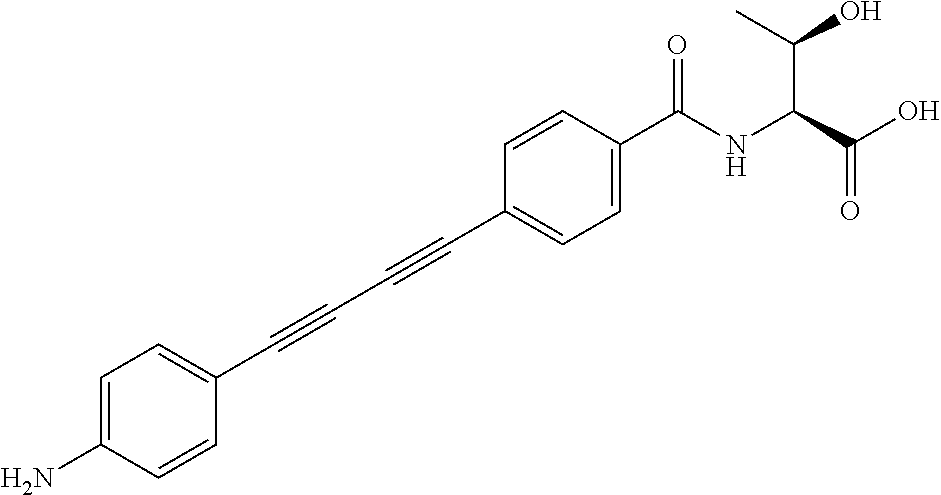 |
(2S,3R)-2-(4-((4-aminophenyl)buta-1,3- diynyl)benzamido)-3-hydroxybutanoic acid (CPD-046) |
| 44 |
 |
N-((2S,3R)-1-amino-3-hydroxy-1- oxobutan-2-yl)-4-((4-aminophenyl)buta- 1,3-diynyl)benzamide (CPD-047) |
| 45 |
 |
(S)-4-((4-aminophenyl)buta-1,3-diynyl)-N- (1-hydroxy-3-isopropyl-2-oxopyrrolidin-3- yl)benzamide (CPD-048) |
| 46 |
 |
4-((4-aminophenyl)buta-1,3-diynyl)-N- ((1R,2S)-1-hydroxy-3-(hydroxyamino)-1- (4-hydroxyphenyl)-3-oxopropan-2- yl)benzamide (CPD-049) |
| 47 |
 |
4-((4-aminophenyl)buta-1,3-diynyl)-N- ((1S,2S)-1-hydroxy-3-(hydroxyamino)-1- (4-hydroxyphenyl)-3-oxopropan-2- yl)benzamide (CPD-050) |
| 48 |
 |
4-((4-aminophenyl)buta-1,3-diynyl)-N- ((2S)-3-hydroxy-1-(hydroxyamino)-3-(4- hydroxyphenyl)-1-oxobutan-2- yl)benzamide (CPD-051) |
| 49 |
 |
4-((4-aminophenyl)buta-1,3-diynyl)-N- ((3R)-3-hydroxy-1-(hydroxyamino)-3-(4- hydroxyphenyl)-1-oxobutan-2- yl)benzamide (CPD-052) |
| 50 |
 |
4-((4-aminophenyl)buta-1,3-diynyl)-N- ((2S,3S)-4,4-difluoro-3-hydroxy-1- (hydroxyamino)-1-oxobutan-2- yl)benzamide (CPD-056) |
| 51 |
 |
4-((4-aminophenyl)buta-1,3-diynyl)-N- ((2S,3S)-4,4,4-trifluoro-3-hydroxy-1- (hydroxyamino)-1-oxobutan-2- yl)benzamide (CPD-057) |
| 52 |
 |
4-((4-aminophenyl)buta-1,3-diynyl)-N- ((2S,3S)-4,4-difluoro-3-hydroxy-1- (hydroxyamino)-3-methyl-1-oxobutan-2- yl)benzamide (CPD-058) |
| 53 |
 |
4-(3-(4-aminophenoxy)prop-1-ynyl)-N- ((2S,3R)-3-hydroxy-1-(hydroxyamino)-1- oxobutan-2-yl)benzamide (CPD-059) |
| 54 |
 |
(R)-4-(3-(4-aminophenoxy)prop-1-ynyl)- N-(1-hydroxy-2-oxopyrrolidin-3- yl)benzamide (CPD-060) |
| 55 |
 |
4-((4-aminophenyl)buta-1,3-diynyl)-N- ((2S,3S)-4-fluoro-3-hydroxy-1- (hydroxyamino)-3-methyl-1-oxobutan-2- yl)benzamide (CPD-061) |
| 56 |
 |
4-((4-aminophenyl)buta-1,3-diynyl)-N- ((2S,3S)-3-hydroxy-1-(hydroxyamino)-3- (4-(hydroxymethyl)phenyl)-1-oxobutan-2- yl)benzamide (CPD-062) |
| 57 |
 |
4-(3-(4-aminophenyl)prop-2-ynyloxy)-N- ((2S,3R)-3-hydroxy-1-(hydroxyamino)-1- oxobutan-2-yl)benzamide (CPD-063) |
| 58 |
 |
(R)-tert-butyl 4-((4-(1-hydroxy-2- oxoazetidin-3-ylcarbamoyl)phenyl)buta- 1,3-diynyl)phenylcarbamate (CPD-064) |
| 59 |
 |
(S)-N-(3-amino-1-(hydroxyamino)-3- methyl-1-oxobutan-2-yl)-4-((2- aminophenyl)buta-1,3-diynyl)benzamide (CPD-065) |
| 60 |
 |
(S)-4-((2-aminophenyl)buta-1,3-diynyl)-N- (3-hydroxy-1-(hydroxyamino)-3-methyl-1- oxobutan-2-yl)benzamide (CPD-066) |
| 61 |
 |
4-((2-aminophenyl)buta-1,3-diynyl)-N- ((2S,3S)-4,4-difluoro-3-hydroxy-1- (hydroxyamino)-3-methyl-1-oxobutan-2- yl)benzamide (CPD-067) |
| 62 |
 |
N-((2S,3S)-4,4-difluoro-3-hydroxy-1- (hydroxyamino)-3-methyl-1-oxobutan-2- yl)-4-((4- (morpholinomethyl)phenyl)ethynyl)benzamide (CPD-069) |
| 63 |
 |
(R)-4-((4-aminophenyl)buta-1,3-diynyl)-N- (3-hydroxy-1-(hydroxyamino)-1- oxopropan-2-yl)benzamide (CPD-070) |
| 64 |
 |
(R)-4-((4-aminophenyl)buta-1,3-diynyl)-N- (1-hydroxy-2-oxoazetidin-3-yl)benzamide (CPD-071) |
| 65 |
 |
4-((4-aminophenyl)buta-1,3-diynyl)-N- ((3R)-3-hydroxy-1-(hydroxyamino)-1-oxo- 3-(1H-1,2,3-triazol-4-yl)butan-2- yl)benzamide (CPD-072) |
| 66 |
 |
N-((3S)-3-amino-4,4-difluoro-1- (hydroxyamino)-3-methyl-1-oxobutan-2- yl)-4-((4-aminophenyl)buta-1,3- diynyl)benzamide (CPD-079) |
| 67 |
 |
N-((2S,3S)-3-amino-4,4-difluoro-1- (hydroxyamino)-3-methyl-1-oxobutan-2- yl)-4-((4- (morpholinomethyl)phenyl)ethynyl)benzamide (CPD-080) |
| 68 |
 |
N-((2S,3S)-3-amino-4,4-difluoro-1- (hydroxyamino)-3-methyl-1-oxobutan-2- yl)-4-((2-aminophenyl)buta-1,3- diynyl)benzamide (CPD-081) |
| 69 |
 |
4-((4-aminophenyl)buta-1,3-diynyl)-N- ((2S,3S)-4,4,4-trifluoro-3-hydroxy-1- (hydroxyamino)-3-methyl-1-oxobutan-2- yl)benzamide (CPD-083) |
| 70 |
 |
(2S,3R)-2-{4′-[(4″-aminophenyl)buta-1′,3′- diynyl]benzamido}-3-[(4′- hydroxymethyl)phen-1′-yl]-1,3- dihydroxybutanamide |
| 71 |
 |
(2S,3R)-2-{4′-[(4″-aminophenyl)buta-1′,3′- diynyl]benzamido}-3-[(4′- aminomethyl)phen-1′-yl]-1,3- dihydroxybutanamide |
| 72 |
 |
(2S,3R)-3-amino-2-{4′-[(4″- aminophenyl)buta-1′,3′- diynyl]benzamido}-3-fluoromethyl-1,3- dihydroxybutanamide |
| 73 |
 |
(2S,3R)-2-{4′-[(4″-aminophenyl)buta-1′,3′- diynyl]phenyl-4′-piperizine-4′- carboxamido}-1,3-dihydroxybutanamide |
| 74 |
 |
(2S,3R)-2-{4′-[(4″-aminophenyl)buta-1′,3′- diynyl]benzamido}-3-[(2′-amino)imidazol- 5′-yl]-1,3-dihydroxybutanamide |
| 75 |
 |
(2S,3R)-2-{4′-[(4″-aminophenyl)buta-1′,3′- diynyl]benzamido}-3-(imidazol-5′-yl]-1,3- dihydroxybutanamide |
| 76 |
 |
(2S,3R)-2-{4′-[(4″-aminophenyl)buta-1′,3′- diynyl]benzamido}-3-(triazol-5′-yl]-1,3- dihydroxybutanamide |
| 77 |
 |
(2S,3R)-2-{4′-[(4″-aminophenyl)buta-1′,3′- diynyl]benzamido}-3-(triazol-1′-yl]-1,3- dihydroxybutanamide |
| 78 |
 |
(2S,3R)-2-{4′-[(4″-aminophenyl)buta-1′,3′- diynyl]benzamido}-3-(3′-amminium- triazol-1′-yl]-1,3-dihydroxybutanamide |
| 79 |
 |
1-hydroxy-3-{N-[(4″-aminophenyl)buta- 1′,3′-diynyl]benzyl}-2-pyrrolidone |
| 80 |
 |
1-hydroxy-3-{4′-[(4″-aminophenyl)prop-2- ynyloxy]benzamido}-2-pyrrolidone |
| 81 |
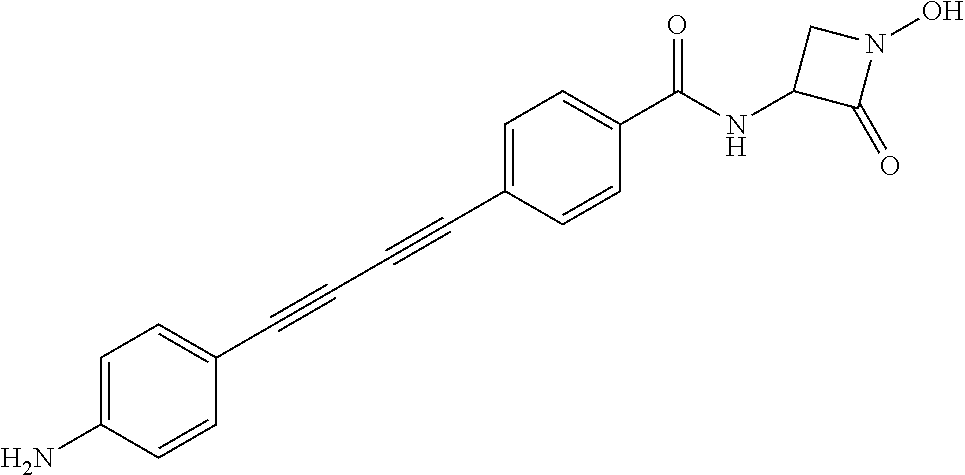 |
1-hydroxy-3-{4′-[(4″-aminophenyl)buta- 1′,3′-diynyl]benzamido}-2-lactam |
| 82 |
 |
N-((2S)-4,4-difluoro-3-hydroxy-1- (hydroxyamino)-3-methyl-1-oxobutan-2- yl)-4-((4-fluorophenyl)buta-1,3- diynyl)benzamide |
| 83 |
 |
N-((2S)-4,4-difluoro-1-(hydroxyamino)-3- methoxy-3-methyl-1-oxobutan-2-yl)-4-((4- fluorophenyl)buta-1,3-diynyl)benzamide |
| 84 |
 |
N-((2S)-3-amino-4,4-difluoro-1- (hydroxyamino)-3-methyl-1-oxobutan-2- yl)-4-((4-fluorophenyl)buta-1,3- diynyl)benzamide |
| 85 |
 |
N-((2S)-3-acetamido-4,4-difluoro-1- (hydroxyamino)-3-methyl-1-oxobutan-2- yl)-4-((4-fluorophenyl)buta-1,3- diynyl)benzamide |
| 86 |
 |
N-((2S)-4,4-difluoro-1-(hydroxyamino)-3- methyl-3-(3-methylureido)-1-oxobutan-2- yl)-4-((4-fluorophenyl)buta-1,3- diynyl)benzamide |
| 87 |
 |
4-((4-chlorophenyl)buta-1,3-diynyl)-N- ((2S)-4,4-difluoro-3-hydroxy-1- (hydroxyamino)-3-methyl-1-oxobutan-2- yl)benzamide |
| 88 |
 |
4-((4-chlorophenyl)buta-1,3-diynyl)-N- ((2S)-4,4-difluoro-1-(hydroxyamino)-3- methoxy-3-methyl-1-oxobutan-2- yl)benzamide |
| 89 |
 |
N-((2S)-3-amino-4,4-difluoro-1- (hydroxyamino)-3-methyl-1-oxobutan-2- yl)-4-((4-chlorophenyl)buta-1,3- diynyl)benzamide |
| 90 |
 |
N-((2S)-3-acetamido-4,4-difluoro-1- (hydroxyamino)-3-methyl-1-oxobutan-2- yl)-4-((4-chlorophenyl)buta-1,3- diynyl)benzamide |
| 91 |
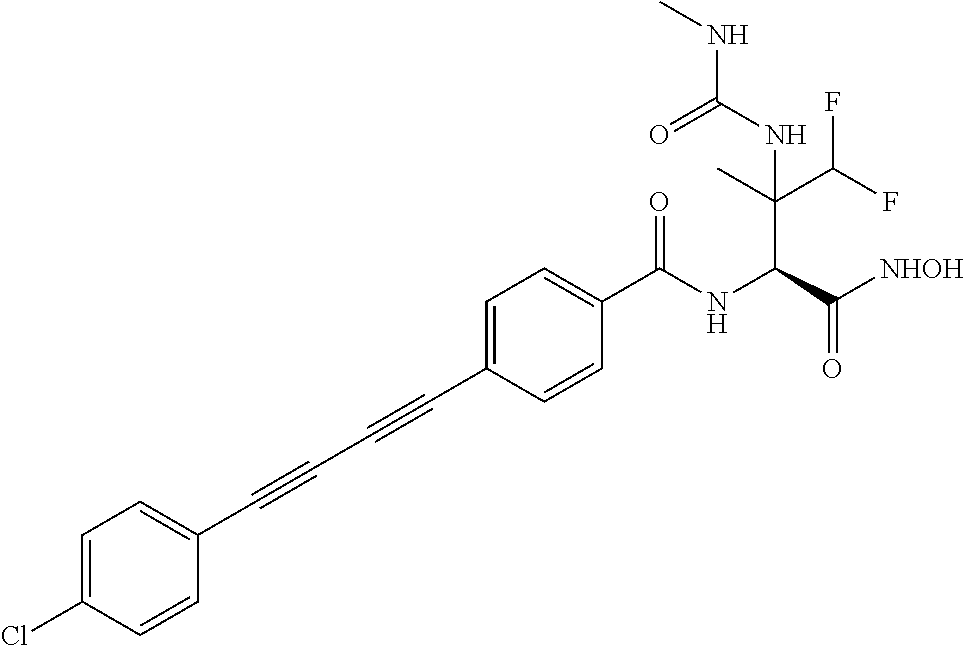 |
4-((4-chlorophenyl)buta-1,3-diynyl)-N- ((2S)-4,4-difluoro-1-(hydroxyamino)-3- methyl-3-(3-methylureido)-1-oxobutan-2- yl)benzamide |
| 92 |
 |
N-((2S)-4,4-difluoro-3-hydroxy-1- (hydroxyamino)-3-methyl-1-oxobutan-2- yl)-4-((4-(trifluoromethyl)phenyl)buta-1,3- diynyl)benzamide |
| 93 |
 |
N-((2S)-4,4-difluoro-1-(hydroxyamino)-3- methoxy-3-methyl-1-oxobutan-2-yl)-4-((4- (trifluoromethyl)phenyl)buta-1,3- diynyl)benzamide |
| 94 |
 |
N-((2S)-3-amino-4,4-difluoro-1- (hydroxyamino)-3-methyl-1-oxobutan-2- yl)-4-((4-(trifluoromethyl)phenyl)buta-1,3- diynyl)benzamide |
| 95 |
 |
N-((2S)-3-acetamido-4,4-difluoro-1- (hydroxyamino)-3-methyl-1-oxobutan-2- yl)-4-((4-(trifluoromethyl)phenyl)buta-1,3- diynyl)benzamide |
| 96 |
 |
N-((2S)-4,4-difluoro-1-(hydroxyamino)-3- methyl-3-(3-methylureido)-1-oxobutan-2- yl)-4-((4-(trifluoromethyl)phenyl)buta-1,3- diynyl)benzamide |
| 97 |
 |
N-((2S)-4,4-difluoro-3-hydroxy-1- (hydroxyamino)-3-methyl-1-oxobutan-2- yl)-4-((4-hydroxyphenyl)buta-1,3- diynyl)benzamide |
| 98 |
 |
N-((2S)-4,4-difluoro-1-(hydroxyamino)-3- methoxy-3-methyl-1-oxobutan-2-yl)-4-((4- hydroxyphenyl)buta-1,3-diynyl)benzamide |
| 99 |
 |
N-((2S)-3-amino-4,4-difluoro-1- (hydroxyamino)-3-methyl-1-oxobutan-2- yl)-4-((4-hydroxyphenyl)buta-1,3- diynyl)benzamide |
| 100 |
 |
N-((2S)-3-acetamido-4,4-difluoro-1- (hydroxyamino)-3-methyl-1-oxobutan-2- yl)-4-((4-hydroxyphenyl)buta-1,3- diynyl)benzamide |
| 101 |
 |
N-((2S)-4,4-difluoro-1-(hydroxyamino)-3- methyl-3-(3-methylureido)-1-oxobutan-2- yl)-4-((4-hydroxyphenyl)buta-1,3- diynyl)benzamide |
| 102 |
 |
N-((2S)-4,4-difluoro-3-hydroxy-1- (hydroxyamino)-3-methyl-1-oxobutan-2- yl)-4-((4-methoxyphenyl)buta-1,3- diynyl)benzamide |
| 103 |
 |
N-((2S)-4,4-difluoro-1-(hydroxyamino)-3- methoxy-3-methyl-1-oxobutan-2-yl)-4-((4- methoxyphenyl)buta-1,3- diynyl)benzamide |
| 104 |
 |
N-((2S)-3-amino-4,4-difluoro-1- (hydroxyamino)-3-methyl-1-oxobutan-2- yl)-4-((4-methoxyphenyl)buta-1,3- diynyl)benzamide |
| 105 |
 |
N-((2S)-3-acetamido-4,4-difluoro-1- (hydroxyamino)-3-methyl-1-oxobutan-2- yl)-4-((4-methoxyphenyl)buta-1,3- diynyl)benzamide |
| 106 |
 |
N-((2S)-4,4-difluoro-1-(hydroxyamino)-3- methyl-3-(3-methylureido)-1-oxobutan-2- yl)-4-((4-methoxyphenyl)buta-1,3- diynyl)benzamide |
| 107 |
 |
N-((2S)-4,4-difluoro-3-hydroxy-1- (hydroxyamino)-3-methyl-1-oxobutan-2- yl)-4-((4-(dimethylamino)phenyl)buta-1,3- diynyl)benzamide |
| 108 |
 |
N-((2S)-4,4-difluoro-1-(hydroxyamino)-3- methoxy-3-methyl-1-oxobutan-2-yl)-4-((4- (dimethylamino)phenyl)buta-1,3- diynyl)benzamide |
| 109 |
 |
N-((2S)-3-amino-4,4-difluoro-1- (hydroxyamino)-3-methyl-1-oxobutan-2- yl)-4-((4-(dimethylamino)phenyl)buta-1,3- diynyl)benzamide |
| 110 |
 |
N-((2S)-3-acetamido-4,4-difluoro-1- (hydroxyamino)-3-methyl-1-oxobutan-2- yl)-4-((4-(dimethylamino)phenyl)buta-1,3- diynyl)benzamide |
| 111 |
 |
N-((2S)-4,4-difluoro-1-(hydroxyamino)-3- methyl-3-(3-methylureido)-1-oxobutan-2- yl)-4-((4-(dimethylamino)phenyl)buta-1,3- diynyl)benzamide |
| 112 |
 |
N-((2S)-4,4-difluoro-3-hydroxy-1- (hydroxyamino)-3-methyl-1-oxobutan-2- yl)-4-((4-(3-methylureido)phenyl)buta-1,3- diynyl)benzamide |
| 113 |
 |
N-((2S)-4,4-difluoro-1-(hydroxyamino)-3- methoxy-3-methyl-1-oxobutan-2-yl)-4-((4- (3-methylureido)phenyl)buta-1,3- diynyl)benzamide |
| 114 |
 |
N-((2S)-3-amino-4,4-difluoro-1- (hydroxyamino)-3-methyl-1-oxobutan-2- yl)-4-((4-(3-methylureido)phenyl)buta-1,3- diynyl)benzamide |
| 115 |
 |
N-((2S)-3-acetamido-4,4-difluoro-1- (hydroxyamino)-3-methyl-1-oxobutan-2- yl)-4-((4-(3-methylureido)phenyl)buta-1,3- diynyl)benzamide |
| 116 |
 |
N-((2S)-4,4-difluoro-1-(hydroxyamino)-3- methyl-3-(3-methylureido)-1-oxobutan-2- yl)-4-((4-(3-methylureido)phenyl)buta-1,3- diynyl)benzamide |
| 117 |
 |
N-((2S)-4,4-difluoro-3-hydroxy-1- (hydroxyamino)-3-methyl-1-oxobutan-2- yl)-4-((4-ureidophenyl)buta-1,3- diynyl)benzamide |
| 118 |
 |
N-((2S)-4,4-difluoro-1-(hydroxyamino)-3- methoxy-3-methyl-1-oxobutan-2-yl)-4-((4- ureidophenyl)buta-1,3-diynyl)benzamide |
| 119 |
 |
N-((2S)-3-amino-4,4-difluoro-1- (hydroxyamino)-3-methyl-1-oxobutan-2- yl)-4-((4-ureidophenyl)buta-1,3- diynyl)benzamide |
| 120 |
 |
N-((2S)-3-acetamido-4,4-difluoro-1- (hydroxyamino)-3-methyl-1-oxobutan-2- yl)-4-((4-ureidophenyl)buta-1,3- diynyl)benzamide |
| 121 |
 |
N-((2S)-4,4-difluoro-1-(hydroxyamino)-3- methyl-3-(3-methylureido)-1-oxobutan-2- yl)-4-((4-ureidophenyl)buta-1,3- diynyl)benzamide |
| 122 |
 |
4-((4-acetamidophenyl)buta-1,3-diynyl)- N-((2S)-4,4-difluoro-3-hydroxy-1- (hydroxyamino)-3-methyl-1-oxobutan-2- yl)benzamide |
| 123 |
 |
4-((4-acetamidophenyl)buta-1,3-diynyl)- N-((2S)-4,4-difluoro-1-(hydroxyamino)-3- methoxy-3-methyl-1-oxobutan-2- yl)benzamide |
| 124 |
 |
4-((4-acetamidophenyl)buta-1,3-diynyl)- N-((2S)-3-amino-4,4-difluoro-1- (hydroxyamino)-3-methyl-1-oxobutan-2- yl)benzamide |
| 125 |
 |
N-((2S)-3-acetamido-4,4-difluoro-1- (hydroxyamino)-3-methyl-1-oxobutan-2- yl)-4-((4-acetamidophenyl)buta-1,3- diynyl)benzamide |
| 126 |
 |
4-((4-acetamidophenyl)buta-1,3-diynyl)- N-((2S)-4,4-difluoro-1-(hydroxyamino)-3- methyl-3-(3-methylureido)-1-oxobutan-2- yl)benzamide |
| 127 |
 |
N-((2S)-4,4-difluoro-3-hydroxy-1- (hydroxyamino)-3-methyl-1-oxobutan-2- yl)-4-((4-(methylsulfonamido)phenyl)buta- 1,3-diynyl)benzamide |
| 128 |
 |
N-((2S)-4,4-difluoro-1-(hydroxyamino)-3- methoxy-3-methyl-1-oxobutan-2-yl)-4-((4- (methylsulfonamido)phenyl)buta-1,3- diynyl)benzamide |
| 129 |
 |
N-((2S)-3-amino-4,4-difluoro-1- (hydroxyamino)-3-methyl-1-oxobutan-2- yl)-4-((4-(methylsulfonamido)phenyl)buta- 1,3-diynyl)benzamide |
| 130 |
 |
N-((2S)-3-acetamido-4,4-difluoro-1- (hydroxyamino)-3-methyl-1-oxobutan-2- yl)-4-((4-(methylsulfonamido)phenyl)buta- 1,3-diynyl)benzamide |
| 131 |
 |
N-((2S)-4,4-difluoro-1-(hydroxyamino)-3- methyl-3-(3-methylureido)-1-oxobutan-2- yl)-4-((4-(methylsulfonamido)phenyl)buta- 1,3-diynyl)benzamide |
| 132 |
 |
N-((2S)-4,4-difluoro-3-hydroxy-1- (hydroxyamino)-3-methyl-1-oxobutan-2- yl)-4-((4-(hydroxymethyl)phenyl)buta-1,3- diynyl)benzamide |
| 133 |
 |
N-((2S)-4,4-difluoro-1-(hydroxyamino)-3- methoxy-3-methyl-1-oxobutan-2-yl)-4-((4- (hydroxymethyl)phenyl)buta-1,3- diynyl)benzamide |
| 134 |
 |
N-((2S)-3-amino-4,4-difluoro-1- (hydroxyamino)-3-methyl-1-oxobutan-2- yl)-4-((4-(hydroxymethyl)phenyl)buta-1,3- diynyl)benzamide |
| 135 |
 |
N-((2S)-3-acetamido-4,4-difluoro-1- (hydroxyamino)-3-methyl-1-oxobutan-2- yl)-4-((4-(hydroxymethyl)phenyl)buta-1,3- diynyl)benzamide |
| 136 |
 |
N-((2S)-4,4-difluoro-1-(hydroxyamino)-3- methyl-3-(3-methylureido)-1-oxobutan-2- yl)-4-((4-(hydroxymethyl)phenyl)buta-1,3- diynyl)benzamide |
| 137 |
 |
4-((4-((2S)-4,4-difluoro-3-hydroxy-1- (hydroxyamino)-3-methyl-1-oxobutan-2- ylcarbamoyl)phenyl)buta-1,3- diynyl)benzoic acid |
| 138 |
 |
4-((4-((2S)-4,4-difluoro-1-(hydroxyamino)- 3-methoxy-3-methyl-1-oxobutan-2- ylcarbamoyl)phenyl)buta-1,3- diynyl)benzoic acid |
| 139 |
 |
4-((4-((2S)-3-amino-4,4-difluoro-1- (hydroxyamino)-3-methyl-1-oxobutan-2- ylcarbamoyl)phenyl)buta-1,3- diynyl)benzoic acid |
| 140 |
 |
4-((4-((2S)-3-acetamido-4,4-difluoro-1- (hydroxyamino)-3-methyl-1-oxobutan-2- ylcarbamoyl)phenyl)buta-1,3- diynyl)benzoic acid |
| 141 |
 |
4-((4-((2S)-4,4-difluoro-1-(hydroxyamino)- 3-methyl-3-(3-methylureido)-1-oxobutan- 2-ylcarbamoyl)phenyl)buta-1,3- diynyl)benzoic acid |
| 142 |
 |
N-((2S)-4,4-difluoro-3-hydroxy-1- (hydroxyamino)-3-methyl-1-oxobutan-2- yl)-4-((4-formylphenyl)buta-1,3- diynyl)benzamide |
| 143 |
 |
N-((2S)-4,4-difluoro-1-(hydroxyamino)-3- methoxy-3-methyl-1-oxobutan-2-yl)-4-((4- formylphenyl)buta-1,3-diynyl)benzamide |
| 144 |
 |
N-((2S)-3-amino-4,4-difluoro-1- (hydroxyamino)-3-methyl-1-oxobutan-2- yl)-4-((4-formylphenyl)buta-1,3- diynyl)benzamide |
| 145 |
 |
N-((2S)-3-acetamido-4,4-difluoro-1- (hydroxyamino)-3-methyl-1-oxobutan-2- yl)-4-((4-formylphenyl)buta-1,3- diynyl)benzamide |
| 146 |
 |
N-((2S)-4,4-difluoro-1-(hydroxyamino)-3- methyl-3-(3-methylureido)-1-oxobutan-2- yl)-4-((4-formylphenyl)buta-1,3- diynyl)benzamide |
| 147 |
 |
4-((4-carbamoylphenyl)buta-1,3-diynyl)- N-((2S)-4,4-difluoro-3-hydroxy-1- (hydroxyamino)-3-methyl-1-oxobutan-2- yl)benzamide |
| 148 |
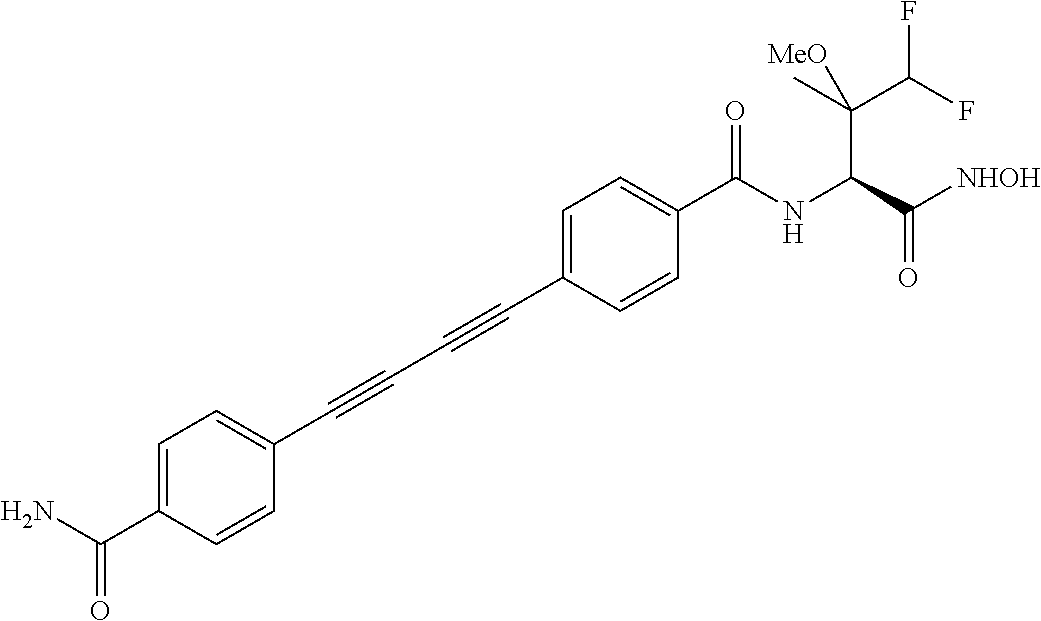 |
4-((4-carbamoylphenyl)buta-1,3-diynyl)- N-((2S)-4,4-difluoro-1-(hydroxyamino)-3- methoxy-3-methyl-1-oxobutan-2- yl)benzamide |
| 149 |
 |
N-((2S)-3-amino-4,4-difluoro-1- (hydroxyamino)-3-methyl-1-oxobutan-2- yl)-4-((4-carbamoylphenyl)buta-1,3- diynyl)benzamide |
| 150 |
 |
N-((2S)-3-acetamido-4,4-difluoro-1- (hydroxyamino)-3-methyl-1-oxobutan-2- yl)-4-((4-carbamoylphenyl)buta-1,3- diynyl)benzamide |
| 151 |
 |
4-((4-carbamoylphenyl)buta-1,3-diynyl)- N-((2S)-4,4-difluoro-1-(hydroxyamino)-3- methyl-3-(3-methylureido)-1-oxobutan-2- yl)benzamide |
| 152 |
 |
4-((4-(aminomethyl)phenyl)buta-1,3- diynyl)-N-((2S)-4,4-difluoro-3-hydroxy-1- (hydroxyamino)-3-methyl-1-oxobutan-2- yl)benzamide |
| 153 |
 |
4-((4-(aminomethyl)phenyl)buta-1,3- diynyl)-N-((2S)-4,4-difluoro-1- (hydroxyamino)-3-methoxy-3-methyl-1- oxobutan-2-yl)benzamide |
| 154 |
 |
N-((2S)-3-amino-4,4-difluoro-1- (hydroxyamino)-3-methyl-1-oxobutan-2- yl)-4-((4-(aminomethyl)phenyl)buta-1,3- diynyl)benzamide |
| 155 |
 |
N-((2S)-3-acetamido-4,4-difluoro-1- (hydroxyamino)-3-methyl-1-oxobutan-2- yl)-4-((4-(aminomethyl)phenyl)buta-1,3- diynyl)benzamide |
| 156 |
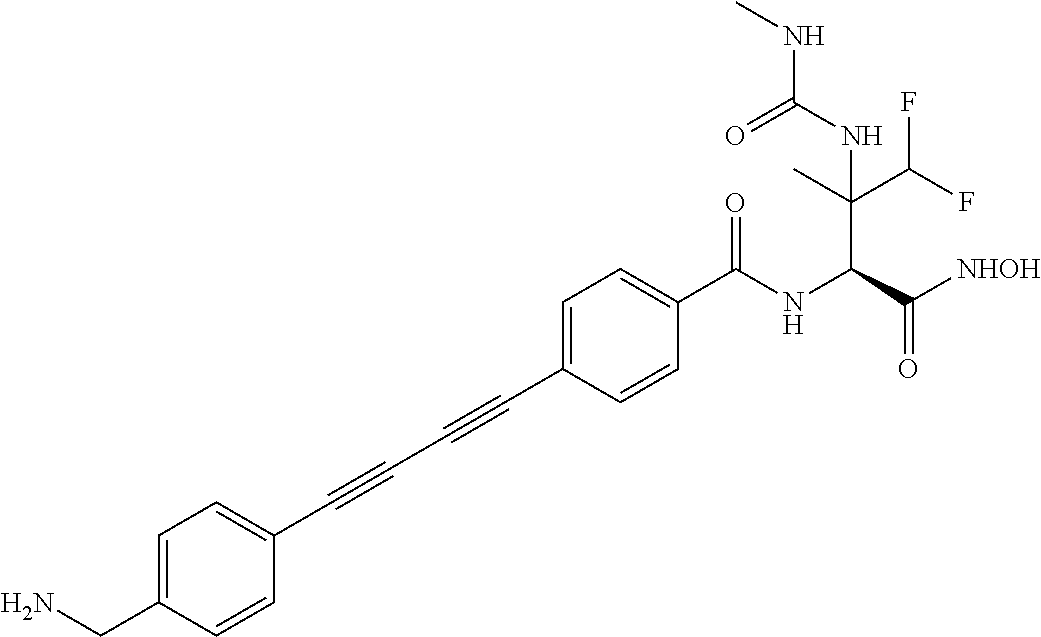 |
4-((4-(aminomethyl)phenyl)buta-1,3- diynyl)-N-((2S)-4,4-difluoro-1- (hydroxyamino)-3-methyl-3-(3- methylureido)-1-oxobutan-2-yl)benzamide |
| 157 |
 |
4-((4-cyanophenyl)buta-1,3-diynyl)-N- ((2S)-4,4-difluoro-3-hydroxy-1- (hydroxyamino)-3-methyl-1-oxobutan-2- yl)benzamide |
| 158 |
 |
4-((4-cyanophenyl)buta-1,3-diynyl)-N- ((2S)-4,4-difluoro-1-(hydroxyamino)-3- methoxy-3-methyl-1-oxobutan-2- yl)benzamide |
| 159 |
 |
N-((2S)-3-amino-4,4-difluoro-1- (hydroxyamino)-3-methyl-1-oxobutan-2- yl)-4-((4-cyanophenyl)buta-1,3- diynyl)benzamide |
| 160 |
 |
N-((2S)-3-acetamido-4,4-difluoro-1- (hydroxyamino)-3-methyl-1-oxobutan-2- yl)-4-((4-cyanophenyl)buta-1,3- diynyl)benzamide |
| 161 |
 |
4-((4-cyanophenyl)buta-1,3-diynyl)-N- ((2S)-4,4-difluoro-1-(hydroxyamino)-3- methyl-3-(3-methylureido)-1-oxobutan-2- yl)benzamide |
| 162 |
 |
N-((2S)-4,4-difluoro-3-hydroxy-1- (hydroxyamino)-3-methyl-1-oxobutan-2- yl)-4-((4- ((dimethylamino)methyl)phenyl)buta-1,3- diynyl)benzamide |
| 163 |
 |
N-((2S)-4,4-difluoro-1-(hydroxyamino)-3- methoxy-3-methyl-1-oxobutan-2-yl)-4-((4- ((dimethylamino)methyl)phenyl)buta-1,3- diynyl)benzamide |
| 164 |
 |
N-((2S)-3-amino-4,4-difluoro-1- (hydroxyamino)-3-methyl-1-oxobutan-2- yl)-4-((4- ((dimethylamino)methyl)phenyl)buta-1,3- diynyl)benzamide |
| 165 |
 |
N-((2S)-3-acetamido-4,4-difluoro-1- (hydroxyamino)-3-methyl-1-oxobutan-2- yl)-4-((4- ((dimethylamino)methyl)phenyl)buta-1,3- diynyl)benzamide |
| 166 |
 |
N-((2S)-4,4-difluoro-1-(hydroxyamino)-3- methyl-3-(3-methylureido)-1-oxobutan-2- yl)-4-((4- ((dimethylamino)methyl)phenyl)buta-1,3- diynyl)benzamide |
| 167 |
 |
N-((2S)-4,4-difluoro-3-hydroxy-1- (hydroxyamino)-3-methyl-1-oxobutan-2- yl)-4-((4-(ureidomethyl)phenyl)buta-1,3- diynyl)benzamide |
| 168 |
 |
N-((2S)-4,4-difluoro-1-(hydroxyamino)-3- methoxy-3-methyl-1-oxobutan-2-yl)-4-((4- (ureidomethyl)phenyl)buta-1,3- diynyl)benzamide |
| 169 |
 |
N-((2S)-3-amino-4,4-difluoro-1- (hydroxyamino)-3-methyl-1-oxobutan-2- yl)-4-((4-(ureidomethyl)phenyl)buta-1,3- diynyl)benzamide |
| 170 |
 |
N-((2S)-3-acetamido-4,4-difluoro-1- (hydroxyamino)-3-methyl-1-oxobutan-2- yl)-4-((4-(ureidomethyl)phenyl)buta-1,3- diynyl)benzamide |
| 171 |
 |
N-((2S)-4,4-difluoro-1-(hydroxyamino)-3- methyl-3-(3-methylureido)-1-oxobutan-2- yl)-4-((4-(ureidomethyl)phenyl)buta-1,3- diynyl)benzamide |
| 172 |
 |
N-((2S)-4,4-difluoro-3-hydroxy-1- (hydroxyamino)-3-methyl-1-oxobutan-2- yl)-4-((4-(morpholinomethyl)phenyl)buta- 1,3-diynyl)benzamide |
| 173 |
 |
N-((2S)-4,4-difluoro-1-(hydroxyamino)-3- methoxy-3-methyl-1-oxobutan-2-yl)-4-((4- (morpholinomethyl)phenyl)buta-1,3- diynyl)benzamide |
| 174 |
 |
N-((2S)-3-amino-4,4-difluoro-1- (hydroxyamino)-3-methyl-1-oxobutan-2- yl)-4-((4-(morpholinomethyl)phenyl)buta- 1,3-diynyl)benzamide |
| 175 |
 |
N-((2S)-3-acetamido-4,4-difluoro-1- (hydroxyamino)-3-methyl-1-oxobutan-2- yl)-4-((4-(morpholinomethyl)phenyl)buta- 1,3-diynyl)benzamide |
| 176 |
 |
N-((2S)-4,4-difluoro-1-(hydroxyamino)-3- methyl-3-(3-methylureido)-1-oxobutan-2- yl)-4-((4-(morpholinomethyl)phenyl)buta- 1,3-diynyl)benzamide |
| 177 |
 |
N-((2S)-4,4-difluoro-3-hydroxy-1- (hydroxyamino)-3-methyl-1-oxobutan-2- yl)-4-((4-(pyrrolidin-1- ylmethyl)phenyl)buta-1,3- diynyl)benzamide |
| 178 |
 |
N-((2S)-4,4-difluoro-1-(hydroxyamino)-3- methoxy-3-methyl-1-oxobutan-2-yl)-4-((4- (pyrrolidin-1-ylmethyl)phenyl)buta-1,3- diynyl)benzamide |
| 179 |
 |
N-((2S)-3-amino-4,4-difluoro-1- (hydroxyamino)-3-methyl-1-oxobutan-2- yl)-4-((4-(pyrrolidin-1- ylmethyl)phenyl)buta-1,3- diynyl)benzamide |
| 180 |
 |
N-((2S)-3-acetamido-4,4-difluoro-1- (hydroxyamino)-3-methyl-1-oxobutan-2- yl)-4-((4-(pyrrolidin-1- ylmethyl)phenyl)buta-1,3- diynyl)benzamide |
| 181 |
 |
N-((2S)-4,4-difluoro-1-(hydroxyamino)-3- methyl-3-(3-methylureido)-1-oxobutan-2- yl)-4-((4-(pyrrolidin-1- ylmethyl)phenyl)buta-1,3- diynyl)benzamide |
| 182 |
 |
4-((4-((1H-imidazol-1- yl)methyl)phenyl)buta-1,3-diynyl)-N-((2S)- 4,4-difluoro-3-hydroxy-1-(hydroxyamino)- 3-methyl-1-oxobutan-2-yl)benzamide |
| 183 |
 |
4-((4-((1H-imidazol-1- yl)methyl)phenyl)buta-1,3-diynyl)-N-((2S)- 4,4-difluoro-1-(hydroxyamino)-3-methoxy- 3-methyl-1-oxobutan-2-yl)benzamide |
| 184 |
 |
4-((4-((1H-imidazol-1- yl)methyl)phenyl)buta-1,3-diynyl)-N-((2S)- 3-amino-4,4-difluoro-1-(hydroxyamino)-3- methyl-1-oxobutan-2-yl)benzamide |
| 185 |
 |
4-((4-((1H-imidazol-1- yl)methyl)phenyl)buta-1,3-diynyl)-N-((2S)- 3-acetamido-4,4-difluoro-1- (hydroxyamino)-3-methyl-1-oxobutan-2- yl)benzamide |
| 186 |
 |
4-((4-((1H-imidazol-1- yl)methyl)phenyl)buta-1,3-diynyl)-N-((2S)- 4,4-difluoro-1-(hydroxyamino)-3-methyl-3- (3-methylureido)-1-oxobutan-2- yl)benzamide |
| 187 |
 |
N-((2S)-4,4-difluoro-3-hydroxy-1- (hydroxyamino)-3-methyl-1-oxobutan-2- yl)-4-(thiophen-2-ylbuta-1,3- diynyl)benzamide |
| 188 |
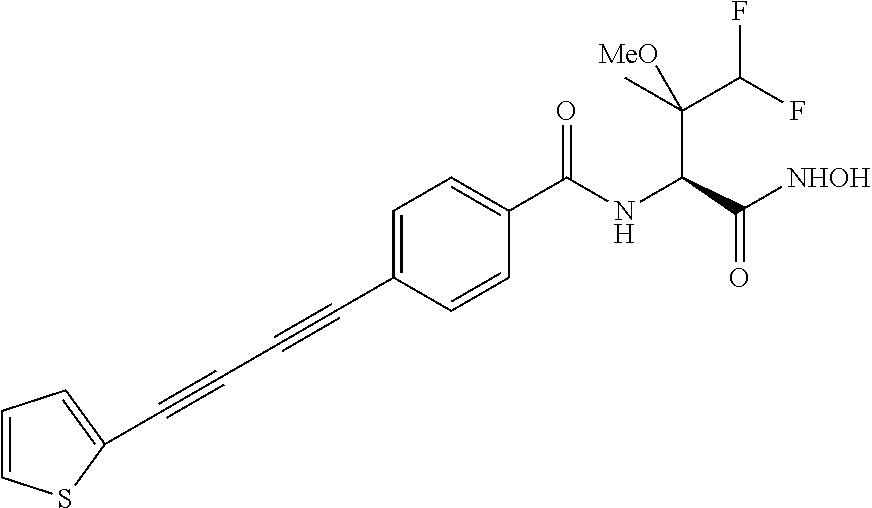 |
N-((2S)-4,4-difluoro-1-(hydroxyamino)-3- methoxy-3-methyl-1-oxobutan-2-yl)-4- (thiophen-2-ylbuta-1,3-diynyl)benzamide |
| 189 |
 |
N-((2S)-3-amino-4,4-difluoro-1- (hydroxyamino)-3-methyl-1-oxobutan-2- yl)-4-(thiophen-2-ylbuta-1,3- diynyl)benzamide |
| 190 |
 |
N-((2S)-3-acetamido-4,4-difluoro-1- (hydroxyamino)-3-methyl-1-oxobutan-2- yl)-4-(thiophen-2-ylbuta-1,3- diynyl)benzamide |
| 191 |
 |
N-((2S)-4,4-difluoro-1-(hydroxyamino)-3- methyl-3-(3-methylureido)-1-oxobutan-2- yl)-4-(thiophen-2-ylbuta-1,3- diynyl)benzamide |
| 192 |
 |
4-((5-aminothiophen-2-yl)buta-1,3-diynyl)- N-((2S)-4,4-difluoro-3-hydroxy-1- (hydroxyamino)-3-methyl-1-oxobutan-2- yl)benzamide |
| 193 |
 |
4-((5-aminothiophen-2-yl)buta-1,3-diynyl)- N-((2S)-4,4-difluoro-1-(hydroxyamino)-3- methoxy-3-methyl-1-oxobutan-2- yl)benzamide |
| 194 |
 |
N-((2S)-3-amino-4,4-difluoro-1- (hydroxyamino)-3-methyl-1-oxobutan-2- yl)-4-((5-aminothiophen-2-yl)buta-1,3- diynyl)benzamide |
| 195 |
 |
N-((2S)-3-acetamido-4,4-difluoro-1- (hydroxyamino)-3-methyl-1-oxobutan-2- yl)-4-((5-aminothiophen-2-yl)buta-1,3- diynyl)benzamide |
| 196 |
 |
4-((5-aminothiophen-2-yl)buta-1,3-diynyl)- N-((2S)-4,4-difluoro-1-(hydroxyamino)-3- methyl-3-(3-methylureido)-1-oxobutan-2- yl)benzamide |
| 197 |
 |
N-((2S)-4,4-difluoro-3-hydroxy-1- (hydroxyamino)-3-methyl-1-oxobutan-2- yl)-4-((l-methyl-1H-imidazol-4-yl)buta- 1,3-diynyl)benzamide |
| 198 |
 |
N-((2S)-4,4-difluoro-1-(hydroxyamino)-3- methoxy-3-methyl-1-oxobutan-2-yl)-4-((1- methyl-1H-imidazol-4-yl)buta-1,3- diynyl)benzamide |
| 199 |
 |
N-((2S)-3-amino-4,4-difluoro-1- (hydroxyamino)-3-methyl-1-oxobutan-2- yl)-4-((1-methyl-1H-imidazol-4-yl)buta- 1,3-diynyl)benzamide |
| 200 |
 |
N-((2S)-3-acetamido-4,4-difluoro-1- (hydroxyamino)-3-methyl-1-oxobutan-2- yl)-4-((1-methyl-1H-imidazol-4-yl)buta- 1,3-diynyl)benzamide |
| 201 |
 |
N-((2S)-4,4-difluoro-1-(hydroxyamino)-3- methyl-3-(3-methylureido)-1-oxobutan-2- yl)-4-((1-methyl-1H-imidazol-4-yl)buta- 1,3-diynyl)benzamide |
| 202 |
 |
4-((1H-imidazol-4-yl)buta-1,3-diynyl)-N- ((2S)-4,4-difluoro-3-hydroxy-1- (hydroxyamino)-3-methyl-1-oxobutan-2- yl)benzamide |
| 203 |
 |
4-((1H-imidazol-4-yl)buta-1,3-diynyl)-N- ((2S)-4,4-difluoro-1-(hydroxyamino)-3- methoxy-3-methyl-1-oxobutan-2- yl)benzamide |
| 204 |
 |
4-((1H-imidazol-4-yl)buta-1,3-diynyl)-N- ((2S)-3-amino-4,4-difluoro-1- (hydroxyamino)-3-methyl-1-oxobutan-2- yl)benzamide |
| 205 |
 |
4-((1H-imidazol-4-yl)buta-1,3-diynyl)-N- ((2S)-3-acetamido-4,4-difluoro-1- (hydroxyamino)-3-methyl-1-oxobutan-2- yl)benzamide |
| 206 |
 |
4-((1H-imidazol-4-yl)buta-1,3-diynyl)-N- ((2S)-4,4-difluoro-1-(hydroxyamino)-3- methyl-3-(3-methylureido)-1-oxobutan-2- yl)benzamide |
| 207 |
 |
4-((1H-1,2,3-triazol-4-yl)buta-1,3-diynyl)- N-((2S)-4,4-difluoro-3-hydroxy-1- (hydroxyamino)-3-methyl-1-oxobutan-2- yl)benzamide |
| 208 |
 |
4-((1H-1,2,3-triazol-4-yl)buta-1,3-diynyl)- N-((2S)-4,4-difluoro-1-(hydroxyamino)-3- methoxy-3-methyl-1-oxobutan-2- yl)benzamide |
| 209 |
 |
4-((1H-1,2,3-triazol-4-yl)buta-1,3-diynyl)- N-((2S)-3-amino-4,4-difluoro-1- (hydroxyamino)-3-methyl-1-oxobutan-2- yl)benzamide |
| 210 |
 |
4-((1H-1,2,3-triazol-4-yl)buta-1,3-diynyl)- N-((2S)-3-acetamido-4,4-difluoro-1- (hydroxyamino)-3-methyl-1-oxobutan-2- yl)benzamide |
| 211 |
 |
4-((1H-1,2,3-triazol-4-yl)buta-1,3-diynyl)- N-((2S)-4,4-difluoro-1-(hydroxyamino)-3- methyl-3-(3-methylureido)-1-oxobutan-2- yl)benzamide |
| 212 |
 |
4-((2H-tetrazol-5-yl)buta-1,3-diynyl)-N- ((2S)-4,4-difluoro-3-hydroxy-1- (hydroxyamino)-3-methyl-1-oxobutan-2- yl)benzamide |
| 213 |
 |
4-((2H-tetrazol-5-yl)buta-1,3-diynyl)-N- ((2S)-4,4-difluoro-1-(hydroxyamino)-3- methoxy-3-methyl-1-oxobutan-2- yl)benzamide |
| 214 |
 |
4-((2H-tetrazol-5-yl)buta-1,3-diynyl)-N- ((2S)-3-amino-4,4-difluoro-1- (hydroxyamino)-3-methyl-1-oxobutan-2- yl)benzamide |
| 215 |
 |
4-((2H-tetrazol-5-yl)buta-1,3-diynyl)-N- ((2S)-3-acetamido-4,4-difluoro-1- (hydroxyamino)-3-methyl-1-oxobutan-2- yl)benzamide |
| 216 |
 |
4-((2H-tetrazol-5-yl)buta-1,3-diynyl)-N- ((2S)-4,4-difluoro-1-(hydroxyamino)-3- methyl-3-(3-methylureido)-1-oxobutan-2- yl)benzamide |
| 217 |
 |
N-((2S)-4,4-difluoro-3-hydroxy-1- (hydroxyamino)-3-methyl-1-oxobutan-2- yl)-4-((l-methyl-1H-pyrazol-4-yl)buta-1,3- diynyl)benzamide |
| 218 |
 |
N-((2S)-4,4-difluoro-1-(hydroxyamino)-3- methoxy-3-methyl-1-oxobutan-2-yl)-4-((1- methyl-1H-pyrazol-4-yl)buta-1,3- diynyl)benzamide |
| 219 |
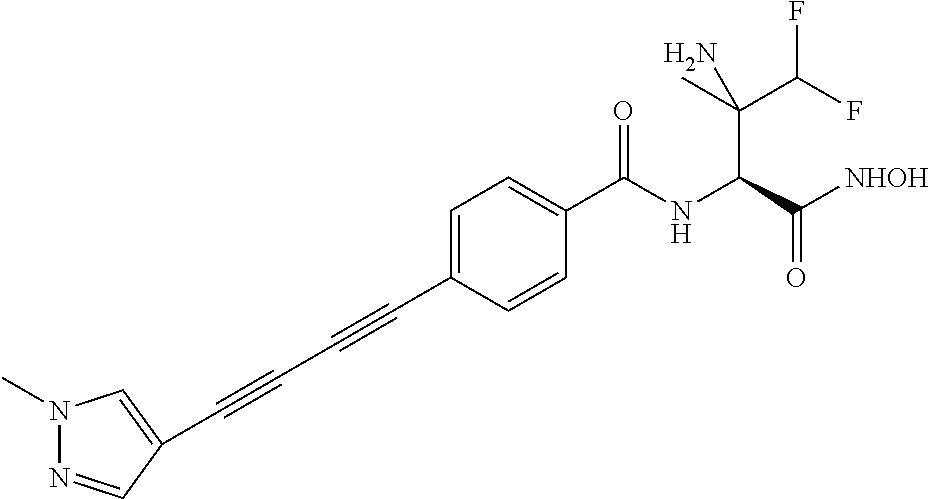 |
N-((2S)-3-amino-4,4-difluoro-1- (hydroxyamino)-3-methyl-1-oxobutan-2- yl)-4-((1-methyl-1H-pyrazol-4-yl)buta-1,3- diynyl)benzamide |
| 220 |
 |
N-((2S)-3-acetamido-4,4-difluoro-1- (hydroxyamino)-3-methyl-1-oxobutan-2- yl)-4-((l-methyl-1H-pyrazol-4-yl)buta-1,3- diynyl)benzamide |
| 221 |
 |
N-((2S)-4,4-difluoro-1-(hydroxyamino)-3- methyl-3-(3-methylureido)-1-oxobutan-2- yl)-4-((1-methyl-1H-pyrazol-4-yl)buta-1,3- diynyl)benzamide |
| 222 |
 |
N-((2S)-4,4-difluoro-3-hydroxy-1- (hydroxyamino)-3-methyl-1-oxobutan-2- yl)-4-(isoxazol-5-ylbuta-1,3-diynyl)benzamide |
| 223 |
 |
N-((2S)-4,4-difluoro-1-(hydroxyamino)-3- methoxy-3-methyl-1-oxobutan-2-yl)-4- (isoxazol-5-ylbuta-1,3-diynyl)benzamide |
| 224 |
 |
N-((2S)-3-amino-4,4-difluoro-1- (hydroxyamino)-3-methyl-1-oxobutan-2- yl)-4-(isoxazol-5-ylbuta-1,3-diynyl)benzamide |
| 225 |
 |
N-((2S)-3-acetamido-4,4-difluoro-1- (hydroxyamino)-3-methyl-1-oxobutan-2- yl)-4-(isoxazol-5-ylbuta-1,3-diynyl)benzamide |
| 226 |
 |
N-((2S)-4,4-difluoro-1-(hydroxyamino)-3- methyl-3-(3-methylureido)-1-oxobutan-2- yl)-4-(isoxazol-5-ylbuta-1,3-diynyl)benzamide |
| 227 |
 |
N-((2S)-4,4-difluoro-3-hydroxy-1- (hydroxyamino)-3-methyl-1-oxobutan-2- yl)-4-(oxazol-5-ylbuta-1,3-diynyl)benzamide |
| 228 |
 |
N-((2S)-4,4-difluoro-1-(hydroxyamino)-3- methoxy-3-methyl-1-oxobutan-2-yl)-4- (oxazol-5-ylbuta-1,3-diynyl)benzamide |
| 229 |
 |
N-((2S)-3-amino-4,4-difluoro-1- (hydroxyamino)-3-methyl-1-oxobutan-2- yl)-4-(oxazol-5-ylbuta-1,3-diynyl)benzamide |
| 230 |
 |
N-((2S)-3-acetamido-4,4-difluoro-1- (hydroxyamino)-3-methyl-1-oxobutan-2- yl)-4-(oxazol-5-ylbuta-1,3-diynyl)benzamide |
| 231 |
 |
N-((2S)-4,4-difluoro-1-(hydroxyamino)-3- methyl-3-(3-methylureido)-1-oxobutan-2- yl)-4-(oxazol-5-ylbuta-1,3-diynyl)benzamide |
| 232 |
 |
N-((2S)-4,4-difluoro-3-hydroxy-1- (hydroxyamino)-3-methyl-1-oxobutan-2- yl)-4-(isothiazol-5-ylbuta-1,3-diynyl)benzamide |
| 233 |
 |
N-((2S)-4,4-difluoro-1-(hydroxyamino)-3- methoxy-3-methyl-1-oxobutan-2-yl)-4- (isothiazol-5-ylbuta-1,3-diynyl)benzamide |
| 234 |
 |
N-((2S)-3-amino-4,4-difluoro-1- (hydroxyamino)-3-methyl-1-oxobutan-2- yl)-4-(isothiazol-5-ylbuta-1,3-diynyl)benzamide |
| 235 |
 |
N-((2S)-3-acetamido-4,4-difluoro-1- (hydroxyamino)-3-methyl-1-oxobutan-2- yl)-4-(isothiazol-5-ylbuta-1,3-diynyl)benzamide |
| 236 |
 |
N-((2S)-4,4-difluoro-1-(hydroxyamino)-3- methyl-3-(3-methylureido)-1-oxobutan-2- yl)-4-(isothiazol-5-ylbuta-1,3-diynyl)benzamide |
| 237 |
 |
N-((2S)-4,4-difluoro-3-hydroxy-1- (hydroxyamino)-3-methyl-1-oxobutan-2- yl)-4-(thiazol-5-ylbuta-1,3-diynyl)benzamide |
| 238 |
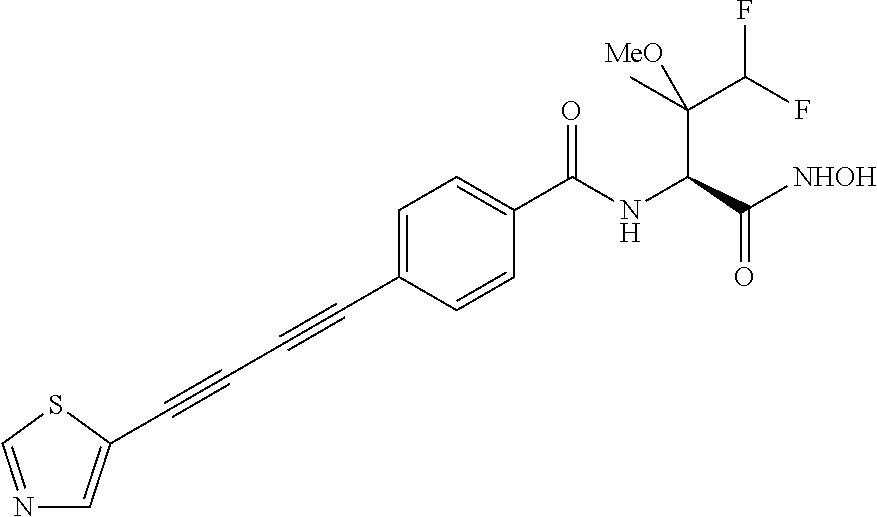 |
N-((2S)-4,4-difluoro-1-(hydroxyamino)-3- methoxy-3-methyl-1-oxobutan-2-yl)-4- (thiazol-5-ylbuta-1,3-diynyl)benzamide |
| 239 |
 |
N-((2S)-3-amino-4,4-difluoro-1- (hydroxyamino)-3-methyl-1-oxobutan-2- yl)-4-(thiazol-5-ylbuta-1,3-diynyl)benzamide |
| 240 |
 |
N-((2S)-3-acetamido-4,4-difluoro-1- (hydroxyamino)-3-methyl-1-oxobutan-2- yl)-4-(thiazol-5-ylbuta-1,3-diynyl)benzamide |
| 241 |
 |
N-((2S)-4,4-difluoro-1-(hydroxyamino)-3- methyl-3-(3-methylureido)-1-oxobutan-2- yl)-4-(thiazol-5-ylbuta-1,3-diynyl)benzamide |
| 242 |
 |
N-((2S)-4,4-difluoro-3-hydroxy-1- (hydroxyamino)-3-methyl-1-oxobutan-2- yl)-4-(thiophen-3-ylbuta-1,3-diynyl)benzamide |
| 243 |
 |
N-((2S)-4,4-difluoro-1-(hydroxyamino)-3- methoxy-3-methyl-1-oxobutan-2-yl)-4- (thiophen-3-ylbuta-1,3-diynyl)benzamide |
| 244 |
 |
N-((2S)-3-amino-4,4-difluoro-1- (hydroxyamino)-3-methyl-1-oxobutan-2- yl)-4-(thiophen-3-ylbuta-1,3-diynyl)benzamide |
| 245 |
 |
N-((2S)-3-acetamido-4,4-difluoro-1- (hydroxyamino)-3-methyl-1-oxobutan-2- yl)-4-(thiophen-3-ylbuta-1,3-diynyl)benzamide |
| 246 |
 |
N-((2S)-4,4-difluoro-1-(hydroxyamino)-3- methyl-3-(3-methylureido)-1-oxobutan-2- yl)-4-(thiophen-3-ylbuta-1,3-diynyl)benzamide |
| 247 |
 |
N-((2S)-4,4-difluoro-3-hydroxy-1- (hydroxyamino)-3-methyl-1-oxobutan-2- yl)-4-(furan-3-ylbuta-1,3-diynyl)benzamide |
| 248 |
 |
N-((2S)-4,4-difluoro-1-(hydroxyamino)-3- methoxy-3-methyl-1-oxobutan-2-yl)-4- (furan-3-ylbuta-1,3-diynyl)benzamide |
| 249 |
 |
N-((2S)-3-amino-4,4-difluoro-1- (hydroxyamino)-3-methyl-1-oxobutan-2- yl)-4-(furan-3-ylbuta-1,3-diynyl)benzamide |
| 250 |
 |
N-((2S)-3-acetamido-4,4-difluoro-1- (hydroxyamino)-3-methyl-1-oxobutan-2- yl)-4-(furan-3-ylbuta-1,3-diynyl)benzamide |
| 251 |
 |
N-((2S)-4,4-difluoro-1-(hydroxyamino)-3- methyl-3-(3-methylureido)-1-oxobutan-2- yl)-4-(furan-3-ylbuta-1,3-diynyl)benzamide |
| 252 |
 |
4-((2-aminothiazol-5-yl)buta-1,3-diynyl)- N-((2S)-4,4-difluoro-3-hydroxy-1- (hydroxyamino)-3-methyl-1-oxobutan-2- yl)benzamide |
| 253 |
 |
4-((2-aminothiazol-5-yl)buta-1,3-diynyl)- N-((2S)-4,4-difluoro-1-(hydroxyamino)-3- methoxy-3-methyl-1-oxobutan-2- yl)benzamide |
| 254 |
 |
N-((2S)-3-amino-4,4-difluoro-1- (hydroxyamino)-3-methyl-1-oxobutan-2- yl)-4-((2-aminothiazol-5-yl)buta-1,3- diynyl)benzamide |
| 255 |
 |
N-((2S)-3-acetamido-4,4-difluoro-1- (hydroxyamino)-3-methyl-1-oxobutan-2- yl)-4-((2-aminothiazol-5-yl)buta-1,3- diynyl)benzamide |
| 256 |
 |
4-((2-aminothiazol-5-yl)buta-1,3-diynyl)- N-((2S)-4,4-difluoro-1-(hydroxyamino)-3- methyl-3-(3-methylureido)-1-oxobutan-2- yl)benzamide |
| 257 |
 |
4-((2-aminophenyl)buta-1,3-diynyl)-N- ((2S)-4,4-difluoro-1-(hydroxyamino)-3- methoxy-3-methyl-1-oxobutan-2- yl)benzamide |
| 258 |
 |
N-((2S)-3-amino-4,4-difluoro-1- (hydroxyamino)-3-methyl-1-oxobutan-2- yl)-4-((2-aminophenyl)buta-1,3- diynyl)benzamide |
| 259 |
 |
N-((2S)-3-acetamido-4,4-difluoro-1- (hydroxyamino)-3-methyl-1-oxobutan-2- yl)-4-((2-aminophenyl)buta-1,3- diynyl)benzamide |
| 260 |
 |
4-((2-aminophenyl)buta-1,3-diynyl)-N- ((2S)-4,4-difluoro-1-(hydroxyamino)-3- methyl-3-(3-methylureido)-1-oxobutan-2- yl)benzamide |
| 261 |
 |
N-((2S)-4,4-difluoro-3-hydroxy-1- (hydroxyamino)-3-methyl-1-oxobutan-2- yl)-4-((2-hydroxyphenyl)buta-1,3- diynyl)benzamide |
| 262 |
 |
N-((2S)-4,4-difluoro-1-(hydroxyamino)-3- methoxy-3-methyl-1-oxobutan-2-yl)-4-((2- hydroxyphenyl)buta-1,3-diynyl)benzamide |
| 263 |
 |
N-((2S)-3-amino-4,4-difluoro-1- (hydroxyamino)-3-methyl-1-oxobutan-2- yl)-4-((2-hydroxyphenyl)buta-1,3- diynyl)benzamide |
| 264 |
 |
N-((2S)-3-acetamido-4,4-difluoro-1- (hydroxyamino)-3-methyl-1-oxobutan-2- yl)-4-((2-hydroxyphenyl)buta-1,3- diynyl)benzamide |
| 265 |
 |
N-((2S)-4,4-difluoro-1-(hydroxyamino)-3- methyl-3-(3-methylureido)-1-oxobutan-2- yl)-4-((2-hydroxyphenyl)buta-1,3- diynyl)benzamide |
| 266 |
 |
N-((2S)-4,4-difluoro-3-hydroxy-1- (hydroxyamino)-3-methyl-1-oxobutan-2- yl)-4-((2-methoxyphenyl)buta-1,3- diynyl)benzamide |
| 267 |
 |
N-((2S)-4,4-difluoro-1-(hydroxyamino)-3- methoxy-3-methyl-1-oxobutan-2-yl)-4-((2- methoxyphenyl)buta-1,3-diynyl)benzamide |
| 268 |
 |
N-((2S)-3-amino-4,4-difluoro-1- (hydroxyamino)-3-methyl-1-oxobutan-2- yl)-4-((2-methoxyphenyl)buta-1,3- diynyl)benzamide |
| 269 |
 |
N-((2S)-3-acetamido-4,4-difluoro-1- (hydroxyamino)-3-methyl-1-oxobutan-2- yl)-4-((2-methoxyphenyl)buta-1,3- diynyl)benzamide |
| 270 |
 |
N-((2S)-4,4-difluoro-1-(hydroxyamino)-3- methyl-3-(3-methylureido)-1-oxobutan-2- yl)-4-((2-methoxyphenyl)buta-1,3- diynyl)benzamide |
| 271 |
 |
N-((2S)-4,4-difluoro-1-(hydroxyamino)-3- methoxy-3-methyl-1-oxobutan-2-yl)-4-((4- (morpholinomethyl)phenyl)ethynyl)benzamide |
| 272 |
 |
N-((2S)-3-amino-4,4-difluoro-1- (hydroxyamino)-3-methyl-1-oxobutan-2- yl)-4-((4- (morpholinomethyl)phenyl)ethynyl)benzamide |
| 273 |
 |
N-((2S)-3-acetamido-4,4-difluoro-1- (hydroxyamino)-3-methyl-1-oxobutan-2- yl)-4-((4- (morpholinomethyl)phenyl)ethynyl)benzamide |
| 274 |
 |
N-((2S)-4,4-difluoro-1-(hydroxyamino)-3- methyl-3-(3-methylureido)-1-oxobutan-2- yl)-4-((4- (morpholinomethyl)phenyl)ethynyl)benzamide |
where ui is the initial velocity of the reaction in the presence of the inhibitor, u0 is the initial velocity of the reaction in the absence of the inhibitor, [E]T is the total enzyme concentration, and [I]T is the total inhibitor concentration. A KI value is calculated using: KI=KI app/(1+[S]/KM), where [S] is the substrate concentration. All measurements are done in triplicates.
Construction of E. coli W3110PA
| TABLE 1 | ||||
| P. | ||||
| E. coli | E. coli | aeruginosa | E. coli | |
| Compound | W3110 | W3110RL | (PAO1) | W3110PA |
 |
B | E | E | E |
 |
A | E | B | A |
 |
C | E | E | E |
 |
A | E | A | A |
| CPD-007 | B | E | B | B |
| CPD-009 | A | B | A | A |
| CPD-011 | A | B | A | A |
| CPD-012 | A | B | A | A |
| CPD-013 | A | C | B | A |
| CPD-014 | A | E | B | B |
| CPD-015 | A | E | B | D |
| CPD-016 | B | E | E | D |
| CPD-017 | C | E | E | E |
| CPD-018 | B | E | C | D |
| CPD-019 | D | E | E | E |
| CPD-020 | A | B | C | B |
| CPD-021 | B | E | B | C |
| CPD-022 | A | D | B | A |
| CPD-023 | A | C | D | B |
| CPD-024 | A | E | D | C |
| CPD-025 | B | E | D | E |
| CPD-026 | B | E | E | E |
| CPD-027 | A | C | B | B |
| CPD-028 | A | E | E | E |
| CPD-029 | B | E | E | E |
| CPD-030 | C | E | E | E |
| CPD-031 | C | E | E | E |
| CPD-032 | C | D | C | C |
| CPD-033 | B | E | C | B |
| CPD-034 | C | D | C | D |
| CPD-035 | A | C | A | B |
| CPD-036 | B | E | A | B |
| CPD-037 | A | B | A | A |
| CPD-038 | A | D | A | B |
| CPD-039 | B | E | D | D |
| CPD-040 | A | B | A | A |
| CPD-041 | A | C | B | B |
| CPD-042 | B | D | D | D |
| CPD-043 | A | D | D | D |
| CPD-044 | A | D | D | D |
| CPD-045 | B | D | D | D |
| CPD-046 | B | D | D | D |
| CPD-047 | B | D | D | D |
| CPD-048 | B | D | D | D |
| CPD-049 | B | D | C | D |
| CPD-050 | A | C | B | A |
| CPD-051 | A | D | A | A |
| CPD-052 | A | D | B | B |
| CPD-053 | A | D | A | A |
| CPD-054 | B | D | C | C |
| CPD-055 | B | D | C | C |
| CPD-056 | A | B | A | A |
| CPD-057 | A | D | A | A |
| CPD-058 | A | A | A | A |
| CPD-059 | B | D | C | C |
| CPD-060 | B | D | C | C |
| CPD-061 | A | D | B | B |
| CPD-062 | A | D | B | A |
| CPD-069 | A | B | ||
| CPD-071 | B | D | ||
| CPD-072 | A | A | ||
| CPD-079 | A | A | ||
| CPD-080 | A | A | ||
| TABLE 2 | |
| N. gonorrhoeae | |
| Compound | FA 19 | 35/02 |
 | E | E |
| CPD-011 | C | D |
| CPD-013 | B | C |
| CPD-040 | C | D |
| CPD-065 | B | C |
| CPD-066 | B | C |
| CPD-067 | A | B |
Disk Diffusion Assay
| TABLE 3 | ||||
| Compound | Sus. A.b. Isolate | MDR A.b. Isolate | ||
| CPD-011 | A | A | ||
| CPD-012 | A | A | ||
| CPD-013 | A | A | ||
| CPD-037 | C | B | ||
| CPD-040 | B | B | ||
| CPD-051 | A | A | ||
| CPD-058 | C | C | ||
| CPD-067 | B | B | ||
| Ciprofloxacin | D | A | ||
| Carbenicillin | A | A | ||
| Chloramphenicol | B | A | ||
| Imipenem | D | A | ||
| Ceftriaxone | A | A | ||
| Tetracycline | B | A | ||
| Polymyxin B | B | B | ||
Claims (13)

Priority Applications (1)
| Application Number | Priority Date | Filing Date | Title |
|---|---|---|---|
| US13/820,404 US9738604B2 (en) | 2010-09-03 | 2011-09-06 | Ethynylbenzene derivatives |
Applications Claiming Priority (3)
| Application Number | Priority Date | Filing Date | Title |
|---|---|---|---|
| US37993510P | 2010-09-03 | 2010-09-03 | |
| PCT/US2011/050548 WO2012031298A2 (en) | 2010-09-03 | 2011-09-06 | Ethynylbenzene derivatives |
| US13/820,404 US9738604B2 (en) | 2010-09-03 | 2011-09-06 | Ethynylbenzene derivatives |
Related Parent Applications (1)
| Application Number | Title | Priority Date | Filing Date |
|---|---|---|---|
| PCT/US2011/050548 A-371-Of-International WO2012031298A2 (en) | 2010-09-03 | 2011-09-06 | Ethynylbenzene derivatives |
Related Child Applications (1)
| Application Number | Title | Priority Date | Filing Date |
|---|---|---|---|
| US15/681,894 Division US10597361B2 (en) | 2010-09-03 | 2017-08-21 | Ethynylbenzene derivatives |
Publications (2)
| Publication Number | Publication Date |
|---|---|
| US20130231323A1 US20130231323A1 (en) | 2013-09-05 |
| US9738604B2 true US9738604B2 (en) | 2017-08-22 |
Family
ID=44652010
Family Applications (2)
| Application Number | Title | Priority Date | Filing Date |
|---|---|---|---|
| US13/820,404 Active 2032-04-19 US9738604B2 (en) | 2010-09-03 | 2011-09-06 | Ethynylbenzene derivatives |
| US15/681,894 Active US10597361B2 (en) | 2010-09-03 | 2017-08-21 | Ethynylbenzene derivatives |
Family Applications After (1)
| Application Number | Title | Priority Date | Filing Date |
|---|---|---|---|
| US15/681,894 Active US10597361B2 (en) | 2010-09-03 | 2017-08-21 | Ethynylbenzene derivatives |
Country Status (2)
| Country | Link |
|---|---|
| US (2) | US9738604B2 (en) |
| WO (1) | WO2012031298A2 (en) |
Cited By (2)
| Publication number | Priority date | Publication date | Assignee | Title |
|---|---|---|---|---|
| US20160221934A1 (en) * | 2013-08-16 | 2016-08-04 | Duke University | Substituted Hydroxamic Acid Compounds |
| US10597361B2 (en) * | 2010-09-03 | 2020-03-24 | Duke University | Ethynylbenzene derivatives |
Families Citing this family (15)
| Publication number | Priority date | Publication date | Assignee | Title |
|---|---|---|---|---|
| CN103012207B (en) * | 2012-12-29 | 2015-05-27 | 吉首大学 | Diaryl propionyl-N-methyl hydroxamic acid type urease inhibitor and synthesis and application thereof |
| EP2975022B1 (en) * | 2013-03-15 | 2019-05-08 | FUJIFILM Toyama Chemical Co., Ltd. | Novel hydroxamic acid derivative or salt thereof |
| WO2015024011A2 (en) | 2013-08-16 | 2015-02-19 | Duke University | Antibacterial compounds |
| WO2015024016A2 (en) | 2013-08-16 | 2015-02-19 | Duke University | 2-piperidinyl substituted n,3-dihydroxybutanamides |
| US9539305B1 (en) | 2014-03-14 | 2017-01-10 | Fleurir Abx Llc | Pristinamycin compositions, LpxC compositions, their improvements, and combinations thereof |
| CN105777464B (en) * | 2014-12-26 | 2020-09-29 | 中国科学院上海药物研究所 | Hydroxamic acid derivative and preparation method and application thereof |
| CN105130888A (en) * | 2015-10-09 | 2015-12-09 | 中国药科大学 | Pyridylacetylene prolyl hydroxylase inhibitor and preparation method and medical application thereof |
| CN105669750B (en) * | 2016-03-01 | 2018-04-03 | 中国医学科学院医药生物技术研究所 | New zinc ion chelating agent and its preparation and the application in anti-gram positive bacterial infection |
| AU2017257755B2 (en) * | 2016-04-25 | 2021-05-06 | Duke University | Benzoylglycine derivatives and methods of making and using same |
| US11034650B2 (en) * | 2016-12-23 | 2021-06-15 | Intervet Inc. | Compounds useful for treating a Mannheimia haemolytica or Histophilus somni infection |
| JP7082445B2 (en) * | 2016-12-23 | 2022-06-08 | インターベット インターナショナル ベー. フェー. | Compounds for treating bovine or porcine respiratory disease |
| MY202326A (en) | 2017-09-14 | 2024-04-24 | Daiichi Sankyo Co Ltd | Compound having cyclic structure |
| KR102868718B1 (en) * | 2018-02-10 | 2025-10-14 | 케이비피 바이오사이언시즈 씨오., 엘티디. | Compounds that act as antibiotics |
| CN110563611B (en) * | 2019-09-19 | 2021-02-02 | 中国医学科学院医药生物技术研究所 | A kind of hydroxamic acid derivative and its preparation method and application |
| CN110590599B (en) * | 2019-09-30 | 2022-07-26 | 大连民族大学 | A kind of quorum sensing signal molecular structure analog and preparation method thereof |
Citations (16)
| Publication number | Priority date | Publication date | Assignee | Title |
|---|---|---|---|---|
| WO1997042179A1 (en) | 1996-05-07 | 1997-11-13 | Merck & Co., Inc. | Antibacterial agents |
| WO2004062601A2 (en) | 2003-01-08 | 2004-07-29 | Chiron Corporation | Antibacterial agents |
| WO2007064749A1 (en) | 2005-12-01 | 2007-06-07 | Schering Corporation | Compounds for the treatment of inflammatory disorders and microbial diseases |
| WO2007064732A1 (en) | 2005-12-01 | 2007-06-07 | Schering Corporation | Compounds for the treatment of inflammatory disorders and microbial diseases |
| WO2008027466A1 (en) | 2006-08-31 | 2008-03-06 | Schering Corporation | Hydantoin derivatives useful as antibacterial agents |
| WO2008154642A2 (en) | 2007-06-12 | 2008-12-18 | Achaogen, Inc. | Antibacterial agents |
| WO2009158369A1 (en) | 2008-06-25 | 2009-12-30 | Schering Corporation | Synthesis and use of heterocyclic antibacterial agents |
| WO2010017060A1 (en) | 2008-08-04 | 2010-02-11 | Schering Corporation | Urea derivatives as antibacterial agents |
| WO2010031750A1 (en) | 2008-09-17 | 2010-03-25 | Novartis Ag | Organic compounds for applications in bacterial infections treatment |
| US7691843B2 (en) | 2002-07-11 | 2010-04-06 | Pfizer Inc. | N-hydroxyamide derivatives possessing antibacterial activity |
| WO2010100475A1 (en) | 2009-03-02 | 2010-09-10 | Astrazeneca Ab | Hydroxamic acid derivatives as gram-negative antibacterial agents |
| WO2011005355A1 (en) | 2009-05-07 | 2011-01-13 | Achaogen, Inc. | Combinations comprising a lpxc inhibitor and an antibiotic for use in the treatment of infections caused by gram-negative bacteria |
| WO2011045703A2 (en) | 2009-10-13 | 2011-04-21 | Pfizer Inc. | C-linked hydroxamic acid derivatives useful as antibacterial agents |
| WO2011051201A1 (en) | 2009-10-27 | 2011-05-05 | F. Hoffmann-La Roche Ag | Positive allosteric modulators (pam) |
| WO2011073845A1 (en) | 2009-12-16 | 2011-06-23 | Pfizer Inc. | N-linked hydroxamic acid derivatives useful as antibacterial agents |
| WO2011132712A1 (en) | 2010-04-20 | 2011-10-27 | 大正製薬株式会社 | Novel hydroxamic acid derivative |
Family Cites Families (10)
| Publication number | Priority date | Publication date | Assignee | Title |
|---|---|---|---|---|
| WO1993014077A1 (en) | 1992-01-21 | 1993-07-22 | Glaxo Group Limited | Piperidineacetic acid derivatives as inhibitors of fibrinogen-dependent blood platelet aggregation |
| TW448172B (en) | 1996-03-08 | 2001-08-01 | Pharmacia & Upjohn Co Llc | Novel hydroxamic acid derivatives useful for the treatment of diseases related to connective tissue degradation |
| GB9725782D0 (en) | 1997-12-05 | 1998-02-04 | Pfizer Ltd | Therapeutic agents |
| US6511993B1 (en) | 1999-06-03 | 2003-01-28 | Kevin Neil Dack | Metalloprotease inhibitors |
| CA2483314A1 (en) | 2002-04-25 | 2003-11-06 | Pharmacia Corporation | Piperidinyl-and piperazinyl-sulfonylmethyl hydroxamic acids and their use as protease inhibitors |
| US20050154022A1 (en) | 2004-01-14 | 2005-07-14 | H. Lundbeck A/S | 4-aryl piperidines |
| AT502219B1 (en) | 2005-08-04 | 2007-04-15 | Sanochemia Pharmazeutika Ag | PROCESS FOR REPRESENTING 5-SUBSTITUTED TETRAZOLES |
| WO2008105515A1 (en) | 2007-02-28 | 2008-09-04 | Taisho Pharmaceutical Co., Ltd. | Novel hydroxamic acid derivative |
| WO2010024356A1 (en) | 2008-08-27 | 2010-03-04 | 大正製薬株式会社 | Novel hydroxamic acid derivative having naphthyridine-n-oxide |
| US9738604B2 (en) | 2010-09-03 | 2017-08-22 | Duke University | Ethynylbenzene derivatives |
-
2011
- 2011-09-06 US US13/820,404 patent/US9738604B2/en active Active
- 2011-09-06 WO PCT/US2011/050548 patent/WO2012031298A2/en not_active Ceased
-
2017
- 2017-08-21 US US15/681,894 patent/US10597361B2/en active Active
Patent Citations (23)
| Publication number | Priority date | Publication date | Assignee | Title |
|---|---|---|---|---|
| WO1997042179A1 (en) | 1996-05-07 | 1997-11-13 | Merck & Co., Inc. | Antibacterial agents |
| US7691843B2 (en) | 2002-07-11 | 2010-04-06 | Pfizer Inc. | N-hydroxyamide derivatives possessing antibacterial activity |
| US20090163496A1 (en) | 2003-01-08 | 2009-06-25 | University Of Washington | Antibacterial agents |
| WO2004062601A2 (en) | 2003-01-08 | 2004-07-29 | Chiron Corporation | Antibacterial agents |
| US20040229955A1 (en) | 2003-01-08 | 2004-11-18 | Andersen Niels H. | Antibacterial agents |
| US7989660B2 (en) | 2003-01-08 | 2011-08-02 | Novartis Vaccines And Diagnostics, Inc. | Antibacterial agents |
| US8084615B2 (en) | 2003-01-08 | 2011-12-27 | University Of Washington | Antibacterial agents |
| US7358359B2 (en) | 2003-01-08 | 2008-04-15 | University Of Washington | Antibacterial agents |
| WO2007064749A1 (en) | 2005-12-01 | 2007-06-07 | Schering Corporation | Compounds for the treatment of inflammatory disorders and microbial diseases |
| WO2007064732A1 (en) | 2005-12-01 | 2007-06-07 | Schering Corporation | Compounds for the treatment of inflammatory disorders and microbial diseases |
| WO2008027466A1 (en) | 2006-08-31 | 2008-03-06 | Schering Corporation | Hydantoin derivatives useful as antibacterial agents |
| WO2008154642A2 (en) | 2007-06-12 | 2008-12-18 | Achaogen, Inc. | Antibacterial agents |
| US20100190766A1 (en) | 2007-06-12 | 2010-07-29 | Achaogen, Inc. | Antibacterial agents |
| WO2009158369A1 (en) | 2008-06-25 | 2009-12-30 | Schering Corporation | Synthesis and use of heterocyclic antibacterial agents |
| WO2010017060A1 (en) | 2008-08-04 | 2010-02-11 | Schering Corporation | Urea derivatives as antibacterial agents |
| WO2010031750A1 (en) | 2008-09-17 | 2010-03-25 | Novartis Ag | Organic compounds for applications in bacterial infections treatment |
| WO2010100475A1 (en) | 2009-03-02 | 2010-09-10 | Astrazeneca Ab | Hydroxamic acid derivatives as gram-negative antibacterial agents |
| WO2011005355A1 (en) | 2009-05-07 | 2011-01-13 | Achaogen, Inc. | Combinations comprising a lpxc inhibitor and an antibiotic for use in the treatment of infections caused by gram-negative bacteria |
| WO2011045703A2 (en) | 2009-10-13 | 2011-04-21 | Pfizer Inc. | C-linked hydroxamic acid derivatives useful as antibacterial agents |
| WO2011051201A1 (en) | 2009-10-27 | 2011-05-05 | F. Hoffmann-La Roche Ag | Positive allosteric modulators (pam) |
| WO2011073845A1 (en) | 2009-12-16 | 2011-06-23 | Pfizer Inc. | N-linked hydroxamic acid derivatives useful as antibacterial agents |
| WO2011132712A1 (en) | 2010-04-20 | 2011-10-27 | 大正製薬株式会社 | Novel hydroxamic acid derivative |
| US20130072677A1 (en) | 2010-04-20 | 2013-03-21 | Toyama Chemical Co., Ltd. | Novel hydroxamic acid derivative |
Non-Patent Citations (11)
| Title |
|---|
| "Fluorine in medicinal chemistry: Recent therapeutic applications of fluorinated small molecules" by Kirk, J. Fluorine Chem. 127, 1013-29 (2006). * |
| "Fluorine in medicinal chemistry" by Purser et al., Chem. Soc. Rev. 37, 320-30 (2008). * |
| "Fluorine in Pharmaceuticals: Looking Beyond Intuition" by Müller et al., Science 317, 1881-86 (2007). * |
| "The Trifluoromethyl Group in Medicinal Chemistry" by Yale, J. Med. Pharm. Chem. 1, 121-33 (1959). * |
| International Preliminary Report on Patentability in the International Application No. PCT/US2011/050548. |
| International Search Report and Written Opinion in the International Application No. PCT/US2011/050548 dated Jul. 25, 2012. |
| Lehrfeld, J.: "Synthesis of 6-Substituted Nicotinic Acid Uerivatives as Analogs of Ergot Alkaloicls" Journal of Medicinal Chemistryvol. 7. No. 2; Jan. 1, 1964 (Jan. 1, 1964). pp. 150-154. XP055013512. Retrieved from the Internet: URL:http://pubs.acs.orgjjournaljjmcmar [retrieved on Nov. 30, 2011] See compounds of table III. pp. 151. |
| LEHRFELD: "Synthesis of 6-Substituted Nicotinic Acid Uerivatives as Analogs of Ergot Alkaloicls", 1 January 1964 (1964-01-01), XP055013512, [retrieved on 20111130] |
| Ritzen et al: "Discovery of a potent and brain penetrant mGluR5 positive allosteric modulator", Biorganic & Medicinal Chemistry Letters, vol. 19, Apr. 24, 2009 (Apr. 24, 2009), pp. 3275-3278 See compounds on table 1, p. 3276. |
| Rodriguez et al.: "Discovery of novel allosteric modulators of metabotropic glutamate receptor subtype 5 reveals chemical and functional diversity and invivo activity." Molecular Pharmacology, vol. 78, 2010, pp. 1105-1123, XP008145887, See compound on table 1, p. 1111 and tables 3-4, pp. 1117-1118. |
| RODRIGUEZ, ALICE L.; GRIER, MARK D.; JONES, CARRIE K.; HERMAN, ELIZABETH J.; KANE, ALEXANDER S.; SMITH, RANDY L.; WILLIAMS, RICHAR: "Discovery of novel allosteric modulators of metabotropic glutamate receptor subtype 5 reveals chemical and functional diversity and in vivo activity in rat behavioral models of anxiolytic and antipsychotic activity", MOLECULAR PHARMACOLOGY, AMERICAN SOCIETY FOR PHARMACOLOGY AND EXPERIMENTAL THERAPEUTICS, US, vol. 78, no. 6, 1 December 2010 (2010-12-01), US, pages 1105 - 1123, XP008145887, ISSN: 0026-895X, DOI: 10.1124/mol.110.067207 |
Cited By (3)
| Publication number | Priority date | Publication date | Assignee | Title |
|---|---|---|---|---|
| US10597361B2 (en) * | 2010-09-03 | 2020-03-24 | Duke University | Ethynylbenzene derivatives |
| US20160221934A1 (en) * | 2013-08-16 | 2016-08-04 | Duke University | Substituted Hydroxamic Acid Compounds |
| US10647664B2 (en) * | 2013-08-16 | 2020-05-12 | Duke University | Substituted hydroxamic acid compounds |
Also Published As
| Publication number | Publication date |
|---|---|
| US20170349544A1 (en) | 2017-12-07 |
| WO2012031298A2 (en) | 2012-03-08 |
| WO2012031298A3 (en) | 2012-09-27 |
| US20130231323A1 (en) | 2013-09-05 |
| US10597361B2 (en) | 2020-03-24 |
Similar Documents
| Publication | Publication Date | Title |
|---|---|---|
| US10597361B2 (en) | Ethynylbenzene derivatives | |
| US10647664B2 (en) | Substituted hydroxamic acid compounds | |
| US12247011B2 (en) | Selective inhibitors of NLRP3 inflammasome | |
| US8247401B2 (en) | P2X3 receptor antagonists for treatment of pain | |
| US8975235B2 (en) | Lysophosphatidic acid receptor antagonists | |
| ES2483992T3 (en) | Oxazole compound and pharmaceutical composition | |
| US12103904B2 (en) | Benzoylglycine derivatives and methods of making and using same | |
| US20230312557A1 (en) | P2x3 modulators | |
| US10189786B2 (en) | Antibacterial compounds | |
| US12054461B2 (en) | Sulfonylurea derivatives and uses thereof | |
| US9908851B2 (en) | 2-piperidinyl substituted N,3-dihydroxybutanamides | |
| US20220098159A1 (en) | Carbamate derivatives and uses thereof | |
| JP4550353B2 (en) | Hematopoietic prostaglandin D2 synthase inhibitor | |
| US20230122967A1 (en) | Novel compounds as inhibitors of pcsk9 | |
| US20070208021A1 (en) | Phenoxyacetic Acid Derivatives and Drug Comprising The Same | |
| HK40104425A (en) | Benzoylglycine derivatives and methods of making and using same |
Legal Events
| Date | Code | Title | Description |
|---|---|---|---|
| AS | Assignment |
Owner name: DUKE UNIVERSITY, NORTH CAROLINA Free format text: ASSIGNMENT OF ASSIGNORS INTEREST;ASSIGNORS:ZHOU, PEI;TOONE, ERIC J.;SIGNING DATES FROM 20130415 TO 20130515;REEL/FRAME:030453/0980 |
|
| STCF | Information on status: patent grant |
Free format text: PATENTED CASE |
|
| AS | Assignment |
Owner name: NATIONAL INSTITUTES OF HEALTH (NIH), U.S. DEPT. OF Free format text: CONFIRMATORY LICENSE;ASSIGNOR:DUKE UNIVERSITY;REEL/FRAME:045944/0294 Effective date: 20180412 |
|
| MAFP | Maintenance fee payment |
Free format text: PAYMENT OF MAINTENANCE FEE, 4TH YR, SMALL ENTITY (ORIGINAL EVENT CODE: M2551); ENTITY STATUS OF PATENT OWNER: SMALL ENTITY Year of fee payment: 4 |
|
| MAFP | Maintenance fee payment |
Free format text: PAYMENT OF MAINTENANCE FEE, 8TH YR, SMALL ENTITY (ORIGINAL EVENT CODE: M2552); ENTITY STATUS OF PATENT OWNER: SMALL ENTITY Year of fee payment: 8 |