US9728890B2 - Electric wire holder having a hole with an internal diameter smaller than an external diameter of an accommodated electric wire - Google Patents

Electric wire holder having a hole with an internal diameter smaller than an external diameter of an accommodated electric wire Download PDF

Info

Publication number
US9728890B2
US9728890B2 US14/899,921 US201414899921A US9728890B2 US 9728890 B2 US9728890 B2 US 9728890B2 US 201414899921 A US201414899921 A US 201414899921A US 9728890 B2 US9728890 B2 US 9728890B2
Authority
US
United States
Prior art keywords
electric wire
holder
connector housing
diameter dimension
connector
Prior art date
Legal status (The legal status is an assumption and is not a legal conclusion. Google has not performed a legal analysis and makes no representation as to the accuracy of the status listed.)
Active
Application number
US14/899,921
Other versions
US20160141796A1 (en
Inventor
Satoshi Nakai
Toru Suzuki
Current Assignee (The listed assignees may be inaccurate. Google has not performed a legal analysis and makes no representation or warranty as to the accuracy of the list.)
Yazaki Corp
Original Assignee
Yazaki Corp
Priority date (The priority date is an assumption and is not a legal conclusion. Google has not performed a legal analysis and makes no representation as to the accuracy of the date listed.)
Filing date
Publication date
Application filed by Yazaki Corp filed Critical Yazaki Corp
Assigned to YAZAKI CORPORATION reassignment YAZAKI CORPORATION ASSIGNMENT OF ASSIGNORS INTEREST (SEE DOCUMENT FOR DETAILS). Assignors: NAKAI, SATOSHI, SUZUKI, TORU
Publication of US20160141796A1 publication Critical patent/US20160141796A1/en
Application granted granted Critical
Publication of US9728890B2 publication Critical patent/US9728890B2/en
Assigned to YAZAKI CORPORATION reassignment YAZAKI CORPORATION CHANGE OF ADDRESS Assignors: YAZAKI CORPORATION
Active legal-status Critical Current
Anticipated expiration legal-status Critical

Links

Images

Classifications

    • HELECTRICITY
    • H01ELECTRIC ELEMENTS
    • H01RELECTRICALLY-CONDUCTIVE CONNECTIONS; STRUCTURAL ASSOCIATIONS OF A PLURALITY OF MUTUALLY-INSULATED ELECTRICAL CONNECTING ELEMENTS; COUPLING DEVICES; CURRENT COLLECTORS
    • H01R13/00Details of coupling devices of the kinds covered by groups H01R12/70 or H01R24/00 - H01R33/00
    • H01R13/58Means for relieving strain on wire connection, e.g. cord grip, for avoiding loosening of connections between wires and terminals within a coupling device terminating a cable
    • H01R13/5804Means for relieving strain on wire connection, e.g. cord grip, for avoiding loosening of connections between wires and terminals within a coupling device terminating a cable comprising a separate cable clamping part
    • H01R13/5816Means for relieving strain on wire connection, e.g. cord grip, for avoiding loosening of connections between wires and terminals within a coupling device terminating a cable comprising a separate cable clamping part for cables passing through an aperture in a housing wall, the separate part being captured between cable and contour of aperture
    • HELECTRICITY
    • H01ELECTRIC ELEMENTS
    • H01RELECTRICALLY-CONDUCTIVE CONNECTIONS; STRUCTURAL ASSOCIATIONS OF A PLURALITY OF MUTUALLY-INSULATED ELECTRICAL CONNECTING ELEMENTS; COUPLING DEVICES; CURRENT COLLECTORS
    • H01R13/00Details of coupling devices of the kinds covered by groups H01R12/70 or H01R24/00 - H01R33/00
    • H01R13/46Bases; Cases
    • H01R13/52Dustproof, splashproof, drip-proof, waterproof, or flameproof cases
    • HELECTRICITY
    • H01ELECTRIC ELEMENTS
    • H01RELECTRICALLY-CONDUCTIVE CONNECTIONS; STRUCTURAL ASSOCIATIONS OF A PLURALITY OF MUTUALLY-INSULATED ELECTRICAL CONNECTING ELEMENTS; COUPLING DEVICES; CURRENT COLLECTORS
    • H01R13/00Details of coupling devices of the kinds covered by groups H01R12/70 or H01R24/00 - H01R33/00
    • H01R13/46Bases; Cases
    • H01R13/52Dustproof, splashproof, drip-proof, waterproof, or flameproof cases
    • H01R13/5202Sealing means between parts of housing or between housing part and a wall, e.g. sealing rings
    • HELECTRICITY
    • H01ELECTRIC ELEMENTS
    • H01RELECTRICALLY-CONDUCTIVE CONNECTIONS; STRUCTURAL ASSOCIATIONS OF A PLURALITY OF MUTUALLY-INSULATED ELECTRICAL CONNECTING ELEMENTS; COUPLING DEVICES; CURRENT COLLECTORS
    • H01R13/00Details of coupling devices of the kinds covered by groups H01R12/70 or H01R24/00 - H01R33/00
    • H01R13/58Means for relieving strain on wire connection, e.g. cord grip, for avoiding loosening of connections between wires and terminals within a coupling device terminating a cable
    • HELECTRICITY
    • H01ELECTRIC ELEMENTS
    • H01RELECTRICALLY-CONDUCTIVE CONNECTIONS; STRUCTURAL ASSOCIATIONS OF A PLURALITY OF MUTUALLY-INSULATED ELECTRICAL CONNECTING ELEMENTS; COUPLING DEVICES; CURRENT COLLECTORS
    • H01R13/00Details of coupling devices of the kinds covered by groups H01R12/70 or H01R24/00 - H01R33/00
    • H01R13/58Means for relieving strain on wire connection, e.g. cord grip, for avoiding loosening of connections between wires and terminals within a coupling device terminating a cable
    • H01R13/5804Means for relieving strain on wire connection, e.g. cord grip, for avoiding loosening of connections between wires and terminals within a coupling device terminating a cable comprising a separate cable clamping part
    • H01R13/5812Means for relieving strain on wire connection, e.g. cord grip, for avoiding loosening of connections between wires and terminals within a coupling device terminating a cable comprising a separate cable clamping part the cable clamping being achieved by mounting the separate part on the housing of the coupling device
    • HELECTRICITY
    • H01ELECTRIC ELEMENTS
    • H01RELECTRICALLY-CONDUCTIVE CONNECTIONS; STRUCTURAL ASSOCIATIONS OF A PLURALITY OF MUTUALLY-INSULATED ELECTRICAL CONNECTING ELEMENTS; COUPLING DEVICES; CURRENT COLLECTORS
    • H01R13/00Details of coupling devices of the kinds covered by groups H01R12/70 or H01R24/00 - H01R33/00
    • H01R13/58Means for relieving strain on wire connection, e.g. cord grip, for avoiding loosening of connections between wires and terminals within a coupling device terminating a cable
    • H01R13/5833Means for relieving strain on wire connection, e.g. cord grip, for avoiding loosening of connections between wires and terminals within a coupling device terminating a cable the cable being forced in a tortuous or curved path, e.g. knots in cable

Definitions

  • the present invention relates to a connector having an electric wire holder for holding an electric wire in a connector housing.
  • FIG. 1 A connector having an electric wire holder for holding an electric wire in a connector housing has been suggested in the past.
  • a first conventional example of such a connector is shown in FIG. 1 , FIG. 2A , and FIG. 2B .
  • a connector 100 includes a connector housing 102 accommodating a terminal 101 and a shield shell 102 A arranged to enclose a portion of an external periphery of the connector housing 102 .
  • the connector housing 102 is provided with a cylindrical portion 103 protruding to the rear from the cylinder of the shield shell 102 A.
  • the rear end of the cylindrical portion 103 is attached with a rear holder (electric wire holder) 104 .
  • a protrusion 105 extending in an external diameter direction is provided on the distal end external periphery of the cylindrical portion 103 .
  • the rear holder 104 has an arm 107 extending to the front from a main body portion 106 , and a lock portion 108 with which the protrusion 105 is locked is arranged at the distal end of this arm 107 .
  • the rear holder 104 is inserted from the rear end of the cylindrical portion 103 of the connector housing 102 , and the protrusion 105 of the distal end external periphery of the cylindrical portion 103 is locked with the lock portion 108 arranged at the distal end of the arm 107 of the rear holder 104 . Accordingly, the rear holder 104 is fixed to the connector housing 102 . Since the electric wire is held by the rear holder 104 , this can prevent the electric wire from being pulled out of the connector housing 102 , and can prevent a pull-out force from being applied to the distal end side of the electric wire (for example, a terminal).
  • the connector 110 includes a connector housing 112 for accommodating a terminal 111 .
  • An accommodating chamber 113 at a rear end of this connector housing 112 accommodates a retainer (electric wire holder) 114 .
  • a rubber plug 115 is provided to seal between the connector housing 112 and the electric wire W is provided.
  • a protrusion 117 is provided that extends in the external diameter direction of the retainer 114 and is locked in a locking hole 116 arranged in the connector housing 112 .
  • the terminal 111 is accommodated in the connector housing 112 , and the electric wire W connected to this terminal 111 is inserted into the retainer 114 , and the retainer 114 is accommodated in the accommodating chamber 113 of the connector housing 112 , and the protrusion 117 of the external periphery of the retainer 114 is locked with the locking hole 116 of the connector housing 112 , so that the retainer 114 is fixed to the connector housing 112 .
  • the retainer 114 holds the electric wire W, and therefore, this can prevent the electric wire W from being pulled out of the connector housing 112 , and can prevent the pull-out force from being applied to the distal end side of the electric wire W.
  • Patent Literature 1 JP 2001-60475 A
  • the protrusion 105 of the connector housing 102 and the lock portion 108 of the rear holder 104 are designed in view of the assembly tolerance, and therefore, a backlash may occur due to an assembly tolerance between the connector housing 102 and the rear holder 104 .
  • a backlash between the connector housing 102 and the rear holder 104 , there is a problem in that the rear holder 104 cannot shut off vibration from the electric wire.
  • the internal diameter of the accommodating chamber 113 of the connector housing 112 and the external diameter of the retainer 114 are designed in view of an assembly tolerance, and therefore, a backlash may occur due to an assembly tolerance.
  • a backlash between the connector housing 112 and the retainer 114 , there is a problem like the above problem in that the retainer 114 cannot shut off vibration from the electric wire.
  • the present invention is made to solve the above problems, and it is an object of the present invention to provide a connector that can suppress backlash between a connector housing and an electric wire holder and in which the electric wire holder can shut off vibration from the electric wire.
  • a connector according to the present invention includes a connector housing provided with a holder accommodating chamber, and an electric wire holder including an electric wire insertion hole and configured to insert an electric wire into the electric wire insertion hole and to be accommodated within the holder accommodating chamber.
  • An external diameter dimension of the electric wire is configured to be larger than an internal diameter dimension of the electric wire insertion hole of the electric wire holder, and an internal diameter dimension of the holder accommodating chamber of the connector housing is configured to be less than an external diameter dimension of the electric wire holder in a state where the electric wire is accommodated in the electric wire insertion hole.
  • the electric wire holder of the connector according to the present invention may include two divided bodies each provided with an electric wire groove, and the electric wire insertion hole is formed by the two electric wire grooves.
  • the two divided bodies of the connector according to the present invention may have a coupling portion for coupling with each other.
  • the electric wires are inserted into the electric wire insertion holes of the electric wire holder, and the electric wire holder is accommodated in the holder accommodating chamber of the connector housing, the external diameter dimension of the electric wire is more than the internal diameter dimension of the electric wire insertion hole of the electric wire holder, and the interference of the electric wire of the electric wire holder is exerted, and the external diameter dimension of the electric wire holder increases because of the elastic counterforce of this electric wire, and this eliminates the gap between the electric wire holder and the holder accommodating chamber of the connector housing, and the electric wire holder is pressed against the connector housing. Therefore, backlash between the electric wire and the electric wire holder and in addition is eliminated, backlash between the connector housing and the electric wire holder is eliminated. Therefore, the electric wire holder can cut off the vibration from the electric wire.
  • FIG. 1 illustrates a first conventional example, and is an assembly perspective view of a connector.
  • FIG. 2A illustrates the first conventional example, and is a longitudinal sectional view of the connector.
  • FIG. 2B illustrates the first conventional example, and is an enlarged sectional view of a section A in FIG. 2A .
  • FIG. 3 illustrates a second conventional example, and is a longitudinal sectional view of a connector.
  • FIG. 4 illustrates a first embodiment according to the present invention, and is an assembly perspective view of a connector.
  • FIG. 5 illustrates the first embodiment according to the present invention, and is an exploded perspective diagram of the connector.
  • FIG. 6 illustrates the first embodiment according to the present invention, and is a perspective diagram illustrating a process of assembly of the connector when the connector is seen from the back surface side.
  • FIG. 7 illustrates the first embodiment according to the present invention, and is a longitudinal sectional view of the connector.
  • FIG. 8 illustrates the first embodiment according to the present invention, and is a transverse sectional view of the connector.
  • FIG. 9 illustrates the first embodiment according to the present invention, and is a longitudinal sectional view for explaining a structure such as a lock portion.
  • FIG. 10 illustrates the first embodiment according to the present invention, and is a partially cutaway perspective diagram for explaining a structure such as the lock portion.
  • FIG. 11A illustrates a second embodiment according to the present invention, and is a side view illustrating an assembly procedure of a rear holder to a connector.
  • FIG. 11B illustrates the second embodiment according to the present invention, and is a side view illustrating an assembly procedure of the rear holder to the connector.
  • FIG. 11C illustrates the second embodiment according to the present invention, and is a side view illustrating an assembly procedure of the rear holder to the connector.
  • FIG. 12A illustrates the second embodiment according to the present invention, and is a side view illustrating an assembly procedure of the rear holder to the connector.
  • FIG. 12B illustrates the second embodiment according to the present invention, and is a side view illustrating a state in which the rear holder is assembled with the connector.
  • FIG. 13 illustrates the second embodiment according to the present invention, and is a perspective diagram before the rear holder is coupled.
  • FIG. 14A illustrates the second embodiment according to the present invention, and is a top view illustrating a divided body of the rear holder.
  • FIG. 14B illustrates the second embodiment according to the present invention, and is a front view illustrating the divided body of the rear holder.
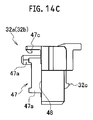
  • FIG. 14C illustrates the second embodiment according to the present invention, and is a side view illustrating the divided body of the rear holder.
  • FIG. 4 to FIG. 10 illustrate a first embodiment of the present invention.
  • a connector 1 A according to this first embodiment is a high voltage female connector-type shield connector connected to an inverter case (not shown).
  • the connector 1 A is attached to an inverter by being mated to a terminal block (not shown) provided inside of the inverter.
  • FIG. 10 is a perspective diagram corresponding to FIG. 9 (longitudinal sectional view), and in FIG. 10 , a connector housing 3 , a shield shell 4 , a protector 5 , and the like are partially cut away in order to explain a structure of lock portions 35 to 38 , 52 to 55 in an easy to understand manner.
  • the connector 1 A includes the substantially cylindrical shape connector housing 3 accommodating a pair of right and left terminals 2 , the shield shell 4 arranged on an external periphery of this connector housing 3 , and the protector 5 arranged to cover the back of the connector housing 3 .
  • a shell packing (shell packing) 6 seals a space between the external peripheral surface of the connector housing 3 and the inner peripheral of the shield shell 4 , and a unit packing (unit packing) 7 is arranged on the external periphery of the connector housing 3 .
  • Electric wires 21 are connected to the pair of terminals 2 .
  • This electric wire 21 extends from the inside of the connector housing 3 in an electric wire draw-out direction (a direction indicated by arrow A in FIG. 10 ), and the electric wire 21 bends to the lower side in the course, and is covered with a rubber boot 22 . Further, this rubber boot 22 is covered with the protector 5 .
  • the connector housing 3 is provided with a flange portion 30 extending in a direction perpendicular to an electric wire draw-out direction, terminal accommodating chambers 31 a accommodating the terminals 2 , and electric wire draw-out holes 31 b in communication with the terminal accommodating chambers 31 a .
  • a part of the electric wire draw-out hole 31 b is formed as a holder accommodating chamber 31 c .
  • the rear holder (electric wire holder) 32 A for holding the electric wire 21 is accommodated in the holder accommodating chamber 31 c .
  • a rubber plug 33 for sealing the space between the connector housing 3 and the electric wire 21 is accommodated at the forward position with respect to the holder accommodating chamber 31 c.
  • the rear holder 32 A is configured of two divided bodies 32 a , 32 b assembled with each other. Each of the divided bodies 32 a , 32 b has an elastic arm locking portion 32 c .
  • each elastic arm locking portion 32 c is locked with a locked projection portion 40 of the connector housing 3 .
  • the elastic arm locking portion 32 c and the locked projection portion 40 are designed in view of the assembly tolerance.
  • Each of the two divided bodies 32 a , 32 b has a pair of semicircular electric wire grooves 39 a , 39 b .
  • the rear holder 32 A has two sets of electric wire insertion holes 39 each configured of the pair of electric wire grooves 39 a , 39 b.
  • An external diameter dimension D 1 of the electric wire 21 is configured to be larger than an internal diameter dimension D 2 of each electric wire insertion hole 39 (the external diameter dimension D 1 of the electric wire 21 >the internal diameter dimension D 2 of each electric wire insertion hole 39 ).
  • An internal diameter dimension D 4 of the holder accommodating chamber 31 c of the connector housing 3 is configured to be larger than an external diameter dimension D 3 of the rear holder 32 A as a component alone (the external diameter dimension D 3 of the rear holder 32 A as the component alone ⁇ the internal diameter dimension D 4 of the holder accommodating chamber 31 c of the connector housing 3 ).
  • the interference of the electric wire 21 with the rear holder 32 A is configured to be the same as or larger than the gap between the connector housing 3 and the rear holder 32 A (the external diameter dimension D 1 of the electric wire 21 ⁇ the internal diameter dimension D 2 of each electric wire insertion hole 39 ⁇ the internal diameter dimension D 4 of the holder accommodating chamber 31 c of the connector housing 3 ⁇ the external diameter dimension D 3 of the rear holder 32 A as a component alone).
  • the rear holder 32 A is pressurized by the interference of the electric wire 21 with the rear holder 32 A, and the diameter of the rear holder 32 A is expanded, and accordingly, the external diameter dimension D 3 of the rear holder 32 A increases.
  • a pair of right and left housing-side lock portions 35 , 36 arranged above side plate parts 58 , 59 , explained later, of the protector 5 are provided on a surface 34 of the flange portion 30 located at the rear end side of the connector housing 3 .
  • Each of the housing-side lock portions 35 , 36 includes locked portions 35 a , 36 a protruding from the surface 34 of the flange portion 30 and extending in the electric wire draw-out direction and stopper portions 35 b , 36 b that prevent the protector-side lock portions 52 , 53 locked with the locked portions 35 a , 36 a from displacing in the electric wire draw-out direction.
  • the connector housing 3 is provided with the pair of right and left housing-side lock portions 35 , 36 as well as pair of right and left housing-side auxiliary lock portions 37 , 38 arranged inside of the side plate parts 58 , 59 of the protector 5 .
  • Each of the housing-side auxiliary lock portions 37 , 38 includes position restriction portions 37 a , 38 a protruding from the surface 34 of the flange portion 30 and extending in the electric wire draw-out direction and auxiliary lock-side stopper portions 37 b , 38 b that prevent the protector-side auxiliary lock portions 54 , 55 , explained later, from displacing in the electric wire draw-out direction.
  • the shield shell 4 is provided with lock portion insertion holes 41 , 42 into which the housing-side lock portions 35 , 36 , respectively, are inserted, and is provided with auxiliary lock portion insertion holes 43 , 44 into which the housing-side auxiliary lock portions 37 , 38 , respectively, are inserted.
  • the protector 5 includes a flat plate shaped bottom plate part 56 , a top plate part 57 bent at the upper side, and a pair of right and left side plate parts 58 , 59 arranged vertically at the right and left end portions of the bottom plate part 56 and the top plate part 57 , and is formed to be able to open and close vertically via a hinge 51 arranged on one of the side plate parts 58 .
  • a pair of right and left protector-side lock portions 52 , 53 locked with the housing-side lock portions 35 , 36 , respectively, is arranged above the side plate parts 58 , 59 of the protector 5 .
  • These protector-side lock portions 52 , 53 include arm parts 52 a , 53 a , respectively, protruding to the upper side with respect to the side plate parts 58 , 59 , respectively, and deforming in a direction perpendicular to the electric wire draw-out direction (a direction indicated by arrows B, C of FIG. 10 ) and locking claw parts 52 b , 53 b arranged at the distal end side of the arm parts 52 a , 53 a , respectively.
  • the protector 5 is provided with the pair of right and left protector-side lock portions 52 , 53 , respectively, and the pair of right and left protector-side auxiliary lock portions 54 , 55 , respectively.
  • the protector-side auxiliary lock portions 54 , 55 are arranged inside of the side plate parts 58 , 59 of the protector 5 .
  • Upper stopper step surfaces 54 a , 55 a are arranged above the protector-side auxiliary lock portions 54 , 55 , respectively, and when the protector 5 is assembled, the position restriction portions 37 a , 38 a come into contact with the upper stopper step surfaces 54 a , 55 a , respectively, so that the protector 5 is positioned.
  • the shell packing 6 and the shield shell 4 are attached to the connector housing 3 , and the terminal 2 , the electric wire 21 , and the rear holder 32 A are assembled into the connector housing 3 .
  • the electric wires 21 are inserted into the electric wire grooves 39 a , 39 b of the divided bodies 32 a , 32 b , and the divided bodies 32 a , 32 b are combined with each other, so that the rear holder 32 A is integrated and accommodated in the electric wire draw-out hole 31 b.
  • the external diameter dimension D 1 of the electric wire 21 is more than the internal diameter dimension D 2 of the electric wire insertion hole 39 of the rear holder 32 A, the interference of the electric wire 21 of the rear holder 32 A is exerted, and the diameter of the rear holder 32 A is expanded due to the elastic counterforce from the electric wire 21 , and accordingly, the external diameter dimension D 3 of the rear holder 32 A increases, which eliminates the gap between the rear holder 32 A and the holder accommodating chamber 31 c of the connector housing 3 .
  • the rear holder 32 A is pressed against the connector housing 3 by the elastic counterforce of the electric wire 21 , and this can suppress the backlash between the connector housing 3 and the rear holder 32 A, and the rear holder 32 A can shut off vibration from the electric wire 21 . In addition, the backlash between the electric wire 21 and the rear holder 32 A can be suppressed.
  • the rubber boot 22 is attached to cover the electric wires 21 drawn out from the connector housing 3 , and the protector 5 is assembled with the connector housing 3 in a direction perpendicular to the electric wire draw-out direction (a direction indicated by arrow D of FIG. 10 ). Accordingly, the portion of the shield shell 4 that comes into contact with the surface 34 of the flange portion 30 of the connector housing 3 is sandwiched by the protector 5 and the flange portion 30 of the connector housing 3 , and in this state, the housing-side lock portions 35 , 36 and the protector-side lock portions 52 , 53 are locked with each other, and therefore, the shield shell 4 is fixed to the connector housing 3 via the protector 5 .
  • the pair of protector-side lock portions 52 , 53 are locked such that the arm parts 52 a , 53 a are deformed in directions opposite to each other, i.e., directions indicated by arrows B, C of FIG. 10 , and the locking claw parts 52 b , 53 b are locked with the locked portions 35 a , 36 a .
  • a pair of protector-side auxiliary lock portions 54 , 55 are locked with the position restriction portions 37 a , 38 a and the auxiliary lock-side stopper portions 37 b , 38 b of the housing-side auxiliary lock portions 37 , 38 , respectively.
  • the interference of the electric wire 21 of the rear holder 32 A is exerted, and this eliminates the gap between the rear holder 32 A and the holder accommodating chamber 31 c of the connector housing 3 , and the rear holder 32 A is pressed against the connector housing 3 , and therefore, backlash between the electric wire 21 and the rear holder 32 A is eliminated, and in addition, backlash between the connector housing 3 and the rear holder 32 A is eliminated. Therefore, the rear holder 32 A can cut off vibration from the electric wire 21 .
  • the electric wires 21 are inserted into the electric wire grooves 39 a , 39 b of the divided bodies 32 a , 32 b while the rear holder 32 A is divided, and the divided bodies 32 a , 32 b are assembled with each other, and are accommodated in the holder accommodating chamber 31 c of the connector housing 3 , and therefore, the assembly work of the rear holder 32 A and the electric wires 21 can be performed easily.
  • FIG. 11A to FIG. 14C illustrate a second embodiment of the present invention.
  • a connector 1 B of this second embodiment includes a terminal 2 and a connector housing 3 accommodating the terminal 2 .
  • the connector housing 3 is provided with a terminal accommodating chamber (not shown) and an electric wire draw-out hole (not shown). A portion of the electric wire draw-out hole is formed as a holder accommodating chamber (not shown).
  • the terminals 2 connected to electric wires 21 are accommodated in the terminal accommodating chambers.
  • a rubber plug 33 attached to the electric wire 21 is accommodated in the electric wire draw-out hole.
  • a rear holder 32 B which is an electric wire holder attached to the electric wire 21 is accommodated in the holder accommodating chamber.
  • the rear holder 32 B is configured of two divided bodies 32 a , 32 b assembled with each other.
  • Each of the divided bodies 32 a , 32 b has an elastic arm locking portion 32 c .
  • each elastic arm locking portion 32 c is locked with a locked portion (not shown) of the connector housing 3 .
  • the elastic arm locking portion 32 c and a locked projection portion (not shown) are designed in view of the assembly tolerance.
  • Each of the two divided bodies 32 a , 32 b has a pair of semicircular electric wire grooves 39 a , 39 b .
  • Multiple ribs 46 are provided on the inner periphery of each of the electric wire grooves 39 a , 39 b .
  • Each of the divided bodies 32 a , 32 b is provided with a coupling portion 47 for coupling with each other.
  • the coupling portion 47 includes mating walls 47 a at multiple portions that protrude from an abutment surface 48 of each other of the divided bodies 32 a , 32 b , mating grooves 47 b at multiple portions that are formed to be open at the opposite position of the other mating wall 47 a and with which each mating wall 47 a is mated, and a lock arm 47 c that protrudes from the abutment surface 48 of each other, and a lock arm locking portion 47 d with which the lock arm 47 c is locked.
  • the rear holder 32 B is coupled such that the mating wall 47 a of each other is mated with the mating groove 47 b , and the lock arm 47 c of each other is locked with the lock arm locking portion 47 d .
  • the mating walls 47 a and the mating grooves 47 b at multiple positions have the positioning function and the coupling strengthening function of the two divided bodies 32 a , 32 b.
  • each of the two electric wire insertion holes 39 is configured of a pair of electric wire grooves 39 a , 39 b while the two divided bodies 32 a , 32 b are assembled.
  • an external diameter dimension D 1 of the electric wire 21 is configured to be larger than an internal diameter dimension D 2 of each electric wire insertion hole 39 (the external diameter dimension D 1 of the electric wire 21 >the internal diameter dimension D 2 of each electric wire insertion hole 39 ).
  • An internal diameter dimension D 4 of the holder accommodating chamber of the connector housing 3 is configured to be larger than an external diameter dimension D 3 of the rear holder 32 B as a component alone (the external diameter dimension D 3 of the rear holder 32 B as the component alone ⁇ the internal diameter dimension D 4 of the holder accommodating chamber of the connector housing 3 ).
  • FIG. 13 An assembly step of the rear holder 32 B to the electric wire 21 and an assembly step of the rubber plug 33 , the rear holder 32 B, and the like to the connector housing 3 are shown in FIG. 13 , FIG. 14A , FIG. 14B and FIG. 14C .
  • the assembly step of the rear holder 32 B to the electric wire 21 and the assembly step of the rubber plug 33 , the rear holder 32 B, and the like to the connector housing 3 are the same as those of the first embodiment explained above, and the explanation thereabout is omitted.
  • the two divided bodies 32 a , 32 b have the coupling portion 47 for coupling with each other. Therefore, the attachment performance of the rear holder 32 B to the electric wire 21 is high, and furthermore, the two divided bodies 32 a , 32 b are rigidly coupled, and this reliably prevents the backlash between the electric wire 21 and the rear holder 32 B and between the connector housing 3 and the rear holder 32 B.
  • the coupling portion 47 has the mating walls 47 a and the mating grooves 47 b mating therewith at multiple portions. Therefore, two divided bodies 32 a , 32 b can maintain an appropriate coupling form even while the two divided bodies 32 a , 32 b receive a compression force, and this can reliably prevent backlash between the electric wire 21 and the rear holder 32 B and between the connector housing 3 and the rear holder 32 B.
  • the embodiment of the present invention has been described heretofore, the embodiment is merely exemplified for facilitating the understanding of the present invention, and the present invention is not limited to the embodiment.
  • the technical scope of the present invention may include not only the specific technical matters disclosed in the above-described embodiment but also various modifications, changes, and alternative techniques easily derived from the above-described specific technical matters.
  • the electric wires are inserted into the electric wire insertion holes of the electric wire holder, and the electric wire holder is accommodated in the holder accommodating chamber of the connector housing, the external diameter dimension of the electric wire is more than the internal diameter dimension of the electric wire insertion hole of the electric wire holder, and the interference of the electric wire of the electric wire holder is exerted, and the external diameter dimension of the electric wire holder increases because of the elastic counterforce of this electric wire, and this eliminates the gap between the electric wire holder and the holder accommodating chamber of the connector housing, and the electric wire holder is pressed against the connector housing. Therefore, backlash between the electric wire and the electric wire holder is eliminated and in addition, backlash between the connector housing and the electric wire holder is eliminated. Therefore, the electric wire holder can cut off the vibration from the electric wire.

Landscapes

  • Details Of Connecting Devices For Male And Female Coupling (AREA)
  • Connector Housings Or Holding Contact Members (AREA)

Abstract

The connector is provided with a connector housing (3) having a holder accommodating chamber (31 c), and a rear holder (32A), with an electric wire (21) inserted into an electric wire insertion hole (39) thereof, accommodated within the holder accommodating chamber (31 c). The external diameter dimension (D1) of the electric wire (21) is larger than the internal diameter dimension (D2) of the electric wire insertion hole (39) of the rear holder (32A), and the internal diameter dimension (D4) of the holder accommodating chamber (31 c) of the connector housing (3) is smaller than the external diameter dimension (D3) of the rear holder (32A) with the electric wire (21) accommodated within the electric wire insertion hole (39).

Description

TECHNICAL FIELD
The present invention relates to a connector having an electric wire holder for holding an electric wire in a connector housing.
BACKGROUND ART
A connector having an electric wire holder for holding an electric wire in a connector housing has been suggested in the past. A first conventional example of such a connector is shown in FIG. 1, FIG. 2A, and FIG. 2B. In FIG. 1, FIG. 2A and FIG. 2B, a connector 100 includes a connector housing 102 accommodating a terminal 101 and a shield shell 102A arranged to enclose a portion of an external periphery of the connector housing 102. The connector housing 102 is provided with a cylindrical portion 103 protruding to the rear from the cylinder of the shield shell 102A. The rear end of the cylindrical portion 103 is attached with a rear holder (electric wire holder) 104. A protrusion 105 extending in an external diameter direction is provided on the distal end external periphery of the cylindrical portion 103. The rear holder 104 has an arm 107 extending to the front from a main body portion 106, and a lock portion 108 with which the protrusion 105 is locked is arranged at the distal end of this arm 107.
In the above configuration, the rear holder 104 is inserted from the rear end of the cylindrical portion 103 of the connector housing 102, and the protrusion 105 of the distal end external periphery of the cylindrical portion 103 is locked with the lock portion 108 arranged at the distal end of the arm 107 of the rear holder 104. Accordingly, the rear holder 104 is fixed to the connector housing 102. Since the electric wire is held by the rear holder 104, this can prevent the electric wire from being pulled out of the connector housing 102, and can prevent a pull-out force from being applied to the distal end side of the electric wire (for example, a terminal).
A second conventional example of this kind of connector is shown in FIG. 3 (refer to Patent Literature 1). In FIG. 3, the connector 110 includes a connector housing 112 for accommodating a terminal 111. An accommodating chamber 113 at a rear end of this connector housing 112 accommodates a retainer (electric wire holder) 114. At the front end side with respect to the retainer 114, a rubber plug 115 is provided to seal between the connector housing 112 and the electric wire W is provided. At the external periphery of the retainer 114, a protrusion 117 is provided that extends in the external diameter direction of the retainer 114 and is locked in a locking hole 116 arranged in the connector housing 112.
In the above configuration, the terminal 111 is accommodated in the connector housing 112, and the electric wire W connected to this terminal 111 is inserted into the retainer 114, and the retainer 114 is accommodated in the accommodating chamber 113 of the connector housing 112, and the protrusion 117 of the external periphery of the retainer 114 is locked with the locking hole 116 of the connector housing 112, so that the retainer 114 is fixed to the connector housing 112. Accordingly, the retainer 114 holds the electric wire W, and therefore, this can prevent the electric wire W from being pulled out of the connector housing 112, and can prevent the pull-out force from being applied to the distal end side of the electric wire W.
CITATION LIST Patent Literature
Patent Literature 1: JP 2001-60475 A
SUMMARY OF INVENTION Technical Problem
In the connector 100 according to the first conventional example, the protrusion 105 of the connector housing 102 and the lock portion 108 of the rear holder 104 are designed in view of the assembly tolerance, and therefore, a backlash may occur due to an assembly tolerance between the connector housing 102 and the rear holder 104. When there is a backlash between the connector housing 102 and the rear holder 104, there is a problem in that the rear holder 104 cannot shut off vibration from the electric wire.
In addition, in the connector 110 according to the second conventional example, the internal diameter of the accommodating chamber 113 of the connector housing 112 and the external diameter of the retainer 114 are designed in view of an assembly tolerance, and therefore, a backlash may occur due to an assembly tolerance. When there is a backlash between the connector housing 112 and the retainer 114, there is a problem like the above problem in that the retainer 114 cannot shut off vibration from the electric wire.
Accordingly, the present invention is made to solve the above problems, and it is an object of the present invention to provide a connector that can suppress backlash between a connector housing and an electric wire holder and in which the electric wire holder can shut off vibration from the electric wire.
Solution to Problem
A connector according to the present invention includes a connector housing provided with a holder accommodating chamber, and an electric wire holder including an electric wire insertion hole and configured to insert an electric wire into the electric wire insertion hole and to be accommodated within the holder accommodating chamber. An external diameter dimension of the electric wire is configured to be larger than an internal diameter dimension of the electric wire insertion hole of the electric wire holder, and an internal diameter dimension of the holder accommodating chamber of the connector housing is configured to be less than an external diameter dimension of the electric wire holder in a state where the electric wire is accommodated in the electric wire insertion hole.
The electric wire holder of the connector according to the present invention may include two divided bodies each provided with an electric wire groove, and the electric wire insertion hole is formed by the two electric wire grooves.
The two divided bodies of the connector according to the present invention may have a coupling portion for coupling with each other.
Advantageous Effects of Invention
According to the present invention, the electric wires are inserted into the electric wire insertion holes of the electric wire holder, and the electric wire holder is accommodated in the holder accommodating chamber of the connector housing, the external diameter dimension of the electric wire is more than the internal diameter dimension of the electric wire insertion hole of the electric wire holder, and the interference of the electric wire of the electric wire holder is exerted, and the external diameter dimension of the electric wire holder increases because of the elastic counterforce of this electric wire, and this eliminates the gap between the electric wire holder and the holder accommodating chamber of the connector housing, and the electric wire holder is pressed against the connector housing. Therefore, backlash between the electric wire and the electric wire holder and in addition is eliminated, backlash between the connector housing and the electric wire holder is eliminated. Therefore, the electric wire holder can cut off the vibration from the electric wire.
BRIEF DESCRIPTION OF DRAWINGS
FIG. 1 illustrates a first conventional example, and is an assembly perspective view of a connector.
FIG. 2A illustrates the first conventional example, and is a longitudinal sectional view of the connector.
FIG. 2B illustrates the first conventional example, and is an enlarged sectional view of a section A in FIG. 2A.
FIG. 3 illustrates a second conventional example, and is a longitudinal sectional view of a connector.
FIG. 4 illustrates a first embodiment according to the present invention, and is an assembly perspective view of a connector.
FIG. 5 illustrates the first embodiment according to the present invention, and is an exploded perspective diagram of the connector.
FIG. 6 illustrates the first embodiment according to the present invention, and is a perspective diagram illustrating a process of assembly of the connector when the connector is seen from the back surface side.
FIG. 7 illustrates the first embodiment according to the present invention, and is a longitudinal sectional view of the connector.
FIG. 8 illustrates the first embodiment according to the present invention, and is a transverse sectional view of the connector.
FIG. 9 illustrates the first embodiment according to the present invention, and is a longitudinal sectional view for explaining a structure such as a lock portion.
FIG. 10 illustrates the first embodiment according to the present invention, and is a partially cutaway perspective diagram for explaining a structure such as the lock portion.
FIG. 11A illustrates a second embodiment according to the present invention, and is a side view illustrating an assembly procedure of a rear holder to a connector.
FIG. 11B illustrates the second embodiment according to the present invention, and is a side view illustrating an assembly procedure of the rear holder to the connector.
FIG. 11C illustrates the second embodiment according to the present invention, and is a side view illustrating an assembly procedure of the rear holder to the connector.
FIG. 12A illustrates the second embodiment according to the present invention, and is a side view illustrating an assembly procedure of the rear holder to the connector.
FIG. 12B illustrates the second embodiment according to the present invention, and is a side view illustrating a state in which the rear holder is assembled with the connector.
FIG. 13 illustrates the second embodiment according to the present invention, and is a perspective diagram before the rear holder is coupled.
FIG. 14A illustrates the second embodiment according to the present invention, and is a top view illustrating a divided body of the rear holder.
FIG. 14B illustrates the second embodiment according to the present invention, and is a front view illustrating the divided body of the rear holder.
FIG. 14C illustrates the second embodiment according to the present invention, and is a side view illustrating the divided body of the rear holder.
DESCRIPTION OF EMBODIMENTS
An embodiment of the present invention is described in detail with reference to drawings.
In this specification, it must be noted that drawings are schematic views, and constitutions of devices and systems are different from constitutions of an actual device. Accordingly, the specific constitutions should be determined by taking into account the description made hereinafter. Further, it is also needless to say that the respective drawings include portions having different constitutions.
The embodiment of the present invention described hereinafter is provided for exemplifying a device and a method which embody the technical concept of the present invention, and the technical concept of the present invention does not limit materials, shapes, structures, arrangements and the like of the respective constitutional parts to the followings. Various modifications are conceivable with respect to the technical concept of the present invention within the technical scope described in claims.
First Embodiment
FIG. 4 to FIG. 10 illustrate a first embodiment of the present invention. A connector 1A according to this first embodiment is a high voltage female connector-type shield connector connected to an inverter case (not shown). The connector 1A is attached to an inverter by being mated to a terminal block (not shown) provided inside of the inverter. It should be noted that FIG. 10 is a perspective diagram corresponding to FIG. 9 (longitudinal sectional view), and in FIG. 10, a connector housing 3, a shield shell 4, a protector 5, and the like are partially cut away in order to explain a structure of lock portions 35 to 38, 52 to 55 in an easy to understand manner.
As shown in FIG. 4 and FIG. 5, the connector 1A includes the substantially cylindrical shape connector housing 3 accommodating a pair of right and left terminals 2, the shield shell 4 arranged on an external periphery of this connector housing 3, and the protector 5 arranged to cover the back of the connector housing 3. A shell packing (shell packing) 6 seals a space between the external peripheral surface of the connector housing 3 and the inner peripheral of the shield shell 4, and a unit packing (unit packing) 7 is arranged on the external periphery of the connector housing 3.
Electric wires 21 are connected to the pair of terminals 2. This electric wire 21 extends from the inside of the connector housing 3 in an electric wire draw-out direction (a direction indicated by arrow A in FIG. 10), and the electric wire 21 bends to the lower side in the course, and is covered with a rubber boot 22. Further, this rubber boot 22 is covered with the protector 5.
The connector housing 3 is provided with a flange portion 30 extending in a direction perpendicular to an electric wire draw-out direction, terminal accommodating chambers 31 a accommodating the terminals 2, and electric wire draw-out holes 31 b in communication with the terminal accommodating chambers 31 a. A part of the electric wire draw-out hole 31 b is formed as a holder accommodating chamber 31 c. The rear holder (electric wire holder) 32A for holding the electric wire 21 is accommodated in the holder accommodating chamber 31 c. A rubber plug 33 for sealing the space between the connector housing 3 and the electric wire 21 is accommodated at the forward position with respect to the holder accommodating chamber 31 c.
The rear holder 32A is configured of two divided bodies 32 a, 32 b assembled with each other. Each of the divided bodies 32 a, 32 b has an elastic arm locking portion 32 c. When the rear holder 32A is inserted to an appropriate position of the holder accommodating chamber 31 c, each elastic arm locking portion 32 c is locked with a locked projection portion 40 of the connector housing 3. In this case, the elastic arm locking portion 32 c and the locked projection portion 40 are designed in view of the assembly tolerance.
Each of the two divided bodies 32 a, 32 b has a pair of semicircular electric wire grooves 39 a, 39 b. In the state where the two divided bodies 32 a, 32 b are assembled, the rear holder 32A has two sets of electric wire insertion holes 39 each configured of the pair of electric wire grooves 39 a, 39 b.
An external diameter dimension D1 of the electric wire 21 is configured to be larger than an internal diameter dimension D2 of each electric wire insertion hole 39 (the external diameter dimension D1 of the electric wire 21>the internal diameter dimension D2 of each electric wire insertion hole 39). An internal diameter dimension D4 of the holder accommodating chamber 31 c of the connector housing 3 is configured to be larger than an external diameter dimension D3 of the rear holder 32A as a component alone (the external diameter dimension D3 of the rear holder 32A as the component alone<the internal diameter dimension D4 of the holder accommodating chamber 31 c of the connector housing 3).
Further, the interference of the electric wire 21 with the rear holder 32A is configured to be the same as or larger than the gap between the connector housing 3 and the rear holder 32A (the external diameter dimension D1 of the electric wire 21−the internal diameter dimension D2 of each electric wire insertion hole 39≧the internal diameter dimension D4 of the holder accommodating chamber 31 c of the connector housing 3−the external diameter dimension D3 of the rear holder 32A as a component alone). As explained below, in the state where the electric wire 21 is accommodated in the electric wire insertion hole 39, the rear holder 32A is pressurized by the interference of the electric wire 21 with the rear holder 32A, and the diameter of the rear holder 32A is expanded, and accordingly, the external diameter dimension D3 of the rear holder 32A increases.
A pair of right and left housing- side lock portions 35, 36 arranged above side plate parts 58, 59, explained later, of the protector 5 are provided on a surface 34 of the flange portion 30 located at the rear end side of the connector housing 3. Each of the housing- side lock portions 35, 36 includes locked portions 35 a, 36 a protruding from the surface 34 of the flange portion 30 and extending in the electric wire draw-out direction and stopper portions 35 b, 36 b that prevent the protector- side lock portions 52, 53 locked with the locked portions 35 a, 36 a from displacing in the electric wire draw-out direction.
The connector housing 3 is provided with the pair of right and left housing- side lock portions 35, 36 as well as pair of right and left housing-side auxiliary lock portions 37, 38 arranged inside of the side plate parts 58, 59 of the protector 5. Each of the housing-side auxiliary lock portions 37, 38 includes position restriction portions 37 a, 38 a protruding from the surface 34 of the flange portion 30 and extending in the electric wire draw-out direction and auxiliary lock- side stopper portions 37 b, 38 b that prevent the protector-side auxiliary lock portions 54, 55, explained later, from displacing in the electric wire draw-out direction.
The shield shell 4 is provided with lock portion insertion holes 41, 42 into which the housing- side lock portions 35, 36, respectively, are inserted, and is provided with auxiliary lock portion insertion holes 43, 44 into which the housing-side auxiliary lock portions 37, 38, respectively, are inserted.
The protector 5 includes a flat plate shaped bottom plate part 56, a top plate part 57 bent at the upper side, and a pair of right and left side plate parts 58, 59 arranged vertically at the right and left end portions of the bottom plate part 56 and the top plate part 57, and is formed to be able to open and close vertically via a hinge 51 arranged on one of the side plate parts 58.
A pair of right and left protector- side lock portions 52, 53 locked with the housing- side lock portions 35, 36, respectively, is arranged above the side plate parts 58, 59 of the protector 5. These protector- side lock portions 52, 53 include arm parts 52 a, 53 a, respectively, protruding to the upper side with respect to the side plate parts 58, 59, respectively, and deforming in a direction perpendicular to the electric wire draw-out direction (a direction indicated by arrows B, C of FIG. 10) and locking claw parts 52 b, 53 b arranged at the distal end side of the arm parts 52 a, 53 a, respectively.
In addition, the protector 5 is provided with the pair of right and left protector- side lock portions 52, 53, respectively, and the pair of right and left protector-side auxiliary lock portions 54, 55, respectively. The protector-side auxiliary lock portions 54, 55 are arranged inside of the side plate parts 58, 59 of the protector 5. Upper stopper step surfaces 54 a, 55 a are arranged above the protector-side auxiliary lock portions 54, 55, respectively, and when the protector 5 is assembled, the position restriction portions 37 a, 38 a come into contact with the upper stopper step surfaces 54 a, 55 a, respectively, so that the protector 5 is positioned.
In the above configuration, when the connector 1A is assembled, the shell packing 6 and the shield shell 4 are attached to the connector housing 3, and the terminal 2, the electric wire 21, and the rear holder 32A are assembled into the connector housing 3. At this occasion, the electric wires 21 are inserted into the electric wire grooves 39 a, 39 b of the divided bodies 32 a, 32 b, and the divided bodies 32 a, 32 b are combined with each other, so that the rear holder 32A is integrated and accommodated in the electric wire draw-out hole 31 b.
As a result, since the external diameter dimension D1 of the electric wire 21 is more than the internal diameter dimension D2 of the electric wire insertion hole 39 of the rear holder 32A, the interference of the electric wire 21 of the rear holder 32A is exerted, and the diameter of the rear holder 32A is expanded due to the elastic counterforce from the electric wire 21, and accordingly, the external diameter dimension D3 of the rear holder 32A increases, which eliminates the gap between the rear holder 32A and the holder accommodating chamber 31 c of the connector housing 3. Therefore, the rear holder 32A is pressed against the connector housing 3 by the elastic counterforce of the electric wire 21, and this can suppress the backlash between the connector housing 3 and the rear holder 32A, and the rear holder 32A can shut off vibration from the electric wire 21. In addition, the backlash between the electric wire 21 and the rear holder 32A can be suppressed.
Subsequently, the rubber boot 22 is attached to cover the electric wires 21 drawn out from the connector housing 3, and the protector 5 is assembled with the connector housing 3 in a direction perpendicular to the electric wire draw-out direction (a direction indicated by arrow D of FIG. 10). Accordingly, the portion of the shield shell 4 that comes into contact with the surface 34 of the flange portion 30 of the connector housing 3 is sandwiched by the protector 5 and the flange portion 30 of the connector housing 3, and in this state, the housing- side lock portions 35, 36 and the protector- side lock portions 52, 53 are locked with each other, and therefore, the shield shell 4 is fixed to the connector housing 3 via the protector 5.
When the protector 5 is assembled with the connector housing 3 in a direction perpendicular to the electric wire draw-out direction as described above, the pair of protector- side lock portions 52, 53 are locked such that the arm parts 52 a, 53 a are deformed in directions opposite to each other, i.e., directions indicated by arrows B, C of FIG. 10, and the locking claw parts 52 b, 53 b are locked with the locked portions 35 a, 36 a. At the same time, a pair of protector-side auxiliary lock portions 54, 55 are locked with the position restriction portions 37 a, 38 a and the auxiliary lock- side stopper portions 37 b, 38 b of the housing-side auxiliary lock portions 37, 38, respectively.
As described above, according to the present embodiment, when the electric wires 21 are inserted into the electric wire insertion holes 39 of the rear holder 32A, and the rear holder 32A is accommodated in the holder accommodating chamber 31 c of the connector housing 3, the interference of the electric wire 21 of the rear holder 32A is exerted, and this eliminates the gap between the rear holder 32A and the holder accommodating chamber 31 c of the connector housing 3, and the rear holder 32A is pressed against the connector housing 3, and therefore, backlash between the electric wire 21 and the rear holder 32A is eliminated, and in addition, backlash between the connector housing 3 and the rear holder 32A is eliminated. Therefore, the rear holder 32A can cut off vibration from the electric wire 21.
According to the present embodiment, the electric wires 21 are inserted into the electric wire grooves 39 a, 39 b of the divided bodies 32 a, 32 b while the rear holder 32A is divided, and the divided bodies 32 a, 32 b are assembled with each other, and are accommodated in the holder accommodating chamber 31 c of the connector housing 3, and therefore, the assembly work of the rear holder 32A and the electric wires 21 can be performed easily.
Second Embodiment
FIG. 11A to FIG. 14C illustrate a second embodiment of the present invention. As shown in FIG. 12A, FIG. 12B and FIG. 13, a connector 1B of this second embodiment includes a terminal 2 and a connector housing 3 accommodating the terminal 2.
Like the first embodiment explained above, the connector housing 3 is provided with a terminal accommodating chamber (not shown) and an electric wire draw-out hole (not shown). A portion of the electric wire draw-out hole is formed as a holder accommodating chamber (not shown). The terminals 2 connected to electric wires 21 are accommodated in the terminal accommodating chambers. A rubber plug 33 attached to the electric wire 21 is accommodated in the electric wire draw-out hole. A rear holder 32B which is an electric wire holder attached to the electric wire 21 is accommodated in the holder accommodating chamber.
As shown in FIG. 13, FIG. 14A, FIG. 14B and FIG. 14C in details, like the first embodiment explained above, the rear holder 32B is configured of two divided bodies 32 a, 32 b assembled with each other. Each of the divided bodies 32 a, 32 b has an elastic arm locking portion 32 c. When the rear holder 32B is inserted to an appropriate position of the holder accommodating chamber, each elastic arm locking portion 32 c is locked with a locked portion (not shown) of the connector housing 3. In this case, the elastic arm locking portion 32 c and a locked projection portion (not shown) are designed in view of the assembly tolerance.
Each of the two divided bodies 32 a, 32 b has a pair of semicircular electric wire grooves 39 a, 39 b. Multiple ribs 46 are provided on the inner periphery of each of the electric wire grooves 39 a, 39 b. Each of the divided bodies 32 a, 32 b is provided with a coupling portion 47 for coupling with each other. The coupling portion 47 includes mating walls 47 a at multiple portions that protrude from an abutment surface 48 of each other of the divided bodies 32 a, 32 b, mating grooves 47 b at multiple portions that are formed to be open at the opposite position of the other mating wall 47 a and with which each mating wall 47 a is mated, and a lock arm 47 c that protrudes from the abutment surface 48 of each other, and a lock arm locking portion 47 d with which the lock arm 47 c is locked. The rear holder 32B is coupled such that the mating wall 47 a of each other is mated with the mating groove 47 b, and the lock arm 47 c of each other is locked with the lock arm locking portion 47 d. The mating walls 47 a and the mating grooves 47 b at multiple positions have the positioning function and the coupling strengthening function of the two divided bodies 32 a, 32 b.
In the rear holder 32B, each of the two electric wire insertion holes 39 is configured of a pair of electric wire grooves 39 a, 39 b while the two divided bodies 32 a, 32 b are assembled. Like the first embodiment explained above, an external diameter dimension D1 of the electric wire 21 is configured to be larger than an internal diameter dimension D2 of each electric wire insertion hole 39 (the external diameter dimension D1 of the electric wire 21>the internal diameter dimension D2 of each electric wire insertion hole 39). An internal diameter dimension D4 of the holder accommodating chamber of the connector housing 3 is configured to be larger than an external diameter dimension D3 of the rear holder 32B as a component alone (the external diameter dimension D3 of the rear holder 32B as the component alone<the internal diameter dimension D4 of the holder accommodating chamber of the connector housing 3).
An assembly step of the rear holder 32B to the electric wire 21 and an assembly step of the rubber plug 33, the rear holder 32B, and the like to the connector housing 3 are shown in FIG. 13, FIG. 14A, FIG. 14B and FIG. 14C. The assembly step of the rear holder 32B to the electric wire 21 and the assembly step of the rubber plug 33, the rear holder 32B, and the like to the connector housing 3 are the same as those of the first embodiment explained above, and the explanation thereabout is omitted.
With the connector 1B according to this second embodiment, because of the same reason as those of the first embodiment explained above, backlash between the electric wire 21 and the rear holder 32B is eliminated, and in addition, backlash between the connector housing 3 and the rear holder 32B is eliminated. Therefore, the rear holder 32B can shut off vibration from the electric wire 21. In addition, in each of the divided bodies 32 a, 32 b, multiple ribs 46 are provided on the inner periphery of each of the electric wire grooves 39 a, 39 b. The rib 46 digs into the electric wire 21, so that the fixing force between the electric wire 21 and the rear holder 32B is improved.
The two divided bodies 32 a, 32 b have the coupling portion 47 for coupling with each other. Therefore, the attachment performance of the rear holder 32B to the electric wire 21 is high, and furthermore, the two divided bodies 32 a, 32 b are rigidly coupled, and this reliably prevents the backlash between the electric wire 21 and the rear holder 32B and between the connector housing 3 and the rear holder 32B.
The coupling portion 47 has the mating walls 47 a and the mating grooves 47 b mating therewith at multiple portions. Therefore, two divided bodies 32 a, 32 b can maintain an appropriate coupling form even while the two divided bodies 32 a, 32 b receive a compression force, and this can reliably prevent backlash between the electric wire 21 and the rear holder 32B and between the connector housing 3 and the rear holder 32B.
Although the embodiment of the present invention has been described heretofore, the embodiment is merely exemplified for facilitating the understanding of the present invention, and the present invention is not limited to the embodiment. The technical scope of the present invention may include not only the specific technical matters disclosed in the above-described embodiment but also various modifications, changes, and alternative techniques easily derived from the above-described specific technical matters.
This application claims priority based on Japanese Patent Application No. 2013-130299 filed on Jun. 21, 2013, and the entire contents thereof are herein incorporated by reference.
INDUSTRIAL APPLICABILITY
According to the present invention, the electric wires are inserted into the electric wire insertion holes of the electric wire holder, and the electric wire holder is accommodated in the holder accommodating chamber of the connector housing, the external diameter dimension of the electric wire is more than the internal diameter dimension of the electric wire insertion hole of the electric wire holder, and the interference of the electric wire of the electric wire holder is exerted, and the external diameter dimension of the electric wire holder increases because of the elastic counterforce of this electric wire, and this eliminates the gap between the electric wire holder and the holder accommodating chamber of the connector housing, and the electric wire holder is pressed against the connector housing. Therefore, backlash between the electric wire and the electric wire holder is eliminated and in addition, backlash between the connector housing and the electric wire holder is eliminated. Therefore, the electric wire holder can cut off the vibration from the electric wire.
REFERENCE SIGNS LIST
  • 1A, 1B Connector
  • 2 Terminal
  • 3 Connector Housing
  • 21 Electric Wire
  • 31 c Holder Accommodating Chamber
  • 32 a, 32 b Rear Holder (Electric Wire Holder)
  • 32 a, 32 b Divided Body
  • 39 Electric Wire Insertion Hole
  • 39 a, 39 b Electric Wire Groove
  • 47 Coupling Portion

Claims (5)

The invention claimed is:
1. A connector comprising:
a connector housing provided with a holder accommodating chamber, and
an electric wire holder including an electric wire insertion hole with a substantially constant internal diameter dimension and a substantially constant external diameter dimension, wherein the electric wire holder is configured to receive an electric wire into the electric wire insertion hole and to be accommodated within the holder accommodating chamber,
wherein an external diameter dimension of the electric wire is configured to be larger than the internal diameter dimension of the electric wire insertion hole of the electric wire holder, and
an internal diameter dimension of the holder accommodating chamber of the connector housing is configured to be less than an external diameter dimension of the electric wire holder in a state where the electric wire is accommodated in the electric wire insertion hole, and
wherein the electric wire insertion hole and the electric wire are shaped such that no gaps are formed between the electric wire insertion hole and the electric wise.
2. The connector according to claim 1, wherein the electric wire holder includes two divided bodies each provided with an electric wire groove, and the electric wire insertion hole is formed by the two electric wire grooves.
3. The connector according to claim 2, wherein the two divided bodies have a coupling portion for coupling with each other.
4. The connector according to claim 2, wherein each of the electric wire grooves includes at least one protruding rib extending along an axial direction of the electric wire holder.
5. The connector according to claim 2, wherein each divided body includes an elastic arm locking portion.
US14/899,921 2013-06-21 2014-06-19 Electric wire holder having a hole with an internal diameter smaller than an external diameter of an accommodated electric wire Active US9728890B2 (en)

Applications Claiming Priority (3)

Application Number Priority Date Filing Date Title
JP2013-130299 2013-06-21
JP2013130299A JP2015005422A (en) 2013-06-21 2013-06-21 connector
PCT/JP2014/066242 WO2014203954A1 (en) 2013-06-21 2014-06-19 Connector

Publications (2)

Publication Number Publication Date
US20160141796A1 US20160141796A1 (en) 2016-05-19
US9728890B2 true US9728890B2 (en) 2017-08-08

Family

ID=52104680

Family Applications (1)

Application Number Title Priority Date Filing Date
US14/899,921 Active US9728890B2 (en) 2013-06-21 2014-06-19 Electric wire holder having a hole with an internal diameter smaller than an external diameter of an accommodated electric wire

Country Status (5)

Country Link
US (1) US9728890B2 (en)
JP (1) JP2015005422A (en)
CN (1) CN105308801A (en)
DE (1) DE112014002904T5 (en)
WO (1) WO2014203954A1 (en)

Cited By (7)

* Cited by examiner, † Cited by third party
Publication number Priority date Publication date Assignee Title
US9825398B1 (en) * 2016-05-17 2017-11-21 J.S.T. Mfg. Co., Ltd. Waterproof connector
US20180083383A1 (en) * 2016-09-20 2018-03-22 Yazaki Corporation Connector, connector cover, and wire harness
US20180287293A1 (en) * 2017-04-03 2018-10-04 Tyco Electronics Japan G.K. Seal Member and Electrical Connector
US10403997B2 (en) * 2016-03-10 2019-09-03 Voss Automotive Gmbh Guided plug connector
US20190280424A1 (en) * 2018-03-09 2019-09-12 Sumitomo Wiring Systems, Ltd. Rubber boot and connector
US11095070B2 (en) * 2019-04-26 2021-08-17 J.S.T. Mfg. Co., Ltd. Electrical connector
US20240322482A1 (en) * 2021-12-03 2024-09-26 Auma Riester Gmbh & Co. Kg Electronic device and corresponding product series

Families Citing this family (6)

* Cited by examiner, † Cited by third party
Publication number Priority date Publication date Assignee Title
JP6826519B2 (en) * 2017-11-16 2021-02-03 東海興業株式会社 Assembly
JP7260494B2 (en) * 2020-02-26 2023-04-18 トヨタ自動車株式会社 Attachment structure of electric wire to connector
JP7395237B2 (en) * 2020-03-06 2023-12-11 矢崎総業株式会社 connector
JP7563122B2 (en) * 2020-11-12 2024-10-08 住友電装株式会社 connector
JP2022107081A (en) * 2021-01-08 2022-07-21 矢崎総業株式会社 Wire harness
JP7323571B2 (en) * 2021-04-14 2023-08-08 矢崎総業株式会社 Holding structure for wires with terminals

Citations (17)

* Cited by examiner, † Cited by third party
Publication number Priority date Publication date Assignee Title
JPS60195885A (en) 1984-03-14 1985-10-04 ニツクスドルフ・コンプ−タ−・アクチエンゲゼルシヤフト Holding part in plug box of electric cable
JPH0531146U (en) 1991-02-28 1993-04-23 第一電子工業株式会社 Cable tie
JPH0638174U (en) 1992-10-27 1994-05-20 株式会社エーユーイー研究所 Pin plug
US5675124A (en) * 1996-04-30 1997-10-07 Stough; Robert Eugene Grommet for a fiber optic enclosure
JPH1050412A (en) 1996-08-02 1998-02-20 Sumitomo Wiring Syst Ltd Connection structure for cable fitted with external conductor and connection member therefor
US6071147A (en) * 1997-03-10 2000-06-06 Yazak Corporation Waterproof connector
JP2001060475A (en) 1999-08-23 2001-03-06 Auto Network Gijutsu Kenkyusho:Kk Waterproof connector
US6494731B1 (en) * 1999-06-28 2002-12-17 Yazaki Corporation Waterproof connector
US20040229508A1 (en) * 2003-03-24 2004-11-18 Autonetworks Technologies, Ltd. Connecting structure for electric wire to shield case of apparatus
US7033215B2 (en) * 2002-12-18 2006-04-25 Sumitomo Wiring Systems, Ltd. Sealing plug and a watertight connector provided therewith
US20080139028A1 (en) * 2006-12-12 2008-06-12 Donald Andrew Burris Compression seal for coaxial cable connector and terminal
US7699653B2 (en) * 2007-08-09 2010-04-20 Yazaki Corporation Rubber stopper for waterproof connector and waterproof connector
JP2010118328A (en) 2008-10-16 2010-05-27 Yazaki Corp Connector
US20110207354A1 (en) * 2009-09-01 2011-08-25 Harunori Tashiro Connector
US20140008122A1 (en) * 2012-07-04 2014-01-09 Hitachi Metals, Ltd. Wire holding device and wire harness
US20150140850A1 (en) * 2012-07-25 2015-05-21 Yazaki Corporation Shield connector structure
US20150140848A1 (en) * 2012-06-21 2015-05-21 Yazaki Corporation Connector and injection method for filler material

Family Cites Families (4)

* Cited by examiner, † Cited by third party
Publication number Priority date Publication date Assignee Title
EP1873871B1 (en) * 2006-06-30 2011-03-09 Sumitomo Wiring Systems, Ltd. Electrical connector
JP2010102943A (en) * 2008-10-23 2010-05-06 Sumitomo Wiring Syst Ltd Connector
JP2011119059A (en) * 2009-12-01 2011-06-16 Yazaki Corp Wire holder
JP2012221785A (en) * 2011-04-11 2012-11-12 Sumitomo Wiring Syst Ltd Connector

Patent Citations (18)

* Cited by examiner, † Cited by third party
Publication number Priority date Publication date Assignee Title
JPS60195885A (en) 1984-03-14 1985-10-04 ニツクスドルフ・コンプ−タ−・アクチエンゲゼルシヤフト Holding part in plug box of electric cable
JPH0531146U (en) 1991-02-28 1993-04-23 第一電子工業株式会社 Cable tie
JPH0638174U (en) 1992-10-27 1994-05-20 株式会社エーユーイー研究所 Pin plug
US5675124A (en) * 1996-04-30 1997-10-07 Stough; Robert Eugene Grommet for a fiber optic enclosure
JPH1050412A (en) 1996-08-02 1998-02-20 Sumitomo Wiring Syst Ltd Connection structure for cable fitted with external conductor and connection member therefor
US6071147A (en) * 1997-03-10 2000-06-06 Yazak Corporation Waterproof connector
US6494731B1 (en) * 1999-06-28 2002-12-17 Yazaki Corporation Waterproof connector
US6331124B1 (en) * 1999-08-23 2001-12-18 Autonetworks Technologies Ltd. Waterproof connector
JP2001060475A (en) 1999-08-23 2001-03-06 Auto Network Gijutsu Kenkyusho:Kk Waterproof connector
US7033215B2 (en) * 2002-12-18 2006-04-25 Sumitomo Wiring Systems, Ltd. Sealing plug and a watertight connector provided therewith
US20040229508A1 (en) * 2003-03-24 2004-11-18 Autonetworks Technologies, Ltd. Connecting structure for electric wire to shield case of apparatus
US20080139028A1 (en) * 2006-12-12 2008-06-12 Donald Andrew Burris Compression seal for coaxial cable connector and terminal
US7699653B2 (en) * 2007-08-09 2010-04-20 Yazaki Corporation Rubber stopper for waterproof connector and waterproof connector
JP2010118328A (en) 2008-10-16 2010-05-27 Yazaki Corp Connector
US20110207354A1 (en) * 2009-09-01 2011-08-25 Harunori Tashiro Connector
US20150140848A1 (en) * 2012-06-21 2015-05-21 Yazaki Corporation Connector and injection method for filler material
US20140008122A1 (en) * 2012-07-04 2014-01-09 Hitachi Metals, Ltd. Wire holding device and wire harness
US20150140850A1 (en) * 2012-07-25 2015-05-21 Yazaki Corporation Shield connector structure

Non-Patent Citations (4)

* Cited by examiner, † Cited by third party
Title
Communication dated Feb. 21, 2017, from the Japanese Patent Office in counterpart Japanese application No. 2013-130299.
Communication dated Oct. 4, 2016 from the Japanese Patent Office in counterpart Application No. 2013-130299.
International Search Report for PCT/JP2014/066242 dated Jul. 29, 2014 [PCT/ISA/210].
Written Opinion for PCT/JP2014/066242 dated Jul. 29, 2014 [PCT/ISA/237].

Cited By (9)

* Cited by examiner, † Cited by third party
Publication number Priority date Publication date Assignee Title
US10403997B2 (en) * 2016-03-10 2019-09-03 Voss Automotive Gmbh Guided plug connector
US9825398B1 (en) * 2016-05-17 2017-11-21 J.S.T. Mfg. Co., Ltd. Waterproof connector
US20180083383A1 (en) * 2016-09-20 2018-03-22 Yazaki Corporation Connector, connector cover, and wire harness
US10249977B2 (en) * 2016-09-20 2019-04-02 Yazaki Corporation Connector, connector cover, and wire harness
US20180287293A1 (en) * 2017-04-03 2018-10-04 Tyco Electronics Japan G.K. Seal Member and Electrical Connector
US10490931B2 (en) * 2017-04-03 2019-11-26 Tyco Electronics Japan G.K. Seal member and electrical connector
US20190280424A1 (en) * 2018-03-09 2019-09-12 Sumitomo Wiring Systems, Ltd. Rubber boot and connector
US11095070B2 (en) * 2019-04-26 2021-08-17 J.S.T. Mfg. Co., Ltd. Electrical connector
US20240322482A1 (en) * 2021-12-03 2024-09-26 Auma Riester Gmbh & Co. Kg Electronic device and corresponding product series

Also Published As

Publication number Publication date
WO2014203954A1 (en) 2014-12-24
DE112014002904T5 (en) 2016-03-03
CN105308801A (en) 2016-02-03
US20160141796A1 (en) 2016-05-19
JP2015005422A (en) 2015-01-08

Similar Documents

Publication Publication Date Title
US9728890B2 (en) Electric wire holder having a hole with an internal diameter smaller than an external diameter of an accommodated electric wire
US9570899B2 (en) Connector with rubber plug, retainer for retaining rubber plug and a guide formed on a rear part of the retainer for accommodating bending of wires
JPWO2017122779A1 (en) connector
JP5818100B2 (en) Waterproof connector
JP2015005431A (en) Connector
WO2013161341A1 (en) Water-resistant connector
US11189963B2 (en) Connector
WO2019012932A1 (en) Connector
JP5999440B2 (en) connector
US10283902B2 (en) Waterproof structure for connector
JP2013239368A (en) Water proof connector
WO2014181663A1 (en) Shield connector
JP2015015138A (en) Waterproof connector
JP6438675B2 (en) Connector waterproof structure
US10008803B2 (en) Connector for a camera with reduced dimensions in a fitting direction
JP2017098193A (en) Waterproof connector
JP2017050094A (en) Connector waterproof structure
CN113131268B (en) Connector with a locking member
JP6317990B2 (en) Connector waterproof structure
EP3993175A1 (en) Sealed connector housing for an angled electrical connector
JP6004539B2 (en) connector
JP6411304B2 (en) Connector waterproof structure
JP2019175728A (en) connector
JP6227579B2 (en) Connector waterproof structure
JP2024161768A (en) Terminal Unit

Legal Events

Date Code Title Description
AS Assignment

Owner name: YAZAKI CORPORATION, JAPAN

Free format text: ASSIGNMENT OF ASSIGNORS INTEREST;ASSIGNORS:NAKAI, SATOSHI;SUZUKI, TORU;REEL/FRAME:037332/0831

Effective date: 20151202

STCF Information on status: patent grant

Free format text: PATENTED CASE

MAFP Maintenance fee payment

Free format text: PAYMENT OF MAINTENANCE FEE, 4TH YEAR, LARGE ENTITY (ORIGINAL EVENT CODE: M1551); ENTITY STATUS OF PATENT OWNER: LARGE ENTITY

Year of fee payment: 4

AS Assignment

Owner name: YAZAKI CORPORATION, JAPAN

Free format text: CHANGE OF ADDRESS;ASSIGNOR:YAZAKI CORPORATION;REEL/FRAME:063845/0802

Effective date: 20230331

MAFP Maintenance fee payment

Free format text: PAYMENT OF MAINTENANCE FEE, 8TH YEAR, LARGE ENTITY (ORIGINAL EVENT CODE: M1552); ENTITY STATUS OF PATENT OWNER: LARGE ENTITY

Year of fee payment: 8