US9726933B2 - Liquid-crystal displays and liquid-crystalline media having homeotropic alignment - Google Patents

Liquid-crystal displays and liquid-crystalline media having homeotropic alignment Download PDF

Info

Publication number
US9726933B2
US9726933B2 US14/652,568 US201314652568A US9726933B2 US 9726933 B2 US9726933 B2 US 9726933B2 US 201314652568 A US201314652568 A US 201314652568A US 9726933 B2 US9726933 B2 US 9726933B2
Authority
US
United States
Prior art keywords
denotes
independently
atoms
another
optionally
Prior art date
Legal status (The legal status is an assumption and is not a legal conclusion. Google has not performed a legal analysis and makes no representation as to the accuracy of the status listed.)
Expired - Fee Related
Application number
US14/652,568
Other versions
US20150301368A1 (en
Inventor
Graziano Archetti
Andreas Taugerbeck
Renate Bender
Rocco Fortte
Peer Kirsch
Izumi Saito
Current Assignee (The listed assignees may be inaccurate. Google has not performed a legal analysis and makes no representation or warranty as to the accuracy of the list.)
Merck Patent GmbH
Original Assignee
Merck Patent GmbH
Priority date (The priority date is an assumption and is not a legal conclusion. Google has not performed a legal analysis and makes no representation as to the accuracy of the date listed.)
Filing date
Publication date
Application filed by Merck Patent GmbH filed Critical Merck Patent GmbH
Assigned to MERCK PATENT GMBH reassignment MERCK PATENT GMBH ASSIGNMENT OF ASSIGNORS INTEREST (SEE DOCUMENT FOR DETAILS). Assignors: KIRSCH, PEER, FORTTE, ROCCO, SAITO, IZUMI, BENDER, RENATE, ARCHETTI, GRAZIANO, TAUGERBECK, ANDREAS
Publication of US20150301368A1 publication Critical patent/US20150301368A1/en
Application granted granted Critical
Publication of US9726933B2 publication Critical patent/US9726933B2/en
Expired - Fee Related legal-status Critical Current
Anticipated expiration legal-status Critical

Links

Classifications

    • CCHEMISTRY; METALLURGY
    • C09DYES; PAINTS; POLISHES; NATURAL RESINS; ADHESIVES; COMPOSITIONS NOT OTHERWISE PROVIDED FOR; APPLICATIONS OF MATERIALS NOT OTHERWISE PROVIDED FOR
    • C09KMATERIALS FOR MISCELLANEOUS APPLICATIONS, NOT PROVIDED FOR ELSEWHERE
    • C09K19/00Liquid crystal materials
    • C09K19/04Liquid crystal materials characterised by the chemical structure of the liquid crystal components, e.g. by a specific unit
    • C09K19/06Non-steroidal liquid crystal compounds
    • C09K19/063Non-steroidal liquid crystal compounds containing one non-condensed saturated non-aromatic ring, e.g. cyclohexane ring
    • GPHYSICS
    • G02OPTICS
    • G02FOPTICAL DEVICES OR ARRANGEMENTS FOR THE CONTROL OF LIGHT BY MODIFICATION OF THE OPTICAL PROPERTIES OF THE MEDIA OF THE ELEMENTS INVOLVED THEREIN; NON-LINEAR OPTICS; FREQUENCY-CHANGING OF LIGHT; OPTICAL LOGIC ELEMENTS; OPTICAL ANALOGUE/DIGITAL CONVERTERS
    • G02F1/00Devices or arrangements for the control of the intensity, colour, phase, polarisation or direction of light arriving from an independent light source, e.g. switching, gating or modulating; Non-linear optics
    • G02F1/01Devices or arrangements for the control of the intensity, colour, phase, polarisation or direction of light arriving from an independent light source, e.g. switching, gating or modulating; Non-linear optics for the control of the intensity, phase, polarisation or colour 
    • G02F1/13Devices or arrangements for the control of the intensity, colour, phase, polarisation or direction of light arriving from an independent light source, e.g. switching, gating or modulating; Non-linear optics for the control of the intensity, phase, polarisation or colour  based on liquid crystals, e.g. single liquid crystal display cells
    • G02F1/133Constructional arrangements; Operation of liquid crystal cells; Circuit arrangements
    • G02F1/1333Constructional arrangements; Manufacturing methods
    • G02F1/1337Surface-induced orientation of the liquid crystal molecules, e.g. by alignment layers
    • CCHEMISTRY; METALLURGY
    • C07ORGANIC CHEMISTRY
    • C07CACYCLIC OR CARBOCYCLIC COMPOUNDS
    • C07C31/00Saturated compounds having hydroxy or O-metal groups bound to acyclic carbon atoms
    • C07C31/27Polyhydroxylic alcohols containing saturated rings
    • CCHEMISTRY; METALLURGY
    • C07ORGANIC CHEMISTRY
    • C07CACYCLIC OR CARBOCYCLIC COMPOUNDS
    • C07C31/00Saturated compounds having hydroxy or O-metal groups bound to acyclic carbon atoms
    • C07C31/27Polyhydroxylic alcohols containing saturated rings
    • C07C31/272Monocyclic
    • C07C31/276Monocyclic with a six-membered ring
    • CCHEMISTRY; METALLURGY
    • C07ORGANIC CHEMISTRY
    • C07CACYCLIC OR CARBOCYCLIC COMPOUNDS
    • C07C33/00Unsaturated compounds having hydroxy or O-metal groups bound to acyclic carbon atoms
    • C07C33/26Polyhydroxylic alcohols containing only six-membered aromatic rings as cyclic part
    • CCHEMISTRY; METALLURGY
    • C07ORGANIC CHEMISTRY
    • C07CACYCLIC OR CARBOCYCLIC COMPOUNDS
    • C07C33/00Unsaturated compounds having hydroxy or O-metal groups bound to acyclic carbon atoms
    • C07C33/36Polyhydroxylic alcohols containing six-membered aromatic rings and other rings
    • CCHEMISTRY; METALLURGY
    • C07ORGANIC CHEMISTRY
    • C07CACYCLIC OR CARBOCYCLIC COMPOUNDS
    • C07C43/00Ethers; Compounds having groups, groups or groups
    • C07C43/02Ethers
    • C07C43/20Ethers having an ether-oxygen atom bound to a carbon atom of a six-membered aromatic ring
    • C07C43/23Ethers having an ether-oxygen atom bound to a carbon atom of a six-membered aromatic ring containing hydroxy or O-metal groups
    • CCHEMISTRY; METALLURGY
    • C09DYES; PAINTS; POLISHES; NATURAL RESINS; ADHESIVES; COMPOSITIONS NOT OTHERWISE PROVIDED FOR; APPLICATIONS OF MATERIALS NOT OTHERWISE PROVIDED FOR
    • C09KMATERIALS FOR MISCELLANEOUS APPLICATIONS, NOT PROVIDED FOR ELSEWHERE
    • C09K19/00Liquid crystal materials
    • C09K19/04Liquid crystal materials characterised by the chemical structure of the liquid crystal components, e.g. by a specific unit
    • C09K19/06Non-steroidal liquid crystal compounds
    • C09K19/08Non-steroidal liquid crystal compounds containing at least two non-condensed rings
    • C09K19/30Non-steroidal liquid crystal compounds containing at least two non-condensed rings containing saturated or unsaturated non-aromatic rings, e.g. cyclohexane rings
    • C09K19/3001Cyclohexane rings
    • C09K19/3003Compounds containing at least two rings in which the different rings are directly linked (covalent bond)
    • CCHEMISTRY; METALLURGY
    • C09DYES; PAINTS; POLISHES; NATURAL RESINS; ADHESIVES; COMPOSITIONS NOT OTHERWISE PROVIDED FOR; APPLICATIONS OF MATERIALS NOT OTHERWISE PROVIDED FOR
    • C09KMATERIALS FOR MISCELLANEOUS APPLICATIONS, NOT PROVIDED FOR ELSEWHERE
    • C09K19/00Liquid crystal materials
    • C09K19/04Liquid crystal materials characterised by the chemical structure of the liquid crystal components, e.g. by a specific unit
    • C09K19/06Non-steroidal liquid crystal compounds
    • C09K19/34Non-steroidal liquid crystal compounds containing at least one heterocyclic ring
    • C09K19/3402Non-steroidal liquid crystal compounds containing at least one heterocyclic ring having oxygen as hetero atom
    • CCHEMISTRY; METALLURGY
    • C09DYES; PAINTS; POLISHES; NATURAL RESINS; ADHESIVES; COMPOSITIONS NOT OTHERWISE PROVIDED FOR; APPLICATIONS OF MATERIALS NOT OTHERWISE PROVIDED FOR
    • C09KMATERIALS FOR MISCELLANEOUS APPLICATIONS, NOT PROVIDED FOR ELSEWHERE
    • C09K19/00Liquid crystal materials
    • C09K19/52Liquid crystal materials characterised by components which are not liquid crystals, e.g. additives with special physical aspect: solvents, solid particles
    • C09K19/54Additives having no specific mesophase characterised by their chemical composition
    • C09K19/542Macromolecular compounds
    • CCHEMISTRY; METALLURGY
    • C09DYES; PAINTS; POLISHES; NATURAL RESINS; ADHESIVES; COMPOSITIONS NOT OTHERWISE PROVIDED FOR; APPLICATIONS OF MATERIALS NOT OTHERWISE PROVIDED FOR
    • C09KMATERIALS FOR MISCELLANEOUS APPLICATIONS, NOT PROVIDED FOR ELSEWHERE
    • C09K19/00Liquid crystal materials
    • C09K19/52Liquid crystal materials characterised by components which are not liquid crystals, e.g. additives with special physical aspect: solvents, solid particles
    • C09K19/54Additives having no specific mesophase characterised by their chemical composition
    • C09K19/56Aligning agents
    • GPHYSICS
    • G02OPTICS
    • G02FOPTICAL DEVICES OR ARRANGEMENTS FOR THE CONTROL OF LIGHT BY MODIFICATION OF THE OPTICAL PROPERTIES OF THE MEDIA OF THE ELEMENTS INVOLVED THEREIN; NON-LINEAR OPTICS; FREQUENCY-CHANGING OF LIGHT; OPTICAL LOGIC ELEMENTS; OPTICAL ANALOGUE/DIGITAL CONVERTERS
    • G02F1/00Devices or arrangements for the control of the intensity, colour, phase, polarisation or direction of light arriving from an independent light source, e.g. switching, gating or modulating; Non-linear optics
    • G02F1/01Devices or arrangements for the control of the intensity, colour, phase, polarisation or direction of light arriving from an independent light source, e.g. switching, gating or modulating; Non-linear optics for the control of the intensity, phase, polarisation or colour 
    • G02F1/13Devices or arrangements for the control of the intensity, colour, phase, polarisation or direction of light arriving from an independent light source, e.g. switching, gating or modulating; Non-linear optics for the control of the intensity, phase, polarisation or colour  based on liquid crystals, e.g. single liquid crystal display cells
    • G02F1/133Constructional arrangements; Operation of liquid crystal cells; Circuit arrangements
    • G02F1/1333Constructional arrangements; Manufacturing methods
    • G02F1/1343Electrodes
    • G02F1/134309Electrodes characterised by their geometrical arrangement
    • G02F1/134363Electrodes characterised by their geometrical arrangement for applying an electric field parallel to the substrate, i.e. in-plane switching [IPS]
    • C07C2101/14
    • CCHEMISTRY; METALLURGY
    • C07ORGANIC CHEMISTRY
    • C07CACYCLIC OR CARBOCYCLIC COMPOUNDS
    • C07C2601/00Systems containing only non-condensed rings
    • C07C2601/12Systems containing only non-condensed rings with a six-membered ring
    • C07C2601/14The ring being saturated
    • CCHEMISTRY; METALLURGY
    • C09DYES; PAINTS; POLISHES; NATURAL RESINS; ADHESIVES; COMPOSITIONS NOT OTHERWISE PROVIDED FOR; APPLICATIONS OF MATERIALS NOT OTHERWISE PROVIDED FOR
    • C09KMATERIALS FOR MISCELLANEOUS APPLICATIONS, NOT PROVIDED FOR ELSEWHERE
    • C09K19/00Liquid crystal materials
    • C09K19/04Liquid crystal materials characterised by the chemical structure of the liquid crystal components, e.g. by a specific unit
    • C09K2019/0444Liquid crystal materials characterised by the chemical structure of the liquid crystal components, e.g. by a specific unit characterized by a linking chain between rings or ring systems, a bridging chain between extensive mesogenic moieties or an end chain group
    • CCHEMISTRY; METALLURGY
    • C09DYES; PAINTS; POLISHES; NATURAL RESINS; ADHESIVES; COMPOSITIONS NOT OTHERWISE PROVIDED FOR; APPLICATIONS OF MATERIALS NOT OTHERWISE PROVIDED FOR
    • C09KMATERIALS FOR MISCELLANEOUS APPLICATIONS, NOT PROVIDED FOR ELSEWHERE
    • C09K19/00Liquid crystal materials
    • C09K19/04Liquid crystal materials characterised by the chemical structure of the liquid crystal components, e.g. by a specific unit
    • C09K2019/0444Liquid crystal materials characterised by the chemical structure of the liquid crystal components, e.g. by a specific unit characterized by a linking chain between rings or ring systems, a bridging chain between extensive mesogenic moieties or an end chain group
    • C09K2019/0448Liquid crystal materials characterised by the chemical structure of the liquid crystal components, e.g. by a specific unit characterized by a linking chain between rings or ring systems, a bridging chain between extensive mesogenic moieties or an end chain group the end chain group being a polymerizable end group, e.g. -Sp-P or acrylate
    • CCHEMISTRY; METALLURGY
    • C09DYES; PAINTS; POLISHES; NATURAL RESINS; ADHESIVES; COMPOSITIONS NOT OTHERWISE PROVIDED FOR; APPLICATIONS OF MATERIALS NOT OTHERWISE PROVIDED FOR
    • C09KMATERIALS FOR MISCELLANEOUS APPLICATIONS, NOT PROVIDED FOR ELSEWHERE
    • C09K19/00Liquid crystal materials
    • C09K19/04Liquid crystal materials characterised by the chemical structure of the liquid crystal components, e.g. by a specific unit
    • C09K19/06Non-steroidal liquid crystal compounds
    • C09K19/08Non-steroidal liquid crystal compounds containing at least two non-condensed rings
    • C09K19/10Non-steroidal liquid crystal compounds containing at least two non-condensed rings containing at least two benzene rings
    • C09K19/12Non-steroidal liquid crystal compounds containing at least two non-condensed rings containing at least two benzene rings at least two benzene rings directly linked, e.g. biphenyls
    • C09K2019/121Compounds containing phenylene-1,4-diyl (-Ph-)
    • C09K2019/122Ph-Ph
    • CCHEMISTRY; METALLURGY
    • C09DYES; PAINTS; POLISHES; NATURAL RESINS; ADHESIVES; COMPOSITIONS NOT OTHERWISE PROVIDED FOR; APPLICATIONS OF MATERIALS NOT OTHERWISE PROVIDED FOR
    • C09KMATERIALS FOR MISCELLANEOUS APPLICATIONS, NOT PROVIDED FOR ELSEWHERE
    • C09K19/00Liquid crystal materials
    • C09K19/04Liquid crystal materials characterised by the chemical structure of the liquid crystal components, e.g. by a specific unit
    • C09K19/06Non-steroidal liquid crystal compounds
    • C09K19/08Non-steroidal liquid crystal compounds containing at least two non-condensed rings
    • C09K19/10Non-steroidal liquid crystal compounds containing at least two non-condensed rings containing at least two benzene rings
    • C09K19/12Non-steroidal liquid crystal compounds containing at least two non-condensed rings containing at least two benzene rings at least two benzene rings directly linked, e.g. biphenyls
    • C09K2019/121Compounds containing phenylene-1,4-diyl (-Ph-)
    • C09K2019/123Ph-Ph-Ph
    • CCHEMISTRY; METALLURGY
    • C09DYES; PAINTS; POLISHES; NATURAL RESINS; ADHESIVES; COMPOSITIONS NOT OTHERWISE PROVIDED FOR; APPLICATIONS OF MATERIALS NOT OTHERWISE PROVIDED FOR
    • C09KMATERIALS FOR MISCELLANEOUS APPLICATIONS, NOT PROVIDED FOR ELSEWHERE
    • C09K19/00Liquid crystal materials
    • C09K19/04Liquid crystal materials characterised by the chemical structure of the liquid crystal components, e.g. by a specific unit
    • C09K19/06Non-steroidal liquid crystal compounds
    • C09K19/08Non-steroidal liquid crystal compounds containing at least two non-condensed rings
    • C09K19/30Non-steroidal liquid crystal compounds containing at least two non-condensed rings containing saturated or unsaturated non-aromatic rings, e.g. cyclohexane rings
    • C09K19/3001Cyclohexane rings
    • C09K19/3003Compounds containing at least two rings in which the different rings are directly linked (covalent bond)
    • C09K2019/3009Cy-Ph
    • CCHEMISTRY; METALLURGY
    • C09DYES; PAINTS; POLISHES; NATURAL RESINS; ADHESIVES; COMPOSITIONS NOT OTHERWISE PROVIDED FOR; APPLICATIONS OF MATERIALS NOT OTHERWISE PROVIDED FOR
    • C09KMATERIALS FOR MISCELLANEOUS APPLICATIONS, NOT PROVIDED FOR ELSEWHERE
    • C09K19/00Liquid crystal materials
    • C09K19/04Liquid crystal materials characterised by the chemical structure of the liquid crystal components, e.g. by a specific unit
    • C09K19/06Non-steroidal liquid crystal compounds
    • C09K19/08Non-steroidal liquid crystal compounds containing at least two non-condensed rings
    • C09K19/30Non-steroidal liquid crystal compounds containing at least two non-condensed rings containing saturated or unsaturated non-aromatic rings, e.g. cyclohexane rings
    • C09K19/3001Cyclohexane rings
    • C09K19/3003Compounds containing at least two rings in which the different rings are directly linked (covalent bond)
    • C09K2019/301Cy-Cy-Ph
    • CCHEMISTRY; METALLURGY
    • C09DYES; PAINTS; POLISHES; NATURAL RESINS; ADHESIVES; COMPOSITIONS NOT OTHERWISE PROVIDED FOR; APPLICATIONS OF MATERIALS NOT OTHERWISE PROVIDED FOR
    • C09KMATERIALS FOR MISCELLANEOUS APPLICATIONS, NOT PROVIDED FOR ELSEWHERE
    • C09K19/00Liquid crystal materials
    • C09K19/04Liquid crystal materials characterised by the chemical structure of the liquid crystal components, e.g. by a specific unit
    • C09K19/06Non-steroidal liquid crystal compounds
    • C09K19/08Non-steroidal liquid crystal compounds containing at least two non-condensed rings
    • C09K19/30Non-steroidal liquid crystal compounds containing at least two non-condensed rings containing saturated or unsaturated non-aromatic rings, e.g. cyclohexane rings
    • C09K19/3001Cyclohexane rings
    • C09K19/3003Compounds containing at least two rings in which the different rings are directly linked (covalent bond)
    • C09K2019/3016Cy-Ph-Ph
    • CCHEMISTRY; METALLURGY
    • C09DYES; PAINTS; POLISHES; NATURAL RESINS; ADHESIVES; COMPOSITIONS NOT OTHERWISE PROVIDED FOR; APPLICATIONS OF MATERIALS NOT OTHERWISE PROVIDED FOR
    • C09KMATERIALS FOR MISCELLANEOUS APPLICATIONS, NOT PROVIDED FOR ELSEWHERE
    • C09K19/00Liquid crystal materials
    • C09K19/04Liquid crystal materials characterised by the chemical structure of the liquid crystal components, e.g. by a specific unit
    • C09K19/06Non-steroidal liquid crystal compounds
    • C09K19/08Non-steroidal liquid crystal compounds containing at least two non-condensed rings
    • C09K19/30Non-steroidal liquid crystal compounds containing at least two non-condensed rings containing saturated or unsaturated non-aromatic rings, e.g. cyclohexane rings
    • C09K19/3001Cyclohexane rings
    • C09K19/3028Cyclohexane rings in which at least two rings are linked by a carbon chain containing carbon to carbon single bonds
    • C09K2019/3036Cy-C2H4-Ph
    • CCHEMISTRY; METALLURGY
    • C09DYES; PAINTS; POLISHES; NATURAL RESINS; ADHESIVES; COMPOSITIONS NOT OTHERWISE PROVIDED FOR; APPLICATIONS OF MATERIALS NOT OTHERWISE PROVIDED FOR
    • C09KMATERIALS FOR MISCELLANEOUS APPLICATIONS, NOT PROVIDED FOR ELSEWHERE
    • C09K19/00Liquid crystal materials
    • C09K19/04Liquid crystal materials characterised by the chemical structure of the liquid crystal components, e.g. by a specific unit
    • C09K19/06Non-steroidal liquid crystal compounds
    • C09K19/08Non-steroidal liquid crystal compounds containing at least two non-condensed rings
    • C09K19/30Non-steroidal liquid crystal compounds containing at least two non-condensed rings containing saturated or unsaturated non-aromatic rings, e.g. cyclohexane rings
    • C09K19/3001Cyclohexane rings
    • C09K19/3028Cyclohexane rings in which at least two rings are linked by a carbon chain containing carbon to carbon single bonds
    • C09K2019/304Cy-C2H4-Ph-Ph
    • CCHEMISTRY; METALLURGY
    • C09DYES; PAINTS; POLISHES; NATURAL RESINS; ADHESIVES; COMPOSITIONS NOT OTHERWISE PROVIDED FOR; APPLICATIONS OF MATERIALS NOT OTHERWISE PROVIDED FOR
    • C09KMATERIALS FOR MISCELLANEOUS APPLICATIONS, NOT PROVIDED FOR ELSEWHERE
    • C09K19/00Liquid crystal materials
    • C09K19/04Liquid crystal materials characterised by the chemical structure of the liquid crystal components, e.g. by a specific unit
    • C09K19/06Non-steroidal liquid crystal compounds
    • C09K19/08Non-steroidal liquid crystal compounds containing at least two non-condensed rings
    • C09K19/30Non-steroidal liquid crystal compounds containing at least two non-condensed rings containing saturated or unsaturated non-aromatic rings, e.g. cyclohexane rings
    • C09K19/3001Cyclohexane rings
    • C09K19/3059Cyclohexane rings in which at least two rings are linked by a carbon chain containing carbon to carbon triple bonds
    • C09K2019/3063Cy-Ph-C≡C-Ph
    • CCHEMISTRY; METALLURGY
    • C09DYES; PAINTS; POLISHES; NATURAL RESINS; ADHESIVES; COMPOSITIONS NOT OTHERWISE PROVIDED FOR; APPLICATIONS OF MATERIALS NOT OTHERWISE PROVIDED FOR
    • C09KMATERIALS FOR MISCELLANEOUS APPLICATIONS, NOT PROVIDED FOR ELSEWHERE
    • C09K19/00Liquid crystal materials
    • C09K19/04Liquid crystal materials characterised by the chemical structure of the liquid crystal components, e.g. by a specific unit
    • C09K19/06Non-steroidal liquid crystal compounds
    • C09K19/34Non-steroidal liquid crystal compounds containing at least one heterocyclic ring
    • C09K19/3402Non-steroidal liquid crystal compounds containing at least one heterocyclic ring having oxygen as hetero atom
    • C09K2019/3422Non-steroidal liquid crystal compounds containing at least one heterocyclic ring having oxygen as hetero atom the heterocyclic ring being a six-membered ring
    • GPHYSICS
    • G02OPTICS
    • G02FOPTICAL DEVICES OR ARRANGEMENTS FOR THE CONTROL OF LIGHT BY MODIFICATION OF THE OPTICAL PROPERTIES OF THE MEDIA OF THE ELEMENTS INVOLVED THEREIN; NON-LINEAR OPTICS; FREQUENCY-CHANGING OF LIGHT; OPTICAL LOGIC ELEMENTS; OPTICAL ANALOGUE/DIGITAL CONVERTERS
    • G02F1/00Devices or arrangements for the control of the intensity, colour, phase, polarisation or direction of light arriving from an independent light source, e.g. switching, gating or modulating; Non-linear optics
    • G02F1/01Devices or arrangements for the control of the intensity, colour, phase, polarisation or direction of light arriving from an independent light source, e.g. switching, gating or modulating; Non-linear optics for the control of the intensity, phase, polarisation or colour 
    • G02F1/13Devices or arrangements for the control of the intensity, colour, phase, polarisation or direction of light arriving from an independent light source, e.g. switching, gating or modulating; Non-linear optics for the control of the intensity, phase, polarisation or colour  based on liquid crystals, e.g. single liquid crystal display cells
    • G02F1/133Constructional arrangements; Operation of liquid crystal cells; Circuit arrangements
    • G02F1/1333Constructional arrangements; Manufacturing methods
    • G02F1/1337Surface-induced orientation of the liquid crystal molecules, e.g. by alignment layers
    • G02F1/133742Surface-induced orientation of the liquid crystal molecules, e.g. by alignment layers for homeotropic alignment
    • G02F2001/133742

Definitions

  • the present invention relates to liquid-crystalline media (LC media) having negative or positive dielectric anisotropy comprising self-alignment additives with an at least one bifunctional or polyfunctional anchor group, which effects the homeotropic (vertical) alignment of the LC media at a surface or the cell walls of a liquid-crystal display (LC display).
  • the invention therefore also encompasses LC displays having homeotropic alignment of the liquid-crystalline medium (LC medium) without conventional imide alignment layers.
  • the LC media may be supplemented by a polymerizable or polymerized component, which serves for stabilisation of the alignment, for adjustment of the tilt angle and/or as passivation layer.
  • VAN vertical aligned nematic displays
  • MVA multi-domain vertical alignment
  • MVA multi-domain vertical alignment
  • PVA patterned vertical alignment, for example: Kim, Sang Soo, paper 15.4: “Super PVA Sets New State-of-the-Art for LCD-TV”, SID 2004 International Symposium, Digest of Technical Papers, XXXV, Book II, pp. 760 to 763)
  • ASV advanced super view, for example: Shigeta, Mitzuhiro and Fukuoka, Hirofumi, paper 15.2: “Development of High Quality LCDTV”, SID 2004 International Symposium, Digest of Technical Papers, XXXV, Book II, pp.
  • VA displays which comprise LC media having positive dielectric anisotropy are described in S. H. Lee et al. Appl. Phys. Lett . (1997), 71, 2851-2853. These displays use interdigital electrodes arranged on a substrate surface (in-plane addressing electrode configuration having a comb-shaped structure), as employed, inter alia, in the commercially available IPS (in-plane switching) displays (as disclosed, for example, in DE 40 00 451 and EP 0 588 568), and have a homeotropic arrangement of the liquid-crystal medium, which changes to a planar arrangement on application of an electric field (VA-IPS).
  • IPS in-plane switching
  • VA-IPS displays are also known under the name positive-VA and HT-VA.
  • VA-IPS displays In all such displays (referred to below in general as VA-IPS displays), an alignment layer is applied to both substrate surfaces for homeotropic alignment of the LC medium; the production of this layer has hitherto been associated with considerable effort.
  • LC phases which have to satisfy a multiplicity of requirements. Particularly important here are chemical resistance to moisture, air, the materials in the substrate surfaces and physical influences, such as heat, infrared, visible and ultraviolet radiation and direct and alternating electric fields.
  • LC phases are required to have a liquid-crystalline mesophase in a suitable temperature range and low viscosity.
  • VA and VA-IPS displays are generally intended to have very high specific resistance at the same time as a large working-temperature range, short response times and a low threshold voltage, with the aid of which various grey shades can be produced.
  • a polyimide layer on the substrate surfaces ensures homeotropic alignment of the liquid crystal.
  • the production of a suitable alignment layer in the display requires considerable effort.
  • interactions of the alignment layer with the LC medium may impair the electrical resistance of the display. Owing to possible interactions of this type, the number of suitable liquid-crystal components is considerably reduced. It would therefore be desirable to achieve homeotropic alignment of the LC medium without polyimide.
  • VA displays have significantly better viewing-angle dependences and are therefore used principally for televisions and monitors.
  • PS polymer sustained
  • PSA polymer sustained alignment
  • a small amount (for example 0.3% by weight, typically ⁇ 1% by weight) of one or more polymerizable compound(s) is added to the LC medium and, after introduction into the LC cell, is polymerized or crosslinked in situ, usually by UV photopolymerization, between the electrodes with or without an applied electrical voltage.
  • the addition of polymerizable mesogenic or liquid-crystalline compounds, also known as reactive mesogens or “RMs”, to the LC mixture has proven particularly suitable.
  • PSA technology has hitherto been employed principally for LC media having negative dielectric anisotropy.
  • PSA PSA is used below as representative of PS displays and PSA displays.
  • PSA-VA, PSA-OCB, PSA-IPS, PSA-FFS and PSA-TN displays are known.
  • the polymerization of the polymerizable compound(s) preferably takes place with an applied electrical voltage in the case of PSA-VA and PSA-OCB displays, and with or without an applied electrical voltage in the case of PSA-IPS displays.
  • the PS(A) method results in a ‘pretilt’ in the cell.
  • PSA-OCB displays for example, it is possible for the bend structure to be stabilized so that an offset voltage is unnecessary or can be reduced.
  • the pretilt has a positive effect on the response times.
  • a standard MVA or PVA pixel and electrode layout can be used for PSA-VA displays.
  • PSA-VA displays are described, for example, in JP 10-036847 A, EP 1 170 626 A2, U.S. Pat. No. 6,861,107, U.S. Pat. No. 7,169,449, US 2004/0191428 A1, US 2006/0066793 A1 and US 2006/0103804 A1.
  • PSA-OCB displays are described, for example, in T.-J-Chen et al., Jpn. J. Appl. Phys. 45, 2006, 2702-2704 and S. H. Kim, L.-C-Chien, Jpn. J. Appl. Phys. 43, 2004, 7643-7647.
  • PSA-IPS displays are described, for example, in U.S. Pat. No.
  • PSA-TN displays are described, for example, in Optics Express 2004, 12(7), 1221.
  • PSA-VA-IPS displays are disclosed, for example, in WO 2010/089092 A1.
  • PSA displays can be operated as active-matrix or passive-matrix displays.
  • active-matrix displays individual pixels are usually addressed by integrated, non-linear active elements, such as, for example, transistors (for example thin-film transistors or “TFTs”), while in the case of passive-matrix displays, individual pixels are usually addressed by the multiplex method, both methods being known from the prior art.
  • transistors for example thin-film transistors or “TFTs”
  • P denotes a polymerizable group, usually an acrylate or methacrylate group, as described, for example, in U.S. Pat. No. 7,169,449.
  • WO 2012/038026 A1 discloses self-aligning mesogens (SAMs) with a hydroxy group attached to a mesogenic core structure comprising two or more rings.
  • the present invention relates firstly to an LC medium comprising a low-molecular-weight liquid-crystalline component and one or more self-alignment additives of formula I, R 1 -A 1 -(Z 2 -A 2 ) m1 -R 2 (I) wherein
  • the liquid-crystalline component or the LC medium can have either positive or negative dielectric anisotropy.
  • the LC medium according to the invention is preferably nematic.
  • the LC medium preferably comprises a polymerized or polymerizable component, where the polymerized component is obtainable by polymerization of a polymerizable component.
  • This polymer component enables the LC medium and in particular its alignment to be stabilized, a passivation layer to be built, and a desired pretilt optionally to be established.
  • the present invention furthermore relates to a process for the preparation of an LC medium in which a low-molecular-weight liquid-crystalline component is mixed with one or more of said self-alignment additives, and one or more polymerizable compounds and/or auxiliary substances are optionally added.
  • the liquid-crystalline component or the LC medium can have either positive or negative dielectric anisotropy.
  • the present invention furthermore relates to a liquid-crystal display (LC display) comprising a liquid-crystal cell (LC cell) having two parallel, planar substrates and at least two electrodes, where at least one substrate is transparent to light and at least one substrate has one or two electrodes, and a layer of a liquid-crystal medium (LC medium), located between the substrates, comprising a low-molecular-weight liquid-crystalline component and one or more of said self-alignment additives suitable for effecting homeotropic (vertical) alignment of the LC medium with respect to the substrate surfaces.
  • LC display comprising a liquid-crystal cell (LC cell) having two parallel, planar substrates and at least two electrodes, where at least one substrate is transparent to light and at least one substrate has one or two electrodes, and a layer of a liquid-crystal medium (LC medium), located between the substrates, comprising a low-molecular-weight liquid-crystalline component and one or more of said self-alignment additives suitable for effect
  • the LC medium of the LC display preferably comprises a polymerized or polymerizable component, where the polymerized component is obtainable by polymerization of one or more polymerizable compounds in the LC medium between the substrates of the LC cell, optionally with application of an electrical voltage to the electrodes of the cell or under the action of another electric field.
  • the invention furthermore relates to a process for the production of an LC display, preferably of the PSA-VA(-IPS) type, comprising an LC cell having two substrates and at least two electrodes, where at least one substrate is transparent to light and at least one substrate has one or two electrodes, comprising the process steps of:
  • the invention furthermore relates to new compounds summarized under formula I above and below, in particular with the preferred meanings of the substituents.
  • the aforementioned self-alignment additive is dissolved or dispersed in the liquid crystal mixture. It effects the homeotropic alignment of the liquid crystal with respect to the substrate surfaces (such as, for example, a SiN x or glass surface or an ITO- or polyimide- or photoresist-coated surface).
  • the substrate surfaces such as, for example, a SiN x or glass surface or an ITO- or polyimide- or photoresist-coated surface.
  • the polar anchor group interacts with the substrate surface.
  • the additive after interaction with the substrate surface, consequently aligns relative to the boundaries of the mixture and induces homeotropic alignment of the liquid crystal.
  • the self-alignment additive is preferably employed in a concentration of ⁇ 5% by weight, more preferably ⁇ 3% by weight and particularly ⁇ 1% by weight, and most preferably ⁇ 0.5% by weight.
  • the use of 0.1 to 0.5% by weight of the self-alignment additive generally results in a complete homeotropic alignment of the LC layer for conventional cell thicknesses (3 to 4 ⁇ m) and for the substrate materials used in the display industry.
  • Other surfaces e.g. by special treatments, may allow to further reduce the amount of additive ( ⁇ 0.1 wt %) while keeping up the alignment or may also allow to increase the amount of additive (>5 wt %) without affecting the display performance.
  • the polar anchor group R 2 of the self-alignment additive preferably comprises hydroxy or amino groups which presumably undergo a non-covalent interaction with the glass, metal-oxide or polymer substrate surface.
  • the groups should at the same time be sufficiently stable for use as LC medium. In addition, they should have only little effect on the VHR values (‘voltage holding ratio’) of the LC medium. Hydroxy groups are therefore preferred.
  • the polar anchor group R 2 preferably contains two or three, particularly two OH groups or two or three, particularly two N atoms, where the N atoms are in a primary, secondary or tertiary amino group.
  • the anchor group R 2 of formula I thus encompasses, for example, preferably a pair of hydroxy groups or a pair of amino groups, which are connected to each other and to the mesogenic core (the group R 1 -A 1 -(Z 2 -A 2 ) m1 -) by a polyvalent organic group consisting of a branching part provided by the polyvalent spacer Sp 2 , Sp 4 or a ring B, as further described for the group R 2 , and optional further bivalent spacers (Sp 1 , Sp 5 , —Y-Sp 3 ) between each of these structural elements.
  • the structure of the anchor group R 2 hence may be branched, cyclic or a combination thereof.
  • spacer group or “Sp”, as used herein, is known to the person skilled in the art and is described in the literature, see, for example, Pure Appl. Chem. 73(5), 888 (2001) and C. Tschierske, G. Pelzl, S. Diele, Angew. Chem. 2004, 116, 6340-6368. Unless indicated otherwise, the terms “spacer group” or “spacer” as used herein will be understood to mean a group which connects two or more different parts of a molecule.
  • the group R 2 in the above formulae preferably denotes a group of the formula (A1), (A2) or (A3), as shown above, wherein independently the following definitions are preferred:
  • the spacer Sp 1 is preferably not a single group.
  • Ring B more preferably denotes a substituted benzene selected from the following formulae, where the bonds indicate the substituted positions
  • the group R 2 in the formulae above and below particularly preferably denotes a group of the sub-formula (A1a), (A2a), (A3a) or (A3b),
  • variable groups are independently defined as above and below, and
  • aryl or “aromatic group” denotes an aromatic carbon group or a group derived there from.
  • heteroaryl denotes “aryl” as defined above containing one or more heteroatoms.
  • Aryl and heteroaryl groups may be monocyclic or polycyclic, i.e. they may contain one ring (such as, for example, phenyl) or two or more rings, which may also be fused (such as, for example, naphthyl) or covalently bonded (such as, for example, biphenyl), or contain a combination of fused and bonded rings.
  • Heteroaryl groups contain one or more heteroatoms, preferably selected from O, N, S and Se.
  • aryl groups having 6 to 25 C atoms and mono-, bi- or tricyclic heteroaryl groups having 2 to 25 C atoms, which optionally contain fused rings and are optionally substituted.
  • Preferred aryl groups are, for example, phenyl, biphenyl, terphenyl, [1,1′:3′,1′′]terphenyl-2′-yl, naphthyl, anthracene, binaphthyl, phenanthrene, pyrene, dihydropyrene, chrysene, perylene, tetracene, pentacene, benzo-pyrene, fluorene, indene, indenofluorene, spirobifluorene, etc.
  • Preferred heteroaryl groups are, for example, 5-membered rings, such as pyrrole, pyrazole, imidazole, 1,2,3-triazole, 1,2,4-triazole, tetrazole, furan, thiophene, selenophene, oxazole, isoxazole, 1,2-thiazole, 1,3-thiazole, 1,2,3-oxadiazole, 1,2,4-oxadiazole, 1,2,5-oxadiazole, 1,3,4-oxadiazole, 1,2,3-thiadiazole, 1,2,4-thiadiazole, 1,2,5-thiadiazole, 1,3,4-thiadiazole, 6-membered rings, such as pyridine, pyridazine, pyrimidine, pyrazine, 1,3,5-triazine, 1,2,4-triazine, 1,2,3-triazine, 1,2,4,5-tetrazine, 1,2,3,4-tetrazine, 1,
  • the (non-aromatic) alicyclic and heterocyclic groups encompass both saturated rings, i.e. those containing exclusively single bonds, and also partially unsaturated rings, i.e. those which may also contain multiple bonds.
  • Heterocyclic rings contain one or more heteroatoms, preferably selected from Si, O, N, S and Se.
  • the alicyclic and heterocyclic groups which are non-aromatic, may be monocyclic, i.e. contain only one ring (such as, for example, cyclohexane), or polycyclic, i.e. contain a plurality of rings (such as, for example, decahydronaphthalene or bicyclooctane). Particular preference is given to saturated groups. Preference is furthermore given to mono-, bi- or tricyclic groups having 3 to 25 C atoms, which optionally contain fused rings and are optionally substituted.
  • Preferred alicyclic and heterocyclic groups are, for example, 5-membered groups, such as cyclopentane, tetrahydrofuran, tetrahydrothiofuran, pyrrolidine, 6-membered groups, such as cyclohexane, cyclohexene, tetrahydropyran, tetrahydrothiopyran, 1,3-dioxane, 1,3-dithiane, piperidine, 7-membered groups, such as cycloheptane, and fused groups, such as tetrahydronaphthalene, decahydronaphthalene, indane, bicyclo[1.1.1]pentane-1,3-diyl, bicyclo[2.2.2]octane-1,4-diyl, spiro[3.3]heptane-2,6-diyl, octa-hydro-4,7-methanoindane-2,5-d
  • the rings A 1 and A 2 in formula I above and below preferably denote each, independently of one another, a radical selected from the following groups:
  • the rings A 1 and A 2 particularly preferably denote
  • alkyl denotes a straight-chain or branched, saturated or unsaturated, preferably saturated, aliphatic hydrocarbon radical having 1 to 15 (i.e. 1, 2, 3, 4, 5, 6, 7, 8, 9, 10, 11, 12, 13, 14 or 15) carbon atoms.
  • cyclic alkyl encompasses alkyl groups which have at least one carbocyclic part, i.e., for example, also cycloalkylalkyl, alkylcycloalkyl and alkylcycloalkylalkyl.
  • the carbocyclic groups encompass, for example, cyclo-propyl, cyclobutyl, cyclopentyl, cyclohexyl, cycloheptyl, cyclooctyl, etc.
  • Halogen in connection with the present invention stands for fluorine, chlorine, bromine or iodine, preferably for fluorine or chlorine.
  • Particularly preferred compounds of the formula I are selected from the following illustrative compounds, which at the same time represent particularly preferred groups A 1 , A 2 , Z 2 and R 2 and preferred combinations of two or more of these groups (e.g. the group -A 1 -(Z 2 -A 2 ) m1 -) of the self-alignment additives:
  • R 1 has the meanings denoted above and below, and R L is independently defined as above and below for formula I, preferably denotes, independently, F, Cl, CH 3 or CH 2 CH 3 , and p independently denotes 0, 1, 3, or 4, preferably 0, 1 or 2, more preferably 0 or 1.
  • self-aligning additives of the formula I which, besides the polar anchor, contain one or more polymerizable groups as further functionalisation (compare group P a or P b below).
  • Preferred polymerizable groups are groups such as acrylate, methacrylate, fluoroacrylate, oxetane, vinyloxy or epoxide groups, particularly preferably acrylate and methacrylate.
  • An advantage of the LC displays according to the invention is that the displays achieve the desired homeotropic alignment without the conventional polyimide alignment layer. Compared with previously known alignment additives the desired vertical alignment is already achieved at lower concentrations of the additive.
  • the alignment additives according to the invention already show complete alignment of the cell at concentrations as low as 0.1 to 0.5% by weight. This alignment is generally also retained at elevated temperatures, which makes the additives compatible to the display production process e.g. resistance to heat-cure of the sealant. Heat load, even above the clearing point of the LC medium, is tolerated.
  • the homeotropic alignment is additionally stabilised; improved temperature stability of the electro-optical switching is thus achieved.
  • the polymer-stabilised displays according to the invention are distinguished by improved response times and a better contrast ratio (pretilt angle and temperature dependence of the contrast).
  • the polymerized component which is optionally present, can at the same time serve as a passivation layer, which increases the reliability of the display.
  • the compounds of the formula I do not destabilise the nematic phase of the LC medium thanks to their structure, but instead contribute to the stability.
  • the relatively small amount of compounds of the formula I has virtually no effect on the properties of the LC media. It is therefore possible to use a broad range of liquid-crystal components in the LC display.
  • the LC displays according to the invention therefore preferably have no alignment layer for homeotropic alignment on the surfaces of the LC cell, i.e. they are polyimide-free.
  • these preferably consist of polyimide.
  • the alignment layers are then preferably not rubbed, because no rubbing is needed. The rubbing of the alignment layer, a particularly time-consuming step in production, which was hitherto necessary is thus superfluous.
  • the non-rubbed polyimide layer can serve as a passivation layer.
  • the LC displays according to the invention use an LC medium having negative dielectric anisotropy ( ⁇ 1.5).
  • the display is a VA display having electrodes arranged on opposite sides (i.e. the substrates) of the LC cell, preferably having electrodes which are arranged in such a way that they are able to generate an electric field aligned predominantly perpendicular to the substrate surface.
  • Typical substrates used are those which are used from the VAN mode and PSA-VA (structuring of the electrodes is therefore possible).
  • the LC displays according to the invention use an LC medium having positive dielectric anisotropy ( ⁇ 1.5).
  • LC medium having positive dielectric anisotropy ( ⁇ 1.5).
  • such display is a VA-IPS display having electrodes arranged on one side (i.e. one substrate) of the LC cell, preferably having electrodes which are arranged in such a way that they are able to generate an electric field aligned predominantly planar to the substrate surface, for example interdigital electrodes (in-plane addressing electrode configuration having a comb-shaped structure).
  • the LC displays are provided in a conventional manner with polariser(s), which make(s) the LC medium switching operation visible.
  • the compounds of formula I can be prepared by methods reported in the following, or in analogy to similar compounds taken from literature.
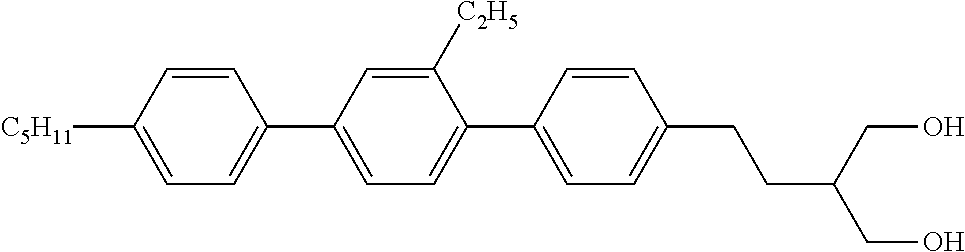
  • Typical additives of formula I are diols of formula 4, derivable from malonic acid,
  • R 1 , A 1 , A 2 , n and m1 are as defined as in formula I above and below.
  • Compounds of formula 4 with n>0 and m1>1 are new and can be synthesised by alkylation of malonic acid in the presence of a base (NaOEt, NaH, etc.) followed by reduction with, for example, lithium aluminium hydride (Scheme 1).
  • the polymerized component (polymer), which is optionally present in the LC cell, is obtainable by polymerization of a polymerizable component, i.e. one or more kinds of monomers.
  • the polymerizable component consists of one or more polymerizable compounds. Such polymerizable compounds have one to five, preferably two or three, polymerizable groups (preferably those groups P 1/2 indicated above and below).
  • the one or more monomers are firstly dissolved in the LC medium and are polymerized in the LC cell after homeotropic alignment or a high tilt angle of the LC medium has been established.
  • a voltage can be applied to the LC cell.
  • such a voltage is superfluous, and the desired alignment becomes established merely through the nature of the LC medium and the cell geometry.
  • Suitable monomers (polymerizable component) for the LC medium are those from the prior art which are used for PSA-VA displays, in particular and preferably polymerizable compounds of the formulae M1 to M42 below.
  • the LC media according to the invention for use in PSA displays preferably comprise ⁇ 5% by weight, particularly preferably ⁇ 1% by weight and very particularly preferably ⁇ 0.5% by weight, of polymerizable compounds, in particular polymerizable compounds of the formulae mentioned below. In order to achieve an adequate effect, 0.2% by weight or more is preferably employed. The optimum amount is dependent on the cell thickness.
  • Suitable and preferred polymerizable compounds are selected, for example, from the following formulae:
  • the LC medium or the polymerizable component preferably comprises one or more compounds selected from the group of the formulae M1-M42, particularly preferably from the group of the formulae M2-M26, very particularly preferably from the group of the formulae M2, M3, M9, M14 and M15.
  • the LC medium or the polymerizable component preferably comprises no compounds of the formula M10 in which Z 2 and Z 3 denote —(CO)O— or —O(CO)—.
  • the polymerizable compounds are polymerized or crosslinked (if a polymerizable compound contains two or more polymerizable groups) by in-situ polymerization in the LC medium between the substrates of the LC display, optionally with application of a voltage.
  • the polymerization can be carried out in one step. It is also possible firstly to carry out the polymerization with application of a voltage in a first step in order to produce a pretilt angle, and subsequently, in a second polymerization step, to polymerise or crosslink the compounds which have not fully reacted in the first step without an applied voltage (“end curing”).
  • Suitable and preferred polymerization methods are, for example, thermal or photopolymerization, preferably photopolymerization, in particular UV photopolymerization.
  • One or more initiators as an auxiliary substance can optionally also be added here.
  • Suitable conditions for the polymerization and suitable types and amounts of initiators are known to the person skilled in the art and are described in the literature.
  • Suitable for free-radical polymerization are, for example, the commercially available photoinitiators Irgacure651®, Irgacure184®, Irgacure907®, Irgacure369® or Darocure1173®(Ciba AG). If an initiator is employed, its proportion is preferably 0.001 to 5% by weight, particularly preferably 0.001 to 1% by weight.
  • the polymerizable compounds according to the invention are also suitable for polymerization without an initiator, which is associated with considerable advantages, such as, for example, lower material costs and, in particular, reduced contamination of the LC medium by possible residual amounts of the initiator or degradation products thereof.
  • the polymerization can thus also be carried out without addition of an initiator.
  • the LC medium thus, in a preferred embodiment, comprises no polymerization initiator.
  • the polymerizable component or the LC medium may also comprise one or more stabilisers as an auxiliary substance in order to prevent undesired spontaneous polymerization of the RMs, for example during storage or transport.
  • Suitable types and amounts of stabilisers are known to the person skilled in the art and are described in the literature. Particularly suitable are, for example, the commercially available stabilisers from the Irganox® series (Ciba AG), such as, for example, Irganox® 1076. If stabilisers are employed, their proportion, based on the total amount of the RMs or the polymerizable component, is preferably 10-10,000 ppm, particularly preferably 50-500 ppm.
  • the LC media for use in the LC displays according to the invention comprise an LC mixture (“host mixture”) comprising one or more, preferably two or more, low-molecular-weight (i.e. not polymeric) compounds.
  • host mixture comprising one or more, preferably two or more, low-molecular-weight (i.e. not polymeric) compounds.
  • the latter are stable or unreactive with respect to a polymerization reaction under the conditions used for the polymerization of the polymerizable compounds.
  • a suitable host mixture is any dielectrically negative or positive LC mixture which is suitable for use in conventional VA and VA-IPS displays.
  • Suitable LC mixtures are known to the person skilled in the art and are described in the literature.
  • LC media for VA displays having negative dielectric anisotropy are described in EP 1 378 557 A1.
  • Suitable LC mixtures having positive dielectric anisotropy which are suitable for LCDs and especially for IPS displays are known, for example, from JP 07-181 439 (A), EP 0 667 555, EP 0 673 986, DE 195 09 410, DE 195 28 106, DE 195 28 107, WO 96/23 851 and WO 96/28 521.
  • LC medium which additionally comprises one or more compounds selected from the group of the compounds of the formulae A, B and C,
  • Z 2 can have identical or different meanings.
  • Z 2 and Z 2′ can have identical or different meanings.
  • R 2A , R 2B and R 2C each preferably denote alkyl having 1-6 C atoms, in particular CH 3 , C 2 H 5 , n-C 3 H 7 , n-C 4 H 9 , n-C 5 H 11 .
  • Z 2 and Z 2′ in the formulae A and B preferably each, independently of one another, denote a single bond, furthermore a —C 2 H 4 — bridge.
  • (O)C v H 2v+1 preferably denotes OC v H 2v+1 , furthermore C v H 2v+1 .
  • (O)C v H 2v+1 preferably denotes C v H 2v+1 .
  • L 3 and L 4 preferably each denote F.
  • the proportion of compounds of the formulae A and/or B in the mixture as a whole is preferably at least 20% by weight.
  • the values of the birefringence ⁇ n in the liquid-crystal mixture are generally between 0.07 and 0.16, preferably between 0.08 and 0.12.
  • the rotational viscosity ⁇ 1 at 20° C. before the polymerization is preferably ⁇ 165 mPa ⁇ s, in particular ⁇ 140 mPa ⁇ s.
  • the compounds of the formula II are preferably selected from the group consisting of the following formulae:
  • the nematic phase of the dielectrically negative or positive LC medium according to the invention preferably has a nematic phase in a temperature range from 10° C. or less to 60° C. or more, particularly preferably from 0 or less to 70° C. or more.
  • the LC media according to the invention comprise one or more compounds selected from the group consisting of compounds from Table A.
  • Table C indicates possible stabilisers as auxiliary substances which can be added to the LC media according to the invention.
  • n here denotes an integer from 1 to 12, preferably 1, 2, 3, 4, 5, 6, 7 or 8, terminal methyl groups are not shown).
  • the LC media preferably comprise 0 to 10% by weight, in particular 1 ppm to 5% by weight, particularly preferably 1 ppm to 1% by weight, of stabilisers.
  • the LC media preferably comprise one or more stabilisers selected from the group consisting of compounds from Table C.
  • LC media and LC medium The same applies to the terms “component” in each case encompasses one or more substances, compounds and/or particles.
  • the process of polymerising the polymerizable compounds in the PSA displays as described above and below is carried out at a temperature where the LC medium exhibits a liquid crystal phase, preferably a nematic phase, and most preferably is carried out at room temperature. At temperatures below the clearing point also good vertical alignment is observed due to the use of additives according to the invention.
  • the polymerizable compounds are polymerized in the display or test cell by irradiation with UVA light (usually 365 nm) of defined intensity for a pre-specified time, with a voltage optionally being applied simultaneously to the display (usually 10 to 30 V alternating current, 1 kHz).
  • UVA light usually 365 nm
  • a voltage optionally being applied simultaneously to the display usually 10 to 30 V alternating current, 1 kHz.
  • a 100 mW/cm 2 mercury vapour lamp is used, and the intensity is measured using a standard UV meter (Ushio UNI meter) fitted with a 320 nm band-pass filter.
  • the compounds employed, if not commercially available, are synthesised by standard laboratory procedures.
  • the LC media originate from Merck KGaA, Germany.
  • lithiumaluminiumhydride 550 mg (14.5 mmol) lithiumaluminiumhydride are suspended in 4 ml toluene and a solution of 4.80 g (12 mmol) 2-[2-(2-Fluoro-4′-propyl-biphenyl-4-yl)-ethyl]-malonic acid diethyl ester in 20 ml THF is added dropwise.
  • the reaction is refluxed for 1 h, poured onto ice-water and acidified with 2 N hydrochloric acid.
  • the aq. layer is separated and extracted three times with MTB-Ether.
  • the combined org. layer are washed with brine, dried over sodium sulfate and the solvent is evaporated.
  • reaction product is extracted with methyl-tert-butyl ether and the organic layer is washed with brine, dried over sodium sulphate, filtered and evaporated under vacuum.
  • the crude product is purified via silica gel chromate-grapy (toluene/heptane 1:1) and afterwards crystallized from heptane to give 17.8 g (71% yield) of the product as white crystals.
  • the organic layer is separated, washed with water, brine and dried over sodium sulphate. It is filtered and evaporated under vacuum.
  • the crude product is purified via silica gel chromatography with heptane and heptane/ethyl acetate (8:2). The obtained product is finally crystallized from heptane and the product is obtained as white crystals with 3.5 g (58% yield).
  • 0.88 ppm (t, 7.02 Hz, 3H, CH 3 ), 1.08 ppm (t, 7.54 Hz, 3H, CH 3 ), 1.32 ppm (m c , 4H, CH 2 —H), 1.6 ppm (m, 5H, CH 2 —H, CH(CH 2 OH) 2 ), 2.64 ppm (m, 6H, arom.-CH 2 ), 3.45 ppm (m c , 4H, CH 2 OH), 4.34 ppm (t, 5.2 Hz, 2H, OH), 7.25 ppm (m, 7H, arom.-H), 7.48 ppm (dd, 7.92 Hz, 1.97 Hz, 1H, arom.-H), 7.57 ppm (d, 1.92 Hz, 1H, arom.-H), 7.60 ppm (d, 8.2 Hz, 2H, arom.-H).
  • reaction mixture is diluted with water, extracted with methyl tert-butyl ether and dried over Na 2 SO 4 . After evaporation of the solvent the crude product is purified via column chromatography with heptane and the product is obtained as a yellow solid.
  • reaction mixture is allowed to rise to room temperature during 5 h and is then poured into ice water and extracted with methyl-tert-butyl ether. The combined organic layers are washed with brine and dried over Na 2 SO 4 and evaporated under vacuum. The crude product is filtered via column chromatography and the product is obtained as a solid material.
  • liquid-crystalline mixtures consisting of low-molecular-weight components in the stated percentage proportions by weight are used.
  • the compound no. 1 (0.5% by weight) is added to the nematic LC medium M1 of the VA type ( ⁇ 0, Table 1) and the mixture is homogenised.
  • the resulting mixture is introduced into a test cell (without polyimide alignment layer, LC layer thickness d ⁇ 4.0 ⁇ m, ITO coating on both sides (structured ITO in case of a multi-domain switching), no passivation layer).
  • the LC medium has spontaneous homeotropic (vertical) alignment to the substrate surfaces. In the temperature-stable range, the VA cell can be switched reversibly between crossed polarisers by application of a voltage of between 0 and 30 V.
  • the compound 1 (0.5% by weight) is added to a nematic LC medium M3 of the VA-IPS type ( ⁇ >0, Table 3) and the mixture is homogenised.
  • the resulting mixture is introduced into a test cell (without polyimide alignment layer, layer thickness d ⁇ 4 ⁇ m, ITO interdigital electrodes arranged on a substrate surface, glass on the opposite substrate surface, no passivation layer).
  • the LC medium has spontaneous homeotropic (vertical) alignment to the substrate surfaces.
  • the VA-IPS cell can be switched reversibly between crossed polarisers by application of a voltage of between 0 and 20 V.
  • the compounds 2 to 40 are added analogously to Mixture Example 1 to a nematic LC medium M1 ( ⁇ 0) and the mixture is homogenised.
  • the proportions by weight of the compounds in the medium are indicated in Table 4.
  • the resulting LC medium is in each case introduced into a test cell as in Mixture Example 1 (without pre-alignment layer) and shows spontaneous homeotropic (vertical) alignment to the substrate surfaces.
  • the VA cell can be switched reversibly between crossed polarisers by application of a voltage of between 0 and 30 V.
  • the additives no. 1 to 40 show favourable alignment properties in both LC media with negative ⁇ , M1 and M2.
  • the compounds 2 to 40 are added analogously to Mixture Example 2 to a nematic LC medium M3 ( ⁇ >0) and the mixture is homogenised.
  • the proportions by weight of the compounds in the medium are indicated in Table 5.
  • the resulting LC medium is in all cases introduced into a test cell without pre-alignment layer and has spontaneous homeotropic (vertical) alignment to the substrate surfaces.
  • the VA-IPS cell can be switched reversibly between crossed polarisers by application of a voltage of between 0 and 20 V.
  • a polymerizable compound (RM-1, 0.3% by weight) and a self-aligning compound (5, 0.25% by weight, or 6, 0.25% by weight, or 19, 0.15% by weight, or 21, 0.15% by weight, or 26, 0.15% by weight, or 34, 0.20% by weight or 35, 0.20% by weight) are added to the nematic LC medium M1 ( ⁇ 0) and the mixture is homogenised.
  • the resulting mixture is introduced into a test cell (without polyimide alignment layer, layer thickness d ⁇ 4.0 ⁇ m, ITO coating on both sides (structured ITO in case of a multi-domain switching), no passivation layer).
  • the LC medium has spontaneous homeotropic (vertical) alignment to the substrate surfaces.
  • the cell is irradiated with UV light of intensity 100 mW/cm 2 at 20° C. for 15 min with application of a voltage greater than the optical threshold voltage. This causes polymerization of the monomeric, polymerizable compound.
  • the homeotropic alignment is additionally stabilized, and the pre-tilt is tuned.
  • the resultant PSA-VA cell can be switched reversibly at up to the clearing point with application of a voltage of between 0 and 30 V. The response times are reduced compared to the un-polymerized cell.
  • Auxiliary substances like Irganox® 1076 (Ciba Specialty Chem.) may be added (e.g. 0.001%) for preventing spontaneous polymerization.
  • a UV-cut filter may be used during polymerization for preventing damage of the mixtures (e.g. 320 or 340 nm UV cut-filter).
  • Polymerization may also be performed without an applied voltage. After polymerization a passivation layer is formed, without changing the pre-tilt. The passivation layer improves the long-time stability of the self-orientation.
  • the LC media of the Mixture Examples 3 to 41 are filled into a test cell (without polyimide alignment layer, layer thickness d ⁇ 4.0 ⁇ m, ITO coating on both sides (structured ITO in case of a multi-domain switching), no passivation layer).
  • the LC medium has spontaneous homeotropic (vertical) alignment to the substrate surfaces.
  • the resulting VA-cell is treated at 120° C. for at least 1 h. After heat-stress, all cells still show high quality of the self-orientation.
  • the compounds are thus compatible with the conditions of a production process used in the display industry.

Landscapes

  • Chemical & Material Sciences (AREA)
  • Organic Chemistry (AREA)
  • Physics & Mathematics (AREA)
  • Crystallography & Structural Chemistry (AREA)
  • Engineering & Computer Science (AREA)
  • Materials Engineering (AREA)
  • Nonlinear Science (AREA)
  • General Physics & Mathematics (AREA)
  • Mathematical Physics (AREA)
  • Optics & Photonics (AREA)
  • Geometry (AREA)
  • Spectroscopy & Molecular Physics (AREA)
  • Liquid Crystal (AREA)
  • Liquid Crystal Substances (AREA)
  • Organic Low-Molecular-Weight Compounds And Preparation Thereof (AREA)

Abstract

The present invention relates to liquid-crystalline media (LC media) having negative or positive dielectric anisotropy comprising self-alignment additives (SAMs) with an at least one bifunctional or polyfunctional anchor group, which effects the homeotropic (vertical) alignment of the LC media at a surface or the cell walls of a liquid-crystal display (LC display). The invention therefore also encompasses LC displays having homeotropic alignment of the liquid-crystalline medium (LC medium) without conventional imide alignment layers. The LC media may be supplemented by a polymerizable or polymerized component, which serves for stabilization of the alignment, for adjustment of the tilt angle and/or as passivation layer.

Description

The present invention relates to liquid-crystalline media (LC media) having negative or positive dielectric anisotropy comprising self-alignment additives with an at least one bifunctional or polyfunctional anchor group, which effects the homeotropic (vertical) alignment of the LC media at a surface or the cell walls of a liquid-crystal display (LC display). The invention therefore also encompasses LC displays having homeotropic alignment of the liquid-crystalline medium (LC medium) without conventional imide alignment layers. The LC media may be supplemented by a polymerizable or polymerized component, which serves for stabilisation of the alignment, for adjustment of the tilt angle and/or as passivation layer.
The principle of electrically controlled birefringence, the ECB effect or also DAP (deformation of aligned phases) effect, was described for the first time in 1971 (M. F. Schieckel and K. Fahrenschon, “Deformation of nematic liquid crystals with vertical orientation in electrical fields”, Appl. Phys. Lett. 19 (1971), 3912). This was followed by papers by J. F. Kahn (Appl. Phys. Lett. 20 (1972), 1193) and G. Labrunie and J. Robert (J. Appl. Phys. 44 (1973), 4869).
The papers by J. Robert and F. Clerc (SID 80 Digest Techn. Papers (1980), 30), J. Duchene (Displays 7 (1986), 3) and H. Schad (SID 82 Digest Techn. Papers (1982), 244) showed that liquid-crystalline phases must have high values for the ratio of the elastic constants K3/K1, high values for the optical anisotropy Δn and values for the dielectric anisotropy of Δ∈≦−0.5 in order to be suitable for use in high-information display elements based on the ECB effect. Electro-optical display elements based on the ECB effect have homeotropic edge alignment (VA technology=vertically aligned).
Displays which use the ECB effect, as so-called VAN (vertically aligned nematic) displays, for example in the MVA (multi-domain vertical alignment, for example: Yoshide, H. et al., paper 3.1: “MVA LCD for Notebook or Mobile PCs . . . ”, SID 2004 International Symposium, Digest of Technical Papers, XXXV, Book I, pp. 6 to 9, and Liu, C. T. et al., paper 15.1: “A 46-inch TFT-LCD HDTV Technology . . . ”, SID 2004 International Symposium, Digest of Technical Papers, XXXV, Book II, pp. 750 to 753), PVA (patterned vertical alignment, for example: Kim, Sang Soo, paper 15.4: “Super PVA Sets New State-of-the-Art for LCD-TV”, SID 2004 International Symposium, Digest of Technical Papers, XXXV, Book II, pp. 760 to 763), ASV (advanced super view, for example: Shigeta, Mitzuhiro and Fukuoka, Hirofumi, paper 15.2: “Development of High Quality LCDTV”, SID 2004 International Symposium, Digest of Technical Papers, XXXV, Book II, pp. 754 to 757) modes, have established themselves as one of the three more recent types of liquid-crystal display that are currently the most important, in particular for television applications, besides IPS (in-plane switching) displays (for example: Yeo, S. D., paper 15.3: “An LC Display for the TV Application”, SID 2004 International Symposium, Digest of Technical Papers, XXXV, Book II, pp. 758 & 759) and the long-known TN (twisted nematic) displays. The technologies are compared in general form, for example, in Souk, Jun, SID Seminar 2004, seminar M-6: “Recent Advances in LCD Technology”, Seminar Lecture Notes, M-6/1 to M-6/26, and Miller, Ian, SID Seminar 2004, seminar M-7: “LCD-Television”, Seminar Lecture Notes, M-7/1 to M-7/32. Although the response times of modern ECB displays have already been significantly improved by addressing methods with over-drive, for example: Kim, Hyeon Kyeong et al., paper 9.1: “A 57-in. Wide UXGA TFT-LCD for HDTV Application”, SID 2004 International Symposium, Digest of Technical Papers, XXXV, Book I, pp. 106 to 109, the achievement of video-compatible response times, in particular on switching of grey shades, is still a problem which has not yet been satisfactorily solved.
Considerable effort is associated with the production of VA displays having two or more domains of different preferential direction. It is an aim of this invention to simplify the production processes and the display devices themselves without giving up the advantages of VA technology, such as relatively short response times and good viewing-angle dependence.
VA displays which comprise LC media having positive dielectric anisotropy are described in S. H. Lee et al. Appl. Phys. Lett. (1997), 71, 2851-2853. These displays use interdigital electrodes arranged on a substrate surface (in-plane addressing electrode configuration having a comb-shaped structure), as employed, inter alia, in the commercially available IPS (in-plane switching) displays (as disclosed, for example, in DE 40 00 451 and EP 0 588 568), and have a homeotropic arrangement of the liquid-crystal medium, which changes to a planar arrangement on application of an electric field (VA-IPS).
Further developments of the above-mentioned display can be found, for example, in K. S. Hun et al. J. Appl. Phys. (2008), 104, 084515 (DSIPS: ‘double-side in-plane switching’ for improvements of driver voltage and transmission), M. Jiao et al. App. Phys. Lett (2008), 92, 111101 (DFFS: ‘dual fringe field switching’ for improved response times) and Y. T. Kim et al. Jap. J. App. Phys. (2009), 48, 110205 (VAS: ‘viewing angle switchable’ LCD).
In addition, VA-IPS displays are also known under the name positive-VA and HT-VA.
In all such displays (referred to below in general as VA-IPS displays), an alignment layer is applied to both substrate surfaces for homeotropic alignment of the LC medium; the production of this layer has hitherto been associated with considerable effort.
It is an aim of this invention to simplify the production processes themselves without giving up the advantages of VA-IPS technology, such as relatively short response times, good viewing-angle dependence and high contrast.
Industrial application of these effects in electro-optical display elements requires LC phases, which have to satisfy a multiplicity of requirements. Particularly important here are chemical resistance to moisture, air, the materials in the substrate surfaces and physical influences, such as heat, infrared, visible and ultraviolet radiation and direct and alternating electric fields.
Furthermore, industrially usable LC phases are required to have a liquid-crystalline mesophase in a suitable temperature range and low viscosity.
VA and VA-IPS displays are generally intended to have very high specific resistance at the same time as a large working-temperature range, short response times and a low threshold voltage, with the aid of which various grey shades can be produced.
In conventional VA and VA-IPS displays, a polyimide layer on the substrate surfaces ensures homeotropic alignment of the liquid crystal. The production of a suitable alignment layer in the display requires considerable effort. In addition, interactions of the alignment layer with the LC medium may impair the electrical resistance of the display. Owing to possible interactions of this type, the number of suitable liquid-crystal components is considerably reduced. It would therefore be desirable to achieve homeotropic alignment of the LC medium without polyimide.
The disadvantage of the active-matrix TN displays frequently used is due to their comparatively low contrast, the relatively high viewing-angle dependence and the difficulty of producing grey shades in these displays.
VA displays have significantly better viewing-angle dependences and are therefore used principally for televisions and monitors.
A further development are the so-called PS (polymer sustained) or PSA (polymer sustained alignment) displays, for which the term “polymer stabilised” is also occasionally used. The PSA displays are distinguished by the shortening of the response times without significant adverse effects on other parameters, such as, in particular, the favourable viewing-angle dependence of the contrast.
In these displays, a small amount (for example 0.3% by weight, typically <1% by weight) of one or more polymerizable compound(s) is added to the LC medium and, after introduction into the LC cell, is polymerized or crosslinked in situ, usually by UV photopolymerization, between the electrodes with or without an applied electrical voltage. The addition of polymerizable mesogenic or liquid-crystalline compounds, also known as reactive mesogens or “RMs”, to the LC mixture has proven particularly suitable. PSA technology has hitherto been employed principally for LC media having negative dielectric anisotropy.
Unless indicated otherwise, the term “PSA” is used below as representative of PS displays and PSA displays.
In the meantime, the PSA principle is being used in diverse classical LC displays. Thus, for example, PSA-VA, PSA-OCB, PSA-IPS, PSA-FFS and PSA-TN displays are known. The polymerization of the polymerizable compound(s) preferably takes place with an applied electrical voltage in the case of PSA-VA and PSA-OCB displays, and with or without an applied electrical voltage in the case of PSA-IPS displays. As can be demonstrated in test cells, the PS(A) method results in a ‘pretilt’ in the cell. In the case of PSA-OCB displays, for example, it is possible for the bend structure to be stabilized so that an offset voltage is unnecessary or can be reduced. In the case of PSA-VA displays, the pretilt has a positive effect on the response times. A standard MVA or PVA pixel and electrode layout can be used for PSA-VA displays. In addition, however, it is also possible, for example, to manage with only one structured electrode side and no protrusions, which significantly simplifies production and at the same time results in very good contrast at the same time as very good light transmission.
PSA-VA displays are described, for example, in JP 10-036847 A, EP 1 170 626 A2, U.S. Pat. No. 6,861,107, U.S. Pat. No. 7,169,449, US 2004/0191428 A1, US 2006/0066793 A1 and US 2006/0103804 A1. PSA-OCB displays are described, for example, in T.-J-Chen et al., Jpn. J. Appl. Phys. 45, 2006, 2702-2704 and S. H. Kim, L.-C-Chien, Jpn. J. Appl. Phys. 43, 2004, 7643-7647. PSA-IPS displays are described, for example, in U.S. Pat. No. 6,177,972 and Appl. Phys. Lett. 1999, 75(21), 3264. PSA-TN displays are described, for example, in Optics Express 2004, 12(7), 1221. PSA-VA-IPS displays are disclosed, for example, in WO 2010/089092 A1.
Like the conventional LC displays described above, PSA displays can be operated as active-matrix or passive-matrix displays. In the case of active-matrix displays, individual pixels are usually addressed by integrated, non-linear active elements, such as, for example, transistors (for example thin-film transistors or “TFTs”), while in the case of passive-matrix displays, individual pixels are usually addressed by the multiplex method, both methods being known from the prior art.
In particular for monitor and especially TV applications, optimization of the response times, but also of the contrast and luminance (i.e. also transmission), of the LC display is still sought after. The PSA method can provide crucial advantages here. In particular in the case of PSA-VA displays, a shortening of the response times, which correlate with a pretilt which can be measured in test cells, can be achieved without significant adverse effects on other parameters.
In the prior art, polymerizable compounds of the following formula, for example, are used for PSA-VA:
Figure US09726933-20170808-C00001

in which P denotes a polymerizable group, usually an acrylate or methacrylate group, as described, for example, in U.S. Pat. No. 7,169,449.
The effort for the production of a polyimide layer, treatment of the layer and improvement with bumps or polymer layers is relatively great. A simplifying technology compatible with (PSA-)VA/VA-IPS which on the one hand reduces production costs and on the other hand helps to optimize the image quality (viewing-angle dependence, contrast, response times) would therefore be desirable.
The document WO 2012/038026 A1 discloses self-aligning mesogens (SAMs) with a hydroxy group attached to a mesogenic core structure comprising two or more rings.
The existing approaches for achieving display applications without a polyimide layer could be still improved.
The present invention relates firstly to an LC medium comprising a low-molecular-weight liquid-crystalline component and one or more self-alignment additives of formula I,
R1-A1-(Z2-A2)m1-R2  (I)
wherein
  • R2 denotes a group
Figure US09726933-20170808-C00002
  • Sp1, Sp3, Sp5 independently of each other, denotes a spacer group or a single bond,
  • Sp2 denotes a trivalent, acyclic spacer group, preferably a group CH, CR0 or N,
  • Sp4 denotes a tetravalent, acyclic spacer group, preferably a carbon atom,
  • Y is independently of each other O, S, (CO), NR0 or a single bond,
  • X1 and X2 independently of each other a group —OH, —NH2, —NHR11, —SH, —SR11, —NR11 2, —OR11 or —(CO)OH,
Figure US09726933-20170808-C00003
  • R11 in each case independently denotes a halogenated or unsubstituted alkyl having 1 to 15 C atoms, where, in addition, one or more CH2 groups in this alkyl may each be replaced, independently of one another, by —C≡C—, —CH═CH—, —(CO)O—, —O(CO)—, —(CO)— or —O— in such a way that O or N atoms are not linked directly to one another, and where two radicals R11 are optionally linked to one another to form a ring,
    • preferably R11 is alkyl with 1 to 7 C atoms, more preferably CH3 or CH2CH3,
  • B any ring or condensed ring, optionally substituted by one, two or three substituents RL, preferably a six-membered ring, particularly preferred benzene, where the optional substituents of said benzene reside in place of any of the positions of hydrogen atoms,
  • p 2, 3, 4 or 5, preferably 2 or 3,
  • A1 and A2 each, independently of one another, denote an aromatic, heteroaromatic, alicyclic or heterocyclic group, preferably having 4 to 25 C atoms, which may also contain fused rings, and which may also be mono- or polysubstituted by RL,
  • RL in each case, independently of one another, denotes OH, SH, SR0, —(CH2)n1—OH, F, Cl, Br, I, —CN, —NO2, —NCO, —NCS, —OCN, —SCN, —C(═O)N(R0)2, —C(═O)R0, —N(R0)2, —(CH2)n1—N(R0)2, optionally substituted silyl, optionally substituted aryl or cycloalkyl having 6 to 20 C atoms, or straight-chain or branched alkyl, alkoxy, alkylcarbonyl, alkoxycarbonyl, alkylcarbonyloxy or alkoxycarbonyloxy having 1 to 25 C atoms, in which, in addition, one or more H atoms may be replaced by F or Cl, and two vicinal RL together are optionally ═O(carbonyl O),
  • n1 denotes 1, 2, 3 or 4,
  • Z2 in each case, independently of one another, denotes a single bond, —O—, —S—, —CO—, —CO—O—, —OCO—, —O—CO—O—, —OCH2—, —CH2O—, —SCH2—, —CH2S—, —CF2O—, —OCF2—, —CF2S—, —SCF2—, —(CH2)n1—, —CF2CH2—, —CH2CF2—, —(CF2)n1—, —CH═CH—, —CF═CF—, —C≡C—, —CH═CH—COO—, —OCO—CH═CH— or CR0R00, preferably a single bond or —CH2CH2—,
  • R0 and R00 each, independently of one another, denote H or alkyl having 1 to 12 C atoms,
  • R1 denotes H, halogen, straight-chain, branched or cyclic alkyl having 1 to 25 C atoms, in which, in addition, one or more non-adjacent CH2 groups may be replaced by —C≡C—, —CH═CH—, —NR0—, —O—, —S—, —CO—, —CO—O—, —O—CO—, —O—CO—O— in such a way that N, O and/or S atoms are not linked directly to one another, and in which, in addition, one or more tertiary carbon atoms (CH groups) may be replaced by N, and in which, in addition, one or more H atoms may be replaced by F or Cl, and
  • m1 denotes 0, 1, 2, 3, 4 or 5, preferably 1 or 2.
The liquid-crystalline component or the LC medium can have either positive or negative dielectric anisotropy. The LC medium according to the invention is preferably nematic.
In addition, the LC medium preferably comprises a polymerized or polymerizable component, where the polymerized component is obtainable by polymerization of a polymerizable component.
This polymer component enables the LC medium and in particular its alignment to be stabilized, a passivation layer to be built, and a desired pretilt optionally to be established.
The present invention furthermore relates to a process for the preparation of an LC medium in which a low-molecular-weight liquid-crystalline component is mixed with one or more of said self-alignment additives, and one or more polymerizable compounds and/or auxiliary substances are optionally added. The liquid-crystalline component or the LC medium can have either positive or negative dielectric anisotropy.
The present invention furthermore relates to a liquid-crystal display (LC display) comprising a liquid-crystal cell (LC cell) having two parallel, planar substrates and at least two electrodes, where at least one substrate is transparent to light and at least one substrate has one or two electrodes, and a layer of a liquid-crystal medium (LC medium), located between the substrates, comprising a low-molecular-weight liquid-crystalline component and one or more of said self-alignment additives suitable for effecting homeotropic (vertical) alignment of the LC medium with respect to the substrate surfaces.
In addition, the LC medium of the LC display preferably comprises a polymerized or polymerizable component, where the polymerized component is obtainable by polymerization of one or more polymerizable compounds in the LC medium between the substrates of the LC cell, optionally with application of an electrical voltage to the electrodes of the cell or under the action of another electric field.
The invention furthermore relates to a process for the production of an LC display, preferably of the PSA-VA(-IPS) type, comprising an LC cell having two substrates and at least two electrodes, where at least one substrate is transparent to light and at least one substrate has one or two electrodes, comprising the process steps of:
    • filling of the cell with an LC medium as described above and below or in the claims, comprising one or more self-alignment additives which is suitable for effecting the homeotropic (vertical) alignment of the LC medium with respect to the substrate surfaces, and optionally
    • polymerization of a polymerizable component optionally present, optionally with application of a voltage to the electrodes of the cell or under the action of another electric field.
The invention furthermore relates to new compounds summarized under formula I above and below, in particular with the preferred meanings of the substituents.
The aforementioned self-alignment additive is dissolved or dispersed in the liquid crystal mixture. It effects the homeotropic alignment of the liquid crystal with respect to the substrate surfaces (such as, for example, a SiNx or glass surface or an ITO- or polyimide- or photoresist-coated surface). Considering the investigations for this invention, it appears that the polar anchor group interacts with the substrate surface. The additive, after interaction with the substrate surface, consequently aligns relative to the boundaries of the mixture and induces homeotropic alignment of the liquid crystal.
The self-alignment additive is preferably employed in a concentration of <5% by weight, more preferably <3% by weight and particularly <1% by weight, and most preferably <0.5% by weight. The use of 0.1 to 0.5% by weight of the self-alignment additive generally results in a complete homeotropic alignment of the LC layer for conventional cell thicknesses (3 to 4 μm) and for the substrate materials used in the display industry. Other surfaces, e.g. by special treatments, may allow to further reduce the amount of additive (<0.1 wt %) while keeping up the alignment or may also allow to increase the amount of additive (>5 wt %) without affecting the display performance.
The polar anchor group R2 of the self-alignment additive preferably comprises hydroxy or amino groups which presumably undergo a non-covalent interaction with the glass, metal-oxide or polymer substrate surface. The groups should at the same time be sufficiently stable for use as LC medium. In addition, they should have only little effect on the VHR values (‘voltage holding ratio’) of the LC medium. Hydroxy groups are therefore preferred.
The polar anchor group R2 preferably contains two or three, particularly two OH groups or two or three, particularly two N atoms, where the N atoms are in a primary, secondary or tertiary amino group.
The anchor group R2 of formula I thus encompasses, for example, preferably a pair of hydroxy groups or a pair of amino groups, which are connected to each other and to the mesogenic core (the group R1-A1-(Z2-A2)m1-) by a polyvalent organic group consisting of a branching part provided by the polyvalent spacer Sp2, Sp4 or a ring B, as further described for the group R2, and optional further bivalent spacers (Sp1, Sp5, —Y-Sp3) between each of these structural elements. The structure of the anchor group R2 hence may be branched, cyclic or a combination thereof.
The term “spacer group”, or “Sp”, as used herein, is known to the person skilled in the art and is described in the literature, see, for example, Pure Appl. Chem. 73(5), 888 (2001) and C. Tschierske, G. Pelzl, S. Diele, Angew. Chem. 2004, 116, 6340-6368. Unless indicated otherwise, the terms “spacer group” or “spacer” as used herein will be understood to mean a group which connects two or more different parts of a molecule.
A divalent spacer of formula Sp1 or Sp3 or Sp5 as used herein independently preferably denotes one of the meanings indicated for group Sp, where
  • Sp denotes alkylene having 1 to 20, preferably 1 to 12, more preferably 1 to 6, C atoms, which is optionally mono- or polysubstituted by F, Cl, Br, I or CN and in which, in addition, one or more non-adjacent CH2 groups may each be replaced, independently of one another, by —O—, —S—, —NH—, —N(R0)—, —Si(R0R00)—, —CO—, —CO—O—, —O—CO—, —O—CO—O—, —S—CO—, —CO—S—, —N(R0)—CO—O—, —O—CO—N(R0)—, —N(R0)—CO—N(R0)—, —CH═CH— or —≡C≡C— in such a way that O, N and/or S atoms are not linked directly to one another, and
  • R0 and R00 each, independently of one another, denote H or alkyl having 1 to 12 C atoms.
The group R2 in the above formulae preferably denotes a group of the formula (A1), (A2) or (A3), as shown above, wherein independently the following definitions are preferred:
  • Sp1 denotes —(CH2)n—, —(CH2)nO—, —O(CH2)n—, —O—, —S—, —NR0—, —C≡C—, —C≡C—(CH2)n—, —CH═CH— or —CH═CH—(CH2)n—, where n is 1 to 6, or a single bond,
    • more preferably —CH2—, —CH2CH2—, —CH2O—, —OCH2—, —CH2CH2CH2—, —CH2CH2O—, —OCH2CH2—, —C≡C—(CH2)n—, —O—, or a single bond, most preferably not a single bond for structure (A1) and (A2), and preferably a single bond for structure (A3),
  • Sp2 is CH or N,
  • Sp3 is —(CH2)n—, —(CH2CH2O)q1—CH2CH2—, —CH2CH2—S—CH2CH2—, —CH2CH2—NH—CH2CH2— or —(SiR0R00—O)p1—, in which n is an integer from 1 to 12, q1 is an integer from 1 to 3, and R0 and R00 have the meanings indicated above,
    • more preferably —(CH2)n—,
  • Sp4 is a tetravalent carbon atom,
  • Sp5 is —(CH2)n—, —(CH2)n—O—(CH2)m—, wherein n is 1 to 6, preferably 1, and m is 1, 2, 3, 4, 5 or 6, more preferably Sp5 is —CH2—,
  • p is 2 or 3, preferably 2, and the both chains may have independent compositions,
  • X1, X2 independently denote a group —OH, —NH2, —NHR11, —NR11 2, —(CO)OH or a group of the formula
Figure US09726933-20170808-C00004
    • wherein R0 is defined as above and preferably denotes H,
    • more preferably X1, X2 denote —OH or —NH2, especially OH, and
  • n independently denotes 1, 2, 3 or 4.
For the compounds of formula I wherein R2 is a group (A1) or (A2), the spacer Sp1 is preferably not a single group.
Further,
Figure US09726933-20170808-C00005

in formula I and its closer defined formulae preferably denotes a benzene ring. Ring B more preferably denotes a substituted benzene selected from the following formulae, where the bonds indicate the substituted positions
Figure US09726933-20170808-C00006
The group R2 in the formulae above and below particularly preferably denotes a group of the sub-formula (A1a), (A2a), (A3a) or (A3b),
Figure US09726933-20170808-C00007

in which the variable groups are independently defined as above and below, and
  • n independently denotes 1, 2, 3 or 4, preferably 1,
    while formulae (A1a) and (A3a) are particularly preferred.
The term “aryl” or “aromatic group” denotes an aromatic carbon group or a group derived there from. The term “heteroaryl” denotes “aryl” as defined above containing one or more heteroatoms.
Aryl and heteroaryl groups may be monocyclic or polycyclic, i.e. they may contain one ring (such as, for example, phenyl) or two or more rings, which may also be fused (such as, for example, naphthyl) or covalently bonded (such as, for example, biphenyl), or contain a combination of fused and bonded rings. Heteroaryl groups contain one or more heteroatoms, preferably selected from O, N, S and Se.
Particular preference is given to mono-, bi- or tricyclic aryl groups having 6 to 25 C atoms and mono-, bi- or tricyclic heteroaryl groups having 2 to 25 C atoms, which optionally contain fused rings and are optionally substituted. Preference is furthermore given to 5-, 6- or 7-membered aryl and heteroaryl groups, in which, in addition, one or more CH groups may be replaced by N, S or O in such a way that O atoms and/or S atoms are not linked directly to one another.
Preferred aryl groups are, for example, phenyl, biphenyl, terphenyl, [1,1′:3′,1″]terphenyl-2′-yl, naphthyl, anthracene, binaphthyl, phenanthrene, pyrene, dihydropyrene, chrysene, perylene, tetracene, pentacene, benzo-pyrene, fluorene, indene, indenofluorene, spirobifluorene, etc.
Preferred heteroaryl groups are, for example, 5-membered rings, such as pyrrole, pyrazole, imidazole, 1,2,3-triazole, 1,2,4-triazole, tetrazole, furan, thiophene, selenophene, oxazole, isoxazole, 1,2-thiazole, 1,3-thiazole, 1,2,3-oxadiazole, 1,2,4-oxadiazole, 1,2,5-oxadiazole, 1,3,4-oxadiazole, 1,2,3-thiadiazole, 1,2,4-thiadiazole, 1,2,5-thiadiazole, 1,3,4-thiadiazole, 6-membered rings, such as pyridine, pyridazine, pyrimidine, pyrazine, 1,3,5-triazine, 1,2,4-triazine, 1,2,3-triazine, 1,2,4,5-tetrazine, 1,2,3,4-tetrazine, 1,2,3,5-tetrazine, or condensed groups, such as indole, isoindole, indolizine, indazole, benzimidazole, benzotriazole, purine, naphthimidazole, phenan-thrimidazole, pyridimidazole, pyrazinimidazole, quinoxalinimidazole, benz-oxazole, naphthoxazole, anthroxazole, phenanthroxazole, isoxazole, benzo-thiazole, benzofuran, isobenzofuran, dibenzofuran, quinoline, isoquinoline, pteridine, benzo-5,6-quinoline, benzo-6,7-quinoline, benzo-7,8-quinoline, benzoisoquinoline, acridine, phenothiazine, phenoxazine, benzopyridazine, benzopyrimidine, quinoxaline, phenazine, naphthyridine, azacarbazole, benzocarboline, phenanthridine, phenanthroline, thieno[2,3b]thiophene, thieno[3,2b]thiophene, dithienothiophene, isobenzothiophene, dibenzothio-phene, benzothiadiazothiophene, or combinations of these groups. The heteroaryl groups may also be substituted by alkyl, alkoxy, thioalkyl, fluorine, fluoroalkyl or further aryl or heteroaryl groups.
The (non-aromatic) alicyclic and heterocyclic groups encompass both saturated rings, i.e. those containing exclusively single bonds, and also partially unsaturated rings, i.e. those which may also contain multiple bonds. Heterocyclic rings contain one or more heteroatoms, preferably selected from Si, O, N, S and Se.
The alicyclic and heterocyclic groups, which are non-aromatic, may be monocyclic, i.e. contain only one ring (such as, for example, cyclohexane), or polycyclic, i.e. contain a plurality of rings (such as, for example, decahydronaphthalene or bicyclooctane). Particular preference is given to saturated groups. Preference is furthermore given to mono-, bi- or tricyclic groups having 3 to 25 C atoms, which optionally contain fused rings and are optionally substituted. Preference is furthermore given to 5-, 6-, 7- or 8-membered carbocyclic groups, in which, in addition, one or more C atoms may be replaced by Si and/or one or more CH groups may be replaced by N and/or one or more non-adjacent CH2 groups may be replaced by —O— and/or —S—.
Preferred alicyclic and heterocyclic groups are, for example, 5-membered groups, such as cyclopentane, tetrahydrofuran, tetrahydrothiofuran, pyrrolidine, 6-membered groups, such as cyclohexane, cyclohexene, tetrahydropyran, tetrahydrothiopyran, 1,3-dioxane, 1,3-dithiane, piperidine, 7-membered groups, such as cycloheptane, and fused groups, such as tetrahydronaphthalene, decahydronaphthalene, indane, bicyclo[1.1.1]pentane-1,3-diyl, bicyclo[2.2.2]octane-1,4-diyl, spiro[3.3]heptane-2,6-diyl, octa-hydro-4,7-methanoindane-2,5-diyl and perhydrocyclopenta[a]phenanthrene-3,7-diyl.
The rings A1 and A2 in formula I above and below preferably denote each, independently of one another, a radical selected from the following groups:
    • a) the group consisting of 1,4-phenylene and 1,3-phenylene, in which, in addition, one or two CH groups may be replaced by N and in which, in addition, one or more H atoms may be replaced by RL,
    • b) the group consisting of trans-1,4-cyclohexylene, 1,4-cyclo-hexenylene and 1,4′-bicyclohexylene, in which, in addition, one or more non-adjacent CH2 groups may be replaced by —O— and/or —S— and in which, in addition, one or more H atoms may be replaced by F or Cl,
    • c) the group consisting of tetrahydropyran-2,5-diyl, 1,3-dioxane-2,5-diyl, tetrahydrofuran-2,5-diyl, cyclobutane-1,3-diyl, piperidine-1,4-diyl, thiophene-2,5-diyl and selenophene-2,5-diyl, each of which may, in addition, be mono- or polysubstituted by RL,
    • d) the group consisting of saturated, partially unsaturated or fully unsaturated, and optionally substituted, polycyclic radicals having 5 to 20 cyclic C atoms, one or more of which may also be replaced by heteroatoms, preferably selected from the group consisting of 3,3′-bicyclobutylidene, bicyclo[1.1.1]pentane-1,3-diyl, bicyclo[2.2.2]octane-1,4-diyl, spiro[3.3]heptane-2,6-diyl, indane-2,5-diyl, perhydrocyclopenta[a]phenanthrene-3,17-diyl (in particular gonane-3,17-diyl),
Figure US09726933-20170808-C00008
    • where, in addition, one or more H atoms in these radicals may be replaced by RL, and/or one or more double bonds may be replaced by single bonds, and/or one or more CH groups may be replaced by N,
  • Ra, Rb each, independently of one another, denote H, F or straight-chain or branched alkyl having 1 to 12 C atoms, in which, in addition, one or more H atoms may be replaced by F, or together form a carbocyclic ring system,
  • M denotes —O—, —S—, —CH2—, —CHY1— or —CY1Y2—, and
  • Y1 and Y2 each, independently of one another, have one of the meanings indicated above for R0, or denote Cl or CN, one of the groups Y′ and Y2 alternatively also denotes —OCF3, preferably denote H, F, Cl, CN or CF3.
The rings A1 and A2 particularly preferably denote
    • each, independently of one another, 1,4-phenylene, 1,3-phenylene, 1,2-phenylene, where, in addition, one or more CH groups in these groups may be replaced by N, or cyclohexane-1,4-diyl, or cyclohexane-1,3-diyl, in which, in addition, one or more non-adjacent CH2 groups may be replaced by 0, where all these groups may be unsubstituted or mono- or polysubstituted by a group RL, most preferably A1 and A2 denote 1,4-phenylene optionally substituted by RL or cyclohexane-1,4-diyl.
Above and below
  • RL preferably denotes on each occurrence, identically or differently, F, Cl, CN, or straight-chain or branched, in each case optionally fluorinated alkyl, alkoxy, alkylcarbonyl, alkoxycarbonyl, alkylcarbonyloxy or alkoxycarbonyloxy having 1 to 12 C atoms.
More preferably in formula I, each independently of one another,
  • m1 denotes 1, 2 or 3 for acyclic anchor groups and 1 or 2 for anchor groups of formula (A2) comprising the ring B, and
  • A1 and A2 independently denote 1,4-phenylene, 1,3-phenylene or cyclohexane-1,4-diyl.
In connection with the present invention, the term “alkyl” denotes a straight-chain or branched, saturated or unsaturated, preferably saturated, aliphatic hydrocarbon radical having 1 to 15 (i.e. 1, 2, 3, 4, 5, 6, 7, 8, 9, 10, 11, 12, 13, 14 or 15) carbon atoms.
The term “cyclic alkyl” encompasses alkyl groups which have at least one carbocyclic part, i.e., for example, also cycloalkylalkyl, alkylcycloalkyl and alkylcycloalkylalkyl. The carbocyclic groups encompass, for example, cyclo-propyl, cyclobutyl, cyclopentyl, cyclohexyl, cycloheptyl, cyclooctyl, etc.
“Halogen” in connection with the present invention stands for fluorine, chlorine, bromine or iodine, preferably for fluorine or chlorine.
Particularly preferred compounds of the formula I are selected from the following illustrative compounds, which at the same time represent particularly preferred groups A1, A2, Z2 and R2 and preferred combinations of two or more of these groups (e.g. the group -A1-(Z2-A2)m1-) of the self-alignment additives:
Figure US09726933-20170808-C00009
Figure US09726933-20170808-C00010
Figure US09726933-20170808-C00011

wherein R1 has the meanings denoted above and below, and
RL is independently defined as above and below for formula I, preferably denotes, independently, F, Cl, CH3 or CH2CH3, and
p independently denotes 0, 1, 3, or 4, preferably 0, 1 or 2, more preferably 0 or 1.
Preferred embodiments of the formulae I-1 to I-35 are shown in the following structure examples:
Figure US09726933-20170808-C00012
Figure US09726933-20170808-C00013
Figure US09726933-20170808-C00014
Figure US09726933-20170808-C00015
Figure US09726933-20170808-C00016
In a further preferred embodiment of the invention, use is made of self-aligning additives of the formula I which, besides the polar anchor, contain one or more polymerizable groups as further functionalisation (compare group Pa or Pb below). Preferred polymerizable groups are groups such as acrylate, methacrylate, fluoroacrylate, oxetane, vinyloxy or epoxide groups, particularly preferably acrylate and methacrylate. The inclusion of compounds of the formula I in the polymerization permanently immobilises the compounds, causing them to retain their function.
An advantage of the LC displays according to the invention is that the displays achieve the desired homeotropic alignment without the conventional polyimide alignment layer. Compared with previously known alignment additives the desired vertical alignment is already achieved at lower concentrations of the additive. The alignment additives according to the invention already show complete alignment of the cell at concentrations as low as 0.1 to 0.5% by weight. This alignment is generally also retained at elevated temperatures, which makes the additives compatible to the display production process e.g. resistance to heat-cure of the sealant. Heat load, even above the clearing point of the LC medium, is tolerated.
In case of applying the polymer stabilisation (e.g. PS-VA), the homeotropic alignment is additionally stabilised; improved temperature stability of the electro-optical switching is thus achieved. The polymer-stabilised displays according to the invention are distinguished by improved response times and a better contrast ratio (pretilt angle and temperature dependence of the contrast). The polymerized component, which is optionally present, can at the same time serve as a passivation layer, which increases the reliability of the display.
The compounds of the formula I do not destabilise the nematic phase of the LC medium thanks to their structure, but instead contribute to the stability. In addition, the relatively small amount of compounds of the formula I has virtually no effect on the properties of the LC media. It is therefore possible to use a broad range of liquid-crystal components in the LC display.
The LC displays according to the invention therefore preferably have no alignment layer for homeotropic alignment on the surfaces of the LC cell, i.e. they are polyimide-free. In the case where the LC displays nevertheless have alignment layers on one or both sides, these preferably consist of polyimide. The alignment layers are then preferably not rubbed, because no rubbing is needed. The rubbing of the alignment layer, a particularly time-consuming step in production, which was hitherto necessary is thus superfluous. The non-rubbed polyimide layer can serve as a passivation layer.
In a particular embodiment, the LC displays according to the invention use an LC medium having negative dielectric anisotropy (Δ∈≦−1.5). In general, the display is a VA display having electrodes arranged on opposite sides (i.e. the substrates) of the LC cell, preferably having electrodes which are arranged in such a way that they are able to generate an electric field aligned predominantly perpendicular to the substrate surface. Typical substrates used are those which are used from the VAN mode and PSA-VA (structuring of the electrodes is therefore possible).
In a particular embodiment, the LC displays according to the invention use an LC medium having positive dielectric anisotropy (Δ∈≧1.5). In general, such display is a VA-IPS display having electrodes arranged on one side (i.e. one substrate) of the LC cell, preferably having electrodes which are arranged in such a way that they are able to generate an electric field aligned predominantly planar to the substrate surface, for example interdigital electrodes (in-plane addressing electrode configuration having a comb-shaped structure).
The LC displays are provided in a conventional manner with polariser(s), which make(s) the LC medium switching operation visible.
The compounds of formula I can be prepared by methods reported in the following, or in analogy to similar compounds taken from literature.
Numerous compounds with a liquid crystal backbone of formula R1-A1-(Z2-A2)m1- (part structure of formula I) are already well known to the expert. The introduction of an anchor group R2 into the terminal end can be accomplished by known chemistry. This is illustrated by the following reaction schemes 1, 2 and 3.
Typical additives of formula I are diols of formula 4, derivable from malonic acid,
Figure US09726933-20170808-C00017

where R1, A1, A2, n and m1 are as defined as in formula I above and below. Compounds of formula 4 with n=0 are known intermediates in liquid crystal chemistry (cf. Examples 1 and 2 below, or WO 2006/015683 A1). Compounds of formula 4 with n>0 and m1=1 are published in the document DD 269856 A1. Compounds of formula 4 with n>0 and m1>1 are new and can be synthesised by alkylation of malonic acid in the presence of a base (NaOEt, NaH, etc.) followed by reduction with, for example, lithium aluminium hydride (Scheme 1).
Figure US09726933-20170808-C00018
Compounds with an anchor group of formula (A3)
Figure US09726933-20170808-C00019

can be prepared from alcohols or phenols of formula (7) by alkylation with optionally protected hydroxy alkyl halides (or other leaving groups instead of halides), or in case of phenols (10) alternatively by Mitsunobu reaction with monoprotected diols (Scheme 2). Common commercially available reagents are 2-chloro- or 2-bromo-ethanol, or 3-benzyloxy-1-propanol.
Figure US09726933-20170808-C00020
From the above-mentioned alcohols, the according amines are accessible, for example, by Gabriel synthesis as exemplified in Scheme 3.
Figure US09726933-20170808-C00021
The polymerized component (polymer), which is optionally present in the LC cell, is obtainable by polymerization of a polymerizable component, i.e. one or more kinds of monomers. The polymerizable component consists of one or more polymerizable compounds. Such polymerizable compounds have one to five, preferably two or three, polymerizable groups (preferably those groups P1/2 indicated above and below). In general, the one or more monomers are firstly dissolved in the LC medium and are polymerized in the LC cell after homeotropic alignment or a high tilt angle of the LC medium has been established. In order to support the desired alignment, a voltage can be applied to the LC cell. However, in the simplest case, such a voltage is superfluous, and the desired alignment becomes established merely through the nature of the LC medium and the cell geometry.
Suitable monomers (polymerizable component) for the LC medium are those from the prior art which are used for PSA-VA displays, in particular and preferably polymerizable compounds of the formulae M1 to M42 below. The LC media according to the invention for use in PSA displays preferably comprise <5% by weight, particularly preferably <1% by weight and very particularly preferably <0.5% by weight, of polymerizable compounds, in particular polymerizable compounds of the formulae mentioned below. In order to achieve an adequate effect, 0.2% by weight or more is preferably employed. The optimum amount is dependent on the cell thickness.
Suitable and preferred polymerizable compounds (mesogenic monomers), particularly for use in PSA displays, are selected, for example, from the following formulae:
Figure US09726933-20170808-C00022
Figure US09726933-20170808-C00023
Figure US09726933-20170808-C00024
Figure US09726933-20170808-C00025
Figure US09726933-20170808-C00026

in which the individual radicals have the following meanings:
  • P1 and P2 each, independently of one another, denote a polymerisable group, preferably an acrylate, methacrylate, fluoroacrylate, oxetane, vinyloxy or epoxide group,
  • Sp1 and Sp2 each, independently of one another, denote a single bond or a divalent spacer group, preferably having one of the meanings indicated above for Sp, and particularly preferably —(CH2)p1—, —(CH2)p1—O—, —(CH2)p1—CO—O— or —(CH2)p1—O—CO—O—, in which p1 is an integer from 1 to 12, and where the linking to the adjacent ring in the last-mentioned groups takes place via the O atom,
    • where, in addition, one or more of the radicals P1-Sp1- and P2-Sp2- may denote a radical Raa, with the proviso that at least one of the radicals P1-Sp1- and P2-Sp2- present does not denote Raa,
  • Raa denotes H, F, Cl, CN or straight-chain or branched alkyl having 1 to 25 C atoms, in which, in addition, one or more non-adjacent CH2 groups may each be replaced, independently of one another, by C(R0)═C(R00)—, —C≡C—, —N(R0)—, —O—, —S—, —CO—, —CO—O—, —O—CO—, —O—CO—O— in such a way that O and/or S atoms are not linked directly to one another, and in which, in addition, one or more H atoms may be replaced by F, Cl, CN or P1-Sp1-, particularly preferably straight-chain or branched, optionally mono- or polyfluorinated alkyl, alkoxy, alkenyl, alkynyl, alkylcarbonyl, alkoxycarbonyl or alkylcarbonyloxy having 1 to 12 C atoms (where the alkenyl and alkynyl radicals have at least two C atoms and the branched radicals have at least three C atoms),
  • R0, R00 each, independently of one another, denote H or alkyl having 1 to 12 C atoms,
  • Ry and Rz each, independently of one another, denote H, F, CH3 or CF3,
  • Z1 denotes —O—, —CO—, —C(RyRz)— or —CF2CF2—,
  • Z2 and Z3 each, independently of one another, denote —CO—O—, —O—CO—, —CH2O—, —OCH2—, —CF2O—, —OCF2— or —(CH2)n—, where n is 2, 3 or 4,
  • L on each occurrence, identically or differently, denotes F, Cl, CN, SCN, SF5 or straight-chain or branched, optionally mono- or polyfluorinated alkyl, alkoxy, alkenyl, alkynyl, alkylcarbonyl, alkoxycarbonyl, alkylcarbonyloxy or alkoxycarbonyloxy having 1 to 12 C atoms, preferably F,
  • L′ and L″ each, independently of one another, denote H, F or Cl,
  • r denotes 0, 1, 2, 3 or 4,
  • s denotes 0, 1, 2 or 3,
  • t denotes 0, 1 or 2, and
  • x denotes 0 or 1.
The LC medium or the polymerizable component preferably comprises one or more compounds selected from the group of the formulae M1-M42, particularly preferably from the group of the formulae M2-M26, very particularly preferably from the group of the formulae M2, M3, M9, M14 and M15.
The LC medium or the polymerizable component preferably comprises no compounds of the formula M10 in which Z2 and Z3 denote —(CO)O— or —O(CO)—.
For the production of PSA displays, the polymerizable compounds are polymerized or crosslinked (if a polymerizable compound contains two or more polymerizable groups) by in-situ polymerization in the LC medium between the substrates of the LC display, optionally with application of a voltage. The polymerization can be carried out in one step. It is also possible firstly to carry out the polymerization with application of a voltage in a first step in order to produce a pretilt angle, and subsequently, in a second polymerization step, to polymerise or crosslink the compounds which have not fully reacted in the first step without an applied voltage (“end curing”).
Suitable and preferred polymerization methods are, for example, thermal or photopolymerization, preferably photopolymerization, in particular UV photopolymerization. One or more initiators as an auxiliary substance can optionally also be added here. Suitable conditions for the polymerization and suitable types and amounts of initiators are known to the person skilled in the art and are described in the literature. Suitable for free-radical polymerization are, for example, the commercially available photoinitiators Irgacure651®, Irgacure184®, Irgacure907®, Irgacure369® or Darocure1173®(Ciba AG). If an initiator is employed, its proportion is preferably 0.001 to 5% by weight, particularly preferably 0.001 to 1% by weight.
The polymerizable compounds according to the invention are also suitable for polymerization without an initiator, which is associated with considerable advantages, such as, for example, lower material costs and, in particular, reduced contamination of the LC medium by possible residual amounts of the initiator or degradation products thereof. The polymerization can thus also be carried out without addition of an initiator. The LC medium thus, in a preferred embodiment, comprises no polymerization initiator.
The polymerizable component or the LC medium may also comprise one or more stabilisers as an auxiliary substance in order to prevent undesired spontaneous polymerization of the RMs, for example during storage or transport. Suitable types and amounts of stabilisers are known to the person skilled in the art and are described in the literature. Particularly suitable are, for example, the commercially available stabilisers from the Irganox® series (Ciba AG), such as, for example, Irganox® 1076. If stabilisers are employed, their proportion, based on the total amount of the RMs or the polymerizable component, is preferably 10-10,000 ppm, particularly preferably 50-500 ppm.
Besides the self-aligning additives described above and the optional polymerizable compounds described above, the LC media for use in the LC displays according to the invention comprise an LC mixture (“host mixture”) comprising one or more, preferably two or more, low-molecular-weight (i.e. not polymeric) compounds. The latter are stable or unreactive with respect to a polymerization reaction under the conditions used for the polymerization of the polymerizable compounds. In principle, a suitable host mixture is any dielectrically negative or positive LC mixture which is suitable for use in conventional VA and VA-IPS displays.
Suitable LC mixtures are known to the person skilled in the art and are described in the literature. LC media for VA displays having negative dielectric anisotropy are described in EP 1 378 557 A1.
Suitable LC mixtures having positive dielectric anisotropy which are suitable for LCDs and especially for IPS displays are known, for example, from JP 07-181 439 (A), EP 0 667 555, EP 0 673 986, DE 195 09 410, DE 195 28 106, DE 195 28 107, WO 96/23 851 and WO 96/28 521.
Preferred embodiments of the liquid-crystalline medium having negative dielectric anisotropy according to the invention are indicated below:
LC medium which additionally comprises one or more compounds selected from the group of the compounds of the formulae A, B and C,
Figure US09726933-20170808-C00027
    • in which
    • R2A, R2B and R2C each, independently of one another, denote H, an alkyl radical having up to 15 C atoms which is unsubstituted, monosubstituted by CN or CF3 or at least monosubstituted by halogen, where, in addition, one or more CH2 groups in these radicals may be replaced by —O—, —S—,
Figure US09726933-20170808-C00028
    •  —C≡C—, —CF2O—, —OCF2—, —OC—O— or —O— CO— in such a way that O atoms are not linked directly to one another,
    • L1-4 each, independently of one another, denote F, Cl, CF3 or CHF2,
    • Z2 and Z2′ each, independently of one another, denote a single bond, —CH2CH2—, —CH═CH—, —CF2O—, —OCF2—, —CH2O—, —OCH2—, —COO—, —OCO—, —C2F4—, —CF═CF—, —CH═CHCH2O—,
    • p denotes 1 or 2,
    • q denotes 0 or 1, and
    • v denotes 1 to 6.
In the compounds of the formulae A and B, Z2 can have identical or different meanings. In the compounds of the formula B, Z2 and Z2′ can have identical or different meanings.
In the compounds of the formulae A, B and C, R2A, R2B and R2C each preferably denote alkyl having 1-6 C atoms, in particular CH3, C2H5, n-C3H7, n-C4H9, n-C5H11.
In the compounds of the formulae A and B, L1, L2, L3 and L4 preferably denote L1=L2=F and L3=L4=F, furthermore L1=F and L2=Cl, L1=Cl and L2=F, L3=F and L4=Cl, L3=Cl and L4=F. Z2 and Z2′ in the formulae A and B preferably each, independently of one another, denote a single bond, furthermore a —C2H4— bridge.
If Z2═—C2H4— in the formula B, Z2′ is preferably a single bond, or if Z2′=—C2H4—, Z2 is preferably a single bond. In the compounds of the formulae A and B, (O)CvH2v+1 preferably denotes OCvH2v+1, furthermore CvH2v+1. In the compounds of the formula C, (O)CvH2v+1 preferably denotes CvH2v+1. In the compounds of the formula C, L3 and L4 preferably each denote F.
The proportion of compounds of the formulae A and/or B in the mixture as a whole is preferably at least 20% by weight.
The values of the birefringence Δn in the liquid-crystal mixture are generally between 0.07 and 0.16, preferably between 0.08 and 0.12. The rotational viscosity γ1 at 20° C. before the polymerization is preferably ≦165 mPa·s, in particular ≦140 mPa·s.
Preferred embodiments of the liquid-crystalline medium having positive dielectric anisotropy according to the invention are indicated below:
    • LC medium which additionally comprises one or more compounds of the formulae II and/or III:
Figure US09726933-20170808-C00029
    • in which
    • ring A denotes 1,4-phenylene or trans-1,4-cyclohexylene,
    • a is 0 or 1,
    • R3 in each case, independently of one another, denotes alkyl having 1 to 9 C atoms or alkenyl having 2 to 9 C atoms, preferably alkenyl having 2 to 9 C atoms, and
    • R4 in each case, independently of one another, denotes an unsubstituted or halogenated alkyl radical having 1 to 12 C atoms, where, in addition, one or two non-adjacent CH2 groups may be replaced by —O—, —CH═CH—, —CH═CF—, —(CO)—, —O(CO)— or —(CO)O— in such a way that O atoms are not linked directly to one another, and preferably denotes alkyl having 1 to 12 C atoms or alkenyl having 2 to 9 C atoms.
The compounds of the formula II are preferably selected from the group consisting of the following formulae:
Figure US09726933-20170808-C00030
    • in which R3a and R4a each, independently of one another, denote H, CH3, C2H5 or C3H7, and “alkyl” denotes a straight-chain alkyl group having 1 to 8, preferably 1, 2, 3, 4 or 5, C atoms. Particular preference is given to compounds of the formulae IIa and IIf, in particular those in which R3a denotes H or CH3, preferably H, and compounds of the formula IIc, in particular those in which R3a and R4a denote H, CH3 or C2H5.
    • LC medium which additionally comprises one or more compounds of the following formula:
Figure US09726933-20170808-C00031
    • in which
    • R0 denotes an alkyl or alkoxy radical having 1 to 15 C atoms, where, in addition, one or more CH2 groups in these radicals may each be replaced, independently of one another, by —C≡C—, —CF2O—, —CH═CH—,
Figure US09726933-20170808-C00032
    •  —O—, —(CO)O— or —O(CO)— in such a way that O atoms are not linked directly to one another, and in which, in addition, one or more H atoms may be replaced by halogen,
    • ring A
Figure US09726933-20170808-C00033
    • ring B
      • each, independently of one another, denotes 1,4-phenylene, optionally substituted by one or two F or Cl,
Figure US09726933-20170808-C00034
    • X0 denotes F, Cl, CN, SF5, SCN, NCS, a halogenated alkyl radical, halogenated alkenyl radical, halogenated alkoxy radical or halogenated alkenyloxy radical, each having up to 6 C atoms,
    • Y1-4 each, independently of one another, denote H or F,
    • Z0 denotes —CF2O— or a single bond, and
    • c denotes 0, 1 or 2, preferably 1 or 2.
Figure US09726933-20170808-C00035

is preferably
Figure US09726933-20170808-C00036
    • R0 is generally preferably straight-chain alkyl or alkenyl having 2 to 7 C atoms;
    • X0 is preferably F, furthermore OCF3, Cl or CF3;
    • the medium preferably comprises one or more compounds selected from the group of the compounds of the formula IV or V;
    • the proportion of compounds of the formulae II-V in the mixture as a whole is preferably 30 to 99% by weight;
The nematic phase of the dielectrically negative or positive LC medium according to the invention preferably has a nematic phase in a temperature range from 10° C. or less to 60° C. or more, particularly preferably from 0 or less to 70° C. or more.
Throughout the present application the group
Figure US09726933-20170808-C00037

denotes a 1,4-trans-cyclohexane-1,4-diyl.
In the present application and in the examples below, the structures of the liquid-crystal compounds are indicated by means of acronyms, with the transformation into chemical formulae taking place in accordance with Table A below. All radicals CnH2n+1 and CmH2m+1 are straight-chain alkyl radicals having n and m C atoms respectively; n, m, z and k are integers and preferably denote 1, 2, 3, 4, 5, 6, 7, 8, 9, 10, 11 or 12. The coding in Table A is self-evident.
TABLE A
Figure US09726933-20170808-C00038
Figure US09726933-20170808-C00039
CCH-nm CCH—nOm
Figure US09726933-20170808-C00040
Figure US09726933-20170808-C00041
CC—n-V CC—n-V1
Figure US09726933-20170808-C00042
Figure US09726933-20170808-C00043
CC-n-mV PP—n-m
Figure US09726933-20170808-C00044
Figure US09726933-20170808-C00045
PP—n-Om PP—n-Vm
Figure US09726933-20170808-C00046
Figure US09726933-20170808-C00047
PCH-nm PCH—nOm
Figure US09726933-20170808-C00048
Figure US09726933-20170808-C00049
CY—n-Om CY-n-m
Figure US09726933-20170808-C00050
Figure US09726933-20170808-C00051
CY—V—Om CY—nV—(O)m
Figure US09726933-20170808-C00052
Figure US09726933-20170808-C00053
CVC-n-m CVY—V-m
Figure US09726933-20170808-C00054
Figure US09726933-20170808-C00055
CEY—V-m PY—n-(O)m
Figure US09726933-20170808-C00056
Figure US09726933-20170808-C00057
CCP—V-m CCP—Vn-m
Figure US09726933-20170808-C00058
Figure US09726933-20170808-C00059
CCY-n-m CCY—n-Om
Figure US09726933-20170808-C00060
Figure US09726933-20170808-C00061
CCY—V-m CCY—Vn-m
Figure US09726933-20170808-C00062
Figure US09726933-20170808-C00063
CCY—V—Om CCY—n-OmV
Figure US09726933-20170808-C00064
  CCY—n-zOm
Figure US09726933-20170808-C00065
  CCOC-n-m
Figure US09726933-20170808-C00066
Figure US09726933-20170808-C00067
CPY—n-(O)m CPY—V—Om
Figure US09726933-20170808-C00068
Figure US09726933-20170808-C00069
CQY—n-(O)m CQIY—n-(O)m
Figure US09726933-20170808-C00070
Figure US09726933-20170808-C00071
CCQY—n-(O)m CCQIY—n-(O)m
Figure US09726933-20170808-C00072
Figure US09726933-20170808-C00073
CPQY—n-(O)m CPQIYn-Om
Figure US09726933-20170808-C00074
Figure US09726933-20170808-C00075
CLY—n-(O)m CYLI-n-m
Figure US09726933-20170808-C00076
Figure US09726933-20170808-C00077
LYLI-n-m LY—n-(O)m
Figure US09726933-20170808-C00078
Figure US09726933-20170808-C00079
PGIGI—n-F PGP-n-m
Figure US09726933-20170808-C00080
Figure US09726933-20170808-C00081
PYP—n-(O)m PYP—n-mV
Figure US09726933-20170808-C00082
Figure US09726933-20170808-C00083
YPY-n-m YPY—n-mV
Figure US09726933-20170808-C00084
  BCH-nm
Figure US09726933-20170808-C00085
BCH—nmF
Figure US09726933-20170808-C00086
Figure US09726933-20170808-C00087
CPYP—n-(O)m CPGP-n-m
Figure US09726933-20170808-C00088
Figure US09726933-20170808-C00089
CPYC-n-m CYYC-n-m
Figure US09726933-20170808-C00090
Figure US09726933-20170808-C00091
CCYY-n-m CPYG—n-(O)m
Figure US09726933-20170808-C00092
  CBC-nm
Figure US09726933-20170808-C00093
CBC-nmF
Figure US09726933-20170808-C00094
Figure US09726933-20170808-C00095
CNap-n-Om CCNap-n-Om
Figure US09726933-20170808-C00096
Figure US09726933-20170808-C00097
CENap-n-Om CTNap-n-Om
Figure US09726933-20170808-C00098
  CETNap-n-Om
Figure US09726933-20170808-C00099
  CK—n-F
Figure US09726933-20170808-C00100
Figure US09726933-20170808-C00101
DFDBC—n(O)—(O)m C—DFDBF—n-(O)m
Figure US09726933-20170808-C00102
Figure US09726933-20170808-C00103
APU—n-OXF ACQU—n-F
Figure US09726933-20170808-C00104
APUQU—n-F
Figure US09726933-20170808-C00105
BCH—n•Fm
Figure US09726933-20170808-C00106
CBC—nmF
Figure US09726933-20170808-C00107
  ECCP-nm
Figure US09726933-20170808-C00108
CCZU—n-F
Figure US09726933-20170808-C00109
  PGP-n-m
Figure US09726933-20170808-C00110
CGU—n-F
Figure US09726933-20170808-C00111
CDUQU—n-F
Figure US09726933-20170808-C00112
CC—nV—Vm
Figure US09726933-20170808-C00113
  CCP—Vn-m
Figure US09726933-20170808-C00114
CCG—V—F
Figure US09726933-20170808-C00115
CCP—nV-m
Figure US09726933-20170808-C00116
Figure US09726933-20170808-C00117
  CC—n-Vm
CCQU—n-F
Figure US09726933-20170808-C00118
CPPC—nV—Vm
Figure US09726933-20170808-C00119
  CCQG-n-F
Figure US09726933-20170808-C00120
CQU—n-F
Figure US09726933-20170808-C00121
CPGP-n-m
Figure US09726933-20170808-C00122
CCOC-n-m
Figure US09726933-20170808-C00123
Figure US09726933-20170808-C00124
PQU—n-F PUQU—n-F
Figure US09726933-20170808-C00125
Figure US09726933-20170808-C00126
  CGZP—n-OT
PGU—n-F
Figure US09726933-20170808-C00127
CUQU—n-F
Figure US09726933-20170808-C00128
CPGU—n-F
Figure US09726933-20170808-C00129
PGUQU—n-F
n, m, z, independently of one another, preferably denote 1, 2, 3, 4, 5 or 6.
In a preferred embodiment of the present invention, the LC media according to the invention comprise one or more compounds selected from the group consisting of compounds from Table A.
TABLE B
Table B indicates possible chiral dopants which can be added to the LC media according to the invention.
Figure US09726933-20170808-C00130
Figure US09726933-20170808-C00131
C 15 CB 15
Figure US09726933-20170808-C00132
  CM 21
Figure US09726933-20170808-C00133
R/S-811
Figure US09726933-20170808-C00134
  CM 44
Figure US09726933-20170808-C00135
CM 45
Figure US09726933-20170808-C00136
  CM 47
Figure US09726933-20170808-C00137
CN
Figure US09726933-20170808-C00138
  R/S-2011
Figure US09726933-20170808-C00139
  R/S-3011
Figure US09726933-20170808-C00140
  R/S-4011
Figure US09726933-20170808-C00141
R/S-5011
Figure US09726933-20170808-C00142
R/S-1011
TABLE C
Table C indicates possible stabilisers as auxiliary substances which can be added to the LC media according to the invention.
Figure US09726933-20170808-C00143
Figure US09726933-20170808-C00144
Figure US09726933-20170808-C00145
Figure US09726933-20170808-C00146
Figure US09726933-20170808-C00147
Figure US09726933-20170808-C00148
Figure US09726933-20170808-C00149
Figure US09726933-20170808-C00150
Figure US09726933-20170808-C00151
Figure US09726933-20170808-C00152
Figure US09726933-20170808-C00153
Figure US09726933-20170808-C00154
Figure US09726933-20170808-C00155
Figure US09726933-20170808-C00156
Figure US09726933-20170808-C00157
Figure US09726933-20170808-C00158
Figure US09726933-20170808-C00159
Figure US09726933-20170808-C00160
Figure US09726933-20170808-C00161
Figure US09726933-20170808-C00162
Figure US09726933-20170808-C00163
Figure US09726933-20170808-C00164
Figure US09726933-20170808-C00165
Figure US09726933-20170808-C00166
Figure US09726933-20170808-C00167
Figure US09726933-20170808-C00168
Figure US09726933-20170808-C00169
Figure US09726933-20170808-C00170
Figure US09726933-20170808-C00171
Figure US09726933-20170808-C00172
Figure US09726933-20170808-C00173
Figure US09726933-20170808-C00174
Figure US09726933-20170808-C00175
Figure US09726933-20170808-C00176
Figure US09726933-20170808-C00177
(n here denotes an integer from 1 to 12, preferably 1, 2, 3, 4, 5, 6, 7 or 8, terminal methyl groups are not shown).
The LC media preferably comprise 0 to 10% by weight, in particular 1 ppm to 5% by weight, particularly preferably 1 ppm to 1% by weight, of stabilisers. The LC media preferably comprise one or more stabilisers selected from the group consisting of compounds from Table C.
In the present application, the term “compounds”, also written as “compound(s)”, denotes, unless explicitly indicated otherwise, both one and also a plurality of compounds. Conversely, the term “compound” generally also encompasses a plurality of compounds, if this is possible according to the definition and is not indicated otherwise. The same applies to the terms LC media and LC medium. The term “component” in each case encompasses one or more substances, compounds and/or particles.
In addition, the following abbreviations and symbols are used:
Δn optical anisotropy at 20° C. and 589 nm,
dielectric permittivity parallel to the director at 20° C. and 1 kHz,
Δ∈ dielectric anisotropy at 20° C. and 1 kHz,
cl.p., T(N,I) clearing point [° C.],
K1 elastic constant, “splay” deformation at 20° C. [pN],
K3 elastic constant, “bend” deformation at 20° C. [pN].
Unless explicitly noted otherwise, all concentrations in the present application are quoted in percent by weight and relate to the corresponding mixture as a whole comprising all solid or liquid-crystalline components, without solvents.
Unless explicitly noted otherwise, all temperature values indicated in the present application, such as, for example, for the melting point T(C,N), the transition from the smectic (S) to the nematic (N) phase T(S,N) and the clearing point T(N,I), are quoted in degrees Celsius (° C.). M.p. denotes melting point, cl.p.=clearing point. Furthermore, C=crystalline state, N=nematic phase, S=smectic phase and I=isotropic phase. The data between these symbols represent the transition temperatures.
All physical properties are and have been determined in accordance with “Merck Liquid Crystals, Physical Properties of Liquid Crystals”, Status November 1997, Merck KGaA, Germany, and apply for a temperature of 20° C., and Δn is determined at 589 nm and Δ∈ at 1 kHz, unless explicitly indicated otherwise in each case.
Unless stated otherwise, the process of polymerising the polymerizable compounds in the PSA displays as described above and below is carried out at a temperature where the LC medium exhibits a liquid crystal phase, preferably a nematic phase, and most preferably is carried out at room temperature. At temperatures below the clearing point also good vertical alignment is observed due to the use of additives according to the invention.
Unless stated otherwise, methods of preparing test cells and measuring their electro-optical and other properties are carried out by the methods as described hereinafter or in analogy thereto.
The polymerizable compounds are polymerized in the display or test cell by irradiation with UVA light (usually 365 nm) of defined intensity for a pre-specified time, with a voltage optionally being applied simultaneously to the display (usually 10 to 30 V alternating current, 1 kHz). In the examples, unless indicated otherwise, a 100 mW/cm2 mercury vapour lamp is used, and the intensity is measured using a standard UV meter (Ushio UNI meter) fitted with a 320 nm band-pass filter.
The following examples explain the present invention without intending to restrict it in any way. However, the physical properties make clear to the person skilled in the art what properties can be achieved and in what ranges they can be modified. In particular, the combination of the various properties which can preferably be achieved is thus well defined for the person skilled in the art.
Further combinations of the embodiments and variants of the invention in accordance with the description also arise from the claims.
EXAMPLES
The compounds employed, if not commercially available, are synthesised by standard laboratory procedures. The LC media originate from Merck KGaA, Germany.
COMPOUNDS—SYNTHESIS EXAMPLES Example 1. 2-(trans-4-Propyl-cyclohexyl)-propane-1,3-diol
(CAS-No. 132310-86-2), is commercially available.
Figure US09726933-20170808-C00178
Example 2. 2-(trans-trans-4′-Propyl-bicyclohexyl-4-yl)-propane-1,3-diol
(CAS-No. 188660-24-4), is prepared as described in DE 19531135 A1.
Figure US09726933-20170808-C00179
Example 3. 2-[4-(2-Hydroxy-ethyl)-4′-propyl-bicyclohexyl-4-yl]-ethanol
(1315986-27-6) is prepared as described in WO 2011/088882 A1.
Figure US09726933-20170808-C00180
Example 4. 2-[5-(2-Hydroxy-ethoxy)-4′-pentyl-biphenyl-3-yloxy]-ethanol 4.1 3,5-dimethoxy-4′-pentylbiphenyl
Figure US09726933-20170808-C00181
45.4 g (0.326 mol) sodium metaborate tetrahydrate and 8.25 g (12 mmol) bis(triphenylphosphine)palladium(II)chloride) are dissolved in water (150 ml). After addition of hydrazine hydrate (1 ml) a solution of 40.0 g (0.206 mol) 4-pentylbenzene boronic acid and 69.1 g (0.227 mol) 3,5-dimethoxyphenyl triflate in THF (900 ml) is added and the reaction is refluxed overnight and cooled to room temperature. Ethyl acetate is added, the aq. layer extracted with ethyl acetate and the combined organic layers are dried over sodium sulfate. The solvent is evaporated and the residue purified by chromatography on silica (heptane/toluene 1:1, then 1:9). 3,5-dimethoxy-4′-pentylbiphenyl is obtained as colourless crystals.
1H NMR (500 MHz, CDCl3)
δ=0.90 ppm (t, J=6.9 Hz, 3H, CH3), 1.28-1.41 (m, 4H, CH2), 1.59-1.70 (2H, CH2), 2.63 (t, J=7.5 Hz, 2H, Ar—CH2—CH2—), 3.83 (s, 6H, 2-OCH3), 6.44 (t, J=2.3 Hz, 1H, Ar—H), 6.72 (d, J=2.2 Hz, 2H, Ar—H), 7.23 (d, J=8.1 Hz, 2H, Ar—H), 7.48 (d, J=8.1 Hz, 2H, Ar—H).
4.2 4′-Pentylbiphenyl-3,5-diol
Figure US09726933-20170808-C00182
5.00 g (17.4 mmol) 3,5-dimethoxy-4′-pentylbiphenyl are dissolved in dichloromethane (70 ml) and a solution of 4 ml (43 mmol) of boron tribromide in dichloromethane (10 ml) is added dropwise under ice-cooling. The reaction is stirred for 3 h at the same temperature, is poured onto ice and the aq. layer is extracted three times with ethyl acetate. The combined org. layers are evaporated and the residue is recrystallised from toluene/heptane (1:2) to yield 4′-pentylbiphenyl-3,5-diol as colourless crystals.
1H NMR (400 MHz, DMSO-d6)
δ=0.87 ppm (t, J=6.8 Hz, 3H, CH3), 1.23-1.38 (m, 4H, CH2), 1.53-1.64 (2H, CH2), 2.58 (t, J=7.5 Hz, 2H, Ar—CH2—CH2—), 6.19 (t, J=2.3 Hz, 1H, Ar—H), 6.43 (d, J=2.2 Hz, 2H, Ar—H), 7.23 (d, J=8.2 Hz, 2H, Ar—H), 7.42 (d, J=8.1 Hz, 2H, Ar—H), 9.25 (s, 2H, —OH).
4.3 (5-Ethoxycarbonylmethoxy-4′-pentyl-biphenyl-3-yloxy)-acetic acid ethyl ester
Figure US09726933-20170808-C00183
To 28.0 g (109 mmol) 4′-Pentylbiphenyl-3,5-diol and 107 g (328 mmol) caesium carbonate in 300 ml ethyl methyl ketone, 54.7 g (328 mmol) ethyl bromoacetate are added at 50° C. The reaction is heated under reflux for 4 h, cooled and diluted with 200 ml ethyl acetate. After addition of 200 ml water, the mixture is acidified carefully with 2 M hydrochloric acid. The aq. phase is separated and extracted three times with ethyl acetate. The combined org. layers are washed with brine, dried over sodium sulfate and the solvent is evaporated. The residue is filtered through silica with toluene/ethyl acetate (92:8) and the product is used in the next step without further purification.
4.4 2-[5-(2-Hydroxy-ethoxy)-4′-pentyl-biphenyl-3-yloxy]-ethanol
Figure US09726933-20170808-C00184
37.4 g (86.8 mmol) (5-Ethoxycarbonylmethoxy-4′-pentyl-biphenyl-3-yloxy)-acetic acid ethyl ester are dissolved in 200 ml THF and under cooling with ice, 86.8 ml (172 mmol) of a 2 M solution of lithium aluminium hydride in THF is added so that the temperature did not exceed 30° C. After 3 h the reaction is poured onto ice-water, acidified with 2 M hydrochloric acid and extracted three times with ethyl acetate. The combined org. layers are dried over solium sulfate and the solvent is evaporated. The residue is filtered through silica with ethyl acetate/toluene (2:1) and recrystallised from toluene ethyl acetate (8:2) to give 2-[5-(2-Hydroxy-ethoxy)-4′-pentyl-biphenyl-3-yloxy]-ethanol as colourless crystals, m.p. 94° C.
Example 5. 3-[5-(3-Hydroxy-propoxy)-4′-pentyl-biphenyl-3-yloxy]-propan-1-ol
Figure US09726933-20170808-C00185
2.70 g (10.5 mmol) 4′-pentylbiphenyl-3,5-diol, 5.86 g (42.1 mmol) 3-bromo-1-propanol and 6.11 g (44.1 mmol) potassium carbonate are heated in 60 ml ethyl methyl ketone overnight. The reaction is filtered, evaporated and the crude product is purified by chromatography on silica (ethyl acetate/toluene (7:3)) and recrystallised from heptane/ethyl acetate (9:1) to give 3-[5-(3-Hydroxy-propoxy)-4′-pentyl-biphenyl-3-yloxy]-propan-1-ol as colourless crystals, m.p. 90° C.
Example 6. 2-[2-(2-Fluoro-4′-propyl-biphenyl-4-yl)-ethyl]-propane-1,3-diol 6.1 2-[2-(2-Fluoro-4′-propyl-biphenyl-4-yl)-ethyl]-malonic acid diethyl ester
Figure US09726933-20170808-C00186
24 ml (0.063 mol) of a 20% solution of sodium ethanoate in ethanol is diluted with 10 ml of ethanol, and 9.5 ml (0.062 mol) ethyl malonate followed by 10.0 g (0.031 mol) 4-(2-Bromo-ethyl)-2-fluoro-4′-propyl-biphenyl are added under reflux. The reaction is refluxed for 2 h, water is added and the solution is extracted three times with MTB-Ether. The combined org. layers are washed with brine and dried over sodium sulfate. The solvent is evaporated and the product is purified by column chromatography with heptane/ethyl acetate (9:1) on silica and excess ethyl malonate is removed by bulb-to-bulb distillation. 2-[2-(2-Fluoro-4-propyl-biphenyl-4-yl)-ethyl]-malonic acid diethyl ester is obtained as yellow oil.
1H NMR (500 MHz, CDCl3)
δ=0.98 ppm (t, J=7.3 Hz, 3H, CH3), 1.28 (t, J=7.1 Hz, 6H, —OCH2CH3), 1.68 (sext., J=7.4 Hz, 2H, CH2), 2.25 (q, J=7.7 Hz, 2H, CH2), 2.63 (dd, J=7.5 Hz, J=7.7 Hz, 2H, CH2), 2.69 (dd, J=7.4 Hz, J=8.1 Hz, 2H, CH2), 3.36 (s, 1H, —CH(COOEt)2), 4.21 (q, J=7.1 Hz, 4H, —OCH2CH3), 6.98 (dd, J=11.6 Hz, J=1.5 Hz, 1H, Ar—H), 7.02 (dd, J=7.8 Hz, J=1.6 Hz, 1H, Ar—H), 7.24 (d, J=8.2 Hz, 2H, Ar—H), 7.34 (t, J=8.0 Hz, 1H, Ar—H), 7.45 (d, J=8.2 Hz, J=1.5 Hz, 2H, Ar—H).
6.2 2-[2-(2-Fluoro-4′-propyl-biphenyl-4-yl)-ethyl]-propane-1,3-diol
Figure US09726933-20170808-C00187
550 mg (14.5 mmol) lithiumaluminiumhydride are suspended in 4 ml toluene and a solution of 4.80 g (12 mmol) 2-[2-(2-Fluoro-4′-propyl-biphenyl-4-yl)-ethyl]-malonic acid diethyl ester in 20 ml THF is added dropwise. The reaction is refluxed for 1 h, poured onto ice-water and acidified with 2 N hydrochloric acid. The aq. layer is separated and extracted three times with MTB-Ether. The combined org. layer are washed with brine, dried over sodium sulfate and the solvent is evaporated. Crystallisation from heptane gave 2-[2-(2-Fluoro-4′-propyl-biphenyl-4-yl)-ethyl]-propane-1,3-diol as a white solid, m.p. 66° C. Phases: K 66 SmC 73 I.
Example 7. 2-[2-(2-Ethyl-4′-propyl-biphenyl-4-yl)-ethyl]-propane-1,3-diol
Figure US09726933-20170808-C00188
Analogous to example 6, 2-[2-(2-Ethyl-4′-propyl-biphenyl-4-yl)-ethyl]-propane-1,3-diol is obtained as colourless crystals. M.p.=70° C.
Example 8. 2-[2-(4′-Propyl-biphenyl-4-yl)-ethyl]-propane-1,3-diol
Figure US09726933-20170808-C00189
Analogous to example 6, 2-[2-(4′-Propyl-biphenyl-4-yl)-ethyl]-propane-1,3-diol is obtained as colourless crystals.
Example 9. 5-[2-(2-Hydroxy-ethoxy)-ethoxy]-4′-pentyl-biphenyl-3-ol
Figure US09726933-20170808-C00190
2.90 g (11.3 mmol) 4′-pentylbiphenyl-3,5-diol and 1.41 g (11.3 mmol) 2-(2-Chloro-ethoxy)-ethanol are dissolved in 30 ml DMF, 1.56 g (11.3 mmol) potassium carbonate are added and the reaction is heated at 100° C. for 2 d. After cooling to room temp. the solution is carefully acidified with 1 M hydrochloric acid, diluted with MTB-Ether and washed with brine. The solvent is evaporated and the crude product is purified by chromatography on silica (ethyl acetate/toluene 7:3) and crystallised from heptane/ethyl acetate at −30° C.
5-[2-(2-Hydroxy-ethoxy)-ethoxy]-4′-pentyl-biphenyl-3-ol is obtained as colourless crystals, m.p. 64° C.
Example 10 2-[2-(2′-Ethyl-4″-pentyl-[1,1′;4′,1″]terphenyl-4-yl)-ethyl]-propane-1,3-diol 10.1 Synthesis of 2-[4-(4,4,5,5-Tetramethyl[1,3,2]dioxaborolan-2-yl)-phenyl]-ethanol A
Figure US09726933-20170808-C00191
20.0 g (99.5 mmol) 2-(4-Bromo-phenyl)-ethanol, 28.4 g (109.4 mmol) bis-(pinacolato)-diboron, 32.3 g (330 mmol) potassium acetate and 2.5 g (3.4 mmol) PdCl2dppf are dissolved in 355 ml 1,4-dioxane and are refluxed overnight. The reaction mixture is cooled to room temperature and 300 ml water is added. The mixture is extracted four times with Methyl-tert-butyl ether, washed with brine, dried over sodium sulphate, filtered and evaporated under vacuum. The crude product is purified via silica gel chromatography (toluene/ethyl acetate 4:1) to give 22 g (87% yield) of the product as yellow oil.
10.2 Synthesis of 2-(4′-Bromo-2′-ethyl-biphenyl-4-yl)-ethanol B
Figure US09726933-20170808-C00192
25 g (236 mmol) sodium carbonate is dissolved in 175 ml water and 75 ml ethanol. 29.6 g (95.2 mmol) 4-bromo-2-ethyl-1-iodo-benzene, 23.6 g (95.0 mmol) boronic ester A are dissolved in 375 ml toluene added to the reaction mixture. After adding Pd(PPh3)4 to the mixture it is refluxed for 5.5 h and cooled to room temperature. The organic phase is separated and the water phase is extracted two times with ethyl acetate. The combined organic phases are washed with brine, dried over sodium sulphate, filtered and evaporated under vacuum. The crude product is purified via silica gel chromatography (heptane/ethyl acetate 8:2) and (toluene/ethyl Acetate 95:5) to give 24.5 g (80% yield) of the product.
10.3 Synthesis of 2-(2′-Ethyl-4″-pentyl-[1,1′;4′,1″]terphenyl-4-yl)-ethanol C
Figure US09726933-20170808-C00193
14.2 g (101 mmol) sodium metaborate tetrahydrate are dissolved in 215 ml water and added with 960 mg (1.34 mmol) Pd(PPh3)2Cl2, 0.065 ml hydrazinium hydroxide, 21.5 g (67.0 mmol) of bromine B and 25 ml THF. The mixture is stirred for 5 min and then added with 12.9 g (67.2 mmol) 4-(pentylphenyl) boronic acid in 50 ml THF. The reaction mixture is refluxed for 16 h and cooled to room temperature. The reaction product is extracted with methyl-tert-butyl ether and the organic layer is washed with brine, dried over sodium sulphate, filtered and evaporated under vacuum. The crude product is purified via silica gel chromate-grapy (toluene/heptane 1:1) and afterwards crystallized from heptane to give 17.8 g (71% yield) of the product as white crystals.
10.4 4-(2-Bromo-ethyl)-2′-ethyl-4″-pentyl-[1,1′;4′,1″]terphenyl D
Figure US09726933-20170808-C00194
17.8 g (48.0 mmol) of alcohol C is solved in 93.0 ml (0.81 mol) of hydrobromic acid. The reaction mixture is refluxed for 16 h and cooled to room temperature. 50 ml of water are added and the layers separated. The product layer washed with brine, filtered, evaporated under vacuum and purified via silica gel chromatography with heptane/ethyl acetate (9:1) to give 15.6 g (73% yield) of the product as an oil.
10.5 Synthesis of 2-[2-(2′-Ethyl-4″-pentyl-[1,1′;4′,1″]terphenyl-4-yl)-ethyl]-malonicacid diethyl ester E
Figure US09726933-20170808-C00195
To 45 ml (0.77 mol) ethanol are added 1.5 g (65 mmol) sodium metal in small portions. (caution: H2 formation) Afterwards are added 16.7 ml (109 mmol) diethylmalonate and 29.6 g (69 mmol) bromide Din 5 ml ethanol. The reaction mixture is then refluxed for 2.5 h and cooled to room temperature and evaporated. It is added with water and methyl-tert-butyl ether and ethyl acetate. The combined organic layers are washed with brine, dried with sodium hydrogen sulphate, filtered and evaporated under vacuum. The crude product is purified via silica gel chromatography (heptane/ethyl acetate 9:1) to give 15.5 g (44% yield) of the product.
10.6 2-[2-(2′-Ethyl-4″-pentyl-[1,1′;4′,1″]terphenyl-4-yl)-ethyl]-propane-1,3-diol F
Figure US09726933-20170808-C00196
0.66 g (17.4 mmol) LiAlH4 powder is added to 3.6 ml toluene. Afterwards 15 ml THF are cautiously added and, at 0 to 10° C., 7.5 g (0.14 mmol) of malonic ester E dissolved in 30 ml THF are slowly added. After complete addition the reaction mixture is stirred at 65° C. for 3.5 h, then cooled to 5° C. and very cautiously quenched with a 10 ml THF-water (1:1) mixture (H2 generation!). The white suspension is treated with 2 N HCl until a pH value of 1 is reached. 50 ml of water are added and the mixture is extracted with 100 ml of ethyl ether. The organic layer is separated, washed with water, brine and dried over sodium sulphate. It is filtered and evaporated under vacuum. The crude product is purified via silica gel chromatography with heptane and heptane/ethyl acetate (8:2). The obtained product is finally crystallized from heptane and the product is obtained as white crystals with 3.5 g (58% yield).
Phases: Tg−25 K 79 SmA 96 I
1H NMR (500 MHz, DMSO-d6):
δ=0.88 ppm (t, 7.02 Hz, 3H, CH3), 1.08 ppm (t, 7.54 Hz, 3H, CH3), 1.32 ppm (mc, 4H, CH2—H), 1.6 ppm (m, 5H, CH2—H, CH(CH2OH)2), 2.64 ppm (m, 6H, arom.-CH2), 3.45 ppm (mc, 4H, CH2OH), 4.34 ppm (t, 5.2 Hz, 2H, OH), 7.25 ppm (m, 7H, arom.-H), 7.48 ppm (dd, 7.92 Hz, 1.97 Hz, 1H, arom.-H), 7.57 ppm (d, 1.92 Hz, 1H, arom.-H), 7.60 ppm (d, 8.2 Hz, 2H, arom.-H).
Example 11. 2-[2-(4′-Propyl-bicyclohexyl-4-yl)-ethoxy]-propane-1,3-diol 11.1 4′-[2-(2-Benzyloxy-1-benzyloxymethyl-ethoxy)-ethyl]-4-propyl-bicyclohexyl
Figure US09726933-20170808-C00197
9.9 g (35 mmol) 1,3-dibenzyloxypropan-2-ol are dissolved in 20 ml DMF and added dropwise at 0° C. to a suspension of 1.8 g (44 mmol) sodium hydride (60% in paraffin oil) in 30 ml of DMF. After the effervescence had ceased, the cooling bath is removed and a solution of 9.3 g (29 mmol) 4′-(2-bromo-ethyl)-4-propyl-bicyclohexyl in 50 ml DMF is added. The reaction is stirred overnight, poured onto ice water, acidified with 2 M hydrochloric acid and extracted tree times with MTB-Ether. The combined org. layers are washed with brine, dried over sodium sulfate and evaporated. The crude 4′-[2-(2-benzyloxy-1-benzyloxymethyl-ethoxy)-ethyl]-4-propyl-bicyclohexyl is obtained as colourless oil which is used in the next step without further purification.
1H NMR (500 MHz, CDCl3)
δ=0.78-1.18 ppm (m, 17H, aliphatic H, therein: 0.87 (t, J=7.4 Hz, CH3), 1.22-1.35 (m, 3H, aliphatic H), 1.47 (q, J=6.9 Hz, 1H, aliphatic H), 1.65-1.81 (m, 8H, aliphatic-H), 3.53-3.69 (m, 6H, —CH2O—), 4.06 (tt, J=4.5 Hz, J=6.2 Hz, 1H, —OCH(CH2O—)2—), 4.59 (s, 4H, PhCH2O—), 7.38-7.42 (m, 10H, Ar—H).
11.2 2-[2-(4′-Propyl-bicyclohexyl-4-yl)-ethoxy]-propane-1,3-diol
Figure US09726933-20170808-C00198
5.00 g (9.87 mmol) 4′-[2-(2-benzyloxy-1-benzyloxymethyl-ethoxy)-ethyl]-4-propyl-bicyclohexyl in THF are hydrogenated in the presence of palladium in charcoal until the reaction ceased. The solution is filtered, evaporated and the crude product is recrystallised from ethanol to give 2-[2-(4′-propyl-bicyclohexyl-4-yl)-ethoxy]-propane-1,3-diol as colourless crystals.
Example 12. 2-(2-{2-Ethyl-2′-fluoro-4′-[2-(4-pentyl-phenyl)-ethyl]-biphenyl-4-yl}-ethyl)-propane-1,3-diol
Figure US09726933-20170808-C00199
12.1 1-Bromo-2-fluoro-4-(4-pentyl-phenylethynyl)-benzene A
Figure US09726933-20170808-C00200
86.0 g (0.286 mol) of 4-bromo-2-fluoro-1-iodo-benzene, 4.5 g (6.41 mmol) Pd(PPh3)2Cl2 and 1.20 g (6.30 mmol) of CuI are solved at RT in 500 ml triethylamine and properly degassed. 50.0 g (0.290 mol) of 1-ethynyl-4-pentyl-benzene is solved in 100 ml triethylamine and added dropwise to the mixture. The reaction temperature rises during the addition of the alkine and the reaction mixture is stirred at room temperature for 18 h. The reaction mixture is diluted with water, extracted with methyl tert-butyl ether and dried over Na2SO4. After evaporation of the solvent the crude product is purified via column chromatography with heptane and the product is obtained as a yellow solid.
12.2 Synthesis of Boronic Acid B
139.5 g (0.404 mol) of product A are dissolved in 1000 ml THF and cooled to −78° C. and 260 ml (1.6 M in hexane, 0.42 mol) of n-butyllithium are added dropwise at this temperature. After stirring for 15 min at −78° C. 50.0 ml (0.44 mol) of trimethyl borate is added dropwise and the resulting reaction mixture is stirred over night (18 h) with temperature rising up to room temperature during this time. The reaction mixture is acidified at 0° C. with 2 N HCl and the organic layer is separated, dried over brine and evaporated under vacuum to give the product B as slightly yellow crystals.
1H NMR (500 MHz, CDCl3): δ=0.93 ppm (t, 6.9 Hz, 3H, CH3), 1.36 ppm (mc, 4H, CH2—H), 1.65 ppm (quint., 7.5 Hz, 2H, CH2), 2.65 ppm (t, 7.8 Hz, 2H, CH2), 7.20 ppm (d, 8.2 Hz, 3H, Ar.—H), 7.29 ppm (dd, 8.2 Hz, 1.8 Hz, 1H, Ar—H), 7.46 ppm (d, 8.2 Hz, 2H, Ar—H), 7.53 ppm (dd, 8.3 Hz, 8.2 Hz, 1H, Ar.—H).
12.3 Synthesis of 4′-Bromo-2′-ethyl-2-fluoro-4-(4-pentyl-phenylethynyl)-biphenyl C
Figure US09726933-20170808-C00201
28.2 g (0.266 mol) Na2CO3 is dissolved in 100 ml water and to this 207 ml toluene and 33.2 g (106.9 mmol) of 4-bromo-2-ethyl-1-iodo-benzene are added. The mixture is heated to 75° C., 3.8 g (3.3 mmol) Pd(PPh3)4 are added and immediately a solution of boronic acid B (33.4 g [0.107 mol] in 33.2 ml ethanol is added during 15 min. The reaction mixture is refluxed for 18 h and is diluted with toluene and washed with water. The organic layer is washed with brine, dried over Na2SO4 and evaporated under vacuum. Raw material C is purified with heptane and heptane/toluene (10:1) via column chromatography and the product is obtained as a white solid.
12.4 Synthesis of 2-[2-Ethyl-2′-fluoro-4′-(4-pentyl-phenylethynyl)-biphenyl-4-yl]-ethano D
Figure US09726933-20170808-C00202
35.9 g (77.0 mmol) of bromide C is solved in 100 ml THF and cooled to −78° C. and n-butyl-lithium (51 ml, 1.6 M, [82.0 mmol]) is added dropwise. To the reaction mixture is added 4.1 g (93.0 mmol) of ethylene oxide in 10 ml cooled (0° C.) THF and after 30 min stirring at −78° C. 10.1 ml (80.0 mmol) of boron trifluoride etherate in 40 ml THF is added cautiously dropwise (exothermic reaction). The reaction mixture is allowed to rise to room temperature during 5 h and is then poured into ice water and extracted with methyl-tert-butyl ether. The combined organic layers are washed with brine and dried over Na2SO4 and evaporated under vacuum. The crude product is filtered via column chromatography and the product is obtained as a solid material.
12.5 Synthesis of 2-{2-Ethyl-2′-fluoro-4′-[2-(4-pentyl-phenyl)-ethyl]-biphenyl-4-yl}-ethanol
Figure US09726933-20170808-C00203
21.8 g (51.0 mmol) of alkine D is dissolved in 200 ml THF and to this 4.40 g Pd—C (5%/E101R/54% H2O, Degussa) is added. The triple bond is reduced with H2 (3.0 PRAX Air GmbH) at normal pressure and RT within 32 h after an additional addition of 4.4 g Pd—C after 16 h. The reaction mixture is filtered with silica gel with toluene/methyl tert-butyl ether (9:1) and evaporated under vacuum to give alcohol E.
12.6 Synthesis of methanesulfonic acid 2-{2-ethyl-2′-fluoro-4′-[2-(4-pentyl-phenyl)-ethyl]-biphenyl-4-yl}-ethyl ester F
Figure US09726933-20170808-C00204
21.8 g (52.0 mmol) of alcohol E and 600 mg (4.91 mmol) 4-dimethylaminopyridine is solved in 100 ml dichloromethane and 9.5 ml (117.7 mmol) pyridine is added. The reaction mixture is cooled to 0° C. and 4.80 ml (62.0 mmol) methanesulfonylchloride is added. The mixture is stirred for 18 h and the temperature is allowed to rise up to room temperature during that time. After complete conversion the mixture is diluted with water and extracted with dichloromethane. The organic layer is washed with 2 N HCl and water, dried with Na2SO4 and evaporated under vacuum. The crude product is filtered over silica gel with dichloromethane and the product is obtained as a colourless oil.
12.7 2-(2-{2-Ethyl-2′-fluoro-4′-[2-(4-pentyl-phenyl)-ethyl]-biphenyl-4-yl}-ethyl)-propane-1,3-diol (Example 12)
Figure US09726933-20170808-C00205
The synthetic transformations starting from F via G are done under the same reaction conditions like shown in the synthesis examples 10.5 and 10.6.
The title product is obtained as a colourless oil which, after extended cooling at −20° C., crystallizes to a white solid (mp.=35° C.).
Phases: Tg−34 Sm 21 K [35] I
1H NMR (500 MHz, CDCl3): δ=0.89 ppm (t, 7.0 Hz, 3H, CH3), 1.07 ppm (t, 7.6 Hz, 3H, CH3), 1.32 ppm (mc, 4H, CH2—H), 1.64 ppm (m, 4H), 1.86 ppm (mc, 1H, CH(CH2OH)2, 2.19 ppm (t, 4.9 Hz, 2H, OH), 2.49 ppm (q, 7.5 Hz, 2H, CH2), 2.58 ppm (dd, 7.9 Hz, 2H, CH2), 2.70 ppm (dd, 8.0 Hz, 2H, CH2), 2.94 (s, 4H, CH2), 3.74 ppm (mc, 2H, CH2OH), 3.89 ppm (mc, 2H, CH2OH), 6.94 ppm (dd, 10.6 Hz, 1.5 Hz, 1H, Arom.-H), 6.99 ppm (dd, 7.74 Hz, 1.6 Hz, 1H, Arom.-H), 7.11 ppm (m, 8H, Arom.-H).
The following compounds for use in LC media are prepared analogously or in accordance with a literature procedure.
According to Examples 4 and 5 the following compounds are synthesised:
Figure US09726933-20170808-C00206
Figure US09726933-20170808-C00207
Figure US09726933-20170808-C00208
According to Example 6 or 11 the following compounds are synthesized:
Figure US09726933-20170808-C00209
Figure US09726933-20170808-C00210
Figure US09726933-20170808-C00211
From the above alcohols, amines are prepared.
Figure US09726933-20170808-C00212
According to the example 12 the following molecules are synthesized:
Figure US09726933-20170808-C00213
Mixture Examples
For the preparation of the LC media according to the invention, the following liquid-crystalline mixtures consisting of low-molecular-weight components in the stated percentage proportions by weight are used.
TABLE 1
Nematic LC medium M1 (Δε < 0)
CY-3-O2 15.5% Cl.p. +75° C.
CCY-3-O3   8% Δn 0.098
CCY-4-O2 10% Δε −3.0
CPY-2-O2  5.5% ε 3.4
CPY-3-O2 11.5% K3/K1 1.02
CCH-34 9.25%
CCH-23 24.5%
PYP-2-3 8.75%
PCH-301   7%
TABLE 2
Nematic LC medium M2 (Δε < 0)
CY-3-O4 14%  Cl.p. +80° C.
CCY-3-O2 9% Δn 0.090
CCY-3-O3 9% Δε −3.3
CPY-2-O2 10%  ε 3.4
CPY-3-O2 10%  K3/K1 0.97
CCY-3-1 8%
CCH-34 9%
CCH-35 6%
PCH-53 10% 
CCH-301 6%
CCH-303 9%
TABLE 3
Nematic LC medium M3 (Δε < 0)
CC-4-V 10% Cl.p. +77° C.
CC-5-V 13.5% Δn 0.113
PGU-3-F 6.5%  Δε 19.2
ACQU-2-F 10% ε 23.8
ACQU-3-F 12% K3/K1 0.97
PUQU-3-F 11%
CCP-V-1 12%
APUQU-2-F  6%
APUQU-3-F  7%
PGUQU-3-F  8%
CPGU-3-OT  4%
The following compounds 1 to 40 are used as self-aligning additives:
Compound
No. Structure
 1
Figure US09726933-20170808-C00214
 2
Figure US09726933-20170808-C00215
 3
Figure US09726933-20170808-C00216
 4
Figure US09726933-20170808-C00217
 5
Figure US09726933-20170808-C00218
 6
Figure US09726933-20170808-C00219
 7
Figure US09726933-20170808-C00220
 8
Figure US09726933-20170808-C00221
 9
Figure US09726933-20170808-C00222
10
Figure US09726933-20170808-C00223
11
Figure US09726933-20170808-C00224
12
Figure US09726933-20170808-C00225
13
Figure US09726933-20170808-C00226
14
Figure US09726933-20170808-C00227
15
Figure US09726933-20170808-C00228
16
Figure US09726933-20170808-C00229
17
Figure US09726933-20170808-C00230
18
Figure US09726933-20170808-C00231
19
Figure US09726933-20170808-C00232
20
Figure US09726933-20170808-C00233
21
Figure US09726933-20170808-C00234
22
Figure US09726933-20170808-C00235
23
Figure US09726933-20170808-C00236
24
Figure US09726933-20170808-C00237
25
Figure US09726933-20170808-C00238
26
Figure US09726933-20170808-C00239
27
Figure US09726933-20170808-C00240
28
Figure US09726933-20170808-C00241
29
Figure US09726933-20170808-C00242
30
Figure US09726933-20170808-C00243
31
Figure US09726933-20170808-C00244
32
Figure US09726933-20170808-C00245
33
Figure US09726933-20170808-C00246
34
Figure US09726933-20170808-C00247
35
Figure US09726933-20170808-C00248
36
Figure US09726933-20170808-C00249
37
Figure US09726933-20170808-C00250
38
Figure US09726933-20170808-C00251
39
Figure US09726933-20170808-C00252
40
Figure US09726933-20170808-C00253
The following polymerizable mesogens are employed:
Figure US09726933-20170808-C00254
Mixture Example 1
The compound no. 1 (0.5% by weight) is added to the nematic LC medium M1 of the VA type (Δ∈<0, Table 1) and the mixture is homogenised.
Use in Test Cells without Pre-Alignment Layer:
The resulting mixture is introduced into a test cell (without polyimide alignment layer, LC layer thickness d≈4.0 μm, ITO coating on both sides (structured ITO in case of a multi-domain switching), no passivation layer). The LC medium has spontaneous homeotropic (vertical) alignment to the substrate surfaces. In the temperature-stable range, the VA cell can be switched reversibly between crossed polarisers by application of a voltage of between 0 and 30 V.
Mixture Example 2
The compound 1 (0.5% by weight) is added to a nematic LC medium M3 of the VA-IPS type (Δ∈>0, Table 3) and the mixture is homogenised.
Use in Test Cells without Pre-Alignment Layer:
The resulting mixture is introduced into a test cell (without polyimide alignment layer, layer thickness d≈4 μm, ITO interdigital electrodes arranged on a substrate surface, glass on the opposite substrate surface, no passivation layer). The LC medium has spontaneous homeotropic (vertical) alignment to the substrate surfaces. In the temperature-stable range, the VA-IPS cell can be switched reversibly between crossed polarisers by application of a voltage of between 0 and 20 V.
Mixture Examples 3-41
The compounds 2 to 40 are added analogously to Mixture Example 1 to a nematic LC medium M1 (Δ∈<0) and the mixture is homogenised. The proportions by weight of the compounds in the medium are indicated in Table 4. The resulting LC medium is in each case introduced into a test cell as in Mixture Example 1 (without pre-alignment layer) and shows spontaneous homeotropic (vertical) alignment to the substrate surfaces. In the temperature-stable range, the VA cell can be switched reversibly between crossed polarisers by application of a voltage of between 0 and 30 V.
TABLE 4
Proportions by weight for self-aligning additive in M1 and alignment
of the resulting cell at 20° C. Test cell of the VA type.
Mixture
Example Compound Proportion Alignment at 20° C./
No. No. by weight switchable
3 2 0.25% homeotropic/yes
4 3 0.25% homeotropic/yes
5 4 0.25% homeotropic/yes
6 5 0.25% homeotropic/yes
7 6 0.25% homeotropic/yes
8 7 0.25% homeotropic/yes
9 8 0.25% homeotropic/yes
10 9 0.25% homeotropic/yes
11 10 0.25% homeotropic/yes
12 11 0.4% homeotropic/yes
13 12 0.4% homeotropic/yes
14 13 0.4% homeotropic/yes
15 14 0.4% homeotropic/yes
16 15 0.35% homeotropic/yes
17 16 0.1% homeotropic/yes
18 17 0.3% homeotropic/yes
19 18 0.15% homeotropic/yes
20 19 0.15% homeotropic/yes
21 20 0.15% homeotropic/yes
22 21 0.15% homeotropic/yes
23 22 0.15% homeotropic/yes
24 23 0.15% homeotropic/yes
25 24 0.15% homeotropic/yes
26 25 0.15% homeotropic/yes
27 26 0.15% homeotropic/yes
28 27 0.2% homeotropic/yes
29 28 0.2% homeotropic/yes
30 29 0.2% homeotropic/yes
31 30 0.2% homeotropic/yes
32 31 0.2% homeotropic/yes
33 32 0.2% homeotropic/yes
34 33 0.2% homeotropic/yes
35 34 0.2% homeotropic/yes
36 35 0.2% homeotropic/yes
37 36 0.2% homeotropic/yes
38 37 0.2% homeotropic/yes
39 38 0.3% homeotropic/yes
40 39 0.2% homeotropic/yes
41 40 0.15% homeotropic/yes

Results for Medium M2:
According to Mixture Example 1, further mixtures with compounds 1 to 40 are prepared with the LC medium M2, employing the same proportions by weight as reported in Table 4. Each resulting LC medium is introduced into a test cell according to Mixture Example 1 without pre-alignment layer. It has spontaneous homeotropic (vertical) alignment to the substrate surfaces. In the temperature-stable range, the VA cell can be switched reversibly between crossed polarisers by application of a voltage of between 0 and 30 V.
The additives no. 1 to 40 show favourable alignment properties in both LC media with negative Δ∈, M1 and M2.
Mixture Examples 42-80
The compounds 2 to 40 are added analogously to Mixture Example 2 to a nematic LC medium M3 (Δ∈>0) and the mixture is homogenised. The proportions by weight of the compounds in the medium are indicated in Table 5. The resulting LC medium is in all cases introduced into a test cell without pre-alignment layer and has spontaneous homeotropic (vertical) alignment to the substrate surfaces. In the temperature-stable range, the VA-IPS cell can be switched reversibly between crossed polarisers by application of a voltage of between 0 and 20 V.
TABLE 5
Proportions by weight for doping in M3 and alignment of
the resulting cell at 20° C. Test cell of the VA-IPS type
Mixture
Example Compound Proportion Alignment at 20° C./
No. No. by weight switchable
42 2 0.25% homeotropic/yes
43 3 0.25% homeotropic/yes
44 4 0.25% homeotropic/yes
45 5 0.25% homeotropic/yes
46 6 0.25% homeotropic/yes
47 7 0.25% homeotropic/yes
48 8 0.25% homeotropic/yes
49 9 0.25% homeotropic/yes
50 10 0.25% homeotropic/yes
51 11 0.4% homeotropic/yes
52 12 0.4% homeotropic/yes
53 13 0.4% homeotropic/yes
54 14 0.4% homeotropic/yes
55 15 0.35% homeotropic/yes
56 16 0.1% homeotropic/yes
57 17 0.3% homeotropic/yes
58 18 0.15% homeotropic/yes
59 19 0.15% homeotropic/yes
60 20 0.15% homeotropic/yes
61 21 0.15% homeotropic/yes
62 22 0.15% homeotropic/yes
63 23 0.15% homeotropic/yes
64 24 0.15% homeotropic/yes
65 25 0.15% homeotropic/yes
66 26 0.15% homeotropic/yes
67 27 0.2% homeotropic/yes
68 28 0.2% homeotropic/yes
69 29 0.2% homeotropic/yes
70 30 0.2% homeotropic/yes
71 31 0.2% homeotropic/yes
72 32 0.2% homeotropic/yes
73 33 0.2% homeotropic/yes
74 34 0.2% homeotropic/yes
75 35 0.2% homeotropic/yes
76 36 0.2% homeotropic/yes
77 37 0.2% homeotropic/yes
78 38 0.3% homeotropic/yes
79 39 0.2% homeotropic/yes
80 40 0.15% homeotropic/yes
Mixture Example 81 to 88 (Polymer Stabilisation of Previous Mixture Examples)
A polymerizable compound (RM-1, 0.3% by weight) and a self-aligning compound (5, 0.25% by weight, or 6, 0.25% by weight, or 19, 0.15% by weight, or 21, 0.15% by weight, or 26, 0.15% by weight, or 34, 0.20% by weight or 35, 0.20% by weight) are added to the nematic LC medium M1 (Δ∈<0) and the mixture is homogenised.
Use in Test Cells without Pre-Alignment Layer:
The resulting mixture is introduced into a test cell (without polyimide alignment layer, layer thickness d≈4.0 μm, ITO coating on both sides (structured ITO in case of a multi-domain switching), no passivation layer). The LC medium has spontaneous homeotropic (vertical) alignment to the substrate surfaces. The cell is irradiated with UV light of intensity 100 mW/cm2 at 20° C. for 15 min with application of a voltage greater than the optical threshold voltage. This causes polymerization of the monomeric, polymerizable compound. The homeotropic alignment is additionally stabilized, and the pre-tilt is tuned. The resultant PSA-VA cell can be switched reversibly at up to the clearing point with application of a voltage of between 0 and 30 V. The response times are reduced compared to the un-polymerized cell.
Auxiliary substances like Irganox® 1076 (Ciba Specialty Chem.) may be added (e.g. 0.001%) for preventing spontaneous polymerization. A UV-cut filter may be used during polymerization for preventing damage of the mixtures (e.g. 320 or 340 nm UV cut-filter).
Polymerization may also be performed without an applied voltage. After polymerization a passivation layer is formed, without changing the pre-tilt. The passivation layer improves the long-time stability of the self-orientation.
Polymer Stabilisation of Analogous Mixture Experiments
Analogously to Mixture examples 81 to 88, mixtures with RM-1 and the LC medium M2 are performed with compound 5, 6, 19, 26, 34, and 35. Comparable results to Mixture Examples 81 to 88 are obtained.
Variation of the Reactive Mesogen
RM-2, RM-3 and RM-4 are employed (replacing RM-1), with both M1 and M2. Comparable results to Mixture Examples 81 to 88 are obtained.
Heat Load Experiments (Stability of the Self-Orientation of Mixture Examples 3 to 41)
The LC media of the Mixture Examples 3 to 41 are filled into a test cell (without polyimide alignment layer, layer thickness d≈4.0 μm, ITO coating on both sides (structured ITO in case of a multi-domain switching), no passivation layer). The LC medium has spontaneous homeotropic (vertical) alignment to the substrate surfaces. The resulting VA-cell is treated at 120° C. for at least 1 h. After heat-stress, all cells still show high quality of the self-orientation. The compounds are thus compatible with the conditions of a production process used in the display industry.

Claims (24)

The invention claimed is:
1. A LC medium comprising a low-molecular-weight liquid-crystalline mixture and one or more self-aligning additives of formula I:

R1-A1-(Z2-A2)m1-R2  (I)
R2 denotes a group
Figure US09726933-20170808-C00255
Sp1, Sp3, Sp5 independently of each other, denotes a spacer group or a single bond,
Sp2 denotes a trivalent, acyclic spacer group,
Sp4 denotes a tetravalent, acyclic spacer group,
Y is independently of each other O, S, (CO), NR0 or a single bond,
X1 and X2 independently of each other a group —OH, —NH2, —NHR11, —SH, —SR11, —NR11 2, —OR11 or —(CO)OH,
Figure US09726933-20170808-C00256
R11 in each case independently denotes a halogenated or unsubstituted alkyl chain having 1 to 15 C atoms, in which one or more CH2 groups are each optionally replaced, independently of one another, by —C≡C—, —CH═CH—, —(CO)O—, —O(CO)—, —(CO)— or —O— in such a way that O or N atoms are not linked directly to one another, and where two radicals R11 are optionally linked to one another to form a ring,
B a ring or condensed ring, optionally substituted by one, two or three RL,
p is 2, 3, 4 or 5,
A1 and A2 each, independently of one another, denote an aromatic, heteroaromatic, alicyclic or heterocyclic group, which optionally contains fused rings, and which is optionally mono- or polysubstituted by RL,
RL in each case, independently of one another, denotes OH, SH, SR0, —(CH2)n1—OH, F, Cl, Br, I, —CN, —NO2, —NCO, —NCS, —OCN, —SCN, —C(═O)N(R0)2, —C(═O)R0, —N(R0)2, —(CH2)n1—N(R0)2, optionally substituted silyl, optionally substituted aryl or cycloalkyl having 6 to 20 C atoms, or straight-chain or branched alkyl, alkoxy, alkylcarbonyl, alkoxycarbonyl, alkylcarbonyloxy or alkoxycarbonyloxy having 1 to 25 C atoms, in which one or more H atoms are optionally replaced by F or Cl, and two vicinal RL together are optionally ═O,
n1 denotes 1, 2, 3, 4 or 5,
Z2 in each case, independently of one another, denotes a single bond, —O—, —S—, —CO—, —CO—O—, —OCO—, —O—CO—O—, —OCH2—, —CH2O—, —SCH2—, —CH2S—, —CF2O—, —OCF2—, —CF2S—, —SCF2—, —(CH2)n1—, —CF2CH2—, —CH2CF2—, —(CF2)n1—, —CH═CH—, —CF═CF—, —C≡C—, —CH═CH—COO—, —OCO—CH═CH— or CR0R00,
R0 and R00 each, independently of one another, denote H or alkyl having 1 to 12 C atoms,
R1 denotes H, halogen, straight-chain, branched or cyclic alkyl having 1 to 25 C atoms, in which one or more non-adjacent CH2 groups are optionally replaced by —C≡C, —CH═CH, —NR0—, —O—, —S—, —CO—, —CO—O—, —O—CO—, or —O—CO—O— in such a way that N, O and/or S atoms are not linked directly to one another, and in which one or more tertiary carbon atoms (CH groups) are optionally replaced by N, and in which one or more H atoms are optionally replaced by F or Cl, and
m1 denotes 0, 1, 2, 3, 4 or 5.
2. The LC medium according to claim 1, further comprising a polymerizable or polymerized component, where the polymerized component is obtainable by polymerization of a polymerizable component.
3. The LC medium according to claim 1, wherein in the compound of formula I, m1 is 1, 2 or 3.
4. The LC medium according to claim 1, wherein, in the compound of formula I, R2 contains two or three hydroxy groups.
5. The LC medium according to claim 1, wherein in the compound of formula I, R2 comprises two groups X1 or two groups X2.
6. The LC medium according to claim 1, wherein, in the compound of formula I, A1 and A2, if present, are independently 1,4-phenylene and/or cyclohexane-1,4-diyl, which are all optionally substituted by RL.
7. The LC medium according to claim 1, wherein, in the compound of formula I,
Sp2 is CH, CR0 or N,
Sp4 is C, and
Figure US09726933-20170808-C00257
denotes a benzene ring.
8. The LC medium according to claim 1, wherein in the compound of formula I
R2 denotes
Figure US09726933-20170808-C00258
in which Y, X1, X2, Sp1 and Sp3 are independently defined as for the compound of formula I, and
n independently denotes 1, 2, 3 or 4.
9. The LC medium according to claim 1, comprising one or more compounds of the following formulae:
Figure US09726933-20170808-C00259
Figure US09726933-20170808-C00260
Figure US09726933-20170808-C00261
Figure US09726933-20170808-C00262
Figure US09726933-20170808-C00263
Figure US09726933-20170808-C00264
wherein R1, RL and p are independently defined as for the compound of formula I.
10. The LC medium according to claim 1, comprising the one or more compounds of formula I in a concentration of less than 1% by weight.
11. The LC medium according to claim 1, comprising one or more polymerizable compounds or a polymerized component, which comprises one or more compounds in polymerized form, wherein the one or more polymerizable compounds are of the following formulae:
Figure US09726933-20170808-C00265
Figure US09726933-20170808-C00266
Figure US09726933-20170808-C00267
Figure US09726933-20170808-C00268
Figure US09726933-20170808-C00269
Figure US09726933-20170808-C00270
wherein
P1 and P2 each, independently of one another, denote a polymerisable group,
Sp1 and Sp2 each, independently of one another, denote a single bond or a divalent spacer group, where, in addition, one or more of the radicals P1-Sp1- and P2—Sp2- optionally denote a radical Raa, with the proviso that at least one of the radicals P1-Sp1- and P2—Sp2- present does not denote Raa,
Raa denotes H, F, Cl, CN or straight-chain or branched alkyl having 1 to 25 C atoms, in which one or more non-adjacent CH2 groups are each optionally replaced, independently of one another, by C(R0)═C(R00)—, —C≡C—, —N(R0)—, —O—, —S—, —CO—, —CO—O—, —O—CO—, or —O—CO—O— in such a way that O and/or S atoms are not linked directly to one another, and in which one or more H atoms are optionally replaced by F, Cl, CN or P1—Sp1-,
R0, R00 each, independently of one another, denote H or alkyl having 1 to 12 C atoms,
Ry and Rz each, independently of one another, denote H, F, CH3 or CF3,
Z1 denotes —O—, —CO—, —C(RyRz)— or —CF2CF2—,
Z2 and Z3 each, independently of one another, denote —CO—O—, —O—CO—, —CH2O—, —OCH2—, —CF2O—, —OCF2— or —(CH2)—, where n is 2, 3 or 4,
L on each occurrence, identically or differently, denotes F, Cl, CN, SCN, SF5 or straight-chain or branched, optionally mono- or polyfluorinated alkyl, alkoxy, alkenyl, alkynyl, alkylcarbonyl, alkoxycarbonyl, alkylcarbonyloxy or alkoxycarbonyloxy having 1 to 12 C atoms,
L′ and L″ each, independently of one another, denote H, F or Cl,
r denotes 0, 1, 2, 3 or 4,
s denotes 0, 1, 2 or 3,
t denotes 0, 1 or 2, and
x denotes 0 or 1.
12. The LC medium according to claim 1, comprising <5% by weight of polymerizable compounds.
13. An LC display comprising an LC cell having two substrates and at least two electrodes, where at least one substrate is transparent to light and at least one substrate has one or two electrodes, and a layer of an LC medium according to claim 1 located between the substrates, where the compound of the formula I is suitable for effecting homeotropic alignment of the LC medium with respect to the substrate surfaces.
14. The LC display according to claim 13, wherein the substrates have no alignment layers for homeotropic alignment.
15. The LC display according to claim 13, wherein the substrates have unrubbed alignment layers on one or both sides.
16. The LC display according to claim 13, which is a VA display containing an LC medium having negative dielectric anisotropy and electrodes arranged on opposite substrates.
17. The LC display according to claim 13, which is a VA-IPS display containing an LC medium having positive dielectric anisotropy and two electrodes arranged on at least one substrate.
18. A process for preparing a LC medium according to claim 1, comprising mixing together one or more compounds of formula I with a low-molecular-weight liquid-crystalline component or components, and optionally adding one or more polymerizable compounds and/or auxiliary substances.
19. A compound of formula I′

R1-A1-(Z2-A2)m1-R2  (I′)
in which
R2 denotes
Figure US09726933-20170808-C00271
n independently denotes 1, 2, 3 or 4,
Sp1, Sp3, Sp5 independently of each other, denotes a spacer group or a single bond,
Sp2 denotes a trivalent, acyclic spacer group,
Sp4 denotes a tetravalent, acyclic spacer group,
Y is independently of each other O, S, (CO), NR0 or a single bond,
X1 and X2 independently of each other a group —OH, —NH2, —NHR11, —SH, —SR11, —NR11 2, —OR11 or —(CO)OH,
Figure US09726933-20170808-C00272
R11 in each case independently denotes a halogenated or unsubstituted alkyl chain having 1 to 15 C atoms, in which one or more CH2 groups are each optionally replaced, independently of one another, by —C≡C—, —CH═CH—, —(CO)O—, —O(CO)—, —(CO)— or —O— in such a way that O or N atoms are not linked directly to one another, and where two radicals R11 are optionally linked to one another to form a ring,
B a ring or condensed ring, optionally substituted by one, two or three RL,
p is 2, 3, 4 or 5,
A1 and A2 each, independently of one another, denote an aromatic, heteroaromatic, alicyclic or heterocyclic group, which optionally contains fused rings, and which is optionally mono- or polysubstituted by RL,
RL in each case, independently of one another, denotes OH, SH, SR0, —(CH2)n1—OH, F, Cl, Br, I, —CN, —NO2, —NCO, —NCS, —OCN, —SCN, —C(═O)N(R0)2, —C(═O)R0, —N(R0)2, —(CH2)n1—N(R0)2, optionally substituted silyl, optionally substituted aryl or cycloalkyl having 6 to 20 C atoms, or straight-chain or branched alkyl, alkoxy, alkylcarbonyl, alkoxycarbonyl, alkylcarbonyloxy or alkoxycarbonyloxy having 1 to 25 C atoms, in which one or more H atoms are optionally replaced by F or Cl, and two vicinal RL together are optionally ═O,
n1 denotes 1, 2, 3, 4 or 5,
Z2 in each case, independently of one another, denotes a single bond, —O—, —S—, —CO—, —CO—O—, —OCO—, —O—CO—O—, —OCH2—, —CH2O—, —SCH2—, —CH2S—, —CF2O—, —OCF2—, —CF2S—, —SCF2—, —(CH2)n1—, —CF2CH2—, —CH2CF2—, —(CF2)n1—, —CH═CH—, —CF═CF—, —C≡C—, —CH═CH—COO—, —OCO—CH═CH— or CR0R00,
R0 and R00 each, independently of one another, denote H or alkyl having 1 to 12 C atoms,
R1 denotes H, halogen, straight-chain, branched or cyclic alkyl having 1 to 25 C atoms, in which one or more non-adjacent CH2 groups are optionally replaced by —C≡C—, —CH═CH, —NR0—, —O—, —S—, —CO—, —CO—O—, —O—CO—, or —O—CO—O— in such a way that N, O and/or S atoms are not linked directly to one another, and in which one or more tertiary carbon atoms (CH groups) are optionally replaced by N, and in which one or more H atoms are optionally replaced by F or Cl, and
m1 denotes 1, 2, 3 or 4.
20. The compound according to claim 19, wherein
Sp1 is not a single bond.
21. The compound according to claim 19, wherein
m1 denotes 1, 2 or 3, and
R2 denotes a group of formula
Figure US09726933-20170808-C00273
and p, Sp1, ring B, Y, Sp3 and X2 are defined as for the compound of formula I′.
22. A method for effecting homeotropic alignment between two substrates of an LC cell, comprising providing a layer of the LC medium according to claim 1 between the two substrates.
23. A process for preparing a LC display comprising a LC cell having two substrates and at least two electrodes, where at least one substrate is transparent to light and at least one substrate has one or two electrodes, comprising the process steps of:
filling of the cell with the LC medium according to claim 1 and optionally a polymerizable component, and optionally
polymerizing the polymerizable component, optionally with application of a voltage to the cell or under the action of an electric field.
24. A compound of formula I′

R1-A1-(Z2-A2)m1-R2  (I′)
in which
R2 denotes a group
Figure US09726933-20170808-C00274
Sp1, Sp3, Sp5 independently of each other, denotes a spacer group or a single bond,
Sp2 denotes a trivalent, acyclic spacer group,
Sp4 denotes a tetravalent, acyclic spacer group,
Y is independently of each other O, S, (CO), NR0 or a single bond,
X1 and X2 independently of each other a group —OH, —NH2, —NHR11, —SH, —SR11, —NR11 2, —OR11 or —(CO)OH,
Figure US09726933-20170808-C00275
R11 in each case independently denotes a halogenated or unsubstituted alkyl chain having 1 to 15 C atoms, in which one or more CH2 groups are each optionally replaced, independently of one another, by —C≡C—, —CH═CH—, —(CO)O—, —O(CO)—, —(CO)— or —O— in such a way that O or N atoms are not linked directly to one another, and where two radicals R11 are optionally linked to one another to form a ring,
B a ring or condensed ring, optionally substituted by one, two or three RL,
p is 2, 3, 4 or 5,
A1 and A2 each, independently of one another, denote 1,4-phenylene and/or cyclohexane-1,4-diyl, which is optionally mono- or polysubstituted by RL,
RL in each case, independently of one another, denotes OH, SH, SR0, —(CH2)n1—OH, F, Cl, Br, I, —CN, —NO2, —NCO, —NCS, —OCN, —SCN, —C(═O)N(R0)2, —C(═O)R0, —N(R0)2, —(CH2)n1—N(R0)2, optionally substituted silyl, optionally substituted aryl or cycloalkyl having 6 to 20 C atoms, or straight-chain or branched alkyl, alkoxy, alkylcarbonyl, alkoxycarbonyl, alkylcarbonyloxy or alkoxycarbonyloxy having 1 to 25 C atoms, in which one or more H atoms are optionally replaced by F or Cl, and two vicinal RL together are optionally ═O,
n1 denotes 1, 2, 3, 4 or 5,
Z2 in each case, independently of one another, denotes a single bond, —O—, —S—, —CO—, —CO—O—, —OCO—, —O—CO—O—, —OCH2—, —CH2O—, —SCH2—, —CH2S—, —CF2O—, —OCF2—, —CF2S—, —SCF2—, —(CH2)n1—, —CF2CH2—, —CH2CF2—, —(CF2)n1—, —CH═CH—, —CF═CF—, —C≡C—, —CH═CH—COO—, —OCO—CH═CH— or CR0R00,
R0 and R00 each, independently of one another, denote H or alkyl having 1 to 12 C atoms,
R1 denotes H, halogen, straight-chain, branched or cyclic alkyl having 1 to 25 C atoms, in which one or more non-adjacent CH2 groups are optionally replaced by —C≡C—, —CH═CH—, —NR0—, —O—, —S—, —CO—, —CO—O—, —O—CO—, or —O—CO—O— in such a way that N, O and/or S atoms are not linked directly to one another, and in which one or more tertiary carbon atoms (CH groups) are optionally replaced by N, and in which one or more H atoms are optionally replaced by F or Cl, and
m1 denotes 2, 3 or 4.
US14/652,568 2012-12-17 2013-11-26 Liquid-crystal displays and liquid-crystalline media having homeotropic alignment Expired - Fee Related US9726933B2 (en)

Applications Claiming Priority (4)

Application Number Priority Date Filing Date Title
EP12008389 2012-12-17
EP12008389.4 2012-12-17
PCT/EP2013/003563 WO2014094959A1 (en) 2012-12-17 2013-11-26 Liquid-crystal displays and liquid-crystalline media having homeotropic alignment

Publications (2)

Publication Number Publication Date
US20150301368A1 US20150301368A1 (en) 2015-10-22
US9726933B2 true US9726933B2 (en) 2017-08-08

Family

ID=47458623

Family Applications (1)

Application Number Title Priority Date Filing Date
US14/652,568 Expired - Fee Related US9726933B2 (en) 2012-12-17 2013-11-26 Liquid-crystal displays and liquid-crystalline media having homeotropic alignment

Country Status (7)

Country Link
US (1) US9726933B2 (en)
EP (1) EP2931838B1 (en)
JP (1) JP6510419B2 (en)
KR (1) KR20150100766A (en)
CN (1) CN104870612B (en)
TW (1) TWI613279B (en)
WO (1) WO2014094959A1 (en)

Cited By (10)

* Cited by examiner, † Cited by third party
Publication number Priority date Publication date Assignee Title
US20160159763A1 (en) * 2011-01-20 2016-06-09 Merck Patent Gmbh Polymerizable compounds and the use thereof in liquid-crystal displays
US10131841B2 (en) 2013-12-16 2018-11-20 Merck Patent Gmbh Liquid-crystalline medium
US10282014B2 (en) 2013-09-30 2019-05-07 Apple Inc. Operating multiple functions in a display of an electronic device
US10296123B2 (en) 2015-03-06 2019-05-21 Apple Inc. Reducing noise in a force signal in an electronic device
US10416811B2 (en) 2015-09-24 2019-09-17 Apple Inc. Automatic field calibration of force input sensors
US10538705B2 (en) 2016-12-13 2020-01-21 Jnc Corporation Liquid crystal composition and liquid crystal display device
US11063227B2 (en) * 2016-07-07 2021-07-13 Merck Patent Gmbh Electronic switching element
US11072742B2 (en) 2017-12-20 2021-07-27 Merck Patent Gmbh Liquid-crystalline media having homeotropic alignment
US11214736B2 (en) 2015-09-09 2022-01-04 Merck Patent Gmbh Liquid-crystalline medium
US12031078B2 (en) 2016-07-20 2024-07-09 Merck Patent Gmbh Switching layer for use in an optical switching element

Families Citing this family (54)

* Cited by examiner, † Cited by third party
Publication number Priority date Publication date Assignee Title
EP2918658B1 (en) 2014-03-10 2020-05-13 Merck Patent GmbH Liquid crystalline media with homeotropic alignment
WO2016114093A1 (en) 2015-01-14 2016-07-21 Jnc株式会社 Compound having polymerizable group, liquid crystal composition and liquid crystal display element
KR20170107436A (en) * 2015-01-20 2017-09-25 제이엔씨 주식회사 Liquid crystal composition and liquid crystal display element
JP6906309B2 (en) 2015-02-09 2021-07-21 Jnc株式会社 Polymerizable polar compounds, liquid crystal compositions and liquid crystal display devices
WO2016152340A1 (en) * 2015-03-24 2016-09-29 Jnc株式会社 Liquid crystal composition and liquid crystal display element
US10479940B2 (en) 2015-04-23 2019-11-19 Jnc Corporation Liquid crystal composition and liquid crystal display device
CN104845644B (en) * 2015-05-27 2017-03-15 深圳市华星光电技术有限公司 A kind of Liquid crystal medium composition
CN105087021B (en) * 2015-06-18 2017-11-17 深圳市华星光电技术有限公司 A kind of preparation method of liquid crystal vertical-tropism agent, liquid crystal display cells and liquid crystal display cells
TWI694140B (en) 2015-07-17 2020-05-21 日商捷恩智股份有限公司 Polymerizable polar compound, liquid crystal composition and liquid crystal display element
US10689576B2 (en) 2015-07-23 2020-06-23 Jnc Corporation Liquid crystal composition and liquid crystal display device
JP2018532869A (en) * 2015-09-15 2018-11-08 メルク パテント ゲゼルシャフト ミット ベシュレンクテル ハフツングMerck Patent Gesellschaft mit beschraenkter Haftung Liquid crystal medium having homeotropic alignment
WO2017068875A1 (en) * 2015-10-23 2017-04-27 Jnc株式会社 Liquid crystal composition and liquid crystal display element
WO2017082062A1 (en) * 2015-11-10 2017-05-18 Dic株式会社 Nematic liquid crystal composition and liquid crystal display element using same
CN108368427A (en) 2015-12-08 2018-08-03 捷恩智株式会社 Liquid-crystal composition and liquid crystal display element
US10442992B2 (en) 2015-12-17 2019-10-15 Jnc Corporation Liquid crystal composition and liquid crystal display device
US10385269B2 (en) 2015-12-21 2019-08-20 Jnc Corporation Liquid crystal composition and liquid crystal display device
JP6747456B2 (en) * 2016-01-29 2020-08-26 Jnc株式会社 Liquid crystal composition and liquid crystal display device
JPWO2017145611A1 (en) * 2016-02-25 2018-12-20 Jnc株式会社 Liquid crystal composition and liquid crystal display element
CN105936830A (en) * 2016-04-22 2016-09-14 深圳市华星光电技术有限公司 Liquid crystal material, liquid crystal display panel manufacturing method and liquid crystal display panel
JP6683253B2 (en) * 2016-05-18 2020-04-15 Jnc株式会社 Low molecular weight polar compound for homogeneously aligning liquid crystal medium, and liquid crystal medium containing the same
JP6587033B2 (en) 2016-05-18 2019-10-09 Jnc株式会社 Liquid crystal display device comprising a liquid crystal medium containing a low molecular weight compound for homogeneously aligning the liquid crystal medium
EP3467073A4 (en) * 2016-06-03 2020-01-08 DIC Corporation SPONTANEOUS ORIENTATION AID FOR COMPOSITION OF LIQUID CRYSTALS, APPROPRIATE COMPOUND FOR USE IN SUCH SPONTANEOUS ORIENTATION AID, LIQUID CRYSTAL COMPOSITION AND LIQUID CRYSTAL DISPLAY ELEMENT
JP6669255B2 (en) 2016-06-03 2020-03-18 Jnc株式会社 Polymerizable polar compound, liquid crystal composition, and liquid crystal display device
KR20190024868A (en) 2016-06-28 2019-03-08 제이엔씨 주식회사 Method for manufacturing liquid crystal display element and liquid crystal display element
CN106281363B (en) * 2016-07-18 2019-01-22 深圳市华星光电技术有限公司 Auto-orientation Liquid crystal medium composition, liquid crystal display panel and preparation method thereof
CN106281364B (en) * 2016-07-21 2019-01-22 深圳市华星光电技术有限公司 Auto-orientation Liquid crystal medium composition, liquid crystal display panel and preparation method thereof
US10344213B2 (en) 2016-07-22 2019-07-09 Samsung Display Co., Ltd. Reactive mesogen and liquid crystal composition including the same
TWI728101B (en) * 2016-08-05 2021-05-21 日商捷恩智股份有限公司 Polymerizable polar compound, liquid crystal composition and liquid crystal display element
KR20180032734A (en) 2016-09-22 2018-04-02 삼성디스플레이 주식회사 Manufacturing method of curved liquid crystal display device and the curved liquid crystal display device assembled thereby
TWI737834B (en) * 2016-10-26 2021-09-01 日商迪愛生股份有限公司 Spontaneous alignment aid for liquid crystal composition
JP7070429B2 (en) 2016-12-08 2022-05-18 Jnc株式会社 Reverse mode LCD device
JP6751152B2 (en) * 2016-12-12 2020-09-02 Dic株式会社 Nanocrystal composite for light emission
KR20200016215A (en) * 2017-06-01 2020-02-14 디아이씨 가부시끼가이샤 Polymerizable monomer, liquid crystal composition and liquid crystal display element using the same
WO2019003936A1 (en) * 2017-06-26 2019-01-03 Dic株式会社 Spontaneous alignment aid for liquid crystal composition
WO2019003935A1 (en) 2017-06-29 2019-01-03 Dic株式会社 Liquid crystal composition and liquid crystal display element
KR20200041880A (en) * 2017-09-08 2020-04-22 디아이씨 가부시끼가이샤 Alignment aid, liquid crystal composition and liquid crystal display element
JP2019073675A (en) * 2017-10-12 2019-05-16 Jnc株式会社 Liquid crystal composition and liquid crystal display element
KR20190047160A (en) 2017-10-25 2019-05-08 삼성디스플레이 주식회사 Liquid crystal composition and display device comprising the same
CN107805506A (en) * 2017-11-14 2018-03-16 深圳市华星光电技术有限公司 Liquid crystal display panel and preparation method thereof, auto-orientation liquid crystal media mixture
JP6725893B2 (en) * 2017-11-17 2020-07-22 Dic株式会社 Polymerizable compound, liquid crystal composition and liquid crystal display device using the same
TWI786218B (en) * 2017-11-21 2022-12-11 日商迪愛生股份有限公司 Liquid crystal composition and liquid crystal display element
WO2019111845A1 (en) 2017-12-05 2019-06-13 Jnc株式会社 Polymerizable polar compound, liquid crystal composition, and liquid crystal display element
CN110093166B (en) * 2018-01-31 2021-03-16 北京八亿时空液晶科技股份有限公司 Liquid crystal composition containing self-aligned compound and application thereof
DE102019000286A1 (en) * 2018-02-05 2019-08-08 Merck Patent Gmbh Compounds for homeotropic alignment of liquid-crystalline media
KR102479021B1 (en) * 2018-02-23 2022-12-19 삼성디스플레이 주식회사 Liquid crystal display
CN110229678B (en) * 2018-03-06 2020-10-27 北京八亿时空液晶科技股份有限公司 A kind of self-aligning additive and its preparation method and application
CN110272747B (en) * 2018-03-15 2020-12-18 北京八亿时空液晶科技股份有限公司 A kind of liquid crystal composition containing self-alignment compound and its application
CN110396415B (en) * 2018-04-25 2021-01-26 北京八亿时空液晶科技股份有限公司 A new type of liquid crystal vertical alignment agent and its preparation method and application
CN110527520B (en) * 2018-05-25 2022-07-05 石家庄诚志永华显示材料有限公司 Liquid crystal compound and liquid crystal composition
US20210261865A1 (en) * 2018-06-07 2021-08-26 Merck Patent Gmbh Additives for liquid-crystal mixtures
CN110872520B (en) * 2018-08-31 2022-12-09 石家庄诚志永华显示材料有限公司 Liquid crystal display device
CN110964539B (en) * 2018-09-28 2022-10-14 石家庄诚志永华显示材料有限公司 Liquid crystal composition, polymer liquid crystal alignment polymer, liquid crystal display element, liquid crystal display
CN113214083B (en) * 2021-04-06 2022-04-22 北京八亿时空液晶科技股份有限公司 Self-alignment polymerizable compound and application thereof
WO2024100183A1 (en) 2022-11-11 2024-05-16 Merck Patent Gmbh Liquid crystalline sam via spin-coat assembly and their area selective deposition properties

Citations (10)

* Cited by examiner, † Cited by third party
Publication number Priority date Publication date Assignee Title
US3848966A (en) 1973-10-15 1974-11-19 Gen Motors Corp Homeotropic alignment additive for liquid crystals
US3981816A (en) 1972-11-15 1976-09-21 Matsushita Electric Industrial Co., Ltd. Liquid crystal display device
DD269856A1 (en) 1988-03-03 1989-07-12 Univ Halle Wittenberg LIQUID CRYSTALLINE AMPHIPHILE
DD285103A5 (en) 1989-06-26 1990-12-05 Martin-Luther-Universitaet Halle Wittenberg,Dd AMPHOTROPE LIQUID CRYSTALLINE AMPHIPHILE
WO2006015683A1 (en) 2004-08-10 2006-02-16 Merck Patent Gmbh Liquid crystal compounds, liquid crystal medium and liquid crystal display
EP1813287A1 (en) 2004-10-19 2007-08-01 National Institute of Advanced Industrial Science and Technology Type ii cubic liquid crystal composition
JP4506105B2 (en) 2003-06-10 2010-07-21 Dic株式会社 Liquid crystal alignment accelerator, liquid crystal composition and optical anisotropic body
WO2012007107A1 (en) 2010-07-15 2012-01-19 Merck Patent Gmbh Liquid crystalline media and liquid crystal displays with a polymer-stabilized homeotropic orientation
WO2012038026A1 (en) 2010-09-25 2012-03-29 Merck Patent Gmbh Liquid crystal displays and liquid crystalline media with homeotropic alignment
TW201221629A (en) 2010-08-19 2012-06-01 Merck Patent Gmbh Liquid-crystalline medium and liquid-crystal displays

Family Cites Families (25)

* Cited by examiner, † Cited by third party
Publication number Priority date Publication date Assignee Title
DE4000451B4 (en) 1990-01-09 2004-12-09 Merck Patent Gmbh Electro-optical liquid crystal switching element
DE69333323T2 (en) 1992-09-18 2004-09-16 Hitachi, Ltd. A liquid crystal display device
JPH07181439A (en) 1993-12-24 1995-07-21 Hitachi Ltd Active matrix liquid crystal display device
JP3543351B2 (en) 1994-02-14 2004-07-14 株式会社日立製作所 Active matrix type liquid crystal display
TW262553B (en) 1994-03-17 1995-11-11 Hitachi Seisakusyo Kk
DE19528106A1 (en) 1995-02-03 1996-08-08 Merck Patent Gmbh In-plane-switching electro=optical LCD with short switching times
CN1125158C (en) 1995-02-03 2003-10-22 默克专利股份有限公司 Electro-optic liquid crystal display
DE19528107B4 (en) 1995-03-17 2010-01-21 Merck Patent Gmbh Liquid-crystalline medium and its use in an electro-optical liquid crystal display
DE19509410A1 (en) 1995-03-15 1996-09-19 Merck Patent Gmbh Electro-optical liquid crystal display
DE19531135A1 (en) 1995-08-24 1997-02-27 Merck Patent Gmbh Bis:tri:fluoro-methyl-dioxane(s) combining low viscosity with high dielectric anisotropy
JPH1036847A (en) 1996-07-25 1998-02-10 Seiko Epson Corp Liquid crystal display device and method of manufacturing the same
US6177972B1 (en) 1999-02-04 2001-01-23 International Business Machines Corporation Polymer stabilized in-plane switched LCD
JP2002023199A (en) 2000-07-07 2002-01-23 Fujitsu Ltd Liquid crystal display device and manufacturing method thereof
JP4175826B2 (en) 2002-04-16 2008-11-05 シャープ株式会社 Liquid crystal display
DE50306559D1 (en) 2002-07-06 2007-04-05 Merck Patent Gmbh Liquid crystalline medium
JP2004294605A (en) 2003-03-26 2004-10-21 Fujitsu Display Technologies Corp LCD panel
JP4387276B2 (en) 2004-09-24 2009-12-16 シャープ株式会社 Liquid crystal display
JP2006139047A (en) 2004-11-12 2006-06-01 Sharp Corp Liquid crystal display device and manufacturing method thereof
US9181182B2 (en) * 2008-10-17 2015-11-10 Akaal Pharma Pty Ltd S1P receptors modulators
ES2466695T3 (en) * 2008-10-30 2014-06-11 Biogen Idec Ma Inc. Bicyclic aryl sphingosine 1-phosphate analogs
DE102010006691A1 (en) 2009-02-06 2010-10-28 Merck Patent Gmbh Liquid-crystalline medium and liquid-crystal display
EP2502973A4 (en) * 2009-11-18 2014-07-23 Adeka Corp Liquid crystal composition comprising polymerizable compound, and liquid crystal display element using said liquid crystal composition
CN103635466A (en) * 2011-04-20 2014-03-12 生物科学管理有限责任公司 Aromatic amides and uses thereof
US8604069B2 (en) * 2011-04-28 2013-12-10 Japan Tobacco Inc. Amide compound and medicinal use thereof
WO2012156367A1 (en) * 2011-05-17 2012-11-22 Bayer Intellectual Property Gmbh Amino-substituted imidazopyridazines as mknk1 kinase inhibitors

Patent Citations (18)

* Cited by examiner, † Cited by third party
Publication number Priority date Publication date Assignee Title
US3981816A (en) 1972-11-15 1976-09-21 Matsushita Electric Industrial Co., Ltd. Liquid crystal display device
US3848966A (en) 1973-10-15 1974-11-19 Gen Motors Corp Homeotropic alignment additive for liquid crystals
DD269856A1 (en) 1988-03-03 1989-07-12 Univ Halle Wittenberg LIQUID CRYSTALLINE AMPHIPHILE
DD285103A5 (en) 1989-06-26 1990-12-05 Martin-Luther-Universitaet Halle Wittenberg,Dd AMPHOTROPE LIQUID CRYSTALLINE AMPHIPHILE
JP4506105B2 (en) 2003-06-10 2010-07-21 Dic株式会社 Liquid crystal alignment accelerator, liquid crystal composition and optical anisotropic body
WO2006015683A1 (en) 2004-08-10 2006-02-16 Merck Patent Gmbh Liquid crystal compounds, liquid crystal medium and liquid crystal display
US7846903B2 (en) 2004-10-19 2010-12-07 National Institute Of Advanced Industrial Science And Technology Type II cubic liquid crystal composition
US20080113923A1 (en) 2004-10-19 2008-05-15 National Institute Of Advanced Industrial Science Type II Cubic Liquid Crystal Composition
EP1813287A1 (en) 2004-10-19 2007-08-01 National Institute of Advanced Industrial Science and Technology Type ii cubic liquid crystal composition
WO2012007107A1 (en) 2010-07-15 2012-01-19 Merck Patent Gmbh Liquid crystalline media and liquid crystal displays with a polymer-stabilized homeotropic orientation
US20130114034A1 (en) 2010-07-15 2013-05-09 Merck Patent Gesellschaft Mit Beschrankter Haftung Liquid crystalline media and liquid crystal displays with a polymer-stabilized homeotropic orientation
US9120970B2 (en) * 2010-07-15 2015-09-01 Merck Patent Gmbh Liquid crystalline media and liquid crystal displays with a polymer-stabilized homeotropic orientation
TW201221629A (en) 2010-08-19 2012-06-01 Merck Patent Gmbh Liquid-crystalline medium and liquid-crystal displays
US20130148069A1 (en) 2010-08-19 2013-06-13 Merck Patent Gesellschaft Mit Beschrankter Haftung Liquid-crystalline medium and liquid-crystal displays
US9234135B2 (en) * 2010-08-19 2016-01-12 Merck Patent Gmbh Liquid-crystalline medium and liquid-crystal displays
WO2012038026A1 (en) 2010-09-25 2012-03-29 Merck Patent Gmbh Liquid crystal displays and liquid crystalline media with homeotropic alignment
DE102011108708A1 (en) 2010-09-25 2012-03-29 Merck Patent Gmbh Liquid crystal displays and liquid crystal media with homeotropic alignment
US20130182202A1 (en) 2010-09-25 2013-07-18 Merck Patent Gesellschaft Mit Beschrankter Haftung Liquid crystal displays and liquid crystalline media with homeotropic alignment

Non-Patent Citations (4)

* Cited by examiner, † Cited by third party
Title
B. Neumann et al., "Molecular Design of Amphotropic Materials: Influence of Oligooxyethylene Groups on the Mesogenic Properties of Calamitic Liquid Crystals", Journal of Materials Chemistry, vol. 6, No. 7 (Jul. 1, 1996) pp. 1087-1098.
Chinese Office Action dated Sep. 9, 2016 issued in corresponding CN 201380065433.9 application (8 pages).
International Search Report dated Feb. 10, 2014 issued in corresponding PCT/EP2013/003563 application (pp. 1-4).
Partial English Translation of JP 4506105 B2 published May 14, 2010.

Cited By (12)

* Cited by examiner, † Cited by third party
Publication number Priority date Publication date Assignee Title
US20160159763A1 (en) * 2011-01-20 2016-06-09 Merck Patent Gmbh Polymerizable compounds and the use thereof in liquid-crystal displays
US10414743B2 (en) * 2011-01-20 2019-09-17 Merck Patent Gmbh Polymerizable compounds and the use thereof in liquid-crystal displays
US10282014B2 (en) 2013-09-30 2019-05-07 Apple Inc. Operating multiple functions in a display of an electronic device
US10131841B2 (en) 2013-12-16 2018-11-20 Merck Patent Gmbh Liquid-crystalline medium
US10296123B2 (en) 2015-03-06 2019-05-21 Apple Inc. Reducing noise in a force signal in an electronic device
US11214736B2 (en) 2015-09-09 2022-01-04 Merck Patent Gmbh Liquid-crystalline medium
US10416811B2 (en) 2015-09-24 2019-09-17 Apple Inc. Automatic field calibration of force input sensors
US11063227B2 (en) * 2016-07-07 2021-07-13 Merck Patent Gmbh Electronic switching element
US11522141B2 (en) 2016-07-07 2022-12-06 Merck Patent Gmbh Electronic switching element
US12031078B2 (en) 2016-07-20 2024-07-09 Merck Patent Gmbh Switching layer for use in an optical switching element
US10538705B2 (en) 2016-12-13 2020-01-21 Jnc Corporation Liquid crystal composition and liquid crystal display device
US11072742B2 (en) 2017-12-20 2021-07-27 Merck Patent Gmbh Liquid-crystalline media having homeotropic alignment

Also Published As

Publication number Publication date
KR20150100766A (en) 2015-09-02
TWI613279B (en) 2018-02-01
JP2016501938A (en) 2016-01-21
CN104870612B (en) 2017-09-12
US20150301368A1 (en) 2015-10-22
EP2931838A1 (en) 2015-10-21
CN104870612A (en) 2015-08-26
WO2014094959A1 (en) 2014-06-26
TW201430111A (en) 2014-08-01
JP6510419B2 (en) 2019-05-08
EP2931838B1 (en) 2017-08-16

Similar Documents

Publication Publication Date Title
US9726933B2 (en) Liquid-crystal displays and liquid-crystalline media having homeotropic alignment
US11015121B2 (en) Liquid crystal displays and liquid crystalline media with homeotropic alignment
US10513657B2 (en) Liquid-crystalline media having homeotropic alignment
US10294426B2 (en) Liquid crystalline media having homeotropic alignment
KR102744464B1 (en) Liquid-crystalline media having homeotropic alignment
US8313669B2 (en) Liquid-crystal display
US11939511B2 (en) Liquid crystal mixture and liquid crystal display
US20180258346A1 (en) Liquid-crystalline media having homeotropic alignment
US11905450B2 (en) Liquid crystal mixture and liquid crystal display
US20180142152A1 (en) Compounds for the homeotropic alignment of liquid-crystalline media
US11352560B2 (en) Liquid crystal mixture and liquid crystal display
US20220251448A1 (en) Liquid Crystal Mixture and Liquid Crystal Display
US20210261865A1 (en) Additives for liquid-crystal mixtures
US20230068853A1 (en) Liquid crystal mixture and liquid crystal display

Legal Events

Date Code Title Description
AS Assignment

Owner name: MERCK PATENT GMBH, GERMANY

Free format text: ASSIGNMENT OF ASSIGNORS INTEREST;ASSIGNORS:ARCHETTI, GRAZIANO;TAUGERBECK, ANDREAS;BENDER, RENATE;AND OTHERS;SIGNING DATES FROM 20150217 TO 20150316;REEL/FRAME:035920/0554

STCF Information on status: patent grant

Free format text: PATENTED CASE

FEPP Fee payment procedure

Free format text: MAINTENANCE FEE REMINDER MAILED (ORIGINAL EVENT CODE: REM.); ENTITY STATUS OF PATENT OWNER: LARGE ENTITY

LAPS Lapse for failure to pay maintenance fees

Free format text: PATENT EXPIRED FOR FAILURE TO PAY MAINTENANCE FEES (ORIGINAL EVENT CODE: EXP.); ENTITY STATUS OF PATENT OWNER: LARGE ENTITY

STCH Information on status: patent discontinuation

Free format text: PATENT EXPIRED DUE TO NONPAYMENT OF MAINTENANCE FEES UNDER 37 CFR 1.362

FP Lapsed due to failure to pay maintenance fee

Effective date: 20210808