US9713340B2 - Electromagnetic system - Google Patents
Electromagnetic system Download PDFInfo
- Publication number
- US9713340B2 US9713340B2 US13/120,615 US200913120615A US9713340B2 US 9713340 B2 US9713340 B2 US 9713340B2 US 200913120615 A US200913120615 A US 200913120615A US 9713340 B2 US9713340 B2 US 9713340B2
- Authority
- US
- United States
- Prior art keywords
- chamber
- channel
- electromagnetic energy
- pumpable material
- opening
- Prior art date
- Legal status (The legal status is an assumption and is not a legal conclusion. Google has not performed a legal analysis and makes no representation as to the accuracy of the status listed.)
- Active, expires
Links
Images




Classifications
-
- A—HUMAN NECESSITIES
- A23—FOODS OR FOODSTUFFS; TREATMENT THEREOF, NOT COVERED BY OTHER CLASSES
- A23B—PRESERVATION OF FOODS, FOODSTUFFS OR NON-ALCOHOLIC BEVERAGES; CHEMICAL RIPENING OF FRUIT OR VEGETABLES
- A23B2/00—Preservation of foods or foodstuffs, in general
- A23B2/05—Preservation of foods or foodstuffs, in general by heating using irradiation or electric treatment
- A23B2/08—Preservation of foods or foodstuffs, in general by heating using irradiation or electric treatment using microwaves or dielectric heating
-
- A23L3/01—
-
- A—HUMAN NECESSITIES
- A23—FOODS OR FOODSTUFFS; TREATMENT THEREOF, NOT COVERED BY OTHER CLASSES
- A23B—PRESERVATION OF FOODS, FOODSTUFFS OR NON-ALCOHOLIC BEVERAGES; CHEMICAL RIPENING OF FRUIT OR VEGETABLES
- A23B2/00—Preservation of foods or foodstuffs, in general
- A23B2/05—Preservation of foods or foodstuffs, in general by heating using irradiation or electric treatment
-
- A23L3/005—
-
- H—ELECTRICITY
- H05—ELECTRIC TECHNIQUES NOT OTHERWISE PROVIDED FOR
- H05B—ELECTRIC HEATING; ELECTRIC LIGHT SOURCES NOT OTHERWISE PROVIDED FOR; CIRCUIT ARRANGEMENTS FOR ELECTRIC LIGHT SOURCES, IN GENERAL
- H05B6/00—Heating by electric, magnetic or electromagnetic fields
- H05B6/64—Heating using microwaves
- H05B6/78—Arrangements for continuous movement of material
- H05B6/782—Arrangements for continuous movement of material wherein the material moved is food
-
- H—ELECTRICITY
- H05—ELECTRIC TECHNIQUES NOT OTHERWISE PROVIDED FOR
- H05B—ELECTRIC HEATING; ELECTRIC LIGHT SOURCES NOT OTHERWISE PROVIDED FOR; CIRCUIT ARRANGEMENTS FOR ELECTRIC LIGHT SOURCES, IN GENERAL
- H05B6/00—Heating by electric, magnetic or electromagnetic fields
- H05B6/64—Heating using microwaves
- H05B6/80—Apparatus for specific applications
- H05B6/802—Apparatus for specific applications for heating fluids
-
- A—HUMAN NECESSITIES
- A23—FOODS OR FOODSTUFFS; TREATMENT THEREOF, NOT COVERED BY OTHER CLASSES
- A23V—INDEXING SCHEME RELATING TO FOODS, FOODSTUFFS OR NON-ALCOHOLIC BEVERAGES AND LACTIC OR PROPIONIC ACID BACTERIA USED IN FOODSTUFFS OR FOOD PREPARATION
- A23V2002/00—Food compositions, function of food ingredients or processes for food or foodstuffs
-
- Y—GENERAL TAGGING OF NEW TECHNOLOGICAL DEVELOPMENTS; GENERAL TAGGING OF CROSS-SECTIONAL TECHNOLOGIES SPANNING OVER SEVERAL SECTIONS OF THE IPC; TECHNICAL SUBJECTS COVERED BY FORMER USPC CROSS-REFERENCE ART COLLECTIONS [XRACs] AND DIGESTS
- Y10—TECHNICAL SUBJECTS COVERED BY FORMER USPC
- Y10T—TECHNICAL SUBJECTS COVERED BY FORMER US CLASSIFICATION
- Y10T137/00—Fluid handling
- Y10T137/0318—Processes
- Y10T137/0391—Affecting flow by the addition of material or energy
-
- Y—GENERAL TAGGING OF NEW TECHNOLOGICAL DEVELOPMENTS; GENERAL TAGGING OF CROSS-SECTIONAL TECHNOLOGIES SPANNING OVER SEVERAL SECTIONS OF THE IPC; TECHNICAL SUBJECTS COVERED BY FORMER USPC CROSS-REFERENCE ART COLLECTIONS [XRACs] AND DIGESTS
- Y10—TECHNICAL SUBJECTS COVERED BY FORMER USPC
- Y10T—TECHNICAL SUBJECTS COVERED BY FORMER US CLASSIFICATION
- Y10T137/00—Fluid handling
- Y10T137/6416—With heating or cooling of the system
- Y10T137/6606—With electric heating element
Definitions
- pumpable materials need to be heated to a specific temperature. Examples include heating food materials to a specific temperature to sterilize or pasteurize the food material. As such, devices and methods for heating pumpable materials in an efficient and effective manner are needed.
- FIG. 1 illustrates a three-dimensional view of a system for processing a material according to one embodiment.
- FIG. 2 illustrates a side cross-sectional view of an electromagnetic chamber of FIG. 1 according to an embodiment of the present invention.
- FIG. 3 illustrates a front cross-sectional view of an electromagnetic chamber of FIG. 1 in accordance with one embodiment of the present invention.
- FIG. 4 illustrates front cross-sectional view of an electromagnetic chamber of FIG. 1 in accordance with another embodiment of the present invention.
- FIG. 5 illustrates a front cross-sectional view of an electromagnetic system in accordance with another embodiment of the present invention.
- FIG. 6 illustrated the cross section view of a pipe inside the electromagnetic chamber in accordance with another embodiment of the present invention.
- FIG. 7 illustrates a three dimensional view for processing a material according to another embodiment.
- FIG. 8-9 illustrate front cross-sectional views of electromagnetic chambers and front cross-sectional views of the pipe therein, respectively in accordance with some embodiments of the present invention.
- FIG. 10 illustrated the cross section view of a pipe inside the electromagnetic chamber in accordance with another embodiment of the present invention
- FIG. 11 illustrates a three-dimensional view of an electromagnetic chamber with a pipe passing through in accordance with one embodiment of the present invention.
- FIG. 12 illustrates a side cross sectional view of an electromagnetic system in accordance with another embodiment of the present invention.
- FIG. 13 illustrates a view of an electromagnetic system in accordance with another embodiment of the present invention.
- FIG. 14 illustrates a front cross-sectional view of the electromagnetic chamber with another embodiment of the present invention
- FIG. 15 illustrate front cross-sectional views of electromagnetic chambers and front cross-sectional views of the pipe therein, respectively in accordance with some embodiments of the present invention.
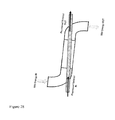
- FIGS. 16-39 illustrate other embodiments of the present invention.
- FIGS. 40-41 illustrate possible process flow diagrams
- FIG. 42 illustrates side cross sectional views of possible channel orientations within a chamber
- An embodiment of the present invention is an electromagnetic system for treating pumpable materials 139 with electromagnetic energy 110 .
- pumpable materials include biomaterials such as foods materials, pharmaceutical materials, and other materials which are usable by an animal (i.e., a human or other living being).
- food materials include soups, mashed potatoes, dog food, or any other materials which is ingestible by an animal.
- pharmaceuticals include medicines, cosmetics, or any other item that may be used for any purpose for an animal.
- the pumpable materials may be pumped throughout the electromagnetic chamber and along a length 120 of the chamber.
- the pumpable materials may be homogeneous or heterogeneous.
- the product is the same.
- Banana puree is an example of a homogeneous material.
- Heterogeneous materials have different products contained.
- chicken noodle soup has noodles, chicken, and broth.
- the material could be a multi-phase material. Multi-phase materials could have the same product but in different forms. For example, chunky mashed potatoes could have potato puree and chunks of potato.
- An embodiment of the present invention is a method for heating pumpable multi-phase and/or heterogeneous pumpable material.
- the material is conveyed or flowed in a channel through an electromagnetic energy chamber.
- a device can be used the convey the material in a channel through the electromagnetic energy chamber.
- One example is a pump to convey the material in a channel through the electromagnetic chamber.
- Another example is to use the force of gravity to convey the material.
- the channel traverses the length of the electromagnetic energy chamber.
- This chamber is made up of a first end 210 and a second end 212 .
- the first end 210 is where the channel enters the chamber.
- the second end 212 is where the channel exits the chamber.
- This channel could be a cylindrical pipe.
- the channel is oriented nearly parallel or at a slight angle relative to a horizontal surface.
- the horizontal surface could be the ground, or Earth.
- the horizontal surface can also be perpendicular to the force of the gravity.
- One specific example of a slight angle would be 1 ⁇ 4′′ elevation for each foot of horizontal length.
- the channel could be oriented nearly perpendicular, i.e. vertically, relative to the ground.
- the channel could be oriented at a slight angle relative to the ground, such as anywhere from 0 degrees to 40 degrees relative to the ground.
- the slight angle may be less than 5 degrees.
- the slight angle may be less than about 1.2 degrees.
- the channel would be of a composition such that is virtually invisible to the frequency of electromagnetic energy used. This means that when the channel is exposed to electromagnetic energy used, it does not heat significantly relative to the material inside the channel being exposed to electromagnetic energy, and the electromagnetic energy can pass through the channel so that it can be absorbed by the material inside the channel.
- electromagnetic-transparent channel materials including Teflon, ceramics, glass, fiberglass, Ultem, PEEK, TPX, Ultem and other electromagnetic-transparent polymers—or any combination or laminate fabricated from combinations or layer of listed materials.
- the material is rapidly heated by exposing the material to a relatively high power electromagnetic energy.
- the high power electromagnetic energy could be over 20 kW delivered to the material inside the electromagnetic chamber.
- the high power electromagnetic energy could also be less than 20 kW, such as about 1 kW to 20 kW.
- rapid heating of a material would be heating the material to above 70° C. in less than 10 minutes.
- rapid heating of a material would be heating the material to above 85° C. in less than 15 minutes.
- a plurality of chambers can be employed. Each chamber in the plurality contains the channel which traverses at least a portion of each of the plurality of chambers.
- a single source of electromagnetic energy or multiple sources of electromagnetic energy to provide electromagnetic energy to each of the chambers.
- the energy that is absorbed by the material in one chamber as the source of energy in the next chamber.
- FIG. 1 illustrates this embodiment where a single electromagnetic source 110 treats chamber 102 . The energy passes through chamber 102 . Energy that is not absorbed by the material in chamber 102 then passes to chamber 103 .
- a single source of electromagnetic energy could be split and used to treat more than one chamber.
- electromagnetic energy e.g. at least 20 kW
- the high power electromagnetic energy could also be less than 20 kW, such as about 1 kW to 20 kW.
- rapid heating of a material would be heating the material to above 70° C. in less than 10 minutes while it is being treated in the plurality of chambers.
- rapid heating of a material would be heating the material to above 85° C. in less than 15 minutes while it is being treated in the plurality of chambers.
- another embodiment is the material inside the channel is treated in one portion of the cross section of the channel inside the chamber at a lower energy level than at another portion of the cross section of the channel inside the chamber.
- treating one portion of the cross section with a lower energy level than another portion could preferentially heat one portion within the cross section of the channel over another area in an electromagnetic chamber.
- electromagnetic energy in the chamber could be higher on the top of the channel and lower on the bottom of the channel. This means the material in the top of the channel would receive more energy than the material in the bottom of the channel. In a pipe, this would correspond to the top side of the pipe being heated more. This example is illustrated in FIG. 6 .
- FIG. 6 is illustrated in FIG. 6 .
- FIG. 6 illustrates a cross section of the pipe inside the chamber.
- the pipe has a top portion of the cross section 180 and a bottom portion of the cross section 182 .
- the reference letter “H” in FIG. 6 represents a portion of higher electromagnetic energy exposure 190 and the reference letter “C” in FIG. 6 represents a portion of less electromagnetic energy exposure 192 .
- This is useful for multi-phase and/or heterogeneous materials because of the density differences and flow differences between particles in the material and fluid in the material.
- the chamber is created so that a lower energy level is exists in some areas of the chamber.
- the chamber can be created so that the energy pattern illustrated in FIG. 3 wherein the energy level is lower in the bottom and top of the chamber.
- Decreased density causes these hotter materials (both fluid and solid components) to move towards the top of the pipe; and colder materials (with higher density) to move towards the bottom of the pipe where the heating takes place again resulting in repetition of the bottom to top movement of the hotter materials and top to bottom movement of the colder materials.
- microwave energy can be used as a source. This includes using standard industrial frequencies 915 MHz and 2450 MHz. In one preferred embodiment, a 915 MHz microwave generator is used that generates at least 20 kW of microwave energy. It should be understood that other frequencies may be employed and other power levels may be used and the present invention should not be limited to the specific frequencies and power levels explicitly discussed herein.
- Treating can be by exposing the material to electromagnetic energy. Treating can also be heating the material, curing the material, drying the material and/or performing any other function to or with the material.
- the electromagnetic system 100 includes at least one chamber 102 and at least one channel 104 .
- the system 100 may include a plurality of chambers electromagnetically connected together using waveguide bends 108 .
- the system 100 is connectable to a microwave generator, which is not shown.
- Each chamber 102 may be a metallic container capable of directing microwave energy into the materials in the interior cavity 106 of the chamber 102 .
- the chamber 102 may include a metallic waveguide having a longitudinal length 120 and a cross-section ( FIG. 2 ) along such length 120 of the chamber.
- An example of a chamber is a waveguide.
- FIG. 2 is a cross-section 115 along the length 120 of the chamber with a first end 210 and a second end 212 .
- the chamber 102 is bounded by two conductive surfaces 200 and 202 .
- FIG. 3 illustrates a cross-section 130 perpendicular to the longitudinal length 120 of the chamber.
- Such cross-section 130 includes a height 132 and a width 134 , where the chamber height 132 is longer than the chamber width 134 .
- Such configuration may form a TE 10 mode (or other TE mode) within the chamber 102 .
- Other energy patterns are possible in the chamber are possible with the present invention with the key aspect being the energy level is lower at some area near the conductive surfaces 200 and 202 than another area of the chamber.
- the chamber 102 may be aligned such that the length 120 of the chamber 102 is substantially parallel to a horizontal surface 138 and the width of the chamber is aligned parallel to a horizontal surface 138 and the height 132 of the chamber 102 being perpendicular to a horizontal surface 138 .
- the horizontal surface 138 could be the ground or any other horizontal surface that is substantially perpendicular to the force of gravity.
- the chamber height 132 is longer than the chamber width 134 .
- the chamber is oriented relative to a horizontal surface such that the longer side (the height 132 ) of the chamber is perpendicular or nearly perpendicular to the horizontal surface and the shorter side (the width 134 ) is parallel or at a slight angle to the horizontal surface at most or all portions along the length 110 of the chamber.
- An example of this embodiment is illustrated in FIG. 7 .
- the chamber is oriented relative to a horizontal surface such that the longer side (the height 132 ) of the chamber and the shorter side (the width 134 ) are both perpendicular or nearly perpendicular to the horizontal surface.
- the chamber is oriented relative to a horizontal surface such that the longer side (the height 132 ) of the chamber is parallel or at a slight angle to the horizontal surface and the shorter side (the width 134 ) is perpendicular or nearly perpendicular to the horizontal surface.
- a slight angle would be 1 ⁇ 4′′ elevation for each foot of horizontal length.
- a slight angle relative to a horizontal surface is between 0 degrees to 40 degrees relative to the ground. In another embodiment, the slight angle may be less than 5 degrees.
- the channel 104 may be any type of passageway that allows for the materials 139 to flow or be pumped with in an interior cavity 140 of the channel 104 .
- One example of the channel 104 may be a pipe.
- a pipe 104 is only an example of the channel, the pipe 104 is referred to herein as the channel for illustrative purposes.
- the pipe 104 passes through at least a portion or the full span of a chamber 102 that exposes the material to electromagnetic energy.
- the chamber 102 is designed so that the amount of electromagnetic energy at the bottom and top of the chamber is less than the energy in the center of the chamber.
- One example of a chamber would be a waveguide that supports TE 10 mode. This energy pattern 160 is shown in FIG. 3 where the arrows represent the electric field 162 of the electromagnetic energy.
- the pipe 104 would be of a composition such that is relatively invisible to the frequency of electromagnetic energy used. This means that when the channel is exposed to electromagnetic energy, it does not heat significantly relative to the material inside the channel being exposed to electromagnetic energy, and the electromagnetic energy can pass through the channel so that it can be absorbed by the material inside the channel.
- electromagnetic-transparent channel materials including Teflon, ceramics, glass, fiberglass, Ultem, PEEK, TPX, Ultem and other electromagnetic-transparent polymers—or any combination or laminate fabricated from combinations or layer of listed materials.
- microwave energy can be used as a source. This includes using standard industrial frequencies 915 MHz and 2450 MHz. In one preferred embodiment, a 915 MHz microwave generator is used that generates at least 20 kW of microwave energy.
- One embodiment of the present invention is an apparatus designed so that the pipe enters the chamber near the bottom portion 150 or the top portion 152 of the chamber 102 .
- the electromagnetic energy delivered to the cross section of the material is higher at one portion of the chamber versus other portions of the chamber.
- the electromagnetic energy delivered to the chamber is higher near the center of the chamber and lower near the top or bottom of the chamber when the chamber is configured for TE 10 mode. This is shown in FIG. 3 , which is a cross section of the chamber 102 configured for TE 10 mode.
- the pipe enters the chamber at a lower portion, which corresponds to a lower amount of electromagnetic energy 160 (as illustrated in FIG. 3 ).
- the pipe enters the lower portion of the chamber.
- Introducing the pipe near the bottom portion 150 or top portion 152 of the chamber 102 minimizes reflections of the energy so as to maximize the energy imparted in the material. It also serves to more gradually expose the material to electromagnetic energy.
- the pipe leaves the chamber around the center of the chamber, which is illustrated in FIG. 5 .
- FIG. 6 illustrates a cross section of the pipe of FIG. 4 .
- the pipe has a top portion of the cross section 180 and a bottom portion of the cross section 182 .
- the reference letter “H” in FIG. 6 represents a portion of higher electromagnetic energy exposure 190 and the reference letter “C” in FIG. 6 represents a portion of less electromagnetic energy exposure 192 .
- the chamber may be connected to one or more bends 170 on each side that bring the electromagnetic energy from the generator to the chamber.
- the bends 170 have an opening 172 for the pipe.
- This opening 172 has chokes 174 in place that prevent electromagnetic energy leakage from the chamber 102 .
- the choke is a metal sleeve 176 that attaches to the bend.
- the metal sleeve 176 is slightly larger than the diameter of the pipe to allow the pipe to pass through it.
- the sleeve 176 is longer than a quarter wavelength of the electromagnetic energy.
- the pipe enters at a lower energy area of the chamber By having the pipe enter at a lower energy area of the chamber, it allows energy to flow into the chamber more readily. First, this minimizes reflections and maximizes the energy that can be absorbed by the material. Second, by starting at a lower energy point in the chamber, it creates less shock on the material, i.e. a more gradual change in temperature of the material. Third, starting at lower energy allows the material to be exposed to the electromagnetic energy over a longer period of time. Fourth, as the pipe enters the chamber, more energy is absorbed on the bottom or top area of the material inside the pipe, depending if the pipe enters the top or bottom of the chamber. Entering on the top of the chamber places more energy on the bottom of the pipe area. Entering on the bottom of the chamber places more energy on the top of the pipe area. This could be advantageous for heterogeneous and/or multi-phase materials.
- FIGS. 8 and 9 are cross-sectional views similar to those of FIGS. 4 and 5 .
- FIG. 8 illustrates that the pipe enters the bottom portion of the chamber at the beginning portion of the chamber length
- FIG. 9 illustrates the pipe entering the top portion of the chamber at the end of the chamber length.
- the pipe has a top portion of the cross section 180 and a bottom portion of the cross section 182 .
- FIG. 10 shows a cross-section of the pipe shown in FIG.
- FIG. 6 shows a heating pattern of the cross-section of the pipe of FIG. 8 . Nonetheless, like the embodiment of FIG. 4 , introducing the pipe near the bottom or top of the chamber minimizes reflections of the energy so as to maximize the energy imparted in the material. It also serves to more gradually expose the material to electromagnetic energy. Additionally, the material is initially exposed to higher energy on one side of the pipe at entry. As the material is conveyed through the pipe, the energy pattern is reversed so that the material is exposed to higher energy on the other side of the pipe.
- FIG. 11 further illustrates.
- the chamber has bends on each side that bring the electromagnetic energy from the generator to the chamber.
- the bends have an opening for the channel, in this case a cylindrical pipe. This opening has chokes in place that prevent leakage from the chamber.
- the choke is a metal sleeve that attaches to the bend.
- the sleeve is slightly larger than the diameter of the pipe to allow the pipe to pass through it.
- the sleeve is longer than quarter wavelength of the electromagnetic energy. Not shown is the electromagnetic energy generator that created the electromagnetic energy.
- the channel enters at the first end of the chamber near the bottom of the chamber and exits at the second end of the chamber at the top the chamber. The channel exits through a bend that has a choke attached.
- the channel enters the chamber on the bottom and exits the chamber at the bottom, i.e. on the same side as the entry.
- the channel could also be shown entering on the top of the chamber and exiting the top of the chamber.
- This embodiment maintains the material in a lower energy area of the chamber throughout the length of the chamber. This could be used with sensitive materials that cannot tolerate a higher electromagnetic power density. It also serves to lengthen the exposure area for the material.
- As the pipe enters the chamber more energy is absorbed on the bottom or top area of the material inside the pipe, depending if the pipe enters the top or bottom of the chamber. Entering on the top of the chamber places more energy on the bottom of the pipe area. Entering on the bottom of the chamber places more energy on the top of the pipe area. This could be advantageous for heterogeneous and/or multi-phase materials.
- the chamber is designed so that the channel one of: 1) enters near a top portion of the chamber and exits near a bottom portion of the chamber, 2) enters near a bottom portion of the chamber and exits near a top portion of the chamber, 3) enters near a top portion of the chamber and exits near a top portion of the chamber, 4) enters near a bottom portion of the chamber and exits near a bottom portion of the chamber, 5) enters near a top portion of the chamber and exits near the center portion of the chamber, or 6) enters near a bottom portion of the chamber and exits near the center portion of the chamber.
- Enters means the channel passes through an opening 172 into a chamber at first end 210 .
- Exits means the channel passes through an opening at the second end 212 .
- FIG. 42 illustrates different possible combinations of entry and exit of the channel through the chamber.
- FIG. 13 Another embodiment is that the chamber is twisted as shown in FIG. 13 .
- the energy pattern where the pipe enters and exits the chamber is shown in FIG. 14 .
- the electric field polarization is shown in FIG. 14 as the arrows.
- the electric field is the mechanism for heating in most biomaterials.
- a rotating electric field pattern can help create more uniform heating.
- FIG. 15 shows one embodiment of this where the pipe enters in the middle of the chamber and exits at the middle of the chambers. Variations of this include having the pipe enter or exit near the top or bottom.
- the twisted chamber may create more even heating of some materials.
- Chambers can be placed horizontally or vertically or any combination relative to each other.
- the material can enter and exit each chamber through the bends.
- a choke at the end of each bend is used to limit electromagnetic energy from escaping.
- the material can be mixed and/or monitored outside of the electromagnetic energy environment.
- FIG. 1 illustrates an embodiment of a two chamber system.
- the material 139 flows into the first chamber inside a channel 104 .
- This channel could be a cylindrical pipe.
- the material inside the channel enters the chamber 102 through an opening 172 in bend 170 .
- Extending from the bend if a choke 174 which limits electromagnetic energy from the outside environment.
- a choke is a metal sleeve 176 that is larger in diameter than the channel and is at least a quarter wavelength of the frequency of the electromagnetic energy in length.
- the channel is at a slight elevation angle to the ground 138 .
- the material 139 inside the channel passed down the length 110 the first chamber 102 .
- the chamber has a top 152 and bottom 150 .
- the material inside the channel exits the chamber 102 at the bend 108 through a choke. After the material exits the bend and chokes, the material can sent through one or more mixing systems 144 or monitoring systems 146 . The material then goes into a second electromagnetic chamber 103 .
- This embodiment allows for additional mixing or monitoring of the product outside of the electromagnetic energy environment. Additionally, this system could spread out the time the material is exposed to the electromagnetic energy which lowers the power density on the material. This allows consistent heating of materials that are sensitive to rapid changes in temperature. Further, the multi-chamber system can lead to a more compact footprint.
- Another embodiment of the present invention is a process that allows new food products to be created and the food products created.
- the process uses electromagnetic energy to rapidly heat a material as it pumped or flows through an chamber.
- the electromagnetic energy heats the food product to a temperature of at least 70° C. in less than 10 minutes.
- the electromagnetic energy heats the food product to a temperature of at least 85° C. in less than 15 minutes.
- the electromagnetic energy heats the food product to a temperature of at least 120° C. in less than 20 minutes.
- the product is held at near the temperature exiting the electromagnetic chamber for a short amount of time, e.g. less than 5 minutes.
- the product is cooled and packaged without exposing the product to the outside environment.
- the package is sterilized and the product is added to the package in a sterile environment.
- strawberries either sliced, diced, pureed, or whole or any combination can be created in a package that can be stored in ambient conditions (i.e. without refrigeration) for at least 6 months without spoiling.
- vitamin C retention in the strawberries is greater than or equal to 90% of the vitamin C content before processing.
- anthocyanin retention in the strawberries is greater than or equal to 90% of the anthocynanin content before processing.
- blueberries either sliced, diced, pureed, or whole or any combination can be created in a package that can be stored at ambient conditions (i.e. without refrigeration) for at least 6 months without spoiling. Furthermore, vitamin C retention in the blueberries is greater than or equal to 90% of the vitamin C content before processing. To allow blueberries to be conveyed, e.g. pumped, it is possible to add pureed blueberries or a fluid that is similar in its composition such as white grape juice. This embodiment can be extended to other berry products. Examples include blackberries, raspberries, boysenberries, and grapes.
- blueberries either sliced, diced, pureed, or whole or any combination can be created in a package that can be stored in ambient conditions (i.e. without refrigeration) for up to 12 months without spoiling with anthocyanin retention in the blueberries is greater than or equal to 90% of the anthocyanin content before processing.
- peaches either sliced, diced, pureed, or whole or any combination can be created in a package that can be stored at ambient conditions (i.e. without refrigeration) for up to 12 months without spoiling. Furthermore, vitamin C retention in the peaches is greater than or equal to 90% of the vitamin C content before processing.
- tomatoes either sliced, diced, pureed, or whole or any combination can be created in a package that can be stored at ambient conditions (i.e. without refrigeration) for up to 12 months without spoiling.
- vitamin C retention in the tomatoes is greater than or equal to 90% of the vitamin C content before processing.
- lycopene retention in the tomatoes is greater than or equal to 70% of the lycopene content before processing.
- One embodiment of the present invention is to acidify the tomatoes prior to rapidly heating the tomatoes in the electromagnetic chamber. One method of accomplishing this is to add citric acid.
- Another embodiment of the present invention is to add a product that helps preserve the texture, such as calcium salt, calcium chloride, to the tomatoes prior to rapidly heating the tomatoes in the chamber.
- waveguides As system of one or more microwave generators, waveguides, applicators, circulators, water loads and microwave choking interfaces.
- One element of the subsystem is an ex-centric flow microwave applicator.
- the ex-centric traveling wave applicator consists of a straight waveguide segment, two H-bend type metal waveguide elbows each fitted with a cylindrical segment of a metal pipe and a microwave-transparent flow-through, product-carrying conduit entering the applicator through one cylindrical metal pipe segment and exiting the applicator through the other, opposing metal tube segment.
- the entry location of the microwave transparent tube is positioned off-center relative to the rectangular cross section of the straight waveguide segment at the product and microwave entry-end.
- the exit location of the product-carrying, microwave-transparent tube conduit is aligned approximately with the center-point location of the straight portion of the metal waveguide.
- treated product flows along a slight upwards incline (at least inch of upward incline per foot of length) in order to establish a flow that can be self-draining in the case of power loss, process interruption and/or under-processing.
- the product flow is self-draining by virtue of its vertically upward direction.
- FIGS. 16-39 illustrate a number of variations. These include multiple sections which could be in a horizontal or vertical orientation of any combination of horizontal and vertical sections.
- FIG. 40-41 show possible process flow diagrams for the elements for the process.
- FIGS. 16-39 illustrate the construction concept of single ex-centric traveling wave applicator, two consecutive ex-centric applicator and three consecutive ex-centric applicator devices for thermal treatment of foods, biomaterials and other materials.
- the presented configurations are intended as illustrations of some of the possible alternatives and embodiments of the devices that constitute the subject of this invention.
- the food, biomaterial or other material to be processed is introduced through a microwave-transparent conduit (typically a sanitary tube made of Teflon, ceramics, glass, Ultem, PEEK, TPX, Ultem and other microwave-transparent polymers—or any combination or laminate fabricated from combinations or layer of listed materials) concurrently with the introduction of microwave energy—ensuring that the energy is delivered to the processed material gradually over an expanded exposure region.
- a microwave-transparent conduit typically a sanitary tube made of Teflon, ceramics, glass, Ultem, PEEK, TPX, Ultem and other microwave-transparent polymers—or any combination or laminate fabricated from combinations or layer of listed materials
- a modular concept and simple and easy configurability of the system also allows for more flexibility in selecting the vertical vs. horizontal (slightly inclined) flow regimes—the system can be configured to allow for certain types of flow regime exposure accommodating individual material biochemical and biophysical characteristics. For example, if the material is anticipated to undergo certain types of chemical and physical conversions such as lipid melting, protein denaturation and/or gel formation or breakdown, the system can be conveniently constructed from a sequence of ex-centric MW applicator modules to allow for an orderly occurrence of these changes—and additional in-flow segments out of the MW application area to minimize the extreme variability in temperature distribution caused by these changes and improve control of thermal energy application.
- Uniformity determines whether all of the elements within the food or biomaterial have been adequately treated with an appropriate thermal pasteurization or sterilization—level of exposure resulting in inactivation of all microorganisms of concern—whether they are microorganisms of public health significance (pathogens) or microorganisms with a capability to cause quality degradation, spoilage and limiting of shelf life of the food and biomaterial products without endangering the consumer (spoilage microorganisms).
- the illustrated device is a rotating flow-through assembly which can be integrated with heat exchangers and improves the equalization of spatial and temporal exposure to thermal and electromagnetic energy during advanced heating of viscous and heterogeneous foods and biomaterials.
- Embodiments of the invention enables exposure to advanced thermal heating methods during horizontal and upwardly inclined flow regimes, thus limiting the length of the travel path of materials of different properties and associated heating rates. Furthermore, rotation of the entire flow-through exposure region repetitively forces the more dense segments of the material to the upper regions of the flow as well concurrently forcing the less dense, more buoyant elements and components to the bottom of the flow.
- Embodiments of the invention can be conveniently integrated into existing and emerging advanced heating devices within continuous flow aseptic processing systems and also used to equalize the thermal and electromagnetic energy exposure of materials within energy fields that are imperfectly and non-uniformly distributed in space, thereby enabling processing of these materials using less expensive, more widely available sources of energy, such as 2450 MHz generators
- Embodiments of the presently disclosed invention is the first example of the use of non-magnetic metallic material components as tags or enclosures for residence time and particle location detection in multi-point continuous flow processing configurations, independently or in functional combination with magnetic material tags or implants and magnetic field detection.
- Embodiments of the invention address the issues of ability to discern among different individual particles during real time monitoring and detection as well as the ability to discern the difference between the switched and un-switched states of thermo-sensitive implants.
- the application areas for embodiments of the present invention are continuous flow and batch processing of thermally-treated materials, with the objective of achieve a state of pasteurization, stabilization (extended shelf life) or sterilization for multiphase (particle-containing) foods and/or biomaterials. Additionally, other processes dealing with thick, highly viscous and slurry-type materials could also be used with the invention.
- Non-magnetic metallic materials preferably aluminum, copper or zinc
- Simulated particles carrying the metallic tags or enclosures are passed through the continuous flow processing system
- the system may be fitted with non-metallic pass-through segments (pipe sections) and (preferably) inductive proximity sensors, switches and/or detectors. Inductive detectors/sensors are used to determine and record the time and location of passage of non-magnetic, metallic material—tagged particles
- a concurrent associated system of magnetic tags/implants and a network of magnetic field sensors/detectors is implemented to enable monitoring and detection of magnetically tagged simulated particles (independent or combined with metallic, non-magnetic implants and tags).
- Both non-magnetic metallic and magnetic field sensors/detectors are optionally configured with more than a single level of detection sensitivity—this can be achieved by sensor selection (combining the inductive sensors capable of detecting smaller and larger sizes of metallic implants/containers, combining magnetic-field sensors with various sensitivity ratings, e.g. NVE AA002-02—high sensitivity versus NVE AAH-002-02—ultra high sensitivity), as well as adjusting the sensitivity of implemented sensors in situ by selection of oscillation frequencies (for induction-type sensors/detectors) or adjusting the voltage of operation for GMR NVE sensors.
- particle flow monitoring system can comprise only induction-type sensors, monitoring the times of passage and residence time of non-magnetic metal material tagged implants and tags.
- Another embodiment is a multi-detection location combination of single sensitivity level induction—type detectors and a single sensitivity level GMR magnetic field sensors.
- This system is capable of independently detecting and recording the passage and residence times of metallically tagged, magnetically tagged and combined metallic/magnetic tagged particles. Additionally, such a system is capable of detecting the passage time as well as thermal switching state of metallically-tagged, thermo-magnetic switch containing simulated particles.
- thermo-magnetic switch Up to the point until such particle achieves the switched state of the thermo-magnetic switch within the particle, it is detected only by the metal-detector, inductive sensors along the continuous flow-pathway during the process. Once the switched state of the thermo-magnetic switch within the flowing particle has been achieved, the particle is detected by both induction type sensors as well as magnetic field sensing (GMR) sensors.
- GMR magnetic field sensing
- Additional embodiments of the invention implement multiple sensitivity levels of either or both of the non-contact detector types for non-magnetic metallic (pref. inductive) and/or magnetic (pref. GMR) detection.
- thermo-sensitive implant type thermo-magnetic switches, bacterial spore loads, enzymic, chemical and/or physical TTIs etc.
- each block in the flowchart or block diagrams may represent a module, segment, or portion of code, which comprises one or more executable instructions for implementing the specified logical function(s).
- the functions noted in the block may occur out of the order noted in the Figures. For example, two blocks shown in succession may, in fact, be executed substantially concurrently, or the blocks may sometimes be executed in the reverse order, depending upon the functionality involved.
Landscapes
- Life Sciences & Earth Sciences (AREA)
- Engineering & Computer Science (AREA)
- Physics & Mathematics (AREA)
- Electromagnetism (AREA)
- Polymers & Plastics (AREA)
- Zoology (AREA)
- Chemical & Material Sciences (AREA)
- Food Science & Technology (AREA)
- Wood Science & Technology (AREA)
- Food Preservation Except Freezing, Refrigeration, And Drying (AREA)
- Apparatus For Disinfection Or Sterilisation (AREA)
- Valve Device For Special Equipments (AREA)
- Vehicle Body Suspensions (AREA)
- Physical Or Chemical Processes And Apparatus (AREA)
- Particle Accelerators (AREA)
- Surgical Instruments (AREA)
- Accommodation For Nursing Or Treatment Tables (AREA)
Abstract
Description
| DETECTED BY | |
| PARTICLE TAG/ | Sensor Detector Type and Sensitivity Level |
| IMPLANT TYPE | METALLIC | MAGNETIC |
| METALLIC | MAGNETIC | Standard High | Standard High |
| None | Small | 0 | 0 | 0 | + |
| None | Large | 0 | 0 | + | + |
| Small | None | 0 | + | 0 | 0 |
| Large | None | + | + | 0 | 0 |
| Small | Small | 0 | + | 0 | + |
| Small | Large | 0 | + | + | + |
| Large | Small | + | + | 0 | + |
| Large | Large | + | + | + | + |
Claims (19)
Priority Applications (1)
| Application Number | Priority Date | Filing Date | Title |
|---|---|---|---|
| US13/120,615 US9713340B2 (en) | 2008-09-23 | 2009-09-20 | Electromagnetic system |
Applications Claiming Priority (3)
| Application Number | Priority Date | Filing Date | Title |
|---|---|---|---|
| US9943408P | 2008-09-23 | 2008-09-23 | |
| PCT/US2009/057603 WO2010039466A2 (en) | 2008-09-23 | 2009-09-20 | Electromagnetic system |
| US13/120,615 US9713340B2 (en) | 2008-09-23 | 2009-09-20 | Electromagnetic system |
Related Parent Applications (2)
| Application Number | Title | Priority Date | Filing Date |
|---|---|---|---|
| PCT/US2009/057603 A-371-Of-International WO2010039466A2 (en) | 2008-09-23 | 2009-09-20 | Electromagnetic system |
| US12/565,580 Continuation US8337920B2 (en) | 2008-09-23 | 2009-09-23 | Method for processing biomaterials |
Related Child Applications (3)
| Application Number | Title | Priority Date | Filing Date |
|---|---|---|---|
| US12/565,580 Continuation US8337920B2 (en) | 2008-09-23 | 2009-09-23 | Method for processing biomaterials |
| US13/689,821 Continuation US8574651B2 (en) | 2008-09-23 | 2012-11-30 | Method for processing materials |
| US14/042,825 Continuation US9332781B2 (en) | 2008-09-23 | 2013-10-01 | Method for processing biomaterials |
Publications (2)
| Publication Number | Publication Date |
|---|---|
| US20110174385A1 US20110174385A1 (en) | 2011-07-21 |
| US9713340B2 true US9713340B2 (en) | 2017-07-25 |
Family
ID=42074099
Family Applications (5)
| Application Number | Title | Priority Date | Filing Date |
|---|---|---|---|
| US13/120,615 Active 2032-06-22 US9713340B2 (en) | 2008-09-23 | 2009-09-20 | Electromagnetic system |
| US12/565,580 Active 2030-02-13 US8337920B2 (en) | 2008-09-23 | 2009-09-23 | Method for processing biomaterials |
| US13/689,821 Active US8574651B2 (en) | 2008-09-23 | 2012-11-30 | Method for processing materials |
| US14/042,825 Active US9332781B2 (en) | 2008-09-23 | 2013-10-01 | Method for processing biomaterials |
| US15/064,126 Active 2031-04-25 US10390550B2 (en) | 2008-09-23 | 2016-03-08 | Method for processing biomaterials |
Family Applications After (4)
| Application Number | Title | Priority Date | Filing Date |
|---|---|---|---|
| US12/565,580 Active 2030-02-13 US8337920B2 (en) | 2008-09-23 | 2009-09-23 | Method for processing biomaterials |
| US13/689,821 Active US8574651B2 (en) | 2008-09-23 | 2012-11-30 | Method for processing materials |
| US14/042,825 Active US9332781B2 (en) | 2008-09-23 | 2013-10-01 | Method for processing biomaterials |
| US15/064,126 Active 2031-04-25 US10390550B2 (en) | 2008-09-23 | 2016-03-08 | Method for processing biomaterials |
Country Status (7)
| Country | Link |
|---|---|
| US (5) | US9713340B2 (en) |
| EP (2) | EP2343994B1 (en) |
| CA (2) | CA2762654C (en) |
| ES (2) | ES2534243T3 (en) |
| HR (2) | HRP20150147T1 (en) |
| PL (2) | PL2343994T3 (en) |
| WO (2) | WO2010039466A2 (en) |
Cited By (1)
| Publication number | Priority date | Publication date | Assignee | Title |
|---|---|---|---|---|
| US20200281053A1 (en) * | 2019-03-01 | 2020-09-03 | Harold Dail Kimrey, JR. | Applicator system for heating with radio frequency energy |
Families Citing this family (28)
| Publication number | Priority date | Publication date | Assignee | Title |
|---|---|---|---|---|
| US9522772B2 (en) | 2006-04-03 | 2016-12-20 | Lbp Manufacturing Llc | Insulating packaging |
| US20130303351A1 (en) | 2006-04-03 | 2013-11-14 | Lbp Manufacturing, Inc. | Microwave heating of heat-expandable materials for making packaging substrates and products |
| EP2243719B1 (en) | 2006-04-03 | 2012-10-03 | LBP Manufacturing, Inc. | Thermally activatable insulating packaging |
| PL2343994T3 (en) | 2008-09-23 | 2015-06-30 | Aseptia Inc | The electromagnetic system |
| US10334870B2 (en) | 2010-10-07 | 2019-07-02 | Tropicana Products, Inc. | Processing of whole fruits and vegetables, processing of side-stream ingredients of fruits and vegetables, and use of the processed fruits and vegetables in beverage and food products |
| ES2786024T3 (en) * | 2011-12-07 | 2020-10-08 | Hbc Holding Company Llc | Processing and packaging of food products |
| US9642195B2 (en) | 2012-03-14 | 2017-05-02 | Microwave Materials Technologies, Inc. | Enhanced microwave system utilizing tilted launchers |
| CN117958370A (en) * | 2013-02-14 | 2024-05-03 | Hbc控股有限责任公司 | Processing food products using volumetric heating |
| EP2956017B1 (en) | 2013-02-15 | 2020-01-22 | Pepsico, Inc. | Preparation and incorporation of co-products into beverages to enhance nutrition and sensory attributes |
| US20150044336A1 (en) * | 2013-08-06 | 2015-02-12 | Aseptia, Inc. | Processing of cranberry food product into aseptic packaging |
| US10588326B2 (en) * | 2014-04-21 | 2020-03-17 | Tetra Laval Holdings & Finance S.A. | Use of electromagnetic energy for making pasta filata cheese |
| CA2946147C (en) * | 2014-05-01 | 2020-02-11 | Scientific Drilling International, Inc. | Plug for downhole logging tool |
| US10453562B2 (en) * | 2014-05-08 | 2019-10-22 | ProductVisionaries, LLC | Consumer-oriented biometrics data management and analysis system |
| JP2017526125A (en) * | 2014-08-14 | 2017-09-07 | エルビーピー マニュファクチャリング エルエルシーLbp Manufacturing Llc | Waveguide irradiation chamber for microwave energy applicators |
| US10359319B2 (en) | 2014-12-02 | 2019-07-23 | HBC Holding Company, LLC | Method for design and control of properties of simulated food particles for process monitoring and validation of aseptically processed multiphase foods and biomaterials |
| WO2016090019A1 (en) * | 2014-12-02 | 2016-06-09 | Aseptia, Inc. | Individually traceable multi-functional carrier particles for validation of continuous flow thermal processing of particle-containing foods and biomaterials |
| WO2017062598A1 (en) | 2015-10-06 | 2017-04-13 | Wm. Wrigley Jr. Company | High moisture edible compositions and methods of preparation thereof |
| CA3016414C (en) * | 2016-03-24 | 2024-05-28 | HBC Holding Company, LLC | Multi-zone processing system for applying electromagnetic energy |
| JP2020511755A (en) | 2017-03-15 | 2020-04-16 | 915 ラボ、エルエルシー | Multi-pass microwave heating system |
| AU2018235948B2 (en) | 2017-03-15 | 2023-05-18 | 915 Labs, Inc. | Energy control elements for improved microwave heating of packaged articles |
| KR102541079B1 (en) | 2017-04-17 | 2023-06-08 | 915 랩스, 엘엘씨 | Microwave assisted sterilization and pasteurization systems using synergistic packaging, carrier and launcher configurations |
| EP3621455B1 (en) | 2017-05-09 | 2023-08-30 | GEA Mechanical Equipment GmbH | Apparatus and method to treat dairy products |
| EP3621459A1 (en) | 2017-05-09 | 2020-03-18 | GEA Food Solutions Bakel B.V. | Apparatus and method to heat animal raw fat material to produce fat |
| WO2018206640A1 (en) | 2017-05-09 | 2018-11-15 | Gea Food Solutions Bakel B.V. | Thawing-apparatus and method to thaw a substance |
| ES2888299T3 (en) | 2017-05-09 | 2022-01-03 | Gea Food Solutions Bakel Bv | Apparatus and method for heating oil for frying with solid state RF energy technology |
| EP3621453A1 (en) | 2017-05-09 | 2020-03-18 | GEA Food Solutions Bakel B.V. | Malaxation apparatus for the production of virgin olive oil |
| BE1025708B1 (en) * | 2017-12-26 | 2019-06-11 | Puratos N.V. | METHOD OF HEATING COMPOSITIONS CONTAINING EDIBLE ELEMENTS |
| CN118265516A (en) | 2021-12-09 | 2024-06-28 | 宝洁公司 | Sulfate-free personal cleansing compositions containing effective preservatives |
Citations (36)
| Publication number | Priority date | Publication date | Assignee | Title |
|---|---|---|---|---|
| GB2098040A (en) | 1981-03-31 | 1982-11-10 | Sanyo Electric Co | System for and method of sterilization of food material |
| US4417132A (en) | 1980-01-21 | 1983-11-22 | The Electricity Council | Apparatus for heating electrically conductive flowable media |
| US4808783A (en) | 1986-03-03 | 1989-02-28 | Alfastar Ab | Heat stable microwave energy sterilization method |
| US5021981A (en) | 1988-12-22 | 1991-06-04 | North Carolina State University | Thermal memory cell and thermal system evaluation |
| JPH04290410A (en) | 1991-03-19 | 1992-10-15 | Tokyo Electric Co Ltd | electromagnetic equipment |
| US5159564A (en) | 1988-12-22 | 1992-10-27 | North Carolina State University | Thermal memory cell and thermal system evaluation |
| KR930010449A (en) | 1991-11-28 | 1993-06-22 | 이헌조 | Microwave oven |
| US5290583A (en) * | 1992-04-02 | 1994-03-01 | David Reznik | Method of electroheating liquid egg and product thereof |
| US5309987A (en) | 1992-07-21 | 1994-05-10 | Astec | Method and apparatus for heating and cooling food products during processing |
| US5387397A (en) * | 1988-10-10 | 1995-02-07 | Commonwealth Scientific And Industrial Research Organisation | Method and apparatus for continuous chemical reactions |
| JPH07123918A (en) | 1993-11-05 | 1995-05-16 | Mitsubishi Heavy Ind Ltd | Apparatus for heating oil and fat |
| US5417991A (en) | 1992-05-04 | 1995-05-23 | Kraft General Foods, Inc. | Microwave heating of cheese sauces |
| EP0765105A2 (en) | 1995-09-22 | 1997-03-26 | Eastman Kodak Company | Microwave heating apparatus |
| US5636317A (en) | 1994-06-01 | 1997-06-03 | Reznik; David | Electroheating apparatus and methods |
| US5662031A (en) | 1994-12-23 | 1997-09-02 | Washington State University Research Foundation, Inc. | Continuous flow electrical treatment of flowable food products |
| US5697291A (en) * | 1995-05-15 | 1997-12-16 | Questron Inc. | Method and apparatus for microwave enhanced pasteurization and enzyme inactivation of continuously flowing product |
| US5722312A (en) | 1993-01-18 | 1998-03-03 | Danfoss A/S | Process for mounting a cylinder sleeve in a base member, and a hydraulic machine |
| US5739437A (en) | 1996-06-20 | 1998-04-14 | Tetra Laval Holdings & Finance Sa | Process and article for determining the residence time of a food particle TRX-371 |
| US5750907A (en) | 1996-06-20 | 1998-05-12 | Tetra Laval Holdings & Finance, S.A. | Process and article for determining the residence time of a food particle |
| US5876771A (en) | 1996-06-20 | 1999-03-02 | Tetra Laval Holdings & Finance, Sa | Process and article for determining the residence time of a food particle |
| US5932813A (en) | 1997-10-07 | 1999-08-03 | North Carolina State University | Method and system for residence time measurement of simulated food particles in continuous thermal food processing and simulated food particles for use in same |
| US5998774A (en) | 1997-03-07 | 1999-12-07 | Industrial Microwave Systems, Inc. | Electromagnetic exposure chamber for improved heating |
| US6136015A (en) | 1998-08-25 | 2000-10-24 | Micrus Corporation | Vasoocclusive coil |
| US6178880B1 (en) | 1998-11-11 | 2001-01-30 | Instituut Voor Agrotechnologisch Onderzoek (Ato-Dlo) | Integrated modular design of a pulsed electrical field treatment chamber |
| US6246037B1 (en) | 1999-08-11 | 2001-06-12 | Industrial Microwave Systems, Inc. | Method and apparatus for electromagnetic exposure of planar or other materials |
| US20030209542A1 (en) | 2002-05-13 | 2003-11-13 | Harris George M. | Apparatus and method for microwave processing of food products |
| US20040155034A1 (en) * | 2001-06-08 | 2004-08-12 | Lambert Feher | Continuous flow microwave heater |
| US6776523B2 (en) | 2000-03-10 | 2004-08-17 | North Carolina State University | Method and system for conservative evaluation, validation and monitoring of thermal processing |
| US20050139594A1 (en) * | 2001-10-27 | 2005-06-30 | Nigel Jones | Water heater |
| EP1570753A1 (en) | 2004-03-05 | 2005-09-07 | Sinteco Impianti S.R.L. | Apparatus for continuosly surface pasteruizing meat and food products |
| US6953315B2 (en) | 2003-01-16 | 2005-10-11 | North Carolina State University | Apparatus and method for controlling flow of process materials |
| US20060151533A1 (en) | 2004-11-12 | 2006-07-13 | Josip Simunovic | Methods and apparatuses for thermal treatment of foods and other biomaterials, and products obtained thereby |
| US7112954B2 (en) | 2003-01-28 | 2006-09-26 | North Carolina State University | Methods, systems, and devices for evaluation of thermal treatment |
| JP2007135595A (en) | 2005-11-22 | 2007-06-07 | Ali Spa | Machine for producing and dispensing liquid and semi-liquid food for consumer |
| GB2457495A (en) * | 2008-02-15 | 2009-08-19 | E2V Tech | RF electromagnetic heating a dielectric fluid |
| WO2010039466A2 (en) | 2008-09-23 | 2010-04-08 | James Michael Drozd | Electromagnetic system |
Family Cites Families (33)
| Publication number | Priority date | Publication date | Assignee | Title |
|---|---|---|---|---|
| US2833657A (en) * | 1954-01-08 | 1958-05-06 | Raytheon Mfg Co | Microwave irradiation of fruit juices |
| US3535482A (en) * | 1968-06-26 | 1970-10-20 | Hammtronics Systems Inc | Microwave apparatus for rapid heating of fluids |
| US3577322A (en) * | 1968-12-03 | 1971-05-04 | Stephen J Nesbitt | Microwave heating in the desalination of water |
| US3706631A (en) * | 1970-10-08 | 1972-12-19 | John D Falk | Sterilization of protein-containing fluids |
| US3710063A (en) * | 1971-05-25 | 1973-01-09 | H Aine | Microwave applicator |
| US3843860A (en) * | 1971-12-16 | 1974-10-22 | Varian Associates | Twisted microwave applicator |
| SE411162B (en) * | 1978-02-03 | 1979-12-10 | Husqvarna Ab | PROCEDURE FOR THE PRODUCTION OF FOODS, CONTAINING COAGULATED EGG WHITE SUBSTANCES, AND A DEVICE FOR CARRYING OUT THE KIT |
| US4208806A (en) * | 1978-07-30 | 1980-06-24 | Gebrueder Buehler Ag | Process for treatment of pourable materials with microwaves |
| US4284869A (en) * | 1980-03-06 | 1981-08-18 | Pinkstaff Leo W | Microwave water heater |
| US4534282A (en) * | 1982-05-04 | 1985-08-13 | Marinoza Rene A | Process and apparatus for treating food products |
| AU569777B2 (en) * | 1984-03-23 | 1988-02-18 | C.I.L. Inc. | Purification of waste sulphuric acid using microwave radiation |
| PH22174A (en) * | 1984-05-08 | 1988-06-28 | Unilever Nv | Food processing method |
| US4601679A (en) * | 1985-05-16 | 1986-07-22 | Borg-Warner Corporation | Variable pulley torque drive means |
| US4975246A (en) * | 1985-09-30 | 1990-12-04 | Charm Stanley E | High temperature, short time heating system and method of heating heat-sensitive material |
| NL8802714A (en) * | 1987-11-24 | 1989-06-16 | Stork Amsterdam | METHOD FOR THE CONTINUOUS FLOW THERMAL TREATMENT OF A PRODUCT MIX consisting of a LIQUID WITH SOLID PARTS INCLUDED THEREIN. |
| AT399658B (en) * | 1993-05-05 | 1995-06-26 | Katschnig Helmut | SYSTEM FOR STERILIZING, PASTEURIZING AND / OR DISINFECTING PUMP- OR GIANT MEDIA |
| US5389335A (en) * | 1993-06-18 | 1995-02-14 | Charm Sciences, Inc. | High temperature, short time microwave heating system and method of heating heat-sensitive material |
| JP3437270B2 (en) | 1994-07-21 | 2003-08-18 | キユーピー株式会社 | Oil-in-water emulsified food |
| US5514389B1 (en) * | 1994-10-13 | 1998-06-02 | Florida Dept Of Citrus | System and method for pasteurizing citrus juice using microwave energy |
| IT1280068B1 (en) * | 1995-05-26 | 1997-12-29 | Antonio Polato | METHOD AND APPARATUS FOR THE STERILIZATION OF BIOLOGICAL LIQUIDS, ESPECIALLY MILK AND ITS DERIVATIVES |
| US5829224A (en) * | 1997-10-10 | 1998-11-03 | Tetra Laval Holdings & Finance, Sa | Method and apparatus for producing an aseptic heterogeneous food |
| US6010727A (en) * | 1997-12-31 | 2000-01-04 | Rosenthal; Richard A. | Actinic process for cold pasteurization of fresh foods and beverages |
| AU762443B2 (en) * | 1999-02-26 | 2003-06-26 | Societe Des Produits Nestle S.A. | On-demand sauce or beverage heating system and method thereof |
| US7270842B1 (en) * | 1999-11-12 | 2007-09-18 | North Carolina State University | Thermal gelation of foods and biomaterials using rapid heating |
| JP3581956B2 (en) * | 2000-07-28 | 2004-10-27 | 政一 松尾 | Instant water heater |
| JP4290410B2 (en) | 2002-11-08 | 2009-07-08 | 株式会社コナミスポーツ&ライフ | Locker system, locker, portable key device, locker locking and unlocking method, and computer program |
| NL1022693C2 (en) * | 2003-02-14 | 2004-08-17 | Tno | Continuous thermal process for treating coarse food particles and food particles that are available with the process according to the invention. |
| US9790539B2 (en) * | 2004-06-30 | 2017-10-17 | Russell Biotech, Inc. | Methods and reagents for improved selection of biological molecules |
| US20060013927A1 (en) * | 2004-07-16 | 2006-01-19 | Geveke David J | Radio frequency electric field pasteurization system |
| EP2249896A4 (en) * | 2008-09-11 | 2011-03-16 | Luna Innovations Inc | METHOD AND APPARATUS FOR ACOUSTICALLY ENHANCED ELIMINATION OF BUBS PRESENT IN A FLUID |
| JP5107278B2 (en) * | 2009-02-16 | 2012-12-26 | 株式会社日立製作所 | Microwave heating apparatus and heating method |
| CA2783237C (en) * | 2009-12-07 | 2014-10-21 | John F. Novak | Method and apparatus for microwave-based liquid vaporization system |
| JP5909594B2 (en) * | 2013-10-07 | 2016-04-26 | 第一高周波工業株式会社 | Ferromagnetic particle production equipment |
-
2009
- 2009-09-20 PL PL09818234T patent/PL2343994T3/en unknown
- 2009-09-20 EP EP09818234.8A patent/EP2343994B1/en active Active
- 2009-09-20 US US13/120,615 patent/US9713340B2/en active Active
- 2009-09-20 ES ES09818234.8T patent/ES2534243T3/en active Active
- 2009-09-20 WO PCT/US2009/057603 patent/WO2010039466A2/en not_active Ceased
- 2009-09-20 HR HRP20150147TT patent/HRP20150147T1/en unknown
- 2009-09-20 CA CA2762654A patent/CA2762654C/en active Active
- 2009-09-23 PL PL09818265T patent/PL2343983T3/en unknown
- 2009-09-23 US US12/565,580 patent/US8337920B2/en active Active
- 2009-09-23 CA CA2758110A patent/CA2758110C/en active Active
- 2009-09-23 EP EP09818265.2A patent/EP2343983B1/en active Active
- 2009-09-23 ES ES09818265.2T patent/ES2534244T3/en active Active
- 2009-09-23 HR HRP20150148TT patent/HRP20150148T1/en unknown
- 2009-09-23 WO PCT/US2009/057989 patent/WO2010039523A2/en not_active Ceased
-
2012
- 2012-11-30 US US13/689,821 patent/US8574651B2/en active Active
-
2013
- 2013-10-01 US US14/042,825 patent/US9332781B2/en active Active
-
2016
- 2016-03-08 US US15/064,126 patent/US10390550B2/en active Active
Patent Citations (48)
| Publication number | Priority date | Publication date | Assignee | Title |
|---|---|---|---|---|
| US4417132A (en) | 1980-01-21 | 1983-11-22 | The Electricity Council | Apparatus for heating electrically conductive flowable media |
| GB2098040A (en) | 1981-03-31 | 1982-11-10 | Sanyo Electric Co | System for and method of sterilization of food material |
| US4808783A (en) | 1986-03-03 | 1989-02-28 | Alfastar Ab | Heat stable microwave energy sterilization method |
| US5387397A (en) * | 1988-10-10 | 1995-02-07 | Commonwealth Scientific And Industrial Research Organisation | Method and apparatus for continuous chemical reactions |
| US5021981A (en) | 1988-12-22 | 1991-06-04 | North Carolina State University | Thermal memory cell and thermal system evaluation |
| US5159564A (en) | 1988-12-22 | 1992-10-27 | North Carolina State University | Thermal memory cell and thermal system evaluation |
| JPH04290410A (en) | 1991-03-19 | 1992-10-15 | Tokyo Electric Co Ltd | electromagnetic equipment |
| KR930010449A (en) | 1991-11-28 | 1993-06-22 | 이헌조 | Microwave oven |
| US5290583A (en) * | 1992-04-02 | 1994-03-01 | David Reznik | Method of electroheating liquid egg and product thereof |
| US5417991A (en) | 1992-05-04 | 1995-05-23 | Kraft General Foods, Inc. | Microwave heating of cheese sauces |
| US5309987A (en) | 1992-07-21 | 1994-05-10 | Astec | Method and apparatus for heating and cooling food products during processing |
| US5722312A (en) | 1993-01-18 | 1998-03-03 | Danfoss A/S | Process for mounting a cylinder sleeve in a base member, and a hydraulic machine |
| JPH07123918A (en) | 1993-11-05 | 1995-05-16 | Mitsubishi Heavy Ind Ltd | Apparatus for heating oil and fat |
| US5636317A (en) | 1994-06-01 | 1997-06-03 | Reznik; David | Electroheating apparatus and methods |
| US5776529A (en) | 1994-12-23 | 1998-07-07 | Washington State University Research Foundation | Continuous flow electrical treatment of flowable food products |
| US5662031A (en) | 1994-12-23 | 1997-09-02 | Washington State University Research Foundation, Inc. | Continuous flow electrical treatment of flowable food products |
| US6019031A (en) | 1994-12-23 | 2000-02-01 | Washington State University | Continuous flow electrical treatment of flowable food products |
| US5697291A (en) * | 1995-05-15 | 1997-12-16 | Questron Inc. | Method and apparatus for microwave enhanced pasteurization and enzyme inactivation of continuously flowing product |
| EP0765105A2 (en) | 1995-09-22 | 1997-03-26 | Eastman Kodak Company | Microwave heating apparatus |
| US5876771A (en) | 1996-06-20 | 1999-03-02 | Tetra Laval Holdings & Finance, Sa | Process and article for determining the residence time of a food particle |
| US5739437A (en) | 1996-06-20 | 1998-04-14 | Tetra Laval Holdings & Finance Sa | Process and article for determining the residence time of a food particle TRX-371 |
| US5750907A (en) | 1996-06-20 | 1998-05-12 | Tetra Laval Holdings & Finance, S.A. | Process and article for determining the residence time of a food particle |
| US5998774A (en) | 1997-03-07 | 1999-12-07 | Industrial Microwave Systems, Inc. | Electromagnetic exposure chamber for improved heating |
| US6766699B2 (en) | 1997-10-07 | 2004-07-27 | North Carolina State University | System for measuring residence time for a particulate containing food product |
| US5932813A (en) | 1997-10-07 | 1999-08-03 | North Carolina State University | Method and system for residence time measurement of simulated food particles in continuous thermal food processing and simulated food particles for use in same |
| US6015231A (en) | 1997-10-07 | 2000-01-18 | North Carolina State University | Method for conservatively evaluating continuous thermal treatment process for a particulate-containing food product stream |
| US6536947B1 (en) | 1997-10-07 | 2003-03-25 | North Carolina State University | Plurality of particles made of a detectable magnetic implant and a carrier in combination with a plurality of magnetic field sensors |
| US6136015A (en) | 1998-08-25 | 2000-10-24 | Micrus Corporation | Vasoocclusive coil |
| US6178880B1 (en) | 1998-11-11 | 2001-01-30 | Instituut Voor Agrotechnologisch Onderzoek (Ato-Dlo) | Integrated modular design of a pulsed electrical field treatment chamber |
| US6246037B1 (en) | 1999-08-11 | 2001-06-12 | Industrial Microwave Systems, Inc. | Method and apparatus for electromagnetic exposure of planar or other materials |
| US20070211784A1 (en) | 2000-03-10 | 2007-09-13 | Josip Simunovic | Method and system for conservative evaluation, validation and monitoring of thermal processing |
| US6776523B2 (en) | 2000-03-10 | 2004-08-17 | North Carolina State University | Method and system for conservative evaluation, validation and monitoring of thermal processing |
| US7004620B2 (en) | 2000-03-10 | 2006-02-28 | North Carolina State University | Method and system for conservative evaluation, validation and monitoring of thermal processing |
| US7213967B2 (en) | 2000-03-10 | 2007-05-08 | North Carolina State University | Method and system for conservative evaluation, validation and monitoring of thermal processing |
| US20040155034A1 (en) * | 2001-06-08 | 2004-08-12 | Lambert Feher | Continuous flow microwave heater |
| US20050139594A1 (en) * | 2001-10-27 | 2005-06-30 | Nigel Jones | Water heater |
| US20030209542A1 (en) | 2002-05-13 | 2003-11-13 | Harris George M. | Apparatus and method for microwave processing of food products |
| US6953315B2 (en) | 2003-01-16 | 2005-10-11 | North Carolina State University | Apparatus and method for controlling flow of process materials |
| US7144213B2 (en) | 2003-01-16 | 2006-12-05 | North Carolina State University | Method for controlling flow of process materials |
| US7112954B2 (en) | 2003-01-28 | 2006-09-26 | North Carolina State University | Methods, systems, and devices for evaluation of thermal treatment |
| US20070018639A1 (en) | 2003-01-28 | 2007-01-25 | North Carolina State University | Methods, systems, and devices for evaluation of thermal treatment |
| EP1570753A1 (en) | 2004-03-05 | 2005-09-07 | Sinteco Impianti S.R.L. | Apparatus for continuosly surface pasteruizing meat and food products |
| US20060151533A1 (en) | 2004-11-12 | 2006-07-13 | Josip Simunovic | Methods and apparatuses for thermal treatment of foods and other biomaterials, and products obtained thereby |
| US20110036246A1 (en) | 2004-11-12 | 2011-02-17 | Josip Simunovic | Methods and apparatuses for thermal treatment of foods and other biomaterials, and products obtained thereby |
| JP2007135595A (en) | 2005-11-22 | 2007-06-07 | Ali Spa | Machine for producing and dispensing liquid and semi-liquid food for consumer |
| GB2457495A (en) * | 2008-02-15 | 2009-08-19 | E2V Tech | RF electromagnetic heating a dielectric fluid |
| WO2010039466A2 (en) | 2008-09-23 | 2010-04-08 | James Michael Drozd | Electromagnetic system |
| WO2010039523A2 (en) | 2008-09-23 | 2010-04-08 | Ultraseptics, Inc. | Method for processing biomaterials |
Non-Patent Citations (6)
| Title |
|---|
| International Preliminary Report on Patentability, issued Mar. 29, 2011 for for PCT/US2009/057603, International Bureau of WIPO. |
| International Preliminary Report on Patentability, issued Mar. 29, 2011 for for PCT/US2009/057989, International Bureau of WIPO. |
| International Search Report and Written Opinion issued May 10, 2010 for PCT/US2009/057603, Korean Intellectual Property Office. |
| International Search Report and Written Opinion issued May 4, 2010 for PCT/US2009/057989, Korean Intellectual Property Office. |
| Supplementary European Search Report dated Mar. 5, 2012. |
| U.S. Appl. No. 12/565,580. |
Cited By (1)
| Publication number | Priority date | Publication date | Assignee | Title |
|---|---|---|---|---|
| US20200281053A1 (en) * | 2019-03-01 | 2020-09-03 | Harold Dail Kimrey, JR. | Applicator system for heating with radio frequency energy |
Also Published As
| Publication number | Publication date |
|---|---|
| CA2758110C (en) | 2016-01-05 |
| US20110174385A1 (en) | 2011-07-21 |
| EP2343994B1 (en) | 2014-11-05 |
| EP2343983A4 (en) | 2012-04-18 |
| HRP20150148T1 (en) | 2015-06-19 |
| WO2010039523A2 (en) | 2010-04-08 |
| EP2343994A2 (en) | 2011-07-20 |
| CA2758110A1 (en) | 2010-04-08 |
| PL2343983T3 (en) | 2015-08-31 |
| US10390550B2 (en) | 2019-08-27 |
| ES2534244T3 (en) | 2015-04-20 |
| US20140030398A1 (en) | 2014-01-30 |
| EP2343983B1 (en) | 2014-11-05 |
| CA2762654A1 (en) | 2010-04-08 |
| US20110287151A1 (en) | 2011-11-24 |
| EP2343994A4 (en) | 2012-04-25 |
| HRP20150147T1 (en) | 2015-05-08 |
| US9332781B2 (en) | 2016-05-10 |
| ES2534243T3 (en) | 2015-04-20 |
| WO2010039466A3 (en) | 2010-07-01 |
| CA2762654C (en) | 2017-11-14 |
| WO2010039466A2 (en) | 2010-04-08 |
| US20130122160A1 (en) | 2013-05-16 |
| US8574651B2 (en) | 2013-11-05 |
| US8337920B2 (en) | 2012-12-25 |
| US20160324195A1 (en) | 2016-11-10 |
| WO2010039523A3 (en) | 2010-07-08 |
| EP2343983A2 (en) | 2011-07-20 |
| WO2010039523A9 (en) | 2010-08-26 |
| PL2343994T3 (en) | 2015-06-30 |
Similar Documents
| Publication | Publication Date | Title |
|---|---|---|
| CA2762654C (en) | Electromagnetic system | |
| AU2013205910B2 (en) | Apparatus and process for heat treating a packaged food product | |
| AU2021201634B2 (en) | Radio frequency heating system | |
| Salengke et al. | Pulsed electric field technology: Modeling of electric field and temperature distributions within continuous flow PEF treatment chamber. | |
| US11856976B2 (en) | Contact members for packaged articles heated with radio frequency energy | |
| Sawale et al. | Aseptic microwave sterilization and validation of food containing particles | |
| CN110519994A (en) | Microwave sterilizable or pasteurized delivery vehicles | |
| US11882856B2 (en) | System and method for continuous thermal treatment of a flowable product | |
| EP3621455B1 (en) | Apparatus and method to treat dairy products | |
| Kumar et al. | Feasibility of Aseptic Processing of a Low‐Acid Multiphase Food Product (salsa con queso) Using a Continuous Flow Microwave System | |
| EP4554401B1 (en) | Rf inline heating | |
| ES2750255T3 (en) | Processing of food products with volumetric heating | |
| Coronel | Continuous flow processing of foods using cylindrical applicator microwave systems operating at 915 MHz | |
| Reuter | Basic principles | |
| Smith | Minimal processing technology | |
| Kong et al. | Emerging food technologies | |
| Lin | Continuous flow microwave heating: evaluation of system efficiency and enzyme inactivation kinetics |
Legal Events
| Date | Code | Title | Description |
|---|---|---|---|
| AS | Assignment |
Owner name: ULTRASEPTICS, INC., NORTH CAROLINA Free format text: ASSIGNMENT OF ASSIGNORS INTEREST;ASSIGNOR:DROZD, JAMES MICHAEL;REEL/FRAME:026011/0872 Effective date: 20110322 |
|
| AS | Assignment |
Owner name: ASEPTIA, INC., NORTH CAROLINA Free format text: CHANGE OF NAME;ASSIGNOR:ULTRASEPTICS, INC.;REEL/FRAME:027793/0528 Effective date: 20110425 |
|
| AS | Assignment |
Owner name: NORTH CAROLINA STATE UNIVERSITY, NORTH CAROLINA Free format text: ASSIGNMENT OF ASSIGNORS INTEREST;ASSIGNOR:SIMUNOVIC, JOSIP;REEL/FRAME:037270/0824 Effective date: 20151204 Owner name: NORTH CAROLINA STATE UNIVERSITY, NORTH CAROLINA Free format text: ASSIGNMENT OF ASSIGNORS INTEREST;ASSIGNOR:SIMUNOVIC, JOSIP;REEL/FRAME:037270/0717 Effective date: 20151204 |
|
| STCF | Information on status: patent grant |
Free format text: PATENTED CASE |
|
| AS | Assignment |
Owner name: HBC HOLDING COMPANY, LLC, NORTH CAROLINA Free format text: TRANSFER STATEMENT;ASSIGNOR:ASEPTIA, INC.;REEL/FRAME:047436/0619 Effective date: 20170913 |
|
| MAFP | Maintenance fee payment |
Free format text: PAYMENT OF MAINTENANCE FEE, 4TH YR, SMALL ENTITY (ORIGINAL EVENT CODE: M2551); ENTITY STATUS OF PATENT OWNER: SMALL ENTITY Year of fee payment: 4 |
|
| AS | Assignment |
Owner name: NORTH CAROLINA STATE UNIVERSITY, NORTH CAROLINA Free format text: ASSIGNMENT OF ASSIGNORS INTEREST;ASSIGNOR:CARTWRIGHT, GARY;REEL/FRAME:065318/0551 Effective date: 20231018 |
|
| MAFP | Maintenance fee payment |
Free format text: PAYMENT OF MAINTENANCE FEE, 8TH YR, SMALL ENTITY (ORIGINAL EVENT CODE: M2552); ENTITY STATUS OF PATENT OWNER: SMALL ENTITY Year of fee payment: 8 |