US9710959B2 - Compressed 3D graphics rendering exploiting psychovisual properties - Google Patents
Compressed 3D graphics rendering exploiting psychovisual properties Download PDFInfo
- Publication number
- US9710959B2 US9710959B2 US14/040,072 US201314040072A US9710959B2 US 9710959 B2 US9710959 B2 US 9710959B2 US 201314040072 A US201314040072 A US 201314040072A US 9710959 B2 US9710959 B2 US 9710959B2
- Authority
- US
- United States
- Prior art keywords
- channel values
- green
- graphics
- red
- values
- Prior art date
- Legal status (The legal status is an assumption and is not a legal conclusion. Google has not performed a legal analysis and makes no representation as to the accuracy of the status listed.)
- Expired - Fee Related, expires
Links
Images


Classifications
-
- G—PHYSICS
- G06—COMPUTING OR CALCULATING; COUNTING
- G06T—IMAGE DATA PROCESSING OR GENERATION, IN GENERAL
- G06T15/00—Three-dimensional [3D] image rendering
- G06T15/50—Lighting effects
- G06T15/80—Shading
-
- G—PHYSICS
- G06—COMPUTING OR CALCULATING; COUNTING
- G06T—IMAGE DATA PROCESSING OR GENERATION, IN GENERAL
- G06T11/00—Two-dimensional [2D] image generation
- G06T11/40—Filling planar surfaces by adding surface attributes, e.g. adding colours or textures
-
- G—PHYSICS
- G06—COMPUTING OR CALCULATING; COUNTING
- G06T—IMAGE DATA PROCESSING OR GENERATION, IN GENERAL
- G06T3/00—Geometric image transformations in the plane of the image
- G06T3/40—Scaling of whole images or parts thereof, e.g. expanding or contracting
- G06T3/4015—Image demosaicing, e.g. colour filter arrays [CFA] or Bayer patterns
Definitions
- Graphics processing involves a number of non-trivial challenges, and three-dimensional (3D) graphics rendering has faced particular complications, such as those with respect to managing power efficiency and rendering quality.
- FIG. 1 is a three-dimensional (3D) graphics pipeline for compressed 3D graphics rendering, in accordance with an embodiment of the present disclosure.
- FIG. 2 illustrates a color mask configured in accordance with an embodiment of the present disclosure.
- FIG. 3 illustrates an interpolation algorithm, in accordance with an embodiment of the present disclosure.
- FIG. 4 is a 3D graphics pipeline for compressed 3D graphics rendering, in accordance with another embodiment of the present disclosure.
- FIG. 5 illustrates a color mask configured in accordance with another embodiment of the present disclosure.
- FIG. 6 illustrates an interpolation algorithm, in accordance with another embodiment of the present disclosure.
- FIG. 7A illustrates an example system that may carry out the techniques for compressed 3D graphics rendering as described herein, in accordance with some embodiments.
- FIG. 7B illustrates an example 3D graphics data flow, in accordance with an embodiment of the present disclosure.
- FIG. 7C illustrates an example 3D graphics data flow, in accordance with another embodiment of the present disclosure.
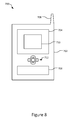
- FIG. 8 illustrates embodiments of a small form factor device in which the system of FIG. 7A may be embodied.
- the techniques can be used to render one red-green-blue (RGB) channel per pixel location.
- RGB red-green-blue
- multiple RGB channels can be rendered at a given pixel location.
- green pixels are rendered at full (e.g., actual) resolution, whereas red and blue pixels are rendered at one-quarter resolution.
- Missing RGB channel components can be interpolated using statistical and/or frequency domain properties of color spectra, in accordance with some embodiments.
- the techniques can be used, for example, to improve the power efficiency and/or rendered graphics quality of a graphics processing unit (GPU) or other rendering engine, in accordance with some embodiments. Numerous configurations and variations will be apparent in light of this disclosure.
- the disclosed techniques may exploit one or more psychovisual properties of the human eye, as will be discussed herein.
- the disclosed techniques may be used, for example, to render only one red-green-blue (RGB) channel per pixel location.
- the green channel may be sampled at a higher frequency (e.g., at one-half resolution) than the red and blue channels (e.g., at one-quarter resolution), and luminance data may be utilized to interpolate missing RGB channel values.
- Adaptive filtering may be utilized to that end, in some embodiments.
- the disclosed techniques may be used, for example, to render multiple RGB channels at some pixel locations.
- the green channel may be sampled at full resolution (e.g., at actual resolution), whereas the red and blue channels may be sampled at partial resolution (e.g., at one-quarter resolution), and data pertaining to primary color differences (PCDs) may be utilized to interpolate missing RGB channel values.
- PCDs primary color differences
- Bilinear interpolation may be utilized to that end, in some embodiments.
- missing RGB channel components may be interpolated, for example, using statistical properties of color spectra and/or frequency domain properties of color spectra, in accordance with some embodiments.
- the human eye normally does not respond to all visual information with equal sensitivity.
- Cone cells are the primary source of color information
- human eyes normally have three types of cone cells, which detect different wavelength ranges approximately corresponding with red, green, and blue light, and thus provide for trichromatic vision.
- eye response can be higher for green spectra than for red spectra or blue spectra. Consequently, the human eye can be more sensitive to errors in green color than in red or blue colors.
- Rod cells are the primary source of visual information under low-light conditions and thus provide for scotopic vision.
- the quantity of rod cells normally outnumbers the quantity of cone cells. Consequently, the human eye can be more sensitive to intensity information than to color information. In part, this may account for why humans, for example, can identify the effects of multisample anti-aliasing (MSAA) and can readily detect blur/aliasing effects in graphics rendering.
- MSAA multisample anti-aliasing
- these physiological phenomena can be exploited to allow for information which is psychovisually redundant (e.g., has relatively less importance for the quality of image perception) to be omitted from a 3D graphics rendering process flow with minimal or otherwise negligible difference to the human eye in the rendered graphics produced.
- Some embodiments can be used, for example, to optimize or otherwise improve power efficiency. For example, some embodiments may provide for a decrease in pixel shader cost, thereby decreasing power consumption in the rendering process. In some instances, this may be done with minimal or otherwise negligible loss of visual quality of the rendered graphics output by a given graphics processor unit (GPU) or other rendering engine. In some cases, the reduced power usage may improve the performance of the GPU/rendering engine given the lesser amount of rendering work to be done.
- GPU graphics processor unit
- Some embodiments can be used, for example, to improve power efficiency while optimizing or otherwise improving rendered graphics quality.
- some embodiments may provide for a decrease in pixel shader cost which is of a comparatively lesser degree as compared to the decrease provided by an approach which seeks to optimize power efficiency.
- the decrease in pixel shader cost may decrease power consumption.
- the additional pixel shader cost can be utilized to provide for an improvement in visual quality of the rendered graphics output by a given GPU or other rendering engine.
- a slightly lesser decrease in pixel shader cost may be traded for a higher quality rendered graphics output, in accordance with some embodiments, as compared with an approach which seeks to optimize power efficiency.
- the reduced power usage may improve the performance of the GPU/rendering engine given the lesser amount of rendering work to be done.
- Some embodiments can be used, for example, to provide a faster and/or lower power graphics processor or other rendering engine. Some embodiments may be utilized, for example, in mobile devices, such as phones, tablets, gaming devices, or other suitable computing devices, as will be apparent in light of this disclosure. Some embodiments may be utilized, for example, in cases in which pixel density is relatively high and occasional cross-color artifacts are negligible or otherwise not perceivable by the human eye. Numerous suitable uses and applications will be apparent in light of this disclosure.
- use of the disclosed techniques may be detected, for example, by performance inspection/evaluation of a given 3D graphics rendering hardware.
- the rendered graphics as output by the hardware can be compared with the original graphics generated by reference rasterizers and/or conformance tests, and the channel peak signal-to-noise ratio (PSNR) for the RGB channels can be computed separately. If, for example, the green channel PSNR is higher than the PSNR of the red and blue channels, then the hardware may be utilizing one or more of the compressed 3D graphics rendering techniques described herein.
- PSNR channel peak signal-to-noise ratio
- FIG. 1 is a three-dimensional (3D) graphics pipeline 100 for compressed 3D graphics rendering, in accordance with an embodiment of the present disclosure.
- pipeline 100 may begin with vertex processing, tessellation, geometry processing, and rasterization, as in blocks 110 , 120 , 130 , and 140 , each of which may be performed as traditionally done. Thereafter, pipeline 100 may proceed with compressed pixel processing, as in block 150 .
- Compressed pixel processing can be performed by a compressed pixel processing module 151 (e.g., depicted in FIG. 7A ), which may include custom, proprietary, known, and/or after-developed image/video processing code or instruction sets that are generally well-defined and operable, for example, to process only one RGB channel per pixel.
- a color mask 152 may be selected to specify which channel is to be rendered at a given pixel location.
- FIG. 2 which illustrates a color mask 152 configured in accordance with an embodiment of the present disclosure.
- color mask 152 is provided in a Bayer-type shading pattern and configured to: (1) render red and blue at 1 ⁇ 4 (one-quarter) resolution; and (2) render green at 1 ⁇ 2 (one-half) resolution.
- compressed pixel processing module 151 processes only one of the RGB channels as determined by the particular color mask 152 utilized.
- Other suitable configurations for color mask 152 will depend on a given application and will be apparent in light of this disclosure.
- a reduced quantity of color values may be computed based on the limited RGB channel data processed (e.g., subjected to pixel shading).
- the missing RGB channel values e.g., those left unprocessed by compressed pixel processing module 151 and thus not subjected to pixel shading
- pipeline 100 may proceed with de-mosaicking, as in block 160 .
- De-mosaicking can be performed by a de-mosaicking module 171 (e.g., depicted in FIG.
- de-mosaicking module 171 configured, for example, to implement any one or more suitable de-mosaicking algorithms, as will be apparent in light of this disclosure.
- a given graphics processing unit (GPU) or other rendering engine may utilize a hardware implementation of a de-mosaicking algorithm in one or more of its media pipelines.
- Such a de-mosaicking algorithm can be utilized by de-mosaicking module 171 , in accordance with an embodiment.
- Other suitable algorithms which can be utilized by de-mosaicking module 171 to perform the desired de-mosaicking will be apparent in light of this disclosure.
- the de-mosaicking algorithm implemented by de-mosaicking module 171 may be one which interpolates missing values and thus can be utilized to reconstruct the missing RGB channel values.
- de-mosaicking module 171 can be considered a reconstruction module which reconstructs the 3D graphics data, in some embodiments.
- FIG. 3 which illustrates an interpolation algorithm 172 , in accordance with an embodiment of the present disclosure.
- the interpolation algorithm 172 may begin with computing the luminance factor, as in block 174 .
- Luminance at full resolution may be calculated, for example, using the following relationship:
- L ⁇ ( x , y ) 1 4 ⁇ ( R ⁇ ( x , y ) + 2 ⁇ ⁇ G ⁇ ( x , y ) + B ⁇ ( x , y ) ) , where L is luminance and where R, G, and B refer to red, green, and blue pixels, respectively.
- R, G, and B refer to red, green, and blue pixels, respectively.
- horizontal and vertical frequencies contribute more to luminance than diagonal frequencies.
- an adaptive filter for example, that is elongated in the horizontal and vertical directions to estimate the luminance values at green pixels, and the remaining luminance values at red and blue pixels may be computed using the gradient of luminance of the neighboring pixels.
- the luminance at green pixels may be computed, for example, by filtering green pixels captured with the following filter:
- the luminance at both red and blue pixels may be interpolated adaptively based on the luminance values of green pixels neighboring those red and blue pixels, in accordance with an embodiment.
- the final render target data e.g., the remaining quantity of color values based on the interpolated RGB channel data
- the final render target data may be produced and output for downstream use, in accordance with some embodiments.
- using the compressed 3D graphics rendering flow provided by 3D graphics pipeline 100 may result in a minimal or otherwise negligible image difference (as between a reference image and the reconstructed image), as detectable by the human eye.
- the channel peak signal-to-noise ratio (PSNR) may be in the range of about 30-50 dB (e.g., about 30-35 dB, about 35-40 dB, about 40-45 dB, about 45-50 dB, or any other sub-range in the range of about 30-50 dB), in accordance with some embodiments.
- a given channel PSNR may be greater than or equal to about 30 dB. In some cases, the average channel PSNR may be about 40 dB ⁇ 5 dB. Other suitable ranges for the channel PSNR will depend on a given application and will be apparent in light of this disclosure.
- the compressed 3D graphics rendering flow provided by 3D graphics pipeline 100 may provide for reduced power consumption by a given host GPU or other rendering engine with minimal or otherwise negligible rendered graphics quality loss.
- the compressed 3D graphics rendering flow provided by 3D graphics pipeline 100 may be considered, for example, a power-optimized compressed 3D graphics rendering methodology.
- each of the functional boxes e.g., 110 , 120 , 130 , 140 , 150 , and 160
- FIG. 1 can be implemented, for example, as a module or sub-module that, when executed by one or more processors or otherwise operated, causes the associated functionality as described herein to be carried out.
- modules/sub-modules may be implemented, for instance, in software (e.g., executable instructions stored on one or more computer readable media), firmware (e.g., embedded routines of a microcontroller or other device which may have I/O capacity for soliciting input from a user and providing responses to user requests), and/or hardware (e.g., gate level logic, field programmable gate array, purpose-built silicon, etc.).
- software e.g., executable instructions stored on one or more computer readable media
- firmware e.g., embedded routines of a microcontroller or other device which may have I/O capacity for soliciting input from a user and providing responses to user requests
- hardware e.g., gate level logic, field programmable gate array, purpose-built silicon, etc.
- the compressed 3D graphics rendering methodology discussed above seeks to decrease pixel shading cost to improve performance and decrease power consumption with minimal or otherwise negligible loss of visual quality of the output of the rendering engine, in accordance with some embodiments.
- the power-optimized methodology discussed above utilizes a Bayer-type color mask pattern or other imaging pattern in which a single color sample is rendered at a given pixel location.
- each channel may be rendered independently of other channels. This understanding, along with statistical properties of images (discussed below), may be exploited to render comparatively higher-quality compressed 3D graphics, in some instances.
- the compressed 3D graphics rendering techniques discussed below are, in a sense, a quality-optimized variation of those power-optimized techniques discussed above. More particularly, the quality-optimized compressed 3D graphics rendering methodology discussed herein permits a comparatively lesser pixel shading cost reduction as compared to the power-optimized compressed 3D graphics rendering methodology discussed herein to allow for the opportunity to output comparatively higher-quality rendered graphics, in some cases.
- FIG. 4 is a 3D graphics pipeline 200 for compressed 3D graphics rendering, in accordance with another embodiment of the present disclosure.
- pipeline 200 may begin with vertex processing, tessellation, geometry processing, and rasterization, as in blocks 210 , 220 , 230 , and 240 , respectively, each of which may be performed as traditionally done. Thereafter, pipeline 200 may proceed with sampled pixel processing, as in block 250 .
- Sampled pixel processing can be performed by a sampled pixel processing module 251 (e.g., depicted in FIG.
- a color mask 252 may be selected to specify which channel or channels are to be rendered at a given pixel location.
- FIG. 5 which illustrates a color mask 252 configured in accordance with another embodiment of the present disclosure.
- color mask 252 is provided in a shading pattern configured to: (1) uniformly render red and blue at 1 ⁇ 4 (one-quarter) resolution; and (2) render green at complete (e.g., actual) resolution.
- color mask 252 differs from the color mask 152 , discussed above, in that it is configured to render multiple color samples in some pixel locations.
- sampled pixel processing module 251 processes the RGB channels as determined by the particular color mask 252 utilized.
- Other suitable configurations for color mask 252 will depend on a given application and will be apparent in light of this disclosure.
- a reduced quantity of color values may be computed based on the limited RGB channel data processed (e.g., subjected to pixel shading).
- the missing RGB channel values e.g., those left unprocessed by sampled pixel processing module 251 and thus not subjected to pixel shading
- pipeline 200 may proceed with interpolation, as in block 260 .
- Interpolation can be performed by an interpolation module 271 (e.g., depicted in FIG. 7A ) configured, for example, to implement any one or more suitable interpolation algorithms, as will be apparent in light of this disclosure. Other suitable algorithms which can be utilized by interpolation module 271 to perform the desired interpolation will be apparent in light of this disclosure.
- interpolation module 271 may be one which interpolates missing values and thus can be utilized to reconstruct the missing RGB channel values.
- interpolation module 271 can be considered a reconstruction module which reconstructs the 3D graphics data, in some embodiments.
- FIG. 6 which illustrates an interpolation algorithm 272 , in accordance with another embodiment of the present disclosure.
- the interpolation algorithm 272 may begin with computing primary color differences (PCDs), as in block 274 .
- PCDs primary color differences
- PCDs are low-pass signals.
- use can be made of this statistical property, for example, to interpolate the sampled PCDs (e.g., available at 1 ⁇ 4 resolution) to original (e.g., screen) resolution using any suitable interpolation methodology, as will be apparent in light of this disclosure. In some cases, bilinear interpolation can be used.
- the missing red and blue components may be computed by adding green channel intensities to the estimated PCDs, in accordance with some embodiments.
- the final render target data e.g., the remaining quantity of color values based on the interpolated RGB channel data
- the final render target data may be produced and output for downstream use, in accordance with some embodiments.
- using the compressed 3D graphics rendering flow provided by 3D graphics pipeline 200 may result in a minimal or otherwise negligible image difference (as between a reference image and the reconstructed image), as detectable by the human eye.
- the channel peak signal-to-noise ratio (PSNR) may be in the range of about 30-50 dB (e.g., about 30-35 dB, about 35-40 dB, about 40-45 dB, about 45-50 dB, or any other sub-range in the range of about 30-50 dB), in accordance with some embodiments.
- a given channel PSNR may be greater than or equal to about 30 dB. In some cases, the average channel PSNR may be about 43.5 dB ⁇ 5 dB. Also, in some instances, the S-CIELAB visual quality difference metric may be less than or equal to about 1.5 (e.g., about 1.3-1.5, about 1.1-1.3, or any other sub-range that is less than or equal to about 1.5) and have a mean of about 0.3 ⁇ 0.1. Other suitable ranges for the channel PSNR and/or S-CIELAB metric will depend on a given application and will be apparent in light of this disclosure.
- the compressed 3D graphics rendering flow provided by 3D graphics pipeline 200 may provide for reduced power consumption by a given host GPU or other rendering engine.
- power savings associated with 3D graphics pipeline 200 may be, in some instances, of a comparatively lesser degree than power savings associated with 3D graphics pipeline 100 . That is, in some cases, pipeline 200 may have a pixel shading cost which is comparatively higher than pipeline 100 (e.g., if more green channels are permitted to be rendered in pipeline 200 as compared to pipeline 100 ). It should be noted, however, that this additional pixel shader cost may allow for accurately calculated PCDs, which in turn can be utilized to provide for comparatively better quality rendered 3D graphics, for example, as compared with an approach which seeks to optimize power efficiency.
- pipeline 200 may trade slightly higher power consumption (e.g., by way of a slightly higher pixel shader cost) as compared to pipeline 100 , for example, for the sake of providing rendered 3D graphics output of comparatively higher visual quality as compared to the output of pipeline 100 , in accordance with some embodiments.
- the compressed 3D graphics rendering flow provided by 3D graphics pipeline 200 may be considered, for example, a quality-optimized compressed 3D graphics rendering methodology.
- each of the functional boxes (e.g., 210 , 220 , 230 , 240 , 250 , and 260 ) shown in FIG. 4 can be implemented, for example, as a module or sub-module that, when executed by one or more processors or otherwise operated, causes the associated functionality as described herein to be carried out.
- modules/sub-modules may be implemented, for instance, in software (e.g., executable instructions stored on one or more computer readable media), firmware (e.g., embedded routines of a microcontroller or other device which may have I/O capacity for soliciting input from a user and providing responses to user requests), and/or hardware (e.g., gate level logic, field programmable gate array, purpose-built silicon, etc.).
- software e.g., executable instructions stored on one or more computer readable media
- firmware e.g., embedded routines of a microcontroller or other device which may have I/O capacity for soliciting input from a user and providing responses to user requests
- hardware e.g., gate level logic, field programmable gate array, purpose-built silicon, etc.
- FIG. 7A illustrates an example system 600 that may carry out the techniques for compressed 3D graphics rendering as described herein, in accordance with some embodiments.
- system 600 may be a media system, although system 600 is not limited to this context.
- system 600 may be incorporated into a personal computer (PC), laptop computer, ultra-laptop computer, tablet, touch pad, portable computer, handheld computer, palmtop computer, personal digital assistant (PDA), cellular telephone, combination cellular telephone/PDA, television, smart device (e.g., smart phone, smart tablet or smart television), mobile internet device (MID), messaging device, data communication device, set-top box, game console, or other such computing environments capable of performing graphics rendering operations.
- PC personal computer
- PDA personal digital assistant
- cellular telephone combination cellular telephone/PDA
- television smart device (e.g., smart phone, smart tablet or smart television), mobile internet device (MID), messaging device, data communication device, set-top box, game console, or other such computing environments capable of performing graphics rendering operations.
- smart device e.g.,
- system 600 comprises a platform 602 coupled to a display 620 .
- Platform 602 may receive content from a content device such as content services device(s) 630 or content delivery device(s) 640 or other similar content sources.
- a navigation controller 650 comprising one or more navigation features may be used to interact, for example, with platform 602 and/or display 620 . Each of these example components is described in more detail below.
- platform 602 may comprise any combination of a chipset 605 , processor 610 , memory 612 , storage 614 , graphics subsystem 615 , applications 616 , and/or radio 618 .
- Chipset 605 may provide intercommunication among processor 610 , memory 612 , storage 614 , graphics subsystem 615 , applications 616 , and/or radio 618 .
- chipset 605 may include a storage adapter (not depicted) capable of providing intercommunication with storage 614 .
- Processor 610 may be implemented, for example, as Complex Instruction Set Computer (CISC) or Reduced Instruction Set Computer (RISC) processors, x86 instruction set compatible processors, multi-core, or any other microprocessor or central processing unit (CPU).
- processor 610 may comprise dual-core processor(s), dual-core mobile processor(s), and so forth.
- Memory 612 may be implemented, for instance, as a volatile memory device such as, but not limited to, a Random Access Memory (RAM), Dynamic Random Access Memory (DRAM), or Static RAM (SRAM).
- RAM Random Access Memory
- DRAM Dynamic Random Access Memory
- SRAM Static RAM
- Storage 614 may be implemented, for example, as a non-volatile storage device such as, but not limited to, a magnetic disk drive, optical disk drive, tape drive, an internal storage device, an attached storage device, flash memory, battery backed-up SDRAM (synchronous DRAM), and/or a network accessible storage device.
- storage 614 may comprise technology to increase the storage performance enhanced protection for valuable digital media when multiple hard drives are included, for example.
- Graphics subsystem 615 may perform processing of images/graphics such as still or video for display.
- Graphics subsystem 615 may be a graphics processing unit (GPU) or a visual processing unit (VPU), for example.
- An analog or digital interface may be used to communicatively couple graphics subsystem 615 and display 620 .
- the interface may be any of a High-Definition Multimedia Interface (HDMI), DisplayPort, wireless HDMI, and/or wireless HD compliant techniques.
- Graphics subsystem 615 could be integrated into processor 610 or chipset 605 .
- Graphics subsystem 615 could be a stand-alone card communicatively coupled to chipset 605 .
- the techniques for compressed 3D graphics rendering described herein may be implemented in various hardware architectures.
- the techniques for compressed 3D graphics rendering as provided herein may be integrated within a graphics and/or video chipset.
- a discrete security processor may be used.
- the graphics and/or video functions including the techniques for compressed 3D graphics rendering may be implemented by a general purpose processor, including a multi-core processor.
- graphics subsystem 615 may host one or more of the graphics processing modules discussed herein, such as compressed pixel processing module 151 , de-mosaicking module 171 , sampled pixel processing module 251 , and/or interpolation module 271 . Included modules may be configured to communicate with one another so as to permit 3D graphics data to be transferred there between, for example, during compressed 3D graphics rendering or other processing. For instance, consider FIG. 7B , which illustrates an example 3D graphics data flow, in accordance with an embodiment of the present disclosure.
- 3D graphics data which has undergone at least one of vertex processing, tessellation, geometry processing, and/or rasterization (discussed above) may be received, for example, by compressed pixel processing module 151 .
- Color mask 152 may be applied to the received 3D graphics data, and the resultant intermediate render target data (e.g., single channel RGB data) may be output, for example, to de-mosaicking module 171 .
- de-mosaicking module 171 may reconstruct the missing RGB channel data (e.g., using one or more interpolation algorithms, such as an adaptive filtering algorithm which utilizes luminance factor calculations, discussed above).
- the resultant final render target data e.g., multi-channel RGB data
- FIG. 7C illustrates an example 3D graphics data flow, in accordance with another embodiment of the present disclosure.
- 3D graphics data which has undergone at least one of vertex processing, tessellation, geometry processing, and/or rasterization (discussed above) may be received, for example, by sampled pixel processing module 251 .
- Color mask 252 may be applied to the received 3D graphics data, and the resultant intermediate render target data (e.g., multi-channel RGB data) may be output, for example, to interpolation module 271 .
- the resultant intermediate render target data e.g., multi-channel RGB data
- interpolation module 271 may reconstruct the missing RGB channel data (e.g., using one or more interpolation algorithms, such as a bilinear interpolation algorithm which utilizes PCD calculations, discussed above).
- the resultant final render target data e.g., multi-channel RGB data
- radio 618 may include one or more radios capable of transmitting and receiving signals using various suitable wireless communications techniques. Such techniques may involve communications across one or more wireless networks. Exemplary wireless networks may include, but are not limited to, wireless local area networks (WLANs), wireless personal area networks (WPANs), wireless metropolitan area network (WMANs), cellular networks, and satellite networks. In communicating across such networks, radio 618 may operate in accordance with one or more applicable standards in any version.
- WLANs wireless local area networks
- WPANs wireless personal area networks
- WMANs wireless metropolitan area network
- cellular networks and satellite networks.
- display 620 may comprise any television or computer-type monitor or display.
- Display 620 may comprise, for example, a liquid crystal display (LCD) screen, electrophoretic display (EPD) or liquid paper display, flat panel display, touchscreen display, television-like device, and/or a television.
- Display 620 may be digital and/or analog.
- display 620 may be a holographic or three-dimensional (3-D) display.
- display 620 may be a transparent surface that may receive a visual projection.
- Such projections may convey various forms of information, images, and/or objects. For example, such projections may be a visual overlay for a mobile augmented reality (MAR) application.
- MAR mobile augmented reality
- content services device(s) 630 may be hosted by any national, international, and/or independent service and thus may be accessible to platform 602 via the Internet or other network, for example.
- Content services device(s) 630 may be coupled to platform 602 and/or to display 620 .
- Platform 602 and/or content services device(s) 630 may be coupled to a network 660 to communicate (e.g., send and/or receive) media information to and from network 660 .
- Content delivery device(s) 640 also may be coupled to platform 602 and/or to display 620 .
- content services device(s) 630 may comprise a cable television box, personal computer (PC), network, telephone, Internet-enabled devices or appliance capable of delivering digital information and/or content, and any other similar device capable of unidirectionally or bi-directionally communicating content between content providers and platform 602 and/or display 620 , via network 660 or directly. It will be appreciated that the content may be communicated unidirectionally and/or bi-directionally to and from any one of the components in system 600 and a content provider via network 660 . Examples of content may include any media information including, for example, video, music, graphics, text, medical and gaming content, and so forth.
- Content services device(s) 630 receives content such as cable television programming including media information, digital information, and/or other content. Examples of content providers may include any cable or satellite television or radio or Internet content providers. The provided examples are not meant to limit the present disclosure.
- platform 602 may receive control signals from navigation controller 650 having one or more navigation features. The navigation features of controller 650 may be used to interact with user interface 622 , for example.
- navigation controller 650 may be a pointing device that may be a computer hardware component (specifically human interface device) that allows a user to input spatial (e.g., continuous and multi-dimensional) data into a computer. Many systems such as graphical user interfaces (GUI) and televisions and monitors allow the user to control and provide data to the computer or television using physical gestures.
- GUI graphical user interfaces
- Movements of the navigation features of controller 650 may be echoed on a display (e.g., display 620 ) by movements of a pointer, cursor, focus ring, or other visual indicators displayed on the display.
- a display e.g., display 620
- the navigation features located on navigation controller 650 may be mapped to virtual navigation features displayed on user interface 622 , for example.
- controller 650 may not be a separate component but integrated into platform 602 and/or display 620 . Embodiments, however, are not limited to the elements or in the context shown or described herein, as will be appreciated.
- drivers may comprise technology to enable users to instantly turn on and off platform 602 like a television with the touch of a button after initial boot-up, when enabled, for example.
- Program logic may allow platform 602 to stream content to media adaptors or other content services device(s) 630 or content delivery device(s) 640 when the platform is turned “off”
- chip set 605 may comprise hardware and/or software support for 5.1 surround sound audio and/or high definition 7.1 surround sound audio, for example.
- Drivers may include a graphics driver for integrated graphics platforms.
- the graphics driver may comprise a peripheral component interconnect (PCI) express graphics card.
- PCI peripheral component interconnect
- any one or more of the components shown in system 600 may be integrated.
- platform 602 and content services device(s) 630 may be integrated, or platform 602 and content delivery device(s) 640 may be integrated, or platform 602 , content services device(s) 630 , and content delivery device(s) 640 may be integrated, for example.
- platform 602 and display 620 may be an integrated unit. Display 620 and content service device(s) 630 may be integrated, or display 620 and content delivery device(s) 640 may be integrated, for example. These examples are not meant to limit the present disclosure.
- system 600 may be implemented as a wireless system, a wired system, or a combination of both.
- system 600 may include components and interfaces suitable for communicating over a wireless shared media, such as one or more antennas, transmitters, receivers, transceivers, amplifiers, filters, control logic, and so forth.
- a wireless shared media may include portions of a wireless spectrum, such as the radio frequency (RF) spectrum and so forth.
- system 600 may include components and interfaces suitable for communicating over wired communications media, such as input/output (I/O) adapters, physical connectors to connect the I/O adapter with a corresponding wired communications medium, a network interface card (NIC), disc controller, video controller, audio controller, and so forth.
- wired communications media may include a wire, cable, metal leads, printed circuit board (PCB), backplane, switch fabric, semiconductor material, twisted-pair wire, co-axial cable, fiber optics, and so forth.
- Platform 602 may establish one or more logical or physical channels to communicate information.
- the information may include media information and control information.
- Media information may refer to any data representing content meant for a user. Examples of content may include, for example, data from a voice conversation, videoconference, streaming video, email or text messages, voice mail message, alphanumeric symbols, graphics, image, video, text and so forth.
- Control information may refer to any data representing commands, instructions, or control words meant for an automated system. For example, control information may be used to route media information through a system or instruct a node to process the media information in a predetermined manner (e.g., using the techniques for compressed 3D graphics rendering as described herein). The embodiments, however, are not limited to the elements or context shown or described in FIGS. 7A-7C .
- FIG. 8 illustrates embodiments of a small form factor device 700 in which system 600 may be embodied.
- device 700 may be implemented as a mobile computing device having wireless capabilities.
- a mobile computing device may refer to any device having a processing system and a mobile power source or supply, such as one or more batteries, for example.
- examples of a mobile computing device may include a personal computer (PC), laptop computer, ultra-laptop computer, tablet, touch pad, portable computer, handheld computer, palmtop computer, personal digital assistant (PDA), cellular telephone, combination cellular telephone/PDA, television, smart device (e.g., smart phone, smart tablet or smart television), mobile internet device (MID), messaging device, data communication device, and so forth.
- PC personal computer
- laptop computer ultra-laptop computer
- tablet touch pad
- portable computer handheld computer
- palmtop computer personal digital assistant
- PDA personal digital assistant
- cellular telephone e.g., cellular telephone/PDA
- television smart device (e.g., smart phone, smart tablet or smart television), mobile internet device (MID), messaging device, data communication device, and so forth.
- smart device e.g., smart phone, smart tablet or smart television
- MID mobile internet device
- Examples of a mobile computing device also may include computers that are arranged to be worn by a person, such as a wrist computer, finger computer, ring computer, eyeglass computer, belt-clip computer, arm-band computer, shoe computers, clothing computers, and other wearable computers.
- a mobile computing device may be implemented as a smart phone capable of executing computer applications, as well as voice communications and/or data communications.
- voice communications and/or data communications may be described with a mobile computing device implemented as a smart phone by way of example, it may be appreciated that other embodiments may be implemented using other wireless mobile computing devices as well. The embodiments are not limited in this context.
- device 700 may comprise a housing 702 , a display 704 , an input/output (I/O) device 706 , and an antenna 708 .
- Device 700 also may comprise navigation features 712 .
- Display 704 may comprise any suitable display unit for displaying information appropriate for a mobile computing device.
- I/O device 706 may comprise any suitable I/O device for entering information into a mobile computing device. Examples for I/O device 706 may include an alphanumeric keyboard, a numeric keypad, a touch pad, input keys, buttons, switches, rocker switches, microphones, speakers, voice recognition device and software, and so forth. Information also may be entered into device 700 by way of microphone. Such information may be digitized by a voice recognition device. The embodiments are not limited in this context.
- Various embodiments may be implemented using hardware elements, software elements, or a combination of both.
- hardware elements may include processors, microprocessors, circuits, circuit elements (e.g., transistors, resistors, capacitors, inductors, and so forth), integrated circuits (IC), application specific integrated circuits (ASIC), programmable logic devices (PLD), digital signal processors (DSP), field programmable gate array (FPGA), logic gates, registers, semiconductor device, chips, microchips, chip sets, and so forth.
- Examples of software may include software components, programs, applications, computer programs, application programs, system programs, machine programs, operating system software, middleware, firmware, software modules, routines, subroutines, functions, methods, procedures, software interfaces, application program interfaces (API), instruction sets, computing code, computer code, code segments, computer code segments, words, values, symbols, or any combination thereof. Whether hardware elements and/or software elements are used may vary from one embodiment to the next in accordance with any number of factors, such as desired computational rate, power levels, heat tolerances, processing cycle budget, input data rates, output data rates, memory resources, data bus speeds, and other design or performance constraints.
- Some embodiments may be implemented, for example, using a machine-readable medium or article which may store an instruction or a set of instructions that, if executed by a machine, may cause the machine to perform a method and/or operations in accordance with an embodiment.
- a machine may include, for example, any suitable processing platform, computing platform, computing device, processing device, computing system, processing system, computer, processor, or the like, and may be implemented using any suitable combination of hardware and software.
- the machine-readable medium or article may include, for example, any suitable type of memory unit, memory device, memory article, memory medium, storage device, storage article, storage medium and/or storage unit, for example, memory, removable or non-removable media, erasable or non-erasable media, writeable or re-writeable media, digital or analog media, hard disk, floppy disk, Compact Disk Read Only Memory (CD-ROM), Compact Disk Recordable (CD-R), Compact Disk Rewriteable (CD-RW), optical disk, magnetic media, magneto-optical media, removable memory cards or disks, various types of Digital Versatile Disk (DVD), a tape, a cassette, or the like.
- the instructions may include any suitable type of executable code implemented using any suitable high-level, low-level, object-oriented, visual, compiled, and/or interpreted programming language.
- processing refers to the action and/or processes of a computer or computing system, or similar electronic computing device, that manipulates and/or transforms data represented as physical quantities (e.g., electronic) within the computing system's registers and/or memories into other data similarly represented as physical quantities within the computing system's memories, registers, or other such information storage, transmission, or displays.
- physical quantities e.g., electronic
- Example 1 is a graphics processing architecture comprising: a pixel processing module configured to process three-dimensional (3D) graphics data with a color mask having a shading pattern which renders green pixels at a higher resolution than red pixels and blue pixels; and a reconstruction module configured to receive 3D graphics data processed by the pixel processing module and to reconstruct missing red-green-blue (RGB) channel values.
- a pixel processing module configured to process three-dimensional (3D) graphics data with a color mask having a shading pattern which renders green pixels at a higher resolution than red pixels and blue pixels
- a reconstruction module configured to receive 3D graphics data processed by the pixel processing module and to reconstruct missing red-green-blue (RGB) channel values.
- RGB red-green-blue
- Example 2 includes the subject matter of any of Examples 1, 4, 6-10, and 15-16, wherein the shading pattern of the color mask Renders green pixels at 1 ⁇ 2 (one-half) resolution and renders red pixels and blue pixels at 1 ⁇ 4(one-quarter) resolution.
- Example 3 includes the subject matter of any of Examples 1, 5, and 11-16, wherein the shading pattern of the color mask renders green pixels at actual resolution and renders red pixels and blue pixels at 1 ⁇ 4 (one-quarter) resolution.
- Example 4 includes the subject matter of any of Examples 1-2, 6-10, and 15-16, wherein the reconstruction module is configured with a de-mosaicking algorithm that interpolates missing values utilizable in reconstructing missing RGB channel values.
- Example 5 includes the subject matter of any of Examples 1, 3, and 11-16, wherein the reconstruction module is configured with an interpolation algorithm that interpolates missing values utilizable in reconstructing missing RGB channel values.
- Example 6 includes the subject matter of any of Examples 1-2, 4, 7-10, and 15-16, wherein the reconstruction module is configured to: calculate luminance at green pixels; interpolate missing RGB channel values from the resultant luminance calculation; and retrieve color values at original resolution based on the resultant interpolated RGB channel values.
- Example 7 includes the subject matter of Example 6, wherein the luminance at green pixels is calculated by
- L ⁇ ( x , y ) 1 4 ⁇ ( R ⁇ ( x , y ) + 2 ⁇ G ⁇ ( x , y ) + B ⁇ ( x , y ) ) , where L is luminance, R refers to red pixels, G refers to green pixels, and B refers to blue pixels.
- Example 8 includes the subject matter of Example 7, wherein the luminance at green pixels is calculated using an adaptive filter configured to filter green pixels captured with the filter:
- Example 11 includes the subject matter of any of Examples 1, 3, 5, and 12-16, wherein the reconstruction module is configured to: compute primary color differences (PCDs); interpolate missing RGB channel values from the resultant PCDs; and retrieve color values at original resolution based on the resultant interpolated RGB channel values.
- PCDs primary color differences
- RGB channel values interpolate missing RGB channel values from the resultant PCDs
- retrieve color values at original resolution based on the resultant interpolated RGB channel values.
- Example 15 is a graphics processing unit (GPU) including the subject matter of any of Examples 1-14.
- GPU graphics processing unit
- Example 16 is a method of compressed three-dimensional (3D) graphics rendering, the method comprising: processing 3D graphics data with a color mask having a shading pattern which renders green pixels at a higher resolution than red pixels and blue pixels; and reconstructing red-green-blue (RGB) channel values missing from the processed 3D graphics data.
- 3D graphics rendering comprising: processing 3D graphics data with a color mask having a shading pattern which renders green pixels at a higher resolution than red pixels and blue pixels; and reconstructing red-green-blue (RGB) channel values missing from the processed 3D graphics data.
- RGB red-green-blue
- Example 17 includes the subject matter of any of Examples 16, 19-23, and 28-29, wherein the shading pattern of the color mask renders green pixels at 1 ⁇ 2 (one-half) resolution and renders red pixels and blue pixels at 1 ⁇ 4 (one-quarter) resolution.
- Example 18 includes the subject matter of any of Examples 16 and 24-29, wherein the shading pattern of the color mask renders green pixels at actual resolution and renders red pixels and blue pixels at 1 ⁇ 4 (one-quarter) resolution.
- Example 19 includes the subject matter of any of Examples 16-17, 20-23, and 28-29, wherein reconstructing missing RGB channel values comprises: calculating luminance at green pixels; interpolating missing RGB channel values from the resultant luminance calculation; and retrieving color values at original resolution based on the resultant interpolated RGB channel values.
- Example 20 includes the subject matter of Example 19, wherein the luminance at green pixels is calculated by
- L ⁇ ( x , y ) 1 4 ⁇ ( R ⁇ ( x , y ) + 2 ⁇ G ⁇ ( x , y ) + B ⁇ ( x , y ) ) , where L is luminance, R refers to red pixels, G refers to green pixels, and B refers to blue pixels.
- Example 21 includes the subject matter of Example 20, wherein the luminance at green pixels is calculated using an adaptive filter configured to filter green pixels captured with the filter:
- Example 24 includes the subject matter of any of Examples 16, 18, and 25-29, wherein reconstructing missing RGB channel values comprises: computing primary color differences (PCDs); interpolating missing RGB channel values from the resultant PCDs; and retrieving color values at original resolution based on the resultant interpolated RGB channel values.
- PCDs primary color differences
- RGB channel values from the resultant PCDs
- color values at original resolution based on the resultant interpolated RGB channel values.
- Example 28 includes the subject matter of any of Examples 16-27 and 29, wherein before processing the 3D graphics data with the color mask, the method further comprises: performing at least one of vertex processing, tessellation, geometry processing, and/or rasterization on the 3D graphics data.
- Example 29 is a computer-readable medium encoded with instructions that, when executed by one or more processors, causes a process for compressed three-dimensional (3D) graphics rendering to be carried out, the process including the subject matter of any of Examples 16-28.
- Example 30 is a graphics processing unit (GPU) comprising: a pixel processing module configured to process three-dimensional (3D) graphics data with a color mask having a shading pattern which renders green pixels at a higher resolution than red pixels and blue pixels, the 3D graphics data having undergone at least one of vertex processing, tessellation, geometry processing, and/or rasterization upstream of the pixel processing module; a reconstruction module configured to receive 3D graphics data processed by the pixel processing module and to reconstruct missing red-green-blue (RGB) channel values.
- a graphics processing unit comprising: a pixel processing module configured to process three-dimensional (3D) graphics data with a color mask having a shading pattern which renders green pixels at a higher resolution than red pixels and blue pixels, the 3D graphics data having undergone at least one of vertex processing, tessellation, geometry processing, and/or rasterization upstream of the pixel processing module; a reconstruction module configured to receive 3D graphics data processed by the pixel processing module and to reconstruct missing red-green-
- Example 31 includes the subject matter of any of Examples 30 and 32-37, wherein the reconstruction module is programmed with at least one of a de-mosaicking algorithm that interpolates missing values utilizable in reconstructing missing RGB channel values and/or an interpolation algorithm that interpolates missing values utilizable in reconstructing missing RGB channel values.
- the reconstruction module is programmed with at least one of a de-mosaicking algorithm that interpolates missing values utilizable in reconstructing missing RGB channel values and/or an interpolation algorithm that interpolates missing values utilizable in reconstructing missing RGB channel values.
- Example 32 includes the subject matter of any of Examples 30-31 and 33-37, wherein an output of the GPU has a channel peak signal-to-noise ratio (PSNR) in the range of about 30-50 dB.
- PSNR channel peak signal-to-noise ratio
- Example 33 includes the subject matter of any of Examples 30-32 and 34-37, wherein an output of the GPU has an average channel peak signal-to-noise ratio (PSNR) of about 40 dB ⁇ 5 dB.
- PSNR signal-to-noise ratio
- Example 34 includes the subject matter of any of Examples 30-33 and 35-37, wherein an output of the GPU has an average channel peak signal-to-noise ratio (PSNR) of about 43.5 dB ⁇ 5 dB.
- PSNR signal-to-noise ratio
- Example 35 includes the subject matter of any of Examples 30-34 and 36-37, wherein an output of the GPU has a S-CIELAB visual quality difference metric that is less than or equal to about 1.5.
- Example 36 includes the subject matter of any of Examples 30-35 and 37, wherein an output of the GPU has a mean S-CIELAB visual quality difference metric of about 0.3 ⁇ 0.1.
- Example 37 is a mobile computing device including the subject matter of any of Examples 30-36.
Landscapes
- Engineering & Computer Science (AREA)
- Physics & Mathematics (AREA)
- General Physics & Mathematics (AREA)
- Theoretical Computer Science (AREA)
- Computer Graphics (AREA)
- Image Generation (AREA)
Priority Applications (2)
| Application Number | Priority Date | Filing Date | Title |
|---|---|---|---|
| US14/040,072 US9710959B2 (en) | 2013-09-27 | 2013-09-27 | Compressed 3D graphics rendering exploiting psychovisual properties |
| EP14186500.6A EP2854101A3 (de) | 2013-09-27 | 2014-09-26 | Komprimierte 3D-Grafikdarstellung unter Ausnutzung psychovisueller Eigenschaften |
Applications Claiming Priority (1)
| Application Number | Priority Date | Filing Date | Title |
|---|---|---|---|
| US14/040,072 US9710959B2 (en) | 2013-09-27 | 2013-09-27 | Compressed 3D graphics rendering exploiting psychovisual properties |
Publications (2)
| Publication Number | Publication Date |
|---|---|
| US20150091902A1 US20150091902A1 (en) | 2015-04-02 |
| US9710959B2 true US9710959B2 (en) | 2017-07-18 |
Family
ID=51628014
Family Applications (1)
| Application Number | Title | Priority Date | Filing Date |
|---|---|---|---|
| US14/040,072 Expired - Fee Related US9710959B2 (en) | 2013-09-27 | 2013-09-27 | Compressed 3D graphics rendering exploiting psychovisual properties |
Country Status (2)
| Country | Link |
|---|---|
| US (1) | US9710959B2 (de) |
| EP (1) | EP2854101A3 (de) |
Cited By (1)
| Publication number | Priority date | Publication date | Assignee | Title |
|---|---|---|---|---|
| US20180357750A1 (en) * | 2017-06-07 | 2018-12-13 | Mediatek Inc. | Demosaicking for multi-cell image sensor |
Families Citing this family (7)
| Publication number | Priority date | Publication date | Assignee | Title |
|---|---|---|---|---|
| WO2017125151A1 (en) * | 2016-01-20 | 2017-07-27 | Hewlett-Packard Development Company L.P. | Imaging pipeline processing |
| US10168909B1 (en) * | 2016-03-29 | 2019-01-01 | Amazon Technologies, Inc. | Compression hardware acceleration |
| GB2558886B (en) | 2017-01-12 | 2019-12-25 | Imagination Tech Ltd | Graphics processing units and methods for controlling rendering complexity using cost indications for sets of tiles of a rendering space |
| US10152822B2 (en) | 2017-04-01 | 2018-12-11 | Intel Corporation | Motion biased foveated renderer |
| US10319064B2 (en) | 2017-04-10 | 2019-06-11 | Intel Corporation | Graphics anti-aliasing resolve with stencil mask |
| KR20190049197A (ko) * | 2017-11-01 | 2019-05-09 | 한국전자통신연구원 | 고해상도 영상을 이용한 업샘플링 및 rgb 합성 방법, 및 이를 수행하는 장치 |
| TWI810539B (zh) | 2021-03-30 | 2023-08-01 | 元太科技工業股份有限公司 | 電泳顯示裝置以及電泳顯示裝置的驅動方法 |
Citations (6)
| Publication number | Priority date | Publication date | Assignee | Title |
|---|---|---|---|---|
| US3971065A (en) | 1975-03-05 | 1976-07-20 | Eastman Kodak Company | Color imaging array |
| US20020135683A1 (en) | 1999-12-20 | 2002-09-26 | Hideo Tamama | Digital still camera system and method |
| US7986358B1 (en) * | 2003-02-25 | 2011-07-26 | Matrox Electronic Systems, Ltd. | Bayer image conversion using a graphics processing unit |
| US20120229664A1 (en) * | 2011-03-08 | 2012-09-13 | Neal Solomon | Digital image and video compression and decompression methods |
| US20120293677A1 (en) * | 2011-05-17 | 2012-11-22 | Samsung Electronics Co., Ltd. | Methods and apparatuses for anti-shading correction with extended color correlated temperature dependency |
| US20130218531A1 (en) * | 2010-07-12 | 2013-08-22 | 3Shape A/S | 3d modeling of an object using textural features |
Family Cites Families (1)
| Publication number | Priority date | Publication date | Assignee | Title |
|---|---|---|---|---|
| US8619085B2 (en) * | 2010-03-08 | 2013-12-31 | Broadcom Corporation | Method and system for compressing tile lists used for 3D rendering |
-
2013
- 2013-09-27 US US14/040,072 patent/US9710959B2/en not_active Expired - Fee Related
-
2014
- 2014-09-26 EP EP14186500.6A patent/EP2854101A3/de not_active Withdrawn
Patent Citations (6)
| Publication number | Priority date | Publication date | Assignee | Title |
|---|---|---|---|---|
| US3971065A (en) | 1975-03-05 | 1976-07-20 | Eastman Kodak Company | Color imaging array |
| US20020135683A1 (en) | 1999-12-20 | 2002-09-26 | Hideo Tamama | Digital still camera system and method |
| US7986358B1 (en) * | 2003-02-25 | 2011-07-26 | Matrox Electronic Systems, Ltd. | Bayer image conversion using a graphics processing unit |
| US20130218531A1 (en) * | 2010-07-12 | 2013-08-22 | 3Shape A/S | 3d modeling of an object using textural features |
| US20120229664A1 (en) * | 2011-03-08 | 2012-09-13 | Neal Solomon | Digital image and video compression and decompression methods |
| US20120293677A1 (en) * | 2011-05-17 | 2012-11-22 | Samsung Electronics Co., Ltd. | Methods and apparatuses for anti-shading correction with extended color correlated temperature dependency |
Non-Patent Citations (7)
| Title |
|---|
| Extended European Search Report received for European Patent Application No. 14186500.6, search dated Jun. 26, 2015, 9 pages. |
| Jean, Réi, "Demosaicing with the Bayer Pattern," Dept. of Computer Science, Univ. of North Carolina, retrieved Jan. 1, 2010, 6 pages. |
| Li et al., "Color Filter Array Demosaicking Using High-Order Interpolation Techniques with a Weighted Median Filter for Sharp Color Edge Preservation," IEEE Transactions on Image Processing, vol. 18, No. 9, Sep. 2009, 12 pages. |
| Lian, N. X., Chang, L., Tan, Y. P., & Zagorodnov, V. (2007): "Adaptive Filtering for Color Filter Array Demosaicking", Image Processing, IEEE Transactions on, 16(10), pp. 2515-2525. * |
| Lian, N., Chang, L., & Tan, Y. P. (Sep. 2005): "Improved Color Filter Array Demosaicking by Accurate Luminance Estimation", In Image Processing, ICIP 2005. IEEE International Conference on (vol. 1) (pp. 1-4). * |
| Malvar et al., "High-Quality Linear Interpolation for Demosaicing of Bayer-Patterned Color Images," IEEE Int'l Conf. on Acoustics, Speech, and Signal Processing (ICASSP), Montreal, Québec, Canada, May 17-24, 2004, vol. 3, May 17, 2004, pp. 485-488, 4 pages. |
| Pei, S. C., & Tam, I. K. (2003): "Effective Color Interpolation in CCD Color Filter Arrays Using Signal Correlation", Circuits and Systems for Video Technology, IEEE Transactions on, 13(6), pp. 503-513. * |
Cited By (1)
| Publication number | Priority date | Publication date | Assignee | Title |
|---|---|---|---|---|
| US20180357750A1 (en) * | 2017-06-07 | 2018-12-13 | Mediatek Inc. | Demosaicking for multi-cell image sensor |
Also Published As
| Publication number | Publication date |
|---|---|
| EP2854101A2 (de) | 2015-04-01 |
| EP2854101A3 (de) | 2015-10-07 |
| US20150091902A1 (en) | 2015-04-02 |
Similar Documents
| Publication | Publication Date | Title |
|---|---|---|
| US9710959B2 (en) | Compressed 3D graphics rendering exploiting psychovisual properties | |
| US10970917B2 (en) | Decoupled shading pipeline | |
| US9298006B2 (en) | Layered light field reconstruction for defocus blur | |
| CN104050634B (zh) | 丢弃过滤器抽头的纹理地址模式 | |
| US20150278981A1 (en) | Avoiding Sending Unchanged Regions to Display | |
| US9357236B2 (en) | Color compression using a selective color transform | |
| US9959643B2 (en) | Variable rasterization order for motion blur and depth of field | |
| US20140010478A1 (en) | Pixel-adaptive interpolation algorithm for image upscaling | |
| US9741154B2 (en) | Recording the results of visibility tests at the input geometry object granularity | |
| US10109069B2 (en) | Angle-dependent anisotropic filtering | |
| US9582847B2 (en) | Color buffer compression | |
| US10043252B2 (en) | Adaptive filtering with weight analysis | |
| US9262841B2 (en) | Front to back compositing | |
| US20150154772A1 (en) | Variable Rasterization Order for Motion Blur and Depth of Field | |
| US20150279089A1 (en) | Streaming compression anti-aliasing approach to deferred shading | |
| EP2854102A1 (de) | Konservatives morphologisches Anti-Aliasing | |
| US9273955B2 (en) | Three-dimensional data acquisition | |
| US20240177267A1 (en) | Range aware spatial upscaling | |
| US20140375647A1 (en) | Efficient real-time rendering for high pixel density displays | |
| US9886740B2 (en) | Degradation coverage-based anti-aliasing |
Legal Events
| Date | Code | Title | Description |
|---|---|---|---|
| AS | Assignment |
Owner name: INTEL CORPORATION, CALIFORNIA Free format text: ASSIGNMENT OF ASSIGNORS INTEREST;ASSIGNORS:PEDIREDLA, ADITHYA K.;KUMAR, PAVAN A.;SIMON, BIJU PUTHUR;SIGNING DATES FROM 20130927 TO 20131002;REEL/FRAME:031362/0970 |
|
| FEPP | Fee payment procedure |
Free format text: PAYOR NUMBER ASSIGNED (ORIGINAL EVENT CODE: ASPN); ENTITY STATUS OF PATENT OWNER: LARGE ENTITY |
|
| STCF | Information on status: patent grant |
Free format text: PATENTED CASE |
|
| MAFP | Maintenance fee payment |
Free format text: PAYMENT OF MAINTENANCE FEE, 4TH YEAR, LARGE ENTITY (ORIGINAL EVENT CODE: M1551); ENTITY STATUS OF PATENT OWNER: LARGE ENTITY Year of fee payment: 4 |
|
| FEPP | Fee payment procedure |
Free format text: MAINTENANCE FEE REMINDER MAILED (ORIGINAL EVENT CODE: REM.); ENTITY STATUS OF PATENT OWNER: LARGE ENTITY |
|
| LAPS | Lapse for failure to pay maintenance fees |
Free format text: PATENT EXPIRED FOR FAILURE TO PAY MAINTENANCE FEES (ORIGINAL EVENT CODE: EXP.); ENTITY STATUS OF PATENT OWNER: LARGE ENTITY |
|
| STCH | Information on status: patent discontinuation |
Free format text: PATENT EXPIRED DUE TO NONPAYMENT OF MAINTENANCE FEES UNDER 37 CFR 1.362 |
|
| FP | Lapsed due to failure to pay maintenance fee |
Effective date: 20250718 |