US9707200B2 - Metabolism-improving agent comprising rare fatty acid - Google Patents
Metabolism-improving agent comprising rare fatty acid Download PDFInfo
- Publication number
- US9707200B2 US9707200B2 US14/439,146 US201314439146A US9707200B2 US 9707200 B2 US9707200 B2 US 9707200B2 US 201314439146 A US201314439146 A US 201314439146A US 9707200 B2 US9707200 B2 US 9707200B2
- Authority
- US
- United States
- Prior art keywords
- cis
- acid
- oxo
- fatty acid
- hydroxy
- Prior art date
- Legal status (The legal status is an assumption and is not a legal conclusion. Google has not performed a legal analysis and makes no representation as to the accuracy of the status listed.)
- Active
Links
- KUZBHLVMWCTJFO-FAELGAMRSA-N CC/C=C\CC(=O)CCC.CCC/C=C/C(=O)CCC Chemical compound CC/C=C\CC(=O)CCC.CCC/C=C/C(=O)CCC KUZBHLVMWCTJFO-FAELGAMRSA-N 0.000 description 1
- AITLROQFDHPXGF-JXGYXAOLSA-N CC/C=C\CC.CCCC(O)CC Chemical compound CC/C=C\CC.CCCC(O)CC AITLROQFDHPXGF-JXGYXAOLSA-N 0.000 description 1
- VIJKCOKFMNWXRG-IXKJETIDSA-N CCC/C=C/C(=O)CCC.CCC/C=C/C(O)CCC.CCCCCC(=O)CCC.CCCCCC(O)CCC Chemical compound CCC/C=C/C(=O)CCC.CCC/C=C/C(O)CCC.CCCCCC(=O)CCC.CCCCCC(O)CCC VIJKCOKFMNWXRG-IXKJETIDSA-N 0.000 description 1
- RGXVZBXACMXUAC-ZQGZPJDTSA-N CCC/C=C/C(=O)CCC.CCCCCC(=O)CCC Chemical compound CCC/C=C/C(=O)CCC.CCCCCC(=O)CCC RGXVZBXACMXUAC-ZQGZPJDTSA-N 0.000 description 1
- KFIGCJJHHCNYCN-UHFFFAOYSA-N CCCC(=O)CC.CCCC(O)CC Chemical compound CCCC(=O)CC.CCCC(O)CC KFIGCJJHHCNYCN-UHFFFAOYSA-N 0.000 description 1
Images


Classifications
-
- A—HUMAN NECESSITIES
- A61—MEDICAL OR VETERINARY SCIENCE; HYGIENE
- A61K—PREPARATIONS FOR MEDICAL, DENTAL OR TOILETRY PURPOSES
- A61K31/00—Medicinal preparations containing organic active ingredients
- A61K31/185—Acids; Anhydrides, halides or salts thereof, e.g. sulfur acids, imidic, hydrazonic or hydroximic acids
- A61K31/19—Carboxylic acids, e.g. valproic acid
- A61K31/20—Carboxylic acids, e.g. valproic acid having a carboxyl group bound to a chain of seven or more carbon atoms, e.g. stearic, palmitic, arachidic acids
- A61K31/202—Carboxylic acids, e.g. valproic acid having a carboxyl group bound to a chain of seven or more carbon atoms, e.g. stearic, palmitic, arachidic acids having three or more double bonds, e.g. linolenic
-
- A—HUMAN NECESSITIES
- A23—FOODS OR FOODSTUFFS; TREATMENT THEREOF, NOT COVERED BY OTHER CLASSES
- A23K—FODDER
- A23K20/00—Accessory food factors for animal feeding-stuffs
- A23K20/10—Organic substances
- A23K20/158—Fatty acids; Fats; Products containing oils or fats
-
- A—HUMAN NECESSITIES
- A23—FOODS OR FOODSTUFFS; TREATMENT THEREOF, NOT COVERED BY OTHER CLASSES
- A23L—FOODS, FOODSTUFFS OR NON-ALCOHOLIC BEVERAGES, NOT OTHERWISE PROVIDED FOR; PREPARATION OR TREATMENT THEREOF
- A23L33/00—Modifying nutritive qualities of foods; Dietetic products; Preparation or treatment thereof
- A23L33/10—Modifying nutritive qualities of foods; Dietetic products; Preparation or treatment thereof using additives
- A23L33/115—Fatty acids or derivatives thereof; Fats or oils
- A23L33/12—Fatty acids or derivatives thereof
-
- A—HUMAN NECESSITIES
- A61—MEDICAL OR VETERINARY SCIENCE; HYGIENE
- A61K—PREPARATIONS FOR MEDICAL, DENTAL OR TOILETRY PURPOSES
- A61K31/00—Medicinal preparations containing organic active ingredients
- A61K31/185—Acids; Anhydrides, halides or salts thereof, e.g. sulfur acids, imidic, hydrazonic or hydroximic acids
- A61K31/19—Carboxylic acids, e.g. valproic acid
- A61K31/20—Carboxylic acids, e.g. valproic acid having a carboxyl group bound to a chain of seven or more carbon atoms, e.g. stearic, palmitic, arachidic acids
-
- A—HUMAN NECESSITIES
- A61—MEDICAL OR VETERINARY SCIENCE; HYGIENE
- A61K—PREPARATIONS FOR MEDICAL, DENTAL OR TOILETRY PURPOSES
- A61K31/00—Medicinal preparations containing organic active ingredients
- A61K31/185—Acids; Anhydrides, halides or salts thereof, e.g. sulfur acids, imidic, hydrazonic or hydroximic acids
- A61K31/19—Carboxylic acids, e.g. valproic acid
- A61K31/20—Carboxylic acids, e.g. valproic acid having a carboxyl group bound to a chain of seven or more carbon atoms, e.g. stearic, palmitic, arachidic acids
- A61K31/201—Carboxylic acids, e.g. valproic acid having a carboxyl group bound to a chain of seven or more carbon atoms, e.g. stearic, palmitic, arachidic acids having one or two double bonds, e.g. oleic, linoleic acids
-
- A—HUMAN NECESSITIES
- A61—MEDICAL OR VETERINARY SCIENCE; HYGIENE
- A61P—SPECIFIC THERAPEUTIC ACTIVITY OF CHEMICAL COMPOUNDS OR MEDICINAL PREPARATIONS
- A61P1/00—Drugs for disorders of the alimentary tract or the digestive system
- A61P1/16—Drugs for disorders of the alimentary tract or the digestive system for liver or gallbladder disorders, e.g. hepatoprotective agents, cholagogues, litholytics
-
- A—HUMAN NECESSITIES
- A61—MEDICAL OR VETERINARY SCIENCE; HYGIENE
- A61P—SPECIFIC THERAPEUTIC ACTIVITY OF CHEMICAL COMPOUNDS OR MEDICINAL PREPARATIONS
- A61P3/00—Drugs for disorders of the metabolism
- A61P3/04—Anorexiants; Antiobesity agents
-
- A—HUMAN NECESSITIES
- A61—MEDICAL OR VETERINARY SCIENCE; HYGIENE
- A61P—SPECIFIC THERAPEUTIC ACTIVITY OF CHEMICAL COMPOUNDS OR MEDICINAL PREPARATIONS
- A61P3/00—Drugs for disorders of the metabolism
- A61P3/06—Antihyperlipidemics
-
- A—HUMAN NECESSITIES
- A61—MEDICAL OR VETERINARY SCIENCE; HYGIENE
- A61P—SPECIFIC THERAPEUTIC ACTIVITY OF CHEMICAL COMPOUNDS OR MEDICINAL PREPARATIONS
- A61P3/00—Drugs for disorders of the metabolism
- A61P3/08—Drugs for disorders of the metabolism for glucose homeostasis
- A61P3/10—Drugs for disorders of the metabolism for glucose homeostasis for hyperglycaemia, e.g. antidiabetics
Definitions
- the present invention relates to a metabolism improving agent containing a rare fatty acid. More particularly, the present invention relates to a metabolism improving agent utilizing the physiological function, for example, effect of improving metabolism of lipid, sugar and energy, of rare fatty acids such as oxo fatty acid, hydroxy fatty acid and the like. The present invention also relates to a food, a pharmaceutical product, a feed and the like containing the agent.
- Metabolic syndrome refers to a condition where at least two of hyperglycemia, hypertension and lipid abnormality are complicated and arteriosclerosis is easily developed due to visceral fat obesity.
- ingestion calorie by diet therapy with the aim of preventing or solving progress of lipid accumulation in metabolic syndrome has been proposed.
- Non-patent document 1 conjugated fatty acids such as conjugated linoleic acid and the like
- ⁇ 3 polyunsaturated fatty acids such as eicosapentaenoic acid, docosahexaenoic acid and the like
- pattern document 2 medium chain fatty acid
- An object of the present invention is to provide a novel metabolism improving agent containing a rare fatty acid, which improves the metabolism of lipid and/or sugar and the like.
- oxo fatty acids for example, 10-oxo-cis-12-octadecenoic acid (hereinafter to be also referred to as “KetoA”), or hydroxy fatty acid, for example, 10-hydroxy-cis-12-octadecenoic acid (hereinafter to be also referred to as “HYA”)
- KetoA 10-oxo-cis-12-octadecenoic acid
- HYA 10-hydroxy-cis-12-octadecenoic acid
- PPAR peroxisome proliferator-activated receptor
- LXR Liver X Receptor
- the present invention was completed based on the above findings.
- the present invention provides the following:
- a metabolism improving agent comprising an oxo fatty acid having 18 carbon atoms and a carbonyl group at the 10- or 12-position, and/or a hydroxy fatty acid having 18 carbon atoms and a hydroxyl group at the 10- and/or 12-position(s).
- oxo fatty acid is at least one kind selected from the group consisting of 10-oxo-cis-12-octadecenoic acid (KetoA), 10-oxo-cis-12,cis-15-octadecadienoic acid ( ⁇ KetoA), 10-oxo-cis-6,cis-12-octadecadienoic acid ( ⁇ KetoA), 10-oxo-cis-6,cis-12,cis-15-octadecatrienoic acid (sKetoA), 10-oxooctadecanoic acid (KetoB), 10-oxo-cis-6-octadecenoic acid ( ⁇ KetoB), 10-oxo-cis-15-octadecenoic acid ( ⁇ KetoB) or 10-oxo-cis-6,cis-15-octadecadienoic acid (sKetoB), 12-oxoociscis-12-octadece
- hydroxy fatty acid is at least one kind selected from the group consisting of 10-hydroxy-cis-12-octadecenoic acid (HYA), 10-hydroxy-cis-12,cis-15-octadecadienoic acid ( ⁇ HYA), 10-hydroxy-cis-6, cis-12-octadecadienoic acid ( ⁇ HYA), 10-hydroxy-cis-6,cis-12,cis-15-octadecatrienoic acid (sHYA), 10,12-dihydroxyoctadecanoic acid (rHYA), 10-hydroxyoctadecanoic acid (HYB), 10-hydroxy-cis-15-octadecenoic acid ( ⁇ HYB), 10-hydroxy-cis-6-octadecenoic acid ( ⁇ HYB), 10-hydroxy-cis-6,cis-15-octadecadienoic acid (sHYB), 12-hydroxyoctadecanoic acid (rHYB), 10-hydroxy-trans
- a method of improving metabolism in a mammal comprising administering an oxo fatty acid having 18 carbon atoms and a carbonyl group at the 10- or 12-position, and/or a hydroxy fatty acid having 18 carbon atoms and a hydroxyl group at the 10- and/or 12-position(s) to the mammal.
- oxo fatty acid or hydroxy fatty acids such as KetoA or HYA (hereinafter to be also referred to as oxo fatty acid and the like) was found to have conventionally-unknown physiological functions, for example, a PPAR activating action, a blood glucose level increase-suppressive action, a blood neutral fat-lowering action, a glucose tolerance-improving action, an energy metabolism-promoting action and the like. Furthermore, they have also found that these oxo fatty acids, and the like have a strong lipid synthesis suppressive action due to an antagonizing action on LXR.
- the present invention provides a metabolism improving agent containing rare fatty acid oxo fatty acid and the like. Since the agent can be used in various fields such as pharmaceutical product, food, feed and the like, the present invention is industrially extremely useful.
- FIG. 1 shows the results of PPAR ⁇ / ⁇ reporter activity of KetoA or HYA, wherein cont. shows negative control (ethanol addition), Posi shows positive control (PPAR agonist addition), and the vertical axis shows relative luciferase activity.
- FIG. 2 shows changes in the body weight of mouse after feeding KetoA or HYA, wherein the vertical axis shows body weight (g), and the horizontal axis shows period (weeks) lapsed.
- FIG. 3 shows changes in the blood glucose level of mouse after feeding KetoA or HYA, wherein the vertical axis shows plasma glucose concentration (mg/dL), and the horizontal axis shows period (weeks) lapsed.
- FIG. 4 shows oxygen consumption of mouse after feeding KetoA or HYA, wherein the vertical axis shows oxygen consumption amount (mL/kg/hr), dark shows measured value of dark period, and light shows the measured value of light period.
- FIG. 5 shows rectal temperature after feeding mouse with KetoA or HYA, wherein the vertical axis shows rectal temperature (° C.).
- FIG. 6 shows white fat weight after feeding mouse with KetoA or HYA, wherein the vertical axis shows intraperitoneal white fat weight (mg).
- FIG. 7 shows neutral fats after feeding mouse with KetoA or HYA, wherein the vertical axis shows plasma triglyceride concentration (mg/dL).
- FIG. 8 shows an influence of KetoA or HYA on SREBP-1c mRNA expression induced by LXR agonist, wherein the vertical axis shows relative expression of SREBP-1c mRNA.
- FIG. 9 shows an influence of KetoA or HYA on immature SREBP-1 expression induced by LXR agonist, wherein the vertical axis shows relative expression of immature SREBP-1c, and the upper graph shows Western blotting images.
- FIG. 10 shows an influence of KetoA or HYA on mature SREBP-1 expression induced by LXR agonist, wherein the vertical axis shows relative expression of mature SREBP-1c, and the upper graph shows Western blotting images.
- FIG. 11 shows an influence of KetoA or HYA on SCD-1 mRNA expression induced by LXR agonist, wherein the vertical axis shows relative expression of SCD-1 mRNA.
- FIG. 12 shows an influence of KetoA or HYA on FAS mRNA expression induced by LXR agonist, wherein the vertical axis shows relative expression of FAS mRNA.
- FIG. 13 shows an influence of KetoA or HYA on ACC1 mRNA expression induced by LXR agonist, wherein the vertical axis shows relative expression of ACC1 mRNA.
- FIG. 14 shows an influence of KetoA or HYA on ACC2 mRNA expression induced by LXR agonist, wherein the vertical axis shows relative expression of ACC2 mRNA.
- FIG. 15 shows an influence of KetoA or HYA on triacylglycerol accumulation by LXR agonist, wherein the vertical axis shows triacylglycerol level ( ⁇ g/mg protein).
- FIG. 16 shows evaluation of antagonizing action on LXR by luciferase assay, wherein the vertical axis shows relative luciferase activity.
- the “metabolism improvement” means that the metabolism of lipid and/or sugar and/or energy are/is improved.
- lipid metabolism improvement means promotion of the decomposition of lipid present in the body tissue, blood, or lymph tissue, suppression of lipid synthesis, prevention and/or suppression of accumulation of lipid in body tissues such as adipose tissue and the like, or reduction of lipid accumulated in body tissue and the like.
- the “lipid” is triglyceride and/or cholesterol, including fatty acid.
- the improvement of sugar metabolism means suppression of an increase in sugar, and/or glycated hemoglobin (HbA1c) present in blood, fasting blood sugar level, or promotion of sugar metabolism after eating. Furthermore, sugar metabolism improvement also includes improvement of impaired glucose tolerance (pathology not included in normal type or diabetes type, and pre-diabetic).
- the “sugar” refers to monosaccharide, disaccharide or polysaccharide.
- the improvement of energy metabolism means bringing the state of abnormal balance of ingested energy level and release energy level, or the state of unattainable control of the balance of ingested energy level and release energy level, to a normal state or closer to a normal state.
- PPAR activity can be measured. It is known that PPAR includes at least 3 kinds of subtypes: PPAR ⁇ , PPAR ⁇ (same as ⁇ ) and PPAR ⁇ .
- PPAR ⁇ is mainly expressed in the liver, heart, kidney, skeletal muscle, brown adipocyte and the like, and is involved in control of many genes relating to ⁇ oxidation of fatty acid.
- PPAR ⁇ is expressed in comparatively all over the body (brain, adipose tissue, skin etc.).
- PPAR ⁇ has at least 3 kinds of isoforms, is mainly expressed in white adipocyte and macrophage, and is involved in adipocyte differentiation and the like.
- a ligand (agonist, antagonist) activity is confirmed for at least one kind of these PPARs and an agonist activity is found, it is judged that the possibility of having a metabolism improving effect is high, or a metabolism improving effect is present.
- the PPAR reporter assay described in FEBS Letters 514 (2002) p. 315-322 can be performed. However, the method is not limited thereto.
- oxo fatty acid and the like may be administered to obesity or diabetes animal model, body weight, organ weight, blood glucose level, neutral fats value, oxygen consumption level, rectal temperature and the like are measured, and the presence or absence of the changes thereof can be confirmed.
- the obesity or diabetes animal model is not limited as long as it is an animal showing the properties.
- commercially available KKAy mouse, NOD mouse, NSY mouse, TSOD mouse, ZDF/Crl-Leprfa rat, SDT/Jcl rat and the like can be recited.
- the body weight, organ weight, blood glucose level, neutral fats value, oxygen consumption level, rectal temperature and the like can be measured by a known method.
- the method described in the aforementioned document includes adding a LXR agonist, and (1) measuring the expression level of mRNA and/or protein of lipid synthesis-related factors, for example, SREBP-1c, mature and immature SREBP-1, SCD-1, FAS, ACC1 and/or ACC2, (2) measuring an intracellular triacylglycerol level, or (3) performing luciferase assay using LXR responsive sequence.
- LXR agonist include, but are not limited to, T0901317, 22(R)-hydroxycholesterol, 24(S)-hydroxycholesterol and the like.
- oxo fatty acid is an oxo fatty acid having 18 carbon atoms and a carbonyl group at the 10- or 12-position (hereinafter sometimes to be abbreviated as “10-oxo fatty acid” or “12-oxo fatty acid”).
- 10-oxo-cis-12-octadecenoic acid KetoA
- 10-oxo-cis-12,cis-15-octadecadienoic acid hereinafter to be also referred to as “ ⁇ KetoA”
- 10-oxo-cis-6,cis-12-octadecadienoic acid hereinafter to be also referred to as “ ⁇ KetoA”
- 10-oxo-cis-6,cis-12,cis-15-octadecatrienoic acid hereinafter to be also referred to as “sKetoA”
- 10-oxooctadecanoic acid hereinafter to be also referred to as “KetoB”
- 10-oxo-cis-6-octadecenoic acid hereinafter to be also referred to as “ ⁇ KetoB”
- 10-oxo-cis-15-octadecenoic acid hereinafter to be also referred to be also referred to
- hydroxy fatty acid refers to a hydroxy fatty acid having 18 carbon atoms and a hydroxyl group at the 10-position (hereinafter sometimes to be abbreviated as “10-hydroxy fatty acid”), or a hydroxy fatty acid having 18 carbon atoms and a hydroxyl group at the 12-position (hereinafter sometimes to be abbreviated as “12-hydroxy fatty acid”).
- 10-hydroxy fatty acid a hydroxy fatty acid having 18 carbon atoms and a hydroxyl group at the 10-position
- 12-hydroxy fatty acid a “10,12-dihydroxy fatty acid” having a hydroxyl group at the 10- and 12-positions is also encompassed as one embodiment of “10-hydroxy fatty acid”, “12-hydroxy fatty acid”.
- More specific examples include, but are not limited to, 10-hydroxy-cis-12-octadecenoic acid (HYA), 10-hydroxy-cis-12,cis-15-octadecadienoic acid (hereinafter to be also referred to as “ ⁇ HYA”), 10-hydroxy-cis-6,cis-12-octadecadienoic acid (hereinafter to be also referred to as “ ⁇ HYA”), 10-hydroxy-cis-6,cis-12,cis-15-octadecatrienoic acid (hereinafter to be also referred to as “sHYA”), 10,12-dihydroxyoctadecanoic acid (hereinafter to be also referred to as “rHYA”), 10-hydroxyoctadecanoic acid (hereinafter to be also referred to as “HYB”), 10-hydroxy-cis-15-octadecenoic acid (hereinafter to be also referred to as “ ⁇ HYB”), 10-hydroxy-cis-6-octadece
- the rare fatty acids such as oxo fatty acid, hydroxy fatty acid and the like to be used in the present invention can be prepared by the method described in Japanese patent application No. 2012-108928, and HYA can be prepared by reference to Biochemical and Biophysical Research Communications 416 (2011) p. 188-193 and the like.
- RA, rHYB and the like commercially available products can be used.
- KetoRA, rKetoB can be prepared RA by utilizing the following chromic acid oxidation and the like.
- 10-oxo fatty acid is produced from an unsaturated fatty acid having 18 carbon atoms and a cis double bond at the 9-position (hereinafter sometimes to be abbreviated as “cis-9 unsaturated fatty acid”) by two-step reaction.
- cis-9 unsaturated fatty acid an unsaturated fatty acid having 18 carbon atoms and a cis double bond at the 9-position
- reaction 1 10-hydroxy fatty acid is produced from cis-9 unsaturated fatty acid by a hydratase reaction.
- the substrate in “reaction 1” is not particularly limited as long as it is an unsaturated fatty acid having 18 carbon atoms and a cis double bond at the 9-position, and examples thereof include monoeneoic acid (18:1), dienoic acid (18:2), trienoic acid (18:3), tetraenoic acid (18:4), pentaenoic acid (18:5) and the like. More preferred are dienoic acid, trienoic acid and tetraenoic acid, and particularly preferred are dienoic acids and trienoic acids.
- fatty acid encompasses not only free acids but also ester form, salt with basic compound and the like.
- Examples of the monoenoic acid include oleic acid, ricinoleic acid and the like.
- dienoic acid examples include linoleic acid, cis-9,trans-11-octadecadienoic acid and the like.
- trienoic acids examples include ⁇ -linolenic acid, ⁇ -linolenic acid and the like.
- tetraenoic acid examples include stearidonic acid and the like.
- hydratase that catalyzes reaction 1 is not particularly limited as long as it is an enzyme capable of utilizing the above-mentioned cis-9 unsaturated fatty acid as a substrate and capable of converting to 10-hydroxy fatty acid, for example, lactic acid bacteria-derived fatty acid-hydratase (CLA-HY) is preferable. More preferred is Lactobacillus plantarum -derived CLA-HY, and particularly preferred is L. plantarum FERM BP-10549 strain-derived CLA-HY. CLA-HY can be obtained by the method described in JP-A-2007-259712, or the like.
- the amount of hydratase to be added is, for example, 0.001-0.10 mg/ml, preferably 0.1-5 mg/ml, more preferably 0.2-2 mg/ml.
- a “cofactor” may be used for reaction 1 and, for example, NADH, NADPH, FADH 2 and the like can be used.
- the concentration of addition may be any as long as the hydration reaction proceeds efficiently. It is preferably 0.001-20 mM, more preferably 0.01-10 mM.
- an “activator” may be used for the enzyme reaction and, for example, one or more compounds selected from the group consisting of potassium molybdate, disodium molybdate(VI) anhydrate, disodium molybdate(VI) dihydrate, sodium orthovanadate(V), sodium metavanadate(V), potassium tungstate(VI), sodium tungstate(VI) anhydrate and sodium tungstate(VI) dihydrate can be mentioned.
- the concentration of addition thereof may be any as long as the hydration reaction proceeds efficiently. It is preferably 0.1-20 mM, more preferably 1-10 mM.
- rHYA can be obtained by adding 100 mM potassium phosphate buffer (pH 6.5) containing hydration enzyme (wet bacteria body weight 0.7 g) expressed in Escherichia coli , NADH (33 mg), FAD (0.8 mg), ricinoleic acid (1 g), BSA (0.2 g) to RA to a total amount of 10 ml, and performing a shaking reaction anaerobically at 37° C. for 63 hr, 225 rpm.
- hydration enzyme wet bacteria body weight 0.7 g expressed in Escherichia coli
- NADH 33 mg
- FAD 0.8 mg
- ricinoleic acid (1 g)
- BSA 0.2 g
- 12-hydroxy fatty acid can be obtained, for example, by hydrolysis of natural oil containing, as a main component, triglyceride ester containing 12-hydroxy fatty acid as a constituent fatty acid.
- natural oil containing, as a main component, triglyceride ester containing 12-hydroxy fatty acid as a constituent fatty acid.
- RA can be obtained by hydrolysis of castor oil
- rHYB can be obtained by hydrolysis of hydrogenated castor oil.
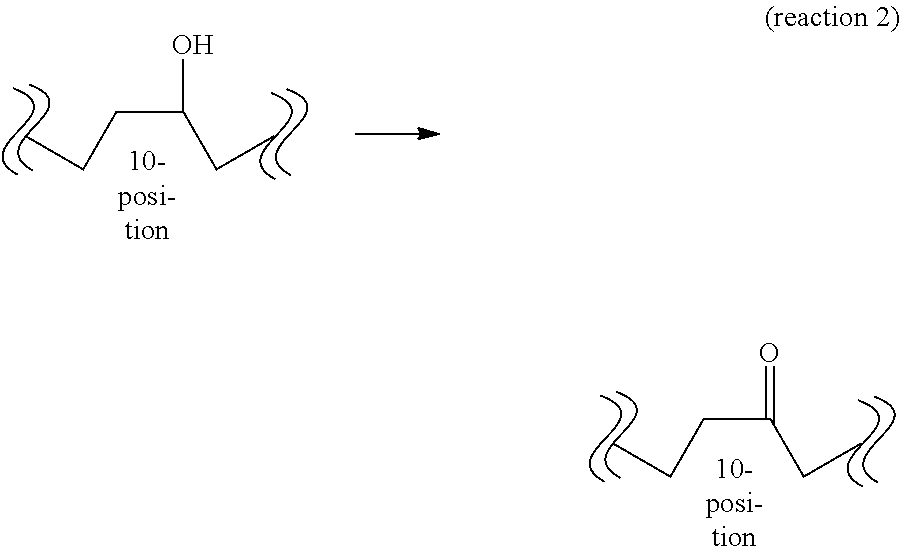
- reaction 2 10-oxo fatty acid is produced from 10-hydroxy fatty acid by a dehydrogenase reaction or chemical oxidation using chromic acid.
- the dehydrogenase that catalyzes reaction 2 is not particularly limited as long as it is an enzyme capable of utilizing 10-hydroxy fatty acid as a substrate and capable of converting to 10-oxo fatty acid, for example, lactic acid bacteria-derived hydroxy fatty acid-dehydrogenase (CLA-DH) is preferable. More preferred is Lactobacillus plantarum -derived CLA-DH, and particularly preferred is L. plantarum FERM BP-10549 strain-derived CLA-DH. CLA-DH can be obtained by the method described in JP-A-2007-259712, or the like.
- the amount of dehydrogenase to be added is, for example, 0.001-10 mg/ml, preferably 0.1-5 mg/ml, more preferably 0.2-2 mg/ml.
- a “cofactor” may be used for reaction 2 and, for example, NAD, NADP, FAD and the like can be used.
- the concentration of addition may be any as long as the oxidation reaction proceeds efficiently. It is preferably 0.001-20 mM, more preferably 0.01-10 mM.
- an “activator” may be used for the enzyme reaction and, for example, compounds similar to those recited as examples in the above-mentioned reaction 1 can be used at a similar addition concentration.
- the second reaction can be performed by chemical oxidation.
- chromic acid oxidation preferably Jones oxidation and the like
- chromic acid salts and complexes of the compound such as anhydrous chromic acid CrO 3 , chromic acid H 2 CrO 4 and dichromic acid H 2 Cr 2 O 7 can be used.
- 12-oxo fatty acid can be obtained from 12-hydroxy fatty acid.
- KetoRA can be obtained by the following method.
- the precipitated sediment is removed by centrifugation, and the obtained centrifuged supernatant is placed in a separating funnel and blended well with hexane (100 ml) and Milli-Q water (100 ml).
- the hexane layer is recovered by centrifugation, washed several times with Milli-Q water, and concentrated by a rotary evaporator to extract the reaction product and unreacted substrates. About 98% of the extract can be confirmed to be KetoRA.
- rKetoB can be obtained by chromic acid oxidation in the same manner as in rHYB.
- 10-oxo,trans-11 fatty acid is produced from an oxo fatty acid having 18 carbon atoms, a carbonyl group at the 10-position and a cis double bond at the 12-position by an isomerase reaction (reaction 3).
- the “substrate” of reaction 3 is not particularly limited as long as it is 10-oxo,cis-12 fatty acid induced from an unsaturated fatty acid having 18 carbon atoms and a cis double bond at the 9- and 12-positions, by the above-mentioned reactions 1 and 2.
- Examples thereof include KetoA induced from linoleic acid, ⁇ KetoA induced from ⁇ -linolenic acid, ⁇ KetoA induced from ⁇ -linolenic acid, sKetoA induced from stearidonic acid and the like.
- the substrate may be obtained by a method other than reactions 1 and 2.
- isomerase that catalyzes reaction 3 is not particularly limited as long as it is an enzyme capable of utilizing the above-mentioned 10-oxo,cis-12 fatty acid as a substrate and capable of converting to 10-oxo,trans-11 fatty acid, for example, lactic acid bacteria-derived oxo fatty acid-isomerase (CLA-DC) is preferable. More preferred is Lactobacillus plantarum -derived CLA-DC, and particularly preferred is L. plantarum FERM BP-10549 strain-derived CLA-DC. CLA-DC can be obtained by the method described in JP-A-2007-259712, or the like.
- the amount of isomerase to be added is, for example, 0.001-10 mg/ml, preferably 0.1-5 mg/ml, more preferably 0.2-2 mg/ml.
- an “activator” may be used for the isomerase reaction and, for example, compounds similar to those recited as examples in the above-mentioned reaction 1 can be used at a similar addition concentration.
- 10-Oxo,11,12-saturated fatty acid is produced from an oxo fatty acid having 18 carbon atoms, a carbonyl group at the 10-position and a trans double bond at the 11-position (10-oxo,trans-11 fatty acid) by a saturase reaction (reaction 4).
- the “substrate” of reaction 4 is not particularly limited as long as it is 10-oxo,trans-11 fatty acid produced by the above-mentioned reaction 3.
- Examples thereof include KetoC induced from KetoA, ⁇ KetoC induced from ⁇ KetoA, ⁇ KetoC induced from ⁇ KetoA, sKetoC induced from sKetoA and the like.
- the substrate may be obtained by a method other than reaction 3.
- While saturase that catalyzes reaction 4 is not particularly limited as long as it is an enzyme capable of utilizing the above-mentioned 10-oxo,trans-11 fatty acid as a substrate and capable of converting to 10-oxo,11,12-saturated fatty acid, for example, oxo fatty acid-enone reductase (CLA-ER) derived from lactic acid bacteria is preferable. More preferred is Lactobacillus plantarum -derived CLA-ER, and particularly preferred is L. plantarum FERM BP-10549 strain-derived CLA-ER.
- CLA-ER oxo fatty acid-enone reductase
- a protein comprising an amino acid sequence which is the amino acid sequence shown in SEQ ID NO: 2 wherein one or plural amino acids are deleted and/or substituted and/or inserted and/or added, and having an enzyme activity of catalyzing the above-mentioned reaction 4, or (c) a protein encoded by a base sequence that hybridizes to a nucleic acid consisting of a complementary chain sequence of the base sequence shown in SEQ ID NO: 1 under stringent conditions, and having an enzyme activity to catalyze the above-mentioned reaction 4.
- More specific examples of the above-mentioned (b) include a protein containing (i) an amino acid sequence which is the amino acid sequence shown in SEQ ID NO: 2, wherein 1-20, preferably 1-10, more preferably 1—several (5, 4, 3 or 2) amino acids are deleted, (ii) an amino acid sequence which is the amino acid sequence shown in SEQ ID NO: 2, wherein 1-20, preferably 1-10, more preferably 1—several number (5, 4, 3, or 2) amino acids are added, (iii) an amino acid sequence which is the amino acid sequence shown in SEQ ID NO: 2, wherein 1-20, preferably 1-10, more preferably 1—several (5, 4, 3 or 2) amino acids are inserted, (iv) an amino acid sequence which is the amino acid sequence shown in SEQ ID NO: 2, wherein 1-20, preferably 1-10, more preferably 1—several (5, 4, 3 or 2) amino acids are substituted by other amino acids, or (v) an amino acid sequence obtained by combining them.
- amino acids with similar properties e.g., glycine and alanine, valine and leucine and isoleucine, serine and threonine, aspartic acid and glutamic acid, asparagine and glutamine, lysine and arginine, cysteine and methionine, phenylalanine and tyrosine etc.
- amino acids with similar properties e.g., glycine and alanine, valine and leucine and isoleucine, serine and threonine, aspartic acid and glutamic acid, asparagine and glutamine, lysine and arginine, cysteine and methionine, phenylalanine and tyrosine etc.
- deletion, substitution and insertion are not particularly limited as long as the above-mentioned enzyme activity is maintained.
- the “stringent conditions” are conditions under which nucleotide sequences having high identity, for example, identity of 70, 80, 90, 95 or 99% or above, hybridize to each other and nucleotide sequences having identity lower than that do not hybridize; specifically, conditions of washing once, more preferably 2-3 times, at the salt concentration and temperature corresponding to those in the washing conditions of general Southern hybridization (60° C., 1 ⁇ SSC, 0.1% SDS, preferably, 0.1 ⁇ SSC, 0.1% SDS, more preferably, 68° C., 0.1 ⁇ SSC, 0.1% SDS) and the like.
- general Southern hybridization 60° C., 1 ⁇ SSC, 0.1% SDS, preferably, 0.1 ⁇ SSC, 0.1% SDS, more preferably, 68° C., 0.1 ⁇ SSC, 0.1% SDS
- CLA-ER can be isolated from, for example, the fungus and culture medium of L. plantarum FERM BP-10549 strain by a protein separation and purification technique known per se, for example, by using the enzyme activity that catalyzes the above-mentioned reaction 4 as an index.
- it can also be produced by recombination by synthesizing the total base sequence of the coding region of CLA-ER based on the information of the base sequence shown in SEQ ID NO: 1, or designing a primer capable of amplifying CLA-ER gene segment so containing the coding region, performing PCR using cDNA or genome DNA prepared from the above-mentioned strain as a template, cloning the obtained amplification fragment to a suitable expression vector and introducing same into a host cell, and cultivating the cell.
- one suitable for a host cell to be introduced with the vector may be appropriately selected according to the object (e.g., protein expression) and can be used.
- the expression vector can contain an appropriate promoter, a transcription termination signal, and a selection marker gene (drug resistance gene, gene that complements auxotrophic mutation etc.). Also, it may contain a sequence encoding a tag sequence useful for separation and purification of the expressed protein and the like.
- the vector may be incorporated into the genome of a target host cell.
- the vector can be introduced into a target host cell by a transformation method known per se such as a competent cell method, a protoplast method, a calcium phosphate coprecipitation method and the like.
- the above-mentioned “host cell” may be any cell as long as it can express a vector containing a nucleic acid encoding the above-mentioned CLA-ER, and bacterium, yeast, fungi, higher eukaryotic cell and the like can be mentioned.
- the bacterium include gram-positive bacteria such as bacillus, Streptomyces and the like and gram negative bacteria such as Escherichia coli and the like.
- a recombinant cell introduced with a vector containing a nucleic acid encoding CLA-ER can be cultivated by a method known per se which is suitable for the host cell.
- “Purification” of the above-mentioned CLA-ER can be performed by a method known per se, for example, fungi collected by centrifugation and the like are ruptured by ultrasonication or glass beads and the like, solid such as cell debris is removed by centrifugation and the like, and the like to give a crude enzyme solution, which is subjected to a salting out method using ammonium sulfate, sodium sulfate and the like, chromatographys such as ion exchange chromatography, gel filtration chromatography, affinity chromatography and the like, gel electrophoresis and the like.
- the amount of saturase to be added is, for example, 0.001-10 mg/ml, preferably 0.1-5 mg/ml, more preferably 0.2-2 mg/ml.
- a “cofactor” may be used for reaction 4 and, for example, NADH and the like can be used.
- the concentration of addition may be any as long as the oxidation reaction proceeds efficiently. It is preferably 0.001-20 mM, more preferably 0.01-10 mM.
- an “activator” may be used for the enzyme reaction and, for example, compounds similar to those recited as examples in the above-mentioned reaction 1 can be used at a similar addition concentration.
- 10-Hydroxy,trans-11 fatty acid is produced from an oxo fatty acid having 18 carbon atoms, a carbonyl group at the 10-position and a trans double bond at the 11-position (10-oxo,trans-11 fatty acid) by a dehydrogenase reaction (reaction 5) or 10-hydroxy,11,12-saturated fatty acid is produced from an oxo fatty acid having 18 carbon atoms and a carbonyl group at the 10-position and not having a double bond at the 11- and 12-positions (10-oxo,11,12-saturated fatty acid) by a dehydrogenase reaction (reaction 6).
- the “substrate” of reaction 5 is not particularly limited as long as it is 10-oxo,trans-11 fatty acid produced by the above-mentioned reaction 3.
- Examples thereof include KetoC induced from KetoA, ⁇ KetoC induced from ⁇ KetoA, ⁇ KetoC induced from ⁇ KetoA, sKetoC induced from sKetoA and the like.
- the substrate may be obtained by a method other than reaction 3.
- the “substrate” of reaction 6 is not particularly limited as long as it is 10-oxo,11,12-saturated fatty acid produced by the above-mentioned reaction 4.
- Examples thereof include KetoB induced from KetoC, ⁇ KetoB induced from ⁇ KetoC, ⁇ KetoB induced from ⁇ KetoC, sKetoB induced from sKetoC and the like.
- the substrate may be obtained by a method other than reaction 4.
- the dehydrogenase that catalyzes reaction 5 or reaction 6 is not particularly limited as long as it is an enzyme capable of utilizing 10-oxo,trans-11 fatty acid or 10-oxo,11,12-saturated fatty acid as a substrate and capable of converting to 10-hydroxy,trans-11 fatty acid or 10-hydroxy,11,12-saturated fatty acid, for example, lactic acid bacteria-derived hydroxy fatty acid-dehydrogenase (CLA-DH) is preferable. More preferred is Lactobacillus plantarum -derived CLA-DH, and particularly preferred is L. plantarum FERM BP-10549 strain-derived CLA-DH. While CLA-DH catalyzes the oxidation reaction in the above-mentioned reaction 2, it can also catalyze the reduction reaction in reaction 5 or reaction 6 as a reverse reaction.
- CLA-DH lactic acid bacteria-derived hydroxy fatty acid-dehydrogenase
- the amount of dehydrogenase to be added is, for example, 0.001-10 mg/ml, preferably 0.1-5 mg/ml, more preferably 0.2-2 mg/ml.
- a “cofactor” may be used for reaction 5 and reaction 6 and, for example, NADH, NADPH, FADH 2 and the like can be used.
- the concentration of addition may be any as long as the reduction reaction proceeds efficiently. It is preferably 0.001-20 mM, more preferably 0.01-10 mM.
- an “activator” may be used for the enzyme reaction and, for example, compounds similar to those recited as examples in the above-mentioned reaction 1 can be used at a similar addition concentration.
- the enzymes hydratase, dehydrogenase, isomerase, saturating enzyme
- the reaction system in the form of recombinant cells (e.g., Escherichia coli, Bacillus subtilis , yeast, insect cell, animal cell etc.) introduced with an expression vector containing a nucleic acid encoding same.
- the reaction can also be performed by cultivating the cells in a liquid medium suitable for the culture of the cells and added with a substrate and, where necessary, a cofactor and an activator.
- any of the above-mentioned enzymes may be a purified one or a crudely purified one.
- hydratase may be expressed in fungus such as Escherichia coli and the like and the fungus itself may be used or culture medium thereof may be used.
- the enzyme may be of a free type, or immobilized by various carriers.
- the metabolism improving agent of the present invention containing oxo fatty acid and the like can also be applied to the improvement of lifestyle-related diseases.
- the “lifestyle-related disease” is a disease group for which life habits such as eating habit, exercise habit, rest, smoking, drinking and the like are involved in the onset and progression thereof, and includes pathologies such as adult obesity, child obesity, nutrition ataxia, anorexia, gastric cancer, large intestine cancer, gout, hypertension, arteriosclerosis, nephrolithiasis, myocardial infarction, angina pectoris, gastric ulcer, kidney disease, osteoporosis, periodontitis, alcoholic hepatitis, cirrhosis, liver cancer, lung cancer, bronchitis, emphysema, periodontal disease, cerebral apoplexy, cerebral infarction, aneurysm, overwork death, insomnia and the like.
- the metabolism improving agent of the present invention can also be used for the prophylaxis or improvement of diabetes (type 1 diabetes, type 2 diabetes, pregnancy diabetes etc.), diabetic complications (arteriosclerotic to diseases, diabetic retinopathy, diabetic nephropathy, diabetic neuropathy etc.), lipid metabolism abnormality, hyperlipidemia, hypercholesterolemia, hypertriglyceridemia, insulin resistance, and fatty liver.
- diabetes type 1 diabetes, type 2 diabetes, pregnancy diabetes etc.
- diabetic complications arteriosclerotic to diseases, diabetic retinopathy, diabetic nephropathy, diabetic neuropathy etc.
- lipid metabolism abnormality hyperlipidemia
- hypercholesterolemia hypertriglyceridemia
- insulin resistance and fatty liver.
- the metabolism improving agent of the present invention can be used for the prophylaxis or treatment of at least one kind selected from the group consisting of obesity, diabetes, lipid metabolism abnormality, hyperlipidemia, hypercholesterolemia, hypertriglyceridemia, insulin resistance and fatty liver, by administration to human, or an animal other than human (e.g., dog, cat, mouse, rat, hamster, guinea pig, rabbit, swine, bovine, chicken, parakeet, hill myna, goat, horse, sheep, monkey etc.).
- an animal other than human e.g., dog, cat, mouse, rat, hamster, guinea pig, rabbit, swine, bovine, chicken, parakeet, hill myna, goat, horse, sheep, monkey etc.
- the metabolism improving agent of the present invention containing oxo fatty acid and the like can be used as, for example, a pharmaceutical product, a food, a feed, a cosmetic and the like, or by adding the agent to them.
- the dosage form of the pharmaceutical product includes dispersion, granule, pill, soft capsule, hard capsules, tablet, chewable tablet, quick-integrating tablet, syrup, liquid, suspension, suppository, ointment, cream, gel, adhesive, inhalant, injection and the like.
- a preparation thereof is prepared according to a conventional method. Since oxo fatty acid and the like are poorly soluble in water, they are dissolved in a non-hydrophilic organic solvent such as plant-derived oil, animal-derived oil and the like or dispersed or emulsified in an aqueous solution together with an emulsifier, a dispersing agent, a surfactant and the like by a homogenizer (high-pressure homogenizer) and used.
- a homogenizer high-pressure homogenizer
- additives examples include animal and plant oils such as soybean oil, safflower oil, olive oil, germ oil, sunflower oil, beef fat, sardine oil and the like, polyalcohols such as polyethylene glycol, propylene glycol, glycerol, sorbitol and the like, surfactants such as sorbitan ester of fatty acid, sucrose ester of fatty acid, glycerin fatty acid ester, polyglycerol ester of fatty acid and the like, excipients such as purified water, lactose, starch, crystalline cellulose, D-mannitol, lecithin, gum arabic, sorbitol solution, carbohydrate solution and the like, sweetener, colorant, pH adjuster, flavor and the like.
- a liquid preparation may be dissolved or suspended in water or other suitable medium when in use.
- tablet and granules may be coated by a well-known method.
- intravenous, intraperitoneal, intramuscular, subcutaneous, transdermal, intraarticular, intrasynovial, intrathecal, intraperiosteum, sublingual, oral administrations and the like are preferable, and intravenous administration or intraperitoneal administration is particularly preferable.
- the intravenous administration may be any of drip administration and bolus administration.
- the form of the food is not particularly limited as long as it permits oral ingestion, such as solution, suspension, powder, solid formed article and the like.
- Specific examples include supplements (powder, granule, soft capsule, hard capsule, tablet, chewable tablet, quick-integrating tablet, syrup, liquid etc.), drinks (carbonic acid drinks, lactic acid drinks, sport drinks, fruit juice drinks, vegetable drinks, soymilk beverage, coffee drinks, tea drinks, powder drinks, concentrated drinks, nutrition drinks, alcohol drinks etc.), confectionery (gummy candy, jelly, gum, chocolate, cookie, candy, caramel, Japanese confectionery, snack etc.), instant food (instant noodles, retort food, can, microwavable foods, instant soup, miso soups, freeze-dried food etc.), oil, fats and oils food (mayonnaise, dressing, butter, cream, margarine etc.), wheat powder products (bread, pasta, noodle, cake mix, bread crumb etc.), seasoning (sauce, tomato
- the above-mentioned foods can contain, where necessary, various nutrients, various vitamins (vitamin A, vitamin B1, vitamin B2, vitamin B6, vitamin C, vitamin D, vitamin E, vitamin K etc.), various minerals (magnesium, zinc, iron, sodium, potassium, selenium etc.), dietary fiber, dispersing agent, stabilizer such as emulsifier and the like, sweetener, flavor components (citric acid, malic acid etc.), flavor, royal jelly, propolis, Agaricus and the like.
- the feed is, for example, pet food, stock raising or aquaculture feed additive and the like.
- the metabolism improving agent of the present invention is used as a cosmetic or a cosmetic additive
- the cosmetic is, for example, cream, gel, skin milk, serum, toner, microemulsion essence, facial mask, foundation, lip rouge, eye shadow, shampoo, conditioner, bath additive and the like, and a flavor and the like may be mixed therewith.
- Only one kind of oxo fatty acid and the like may be blended with the pharmaceutical product, food, feed, cosmetic and the like of the present invention or two or more kinds thereof may be used in combination.
- the dose of the pharmaceutical product of the present invention or the ingestion amount of the food of the present invention can be appropriately determined according to the age and body weight of the patients or those who ingest same, symptom, administration time, dosage form, administration method, combination of medicaments and the like.
- the total amount of the oxo fatty acid and the like as an active ingredient is 0.02-100 mg/kg body weight, preferably 0.2-50 mg/kg body weight, per day for an adult, or 0.002 mg-50 mg/kg body weight, preferably 0.02-5.0 mg/kg body weight, by parenteral administration, which can be administered once a day or in several (2-5) portions per day.
- the ingestion amount of the feed of the present invention and the amount of use of the cosmetic of the present invention can each appropriately determined according to the above-mentioned ingestion amount of the food and the above-mentioned dose of the pharmaceutical product.
- KetoRA was prepared from ricinoleic acid (RA) based on the above-mentioned method.
- GW7647 (PPAR ⁇ agonist), Troglitazone (PPAR ⁇ agonist) were purchased from Sigma-Aldrich, T0901317 (LXR agonist) was purchased from Cayman Chemical, RA was purchased from NU-CHEK PREP, INC. (USA) (product number: U-50-A), EPA was purchased from NU-CHEK PREP, INC. (USA) (product number: U-99-A), LA was purchased from Sigma-Aldrich (product number: L1376), and other reagents were purchased from Wako Pure Chemical Industries, Ltd. or Nacalai Tesque and the like.
- PPAR ⁇ , ⁇ -activating action was measured first. The measurement was performed in reference to Nobuyuki Takahashi et al., FEES Letters 514 (2002) p. 315-322, “Dual action of isoprenols from herbal medicines on both PPARgamma and PPARalpha in 3T3-L1 adipocytes and HepG2 hepatocytes.”, the section of Materials and Methods “Reporter plasmids and luciferase assays”.
- a plasmid containing DNA encoding a fused protein of PPAR ⁇ , ⁇ ligand binding region and GAL4 DNA binding region pM-hPPAR ⁇ or pM-hPPAR ⁇
- a reporter plasmid containing GAL4 binding DNA sequence linked to luciferase p4xUASg-tk-luc
- pRL-CMV internal control
- the concentration of the sample was adjusted with ethanol. Ethanol was used as a negative control, PPAR ⁇ was used as a positive control, and GW7647 (10 nM) and Troglitazone (5 ⁇ M) were used as ⁇ agonists. The results are shown in FIG. 1 .
- luciferase activity was also measured for ⁇ KetoA, ⁇ KetoA, sKetoA, KetoB, ⁇ KetoB, ⁇ KetoB, sKetoB, rKetoB, KetoC, ⁇ KetoC, ⁇ KetoC, sKetoC, KetoRA, ⁇ HYA, ⁇ HYA, sHYA, rHYA, HYB, ⁇ HYB, ⁇ HYB, sHYB, rHYB, RA, HYC, ⁇ HYC, ⁇ HYC and sHYC.
- KetoC, ⁇ KetoC, KetoRA and ⁇ KetoC showed PPAR ⁇ and ⁇ agonist activity
- HYB, KetoB, ⁇ HYA, ⁇ HYA, rHYB, RA, rKetoB and rHYA showed PPAR ⁇ agonist activity
- ⁇ KetoA and ⁇ KetoA showed PPAR ⁇ agonist activity.
- KKAy mice KKAy/TaJcl, male, 4-week-old, purchased from CLEA Japan, Inc. and individually bred
- ND normal diet
- HFD high-fat diet
- control group non-addition feed
- the KetoA, HYA-added feed was prepared by adding KetoA, HYA to HFD such that the amount to be added was 0.05% (w/w) (0.05% group) or 0.1% (w/w) (0.1% group).
- FIG. 2 The profile of the body weight of KKAy mouse is shown in FIG. 2 .
- a body weight increase suppression tendency was found in the 0.05% group, and significant suppression of body weight increase was found in the 0.1% group.
- significant suppression of body weight increase was found in the 0.05% group.
- * shows P ⁇ 0.05, and ** shows P ⁇ 0.01 (hereinafter the same for FIGS. 3-7 ).
- the results show that heat generation is promoted in the KetoA group.
- the results of the organ weight (intraperitoneal white fat weight) of the KKAy mouse are shown in FIG. 6
- the results of plasma neutral fats are shown in FIG. 7 .
- a significant decrease in both the intraperitoneal white fat weight and plasma neutral fat level was confirmed in the 0.1% KetoA group.
- HepG2 cells (2.0 ⁇ 10 5 cells/mL) were cultured in DMEM medium containing 10% FES for 24 hr, and the medium was exchanged with 0.1% BSA-containing DMEM medium containing 10 nM LXR agonist T0901317 (Cayman Chemicals) and 60 ⁇ M various fatty acid. After culture for 24 hr, the cells were recovered, and total RNA was extracted using Sepasol reagent (Nacalai Tesque). After DNase treatment, reverse transcription was performed using SuperScriptII (Invitrogen) to give a cDNA solution. Using SYBR Green Mix (Bio-Rad, Richmond, Calif.) and gene-specific primer (Table 1), real-time PCR was performed as follows.
- the protein expression level of immature and mature SREBP-1c was measured.
- Cells treated as mentioned above were dispersed in buffer A (250 mM sucrose, 10 mM HEPES-KOH, 10 mM KCl, 1.5 mM MgCl 2 , 1 mM EDTA-Na, 1 mM EGTA-Na, pH 7.6) containing a protease inhibitor, passed 20 times through a 23 gauge injection needle, and centrifuged (1,000 ⁇ g, 4° C., 5 min) to separate into supernatant 1 and precipitate 1.
- buffer A 250 mM sucrose, 10 mM HEPES-KOH, 10 mM KCl, 1.5 mM MgCl 2 , 1 mM EDTA-Na, 1 mM EGTA-Na, pH 7.6
- a protease inhibitor passed 20 times through a 23 gauge injection needle, and centrifuged (1,000 ⁇ g, 4° C., 5 min) to separate into
- the precipitate 1 was re-dissolved in buffer B (20 mM HEPES-KOH, 0.42 M NaCl, 2.5% glycerol, 1.5 mM MgCl 2 , 1 mM EDTA-Na, 1 mM EGTA-Na, pH 7.6), and centrifuged (10 5 ⁇ g, 4° C., 15 min). The obtained supernatant 2 was used as a nuclear fraction (including mature form).
- the supernatant 1 was further centrifuged (10 5 ⁇ g, 4° C., 15 min), and the obtained precipitate 2 was dissolved in cell lysate (10 mM Tris-HCl, 100 mM NaCl, 1% SDS, 1 mM EDTA-Na, 1 mM EGTA-Na) and used as a membrane fraction (including immature form).
- cell lysate (10 mM Tris-HCl, 100 mM NaCl, 1% SDS, 1 mM EDTA-Na, 1 mM EGTA-Na
- measurement was performed by Western blot method using anti-SREBP-1 polyclonal antibody (Santa Cruz).
- Dual luciferase system Promega
- antagonizing action on LXR was evaluated by luciferase assay.
- p3xIR1-tk-Luc, pCMX-hLXRa, pRL-CMX were introduced into HepG2 cell. After culture in a 0.1% BSA-containing serum-free medium containing various fatty acids and T0901317 for 24 hr, the luciferase activity was measured.
- FIG. 8 shows variation of expression of SREBP-1c mRNA.
- T0901317 increased the expression to about 7-fold, but a strong suppressive action was found in HYA and KetoA.
- the results of Western blotting also show that HYA and KetoA strongly suppressed promotion of the expression of mature and immature SREBP-1 induced by T0901317 ( FIGS. 9, 10 ).
- lipid synthesis-related genes SCD-1, FAS, ACC1, 2 under transcriptional regulation by SREBP-1c also show down regulation by these fatty acids ( FIGS. 11-14 ). While the intracellular triacylglycerol level also increased by T0901317 ( FIG.
- FIGS. 8-16 * shows P ⁇ 0.05, ** shows P ⁇ 0.001, *** shows P ⁇ 0.0001 (vs. T0901317 addition, fatty acid non-addition).
- ⁇ KetoA, ⁇ KetoA, sKetoA, KetoB, ⁇ KetoB, ⁇ KetoB, sKetoB, rKetoB, KetoC, ⁇ KetoC, ⁇ KetoC, sKetoC, KetoRA, ⁇ HYA, ⁇ HYA, sHYA, rHYA, HYB, ⁇ HYB, ⁇ HYB, sHYB, rHYB, RA, HYC, ⁇ HYC, ⁇ HYC and sHYC were also measured for SREBP-1c, mature and immature SREBP-1 expression, SCD-1, FAS, ACC1, 2, intracellular triacylglycerol level, and antagonizing action on LXR by luciferase assay.
- ⁇ HYA, ⁇ KetoA, ⁇ KetoA, HYB, rHYB, RA, rKetoB also showed a lipid synthesis suppressive action by the antagonizing action on LXR.
- HYA and KetoA from the fatty acids examined at this time have a strong lipid synthesis suppressive action by an antagonizing action on LXR.
- rare fatty acids such as ⁇ HYA, ⁇ KetoA, ⁇ KetoA, HYB, rHYB, RA, rKetoB and the like were also shown to have a lipid synthesis suppressive action.
- the present invention has clarified oxo fatty acid and the like have a conventionally-unknown lipid and/or sugar and/or energy metabolism improving effect as a physiological function thereof.
- a lipid and/or sugar and/or energy metabolism improving agent containing the oxo fatty acid and the like is applicable to various fields such as pharmaceutical product, food, feed and the like, and the present invention is industrially extremely useful.
Landscapes
- Health & Medical Sciences (AREA)
- Chemical & Material Sciences (AREA)
- Life Sciences & Earth Sciences (AREA)
- Medicinal Chemistry (AREA)
- Veterinary Medicine (AREA)
- Animal Behavior & Ethology (AREA)
- Public Health (AREA)
- General Health & Medical Sciences (AREA)
- Pharmacology & Pharmacy (AREA)
- Engineering & Computer Science (AREA)
- Epidemiology (AREA)
- Polymers & Plastics (AREA)
- Diabetes (AREA)
- Food Science & Technology (AREA)
- General Chemical & Material Sciences (AREA)
- Nuclear Medicine, Radiotherapy & Molecular Imaging (AREA)
- Chemical Kinetics & Catalysis (AREA)
- Organic Chemistry (AREA)
- Bioinformatics & Cheminformatics (AREA)
- Obesity (AREA)
- Hematology (AREA)
- Animal Husbandry (AREA)
- Oil, Petroleum & Natural Gas (AREA)
- Mycology (AREA)
- Nutrition Science (AREA)
- Zoology (AREA)
- Child & Adolescent Psychology (AREA)
- Endocrinology (AREA)
- Emergency Medicine (AREA)
- Gastroenterology & Hepatology (AREA)
- Acyclic And Carbocyclic Compounds In Medicinal Compositions (AREA)
- Coloring Foods And Improving Nutritive Qualities (AREA)
- Fodder In General (AREA)
Abstract
Description
- patent document 1: JP-A-2006-521368
- patent document 2: WO 2009/096570
- patent document 3: JP-A-2011-184411
- non-patent document 1: Nagao K, (2005), J. Biosci. Bioeng., vol. 100, no. 2, p. 152-157
- non-patent document 2: Kim Y-I, (2011), Mol. Nutr. Food Res., vol. 55, p. 585-593
- non-patent document 3: Kim Y-I, (2012), PLoS ONE, vol. 7, no. 2, e31317
[4] The agent of [1], wherein the hydroxy fatty acid is at least one kind selected from the group consisting of 10-hydroxy-cis-12-octadecenoic acid (HYA), 10-hydroxy-cis-12,cis-15-octadecadienoic acid (αHYA), 10-hydroxy-cis-6, cis-12-octadecadienoic acid (γHYA), 10-hydroxy-cis-6,cis-12,cis-15-octadecatrienoic acid (sHYA), 10,12-dihydroxyoctadecanoic acid (rHYA), 10-hydroxyoctadecanoic acid (HYB), 10-hydroxy-cis-15-octadecenoic acid (αHYB), 10-hydroxy-cis-6-octadecenoic acid (γHYB), 10-hydroxy-cis-6,cis-15-octadecadienoic acid (sHYB), 12-hydroxyoctadecanoic acid (rHYB), 10-hydroxy-trans-11-octadecenoic acid (HYC), 10-hydroxy-trans-11,cis-15-octadecadienoic acid (αHYC), 10-hydroxy-cis-6,trans-11-octadecadienoic acid (γHYC), 10-hydroxy-cis-6,trans-11,cis-15-octadecatrienoic acid (sHYC), and ricinoleic acid (RA).
[5] The agent of any one of [1]-[4], which is used for the prophylaxis or improvement of at least one kind selected from the group consisting of obesity, diabetes, lipid metabolism abnormality, hyperlipidemia, and fatty liver.
[6] The agent of any one of [1]-[4], which is a food or a food additive.
[7] The agent of any one of [1]-[4], which is a pharmaceutical product.
[8] The agent of any one of [1]-[4], which is a feed or a feed additive.
[9] A method of improving metabolism in a mammal, comprising administering an oxo fatty acid having 18 carbon atoms and a carbonyl group at the 10- or 12-position, and/or a hydroxy fatty acid having 18 carbon atoms and a hydroxyl group at the 10- and/or 12-position(s) to the mammal.
[10] An oxo fatty acid having 18 carbon atoms and a carbonyl group at the 10- or 12-position, and/or a hydroxy fatty acid having 18 carbon atoms and a hydroxyl group at the 10- and/or 12-position(s) for use as a metabolism improving agent.
[11] Use of an oxo fatty acid having 18 carbon atoms and a carbonyl group at the 10- or 12-position, and/or a hydroxy fatty acid having 18 carbon atoms and a hydroxyl group at the 10- and/or 12-position(s) in the production of a metabolism improving agent.



(c) a protein encoded by a base sequence that hybridizes to a nucleic acid consisting of a complementary chain sequence of the base sequence shown in SEQ ID NO: 1 under stringent conditions, and having an enzyme activity to catalyze the above-mentioned

| TABLE 1 | ||
| mRNA | base sequence of primer | reference |
| SREBP- |
5′-GGAGGGGTAGGGCCAACGGCCT-3′ (SEQ ID NO: 3) | Field et al., |
| 5′-CATGTCTTCGAAAGTGCAATCC-3′ (SEQ ID NO: 4) | 2002* | |
| SCD-1 | 5′-TGGTTTCACTTGGAGCTGTG-3′ (SEQ ID NO: 5) | |
| 5′-GGCCTTGGAGACTTTCTTCC-3′ (SEQ ID NO: 6) | ||
| |
5′-ACAGGGACAACCTGGAGTTCT-3′ (SEQ ID NO: 7) | Field et al., |
| 5′-CTGTGGTCCCACTTGATGAGT-3′ (SEQ ID NO: 8) | 2002 | |
| |
5′-ATCCCGTACCTTCTTCTACTG-3′ (SEQ ID NO: 9) | |
| 5′-CCCAAACATAAGCCTTCACTG-3′ (SEQ ID NO: 10) | ||
| |
5′-CTCTGACCATGTTCGTTCTC-3′ (SEQ ID NO: 11) | NM_001093 |
| 5′-ATCTTCATCACCTCCATCTC-3′ (SEQ ID NO: 12) | ||
| |
5′-TAAGTCCCTGCCCTTTGTACACA-3′ (SEQ ID NO: 13) | Field et al., |
| 5′-GATCCGAGGGCCTCACTAAAC-3′ (SEQ ID NO: 14) | 2002 | |
| *Field et al., 2002; Biochem J. 368: 855-864 | ||
Claims (20)
Applications Claiming Priority (3)
| Application Number | Priority Date | Filing Date | Title |
|---|---|---|---|
| JP2012237933 | 2012-10-29 | ||
| JP2012-237933 | 2012-10-29 | ||
| PCT/JP2013/077871 WO2014069227A1 (en) | 2012-10-29 | 2013-10-14 | Metabolism-improving agent comprising rare fatty acid |
Publications (2)
| Publication Number | Publication Date |
|---|---|
| US20150342916A1 US20150342916A1 (en) | 2015-12-03 |
| US9707200B2 true US9707200B2 (en) | 2017-07-18 |
Family
ID=50627141
Family Applications (1)
| Application Number | Title | Priority Date | Filing Date |
|---|---|---|---|
| US14/439,146 Active US9707200B2 (en) | 2012-10-29 | 2013-10-14 | Metabolism-improving agent comprising rare fatty acid |
Country Status (7)
| Country | Link |
|---|---|
| US (1) | US9707200B2 (en) |
| EP (1) | EP2913051B1 (en) |
| JP (1) | JP6340523B2 (en) |
| CN (1) | CN104902887B (en) |
| DK (1) | DK2913051T3 (en) |
| ES (1) | ES2692723T3 (en) |
| WO (1) | WO2014069227A1 (en) |
Cited By (2)
| Publication number | Priority date | Publication date | Assignee | Title |
|---|---|---|---|---|
| US20170000752A1 (en) * | 2014-01-24 | 2017-01-05 | Kyoto University | Anti-inflammatory agent containing rare fatty acid |
| WO2025128741A1 (en) * | 2023-12-12 | 2025-06-19 | The Regents Of The University Of California | Octadecanoid compositions and methods of activating mucosal repair pathways |
Families Citing this family (13)
| Publication number | Priority date | Publication date | Assignee | Title |
|---|---|---|---|---|
| DK2959897T3 (en) * | 2013-02-21 | 2019-08-12 | Univ Kyoto | GUT PROTECTION AGENT CONTAINING HYDROXYLATED FAT ACID |
| EP3098313B1 (en) | 2014-01-24 | 2022-01-05 | Kyoto University | Method for producing rare fatty acid using novel enzyme, and novel rare fatty acid |
| CN106456586A (en) | 2014-01-24 | 2017-02-22 | 国立大学法人京都大学 | Metabolism-improving agent comprising rare fatty acid |
| JP6499830B2 (en) * | 2014-06-02 | 2019-04-10 | キッコーマン株式会社 | Protein-containing beverage |
| JP6510186B2 (en) * | 2014-06-02 | 2019-05-08 | キッコーマン株式会社 | Tomato containing food and drink |
| CN107922308B (en) * | 2015-06-02 | 2024-11-12 | 内斯托尔株式会社 | Novel triglyceride and its use |
| EP3305757B1 (en) * | 2015-06-02 | 2023-09-20 | Noster Inc. | 10-hydroxy-cis-12-octadecenoic acid alkyl ester and use thereof |
| EP3597183B1 (en) * | 2017-03-17 | 2023-06-28 | Noster Inc. | Composition for inhibiting growth of bacterium having menaquinone synthesis pathway through futalosine or futalosine derivative |
| US11130974B2 (en) | 2017-08-31 | 2021-09-28 | Kyoto University | Hydroxylated fatty acid homopolymer and production method thereof |
| JP6480630B1 (en) * | 2018-09-26 | 2019-03-13 | アサヒグループホールディングス株式会社 | Fat accumulation inhibitor and blood lipid improving agent |
| JP7500079B2 (en) | 2019-03-29 | 2024-06-17 | Noster株式会社 | Method for producing rare fatty acids using novel enzymes and novel rare fatty acids |
| CN111253246B (en) * | 2020-03-16 | 2023-03-17 | 中国医学科学院基础医学研究所 | Acyl acid derivative and preparation method and medical application thereof |
| WO2025047856A1 (en) * | 2023-08-30 | 2025-03-06 | 国立大学法人神戸大学 | Muscle atrophy inhibitor |
Citations (16)
| Publication number | Priority date | Publication date | Assignee | Title |
|---|---|---|---|---|
| US4582804A (en) | 1985-07-09 | 1986-04-15 | Litchfield John H | Microbiological synthesis of hydroxy-fatty acids and keto-fatty acids |
| WO1999016435A1 (en) * | 1997-09-29 | 1999-04-08 | Menarini Ricerche S.P.A. | Pharmaceutical compositions containing ricinoleic acid and their use in anti-inflammatory and analgesic therapy |
| WO2002000042A2 (en) | 2000-06-26 | 2002-01-03 | The Procter & Gamble Company | Compositions and methods for body weight management |
| US20040019109A1 (en) | 2002-07-24 | 2004-01-29 | Christer Owman | Methods of identifying compounds that affect a fatty acid cell-surface receptor |
| EP1481671A1 (en) | 2002-02-14 | 2004-12-01 | Kirin Beer Kabushiki Kaisha | Compositions and foods for improving lipid metabolism |
| US7015249B1 (en) * | 1997-12-12 | 2006-03-21 | Purdue Research Foundation | Methods and compositions for treating diabetes |
| JP2006521368A (en) | 2003-03-27 | 2006-09-21 | サントリー株式会社 | Lipid improving agent and composition comprising lipid improving agent |
| JP2007259712A (en) | 2006-03-27 | 2007-10-11 | Asahi Kasei Pharma Kk | Method for producing conjugated fatty acid |
| KR100824969B1 (en) | 2007-02-02 | 2008-04-28 | 건국대학교 산학협력단 | Novel Stenotropomonas Acid Amaniphilia Strains and Method for Preparing Hydroxy Fatty Acid Using the Same |
| JP2009051732A (en) | 2005-12-13 | 2009-03-12 | Meiji Seika Kaisha Ltd | Composition having ppar ligand activity |
| WO2009096570A1 (en) | 2008-02-01 | 2009-08-06 | Nok Klueber Co., Ltd. | Lubricant compositions |
| JP2009209054A (en) | 2008-02-29 | 2009-09-17 | National Univ Corp Shizuoka Univ | alpha-KETOL FATTY ACID DERIVATIVE, KETO FATTY ACID DERIVATIVE, AND FLOWER-BUD FORMATION ACCELERATOR |
| JP2011184411A (en) | 2010-03-11 | 2011-09-22 | Kyoto Univ | Lifestyle related disease amelioration agent including extract of tomato |
| WO2012032415A2 (en) | 2010-09-08 | 2012-03-15 | Pronova Biopharma Norge As | Compositions comprising a fatty acid oil mixture comprising epa and dha in free acid form, a surfactant, and a statin |
| WO2012032417A2 (en) | 2010-09-08 | 2012-03-15 | Pronova Biopharma Norge As | Compositions comprising a fatty acid oil mixture, a free fatty acid, and a statin |
| WO2013168310A1 (en) | 2012-05-10 | 2013-11-14 | 国立大学法人京都大学 | Method for producing oxo fatty acid and rare fatty acid |
Family Cites Families (1)
| Publication number | Priority date | Publication date | Assignee | Title |
|---|---|---|---|---|
| GB0021988D0 (en) | 2000-09-07 | 2000-10-25 | Nokia Mobile Phones Ltd | Management of portable radiotelephones |
-
2013
- 2013-10-14 WO PCT/JP2013/077871 patent/WO2014069227A1/en not_active Ceased
- 2013-10-14 JP JP2014544416A patent/JP6340523B2/en active Active
- 2013-10-14 EP EP13850683.7A patent/EP2913051B1/en active Active
- 2013-10-14 DK DK13850683.7T patent/DK2913051T3/en active
- 2013-10-14 CN CN201380068773.7A patent/CN104902887B/en active Active
- 2013-10-14 ES ES13850683.7T patent/ES2692723T3/en active Active
- 2013-10-14 US US14/439,146 patent/US9707200B2/en active Active
Patent Citations (19)
| Publication number | Priority date | Publication date | Assignee | Title |
|---|---|---|---|---|
| US4582804A (en) | 1985-07-09 | 1986-04-15 | Litchfield John H | Microbiological synthesis of hydroxy-fatty acids and keto-fatty acids |
| WO1999016435A1 (en) * | 1997-09-29 | 1999-04-08 | Menarini Ricerche S.P.A. | Pharmaceutical compositions containing ricinoleic acid and their use in anti-inflammatory and analgesic therapy |
| US7015249B1 (en) * | 1997-12-12 | 2006-03-21 | Purdue Research Foundation | Methods and compositions for treating diabetes |
| WO2002000042A2 (en) | 2000-06-26 | 2002-01-03 | The Procter & Gamble Company | Compositions and methods for body weight management |
| EP1481671A1 (en) | 2002-02-14 | 2004-12-01 | Kirin Beer Kabushiki Kaisha | Compositions and foods for improving lipid metabolism |
| US20040019109A1 (en) | 2002-07-24 | 2004-01-29 | Christer Owman | Methods of identifying compounds that affect a fatty acid cell-surface receptor |
| JP2006521368A (en) | 2003-03-27 | 2006-09-21 | サントリー株式会社 | Lipid improving agent and composition comprising lipid improving agent |
| US20060217441A1 (en) | 2003-03-27 | 2006-09-28 | Suntory Limited | Lipid-improving agent and composition containing lipid-improving agent |
| JP2009051732A (en) | 2005-12-13 | 2009-03-12 | Meiji Seika Kaisha Ltd | Composition having ppar ligand activity |
| JP2007259712A (en) | 2006-03-27 | 2007-10-11 | Asahi Kasei Pharma Kk | Method for producing conjugated fatty acid |
| KR100824969B1 (en) | 2007-02-02 | 2008-04-28 | 건국대학교 산학협력단 | Novel Stenotropomonas Acid Amaniphilia Strains and Method for Preparing Hydroxy Fatty Acid Using the Same |
| WO2009096570A1 (en) | 2008-02-01 | 2009-08-06 | Nok Klueber Co., Ltd. | Lubricant compositions |
| US20100305012A1 (en) | 2008-02-01 | 2010-12-02 | Nok Klueber Co., Ltd. | Lubricant Composition |
| JP2009209054A (en) | 2008-02-29 | 2009-09-17 | National Univ Corp Shizuoka Univ | alpha-KETOL FATTY ACID DERIVATIVE, KETO FATTY ACID DERIVATIVE, AND FLOWER-BUD FORMATION ACCELERATOR |
| JP2011184411A (en) | 2010-03-11 | 2011-09-22 | Kyoto Univ | Lifestyle related disease amelioration agent including extract of tomato |
| WO2012032415A2 (en) | 2010-09-08 | 2012-03-15 | Pronova Biopharma Norge As | Compositions comprising a fatty acid oil mixture comprising epa and dha in free acid form, a surfactant, and a statin |
| WO2012032417A2 (en) | 2010-09-08 | 2012-03-15 | Pronova Biopharma Norge As | Compositions comprising a fatty acid oil mixture, a free fatty acid, and a statin |
| WO2013168310A1 (en) | 2012-05-10 | 2013-11-14 | 国立大学法人京都大学 | Method for producing oxo fatty acid and rare fatty acid |
| US20150125911A1 (en) | 2012-05-10 | 2015-05-07 | Kyoto University | Method for producing oxo fatty acid and rare fatty acid |
Non-Patent Citations (10)
| Title |
|---|
| Duran-Sandoval et al., "PPAR agonists in the treatment of the metabolic syndrome and type 2 diabetes" in Gaw, A. and Shepherd, J., eds., Lipids and Atherosclerosis Annual 2003 (Taylor & Francis, Ltd., London, U.K., 2003), pp. 37-57. |
| European Patent Office, Communication Pursuant to Rule 114(2) EPC in European Patent Application No. 13850683.7 (Dec. 7, 2016). |
| European Patent Office, Supplementary European Search Report in Application No. 13850683 (Apr. 14, 2016). |
| Japanese Patent Office, International Search Report in International Patent Application No. PCT/JP2013/077871 (Jan. 21, 2014). |
| Kidshealth.org (2013). * |
| Kim et al., Mol. Nutr. Food Res., 55: 585-593 (2011). |
| Kim et al., PLoS ONE, 7(2): e31317 (2012). |
| Kishino et al., Biochem. Biophys. Res. Commun. 416(1-2): 188-193 (2011). |
| Nagao K, J. Biosci. Bioeng., 100(2): 152-157 (2005). |
| Simmons et al. Acta Diabetol. 1993; 30(4);233-7 (Abstract. * |
Cited By (2)
| Publication number | Priority date | Publication date | Assignee | Title |
|---|---|---|---|---|
| US20170000752A1 (en) * | 2014-01-24 | 2017-01-05 | Kyoto University | Anti-inflammatory agent containing rare fatty acid |
| WO2025128741A1 (en) * | 2023-12-12 | 2025-06-19 | The Regents Of The University Of California | Octadecanoid compositions and methods of activating mucosal repair pathways |
Also Published As
| Publication number | Publication date |
|---|---|
| JP6340523B2 (en) | 2018-06-13 |
| ES2692723T3 (en) | 2018-12-04 |
| EP2913051B1 (en) | 2018-09-19 |
| JPWO2014069227A1 (en) | 2016-09-08 |
| CN104902887B (en) | 2019-05-17 |
| CN104902887A (en) | 2015-09-09 |
| EP2913051A1 (en) | 2015-09-02 |
| EP2913051A4 (en) | 2016-05-25 |
| DK2913051T3 (en) | 2018-12-03 |
| US20150342916A1 (en) | 2015-12-03 |
| WO2014069227A1 (en) | 2014-05-08 |
Similar Documents
| Publication | Publication Date | Title |
|---|---|---|
| EP2913051B1 (en) | Metabolism-improving agent comprising rare fatty acid | |
| US12491173B2 (en) | Metabolism-improving agent comprising rare fatty acid | |
| JP6940854B2 (en) | Anti-inflammatory agent containing rare fatty acids | |
| US9539229B2 (en) | Intestinal tract-protecting agent containing hydroxylated fatty acid | |
| JP4355368B2 (en) | Methods and compositions for the synthesis of long chain polyunsaturated fatty acids | |
| US20160208297A1 (en) | Omega3 unsaturated fatty acid enzyme and method for producing eicosapentaenoic acid | |
| WO2020203751A1 (en) | Production method for rare fatty acid using novel enzyme, and novel rare fatty acid | |
| CN107109378B (en) | Novel omega-3 fatty acid desaturase and method for producing eicosapentaenoic acid |
Legal Events
| Date | Code | Title | Description |
|---|---|---|---|
| AS | Assignment |
Owner name: NITTO PHARMACEUTICAL INDUSTRIES, LTD., JAPAN Free format text: ASSIGNMENT OF ASSIGNORS INTEREST;ASSIGNORS:OGAWA, JUN;KISHINO, SHIGENOBU;PARK, SI-BUM;AND OTHERS;SIGNING DATES FROM 20150420 TO 20150502;REEL/FRAME:035756/0546 Owner name: KYOTO UNIVERSITY, JAPAN Free format text: ASSIGNMENT OF ASSIGNORS INTEREST;ASSIGNORS:OGAWA, JUN;KISHINO, SHIGENOBU;PARK, SI-BUM;AND OTHERS;SIGNING DATES FROM 20150420 TO 20150502;REEL/FRAME:035756/0546 |
|
| STCF | Information on status: patent grant |
Free format text: PATENTED CASE |
|
| MAFP | Maintenance fee payment |
Free format text: PAYMENT OF MAINTENANCE FEE, 4TH YEAR, LARGE ENTITY (ORIGINAL EVENT CODE: M1551); ENTITY STATUS OF PATENT OWNER: LARGE ENTITY Year of fee payment: 4 |
|
| FEPP | Fee payment procedure |
Free format text: ENTITY STATUS SET TO SMALL (ORIGINAL EVENT CODE: SMAL); ENTITY STATUS OF PATENT OWNER: SMALL ENTITY |
|
| AS | Assignment |
Owner name: NOSTER INC., JAPAN Free format text: ASSIGNMENT OF ASSIGNORS INTEREST;ASSIGNOR:NITTO PHARMACEUTICAL INDUSTRIES, LTD.;REEL/FRAME:055920/0263 Effective date: 20210406 |
|
| AS | Assignment |
Owner name: NOSTER INC., JAPAN Free format text: ASSIGNMENT OF ASSIGNORS INTEREST;ASSIGNOR:KYOTO UNIVERSITY;REEL/FRAME:068851/0663 Effective date: 20240904 |
|
| AS | Assignment |
Owner name: NOSTER INC., JAPAN Free format text: CORRECTIVE ASSIGNMENT TO CORRECT THE THE PROPERTY TYPE FROM APPLICATION NUMBER TO PATENT NUMBER FOR 10952983 AND 10975397 PREVIOUSLY RECORDED AT REEL: 68851 FRAME: 663. ASSIGNOR(S) HEREBY CONFIRMS THE ASSIGNMENT;ASSIGNOR:KYOTO UNIVERSITY;REEL/FRAME:069207/0122 Effective date: 20240904 |
|
| MAFP | Maintenance fee payment |
Free format text: PAYMENT OF MAINTENANCE FEE, 8TH YR, SMALL ENTITY (ORIGINAL EVENT CODE: M2552); ENTITY STATUS OF PATENT OWNER: SMALL ENTITY Year of fee payment: 8 |