US9641087B2 - Method and device for detecting conduction mode - Google Patents
Method and device for detecting conduction mode Download PDFInfo
- Publication number
- US9641087B2 US9641087B2 US14/823,426 US201514823426A US9641087B2 US 9641087 B2 US9641087 B2 US 9641087B2 US 201514823426 A US201514823426 A US 201514823426A US 9641087 B2 US9641087 B2 US 9641087B2
- Authority
- US
- United States
- Prior art keywords
- voltage
- waveform
- digital signal
- signal
- voltages
- Prior art date
- Legal status (The legal status is an assumption and is not a legal conclusion. Google has not performed a legal analysis and makes no representation as to the accuracy of the status listed.)
- Active, expires
Links
Images





Classifications
-
- H—ELECTRICITY
- H02—GENERATION; CONVERSION OR DISTRIBUTION OF ELECTRIC POWER
- H02M—APPARATUS FOR CONVERSION BETWEEN AC AND AC, BETWEEN AC AND DC, OR BETWEEN DC AND DC, AND FOR USE WITH MAINS OR SIMILAR POWER SUPPLY SYSTEMS; CONVERSION OF DC OR AC INPUT POWER INTO SURGE OUTPUT POWER; CONTROL OR REGULATION THEREOF
- H02M3/00—Conversion of DC power input into DC power output
- H02M3/22—Conversion of DC power input into DC power output with intermediate conversion into AC
- H02M3/24—Conversion of DC power input into DC power output with intermediate conversion into AC by static converters
- H02M3/28—Conversion of DC power input into DC power output with intermediate conversion into AC by static converters using discharge tubes with control electrode or semiconductor devices with control electrode to produce the intermediate AC
- H02M3/325—Conversion of DC power input into DC power output with intermediate conversion into AC by static converters using discharge tubes with control electrode or semiconductor devices with control electrode to produce the intermediate AC using devices of a triode or a transistor type requiring continuous application of a control signal
- H02M3/335—Conversion of DC power input into DC power output with intermediate conversion into AC by static converters using discharge tubes with control electrode or semiconductor devices with control electrode to produce the intermediate AC using devices of a triode or a transistor type requiring continuous application of a control signal using semiconductor devices only
- H02M3/33507—Conversion of DC power input into DC power output with intermediate conversion into AC by static converters using discharge tubes with control electrode or semiconductor devices with control electrode to produce the intermediate AC using devices of a triode or a transistor type requiring continuous application of a control signal using semiconductor devices only with automatic control of the output voltage or current, e.g. flyback converters
- H02M3/33515—Conversion of DC power input into DC power output with intermediate conversion into AC by static converters using discharge tubes with control electrode or semiconductor devices with control electrode to produce the intermediate AC using devices of a triode or a transistor type requiring continuous application of a control signal using semiconductor devices only with automatic control of the output voltage or current, e.g. flyback converters with digital control
-
- H—ELECTRICITY
- H02—GENERATION; CONVERSION OR DISTRIBUTION OF ELECTRIC POWER
- H02M—APPARATUS FOR CONVERSION BETWEEN AC AND AC, BETWEEN AC AND DC, OR BETWEEN DC AND DC, AND FOR USE WITH MAINS OR SIMILAR POWER SUPPLY SYSTEMS; CONVERSION OF DC OR AC INPUT POWER INTO SURGE OUTPUT POWER; CONTROL OR REGULATION THEREOF
- H02M3/00—Conversion of DC power input into DC power output
- H02M3/22—Conversion of DC power input into DC power output with intermediate conversion into AC
- H02M3/24—Conversion of DC power input into DC power output with intermediate conversion into AC by static converters
- H02M3/28—Conversion of DC power input into DC power output with intermediate conversion into AC by static converters using discharge tubes with control electrode or semiconductor devices with control electrode to produce the intermediate AC
- H02M3/325—Conversion of DC power input into DC power output with intermediate conversion into AC by static converters using discharge tubes with control electrode or semiconductor devices with control electrode to produce the intermediate AC using devices of a triode or a transistor type requiring continuous application of a control signal
- H02M3/335—Conversion of DC power input into DC power output with intermediate conversion into AC by static converters using discharge tubes with control electrode or semiconductor devices with control electrode to produce the intermediate AC using devices of a triode or a transistor type requiring continuous application of a control signal using semiconductor devices only
- H02M3/33507—Conversion of DC power input into DC power output with intermediate conversion into AC by static converters using discharge tubes with control electrode or semiconductor devices with control electrode to produce the intermediate AC using devices of a triode or a transistor type requiring continuous application of a control signal using semiconductor devices only with automatic control of the output voltage or current, e.g. flyback converters
-
- H—ELECTRICITY
- H02—GENERATION; CONVERSION OR DISTRIBUTION OF ELECTRIC POWER
- H02M—APPARATUS FOR CONVERSION BETWEEN AC AND AC, BETWEEN AC AND DC, OR BETWEEN DC AND DC, AND FOR USE WITH MAINS OR SIMILAR POWER SUPPLY SYSTEMS; CONVERSION OF DC OR AC INPUT POWER INTO SURGE OUTPUT POWER; CONTROL OR REGULATION THEREOF
- H02M3/00—Conversion of DC power input into DC power output
- H02M3/22—Conversion of DC power input into DC power output with intermediate conversion into AC
- H02M3/24—Conversion of DC power input into DC power output with intermediate conversion into AC by static converters
- H02M3/28—Conversion of DC power input into DC power output with intermediate conversion into AC by static converters using discharge tubes with control electrode or semiconductor devices with control electrode to produce the intermediate AC
- H02M3/325—Conversion of DC power input into DC power output with intermediate conversion into AC by static converters using discharge tubes with control electrode or semiconductor devices with control electrode to produce the intermediate AC using devices of a triode or a transistor type requiring continuous application of a control signal
- H02M3/335—Conversion of DC power input into DC power output with intermediate conversion into AC by static converters using discharge tubes with control electrode or semiconductor devices with control electrode to produce the intermediate AC using devices of a triode or a transistor type requiring continuous application of a control signal using semiconductor devices only
- H02M3/33569—Conversion of DC power input into DC power output with intermediate conversion into AC by static converters using discharge tubes with control electrode or semiconductor devices with control electrode to produce the intermediate AC using devices of a triode or a transistor type requiring continuous application of a control signal using semiconductor devices only having several active switching elements
- H02M3/33576—Conversion of DC power input into DC power output with intermediate conversion into AC by static converters using discharge tubes with control electrode or semiconductor devices with control electrode to produce the intermediate AC using devices of a triode or a transistor type requiring continuous application of a control signal using semiconductor devices only having several active switching elements having at least one active switching element at the secondary side of an isolation transformer
- H02M3/33592—Conversion of DC power input into DC power output with intermediate conversion into AC by static converters using discharge tubes with control electrode or semiconductor devices with control electrode to produce the intermediate AC using devices of a triode or a transistor type requiring continuous application of a control signal using semiconductor devices only having several active switching elements having at least one active switching element at the secondary side of an isolation transformer having a synchronous rectifier circuit or a synchronous freewheeling circuit at the secondary side of an isolation transformer
-
- H—ELECTRICITY
- H02—GENERATION; CONVERSION OR DISTRIBUTION OF ELECTRIC POWER
- H02M—APPARATUS FOR CONVERSION BETWEEN AC AND AC, BETWEEN AC AND DC, OR BETWEEN DC AND DC, AND FOR USE WITH MAINS OR SIMILAR POWER SUPPLY SYSTEMS; CONVERSION OF DC OR AC INPUT POWER INTO SURGE OUTPUT POWER; CONTROL OR REGULATION THEREOF
- H02M1/00—Details of apparatus for conversion
- H02M1/0003—Details of control, feedback or regulation circuits
- H02M1/0009—Devices or circuits for detecting current in a converter
-
- H02M2001/0009—
-
- Y—GENERAL TAGGING OF NEW TECHNOLOGICAL DEVELOPMENTS; GENERAL TAGGING OF CROSS-SECTIONAL TECHNOLOGIES SPANNING OVER SEVERAL SECTIONS OF THE IPC; TECHNICAL SUBJECTS COVERED BY FORMER USPC CROSS-REFERENCE ART COLLECTIONS [XRACs] AND DIGESTS
- Y02—TECHNOLOGIES OR APPLICATIONS FOR MITIGATION OR ADAPTATION AGAINST CLIMATE CHANGE
- Y02B—CLIMATE CHANGE MITIGATION TECHNOLOGIES RELATED TO BUILDINGS, e.g. HOUSING, HOUSE APPLIANCES OR RELATED END-USER APPLICATIONS
- Y02B70/00—Technologies for an efficient end-user side electric power management and consumption
- Y02B70/10—Technologies improving the efficiency by using switched-mode power supplies [SMPS], i.e. efficient power electronics conversion e.g. power factor correction or reduction of losses in power supplies or efficient standby modes
Definitions
- the present invention relates to a detection technology, particularly to a method and a device for detecting conduction mode.
- Switching power converters with synchronous rectification utilize switching between inductor's current continuous and discontinuous conduction operation modes (CCM and DCM) in order to achieve improved power efficiency across wide load and input voltage ranges.
- the inductor current zero crossing is sensed in order to detect the operation modes transition point between CCM and DCM.
- the challenges associated with this include inductor current zero crossing point sensing accuracy, noise effect near the zero crossing point and the sensing circuitry speed and power loss.
- Switching from CCM to DCM or vice versa requires sensing the zero crossing of the inductor current. This requires sensing the instantaneous inductor current information at the switching frequency speed, its accuracy and stability is sensitive to noise effect at the zero crossing transition point and it results in additional power losses by the sensing circuitries especially at higher load currents and at higher switching frequencies.
- the detection of the inductor current zero crossing which determines the operation mode (CCM or DCM) and determines the Synchronous Rectifier (SR) switch turn off time in DCM, requires sensing the instantaneous current of the output inductor, where the high bandwidth sensing and detection circuitries are essential in order to detect the correct zero crossing point.
- the switching noise which is introduced at the instances of turning ON and OFF of the converter switches (where the zero crossing of inductor current occurs), makes it more difficult to detect the zero crossing time (and the non zero crossing) accurately.
- the present invention provides a method and a device for detecting conduction mode, so as to solve the afore-mentioned problems of the prior art.
- a primary objective of the present invention is to provide a method and a device for detecting conduction mode, which uses a reference duration and two different voltages of a detected voltage signal across a synchronous rectifier to detect the waveform slope of the detected voltage signal, thereby precisely determining that an energy-storing element operates in continuous conduction mode (CCM) or discontinuous conduction mode (DCM).
- CCM continuous conduction mode
- DCM discontinuous conduction mode
- the present invention provides a method for detecting conduction mode, which uses an energy-storing element to connect with a synchronous rectifier and a load, and the load connects with the synchronous rectifier. Firstly, energy is discharged from the energy-storing element and applied to the load through the synchronous rectifier, so as to periodically generate a detected voltage signal across the synchronous rectifier, and the detected voltage signal comprises at least one raising waveform, at least one horizontal waveform and at least one descending waveform appearing during a period of the detected voltage signal. Then, the detected voltage signal is received to generate an output according to the detected voltage signal, and either of a reference duration or a reference slope, so as to determine that the energy-storing element operates in CCM or DCM.
- the present invention also provides a device for detecting conduction mode, which connects with a synchronous rectifier, and the synchronous rectifier and a load connect with an energy-storing element, and the load connects with the synchronous rectifier.
- Energy is discharged from the energy-storing element and applied to the load through the synchronous rectifier, so as to periodically generate a detected voltage signal across the synchronous rectifier.
- the detected voltage signal comprises at least one raising waveform, at least one horizontal waveform and at least one descending waveform appearing during a period of the detected voltage signal.
- the device for detecting conduction mode receives the detected voltage signal, and generates an output according to the detected voltage signal, and either of a reference duration or a reference slope, so as to determine that the energy-storing element operates in CCM or DCM.
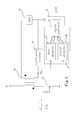
- FIG. 1 is a schematic diagram illustrating a device for detecting conduction mode according to the first embodiment of the present invention
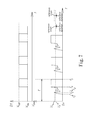
- FIG. 2 is a schematic diagram illustrating waveforms of a detected voltage signal and the first digital signal in discontinuous conduction mode (DCM) according to the first embodiment of the present invention
- FIG. 3 is a schematic diagram illustrating waveforms of the detected voltage signal and the second digital signal in DCM according to the first embodiment of the present invention
- FIG. 4 is a schematic diagram illustrating waveforms of a detected voltage signal and the first digital signal in continuous conduction mode (CCM) according to the first embodiment of the present invention
- FIG. 5 is a schematic diagram illustrating waveforms of the detected voltage signal and the second digital signal in CCM according to the first embodiment of the present invention
- FIG. 6 is a schematic diagram illustrating a device for detecting conduction mode according to the second embodiment of the present invention.
- FIG. 7 is a schematic diagram illustrating waveforms of a detected voltage signal and the first digital signal in DCM according to the second embodiment of the present invention.
- FIG. 8 is a schematic diagram illustrating waveforms of the detected voltage signal and the second digital signal in DCM according to the second embodiment of the present invention.
- FIG. 9 is a schematic diagram illustrating waveforms of a detected voltage signal and the first digital signal in CCM according to the second embodiment of the present invention.
- FIG. 10 is a schematic diagram illustrating waveforms of the detected voltage signal and the second digital signal in CCM according to the second embodiment of the present invention.
- FIG. 11 is a schematic diagram illustrating waveforms of the fourth digital signals in DCM and CCM according to the second embodiment of the present invention.
- the present invention provides a conduction mode detection technique whose goal is to detect continuous conduction mode (CCM) and discontinuous conduction mode (DCM).
- CCM continuous conduction mode
- DCM discontinuous conduction mode
- CCM indicates that an energy-storing element, such as a power transformer connected with a rectifier, is always conducting current and has two states of receiving energy from input and delivering energy to the output.
- the voltage across the rectifier is a square wave. When receiving energy, the voltage across the rectifier is high related to the input voltage. When delivering energy, the voltage across the rectifier is near zero.
- DCM indicates that the power transformer still has two states of receiving energy from input and delivering energy to the output.
- the voltage across the rectifier is high related to the input voltage.
- the voltage across the rectifier is near zero.
- the voltage across the rectifier is not a square wave, and the voltage across the rectifier oscillating at a frequency determined by parasitic inductance and capacitance occurs.
- the present invention uses a circuit to detect the difference between CCM and DCM, namely, by detecting the voltage across the rectifier.
- the oscillation voltage in DCM has a lower rise and fall time than the square wave.
- This circuit uses a rise/fall time detection to distinguish CCM from DCM.
- Another possible method is to use a filter circuit, since the square wave in the states of receiving and delivering energy have a faster rise/fall time and/or higher frequency than the oscillation voltage.
- the device 8 for detecting conduction mode comprises an analog processor 10 and a digital processor 12 .
- the digital processor 12 is realized with a logic assembly, such as a XOR gate.
- the analog processor 10 connects with a synchronous rectifier 14 , wherein the synchronous rectifier 14 is realized with a diode or an N-channel metal oxide semiconductor field effect transistor (NMOSFET).
- NMOSFET N-channel metal oxide semiconductor field effect transistor
- An energy-storing element for example, but not limited to a transformer 18 or an inductor, connects with the synchronous rectifier 14 and a load 16 including a load capacitance.
- the transformer 18 is installed in a switching power supply.
- a secondary winding of the transformer 18 and the load 16 connects with the synchronous rectifier 14 .
- An end of a primary winding of the transformer 18 connects with a high-voltage terminal, and another end of the primary winding connects with a low-voltage terminal via an electrical switch 20 .
- the low-voltage terminal is grounded and the electrical switch 20 is realized with an NMOSFET.
- the electrical switch 20 receives a square waveform S to switch a conduction state thereof, and the transformer 18 receives and stores a voltage V H as energy from the high-voltage terminal and discharges the energy from the secondary winding according to the conduction state.
- the energy is applied to the load 16 through the synchronous rectifier 14 , so as to periodically generate a detected voltage signal V 2nd across the synchronous rectifier 14 .
- the waveform of the detected voltage signal V 2nd comprises at least one raising waveform, at least one horizontal waveform and at least one descending waveform appearing during a period T of the detected voltage signal V 2nd .
- the raising waveform, the horizontal waveform and the descending waveform appear during different intervals.
- the analog processor 10 receives the detected voltage signal V 2nd , and generates first and second digital signals D 1 and D 2 according to the waveform and voltage of the detected voltage signal V 2nd and a reference duration.
- the voltage of the detected voltage signal V 2nd comprises and first, second and third voltages V 1 , V 2 and V 3 between the maximum voltage and the minimum voltage of the detected voltage signal V 2nd , and the second voltage V 2 is less than the first voltage V 1 .
- the first voltage V 1 is equal to the third voltage V 3 .
- the analog processor 10 generates first and second digital signals D 1 and D 2 according to the waveform of the detected voltage signal V 2nd and a reference slope.
- the digital processor 12 connects with the analog processor 10 , receives the first and second digital signals D 1 and D 2 , and generates a third digital signal D 3 as an output according to the first and second digital signals D 1 and D 2 , so as to determine that the transformer 18 operates in continuous conduction mode (CCM) or discontinuous conduction mode (DCM).
- CCM continuous conduction mode
- DCM discontinuous conduction mode
- the third digital signal D 3 is a single level digital signal.
- the third digital signal D 3 has two different voltage levels or an inverse single level digital signal of CCM. Since the waveform slope of the detected voltage signal V 2nd are different in DCM and CCM, the third digital signal D 3 can precisely distinguish CCM from DCM.
- the analog processor 10 further comprises a first detector 22 and a second detector 24 .
- the first and second detectors 22 and 24 can be realized with SR latches or J-K flip flops.
- the first detector 22 connects with the synchronous rectifier 14 and the digital processor 12 , receives the detected voltage signal V 2nd , and generates the first digital signal D 1 according to the waveform of the detected voltage signal V 2nd , the reference duration, the first voltage V 1 and the second voltage V 2 .
- the first detector 22 generates the first digital signal D 1 according to the waveform of the detected voltage signal V 2nd and the reference slope.
- the second detector 24 connects with the synchronous rectifier 14 and the digital processor 12 , receives the detected voltage signal V 2nd , and generates the second digital signal D 2 according to the waveform of the detected voltage signal V 2nd , the reference duration and the first, second and third voltages V 1 , V 2 and V 3 . Alternatively, the second detector 24 generates the second digital signal D 2 according to the waveform of the detected voltage signal V 2nd and the reference slope.
- the electrical switch 20 receives the square waveform S to switch a conduction state thereof, and the transformer 18 receives and stores the voltage V H as energy from the high-voltage terminal and discharges the energy from the secondary winding according to the conduction state, and the energy is applied to the load 16 through the synchronous rectifier 14 , so as to periodically generate the detected voltage signal V 2nd across the synchronous rectifier 14 .
- the waveform of the detected voltage signal V 2nd comprises at least one raising waveform, at least one horizontal waveform and at least one descending waveform appearing during a period T of the detected voltage signal V 2nd .
- the transformer 18 operates in DCM, the waveform of the detected voltage signal V 2nd is shown in the lower inset of FIG.
- the part of the detected voltage signal V 2nd between t 1 and t 2 is the raising waveform
- the part of the detected voltage signal V 2nd between t 2 and t 3 is the descending waveform
- the part of the detected voltage signal V 2nd between t 4 and t 5 is the horizontal waveform.
- the waveform of the detected voltage signal V 2nd is shown in the lower inset of FIG. 4 or FIG. 5 . In FIG. 4 or FIG.
- the instantaneously-raising part of the detected voltage signal V 2nd at about t 1 is the raising waveform
- the instantaneously-descending part of the detected voltage signal V 2nd at about t 2 is the descending waveform
- the part of the detected voltage signal V 2nd between t 1 and t 2 is the horizontal waveform.
- the first and second detectors 22 and 24 receive the detected voltage signal V 2nd .
- the first detector 22 generates the first digital signal D 1 according to the waveform of the detected voltage signal V 2nd , either of the reference duration or the reference slope, and the first and second voltages V 1 and V 2 .
- the second detector 24 generates the second digital signal D 2 according to the detected voltage signal V 2nd , either of the reference duration or the reference slope, and the first, second and third voltages V 1 , V 2 , and V 3 .
- the detected voltage signal V 2nd , the reference duration, and the first and second voltages V 1 and V 2 satisfy at least one of following relationships (a1)-(a3), a following relationship (a4) and at least one of following relationships (a5)-(a7):
- the first digital signal D 1 is a high level signal V high after the raising waveform appears.
- the raising waveform comprises the first and second voltages V 1 and V 2 and the waveform slope of the raising waveform corresponding to the first and second voltages V 1 and V 2 is less than the reference slope
- the first digital signal D 1 is a high level signal V high after the raising waveform appears. For example, as shown in FIG.
- the raising waveform at about t 1 comprises the first and second voltages V 1 and V 2 and the time interval between two time points corresponding to the first and second voltages V 1 and V 2 in the raising waveform is less than the reference duration, thus the first digital signal D 1 is the high level signal V high after the raising waveform appears.
- the raising waveform comprises the first and second voltages V 1 and V 2 and a time interval between two time points corresponding to the first and second voltages V 1 and V 2 in the raising waveform is not less than the reference duration, the first digital signal D 1 keeps unchanged after the raising waveform appears.
- the raising waveform comprises the first and second voltages V 1 and V 2 and the waveform slope of the raising waveform corresponding to the first and second voltages V 1 and V 2 is not less than the reference slope
- the first digital signal D 1 keeps unchanged after the raising waveform appears.
- the raising waveform between t 1 and t 2 comprises the first and second voltages V 1 and V 2 and the time interval between two time points corresponding to the first and second voltages V 1 and V 2 in the raising waveform is not less than the reference duration, thus the first digital signal D 1 keeps unchanged after the raising waveform appears.
- the first digital signal D 1 keeps unchanged after the raising waveform appears.
- the first digital signal D 1 keeps unchanged after the horizontal waveform appears. For example, as shown in FIG. 2 , the first digital signal D 1 keeps unchanged after the horizontal waveform between t 4 and t 5 appears. Besides, as shown in FIG. 4 , the first digital signal D 1 keeps unchanged after the horizontal waveform between t 1 and t 2 appears.
- the first digital signal D 1 is a low level signal V low after the descending waveform appears.
- the first digital signal D 1 is a low level signal V low after the descending waveform appears. For example, as shown in FIG.
- the descending waveform at about t 5 comprises the first and second voltages V 1 and V 2 and the time interval between two time points corresponding to the first and second voltages V 1 and V 2 in the descending waveform is less than the reference duration, thus the first digital signal D 1 is the low level signal V low after the descending waveform appears.
- the descending waveform at about t 2 comprises the first and second voltages V 1 and V 2 and the time interval between two time points corresponding to the first and second voltages V 1 and V 2 in the descending waveform is less than the reference duration, thus the first digital signal D 1 is the low level signal V low after the descending waveform appears.
- the first digital signal D 1 keeps unchanged after the descending waveform appears.
- the first digital signal D 1 keeps unchanged after the descending waveform appears. For example, as shown in FIG.
- the descending waveform between t 2 and t 3 comprises the first and second voltages V 1 and V 2 and the time interval between two time points corresponding to the first and second voltages V 1 and V 2 in the descending waveform is not less than the reference duration, thus the first digital signal D 1 keeps unchanged after the descending waveform appears.
- the first digital signal D 1 keeps unchanged after the descending waveform appears.
- the detected voltage signal V 2nd , the reference duration, and the first and second voltages V 1 and V 2 satisfy at least one of following relationships (b1)-(b3), a following relationship (b4) and at least one of following relationships (b5)-(b7):
- the second digital signal D 2 is a high level signal V high after the raising waveform appears.
- the raising waveform between t 1 and t 2 comprises the first voltage V 1 and the voltage of the raising waveform is larger than the first voltage V 1 , thus the second digital signal D 2 is the high level signal V high after the raising waveform appears.
- the raising waveform at about t 1 comprises the first voltage V 1 and the voltage of the raising waveform is larger than the first voltage V 1 , thus the second digital signal D 2 is the high level signal V high after the raising waveform appears.
- the second digital signal D 2 keeps unchanged after the raising waveform appears.
- the second digital signal D 2 keeps unchanged after the horizontal waveform appears. For example, as shown in FIG. 3 , the second digital signal D 2 keeps unchanged after the horizontal waveform between t 4 and t 5 appears. Besides, as shown in FIG. 4 , the second digital signal D 2 keeps unchanged after the horizontal waveform between t 1 and t 2 appears.
- the second digital signal D 2 is a low level signal V low after the descending waveform appears.
- the second digital signal D 2 is a low level signal V low after the descending waveform appears. For example, as shown in FIG.
- the descending waveform at about t 5 comprises the first and second voltages V 1 and V 2 and the time interval between two time points corresponding to the first and second voltages V 1 and V 2 in the descending waveform is less than the reference duration, thus the second digital signal D 2 is the low level signal V low after the descending waveform appears.
- the descending waveform at about t 2 comprises the first and second voltages V 1 and V 2 and the time interval between two time points corresponding to the first and second voltages V 1 and V 2 in the descending waveform is less than the reference duration, thus the second digital signal D 2 is the low level signal V low after the descending waveform appears.
- the descending waveform between t 2 and t 3 comprises the first and second voltages V 1 and V 2 and the time interval between two time points corresponding to the first and second voltages V 1 and V 2 in the descending waveform is not less than the reference duration, thus the second digital signal D 2 keeps unchanged after the descending waveform appears.
- the second digital signal D 2 keeps unchanged after the descending waveform appears.
- the digital processor 12 receives the first and second digital signals D 1 and D 2 , and generates the third digital signal D 3 according to the first and second digital signals D 1 and D 2 , so as to determine that the transformer 18 operates in CCM or DCM.
- the digital processor 12 is realized with a XOR gate.
- the third digital signal D 3 is a single level digital signal.
- the third digital signal D 3 has two different voltage levels or an inverse single level digital signal of CCM.
- the operation of the analog processor 10 and the digital processor 12 is also performed in a step.
- the device 8 for detecting conduction mode receives the detected voltage signal V 2nd and generates the third digital signal D 3 according to the detected voltage signal V 2nd , either of the reference duration or the reference slope, and the first, second and third voltages V 1 , V 2 and V 3 , so as to determine that the transformer 18 operates in CCM or DCM.
- the digital processor 12 comprises a logic assembly 26 and a filter 28 , and the logic assembly 26 is exemplified by a XOR gate.
- the logic assembly 26 connects with the analog processor 10 , receives the first and second digital signals D 1 and D 2 and generates a fourth digital signal D 4 according to the first and second digital signals D 1 and D 2 .
- the fourth digital signal D 4 has a period T M , a first voltage level V M1 and a second voltage level V M2 different from the first voltage level V M1 .
- the first and second voltage levels V M1 and V M2 respectively occupy a first duration and a second duration in the period T M of the fourth digital signal D 4 .
- the filter 28 connects with the logic assembly 26 and receives the fourth digital signal D 4 .
- the filter 28 filters out the first voltage level V M1 to generate the third digital signal D 3 when a ratio of the first duration to the period T M of the fourth digital signal D 4 is less than a given value such as 1% or 2%.
- the filter 28 passes the fourth digital signal D 4 as the third digital signal D 3 when the ratio is larger than or equal to the given value.
- the operation of the second embodiment is introduced as below.
- the operation of the electrical switch 20 , the transformer 18 , the synchronous rectifier 14 , the load 16 and the analog processor 10 is the same to that of the first embodiment so will not be reiterated.
- the first and second voltages V 1 and V 2 of the first embodiment are different from those of the second embodiment.
- the first digital signal D 1 in DCM of the second embodiment is different from that of the first embodiment, and there is a little delay between the first and second digital signals D 1 and D 2 in CCM of the second embodiment.
- the logic assembly 26 then receives the first and second digital signals D 1 and D 2 and generates the fourth digital signal D 4 according to the first and second digital signals D 1 and D 2 , wherein the fourth digital signal D 4 in CCM has a plurality of positive pulses.
- the filter 28 receives the fourth digital signal D 4 and determines whether the ratio of the first duration to the period T M of the fourth digital signal D 4 is less than the given value. If the answer is yes, the filter 28 filters out the first voltage level V M1 to generate the third digital signal D 3 . If the answer is no, the filter 28 passes the fourth digital signal D 4 as the third digital signal D 3 .
- the method and the device of the present invention can precisely determine that the energy-storing element operates in CCM or DCM.
Landscapes
- Engineering & Computer Science (AREA)
- Power Engineering (AREA)
- Dc-Dc Converters (AREA)
Abstract
Description
(a2) When the raising waveform comprises the first and second voltages V1 and V2 and a time interval between two time points corresponding to the first and second voltages V1 and V2 in the raising waveform is not less than the reference duration, the first digital signal D1 keeps unchanged after the raising waveform appears. In other words, when the raising waveform comprises the first and second voltages V1 and V2 and the waveform slope of the raising waveform corresponding to the first and second voltages V1 and V2 is not less than the reference slope, the first digital signal D1 keeps unchanged after the raising waveform appears. For example, as shown in
(a3) When the raising waveform does not comprise the first and second voltages V1 and V2, the first digital signal D1 keeps unchanged after the raising waveform appears.
(a4) The first digital signal D1 keeps unchanged after the horizontal waveform appears. For example, as shown in
(a5) When the descending waveform comprises the first and second voltages V1 and V2 and a time interval between two time points corresponding to the first and second voltages V1 and V2 in the descending waveform is less than the reference duration, the first digital signal D1 is a low level signal Vlow after the descending waveform appears. In other words, when the descending waveform comprises the first and second voltages V1 and V2 and the waveform slope of the descending waveform corresponding to the first and second voltages V1 and V2 is less than the reference slope, the first digital signal D1 is a low level signal Vlow after the descending waveform appears. For example, as shown in
(a6) When the descending waveform comprises the first and second voltages V1 and V2 and a time interval between two time points corresponding to the first and second voltages V1 and V2 in the descending waveform is not less than the reference duration, the first digital signal D1 keeps unchanged after the descending waveform appears. In other words, when the descending waveform comprises the first and second voltages V1 and V2 and the waveform slope of the descending waveform corresponding to the first and second voltages V1 and V2 is not less than the reference slope, the first digital signal D1 keeps unchanged after the descending waveform appears. For example, as shown in
(a7) When the descending waveform does not comprise the first and second voltages V1 and V2, the first digital signal D1 keeps unchanged after the descending waveform appears.
(b2) When the raising waveform comprises the third voltage V3 and the voltage of the raising waveform is not larger than the third voltage V3, the second digital signal D2 keeps unchanged after the raising waveform appears.
(b3) When the raising waveform does not comprise the third voltage V3, the second digital signal D2 keeps unchanged after the raising waveform appears.
(b4) The second digital signal D2 keeps unchanged after the horizontal waveform appears. For example, as shown in
(b5) When the descending waveform comprises the first and second voltages V1 and V2 and the time interval between two time points corresponding to the first and second voltages V1 and V2 in the descending waveform is less than the reference duration, the second digital signal D2 is a low level signal Vlow after the descending waveform appears. In other words, when the descending waveform comprises the first and second voltages V1 and V2 and the waveform slope of the descending waveform corresponding to the first and second voltages V1 and V2 is less than the reference slope, the second digital signal D2 is a low level signal Vlow after the descending waveform appears. For example, as shown in
(b6) When the descending waveform comprises the first and second voltages V1 and V2 and the time interval between two time points corresponding to the first and second voltages V1 and V2 in the descending waveform is not less than the reference duration, the second digital signal D2 keeps unchanged after the descending waveform appears. In other words, when the descending waveform comprises the first and second voltages V1 and V2 and the waveform slope of the descending waveform corresponding to the first and second voltages V1 and V2 is not less than the reference slope, the second digital signal D2 keeps unchanged after the descending waveform appears. For example, as shown in
(b7) When the descending waveform does not comprise the first and second voltages V1 and V2, the second digital signal D2 keeps unchanged after the descending waveform appears.
Claims (19)
Priority Applications (1)
| Application Number | Priority Date | Filing Date | Title |
|---|---|---|---|
| US14/823,426 US9641087B2 (en) | 2015-08-11 | 2015-08-11 | Method and device for detecting conduction mode |
Applications Claiming Priority (1)
| Application Number | Priority Date | Filing Date | Title |
|---|---|---|---|
| US14/823,426 US9641087B2 (en) | 2015-08-11 | 2015-08-11 | Method and device for detecting conduction mode |
Publications (2)
| Publication Number | Publication Date |
|---|---|
| US20170047851A1 US20170047851A1 (en) | 2017-02-16 |
| US9641087B2 true US9641087B2 (en) | 2017-05-02 |
Family
ID=57994389
Family Applications (1)
| Application Number | Title | Priority Date | Filing Date |
|---|---|---|---|
| US14/823,426 Active 2035-09-17 US9641087B2 (en) | 2015-08-11 | 2015-08-11 | Method and device for detecting conduction mode |
Country Status (1)
| Country | Link |
|---|---|
| US (1) | US9641087B2 (en) |
Families Citing this family (4)
| Publication number | Priority date | Publication date | Assignee | Title |
|---|---|---|---|---|
| TWI669896B (en) * | 2017-05-05 | 2019-08-21 | 擎力科技股份有限公司 | Power converter with synchronous rectifier and voltage regulating method thereof |
| US9871454B1 (en) * | 2017-06-19 | 2018-01-16 | Sync Power Corp. | Method of controlling synchronous rectifier metal-oxide-semiconductor with pulse transformer |
| TWI774980B (en) * | 2019-08-29 | 2022-08-21 | 偉詮電子股份有限公司 | Synchronous rectification controller, method of adaptively setting a slew-rate threshold, and relevant control methods |
| CN112865541B (en) * | 2021-01-22 | 2022-03-29 | 成都启臣微电子股份有限公司 | Synchronous rectification controller, synchronous rectification system and synchronous rectification control method |
Citations (1)
| Publication number | Priority date | Publication date | Assignee | Title |
|---|---|---|---|---|
| US6456106B1 (en) * | 1997-12-08 | 2002-09-24 | Srmos, Inc. | Method and circuit for detection of primary switches status in isolated DC/DC converters |
-
2015
- 2015-08-11 US US14/823,426 patent/US9641087B2/en active Active
Patent Citations (1)
| Publication number | Priority date | Publication date | Assignee | Title |
|---|---|---|---|---|
| US6456106B1 (en) * | 1997-12-08 | 2002-09-24 | Srmos, Inc. | Method and circuit for detection of primary switches status in isolated DC/DC converters |
Also Published As
| Publication number | Publication date |
|---|---|
| US20170047851A1 (en) | 2017-02-16 |
Similar Documents
| Publication | Publication Date | Title |
|---|---|---|
| US8213203B2 (en) | Method and apparatus for controlling a constant current output in a switching mode power supply | |
| JP6404581B2 (en) | Power converter controller, power converter, and method for sensing power converter input | |
| US9287793B2 (en) | Isolated power supply, control signal transmission circuit and method thereof | |
| CN105071662B (en) | The switching power source control circuit and control method of a kind of quasi-resonant mode | |
| US9350258B2 (en) | Conduction detecting circuit, rectifying switch controlling circuit including the conduction detecting circuit and power supply for the rectifying switch controlling circuit to be applied | |
| US9455622B2 (en) | Inverter and over current protection method thereof | |
| KR101179327B1 (en) | Power factor correction circuit | |
| US20120133285A1 (en) | Method and circuit for power factor correction | |
| US20160322908A1 (en) | Flyback converter, control circuit and control method therefor | |
| US9641087B2 (en) | Method and device for detecting conduction mode | |
| US9917503B2 (en) | Overcurrent protection circuit and power factor correction circuit comprising the same | |
| US20150049523A1 (en) | Method for controlling synchronous rectifier of power converter and control circuit using the same | |
| CN105375768A (en) | Capacitive mode protection method and capacitive mode control circuit of resonant converter | |
| KR20150094552A (en) | Resonant converter control techniques to manage negative sr current | |
| US10958178B2 (en) | Control circuit, control method and flyback converter of primary-side feedback control thereof | |
| US9774262B2 (en) | Current resonance type power supply device | |
| KR20090011715A (en) | Converter and driving method | |
| CN103715898A (en) | Feedback voltage sampling circuit, and feedback voltage blanking circuit and method | |
| KR20130132169A (en) | Switch control device, power supply device comprising the same, and driving method of power supply device | |
| CN103887952A (en) | Output voltage dynamic sampling circuit in alternating current-direct current converter | |
| JP2016192889A (en) | Power converter | |
| CN103917878A (en) | AC input voltage cut-off detection method and circuit | |
| US8154889B1 (en) | Operating mode detection in a flyback converter | |
| JP3459143B2 (en) | Overload protection method for switching converter | |
| CN108303579B (en) | Voltage detection circuit and method |
Legal Events
| Date | Code | Title | Description |
|---|---|---|---|
| AS | Assignment |
Owner name: SYNC POWER CORP., TAIWAN Free format text: ASSIGNMENT OF ASSIGNORS INTEREST;ASSIGNORS:HUANG, CHUN-JEN;YEE, HSIAN-PEI;REEL/FRAME:036350/0611 Effective date: 20150807 |
|
| STCF | Information on status: patent grant |
Free format text: PATENTED CASE |
|
| MAFP | Maintenance fee payment |
Free format text: PAYMENT OF MAINTENANCE FEE, 4TH YR, SMALL ENTITY (ORIGINAL EVENT CODE: M2551); ENTITY STATUS OF PATENT OWNER: SMALL ENTITY Year of fee payment: 4 |
|
| MAFP | Maintenance fee payment |
Free format text: PAYMENT OF MAINTENANCE FEE, 8TH YR, SMALL ENTITY (ORIGINAL EVENT CODE: M2552); ENTITY STATUS OF PATENT OWNER: SMALL ENTITY Year of fee payment: 8 |