US9634530B2 - Interior permanent magnet motor with shifted rotor laminations - Google Patents

Interior permanent magnet motor with shifted rotor laminations Download PDF

Info

Publication number
US9634530B2
US9634530B2 US13/839,225 US201313839225A US9634530B2 US 9634530 B2 US9634530 B2 US 9634530B2 US 201313839225 A US201313839225 A US 201313839225A US 9634530 B2 US9634530 B2 US 9634530B2
Authority
US
United States
Prior art keywords
notch
rotor
rotor lamination
center
lamination
Prior art date
Legal status (The legal status is an assumption and is not a legal conclusion. Google has not performed a legal analysis and makes no representation as to the accuracy of the status listed.)
Expired - Fee Related, expires
Application number
US13/839,225
Other versions
US20140265707A1 (en
Inventor
Steven D. Klein
Jeffrey T. Klass
Mohammed R. Islam
Mohammad S. Islam
Mazharul H. Chowdhury
Current Assignee (The listed assignees may be inaccurate. Google has not performed a legal analysis and makes no representation or warranty as to the accuracy of the list.)
Steering Solutions IP Holding Corp
Original Assignee
Steering Solutions IP Holding Corp
Priority date (The priority date is an assumption and is not a legal conclusion. Google has not performed a legal analysis and makes no representation as to the accuracy of the date listed.)
Filing date
Publication date
Application filed by Steering Solutions IP Holding Corp filed Critical Steering Solutions IP Holding Corp
Priority to US13/839,225 priority Critical patent/US9634530B2/en
Assigned to STEERING SOLUTIONS IP HOLDING CORPORATION reassignment STEERING SOLUTIONS IP HOLDING CORPORATION ASSIGNMENT OF ASSIGNORS INTEREST (SEE DOCUMENT FOR DETAILS). Assignors: CHOWDHURY, MAZHARUL H., ISLAM, MOHAMMAD S., ISLAM, MOHAMMED R., KLASS, JEFFREY T., KLEIN, STEVEN D.
Priority to EP14159381.4A priority patent/EP2779386A3/en
Priority to CN201410151194.5A priority patent/CN104052179B/en
Publication of US20140265707A1 publication Critical patent/US20140265707A1/en
Application granted granted Critical
Publication of US9634530B2 publication Critical patent/US9634530B2/en
Expired - Fee Related legal-status Critical Current
Adjusted expiration legal-status Critical

Links

Images

Classifications

    • HELECTRICITY
    • H02GENERATION; CONVERSION OR DISTRIBUTION OF ELECTRIC POWER
    • H02KDYNAMO-ELECTRIC MACHINES
    • H02K1/00Details of the magnetic circuit
    • H02K1/06Details of the magnetic circuit characterised by the shape, form or construction
    • H02K1/22Rotating parts of the magnetic circuit
    • H02K1/27Rotor cores with permanent magnets
    • H02K1/2706Inner rotors
    • H02K1/272Inner rotors the magnetisation axis of the magnets being perpendicular to the rotor axis
    • H02K1/274Inner rotors the magnetisation axis of the magnets being perpendicular to the rotor axis the rotor consisting of two or more circumferentially positioned magnets
    • H02K1/2753Inner rotors the magnetisation axis of the magnets being perpendicular to the rotor axis the rotor consisting of two or more circumferentially positioned magnets the rotor consisting of magnets or groups of magnets arranged with alternating polarity
    • H02K1/276Magnets embedded in the magnetic core, e.g. interior permanent magnets [IPM]
    • HELECTRICITY
    • H02GENERATION; CONVERSION OR DISTRIBUTION OF ELECTRIC POWER
    • H02KDYNAMO-ELECTRIC MACHINES
    • H02K1/00Details of the magnetic circuit
    • H02K1/06Details of the magnetic circuit characterised by the shape, form or construction
    • H02K1/22Rotating parts of the magnetic circuit
    • H02K1/28Means for mounting or fastening rotating magnetic parts on to, or to, the rotor structures
    • HELECTRICITY
    • H02GENERATION; CONVERSION OR DISTRIBUTION OF ELECTRIC POWER
    • H02KDYNAMO-ELECTRIC MACHINES
    • H02K15/00Processes or apparatus specially adapted for manufacturing, assembling, maintaining or repairing of dynamo-electric machines
    • H02K15/02Processes or apparatus specially adapted for manufacturing, assembling, maintaining or repairing of dynamo-electric machines of stator or rotor bodies
    • H02K15/03Processes or apparatus specially adapted for manufacturing, assembling, maintaining or repairing of dynamo-electric machines of stator or rotor bodies having permanent magnets
    • HELECTRICITY
    • H02GENERATION; CONVERSION OR DISTRIBUTION OF ELECTRIC POWER
    • H02KDYNAMO-ELECTRIC MACHINES
    • H02K29/00Motors or generators having non-mechanical commutating devices, e.g. discharge tubes or semiconductor devices
    • H02K29/03Motors or generators having non-mechanical commutating devices, e.g. discharge tubes or semiconductor devices with a magnetic circuit specially adapted for avoiding torque ripples or self-starting problems
    • HELECTRICITY
    • H02GENERATION; CONVERSION OR DISTRIBUTION OF ELECTRIC POWER
    • H02KDYNAMO-ELECTRIC MACHINES
    • H02K16/00Machines with more than one rotor or stator
    • H02K16/02Machines with one stator and two or more rotors
    • HELECTRICITY
    • H02GENERATION; CONVERSION OR DISTRIBUTION OF ELECTRIC POWER
    • H02KDYNAMO-ELECTRIC MACHINES
    • H02K2201/00Specific aspects not provided for in the other groups of this subclass relating to the magnetic circuits
    • H02K2201/06Magnetic cores, or permanent magnets characterised by their skew
    • YGENERAL TAGGING OF NEW TECHNOLOGICAL DEVELOPMENTS; GENERAL TAGGING OF CROSS-SECTIONAL TECHNOLOGIES SPANNING OVER SEVERAL SECTIONS OF THE IPC; TECHNICAL SUBJECTS COVERED BY FORMER USPC CROSS-REFERENCE ART COLLECTIONS [XRACs] AND DIGESTS
    • Y10TECHNICAL SUBJECTS COVERED BY FORMER USPC
    • Y10TTECHNICAL SUBJECTS COVERED BY FORMER US CLASSIFICATION
    • Y10T29/00Metal working
    • Y10T29/49Method of mechanical manufacture
    • Y10T29/49002Electrical device making
    • Y10T29/49009Dynamoelectric machine
    • Y10T29/49012Rotor

Definitions

  • the present invention relates to interior permanent magnet motors and more particularly to an interior permanent magnet motor with a rotor comprising shifted laminations.
  • Permanent magnet brushless motors are widely used in industrial drives for high performance application because of their high torque density.
  • One form of permanent magnet motors interior permanent magnet (IPM) motors
  • IPM motors are in relatively widely use due to the relative simplicity.
  • IPM motors commonly employ imbedded magnets that are relatively inexpensive, such as rectangular magnet blocks, embedded in their rotor cores. By embedding the magnets in the rotor core rather than affixing the magnets to an exterior surface of the rotor, magnet retention and manufacturing yield may both be improved without significantly impacting motor output characteristics relative to surface-mounted, permanent magnet (SPM) motors.
  • SPM surface-mounted, permanent magnet
  • Cogging torque can become an important challenge, as well as torque ripple, vibration, and speed pulsations.
  • Cogging torque may be caused by interactions between permanent magnets mounted on the rotor and slots that may be defined in an associated stator.
  • To minimize cogging torque in an IPM motor can present significant challenges relative to SPM motors because IPM motors may include relatively smaller air gaps such that traditional techniques such as linear skewing or shaping of the magnets may be rendered impractical by the simplified rectangular shapes of the permanent magnets.
  • attempts to minimize the cogging torque often entail added complexity and reduced power (i.e, torque) output for a given size of motor.
  • IMPs interior permanent magnet motors
  • techniques such as shaping of magnets and magnet poles, skewing of rotor and/or stator magnets, step-skewing of magnets, combining slots and pole, and placement of dummy notches in the stator teeth.
  • various harmonics can remain problematic. For example, in one recently encountered configuration, an 18th order harmonic emerged prominently and was attributed to a gap between adjacent segments of a stator in an IMP.
  • IPM motors it is desirable to have improved systems and methods for reducing cogging torque in IPM motors. It is also desirable to have an improved IPM brushless motor providing reduced cogging torque characteristics across a full range of harmonic frequencies.
  • a rotor comprises a first rotor lamination and a second rotor lamination.
  • the first rotor lamination comprises a nonmagnetic substrate and defines a first outer periphery.
  • the second rotor lamination comprises a nonmagnetic substrate and defines a second outer periphery.
  • the first rotor lamination and the second rotor lamination are configured for defining, when joined into rotor assembly, a central axis of rotation and a plurality of interior magnet pockets disposed symmetrically about the central axis of rotation, each pocket of the plurality of interior magnet pockets is configured for housing and retaining a permanent magnet.
  • a method of forming a rotor comprises forming a first rotor lamination and a second rotor lamination, rotating the second rotor lamination about an axis of symmetry of the second rotor lamination; and mating the first rotor lamination to the second rotor lamination such that a first notch of the first rotor lamination is disposed adjacent to the first notch of the second rotor lamination.
  • the first rotor lamination and the second rotor lamination each define, when joined into rotor assembly, a central axis of rotation and a plurality of interior magnet pockets disposed symmetrically about the central axis of rotation.
  • Each pocket of the plurality of interior magnet pockets is configured for housing and retaining a permanent magnet
  • the first notch is disposed adjacent to a center of each magnet pocket and a second notch is also disposed adjacent to the magnet pocket and offset from the center of the magnet pocket.
  • the first rotor lamination and the second rotor lamination each have an axis of symmetry passing through a center of the respective rotor lamination and an edge of the rotor lamination.
  • FIG. 1 shows an exemplary first rotor lamination
  • FIG. 2 shows an exemplary second rotor lamination that is substantially a mirror image (i.e., a flipped version) of the rotor lamination of FIG. 1 ;
  • FIG. 3 shows an exemplary rotor comprising a first rotor lamination and a second rotor lamination
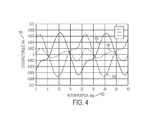
  • FIG. 4 shows an exemplary relationship between cogging torque and rotor position with individual contributions shown from each of two rotor laminations and with a resulting minimized cogging torque produced when the contributions from the first rotor lamination mitigate contributions from the second rotor lamination;
  • FIG. 5 shows an exemplary first rotor lamination having a first symmetric notch pattern
  • FIG. 6 shows an exemplary second rotor lamination having a second symmetric notch pattern that differs from the notch pattern of the first rotor lamination shown in FIG. 5 ;
  • FIG. 7 shown an exemplary rotor lamination having an asymmetric notch pattern in which notches are asymmetrically distributed along an outer edge of each of the magnets.
  • a machine such as a brushless interior permanent magnet motor 100 may include a rotor 102 disposed for rotation about a central axis of rotation 104 within a stator assembly 106 .
  • a rotor 102 may include a first rotor lamination 108 and a second rotor lamination 110 .
  • the first rotor lamination 108 comprises a substrate 112 and defines a first outer periphery 114 , which may be substantially cylindrical.
  • the second rotor lamination 110 also comprises a substrate 112 and defines a second outer periphery 116 , which may also be substantially cylindrical.
  • the first rotor lamination 108 and the second rotor lamination 110 are configured for defining, when joined into rotor assembly 102 , a central axis of rotation 104 and a plurality of interior magnet pockets 122 disposed about the central axis of rotation 104 .
  • the pockets may be disposed symmetrically about the central axis of rotation 104 , meaning that if the first rotor lamination 108 were divided into an even number of pie-shaped segments (e.g., six or eight or ten or twelve segments) such that each segment were to contain one interior magnet pocket, then each of the segments would look identical to each of the other segments.
  • Each interior magnet pocket of the plurality of interior magnet pockets 122 is configured for housing and retaining a permanent magnet 124 in a fixed position relative to the rotor assembly 102 . It should be appreciated that each of the magnet pockets may be formed entirely within the first rotor lamination 108 , entirely within the second rotor lamination 110 , or partially within the first rotor lamination 108 and partially within the second rotor lamination 110 .
  • a rotor 102 of an IPM comprises a first rotor lamination 108 that is mated with a second rotor lamination 110 .
  • the mating of the first rotor lamination 108 with the second rotor lamination 110 may be accomplished in a number of manners including by installing fasteners, such as rivets or screws, between the rotor laminations or by applying an adhesive between the rotor laminations, by welding the laminations or other means known in the art.
  • a rotor 102 includes a plurality of interior permanent magnets, each interior permanent magnet 124 being disposed in a respective interior magnet pocket of the plurality of interior magnet pockets 122 .
  • Each interior magnet pocket of the plurality of interior magnet pockets 122 may have a substantially rectangular cross-section, when such a cross-section is taken perpendicular to the central axis of rotation 104 .
  • each rotor lamination may be symmetric.
  • a plurality of pie-shaped segments of the rotor lamination may each be substantially similar to one another.
  • the symmetry may be evident when the pie-shaped segments are selected so as to each contain an entire interior magnet pocket 122 .
  • the symmetry may also be evident when the pie-shaped segments are selected so as to bisect each interior magnet pocket.
  • the first rotor lamination 108 may define a first cross-section taken perpendicular to the central axis of rotation 104 , wherein the first cross-section is symmetrical about a line 126 that intersects the central axis of rotation 104 .
  • the second rotor lamination 110 may similarly define a second cross-section taken perpendicular to the central axis of rotation 104 , wherein the second cross-section is symmetrical about a line 128 that intersects the central axis of rotation 104 .
  • both the first rotor lamination 108 and the second rotor lamination 110 may be stamped or punched or cast or machined in an identical, or nearly identical, manner. Accordingly, the first rotor lamination 108 and the second rotor lamination 110 may be produced using one or more common manufacturing processes. Then, prior to assembly into a rotor 102 , one of the rotor laminations would be rotated about an axis 130 that passes through the central axis of rotation 104 so as to become a second rotor lamination 110 prior to assembly with a first rotor lamination 108 .
  • first rotor lamination 108 defines at least one notch 132 disposed so as to form a first notch pattern 134 when an inside face 136 of the first rotor lamination 108 is facing in a first direction 138
  • second rotor lamination 110 defines at least one notch disposed so as to form a second notch pattern 140 when an inside face 142 of the second rotor lamination 110 is facing in a direction 144 opposing the first direction 138
  • the second notch pattern 140 being a mirror image of the first notch pattern 134 .
  • the first notch pattern 134 may comprise not only a center notch 132 disposed along a first radial line 148 that intersects a center 150 of each magnet pocket, but also an offset notch 152 that is disposed a first offset distance 154 from the first radial line 148 .
  • one of the rotor laminations e.g., the second rotor lamination 110
  • the other rotor lamination e.g., the first rotor lamination 108
  • This manufacturing and assembly technique may be beneficial not only for simplifying the manufacturing equipment and reducing the number of unique parts used in producing a rotor 102 , but also for improving quality and producing cancellation of certain harmonics in a mated assembly of rotor laminations.
  • a diameter 156 of the center notch 132 may be approximately equal to a diameter 158 of the offset notch 152 .
  • a diameter 156 of the center notch 132 may differ appreciably from a diameter 158 of the offset notch 152 .
  • the first rotor lamination 108 may define at least one notch disposed so as to form a first notch pattern 134 when an inside face 136 of the first rotor lamination 108 is facing in a first direction 138 while the second rotor lamination 110 defines at least one notch disposed so as to form a second notch pattern 140 when an inside face 136 of the first rotor lamination 108 is facing in a direction 144 opposing the first direction 138 (i.e., the second rotor lamination 110 has been flipped over, i.e., rotated about a line 126 that intersects the central axis of rotation 104 ), with the second notch pattern 140 differing appreciably from the first notch pattern 134 .
  • a first notch pattern 134 may comprises a center notch 132 disposed along a first radial line 148 that intersects a center 150 of each magnet pocket.
  • the first notch pattern 134 may comprise two offset notches that are each disposed a first offset distance 154 from the first radial line 148 on opposing sides of the first radial line 148 .
  • the second notch pattern 140 may also comprise a center notch 132 disposed along a first radial line 148 intersecting a center 150 of the magnet pocket and two offset notches that are each disposed a second offset distance 155 from the first radial line 148 on opposing sides of the first radial line 148 with the second offset distance 155 differing appreciably from the first offset distance 154 .
  • first rotor lamination 108 having one notch pattern e.g., widely spread, symmetrically disposed offset notches
  • second rotor lamination 110 having a different notch pattern e.g., narrowly spread, symmetrically disposed offset notches
  • a diameter 156 of the center notch 132 may be approximately equal to a diameter 156 of each offset notch 152 or, alternatively, may differ appreciably from a diameter 156 of each offset notch 152 .
  • a method of forming a rotor 102 may comprise forming a first rotor lamination 108 and a second rotor lamination 110 , rotating the second rotor lamination 110 about the axis of symmetry; and mating the first rotor lamination 108 to the second rotor lamination 110 .
  • the laminations may be suitably fastened.
  • the first rotor lamination 108 and the second rotor lamination 110 define, when joined into rotor assembly 102 , a central axis of rotation 104 and a plurality of interior magnet pockets 122 disposed symmetrically about the central axis of rotation 104 .
  • Each pocket of the plurality of interior magnet pockets 122 is configured for housing and retaining a permanent magnet 124 , and such retaining may be configured such that the magnets are retained in a fixed relationship relative to the rotor assembly 102 .
  • a first notch is disposed adjacent to a center 150 of each magnet pocket, and a second notch is also disposed adjacent to the magnet pocket and offset from the center 150 of the magnet pocket.
  • the first rotor lamination 108 and the second rotor lamination 110 each have an axis of symmetry passing through a center 150 of the respective rotor lamination and an edge of the rotor lamination. As shown in FIGS. 1-2 , however, the first rotor lamination 108 may be a mirror image of the second rotor lamination 110 .
  • the step of mating the first rotor lamination 108 to the second rotor lamination 110 is performed such that the first notch of the first rotor lamination 108 is disposed adjacent to the first notch of the second rotor lamination 110 .
  • Each notch of the first rotor lamination 108 and each notch of the second rotor lamination 110 may be formed by punching.
  • a first punching apparatus may be suitably used for punching each notch of the first rotor lamination 108 , with the same first punching apparatus also being suitably used for punching each notch of the second rotor lamination 110 .
  • the invention provides a simplified and cost-effective means for manufacturing a rotor 102 comprising a first rotor lamination 108 and a second rotor lamination 110 .
  • a method of forming a rotor 102 comprises forming a first rotor lamination 108 and a second rotor lamination 110 and mating the first rotor lamination 108 to the second rotor lamination 110 such that a magnet pocket of the first rotor lamination 108 is disposed adjacent to a magnet pocket of the second rotor lamination 110 .
  • the first rotor lamination 108 defines at least one notch disposed so as to form a first notch pattern 134 when an inside face 136 of the first rotor lamination 108 is facing in a first direction 138
  • the second rotor lamination 110 defines at least one notch disposed so as to form a second notch pattern 140 when an inside face 136 of the second rotor lamination 110 is facing in a direction 144 opposing the first direction 138
  • the second notch pattern 140 differs from the first notch pattern 134 .
  • first notch pattern 134 may comprise a center notch 132 disposed along a first radial line 148 intersecting a center 150 of the magnet pocket and two offset notches that are each disposed a first offset distance 154 from the first radial line 148 on opposing sides of the first radial line 148 .
  • second notch pattern 140 may comprise a center notch 132 disposed along a first radial line 148 intersecting a center 150 of the magnet pocket and two offset notches that are each disposed a second offset distance from the first radial line 148 on opposing sides of the first radial line 148 .
  • the second offset distance differs appreciably from the first offset distance 154 .
  • a diameter 156 of the center notch 132 is approximately equal to a diameter 156 of each of the two offset notches.
  • a diameter 156 of the center notch 132 may differ appreciably from a diameter 156 of each of the two offset notches.
  • FIG. 4 shows an exemplary relationship between cogging torque 160 and rotor position 162 with individual contributions shown from each of two rotor laminations 164 , 166 and with a resulting minimized cogging torque 168 produced when the contributions from the first rotor lamination 164 mitigate contributions from the second rotor lamination 166 .
  • cogging torque may be reduced as shown in FIG. 4 .
  • the differing rotor laminations may be provided, as shown in FIGS.
  • a notch pattern may be employed wherein the notches are asymmetrically distributed along an outer edge of each of the magnets 122 . More specifically, a first notch, having a smaller diameter, may be positioned at an off-center location along an outer edge of each of the magnets 122 while a second notch, having a larger diameter is positioned at a different off-center location along an outer edge of each of the magnets 122 . In one embodiment, the larger of the two notches is in leading position along each magnet, and in another embodiment, the larger of the two notches is in a trailing location along each magnet. It should also be appreciated that a notch having an intermediate-sized diameter may be disposed along the edge of each magnet in a position between the larger-diameter notch and the smaller-diameter notch.
  • rotor laminations may be superimposed upon one another so as to create a rotor 102 that produces desirable characteristics in terms of cogging torque and other parameters.
  • identical laminations may be combined in a front-to-back orientation with all of the notch patterns aligned.
  • identical laminations may be combined with one of the laminations flipped, producing a front-to-front orientation or a back-to-back orientation, so that the notch patterns may be reversed (i.e., mirror images of one another).
  • differing laminations may be used. Accordingly, notch patterns may be produced with variation or with uniformity along the axis of rotation 104 of the rotor 102 , and rotors of desirable lengths along the axis of rotation 104 can be economically and reliably produced.
  • a gap between adjacent segments of a segmented stator assembly 106 is disposed at an angle of approximately 45 degrees from the radial direction.
  • This intermediate angle (falling half-way between what would be a tangent on the one hand and an unskewed radius on the other hand) is disclosed as a representative example. It should be appreciated, however, that other skew angles may be advantageous in particular applications as well.

Landscapes

  • Engineering & Computer Science (AREA)
  • Power Engineering (AREA)
  • Manufacturing & Machinery (AREA)
  • Permanent Field Magnets Of Synchronous Machinery (AREA)
  • Iron Core Of Rotating Electric Machines (AREA)
  • Manufacture Of Motors, Generators (AREA)

Abstract

A rotor comprises a first rotor lamination and a second rotor lamination. The first rotor lamination and the second rotor lamination are configured for defining, when joined into rotor assembly, a central axis of rotation and a plurality of interior magnet pockets disposed symmetrically about the central axis of rotation, each pocket of the plurality of interior magnet pockets is configured for housing and retaining a permanent magnet. A method of forming a rotor comprises forming a first rotor lamination and a second rotor lamination, rotating the second rotor lamination about an axis of symmetry of the second rotor lamination; and mating the first rotor lamination to the second rotor lamination such that a first notch of the first rotor lamination is disposed adjacent to the first notch of the second rotor lamination.

Description

BACKGROUND OF THE INVENTION
The present invention relates to interior permanent magnet motors and more particularly to an interior permanent magnet motor with a rotor comprising shifted laminations.
Permanent magnet brushless motors are widely used in industrial drives for high performance application because of their high torque density. One form of permanent magnet motors, interior permanent magnet (IPM) motors, are in relatively widely use due to the relative simplicity. For example, IPM motors commonly employ imbedded magnets that are relatively inexpensive, such as rectangular magnet blocks, embedded in their rotor cores. By embedding the magnets in the rotor core rather than affixing the magnets to an exterior surface of the rotor, magnet retention and manufacturing yield may both be improved without significantly impacting motor output characteristics relative to surface-mounted, permanent magnet (SPM) motors.
In high performance applications for IPM motors, cogging torque can become an important challenge, as well as torque ripple, vibration, and speed pulsations. Cogging torque, for example, may be caused by interactions between permanent magnets mounted on the rotor and slots that may be defined in an associated stator. To minimize cogging torque in an IPM motor can present significant challenges relative to SPM motors because IPM motors may include relatively smaller air gaps such that traditional techniques such as linear skewing or shaping of the magnets may be rendered impractical by the simplified rectangular shapes of the permanent magnets. As a result, attempts to minimize the cogging torque often entail added complexity and reduced power (i.e, torque) output for a given size of motor.
Current designs for interior permanent magnet motors (IMPs) seek to minimize cogging torque using a variety of techniques such as shaping of magnets and magnet poles, skewing of rotor and/or stator magnets, step-skewing of magnets, combining slots and pole, and placement of dummy notches in the stator teeth. Unfortunately, though, various harmonics can remain problematic. For example, in one recently encountered configuration, an 18th order harmonic emerged prominently and was attributed to a gap between adjacent segments of a stator in an IMP.
Accordingly, it is desirable to have improved systems and methods for reducing cogging torque in IPM motors. It is also desirable to have an improved IPM brushless motor providing reduced cogging torque characteristics across a full range of harmonic frequencies.
SUMMARY OF THE INVENTION
In one exemplary embodiment of the invention, a rotor comprises a first rotor lamination and a second rotor lamination. The first rotor lamination comprises a nonmagnetic substrate and defines a first outer periphery. Similarly, the second rotor lamination comprises a nonmagnetic substrate and defines a second outer periphery. The first rotor lamination and the second rotor lamination are configured for defining, when joined into rotor assembly, a central axis of rotation and a plurality of interior magnet pockets disposed symmetrically about the central axis of rotation, each pocket of the plurality of interior magnet pockets is configured for housing and retaining a permanent magnet.
In a further aspect, a method of forming a rotor comprises forming a first rotor lamination and a second rotor lamination, rotating the second rotor lamination about an axis of symmetry of the second rotor lamination; and mating the first rotor lamination to the second rotor lamination such that a first notch of the first rotor lamination is disposed adjacent to the first notch of the second rotor lamination.
In accordance with this embodiment, the first rotor lamination and the second rotor lamination each define, when joined into rotor assembly, a central axis of rotation and a plurality of interior magnet pockets disposed symmetrically about the central axis of rotation. Each pocket of the plurality of interior magnet pockets is configured for housing and retaining a permanent magnet The first notch is disposed adjacent to a center of each magnet pocket and a second notch is also disposed adjacent to the magnet pocket and offset from the center of the magnet pocket. The first rotor lamination and the second rotor lamination each have an axis of symmetry passing through a center of the respective rotor lamination and an edge of the rotor lamination.
These and other advantages and features will become more apparent from the following description taken in conjunction with the drawings.
BRIEF DESCRIPTION OF THE DRAWINGS
The subject matter which is regarded as the invention is particularly pointed out and distinctly claimed in the claims at the conclusion of the specification. The foregoing and other features, and advantages of the invention are apparent from the following detailed description taken in conjunction with the accompanying drawings in which:
FIG. 1 shows an exemplary first rotor lamination;
FIG. 2 shows an exemplary second rotor lamination that is substantially a mirror image (i.e., a flipped version) of the rotor lamination of FIG. 1;
FIG. 3 shows an exemplary rotor comprising a first rotor lamination and a second rotor lamination;
FIG. 4 shows an exemplary relationship between cogging torque and rotor position with individual contributions shown from each of two rotor laminations and with a resulting minimized cogging torque produced when the contributions from the first rotor lamination mitigate contributions from the second rotor lamination;
FIG. 5 shows an exemplary first rotor lamination having a first symmetric notch pattern;
FIG. 6 shows an exemplary second rotor lamination having a second symmetric notch pattern that differs from the notch pattern of the first rotor lamination shown in FIG. 5; and
FIG. 7 shown an exemplary rotor lamination having an asymmetric notch pattern in which notches are asymmetrically distributed along an outer edge of each of the magnets.
DETAILED DESCRIPTION
Referring now to the Figures, where the invention will be described with reference to specific embodiments, without limiting same, in an exemplary embodiment, a machine, such as a brushless interior permanent magnet motor 100, may include a rotor 102 disposed for rotation about a central axis of rotation 104 within a stator assembly 106. As shown in FIG. 3, such a rotor 102 may include a first rotor lamination 108 and a second rotor lamination 110. The first rotor lamination 108 comprises a substrate 112 and defines a first outer periphery 114, which may be substantially cylindrical. In an exemplary embodiment, the second rotor lamination 110 also comprises a substrate 112 and defines a second outer periphery 116, which may also be substantially cylindrical.
The first rotor lamination 108 and the second rotor lamination 110 are configured for defining, when joined into rotor assembly 102, a central axis of rotation 104 and a plurality of interior magnet pockets 122 disposed about the central axis of rotation 104. As shown in FIGS. 1-2 and 5-6, the pockets may be disposed symmetrically about the central axis of rotation 104, meaning that if the first rotor lamination 108 were divided into an even number of pie-shaped segments (e.g., six or eight or ten or twelve segments) such that each segment were to contain one interior magnet pocket, then each of the segments would look identical to each of the other segments. Each interior magnet pocket of the plurality of interior magnet pockets 122 is configured for housing and retaining a permanent magnet 124 in a fixed position relative to the rotor assembly 102. It should be appreciated that each of the magnet pockets may be formed entirely within the first rotor lamination 108, entirely within the second rotor lamination 110, or partially within the first rotor lamination 108 and partially within the second rotor lamination 110.
As mentioned above, in an exemplary embodiment, a rotor 102 of an IPM comprises a first rotor lamination 108 that is mated with a second rotor lamination 110. The mating of the first rotor lamination 108 with the second rotor lamination 110 may be accomplished in a number of manners including by installing fasteners, such as rivets or screws, between the rotor laminations or by applying an adhesive between the rotor laminations, by welding the laminations or other means known in the art.
In an exemplary embodiment, a rotor 102 includes a plurality of interior permanent magnets, each interior permanent magnet 124 being disposed in a respective interior magnet pocket of the plurality of interior magnet pockets 122. Each interior magnet pocket of the plurality of interior magnet pockets 122 may have a substantially rectangular cross-section, when such a cross-section is taken perpendicular to the central axis of rotation 104.
In an exemplary embodiment, each rotor lamination may be symmetric. For example, as mentioned above, a plurality of pie-shaped segments of the rotor lamination may each be substantially similar to one another. As shown in FIGS. 1-2, the symmetry may be evident when the pie-shaped segments are selected so as to each contain an entire interior magnet pocket 122. As shown in FIGS. 5-6, the symmetry may also be evident when the pie-shaped segments are selected so as to bisect each interior magnet pocket.
As shown in FIGS. 5 and 6, in one exemplary embodiment, the first rotor lamination 108 may define a first cross-section taken perpendicular to the central axis of rotation 104, wherein the first cross-section is symmetrical about a line 126 that intersects the central axis of rotation 104. Similarly, the second rotor lamination 110 may similarly define a second cross-section taken perpendicular to the central axis of rotation 104, wherein the second cross-section is symmetrical about a line 128 that intersects the central axis of rotation 104.
It may be convenient that the second cross-section be a mirror image of the first cross-section. In such an embodiment, as shown in FIGS. 1-2, for example, both the first rotor lamination 108 and the second rotor lamination 110 may be stamped or punched or cast or machined in an identical, or nearly identical, manner. Accordingly, the first rotor lamination 108 and the second rotor lamination 110 may be produced using one or more common manufacturing processes. Then, prior to assembly into a rotor 102, one of the rotor laminations would be rotated about an axis 130 that passes through the central axis of rotation 104 so as to become a second rotor lamination 110 prior to assembly with a first rotor lamination 108.
The above-described common manufacturing process may be useful, for example, in connection with an embodiment wherein the first rotor lamination 108 defines at least one notch 132 disposed so as to form a first notch pattern 134 when an inside face 136 of the first rotor lamination 108 is facing in a first direction 138, while the second rotor lamination 110 defines at least one notch disposed so as to form a second notch pattern 140 when an inside face 142 of the second rotor lamination 110 is facing in a direction 144 opposing the first direction 138, with the second notch pattern 140 being a mirror image of the first notch pattern 134. In particular, the first notch pattern 134 may comprise not only a center notch 132 disposed along a first radial line 148 that intersects a center 150 of each magnet pocket, but also an offset notch 152 that is disposed a first offset distance 154 from the first radial line 148.
When the first and second rotor laminations are produced so as to both include the identical notch pattern, as shown in FIGS. 1-2, one of the rotor laminations (e.g., the second rotor lamination 110) may be flipped prior to being mated with the other rotor lamination (e.g., the first rotor lamination 108) such that a leading notch may be provided by one rotor lamination while a following notch is provided by the other rotor lamination. This manufacturing and assembly technique may be beneficial not only for simplifying the manufacturing equipment and reducing the number of unique parts used in producing a rotor 102, but also for improving quality and producing cancellation of certain harmonics in a mated assembly of rotor laminations.
In accordance with the above-described embodiments, a diameter 156 of the center notch 132 may be approximately equal to a diameter 158 of the offset notch 152. Alternatively, a diameter 156 of the center notch 132 may differ appreciably from a diameter 158 of the offset notch 152.
In an exemplary embodiment, as shown in FIGS. 1-2, the first rotor lamination 108 may define at least one notch disposed so as to form a first notch pattern 134 when an inside face 136 of the first rotor lamination 108 is facing in a first direction 138 while the second rotor lamination 110 defines at least one notch disposed so as to form a second notch pattern 140 when an inside face 136 of the first rotor lamination 108 is facing in a direction 144 opposing the first direction 138 (i.e., the second rotor lamination 110 has been flipped over, i.e., rotated about a line 126 that intersects the central axis of rotation 104), with the second notch pattern 140 differing appreciably from the first notch pattern 134.
In an exemplary embodiment, as shown in FIGS. 5-6, a first notch pattern 134 may comprises a center notch 132 disposed along a first radial line 148 that intersects a center 150 of each magnet pocket. In addition, the first notch pattern 134 may comprise two offset notches that are each disposed a first offset distance 154 from the first radial line 148 on opposing sides of the first radial line 148. The second notch pattern 140 may also comprise a center notch 132 disposed along a first radial line 148 intersecting a center 150 of the magnet pocket and two offset notches that are each disposed a second offset distance 155 from the first radial line 148 on opposing sides of the first radial line 148 with the second offset distance 155 differing appreciably from the first offset distance 154. The combination of a first rotor lamination 108 having one notch pattern (e.g., widely spread, symmetrically disposed offset notches) with a second rotor lamination 110 having a different notch pattern (e.g., narrowly spread, symmetrically disposed offset notches) may produce a desirable cogging torque characteristic via the cancellation of otherwise undesirable contributions from each of the laminations.
It should be appreciated that a diameter 156 of the center notch 132 may be approximately equal to a diameter 156 of each offset notch 152 or, alternatively, may differ appreciably from a diameter 156 of each offset notch 152.
A method of forming a rotor 102, therefore, may comprise forming a first rotor lamination 108 and a second rotor lamination 110, rotating the second rotor lamination 110 about the axis of symmetry; and mating the first rotor lamination 108 to the second rotor lamination 110. Once mated, the laminations may be suitably fastened. In accordance with the method, the first rotor lamination 108 and the second rotor lamination 110 define, when joined into rotor assembly 102, a central axis of rotation 104 and a plurality of interior magnet pockets 122 disposed symmetrically about the central axis of rotation 104. Each pocket of the plurality of interior magnet pockets 122 is configured for housing and retaining a permanent magnet 124, and such retaining may be configured such that the magnets are retained in a fixed relationship relative to the rotor assembly 102. A first notch is disposed adjacent to a center 150 of each magnet pocket, and a second notch is also disposed adjacent to the magnet pocket and offset from the center 150 of the magnet pocket. The first rotor lamination 108 and the second rotor lamination 110 each have an axis of symmetry passing through a center 150 of the respective rotor lamination and an edge of the rotor lamination. As shown in FIGS. 1-2, however, the first rotor lamination 108 may be a mirror image of the second rotor lamination 110.
The step of mating the first rotor lamination 108 to the second rotor lamination 110 is performed such that the first notch of the first rotor lamination 108 is disposed adjacent to the first notch of the second rotor lamination 110. Each notch of the first rotor lamination 108 and each notch of the second rotor lamination 110 may be formed by punching. In connection with the above-described mirror-imaged laminations, a first punching apparatus may be suitably used for punching each notch of the first rotor lamination 108, with the same first punching apparatus also being suitably used for punching each notch of the second rotor lamination 110. Thus, the invention provides a simplified and cost-effective means for manufacturing a rotor 102 comprising a first rotor lamination 108 and a second rotor lamination 110.
In an exemplary embodiment, a method of forming a rotor 102 comprises forming a first rotor lamination 108 and a second rotor lamination 110 and mating the first rotor lamination 108 to the second rotor lamination 110 such that a magnet pocket of the first rotor lamination 108 is disposed adjacent to a magnet pocket of the second rotor lamination 110. In accordance with this exemplary embodiment, the first rotor lamination 108 defines at least one notch disposed so as to form a first notch pattern 134 when an inside face 136 of the first rotor lamination 108 is facing in a first direction 138, while the second rotor lamination 110 defines at least one notch disposed so as to form a second notch pattern 140 when an inside face 136 of the second rotor lamination 110 is facing in a direction 144 opposing the first direction 138, and while the second notch pattern 140 differs from the first notch pattern 134.
It should be appreciated that the first notch pattern 134 may comprise a center notch 132 disposed along a first radial line 148 intersecting a center 150 of the magnet pocket and two offset notches that are each disposed a first offset distance 154 from the first radial line 148 on opposing sides of the first radial line 148. In addition, the second notch pattern 140 may comprise a center notch 132 disposed along a first radial line 148 intersecting a center 150 of the magnet pocket and two offset notches that are each disposed a second offset distance from the first radial line 148 on opposing sides of the first radial line 148. Finally, as shown in FIGS. 5-6, the second offset distance differs appreciably from the first offset distance 154. A diameter 156 of the center notch 132 is approximately equal to a diameter 156 of each of the two offset notches. Alternatively, a diameter 156 of the center notch 132 may differ appreciably from a diameter 156 of each of the two offset notches.
FIG. 4 shows an exemplary relationship between cogging torque 160 and rotor position 162 with individual contributions shown from each of two rotor laminations 164, 166 and with a resulting minimized cogging torque 168 produced when the contributions from the first rotor lamination 164 mitigate contributions from the second rotor lamination 166. By providing two differing rotor laminations, each having a unique notch pattern, and combining the two differing rotor laminations to form a single rotor 102, cogging torque may be reduced as shown in FIG. 4. As discussed above the differing rotor laminations may be provided, as shown in FIGS. 1-2, by manufacturing a single asymmetric pattern on the laminations, and then flipping one of the laminations before combining them to form the rotor 102. Alternatively, as shown in FIGS. 5-6, two symmetric, yet differing, laminations may be combined so as to form the rotor 102 with advantageous reductions in cogging torque.
As shown in FIG. 7, a notch pattern may be employed wherein the notches are asymmetrically distributed along an outer edge of each of the magnets 122. More specifically, a first notch, having a smaller diameter, may be positioned at an off-center location along an outer edge of each of the magnets 122 while a second notch, having a larger diameter is positioned at a different off-center location along an outer edge of each of the magnets 122. In one embodiment, the larger of the two notches is in leading position along each magnet, and in another embodiment, the larger of the two notches is in a trailing location along each magnet. It should also be appreciated that a notch having an intermediate-sized diameter may be disposed along the edge of each magnet in a position between the larger-diameter notch and the smaller-diameter notch.
It should be appreciated that two or more rotor laminations may be superimposed upon one another so as to create a rotor 102 that produces desirable characteristics in terms of cogging torque and other parameters. In some embodiments, identical laminations may be combined in a front-to-back orientation with all of the notch patterns aligned. In other embodiments, identical laminations may be combined with one of the laminations flipped, producing a front-to-front orientation or a back-to-back orientation, so that the notch patterns may be reversed (i.e., mirror images of one another). In further embodiments, differing laminations may be used. Accordingly, notch patterns may be produced with variation or with uniformity along the axis of rotation 104 of the rotor 102, and rotors of desirable lengths along the axis of rotation 104 can be economically and reliably produced.
In addition to employing a rotor having a desirable, optimized pattern of notches, which may be constant or which may be varying along an axial direction, further improvements in cogging torque may also be realized by skewing a gap between segments of a stator assembly used in connection with the rotor. For example, in a segmented stator assembly 106, a gap may be present between stator segments with the gap typically being oriented along a radial direction. It has been found, however, that by skewing the gap, such that the gap is disposed at an angle relative to a radial direction, cogging torque may advantageously be reduced.
For example, in one embodiment, a gap between adjacent segments of a segmented stator assembly 106 is disposed at an angle of approximately 45 degrees from the radial direction. This intermediate angle (falling half-way between what would be a tangent on the one hand and an unskewed radius on the other hand) is disclosed as a representative example. It should be appreciated, however, that other skew angles may be advantageous in particular applications as well. For example, it may be desirable to configure the stator segments such that a gap between segments is disposed at an angle relative to the radial direction, with the angle being approximately 10 degrees or 20 degrees or 30 degrees or 45 degrees or 60 degrees, with each selection having its own effect on cogging torque. It is up to the designer, then, to choose a particular combination of segment gap skewing and rotor notch pattern to produce a suitable cogging torque characteristic.
While the invention has been described in detail in connection with only a limited number of embodiments, it should be readily understood that the invention is not limited to such disclosed embodiments. Rather, the invention can be modified to incorporate any number of variations, alterations, substitutions or equivalent arrangements not heretofore described, but which are commensurate with the spirit and scope of the invention. Additionally, while various embodiments of the invention have been described, it is to be understood that aspects of the invention may include only some of the described embodiments. Accordingly, the invention is not to be seen as limited by the foregoing description.

Claims (9)

Having thus described the invention, it is claimed:
1. A rotor comprising:
a first rotor lamination comprising a first substrate and defining a first outer periphery and a first plurality of interior magnet pockets;
a second rotor lamination comprising a second substrate and defining a second outer periphery and a second plurality of interior magnet pockets;
a joining of the first rotor lamination and the second rotor lamination into a rotor assembly defines a central axis of rotation and the first and second plurality of interior magnet pockets are disposed symmetrically about the central axis of rotation and each pocket of the first and second plurality of interior magnet pockets are proximately aligned such that each pocket houses and retains a permanent magnet that extends through the first rotor lamination and the second rotor lamination;
the first rotor lamination includes a first notch pattern having a first center notch disposed along a first radial line intersecting a center of each magnet pocket and a leading notch, the first center notch and leading notch each extending from the first plurality of interior magnet pockets;
the second rotor lamination includes a second notch pattern having a second center notch disposed along a second radial line intersecting the center of each magnet pocket and a following notch offset from the leading notch, the second center notch and the following notch each extending from the second plurality of interior magnet pockets; and
the first center notch of the first notch pattern is proximately aligned with the second center notch of the second notch pattern.
2. The rotor of claim 1, wherein each pocket of the plurality of interior magnet pockets has a rectangular cross-section taken perpendicular to the central axis of rotation.
3. The rotor of claim 1, wherein the second notch pattern is a mirror image of the first notch pattern.
4. The rotor of claim 3:
wherein the leading notch is disposed a first offset distance from the first radial line.
5. The rotor of claim 1:
wherein the first notch pattern has a first offset notch, the leading notch and the first offset notch are each disposed a first offset distance from the first radial line on opposing sides of the first radial line;
wherein the second notch pattern has a second offset notch, the following notch and the second offset notch are each disposed a second offset distance from the first radial line on opposing sides of the first radial line; and
wherein the second offset distance differs from the first offset distance.
6. The rotor of claim 5, wherein a diameter of at least one of the first center notch and the second center notch differs from a diameter of each offset notch.
7. A method of forming a rotor comprising:
forming a first rotor lamination and a second rotor lamination, the first rotor lamination defines a first notch pattern that extends from a magnet pocket of the first rotor lamination and includes a first center notch disposed along a first radial line intersecting a center of the magnet pocket and two offset notches that are each disposed a first offset distance from the first radial line on opposing sides of the first radial line, the second rotor lamination defines a second notch pattern that extends from a magnet pocket of the second rotor lamination and includes a second center notch disposed along the first radial line intersecting the center of the magnet pocket and two offset notches that are each disposed a second offset distance from the first radial line on opposing sides of the first radial line, and the second notch pattern differs from the first notch pattern; and
mating the first rotor lamination to the second rotor lamination such that the magnet pocket of the first rotor lamination is disposed adjacent to and is approximately aligned with the magnet pocket of the second rotor lamination.
8. A method of forming a rotor as claimed in claim 7:
wherein the second offset distance differs from the first offset distance.
9. A method of forming a rotor as claimed in claim 8, wherein a diameter of the center notch is approximately equal to a diameter of each of the two offset notches.
US13/839,225 2013-03-15 2013-03-15 Interior permanent magnet motor with shifted rotor laminations Expired - Fee Related US9634530B2 (en)

Priority Applications (3)

Application Number Priority Date Filing Date Title
US13/839,225 US9634530B2 (en) 2013-03-15 2013-03-15 Interior permanent magnet motor with shifted rotor laminations
EP14159381.4A EP2779386A3 (en) 2013-03-15 2014-03-13 Interior permanent magnet motor with shifted rotor laminations
CN201410151194.5A CN104052179B (en) 2013-03-15 2014-03-15 Internal permanent magnet motor with offset rotor laminations

Applications Claiming Priority (1)

Application Number Priority Date Filing Date Title
US13/839,225 US9634530B2 (en) 2013-03-15 2013-03-15 Interior permanent magnet motor with shifted rotor laminations

Publications (2)

Publication Number Publication Date
US20140265707A1 US20140265707A1 (en) 2014-09-18
US9634530B2 true US9634530B2 (en) 2017-04-25

Family

ID=50272442

Family Applications (1)

Application Number Title Priority Date Filing Date
US13/839,225 Expired - Fee Related US9634530B2 (en) 2013-03-15 2013-03-15 Interior permanent magnet motor with shifted rotor laminations

Country Status (3)

Country Link
US (1) US9634530B2 (en)
EP (1) EP2779386A3 (en)
CN (1) CN104052179B (en)

Cited By (3)

* Cited by examiner, † Cited by third party
Publication number Priority date Publication date Assignee Title
US10505416B2 (en) 2017-11-09 2019-12-10 Ford Global Technologies, Llc Patterned offset pole rotor
US20210344239A1 (en) * 2018-09-18 2021-11-04 Lg Innotek Co., Ltd. Motor
US20220140677A1 (en) * 2019-09-05 2022-05-05 Nidec Motor Corporation Laminated rotor having deflecting magnet retaining prongs and support posts for the prongs

Families Citing this family (6)

* Cited by examiner, † Cited by third party
Publication number Priority date Publication date Assignee Title
JP2016073056A (en) * 2014-09-29 2016-05-09 トヨタ自動車株式会社 Manufacturing method of rotor
US10720807B2 (en) 2015-10-30 2020-07-21 Hitachi Automotive Systems, Ltd. Magnet-type rotor, rotary electric machine equipped with magnet-type rotor, and electric vehicle equipped with rotary electric machine
US11532961B2 (en) 2018-09-21 2022-12-20 Steering Solutions Ip Holding Corporation Pole lobed rotor core
DE102019124186A1 (en) * 2019-09-10 2021-03-11 Schaeffler Technologies AG & Co. KG Rotor, electric motor and method for reducing the unbalance of a rotor
DE102020114008A1 (en) * 2020-05-26 2021-12-02 Schaeffler Technologies AG & Co. KG Set of laminated cores and rotor with set of laminated cores attached to the rotor shaft
KR102777794B1 (en) * 2020-08-05 2025-03-06 현대자동차주식회사 Rotor with a fixation jaws asymmetrically based on shaft key

Citations (12)

* Cited by examiner, † Cited by third party
Publication number Priority date Publication date Assignee Title
GB564865A (en) * 1943-04-21 1944-10-17 Stanley Isaiah Hitchcock Improvements in or relating to permanent- or electro-magnet motor or generator structures
US5663605A (en) * 1995-05-03 1997-09-02 Ford Motor Company Rotating electrical machine with electromagnetic and permanent magnet excitation
US5864196A (en) * 1995-09-20 1999-01-26 Yun; Ja Dong Rotor for a motor including non-magnetic plates laminated between silicon steel sheets
EP0909003A2 (en) 1997-10-13 1999-04-14 Matsushita Electric Industrial Co., Ltd A motor using a rotor including interior permanent magnets
US20020112904A1 (en) * 2000-03-02 2002-08-22 Hitachi, Ltd. Hybrid electric vehicle employing permanent magnetic type dynamo-electric machine
US20040041489A1 (en) 2002-08-28 2004-03-04 Horst Gary E. Interior permanent magnet motor for use in washing machines
US20050062354A1 (en) 2002-03-22 2005-03-24 Ebm-Papst St. Georgen Gmbh & Co. Kg Electric motor with poles shaped to minimize cogging torque
US20050121990A1 (en) * 2003-12-08 2005-06-09 Nissan Motor Co., Ltd. Rotor for rotary electric machine
US20080224558A1 (en) * 2007-03-15 2008-09-18 A. O. Smith Corporation Interior permanent magnet motor including rotor with flux barriers
JP2011120333A (en) 2009-12-01 2011-06-16 Mitsubishi Electric Corp Rotor for permanent magnet embedded motor, blower, and compressor
CN102916544A (en) 2011-08-01 2013-02-06 珠海格力节能环保制冷技术研究中心有限公司 Motor rotor structure, permanent-magnet synchronous motor and variable-frequency compressor
WO2013032353A1 (en) 2011-08-26 2013-03-07 General Electric Company Permanent magent rotor having a combined laminated stack and method of assembly

Family Cites Families (3)

* Cited by examiner, † Cited by third party
Publication number Priority date Publication date Assignee Title
DE102004017507A1 (en) * 2004-04-08 2005-10-27 Minebea Co., Ltd. Rotor arrangement for an electric machine
JP4709132B2 (en) * 2006-12-28 2011-06-22 三菱電機株式会社 Rotor of permanent magnet embedded motor, motor for blower and motor for compressor
JP5869592B2 (en) * 2011-02-28 2016-02-24 ユーキューエム テクノロジーズ インコーポレーテッド Brushless permanent magnet electric machine capable of using low coercivity magnets

Patent Citations (16)

* Cited by examiner, † Cited by third party
Publication number Priority date Publication date Assignee Title
GB564865A (en) * 1943-04-21 1944-10-17 Stanley Isaiah Hitchcock Improvements in or relating to permanent- or electro-magnet motor or generator structures
US5663605A (en) * 1995-05-03 1997-09-02 Ford Motor Company Rotating electrical machine with electromagnetic and permanent magnet excitation
US5864196A (en) * 1995-09-20 1999-01-26 Yun; Ja Dong Rotor for a motor including non-magnetic plates laminated between silicon steel sheets
EP0909003A2 (en) 1997-10-13 1999-04-14 Matsushita Electric Industrial Co., Ltd A motor using a rotor including interior permanent magnets
US6353275B1 (en) * 1997-10-13 2002-03-05 Noriyoshi Nishiyama Rotor with adhesive filled grooves fastening interior permanent magnets
US20020112904A1 (en) * 2000-03-02 2002-08-22 Hitachi, Ltd. Hybrid electric vehicle employing permanent magnetic type dynamo-electric machine
US20050062354A1 (en) 2002-03-22 2005-03-24 Ebm-Papst St. Georgen Gmbh & Co. Kg Electric motor with poles shaped to minimize cogging torque
US6717314B2 (en) * 2002-08-28 2004-04-06 Emerson Electric Co. Interior permanent magnet motor for use in washing machines
US20040041489A1 (en) 2002-08-28 2004-03-04 Horst Gary E. Interior permanent magnet motor for use in washing machines
US20050121990A1 (en) * 2003-12-08 2005-06-09 Nissan Motor Co., Ltd. Rotor for rotary electric machine
CN1627600A (en) 2003-12-08 2005-06-15 日产自动车株式会社 Rotor for rotary electric machine
US20080224558A1 (en) * 2007-03-15 2008-09-18 A. O. Smith Corporation Interior permanent magnet motor including rotor with flux barriers
JP2011120333A (en) 2009-12-01 2011-06-16 Mitsubishi Electric Corp Rotor for permanent magnet embedded motor, blower, and compressor
CN102916544A (en) 2011-08-01 2013-02-06 珠海格力节能环保制冷技术研究中心有限公司 Motor rotor structure, permanent-magnet synchronous motor and variable-frequency compressor
WO2013032353A1 (en) 2011-08-26 2013-03-07 General Electric Company Permanent magent rotor having a combined laminated stack and method of assembly
US20140292132A1 (en) * 2011-08-26 2014-10-02 General Electric Company Permanent magnet rotor having a combined laminated stack and method of assembly

Non-Patent Citations (5)

* Cited by examiner, † Cited by third party
Title
Chinese Office Action for CN Application No. 201410151194.5 dated Dec. 31, 2015.
European Search report for EP Application No. 14159381.4 dated Feb. 7, 2017.
Machine translation of CN102916544.
Machine translation of JP2011120333.
Third Chinese Office Action for CN Application No. 201410151194.5 dated Dec. 30, 2016, English Translation.

Cited By (7)

* Cited by examiner, † Cited by third party
Publication number Priority date Publication date Assignee Title
US10505416B2 (en) 2017-11-09 2019-12-10 Ford Global Technologies, Llc Patterned offset pole rotor
US20210344239A1 (en) * 2018-09-18 2021-11-04 Lg Innotek Co., Ltd. Motor
US11936245B2 (en) * 2018-09-18 2024-03-19 Lg Innotek Co., Ltd. Motor
US20220140677A1 (en) * 2019-09-05 2022-05-05 Nidec Motor Corporation Laminated rotor having deflecting magnet retaining prongs and support posts for the prongs
US11670976B2 (en) * 2019-09-05 2023-06-06 Nidec Motor Corporation Laminated rotor having deflecting magnet retaining prongs deflecting when inserting magnets in an axial directions and support posts with constant width
US20240079920A1 (en) * 2019-09-05 2024-03-07 Nidec Motor Corporation Laminated rotor having deflecting magnet retaining prongs and support posts for limiting an amount of deflection of the prongs
US12034339B2 (en) * 2019-09-05 2024-07-09 Nidec Motor Corporation Laminated rotor having deflecting magnet retaining prongs deflecting when inserting magnets in axial directions and support posts with constant width

Also Published As

Publication number Publication date
EP2779386A3 (en) 2017-03-08
CN104052179A (en) 2014-09-17
US20140265707A1 (en) 2014-09-18
CN104052179B (en) 2019-02-19
EP2779386A2 (en) 2014-09-17

Similar Documents

Publication Publication Date Title
US9634530B2 (en) Interior permanent magnet motor with shifted rotor laminations
US7595575B2 (en) Motor/generator to reduce cogging torque
CN103891102B (en) Rotor, compressor and the refrigerating air conditioning device of permanent magnet embedded-type electric motivation
KR101288732B1 (en) Permanent-magnet type synchronous motor
US9923436B2 (en) Rotor for a rotary electric machine
US8937417B2 (en) Rotating electric machine and wind power generation system
US9024498B2 (en) Rotating electrical machine
US20140091663A1 (en) Permanent-magnet type rotating electrical machine
US20140062254A1 (en) Permanent Magnet Rotating Electrical Machine
JP5202492B2 (en) Rotor, blower and compressor of embedded permanent magnet motor
CN103633759B (en) Rotor and motor
CN108667176B (en) IPM rotor and method for manufacturing magnet for IPM rotor
JP5697566B2 (en) Magnetic gear and manufacturing method thereof
CN109698591B (en) Rotor and motor
JP4964291B2 (en) Rotor, blower and compressor of embedded permanent magnet motor
JP2000278896A (en) Motor rotor
JP5005830B1 (en) Rotor core, rotor and rotating electric machine
KR100624381B1 (en) Rotor of permanent magnet embedded motor and its manufacturing method
JP2015233368A (en) Permanent magnet type motor
JP2001359266A (en) Structure of brushless dc motor
JP2015033245A (en) Rotor for permanent magnet motor
JP5944683B2 (en) Rotor and motor
JP4855747B2 (en) Permanent magnet type reluctance rotating electric machine
JP5959616B2 (en) Rotor, compressor and refrigeration air conditioner for embedded permanent magnet motor
JP2014113036A (en) Embedded magnet rotor, motor, and method of manufacturing embedded magnet rotor

Legal Events

Date Code Title Description
AS Assignment

Owner name: STEERING SOLUTIONS IP HOLDING CORPORATION, MICHIGA

Free format text: ASSIGNMENT OF ASSIGNORS INTEREST;ASSIGNORS:KLEIN, STEVEN D.;KLASS, JEFFREY T.;ISLAM, MOHAMMED R.;AND OTHERS;REEL/FRAME:030038/0724

Effective date: 20130318

STCF Information on status: patent grant

Free format text: PATENTED CASE

MAFP Maintenance fee payment

Free format text: PAYMENT OF MAINTENANCE FEE, 4TH YEAR, LARGE ENTITY (ORIGINAL EVENT CODE: M1551); ENTITY STATUS OF PATENT OWNER: LARGE ENTITY

Year of fee payment: 4

FEPP Fee payment procedure

Free format text: MAINTENANCE FEE REMINDER MAILED (ORIGINAL EVENT CODE: REM.); ENTITY STATUS OF PATENT OWNER: LARGE ENTITY

LAPS Lapse for failure to pay maintenance fees

Free format text: PATENT EXPIRED FOR FAILURE TO PAY MAINTENANCE FEES (ORIGINAL EVENT CODE: EXP.); ENTITY STATUS OF PATENT OWNER: LARGE ENTITY

STCH Information on status: patent discontinuation

Free format text: PATENT EXPIRED DUE TO NONPAYMENT OF MAINTENANCE FEES UNDER 37 CFR 1.362

FP Lapsed due to failure to pay maintenance fee

Effective date: 20250425