US9588420B2 - Apparatus and method for indirect surface cleaning - Google Patents
Apparatus and method for indirect surface cleaning Download PDFInfo
- Publication number
- US9588420B2 US9588420B2 US15/048,774 US201615048774A US9588420B2 US 9588420 B2 US9588420 B2 US 9588420B2 US 201615048774 A US201615048774 A US 201615048774A US 9588420 B2 US9588420 B2 US 9588420B2
- Authority
- US
- United States
- Prior art keywords
- photomask
- feature
- substrate
- pellicle
- thin film
- Prior art date
- Legal status (The legal status is an assumption and is not a legal conclusion. Google has not performed a legal analysis and makes no representation as to the accuracy of the status listed.)
- Active
Links
Images




Classifications
-
- G—PHYSICS
- G03—PHOTOGRAPHY; CINEMATOGRAPHY; ANALOGOUS TECHNIQUES USING WAVES OTHER THAN OPTICAL WAVES; ELECTROGRAPHY; HOLOGRAPHY
- G03F—PHOTOMECHANICAL PRODUCTION OF TEXTURED OR PATTERNED SURFACES, e.g. FOR PRINTING, FOR PROCESSING OF SEMICONDUCTOR DEVICES; MATERIALS THEREFOR; ORIGINALS THEREFOR; APPARATUS SPECIALLY ADAPTED THEREFOR
- G03F1/00—Originals for photomechanical production of textured or patterned surfaces, e.g., masks, photo-masks, reticles; Mask blanks or pellicles therefor; Containers specially adapted therefor; Preparation thereof
- G03F1/68—Preparation processes not covered by groups G03F1/20 - G03F1/50
- G03F1/82—Auxiliary processes, e.g. cleaning or inspecting
-
- B—PERFORMING OPERATIONS; TRANSPORTING
- B08—CLEANING
- B08B—CLEANING IN GENERAL; PREVENTION OF FOULING IN GENERAL
- B08B7/00—Cleaning by methods not provided for in a single other subclass or a single group in this subclass
- B08B7/0035—Cleaning by methods not provided for in a single other subclass or a single group in this subclass by radiant energy, e.g. UV, laser, light beam or the like
- B08B7/0042—Cleaning by methods not provided for in a single other subclass or a single group in this subclass by radiant energy, e.g. UV, laser, light beam or the like by laser
-
- G—PHYSICS
- G03—PHOTOGRAPHY; CINEMATOGRAPHY; ANALOGOUS TECHNIQUES USING WAVES OTHER THAN OPTICAL WAVES; ELECTROGRAPHY; HOLOGRAPHY
- G03F—PHOTOMECHANICAL PRODUCTION OF TEXTURED OR PATTERNED SURFACES, e.g. FOR PRINTING, FOR PROCESSING OF SEMICONDUCTOR DEVICES; MATERIALS THEREFOR; ORIGINALS THEREFOR; APPARATUS SPECIALLY ADAPTED THEREFOR
- G03F1/00—Originals for photomechanical production of textured or patterned surfaces, e.g., masks, photo-masks, reticles; Mask blanks or pellicles therefor; Containers specially adapted therefor; Preparation thereof
- G03F1/68—Preparation processes not covered by groups G03F1/20 - G03F1/50
- G03F1/72—Repair or correction of mask defects
-
- Y—GENERAL TAGGING OF NEW TECHNOLOGICAL DEVELOPMENTS; GENERAL TAGGING OF CROSS-SECTIONAL TECHNOLOGIES SPANNING OVER SEVERAL SECTIONS OF THE IPC; TECHNICAL SUBJECTS COVERED BY FORMER USPC CROSS-REFERENCE ART COLLECTIONS [XRACs] AND DIGESTS
- Y10—TECHNICAL SUBJECTS COVERED BY FORMER USPC
- Y10S—TECHNICAL SUBJECTS COVERED BY FORMER USPC CROSS-REFERENCE ART COLLECTIONS [XRACs] AND DIGESTS
- Y10S134/00—Cleaning and liquid contact with solids
- Y10S134/902—Semiconductor wafer
Definitions
- This patent disclosure relates generally to devices and methods for cleaning surfaces and, more particularly, to devices and methods for cleaning surfaces of components used in the semiconductor industry, optical systems, and the like.
- the devices and methods disclosed herein are applicable to extending the useful life of photomask reticles, improving the performance of photomask reticles, or combinations thereof.
- the photolithographic production of semiconductors utilizes a series of photomasks to produce the features on the semiconducting wafers.
- a photomask is imaged onto the prepared semiconducting wafer.
- additional processing may be used to modify the semiconductor wafer material in the pattern of the photomask.
- additional photomasks may be imaged onto the wafer. High-precision alignment of the subsequent photomasks relative to features produced using the previous photomasks promotes the quality of structures manufactured on the semiconductor wafer.
- Metrics to evaluate the quality of structures manufactured on a semiconductor wafer may include dimensional precision of a single feature, dimensional precision of the location of a one feature relative to other features, or combinations thereof.
- Some dimensions of the features on the photomask may be referred to as critical dimensions (CDs), and the placement of features on the photomask relative to the other features may be referred to as overlay.
- CDs critical dimensions
- overlay For the most critical photomasks, the overlay requirement can be a few nanometers or less across the entire length of the mask.
- the properties of photomasks may vary within ranges resulting from tolerances applied during the manufacturing process.
- the optical performance characteristics of partially absorbing films may depend on the material composition of the film and a thickness of the film.
- the CDs and overlay of the mask may vary depending on the precision of the write tools, the etching processes, the number and type of cleaning processes, and the temperatures and stresses applied on the photomask during fabrication. Variability in the characteristics of the unprocessed photomasks (e.g., compositional and film stress differences), can also contribute to the final variances in CD and overlay by varying the response of the photomask to the manufacturing processes.
- the performance characteristics of photomask can change due to use in production.
- the photomask may be exposed to intense radiation, including ultraviolet (UV) radiation, deep ultraviolet (DUV) radiation, or extreme ultraviolet (EUV) radiation.
- UV ultraviolet
- DUV deep ultraviolet
- EUV extreme ultraviolet
- the radiation can cause photo-degradation of the photomask, particularly of the thin film.
- photomasks may require cleaning after use in production for a period of time. These cleaning processes may alter the characteristics of the photomask, and there may be a limit to the number of times a mask can be re-cleaned and still meet specifications.
- a process for reducing the mask-to-mask variability of one or more of the critical process characteristics of a photomask could potentially improve the overall production yield of a semiconductor fabrication process using photomasks. Firstly, correcting out-of-specification masks and making them viable for production use could help to avoid production delays and costs associated with fabrication of new photomasks to replace the out-of-specification photomasks. Secondly, reducing the variation in one or more performance characteristics may result in tolerance margin that can be used to expand the acceptable range of another characteristic. Thus, reducing the variability of any critical photomask characteristic may provide the benefit of reducing the variability in the printed features on the product wafers, which improves device yield and performance.
- a method for modifying one or more characteristics of a material to affect the materials optical properties and/or affect the performance or lifetime of a device that utilizes the target material is provided.
- a method to modify the overlay of a photomask is provided. The method may include irradiation of the substrate surface to create a thermal energy or heat build-up in the substrate and/or thin film(s).
- the resulting temperature increase in the partial absorbing film produces a thermally based material change that may include, but is not limited to, composition changes (e.g., dehydration, oxidation), surface changes (e.g., morphology, roughness), or material property changes (e.g., annealing, densification).
- composition changes e.g., dehydration, oxidation
- surface changes e.g., morphology, roughness
- material property changes e.g., annealing, densification
- the method may include the use of electromagnetic radiation and in particular the use of laser radiation.
- the inventive method may include a reduced risk of thin film damage by utilizing relatively long pulse-widths or by heating the substrate and thin film, by irradiation, to a similar temperature.
- the method provides for improved photomask performance by localized modification and/or uniform or non-uniform global modification of the photomask overlay.
- the method may have advantage for applications where the environment above the substrate is substantially or full enclosed.
- the method may also include directing an electromagnetic energy source through a material disposed relative to the surface that is part of the substrates environmental enclosure.
- the inventive method could be used to modify the overlay of a pellicalized photomask.
- an apparatus for laser material modification utilizing the above described method may include metrology for inspection of the photomask overlay. These measurements may be advantageously performed before, during or after application of the process and could be used for closed-loop control of the process during use.
- the above mentioned apparatus may also include means of monitoring and controlling the temperature of the substrate and/or adjacent materials. Said means may include local temperature control or temperature control over the entire substrate.
- a photomask fabrication process that utilizes the method and/or apparatus disclosed herein is provided to modify the overlay of the photomask.
- Certain embodiments of the present invention provide the ability to modify a material without surface preparation or environmental control above the substrate surface. Certain embodiments provide material modification with reduced risk of substrate damage. Further, certain embodiments of the present invention provide for an extended lifetime of photomasks used in wafer printing. Certain embodiments of the present invention also provide for increased precision in the manufacture of photomask used in wafer printing. In addition, certain embodiments of the present invention provide for reduced wafer manufacturing costs including improved photomask yield and performance leading to improved device yield.
- FIG. 1 a illustrates a schematic diagram of externally-generated thermal excitation of a partially absorbing material.
- FIG. 1 b illustrates a side view of a thin absorbing film on top of a substrate.
- FIG. 2 illustrates a plot of a MoSi absorption spectrum from the deep ultraviolet to the far infrared region of the electromagnetic spectrum.
- FIG. 3 illustrates a plot of a quartz absorption spectrum from the deep ultraviolet to the far infrared region of the electromagnetic spectrum.
- FIG. 4 illustrates a diagram of a photomask surface with thin film partial absorber including a pellicle attached thereto.
- FIG. 5 a illustrates a schematic diagram of a photomask with a pellicle showing a laser beam focused through the pellicle and onto the surface.
- FIG. 5 b illustrates a schematic diagram of the beam spot size on the pellicle versus on the mask produced by focusing.
- FIG. 5 c illustrates a schematic diagram of a photomask with a pellicle showing laser beam focused through the pellicle and onto the surface and a side view of the beam spot on the pellicle.
- FIG. 6 a illustrates a cross sectional view of a Gaussian beam energy distribution and the corresponding temperature profile produced.
- FIG. 6 b illustrates a cross sectional view of a top-hat beam energy distribution and the corresponding temperature profile produced.
- FIG. 7 illustrates a diagram of a photomask with a cold plate contacting the bottom of the mask.
- FIG. 8 illustrates a diagram showing forced convection cooling of areas on the photomask.
- FIG. 9 a illustrates a schematic diagram of a single pass of the laser beam across a surface to minimize local thermal energy or heat buildup. A single row or column with large lateral spacing between spots is illustrated.
- FIG. 9 b illustrates a schematic diagram of two passes of the laser beam across surface to minimize local thermal energy or heat buildup. A single row with two sets of beam spots overlapped with large spacing between sets of pulses is illustrated.
- FIG. 9 c illustrates a schematic diagram of multiple laser passes over an area of the substrate to achieve material change processing of the section of the substrate.
- FIG. 9 d illustrates a schematic diagram of a second dimension of material change processing.
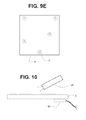
- FIG. 9 e illustrates a schematic diagram representing the use of non-contiguous pulses on the surface.
- FIG. 10 illustrates a schematic diagram of a partial absorber material on a substrate with a thermocouple or an infrared temperature monitoring devices.
- FIG. 11 illustrates a schematic diagram of a partial absorber material on a substrate with imaging, microscopy, spectroscopy, or combination system for material property analysis.
- FIG. 12 illustrates a schematic diagram of a partial absorber material on a substrate with a measurement system where the measurement system and laser beam delivery share a common path.
- FIG. 13 illustrates a system diagram for a robotic loading and X/Y/Z stage motion of a substrate relative to a laser beam.
- FIG. 14 illustrates a plan view of a photomask assembly, according to an aspect of the disclosure.
- FIG. 15 illustrates a plan view of a photomask assembly, according to an aspect of the disclosure.
- FIG. 16 illustrates a plan view of a photomask assembly, according to an aspect of the disclosure.
- FIG. 17 illustrates a plan view of a photomask assembly, according to an aspect of the disclosure.
- FIG. 18 illustrates a plan view of a photomask assembly, according to an aspect of the disclosure.
- FIG. 19 illustrates a plan view of a photomask assembly, according to an aspect of the disclosure.
- FIG. 20 illustrates a plan view of a photomask assembly, according to an aspect of the disclosure.
- FIG. 21 illustrates a plan view of a photomask assembly, according to an aspect of the disclosure.
- FIG. 1 a illustrates a schematic diagram of externally-generated thermal excitation of a partially absorbing material.
- the excitation apparatus 100 includes an external energy source 1 configured and arranged to direct an energy beam 2 onto a thin absorbing film 3 disposed on the surface of a partially or completely transmitting substrate 4 .
- An excitation method may include direct excitation of the thin absorbing film 3 upon the substrate 4 by the energy beam 2 generated by the external energy source 1 .
- the substrate 4 may be a photomask or compose at least a portion of a photomask assembly, and the terms “substrate” and “photomask” may be used interchangeably throughout the disclosure, unless specified otherwise.
- Partially absorbing films are built specifically to allow at least a fraction of the lithographic light wavelength to pass through the film to enhance the printing effects on the wafer.
- partially absorbing films may not include opaque films.
- the external energy source 1 is an electromagnetic energy source and the energy beam 2 is an electromagnetic beam.
- the external energy source 1 is a light source, and the energy beam 2 is a beam of light.
- the external energy source 1 is a laser light source, and the energy beam 2 is a beam of laser light.
- the external energy source 1 may produce an energy beam 2 embodying other forms of energy, including but not limited to, an electron beam, a microwave beam, an x-ray beam, an acoustic wave, combinations thereof, or any other energy beam known in the art.
- Interaction of the energy beam 2 with the thin absorbing film 3 or the substrate 4 may cause thermal excitation of the thin absorbing film 3 , the substrate 4 , or combinations thereof.
- interaction of the energy beam 2 with the thin absorbing film 3 results in an increase in thermal energy of a material of the thin absorbing film 3 , which may cause an increase in the temperature of the material of the thin absorbing film 3 .
- interaction of the energy beam 2 with the substrate 4 results in an increase in thermal energy of a material of the substrate 4 , which may cause an increase in the temperature of the material of the substrate 4 .
- a temperature of the substrate 4 when a temperature of the substrate 4 is greater than a temperature of the thin absorbing film 3 , heat may transfer from the substrate 4 to the thin absorbing film 3 by conduction, convection, radiation, or combinations thereof, thereby further increasing the thermal energy or temperature of the thin absorbing film 3 .
- a thermal energy increase in a material may refer to an increase in enthalpy (h), an increase in internal energy (u), an increase in temperature, or combinations thereof.
- FIG. 1 b illustrates a side view of a thin absorbing film 3 on top of a substrate 4 .
- the thin absorbing film 3 is patterned, such that some portions of the substrate 4 are in communication with the external energy source 1 via the thin absorbing film 3 disposed thereon, while other portions of the substrate are in direct communication with the external energy source 1 without prior transmission of the energy beam 2 through the thin absorbing film 3 .
- heat generated in portions of the substrate 4 in direct communication with the external energy source 1 may conduct through the substrate 4 before transfer into the thin absorbing film 3 via conduction, convection, radiation, or combinations thereof.
- a method for modifying one or more characteristics of a material to affect the material properties and/or affect the performance or lifetime of a device that utilizes the target material is provided.
- a method for modifying the position of features on a substrate is provided.
- the method may increase the useable lifetime of the photomask 4 by moving the position of features in the thin absorbing film 3 that have been shifted by production use, cleaning processes, or external forces applied to the photomask (e.g., attachment of a pellicle to the photomask 4 ).
- the method may include excitation of the substrate surface to create a uniform increase in thermal energy or temperature rise in the substrate 4 and thin absorbing film 3 .
- the resulting temperature increase in the substrate 4 and/or thin film 3 produces a thermally-based material change that may include, but is not limited to, composition changes (e.g., dehydration, oxidation), surface changes (e.g., morphology, roughness), or material property changes (e.g., annealing, densification).
- the result of the thermally-based material change can be a change to an optical performance characteristic of the photomask.
- External energy sources 1 other than lasers, may be used.
- the external energy source 1 may include lamps or other devices that can radiate energy along any portion of the electromagnetic spectrum, including microwaves, infrared radiation, near-ultraviolet radiation, deep ultraviolet radiation, extreme ultraviolet radiation, electron beam generators, x-ray generators, or combinations thereof.
- the thin absorbing film 3 and the substrate 4 may be fabricated from or include many different materials.
- the substrate 4 could have thin film absorber properties and may be targeted for material modification without a thin absorbing film 3 disposed thereon.
- a temperature increase in the thin absorbing film 3 may produce a thermally-based change in a material of the thin absorbing film 3 , and/or a property of the thin absorbing film 3 , including, but not limited to, dehydration, oxidation, surface roughness, annealing, or combinations thereof.
- a threshold temperature to modify the thin absorbing film 3 is below a temperature that could cause damage to a material of the substrate 4 , thereby mitigating risk of thermally-based damage to the substrate 4 .
- Aspects of the disclosure may also reduce the risk of substrate 4 damage relative to other substrate or film modification techniques because it can, in some instances, utilize relatively long pulse-widths which may reduce the potential for multi-photon absorption processes.
- a pulse-width of the energy beam 2 may range from 1 microsecond to 10 milliseconds.
- the laser pulse-width may be greater than 1 microsecond up to and including continuous wave laser excitation.
- FIG. 4 illustrates a photomask assembly 102 including a thin absorbing film 3 and a pellicle 8 attached to the thin absorbing film 3 .
- the method may also include directing the energy beam 2 through a material disposed proximate to the outer surface of a pellicle 104 that is part of the substrate's environmental enclosure.
- apparatus and methods according to the present disclosure may be used to modify the overlay of a pellicalized photomask (see FIG. 5 a ), where the pellicle 104 includes a pellicle film 8 , a pellicle frame 9 , and a pellicle frame adhesive 10 .
- the method includes selecting a laser wavelength that substantially coincides with a strong absorption of a thin absorbing film 3 and setting the laser energy and pulse width to produce the desired thin absorbing film 3 modification.
- Increased absorption in the substrate 4 allows lower laser energies to be used for the process and, therefore, may decrease the potential for damage to adjacent materials that may interact with the laser beam 2 as it is incident upon or reflected from the surface of the substrate 4 .
- an energy beam 2 wavelength that is highly absorbed by the substrate 4 is selected, which may be beneficial when the majority of the substrate has the thin film absorber removed. Further, selecting a wavelength of the energy beam 2 close to a strong absorption band of the substrate 4 may also reduce thermal or temperature differences between the thin film absorber 3 and the substrate 4 , thereby decreasing differential thermal expansion between the thin absorbing film 3 and the substrate 4 .
- the use of multiple laser beam wavelengths and/or laser beam energies may be used if multiple thin film absorbers or a substrate that consists of more than one material are used. Multiple wavelengths may be produced, for example, by utilizing multiple laser sources or a single tunable laser source, or both. Multiple energies can be used by control of the output energy of each laser source using controls and/or devices internal or external to each laser source.
- a substrate consisting of multiple materials may require consideration of the material parameters as well as the energy beam 2 parameters, including excitation wavelength selection.
- a laser wavelength having significant absorption in the thin film absorber 3 material is selected.
- the selected wavelength will have a small absorption in or be highly reflected by other materials on or in the substrate 4 such that the thermal energy increase will be primarily in the thin film absorber 3 material. This may be particularly useful if material adjacent to the thin film absorber will be affected by the process temperature.
- the pellicle film 8 and pellicle frame adhesive 10 may be in close proximity to the thin film absorber film.
- Reducing the overall thermal energy or temperature build up in the system may be important if, for example, if the pellicle frame adhesive outgases or degrades. Minimizing the total thermal energy or temperature buildup may also be important if significant heat is transferred to the environment 7 between the photomask 4 surface and the pellicle film 8 because this thermal build up could affect the film 8 , the adhesive 10 , the pellicle frame 9 materials, or combinations thereof. In some cases, the process temperature may be preferentially maintained below the damage or modification temperatures of the substrate 4 material.
- the basis of the material modification process may make it particularly desirable for all areas of a substrate 4 to reach a temperature substantially near that typically needed for modification without exceeding the thermal damage threshold of the substrate 4 or other adjacent materials. It is possible that the laser energy required to bring one of the materials to the material modification process temperature will produce thermal damage in the other material, particularly if there is a significant difference between the material absorptions.
- the local fluence of the energy beam 2 may be controlled based on the materials being exposed.
- the basis of the material modification process may make it particularly desirable for different areas of a substrate 4 to reach different temperatures and levels of processing.
- the rate and extent of material modification may be dependent on the laser energy.
- the local fluence of the beam may be controlled based on the desired amount of material change in the different areas of the substrate 4 .
- the material modification may depend on the number of times the energy source is applied to the substrate 4 . In this case, the number of applications of the energy source may be varied across the substrate to produce different amounts of material modification at different areas of the substrate 4 .
- longer laser pulse widths up to and including continuous wavelength (CW) lasers, are used to improve the thermal equilibrium between materials with significantly different absorption constants.
- CW continuous wavelength
- the use of such longer laser pulse widths produce the highest thermal energy or temperature increase in the overall system and may not be useable if a material adjacent to the substrate surface has a thermal damage threshold or other adverse thermally induced affect below the process temperature.
- a laser wavelength that has a significant absorption in several or all of the materials on the substrate 4 is selected.
- the same laser energy may then, for example, be used to produce the desired process temperature below any of the substrate materials' damage thresholds.
- thermal properties including diffusivity
- the heat flow from the higher absorbing material to the lower absorbing material may increase the temperature of the lower absorbing material using a lower process energy than may be required by direct exposure of the lower absorbing material by the energy source.
- thermal treatment can modify the substrate and/or thin film of a photomask to cause shifts in the positions of the features in the thin film relative to other features on the mask. This example may be used throughout the several aspects disclosed herein.
- a photomask assembly 102 includes a quartz substrate 4 with a thin film absorber 3 or partially absorbing film 3 on the critical surface of the substrate 4 (see FIGS. 1 a and 1 b ).
- the thin absorbing film 3 being a metal film
- partially absorbing films there may be wavelength regions where these films do not significantly absorb, unlike pure metal films.
- certain embodiments may utilize a wavelength that is highly absorbed by the thin film while the substrate is weakly absorbing or transparent to the selected wavelength. This process may minimize the overall temperature increase of the system and may reduce the risk of direct absorption damage of the quartz substrate.
- FIG. 14 illustrates a plan view of a photomask assembly marked with an intended or design feature array 110 on the surface of the photomask 4 .
- the design feature array 110 illustrated in FIG. 14 is schematically shown as an array of cross (+) features; however, it will be appreciated that the cross features so illustrated are merely representative of points on any photomask features known in the art.
- the design feature array 110 is generated by patterning the thin film 3 on the photomask substrate 4 . However, patterns could be made directly into the substrate surface without or without the presence of a thin film on the surface.
- the majority of the photomask is covered with a thin film absorber 3 , which may be a so-called “dark field mask,” and the individual features of the design feature array 110 are generated by removing the thin film only at the design feature locations.
- the majority of the photomask has the thin film absorber removed, which may be a so-called “clear field mask,” and the individual features of the design feature array 110 are generated by leaving the thin film only at the design feature locations.
- the actual position of the features may vary from the designed pattern array, for example, as a result of variance in the manufacturing process or feature migration resulting from photomask use in a semiconductor fabrication process.
- FIG. 15 illustrates a plan view of a photomask assembly 102 , according to an aspect of the disclosure. Similar to FIG. 14 , FIG. 15 includes a design array of features 110 marked with cross symbols, but in addition, FIG. 15 includes an actual array of features 112 marked by diamond ( ⁇ ) symbols. Each actual feature in the actual array of features 112 may correspond to a design feature in the design array of features 110 . A difference between the actual position of a feature from the actual feature array 112 and design or intended position for a corresponding design feature in the design feature array 110 may define an error in the overlay. Depending on the source(s) of the error, the position of the actual pattern relative to intended pattern may be systematic and/or random.
- the error in the overlay may have a component in a first direction 114 , a component in a second direction 116 , or combinations thereof.
- a total position error over all actual features in the actual feature array 112 may be defined according to a statistical measure over all actual features in the actual feature array 112 , including but not limited to, a sum of errors, a square root of a sum of squares of the errors, or any other statistical measure of error known in the art.
- the dimensions of the process, the energy of the laser and the number of times each location is exposed will vary depending on the response of the photomask to the process.
- the response to applying the disclosed process to the entire photomask substrate 4 , at a constant fluence may be a contracting radial pattern as shown in FIG. 16 .
- FIG. 16 illustrates a plan view of a photomask assembly 102 , according to an aspect of the disclosure.
- the cross (+) symbols represent an actual feature array 120 before treatment of the substrate 4 using the external energy source 1
- the diamond ( ⁇ ) symbols represent an actual feature array 122 after treatment of the substrate 4 using the external energy source 1 , according to aspects of the disclosure.
- the radial contraction of the pattern toward the center of the photomask can be seen in FIG. 16 .
- This illustration is only one possible result of applying the disclosed method to the entire photomask substrate 4 and is used for illustrative purposes only. Alternatively, the process could result in an expanding radial distribution or a fixed lateral movement at each location, or other relative motion.
- FIG. 17 illustrates a plan view of a photomask assembly 102 , according to an aspect of the disclosure.
- the cross (+) symbols represent a design feature array 110
- the diamond ( ⁇ ) symbols represent an actual feature array 112 .
- the overlay error between the design feature array 110 and the actual feature array 112 is a radially expanding pattern from the center of the photomask 4 . It will be appreciated that treating the photomask 4 with an energy beam 2 from the external energy source 1 , according to aspects of the disclosure, may contract the actual feature array 112 radially toward a center 124 of the photomask 4 . The result is shown in FIG. 18 .
- FIG. 18 illustrates a plan view of a photomask assembly 102 , according to an aspect of the disclosure.
- the cross (+) symbols represent a design feature array 110
- the diamond ( ⁇ ) symbols represent an actual feature array 112 .
- application of the energy beam 2 onto the photomask substrate 4 moves the actual feature array 112 closer to the design feature array 110 , thereby reducing the overlay error of the photomask assembly 102 .
- FIG. 19 shows a plan view of a photomask assembly 102 , according to an aspect of the disclosure.
- the cross (+) symbols represent a design feature array 110
- the diamond ( ⁇ ) symbols represent an actual feature array 112 after additional treatment of the photomask assembly 102 in FIG. 18 with an energy beam 2 , according to aspects of the disclosure.
- application of the process multiple times could move the actual feature array 112 even closer to the design feature array 110 , thereby further reducing the overlay error of the photomask assembly 102 , as shown in FIG. 19 .
- the dimensions of the process area, the energy of the laser, and the number of times each location is exposed may vary depending on initial overlay error of the photomask 4 .
- the overlay error may only occur over a portion of the photomask 4 , as illustrated in FIG. 20 .
- FIG. 20 illustrates a plan view of a photomask assembly 102 , according to an aspect of the disclosure.
- the cross (+) symbols represent a design feature array 110
- the diamond ( ⁇ ) symbols represent an actual feature array 112 .
- only the lower right portion 126 of the photomask 4 shows significant overlay error.
- treating only the lower right portion 126 , or the error affected area, of the photomask 4 with the energy beam 2 may be advantageous to reduce the overlay error in of the lower right portion 126 the photomask 4 , without treating the entirety of the photomask 4 with the energy beam 2 .
- FIG. 21 illustrates a plan view of a photomask assembly 102 , according to an aspect of the disclosure.
- the cross (+) symbols represent a design feature array 110
- the diamond ( ⁇ ) symbols represent the actual feature array 112 from FIG. 20 after treatment of the photomask 4 using the energy beam 2 , according to aspects of the disclosure.
- treatment of the lower right portion 126 of the photomask 4 reduced the overlay error in the lower right portion 126 of the photomask 4 .
- an area of the process (size of the energy beam 2 ) may be advantageously adjusted to a small value relative to the distances between individual adjacent features in the actual feature array 112 , so that the effect of the process has a resolution less than the distance between individual adjacent features in the actual feature array 112 .
- the energy and number of pulses may vary for each location on the mask so that features further away from the intended or design position can be moved a greater amount than features that are initially closer to the intended or design position.
- the average material change could be controlled by processing multiple separated areas on the substrate surface ( FIG. 9 a ), if there is a relatively fixed material change produced.
- the spacing between the process areas 13 and/or density of process areas relative to unprocessed area could be used to control the relative amount of the material change process.
- a specific example of a representative method is the changing of one or more properties of a thin absorbing film 3 on a photomask substrate 4 with laser excitation to shift the features of the thin absorbing film 3 .
- the thin absorbing film 3 is a Molybdenum Silicon Oxynitride (Mo w Si x O y N z ) film, which may be abbreviated as MoSi
- MoSi Molybdenum Silicon Oxynitride
- a shift in the overlay may result from a thermal material property change in the MoSi film.
- the material change may include, but is not limited to, oxidation, annealing, dehydrating, or densification of the thin film absorber 3 material.
- the lowest thermal damage point will typically be the melting/reflow point for the base quartz substrate, i.e., around 2912 degrees Fahrenheit (1600 degrees Celsius).
- material changes e.g., annealing
- the temperature for material change can occur below the damage level of the photomask substrate materials.
- FIG. 2 is schematic diagram of an absorption curve for a MoSi partial absorbing photomask film.
- the main absorption occurs either below 0.3 ⁇ m wavelength or above 9 ⁇ m wavelength.
- the shorter wavelengths are not in a particularly desirable wavelength range, because they are usually significantly absorbed by air and because they have a higher photon energy and are therefore more likely to produce multiphoton processes.
- wavelengths in the infrared region may be preferred over DUV because the longer wavelength reduces the potential for multi-photon processes and environmental absorption.
- selecting a wavelength above 9 ⁇ m, for example near the 11.5 ⁇ m absorption peak is particularly desirable according to aspects of the disclosure, which typically produces a high absorption in the MoSi film without high environmental absorption.
- near the 11.5 um absorption peak means a wavelength in the range of 10.5 um to 12.5 um, although other wavelengths in the infrared region may be acceptable. Choosing a wavelength in this region could minimize the total thermal energy or heat input to the system during use of the current invention by lowering the energy required to produce the material change.
- Quartz substrates used for photomasks may be specifically designed to have high transmission in the deep ultraviolet (DUV) wavelength range (see FIG. 3 ). This is typically accomplished by using synthetically fused silica substrates that have extremely low level of impurities. According to aspects of the present disclosure, it may be an advantage to have a significant absorption in the MoSi and a lower absorption in the quartz substrate. As shown in FIG. 3 , the absorption for the example quartz substrate does not have a significant absorption near the MoSi film absorption peak of 11.5 um.
- DUV deep ultraviolet
- the quartz substrate of the photomask 4 it may be advantageous to select a wavelength that is highly absorbed by the quartz substrate of the photomask 4 such that the all areas of the photomask 4 surface reach the desired process temperature.
- thermal transfer between the materials will occur preferentially from quartz to the absorber layer. This may occur because quartz has a relatively low thermal diffusivity and the thin film absorber films typically contain a metal component and therefore have a higher thermal diffusivity.
- This embodiment may be advantageous if the temperature differential between the thin film absorber and the photomask substrate is important. For example, it is possible that a differential thermal expansion between the thin absorbing film 3 and the substrate 4 could lead to damage of one or both of the materials.
- wavelengths in the infrared region may be preferred over DUV because the longer wavelength reduces the potential for multi-photon processes and environmental absorption.
- “near the 9 um absorption peak,” means a wavelength in the range of 8 um to 10 um, although other wavelengths in the infrared region may be acceptable. This wavelength may also provide an advantage for photomasks that have a partially absorbing film coating (i.e., MoSi). As shown in FIG. 2 , the example MoSi material has a reduced absorption near 9 um, compared to the peak at 11.5 um, and would therefore have a reduced thermal energy or temperature increase produced directly by the energy beam 2 from the external energy source 1 .
- the film material temperature reached at constant energy beam 2 fluence using wavelengths in this range should be similar to that for quartz because of the high quartz absorption and the higher thermal diffusivity of the thin film absorber compared to quartz. This is also expected to be true even if the partially absorbing film has a relatively high absorption coefficient in this wavelength range because of the expected thermal diffusivity advantage. It is possible that selecting other wavelengths in this region would improve the overall thermal uniformity by varying the relative thermal build up in the materials produced by direct absorption of the energy beam 2 from the energy source 1 .
- the type of photomask may also be considered when selecting a wavelength for overlay correction. For example, when using dark field masks, selecting a wavelength that is highly absorbed in the thin film may be preferred.
- the overlay modification may best be produced by modification of the thin film, because the majority of the surface is covered with thin film. When using clear field masks, selecting a wavelength that is highly absorbed by the substrate may be preferred.
- the overlay modification may best be produced by modification of the substrate surface, because the majority of the surface is not covered with thin film. In either case, producing a similar thermal modification in areas of the photomask that have thin film and areas of the photomask without thin film may be preferred so that the modification will be predictable across the mask surface.
- the process just described for use according to certain aspects of the disclosure may increase the useable lifetime of a photomask 4 by correcting the overlay changes caused by use of the photomask in production and from cleaning processes. Exposure of the photomask during production use can degrade the thin film of the photomask. These changes in film composition can produce shifts in the overlay of the mask. Use of the present invention, to correct overlay changes caused by production use, may be advantageously implemented through a pellicle 8 . This could allow the photomask 4 to be placed back into production instead of requiring a new photomask be fabricated to replace the degraded photomask. In addition, there are times where a photomask must be removed from production and cleaned for other reasons, which may include damage of the pellicle film and haze growth.
- Conventional cleaning process sequences may require the removal of an attached pellicle, cleaning, and then attachment of a new pellicle.
- the act of removing a pellicle from the mask can produce changes in the overlay of the photomask.
- wet clean processing may degrade the thin and can affect the overlay of the photomask.
- Use of the presently disclosed process can correct the positions of the features and effectively recover the feature positioning lost to the pellicle removal and wet clean. Adding another pellicle to the photomask after cleaning may also change the positions of the features in the thin film because of adding stress to the photomask.
- aspects of the presently disclosed process may be advantageously used through the pellicle 8 in the photomask assembly 102 to correct the overlay of the photomask 4 .
- An additional advantage of modifying the overlay of the photomask could be an improvement in mask-to-mask variability.
- the number of wet cleanings that each mask receives can vary and depends on several of the production parameters.
- a photomask may receive wet cleanings during the processes required to generate the pattern as well as wet cleanings following repair processes that correct imperfection in the pattern.
- the final overlay will depend on cumulative effects of the fabrication processes and the number of wet cleanings. This may result in mask-to-mask variation in overlay prior to use.
- Mask-to-mask variability can be improved, according to aspects of the present disclosure.
- a different amount of overlay modification could be applied to different photomasks before use to adjust each mask to the same overlay level.
- By tightening the variation of this aspect of the photomask it is possible that the allowable variation of other mask parameters can be increased.
- the allowable critical dimension variation during use can be increased if each photomask has a more precise overlay. This may be of particular advantage in combination with repair processing, since reduced dimensional control requirements may provide for a higher photomask yield.
- Methods according to aspects of the present disclosure may be applied to photomask thin film absorber modification and do not require removal of the pellicle 8 from the photomask assembly 102 .
- Performing the thin film absorber modifications after pellicalization has the advantage of ensuring that no additional wet cleaning is required before using aspects of the presently disclosed process.
- a laser-based overlay modification can be performed through the pellicle film material 8 without affecting the pellicle film characteristics (see FIG. 4 ).
- the absorption of the pellicle film at the process wavelength and the energy density (fluence) of the energy beam 2 at the surface of the pellicle film is typically considered.
- the material modification process generally does not produce a temperature increase in the pellicle film that is above the damage threshold.
- the pellicle film there may be significant absorption in the pellicle film near the 9 ⁇ m absorption peaks for the quartz substrate.
- the temperature increase in a substance may be proportional to the fluence of an energy beam 2 applied to the surface; ⁇ T ⁇ F (1)
- ⁇ T is the temperature change within the material and F is the absorbed laser fluence.
- F is the fluence
- E is the energy
- r is the radius of the beam on the substrate surface.
- the ratio of the beam radius 14 at the pellicle 8 to the beam radius 13 on the photomask 4 surface is typically increased by focusing the beam 2 through the pellicle 8 and, therefore, the relative fluence on the pellicle film compared to the photomask substrate surface can be reduced ( FIG. 5 b ).
- utilizing process parameters that produce a large temperature increase in the system may be limited by the damage threshold of the pellicle film.
- the use of pulse-width, relative fluence, process duration, and external material cooling control are example off process parameters that can be used to minimize the temperature increase of the system.
- aspects of the disclosed process may also have a benefit to fully absorbing photomasks, optical photomasks without thin film absorber (quartz only), and next generation photomasks such as used for extreme ultra-violet (EUV) and nano-imprint lithography (NIL).
- Optical photomasks without thin film absorber have features that are etched directly into the base quartz substrate.
- Nano-imprint lithography masks also have features fabricated into the substrate and typically do not have a thin film. For both these types of masks, aspects of the disclosed process can be used to produce a thermal modification in the substrate that induces the desired modification of overlay.
- aspects of the disclosed process may be applied to EUV photomasks by modification of the absorber or the base substrate.
- thermal modification to the multi-layer can be used to modify the overlay.
- the thermal damage level of the reflective multi-layer must be considered, because changes to the multilayer may affect the performance of the photomask.
- the pulse width, temporal pulse shape and the spatial distribution of the laser may be used to enhance the material change process or increase the safe operation range for processing according to certain embodiments of the present invention.
- Shorter pulse widths can be used to minimize the overall thermal input to the system (substrate and environment).
- Longer pulse widths can be used to maintain the process temperature for an extended period of time enhancing the uniformity of the process and to prevent temperature differentials between different materials.
- the temporal pulse shape can be used to control the temperature rise within the thin film absorber. A long temperature rise can be used to produce an initial effect (e.g., annealing) that would be followed by a secondary effect (e.g., oxidation).
- the use of multiple pulses can also be used to lower the beam energy that is desirable for complete processing, thereby further decreasing the risk of substrate damage by analogy to utilizing longer pulse-widths.
- the advantage of multiple pulses being that it is possible that localized cooling of one material may prevent damage while allowing for the process to be performed.
- the pellicle film could be cooled to prevent multiple pulse thermal build up while the thin film absorber is not cooled and the pulse-to-pulse thermal build up is used to reach process temperature in the film.
- the spatial distribution of the laser beam can be used to increase the process window and process uniformity.
- FIG. 6 a shows a Gaussian spatial distribution 15 , that may produce a temperature gradient 16 in the substrate 4 while FIG. 6 b has a flat top or top hat spatial distribution 17 allowing for a more uniform temperature rise within the substrate 18 .
- the spatial distribution can be used to increase the process window. Having a flat-top or top-hat spatial distribution allows for a uniform temperature rise within the beam spot, whereas a Gaussian distribution typically produces a temperature gradient within the beam spot. In order to avoid risk of substrate damage, the maximum energy in the beam is typically limited by the peak of a Gaussian distribution.
- a Gaussian energy distribution is expected to have a higher risk of exceeding the material damage level compared to a flat top beam if the energy variation is similar to the energy difference between the process and damage energy levels. Also, a Gaussian distribution may produce a non-uniform material change affect, whereas a top-hat energy distribution is expected to produce a more uniform material change within the working area of the beam.
- aspects of the present disclosure involve a thermally-based processes, it is sometimes desirable to manage the overall temperature of the system to avoid damage to thermally sensitive materials in proximity to the processed material. This is particularly true in the case of photomask material modification processing without pellicle removal.
- the pellicle films typically have a low thermal damage threshold. Therefore, it is sometimes useful to avoid an overall system temperature build up that may transfer to and/or damage the pellicle material. This includes the pellicle frame and the enclosed environment between the mask surface and the pellicle film.
- Managing the system temperature can be accomplished in several ways. The following examples illustrate several representative methods of sample cooling and it is understood that other methods may exist.
- One way to manage the system temperature is through contact cooling.
- the photomask for example, may be placed in contact with a plate 19 that acts as a heat sink to draw the heat generated on the front surface of the mask toward the back of the mask (see FIG. 7 ). This reduces the heat transfer to the environment above the mask surface, the pellicle film and the adhesive between the pellicle frame and the mask surface.
- the cooling can be accomplished in a variety of ways, including flowing a heat transfer fluid into inlet port 21 and out of outlet port 20 of the heat sink, by flowing other cooling fluids or gases over the mask and/or pellicle, thermoelectric cooling or laser induced cooling of a portion or the entirety of the mask and/or pellicle, or combinations thereof.
- the heat transfer fluid may be water, ethylene glycol, air, nitrogen, combinations thereof, or any other heat transfer fluid known in the art.
- Filtered and/or cooled gas or liquid flow may be directed onto portions of the mask 24 , onto the pellicle film 23 , the pellicle frame and/or adhesives areas 22 to directly reduce the thermal energy or temperature build up in these materials (see FIG. 8 ). This may not only reduce the risk of pellicle film damage but also reduce the risk of creating contaminating out-gassing from the pellicle frame and pellicle film adhesives.
- Pulse-to-pulse thermal energy or temperature build up may also advantageously be controlled and may depend on the thermal characteristics of the thin film absorber, substrate and/or adjacent materials.
- pulse to pulse thermal build up can be controlled by reducing the number of laser pulses incident upon the surface per unit time.
- This temperature build up can also be controlled by increasing the distance between adjacent laser pulses. It may be particularly desirable to have a large lateral displacement between adjacent pulses, where the material is particularly sensitive to pulse-to-pulse thermal energy build up (e.g., pellicle film materials).
- the process typically involves positioning the laser beam 2 at nearly the same locations multiple times to obtain the desired material modification of the target surface.
- a first series of laser pulses are exposed to the surface with a relatively large lateral separation (see FIG. 9 a ).
- a second pass over the same area places an additional series of laser pulses that are slightly shifted relative to the first set of spots (see FIG. 9 b ). This process continues until the entire area has been exposed to the laser pulses (see FIG. 9 c ).
- Overlap in a second direction can be used, according to aspects of the present disclosure, to completely expose a substrate 4 surface (see FIG. 9 d ). According to aspects of the present disclosure, this overall process is repeated and/or the overlap between passes is increased, particularly if it is desirable for the material modification process to include multiple pulses for process completion.
- Changing the position of the beam relative to the surface as illustrated can be accomplished by moving the beam and/or moving the substrate.
- applying pulses in a more systematically distributed manner across the mask may reduce further the likelihood of thermal energy or temperature buildup on the photomask 4 (see FIG. 9 e ).
- the current invention could be used in conjunction with surface preparation or environmental control techniques to extend reticle lifetime. Some of these techniques may require processing before pellicle mounting while others can be performed post-pellicalization.
- a surface preparation method in conjunction with the present invention could provide for an increased material modification result. This process affect could then result from, for example, incorporating an alternative material into the thin film absorber or enhancing the thermal buildup in the thin film absorber.
- Environmental control techniques can also be used in combination with the inventive method.
- Techniques that control the environment both inside and outside the pellicle and pre pellicle could be used in combination with the inventive material modification process.
- One embodiment would include exchanging the environment under the pellicle with a gas that will react with the thin film absorber material to change the material properties. This could be performed without pellicle removal by gas exchange through a filtered vent on the pellicle frame. It may be additionally advantageous to maintain an inert environment inside or outside of the pellicle in conjunction with the present invention to enhance bulk absorber properties relative to surface material change processes. These combination processes could increase the relative overlay change or the direction of the feature shift, for example.
- Methods according to aspects of the disclosure may also be used in combination with metrology to monitor the critical process parameters and/or to evaluate the progression or completion of the material modification process.
- Measurement of the locally generated temperature of the substrate materials can, for example, be used in combination with material change. Temperature measurement can be evaluated prior to application of the process in order to verify risk of temperature related damage. In addition, these temperatures may be monitored during the material modification process to verify process control and/or reduce the risk of material damage.
- the temperature of the substrate and/or absorber film is monitored during the process and has the ability to feed back control of the energy applied to maintain the desired process or turn off the process if too large a temperature build up is detected.
- Multiple devices and methods of temperature monitoring exist and include contact 30 (e.g., thermocouples) and non-contact 29 (e.g., infrared cameras) devices and methods (see FIG. 10 ).
- Metrology devices 31 and methods can also be used, according to aspects of the present disclosure, to analyze or monitor the material or performance properties of the substrate and/or materials on or adjacent to the substrate prior to, during and/or after the energy beam 2 is applied to the substrate 4 ( FIG. 11 ).
- measurement of the positions of features on the photomask can be used to calculate the overlay error before processing. This could be used to determine the level of material modification required to correct the local or global overlay errors. This could also be used to determine the correct energy or number of pulses to apply to discreet areas of the photomask to induce the desired change.
- This metrology could also be used to monitor the overlay during processing and feedback information to the process or stop the processes if the adjustments are within a pre-defined process limit.
- the material properties of the pellicle film could be monitored to determine if an adverse effect is occurring to the pellicle material. This information could be used before processing to limit process temperature, or during processing to stop the process if damage is observed.
- one or more ellipsometers could be used to measure the material response of the pellicle film, absorber film and substrate surface. This data can then be used to calculate the desired material properties including film thickness, transmission and phase.
- the measurement devices could share a common optical path with the process energy source ( FIG. 12 ).
- the energy source 1 may be coupled into the measurement device 31 path using a beam splitting device 33 . Additional optical elements 2 ) may also be beneficial to properly collect the metrology data, as illustrated in FIG. 12 .
- multiple metrologies may be incorporated into the material modification process according to certain embodiments of the present invention. Identifying the overlay errors of the entire photomask reticle, for example, may define the processing temperature requirement. Identifying the local or global overlay variations on a photomask may be used to determine the lateral dimensions for process application and multiple energy levels required for processing different locations/sections across the photomask. In addition, it may be beneficial to apply a lower energy process initially, to measure the response of the photomask features to the process. Once the magnitude of the response for a specific mask is measured, additional processing that utilizes this information can then be applied. This allows the per mask response to be taken into account, when determining the best process to correct the overlay of a photomask.
- Metrology is also used according to certain aspects of the present disclosure to monitor the characteristics of materials adjacent to the surface being cleaned. For example, the temperature of a pellicle film above a photomask may be monitored to reduce the risk of pellicle film damage.
- the transmission characteristics of the pellicle film can also be used to qualify the effects of the process during or after the processing.
- the metrology device 31 , the external energy source 1 , or combinations thereof, maybe operatively coupled to a controller 40 for control thereof.
- the controller 40 may be any purpose-built processor for effecting actuation or control of the metrology device 31 , the external energy source, or both. It will be appreciated that the controller 40 may be embodied in a single housing, or a plurality of housings distributed throughout the excitation and metrology apparatus. Further, the module controller 310 may include power electronics, preprogrammed logic circuits, data processing circuits, volatile memory, non-volatile memory, software, firmware, input/output processing circuits, combinations thereof, or any other controller structures known in the art.
- controller 40 may be configured to effect or control any methods or functions described herein. Further, it will be appreciated that an article of manufacture comprising non-transient machine-readable instructions encoded thereon may be configured to cause the controller 40 to effect or control any of the methods or functions described herein when the instructions are executed by the controller 40 .
- An example of such a substrate manipulation apparatus 130 additionally includes robotic handling 35 of the substrate 4 material and/or movement of the substrate 4 along one or more axes of motion using a translation stage 34 to position the substrate 4 sample relative to an external energy source 1 , as shown in FIG. 13 .
- Robotic handling may include a substrate-gripping end-effector 36 for transferring the substrate 4 between positions.
- the apparatus 130 may, for example, contain one or more of the metrologies as described above and/or may include ways of controlling the temperature of the substrate and/or adjacent materials during the material modification process.
- the apparatus may include metrology used to register the substrate to the staging system and therefore to the laser beam 2 .
- This metrology may also include computer-controlled vision recognition systems. Further, the apparatus may also utilize computer control of the laser, motion and/or metrology and may provide for software based recipe control of the material modification process.
- Laser energy source control may, for example, include controlling when laser pulses are applied as well as the amount of energy applied during the process.
- a method and/or apparatus according to aspects of the present disclosure can be used as part of a novel reticle fabrication process that includes the modification of the overlay on a photomask surface.
- the material modification process can be used to adjust the overlay during or following photomask fabrication processes, including photomask repair processing.
- the photomask may or may not be pellicalized prior to processing.
- Certain embodiments may also be applied to the photomask following a cleaning process.
- material modification may be used to correct for overlay changes resulting from a wet cleaning process. As a result, the process may be used to modify overlay to bring the photomask into a desired specification so that it can be used in production.
- aspects of the present disclosure can be used after the reticle has been used in production to correct overlay changes caused by production use.
- the process may be applied through pellicle to correct overlay, thereby avoiding re-pellicle clean processes.
- aspects of the disclosed process may extend the lifetime of a photomask beyond what is currently achievable by avoiding additional wet cleaning processes and/or re-pellicalization(s).
- Duplicate sets of photomasks are conventionally required because the out-of-specification photomasks must be discarded. Therefore, the disclosed methods may also provide for cost reduction by extending the useful life of a photomask and reducing the requirement for duplicate masks in order to complete a production run.
- a novel photomask reticle fabrication method incorporates an apparatus utilizing one or more of the methods discussed above to modify the thin film absorber 3 properties of the photomask 4 .
- a typical reticle fabrication process includes multiple wet cleaning processes applied to a photomask during fabrication. The number of wet cleaning processes varies from mask to mask so that there is a final overlay variation between masks.
- An aspect of the present disclosure utilizes one or more of the material modification methods described above to globally change the overlay of each photomask different amounts so that the final overlay variation between masks is reduced.
- a reticle fabrication process incorporating the use of one or more of the disclosed methods can be used to reduce overlay error (globally or locally) to extend the useful life of the photomask 4 .
- each wet cleaning process may add variability to the material properties across a single photomask surface. It is possible that the variability of the overlay on a single photomask will be out of acceptable limits after fabrication and/or wet cleaning processing. This is particularly true as the number of wet cleaning processes is increased.
- a novel photomask reticle fabrication process is provided that incorporates an apparatus utilizing one or more of the material modification methods described above to improve the uniformity of the overlay of the photomask. This may include producing non-uniform changes across the entire photomask or one or more local changes in the overlay.
- non-uniform material changes are used to extend the useful life of the photomask by correcting non-uniformity in the overlay of the photomask.
- a novel reticle wafer fabrication process reduces the use of additional masks or mask sets for product manufacture, by extending the photomask lifetime.
Landscapes
- Physics & Mathematics (AREA)
- General Physics & Mathematics (AREA)
- Optics & Photonics (AREA)
- Preparing Plates And Mask In Photomechanical Process (AREA)
Abstract
Description
ΔT˜F (1)
F˜E/r2 (2)
Claims (15)
Priority Applications (2)
| Application Number | Priority Date | Filing Date | Title |
|---|---|---|---|
| US15/048,774 US9588420B2 (en) | 2007-08-09 | 2016-02-19 | Apparatus and method for indirect surface cleaning |
| US15/400,143 US11311917B2 (en) | 2007-08-09 | 2017-01-06 | Apparatus and method for contamination identification |
Applications Claiming Priority (8)
| Application Number | Priority Date | Filing Date | Title |
|---|---|---|---|
| US95498907P | 2007-08-09 | 2007-08-09 | |
| US12/055,178 US7993464B2 (en) | 2007-08-09 | 2008-03-25 | Apparatus and method for indirect surface cleaning |
| US12/277,106 US8293019B2 (en) | 2007-08-09 | 2008-11-24 | Apparatus and method for indirect surface cleaning |
| US13/657,847 US8613803B2 (en) | 2007-08-09 | 2012-10-22 | Apparatus and method for indirect surface cleaning |
| US14/077,028 US8741067B2 (en) | 2007-08-09 | 2013-11-11 | Apparatus and method for indirect surface cleaning |
| US14/294,728 US8986460B2 (en) | 2007-08-09 | 2014-06-03 | Apparatus and method for indirect surface cleaning |
| US14/656,206 US9285674B2 (en) | 2007-08-09 | 2015-03-12 | Apparatus and method for indirect surface cleaning |
| US15/048,774 US9588420B2 (en) | 2007-08-09 | 2016-02-19 | Apparatus and method for indirect surface cleaning |
Related Parent Applications (1)
| Application Number | Title | Priority Date | Filing Date |
|---|---|---|---|
| US14/656,206 Continuation US9285674B2 (en) | 2007-08-09 | 2015-03-12 | Apparatus and method for indirect surface cleaning |
Related Child Applications (1)
| Application Number | Title | Priority Date | Filing Date |
|---|---|---|---|
| US15/400,143 Continuation-In-Part US11311917B2 (en) | 2007-08-09 | 2017-01-06 | Apparatus and method for contamination identification |
Publications (2)
| Publication Number | Publication Date |
|---|---|
| US20160170297A1 US20160170297A1 (en) | 2016-06-16 |
| US9588420B2 true US9588420B2 (en) | 2017-03-07 |
Family
ID=53481545
Family Applications (2)
| Application Number | Title | Priority Date | Filing Date |
|---|---|---|---|
| US14/656,206 Active US9285674B2 (en) | 2007-08-09 | 2015-03-12 | Apparatus and method for indirect surface cleaning |
| US15/048,774 Active US9588420B2 (en) | 2007-08-09 | 2016-02-19 | Apparatus and method for indirect surface cleaning |
Family Applications Before (1)
| Application Number | Title | Priority Date | Filing Date |
|---|---|---|---|
| US14/656,206 Active US9285674B2 (en) | 2007-08-09 | 2015-03-12 | Apparatus and method for indirect surface cleaning |
Country Status (1)
| Country | Link |
|---|---|
| US (2) | US9285674B2 (en) |
Families Citing this family (2)
| Publication number | Priority date | Publication date | Assignee | Title |
|---|---|---|---|---|
| US11311917B2 (en) | 2007-08-09 | 2022-04-26 | Bruker Nano, Inc. | Apparatus and method for contamination identification |
| KR102500603B1 (en) * | 2017-01-06 | 2023-02-17 | 레이브 엘엘씨 | Apparatus and method for contamination identification |
Citations (2)
| Publication number | Priority date | Publication date | Assignee | Title |
|---|---|---|---|---|
| WO2002027404A2 (en) | 2000-09-26 | 2002-04-04 | The Regents Of The University Of California | Mitigation of multilayer defects on a reticle |
| US20140363633A1 (en) * | 2013-06-11 | 2014-12-11 | Sang-Hyun Kim | Methods of reducing a registration error of a photomask, and related photomasks and methods of manufacturing an integrated circuit |
-
2015
- 2015-03-12 US US14/656,206 patent/US9285674B2/en active Active
-
2016
- 2016-02-19 US US15/048,774 patent/US9588420B2/en active Active
Patent Citations (2)
| Publication number | Priority date | Publication date | Assignee | Title |
|---|---|---|---|---|
| WO2002027404A2 (en) | 2000-09-26 | 2002-04-04 | The Regents Of The University Of California | Mitigation of multilayer defects on a reticle |
| US20140363633A1 (en) * | 2013-06-11 | 2014-12-11 | Sang-Hyun Kim | Methods of reducing a registration error of a photomask, and related photomasks and methods of manufacturing an integrated circuit |
Also Published As
| Publication number | Publication date |
|---|---|
| US20150185602A1 (en) | 2015-07-02 |
| US9285674B2 (en) | 2016-03-15 |
| US20160170297A1 (en) | 2016-06-16 |
Similar Documents
| Publication | Publication Date | Title |
|---|---|---|
| JP7416863B2 (en) | Indirect surface cleaning device and method | |
| US7993464B2 (en) | Apparatus and method for indirect surface cleaning | |
| US8182609B1 (en) | Apparatus and method for direct surface cleaning | |
| US20110176121A1 (en) | Lithographic apparatus, device manufacturing method and computer readable medium | |
| US9588420B2 (en) | Apparatus and method for indirect surface cleaning | |
| JP2006024954A (en) | Method of adjusting height of projection on supporting surface of supporting table, lithography projection apparatus, and table supporting item inside apparatus | |
| EP2176708B1 (en) | Method for modifying optical material properties | |
| KR20110122928A (en) | Reflective extreme ultraviolet mask and manufacturing method thereof | |
| TWI646403B (en) | Patterning device cooling system and method for thermally adjusting patterning device | |
| KR20160091979A (en) | An apparatus, a device and a device manufacturing method | |
| TWI905327B (en) | Reticle stage for lithography apparatus, method for cleaning optical element of reticle stage, and use of the same, lithography apparatus, computer program product comprising instructions, and computer-readable medium | |
| US11243479B2 (en) | Method of operating semiconductor apparatus and semiconductor apparatus |
Legal Events
| Date | Code | Title | Description |
|---|---|---|---|
| AS | Assignment |
Owner name: AVIDBANK CORPORATE FINANCE, A DIVISION OF AVIDBANK, CALIFORNIA Free format text: SECURITY INTEREST;ASSIGNOR:RAVE LLC;REEL/FRAME:041079/0069 Effective date: 20170118 Owner name: AVIDBANK CORPORATE FINANCE, A DIVISION OF AVIDBANK Free format text: SECURITY INTEREST;ASSIGNOR:RAVE LLC;REEL/FRAME:041079/0069 Effective date: 20170118 |
|
| STCF | Information on status: patent grant |
Free format text: PATENTED CASE |
|
| AS | Assignment |
Owner name: RAVE LLC, FLORIDA Free format text: RELEASE BY SECURED PARTY;ASSIGNOR:AVIDBANK SPECIALTY FINANCE, A DIVISION OF AVIDBANK;REEL/FRAME:048886/0593 Effective date: 20190402 |
|
| FEPP | Fee payment procedure |
Free format text: ENTITY STATUS SET TO UNDISCOUNTED (ORIGINAL EVENT CODE: BIG.); ENTITY STATUS OF PATENT OWNER: LARGE ENTITY |
|
| AS | Assignment |
Owner name: BRUKER NANO, INC., FLORIDA Free format text: ASSIGNMENT OF ASSIGNORS INTEREST;ASSIGNORS:RAVE LLC;RAVE N.P., INC.;RAVE DIAMOND TECHNOLOGIES INC.;REEL/FRAME:050996/0779 Effective date: 20190402 |
|
| MAFP | Maintenance fee payment |
Free format text: PAYMENT OF MAINTENANCE FEE, 4TH YEAR, LARGE ENTITY (ORIGINAL EVENT CODE: M1551); ENTITY STATUS OF PATENT OWNER: LARGE ENTITY Year of fee payment: 4 |
|
| AS | Assignment |
Owner name: RAVE, LLC, FLORIDA Free format text: ASSIGNMENT OF ASSIGNORS INTEREST;ASSIGNORS:LECLAIRE, JEFFREY E.;ROESSLER, KENNETH GILBERT;BRINKLEY, DAVID;REEL/FRAME:058934/0204 Effective date: 20080324 |
|
| MAFP | Maintenance fee payment |
Free format text: PAYMENT OF MAINTENANCE FEE, 8TH YEAR, LARGE ENTITY (ORIGINAL EVENT CODE: M1552); ENTITY STATUS OF PATENT OWNER: LARGE ENTITY Year of fee payment: 8 |