US9586913B2 - Processes for the preparation of linezolid using novel intermediates - Google Patents
Processes for the preparation of linezolid using novel intermediates Download PDFInfo
- Publication number
- US9586913B2 US9586913B2 US14/785,960 US201314785960A US9586913B2 US 9586913 B2 US9586913 B2 US 9586913B2 US 201314785960 A US201314785960 A US 201314785960A US 9586913 B2 US9586913 B2 US 9586913B2
- Authority
- US
- United States
- Prior art keywords
- formula
- mixture
- enantiomeric
- phthalimido
- hydroxypropyl
- Prior art date
- Legal status (The legal status is an assumption and is not a legal conclusion. Google has not performed a legal analysis and makes no representation as to the accuracy of the status listed.)
- Expired - Fee Related
Links
- 0 CC(=O)O[C@@H](CN1C(=O)C2=C(C=CC=C2)C1=O)CN(C(=O)[1*]O)C1=CC(F)=C(N2CCOCC2)C=C1 Chemical compound CC(=O)O[C@@H](CN1C(=O)C2=C(C=CC=C2)C1=O)CN(C(=O)[1*]O)C1=CC(F)=C(N2CCOCC2)C=C1 0.000 description 60
- WSSLICDKCXLDOS-LLVKDONJSA-N FC1=C(N2CCOCC2)C=CC(NC[C@@H]2CO2)=C1 Chemical compound FC1=C(N2CCOCC2)C=CC(NC[C@@H]2CO2)=C1 WSSLICDKCXLDOS-LLVKDONJSA-N 0.000 description 5
- JJTRRROAMHHERN-RFUXGHJCSA-N FC1=C(N2CCOCC2)C=CC(NC[C@@H]2CO2)=C1.O[C@@H](C[Y])CNC1=CC(F)=C(N2CCOCC2)C=C1 Chemical compound FC1=C(N2CCOCC2)C=CC(NC[C@@H]2CO2)=C1.O[C@@H](C[Y])CNC1=CC(F)=C(N2CCOCC2)C=C1 JJTRRROAMHHERN-RFUXGHJCSA-N 0.000 description 5
- VXIWZOWWQMRVRF-NSHDSACASA-N NC[C@H]1CN(C2=CC(F)=C(N3CCOCC3)C=C2)C(=O)O1 Chemical compound NC[C@H]1CN(C2=CC(F)=C(N3CCOCC3)C=C2)C(=O)O1 VXIWZOWWQMRVRF-NSHDSACASA-N 0.000 description 5
- UVDYUDNYSNKZRV-OAHLLOKOSA-N O=C1C2=C(C=CC=C2)C(=O)N1C[C@H](O)CNC1=CC(F)=C(N2CCOCC2)C=C1 Chemical compound O=C1C2=C(C=CC=C2)C(=O)N1C[C@H](O)CNC1=CC(F)=C(N2CCOCC2)C=C1 UVDYUDNYSNKZRV-OAHLLOKOSA-N 0.000 description 5
- XSHYPAIAEDURIV-AWEZNQCLSA-N [H][C@]1(CCC(C)=O)CN(C2=CC(F)=C(N3CCOCC3)C=C2)C(=O)O1 Chemical compound [H][C@]1(CCC(C)=O)CN(C2=CC(F)=C(N3CCOCC3)C=C2)C(=O)O1 XSHYPAIAEDURIV-AWEZNQCLSA-N 0.000 description 5
- GHCMNGUSCXTDOE-XMMPIXPASA-N CC(=O)O[C@@H](CN1C(=O)C2=C(C=CC=C2)C1=O)CN(C(=O)OCC1=CC=CC=C1)C1=CC(F)=C(N2CCOCC2)C=C1 Chemical compound CC(=O)O[C@@H](CN1C(=O)C2=C(C=CC=C2)C1=O)CN(C(=O)OCC1=CC=CC=C1)C1=CC(F)=C(N2CCOCC2)C=C1 GHCMNGUSCXTDOE-XMMPIXPASA-N 0.000 description 3
- NWVJOHFMZMWYCQ-QGZVFWFLSA-N CCOC(=O)N(C[C@@H](O)CN1C(=O)C2=C(C=CC=C2)C1=O)C1=CC(F)=C(N2CCOCC2)C=C1 Chemical compound CCOC(=O)N(C[C@@H](O)CN1C(=O)C2=C(C=CC=C2)C1=O)C1=CC(F)=C(N2CCOCC2)C=C1 NWVJOHFMZMWYCQ-QGZVFWFLSA-N 0.000 description 3
- HJAGBCSKYUYHTN-OAHLLOKOSA-N O[C@H](CN(C(O)=O)c(cc1F)ccc1N1CCOCC1)CN(C(c1c2cccc1)=O)C2=O Chemical compound O[C@H](CN(C(O)=O)c(cc1F)ccc1N1CCOCC1)CN(C(c1c2cccc1)=O)C2=O HJAGBCSKYUYHTN-OAHLLOKOSA-N 0.000 description 3
- NYQVCOGOJCKSJO-HXUWFJFHSA-N CC(=O)O[C@@H](CN1C(=O)C2=C(C=CC=C2)C1=O)CN(C(=O)OC(C)(C)C)C1=CC(F)=C(N2CCOCC2)C=C1 Chemical compound CC(=O)O[C@@H](CN1C(=O)C2=C(C=CC=C2)C1=O)CN(C(=O)OC(C)(C)C)C1=CC(F)=C(N2CCOCC2)C=C1 NYQVCOGOJCKSJO-HXUWFJFHSA-N 0.000 description 2
- QNECOMYSHCFCMH-GOSISDBHSA-N CC(C)(C)OC(=O)N(C[C@@H](O)CN1C(=O)C2=C(C=CC=C2)C1=O)C1=CC(F)=C(N2CCOCC2)C=C1 Chemical compound CC(C)(C)OC(=O)N(C[C@@H](O)CN1C(=O)C2=C(C=CC=C2)C1=O)C1=CC(F)=C(N2CCOCC2)C=C1 QNECOMYSHCFCMH-GOSISDBHSA-N 0.000 description 2
- SVOSGQHNQMBGRF-LJQANCHMSA-N CCOC(=O)N(C[C@H](CN1C(=O)C2=C(C=CC=C2)C1=O)OC(C)=O)C1=CC(F)=C(N2CCOCC2)C=C1 Chemical compound CCOC(=O)N(C[C@H](CN1C(=O)C2=C(C=CC=C2)C1=O)OC(C)=O)C1=CC(F)=C(N2CCOCC2)C=C1 SVOSGQHNQMBGRF-LJQANCHMSA-N 0.000 description 2
- ZZMOQXOGSNRJHT-JOCHJYFZSA-N O=C(OCC1=CC=CC=C1)N(C[C@@H](O)CN1C(=O)C2=C(C=CC=C2)C1=O)C1=CC(F)=C(N2CCOCC2)C=C1 Chemical compound O=C(OCC1=CC=CC=C1)N(C[C@@H](O)CN1C(=O)C2=C(C=CC=C2)C1=O)C1=CC(F)=C(N2CCOCC2)C=C1 ZZMOQXOGSNRJHT-JOCHJYFZSA-N 0.000 description 2
- LNNSQAMDAGKCDC-DUKVULFPSA-N C.CC(=O)CC[C@H]1CN(C2=CC(F)=C(N3CCOCC3)C=C2)C(=O)O1.NC1=CC(F)=C(N2CCOCC2)C=C1.NC[C@H]1CN(C2=CC(F)=C(N3CCOCC3)C=C2)C(=O)O1.O=C1O[C@@H](CCl)CN1C1=CC(F)=C(N2CCOCC2)C=C1.O=C1O[C@@H](CN2C(=O)C3=C(C=CC=C3)C2=O)CN1C1=CC(F)=C(N2CCOCC2)C=C1.O[C@@H](CCl)CNC1=CC(F)=C(N2CCOCC2)C=C1 Chemical compound C.CC(=O)CC[C@H]1CN(C2=CC(F)=C(N3CCOCC3)C=C2)C(=O)O1.NC1=CC(F)=C(N2CCOCC2)C=C1.NC[C@H]1CN(C2=CC(F)=C(N3CCOCC3)C=C2)C(=O)O1.O=C1O[C@@H](CCl)CN1C1=CC(F)=C(N2CCOCC2)C=C1.O=C1O[C@@H](CN2C(=O)C3=C(C=CC=C3)C2=O)CN1C1=CC(F)=C(N2CCOCC2)C=C1.O[C@@H](CCl)CNC1=CC(F)=C(N2CCOCC2)C=C1 LNNSQAMDAGKCDC-DUKVULFPSA-N 0.000 description 1
- XLVHQNJAJCPYFH-DUMKDOTKSA-N CC(=O)CCC(CCl)OC(=O)NC1=CC(F)=C(N2CCOCC2)C=C1.CC(=O)CC[C@H](O)CCl.Cl.ClC[C@@H]1CO1.NC1=CC(F)=C(N2CCOCC2)C=C1.NC[C@H](O)CCl.O=C=NC1=CC(F)=C(N2CCOCC2)C=C1.O=CC1=CC=CC=C1.O[C@H](CCl)C/N=C/C1=CC=CC=C1.[H][C@]1(CCC(C)=O)CN(C2=CC(F)=C(N3CCOCC3)C=C2)C(=O)O1 Chemical compound CC(=O)CCC(CCl)OC(=O)NC1=CC(F)=C(N2CCOCC2)C=C1.CC(=O)CC[C@H](O)CCl.Cl.ClC[C@@H]1CO1.NC1=CC(F)=C(N2CCOCC2)C=C1.NC[C@H](O)CCl.O=C=NC1=CC(F)=C(N2CCOCC2)C=C1.O=CC1=CC=CC=C1.O[C@H](CCl)C/N=C/C1=CC=CC=C1.[H][C@]1(CCC(C)=O)CN(C2=CC(F)=C(N3CCOCC3)C=C2)C(=O)O1 XLVHQNJAJCPYFH-DUMKDOTKSA-N 0.000 description 1
- LEKUJMPFLHXYMI-LIENUDAVSA-N CC(=O)CC[C@H](O)CCl.CC(=O)CC[C@H]1CO1.COC(=O)CC1=CC(F)=C(N2CCOCC2)C=C1.Cl.ClC[C@@H]1CO1.NC1=CC(F)=C(N2CCOCC2)C=C1.NC[C@H](O)CCl.O=CC1=CC=CC=C1.O[C@H](CCl)C/N=C/C1=CC=CC=C1 Chemical compound CC(=O)CC[C@H](O)CCl.CC(=O)CC[C@H]1CO1.COC(=O)CC1=CC(F)=C(N2CCOCC2)C=C1.Cl.ClC[C@@H]1CO1.NC1=CC(F)=C(N2CCOCC2)C=C1.NC[C@H](O)CCl.O=CC1=CC=CC=C1.O[C@H](CCl)C/N=C/C1=CC=CC=C1 LEKUJMPFLHXYMI-LIENUDAVSA-N 0.000 description 1
- MILMCOMEHIOTQM-RQRLLALUSA-N CC(=O)CC[C@H]1CN(C2=CC(F)=C(N3CCOCC3)C=C2)C(=O)O1.NC1=CC(F)=C(N2CCOCC2)C=C1.O=C(NC1=CC(F)=C(N2CCOCC2)C=C1)OCC1=CC=CC=C1.O=C1O[C@@H](C/N=C/C2=C(O)C=CC=C2)CN1C1=CC(F)=C(N2CCOCC2)C=C1.O=C1O[C@@H](CO)CN1C1=CC(F)=C(N2CCOCC2)C=C1.O=C1O[C@@H](COS(=O)(=O)C2=CC=C([N+](=O)[O-])C=C2)CN1C1=CC(F)=C(N2CCOCC2)C=C1 Chemical compound CC(=O)CC[C@H]1CN(C2=CC(F)=C(N3CCOCC3)C=C2)C(=O)O1.NC1=CC(F)=C(N2CCOCC2)C=C1.O=C(NC1=CC(F)=C(N2CCOCC2)C=C1)OCC1=CC=CC=C1.O=C1O[C@@H](C/N=C/C2=C(O)C=CC=C2)CN1C1=CC(F)=C(N2CCOCC2)C=C1.O=C1O[C@@H](CO)CN1C1=CC(F)=C(N2CCOCC2)C=C1.O=C1O[C@@H](COS(=O)(=O)C2=CC=C([N+](=O)[O-])C=C2)CN1C1=CC(F)=C(N2CCOCC2)C=C1 MILMCOMEHIOTQM-RQRLLALUSA-N 0.000 description 1
- UYJYNTQDCQNNJN-OLNHWQRASA-N CC(=O)NC[C@H]1CN(C2=CC(F)=C(N3CCOCC3)C=C2)C(=O)O1.CS(=O)(=O)OC[C@H]1CN(C2=CC(F)=C(N3CCOCC3)C=C2)C(=O)O1.N.NC1=CC(F)=C(N2CCOCC2)C=C1.NC[C@H]1CN(C2=CC(F)=C(N3CCOCC3)C=C2)C(=O)O1.O=C(NC1=CC(F)=C(N2CCOCC2)C=C1)OCC1=CC=CC=C1.O=C1O[C@@H](CN2C(=O)C3=C(C=CC=C3)C2=O)CN1C1=CC(F)=C(N2CCOCC2)C=C1.O=C1O[C@@H](CO)CN1C1=CC(F)=C(N2CCOCC2)C=C1.O=C1[K]C(=O)C2=C1C=CC=C2.[N-]=[N+]=NC[C@H]1CN(C2=CC(F)=C(N3CCOCC3)C=C2)C(=O)O1 Chemical compound CC(=O)NC[C@H]1CN(C2=CC(F)=C(N3CCOCC3)C=C2)C(=O)O1.CS(=O)(=O)OC[C@H]1CN(C2=CC(F)=C(N3CCOCC3)C=C2)C(=O)O1.N.NC1=CC(F)=C(N2CCOCC2)C=C1.NC[C@H]1CN(C2=CC(F)=C(N3CCOCC3)C=C2)C(=O)O1.O=C(NC1=CC(F)=C(N2CCOCC2)C=C1)OCC1=CC=CC=C1.O=C1O[C@@H](CN2C(=O)C3=C(C=CC=C3)C2=O)CN1C1=CC(F)=C(N2CCOCC2)C=C1.O=C1O[C@@H](CO)CN1C1=CC(F)=C(N2CCOCC2)C=C1.O=C1[K]C(=O)C2=C1C=CC=C2.[N-]=[N+]=NC[C@H]1CN(C2=CC(F)=C(N3CCOCC3)C=C2)C(=O)O1 UYJYNTQDCQNNJN-OLNHWQRASA-N 0.000 description 1
- ANAZKRJPRPRSJF-GPRBKQBXSA-N CC(=O)NC[C@H]1CN(C2=CC(F)=C(N3CCOCC3)C=C2)C(=O)O1.NC[C@H]1CN(C2=CC(F)=C(N3CCOCC3)C=C2)C(=O)O1.O=C1O[C@@H](CN2C(=O)C3=C(C=CC=C3)C2=O)CN1C1=CC(F)=C(N2CCOCC2)C=C1 Chemical compound CC(=O)NC[C@H]1CN(C2=CC(F)=C(N3CCOCC3)C=C2)C(=O)O1.NC[C@H]1CN(C2=CC(F)=C(N3CCOCC3)C=C2)C(=O)O1.O=C1O[C@@H](CN2C(=O)C3=C(C=CC=C3)C2=O)CN1C1=CC(F)=C(N2CCOCC2)C=C1 ANAZKRJPRPRSJF-GPRBKQBXSA-N 0.000 description 1
- RNJWVAVVIGBUPI-BKKPONJCSA-N CC(=O)OC[C@H]1CN(C2=CC(F)=C(N3CCOCC3)C=C2)C(=O)O1.CS(=O)(=O)OC[C@H]1CN(C2=CC(F)=C(N3CCOCC3)C=C2)C(=O)O1.N.NC1=CC(F)=C(N2CCOCC2)C=C1.O=C1O[C@@H](CCl)CN1C1=CC(F)=C(N2CCOCC2)C=C1.O=C1O[C@@H](CO)CN1C1=CC(F)=C(N2CCOCC2)C=C1.O=C1[K]C(=O)C2=C1C=CC=C2.O[C@@H](CCl)CNC1=CC(F)=C(N2CCOCC2)C=C1.[2H]CI Chemical compound CC(=O)OC[C@H]1CN(C2=CC(F)=C(N3CCOCC3)C=C2)C(=O)O1.CS(=O)(=O)OC[C@H]1CN(C2=CC(F)=C(N3CCOCC3)C=C2)C(=O)O1.N.NC1=CC(F)=C(N2CCOCC2)C=C1.O=C1O[C@@H](CCl)CN1C1=CC(F)=C(N2CCOCC2)C=C1.O=C1O[C@@H](CO)CN1C1=CC(F)=C(N2CCOCC2)C=C1.O=C1[K]C(=O)C2=C1C=CC=C2.O[C@@H](CCl)CNC1=CC(F)=C(N2CCOCC2)C=C1.[2H]CI RNJWVAVVIGBUPI-BKKPONJCSA-N 0.000 description 1
- UHXPLIMZPRYPMZ-MJEHRXTDSA-N CC(=O)S.CS(=O)(=O)OC[C@H]1CN(C2=CC(F)=C(N3CCOCC3)C=C2)C(=O)O1.FC1=C(N2CCOCC2)C=CC(Br)=C1.NC1=CC(F)=C(N2CCOCC2)C=C1.O=C1NCC(CO)O1.O=C1NCC(COC2CCCCO2)O1.O=C1O[C@@H](CO)CN1C1=CC(F)=C(N2CCOCC2)C=C1.O=C1O[C@@H](COC2CCCCO2)CN1C1=CC(F)=C(N2CCOCC2)C=C1.O=NO.[2H]CF.[3H][PH](P)=S.[3H][PH](P)=S.[N-]=[N+]=NC[C@H]1CN(C2=CC(F)=C(N3CCOCC3)C=C2)C(=O)O1.[N-]=[N+]=N[Na] Chemical compound CC(=O)S.CS(=O)(=O)OC[C@H]1CN(C2=CC(F)=C(N3CCOCC3)C=C2)C(=O)O1.FC1=C(N2CCOCC2)C=CC(Br)=C1.NC1=CC(F)=C(N2CCOCC2)C=C1.O=C1NCC(CO)O1.O=C1NCC(COC2CCCCO2)O1.O=C1O[C@@H](CO)CN1C1=CC(F)=C(N2CCOCC2)C=C1.O=C1O[C@@H](COC2CCCCO2)CN1C1=CC(F)=C(N2CCOCC2)C=C1.O=NO.[2H]CF.[3H][PH](P)=S.[3H][PH](P)=S.[N-]=[N+]=NC[C@H]1CN(C2=CC(F)=C(N3CCOCC3)C=C2)C(=O)O1.[N-]=[N+]=N[Na] UHXPLIMZPRYPMZ-MJEHRXTDSA-N 0.000 description 1
- TYZROVQLWOKYKF-ZDUSSCGKSA-N CC(NC[C@@H](CN1c(cc2F)ccc2N2CCOCC2)OC1=O)=O Chemical compound CC(NC[C@@H](CN1c(cc2F)ccc2N2CCOCC2)OC1=O)=O TYZROVQLWOKYKF-ZDUSSCGKSA-N 0.000 description 1
- SFELMFCPXHSPQY-OAHLLOKOSA-N CC(NC[C@H](CN(C(O)=O)c(cc1F)ccc1N1CCOCC1)OC(C)=O)=O Chemical compound CC(NC[C@H](CN(C(O)=O)c(cc1F)ccc1N1CCOCC1)OC(C)=O)=O SFELMFCPXHSPQY-OAHLLOKOSA-N 0.000 description 1
- NELIKABVJINPKX-ZDUSSCGKSA-N CCOC(=O)N(C[C@@H](O)CCl)C1=CC(F)=C(N2CCOCC2)C=C1 Chemical compound CCOC(=O)N(C[C@@H](O)CCl)C1=CC(F)=C(N2CCOCC2)C=C1 NELIKABVJINPKX-ZDUSSCGKSA-N 0.000 description 1
- HLNQBKJNUTWWAM-CYBMUJFWSA-N CCOC(=O)N(C[C@@H]1CO1)C1=CC(F)=C(N2CCOCC2)C=C1 Chemical compound CCOC(=O)N(C[C@@H]1CO1)C1=CC(F)=C(N2CCOCC2)C=C1 HLNQBKJNUTWWAM-CYBMUJFWSA-N 0.000 description 1
- MKFCGEVQGWQAIQ-GIKPNOOCSA-M NC1=CC(F)=C(N2CCOCC2)C=C1.NC[C@H]1CN(C2=CC(F)=C(N3CCOCC3)C=C2)C(=O)O1.O=C1C2=C(C=CC=C2)C(=O)N1C[C@H](O)CNC1=CC(F)=C(N2CCOCC2)C=C1.O=C1C2=C(C=CC=C2)C(=O)N1C[C@H]1CO1.O=C1O[C@@H](CN2C(=O)C3=C(C=CC=C3)C2=O)CN1C1=CC(F)=C(N2CCOCC2)C=C1.O=C1[N-]C(=O)C2=C1C=CC=C2.O[C@@H](CCl)CNC1=CC(F)=C(N2CCOCC2)C=C1.[K+] Chemical compound NC1=CC(F)=C(N2CCOCC2)C=C1.NC[C@H]1CN(C2=CC(F)=C(N3CCOCC3)C=C2)C(=O)O1.O=C1C2=C(C=CC=C2)C(=O)N1C[C@H](O)CNC1=CC(F)=C(N2CCOCC2)C=C1.O=C1C2=C(C=CC=C2)C(=O)N1C[C@H]1CO1.O=C1O[C@@H](CN2C(=O)C3=C(C=CC=C3)C2=O)CN1C1=CC(F)=C(N2CCOCC2)C=C1.O=C1[N-]C(=O)C2=C1C=CC=C2.O[C@@H](CCl)CNC1=CC(F)=C(N2CCOCC2)C=C1.[K+] MKFCGEVQGWQAIQ-GIKPNOOCSA-M 0.000 description 1
- NUOIBUDUULVZIO-LLVKDONJSA-N OC(N(C[C@H]1OC1)c(cc1F)ccc1N1CCOCC1)=O Chemical compound OC(N(C[C@H]1OC1)c(cc1F)ccc1N1CCOCC1)=O NUOIBUDUULVZIO-LLVKDONJSA-N 0.000 description 1
- UKFCARICNXRIKI-PPHPATTJSA-N O[C@@H](C[Y])CNC1=CC(F)=C(N2CCOCC2)C=C1 Chemical compound O[C@@H](C[Y])CNC1=CC(F)=C(N2CCOCC2)C=C1 UKFCARICNXRIKI-PPHPATTJSA-N 0.000 description 1
Classifications
-
- C—CHEMISTRY; METALLURGY
- C07—ORGANIC CHEMISTRY
- C07D—HETEROCYCLIC COMPOUNDS
- C07D263/00—Heterocyclic compounds containing 1,3-oxazole or hydrogenated 1,3-oxazole rings
- C07D263/02—Heterocyclic compounds containing 1,3-oxazole or hydrogenated 1,3-oxazole rings not condensed with other rings
- C07D263/08—Heterocyclic compounds containing 1,3-oxazole or hydrogenated 1,3-oxazole rings not condensed with other rings having one double bond between ring members or between a ring member and a non-ring member
- C07D263/16—Heterocyclic compounds containing 1,3-oxazole or hydrogenated 1,3-oxazole rings not condensed with other rings having one double bond between ring members or between a ring member and a non-ring member with hetero atoms or with carbon atoms having three bonds to hetero atoms with at the most one bond to halogen, e.g. ester or nitrile radicals, directly attached to ring carbon atoms
- C07D263/18—Oxygen atoms
- C07D263/20—Oxygen atoms attached in position 2
- C07D263/24—Oxygen atoms attached in position 2 with hydrocarbon radicals, substituted by oxygen atoms, attached to other ring carbon atoms
-
- C—CHEMISTRY; METALLURGY
- C07—ORGANIC CHEMISTRY
- C07D—HETEROCYCLIC COMPOUNDS
- C07D209/00—Heterocyclic compounds containing five-membered rings, condensed with other rings, with one nitrogen atom as the only ring hetero atom
- C07D209/02—Heterocyclic compounds containing five-membered rings, condensed with other rings, with one nitrogen atom as the only ring hetero atom condensed with one carbocyclic ring
- C07D209/44—Iso-indoles; Hydrogenated iso-indoles
- C07D209/48—Iso-indoles; Hydrogenated iso-indoles with oxygen atoms in positions 1 and 3, e.g. phthalimide
-
- C—CHEMISTRY; METALLURGY
- C07—ORGANIC CHEMISTRY
- C07D—HETEROCYCLIC COMPOUNDS
- C07D263/00—Heterocyclic compounds containing 1,3-oxazole or hydrogenated 1,3-oxazole rings
- C07D263/02—Heterocyclic compounds containing 1,3-oxazole or hydrogenated 1,3-oxazole rings not condensed with other rings
- C07D263/08—Heterocyclic compounds containing 1,3-oxazole or hydrogenated 1,3-oxazole rings not condensed with other rings having one double bond between ring members or between a ring member and a non-ring member
- C07D263/16—Heterocyclic compounds containing 1,3-oxazole or hydrogenated 1,3-oxazole rings not condensed with other rings having one double bond between ring members or between a ring member and a non-ring member with hetero atoms or with carbon atoms having three bonds to hetero atoms with at the most one bond to halogen, e.g. ester or nitrile radicals, directly attached to ring carbon atoms
- C07D263/18—Oxygen atoms
- C07D263/20—Oxygen atoms attached in position 2
-
- C—CHEMISTRY; METALLURGY
- C07—ORGANIC CHEMISTRY
- C07D—HETEROCYCLIC COMPOUNDS
- C07D295/00—Heterocyclic compounds containing polymethylene-imine rings with at least five ring members, 3-azabicyclo [3.2.2] nonane, piperazine, morpholine or thiomorpholine rings, having only hydrogen atoms directly attached to the ring carbon atoms
- C07D295/04—Heterocyclic compounds containing polymethylene-imine rings with at least five ring members, 3-azabicyclo [3.2.2] nonane, piperazine, morpholine or thiomorpholine rings, having only hydrogen atoms directly attached to the ring carbon atoms with substituted hydrocarbon radicals attached to ring nitrogen atoms
- C07D295/12—Heterocyclic compounds containing polymethylene-imine rings with at least five ring members, 3-azabicyclo [3.2.2] nonane, piperazine, morpholine or thiomorpholine rings, having only hydrogen atoms directly attached to the ring carbon atoms with substituted hydrocarbon radicals attached to ring nitrogen atoms substituted by singly or doubly bound nitrogen atoms
- C07D295/135—Heterocyclic compounds containing polymethylene-imine rings with at least five ring members, 3-azabicyclo [3.2.2] nonane, piperazine, morpholine or thiomorpholine rings, having only hydrogen atoms directly attached to the ring carbon atoms with substituted hydrocarbon radicals attached to ring nitrogen atoms substituted by singly or doubly bound nitrogen atoms with the ring nitrogen atoms and the substituent nitrogen atoms separated by carbocyclic rings or by carbon chains interrupted by carbocyclic rings
Definitions
- the present invention relates to improved, commercially viable and industrially advantageous processes for the preparation of Linezolid, in high yield and purity, using novel intermediates.
- U.S. Pat. No. 5,688,792 (hereinafter referred to as the US'792 patent), assigned to Pharmacia & Upjohn Company, discloses a variety of oxazine and thiazine oxazolidinone derivatives and their stereochemically isomeric forms, processes for their preparation, pharmaceutical compositions comprising the derivatives, and method of use thereof.
- These compounds are useful antimicrobial agents, effective against a number of human and veterinary pathogens, particularly gram-positive aerobic bacteria such as multiply-resistant staphylococci, streptococci and enterococci as well as anaerobic organisms and acid-fast organisms.
- Linezolid a member of the oxazolidinone class of drugs and chemically named as N-[[(5S)-3-[3-fluoro-4-(4-morpholinyl)phenyl]-2-oxo-5-oxazolidinyl]methyl]acetamide, is active against most Gram-positive bacteria that cause disease, including streptococci, vancomycin-resistant enterococci (VRE), and methicillin-resistant Staphylococcus aureus (MRSA).
- Linezolid is represented by the following structural formula I:
- Linezolid infections of the skin and soft tissues and pneumonia (particularly hospital-acquired pneumonia).
- Linezolid is marketed by Pfizer under the trade names Zyvox (in the United States, United Kingdom, Australia, and several other countries), Zyvoxid (in Europe), and Zyvoxam (in Canada and Mexico).
- Tetrahydrofuran is mixed with S-(+)-3-chloro-1,2-propanediol, the resulting mixture is cooled to ⁇ 16° C., followed by the addition of potassium t-butoxide in tetrahydrofuran while maintaining the temperature at less than ⁇ 10° C. The resulting slurry is then stirred at ⁇ 14° C. to 0° C.
- the precipitated product is collected by vacuum filtration and washed with water and then dried in a stream of nitrogen to produce (5R)-5-(hydroxymethyl)-3-[3-fluoro-4-(4-morpholinyl)phenyl]-2-oxazolidinone.
- Desirable process properties include non-hazardous conditions, environmentally friendly and easy to handle reagents, reduced cost, greater simplicity, increased purity, and increased yield of the product, thereby enabling the production of Linezolid, in high purity and with high yield.
- Linezolid can be prepared in high purity and with high yield, by reacting N-[3-phthalimido-2-(R)-hydroxypropyl]-3-fluoro-4-(4-morpholinyl)aniline with an alkyl or aryl chloroformate, or a dicarbonate reagent, in the presence of a base to produce an alkyl/aryl N-[3-phthalimido-2-(R)-hydroxypropyl]-N-[3-fluoro-4-(4-morpholinyl)phenyl]-carbamate intermediate, which is then reacted with an acetylating agent to produce an alkyl/aryl N-[3-phthalimido-2-(R)-acetyloxypropyl]-N-[3-fluoro-4-(4-morpholinyl)phenyl]-carbamate, followed by deprotection with a suitable reagent in the presence of a base to produce line
- provided herein are efficient, industrially advantageous and environmentally friendly processes for the preparation of linezolid, in high yield and with high purity, using novel intermediates.
- the processes disclosed herein avoid the tedious and cumbersome procedures of the prior processes, thereby resolving the problems associated with the processes described in the prior art, which is more convenient to operate at lab scale and in commercial scale operations.
- R 1 is C 1-12 straight or branched chain alkyl, cycloalkyl, haloalkyl, substituted or unsubstituted aryl, or substituted or unsubstituted aralkyl; and ‘Ac’ represents an acetyl group.
- R 1 is C 1-12 straight or branched chain alkyl, cycloalkyl, haloalkyl, substituted or unsubstituted aryl, or substituted or unsubstituted aralkyl.
- R 1 is C 1-12 straight or branched chain alkyl, cycloalkyl, haloalkyl, substituted or unsubstituted aryl, or substituted or unsubstituted aralkyl; and ‘Ac’ represents an acetyl group.
- R 1 is C 1-12 straight or branched chain alkyl, cycloalkyl, haloalkyl, substituted or unsubstituted aryl, or substituted or unsubstituted aralkyl.
- R 1 is C 1-12 straight or branched chain alkyl, cycloalkyl, haloalkyl, substituted or unsubstituted aryl, or substituted or unsubstituted aralkyl; and Y is a leaving group such as a halogen or a sulfonyloxy group.
- R 1 is C 1-12 straight or branched chain alkyl, cycloalkyl, haloalkyl, substituted or unsubstituted aryl, or substituted or unsubstituted aralkyl
- Y is a leaving group such as a halogen or a sulfonyloxy group
- ‘Ac’ represents an acetyl group.
- R 1 is C 1-12 straight or branched chain alkyl, cycloalkyl, haloalkyl, substituted or unsubstituted aryl, or substituted or unsubstituted aralkyl.
- R 1 is C 1-12 straight or branched chain alkyl, cycloalkyl, haloalkyl, substituted or unsubstituted aryl, or substituted or unsubstituted aralkyl.
- R 1 is C 1-12 straight or branched chain alkyl, cycloalkyl, haloalkyl, substituted or unsubstituted aryl, or substituted or unsubstituted aralkyl; and ‘Ac’ represents an acetyl group.
- the present invention also encompasses the use of the novel compounds of formula III, IV, V, VI, VII, VIII, IX, X, XI and XII disclosed herein for preparing Linezolid.
- the radical R 1 in the compounds of formulae III, IV, V, VI, VII, VIII, IX, XI and XII is methyl, ethyl, propyl, isopropyl, isobutyl, tert-butyl, chloromethyl, phenyl, tolyl, benzyl, p-nitrobenzyl, dibromophenyl or p-methoxybenzyl; and most specifically R 1 is methyl, ethyl, benzyl or tert-butyl.
- the leaving group Y in the compound of formula VII & VIII is a halogen, or an alkyl or aryl sulfonyloxy group.
- the leaving group Y is selected from the group consisting of Cl, Br, I, methanesulfonyloxy, toluenesulfonyloxy and trifluoromethanesulfonyloxy group; more specifically the leaving group Y is Cl or toluenesulfonyloxy; and a most specific leaving group is Cl.
- novel intermediate compounds disclosed herein contain one chiral centre and thus exist as two optical isomers, i.e. enantiomers (R & S-isomers).
- enantiomers R & S-isomers
- the process disclosed herein encompasses the preparation of both enantiomers and mixtures thereof in all proportions.
- the radical R 1 in the compounds of formulae III and IV is methyl, ethyl, propyl, isopropyl, isobutyl, tert-butyl, chloromethyl, phenyl, tolyl, benzyl, p-nitrobenzyl, dibromophenyl or p-methoxybenzyl; and most specifically R 1 is methyl, ethyl, benzyl or tert-butyl.
- alkyl denotes an aliphatic hydrocarbon group which may be straight or branched having 1 to 12 carbon atoms in the chain. Preferred alkyl groups have 1 to 6 carbon atoms in the chain.
- the alkyl may be substituted with one or more “cycloalkyl groups”. Exemplary alkyl groups include methyl, ethyl, n-propyl, iso-propyl, n-butyl, iso-butyl, t-butyl, and n-pentyl.
- cycloalkyl denotes a non-aromatic mono- or multicyclic ring system of 3 to 10 carbon atoms, preferably of about 5 to about 10 carbon atoms.
- exemplary monocyclic cycloalkyl groups include cyclopentyl, cyclohexyl, cycloheptyl and the like.
- aralkyl denotes an aryl-alkyl group wherein the aryl and alkyl are as herein described. Preferred aralkyls contain a lower alkyl moiety. Exemplary aralkyl groups include benzyl, 2-phenethyl and naphthalenemethyl.
- aryl denotes an aromatic monocyclic or multicyclic ring system of 6 to 10 carbon atoms.
- the aryl is optionally substituted with one or more “ring system substituents” which may be the same or different, and are as defined herein.
- exemplary aryl groups include phenyl, tolyl or naphthyl.
- novel intermediate compounds of Linezolid disclosed herein are obtained as solid state forms in substantially pure form.
- substantially pure refers to the solid state form of linezolid intermediates, disclosed herein, having a purity of greater than about 90 wt %, specifically greater than about 95 wt %, more specifically greater than about 98 wt %, and still more specifically greater than about 99 wt %.
- the purity is preferably measured by High Performance. Liquid Chromatography (HPLC).
- HPLC Liquid Chromatography
- the purity of solid state form of linezolid intermediates obtained by the processes disclosed herein can be about 95% to about 99%, or about 98% to about 99.9%, as measured by HPLC.
- salt as used herein may include acid addition salts and base addition salts.
- Acid addition salts include the salts that are derived from organic and inorganic acids.
- the acid addition salts are derived from a therapeutically acceptable acid such as hydrochloric acid, hydrobromic acid, sulfuric acid, nitric acid, oxalic acid, acetic acid, propionic acid, phosphoric acid, succinic acid, maleic acid, fumaric acid, citric acid, glutaric acid, tartaric acid, benzenesulfonic acid, toluenesulfonic acid, di-p-toluoyl-L-(+)-tartaric acid, malic acid, ascorbic acid, and the like.
- a therapeutically acceptable acid such as hydrochloric acid, hydrobromic acid, sulfuric acid, nitric acid, oxalic acid, acetic acid, propionic acid, phosphoric acid, succinic acid, maleic acid, fumaric acid, citric acid, glutaric acid, tartaric acid, benzenesulf
- Base addition salts may be derived from an organic or an inorganic base.
- the base addition salts are derived from alkali or alkaline earth metals such as sodium, calcium, potassium and magnesium; ammonium salt, organic amines such as ethylamine, tert-butylamine, diethylamine, diisopropylamine, and the like.
- Exemplary acetylating agents used in step-(a) include, but are not limited to, acetyl halide such as acetyl chloride, acetyl bromide, acetyl iodide; acetic anhydride, sodium acetate, and the like, or a combination thereof.
- a most specific acetylating agent is acetic anhydride.
- the reaction in step-(a) can be carried out in the presence or absence of a reaction inert solvent. In one embodiment, the reaction in step-(a) is carried out in the absence of a solvent. In another embodiment, the reaction in step-(a) is optionally carried out in the presence of a first solvent.
- solvent also includes mixture of solvents.
- Exemplary first solvents used in step-(a) include, but are not limited to, water, an alcohol, a hydrocarbon solvent, an ester, a ketone, an ether, a nitrile, a polar aprotic solvent, a halogenated hydrocarbon solvent, and mixtures thereof.
- the first solvent used in step-(a) is selected from the group consisting of water, methanol, ethanol, isopropanol, n-butanol, ethyl acetate, methyl acetate, isopropyl acetate, tert-butyl methyl acetate, ethyl formate, acetone, n-pentane, n-hexane, n-heptane, cyclohexane, toluene, xylene, tetrahydrofuran, 2-methyl-tetrahydrofuran, dioxane, diethyl ether, diisopropyl ether, methyl tert-butyl ether, monoglyme, diglyme, acetonitrile, propionitrile, N,N-dimethylformamide, N,N-dimethylacetamide, dimethylsulfoxide, dichloromethane, dichloroethane, and mixture
- the acetylating agent in step-(a) is used in a ratio of about 1 to 6 equivalents, specifically about 3 to 5 equivalents, with respect to (R)-phthalimido-2-hydroxypropyl-carbamate compound of formula IV in order to ensure a proper course of the reaction.
- the acetylation in step-(a) is optionally carried out in the presence of a base.
- the base is an organic base or inorganic base, and most specifically an inorganic base.
- Exemplary bases include, but are not limited to, hydroxides, alkoxides, bicarbonates, phosphates and carbonates of alkali or alkaline earth metals; ammonia, collidine, trimethylamine, triethylamine, tributylamine, diisopropylethylamine, N-methylmorpholine, 1-alkylimidazole and 1,8-diazabicyclo[5.4.0]undec-7-ene (DBU).
- DBU 1,8-diazabicyclo[5.4.0]undec-7-ene
- Specific bases are aqueous ammonia, potassium phosphate, sodium hydroxide, calcium hydroxide, magnesium hydroxide, potassium hydroxide, sodium carbonate, potassium carbonate, sodium bicarbonate, potassium bicarbonate, sodium tert-butoxide, sodium isopropoxide, potassium tert-butoxide, or a combination thereof; and most specifically potassium carbonate, sodium hydroxide and potassium hydroxide.
- reaction temperature and time period will ordinarily depend on the starting compounds and the solvent/reagent employed in the reaction.
- the acetylation reaction in step-(a) is carried out at a temperature of about 0° C. to the reflux temperature of the solvent used, specifically at a temperature of about 25° C. to the reflux temperature of the solvent used, and more specifically at about 30° C. to about 60° C.
- the reaction time may vary between about 1 hour to about 10 hours, specifically about 2 hours to about 7 hours, and more specifically about 4 hours to about 6 hours.
- the reaction mass containing the (R)-phthalimido-2-acetyloxypropyl-carbamate compound of formula III obtained in step-(a) may be subjected to usual work up such as a washing, an extraction, a pH adjustment, an evaporation, a layer separation, a decolorization, or a combination thereof.
- the reaction mass may be used directly in the next step to produce the Linezolid of formula I, or the compound of formula III may be isolated and/or recrystallized and then used in the next step.
- the excess acetic anhydride may be removed by distillation.
- the (R)-phthalimido-2-acetyloxypropyl-carbamate compound of formula III is isolated and/or re-crystallized from a suitable solvent by conventional methods such as cooling, seeding, partial removal of the solvent from the solution, by adding an anti-solvent to the solution, evaporation, vacuum distillation, or a combination thereof.
- the solvent used for isolating and/or recrystallizing the (R)-phthalimido-2-acetyloxypropyl-carbamate compound of formula III is selected from the group consisting of water, an alcohol, a ketone, an ether, an ester, a hydrocarbon solvent, a halogenated hydrocarbon, and mixtures thereof.
- the solvent is selected from the group consisting of water, methanol, ethanol, n-propanol, isopropyl alcohol, acetone, tetrahydrofuran, 2-methyl-tetrahydrofuran, diisopropyl ether, methyl tert-butyl ether, ethyl acetate, n-pentane, n-hexane, n-heptane, cyclohexane, toluene, xylene, dichloromethane, dichloroethane, chloroform, and mixtures thereof.
- a most specific (R)-phthalimido-2-acetyloxypropyl-carbamate compound of formula III prepared by the process described herein is N-[3-phthalimido-2-(R)-acetyloxypropyl]-N-[3-fluoro-4-(4-morpholinyl)phenyl]-carbamic acid ethyl ester of formula IIIa (formula III, wherein R 1 is ethyl):
- a most specific (R)-phthalimido-2-acetyloxypropyl-carbamate compound of formula III prepared by the process described herein is N-[3-phthalimido-2-(R)-acetyloxypropyl]-N-[3-fluoro-4-(4-morpholinyl)phenyl]-carbamic acid tert-butyl ester of formula IIIb (formula III, wherein R 1 is tert-butyl):
- a most specific (R)-phthalimido-2-acetyloxypropyl-carbamate compound of formula III prepared by the process described herein is N-[3-phthalimido-2-(R)-acetyloxypropyl]-N-[3-fluoro-4-(4-morpholinyl)phenyl]-carbamic acid benzyl ester of formula IIIc (formula III, wherein R 1 is benzyl):
- the reagent used in step-(b) is a primary amine formation agent.
- Exemplary primary amine formation agents used in step-(b) include, but are not limited to, hydrazine hydrate, methyl amine, and the like.
- a most specific reagent is hydrazine hydrate or aqueous methyl amine.
- the reaction in step-(b) is optionally carried out in the presence of a base.
- the base is an organic or inorganic base, and most specifically an inorganic base, selected from the group as described hereinabove.
- Specific bases are aqueous ammonia, sodium hydroxide, calcium hydroxide, magnesium hydroxide, potassium hydroxide, sodium carbonate, potassium carbonate, sodium bicarbonate, potassium bicarbonate, sodium tert-butoxide, sodium isopropoxide and potassium tert-butoxide; and most specifically potassium carbonate.
- reaction in step-(b) is carried out in the presence of a second solvent.
- Exemplary second solvents used in step-(b) include, but are not limited to, water, an alcohol, a hydrocarbon solvent, an ester, a ketone, an ether, a nitrile, a polar aprotic solvent, a halogenated hydrocarbon solvent, and mixtures thereof.
- the second solvent used in step-(b) is selected from the group consisting of water, methanol, ethanol, isopropanol, n-butanol, ethyl acetate, methyl acetate, isopropyl acetate, tert-butyl methyl acetate, ethyl formate, acetone, n-pentane, n-hexane, n-heptane, cyclohexane, toluene, xylene, tetrahydrofuran, 2-methyl-tetrahydrofuran, dioxane, diethyl ether, diisopropyl ether, methyl tert-butyl ether, monoglyme, diglyme, acetonitrile, propionitrile, N,N-dimethylformamide, N,N-dimethylacetamide, dimethylsulfoxide, dichloromethane, dichloroethane, and mixture
- the reagent in step-(b) is used in a ratio of about 1 to 5 equivalents, specifically about 3 to 5 equivalents, with respect to the (R)-phthalimido-2-acetyloxypropyl-carbamate compound of formula III in order to ensure a proper course of the reaction.
- the reaction in step-(b) is carried out at a temperature of about 0° C. to the reflux temperature of the solvent used, specifically at a temperature of about 20° C. to the reflux temperature of the solvent used, and most specifically at the reflux temperature of the solvent used.
- the reaction time may vary between about 3 hours to about 10 hours, and specifically about 4 hours to about 6 hours.
- the reaction mass containing the Linezolid of formula I obtained may be subjected to usual work up such as a washing, an extraction, an evaporation, a pH adjustment etc., followed by isolation and/or recrystallization from a suitable solvent by conventional methods such as cooling, seeding, partial removal of the solvent from the solution, by adding an anti-solvent to the solution, evaporation, vacuum distillation, or a combination thereof.
- novel intermediate compounds namely (R)-amino-2-acetyloxypropyl-carbamate compound of formula V and (R)-acetamido-2-hydroxypropyl-carbamate compound of formula XI, are formed when reacting the (R)-phthalimido-2-acetyloxypropyl-carbamate compound of formula III with the primary amine formation agent and these novel compounds may be isolated using the methods described herein.
- the novel compounds of formula V and formula XI are characterized by having the following structural formulae:
- reaction conditions and parameters may permit the isolation of the compounds of formulae V and XI.
- reaction conditions and parameters e.g., temperature, time, reagent, base, solvent, etc.
- use of mild reaction conditions e.g. low temperatures and mild base
- application of heat to the compound of formula V optionally in the presence of a base may permit the isolation of the compound of formula XI.
- the reaction time may vary between about 30 minutes to about 10 hours and specifically about 1 hour to about 3 hours.
- the isolated novel intermediate compounds of formulae V and XI may be further converted into linezolid of formula I using the methods described herein.
- the solvent used for washing, extracting, isolating and/or recrystallizing the pure Linezolid of formula I is selected from the group as described herein above.
- the solvent is selected from the group consisting of water, methanol, ethanol, n-propanol, isopropyl alcohol, acetone, tetrahydrofuran, 2-methyl-tetrahydrofuran, diisopropyl ether, methyl tert-butyl ether, ethyl acetate, n-pentane, n-hexane, n-heptane, cyclohexane, toluene, xylene, dichloromethane, dichloroethane, chloroform, and mixtures thereof.
- the solvent is selected from the group consisting of water, methanol, ethanol, n-propanol, isopropyl alcohol, acetone, ethyl acetate, dichloromethane, and mixtures thereof
- the isolation is carried out by cooling the reaction mass at a temperature of below about 35° C., followed by the addition of water at a temperature of about 10° C. to about 35° C., and more specifically at a temperature of about 20° C. to about 30° C.
- the resulting mass is optionally stirred at a temperature of about 10° C. to about 35° C. for at least 10 minutes, and most specifically at a temperature of about 20° C. to about 30° C. for about 15 minutes to about 2 hours.
- the isolation is carried out by cooling the reaction mass while stirring at a temperature below about 30° C. and more specifically at about 20° C. to about 30° C.
- the solid obtained is collected by filtration, filtration under vacuum, decantation, centrifugation, filtration employing a filtration media of a silica gel or celite, or a combination thereof.
- novel (R)-phthalimido-2-hydroxypropyl-carbamate compound of formula IV employed as intermediate in the process for manufacture of Linezolid disclosed herein allows the product to be easily isolated and purified, thereby producing a product with 70-80% overall yield.
- R 1 is C 1-12 straight or branched chain alkyl, cycloalkyl, haloalkyl, substituted or unsubstituted aryl, or substituted or unsubstituted aralkyl; and ‘Ac’ represents an acetyl group;
- the radical R 1 in the compounds of formula III is methyl, ethyl, propyl, isopropyl, isobutyl, tert-butyl, chloromethyl, phenyl, tolyl, benzyl, p-nitrobenzyl, dibromophenyl or p-methoxybenzyl; and most specifically R 1 is methyl, ethyl, benzyl or tert-butyl.
- R 1 is C 1-12 straight or branched chain alkyl, cycloalkyl, haloalkyl, substituted or unsubstituted aryl, or substituted or unsubstituted aralkyl; and ‘Ac’ represents an acetyl group;
- the radical R 1 in the compounds of formulae III & IV is methyl, ethyl, propyl, isopropyl, isobutyl, tert-butyl, chloromethyl, phenyl, tolyl, benzyl, p-nitrobenzyl, dibromophenyl or p-methoxybenzyl; and most specifically R 1 is methyl, ethyl, benzyl or tert-butyl.
- an improved and cost effective process for the preparation of Linezolid of formula I, or an enantiomeric form or a mixture of enantiomeric forms thereof which comprises:
- the radical R 1 in the compounds of formula IV is methyl, ethyl, propyl, isopropyl, isobutyl, tert-butyl, chloromethyl, phenyl, tolyl, benzyl, p-nitrobenzyl, dibromophenyl or p-methoxybenzyl; and most specifically R 1 is methyl, ethyl, benzyl or tert-butyl.
- the reagent used in step-(a) is a primary amine formation agent.
- Exemplary primary amine formation agents used in step-(a) include, but are not limited to, hydrazine hydrate, methyl amine, and the like.
- a most specific reagent is hydrazine hydrate or aqueous methyl amine.
- the reaction in step-(a) is carried out in the presence of a base.
- the base is an organic or inorganic base, and most specifically an inorganic base, selected from the group as described hereinabove.
- Specific bases are aqueous ammonia, sodium hydroxide, calcium hydroxide, magnesium hydroxide, potassium hydroxide, sodium carbonate, potassium carbonate, sodium bicarbonate, potassium bicarbonate, sodium tert-butoxide, sodium isopropoxide and potassium tert-butoxide; and most specifically potassium carbonate.
- the reaction in step-(a) is carried out in the presence of a solvent.
- a solvent used in step-(a) include, but are not limited to, water, an alcohol, a hydrocarbon solvent, an ester, a ketone, an ether, a nitrile, a polar aprotic solvent, a halogenated hydrocarbon solvent, and mixtures thereof.
- the solvent used in step-(a) is selected from the group consisting of water, methanol, ethanol, isopropanol, n-butanol, ethyl acetate, methyl acetate, isopropyl acetate, tert-butyl methyl acetate, ethyl formate, acetone, n-pentane, n-hexane, n-heptane, cyclohexane, toluene, xylene, tetrahydrofuran, 2-methyl-tetrahydrofuran, dioxane, diethyl ether, diisopropyl ether, methyl tert-butyl ether, mono glyme, diglyme, acetonitrile, propionitrile, N,N-dimethylformamide, N,N-dimethylacetamide, dimethylsulfoxide, dichloromethane, dichloroethane, and mixture
- the reagent in step-(a) is used in a ratio of about 1 to 5 equivalents, specifically about 3 to 5 equivalents, with respect to the (R)-phthalimido-2-hydroxypropyl-carbamate compound of formula IV in order to ensure a proper course of the reaction.
- the reaction in step-(a) is carried out at a temperature of about 0° C. to the reflux temperature of the solvent used, specifically at a temperature of about 20° C. to the reflux temperature of the solvent used, and most specifically at the reflux temperature of the solvent used.
- the reaction time may vary between about 2 hours to about 8 hours, and specifically about 3 hours to about 4 hours.
- the reaction mass containing the (S)—N-[3-fluoro-4-(4-morpholinyl)phenyl]-2-oxo-5-oxazolidinyl-methyl amine of formula II obtained in step-(a) may be subjected to usual work up methods as described hereinabove.
- the reaction mass may be used directly in the next step to produce the Linezolid of formula I, or the compound of formula II may be isolated and/or recrystallized and then used in the next step.
- the (S)—N-[3-fluoro-4-(4-morpholinyl)phenyl]-2-oxo-5-oxazolidinyl-methyl amine of formula II is isolated and/or re-crystallized from a suitable solvent by the methods as described hereinabove.
- reaction conditions and parameters may permit the isolation of the compound of formula VI.
- reaction conditions and parameters e.g., temperature, time, reagent, base, solvent, etc.
- mild reaction conditions e.g. low temperatures and mild base
- the isolated novel intermediate compound of formulae VI may be further converted into linezolid of formula I using the methods described herein.
- the solvent used for isolating and/or recrystallizing the (S)—N-[3-fluoro-4-(4-morpholinyl)phenyl]-2-oxo-5-oxazolidinyl-methyl amine of formula II is selected from the group as described above for such purpose.
- the solvent is selected from the group consisting of water, methanol, ethanol, n-propanol, isopropyl alcohol, acetone, tetrahydrofuran, 2-methyl-tetrahydrofuran, diisopropyl ether, methyl tert-butyl ether, ethyl acetate, n-pentane, n-hexane, n-heptane, cyclohexane, toluene, xylene, dichloromethane, dichloroethane, chloroform, and mixtures thereof.
- acetylation reaction in step-(b) is carried out by the methods known in the art.
- exemplary acetylating agents used in step-(b) include, but are not limited to, acetyl halide such as acetyl chloride, acetyl bromide, acetyl iodide; acetic anhydride, sodium acetate, and the like, or a combination thereof.
- a most specific acetylating agent is acetic anhydride.
- reaction mass containing the linezolid of formula I obtained in step-(b) may be subjected to usual work up, followed by isolation and/or recrystallization from a suitable solvent using the methods as described herein above.
- the radical R 1 in the compounds of formulae IV is methyl, ethyl, propyl, isopropyl, isobutyl, tert-butyl, chloromethyl, phenyl, tolyl, benzyl, p-nitrobenzyl, dibromophenyl or p-methoxybenzyl; and most specifically R 1 is methyl, ethyl, benzyl or tert-butyl.
- R 1 is C 1-12 straight or branched chain alkyl, cycloalkyl, haloalkyl, substituted or unsubstituted aryl, or substituted or unsubstituted aralkyl; comprising reacting N-[3-phthalimido-2-(R)-hydroxypropyl]-3-fluoro-4-(4-morpholinyl)aniline of formula XIII:
- radical R 1 is as defined in Formula IV; to produce the (R)-phthalimido-2-hydroxypropyl-carbamate compound of formula IV or an enantiomeric form or a mixture of enantiomeric forms thereof.
- the radical R 1 in the compounds of formulae IV, XIVa & XIVb is methyl, ethyl, propyl, isopropyl, isobutyl, tert-butyl, chloromethyl, phenyl, tolyl, benzyl, p-nitrobenzyl, dibromophenyl or p-methoxybenzyl; and most specifically R 1 is methyl, ethyl, benzyl or tert-butyl.
- N-[3-phthalimido-2-(R)-hydroxypropyl]-3-fluoro-4-(4-morpholinyl)aniline of formula XIII as used herein as starting material is a known compound and can be obtained by the processes described in the prior art, for example, the processes described in the U.S. Pat. No. 7,429,661 B2 assigned to Symed Labs Limited (the present applicant).
- the reaction between the compounds of formula XIII and XIVa or XIVb is carried out in the presence of a base.
- the base is an organic or inorganic base, and most specifically an organic base.
- Exemplary bases include, but are not limited to, hydroxides, alkoxides, bicarbonates and carbonates of alkali or alkaline earth metals; ammonia, collidine, trimethylamine, tributylamine, triethylamine, diisopropylethylamine, N-methylmorpholine, and 1-alkylimidazole.
- Specific bases are trimethylamine, tributylamine, triethylamine, diisopropylethylamine and N-methylmorpholine; and most specifically diisopropylethylamine.
- the reaction between the compounds of formula XIII and XIVa or XIVb is carried out in the presence of a solvent.
- a solvent used herein include, but are not limited to, water, an alcohol, a hydrocarbon solvent, an ester, a ketone, an ether, a nitrile, a polar aprotic solvent, a halogenated hydrocarbon solvent, and mixtures thereof.
- a most specific solvent is dichloromethane.
- the activating agent of formula XIVa or XIVb is used in a ratio of about 1 to 3 equivalents, specifically about 1.1 to 1.5 equivalents, with respect to the N-[3-phthalimido-2-(R)-hydroxypropyl]-3-fluoro-4-(4-morpholinyl)aniline of formula XIII in order to ensure a proper course of the reaction.
- the reaction between the compounds of formula XIII and the activating agent is carried out at a temperature of about 0° C. to the reflux temperature of the solvent used, specifically at a temperature of about 10° C. to the reflux temperature of the solvent used, and most specifically at a temperature of about 20° C. to about 40° C.
- the reaction time may vary between about 30 minutes to about 8 hours, specifically about 1 hour to about 5 hours, and more specifically about 1 hour to about 2 hours.
- reaction mass containing the (R)-phthalimido-2-hydroxypropyl-carbamate compound of formula IV obtained may be subjected to usual work up, followed by isolation and/or recrystallization from a suitable solvent using the methods as described herein above.
- the solvent used for isolating and/or recrystallizing the (R)-phthalimido-2-hydroxypropyl-carbamate compound of formula IV is selected from the group as described herein above.
- a most specific (R)-phthalimido-2-hydroxypropyl-carbamate compound of formula IV prepared by the process described herein is N-[3-phthalimido-2-(R)-hydroxypropyl]-N-[3-fluoro-4-(4-morpholinyl)phenyl]-carbamic acid ethyl ester of formula IVa (formula IV, wherein R 1 is ethyl):
- a most specific (R)-phthalimido-2-hydroxypropyl-carbamate compound of formula IV prepared by the process described herein is N-[3-phthalimido-2-(R)-hydroxypropyl]-N-[3-fluoro-4-(4-morpholinyl)phenyl]-carbamic acid tert-butyl ester of formula IVb (formula IV, wherein R 1 is tert-butyl):
- a most specific (R)-phthalimido-2-hydroxypropyl-carbamate compound of formula IV prepared by the process described, herein is N-[3-phthalimido-2-(R)-hydroxypropyl]-N-[3-fluoro-4-(4-morpholinyl)phenyl]-carbamic acid benzyl ester of formula IVc (formula IV, wherein R 1 is benzyl):
- R 1 is C 1-12 straight or branched chain alkyl, cycloalkyl, haloalkyl, substituted or unsubstituted aryl, or substituted or unsubstituted aralkyl; which comprises:
- the radical R 1 in the compounds of formulae IV, VII, IX, XIVa & XIVb is methyl, ethyl, propyl, isopropyl, isobutyl, tert-butyl, chloromethyl, phenyl, tolyl, benzyl, p-nitrobenzyl, dibromophenyl or p-methoxybenzyl; and most specifically R 1 is methyl, ethyl, benzyl or tert-butyl.
- the leaving group Y in the compounds of formulae VII and XV is a halogen, or an alkyl or aryl sulfonyloxy group.
- the leaving group Y is selected from the group consisting of Cl, Br, I, methanesulfonyloxy, toluenesulfonyloxy and trifluoromethanesulfonyloxy group; more specifically the leaving group Y is Cl or toluenesulfonyloxy; and a most specific leaving group is Cl.
- the (R)-2-hydroxypropyl-aniline compound of formula XV as used herein as starting material is a known compound and can be obtained by the processes described in the prior art, for example, the processes described in the U.S. Pat. No. 7,307,163 B2 assigned to Symed Labs Limited (the present applicant).
- the reaction in step-(a) is carried out in the presence of a base.
- the base is an organic or inorganic base, and most specifically an organic base, selected from the group as described herein above.
- Exemplary bases include, but are not limited to, hydroxides, alkoxides, bicarbonates and carbonates of alkali or alkaline earth metals; ammonia, collidine, trimethylamine, tributylamine, triethylamine, diisopropylethylamine, N-methylmorpholine, and 1-alkylimidazole.
- Specific bases are trimethylamine, tributylamine, triethylamine, diisopropylethylamine and N-methylmorpholine; and most specifically diisopropylethylamine.
- the reaction in step-(a) is carried out in the presence of a solvent.
- a solvent used herein include, but are not limited to, water, an alcohol, a hydrocarbon solvent, an ester, a ketone, an ether, a nitrile, a polar aprotic solvent, a halogenated hydrocarbon solvent, and mixtures thereof.
- a most specific solvent is dichloromethane.
- the activating agent of formula XIVa or XIVb is used in a ratio of about 1 to 3 equivalents, specifically about 1.1 to 1.5 equivalents, with respect to the (R)-2-hydroxypropyl-aniline compound of formula XV, or N-[2(R)-2,3-epoxypropyl]-3-fluoro-4-(4-morpholinyl)aniline of formula X, in order to ensure a proper course of the reaction.
- the reaction in step-(a) is carried out at a temperature of about 0° C. to the reflux temperature of the solvent used, specifically at a temperature of about 10° C. to the reflux temperature of the solvent used, and most specifically at a temperature of about 20° C. to about 40° C.
- the reaction time may vary between about 30 minutes to about 8 hours, specifically about 1 hour to about 5 hours, and more specifically about 1 hour to about 2 hours.
- reaction mass containing the (R)-2-hydroxypropyl-carbamate compound of formula VII or an (R)-2,3-epoxypropyl-carbamate compound of formula IX obtained in step-(a) may be subjected to usual work up such as a washing, an extraction, a pH adjustment, an evaporation, a layer separation, a decolorization, or a combination thereof.
- the reaction mass may be used directly in the next step to produce the (R)-phthalimido-2-hydroxypropyl-carbamate compound of formula IV, or the compound of formula VII or IX may be isolated and/or recrystallized and then used in the next step.
- the (R)-2-hydroxypropyl-carbamate compound of formula VII or an (R)-2,3-epoxypropyl-carbamate compound of formula IX is isolated and/or re-crystallized from a suitable solvent by conventional methods such as cooling, seeding, partial removal of the solvent from the solution, by adding an anti-solvent to the solution, evaporation, vacuum distillation, or a combination thereof.
- the solvent used for isolating and/or recrystallizing the (R)-2-hydroxypropyl-carbamate compound of formula VII or an (R)-2,3-epoxypropyl-carbamate compound of formula IX is selected from the group as described herein above.
- the reaction in step-(b) is optionally carried out in the presence of a base.
- the base is an organic or inorganic base selected from the group as described hereinabove.
- the reaction in step-(b) is carried out in the presence of a solvent.
- a solvent used in step-(b) include, but are not limited to, water, an alcohol, a hydrocarbon solvent, an ester, a ketone, an ether, a nitrile, a polar aprotic solvent, a halogenated hydrocarbon solvent, and mixtures thereof.
- the solvent used in step-(b) is selected from the group acetonitrile, propionitrile, N,N-dimethylformamide, N,N-dimethylacetamide, dimethylsulfoxide, dichloromethane, dichloroethane, and mixtures thereof. Most specific solvents are acetonitrile, N,N-dimethylformamide, and mixtures thereof.
- the potassium phthalimide in step-(b) is used in a ratio of about 1 to 2 equivalents, specifically about 1.1 to 1.5 equivalents, with respect to the (R)-2-hydroxypropyl-carbamate compound of formula VII or the (R)-2,3-epoxypropyl-carbamate compound of formula IX in order to ensure a proper course of the reaction.
- the reaction in step-(b) is carried out at a temperature of about 0° C. to the reflux temperature of the solvent used, specifically at a temperature of about 20° C. to the reflux temperature of the solvent used, and most specifically at the reflux temperature of the solvent used.
- the reaction time may vary between about 1 hour to about 10 hours, and specifically about 4 hours to about 6 hours.
- reaction mass containing the (R)-phthalimido-2-hydroxypropyl-carbamate compound of formula IV obtained may be subjected to usual work up, followed by isolation and/or recrystallization from a suitable solvent by the methods as described herein above.
- the solvent used for washing, extracting, isolating and/or recrystallizing the (R)-phthalimido-2-hydroxypropyl-carbamate compound of formula IV is selected from the group as described herein above.
- step-(b) The solid obtained in step-(b) is collected by filtration, filtration under vacuum, decantation, centrifugation, filtration employing a filtration media of a silica gel or celite, or a combination thereof.
- a most specific (R)-2-hydroxypropyl-carbamate compound of formula VII prepared by the process described herein is N-[3-Chloro-2-(R)-hydroxypropyl]-N-[3-fluoro-4-(4-morpholinyl)phenyl]-carbamic acid ethyl ester of formula VIIa (formula VII, wherein R 1 is ethyl and Y is Cl):
- a most specific (R)-2,3-epoxypropyl-carbamate compound of formula IX prepared by the process described herein is N-[2(R)-2,3-epoxypropyl]-N-[3-fluoro-4-(4-morpholinyl)phenyl]-carbamic acid ethyl ester of formula IXa (formula IX, wherein R 1 is ethyl):
- R 1 is C 1-12 straight or branched chain alkyl, cycloalkyl, haloalkyl, substituted or unsubstituted aryl, or substituted or unsubstituted aralkyl; comprising reacting the (R)-2-hydroxypropyl-carbamate compound of formula VII or the (R)-2,3-epoxypropyl-carbamate compound of formula IX:
- R 1 is as defined in Formula IV
- Y is a leaving group such as a halogen or a sulfonyloxy group
- potassium phthalimide optionally in the presence of a base, to produce the (R)-phthalimido-2-hydroxypropyl-carbamate compound of formula IV or an enantiomeric form or a mixture of enantiomeric forms thereof.
- the radical R 1 in the compounds of formulae IV, VII & IX is methyl, ethyl, propyl, isopropyl, isobutyl, tert-butyl, chloromethyl, phenyl, tolyl, benzyl, p-nitrobenzyl, dibromophenyl or p-methoxybenzyl; and most specifically R 1 is methyl, ethyl, benzyl or tert-butyl.
- the leaving group Y in the compound of formula VII is a halogen, or an alkyl or aryl sulfonyloxy group.
- the leaving group Y is selected from the group consisting of Cl, Br, I, methanesulfonyloxy, toluenesulfonyloxy and trifluoromethanesulfonyloxy group; more specifically the leaving group Y is Cl or toluenesulfonyloxy; and a most specific leaving group is Cl.
- R 1 is C 1-12 straight or branched chain alkyl, cycloalkyl, haloalkyl, substituted or unsubstituted aryl, or substituted or unsubstituted aralkyl
- Y is a leaving group such as a halogen or a sulfonyloxy group; comprising reacting a (R)-2-hydroxypropyl-aniline compound of formula XV or N-[2(R)-2,3-epoxypropyl]-3-fluoro-4-(4-morpholinyl)aniline of formula X:
- Y is a leaving group such as a halogen or a sulfonyloxy group
- radical R 1 is as defined above; to produce the (R)-2-hydroxypropyl-carbamate compound of formula VII or the (R)-2,3-epoxypropyl-carbamate compound of formula IX or an enantiomeric form or a mixture of enantiomeric forms thereof.
- the radical R 1 in the compounds of formulae VII, IX, XIVa & XIVb is methyl, ethyl, propyl, isopropyl, isobutyl, tert-butyl, chloromethyl, phenyl, tolyl, benzyl, p-nitrobenzyl, dibromophenyl or p-methoxybenzyl; and most specifically R 1 is methyl, ethyl, benzyl or tert-butyl.
- the leaving group Y in the compound of formula VII & XV is a halogen, or an alkyl or aryl sulfonyloxy group.
- the leaving group Y is selected from the group consisting of Cl, Br, I, methanesulfonyloxy, toluenesulfonyloxy and trifluoromethanesulfonyloxy group; more specifically the leaving group Y is Cl or toluenesulfonyloxy; and a most specific leaving group is Cl.
- R 1 is C 1-12 straight or branched chain alkyl, cycloalkyl, haloalkyl, substituted or unsubstituted aryl, or substituted or unsubstituted aralkyl; which comprises:
- the radical R 1 in the compounds of formulae IV, XIVa & XIVb is methyl, ethyl, propyl, isopropyl, isobutyl, tert-butyl, chloromethyl, phenyl, tolyl, benzyl, p-nitrobenzyl, dibromophenyl or p-methoxybenzyl; and most specifically R 1 is methyl, ethyl, benzyl or tert-butyl.
- the leaving group Y in the compound of formula XV is a halogen, or an alkyl or aryl sulfonyloxy group.
- the leaving group Y is selected from the group consisting of Cl, Br, I, methanesulfonyloxy, toluenesulfonyloxy and trifluoromethanesulfonyloxy group; more specifically the leaving group Y is Cl or toluenesulfonyloxy; and a most specific leaving group is Cl.
- the reaction in step-(a) is optionally carried out in the presence of a base.
- the base is an organic or inorganic base selected from the group as described hereinabove.
- the reaction in step-(a) is carried out in the presence of a solvent.
- a solvent used in step-(a) include, but are not limited to, water, an alcohol, a hydrocarbon solvent, an ester, a ketone, an ether, a nitrile, a polar aprotic solvent, a halogenated hydrocarbon solvent, and mixtures thereof.
- the solvent used in step-(a) is selected from the group acetonitrile, propionitrile, N,N-dimethylformamide, N,N-dimethylacetamide, dimethylsulfoxide, dichloromethane, dichloroethane, and mixtures thereof. Most specific solvents are acetonitrile, N,N-dimethylformamide, and mixtures thereof.
- the potassium phthalimide in step-(a) is used in a ratio of about 1 to 2 equivalents, specifically about 1.1 to 1.5 equivalents, with respect to (R)-2-hydroxypropyl-aniline compound of formula XV or N-[2(R)-2,3-epoxypropyl]-3-fluoro-4-(4-morpholinyl)aniline of formula X in order to ensure a proper course of the reaction.
- the reaction in step-(a) is carried out at a temperature of about 0° C. to the reflux temperature of the solvent used, specifically at a temperature of about 20° C. to the reflux temperature of the solvent used, and most specifically at the reflux temperature of the solvent used.
- the reaction time may vary between about 1 hour to about 10 hours, and specifically about 3 hours to about 6 hours.
- reaction mass containing the N-[3-phthalimido-2-(R)-hydroxypropyl]-3-fluoro-4-(4-morpholinyl)aniline of formula XIII obtained in step-(a) may be subjected to usual work up such as a washing, an extraction, a pH adjustment, an evaporation, a layer separation, a decolorization, or a combination thereof.
- the reaction mass may be used directly in the next step to produce the (R)-phthalimido-2-hydroxypropyl-carbamate compound of formula IV, or the compound of formula XIII may be isolated and/or recrystallized and then used in the next step.
- the N-[3-phthalimido-2-(R)-hydroxypropyl]-3-fluoro-4-(4-morpholinyl)aniline of formula XIII is isolated and/or re-crystallized from a suitable solvent by the methods described herein above.
- the solvent used for isolating and/or recrystallizing the N-[3-phthalimido-2-(R)-hydroxypropyl]-3-fluoro-4-(4-morpholinyl)aniline of formula XIII is selected from the group as described herein above.
- the reaction in step-(b) is carried out in the presence of a base.
- the base is an organic or inorganic base, and most specifically an organic base, selected from the group as described herein above.
- Specific bases are trimethylamine, tributylamine, triethylamine, diisopropylethylamine and N-methylmorpholine; and most specifically diisopropylethylamine.
- the reaction in step-(b) is carried out in the presence of a solvent.
- a solvent used herein include, but are not limited to, water, an alcohol, a hydrocarbon solvent, an ester, a ketone, an ether, a nitrile, a polar aprotic solvent, a halogenated hydrocarbon solvent, and mixtures thereof.
- a most specific solvent is dichloromethane.
- the activating agent of formula XIVa or XIVb is used in a ratio of about 1 to 3 equivalents, specifically about 1.1 to 1.5 equivalents, with respect to the N-[3-phthalimido-2-(R)-hydroxypropyl]-3-fluoro-4-(4-morpholinyl)aniline of formula XIII in order to ensure a proper course of the reaction.
- the reaction in step-(b) is carried out at a temperature of about 0° C. to the reflux temperature of the solvent used, specifically at a temperature of about 10° C. to the reflux temperature of the solvent used, and most specifically at a temperature of about 20° C. to about 40° C.
- the reaction time may vary between about 30 minutes to about 8 hours, specifically about 1 hour to about 5 hours, and more specifically about 1 hour to about 2 hours.
- reaction mass containing the (R)-phthalimido-2-hydroxypropyl-carbamate compound of formula IV obtained may be subjected to usual work up, followed by isolation and/or recrystallization from a suitable solvent by the methods as described herein above.
- Y is a leaving group such as a halogen or a sulfonyloxy group; with a base to produce the N-[2(R)-2,3-epoxypropyl]-3-fluoro-4-(4-morpholinyl)aniline of formula X or an enantiomeric form or a mixture of enantiomeric forms thereof, or a salt thereof.
- the leaving group Y in the compound of formula XV is a halogen, or an alkyl or aryl sulfonyloxy group.
- the leaving group Y is selected from the group consisting of Cl, Br, I, methanesulfonyloxy, toluenesulfonyloxy and trifluoromethanesulfonyloxy group; more specifically the leaving group Y is Cl or toluenesulfonyloxy; and a most specific leaving group is Cl.
- the base is an organic or inorganic base, and most specifically an inorganic base.
- Exemplary bases include, but are not limited to, hydroxides, alkoxides, bicarbonates and carbonates of alkali or alkaline earth metals; ammonia, collidine, trimethylamine, tributylamine, triethylamine, diisopropylethylamine, N-methylmorpholine, and 1-alkylimidazole.
- Specific bases are aqueous ammonia, potassium phosphate, sodium hydroxide, calcium hydroxide, magnesium hydroxide, potassium hydroxide, sodium carbonate, potassium carbonate, sodium bicarbonate, potassium bicarbonate, sodium tert-butoxide, sodium isopropoxide, potassium tert-butoxide, or a combination thereof; and most specifically potassium carbonate, sodium hydroxide and potassium hydroxide.
- reaction between the (R)-2-hydroxypropyl-aniline compound of formula XV and the base is carried out in the presence of a solvent.
- Exemplary solvents used herein include, but are not limited to, water, an alcohol, a hydrocarbon solvent, an ester, a ketone, an ether, a nitrile, a polar aprotic solvent, a halogenated hydrocarbon solvent, and mixtures thereof.
- the solvent is selected from the group consisting of water, methanol, ethanol, isopropanol, n-butanol, ethyl acetate, methyl acetate, isopropyl acetate, tert-butyl methyl acetate, ethyl formate, acetone, n-pentane, n-hexane, n-heptane, cyclohexane, toluene, xylene, tetrahydrofuran, 2-methyl-tetrahydrofuran, dioxane, diethyl ether, diisopropyl ether, methyl tert-butyl ether, monoglyme, diglyme, acetonitrile, propionitrile, N,N-dimethylformamide, N,N-dimethylacetamide, dimethylsulfoxide, dichloromethane, dichloroethane, and mixtures thereof.
- Most specific solvents are
- the reaction between the (R)-2-hydroxypropyl-aniline compound of formula XV and the base is carried out at a temperature of about 0° C. to the reflux temperature of the solvent used, specifically at a temperature of about 10° C. to the reflux temperature of the solvent used, and most specifically at a temperature of about 20° C. to about 40° C.
- the reaction time may vary between about 1 to about 16 hours, specifically about 6 hour to about 15 hours, and more specifically about 12 hours to about 14 hours.
- reaction mass containing the of N-[2(R)-2,3-epoxypropyl]-3-fluoro-4-(4-morpholinyl)aniline of formula X obtained may be subjected to usual work up, followed by isolation and/or recrystallization from a suitable solvent using the methods as described herein above.
- the solids obtained in any of the above process steps described hereinabove may be collected by filtration, filtration under vacuum, decantation, centrifugation, filtration employing a filtration media of a silica gel or celite, or a combination thereof.
- the processes of the invention are adapted to the preparation of oxazolidinone derivatives, preferably Linezolid, in high enantiomeric and chemical purity.
- novel intermediate compounds of formulae III, IV, V, VI, VII, VIII, IX, X, XI and XII employed for the preparation of linezolid disclosed herein allows the product to be easily isolated and purified, thereby producing a product with 60-80% overall yield.
- the highly pure linezolid obtained by the above processes may be further dried in, for example, a Vacuum Tray Dryer, a Rotocon Vacuum Dryer, a Vacuum Paddle Dryer or a pilot plant Rota vapor, to further lower residual solvents. Drying can be carried out under reduced pressure until the residual solvent content reduces to the desired amount such as an amount that is within the limits given by the International Conference on Harmonization of Technical Requirements for Registration of Pharmaceuticals for Human Use (“ICH”) guidelines.
- ICH International Conference on Harmonization of Technical Requirements for Registration of Pharmaceuticals for Human Use
- the drying is carried out at atmospheric pressure or reduced pressures, such as below about 200 mm Hg, or below about 50 mm Hg, at temperatures such as about 35° C. to about 90° C., and specifically at about 75° C. to about 85° C.
- the drying can be carried out for any desired time period that achieves the desired result, such as times about 1 to 20 hours. Drying may also be carried out for shorter or longer periods of time depending on the product specifications. Temperatures and pressures will be chosen based on the volatility of the solvent being used and the foregoing should be considered as only a general guidance. Drying can be suitably carried out in a tray dryer, vacuum oven, air oven, or using a fluidized bed drier, spin flash dryer, flash dryer, and the like.
- the highly pure linezolid obtained by the processes disclosed herein has a total purity, includes both chemical and enantiomeric purity, of greater than about 99%, specifically greater than about 99.5%, more specifically greater than about 99.9%, and most specifically greater than about 99.95% as measured by HPLC.
- R 1 is C 1-12 straight or branched chain alkyl, cycloalkyl, haloalkyl, substituted or unsubstituted aryl, or substituted or unsubstituted aralkyl; and ‘Ac’ represents an acetyl group.
- a most specific (R)-phthalimido-2-acetyloxypropyl-carbamate compound of formula III disclosed herein is N-[3-phthalimido-2-(R)-acetyloxypropyl]-N-[3-fluoro-4-(4-morpholinyl)phenyl]-carbamic acid ethyl ester of formula IIIc (formula III, wherein R 1 is ethyl):
- a most specific (R)-phthalimido-2-acetyloxypropyl-carbamate compound of formula III disclosed herein is N-[3-phthalimido-2-(R)-acetyloxypropyl]-N-[3-fluoro-4-(4-morpholinyl)phenyl]-carbamic acid tert-butyl ester of formula IIIb (formula III, wherein R 1 is tert-butyl):
- a most specific (R)-phthalimido-2-acetyloxypropyl-carbamate compound of formula III disclosed herein is N-[3-phthalimido-2-(R)-acetyloxypropyl]N-[3-fluoro-4-(4-morpholinyl)phenyl]-carbamic acid benzyl ester of formula IIIc (formula III, wherein R 1 is benzyl):
- R 1 is C 1-12 straight or branched chain alkyl, cycloalkyl, haloalkyl, substituted or unsubstituted aryl, or substituted or unsubstituted aralkyl.
- a most specific (R)-phthalimido-2-hydroxypropyl-carbamate compound of formula IV disclosed herein is N-[3-phthalimido-2-(R)-hydroxypropyl]-N-[3-fluoro-4-(4-morpholinyl)phenyl]-carbamic acid ethyl ester of formula IVa (formula IV, wherein R 1 is ethyl):
- a most specific (R)-phthalimido-2-hydroxypropyl-carbamate compound of formula IV disclosed herein is N-[3-phthalimido-2-(R)-hydroxypropyl]-N-[3-fluoro-4-(4-morpholinyl)phenyl]-carbamic acid tert-butyl ester of formula IVb (formula IV, wherein R 1 is tert-butyl):
- a most specific (R)-phthalimido-2-hydroxypropyl-carbamate compound of formula IV disclosed herein is N-[3-phthalimido-2-(R)-hydroxypropyl]-N-[3-fluoro-4-(4-morpholinyl)phenyl]-carbamic acid benzyl ester of formula IVc (formula IV, wherein R 1 is benzyl):
- R 1 is C 1-12 straight or branched chain alkyl, cycloalkyl, haloalkyl, substituted or unsubstituted aryl, or substituted or unsubstituted aralkyl; and ‘Ac’ represents an acetyl group.
- R 1 is C 1-12 straight or branched chain alkyl, cycloalkyl, haloalkyl, substituted or unsubstituted aryl, or substituted or unsubstituted aralkyl,
- R 1 is C 1-12 straight or branched chain alkyl, cycloalkyl, haloalkyl, substituted or unsubstituted aryl, or substituted or unsubstituted aralkyl; and Y is a leaving group such as a halogen or a sulfonyloxy group.
- R 1 is C 1-12 straight or branched chain alkyl, cycloalkyl, haloalkyl, substituted or unsubstituted aryl, or substituted or unsubstituted aralkyl
- Y is a leaving group such as a halogen or a sulfonyloxy group
- ‘Ac’ represents an acetyl group.
- R 1 is C 1-12 straight or branched chain alkyl, cycloalkyl, haloalkyl, substituted or unsubstituted aryl, or substituted or unsubstituted aralkyl.
- R 1 is C 1-12 straight or branched chain alkyl, cycloalkyl, haloalkyl, substituted or unsubstituted aryl, or substituted or unsubstituted aralkyl.
- R 1 is C 1-12 straight or branched chain alkyl, cycloalkyl, haloalkyl, substituted or unsubstituted aryl, or substituted or unsubstituted aralkyl; and ‘Ac’ represents an acetyl group.
- the radical R 1 in the compounds of formulae III, IV, V, VI, VII, VIII, IX, XI and XII is methyl, ethyl, propyl, isopropyl, isobutyl, tert-butyl, chloromethyl, phenyl, tolyl, benzyl, p-nitrobenzyl, dibromophenyl or p-methoxybenzyl; and most specifically R 1 is methyl, ethyl, benzyl or tert-butyl.
- the leaving group Y in the compound of formulae VII & VIII is a halogen, or an alkyl or aryl sulfonyloxy group.
- the leaving group Y is selected from the group consisting of Cl, Br, I, methanesulfonyloxy, toluenesulfonyloxy and trifluoromethanesulfonyloxy group; more specifically the leaving group Y is Cl or toluenesulfonyloxy; and a most specific leaving group is Cl.
- the present invention also encompasses the use of the novel compounds of formulae III, IV, V, VI, VII, VIII, IX, X, XI and XII disclosed herein for preparing Linezolid.
- Step-1 N-[3-Phthalimido-2-(R)-acetyloxypropyl]-N-[3-fluoro-4-(4-morpholinyl)phenyl]-carbamic acid ethyl ester
- Acetic anhydride (51 g, 0.5 moles) was added to N-[3-phthalimido-2-(R)-hydroxypropyl]-N-[3-fluoro-4-(4-morpholinyl)phenyl]-carbamic acid ethyl ester and the contents were heated to 50-55° C., followed by maintaining the reaction mixture at the same temperature for 4 to 6 hours.
- Step-1 N-[3-Phthalimido-2-(R)-hydroxypropyl]-N-[3-fluoro-4-(4-morpholinyl)phenyl]-carbamic acid ethyl ester
- N-Ethyldiisopropyl amine (16 g, 0.124 mol) was added to a suspension of N-[3-phthalimido-2-(R)-hydroxypropyl]-3-fluoro-4-(4-morpholinyl)aniline (39.9 g, 0.1 mol) in methylene chloride (360 ml) at 25-30° C.
- Ethyl chloroformate (12 g, 0.11 mol) was slowly added to the resulting solution at 25-30° C. during the time period of about 30 minutes, followed by stirring the mass at the same temperature for 1 to 2 hours.
- reaction mass was washed subsequently with 4N hydrochloric acid solution (100 ml), water (100 ml) and saturated brine solution (100 ml) and then concentrated the resulting mass to produce 45 g of N-[3-phthalimido-2-(R)-hydroxypropyl]-N-[3-fluoro-4-(4-morpholinyl)phenyl]-carbamic acid ethyl ester as a residue (Yield: 95.5%; Purity by HPLC: 98.5%).
- Step-2 (S)—N-[3-Fluoro-4-(4-morpholinyl)phenyl]-2-oxo-5-oxazolidinyl-methylamine
- Step-1 N-[3-Chloro-2-(R)-hydroxypropyl]-N-[3-fluoro-4-(4-morpholinyl)phenyl]-carbamic acid ethyl ester
- N-Ethyldiisopropyl amine (16.1 g, 0.125 mol) was added to a solution of N-[3-chloro-2-(R)-hydroxypropyl]-3-fluoro-4-(4-morpholinyl)aniline (28.85 g, 0.1 mol) in methylene chloride (285 ml) at 25-30° C.
- Ethyl chloroformate 11 g, 0.1 mol was added to the resulting solution at 25-30° C., followed by stirring the solution at the same temperature for 4 hours.
- reaction mass was washed subsequently with 10% hydrochloric acid solution (100 ml), water (100 ml) and saturated brine solution (100 ml) and then concentrated the resulting mass under reduced pressure to produce 35 g of N-[3-chloro-2-(R)-hydroxypropyl]-N-[3-fluoro-4-(4-morpholinyl)phenyl]-carbamic acid ethyl ester as an oily residue (Yield: 97.2%).
- Step-2 N-[3-Phthalimido-2-(R)-hydroxypropyl]-N-[3-fluoro-4-(4-morpholinyl)phenyl]-carbamic acid ethyl ester
- Step-1 N-[2(R)-2,3-epoxypropyl]-3-fluoro-4-(4-morpholinyl)aniline
- Step-2 N-[2(R)-2,3-epoxypropyl]-N-[3-fluoro-4-(4-morpholinyl)phenyl]-carbamic acid ethyl ester
- N-Ethyldiisopropyl amine (15.6 g, 0.12 mol) was added to a solution of N-[2(R)-2,3-epoxypropyl]-3-fluoro-4-(4-morpholinyl)aniline (24.6 g, 0.097 mol) in methylene chloride (250 ml) at 25-30° C.
- Ethyl chloroformate 11 g, 0.1 mol was added to the resulting solution at 25-30° C., followed by stirring the solution at the same temperature for 2 hours.
- Step-3 N-[3-Phthalimido-2-(R)-hydroxypropyl]-N-[3-fluoro-4-(4-morpholinyl)phenyl]-carbamic acid ethyl ester
- Potassium phthalimide (18.5 g, 0.1 mol) was added to a solution of N-[2(R)-2,3-epoxypropyl]-N-[3-fluoro-4-(4-morpholinyl)phenyl]-carbamic acid ethyl ester (27.9 g, 0.086 mol) in dimethylformamide (80 ml) and the resulting suspension was heated to 90-95° C., followed by maintaining the resulting mass for 3 hours at the same temperature. The reaction mass was cooled to room temperature (25-30° C.), followed by the addition of water (400 ml) and then stirring the mass for 1 hour.
Landscapes
- Chemical & Material Sciences (AREA)
- Organic Chemistry (AREA)
- Pharmaceuticals Containing Other Organic And Inorganic Compounds (AREA)
- Organic Low-Molecular-Weight Compounds And Preparation Thereof (AREA)
- Plural Heterocyclic Compounds (AREA)
Abstract
Description


- a) the prior art processes involve the use of highly flammable and dangerous reagents like n-butyl lithium in hexanes;
- b) handling of n-butyl lithium is very difficult at lab scale and in commercial scale operations;
- c) the reaction between N-carbobenzyloxy-3-fluoro-4-morpholinyl aniline and (R)-glycidyl butyrate in tetrahydrofuran in the presence of n-butyl lithium/hexane should be performed at extremely low temperatures (−78° C. to −16° C.) under very strict control of reaction conditions; processes involving extremely low temperatures are undesirable for large-scale operations since they require special equipment and an additional reactor, adding to the cost, thereby making the processes commercially unfeasible;
- d) the processes require longer reaction times and the yields and purity of the product obtained is very low;
- e) the processes involve the use of expensive reagents including noble metal catalysts such as palladium on charcoal; and expensive chiral reagents such as (±)-trans-1,2-diaminocyclohexane, in excess amounts, for preparing the starting material 5-(tetrahydro-pyran-2-yloxymethyl)-2-oxazolidinone which is difficult to synthesize;
- f) the processes involve the use of tedious and cumbersome procedures like prolonged reaction time periods, multiple process steps, column chromatographic purifications, multiple isolation/re-crystallizations—methods involving column chromatographic purifications are generally undesirable for large-scale operations, thereby making the process commercially unfeasible;
- g) the processes involve the use of multiple and excess amounts of hazardous solvents like n-hexane, heptanes, dioxane and tetrahydrofuran;
- h) the processes involve the use of highly toxic reagents like phosgene, triphosgene, pyridinium p-toluenesulfonate, pyridine and sodium azide;
- i) methods involving column chromatographic purifications are generally undesirable for large-scale operations, thereby making the process commercially unfeasible;
- j) the overall processes generate a large quantity of chemical waste which is difficult to treat.


or an enantiomeric form or a mixture of enantiomeric forms thereof, wherein R1 is C1-12 straight or branched chain alkyl, cycloalkyl, haloalkyl, substituted or unsubstituted aryl, or substituted or unsubstituted aralkyl; and ‘Ac’ represents an acetyl group.

or an enantiomeric form or a mixture of enantiomeric forms thereof, wherein R1 is C1-12 straight or branched chain alkyl, cycloalkyl, haloalkyl, substituted or unsubstituted aryl, or substituted or unsubstituted aralkyl.

or an enantiomeric form or a mixture of enantiomeric forms thereof, wherein R1 is C1-12 straight or branched chain alkyl, cycloalkyl, haloalkyl, substituted or unsubstituted aryl, or substituted or unsubstituted aralkyl; and ‘Ac’ represents an acetyl group.

or an enantiomeric form or a mixture of enantiomeric forms thereof, wherein R1 is C1-12 straight or branched chain alkyl, cycloalkyl, haloalkyl, substituted or unsubstituted aryl, or substituted or unsubstituted aralkyl.

or an enantiomeric form or a mixture of enantiomeric forms thereof, wherein R1 is C1-12 straight or branched chain alkyl, cycloalkyl, haloalkyl, substituted or unsubstituted aryl, or substituted or unsubstituted aralkyl; and Y is a leaving group such as a halogen or a sulfonyloxy group.

or an enantiomeric form or a mixture of enantiomeric forms thereof, wherein R1 is C1-12 straight or branched chain alkyl, cycloalkyl, haloalkyl, substituted or unsubstituted aryl, or substituted or unsubstituted aralkyl; Y is a leaving group such as a halogen or a sulfonyloxy group, and ‘Ac’ represents an acetyl group.

or an enantiomeric form or a mixture of enantiomeric forms thereof, wherein R1 is C1-12 straight or branched chain alkyl, cycloalkyl, haloalkyl, substituted or unsubstituted aryl, or substituted or unsubstituted aralkyl.

or an enantiomeric form or a mixture of enantiomeric forms thereof, or a salt thereof.

or an enantiomeric form or a mixture of enantiomeric forms thereof, wherein R1 is C1-12 straight or branched chain alkyl, cycloalkyl, haloalkyl, substituted or unsubstituted aryl, or substituted or unsubstituted aralkyl.

or an enantiomeric form or a mixture of enantiomeric forms thereof, wherein R1 is C1-12 straight or branched chain alkyl, cycloalkyl, haloalkyl, substituted or unsubstituted aryl, or substituted or unsubstituted aralkyl; and ‘Ac’ represents an acetyl group.
- i) the processes involve the use of novel intermediate compounds;
- ii) the overall process involves a reduced number of process steps, shorter reactions times and less expensive reagents thereby making the process cost effective;
- iii) the overall yield of the Linezolid product is increased and the purity of the product is increased without additional purifications such as multiple isolations and re-crystallizations or column chromatographic purifications;
- iv) the processes avoid the use of highly inflammable, dangerous and difficult to handle reagents like n-butyl lithium;
- v) the processes avoid the use of highly inflammable and toxic solvents like hexane, dioxane and heptanes;
- vi) the processes avoid the use of additional and excess amounts of solvents, multiple isolation steps, column chromatographic purifications;
- vii) the processes avoid the use of expensive reagents including noble metal catalysts, e.g., palladium on charcoal, chiral reagents like (±)-trans-1,2-diaminocyclohexane and 5-(tetrahydro-pyran-2-yloxymethyl)-2-oxazolidinone;
- viii) the process avoids the use of tedious and cumbersome procedures like prolonged reaction time periods, extremely low temperatures (−78° C. to −16° C.), multiple process steps, column chromatographic purifications, multiple isolations, additional and excess amounts of solvents; and
- ix) the process involves easy work-up methods and simple isolation processes, and there is a reduction in chemical waste.

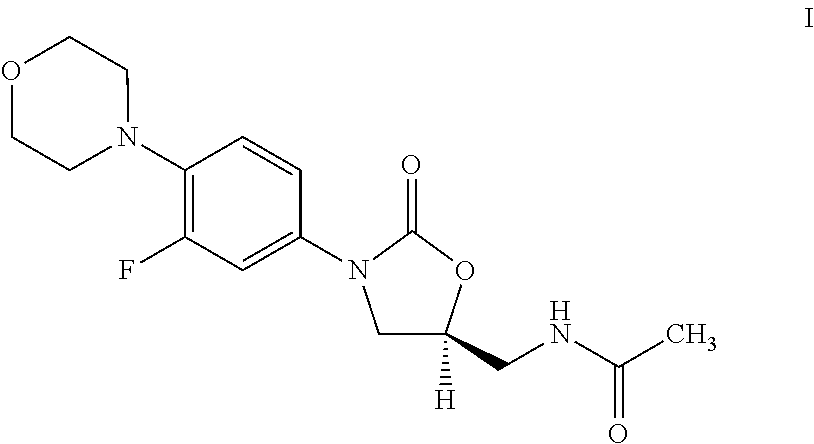
or an enantiomeric form or a mixture of enantiomeric forms thereof, which comprises:
- a) acetylating (R)-phthalimido-2-hydroxypropyl-carbamate compound of formula IV:

-
- or an enantiomeric form or a mixture of enantiomeric forms thereof, wherein R1 is C1-12 straight or branched chain alkyl, cycloalkyl, haloalkyl, substituted or unsubstituted aryl, or substituted or unsubstituted aralkyl;
- with an acetylating agent optionally in the presence of a base to produce an (R)-phthalimido-2-acetyloxypropyl-carbamate compound of formula III:

-
- or an enantiomeric form or a mixture of enantiomeric forms thereof, wherein R1 is as defined in formula IV, and ‘Ac’ represents an acetyl group; and
- b) reacting the (R)-phthalimido-2-acetyloxypropyl-carbamate compound of formula III with a suitable reagent, optionally in the presence of a base, to produce the Linezolid of formula I.

or an enantiomeric form or a mixture of enantiomeric forms thereof.

or an enantiomeric form or a mixture of enantiomeric forms thereof.

or an enantiomeric form or a mixture of enantiomeric forms thereof.


or an enantiomeric form or a mixture of enantiomeric forms thereof, wherein R1 is C1-12 straight or branched chain alkyl, cycloalkyl, haloalkyl, substituted or unsubstituted aryl, or substituted or unsubstituted aralkyl; and ‘Ac’ represents an acetyl group;
- with a suitable reagent, optionally in the presence of a base, to produce the Linezolid of formula I.

or an enantiomeric form or a mixture of enantiomeric forms thereof, wherein R1 is C1-12 straight or branched chain alkyl, cycloalkyl, haloalkyl, substituted or unsubstituted aryl, or substituted or unsubstituted aralkyl; and ‘Ac’ represents an acetyl group;
- comprising acetylating (R)-phthalimido-2-hydroxypropyl-carbamate compound of formula IV:

or an enantiomeric form or a mixture of enantiomeric forms thereof, wherein R1 is as defined above; with an acetylating agent optionally in the presence of a base to produce an (R)-phthalimido-2-acetyloxypropyl-carbamate compound of formula III or an enantiomeric form or a mixture of enantiomeric forms thereof.
- a) reacting (R)-phthalimido-2-hydroxypropyl-carbamate compound of formula IV:

-
- or an enantiomeric form or a mixture of enantiomeric forms thereof, wherein R1 is C1-12 straight or branched chain alkyl, cycloalkyl, haloalkyl, substituted or unsubstituted aryl, or substituted or unsubstituted aralkyl; with a suitable reagent, optionally in the presence of a base, to produce (S)—N-[3-fluoro-4-(4-morpholinyl)phenyl]-2-oxo-5-oxazolidinyl-methyl amine of formula II:

-
- or an enantiomeric form or a mixture of enantiomeric forms thereof, or a salt thereof; and
- b) acetylating the amine compound of formula II with a suitable acetylating agent to produce the Linezolid of formula I.


or an enantiomeric form or a mixture of enantiomeric forms thereof, or a salt thereof;
- comprising reacting (R)-phthalimido-2-hydroxypropyl-carbamate compound of formula IV:

- or an enantiomeric form or a mixture of enantiomeric forms thereof, wherein R1 is C1-12 straight or branched chain alkyl, cycloalkyl, haloalkyl, substituted or unsubstituted aryl, or substituted or unsubstituted aralkyl; with a suitable reagent, optionally in the presence of a base, to produce the aminomethyl compound of formula II, or an enantiomeric form or a mixture of enantiomeric forms thereof, or a salt thereof.

or an enantiomeric form or a mixture of enantiomeric forms thereof, wherein R1 is C1-12 straight or branched chain alkyl, cycloalkyl, haloalkyl, substituted or unsubstituted aryl, or substituted or unsubstituted aralkyl; comprising reacting N-[3-phthalimido-2-(R)-hydroxypropyl]-3-fluoro-4-(4-morpholinyl)aniline of formula XIII:

or an enantiomeric form or a mixture of enantiomeric forms thereof, or a salt thereof;
- with a suitable activating agent, optionally in the presence of a base, wherein the activating agent is a carbonate compound of formula XIVa, or a chloroformate compound of formula XIVb:

wherein the radical R1 is as defined in Formula IV; to produce the (R)-phthalimido-2-hydroxypropyl-carbamate compound of formula IV or an enantiomeric form or a mixture of enantiomeric forms thereof.

or an enantiomeric form or a mixture of enantiomeric forms thereof.

or an enantiomeric form or a mixture of enantiomeric forms thereof.

or an enantiomeric form or a mixture of enantiomeric forms thereof.

or an enantiomeric form or a mixture of enantiomeric forms thereof, wherein R1 is C1-12 straight or branched chain alkyl, cycloalkyl, haloalkyl, substituted or unsubstituted aryl, or substituted or unsubstituted aralkyl; which comprises:
- a) reacting a (R)-2-hydroxypropyl-aniline compound of formula XV or N-[2(R)-2,3-epoxypropyl]-3-fluoro-4-(4-morpholinyl)aniline of formula X:

-
- or an enantiomeric form or a mixture of enantiomeric forms thereof, or a salt thereof, wherein Y is a leaving group such as a halogen or a sulfonyloxy group;
- with a suitable activating agent, optionally in the presence of a base, wherein the activating agent is a carbonate compound of formula XIVa, or a chloroformate compound of formula XIVb:

-
- wherein the radical R1 is as defined in Formula IV; to produce an (R)-2-hydroxypropyl-carbamate compound of formula VII or an (R)-2,3-epoxypropyl-carbamate compound of formula IX:

-
- or an enantiomeric form or a mixture of enantiomeric forms thereof, wherein R1 and Y are as defined above; and
- b) reacting the (R)-2-hydroxypropyl-carbamate compound of formula VII or the (R)-2,3-epoxypropyl-carbamate compound of formula IX obtained in step-(a) with potassium phthalimide, optionally in the presence of a base, to produce the (R)-phthalimido-2-hydroxypropyl-carbamate compound of formula IV or an enantiomeric form or a mixture of enantiomeric forms thereof.

or an enantiomeric form or a mixture of enantiomeric forms thereof.

or an enantiomeric form or a mixture of enantiomeric forms thereof.

or an enantiomeric form or a mixture of enantiomeric forms thereof, wherein R1 is C1-12 straight or branched chain alkyl, cycloalkyl, haloalkyl, substituted or unsubstituted aryl, or substituted or unsubstituted aralkyl; comprising reacting the (R)-2-hydroxypropyl-carbamate compound of formula VII or the (R)-2,3-epoxypropyl-carbamate compound of formula IX:

or an enantiomeric form or a mixture of enantiomeric forms thereof, wherein R1 is as defined in Formula IV, and Y is a leaving group such as a halogen or a sulfonyloxy group; with potassium phthalimide, optionally in the presence of a base, to produce the (R)-phthalimido-2-hydroxypropyl-carbamate compound of formula IV or an enantiomeric form or a mixture of enantiomeric forms thereof.

or an enantiomeric form or a mixture of enantiomeric forms thereof, wherein R1 is C1-12 straight or branched chain alkyl, cycloalkyl, haloalkyl, substituted or unsubstituted aryl, or substituted or unsubstituted aralkyl, and Y is a leaving group such as a halogen or a sulfonyloxy group; comprising reacting a (R)-2-hydroxypropyl-aniline compound of formula XV or N-[2(R)-2,3-epoxypropyl]-3-fluoro-4-(4-morpholinyl)aniline of formula X:

or an enantiomeric form or a mixture of enantiomeric forms thereof, or a salt thereof, wherein Y is a leaving group such as a halogen or a sulfonyloxy group;
- with a suitable activating agent, optionally in the presence of a base, wherein the activating agent is a carbonate compound of formula XIVa, or a chloroformate compound of formula XIVb:

wherein the radical R1 is as defined above; to produce the (R)-2-hydroxypropyl-carbamate compound of formula VII or the (R)-2,3-epoxypropyl-carbamate compound of formula IX or an enantiomeric form or a mixture of enantiomeric forms thereof.

or an enantiomeric form or a mixture of enantiomeric forms thereof, wherein R1 is C1-12 straight or branched chain alkyl, cycloalkyl, haloalkyl, substituted or unsubstituted aryl, or substituted or unsubstituted aralkyl; which comprises:
- a) reacting a (R)-2-hydroxypropyl-aniline compound of formula XV or N-[2(R)-2,3-epoxypropyl]-3-fluoro-4-(4-morpholinyl)aniline of formula X:

-
- or an enantiomeric form or a mixture of enantiomeric forms thereof, or a salt thereof, wherein Y is a leaving group such as a halogen or a sulfonyloxy group;
- with potassium phthalimide, optionally in the presence of a base, to produce N-[3-phthalimido-2-(R)-hydroxypropyl]-3-fluoro-4-(4-morpholinyl)aniline of formula XIII:

-
- or an enantiomeric form or a mixture of enantiomeric forms thereof, or a salt thereof; and
- b) reacting the N-[3-phthalimido-2-(R)-hydroxypropyl]-3-fluoro-4-(4-morpholinyl)aniline of formula XIII or an enantiomeric form or a mixture of enantiomeric forms thereof, or a salt thereof; with a suitable activating agent, optionally in the presence of a base, wherein the activating agent is a carbonate compound of formula XIVa, or a chloroformate compound of formula XIVb:

-
- wherein the radical R1 is as defined in Formula IV; to produce the (R)-phthalimido-2-hydroxypropyl-carbamate compound of formula IV or an enantiomeric form or a mixture of enantiomeric forms thereof.

or an enantiomeric form or a mixture of enantiomeric forms thereof, or a salt thereof;
- comprising reacting N-[2(R)-2,3-epoxypropyl]-3-fluoro-4-(4-morpholinyl)aniline of formula X:

or an enantiomeric form or a mixture of enantiomeric forms thereof, or a salt thereof, with potassium phthalimide, optionally in the presence of a base, to produce N-[3-phthalimido-2-(R)-hydroxypropyl]-3-fluoro-4-(4-morpholinyl)aniline of formula XIII or an enantiomeric form or a mixture of enantiomeric forms thereof, or a salt thereof.

or an enantiomeric form or a mixture of enantiomeric forms thereof, or a salt thereof;
- comprising reacting (R)-2-hydroxypropyl-aniline compound of formula XV:

or an enantiomeric form or a mixture of enantiomeric forms thereof, or a salt thereof, wherein Y is a leaving group such as a halogen or a sulfonyloxy group; with a base to produce the N-[2(R)-2,3-epoxypropyl]-3-fluoro-4-(4-morpholinyl)aniline of formula X or an enantiomeric form or a mixture of enantiomeric forms thereof, or a salt thereof.

or an enantiomeric form or a mixture of enantiomeric forms thereof, wherein R1 is C1-12 straight or branched chain alkyl, cycloalkyl, haloalkyl, substituted or unsubstituted aryl, or substituted or unsubstituted aralkyl; and ‘Ac’ represents an acetyl group.

or an enantiomeric form or a mixture of enantiomeric forms thereof.

or an enantiomeric form or a mixture of enantiomeric forms thereof.

or an enantiomeric form or a mixture of enantiomeric forms thereof.

or an enantiomeric form or a mixture of enantiomeric forms thereof, wherein R1 is C1-12 straight or branched chain alkyl, cycloalkyl, haloalkyl, substituted or unsubstituted aryl, or substituted or unsubstituted aralkyl.

or an enantiomeric form or a mixture of enantiomeric forms thereof.

or an enantiomeric form or a mixture of enantiomeric forms thereof.

or an enantiomeric form or a mixture of enantiomeric forms thereof.

or an enantiomeric form or a mixture of enantiomeric forms thereof, wherein R1 is C1-12 straight or branched chain alkyl, cycloalkyl, haloalkyl, substituted or unsubstituted aryl, or substituted or unsubstituted aralkyl; and ‘Ac’ represents an acetyl group.

or an enantiomeric form or a mixture of enantiomeric forms thereof, wherein R1 is C1-12 straight or branched chain alkyl, cycloalkyl, haloalkyl, substituted or unsubstituted aryl, or substituted or unsubstituted aralkyl,

or an enantiomeric form or a mixture of enantiomeric forms thereof, wherein R1 is C1-12 straight or branched chain alkyl, cycloalkyl, haloalkyl, substituted or unsubstituted aryl, or substituted or unsubstituted aralkyl; and Y is a leaving group such as a halogen or a sulfonyloxy group.

or an enantiomeric form or a mixture of enantiomeric forms thereof, wherein R1 is C1-12 straight or branched chain alkyl, cycloalkyl, haloalkyl, substituted or unsubstituted aryl, or substituted or unsubstituted aralkyl; Y is a leaving group such as a halogen or a sulfonyloxy group, and ‘Ac’ represents an acetyl group.

or an enantiomeric form or a mixture of enantiomeric forms thereof, wherein R1 is C1-12 straight or branched chain alkyl, cycloalkyl, haloalkyl, substituted or unsubstituted aryl, or substituted or unsubstituted aralkyl.

or an enantiomeric form or a mixture of enantiomeric forms thereof, or a salt thereof.

or an enantiomeric form or a mixture of enantiomeric forms thereof, wherein R1 is C1-12 straight or branched chain alkyl, cycloalkyl, haloalkyl, substituted or unsubstituted aryl, or substituted or unsubstituted aralkyl.

or an enantiomeric form or a mixture of enantiomeric forms thereof, wherein R1 is C1-12 straight or branched chain alkyl, cycloalkyl, haloalkyl, substituted or unsubstituted aryl, or substituted or unsubstituted aralkyl; and ‘Ac’ represents an acetyl group.
Claims (23)


Applications Claiming Priority (1)
| Application Number | Priority Date | Filing Date | Title |
|---|---|---|---|
| PCT/IN2013/000278 WO2014174522A1 (en) | 2013-04-25 | 2013-04-25 | Improved processes for the preparation of linezolid using novel intermediates |
Publications (2)
| Publication Number | Publication Date |
|---|---|
| US20160102064A1 US20160102064A1 (en) | 2016-04-14 |
| US9586913B2 true US9586913B2 (en) | 2017-03-07 |
Family
ID=51791155
Family Applications (1)
| Application Number | Title | Priority Date | Filing Date |
|---|---|---|---|
| US14/785,960 Expired - Fee Related US9586913B2 (en) | 2013-04-25 | 2013-04-25 | Processes for the preparation of linezolid using novel intermediates |
Country Status (3)
| Country | Link |
|---|---|
| US (1) | US9586913B2 (en) |
| EP (1) | EP2989097A4 (en) |
| WO (1) | WO2014174522A1 (en) |
Families Citing this family (1)
| Publication number | Priority date | Publication date | Assignee | Title |
|---|---|---|---|---|
| WO2016079757A2 (en) * | 2014-11-19 | 2016-05-26 | Symed Labs Limited | Novel processes for preparing 5-hydroxymethyl-oxazolidin-2-one derivatives |
Citations (5)
| Publication number | Priority date | Publication date | Assignee | Title |
|---|---|---|---|---|
| US20060247435A1 (en) | 2004-07-20 | 2006-11-02 | Dodda Mohan Rao | Novel intermediates for linezolid and related compounds |
| US7291614B2 (en) | 2005-02-24 | 2007-11-06 | Teva Pharmaceutical Industries Ltd. | Processes for the preparation of linezolid intermediate |
| US20090156806A1 (en) | 2007-12-18 | 2009-06-18 | Dipharma Francis S.R.I. | Process for the Preparation of Oxazolidinone Derivatives |
| US20110034465A1 (en) | 2009-04-28 | 2011-02-10 | Apotex Pharmachem Inc. | Processes for the preparation of rivaroxaban and intermediates thereof |
| US20110275805A1 (en) | 2009-01-13 | 2011-11-10 | Lianhe Chemical Technology Co., Ltd. | Method for preparing linezolid and intermediates thereof |
Family Cites Families (2)
| Publication number | Priority date | Publication date | Assignee | Title |
|---|---|---|---|---|
| WO2012051692A1 (en) * | 2010-10-18 | 2012-04-26 | Apotex Pharmachem Inc. | Processes for the preparation of rivaroxaban and intermediates thereof |
| US9593104B2 (en) * | 2013-03-14 | 2017-03-14 | Benova Labs Pvt. Limited | Process for the preparation of oxazolidinone derivatives |
-
2013
- 2013-04-25 US US14/785,960 patent/US9586913B2/en not_active Expired - Fee Related
- 2013-04-25 EP EP13883336.3A patent/EP2989097A4/en not_active Withdrawn
- 2013-04-25 WO PCT/IN2013/000278 patent/WO2014174522A1/en not_active Ceased
Patent Citations (5)
| Publication number | Priority date | Publication date | Assignee | Title |
|---|---|---|---|---|
| US20060247435A1 (en) | 2004-07-20 | 2006-11-02 | Dodda Mohan Rao | Novel intermediates for linezolid and related compounds |
| US7291614B2 (en) | 2005-02-24 | 2007-11-06 | Teva Pharmaceutical Industries Ltd. | Processes for the preparation of linezolid intermediate |
| US20090156806A1 (en) | 2007-12-18 | 2009-06-18 | Dipharma Francis S.R.I. | Process for the Preparation of Oxazolidinone Derivatives |
| US20110275805A1 (en) | 2009-01-13 | 2011-11-10 | Lianhe Chemical Technology Co., Ltd. | Method for preparing linezolid and intermediates thereof |
| US20110034465A1 (en) | 2009-04-28 | 2011-02-10 | Apotex Pharmachem Inc. | Processes for the preparation of rivaroxaban and intermediates thereof |
Non-Patent Citations (4)
| Title |
|---|
| Database Registry Chemical Abstracts Service, Columbus, Ohio, Accession No. RN 1158467-29-8, Entered STN: Jun. 16, 2009. * |
| International Search Report for PCT/IN2013/000278 dated Dec. 6, 2013. |
| Park, HoonGyu. A New Method for the Oxazolidinone Key Intermediate of Linezolid and its Formal Synthesis. Bull. Korean Chem. Soc. 2012, 33(4), 1389-1392. * |
| Reddy, Ganta Madhusudhan. A New Practical Synthesis of Linezolid: An Antibacterial Drug. Letters in Organic Chemistry. 2010, 7, 45-49. * |
Also Published As
| Publication number | Publication date |
|---|---|
| EP2989097A1 (en) | 2016-03-02 |
| EP2989097A4 (en) | 2017-11-08 |
| WO2014174522A1 (en) | 2014-10-30 |
| US20160102064A1 (en) | 2016-04-14 |
Similar Documents
| Publication | Publication Date | Title |
|---|---|---|
| KR100619639B1 (en) | Process to Produce Oxazolidinones | |
| US6998420B2 (en) | Oxazolidinone compounds | |
| EP2595968B1 (en) | Novel process for preparation of linezolid and its novel intermediates | |
| AU2012378913B2 (en) | Improved process for preparing rivaroxaban using novel intermediates | |
| US9012631B2 (en) | 1,3-oxazolidine-2-one-like compound, preparation method and uses thereof | |
| US9586913B2 (en) | Processes for the preparation of linezolid using novel intermediates | |
| US9593104B2 (en) | Process for the preparation of oxazolidinone derivatives | |
| WO2014045292A1 (en) | Improved process for the preparation of linezolid intermediate | |
| WO2016079757A2 (en) | Novel processes for preparing 5-hydroxymethyl-oxazolidin-2-one derivatives | |
| WO2014170908A1 (en) | Process for preparation of oxazolidinone derivatives | |
| USRE47606E1 (en) | Process for the preparation of linezolid | |
| US9643939B1 (en) | Process for the preparation of linezolid | |
| KR101832115B1 (en) | Improved methods for making linazolides |
Legal Events
| Date | Code | Title | Description |
|---|---|---|---|
| AS | Assignment |
Owner name: SYMED LABS LIMITED, INDIA Free format text: ASSIGNMENT OF ASSIGNORS INTEREST;ASSIGNORS:DODDA, MOHAN RAO;BUTHUKURI, VENKAT REDDY;REEL/FRAME:037258/0075 Effective date: 20151026 |
|
| STCF | Information on status: patent grant |
Free format text: PATENTED CASE |
|
| FEPP | Fee payment procedure |
Free format text: ENTITY STATUS SET TO UNDISCOUNTED (ORIGINAL EVENT CODE: BIG.); ENTITY STATUS OF PATENT OWNER: LARGE ENTITY |
|
| MAFP | Maintenance fee payment |
Free format text: PAYMENT OF MAINTENANCE FEE, 4TH YEAR, LARGE ENTITY (ORIGINAL EVENT CODE: M1551); ENTITY STATUS OF PATENT OWNER: LARGE ENTITY Year of fee payment: 4 |
|
| FEPP | Fee payment procedure |
Free format text: MAINTENANCE FEE REMINDER MAILED (ORIGINAL EVENT CODE: REM.); ENTITY STATUS OF PATENT OWNER: LARGE ENTITY |
|
| LAPS | Lapse for failure to pay maintenance fees |
Free format text: PATENT EXPIRED FOR FAILURE TO PAY MAINTENANCE FEES (ORIGINAL EVENT CODE: EXP.); ENTITY STATUS OF PATENT OWNER: LARGE ENTITY |
|
| STCH | Information on status: patent discontinuation |
Free format text: PATENT EXPIRED DUE TO NONPAYMENT OF MAINTENANCE FEES UNDER 37 CFR 1.362 |
|
| FP | Lapsed due to failure to pay maintenance fee |
Effective date: 20250307 |