US9576609B2 - Subtitle processing device and associated method and subtitle parsing method - Google Patents

Subtitle processing device and associated method and subtitle parsing method Download PDF

Info

Publication number
US9576609B2
US9576609B2 US14/849,801 US201514849801A US9576609B2 US 9576609 B2 US9576609 B2 US 9576609B2 US 201514849801 A US201514849801 A US 201514849801A US 9576609 B2 US9576609 B2 US 9576609B2
Authority
US
United States
Prior art keywords
subtitle
block
blocks
contents
target
Prior art date
Legal status (The legal status is an assumption and is not a legal conclusion. Google has not performed a legal analysis and makes no representation as to the accuracy of the status listed.)
Expired - Fee Related
Application number
US14/849,801
Other versions
US20160086636A1 (en
Inventor
Chin-Yi Huang
Hung-Chang Chiu
Chih-Hsien Yao
Tsung-Chin Shih
Current Assignee (The listed assignees may be inaccurate. Google has not performed a legal analysis and makes no representation or warranty as to the accuracy of the list.)
Xueshan Technologies Inc
Original Assignee
MStar Semiconductor Inc Taiwan
Priority date (The priority date is an assumption and is not a legal conclusion. Google has not performed a legal analysis and makes no representation as to the accuracy of the date listed.)
Filing date
Publication date
Application filed by MStar Semiconductor Inc Taiwan filed Critical MStar Semiconductor Inc Taiwan
Assigned to MSTAR SEMICONDUCTOR, INC. reassignment MSTAR SEMICONDUCTOR, INC. ASSIGNMENT OF ASSIGNORS INTEREST (SEE DOCUMENT FOR DETAILS). Assignors: CHIU, HUNG-CHANG, HUANG, CHIN-YI, SHIH, TSUNG-CHIN, YAO, CHIH-HSIEN
Publication of US20160086636A1 publication Critical patent/US20160086636A1/en
Application granted granted Critical
Publication of US9576609B2 publication Critical patent/US9576609B2/en
Assigned to MEDIATEK INC. reassignment MEDIATEK INC. MERGER (SEE DOCUMENT FOR DETAILS). Assignors: MSTAR SEMICONDUCTOR, INC.
Assigned to XUESHAN TECHNOLOGIES INC. reassignment XUESHAN TECHNOLOGIES INC. ASSIGNMENT OF ASSIGNORS INTEREST (SEE DOCUMENT FOR DETAILS). Assignors: MEDIATEK INC.
Expired - Fee Related legal-status Critical Current
Anticipated expiration legal-status Critical

Links

Images

Classifications

    • GPHYSICS
    • G11INFORMATION STORAGE
    • G11BINFORMATION STORAGE BASED ON RELATIVE MOVEMENT BETWEEN RECORD CARRIER AND TRANSDUCER
    • G11B27/00Editing; Indexing; Addressing; Timing or synchronising; Monitoring; Measuring tape travel
    • G11B27/10Indexing; Addressing; Timing or synchronising; Measuring tape travel
    • G11B27/102Programmed access in sequence to addressed parts of tracks of operating record carriers
    • G11B27/105Programmed access in sequence to addressed parts of tracks of operating record carriers of operating discs
    • GPHYSICS
    • G11INFORMATION STORAGE
    • G11BINFORMATION STORAGE BASED ON RELATIVE MOVEMENT BETWEEN RECORD CARRIER AND TRANSDUCER
    • G11B27/00Editing; Indexing; Addressing; Timing or synchronising; Monitoring; Measuring tape travel
    • G11B27/10Indexing; Addressing; Timing or synchronising; Measuring tape travel
    • G11B27/102Programmed access in sequence to addressed parts of tracks of operating record carriers
    • GPHYSICS
    • G11INFORMATION STORAGE
    • G11BINFORMATION STORAGE BASED ON RELATIVE MOVEMENT BETWEEN RECORD CARRIER AND TRANSDUCER
    • G11B27/00Editing; Indexing; Addressing; Timing or synchronising; Monitoring; Measuring tape travel
    • G11B27/10Indexing; Addressing; Timing or synchronising; Measuring tape travel
    • G11B27/19Indexing; Addressing; Timing or synchronising; Measuring tape travel by using information detectable on the record carrier
    • G11B27/28Indexing; Addressing; Timing or synchronising; Measuring tape travel by using information detectable on the record carrier by using information signals recorded by the same method as the main recording
    • G11B27/32Indexing; Addressing; Timing or synchronising; Measuring tape travel by using information detectable on the record carrier by using information signals recorded by the same method as the main recording on separate auxiliary tracks of the same or an auxiliary record carrier
    • G11B27/327Table of contents
    • G11B27/329Table of contents on a disc [VTOC]
    • GPHYSICS
    • G11INFORMATION STORAGE
    • G11BINFORMATION STORAGE BASED ON RELATIVE MOVEMENT BETWEEN RECORD CARRIER AND TRANSDUCER
    • G11B27/00Editing; Indexing; Addressing; Timing or synchronising; Monitoring; Measuring tape travel
    • G11B27/10Indexing; Addressing; Timing or synchronising; Measuring tape travel
    • G11B27/34Indicating arrangements 
    • HELECTRICITY
    • H04ELECTRIC COMMUNICATION TECHNIQUE
    • H04NPICTORIAL COMMUNICATION, e.g. TELEVISION
    • H04N9/00Details of colour television systems
    • H04N9/79Processing of colour television signals in connection with recording
    • H04N9/80Transformation of the television signal for recording, e.g. modulation, frequency changing; Inverse transformation for playback
    • H04N9/82Transformation of the television signal for recording, e.g. modulation, frequency changing; Inverse transformation for playback the individual colour picture signal components being recorded simultaneously only
    • H04N9/8205Transformation of the television signal for recording, e.g. modulation, frequency changing; Inverse transformation for playback the individual colour picture signal components being recorded simultaneously only involving the multiplexing of an additional signal and the colour video signal
    • HELECTRICITY
    • H04ELECTRIC COMMUNICATION TECHNIQUE
    • H04NPICTORIAL COMMUNICATION, e.g. TELEVISION
    • H04N9/00Details of colour television systems
    • H04N9/79Processing of colour television signals in connection with recording
    • H04N9/80Transformation of the television signal for recording, e.g. modulation, frequency changing; Inverse transformation for playback
    • H04N9/82Transformation of the television signal for recording, e.g. modulation, frequency changing; Inverse transformation for playback the individual colour picture signal components being recorded simultaneously only
    • H04N9/8205Transformation of the television signal for recording, e.g. modulation, frequency changing; Inverse transformation for playback the individual colour picture signal components being recorded simultaneously only involving the multiplexing of an additional signal and the colour video signal
    • H04N9/8233Transformation of the television signal for recording, e.g. modulation, frequency changing; Inverse transformation for playback the individual colour picture signal components being recorded simultaneously only involving the multiplexing of an additional signal and the colour video signal the additional signal being a character code signal

Definitions

  • the invention relates in general to subtitles, and more particularly to a subtitle processing device and associated method and a subtitle parsing method.
  • Subtitles may be categorized into embedded subtitles and plug-in subtitles.
  • Embedded subtitles are a part of a video file.
  • a video file may include a video section, an audio section and a subtitle section. Such subtitle section cannot be directly accessed by general users.
  • Plug-in subtitles are a file independent from the video file, and can be directly edited by users. For example, users may adjust the time or texts of the plug-in subtitles.
  • There are various formats for plug-in subtitle files e.g., “.srt”, “.smi”, “.sub” and “.txt” are some common file extensions of subtitle files. According to different formats, one plug-in subtitle file may include one set or multiple sets of subtitles.
  • One set of subtitles represent a set of complete subtitles of a video.
  • Japanese subtitles, Traditional Chinese subtitles or Simplified Chinese subtitles are individually one set of subtitles.
  • Each subtitle unit of one set of subtitles usually includes a starting time, an ending time and subtitle contents, or associated variations.
  • FIG. 1A shows a schematic diagram of contents of a conventional subtitle file in an “.srt” format.
  • the subtitle file at least includes a subtitle unit 110 and a subtitle unit 120 , which respectively includes starting times 112 and 122 , ending times 114 and 124 , and subtitle contents 116 and 126 .
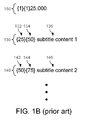
  • FIG. 1B shows a schematic diagram of a conventional subtitle file in a “.sub” format.
  • the subtitle file at least includes a subtitle unit 130 and a subtitle unit 140 , which respectively include starting time 132 and 142 , ending time 134 and 144 , and subtitle contents 136 and 146 .
  • the starting time and the ending time are not directly displayed by hour, minute and second, and need to be converted.
  • a basic column 150 records a conversion method. In this example, 25 frames represent 1 second. Thus, the subtitle contents 136 are in fact displayed from the 1 st second to the 2 nd second, and so forth.
  • FIG. 2 shows a diagram of configuration of a conventional memory for processing subtitles.
  • a memory 200 is disposed in a playback device, and is for parsing and displaying subtitles.
  • the memory 200 includes a subtitle section 210 and an index section 220 .
  • the playback device supports a fixed number of sets of subtitles. Four sets of subtitles are used here as an example. The subtitle contents of these four sets of subtitles are respectively temporarily stored in subtitle sub-sections 212 , 214 , 216 and 218 .
  • the four sets of subtitles have respective corresponding indices respectively stored in index sub-sections 222 , 224 , 226 and 228 .
  • a temporary storage sub-section 211 is for temporarily storing a subtitle unit to be parsed when the playback device parses the subtitle file. Details of purposes of the memory sections are given with reference to a flowchart of processing subtitles.
  • FIG. 3 shows a flowchart of a conventional subtitle parsing method.
  • a controller e.g., a microprocessor or a central processing unit (CPU)
  • CPU central processing unit
  • a part of the subtitle file is first temporarily stored in the temporary storage sub-section 211 of the memory 200 , parsed subtitle contents of the part of the subtitle file are stored in one of the subtitle sub-sections 212 , 214 , 216 and 218 , and an index is established and stored in the corresponding index sub-section.
  • the corresponding subtitles are identified from the memory according to the subtitles the user selects and then displayed. More specifically, one of the four sets of subtitle files are obtained from a storage medium (e.g., a flash memory, a hard drive or a solid-state hard drive) at the beginning of a subtitle process procedure (step S 310 ).
  • a storage medium e.g., a flash memory, a hard drive or a solid-state hard drive
  • step S 320 and step S 330 do not have any contents to be recorded.
  • the subtitle processing procedure omits these two steps and performs step S 340 .
  • step S 360 is performed to determine whether the entire subtitle file is already parsed. Because the subtitle file is only starting to be read, a determination result of step S 360 is negative and the procedure proceeds to step S 370 .
  • step S 370 a part of the contents of the subtitle file is read from the memory medium to the temporary storage sub-section 211 .
  • each subtitle file needs to be read for a multiple number of times before it can be fully parsed.
  • the subtitle unit then is identified from the temporary storage sub-section 211 (step S 350 ). If the subtitle unit is identified, the subtitle contents of the subtitle unit are stored in the subtitle sub-section 212 (step S 320 ), and the starting time and ending time of the subtitle unit as well as the position of the subtitle unit in the memory 200 in the last step are recorded in the index sub-section 222 (step S 330 ), thus completing parsing one subtitle unit.
  • step S 350 a next subtitle unit is identified (step S 350 ) until the data in the temporary storage sub-section 211 is fully processed. It is then determined whether the current subtitle file is completely parsed (step S 360 ). If so, it means that the current subtitle file is completely parsed; if not, step S 370 is iterated to read another part of the contents of the subtitle file from the memory medium to the temporary storage sub-section 211 .
  • the above process is repeated to parse the other three subtitle files, and the data obtained from parsing is filled into the subtitle sub-sections 214 , 216 and 218 as well as the index sub-sections 224 , 226 and 228 .
  • FIG. 4 shows a flowchart of a conventional method for searching for subtitles when playing a video.
  • the corresponding index sub-section e.g., the index sub-section 224
  • the position of the subtitle contents to be displayed in the subtitle sub-section 214 is identified from the index according to the current playback time (step S 420 )
  • the subtitle contents are read and a playback interface is notified to play the read subtitle contents (step S 430 )
  • it is determined whether the video is completely played step S 440 ).
  • the process ends when the video is completely played, or else contents of next subtitle contents to be displayed are search for.
  • the memory 200 is an exclusive memory used for displaying subtitles, and has a fixed size that is determined at the time of completing the system and cannot be readily expanded, meaning that the number of sets of subtitles supported cannot be easily increased by later increasing the memory.
  • the above conventional memory configuration and processing method for subtitles only allow a playback device to support a fixed number of sets of subtitles (e.g., four sets in the above example).
  • all subtitle contents of one set of subtitles are temporarily stored in the subtitle sub-section, and so one subtitle sub-section usually needs 256 KB or more storage space.
  • information of index table is quite complicated (including the starting time and the ending time of each subtitle unit as well as the position of the subtitle contents in the memory).
  • one index sub-section usually needs to occupy 128 KB or more storage space, and about 1.5 MB or more storage space is required to support four sets of subtitles.
  • the conventional solution stores all of the multiple sets of subtitles supported in different subtitle subsections, and the memory space occupied by three of the four sets of subtitles is equivalently wasted if only one of the four sets of subtitles are used in the playback process. Such issue of waste is aggravated when the number of sets of subtitles supported gets larger.
  • the present invention discloses a subtitle processing method.
  • the method includes a subtitle parsing step and a subtitle reading step.
  • the subtitle parsing step includes: dividing a subtitle file into a plurality of subtitle blocks, each of the subtitle blocks including a plurality of subtitle contents, each of the subtitle contents corresponding to a subtitle time; and generating an index table that records characteristic times of the subtitle blocks, each of the characteristic times being associated with one of the subtitle times.
  • the subtitle accessing step for reading a current subtitle content corresponding to a current playback time, includes: identifying a target subtitle block corresponding to the current time according to the current playback time and the characteristic times recorded in the index table, and reading the target subtitle content of the current subtitle block according to the current playback time.
  • the present invention further discloses a subtitle parsing method.
  • the method includes: dividing a subtitle file into a plurality of subtitle blocks, each of the subtitle blocks including a plurality of subtitle contents, each of the subtitle blocks corresponding to a subtitle time; and generating an index table that records characteristic times of the subtitle blocks, each of the characteristic times being associated with one of the subtitle times.
  • a target subtitle content to be displayed when playing a video is generated according to the characteristic times recorded in the index table.
  • the present invention further discloses a subtitle processing device adapted to parse a subtitle file and to read a target subtitle content according to a current playback time.
  • the device includes: a processing unit, configured to divide a subtitle file into a plurality of subtitle blocks to generate an index table, the index table recording characteristic times of the subtitle blocks, to identify a target subtitle block corresponding to the current playback time from the subtitle blocks according to the current playback time and the characteristic times recorded in the index table, and to read the target subtitle content from the target subtitle block according to the current playback time, wherein each of the subtitle blocks includes a plurality of subtitle blocks, each of the subtitle contents corresponds to a subtitle time, and each of the characteristic times is associated with one of the subtitle times; and a memory, including a first memory section configured to store the index table and a second memory section configured to store the subtitle contents included in the target subtitle block.
  • the subtitle processing device and the associated method and the subtitle parsing method of the present invention are capable of quickly establishing an index table of subtitles to significantly reduce the time for parsing the subtitles. Further, in the present invention, without having to store all subtitle contents of the subtitles into a memory, the subtitle contents currently required are dynamically read and stored to the memory during a playback process, thereby greatly decreasing the amount of memory used. Further, as the index table occupies an extremely small space, only a small memory space preserved is sufficient for easily increasing the number of sets of subtitles supported without noticeably increasing system costs.
  • FIG. 1A is a schematic diagram of a conventional subtitle file in an “.srt” format
  • FIG. 1B is a schematic diagram of a conventional subtitle file in an “.sub” format
  • FIG. 2 is a diagram of configuration of a memory conventionally applied for subtitle processing
  • FIG. 3 is a flowchart of a conventional subtitle parsing method
  • FIG. 4 is a flowchart of a conventional method for searching for subtitles when playing a video
  • FIG. 5 is a functional block diagram of a subtitle processing device according to an embodiment of the present invention.
  • FIG. 6 is a diagram of configuration of a hardware memory for subtitle processing of the present invention.
  • FIG. 7 is a flowchart of a subtitle parsing method according to an embodiment of the present invention.
  • FIG. 8 is a mapping diagram of an index table and subtitle files according to an embodiment of the present invention.
  • FIG. 9 is a flowchart of a method for searching for subtitles when playing a video according to an embodiment of the present invention.
  • FIG. 10 is a mapping diagram of temporarily stored contents in subtitle unit sections and subtitle files when playing a video according to an embodiment of the present invention.
  • the present invention discloses a subtitle processing device, a subtitle processing method and a subtitle parsing method capable of quickly parsing subtitles using a small memory space.
  • the device and method of the present invention may be applied to a video playback device.
  • one skilled person in the art may choose equivalent devices or steps to implement the disclosure based on the disclosure of the application. That is, the implementation of the disclosure is not limited in the embodiments described in the disclosure.
  • a part of the elements included in the subtitle processing device of the disclosure may be individually known. Without affecting the full disclosure and possible implementation of the subtitle processing device, the known details are omitted.
  • the subtitle processing method and the subtitle parsing method of the present invention may be implemented by the subtitle processing device of the disclosure or an equivalent device. Without affecting the full disclosure and possible implementation of the method, the description of the method focuses on the steps instead of hardware.
  • FIG. 5 shows a functional block diagram of a subtitle processing device according to an embodiment of the present invention.
  • the subtitle processing device may be a part of a video playback device.
  • the video playback device is a television or a multimedia player.
  • the subtitle processing device includes a file reading/writing module 510 , a system memory 520 , a processing unit 530 , a function module memory 540 and a video playback module 550 .
  • the processing unit 530 is a central processing unit (CPU) or a microcontroller (also referred to as a microprocessor).
  • the system memory 520 stores system data or program codes when the video playback device operates.
  • the function module memory 540 is an exclusive memory that the video playback device uses for subtitle processing, and cannot be shared with other functional modules.
  • the video playback module 550 controls video playback and subtitle display.
  • the file reading/writing module 510 accesses a subtitle file 505 from a hard drive or flash memory.
  • the system memory 520 and the function module memory 540 may be different sections in a same physical memory, or may be two independent physical memories.
  • FIG. 6 shows a diagram of configuration of a hardware memory for subtitle processing of the present invention.
  • the function module memory 540 includes a temporary storage section 610 , an index section 620 and a subtitle unit section 630 .
  • the temporary storage section 610 temporarily stores a part of data of the subtitle files during subtitle parsing.
  • the index section 620 stores an index table generated after subtitle parsing.
  • One index table is obtained from one set of subtitles.
  • the index table generated according to the present invention occupies a small memory space. Besides, once one set of subtitles are parsed, only the corresponding index table is stored instead of also storing the corresponding subtitle contents. Therefore, to support multiple sets of subtitles, the memory space the present invention needs is still quite small.
  • the subtitle unit section 630 temporarily stores multiple subtitle units when the video is played.
  • FIG. 7 shows a flowchart of a subtitle parsing method according to an embodiment of the present invention.
  • FIG. 8 shows a mapping diagram of an index table and subtitle files according to an embodiment of the present invention.
  • a subtitle file to be parsed is obtained (step S 710 )
  • a file size of the subtitle file is obtained after the subtitle file to be parsed is obtained (step S 720 )
  • the subtitle file is divided into a plurality of subtitle blocks (step S 730 ).
  • the number of blocks to be divided is predetermined (e.g., X, where X is a positive integer).
  • the number of blocks is associated with the size of the index table and the time needed for parsing the subtitle file.
  • the size of each block is equal to or substantially equal to F/X.
  • the contents of the subtitle file is read and temporarily stored into the temporary storing section 610 , and then parsed.
  • the size of the temporary storing section 610 may be designed to be the size of a memory that one subtitle display occupies, i.e., the size occupied by one subtitle unit (e.g., 16 KB). Thus, if one subtitle block occupies 10 subtitle units, the subtitle block can be fully parsed after 10 reading operations. However, the temporary storing section 610 may be designed to have a larger size to save the time.
  • the size of the temporary storing section 610 may be designed to be greater than or equal to the size of the blocks, and each block can then be fully parsed by 1 reading operation.
  • the size of the temporary storing section 610 may be adjusted according to the size F of the subtitle file. Taking an actual number of example, assuming that the predetermined number of blocks is 256 and the size of the subtitle file does not exceed 4 MB, the size of each block is then smaller than 16 KB (4 MB/256). Thus, the size of the temporary storing section 610 may be designed to be 16 KB.
  • the size of the temporary storing section 610 may then be designed to be 32 KB (8 MB/256) to save the time, or may be still designed to be 16 KB to save memory.
  • the subtitle file is read in a unit of the size of the temporary storing section 610 . Assuming that the size of the subtitle file is F and the size of the temporary storing section 610 is R, the subtitle file is then divided into F/R blocks. For example, the temporary storing section 610 is capable of concurrently storing one subtitle block, the number of blocks is then F/R.
  • the number of blocks is F/2R.
  • the size of the temporary storing section 610 needs to be adjusted according to the size of the subtitle file. Taking an actual number for example, assuming that the size of the subtitle file does not exceed 4 MB and the size of the temporary storing section 610 is 16 KB, the subtitle file may then be divided into a maximum of 256 (4 MB/16 KB) blocks.
  • the size of the temporary storing section 610 is preferably greater than 32 KB.
  • the size of the temporary storing section 610 may be designed to be smaller than 32 KB (e.g., each subtitle block is divided to be read by two reading operations, and the size of the temporary storing section 610 is designed to be 16 KB). Regardless the method used, the subtitle file is divided into a plurality of blocks. As shown in FIG.
  • a subtitle file 820 is divided into at least N+1 subtitle blocks (including a 0 th subtitle block 821 , a 1 st subtitle block 822 and an N th subtitle 823 ), where N is a positive integer greater than or equal to 1.
  • Each of the subtitle blocks includes a plurality of subtitle units, e.g., the subtitle block 821 includes a total of K+1 subtitle units 821 - 0 to 821 -N, and the subtitle blocks 822 and 823 include L+1 and M+1 subtitle units, respectively, wherein K, L and M are positive integers.
  • K, L and M may be or may not be equal. That is, the subtitle blocks may include the same number of different numbers of subtitle units, or some subtitle blocks may include only 1 subtitle unit or do not include any subtitle unit at all (storing other data of the subtitle file).
  • step S 740 the subtitle blocks are then read (step S 740 ).
  • the first subtitle block e.g., the subtitle block 0 in FIG. 8
  • step S 740 is later again performed, other subtitle blocks are sequentially read according to the times of the subtitle units in the subtitle file in an increasing order.
  • a subtitle unit is searched for in the subtitle blocks (step S 750 ).
  • the characteristic time of the subtitle block is recorded in an index table 810 (step S 760 ).
  • the characteristic time may be the time of a subtitle unit.
  • the characteristic time is the time of an earliest subtitle unit or the time of a latest subtitle unit in a subtitle block.
  • the characteristic time is the time of the earliest subtitle unit in the subtitle block, and so the index table 810 records the characteristic time 00:00:00, 000 of the 0 th subtitle block 821 .
  • the characteristic time of the subtitle block adjacent to that subtitle block is used as the characteristic time of that subtitle block (step S 765 ).
  • the characteristic time of the previous subtitle block is directly used as the characteristic time of the subtitle block.
  • the characteristic time of the subtitle block is first left empty in the index table, and a newly obtained characteristic time is filled back to the empty space when the characteristic time of a next subtitle block is obtained.
  • the index table is later read and it is discovered that two or more successive subtitle block correspond to the same characteristic time, only the subtitle with the smallest number (corresponding to the characteristic time from a previous characteristic time) or a largest number (corresponding to the newly obtained characteristic time filled back in) is read according a rule at the time of filling in the characteristic time.
  • the index 810 has recorded the characteristic time of the current subtitle block, the index value is added by 1 (step S 770 ) to get ready to fill in the characteristic time of the next subtitle block.
  • step S 740 may need to read the same subtitle block once (e.g., when the temporary storing section 610 is greater than or equal to the size of one subtitle block) or multiple times (e.g., when the temporary storing section 610 is smaller than the size of one subtitle block). Further, when the temporary storing section 610 is smaller than the size of one subtitle block, it is possible that the subtitle block is only read once. For example, when the characteristic time is the time of the earliest subtitle unit of the subtitle block, only a frontmost part of the subtitle block is read while the rest part is omitted to reduce parsing time.
  • step S 780 It is then determined whether the subtitle file 820 is completely read (step S 780 ). If not, the process continues to read the next subtitle block (step S 740 ). If the subtitle file 820 is completely read, information of the subtitle file 820 is recorded (step S 790 ), e.g., an encoding format (ASCII, Unicode, or UTF-8), a subtitle file format (“.srt”, or “.smi) and a row count of the index table. As such, one subtitle file is fully parsed.
  • the generated index table is stored into an index sub-section (one of the index sub-sections 622 , 624 , 626 and 628 ) in the index subsection 620 .
  • the index section 620 only requires a 8 KB storage space when a maximum number of 8 sets of subtitles are supported. Therefore, compared to the conventional solution that requires a 128 KB ⁇ 8 storage space, the present invention significantly saves memory.
  • FIG. 9 shows a flowchart of a method for searching for subtitles when playing a video according to an embodiment of the present invention.
  • FIG. 10 shows a mapping diagram of temporarily stored contents in the subtitle section 630 and a subtitle file when playing a video according to an embodiment of the present invention.
  • step S 904 identifies the N th subtitle block 823 as the current target subtitle block.
  • the searching process may be in a sequential search, a binary search or a search according to other algorithms.
  • data of the subtitle block may be read all at once or by several times according to a relationship between the sizes of the subtitle block and the temporary storing section 610 .
  • step S 906 After reading the target subtitle block and temporarily storing the target subtitle block in the temporary storing section 610 (step S 906 ), it is determined whether there is available space in the subtitle unit section 630 (step S 910 ). Contents stored in the subtitle unit section 630 are as shown in a mapping table 1010 , with one row of data corresponding to one subtitle unit.
  • Step S 910 may have different determination methods. For example, it is determined that there is no available space when every row of the subtitle unit section 630 contains data, and step S 960 is performed to rearranged the subtitle unit section 630 . Alternatively, although every row of the subtitle unit section 630 contains data, some of the data may be indicated as expired and may then be overwritten.
  • the size of the subtitle unit section 630 may be flexibly designed according to a principle that an appropriate number of subtitle units are stored to allow correct and smooth subtitle display during a playback process. However, all subtitle contents of the target subtitle block may be simultaneously stored.
  • the subtitle unit section 630 initially contains no data, and so step S 920 is performed.
  • step S 920 each of the subtitle units stored in the temporary storing section 610 is parsed, and information of that subtitle unit is filled into an appropriate field of the mapping table 1010 when that subtitle unit is read. It is then determined whether the data in the temporary storing section 610 has been completely processed (step S 940 ). If not, a next subtitle unit is searched for from the temporary storing section 610 (step S 930 ). Step S 910 is performed when the next subtitle unit is found, or else step S 940 is iterated if not found.
  • step S 940 determines that the data in the temporary storing section 610 is completely processed, the next subtitle block is read from the subtitle file 821 and stored to the temporary storing section 610 (step S 950 ).
  • step S 960 is performed.
  • step S 960 the subtitle unit section 630 is rearranged. More specifically, the subtitle units already displayed or expired are indicated as “1” in the mapping table 1010 .
  • step S 910 is again performed and subtitle units indicated as “1” are discovered, it means that there is available space in the subtitle unit section 630 .
  • step S 970 the target subtitle contents are searched for from the subtitle unit section 630 according to the current playback time. That is, the subtitle contents due for display are identified from the mapping tale 1010 according to the current playback time. For example, assuming that the current playback time is 00:00:00,105, step S 970 reads the subtitle contents 0-1 as the target subtitle contents. After the target subtitle contents are found, the playback module is notified to display the target subtitle contents (step S 980 ). It is then determined whether the video is completely played (step S 990 ). The playback process ends if the video is completely played, or else returns to step S 910 if not.
  • step S 960 it is determined whether to rearrange the subtitle unit section 630 (step S 960 ) or to parse a next subtitle unit in the temporary storing section 610 (step S 920 ) according to current storage conditions of the subtitle unit section 630 .
  • the above steps S 910 to S 990 are repeated until the playback process of the video is complete.
  • step S 960 is not necessarily performed between step S 950 and step S 970 , and may be performed between step S 970 and step S 980 or between step S 980 and step S 990 , or even performed between step S 990 and step S 910 .
  • step S 970 is performed directly after step S 950 , and step S 970 is performed when the determination result of step S 910 is negative. That is to say, the step of rearranging the subtitle unit section 630 (step S 960 ) may be performed before or after searching for the target subtitle contents (step S 970 ) or displaying the target subtitle contents (step S 980 ). More specifically, step S 960 is performed at least once between determining that there is no available space in the subtitle unit section 630 (step S 910 ) and again performing the same determination (when step S 910 is again performed). Under such premise, step S 960 may be selectively performed multiple times at other time points of the process, e.g., step S 960 is performed again after searching for the subtitle unit (step S 930 ).
  • the present invention provides a subtitle parsing method and a corresponding method for displaying subtitles, and these two methods may be performed by the subtitle processing device of the present invention.
  • a subtitle file is divided into a plurality of subtitle blocks when the subtitle file are parsed, and only the characteristic time corresponding to each subtitle block is recorded. Therefore, the present invention is capable of quickly completing the parsing process and generating a quite small index table for reducing memory space. Further, by storing the subtitle contents in a small data amount and sharing the same temporary storing section among multiple sets of subtitle files, the present invention significantly reduces the amount of memory used compared to the prior art.

Landscapes

  • Engineering & Computer Science (AREA)
  • Multimedia (AREA)
  • Signal Processing (AREA)
  • Television Signal Processing For Recording (AREA)
  • Studio Circuits (AREA)

Abstract

A subtitle processing method includes a subtitle parsing step and a subtitle reading step. The subtitle parsing step includes: dividing a subtitle file into a plurality of subtitle blocks, each of the subtitle blocks including a plurality of subtitle contents, each of the subtitle contents corresponding to a subtitle time; generating an index table that records characteristic times of the subtitle blocks. The subtitle reading step, for reading a target subtitle content corresponding to a current time, includes: identifying a target subtitle block corresponding to the current time and the characteristic times recorded in the index table; and reading the target subtitle content of the target subtitle block according to the current time.

Description

This application claims the benefit of Taiwan application Serial No. 103132241, filed Sep. 18, 2014, the subject matter of which is incorporated herein by reference.
BACKGROUND OF THE INVENTION
Field of the Invention
The invention relates in general to subtitles, and more particularly to a subtitle processing device and associated method and a subtitle parsing method.
Description of the Related Art
Subtitles may be categorized into embedded subtitles and plug-in subtitles. Embedded subtitles are a part of a video file. For example, a video file may include a video section, an audio section and a subtitle section. Such subtitle section cannot be directly accessed by general users. Plug-in subtitles are a file independent from the video file, and can be directly edited by users. For example, users may adjust the time or texts of the plug-in subtitles. There are various formats for plug-in subtitle files, e.g., “.srt”, “.smi”, “.sub” and “.txt” are some common file extensions of subtitle files. According to different formats, one plug-in subtitle file may include one set or multiple sets of subtitles. One set of subtitles represent a set of complete subtitles of a video. For example, Japanese subtitles, Traditional Chinese subtitles or Simplified Chinese subtitles are individually one set of subtitles. Each subtitle unit of one set of subtitles usually includes a starting time, an ending time and subtitle contents, or associated variations. FIG. 1A shows a schematic diagram of contents of a conventional subtitle file in an “.srt” format. The subtitle file at least includes a subtitle unit 110 and a subtitle unit 120, which respectively includes starting times 112 and 122, ending times 114 and 124, and subtitle contents 116 and 126. When a current playback time of a video reaches the starting time, the corresponding subtitle contents are displayed on a screen; when the current playback time of the video reaches the ending time, the corresponding subtitle contents are cleared from the screen. FIG. 1B shows a schematic diagram of a conventional subtitle file in a “.sub” format. The subtitle file at least includes a subtitle unit 130 and a subtitle unit 140, which respectively include starting time 132 and 142, ending time 134 and 144, and subtitle contents 136 and 146. It should be noted that, the starting time and the ending time are not directly displayed by hour, minute and second, and need to be converted. A basic column 150 records a conversion method. In this example, 25 frames represent 1 second. Thus, the subtitle contents 136 are in fact displayed from the 1st second to the 2nd second, and so forth.
FIG. 2 shows a diagram of configuration of a conventional memory for processing subtitles. A memory 200 is disposed in a playback device, and is for parsing and displaying subtitles. The memory 200 includes a subtitle section 210 and an index section 220. In general, the playback device supports a fixed number of sets of subtitles. Four sets of subtitles are used here as an example. The subtitle contents of these four sets of subtitles are respectively temporarily stored in subtitle sub-sections 212, 214, 216 and 218. The four sets of subtitles have respective corresponding indices respectively stored in index sub-sections 222, 224, 226 and 228. A temporary storage sub-section 211 is for temporarily storing a subtitle unit to be parsed when the playback device parses the subtitle file. Details of purposes of the memory sections are given with reference to a flowchart of processing subtitles. FIG. 3 shows a flowchart of a conventional subtitle parsing method. Before a video is played, a controller (e.g., a microprocessor or a central processing unit (CPU)) of a playback device parses multiple sets of subtitles. During the parsing process, a part of the subtitle file is first temporarily stored in the temporary storage sub-section 211 of the memory 200, parsed subtitle contents of the part of the subtitle file are stored in one of the subtitle sub-sections 212, 214, 216 and 218, and an index is established and stored in the corresponding index sub-section. When the video is later played, the corresponding subtitles are identified from the memory according to the subtitles the user selects and then displayed. More specifically, one of the four sets of subtitle files are obtained from a storage medium (e.g., a flash memory, a hard drive or a solid-state hard drive) at the beginning of a subtitle process procedure (step S310). As the procedure is at an initial phase, the temporary storage sub-section 211 does not contain any data, and so step S320 and step S330 do not have any contents to be recorded. Thus, the subtitle processing procedure omits these two steps and performs step S340. At this point, it is discovered that the temporary storage sub-section 211 does not contain any data, and so step S360 is performed to determine whether the entire subtitle file is already parsed. Because the subtitle file is only starting to be read, a determination result of step S360 is negative and the procedure proceeds to step S370. In step S370, a part of the contents of the subtitle file is read from the memory medium to the temporary storage sub-section 211. In most circumstances, as the size of each subtitle file is greater than that of the temporary storage sub-section 211, one subtitle file needs to be read for a multiple number of times before it can be fully parsed. The subtitle unit then is identified from the temporary storage sub-section 211 (step S350). If the subtitle unit is identified, the subtitle contents of the subtitle unit are stored in the subtitle sub-section 212 (step S320), and the starting time and ending time of the subtitle unit as well as the position of the subtitle unit in the memory 200 in the last step are recorded in the index sub-section 222 (step S330), thus completing parsing one subtitle unit. When the data in the temporary storage sub-section 211 is not yet fully processed (step 340), a next subtitle unit is identified (step S350) until the data in the temporary storage sub-section 211 is fully processed. It is then determined whether the current subtitle file is completely parsed (step S360). If so, it means that the current subtitle file is completely parsed; if not, step S370 is iterated to read another part of the contents of the subtitle file from the memory medium to the temporary storage sub-section 211. Having completed parsing the current subtitle file, the above process is repeated to parse the other three subtitle files, and the data obtained from parsing is filled into the subtitle sub-sections 214, 216 and 218 as well as the index sub-sections 224, 226 and 228.
FIG. 4 shows a flowchart of a conventional method for searching for subtitles when playing a video. After starting to play the video, the corresponding index sub-section (e.g., the index sub-section 224) is identified according to the selected subtitles (step S410), the position of the subtitle contents to be displayed in the subtitle sub-section 214 is identified from the index according to the current playback time (step S420), the subtitle contents are read and a playback interface is notified to play the read subtitle contents (step S430), and it is determined whether the video is completely played (step S440). The process ends when the video is completely played, or else contents of next subtitle contents to be displayed are search for.
In conclusion, the memory 200 is an exclusive memory used for displaying subtitles, and has a fixed size that is determined at the time of completing the system and cannot be readily expanded, meaning that the number of sets of subtitles supported cannot be easily increased by later increasing the memory. Thus, the above conventional memory configuration and processing method for subtitles only allow a playback device to support a fixed number of sets of subtitles (e.g., four sets in the above example). Further, in the conventional method, all subtitle contents of one set of subtitles are temporarily stored in the subtitle sub-section, and so one subtitle sub-section usually needs 256 KB or more storage space. Further, information of index table is quite complicated (including the starting time and the ending time of each subtitle unit as well as the position of the subtitle contents in the memory). Therefore, one index sub-section usually needs to occupy 128 KB or more storage space, and about 1.5 MB or more storage space is required to support four sets of subtitles. In addition, the conventional solution stores all of the multiple sets of subtitles supported in different subtitle subsections, and the memory space occupied by three of the four sets of subtitles is equivalently wasted if only one of the four sets of subtitles are used in the playback process. Such issue of waste is aggravated when the number of sets of subtitles supported gets larger.
SUMMARY OF THE INVENTION
In view of the shortcomings of the prior art, it is an object of the present invention to provide a subtitle processing device and an associated method and a subtitle parsing method to increase flexibilities and save memory for subtitle processing.
The present invention discloses a subtitle processing method. The method includes a subtitle parsing step and a subtitle reading step. The subtitle parsing step includes: dividing a subtitle file into a plurality of subtitle blocks, each of the subtitle blocks including a plurality of subtitle contents, each of the subtitle contents corresponding to a subtitle time; and generating an index table that records characteristic times of the subtitle blocks, each of the characteristic times being associated with one of the subtitle times. The subtitle accessing step, for reading a current subtitle content corresponding to a current playback time, includes: identifying a target subtitle block corresponding to the current time according to the current playback time and the characteristic times recorded in the index table, and reading the target subtitle content of the current subtitle block according to the current playback time.
The present invention further discloses a subtitle parsing method. The method includes: dividing a subtitle file into a plurality of subtitle blocks, each of the subtitle blocks including a plurality of subtitle contents, each of the subtitle blocks corresponding to a subtitle time; and generating an index table that records characteristic times of the subtitle blocks, each of the characteristic times being associated with one of the subtitle times. A target subtitle content to be displayed when playing a video is generated according to the characteristic times recorded in the index table.
The present invention further discloses a subtitle processing device adapted to parse a subtitle file and to read a target subtitle content according to a current playback time. The device includes: a processing unit, configured to divide a subtitle file into a plurality of subtitle blocks to generate an index table, the index table recording characteristic times of the subtitle blocks, to identify a target subtitle block corresponding to the current playback time from the subtitle blocks according to the current playback time and the characteristic times recorded in the index table, and to read the target subtitle content from the target subtitle block according to the current playback time, wherein each of the subtitle blocks includes a plurality of subtitle blocks, each of the subtitle contents corresponds to a subtitle time, and each of the characteristic times is associated with one of the subtitle times; and a memory, including a first memory section configured to store the index table and a second memory section configured to store the subtitle contents included in the target subtitle block.
The subtitle processing device and the associated method and the subtitle parsing method of the present invention are capable of quickly establishing an index table of subtitles to significantly reduce the time for parsing the subtitles. Further, in the present invention, without having to store all subtitle contents of the subtitles into a memory, the subtitle contents currently required are dynamically read and stored to the memory during a playback process, thereby greatly decreasing the amount of memory used. Further, as the index table occupies an extremely small space, only a small memory space preserved is sufficient for easily increasing the number of sets of subtitles supported without noticeably increasing system costs.
The above and other aspects of the invention will become better understood with regard to the following detailed description of the preferred but non-limiting embodiments. The following description is made with reference to the accompanying drawings.
BRIEF DESCRIPTION OF THE DRAWINGS
FIG. 1A is a schematic diagram of a conventional subtitle file in an “.srt” format;
FIG. 1B is a schematic diagram of a conventional subtitle file in an “.sub” format;
FIG. 2 is a diagram of configuration of a memory conventionally applied for subtitle processing;
FIG. 3 is a flowchart of a conventional subtitle parsing method;
FIG. 4 is a flowchart of a conventional method for searching for subtitles when playing a video;
FIG. 5 is a functional block diagram of a subtitle processing device according to an embodiment of the present invention;
FIG. 6 is a diagram of configuration of a hardware memory for subtitle processing of the present invention;
FIG. 7 is a flowchart of a subtitle parsing method according to an embodiment of the present invention;
FIG. 8 is a mapping diagram of an index table and subtitle files according to an embodiment of the present invention;
FIG. 9 is a flowchart of a method for searching for subtitles when playing a video according to an embodiment of the present invention; and
FIG. 10 is a mapping diagram of temporarily stored contents in subtitle unit sections and subtitle files when playing a video according to an embodiment of the present invention.
DETAILED DESCRIPTION OF THE INVENTION
Technical terms of the application are based on the general definition in the technical field of the application. If the application describes or explains one or some terms, definitions of the terms are based on the description or explanation of the application.
The present invention discloses a subtitle processing device, a subtitle processing method and a subtitle parsing method capable of quickly parsing subtitles using a small memory space. The device and method of the present invention may be applied to a video playback device. In possible implementation, one skilled person in the art may choose equivalent devices or steps to implement the disclosure based on the disclosure of the application. That is, the implementation of the disclosure is not limited in the embodiments described in the disclosure. Further, a part of the elements included in the subtitle processing device of the disclosure may be individually known. Without affecting the full disclosure and possible implementation of the subtitle processing device, the known details are omitted. Further, the subtitle processing method and the subtitle parsing method of the present invention may be implemented by the subtitle processing device of the disclosure or an equivalent device. Without affecting the full disclosure and possible implementation of the method, the description of the method focuses on the steps instead of hardware.
FIG. 5 shows a functional block diagram of a subtitle processing device according to an embodiment of the present invention. The subtitle processing device may be a part of a video playback device. For example, but not limited to, the video playback device is a television or a multimedia player. The subtitle processing device includes a file reading/writing module 510, a system memory 520, a processing unit 530, a function module memory 540 and a video playback module 550. For example, the processing unit 530 is a central processing unit (CPU) or a microcontroller (also referred to as a microprocessor). The system memory 520 stores system data or program codes when the video playback device operates. The function module memory 540 is an exclusive memory that the video playback device uses for subtitle processing, and cannot be shared with other functional modules. The video playback module 550 controls video playback and subtitle display. The file reading/writing module 510 accesses a subtitle file 505 from a hard drive or flash memory. The system memory 520 and the function module memory 540 may be different sections in a same physical memory, or may be two independent physical memories. FIG. 6 shows a diagram of configuration of a hardware memory for subtitle processing of the present invention. The function module memory 540 includes a temporary storage section 610, an index section 620 and a subtitle unit section 630. The temporary storage section 610 temporarily stores a part of data of the subtitle files during subtitle parsing. The index section 620 stores an index table generated after subtitle parsing. One index table is obtained from one set of subtitles. The index table generated according to the present invention occupies a small memory space. Besides, once one set of subtitles are parsed, only the corresponding index table is stored instead of also storing the corresponding subtitle contents. Therefore, to support multiple sets of subtitles, the memory space the present invention needs is still quite small. The subtitle unit section 630 temporarily stores multiple subtitle units when the video is played.
FIG. 7 shows a flowchart of a subtitle parsing method according to an embodiment of the present invention. FIG. 8 shows a mapping diagram of an index table and subtitle files according to an embodiment of the present invention. To parse subtitles, a subtitle file to be parsed is obtained (step S710), a file size of the subtitle file is obtained after the subtitle file to be parsed is obtained (step S720), and the subtitle file is divided into a plurality of subtitle blocks (step S730). In a preferred embodiment, the number of blocks to be divided is predetermined (e.g., X, where X is a positive integer). The number of blocks is associated with the size of the index table and the time needed for parsing the subtitle file. Assuming that the size of the subtitle file is F, the size of each block is equal to or substantially equal to F/X. The contents of the subtitle file is read and temporarily stored into the temporary storing section 610, and then parsed. The size of the temporary storing section 610 may be designed to be the size of a memory that one subtitle display occupies, i.e., the size occupied by one subtitle unit (e.g., 16 KB). Thus, if one subtitle block occupies 10 subtitle units, the subtitle block can be fully parsed after 10 reading operations. However, the temporary storing section 610 may be designed to have a larger size to save the time. For example, the size of the temporary storing section 610 may be designed to be greater than or equal to the size of the blocks, and each block can then be fully parsed by 1 reading operation. In practice, the size of the temporary storing section 610 may be adjusted according to the size F of the subtitle file. Taking an actual number of example, assuming that the predetermined number of blocks is 256 and the size of the subtitle file does not exceed 4 MB, the size of each block is then smaller than 16 KB (4 MB/256). Thus, the size of the temporary storing section 610 may be designed to be 16 KB. However, assuming that the number of blocks is similarly 256 and the size of the subtitle file is between 4 MB and 8 MB, the size of the temporary storing section 610 may then be designed to be 32 KB (8 MB/256) to save the time, or may be still designed to be 16 KB to save memory. In another preferred embodiment, the subtitle file is read in a unit of the size of the temporary storing section 610. Assuming that the size of the subtitle file is F and the size of the temporary storing section 610 is R, the subtitle file is then divided into F/R blocks. For example, the temporary storing section 610 is capable of concurrently storing one subtitle block, the number of blocks is then F/R. However, if the temporary storing section 610 can concurrently store 2 subtitle blocks, the number of blocks is F/2R. Further, to ensure that the number of the blocks does not exceed a predetermined threshold associated with the size of the index table, the size of the temporary storing section 610 needs to be adjusted according to the size of the subtitle file. Taking an actual number for example, assuming that the size of the subtitle file does not exceed 4 MB and the size of the temporary storing section 610 is 16 KB, the subtitle file may then be divided into a maximum of 256 (4 MB/16 KB) blocks. However, if the size of the subtitle file is between 4 MB and 8 MB and the number of blocks is to be controlled to be within 256, the size of the temporary storing section 610 is preferably greater than 32 KB. Alternatively, if one subtitle block is divided to be read by a multiple reading operations, the size of the temporary storing section 610 may be designed to be smaller than 32 KB (e.g., each subtitle block is divided to be read by two reading operations, and the size of the temporary storing section 610 is designed to be 16 KB). Regardless the method used, the subtitle file is divided into a plurality of blocks. As shown in FIG. 8, a subtitle file 820 is divided into at least N+1 subtitle blocks (including a 0th subtitle block 821, a 1st subtitle block 822 and an Nth subtitle 823), where N is a positive integer greater than or equal to 1. Each of the subtitle blocks includes a plurality of subtitle units, e.g., the subtitle block 821 includes a total of K+1 subtitle units 821-0 to 821-N, and the subtitle blocks 822 and 823 include L+1 and M+1 subtitle units, respectively, wherein K, L and M are positive integers. It should be noted that, K, L and M may be or may not be equal. That is, the subtitle blocks may include the same number of different numbers of subtitle units, or some subtitle blocks may include only 1 subtitle unit or do not include any subtitle unit at all (storing other data of the subtitle file).
Again referring to FIG. 7, after the subtitle file is divided into a plurality of blocks (step S730), the subtitle blocks are then read (step S740). When step S740 is performed for the first time, the first subtitle block (e.g., the subtitle block 0 in FIG. 8) is read. When step S740 is later again performed, other subtitle blocks are sequentially read according to the times of the subtitle units in the subtitle file in an increasing order. A subtitle unit is searched for in the subtitle blocks (step S750). When a subtitle unit is found, the characteristic time of the subtitle block is recorded in an index table 810 (step S760). The characteristic time may be the time of a subtitle unit. For example, but not limited to, the characteristic time is the time of an earliest subtitle unit or the time of a latest subtitle unit in a subtitle block. In one preferred embodiment, as shown in FIG. 8, the characteristic time is the time of the earliest subtitle unit in the subtitle block, and so the index table 810 records the characteristic time 00:00:00, 000 of the 0th subtitle block 821. When the subtitle unit is not found in step S750, it means that the subtitle block does not have a characteristic time, and the characteristic time of the subtitle block adjacent to that subtitle block is used as the characteristic time of that subtitle block (step S765). In one preferred embodiment, when the subtitle block does not include any subtitle units, the characteristic time of the previous subtitle block is directly used as the characteristic time of the subtitle block. In another preferred embodiment, the characteristic time of the subtitle block is first left empty in the index table, and a newly obtained characteristic time is filled back to the empty space when the characteristic time of a next subtitle block is obtained. When the index table is later read and it is discovered that two or more successive subtitle block correspond to the same characteristic time, only the subtitle with the smallest number (corresponding to the characteristic time from a previous characteristic time) or a largest number (corresponding to the newly obtained characteristic time filled back in) is read according a rule at the time of filling in the characteristic time. When the index 810 has recorded the characteristic time of the current subtitle block, the index value is added by 1 (step S770) to get ready to fill in the characteristic time of the next subtitle block. That is, the characteristic time is filled into index table according to the sequence of reading the subtitle blocks in step S740. It should be noted that, step S740 may need to read the same subtitle block once (e.g., when the temporary storing section 610 is greater than or equal to the size of one subtitle block) or multiple times (e.g., when the temporary storing section 610 is smaller than the size of one subtitle block). Further, when the temporary storing section 610 is smaller than the size of one subtitle block, it is possible that the subtitle block is only read once. For example, when the characteristic time is the time of the earliest subtitle unit of the subtitle block, only a frontmost part of the subtitle block is read while the rest part is omitted to reduce parsing time.
It is then determined whether the subtitle file 820 is completely read (step S780). If not, the process continues to read the next subtitle block (step S740). If the subtitle file 820 is completely read, information of the subtitle file 820 is recorded (step S790), e.g., an encoding format (ASCII, Unicode, or UTF-8), a subtitle file format (“.srt”, or “.smi) and a row count of the index table. As such, one subtitle file is fully parsed. The generated index table is stored into an index sub-section (one of the index sub-sections 622, 624, 626 and 628) in the index subsection 620. As the information stored in the index table of the present invention is quite simple (each characteristic time only occupies a 4 B (Bytes) storage space, and the index table is only 4 B×256=1 KB if there are a total number of 256 subtitle blocks), the index section 620 only requires a 8 KB storage space when a maximum number of 8 sets of subtitles are supported. Therefore, compared to the conventional solution that requires a 128 KB×8 storage space, the present invention significantly saves memory.
FIG. 9 shows a flowchart of a method for searching for subtitles when playing a video according to an embodiment of the present invention. FIG. 10 shows a mapping diagram of temporarily stored contents in the subtitle section 630 and a subtitle file when playing a video according to an embodiment of the present invention. When a video begins to play, a playback device first determines whether the video is played from a starting point (step S902). If so, a target subtitle block is read (reading the 0th target block 821 at this point); if not, the target subtitle block is searched for from the index table 810 according to the current playback time (step S904). For example, the video is played from the time 00:01:00,700 according to the index table. At this point, step S904 identifies the Nth subtitle block 823 as the current target subtitle block. The searching process may be in a sequential search, a binary search or a search according to other algorithms. During the reading process, data of the subtitle block may be read all at once or by several times according to a relationship between the sizes of the subtitle block and the temporary storing section 610. After reading the target subtitle block and temporarily storing the target subtitle block in the temporary storing section 610 (step S906), it is determined whether there is available space in the subtitle unit section 630 (step S910). Contents stored in the subtitle unit section 630 are as shown in a mapping table 1010, with one row of data corresponding to one subtitle unit. For example, in the 0th row in the mapping table, the time corresponds to the starting and ending times of the subtitle unit 821-0, the subtitle contents correspond to the subtitle unit 821-0, and the mark is for indicating whether the subtitle unit has expired (i.e., already displayed, e.g., bit 0 indicates already displayed and bit 1 indicates not yet displayed). Step S910 may have different determination methods. For example, it is determined that there is no available space when every row of the subtitle unit section 630 contains data, and step S960 is performed to rearranged the subtitle unit section 630. Alternatively, although every row of the subtitle unit section 630 contains data, some of the data may be indicated as expired and may then be overwritten. At this point, it can be determined that there is available space in the subtitle unit section 630. The size of the subtitle unit section 630 may be flexibly designed according to a principle that an appropriate number of subtitle units are stored to allow correct and smooth subtitle display during a playback process. However, all subtitle contents of the target subtitle block may be simultaneously stored. In one preferred embodiment, the subtitle unit section 630 stores 16 subtitle units, i.e., the mapping table in FIG. 10 should have 16 rows (R=15). In an example where one row of data in average occupies 256 B storage space, the size of the subtitle unit section 630 is 8 KB.
The subtitle unit section 630 initially contains no data, and so step S920 is performed. In step S920, each of the subtitle units stored in the temporary storing section 610 is parsed, and information of that subtitle unit is filled into an appropriate field of the mapping table 1010 when that subtitle unit is read. It is then determined whether the data in the temporary storing section 610 has been completely processed (step S940). If not, a next subtitle unit is searched for from the temporary storing section 610 (step S930). Step S910 is performed when the next subtitle unit is found, or else step S940 is iterated if not found. When step S940 determines that the data in the temporary storing section 610 is completely processed, the next subtitle block is read from the subtitle file 821 and stored to the temporary storing section 610 (step S950). However, in steps S910 to S940 for parsing the subtitle units, if the data in the temporary storing section 610 is not completely processed and the subtitle unit section 630 is however fully filled, step S960 is performed. In step S960, the subtitle unit section 630 is rearranged. More specifically, the subtitle units already displayed or expired are indicated as “1” in the mapping table 1010. When step S910 is again performed and subtitle units indicated as “1” are discovered, it means that there is available space in the subtitle unit section 630. The subtitle units indicated as “1” may be cleared or overwritten. In following step S970, the target subtitle contents are searched for from the subtitle unit section 630 according to the current playback time. That is, the subtitle contents due for display are identified from the mapping tale 1010 according to the current playback time. For example, assuming that the current playback time is 00:00:00,105, step S970 reads the subtitle contents 0-1 as the target subtitle contents. After the target subtitle contents are found, the playback module is notified to display the target subtitle contents (step S980). It is then determined whether the video is completely played (step S990). The playback process ends if the video is completely played, or else returns to step S910 if not. In step S960, it is determined whether to rearrange the subtitle unit section 630 (step S960) or to parse a next subtitle unit in the temporary storing section 610 (step S920) according to current storage conditions of the subtitle unit section 630. The above steps S910 to S990 are repeated until the playback process of the video is complete. It should be noted that, step S960 is not necessarily performed between step S950 and step S970, and may be performed between step S970 and step S980 or between step S980 and step S990, or even performed between step S990 and step S910. In any of the above variations, step S970 is performed directly after step S950, and step S970 is performed when the determination result of step S910 is negative. That is to say, the step of rearranging the subtitle unit section 630 (step S960) may be performed before or after searching for the target subtitle contents (step S970) or displaying the target subtitle contents (step S980). More specifically, step S960 is performed at least once between determining that there is no available space in the subtitle unit section 630 (step S910) and again performing the same determination (when step S910 is again performed). Under such premise, step S960 may be selectively performed multiple times at other time points of the process, e.g., step S960 is performed again after searching for the subtitle unit (step S930).
In conclusion, the present invention provides a subtitle parsing method and a corresponding method for displaying subtitles, and these two methods may be performed by the subtitle processing device of the present invention. Compared to the prior art, in the present invention, a subtitle file is divided into a plurality of subtitle blocks when the subtitle file are parsed, and only the characteristic time corresponding to each subtitle block is recorded. Therefore, the present invention is capable of quickly completing the parsing process and generating a quite small index table for reducing memory space. Further, by storing the subtitle contents in a small data amount and sharing the same temporary storing section among multiple sets of subtitle files, the present invention significantly reduces the amount of memory used compared to the prior art.
One person skilled in the art can understand implementation details and variations of the device in FIG. 5 from the disclosure of the methods in FIG. 7 and FIG. 9. Without affecting full disclosure and implementation of the method of the present invention, repetitive details are omitted herein. It should be noted that, the shapes, sizes, ratios and sequences of the steps in the drawings are examples for explaining the present invention to one person skilled in the art, not limiting the present invention. In possible implementation, one skilled person in the art would selectively implement part or all technical features of any embodiment of the application or selectively combine part or all technical features of the embodiments of the application based on the disclosure of the present invention to enhance the implementation flexibility of the present invention.
While the invention has been described by way of example and in terms of the preferred embodiments, it is to be understood that the invention is not limited thereto. On the contrary, it is intended to cover various modifications and similar arrangements and procedures, and the scope of the appended claims therefore should be accorded the broadest interpretation so as to encompass all such modifications and similar arrangements and procedures.

Claims (15)

What is claimed is:
1. A subtitle processing method, comprising:
a subtitle parsing step, comprising:
dividing a subtitle file into a plurality of subtitle blocks, each of the subtitle blocks comprising a plurality of subtitle contents, each of the subtitle contents corresponding to a subtitle time; and
generating an index table that records characteristic times of the subtitle blocks, each of the characteristic times being associated with one of the subtitle times; and
a subtitle reading step, for reading a target subtitle content corresponding to a current playback time, comprising:
identifying a target subtitle block corresponding to the current playback time from the subtitle blocks according to the current playback time and the characteristic times recorded in the index table; and
reading the target subtitle content of the target subtitle block according to the current playback time,
wherein the step of reading the target subtitle contents of the target subtitle block according to the current playback time comprises:
selecting a predetermined number of subtitle contents from the plurality of subtitle contents of the target subtitle block, and recording the subtitle times corresponding to the predetermined number of subtitle contents; and
reading the target subtitle content of the predetermined number of subtitle contents according to the current playback time and the subtitle times; and
further comprising:
marking the target subtitle content; and
replacing the marked target subtitle content by a new subtitle content to update the predetermined number of subtitle contents.
2. The subtitle processing method according to claim 1, wherein the step of dividing the subtitle file into the plurality of subtitle blocks comprises:
obtaining a size of the subtitle file;
determining a subtitle block size according to the size of the subtitle file; and
reading the subtitle file in a unit of the subtitle block size to obtain the subtitle blocks.
3. The subtitle processing method according to claim 1, wherein the step of generating the index table comprises:
reading the subtitle blocks according to a sequence; and
recording the characteristic times of the subtitle blocks according to the sequence to generate the index table;
wherein, when an intermediate subtitle block of the subtitle blocks does not contain any subtitles, the step of recording the characteristic times of the subtitle blocks according to the sequence to generate the index table regards one of the characteristic time of a previous subtitle block of the intermediate subtitle block or the characteristic time of a next subtitle block of the intermediate subtitle block as the characteristic time of the intermediate subtitle block.
4. The subtitle processing method according to claim 1, wherein the characteristic times are one of a maximum value and a minimum value of the subtitle times corresponding to the subtitle contents included in the corresponding subtitle block.
5. A subtitle parsing method, comprising:
dividing a subtitle file into a plurality of subtitle blocks, each of the subtitle blocks comprising a plurality of subtitle contents, each of the subtitle contents comprising a subtitle time; and
generating an index table that records characteristic times of the subtitle blocks, each of the characteristic times being associated with one of the subtitle times;
wherein, a target subtitle content to be displayed when a video is played is selected according to the characteristic times recorded in the index table,
wherein the step of generating the index table comprises:
reading the subtitle blocks according to a sequence; and
recording characteristic times of the subtitle blocks according to the sequence to generate the index table;
wherein, when an intermediate subtitle block of the subtitle blocks does not contain any subtitles, the step of recording the characteristic times of the subtitle blocks according to the sequence to generate the index table regards one of the characteristic time of a previous subtitle block of the intermediate subtitle block or the characteristic time of a next subtitle block of the intermediate subtitle block as the characteristic time of the intermediate subtitle block.
6. The subtitle parsing method according to claim 5, wherein the step of dividing the subtitle file into the plurality of subtitle blocks comprises:
obtaining a size of the subtitle file;
determining a subtitle block size according to the size of the subtitle file; and
reading the subtitle file in a unit of the subtitle block size to obtain the subtitle blocks.
7. The subtitle parsing method according to claim 5, wherein the characteristic times are one of a maximum value and a minimum value of the subtitle times corresponding to the subtitle contents included in the corresponding subtitle block.
8. A subtitle processing device, adapted to parse a subtitle file and to read a target subtitle content according to a current playback time, comprising:
a processing unit, configured to divide a subtitle file into a plurality of subtitle blocks and to generate an index table, the index table recording characteristic times of the subtitle blocks; the processing unit configured to further identify a target subtitle block corresponding to the current playback time from the subtitle blocks according to the current playback time and the characteristic times recorded in the index table, and to read the target subtitle content from the target subtitle block according to the current playback time, each of the subtitle contents corresponding to a subtitle time, each of the characteristic times being associated with one of the subtitle times; and
a memory, comprising:
a first memory section, configured to store the index table; and
a second memory section, configured to store the subtitle contents included in the target subtitle block,
wherein the processing unit reads the subtitle blocks according to a sequence, and records the characteristic times of the subtitle blocks according to the sequence to generate the index table; when an intermediate subtitle block of the subtitle blocks does not contain any subtitles, the processing unit regards one of the characteristic time of a previous subtitle block of the intermediate subtitle block or the characteristic time of a next subtitle block of the intermediate subtitle block as the characteristic time of the intermediate subtitle block.
9. The subtitle processing device according to claim 8, wherein the index table corresponds to a set of subtitles included in the subtitle file, and the first memory section further stores another index table that corresponds to another set of subtitles.
10. The subtitle processing device according to claim 8, wherein the processing unit dynamically updates the second memory section according to the current playback time.
11. The subtitle processing device according to claim 8, wherein the memory further comprises:
a temporary storing section;
wherein, the processing unit divides the subtitle file in a unit of the temporary storing section into the subtitle blocks.
12. The subtitle processing device according to claim 11, wherein the processing unit determines a size of the temporary storing section according to a size of the subtitle file.
13. The subtitle processing device according to claim 8, wherein the processing unit selects a predetermined number of subtitle contents from the plurality of subtitle contents of the target subtitle block, obtains the subtitle times corresponding to the predetermined number of subtitle contents, stores the predetermined number of subtitle contents and the subtitle times to the second memory section, and reads the target subtitle content from the second memory section according to the current playback time and the subtitle times.
14. The subtitle processing device according to claim 13, wherein the processing unit marks the target subtitle content, and replaces the marked target subtitle content by a new subtitle content to update the predetermined number of subtitle contents.
15. The subtitle processing device according to claim 8, wherein the characteristic times are one of a maximum value and a minimum value of the subtitle times corresponding to the subtitle contents included in the corresponding subtitle block.
US14/849,801 2014-09-18 2015-09-10 Subtitle processing device and associated method and subtitle parsing method Expired - Fee Related US9576609B2 (en)

Applications Claiming Priority (3)

Application Number Priority Date Filing Date Title
TW103132241A 2014-09-18
TW103132241A TWI543612B (en) 2014-09-18 2014-09-18 Subtitle processing device and its associated method and method of parsing subtitle
TW103132241 2014-09-18

Publications (2)

Publication Number Publication Date
US20160086636A1 US20160086636A1 (en) 2016-03-24
US9576609B2 true US9576609B2 (en) 2017-02-21

Family

ID=55526336

Family Applications (1)

Application Number Title Priority Date Filing Date
US14/849,801 Expired - Fee Related US9576609B2 (en) 2014-09-18 2015-09-10 Subtitle processing device and associated method and subtitle parsing method

Country Status (2)

Country Link
US (1) US9576609B2 (en)
TW (1) TWI543612B (en)

Cited By (6)

* Cited by examiner, † Cited by third party
Publication number Priority date Publication date Assignee Title
US12187522B2 (en) 2023-01-13 2025-01-07 Johnson & Johnson Vision Care, Inc. Contact lens packages having an absorbent member
USD1061023S1 (en) 2022-06-21 2025-02-11 Johnson & Johnson Vision Care, Inc. Contact lens package
USD1062223S1 (en) 2022-06-21 2025-02-18 Johnson & Johnson Vision Care, Inc. Contact lens package
US12414615B2 (en) 2020-12-13 2025-09-16 Johnson & Johnson Vision Care, Inc. Contact lens packages and methods of opening
US12458121B2 (en) 2022-09-27 2025-11-04 Johnson & Johnson Vision Care, Inc. Contact lens package with draining port
US12503289B2 (en) 2021-12-16 2025-12-23 Johnson & Johnson Vision Care, Inc. Pressurized or vacuum-sealed contact lens packages

Families Citing this family (12)

* Cited by examiner, † Cited by third party
Publication number Priority date Publication date Assignee Title
CN105847995B (en) * 2016-05-16 2020-07-28 上海幻电信息科技有限公司 Method for jumping video position through barrage anchor point
KR20180067247A (en) * 2016-12-12 2018-06-20 엘지전자 주식회사 Mobile terminal
US11588872B2 (en) 2017-06-12 2023-02-21 C-Hear, Inc. System and method for codec for combining disparate content
US10187443B2 (en) 2017-06-12 2019-01-22 C-Hear, Inc. System and method for encoding image data and other data types into one data format and decoding of same
US10419828B2 (en) * 2018-01-08 2019-09-17 Netflix, Inc. Modifying subtitles to reflect changes to audiovisual programs
CN108989897A (en) * 2018-08-13 2018-12-11 封雷迅 It is a kind of by subtitle re-reading video broadcasting method, storage equipment and terminal sentence by sentence
CN109525899A (en) * 2018-11-19 2019-03-26 青岛海信传媒网络技术有限公司 The method and device that subtitle and audio video synchronization are presented
CN110475139B (en) * 2019-07-30 2021-08-03 腾讯音乐娱乐科技(深圳)有限公司 Video subtitle shielding method and device, storage medium and electronic equipment
US11432049B2 (en) * 2019-08-29 2022-08-30 Snap Inc. Subtitle splitter
CN112752165B (en) * 2020-06-05 2023-09-01 腾讯科技(深圳)有限公司 Subtitle processing method, subtitle processing device, server and computer readable storage medium
CN112752156A (en) * 2020-12-28 2021-05-04 海信视像科技股份有限公司 Subtitle adjusting method and display device
CN120730006A (en) * 2025-06-26 2025-09-30 北京美摄网络科技有限公司 Subtitle processing method, device, electronic device and readable storage medium

Citations (6)

* Cited by examiner, † Cited by third party
Publication number Priority date Publication date Assignee Title
US20060088293A1 (en) * 2004-10-22 2006-04-27 King Huang Subtitle file loading method and system thereof
US20090310021A1 (en) * 2008-06-09 2009-12-17 Sony Corporation Information presenting device and information presenting method
US20090316046A1 (en) * 2008-06-24 2009-12-24 Casio Hitachi Mobile Communications Co., Ltd. Captioned image reproducing device, captioned image reproducing method and program
CN101764952A (en) 2008-11-25 2010-06-30 新奥特(北京)视频技术有限公司 Subtitle list editing, examining and broadcasting method based on time periods
CN102739997A (en) 2011-05-10 2012-10-17 新奥特(北京)视频技术有限公司 Subtitle plug-in segmentation rendering method
US20120309527A1 (en) * 2011-06-03 2012-12-06 We R Interactive Limited Audio Visual Game System and Computer Implemented Game Method

Patent Citations (6)

* Cited by examiner, † Cited by third party
Publication number Priority date Publication date Assignee Title
US20060088293A1 (en) * 2004-10-22 2006-04-27 King Huang Subtitle file loading method and system thereof
US20090310021A1 (en) * 2008-06-09 2009-12-17 Sony Corporation Information presenting device and information presenting method
US20090316046A1 (en) * 2008-06-24 2009-12-24 Casio Hitachi Mobile Communications Co., Ltd. Captioned image reproducing device, captioned image reproducing method and program
CN101764952A (en) 2008-11-25 2010-06-30 新奥特(北京)视频技术有限公司 Subtitle list editing, examining and broadcasting method based on time periods
CN102739997A (en) 2011-05-10 2012-10-17 新奥特(北京)视频技术有限公司 Subtitle plug-in segmentation rendering method
US20120309527A1 (en) * 2011-06-03 2012-12-06 We R Interactive Limited Audio Visual Game System and Computer Implemented Game Method

Non-Patent Citations (1)

* Cited by examiner, † Cited by third party
Title
TIPO Office Action, Nov. 23, 2015, 8 pages.

Cited By (6)

* Cited by examiner, † Cited by third party
Publication number Priority date Publication date Assignee Title
US12414615B2 (en) 2020-12-13 2025-09-16 Johnson & Johnson Vision Care, Inc. Contact lens packages and methods of opening
US12503289B2 (en) 2021-12-16 2025-12-23 Johnson & Johnson Vision Care, Inc. Pressurized or vacuum-sealed contact lens packages
USD1061023S1 (en) 2022-06-21 2025-02-11 Johnson & Johnson Vision Care, Inc. Contact lens package
USD1062223S1 (en) 2022-06-21 2025-02-18 Johnson & Johnson Vision Care, Inc. Contact lens package
US12458121B2 (en) 2022-09-27 2025-11-04 Johnson & Johnson Vision Care, Inc. Contact lens package with draining port
US12187522B2 (en) 2023-01-13 2025-01-07 Johnson & Johnson Vision Care, Inc. Contact lens packages having an absorbent member

Also Published As

Publication number Publication date
US20160086636A1 (en) 2016-03-24
TWI543612B (en) 2016-07-21
TW201613339A (en) 2016-04-01

Similar Documents

Publication Publication Date Title
US9576609B2 (en) Subtitle processing device and associated method and subtitle parsing method
JP5100746B2 (en) Video playback apparatus and video playback method
US9185468B2 (en) MP4 container file formats and methods of processing MP4 container files
US7302169B2 (en) Method and apparatus for playing-back moving image data
EP3745727A1 (en) Method and device for data processing
KR101742419B1 (en) Video playback control program, video playback control method, video delivery server, transmission program and transmission apparatus
US8230125B2 (en) Methods for reserving index memory space in AVI recording apparatus
CN114374875B (en) MP4 file recording method, device and readable storage medium
CN107273310A (en) A kind of read method of multi-medium data, device, medium and equipment
TW201426756A (en) Method of arranging data in a non-volatile memory and a memory control system thereof
KR101742420B1 (en) Video data file generation program, video data file generation method and video data file generation apparatus
JP5138037B2 (en) Metadata generation method, access method and apparatus in media file format
US8655139B2 (en) Video recording and reproducing system and reading method of video data
CN105516779B (en) Film caption processing device and method, and method for parsing film caption
US20140185690A1 (en) Multimedia data stream format, metadata generator, encoding method, encoding system, decoding method, and decoding system
JP2004363825A (en) Recording / reproducing apparatus, recording / reproducing method, recording medium and program thereof
CN102169706B (en) Method and device for storing and playing YUV file
US8326946B2 (en) Compact disc playing system and its play back method
US7512764B2 (en) Method for allocating a memory of a de-interleaving unit
KR101477492B1 (en) Apparatus for editing and playing video contents and the method thereof
US20070067570A1 (en) Data processing methods and systems
US10880561B2 (en) Image processing method and image processing device
CN115328391A (en) A storage method, device and management method for local recording of video capture equipment
KR100874023B1 (en) Method and apparatus for managing input data buffer of MP3 decoder
US7848615B2 (en) Medium for storing subtitle data structure of an audio/ video program and method for displaying the same

Legal Events

Date Code Title Description
AS Assignment

Owner name: MSTAR SEMICONDUCTOR, INC., TAIWAN

Free format text: ASSIGNMENT OF ASSIGNORS INTEREST;ASSIGNORS:HUANG, CHIN-YI;CHIU, HUNG-CHANG;YAO, CHIH-HSIEN;AND OTHERS;REEL/FRAME:036531/0021

Effective date: 20150908

STCF Information on status: patent grant

Free format text: PATENTED CASE

AS Assignment

Owner name: MEDIATEK INC., TAIWAN

Free format text: MERGER;ASSIGNOR:MSTAR SEMICONDUCTOR, INC.;REEL/FRAME:052931/0468

Effective date: 20190115

MAFP Maintenance fee payment

Free format text: PAYMENT OF MAINTENANCE FEE, 4TH YEAR, LARGE ENTITY (ORIGINAL EVENT CODE: M1551); ENTITY STATUS OF PATENT OWNER: LARGE ENTITY

Year of fee payment: 4

AS Assignment

Owner name: XUESHAN TECHNOLOGIES INC., CANADA

Free format text: ASSIGNMENT OF ASSIGNORS INTEREST;ASSIGNOR:MEDIATEK INC.;REEL/FRAME:056593/0167

Effective date: 20201223

FEPP Fee payment procedure

Free format text: MAINTENANCE FEE REMINDER MAILED (ORIGINAL EVENT CODE: REM.); ENTITY STATUS OF PATENT OWNER: LARGE ENTITY

LAPS Lapse for failure to pay maintenance fees

Free format text: PATENT EXPIRED FOR FAILURE TO PAY MAINTENANCE FEES (ORIGINAL EVENT CODE: EXP.); ENTITY STATUS OF PATENT OWNER: LARGE ENTITY

STCH Information on status: patent discontinuation

Free format text: PATENT EXPIRED DUE TO NONPAYMENT OF MAINTENANCE FEES UNDER 37 CFR 1.362

FP Lapsed due to failure to pay maintenance fee

Effective date: 20250221