US9567358B2 - Methods of treatment using N-(3-fluorophenyl)-2-{3-[(7-{3-[ethyl(2-hydroxyethyl)amino]propoxy}-quinazolin-4-yl)amino]-1H-pyrazol-5-yl}acetamide - Google Patents
Methods of treatment using N-(3-fluorophenyl)-2-{3-[(7-{3-[ethyl(2-hydroxyethyl)amino]propoxy}-quinazolin-4-yl)amino]-1H-pyrazol-5-yl}acetamide Download PDFInfo
- Publication number
- US9567358B2 US9567358B2 US14/661,657 US201514661657A US9567358B2 US 9567358 B2 US9567358 B2 US 9567358B2 US 201514661657 A US201514661657 A US 201514661657A US 9567358 B2 US9567358 B2 US 9567358B2
- Authority
- US
- United States
- Prior art keywords
- amino
- pyrazol
- propyl
- difluorophenyl
- oxy
- Prior art date
- Legal status (The legal status is an assumption and is not a legal conclusion. Google has not performed a legal analysis and makes no representation as to the accuracy of the status listed.)
- Expired - Fee Related
Links
- 0 [3*]C1=C(OCCC)C=C2N=CN=C(C*C([6*])([7*])C(=O)N([4*])[5*])C2=C1 Chemical compound [3*]C1=C(OCCC)C=C2N=CN=C(C*C([6*])([7*])C(=O)N([4*])[5*])C2=C1 0.000 description 74
- LHWCBJSMGLGILG-UHFFFAOYSA-N CC1=C(C)NN=C1.CC1=C(C)NN=C1.CC1=CC(C)=NN1.CC1=CN=C(C)N1.CC1=CN=C(C)N1 Chemical compound CC1=C(C)NN=C1.CC1=C(C)NN=C1.CC1=CC(C)=NN1.CC1=CN=C(C)N1.CC1=CN=C(C)N1 LHWCBJSMGLGILG-UHFFFAOYSA-N 0.000 description 1
- KUBBIXUUPLRBME-UHFFFAOYSA-N CCC(=O)CC1=NNC(NC2=NC=NC3=CC(OCC4CCN(C)CC4)=CC=C32)=C1 Chemical compound CCC(=O)CC1=NNC(NC2=NC=NC3=CC(OCC4CCN(C)CC4)=CC=C32)=C1 KUBBIXUUPLRBME-UHFFFAOYSA-N 0.000 description 1
- YRKGMRXVMVKRMW-UHFFFAOYSA-N CCCCCOC1=CC=C2C(=C1)N=CN=C2NC1=CC(CC(=O)CC)=NN1 Chemical compound CCCCCOC1=CC=C2C(=C1)N=CN=C2NC1=CC(CC(=O)CC)=NN1 YRKGMRXVMVKRMW-UHFFFAOYSA-N 0.000 description 1
- HFKILCCLNLDLFG-UHFFFAOYSA-N CCCCOC1=C(CO)C=C2C(=C1)N=CN=C2NC1=CC(CC(=O)CC)=NN1 Chemical compound CCCCOC1=C(CO)C=C2C(=C1)N=CN=C2NC1=CC(CC(=O)CC)=NN1 HFKILCCLNLDLFG-UHFFFAOYSA-N 0.000 description 1
- RRJMKIYZUBFULR-UHFFFAOYSA-N CCCCOC1=C(F)C=C2C(=C1)N=CN=C2NC1=CC(CC(=O)CC)=NN1 Chemical compound CCCCOC1=C(F)C=C2C(=C1)N=CN=C2NC1=CC(CC(=O)CC)=NN1 RRJMKIYZUBFULR-UHFFFAOYSA-N 0.000 description 1
- AYFKGTUEJHDUGW-UHFFFAOYSA-N CCCCOC1=CC=C2C(=C1)N=CN=C2NC1=CC(CC(=O)CC)=NN1 Chemical compound CCCCOC1=CC=C2C(=C1)N=CN=C2NC1=CC(CC(=O)CC)=NN1 AYFKGTUEJHDUGW-UHFFFAOYSA-N 0.000 description 1
- QMMWWTSCRXPXNM-UHFFFAOYSA-N CCN(CCOP(O)(O)=O)I Chemical compound CCN(CCOP(O)(O)=O)I QMMWWTSCRXPXNM-UHFFFAOYSA-N 0.000 description 1
- QNWLERUDOJVKKJ-UHFFFAOYSA-N N#CCC#N.NN.[H]N1N=C(N)C(C#N)=C1CC#N.[H]N1N=C(N)C=C1CC(=O)O Chemical compound N#CCC#N.NN.[H]N1N=C(N)C(C#N)=C1CC#N.[H]N1N=C(N)C=C1CC(=O)O QNWLERUDOJVKKJ-UHFFFAOYSA-N 0.000 description 1
- FQKVIRXTSKLEKB-UHFFFAOYSA-N OP(O)(OCCN(C1CCCC1)I)=O Chemical compound OP(O)(OCCN(C1CCCC1)I)=O FQKVIRXTSKLEKB-UHFFFAOYSA-N 0.000 description 1
Classifications
-
- C—CHEMISTRY; METALLURGY
- C07—ORGANIC CHEMISTRY
- C07F—ACYCLIC, CARBOCYCLIC OR HETEROCYCLIC COMPOUNDS CONTAINING ELEMENTS OTHER THAN CARBON, HYDROGEN, HALOGEN, OXYGEN, NITROGEN, SULFUR, SELENIUM OR TELLURIUM
- C07F9/00—Compounds containing elements of Groups 5 or 15 of the Periodic Table
- C07F9/02—Phosphorus compounds
- C07F9/547—Heterocyclic compounds, e.g. containing phosphorus as a ring hetero atom
- C07F9/645—Heterocyclic compounds, e.g. containing phosphorus as a ring hetero atom having two nitrogen atoms as the only ring hetero atoms
- C07F9/6509—Six-membered rings
- C07F9/6512—Six-membered rings having the nitrogen atoms in positions 1 and 3
-
- C—CHEMISTRY; METALLURGY
- C07—ORGANIC CHEMISTRY
- C07F—ACYCLIC, CARBOCYCLIC OR HETEROCYCLIC COMPOUNDS CONTAINING ELEMENTS OTHER THAN CARBON, HYDROGEN, HALOGEN, OXYGEN, NITROGEN, SULFUR, SELENIUM OR TELLURIUM
- C07F9/00—Compounds containing elements of Groups 5 or 15 of the Periodic Table
- C07F9/02—Phosphorus compounds
- C07F9/547—Heterocyclic compounds, e.g. containing phosphorus as a ring hetero atom
- C07F9/6558—Heterocyclic compounds, e.g. containing phosphorus as a ring hetero atom containing at least two different or differently substituted hetero rings neither condensed among themselves nor condensed with a common carbocyclic ring or ring system
- C07F9/65583—Heterocyclic compounds, e.g. containing phosphorus as a ring hetero atom containing at least two different or differently substituted hetero rings neither condensed among themselves nor condensed with a common carbocyclic ring or ring system each of the hetero rings containing nitrogen as ring hetero atom
-
- A—HUMAN NECESSITIES
- A61—MEDICAL OR VETERINARY SCIENCE; HYGIENE
- A61K—PREPARATIONS FOR MEDICAL, DENTAL OR TOILETRY PURPOSES
- A61K31/00—Medicinal preparations containing organic active ingredients
- A61K31/66—Phosphorus compounds
- A61K31/661—Phosphorus acids or esters thereof not having P—C bonds, e.g. fosfosal, dichlorvos, malathion or mevinphos
-
- A—HUMAN NECESSITIES
- A61—MEDICAL OR VETERINARY SCIENCE; HYGIENE
- A61P—SPECIFIC THERAPEUTIC ACTIVITY OF CHEMICAL COMPOUNDS OR MEDICINAL PREPARATIONS
- A61P35/00—Antineoplastic agents
-
- A—HUMAN NECESSITIES
- A61—MEDICAL OR VETERINARY SCIENCE; HYGIENE
- A61P—SPECIFIC THERAPEUTIC ACTIVITY OF CHEMICAL COMPOUNDS OR MEDICINAL PREPARATIONS
- A61P35/00—Antineoplastic agents
- A61P35/02—Antineoplastic agents specific for leukemia
-
- A—HUMAN NECESSITIES
- A61—MEDICAL OR VETERINARY SCIENCE; HYGIENE
- A61P—SPECIFIC THERAPEUTIC ACTIVITY OF CHEMICAL COMPOUNDS OR MEDICINAL PREPARATIONS
- A61P43/00—Drugs for specific purposes, not provided for in groups A61P1/00-A61P41/00
-
- C—CHEMISTRY; METALLURGY
- C07—ORGANIC CHEMISTRY
- C07D—HETEROCYCLIC COMPOUNDS
- C07D403/00—Heterocyclic compounds containing two or more hetero rings, having nitrogen atoms as the only ring hetero atoms, not provided for by group C07D401/00
- C07D403/02—Heterocyclic compounds containing two or more hetero rings, having nitrogen atoms as the only ring hetero atoms, not provided for by group C07D401/00 containing two hetero rings
- C07D403/12—Heterocyclic compounds containing two or more hetero rings, having nitrogen atoms as the only ring hetero atoms, not provided for by group C07D401/00 containing two hetero rings linked by a chain containing hetero atoms as chain links
-
- C—CHEMISTRY; METALLURGY
- C07—ORGANIC CHEMISTRY
- C07D—HETEROCYCLIC COMPOUNDS
- C07D403/00—Heterocyclic compounds containing two or more hetero rings, having nitrogen atoms as the only ring hetero atoms, not provided for by group C07D401/00
- C07D403/14—Heterocyclic compounds containing two or more hetero rings, having nitrogen atoms as the only ring hetero atoms, not provided for by group C07D401/00 containing three or more hetero rings
-
- C—CHEMISTRY; METALLURGY
- C07—ORGANIC CHEMISTRY
- C07F—ACYCLIC, CARBOCYCLIC OR HETEROCYCLIC COMPOUNDS CONTAINING ELEMENTS OTHER THAN CARBON, HYDROGEN, HALOGEN, OXYGEN, NITROGEN, SULFUR, SELENIUM OR TELLURIUM
- C07F9/00—Compounds containing elements of Groups 5 or 15 of the Periodic Table
- C07F9/02—Phosphorus compounds
- C07F9/547—Heterocyclic compounds, e.g. containing phosphorus as a ring hetero atom
- C07F9/6558—Heterocyclic compounds, e.g. containing phosphorus as a ring hetero atom containing at least two different or differently substituted hetero rings neither condensed among themselves nor condensed with a common carbocyclic ring or ring system
Definitions
- the present invention relates to certain quinazoline derivatives for use in the treatment of certain diseases in particular to proliferative disease such as cancer and in the preparation of medicaments for use in the treatment of proliferative disease, to novel quinazoline compounds and to processes for their preparation, as well as pharmaceutical compositions containing them as active ingredient.
- Cancer (and other hyperproliferative disease) is characterised by uncontrolled cellular proliferation. This loss of the normal regulation of cell proliferation often appears to occur as the result of genetic damage to cellular pathways that control progress through the cell cycle.
- CDKs cyclin dependent kinases
- Activity of specific CDKs at specific times is essential for both initiation and coordinated progress through the cell cycle.
- the CDK4 protein appears to control entry into the cell cycle (the G0-G1-S transition) by phosphorylating the retinoblastoma gene product pRb. This stimulates the release of the transcription factor E2F from pRb, which then acts to increase the transcription of genes necessary for entry into S phase.
- the catalytic activity of CDK4 is stimulated by binding to a partner protein, Cyclin D.
- protein kinases that are structurally distinct from the CDK family have been identified which play critical roles in regulating the cell cycle and which also appear to be important in oncogenesis. These include the newly identified human homologues of the Drosophila aurora and S. cerevisiae Ipl1 proteins. The three human homologues of these genes Aurora-A, Aurora-B and Aurora-C (also known as aurora2, aurora1 and aurora3 respectively) encode cell cycle regulated serine-threonine protein kinases (summarised in Adams et al., 2001, Trends in Cell Biology. 11(2): 49-54). These show a peak of expression and kinase activity through G2 and mitosis.
- Aurora-A maps to chromosome 20q13, a region that is frequently amplified in human tumours including both breast and colon tumours.
- Aurora-A may be the major target gene of this amplicon, since Aurora-A DNA is amplified and mRNA overexpressed in greater than 50% of primary human colorectal cancers.
- Aurora-A protein levels appear greatly elevated compared to adjacent normal tissue.
- transfection of rodent fibroblasts with human Aurora-A leads to transformation, conferring the ability to grow in soft agar and form tumours in nude mice (Bischoff et al., 1998, The EMBO Journal. 17(11): 3052-3065).
- Aurora-A and/or Aurora-B will have an antiproliferative effect that may be useful in the treatment of human tumours and other hyperproliferative disease.
- inhibition of Aurora kinases as a therapeutic approach to these diseases may have significant advantages over targeting signalling pathways upstream of the cell cycle (e.g. those activated by growth factor receptor tyrosine kinases such as epidermal growth factor receptor (EGFR) or other receptors). Since the cell cycle is ultimately downstream of all of these diverse signalling events, cell cycle directed therapies such as inhibition of Aurora kinases would be predicted to be active across all proliferating tumour cells, whilst approaches directed at specific signalling molecules (e.g. EGFR) would be predicted to be active only in the subset of tumour cells which express those receptors. It is also believed that significant “cross talk” exists between these signalling pathways meaning that inhibition of one component may be compensated for by another.
- signalling pathways upstream of the cell cycle e.g. those activated by growth factor receptor tyrosine kinases such
- WO 96/09294, WO 96/15118 and WO 99/06378 describe the use of certain quinazoline compounds as receptor tyrosine kinase inhibitors, which may be useful in the treatment of proliferative disease and WO 00/21955 discloses certain quinazoline derivatives as inhibitors of the effects of VEGF.
- WO 02/00649 discloses quinazoline derivative bearing a 5-membered heteroaromatic ring where the ring is, in particular, substituted thiazole or substituted thiophene and co-pending patent application WO 03/055491 discloses quinazoline derivatives bearing an optionally substituted pyrazole ring.
- WO 02/00649 and WO 03/055491 there still exists the need for further compounds having Aurora kinase inhibitory properties.
- the applicants have been successful in finding a novel series of compounds which inhibit the effects of the Aurora kinases and in particular Aurora-A and/or Aurora-B kinase and which have certain properties that make them particularly useful in formulating medicaments for the treatment of disease.
- the compounds are of use in the treatment of proliferative disease such as cancer occurring as either solid and haematological tumours where Aurora kinases are known to be active, and especially in diseases such as colorectal, breast, lung, prostate, pancreatic or bladder and renal cancer as well as leukaemias and lymphomas.
- A is 5-membered heteroaryl containing a nitrogen atom and optionally containing one or two further nitrogen atoms
- X is O, S, S(O), S(O) 2 or NR 14
- m is 0, 1, 2 or 3
- Z is a group selected from —NR 1 R 2 , phosphonooxy, C 3-6 cycloalkyl which C 3-6 cycloalkyl is substituted by phosphonooxy or C 1-4 alkyl substituted by phosphonooxy, and a 4- to 7-membered ring linked via a carbon atom containing a nitrogen atom and optionally containing a further nitrogen atom, which ring may be saturated, partially saturated or unsaturated wherein the ring is substituted on carbon or nitrogen by phosphonooxy or C 1-4 alkyl substituted by phosphonooxy, and wherein the ring is optionally further substituted on carbon or nitrogen by 1, 2 or 3 halo or C 1-4 alkyl groups; R 1 is a group selected from
- the invention includes in its definition any such optically active or racemic form which possesses Aurora kinase inhibitory activity and in particular Aurora-A and/or Aurora-B kinase inhibitory activity.
- the synthesis of optically active forms may be carried out by standard techniques of organic chemistry well known in the art, for example by synthesis from optically active starting materials or by resolution of a racemic form.
- the above-mentioned activity may be evaluated using the standard laboratory techniques referred to hereinafter.
- a compound of formula (I) or a salt thereof may exhibit the phenomenon of tautomerism and that the formulae drawings within this specification can represent only one of the possible tautomeric forms. It is to be understood that the invention encompasses any tautomeric form which has Aurora kinase inhibitory activity and in particular Aurora-A and/or Aurora-B kinase inhibitory activity and is not to be limited merely to any one tautomeric form utilised within the formulae drawings.
- the present invention relates to the compounds of formula (I) as herein defined as well as to the salts thereof.
- Salts for use in pharmaceutical compositions will be pharmaceutically acceptable salts, but other salts may be useful in the production of the compounds of formula (I) and their pharmaceutically acceptable salts.
- Pharmaceutically acceptable salts of the invention may, for example, include acid addition salts of compounds of formula (I) as herein defined which are sufficiently basic to form such salts. Such acid addition salts include but are not limited to furmarate, methanesulphonate, hydrochloride, hydrobromide, citrate and maleate salts and salts formed with phosphoric and sulphuric acid.
- salts are base salts and examples include but are not limited to, an alkali metal salt for example sodium or potassium, an alkaline earth metal salt for example calcium or magnesium, or organic amine salt for example triethylamine, ethanolamine, diethanolamine, triethanolamine, morpholine, N-methylpiperidine, N-ethylpiperidine, dibenzylamine or amino acids such as lysine.
- an alkali metal salt for example sodium or potassium
- an alkaline earth metal salt for example calcium or magnesium
- organic amine salt for example triethylamine, ethanolamine, diethanolamine, triethanolamine, morpholine, N-methylpiperidine, N-ethylpiperidine, dibenzylamine or amino acids such as lysine.
- the compounds of formula (I) may also be provided as in vivo hydrolysable esters.
- An in vivo hydrolysable ester of a compound of formula (I) containing carboxy or hydroxy group is, for example a pharmaceutically acceptable ester which is cleaved in the human or animal body to produce the parent acid or alcohol.
- esters can be identified by administering, for example, intravenously to a test animal, the compound under test and subsequently examining the test animal's body fluid.
- esters for carboxy include C 1-6 alkoxymethyl esters for example methoxymethyl, C 1-6 alkanoyloxymethyl esters for example pivaloyloxymethyl, phthalidyl esters, C 3-8 cycloalkoxycarbonyloxyC 1-6 alkyl esters for example 1-cyclohexylcarbonyloxyethyl, 1,3-dioxolen-2-onylmethyl esters for example 5-methyl-1,3-dioxolen-2-onylmethyl, and C 1-6 alkoxycarbonyloxyethyl esters for example 1-methoxycarbonyloxyethyl; and may be formed at any carboxy group in the compounds of this invention.
- Suitable pharmaceutically acceptable esters for hydroxy include inorganic esters such as phosphate esters (including phosphoramidic cyclic esters) and ⁇ -acyloxyalkyl ethers and related compounds which as a result of the in vivo hydrolysis of the ester breakdown to give the parent hydroxy group/s.
- inorganic esters such as phosphate esters (including phosphoramidic cyclic esters) and ⁇ -acyloxyalkyl ethers and related compounds which as a result of the in vivo hydrolysis of the ester breakdown to give the parent hydroxy group/s.
- ⁇ -acyloxyalkyl ethers include acetoxymethoxy and 2,2-dimethylpropionyloxymethoxy.
- a selection of in vivo hydrolysable ester forming groups for hydroxy include C 1-10 alkanoyl, for example formyl, acetyl, benzoyl, phenylacetyl, substituted benzoyl and phenylacetyl; C 1-10 alkoxycarbonyl (to give alkyl carbonate esters), for example ethoxycarbonyl; di-C 1-4 alkylcarbamoyl and N-(di-C 1-4 alkylaminoethyl)-N—C 1-4 alkylcarbamoyl (to give carbamates); di-C 1-4 alkylaminoacetyl and carboxyacetyl.
- ring substituents on phenylacetyl and benzoyl include aminomethyl, C 1-4 alkylaminomethyl and di-(C 1-4 alkyl)aminomethyl, and morpholino or piperazino linked from a ring nitrogen atom via a methylene linking group to the 3- or 4-position of the benzoyl ring.
- Other interesting in vivo hydrolysable esters include, for example, R A C(O)OC 1-6 alkyl-CO—, wherein R A is for example, benzyloxy-C 1-4 alkyl, or phenyl.
- Suitable substituents on a phenyl group in such esters include, for example, 4-C 1-4 piperazino-C 1-4 alkyl, piperazino-C 1-4 alkyl and morpholino-C 1-4 alkyl.
- alkyl includes both straight-chain and branched-chain alkyl groups. However references to individual alkyl groups such as “propyl” are specific for the straight chain version only and references to individual branched-chain alkyl groups such as “tert-butyl” are specific for the branched chain version only. An analogous convention applies to other generic terms, for example “alkenyl” and “alkynyl”.
- Cycloalkyl is a monocyclic, saturated alkyl ring and “aryl” is a monocyclic or bicyclic aromatic ring.
- heteroaryl is a monocyclic or bicyclic aromatic ring containing 5 to 10 ring atoms of which 1, 2, 3 or 4 ring atoms are chosen from nitrogen, sulphur or oxygen where a ring nitrogen or sulphur may be oxidised.
- Heterocyclyl is a saturated, unsaturated or partially saturated monocyclic or bicyclic ring containing 4 to 12 atoms of which 1, 2, 3 or 4 ring atoms are chosen from nitrogen, sulphur or oxygen, which ring may be carbon or nitrogen linked, wherein a —CH 2 — group can optionally be replaced by a —C(O)—; wherein a ring nitrogen or sulphur atom is optionally oxidised to form the N-oxide or S-oxide(s); wherein a ring —NH is optionally substituted by acetyl, formyl, methyl or mesyl; and wherein a ring is optionally substituted by one or more halo.
- Phosphonooxy is in one aspect a group of formula —OP(O)(OH) 2 .
- phosphonooxy also includes salts of this group such as those formed with alkali metal ions such as sodium or potassium ions or alkaline earth metal ions, for example calcium or magnesium ions.
- substituents are chosen from “1 or 2”, from “1, 2, or 3” or from “1, 2, 3 or 4” groups or substituents it is to be understood that this definition includes all substituents being chosen from one of the specified groups i.e. all substitutents being the same or the substituents being chosen from two or more of the specified groups i.e. the substitutents not being the same.
- R group R 1 to R 14
- Suitable values for any R group (R 1 to R 14 ) or any part or substitutent for such groups include:
- A is pyrrolyl, pyrazolyl, imidazolyl or triazolyl.
- A is a group of formula (a), (b), (c), (d) or (e):
- A is pyrazolyl.
- A is a group of formula (a) as defined above.
- X is NR 14 , O or S. In another aspect X is NR 14 . In yet another aspect X is NH.
- m is 1, 2 or 3. In one aspect m is 1 or 2. In another aspect m is 0, 2 or 3. In another aspect m is 0, 1 or 2. In yet another aspect m is 1. In a further aspect m is 2.
- Z is —NR 1 R 2 or a 5- to 6-membered saturated ring linked via a carbon atom containing a nitrogen atom and optionally containing a further nitrogen atom, which ring is substituted on carbon or nitrogen by phosphonooxy or C 1-4 alkyl substituted by phosphonooxy.
- Z is —NR 1 R 2 .
- R 1 is C 1-5 alkyl substituted by phosphonooxy. In another aspect R 1 is C 1-5 alkyl substituted by phosphonooxy and further substituted by 1 or 2 halo. In a further aspect R 1 is 2-phosphonooxyethyl, 2-phosphonooxy-1,1-dimethylethyl, 2-phosphonooxy-2-methylethyl, 3-phosphonooxy-1,1-dimethylpropyl, 3-phosphonooxypropyl and 4-phosphonooxybutyl.
- R 1 is 2-phosphonooxyethyl, 2-phosphonooxy-1,1-dimethylethyl, 3-phosphonooxy-1,1-dimethylpropyl or 3-phosphonooxypropyl. In yet another aspect R 1 is 2-phosphonooxyethyl.
- R 2 is selected from hydrogen and C 1-6 alkyl which C 1-6 alkyl is optionally substituted by 1, 2 or 3 halo or C 1-4 alkoxy groups, or R 2 is selected from C 2-6 alkenyl, C 2-6 alkynyl, C 3-6 cycloalkyl and C 3-6 cycloalkylC 1-4 alkyl.
- R 2 is hydrogen, allyl, 2-propynyl, methyl, ethyl, propyl, isopropyl, 2-methylpropyl, butyl, 2,2-dimethylpropyl, cyclopropyl, cyclopropylmethyl, cyclobutyl, cyclobutylmethyl, cyclopentyl, cyclopentylmethyl, 3,3,3-trifluoropropyl or 2-methoxyethyl.
- R 1 and R 2 together with the nitrogen to which they are attached form a saturated 5- to 6-membered ring optionally containing a further nitrogen atom wherein the ring is substituted on carbon or nitrogen by a group selected from phosphonooxy and C 1-4 alkyl which C 1-4 alkyl is substituted by phosphonooxy or —NR 8 R 9 , and where the ring is optionally further substituted on carbon or nitrogen by 1 or 2 C 1-4 alkyl groups.
- R 1 and R 2 together with the nitrogen to which they are attached form a piperidine, pyrrolidine or piperazine ring which is substituted by a group selected from phosphonooxy, phosphonooxymethyl, 2-phosphonooxyethyl, N-ethyl-N-(2-phosphonooxyethyl)aminomethyl and N-(2-phosphonooxyethyl)aminomethyl and where the ring is optionally further substituted by 1 or 2 methyl.
- R 1 and R 2 together with the nitrogen to which they are attached form 4-(phosphonooxymethyl)piperidinyl, 2-(phosphonooxymethyl)pyrrolidinyl, 4-(2-phosphonooxyethyl)piperazinyl, 3-(phosphonooxy)pyrrolidinyl, 3-(phosphonooxy)piperidinyl, 2-[N-ethyl-N-(2-phosphonooxyethyl)aminomethyl]pyrrolidinyl, 4-(phosphonooxy)piperidinyl, 2-[N-(2-phosphonooxyethyl)aminomethyl]pyrrolidinyl, 4-(2-phosphonooxyethyl)piperidinyl, 2-(2-phosphonooxyethyl)pyrrolidinyl and 2-(2-phosphonooxyethyl)piperidinyl.
- R 1 and R 2 together with the nitrogen to which they are attached form 4-(phosphonooxymethyl)piperidinyl, 2-(phosphonooxymethyl)pyrrolidinyl, 2-(2-phosphonooxyethyl)pyrrolidinyl and 3-(phosphonooxy)piperidinyl.
- R 1 and R 2 together with the nitrogen to which they are attached form 2-(phosphonooxymethyl)pyrrolidinyl.
- R 3 is C 1-4 alkoxy, halo or hydrogen. In a further aspect R 3 is C 1-4 alkoxy or hydrogen. In another aspect R 3 is methoxy. In another aspect R 3 is hydrogen. In yet a further aspect R 3 is fluoro.
- R 4 is phenyl optionally substituted by 1 or 2 of fluoro or chloro.
- R 4 is 3-fluorophenyl, 3-chlorophenyl, 3,5-difluorophenyl, 3,4-difluorophenyl, 2-fluorophenyl, 2,3-difluorophenyl, 2,4-difluorophenyl and 2,5-difluorophenyl.
- R 4 is 3-fluorophenyl, 3,5-difluorophenyl and 2,3-difluorophenyl.
- R 4 is 3-fluorophenyl.
- R 4 is 3,5-difluorophenyl.
- R 4 is 2,3-difluorophenyl.
- R 5 is hydrogen or methyl. In another aspect R 5 is hydrogen.
- R 6 is hydrogen, fluoro, chloro or methyl. In another aspect R 6 is hydrogen.
- R 7 is hydrogen, fluoro, chloro or methyl. In another aspect R 7 is hydrogen.
- R 8 is 2-phosphonooxyethyl.
- R 9 is hydrogen, methyl or ethyl.
- R 10 is hydrogen, methyl or ethyl.
- R 11 is hydrogen, methyl or ethyl.
- R 12 is hydrogen or methyl.
- R 13 is hydrogen or methyl.
- R 14 is hydrogen or methyl.
- a preferred class of compounds is of formula (I) wherein:
- A is a group of formula (a), (b), (c), (d) or (e) as defined above;
- X is NH
- n 0, 1, 2 or 3;
- Z is —NR 1 R 2 or a 5- to 6-membered saturated ring linked via a carbon atom containing a nitrogen atom and optionally containing a further nitrogen atom, which ring is substituted on carbon or nitrogen by phosphonooxy or C 1-4 alkyl substituted by phosphonooxy;
- R 1 is C 1-5 alkyl substituted by phosphonooxy;
- R 2 is selected from hydrogen and C 1-6 alkyl which C 1-6 alkyl is optionally substituted by 1, 2 or 3 halo or C 1-4 alkoxy groups or R 2 is selected from C 2-6 alkenyl, C 2-6 alkynyl, C 3-6 cycloalkyl and C 3-6 cycloalkylC 1-4 alkyl; or R 1 and R 2 together with the nitrogen to which they are attached form a saturated 5- to 6-membered ring optionally containing a further nitrogen atom wherein the ring is substituted on carbon or nitrogen by a group selected from phosphonooxy and C 1-4
- a preferred class of compounds is of formula (I) wherein:
- A is a group of formula (a), (b), (c), (d) or (e) as defined above;
- X is NH
- n 1, 2 or 3;
- Z is —NR 1 R 2 ;
- R 1 is C 1-5 alkyl substituted by phosphonooxy
- R 2 is selected from hydrogen and C 1-6 alkyl which C 1-6 alkyl is optionally substituted by 1, 2 or 3 halo or C 1-4 alkoxy groups, or R 2 is selected from C 2-6 alkenyl, C 2-6 alkynyl, C 3-6 cycloalkyl and C 3-6 cycloalkylC 1-4 alkyl;
- R 3 is C 1-4 alkoxy, halo or hydrogen
- R 4 is phenyl optionally substituted by 1 or 2 of fluoro or chloro;
- R 5 is hydrogen or methyl
- R 6 and R 7 are independently hydrogen, fluoro, chloro or methyl
- Another preferred class of compounds is of formula (I) wherein:
- A is a group of formula (a) as defined above;
- X is NH
- n 1, 2 or 3;
- Z is —NR 1 R 2 ;
- R 1 is C 1-5 alkyl substituted by phosphonooxy
- R 2 is selected from hydrogen and C 1-6 alkyl which C 1-6 alkyl is optionally substituted by 1, 2 or 3 halo or C 1-4 alkoxy groups, or R 2 is selected from C 2-6 alkenyl, C 2-6 alkynyl, C 3-6 cycloalkyl and C 3-6 cycloalkylC 1-4 alkyl;
- R 3 is C 1-4 alkoxy, halo or hydrogen
- R 4 is phenyl optionally substituted by 1 or 2 of fluoro or chloro;
- R 5 is hydrogen
- R 6 and R 7 are each hydrogen
- A is a group of formula (a) as defined above;
- X is NH
- n 1 or 2;
- Z is —NR 1 R 2 ;
- R 1 is C 1-5 alkyl substituted by phosphonooxy
- R 2 is selected from hydrogen and C 1-6 alkyl which C 1-6 alkyl is optionally substituted by 1, 2 or 3 halo or C 1-4 alkoxy groups, or R 2 is selected from C 2-6 alkenyl, C 2-6 alkynyl, C 3-6 cycloalkyl and C 3-6 cycloalkylC 1-4 alkyl;
- R 3 is C 1-4 alkoxy
- R 4 is phenyl optionally substituted by 1 or 2 of fluoro or chloro;
- R 5 is hydrogen
- R 6 and R 7 are each hydrogen
- a further preferred class of compounds is of formula (I) wherein:
- A is a group of formula (a) as defined above;
- X is NH
- n 1, 2 or 3;
- Z is —NR 1 R 2 ;
- R 1 is C 1-5 alkyl substituted by phosphonooxy
- R 2 is selected from hydrogen and C 1-6 alkyl which C 1-6 alkyl is optionally substituted by 1, 2 or 3 halo or C 1-4 alkoxy groups, or R 2 is selected from C 2-6 alkenyl, C 2-6 alkynyl, C 3-6 cycloalkyl and C 3-6 cycloalkylC 1-4 alkyl;
- R 3 is hydrogen
- R 4 is phenyl optionally substituted by 1 or 2 of fluoro or chloro;
- R 5 is hydrogen
- R 6 and R 7 are each hydrogen
- a further preferred class of compounds is of formula (I) wherein:
- A is a group of formula (a) as defined above;
- X is NH
- n 1 or 2;
- Z is —NR 1 R 2 ;
- R 1 is C 1-5 alkyl substituted by phosphonooxy
- R 2 is selected from hydrogen and C 1-6 alkyl which C 1-6 alkyl is optionally substituted by 1, 2 or 3 halo or C 1-4 alkoxy groups, or R 2 is selected from C 2-6 alkenyl, C 2-6 alkynyl, C 3-6 cycloalkyl and C 3-6 cycloalkylC 1-4 alkyl;
- R 3 is fluoro
- R 4 is phenyl optionally substituted by 1 or 2 of fluoro or chloro;
- R 5 is hydrogen
- R 6 and R 7 are each hydrogen
- Another preferred class of compounds is of formula (I) wherein:
- A is a group of formula (a), (b), (c), (d) or (e) as defined above;
- X is NH
- n 0, 1 or 2;
- Z is —NR 1 R 2 ;
- R 1 and R 2 together with the nitrogen to which they are attached form a saturated 5- to 6-membered ring optionally containing a further nitrogen atom which ring is substituted by a group selected from phosphonooxy and C 1-4 alkyl which C 1-4 alkyl is substituted by phosphonooxy or —NR 8 R 9 , and where the ring is optionally further substituted by 1 or 2 C 1-4 alkyl groups;
- R 3 is C 1-4 alkoxy, halo or hydrogen;
- R 4 is phenyl optionally substituted by 1 or 2 of fluoro or chloro;
- R 5 is hydrogen or methyl; and
- R 6 and R 7 are independently hydrogen, fluoro, chloro or methyl;
- R 8 is 2-phosphonooxyethyl; and
- R 9 is hydrogen, methyl or ethyl; or a pharmaceutically acceptable salt thereof.
- a further preferred class of compounds is of formula (I) wherein:
- A is a group of formula (a) as defined above;
- X is NH
- n 0, 1 or 2;
- Z is —NR 1 R 2 ;
- R 1 and R 2 together with the nitrogen to which they are attached form a saturated 5- to 6-membered ring optionally containing a further nitrogen atom wherein the ring is substituted on carbon or nitrogen by a group selected from phosphonooxy and C 1-4 alkyl which C 1-4 alkyl is substituted by phosphonooxy or —NR 8 R 9 , and where the ring is optionally further substituted on carbon or nitrogen by 1 or 2 C 1-4 alkyl groups;
- R 3 is C 1-4 alkoxy, halo or hydrogen;
- R 4 is phenyl optionally substituted by 1 or 2 of fluoro or chloro;
- R 5 is hydrogen or methyl; and
- R 6 and R 7 are independently hydrogen, fluoro, chloro or methyl;
- R 8 is 2-phosphonooxyethyl; and
- R 9 is hydrogen, methyl or ethyl; or a pharmaceutically acceptable salt thereof.
- a further preferred class of compounds is of formula (I) wherein:
- A is a group of formula (a) as defined above;
- X is NH
- n 0, 1 or 2;
- Z is —NR 1 R 2 ;
- R 1 and R 2 together with the nitrogen to which they are attached form a saturated 5- to 6-membered ring optionally containing a further nitrogen atom wherein the ring is substituted on carbon or nitrogen by a group selected from phosphonooxy and C 1-4 alkyl which C 1-4 alkyl is substituted by phosphonooxy or —NR 8 R 9 , and where the ring is optionally further substituted on carbon or nitrogen by 1 or 2 C 1-4 alkyl groups; R 3 is C 1-4 alkoxy; R 4 is phenyl optionally substituted by 1 or 2 of fluoro or chloro; R 5 is hydrogen; and R 6 and R 7 are each hydrogen; R 8 is 2-phosphonooxyethyl; and R 9 is hydrogen, methyl or ethyl; or a pharmaceutically acceptable salt thereof.
- a further preferred class of compounds is of formula (I) wherein:
- A is a group of formula (a) as defined above;
- X is NH
- n 0, 1 or 2;
- Z is —NR 1 R 2 ;
- R 1 and R 2 together with the nitrogen to which they are attached form a saturated 5- to 6-membered ring optionally containing a further nitrogen atom wherein the ring is substituted on carbon or nitrogen by a group selected from phosphonooxy and C 1-4 alkyl which C 1-4 alkyl is substituted by phosphonooxy or —NR 8 R 9 , and where the ring is optionally further substituted on carbon or nitrogen by 1 or 2 C 1-4 alkyl groups;
- R 3 is hydrogen;
- R 4 is phenyl optionally substituted by 1 or 2 of fluoro or chloro;
- R 5 is hydrogen; and
- R 6 and R 7 are each hydrogen;
- R 8 is 2-phosphonooxyethyl; and R 9 is hydrogen, methyl or ethyl; or a pharmaceutically acceptable salt thereof.
- a preferred compound of the invention is any compound selected from:
- a more preferred compound of the invention is any compound selected from:
- a further preferred compound is:
- a more preferred compound is any compound selected from:
- a further preferred compound is any compound selected from:
- Another preferred compound is any compound selected from:
- a particularly preferred compound is any compound selected from:
- An especially preferred compound of the invention is any compound selected from:
- a further preferred compound is any compound selected from:
- a further preferred compound is any compound selected from:
- Another more preferred compound is any compound selected from:
- a particularly preferred compound is any compound selected from:
- Yet another preferred compound is any compound selected from:
- Another preferred compound is any compound selected from:
- Yet another preferred compound is any compound selected from:
- a further particularly preferred compound is any compound selected from:
- Another preferred compound is any compound selected from:
- the present invention provides a process for the preparation of a compound of formula (I) or a pharmaceutically acceptable salt thereof, which process comprises converting a compound of formula (II) into a compound of formula (I) by phosphorylation of an appropriate hydroxy group:
- A, X, m, R 3 , R 4 , R 5 , R 6 , R 7 and R 9 are as defined for formula (I); and Z′ is a group selected from —NR 1′ R 2′ , hydroxy, C 3-6 cycloalkyl which C 3-6 cycloalkyl is substituted by hydroxy or C 1-4 alkyl substituted by hydroxy, and a 4- to 7-membered ring linked via a carbon atom containing a nitrogen atom and optionally containing a further nitrogen atom, which ring may be saturated, unsaturated or partially saturated wherein the ring is substituted on carbon or nitrogen by hydroxy or C 1-4 alkyl substituted by hydroxy and wherein the ring is optionally further substituted on carbon or nitrogen by 1, 2 or 3 halo or C 1-4 alkyl groups; R 1′ is a group selected from —COR 8′ , —CONR 8′ R 9 and C 1-6 alkyl which C 1-6 alkyl is substituted by hydroxy and
- Phosphorylation may be suitably performed by treatment with 1-H tetrazole (or a suitable replacement such as S-ethyl tetrazole or pyridinium hydrochloride) and di-tert-butyldiethylphosphoramidite or dibenzyldiethylphosphoramidite at 5 to 35° C. under an inert atmosphere for 30 minutes to 4 hours followed by treatment with an oxidizing agent such as meta-chloroperbenzoic acid (mCPBA) or 30% aqueous hydrogen peroxide at ⁇ 10 to 25° C. for 2 to 18 hour.
- mCPBA meta-chloroperbenzoic acid
- Deprotection of the tert-butyl groups to yield the phosphate group is required as a final step with these reagents and may be readily achieved by treatment with 4.0 N hydrochloric acid in 1,4-dioxane at 10 to 35° C. for 12 to 18 hours.
- This process may further comprise a method for the preparation of a compound of formula (II) where Z′ is —NR 1′ R 2′ which method comprises the reaction of a compound of formula (III) where L is a leaving group such as halo (e.g. chloro):
- Suitable reaction conditions for this method include heating a compound of formula (III) with an excess of amine of formula (IV) in an inert solvent such as dimethylacetamide, with or without the addition of a suitable catalyst (such as tetra-n-butylammoniuim iodide or potassium iodide) at a temperature of 50 to 100° C. for 12 to 72 hours.
- a suitable catalyst such as tetra-n-butylammoniuim iodide or potassium iodide
- the leaving group L in formula (III) may be a carboxaldehyde and the reaction with amine (IV) may be carried out under reductive conditions using a reducing agent such as sodium cyanoborohydride.
- amines of formula (IV) are known in the art or may be prepared by the skilled person using methods known in the art.
- the process may further comprise a method for the preparation of a compound of formula (III) where X is NR 14 which method comprises the reaction of a compound of formula (V) where R′ and R′′ are alkyl groups such as methyl and ethyl and L is as defined in relation to formula (III):
- R may be either hydrogen or a group such as tert-butoxycarbonyl (Boc) or trityl:
- Such a reaction can be achieved under a range of conditions described in the literature, such as heating a compound of formula (V) with a compound of formula (VI) in a solvent such as acetic acid at a temperature of 100 to 130° C. for 2 to 18 hours.
- the process may further comprise a method for the preparation of a compound of formula (III) where X is NR 14 , O or S which method comprises the reaction of a compound of formula (VII) where R* is a leaving group such as halo (e.g. chloro):
- reaction can be achieved under a range of conditions described in the literature, such as heating a compound of formula (VII) with a compound of formula (VI) in a solvent such as isopropanol or dimethylacetamide, in the presence of an acid catalyst such as hydrochloric acid, at a temperature of 80 to 100° C. for 2 to 6 hours.
- an acid catalyst such as hydrochloric acid
- the reaction may be effected using a base such as sodium hydride′ carrying out the reaction in an inert solvent such as dimethylformamide at a temperature of 50 to 80° C. for 2 to 6 hours.
- Such a reaction can be achieved (after removal of the protecting group using a method selected from those already described in the literature) under a range of conditions described in the literature such as heating a compound of formula (VIII) with a compound of formula (IX) in the presence of a catalyst such as caesium carbonate in a solvent such as acetonitrile at a temperature of 80 to 100° C. for 1 to 4 hours.
- a catalyst such as caesium carbonate
- a solvent such as acetonitrile
- a method for the preparation of a compound of formula (VIII) comprises the reaction of a compound of formula (X) where P is as defined in relation for formula (VIII):
- reaction is suitably effected in an organic solvent such as toluene or benzene, at elevated temperature, conveniently at the reflux temperature of the solvent.
- organic solvent such as toluene or benzene
- nitric acid as the nitrating agent.
- suitable reaction conditions are illustrated hereinafter.
- nitrile of formula (XII) may be derived by reaction of the corresponding aldehyde of formula (XIII) with hydroxylamine as illustrated hereinafter:
- the process may further comprise a method for the preparation of a compound according to formula (VII) which method comprises the reaction of a compound of formula (XIV)
- L* is a hydroxy group
- a suitable chlorinating agent such as thionyl chloride, phosphoryl chloride or phosphorus pentachloride.
- compounds of formula (XV) are either known compounds or they can be prepared by the skilled person using conventional methods.
- compounds of formula (XV) may be prepared by reaction of a compound of formula (XVII) (where L′′ is a leaving group such as halo (fluoro) and L′′′ is an alkoxy or hydroxy group) by reaction with neat formamide at a temperature of 140 to 200° C. for 3 to 6 hours.
- compounds of formula (XVII) are either known compounds or they can be prepared by the skilled person using conventional methods.
- compounds of formula (XVII) may be prepared by reduction of a compound of formula (XVIII) (where L′′ is a leaving group such as halo (fluoro) and L′′′ is an alkoxy or hydroxy group) using a reducing agent such as sodium dithionite in a water:dichloromethane solvent system at ambient temperature for 1 to 3 hours.
- nitric acid as the nitrating agent.
- suitable reaction conditions are illustrated hereinafter.
- the process may further comprise a method for the preparation of a compound according to formula (VI) where X is NR 14 , O or S which method comprises the reaction of a compound of formula (XX), where P is a suitable protecting group:
- a coupling reagent such as O-(7-azabenzotriazol-1-yl)-N,N,N′,N′-tetramethyluronium hexafluorophosphate
- diisopropylethylamine in a solvent (such as dimethylacetamide) under inert and anhydrous conditions.
- a compound of formula (XX) where X is NR 14 and P is COOR may be prepared from a compound of formula (XXI):
- Suitable reagent and reaction conditions for this reaction include the use of di(tert-butyl)dicarbonate and triethylamine in tetrahydrofuran at 0° C. under a nitrogen atmosphere.
- a compound of formula (III) may also be prepared (following deprotection) from a compound of formula (XX) by reacting it with a compound of formula (V) under a range of conditions described in the literature, such as heating the reaction mixture in a solvent such as acetic acid at a temperature of 100 to 130° C. for 2 to 18 hours.
- a coupling agent such as O-(7-azabenzotriazol-1-yl)-N,N,N′,N′-tetramethyluronium hexafluorophosphate
- diisopropylethylamine in a solvent (such as dimethylacetamide) under inert and anhydrous conditions.
- a compound of formula (XXIII) may also be prepared by reacting a deprotected compound of formula (XX) with a compound of formula (VII) under a range of conditions described in the literature, such as heating the reaction mixture in a solvent such as isopropanol or dimethylacetamide, in the presence of an acid catalyst such as hydrochloric acid, at a temperature of 80 to 100° C. for 2 to 6 hours.
- an acid catalyst such as hydrochloric acid
- the reaction may be effected using a base such as sodium hydride; carrying out the reaction in an inert solvent such as dimethylformamide at a temperature of 50 to 80° C. for 2 to 6 hours.
- aromatic substitution reactions include the introduction of a nitro group using concentrated nitric acid, the introduction of an acyl group using, for example, an acyl halide and Lewis acid (such as aluminium trichloride) under Friedel Crafts conditions; the introduction of an alkyl group using an alkyl halide and Lewis acid (such as aluminium trichloride) under Friedel Crafts conditions; and the introduction of a halogen group.
- modifications include the reduction of a nitro group to an amino group by for example, catalytic hydrogenation with a nickel catalyst or treatment with iron in the presence of hydrochloric acid with heating; oxidation of alkylthio to alkylsulphinyl or alkylsulphonyl.
- a suitable protecting group for an amino or alkylamino group is, for example, an acyl group, for example an alkanoyl group such as acetyl, an alkoxycarbonyl group, for example a methoxycarbonyl, ethoxycarbonyl or tert-butoxycarbonyl group, an arylmethoxycarbonyl group, for example benzyloxycarbonyl, or an aroyl group, for example benzoyl.
- the deprotection conditions for the above protecting groups necessarily vary with the choice of protecting group.
- an acyl group such as an alkanoyl or alkoxycarbonyl group or an aroyl group may be removed for example, by hydrolysis with a suitable base such as an alkali metal hydroxide, for example lithium or sodium hydroxide.
- a suitable base such as an alkali metal hydroxide, for example lithium or sodium hydroxide.
- an acyl group such as a tert-butoxycarbonyl group may be removed, for example, by treatment with a suitable acid as hydrochloric, sulphuric or phosphoric acid or trifluoroacetic acid and an arylmethoxycarbonyl group such as a benzyloxycarbonyl group may be removed, for example, by hydrogenation over a catalyst such as palladium-on-carbon, or by treatment with a Lewis acid for example boron tris(trifluoroacetate).
- a suitable alternative protecting group for a primary amino group is, for example, a phthaloyl group which may be removed by treatment with an alkylamine, for example dimethylaminopropylamine, or with hydrazine.
- a suitable protecting group for a hydroxy group is, for example, an acyl group, for example an alkanoyl group such as acetyl, an aroyl group, for example benzoyl, or an arylmethyl group, for example benzyl.
- the deprotection conditions for the above protecting groups will necessarily vary with the choice of protecting group.
- an acyl group such as an alkanoyl or an aroyl group may be removed, for example, by hydrolysis with a suitable base such as an alkali metal hydroxide, for example lithium or sodium hydroxide.
- a suitable base such as an alkali metal hydroxide, for example lithium or sodium hydroxide.
- an arylmethyl group such as a benzyl group may be removed, for example, by hydrogenation over a catalyst such as palladium-on-carbon.
- a suitable protecting group for a carboxy group is, for example, an esterifying group, for example a methyl or an ethyl group which may be removed, for example, by hydrolysis with a base such as sodium hydroxide, or for example a tert-butyl group which may be removed, for example, by treatment with an acid, for example an organic acid such as trifluoroacetic acid, or for example a benzyl group which may be removed, for example, by hydrogenation over a catalyst such as palladium-on-carbon.
- a base such as sodium hydroxide
- a tert-butyl group which may be removed, for example, by treatment with an acid, for example an organic acid such as trifluoroacetic acid, or for example a benzyl group which may be removed, for example, by hydrogenation over a catalyst such as palladium-on-carbon.
- the protecting groups may be removed at any convenient stage in the synthesis using conventional techniques well known in the chemical art.
- a pharmaceutical composition which comprises a compound formula (I), or a pharmaceutically acceptable salt thereof, as defined herein in association with a pharmaceutically acceptable diluent or carrier.
- compositions of the invention may be in a form suitable for oral use (for example as tablets, lozenges, hard or soft capsules, aqueous or oily suspensions, emulsions, dispersible powders or granules, syrups or elixirs), for topical use (for example as creams, ointments, gels, or aqueous or oily solutions or suspensions), for administration by inhalation (for example as a finely divided powder or a liquid aerosol), for administration by insufflation (for example as a finely divided powder) or for parenteral administration (for example as a sterile aqueous or oily solution for intravenous, subcutaneous, intramuscular or intramuscular dosing or as a suppository for rectal dosing).
- oral use for example as tablets, lozenges, hard or soft capsules, aqueous or oily suspensions, emulsions, dispersible powders or granules, syrups or elixir
- compositions of the invention may be obtained by conventional procedures using conventional pharmaceutical excipients, well known in the art.
- compositions intended for oral use may contain, for example, one or more colouring, sweetening, flavouring and/or preservative agents.
- Suitable pharmaceutically acceptable excipients for a tablet formulation include, for example, inert diluents such as lactose, sodium carbonate, calcium phosphate or calcium carbonate, granulating and disintegrating agents such as corn starch or algenic acid; binding agents such as starch; lubricating agents such as magnesium stearate, stearic acid or talc; preservative agents such as ethyl or propyl p-hydroxybenzoate, and anti-oxidants, such as ascorbic acid. Tablet formulations may be uncoated or coated either to modify their disintegration and the subsequent absorption of the active ingredient within the gastrointestinal track, or to improve their stability and/or appearance, in either case, using conventional coating agents and procedures well known in the art.
- inert diluents such as lactose, sodium carbonate, calcium phosphate or calcium carbonate
- granulating and disintegrating agents such as corn starch or algenic acid
- binding agents such as starch
- lubricating agents
- Compositions for oral use may be in the form of hard gelatin capsules in which the active ingredient is mixed with an inert solid diluent, for example, calcium carbonate, calcium phosphate or kaolin, or as soft gelatin capsules in which the active ingredient is mixed with water or an oil such as peanut oil, liquid paraffin, soya bean oil, coconut oil, or preferably olive oil, or any other acceptable vehicle.
- an inert solid diluent for example, calcium carbonate, calcium phosphate or kaolin
- water or an oil such as peanut oil, liquid paraffin, soya bean oil, coconut oil, or preferably olive oil, or any other acceptable vehicle.
- Aqueous suspensions generally contain the active ingredient in finely powdered form together with one or more suspending agents, such as sodium carboxymethylcellulose, methylcellulose, hydroxypropylmethylcellulose, sodium alginate, polyvinyl-pyrrolidone, gum tragacanth and gum acacia; dispersing or wetting agents such as lecithin or condensation products of an alkylene oxide with fatty acids (for example polyoxyethylene stearate), or condensation products of ethylene oxide with long chain aliphatic alcohols, for example heptadecaethyleneoxycetanol, or condensation products of ethylene oxide with partial esters derived from fatty acids and a hexitol such as polyoxyethylene sorbitol monooleate, or condensation products of ethylene oxide with long chain aliphatic alcohols, for example heptadecaethyleneoxycetanol, or condensation products of ethylene oxide with partial esters derived from fatty acids and a hexitol such as polyoxyethylene sorbitol mono
- the aqueous suspensions may also contain one or more preservatives (such as ethyl or propyl p-hydroxybenzoate, anti-oxidants (such as ascorbic acid), colouring agents, flavouring agents, and/or sweetening agents (such as sucrose, saccharine or aspartame).
- preservatives such as ethyl or propyl p-hydroxybenzoate, anti-oxidants (such as ascorbic acid), colouring agents, flavouring agents, and/or sweetening agents (such as sucrose, saccharine or aspartame).
- Oily suspensions may be formulated by suspending the active ingredient in a vegetable oil (such as arachis oil, olive oil, sesame oil or coconut oil) or in a mineral oil (such as liquid paraffin).
- the oily suspensions may also contain a thickening agent such as beeswax, hard paraffin or cetyl alcohol. Sweetening agents such as those set out above, and flavouring agents may be added to provide a palatable oral preparation. These compositions may be preserved by the addition of an anti-oxidant such as ascorbic acid.
- Dispersible or lyophilised powders and granules suitable for preparation of an aqueous suspension or solution by the addition of water generally contain the active ingredient together with a dispersing or wetting agent, suspending agent and one or more preservatives.
- Suitable dispersing or wetting agents and suspending agents are exemplified by those already mentioned above. Additional excipients such as sweetening, flavouring and colouring agents, may also be present.
- the pharmaceutical compositions of the invention may also be in the form of oil-in-water emulsions.
- the oily phase may be a vegetable oil, such as olive oil or arachis oil, or a mineral oil, such as for example liquid paraffin or a mixture of any of these.
- Suitable emulsifying agents may be, for example, naturally-occurring gums such as gum acacia or gum tragacanth, naturally-occurring phosphatides such as soya bean, lecithin, an esters or partial esters derived from fatty acids and hexitol anhydrides (for example sorbitan monooleate) and condensation products of the said partial esters with ethylene oxide such as polyoxyethylene sorbitan monooleate.
- the emulsions may also contain sweetening, flavouring and preservative agents.
- Syrups and elixirs may be formulated with sweetening agents such as glycerol, propylene glycol, sorbitol, aspartame or sucrose, and may also contain a demulcent, preservative, flavouring and/or colouring agent.
- sweetening agents such as glycerol, propylene glycol, sorbitol, aspartame or sucrose, and may also contain a demulcent, preservative, flavouring and/or colouring agent.
- compositions may also be in the form of a sterile injectable aqueous or oily suspension, solutions, emulsions or particular systems, which may be formulated according to known procedures using one or more of the appropriate dispersing or wetting agents and suspending agents, which have been mentioned above.
- a sterile injectable preparation may also be a sterile injectable solution or suspension in a non-toxic parenterally-acceptable diluent or solvent, for example a solution in polyethylene glycol.
- Suppository formulations may be prepared by mixing the active ingredient with a suitable non-irritating excipient which is solid at ordinary temperatures but liquid at the rectal temperature and will therefore melt in the rectum to release the drug.
- suitable excipients include, for example, cocoa butter and polyethylene glycols.
- Topical formulations such as creams, ointments, gels and aqueous or oily solutions or suspensions, may generally be obtained by formulating an active ingredient with a conventional, topically acceptable, vehicle or diluent using conventional procedure well known in the art.
- Compositions for administration by insufflation may be in the form of a finely divided powder containing particles of average diameter of, for example, 30 ⁇ m or much less preferably 5 ⁇ m or less and more preferably between 5 ⁇ m and 1 ⁇ m, the powder itself comprising either active ingredient alone or diluted with one or more physiologically acceptable carriers such as lactose.
- the powder for insufflation is then conveniently retained in a capsule containing, for example, 1 to 50 mg of active ingredient for use with a turbo-inhaler device, such as is used for insufflation of the known agent sodium cromoglycate.
- Compositions for administration by inhalation may be in the form of a conventional pressurised aerosol arranged to dispense the active ingredient either as an aerosol containing finely divided solid or liquid droplets.
- Conventional aerosol propellants such as volatile fluorinated hydrocarbons or hydrocarbons may be used and the aerosol device is conveniently arranged to dispense a metered quantity of active ingredient.
- a compound of formula (I), or a pharmaceutically acceptable salt thereof for use in therapy. Further provided is a compound of formula (I), or a pharmaceutically acceptable salt thereof, for use as a medicament.
- a compound of formula (I), or a pharmaceutically acceptable salt thereof, is also provided for use in the treatment of a disease where the inhibition of one or more Aurora kinase is beneficial.
- inhibition of Aurora-A kinase and/or Aurora-B kinase may be beneficial.
- inhibition of Aurora-B kinase is beneficial.
- a compound of formula (I), or a pharmaceutically acceptable salt thereof has further use in the treatment of hyperproliferative diseases such as cancer and in particular colorectal, breast, lung, prostate, pancreatic or bladder and renal cancer or leukemias or lymphomas.
- a compound of formula (I), or a pharmaceutically acceptable salt thereof is provided for use in a method of treatment of a warm-blooded animal such as man by therapy.
- a compound of formula (I) or a pharmaceutically acceptable salt thereof for use in the method of treating a human suffering from a disease in which the inhibition of one or more Aurora kinases is beneficial, comprising the steps of administering to a person in need thereof a therapeutically effective amount of a compound of formula (I) or a pharmaceutically acceptable salt thereof.
- inhibition of Aurora-A kinase and/or Aurora-B kinase may be beneficial.
- inhibition of Aurora-B kinase is beneficial.
- a compound of formula (I) or a pharmaceutically acceptable salt thereof for use in the method of treating a human suffering from a hyperproliferative disease such as cancer and in particular particular colorectal, breast, lung, prostate, pancreatic or bladder and renal cancer or leukemias or lymphomas, comprising the steps of administering to a person in need thereof a therapeutically effective amount of a compound of formula (I) or a pharmaceutically acceptable salt thereof.
- a hyperproliferative disease such as cancer and in particular particular colorectal, breast, lung, prostate, pancreatic or bladder and renal cancer or leukemias or lymphomas
- a compound of formula (I) or a pharmaceutically acceptable salt thereof in the preparation of a medicament for the treatment of a disease where the inhibition of one or more Aurora kinase is beneficial.
- inhibition of Aurora-A kinase and/or Aurora-B kinase may be beneficial.
- inhibition of Aurora-B kinase is beneficial.
- use of a compound of formula (I) or a pharmaceutically acceptable salt thereof, in the preparation of a medicament for the treatment of hyperproliferative diseases such as cancer and in particular colorectal, breast, lung, prostate, pancreatic or bladder and renal cancer or leukemias or lymphomas.
- the dose administered will vary with the compound employed, the mode of administration, the treatment desired, the disorder indicated and the age and sex of the animal or patient.
- the size of the dose would thus be calculated according to well known principles of medicine.
- a daily dose in the range for example, 0.05 mg/kg to 50 mg/kg body weight is received, given if required in divided doses.
- a parenteral route is employed.
- a dose in the range for example, 0.05 mg/kg to 25 mg/kg body weight will generally be used.
- a dose in the range for example, 0.05 mg/kg to 25 mg/kg body weight will be used.
- the treatment defined hereinbefore may be applied as a sole therapy or may involve, in addition to the compound of the invention, conventional surgery or radiotherapy or chemotherapy.
- Such chemotherapy may include one or more of the following categories of anti-tumour agents:—
- antiproliferative/antineoplastic drugs and combinations thereof, as used in medical oncology such as alkylating agents (for example cis-platin, carboplatin, cyclophosphamide, nitrogen mustard, melphalan, chlorambucil, busulphan and nitrosoureas); antimetabolites (for example antifolates such as fluoropyrimidines like 5-fluorouracil and tegafur, raltitrexed, methotrexate, cytosine arabinoside and hydroxyurea; antitumour antibiotics (for example anthracyclines like adriamycin, bleomycin, doxorubicin, daunomycin, epirubicin, idarubicin, mitomycin-C, dactinomycin and mithramycin); antimitotic agents (for example vinca alkaloids like vincristine, vinblastine, vindesine and vinorelbine and taxoids like taxol and
- a compound of the invention may be used in combination with one or more cell cycle inhibitors.
- cell cycle inhibitors which inhibit bub1, bubR1 or CDK.
- Such conjoint treatment may be achieved by way of the simultaneous, sequential or separate dosing of the individual components of the treatment.
- combination products employ the compounds of this invention within the dosage range described hereinbefore and the other pharmaceutically active agent within its approved dosage range.
- the compounds of formula (I) and their pharmaceutically acceptable salts are also useful as pharmacological tools in the development and standardisation of in vitro and in vivo test systems for the evaluation of the effects of inhibitors of cell cycle activity in laboratory animals such as cats, dogs, rabbits, monkeys, rats and mice, as part of the search for new therapeutic agents.
- the compounds of the invention inhibit the serine-threonine kinase activity of the Aurora kinases, in particular Aurora-A and/or Aurora-B and thus inhibit the cell cycle and cell proliferation.
- these properties may be assessed for example, using one or more of the procedures set out below. Whilst not wishing to be bound by theoretical constraints, it is believed that the compounds of formula (I) described herein may act as prodrugs. In procedures (c) and (d) set out below it is believed that a phosphonooxy group present in the compound of formula (I) is cleaved in situ to yield a hydroxy group and that such cleavage is necessary for activity is these assays.
- the 5′ PCR primer contained a recognition sequence for the restriction endonuclease BamH1 5′ to the Aurora-A coding sequence. This allowed the insertion of the Aurora-A gene in frame with the 6 histidine residues, spacer region and rTEV protease cleavage site encoded by the pFastBac HTc vector.
- the 3′ PCR primer replaced the Aurora-A stop codon with additional coding sequence followed by a stop codon and a recognition sequence for the restriction endonuclease Not1.
- This additional coding sequence (5′ TAC CCA TAC GAT GTT CCA GAT TAC GCT TCT TAA 3′) encoded for the polypeptide sequence YPYDVPDYAS.
- This sequence derived from the influenza hemagglutin protein, is frequently used as a tag epitope sequence that can be identified using specific monoclonal antibodies.
- the recombinant pFastBac vector therefore encoded for an N-terminally 6 his tagged, C terminally influenza hemagglutin epitope tagged Aurora-A protein. Details of the methods for the assembly of recombinant DNA molecules can be found in standard texts, for example Sambrook et al. 1989, Molecular Cloning—A Laboratory Manual, 2 nd Edition, Cold Spring Harbor Laboratory press and Ausubel et al. 1999, Current Protocols in Molecular Biology, John Wiley and Sons Inc.
- Bacmid DNA was extracted from a small scale culture of several BH10Bac white colonies and transfected into Spodoptera frugiperda Sf21 cells grown in TC100 medium (GibcoBRL) containing 10% serum using CellFECTIN reagent (GibcoBRL) following manufacturer's instructions.
- Virus particles were harvested by collecting cell culture medium 72 hrs post transfection. 0.5 mls of medium was used to infect 100 ml suspension culture of Sf21s containing 1 ⁇ 10 7 cells/ml. Cell culture medium was harvested 48 hrs post infection and virus titre determined using a standard plaque assay procedure.
- Virus stocks were used to infect Sf9 and “High 5” cells at a multiplicity of infection (MOI) of 3 to ascertain expression of recombinant Aurora-A protein.
- MOI multiplicity of infection
- Frozen insect cell pellets containing a total of 2.0 ⁇ 10 8 cells were thawed and diluted with lysis buffer (25 mM HEPES (N-[2-hydroxyethyl]piperazine-N′-[2-ethanesulphonic acid]) pH7.4 at 4° C., 100 mM KCl, 25 mM NaF, 1 mM Na 3 VO 4 , 1 mM PMSF (phenylmethylsulphonyl fluoride), 2 mM 2-mercaptoethanol, 2 mM imidazole, 1 ⁇ g/ml aprotinin, 1 ⁇ g/ml pepstatin, 1 ⁇ g/ml leupeptin), using 1.0 ml per 3 ⁇ 10 7 cells.
- lysis buffer 25 mM HEPES (N-[2-hydroxyethyl]piperazine-N′-[2-ethanesulphonic acid]
- Lysis was achieved using a dounce homogeniser, following which the lysate was centrifuged at 41,000 g for 35 minutes. Aspirated supernatant was pumped onto a 5 mm diameter chromatography column containing 500 ⁇ l Ni NTA (nitrilo-tri-acetic acid) agarose (Qiagen, product no. 30250) which had been equilibrated in lysis buffer. A baseline level of UV absorbance for the eluent was reached after washing the column with 12 ml of lysis buffer followed by 7 ml of wash buffer (25 mM HEPES pH7.4 at 4° C., 100 mM KCl, 20 mM imidazole, 2 mM 2-mercaptoethanol).
- wash buffer 25 mM HEPES pH7.4 at 4° C., 100 mM KCl, 20 mM imidazole, 2 mM 2-mercaptoethanol.
- Bound Aurora-A protein was eluted from the column using elution buffer (25 mM HEPES pH7.4 at 4° C., 100 mM KCl, 400 mM imidazole, 2 mM 2-mercaptoethanol). An elution fraction (2.5 ml) corresponding to the peak in UV absorbance was collected. The elution fraction, containing active Aurora-A kinase, was dialysed exhaustively against dialysis buffer (25 mM HEPES pH7.4 at 4° C., 45% glycerol (v/v), 100 mM KCl, 0.25% Nonidet P40 (v/v), 1 mM dithiothreitol).
- Each new batch of Aurora-A enzyme was titrated in the assay by dilution with enzyme diluent (25 mM Tris-HCl pH7.5, 12.5 mM KCl, 0.6 mM DTT).
- enzyme diluent 25 mM Tris-HCl pH7.5, 12.5 mM KCl, 0.6 mM DTT.
- stock enzyme is diluted 1 in 666 with enzyme diluent and 20 ⁇ l of dilute enzyme is used for each assay well.
- Test compounds (at 10 mM in dimethylsulphoxide (DMSO) were diluted with water and 10 ⁇ l of diluted compound was transferred to wells in the assay plates. “Total” and “blank” control wells contained 2.5% DMSO instead of compound. Twenty microliters of freshly diluted enzyme was added to all wells, apart from “blank” wells.
- Twenty microliters of enzyme diluent was added to “blank” wells. Twenty microliters of reaction mix (25 mM Tris-HCl, 78.4 mM KCl, 2.5 mM NaF, 0.6 mM dithiothreitol, 6.25 mM MnCl 2 , 6.25 mM ATP, 7.5 ⁇ M peptide substrate [biotin-LRRWSLGLRRWSLGLRRWSLGLRRWSLG]) containing 0.2 ⁇ Ci [ ⁇ 33 P]ATP (Amersham Pharmacia, specific activity ⁇ 2500 Ci/mmol) was then added to all test wells to start the reaction. The plates were incubated at room temperature for 60 minutes.
- the compounds of the invention give 50% inhibition of enzyme activity at concentrations of 0.3 nM to 1000 nM and in particular compound 5 in Table 1 gave 50% inhibition of enzyme activity at a concentration of 5.5 nM.
- This assay determines the ability of a test compound to inhibit serine-threonine kinase activity.
- DNA encoding Aurora-B may be obtained by total gene synthesis or by cloning. This DNA may then be expressed in a suitable expression system to obtain polypeptide with serine-threonine kinase activity.
- the coding sequence was isolated from cDNA by polymerase chain reaction (PCR) and cloned into the pFastBac system in a manner similar to that described above for Aurora-A (i.e. to direct expression of a 6-histidine tagged Aurora-B protein).
- Frozen insect cell pellets containing a total of 2.0 ⁇ 10 8 cells were thawed and diluted with lysis buffer (50 mM HEPES (N-[2-hydroxyethyl]piperazine-N′-[2-ethanesulphonic acid]) pH7.5 at 4° C., 1 mM Na 3 VO 4 , 1 mM PMSF (phenylmethylsulphonyl fluoride), 1 mM dithiothreitol, 1 ⁇ g/ml aprotinin, 1 ⁇ g/ml pepstatin, 1 ⁇ g/ml leupeptin), using 1.0 ml per 2 ⁇ 10 7 cells.
- lysis buffer 50 mM HEPES (N-[2-hydroxyethyl]piperazine-N′-[2-ethanesulphonic acid]
- Lysis was achieved using a sonication homogeniser, following which the lysate was centrifuged at 41,000 g for 35 minutes. Aspirated supernatant was pumped onto a 5 mm diameter chromatography column containing 1.0 ml CM sepharose Fast Flow (Amersham Pharmacia Biotech) which had been equilibrated in lysis buffer. A baseline level of UV absorbance for the eluent was reached after washing the column with 12 ml of lysis buffer followed by 7 ml of wash buffer (50 mM HEPES pH7.4 at 4° C., 1 mM dithiothreitol).
- Bound Aurora-B B protein was eluted from the column using a gradient of elution buffer (50 mM HEPES pH7.4 at 4° C., 0.6 M NaCl, 1 mM dithiothreitol, running from 0% elution buffer to 100% elution buffer over 15 minutes at a flowrate of 0.5 ml/min). Elution fractions (1.0 ml) corresponding to the peak in UV absorbance was collected.
- Elution fractions were dialysed exhaustively against dialysis buffer (25 mM HEPES pH7.4 at 4° C., 45% glycerol (v/v), 100 mM KCl, 0.05% (v/v) IGEPAL CA630 (Sigma Aldrich), 1 mM dithiothreitol). Dialysed fractions were assayed for Aurora-B kinase activity.
- Each new batch of Aurora-B enzyme was titrated in the assay by dilution with enzyme diluent (25 mM Tris-HCl pH7.5, 12.5 mM KCl, 0.6 mM DTT).
- enzyme diluent 25 mM Tris-HCl pH7.5, 12.5 mM KCl, 0.6 mM DTT.
- stock enzyme is diluted 1 in 40 with enzyme diluent and 20 ⁇ l of dilute enzyme is used for each assay well.
- Test compounds (at 10 mM in dimethylsulphoxide (DMSO) were diluted with water and 10 ⁇ l of diluted compound was transferred to wells in the assay plates. “Total” and “blank” control wells contained 2.5% DMSO instead of compound. Twenty microliters of freshly diluted enzyme was added to all wells, apart from “blank” wells.
- the compounds of the invention give 50% inhibition of enzyme activity at concentrations of 0.3 nM to 1000 nM and in particular compound 5 in Table 1 gave 50% inhibition of enzyme activity at a concentration of 1.6 nM.
- This and other assays can be used to determine the ability of a test compound to inhibit the growth of adherent mammalian cell lines, for example the human tumour cell line SW620 (ATCC CCL-227).
- This assay determines the ability of at test compound to inhibit the incorporation of the thymidine analogue, 5′-bromo-2′-deoxy-uridine (BrdU) into cellular DNA.
- SW620 or other adherent cells were typically seeded at 1 ⁇ 10 5 cells per well in L-15 media (GIBCO) plus 5% foetal calf serum, 1% L-glutamine (100 ⁇ l/well) in 96 well tissue culture treated 96 well plates (Costar) and allowed to adhere overnight.
- the plate was then washed once with phosphate buffered saline (PBS) and 100 ⁇ l/well of Anti-BrdU-POD antibody solution (diluted 1:100 in antibody dilution buffer) added. The plate was then incubated at room temperature with shaking for 90 minutes. Unbound Anti-BrdU-POD antibody was removed by decanting and washing the plate 4 times with PBS before being blotted dry. TMB substrate solution was added (100 ⁇ l/well) and incubated for approximately 10 minutes at room temperature with shaking until a colour change was apparent. The optical density of the wells was then determined at 690 nm wavelength using a Titertek Multiscan plate reader.
- the values from compound treated, untreated and 100% inhibition controls were used to determine the dilution range of a test compound that gave 50% inhibition of BrdU incorporation.
- the compounds of the invention are active at 0.3 nM to 10000 nM in this test and in particular compound 5 in table 1 was active at 0.1 nM.
- SW620 cells were seeded at 7 ⁇ 10 5 cells per T25 flask (Costar) in 5 ml L-15 (5% FCS, 1% L-glutamine). Flasks were then incubated overnight in a humidified 37° C. incubator with 5% CO 2 . The following day, 5 ⁇ l of L-15 (5% FCS, 1% L-glutamine) carrying the appropriate concentration of test compound solubilised in DMSO was added to the flask.
- a no compound control treatments was also included (0.5% DMSO).
- the cells were then incubated for a defined time (24 hours) with compound. After this time the media was aspirated from the cells and they were washed with 5 ml of prewarmed (37° C.) sterile PBSA, then detached from the flask by brief incubation with trypsin and followed by resuspension in 5 ml of 1% Bovine Serum Albumin (BSA, Sigma-Aldrich Co.) in sterile PBSA. The samples were then centrifuged at 2200 rpm for 10 minutes. The supernatant was aspirated to leave 200 ⁇ l of the PBS/BSA solution.
- BSA Bovine Serum Albumin
- the pellet was resuspended in this 200 ⁇ l of solution by pipetting 10 times to create a single cell suspension.
- One ml of ice-cold 80% ethanol was slowly added to each cell suspension and the samples stored at ⁇ 20° C. overnight or until required for staining.
- Cells were pelleted by centrifugation, ethanol aspirated off and pellets resuspended in 200 ⁇ l PBS containing 100 ⁇ g/ml RNAse (Sigma Aldrich) and 10 ⁇ g/ml Propidium Iodide (Sigma Aldrich). Cell suspensions were incubated at 37° C. for 30 min, a further 200 ⁇ l PBS added and samples stored in the dark at 4° C. overnight.
- the compounds of the invention are active in this test at 0.3 nM to 10000 nM.
- N′-(5-(benzyloxy)-2-cyano-4-methoxyphenyl)-N,N-dimethylimidoformamide (110 g, 356 mmol) and trifluoroacetic acid (600 ml) were refluxed together for 15 min.
- Evaporation and co-evaporation with toluene, trituration with diethyl ether and collection of the solid by vacuum filtration and drying in vacuo yielded N-(2-cyano-5-hydroxy-4-methoxyphenyl)-N,N-dimethylimidoformamide (112 g, 95% yield) as a light brown trifluoroacetate salt:
- the reaction mixture was then diluted with dichloromethane (50 ml) and washed with a saturated solution of sodium bicarbonate. The organic phase was recovered, dried over magnesium sulphate, filtered and concentrated.
- the crude product was dissolved in tetrahydrofuran (18 ml) at 0° C. and hydrogen peroxide (30%, 335 ⁇ l) was added to the solution, which was stirred for 15 hours at ambient temperature.
- the mixture was then cooled to 0° C. and sodium metabisulphite (1.08 g) in water (5 ml) was added at 0° C., and the reaction was allowed to warm to ambient temperature.
- the reaction mixture was diluted with ethyl acetate (150 ml) and diethyl ether (50 ml) resulting in the precipitation of a red solid.
- the solid was recovered by suction filtration, dried and re-suspended in water (100 ml). The mixture was cooled to 0° C. and the pH adjusted to 7 by addition of 1.5 N aqueous ammonium hydroxide solution.
- Methanesulphonyl chloride (864 mg, 7.58 mmol) was added dropwise to a solution of N-(tert-butoxycarbonyl)piperidin-4-ylmethanol (1.63 g, 7.58 mmol) and triethylamine (1.40 ml, 10.0 mmol) in dry tetrahydrofuran (15 ml) at 0° C. and the reaction was stirred at this temperature for 1 hour. The reaction was filtered, the residue was washed with diethyl ether and the combined organic phases were evaporated in vacuo to afford a colourless oil.
- reaction mixture was concentrated in vacuo and purified by flash chromatography on silica gel, eluting with 0-5% methanol in dichloromethane, to yield tert-butyl 4-[( ⁇ 4-[(5- ⁇ 2-[(2,3-difluorophenyl)amino]-2-oxoethyl ⁇ -1H-pyrazol-3-yl)amino]quinazolin-7-yl ⁇ oxy)methyl]piperidin-1-ylcarboxylate (1.11 g, 38% yield) as a yellow solid:
- Trifluoroacetic acid (5 ml) was added to a solution of tert-butyl 4-[( ⁇ 4-[(5- ⁇ 2-[(2,3-difluorophenyl)amino]-2-oxoethyl ⁇ -1H-pyrazol-3-yl)amino]quinazolin-7-yl ⁇ oxy)methyl]piperidin-1-ylcarboxylate (1.11 g, 1.897 mmol) in dichloromethane (25 ml) and the reaction stirred for 30 minutes at ambient temperature. The volatile substances were removed in vacuo and the product was purified by reverse phase hplc.
- Tetra-n-butylammonium fluoride (0.69 ml of a 1.0N solution in tetrahydrofuran, 0.69 mmol) was added to a solution of 2- ⁇ 3-[(7- ⁇ [1-(2- ⁇ [tert-butyl(dimethyl)silyl]oxy ⁇ ethyl)piperidin-4-yl]methoxy ⁇ quinazolin-4-yl)amino]-1H-pyrazol-5-yl ⁇ -N-(2,3-difluorophenyl)acetamide (410 mg, 0.63 mmol) in tetrahydrofuran (10 ml).
- Tri(acetoxy)borohydride 750 mg, 1.48 mmol was added to a solution of N-(3-fluorophenyl)-2- ⁇ 3-[(7- ⁇ 3-[(3-hydroxypropyl)amino]propoxy ⁇ quinazolin-4-yl)amino]-1H-pyrazol-5-yl ⁇ acetamide (290 mg, 0.59 mmol) and acetaldehyde (39 mg, 0.88 mmol) in dimethylformamide (3 ml) at ambient temperature and the reaction stirred for 2 hours.
- 1,4-Dihydroxybutane (33.0 ml, 366 mmol) was added over 10 minutes to a stirred suspension of sodium hydride (14.6 g of a 60% dispersion in oil, 366 mmol) in dimethylacetamide (200 ml) at 0° C. and the reaction stirred for 15 minutes before being heated to 60° C.
- a solution of 7-fluoroquinazolin-4(3H)-one (10.0 g, 61.0 mmol) in dimethylacetamide (60 ml) was added over 5 minutes and the reaction stirred at 110° C. for a further 5 hours.
Landscapes
- Chemical & Material Sciences (AREA)
- Organic Chemistry (AREA)
- Health & Medical Sciences (AREA)
- Life Sciences & Earth Sciences (AREA)
- General Health & Medical Sciences (AREA)
- Biochemistry (AREA)
- Molecular Biology (AREA)
- Public Health (AREA)
- Animal Behavior & Ethology (AREA)
- Veterinary Medicine (AREA)
- Pharmacology & Pharmacy (AREA)
- Medicinal Chemistry (AREA)
- Nuclear Medicine, Radiotherapy & Molecular Imaging (AREA)
- General Chemical & Material Sciences (AREA)
- Chemical Kinetics & Catalysis (AREA)
- Oncology (AREA)
- Hematology (AREA)
- Engineering & Computer Science (AREA)
- Bioinformatics & Cheminformatics (AREA)
- Epidemiology (AREA)
- Pharmaceuticals Containing Other Organic And Inorganic Compounds (AREA)
- Plural Heterocyclic Compounds (AREA)
Abstract

wherein A is 5-membered heteroaryl containing a nitrogen atom and one or two further nitrogen atoms; compositions containing them, processes for their preparation and their use in therapy.
Description

wherein A is 5-membered heteroaryl containing a nitrogen atom and optionally containing one or two further nitrogen atoms;
X is O, S, S(O), S(O)2 or NR14;
m is 0, 1, 2 or 3;
Z is a group selected from —NR1R2, phosphonooxy, C3-6cycloalkyl which C3-6cycloalkyl is substituted by phosphonooxy or C1-4alkyl substituted by phosphonooxy, and a 4- to 7-membered ring linked via a carbon atom containing a nitrogen atom and optionally containing a further nitrogen atom, which ring may be saturated, partially saturated or unsaturated wherein the ring is substituted on carbon or nitrogen by phosphonooxy or C1-4alkyl substituted by phosphonooxy, and wherein the ring is optionally further substituted on carbon or nitrogen by 1, 2 or 3 halo or C1-4alkyl groups;
R1 is a group selected from —COR8, —CONR8R9 and C1-6alkyl which C1-6alkyl is substituted by phosphonooxy and optionally further substituted by 1 or 2 halo or methoxy groups;
R2 is a group selected from hydrogen, —COR10, —CONR10R11 and C1-6alkyl which C1-6alkyl is optionally substituted by 1, 2 or 3 halo or C1-4alkoxy groups, —S(O)pR11 (where p is 0, 1 or 2) or phosphonooxy, or R2 is a group selected from C2-6alkenyl, C2-6alkynyl, C3-6cycloalkyl and C3-6cycloalkylC1-4alkyl;
or R1 and R2 together with the nitrogen to which they are attached form a 4- to 7-membered ring optionally containing a further nitrogen atom which ring may be saturated, unsaturated or partially saturated, wherein the ring is substituted on carbon or nitrogen by a group selected from phosphonooxy and C1-4alkyl which C1-4alkyl is substituted by phosphonooxy or —NR8R9, and where the ring is optionally further substituted on carbon or nitrogen by 1, 2 or 3 halo or C1-4alkyl groups;
R3 is a group selected from hydrogen, halo, cyano, nitro, C1-6alkoxy, C1-6alkyl, —OR12, —CHR12R13, —OC(O)R12, —C(O)R12, —NR12C(O)R13, —C(O)NR12R13, —NR12SO2R13 and —NR12R13;
R4 is hydrogen or a group selected from C1-4alkyl, heteroaryl, heteroarylC1-4alkyl, aryl and arylC1-4alkyl which group is optionally substituted by 1, 2 or 3 substitutents selected from halo, methyl, ethyl, cyclopropyl and ethynyl;
R5 is selected from hydrogen, C1-4alkyl, C2-4alkenyl, C2-4alkynyl, C3-6cycloalkyl and C3-6cycloalkylC1-4alkyl;
R6 and R7 are independently selected from hydrogen, halo, C1-4alkyl, C3-6cycloalkyl, hydroxy and C1-4alkoxy;
R8 is C1-4alkyl substituted by phosphonooxy and optionally further substituted by 1 or 2 halo or methoxy groups;
R9 is selected from hydrogen and C1-4alkyl;
R10 is selected from hydrogen and C1-4alkyl optionally substituted by halo, C1-4alkoxy, S(O)q (where q is 0, 1 or 2) or phosphonoxy;
R11, R12, R13 and R14 are independently selected from hydrogen, C1-4alkyl and heterocyclyl;
or a pharmaceutically acceptable salt thereof.
- for C1-4alkyl: methyl, ethyl, propyl, isopropyl, butyl, 2-methylpropyl and tert-butyl;
- for C1-6alkyl: C1-4alkyl, pentyl, 2,2-dimethylpropyl, 3-methylbutyl and hexyl;
- for C2-4alkenyl: vinyl, allyl and 1-propenyl;
- for C2-6alkenyl: C2-4alkenyl, 1-butenyl, 2-butenyl, 3-butenyl, 2-methylbut-2-enyl, 3-methylbut-1-enyl, 1-pentenyl, 3-pentenyl and 4-hexenyl;
- for C2-4alkynyl: ethynyl, 1-propynyl, 2-propynyl and 3-butynyl;
- for C2-6alkynyl: C2-4alkynyl, 2-pentynyl, hexynyl and 1-methylpent-2-ynyl;
- for C3-6cycloalkyl: cyclopropyl, cyclobutyl, cyclopentyl and cyclohexyl;
- for C3-6cycloalkylC1-4alkyl: cyclopropylmethyl, cyclopropylethyl, cyclobutylmethyl, cyclopentylmethyl and cyclohexylmethyl;
- for aryl: phenyl and naphthyl;
- for arylC1-4alkyl: benzyl, phenethyl, naphthylmethyl and naphthylethyl;
- for halo: fluoro, chloro, bromo and iodo;
- for C1-4alkoxy: methoxy, ethoxy, propoxy and isopropoxy;
- for C1-6alkoxy: C1-4alkoxy, pentyloxy, 1-ethylpropoxy and hexyloxy;
- for heteroaryl: pyridyl, imidazolyl, quinolinyl, cinnolyl, pyrimidinyl, thiophenyl, pyrrolyl, pyrazolyl, thiazolyl, triazolyl, oxazolyl, isoxazolyl and pyrazinyl and preferably thiazolyl, pyridyl, imidazolyl and pyrimidinyl;
- for heteroarylC1-4alkyl: pyridylmethyl, pyridylethyl, pyrimidinylethyl, pyrimidinylpropyl, pyrimidinylbutyl, imidazolylpropyl, imidazolylbutyl, quinolinylpropyl, 1,3,4-triazolylpropyl and oxazolylmethyl;
- for heterocyclyl: furyl, thienyl, pyrrolyl, pyrrolidinyl, imidazolyl, triazolyl, thiazolyl, tetrazolyl, oxazolyl, isoxazolyl, pyrazolyl, pyridyl, pyrimidinyl, pyrazinyl, pyridazinyl, triazinyl, quinolinyl, isoquinolinyl, quinoxalinyl, benzothiazolyl, benzoxazolyl, benzothienyl, benzofuryl, piperidinyl, N-acetylpiperidinyl, N-methylpiperidinyl, N-formylpiperazinyl, N-mesylpiperazinyl, homopiperazinyl, piperazinyl, azetidinyl, oxetanyl, morpholinyl, tetrahydroisoquinolinyl, tetrahydroquinolinyl, indolinyl, pyranyl, dihydro-2H-pyranyl, tetrahydrofuranyl, 2,5-dioximidazolidinyl, 2,2-dimethyl-1,3-dioxolanyl and 3,4-dimethylenedioxybenzyl.

where * is the point of attachment to the X group of formula (I) and ** is the point of attachment to the (CR6R7) group of formula (I). In a preferred aspect A is pyrazolyl. In a more preferred aspect A is a group of formula (a) as defined above.
R1 is C1-5alkyl substituted by phosphonooxy;
R2 is selected from hydrogen and C1-6alkyl which C1-6alkyl is optionally substituted by 1, 2 or 3 halo or C1-4alkoxy groups or R2 is selected from C2-6alkenyl, C2-6alkynyl, C3-6cycloalkyl and C3-6cycloalkylC1-4alkyl;
or R1 and R2 together with the nitrogen to which they are attached form a saturated 5- to 6-membered ring optionally containing a further nitrogen atom wherein the ring is substituted on carbon or nitrogen by a group selected from phosphonooxy and C1-4alkyl which C1-4alkyl is substituted by phosphonooxy or —NR8R9, and where the ring is optionally further substituted on carbon or nitrogen by 1 or 2 C1-4alkyl groups;
R3 is C1-4alkoxy, halo or hydrogen;
R4 is phenyl optionally substituted by 1 or 2 of fluoro or chloro;
R5 is hydrogen or methyl; and
R6 and R7 are independently hydrogen, fluoro, chloro or methyl;
or a pharmaceutically acceptable salt thereof.
R3 is C1-4alkoxy, halo or hydrogen;
R4 is phenyl optionally substituted by 1 or 2 of fluoro or chloro;
R5 is hydrogen or methyl; and
R6 and R7 are independently hydrogen, fluoro, chloro or methyl;
R8 is 2-phosphonooxyethyl; and
R9 is hydrogen, methyl or ethyl;
or a pharmaceutically acceptable salt thereof.
R3 is C1-4alkoxy, halo or hydrogen;
R4 is phenyl optionally substituted by 1 or 2 of fluoro or chloro;
R5 is hydrogen or methyl; and
R6 and R7 are independently hydrogen, fluoro, chloro or methyl;
R8 is 2-phosphonooxyethyl; and
R9 is hydrogen, methyl or ethyl;
or a pharmaceutically acceptable salt thereof.
R3 is C1-4alkoxy;
R4 is phenyl optionally substituted by 1 or 2 of fluoro or chloro;
R5 is hydrogen; and
R6 and R7 are each hydrogen;
R8 is 2-phosphonooxyethyl; and
R9 is hydrogen, methyl or ethyl;
or a pharmaceutically acceptable salt thereof.
R3 is hydrogen;
R4 is phenyl optionally substituted by 1 or 2 of fluoro or chloro;
R5 is hydrogen; and
R6 and R7 are each hydrogen;
R8 is 2-phosphonooxyethyl; and
R9 is hydrogen, methyl or ethyl;
or a pharmaceutically acceptable salt thereof.
- {1-[3-({4-[(5-{2-[(3-fluorophenyl)amino]-2-oxoethyl}-1H-pyrazol-3-yl)amino]-6-methoxyquinazolin-7-yl}oxy)propyl]piperidin-4-yl}methyl dihydrogen phosphate;
- 2-[[3-({4-[(5-{2-[(3,5-difluorophenyl)amino]-2-oxoethyl}-1H-pyrazol-3-yl)amino]-6-methoxyquinazolin-7-yl}oxy)propyl](ethyl)amino]ethyl dihydrogen phosphate;
- {(2S)-1-[3-({4-[(5-{2-[(3,5-difluorophenyl)amino]-2-oxoethyl}-1H-pyrazol-3-yl)amino]-6-methoxyquinazolin-7-yl}oxy)propyl]pyrrolidin-2-yl}methyl dihydrogen phosphate;
- {(2R)-1-[3-({4-[(5-{2-[(3,5-difluorophenyl)amino]-2-oxoethyl}-1H-pyrazol-3-yl)amino]-6-methoxyquinazolin-7-yl}oxy)propyl]pyrrolidin-2-yl}methyl dihydrogen phosphate;
- {(2S)-1-[3-({4-[(5-{2-[(3-fluorophenyl)amino]-2-oxoethyl}-1H-pyrazol-3-yl)amino]-6-methoxyquinazolin-7-yl}oxy)propyl]pyrrolidin-2-yl}methyl dihydrogen phosphate;
- 2-[[3-({4-[(5-{2-[(2,3-difluorophenyl)amino]-2-oxoethyl}-1H-pyrazol-3-yl)amino]-6-methoxyquinazolin-7-yl}oxy)propyl](propyl)amino]ethyl dihydrogen phosphate;
- 2-[[3-({4-[(5-{2-[(2,3-difluorophenyl)amino]-2-oxoethyl}-1H-pyrazol-3-yl)amino]-6-methoxyquinazolin-7-yl}oxy)propyl](isobutyl)amino]ethyl dihydrogen phosphate;
- 2-[[3-({4-[(5-{2-[(3,5-difluorophenyl)amino]-2-oxoethyl}-1H-pyrazol-3-yl)amino]-6-methoxyquinazolin-7-yl}oxy)propyl](isobutyl)amino]ethyl dihydrogen phosphate;
- 2-[[3-({4-[(5-{2-[(3,5-difluorophenyl)amino]-2-oxoethyl}-1H-pyrazol-3-yl)amino]-6-methoxyquinazolin-7-yl}oxy)propyl](propyl)amino]ethyl dihydrogen phosphate;
- 2-[[3-({4-[(5-{2-[(3-fluorophenyl)amino]-2-oxoethyl}-1H-pyrazol-3-yl)amino]-6-methoxyquinazolin-7-yl}oxy)propyl](isobutyl)amino]ethyl dihydrogen phosphate;
- 2-{(2,2-dimethylpropyl)[3-({4-[(5-{2-[(3-fluorophenyl)amino]-2-oxoethyl}-1H-pyrazol-3-yl)amino]-6-methoxyquinazolin-7-yl}oxy)propyl]amino}ethyl dihydrogen phosphate;
- 1-[3-({4-[(5-{2-[(3-fluorophenyl)amino]-2-oxoethyl}-1H-pyrazol-3-yl)amino]-6-methoxyquinazolin-7-yl}oxy)propyl]piperidin-3-yl dihydrogen phosphate;
- {(2R)-1-[3-({4-[(5-{2-[(2,3-difluorophenyl)amino]-2-oxoethyl}-1H-pyrazol-3-yl)amino]-6-methoxyquinazolin-7-yl}oxy)propyl]pyrrolidin-2-yl}methyl dihydrogen phosphate;
- 2-[[3-({4-[(5-{2-[(3,5-difluorophenyl)amino]-2-oxoethyl}-1H-pyrazol-3-yl)amino]-6-methoxyquinazolin-7-yl}oxy)propyl](prop-2-yn-1-yl)amino]ethyl dihydrogen phosphate;
- 2-[[3-({4-[(5-{2-[(2,3-difluorophenyl)amino]-2-oxoethyl}-1H-pyrazol-3-yl)amino]-6-methoxyquinazolin-7-yl}oxy)propyl](isopropyl)amino]ethyl dihydrogen phosphate;
- 2-[[3-({4-[(5-{2-[(2,3-difluorophenyl)amino]-2-oxoethyl}-1H-pyrazol-3-yl)amino]-6-methoxyquinazolin-7-yl}oxy)propyl](prop-2-yn-1-yl)amino]ethyl dihydrogen phosphate;
- 2-[[3-({4-[(5-{2-[(2,3-difluorophenyl)amino]-2-oxoethyl}-1H-pyrazol-3-yl)amino]-6-methoxyquinazolin-7-yl}oxy)propyl](2-methoxyethyl)amino]ethyl dihydrogen phosphate;
- 2-{[3-({4-[(5-{2-[(3-fluorophenyl)amino]-2-oxoethyl}-1H-pyrazol-3-yl)amino]-6-methoxyquinazolin-7-yl}oxy)propyl]amino}ethyl dihydrogen phosphate;
- 2-{(cyclobutylmethyl)[3-({4-[(5-{2-[(2,3-difluorophenyl)amino]-2-oxoethyl}-1H-pyrazol-3-yl)amino]-6-methoxyquinazolin-7-yl}oxy)propyl]amino}ethyl dihydrogen phosphate;
- 2-[[3-({4-[(5-{2-[(3-fluorophenyl)amino]-2-oxoethyl}-1H-pyrazol-3-yl)amino]-6-methoxyquinazolin-7-yl}oxy)propyl](3,3,3-trifluoropropyl)amino]ethyl dihydrogen phosphate;
- 2-{allyl[3-({4-[(5-{2-[(2,3-difluorophenyl)amino]-2-oxoethyl}-1H-pyrazol-3-yl)amino]-6-methoxyquinazolin-7-yl}oxy)propyl]amino}ethyl dihydrogen phosphate;
- 2-{cyclobutyl[3-({4-[(5-{2-[(2,3-difluorophenyl)amino]-2-oxoethyl}-1H-pyrazol-3-yl)amino]-6-methoxyquinazolin-7-yl}oxy)propyl]amino}ethyl dihydrogen phosphate;
- 2-{cyclopentyl[3-({4-[(5-{2-[(2,3-difluorophenyl)amino]-2-oxoethyl}-1H-pyrazol-3-yl)amino]-6-methoxyquinazolin-7-yl}oxy)propyl]amino}ethyl dihydrogen phosphate;
- 2-{cyclopropyl[3-({4-[(5-{2-[(3-fluorophenyl)amino]-2-oxoethyl}-1H-pyrazol-3-yl)amino]-6-methoxyquinazolin-7-yl}oxy)propyl]amino}ethyl dihydrogen phosphate;
- 2-{(cyclopropylmethyl)[3-({4-[(5-{2-[(2,3-difluorophenyl)amino]-2-oxoethyl}-1H-pyrazol-3-yl)amino]-6-methoxyquinazolin-7-yl}oxy)propyl]amino}ethyl dihydrogen phosphate and
- 2-{cyclobutyl[3-({4-[(5-{2-[(3-fluorophenyl)amino]-2-oxoethyl}-1H-pyrazol-3-yl)amino]-6-methoxyquinazolin-7-yl}oxy)propyl]amino}ethyl dihydrogen phosphate;
or a pharmaceutically acceptable salt thereof.
- 2-{4-[({4-[(5-{2-[(2,3-difluorophenyl)amino]-2-oxoethyl}-1H-pyrazol-3-yl)amino]quinazolin-7-yl}oxy)methyl]piperidin-1-yl}ethyl dihydrogen phosphate;
- 2-[[3-({4-[(5-{2-[(2,3-difluorophenyl)amino]-2-oxoethyl}-1H-pyrazol-3-yl)amino]-quinazolin-7-yl}oxy)propyl](ethyl)amino]ethyl dihydrogen phosphate;
- 2-[[3-({4-[(5-{2-[(2,3-difluorophenyl)amino]-2-oxoethyl}-1H-pyrazol-3-yl)amino]-quinazolin-7-yl}oxy)propyl](isopropyl)amino]ethyl dihydrogen phosphate;
- 3-{[3-({4-[(5-{2-[(2,3-difluorophenyl)amino]-2-oxoethyl}-1H-pyrazol-3-yl)amino]quinazolin-7-yl}oxy)propyl]amino}-3-methylbutyl dihydrogen phosphate;
- 2-{(2S)-1-[3-({4-[(5-{2-[(2,3-difluorophenyl)amino]-2-oxoethyl}-1H-pyrazol-3-yl)amino]-quinazolin-7-yl}oxy)propyl]pyrrolidin-2-yl}ethyl dihydrogen phosphate;
- {(2R)-1-[3-({4-[(5-{2-[(2,3-difluorophenyl)amino]-2-oxoethyl}-1H-pyrazol-3-yl)amino]-quinazolin-7-yl}oxy)propyl]pyrrolidin-2-yl}methyl dihydrogen phosphate;
- 2-[[3-({4-[(5-{2-[(2,3-difluorophenyl)amino]-2-oxoethyl}-1H-pyrazol-3-yl)amino]-quinazolin-7-yl}oxy)propyl](propyl)amino]ethyl dihydrogen phosphate;
- 2-[[3-({4-[(5-{2-[(2,3-difluorophenyl)amino]-2-oxoethyl}-1H-pyrazol-3-yl)amino]-quinazolin-7-yl}oxy)propyl](butyl)amino]ethyl dihydrogen phosphate;
- 2-{cyclopentyl[3-({4-[(5-{2-[(2,3-difluorophenyl)amino]-2-oxoethyl}-1H-pyrazol-3-yl)amino]-quinazolin-7-yl}oxy)propyl]amino}ethyl dihydrogen phosphate;
- {(2S)-1-[3-({4-[(5-{2-[(2,3-difluorophenyl)amino]-2-oxoethyl}-1H-pyrazol-3-yl)amino]-quinazolin-7-yl}oxy)propyl]pyrrolidin-2-yl}methyl dihydrogen phosphate;
- {(2S)-1-[3-({4-[(5-{2-[(3-fluorophenyl)amino]-2-oxoethyl}-1H-pyrazol-3-yl)amino]-quinazolin-7-yl}oxy)propyl]pyrrolidin-2-yl}methyl dihydrogen phosphate;
- 2-{cyclopentyl[3-({4-[(5-{2-[(3-fluorophenyl)amino]-2-oxoethyl}-1H-pyrazol-3-yl)amino]-quinazolin-7-yl}oxy)propyl]amino}ethyl dihydrogen phosphate;
- 2-[[3-({4-[(5-{2-[(3-fluorophenyl)amino]-2-oxoethyl}-1H-pyrazol-3-yl)amino]-quinazolin-7-yl}oxy)propyl](ethyl)amino]ethyl dihydrogen phosphate;
- 2-{[3-({4-[(5-{2-[(3-fluorophenyl)amino]-2-oxoethyl}-1H-pyrazol-3-yl)amino]quinazolin-7-yl}oxy)propyl]amino}-2-methylpropyl dihydrogen phosphate;
- 2-[[3-({4-[(5-{2-[(3-fluorophenyl)amino]-2-oxoethyl}-1H-pyrazol-3-yl)amino]-quinazolin-7-yl}oxy)propyl](propyl)amino]ethyl dihydrogen phosphate;
- {(2R)-1-[3-({4-[(5-{2-[(3-fluorophenyl)amino]-2-oxoethyl}-1H-pyrazol-3-yl)amino]-quinazolin-7-yl}oxy)propyl]pyrrolidin-2-yl}methyl dihydrogen phosphate;
- 3-[[3-({4-[(5-{2-[(3-fluorophenyl)amino]-2-oxoethyl}-1H-pyrazol-3-yl)amino]-quinazolin-7-yl}oxy)propyl](ethyl)amino]propyl dihydrogen phosphate
- 2-[[3-({4-[(5-{2-[(3-fluorophenyl)amino]-2-oxoethyl}-1H-pyrazol-3-yl)amino]quinazolin-7-yl}oxy)propyl](2-methoxyethyl)amino]ethyl dihydrogen phosphate
- 2-[[4-({4-[(5-{2-[(2,3-difluorophenyl)amino]-2-oxoethyl}-1H-pyrazol-3-yl)amino]-quinazolin-7-yl}oxy)butyl](propyl)amino]ethyl dihydrogen phosphate;
- 2-[[4-({4-[(5-{2-[(2,3-difluorophenyl)amino]-2-oxoethyl}-1H-pyrazol-3-yl)amino]-quinazolin-7-yl}oxy)butyl](ethyl)amino]ethyl dihydrogen phosphate;
- {(2R)-1-[4-({4-[(5-{2-[(2,3-difluorophenyl)amino]-2-oxoethyl}-1H-pyrazol-3-yl)amino]-quinazolin-7-yl}oxy)butyl]pyrrolidin-2-yl}methyl dihydrogen phosphate;
- 2-[[4-({4-[(5-{2-[(2,3-difluorophenyl)amino]-2-oxoethyl}-1H-pyrazol-3-yl)amino]quinazolin-7-yl}oxy)butyl](methyl)amino]ethyl dihydrogen phosphate; and
- {(2S)-1-[4-({4-[(5-{2-[(2,3-difluorophenyl)amino]-2-oxoethyl}-1H-pyrazol-3-yl)amino]-quinazolin-7-yl}oxy)butyl]pyrrolidin-2-yl}methyl dihydrogen phosphate;
or a pharmaceutically acceptable salt thereof.
- 2-{ethyl[3-({6-fluoro-4-[(5-{2-[(3-fluorophenyl)amino]-2-oxoethyl}-1H-pyrazol-3-yl)amino]quinazolin-7-yl}oxy)propyl]amino}ethyl dihydrogen phosphate;
or a pharmaceutically acceptable salt thereof.
- {1-[3-({4-[(5-{2-[(3-fluorophenyl)amino]-2-oxoethyl}-1H-pyrazol-3-yl)amino]-6-methoxyquinazolin-7-yl}oxy)propyl]piperidin-4-yl}methyl dihydrogen phosphate;
- {(2S)-1-[3-({4-[(5-{2-[(3-fluorophenyl)amino]-2-oxoethyl}-1H-pyrazol-3-yl)amino]-6-methoxyquinazolin-7-yl}oxy)propyl]pyrrolidin-2-yl}methyl dihydrogen phosphate;
- 2-[[3-({4-[(5-{2-[(3-fluorophenyl)amino]-2-oxoethyl}-1H-pyrazol-3-yl)amino]-6-methoxyquinazolin-7-yl}oxy)propyl](isobutyl)amino]ethyl dihydrogen phosphate;
- 2-{(2,2-dimethylpropyl)[3-({4-[(5-{2-[(3-fluorophenyl)amino]-2-oxoethyl}-1H-pyrazol-3-yl)amino]-6-methoxyquinazolin-7-yl}oxy)propyl]amino}ethyl dihydrogen phosphate;
- 1-[3-({4-[(5-{2-[(3-fluorophenyl)amino]-2-oxoethyl}-1H-pyrazol-3-yl)amino]-6-methoxyquinazolin-7-yl}oxy)propyl]piperidin-3-yl dihydrogen phosphate;
- 2-{[3-({4-[(5-{2-[(3-fluorophenyl)amino]-2-oxoethyl}-1H-pyrazol-3-yl)amino]-6-methoxyquinazolin-7-yl}oxy)propyl]amino}ethyl dihydrogen phosphate;
- 2-[[3-({4-[(5-{2-[(3-fluorophenyl)amino]-2-oxoethyl}-1H-pyrazol-3-yl)amino]-6-methoxyquinazolin-7-yl}oxy)propyl](3,3,3-trifluoropropyl)amino]ethyl dihydrogen phosphate;
- 2-{cyclopropyl[3-({4-[(5-{2-[(3-fluorophenyl)amino]-2-oxoethyl}-1H-pyrazol-3-yl)amino]-6-methoxyquinazolin-7-yl}oxy)propyl]amino}ethyl dihydrogen phosphate;
- 2-{cyclobutyl[3-({4-[(5-{2-[(3-fluorophenyl)amino]-2-oxoethyl}-1H-pyrazol-3-yl)amino]-6-methoxyquinazolin-7-yl}oxy)propyl]amino}ethyl dihydrogen phosphate;
- {(2S)-1-[3-({4-[(5-{2-[(3-fluorophenyl)amino]-2-oxoethyl}-1H-pyrazol-3-yl)amino]-quinazolin-7-yl}oxy)propyl]pyrrolidin-2-yl}methyl dihydrogen phosphate;
- 2-{cyclopentyl[3-({4-[(5-{2-[(3-fluorophenyl)amino]-2-oxoethyl}-1H-pyrazol-3-yl)amino]-quinazolin-7-yl}oxy)propyl]amino}ethyl dihydrogen phosphate;
- 2-[[3-({4-[(5-{2-[(3-fluorophenyl)amino]-2-oxoethyl}-1H-pyrazol-3-yl)amino]-quinazolin-7-yl}oxy)propyl](ethyl)amino]ethyl dihydrogen phosphate;
- 2-{[3-({4-[(5-{2-[(3-fluorophenyl)amino]-2-oxoethyl}-1H-pyrazol-3-yl)amino]quinazolin-7-yl}oxy)propyl]amino}-2-methylpropyl dihydrogen phosphate;
- 2-[[3-({4-[(5-{2-[(3-fluorophenyl)amino]-2-oxoethyl}-1H-pyrazol-3-yl)amino]-quinazolin-7-yl}oxy)propyl](propyl)amino]ethyl dihydrogen phosphate;
- {(2R)-1-[3-({4-[(5-{2-[(3-fluorophenyl)amino]-2-oxoethyl}-1H-pyrazol-3-yl)amino]-quinazolin-7-yl}oxy)propyl]pyrrolidin-2-yl}methyl dihydrogen phosphate;
- 3-[[3-({4-[(5-{2-[(3-fluorophenyl)amino]-2-oxoethyl}-1H-pyrazol-3-yl)amino]-quinazolin-7-yl}oxy)propyl](ethyl)amino]propyl dihydrogen phosphate;
- 2-[[3-({4-[(5-{2-[(3-fluorophenyl)amino]-2-oxoethyl}-1H-pyrazol-3-yl)amino]quinazolin-7-yl}oxy)propyl](2-methoxyethyl)amino]ethyl dihydrogen phosphate; and
- 2-{ethyl[3-({6-fluoro-4-[(5-{2-[(3-fluorophenyl)amino]-2-oxoethyl}-1H-pyrazol-3-yl)amino]quinazolin-7-yl}oxy)propyl]amino}ethyl dihydrogen phosphate;
or a pharmaceutically acceptable salt thereof.
- {1-[3-({4-[(5-{2-[(3-fluorophenyl)amino]-2-oxoethyl}-1H-pyrazol-3-yl)amino]-6-methoxyquinazolin-7-yl}oxy)propyl]piperidin-4-yl}methyl dihydrogen phosphate;
- {(2S)-1-[3-({4-[(5-{2-[(3-fluorophenyl)amino]-2-oxoethyl}-1H-pyrazol-3-yl)amino]-6-methoxyquinazolin-7-yl}oxy)propyl]pyrrolidin-2-yl}methyl dihydrogen phosphate;
- 2-[[3-({4-[(5-{2-[(3-fluorophenyl)amino]-2-oxoethyl}-1H-pyrazol-3-yl)amino]-6-methoxyquinazolin-7-yl}oxy)propyl](isobutyl)amino]ethyl dihydrogen phosphate;
- 2-{(2,2-dimethylpropyl)[3-({4-[(5-{2-[(3-fluorophenyl)amino]-2-oxoethyl}-1H-pyrazol-3-yl)amino]-6-methoxyquinazolin-7-yl}oxy)propyl]amino}ethyl dihydrogen phosphate;
- 1-[3-({4-[(5-{2-[(3-fluorophenyl)amino]-2-oxoethyl}-1H-pyrazol-3-yl)amino]-6-methoxyquinazolin-7-yl}oxy)propyl]piperidin-3-yl dihydrogen phosphate;
- 2-{[3-({4-[(5-{2-[(3-fluorophenyl)amino]-2-oxoethyl}-1H-pyrazol-3-yl)amino]-6-methoxyquinazolin-7-yl}oxy)propyl]amino}ethyl dihydrogen phosphate;
- 2-[[3-({4-[(5-{2-[(3-fluorophenyl)amino]-2-oxoethyl}-1H-pyrazol-3-yl)amino]-6-methoxyquinazolin-7-yl}oxy)propyl](3,3,3-trifluoropropyl)amino]ethyl dihydrogen phosphate;
- 2-{cyclopropyl[3-({4-[(5-{2-[(3-fluorophenyl)amino]-2-oxoethyl}-1H-pyrazol-3-yl)amino]-6-methoxyquinazolin-7-yl}oxy)propyl]amino}ethyl dihydrogen phosphate; and
- 2-{cyclobutyl[3-({4-[(5-{2-[(3-fluorophenyl)amino]-2-oxoethyl}-1H-pyrazol-3-yl)amino]-6-methoxyquinazolin-7-yl}oxy)propyl]amino}ethyl dihydrogen phosphate;
or a pharmaceutically acceptable salt thereof.
- 2-[[3-({4-[(5-{2-[(3-fluorophenyl)amino]-2-oxoethyl}-1H-pyrazol-3-yl)amino]-6-methoxyquinazolin-7-yl}oxy)propyl](isobutyl)amino]ethyl dihydrogen phosphate;
- 2-{(2,2-dimethylpropyl)[3-({4-[(5-{2-[(3-fluorophenyl)amino]-2-oxoethyl}-1H-pyrazol-3-yl)amino]-6-methoxyquinazolin-7-yl}oxy)propyl]amino}ethyl dihydrogen phosphate;
- 2-{[3-({4-[(5-{2-[(3-fluorophenyl)amino]-2-oxoethyl}-1H-pyrazol-3-yl)amino]-6-methoxyquinazolin-7-yl}oxy)propyl]amino}ethyl dihydrogen phosphate;
- 2-[[3-({4-[(5-{2-[(3-fluorophenyl)amino]-2-oxoethyl}-1H-pyrazol-3-yl)amino]-6-methoxyquinazolin-7-yl}oxy)propyl](3,3,3-trifluoropropyl)amino]ethyl dihydrogen phosphate;
- 2-{cyclopropyl[3-({4-[(5-{2-[(3-fluorophenyl)amino]-2-oxoethyl}-1H-pyrazol-3-yl)amino]-6-methoxyquinazolin-7-yl}oxy)propyl]amino}ethyl dihydrogen phosphate; and
- 2-{cyclobutyl[3-({4-[(5-{2-[(3-fluorophenyl)amino]-2-oxoethyl}-1H-pyrazol-3-yl)amino]-6-methoxyquinazolin-7-yl}oxy)propyl]amino}ethyl dihydrogen phosphate;
or a pharmaceutically acceptable salt thereof.
- {(2S)-1-[3-({4-[(5-{2-[(3-fluorophenyl)amino]-2-oxoethyl}-1H-pyrazol-3-yl)amino]-quinazolin-7-yl}oxy)propyl]pyrrolidin-2-yl}methyl dihydrogen phosphate;
- 2-{cyclopentyl[3-({4-[(5-{2-[(3-fluorophenyl)amino]-2-oxoethyl}-1H-pyrazol-3-yl)amino]-quinazolin-7-yl}oxy)propyl]amino}ethyl dihydrogen phosphate;
- 2-[[3-({4-[(5-{2-[(3-fluorophenyl)amino]-2-oxoethyl}-1H-pyrazol-3-yl)amino]-quinazolin-7-yl}oxy)propyl](ethyl)amino]ethyl dihydrogen phosphate;
- 2-{[3-({4-[(5-{2-[(3-fluorophenyl)amino]-2-oxoethyl}-1H-pyrazol-3-yl)amino]quinazolin-7-yl}oxy)propyl]amino}-2-methylpropyl dihydrogen phosphate;
- 2-[[3-({4-[(5-{2-[(3-fluorophenyl)amino]-2-oxoethyl}-1H-pyrazol-3-yl)amino]-quinazolin-7-yl}oxy)propyl](propyl)amino]ethyl dihydrogen phosphate;
- {(2R)-1-[3-({4-[(5-{2-[(3-fluorophenyl)amino]-2-oxoethyl}-1H-pyrazol-3-yl)amino]-quinazolin-7-yl}oxy)propyl]pyrrolidin-2-yl}methyl dihydrogen phosphate;
- 3-[[3-({4-[(5-{2-[(3-fluorophenyl)amino]-2-oxoethyl}-1H-pyrazol-3-yl)amino]-quinazolin-7-yl}oxy)propyl](ethyl)amino]propyl dihydrogen phosphate; and
- 2-[[3-({4-[(5-{2-[(3-fluorophenyl)amino]-2-oxoethyl}-1H-pyrazol-3-yl)amino]quinazolin-7-yl}oxy)propyl](2-methoxyethyl)amino]ethyl dihydrogen phosphate;
or a pharmaceutically acceptable salt thereof.
- 2-{cyclopentyl[3-({4-[(5-{2-[(3-fluorophenyl)amino]-2-oxoethyl}-1H-pyrazol-3-yl)amino]-quinazolin-7-yl}oxy)propyl]amino}ethyl dihydrogen phosphate;
- 2-[[3-({4-[(5-{2-[(3-fluorophenyl)amino]-2-oxoethyl}-1H-pyrazol-3-yl)amino]-quinazolin-7-yl}oxy)propyl](ethyl)amino]ethyl dihydrogen phosphate;
- 2-{[3-({4-[(5-{2-[(3-fluorophenyl)amino]-2-oxoethyl}-1H-pyrazol-3-yl)amino]quinazolin-7-yl}oxy)propyl]amino}-2-methylpropyl dihydrogen phosphate;
- 2-[[3-({4-[(5-{2-[(3-fluorophenyl)amino]-2-oxoethyl}-1H-pyrazol-3-yl)amino]-quinazolin-7-yl}oxy)propyl](propyl)amino]ethyl dihydrogen phosphate;
- 3-[[3-({4-[(5-{2-[(3-fluorophenyl)amino]-2-oxoethyl}-1H-pyrazol-3-yl)amino]-quinazolin-7-yl}oxy)propyl](ethyl)amino]propyl dihydrogen phosphate; and
- 2-[[3-({4-[(5-{2-[(3-fluorophenyl)amino]-2-oxoethyl}-1H-pyrazol-3-yl)amino]quinazolin-7-yl}oxy)propyl](2-methoxyethyl)amino]ethyl dihydrogen phosphate;
or a pharmaceutically acceptable salt thereof.
- 2-[[3-({4-[(5-{2-[(3,5-difluorophenyl)amino]-2-oxoethyl}-1H-pyrazol-3-yl)amino]-6-methoxyquinazolin-7-yl}oxy)propyl](ethyl)amino]ethyl dihydrogen phosphate;
- {(2S)-1-[3-({4-[(5-{2-[(3,5-difluorophenyl)amino]-2-oxoethyl}-1H-pyrazol-3-yl)amino]-6-methoxyquinazolin-7-yl}oxy)propyl]pyrrolidin-2-yl}methyl dihydrogen phosphate;
- {(2R)-1-[3-({4-[(5-{2-[(3,5-difluorophenyl)amino]-2-oxoethyl}-1H-pyrazol-3-yl)amino]-6-methoxyquinazolin-7-yl}oxy)propyl]pyrrolidin-2-yl}methyl dihydrogen phosphate;
- 2-[[3-({4-[(5-{2-[(3,5-difluorophenyl)amino]-2-oxoethyl}-1H-pyrazol-3-yl)amino]-6-methoxyquinazolin-7-yl}oxy)propyl](isobutyl)amino]ethyl dihydrogen phosphate;
- 2-[[3-({4-[(5-{2-[(3,5-difluorophenyl)amino]-2-oxoethyl}-1H-pyrazol-3-yl)amino]-6-methoxyquinazolin-7-yl}oxy)propyl](propyl)amino]ethyl dihydrogen phosphate; and
- 2-[[3-({4-[(5-{2-[(3,5-difluorophenyl)amino]-2-oxoethyl}-1H-pyrazol-3-yl)amino]-6-methoxyquinazolin-7-yl}oxy)propyl](prop-2-yn-1-yl)amino]ethyl dihydrogen phosphate;
or a pharmaceutically acceptable salt thereof.
- 2-[[3-({4-[(5-{2-[(3,5-difluorophenyl)amino]-2-oxoethyl}-1H-pyrazol-3-yl)amino]-6-methoxyquinazolin-7-yl}oxy)propyl](ethyl)amino]ethyl dihydrogen phosphate;
- 2-[[3-({4-[(5-{2-[(3,5-difluorophenyl)amino]-2-oxoethyl}-1H-pyrazol-3-yl)amino]-6-methoxyquinazolin-7-yl}oxy)propyl](isobutyl)amino]ethyl dihydrogen phosphate;
- 2-[[3-({4-[(5-{2-[(3,5-difluorophenyl)amino]-2-oxoethyl}-1H-pyrazol-3-yl)amino]-6-methoxyquinazolin-7-yl}oxy)propyl](propyl)amino]ethyl dihydrogen phosphate; and
- 2-[[3-({4-[(5-{2-[(3,5-difluorophenyl)amino]-2-oxoethyl}-1H-pyrazol-3-yl)amino]-6-methoxyquinazolin-7-yl}oxy)propyl](prop-2-yn-1-yl)amino]ethyl dihydrogen phosphate;
or a pharmaceutically acceptable salt thereof.
- 2-[[3-({4-[(5-{2-[(2,3-difluorophenyl)amino]-2-oxoethyl}-1H-pyrazol-3-yl)amino]-6-methoxyquinazolin-7-yl}oxy)propyl](propyl)amino]ethyl dihydrogen phosphate;
- 2-[[3-({4-[(5-{2-[(2,3-difluorophenyl)amino]-2-oxoethyl}-1H-pyrazol-3-yl)amino]-6-methoxyquinazolin-7-yl}oxy)propyl](isobutyl)amino]ethyl dihydrogen phosphate;
- {(2R)-1-[3-({4-[(5-{2-[(2,3-difluorophenyl)amino]-2-oxoethyl}-1H-pyrazol-3-yl)amino]-6-methoxyquinazolin-7-yl}oxy)propyl]pyrrolidin-2-yl}methyl dihydrogen phosphate;
- 2-[[3-({4-[(5-{2-[(2,3-difluorophenyl)amino]-2-oxoethyl}-1H-pyrazol-3-yl)amino]-6-methoxyquinazolin-7-yl}oxy)propyl](isopropyl)amino]ethyl dihydrogen phosphate;
- 2-[[3-({4-[(5-{2-[(2,3-difluorophenyl)amino]-2-oxoethyl}-1H-pyrazol-3-yl)amino]-6-methoxyquinazolin-7-yl}oxy)propyl](prop-2-yn-1-yl)amino]ethyl dihydrogen phosphate;
- 2-[[3-({4-[(5-{2-[(2,3-difluorophenyl)amino]-2-oxoethyl}-1H-pyrazol-3-yl)amino]-6-methoxyquinazolin-7-yl}oxy)propyl](2-methoxyethyl)amino]ethyl dihydrogen phosphate;
- 2-{(cyclobutylmethyl)[3-({4-[(5-{2-[(2,3-difluorophenyl)amino]-2-oxoethyl}-1H-pyrazol-3-yl)amino]-6-methoxyquinazolin-7-yl}oxy)propyl]amino}ethyl dihydrogen phosphate;
- 2-{allyl[3-({4-[(5-{2-[(2,3-difluorophenyl)amino]-2-oxoethyl}-1H-pyrazol-3-yl)amino]-6-methoxyquinazolin-7-yl}oxy)propyl]amino}ethyl dihydrogen phosphate;
- 2-{cyclobutyl[3-({4-[(5-{2-[(2,3-difluorophenyl)amino]-2-oxoethyl}-1H-pyrazol-3-yl)amino]-6-methoxyquinazolin-7-yl}oxy)propyl]amino}ethyl dihydrogen phosphate;
- 2-{cyclopentyl[3-({4-[(5-{2-[(2,3-difluorophenyl)amino]-2-oxoethyl}-1H-pyrazol-3-yl)amino]-6-methoxyquinazolin-7-yl}oxy)propyl]amino}ethyl dihydrogen phosphate;
- 2-{(cyclopropylmethyl)[3-({4-[(5-{2-[(2,3-difluorophenyl)amino]-2-oxoethyl}-1H-pyrazol-3-yl)amino]-6-methoxyquinazolin-7-yl}oxy)propyl]amino}ethyl dihydrogen phosphate;
- 2-{4-[({4-[(5-{2-[(2,3-difluorophenyl)amino]-2-oxoethyl}-1H-pyrazol-3-yl)amino]quinazolin-7-yl}oxy)methyl]piperidin-1-yl}ethyl dihydrogen phosphate;
- 2-[[3-({4-[(5-{2-[(2,3-difluorophenyl)amino]-2-oxoethyl}-1H-pyrazol-3-yl)amino]-quinazolin-7-yl}oxy)propyl](ethyl)amino]ethyl dihydrogen phosphate;
- 2-[[3-({4-[(5-{2-[(2,3-difluorophenyl)amino]-2-oxoethyl}-1H-pyrazol-3-yl)amino]-quinazolin-7-yl}oxy)propyl](isopropyl)amino]ethyl dihydrogen phosphate;
- 3-{[3-({4-[(5-{2-[(2,3-difluorophenyl)amino]-2-oxoethyl}-1H-pyrazol-3-yl)amino]quinazolin-7-yl}oxy)propyl]amino}-3-methylbutyl dihydrogen phosphate;
- 2-{(2S)-1-[3-({4-[(5-{2-[(2,3-difluorophenyl)amino]-2-oxoethyl}-1H-pyrazol-3-yl)amino]-quinazolin-7-yl}oxy)propyl]pyrrolidin-2-yl}ethyl dihydrogen phosphate;
- {(2R)-1-[3-({4-[(5-{2-[(2,3-difluorophenyl)amino]-2-oxoethyl}-1H-pyrazol-3-yl)amino]-quinazolin-7-yl}oxy)propyl]pyrrolidin-2-yl}methyl dihydrogen phosphate;
- 2-[[3-({4-[(5-{2-[(2,3-difluorophenyl)amino]-2-oxoethyl}-1H-pyrazol-3-yl)amino]-quinazolin-7-yl}oxy)propyl](propyl)amino]ethyl dihydrogen phosphate;
- 2-[[3-({4-[(5-{2-[(2,3-difluorophenyl)amino]-2-oxoethyl}-1H-pyrazol-3-yl)amino]-quinazolin-7-yl}oxy)propyl](butyl)amino]ethyl dihydrogen phosphate;
- 2-{cyclopentyl[3-({4-[(5-{2-[(2,3-difluorophenyl)amino]-2-oxoethyl}-1H-pyrazol-3-yl)amino]-quinazolin-7-yl}oxy)propyl]amino}ethyl dihydrogen phosphate;
- {(2S)-1-[3-({4-[(5-{2-[(2,3-difluorophenyl)amino]-2-oxoethyl}-1H-pyrazol-3-yl)amino]-quinazolin-7-yl}oxy)propyl]pyrrolidin-2-yl}methyl dihydrogen phosphate;
- 2-[[4-({4-[(5-{2-[(2,3-difluorophenyl)amino]-2-oxoethyl}-1H-pyrazol-3-yl)amino]-quinazolin-7-yl}oxy)butyl](propyl)amino]ethyl dihydrogen phosphate;
- 2-[[4-({4-[(5-{2-[(2,3-difluorophenyl)amino]-2-oxoethyl}-1H-pyrazol-3-yl)amino]-quinazolin-7-yl}oxy)butyl](ethyl)amino]ethyl dihydrogen phosphate;
- {(2R)-1-[4-({4-[(5-{2-[(2,3-difluorophenyl)amino]-2-oxoethyl}-1H-pyrazol-3-yl)amino]-quinazolin-7-yl}oxy)butyl]pyrrolidin-2-yl}methyl dihydrogen phosphate;
- 2-[[4-({4-[(5-{2-[(2,3-difluorophenyl)amino]-2-oxoethyl}-1H-pyrazol-3-yl)amino]quinazolin-7-yl}oxy)butyl](methyl)amino]ethyl dihydrogen phosphate; and
- {(2S)-1-[4-({4-[(5-{2-[(2,3-difluorophenyl)amino]-2-oxoethyl}-1H-pyrazol-3-yl)amino]-quinazolin-7-yl}oxy)butyl]pyrrolidin-2-yl}methyl dihydrogen phosphate;
or a pharmaceutically acceptable salt thereof.
- 2-[[3-({4-[(5-{2-[(2,3-difluorophenyl)amino]-2-oxoethyl}-1H-pyrazol-3-yl)amino]-6-methoxyquinazolin-7-yl}oxy)propyl](propyl)amino]ethyl dihydrogen phosphate;
- 2-[[3-({4-[(5-{2-[(2,3-difluorophenyl)amino]-2-oxoethyl}-1H-pyrazol-3-yl)amino]-6-methoxyquinazolin-7-yl}oxy)propyl](isobutyl)amino]ethyl dihydrogen phosphate;
- {(2R)-1-[3-({4-[(5-{2-[(2,3-difluorophenyl)amino]-2-oxoethyl}-1H-pyrazol-3-yl)amino]-6-methoxyquinazolin-7-yl}oxy)propyl]pyrrolidin-2-yl}methyl dihydrogen phosphate;
- 2-[[3-({4-[(5-{2-[(2,3-difluorophenyl)amino]-2-oxoethyl}-1H-pyrazol-3-yl)amino]-6-methoxyquinazolin-7-yl}oxy)propyl](isopropyl)amino]ethyl dihydrogen phosphate;
- 2-[[3-({4-[(5-{2-[(2,3-difluorophenyl)amino]-2-oxoethyl}-1H-pyrazol-3-yl)amino]-6-methoxyquinazolin-7-yl}oxy)propyl](prop-2-yn-1-yl)amino]ethyl dihydrogen phosphate;
- 2-[[3-({4-[(5-{2-[(2,3-difluorophenyl)amino]-2-oxoethyl}-1H-pyrazol-3-yl)amino]-6-methoxyquinazolin-7-yl}oxy)propyl](2-methoxyethyl)amino]ethyl dihydrogen phosphate;
- 2-{(cyclobutylmethyl)[3-({4-[(5-{2-[(2,3-difluorophenyl)amino]-2-oxoethyl}-1H-pyrazol-3-yl)amino]-6-methoxyquinazolin-7-yl}oxy)propyl]amino}ethyl dihydrogen phosphate;
- 2-{allyl[3-({4-[(5-{2-[(2,3-difluorophenyl)amino]-2-oxoethyl}-1H-pyrazol-3-yl)amino]-6-methoxyquinazolin-7-yl}oxy)propyl]amino}ethyl dihydrogen phosphate;
- 2-{cyclobutyl[3-({4-[(5-{2-[(2,3-difluorophenyl)amino]-2-oxoethyl}-1H-pyrazol-3-yl)amino]-6-methoxyquinazolin-7-yl}oxy)propyl]amino}ethyl dihydrogen phosphate;
- 2-{cyclopentyl[3-({4-[(5-{2-[(2,3-difluorophenyl)amino]-2-oxoethyl}-1H-pyrazol-3-yl)amino]-6-methoxyquinazolin-7-yl}oxy)propyl]amino}ethyl dihydrogen phosphate; and
- 2-{(cyclopropylmethyl)[3-({4-[(5-{2-[(2,3-difluorophenyl)amino]-2-oxoethyl}-1H-pyrazol-3-yl)amino]-6-methoxyquinazolin-7-yl}oxy)propyl]amino}ethyl dihydrogen phosphate;
or a pharmaceutically acceptable salt thereof.
- 2-[[3-({4-[(5-{2-[(2,3-difluorophenyl)amino]-2-oxoethyl}-1H-pyrazol-3-yl)amino]-6-methoxyquinazolin-7-yl}oxy)propyl](propyl)amino]ethyl dihydrogen phosphate;
- 2-[[3-({4-[(5-{2-[(2,3-difluorophenyl)amino]-2-oxoethyl}-1H-pyrazol-3-yl)amino]-6-methoxyquinazolin-7-yl}oxy)propyl](isobutyl)amino]ethyl dihydrogen phosphate;
- 2-[[3-({4-[(5-{2-[(2,3-difluorophenyl)amino]-2-oxoethyl}-1H-pyrazol-3-yl)amino]-6-methoxyquinazolin-7-yl}oxy)propyl](isopropyl)amino]ethyl dihydrogen phosphate;
- 2-[[3-({4-[(5-{2-[(2,3-difluorophenyl)amino]-2-oxoethyl}-1H-pyrazol-3-yl)amino]-6-methoxyquinazolin-7-yl}oxy)propyl](prop-2-yn-1-yl)amino]ethyl dihydrogen phosphate;
- 2-[[3-({4-[(5-{2-[(2,3-difluorophenyl)amino]-2-oxoethyl}-1H-pyrazol-3-yl)amino]-6-methoxyquinazolin-7-yl}oxy)propyl](2-methoxyethyl)amino]ethyl dihydrogen phosphate;
- 2-{(cyclobutylmethyl)[3-({4-[(5-{2-[(2,3-difluorophenyl)amino]-2-oxoethyl}-1H-pyrazol-3-yl)amino]-6-methoxyquinazolin-7-yl}oxy)propyl]amino}ethyl dihydrogen phosphate;
- 2-{allyl[3-({4-[(5-{2-[(2,3-difluorophenyl)amino]-2-oxoethyl}-1H-pyrazol-3-yl)amino]-6-methoxyquinazolin-7-yl}oxy)propyl]amino}ethyl dihydrogen phosphate;
- 2-{cyclobutyl[3-({4-[(5-{2-[(2,3-difluorophenyl)amino]-2-oxoethyl}-1H-pyrazol-3-yl)amino]-6-methoxyquinazolin-7-yl}oxy)propyl]amino}ethyl dihydrogen phosphate;
- 2-{cyclopentyl[3-({4-[(5-{2-[(2,3-difluorophenyl)amino]-2-oxoethyl}-1H-pyrazol-3-yl)amino]-6-methoxyquinazolin-7-yl}oxy)propyl]amino}ethyl dihydrogen phosphate; and
- 2-{(cyclopropylmethyl)[3-({4-[(5-{2-[(2,3-difluorophenyl)amino]-2-oxoethyl}-1H-pyrazol-3-yl)amino]-6-methoxyquinazolin-7-yl}oxy)propyl]amino}ethyl dihydrogen phosphate;
or a pharmaceutically acceptable salt thereof.
- 2-{4-[({4-[(5-{2-[(2,3-difluorophenyl)amino]-2-oxoethyl}-1H-pyrazol-3-yl)amino]quinazolin-7-yl}oxy)methyl]piperidin-1-yl}ethyl dihydrogen phosphate;
- 2-[[3-({4-[(5-{2-[(2,3-difluorophenyl)amino]-2-oxoethyl}-1H-pyrazol-3-yl)amino]-quinazolin-7-yl}oxy)propyl](ethyl)amino]ethyl dihydrogen phosphate;
- 2-[[3-({4-[(5-{2-[(2,3-difluorophenyl)amino]-2-oxoethyl}-1H-pyrazol-3-yl)amino]-quinazolin-7-yl}oxy)propyl](isopropyl)amino]ethyl dihydrogen phosphate;
- 3-{[3-({4-[(5-{2-[(2,3-difluorophenyl)amino]-2-oxoethyl}-1H-pyrazol-3-yl)amino]quinazolin-7-yl}oxy)propyl]amino}-3-methylbutyl dihydrogen phosphate;
- 2-{(2S)-1-[3-({4-[(5-{2-[(2,3-difluorophenyl)amino]-2-oxoethyl}-1H-pyrazol-3-yl)amino]-quinazolin-7-yl}oxy)propyl]pyrrolidin-2-yl}ethyl dihydrogen phosphate;
- {(2R)-1-[3-({4-[(5-{2-[(2,3-difluorophenyl)amino]-2-oxoethyl}-1H-pyrazol-3-yl)amino]-quinazolin-7-yl}oxy)propyl]pyrrolidin-2-yl}methyl dihydrogen phosphate;
- 2-[[3-({4-[(5-{2-[(2,3-difluorophenyl)amino]-2-oxoethyl}-1H-pyrazol-3-yl)amino]-quinazolin-7-yl}oxy)propyl](propyl)amino]ethyl dihydrogen phosphate;
- 2-[[3-({4-[(5-{2-[(2,3-difluorophenyl)amino]-2-oxoethyl}-1H-pyrazol-3-yl)amino]-quinazolin-7-yl}oxy)propyl](butyl)amino]ethyl dihydrogen phosphate;
- 2-{cyclopentyl[3-({4-[(5-{2-[(2,3-difluorophenyl)amino]-2-oxoethyl}-1H-pyrazol-3-yl)amino]-quinazolin-7-yl}oxy)propyl]amino}ethyl dihydrogen phosphate;
- {(2S)-1-[3-({4-[(5-{2-[(2,3-difluorophenyl)amino]-2-oxoethyl}-1H-pyrazol-3-yl)amino]-quinazolin-7-yl}oxy)propyl]pyrrolidin-2-yl}methyl dihydrogen phosphate;
- 2-[[4-({4-[(5-{2-[(2,3-difluorophenyl)amino]-2-oxoethyl}-1H-pyrazol-3-yl)amino]-quinazolin-7-yl}oxy)butyl](propyl)amino]ethyl dihydrogen phosphate;
- 2-[[4-({4-[(5-{2-[(2,3-difluorophenyl)amino]-2-oxoethyl}-1H-pyrazol-3-yl)amino]-quinazolin-7-yl}oxy)butyl](ethyl)amino]ethyl dihydrogen phosphate;
- {(2R)-1-[4-({4-[(5-{2-[(2,3-difluorophenyl)amino]-2-oxoethyl}-1H-pyrazol-3-yl)amino]-quinazolin-7-yl}oxy)butyl]pyrrolidin-2-yl}methyl dihydrogen phosphate;
- 2-[[4-({4-[(5-{2-[(2,3-difluorophenyl)amino]-2-oxoethyl}-1H-pyrazol-3-yl)amino]quinazolin-7-yl}oxy)butyl](methyl)amino]ethyl dihydrogen phosphate; and
- {(2S)-1-[4-({4-[(5-{2-[(2,3-difluorophenyl)amino]-2-oxoethyl}-1H-pyrazol-3-yl)amino]-quinazolin-7-yl}oxy)butyl]pyrrolidin-2-yl}methyl dihydrogen phosphate;
or a pharmaceutically acceptable salt thereof.
- 2-[[3-({4-[(5-{2-[(2,3-difluorophenyl)amino]-2-oxoethyl}-1H-pyrazol-3-yl)amino]-quinazolin-7-yl}oxy)propyl](ethyl)amino]ethyl dihydrogen phosphate;
- 2-[[3-({4-[(5-{2-[(2,3-difluorophenyl)amino]-2-oxoethyl}-1H-pyrazol-3-yl)amino]-quinazolin-7-yl}oxy)propyl](isopropyl)amino]ethyl dihydrogen phosphate;
- 3-{[3-({4-[(5-{2-[(2,3-difluorophenyl)amino]-2-oxoethyl}-1H-pyrazol-3-yl)amino]quinazolin-7-yl}oxy)propyl]amino}-3-methylbutyl dihydrogen phosphate;
- 2-[[3-({4-[(5-{2-[(2,3-difluorophenyl)amino]-2-oxoethyl}-1H-pyrazol-3-yl)amino]-quinazolin-7-yl}oxy)propyl](propyl)amino]ethyl dihydrogen phosphate;
- 2-[[3-({4-[(5-{2-[(2,3-difluorophenyl)amino]-2-oxoethyl}-1H-pyrazol-3-yl)amino]-quinazolin-7-yl}oxy)propyl](butyl)amino]ethyl dihydrogen phosphate;
- 2-{cyclopentyl[3-({4-[(5-{2-[(2,3-difluorophenyl)amino]-2-oxoethyl}-1H-pyrazol-3-yl)amino]-quinazolin-7-yl}oxy)propyl]amino}ethyl dihydrogen phosphate;
- 2-[[4-({4-[(5-{2-[(2,3-difluorophenyl)amino]-2-oxoethyl}-1H-pyrazol-3-yl)amino]-quinazolin-7-yl}oxy)butyl](propyl)amino]ethyl dihydrogen phosphate;
- 2-[[4-({4-[(5-{2-[(2,3-difluorophenyl)amino]-2-oxoethyl}-1H-pyrazol-3-yl)amino]-quinazolin-7-yl}oxy)butyl](ethyl)amino]ethyl dihydrogen phosphate; and
- 2-[[4-({4-[(5-{2-[(2,3-difluorophenyl)amino]-2-oxoethyl}-1H-pyrazol-3-yl)amino]quinazolin-7-yl}oxy)butyl](methyl)amino]ethyl dihydrogen phosphate;
or a pharmaceutically acceptable salt thereof.
- {1-[3-({4-[(5-{2-[(3-fluorophenyl)amino]-2-oxoethyl}-1H-pyrazol-3-yl)amino]-6-methoxyquinazolin-7-yl}oxy)propyl]piperidin-4-yl}methyl dihydrogen phosphate;
- {(2S)-1-[3-({4-[(5-{2-[(3,5-difluorophenyl)amino]-2-oxoethyl}-1H-pyrazol-3-yl)amino]-6-methoxyquinazolin-7-yl}oxy)propyl]pyrrolidin-2-yl}methyl dihydrogen phosphate;
- {(2R)-1-[3-({4-[(5-{2-[(3,5-difluorophenyl)amino]-2-oxoethyl}-1H-pyrazol-3-yl)amino]-6-methoxyquinazolin-7-yl}oxy)propyl]pyrrolidin-2-yl}methyl dihydrogen phosphate;
- {(2S)-1-[3-({4-[(5-{2-[(3-fluorophenyl)amino]-2-oxoethyl}-1H-pyrazol-3-yl)amino]-6-methoxyquinazolin-7-yl}oxy)propyl]pyrrolidin-2-yl}methyl dihydrogen phosphate;
- 1-[3-({4-[(5-{2-[(3-fluorophenyl)amino]-2-oxoethyl}-1H-pyrazol-3-yl)amino]-6-methoxyquinazolin-7-yl}oxy)propyl]piperidin-3-yl dihydrogen phosphate;
- {(2R)-1-[3-({4-[(5-{2-[(2,3-difluorophenyl)amino]-2-oxoethyl}-1H-pyrazol-3-yl)amino]-6-methoxyquinazolin-7-yl}oxy)propyl]pyrrolidin-2-yl}methyl dihydrogen phosphate;
- 2-{(2S)-1-[3-({4-[(5-{2-[(2,3-difluorophenyl)amino]-2-oxoethyl}-1H-pyrazol-3-yl)amino]-quinazolin-7-yl}oxy)propyl]pyrrolidin-2-yl}ethyl dihydrogen phosphate;
- {(2R)-1-[3-({4-[(5-{2-[(2,3-difluorophenyl)amino]-2-oxoethyl}-1H-pyrazol-3-yl)amino]-quinazolin-7-yl}oxy)propyl]pyrrolidin-2-yl}methyl dihydrogen phosphate;
- {(2S)-1-[3-({4-[(5-{2-[(2,3-difluorophenyl)amino]-2-oxoethyl}-1H-pyrazol-3-yl)amino]-quinazolin-7-yl}oxy)propyl]pyrrolidin-2-yl}methyl dihydrogen phosphate;
- {(2S)-1-[3-({4-[(5-{2-[(3-fluorophenyl)amino]-2-oxoethyl}-1H-pyrazol-3-yl)amino]-quinazolin-7-yl}oxy)propyl]pyrrolidin-2-yl}methyl dihydrogen phosphate;
- {(2R)-1-[3-({4-[(5-{2-[(3-fluorophenyl)amino]-2-oxoethyl}-1H-pyrazol-3-yl)amino]-quinazolin-7-yl}oxy)propyl]pyrrolidin-2-yl}methyl dihydrogen phosphate;
- {(2R)-1-[4-({4-[(5-{2-[(2,3-difluorophenyl)amino]-2-oxoethyl}-1H-pyrazol-3-yl)amino]-quinazolin-7-yl}oxy)butyl]pyrrolidin-2-yl}methyl dihydrogen phosphate; and
- {(2S)-1-[4-({4-[(5-{2-[(2,3-difluorophenyl)amino]-2-oxoethyl}-1H-pyrazol-3-yl)amino]-quinazolin-7-yl}oxy)butyl]pyrrolidin-2-yl}methyl dihydrogen phosphate;
or a pharmaceutically acceptable salt thereof.
- N-(2,3-difluorophenyl)-2-{3-[(7-{[1-(2-hydroxyethyl)piperidin-4-yl]methoxy}quinazolin-4-yl)amino]-1H-pyrazol-5-yl}acetamide;
- N-(2,3-difluorophenyl)-2-{3-[(7-{3-[(3-hydroxy-1,1-dimethylpropyl)amino]propoxy}quinazolin-4-yl)amino]-1H-pyrazol-5-yl}acetamide;
- N-(2,3-difluorophenyl)-2-{3-[(7-{3-[(2S)-2-(2-hydroxyethyl)pyrrolidin-1-yl]propoxy}-quinazolin-4-yl)amino]-1H-pyrazol-5-yl}acetamide;
- N-(2,3-difluorophenyl)-2-{3-[(7-{3-[(2-hydroxyethyl)(butyl)amino]propoxy}-quinazolin-4-yl)amino]-1H-pyrazol-5-yl}acetamide;
- 2-{3-[(7-{3-[cyclopentyl(2-hydroxyethyl)amino]propoxy}-quinazolin-4-yl)amino]-1H-pyrazol-5-yl}-N-(2,3-difluorophenyl)acetamide;
- N-(2,3-difluorophenyl)-2-{3-[(7-{3-[(2S)-2-(hydroxymethyl)pyrrolidin-1-yl]propoxy}-quinazolin-4-yl)amino]-1H-pyrazol-5-yl}acetamide;
- N-(3-fluorophenyl)-2-{3-[(7-{3-[(2S)-2-(hydroxymethyl)pyrrolidin-1-yl]propoxy}-quinazolin-4-yl)amino]-1H-pyrazol-5-yl}acetamide;
- 2-{3-[(7-{3-[cyclopentyl(2-hydroxyethyl)amino]propoxy}-quinazolin-4-yl)amino]-1H-pyrazol-5-yl}-N-(3-fluorophenyl)acetamide;
- N-(3-fluorophenyl)-2-{3-[(7-{3-[ethyl(2-hydroxyethyl)amino]propoxy}-quinazolin-4-yl)amino]-1H-pyrazol-5-yl}acetamide;
- N-(3-fluorophenyl)-2-{3-[(7-{3-[(2-hydroxy-1,1-dimethylethyl)amino]propoxy}quinazolin-4-yl)amino]-1H-pyrazol-5-yl}acetamide;
- N-(3-fluorophenyl)-2-{3-[(7-{3-[(2-hydroxyethyl)(propyl)amino]propoxy}-quinazolin-4-yl)amino]-1H-pyrazol-5-yl}acetamide;
- N-(3-fluorophenyl)-2-{3-[(7-{3-[(2R)-2-(hydroxymethyl)pyrrolidin-1-yl]propoxy}-quinazolin-4-yl)amino]-1H-pyrazol-5-yl}acetamide;
- N-(2,3-difluorophenyl)-2-{3-[(7-{4-[(2-hydroxyethyl)(propyl)amino]butoxy}-quinazolin-4-yl)amino]-1H-pyrazol-5-yl}acetamide;
- N-(3-fluorophenyl)-2-{3-[(7-{4-[ethyl(2-hydroxyethyl)amino]butoxy}-quinazolin-4-yl)amino]-1H-pyrazol-5-yl}acetamide;
- N-(2,3-difluorophenyl)-2-{3-[(7-{4-[(2R)-2-(hydroxymethyl)pyrrolidin-1-yl]butoxy}-quinazolin-4-yl)amino]-1H-pyrazol-5-yl}acetamide;
- N-(2,3-difluorophenyl)-2-{3-[(7-{4-[(2-hydroxyethyl)(methyl)amino]butoxy}quinazolin-4-yl)amino]-1H-pyrazol-5-yl}acetamide;
- N-(2,3-difluorophenyl)-2-{3-[(7-{4-[(2S)-2-(hydroxymethyl)pyrrolidin-1-yl]butoxy}-quinazolin-4-yl)amino]-1H-pyrazol-5-yl}acetamide;
- 2-{3-[(7-{3-[ethyl(3-hydroxypropyl)amino]propoxy}-quinazolin-4-yl)amino]-1H-pyrazol-5-yl}-N-(3-fluorophenyl)acetamide;
- N-(3-fluorophenyl)-2-{3-[(7-{3-[(2-hydroxyethyl)(2-methoxyethyl)amino]propoxy}quinazolin-4-yl)amino]-1H-pyrazol-5-yl}acetamide; and
- 2-{3-[(7-{3-[ethyl(2-hydroxyethyl)amino]propoxy}-6-fluoroquinazolin-4-yl)amino]-1H-pyrazol-5-yl}-N-(3-fluorophenyl)acetamide;
or a pharmaceutically acceptable salt thereof.
Synthetic routes to any of compounds can be found in the examples.
- N-(3-fluorophenyl)-2-{3-[(7-{3-[(2S)-2-(hydroxymethyl)pyrrolidin-1-yl]propoxy}-quinazolin-4-yl)amino]-1H-pyrazol-5-yl}acetamide;
- 2-{3-[(7-{3-[cyclopentyl(2-hydroxyethyl)amino]propoxy}-quinazolin-4-yl)amino]-1H-pyrazol-5-yl}-N-(3-fluorophenyl)acetamide;
- N-(3-fluorophenyl)-2-{3-[(7-{3-[ethyl(2-hydroxyethyl)amino]propoxy}-quinazolin-4-yl)amino]-1H-pyrazol-5-yl}acetamide;
- N-(3-fluorophenyl)-2-{3-[(7-{3-[(2-hydroxy-1,1-dimethylethyl)amino]propoxy}quinazolin-4-yl)amino]-1H-pyrazol-5-yl}acetamide;
- N-(3-fluorophenyl)-2-{3-[(7-{3-[(2-hydroxyethyl)(propyl)amino]propoxy}-quinazolin-4-yl)amino]-1H-pyrazol-5-yl}acetamide;
- N-(3-fluorophenyl)-2-{3-[(7-{3-[(2R)-2-(hydroxymethyl)pyrrolidin-1-yl]propoxy}-quinazolin-4-yl)amino]-1H-pyrazol-5-yl}acetamide;
- N-(3-fluorophenyl)-2-{3-[(7-{4-[ethyl(2-hydroxyethyl)amino]butoxy}-quinazolin-4-yl)amino]-1H-pyrazol-5-yl}acetamide;
- 2-{3-[(7-{3-[ethyl(3-hydroxypropyl)amino]propoxy}-quinazolin-4-yl)amino]-1H-pyrazol-5-yl}-N-(3-fluorophenyl)acetamide;
- N-(3-fluorophenyl)-2-{3-[(7-{3-[(2-hydroxyethyl)(2-methoxyethyl)amino]propoxy}quinazolin-4-yl)amino]-1H-pyrazol-5-yl}acetamide; and
- 2-{3-[(7-{3-[ethyl(2-hydroxyethyl)amino]propoxy}-6-fluoroquinazolin-4-yl)amino]-1H-pyrazol-5-yl}-N-(3-fluorophenyl)acetamide;
or a pharmaceutically acceptable salt thereof.
- N-(2,3-difluorophenyl)-2-{3-[(7-{[1-(2-hydroxyethyl)piperidin-4-yl]methoxy}quinazolin-4-yl)amino]-1H-pyrazol-5-yl}acetamide;
- N-(2,3-difluorophenyl)-2-{3-[(7-{3-[(3-hydroxy-1,1-dimethylpropyl)amino]propoxy}quinazolin-4-yl)amino]-1H-pyrazol-5-yl}acetamide;
- N-(2,3-difluorophenyl)-2-{3-[(7-{3-[(2S)-2-(2-hydroxyethyl)pyrrolidin-1-yl]propoxy}-quinazolin-4-yl)amino]-1H-pyrazol-5-yl}acetamide;
- N-(2,3-difluorophenyl)-2-{3-[(7-{3-[(2-hydroxyethyl)(butyl)amino]propoxy}-quinazolin-4-yl)amino]-1H-pyrazol-5-yl}acetamide;
- 2-{3-[(7-{3-[cyclopentyl(2-hydroxyethyl)amino]propoxy}-quinazolin-4-yl)amino]-1H-pyrazol-5-yl}-N-(2,3-difluorophenyl)acetamide;
- N-(2,3-difluorophenyl)-2-{3-[(7-{3-[(2S)-2-(hydroxymethyl)pyrrolidin-1-yl]propoxy}-quinazolin-4-yl)amino]-1H-pyrazol-5-yl}acetamide;
- N-(2,3-difluorophenyl)-2-{3-[(7-{4-[(2-hydroxyethyl)(propyl)amino]butoxy}-quinazolin-4-yl)amino]-1H-pyrazol-5-yl}acetamide;
- N-(2,3-difluorophenyl)-2-{3-[(7-{4-[(2R)-2-(hydroxymethyl)pyrrolidin-1-yl]butoxy}-quinazolin-4-yl)amino]-1H-pyrazol-5-yl}acetamide;
- N-(2,3-difluorophenyl)-2-{3-[(7-{4-[(2-hydroxyethyl)(methyl)amino]butoxy}quinazolin-4-yl)amino]-1H-pyrazol-5-yl}acetamide; and
- N-(2,3-difluorophenyl)-2-{3-[(7-{4-[(2S)-2-(hydroxymethyl)pyrrolidin-1-yl]butoxy}-quinazolin-4-yl)amino]-1H-pyrazol-5-yl}acetamide;
or a pharmaceutically acceptable salt thereof.

where A, X, m, R3, R4, R5, R6, R7 and R9 are as defined for formula (I); and Z′ is a group selected from —NR1′R2′, hydroxy, C3-6cycloalkyl which C3-6cycloalkyl is substituted by hydroxy or C1-4alkyl substituted by hydroxy, and a 4- to 7-membered ring linked via a carbon atom containing a nitrogen atom and optionally containing a further nitrogen atom, which ring may be saturated, unsaturated or partially saturated wherein the ring is substituted on carbon or nitrogen by hydroxy or C1-4alkyl substituted by hydroxy and wherein the ring is optionally further substituted on carbon or nitrogen by 1, 2 or 3 halo or C1-4alkyl groups; R1′ is a group selected from —COR8′, —CONR8′R9 and C1-6alkyl which C1-6alkyl is substituted by hydroxy and optionally further substituted by 1 or 2 halo or methoxy groups; R2′ is a group selected from hydrogen, —COR10, —CONR10R11 and C1-6alkyl which C1-6alkyl is optionally substituted by 1, 2 or 3 halo or C1-4alkoxy groups or —S(O)pR1 (where p is 0, 1 or 2) or hydroxy, or R2 is selected from C2-6alkenyl, C2-6alkynyl, C3-6cycloalkyl and C3-6cycloalkylC1-4alkyl; or R1 and R2′ together with the nitrogen to which they are attached form a 4- to 7-membered ring optionally containing a further nitrogen atom which may be saturated, unsaturated or partially saturated wherein the ring is substituted on carbon or nitrogen by a group selected from hydroxy and C1-4alkyl substituted by hydroxy or —NR8′R9 and where the ring is optionally further substituted on carbon or nitrogen by 1, 2 or 3 halo or C1-4alkyl groups; and where R8′ is C1-4alkyl substituted by hydroxy and optionally further substituted by 1 or 2 halo or methoxy groups:
and thereafter if necessary:
i) converting a compound of the formula (I) into another compound of the formula (I); and/or
ii) removing any protecting groups; and/or
iii) forming a pharmaceutically acceptable salt thereof.

with an amine of formula (IV):

Suitable reaction conditions for this method include heating a compound of formula (III) with an excess of amine of formula (IV) in an inert solvent such as dimethylacetamide, with or without the addition of a suitable catalyst (such as tetra-n-butylammoniuim iodide or potassium iodide) at a temperature of 50 to 100° C. for 12 to 72 hours. In an alternative procedure, the leaving group L in formula (III) may be a carboxaldehyde and the reaction with amine (IV) may be carried out under reductive conditions using a reducing agent such as sodium cyanoborohydride.

with a compound of formula (VI) where R may be either hydrogen or a group such as tert-butoxycarbonyl (Boc) or trityl:

Such a reaction can be achieved under a range of conditions described in the literature, such as heating a compound of formula (V) with a compound of formula (VI) in a solvent such as acetic acid at a temperature of 100 to 130° C. for 2 to 18 hours.

with a compound of formula (VI) where R is either hydrogen or tert-butoxycarbonyl (Boc) or trityl. Such a reaction can be achieved under a range of conditions described in the literature, such as heating a compound of formula (VII) with a compound of formula (VI) in a solvent such as isopropanol or dimethylacetamide, in the presence of an acid catalyst such as hydrochloric acid, at a temperature of 80 to 100° C. for 2 to 6 hours. Alternatively the reaction may be effected using a base such as sodium hydride′ carrying out the reaction in an inert solvent such as dimethylformamide at a temperature of 50 to 80° C. for 2 to 6 hours.

by reaction with a compound of formula (IX) where L′ is a leaving group such as halo (e.g. bromo) and L is as defined in relation to formula (III):

Such a reaction can be achieved (after removal of the protecting group using a method selected from those already described in the literature) under a range of conditions described in the literature such as heating a compound of formula (VIII) with a compound of formula (IX) in the presence of a catalyst such as caesium carbonate in a solvent such as acetonitrile at a temperature of 80 to 100° C. for 1 to 4 hours.

with an appropriate acetal such as N,N-dimethylformamide dimethyl acetal. The reaction is suitably effected in an organic solvent such as toluene or benzene, at elevated temperature, conveniently at the reflux temperature of the solvent.

Suitable reaction conditions are illustrated hereinafter.

for example, using nitric acid as the nitrating agent. Again, suitable reaction conditions are illustrated hereinafter.


where L* is a hydroxy group, with a suitable chlorinating agent such as thionyl chloride, phosphoryl chloride or phosphorus pentachloride. Again, suitable reaction conditions are illustrated hereinafter.

with a compound of formula (XVI) where L* is a hydroxy group:

Suitable reaction conditions are illustrated hereinafter.

Suitable reaction conditions are illustrated hereinafter.


for example, using nitric acid as the nitrating agent. Again, suitable reaction conditions are illustrated hereinafter.

with an amine of formula HNR4R5 in the presence of a coupling reagent (such as O-(7-azabenzotriazol-1-yl)-N,N,N′,N′-tetramethyluronium hexafluorophosphate) and diisopropylethylamine in a solvent (such as dimethylacetamide) under inert and anhydrous conditions.

with a compound of formula (XXII) where L is an appropriate leaving group:

Suitable reagent and reaction conditions for this reaction include the use of di(tert-butyl)dicarbonate and triethylamine in tetrahydrofuran at 0° C. under a nitrogen atmosphere.

may then be reacted with an amine of formula HNR4R5 in the presence of a coupling agent (such as O-(7-azabenzotriazol-1-yl)-N,N,N′,N′-tetramethyluronium hexafluorophosphate) and diisopropylethylamine in a solvent (such as dimethylacetamide) under inert and anhydrous conditions.

(ii) cytostatic agents such as antioestrogens (for example tamoxifen, toremifene, raloxifene, droloxifene and iodoxyfene), antiandrogens (for example bicalutamide, flutamide, nilutamide and cyproterone acetate), LHRH antagonists or LHRH agonists (for example goserelin, leuprorelin and buserelin), progestogens (for example megestrol acetate), aromatase inhibitors (for example as anastrozole, letrozole, vorazole and exemestane) and inhibitors of 5α-reductase such as finasteride;
(iii) agents which inhibit cancer cell invasion (for example metalloproteinase inhibitors like marimastat and inhibitors of urokinase plasminogen activator receptor function);
(iv) inhibitors of growth factor function, for example such inhibitors include growth factor antibodies, growth factor receptor antibodies (for example the anti-erbb2 antibody trastuzumab [Herceptin™] and the anti-erbb1 antibody cetuximab [C225]), famesyl transferase inhibitors, tyrosine kinase inhibitors and serine-threonine kinase inhibitors, for example inhibitors of the epidermal growth factor family (for example EGFR family tyrosine kinase inhibitors such as N-(3-chloro-4-fluorophenyl)-7-methoxy-6-(3-morpholinopropoxy)quinazolin-4-amine (gefitinib, AZD1839), N-(3-ethynylphenyl)-6,7-bis(2-methoxyethoxy)quinazolin-4-amine (erlotinib, OSI-774) and 6-acrylamido-N-(3-chloro-4-fluorophenyl)-7-(3-morpholinopropoxy)quinazolin-4-amine (CI 1033)), for example inhibitors of the platelet-derived growth factor family and for example inhibitors of the hepatocyte growth factor family;
(v) antiangiogenic agents such as those which inhibit the effects of vascular endothelial growth factor, (for example the anti-vascular endothelial cell growth factor antibody bevacizumab [Avastin™], compounds such as those disclosed in International Patent Applications WO 97/22596, WO 97/30035, WO 97/32856 and WO 98/13354) and compounds that work by other mechanisms (for example linomide, inhibitors of integrin αvβ3 function and angiostatin);
(vi) vascular damaging agents such as Combretastatin A4 and compounds disclosed in International Patent Applications WO 99/02166, WO00/40529, WO 00/41669, WO01/92224, WO02/04434 and WO02/08213;
(vii) antisense therapies, for example those which are directed to the targets listed above, such as ISIS 2503, an anti-ras antisense;
(viii) gene therapy approaches, including for example approaches to replace aberrant genes such as aberrant p53 or aberrant BRCA1 or BRCA2, GDEPT (gene-directed enzyme pro-drug therapy) approaches such as those using cytosine deaminase, thymidine kinase or a bacterial nitroreductase enzyme and approaches to increase patient tolerance to chemotherapy or radiotherapy such as multi-drug resistance gene therapy; and
(ix) immunotherapy approaches, including for example ex vivo and in vivo approaches to increase the immunogenicity of patient tumour cells, such as transfection with cytokines such as interleukin 2, interleukin 4 or granulocyte-macrophage colony stimulating factor, approaches to decrease T-cell anergy, approaches using transfected immune cells such as cytokine-transfected dendritic cells, approaches using cytokine-transfected tumour cell lines and approaches using anti-idiotypic antibodies.
In addition a compound of the invention may be used in combination with one or more cell cycle inhibitors. In particular with cell cycle inhibitors which inhibit bub1, bubR1 or CDK. Such conjoint treatment may be achieved by way of the simultaneous, sequential or separate dosing of the individual components of the treatment. Such combination products employ the compounds of this invention within the dosage range described hereinbefore and the other pharmaceutically active agent within its approved dosage range.
-
- Varian Gemini 2000 spectrometer operating at a field strength of 300 MHz
- Bruker DPX300 spectrometer operating at a field strength of 300 MHz
- JEOL EX 400 spectrometer operating at a field strength of 400 MHz
- Bruker Avance 500 spectrometer operating at a field strength of 500 MHz
Peak multiplicities are shown as follows: s, singlet; d, doublet; dd, double doublet; t, triplet; q, quartet; qu, quintet; m, multiplet; br s, broad singlet.
(vi) robotic synthesis was carried out using a Zymate XP robot, with solution additions via a Zymate Master Laboratory Station and stirred via a Stem RS5000 Reacto-Station at 25° C.;
(vii) work up and purification of reaction mixtures from robotic synthesis was carried out as follows: evaporations were carried out in vacuo using a Genevac HT 4; column chromatography was performed using either an Anachem Sympur MPLC system on silica using 27 mm diameter columns filled with Merck silica (60 μm, 25 g); the structures of the final products were confirmed by LCMS on a Waters 2890/ZMD micromass system using the following and are quoted as retention time (RT) in minutes:
- Column: waters symmetry C18 3.5 μm 4.6×50 mm
- Solvent A: H2O
- Solvent B: CH3CN
- Solvent C: methanol+5% HCOOH
- Flow rate: 2.5 ml/min
- Run time: 5 minutes with a 4.5 minute gradient from 0-100% C
- Wavelength: 254 nm, bandwidth 10 nm
- Mass detector: ZMD micromass
- Injection volume 0.005 ml
(viii) Analytical LCMS for compounds which had not been prepared by robotic synthesis was performed on a Waters Alliance HT system using the following and are quoted as retention time (RT) in minutes: - Column: 2.0 mm×5 cm Phenomenex Max-RP 80A
- Solvent A: Water
- Solvent B: Acetonitrile
- Solvent C: Methanol/1% formic acid or Water/1% formic acid
- Flow rate: 1.1 ml/min
- Run time: 5 minutes with a 4.5 minute gradient from 0-95% B+constant 5% solvent C
- Wavelength: 254 nm, bandwidth 10 nm
- Injection volume 0.005 ml
- Mass detector: Micromass ZMD
(ix) Preparative high performance liquid chromatography (HPLC) was performed on either—Waters preparative LCMS instrument, with retention time (RT) measured in minutes: - Column: β-basic Hypercil (21×100 mm) 5 μm
- Solvent A: Water/0.1% Ammonium carbonate
- Solvent B: Acetonitrile
- Flow rate: 25 ml/min
- Run time: 10 minutes with a 7.5 minute gradient from 0-100% B
- Wavelength: 254 nm, bandwidth 10 nm
- Injection volume 1-1.5 ml
- Mass detector: Micromass ZMD
- Column: 21 mm×15 cm Phenomenex Luna2 C18
- Solvent A: Water+0.2% trifluoracetic acid,
- Solvent B: Acetonitrile+0.2% trifluoracetic acid
- Flow rate: 21 ml/min
- Run time: 20 minutes with various 10 minute gradients from 5-100% B
- Wavelength: 254 nm, bandwidth 10 nm
- Injection volume 0.1-4.0 ml
(x) intermediates were not generally fully characterised and purity was assessed by thin layer chromatography (TLC), HPLC, infra-red (IR), MS or NMR analysis.
| TABLE 1 |
 |
| Compound | Rx | Ry |
| 1 |
 |
3-fluorophenyl |
| 2 |
 |
3,5-difluorophenyl |
| 3 |
 |
3,5-difluorophenyl |
| 4 |
 |
3,5-difluorophenyl |
| 5 |
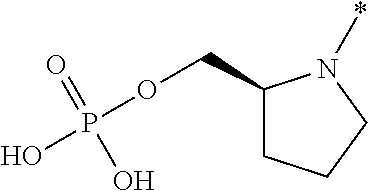 |
3-fluorophenyl |
| 6 |
 |
2,3-difluorophenyl |
| 7 |
 |
2,3-difluorophenyl |
| 8 |
 |
3,5-difluorophenyl |
| 9 |
 |
3,5-difluorophenyl |
| 10 |
 |
3-fluorophenyl |
| 11 |
 |
3-fluorophenyl |
| 12 |
 |
3-fluorophenyl |
| 13 |
 |
2,3-difluorophenyl |
| 14 |
 |
3,5-difluorophenyl |
| 15 |
 |
2,3-difluorophenyl |
| 16 |
 |
2,3-difluorophenyl |
| 17 |
 |
2,3-difluorophenyl |
| 18 |
 |
3-fluorophenyl |
| 19 |
 |
2,3-difluorophenyl |
| 20 |
 |
3-fluorophenyl |
| 21 |
 |
2,3-difluorophenyl |
| 22 |
 |
2,3-difluorophenyl |
| 23 |
 |
2,3-difluorophenyl |
| 24 |
 |
3-fluorophenyl |
| 25 |
 |
2,3-difluorophenyl |
| 26 |
 |
3-fluorophenyl |
| TABLE 2 |
 |
| Compound | Rx | Ry |
| 27 |
 |
2,3-difluorophenyl |
| TABLE 3 |
 |
| Compound | Rx | Ry |
| 28 |
 |
2,3-difluorophenyl |
| 29 |
 |
2,3-difluorophenyl |
| 30 |
 |
2,3-difluorophenyl |
| 31 |
 |
2,3-difluorophenyl |
| 32 |
 |
2,3-difluorophenyl |
| 33 |
 |
2,3-difluorophenyl |
| 34 |
 |
2,3-difluorophenyl |
| 35 |
 |
2,3-difluorophenyl |
| 36 |
 |
2,3-difluorophenyl |
| 37 |
 |
3-fluorophenyl |
| 38 |
 |
3-fluorophenyl |
| 39 |
 |
3-fluorophenyl |
| 40 |
 |
3-fluorophenyl |
| 41 |
 |
3-fluorophenyl |
| 42 |
 |
3-fluorophenyl |
| 43 |
 |
3-fluorophenyl |
| 44 |
 |
3-fluorophenyl |
| TABLE 4 |
 |
| Compound | Rx | Ry |
| 45 |
 |
2,3-difluorophenyl |
| 46 |
 |
2,3-difluorophenyl |
| 47 |
 |
2,3-difluorophenyl |
| 48 |
 |
2,3-difluorophenyl |
| 49 |
 |
2,3-difluorophenyl |
| TABLE 5 |
 |
| Compound | Rx | Ry |
| 50 |
 |
3-fluorophenyl |
The solution was cooled to 5° C., cumene hydroperoxide (426 mg, 2.8 mmol) was slowly added, and the mixture stirred at 50° C. for 1 hour and at ambient temperature for a further 1 hour. The mixture was cooled to 5° C. and triethyl phosphite (415 mg, 2.5 mmol) was added and the reaction stirred at ambient temperature for 1 hour. The solution was diluted with water, extracted with ethyl acetate and the organic phase was separated, dried and concentrated. The resultant oil was purified by chromatography on silica gel, eluting with dichloromethane/methanol (98:2) to dichloromethane/methanol/ammonia (7.0 N) (95:5:1), to give di-tert-butyl 2-{cyclopropyl[3-({4-[(5-{2-[(3-fluorophenyl)amino]-2-oxoethyl}-1H-pyrazol-3-yl)amino]-6-methoxyquinazolin-7-yl}oxy)propyl]amino}ethyl phosphate as an off-white solid (630 mg, 59% yield):
c) Pentafluorophenyl trifluoroacetate (23.25 g, 83 mmol) was added dropwise to a solution of (3-{[7-(3-chloropropoxy)quinazolin-4-yl]amino}-1H-pyrazol-5-yl)acetic acid (15.0 g, 41 mmol) and pyridine (6.7 ml, 83 mmol) in dimethylformamide (150 ml) with cooling to maintain the solution temperature at <23° C. The solution was stirred at ambient temperature for 30 minutes before addition of 3-fluoroaniline (9.22 g, 83 mmol). The reaction was stirred for 2.5 hours at ambient temperature and then a further portion of 3-fluoroaniline (2 ml) was added and the mixture was heated at 90° C. for 3 hours. The reaction mixture was poured into dilute hydrochloric acid (0.1 M) and ice (ca. 500 ml) and the resultant solid was filtered, washed with water and then diethyl ether and then dried to give 2-(3-{[7-(3-chloropropoxy)quinazolin-4-yl]amino}-1H-pyrazol-5-yl)-N-(3-fluorophenyl)acetamide (17.7 g, 94% yield) as a brown solid:
Claims (2)
Priority Applications (1)
| Application Number | Priority Date | Filing Date | Title |
|---|---|---|---|
| US14/661,657 US9567358B2 (en) | 2002-12-24 | 2015-03-18 | Methods of treatment using N-(3-fluorophenyl)-2-{3-[(7-{3-[ethyl(2-hydroxyethyl)amino]propoxy}-quinazolin-4-yl)amino]-1H-pyrazol-5-yl}acetamide |
Applications Claiming Priority (11)
| Application Number | Priority Date | Filing Date | Title |
|---|---|---|---|
| EP02293238.8 | 2002-12-24 | ||
| EP02293238 | 2002-12-24 | ||
| EP02293238 | 2002-12-24 | ||
| EP03291315.4 | 2003-06-02 | ||
| EP03291315 | 2003-06-02 | ||
| EP03291315 | 2003-06-02 | ||
| US10/539,220 US7528121B2 (en) | 2002-12-24 | 2003-12-22 | Phosphonooxy quinazoline derivatives and their pharmaceutical use |
| PCT/GB2003/005613 WO2004058781A1 (en) | 2002-12-24 | 2003-12-22 | Phosphonooxy quinazoline derivatives and their pharmaceutical use |
| US12/431,165 US8268841B2 (en) | 2002-12-24 | 2009-04-28 | Phosphonoxy quinazoline derivatives and their pharmaceutical use |
| US13/590,662 US9018191B2 (en) | 2002-12-24 | 2012-08-21 | Phosphonoxy quinazoline derivatives and their pharmaceutical use |
| US14/661,657 US9567358B2 (en) | 2002-12-24 | 2015-03-18 | Methods of treatment using N-(3-fluorophenyl)-2-{3-[(7-{3-[ethyl(2-hydroxyethyl)amino]propoxy}-quinazolin-4-yl)amino]-1H-pyrazol-5-yl}acetamide |
Related Parent Applications (1)
| Application Number | Title | Priority Date | Filing Date |
|---|---|---|---|
| US13/590,662 Continuation US9018191B2 (en) | 2002-12-24 | 2012-08-21 | Phosphonoxy quinazoline derivatives and their pharmaceutical use |
Publications (2)
| Publication Number | Publication Date |
|---|---|
| US20150307534A1 US20150307534A1 (en) | 2015-10-29 |
| US9567358B2 true US9567358B2 (en) | 2017-02-14 |
Family
ID=32683824
Family Applications (4)
| Application Number | Title | Priority Date | Filing Date |
|---|---|---|---|
| US10/539,220 Active 2026-07-14 US7528121B2 (en) | 2002-12-24 | 2003-12-22 | Phosphonooxy quinazoline derivatives and their pharmaceutical use |
| US12/431,165 Expired - Lifetime US8268841B2 (en) | 2002-12-24 | 2009-04-28 | Phosphonoxy quinazoline derivatives and their pharmaceutical use |
| US13/590,662 Expired - Lifetime US9018191B2 (en) | 2002-12-24 | 2012-08-21 | Phosphonoxy quinazoline derivatives and their pharmaceutical use |
| US14/661,657 Expired - Fee Related US9567358B2 (en) | 2002-12-24 | 2015-03-18 | Methods of treatment using N-(3-fluorophenyl)-2-{3-[(7-{3-[ethyl(2-hydroxyethyl)amino]propoxy}-quinazolin-4-yl)amino]-1H-pyrazol-5-yl}acetamide |
Family Applications Before (3)
| Application Number | Title | Priority Date | Filing Date |
|---|---|---|---|
| US10/539,220 Active 2026-07-14 US7528121B2 (en) | 2002-12-24 | 2003-12-22 | Phosphonooxy quinazoline derivatives and their pharmaceutical use |
| US12/431,165 Expired - Lifetime US8268841B2 (en) | 2002-12-24 | 2009-04-28 | Phosphonoxy quinazoline derivatives and their pharmaceutical use |
| US13/590,662 Expired - Lifetime US9018191B2 (en) | 2002-12-24 | 2012-08-21 | Phosphonoxy quinazoline derivatives and their pharmaceutical use |
Country Status (29)
| Country | Link |
|---|---|
| US (4) | US7528121B2 (en) |
| EP (2) | EP1847539B1 (en) |
| JP (3) | JP4422102B2 (en) |
| KR (1) | KR101010299B1 (en) |
| AR (2) | AR042668A1 (en) |
| AT (2) | ATE438644T1 (en) |
| AU (1) | AU2003290313B2 (en) |
| BR (1) | BRPI0317717B8 (en) |
| CA (1) | CA2511613C (en) |
| CL (1) | CL2003002731A1 (en) |
| CY (2) | CY1107775T1 (en) |
| DE (2) | DE60315892T2 (en) |
| DK (2) | DK1578755T3 (en) |
| ES (2) | ES2290529T3 (en) |
| IL (2) | IL169112A (en) |
| IS (2) | IS2504B (en) |
| MX (1) | MXPA05006918A (en) |
| MY (2) | MY136174A (en) |
| NO (2) | NO335193B1 (en) |
| NZ (1) | NZ540698A (en) |
| PL (2) | PL221490B1 (en) |
| PT (2) | PT1847539E (en) |
| RU (3) | RU2350611C1 (en) |
| SA (1) | SA04240504B1 (en) |
| SI (2) | SI1847539T1 (en) |
| TW (2) | TWI336327B (en) |
| UA (1) | UA83814C2 (en) |
| UY (1) | UY28149A1 (en) |
| WO (1) | WO2004058781A1 (en) |
Families Citing this family (51)
| Publication number | Priority date | Publication date | Assignee | Title |
|---|---|---|---|---|
| JP4498741B2 (en) * | 2001-12-24 | 2010-07-07 | アストラゼネカ アクチボラグ | Substituted quinazoline derivatives as Aurora kinase inhibitors |
| BRPI0317717B8 (en) * | 2002-12-24 | 2021-05-25 | Astrazeneca Ab | compound, pharmaceutical composition, and use of a compound |
| EP1575946A1 (en) * | 2002-12-24 | 2005-09-21 | AstraZeneca AB | Quinazoline compounds |
| BRPI0409427A (en) * | 2003-04-16 | 2006-04-18 | Astrazeneca Ab | compound, use thereof, pharmaceutical composition, method of treating a human suffering from a hyperproliferative disease, and process for the preparation of a compound or a pharmaceutically acceptable salt, ester or prodrug thereof |
| ATE534649T1 (en) * | 2003-05-15 | 2011-12-15 | Arqule Inc | IMIDAZOTHIAZOLES AND IMIDAZOXAZOLE DERIVATIVES AS INHIBITORS OF P38 |
| WO2004105764A1 (en) * | 2003-06-02 | 2004-12-09 | Astrazeneca Ab | (3- ((quinazolin-4-yl) amino )-1h-pyrazol-1-yl) acetamide derivatives and related compounds as aurora kinase inhibitors for the treatment of proliferative diseases such as cancer |
| JP2007514759A (en) | 2003-12-19 | 2007-06-07 | タケダ サン ディエゴ インコーポレイテッド | Kinase inhibitor |
| WO2006023931A2 (en) | 2004-08-18 | 2006-03-02 | Takeda San Diego, Inc. | Kinase inhibitors |
| JP2008515961A (en) * | 2004-10-12 | 2008-05-15 | アストラゼネカ アクチボラグ | Quinazoline derivatives for use against cancer |
| WO2006040520A1 (en) * | 2004-10-12 | 2006-04-20 | Astrazeneca Ab | Quinazoline derivatives |
| ATE479687T1 (en) | 2004-10-15 | 2010-09-15 | Takeda Pharmaceutical | KINASE INHIBITORS |
| CA2584368A1 (en) * | 2004-10-19 | 2006-04-27 | Arqule, Inc. | Synthesis of imidazooxazole and imidazothiazole inhibitors of p38 map kinase |
| US8119655B2 (en) | 2005-10-07 | 2012-02-21 | Takeda Pharmaceutical Company Limited | Kinase inhibitors |
| UY30183A1 (en) | 2006-03-02 | 2007-10-31 | Astrazeneca Ab | QUINOLINE DERIVATIVES |
| US7501430B2 (en) * | 2006-04-17 | 2009-03-10 | Arqule, Inc. | RAF inhibitors and their uses |
| GB0609621D0 (en) * | 2006-05-16 | 2006-06-21 | Astrazeneca Ab | Novel co-crystal |
| GB0609617D0 (en) | 2006-05-16 | 2006-06-21 | Astrazeneca Ab | Process & intermediate |
| GB0609619D0 (en) * | 2006-05-16 | 2006-06-21 | Astrazeneca Ab | Combination |
| BRPI0719883A2 (en) | 2006-10-09 | 2015-05-05 | Takeda Pharmaceutical | Kinase Inhibitors |
| US20110136766A1 (en) * | 2008-03-04 | 2011-06-09 | Vitae Pharmaceuticals, Inc. | Aurora kinase inhibitors |
| WO2009114703A2 (en) * | 2008-03-12 | 2009-09-17 | Fox Chase Cancer Center | Combination therapy for the treatment of cancer |
| CA2722220C (en) | 2008-04-30 | 2016-06-07 | National Health Research Institutes | Fused bicyclic pyrimidine compounds as aurora kinase inhibitors |
| AU2009267161B2 (en) * | 2008-07-03 | 2014-11-06 | Merck Patent Gmbh | Naphthyridininones as Aurora kinase inhibitors |
| CA2744713A1 (en) * | 2008-12-05 | 2010-06-10 | Arqule, Inc. | Raf inhibitors and their uses |
| CA2746652C (en) | 2008-12-11 | 2018-03-06 | Axcentua Pharmaceuticals Ab | Crystalline forms of genistein |
| US7863325B2 (en) | 2008-12-11 | 2011-01-04 | Axcentua Pharmaceuticals Ab | Crystalline genistein sodium salt dihydrate |
| WO2010074724A1 (en) | 2008-12-22 | 2010-07-01 | Millennium Pharmaceuticals, Inc. | Combination of aurora kinase inhibitors and anti-cd20 antibodies |
| SG192769A1 (en) | 2011-03-04 | 2013-09-30 | Glaxosmithkline Ip No 2 Ltd | Amino-quinolines as kinase inhibitors |
| TWI547494B (en) | 2011-08-18 | 2016-09-01 | 葛蘭素史克智慧財產發展有限公司 | Aminoquinazolines as kinase inhibitors |
| TWI592417B (en) | 2012-09-13 | 2017-07-21 | 葛蘭素史克智慧財產發展有限公司 | Aminoquinazoline kinase inhibitor prodrug |
| AR092530A1 (en) | 2012-09-13 | 2015-04-22 | Glaxosmithkline Llc | AMINO-QUINOLINE COMPOSITE, PHARMACEUTICAL COMPOSITION THAT INCLUDES IT AND USE OF THIS COMPOUND FOR THE PREPARATION OF A MEDICINAL PRODUCT |
| HK1217092A1 (en) | 2013-02-15 | 2016-12-23 | Kala Pharmaceuticals, Inc. | Therapeutic compounds and uses thereof |
| US9688688B2 (en) | 2013-02-20 | 2017-06-27 | Kala Pharmaceuticals, Inc. | Crystalline forms of 4-((4-((4-fluoro-2-methyl-1H-indol-5-yl)oxy)-6-methoxyquinazolin-7-yl)oxy)-1-(2-oxa-7-azaspiro[3.5]nonan-7-yl)butan-1-one and uses thereof |
| CN105189462B (en) | 2013-02-20 | 2017-11-10 | 卡拉制药公司 | Therapeutic compounds and uses thereof |
| JP6301374B2 (en) * | 2013-02-21 | 2018-03-28 | グラクソスミスクライン、インテレクチュアル、プロパティー、ディベロップメント、リミテッドGlaxosmithkline Intellectual Property Development Limited | Quinazolines as kinase inhibitors |
| JP6543258B2 (en) | 2013-09-16 | 2019-07-10 | アストラゼネカ アクチボラグ | Therapeutic polymerizable nanoparticles and methods of making and using the same |
| US9890173B2 (en) | 2013-11-01 | 2018-02-13 | Kala Pharmaceuticals, Inc. | Crystalline forms of therapeutic compounds and uses thereof |
| AU2014342042B2 (en) | 2013-11-01 | 2017-08-17 | KALA BIO, Inc. | Crystalline forms of therapeutic compounds and uses thereof |
| JP6525474B2 (en) | 2013-12-06 | 2019-06-05 | ミレニアム ファーマシューティカルズ, インコーポレイテッドMillennium Pharmaceuticals, Inc. | Combination of Aurora kinase inhibitor and anti-CD30 antibody |
| EP3324976A4 (en) | 2015-07-21 | 2019-03-27 | Millennium Pharmaceuticals, Inc. | Administration of aurora kinase inhibitor and chemotherapeutic agents |
| CA3036340A1 (en) | 2016-09-08 | 2018-03-15 | Kala Pharmaceuticals, Inc. | Crystalline forms of therapeutic compounds and uses thereof |
| CA3036336A1 (en) | 2016-09-08 | 2018-03-15 | Kala Pharmaceuticals, Inc. | Crystalline forms of therapeutic compounds and uses thereof |
| WO2018048746A1 (en) | 2016-09-08 | 2018-03-15 | Kala Pharmaceuticals, Inc. | Crystalline forms of therapeutic compounds and uses thereof |
| ES2975183T3 (en) | 2017-09-08 | 2024-07-03 | Univ Leland Stanford Junior | ENPP1 inhibitors and their use for cancer treatment |
| WO2019195658A1 (en) | 2018-04-05 | 2019-10-10 | Dana-Farber Cancer Institute, Inc. | Sting levels as a biomarker for cancer immunotherapy |
| WO2020049208A1 (en) | 2018-09-09 | 2020-03-12 | Fundacio Privada Institut De Recerca De La Sida - Caixa | Aurora kinase as target for treating, preventing or curing hiv infection or aids |
| WO2021041532A1 (en) | 2019-08-26 | 2021-03-04 | Dana-Farber Cancer Institute, Inc. | Use of heparin to promote type 1 interferon signaling |
| US20210161897A1 (en) | 2019-11-12 | 2021-06-03 | Astrazeneca Ab | Epidermal growth factor receptor tyrosine kinase inhibitors for the treatment of cancer |
| CN112939948B (en) * | 2019-12-11 | 2022-05-17 | 苏州美诺医药科技有限公司 | Novel quinazoline-containing compound, intermediate and application thereof |
| WO2021260582A1 (en) | 2020-06-24 | 2021-12-30 | Astrazeneca Uk Limited | Combination of antibody-drug conjugate and aurora b inhibitor |
| WO2022192139A1 (en) | 2021-03-10 | 2022-09-15 | Astrazeneca Ab | Aurora kinase b inhibitors for use for treating cancer |
Citations (17)
| Publication number | Priority date | Publication date | Assignee | Title |
|---|---|---|---|---|
| WO1992020642A1 (en) | 1991-05-10 | 1992-11-26 | Rhone-Poulenc Rorer International (Holdings) Inc. | Bis mono-and bicyclic aryl and heteroaryl compounds which inhibit egf and/or pdgf receptor tyrosine kinase |
| WO1995015758A1 (en) | 1993-12-10 | 1995-06-15 | Rhone-Poulenc Rorer Pharmaceuticals Inc. | Aryl and heteroaryl quinazoline compounds which inhibit csf-1r receptor tyrosine kinase |
| US5480883A (en) | 1991-05-10 | 1996-01-02 | Rhone-Poulenc Rorer Pharmaceuticals Inc. | Bis mono- and bicyclic aryl and heteroaryl compounds which inhibit EGF and/or PDGF receptor tyrosine kinase |
| WO1996009294A1 (en) | 1994-09-19 | 1996-03-28 | The Wellcome Foundation Limited | Substituted heteroaromatic compounds and their use in medicine |
| WO1996015118A1 (en) | 1994-11-12 | 1996-05-23 | Zeneca Limited | Aniline derivatives |
| WO1996039145A1 (en) | 1995-06-06 | 1996-12-12 | Rhone-Poulenc Rorer Pharmaceuticals Inc. | Protein tyrosine kinase aryl and heteroaryl quinazoline compounds having selective inhibition of her-2 autophosphorylation properties |
| WO1997003069A1 (en) | 1995-07-13 | 1997-01-30 | Glaxo Group Limited | Heterocyclic compounds and pharmaceutical compositions containing them |
| WO1999006378A1 (en) | 1997-07-29 | 1999-02-11 | Warner-Lambert Company | Irreversible inhibitors of tyrosine kinases |
| WO2000021955A1 (en) | 1998-10-08 | 2000-04-20 | Astrazeneca Ab | Quinazoline derivatives |
| WO2001021597A1 (en) | 1999-09-21 | 2001-03-29 | Astrazeneca Ab | Therapeutic quinazoline derivatives |
| WO2001021596A1 (en) | 1999-09-21 | 2001-03-29 | Astrazeneca Ab | Quinazoline derivatives and their use as pharmaceuticals |
| WO2002000649A1 (en) | 2000-06-28 | 2002-01-03 | Astrazeneca Ab | Substituted quinazoline derivatives and their use as inhibitors |
| EP0326330B1 (en) | 1988-01-29 | 2002-07-24 | Dow AgroSciences LLC | Quinoline fungicides |
| WO2003000188A2 (en) | 2001-06-21 | 2003-01-03 | Ariad Pharmaceuticals, Inc. | Novel quinazolines and uses thereof |
| WO2003055491A1 (en) | 2001-12-24 | 2003-07-10 | Astrazeneca Ab | Substituted quinazoline derivatives as inhibitors of aurora kinases |
| US6610677B2 (en) | 2000-09-15 | 2003-08-26 | Vertex Pharmaceuticals Incorporated | Pyrazole compounds useful as protein kinase inhibitors |
| WO2004058781A1 (en) | 2002-12-24 | 2004-07-15 | Astrazeneca Ab | Phosphonooxy quinazoline derivatives and their pharmaceutical use |
Family Cites Families (17)
| Publication number | Priority date | Publication date | Assignee | Title |
|---|---|---|---|---|
| AU2737295A (en) | 1994-06-09 | 1996-01-04 | Glaxo Group Limited | Phenethanolamine derivatives and their use as atypical beta-adrenoceptor agonists |
| IL124728A (en) | 1995-12-18 | 2007-06-03 | Sugen Inc | Aurora-1 and aurora-2 proteins |
| GB9624482D0 (en) | 1995-12-18 | 1997-01-15 | Zeneca Phaema S A | Chemical compounds |
| US6716575B2 (en) | 1995-12-18 | 2004-04-06 | Sugen, Inc. | Diagnosis and treatment of AUR1 and/or AUR2 related disorders |
| BR9707495A (en) | 1996-02-13 | 1999-07-27 | Zeneca Ltd | Quinazoline derivative process for the preparation of the same pharmaceutical composition and process for the production of an antiangiogenic effect and / or reduction of vascular permeability in a warm-blooded animal |
| JP4464466B2 (en) | 1996-03-05 | 2010-05-19 | アストラゼネカ・ユーケイ・リミテッド | 4-anilinoquinazoline derivatives |
| GB9718972D0 (en) | 1996-09-25 | 1997-11-12 | Zeneca Ltd | Chemical compounds |
| GB9714249D0 (en) | 1997-07-08 | 1997-09-10 | Angiogene Pharm Ltd | Vascular damaging agents |
| GB9900334D0 (en) | 1999-01-07 | 1999-02-24 | Angiogene Pharm Ltd | Tricylic vascular damaging agents |
| GB9900752D0 (en) | 1999-01-15 | 1999-03-03 | Angiogene Pharm Ltd | Benzimidazole vascular damaging agents |
| IL152682A0 (en) | 2000-05-31 | 2003-06-24 | Astrazeneca Ab | Indole derivatives with vascular damaging activity |
| JP2004502766A (en) | 2000-07-07 | 2004-01-29 | アンギオジェン・ファーマシューティカルズ・リミテッド | Colhinol derivatives as vascular damaging agents |
| CA2410562A1 (en) | 2000-07-07 | 2002-01-31 | Angiogene Pharmaceuticals Limited | Colchinol derivatives as angiogenesis inhibitors |
| BR0113356A (en) * | 2000-08-18 | 2004-04-20 | Millennium Pharm Inc | Quinazoline derivatives as kinase inhibitors |
| GB0124299D0 (en) * | 2001-10-10 | 2001-11-28 | Astrazeneca Ab | Crystal structure of enzyme and uses thereof |
| EP1575946A1 (en) * | 2002-12-24 | 2005-09-21 | AstraZeneca AB | Quinazoline compounds |
| BRPI0409427A (en) * | 2003-04-16 | 2006-04-18 | Astrazeneca Ab | compound, use thereof, pharmaceutical composition, method of treating a human suffering from a hyperproliferative disease, and process for the preparation of a compound or a pharmaceutically acceptable salt, ester or prodrug thereof |
-
2003
- 2003-12-22 BR BRPI0317717A patent/BRPI0317717B8/en not_active IP Right Cessation
- 2003-12-22 NZ NZ540698A patent/NZ540698A/en not_active IP Right Cessation
- 2003-12-22 SI SI200331673T patent/SI1847539T1/en unknown
- 2003-12-22 ES ES03782672T patent/ES2290529T3/en not_active Expired - Lifetime
- 2003-12-22 DE DE60315892T patent/DE60315892T2/en not_active Expired - Lifetime
- 2003-12-22 DK DK03782672T patent/DK1578755T3/en active
- 2003-12-22 PL PL377680A patent/PL221490B1/en unknown
- 2003-12-22 CL CL200302731A patent/CL2003002731A1/en unknown
- 2003-12-22 AT AT07009390T patent/ATE438644T1/en active
- 2003-12-22 CA CA2511613A patent/CA2511613C/en not_active Expired - Lifetime
- 2003-12-22 MY MYPI20034944A patent/MY136174A/en unknown
- 2003-12-22 US US10/539,220 patent/US7528121B2/en active Active
- 2003-12-22 UA UAA200507294A patent/UA83814C2/en unknown
- 2003-12-22 ES ES07009390T patent/ES2329623T3/en not_active Expired - Lifetime
- 2003-12-22 AT AT03782672T patent/ATE370958T1/en active
- 2003-12-22 SI SI200330965T patent/SI1578755T1/en unknown
- 2003-12-22 PT PT07009390T patent/PT1847539E/en unknown
- 2003-12-22 RU RU2007121850/04A patent/RU2350611C1/en active
- 2003-12-22 PT PT03782672T patent/PT1578755E/en unknown
- 2003-12-22 WO PCT/GB2003/005613 patent/WO2004058781A1/en not_active Ceased
- 2003-12-22 KR KR1020057012015A patent/KR101010299B1/en not_active Expired - Lifetime
- 2003-12-22 DK DK07009390T patent/DK1847539T3/en active
- 2003-12-22 AU AU2003290313A patent/AU2003290313B2/en not_active Expired
- 2003-12-22 PL PL412704A patent/PL223998B1/en unknown
- 2003-12-22 DE DE60328735T patent/DE60328735D1/en not_active Expired - Lifetime
- 2003-12-22 JP JP2005509716A patent/JP4422102B2/en not_active Expired - Lifetime
- 2003-12-22 MX MXPA05006918A patent/MXPA05006918A/en active IP Right Grant
- 2003-12-22 EP EP07009390A patent/EP1847539B1/en not_active Expired - Lifetime
- 2003-12-22 EP EP03782672A patent/EP1578755B1/en not_active Expired - Lifetime
- 2003-12-22 MY MYPI20071321A patent/MY147761A/en unknown
- 2003-12-22 RU RU2005123485/04A patent/RU2357971C2/en active
- 2003-12-23 UY UY28149A patent/UY28149A1/en not_active Application Discontinuation
- 2003-12-23 TW TW092136601A patent/TWI336327B/en not_active IP Right Cessation
- 2003-12-23 TW TW099134275A patent/TWI393710B/en not_active IP Right Cessation
- 2003-12-23 AR ARP030104824A patent/AR042668A1/en active IP Right Grant
-
2004
- 2004-02-18 SA SA04240504A patent/SA04240504B1/en unknown
-
2005
- 2005-06-09 IL IL169112A patent/IL169112A/en active IP Right Grant
- 2005-06-13 NO NO20052855A patent/NO335193B1/en not_active IP Right Cessation
- 2005-07-20 IS IS7948A patent/IS2504B/en unknown
-
2007
- 2007-05-16 AR ARP070102117A patent/AR057753A2/en not_active Application Discontinuation
- 2007-06-13 RU RU2007121850/04K patent/RU2007121850A/en unknown
- 2007-06-28 JP JP2007169891A patent/JP4906608B2/en not_active Expired - Lifetime
- 2007-08-09 IL IL185176A patent/IL185176A/en active IP Right Grant
- 2007-10-24 CY CY20071101369T patent/CY1107775T1/en unknown
-
2008
- 2008-02-13 IS IS8714A patent/IS2884B/en unknown
- 2008-10-15 JP JP2008265949A patent/JP4503090B2/en not_active Expired - Lifetime
-
2009
- 2009-04-28 US US12/431,165 patent/US8268841B2/en not_active Expired - Lifetime
- 2009-10-13 CY CY20091101054T patent/CY1109479T1/en unknown
-
2012
- 2012-08-21 US US13/590,662 patent/US9018191B2/en not_active Expired - Lifetime
-
2013
- 2013-11-01 NO NO20131444A patent/NO335446B1/en not_active IP Right Cessation
-
2015
- 2015-03-18 US US14/661,657 patent/US9567358B2/en not_active Expired - Fee Related
Patent Citations (20)
| Publication number | Priority date | Publication date | Assignee | Title |
|---|---|---|---|---|
| EP0326330B1 (en) | 1988-01-29 | 2002-07-24 | Dow AgroSciences LLC | Quinoline fungicides |
| US5480883A (en) | 1991-05-10 | 1996-01-02 | Rhone-Poulenc Rorer Pharmaceuticals Inc. | Bis mono- and bicyclic aryl and heteroaryl compounds which inhibit EGF and/or PDGF receptor tyrosine kinase |
| US5710158A (en) | 1991-05-10 | 1998-01-20 | Rhone-Poulenc Rorer Pharmaceuticals Inc. | Aryl and heteroaryl quinazoline compounds which inhibit EGF and/or PDGF receptor tyrosine kinase |
| WO1992020642A1 (en) | 1991-05-10 | 1992-11-26 | Rhone-Poulenc Rorer International (Holdings) Inc. | Bis mono-and bicyclic aryl and heteroaryl compounds which inhibit egf and/or pdgf receptor tyrosine kinase |
| WO1995015758A1 (en) | 1993-12-10 | 1995-06-15 | Rhone-Poulenc Rorer Pharmaceuticals Inc. | Aryl and heteroaryl quinazoline compounds which inhibit csf-1r receptor tyrosine kinase |
| WO1996009294A1 (en) | 1994-09-19 | 1996-03-28 | The Wellcome Foundation Limited | Substituted heteroaromatic compounds and their use in medicine |
| WO1996015118A1 (en) | 1994-11-12 | 1996-05-23 | Zeneca Limited | Aniline derivatives |
| WO1996039145A1 (en) | 1995-06-06 | 1996-12-12 | Rhone-Poulenc Rorer Pharmaceuticals Inc. | Protein tyrosine kinase aryl and heteroaryl quinazoline compounds having selective inhibition of her-2 autophosphorylation properties |
| WO1997003069A1 (en) | 1995-07-13 | 1997-01-30 | Glaxo Group Limited | Heterocyclic compounds and pharmaceutical compositions containing them |
| WO1999006378A1 (en) | 1997-07-29 | 1999-02-11 | Warner-Lambert Company | Irreversible inhibitors of tyrosine kinases |
| WO2000021955A1 (en) | 1998-10-08 | 2000-04-20 | Astrazeneca Ab | Quinazoline derivatives |
| WO2001021597A1 (en) | 1999-09-21 | 2001-03-29 | Astrazeneca Ab | Therapeutic quinazoline derivatives |
| WO2001021596A1 (en) | 1999-09-21 | 2001-03-29 | Astrazeneca Ab | Quinazoline derivatives and their use as pharmaceuticals |
| WO2002000649A1 (en) | 2000-06-28 | 2002-01-03 | Astrazeneca Ab | Substituted quinazoline derivatives and their use as inhibitors |
| US6610677B2 (en) | 2000-09-15 | 2003-08-26 | Vertex Pharmaceuticals Incorporated | Pyrazole compounds useful as protein kinase inhibitors |
| WO2003000188A2 (en) | 2001-06-21 | 2003-01-03 | Ariad Pharmaceuticals, Inc. | Novel quinazolines and uses thereof |
| WO2003055491A1 (en) | 2001-12-24 | 2003-07-10 | Astrazeneca Ab | Substituted quinazoline derivatives as inhibitors of aurora kinases |
| WO2004058781A1 (en) | 2002-12-24 | 2004-07-15 | Astrazeneca Ab | Phosphonooxy quinazoline derivatives and their pharmaceutical use |
| US7528121B2 (en) * | 2002-12-24 | 2009-05-05 | Astrazeneca Ab | Phosphonooxy quinazoline derivatives and their pharmaceutical use |
| US9018191B2 (en) * | 2002-12-24 | 2015-04-28 | Astrazeneca Ab | Phosphonoxy quinazoline derivatives and their pharmaceutical use |
Non-Patent Citations (15)
Also Published As
Similar Documents
| Publication | Publication Date | Title |
|---|---|---|
| US9567358B2 (en) | Methods of treatment using N-(3-fluorophenyl)-2-{3-[(7-{3-[ethyl(2-hydroxyethyl)amino]propoxy}-quinazolin-4-yl)amino]-1H-pyrazol-5-yl}acetamide | |
| US7407946B2 (en) | Quinazoline compounds | |
| EP1575966B1 (en) | Therapeutic quinazoline derivatives | |
| US7691867B2 (en) | Chemical compounds | |
| US20050070561A1 (en) | Substituted quinazoline derivatives as inhibitors of aurora kinases | |
| US20060178382A1 (en) | Chinazoline derivatives as aurora kinase inhibitors | |
| EP1635837B1 (en) | (3-((quinazolin-4-yl)amino)-1h-pyrazol-1-yl)acetamide derivatives and related compounds as aurora kinase inhibitors for the treatment of proliferative diseases such as cancer | |
| AU2007202223B2 (en) | Phosphonooxy quinazoline derivatives and their pharmaceutical use | |
| HK1080481B (en) | Phosphonooxy quinazoline derivatives and their pharmaceutical use | |
| HK1111417B (en) | Quinazoline derivatives |
Legal Events
| Date | Code | Title | Description |
|---|---|---|---|
| AS | Assignment |
Owner name: ASTRAZENECA AB, SWEDEN Free format text: ASSIGNMENT OF ASSIGNORS INTEREST;ASSIGNORS:HERON, NICOLA MURDOCH;MORTLOCK, ANDREW AUSTEN;JUNG, FREDERIC HENRI;AND OTHERS;SIGNING DATES FROM 20050518 TO 20050601;REEL/FRAME:038930/0542 |
|
| STCF | Information on status: patent grant |
Free format text: PATENTED CASE |
|
| MAFP | Maintenance fee payment |
Free format text: PAYMENT OF MAINTENANCE FEE, 4TH YEAR, LARGE ENTITY (ORIGINAL EVENT CODE: M1551); ENTITY STATUS OF PATENT OWNER: LARGE ENTITY Year of fee payment: 4 |
|
| FEPP | Fee payment procedure |
Free format text: MAINTENANCE FEE REMINDER MAILED (ORIGINAL EVENT CODE: REM.); ENTITY STATUS OF PATENT OWNER: LARGE ENTITY |
|
| LAPS | Lapse for failure to pay maintenance fees |
Free format text: PATENT EXPIRED FOR FAILURE TO PAY MAINTENANCE FEES (ORIGINAL EVENT CODE: EXP.); ENTITY STATUS OF PATENT OWNER: LARGE ENTITY |
|
| STCH | Information on status: patent discontinuation |
Free format text: PATENT EXPIRED DUE TO NONPAYMENT OF MAINTENANCE FEES UNDER 37 CFR 1.362 |
|
| FP | Lapsed due to failure to pay maintenance fee |
Effective date: 20250214 |