US9561440B2 - Gaming device implementing a cooperative battle game in which the quantity of players of a group of players are managed based on mission success rates - Google Patents
Gaming device implementing a cooperative battle game in which the quantity of players of a group of players are managed based on mission success rates Download PDFInfo
- Publication number
- US9561440B2 US9561440B2 US14/242,618 US201414242618A US9561440B2 US 9561440 B2 US9561440 B2 US 9561440B2 US 201414242618 A US201414242618 A US 201414242618A US 9561440 B2 US9561440 B2 US 9561440B2
- Authority
- US
- United States
- Prior art keywords
- group
- groups
- player
- rate
- threshold value
- Prior art date
- Legal status (The legal status is an assumption and is not a legal conclusion. Google has not performed a legal analysis and makes no representation as to the accuracy of the status listed.)
- Expired - Fee Related, expires
Links
Images



Classifications
-
- A—HUMAN NECESSITIES
- A63—SPORTS; GAMES; AMUSEMENTS
- A63F—CARD, BOARD, OR ROULETTE GAMES; INDOOR GAMES USING SMALL MOVING PLAYING BODIES; VIDEO GAMES; GAMES NOT OTHERWISE PROVIDED FOR
- A63F13/00—Video games, i.e. games using an electronically generated display having two or more dimensions
- A63F13/30—Interconnection arrangements between game servers and game devices; Interconnection arrangements between game devices; Interconnection arrangements between game servers
- A63F13/35—Details of game servers
-
- A—HUMAN NECESSITIES
- A63—SPORTS; GAMES; AMUSEMENTS
- A63F—CARD, BOARD, OR ROULETTE GAMES; INDOOR GAMES USING SMALL MOVING PLAYING BODIES; VIDEO GAMES; GAMES NOT OTHERWISE PROVIDED FOR
- A63F13/00—Video games, i.e. games using an electronically generated display having two or more dimensions
- A63F13/60—Generating or modifying game content before or while executing the game program, e.g. authoring tools specially adapted for game development or game-integrated level editor
- A63F13/67—Generating or modifying game content before or while executing the game program, e.g. authoring tools specially adapted for game development or game-integrated level editor adaptively or by learning from player actions, e.g. skill level adjustment or by storing successful combat sequences for re-use
-
- A—HUMAN NECESSITIES
- A63—SPORTS; GAMES; AMUSEMENTS
- A63F—CARD, BOARD, OR ROULETTE GAMES; INDOOR GAMES USING SMALL MOVING PLAYING BODIES; VIDEO GAMES; GAMES NOT OTHERWISE PROVIDED FOR
- A63F13/00—Video games, i.e. games using an electronically generated display having two or more dimensions
- A63F13/70—Game security or game management aspects
- A63F13/79—Game security or game management aspects involving player-related data, e.g. identities, accounts, preferences or play histories
- A63F13/795—Game security or game management aspects involving player-related data, e.g. identities, accounts, preferences or play histories for finding other players; for building a team; for providing a buddy list
-
- A—HUMAN NECESSITIES
- A63—SPORTS; GAMES; AMUSEMENTS
- A63F—CARD, BOARD, OR ROULETTE GAMES; INDOOR GAMES USING SMALL MOVING PLAYING BODIES; VIDEO GAMES; GAMES NOT OTHERWISE PROVIDED FOR
- A63F13/00—Video games, i.e. games using an electronically generated display having two or more dimensions
- A63F13/80—Special adaptations for executing a specific game genre or game mode
- A63F13/822—Strategy games; Role-playing games
Definitions
- the present invention relates to a server device and a program.
- server device which is connected to a plurality of player terminals through a network, performs grouping according to a level of an entered player after previously receiving entries from the player terminals, and performs a battle game in the grouped group (for example, JP 2003-135854 A).
- the present invention has been made in consideration of such circumstances, and is directed to adjust a game difficulty level of each group with good balance by appropriately controlling the number of persons of each group.
- a main invention of the present invention for solving the above problems is a server device, which is connected to a plurality of player terminals through a network, including: a storage unit configured to store an initial upper limit of number of groups and an initial threshold value smaller than an upper limit of a group affiliation rate, which is a ratio of number of affiliated persons with respect to a quota of a group; a group generating portion configured to generate a plurality of groups to which the group affiliation rate of the initial threshold value is set, at a start of a game, based on the initial upper limit of the number of groups; and a player distributing portion configured to, when there is a request for participation in a group from the player terminal after the start of the game, distribute players using the player terminals to groups where the group affiliation rate has not reach the initial threshold value, until the group affiliation rate of all groups reaches the initial threshold value, and, after the group affiliation rate of all groups has reached the initial threshold value, distribute players using the player terminals to groups where the group affiliation rate has not reached the upper limit.
- a game difficulty level of each group can be adjusted with good balance by appropriately controlling the number of persons of each group.
- FIG. 1 is a diagram illustrating an overall configuration example of a game system
- FIG. 2 is a block diagram illustrating a functional configuration of a server device
- FIG. 3 is a block diagram illustrating a functional configuration of a player terminal
- FIG. 4 is a diagram illustrating an example of a data structure of character information
- FIG. 5 is a diagram illustrating an example of a data structure of player information
- FIG. 6 is a diagram illustrating an example of a data structure of possessed character information
- FIG. 7 is a diagram illustrating an example of a data structure of field information
- FIG. 8 is a diagram illustrating an example of a data structure of game result information
- FIG. 9 is a diagram illustrating an example of a data structure of battle information
- FIG. 10 is a diagram for explaining an outline of a procedure (1) when a player is distributed to a field
- FIG. 11 is a diagram for explaining an outline of a procedure (2) when a player is distributed to a field
- FIG. 12 is a diagram for explaining an outline of a procedure (3) when a player is distributed to a field
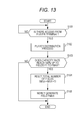
- FIG. 13 is a flowchart for explaining an example of operation of the game system.
- FIG. 14 is a flowchart for explaining a player distribution process.
- a server device which is connected to a plurality of player terminals through a network, includes: a storage unit configured to store an initial upper limit of number of groups and an initial threshold value smaller than an upper limit of a group affiliation rate, which is a ratio of number of affiliated persons with respect to a quota of a group; a group generating portion configured to generate a plurality of groups to which the group affiliation rate of the initial threshold value is set, at a start of a game, based on the initial upper limit of the number of groups; and a player distributing portion configured to, when there is a request for participation in a group from the player terminal after the start of the game, distribute players using the player terminals to groups where the group affiliation rate has not reach the initial threshold value, until the group affiliation rate of all groups reaches the initial threshold value, and, after the group affiliation rate of all groups has reached the initial threshold value, distribute players using the player terminals to groups where the group affiliation rate has not reached the upper limit.
- the game difficulty level of each group can be adjusted with good balance by appropriately controlling the number of persons of each group.
- the server device may include: an upper limit changing portion configured to change the upper limit of the number of the groups from the initial upper limit after the group affiliation rate of all groups has reached the upper limit; and an additional group generating portion configured to additionally generate a new group, based on the changed upper limit of the number of the groups, wherein after the group affiliation rate of all groups has reached the upper limit, the player distributing portion may distribute players using the player terminals to the newly added and generated group.
- an upper limit changing portion configured to change the upper limit of the number of the groups from the initial upper limit after the group affiliation rate of all groups has reached the upper limit
- an additional group generating portion configured to additionally generate a new group, based on the changed upper limit of the number of the groups, wherein after the group affiliation rate of all groups has reached the upper limit, the player distributing portion may distribute players using the player terminals to the newly added and generated group.
- the server device may include: a game processing portion configured to progress a game that gives missions set by group units to each player belonging to each group in each of the plurality of groups; a calculating portion configured to calculate a mission success rate in all groups; and a threshold value changing portion configured to change the threshold value of the group affiliation rate from the initial threshold value, based on the calculated success rate, wherein the group additionally generating portion may additionally generate a new group where the group affiliation rate of the changed threshold value is set.
- the number of persons of each group can be appropriately controlled according to the mission success rate.
- the storage unit may store an initial quota of a group, and include: a game processing portion configured to progress a game that gives missions set by group units to each player belonging to each group in each of the plurality of groups; a calculating portion configured to calculate a mission success rate in all groups; and a quota changing portion configured to change a quota of a group from the initial quota, based on the calculated success rate, wherein the group additionally generating portion additionally generates a new group where the changed quota is set.
- the number of persons of each group can be appropriately controlled according to the mission success rate.
- the game processing portion may change a difficulty level of the missions set by group units, based on the success rate calculated by the calculating portion.
- the game balance between the groups can be controlled according to the mission success rate.
- a non-transitory computer-readable storage medium stores game program causing a server device, which is connected to a plurality of player terminals through a network, to execute: storing an initial upper limit of number of groups and an initial threshold value smaller than an upper limit of a group affiliation rate, which is a ratio of number of affiliated persons with respect to a quota of a group; generating a plurality of groups to which the group affiliation rate of the initial threshold value is set, at a start of a game, based on the initial upper limit of the number of groups; and when there is a request for participation in a group from the player terminal after the start of the game, distributing players using the player terminals to groups where the group affiliation rate has not reach the initial threshold value, until the group affiliation rate of all groups reaches the initial threshold value, and, after the group affiliation rate of all groups has reached the initial threshold value, distributing players using the player terminals to groups where the group affiliation rate has not reached the upper limit.
- the game difficulty level of each group can be adjusted with good balance by appropriately controlling the number of persons of each group
- FIG. 1 is a diagram illustrating an example of an overall configuration of a game system 1 according to the present embodiment.
- the game system 1 is configured to provide various game-related services to players through a network 2 (for example, the Internet or the like) and is configured to include a server device 10 and a plurality of player terminals 20 .
- FIG. 2 is a block diagram illustrating a functional configuration of the server device 10 according to the present embodiment.
- the server device 10 is an information processing device (for example, workstation or personal computer) used when a system administrator or the like operates and manages a game service.
- the server device 10 can deliver (respond) a game program operable on the player terminals 20 or a web page (game image or the like) created with a markup language (HTML or the like) in accordance with the specification of the player terminals 20 .
- the server device 10 includes a control unit 11 , a data storage unit 12 , an input unit 13 , a display unit 14 , and a communication unit 15 .
- the control unit 11 transfers data between the respective units and controls the entire server device 10 .
- the control unit 11 is realized in a manner that a central processing unit (CPU) executes a program stored in a predetermined memory.
- the control unit 11 of the present embodiment includes a group generating portion 111 , a player distributing portion 112 , an upper limit changing portion 113 , an additional group generating portion 114 , a game processing portion 115 , a calculating portion 116 , a quota changing portion 117 , and a threshold value changing portion 118 .
- the group generating portion 111 has a function of executing a process of generating a group based on an initial condition at the start of the game.
- the group generating portion 111 of the present embodiment generates a plurality of groups to which a group affiliation rate of an initial threshold value is set, based on an initial upper limit of the number of groups.
- the player distributing portion 112 has a function of executing a process of making the players belong to the groups.
- the player distributing portion 112 distributes a player using the corresponding player terminal to one of the plurality of groups.
- the upper limit changing portion 113 has a function of executing a process of changing the upper limit of the number of groups. After the group affiliation rates of all groups reach the upper limit, the upper limit changing portion 113 according to the present embodiment changes the upper limit of the number of groups from the initial upper limit.
- the additional group generating portion 114 has a function of executing a process of generating new groups by adding groups besides the plurality of groups generated by the group generating portion 111 .
- the additional group generating portion 114 according to the present embodiment additionally generates new groups according to the change in the upper limit of the number of groups by the upper limit changing portion 113 .
- the game processing portion 115 has a function of executing a process related to the game.
- the game processing portion 115 according to the present embodiment progresses the game by giving a mission set by group unit to each player belonging to each group, with respect to each of the plurality of groups.
- the calculating portion 116 has a function of executing a process of calculating various values, including a process of calculating a mission success rate with respect to entire groups.
- the success rate can be obtained as a ratio of the number of times of mission success of the entire groups (value obtained by summing the number of times of mission success of each group) to the number of times of mission execution of the entire groups (value obtained by summing the number of times of mission execution of each group)
- the calculating portion 116 calculates the mission success rate of each field at predetermined time intervals (for example, every hour) and updates game result information illustrated in FIG. 8 . Also, whenever there is an access from the player terminal 20 , the calculating portion 116 calculates a capacity rate of each field and updates field information illustrated in FIG. 7 .
- the quota changing portion 117 has a function of executing a process of changing the quota of the group.
- the quota changing portion 117 changes the quota of the group from an initial quota, based on the success rate calculated by the calculating portion 116 .
- the threshold value changing portion 118 has a function of executing a process of changing the threshold value of the group affiliation rate.
- the threshold value changing portion 118 changes the threshold value of the group affiliation rate from an initial threshold value, based on the success rate calculated by the calculating portion 116 .
- the storage unit 12 includes a read only memory (ROM) as a read only storage area where a system program is stored and a random access memory (RAM) as a rewritable storage area used as a work area of arithmetic processing by the control unit 11 .
- the storage unit 12 is realized, for example, by a nonvolatile storage device such as a flash memory, a hard disk, or the like.
- the storage unit 12 of the present embodiment stores at least character information as information on characters, player information as information on players, field information as information on fields, and game result information as information on game results. Details of the information will be described later.
- the storage unit 12 stores the initial upper limit of the number of fields (number of groups), the initial threshold value (for example, “50%”) smaller than the upper limit (100%) of the capacity rate (group affiliation rate), and the initial quota of the field (for example, “100 persons”).
- the input unit 13 allows the system administrator to input various data (for example, character information, or the like).
- the input unit 13 is realized, for example, by a keyboard, a mouse, or the like.
- the display unit 14 is used for displaying an operation screen for the system administrator on the basis of a command from the control unit 11 , and is realized, for example, by a liquid crystal display (LCD) or the like.
- LCD liquid crystal display
- the communication unit 15 is provided for performing communication between the player terminals 20 .
- the communication unit 15 functions as a reception unit that receives various data or signals transmitted from the player terminals 20 , and a transmission unit that transmits various data or signals to the player terminals 20 according to a command from the control unit 11 .
- the communication unit 15 is realized, for example, by a network interface card (NIC), or the like.
- FIG. 3 is a block diagram illustrating a functional configuration of the player terminal 20 .
- the player terminal 20 of the present embodiment is an information processing device (for example, a mobile phone terminal, a smartphone, a tablet terminal, or the like) used by the player when playing the game.
- the player terminal 20 can request the server device 10 to deliver a variety of information on the game (game program, web page, or the like). Since the player terminal 20 has a web browser allowing the player to browse the web page, the player terminal 20 can display the web page (game screen, or the like) delivered from the server device 10 .
- the player terminal 20 includes a terminal control unit 21 , a terminal storage unit 22 , a terminal input unit 23 , a terminal display unit 24 , and a terminal communication unit 25 .
- the terminal control unit 21 transfers data between the respective units and controls the entire player terminal 20 .
- the terminal control unit 21 is realized in a manner that a central processing unit (CPU) executes a program stored in a predetermined memory.
- the terminal control unit 21 of the present embodiment also functions as a screen display control unit that controls a display form of a game screen displayed on the terminal display unit 24 .
- the terminal storage unit 22 is connected to the terminal control unit 21 through a bus, and performs processing of referring to, reading out, or rewriting stored data according to a command from the terminal control unit 21 .
- the terminal storage unit 22 is realized, for example, by flash memory, a hard disk, or the like.
- the terminal input unit 23 allows the player to perform various operations (game operation, or the like).
- the terminal input unit 23 is realized, by an operation button, a touch panel, or the like.
- the terminal display unit 24 is used for displaying a game screen by a command from the terminal control unit 21 , and is realized, for example, by a liquid crystal display (LCD) and the like.
- the terminal communication unit 25 functions as a transmission/reception unit for performing transmission/reception of various types of information to/from the server device 10 through the network 2 , and is realized, for example, by a network interface card (NIC), or the like.
- NIC network interface card
- FIG. 4 is a diagram illustrating an example of a data structure of character information stored in the storage unit 12 of the server device 10 .
- the character information includes fields such as a character ID, a character name, a rarity, an initial attack strength, an initial defense strength, an initial hit point, and the like.
- the character ID is identification information that identifies the character.
- the character name is information indicating a display name of the character.
- the rarity is a parameter indicating a rarity of the character.
- a 4-stage rarity (“common” ⁇ “uncommon” ⁇ “rare” ⁇ “super rare”) is set.
- the initial attack strength, the initial defense strength, and the initial hit point of the character are parameters indicating ability values initially set to the character.
- the rarity is not limited to the 4-stage.
- the name of each rarity may also use different names from the above name.
- FIG. 5 is a diagram illustrating an example of a data structure of player information stored in the storage unit 12 of the server device 10 .
- the player information includes fields such as a player ID, a player name, possessed character information, and the like.
- the player ID is identification information that identifies the player.
- the player name is information indicating a display name of the player.
- the possessed character information is information indicating a character the player possesses.
- FIG. 6 is a diagram illustrating an example of a data structure of the possessed character information.
- the possessed character information includes fields such as a character ID, a level of a character, an attack strength, a defense strength, a hit point, an acquisition date and time, and the like.
- the character ID is identification information that identifies the character the player possesses.
- the level, the attack strength, the defense strength, and the hit point of the character are parameters indicating current capability values set to the character the player possesses. Such various parameters are updated according to the progress of the game.
- the acquisition date and time are information indicating a date and time when the player acquired the character.
- FIG. 7 is a diagram illustrating an example of a data structure of field information stored in the storage unit 12 of the server device 10 .
- the field information includes fields such as an index, a field name (field Fi), a maximum capacity, a capacity, a capacity rate, a player ID, and the like.
- the index is a serial number for designating the fields.
- the field name (field Fi) is information indicating a display name of the field.
- the maximum capacity is information indicating the quota of players, that is, information indicating the maximum number of players who can be accommodated in the field.
- the capacity is information indicating the number of players (number of affiliated persons) distributed to the group at this time, that is, information indicating the number of players accommodated in the field at this time.
- the capacity rate is an example of the group affiliation rate, and is information indicating a ratio of affiliated persons with respect to the quota of the players, that is, a ratio of the capacity with respect to the maximum capacity.
- the player ID is identification information that identifies the player distributed to the field.
- FIG. 8 is a diagram illustrating an example of a data structure of the game result information stored in the storage unit 12 of the server device 10 .
- the game result information includes fields such as a data acquisition date and time, battle information, a mission success rate, and the like.
- the data acquisition date and time are information indicating a date and time when data was acquired. In the present embodiment, data is acquired every hour.
- the battle information is information on battle.
- the mission success rate is information indicating a ratio of the number of times of success of the entire fields (value obtained by summing the number of times of success in each field) with respect to the number of times of battle execution of the entire fields (value obtained by summing the number of times of battle execution in each field)
- FIG. 9 is a diagram illustrating an example of a data structure of the battle information.
- the battle information is history information on the battle result in each field, and includes fields such as a field name (field Fi), an enemy character, a battle result, and the like.
- the field name (field Fi) is information indicating a display name of the field.
- the enemy character is information that identifies an enemy character appearing in the field.
- the battle result is victory-defeat information indicating the victory or defeat in the battle game.
- the game system 1 provides various games that are executed using an electronic game card (hereinafter, referred to as “character”) associated with a game character.
- character an electronic game card
- the game system 1 provides a battle game in which a plurality of players cooperates to perform a mission so as to defeat a common enemy.
- a plurality of fields to be battle places is set in each field, an enemy character to be a battle opponent is set.
- the player requests a participation in the battle game during the holding period of the game, the player is distributed to one of the plurality of fields.
- the players distributed to the same field are grouped.
- the mission of the players belonging to the group is to defeat the common enemy appearing in the field.
- the battle against the common enemy character is performed by each player of the group. At this time, the player performs the battle against the common enemy character by using a player character selected from his or her possessed characters.
- the victory or defeat is determined by the game processing portion 115 with reference to the possessed character information illustrated in FIG. 6 and the character information illustrated in FIG. 3 and based on various parameters (attack strength, defense strength, hit point, or the like) set to the player character and various parameters (initial attack strength, initial defense strength, initial hit point, or the like) set to the common enemy character.
- the player participating in the battle game is distributed to one of the plurality of fields.
- FIG. 10 is a diagram for explaining the outline of the procedure of distributing the player to the field when there is an access to request a participation in the battle game from 480 players per unit time. As illustrated in FIG. 10 , since the initial upper limit of the number of the fields is “10”, 10 fields (field F1 to Field F10) are generated.
- players are distributed to the fields in accessed order. Specifically, the first to fiftieth accessed players (50 persons) are distributed to the field F1. Then, since the capacity rate of the field F1 reaches 50% of the initial threshold value, the 51st to 100th accessed players (50 persons) are distributed to the field F2. Similarly, the 401st to 450th accessed players (50 persons) are distributed to the field F9. Then, since the capacity rate of the field F9 reaches 50% of the initial threshold value, the 451st to 480th accessed players (30 persons) are distributed to the field F10.
- FIG. 11 is a diagram for explaining the outline of the procedure of distributing the player to the field when there is an access to request a participation in the battle game from 700 players per unit time. As illustrated in the upper diagram of FIG. 11 , since the initial upper limit of the number of the fields is “10”, 10 fields (fields F1 to F10) are generated.
- players are distributed to the fields in accessed order. Specifically, as illustrated in the upper diagram of FIG. 11 , until the capacity rate of all fields reaches 50%, the 1st to 500th accessed players (500 persons) are sequentially distributed from the field F1 to the field F10 by the procedure similar to the first distribution pattern illustrated in FIG. 10 . Then, as illustrated in the lower diagram of FIG. 11 , after the capacity rate of all fields reaches 50%, the distribution is performed as follows.
- the 501st accessed player (1 person) is distributed to the field F1
- the 502nd accessed player (1 person) is distributed to the field F2.
- the 509th accessed player (1 person) is distributed to the field F9
- the 510th accessed player (1 person) is distributed to the field F10.
- 501st, 511th, 521st, . . . , 691st accessed players are distributed to the field F1.
- 502nd, 512th, 522nd, . . . , 692nd accessed players are distributed to the field F2.
- 509th, 519th, 529th, . . . , 699th accessed players are distributed to the field F9.
- 510th, 520th, 530th, . . . , 700th accessed players are distributed to the field F10.
- FIG. 12 is a diagram for explaining the outline of the procedure of distributing the player to the field when there is an access to request a participation in the battle game from 1010 players per unit time.
- the 1st to 500th accessed players 500 persons
- the 501st to 1000th accessed players 1000 persons
- the distribution is performed as follows.
- the upper limit of the number of the fields is changed from 10, which is the initial upper limit, to 11. That is, as illustrated in the lower diagram of FIG. 12 , since the initial upper limit of the number of the fields is “11”, a new 11th field (field F11) is additionally generated. Then, 1001st to 1010th accessed players (10 persons) are distributed to the field F11.
- the initial threshold value for example, 50%
- the number of persons of the group is controlled in this manner, it leads to control time taken until the group reaches the quota. For example, when it is assumed that there is an access of 10 persons in 1 minute, the following difference occurs in time until the first field F1 reaches the quota.
- the field F1 reaches the quota (100 persons) in 10 minutes.
- FIG. 13 is a flowchart for explaining an example of operation of the game system 1 according to the present embodiment. It is assumed herein that the quota of the field Fi is “100 persons”, the initial threshold value of the capacity rate (group affiliation rate) is “50%” (the upper limit of the capacity rate is “100%”), and the initial upper limit of the number of fields is “10”.
- the server device 10 determines whether there is an access (request for participation in the field) from the player terminal 20 (S 101 ). When there is the access (S 101 : YES), the server device 10 proceeds to step S 102 .
- the server device 10 when receiving the access (request for participation in the field) from the player terminal 20 , the server device 10 performs the player distribution process (S 102 ). That is, the player distributing portion 112 distributes the player accessed using the player terminal 20 to one of 10 fields (groups) generated by the group generating portion 111 based on the initial upper limit of the number of the groups.
- FIG. 14 is a flowchart for explaining the player distribution process.
- the index i corresponds to the field name (field Fi).
- fields F1 to F10 are generated at the start of the game, and the maximum value (MAX) of the index i is reset to “10”.
- the disappearance of the field Fi is to perform the setting to delete the field Fi due to the elapse of a predetermined time (for example, 1 hour) from the generation of the field Fi by the group generating portion 111 or to perform the setting to delete the field Fi by clearing the mission by defeating the enemy character appeared in the field Fi.
- a predetermined time for example, 1 hour
- step S 203 when it is determined that the field Fi has not been disappeared (S 203 : NO), the process proceeds to step S 204 .
- step S 203 when it is determined that the field Fi has been disappeared (S 203 : YES), the process returns to step S 202 to increment the index i by 1, and the subsequent processes are repeated.
- step S 204 whether the capacity rate of the field Fi has reached 50% is determined by the player distributing portion 112 . For example, when the index i is 1, whether the capacity rate of the first field Fi has reached 50% is determined.
- step S 204 when it is determined that the capacity rate of the field Fi has not reached 50% (S 204 : NO), the player accessed using the player terminal 20 is distributed to the field Fi (S 205 ). On the other hand, when it is determined that the capacity rate of the field F has reached 50% (S 204 : YES), the process proceeds to step S 206 .
- the capacity rate of all fields has reached 50% (see the upper drawing of FIG. 11 ).
- the players accessed using the player terminals 20 are sequentially distributed one by one from the field F1 to the field F10 (S 207 , see the lower drawing of FIG. 11 ).
- the process returns to step S 202 to increment the index i by 1, and the subsequent processes are repeated (see FIG. 10 ).
- the server device 10 sets the threshold value of the capacity rate with respect to the field F11.
- the threshold value of the capacity rate is set based on the mission success rate in all fields.
- the threshold value of the capacity rate of the new field F11 is set to be lower than the initial threshold value (50%). Conversely, when the mission success rate is lowered, the threshold value of the capacity rate of the new field F11 is set to be higher than the initial threshold value (50%). That is, as the trend until the field added this time is, when the enemy character tends to be easily defeated, the subsequent difficulty level of the game is raised by performing control to reduce the number of persons of the field. Conversely, when the enemy character tends to be hardly defeated, the subsequent difficulty level of the game is lowered by performing control to increase the number of persons of the field.
- the calculating portion 116 of the server device 10 acquires the mission result of each field every hour, calculates the mission success rate of all fields, and updates the game result information illustrated in FIG. 8 . That is, the calculating portion 116 calculates the number of mission executions in all fields from the sum of the number of mission executions (number of battle with the enemy character) in the respective fields F1 to F10. Then, the calculating portion 116 calculates the number of mission successes in all fields from the sum of the number of mission successes (number of successes in the battle with the enemy character) in the respective fields F1 to F10. Then, the calculating portion 116 calculates the ratio of the number of mission successes in all fields with respect to the number of mission executions in all fields, and determines the mission success rate of all fields.
- the threshold value changing portion 118 of the server device 10 acquires the mission success rate of the data acquisition date and time closest to the date and time when the new field F11 is added and generated, with reference to the game result information illustrated in FIG. 8 . Then, the threshold value changing portion 118 determines whether the acquired mission success rate is higher than a reference value (for example, 70% to 75%), and updates the record of the storage unit 12 by changing the threshold value of the capacity rate of the added and generated field F11, based on the determination result.
- a reference value for example, 70% to 75%
- the threshold value changing portion 118 sets the threshold value of the capacity rate of the new field F11 to be lower than the initial threshold value (50%).
- the threshold value changing portion 118 sets the threshold value of the capacity rate of the new field F11 to be higher than the initial threshold value (50%).
- the threshold value of the capacity rate of the new field F11 is set to the initial threshold value (50%).
- the accessed player when there is an access from a player wanting to participate in the battle game at an arbitrary timing after the start of the battle game, the accessed player is distributed to one of the plurality of fields for playing the battle game. Since the initial threshold value (for example, 50%) of the capacity rate is set in each field, the number of persons of the group is controlled such that the field does not reach the quota quickly. Then, when each field reaches the quota, the new field is added and generated. The threshold value of the capacity rate determined based on the mission success rate of all fields is set to the new field. Therefore, the difficulty level of the game in each field can be adjusted with good balance because the number of persons of each field is appropriately controlled according to the battle situation, such as whether the enemy character tends to be easily defeated or tends to be hardly defeated.
- the initial threshold value for example, 50%
- the quota of the new field Fmax may be changed from the initial quota, based on the mission success rate of all fields.
- the quota changing portion 117 acquires the mission success rate of the data acquisition date and time closest to the date and time when the new field F11 is added and generated, with reference to the game result information illustrated in FIG. 8 . Then, the quota changing portion 117 may determine whether the acquired mission success rate is higher than a reference value (for example, 70% to 75%), and update the record of the storage unit 12 by changing the quota of the added and generated field F11 from the initial quota (for example, “100 persons”), based on the determination result.
- a reference value for example, 70% to 75
- the quota changing portion 117 sets the quota of the new field F11 to be lower than the initial quota (100 persons).
- the quota of the new field F11 is set to be higher than the initial quota (100 persons).
- the quota of the new field F11 is set to the initial quota (100 persons).
- the difficulty level of the mission set by group units may be changed based on the mission success rate of all groups.
- the game processing portion 115 may change the strength (ability parameter such as attack strength or the like) of the enemy character appearing in each field, based on the mission success rate of all fields calculated by the calculating portion 116 . That is, when the mission success rate is raised, the ability parameter of the enemy character may be raised (the enemy character may be strengthened). Conversely, when the mission success rate is lowered, the ability parameter of the enemy character may be lowered (the enemy character may be weakened).
- the game system 1 provided with one server device 10 as an example of a server device has been exemplarily described.
- the game system 1 is not limited to this example, and may be provided with a plurality of server devices 10 as an example of the server device.
- a plurality of server devices 10 may be connected through a network 2 , and each of the server devices 10 may perform various types of processing in a distributed manner.
- the server device 10 is an example of a computer provided with a processor and a memory.
- the present invention is not limited thereto.
- the player terminal 20 alone or the server device 10 alone may execute a variety of above-described processing according to the game program.
- the player terminal 20 may be configured to manage a part of the functions as the information processing apparatus.
- the server device 10 and the player terminal 20 constitute the information processing apparatus.
- the information processing apparatus is an example of a computer provided with a processor and a memory.
Landscapes
- Engineering & Computer Science (AREA)
- Multimedia (AREA)
- Business, Economics & Management (AREA)
- Computer Security & Cryptography (AREA)
- General Business, Economics & Management (AREA)
- Management, Administration, Business Operations System, And Electronic Commerce (AREA)
Abstract
Description
Claims (5)
Applications Claiming Priority (2)
| Application Number | Priority Date | Filing Date | Title |
|---|---|---|---|
| JP2013212630A JP5869544B2 (en) | 2013-10-10 | 2013-10-10 | Server apparatus and program |
| JP2013-212630 | 2013-10-10 |
Publications (2)
| Publication Number | Publication Date |
|---|---|
| US20150105161A1 US20150105161A1 (en) | 2015-04-16 |
| US9561440B2 true US9561440B2 (en) | 2017-02-07 |
Family
ID=52810116
Family Applications (1)
| Application Number | Title | Priority Date | Filing Date |
|---|---|---|---|
| US14/242,618 Expired - Fee Related US9561440B2 (en) | 2013-10-10 | 2014-04-01 | Gaming device implementing a cooperative battle game in which the quantity of players of a group of players are managed based on mission success rates |
Country Status (2)
| Country | Link |
|---|---|
| US (1) | US9561440B2 (en) |
| JP (1) | JP5869544B2 (en) |
Families Citing this family (10)
| Publication number | Priority date | Publication date | Assignee | Title |
|---|---|---|---|---|
| US9539517B2 (en) * | 2013-06-21 | 2017-01-10 | Gree, Inc. | Game control method, server device, game system, and computer-readable recording medium |
| US9919217B2 (en) | 2016-03-08 | 2018-03-20 | Electronic Arts Inc. | Dynamic difficulty adjustment |
| US10384133B1 (en) | 2016-12-30 | 2019-08-20 | Electronic Arts Inc. | Systems and methods for automatically measuring a video game difficulty |
| US10357718B2 (en) * | 2017-02-28 | 2019-07-23 | Electronic Arts Inc. | Realtime dynamic modification and optimization of gameplay parameters within a video game application |
| US10713543B1 (en) | 2018-06-13 | 2020-07-14 | Electronic Arts Inc. | Enhanced training of machine learning systems based on automatically generated realistic gameplay information |
| US10953334B2 (en) | 2019-03-27 | 2021-03-23 | Electronic Arts Inc. | Virtual character generation from image or video data |
| US11276216B2 (en) | 2019-03-27 | 2022-03-15 | Electronic Arts Inc. | Virtual animal character generation from image or video data |
| US11110353B2 (en) | 2019-07-10 | 2021-09-07 | Electronic Arts Inc. | Distributed training for machine learning of AI controlled virtual entities on video game clients |
| US11875445B2 (en) | 2021-10-12 | 2024-01-16 | Electronic Arts Inc. | Seamless image processing of a tiled image region |
| US12551795B2 (en) | 2023-03-30 | 2026-02-17 | Electronic Arts Inc. | Automated personalized video game guidance system |
Citations (2)
| Publication number | Priority date | Publication date | Assignee | Title |
|---|---|---|---|---|
| JP2003135854A (en) | 2001-11-08 | 2003-05-13 | Namco Ltd | Server, server control program, and recording medium recording the program |
| US20100227691A1 (en) * | 2006-10-27 | 2010-09-09 | Cecure Gaming Limited | Online gaming system |
Family Cites Families (5)
| Publication number | Priority date | Publication date | Assignee | Title |
|---|---|---|---|---|
| JPWO2006025255A1 (en) * | 2004-08-30 | 2008-05-08 | 松下電器産業株式会社 | Client terminal device for executing multi-participant application, group formation method, and group formation program |
| JP5045982B2 (en) * | 2006-06-26 | 2012-10-10 | 克秀 浅沼 | Grouping system, grouping management server, and grouping program |
| JP2009233268A (en) * | 2008-03-28 | 2009-10-15 | Namco Bandai Games Inc | Network system, server, program and information storage medium |
| JP5323922B2 (en) * | 2011-12-29 | 2013-10-23 | 株式会社コナミデジタルエンタテインメント | Game system |
| JP5265790B2 (en) * | 2012-01-24 | 2013-08-14 | 株式会社コナミデジタルエンタテインメント | GAME CONTROL DEVICE, GAME CONTROL METHOD, PROGRAM, GAME CONTROL SYSTEM |
-
2013
- 2013-10-10 JP JP2013212630A patent/JP5869544B2/en active Active
-
2014
- 2014-04-01 US US14/242,618 patent/US9561440B2/en not_active Expired - Fee Related
Patent Citations (2)
| Publication number | Priority date | Publication date | Assignee | Title |
|---|---|---|---|---|
| JP2003135854A (en) | 2001-11-08 | 2003-05-13 | Namco Ltd | Server, server control program, and recording medium recording the program |
| US20100227691A1 (en) * | 2006-10-27 | 2010-09-09 | Cecure Gaming Limited | Online gaming system |
Also Published As
| Publication number | Publication date |
|---|---|
| JP5869544B2 (en) | 2016-02-24 |
| JP2015075979A (en) | 2015-04-20 |
| US20150105161A1 (en) | 2015-04-16 |
Similar Documents
| Publication | Publication Date | Title |
|---|---|---|
| US20150105161A1 (en) | Server device, and non-transitory computer-readable storage medium storing game program | |
| JP6251757B2 (en) | Information processing apparatus and game program | |
| JP6095383B2 (en) | Video game processing apparatus and video game processing program | |
| JP5657161B1 (en) | GAME PROGRAM AND INFORMATION PROCESSING DEVICE | |
| JP2015009093A (en) | Server device and game program | |
| JP5923209B1 (en) | Information processing apparatus and game program | |
| JP2023018025A (en) | Program, control method, and information processor | |
| JP2015039386A (en) | Game program and information processing device | |
| JP5923212B1 (en) | Information processing apparatus, game program, and information processing method | |
| JP2018038555A (en) | Video game processing program | |
| US20180250597A1 (en) | Information processing device, non-transitory computer readable medium, and information processing method | |
| JP6618600B1 (en) | Information processing apparatus, game program, and information processing method | |
| JP5643455B1 (en) | Information processing apparatus and game program | |
| JP2020014809A (en) | Information processing device, game program, and information processing method | |
| JP6475956B2 (en) | GAME PROGRAM AND INFORMATION PROCESSING DEVICE | |
| JP6456546B1 (en) | Information processing apparatus, game program, and information processing method | |
| JP2016168132A (en) | Information processor and game program | |
| JP2015013212A (en) | Server device and game program | |
| JP6795659B2 (en) | Video game processing program and video game processing system | |
| JP6494405B2 (en) | Information processing apparatus and game program | |
| JP2017213401A (en) | Video game processing program and video game processing system | |
| JP2022125335A (en) | Information processing device, game program, and information processing method | |
| JP5841288B1 (en) | Information processing apparatus and game program | |
| JP6189905B2 (en) | Video game processing program and video game processing system | |
| JP6559090B2 (en) | Information processing apparatus and game program |
Legal Events
| Date | Code | Title | Description |
|---|---|---|---|
| AS | Assignment |
Owner name: DENA CO., LTD., JAPAN Free format text: ASSIGNMENT OF ASSIGNORS INTEREST;ASSIGNORS:SUMAKI, YUSUKE;NAKATANI, KAZUKI;MURAKAMI, MAMORU;AND OTHERS;REEL/FRAME:032576/0685 Effective date: 20140317 |
|
| STCF | Information on status: patent grant |
Free format text: PATENTED CASE |
|
| MAFP | Maintenance fee payment |
Free format text: PAYMENT OF MAINTENANCE FEE, 4TH YEAR, LARGE ENTITY (ORIGINAL EVENT CODE: M1551); ENTITY STATUS OF PATENT OWNER: LARGE ENTITY Year of fee payment: 4 |
|
| AS | Assignment |
Owner name: DENA CO., LTD., JAPAN Free format text: CHANGE OF ADDRESS;ASSIGNOR:DENA CO., LTD.;REEL/FRAME:059805/0970 Effective date: 20220406 |
|
| FEPP | Fee payment procedure |
Free format text: MAINTENANCE FEE REMINDER MAILED (ORIGINAL EVENT CODE: REM.); ENTITY STATUS OF PATENT OWNER: LARGE ENTITY |
|
| LAPS | Lapse for failure to pay maintenance fees |
Free format text: PATENT EXPIRED FOR FAILURE TO PAY MAINTENANCE FEES (ORIGINAL EVENT CODE: EXP.); ENTITY STATUS OF PATENT OWNER: LARGE ENTITY |
|
| STCH | Information on status: patent discontinuation |
Free format text: PATENT EXPIRED DUE TO NONPAYMENT OF MAINTENANCE FEES UNDER 37 CFR 1.362 |
|
| FP | Lapsed due to failure to pay maintenance fee |
Effective date: 20250207 |