US9546262B1 - Phosphorous containing compounds and process for synthesis - Google Patents

Phosphorous containing compounds and process for synthesis Download PDF

Info

Publication number
US9546262B1
US9546262B1 US14/932,092 US201514932092A US9546262B1 US 9546262 B1 US9546262 B1 US 9546262B1 US 201514932092 A US201514932092 A US 201514932092A US 9546262 B1 US9546262 B1 US 9546262B1
Authority
US
United States
Prior art keywords
group
phosphorus
compound
epoxy
alkyl
Prior art date
Legal status (The legal status is an assumption and is not a legal conclusion. Google has not performed a legal analysis and makes no representation as to the accuracy of the status listed.)
Active
Application number
US14/932,092
Inventor
An-Pang Tu
Szu-Fang Chen
Ping-Chieh Wang
Kuen-Yuan Hwang
Current Assignee (The listed assignees may be inaccurate. Google has not performed a legal analysis and makes no representation or warranty as to the accuracy of the list.)
Chang Chun Plastics Co Ltd
Original Assignee
Chang Chun Plastics Co Ltd
Priority date (The priority date is an assumption and is not a legal conclusion. Google has not performed a legal analysis and makes no representation as to the accuracy of the date listed.)
Filing date
Publication date
Application filed by Chang Chun Plastics Co Ltd filed Critical Chang Chun Plastics Co Ltd
Priority to US14/932,092 priority Critical patent/US9546262B1/en
Assigned to CHANG CHUN PLASTICS CO. LTD. reassignment CHANG CHUN PLASTICS CO. LTD. ASSIGNMENT OF ASSIGNORS INTEREST (SEE DOCUMENT FOR DETAILS). Assignors: CHEN, SZU-FANG, HWANG, KUEN-YUAN, TU, AN-PANG, WANG, PING-CHIEH
Priority to US15/066,745 priority patent/US9605109B1/en
Priority to TW105135893A priority patent/TWI655197B/en
Priority to CN201610962787.9A priority patent/CN106986893B/en
Priority to JP2016216599A priority patent/JP6487891B2/en
Application granted granted Critical
Publication of US9546262B1 publication Critical patent/US9546262B1/en
Active legal-status Critical Current
Anticipated expiration legal-status Critical

Links

Classifications

    • CCHEMISTRY; METALLURGY
    • C08ORGANIC MACROMOLECULAR COMPOUNDS; THEIR PREPARATION OR CHEMICAL WORKING-UP; COMPOSITIONS BASED THEREON
    • C08GMACROMOLECULAR COMPOUNDS OBTAINED OTHERWISE THAN BY REACTIONS ONLY INVOLVING UNSATURATED CARBON-TO-CARBON BONDS
    • C08G59/00Polycondensates containing more than one epoxy group per molecule; Macromolecules obtained by polymerising compounds containing more than one epoxy group per molecule using curing agents or catalysts which react with the epoxy groups
    • C08G59/18Macromolecules obtained by polymerising compounds containing more than one epoxy group per molecule using curing agents or catalysts which react with the epoxy groups ; e.g. general methods of curing
    • C08G59/20Macromolecules obtained by polymerising compounds containing more than one epoxy group per molecule using curing agents or catalysts which react with the epoxy groups ; e.g. general methods of curing characterised by the epoxy compounds used
    • C08G59/22Di-epoxy compounds
    • C08G59/30Di-epoxy compounds containing atoms other than carbon, hydrogen, oxygen and nitrogen
    • C08G59/304Di-epoxy compounds containing atoms other than carbon, hydrogen, oxygen and nitrogen containing phosphorus
    • CCHEMISTRY; METALLURGY
    • C08ORGANIC MACROMOLECULAR COMPOUNDS; THEIR PREPARATION OR CHEMICAL WORKING-UP; COMPOSITIONS BASED THEREON
    • C08KUse of inorganic or non-macromolecular organic substances as compounding ingredients
    • C08K5/00Use of organic ingredients
    • C08K5/49Phosphorus-containing compounds
    • C08K5/51Phosphorus bound to oxygen
    • C08K5/53Phosphorus bound to oxygen bound to oxygen and to carbon only
    • C08K5/5313Phosphinic compounds, e.g. R2=P(:O)OR'
    • CCHEMISTRY; METALLURGY
    • C07ORGANIC CHEMISTRY
    • C07FACYCLIC, CARBOCYCLIC OR HETEROCYCLIC COMPOUNDS CONTAINING ELEMENTS OTHER THAN CARBON, HYDROGEN, HALOGEN, OXYGEN, NITROGEN, SULFUR, SELENIUM OR TELLURIUM
    • C07F9/00Compounds containing elements of Groups 5 or 15 of the Periodic Table
    • C07F9/02Phosphorus compounds
    • C07F9/547Heterocyclic compounds, e.g. containing phosphorus as a ring hetero atom
    • C07F9/6564Heterocyclic compounds, e.g. containing phosphorus as a ring hetero atom having phosphorus atoms, with or without nitrogen, oxygen, sulfur, selenium or tellurium atoms, as ring hetero atoms
    • C07F9/6571Heterocyclic compounds, e.g. containing phosphorus as a ring hetero atom having phosphorus atoms, with or without nitrogen, oxygen, sulfur, selenium or tellurium atoms, as ring hetero atoms having phosphorus and oxygen atoms as the only ring hetero atoms
    • C07F9/657163Heterocyclic compounds, e.g. containing phosphorus as a ring hetero atom having phosphorus atoms, with or without nitrogen, oxygen, sulfur, selenium or tellurium atoms, as ring hetero atoms having phosphorus and oxygen atoms as the only ring hetero atoms the ring phosphorus atom being bound to at least one carbon atom
    • CCHEMISTRY; METALLURGY
    • C07ORGANIC CHEMISTRY
    • C07FACYCLIC, CARBOCYCLIC OR HETEROCYCLIC COMPOUNDS CONTAINING ELEMENTS OTHER THAN CARBON, HYDROGEN, HALOGEN, OXYGEN, NITROGEN, SULFUR, SELENIUM OR TELLURIUM
    • C07F9/00Compounds containing elements of Groups 5 or 15 of the Periodic Table
    • C07F9/02Phosphorus compounds
    • C07F9/547Heterocyclic compounds, e.g. containing phosphorus as a ring hetero atom
    • C07F9/6564Heterocyclic compounds, e.g. containing phosphorus as a ring hetero atom having phosphorus atoms, with or without nitrogen, oxygen, sulfur, selenium or tellurium atoms, as ring hetero atoms
    • C07F9/6571Heterocyclic compounds, e.g. containing phosphorus as a ring hetero atom having phosphorus atoms, with or without nitrogen, oxygen, sulfur, selenium or tellurium atoms, as ring hetero atoms having phosphorus and oxygen atoms as the only ring hetero atoms
    • C07F9/657163Heterocyclic compounds, e.g. containing phosphorus as a ring hetero atom having phosphorus atoms, with or without nitrogen, oxygen, sulfur, selenium or tellurium atoms, as ring hetero atoms having phosphorus and oxygen atoms as the only ring hetero atoms the ring phosphorus atom being bound to at least one carbon atom
    • C07F9/657172Heterocyclic compounds, e.g. containing phosphorus as a ring hetero atom having phosphorus atoms, with or without nitrogen, oxygen, sulfur, selenium or tellurium atoms, as ring hetero atoms having phosphorus and oxygen atoms as the only ring hetero atoms the ring phosphorus atom being bound to at least one carbon atom the ring phosphorus atom and one oxygen atom being part of a (thio)phosphinic acid ester: (X = O, S)
    • CCHEMISTRY; METALLURGY
    • C07ORGANIC CHEMISTRY
    • C07FACYCLIC, CARBOCYCLIC OR HETEROCYCLIC COMPOUNDS CONTAINING ELEMENTS OTHER THAN CARBON, HYDROGEN, HALOGEN, OXYGEN, NITROGEN, SULFUR, SELENIUM OR TELLURIUM
    • C07F9/00Compounds containing elements of Groups 5 or 15 of the Periodic Table
    • C07F9/02Phosphorus compounds
    • C07F9/547Heterocyclic compounds, e.g. containing phosphorus as a ring hetero atom
    • C07F9/6564Heterocyclic compounds, e.g. containing phosphorus as a ring hetero atom having phosphorus atoms, with or without nitrogen, oxygen, sulfur, selenium or tellurium atoms, as ring hetero atoms
    • C07F9/6571Heterocyclic compounds, e.g. containing phosphorus as a ring hetero atom having phosphorus atoms, with or without nitrogen, oxygen, sulfur, selenium or tellurium atoms, as ring hetero atoms having phosphorus and oxygen atoms as the only ring hetero atoms
    • C07F9/6574Esters of oxyacids of phosphorus
    • C07F9/65744Esters of oxyacids of phosphorus condensed with carbocyclic or heterocyclic rings or ring systems
    • CCHEMISTRY; METALLURGY
    • C08ORGANIC MACROMOLECULAR COMPOUNDS; THEIR PREPARATION OR CHEMICAL WORKING-UP; COMPOSITIONS BASED THEREON
    • C08GMACROMOLECULAR COMPOUNDS OBTAINED OTHERWISE THAN BY REACTIONS ONLY INVOLVING UNSATURATED CARBON-TO-CARBON BONDS
    • C08G59/00Polycondensates containing more than one epoxy group per molecule; Macromolecules obtained by polymerising compounds containing more than one epoxy group per molecule using curing agents or catalysts which react with the epoxy groups
    • C08G59/18Macromolecules obtained by polymerising compounds containing more than one epoxy group per molecule using curing agents or catalysts which react with the epoxy groups ; e.g. general methods of curing
    • C08G59/40Macromolecules obtained by polymerising compounds containing more than one epoxy group per molecule using curing agents or catalysts which react with the epoxy groups ; e.g. general methods of curing characterised by the curing agents used
    • C08G59/4007Curing agents not provided for by the groups C08G59/42 - C08G59/66
    • C08G59/4071Curing agents not provided for by the groups C08G59/42 - C08G59/66 phosphorus containing compounds
    • CCHEMISTRY; METALLURGY
    • C08ORGANIC MACROMOLECULAR COMPOUNDS; THEIR PREPARATION OR CHEMICAL WORKING-UP; COMPOSITIONS BASED THEREON
    • C08GMACROMOLECULAR COMPOUNDS OBTAINED OTHERWISE THAN BY REACTIONS ONLY INVOLVING UNSATURATED CARBON-TO-CARBON BONDS
    • C08G59/00Polycondensates containing more than one epoxy group per molecule; Macromolecules obtained by polymerising compounds containing more than one epoxy group per molecule using curing agents or catalysts which react with the epoxy groups
    • C08G59/18Macromolecules obtained by polymerising compounds containing more than one epoxy group per molecule using curing agents or catalysts which react with the epoxy groups ; e.g. general methods of curing
    • C08G59/40Macromolecules obtained by polymerising compounds containing more than one epoxy group per molecule using curing agents or catalysts which react with the epoxy groups ; e.g. general methods of curing characterised by the curing agents used
    • C08G59/42Polycarboxylic acids; Anhydrides, halides or low molecular weight esters thereof
    • C08G59/423Polycarboxylic acids; Anhydrides, halides or low molecular weight esters thereof containing an atom other than oxygen belonging to a functional groups to C08G59/42, carbon and hydrogen
    • CCHEMISTRY; METALLURGY
    • C08ORGANIC MACROMOLECULAR COMPOUNDS; THEIR PREPARATION OR CHEMICAL WORKING-UP; COMPOSITIONS BASED THEREON
    • C08JWORKING-UP; GENERAL PROCESSES OF COMPOUNDING; AFTER-TREATMENT NOT COVERED BY SUBCLASSES C08B, C08C, C08F, C08G or C08H
    • C08J5/00Manufacture of articles or shaped materials containing macromolecular substances
    • C08J5/04Reinforcing macromolecular compounds with loose or coherent fibrous material
    • C08J5/0405Reinforcing macromolecular compounds with loose or coherent fibrous material with inorganic fibres
    • C08J5/043Reinforcing macromolecular compounds with loose or coherent fibrous material with inorganic fibres with glass fibres
    • CCHEMISTRY; METALLURGY
    • C08ORGANIC MACROMOLECULAR COMPOUNDS; THEIR PREPARATION OR CHEMICAL WORKING-UP; COMPOSITIONS BASED THEREON
    • C08JWORKING-UP; GENERAL PROCESSES OF COMPOUNDING; AFTER-TREATMENT NOT COVERED BY SUBCLASSES C08B, C08C, C08F, C08G or C08H
    • C08J5/00Manufacture of articles or shaped materials containing macromolecular substances
    • C08J5/24Impregnating materials with prepolymers which can be polymerised in situ, e.g. manufacture of prepregs
    • C08J5/241Impregnating materials with prepolymers which can be polymerised in situ, e.g. manufacture of prepregs using inorganic fibres
    • C08J5/244Impregnating materials with prepolymers which can be polymerised in situ, e.g. manufacture of prepregs using inorganic fibres using glass fibres
    • CCHEMISTRY; METALLURGY
    • C08ORGANIC MACROMOLECULAR COMPOUNDS; THEIR PREPARATION OR CHEMICAL WORKING-UP; COMPOSITIONS BASED THEREON
    • C08LCOMPOSITIONS OF MACROMOLECULAR COMPOUNDS
    • C08L63/00Compositions of epoxy resins; Compositions of derivatives of epoxy resins
    • CCHEMISTRY; METALLURGY
    • C09DYES; PAINTS; POLISHES; NATURAL RESINS; ADHESIVES; COMPOSITIONS NOT OTHERWISE PROVIDED FOR; APPLICATIONS OF MATERIALS NOT OTHERWISE PROVIDED FOR
    • C09KMATERIALS FOR MISCELLANEOUS APPLICATIONS, NOT PROVIDED FOR ELSEWHERE
    • C09K21/00Fireproofing materials
    • C09K21/06Organic materials
    • C09K21/12Organic materials containing phosphorus
    • CCHEMISTRY; METALLURGY
    • C09DYES; PAINTS; POLISHES; NATURAL RESINS; ADHESIVES; COMPOSITIONS NOT OTHERWISE PROVIDED FOR; APPLICATIONS OF MATERIALS NOT OTHERWISE PROVIDED FOR
    • C09KMATERIALS FOR MISCELLANEOUS APPLICATIONS, NOT PROVIDED FOR ELSEWHERE
    • C09K21/00Fireproofing materials
    • C09K21/14Macromolecular materials
    • CCHEMISTRY; METALLURGY
    • C08ORGANIC MACROMOLECULAR COMPOUNDS; THEIR PREPARATION OR CHEMICAL WORKING-UP; COMPOSITIONS BASED THEREON
    • C08JWORKING-UP; GENERAL PROCESSES OF COMPOUNDING; AFTER-TREATMENT NOT COVERED BY SUBCLASSES C08B, C08C, C08F, C08G or C08H
    • C08J2363/00Characterised by the use of epoxy resins; Derivatives of epoxy resins
    • CCHEMISTRY; METALLURGY
    • C08ORGANIC MACROMOLECULAR COMPOUNDS; THEIR PREPARATION OR CHEMICAL WORKING-UP; COMPOSITIONS BASED THEREON
    • C08JWORKING-UP; GENERAL PROCESSES OF COMPOUNDING; AFTER-TREATMENT NOT COVERED BY SUBCLASSES C08B, C08C, C08F, C08G or C08H
    • C08J2363/00Characterised by the use of epoxy resins; Derivatives of epoxy resins
    • C08J2363/02Polyglycidyl ethers of bis-phenols
    • CCHEMISTRY; METALLURGY
    • C08ORGANIC MACROMOLECULAR COMPOUNDS; THEIR PREPARATION OR CHEMICAL WORKING-UP; COMPOSITIONS BASED THEREON
    • C08LCOMPOSITIONS OF MACROMOLECULAR COMPOUNDS
    • C08L2201/00Properties
    • C08L2201/02Flame or fire retardant/resistant

Definitions

  • the present disclosure relates to phosphorus-containing compounds and preparation methods thereof, and more particularly, to phosphorus-containing compounds which can directly react to form phosphorus-containing epoxy resin or serve as a hardener for an epoxy resin composition.
  • epoxy resin Due to good resistance to solvents, excellent mechanical strength, and electrically insulating properties, etc., epoxy resin is widely used. For example, epoxy resins are often applied to coating materials, electrically insulating materials, printed circuit laminated boards and electronic packaging materials, construction and building materials, adhesives, and navigation technology. Epoxy resins, however, can have poor thermal resistance and burn easily, which may set significant restriction on the uses of epoxy resin. Therefore, with development of electronic technology, the industry has sought to improve flame retardant properties and thermal resistance of epoxy resins.
  • Phosphorus-containing flame retardants have significant advantages of low toxicity, good processing properties, low usage amounts, and good compatibility with resins.
  • polymeric materials are urged to undergo a dehydration reaction by which hydrogen of carbohydrate reacts with oxygen of air to form water so as to reduce an ambient temperature and thereby provide a flame retardant effect.
  • phosphoric acid is decomposed under a high temperature, making polymeric compounds carbonized to form a flame retardant coke layer; moreover, phosphoric acid would be further dehydrated and esterified under the high temperature to form glass-like melted polymeric phosphoric acid that covers surfaces of burning substances and serves as a protective layer for preventing oxygen from entering into non-burning internal portions of polymers and for impeding release of volatile decomposed substances, thereby inhibiting proliferation of flames and achieving the flame retardant effect.
  • phosphorus-containing substances can be divided into reactive phosphorus-containing compounds with function groups, and generally non-reactive phosphorus-containing compounds.
  • the non-reactive phosphorus-containing compounds have relatively poor thermal resistance and are not suitably applied to epoxy resin compositions required to be highly thermal resistant.
  • the reactive phosphorus-containing compounds bonded to other molecules can thus have relatively higher thermal stability and thereby become a mainstream of usage.
  • phosphorus-containing flame retardant resin compositions no matter having linear phosphorus-containing compounds or non-reactive phosphorus-containing compounds, are worse in processing properties than bromine-containing epoxy resin compositions in practical applications. Therefore, it is deemed hard to enhance both the flame retardant properties and thermal resistance of the resin compositions.
  • the instant disclosure relates to phosphorus-containing compounds that can be used to form flame retardant phosphorus-containing resins, and also can serve as a hardener for a flame retardant epoxy resin compositions.
  • the instant disclosure also provides methods for preparing the phosphorus-containing compounds, resinous composition comprising the phosphorus-containing compounds, and flame retardants comprising the phosphorus-containing compounds.
  • DOPO 9,10-dihydro-9-oxa-10-phosphaphenanthrene-10-oxide
  • DMP 6-(1,1-bis(4-hydroxyphenyl)ethyl)dibenzo[c,e][1,2]oxaphosphinine 6-oxide
  • the “hydroxyl” groups on the DOPO and DMP appear in the phosphorous-containing epoxy (as shown by the arrows) and result in a huge polarity in the molecule which contributes to high water absorption and inferior dielectric properties.
  • the hydroxyl groups on the starting material can be acylated so that the “hydroxyl” group is converted to an acyloxy group (—O—(C ⁇ O)—R). This results in less water absorption and better dielectric properties.
  • R 1 , R 2 , R 3 , and R 4 are independently selected from the group consisting of H, C 1 -C 10 , C 1 -C 10 alkoxy, and C 3 -C 10 cycloalkyl;
  • R 5 is independently selected from the group consisting of H, C 1 -C 10 alkyl, C 1 -C 10 alkoxy, C 3 -C 10 cycloalkyl, and Ar 3 ;
  • Ar 1 , Ar 2 , and Ar 3 are independently selected from the group consisting of
  • R 6 and R 7 are independently selected from the group consisting of H, C 1 -C 10 alkyl group, C 1 -C 10 alkoxy, and a cyclic alkyl group having 3-10 carbon atoms,
  • M and n are independently an integer from 0 to 4.
  • R 8 is absent or is selected from the group consisting of —CH 2 —, —(CH 3 ) 2 C—), —CO—, —SO 2 —, and —O—
  • R 9 is absent or is —(CH 2 ) p , wherein p is an integer from 1 to 20;
  • A is selected from the group consisting of C 1 -C 10 alkyl
  • each R 10 is independently H or C 1 -C 10 alkyl
  • x is an integer from 0 to 4.
  • R 1 , R 2 , R 3 , and R 4 are independently selected from the group consisting of H, C 1 -C 10 , C 1 -C 10 alkoxy, and C 3 -C 10 cycloalkyl;
  • R 5 is independently selected from the group consisting of H, C 1 -C 10 alkyl, C 1 -C 10 alkoxy, C 3 -C 10 cycloalkyl, and Ar 3 ;
  • Ar 1 , Ar 2 , and Ar 3 are independently selected from the group consisting of
  • R 6 and R 7 are independently selected from the group consisting of H, C 1 -C 10 alkyl group, C 1 -C 10 alkoxy, and a cyclic alkyl group having 3-10 carbon atoms,
  • M and n are independently an integer from 0 to 4.
  • R 8 is absent or is selected from the group consisting of —CH 2 —, —(CH 3 ) 2 C—, —CO—, —SO 2 —, and —O—
  • R 9 is absent or is —(CH 2 ) p , wherein p is an integer from 1 to 20;
  • A is selected from the group consisting of C 1 -C 10 alkyl
  • each R 10 is independently H or C 1 -C 10 alkyl
  • x is an integer from 0 to 4.
  • Ep is selected from the group consisting of:
  • each R 11 is independently selected from the group consisting of H, C 1 -C 6 alkyl, C 1 -C 6 alkoxy, a cyclic alkyl group having 3-7 carbon atoms, phenyl, and a phenoxyl group. In some cases, R 11 is independently H or a C 1 -C 10 alkyl.
  • the instant disclosure relates to a method for synthesizing a compound described herein; to a flame retardant resinous compositions comprising the compounds described herein; and to a cured flame retardant resin prepared by cross-linking the flame retardant resinous composition.
  • R 1 , R 2 , R 3 , and R 4 are independently selected from the group consisting of H, C 1 -C 10 , C 1 -C 10 alkoxy, and C 3 -C 10 cycloalkyl;
  • R 5 is independently selected from the group consisting of H, C 1 -C 10 alkyl, C 1 -C 10 alkoxy, C 3 -C 10 cycloalkyl, and Ar 3 ;
  • Ar 1 , Ar 2 , and Ar 3 are independently selected from the group consisting of
  • R 6 and R 7 are independently selected from the group consisting of H, C 1 -C 10 alkyl group, C 1 -C 10 alkoxy, and a cyclic alkyl group having 3-10 carbon atoms,
  • M and n are independently an integer from 0 to 4.
  • R 8 is absent or is selected from the group consisting of —CH 2 —, —(CH 3 ) 2 C—), —CO—, —SO 2 —, and —O—
  • R 9 is absent or is —(CH 2 ) p , wherein p is an integer from 1 to 20;
  • A is selected from the group consisting of C 1 -C 10 alkyl
  • each R 10 is independently H or C 1 -C 10 alkyl
  • x is an integer from 0 to 4.
  • R 5 is H or C 1 -C 10 alkyl.
  • Ar 1 and Ar 2 are
  • R 9 may be absent.
  • R 1 , R 2 , R 3 , and R 4 are hydrogen. In other instances, A is C 1 -C 10 alkyl,
  • x is zero.
  • the instant disclosure also relates to a compound of formula (Ia)
  • R 1 , R 2 , R 3 , and R 4 are independently selected from the group consisting of H, C 1 -C 10 , C 1 -C 10 alkoxy, and C 3 -C 10 cycloalkyl;
  • R 5 is independently selected from the group consisting of H, C 1 -C 10 alkyl, C 1 -C 10 alkoxy, C 3 -C 10 cycloalkyl, and Ar 3 ;
  • Ar 3 is independently selected from the group consisting of
  • R 6 and R 7 are independently selected from the group consisting of H, C 1 -C 10 alkyl group, C 1 -C 10 alkoxy, and a cyclic alkyl group having 3-10 carbon atoms,
  • M and n are independently an integer from 0 to 4.
  • R 8 is absent or is selected from the group consisting of —CH 2 —, —(CH 3 ) 2 CH 2 —, —CO—, —SO 2 —, and —O—
  • R 9 is absent or is —(CH 2 ) p , wherein p is an integer from 1 to 20;
  • A is selected from the group consisting of C 1 -C 10 alkyl
  • each R 10 is independently H or C 1 -C 10 alkyl
  • x is an integer from 0 to 4.
  • R 5 is H or C 1 -C 10 alkyl; and in some cases R 5 is methyl.
  • R 1 , R 2 , R 3 , and R 4 are hydrogen.
  • A can be a C 1 -C 10 alkyl
  • x may be zero.
  • the instant disclosure further relates to a compound selected from the group consisting of:
  • R 1 , R 2 , R 3 , and R 4 are independently selected from the group consisting of H, C 1 -C 10 , C 1 -C 10 alkoxy, and C 3 -C 10 cycloalkyl;
  • R 5 is independently selected from the group consisting of H, C 1 -C 10 alkyl, C 1 -C 10 alkoxy, C 3 -C 10 cycloalkyl, and Ar 3 ;
  • Ar 1 , Ar 2 , and Ar 3 are independently selected from the group consisting of
  • R 6 and R 7 are independently selected from the group consisting of H, C 1 -C 10 alkyl group, C 1 -C 10 alkoxy, and a cyclic alkyl group having 3-10 carbon atoms,
  • M and n are independently an integer from 0 to 4.
  • R 8 is absent or is selected from the group consisting of —CH 2 —, —(CH 3 ) 2 C—, —CO—, —SO 2 —, and —O—
  • R 9 is absent or is —(CH 2 ) p , wherein p is an integer from 1 to 20;
  • A is selected from the group consisting of C 1 -C 10 alkyl
  • each R 10 is independently H or C 1 -C 10 alkyl
  • x is an integer from 0 to 4.
  • Ep is selected from the group consisting of:
  • each R 11 is independently selected from the group consisting of H, C 1 -C 6 alkyl, C 1 -C 6 alkoxy, a cyclic alkyl group having 3-7 carbon atoms, phenyl, and a phenoxyl group. In some cases, R 11 is independently H or a C 1 -C 10 alkyl.
  • Ep may be selected from the group consisting of:
  • the instant disclosure further relates to a flame retardant resinous composition comprising a compound of formula (I) as defined above; and to a cured flame retardant resin prepared by cross-linking the flame retardant resinous composition.
  • the reaction temperature is 100-200° C., 100-150° C., or 120-160° C.
  • the equivalent ratio of the epoxy monomer of formula (III) to the compound of formula (I) is 1:1 to 10:1, 1:1 to 5:1, or 1:2 to 5:1.
  • the amount of catalyst used to catalyze the reaction is 0.1-5 wt. %, 0.1-3 wt. %, or 0.2 to 0.5 wt. %, based on the amount of the epoxy monomer defined by the formula (III).
  • the catalyst is an imidazole, a tertiary amine, a tertiary phosphine, a quaternary ammonium salt, a quaternary phosphonium salt, a boron trifluoride complex, or a lithium compound.
  • the catalyst may be an imidazole selected from the group consisting of 2-phenylimidazole and 2-methylimidazole; or the catalyst may be triphenylphosphine (a tertiary amine).
  • the catalyst is a quaternary ammonium salt selected from the group consisting of benzyltrimethyl ammonium chloride, benzyltriethyl ammonium chloride, and tetrabutyl ammonium chloride.
  • the catalyst may be a quaternary phosphonium salt selected from the group consisting of ethyltriphenyl phosphonium acetate and a ethyltriphenyl phosphonium halide.
  • the yield of the foregoing phosphorus-containing bisphenol was 85%, and the melting point was 306° C.
  • the measured value of the carbon, hydrogen, and oxygen element were 72.48%, 4.65%, and 14.90%, respectively (the theoretical value, C, 72.89%; H, 4.65%; O, 14.94%.) by element analysis.
  • the yield of the foregoing phosphorus-containing bisphenol was 85%, and the melting point was 317° C.
  • the measured value of the carbon, hydrogen, and oxygen element were 75.54%, 4.58%, and 13.56%, respectively (the theoretical value, C, 75.31%; H, 4.85%; O, 13.38%.) by element analysis.
  • the yield of the foregoing phosphorus-containing bisphenol was 80%, and the melting point was 338° C.
  • the measured value of the carbon, hydrogen, and oxygen element were 77.69%, 4.17%, and 12.25%, respectively (the theoretical value, C, 77.26%; H, 4.76%; O, 12.11%.) by element analysis.
  • DMP Phosphorous containing bisphenol Compound A1 428 g (1 mol), Potassium carbonate (K 2 CO 3 )303.9 g (2.2 mol) and acetone 1000 g were placed into a in a five-neck glass reaction kettle equipped with an electric heating jacket, a temperature controller, an electric stirrer and a stirring bar, a nitrogen gas inlet, a thermocouple, a water-cooled condenser, and a feeding funnel.
  • benzoyl chloride 309.5 g (2.2 mol) was dropped into the reactor at 50° C. within 1 hour, then reacted 4 hours. Afterwards, substances were cooled to the room temperature.
  • ester substituted phosphorous bisphenol compound and by-product salt which is generated by the addition reaction precipitated in the reactor.
  • using water to wash the precipitant then isolated the product by filtration.
  • Dried the product at a temperature of 120° C.
  • the white powder is ester substituted of Phosphorous bisphenol compound B1,
  • DMP phosphorous containing bisphenol compound A1 428 g (1 mol), potassium carbonate (K2CO3)303.9 g (2.2 mol) and acetone 1000 g were placed into a in a five-neck glass reaction kettle equipped with an electric heating jacket, a temperature controller, an electric stirrer and a stirring bar, a nitrogen gas inlet, a thermocouple, a water-cooled condenser, and a feeding funnel.
  • naphthoyl chloride 418 g (2.2 mol) was dropped into the reactor at 50° C. within 1 hour, then reacted 4 hours. Afterwards, substances were cooled to the room temperature.
  • ester substituted phosphorous bisphenol compound and by-product salt which is generated by the addition reaction precipitated in the reactor.
  • using water to wash the precipitant then isolated the product by filtration. Finally, dried the product at a temperature of 120° C.
  • the white powder is ester substituted of phosphorous bisphenol compound B2,
  • DMP phosphorous containing bisphenol compound A1 428 g (1 mol), potassium carbonate (K2CO3)303.9 g (2.2 mol) and acetone 1000 g were placed into a in a five-neck glass reaction kettle equipped with an electric heating jacket, a temperature controller, an electric stirrer and a stirring bar, a nitrogen gas inlet, a thermocouple, a water-cooled condenser, and a feeding funnel.
  • acetyl chloride 172.7 g (2.2 mol) was dropped into the reactor at 50° C. within 1 hour, then reacted 4 hours. Afterwards, substances were cooled to the room temperature.
  • ester substituted phosphorous bisphenol compound and by-product salt which is generated by the addition reaction were precipitated in the reactor.
  • using water to wash the precipitant then isolated the product by filtration. Finally, dried the product at a temperature of 120° C.
  • the white powder is ester substituted of Phosphorous bisphenol compound B3
  • DMP phosphorous containing bisphenol compound A1 428 g (1 mol), Benzoic acid anhydride 497.7 g (2.2 mol) and 1-methyl imidazole 0.173 g were placed into a in a five-neck glass reaction kettle equipped with an electric heating jacket, a temperature controller, an electric stirrer and a stirring bar, a nitrogen gas inlet, a thermocouple, a water-cooled condenser, and a feeding funnel.
  • benzoyl anhydride 497.7 g (2.2 mol) was dropped into the reactor at 50° C. within 1 hour, then reacted 4 hours. Afterwards, substances were cooled to the room temperature.
  • ester substituted phosphorous bisphenol compound and by-product salt which is generated by the addition reaction precipitated in the reactor.
  • using water to wash the precipitant then isolated the product after filtration. Finally, dried the product at a temperature of 120° C.
  • the white powder is ester substituted of phosphorous bisphenol compound B4.
  • DMP phosphorous containing bisphenol compound A1 428 g (1 mol), acetic acid anhydride 340 g (2.2 mol) and 1-methyl imidazole 0.173 g were placed into a in a five-neck glass reaction kettle equipped with an electric heating jacket, a temperature controller, an electric stirrer and a stirring bar, a nitrogen gas inlet, a thermocouple, a water-cooled condenser, and a feeding funnel.
  • acetic anhydride 340 g (2.2 mol) was dropped into the reactor at 50° C. within 1 hour, then reacted 4 hours. Afterwards, substances were cooled to the room temperature.
  • ester substituted phosphorous bisphenol compound and by-product salt which is generated by the addition reaction precipitated in the reactor.
  • using water to wash the precipitant then isolated the product after filtration.
  • Dried the product at a temperature of 120° C.
  • the white powder is ester substituted of Phosphorous bisphenol compound B5
  • Ep Epoxy A diglycidyl ether of bisphenol F having an epoxy equivalent resin 2 Weight of 163-173 grams/equivalent, a hydrolyzable chloride of below 200 ppm, a viscosity of 2500-4500 cp, under trade name of BFE170 sold and manufactured by Chang Chun Plastic Co., Ltd., Taiwan, R.O.C.
  • Ep Epoxy A diglycidyl ether of 3,3′,5,5′-tetramethyl-4,4′-biphenol resin 3 having an epoxy equivalent Weight of 180 to 200 grams/equivalent, under trade name of YX4000H sold and manufactured by Yuka Shell Epoxy Co. Ltd., Japan.
  • Ep Epoxy A polyglycidyl ether of dicyclodipentadiene having an epoxy resin 4 equivalent weight of 240-270 grams/equivalent, under trade name of DNE260 sold and manufactured by Chang Chun Plastic Co., Ltd., Taiwan, R.O.C.
  • Ep Epoxy A phosphorus containing polyglycidyl ether of phenolic resin 5 condensate having an epoxy equivalent weight of 260-300 grams/equivalent, a solid content of 75% under trade name of BEP280A75 sold and manufactured by Chang Chun Plastic Co., Ltd., Taiwan, R.O.C.
  • R- Curing Dicyandiamide (DICY), 10% dissolved in dimethylformamide.
  • agent A Curing Nitrogen containing phenolic resin dissolved in cyclohexanol.
  • agent B The solid content is 60% Catalyst A triphenylphosphine. (TPP), 10% dissolved in methylethylketone Catalyst B 2-methylimidazole (hereinafter referred to 2MI)., 10% dissolved in methanol
  • Epoxy resin 1 (100 g) and ester substituted phosphorus compound B1 (Dibenzyl-DMP) (70 g) were placed in a five-neck glass reaction kettle equipped with an electric heating jacket, a temperature controller, an electric stirrer and a stirring bar, a nitrogen gas inlet, a thermocouple, a water-cooled condenser, and a feeding funnel. Nitrogen gas was introduced and the reaction kettle was heated to 130° C. After epoxy resin A and ester substituted phosphorus compound B1 completely melted, the raw materials were dried under vacuum. The steps of introducing nitrogen gas and drying were carried out two more times. When the temperature of the reaction kettle was decreased from 100° C., catalyst A (0.8 g) was added.
  • the stirrer was started to mix the resin and catalyst and the nitrogen gas was introduced. The resulting mixture was heated to 170° C. It was found that the reactants were slowly exothermic. The reactants were maintained at 170° C. for 2.5 hours and the phosphorus-containing epoxy (Epoxy C1) was obtained. The equivalent weight was 507.2, and the theoretical phosphorus content was 2.0 wt %. For uniformity, the product was dissolved in the methyl ethyl ketone (MEK) and the solid content adjusted to 70%.
  • MEK methyl ethyl ketone
  • Epoxy resin 2 (100 g) and ester substituted phosphorus compound B1 (Dibenzyl-DMT) (70 g) were placed in a five-neck glass reaction kettle equipped with an electric heating jacket, a temperature controller, an electric stirrer and a stirring bar, a nitrogen gas inlet, a thermocouple, a water-cooled condenser, and a feeding funnel. Nitrogen gas was introduced and the reaction kettle was heated to 130° C. After epoxy resin 2 and ester substituted phosphorus compound B1 completely melted, the raw materials were dried under vacuum. The steps of introducing nitrogen gas and drying were carried out two more times. When the temperature of the reaction kettle was decreased from 100° C., catalyst A (0.8 g) was added.
  • the stirrer was started to mix the resin and catalyst and the nitrogen gas was introduced. The resulting mixture was heated to 170° C. It was found that the reactants were slowly exothermic. The reactants were maintained at 170° C. for 2.5 hours and the phosphorus-containing epoxy (Epoxy C2) was obtained. The epoxy equivalent weight was 455.3, and the theoretical phosphorus content was 2.0 wt %. For uniformity, the product was dissolved in the methyl ethyl ketone (MEK) and the solid content adjusted to 70%.
  • MEK methyl ethyl ketone
  • Epoxy resin 3 (100 g) and ester substituted phosphorus compound B1 (Dibenzyl-DMP) (70 g) were placed in a five-neck glass reaction kettle equipped with an electric heating jacket, a temperature controller, an electric stirrer and a stirring bar, a nitrogen gas inlet, a thermocouple, a water-cooled condenser, and a feeding funnel. Nitrogen gas was introduced and the reaction kettle was heated to 130° C. After epoxy resin 3 and ester substituted phosphorus compound B1 completely melted, the raw materials were dried under vacuum. The steps of introducing nitrogen gas and drying were carried out two more times. When the temperature of the reaction kettle was decreased from 100° C., catalyst A (0.8 g) was added.
  • the stirrer was started to mix the resin and catalyst and the nitrogen gas was introduced. The resulting mixture was heated to 170° C. It was found that the reactants were slowly exothermic. The reactants were maintained at 170° C. for 2.5 hours and the phosphorus-containing epoxy (Epoxy C3) was obtained. The epoxy equivalent weight was 545.2, and the theoretical phosphorus content was 2.0 wt %. For uniformity, the product was dissolved in the methyl ethyl ketone (MEK) and the solid content adjusted to 70%.
  • MEK methyl ethyl ketone
  • Epoxy resin 4 (100 g) and ester substituted phosphorus compound B1 (Dibenzyl-DMP) (70 g) were placed in a five-neck glass reaction kettle equipped with an electric heating jacket, a temperature controller, an electric stirrer and a stirring bar, a nitrogen gas inlet, a thermocouple, a water-cooled condenser, and a feeding funnel. Nitrogen gas was introduced and the reaction kettle was heated to 130° C. After epoxy resin 4 and ester substituted phosphorus compound B1 completely melted, the raw materials were dried under vacuum. The steps of introducing nitrogen gas and drying were carried out two more times. When the temperature of the reaction kettle was decreased from 100° C., catalyst A (0.8 g) was added.
  • the stirrer was started to mix the resin and catalyst and the nitrogen gas were introduced. The resulting mixture was heated to 170° C. It was found that the reactants were slowly exothermic. The reactants were maintained at 170° C. for 2.5 hours and the phosphorus-containing epoxy (Epoxy C4) was obtained. The epoxy equivalent weight was 870, and the theoretical phosphorus content was 2.0 wt %. For uniformity, the product was dissolved in the methyl ethyl ketone (MEK) and the solid content adjusted to 70%.
  • MEK methyl ethyl ketone
  • Epoxy resin 1 (100 g) and ester substituted phosphorus compound B2 (Dinaphthoyl-DMP) (91 g) were placed in a five-neck glass reaction kettle equipped with an electric heating jacket, a temperature controller, an electric stirrer and a stirring bar, a nitrogen gas inlet, a thermocouple, a water-cooled condenser, and a feeding funnel. Nitrogen gas was introduced and the reaction kettle was heated to 130° C. After epoxy resin 1 and ester substituted phosphorus compound B2 completely melted, the raw materials were dried under vacuum. The steps of introducing nitrogen gas and drying were carried out two more times. When the temperature of the reaction kettle was decreased from 100° C., catalyst A (0.9 g) was added.
  • the stirrer was started to mix the resin and catalyst and the nitrogen gas were introduced. The resulting mixture was heated to 170° C. It was found that the reactants were slowly exothermic. The reactants were maintained at 170° C. for 2.5 hours and the phosphorus-containing epoxy (Epoxy C5) was obtained. The epoxy equivalent weight was 617.8, and the theoretical phosphorus content was 2.0 wt %. For uniformity, the product was dissolved in the methyl ethyl ketone (MEK) and the solid content adjusted to 70%.
  • MEK methyl ethyl ketone
  • Epoxy resin 1 (100 g) and ester substituted phosphorus compound B3 (Diacetyl-DMP) 50 g) were placed in a five-neck glass reaction kettle equipped with an electric heating jacket, a temperature controller, an electric stirrer and a stirring bar, a nitrogen gas inlet, a thermocouple, a water-cooled condenser, and a feeding funnel. Nitrogen gas was introduced and the reaction kettle was heated to 130° C. After epoxy resin 1 and ester substituted phosphorus compound B3 completely melted, the raw materials were dried under vacuum. The steps of introducing nitrogen gas and drying were carried out two more times. When the temperature of the reaction kettle was decreased from 100° C., catalyst A (0.8 g) was added.
  • the stirrer was started to mix the resin and catalyst and the nitrogen gas was introduced. The resulting mixture was heated to 170° C. It was found that the reactants were slowly exothermic. The reactants were maintained at 170° C. for 2.5 hours and the phosphorus-containing epoxy (Epoxy C6) was obtained. The epoxy equivalent weight was 414.8, and the theoretical phosphorus content was 2.0 wt %. For uniformity, the product was dissolved in the methyl ethyl ketone (MEK) and the solid content adjusted to 70%.
  • MEK methyl ethyl ketone
  • Epoxy resin 1 (100 g) and ester substituted phosphorus compound A1 (DMP) (39 g) were placed in a five-neck glass reaction kettle equipped with an electric heating jacket, a temperature controller, an electric stirrer and a stirring bar, a nitrogen gas inlet, a thermocouple, a water-cooled condenser, and a feeding funnel. Nitrogen gas was introduced and the reaction kettle was heated to 130° C. After epoxy resin 1 and ester substituted phosphorus compound A1 completely melted, the raw materials were dried under vacuum. The steps of introducing nitrogen gas and drying were carried out two more times. When the temperature of the reaction kettle was decreased from 100° C., catalyst A (0.7 g) was added.
  • the stirrer was started to mix the resin and catalyst and the nitrogen gas was introduced. The resulting mixture was heated to 170° C. It was found that the reactants were slowly exothermic. The reactants were maintained at 170° C. for 2.5 hours and the phosphorus-containing epoxy (Epoxy C7) was obtained. The epoxy equivalent weight was 370.9, and the theoretical phosphorus content was 2.0 wt %. For uniformity, the product was dissolved in the methyl ethyl ketone (MEK) and the solid content adjusted to 70%.
  • MEK methyl ethyl ketone
  • Epoxy resin 2 (100 g) and ester substituted phosphorus compound A1 (DMP) (39 g) were placed in a five-neck glass reaction kettle equipped with an electric heating jacket, a temperature controller, an electric stirrer and a stirring bar, a nitrogen gas inlet, a thermocouple, a water-cooled condenser, and a feeding funnel. Nitrogen gas was introduced and the reaction kettle was heated to 130° C. After epoxy resin 2 and ester substituted phosphorus compound A1 completely melted, the raw materials were dried under vacuum. The steps of introducing nitrogen gas and drying were carried out two more times. When the temperature of the reaction kettle was decreased from 100° C., catalyst A (0.7 g) was added.
  • the stirrer was started to mix the resin and catalyst and the nitrogen gas was introduced. The resulting mixture was heated to 170° C. It was found that the reactants were slowly exothermic. The reactants were maintained at 170° C. for 2.5 hours and the phosphorus-containing epoxy (Epoxy C8) was obtained. The epoxy equivalent weight was 336.6, and the theoretical phosphorus content was 2.0 wt %. For uniformity, the product was dissolved in the methyl ethyl ketone (MEK) and the solid content adjusted to 70%.
  • MEK methyl ethyl ketone
  • Epoxy resin 3 (100 g) and ester substituted phosphorus compound A1 (DMP) (39 g) were placed in a five-neck glass reaction kettle equipped with an electric heating jacket, a temperature controller, an electric stirrer and a stirring bar, a nitrogen gas inlet, a thermocouple, a water-cooled condenser, and a feeding funnel. Nitrogen gas was introduced and the reaction kettle was heated to 130° C. After epoxy resin 3 and ester substituted phosphorus compound A1 completely melted, the raw materials were dried under vacuum. The steps of introducing nitrogen gas and drying were carried out two more times. When the temperature of the reaction kettle was decreased from 100° C., catalyst A (0.7 g) was added.
  • the stirrer was started to mix the resin and catalyst and the nitrogen gas was introduced. The resulting mixture was heated to 17° C. It was found that the reactants were slowly exothermic. The reactants were maintained at 170° C. for 2.5 hours and the phosphorus-containing epoxy (Epoxy C9) was obtained. The epoxy equivalent weight was 395.6, and the theoretical phosphorus content was 2.0 wt %. For uniformity, the product was dissolved in the methyl ethyl ketone (MEK) and the solid content adjusted to 70%.
  • MEK methyl ethyl ketone
  • compositions of Examples 9-17 were evaluated for epoxy equivalent weight (EEW) and solids content according to the following methods:
  • Epoxy equivalent weight (EEW) the epoxy resin can be determined according to the method in ASTM D1652.
  • Solid content 1 gram of sample containing the phosphorus-containing epoxy resin was placed in an oven at 150° C. for 60 minutes after which and the weight percentage of the resulting non-volatile components was measured.
  • Dk Dielectric Constant
  • Df Dissipation Factor
  • Peel Strength(1 oz copper) was measured according to IPC-TM-650-2.4.8.
  • Glass Transition Temperature (Tg) was measured according to IPC-TM-650-2.4.25 by using Differential Scanning calorimetry(DSC) (Scan Rate: 20° C./min).
  • CTE,ppm/K Coefficient Thermal Expansion
  • Td Decomposition Temperature
  • S-288 Thermal Stability (S-288) are measured according to JIS-C-6481: The laminated entity was immersed into a 288° C. solder furnace and the time to delamination measured.
  • Flame Retardancy was measured according to UL94.
  • UL 94 Flammability Ratings Summary 5VA Burning stops within 60 seconds after five applications of Surface five seconds each of a flame (larger than that used in Vertical Burn Burn testing) to a test bar. Test specimens MAY NOT have a burn-through (no hole). This is the highest (most flame retardant) UL94 rating.
  • 5VB Burning stops within 60 seconds after five applications of five Surface seconds each of a flame (larger than that used in Vertical Burn Burn testing) to a test bar. Test specimens MAY HAVE a burn- through (a hole).
  • inventive compositions provide excellent flame retardancy and thermal stability. Furthermore, based on the comparison above, the inventive compositions provide surprisingly better water resistance and dielectric properties than the comparative compositions.

Landscapes

  • Chemical & Material Sciences (AREA)
  • Organic Chemistry (AREA)
  • Health & Medical Sciences (AREA)
  • Materials Engineering (AREA)
  • Engineering & Computer Science (AREA)
  • Medicinal Chemistry (AREA)
  • Chemical Kinetics & Catalysis (AREA)
  • Polymers & Plastics (AREA)
  • Molecular Biology (AREA)
  • General Health & Medical Sciences (AREA)
  • Biochemistry (AREA)
  • Life Sciences & Earth Sciences (AREA)
  • Manufacturing & Machinery (AREA)
  • Inorganic Chemistry (AREA)
  • Epoxy Resins (AREA)
  • Fireproofing Substances (AREA)
  • Low-Molecular Organic Synthesis Reactions Using Catalysts (AREA)

Abstract

The instant disclosure relates to phosphorus-containing compounds that can be used to form flame retardant phosphorus-containing resins, and also can serve as a hardener for a flame retardant epoxy resin compositions. In particular, the phosphorus-containing compounds are modified with acyloxy groups (—O—(C═O)—R), as shown below. Incorporation of the acyloxy groups results in resins that are water resistant and exhibit improved dielectric properties.
Figure US09546262-20170117-C00001

Description

FIELD OF THE DISCLOSURE
The present disclosure relates to phosphorus-containing compounds and preparation methods thereof, and more particularly, to phosphorus-containing compounds which can directly react to form phosphorus-containing epoxy resin or serve as a hardener for an epoxy resin composition.
BACKGROUND
Due to good resistance to solvents, excellent mechanical strength, and electrically insulating properties, etc., epoxy resin is widely used. For example, epoxy resins are often applied to coating materials, electrically insulating materials, printed circuit laminated boards and electronic packaging materials, construction and building materials, adhesives, and navigation technology. Epoxy resins, however, can have poor thermal resistance and burn easily, which may set significant restriction on the uses of epoxy resin. Therefore, with development of electronic technology, the industry has sought to improve flame retardant properties and thermal resistance of epoxy resins.
There has been a plurality of techniques available for improving the flame retardant properties of epoxy resins, the most common one of which is to introduce a flame retardant into an epoxy resin compound. Often, a halogen-containing flame retardant is used. Although halogens are effective for retarding flames, they can produce erosive and toxic hydrogen halide gases.
Phosphorus-containing flame retardants have significant advantages of low toxicity, good processing properties, low usage amounts, and good compatibility with resins. During the burning process of the phosphorus-containing flame retardants, on the one hand, polymeric materials are urged to undergo a dehydration reaction by which hydrogen of carbohydrate reacts with oxygen of air to form water so as to reduce an ambient temperature and thereby provide a flame retardant effect. On the other hand, phosphoric acid is decomposed under a high temperature, making polymeric compounds carbonized to form a flame retardant coke layer; moreover, phosphoric acid would be further dehydrated and esterified under the high temperature to form glass-like melted polymeric phosphoric acid that covers surfaces of burning substances and serves as a protective layer for preventing oxygen from entering into non-burning internal portions of polymers and for impeding release of volatile decomposed substances, thereby inhibiting proliferation of flames and achieving the flame retardant effect.
Currently used phosphorus-containing substances can be divided into reactive phosphorus-containing compounds with function groups, and generally non-reactive phosphorus-containing compounds. The non-reactive phosphorus-containing compounds have relatively poor thermal resistance and are not suitably applied to epoxy resin compositions required to be highly thermal resistant. The reactive phosphorus-containing compounds bonded to other molecules can thus have relatively higher thermal stability and thereby become a mainstream of usage.
Among available reactive phosphorus-containing compounds, the most commonly used is a linear phosphorus-containing compound; however, due to an —O—P—O— bond on a main chain thereof, this linear phosphorus-containing compound has poorer thermal resistance than a normal halogen-containing or halogen-free epoxy resin composition. In another aspect, phosphorus-containing flame retardant resin compositions, no matter having linear phosphorus-containing compounds or non-reactive phosphorus-containing compounds, are worse in processing properties than bromine-containing epoxy resin compositions in practical applications. Therefore, it is deemed hard to enhance both the flame retardant properties and thermal resistance of the resin compositions.
SUMMARY OF THE DISCLOSURE
The instant disclosure relates to phosphorus-containing compounds that can be used to form flame retardant phosphorus-containing resins, and also can serve as a hardener for a flame retardant epoxy resin compositions. The instant disclosure also provides methods for preparing the phosphorus-containing compounds, resinous composition comprising the phosphorus-containing compounds, and flame retardants comprising the phosphorus-containing compounds.
9,10-dihydro-9-oxa-10-phosphaphenanthrene-10-oxide (DOPO) or 6-(1,1-bis(4-hydroxyphenyl)ethyl)dibenzo[c,e][1,2]oxaphosphinine 6-oxide (DMP) can be reacted with an epoxy to synthesize a phosphorous-containing epoxy, as shown below for DMP.
Figure US09546262-20170117-C00002
The “hydroxyl” groups on the DOPO and DMP, however, appear in the phosphorous-containing epoxy (as shown by the arrows) and result in a huge polarity in the molecule which contributes to high water absorption and inferior dielectric properties. To prevent the “hydroxyl” groups from forming in the phosphorous-containing epoxy, the hydroxyl groups on the starting material can be acylated so that the “hydroxyl” group is converted to an acyloxy group (—O—(C═O)—R). This results in less water absorption and better dielectric properties.
Figure US09546262-20170117-C00003
Therefore, in general, the instant disclosure relates to a compound of formula (I):
Figure US09546262-20170117-C00004
wherein, R1, R2, R3, and R4 are independently selected from the group consisting of H, C1-C10, C1-C10 alkoxy, and C3-C10 cycloalkyl;
R5 is independently selected from the group consisting of H, C1-C10 alkyl, C1-C10 alkoxy, C3-C10 cycloalkyl, and Ar3; and
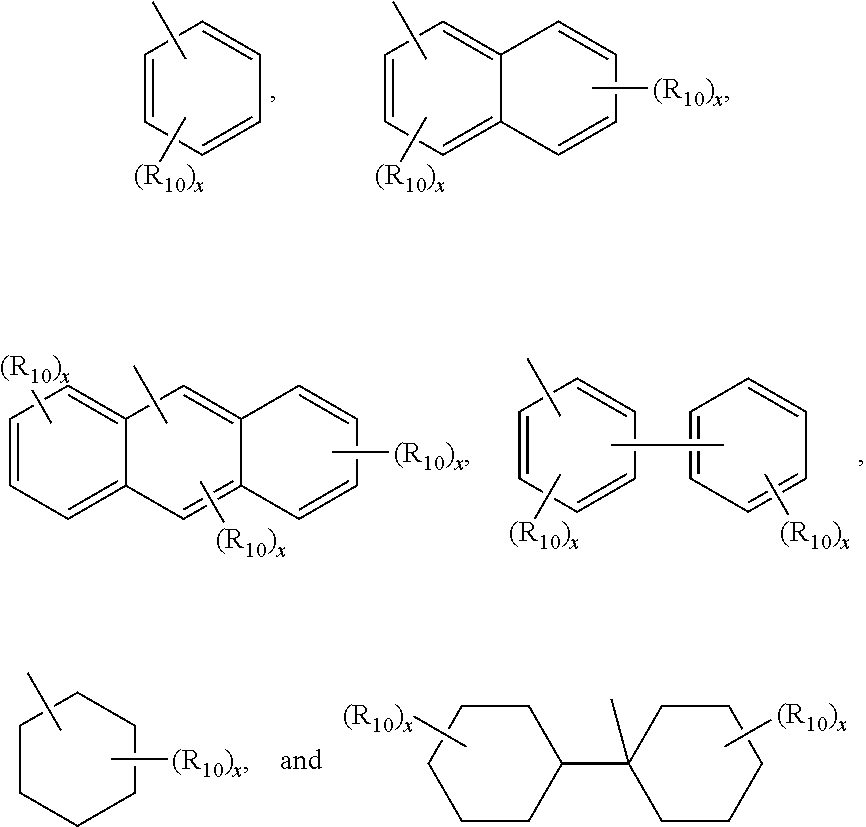
Ar1, Ar2, and Ar3 are independently selected from the group consisting of
Figure US09546262-20170117-C00005
R6 and R7 are independently selected from the group consisting of H, C1-C10 alkyl group, C1-C10 alkoxy, and a cyclic alkyl group having 3-10 carbon atoms,
M and n are independently an integer from 0 to 4;
R8 is absent or is selected from the group consisting of —CH2—, —(CH3)2C—), —CO—, —SO2—, and —O—
R9 is absent or is —(CH2)p, wherein p is an integer from 1 to 20;
A is selected from the group consisting of C1-C10 alkyl,
Figure US09546262-20170117-C00006
wherein, each R10 is independently H or C1-C10 alkyl; and
x is an integer from 0 to 4.
The instant disclosure relates to a compound of Formula (II):
Figure US09546262-20170117-C00007
wherein, R1, R2, R3, and R4 are independently selected from the group consisting of H, C1-C10, C1-C10 alkoxy, and C3-C10 cycloalkyl;
R5 is independently selected from the group consisting of H, C1-C10 alkyl, C1-C10 alkoxy, C3-C10 cycloalkyl, and Ar3; and
Ar1, Ar2, and Ar3 are independently selected from the group consisting of
Figure US09546262-20170117-C00008
R6 and R7 are independently selected from the group consisting of H, C1-C10 alkyl group, C1-C10 alkoxy, and a cyclic alkyl group having 3-10 carbon atoms,
M and n are independently an integer from 0 to 4;
R8 is absent or is selected from the group consisting of —CH2—, —(CH3)2C—, —CO—, —SO2—, and —O—
R9 is absent or is —(CH2)p, wherein p is an integer from 1 to 20;
A is selected from the group consisting of C1-C10 alkyl,
Figure US09546262-20170117-C00009
wherein, each R10 is independently H or C1-C10 alkyl; and
x is an integer from 0 to 4; and
Ep is selected from the group consisting of:
Figure US09546262-20170117-C00010
wherein each R11 is independently selected from the group consisting of H, C1-C6 alkyl, C1-C6 alkoxy, a cyclic alkyl group having 3-7 carbon atoms, phenyl, and a phenoxyl group. In some cases, R11 is independently H or a C1-C10 alkyl.
Finally, the instant disclosure relates to a method for synthesizing a compound described herein; to a flame retardant resinous compositions comprising the compounds described herein; and to a cured flame retardant resin prepared by cross-linking the flame retardant resinous composition.
DETAILED DESCRIPTION OF THE DISCLOSURE
The instant disclosure relates to compound of formula (I):
Figure US09546262-20170117-C00011
wherein, R1, R2, R3, and R4 are independently selected from the group consisting of H, C1-C10, C1-C10 alkoxy, and C3-C10 cycloalkyl;
R5 is independently selected from the group consisting of H, C1-C10 alkyl, C1-C10 alkoxy, C3-C10 cycloalkyl, and Ar3; and
Ar1, Ar2, and Ar3 are independently selected from the group consisting of
Figure US09546262-20170117-C00012
R6 and R7 are independently selected from the group consisting of H, C1-C10 alkyl group, C1-C10 alkoxy, and a cyclic alkyl group having 3-10 carbon atoms,
M and n are independently an integer from 0 to 4;
R8 is absent or is selected from the group consisting of —CH2—, —(CH3)2C—), —CO—, —SO2—, and —O—
R9 is absent or is —(CH2)p, wherein p is an integer from 1 to 20;
A is selected from the group consisting of C1-C10 alkyl,
Figure US09546262-20170117-C00013
wherein, each R10 is independently H or C1-C10 alkyl; and
x is an integer from 0 to 4.
In some instances, R5 is H or C1-C10 alkyl. In other instances, Ar1 and Ar2 are
Figure US09546262-20170117-C00014

and in some instances R9 may be absent.
In some instances, R1, R2, R3, and R4 are hydrogen. In other instances, A is C1-C10 alkyl,
Figure US09546262-20170117-C00015

and in some instances, x is zero.
The instant disclosure also relates to a compound of formula (Ia)
Figure US09546262-20170117-C00016
wherein, R1, R2, R3, and R4 are independently selected from the group consisting of H, C1-C10, C1-C10 alkoxy, and C3-C10 cycloalkyl;
R5 is independently selected from the group consisting of H, C1-C10 alkyl, C1-C10 alkoxy, C3-C10 cycloalkyl, and Ar3; and
Ar3 is independently selected from the group consisting of
Figure US09546262-20170117-C00017
R6 and R7 are independently selected from the group consisting of H, C1-C10 alkyl group, C1-C10 alkoxy, and a cyclic alkyl group having 3-10 carbon atoms,
M and n are independently an integer from 0 to 4;
R8 is absent or is selected from the group consisting of —CH2—, —(CH3)2CH2—, —CO—, —SO2—, and —O—
R9 is absent or is —(CH2)p, wherein p is an integer from 1 to 20; and
A is selected from the group consisting of C1-C10 alkyl,
Figure US09546262-20170117-C00018
wherein, each R10 is independently H or C1-C10 alkyl; and
x is an integer from 0 to 4.
In some cases, R5 is H or C1-C10 alkyl; and in some cases R5 is methyl. In some cases, R1, R2, R3, and R4 are hydrogen. Furthermore, A can be a C1-C10 alkyl,
Figure US09546262-20170117-C00019

and in some cases x may be zero.
The instant disclosure further relates to a compound selected from the group consisting of:
Figure US09546262-20170117-C00020
The instant disclosure relates to a compound of Formula (II):
Figure US09546262-20170117-C00021
wherein, R1, R2, R3, and R4 are independently selected from the group consisting of H, C1-C10, C1-C10 alkoxy, and C3-C10 cycloalkyl;
R5 is independently selected from the group consisting of H, C1-C10 alkyl, C1-C10 alkoxy, C3-C10 cycloalkyl, and Ar3; and
Ar1, Ar2, and Ar3 are independently selected from the group consisting of
Figure US09546262-20170117-C00022
R6 and R7 are independently selected from the group consisting of H, C1-C10 alkyl group, C1-C10 alkoxy, and a cyclic alkyl group having 3-10 carbon atoms,
M and n are independently an integer from 0 to 4;
R8 is absent or is selected from the group consisting of —CH2—, —(CH3)2C—, —CO—, —SO2—, and —O—
R9 is absent or is —(CH2)p, wherein p is an integer from 1 to 20;
A is selected from the group consisting of C1-C10 alkyl,
Figure US09546262-20170117-C00023
wherein, each R10 is independently H or C1-C10 alkyl; and
x is an integer from 0 to 4; and
Ep is selected from the group consisting of:
Figure US09546262-20170117-C00024
wherein each R11 is independently selected from the group consisting of H, C1-C6 alkyl, C1-C6 alkoxy, a cyclic alkyl group having 3-7 carbon atoms, phenyl, and a phenoxyl group. In some cases, R11 is independently H or a C1-C10 alkyl.
In the compound of Formula (II), Ep may be selected from the group consisting of:
Figure US09546262-20170117-C00025
The instant disclosure further relates to a flame retardant resinous composition comprising a compound of formula (I) as defined above; and to a cured flame retardant resin prepared by cross-linking the flame retardant resinous composition.
Finally, the instant disclosure relates to a method for synthesizing a compound of Formula (II)
Figure US09546262-20170117-C00026
comprising performing a catalytic reaction of a compound of formula (I)
Figure US09546262-20170117-C00027
with an epoxy monomer of formula (III)
Figure US09546262-20170117-C00028
wherein the substituents for Formula (I), (II), and (III), are defined above. In some instances, the reaction temperature is 100-200° C., 100-150° C., or 120-160° C. The equivalent ratio of the epoxy monomer of formula (III) to the compound of formula (I) is 1:1 to 10:1, 1:1 to 5:1, or 1:2 to 5:1. The amount of catalyst used to catalyze the reaction is 0.1-5 wt. %, 0.1-3 wt. %, or 0.2 to 0.5 wt. %, based on the amount of the epoxy monomer defined by the formula (III). In some cases, the catalyst is an imidazole, a tertiary amine, a tertiary phosphine, a quaternary ammonium salt, a quaternary phosphonium salt, a boron trifluoride complex, or a lithium compound. In particular, the catalyst may be an imidazole selected from the group consisting of 2-phenylimidazole and 2-methylimidazole; or the catalyst may be triphenylphosphine (a tertiary amine). In some cases, the catalyst is a quaternary ammonium salt selected from the group consisting of benzyltrimethyl ammonium chloride, benzyltriethyl ammonium chloride, and tetrabutyl ammonium chloride. Finally, the catalyst may be a quaternary phosphonium salt selected from the group consisting of ethyltriphenyl phosphonium acetate and a ethyltriphenyl phosphonium halide.
EXAMPLE 1 Synthesis of Phosphorus Containing Bisphenol Compound A1 (DMP)
Figure US09546262-20170117-C00029
10.81 g (0.05 mole) of 9,10-dihydro-9-oxa-10-phosphaphenanthrene-10-oxide (DOPO), 23.5 g (0.25 mole) of phenol, 6.81 g (0.05 mole) of 4′-Hydroxyacetophenone, and 0.432 g (4 wt % based on the weight of DOPO) of p-toluenesulfonic acid were mixed and stirred in a 250 ml three-necked flask reactor at room temperature in advance. The reactants were stirred constantly at 130.degree. C. for 24 hours to form a mixture, and then the temperature of the mixture was cooled down to the room temperature. The crude products separated out from the cooled mixture were washed by ethanol and then filtrated and dried to obtain a white powder. The white powder was the phosphorus-containing bisphenol, and the chemical structure of the phosphorus-containing bisphneol A1.
The yield of the foregoing phosphorus-containing bisphenol was 85%, and the melting point was 306° C. The measured value of the carbon, hydrogen, and oxygen element were 72.48%, 4.65%, and 14.90%, respectively (the theoretical value, C, 72.89%; H, 4.65%; O, 14.94%.) by element analysis.
EXAMPLE 2 Synthesis of Phosphorus Containing Bisphenol Compound A2
Figure US09546262-20170117-C00030
10.81 g (0.05 mole) of DOPO, 36 g (0.25 mole) of 2-naphthol, 6.81 g (0.05 mole) of 4′-Hydroxyacetophenone, and 0.432 g (4 wt % based on the Weight of DOPO) of p-toluene sulfonic acid were mixed and stirred in a 250 ml three-necked flask reactor at room temperature in advance. The reactants were stirred constantly at 130° C. for 24 hours to form a mixture, and then the temperature of the mixture was cooled down to the room temperature. The crude products separated out from the cooled mixture were washed by ethanol and then filtrated and dried to obtain a white powder. The white powder was the phosphorus-containing compound A2.
The yield of the foregoing phosphorus-containing bisphenol was 85%, and the melting point was 317° C. The measured value of the carbon, hydrogen, and oxygen element were 75.54%, 4.58%, and 13.56%, respectively (the theoretical value, C, 75.31%; H, 4.85%; O, 13.38%.) by element analysis.
EXAMPLE 3 Synthesis of Phosphorus Containing Bisphenol A3
Figure US09546262-20170117-C00031
10.81 g (0.05 mole) of DOPO, 36 g (0.25 mole) of 2-naphthol, 9.01 g (0.05 mole) of 6-acetyl-2-naphthol, and 0.432 g (4 wt % based on the Weight of DOPO) of p-toluene sulfonic acid were mixed and stirred in a 250 ml three-necked flask reactor at room temperature in advance. The reactants were stirred constantly at 130° C. for 24 hours to form a mixture, and then the temperature of the mixture was cooled down to the room temperature. The crude products separated out from the cooled mixture were washed by ethanol and then filtrated and dried to obtain a white powder. The white powder was the phosphorus-containing compound A3.
The yield of the foregoing phosphorus-containing bisphenol was 80%, and the melting point was 338° C. The measured value of the carbon, hydrogen, and oxygen element were 77.69%, 4.17%, and 12.25%, respectively (the theoretical value, C, 77.26%; H, 4.76%; O, 12.11%.) by element analysis.
EXAMPLE 4 Synthesis of Ester Substituted Phosphorous-Containing Bisphenol Compound B1
Figure US09546262-20170117-C00032
DMP (Phosphorous containing bisphenol Compound A1) 428 g (1 mol), Potassium carbonate (K2CO3)303.9 g (2.2 mol) and acetone 1000 g were placed into a in a five-neck glass reaction kettle equipped with an electric heating jacket, a temperature controller, an electric stirrer and a stirring bar, a nitrogen gas inlet, a thermocouple, a water-cooled condenser, and a feeding funnel. At first, benzoyl chloride 309.5 g (2.2 mol) was dropped into the reactor at 50° C. within 1 hour, then reacted 4 hours. Afterwards, substances were cooled to the room temperature. In the same time, the ester substituted phosphorous bisphenol compound and by-product salt which is generated by the addition reaction precipitated in the reactor. In order to eliminate the reaction byproduct salt, using water to wash the precipitant then isolated the product by filtration. Finally, Dried the product at a temperature of 120° C. The white powder is ester substituted of Phosphorous bisphenol compound B1,
FT-IR analysis indicated that the 3300 cm-1 peak of OH group was not detected and the 1700 cm-1 peak of carbonyl group was detected. The yield of the foregoing ester substituted phosphorus-containing bisphenol was 88%, melting point: 180° C.
EXAMPLE 5 Synthesis of Ester Substituted Phosphorous Containing Bisphenol Compound B2 Dinaphthoyl-DMP
Figure US09546262-20170117-C00033
DMP (phosphorous containing bisphenol compound A1) 428 g (1 mol), potassium carbonate (K2CO3)303.9 g (2.2 mol) and acetone 1000 g were placed into a in a five-neck glass reaction kettle equipped with an electric heating jacket, a temperature controller, an electric stirrer and a stirring bar, a nitrogen gas inlet, a thermocouple, a water-cooled condenser, and a feeding funnel. At first, naphthoyl chloride 418 g (2.2 mol) was dropped into the reactor at 50° C. within 1 hour, then reacted 4 hours. Afterwards, substances were cooled to the room temperature. In the same time, the ester substituted phosphorous bisphenol compound and by-product salt which is generated by the addition reaction precipitated in the reactor. In order to eliminate the reaction byproduct salt, using water to wash the precipitant then isolated the product by filtration. Finally, dried the product at a temperature of 120° C. The white powder is ester substituted of phosphorous bisphenol compound B2,
FT-IR analysis indicated that the 3300 cm-1 peak of OH group was not detected and the 1700 cm-1 peak of carbonyl group was detected, The yield of the foregoing ester substituted phosphorus-containing bisphenol was 85%. Melting point: 180° C.
EXAMPLE 6 Synthesis of Ester Substituted Phosphorous Containing Bisphenol Compound B3 Diacetyl-DMP
Figure US09546262-20170117-C00034
DMP (phosphorous containing bisphenol compound A1) 428 g (1 mol), potassium carbonate (K2CO3)303.9 g (2.2 mol) and acetone 1000 g were placed into a in a five-neck glass reaction kettle equipped with an electric heating jacket, a temperature controller, an electric stirrer and a stirring bar, a nitrogen gas inlet, a thermocouple, a water-cooled condenser, and a feeding funnel. At first, acetyl chloride 172.7 g (2.2 mol) was dropped into the reactor at 50° C. within 1 hour, then reacted 4 hours. Afterwards, substances were cooled to the room temperature. In the same time, the ester substituted phosphorous bisphenol compound and by-product salt which is generated by the addition reaction were precipitated in the reactor. In order to eliminate the reaction byproduct salt, using water to wash the precipitant then isolated the product by filtration. Finally, dried the product at a temperature of 120° C. The white powder is ester substituted of Phosphorous bisphenol compound B3
FT-IR analysis indicated that the 3300 cm-1 peak of OH group was not detected and the 1700 cm-1 peak of carbonyl group was detected, The yield of the foregoing ester substituted phosphorus-containing bisphenol was 89%. Melting point: 180° C.
EXAMPLE 7 Synthesis of Ester Substituted Phosphorous Containing Bisphenol Compound B4
Figure US09546262-20170117-C00035
DMP (phosphorous containing bisphenol compound A1) 428 g (1 mol), Benzoic acid anhydride 497.7 g (2.2 mol) and 1-methyl imidazole 0.173 g were placed into a in a five-neck glass reaction kettle equipped with an electric heating jacket, a temperature controller, an electric stirrer and a stirring bar, a nitrogen gas inlet, a thermocouple, a water-cooled condenser, and a feeding funnel. At first, benzoyl anhydride 497.7 g (2.2 mol) was dropped into the reactor at 50° C. within 1 hour, then reacted 4 hours. Afterwards, substances were cooled to the room temperature. In the same time, the ester substituted phosphorous bisphenol compound and by-product salt which is generated by the addition reaction precipitated in the reactor. In order to eliminate the reaction byproduct salt, using water to wash the precipitant then isolated the product after filtration. Finally, dried the product at a temperature of 120° C. The white powder is ester substituted of phosphorous bisphenol compound B4.
FT-IR analysis indicated that the 3300 cm-1 peak of OH group was not detected and the 1700 cm-1 peak of carbonyl group was detected, The yield of the foregoing ester substituted phosphorus-containing bisphenol was 79%. Melting point: 180° C.
EXAMPLE 8 Synthesis of Ester Substituted Phosphorous Containing Bisphenol Compound B5
Figure US09546262-20170117-C00036
DMP (phosphorous containing bisphenol compound A1) 428 g (1 mol), acetic acid anhydride 340 g (2.2 mol) and 1-methyl imidazole 0.173 g were placed into a in a five-neck glass reaction kettle equipped with an electric heating jacket, a temperature controller, an electric stirrer and a stirring bar, a nitrogen gas inlet, a thermocouple, a water-cooled condenser, and a feeding funnel. At first, acetic anhydride 340 g (2.2 mol) was dropped into the reactor at 50° C. within 1 hour, then reacted 4 hours. Afterwards, substances were cooled to the room temperature. In the same time, the ester substituted phosphorous bisphenol compound and by-product salt which is generated by the addition reaction precipitated in the reactor. In order to eliminate the reaction byproduct salt, using water to wash the precipitant then isolated the product after filtration. Finally, Dried the product at a temperature of 120° C. The white powder is ester substituted of Phosphorous bisphenol compound B5
FT-IR analysis indicated that the 3300 cm-1 peak of OH group was not detected and the 1700 cm-1 peak of carbonyl group was detected, The yield of the foregoing ester substituted phosphorus-containing bisphenol was 81%. Melting point: 180° C.
EXAMPLES 9-31
The following components are used in Examples 9-26:
Epoxy A diglycidyl ether of bisphenol A having an epoxy equivalent
resin 1 Weight of 175-185 grams/equivalent, a hydrolyzable chloride
of below 200 ppm, a viscosity of 7000-10000 cp, under trade
name of BE186LG sold and manufactured by Chang Chun
Plastic Co., Ltd., Taiwan, R.O.C.
Ep =
Figure US09546262-20170117-C00037
Epoxy A diglycidyl ether of bisphenol F having an epoxy equivalent
resin 2 Weight of 163-173 grams/equivalent, a hydrolyzable
chloride of below 200 ppm, a viscosity of 2500-4500 cp,
under trade name of BFE170 sold and manufactured by
Chang Chun Plastic Co., Ltd., Taiwan, R.O.C.
Ep =
Figure US09546262-20170117-C00038
Epoxy A diglycidyl ether of 3,3′,5,5′-tetramethyl-4,4′-biphenol
resin 3 having an epoxy equivalent Weight of 180 to 200
grams/equivalent, under trade name of YX4000H sold and
manufactured by Yuka Shell Epoxy Co. Ltd., Japan.
Ep =
Figure US09546262-20170117-C00039
Epoxy A polyglycidyl ether of dicyclodipentadiene having an epoxy
resin 4 equivalent weight of 240-270 grams/equivalent, under trade
name of DNE260 sold and manufactured by Chang Chun
Plastic Co., Ltd., Taiwan, R.O.C.
Ep =
Figure US09546262-20170117-C00040
Epoxy A phosphorus containing polyglycidyl ether of phenolic
resin 5 condensate having an epoxy equivalent weight of 260-300
grams/equivalent, a solid content of 75% under trade name of
BEP280A75 sold and manufactured by Chang Chun Plastic
Co., Ltd., Taiwan, R.O.C.
R- =
Figure US09546262-20170117-C00041
Curing Dicyandiamide (DICY), 10% dissolved in dimethylformamide.
agent A
Curing Nitrogen containing phenolic resin dissolved in cyclohexanol.
agent B The solid content is 60%
Catalyst A triphenylphosphine. (TPP), 10% dissolved in
methylethylketone
Catalyst B 2-methylimidazole (hereinafter referred to 2MI)., 10%
dissolved in methanol
EXAMPLE 9 Synthesis of Phosphorous Containing Epoxy C1
Figure US09546262-20170117-C00042
Epoxy resin 1 (100 g) and ester substituted phosphorus compound B1 (Dibenzyl-DMP) (70 g) were placed in a five-neck glass reaction kettle equipped with an electric heating jacket, a temperature controller, an electric stirrer and a stirring bar, a nitrogen gas inlet, a thermocouple, a water-cooled condenser, and a feeding funnel. Nitrogen gas was introduced and the reaction kettle was heated to 130° C. After epoxy resin A and ester substituted phosphorus compound B1 completely melted, the raw materials were dried under vacuum. The steps of introducing nitrogen gas and drying were carried out two more times. When the temperature of the reaction kettle was decreased from 100° C., catalyst A (0.8 g) was added. The stirrer was started to mix the resin and catalyst and the nitrogen gas was introduced. The resulting mixture was heated to 170° C. It was found that the reactants were slowly exothermic. The reactants were maintained at 170° C. for 2.5 hours and the phosphorus-containing epoxy (Epoxy C1) was obtained. The equivalent weight was 507.2, and the theoretical phosphorus content was 2.0 wt %. For uniformity, the product was dissolved in the methyl ethyl ketone (MEK) and the solid content adjusted to 70%.
EXAMPLE 10 Synthesis of Phosphorous Containing Epoxy C2
Figure US09546262-20170117-C00043
Epoxy resin 2 (100 g) and ester substituted phosphorus compound B1 (Dibenzyl-DMT) (70 g) were placed in a five-neck glass reaction kettle equipped with an electric heating jacket, a temperature controller, an electric stirrer and a stirring bar, a nitrogen gas inlet, a thermocouple, a water-cooled condenser, and a feeding funnel. Nitrogen gas was introduced and the reaction kettle was heated to 130° C. After epoxy resin 2 and ester substituted phosphorus compound B1 completely melted, the raw materials were dried under vacuum. The steps of introducing nitrogen gas and drying were carried out two more times. When the temperature of the reaction kettle was decreased from 100° C., catalyst A (0.8 g) was added. The stirrer was started to mix the resin and catalyst and the nitrogen gas was introduced. The resulting mixture was heated to 170° C. It was found that the reactants were slowly exothermic. The reactants were maintained at 170° C. for 2.5 hours and the phosphorus-containing epoxy (Epoxy C2) was obtained. The epoxy equivalent weight was 455.3, and the theoretical phosphorus content was 2.0 wt %. For uniformity, the product was dissolved in the methyl ethyl ketone (MEK) and the solid content adjusted to 70%.
EXAMPLE 11 Synthesis of Phosphorous Containing Epoxy C3
Figure US09546262-20170117-C00044
Epoxy resin 3 (100 g) and ester substituted phosphorus compound B1 (Dibenzyl-DMP) (70 g) were placed in a five-neck glass reaction kettle equipped with an electric heating jacket, a temperature controller, an electric stirrer and a stirring bar, a nitrogen gas inlet, a thermocouple, a water-cooled condenser, and a feeding funnel. Nitrogen gas was introduced and the reaction kettle was heated to 130° C. After epoxy resin 3 and ester substituted phosphorus compound B1 completely melted, the raw materials were dried under vacuum. The steps of introducing nitrogen gas and drying were carried out two more times. When the temperature of the reaction kettle was decreased from 100° C., catalyst A (0.8 g) was added. The stirrer was started to mix the resin and catalyst and the nitrogen gas was introduced. The resulting mixture was heated to 170° C. It was found that the reactants were slowly exothermic. The reactants were maintained at 170° C. for 2.5 hours and the phosphorus-containing epoxy (Epoxy C3) was obtained. The epoxy equivalent weight was 545.2, and the theoretical phosphorus content was 2.0 wt %. For uniformity, the product was dissolved in the methyl ethyl ketone (MEK) and the solid content adjusted to 70%.
EXAMPLE 12 Synthesis of Phosphorous Containing Epoxy C4
Figure US09546262-20170117-C00045
Epoxy resin 4 (100 g) and ester substituted phosphorus compound B1 (Dibenzyl-DMP) (70 g) were placed in a five-neck glass reaction kettle equipped with an electric heating jacket, a temperature controller, an electric stirrer and a stirring bar, a nitrogen gas inlet, a thermocouple, a water-cooled condenser, and a feeding funnel. Nitrogen gas was introduced and the reaction kettle was heated to 130° C. After epoxy resin 4 and ester substituted phosphorus compound B1 completely melted, the raw materials were dried under vacuum. The steps of introducing nitrogen gas and drying were carried out two more times. When the temperature of the reaction kettle was decreased from 100° C., catalyst A (0.8 g) was added. The stirrer was started to mix the resin and catalyst and the nitrogen gas were introduced. The resulting mixture was heated to 170° C. It was found that the reactants were slowly exothermic. The reactants were maintained at 170° C. for 2.5 hours and the phosphorus-containing epoxy (Epoxy C4) was obtained. The epoxy equivalent weight was 870, and the theoretical phosphorus content was 2.0 wt %. For uniformity, the product was dissolved in the methyl ethyl ketone (MEK) and the solid content adjusted to 70%.
EXAMPLE 13 Synthesis of Phosphorous Containing Epoxy C5
Figure US09546262-20170117-C00046
Epoxy resin 1 (100 g) and ester substituted phosphorus compound B2 (Dinaphthoyl-DMP) (91 g) were placed in a five-neck glass reaction kettle equipped with an electric heating jacket, a temperature controller, an electric stirrer and a stirring bar, a nitrogen gas inlet, a thermocouple, a water-cooled condenser, and a feeding funnel. Nitrogen gas was introduced and the reaction kettle was heated to 130° C. After epoxy resin 1 and ester substituted phosphorus compound B2 completely melted, the raw materials were dried under vacuum. The steps of introducing nitrogen gas and drying were carried out two more times. When the temperature of the reaction kettle was decreased from 100° C., catalyst A (0.9 g) was added. The stirrer was started to mix the resin and catalyst and the nitrogen gas were introduced. The resulting mixture was heated to 170° C. It was found that the reactants were slowly exothermic. The reactants were maintained at 170° C. for 2.5 hours and the phosphorus-containing epoxy (Epoxy C5) was obtained. The epoxy equivalent weight was 617.8, and the theoretical phosphorus content was 2.0 wt %. For uniformity, the product was dissolved in the methyl ethyl ketone (MEK) and the solid content adjusted to 70%.
EXAMPLE 14 Synthesis of Phosphorous Containing Epoxy C6
Figure US09546262-20170117-C00047
Epoxy resin 1 (100 g) and ester substituted phosphorus compound B3 (Diacetyl-DMP) 50 g) were placed in a five-neck glass reaction kettle equipped with an electric heating jacket, a temperature controller, an electric stirrer and a stirring bar, a nitrogen gas inlet, a thermocouple, a water-cooled condenser, and a feeding funnel. Nitrogen gas was introduced and the reaction kettle was heated to 130° C. After epoxy resin 1 and ester substituted phosphorus compound B3 completely melted, the raw materials were dried under vacuum. The steps of introducing nitrogen gas and drying were carried out two more times. When the temperature of the reaction kettle was decreased from 100° C., catalyst A (0.8 g) was added. The stirrer was started to mix the resin and catalyst and the nitrogen gas was introduced. The resulting mixture was heated to 170° C. It was found that the reactants were slowly exothermic. The reactants were maintained at 170° C. for 2.5 hours and the phosphorus-containing epoxy (Epoxy C6) was obtained. The epoxy equivalent weight was 414.8, and the theoretical phosphorus content was 2.0 wt %. For uniformity, the product was dissolved in the methyl ethyl ketone (MEK) and the solid content adjusted to 70%.
EXAMPLE 15 Synthesis of Phosphorous Containing Epoxy C7
Figure US09546262-20170117-C00048
Epoxy resin 1 (100 g) and ester substituted phosphorus compound A1 (DMP) (39 g) were placed in a five-neck glass reaction kettle equipped with an electric heating jacket, a temperature controller, an electric stirrer and a stirring bar, a nitrogen gas inlet, a thermocouple, a water-cooled condenser, and a feeding funnel. Nitrogen gas was introduced and the reaction kettle was heated to 130° C. After epoxy resin 1 and ester substituted phosphorus compound A1 completely melted, the raw materials were dried under vacuum. The steps of introducing nitrogen gas and drying were carried out two more times. When the temperature of the reaction kettle was decreased from 100° C., catalyst A (0.7 g) was added. The stirrer was started to mix the resin and catalyst and the nitrogen gas was introduced. The resulting mixture was heated to 170° C. It was found that the reactants were slowly exothermic. The reactants were maintained at 170° C. for 2.5 hours and the phosphorus-containing epoxy (Epoxy C7) was obtained. The epoxy equivalent weight was 370.9, and the theoretical phosphorus content was 2.0 wt %. For uniformity, the product was dissolved in the methyl ethyl ketone (MEK) and the solid content adjusted to 70%.
EXAMPLE 16 Synthesis of Phosphorous Containing Epoxy C8
Figure US09546262-20170117-C00049
Epoxy resin 2 (100 g) and ester substituted phosphorus compound A1 (DMP) (39 g) were placed in a five-neck glass reaction kettle equipped with an electric heating jacket, a temperature controller, an electric stirrer and a stirring bar, a nitrogen gas inlet, a thermocouple, a water-cooled condenser, and a feeding funnel. Nitrogen gas was introduced and the reaction kettle was heated to 130° C. After epoxy resin 2 and ester substituted phosphorus compound A1 completely melted, the raw materials were dried under vacuum. The steps of introducing nitrogen gas and drying were carried out two more times. When the temperature of the reaction kettle was decreased from 100° C., catalyst A (0.7 g) was added. The stirrer was started to mix the resin and catalyst and the nitrogen gas was introduced. The resulting mixture was heated to 170° C. It was found that the reactants were slowly exothermic. The reactants were maintained at 170° C. for 2.5 hours and the phosphorus-containing epoxy (Epoxy C8) was obtained. The epoxy equivalent weight was 336.6, and the theoretical phosphorus content was 2.0 wt %. For uniformity, the product was dissolved in the methyl ethyl ketone (MEK) and the solid content adjusted to 70%.
EXAMPLE 17 Synthesis of Phosphorous Containing Epoxy C9
Figure US09546262-20170117-C00050
Epoxy resin 3 (100 g) and ester substituted phosphorus compound A1 (DMP) (39 g) were placed in a five-neck glass reaction kettle equipped with an electric heating jacket, a temperature controller, an electric stirrer and a stirring bar, a nitrogen gas inlet, a thermocouple, a water-cooled condenser, and a feeding funnel. Nitrogen gas was introduced and the reaction kettle was heated to 130° C. After epoxy resin 3 and ester substituted phosphorus compound A1 completely melted, the raw materials were dried under vacuum. The steps of introducing nitrogen gas and drying were carried out two more times. When the temperature of the reaction kettle was decreased from 100° C., catalyst A (0.7 g) was added. The stirrer was started to mix the resin and catalyst and the nitrogen gas was introduced. The resulting mixture was heated to 17° C. It was found that the reactants were slowly exothermic. The reactants were maintained at 170° C. for 2.5 hours and the phosphorus-containing epoxy (Epoxy C9) was obtained. The epoxy equivalent weight was 395.6, and the theoretical phosphorus content was 2.0 wt %. For uniformity, the product was dissolved in the methyl ethyl ketone (MEK) and the solid content adjusted to 70%.
The compositions of Examples 9-17 were evaluated for epoxy equivalent weight (EEW) and solids content according to the following methods:
Epoxy equivalent weight (EEW): the epoxy resin can be determined according to the method in ASTM D1652.
Solid content: 1 gram of sample containing the phosphorus-containing epoxy resin was placed in an oven at 150° C. for 60 minutes after which and the weight percentage of the resulting non-volatile components was measured.
The results are reported in Table 1 below.
TABLE 1
Examples 9-17
Example No.
9 10 11 12 13 14 15 16 17
Phosphorous-Containing Epoxy Resin
C1 C2 C3 C4 C5 C6 C7 C8 C9
Epoxy resin 1 100 100 100 100
Epoxy resin 2 100 100
Epoxy resin 3 100 100
Epoxy resin 4 100
Synthesis example 4 70 70 70 70
Synthesis example 5 91
Synthesis example 6 50
Synthesis example 1 39 39 39
Catalyst A 0.8 0.8 0.8 0.8 0.9 0.8 0.7 0.7 0.7
Methyl Ethyl Ketone 73 73 73 73 82.2 64 60 60 60
EEW 507.2 455.3 545.2 870 617.8 414.8 370.9 336.6 395.6
Phosphorous content 2.0% 2.0% 2.0% 2.0 2.0% 2.0% 2.0% 2.0% 2.0%
Solid content  70%  70%  70%  70%  70%  70%  70%  70%  70%
EXAMPLES 18-31
Glass fiber fabric was impregnated with the phosphorus-containing epoxy resins of Examples 9-17 (Phosphorous-Containing Epoxy Resins C1-C9) and dried at 160° C. to form prepegs. Five pieces of the prepregs were piled up and a sheet of 35 μm copper foil was placed on the top and bottom and laminated at 210° C. under a pressure of 25 kg/cm2. This resulted in a laminated entity of the phosphorus-containing epoxy resin and glass fiber fabric. The physical properties of each laminated entity were analyzed according to the following procedures.
Dielectric Constant (Dk) and Dissipation Factor (Df) were measured according to IPC-TM-650-2.5.5.9.
Peel Strength(1 oz copper) was measured according to IPC-TM-650-2.4.8.
Glass Transition Temperature (Tg) was measured according to IPC-TM-650-2.4.25 by using Differential Scanning calorimetry(DSC) (Scan Rate: 20° C./min).
Coefficient Thermal Expansion (CTE,ppm/K) was measured according to IPC-TM-650-2.4.24 by TMA (thermo mechanical analysis) (α1 is the CTE value before Tg, α2 is the CTE value after Tg).
Decomposition Temperature (Td, 5% weight loss) was measured according to IPC-TM-650-2.3.40 using a thermogravimetric analyzer (TGA) (Scan Rate: 10° C./min).
Water Absorption (Wt %): To calculate the water absorption, the specimens were placed in a 100° C. water and the of increase in weight (wt %) measured after two hours.
Thermal Stability (S-288) are measured according to JIS-C-6481: The laminated entity was immersed into a 288° C. solder furnace and the time to delamination measured.
Flame Retardancy was measured according to UL94.
UL 94 Flammability Ratings Summary
5VA Burning stops within 60 seconds after five applications of
Surface five seconds each of a flame (larger than that used in Vertical
Burn Burn testing) to a test bar. Test specimens MAY NOT have a
burn-through (no hole). This is the highest (most flame
retardant) UL94 rating.
5VB Burning stops within 60 seconds after five applications of five
Surface seconds each of a flame (larger than that used in Vertical Burn
Burn testing) to a test bar. Test specimens MAY HAVE a burn-
through (a hole).
V-0 Burning stops within 10 seconds after two applications of ten
Vertical seconds each of a flame to a test bar. NO flaming drips are
Burn allowed.
V-1 Burning stops within 60 seconds after two applications of ten
Vertical seconds each of a flame to a test bar. NO flaming drips are
Burn allowed.
V-2 Burning stops within 60 seconds after two applications of ten
Vertical seconds each of a flame to a test bar. Flaming drips ARE
Burn allowed
H-B Slow horizontal burning on a 3mm thick specimen with a
Hori- burning rate is less than 3″/min or stops burning before the 5″
zontal mark. H-B rated materials are considered “self-extinguishing”.
Burn This is the lowest (least flame retardant) UL94 rating.
The composition of Examples 18-31 are shown in Tables 2 and 2(a), and the measurements are reported in Tables 3 and 3(a).
TABLE 2
Examples 18-26 (Inventive)
Examples No.
18 19 20 21 22 23 24 25 26
Phosphorous epoxy C1 100 100
(From Example 9)
Phosphorous epoxy C2 100
(From Example 10)
Phosphorous epoxy C3 100
(From Example 11)
Phosphorous epoxy C4 100
(From Example 12)
Phosphorous epoxy C5 100 100
(From Example 13)
Phosphorous epoxy C6 100 100
(From Example 14)
Curing agent A 16.3 18.1 15.1 9.5 13.4 20.2
Curing agent B 51.7 41.8 63.2
Catalyst B 0.5 0.5 0.5 0.5 0.5 0.5 0.5 0.5 0.5
Acetone 5 5 5 10 7 0 25 22 23
TABLE 2(a)
Examples 27-31 (Comparative)
Examples No. 27 28 29 30 31
Phosphorous epoxy C7 100 100
(From Example 15)
Phosphorous epoxy C8 100
(From Example 16)
Phosphorous epoxy C9 100
(From Example 17)
Epoxy 5 100
Curing agent A 22.2 24.5 20.8 32
Curing agent B 69.1
Catalyst B 0.5 0.5 0.5 0.5 0.5
Acetone 0 0 0 22.5 0
TABLE 3
Examples 18-26 (Inventive)
Examples No.
18 19 20 21 22 23 24 25 26
Dk [1 MHz] 4.54 4.69 4.71 4.45 4.56 4.62 4.5 4.50 4.55
Df [1 MHz] 0.013 0.010 0.012 0.011 0.015 0.013 0.011 0.013 0.010
Peel strength (kgf/cm) 1.8 1.9 1.9 1.8 1.7 1.8 1.9 1.8 1.9
Water absorption (Wt %) 0.24 0.26 0.25 0.28 0.21 0.26 0.20 0.16 0.15
CTE α1(ppm) 26.9 36.5 30 25.4 26.3 25.1 25.2 25.9 23.2
CTE α2(ppm) 232 260 245 219 230 235.0 215.6 221 210.5
Tg 137 123 150 145 141 129 150 156 140
Td 371 372 357 377 376 370 381 386 380
Flame retardancy V0 V0 V0 V0 V0 V0 V0 V0 V0
Thermal stability >180 >180 >180 >180 >180 >180 >180 >180 >180
S-288 (sec)
TABLE 3(a)
Example 27-31 (Comparative)
Examples No. 27 28 29 30 31
Dk [1MHz] 4.85 4.89 5.01 4.83 5.05
Df [1MHz] 0.019 0.016 0.014 0.014 0.013
Peel strength(kgf/cm) 2.1 2.1 2.1 2.1 1.5
Water absorption (Wt %) 0.34 0.35 0.32 0.23 0.32
CTE α1(ppm) 40.6 47.4 39.2 34 32
CTE α2(ppm) 260.2 265.5 253 243 253
Tg 146 130 161 162 135
Td 371 373 350 380 367
Flame retardancy V0 V0 V0 V0 V0
Thermal stability >180 >180 >180 >180 >180
S-288 (sec)
The data show that the inventive compositions provide excellent flame retardancy and thermal stability. Furthermore, based on the comparison above, the inventive compositions provide surprisingly better water resistance and dielectric properties than the comparative compositions.
The above embodiments are only used to illustrate the principle of the present disclosure and the effect thereof, and should not be construed as to limit the present disclosure. The above embodiments can be modified and altered by those skilled in the art, without departing from the spirit and scope of the present disclosure. Therefore, the protection scope of the present disclosure is defined in the following appended claims. As long as it does not affect the effects and achievable goals of this disclosure, it should be covered under the technical contents disclosed herein.
The terms “comprising,” “having,” and “including” are used in their open, non-limiting sense. The terms “a” and “the” are understood to encompass the plural as well as the singular. The expression “at least one” means one or more and thus includes individual components as well as mixtures/combinations. The term “about” when referring to a value, is meant specifically that a measurement can be rounded to the value using a standard convention for rounding numbers. For example, “about 1.5” is 1.45 to 1.54. All valued set forth herein can be modified with the term “about” or recited without the term, regardless of whether the term “about” is specifically set forth (or is absent) in conjunction with any particular value. All ranges and values disclosed herein are inclusive and combinable. For examples, any value or point described herein that falls within a range described herein can serve as a minimum or maximum value to derive a sub-range, etc.

Claims (20)

The invention claimed is:
1. A compound of Formula (II)
Figure US09546262-20170117-C00051
wherein,
n′ is an integer from 1 to 4;
R1, R2, R3, and R4 are independently selected from the group consisting of H, C1-C10 alkyl, C1-C10 alkoxy, and C3-C10 cycloalkyl;
R5 is independently selected from the group consisting of H, C1-C10 alkyl, C1-C10 alkoxy, C3-C10 cycloalkyl, and Ara; and
Ar1 and Ar2 are independently selected from the group consisting of
Figure US09546262-20170117-C00052
Ar3 is selected from the group consisting of
Figure US09546262-20170117-C00053
R6 and R7 are independently selected from the group consisting of H, C1-C10 alkyl group, C1-C10 alkoxy, and a cyclic alkyl group having 3-10 carbon atoms,
m and n are independently an integer from 0 to 4;
R8 is absent or is selected from the group consisting of —CH2—, —(CH3)2C—, —CO—, —SO2—, and —O—
R9 is absent or is —(CH2)p, wherein p is an integer from 1 to 20;
z is 1;
A is selected from the group consisting of C1-C10 alkyl,
Figure US09546262-20170117-C00054
wherein, each R10 is independently H or C1-C10 alkyl; and
x is an integer from 0 to 4; and
Ep is selected from the group consisting of:
Figure US09546262-20170117-C00055
wherein each of R11 is independently selected from the group consisting of H, C1-C6 alkyl, C1-C6 alkoxy, a cyclic alkyl group having 3-7 carbon atoms, phenyl, and a phenoxyl group.
2. The compound of claim 1, wherein each of R11 is independently H or a C1-C6 alkyl.
3. The compound of claim 1, wherein Ep is selected from the group consisting of:
Figure US09546262-20170117-C00056
4. The compound of claim 3, wherein R9 is absent.
5. The compound of claim 1, wherein R5 is H.
6. The compound of claim 1, wherein R5 is C1-C10 alkyl.
7. The compound of claim 1, wherein R5 is methyl.
8. The compound of claim 1, wherein Ar1 and Ar2 are
Figure US09546262-20170117-C00057
9. The compound of claim 1, wherein R1, R2, R3, and R4 are H.
10. The compound of claim 1, wherein
R1, R2, R3 and R4 are H;
R5 is C1-C10 alkyl;
Ar1 and Ar2 are
Figure US09546262-20170117-C00058
and
R11 is H.
11. The compound of claim 10, wherein Ep is selected from the group consisting of:
Figure US09546262-20170117-C00059
12. The compound of claim 11, wherein R9 is absent.
13. A method for synthesizing a compound of Formula (II)
Figure US09546262-20170117-C00060
wherein,
n′ is an integer from 1 to 4;
R1, R2, R3, and R4 are independently selected from the group consisting of H, C1-C10 alkyl, C1-C10 alkoxy, C3-C10 cycloalkyl;
R5 is independently selected from the group consisting of H, C1-C10 alkyl, C1-C10 alkoxy, and C3-C10 cycloalkyl, and Ara; and
Ar1 and Ar2 are independently selected from the group consisting of
Figure US09546262-20170117-C00061
Ar3 is selected from the group consisting of
Figure US09546262-20170117-C00062
R6 and R7 are independently selected from the group consisting of H, C1-C10 alkyl group, C1-C10 alkoxy, and a cyclic alkyl group having 3-10 carbon atoms,
m and n are independently an integer from 0 to 4;
R8 is absent or is selected from the group consisting of —CH2—, —(CH3)2C—, —CO—, —SO2—, and —O—
R9 is absent or is —(CH2)p, wherein p is an integer from 1 to 20;
z is 1;
A is selected from the group consisting of C1-C10 alkyl,
Figure US09546262-20170117-C00063
wherein, each R10 is independently H or C1-C10 alkyl; and
x is an integer from 0 to 4; and
Ep is selected from the group consisting of:
Figure US09546262-20170117-C00064
wherein each of R11 is independently selected from the group consisting of H, C1-C6 alkyl, C1-C6 alkoxy, a cyclic alkyl group having 3-7 carbon atoms, phenyl, and a phenoxyl group;
comprising performing a catalytic reaction of a compound of formula (I)
Figure US09546262-20170117-C00065
with an epoxy monomer of formula (III)
Figure US09546262-20170117-C00066
14. The method of claim 13, wherein each of R11 is independently H or a C1-C6 alkyl.
15. The method of claim 13, wherein Ep is selected from the group consisting of:
Figure US09546262-20170117-C00067
16. The method of claim 13, wherein R5 is H.
17. The method of claim 13, wherein R5 is C1-C10 alkyl.
18. The method of claim 13, wherein R5 is methyl.
19. The method of claim 13, wherein Ar1 and Ar2 are
Figure US09546262-20170117-C00068
20. A compound selected from the group consisting of:
Figure US09546262-20170117-C00069
Figure US09546262-20170117-C00070
wherein n′ is an integer from 1 to 4.
US14/932,092 2015-11-04 2015-11-04 Phosphorous containing compounds and process for synthesis Active US9546262B1 (en)

Priority Applications (5)

Application Number Priority Date Filing Date Title
US14/932,092 US9546262B1 (en) 2015-11-04 2015-11-04 Phosphorous containing compounds and process for synthesis
US15/066,745 US9605109B1 (en) 2015-11-04 2016-03-10 Phosphorous containing compounds and process for synthesis
TW105135893A TWI655197B (en) 2015-11-04 2016-11-04 Phosphorous containing compounds and process for synthesis
CN201610962787.9A CN106986893B (en) 2015-11-04 2016-11-04 Phosphorus-containing compound and method for producing the same
JP2016216599A JP6487891B2 (en) 2015-11-04 2016-11-04 Phosphorus-containing compound and method for producing the same

Applications Claiming Priority (1)

Application Number Priority Date Filing Date Title
US14/932,092 US9546262B1 (en) 2015-11-04 2015-11-04 Phosphorous containing compounds and process for synthesis

Related Child Applications (1)

Application Number Title Priority Date Filing Date
US15/066,745 Division US9605109B1 (en) 2015-11-04 2016-03-10 Phosphorous containing compounds and process for synthesis

Publications (1)

Publication Number Publication Date
US9546262B1 true US9546262B1 (en) 2017-01-17

Family

ID=57749298

Family Applications (2)

Application Number Title Priority Date Filing Date
US14/932,092 Active US9546262B1 (en) 2015-11-04 2015-11-04 Phosphorous containing compounds and process for synthesis
US15/066,745 Active US9605109B1 (en) 2015-11-04 2016-03-10 Phosphorous containing compounds and process for synthesis

Family Applications After (1)

Application Number Title Priority Date Filing Date
US15/066,745 Active US9605109B1 (en) 2015-11-04 2016-03-10 Phosphorous containing compounds and process for synthesis

Country Status (4)

Country Link
US (2) US9546262B1 (en)
JP (1) JP6487891B2 (en)
CN (1) CN106986893B (en)
TW (1) TWI655197B (en)

Cited By (5)

* Cited by examiner, † Cited by third party
Publication number Priority date Publication date Assignee Title
US20190153151A1 (en) * 2016-06-27 2019-05-23 Kolon Industries, Inc. Thermosetting resin composition, and prepreg and substrate using same
CN111825831A (en) * 2019-04-23 2020-10-27 长春人造树脂厂股份有限公司 Epoxy resin compound with high phosphorus and oxazolidone content, preparation method and cured composition comprising the compound
KR20210029993A (en) * 2019-09-09 2021-03-17 한밭대학교 산학협력단 Novel dibenzooxaphosphinine oxide derivative compounds and pharmaceutical composition for preventing or treating degenerative disease comprising the same as an active ingredient
CN115806653A (en) * 2022-12-21 2023-03-17 江苏扬农锦湖化工有限公司 A kind of naphthalene-based halogen-free flame-retardant epoxy resin and its preparation method and application
US11773217B2 (en) 2020-04-29 2023-10-03 Chang Chun Plastics Co., Ltd. Phosphorus containing compounds and epoxy resins thereof

Families Citing this family (2)

* Cited by examiner, † Cited by third party
Publication number Priority date Publication date Assignee Title
CN107739453B (en) * 2017-11-14 2019-03-08 贵州省材料产业技术研究院 DOPO derivative flame retardant and its preparation method and application
TWI893655B (en) * 2023-02-22 2025-08-11 長春人造樹脂廠股份有限公司 Phosphorus-containing resin and the flame-retardant and heat-resistant composition thereof

Citations (12)

* Cited by examiner, † Cited by third party
Publication number Priority date Publication date Assignee Title
US6441067B1 (en) 2001-08-23 2002-08-27 Chung-Shan Institute Of Science & Technology Phosphorus-containing compounds and their use in flame retardance
TW523526B (en) 2000-05-08 2003-03-11 Chang Chun Plastics Co Ltd Flame retardant resin and flame retardant composition containing the same
US20040077821A1 (en) 2002-10-21 2004-04-22 Kuen-Yuan Hwang Flame retarding resin composition
US6984716B2 (en) 2002-10-22 2006-01-10 Chang Chun Plastics Co., Ltd. Phosphorus-containing compound
US7064157B2 (en) 2000-07-19 2006-06-20 Chang Chun Plastics Co., Ltd. Flame retardant resin and flame retardant composition containing the same
TWI322810B (en) 2002-10-22 2010-04-01 Chang Chun Plastics Co Ltd
TWI351406B (en) 2008-07-25 2011-11-01 Univ Nat Chunghsing
TWI359152B (en) 2009-01-19 2012-03-01 Nat Univ Chung Hsing Phosphorus-containing compounds with various subst
US8134021B2 (en) 2008-07-15 2012-03-13 National Chunghsing University Phosphorus-containing bisphenols and preparing method thereof
CN102850722A (en) 2012-09-07 2013-01-02 广东生益科技股份有限公司 Epoxy resin composition, and prepreg and copper foil-clad laminated sheet prepared by using epoxy resin composition
US8426547B2 (en) 2010-01-13 2013-04-23 Chang Chun Plastics Co., Ltd Phosphorus-containing epoxy resin and method for synthesizing the same
CN103626958A (en) 2012-08-21 2014-03-12 新亚T&C Epoxy compound having excellent electrical properties and method for producing the same

Family Cites Families (5)

* Cited by examiner, † Cited by third party
Publication number Priority date Publication date Assignee Title
US6463253B2 (en) * 1999-12-20 2002-10-08 Konica Corporation Cleaning unit, and image forming method and image forming apparatus using said cleaning unit
TWI359151B (en) * 2008-07-02 2012-03-01 Chang Chun Plastics Co Ltd Phosphorus-containing compounds and their preparat
JP5125864B2 (en) * 2008-08-06 2013-01-23 東洋インキScホールディングス株式会社 Flame retardant and flame retardant resin composition
JP2012052007A (en) * 2010-08-31 2012-03-15 Fujifilm Corp Cyclic phosphorus carbonate compound, flame retardant, resin composition, and housing for electric and electronic equipment
TWI432445B (en) * 2011-07-06 2014-04-01 Nat Univ Chung Hsing Monofunctional, bifunctional, and multifunctional phosphinated phenols and their derivatives and preparation method thereof

Patent Citations (13)

* Cited by examiner, † Cited by third party
Publication number Priority date Publication date Assignee Title
TW523526B (en) 2000-05-08 2003-03-11 Chang Chun Plastics Co Ltd Flame retardant resin and flame retardant composition containing the same
US7064157B2 (en) 2000-07-19 2006-06-20 Chang Chun Plastics Co., Ltd. Flame retardant resin and flame retardant composition containing the same
US6441067B1 (en) 2001-08-23 2002-08-27 Chung-Shan Institute Of Science & Technology Phosphorus-containing compounds and their use in flame retardance
US20040077821A1 (en) 2002-10-21 2004-04-22 Kuen-Yuan Hwang Flame retarding resin composition
US6984716B2 (en) 2002-10-22 2006-01-10 Chang Chun Plastics Co., Ltd. Phosphorus-containing compound
TWI322810B (en) 2002-10-22 2010-04-01 Chang Chun Plastics Co Ltd
US8134021B2 (en) 2008-07-15 2012-03-13 National Chunghsing University Phosphorus-containing bisphenols and preparing method thereof
TWI351406B (en) 2008-07-25 2011-11-01 Univ Nat Chunghsing
TWI359152B (en) 2009-01-19 2012-03-01 Nat Univ Chung Hsing Phosphorus-containing compounds with various subst
US8426547B2 (en) 2010-01-13 2013-04-23 Chang Chun Plastics Co., Ltd Phosphorus-containing epoxy resin and method for synthesizing the same
CN103626958A (en) 2012-08-21 2014-03-12 新亚T&C Epoxy compound having excellent electrical properties and method for producing the same
CN102850722A (en) 2012-09-07 2013-01-02 广东生益科技股份有限公司 Epoxy resin composition, and prepreg and copper foil-clad laminated sheet prepared by using epoxy resin composition
US20140072818A1 (en) 2012-09-07 2014-03-13 Guangdong Shengyi Sci.Tech Co., Ltd Epoxy resin composition, and prepreg and copper clad laminate made therefrom

Non-Patent Citations (1)

* Cited by examiner, † Cited by third party
Title
Lee et al., CN 103626958 A machine translation in English, Mar. 12, 2014. *

Cited By (8)

* Cited by examiner, † Cited by third party
Publication number Priority date Publication date Assignee Title
US20190153151A1 (en) * 2016-06-27 2019-05-23 Kolon Industries, Inc. Thermosetting resin composition, and prepreg and substrate using same
US10774173B2 (en) * 2016-06-27 2020-09-15 Kolon Industries, Inc. Thermosetting resin composition, and prepreg and substrate using same
CN111825831A (en) * 2019-04-23 2020-10-27 长春人造树脂厂股份有限公司 Epoxy resin compound with high phosphorus and oxazolidone content, preparation method and cured composition comprising the compound
US10899871B2 (en) 2019-04-23 2021-01-26 Chang Chun Plastics Co., Ltd. Phosphorous containing epoxy resins and process for synthesis
CN111825831B (en) * 2019-04-23 2023-05-05 长春人造树脂厂股份有限公司 Epoxy resin compound with high phosphorus and oxazolidone content, preparation method and curing composition containing same
KR20210029993A (en) * 2019-09-09 2021-03-17 한밭대학교 산학협력단 Novel dibenzooxaphosphinine oxide derivative compounds and pharmaceutical composition for preventing or treating degenerative disease comprising the same as an active ingredient
US11773217B2 (en) 2020-04-29 2023-10-03 Chang Chun Plastics Co., Ltd. Phosphorus containing compounds and epoxy resins thereof
CN115806653A (en) * 2022-12-21 2023-03-17 江苏扬农锦湖化工有限公司 A kind of naphthalene-based halogen-free flame-retardant epoxy resin and its preparation method and application

Also Published As

Publication number Publication date
JP6487891B2 (en) 2019-03-20
CN106986893B (en) 2021-05-04
US9605109B1 (en) 2017-03-28
TWI655197B (en) 2019-04-01
JP2017088600A (en) 2017-05-25
CN106986893A (en) 2017-07-28
TW201716419A (en) 2017-05-16

Similar Documents

Publication Publication Date Title
US9546262B1 (en) Phosphorous containing compounds and process for synthesis
JP4285491B2 (en) Epoxy resin composition, cured product thereof, novel epoxy resin, novel phenol resin, and semiconductor sealing material
US7064157B2 (en) Flame retardant resin and flame retardant composition containing the same
TWI388602B (en) Epoxy compound composition
US7084194B2 (en) Halogen-free resin composition
JP4259536B2 (en) Method for producing phenol resin and method for producing epoxy resin
JP2017088600A5 (en)
EP1992655B9 (en) Method of producing phenol resin and method of producing epoxy resin
US20080132629A1 (en) Synthesis of new dihydrobenzoxazine
JP5679248B1 (en) Epoxy compound, epoxy resin, curable composition, cured product thereof, semiconductor sealing material, and printed wiring board
US11773217B2 (en) Phosphorus containing compounds and epoxy resins thereof
JP2023074975A (en) Resin composition for semiconductor encapsulation, semiconductor encapsulation material, and semiconductor device
US8039560B1 (en) Low dielectric brominated resin with a symmetric or saturated heterocyclic alphatic molecular structure and the preparation thereof
KR102871799B1 (en) Epoxy resin, curable composition, cured product, semiconductor encapsulation material, semiconductor device, prepreg, circuit board, and build-up film
KR102342169B1 (en) Non Halogen Flame Retardant Copolymer, The Method of Manufacturing the Same and Composition Comprising the Same
WO2022118722A1 (en) Epoxy resin, curable composition, cured product, semiconductor sealing material, semiconductor device, prepreg, circuit board, and build-up film
KR20180001281A (en) Non Halogen Flame Retardant Copolymer, The Method of Manufacturing the Same and Composition Comprising the Same
KR20140085926A (en) Phosphorus Containing Phenol Novolac Epoxy Resin and Method for Preparing the Same

Legal Events

Date Code Title Description
AS Assignment

Owner name: CHANG CHUN PLASTICS CO. LTD., TAIWAN

Free format text: ASSIGNMENT OF ASSIGNORS INTEREST;ASSIGNORS:TU, AN-PANG;CHEN, SZU-FANG;WANG, PING-CHIEH;AND OTHERS;REEL/FRAME:036957/0801

Effective date: 20151012

STCF Information on status: patent grant

Free format text: PATENTED CASE

MAFP Maintenance fee payment

Free format text: PAYMENT OF MAINTENANCE FEE, 4TH YEAR, LARGE ENTITY (ORIGINAL EVENT CODE: M1551); ENTITY STATUS OF PATENT OWNER: LARGE ENTITY

Year of fee payment: 4

MAFP Maintenance fee payment

Free format text: PAYMENT OF MAINTENANCE FEE, 8TH YEAR, LARGE ENTITY (ORIGINAL EVENT CODE: M1552); ENTITY STATUS OF PATENT OWNER: LARGE ENTITY

Year of fee payment: 8