US9542913B2 - Common voltage driving compensation unit, method and display panel using the same - Google Patents
Common voltage driving compensation unit, method and display panel using the same Download PDFInfo
- Publication number
- US9542913B2 US9542913B2 US14/496,812 US201414496812A US9542913B2 US 9542913 B2 US9542913 B2 US 9542913B2 US 201414496812 A US201414496812 A US 201414496812A US 9542913 B2 US9542913 B2 US 9542913B2
- Authority
- US
- United States
- Prior art keywords
- common voltage
- compensation unit
- voltage driving
- input terminal
- driving compensation
- Prior art date
- Legal status (The legal status is an assumption and is not a legal conclusion. Google has not performed a legal analysis and makes no representation as to the accuracy of the status listed.)
- Expired - Fee Related, expires
Links
Images



Classifications
-
- G—PHYSICS
- G09—EDUCATION; CRYPTOGRAPHY; DISPLAY; ADVERTISING; SEALS
- G09G—ARRANGEMENTS OR CIRCUITS FOR CONTROL OF INDICATING DEVICES USING STATIC MEANS TO PRESENT VARIABLE INFORMATION
- G09G5/00—Control arrangements or circuits for visual indicators common to cathode-ray tube indicators and other visual indicators
- G09G5/18—Timing circuits for raster scan displays
-
- G—PHYSICS
- G09—EDUCATION; CRYPTOGRAPHY; DISPLAY; ADVERTISING; SEALS
- G09G—ARRANGEMENTS OR CIRCUITS FOR CONTROL OF INDICATING DEVICES USING STATIC MEANS TO PRESENT VARIABLE INFORMATION
- G09G3/00—Control arrangements or circuits, of interest only in connection with visual indicators other than cathode-ray tubes
- G09G3/20—Control arrangements or circuits, of interest only in connection with visual indicators other than cathode-ray tubes for presentation of an assembly of a number of characters, e.g. a page, by composing the assembly by combination of individual elements arranged in a matrix no fixed position being assigned to or needed to be assigned to the individual characters or partial characters
- G09G3/34—Control arrangements or circuits, of interest only in connection with visual indicators other than cathode-ray tubes for presentation of an assembly of a number of characters, e.g. a page, by composing the assembly by combination of individual elements arranged in a matrix no fixed position being assigned to or needed to be assigned to the individual characters or partial characters by control of light from an independent source
- G09G3/36—Control arrangements or circuits, of interest only in connection with visual indicators other than cathode-ray tubes for presentation of an assembly of a number of characters, e.g. a page, by composing the assembly by combination of individual elements arranged in a matrix no fixed position being assigned to or needed to be assigned to the individual characters or partial characters by control of light from an independent source using liquid crystals
- G09G3/3611—Control of matrices with row and column drivers
- G09G3/3696—Generation of voltages supplied to electrode drivers
-
- G—PHYSICS
- G09—EDUCATION; CRYPTOGRAPHY; DISPLAY; ADVERTISING; SEALS
- G09G—ARRANGEMENTS OR CIRCUITS FOR CONTROL OF INDICATING DEVICES USING STATIC MEANS TO PRESENT VARIABLE INFORMATION
- G09G2310/00—Command of the display device
- G09G2310/02—Addressing, scanning or driving the display screen or processing steps related thereto
- G09G2310/0232—Special driving of display border areas
-
- G—PHYSICS
- G09—EDUCATION; CRYPTOGRAPHY; DISPLAY; ADVERTISING; SEALS
- G09G—ARRANGEMENTS OR CIRCUITS FOR CONTROL OF INDICATING DEVICES USING STATIC MEANS TO PRESENT VARIABLE INFORMATION
- G09G2320/00—Control of display operating conditions
- G09G2320/02—Improving the quality of display appearance
- G09G2320/0223—Compensation for problems related to R-C delay and attenuation in electrodes of matrix panels, e.g. in gate electrodes or on-substrate video signal electrodes
-
- G—PHYSICS
- G09—EDUCATION; CRYPTOGRAPHY; DISPLAY; ADVERTISING; SEALS
- G09G—ARRANGEMENTS OR CIRCUITS FOR CONTROL OF INDICATING DEVICES USING STATIC MEANS TO PRESENT VARIABLE INFORMATION
- G09G2320/00—Control of display operating conditions
- G09G2320/02—Improving the quality of display appearance
- G09G2320/0242—Compensation of deficiencies in the appearance of colours
Definitions
- the present disclosure relates to display technology, and particularly to a common voltage driving compensation unit, a method and a display panel using the same.
- TFT-LCD Thin Film Transistor Liquid Crystal Display
- technologies like a large scale LCD a large aperture opening ratio LCD and Gate Driver on Array (GOA) develop greatly.
- a display panel with the large scale and large aperture opening ratio as stated above also has a problem regarding picture quality.
- FIG. 1 shows a structural diagram of a display panel implementing the common electrode compensation conventionally.
- a common electrode bus 01 is arranged peripherally around a display area 00 on the display panel of TFT-LCD to implement common electrode connections on the display panel.
- Source driver circuits 02 also referred to as a source driver IC
- Gate driver circuits are provided outside both side of the common electrode bus 01 . Because gate drivers are usually manufactured using the GOA technology, GOA circuits 03 are provided on both sides of the display area 00 .
- FIG. 2 shows a principle diagram of a common voltage driving compensation unit 05 , in which the common voltage driving compensation unit 05 includes an operational amplifier, an in-phase input terminal 051 at which a common electrode voltage is inputted, a reverse-phase input terminal 052 at which a feedback voltage provided by the feedback signal line is inputted, and an output terminal 053 at which a compensated common electrode voltage is outputted.
- the common voltage driving compensation unit 05 includes an operational amplifier, an in-phase input terminal 051 at which a common electrode voltage is inputted, a reverse-phase input terminal 052 at which a feedback voltage provided by the feedback signal line is inputted, and an output terminal 053 at which a compensated common electrode voltage is outputted.
- a common electrode compensation i.e. Vcom compensation
- Vcom compensation uniform compensation on the whole display panel can't be achieved with the conventional Vcom compensation manners, and a reddish phenomenon is caused on the display panel at an end near to the source driver circuit (i.e. a near end) due to over-compensation.
- a greenish phenomenon is caused on the display panel due to under-compensation, and thus a picture quality is degraded.
- a technical problem to be solved by the present disclosure is to suppress fluctuation coupling of a common electrode so as to achieve uniform compensation and hence improve the picture quality.
- a common voltage driving compensation unit comprising: an operational amplifier, including an in-phase input terminal, a reverse-phase input terminal and a first output terminal, wherein the in-phase input terminal is inputted a common voltage, the reverse-phase input terminal is inputted a feedback voltage, a plurality of parallel connected paths are provided between the reverse-phase input terminal and the first output terminal, and each path including an analog switch and a resistor; and a controller configured to generate control signals according to an area where a current scan area is positioned, to control on and off of the analog switch on each path, so as to amplify the common voltage with a corresponding amplification ratio, wherein, the area where the current scan area is positioned, is determined based on a scan line driving clock signal and a frame start signal received.
- the resistors on the plurality of paths have same or different resistances.
- each of the plurality of analog switches may include: an input terminal, connected to the reverse-phase input terminal; a second output terminal, connected to a first terminal of corresponding resistor, a second terminal of the corresponding resistor is connected to the first output terminal; and a control terminal, configured to receive the control signal from the controller.
- the controller may include: a first input terminal, connected to a scan line driving clock signal line to receive the scan line driving clock signal; a second input terminal, connected to frame start signal line to receive the frame start signal; the controller is configured to count the scan line driving clock signal based on the frame start signal, and to output corresponding control signals based on a value range to which a count value of the scan line driving clock signal belongs.
- the controller may further include: a plurality of output terminals, configured to output the control signals, wherein a number of the plurality of output terminals corresponds to a number of the plurality of paths.
- the disclosure also provides a display panel, comprising a timing controller, and a common voltage driving compensation unit as described above, wherein the timing controller is configured to provide the common voltage driving compensation unit with the scan line driving clock signal and the frame start signal.
- the disclosure also provides a common voltage driving compensation method, comprising:
- the method further comprises starting the counting of the scan line driving clock signals when the frame start signal inputted to the controller is at a high level.
- each common voltage driving compensation unit generates a corresponding amplification ratio according to the combination of on and off of respective analog switch, and common voltages with corresponding amplification ratios are respectively provided to the common electrodes in different areas by controlling the combination of on and off of respective analog switch based on the range to which the count value of the scan line driving clock signals belongs, so as to compensate and suppress the fluctuation coupling of the common electrodes during the common electrode compensating process for the display panel with a heavy-load, and eliminate the reddish and heat generation phenomenon on the display panel due to over-compensation and improve the picture quality.
- FIG. 1 is a structural diagram showing a display panel to which a common voltage driving compensation is applied conventionally.
- FIG. 2 is a principle diagram showing a conventional common voltage driving compensation unit.
- FIG. 3 is a structural principle diagram showing a sub-pixel structure for displaying.
- FIG. 4 is a principle diagram showing a common voltage driving compensation unit according to one embodiment of the present invention.
- FIG. 5 is a structural diagram showing a switch in FIG. 4 .
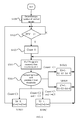
- FIG. 6 shows a flow chart for generating a control signal according to one embodiment of the present invention, in which four areas are taken as an example.
- FIG. 7 is a principle diagram showing a common voltage driving compensation unit according to one embodiment of the present invention, in which four areas are taken as an example.
- FIG. 8 shows a flow chart of a common voltage driving compensation method according to one embodiment of the present invention.
- An array base plate of a display panel has a TFT array structure. As shown in FIG. 3 , for each sub pixel, Gate of TFT is connected to Scan line 101 , Drain is connected to Data line 102 , and Source is connected to a common electrode Vcom via two parallel connected capacitors, one of which is a storage capacitor Cs, the other is a pixel capacitor Clc. Scan line 101 and Data line 102 are crossed to form the sub pixels.
- a basic operation principle of the sub pixel with the above structure is: applying valid scan signals to Scan line 101 line by line to enable the corresponding line; when the scan signal for the corresponding line is valid, writing data into the corresponding scan line via Data line 102 , and when the scan signal in this Scan line 101 is deactivated, storing the written data into all pixels in this line via the storage capacitor Cs.
- the voltage difference across the pixel capacitor Clc is information regarding a brightness to be displayed at this sub pixel.
- a coupling capacitance is usually existed between the data line and the common electrode line, especially for the display panel with a heavy-load. This will lead to a larger coupling area, and thus larger coupling capacitance.
- a common electrode will be coupling effected by a data line whenever data is written into a line, this leads to a coupling phenomenon between the common electrode line and the data line. Therefore the data on the common electrode line would be destructed as a polarity and an intensity of the data on the data line is deflected. Because of large sizes of the display panel with a heavy-load, a corresponding amplification ratio is needed for a different area. Thus, the common voltage of the common electrode will be varied during the compensating for the sake of non-uniform compensation, and this will degrade the picture quality.
- a common voltage driving compensation unit which may include an operational amplifier 10 and a controller 40 .
- the operational amplifier 10 comprises an in-phase input terminal 051 , a reverse-phase input terminal 052 and a first output terminal 053 .
- the in-phase input terminal 051 receives the common voltage
- the reverse-phase input terminal 052 receives the feedback voltage.
- a plurality of paths are connected in parallel between the reverse-phase input terminal 052 and the first output terminal 053 , and each path includes a corresponding analog switch 20 and a corresponding resistor 30 .
- the resistance of each resistor 30 may be the same or different for each of the paths.
- the controller 40 controls a combination of on and off of the respective analog switches according to a range to which a count value of the scan line driving clock signal belongs.
- the principle diagram of the common voltage driving compensation unit is shown in FIG. 4 .
- a plurality of analog switches are provided in parallel in the common voltage driving compensation unit, instead of an original structure with single path.
- a plurality of paths are formed with a plurality of switches and a plurality of corresponding resistors.
- the corresponding amplification ratios could be obtained for the various areas as desired so as to compensate the common electrodes, thereby compensating and suppressing the fluctuation coupling of the common electrode.
- the reddish and heat generation phenomenon on the display panel due to overcompensation may be eliminated and the picture quality is improved.
- a feedback resistor and a capacitor are provided between the in-phase input terminal 051 and the reverse-phase input terminal 052 , as shown in FIG. 4 .
- the validity of the resistors in the paths can be determined by the analog switches, thereby achieving various equivalent resistances between the reverse-phase input terminal 052 and the output terminal 053 .
- the ratio of the equivalent resistances to the feedback resistances further determines the various amplification ratios to amplify the common voltage inputted correspondingly.
- FIG. 5 shows a structural diagram of an analog switch according to the embodiment.
- the analog switch includes an input terminal In, a second output terminal Out and a control terminal SW.
- the input terminal In is connected to the reverse-phase input terminal 052 of the operational amplifier 10 to receive a feedback signal of the common electrode
- the second output terminal Out is connected to a first terminal of a corresponding resistor
- a second terminal of the corresponding resistor is connected to the first output terminal 053 of the operational amplifier 10
- the control terminal SW is configured to receive the control signal.
- An operation state of a multi-path analog switch is controlled according to the control signal inputted to the control terminal SW.
- the controller 40 is a circuit with two inputs and multiple outputs.
- the controller 40 includes a first input terminal 41 , a second input terminal 42 and a plurality of output terminals.
- the first input terminal 41 is connected to the scan line driving clock signal line to receive the scan line driving clock signal (e.g. CPV signal in the example of gate drivers), a second input terminal 42 is connected to the frame start signal line to receive the frame start signal (e.g. STV signal in the example of gate drivers).
- the controller 40 configured to generate a corresponding control signal.
- the controller may be configured to, when the frame start signal inputted to the controller is at a high level (for example, a rising edge of the STV signal is detected), start counting the received scan line driving clock signals and obtain the control signals to be outputted.
- the output terminals of the controller 40 output the control signals.
- the number of the plurality of output terminals corresponds to the number of the plurality of paths. For example, when a certain terminal is outputting a signal at a high level, the analog switch on the corresponding path is turned on, and when an output terminal is outputting a signal at a low level, the analog switch on the corresponding path is turned off.
- a combined control of on and off of respective analog switches is implemented, which further leads to different amplification ratios, so as to achieve the purpose of area-dependent compensation.
- State machines of the two inputs could be used to generate the control signals.
- the whole display area may be divided into four areas for 1080 scan lines, wherein lines 1-270 are grouped as a first area, lines 271-540 are grouped as a second area, lines 541-810 are grouped as a third area, and lines 811-1080 are grouped as a fourth area.
- a flow chart for generating control signal is shown in FIG. 6 .
- step S 102 determining whether the STV signal is equal to 1.
- the STV signal is 0, the STV signal is invalid, indicating that there isn't any new frames to be displayed, thereby wait for the next one.
- the STV signal is 1, the STV signal is valid, indicating a new frame is to be displayed, goes to step S 103 .
- CPV signal is a pulse signal, therefore rising edges or falling edges of the CPV signals may be counted.
- step S 105 comparing the current count value Count with predetermined thresholds.
- C 1 is set to be 270 in the example
- step S 104 continue to increment the count value Count according to a received driving clock signal CPV.
- the count value Count is larger than C 1 and smaller than or equals to C 2 (C 2 is set to be 540 in the example)
- step S 104 continue to increment the count value Count according to a received CPV signal.
- the count value Count is larger than C 2 and smaller than or equals to C 3 (C 3 is set to be 810 in the example)
- STV signal is a pulse signal, it usually has changed from high level to low level 0 when scanning the fourth area. Therefore, return to step S 102 , to determine if the frame start signal STV equals to 1. If the STV signal is 0, it is indicated that the current frame is still being scanned, thereby remain in the fourth state. If the STV signal is 1, it is indicated that a new frame is to be scanned. Therefore, the count value Count is reset to 0, and the operations in the above steps of S 103 -S 106 are performed.
- the first scan line is the near end (i.e. an end near to source driver), and the 1080th scan line is the far end (i.e. an end far from source driver), then a smaller amplification ratio is used to compensate the common electrode in the first area where the first line is positioned, thereby the resistor on the first path may be set to have the smallest resistance. Similarly, a larger amplification ratio is used to compensate the common electrode in the fourth area where the 1080th line is positioned, thereby the resistor on the fourth path may be set to have the largest resistance.
- the resistances of respective resistors on the paths are arranged in an ascending order from the first to the fourth.
- the first analog switch When the scan lines activated are lines 1-270, the first analog switch is turned on, and other switches are off; when the scan lines activated are lines 271-540, the second analog switch is turned on, and other switches are off; when the scan lines activated are lines 541-810, the third analog switch is turned on, and other switches are off; and when the scan lines activated are lines 811-1080, the fourth analog switch is turned on, and other switches are off.
- an appropriate amplification ratio may be obtained by allowing only one analog switch to be turned on each time, because the resistors on the four paths have different resistances.
- the four resistors may have the same resistance as well, and the appropriate amplification ratios may be achieved by arranging the on and off of the analog switches in a different combination.
- a principle diagram of the common voltage driving compensation unit with the four divided areas is shown in FIG. 7 .
- the multiplexing structure in the embodiment is used to implement the generation of four control signals.
- the whole display area is not limited to be divided into four areas.
- any other configuration of the switch states and resistances may be adopted, as long as the closer it is to the source driver, the smaller an amplification ratio is needed for the common electrode compensation.
- the received gate driving clock signals are counted during the compensation of the common electrodes, and an area being scanned is determined based on the range to which the count value belongs, so as to compensate and suppress the fluctuation coupling of the common electrodes, eliminate the reddish and heat generation phenomenon on display panel due to overcompensation and improve picture quality.
- This common voltage driving compensation unit is particularly applicable to the common electrode compensation of the display panel with a heavy-load.
- the embodiment also provides a display panel, which may include a timing controller and a common voltage driving compensation unit according to the embodiment.
- the timing controller provides the common voltage driving compensation unit with the scan line driving clock signal and the frame start signal.
- the controller in the common voltage driving compensation unit counts the received scan line driving clock signals, and provides corresponding amplification ratios based on a range to which the count value belongs.
- the amplification ratio is based on a combination of on and off of the analog switches in the common voltage driving compensation unit. Particularly, the amplification ratio is associated with the ratio of the equivalent resistance of the parallel paths to the feedback resistance of the reverse-input terminal.
- the area dividing is performed based on a distance between the common voltage driving compensation unit and a source driver, and the ranges of the gate driving clock signals are determined based on the area division.
- the controller in the common voltage driving compensation unit takes STV signal and CPV signal as input data, and divides the display panel according to the counting of CPV signals, thereby different areas are compensated with corresponding amplification ratios, so as to uniformize compensation of the whole display panel, suppress the fluctuation coupling of the common electrode, avoiding over-compensation and under-compensation, and thus improve the picture quality.
- the common voltage driving compensation method may include:
- a common voltage driving compensation unit which is closer to the source driver is called a near end
- a common voltage driving compensation unit which is far from the source driver is called a far end
- the number of the areas obtained from dividing may be set on demand.
- at least two areas are obtained, i.e. the near end and the far end.
- at least three areas are obtained, i.e. a far end, a near end and an area between the far end and the near end, and the area between the far end and the near end may be further divided.
- the dividing may be performed evenly or unevenly.
- the display panel is divided into at least three areas, and each area corresponds to a switch. If three areas are obtained by division, then a first area is at the near end, a third area is at the far end, and a second area is between the near end and the far end. If more than three areas are obtained by division, then the two edge areas are located at respectively the near end and the far end, and a multiple areas may be located between the near end and the far end.
- the CPV signals are counted. Based on the count value being within different preset ranges, the combination of on and off of the corresponding analog switches on the paths in the common voltage driving compensation unit is controlled.
- the amplification ratio is determined by a ratio of the equivalent resistance of the parallel paths to the resistance of the feedback resistor connected to the reverse-input terminal. Because the resistances on the corresponding paths may be same or different with each other, corresponding amplification ratios are provided for the different areas.
- Area-dependent compensation is implemented to the different areas by using different amplification ratios, as in the above embodiment, only one analog switch is turned on each time, whereas other analog switches are turned off, and the respective analog switch corresponds to a resistor with a certain resistance.
- the area-dependent compensation may also be implemented in other ways. For example, two or more analog switches may be turned on at the same time, and the resistances of corresponding resistors may be same or different.
- Those skilled in the art can set various control signals for the operation of a state machine like that in FIG. 6 . This is more useful in a situation where more areas are obtained by dividing. If the division is finer, and more areas are obtained, then it will not be necessary for one path to correspond to only one area.
- the on and off of switches and the resistance of respective resistors may be designed in a flexible manner, as long as the equivalent resistance of the circuit formed by the paths are different. Therefore, less analog switches and resistors would be required.
Landscapes
- Engineering & Computer Science (AREA)
- Physics & Mathematics (AREA)
- Computer Hardware Design (AREA)
- General Physics & Mathematics (AREA)
- Theoretical Computer Science (AREA)
- Chemical & Material Sciences (AREA)
- Crystallography & Structural Chemistry (AREA)
- Multimedia (AREA)
- Liquid Crystal Display Device Control (AREA)
- Control Of Indicators Other Than Cathode Ray Tubes (AREA)
Abstract
Description
-
- dividing a display area into a plurality of areas based on a distance between the common voltage driving compensation unit and the source driver;
- counting the scan line driving clock signals, and setting at least two predetermined threshold ranges based on a result of the dividing;
- controlling a combination of on and off of the analog switches on respective paths based on the predetermined threshold range to which the count value belongs, so as to compensate the inputted common voltage with corresponding amplification ratios, respectively.
-
- step S1, dividing a display area based on a distance between the common voltage driving compensation unit and a source driver;
- step S2, counting the scan line driving clock signal, and dividing a range of a count value according to a result of the dividing in step S1. When the frame start signal is at a valid level (e.g. high level), starting to count the scan line driving clock signal. As a frame synchronization signal, the frame start signal means starting to display a new frame. Scan line driving clock signal line is connected to a scan driver circuit for the display panel. Each scan line driving clock signal is acted as a synchronization signal for a corresponding scan line in the pixel structure;
- step S3, based on the count value being within different preset ranges, the common voltage driving compensation unit controlling a combination of on and off of analog switches on corresponding paths, so as to amplify the input common voltage with the corresponding amplification ratios.
Claims (9)
Applications Claiming Priority (3)
| Application Number | Priority Date | Filing Date | Title |
|---|---|---|---|
| CN201410255374 | 2014-06-10 | ||
| CN201410255374.8 | 2014-06-10 | ||
| CN201410255374.8A CN104050942B (en) | 2014-06-10 | 2014-06-10 | A kind of common electric voltage drives compensating unit, method and display floater |
Publications (2)
| Publication Number | Publication Date |
|---|---|
| US20150356951A1 US20150356951A1 (en) | 2015-12-10 |
| US9542913B2 true US9542913B2 (en) | 2017-01-10 |
Family
ID=51503683
Family Applications (1)
| Application Number | Title | Priority Date | Filing Date |
|---|---|---|---|
| US14/496,812 Expired - Fee Related US9542913B2 (en) | 2014-06-10 | 2014-09-25 | Common voltage driving compensation unit, method and display panel using the same |
Country Status (2)
| Country | Link |
|---|---|
| US (1) | US9542913B2 (en) |
| CN (1) | CN104050942B (en) |
Cited By (2)
| Publication number | Priority date | Publication date | Assignee | Title |
|---|---|---|---|---|
| US10380937B2 (en) * | 2015-08-26 | 2019-08-13 | Apple Inc. | Multi-zoned variable VCOM control |
| US10884443B2 (en) | 2017-12-12 | 2021-01-05 | Boe Technology Group Co., Ltd. | Voltage control circuit and method, panel and display apparatus |
Families Citing this family (37)
| Publication number | Priority date | Publication date | Assignee | Title |
|---|---|---|---|---|
| CN104269147A (en) * | 2014-09-30 | 2015-01-07 | 南京中电熊猫液晶显示科技有限公司 | Liquid crystal display panel driving circuit and liquid crystal device |
| CN104317083A (en) * | 2014-10-28 | 2015-01-28 | 重庆京东方光电科技有限公司 | Display panel and device |
| CN104299593B (en) * | 2014-11-07 | 2017-01-25 | 深圳市华星光电技术有限公司 | Liquid crystal display device |
| CN104376829A (en) * | 2014-12-11 | 2015-02-25 | 京东方科技集团股份有限公司 | Display substrate driving device and method and display device |
| JP6574369B2 (en) * | 2015-10-13 | 2019-09-11 | 株式会社ジャパンディスプレイ | Display device |
| CN105321453A (en) * | 2015-12-01 | 2016-02-10 | 武汉华星光电技术有限公司 | Display panel and display device |
| CN105390107B (en) * | 2015-12-07 | 2018-02-02 | 深圳市华星光电技术有限公司 | Common electric voltage of LCD panel adjustment circuit and liquid crystal display device |
| CN105405426B (en) * | 2016-01-04 | 2018-05-08 | 京东方科技集团股份有限公司 | Display screen, display device and display control method |
| CN105469767B (en) * | 2016-01-05 | 2017-11-07 | 京东方科技集团股份有限公司 | A kind of common electric voltage compensation circuit, compensation method, display panel and display device |
| CN105654888B (en) * | 2016-02-04 | 2019-06-14 | 京东方科技集团股份有限公司 | A common electrode voltage compensation circuit and display device |
| US10129757B2 (en) | 2016-08-01 | 2018-11-13 | Apple Inc. | Transceiver architecture for license assisted access systems |
| CN106023877B (en) * | 2016-08-15 | 2019-02-19 | 京东方科技集团股份有限公司 | Common voltage regulation circuit, method, display panel and apparatus |
| CN106205540B (en) | 2016-08-31 | 2019-02-01 | 深圳市华星光电技术有限公司 | Improve the liquid crystal display panel and liquid crystal display of display brightness homogeneity |
| CN106297709A (en) * | 2016-09-09 | 2017-01-04 | 合肥鑫晟光电科技有限公司 | Display floater, compensation device, display device and common electrode voltage compensation method |
| CN106409260B (en) * | 2016-11-17 | 2019-04-26 | 京东方科技集团股份有限公司 | Voltage compensation circuit and voltage compensation method thereof, display panel and display device |
| CN106782397A (en) | 2017-01-03 | 2017-05-31 | 京东方科技集团股份有限公司 | The compensation method of display panel and its common electric voltage, display device |
| KR102595135B1 (en) * | 2017-01-09 | 2023-10-31 | 삼성디스플레이 주식회사 | Display device and control method thereof |
| CN107799082A (en) * | 2017-11-16 | 2018-03-13 | 深圳市华星光电技术有限公司 | A kind of common electric voltage VCOM control circuits and corresponding liquid crystal display device |
| CN109509453B (en) * | 2018-12-24 | 2021-05-14 | 惠科股份有限公司 | Display panel driving method, device and readable storage medium |
| CN109785811B (en) * | 2019-01-29 | 2021-03-02 | 重庆京东方光电科技有限公司 | Common voltage supply circuit, liquid crystal display panel and driving method thereof |
| TWI708951B (en) * | 2019-06-14 | 2020-11-01 | 友達光電股份有限公司 | Detection circuit and display panel |
| CN110428788A (en) * | 2019-07-24 | 2019-11-08 | 深圳市华星光电技术有限公司 | A kind of the common voltage compensation circuit and compensation system of display panel |
| CN110531896B (en) * | 2019-08-29 | 2024-03-29 | 珠海市宏沛函电子技术有限公司 | Touch driving method, touch driving device and touch panel |
| CN111308820B (en) | 2020-03-11 | 2022-07-05 | 京东方科技集团股份有限公司 | Array substrate, display device and control method thereof |
| CN111477194B (en) * | 2020-05-27 | 2022-02-22 | 京东方科技集团股份有限公司 | Common voltage output circuit, display device and common voltage compensation method |
| CN111640404B (en) * | 2020-06-10 | 2022-06-14 | 昆山龙腾光电股份有限公司 | Wide-narrow viewing angle switching circuit and display device thereof |
| CN113178176B (en) * | 2021-04-25 | 2023-11-28 | Tcl华星光电技术有限公司 | Display devices and mobile terminals |
| CN114373416A (en) * | 2021-11-30 | 2022-04-19 | 长沙惠科光电有限公司 | display panel |
| CN115171623B (en) * | 2022-08-08 | 2024-04-09 | 合肥京东方显示技术有限公司 | Driving circuit and display device |
| CN115346461B (en) * | 2022-08-09 | 2026-02-24 | 惠科股份有限公司 | Common voltage compensation method, common voltage compensation device, display equipment and readable storage medium |
| CN115762384A (en) * | 2022-11-24 | 2023-03-07 | 惠科股份有限公司 | Common voltage compensation system, method of controlling the same, display device, and storage medium |
| CN116153223A (en) * | 2023-01-31 | 2023-05-23 | 惠科股份有限公司 | Common voltage compensation method, device, display device and medium of display panel |
| CN116229868B (en) * | 2023-03-01 | 2026-02-06 | 北京奕斯伟计算技术股份有限公司 | Amplifying circuit, control method, device and equipment of source electrode driving circuit |
| CN116755579B (en) * | 2023-08-18 | 2023-11-28 | 合肥联宝信息技术有限公司 | Compensation circuit, voltage compensation method and electronic equipment for display device |
| CN116994536B (en) * | 2023-08-31 | 2023-12-01 | 惠科股份有限公司 | Common voltage compensation circuit, compensation method and display device |
| CN118155582B (en) * | 2024-03-13 | 2026-04-03 | 广州华星光电半导体显示技术有限公司 | Voltage compensation circuit, method, driving device and display device |
| CN118281131B (en) * | 2024-03-18 | 2025-09-26 | 广州华星光电半导体显示技术有限公司 | Display panel and display device |
Citations (8)
| Publication number | Priority date | Publication date | Assignee | Title |
|---|---|---|---|---|
| US4673807A (en) * | 1984-10-12 | 1987-06-16 | Dai Nippon Insatso Kabushiki Kaisha | Automatic range control method for an optical density/dot percentage measuring device |
| KR20080062926A (en) | 2006-12-29 | 2008-07-03 | 엘지디스플레이 주식회사 | Common Voltage Compensation Circuit of LCD |
| US20080252584A1 (en) * | 2007-04-10 | 2008-10-16 | Hitachi Displays, Ltd. | Liquid crystal display device |
| US20080303770A1 (en) * | 2007-06-11 | 2008-12-11 | Hitachi Displays, Ltd. | Liquid Crystal Display Device |
| US20120162184A1 (en) * | 2010-12-24 | 2012-06-28 | Samsung Electronics Co., Ltd. | Method of driving display panel and display apparatus for performing the same |
| CN102891655A (en) | 2011-02-25 | 2013-01-23 | 马克西姆综合产品公司 | Vcom amplifier with transient assist circuit |
| CN103426413A (en) | 2012-05-25 | 2013-12-04 | 乐金显示有限公司 | Liquid crystal display device and driving method thereof |
| US20140028535A1 (en) * | 2012-07-24 | 2014-01-30 | Lg Display Co., Ltd. | Liquid crystal display device including common voltage compensating circuit |
-
2014
- 2014-06-10 CN CN201410255374.8A patent/CN104050942B/en not_active Expired - Fee Related
- 2014-09-25 US US14/496,812 patent/US9542913B2/en not_active Expired - Fee Related
Patent Citations (9)
| Publication number | Priority date | Publication date | Assignee | Title |
|---|---|---|---|---|
| US4673807A (en) * | 1984-10-12 | 1987-06-16 | Dai Nippon Insatso Kabushiki Kaisha | Automatic range control method for an optical density/dot percentage measuring device |
| KR20080062926A (en) | 2006-12-29 | 2008-07-03 | 엘지디스플레이 주식회사 | Common Voltage Compensation Circuit of LCD |
| US20080252584A1 (en) * | 2007-04-10 | 2008-10-16 | Hitachi Displays, Ltd. | Liquid crystal display device |
| US20080303770A1 (en) * | 2007-06-11 | 2008-12-11 | Hitachi Displays, Ltd. | Liquid Crystal Display Device |
| US20120162184A1 (en) * | 2010-12-24 | 2012-06-28 | Samsung Electronics Co., Ltd. | Method of driving display panel and display apparatus for performing the same |
| CN102891655A (en) | 2011-02-25 | 2013-01-23 | 马克西姆综合产品公司 | Vcom amplifier with transient assist circuit |
| CN103426413A (en) | 2012-05-25 | 2013-12-04 | 乐金显示有限公司 | Liquid crystal display device and driving method thereof |
| US20140028535A1 (en) * | 2012-07-24 | 2014-01-30 | Lg Display Co., Ltd. | Liquid crystal display device including common voltage compensating circuit |
| CN103578439A (en) | 2012-07-24 | 2014-02-12 | 乐金显示有限公司 | Liquid crystal display device including common voltage compensating circuit |
Non-Patent Citations (1)
| Title |
|---|
| English Translation of first Chinese Office Action dated Oct. 10, 2015, for corresponding Chinese Application No. 201410255374.8. |
Cited By (2)
| Publication number | Priority date | Publication date | Assignee | Title |
|---|---|---|---|---|
| US10380937B2 (en) * | 2015-08-26 | 2019-08-13 | Apple Inc. | Multi-zoned variable VCOM control |
| US10884443B2 (en) | 2017-12-12 | 2021-01-05 | Boe Technology Group Co., Ltd. | Voltage control circuit and method, panel and display apparatus |
Also Published As
| Publication number | Publication date |
|---|---|
| CN104050942B (en) | 2016-06-29 |
| US20150356951A1 (en) | 2015-12-10 |
| CN104050942A (en) | 2014-09-17 |
Similar Documents
| Publication | Publication Date | Title |
|---|---|---|
| US9542913B2 (en) | Common voltage driving compensation unit, method and display panel using the same | |
| US10403218B2 (en) | Mura compensation circuit and method, driving circuit and display device | |
| KR102371896B1 (en) | Method of driving display panel and display apparatus for performing the same | |
| US20160070147A1 (en) | Liquid crystal display device | |
| CN103544927B (en) | Display drive circuit, display device and display drive method | |
| KR20130131851A (en) | Liquid crystal display device and driving method thereof | |
| KR102099281B1 (en) | Liquid crystal display and method for driving the same | |
| US20080024417A1 (en) | Common voltage compensation device, liquid crystal display, and driving method thereof | |
| CN105118470A (en) | Grid electrode driving circuit and grid electrode driving method, array substrate and display panel | |
| US20090244041A1 (en) | Liquid crystal displays | |
| JP2013167772A (en) | Liquid crystal display device | |
| KR20060111262A (en) | Drive of display device | |
| US10152933B2 (en) | Driving method and system for liquid crystal display | |
| KR102459705B1 (en) | Liquid crystal display device | |
| KR20150059525A (en) | Display apparatus and method of driving thereof | |
| KR20060089831A (en) | Drive of display device | |
| US20180268773A1 (en) | Display device and method for adjusting common voltage of display device | |
| KR20120109890A (en) | Driving apparatus and driving method of liquid crsytal display | |
| KR101367134B1 (en) | Driving apparatus of display device | |
| KR20120128904A (en) | Driving apparatus and driving method of liquid crsytal display | |
| CN107204168B (en) | Driving method for display panel | |
| US8884860B2 (en) | Liquid crystal display having increased response speed, and device and method for modifying image signal to provide increased response speed | |
| US20210295788A1 (en) | Display Panel Driving Method and Display Panel Driving Circuit Thereof | |
| KR20070116408A (en) | Liquid crystal display device and driving method thereof | |
| KR20110133248A (en) | Driving apparatus and method of display device |
Legal Events
| Date | Code | Title | Description |
|---|---|---|---|
| AS | Assignment |
Owner name: BEIJING BOE DISPLAY TECHNOLOGY CO., LTD., CHINA Free format text: ASSIGNMENT OF ASSIGNORS INTEREST;ASSIGNOR:WANG, JIEQIONG;REEL/FRAME:033821/0318 Effective date: 20140910 Owner name: BOE TECHNOLOGY GROUP CO., LTD., CHINA Free format text: ASSIGNMENT OF ASSIGNORS INTEREST;ASSIGNOR:WANG, JIEQIONG;REEL/FRAME:033821/0318 Effective date: 20140910 |
|
| STCF | Information on status: patent grant |
Free format text: PATENTED CASE |
|
| MAFP | Maintenance fee payment |
Free format text: PAYMENT OF MAINTENANCE FEE, 4TH YEAR, LARGE ENTITY (ORIGINAL EVENT CODE: M1551); ENTITY STATUS OF PATENT OWNER: LARGE ENTITY Year of fee payment: 4 |
|
| FEPP | Fee payment procedure |
Free format text: MAINTENANCE FEE REMINDER MAILED (ORIGINAL EVENT CODE: REM.); ENTITY STATUS OF PATENT OWNER: LARGE ENTITY |
|
| LAPS | Lapse for failure to pay maintenance fees |
Free format text: PATENT EXPIRED FOR FAILURE TO PAY MAINTENANCE FEES (ORIGINAL EVENT CODE: EXP.); ENTITY STATUS OF PATENT OWNER: LARGE ENTITY |
|
| STCH | Information on status: patent discontinuation |
Free format text: PATENT EXPIRED DUE TO NONPAYMENT OF MAINTENANCE FEES UNDER 37 CFR 1.362 |
|
| FP | Lapsed due to failure to pay maintenance fee |
Effective date: 20250110 |