US9536883B2 - Dual anti-fuse - Google Patents
Dual anti-fuse Download PDFInfo
- Publication number
- US9536883B2 US9536883B2 US13/548,123 US201213548123A US9536883B2 US 9536883 B2 US9536883 B2 US 9536883B2 US 201213548123 A US201213548123 A US 201213548123A US 9536883 B2 US9536883 B2 US 9536883B2
- Authority
- US
- United States
- Prior art keywords
- fuse
- channel
- programmable gate
- gate
- semiconductor fin
- Prior art date
- Legal status (The legal status is an assumption and is not a legal conclusion. Google has not performed a legal analysis and makes no representation as to the accuracy of the status listed.)
- Expired - Fee Related, expires
Links
Images


Classifications
-
- H01L27/101—
-
- H—ELECTRICITY
- H10—SEMICONDUCTOR DEVICES; ELECTRIC SOLID-STATE DEVICES NOT OTHERWISE PROVIDED FOR
- H10D—INORGANIC ELECTRIC SEMICONDUCTOR DEVICES
- H10D84/00—Integrated devices formed in or on semiconductor substrates that comprise only semiconducting layers, e.g. on Si wafers or on GaAs-on-Si wafers
- H10D84/201—Integrated devices formed in or on semiconductor substrates that comprise only semiconducting layers, e.g. on Si wafers or on GaAs-on-Si wafers characterised by the integration of only components covered by H10D1/00 or H10D8/00, e.g. RLC circuits
- H10D84/204—Integrated devices formed in or on semiconductor substrates that comprise only semiconducting layers, e.g. on Si wafers or on GaAs-on-Si wafers characterised by the integration of only components covered by H10D1/00 or H10D8/00, e.g. RLC circuits of combinations of diodes or capacitors or resistors
- H10D84/206—Integrated devices formed in or on semiconductor substrates that comprise only semiconducting layers, e.g. on Si wafers or on GaAs-on-Si wafers characterised by the integration of only components covered by H10D1/00 or H10D8/00, e.g. RLC circuits of combinations of diodes or capacitors or resistors of combinations of capacitors and resistors
-
- H—ELECTRICITY
- H10—SEMICONDUCTOR DEVICES; ELECTRIC SOLID-STATE DEVICES NOT OTHERWISE PROVIDED FOR
- H10B—ELECTRONIC MEMORY DEVICES
- H10B20/00—Read-only memory [ROM] devices
- H10B20/20—Programmable ROM [PROM] devices comprising field-effect components
- H10B20/25—One-time programmable ROM [OTPROM] devices, e.g. using electrically-fusible links
-
- H—ELECTRICITY
- H10—SEMICONDUCTOR DEVICES; ELECTRIC SOLID-STATE DEVICES NOT OTHERWISE PROVIDED FOR
- H10D—INORGANIC ELECTRIC SEMICONDUCTOR DEVICES
- H10D64/00—Electrodes of devices having potential barriers
- H10D64/20—Electrodes characterised by their shapes, relative sizes or dispositions
- H10D64/27—Electrodes not carrying the current to be rectified, amplified, oscillated or switched, e.g. gates
- H10D64/311—Gate electrodes for field-effect devices
- H10D64/411—Gate electrodes for field-effect devices for FETs
-
- H—ELECTRICITY
- H10—SEMICONDUCTOR DEVICES; ELECTRIC SOLID-STATE DEVICES NOT OTHERWISE PROVIDED FOR
- H10D—INORGANIC ELECTRIC SEMICONDUCTOR DEVICES
- H10D64/00—Electrodes of devices having potential barriers
- H10D64/60—Electrodes characterised by their materials
- H10D64/66—Electrodes having a conductor capacitively coupled to a semiconductor by an insulator, e.g. MIS electrodes
- H10D64/671—Electrodes having a conductor capacitively coupled to a semiconductor by an insulator, e.g. MIS electrodes the conductor having lateral variation in doping or structure
-
- H—ELECTRICITY
- H01—ELECTRIC ELEMENTS
- H01L—SEMICONDUCTOR DEVICES NOT COVERED BY CLASS H10
- H01L23/00—Details of semiconductor or other solid state devices
- H01L23/52—Arrangements for conducting electric current within the device in operation from one component to another, i.e. interconnections, e.g. wires, lead frames
- H01L23/522—Arrangements for conducting electric current within the device in operation from one component to another, i.e. interconnections, e.g. wires, lead frames including external interconnections consisting of a multilayer structure of conductive and insulating layers inseparably formed on the semiconductor body
- H01L23/525—Arrangements for conducting electric current within the device in operation from one component to another, i.e. interconnections, e.g. wires, lead frames including external interconnections consisting of a multilayer structure of conductive and insulating layers inseparably formed on the semiconductor body with adaptable interconnections
- H01L23/5252—Arrangements for conducting electric current within the device in operation from one component to another, i.e. interconnections, e.g. wires, lead frames including external interconnections consisting of a multilayer structure of conductive and insulating layers inseparably formed on the semiconductor body with adaptable interconnections comprising anti-fuses, i.e. connections having their state changed from non-conductive to conductive
-
- H—ELECTRICITY
- H01—ELECTRIC ELEMENTS
- H01L—SEMICONDUCTOR DEVICES NOT COVERED BY CLASS H10
- H01L23/00—Details of semiconductor or other solid state devices
- H01L23/52—Arrangements for conducting electric current within the device in operation from one component to another, i.e. interconnections, e.g. wires, lead frames
- H01L23/522—Arrangements for conducting electric current within the device in operation from one component to another, i.e. interconnections, e.g. wires, lead frames including external interconnections consisting of a multilayer structure of conductive and insulating layers inseparably formed on the semiconductor body
- H01L23/525—Arrangements for conducting electric current within the device in operation from one component to another, i.e. interconnections, e.g. wires, lead frames including external interconnections consisting of a multilayer structure of conductive and insulating layers inseparably formed on the semiconductor body with adaptable interconnections
- H01L23/5256—Arrangements for conducting electric current within the device in operation from one component to another, i.e. interconnections, e.g. wires, lead frames including external interconnections consisting of a multilayer structure of conductive and insulating layers inseparably formed on the semiconductor body with adaptable interconnections comprising fuses, i.e. connections having their state changed from conductive to non-conductive
-
- H—ELECTRICITY
- H01—ELECTRIC ELEMENTS
- H01L—SEMICONDUCTOR DEVICES NOT COVERED BY CLASS H10
- H01L2924/00—Indexing scheme for arrangements or methods for connecting or disconnecting semiconductor or solid-state bodies as covered by H01L24/00
-
- H—ELECTRICITY
- H01—ELECTRIC ELEMENTS
- H01L—SEMICONDUCTOR DEVICES NOT COVERED BY CLASS H10
- H01L2924/00—Indexing scheme for arrangements or methods for connecting or disconnecting semiconductor or solid-state bodies as covered by H01L24/00
- H01L2924/0001—Technical content checked by a classifier
- H01L2924/0002—Not covered by any one of groups H01L24/00, H01L24/00 and H01L2224/00
-
- H10W20/491—
-
- H10W20/493—
Definitions
- An anti-fuse can be configured in a planar arrangement with a source, a drain, and a channel situated in a semiconductor substrate.
- a programmable gate is situated over the channel and includes a gate electrode situated over a gate dielectric.
- the gate dielectric initially provides a high-resistance current path between the gate electrode and the channel of the anti-fuse.
- the anti-fuse can be programmed by applying a programming voltage across the gate electrode and the channel so as cause breakdown of the gate dielectric. Once programmed, the current path changes from high-resistance to low-resistance to facilitate current flow through the current path.
- the present disclosure is directed to a dual anti-fuse, substantially as shown in and/or described in connection with at least one of the figures, and as set forth more completely in the claims.
- FIG. 1 illustrates a schematic diagram of an exemplary circuit including a dual anti-fuse structure.
- FIG. 2 shows a process flow diagram illustrating an exemplary process for fabricating a dual anti-fuse structure.
- FIG. 3A illustrates a cross-sectional view of a portion of an exemplary wafer during processing.
- FIG. 3B illustrates a cross-sectional view of a portion of an exemplary wafer during processing.
- FIG. 3C illustrates a cross-sectional view of a portion of an exemplary wafer during processing.
- FIG. 4A illustrates a top view of a dual anti-fuse structure.
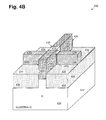
- FIG. 4B illustrates a perspective view of a dual anti-fuse structure.
- FIG. 1 illustrates a schematic diagram of a circuit 100 including a dual anti-fuse structure 150 .
- the dual anti-fuse structure 150 includes an anti-fuse 102 a and an anti-fuse 102 b.
- the anti-fuse 102 a includes a source 104 a , a drain 106 a , a programmable gate 108 a , and a channel 110 a .
- the programmable gate 108 a and the channel 110 a form a high-resistance path for current flow.
- the source 104 a and the drain 106 a can be coupled to the high-resistance path through the channel 110 a , as shown in FIG. 1 .
- the anti-fuse 102 a can be programmed by applying a programming voltage across the programmable gate 108 a and the channel 110 a so as cause breakdown of a gate dielectric in the programmable gate 108 a . Once programmed, the high-resistance path changes from to a low-resistance path to facilitate current flow.
- the anti-fuse 102 b includes a source 104 b , a drain 106 b , a programmable gate 108 b , and a channel 110 b .
- the programmable gate 108 b and the channel 110 b form a high-resistance path for current flow.
- the source 104 b and the drain 106 b can be coupled to the high-resistance path through the channel 110 b , as shown in FIG. 1 .
- the anti-fuse 102 b can be programmed by applying a programming voltage across the programmable gate 108 b and the channel 110 b so as cause breakdown of a gate dielectric in the programmable gate 108 b . Once programmed, the high-resistance path changes from to a low-resistance path to facilitate current flow.
- the source 104 a of the anti-fuse 102 a is coupled to the source 104 b of the anti-fuse 102 b .
- the drain 106 a of the anti-fuse 102 a is coupled to the drain 106 b of the anti-fuse 102 b .
- the source 104 a is not coupled to the source 104 b and/or the drain 106 a is not coupled to the drain 106 b in the dual anti-fuse structure 150 .
- the dual anti-fuse structure 150 can have many different configurations and can be utilized in many different circuits.
- the circuit 100 illustrates ones such circuit utilizing the dual-anti-fuse structure 150 .
- the programmable gate 108 a is coupled between a program transistor 114 a and a read transistor 116 a .
- the programmable gate 108 b is coupled between a program transistor 114 b and a read transistor 116 b .
- the source 104 a and the source 104 b are coupled to a ground G 1 .
- the drain 106 a and the drain 106 b are coupled to a ground G 2 , which can be the same as the ground G 1 .
- the anti-fuse 102 a can be programmed by, for example, applying a programming voltage V PP1 across the programmable gate 108 a and the channel 110 a through the program transistor 114 a , which can be controlled by a gate 120 a .
- the programming voltage V PP1 is sufficient to program the anti-fuse 102 a by blowing the anti-fuse 102 a .
- the anti-fuse 102 a can be read from by, for example, applying a read voltage V DD1 to the programmable gate 108 a through the read transistor 116 a , which can be controlled by a gate 122 a .
- the read voltage V DD1 can then be utilized to sense whether or not the anti-fuse 102 a has been programmed based on the resistivity of the programmable gate 108 a.
- the anti-fuse 102 b can be programmed by, for example, applying a programming voltage V PP2 across the programmable gate 108 b and the channel 110 b through the program transistor 114 b , which can be controlled by a gate 120 b .
- the programming voltage V PP2 is sufficient to program the anti-fuse 102 b by blowing the anti-fuse 102 b .
- the anti-fuse 102 b can be read from by, for example, applying a read voltage V DD2 to the programmable gate 108 b through the read transistor 116 b , which can be controlled by a gate 122 b .
- the read voltage V DD2 can then be utilized to sense whether or not the anti-fuse 102 b has been programmed based on the resistivity of the programmable gate 108 b.
- the dual-anti fuse structure 150 includes the anti-fuse 102 a and the anti-fuse 102 b , which can optionally be independently operated as described above.
- the anti-fuse 102 a described above includes the source 104 a and the drain 106 a for connection to the anti-fuse 102 a .
- the source 104 a and/or the drain 106 a are not included in the dual anti-fuse structure 150 or are not utilized for connection to the anti-fuse 102 a .
- the anti-fuse 102 a can include the source 104 a without the drain 106 a or can include the drain 106 a without the source 104 a .
- the anti-fuse 102 b described above includes the source 104 b and the drain 106 b for connection to the anti-fuse 102 b .
- the source 104 b and/or the drain 106 b are not included in the dual anti-fuse structure 150 or are not utilized for connection to the anti-fuse 102 b .
- the anti-fuse 102 b can include the source 104 b without the drain 106 b or can include the drain 106 b without the source 104 b .
- utilizing the sources 104 a and 104 b and the drains 106 a and 106 b can offer various advantages including lowering the resistivity of the anti-fuses 102 a and 102 b after programming.
- FIG. 2 shows a process flow diagram illustrating a process 200 for fabricating a dual anti-fuse structure, such as the dual anti-fuse structure 150 in FIG. 1 .
- the dual anti-fuse structure 150 can be fabricated utilizing processes other than the process 200 .
- the process 200 is described with respect to FIGS. 3A, 3B, and 3C .
- the implementation illustrated by the process 200 can be performed on a processed wafer, which prior to the process 200 may include a substrate having a source region, a drain region, and a channel region in a common semiconductor fin, a gate dielectric layer, and a field dielectric layer.
- the process 200 includes forming a conductive gate layer (e.g., 328 ) over a common semiconductor fin (e.g., 330 ) ( 270 in FIG. 2 ).
- a conductive gate layer e.g., 328
- a common semiconductor fin e.g., 330
- FIG. 3A illustrates a cross-sectional view of a portion of a wafer 370 during processing.
- the wafer 370 includes a substrate 332 , a field dielectric layer 334 , a common semiconductor fin 330 , a gate dielectric layer 340 , and a conductive gate layer 328 .
- the substrate 332 includes semiconductor material, such as single-crystal semiconductor material.
- the substrate 332 is a silicon substrate and more particularly monocrystalline silicon.
- the substrate 332 is a P type substrate (e.g. a lightly doped P ⁇ substrate).
- the substrate 332 is an N type (e.g. a lightly doped N ⁇ substrate) substrate or is undoped.
- the substrate 332 is a semiconductor on insulator substrate, such as a silicon on insulator substrate (SOI) (Not shown).
- the common semiconductor fin 330 includes semiconductor material, and in the present implementation is silicon.
- the common semiconductor fin 330 is formed in and on the substrate 332 and includes channels 310 a and 310 b situated in a common channel region 310 .
- the common channel region 310 is a doped region of the common semiconductor fin 330 .
- the common channel region 310 is P type (e.g., lightly doped P ⁇ ).
- the common channel region 310 can be doped differently than what is shown in FIG. 3A .
- the common channel region 310 is N type (e.g., lightly doped N ⁇ ).
- the common channel region 310 has a similar doping profile as the substrate 332 as the common channel region 310 is formed from the substrate 332 , however, the common channel region 310 can have a different doping profile than the substrate 332 . Furthermore, while in the present implementation, the channels 310 a and 310 b are in the common channel region 310 , in some implementations, the channels 310 a and 310 b are in separate channel regions.
- the field dielectric layer 334 is situated over the substrate 332 .
- the field dielectric layer 334 includes one or more dielectric materials, such as silicon dioxide.
- the field dielectric layer 334 is a shallow trench isolation (STI) layer and underlies the conductive gate layer 328 and the gate dielectric layer 340 .
- STI shallow trench isolation
- the gate dielectric layer 340 is situated over and on the substrate 332 , the common semiconductor fin 330 , and the field dielectric layer 334 .
- the gate dielectric layer 340 includes dielectric material.
- Dielectric material suitable for the gate dielectric layer 340 includes gate dielectric material for field-effect transistors (FETs), such as finFETs.
- FETs field-effect transistors
- the gate dielectric layer 340 includes high-k dielectric material. Examples of high-k dielectric material for the gate dielectric layer 340 includes, as specific examples, hafnium oxide (HfO 2 ), zirconium oxide (ZrO 2 ), chromium oxide (CrO 2 ), and the like.
- the conductive gate layer 328 is situated over the substrate 332 and on the gate dielectric layer 340 and the field dielectric layer 334 .
- the conductive gate layer 328 includes conductive material.
- Conductive material suitable for the conductive gate layer 328 includes gate material for FETs, such as finFETs.
- the conductive gate layer 328 includes metal, such as high-k metal gate material. Examples of high-k metal gate material for the conductive gate layer 328 include, as specific examples, tantalum (Ta), tantalum nitride (TaN), titanium nitride (TiN), molybdenum (Mo), ruthenium (Ru), tantalum carbide nitride (TaCN), or other metal or metal stack.
- the conductive gate layer 328 is formed over the common semiconductor fin 330 .
- the wafer 370 may also include the field dielectric layer 334 , the gate dielectric layer 340 , and the common channel region 310 and common source and drain regions in the common semiconductor fin 330 (the common source and drain regions are not shown in FIG. 3A ).
- the conductive gate layer 328 can be formed over the common semiconductor fin 330 by depositing one or more layers of conductive material, such as metal, over the common semiconductor fin 330 .
- the deposition can utilize physical vapor deposition (PVD), chemical vapor deposition (CVD), or another deposition technique.
- the deposited one or more layers of conductive material can then be planarized utilizing chemical mechanical planarization (CMP) or another planarization technique, resulting in the wafer 370 shown in FIG. 3A .
- CMP chemical mechanical planarization
- the process 200 includes forming a mask (e.g., 344 ) over the conductive gate layer (e.g., 328 ) ( 272 in FIG. 2 ).
- a mask e.g., 344
- the conductive gate layer e.g., 328
- FIG. 3B illustrates a cross-sectional view of a portion a wafer 372 during processing.
- the wafer 372 includes a mask 344 formed over the conductive gate layer 328 .
- the mask 344 exposes a region 336 of the conductive gate layer 328 that overlies the common semiconductor fin 330 .
- the mask 344 can include photoresist.
- the mask 344 can be formed over the conductive gate layer 328 by applying the photoresist to the wafer 370 of FIG. 3A over the conductive gate layer 328 .
- the photoresist can be patterned to expose the region 336 of the conductive gate layer 328 , resulting in the wafer 372 shown in FIG. 3B .
- the process 200 includes etching the conductive gate layer (e.g., 328 ) using the mask (e.g., 344 ) to form a first programmable gate (e.g., 308 a ) of a first anti-fuse (e.g., 302 a ) and a second programmable gate (e.g., 308 b ) of a second anti-fuse (e.g., 302 b ) ( 274 in FIG. 2 ).
- a first programmable gate e.g., 308 a
- a second anti-fuse e.g., 302 b
- FIG. 3C illustrates a cross-sectional view of a portion a wafer 374 during processing. It is noted that FIG. 3C shows only the region 336 for clarity.
- the wafer 374 includes an anti-fuse 302 a and an anti-fuse 302 b .
- the anti-fuse 302 a includes a programmable gate 308 a and the anti-fuse 302 b includes a programmable gate 308 b .
- the programmable gate 308 a includes an electrode 328 a and a gate dielectric 340 a .
- the gate dielectric 340 a is in contact with the channel 310 a .
- the programmable gate 308 b includes an electrode 328 b and a gate dielectric 340 b .
- the gate dielectric 340 b is in contact with the channel 310 b.
- the programmable gate 308 a and the programmable gate 308 b can be formed by etching the conductive gate layer 328 of the wafer 372 in FIG. 3B using the mask 344 of the wafer 372 .
- the etching forms the programmable gates 308 a and 308 b by electrically disconnecting portions of the conductive gate layer 328 thereby forming the electrodes 328 a and 328 b .
- the mask 344 can be removed, resulting in the wafer 374 shown in FIG. 3C .
- the etching of the conductive gate layer 328 can also optionally remove a portion of the gate dielectric layer 340 to form the gate dielectrics 340 a and 340 b .
- a dedicated etch can be employed to remove the portion of the gate dielectric layer 340 to form the gate dielectrics 340 a and 340 b .
- the portion of the gate dielectric layer 340 may not be etched.
- the gate dielectric layer 340 can remain covering the common semiconductor fin 330 as in the wafer 372 .
- the process 200 provides for fabrication of dual anti-fuse structure.
- the process 200 can be integrated into processes for fabrication of one or more finFETs. In some implementations, this integration only requires an addition of the mask 344 for etching the conductive gate layer 328 . However, the mask 344 may also be utilized for fabricating finFETs or other components.
- FIG. 4A illustrates a top view of a dual anti-fuse structure 450 .
- FIG. 4B illustrates a perspective view of the dual anti-fuse structure 450 .
- the dual anti-fuse structure 450 corresponds to the dual anti-fuse structure 150 in FIG. 1 .
- the dual anti-fuse structure 450 corresponds to the region 336 of the wafer 374 in FIG. 3C along cross-section 3 C- 3 C in FIG. 4A .
- the dual anti-fuse structure 450 includes an anti-fuse 402 a and an anti-fuse 402 b corresponding respectively to the anti-fuse 102 a and the anti-fuse 102 b in FIG. 1 and the anti-fuse 302 a and the anti-fuse 302 b in FIG. 3C .
- the dual anti-fuse structure 450 further includes a substrate 432 , a common semiconductor fin 430 , a common channel region 410 , and a field dielectric layer 434 corresponding respectively to the substrate 332 , the common semiconductor fin 330 , the common channel region 310 , and the field dielectric layer 334 in FIG. 3C .
- the anti-fuse 402 a includes a channel 410 a , a source 404 a , a drain 406 a , and a programmable gate 408 a .
- the channel 410 a , the source 404 a , the drain 406 a , and the programmable gate 408 a correspond respectively to the channel 110 a , the source 104 a , the drain 106 a , and the programmable gate 108 a in FIG. 1 .
- the channel 410 a further corresponds to the channel 310 a in FIG. 3C .
- the source 404 a and the drain 406 a can have corresponding constituents in the wafer 374 in FIG.
- the programmable gate 408 a includes a gate dielectric 440 a and an electrode 428 a corresponding respectively to the gate dielectric 340 a and the electrode 328 a in FIG. 3C .
- the anti-fuse 402 b includes a channel 410 b , a source 404 b , a drain 406 b , and a programmable gate 408 b .
- the channel 410 b , the source 404 b , the drain 406 b , and the programmable gate 408 b correspond respectively to the channel 110 b , the source 104 b , the drain 106 b , and the programmable gate 108 b in FIG. 1 .
- the channel 410 b further corresponds to the channel 310 b in FIG. 3C .
- the source 404 h and the drain 406 b can have corresponding constituents in the wafer 374 in FIG.
- the programmable gate 408 b includes a gate dielectric 440 b and an electrode 428 b corresponding respectively to the gate dielectric 340 b and the electrode 328 b in FIG. 3C .
- the sources 404 a and 404 b are situated in a common source region 404 .
- the common source region 404 is a doped region of the common semiconductor fin 430 .
- the common source region 404 is N type (e.g., highly doped N+).
- the common source region 404 can be doped differently than what is shown in FIGS. 4A and 4B .
- the common source region 404 is P type (e.g., highly doped P+). While in the present implementation, the sources 404 a and 404 b are in the common source region 404 , in some implementations, the sources 404 a and 404 b are in separate source regions.
- the drains 406 a and 406 b are situated in a common drain region 406 .
- the common drain region 406 is a doped region of the common semiconductor fin 430 .
- the common drain region 406 is N type (e.g., highly doped N+).
- the common drain region 406 can be doped differently than what is shown in FIGS. 4A and 4B .
- the common drain region 406 is P type (e.g., highly doped P+).
- the drains 406 a and 406 b are in the common drain region 406
- the drains 406 a and 406 b are in separate drain regions.
- the sources 404 a and 404 b and the drains 406 a and 406 b can be doped the same or differently with respect to one another.
- the dual anti-fuse structure 450 includes the channels 410 a and 410 b , the sources 404 a and 404 b , and the drains 406 a and 406 b each situated in the common semiconductor fin 430 .
- the the common source region 404 and the common drain region 406 can optionally be be formed concurrently with a source region and a drain region of a finFET.
- the common channel region 410 can optionally be formed concurrently with a channel region of the finFET.
- the common source region 404 , the common source region 404 , and the common drain region 406 may be integrated into a process for fabricating a finFET without requiring additional processing steps.
- the channel 410 a in the common semiconductor fin 430 is adjacent to the programmable gate 408 a .
- the programmable gate 408 a is on a sidewall 446 a of the common semiconductor fin 430 .
- the anti-fuse 402 a is formed between the channel 410 a and the programmable gate 408 a .
- the channel 410 b in the common semiconductor fin 430 is adjacent to the programmable gate 408 b .
- the programmable gate 408 b is on a sidewall 446 b of the common semiconductor fin 430 .
- the anti-fuse 402 b is formed between the channel 410 b and the programmable gate 408 b.
- the anti-fuse 402 a can be programmed, for example, by applying a programming voltage across the programmable gate 408 a and the channel 410 a so as cause breakdown of the gate dielectric 440 a in the programmable gate 408 a .
- the source 404 a and/or the drain 406 a can be coupled to ground and a programming voltage can be applied to the electrode 428 a to breakdown the gate dielectric 440 a .
- the electrode 428 a has a low resistance path to a diode and/or diodes formed by the channel 410 a and the source 404 a and/or the channel 410 a and the drain 406 a .
- Utilizing both the source 404 a and the drain 406 a for connection to the anti-fuse 402 a offers a low resistivity current path, however, it will be appreciated that the anti-fuse 402 a can function with only one of the source 404 a and the drain 406 a .
- some implementations may not include one of the source 404 a and the drain 406 a or may not connect to one of the source 404 a and the drain 406 a.
- the anti-fuse 402 b can be programmed by applying a programming voltage across the programmable gate 408 b and the channel 410 b so as cause breakdown of the gate dielectric 440 b in the programmable gate 408 b .
- the source 404 b and/or the drain 406 b can be coupled to ground and a programming voltage can be applied to the electrode 428 b to breakdown the gate dielectric 440 b .
- the electrode 428 b has a low resistance path to a diode and/or diodes formed by the channel 410 b and the source 404 b and/or the channel 410 b and the drain 406 b .
- the anti-fuse 402 b can function with only one of the source 404 b and the drain 406 b .
- some implementations may not include one of the source 404 b and the drain 406 b or may not connect to one of the source 404 b and the drain 406 b.
- the dual anti-fuse structure 450 provides for the anti-fuse 402 a and the anti-fuse 402 b being compact while still being capable of independent operation.
- the channels 410 a and 410 b are each situated between the programmable gate 408 a and the programmable gate 408 b .
- the channels 410 a and 410 b are each situated between the source 404 a and the drain 406 a and also are each situated between the source 404 b and the drain 406 b . Utilizing such an arrangement allows for, among other advantages, further compactness of the dual anti-fuse structure 450 as well as concurrent fabrication of the anti-fuses 402 a and 402 b.
Landscapes
- Thin Film Transistor (AREA)
- Metal-Oxide And Bipolar Metal-Oxide Semiconductor Integrated Circuits (AREA)
- Semiconductor Memories (AREA)
- Design And Manufacture Of Integrated Circuits (AREA)
Abstract
Description
Claims (22)
Priority Applications (5)
| Application Number | Priority Date | Filing Date | Title |
|---|---|---|---|
| US13/548,123 US9536883B2 (en) | 2012-07-12 | 2012-07-12 | Dual anti-fuse |
| EP13003395.4A EP2685498B1 (en) | 2012-07-12 | 2013-07-04 | Dual anti-fuse |
| CN201310285046.8A CN103545291B (en) | 2012-07-12 | 2013-07-08 | Double antifuse |
| TW102124356A TWI512947B (en) | 2012-07-12 | 2013-07-08 | Double anti-fuse |
| KR1020130081946A KR20140009063A (en) | 2012-07-12 | 2013-07-12 | Dual anti-fuse |
Applications Claiming Priority (1)
| Application Number | Priority Date | Filing Date | Title |
|---|---|---|---|
| US13/548,123 US9536883B2 (en) | 2012-07-12 | 2012-07-12 | Dual anti-fuse |
Publications (2)
| Publication Number | Publication Date |
|---|---|
| US20140015095A1 US20140015095A1 (en) | 2014-01-16 |
| US9536883B2 true US9536883B2 (en) | 2017-01-03 |
Family
ID=48747883
Family Applications (1)
| Application Number | Title | Priority Date | Filing Date |
|---|---|---|---|
| US13/548,123 Expired - Fee Related US9536883B2 (en) | 2012-07-12 | 2012-07-12 | Dual anti-fuse |
Country Status (5)
| Country | Link |
|---|---|
| US (1) | US9536883B2 (en) |
| EP (1) | EP2685498B1 (en) |
| KR (1) | KR20140009063A (en) |
| CN (1) | CN103545291B (en) |
| TW (1) | TWI512947B (en) |
Cited By (2)
| Publication number | Priority date | Publication date | Assignee | Title |
|---|---|---|---|---|
| US12094818B2 (en) | 2021-05-20 | 2024-09-17 | Changxin Memory Technologies, Inc. | Fin-based antifuse structure having gate stacks biased at different gate voltages and method of manufacturing the same |
| US20260047085A1 (en) * | 2024-08-12 | 2026-02-12 | Globalfoundries U.S. Inc. | Memory cell including dual-antifuse device, memory structure, and operating method |
Families Citing this family (12)
| Publication number | Priority date | Publication date | Assignee | Title |
|---|---|---|---|---|
| FR2993389B1 (en) * | 2012-07-10 | 2015-02-27 | Soitec Silicon On Insulator | antifuse |
| CN105917461B (en) * | 2014-02-11 | 2020-01-21 | 英特尔公司 | Antifuse with backfill terminals |
| KR102150869B1 (en) * | 2014-04-03 | 2020-09-02 | 삼성전자 주식회사 | fuse structure and semiconductor device including the same |
| KR102179169B1 (en) | 2014-09-02 | 2020-11-18 | 삼성전자주식회사 | Semiconductor device and method for manufacturing semiconductor device |
| KR102369926B1 (en) | 2015-04-10 | 2022-03-04 | 에스케이하이닉스 주식회사 | Anti-fuse, anti-fuse array and method of operating the same |
| CN106653737B (en) * | 2015-11-02 | 2019-10-15 | 中国科学院微电子研究所 | Anti-fuse structure and manufacturing method thereof |
| US9667251B1 (en) | 2016-01-29 | 2017-05-30 | Avago Technologies General Ip (Singapore) Pte. Ltd. | Charge steering latch for low soft error rate |
| US10008507B2 (en) | 2016-04-14 | 2018-06-26 | International Business Machines Corporation | Metal FinFET anti-fuse |
| US10090027B2 (en) * | 2016-05-25 | 2018-10-02 | Ememory Technology Inc. | Memory system with low read power |
| US9831254B1 (en) | 2016-09-22 | 2017-11-28 | International Business Machines Corporation | Multiple breakdown point low resistance anti-fuse structure |
| US11758714B2 (en) * | 2020-07-31 | 2023-09-12 | Taiwan Semiconductor Manufacturing Co., Ltd. | Fuse cell structure |
| CN115377058A (en) * | 2021-05-20 | 2022-11-22 | 长鑫存储技术有限公司 | Fuse structure and manufacturing method thereof |
Citations (4)
| Publication number | Priority date | Publication date | Assignee | Title |
|---|---|---|---|---|
| KR20050093768A (en) | 2005-05-30 | 2005-09-23 | 인터내셔널 비지네스 머신즈 코포레이션 | Integrated antifuse structure for finfet and cmos devices |
| JP2010034266A (en) | 2008-07-29 | 2010-02-12 | Renesas Technology Corp | Double gate semiconductor device and method of manufacturing the same |
| US20100232203A1 (en) * | 2009-03-16 | 2010-09-16 | Taiwan Semiconductor Manufacturing Company, Ltd. | Electrical anti-fuse and related applications |
| US20130270559A1 (en) * | 2011-10-18 | 2013-10-17 | Walid M. Hafez | Antifuse element utilizing non-planar topology |
Family Cites Families (3)
| Publication number | Priority date | Publication date | Assignee | Title |
|---|---|---|---|---|
| WO2004059726A1 (en) * | 2002-12-20 | 2004-07-15 | International Business Machines Corporation | Integrated antifuse structure for finfet and cmos devices |
| US8274132B2 (en) * | 2008-02-14 | 2012-09-25 | Infineon Technologies Ag | Electrical device and fabrication method |
| KR101752151B1 (en) * | 2010-08-27 | 2017-06-30 | 삼성전자주식회사 | Fuse circuit, fuse array, semiconductor memory device including the same and a method of manufacturing semiconductor device |
-
2012
- 2012-07-12 US US13/548,123 patent/US9536883B2/en not_active Expired - Fee Related
-
2013
- 2013-07-04 EP EP13003395.4A patent/EP2685498B1/en active Active
- 2013-07-08 CN CN201310285046.8A patent/CN103545291B/en active Active
- 2013-07-08 TW TW102124356A patent/TWI512947B/en not_active IP Right Cessation
- 2013-07-12 KR KR1020130081946A patent/KR20140009063A/en not_active Ceased
Patent Citations (5)
| Publication number | Priority date | Publication date | Assignee | Title |
|---|---|---|---|---|
| KR20050093768A (en) | 2005-05-30 | 2005-09-23 | 인터내셔널 비지네스 머신즈 코포레이션 | Integrated antifuse structure for finfet and cmos devices |
| JP2010034266A (en) | 2008-07-29 | 2010-02-12 | Renesas Technology Corp | Double gate semiconductor device and method of manufacturing the same |
| US20100232203A1 (en) * | 2009-03-16 | 2010-09-16 | Taiwan Semiconductor Manufacturing Company, Ltd. | Electrical anti-fuse and related applications |
| US20130270559A1 (en) * | 2011-10-18 | 2013-10-17 | Walid M. Hafez | Antifuse element utilizing non-planar topology |
| CN104025293A (en) | 2011-10-18 | 2014-09-03 | 英特尔公司 | Antifuse element utilizing non-planar topology |
Non-Patent Citations (4)
| Title |
|---|
| Chinese Office Action dated May 10, 2016, issued in Chinese Patent Application No. 201310285046.8. |
| Chinese Office Action dated Sep. 6, 2015, issued in Chinese Patent Application No. 201310285046.8. |
| Korean Office Action issued Jun. 26, 2014 in Korean Application No. 10-2013-0081946 (no English translation), 4 pages. |
| Taiwan Office Action issue Mar. 2, 2015 in application No. 102124356, (no English translation), 6 pages. |
Cited By (2)
| Publication number | Priority date | Publication date | Assignee | Title |
|---|---|---|---|---|
| US12094818B2 (en) | 2021-05-20 | 2024-09-17 | Changxin Memory Technologies, Inc. | Fin-based antifuse structure having gate stacks biased at different gate voltages and method of manufacturing the same |
| US20260047085A1 (en) * | 2024-08-12 | 2026-02-12 | Globalfoundries U.S. Inc. | Memory cell including dual-antifuse device, memory structure, and operating method |
Also Published As
| Publication number | Publication date |
|---|---|
| CN103545291A (en) | 2014-01-29 |
| TW201419498A (en) | 2014-05-16 |
| EP2685498A3 (en) | 2017-07-12 |
| US20140015095A1 (en) | 2014-01-16 |
| EP2685498B1 (en) | 2019-10-16 |
| CN103545291B (en) | 2017-05-31 |
| TWI512947B (en) | 2015-12-11 |
| KR20140009063A (en) | 2014-01-22 |
| EP2685498A2 (en) | 2014-01-15 |
Similar Documents
| Publication | Publication Date | Title |
|---|---|---|
| US9536883B2 (en) | Dual anti-fuse | |
| US9640535B2 (en) | Method for forming source/drain contacts during CMOS integration using confined epitaxial growth techniques and the resulting semiconductor devices | |
| JP4790967B2 (en) | Dual metal gate transistor for CMOS process | |
| TWI548096B (en) | Method for forming contact structure on fin field effect transistor semiconductor device and device therefor | |
| US9443991B2 (en) | Semiconductor device and method of manufacturing the same | |
| US8227890B2 (en) | Method of forming an electrical fuse and a metal gate transistor and the related electrical fuse | |
| TWI795378B (en) | Integrated circuit and method for manufacturing the same | |
| US10083972B2 (en) | Hybrid logic and SRAM contacts | |
| US8803253B2 (en) | Replacement metal gate process for CMOS integrated circuits | |
| TWI573274B (en) | Semiconductor structure and method of manufacturing same | |
| US8658509B2 (en) | Semiconductor resistors formed at a lower height level in a semiconductor device comprising metal gates | |
| US8816421B2 (en) | Semiconductor device with semiconductor fins and floating gate | |
| US9524962B2 (en) | Semiconductor device comprising an e-fuse and a FET | |
| US9673106B2 (en) | Semiconductor devices and methods of manufacturing the same | |
| TW201727832A (en) | Semiconductor device | |
| CN102683343A (en) | Semiconductor device and method of manufacturing the same | |
| US20050205938A1 (en) | Semiconductor device and method of manufacture the same | |
| US20090224324A1 (en) | Semiconductor device and manufacturing method thereof | |
| CN206584930U (en) | Integrated circuit | |
| US9899319B2 (en) | Raised e-fuse | |
| US9276004B2 (en) | ROM arrays having memory cell transistors programmed using metal gates | |
| US12482706B2 (en) | Semiconductor structure that includes self-aligned contact plugs and methods for manufacturing the same | |
| HK1191448A (en) | Dual anti-fuse |
Legal Events
| Date | Code | Title | Description |
|---|---|---|---|
| AS | Assignment |
Owner name: BROADCOM CORPORATION, CALIFORNIA Free format text: ASSIGNMENT OF ASSIGNORS INTEREST;ASSIGNORS:HUI, FRANK;KISTLER, NEAL;REEL/FRAME:028543/0362 Effective date: 20120712 |
|
| AS | Assignment |
Owner name: BANK OF AMERICA, N.A., AS COLLATERAL AGENT, NORTH CAROLINA Free format text: PATENT SECURITY AGREEMENT;ASSIGNOR:BROADCOM CORPORATION;REEL/FRAME:037806/0001 Effective date: 20160201 Owner name: BANK OF AMERICA, N.A., AS COLLATERAL AGENT, NORTH Free format text: PATENT SECURITY AGREEMENT;ASSIGNOR:BROADCOM CORPORATION;REEL/FRAME:037806/0001 Effective date: 20160201 |
|
| STCF | Information on status: patent grant |
Free format text: PATENTED CASE |
|
| AS | Assignment |
Owner name: AVAGO TECHNOLOGIES GENERAL IP (SINGAPORE) PTE. LTD., SINGAPORE Free format text: ASSIGNMENT OF ASSIGNORS INTEREST;ASSIGNOR:BROADCOM CORPORATION;REEL/FRAME:041706/0001 Effective date: 20170120 Owner name: AVAGO TECHNOLOGIES GENERAL IP (SINGAPORE) PTE. LTD Free format text: ASSIGNMENT OF ASSIGNORS INTEREST;ASSIGNOR:BROADCOM CORPORATION;REEL/FRAME:041706/0001 Effective date: 20170120 |
|
| AS | Assignment |
Owner name: BROADCOM CORPORATION, CALIFORNIA Free format text: TERMINATION AND RELEASE OF SECURITY INTEREST IN PATENTS;ASSIGNOR:BANK OF AMERICA, N.A., AS COLLATERAL AGENT;REEL/FRAME:041712/0001 Effective date: 20170119 |
|
| CC | Certificate of correction | ||
| AS | Assignment |
Owner name: AVAGO TECHNOLOGIES INTERNATIONAL SALES PTE. LIMITE Free format text: MERGER;ASSIGNOR:AVAGO TECHNOLOGIES GENERAL IP (SINGAPORE) PTE. LTD.;REEL/FRAME:047422/0464 Effective date: 20180509 |
|
| AS | Assignment |
Owner name: AVAGO TECHNOLOGIES INTERNATIONAL SALES PTE. LIMITE Free format text: CORRECTIVE ASSIGNMENT TO CORRECT THE EXECUTION DATE PREVIOUSLY RECORDED AT REEL: 047422 FRAME: 0464. ASSIGNOR(S) HEREBY CONFIRMS THE MERGER;ASSIGNOR:AVAGO TECHNOLOGIES GENERAL IP (SINGAPORE) PTE. LTD.;REEL/FRAME:048883/0702 Effective date: 20180905 |
|
| FEPP | Fee payment procedure |
Free format text: MAINTENANCE FEE REMINDER MAILED (ORIGINAL EVENT CODE: REM.); ENTITY STATUS OF PATENT OWNER: LARGE ENTITY |
|
| LAPS | Lapse for failure to pay maintenance fees |
Free format text: PATENT EXPIRED FOR FAILURE TO PAY MAINTENANCE FEES (ORIGINAL EVENT CODE: EXP.); ENTITY STATUS OF PATENT OWNER: LARGE ENTITY |
|
| STCH | Information on status: patent discontinuation |
Free format text: PATENT EXPIRED DUE TO NONPAYMENT OF MAINTENANCE FEES UNDER 37 CFR 1.362 |
|
| FP | Lapsed due to failure to pay maintenance fee |
Effective date: 20210103 |