US9534000B2 - Cytotoxic benzodiazepine derivatives and methods of preparation - Google Patents
Cytotoxic benzodiazepine derivatives and methods of preparation Download PDFInfo
- Publication number
- US9534000B2 US9534000B2 US13/984,762 US201213984762A US9534000B2 US 9534000 B2 US9534000 B2 US 9534000B2 US 201213984762 A US201213984762 A US 201213984762A US 9534000 B2 US9534000 B2 US 9534000B2
- Authority
- US
- United States
- Prior art keywords
- carbon atoms
- optionally substituted
- branched
- linear
- group
- Prior art date
- Legal status (The legal status is an assumption and is not a legal conclusion. Google has not performed a legal analysis and makes no representation as to the accuracy of the status listed.)
- Expired - Fee Related, expires
Links
- 0 [6*]C1=C(*[2H]*CCC2=C([6*])C=C3[W]N4C=C(C)C[C@H]4C(C)N(C)C3=C2)C=C2C(=C1)[W]N1C=C(C)C[C@H]1c([Y])n2C.[6*]C1=C(*[2H]*CCC2=C([6*])C=C3[W]N4CC(C)(C)C[C@H]4C(C)N(C)C3=C2)C=C2C(=C1)[W]N1CC(C)(C)C[C@H]1c([Y])n2C.[6*]C1=C(*[2H]*CCC2=C([6*])C=C3[W]N4CCC[C@H]4C(C)N(C)C3=C2)C=C2C(=C1)[W]N1CCC[C@H]1c([Y])n2C Chemical compound [6*]C1=C(*[2H]*CCC2=C([6*])C=C3[W]N4C=C(C)C[C@H]4C(C)N(C)C3=C2)C=C2C(=C1)[W]N1C=C(C)C[C@H]1c([Y])n2C.[6*]C1=C(*[2H]*CCC2=C([6*])C=C3[W]N4CC(C)(C)C[C@H]4C(C)N(C)C3=C2)C=C2C(=C1)[W]N1CC(C)(C)C[C@H]1c([Y])n2C.[6*]C1=C(*[2H]*CCC2=C([6*])C=C3[W]N4CCC[C@H]4C(C)N(C)C3=C2)C=C2C(=C1)[W]N1CCC[C@H]1c([Y])n2C 0.000 description 57
- ZTNCIMVYXVCOBL-UHFFFAOYSA-N CC(C)CC([Y])C(C)C Chemical compound CC(C)CC([Y])C(C)C ZTNCIMVYXVCOBL-UHFFFAOYSA-N 0.000 description 5
- NIXKACOKLPRDMY-UHFFFAOYSA-N CC1CC(=O)N(C)C1=O Chemical compound CC1CC(=O)N(C)C1=O NIXKACOKLPRDMY-UHFFFAOYSA-N 0.000 description 5
- RBYQQCNMUWJMJW-OPTODJCZSA-N C.C.CC(C)CC(=O)NC1=CC=C(C(=O)ON2C(=O)CC(C)C2=O)C=C1.CC(C)CC(=O)NCC(=O)ON1C(=O)CC(C)C1=O.CC(C)CC(=O)ON1C(=O)CC(C)C1=O.CC(C)SC(C)CCC(=O)ON1C(=O)CC(C)C1=O.CC(C)SCCCC(=O)ON1C(=O)CC(C)C1=O.CC1CC(=O)N(OC(=O)C2CCC(CN3C(=O)CC(C(C)C)C3=O)CC2)C1=O.CC1CC(=O)N(OC(=O)CCNC(=O)CCC(=O)CNC(=O)CCC(=O)CCCN2C(=O)CC(C(C)C)C2=O)C1=O.CC1CC(=O)N(OC(=O)CCOCCCC(=O)CN2C(=O)CC(C(C)C)C2=O)C1=O.CC1CC(=O)N(OC(=O)CN2C(=O)CC(C(C)C)C2=O)C1=O.[2H]C1CC(=O)N(OC(=O)C(CCSC(C)C)S(=O)(=O)OC)C1=O Chemical compound C.C.CC(C)CC(=O)NC1=CC=C(C(=O)ON2C(=O)CC(C)C2=O)C=C1.CC(C)CC(=O)NCC(=O)ON1C(=O)CC(C)C1=O.CC(C)CC(=O)ON1C(=O)CC(C)C1=O.CC(C)SC(C)CCC(=O)ON1C(=O)CC(C)C1=O.CC(C)SCCCC(=O)ON1C(=O)CC(C)C1=O.CC1CC(=O)N(OC(=O)C2CCC(CN3C(=O)CC(C(C)C)C3=O)CC2)C1=O.CC1CC(=O)N(OC(=O)CCNC(=O)CCC(=O)CNC(=O)CCC(=O)CCCN2C(=O)CC(C(C)C)C2=O)C1=O.CC1CC(=O)N(OC(=O)CCOCCCC(=O)CN2C(=O)CC(C(C)C)C2=O)C1=O.CC1CC(=O)N(OC(=O)CN2C(=O)CC(C(C)C)C2=O)C1=O.[2H]C1CC(=O)N(OC(=O)C(CCSC(C)C)S(=O)(=O)OC)C1=O RBYQQCNMUWJMJW-OPTODJCZSA-N 0.000 description 3
- GJJRYIUTTAHSJD-UHFFFAOYSA-N COCCOCCOCCN(CC(C)(C)SC1CC(=O)N(CCC(=O)ON2C(=O)CCC2=O)C1=O)C(C)C.COCCOCCOCCN(CC(C)(C)SCCCC(=O)ON1C(=O)CCC1=O)C(C)C Chemical compound COCCOCCOCCN(CC(C)(C)SC1CC(=O)N(CCC(=O)ON2C(=O)CCC2=O)C1=O)C(C)C.COCCOCCOCCN(CC(C)(C)SCCCC(=O)ON1C(=O)CCC1=O)C(C)C GJJRYIUTTAHSJD-UHFFFAOYSA-N 0.000 description 3
- NXFOVYHJRDUNII-UHFFFAOYSA-N C.C.C.C.C.C.C.C.C.C.CC(C)C(=O)C1CCC(CN2C(=O)CC(C(C)C)C2=O)CC1.CC(C)C(=O)CCNC(=O)CCC(=O)CNC(=O)CCC(=O)CCCN1C(=O)CC(C(C)C)C1=O.CC(C)C(=O)CCOCCCC(=O)CN1C(=O)CC(C(C)C)C1=O.CC(C)C(=O)CN1C(=O)CC(C(C)C)C1=O.CC(C)CC(=O)C(C)C.CC(C)CC(=O)NC1=CC=C(C(=O)C(C)C)C=C1.CC(C)CC(=O)NCC(=O)C(C)C.CC(C)SC(C)CCC(=O)C(C)C.CC(C)SCCCC(=O)C(C)C.COS(=O)(=O)C(CCSC(C)C)C(=O)C(C)C Chemical compound C.C.C.C.C.C.C.C.C.C.CC(C)C(=O)C1CCC(CN2C(=O)CC(C(C)C)C2=O)CC1.CC(C)C(=O)CCNC(=O)CCC(=O)CNC(=O)CCC(=O)CCCN1C(=O)CC(C(C)C)C1=O.CC(C)C(=O)CCOCCCC(=O)CN1C(=O)CC(C(C)C)C1=O.CC(C)C(=O)CN1C(=O)CC(C(C)C)C1=O.CC(C)CC(=O)C(C)C.CC(C)CC(=O)NC1=CC=C(C(=O)C(C)C)C=C1.CC(C)CC(=O)NCC(=O)C(C)C.CC(C)SC(C)CCC(=O)C(C)C.CC(C)SCCCC(=O)C(C)C.COS(=O)(=O)C(CCSC(C)C)C(=O)C(C)C NXFOVYHJRDUNII-UHFFFAOYSA-N 0.000 description 2
- OIWHQABMOKHKQP-JWOVENAMSA-N C.C.COCCOCCOCCN(CC(C)(C)S)C1=CC(COC2=CC3=C(C=C2OC)C(=O)N2CCC[C@H]2C([Y])C3)=CC(COC2=C(C)C=C3C(=O)N4CCC[C@H]4CCC3=C2)=C1 Chemical compound C.C.COCCOCCOCCN(CC(C)(C)S)C1=CC(COC2=CC3=C(C=C2OC)C(=O)N2CCC[C@H]2C([Y])C3)=CC(COC2=C(C)C=C3C(=O)N4CCC[C@H]4CCC3=C2)=C1 OIWHQABMOKHKQP-JWOVENAMSA-N 0.000 description 2
- FHVGOGGHHZGKOT-UHFFFAOYSA-N CC(=O)CN1C(=O)CC(C(C)C)C1=O Chemical compound CC(=O)CN1C(=O)CC(C(C)C)C1=O FHVGOGGHHZGKOT-UHFFFAOYSA-N 0.000 description 2
- XDFGYNDNMMSVHB-UHFFFAOYSA-N CC(C)C(=O)C1CCC(CN2C(=O)CC(C(C)C)C2=O)CC1.CC(C)C(=O)CCCN1C(=O)CC(C(C)C)C1=O.CC(C)C(=O)CCN1C(=O)CC(C(C)C)C1=O.CC(C)CC(=O)C(C)C.CC(C)CC(=O)NC1=CC=C(C(=O)C(C)C)C=C1 Chemical compound CC(C)C(=O)C1CCC(CN2C(=O)CC(C(C)C)C2=O)CC1.CC(C)C(=O)CCCN1C(=O)CC(C(C)C)C1=O.CC(C)C(=O)CCN1C(=O)CC(C(C)C)C1=O.CC(C)CC(=O)C(C)C.CC(C)CC(=O)NC1=CC=C(C(=O)C(C)C)C=C1 XDFGYNDNMMSVHB-UHFFFAOYSA-N 0.000 description 2
- MEMXVBHENJOWOC-UHFFFAOYSA-N CC(C)CC(=O)NC1=CC=C(C(=O)ON2C(=O)CC(C)C2=O)C=C1.CC(C)CC(=O)ON1C(=O)CC(C)C1=O.CC1CC(=O)N(OC(=O)C2CCC(CN3C(=O)CC(C(C)C)C3=O)CC2)C1=O.CC1CC(=O)N(OC(=O)CCCN2C(=O)CC(C(C)C)C2=O)C1=O.CC1CC(=O)N(OC(=O)CCN2C(=O)CC(C(C)C)C2=O)C1=O Chemical compound CC(C)CC(=O)NC1=CC=C(C(=O)ON2C(=O)CC(C)C2=O)C=C1.CC(C)CC(=O)ON1C(=O)CC(C)C1=O.CC1CC(=O)N(OC(=O)C2CCC(CN3C(=O)CC(C(C)C)C3=O)CC2)C1=O.CC1CC(=O)N(OC(=O)CCCN2C(=O)CC(C(C)C)C2=O)C1=O.CC1CC(=O)N(OC(=O)CCN2C(=O)CC(C(C)C)C2=O)C1=O MEMXVBHENJOWOC-UHFFFAOYSA-N 0.000 description 2
- ZHOJMJVHUXZFOM-UHFFFAOYSA-N CCC(=O)C(CCSSC(C)(C)CN(CCOCCOCCOC)C(C)C)S(=O)(=O)O.CNC(=O)CCCSSC(C)(C)CN(CCOCCOCCOC)C(C)C Chemical compound CCC(=O)C(CCSSC(C)(C)CN(CCOCCOCCOC)C(C)C)S(=O)(=O)O.CNC(=O)CCCSSC(C)(C)CN(CCOCCOCCOC)C(C)C ZHOJMJVHUXZFOM-UHFFFAOYSA-N 0.000 description 2
- OFBQJSOFQDEBGM-UHFFFAOYSA-N CCCCC Chemical compound CCCCC OFBQJSOFQDEBGM-UHFFFAOYSA-N 0.000 description 2
- NZJLIXJLBZJTQV-UHFFFAOYSA-N CNC(=O)CCCSC(C)(C)CN(CCOCCOCCOC)C(C)C.CNC(=O)CCN1C(=O)CC(SC(C)(C)CN(CCOCCOCCOC)C(C)C)C1=O Chemical compound CNC(=O)CCCSC(C)(C)CN(CCOCCOCCOC)C(C)C.CNC(=O)CCN1C(=O)CC(SC(C)(C)CN(CCOCCOCCOC)C(C)C)C1=O NZJLIXJLBZJTQV-UHFFFAOYSA-N 0.000 description 2
- BLCOXNCTWBFQLK-AQYKTNRQSA-L COC1=CC=C(C2=CN3C(=O)C4=CC(OC)=C(OCCCCCOC5=C(C)C=C6C(=O)N7C=C(C8=CC=C(NC(=O)C(CCCNC(C)=O)CC(=O)C(NC(=O)CCCCCN9C(=O)C=CC9=O)C(C)C)C=C8)C[C@H]7/C=N\C6=C5)C=C4CC[C@@H]3C2)C=C1.COC1=CC=C(C2=CN3C(=O)C4=CC(OC)=C(OCCCCCOC5=C(C)C=C6C(=O)N7C=C(C8=CC=C(NC(=O)C(CCCNC(C)=O)CC(=O)C(NC(=O)CCCCCN9C(=O)C=CC9=O)C(C)C)C=C8)C[C@H]7C(S(=O)(=O)O[Na])CC6=C5)C=C4CC[C@@H]3C2)C=C1.COC1=CC=C(C2=CN3C(=O)C4=CC(OC)=C(OCCCCCOC5=C(C)C=C6C(=O)N7C=C(C8=CC=C(NC(=O)C(CCCNC(C)=O)CC(=O)C(NC(=O)CCCCCN9C(=O)C=CC9=O)C(C)C)C=C8)C[C@H]7CCC6=C5)C=C4/N=C\[C@@H]3C2)C=C1.COC1=CC=C(C2=CN3C(=O)C4=CC(OC)=C(OCCCCCOC5=C(C)C=C6C(=O)N7C=C(C8=CC=C(NC(=O)C(CCCNC(C)=O)CC(=O)C(NC(=O)CCCCCN9C(=O)C=CC9=O)C(C)C)C=C8)C[C@H]7CCC6=C5)C=C4CC(OOOS[Na])[C@@H]3C2)C=C1 Chemical compound COC1=CC=C(C2=CN3C(=O)C4=CC(OC)=C(OCCCCCOC5=C(C)C=C6C(=O)N7C=C(C8=CC=C(NC(=O)C(CCCNC(C)=O)CC(=O)C(NC(=O)CCCCCN9C(=O)C=CC9=O)C(C)C)C=C8)C[C@H]7/C=N\C6=C5)C=C4CC[C@@H]3C2)C=C1.COC1=CC=C(C2=CN3C(=O)C4=CC(OC)=C(OCCCCCOC5=C(C)C=C6C(=O)N7C=C(C8=CC=C(NC(=O)C(CCCNC(C)=O)CC(=O)C(NC(=O)CCCCCN9C(=O)C=CC9=O)C(C)C)C=C8)C[C@H]7C(S(=O)(=O)O[Na])CC6=C5)C=C4CC[C@@H]3C2)C=C1.COC1=CC=C(C2=CN3C(=O)C4=CC(OC)=C(OCCCCCOC5=C(C)C=C6C(=O)N7C=C(C8=CC=C(NC(=O)C(CCCNC(C)=O)CC(=O)C(NC(=O)CCCCCN9C(=O)C=CC9=O)C(C)C)C=C8)C[C@H]7CCC6=C5)C=C4/N=C\[C@@H]3C2)C=C1.COC1=CC=C(C2=CN3C(=O)C4=CC(OC)=C(OCCCCCOC5=C(C)C=C6C(=O)N7C=C(C8=CC=C(NC(=O)C(CCCNC(C)=O)CC(=O)C(NC(=O)CCCCCN9C(=O)C=CC9=O)C(C)C)C=C8)C[C@H]7CCC6=C5)C=C4CC(OOOS[Na])[C@@H]3C2)C=C1 BLCOXNCTWBFQLK-AQYKTNRQSA-L 0.000 description 2
- XOEOERPFNAGMKO-OTHZPEFDSA-N [H][C@]12/C=N\C3=C(C=C(C)C(CC[3H]CCC4=CC5=C(C=C4[Y])C(=O)N4C/C(=C/C)C[C@@]4([H])/C=N\5)=C3)C(=O)N1C/C(=C/C)C2.[H][C@]12/C=N\C3=C(C=C(C)C(CC[3H]CCC4=CC5=C(C=C4[Y])C(=O)N4CC(=C)C[C@@]4([H])/C=N\5)=C3)C(=O)N1CC(=C)C2 Chemical compound [H][C@]12/C=N\C3=C(C=C(C)C(CC[3H]CCC4=CC5=C(C=C4[Y])C(=O)N4C/C(=C/C)C[C@@]4([H])/C=N\5)=C3)C(=O)N1C/C(=C/C)C2.[H][C@]12/C=N\C3=C(C=C(C)C(CC[3H]CCC4=CC5=C(C=C4[Y])C(=O)N4CC(=C)C[C@@]4([H])/C=N\5)=C3)C(=O)N1CC(=C)C2 XOEOERPFNAGMKO-OTHZPEFDSA-N 0.000 description 2
- VQHQMHIZHUWTNP-BIFXRVFJSA-N C.C.C.C.C.C.C.C.C.C.C.C.C.CCC(=O)C(CCSSC(C)(C)CN(CCOCCOCCOC)C1=CC(COC2=CC3=C(C=C2OC)C(=O)N2CCC[C@H]2C([Y])C3)=CC(COC2=C(C)C=C3C(=O)N4CCC[C@H]4CCC3=C2)=C1)S(=O)(=O)O.CCC(=O)CCCSSC(C)(C)CN(CCOCCOCCOC)C1=CC(COC2=CC3=C(C=C2OC)C(=O)N2CCC[C@H]2C([Y])C3)=CC(COC2=C(C)C=C3C(=O)N4CCC[C@H]4CCC3=C2)=C1.CNC(=O)CCCSC(C)(C)CN(CCOCCOCCOC)C1=CC(COC2=CC3=C(C=C2OC)C(=O)N2CCC[C@H]2CC3)=CC(COC2=C(C)C=C3C(=O)N4CCC[C@H]4C([Y])CC3=C2)=C1.CNC(=O)CCN1C(=O)CC(SC(C)(C)CN(CCOCCOCCOC)C2=CC(COC3=CC4=C(C=C3OC)C(=O)N3CCC[C@H]3C([Y])C4)=CC(COC3=C(C)C=C4C(=O)N5CCC[C@H]5CCC4=C3)=C2)C1=O Chemical compound C.C.C.C.C.C.C.C.C.C.C.C.C.CCC(=O)C(CCSSC(C)(C)CN(CCOCCOCCOC)C1=CC(COC2=CC3=C(C=C2OC)C(=O)N2CCC[C@H]2C([Y])C3)=CC(COC2=C(C)C=C3C(=O)N4CCC[C@H]4CCC3=C2)=C1)S(=O)(=O)O.CCC(=O)CCCSSC(C)(C)CN(CCOCCOCCOC)C1=CC(COC2=CC3=C(C=C2OC)C(=O)N2CCC[C@H]2C([Y])C3)=CC(COC2=C(C)C=C3C(=O)N4CCC[C@H]4CCC3=C2)=C1.CNC(=O)CCCSC(C)(C)CN(CCOCCOCCOC)C1=CC(COC2=CC3=C(C=C2OC)C(=O)N2CCC[C@H]2CC3)=CC(COC2=C(C)C=C3C(=O)N4CCC[C@H]4C([Y])CC3=C2)=C1.CNC(=O)CCN1C(=O)CC(SC(C)(C)CN(CCOCCOCCOC)C2=CC(COC3=CC4=C(C=C3OC)C(=O)N3CCC[C@H]3C([Y])C4)=CC(COC3=C(C)C=C4C(=O)N5CCC[C@H]5CCC4=C3)=C2)C1=O VQHQMHIZHUWTNP-BIFXRVFJSA-N 0.000 description 1
- KPDOXDNODOIPKF-MNXVKNNGSA-N C.C.C.C.C.C.C.C.CCC(=O)C(=O)CCCSC(C)(C)CN(CCOCCOCCOC)C1=CC(COC2=CC3=C(C=C2OC)C(=O)N2CCC[C@H]2CC3)=CC(COC2=C(C)C=C3C(=O)N4CCC[C@H]4C([Y])CC3=C2)=C1.CCC(=O)C(CCSSC(C)(C)CN(CCOCCOCCOC)C1=CC(COC2=CC3=C(C=C2OC)C(=O)N2CCC[C@H]2C([Y])N3)=CC(COC2=C(C)C=C3C(=O)N4CCC[C@H]4CCC3=C2)=C1)S(=O)(=O)O.CCC(=O)CCCSSC(C)(C)CN(CCOCCOCCOC)C1=CC(COC2=CC3=C(C=C2OC)C(=O)N2CCC[C@H]2C([Y])N3)=CC(COC2=C(C)C=C3C(=O)N4CCC[C@H]4CCC3=C2)=C1.CNC(=O)CCN1C(=O)CC(SC(C)(C)CN(CCOCCOCCOC)C2=CC(COC3=CC4=C(C=C3OC)C(=O)N3CCC[C@H]3C([Y])C4)=CC(COC3=C(C)C=C4C(=O)N5CCC[C@H]5CCC4=C3)=C2)C1=O Chemical compound C.C.C.C.C.C.C.C.CCC(=O)C(=O)CCCSC(C)(C)CN(CCOCCOCCOC)C1=CC(COC2=CC3=C(C=C2OC)C(=O)N2CCC[C@H]2CC3)=CC(COC2=C(C)C=C3C(=O)N4CCC[C@H]4C([Y])CC3=C2)=C1.CCC(=O)C(CCSSC(C)(C)CN(CCOCCOCCOC)C1=CC(COC2=CC3=C(C=C2OC)C(=O)N2CCC[C@H]2C([Y])N3)=CC(COC2=C(C)C=C3C(=O)N4CCC[C@H]4CCC3=C2)=C1)S(=O)(=O)O.CCC(=O)CCCSSC(C)(C)CN(CCOCCOCCOC)C1=CC(COC2=CC3=C(C=C2OC)C(=O)N2CCC[C@H]2C([Y])N3)=CC(COC2=C(C)C=C3C(=O)N4CCC[C@H]4CCC3=C2)=C1.CNC(=O)CCN1C(=O)CC(SC(C)(C)CN(CCOCCOCCOC)C2=CC(COC3=CC4=C(C=C3OC)C(=O)N3CCC[C@H]3C([Y])C4)=CC(COC3=C(C)C=C4C(=O)N5CCC[C@H]5CCC4=C3)=C2)C1=O KPDOXDNODOIPKF-MNXVKNNGSA-N 0.000 description 1
- KDHAJPQXEHDXNS-UCWIMNNUSA-N C.C.CC(=O)CC[C@@H](CC(=O)C1=CC=C(CCC2=NC3=C(N=C2)N=C(N)NC3=O)C=C1)C(=O)O.O=C=O.O=C=O.O=C=O.O=S(=O)=O.[H]C[C@@H](NC)C(=O)C[C@H](CCCNC(=N)N)C(=O)N[C@H](C[H])C(=O)CC([H])CSSC(C)(C)CN(CCOCCOCCC)C1=CC(COC2=C(C)C=C3C(=O)N4CCC[C@@H]4CCC3=C2)=CC(COC2=C(OC)C=C3C(=O)N4CCC[C@H]4C([Na])CC3=C2)=C1 Chemical compound C.C.CC(=O)CC[C@@H](CC(=O)C1=CC=C(CCC2=NC3=C(N=C2)N=C(N)NC3=O)C=C1)C(=O)O.O=C=O.O=C=O.O=C=O.O=S(=O)=O.[H]C[C@@H](NC)C(=O)C[C@H](CCCNC(=N)N)C(=O)N[C@H](C[H])C(=O)CC([H])CSSC(C)(C)CN(CCOCCOCCC)C1=CC(COC2=C(C)C=C3C(=O)N4CCC[C@@H]4CCC3=C2)=CC(COC2=C(OC)C=C3C(=O)N4CCC[C@H]4C([Na])CC3=C2)=C1 KDHAJPQXEHDXNS-UCWIMNNUSA-N 0.000 description 1
- OKRDTADSQSALBE-MQLPBGDGSA-N C.C.CC(C)CC(=O)NC1=CC=C(C(=O)ON2C(=O)CC(C)C2=O)C=C1.CC(C)CC(=O)ON1C(=O)CC(C)C1=O.CC1CC(=O)N(OC(=O)C2CCC(CN3C(=O)CC(C(C)C)C3=O)CC2)C1=O.CC1CC(=O)N(OC(=O)CCN2C(=O)CC(C(C)C)C2=O)C1=O.[2H]C1CC(=C)N(OC(=O)CCCN2C(=O)CC(C(C)C)C2=O)C1=O Chemical compound C.C.CC(C)CC(=O)NC1=CC=C(C(=O)ON2C(=O)CC(C)C2=O)C=C1.CC(C)CC(=O)ON1C(=O)CC(C)C1=O.CC1CC(=O)N(OC(=O)C2CCC(CN3C(=O)CC(C(C)C)C3=O)CC2)C1=O.CC1CC(=O)N(OC(=O)CCN2C(=O)CC(C(C)C)C2=O)C1=O.[2H]C1CC(=C)N(OC(=O)CCCN2C(=O)CC(C(C)C)C2=O)C1=O OKRDTADSQSALBE-MQLPBGDGSA-N 0.000 description 1
- YCOSTLHOSHKHPL-WBKPJAKPSA-N C.C.CC[C@@H](CC(=O)C1=CC=C(CCC2=NC3=C(N=C2)N=C(N)NC3=O)C=C1)C(=O)O.O=C=O.O=C=O.O=C=O.O=S(=O)=O.[H]C[C@@H](NC(=O)CC)C(=O)C[C@H](CCCNC(=N)N)C(=O)N[C@H](C[H])C(=O)CC([H])CSSC(C)(C)CN(CCOCCOCCC)C1=CC(COC2=C(C)C=C3C(=O)N4CCC[C@H]4CCC3=C2)=CC(COC2=C(OC)C=C3C(=O)N4CCC[C@H]4C([Na])CC3=C2)=C1 Chemical compound C.C.CC[C@@H](CC(=O)C1=CC=C(CCC2=NC3=C(N=C2)N=C(N)NC3=O)C=C1)C(=O)O.O=C=O.O=C=O.O=C=O.O=S(=O)=O.[H]C[C@@H](NC(=O)CC)C(=O)C[C@H](CCCNC(=N)N)C(=O)N[C@H](C[H])C(=O)CC([H])CSSC(C)(C)CN(CCOCCOCCC)C1=CC(COC2=C(C)C=C3C(=O)N4CCC[C@H]4CCC3=C2)=CC(COC2=C(OC)C=C3C(=O)N4CCC[C@H]4C([Na])CC3=C2)=C1 YCOSTLHOSHKHPL-WBKPJAKPSA-N 0.000 description 1
- BODVNEIGVYVJJM-ZHHFVJILSA-N C.C.COCCOCCOCCN(CC(C)(C)S)C1=CC(COC2=CC3=C(C=C2OC)C(=O)N2CCC[C@H]2C=N3)=CC(COC2=C(C)C=C3C(=O)N4CCC[C@H]4CCC3=C2)=C1 Chemical compound C.C.COCCOCCOCCN(CC(C)(C)S)C1=CC(COC2=CC3=C(C=C2OC)C(=O)N2CCC[C@H]2C=N3)=CC(COC2=C(C)C=C3C(=O)N4CCC[C@H]4CCC3=C2)=C1 BODVNEIGVYVJJM-ZHHFVJILSA-N 0.000 description 1
- PXEARVKHRSEEKZ-UHFFFAOYSA-N C.C=C1CCC(=O)N1OC(=O)C(CCSSC(C)(C)CN(CCOCCOCCOC)C(C)C)S(=O)(=O)O.C=C1CCC(=O)N1OC(=O)CCCSSC(C)(C)CN(CCOCCOCCOC)C(C)C Chemical compound C.C=C1CCC(=O)N1OC(=O)C(CCSSC(C)(C)CN(CCOCCOCCOC)C(C)C)S(=O)(=O)O.C=C1CCC(=O)N1OC(=O)CCCSSC(C)(C)CN(CCOCCOCCOC)C(C)C PXEARVKHRSEEKZ-UHFFFAOYSA-N 0.000 description 1
- FOBIJGJNZVSXEH-CMWWZOBPSA-N C/C=C(\C[C@H]1CNc(c2c3)cc(OCc4cc(CSSc5ncccc5)cc(COc(c(OC)c5)cc(N=C[C@H](C6)N7C/C6=C/C)c5C7=O)c4)c3OC)/CN1C2=O Chemical compound C/C=C(\C[C@H]1CNc(c2c3)cc(OCc4cc(CSSc5ncccc5)cc(COc(c(OC)c5)cc(N=C[C@H](C6)N7C/C6=C/C)c5C7=O)c4)c3OC)/CN1C2=O FOBIJGJNZVSXEH-CMWWZOBPSA-N 0.000 description 1
- OZYVHGXWFJBNLU-SMTPOLCYSA-N C/C=C1\C[C@H]2C=NC3=C(C=C(OC)C(OCC4=CC(COC5=C(C)C=C6C(=O)N7C/C(=C/C)C[C@H]7CCC6=C5)=CC(CSC)=C4)=C3)C(=O)N2C1 Chemical compound C/C=C1\C[C@H]2C=NC3=C(C=C(OC)C(OCC4=CC(COC5=C(C)C=C6C(=O)N7C/C(=C/C)C[C@H]7CCC6=C5)=CC(CSC)=C4)=C3)C(=O)N2C1 OZYVHGXWFJBNLU-SMTPOLCYSA-N 0.000 description 1
- LIIOJICVGZJNCN-HPNCQZSLSA-N C/C=C1\C[C@H]2C=NC3=C(C=C(OC)C(OCC4=CC(COC5=C(C)C=C6C(=O)N7C/C(=C/C)C[C@H]7CCC6=C5)=CC(CSSC5=NC=CC=C5)=C4)=C3)C(=O)N2C1 Chemical compound C/C=C1\C[C@H]2C=NC3=C(C=C(OC)C(OCC4=CC(COC5=C(C)C=C6C(=O)N7C/C(=C/C)C[C@H]7CCC6=C5)=CC(CSSC5=NC=CC=C5)=C4)=C3)C(=O)N2C1 LIIOJICVGZJNCN-HPNCQZSLSA-N 0.000 description 1
- NFEUNVRREBWXHM-IQEJTTTLSA-N C/C=C1\C[C@H]2C=NC3=C(C=C(OC)C(OCC4=CC(COC5=C(C)C=C6C(=O)N7C/C(=C/C)C[C@H]7CCC6=C5)=CC(N(CC(C)(C)SC5CC(=O)N(CC6CCC(C(=O)ON7C(=O)CCC7=O)CC6)C5=O)C(=O)CCOCCOCCOCCOC)=C4)=C3)C(=O)N2C1 Chemical compound C/C=C1\C[C@H]2C=NC3=C(C=C(OC)C(OCC4=CC(COC5=C(C)C=C6C(=O)N7C/C(=C/C)C[C@H]7CCC6=C5)=CC(N(CC(C)(C)SC5CC(=O)N(CC6CCC(C(=O)ON7C(=O)CCC7=O)CC6)C5=O)C(=O)CCOCCOCCOCCOC)=C4)=C3)C(=O)N2C1 NFEUNVRREBWXHM-IQEJTTTLSA-N 0.000 description 1
- LEBYAHPNVLGDBV-BZWANZMZSA-N C/C=C1\C[C@H]2C=NC3=C(C=C(OC)C(OCC4=CC(COC5=C(C)C=C6C(=O)N7C/C(=C/C)C[C@H]7CCC6=C5)=CC(N(CCOCCOC)CC(C)(C)S)=C4)=C3)C(=O)N2C1 Chemical compound C/C=C1\C[C@H]2C=NC3=C(C=C(OC)C(OCC4=CC(COC5=C(C)C=C6C(=O)N7C/C(=C/C)C[C@H]7CCC6=C5)=CC(N(CCOCCOC)CC(C)(C)S)=C4)=C3)C(=O)N2C1 LEBYAHPNVLGDBV-BZWANZMZSA-N 0.000 description 1
- PQQCBXBBVPPCCI-OVISICOASA-N C/C=C1\C[C@H]2C=NC3=C(C=C(OC)C(OCC4=CC(COC5=C(C)C=C6C(=O)N7C/C(=C/C)C[C@H]7CCC6=C5)=CC(N(CCOCCOCCOC)CC(C)(C)SSCCC(C(C)=O)S(=O)(=O)O)=C4)=C3)C(=O)N2C1 Chemical compound C/C=C1\C[C@H]2C=NC3=C(C=C(OC)C(OCC4=CC(COC5=C(C)C=C6C(=O)N7C/C(=C/C)C[C@H]7CCC6=C5)=CC(N(CCOCCOCCOC)CC(C)(C)SSCCC(C(C)=O)S(=O)(=O)O)=C4)=C3)C(=O)N2C1 PQQCBXBBVPPCCI-OVISICOASA-N 0.000 description 1
- NGAMAKPPGMOEIM-DXPNZXCKSA-N C/C=C1\C[C@H]2C=NC3=C(C=C(OC)C(OCC4=CC(COC5=C(C)C=C6C(=O)N7C/C(=C/C)C[C@H]7CCC6=C5)=CC(NC(=O)CC(C)(C)S(C)=S)=C4)=C3)C(=O)N2C1 Chemical compound C/C=C1\C[C@H]2C=NC3=C(C=C(OC)C(OCC4=CC(COC5=C(C)C=C6C(=O)N7C/C(=C/C)C[C@H]7CCC6=C5)=CC(NC(=O)CC(C)(C)S(C)=S)=C4)=C3)C(=O)N2C1 NGAMAKPPGMOEIM-DXPNZXCKSA-N 0.000 description 1
- JYYABKBTJSRLPG-FCMHWJRGSA-N C/C=C1\C[C@H]2C=NC3=C(C=C(OC)C(OCC4=CC(COC5=C(C)C=C6C(=O)N7C/C(=C/C)C[C@H]7CCC6=C5)=CC(NCCCC(=O)OC)=C4)=C3)C(=O)N2C1 Chemical compound C/C=C1\C[C@H]2C=NC3=C(C=C(OC)C(OCC4=CC(COC5=C(C)C=C6C(=O)N7C/C(=C/C)C[C@H]7CCC6=C5)=CC(NCCCC(=O)OC)=C4)=C3)C(=O)N2C1 JYYABKBTJSRLPG-FCMHWJRGSA-N 0.000 description 1
- NNTHQOFWHHSURJ-HGHAMTCNSA-N C/C=C1\C[C@H]2C=NC3=C(C=C(OC)C(OCC4=CC(COC5=C(C)C=C6C(=O)N7C/C(=C/C)C[C@H]7CCC6=C5)=CC(OCCOCCOCCOCCOCCC(=O)ON5C(=O)CCC5=O)=C4)=C3)C(=O)N2C1 Chemical compound C/C=C1\C[C@H]2C=NC3=C(C=C(OC)C(OCC4=CC(COC5=C(C)C=C6C(=O)N7C/C(=C/C)C[C@H]7CCC6=C5)=CC(OCCOCCOCCOCCOCCC(=O)ON5C(=O)CCC5=O)=C4)=C3)C(=O)N2C1 NNTHQOFWHHSURJ-HGHAMTCNSA-N 0.000 description 1
- KSTUHYGLUDBLJY-UHFFFAOYSA-N C1CCOC1.CC(C)(C)OC(=O)OC(=O)OC(C)(C)C.CCCOCCOCCN(C(=O)OC(C)(C)C)C1=CC(CO)=CC(CO)=C1.CCCOCCOCCNC1=CC(CO)=CC(CO)=C1 Chemical compound C1CCOC1.CC(C)(C)OC(=O)OC(=O)OC(C)(C)C.CCCOCCOCCN(C(=O)OC(C)(C)C)C1=CC(CO)=CC(CO)=C1.CCCOCCOCCNC1=CC(CO)=CC(CO)=C1 KSTUHYGLUDBLJY-UHFFFAOYSA-N 0.000 description 1
- QTDLQIMXHOHGOU-UHFFFAOYSA-N C=C1CCC(=O)C1OC(=O)CCCI.C=C1CCC(=O)C1OC(=O)CCN1C(=O)C=CC1=O.CC.CC1=CN=C(SSCCC(C(=O)OC2C(=O)CCC2=O)S(=O)(=O)O)C=C1.O=C(CCCSSC1=NC=CC=C1)OC1C(=O)CCC1=O.[H]C Chemical compound C=C1CCC(=O)C1OC(=O)CCCI.C=C1CCC(=O)C1OC(=O)CCN1C(=O)C=CC1=O.CC.CC1=CN=C(SSCCC(C(=O)OC2C(=O)CCC2=O)S(=O)(=O)O)C=C1.O=C(CCCSSC1=NC=CC=C1)OC1C(=O)CCC1=O.[H]C QTDLQIMXHOHGOU-UHFFFAOYSA-N 0.000 description 1
- BWJOWBPXDFKIAB-UHFFFAOYSA-N C=C1CCC(=O)N1OC(=O)C(CCSSC(C)(C)CN(CCOCCOCCOC)C(C)C)S(=O)(=O)O.C=C1CCC(=O)N1OC(=O)CCCSSC(C)(C)CN(CCOCCOCCOC)C(C)C Chemical compound C=C1CCC(=O)N1OC(=O)C(CCSSC(C)(C)CN(CCOCCOCCOC)C(C)C)S(=O)(=O)O.C=C1CCC(=O)N1OC(=O)CCCSSC(C)(C)CN(CCOCCOCCOC)C(C)C BWJOWBPXDFKIAB-UHFFFAOYSA-N 0.000 description 1
- QVLCDQYMGGFITD-ZWXJPIIXSA-N C=C1C[C@H]2C=NC3=C(C=C(OC)C(OCC4=CC(COC5=C(C)C=C6C(=O)N7CC(=C)C[C@H]7CCC6=C5)=CC(CN(C)C(=O)CC(=O)NN)=C4)=C3)C(=O)N2C1 Chemical compound C=C1C[C@H]2C=NC3=C(C=C(OC)C(OCC4=CC(COC5=C(C)C=C6C(=O)N7CC(=C)C[C@H]7CCC6=C5)=CC(CN(C)C(=O)CC(=O)NN)=C4)=C3)C(=O)N2C1 QVLCDQYMGGFITD-ZWXJPIIXSA-N 0.000 description 1
- QWJDEYCRZLMHJC-ZUBDYPCQSA-N C=C1C[C@H]2C=NC3=C(C=C(OC)C(OCC4=CC(COC5=C(C)C=C6C(=O)N7CC(=C)C[C@H]7CCC6=C5)=CC(N(C)CC(C)(C)SSCCCC(=O)ON5C(=O)CCC5=O)=C4)=C3)C(=O)N2C1 Chemical compound C=C1C[C@H]2C=NC3=C(C=C(OC)C(OCC4=CC(COC5=C(C)C=C6C(=O)N7CC(=C)C[C@H]7CCC6=C5)=CC(N(C)CC(C)(C)SSCCCC(=O)ON5C(=O)CCC5=O)=C4)=C3)C(=O)N2C1 QWJDEYCRZLMHJC-ZUBDYPCQSA-N 0.000 description 1
- MMYIJBWLMPRHJF-ZUBDYPCQSA-N C=C1C[C@H]2C=NC3=C(C=C(OC)C(OCC4=CC(COC5=C(C)C=C6C(=O)N7CC(=C)C[C@H]7CCC6=C5)=CC(N(C)CC(C)(C)SSCCCC(C)=O)=C4)=C3)C(=O)N2C1 Chemical compound C=C1C[C@H]2C=NC3=C(C=C(OC)C(OCC4=CC(COC5=C(C)C=C6C(=O)N7CC(=C)C[C@H]7CCC6=C5)=CC(N(C)CC(C)(C)SSCCCC(C)=O)=C4)=C3)C(=O)N2C1 MMYIJBWLMPRHJF-ZUBDYPCQSA-N 0.000 description 1
- RECVLZBENVKVTD-UHFFFAOYSA-N CC(=O)COCCOCCNC(=O)CCN1C(=O)CC(C(C)C)C1=O Chemical compound CC(=O)COCCOCCNC(=O)CCN1C(=O)CC(C(C)C)C1=O RECVLZBENVKVTD-UHFFFAOYSA-N 0.000 description 1
- ROZRSJBZRVVZCZ-RMZRELHQSA-N CC(=O)OC/C=C/C1=CC=C([Y]C(C)C)C=C1 Chemical compound CC(=O)OC/C=C/C1=CC=C([Y]C(C)C)C=C1 ROZRSJBZRVVZCZ-RMZRELHQSA-N 0.000 description 1
- JQEOOTKGFWMBRY-PXLJZGITSA-N CC(C)(CCC(Nc1cc(C(C[C@H]2CNc(c3c4)cc(OCCCOc(c(OC)c5)cc(N=C[C@H](C6)N7C=C6c(cc6)ccc6OC)c5C7=O)c4OC)=CN2C3=O)ccc1)=O)S Chemical compound CC(C)(CCC(Nc1cc(C(C[C@H]2CNc(c3c4)cc(OCCCOc(c(OC)c5)cc(N=C[C@H](C6)N7C=C6c(cc6)ccc6OC)c5C7=O)c4OC)=CN2C3=O)ccc1)=O)S JQEOOTKGFWMBRY-PXLJZGITSA-N 0.000 description 1
- LPNXFLKYHWGNKG-UHFFFAOYSA-N CC(C)(S)CSCC1=CC(CO)=CC(CO)=C1.CC1(C)CS1.OCC1=CC(CO)=CC(CS)=C1 Chemical compound CC(C)(S)CSCC1=CC(CO)=CC(CO)=C1.CC1(C)CS1.OCC1=CC(CO)=CC(CS)=C1 LPNXFLKYHWGNKG-UHFFFAOYSA-N 0.000 description 1
- UZBGPRKEZPRGAJ-UHFFFAOYSA-N CC(C)(S)CSCC1=CC(CO)=CC(CO)=C1.CSS(C)(=O)=O.CSSC(C)(C)CSCC1=CC(CO)=CC(CO)=C1 Chemical compound CC(C)(S)CSCC1=CC(CO)=CC(CO)=C1.CSS(C)(=O)=O.CSSC(C)(C)CSCC1=CC(CO)=CC(CO)=C1 UZBGPRKEZPRGAJ-UHFFFAOYSA-N 0.000 description 1
- QUGRAQRWMYNNOO-UHFFFAOYSA-N CC1CC(=O)N(CCCCCCN2C(=O)C=CC2=O)C1=O.CC1CC(=O)N(CCOCCOCCOCCN2C(=O)C=CC2=O)C1=O.CCC(=O)C(CCSSC1=NC=C(C)C=C1)S(=O)(=O)O.CCC(=O)C1CCC(CN2C(=O)C=CC2=O)CC1.CCC(=O)CCC(C)C.CCC(=O)CCC(C)SSC1=NC=CC=C1.CCC(=O)CCCC(=O)CNC(=O)CCC(=O)CNC(=O)CCCN1C(=O)C=CC1=O.CCC(=O)CCCSSC1=NC=CC=C1.CCCC(C(=O)CC)S(=O)(=O)O.CNC(=O)CBr.CNC(=O)CC(CN1C(=O)C=CC1=O)S(=O)(=O)O.CNC(=O)CCCCCN1C(=O)C=CC1=O.CNC(=O)CCN1C(=O)C=CC1=O.CNC(=O)CCOCCNC(=O)CCN1C(=O)C=CC1=O.CNC(=O)CI Chemical compound CC1CC(=O)N(CCCCCCN2C(=O)C=CC2=O)C1=O.CC1CC(=O)N(CCOCCOCCOCCN2C(=O)C=CC2=O)C1=O.CCC(=O)C(CCSSC1=NC=C(C)C=C1)S(=O)(=O)O.CCC(=O)C1CCC(CN2C(=O)C=CC2=O)CC1.CCC(=O)CCC(C)C.CCC(=O)CCC(C)SSC1=NC=CC=C1.CCC(=O)CCCC(=O)CNC(=O)CCC(=O)CNC(=O)CCCN1C(=O)C=CC1=O.CCC(=O)CCCSSC1=NC=CC=C1.CCCC(C(=O)CC)S(=O)(=O)O.CNC(=O)CBr.CNC(=O)CC(CN1C(=O)C=CC1=O)S(=O)(=O)O.CNC(=O)CCCCCN1C(=O)C=CC1=O.CNC(=O)CCN1C(=O)C=CC1=O.CNC(=O)CCOCCNC(=O)CCN1C(=O)C=CC1=O.CNC(=O)CI QUGRAQRWMYNNOO-UHFFFAOYSA-N 0.000 description 1
- PXEJOHXGPNFHOM-UHFFFAOYSA-N CCC(=O)C(CCSSC1=NC=C(C)C=C1)S(=O)(=O)O.CCC(=O)CCCSSC1=NC=CC=C1.CNC(=O)CCCI.CNC(=O)CCN1C(=O)C=CC1=O.C[N+](=O)[O-].[H]C Chemical compound CCC(=O)C(CCSSC1=NC=C(C)C=C1)S(=O)(=O)O.CCC(=O)CCCSSC1=NC=CC=C1.CNC(=O)CCCI.CNC(=O)CCN1C(=O)C=CC1=O.C[N+](=O)[O-].[H]C PXEJOHXGPNFHOM-UHFFFAOYSA-N 0.000 description 1
- QWTDNUCVQCZILF-UHFFFAOYSA-N CCC(C)C Chemical compound CCC(C)C QWTDNUCVQCZILF-UHFFFAOYSA-N 0.000 description 1
- ZJOXXYXIMMMKFN-UHFFFAOYSA-M CCC1=CC(COS(C)(=O)=O)=CC(N(CCOCCOCCOC)CC(C)(C)SSC)=C1.COCCOCCOCCN(CC(C)(C)SSC)C1=CC(CI)=CC(CI)=C1.[Na]I Chemical compound CCC1=CC(COS(C)(=O)=O)=CC(N(CCOCCOCCOC)CC(C)(C)SSC)=C1.COCCOCCOCCN(CC(C)(C)SSC)C1=CC(CI)=CC(CI)=C1.[Na]I ZJOXXYXIMMMKFN-UHFFFAOYSA-M 0.000 description 1
- KVUGYHDBPVHTKY-UHFFFAOYSA-N CCCOCCOCCN(CC(C)(C)S(C)=S)C1=CC(CO)=CC(CO)=C1.CCCOCCOCCNC1=CC(CO)=CC(CO)=C1.[H]C(=O)C(C)(C)S(C)=S Chemical compound CCCOCCOCCN(CC(C)(C)S(C)=S)C1=CC(CO)=CC(CO)=C1.CCCOCCOCCNC1=CC(CO)=CC(CO)=C1.[H]C(=O)C(C)(C)S(C)=S KVUGYHDBPVHTKY-UHFFFAOYSA-N 0.000 description 1
- HFTZWWKFXMBSMM-UHFFFAOYSA-N CCCOCCOCCN(CC(C)(C)SSC)C1=CC(CO[Si](C)(C)C(C)(C)C)=CC(CO[Si](C)(C)C(C)(C)C)=C1.CCCOCCOCCNC1=CC(CO[Si](C)(C)C(C)(C)C)=CC(CO[Si](C)(C)C(C)(C)C)=C1.CSSC(C)(C)C=O Chemical compound CCCOCCOCCN(CC(C)(C)SSC)C1=CC(CO[Si](C)(C)C(C)(C)C)=CC(CO[Si](C)(C)C(C)(C)C)=C1.CCCOCCOCCNC1=CC(CO[Si](C)(C)C(C)(C)C)=CC(CO[Si](C)(C)C(C)(C)C)=C1.CSSC(C)(C)C=O HFTZWWKFXMBSMM-UHFFFAOYSA-N 0.000 description 1
- MXYHAFZACXFBCY-UHFFFAOYSA-N CCCOCCOCCNC1=CC(CO[Si](C)(C)C(C)(C)C)=CC(CO[Si](C)(C)C(C)(C)C)=C1.CCCOCCOCCOS(=O)(=O)C1=CC=C(C)C=C1.NC1=CC(CO)=CC(CO)=C1 Chemical compound CCCOCCOCCNC1=CC(CO[Si](C)(C)C(C)(C)C)=CC(CO[Si](C)(C)C(C)(C)C)=C1.CCCOCCOCCOS(=O)(=O)C1=CC=C(C)C=C1.NC1=CC(CO)=CC(CO)=C1 MXYHAFZACXFBCY-UHFFFAOYSA-N 0.000 description 1
- FQGLURDPVKEDAX-UHFFFAOYSA-N CCN1C(=O)CC(C(C)C)C1=O Chemical compound CCN1C(=O)CC(C(C)C)C1=O FQGLURDPVKEDAX-UHFFFAOYSA-N 0.000 description 1
- RXLGSDUGWLCGCC-UHFFFAOYSA-M CCOC(=O)C1=CC(O)=CC(C(=O)OCC)=N1.CCOC(=O)C1=CC(OCCCC(C)(C)SSC)=CC(C(=O)OCC)=N1.CSSC(C)(C)CCCOS(=O)(=O)C1=CC=C(C)C=C1.O=COO[K].[KH] Chemical compound CCOC(=O)C1=CC(O)=CC(C(=O)OCC)=N1.CCOC(=O)C1=CC(OCCCC(C)(C)SSC)=CC(C(=O)OCC)=N1.CSSC(C)(C)CCCOS(=O)(=O)C1=CC=C(C)C=C1.O=COO[K].[KH] RXLGSDUGWLCGCC-UHFFFAOYSA-M 0.000 description 1
- ZSURCMPNUSBORR-UHFFFAOYSA-N CCOC(=O)C1=CC(O)=CC(C(=O)OCC)=N1.O=C1C=C(C(=O)O)NC(C(=O)O)=C1 Chemical compound CCOC(=O)C1=CC(O)=CC(C(=O)OCC)=N1.O=C1C=C(C(=O)O)NC(C(=O)O)=C1 ZSURCMPNUSBORR-UHFFFAOYSA-N 0.000 description 1
- IIWJBBREDCTZLN-UHFFFAOYSA-N CCOC(=O)C1=CC(OCCCC(C)(C)SSC)=CC(C(=O)OCC)=N1.CSSC(C)(C)CCCOC1=CC(CO)=NC(CO)=C1 Chemical compound CCOC(=O)C1=CC(OCCCC(C)(C)SSC)=CC(C(=O)OCC)=N1.CSSC(C)(C)CCCOC1=CC(CO)=NC(CO)=C1 IIWJBBREDCTZLN-UHFFFAOYSA-N 0.000 description 1
- ILNPPGGFGNTLFO-UHFFFAOYSA-N CCOCCOCCNC(=O)CCN1C(=O)CC(C(C)C)C1=O Chemical compound CCOCCOCCNC(=O)CCN1C(=O)CC(C(C)C)C1=O ILNPPGGFGNTLFO-UHFFFAOYSA-N 0.000 description 1
- FEGKEUODYZVQRY-UHFFFAOYSA-N CNC1=CC=C(COC(C)=O)C=C1 Chemical compound CNC1=CC=C(COC(C)=O)C=C1 FEGKEUODYZVQRY-UHFFFAOYSA-N 0.000 description 1
- PEASLJRUJQINRE-QAZBPYKKSA-N COC(=O)CCC(=O)N(C)C1=CC=CC(C2=CN3C(=O)C4=C(C=C(OCCCOC5=CC6=C(C=C5OC)C(=O)N5C=C(C7=CC=C(N8CCN(C)CC8)C=C7)C[C@H]5C=N6)C(C)=C4)CC[C@@H]3C2)=C1 Chemical compound COC(=O)CCC(=O)N(C)C1=CC=CC(C2=CN3C(=O)C4=C(C=C(OCCCOC5=CC6=C(C=C5OC)C(=O)N5C=C(C7=CC=C(N8CCN(C)CC8)C=C7)C[C@H]5C=N6)C(C)=C4)CC[C@@H]3C2)=C1 PEASLJRUJQINRE-QAZBPYKKSA-N 0.000 description 1
- URZHNOYXIZNDCP-UHFFFAOYSA-N COC1=CC(C(=O)O)=C([N+](=O)[O-])C=C1C.COC1=CC(C(=O)O)=CC=C1C.O=[N+]([O-])O Chemical compound COC1=CC(C(=O)O)=C([N+](=O)[O-])C=C1C.COC1=CC(C(=O)O)=CC=C1C.O=[N+]([O-])O URZHNOYXIZNDCP-UHFFFAOYSA-N 0.000 description 1
- YXIGRAIONFZBQX-IKOZWROWSA-N COC1=CC2=C(C=C1OCC1=CC(COC3=CC4=C(C=C3C)C(=O)N3C=C(C5=CC=C(CC(=O)CCC(=O)[W])C=C5)C[C@H]3CC4)=CC=C1)nc[C@@H]1CC(C3=CC=CC=C3)=CN1C2=O.C[U] Chemical compound COC1=CC2=C(C=C1OCC1=CC(COC3=CC4=C(C=C3C)C(=O)N3C=C(C5=CC=C(CC(=O)CCC(=O)[W])C=C5)C[C@H]3CC4)=CC=C1)nc[C@@H]1CC(C3=CC=CC=C3)=CN1C2=O.C[U] YXIGRAIONFZBQX-IKOZWROWSA-N 0.000 description 1
- DZXMVGHPQNYYOR-KZSBUEOVSA-N COC1=CC2=C(C=C1OCC1=CC(COC3=CC4=C(C=C3C)C(=O)N3C=C(C5=CC=C(CC(=O)CCC(C)(C)C)C=C5)C[C@H]3CC4)=CC=C1)nc[C@@H]1CC(C3=CC=CC=C3)=CN1C2=O.C[U] Chemical compound COC1=CC2=C(C=C1OCC1=CC(COC3=CC4=C(C=C3C)C(=O)N3C=C(C5=CC=C(CC(=O)CCC(C)(C)C)C=C5)C[C@H]3CC4)=CC=C1)nc[C@@H]1CC(C3=CC=CC=C3)=CN1C2=O.C[U] DZXMVGHPQNYYOR-KZSBUEOVSA-N 0.000 description 1
- XAKDMMGZMWDCSR-XMHPBWCLSA-N COC1=CC2=C(C=C1OCC1=CC(COC3=CC4=C(C=C3C)C(=O)N3C=C(C5=CC=C(N(C)CCC(C)(C)SSCCC(C(=O)ON6C(=O)CCC6=O)S(=O)(=O)O)C=C5)C[C@H]3CC4)=CC=C1)N=C[C@@H]1CC(C3=CC=C(C)C=C3)=CN1C2=O Chemical compound COC1=CC2=C(C=C1OCC1=CC(COC3=CC4=C(C=C3C)C(=O)N3C=C(C5=CC=C(N(C)CCC(C)(C)SSCCC(C(=O)ON6C(=O)CCC6=O)S(=O)(=O)O)C=C5)C[C@H]3CC4)=CC=C1)N=C[C@@H]1CC(C3=CC=C(C)C=C3)=CN1C2=O XAKDMMGZMWDCSR-XMHPBWCLSA-N 0.000 description 1
- ROTYZDZDZQHBCT-XMHPBWCLSA-N COC1=CC2=C(C=C1OCC1=CC(COC3=CC4=C(C=C3C)C(=O)N3C=C(C5=CC=C(N(C)CCC(C)(C)SSCCC(C(C)=O)S(=O)(=O)O)C=C5)C[C@H]3CC4)=CC=C1)N=C[C@@H]1CC(C3=CC=C(C)C=C3)=CN1C2=O Chemical compound COC1=CC2=C(C=C1OCC1=CC(COC3=CC4=C(C=C3C)C(=O)N3C=C(C5=CC=C(N(C)CCC(C)(C)SSCCC(C(C)=O)S(=O)(=O)O)C=C5)C[C@H]3CC4)=CC=C1)N=C[C@@H]1CC(C3=CC=C(C)C=C3)=CN1C2=O ROTYZDZDZQHBCT-XMHPBWCLSA-N 0.000 description 1
- UUTYFSHKJWDDBY-AMAPPZPBSA-N COC1=CC2=C(C=C1OCCCCCOC1=CC3=C(C=C1C)C(=O)N1C=C(C4=CC=C(C=O)C=C4)C[C@H]1CC3)N=C[C@@H]1CC(C3=CC=C(C)C=C3)=CN1C2=O Chemical compound COC1=CC2=C(C=C1OCCCCCOC1=CC3=C(C=C1C)C(=O)N1C=C(C4=CC=C(C=O)C=C4)C[C@H]1CC3)N=C[C@@H]1CC(C3=CC=C(C)C=C3)=CN1C2=O UUTYFSHKJWDDBY-AMAPPZPBSA-N 0.000 description 1
- GQIXPXGGUDSQHK-ZLEBTXLYSA-N COC1=CC2=C(C=C1OCCCCCOC1=CC3=C(C=C1C)C(=O)N1C=C(C4=CC=C(NC(=O)CCC(C)(C)S(C)=S)C=C4)C[C@H]1CC3)N=C[C@@H]1CC(C3=CC=C(C)C=C3)=CN1C2=O Chemical compound COC1=CC2=C(C=C1OCCCCCOC1=CC3=C(C=C1C)C(=O)N1C=C(C4=CC=C(NC(=O)CCC(C)(C)S(C)=S)C=C4)C[C@H]1CC3)N=C[C@@H]1CC(C3=CC=C(C)C=C3)=CN1C2=O GQIXPXGGUDSQHK-ZLEBTXLYSA-N 0.000 description 1
- OBUMBDIDSGNLHN-ASZCOHPESA-N COC1=CC2=C(C=C1OCCCCCOC1=CC3=C(C=C1C)C(=O)N1C=C(C4=CC=C(OCCCC(C)(C)SC5CC(=O)C(CCC(=O)ON6C(=O)CCC6=O)C5=O)C=C4)C[C@H]1CC3)N=C[C@@H]1CC(C3=CC=C(C)C=C3)=CN1C2=O Chemical compound COC1=CC2=C(C=C1OCCCCCOC1=CC3=C(C=C1C)C(=O)N1C=C(C4=CC=C(OCCCC(C)(C)SC5CC(=O)C(CCC(=O)ON6C(=O)CCC6=O)C5=O)C=C4)C[C@H]1CC3)N=C[C@@H]1CC(C3=CC=C(C)C=C3)=CN1C2=O OBUMBDIDSGNLHN-ASZCOHPESA-N 0.000 description 1
- CETNBXXPAJATEX-ASZCOHPESA-N COC1=CC2=C(C=C1OCCCCCOC1=CC3=C(C=C1C)C(=O)N1C=C(C4=CC=C(OCCCC(C)(C)SC5CC(=O)C(CCC(C)=O)C5=O)C=C4)C[C@H]1CC3)N=C[C@@H]1CC(C3=CC=C(C)C=C3)=CN1C2=O Chemical compound COC1=CC2=C(C=C1OCCCCCOC1=CC3=C(C=C1C)C(=O)N1C=C(C4=CC=C(OCCCC(C)(C)SC5CC(=O)C(CCC(C)=O)C5=O)C=C4)C[C@H]1CC3)N=C[C@@H]1CC(C3=CC=C(C)C=C3)=CN1C2=O CETNBXXPAJATEX-ASZCOHPESA-N 0.000 description 1
- MHUXDQVBSFJDBQ-RGULYWFUSA-N COC1=CC2=C(C=C1OCCCOC1=CC3=C(C=C1C)C(=O)N1C=C(C4=CC(NC(=O)CCC(C)(C)S)=CC=C4)C[C@H]1CC3)N=C[C@@H]1CC(C3=CC=C(C)C=C3)=CN1C2=O Chemical compound COC1=CC2=C(C=C1OCCCOC1=CC3=C(C=C1C)C(=O)N1C=C(C4=CC(NC(=O)CCC(C)(C)S)=CC=C4)C[C@H]1CC3)N=C[C@@H]1CC(C3=CC=C(C)C=C3)=CN1C2=O MHUXDQVBSFJDBQ-RGULYWFUSA-N 0.000 description 1
- CNVYKAKXTYWWHN-HLFYWILQSA-N COC1=CC2=C(C=C1OCCCOC1=CC3=C(C=C1C)C(=O)N1C=C(C4=CC(NC(=O)CCC(C)(C)SC)=CC=C4)C[C@H]1CC3)N=C[C@@H]1CC(C3=CC=C(OCCN(C)C)C=C3)=CN1C2=O Chemical compound COC1=CC2=C(C=C1OCCCOC1=CC3=C(C=C1C)C(=O)N1C=C(C4=CC(NC(=O)CCC(C)(C)SC)=CC=C4)C[C@H]1CC3)N=C[C@@H]1CC(C3=CC=C(OCCN(C)C)C=C3)=CN1C2=O CNVYKAKXTYWWHN-HLFYWILQSA-N 0.000 description 1
- CHAKUONQKPGQRU-TYSQAPLDSA-N COC1=CC2=C(C=C1OCCCOC1=CC3=C(C=C1C)C(=O)N1C=C(C4=CC=C(CC(=O)CCC(=O)[W])C=C4)C[C@H]1CC3)nc[C@@H]1CC(C3=CC=CC=C3)=CN1C2=O.C[U] Chemical compound COC1=CC2=C(C=C1OCCCOC1=CC3=C(C=C1C)C(=O)N1C=C(C4=CC=C(CC(=O)CCC(=O)[W])C=C4)C[C@H]1CC3)nc[C@@H]1CC(C3=CC=CC=C3)=CN1C2=O.C[U] CHAKUONQKPGQRU-TYSQAPLDSA-N 0.000 description 1
- FIYYHQMIEOJJHN-OCRIZHASSA-N COC1=CC2=C(C=C1OCCCOC1=CC3=C(C=C1C)C(=O)N1C=C(C4=CC=C(CC(=O)CCC(C)(C)C)C=C4)C[C@H]1CC3)nc[C@@H]1CC(C3=CC=CC=C3)=CN1C2=O.C[U] Chemical compound COC1=CC2=C(C=C1OCCCOC1=CC3=C(C=C1C)C(=O)N1C=C(C4=CC=C(CC(=O)CCC(C)(C)C)C=C4)C[C@H]1CC3)nc[C@@H]1CC(C3=CC=CC=C3)=CN1C2=O.C[U] FIYYHQMIEOJJHN-OCRIZHASSA-N 0.000 description 1
- LJIICIPGYASHMO-GWRSVMHXSA-N COC1=CC2=C(C=C1OCCCOC1=CC3=C(C=C1C)C(=O)N1C=C(C4=CC=C(CCC(=O)CCC(C)(C)SCC(=O)ON5C(=O)CCC5=O)C=C4)C[C@H]1CC3)N=C[C@@H]1CC(C3=CC=C(C)C=C3)=CN1C2=O Chemical compound COC1=CC2=C(C=C1OCCCOC1=CC3=C(C=C1C)C(=O)N1C=C(C4=CC=C(CCC(=O)CCC(C)(C)SCC(=O)ON5C(=O)CCC5=O)C=C4)C[C@H]1CC3)N=C[C@@H]1CC(C3=CC=C(C)C=C3)=CN1C2=O LJIICIPGYASHMO-GWRSVMHXSA-N 0.000 description 1
- UVBPLZFDOPNGRD-GWRSVMHXSA-N COC1=CC2=C(C=C1OCCCOC1=CC3=C(C=C1C)C(=O)N1C=C(C4=CC=C(CSCCOCCOCCOCCOCCC(C)=O)C=C4)C[C@H]1CC3)N=C[C@@H]1CC(C3=CC=CS3)=CN1C2=O Chemical compound COC1=CC2=C(C=C1OCCCOC1=CC3=C(C=C1C)C(=O)N1C=C(C4=CC=C(CSCCOCCOCCOCCOCCC(C)=O)C=C4)C[C@H]1CC3)N=C[C@@H]1CC(C3=CC=CS3)=CN1C2=O UVBPLZFDOPNGRD-GWRSVMHXSA-N 0.000 description 1
- CPXRUSYNBKZWOT-NNRGRWLXSA-N COC1=CC2=C(C=C1OCCCOC1=CC3=C(C=C1C)C(=O)N1C=C(C4=CC=C(N(C)CCOCCOCCOCC(C)(C)SSC5=NC=CC=C5)C=C4)C[C@H]1CC3)N=C[C@@H]1CC(C3=CC=C(C)C=C3)=CN1C2=O Chemical compound COC1=CC2=C(C=C1OCCCOC1=CC3=C(C=C1C)C(=O)N1C=C(C4=CC=C(N(C)CCOCCOCCOCC(C)(C)SSC5=NC=CC=C5)C=C4)C[C@H]1CC3)N=C[C@@H]1CC(C3=CC=C(C)C=C3)=CN1C2=O CPXRUSYNBKZWOT-NNRGRWLXSA-N 0.000 description 1
- WIIBFFOLLKQWLJ-GPOMZPHUSA-N COC1=CC2=C(C=C1OCCCOC1=CC3=C(C=C1C)C(=O)N1C=C(C4=CC=C(NC(=O)CCC(=O)ON5C(=O)CCC5=O)C=C4)C[C@H]1CC3)N=C[C@@H]1CC(C3=CC=CS3)=CN1C2=O Chemical compound COC1=CC2=C(C=C1OCCCOC1=CC3=C(C=C1C)C(=O)N1C=C(C4=CC=C(NC(=O)CCC(=O)ON5C(=O)CCC5=O)C=C4)C[C@H]1CC3)N=C[C@@H]1CC(C3=CC=CS3)=CN1C2=O WIIBFFOLLKQWLJ-GPOMZPHUSA-N 0.000 description 1
- UBMCPTAVDUOWGM-GWRSVMHXSA-N COC1=CC2=C(C=C1OCCCOC1=CC3=C(C=C1C)C(=O)N1C=C(C4=CC=C(NC(=O)CCC(C)(C)SSCCCC(=O)ON5C(=O)CCC5=O)C=C4)C[C@H]1CC3)N=C[C@@H]1CC(C3=CC=C(C)C=C3)=CN1C2=O Chemical compound COC1=CC2=C(C=C1OCCCOC1=CC3=C(C=C1C)C(=O)N1C=C(C4=CC=C(NC(=O)CCC(C)(C)SSCCCC(=O)ON5C(=O)CCC5=O)C=C4)C[C@H]1CC3)N=C[C@@H]1CC(C3=CC=C(C)C=C3)=CN1C2=O UBMCPTAVDUOWGM-GWRSVMHXSA-N 0.000 description 1
- CROAVDPNPUOKMO-NCMCXNLPSA-N COC1=CC2=C(C=C1OCCCOC1=CC3=C(C=C1C)C(=O)N1C=C(C4=CC=C([Y]CCCCC(=O)[W])C=C4)C[C@H]1CC3)nc[C@@H]1CC(C3=CC=CC=C3)=CN1C2=O.C[U] Chemical compound COC1=CC2=C(C=C1OCCCOC1=CC3=C(C=C1C)C(=O)N1C=C(C4=CC=C([Y]CCCCC(=O)[W])C=C4)C[C@H]1CC3)nc[C@@H]1CC(C3=CC=CC=C3)=CN1C2=O.C[U] CROAVDPNPUOKMO-NCMCXNLPSA-N 0.000 description 1
- QJUNWRFAVMPUAW-ROHYJXROSA-N COC1=CC2=C(C=C1OCCCOC1=CC3=C(C=C1C)C(=O)N1C=C(C4=CC=C([Y]CCCCC(C)(C)C)C=C4)C[C@H]1CC3)nc[C@@H]1CC(C3=CC=CC=C3)=CN1C2=O.C[U] Chemical compound COC1=CC2=C(C=C1OCCCOC1=CC3=C(C=C1C)C(=O)N1C=C(C4=CC=C([Y]CCCCC(C)(C)C)C=C4)C[C@H]1CC3)nc[C@@H]1CC(C3=CC=CC=C3)=CN1C2=O.C[U] QJUNWRFAVMPUAW-ROHYJXROSA-N 0.000 description 1
- YHUFNBUOAQVHBZ-NCMCXNLPSA-N COC1=CC2=C(C=C1OCCCOC1=CC3=C(C=C1C)C(=O)N1C=C(C4=CC=C([Y]CCCOC(=O)[W])C=C4)C[C@H]1CC3)nc[C@@H]1CC(C3=CC=CC=C3)=CN1C2=O.C[U] Chemical compound COC1=CC2=C(C=C1OCCCOC1=CC3=C(C=C1C)C(=O)N1C=C(C4=CC=C([Y]CCCOC(=O)[W])C=C4)C[C@H]1CC3)nc[C@@H]1CC(C3=CC=CC=C3)=CN1C2=O.C[U] YHUFNBUOAQVHBZ-NCMCXNLPSA-N 0.000 description 1
- JHHCFEZHNICIGE-ROHYJXROSA-N COC1=CC2=C(C=C1OCCCOC1=CC3=C(C=C1C)C(=O)N1C=C(C4=CC=C([Y]CCCOCC(C)(C)C)C=C4)C[C@H]1CC3)nc[C@@H]1CC(C3=CC=CC=C3)=CN1C2=O.C[U] Chemical compound COC1=CC2=C(C=C1OCCCOC1=CC3=C(C=C1C)C(=O)N1C=C(C4=CC=C([Y]CCCOCC(C)(C)C)C=C4)C[C@H]1CC3)nc[C@@H]1CC(C3=CC=CC=C3)=CN1C2=O.C[U] JHHCFEZHNICIGE-ROHYJXROSA-N 0.000 description 1
- DOZASBRKLUDNDR-PAZLEYPVSA-M COC1=CC=C(C2=CN3C(=O)C4=CC(OC)=C(OCCCCCOC5=C(C)C=C6C(=O)N7C=C(C8=CC=C(NC(=O)C(CCCNC(C)=O)CC(=O)C(NC(=O)CCCCCN9C(=O)CC(SC)C9=O)C(C)C)C=C8)C[C@H]7C(S(=O)(=O)O[Na])CC6=C5)C=C4CC[C@@H]3C2)C=C1.COC1=CC=C(C2=CN3C(=O)C4=CC(OC)=C(OCCCCCOC5=C(C)C=C6C(=O)N7C=C(C8=CC=C(NC(=O)C(CCCNC(N)=O)CC(=O)C(NC(=O)CCCCCN9C(=O)CC(SC)C9=O)C(C)C)C=C8)C[C@H]7CCC6=C5)C=C4/N=C\[C@@H]3C2)C=C1 Chemical compound COC1=CC=C(C2=CN3C(=O)C4=CC(OC)=C(OCCCCCOC5=C(C)C=C6C(=O)N7C=C(C8=CC=C(NC(=O)C(CCCNC(C)=O)CC(=O)C(NC(=O)CCCCCN9C(=O)CC(SC)C9=O)C(C)C)C=C8)C[C@H]7C(S(=O)(=O)O[Na])CC6=C5)C=C4CC[C@@H]3C2)C=C1.COC1=CC=C(C2=CN3C(=O)C4=CC(OC)=C(OCCCCCOC5=C(C)C=C6C(=O)N7C=C(C8=CC=C(NC(=O)C(CCCNC(N)=O)CC(=O)C(NC(=O)CCCCCN9C(=O)CC(SC)C9=O)C(C)C)C=C8)C[C@H]7CCC6=C5)C=C4/N=C\[C@@H]3C2)C=C1 DOZASBRKLUDNDR-PAZLEYPVSA-M 0.000 description 1
- QLKPLYTVHOKLJO-HOTDXWMISA-N COC1=CC=C(C2=CN3C(=O)C4=CC(OC)=C(OCCCCCOC5=C(C)C=C6C(=O)N7C=C(C8=CC=C(NC(=O)C(CCCNC(N)=O)NC(=O)C(NC(=O)CCCCCN9C(=O)CC(C)C9=O)C(C)C)C=C8)C[C@H]7CCC6=C5)C=C4N=C[C@@H]3C2)C=C1 Chemical compound COC1=CC=C(C2=CN3C(=O)C4=CC(OC)=C(OCCCCCOC5=C(C)C=C6C(=O)N7C=C(C8=CC=C(NC(=O)C(CCCNC(N)=O)NC(=O)C(NC(=O)CCCCCN9C(=O)CC(C)C9=O)C(C)C)C=C8)C[C@H]7CCC6=C5)C=C4N=C[C@@H]3C2)C=C1 QLKPLYTVHOKLJO-HOTDXWMISA-N 0.000 description 1
- MMVUEMRITBAUSP-UHFFFAOYSA-N COCCOCCOCCN(CC(C)(C)SSCCC(C(=O)ON1C(=O)CCC1=O)S(=O)(=O)O)C(C)C.COCCOCCOCCN(CC(C)(C)SSCCCC(=O)ON1C(=O)CCC1=O)C(C)C Chemical compound COCCOCCOCCN(CC(C)(C)SSCCC(C(=O)ON1C(=O)CCC1=O)S(=O)(=O)O)C(C)C.COCCOCCOCCN(CC(C)(C)SSCCCC(=O)ON1C(=O)CCC1=O)C(C)C MMVUEMRITBAUSP-UHFFFAOYSA-N 0.000 description 1
- HSISYJJMIZSIHT-UHFFFAOYSA-N COCCOCCOCCNc1cc(CO)cc(CO)c1 Chemical compound COCCOCCOCCNc1cc(CO)cc(CO)c1 HSISYJJMIZSIHT-UHFFFAOYSA-N 0.000 description 1
- HJNXOKTUUAMOCP-UHFFFAOYSA-N CSC(CC(N1)=O)C1=C Chemical compound CSC(CC(N1)=O)C1=C HJNXOKTUUAMOCP-UHFFFAOYSA-N 0.000 description 1
- JJVGMIWQSIBHIV-UHFFFAOYSA-N CSSC(C)(C)C=O.CSSC(C)(C)CNC1=CC(CO)=CC(CO)=C1.NC1=CC(CO)=CC(CO)=C1 Chemical compound CSSC(C)(C)C=O.CSSC(C)(C)CNC1=CC(CO)=CC(CO)=C1.NC1=CC(CO)=CC(CO)=C1 JJVGMIWQSIBHIV-UHFFFAOYSA-N 0.000 description 1
- SWKYBLJAHJOMHG-UHFFFAOYSA-N CSSC(C)(C)CCCO.CSSC(C)(C)CCCOS(=O)(=O)C1=CC=C(C)C=C1 Chemical compound CSSC(C)(C)CCCO.CSSC(C)(C)CCCOS(=O)(=O)C1=CC=C(C)C=C1 SWKYBLJAHJOMHG-UHFFFAOYSA-N 0.000 description 1
- JSHOVKSMJRQOGY-UHFFFAOYSA-N O=C(CCCSSc1ccccn1)ON(C(CC1)=O)C1=O Chemical compound O=C(CCCSSc1ccccn1)ON(C(CC1)=O)C1=O JSHOVKSMJRQOGY-UHFFFAOYSA-N 0.000 description 1
- GXDNEONOYMTXHM-NKIDADOFSA-N [3H]/C=C1\C[C@H]2cnC3=C(C=C(OC)C(OCC4=CC(COC5=C(C)C=C6C(=O)N7C/C(=C/[3H])C[C@H]7CCC6=C5)=CC(N(CC(C)(C)SC)C(=O)CCOC)=C4)=C3)C(=O)N2C1 Chemical compound [3H]/C=C1\C[C@H]2cnC3=C(C=C(OC)C(OCC4=CC(COC5=C(C)C=C6C(=O)N7C/C(=C/[3H])C[C@H]7CCC6=C5)=CC(N(CC(C)(C)SC)C(=O)CCOC)=C4)=C3)C(=O)N2C1 GXDNEONOYMTXHM-NKIDADOFSA-N 0.000 description 1
- OCKYHBXLQMFQAI-NKIDADOFSA-N [3H]/C=C1\C[C@H]2cnC3=C(C=C(OC)C(OCC4=CC(COC5=C(C)C=C6C(=O)N7C/C(=C/[3H])C[C@H]7CCC6=C5)=CC(N(CCOC)CC(C)(C)SC)=C4)=C3)C(=O)N2C1 Chemical compound [3H]/C=C1\C[C@H]2cnC3=C(C=C(OC)C(OCC4=CC(COC5=C(C)C=C6C(=O)N7C/C(=C/[3H])C[C@H]7CCC6=C5)=CC(N(CCOC)CC(C)(C)SC)=C4)=C3)C(=O)N2C1 OCKYHBXLQMFQAI-NKIDADOFSA-N 0.000 description 1
- CRFKAKGPIZIQCO-OJEIIDRLSA-N [3H]/C=C1\C[C@H]2cnC3=C(C=C(OC)C(OCC4=CC(COC5=C(C)C=C6C(=O)N7C/C(=C/[3H])C[C@H]7CCC6=C5)=CC([Y]CC(=O)CC(=O)[W])=C4)=C3)C(=O)N2C1 Chemical compound [3H]/C=C1\C[C@H]2cnC3=C(C=C(OC)C(OCC4=CC(COC5=C(C)C=C6C(=O)N7C/C(=C/[3H])C[C@H]7CCC6=C5)=CC([Y]CC(=O)CC(=O)[W])=C4)=C3)C(=O)N2C1 CRFKAKGPIZIQCO-OJEIIDRLSA-N 0.000 description 1
- IPQRJAYNXJMHNT-LSZHSXLXSA-N [3H]/C=C1\C[C@H]2cnC3=C(C=C(OC)C(OCC4=CC(COC5=C(C)C=C6C(=O)N7C/C(=C/[3H])C[C@H]7CCC6=C5)=CC([Y]CC(=O)CC(C)(C)SC)=C4)=C3)C(=O)N2C1 Chemical compound [3H]/C=C1\C[C@H]2cnC3=C(C=C(OC)C(OCC4=CC(COC5=C(C)C=C6C(=O)N7C/C(=C/[3H])C[C@H]7CCC6=C5)=CC([Y]CC(=O)CC(C)(C)SC)=C4)=C3)C(=O)N2C1 IPQRJAYNXJMHNT-LSZHSXLXSA-N 0.000 description 1
- JDJVRKOSWBQVFA-OJEIIDRLSA-N [3H]/C=C1\C[C@H]2cnC3=C(C=C(OC)C(OCC4=CC(COC5=C(C)C=C6C(=O)N7C/C(=C/[3H])C[C@H]7CCC6=C5)=CC([Y]CCC(=O)[W])=C4)=C3)C(=O)N2C1 Chemical compound [3H]/C=C1\C[C@H]2cnC3=C(C=C(OC)C(OCC4=CC(COC5=C(C)C=C6C(=O)N7C/C(=C/[3H])C[C@H]7CCC6=C5)=CC([Y]CCC(=O)[W])=C4)=C3)C(=O)N2C1 JDJVRKOSWBQVFA-OJEIIDRLSA-N 0.000 description 1
- XVZNDZFIKMQIBC-LSZHSXLXSA-N [3H]/C=C1\C[C@H]2cnC3=C(C=C(OC)C(OCC4=CC(COC5=C(C)C=C6C(=O)N7C/C(=C/[3H])C[C@H]7CCC6=C5)=CC([Y]CCC(C)(C)SC)=C4)=C3)C(=O)N2C1 Chemical compound [3H]/C=C1\C[C@H]2cnC3=C(C=C(OC)C(OCC4=CC(COC5=C(C)C=C6C(=O)N7C/C(=C/[3H])C[C@H]7CCC6=C5)=CC([Y]CCC(C)(C)SC)=C4)=C3)C(=O)N2C1 XVZNDZFIKMQIBC-LSZHSXLXSA-N 0.000 description 1
- DFZWBWNCZXODAN-OJEIIDRLSA-N [3H]/C=C1\C[C@H]2cnC3=C(C=C(OC)C(OCC4=CC(COC5=C(C)C=C6C(=O)N7C/C(=C/[3H])C[C@H]7CCC6=C5)=CC([Y]CCCOCCC(=O)[W])=C4)=C3)C(=O)N2C1 Chemical compound [3H]/C=C1\C[C@H]2cnC3=C(C=C(OC)C(OCC4=CC(COC5=C(C)C=C6C(=O)N7C/C(=C/[3H])C[C@H]7CCC6=C5)=CC([Y]CCCOCCC(=O)[W])=C4)=C3)C(=O)N2C1 DFZWBWNCZXODAN-OJEIIDRLSA-N 0.000 description 1
- GGNLICOBAOAGNY-LSZHSXLXSA-M [3H]/C=C1\C[C@H]2cnC3=C(C=C(OC)C(OCC4=CC(COC5=C(C)C=C6C(=O)N7C/C(=C/[3H])C[C@H]7CCC6=C5)=CC([Y]SC)=C4)=C3)C(=O)N2C1 Chemical compound [3H]/C=C1\C[C@H]2cnC3=C(C=C(OC)C(OCC4=CC(COC5=C(C)C=C6C(=O)N7C/C(=C/[3H])C[C@H]7CCC6=C5)=CC([Y]SC)=C4)=C3)C(=O)N2C1 GGNLICOBAOAGNY-LSZHSXLXSA-M 0.000 description 1
Images




Classifications
-
- A—HUMAN NECESSITIES
- A61—MEDICAL OR VETERINARY SCIENCE; HYGIENE
- A61K—PREPARATIONS FOR MEDICAL, DENTAL OR TOILETRY PURPOSES
- A61K31/00—Medicinal preparations containing organic active ingredients
- A61K31/33—Heterocyclic compounds
- A61K31/395—Heterocyclic compounds having nitrogen as a ring hetero atom, e.g. guanethidine or rifamycins
- A61K31/55—Heterocyclic compounds having nitrogen as a ring hetero atom, e.g. guanethidine or rifamycins having seven-membered rings, e.g. azelastine, pentylenetetrazole
- A61K31/551—Heterocyclic compounds having nitrogen as a ring hetero atom, e.g. guanethidine or rifamycins having seven-membered rings, e.g. azelastine, pentylenetetrazole having two nitrogen atoms, e.g. dilazep
- A61K31/5513—1,4-Benzodiazepines, e.g. diazepam or clozapine
- A61K31/5517—1,4-Benzodiazepines, e.g. diazepam or clozapine condensed with five-membered rings having nitrogen as a ring hetero atom, e.g. imidazobenzodiazepines, triazolam
-
- A—HUMAN NECESSITIES
- A61—MEDICAL OR VETERINARY SCIENCE; HYGIENE
- A61K—PREPARATIONS FOR MEDICAL, DENTAL OR TOILETRY PURPOSES
- A61K45/00—Medicinal preparations containing active ingredients not provided for in groups A61K31/00 - A61K41/00
- A61K45/06—Mixtures of active ingredients without chemical characterisation, e.g. antiphlogistics and cardiaca
-
- A61K47/48215—
-
- A61K47/48276—
-
- A61K47/48384—
-
- A61K47/48561—
-
- A61K47/48569—
-
- A61K47/4863—
-
- A—HUMAN NECESSITIES
- A61—MEDICAL OR VETERINARY SCIENCE; HYGIENE
- A61K—PREPARATIONS FOR MEDICAL, DENTAL OR TOILETRY PURPOSES
- A61K47/00—Medicinal preparations characterised by the non-active ingredients used, e.g. carriers or inert additives; Targeting or modifying agents chemically bound to the active ingredient
- A61K47/50—Medicinal preparations characterised by the non-active ingredients used, e.g. carriers or inert additives; Targeting or modifying agents chemically bound to the active ingredient the non-active ingredient being chemically bound to the active ingredient, e.g. polymer-drug conjugates
- A61K47/51—Medicinal preparations characterised by the non-active ingredients used, e.g. carriers or inert additives; Targeting or modifying agents chemically bound to the active ingredient the non-active ingredient being chemically bound to the active ingredient, e.g. polymer-drug conjugates the non-active ingredient being a modifying agent
- A61K47/54—Medicinal preparations characterised by the non-active ingredients used, e.g. carriers or inert additives; Targeting or modifying agents chemically bound to the active ingredient the non-active ingredient being chemically bound to the active ingredient, e.g. polymer-drug conjugates the non-active ingredient being a modifying agent the modifying agent being an organic compound
- A61K47/545—Heterocyclic compounds
-
- A—HUMAN NECESSITIES
- A61—MEDICAL OR VETERINARY SCIENCE; HYGIENE
- A61K—PREPARATIONS FOR MEDICAL, DENTAL OR TOILETRY PURPOSES
- A61K47/00—Medicinal preparations characterised by the non-active ingredients used, e.g. carriers or inert additives; Targeting or modifying agents chemically bound to the active ingredient
- A61K47/50—Medicinal preparations characterised by the non-active ingredients used, e.g. carriers or inert additives; Targeting or modifying agents chemically bound to the active ingredient the non-active ingredient being chemically bound to the active ingredient, e.g. polymer-drug conjugates
- A61K47/51—Medicinal preparations characterised by the non-active ingredients used, e.g. carriers or inert additives; Targeting or modifying agents chemically bound to the active ingredient the non-active ingredient being chemically bound to the active ingredient, e.g. polymer-drug conjugates the non-active ingredient being a modifying agent
- A61K47/62—Medicinal preparations characterised by the non-active ingredients used, e.g. carriers or inert additives; Targeting or modifying agents chemically bound to the active ingredient the non-active ingredient being chemically bound to the active ingredient, e.g. polymer-drug conjugates the non-active ingredient being a modifying agent the modifying agent being a protein, peptide or polyamino acid
- A61K47/64—Drug-peptide, drug-protein or drug-polyamino acid conjugates, i.e. the modifying agent being a peptide, protein or polyamino acid which is covalently bonded or complexed to a therapeutically active agent
-
- A—HUMAN NECESSITIES
- A61—MEDICAL OR VETERINARY SCIENCE; HYGIENE
- A61K—PREPARATIONS FOR MEDICAL, DENTAL OR TOILETRY PURPOSES
- A61K47/00—Medicinal preparations characterised by the non-active ingredients used, e.g. carriers or inert additives; Targeting or modifying agents chemically bound to the active ingredient
- A61K47/50—Medicinal preparations characterised by the non-active ingredients used, e.g. carriers or inert additives; Targeting or modifying agents chemically bound to the active ingredient the non-active ingredient being chemically bound to the active ingredient, e.g. polymer-drug conjugates
- A61K47/51—Medicinal preparations characterised by the non-active ingredients used, e.g. carriers or inert additives; Targeting or modifying agents chemically bound to the active ingredient the non-active ingredient being chemically bound to the active ingredient, e.g. polymer-drug conjugates the non-active ingredient being a modifying agent
- A61K47/68—Medicinal preparations characterised by the non-active ingredients used, e.g. carriers or inert additives; Targeting or modifying agents chemically bound to the active ingredient the non-active ingredient being chemically bound to the active ingredient, e.g. polymer-drug conjugates the non-active ingredient being a modifying agent the modifying agent being an antibody, an immunoglobulin or a fragment thereof, e.g. an Fc-fragment
- A61K47/6801—Drug-antibody or immunoglobulin conjugates defined by the pharmacologically or therapeutically active agent
- A61K47/6803—Drugs conjugated to an antibody or immunoglobulin, e.g. cisplatin-antibody conjugates
- A61K47/68035—Drugs conjugated to an antibody or immunoglobulin, e.g. cisplatin-antibody conjugates the drug being a pyrrolobenzodiazepine
-
- A—HUMAN NECESSITIES
- A61—MEDICAL OR VETERINARY SCIENCE; HYGIENE
- A61K—PREPARATIONS FOR MEDICAL, DENTAL OR TOILETRY PURPOSES
- A61K47/00—Medicinal preparations characterised by the non-active ingredients used, e.g. carriers or inert additives; Targeting or modifying agents chemically bound to the active ingredient
- A61K47/50—Medicinal preparations characterised by the non-active ingredients used, e.g. carriers or inert additives; Targeting or modifying agents chemically bound to the active ingredient the non-active ingredient being chemically bound to the active ingredient, e.g. polymer-drug conjugates
- A61K47/51—Medicinal preparations characterised by the non-active ingredients used, e.g. carriers or inert additives; Targeting or modifying agents chemically bound to the active ingredient the non-active ingredient being chemically bound to the active ingredient, e.g. polymer-drug conjugates the non-active ingredient being a modifying agent
- A61K47/68—Medicinal preparations characterised by the non-active ingredients used, e.g. carriers or inert additives; Targeting or modifying agents chemically bound to the active ingredient the non-active ingredient being chemically bound to the active ingredient, e.g. polymer-drug conjugates the non-active ingredient being a modifying agent the modifying agent being an antibody, an immunoglobulin or a fragment thereof, e.g. an Fc-fragment
- A61K47/6835—Medicinal preparations characterised by the non-active ingredients used, e.g. carriers or inert additives; Targeting or modifying agents chemically bound to the active ingredient the non-active ingredient being chemically bound to the active ingredient, e.g. polymer-drug conjugates the non-active ingredient being a modifying agent the modifying agent being an antibody, an immunoglobulin or a fragment thereof, e.g. an Fc-fragment the modifying agent being an antibody or an immunoglobulin bearing at least one antigen-binding site
- A61K47/6849—Medicinal preparations characterised by the non-active ingredients used, e.g. carriers or inert additives; Targeting or modifying agents chemically bound to the active ingredient the non-active ingredient being chemically bound to the active ingredient, e.g. polymer-drug conjugates the non-active ingredient being a modifying agent the modifying agent being an antibody, an immunoglobulin or a fragment thereof, e.g. an Fc-fragment the modifying agent being an antibody or an immunoglobulin bearing at least one antigen-binding site the antibody targeting a receptor, a cell surface antigen or a cell surface determinant
-
- A—HUMAN NECESSITIES
- A61—MEDICAL OR VETERINARY SCIENCE; HYGIENE
- A61K—PREPARATIONS FOR MEDICAL, DENTAL OR TOILETRY PURPOSES
- A61K47/00—Medicinal preparations characterised by the non-active ingredients used, e.g. carriers or inert additives; Targeting or modifying agents chemically bound to the active ingredient
- A61K47/50—Medicinal preparations characterised by the non-active ingredients used, e.g. carriers or inert additives; Targeting or modifying agents chemically bound to the active ingredient the non-active ingredient being chemically bound to the active ingredient, e.g. polymer-drug conjugates
- A61K47/51—Medicinal preparations characterised by the non-active ingredients used, e.g. carriers or inert additives; Targeting or modifying agents chemically bound to the active ingredient the non-active ingredient being chemically bound to the active ingredient, e.g. polymer-drug conjugates the non-active ingredient being a modifying agent
- A61K47/68—Medicinal preparations characterised by the non-active ingredients used, e.g. carriers or inert additives; Targeting or modifying agents chemically bound to the active ingredient the non-active ingredient being chemically bound to the active ingredient, e.g. polymer-drug conjugates the non-active ingredient being a modifying agent the modifying agent being an antibody, an immunoglobulin or a fragment thereof, e.g. an Fc-fragment
- A61K47/6835—Medicinal preparations characterised by the non-active ingredients used, e.g. carriers or inert additives; Targeting or modifying agents chemically bound to the active ingredient the non-active ingredient being chemically bound to the active ingredient, e.g. polymer-drug conjugates the non-active ingredient being a modifying agent the modifying agent being an antibody, an immunoglobulin or a fragment thereof, e.g. an Fc-fragment the modifying agent being an antibody or an immunoglobulin bearing at least one antigen-binding site
- A61K47/6851—Medicinal preparations characterised by the non-active ingredients used, e.g. carriers or inert additives; Targeting or modifying agents chemically bound to the active ingredient the non-active ingredient being chemically bound to the active ingredient, e.g. polymer-drug conjugates the non-active ingredient being a modifying agent the modifying agent being an antibody, an immunoglobulin or a fragment thereof, e.g. an Fc-fragment the modifying agent being an antibody or an immunoglobulin bearing at least one antigen-binding site the antibody targeting a determinant of a tumour cell
-
- A—HUMAN NECESSITIES
- A61—MEDICAL OR VETERINARY SCIENCE; HYGIENE
- A61K—PREPARATIONS FOR MEDICAL, DENTAL OR TOILETRY PURPOSES
- A61K47/00—Medicinal preparations characterised by the non-active ingredients used, e.g. carriers or inert additives; Targeting or modifying agents chemically bound to the active ingredient
- A61K47/50—Medicinal preparations characterised by the non-active ingredients used, e.g. carriers or inert additives; Targeting or modifying agents chemically bound to the active ingredient the non-active ingredient being chemically bound to the active ingredient, e.g. polymer-drug conjugates
- A61K47/51—Medicinal preparations characterised by the non-active ingredients used, e.g. carriers or inert additives; Targeting or modifying agents chemically bound to the active ingredient the non-active ingredient being chemically bound to the active ingredient, e.g. polymer-drug conjugates the non-active ingredient being a modifying agent
- A61K47/68—Medicinal preparations characterised by the non-active ingredients used, e.g. carriers or inert additives; Targeting or modifying agents chemically bound to the active ingredient the non-active ingredient being chemically bound to the active ingredient, e.g. polymer-drug conjugates the non-active ingredient being a modifying agent the modifying agent being an antibody, an immunoglobulin or a fragment thereof, e.g. an Fc-fragment
- A61K47/6835—Medicinal preparations characterised by the non-active ingredients used, e.g. carriers or inert additives; Targeting or modifying agents chemically bound to the active ingredient the non-active ingredient being chemically bound to the active ingredient, e.g. polymer-drug conjugates the non-active ingredient being a modifying agent the modifying agent being an antibody, an immunoglobulin or a fragment thereof, e.g. an Fc-fragment the modifying agent being an antibody or an immunoglobulin bearing at least one antigen-binding site
- A61K47/6851—Medicinal preparations characterised by the non-active ingredients used, e.g. carriers or inert additives; Targeting or modifying agents chemically bound to the active ingredient the non-active ingredient being chemically bound to the active ingredient, e.g. polymer-drug conjugates the non-active ingredient being a modifying agent the modifying agent being an antibody, an immunoglobulin or a fragment thereof, e.g. an Fc-fragment the modifying agent being an antibody or an immunoglobulin bearing at least one antigen-binding site the antibody targeting a determinant of a tumour cell
- A61K47/6867—Medicinal preparations characterised by the non-active ingredients used, e.g. carriers or inert additives; Targeting or modifying agents chemically bound to the active ingredient the non-active ingredient being chemically bound to the active ingredient, e.g. polymer-drug conjugates the non-active ingredient being a modifying agent the modifying agent being an antibody, an immunoglobulin or a fragment thereof, e.g. an Fc-fragment the modifying agent being an antibody or an immunoglobulin bearing at least one antigen-binding site the antibody targeting a determinant of a tumour cell the tumour determinant being from a cell of a blood cancer
-
- A—HUMAN NECESSITIES
- A61—MEDICAL OR VETERINARY SCIENCE; HYGIENE
- A61P—SPECIFIC THERAPEUTIC ACTIVITY OF CHEMICAL COMPOUNDS OR MEDICINAL PREPARATIONS
- A61P35/00—Antineoplastic agents
-
- C—CHEMISTRY; METALLURGY
- C07—ORGANIC CHEMISTRY
- C07D—HETEROCYCLIC COMPOUNDS
- C07D487/00—Heterocyclic compounds containing nitrogen atoms as the only ring hetero atoms in the condensed system, not provided for by groups C07D451/00 - C07D477/00
- C07D487/02—Heterocyclic compounds containing nitrogen atoms as the only ring hetero atoms in the condensed system, not provided for by groups C07D451/00 - C07D477/00 in which the condensed system contains two hetero rings
- C07D487/04—Ortho-condensed systems
-
- C—CHEMISTRY; METALLURGY
- C07—ORGANIC CHEMISTRY
- C07D—HETEROCYCLIC COMPOUNDS
- C07D519/00—Heterocyclic compounds containing more than one system of two or more relevant hetero rings condensed among themselves or condensed with a common carbocyclic ring system not provided for in groups C07D453/00 or C07D455/00
-
- C—CHEMISTRY; METALLURGY
- C07—ORGANIC CHEMISTRY
- C07K—PEPTIDES
- C07K16/00—Immunoglobulins [IG], e.g. monoclonal or polyclonal antibodies
- C07K16/18—Immunoglobulins [IG], e.g. monoclonal or polyclonal antibodies against material from animals or humans
- C07K16/28—Immunoglobulins [IG], e.g. monoclonal or polyclonal antibodies against material from animals or humans against receptors, cell surface antigens or cell surface determinants
- C07K16/30—Immunoglobulins [IG], e.g. monoclonal or polyclonal antibodies against material from animals or humans against receptors, cell surface antigens or cell surface determinants from tumour cells
-
- A—HUMAN NECESSITIES
- A61—MEDICAL OR VETERINARY SCIENCE; HYGIENE
- A61K—PREPARATIONS FOR MEDICAL, DENTAL OR TOILETRY PURPOSES
- A61K39/00—Medicinal preparations containing antigens or antibodies
- A61K2039/505—Medicinal preparations containing antigens or antibodies comprising antibodies
-
- C—CHEMISTRY; METALLURGY
- C07—ORGANIC CHEMISTRY
- C07K—PEPTIDES
- C07K2317/00—Immunoglobulins specific features
- C07K2317/20—Immunoglobulins specific features characterized by taxonomic origin
- C07K2317/24—Immunoglobulins specific features characterized by taxonomic origin containing regions, domains or residues from different species, e.g. chimeric, humanized or veneered
-
- C—CHEMISTRY; METALLURGY
- C07—ORGANIC CHEMISTRY
- C07K—PEPTIDES
- C07K2317/00—Immunoglobulins specific features
- C07K2317/90—Immunoglobulins specific features characterized by (pharmaco)kinetic aspects or by stability of the immunoglobulin
- C07K2317/92—Affinity (KD), association rate (Ka), dissociation rate (Kd) or EC50 value
-
- C—CHEMISTRY; METALLURGY
- C07—ORGANIC CHEMISTRY
- C07K—PEPTIDES
- C07K2317/00—Immunoglobulins specific features
- C07K2317/90—Immunoglobulins specific features characterized by (pharmaco)kinetic aspects or by stability of the immunoglobulin
- C07K2317/94—Stability, e.g. half-life, pH, temperature or enzyme-resistance
Definitions
- the present invention relates to novel cytotoxic compounds, and cytotoxic conjugates comprising these cytotoxic compounds and cell-binding agents. More specifically, this invention relates to novel benzodiazepine compounds derivatives thereof, intermediates thereof, conjugates thereof, and pharmaceutically acceptable salts thereof, which are useful as medicaments, in particular as anti-proliferative agents.
- This invention also describes the use of imine reactive reagents for the preparation of conjugates of cell-binding agents with DNA-binding cytotoxic drugs containing one or more imine functional groups.
- Benzodiazepine derivatives are useful compounds for treating various disorders, and include medicaments such as, antiepileptics (imidazo[2,1-b][1,3,5]benzothiadiazepines, U.S. Pat. No. 4,444,688; U.S. Pat. No. 4,062,852), antibacterials (pyrimido[1,2-c][1,3,5]benzothiadiazepines, GB 1476684), diuretics and hypotensives (pyrrolo(1,2-b)[1,2,5]benzothiadiazepine 5,5 dioxide, U.S. Pat. No. 3,506,646), hypolipidemics (WO 03091232), anti-depressants (U.S. Pat. No. 3,453,266); osteoporosis (JP 2138272).
- medicaments such as, antiepileptics (imidazo[2,1-b][1,3,5]benzothiadiazepines, U.S. Pat. No. 4,444,688;
- benzodiazepine derivatives such as pyrrolobenzodiazepines (PBDs)
- PBDs pyrrolobenzodiazepines
- PBDs Physical structure of PBDs is described in US Publication Number 20070072846.
- the PBDs differ in the number, type and position of substituents, in both their aromatic A rings and pyrrolo C rings, and in the degree of saturation of the C ring. Their ability to form an adduct in the minor groove and crosslink DNA enables them to interfere with DNA processing, hence their potential for use as antiproliferative agents.
- SJG-136 (NSC 694501) is a potent cytotoxic agent that causes DNA inter-strand crosslinks (S. G Gregson et al., 2001 , J. Med. Chem., 44: 737-748; M. C. Alley et al., 2004 , Cancer Res., 64: 6700-6706; J. A. Hartley et al., 2004 , Cancer Res., 64: 6693-6699; C. Martin et al., 2005 , Biochemistry., 44: 4135-4147; S. Arnould et al., 2006 , Mol. Cancer. Ther., 5: 1602-1509).
- Monoclonal antibodies are increasingly being explored as therapeutic agents against cancer.
- Several monoclonal antibodies against cancer cell-surface antigens have already been approved for cancer treatment, such as rituximab for non-Hodgkin's lymphoma, trastuzumab for breast cancer, cetuximab for head and neck and colorectal cancer, cetuximab, panitimumab, and bevacizumab for colorectal cancer, and alemtuzumab for chronic lymphocytic leukemia (Strome, S. E., Sausville, E. A., and Mann, D., 2007, The Oncologist, 12, 1084-1095).
- the cytotoxic activity of a “naked” antibody can be limited to the mechanisms of receptor function inhibition, complement-dependent cytotoxicity (CDC), and antibody-dependent cell-mediated cytotoxicity (ADCC).
- ADC antibody-cytotoxic drug conjugate
- the cytotoxic drugs that have been employed in linkage with antibodies include antitubulin drugs such as maytansinoids and auristatins, DNA-binding drugs such as calicheamicin that causes sequence-specific double-stranded DNA cleavage.
- DNA-binding cytotoxic drugs includes imine-containing pyrrolobenzodiazepines (PBD) such as N-2-imidazolyl alkyl substituted 1,2,5-benzothiadiazepine-1,1-dioxide, U.S. Pat. No.
- PBD imine-containing pyrrolobenzodiazepines
- the present invention is partly based on the unexpected finding that cell binding agent conjugates of new cytotoxic benzodiazepine derivatives, such as pyrrolobenzodiazapene dimers that are devoid of two imine functionalities (e.g., one imine functionality and one amine functionality), and thus incapable of crosslinking DNA, display a much higher therapeutic index (ratio of maximum tolerated dose to minimum effective dose) in vivo compared to benzodiazepine derivatives that can crosslink DNA that are previously disclosed in the art.
- cytotoxic benzodiazepine derivatives such as pyrrolobenzodiazapene dimers that are devoid of two imine functionalities (e.g., one imine functionality and one amine functionality)
- two imine functionalities e.g., one imine functionality and one amine functionality
- one object of the invention is to provide cytotoxic compound comprising a linking group with a reactive group bonded thereto capable of covalently linking the cytotoxic compound to a cell binding agent (CBA, see below), wherein the cytotoxic compound is represented by any one of the following formulas:
- X is not the linking group with the reactive group bonded thereto.
- the double line between N and C represents a single bond, Y is not —H.
- Y is a leaving group selected from —OR, —OCOR′, —OCOOR′, —OCONR′R′′, —NR′R′′, —NR′COR′′, —NR′NR′R′′, an optionally substituted 5- or 6-membered nitrogen-containing heterocycle (e.g., piperidine, tetrahydropyrrole, pyrazole, morpholine, etc.), a guanidinum represented by —NR′(C ⁇ NH)NR′R′′, an amino acid, or a peptide represented by —NRCOP′, wherein P′ is an amino acid or a polypeptide containing between 2 to 20 amino acid units, —SR, —SOR′, —SO 2 M, —SO 3 M, —OSO 3 M, halogen, cyano and an azido.
- P′ is an amino acid or a polypeptide containing between 2 to 20 amino acid units, —SR, —SOR′, —SO 2 M
- a second object of the invention is to provide conjugates of cell binding agents with the novel benzodiazepine compounds or derivatives thereof of the present invention. These conjugates are useful as therapeutic agents, which are delivered specifically to target cells and are cytotoxic.
- a conjugate of the invention may comprise: a cytotoxic compound and a cell binding agent (CBA), wherein the cytotoxic compound comprises a linking group which covalently links the cytotoxic compound to the CBA, and wherein the cytotoxic compound is represented by any one of the following formulas:
- X is not the linking group.
- the double line between N and C represents a single bond, Y is not —H.
- Y is —H or a leaving group selected from —OR, —OCOR′, —OCOOR′, —OCONR′R′′, —NR′R′′, —NR′COR′′, —NR′NR′R′′, an optionally substituted 5- or 6-membered nitrogen-containing heterocycle (e.g., piperidine, tetrahydropyrrole, pyrazole, morpholine, etc.), a guanidinum represented by —NR′(C ⁇ NH)NR′R′′, an amino acid, or a peptide represented by —NRCOP′, wherein P′ is an amino acid or a polypeptide containing between 2 to 20 amino acid units, —SR, —SOR′, —SO 2 M, —SO 3 M, —OSO 3 M, halogen, cyano and an azido.
- Y is not —H.
- the present invention also includes a composition (e.g., a pharmaceutical composition) comprising novel benzodiazepine compounds, derivatives thereof, or conjugates thereof, (and/or solvates, hydrates and/or salts thereof) and a carrier (a pharmaceutically acceptable carrier).
- a composition e.g., a pharmaceutical composition
- the present invention additionally includes a composition (e.g., a pharmaceutical composition) comprising novel benzodiazepine compounds, derivatives thereof, or conjugates thereof (and/or solvates, hydrates and/or salts thereof), and a carrier (a pharmaceutically acceptable carrier), further comprising a second therapeutic agent.
- the present compositions are useful for inhibiting abnormal cell growth or treating a proliferative disorder in a mammal (e.g., human).
- compositions are useful for treating conditions such as cancer, rheumatoid arthritis, multiple sclerosis, graft versus host disease (GVHD), transplant rejection, lupus, myositis, infection, immune deficiency such as AIDS, and inflammatory diseases in a mammal (e.g., human).
- conditions such as cancer, rheumatoid arthritis, multiple sclerosis, graft versus host disease (GVHD), transplant rejection, lupus, myositis, infection, immune deficiency such as AIDS, and inflammatory diseases in a mammal (e.g., human).
- the present invention includes a method of inhibiting abnormal cell growth or treating a proliferative disorder in a mammal (e.g., human) comprising administering to said mammal a therapeutically effective amount of novel benzodiazepine compounds, derivatives thereof, or conjugates thereof, (and/or solvates and salts thereof) or a composition thereof, alone or in combination with a second therapeutic agent.
- a mammal e.g., human
- the present invention includes a method of synthesizing and using novel benzodiazepine compounds, derivatives thereof, and conjugates thereof for in vitro, in situ, and in vivo diagnosis or treatment of mammalian cells, organisms, or associated pathological conditions.
- the compounds of this invention, derivatives thereof, or conjugates thereof, and compositions comprising them, are useful for treating or lessening the severity of disorders, such as, characterized by abnormal growth of cells (e.g., cancer).
- Other applications for compounds and conjugates of this invention include, but are not limited to, treating conditions such as cancer, rheumatoid arthritis, multiple sclerosis, graft versus host disease (GVHD), transplant rejection, lupus, myositis, infection, immune deficiency such as AIDS and inflammatory diseases in a mammal (e.g., human).
- the present invention also describes the use of imine-reactive reagents for treating an imine-containing drug, which resulted in an unexpected improvement in its conjugation reaction with cell binding agents (CBA) such as antibodies.
- CBA cell binding agents
- the reagents are such that the cell killing properties of the drug are not diminished and the integrity of the CBA (antibody) is fully maintained.
- the present invention is directed to a method for preparing a conjugate comprising a cell-binding agent (CBA) conjugated to a cytotoxic compound with a linking group, the method comprising reacting a modified cytotoxic compound with a modified CBA at a pH of about 4 to about 9, wherein:
- CBA cell-binding agent
- the modified cytotoxic compound is produced by reacting an imine reactive reagent with an imine-containing cytotoxic compound bearing the thiol group having one of the following formulas, or a pharmaceutically acceptable salt thereof:
- the present invention is directed to a method for preparing a conjugate comprising a cell-binding agent (CBA) conjugated to a cytotoxic compound with a linking group, the method comprising reacting the CBA with an imine-containing cytotoxic compound, an imine reactive reagent, and a bifunctional crosslinking agent comprising the linking group to form the conjugate,
- CBA cell-binding agent
- the present invention is directed to a method for preparing a conjugate comprising a cell-binding agent (CBA) conjugated to a cytotoxic compound with a linking group, the method comprising:
- the imine-containing cytotoxic compound may be represented by any one of the following formulas, or a pharmaceutically acceptable salt thereof:
- the present invention is directed to a method for preparing a conjugate comprising a cell-binding agent (CBA) conjugated to a cytotoxic compound with a linking group, the method comprising reacting a second modified cytotoxic compound with the CBA at a pH of about 4 to about 9, wherein the second modified cytotoxic compound has the structure of one of the following formulas, or a pharmaceutically acceptable salt thereof:
- CBA cell-binding agent
- said second modified cytotoxic compound comprising:
- the second modified cytotoxic compound is produced by reacting an imine reactive reagent with an imine-containing cytotoxic compound bearing the linking group and the reactive group having the following structure:
- the second modified cytotoxic compound is represented by any one of the following formulas:
- cytotoxic compound and the linking group of the conjugate is represented by any one of the following formulas:
- FIGS. 1-31 shows illustrative synthesis schemes for the benzodiazepine cytotoxic compounds (with or without a linking group attached thereto) and conjugates of the invention. Although most of the schemes show a specific compound of one of the formulas (V)-(VII), similar schemes are expected to apply to compounds of all formulas (V)-(VII).
- FIG. 32 shows the synthesis scheme for Linker 5e.
- FIG. 33 shows an alternate scheme for synthesizing 4-(benzyloxy)-5-methoxy-2-nitrobenzoic acid used in the preparation of IBD monomer.
- FIG. 34 is an alternate synthesis scheme for (5-((2-(2-(2-methoxyethoxy)ethoxy)ethyl)(2-methyl-2-(methyldisulfanyl)propyl)amino)-1,3-phenylene)dimethanol (1b).
- FIG. 35 is an alternate synthesis scheme for (5-((2-(2-(2-methoxyethoxy)ethoxy)ethyl)(2-methyl-2-(methyldisulfanyl)propyl)amino)-1,3-phenylene)dimethanol (1b).
- FIG. 36 shows a representative synthesis scheme for a Sulfonated folate/cytotoxic compound conjugate.
- FIGS. 37-41 show exemplary methods of the present invention for preparing a cell-binding agent-drug conjugate.
- the “C” ring generically representing the common structures of formulas (V)-(VII).
- FIG. 42 shows certain preferred conjugates of the invention, which may be produced by the methods of the invention.
- Linear or branched alkyl refers to a saturated linear or branched-chain monovalent hydrocarbon radical of one to twenty carbon atoms.
- alkyl include, but are not limited to, methyl, ethyl, 1-propyl, 2-propyl, 1-2-methyl-1-propyl, —CH 2 CH(CH 3 ) 2 ), 2-butyl, 2-methyl-2-propyl, 1-pentyl, 2-pentyl 3-pentyl, 2-methyl-2-butyl, 3-methyl-2-butyl, 3-methyl-1-butyl, 2-methyl-1-butyl, 1-hexyl), 2-hexyl, 3-hexyl, 2-methyl-2-pentyl, 3-methyl-2-pentyl, 4-methyl-2-pentyl, 3-methyl-3-pentyl, 2-methyl-3-pentyl, 2,3-dimethyl-2-butyl, 3,3-dimethyl-2-butyl, 1-heptyl, 1-oc
- Linear or branched alkenyl refers to linear or branched-chain monovalent hydrocarbon radical of two to twenty carbon atoms with at least one site of unsaturation, i.e., a carbon-carbon, double bond, wherein the alkenyl radical includes radicals having “cis” and “trans” orientations, or alternatively, “E” and “Z” orientations. Examples include, but are not limited to, ethylenyl or vinyl (—CH ⁇ CH 2 ), allyl (—CH 2 CH ⁇ CH 2 ), and the like.
- the alkenyl has two to ten carbon atoms. More preferably, the alkyl has two to four carbon atoms.
- Linear or branched alkynyl refers to a linear or branched monovalent hydrocarbon radical of two to twenty carbon atoms with at least one site of unsaturation, i.e., a carbon-carbon, triple bond. Examples include, but are not limited to, ethynyl, propynyl, 1-butynyl, 2-butynyl, 1-pentynyl, 2-pentynyl, 3-pentynyl, hexynyl, and the like.
- the alkynyl has two to ten carbon atoms. More preferably, the alkynyl has two to four carbon atoms.
- carrier refers to a monovalent non-aromatic, saturated or partially unsaturated ring having 3 to 12 carbon atoms as a monocyclic ring or 7 to 12 carbon atoms as a bicyclic ring.
- Bicyclic carbocycles having 7 to 12 atoms can be arranged, for example, as a bicyclo[4,5], [5,5], [5,6], or [6,6] system, and bicyclic carbocycles having 9 or 10 ring atoms can be arranged as a bicyclo[5,6] or [6,6] system, or as bridged systems such as bicyclo[2.2.1]heptane, bicyclo[2.2.2]octane and bicyclo[3.2.2]nonane.
- monocyclic carbocycles include, but are not limited to, cyclopropyl, cyclobutyl, cyclopentyl, 1-cyclopent-1-enyl, 1-cyclopent-2-enyl, 1-cyclopent-3-enyl, cyclohexyl, 1-cyclohex-1-enyl, 1-cyclohex-2-enyl, 1-cyclohex-3-enyl, cyclohexadienyl, cycloheptyl, cyclooctyl, cyclononyl, cyclodecyl, cycloundecyl, cyclododecyl, and the like.
- cyclic alkyl and “cycloalkyl” can be used interchangeably. They refer to a monovalent saturated carbocyclic ring radical. Preferably, the cyclic alkyl is 3 to 7 membered monocyclic ring radical. More preferably, the cyclic alkyl is cyclohexyl.
- cyclic alkenyl refers to a carbocyclic ring radical having at least one double bond in the ring structure.
- cyclic alkynyl refers to a carbocyclic ring radical having at least one triple bond in the ring structure.
- Aryl means a monovalent aromatic hydrocarbon radical of 6-18 carbon atoms derived by the removal of one hydrogen atom from a single carbon atom of a parent aromatic ring system. Some aryl groups are represented in the exemplary structures as “Ar.” Aryl includes bicyclic radicals comprising an aromatic ring fused to a saturated, partially unsaturated ring, or aromatic carbocyclic or heterocyclic ring.
- Typical aryl groups include, but are not limited to, radicals derived from benzene (phenyl), substituted benzenes, naphthalene, anthracene, indenyl, indanyl, 1,2-dihydronapthalene, 1,2,3,4-tetrahydronapthyl, and the like.
- aryl is phenyl group.
- heterocycle refers to a saturated or a partially unsaturated (i.e., having one or more double and/or triple bonds within the ring) carbocyclic radical of 3 to 18 ring atoms in which at least one ring atom is a heteroatom selected from nitrogen, oxygen, phosphorus, and sulfur, the remaining ring atoms being C, where one or more ring atoms is optionally substituted independently with one or more substituents described below.
- a heterocycle may be a monocycle having 3 to 7 ring members (2 to 6 carbon atoms and 1 to 4 heteroatoms selected from N, O, P, and S) or a bicycle having 7 to 10 ring members (4 to 9 carbon atoms and 1 to 6 heteroatoms selected from N, O, P, and S), for example: a bicyclo[4,5], [5,5], [5,6], or [6,6] system.
- Heterocycles are described in Paquette, Leo A.; “Principles of Modern Heterocyclic Chemistry” (W. A.
- Heterocyclyl also includes radicals where heterocycle radicals are fused with a saturated, partially unsaturated ring, or aromatic carbocyclic or heterocyclic ring.
- heterocyclic rings include, but are not limited to, pyrrolidinyl, tetrahydrofuranyl, dihydrofuranyl, tetrahydrothienyl, tetrahydropyranyl, dihydropyranyl, tetrahydrothiopyranyl, piperidino, morpholino, thiomorpholino, thioxanyl, piperazinyl, homopiperazinyl, azetidinyl, oxetanyl, thietanyl, homopiperidinyl, oxepanyl, thiepanyl, oxazepinyl, diazepinyl, thiazepinyl, 2-pyrrolinyl, 3-pyrrolinyl, indolinyl, 2H-pyranyl, 4H-pyranyl, dioxanyl, 1,3-dioxolanyl, pyrazolinyl, dithianyl, dithiolan
- Spiro moieties are also included within the scope of this definition.
- Examples of a heterocyclic group wherein ring atoms are substituted with oxo ( ⁇ O) moieties are pyrimidinonyl and 1,1-dioxo-thiomorpholinyl.
- heteroaryl refers to a monovalent aromatic radical of 5- or 6-membered rings, and includes fused ring systems (at least one of which is aromatic) of 5-18 atoms, containing one or more heteroatoms independently selected from nitrogen, oxygen, and sulfur.
- heteroaryl groups are pyridinyl (including, for example, 2-hydroxypyridinyl), imidazolyl, imidazopyridinyl, pyrimidinyl (including, for example, 4-hydroxypyrimidinyl), pyrazolyl, triazolyl, pyrazinyl, tetrazolyl, furyl, thienyl, isoxazolyl, thiazolyl, oxazolyl, isothiazolyl, pyrrolyl, quinolinyl, isoquinolinyl, indolyl, benzimidazolyl, benzofuranyl, cinnolinyl, indazolyl, indolizinyl, phthalazinyl, pyridazinyl, triazinyl, isoindolyl, pteridinyl, purinyl, oxadiazolyl, triazolyl, thiadiazolyl, furazanyl,
- the heterocycle or heteroaryl groups may be carbon (carbon-linked) or nitrogen (nitrogen-linked) attached where such is possible.
- carbon bonded heterocycles or heteroaryls are bonded at position 2, 3, 4, 5, or 6 of a pyridine, position 3, 4, 5, or 6 of a pyridazine, position 2, 4, 5, or 6 of a pyrimidine, position 2, 3, 5, or 6 of a pyrazine, position 2, 3, 4, or 5 of a furan, tetrahydrofuran, thiofuran, thiophene, pyrrole or tetrahydropyrrole, position 2, 4, or 5 of an oxazole, imidazole or thiazole, position 3, 4, or 5 of an isoxazole, pyrazole, or isothiazole, position 2 or 3 of an aziridine, position 2, 3, or 4 of an azetidine, position 2, 3, 4, 5, 6, 7, or 8 of a quinoline or position 1, 3, 4, 5, 6, 7,
- nitrogen bonded heterocycles or heteroaryls are bonded at position 1 of an aziridine, azetidine, pyrrole, pyrrolidine, 2-pyrroline, 3-pyrroline, imidazole, imidazolidine, 2-imidazoline, 3-imidazoline, pyrazole, pyrazoline, 2-pyrazoline, 3-pyrazoline, piperidine, piperazine, indole, indoline, 1H-indazole, position 2 of a isoindole, or isoindoline, position 4 of a morpholine, and position 9 of a carbazole, or O-carboline.
- heteroatoms present in heteroaryl or heterocyclcyl include the oxidized forms such as NO, SO, and SO 2 .
- halo or halogen refers to F, Cl, Br, or I.
- alkyl, alkenyl, alkynyl, cyclic alkyl, cyclic alkenyl, cyclic alkynyl, carbocyclyl, aryl, heterocyclyl and heteroaryl described above can be optionally substituted with one more (e.g., 2, 3, 4, 5, 6 or more) substituents.
- a non-hydrogen substituent is in the place of a hydrogen substituent on a carbon, oxygen, sulfur or nitrogen of the substituent.
- a substituted alkyl substituent is an alkyl substituent wherein at least one non-hydrogen substituent is in the place of a hydrogen substituent on the alkyl substituent.
- monofluoroalkyl is alkyl substituted with a fluoro substituent
- difluoroalkyl is alkyl substituted with two fluoro substituents. It should be recognized that if there is more than one substitution on a substituent, each non-hydrogen substituent may be identical or different (unless otherwise stated).
- substituent may be either (1) not substituted, or (2) substituted. If a carbon of a substituent is described as being optionally substituted with one or more of a list of substituents, one or more of the hydrogens on the carbon (to the extent there are any) may separately and/or together be replaced with an independently selected optional substituent. If a nitrogen of a substituent is described as being optionally substituted with one or more of a list of substituents, one or more of the hydrogens on the nitrogen (to the extent there are any) may each be replaced with an independently selected optional substituent.
- One exemplary substituent may be depicted as —NR′R′′, wherein R′ and R′′ together with the nitrogen atom to which they are attached, may form a heterocyclic ring.
- the heterocyclic ring formed from R′ and R′′ together with the nitrogen atom to which they are attached may be partially or fully saturated.
- the heterocyclic ring consists of 3 to 7 atoms.
- the heterocyclic ring is selected from the group consisting of pyrrolyl, imidazolyl, pyrazolyl, triazolyl, tetrazolyl, isoxazolyl, pyridyl and thiazolyl.
- a group of substituents are collectively described as being optionally substituted by one or more of a list of substituents, the group may include: (1) unsubstitutable substituents, (2) substitutable substituents that are not substituted by the optional substituents, and/or (3) substitutable substituents that are substituted by one or more of the optional substituents.
- a substituent is described as being optionally substituted with up to a particular number of non-hydrogen substituents, that substituent may be either (1) not substituted; or (2) substituted by up to that particular number of non-hydrogen substituents or by up to the maximum number of substitutable positions on the substituent, whichever is less.
- a substituent is described as a heteroaryl optionally substituted with up to 3 non-hydrogen substituents, then any heteroaryl with less than 3 substitutable positions would be optionally substituted by up to only as many non-hydrogen substituents as the heteroaryl has substitutable positions.
- substituents in non-limiting examples, can be selected from a linear, branched or cyclic alkyl, alkenyl or alkynyl having from 1 to 10 carbon atoms, aryl, heteroaryl, heterocycyclyl, halogen, guanidinium [—NH(C ⁇ NH)NH 2 ], —OR 100 , NR 101 R 102 , —NO 2 , —NR 101 COR 102 , —SR 100 , a sulfoxide represented by —SOR 101 , a sulfone represented by —SO 2 R 101 , a sulfonate —SO 3 M, a sulfate —OSO 3 M, a sulfonamide represented by —SO 2 NR 101 R 102 , cyano, an azido, —COR 101 , —OCOR 101 , —OCONR 101 R 102 and a polyethylene glycol unit (—OCH 2 CH 2 )
- the substituents for the optionally substituted alkyl, alkenyl, alkynyl, cyclic alkyl, cyclic alkenyl, cyclic alkynyl, carbocyclyl, aryl, heterocyclyl and heteroaryl described above include halogen, —CN, —NR 102 R 103 , —CF 3 , —OR 101 , aryl, heteroaryl, heterocycycl, —SOR 101 , —SO 2 R 101 and —SO 3 M.
- cytotoxic compound or “cytotoxic compound,” “cytotoxic dimer” and “cytotoxic dimer compound” are used interchangeably. They are intended to include compounds for which a structure or formula or any derivative thereof has been disclosed in the present invention or a structure or formula or any biologically active derivative thereof that has been incorporated by reference.
- the term also includes, stereoisomers, geometric isomers, tautomers, solvates, metabolites, salts (e.g., pharmaceutically acceptable salts) and prodrugs, and prodrug salts of a compound of all the formulae disclosed in the present invention.
- the term also includes any solvates, hydrates, and polymorphs of any of the foregoing.
- cytotoxic compound comprises a linking group or a linking group with a reactive group bonded thereto.
- cytotoxic compound does not comprise a linking group or a linking group with a reactive group bonded thereto.
- conjugate refers to a compound described herein or a derivative thereof that is linked to a cell binding agent.
- linkable to a cell binding agent refers to the compounds described herein or derivates thereof comprising at least one linking group or a precursor thereof suitable to bond these compounds or derivatives thereof to a cell binding agent.
- precursor of a given group refers to any group which may lead to that group by any deprotection, a chemical modification, or a coupling reaction.
- linked to a cell binding agent refers to a conjugate molecule comprising at least one of the compounds described herein (e.g., compounds and drug-linker compounds of the formulas describe herein), or derivative thereof bound to a cell binding agent via a suitable linking group or a precursor thereof.
- chiral refers to molecules which have the property of non-superimposability of the mirror image partner, while the term “achiral” refers to molecules which are superimposable on their mirror image partner.
- stereoisomer refers to compounds which have identical chemical constitution and connectivity, but different orientations of their atoms in space that cannot be interconverted by rotation about single bonds.
- Diastereomer refers to a stereoisomer with two or more centers of chirality and whose molecules are not mirror images of one another. Diastereomers have different physical properties, e.g. melting points, boiling points, spectral properties, and reactivities. Mixtures of diastereomers may separate under high resolution analytical procedures such as crystallization, electrophoresis and chromatography.
- Enantiomers refer to two stereoisomers of a compound which are non-superimposable mirror images of one another.
- the compounds of the invention may contain asymmetric or chiral centers, and therefore exist in different stereoisomeric forms. It is intended that all stereoisomeric forms of the compounds of the invention, including but not limited to, diastereomers, enantiomers and atropisomers, as well as mixtures thereof such as racemic mixtures, form part of the present invention.
- a specific stereoisomer may also be referred to as an enantiomer, and a mixture of such isomers is often called an enantiomeric mixture.
- a 50:50 mixture of enantiomers is referred to as a racemic mixture or a racemate, which may occur where there has been no stereoselection or stereospecificity in a chemical reaction or process.
- the terms “racemic mixture” and “racemate” refer to an equimolar mixture of two enantiomeric species, devoid of optical activity.
- tautomer or “tautomeric form” refers to structural isomers of different energies which are interconvertible via a low energy barrier.
- proton tautomers also known as prototropic tautomers
- Valence tautomers include interconversions by reorganization of some of the bonding electrons.
- prodrug refers to a precursor or derivative form of a compound of the invention that is capable of being enzymatically or hydrolytically activated or converted into the more active parent form. See, e.g., Wilman, “Prodrugs in Cancer Chemotherapy” Biochemical Society Transactions, 14, pp. 375-382, 615th Meeting Harbor (1986) and Stella et al., “Prodrugs: A Chemical Approach to Targeted Drug Delivery,” Directed Drug Delivery, Borchardt et al., (ed.), pp. 247-267, Humana Press (1985).
- the prodrugs of this invention include, but are not limited to, ester-containing prodrugs, phosphate-containing prodrugs, thiophosphate-containing prodrugs, sulfate-containing prodrugs, peptide-containing prodrugs, D-amino acid-modified prodrugs, glycosylated prodrugs, ⁇ -lactam-containing prodrugs, optionally substituted phenoxyacetamide-containing prodrugs, optionally substituted phenylacetamide-containing prodrugs, 5-fluorocytosine and other 5-fluorouridine prodrugs which can be converted into the more active cytotoxic free drug.
- cytotoxic drugs that can be derivatized into a prodrug form for use in this invention include, but are not limited to, compounds of the invention and chemotherapeutic agents such as described above.
- prodrug is also meant to include a derivative of a compound that can hydrolyze, oxidize, or otherwise react under biological conditions (in vitro or in vivo) to provide a compound of this invention.
- Prodrugs may only become active upon such reaction under biological conditions, or they may have activity in their unreacted forms.
- Examples of prodrugs contemplated in this invention include, but are not limited to, analogs or derivatives of compounds of any one of the formulae disclosed herein that comprise biohydrolyzable moieties such as biohydrolyzable amides, biohydrolyzable esters, biohydrolyzable carbamates, biohydrolyzable carbonates, biohydrolyzable ureides, and biohydrolyzable phosphate analogues.
- prodrugs include derivatives of compounds of any one of the formulae disclosed herein that comprise —NO, —NO 2 , —ONO, or —ONO 2 moieties.
- Prodrugs can typically be prepared using well-known methods, such as those described by Burger's Medicinal Chemistry and Drug Discovery (1995) 172-178, 949-982 (Manfred E. Wolff ed., 5th ed); see also Goodman and Gilman's, The Pharmacological basis of Therapeutics, 8th ed., McGraw-Hill, Int. Ed. 1992, “Biotransformation of Drugs.”
- prodrug of the invention includes compounds (with or without any linker groups) and conjugates of the invention comprising an adduct formed between an imine bond of the compounds/conjugates and an imine reactive reagent.
- Another preferred form of prodrug of the invention includes compounds such as those of formula (I)-(IV), wherein when the double line between N and C represents a single bond, X is H or an amine protecting group, and the compound becomes a prodrug.
- a prodrug of the invention may contain one or both forms of prodrugs described herein (e.g., containing an adduct formed between an imine bond of the compounds/conjugates and an imine reactive reagent, and/or containing a Y leaving group when X is —H).
- imine reactive reagent refers to a reagent that is capable of reacting with an imine group.
- imine reactive reagent includes, but is not limited to, sulfites (H 2 SO 3 , H 2 SO 2 or a salt of HSO 3 ⁇ , SO 3 2 ⁇ or HSO 2 ⁇ formed with a cation), metabisulfite (H 2 S 2 O 5 or a salt of S 2 O 5 2 ⁇ formed with a cation), mono, di, tri, and tetra-thiophosphates (PO 3 SH 3 , PO 2 S 2 H 3 , POS 3 H 3 , PS 4 H 3 or a salt of PO 3 S 3 ⁇ , PO 2 S 2 3 ⁇ , POS 3 3 ⁇ or PS 4 3 ⁇ formed with a cation), thio phosphate esters ((R i O) 2 PS(OR i ), R i SH, R i SOH, R i SO 2 H, R i SO 3 H), various amine
- the cation is a monovalent cation, such as Na + or K + .
- the imine reactive reagent is selected from sulfites, hydroxylamine, urea and hydrazine. More preferably, the imine reactive reagent is NaHSO 3 or KHSO 3 .
- biohydrolyzable amide As used herein and unless otherwise indicated, the terms “biohydrolyzable amide,” “biohydrolyzable ester,” “biohydrolyzable carbamate,” “biohydrolyzable carbonate,” “biohydrolyzable ureide” and “biohydrolyzable phosphate analogue” mean an amide, ester, carbamate, carbonate, ureide, or phosphate analogue, respectively, that either: 1) does not destroy the biological activity of the compound and confers upon that compound advantageous properties in vivo, such as uptake, duration of action, or onset of action; or 2) is itself biologically inactive but is converted in vivo to a biologically active compound.
- biohydrolyzable amides include, but are not limited to, lower alkyl amides, ⁇ -amino acid amides, alkoxyacyl amides, and alkylaminoalkylcarbonyl amides.
- biohydrolyzable esters include, but are not limited to, lower alkyl esters, alkoxyacyloxy esters, alkyl acylamino alkyl esters, and choline esters.
- biohydrolyzable carbamates include, but are not limited to, lower alkylamines, substituted ethylenediamines, amino acids, hydroxyalkylamines, heterocyclic and heteroaromatic amines, and polyether amines.
- Particularly favored prodrugs and prodrug salts are those that increase the bioavailability of the compounds of this invention when such compounds are administered to a mammal.
- phrases “pharmaceutically acceptable salt” as used herein, refers to pharmaceutically acceptable organic or inorganic salts of a compound of the invention.
- Exemplary salts include, but are not limited, to sulfate, citrate, acetate, oxalate, chloride, bromide, iodide, nitrate, bisulfate, phosphate, acid phosphate, isonicotinate, lactate, salicylate, acid citrate, tartrate, oleate, tannate, pantothenate, bitartrate, ascorbate, succinate, maleate, gentisinate, fumarate, gluconate, glucuronate, saccharate, formate, benzoate, glutamate, methanesulfonate “mesylate,” ethanesulfonate, benzenesulfonate, p-toluenesulfonate, pamoate (i.e., 1,1′-methylene-bis-(
- a pharmaceutically acceptable salt may involve the inclusion of another molecule such as an acetate ion, a succinate ion or other counter ion.
- the counter ion may be any organic or inorganic moiety that stabilizes the charge on the parent compound.
- a pharmaceutically acceptable salt may have more than one charged atom in its structure. Instances where multiple charged atoms are part of the pharmaceutically acceptable salt can have multiple counter ions. Hence, a pharmaceutically acceptable salt can have one or more charged atoms and/or one or more counter ion.
- the desired pharmaceutically acceptable salt may be prepared by any suitable method available in the art, for example, treatment of the free base with an inorganic acid, such as hydrochloric acid, hydrobromic acid, sulfuric acid, nitric acid, methanesulfonic acid, phosphoric acid and the like, or with an organic acid, such as acetic acid, maleic acid, succinic acid, mandelic acid, fumaric acid, malonic acid, pyruvic acid, oxalic acid, glycolic acid, salicylic acid, a pyranosidyl acid, such as glucuronic acid or galacturonic acid, an alpha hydroxy acid, such as citric acid or tartaric acid, an amino acid, such as aspartic acid or glutamic acid, an aromatic acid, such as benzoic acid or cinnamic acid, a sulfonic acid, such as p-toluenesulfonic acid or ethanesulfonic acid
- an inorganic acid such as hydro
- the desired pharmaceutically acceptable salt may be prepared by any suitable method, for example, treatment of the free acid with an inorganic or organic base, such as an amine (primary, secondary or tertiary), an alkali metal hydroxide or alkaline earth metal hydroxide, or the like.
- suitable salts include, but are not limited to, organic salts derived from amino acids, such as glycine and arginine, ammonia, primary, secondary, and tertiary amines, and cyclic amines, such as piperidine, morpholine and piperazine, and inorganic salts derived from sodium, calcium, potassium, magnesium, manganese, iron, copper, zinc, aluminum and lithium.
- solvate means a compound which further includes a stoichiometric or non-stoichiometric amount of solvent such as water, isopropanol, acetone, ethanol, methanol, DMSO, ethyl acetate, acetic acid, and ethanolamine dichloromethane, 2-propanol, or the like, bound by non-covalent intermolecular forces.
- Solvates or hydrates of the compounds are readily prepared by addition of at least one molar equivalent of a hydroxylic solvent such as methanol, ethanol, 1-propanol, 2-propanol or water to the compound to result in solvation or hydration of the imine moiety.
- abnormal cell growth and “proliferative disorder” are used interchangeably in this application.
- Abnormal cell growth refers to cell growth that is independent of normal regulatory mechanisms (e.g., loss of contact inhibition).
- tumor cells tumor cells
- tumors tumor cells
- any tumors that proliferate by receptor tyrosine kinases any tumors that proliferate by aberrant serine/threonine kinase activation
- benign and malignant cells of other proliferative diseases in which aberrant serine/threonine kinase activation benign and malignant cells of other proliferative diseases in which aberrant serine/threonine kinase activation occurs.
- cancer and “cancerous” refer to or describe the physiological condition in mammals that is typically characterized by unregulated cell growth.
- a “tumor” comprises one or more cancerous cells, and/or benign or pre-cancerous cells. Examples of cancer include, but are not limited to, carcinoma, lymphoma, blastoma, sarcoma, and leukemia or lymphoid malignancies.
- cancers include squamous cell cancer (e.g., epithelial squamous cell cancer), lung cancer including small-cell lung cancer, non-small cell lung cancer (“NSCLC”), adenocarcinoma of the lung and squamous carcinoma of the lung, cancer of the peritoneum, hepatocellular cancer, gastric or stomach cancer including gastrointestinal cancer, pancreatic cancer, glioblastoma, cervical cancer, ovarian cancer, liver cancer, bladder cancer, hepatoma, breast cancer, colon cancer, rectal cancer, colorectal cancer, endometrial or uterine carcinoma, salivary gland carcinoma, kidney or renal cancer, prostate cancer, vulval cancer, thyroid cancer, hepatic carcinoma, anal carcinoma, penile carcinoma, acute leukemia, head/brain and neck cancer, cancers of lymphatic organs and hematological malignancy including Leukemia (Acute lymphoblastic leukemia (ALL), Acute myelogenous leukemia (AML), Chronic
- a “therapeutic agent” encompasses both a biological agent such as an antibody, a peptide, a protein, an enzyme or a chemotherapeutic agent.
- a “chemotherapeutic agent” is a chemical compound useful in the treatment of cancer.
- chemotherapeutic agents include Erlotinib (TARCEVA®, Genentech/OSI Pharm.), Bortezomib (VELCADE®, Millennium Pharm.), Fulvestrant (FASLODEX®, AstraZeneca), Sutent (SU11248, Pfizer), Letrozole (FEMARA®, Novartis), Imatinib mesylate (GLEEVEC®, Novartis), PTK787/ZK 222584 (Novartis), Oxaliplatin (Eloxatin®, Sanofi), 5-FU (5-fluorouracil), Leucovorin, Rapamycin (Sirolimus, RAPAMUNE®, Wyeth), Lapatinib (TYKERB®, GSK572016, Glaxo Smith Kline), Lonafarnib (SCH 66336), Sorafenib (BAY43-9006, Bayer Labs), and Ge
- dynemicin including dynemicin A; bisphosphonates, such as clodronate; an esperamicin; as well as neocarzinostatin chromophore and related chromoprotein enediyne antibiotic chromophores), aclacinomysins, actinomycin, authramycin, azaserine, bleomycins, cactinomycin, carabicin, caminomycin, carzinophilin, chromomycinis, dactinomycin, daunorubicin, detorubicin, 6-diazo-5-oxo-L-norleucine, ADRIAMYCIN® (doxorubicin), morpholino-doxorubicin, cyanomorpholino-doxorubicin, 2-pyrrolino-doxorubicin and deoxydoxorubicin), epirubicin,
- chemotherapeutic agent include: (i) anti-hormonal agents that act to regulate or inhibit hormone action on tumors such as anti-estrogens and selective estrogen receptor modulators (SERMs), including, for example, tamoxifen (including NOLVADEX®; tamoxifen citrate), raloxifene, droloxifene, 4-hydroxytamoxifen, trioxifene, keoxifene, LY117018, onapristone, and FARESTON® (toremifine citrate); (ii) aromatase inhibitors that inhibit the enzyme aromatase, which regulates estrogen production in the adrenal glands, such as, for example, 4(5)-imidazoles, aminoglutethimide, MEGASE® (megestrol acetate), AROMASIN® (exemestane; Pfizer), formestanie, fadrozole, RIVISOR® (vorozole), FEMARA® (letrozole),
- SERMs
- anti-angiogenic agents include MMP-2 (matrix-metalloproteinase 2) inhibitors, MMP-9 (matrix-metalloproteinase 9) inhibitors, COX-II (cyclooxygenase II) inhibitors, and VEGF receptor tyrosine kinase inhibitors.
- VEGF receptor tyrosine kinase inhibitors include 4-(4-bromo-2-fluoroanilino)-6-methoxy-7-(1-methylpiperidin-4-ylmethoxy)quinazoline (ZD6474; Example 2 within WO 01/32651), 4-(4-fluoro-2-methylindol-5-yloxy)-6-methoxy-7-(3-pyrrolidin-1-ylpropoxy)-quinazoline (AZD2171; Example 240 within WO 00/47212), vatalanib (PTK787; WO 98/35985) and SU11248 (sunitinib; WO 01/60814), and compounds such as those disclosed in PCT Publication Nos. WO 97/22596, WO 97/30035, WO 97/32856, and WO 98/13354).
- chemotherapeutic agents that can be used in combination with the present compounds include inhibitors of PI3K (phosphoinositide-3 kinase), such as those reported in Yaguchi et al (2006) Jour. of the Nat. Cancer Inst. 98(8):545-556; U.S. Pat. No. 7,173,029; U.S. Pat. No. 7,037,915; U.S. Pat. No. 6,608,056; U.S. Pat. No. 6,608,053; U.S. Pat. No. 6,838,457; U.S. Pat. No. 6,770,641; U.S. Pat. No. 6,653,320; U.S. Pat. No.
- PI3K phosphoinositide-3 kinase
- PI3K inhibitors include SF-1126 (PI3K inhibitor, Semafore Pharmaceuticals), BEZ-235 (PI3K inhibitor, Novartis), XL-147 (PI3K inhibitor, Exelixis, Inc.).
- Chemotherapeutic agents may also include any of the generic drugs or biosimilars of the brand-name drugs referenced herein, or improvements thereof, including improved formulations, prodrugs, delivery means (sustained release, bioadhesive coating, targeted delivery etc.), and dosage forms.
- a “metabolite” is a product produced through metabolism in the body of a specified compound, a derivative thereof, or a conjugate thereof, or salt thereof. Metabolites of a compound, a derivative thereof, or a conjugate thereof, may be identified using routine techniques known in the art and their activities determined using tests such as those described herein. Such products may result for example from the oxidation, hydroxylation, reduction, hydrolysis, amidation, deamidation, esterification, deesterification, enzymatic cleavage, and the like, of the administered compound.
- the invention includes metabolites of compounds, a derivative thereof, or a conjugate thereof, of the invention, including compounds, a derivative thereof, or a conjugate thereof, produced by a process comprising contacting a compound, a derivative thereof, or a conjugate thereof, of this invention with a mammal for a period of time sufficient to yield a metabolic product thereof.
- phrases “pharmaceutically acceptable” indicates that the substance or composition must be compatible chemically and/or toxicologically, with the other ingredients comprising a formulation, and/or the mammal being treated therewith.
- protecting group refers to a substituent that is commonly employed to block or protect a particular functionality while reacting other functional groups on the compound, a derivative thereof, or a conjugate thereof.
- an “amine-protecting group” or an “amino-protecting moiety” is a substituent attached to an amino group that blocks or protects the amino functionality in the compound.
- Such groups are well known in the art (see for example P. Wuts and T. Greene, 2007, Protective Groups in Organic Synthesis, Chapter 7, J.
- carbamates such as methyl and ethyl carbamate, FMOC, substituted ethyl carbamates, carbamates cleaved by 1,6- ⁇ -elimination (also termed “self immolative”), ureas, amides, peptides, alkyl and aryl derivatives.
- Suitable amino-protecting groups include acetyl, trifluoroacetyl, t-butoxycarbonyl (BOC), benzyloxycarbonyl (CBZ) and 9-fluorenylmethylenoxycarbonyl (Fmoc).
- leaving group refers to an group of charged or uncharged moiety that departs during a substitution or displacement.
- leaving groups include, but not limited to, halogens, esters, alkoxy, hydroxyl, tosylates, triflates, mesylates, nitriles, azide, carbamate, disulfides, thioesters, thioethers and diazonium compounds.
- bifunctional crosslinking agent refers to modifying agents that possess two reactive groups connected to a “linking group”; one of which is capable of reacting with a cell binding agent while the other one reacts with the cytotoxic compound to link the two moieties together.
- bifunctional crosslinkers are well known in the art (see, for example, Isalm and Dent in Bioconjugation chapter 5, p 218-363, Groves Dictionaries Inc. New York, 1999).
- SMCC N-succinimidyl-4-(N-maleimidomethyl)-cyclohexane-1-carboxylate
- SIAB N-succinimidyl-4-(iodoacetyl)-aminobenzoate
- Other bifunctional crosslinking agents that introduce maleimido groups or haloacetyl groups on to a cell binding agent are well known in the art (see US Patent Applications 2008/0050310, 20050169933, available from Pierce Biotechnology Inc. P.O. Box 117, Rockland
- 61105 USA
- BMPEO bis-maleimidopolyethyleneglycol
- BMPS BM(PEO) 2 , BM(PEO) 3
- BMPS N-( ⁇ -maleimidopropyloxy)succinimide ester
- GMBS ⁇ -maleimidobutyric acid N-succinimidyl ester
- EMCS ⁇ -maleimidocaproic acid N-hydroxysuccinimide ester
- 5-maleimidovaleric acid NHS HBVS
- N-succinimidyl-4-(N-maleimidomethyl)-cyclohexane-1-carboxy-(6-amidocaproate which is a “long chain” analog of SMCC (LC-SMCC), m-maleimidobenzoyl-N-hydroxysuccinimide ester (MBS), 4-(4-N-maleimidophenyl)-butyric acid hydrazide or HCl salt
- Heterobifunctional crosslinking agents are bifunctional crosslinking agents having two different reactive groups. Heterobifunctional crosslinking agents containing both an amine-reactive N-hydroxysuccinimide group (NHS group) and a carbonyl-reactive hydrazine group can also be used to link the cytotoxic compounds described herein with a cell-binding agent (e.g., antibody). Examples of such commercially available heterobifunctional crosslinking agents include succinimidyl 6-hydrazinonicotinamide acetone hydrazone (SANH), succinimidyl 4-hydrazidoterephthalate hydrochloride (SHTH) and succinimidyl hydrazinium nicotinate hydrochloride (SHNH).
- SSH succinimidyl 6-hydrazinonicotinamide acetone hydrazone
- SHTH succinimidyl 4-hydrazidoterephthalate hydrochloride
- SHNH succinimidyl hydrazinium nicotinate hydrochlor
- Conjugates bearing an acid-labile linkage can also be prepared using a hydrazine-bearing benzodiazepine derivative of the present invention.
- bifunctional crosslinking agents include succinimidyl-p-formyl benzoate (SFB) and succinimidyl-p-formylphenoxyacetate (SFPA).
- Bifunctional crosslinking agents that enable the linkage of cell binding agent with cytotoxic compounds via disulfide bonds include N-succinimidyl-4-(4-nitropyridyl-2-dithio)butanoate and other bifunctional crosslinking agents that are known in the art and include N-succinimidyl-3-(2-pyridyldithio)propionate (SPDP), N-succinimidyl-4-(2-pyridyldithio)pentanoate (SPP), N-succinimidyl-4-(2-pyridyldithio)butanoate (SPDB), N-succinimidyl-4-(2-pyridyldithio)2-sulfo butanoate (sulfo-SPDB) to introduce dithiopyridyl groups.
- SPDP N-succinimidyl-3-(2-pyridyldithio)propionate
- SPP
- crosslinking agents that can be used to introduce disulfide groups are known in the art and are disclosed in U.S. Pat. Nos. 6,913,748, 6,716,821 and US Patent Publications 20090274713 and 20100129314, all of which are incorporated herein by reference.
- crosslinking agents such as 2-iminothiolane, homocysteine thiolactone or S-acetylsuccinic anhydride that introduce thiol groups can also be used.
- a “linker,” “linker moiety,” or “linking group” as defined herein refers to a moiety that connects two groups, such as a cell binding agent and a cytotoxic compound, together. Typically, the linker is substantially inert under conditions for which the two groups it is connecting are linked.
- a bifunctional crosslinking agent may comprise two reactive groups, one at each ends of a linker moiety, such that one reactive group can be first reacted with the cytotoxic compound to provide a compound bearing the linker moiety and a second reactive group, which can then react with a cell binding agent.
- one end of the bifunctional crosslinking agent can be first reacted with the cell binding agent to provide a cell binding agent bearing a linker moiety and a second reactive group, which can then react with a cytotoxic compound.
- the linking moiety may contain a chemical bond that allows for the release of the cytotoxic moiety at a particular site. Suitable chemical bonds are well known in the art and include disulfide bonds, thioether bonds, acid labile bonds, photolabile bonds, peptidase labile bonds and esterase labile bonds (see for example U.S. Pat. Nos.
- linkers that can be used in the present invention include non-cleavable linkers, such as those described in are described in detail in U.S. publication number 20050169933, or charged linkers or hydrophilic linkers and are described in US 2009/0274713, US 2010/01293140 and WO 2009/134976, each of which is expressly incorporated herein by reference, each of which is expressly incorporated herein by reference.
- the linking group with a reactive group attached at one end is selected from the following “List 1”:
- n, p, q, m′, n′, t′ are integer from 1 to 10, or are optionally 0;
- t, m′′, n′′, and p′′ are 0 or 1;
- Y′′ is absent or is selected from O, S, S—S or NR 32 , wherein R 32 has the same definition as given above for R; or
- X′′ is selected from a maleimido group, a haloacetyl group or SR 37 , wherein R 37 has the same definition as above;
- A′′ is an amino acid selected from glycine, alanine, leucine, valine, lysine, citrulline and glutamate or a polypeptide containing between 2 to 20 amino acid units;
- R 20 , R 21 , R 22 , R 23 , R 24 , R 25 , R 26 , and R 27 are the same or different, and are —H or a linear or branched alkyl having from 1 to 5 carbon atoms;
- R 29 and R 30 are the same or different, and are —H or alkyl from 1 to 5 carbon atoms;
- R 33 is —H or linear, branched or cyclic alkyl, alkenyl or alkynyl having from 1 to 12 carbon atoms, a polyethylene glycol unit R—(OCH 2 CH 2 ) n —, or R 33 is —COR 34 , —CSR 34 , —SOR 34 , or —SO 2 R 34 , wherein R 34 is H or linear, branched or cyclic alkyl, alkenyl or alkynyl having from 1 to 20 carbon atoms or, a polyethylene glycol unit —(OCH 2 CH 2 ) n ; and
- R 40 and R 41 is optionally a negatively or positively charged functional group and the other is H or alkyl, alkenyl, alkynyl having 1 to 4 carbon atoms.
- linking groups may be present in any of the compounds, drug-linker compounds, or conjugates of the invention, including replacing the linking groups of any of the formulas described herein.
- amino acid refers to naturally occurring amino acids or non-naturally occurring amino acid represented by NH 2 —C(R aa′ R aa )—C( ⁇ O)OH, wherein R aa and R aa′ are each independently H, an optionally substituted linear, branched or cyclic alkyl, alkenyl or alkynyl having 1 to 10 carbon atoms, aryl, heteroaryl or heterocyclyl.
- amino acid also refers to the corresponding residue when one hydrogen atom is removed from the amine and/or carboxy end of the amino acid, such as —NH—C(R aa′ R aa )—C( ⁇ O)O—.
- the term “cation” refers to an ion with positive charge.
- the cation can be monovalent (e.g., Na + , K + , etc.), bi-valent (e.g., Ca 2+ , Mg 2+ , etc.) or multi-valent (e.g., Al 3+ etc.).
- the cation is monovalent.
- terapéuticaally effective amount means that amount of active compound or conjugate that elicits the desired biological response in a subject. Such response includes alleviation of the symptoms of the disease or disorder being treated, prevention, inhibition or a delay in the recurrence of symptom of the disease or of the disease itself, an increase in the longevity of the subject compared with the absence of the treatment, or prevention, inhibition or delay in the progression of symptom of the disease or of the disease itself. Determination of the effective amount is well within the capability of those skilled in the art, especially in light of the detailed disclosure provided herein. Toxicity and therapeutic efficacy of compound I can be determined by standard pharmaceutical procedures in cell cultures and in experimental animals.
- the effective amount of compound or conjugate of the present invention or other therapeutic agent to be administered to a subject will depend on the stage, category and status of the multiple myeloma and characteristics of the subject, such as general health; age, sex, body weight and drug tolerance.
- the effective amount of compound or conjugate of the present invention or other therapeutic agent to be administered will also depend on administration route and dosage form. Dosage amount and interval can be adjusted individually to provide plasma levels of the active compound that are sufficient to maintain desired therapeutic effects.
- thiol reactive group refers to a functional group that will react with a thiol moiety.
- thiol reactive group includes, but is not limited to, maleimido, vinylpyridine, vinyl sulfone, vinyl sulfonamide, a haloacetyl-based group (e.g., haloacetamido) or a disulfide (e.g., —SSR d , wherein R d is a linear or branched alkyl having 1 to 4 carbon atoms, phenyl, nitrophenyl, dinitrophenyl, carboxynitrophenyl, pyridyl, 2-nitropyridyl, 4-nitropyridyl, or 3-carboxy-4-nitropyridyl).
- reactive ester refers to an ester contains a leaving group that is readily displaced by an amine group or a hydroxyl group.
- reactive ester includes, but is not limited to, N-hydroxysuccinimide ester, N-hydroxy sulfosuccinimide ester, nitrophenyl ester, dinitrophenyl ester, tetrafluorophenyl ester, sulfo-tetrafluorophenyl ester, and pentafluorophenyl ester.
- the reactive ester is N-hydroxysuccinimide (NHS) ester.
- an imine-containing drug or “an imine-containing cytotoxic compound” refers to a compound described herein (without a linker group) that has at least one imine functional group.
- the imine-containing drug contains one imine functional group.
- the present invention is directed to cytotoxic compounds described herein (e.g., compounds of formulas (Va), (VIa), and (VIIa), etc).
- the cytotoxic compounds of the present invention do not include any compounds described in US 2010/0203007 (the entire teaching of which is incorporated herein by reference), such as those specifically disclaimed in the proviso below.
- the invention provides a cytotoxic compound comprising a linking group with a reactive group bonded thereto capable of covalently linking the cytotoxic compound to a cell binding agent (CBA), wherein said cytotoxic compound is represented by any one of the following formulas (Va), (VIa), or (VIIa):
- X is not the linking group with the reactive group bonded thereto.
- the double line between N and C represents a single bond, Y is not —H.
- Y is —H or a leaving group selected from —OR, —OCOR′, —OCOOR′, —OCONR′R′′, —NR′R′′, —NR′COR′′, —NR′NR′R′′, an optionally substituted 5 or 6-membered nitrogen-containing heterocycle (e.g., piperidine, tetrahydropyrrole, pyrazole, morpholine, etc.), a guanidinum represented by —NR′(C ⁇ NH)NR′R′′, an amino acid, or a peptide represented by —NRCOP′, wherein P′ is an amino acid or a polypeptide containing between 2 to 20 amino acid units, —SR, —SOR′, —SO 2 M, —SO 3 M, —OSO 3 M, halogen, cyano and an azido.
- Y is (Sodium) Bisulfite adduct, (Sodium) Hydrosulfite adduct
- L is absent, or is selected from an optionally substituted phenyl group and an optionally substituted pyridyl group, wherein the phenyl and the pyridyl group bears the linking group with the reactive group bonded thereto, or L is an amine group bearing the linking group with the reactive group bonded thereto (i.e., —N(linking group)-), or L is a linear, branched or cyclic alkyl or alkenyl having from 1 to 6 carbon atoms and bearing the linking group with the reactive group bonded thereto.
- cytotoxic dimers of formula (Va), (VIa), and (VIIa) are represented by the following formulas:
- X is not the linking group with the reactive group bonded thereto.
- the double line between N and C represents a single bond, Y is not —H.
- a and A′ are both —O—, R 6 is —OMe.
- L′ in formula (VAa), (VIAa) or (VIIAa), or one of Q 2 and Q 2 ′ in formula (VIIA2a) is represented by the following formula: —W′—R x —V—R y -J,
- J is —SH, —SSR d , a maleimide, or a N-hydroxysuccinimide ester.
- R e′ is —H or -Me;
- R e is a linear or branched alkyl having 1 to 6 carbon atoms or —(CH 2 —CH 2 —O) n —R k ;
- n is an integer from 2 to 8; preferably R k is —H, -Me or —CH 2 CH 2 —NMe 2 , and the remainder of the variables are as described above in the third specific embodiment.
- V is an amino acid or a peptide having 2 to 8 amino acids. In certain embodiments, V is valine-citrulline, gly-gly-gly, or ala-leu-ala-leu.
- L′ is represented by the following formula: —W′—[CR 1′′ R 2′′ ] a —V-[Cy] 0-1 -[CR 3′′ R 4′′ ] b —COE,
- W′ is —N(R e )—.
- R e is —(CH 2 —CH 2 —O) 2-6 —R k , wherein R k is a —H, a linear, branched cyclic alkyl having 1 to 6 carbon atoms.
- V is —S— or —SS—.
- L′ such as the one in the third and/or the fourth specific embodiment, is represented by the following formula: —NR e —[CR 1′′ R 2′′ ] a —S—[CR 3′′ R 4′′ ] b —COE.
- L′ in formula (VAa), (VIAa) or (VIIAa), or one of Q 2 and Q 2 ′ in formula (VIIA2a) is:
- L′ such as the one in the third and/or the fourth specific embodiment, is represented by the following formula: —NR e —[CR 1′′ R 2′′ ] a —S-Cy-[CR 3′′ R 4′′ ] b —COE.
- L′ in formula (VAa), (VIAa) or (VIIAa), or one of Q 2 and Q 2 ′ in formula (VIIA2a) is:
- L′ in formula (VAa), (VIAa) or (VIIAa), or one of Q 2 and Q 2 ′ in formula (VIIA2a) is represented by the following formula: —W′—R x —S—Z s
- R k is —H or -Me, and n is an integer from 2 to 8.
- R x is a linear or branched alkyl having 1 to 6 carbon atoms; and the remainder of the variables is as described above in the third, fourth, and/or the fifth specific embodiment.
- L′ in formula (VAa), (VIAa) or (VIIAa), or one of Q 2 and Q 2 ′ in formula (VIIA2a) is represented by the following formula: —W′—R x —S—Z s
- Z s is represented by any one of the following formulas:
- W′ is —N(R e )—.
- R e is —(CH 2 —CH 2 —O) n —R k , wherein R k is a —H, a linear, branched cyclic alkyl having 1 to 6 carbon atoms.
- R k is —H or -Me
- n is 4, and q is 2.
- R x is a linear or branched alkyl having 1 to 6 carbon atoms.
- R x may be —(CH 2 ) p —(CR f R g )—, wherein R f and R g are each independently selected from H or a linear or branched alkyl having 1 to 4 carbon atoms; and p is 0, 1, 2 or 3.
- R f and R g are the same or different, and are selected from —H and -Me; and p is 1.
- Y is —OH or —SO 3 M.
- R k is —H or -Me
- n is an integer from 2 to 8.
- R x is a linear or branched alkyl having 1 to 6 carbon atoms.
- R x is —(CH 2 ) p —(CR f R g )—, wherein R f and R g are each independently selected from H or a linear or branched alkyl having 1 to 4 carbon atoms; p is 0, 1, 2 or 3. More preferably, R f and R g are the same or different, and are selected from —H and -Me; and p is 1.
- the linker is represented by any one of the formula selected from formulas (a1), (a4′), (a5′), (a12) and (a13) shown above; and the remainder of the variables are as described above in the ninth specific embodiment.
- R x is —(CH 2 ) p —(CR f R g )—, wherein R f and R g are each independently selected from H or a linear or branched alkyl having 1 to 4 carbon atoms; p is 0, 1, 2 or 3. More preferably, R f and R g are the same or different, and are selected from —H and -Me; and p is 1.
- the double line between N and C may represent a double bond.
- the double line between N and C may represent a single bond
- X is —H, the linking group with the reactive group bonded thereto, or an amine protecting group
- Y is selected from —H, —OR, —OCOR′, —SR, —NR′R,′′ an optionally substituted 5- or 6-membered nitrogen-containing heterocycle, —SO 3 M, —SO 2 M and a sulfate —OSO 3 M (e.g., Y is —OR, —OCOR′, —SR, —NR′R,′′ an optionally substituted 5- or 6-membered nitrogen-containing heterocycle, —SO 3 M, —SO 2 M and a sulfate —OSO 3 M).
- Y is selected from —H, —SO 3 M, —OH, —OMe, —OEt or —NHOH (e.g., Y is —SO 3 M, —OH, —OMe, —OEt or —NHOH).
- Y is —H, —SO 3 M or —OH (e.g., Y is —SO 3 M or —OH).
- M is —H, Na + or K + .
- W when present, is C ⁇ O.
- X′ is selected from the group consisting of —H, —OH, an optionally substituted linear, branched or cyclic alkyl, alkenyl or alkynyl having from 1 to 10 carbon atoms, phenyl, the linking group with the reactive group bounded thereto, and an amine-protecting group.
- X′ is —H, —OH, -Me or the linking group with the reactive group bounded thereto.
- X′ is —H.
- Y′ is selected from the group consisting of —H, an oxo group, a substituted or unsubstituted linear, branched or cyclic alkyl, alkenyl or alkynyl having from 1 to 10 carbon atoms.
- Y′ is —H or oxo.
- Y′ is —H.
- a and A′ are the same or different, and are selected from O, S, NR 5 and oxo (C ⁇ O).
- a and A′ may be same or different and selected from —O— and —S—.
- both A and A′ are —O—.
- D and D′ when present, are the same or different, and are independently selected from a polyethylene glycol unit (—OCH 2 CH 2 ) n , wherein n is an integer from 1 to 24, an amino acid, a peptide bearing 2 to 6 amino acids, or a linear, branched or cyclic alkyl, alkenyl or alkynyl having 1 to 10 carbon atoms, wherein the alkyl, alkenyl and alkynyl are optionally substituted with one or more substituents independently selected from the group consisting of halogen, —OR, —NR′COR′′, —SR and —COR′.
- D and D′ are linear or branched alkyl bearing 1 to 4 carbon atoms.
- the cytotoxic compound of the present invention as described in the first, third, and eighth embodiment is represented by the following:
- the invention provides a cytotoxic compound with the formula Ia:
- R N is selected from the group consisting of H and C 1-4 alkyl, and either:
- each of R 21 , R 22 , and R 23 are independently selected from H, C 1-3 saturated alkyl, C 2-3 alkenyl, C 2-3 alkynyl, and cyclopropyl, where the total number of carbon atoms in the R 120 group is no more than 5;
- R 25a and R 25b are H and the other is phenyl, which phenyl is optionally substituted by a group selected from halo, methyl, methoxy, pyridyl, or thiophenyl;
- R 24 is selected from H, C 1-3 saturated alkyl, C 2-3 alkenyl, C 2-3 alkynyl, cyclopropyl, and phenyl, which phenyl is optionally substituted by a group selected from halo, methyl, methoxy, pyridyl, and thiophenyl;
- R 70 is selected from H, OH, and OR 10 .
- R 70 is a C 1-4 alkyloxy group.
- Y 10 is O.
- R s ′′ is C 3-7 alkylene.
- R 90 is H.
- R 60 is selected from H and halo.
- a 10 is phenyl
- X 10 is selected from OH, SH, or NH 2 .
- Q 10 is a single bond.
- Q 20 is a single bond. In certain embodiments, Q 20 is —Z—(CH 2 ) n′ —, Z is O or S and n′ is 1 or 2.
- Q 10 is —CH ⁇ CH—.
- R 120 is a C 1-5 saturated aliphatic alkyl group.
- R 120 is methyl, ethyl, or propyl.
- R 120 is a C 3-6 saturated cycloalkyl group.
- R 120 is cyclopropyl.
- R 120 is a group of formula:
- the total number of carbon atoms in the R 120 group is no more than 4.
- the total number of carbon atoms in the R 120 group is no more than 3.
- one of R 21 , R 22 , and R 23 is H, with the other two groups being selected from H, C 1-3 saturated alkyl, C 2-3 alkenyl, C 2-3 alkynyl, and cyclopropyl.
- two of R 21 , R 22 , and R 23 are H, with the other group being selected from H, C 1-3 saturated alkyl, C 2-3 alkenyl, C 2-3 alkynyl, and cyclopropyl.
- R 120 is a group of formula:
- R 120 is the group
- R 120 is a group of formula:
- R 24 is selected from H, methyl, ethyl, ethenyl, and ethynyl. More preferably, R 24 is selected from H and methyl.
- the nitrogen and carbon atoms to which R 100 and R 110 are bound form a nitrogen-carbon double bond; R 100 is absent; and R 110 is —H; or the nitrogen and carbon atoms to which R 100′ and R 110′ are bound, form a nitrogen-carbon double bond; R 100′ is absent; and R 110′ is —H.
- R 60′ , R 70′ , R 90′ , and Y 10 ′ are the same as R 60 , R 10 , R 90 , and Y 10 respectively.
- cytotoxic compounds can be based on the methods/schemes described herein, and methods/schemes essentially identical to those in WO 2001/130613 A1 and WO 2001/130616 A1 (both incorporated herein by reference).
- the invention further provides the use of a compound of the invention, or a pharmaceutically acceptable salt or solvate thereof, in the manufacture of a medicament for treating a proliferative disease or an autoimmune disease.
- the invention additionally provides the use of a Conjugate of the invention, or a pharmaceutically acceptable salt or solvate thereof, for treating a proliferative disease or an autoimmune disease.
- cytotoxic compounds described above comprise a linking group with a reactive group bonded thereto, which compounds may result from reacting a bifunctional crosslinking reagent with “linker-less” compounds to form the so-called drug-linker compounds.
- linker-less compounds may result from reacting a bifunctional crosslinking reagent with “linker-less” compounds to form the so-called drug-linker compounds.
- drug compounds that are otherwise identical to the drug-linker compounds, but without the linker moiety are also encompassed by the present invention.
- the invention provides a cytotoxic compound without linking group, but may be capable of reacting with a bifunctional crosslinking agent to form a compound of the invention, such as any one of the 1 st to the 11 th specific embodiments described above; or to form a cell-binding agent conjugate of the invention (such as those described below).
- the linkerless cytotoxic compounds of the invention are represented by any one of the following formulas (V), (VI), or (VII):
- the compound is represented by any one of the following formulas:
- the double line between N and C represents a single bond
- Y is not —H.
- the double line between N and C represents a single bond or a double bond, provided that when it is a double bond X is absent and Y is —H, and when it is a single bond, X is selected from —H, or an amine protecting group (preferably X is —H); W is C ⁇ O; A and A′ are both —O—; W is —(C ⁇ O)—; R 6 is —H, or optionally substituted C1-C10 linear, C1-C10 branched, or C3-C7 cyclic alkyl, —O-alkyl, or —O-halo-alkyl, such as —OMe; X′ is selected from the group consisting of —H, —OH, a substituted or unsubstituted linear, branched or cyclic alkyl, alkenyl or alkynyl having from 1 to 10 carbon atoms, phenyl, and an amine-protecting group; and Y′ is
- Y is selected from —OR, —OCOR′, —SR, —NR′R′′, —SO 3 M, —SO 2 M, or —OSO 3 M, wherein M is —H or a pharmaceutically acceptable cation such as Na + or K + .
- Y is selected from —H, —OH, —OMe, —OEt, —NHOH or —SO 3 M (e.g., Y is —OH, —OMe, —OEt, —NHOH or —SO 3 M).
- Y is —H, —OH or —SO 3 M (e.g., Y is —OH or —SO 3 M), preferably M is —H or Na + .
- the double line between N and C represents a single bond or a double bond, provided that when it is a double bond X is absent and Y is —H, and when it is a single bond, X is selected from —H, or an amine protecting group (preferably X is —H); W is C ⁇ O; X′ and Y′ are —H; A and A′ are both —O—; W is —(C ⁇ O)—; R 6 is —H, or optionally substituted C1-C10 linear, C1-C10 branched, or C3-C7 cyclic alkyl, —O-alkyl, or —O-halo-alkyl, such as —OMe.
- the bifunctional crosslinking agents can be any bifunctional linker known in the art.
- the bifunctional linkers can be used for making the drug-linker compounds are those that form disulfide bonds, thioether bonds, acid labile bonds, photolabile bonds, peptidase labile bonds and esterase labile bonds with the cytotoxic compounds (see for example, U.S. Pat. Nos. 5,208,020; 5,475,092; 6,441,163; 6,716,821; 6,913,748; 7,276,497; 7,276,499; 7,368,565; 7,388,026 and 7,414,073, all of which are incorporated herein by reference).
- the bifunctional crosslinking agents are those that form disulfide bonds, thioether and peptidase labile bonds with the cytotoxic compounds.
- Other bifunctional crosslinking agents that can be used in the present invention include non-cleavable linkers, such as those described in U.S. publication number US 2005/0169933, or charged linkers or hydrophilic linkers and are described in US 2009/0274713, US 2010/01293140 and WO 2009/134976, each of which is expressly incorporated herein by reference.
- the bifunctional crosslinking agents that can be used for making the (drug-linker) compounds of the present invention also include those described in Thermo Scientific Pierce Crosslinking Technical Handbook , the entire teaching of which is incorporated herein by reference.
- FIGS. 1-36 Representative processes for preparing the cytotoxic dimer compounds and precursors thereof, as well as conjugates with cell-binding agents of the present invention, are shown in FIGS. 1-36 .
- the dimers were prepared by reacting a monomer with linker compounds which possess two leaving groups such as halogen, triflate, mesylate, or tosylate such as that described for the synthesis of dimer compounds in FIG. 1 .
- Synthesis of representative dimers which bear a thiol or disulfide moiety to enable linkage to cell binding agents via reducible or non-reducible bonds are shown in, for example, FIGS. 2, 8, 12, 15 , etc. In FIG.
- FIG. 10 describes a dimer possessing a short polyethylene glycol moiety and an amide disulfide which was reduced to thiol 35f or 36f and converted to a reactive ester.
- FIG. 32 describes the synthesis of pyridyl disulfide containing linker 5e which can be converted to a mono-imine thiol of the present invention before being converted to a reactive ester.
- Synthesis of representative dimers which possess linkers that can react with cell binding agents are prepared by converting the methyl esters to the corresponding reactive esters of a leaving group such as, but not limited to, N-hydroxysuccinimide esters, N-hydroxyphthalimide esters, N-hydroxy sulfo-succinimide esters, para-nitrophenyl esters, pentafluorophenyl esters are shown in FIGS. 12 and 17 .
- FIGS. 1 and 18-23 Representative processes for preparing the cytotoxic dimer compounds of the present invention suitable for one-step conjugation with a cell binding agent are shown in FIGS. 1 and 18-23 .
- a dimer containing a thiol moiety is reacted with a bifunctional crosslinking reagent possessing a reactive group such as, but not limited to, a thiopyridyl, a maleimide, iodide, bromide, or tosylate on one side and a reactive substituent suitable for reaction with a cell binding agent such as, but not limited to, N-hydroxysuccinimide esters, N-hydroxyphtalimide esters, N-hydroxy sulfo-succinimide esters, paranitrophenyl esters, pentafluorophenyl esters.
- a bifunctional crosslinking reagent possessing a reactive group such as, but not limited to, a thiopyridyl, a maleimi
- FIGS. 27-28 Alternative synthetic processes for preparing representative cytotoxic dimer compounds of the present invention are shown in FIGS. 27-28 .
- the synthesis of the mono reduced dimer is accomplished by a two step coupling method, in which a reduced form of monomer is either initially coupled to the linker followed by coupling with the PBD monomer or the dimer is prepared using a mixture of both reduced monomer and the PBD monomer in the coupling with the reactive linker.
- the di-reduced dimer is potentially a byproduct of the second synthetic pathway previously described (such as FIG. 28 ), a more direct route is possible in which two reduced monomers are coupled to the linker directly.
- Cell-binding agents may be of any kind presently known, or that become known and includes peptides and non-peptides. Generally, these can be antibodies (especially monoclonal antibodies), lymphokines, hormones, growth factors, vitamins (such as folate etc., which may bind to a cell surface receptor thereof, e.g., a folate receptor), nutrient-transport molecules (such as transferrin), or any other cell-binding molecule or substance.
- the cell-binding agents are proteins or polypeptides, or compounds comprising proteins or polypeptides.
- the proteins or polypeptides comprise one or more Lys residues with side chain —NH 2 groups.
- the proteins or polypeptides comprise one or more Cys residues.
- the side chain —SH groups of the Cys residues may be intact, or may be in a disulfide bond that can be reduced.
- reduction of the disulfide bond(s) does not significantly negatively impact the cell-binding function of the proteins or polypeptides (e.g., in the case of antibody or antigen-binding portion thereof, reduction of the disulfide bonds does not substantially increase the dissociation of light chains/heavy chains).
- the Lys side chain —NH 2 groups and/or the Cys side chain —SH groups may be covalently linked to the linkers, which are in turn linked to the dimer compounds of the invention, thus conjugating the cell-binding agents to the dimer compounds of the invention.
- Each protein-based cell-binding agents may contain multiple Lys side chain —NH 2 groups and/or the Cys side chain —SH groups available for linking the compounds of the invention through the bifunctional crosslinkers.
- cell-binding agents More specific examples of cell-binding agents that can be used include:
- interferons e.g. ⁇ , ⁇ , ⁇
- lymphokines such as IL-2, IL-3, IL-4, IL-6;
- hormones such as insulin, TRH (thyrotropin releasing hormone), MSH (melanocyte-stimulating hormone), steroid hormones, such as androgens and estrogens;
- EGF EGF
- TGF-alpha FGF
- FGF FGF
- VEGF vascular endothelial growth factor
- G-CSF G-CSF
- M-CSF M-CSF
- GM-CSF GM-CSF
- vitamins such as folate
- Protein scaffolds based on a consensus sequence of fibronectin type III (FN3) repeats also known as Centyrins; See U.S. Patent Publication 2010/0255056, incorporated herein by reference;
- Fibronectin domain scaffold proteins (Adnectins: US Patent Application Nos. 20070082365; 20080139791, incorporated herein by reference).
- Monoclonal antibody techniques allow for the production of extremely specific cell-binding agents in the form of specific monoclonal antibodies.
- Particularly well known in the art are techniques for creating monoclonal antibodies produced by immunizing mice, rats, hamsters or any other mammal with the antigen of interest such as the intact target cell, antigens isolated from the target cell, whole virus, attenuated whole virus, and viral proteins such as viral coat proteins.
- Sensitized human cells can also be used.
- Another method of creating monoclonal antibodies is the use of phage libraries of scFv (single chain variable region), specifically human scFv (see e.g., Griffiths et al., U.S. Pat. Nos.
- resurfaced antibodies disclosed in U.S. Pat. No. 5,639,641 may also be used, as may chimeric antibodies and humanized antibodies. Selection of the appropriate cell-binding agent is a matter of choice that depends upon the particular cell population that is to be targeted, but in general human monoclonal antibodies are preferred if an appropriate one is available.
- the monoclonal antibody MY9 is a murine IgG1 antibody that binds specifically to the CD33 Antigen ⁇ J. D. Griffin et al 8 Leukemia Res., 521 (1984) ⁇ and can be used if the target cells express CD33 as in the disease of acute myelogenous leukemia (AML).
- the cell-binding agent may be any compound that can bind a cell, either in a specific or non-specific manner. Generally, these can be antibodies (especially monoclonal antibodies and antibody fragments), interferons, lymphokines, hormones, growth factors, vitamins, nutrient-transport molecules (such as transferrin), or any other cell-binding molecule or substance.
- the cell-binding agent binds to an antigen that is a polypeptide and may be a transmembrane molecule (e.g. receptor) or a ligand such as a growth factor.
- antigens include molecules such as renin; a growth hormone, including human growth hormone and bovine growth hormone; growth hormone releasing factor; parathyroid hormone; thyroid stimulating hormone; lipoproteins; alpha-1-antitrypsin; insulin A-chain; insulin B-chain; proinsulin; follicle stimulating hormone; calcitonin; luteinizing hormone; glucagon; clotting factors such as factor vmc, factor IX, tissue factor (TF), and von Willebrands factor; anti-clotting factors such as Protein C; atrial natriuretic factor; lung surfactant; a plasminogen activator, such as urokinase or human urine or tissue-type plasminogen activator (t-PA); bombesin; thrombin; hemo
- GM-CSF which binds to myeloid cells can be used as a cell-binding agent to diseased cells from acute myelogenous leukemia.
- IL-2 which binds to activated T-cells can be used for prevention of transplant graft rejection, for therapy and prevention of graft-versus-host disease, and for treatment of acute T-cell leukemia.
- MSH which binds to melanocytes, can be used for the treatment of melanoma, as can antibodies directed towards melanomas.
- Folic acid can be used to target the folate receptor expressed on ovarian and other tumors.
- Epidermal growth factor can be used to target squamous cancers such as lung and head and neck.
- Somatostatin can be used to target neuroblastomas and other tumor types.
- Cancers of the breast and testes can be successfully targeted with estrogen (or estrogen analogues) or androgen (or androgen analogues) respectively as cell-binding agents.
- the cell-binding agent is humanized monoclonal antibodies.
- the cell-binding agent is huMy9-6, or other related antibodies, which are described in U.S. Pat. Nos. 7,342,110 and 7,557,189 (incorporated herein by reference).
- the cell-binding agent is an anti-folate receptor antibody described in U.S. Provisional Application Nos. 61/307,797, 61/346,595, 61/413,172 and U.S. application Ser. No. 13/033,723 (published as US 2012-0009181 A1). The teachings of all these applications are incorporated herein by reference in its entirety.
- the cell-binding agent may be a monoclonal antibody or antigen-binding portions thereof sharing sequences critical for antigen-binding with an antibody disclosed herein, such as huMy9-6 or its related antibodies described in U.S. Pat. Nos. 7,342,110 and 7,557,189 (incorporated herein by reference).
- These derivative antibodies may have substantially the same or identical (1) light chain and/or heavy chain CDR3 regions; (2) light chain and/or heavy chain CDR1, CDR2, and CDR3 regions; or (3) light chain and/or heavy chain regions, compared to an antibody described herein. Sequences within these regions may contain conservative amino acid substitutions, including substitutions within the CDR regions. Preferably, there is no more than 1, 2, 3, 4, or 5 conservative substitutions.
- the derivative antibodies have a light chain region and/or a heavy chain region that is at least about 90%, 95%, 99% or 100% identical to an antibody described herein.
- These derivative antibodies may have substantially the same binding specificity and/or affinity to the target antigen compared to an antibody described herein.
- the K d and/or k off values of the derivative antibodies are within 10-fold (either higher or lower), 5-fold (either higher or lower), 3-fold (either higher or lower), or 2-fold (either higher or lower) of an antibody described herein.
- These derivative antibodies may be fully human antibodies, or humanized antibodies, or chimeric antibodies.
- the derivative antibodies may be produced according to any art-recognized methods.
- the anti-folate receptor antibody is a humanized antibody or antigen binding fragment thereof that specifically binds a human folate receptor 1, wherein the antibody comprises: (a) a heavy chain CDR1 comprising GYFMN (SEQ ID NO: 1); a heavy chain CDR2 comprising RIHPYDGIDTFYNQXaa 1 FXaa 2 Xaa 3 (SEQ ID NO: 2); and a heavy chain CDR3 comprising YDGSRAMDY (SEQ ID NO: 3); and (b) a light chain CDR1 comprising KASQSVSFAGTSLMH (SEQ ID NO: 4); a light chain CDR2 comprising RASNLEA (SEQ ID NO: 5); and a light chain CDR3 comprising QQSREYPYT (SEQ ID NO: 6); wherein Xaa 1 is selected from K, Q, H, and R; Xaa 2 is selected from Q, H, N, and R; and Xaa 3 is selected from GYFMN
- the anti-folate receptor antibody is a humanized antibody or antigen binding fragment thereof that specifically binds the human folate receptor 1 comprising the heavy chain having the amino acid sequence of QVQLVQSGAEVVKPGASVKISCKASGYTFTGYFMNWVKQSPGQSLEWIGRIHP YDGDTFYNQKFQGKATLTVDKSSNTAHMELLSLTSEDFAVYYCTRYDGSRAM DYWGQGTTVTVSSASTKGPSVFPLAPSSKSTSGGTAALGCLVKDYFPEPVTVSW NSGALTSGVHTFPAVLQSSGLYSLSSVVTVPSSSLGTQTYICNVNHKPSNTKVDK KVEPKSCDKTHTCPPCPAPELLGGPSVFLFPPKPKDTLMISRTPEVTCVVVDVSH EDPEVKFNWYVDGVEVHNAKTKPREEQYNSTYRVVSVLTVLHQDWLNGKEY KCKVSNKALPAPIEKTISKAKGQPREP
- the anti-folate antibody is a humanized antibody or antigen binding fragment thereof encoded by the plasmid DNA deposited with the ATCC on Apr. 7, 2010 and having ATCC deposit nos. PTA-10772 and PTA-10773 or 10774.
- the anti-folate receptor antibody is a humanized antibody or antigen binding fragment thereof that specifically binds the human folate receptor 1 comprising the light chain having the amino acid sequence of DIVLTQSPLSLAVSLGQPAIISCKASQSVSFAGTSLMHWYHQKPGQQPRLLIYRA SNLEAGVPDRFSGSGSKTDFTLNISPVEAEDAATYYCQQSREYPYTFGGGTKLEI KRTVAAPSVFIFPPSDEQLKSGTASVVCLLNNFYPREAKVQWKVDNALQSGNSQ ESVTEQDSKDSTYSLSSTLTLSKADYEKHKVYACEVTHQGLSSPVTKSFNRGEC (SEQ ID NO: 9); or DIVLTQSPLSLAVSLGQPAIISCKASQSVSFAGTSLMHWYHQKPGQQPRLLIYRA SNLEAGVPDRFSGSGSKTDFTLTISPVEAEDAATYYCQQSREYPYTFGGGTKLEI K
- the anti-folate receptor antibody is a humanized antibody or antigen binding fragment thereof that specifically binds the human folate receptor 1 comprising the heavy chain having the amino acid sequence of SEQ ID NO: 8, and the light chain having the amino acid sequence of SEQ ID NO: 9 or SEQ ID NO: 10.
- the antibody comprises the heavy chain having the amino acid sequence of SEQ ID NO: 8 and the light chain having the amino acid sequence of SEQ ID NO: 10 (hu FOLR1).
- the anti-folate receptor antibody is a humanized antibody or antigen binding fragment thereof encoded by the plasmid DNA deposited with the ATCC on Apr. 7, 2010 and having ATCC deposit nos. PTA-10772 and PTA-10773 or 10774.
- the anti-folate receptor antibody is a humanized antibody or antigen binding fragment thereof comprising a heavy chain variable domain at least about 90%, 95%, 99% or 100% identical to QVQLVQSGAEVVKPGASVKISCKASGYTFTGYFMNWVKQSPGQSLEWIGRIHP YDGDTFYNQKFQGKATLTVDKSSNTAHMELLSLTSEDFAVYYCTRYDGSRAM DYWGQGTTVTVSS (SEQ ID NO: 11), and a light chain variable domain at least about 90%, 95%, 99% or 100% identical to DIVLTQSPLSLAVSLGQPAIISCKASQSVSFAGTSLMHWYHQKPGQQQPRLLIYRA SNLEAGVPDRFSGSGSKTDFTLNISPVEAEDAATYYCQQSREYPYTFGGGTKLEI KR (SEQ ID NO: 12); or DIVLTQSPLSLAVSLGQPAIISCKASQSVSFAGTSLMHWYHQ
- a cell-binding agent such as an antibody
- a heterobifunctional crosslinker bearing an amine-reactive group such as N-hydroxysuccinimide group (NHS group), a thiol-reactive maleimido, vinylpyridine, vinyl sulfone, vinyl sulfonamide or a haloacetyl-based group, or a thiol group.
- NHS group N-hydroxysuccinimide group
- a thiol-reactive maleimido vinylpyridine, vinyl sulfone, vinyl sulfonamide or a haloacetyl-based group, or a thiol group.
- Thiol residues in antibody can be introduced by a number of methods known in the art, including: a) modification of antibody with thiol-generating reagents such as 2-iminothiolane or homocysteine thiolactone, or b) via reaction with a disulfide-containing heterobifunctional crosslinking agent such as SPP, SPDP, SPDB, sulfo-SPDB followed by reduction of the disulfide bond with DTT or TCEP to generate a free thiol, c) mutagenesis to incorporate non-native cysteine residues, such as cysteine-engineered antibodies (US2007/0092940 A1, US 2010/0003766 A1, U.S. Pat. No. 7,723,485 B2), or d) reduction of native disulfide bonds (del Rosario, R. B. et al., Cancer Res. Suppl. 1990, 50, 804s-808s).
- thiol-generating reagents such as 2-i
- a heterobifunctional crosslinking agent bearing a thiol-reactive group including but not limited to SPDB, sulfo-SMCC, SMCC, LC-SMCC, KMUA, BMPS, GMBS, sulfo-GMBS, EMCS, s
- Crosslinking agents comprising a maleimido-based moiety include N-succinimidyl 4-(maleimidomethyl)cyclohexanecarboxylate (SMCC), N-succinimidyl-4-(N-maleimidomethyl)-cyclohexane-1-carboxy-(6-amidocaproate), which is a “long chain” analog of SMCC (LC-SMCC), ⁇ -maleimidoundecanoic acid N-succinimidyl ester (KMUA), ⁇ -maleimidobutyric acid N-succinimidyl ester (GMBS), ⁇ -maleimidocaproic acid N-hydroxysuccinimide ester (EMCS), m-maleimidobenzoyl-N-hydroxysuccinimide ester (MBS), N- ⁇ -maleimidoacetoxy)-succinimide ester (AMAS), succinimidyl-6-( ⁇ -maleimidopropiona
- Thiol reactive compounds which contain a vinylpyridine are described (Friedman M. et. Al. Int. J. Peptide Protein Res. 1974, 6, 183-185; Mak A. et. Al. Anal. Biochem. 1978, 84, 432-440).
- Thiol reactive compounds which contain a vinyl sulfone moiety have been described (Masri M. S. J. Protein Chem. 1988, 7, 49-54; Morpurgo, M. et. Al. Bioconjugate Chem.
- Cross-linking reagents comprising a haloacetyl-based moiety include N-succinimidyl-4-(iodoacetyl)-aminobenzoate (SIAB), N-succinimidyl iodoacetate (SIA), N-succinimidyl bromoacetate (SBA), and N-succinimidyl 3-(bromoacetamido)propionate (SBAP).
- SIAB N-succinimidyl-4-(iodoacetyl)-aminobenzoate
- SIA N-succinimidyl iodoacetate
- SBA N-succinimidyl bromoacetate
- SBAP N-succinimidyl 3-(bromoacetamido)propionate
- the modified antibody can be purified by any suitable methods known in the art, for example, gel filtration, TFF or ion-exchange chromatography or affinity chromatography.
- the present invention provides improved methods to produce cell-binding agent-drug conjugates, comprising a cell-binding agent linked to one or more cytotoxic compounds of the present invention via a variety of linkers, including, but not limited to, disulfide linkers, thioether linkers, amide bonded linkers, peptidase-labile linkers, acid-labile linkers, esterase-labile linkers.
- linkers including, but not limited to, disulfide linkers, thioether linkers, amide bonded linkers, peptidase-labile linkers, acid-labile linkers, esterase-labile linkers.
- the present invention also provides cell-binding agent-drug conjugates so made.
- Representative conjugates of the invention are antibody/cytotoxic compound, antibody fragment/cytotoxic compound, epidermal growth factor (EGF)/cytotoxic compound, melanocyte stimulating hormone (MSH)/cytotoxic compound, thyroid stimulating hormone (TSH)/cytotoxic compound, somatostatin/cytotoxic compound, folate/cytotoxic compound, estrogen/cytotoxic compound, estrogen analogue/cytotoxic compound, androgen/cytotoxic compound, and androgen analogue/cytotoxic compound.
- a representative folate/cytotoxic compound conjugate (with the “C” ring generically representing the common structures of formulas (V)-(VII)) is depicted below, with the optional —SO 3 ⁇ N + adduct on the imine bond of one of the two drug monomers.
- a representative synthesis scheme for this conjugate is shown in FIG. 36 .
- the present invention provides conjugates comprising a pyrrolobenzodiazepine dimer compound (e.g., compounds of formulas (V)-(VII), etc.) and the cell-binding agent linked through a covalent bond.
- the linker can be cleaved at the site of the tumor/unwanted proliferating cells to deliver the cytotoxic agent to its target in a number of ways.
- the linker can be cleaved, for example, by low pH (hydrazone), reductive environment (disulfide), proteolysis (amide/peptide link), or through an enzymatic reaction (esterase/glycosidase).
- representative cytotoxic conjugates of the invention are antibody/pyrrolobenzodiazepine dimer compound, antibody fragment/pyrrolobenzodiazepine dimer compound, epidermal growth factor (EGF)/pyrrolobenzodiazepine dimer compound, melanocyte stimulating hormone (MSH)/pyrrolobenzodiazepine dimer compound, thyroid stimulating hormone (TSH)/pyrrolobenzodiazepine dimer compound, somatostatin/pyrrolobenzodiazepine dimer compound, folate/pyrrolobenzodiazepine dimer compound, estrogen/pyrrolobenzodiazepine dimer compound, estrogen analogue/pyrrolobenzodiazepine dimer compound, prostate specific membrane antigen (PSMA) inhibitor/pyrrolobenzodiazepine dimer compound, matriptase inhibitor/pyrrolobenzodiazepine dimer compound, designed ankyrin repeat proteins (DARPins)/pyrrolobenzodiazepine dimer compound, androgen/pyrrolobenzodiazepine dim
- the invention also provide methods of producing such conjugates according to the methods of the invention described here.
- the invention provides a conjugate comprising: a cytotoxic compound and a cell binding agent (CBA), wherein the cytotoxic compound comprises a linking group which covalently links the cytotoxic compound to the CBA, and wherein the cytotoxic compound is represented by any one of the following formulas:
- X is not the linking group.
- the double line between N and C represents a single bond, Y is not —H.
- Y is a leaving group selected from —OR, —OCOR′, —OCOOR′, —OCONR′R′′, —NR′R′′, —NR′COR′′, —NR′NR′R′′, an optionally substituted 5 or 6-membered nitrogen-containing heterocycle (e.g., piperidine, tetrahydropyrrole, pyrazole, morpholine, etc.), a guanidinum represented by —NR′(C ⁇ NH)NR′R′′, an amino acid, or a peptide represented by —NRCOP′, wherein P′ is an amino acid or a polypeptide containing between 2 to 20 amino acid units, —SR, —SOR′, —SO 2 M, —SO 3 M, —OSO 3 M, halogen, cyano and an azido.
- P′ is an amino acid or a polypeptide containing between 2 to 20 amino acid units, —SR, —SOR′, —SO 2 M
- L is absent, or is selected from an optionally substituted phenyl group and an optionally substituted pyridyl group, wherein the phenyl and the pyridyl group bears the linking group, or L is an amine group bearing the linking group (i.e., —N(linking group)-), or L is a linear, branched or cyclic alkyl or alkenyl having from 1 to 6 carbon atoms and bearing the linking group.
- the compound is represented by any one of the following formulas:
- one of L′, L′′, or L′′′ is the linking group, while the others are —H.
- L′ is the linking group
- L′′ and L′′′ are —H.
- a and A′ are both —O—, R 6 is —OMe.
- L′ in formula (VAb), (VIAb) or (VIIAb), or one of Q 2 and Q 2 ′ in formula (VIIA2b) is represented by the following formula: —W′—R x —V—R y -J,
- J is —S—, —SS—, a succinimide, or —C( ⁇ O)—.
- R e′ is —H or -Me;
- R e is a linear or branched alkyl having 1 to 6 carbon atoms or —(CH 2 —CH 2 —O) n —R k ;
- n is an integer from 2 to 8;
- R k is —H, -Me or —CH 2 CH 2 —NMe 2 , and the remainder of the variables are as described above in the fifteenth specific embodiment.
- V is an amino acid or a peptide having 2 to 8 amino acids.
- V is valine-citrulline, gly-gly-gly, or ala-leu-ala-leu.
- L′ in the 14 th specific embodiment is represented by the following formula: —W′—[CR 1′′ R 2′′ ] a —V-[Cy] 0-1 -[CR 3′′ R 4′′ ] b —C( ⁇ O)—,
- W′ is —N(R e )—.
- R e is —(CH 2 —CH 2 —O) 2-6 —R k , wherein R k is a linear or branched alkyl having 1 to 6 carbon atoms.
- V is —S— or —SS—.
- L′ in the 14 th or the 15 th specific embodiment is represented by the following formula: —NR e —[CR 1′′ R 2′′ ] a —S—[CR 3′′ R 4′′ ] b —C( ⁇ O)—.
- L′ in formula (VAb), (VIAb) or (VIIAb), or one of Q 2 and Q 2 ′ in formula (VIIA2b) is conjugated to the CBA as L′-CBA with the following structure:
- the antibody is huMy9-6.
- L′ in the 14 th or the 15 th specific embodiment is represented by the following formula: —NR e —[CR 1′′ R 2′′ ] a —S-Cy-[CR 3′′ R 4′′ ] b —C( ⁇ O)—.
- L′ in formula (VAb), (VIAb) or (VIIAb), or one of Q 2 and Q 2 ′ in formula (VIIA2b) is conjugated to the CBA through the following structure:
- the antibody is huMy9-6.
- L′ in formula (VAb), (VIAb) or (VIIAb), or one of Q 2 and Q 2 ′ in formula (VIIA2b) is represented by the following formula: —W′—R x —S—Z s
- L′ in formula (VAb), (VIAb) or (VIIAb), or one of Q 2 and Q 2 ′ in formula (VIIA2b) is represented by the following formula: —W′—R x —S—Z s
- Z s is represented by any one of the following formulas:
- W′ is —N(R e )—.
- R e is —(CH 2 —CH 2 —O) n —R k , wherein R k is a —H, a linear, branched cyclic alkyl having 1 to 6 carbon atoms.
- R k is —H or -Me
- n is 4, and q is 2.
- R x is a linear or branched alkyl having 1 to 6 carbon atoms.
- R x is —(CH 2 ) p —(CR f R g )—, wherein R f and R g are each independently selected from H or a linear or branched alkyl having 1 to 4 carbon atoms; and p is 0, 1, 2 or 3.
- R f and R g are the same or different, and are selected from —H and -Me; and p is 1.
- R x is —(CH 2 ) p —(CR f R g )—, wherein R f and R g are each independently selected from —H or a linear or branched alkyl having 1 to 4 carbon atoms; p is 0, 1, 2 or 3. More preferably, R f and R g are the same or different, and are selected from —H and -Me; and p is 1.
- the double line between N and C may represent a double bond.
- the double line between N and C may represent a single bond
- X is —H, the linking group, or an amine protecting group (e.g., X is —H);
- Y is —H or selected from —OR, —OCOR′, —SR, —NR′R′′, an optionally substituted 5- or 6-membered nitrogen-containing heterocycle, —SO 3 M, —SO 2 M and a sulfate —OSO 3 M.
- Y is not —H.
- Y is selected from —H, —SO 3 M, —OH, —OMe, —OEt or —NHOH (e.g., Y is —SO 3 M, —OH, —OMe, —OEt or —NHOH).
- Y is —H, —SO 3 M or —OH (e.g., Y is —SO 3 M or —OH).
- M is —H, Na + or K + .
- W when present, is C ⁇ O.
- X′ is selected from the group consisting of —H, —OH, an optionally substituted linear, branched or cyclic alkyl, alkenyl or alkynyl having from 1 to 10 carbon atoms, phenyl, the linking group, and an amine-protecting group.
- X′ is —H, —OH, -Me or the linking group.
- X′ is —H.
- Y′ is selected from the group consisting of —H, an oxo group, a substituted or unsubstituted linear, branched or cyclic alkyl, alkenyl or alkynyl having from 1 to 10 carbon atoms.
- Y′ is —H or oxo.
- Y′ is —H.
- a and A′ are the same or different, and are selected from —O—, —S—, —N(R 5 )—, and oxo (C ⁇ O).
- a and A′ are the same or different, and are selected from —O— and —S—.
- a and A′ are —O—.
- D and D′ when present, are the same or different, and are independently selected from a polyethylene glycol unit (—OCH 2 CH 2 ) n , wherein n is an integer from 1 to 24, an amino acid, a peptide bearing 2 to 6 amino acids, or a linear, branched or cyclic alkyl, alkenyl or alkynyl having 1 to 10 carbon atoms, wherein the alkyl, alkenyl and alkynyl are optionally substituted with one or more substituents independently selected from the group consisting of halogen, —OR, —NR′COR′′, —SR and —COR′.
- D and D′ are linear or branched alkyl bearing 1 to 4 carbon atoms.
- the conjugate of the present invention as described in the 12 th , 13 th , or the 19 th specific embodiment is represented by the following:
- the invention also provides a conjugate having formula Ia′ L 10 -(LU-D 10 ) p′ (Ia′)
- R 70 is selected from H, OH, and OR.
- R 70 is a C 1-4 alkyloxy group.
- Y 10 is O.
- R s ′′ is C 3-7 alkylene.
- R 90 is H.
- R 60 is selected from H and halo.
- a 10 is phenyl
- X 10 is selected from —O—, —S—, or —NH—.
- Q 10 is a single bond.
- Q 20 is a single bond. In certain embodiments, Q 20 is —Z—(CH 2 ) n′ —, Z is O or S and n′ is 1 or 2.
- Q 10 is —CH ⁇ CH—.
- R 120 is a C 5-7 aryl group.
- R 120 is phenyl.
- R 120 is a C 8-10 aryl group.
- R 120 is bears one to three substituent groups.
- the nitrogen and carbon atoms to which R 100 and R 110 are bound form a nitrogen-carbon double bond; R 100 is absent; and R 110 is H; or the nitrogen and carbon atoms to which R 100′ and R 110′ are bound, form a nitrogen-carbon double bond; R 100′ is absent; and R 110′ is —H.
- R 60′ , R 70′ , R 90′ , and Y 10 ′ are the same as R 60 , R 70 , R 90 , and Y 10 respectively.
- the Linker unit (LU) has the formula Ia or Ib: -A 1 a -L 1 s -L 2 y - (1a)
- the Linker unit (LU) has formula 1a.
- a 1 is selected from:
- a 1 is:
- L 1 comprises an amino acid sequence.
- L 1 is a dipeptide. More preferably, L 1 is selected from the group consisting of valine-alanine, valine-citrulline and phenylalanine-lysine.
- y is 0.
- y is 1 or 2.
- L 2 is:
- the invention further provides the use of a Conjugate of the invention, or a pharmaceutically acceptable salt or solvate thereof, in the manufacture of a medicament for treating a proliferative disease or an autoimmune disease.
- the invention additionally provides the use of a Conjugate of the invention, or a pharmaceutically acceptable salt or solvate thereof, for treating a proliferative disease or an autoimmune disease.
- the invention additionally provides the use of a compound according to any one of claims 1 to 31 in the manufacture of a medicament for treating a proliferative disease.
- the invention additionally provides a compound as described herein above for use in the treatment of a proliferative disease.
- FIG. 42 Certain preferred conjugates of the invention, or conjugates that can be produced by the methods of the invention, are represented in FIG. 42 .
- the conjugate of any one of the described embodiments may comprise 1-10 cytotoxic compounds, 2-9 cytotoxic compounds, 3-8 cytotoxic compounds, 4-7 cytotoxic compounds, or 5-6 cytotoxic compounds, each cytotoxic compound comprising the linking group linking the cytotoxic compound to the CBA, and each cytotoxic compound on the conjugate is the same.
- the conjugate of any one of the described embodiments may comprise 1-10 modified cytotoxic compounds, 2-9 modified cytotoxic compounds, 3-8 modified cytotoxic compounds, 4-7 modified cytotoxic compounds, or 5-6 modified cytotoxic compounds, each modified cytotoxic compound comprising the linking group linking the modified cytotoxic compound to the CBA, and each modified cytotoxic compound on the conjugate is the same.
- the conjugate of any one of the described embodiments may comprise 1-10 total modified and unmodified cytotoxic compounds (those cytotoxic compounds with the imine group intact), 2-9 total modified and unmodified cytotoxic compounds, 3-8 total modified and unmodified cytotoxic compounds, 4-7 total modified and unmodified cytotoxic compounds, or 5-6 total modified and unmodified cytotoxic compounds, each modified or unmodified cytotoxic compound comprising the linking group linking the modified or unmodified cytotoxic compound to the CBA, and each modified or unmodified cytotoxic compound on the conjugate is the same (except for the (bisulfite) modification).
- the cell-binding agent may bind to target cells selected from tumor cells, virus infected cells, microorganism infected cells, parasite infected cells, autoimmune cells, activated cells, myeloid cells, activated T-cells, B cells, or melanocytes; cells expressing the CD4, CD6, CD19, CD20, CD22, CD30, CD33, CD37, CD38, CD40, CD44, CD56, EpCAM, CanAg, CALLA, or Her-2 antigens; Her-3 antigens; or cells expressing insulin growth factor receptor, epidermal growth factor receptor, and folate receptor.
- target cells selected from tumor cells, virus infected cells, microorganism infected cells, parasite infected cells, autoimmune cells, activated cells, myeloid cells, activated T-cells, B cells, or melanocytes
- the cell-binding agent may be an antibody, a single chain antibody, an antibody fragment that specifically binds to the target cell, a monoclonal antibody, a single chain monoclonal antibody, or a monoclonal antibody fragment that specifically binds to a target cell, a chimeric antibody, a chimeric antibody fragment that specifically binds to the target cell, a domain antibody, a domain antibody fragment that specifically binds to the target cell, a lymphokine, a hormone, a vitamin, a growth factor, a colony stimulating factor, or a nutrient-transport molecule.
- the antibody may be a resurfaced antibody, a resurfaced single chain antibody, or a resurfaced antibody fragment.
- the antibody may be a monoclonal antibody, a single chain monoclonal antibody, or a monoclonal antibody fragment thereof.
- the antibody may be a humanized antibody, a humanized single chain antibody, or a humanized antibody fragment.
- the invention further provides a pharmaceutical composition comprising any of the conjugates described herein, and a pharmaceutically acceptable carrier.
- the invention further provides a drug-linker compound comprising any of the subject compound covalently linked to a bifunctional linker.
- the invention additional provides a conjugate comprising any of the subject compounds, or the subject drug-linker compounds, linked to a cell-binding agent.
- the invention further provides a method of inhibiting abnormal cell growth or treating a proliferative disorder, an autoimmune disorder, destructive bone disorder, infectious disease, viral disease, fibrotic disease, neurodegenerative disorder, pancreatitis or kidney disease in a mammal comprising administering to the mammal a therapeutically effective amount of any of the compounds (with or without any linker group) or conjugates of the invention, and, optionally, a second chemotherapeutic agent.
- the second chemotherapeutic agent is administered to the mammal sequentially or consecutively.
- the method is for treating a condition selected from cancer, rheumatoid arthritis, multiple sclerosis, graft versus host disease (GVHD), transplant rejection, lupus, myositis, infection, and immune deficiency.
- a condition selected from cancer, rheumatoid arthritis, multiple sclerosis, graft versus host disease (GVHD), transplant rejection, lupus, myositis, infection, and immune deficiency.
- the method or conjugate is for treating a cancer.
- the cancer is selected from breast cancer, colon cancer, brain cancer, prostate cancer, kidney cancer, pancreatic cancer, ovarian cancer, head and neck cancer, melanoma, colorectal cancer, gastric cancer, squamous cancer, small-cell lung cancer, non small-cell lung cancer, testicular cancer, Merkel cell carcinoma, glioblastoma, neuroblastoma, cancers of lymphatic organs and hematological malignancy including Leukemia (Acute lymphoblastic leukemia (ALL), Acute myelogenous leukemia (AML), Chronic lymphocytic leukemia (CLL), Chronic myelogenous leukemia (CML), Acute monocytic leukemia (AMOL), Hairy cell leukemia (HCL), T-cell prolymphocytic leukemia (T-PLL), Large granular lymphocytic leukemia, Adult T-cell leukemia), Lymphoma (small lymphocytic lymphoma (SLL), Hodg
- ALL
- the cytotoxic compound may comprise a linking moiety with a reactive group bonded thereto.
- a bifunctional crosslinking reagent can be first reacted with the cytotoxic compound to provide the compound bearing a linking moiety with one reactive group bonded thereto (i.e., drug-linker compound), which can then react with a cell binding agent.
- one end of the bifunctional crosslinking reagent can first react with the cell binding agent to provide the cell binding agent bearing a linking moiety with one reactive group bonded thereto, which can then react with a cytotoxic compound.
- the linking moiety may contain a chemical bond that allows for the release of the cytotoxic moiety at a particular site.
- Suitable chemical bonds are well known in the art and include disulfide bonds, thioether bonds, acid labile bonds, photolabile bonds, peptidase labile bonds and esterase labile bonds (see for example U.S. Pat. Nos. 5,208,020; 5,475,092; 6,441,163; 6,716,821; 6,913,748; 7,276,497; 7,276,499; 7,368,565; 7,388,026 and 7,414,073).
- Preferred are disulfide bonds, thioether and peptidase labile bonds.
- the compounds of the invention can be linked through L, L′, L′′, L′′′, X (when present), Y, X′, Y′, R 6 , Q 2 or Q 2 ′.
- preferred linkable groups are L′, L′′, L′′′ and Q 2 or Q 2 ′, and most preferred linkable groups are L′ and Q 2 or Q 2 ′.
- a solution of an antibody in aqueous buffer may be incubated with a molar excess of an antibody modifying agent such as N-succinimidyl-3-(2-pyridyldithio)propionate (SPDP) or with N-succinimidyl-4-(2-pyridyldithio)butanoate (SPDB) to introduce dithiopyridyl groups.
- SPDP N-succinimidyl-3-(2-pyridyldithio)propionate
- SPDB N-succinimidyl-4-(2-pyridyldithio)butanoate
- the modified antibody is then reacted with the thiol-containing cytotoxic compound to produce a disulfide-linked antibody-benzodiazepine dimer conjugate.
- the cell binding agent-drug conjugate may then be purified using any purification methods known in the art, such as those described in U.S. Pat. No.
- the cell-binding agent-drug conjugate can be purified using tangential flow filtration, adsorptive chromatography, adsorptive filtration, selective precipitation, non-absorptive filtration or combination thereof.
- tangential flow filtration also known as cross flow filtration, ultrafiltration and diafiltration
- adsorptive chromatography resins are used for the purification of the conjugates.
- the antibody may be incubated with a molar excess of an antibody modifying agent such as 2-iminothiolane, L-homocysteine thiolactone (or derivatives), or N-succinimidyl-5-acetylthioacetate (SATA) to introduce sulfhydryl groups.
- an antibody modifying agent such as 2-iminothiolane, L-homocysteine thiolactone (or derivatives), or N-succinimidyl-5-acetylthioacetate (SATA) to introduce sulfhydryl groups.
- the modified antibody is then reacted with the appropriate disulfide-containing cytotoxic agent, to produce a disulfide-linked antibody-cytotoxic agent conjugate.
- the antibody-cytotoxic agent conjugate may then be purified by methods described above.
- the cell binding may also be engineered to introduce thiol moieties, such as cysteine-engineered antibodies disclosed in U.S. Pat. Nos
- a solution of an antibody in aqueous buffer may be incubated with a molar excess of an antibody-modifying agent such as N-succinimidyl-4-(N-maleimidomethyl)-cyclohexane-1-carboxylate to introduce maleimido groups, or with N-succinimidyl-4-(iodoacetyl)-aminobenzoate (SIAB) to introduce iodoacetyl groups.
- the modified antibody is then reacted with the thiol-containing cytotoxic agent to produce a thioether-linked antibody-cytotoxic conjugate.
- the antibody-cytotoxic conjugate may then be purified by methods described above.
- the number of cytotoxic molecules bound per antibody molecule can be determined spectrophotometrically by measuring the ratio of the absorbance at 280 nm and 330 nm.
- An average of 1-10 cytotoxic compounds/antibody molecule(s) can be linked by the methods described herein.
- the preferred average number of linked cytotoxic compounds per antibody molecule is 2-5, and the most preferred is 2.5-4.0.
- Cytotoxic agents containing linkers terminating in an N-hydroxy succinimidyl (NHS) ester can react with the antibody to produce direct amide linked conjugates.
- the antibody-cytotoxic agent conjugate may then be purified by gel-filtration by any methods described above.
- FIGS. 29 and 30 Representative processes for preparing the cell-binding agent-drug conjugates of the present invention are shown in FIGS. 29 and 30 .
- a cytotoxic dimer compound of the present invention can be conjugated with a cell binding agent through either a one-step or a two-step conjugation method.
- FIGS. 29 a and 29 b representative examples are described, wherein a dimer compound that possesses a linker such as an N-hydroxysuccinimide ester is reacted directly with a cell binding agent, such as an antibody, generating the desired conjugate.
- linkable dimer 13f was first treated with sodium bisulfate to provide a modified dimer compound before adding antibody to form the conjugate of the present invention.
- FIG. 30 A representative example of a two-step conjugation method is described in FIG. 30 , wherein an antibody is first modified with a bifunctional crosslinking agent resulting in an antibody that possesses a desired number of linkers suitable for reaction with a dimer compound having a free thiol moiety.
- the antibody huMy9-6 was first modified with SPDB to give an antibody with linkers containing the dithiopyridyl moiety. The modified antibody was then exposed to a free thiol, such as 5d, generating the desired conjugate huMy9-6-SPDB-5d.
- the present invention is directed to a method for preparing a conjugate comprising a cell-binding agent (CBA) conjugated to a cytotoxic compound with a linking group, the method comprising reacting a modified cytotoxic compound with a modified CBA at a pH of about 4 to about 9, wherein:
- CBA cell-binding agent
- the modified cytotoxic compound is produced by reacting an imine reactive reagent with an imine-containing cytotoxic compound bearing the thiol group having one of the following formulas, or a pharmaceutically acceptable salt thereof:
- the method may further comprises purifying the modified cytotoxic compound prior to reacting with the modified CBA.
- the modified CBA is prepared by reacting the CBA with the bifunctional crosslinking agent, said bifunctional crosslinking agent comprising the thiol-reactive group and a group reactive with the CBA, both bonded to the linking group.
- the group reactive with the CBA reacts with an amino group of the CBA (such as the amino group of a Lys sidechain), or with a thiol group of the CBA (such as the thiol group of a Cys sidechain).
- the thiol-reactive group is selected from the group consisting of maleimido, vinylpyridine, vinyl sulfone, vinyl sulfonamide, a haloacetyl-based group and a disulfide group.
- the thiol-reactive group may be maleimido, haloacetamido or —SSR d , wherein R d is a linear or branched alkyl having 1 to 4 carbon atoms, phenyl, nitrophenyl, dinitrophenyl, carboxynitrophenyl, pyridyl, 2-nitropyridyl, 4-nitropyridyl, or 3-carboxy-4-nitropyridyl.
- the modified CBA is:
- step one an imine reactive reagent (shown in the reaction scheme as a nucleophile (Nuc:)) is added to a drug containing a thiol and allowed to react and form a modified drug bearing the thiol group.
- the modified drug is optionally purified to remove excess imine reactive reagent.
- step two the antibody is modified with a linker containing a thiol reactive group X (maleimide, SSPy, vinyl sulfone, etc), and reacted with the modified drug bearing the thiol group at pH 6-9 to generate a stable disulfide or thioether bond between the drug and the antibody.
- a linker containing a thiol reactive group X maleimide, SSPy, vinyl sulfone, etc
- step three the side products (such as excess imine reactive reagent, the modified drug that does not react with the antibody, etc.) are removed and the conjugate is formulated.
- the number of the drug molecules conjugated to the antibody is equal to n, which can be from, for example, 1-10.
- the scheme is generally expected to apply to all compounds of formulas (V)-(VII).
- FIG. 30 A representative example of a two-step conjugation method is described in FIG. 30 , wherein an antibody is first modified with a bifunctional crosslinking agent resulting in an antibody that possesses a desired number of linkers suitable for reaction with a dimer compound having a free thiol moiety.
- the antibody huMy9-6 was first modified with SPDB to give an antibody with linkers containing the dithiopyridyl moiety.
- the modified antibody was then exposed to a free thiol, such as 5d, generating the desired conjugate huMy9-6-SPDB-5d.
- Additional suitable thiol reactive linkers that may be used in similar reactions are included in FIG. 30 .
- the scheme is generally expected to apply to all compounds of formulas (V)-(VII).
- the imine reactive reagent can be mixed with the drug bearing a thiol group in organic solvent (e.g., dimethylacetamide, dimethylformamide, dimethylsulfoxide, acetonitrile, ethanol, methanol, methylene chloride, chloroform, dioxane, or a mixture thereof) or a mixture of water (e.g., deionized water) and one or more organic solvents.
- organic solvent e.g., dimethylacetamide, dimethylformamide, dimethylsulfoxide, acetonitrile, ethanol, methanol, methylene chloride, chloroform, dioxane, or a mixture thereof
- water e.g., deionized water
- the imine reactive reagent can be mixed with the drug at room temperature for 30 min or longer (for example, about 1 hour, about 2 hours, about 3 hours, about 4 hours, about 5 hours, about 10 hours, about 24 hours or until the reaction is complete).
- the incubation/reaction time is about 0-4 hrs, or 1-3 hrs.
- the resulting mixture can be used immediately to react with the cell-binding agent (e.g., antibody) modified with a thiol-reactive group buffered at pH about 4 to about 9, preferably about 6 to about 9.
- the mixture can be frozen and stored, for example, at ⁇ 20° C. or ⁇ 80° C., and used later while maintaining its reactivity with the cell-binding agent (e.g., antibody).
- reaction mixture of drug and imine reactive reagent is used immediately or kept frozen until use after mixing to react with the cell-binding agent bearing a thiol-reactive group.
- miscible co-solvent system e.g., water and dimethylacetamide
- a mixture of water and organic solvent(s) is used as a non-miscible co-solvent system (e.g., water and methylene chloride)
- the drug and the imine reactive reagent are mixed for 10 min or longer (for example, about 30 mins, about 1 hour, about 2 hours, about 5 hours, about 10 hours, about 24 hours or until the reaction is complete), and the aqueous layer is collected, quantified for the drug and reactive thiol (e.g., by UV spectroscopy and Ellman's assay with DTNB (5,5′-dithiobis-(2-nitrobenzoic acid)) reagent) and added to the cell-binding agent (e.g., antibody) bearing a thiol-reactive group buffered at pH of about 4 to about 9, preferably about 6 to about 9.
- the cell-binding agent e.g., antibody
- the present invention provides a method for preparing a conjugate comprising a cell-binding agent (CBA) conjugated to a cytotoxic compound with a linking group, the method comprising reacting the CBA with an imine-containing cytotoxic compound, an imine reactive reagent, and a bifunctional crosslinking agent comprising the linking group to form the conjugate,
- CBA cell-binding agent
- the cell-binding agent e.g., antibody
- a drug e.g., the imine-containing cytotoxic compound
- an imine reactive reagent e.g., the cell-binding agent-drug conjugate
- the bifuctional crosslinking agent is contacted with the first mixture immediately after the formation of the first mixture.
- the first mixture was held for a time interval (e.g., about 1-10 mins, about 10-30 mins, about 30 mins to 1 hr, about 1 to 5 hrs, about 5 to 24 hrs, or about 1 to 2 days) before it is contacted with a bifunctional crosslinking agent.
- a time interval e.g., about 1-10 mins, about 10-30 mins, about 30 mins to 1 hr, about 1 to 5 hrs, about 5 to 24 hrs, or about 1 to 2 days
- the method may further comprises purifying the conjugate.
- step 1 an imine reactive reagent (shown in the reaction scheme as a nucleophile (Nuc:)) is added to the CBA (e.g., an antibody), a drug containing a thiol, a bifunctional crosslinking agent containing both a thiol reactive group X (maleimide, SSPy, vinyl sulfone, etc) and a reactive ester group, and allow the reaction to proceed at pH 6-9 to generate a stable drug-antibody conjugate.
- step two the side products (such as excess imine reactive reagent, the modified drug that does not react with the antibody, etc.) are removed and the conjugate is formulated.
- the number of the drug molecules conjugated to the antibody is equal to n, which can be from, for example, 1-10.
- the scheme is generally expected to apply to all compounds of formulas (V)-(VII).
- the present invention provides a method for preparing a conjugate comprising a cell-binding agent (CBA) conjugated to a cytotoxic compound with a linking group, the method comprising:
- the group reactive with the CBA is a thiol group, a maleimide group, a haloacetamide group, or an amine group.
- the modified cytotoxic compound comprises a thiol group, and the group reactive with the modified cytotoxic compound is a thiol-reactive group.
- the modified cytotoxic compound is produced by reacting an imine reactive reagent with an imine-containing cytotoxic compound in a reaction mixture, wherein the imine-containing cytotoxic compound comprises the thiol group and has one of the following formulas:
- the method may further comprises purifying the modified cytotoxic compound prior to step a).
- the method may further comprises purifying the second modified cytotoxic compound prior to step b).
- reaction mixture is stored frozen before the frozen mixture is thawed and step a) is carried out.
- the method may further comprises storing the reaction mixture of step a) frozen before thawing and before step b) is carried out.
- the bifunctional crosslinking agent is bis-maleimidohexane or BMPEO.
- step 1 an imine reactive reagent (shown in the reaction scheme as a nucleophile (Nuc:)) is added to a cytotoxic compound containing a thiol.
- the resulting modified cytotoxic compound is optionally purified, before the modified cytotoxic compound is reacted in “step two” with a bifunctional crosslinking agent (such as a bismaleimidohexane or BMPEO) to produce a second modified drug bearing a thiol-reacting group.
- a thiol-containing CBA such as antibody
- step four the side products (such as excess imine reactive reagent, the modified drug that does not react with the antibody, etc.) are removed and the conjugate is formulated.
- the number of the drug molecules conjugated to the antibody is equal to n, which can be from, for example, 1-10.
- the scheme is generally expected to apply to all compounds of formulas (V)-(VII).
- the imine reactive reagent can be mixed with the drug bearing a thiol-reactive group in organic solvent (e.g., dimethylacetamide, dimethylformamide, dimethylsulfoxide, acetonitrile, ethanol, methanol, methylene chloride, chloroform, dioxane, or a mixture thereof) or a mixture of water (e.g., deionized water) and one or more organic solvents.
- organic solvent e.g., dimethylacetamide, dimethylformamide, dimethylsulfoxide, acetonitrile, ethanol, methanol, methylene chloride, chloroform, dioxane, or a mixture thereof
- water e.g., deionized water
- the imine reactive reagent can be mixed with the drug at room temperature for 30 min or longer (for example, about 1 hour, about 2 hours, about 3 hours, about 4 hours, about 5 hours, about 10 hours, about 24 hours or until the reaction is complete).
- the incubation/reaction time is about 0-4 hrs, or 1-3 hrs.
- the resulting mixture can be used immediately to react with the cell-binding agent (e.g., antibody) modified with a thiol-reactive group buffered at pH about 4 to about 9, preferably about 6 to about 9.
- the mixture can be frozen and stored, for example, at ⁇ 20° C. or ⁇ 80° C., and used later while maintaining its reactivity with the cell-binding agent (e.g., antibody).
- reaction mixture of the drug and the imine reactive reagent is used immediately after mixing or kept frozen until use to react with the cell-binding agent bearing a thiol-reactive group.
- a miscible co-solvent system e.g., water and dimethylacetamide
- a mixture of water and organic solvent(s) is used as a non-miscible co-solvent system (e.g., water and methylene chloride)
- the drug and the imine reactive reagent are mixed for 10 min or longer (for example, about 30 mins, about 1 hour, about 2 hours, about 5 hours, about 10 hours, about 24 hours or until the reaction is complete), and the aqueous layer is collected, quantified for the drug (e.g., by UV spectroscopy) and added to the cell-binding agent (e.g., antibody) bearing a thiol group buffered at pH of about 4 to about 9, preferably about 6 to about 9.
- the cell-binding agent e.g., antibody bearing a thiol group buffered at pH of about 4 to about 9, preferably about 6 to about 9.
- the present invention is directed to a method for preparing a conjugate comprising a cell-binding agent (CBA) conjugated to a cytotoxic compound with a linking group, the method comprising reacting a second modified cytotoxic compound with the CBA at a pH of about 4 to about 9, wherein the second modified cytotoxic compound has the structure of one of the following formulas, or a pharmaceutically acceptable salt thereof:
- CBA cell-binding agent
- said second modified cytotoxic compound comprising:
- the second modified cytotoxic compound is produced by reacting an imine reactive reagent with an imine-containing cytotoxic compound bearing the linking group and the reactive group having the following structure:
- the method may further comprises purifying the second modified cytotoxic compound prior to reacting with the CBA.
- the reactive ester may be selected from the group consisting of N-hydroxysuccinimide ester, N-hydroxy sulfosuccinimide ester, nitrophenyl ester, dinitrophenyl ester, tetrafluorophenyl ester, sulfo-tetrafluorophenyl ester, and pentafluorophenyl ester.
- the reactive ester is N-hydroxysuccinimide ester.
- the thiol-reactive group may be selected from the group consisting of maleimido, vinylpyridine, vinyl sulfone, vinyl sulfonamide, a haloacetyl-based group and a disulfide group.
- the thiol-reactive group may be maleimido, haloacetamido or —SSR d , wherein R d is a linear or branched alkyl having 1 to 4 carbon atoms, phenyl, nitrophenyl, dinitrophenyl, carboxynitrophenyl, pyridyl, 2-nitropyridyl, 4-nitropyridyl, or 3-carboxy-4-nitropyridyl.
- step one an imine reactive reagent (shown in the reaction scheme as a nucleophile (Nuc:)) is added to the drug containing an reactive ester (1c) and allowed to react to form a modified drug.
- the modified drug can be optionally purified to remove excess imine reactive reagent.
- step two the modified drug with a reactive ester is reacted with an antibody buffered at pH 6-9.
- step three the side products (such as excess imine reactive reagent, modified drug that does not react with the antibody, etc.) are removed, and the conjugate is formulated.
- the number of the drug molecules conjugated to the antibody is equal to n, which can be from, for example, 1 to 10.
- the scheme is generally expected to apply to all compounds of formulas (V)-(VII).
- step one an imine reactive regent is added to the drug containing a thiol-reactive group (where R is maleimide group, SSPy, etc.) and allowed to react and form a modified drug.
- the modified drug is optionally purified to remove excess imine reactive reagent.
- step two the modified drug is reacted with an antibody containing a reactive thiol to form an antibody-drug conjugate having antibody covalently linked to the drug through a stable disulfide or thioether bond.
- Antibodies with reactive thiol group can be generated by methods described herein, for example, by reducing interchain disulfides, genetically encoding cysteine, or modifying antibody with linkers containing thiols or chemically masked thiols.
- step three the drug which does not react with the antibody is removed and the conjugate is formulated.
- the number of the drug molecules conjugated to the antibody is equal to n, which can be from, for example, 1-10.
- the scheme is generally expected to apply to all compounds of formulas (V)-(VII).
- the imine reactive reagent can be mixed with the drug bearing an activated ester (e.g., N-hydroxysuccinimidyl ester, pentafluorophenol ester, sulfo N-hydroxysuccinimidyl ester) in an organic solvent (e.g., dimethyl acetamide, ethanol, methylene chloride, chloroform, dioxane, or a mixture thereof) or a mixture of water (e.g., deionized water) and one or more organic solvents.
- an activated ester e.g., N-hydroxysuccinimidyl ester, pentafluorophenol ester, sulfo N-hydroxysuccinimidyl ester
- an organic solvent e.g., dimethyl acetamide, ethanol, methylene chloride, chloroform, dioxane, or a mixture thereof
- water e.g., deionized water
- the imine reactive reagent can be mixed with the drug at a temperature of 0 to 100° C., preferably at a temperature of 0 to 30° C., more preferably at room temperature for 5 min or longer (for example, about 30 min, 1 hour, about 2 hours, about 3 hours, about 4 hours, about 5 hours, about 10 hours, about 24 hours or until the reaction is complete).
- the incubation/reaction time is about 0-4 hrs, or 1-3 hrs.
- the resulting reaction mixture can be used immediately to react with the cell-binding agent (e.g., antibody) buffered in pH of about 4 to about 9, preferably about 6 to about 9.
- the reaction mixture can be frozen and stored, for example, at about ⁇ 20° C. or ⁇ 80° C. and used later while maintaining its reactivity with the antibody. Preferrably, no purification of intermediate products is required.
- a mixture of water and organic solvent e.g., water and dimethylacetamide
- the drug and imine reaction mixture is used immediately after mixing, or kept frozen until use, to react with the cell-binding agent (e.g., antibody).
- the drug and the imine reactive reagent are mixed for 10 min or longer, and the aqueous layer is collected, quantified for the drug and added to the cell-binding agent (e.g., antibody) buffered at pH about 4 to about 9, preferably about 6 to about 9.
- the cell-binding agent e.g., antibody
- a suitable amount of the imine reactive reagent can be used.
- about 0.1 to about 30 molar equivalents of the imine reactive reagent to the drug can be used.
- about 1 to about 10 molar equivalents, more preferably, about 1 to about 5 molar equivalents, and even more preferably about 3 to about 5 molar equivalents of the imine reactive reagent can be used.
- any of the following imine reactive reagent can be used: sulfites (H 2 SO 3 , H 2 SO 2 or a salt of HSO 3 ⁇ , SO 3 2 ⁇ or HSO 2 ⁇ formed with a cation), metabisulfite (H 2 S 2 O 5 or a salt of S 2 O 5 2 ⁇ formed with a cation), mono, di, tri, and tetra-thiophosphates (PO 3 SH 3 , PO 2 S 2 H 3 , POS 3 H 3 , PS 4 H 3 or a salt of PO 3 S 3 ⁇ , PO 2 S 2 3 ⁇ , POS 3 3 ⁇ or PS 4 3 ⁇ formed with a cation), thio phosphate esters ((R i O) 2 PS(OR i ), R i SH, R i SOH, R i SO 2 H, R i SO 3 H), various amines (hydroxylamine e.g., NH 2 OH), hydr
- the imine reactive reagent is selected from sulfites (e.g., NaHSO 3 or KHSO 3 ), hydroxylamine, hydrazine and urea. More preferably, the imine reactive reagent is NaHSO 3 or KHSO 3 .
- the modified drugs described in any of the above aspects are purified before reacting with a cell-binding agent. Any suitable methods known in the art can be used for purifying the modified drug.
- the modified drug can be purified by column chromatography (e.g., silica gel chromatography) or HPLC.
- the cell-binding agent-drug conjugate prepared according to any of the aspects above is purified by tangential flow filtration, adsorptive chromatography, adsorptive filtration, selective precipitation, non-absorptive filtration or combination thereof.
- tangential flow filtration also known as cross flow filtration, ultrafiltration and diafiltration
- adsorptive chromatography resins are used for the purification of the conjugates.
- TFF systems may be utilized, including a Pellicon type system (Millipore, Billerica, Mass.), a Sartocon Cassette system (Sartorius AG, Edgewood, N.Y.), and a Centrasette type system (Pall Corp., East Hills, N.Y.).
- Pellicon type system Millipore, Billerica, Mass.
- Sartocon Cassette system Sartorius AG, Edgewood, N.Y.
- Centrasette type system Pall Corp., East Hills, N.Y.
- adsorptive chromatography resins include resins for hydroxyapatite chromatography, hydrophobic charge induction chromatography (HCIC), hydrophobic interaction chromatography (HIC), ion exchange chromatography, mixed mode ion exchange chromatography, immobilized metal affinity chromatography (IMAC), dye ligand chromatography, affinity chromatography, reversed phase chromatography, and combinations thereof.
- HCIC hydrophobic charge induction chromatography
- HIC hydrophobic interaction chromatography
- IMAC immobilized metal affinity chromatography
- dye ligand chromatography affinity chromatography
- affinity chromatography affinity chromatography
- reversed phase chromatography and combinations thereof.
- Suitable hydroxyapatite resins include ceramic hydroxyapatite (CHT Type I and Type II, Bio-Rad Laboratories, Hercules, Calif.), HA Ultrogel hydroxyapatite (Pall Corp., East Hills, N.Y.), and ceramic fluoroapatite (CFT Type I and Type II, Bio-Rad Laboratories, Hercules, Calif.).
- An example of a suitable HCIC resin is MEP Hypercel resin (Pall Corp., East Hills, N.Y.).
- HIC resins examples include Butyl-Sepharose, Hexyl-Sepaharose, Phenyl-Sepharose, and Octyl Sepharose resins (all from GE Healthcare, Piscataway, N.J.), as well as Macro-prep Methyl and Macro-Prep t-Butyl resins (Biorad Laboratories, Hercules, Calif.).
- suitable ion exchange resins include SP-Sepharose, CM-Sepharose, and Q-Sepharose resins (all from GE Healthcare, Piscataway, N.J.), and Unosphere S resin (Bio-Rad Laboratories, Hercules, Calif.).
- suitable mixed mode ion exchangers include Bakerbond ABx resin (JT Baker, Phillipsburg N.J.).
- suitable IMAC resins include Chelating Sepharose resin (GE Healthcare, Piscataway, N.J.) and Profinity IMAC resin (Bio-Rad Laboratories, Hercules, Calif.).
- suitable dye ligand resins include Blue Sepharose resin (GE Healthcare, Piscataway, N.J.) and Affi-gel Blue resin (Bio-Rad Laboratories, Hercules, Calif.).
- affinity resins include Protein A Sepharose resin (e.g., MabSelect, GE Healthcare, Piscataway, N.J.), where the cell binding agent is an antibody, and lectin affinity resins, e.g. Lentil Lectin Sepharose resin (GE Healthcare, Piscataway, N.J.), where the cell binding agent bears appropriate lectin binding sites.
- lectin affinity resins e.g. Lentil Lectin Sepharose resin (GE Healthcare, Piscataway, N.J.)
- an antibody specific to the cell binding agent may be used. Such an antibody can be immobilized to, for instance, Sepharose 4 Fast Flow resin (GE Healthcare, Piscataway, N.J.).
- suitable reversed phase resins include C4, C8, and C18 resins (Grace Vydac, Hesperia, Calif.).
- any suitable non-absorptive chromatography resins can be used in the methods of the present invention.
- suitable chromatography resins include, but are not limited to, SEPHADEXTM G-25, G-50, G-100, SEPHACRYLTM resins (e.g., S-200 and S-300), SUPERDEXTM resins (e.g., SUPERDEXTM 75 and SUPERDEXTM 200), BIO-GEL® resins (e.g., P-6, P-10, P-30, P-60, and P-100), and others known to those of ordinary skill in the art.
- Drugs that can be used in the present methods include compounds described in US2010/0316656, US 2010/003641, US2010/0203007, all of which are incorporated herein by reference.
- cytotoxic compounds that can be conjugated with cell-binding agents via a linking group do not comprise the linking group. Instead, a bifunctional cross-linking reagent (comprising the linking group) may be required to conjugate the linkerless cytotoxic compound with the CBA through the linker group.
- a drug covalently connected to a linking group with a reactive group bonded thereto which can be used in the methods of the present invention (such as in the 1-step reagent method as described in the fourth aspect of the invention above), or which may be an intermediate product of the methods of the invention (such as the method described in the third aspect of the invention), is a cytotoxic compound bearing a reactive group, such as a reactive ester or a thiol-reactive group (collectively “the reactive group”), comprising a linking group with the reactive group bonded thereto, capable of covalently linking the cytotoxic compound to the CBA, wherein the cytotoxic compound is represented by any one of the following formulas:
- Y′ is —H
- cytotoxic dimers bonded to the linking group with the reactive group attached thereto are represented by the following formulas:
- Q 1 and Q 1 ′ are absent; Ar and Ar′ are an optionally substituted phenyl.
- R a ′′ and R b ′′ are both —H or both Me.
- L′ in formula (VAa′), (VIAa′) or (VIIAa′), or one of Q 2 and Q 2 ′ in formula (VIIA2a′) is represented by the following formula: —W′—R x —V—R y -J,
- J is —SH, —SSR d , a maleimide, or a N-hydroxysuccinimide ester.
- R e′ is —H or -Me;
- R e is a linear or branched alkyl having 1 to 6 carbon atoms or —(CH 2 —CH 2 —O) n —R k ;
- n is an integer from 2 to 8; preferably R k is —H, -Me or —CH 2 CH 2 —NMe 2 , and the remainder of the variables are as described above in the alternative third specific embodiment.
- V is an amino acid or a peptide having 2 to 8 amino acids. More preferably, V is valine-citrulline, gly-gly-gly or ala-leu-ala-leu.
- W′ is —O—, —N(R e )— or —N(R e )—C( ⁇ O)—;
- R e is —H, a linear or branched alkyl having 1 to 4 carbon atoms, or —(CH 2 —CH 2 —O) n —R k ;
- R x is a linear or branched alkyl having 1 to 6 carbon atoms;
- V is absent, —(O—CH 2 —CH 2 ) n —, —C( ⁇ O)—NH—, —S—, —NH—C( ⁇ O)—;
- R y is absent or a linear or branched alkyl having 1 to 4 carbon atoms;
- J is —SH, —SSR d or —COE (preferably, N-hydroxysuccinimide ester). The remainder of the variables is as described in the alternative fourth specific embodiment.
- W′ is —O—, —N(R e )— or —N(R e )—C( ⁇ O)—;
- R e is H, -Me, or —(CH 2 —CH 2 —O) n -Me;
- n is an integer from 2 to 6;
- R x is linear or branched alkyl bearing 1 to 6 carbon atoms;
- V and R y are absent; and J is —COE, preferably N-hydroxysuccinimide ester.
- L′ in formula (VAa′), (VIAa′) or (VIIAa′), or one of Q 2 and Q 2 ′ in formula (VIIA2a′) is represented by the following formula: —W′—[CR 1′′ R 2′′ ] a —V-[Cy] 0-1 -[CR 3′′ R 4′′ ] b —COE,
- W′ is —N(R e )—.
- R e is —(CH 2 —CH 2 —O) 2-6 —R k , wherein R k is a —H, a linear, branched cyclic alkyl having 1 to 6 carbon atoms.
- V is —S— or —SS—.
- L′ in formula (VAa′), (VIAa′) or (VIIAa′), or one of Q 2 and Q 2 ′ in formula (VIIA2a′), such as in the alternative fourth and alternative fifth specific embodiment, is represented by the following formula: —NR e —[CR 1′′ R 2′′ ] a —S—[CR 3′′ R 4′′ ] b —COE.
- the cytotoxic compound bonded to the linking group with the reactive group attached thereto is:
- L′ in formula (VAa′), (VIAa′) or (VIIAa′), or one of Q 2 and Q 2 ′ in formula (VIIA2a′), such as in the alternative fourth, fifth, or sixth specific embodiments, is represented by the following formula: —NR e —[CR 1′′ R 2′′ ] a —S-Cy-[CR 3′′ R 4′′ ] b —COE.
- L′ in formula (VAa′), (VIAa′) or (VIIAa′), or one of Q 2 and Q 2 ′ in formula (VIIA2a′), as in the alternative 4th, 5th, and 7th specific embodiments, is:
- L′ in formula (VAa′), (VIAa′) or (VIIAa′), or one of Q 2 and Q 2 ′ in formula (VIIA2a′) is represented by the following formula: —W′—R x —S—Z s ,
- R k is —H or -Me and n is an integer from 2 to 8.
- R x is a linear or branched alkyl having 1 to 6 carbon atoms; and the remainder of the variables is as described above in the alternative fifth specific embodiment.
- R x is —(CH 2 ) p —(CR f R g )—, wherein R f and R g are each independently selected from H or a linear or branched alkyl having 1 to 4 carbon atoms; p is 0, 1, 2 or 3. More preferably, R f and R g are the same or different and are selected from —H and -Me; and p is 1.
- L′ in formula (VAa′), (VIAa′) or (VIIAa′), or one of Q 2 and Q 2 ′ in formula (VIIA2a′) is represented by the following formula: —W′—R x —S—Z s ,
- Z s is represented by any one of the following formulas:
- W′ is —N(R e )—.
- R e is —(CH 2 —CH 2 —O) n —R k , wherein R k is a —H, a linear, branched cyclic alkyl having 1 to 6 carbon atoms.
- R k is —H or -Me
- n is 4, and q is 2.
- R x is a linear or branched alkyl having 1 to 6 carbon atoms.
- R x is —(CH 2 ) p —(CR f R g )—, wherein R f and R g are each independently selected from —H or a linear or branched alkyl having 1 to 4 carbon atoms; and p is 0, 1, 2 or 3.
- R f and R g are the same or different, and are selected from —H and -Me; and p is 1.
- Y is —SO 3 M
- M is —H or a pharmaceutically acceptable cation (e.g., Na + )
- X′ and Y′ are both —H
- a and A′ are both —O—
- R 6 is —OMe
- R x is a linear or branched alkyl having 1 to 6 carbon atoms.
- Y is selected from —SO 3 M, —SO 2 M and a sulfate —OSO 3 M.
- Y is —SO 3 M, wherein M is preferably —H, Na + or K + .
- W when present, is C ⁇ O.
- X′ is selected from the group consisting of —H, —OH, an optionally substituted linear, branched or cyclic alkyl, alkenyl or alkynyl having from 1 to 10 carbon atoms, phenyl, the linking group with the reactive group bonded thereto, and an amine-protecting group.
- X′ is —H, —OH, -Me or the linking group with the reactive group bonded thereto. More preferably, X′ is —H.
- Y′ is selected from the group consisting of —H, an oxo group, a substituted or unsubstituted linear, branched or cyclic alkyl, alkenyl or alkynyl having from 1 to 10 carbon atoms.
- Y′ is —H or oxo. More preferably, Y′ is —H.
- a and A′ are the same or different, and are selected from —O—, —S—, —NR 5 —, and oxo —(C ⁇ O)—.
- a and A′ are the same or different, and are selected from —O— and —S—. More preferably, A and A′ are —O—.
- D and D′ when present, are the same or different, and are independently selected from a polyethylene glycol unit (—OCH 2 CH 2 ) n , wherein n is an integer from 1 to 24, an amino acid, a peptide bearing 2 to 6 amino acids, or a linear, branched or cyclic alkyl, alkenyl or alkynyl having 1 to 10 carbon atoms, wherein the alkyl, alkenyl and alkynyl are optionally substituted with one or more substituents independently selected from the group consisting of halogen, —OR, —NR′COR′′, —SR and —COR′.
- D and D′ are linear or branched alkyl bearing 1 to 4 carbon atoms.
- the various groups of the cytotoxic compounds of the alternative first, third, and ninth specific embodiments are represented below: W is C ⁇ O; R 6 is —OMe; X′ is —H; Y′ is —H; and A and A′ are —O—.
- linking group with the reactive group attached thereto as in any of the alternative specific embodiment above is any one of those listed in List 1.
- cytoxic dimers without a linker moieties (such as the linker moieties described above) attached thereto may further react with a bifunctional crosslinking reagent to form a drug bearing a linking moiety with a reactive group attached thereto, in order to be used in the methods of the present invention (e.g., to further react with a cell-binding agent to form the drug-CBA conjugate).
- cytoxic dimers without a linker moieties (such as the linker moieties described above) attached thereto may further react with a bifunctional crosslinking reagent and a cell-binding reagent in a one-step reaction to directly form the drug-CBA conjugate.
- an imine-reactive reagent may be added to the reaction mixture to form a drug-imine reactive reagent adduct (such as a bisulfite adduct) prior to the reaction to create the drug-CBA conjugate.
- a drug-imine reactive reagent adduct such as a bisulfite adduct
- the cytoxic dimers without a linker moieties (such as the linker moieties described above) attached thereto may be first pre-incubated with the imine reactive reagent to form the adduct, before the reaction mixture is used in the subsequent reactions to form the drug-CBA conjugate.
- the imine-containing cytotoxic compound is represented by any one of the following formulas, or a pharmaceutically acceptable salt thereof:
- Y is selected from —SO 3 M, —SO 2 M, or —OSO 3 M, and wherein M is —H or a pharmaceutically acceptable cation such as Na + or K + .
- Y is —SO 3 M; M is —H or Na + .
- the imine-containing cytotoxic compound is represented by any one of the following formulas:
- the modified cytotoxic compound when present, is represented by one of the following formulas, or a pharmaceutically acceptable salt thereof:
- Q 1 and Q 1 ′ are absent; Ar and Ar′ are an optionally substituted phenyl.
- R a ′′ and R b ′′ are both —H or both Me.
- one of L′, L′′, or L′′′ bears the thiol group, while the others are —H.
- L′ bears the thiol group
- L′′ and L′′′ are —H.
- a and A′ are both —O—; R 6 is —OMe.
- L′ in formula (VA), (VIA) or (VIIA), or one of Q 2 and Q 2 ′ in formula (VIIA2) is represented by the following formula: —W′—R x —SH,
- W′ is —N(R e )—.
- R e is —(CH 2 —CH 2 —O) n —R k , wherein R k is a —H, a linear, branched cyclic alkyl having 1 to 6 carbon atoms.
- R k is —H or -Me
- n is 4, and q is 2.
- R x is a linear or branched alkyl having 1 to 6 carbon atoms.
- R x is —(CH 2 ) p —(CR f R g )—, wherein R f and R g are each independently selected from —H or a linear or branched alkyl having 1 to 4 carbon atoms; and p is 0, 1, 2 or 3.
- R f and R g are the same or different, and are selected from —H and -Me; and p is 1.
- the bifunctional crosslinking agent is: a maleimido-based moiety selected from: N-succinimidyl 4-(maleimidomethyl)cyclohexanecarboxylate (SMCC), N-succinimidyl-4-(N-maleimidomethyl)-cyclohexane-1-carboxy-(6-amidocaproate) (LC-SMCC), ⁇ -maleimidoundecanoic acid N-succinimidyl ester (KMUA), ⁇ -maleimidobutyric acid N-succinimidyl ester (GMBS), ⁇ -maleimidocaproic acid N-hydroxysuccinimide ester (EMCS), m-maleimidobenzoyl-N-hydroxysuccinimide ester (MBS), N- ⁇ -maleimidoacetoxy)-succinimide ester (AMAS), succinimidyl-6-( ⁇ -maleimidopropionamido)he
- the bifunctional crosslinking agent is selected from the group consisting of SMCC, Sulfo-SMCC, BMPS, GMBS, SIA, SIAB, N-succinimidyl-, 4-(4-nitropyridyl-2-dithio)butanoate, bis-maleimidohexane or BMPEO.
- the modified CBA when present, is:
- the present invention provides improved methods to produce cell-binding agent-drug conjugates, comprising a cell-binding agent linked to one or more cytotoxic compounds of the present invention via a variety of linkers, including, but not limited to, disulfide linkers, thioether linkers, amide bonded linkers, peptidase-labile linkers, acid-labile linkers, esterase-labile linkers.
- linkers including, but not limited to, disulfide linkers, thioether linkers, amide bonded linkers, peptidase-labile linkers, acid-labile linkers, esterase-labile linkers.
- Representative conjugates that can be made using the methods of the invention include antibody/cytotoxic compound, antibody fragment/cytotoxic compound, epidermal growth factor (EGF)/cytotoxic compound, melanocyte stimulating hormone (MSH)/cytotoxic compound, thyroid stimulating hormone (TSH)/cytotoxic compound, somatostatin/cytotoxic compound, folate/cytotoxic compound, estrogen/cytotoxic compound, estrogen analogue/cytotoxic compound, androgen/cytotoxic compound, and androgen analogue/cytotoxic compound.
- a representative folate/cytotoxic compound conjugate is depicted below, with the optional —SO 3 Na adduct on the imine bond of one of the two drug monomers.
- a representative synthesis scheme for this conjugate is shown in FIG. 36 .
- the present invention provides methods for producing conjugates comprising a pyrrolobenzodiazepine dimer compound (e.g., formulas (Vb′), (VIb′), (VIIb′), (VAb′), (VIAb′), (VIIAb′), etc.) and the cell-binding agent linked through a covalent bond.
- the linker can be cleaved at the site of the tumor/unwanted proliferating cells to deliver the cytotoxic agent to its target in a number of ways.
- the linker can be cleaved, for example, by low pH (hydrazone), reductive environment (disulfide), proteolysis (amide/peptide link), or through an enzymatic reaction (esterase/glycosidase).
- representative cytotoxic conjugates that can be produced by the methods of the invention are antibody/pyrrolobenzodiazepine dimer compound, antibody fragment/pyrrolobenzodiazepine dimer compound, epidermal growth factor (EGF)/pyrrolobenzodiazepine dimer compound, melanocyte stimulating hormone (MSH)/pyrrolobenzodiazepine dimer compound, thyroid stimulating hormone (TSH)/pyrrolobenzodiazepine dimer compound, somatostatin/pyrrolobenzodiazepine dimer compound, folate/pyrrolobenzodiazepine dimer compound, estrogen/pyrrolobenzodiazepine dimer compound, estrogen analogue/pyrrolobenzodiazepine dimer compound, prostate specific membrane antigen (PSMA) inhibitor/pyrrolobenzodiazepine dimer compound, matriptase inhibitor/pyrrolobenzodiazepine dimer compound, designed ankyrin repeat proteins (DARPins)/pyrrolobenzodiazepine dimer compound, androgen/pyrrol
- the methods of the invention produce a conjugate comprising: a cytotoxic compound and a cell binding agent (CBA), wherein the cytotoxic compound is covalently linked to the CBA through a linking group, and wherein the cytotoxic compound and the linking group portion of the conjugate is represented by any one of the following formulas:
- Y is —SO 2 M, —SO 3 M, or —OSO 3 M.
- L is absent, or is selected from an optionally substituted phenyl group and an optionally substituted pyridyl group, wherein the phenyl and the pyridyl group bears the linking group, or L is an amine group bearing the linking group (i.e., —N(linking group)-), or L is a linear, branched or cyclic alkyl or alkenyl having from 1 to 6 carbon atoms and bearing the linking group.
- the cytotoxic compound bonded to the linking group is represented by any one of the following formulas:
- Q 1 and Q 1 ′ are absent; Ar and Ar′ are an optionally substituted phenyl.
- R a ′′ and R b ′′ are both —H or both Me.
- one of L′, L′′, or L′′′ is the linking group, while the others are —H.
- L′ is the linking group
- L′′ and L′′′ are —H.
- a and A′ are both —O—, R 6 is —OMe.
- L′ in formula (Vab′), (VIAb′) or (VIIAb′), or one of Q 2 and Q 2 ′ in formula (VIIA2b′) is represented by the following formula: —W′—R x —V—R y -J,
- J is —S—, —SS—, a succinimide, or —C( ⁇ O)—.
- R e′ is —H or -Me;
- R e is a linear or branched alkyl having 1 to 6 carbon atoms or —(CH 2 —CH 2 —O) n —R k ;
- n is an integer from 2 to 8; and
- R k is —H, -Me or —CH 2 CH 2 —NMe 2 , and the remainder of the variables are as described above in the alternative fifteenth specific embodiment.
- V is an amino acid or a peptide having 2 to 8 amino acids. In certain embodiments, V is valine-citrulline, gly-gly-gly, or ala-leu-ala-leu.
- L′ in formula (Vab′), (VIAb′) or (VIIAb′), or one of Q 2 and Q 2 ′ in formula (VIIA2b′), such as in the alternative sixteenth specific embodiment, is represented by the following formula: —W′—[CR 1′′ R 2′′ ] a —V-[Cy] 0-1 -[CR 3′′ R 4′′ ] b —C( ⁇ O)—,
- W′ is —N(R e )—.
- R e is —(CH 2 —CH 2 —O) 2-6 —R k , wherein R k is a linear or branched alkyl having 1 to 6 carbon atoms.
- V is —S— or —SS—.
- L′ in formula (Vab′), (VIAb′) or (VIIAb′), or one of Q 2 and Q 2 ′ in formula (VIIA2b′), such as in the alternative sixteenth or the alternative seventeenth specific embodiment, is represented by the following formula: —NR e —[CR 1′′ R 2′′ ] a —S—[CR 3′′ R 4′′ ] b —C( ⁇ O)—.
- L′ in formula (Vab′), (VIAb′) or (VIIAb′), or one of Q 2 and Q 2 ′ in formula (VIIA2b′), such as in the alternative sixteenth or the alternative seventeenth specific embodiment, is connected to the CBA as L′-CBA with the following structure:
- the antibody is huMy9-6.
- L′ in formula (VAb′), (VIAb′) or (VIIAb′), or one of Q 2 and Q 2 ′ in formula (VIIA2b′), such as in the alternative sixteenth or the alternative seventeenth specific embodiment, is represented by the following formula: —NR e —[CR 1′′ R 2′′ ] a —S-Cy-[CR 3′′ R 4′′ ] b —C( ⁇ O)—.
- L′ in formula (VAb′), (VIAb′) or (VIIAb′), or one of Q 2 and Q 2 ′ in formula (VIIA2b′), such as in the alternative sixteenth, seventeenth, and the nineteenth specific embodiments, is connected to the CBA as L′-CBA with the following structure:
- the antibody is huMy9-6.
- L′ in formula (VAb), (VIAb) or (VIIAb), or one of Q 2 and Q 2 ′ in formula (VIIA2b), is represented by the following formula: —W′—R x —S—Z s ,
- L′ in formula (VAb′), (VIAb′) or (VIIAb′), or one of Q 2 and Q 2 ′ in formula (VIIA2b′), is represented by the following formula: —W′—R x —S—Z s ,
- Z s is represented by any one of the following formulas:
- W′ is —N(R e )—.
- R e is —(CH 2 —CH 2 —O) n —R k , wherein R k is a —H, a linear, branched cyclic alkyl having 1 to 6 carbon atoms.
- R k is —H or -Me
- n is 4, and q is 2.
- R x is a linear or branched alkyl having 1 to 6 carbon atoms.
- R′′ is —(CH 2 ) p —(CR f R g )—, wherein R f and R g are each independently selected from H or a linear or branched alkyl having 1 to 4 carbon atoms; and p is 0, 1, 2 or 3.
- R f and R g are the same or different, and are selected from —H and -Me; and p is 1.
- Y is selected from —SO 3 M, —SO 2 M and a sulfate —OSO 3 M.
- Y is —SO 3 M.
- M is —H, Na + or K + .
- W when present, is C ⁇ O.
- X′ is selected from the group consisting of —H, —OH, an optionally substituted linear, branched or cyclic alkyl, alkenyl or alkynyl having from 1 to 10 carbon atoms, phenyl, the linking group, and an amine-protecting group.
- X′ is —H, —OH, -Me or the linking group.
- X′ is —H.
- Y′ is selected from the group consisting of —H, an oxo group, a substituted or unsubstituted linear, branched or cyclic alkyl, alkenyl or alkynyl having from 1 to 10 carbon atoms.
- Y′ is —H or oxo. More preferably, —H.
- a and A′ are the same or different, and are selected from —O—, —S—, —N(R 5 )—, and oxo, (C ⁇ O).
- a and A′ are the same or different, and are selected from —O— and —S—. More preferably, A and A′ are —O—.
- D and D′ when present, are the same or different, and are independently selected from a polyethylene glycol unit (—OCH 2 CH 2 ) n , wherein n is an integer from 1 to 24, an amino acid, a peptide bearing 2 to 6 amino acids, or a linear, branched or cyclic alkyl, alkenyl or alkynyl having 1 to 10 carbon atoms, wherein the alkyl, alkenyl and alkynyl are optionally substituted with one or more substituents independently selected from the group consisting of halogen, —OR, —NR′COR′′, —SR and —COR′.
- D and D′ are linear or branched alkyl bearing 1 to 4 carbon atoms.
- R x is —(CH 2 ) p —(CR f R g )—, wherein R f and R g are each independently selected from —H or a linear or branched alkyl having 1 to 4 carbon atoms; p is 0, 1, 2 or 3. More preferably, R f and R g are the same or different, and are selected from —H and -Me; and p is 1.
- the conjugate of the present invention as described in the alternative fourteenth, fifteenth, or the twenty-first specific embodiment is represented by the following:
- Y is selected from —SO 3 M, —SO 2 M and a sulfate —OSO 3 M.
- Y is —SO 3 M.
- M is —H, Na + or K + .
- W when present, is C ⁇ O.
- X′ is selected from the group consisting of —H, —OH, an optionally substituted linear, branched or cyclic alkyl, alkenyl or alkynyl having from 1 to 10 carbon atoms, phenyl, the linking group, and an amine-protecting group.
- X′ is —H, —OH, -Me or the linking group.
- X′ is —H.
- Y′ is selected from the group consisting of —H, an oxo group, a substituted or unsubstituted linear, branched or cyclic alkyl, alkenyl or alkynyl having from 1 to 10 carbon atoms.
- Y′ is —H or oxo.
- Y′ is —H.
- a and A′ are the same or different, and are selected from —O—, —S—, —N(R 5 )—, and oxo (C ⁇ O).
- a and A′ are the same or different, and are selected from —O— and —S—.
- a and A′ are —O—.
- D and D′ when present, are the same or different, and are independently selected from a polyethylene glycol unit (—OCH 2 CH 2 ) n , wherein n is an integer from 1 to 24, an amino acid, a peptide bearing 2 to 6 amino acids, or a linear, branched or cyclic alkyl, alkenyl or alkynyl having 1 to 10 carbon atoms, wherein the alkyl, alkenyl and alkynyl are optionally substituted with one or more substituents independently selected from the group consisting of halogen, —OR, —NR′COR′′, —SR and —COR′.
- D and D′ are linear or branched alkyl bearing 1 to 4 carbon atoms.
- the conjugate of any one of the described embodiments may comprise 1-10 cytotoxic compounds, 2-9 cytotoxic compounds, 3-8 cytotoxic compounds, 4-7 cytotoxic compounds, or 5-6 cytotoxic compounds, each cytotoxic compound comprising the linking group linking the cytotoxic compound to the CBA, and each cytotoxic compound on the conjugate is the same.
- the conjugate of any one of the described embodiments may comprise 1-10 modified cytotoxic compounds, 2-9 modified cytotoxic compounds, 3-8 modified cytotoxic compounds, 4-7 modified cytotoxic compounds, or 5-6 modified cytotoxic compounds, each modified cytotoxic compound comprising the linking group linking the modified cytotoxic compound to the CBA, and each modified cytotoxic compound on the conjugate is the same.
- the conjugate of any one of the described embodiments may comprise 1-10 total modified and unmodified cytotoxic compounds, 2-9 total modified and unmodified cytotoxic compounds, 3-8 total modified and unmodified cytotoxic compounds, 4-7 total modified and unmodified cytotoxic compounds, or 5-6 total modified and unmodified cytotoxic compounds, each modified or unmodified cytotoxic compound comprising the linking group linking the modified or unmodified cytotoxic compound to the CBA, and each modified or unmodified cytotoxic compound on the conjugate is the same (except for the (bisulfite) modification).
- the cell-binding agent may bind to target cells selected from tumor cells, virus infected cells, microorganism infected cells, parasite infected cells, autoimmune cells, activated cells, myeloid cells, activated T-cells, B cells, or melanocytes; cells expressing the CD4, CD6, CD19, CD20, CD22, CD30, CD33, CD37, CD38, CD40, CD44, CD56, EpCAM, CanAg, CALLA, or Her-2 antigens; Her-3 antigens; or cells expressing insulin growth factor receptor, epidermal growth factor receptor, and folate receptor.
- target cells selected from tumor cells, virus infected cells, microorganism infected cells, parasite infected cells, autoimmune cells, activated cells, myeloid cells, activated T-cells, B cells, or melanocytes
- the cell-binding agent may be an antibody, a single chain antibody, an antibody fragment that specifically binds to the target cell, a monoclonal antibody, a single chain monoclonal antibody, or a monoclonal antibody fragment that specifically binds the a target cell, a chimeric antibody, a chimeric antibody fragment that specifically binds to the target cell, a domain antibody, a domain antibody fragment that specifically binds to the target cell, a lymphokine, a hormone, a vitamin, a growth factor, a colony stimulating factor, or a nutrient-transport molecule.
- the antibody may be a resurfaced antibody, a resurfaced single chain antibody, or a resurfaced antibody fragment.
- the antibody may be a monoclonal antibody, a single chain monoclonal antibody, or a monoclonal antibody fragment thereof.
- the antibody may be a humanized antibody, a humanized single chain antibody, or a humanized antibody fragment.
- the imine reactive reagent is selected from the group consisting of sulfites (H 2 SO 3 , H 2 SO 2 or a salt of HSO 3 ⁇ , SO 3 2 ⁇ or HSO 2 ⁇ formed with a cation), metabisulfite (H 2 S 2 O 5 or a salt of S 2 O 5 2 ⁇ formed with a cation), mono, di, tri, and tetra-thiophosphates (PO 3 SH 3 , PO 2 S 2 H 3 , POS 3 H 3 , PS 4 H 3 or a salt of PO 3 S 3 ⁇ , PO 2 S 2 3 ⁇ , POS 3 3 ⁇ or PS 4 3 ⁇ formed with a cation), thio phosphate esters ((R i O) 2 PS(OR i ), R i SH, R i SOH, R i SO 2 H, R i SO 3 H), various amines (hydroxyl) sulfites (H 2 SO 3 , H 2 SO 2 or a salt of HSO 3
- the imine reactive reagent is selected from sulfites, hydroxylamine, hydrazine and urea. More preferably, the imine reactive reagent is NaHSO 3 or KHSO 3 .
- any one of the alternative specific embodiment herein such as the alternative 1-24 th specific embodiments, about 0.1 to about 30 molar equivalents of the imine reactive reagent to the imine-containing cytotoxic compound is used. In certain embodiments, about 1 to about 10 molar equivalents of the imine reactive reagent to the imine-containing cytotoxic compound is used. In certain embodiments, about 3 to about 5 molar equivalents of the imine reactive reagent to the imine-containing cytotoxic compound is used.
- the bifunctional crosslinking agent links the cytotoxic agent to the cell-binding agent through a thioether bond, and may have a maleimido- or haloacetyl-based moiety, wherein the bifunctional crosslinking agent having the maleimido-based moiety is selected from: N-succinimidyl 4-(maleimidomethyl)cyclohexanecarboxylate (SMCC), N-succinimidyl-4-(N-maleimidomethyl)-cyclohexane-1-carboxy-(6-amidocaproate) (LC-SMCC), ⁇ -maleimidoundecanoic acid N-succinimidyl ester (KMUA), ⁇ -maleimidobutyric acid N-succinimidyl ester (GMBS), ⁇ -maleimidocaproic acid N-hydroxysuccinimide ester
- SCC N-succinimidyl 4-(maleimidomethyl)cyclohexan
- the bifunctional crosslinking agent is selected from the group consisting of SMCC, Sulfo-SMCC, BMPS, GMBS, SIA, SIAB, N-succinimidyl-4-(4-nitropyridyl-2-dithio)butanoate, bis-maleimidohexane or BMPEO.
- the conjugate is purified by tangential flow filtration, adsorptive chromatography, adsorptive filtration, selective precipitation, non-absorptive filtration or combination thereof.
- the conjugate is purified by tangential flow filtration and/or adsorptive chromatography.
- the cell-binding agent (CBA) bearing the thiol-reactive group is:
- the invention provides a method for preparing a conjugate of the following formula:
- Y is —SO 3 M; and M is —H or a pharmaceutically acceptable cation.
- the CBA is huMy9-6.
- the modified cytotoxic compound is produced by reacting an imine reactive reagent with an imine-containing cytotoxic compound of the following formula:
- the CBA is huMy9-6.
- the invention provides a method for preparing a conjugate of the following formula:
- Y is —SO 3 M; and M is —H or a pharmaceutically acceptable cation.
- the CBA is huMy9-6.
- drugs that can be used in the methods of the present invention are represented by formula (B1):
- compounds of formula (B1) are represented by the following formula:
- Q 1 and Q 1 ′ are absent; Ar and Ar′ are an optionally substituted phenyl.
- L′ in formula (B2), and one of Q 2 and Q 2 ′ in formula (B3) is a linking group represented by the following formula: —W′—R x —V—R y -J,
- R e′ is H or Me; R e is a linear or branched alkyl having 1 to 6 carbon atoms or —(CH 2 —CH 2 —O) n —R c ; n is an integer from 2 to 8; and the remainder of the variables are as described above in the alternative fourth specific embodiment.
- V is an amino acid or a peptide having 2 to 8 amino acids. More preferably, V is valine-citrulline, gly-gly-gly or ala-leu-ala-leu.
- J is SH, —SSR d or —COE as described above.
- L′′ and L′′′ are H, and L′ is represented by —W′—R x —S—Z s , wherein the variables are as described in the alternative eighth and alternative ninth specific embodiments.
- drugs that can be used in the methods of the present invention are represented by:
- T is a 4 to 10-membered aryl or heteroaryl, more preferably phenyl or pyridyl, optionally substituted by one or more linker(s).
- Suitable linking groups are well known in the art and include thiol, sulfide, disulfide groups, thioether groups, acid labile groups, photolabile groups, peptidase labile groups and esterase labile groups. Preferred are disulfide groups and thioether groups.
- the linking group is a thiol-, sulfide (or so-called thioether —S—) or disulfide (—S—S—)-containing group
- the side chain carrying the thiol, the sulfide or disulfide group can be linear or branched, aromatic or heterocyclic.
- suitable side chains One of ordinary skill in the art can readily identify suitable side chains.
- thiol-, sulfide- or disulfide-containing substituents include
- Q is a direct link or a linear alkyl or branched alkyl having from 1-10 carbon atoms or a polyethylene glycol spacer with 2 to 20 repeating ethylene oxy units;
- compounds of formula (C1) are selected from the group consisting in:
- compounds of formula (C1) are represented by the following formula:
- drugs that can be used in the methods of the present invention are represented by formula (D1):
- said linker is of formula: -G-D-(Z) p —C( ⁇ O)—Z′R′′
- non-cleavable linkers include
- compound of formula (C2) is in the form of an ion (eg. sulphonate)
- the counter ion may be present (eg. Na + or K + ).
Landscapes
- Health & Medical Sciences (AREA)
- Chemical & Material Sciences (AREA)
- Life Sciences & Earth Sciences (AREA)
- Engineering & Computer Science (AREA)
- Bioinformatics & Cheminformatics (AREA)
- Organic Chemistry (AREA)
- General Health & Medical Sciences (AREA)
- Medicinal Chemistry (AREA)
- Animal Behavior & Ethology (AREA)
- Pharmacology & Pharmacy (AREA)
- Public Health (AREA)
- Veterinary Medicine (AREA)
- Epidemiology (AREA)
- Immunology (AREA)
- Cell Biology (AREA)
- Proteomics, Peptides & Aminoacids (AREA)
- Molecular Biology (AREA)
- Oncology (AREA)
- Hematology (AREA)
- General Chemical & Material Sciences (AREA)
- Nuclear Medicine, Radiotherapy & Molecular Imaging (AREA)
- Chemical Kinetics & Catalysis (AREA)
- Biophysics (AREA)
- Genetics & Genomics (AREA)
- Biochemistry (AREA)
- Pharmaceuticals Containing Other Organic And Inorganic Compounds (AREA)
- Medicinal Preparation (AREA)
- Peptides Or Proteins (AREA)
- Medicines That Contain Protein Lipid Enzymes And Other Medicines (AREA)
- Nitrogen And Oxygen Or Sulfur-Condensed Heterocyclic Ring Systems (AREA)
- Medicines Containing Antibodies Or Antigens For Use As Internal Diagnostic Agents (AREA)
- Micro-Organisms Or Cultivation Processes Thereof (AREA)
- Low-Molecular Organic Synthesis Reactions Using Catalysts (AREA)
- Nitrogen Condensed Heterocyclic Rings (AREA)
- Acyclic And Carbocyclic Compounds In Medicinal Compositions (AREA)
- Indole Compounds (AREA)
Abstract
Description

-
- the double line between N and C represents a single bond or a double bond, provided that when it is a double bond X is absent and Y is —H, or a linear or branched alkyl having 1 to 4 carbon atoms, and when it is a single bond, X is —H, the linking group with the reactive group bonded thereto, or an amine protecting moiety;

- Y is —H or a leaving group selected from —OR, —OCOR′, —OCOOR′, —OCONR′R″, —NR′R″, —NR′COR″, —NR′NR′R″, an optionally substituted 5- or 6-membered nitrogen-containing heterocycle (e.g., piperidine, tetrahydropyrrole, pyrazole, morpholine, etc.), a guanidinum represented by —NR′(C═NH)NR′R″, an amino acid, or a peptide represented by —NRCOP′, wherein P′ is an amino acid or a polypeptide containing between 2 to 20 amino acid units, —SR, —SOR′, —SO2M, —SO3M, —OSO3M, halogen, cyano and an azido; or,
- Y is a sulfite (HSO3, HSO2 or a salt of HSO3 −, SO3 2− or HSO2 − formed with a cation), metabisulfite (H2S2O5 or a salt of S2O5 2− formed with a cation), mono-, di-, tri-, and tetra-thiophosphate (PO3SH3, PO2S2H2, POS3H2, PS4H2 or a salt of PO3S3−, PO2S2 3−, POS3 3− or PS4 3− formed with a cation), thio phosphate ester (RiO)2PS(ORi), RiS—, RiSO, RiSO2, RiSO3, thiosulfate (HS2O3 or a salt of S2O3 2− formed with a cation), dithionite (HS2O4 or a salt of S2O4 2− formed with a cation), phosphorodithioate (P(═S)(ORk′)(S)(OH) or a salt thereof formed with a cation), hydroxamic acid (Rk′C(═O)NOH or a salt formed with a cation), formaldehyde sulfoxylate (HOCH2SO2 − or a salt of HOCH2SO2 − formed with a cation, such as HOCH2SO2 −Na+) or a mixture thereof, wherein Ri is a linear or branched alkyl having 1 to 10 carbon atoms and is substituted with at least one substituent selected from —N(Rj)2, —CO2H, —SO3H, and —PO3H; Ri can be further optionally substituted with a substituent for an alkyl described herein; Rj is a linear or branched alkyl having 1 to 6 carbon atoms; Rk′ is a linear, branched or cyclic alkyl, alkenyl or alkynyl having 1 to 10 carbon atoms, aryl, heterocyclyl or heteroaryl;
- M is —H or a pharmaceutically acceptable cation;
- R6 is —H, —R, —OR, —SR, —NR′R″, —NO2, halogen or the linking group with the reactive group bonded thereto;
- R, for each occurrence, is independently selected from the group consisting of —H, an optionally substituted linear, branched or cyclic alkyl, alkenyl or alkynyl having from 1 to 10 carbon atoms, a polyethylene glycol unit —(CH2CH2O)n—Rc, an optionally substituted aryl having 6 to 18 carbon atoms, an optionally substituted 5- to 18-membered heteroaryl ring containing one or more heteroatoms independently selected from nitrogen, oxygen, and sulfur, or an optionally substituted 3- to 18-membered heterocyclic ring containing 1 to 6 heteroatoms independently selected from O, S, N and P;
- R′ and R″ are each independently selected from —H, —OH, —OR, —NHR, —NR2, —COR, an optionally substituted linear, branched or cyclic alkyl, alkenyl or alkynyl having from 1 to 10 carbon atoms, a polyethylene glycol unit —(CH2CH2O)n—Rc, and an optionally substituted 3- to 18-membered heterocyclic ring having 1 to 6 heteroatoms independently selected from O, S, N and P;
- Rc is —H or a substituted or unsubstituted linear or branched alkyl having 1 to 4 carbon atoms, or the linking group with the reactive group bonded thereto;
- n is an integer from 1 to 24;
- W is selected from C═O, C═S, CH2, BH, SO and SO2;
- X′ is selected from —H, an amine-protecting group, the linking group with the reactive group bonded thereto, an optionally substituted linear, branched or cyclic alkyl, alkenyl or alkynyl having from 1 to 10 carbon atoms, a polyethylene glycol unit —(CH2CH2O)n—Rc, an optionally substituted aryl having 0.6 to 18 carbon atoms, an optionally substituted 5- to 18-membered heteroaryl ring containing one or more heteroatoms independently selected from nitrogen, oxygen, and sulfur, and an optionally substituted 3- to 18-membered heterocyclic ring containing 1 to 6 heteroatoms independently selected from O, S, N and P;
- Y′ is selected from —H, an oxo group, the linking group with the reactive group bonded thereto, an optionally substituted linear, branched or cyclic alkyl, alkenyl or alkynyl having from 1 to 10 carbon atoms, an optionally substituted 6- to 18-membered aryl, an optionally substituted 5- to 18-membered heteroaryl ring containing one or more heteroatoms independently selected from nitrogen, oxygen, and sulfur, an optionally substituted 3- to 18-membered heterocyclic ring having 1 to 6 heteroatoms;
- A and A′ are the same or different, and are independently selected from —O—, oxo (—C(═O)—), —CRR′O—, —CRR′—, —S—, —CRR′S—, —NR5 and —CRR′N(R5)—,
- R5 for each occurrence is independently —H or an optionally substituted linear or branched alkyl having 1 to 10 carbon atoms;
- D and D′ are the same or different, and are independently absent or selected from the group consisting of an optionally substituted linear, branched or cyclic alkyl, alkenyl or alkynyl having 1 to 10 carbon atoms, an amino acid, a peptide bearing 2 to 6 amino acids, and a polyethylene glycol unit (—OCH2CH2)n—;
- L is absent, the linking group with the reactive group bonded thereto, a polyethylene glycol unit (—OCH2CH2)n—, a linear, branched or cyclic alkyl or alkenyl having 1 to 10 carbon atoms, a phenyl group, a 3 to 18-membered heterocyclic ring or a 5- to 18-membered heteroaryl ring having 1 to 6 heteroatoms independently selected from O, S, N and P, wherein the alkyl or alkenyl is optionally substituted with the linking group with the reactive group bonded thereto; the phenyl or heterocyclic or heteroaryl ring can be optionally substituted, wherein the substituent can comprise the linking group with the reactive group bonded thereto;
- X″ and X′″ are the same or different, and are independently selected from —(CH2)n′—, —NR′—, —CO—, —BH—, —SO— or —SO2—;
- Y″ and Y′″ are the same or different, and are independently selected from —O, —(CH2)n′—, —NR′— or —S—;
- Z″ and Z′″ are the same or different, and are independently selected from —(CH2)n′—, —CR7R8—, —NR9—, —O—, and —S—;
- n′ is selected from 0, 1, 2 and 3;
- R7 and R8 are the same or different, and are each independently selected from —H, —OH, —SH, —COOH, —NHR′, a polyethylene glycol unit —(OCH2CH2)n—, an amino acid, a peptide unit bearing 2 to 6 amino acids, an optionally substituted linear, branched or cyclic alkyl having from 1 to 10 carbon atoms;
- R9 is independently selected from —H, an optionally substituted linear, branched or cyclic alkyl having from 1 to 10 carbon atoms, a polyethylene glycol unit —(OCH2CH2)n—;
- Ra, Ra′, Rb and Rb′ are the same or different, and are independently selected from the group consisting of —H, halide, or an optionally substituted branched, linear or cyclic alkyl having 1 to 10 carbon atoms; or Ra and Ra′ and/or Rb and Rb′ together form a double bond containing group ═B and ═B′ respectively;
- ═B and ═B′ are the same or different and independently selected from an optionally substituted branched or linear alkenyl or a carbonyl group;
- Q is Q1-Ar-Q2;
- Q′ is Q1′-Ar′-Q2′;
- Q1 and Q1′ are each independently absent, a linear, branched or cyclic alkyl from 1 to 6 carbon atoms or a —CH═CH unit;
- Ar and Ar′ are each independently absent, or represent an aryl group;
- Q2 and Q2′ are each independently selected from —H, the linking group with the reactive group bonded thereto, a substituted or unsubstituted linear, branched or cyclic alkyl, alkenyl or alkynyl having from 1 to 10 carbon atoms, a polyethylene glycol unit —Rc′—(OCH2CH2)n—Rc, or a substituent selected from a halogen, guanidinium [—NH(C═NH)NH2], —OR, —NR′R″, —NO2, —NCO, —NR′COR″, —SR, a sulfoxide represented by —SOR′, a sulfone represented by —SO2R′, a sulfonate —SO3M, a sulfate —OSO3M, a sulfonamide represented by SO2NR′R″, cyano, an azido, —COR′, —OCOR′ or —OCONR′R″; and
- Rc′ is absent or selected from linear or branched alkyl, alkenyl or alkynyl having 1 to 5 carbon atoms.
- the double line

-
- the double line between N and C represents a single bond or a double bond, provided that when it is a double bond X is absent and Y is —H, or a linear or branched alkyl having 1 to 4 carbon atoms, and when it is a single bond, X is —H, the linking group, or an amine protecting moiety;
- Y is —H or a leaving group selected from —OR, —OCOR′, —OCOOR′, —OCONR′R″, —NR′R″, —NR′COR″, —NR′NR′R″, an optionally substituted 5- or 6-membered nitrogen-containing heterocycle (e.g., piperidine, tetrahydropyrrole, pyrazole, morpholine), a guanidinum represented by —NR′(C═NH)NR′R″, an amino acid, or a peptide represented by —NRCOP′, wherein P′ is an amino acid or a polypeptide containing between 2 to 20 amino acid units, —SR, —SOR′, —SO2M, —SO3M, —OSO3M, halogen, cyano and an azido; or,
- Y is a sulfite (HSO3, HSO2 or a salt of HSO3 −, SO3 2− or HSO2 − formed with a cation), metabisulfite (H2S2O5 or a salt of S2O5 2− formed with a cation), mono-, di-, tri-, and tetra-thiophosphate (PO3SH3, PO2S2H2, POS3H2, PS4H2 or a salt of PO3S3−, PO2S2 3−, POS3 3− or PS4 3− formed with a cation), thio phosphate ester (RiO)2PS(ORi), RiS—, RiSO, RiSO2, RiSO3, thiosulfate (HS2O3 or a salt of S2O3 2− formed with a cation), dithionite (HS2O4 or a salt of S2O4 2− formed with a cation), phosphorodithioate (P(═S)(ORk′)(S)(OH) or a salt thereof formed with a cation), hydroxamic acid (Rk′C(═O)NOH or a salt formed with a cation), formaldehyde sulfoxylate (HOCH2SO2 − or a salt of HOCH2SO2 − formed with a cation, such as HOCH2SO2 −Na+) or a mixture thereof, wherein Ri is a linear or branched alkyl having 1 to 10 carbon atoms and is substituted with at least one substituent selected from —N(Rj)2, —CO2H, —SO3H, and —PO3H; Ri can be further optionally substituted with a substituent for an alkyl described herein; Rj is a linear or branched alkyl having 1 to 6 carbon atoms; Rk′ is a linear, branched or cyclic alkyl, alkenyl or alkynyl having 1 to 10 carbon atoms, aryl, heterocyclyl or heteroaryl;
- M is —H or a pharmaceutically acceptable cation;
- R6 is —H, —R, —OR, —SR, —NR′R″, —NO2, halogen or the linking group;
- R, for each occurrence, is independently selected from the group consisting of —H, an optionally substituted linear, branched or cyclic alkyl, alkenyl or alkynyl having from 1 to 10 carbon atoms, a polyethylene glycol unit —(CH2CH2O)n—Rc, an optionally substituted aryl having 6 to 18 carbon atoms, an optionally substituted 5- to 18-membered heteroaryl ring containing one or more heteroatoms independently selected from nitrogen, oxygen, and sulfur, or an optionally substituted 3- to 18-membered heterocyclic ring containing 1 to 6 heteroatoms independently selected from O, S, N and P;
- R′ and R″ are each independently selected from —H, —OH, —OR, —NHR, —NR2, —COR, an optionally substituted linear, branched or cyclic alkyl, alkenyl or alkynyl having from 1 to 10 carbon atoms, a polyethylene glycol unit —(CH2CH2O)n—Rc, and an optionally substituted 3-18-membered heterocyclic ring having 1 to 6 heteroatoms independently selected from O, S, N and P;
- Rc is —H or a substituted or unsubstituted linear or branched alkyl having 1 to 4 carbon atoms, or the linking group;
- n is an integer from 1 to 24;
- W is selected from C═O, C═S, CH2, BH, SO and SO2;
- X′ is selected from —H, an amine-protecting group, the linking group, an optionally substituted linear, branched or cyclic alkyl, alkenyl or alkynyl having from 1 to 10 carbon atoms, a polyethylene glycol unit —(CH2CH2O)n—Rc, an optionally substituted aryl having 6 to 18 carbon atoms, an optionally substituted 5- to 18-membered heteroaryl ring containing one or more heteroatoms independently selected from nitrogen, oxygen, and sulfur, and an optionally substituted 3- to 18-membered heterocyclic ring containing 1 to 6 heteroatoms independently selected from O, S, N and P;
- Y′ is selected from —H, an oxo group, the linking group, an optionally substituted linear, branched or cyclic alkyl, alkenyl or alkynyl having from 1 to 10 carbon atoms, an optionally substituted 6- to 18-membered aryl, an optionally substituted 5- to 18-membered heteroaryl ring containing one or more heteroatoms independently selected from nitrogen, oxygen, and sulfur, an optionally substituted 3 to 18-membered heterocyclic ring having 1 to 6 heteroatoms;
- A and A′ are the same or different, and are independently selected from —O—, oxo (—C(═O)—), —CRR′O—, —CRR′—, —S—, —CRR′S—, —N(R5)— and —CRR′N(R5)—,
- R5 for each occurrence is independently —H or an optionally substituted linear or branched alkyl having 1 to 10 carbon atoms;
- D and D′ are the same or different, and are independently absent or selected from the group consisting of an optionally substituted linear, branched or cyclic alkyl, alkenyl or alkynyl having 1 to 10 carbon atoms, an amino acid, a peptide bearing 2 to 6 amino acids, and a polyethylene glycol unit (—OCH2CH2)n—;
- L is absent, the linking group, a polyethylene glycol unit (—OCH2CH2)n—, a linear, branched or cyclic alkyl or alkenyl having 1 to 10 carbon atoms, a phenyl group, a 3- to 18-membered heterocyclic ring or a 5- to 18-membered heteroaryl ring having 1 to 6 heteroatoms independently selected from O, S, N and P, wherein the alkyl or alkenyl is optionally substituted with the linking group; phenyl or heterocyclic or heteroaryl ring can be optionally substituted, wherein the substituent can be the linking group;
- X″ and X′″ are the same or different, and are independently selected from —(CH2)n′—, —NR′—, —CO—, —BH—, —SO— or —SO2—;
- Y″ and Y′″ are the same or different, and are independently selected from —O, —(CH2)n′—, —NR′— or —S—;
- Z″ and Z′″ are the same or different, and are independently selected from —(CH2)n′—, —CR7R8—, —NR9—, —O—, and —S—;
- n′ is selected from 0, 1, 2 and 3;
- R7 and R8 are the same or different, and are each independently selected from —H, —OH, —SH, —COOH, —NHR′, a polyethylene glycol unit —(OCH2CH2)n—, an amino acid, a peptide unit bearing 2 to 6 amino acids, an optionally substituted linear, branched or cyclic alkyl having from 1 to 10 carbon atoms;
- R9 is independently selected from —H, an optionally substituted linear, branched or cyclic alkyl having from 1 to 10 carbon atoms, a polyethylene glycol unit —(OCH2CH2)n—;
- Ra, Ra′, Rb and Rb′ are the same or different, and are independently selected from the group consisting of —H, halide, or an optionally substituted branched, linear or cyclic alkyl having 1 to 10 carbon atoms; or Ra and Ra′ and/or Rb and Rb′ together form a double bond containing group ═B and ═B′ respectively;
- ═B and ═B′ are the same or different and independently selected from an optionally substituted branched or linear alkenyl or a carbonyl group;
- Q is Q1-Ar-Q2;
- Q′ is Q1′-Ar′-Q2′;
- Q1 and Q1′ are each independently absent, a linear, branched or cyclic alkyl from 1 to 6 carbon atoms or a —CH═CH unit;
- Ar and Ar′ are each independently absent or represent an aryl group;
- Q2 and Q2′ are each independently selected from —H, the linking group with the reactive group bonded thereto, a substituted or unsubstituted linear, branched or cyclic alkyl, alkenyl or alkynyl having from 1 to 10 carbon atoms, a polyethylene glycol unit —Rc′—(OCH2CH2)n—Rc, or a substituent selected from a halogen, guanidinium [—NH(C═NH)NH2], —OR, —NR′R″, —NO2, —NCO, —NR′COR″, —SR, a sulfoxide represented by —SOR′, a sulfone represented by —SO2R′, a sulfonate —SO3M, a sulfate —OSO3M, a sulfonamide represented by SO2NR′R″, cyano, an azido, —COR′, —OCOR′ or —OCONR′R″; and
- Rc′ is absent or selected from linear or branched alkyl, alkenyl or alkynyl having 1 to 5 carbon atoms.
- the double line
-
- a) the modified CBA comprises a residue of a bifunctional crosslinking agent bonded to the CBA, and the residue comprises the linking group and a thiol-reactive group; and
- b) the modified cytotoxic compound comprises a thiol group, and a group represented by:

-
- (1) the modified cytotoxic compound is represented by one of the following formulae, or a pharmaceutically acceptable salt thereof:

and,
-
- (2) the modified cytotoxic compound and the linking group portion of the conjugate is represented by one of the following formulae:

-
-
- Y is a leaving group, and is a sulfite (HSO3, HSO2 or a salt of HSO3 −, SO3 2− or HSO2 − formed with a cation), metabisulfite (H2S2O5 or a salt of S2O5 2− formed with a cation), mono-, di-, tri-, and tetra-thiophosphate (PO3SH3, PO2S2H2, POS3H2, PS4H2 or a salt of PO3S3−, PO2S2 3−, POS3 3− or PS4 3− formed with a cation), thio phosphate ester (RiO)2PS(ORi), RiSO, RiSO2, RiSO3, thiosulfate (HS2O3 or a salt of S2O3 2− formed with a cation), dithionite (HS2O4 or a salt of S2O4 2− formed with a cation), phosphorodithioate (P(═S)(ORk′)(S)(OH) or a salt thereof formed with a cation), hydroxamic acid (Rk′C(═O)NOH or a salt formed with a cation), formaldehyde sulfoxylate (HOCH2SO2 − or a salt of HOCH2SO2 − formed with a cation, such as HOCH2SO2 −Na+) or a mixture thereof, wherein Ri is a linear or branched alkyl having 1 to 10 carbon atoms and is substituted with at least one substituent selected from —N(Rj)2, —CO2H, —SO3H, and —PO3H; Ri can be further optionally substituted with a substituent for an alkyl described herein; Rj is a linear or branched alkyl having 1 to 6 carbon atoms; Rk′ is a linear, branched or cyclic alkyl, alkenyl or alkynyl having 1 to 10 carbon atoms, aryl, heterocyclyl or heteroaryl;
- X′ is selected from —H, an amine-protecting group, an optionally substituted linear, branched or cyclic alkyl, alkenyl or alkynyl having from 1 to 10 carbon atoms, a polyethylene glycol unit —(CH2CH2O)n—Rc, an optionally substituted aryl having 6 to 18 carbon atoms, an optionally substituted 5- to 18-membered heteroaryl ring containing one or more heteroatoms independently selected from nitrogen, oxygen, and sulfur, and an optionally substituted 3- to 18-membered heterocyclic ring containing 1 to 6 heteroatoms independently selected from O, S, N and P;
- Y′ is selected from —H, an oxo group, an optionally substituted linear, branched or cyclic alkyl, alkenyl or alkynyl having from 1 to 10 carbon atoms, an optionally substituted 6- to 18-membered aryl, an optionally substituted 5- to 18-membered heteroaryl ring containing one or more heteroatoms independently selected from nitrogen, oxygen, and sulfur, an optionally substituted 3 to 18-membered heterocyclic ring having 1 to 6 heteroatoms;
- Rc is —H or a substituted or unsubstituted linear or branched alkyl having 1 to 4 carbon atoms;
- R, for each occurrence, is independently selected from the group consisting of —H, an optionally substituted linear, branched or cyclic alkyl, alkenyl or alkynyl having from 1 to 10 carbon atoms, a polyethylene glycol unit —(CH2CH2O)n—Rc, an optionally substituted aryl having 6 to 18 carbon atoms, an optionally substituted 5- to 18-membered heteroaryl ring containing one or more heteroatoms independently selected from nitrogen, oxygen, and sulfur, or an optionally substituted 3- to 18-membered heterocyclic ring containing 1 to 6 heteroatoms independently selected from O, S, N and P;
- R′ and R″ are each independently selected from —H, —OH, —OR, —NHR, —NR2, —COR, an optionally substituted linear, branched or cyclic alkyl, alkenyl or alkynyl having from 1 to 10 carbon atoms, a polyethylene glycol unit —(CH2CH2O)n—Rc, and an optionally substituted 3-18-membered heterocyclic ring having 1 to 6 heteroatoms independently selected from O, S, N and P;
- n is an integer from 1 to 24;
- W is selected from C═O, C═S, CH2, BH, SO and SO2;
- R6 is —H, —R, —OR, —SR, —NR′R″, —NO2, or halogen;
- A and A′ are the same or different, and are independently selected from —O—, oxo (—C(═O)—), —CRR′O—, —CRR′—, —S—, —CRR′S—, —N(R5)— and —CRR′N(R5)—,
- R5 for each occurrence is independently —H or an optionally substituted linear or branched alkyl having 1 to 10 carbon atoms;
- D and D′ are the same or different, and are independently absent or selected from the group consisting of an optionally substituted linear, branched or cyclic alkyl, alkenyl or alkynyl having 1 to 10 carbon atoms, an amino acid, a
peptide bearing 2 to 6 amino acids, and a polyethylene glycol unit (—OCH2CH2)n—; - L is absent, or when present, comprises the thiol group, or is a polyethylene glycol unit (—OCH2CH2)n—, a linear, branched or cyclic alkyl or alkenyl having 1 to 10 carbon atoms, a phenyl group, a 3- to 18-membered heterocyclic ring or a 5- to 18-membered heteroaryl ring having 1 to 6 heteroatoms independently selected from O, S, N and P, wherein the alkyl, alkenyl, phenyl, or heterocyclic or heteroaryl ring is optionally substituted;
- X″ and X′″ are the same or different, and are independently selected from —(CH2)n′—, —NR′—, —CO—, —BH—, —SO— or —SO2—;
- Y″ and Y′″ are the same or different, and are independently selected from —O, —(CH2)n′—, —NR′— or —S—;
- Z″ and Z′″ are the same or different, and are independently selected from —(CH2)n′—, —CR7R8—, —NR9—, —O—, and —S—;
- n′ is selected from 0, 1, 2 and 3;
- R7 and R8 are the same or different, and are each independently selected from —H, —OH, —SH, —COOH, —NHR′, a polyethylene glycol unit —(OCH2CH2)n—, an amino acid, a peptide unit bearing 2 to 6 amino acids, an optionally substituted linear, branched or cyclic alkyl having from 1 to 10 carbon atoms;
- R9 is independently selected from —H, an optionally substituted linear, branched or cyclic alkyl having from 1 to 10 carbon atoms, a polyethylene glycol unit —(OCH2CH2)n—;
- Ra, Ra′, Rb and Rb′ are the same or different, and are independently selected from the group consisting of —H, halide, or an optionally substituted branched, linear or cyclic alkyl having 1 to 10 carbon atoms; or Ra and Ra′ and/or Rb and Rb′ together form a double bond containing group ═B and ═B′ respectively;
- ═B and ═B′ are the same or different and independently selected from an optionally substituted branched or linear alkenyl or a carbonyl group;
- Q is Q1-Ar-Q2;
- Q′ is Q1′-Ar′-Q2′;
- Q1 and Q1′ are each independently absent, a linear, branched or cyclic alkyl from 1 to 6 carbon atoms or a —CH═CH unit;
- Ar and Ar′ are each independently absent or represent an aryl group;
- Q2 and Q2′ are each independently selected from —H, a substituted or unsubstituted linear, branched or cyclic alkyl, alkenyl or alkynyl having from 1 to 10 carbon atoms, a polyethylene glycol unit —Rc′—(OCH2CH2)n—Rc, or a substituent selected from a halogen, guanidinium [—NH(C═NH)NH2], —OR, —NR′R″, —NO2, —NCO, —NR′COR″, —SR, a sulfoxide represented by —SOR′, a sulfone represented by —SO2R′, a sulfonate —SO3M, a sulfate —OSO3M, a sulfonamide represented by SO2NR′R″, cyano, an azido, —COR′, —OCOR′ or —OCONR′R″;
- Rc′ is absent or selected from linear or branched alkyl, alkenyl or alkynyl having 1 to 5 carbon atoms; and
- wherein at least one of X′, Y′, R6, Rc, L (e.g., through an optionally substituted group), Q, Q′, Q2 or Q2′ is bonded to the linking group in formulas (Vb′), (VIb′), or (VIIb′).
-

-
- the imine-containing cytotoxic compound is represented by one of the following formulae, or a pharmaceutically acceptable salt thereof:

-
- X′ is selected from —H, an amine-protecting group, an optionally substituted linear, branched or cyclic alkyl, alkenyl or alkynyl having from 1 to 10 carbon atoms, a polyethylene glycol unit —(CH2CH2O)n—Rc, an optionally substituted aryl having 6 to 18 carbon atoms, an optionally substituted 5- to 18-membered heteroaryl ring containing one or more heteroatoms independently selected from nitrogen, oxygen, and sulfur, and an optionally substituted 3- to 18-membered heterocyclic ring containing 1 to 6 heteroatoms independently selected from O, S, N and P;
- Y′ is selected from —H, an oxo group, an optionally substituted linear, branched or cyclic alkyl, alkenyl or alkynyl having from 1 to 10 carbon atoms, an optionally substituted 6- to 18-membered aryl, an optionally substituted 5- to 18-membered heteroaryl ring containing one or more heteroatoms independently selected from nitrogen, oxygen, and sulfur, an optionally substituted 3 to 18-membered heterocyclic ring having 1 to 6 heteroatoms;
- Rc is —H or a substituted or unsubstituted linear or branched alkyl having 1 to 4 carbon atoms;
- R, for each occurrence, is independently selected from the group consisting of —H, an optionally substituted linear, branched or cyclic alkyl, alkenyl or alkynyl having from 1 to 10 carbon atoms, a polyethylene glycol unit —(CH2CH2O)n—Rc, an optionally substituted aryl having 6 to 18 carbon atoms, an optionally substituted 5- to 18-membered heteroaryl ring containing one or more heteroatoms independently selected from nitrogen, oxygen, and sulfur, or an optionally substituted 3- to 18-membered heterocyclic ring containing 1 to 6 heteroatoms independently selected from O, S, N and P;
- R′ and R″ are each independently selected from —H, —OH, —OR, —NHR, —NR2, —COR, an optionally substituted linear, branched or cyclic alkyl, alkenyl or alkynyl having from 1 to 10 carbon atoms, a polyethylene glycol unit —(CH2CH2O)n—Rc, and an optionally substituted 3-18-membered heterocyclic ring having 1 to 6 heteroatoms independently selected from O, S, N and P;
- n is an integer from 1 to 24;
- W is selected from C═O, C═S, CH2, BH, SO and SO2;
- R6 is —H, —R, —OR, —SR, —NR′R″, —NO2, or halogen;
- A and A′ are the same or different, and are independently selected from —O—, oxo (—C(═O)—), —CRR′O—, —CRR′—, —S—, —CRR′S—, —N(R5)— and —CRR′N(R5)—,
- R5 for each occurrence is independently —H or an optionally substituted linear or branched alkyl having 1 to 10 carbon atoms;
- D and D′ are the same or different, and are independently absent or selected from the group consisting of an optionally substituted linear, branched or cyclic alkyl, alkenyl or alkynyl having 1 to 10 carbon atoms, an amino acid, a
peptide bearing 2 to 6 amino acids, and a polyethylene glycol unit (—OCH2CH2)n—; - L is absent, or when present, comprises the thiol group, or is a polyethylene glycol unit (—OCH2CH2)n—, a linear, branched or cyclic alkyl or alkenyl having 1 to 10 carbon atoms, a phenyl group, a 3- to 18-membered heterocyclic ring or a 5- to 18-membered heteroaryl ring having 1 to 6 heteroatoms independently selected from O, S, N and P, wherein the alkyl, alkenyl, phenyl, or heterocyclic or heteroaryl ring is optionally substituted;
- X″ and X′″ are the same or different, and are independently selected from —(CH2)n′—, —NR′—, —CO—, —BH—, —SO— or —SO2—;
- Y″ and Y′″ are the same or different, and are independently selected from —O, —(CH2)n′—, —NR′— or —S—;
- Z″ and Z′″ are the same or different, and are independently selected from —(CH2)n′—, —CR7R8—, —NR9—, —O—, and —S—;
- n′ is selected from 0, 1, 2 and 3;
- R7 and R8 are the same or different, and are each independently selected from —H, —OH, —SH, —COOH, —NHR′, a polyethylene glycol unit —(OCH2CH2)n—, an amino acid, a peptide unit bearing 2 to 6 amino acids, an optionally substituted linear, branched or cyclic alkyl having from 1 to 10 carbon atoms;
- R9 is independently selected from —H, an optionally substituted linear, branched or cyclic alkyl having from 1 to 10 carbon atoms, a polyethylene glycol unit —(OCH2CH2)n—;
- Ra, Ra′, Rb and Rb′ are the same or different, and are independently selected from the group consisting of —H, halide, or an optionally substituted branched, linear or cyclic alkyl having 1 to 10 carbon atoms; or Ra and Ra′ and/or Rb and Rb′ together form a double bond containing group ═B and ═B′ respectively;
- ═B and ═B′ are the same or different and independently selected from an optionally substituted branched or linear alkenyl or a carbonyl group;
- Q is Q1-Ar-Q2;
- Q′ is Q1′-Ar′-Q2′;
- Q1 and Q1′ are each independently absent, a linear, branched or cyclic alkyl from 1 to 6 carbon atoms or a —CH═CH unit;
- Ar and Ar′ are each independently absent or represent an aryl group;
- Q2 and Q2′ are each independently selected from —H, a substituted or unsubstituted linear, branched or cyclic alkyl, alkenyl or alkynyl having from 1 to 10 carbon atoms, a polyethylene glycol unit —Rc′—(OCH2CH2)n—Rc, or a substituent selected from a halogen, guanidinium [—NH(C═NH)NH2], —OR, —NR′R″, —NO2, —NCO, —NR′COR″, —SR, a sulfoxide represented by —SOR′, a sulfone represented by —SO2R′, a sulfonate —SO3M, a sulfate —OSO3M, a sulfonamide represented by SO2NR′R″, cyano, an azido, —COR′, —OCOR′ or —OCONR′R″;
- Rc′ is absent or selected from linear or branched alkyl, alkenyl or alkynyl having 1 to 5 carbon atoms; and
- wherein at least one of X′, Y′, R6, Rc, L (e.g., through an optionally substituted group), Q, Q′, Q2 or Q2′ is bonded to the linking group in the conjugate.
-
- a) reacting a modified cytotoxic compound with a bifunctional crosslinking agent comprising the linking group, a group reactive with the CBA (such as a thiol group, a maleimide group, a haloacetamide group, or an amine group), and a group reactive with the modified cytotoxic compound, to form a second modified cytotoxic compound covalently bonded to a residue of the bifunctional crosslinking agent, wherein the residue comprises the linking group and the group reactive with the CBA;
- wherein the modified cytotoxic compound is represented by one of the following formulas, or a pharmaceutically acceptable salt thereof:

-
- Y is a leaving group, and is a sulfite (HSO3, HSO2 or a salt of HSO3 −, SO3 2− or HSO2 − formed with a cation), metabisulfite (H2S2O5 or a salt of S2O5 2− formed with a cation), mono-, di-, tri-, and tetra-thiophosphate (PO3SH3, PO2S2H2, POS3H2, PS4H2 or a salt of PO3S3−, PO2S2 3−, POS3 3− or PS4 3− formed with a cation), thio phosphate ester (RiO)2PS(ORi), RiS—, RiSO, RiSO2, RiSO3, thiosulfate (HS2O3 or a salt of S2O3 2− formed with a cation), dithionite (HS2O4 or a salt of S2O4 2− formed with a cation), phosphorodithioate (P(═S)(ORk′)(S)(OH) or a salt thereof formed with a cation), hydroxamic acid (Rk′C(═O)NOH or a salt formed with a cation), formaldehyde sulfoxylate (HOCH2SO2 − or a salt of HOCH2SO2 − formed with a cation, such as HOCH2SO2 −Na+) or a mixture thereof, wherein Ri is a linear or branched alkyl having 1 to 10 carbon atoms and is substituted with at least one substituent selected from —N(Rj)2, —CO2H, —SO3H, and —PO3H; Ri can be further optionally substituted with a substituent for an alkyl described herein; Rj is a linear or branched alkyl having 1 to 6 carbon atoms; Rk′ is a linear, branched or cyclic alkyl, alkenyl or alkynyl having 1 to 10 carbon atoms, aryl, heterocyclyl or heteroaryl;
- X′ is selected from —H, an amine-protecting group, an optionally substituted linear, branched or cyclic alkyl, alkenyl or alkynyl having from 1 to 10 carbon atoms, a polyethylene glycol unit —(CH2CH2O)n—Rc, an optionally substituted aryl having 6 to 18 carbon atoms, an optionally substituted 5- to 18-membered heteroaryl ring containing one or more heteroatoms independently selected from nitrogen, oxygen, and sulfur, and an optionally substituted 3- to 18-membered heterocyclic ring containing 1 to 6 heteroatoms independently selected from O, S, N and P;
- Y′ is selected from —H, an oxo group, an optionally substituted linear, branched or cyclic alkyl, alkenyl or alkynyl having from 1 to 10 carbon atoms, an optionally substituted 6- to 18-membered aryl, an optionally substituted 5- to 18-membered heteroaryl ring containing one or more heteroatoms independently selected from nitrogen, oxygen, and sulfur, an optionally substituted 3 to 18-membered heterocyclic ring having 1 to 6 heteroatoms;
- Rc is —H or a substituted or unsubstituted linear or branched alkyl having 1 to 4 carbon atoms;
- R, for each occurrence, is independently selected from the group consisting of —H, an optionally substituted linear, branched or cyclic alkyl, alkenyl or alkynyl having from 1 to 10 carbon atoms, a polyethylene glycol unit —(CH2CH2O)n—Rc, an optionally substituted aryl having 6 to 18 carbon atoms, an optionally substituted 5- to 18-membered heteroaryl ring containing one or more heteroatoms independently selected from nitrogen, oxygen, and sulfur, or an optionally substituted 3- to 18-membered heterocyclic ring containing 1 to 6 heteroatoms independently selected from O, S, N and P;
- R′ and R″ are each independently selected from —H, —OH, —OR, —NHR, —NR2, —COR, an optionally substituted linear, branched or cyclic alkyl, alkenyl or alkynyl having from 1 to 10 carbon atoms, a polyethylene glycol unit —(CH2CH2O)n—Rc, and an optionally substituted 3-18-membered heterocyclic ring having 1 to 6 heteroatoms independently selected from O, S, N and P;
- n is an integer from 1 to 24;
- W is selected from C═O, C═S, CH2, BH, SO and SO2;
- R6 is —H, —R, —OR, —SR, —NR′R″, —NO2, or halogen;
- A and A′ are the same or different, and are independently selected from —O—, oxo (—C(═O)—), —CRR′O—, —CRR′—, —S—, —CRR′S—, —N(R5)— and —CRR′N(R5)—,
- R5 for each occurrence is independently —H or an optionally substituted linear or branched alkyl having 1 to 10 carbon atoms;
- D and D′ are the same or different, and are independently absent or selected from the group consisting of an optionally substituted linear, branched or cyclic alkyl, alkenyl or alkynyl having 1 to 10 carbon atoms, an amino acid, a
peptide bearing 2 to 6 amino acids, and a polyethylene glycol unit (—OCH2CH2)n—; - L is absent, or when present, comprises the thiol group, or is a polyethylene glycol unit (—OCH2CH2)n—, a linear, branched or cyclic alkyl or alkenyl having 1 to 10 carbon atoms, a phenyl group, a 3- to 18-membered heterocyclic ring or a 5- to 18-membered heteroaryl ring having 1 to 6 heteroatoms independently selected from O, S, N and P, wherein the alkyl, alkenyl, phenyl, or heterocyclic or heteroaryl ring is optionally substituted;
- X″ and X′″ are the same or different, and are independently selected from —(CH2)n′—, —NR′—, —CO—, —BH—, —SO— or —SO2—;
- Y″ and Y′″ are the same or different, and are independently selected from —O, —(CH2)n′—, —NR′— or —S—;
- Z″ and Z′″ are the same or different, and are independently selected from —(CH2)n′—, —CR7R8—, —NR9—, —O—, and —S—;
- n′ is selected from 0, 1, 2 and 3;
- R7 and R8 are the same or different, and are each independently selected from —H, —OH, —SH, —COOH, —NHR′, a polyethylene glycol unit —(OCH2CH2)n—, an amino acid, a peptide unit bearing 2 to 6 amino acids, an optionally substituted linear, branched or cyclic alkyl having from 1 to 10 carbon atoms;
- R9 is independently selected from —H, an optionally substituted linear, branched or cyclic alkyl having from 1 to 10 carbon atoms, a polyethylene glycol unit —(OCH2CH2)n—;
- Ra, Ra′, Rb and Rb′ are the same or different, and are independently selected from the group consisting of —H, halide, or an optionally substituted branched, linear or cyclic alkyl having 1 to 10 carbon atoms; or Ra and Ra′ and/or Rb and Rb′ together form a double bond containing group ═B and ═B′ respectively;
- ═B and ═B′ are the same or different and independently selected from an optionally substituted branched or linear alkenyl or a carbonyl group;
- Q is Q1-Ar-Q2;
- Q′ is Q1′-Ar′-Q2′;
- Q1 and Q1′ are each independently absent, a linear, branched or cyclic alkyl from 1 to 6 carbon atoms or a —CH═CH unit;
- Ar and Ar′ are each independently absent or represent an aryl group;
- Q2 and Q2′ are each independently selected from —H, a substituted or unsubstituted linear, branched or cyclic alkyl, alkenyl or alkynyl having from 1 to 10 carbon atoms, a polyethylene glycol unit —Rc′—(OCH2CH2)n—Rc, or a substituent selected from a halogen, guanidinium [—NH(C═NH)NH2], —OR, —NR′R″, —NO2, —NCO, —NR′COR″, —SR, a sulfoxide represented by —SOR′, a sulfone represented by —SO2R′, a sulfonate —SO3M, a sulfate —OSO3M, a sulfonamide represented by SO2NR′R″, cyano, an azido, —COR′, —OCOR′ or —OCONR′R″;
- Rc′ is absent or selected from linear or branched alkyl, alkenyl or alkynyl having 1 to 5 carbon atoms; and
- b) reacting the second modified cytotoxic compound with the CBA through the group reactive with the CBA, at a pH of about 4 to about 9, to form the conjugate,
- wherein at least one of X′, Y′, R6, Rc, L (e.g., through an optionally substituted group), Q, Q′, Q2 or Q2′ is bonded to the linking group in the conjugate.

-
- X′ is selected from —H, an amine-protecting group, an optionally substituted linear, branched or cyclic alkyl, alkenyl or alkynyl having from 1 to 10 carbon atoms, a polyethylene glycol unit —(CH2CH2O)n—Rc, an optionally substituted aryl having 6 to 18 carbon atoms, an optionally substituted 5- to 18-membered heteroaryl ring containing one or more heteroatoms independently selected from nitrogen, oxygen, and sulfur, and an optionally substituted 3- to 18-membered heterocyclic ring containing 1 to 6 heteroatoms independently selected from O, S, N and P;
- Y′ is selected from —H, an oxo group, an optionally substituted linear, branched or cyclic alkyl, alkenyl or alkynyl having from 1 to 10 carbon atoms, an optionally substituted 6- to 18-membered aryl, an optionally substituted 5- to 18-membered heteroaryl ring containing one or more heteroatoms independently selected from nitrogen, oxygen, and sulfur, an optionally substituted 3 to 18-membered heterocyclic ring having 1 to 6 heteroatoms;
- Rc is —H or a substituted or unsubstituted linear or branched alkyl having 1 to 4 carbon atoms;
- R6 is —H, —R, —OR, —SR, —NR′R″, —NO2, or halogen;
- R, for each occurrence, is independently selected from the group consisting of —H, an optionally substituted linear, branched or cyclic alkyl, alkenyl or alkynyl having from 1 to 10 carbon atoms, a polyethylene glycol unit —(CH2CH2O)n—Rc, an optionally substituted aryl having 6 to 18 carbon atoms, an optionally substituted 5- to 18-membered heteroaryl ring containing one or more heteroatoms independently selected from nitrogen, oxygen, and sulfur, or an optionally substituted 3- to 18-membered heterocyclic ring containing 1 to 6 heteroatoms independently selected from O, S, N and P;
- R′ and R″ are each independently selected from —H, —OH, —OR, —NHR, —NR2, —COR, an optionally substituted linear, branched or cyclic alkyl, alkenyl or alkynyl having from 1 to 10 carbon atoms, a polyethylene glycol unit —(CH2CH2O)n—Rc, and an optionally substituted 3-18-membered heterocyclic ring having 1 to 6 heteroatoms independently selected from O, S, N and P;
- n is an integer from 1 to 24;
- W is selected from C═O, C═S, CH2, BH, SO and SO2;
- A and A′ are the same or different, and are independently selected from —O—, oxo (—C(═O)—), —CRR′O—, —CRR′—, —S—, —CRR′S—, —N(R5)— and —CRR′N(R5)—,
- R5 for each occurrence is independently —H or an optionally substituted linear or branched alkyl having 1 to 10 carbon atoms;
- D and D′ are the same or different, and are independently absent or selected from the group consisting of an optionally substituted linear, branched or cyclic alkyl, alkenyl or alkynyl having 1 to 10 carbon atoms, an amino acid, a
peptide bearing 2 to 6 amino acids, and a polyethylene glycol unit (—OCH2CH2)n—; - L is absent, or when present, comprises the thiol group, and is a polyethylene glycol unit (—OCH2CH2)n—, a linear, branched or cyclic alkyl or alkenyl having 1 to 10 carbon atoms, a phenyl group, a 3- to 18-membered heterocyclic ring or a 5- to 18-membered heteroaryl ring having 1 to 6 heteroatoms independently selected from O, S, N and P, wherein the alkyl, alkenyl, phenyl, or heterocyclic or heteroaryl ring is optionally substituted;
- X″ and X′″ are the same or different, and are independently selected from —(CH2)n′—, —NR′—, —CO—, —BH—, —SO— or —SO2—;
- Y″ and Y′″ are the same or different, and are independently selected from —O, —(CH2)n′—, —NR′— or —S—;
- Z″ and Z′″ are the same or different, and are independently selected from —(CH2)n′—, —CR7R8—, —NR9—, —O—, and —S—;
- n′ is selected from 0, 1, 2 and 3;
- R7 and R8 are the same or different, and are each independently selected from —H, —OH, —SH, —COOH, —NHR′, a polyethylene glycol unit —(OCH2CH2)n—, an amino acid, a peptide unit bearing 2 to 6 amino acids, an optionally substituted linear, branched or cyclic alkyl having from 1 to 10 carbon atoms;
- R9 is independently selected from —H, an optionally substituted linear, branched or cyclic alkyl having from 1 to 10 carbon atoms, a polyethylene glycol unit —(OCH2CH2)n—;
- Ra, Ra′, Rb and Rb′ are the same or different, and are independently selected from the group consisting of —H, halide, or an optionally substituted branched, linear or cyclic alkyl having 1 to 10 carbon atoms; or Ra and Ra′ and/or Rb and Rb′ together form a double bond containing group ═B and ═B′ respectively;
- ═B and ═B′ are the same or different and independently selected from an optionally substituted branched or linear alkenyl or a carbonyl group;
- Q is Q1-Ar-Q2;
- Q′ is Q1′-Ar′-Q2′;
- Q1 and Q1′ are each independently absent, a linear, branched or cyclic alkyl from 1 to 6 carbon atoms or a —CH═CH unit;
- Ar and Ar′ are each independently absent or represent an aryl group;
- Q2 and Q2′ are each independently selected from —H, a substituted or unsubstituted linear, branched or cyclic alkyl, alkenyl or alkynyl having from 1 to 10 carbon atoms, a polyethylene glycol unit —Rc′—(OCH2CH2)n—Rc, or a substituent selected from a halogen, guanidinium [—NH(C═NH)NH2], —OR, —NR′R″, —NO2, —NCO, —NR′COR″, —SR, a sulfoxide represented by —SOR′, a sulfone represented by —SO2R′, a sulfonate —SO3M, a sulfate —OSO3M, a sulfonamide represented by SO2NR′R″, cyano, an azido, —COR′, —OCOR′ or —OCONR′R″; and
- Rc′ is absent or selected from linear or branched alkyl, alkenyl or alkynyl having 1 to 5 carbon atoms.

-
- a) a residue of a bifunctional crosslinking agent bonded to the cytotoxic compound, and the residue comprises the linking group and a reactive group selected from a reactive ester and a thiol-reactive group, and,
- b) a group represented by:

-
- Y is a sulfite (HSO3, HSO2 or a salt of HSO3 −, SO3 2− or HSO2 − formed with a cation), metabisulfite (H2S2O5 or a salt of S2O5 2− formed with a cation), mono-, di-, tri-, and tetra-thiophosphate (PO3SH3, PO2S2H2, POS3H2, PS4H2 or a salt of PO3S3−, PO2S2 3−, POS3 3− or PS4 3− formed with a cation), thio phosphate ester (RiO)2PS(ORi), RiS—, RiSO, RiSO2, RiSO3, thiosulfate (HS2O3 or a salt of S2O3 2− formed with a cation), dithionite (HS2O4 or a salt of S2O4 2− formed with a cation), phosphorodithioate (P(═S)(ORk′)(S)(OH) or a salt thereof formed with a cation), hydroxamic acid (Rk′C(═O)NOH or a salt formed with a cation), formaldehyde sulfoxylate (HOCH2SO2 − or a salt of HOCH2SO2 − formed with a cation, such as HOCH2SO2 −Na+) or a mixture thereof, wherein Ri is a linear or branched alkyl having 1 to 10 carbon atoms and is substituted with at least one substituent selected from —N(Rj)2, —CO2H, —SO3H, and —PO3H; Ri can be further optionally substituted with a substituent for an alkyl described herein; Rj is a linear or branched alkyl having 1 to 6 carbon atoms; Rk′ is a linear, branched or cyclic alkyl, alkenyl or alkynyl having 1 to 10 carbon atoms, aryl, heterocyclyl or heteroaryl;
- X′ is selected from —H, an amine-protecting group, the linking group with the reactive group bonded thereto, an optionally substituted linear, branched or cyclic alkyl, alkenyl or alkynyl having from 1 to 10 carbon atoms, a polyethylene glycol unit —(CH2CH2O)n—Rc, an optionally substituted aryl having 6 to 18 carbon atoms, an optionally substituted 5- to 18-membered heteroaryl ring containing one or more heteroatoms independently selected from nitrogen, oxygen, and sulfur, and an optionally substituted 3- to 18-membered heterocyclic ring containing 1 to 6 heteroatoms independently selected from O, S, N and P;
- Y′ is selected from —H, an oxo group, the linking group with the reactive group bonded thereto, an optionally substituted linear, branched or cyclic alkyl, alkenyl or alkynyl having from 1 to 10 carbon atoms, an optionally substituted 6- to 18-membered aryl, an optionally substituted 5- to 18-membered heteroaryl ring containing one or more heteroatoms independently selected from nitrogen, oxygen, and sulfur, an optionally substituted 3- to 18-membered heterocyclic ring having 1 to 6 heteroatoms;
- Rc is —H or a substituted or unsubstituted linear or branched alkyl having 1 to 4 carbon atoms, or the linking group with the reactive group bonded thereto;
- R, for each occurrence, is independently selected from the group consisting of —H, an optionally substituted linear, branched or cyclic alkyl, alkenyl or alkynyl having from 1 to 10 carbon atoms, a polyethylene glycol unit —(CH2CH2O)n—Rc, an optionally substituted aryl having 6 to 18 carbon atoms, an optionally substituted 5- to 18-membered heteroaryl ring containing one or more heteroatoms independently selected from nitrogen, oxygen, and sulfur, or an optionally substituted 3- to 18-membered heterocyclic ring containing 1 to 6 heteroatoms independently selected from O, S, N and P;
- R′ and R″ are each independently selected from —H, —OH, —OR, —NHR, —NR2, —COR, an optionally substituted linear, branched or cyclic alkyl, alkenyl or alkynyl having from 1 to 10 carbon atoms, a polyethylene glycol unit —(CH2CH2O)n—Rc, and an optionally substituted 3- to 18-membered heterocyclic ring having 1 to 6 heteroatoms independently selected from O, S, N and P;
- n is an integer from 1 to 24;
- W is selected from C═O, C═S, CH2, BH, SO and SO2;
- R6 is —H, —R, —OR, —SR, —NR′R″, —NO2, halogen or the linking group with the reactive group bonded thereto;
- A and A′ are the same or different, and are independently selected from —O—, oxo (—C(═O)—), —CRR′O—, —CRR′—, —S—, —CRR′S—, —NR5 and —CRR′N(R5)—;
- R5 for each occurrence is independently —H or an optionally substituted linear or branched alkyl having 1 to 10 carbon atoms;
- D and D′ are the same or different, and are independently absent or selected from the group consisting of an optionally substituted linear, branched or cyclic alkyl, alkenyl or alkynyl having 1 to 10 carbon atoms, an amino acid, a
peptide bearing 2 to 6 amino acids, and a polyethylene glycol unit (—OCH2CH2)n—; - L is absent, the linking group with the reactive group bonded thereto, a polyethylene glycol unit (—OCH2CH2)n—, a linear, branched or cyclic alkyl or alkenyl having 1 to 10 carbon atoms, a phenyl group, a 3 to 18-membered heterocyclic ring or a 5- to 18-membered heteroaryl ring having 1 to 6 heteroatoms independently selected from O, S, N and P, wherein the alkyl or alkenyl is optionally substituted with the linking group with the reactive group bonded thereto; phenyl or heterocyclic or heteroaryl ring can be optionally substituted, wherein the substituent can be the linking group with the reactive group bonded thereto;
- X″ and X′″ are the same or different, and are independently selected from —(CH2)n′—, —NR′—, —CO—, —BH—, —SO— or —SO2—;
- Y″ and Y′″ are the same or different, and are independently selected from —O, —(CH2)n′—, —NR′— or —S—;
- Z″ and Z′″ are the same or different, and are independently selected from —(CH2)n′—, —CR7R8—, —NR9—, —O—, and —S—;
- n′ is selected from 0, 1, 2 and 3;
- R7 and R8 are the same or different, and are each independently selected from —H, —OH, —SH, —COOH, —NHR′, a polyethylene glycol unit —(OCH2CH2)n—, an amino acid, a peptide unit bearing 2 to 6 amino acids, an optionally substituted linear, branched or cyclic alkyl having from 1 to 10 carbon atoms;
- R9 is independently selected from —H, an optionally substituted linear, branched or cyclic alkyl having from 1 to 10 carbon atoms, a polyethylene glycol unit —(OCH2CH2)n—;
- Ra, Ra′, Rb and Rb′ are the same or different, and are independently selected from the group consisting of —H, halide, or an optionally substituted branched, linear or cyclic alkyl having 1 to 10 carbon atoms; or Ra and Ra′ and/or Rb and Rb′ together form a double bond containing group ═B and ═B′ respectively;
- ═B and ═B′ are the same or different and independently selected from an optionally substituted branched or linear alkenyl or a carbonyl group;
- Q is Q1-Ar-Q2;
- Q′ is Q1′-Ar′-Q2′;
- Q1 and Q1′ are each independently absent, a linear, branched or cyclic alkyl from 1 to 6 carbon atoms or a —CH═CH unit;
- Ar and Ar′ are each independently absent, or represent an aryl group;
- Q2 and Q2′ are each independently selected from —H, the linking group with the reactive group bonded thereto, a substituted or unsubstituted linear, branched or cyclic alkyl, alkenyl or alkynyl having from 1 to 10 carbon atoms, a polyethylene glycol unit —Rc′—(OCH2CH2)n—Rc, or a substituent selected from a halogen, guanidinium [—NH(C═NH)NH2], —OR, —NR′R″, —NO2, —NCO, —NR′COR″, —SR, a sulfoxide represented by —SOR′, a sulfone represented by —SO2R′, a sulfonate —SO3M, a sulfate —OSO3M, a sulfonamide represented by SO2NR′R″, cyano, an azido, —COR′, —OCOR′ or —OCONR′R″; and
- Rc′ is absent or selected from linear or branched alkyl, alkenyl or alkynyl having 1 to 5 carbon atoms.


-
- Y is a sulfite (HSO3, HSO2 or a salt of HSO3 −, SO3 2− or HSO2 − formed with a cation), metabisulfite (H2S2O5 or a salt of S2O5 2− formed with a cation), mono-, di-, tri-, and tetra-thiophosphate (PO3SH3, PO2S2H2, POS3H2, PS4H2 or a salt of PO3S3−, PO2S2 3−, POS3 3− or PS4 3− formed with a cation), thio phosphate ester (RiO)2PS(ORi), RiS—, RiSO, RiSO2, RiSO3, thiosulfate (HS2O3 or a salt of S2O3 2− formed with a cation), dithionite (HS2O4 or a salt of S2O4 2− formed with a cation), phosphorodithioate (P(═S)(ORk′)(S)(OH) or a salt thereof formed with a cation), hydroxamic acid (Rk′C(═O)NOH or a salt formed with a cation), formaldehyde sulfoxylate (HOCH2SO2 − or a salt of HOCH2SO2 − formed with a cation, such as HOCH2SO2 −Na+) or a mixture thereof, wherein Ri is a linear or branched alkyl having 1 to 10 carbon atoms and is substituted with at least one substituent selected from —N(Rj)2, —CO2H, —SO3H, and —PO3H; Ri can be further optionally substituted with a substituent for an alkyl described herein; Rj is a linear or branched alkyl having 1 to 6 carbon atoms; Rk′ is a linear, branched or cyclic alkyl, alkenyl or alkynyl having 1 to 10 carbon atoms, aryl, heterocyclyl or heteroaryl;
- X′ is selected from —H, an amine-protecting group, the linking group with the reactive group bonded thereto, an optionally substituted linear, branched or cyclic alkyl, alkenyl or alkynyl having from 1 to 10 carbon atoms, a polyethylene glycol unit —(CH2CH2O)n—Rc, an optionally substituted aryl having 6 to 18 carbon atoms, an optionally substituted 5- to 18-membered heteroaryl ring containing one or more heteroatoms independently selected from nitrogen, oxygen, and sulfur, and an optionally substituted 3- to 18-membered heterocyclic ring containing 1 to 6 heteroatoms independently selected from O, S, N and P;
- Y′ is selected from —H, an oxo group, the linking group with the reactive group bonded thereto, an optionally substituted linear, branched or cyclic alkyl, alkenyl or alkynyl having from 1 to 10 carbon atoms, an optionally substituted 6- to 18-membered aryl, an optionally substituted 5- to 18-membered heteroaryl ring containing one or more heteroatoms independently selected from nitrogen, oxygen, and sulfur, an optionally substituted 3- to 18-membered heterocyclic ring having 1 to 6 heteroatoms;
- Rc is —H or a substituted or unsubstituted linear or branched alkyl having 1 to 4 carbon atoms, or the linking group with the reactive group bonded thereto;
- R6 is —H, —R, —OR, —SR, —NR′R″, —NO2, halogen or the linking group with the reactive group bonded thereto;
- R, for each occurrence, is independently selected from the group consisting of —H, an optionally substituted linear, branched or cyclic alkyl, alkenyl or alkynyl having from 1 to 10 carbon atoms, a polyethylene glycol unit —(CH2CH2O)n—Rc, an optionally substituted aryl having 6 to 18 carbon atoms, an optionally substituted 5- to 18-membered heteroaryl ring containing one or more heteroatoms independently selected from nitrogen, oxygen, and sulfur, or an optionally substituted 3- to 18-membered heterocyclic ring containing 1 to 6 heteroatoms independently selected from O, S, N and P;
- R′ and R″ are each independently selected from —H, —OH, —OR, —NHR, —NR2, —COR, an optionally substituted linear, branched or cyclic alkyl, alkenyl or alkynyl having from 1 to 10 carbon atoms, a polyethylene glycol unit —(CH2CH2O)n—Rc, and an optionally substituted 3- to 18-membered heterocyclic ring having 1 to 6 heteroatoms independently selected from O, S, N and P;
- n is an integer from 1 to 24;
- W is selected from C═O, C═S, CH2, BH, SO and SO2;
- A and A′ are the same or different, and are independently selected from —O—, oxo (—C(═O)—), —CRR′O—, —CRR′—, —S—, —CRR′S—, —NR5 and —CRR′N(R5)—;
- R5 for each occurrence is independently —H or an optionally substituted linear or branched alkyl having 1 to 10 carbon atoms;
- D and D′ are the same or different, and are independently absent or selected from the group consisting of an optionally substituted linear, branched or cyclic alkyl, alkenyl or alkynyl having 1 to 10 carbon atoms, an amino acid, a
peptide bearing 2 to 6 amino acids, and a polyethylene glycol unit (—OCH2CH2)n—; - L is absent, the linking group with the reactive group bonded thereto, a polyethylene glycol unit (—OCH2CH2)n—, a linear, branched or cyclic alkyl or alkenyl having 1 to 10 carbon atoms, a phenyl group, a 3 to 18-membered heterocyclic ring or a 5- to 18-membered heteroaryl ring having 1 to 6 heteroatoms independently selected from O, S, N and P, wherein the alkyl or alkenyl is optionally substituted with the linking group with the reactive group bonded thereto; phenyl or heterocyclic or heteroaryl ring can be optionally substituted, wherein the substituent can be the linking group with the reactive group bonded thereto;
- X″ and X′″ are the same or different, and are independently selected from —(CH2)n′—, —NR′—, —CO—, —BH—, —SO— or —SO2—;
- Y″ and Y′″ are the same or different, and are independently selected from —O, —(CH2)n′—, —NR′— or —S—;
- Z″ and Z′″ are the same or different, and are independently selected from —(CH2)n′—, —CR7R8—, —O—, and —S—;
- n′ is selected from 0, 1, 2 and 3;
- R7 and R8 are the same or different, and are each independently selected from —H, —OH, —SH, —COOH, —NHR′, a polyethylene glycol unit —(OCH2CH2)n—, an amino acid, a peptide unit bearing 2 to 6 amino acids, an optionally substituted linear, branched or cyclic alkyl having from 1 to 10 carbon atoms;
- R9 is independently selected from —H, an optionally substituted linear, branched or cyclic alkyl having from 1 to 10 carbon atoms, a polyethylene glycol unit —(OCH2CH2)n—;
- Ra, Ra′, Rb and Rb′ are the same or different, and are independently selected from the group consisting of —H, halide, or an optionally substituted branched, linear or cyclic alkyl having 1 to 10 carbon atoms; or Ra and Ra′ and/or Rb and Rb′ together form a double bond containing group ═B and ═B′ respectively;
- ═B and ═B′ are the same or different and independently selected from an optionally substituted branched or linear alkenyl or a carbonyl group;
- Q is Q1-Ar-Q2;
- Q′ is Q1′-Ar′-Q2′;
- Q1 and Q1′ are each independently absent, a linear, branched or cyclic alkyl from 1 to 6 carbon atoms or a —CH═CH unit;
- Ar and Ar′ are each independently absent, or represent an aryl group;
- Q2 and Q2′ are each independently selected from —H, the linking group with the reactive group bonded thereto, a substituted or unsubstituted linear, branched or cyclic alkyl, alkenyl or alkynyl having from 1 to 10 carbon atoms, a polyethylene glycol unit —Rc′—(OCH2CH2)n—Rc, or a substituent selected from a halogen, guanidinium [—NH(C═NH)NH2], —OR, —NR′R″, —NO2, —NCO, —NR′COR″, —SR, a sulfoxide represented by —SOR′, a sulfone represented by —SO2R′, a sulfonate —SO3M, a sulfate —OSO3M, a sulfonamide represented by SO2NR′R″, cyano, an azido, —COR′, —OCOR′ or —OCONR′R″; and
- Rc′ is absent or selected from linear or branched alkyl, alkenyl or alkynyl having 1 to 5 carbon atoms.

-
- Y is a leaving group, and is a sulfite (HSO3, HSO2 or a salt of HSO3 −, SO3 2− or HSO2 − formed with a cation), metabisulfite (H2S2O5 or a salt of S2O5 2− formed with a cation), mono-, di-, tri-, and tetra-thiophosphate (PO3SH3, PO2S2H2, POS3H2, PS4H2 or a salt of PO3S3−, PO2S2 3−, POS3 3− or PS4 3− formed with a cation), thio phosphate ester (RiO)2PS(ORi), RiS—, RiSO, RiSO2, RiSO3, thiosulfate (HS2O3 or a salt of S2O3 2− formed with a cation), dithionite (HS2O4 or a salt of S2O4 2− formed with a cation), phosphorodithioate (P(═S)(ORk′)(S)(OH) or a salt thereof formed with a cation), hydroxamic acid (Rk′C(═O)NOH or a salt formed with a cation), formaldehyde sulfoxylate (HOCH2SO2 − or a salt of HOCH2SO2 − formed with a cation, such as HOCH2SO2 −Na+) or a mixture thereof, wherein Ri is a linear or branched alkyl having 1 to 10 carbon atoms and is substituted with at least one substituent selected from —N(Rj)2, —CO2H, —SO2M, —SO3M, —OSO3M, and —PO3H; Ri can be further optionally substituted with a substituent for an alkyl described herein; Rj is a linear or branched alkyl having 1 to 6 carbon atoms; Rk′ is a linear, branched or cyclic alkyl, alkenyl or alkynyl having 1 to 10 carbon atoms, aryl, heterocyclyl or heteroaryl;
- M is —H or a pharmaceutically acceptable cation, such as Na+;
- X′ is selected from —H, an amine-protecting group, the linking group, an optionally substituted linear, branched or cyclic alkyl, alkenyl or alkynyl having from 1 to 10 carbon atoms, a polyethylene glycol unit —(CH2CH2O)n—Rc, an optionally substituted aryl having 6 to 18 carbon atoms, an optionally substituted 5- to 18-membered heteroaryl ring containing one or more heteroatoms independently selected from nitrogen, oxygen, and sulfur, and an optionally substituted 3- to 18-membered heterocyclic ring containing 1 to 6 heteroatoms independently selected from O, S, N and P;
- Y′ is selected from —H, an oxo group, the linking group, an optionally substituted linear, branched or cyclic alkyl, alkenyl or alkynyl having from 1 to 10 carbon atoms, an optionally substituted 6- to 18-membered aryl, an optionally substituted 5- to 18-membered heteroaryl ring containing one or more heteroatoms independently selected from nitrogen, oxygen, and sulfur, an optionally substituted 3- to 18-membered heterocyclic ring having 1 to 6 heteroatoms;
- Rc is —H or a substituted or unsubstituted linear or branched alkyl having 1 to 4 carbon atoms, or the linking group;
- R6 is —H, —R, —OR, —SR, —NR′R″, —NO2, halogen or the linking group;
- R, for each occurrence, is independently selected from the group consisting of —H, an optionally substituted linear, branched or cyclic alkyl, alkenyl or alkynyl having from 1 to 10 carbon atoms, a polyethylene glycol unit —(CH2CH2O)n—Rc, an optionally substituted aryl having 6 to 18 carbon atoms, an optionally substituted 5- to 18-membered heteroaryl ring containing one or more heteroatoms independently selected from nitrogen, oxygen, and sulfur, or an optionally substituted 3- to 18-membered heterocyclic ring containing 1 to 6 heteroatoms independently selected from O, S, N and P;
- R′ and R″ are each independently selected from —H, —OH, —OR, —NHR, —NR2, —COR, an optionally substituted linear, branched or cyclic alkyl, alkenyl or alkynyl having from 1 to 10 carbon atoms, a polyethylene glycol unit —(CH2CH2O)n—Rc, and an optionally substituted 3-18-membered heterocyclic ring having 1 to 6 heteroatoms independently selected from O, S, N and P;
- n is an integer from 1 to 24;
- W is selected from C═O, C═S, CH2, BH, SO and SO2;
- A and A′ are the same or different, and are independently selected from —O—, oxo (—C(═O)—), —CRR′O—, —CRR′—, —S—, —CRR′S—, —N(R5)— and —CRR′N(R5)—,
- R5 for each occurrence is independently —H or an optionally substituted linear or branched alkyl having 1 to 10 carbon atoms;
- D and D′ are the same or different, and are independently absent or selected from the group consisting of an optionally substituted linear, branched or cyclic alkyl, alkenyl or alkynyl having 1 to 10 carbon atoms, an amino acid, a
peptide bearing 2 to 6 amino acids, and a polyethylene glycol unit (—OCH2CH2)n—; - L is absent, the linking group, a polyethylene glycol unit (—OCH2CH2)n—, a linear, branched or cyclic alkyl or alkenyl having 1 to 10 carbon atoms, a phenyl group, a 3- to 18-membered heterocyclic ring or a 5- to 18-membered heteroaryl ring having 1 to 6 heteroatoms independently selected from O, S, N and P, wherein the alkyl or alkenyl is optionally substituted with the linking group; the phenyl or heterocyclic or heteroaryl ring can be optionally substituted, wherein the substituent can comprise the linking group;
- X″ and X′″ are the same or different, and are independently selected from —(CH2)n′—, —NR′—, —CO—, —BH—, —SO— or —SO2—;
- Y″ and Y′″ are the same or different, and are independently selected from —O, —(CH2)n′—, —NR′— or —S—;
- Z″ and Z′″ are the same or different, and are independently selected from —(CH2)n′—, —CR7R8—, —NR9—, —O—, and —S—;
- n′ is selected from 0, 1, 2 and 3;
- R7 and R8 are the same or different, and are each independently selected from —H, —OH, —SH, —COOH, —NHR′, a polyethylene glycol unit —(OCH2CH2)n—, an amino acid, a peptide unit bearing 2 to 6 amino acids, an optionally substituted linear, branched or cyclic alkyl having from 1 to 10 carbon atoms;
- R9 is independently selected from —H, an optionally substituted linear, branched or cyclic alkyl having from 1 to 10 carbon atoms, a polyethylene glycol unit —(OCH2CH2)n—;
- Ra, Ra′, Rb and Rb′ are the same or different, and are independently selected from the group consisting of —H, halide, or an optionally substituted branched, linear or cyclic alkyl having 1 to 10 carbon atoms; or Ra and Ra′ and/or Rb and Rb′ together form a double bond containing group ═B and ═B′ respectively;
- ═B and ═B′ are the same or different and independently selected from an optionally substituted branched or linear alkenyl or a carbonyl group;
- Q is Q1-Ar-Q2;
- Q′ is Q1′-Ar′-Q2′;
- Q1 and Q1′ are each independently absent, a linear, branched or cyclic alkyl from 1 to 6 carbon atoms or a —CH═CH unit;
- Ar and Ar′ are each independently absent or represent an aryl group;
- Q2 and Q2′ are each independently selected from —H, the linking group, a substituted or unsubstituted linear, branched or cyclic alkyl, alkenyl or alkynyl having from 1 to 10 carbon atoms, a polyethylene glycol unit —Rc′—(OCH2CH2)n—Rc, or a substituent selected from a halogen, guanidinium [—NH(C═NH)NH2], —OR, —NR′R″, —NO2, —NCO, —NR′COR″, —SR, a sulfoxide represented by —SOR′, a sulfone represented by —SO2R′, a sulfonate —SO3M, a sulfate —OSO3M, a sulfonamide represented by SO2NR′R″, cyano, an azido, —COR′, —OCOR′ or —OCONR′R″; and
- Rc′ is absent or selected from linear or branched alkyl, alkenyl or alkynyl having 1 to 5 carbon atoms.

-
- the double line between N and C represents a single bond or a double bond, provided that when it is a double bond X is absent and Y is —H, or a linear or branched alkyl having 1 to 4 carbon atoms, and when it is a single bond, X is —H, the linking group with the reactive group bonded thereto, or an amine protecting moiety;
- Y is —H or a leaving group selected from —OR, —OCOR′, —OCOOR′, —OCONR′R″, —NR′R″, —NR′COR″, —NR′NR′R″, an optionally substituted 5- or 6-membered nitrogen-containing heterocycle (e.g., piperidine, tetrahydropyrrole, pyrazole, morpholine, etc.), a guanidinum represented by —NR′(C═NH)NR′R″, an amino acid, or a peptide represented by —NRCOP′, wherein P′ is an amino acid or a polypeptide containing between 2 to 20 amino acid units, —SR, —SOR′, —SO2M, —SO3M, —OSO3M, halogen, cyano and an azido; or,
- Y is a sulfite (HSO3, HSO2 or a salt of HSO3 −, SO3 2− or HSO2 − formed with a cation), metabisulfite (H2S2O5 or a salt of S2O5 2− formed with a cation), mono-, di-, tri-, and tetra-thiophosphate (PO3SH3, PO2S2H2, POS3H2, PS4H2 or a salt of PO3S3−, PO2S2 3−, POS3 3− or PS4 3− formed with a cation), thio phosphate ester (RiO)2PS(ORi), RiS—, RiSO, RiSO2, RiSO3, thiosulfate (HS2O3 or a salt of S2O3 2− formed with a cation), dithionite (HS2O4 or a salt of S2O4 2− formed with a cation), phosphorodithioate (P(═S)(ORk′)(S)(OH) or a salt thereof formed with a cation), hydroxamic acid (Rk′C(═O)NOH or a salt formed with a cation), formaldehyde sulfoxylate (HOCH2SO2 − or a salt of HOCH2SO2 − formed with a cation, such as HOCH2SO2 −Na+) or a mixture thereof, wherein Ri is a linear or branched alkyl having 1 to 10 carbon atoms and is substituted with at least one substituent selected from —N(Rj)2, —CO2H, —SO3H, and —PO3H; Ri can be further optionally substituted with a substituent for an alkyl described herein; Rj is a linear or branched alkyl having 1 to 6 carbon atoms; Rk′ is a linear, branched or cyclic alkyl, alkenyl or alkynyl having 1 to 10 carbon atoms, aryl, heterocyclyl or heteroaryl;
- M is —H or a pharmaceutically acceptable cation;
- R6 is —H, —R, —OR, —SR, —NR′R″, —NO2, halogen or the linking group with the reactive group bonded thereto;
- R, for each occurrence, is independently selected from the group consisting of —H, an optionally substituted linear, branched or cyclic alkyl, alkenyl or alkynyl having from 1 to 10 carbon atoms, a polyethylene glycol unit —(CH2CH2O)n—Rc, an optionally substituted aryl having 6 to 18 carbon atoms, an optionally substituted 5- to 18-membered heteroaryl ring containing one or more heteroatoms independently selected from nitrogen, oxygen, and sulfur, or an optionally substituted 3- to 18-membered heterocyclic ring containing 1 to 6 heteroatoms independently selected from O, S, N and P;
- R′ and R″ are each independently selected from —H, —OH, —OR, —NHR, —NR2, —COR, an optionally substituted linear, branched or cyclic alkyl, alkenyl or alkynyl having from 1 to 10 carbon atoms, a polyethylene glycol unit —(CH2CH2O)n—Rc, and an optionally substituted 3- to 18-membered heterocyclic ring having 1 to 6 heteroatoms independently selected from O, S, N and P;
- Rc is —H or a substituted or unsubstituted linear or branched alkyl having 1 to 4 carbon atoms, or the linking group with the reactive group bonded thereto;
- n is an integer from 1 to 24;
- W is selected from C═O, C═S, CH2, BH, SO and SO2;
- X′ is selected from —H, an amine-protecting group, the linking group with the reactive group bonded thereto, an optionally substituted linear, branched or cyclic alkyl, alkenyl or alkynyl having from 1 to 10 carbon atoms, a polyethylene glycol unit —(CH2CH2O)n—Rc, an optionally substituted aryl having 6 to 18 carbon atoms, an optionally substituted 5- to 18-membered heteroaryl ring containing one or more heteroatoms independently selected from nitrogen, oxygen, and sulfur, and an optionally substituted 3- to 18-membered heterocyclic ring containing 1 to 6 heteroatoms independently selected from O, S, N and P;
- Y′ is selected from —H, an oxo group, the linking group with the reactive group bonded thereto, an optionally substituted linear, branched or cyclic alkyl, alkenyl or alkynyl having from 1 to 10 carbon atoms, an optionally substituted 6- to 18-membered aryl, an optionally substituted 5- to 18-membered heteroaryl ring containing one or more heteroatoms independently selected from nitrogen, oxygen, and sulfur, an optionally substituted 3- to 18-membered heterocyclic ring having 1 to 6 heteroatoms;
- A and A′ are the same or different, and are independently selected from —O—, oxo (—C(═O)—), —CRR′O—, —CRR′—, —S—, —CRR′S—, —NR5 and —CRR′N(R5)—,
- R5 for each occurrence is independently —H or an optionally substituted linear or branched alkyl having 1 to 10 carbon atoms;
- D and D′ are the same or different, and are independently absent or selected from the group consisting of an optionally substituted linear, branched or cyclic alkyl, alkenyl or alkynyl having 1 to 10 carbon atoms, an amino acid, a peptide bearing 2 to 6 amino acids, and a polyethylene glycol unit (—OCH2CH2)n—;
- L is absent, the linking group with the reactive group bonded thereto, a polyethylene glycol unit (—OCH2CH2)n—, a linear, branched or cyclic alkyl or alkenyl having 1 to 10 carbon atoms, a phenyl group, a 3 to 18-membered heterocyclic ring or a 5- to 18-membered heteroaryl ring having 1 to 6 heteroatoms independently selected from O, S, N and P, wherein the alkyl or alkenyl is optionally substituted with the linking group with the reactive group bonded thereto; phenyl or heterocyclic or heteroaryl ring can be optionally substituted, wherein the substituent can be the linking group with the reactive group bonded thereto;
- X″ and X′″ are the same or different, and are independently selected from —(CH2)n′—, —NR′—, —CO—, —BH—, —SO— or —SO2—;
- Y″ and Y′″ are the same or different, and are independently selected from —O, —(CH2)n′—, —NR′— or —S—;
- Z″ and Z′″ are the same or different, and are independently selected from —(CH2)n′—, —CR7R8—, —O—, and —S—;
- n′ is selected from 0, 1, 2 and 3;
- R7 and R8 are the same or different, and are each independently selected from —H, —OH, —SH, —COOH, —NHR′, a polyethylene glycol unit —(OCH2CH2)n—, an amino acid, a peptide unit bearing 2 to 6 amino acids, an optionally substituted linear, branched or cyclic alkyl having from 1 to 10 carbon atoms;
- R9 is independently selected from —H, an optionally substituted linear, branched or cyclic alkyl having from 1 to 10 carbon atoms, a polyethylene glycol unit —(OCH2CH2)n—;
- Ra, Ra′, Rb and Rb′ are the same or different, and are independently selected from the group consisting of —H, halide, or an optionally substituted branched, linear or cyclic alkyl having 1 to 10 carbon atoms; or Ra and Ra′ and/or Rb and Rb′ together form a double bond containing group ═B and ═B′ respectively;
- ═B and ═B′ are the same or different and independently selected from an optionally substituted branched or linear alkenyl or a carbonyl group;
- Q is Q1-Ar-Q2;
- Q′ is Q1′-Ar′-Q2′;
- Q1 and Q1′ are each independently absent, a linear, branched or cyclic alkyl from 1 to 6 carbon atoms or a —CH═CH unit;
- Ar and Ar′ are each independently absent, or represent an aryl group;
- Q2 and Q2′ are each independently selected from —H, the linking group with the reactive group bonded thereto, a substituted or unsubstituted linear, branched or cyclic alkyl, alkenyl or alkynyl having from 1 to 10 carbon atoms, a polyethylene glycol unit —Rc′—(OCH2CH2)n—Rc, or a substituent selected from a halogen, guanidinium [—NH(C═NH)NH2], —OR, —NR′R″, —NO2, —NCO, —NR′COR″, —SR, a sulfoxide represented by —SOR′, a sulfone represented by —SO2R′, a sulfonate —SO3M, a sulfate —OSO3M, a sulfonamide represented by SO2NR′R″, cyano, an azido, —COR′, —OCOR′ or —OCONR′R″; and
- Rc′ is absent or selected from linear or branched alkyl, alkenyl or alkynyl having 1 to 5 carbon atoms.
- the double line

-
- the double line between N and C represents a single bond or a double bond, provided that when it is a double bond X is absent and Y is —H, and when it is a single bond, X is selected from —H, the linking group with the reactive group bonded thereto, or an amine protecting group (preferably X is —H);
- Y is selected from —H, —OR, —OCOR′, —SR, —NR′R″, —SO3M, —SO2M, or —OSO3M, wherein M is —H or a pharmaceutically acceptable cation such as Na+ or K+. Preferably, Y is selected from —OH, —OMe, —OEt, —NHOH or —SO3M. Even more preferably, Y is —OH or —SO3M, preferably M is —H or Na+;
- R is —H, an optionally substituted linear, branched or cyclic alkyl, alkenyl or alkynyl having from 1 to 10 carbon atoms or a PEG group —(CH2CH2O)n—Rc, wherein n is an integer from 1 to 24 and Rc is a linear or branched alkyl having 1 to 4 carbon atoms;
- R′ and R″ are the same or different, and are selected from —H, —OH, —OR, —NRRg′, —COR, an optionally substituted linear, branched or cyclic alkyl, alkenyl or alkynyl having from 1 to 10 carbon atoms, an optionally substituted aryl having from 6 to 18 carbon atoms, an optionally substituted 3- to 18-membered heterocyclic ring having 1 to 6 heteroatoms selected from O, S, N and P, a PEG group —(CH2CH2O)n—Rc, wherein n is an integer from 1 to 24, preferably n is 2, 4 or 8; and Rg′ is —H, an optionally substituted linear, branched or cyclic alkyl, alkenyl or alkynyl having from 1 to 10 carbon atoms or a PEG group —(CH2CH2O)n—Rc;
- X′ is selected from the group consisting of —H, —OH, a substituted or unsubstituted linear, branched or cyclic alkyl, alkenyl or alkynyl having from 1 to 10 carbon atoms, phenyl, and an amine-protecting group. Preferably, X′ is —H, —OH or -Me. More preferably, X′ is —H;
- Y′ is selected from the group consisting of —H, an oxo group, a substituted or unsubstituted linear, branched or cyclic alkyl, alkenyl or alkynyl having from 1 to 10 carbon atoms. Preferably, Y′ is selected from —H or -Me. More preferably Y′ is —H;
- R6 is —ORc or —SRc, wherein Rc is a linear or branched alkyl having 1 to 4 carbon atoms. Preferably, R6 is —OMe or —SMe. Even more preferably, R6 is —OMe;
- A and A′ are selected from —O— and —S—. Preferably, A and A′ are —O—;
- Ra″ and Rb″ are the same or different, and are selected from —H and -Me;
- one of Q2 and Q2′ is selected from —H, —R, —OR, —NR′R″, —NR′(C═O)OR″, —SR, and —NO2, the other is the linking group with the reactive group bonded thereto.
- L′, L″, and L′″ are the same or different, and are independently selected from —H, an optionally substituted linear, branched or cyclic alkyl, alkenyl or alkynyl having from 1 to 10 carbon atoms, a polyethylene glycol unit —(OCH2CH2)n—Rc, halogen, guanidinium [—NH(C═NH)NH2], —OR, —NR′R″, —NO2, —NR′COR″, —SR, a sulfoxide represented by —SOR′, a sulfone represented by —SO2R′, a sulfonate —SO3 −M+, a sulfate —OSO3 +M−, a sulfonamide represented by —SO2NR′R″, cyano, an azido, —COR′, —OCOR′, —OCONR′R″ and the linking group with the reactive group bonded thereto, provided only one of L′, L″, and L′″ is the linking group with the reactive group bonded thereto. Preferably, L′ is the linking group with the reactive group bonded thereto. Alternatively, one of L′, L″ or L′″ is the linking group with the reactive group bonded thereto, while the others are —H. More preferably, L′ is the linking group with the reactive group bonded thereto, and L″ and L′″ are —H.
- the double line
—W′—Rx—V—Ry-J,
-
- W′ and V are the same or different, and are each independently absent, or selected from -+CReRe′—, —O—, —O—C(═O)—, —C(═O)—O—, —S—, —SO—, —SO2—, —CH2—S—, —CH2O—, —CH2NRe—, —O—(C═O)O—, —O—(C═O)N(Re)—, —N(Re)—, —N(Re)—C(═O)—, —C(═O)—N(Re)—, —N(Re)—C(═O)O—, —N(C(═O)Re)C(═O)—, —N(C(═O)Re)—, —(O—CH2—CH2)n—, —SS—, or —C(═O)—, or an amino acid, or a peptide having 2 to 8 amino acids;
- Rx and Ry are the same or different, and are each independently absent or an optionally substituted linear, branched or cyclic alkyl, alkenyl or alkynyl having 1 to 10 carbon atoms, an
aryl bearing 6 to 10 carbon atoms or a 3- to 8-membered hetereocyclic ring bearing 1 to 3 heteroatoms selected from O, N or S; - Re and Re′ are the same or different, and are selected from —H, a linear, branched or cyclic alkyl, alkenyl or alkynyl having 1 to 10 carbon atoms or —(CH2—CH2—O)n—Rk, wherein Rk is a —H, a linear, branched cyclic alkyl having 1 to 6 carbon atoms, optionally bearing a secondary amino (e.g., —NHR101) or tertiary amino (—NR101R102) group or a 5 or 6-membered nitrogen containing heterocycle, such as piperidine or morpholine, wherein R101 and R102 are each independently a linear, branched, or cyclic alkyl, alkenyl or alkynyl having 1 to 10 carbon atoms. Preferably, R101 and R102 are each independently a linear or branched alkyl having 1 to 6 carbon atoms;
- n is an integer from 1 to 24; and
- J comprises the reactive group bonded thereto, and is selected from a maleimide, a haloacetamido, —SH, —SSRd, —CH2SH, —CH(Me)SH, —C(Me)2SH, —NHRc1, —CH2NHRc1, —NRc1NH2, —COOH, and —COE, wherein —COE represents a reactive ester selected from, but not limited to, N-hydroxysuccinimde ester, N-hydroxy sulfosuccinimide ester, nitrophenyl (e.g., 2 or 4-nitrophenyl) ester, dinitrophenyl (e.g., 2,4-dinitrophenyl) ester, sulfo-tetrafluorophenyl (e.g., 4-sulfo-2,3,5,6-tetrafluorophenyl) ester, and pentafluorophenyl ester, and wherein Rc1 is —H or a substituted or unsubstituted linear or branched alkyl having 1 to 4 carbon atoms, and
- Rd is selected from phenyl, nitrophenyl (e.g., 2 or 4-nitrophenyl), dinitrophenyl (e.g., 2 or 4-nitrophenyl), carboxynitrophenyl (e.g., 3-carboxy-4-nitrophenyl), pyridyl or nitropyridyl (e.g., 4-nitropyridyl).
-
- W′ is —O—, —N(Re)— or —N(Re)—C(═O)—;
- Re is H, a linear or branched alkyl having 1 to 4 carbon atoms, or —(CH2—CH2—O)n—Rk;
- Rx is a linear or branched alkyl having 1 to 6 carbon atoms;
- V is absent, —(O—CH2—CH2)n—, —C(═O)—NH—, —S—, —NH—C(═O)—;
- Ry is absent or a linear or branched alkyl having 1 to 4 carbon atoms; and
- J is —SH, —SSRd or —COE (preferably, N-hydroxysuccinimide ester). The remainder of the variables is as described in the third specific embodiment.
-
- W′ is —O—, —N(Re)— or —N(Re)—C(═O)—;
- Re is H, Me, or —(CH2—CH2—O)n-Me;
- n is an integer from 2 to 6;
- Rx is linear or branched
alkyl bearing 1 to 6 carbon atoms; - V and Ry are absent; and
- J is —COE, preferably N-hydroxysuccinimide ester. The remainder of the variables is as described in the third specific embodiment.
—W′—[CR1″R2″]a—V-[Cy]0-1-[CR3″R4″]b—COE,
-
- R1″, R2″, and R3″ are each independently —H or a linear or branched
alkyl bearing 1 to 4 carbon atoms, preferably -Me; - R4″ is —H, a linear or branched
alkyl bearing 1 to 4 carbon atoms (preferably -Me), —SO3H, or —SO3 −M+, wherein M+ is a pharmaceutically acceptable cation; - a is an integers from 0-5 (e.g., from 0 to 2, 3, 4, or 5), and b is an integer from 0-6 (e.g., from 0 to 3, 4, 5, or 6); and,
- Cy is an optionally substituted 5-membered heterocyclic ring bearing an N heteroatom, preferably Cy is
- R1″, R2″, and R3″ are each independently —H or a linear or branched

—NRe—[CR1″R2″]a—S—[CR3″R4″]b—COE.

-
- wherein Y is —H or —SO3M (e.g., Y is —SO3M), and M is —H or a pharmaceutically acceptable cation.
—NRe—[CR1″R2″]a—S-Cy-[CR3″R4″]b—COE.

-
- wherein Y is —H or —SO3M (e.g., Y is —SO3M), and M is —H or a pharmaceutically acceptable cation.
—W′—Rx—S—Zs
-
- W′ is absent, or selected from —O—, —N(Re)—, —N(Re)—C(═O)—, —N(C(═O)Re)—, —S— or —CH2—S—, —CH2NRe—;
- Rx is absent or selected from a linear, branched or cyclic alkyl having 1 to 10 carbon atoms;
- Re is —H, a linear, branched or cyclic alkyl, alkenyl or alkynyl having 1 to 10 carbon atoms or —(CH2—CH2—O)n—Rk, wherein Rk is a —H, a linear, branched cyclic alkyl having 1 to 6 carbon atoms, optionally bearing a secondary amino (e.g., —NHR101) or tertiary amino (—NR101R102) group or a 5- or 6-membered nitrogen containing heterocycle, such as piperidine or morpholine, wherein R101 and R102 are each independently a linear, branched, or cyclic alkyl, alkenyl or alkynyl having 1 to 10 carbon atoms. Preferably, R101 and R102 are each independently a linear or branched alkyl having 1 to 6 carbon atoms;
- Zs is —H, —SRm;
- Rm is Rd or a substituted or unsubstituted linear or branched alkyl having 1 to 4 carbon atoms bearing a reactive ester, selected from N-hydroxysuccinimide esters, N-hydroxyphtalimide esters, N-hydroxy sulfo-succinimide esters, para-nitrophenyl esters, dinitrophenyl esters, pentafluorophenyl esters;
- Rd is selected from phenyl, nitrophenyl, dinitrophenyl, carboxynitrophenyl, pyridyl or nitropyridyl; and,
- n is an integer from 1 to 24; and the remainder of the variables are as described above in the third specific embodiment.
—W′—Rx—S—Zs
-
- the double line between N and C represents a single bond or a double bond, provided that when it is a double bond, X is absent and Y is —H, and when it is a single bond, X is selected from —H, the linking group with the reactive group bonded thereto, or an amine protecting group (preferably X is —H);
- Y is —H, or a leaving group selected from —OR, —OCOR′, —SR, —NR′R,″ —SO3M, —SO2M or —OSO3M, wherein M is —H or a pharmaceutically acceptable cation such as Na+ or K+;
- R is —H, an optionally substituted linear, branched or cyclic alkyl, alkenyl or alkynyl having from 1 to 10 carbon atoms or a PEG group —(CH2CH2O)n—Rc, wherein n is an integer from 1 to 24, and Rc is a linear or branched alkyl having 1 to 4 carbon atoms;
- R′ and R″ are the same or different, and are selected from —H, —OH, —OR, —NRRg′, —COR, an optionally substituted linear, branched or cyclic alkyl, alkenyl or alkynyl having from 1 to 10 carbon atoms, an optionally substituted aryl having from 6 to 18 carbon atoms, an optionally substituted 3- to 18-membered heterocyclic ring having 1 to 6 heteroatoms selected from O, S, N and P, a PEG group —(CH2CH2O)n—Rc, wherein n is an integer from 1 to 24, preferably n is 2, 4 or 8; and Rg′ is —H, an optionally substituted linear, branched or cyclic alkyl, alkenyl or alkynyl having from 1 to 10 carbon atoms or a PEG group —(CH2CH2O)n—Rc;
- X′ is selected from the group consisting of —H, —OH, a substituted or unsubstituted linear, branched or cyclic alkyl, alkenyl or alkynyl having from 1 to 10 carbon atoms, phenyl, and an amine-protecting group;
- Y′ is selected from the group consisting of —H, an oxo group, a substituted or unsubstituted linear, branched or cyclic alkyl, alkenyl or alkynyl having from 1 to 10 carbon atoms;
- A and A′ are selected from —O— and —S—;
- W′ is absent, or selected from —O—, —N(Re)—, —N(Re)—C(═O)—, —N(C(═O)Re)—, —S—, —CH2—S—, or —CH2NRe—;
- Rx is absent or selected from a linear, branched or cyclic alkyl having 1 to 10 carbon atoms;
- Re is —H, a linear, branched or cyclic alkyl, alkenyl or alkynyl having 1 to 10 carbon atoms or —(CH2—CH2—O)n—Rk, wherein Rk is a —H, a linear, branched cyclic alkyl having 1 to 6 carbon atoms, optionally bearing a secondary amino (e.g., —NHR101) or tertiary amino) group or a 5- or 6-membered nitrogen containing heterocycle, such as piperidine or morpholine, wherein R101 and R102 are each independently a linear, branched, or cyclic alkyl, alkenyl or alkynyl having 1 to 10 carbon atoms;
- Zs is —H, or is selected from any one of the following formulas:
- the double line

-
- q is an integer from 1 to 5;
- n is an integer from 2 to 6;
- D is or —SO3M;
- M is —H or a pharmaceutically acceptable cation, such as Na+ or K+.

-
- the double line between N and C represents a single bond or a double bond, provided that when it is a double bond X is absent and Y is —H, and when it is a single bond, X is —H; Y is —H, —OH or —SO3M;
- M is —H or a pharmaceutically acceptable cation (e.g., Na+);
- X′ and Y′ are both —H;
- A and A′ are both —O—;
- R6 is —OMe; and
- Rx is a linear or branched alkyl having 1 to 6 carbon atoms.
- the double line
-
- W′ is —O—, —N(Re)—, —N(Re)—C(═O)—, —N(CORe)—, —S— or —CH2—S—;
- Rx is absent or selected from a linear, branched or cyclic alkyl having 1 to 6 carbon atoms;
- Re is —H, a linear, branched or cyclic alkyl, alkenyl or alkynyl having 1 to 10 carbon atoms or —(CH2—CH2—O)n—Rk, wherein Rk is a —H, a linear, branched cyclic alkyl having 1 to 6 carbon atoms, optionally bearing a primary, secondary or tertiary amino group or a 5- or 6-membered Nitrogen containing heterocycle, such as piperidine or morpholine;
- n is an integer from 1 to 24; and the remainder of the variables are as described above in the ninth specific embodiment.
-
- the double line between N and C represents a single bond or a double bond, provided that when it is a double bond X is absent and Y is —H, and when it is a single bond, X is —H; Y is —H, —OH or —SO3M (e.g., Y is —OH or —SO3M);
- M is —H or Na+;
- X′ and Y′ are both —H;
- A and A′ are both —O—;
- R6 is —OMe;
- Rx is a linear or branched alkyl having 1 to 6 carbon atoms; and the remainder of the variables is as described above in the third, fourth, or the fifth specific embodiment.
- the double line
-
- the double line between N and C represents a double bond;
- Y is —H;
- W is C═O;
- R6 is —OMe;
- X′ is —H;
- Y′ is —H; and
- A and A′ are —O—.
- the double line

-
- R20 is of formula IIa:

-
- where A10 is a C5-7 aryl group, X10 is selected from the group consisting of OH, SH, CO2H, C(═O)H, N═C═O, CONHNH2,

and NHRN, wherein RN is selected from the group consisting of H and C1-4 alkyl, and either:
-
- (i) Q10 is a single bond, and Q20 is selected from a single bond and —Z—(CH2)n′—, where Z is selected from a single bond, O, S, and NH and n′ is from 1 to 3; or
- (ii) Q10 is —CH═CH—, and Q20 is a single bond;
- R120 is selected from:
- (iia) C1-5 saturated aliphatic alkyl;
- (iib) C3-6 saturated cycloalkyl;
- (iic)

wherein each of R21, R22, and R23 are independently selected from H, C1-3 saturated alkyl, C2-3 alkenyl, C2-3 alkynyl, and cyclopropyl, where the total number of carbon atoms in the R120 group is no more than 5;
-
- (iid)

wherein one of R25a and R25b is H and the other is phenyl, which phenyl is optionally substituted by a group selected from halo, methyl, methoxy, pyridyl, or thiophenyl; and
-
- (iie)

where R24 is selected from H, C1-3 saturated alkyl, C2-3 alkenyl, C2-3 alkynyl, cyclopropyl, and phenyl, which phenyl is optionally substituted by a group selected from halo, methyl, methoxy, pyridyl, and thiophenyl;
-
- R60 and R90 are independently selected from H, R10, OH, OR10, SH, SR10, NH2, NHR10, NR10R10′, nitro, Me3Sn, and halo; where R10 and R10′ are independently selected from optionally substituted C1-12 alkyl, C3-20 heterocyclyl, and C5-20 aryl groups;
- R70 is selected from H, R10, OH, OR10, SH, SR10, NH2, NHR10, NR10R10′, nitro, Me3Sn, and halo;
- either:
- (a) R100′ is selected from —H, an amine-protecting group, an optionally substituted linear, branched or cyclic alkyl, alkenyl or alkynyl having from 1 to 10 carbon atoms, a polyethylene glycol unit —(CH2CH2O)n—Rc, an optionally substituted aryl having 6 to 18 carbon atoms, an optionally substituted 5- to 18-membered heteroaryl ring containing one or more heteroatoms independently selected from nitrogen, oxygen, and sulfur, and an optionally substituted 3- to 18-membered heterocyclic ring containing 1 to 6 heteroatoms independently selected from O, S, N and P; and
- R110′ is selected from —H, an oxo group, an optionally substituted linear, branched or cyclic alkyl, alkenyl or alkynyl having from 1 to 10 carbon atoms, an optionally substituted 6- to 18-membered aryl, an optionally substituted 5- to 18-membered heteroaryl ring containing one or more heteroatoms independently selected from nitrogen, oxygen, and sulfur, an optionally substituted 3- to 18-membered heterocyclic ring having 1 to 6 heteroatoms;
- when the nitrogen and carbon atoms to which R100 and R110 are bound, form a nitrogen-carbon double bond; R100 is absent; R110 is —H, or a linear or branched alkyl having 1 to 4 carbon atoms; or
- when the nitrogen and carbon atoms to which R100 and R110 are bound, form a nitrogen-carbon single bond; R100 is H or an amine-protecting group, and
- R110 is H, an oxo group, O-Proto, wherein Proto is an oxygen protecting group, or a leaving group selected from —OR, —OCOR′, —OCOOR′, —OCONR′R″, —NR′R″, —NR′COR″, —NR′NR′R″, an optionally substituted 5- or 6-membered nitrogen-containing heterocycle (e.g., piperidine, tetrahydropyrrole, pyrazole, morpholine, etc.), a guanidinum represented by —NR′(C═NH)NR′R″, an amino acid, or a peptide represented by —NRCOP′, wherein P′ is an amino acid or a polypeptide containing between 2 to 20 amino acid units, —SR, —SOR′, —SO2M, —SO3M, —OSO3M, halogen, cyano and an azido; or
- R110 is a sulfite (HSO3, HSO2 or a salt of HSO3 −, SO3 2− or HSO2 − formed with a cation), metabisulfite (H2S2O5 or a salt of S2O5 2− formed with a cation), mono-, di-, tri-, and tetra-thiophosphate (PO3SH3, PO2S2H2, POS3H2, PS4H2 or a salt of PO3S3−, PO2S2 3−, POS3 3− or PS4 3− formed with a cation), thio phosphate ester (RiO)2PS(ORi), RiS—, RiSO, RiSO2, RiSO3, thiosulfate (HS2O3 or a salt of S2O3 2− formed with a cation), dithionite (HS2O4 or a salt of S2O4 2− formed with a cation), phosphorodithioate (P(═S)(ORk′)(S)(OH) or a salt thereof formed with a cation), hydroxamic acid (Rk′C(═O)NOH or a salt formed with a cation), formaldehyde sulfoxylate (HOCH2SO2 − or a salt of HOCH2SO2 − formed with a cation, such as HOCH2SO2 −Na+) or a mixture thereof, wherein Ri is a linear or branched alkyl having 1 to 10 carbon atoms and is substituted with at least one substituent selected from —N(Rj)2, —CO2H, —SO3H, and —PO3H; Ri can be further optionally substituted with a substituent for an alkyl described herein; Rj is a linear or branched alkyl having 1 to 6 carbon atoms; Rk′ is a linear, branched or cyclic alkyl, alkenyl or alkynyl having 1 to 10 carbon atoms, aryl, heterocyclyl or heteroaryl; or
- (b) R100 is selected from —H, an amine-protecting group, an optionally substituted linear, branched or cyclic alkyl, alkenyl or alkynyl having from 1 to 10 carbon atoms, a polyethylene glycol unit —(CH2CH2O)n—Rc, an optionally substituted aryl having 6 to 18 carbon atoms, an optionally substituted 5- to 18-membered heteroaryl ring containing one or more heteroatoms independently selected from nitrogen, oxygen, and sulfur, and an optionally substituted 3- to 18-membered heterocyclic ring containing 1 to 6 heteroatoms independently selected from O, S, N and P; and
- R110 is selected from —H, an oxo group, an optionally substituted linear, branched or cyclic alkyl, alkenyl or alkynyl having from 1 to 10 carbon atoms, an optionally substituted 6- to 18-membered aryl, an optionally substituted 5- to 18-membered heteroaryl ring containing one or more heteroatoms independently selected from nitrogen, oxygen, and sulfur, an optionally substituted 3- to 18-membered heterocyclic ring having 1 to 6 heteroatoms;
- when the nitrogen and carbon atoms to which R100′ and R110′ are bound, form a nitrogen-carbon double bald; R100′ is absent; R110′ is —H, or a linear or branched alkyl having 1 to 4 carbon atoms; or
- when the nitrogen and carbon atoms to which R100′ and R110′ are bound, form a nitrogen-carbon single bond; R100′ is H or an amine-protecting group, and
- R110′ is H, an oxo group, O-Proto, wherein Proto is an oxygen protecting group, or a leaving group selected from —OR, —OCOR′, —OCOOR′, —OCONR′R″, —NR′R″, —NR′COR″, —NR′NR′R″, an optionally substituted 5- or 6-membered nitrogen-containing heterocycle (e.g., piperidine, tetrahydropyrrole, pyrazole, morpholine, etc.), a guanidinum represented by —NR′(C═NH)NR′R″, an amino acid, or a peptide represented by —NRCOP′, wherein P′ is an amino acid or a polypeptide containing between 2 to 20 amino acid units, —SR, —SOR′, —SO2M, —SO3M, —OSO3M, halogen, cyano and an azido; or
- R110′ is a sulfite (HSO3, HSO2 or a salt of HSO3 −, SO3 2− or HSO2 − formed with a cation), metabisulfite (H2S2O5 or a salt of S2O5 2− formed with a cation), mono-, di-, tri-, and tetra-thiophosphate (PO3SH3, PO2S2H2, POS3H2, PS4H2 or a salt of PO3S3−, PO2S2 3−, POS3 3− or PS4 3− formed with a cation), thio phosphate ester (RiO)2PS(ORi), RiS—, RiSO, RiSO2, RiSO3, thiosulfate (HS2O3 or a salt of S2O3 2− formed with a cation), dithionite (HS2O4 or a salt of S2O4 2− formed with a cation), phosphorodithioate (P(═S)(ORk′)(S)(OH) or a salt thereof formed with a cation), hydroxamic acid (Rk′C(═O)NOH or a salt formed with a cation), formaldehyde sulfoxylate (HOCH2SO2 − or a salt of HOCH2SO2 − formed with a cation, such as HOCH2SO2 −Na+) or a mixture thereof, wherein Ri is a linear or branched alkyl having 1 to 10 carbon atoms and is substituted with at least one substituent selected from —N(Rj)2, —CO2H, —SO3H, and —PO3H; Ri can be further optionally substituted with a substituent for an alkyl described herein; Rj is a linear or branched alkyl having 1 to 6 carbon atoms; Rk′ is a linear, branched or cyclic alkyl, alkenyl or alkynyl having 1 to 10 carbon atoms, aryl, heterocyclyl or heteroaryl;
- M is —H or a pharmaceutically acceptable cation;
- R, for each occurrence, is independently selected from the group consisting of —H, an optionally substituted linear, branched or cyclic alkyl, alkenyl or alkynyl having from 1 to 10 carbon atoms, a polyethylene glycol unit —(CH2CH2O)n—Rc, an optionally substituted aryl having 6 to 18 carbon atoms, an optionally substituted 5- to 18-membered heteroaryl ring containing one or more heteroatoms independently selected from nitrogen, oxygen, and sulfur, or an optionally substituted 3- to 18-membered heterocyclic ring containing 1 to 6 heteroatoms independently selected from O, S, N and P;
- R′ and R″ are each independently selected from —H, —OH, —OR, —NHR, —N(R)2, —COR, an optionally substituted linear, branched or cyclic alkyl, alkenyl or alkynyl having from 1 to 10 carbon atoms, a polyethylene glycol unit —(CH2CH2O)n—Rc, and an optionally substituted 3- to 18-membered heterocyclic ring having 1 to 6 heteroatoms independently selected from O, S, N and P;
- Rc is —H or a substituted or unsubstituted linear or branched alkyl having 1 to 4 carbon atoms;
- n is an integer from 1 to 24;
- Rs″ is a C3-12 alkylene group, which chain may be interrupted by one or more heteroatoms, and/or aromatic rings;
- Y10 and Y10′ are selected from O, S, or NH;
- R60′, R70′, and R90′ are selected from the same groups as R60, R70, and R90 respectively.
-
- (a) when the nitrogen and carbon atoms to which R100 and R110 are bound, form a nitrogen-carbon double bond; R100 is absent; and R110 is —H; or
- when the nitrogen and carbon atoms to which R100 and R110 are bound, form a nitrogen-carbon single bond;
- (a)(i) R100 is H, and R110 is OH, ORA, or SOzM, where RA is C1-4 alkyl; z is 2 or 3; and M is a monovalent pharmaceutically acceptable cation;
- (a)(ii) R100 is carbamate nitrogen protecting group, and R110 is O-Proto, wherein Proto is an oxygen protecting group; or
- (a)(iii) R100 is a hemi-aminal nitrogen protecting group and R110 is an oxo group; or
- (b) when the nitrogen and carbon atoms to which R100′ and R110′ are bound, form a nitrogen-carbon double bond; R100′ is absent; and R110′ is —H; or
- when the nitrogen and carbon atoms to which R100′ and R110′ are bound, form a nitrogen-carbon single bond;
- (b)(i) R100′ is H, and R110′ is OH, ORA, or SOzM, where RA is C1-4 alkyl; z is 2 or 3; and M is a monovalent pharmaceutically acceptable cation;
- (b)(ii) R100′ is carbamate nitrogen protecting group, and R110′ is O-Proto, wherein Proto is an oxygen protecting group; or
- (b)(iii) R100′ is a hemi-aminal nitrogen protecting group and R110′ is an oxo group.
-
- under condition (a), R100′ is selected from the group consisting of —H, —OH, a linear, branched or cyclic alkyl, alkenyl or alkynyl having from 1 to 10 carbon atoms, phenyl, and an amine-protecting group. R110′ is selected from the group consisting of —H, an oxo group, a linear, branched or cyclic alkyl, alkenyl or alkynyl having from 1 to 10 carbon atoms; or
- under condition (b), R100 is selected from the group consisting of —H, —OH, a linear, branched or cyclic alkyl, alkenyl or alkynyl having from 1 to 10 carbon atoms, phenyl, and an amine-protecting group. R110 is selected from the group consisting of —H, an oxo group, a linear, branched or cyclic alkyl, alkenyl or alkynyl having from 1 to 10 carbon atoms.


-
- the double line between N and C represents a single bond or a double bond, provided that when it is a double bond, X is absent and Y is —H, or a linear or branched alkyl having 1 to 4 carbon atoms, and when it is a single bond, X is —H, or an amine protecting moiety; preferably, the double linebetween N and C represents a double bond;
- Y is —H or a leaving group selected from —OR, —OCOR′, —OCOOR′, —OCONR′R″, —NR′R″, —NR′COR″, —NR′NR′R″, an optionally substituted 5- or 6-membered nitrogen-containing heterocycle (e.g., piperidine, tetrahydropyrrole, pyrazole, morpholine, etc.), a guanidinum represented by —NR′(C═NH)NR′R″, an amino acid, or a peptide represented by —NRCOP′, wherein P′ is an amino acid or a polypeptide containing between 2 to 20 amino acid units, —SR, —SOR′, —SO2M, —SO3M, —OSO3M, halogen, cyano and an azido, wherein M is —H or a pharmaceutically acceptable cation; such as Na+ or K+. Preferably, M is —H or Na+. Preferably, Y is selected from —SO3M, —OH, —OMe, —OEt or —NHOH. More preferably, Y is —SO3M or —OH; or,
- Y is a sulfite (HSO3, HSO2 or a salt of HSO3 −, SO3 2− or HSO2 − formed with a cation), metabisulfite (H2S2O5 or a salt of S2O5 2− formed with a cation), mono-, di-, tri-, and tetra-thiophosphate (PO3SH3, PO2S2H2, POS3H2, PS4H2 or a salt of PO3S3−, PO2S2 3−, POS3 3− or PS4 3− formed with a cation), thio phosphate ester (RiO)2PS(ORi), RiS—, RiSO, RiSO2, RiSO3, thiosulfate (HS2O3 or a salt of S2O3 2− formed with a cation), dithionite (HS2O4 or a salt of S2O4 2− formed with a cation), phosphorodithioate (P(═S)(ORk′)(S)(OH) or a salt thereof formed with a cation), hydroxamic acid (Rk′C(═O)NOH or a salt formed with a cation), formaldehyde sulfoxylate (HOCH2SO2 − or a salt of HOCH2SO2 − formed with a cation, such as HOCH2SO2 −Na+) or a mixture thereof, wherein Ri is a linear or branched alkyl having 1 to 10 carbon atoms and is substituted with at least one substituent selected from —N(Rj)2, —CO2H, —SO3H, and —PO3H; Ri can be further optionally substituted with a substituent for an alkyl described herein; Rj is a linear or branched alkyl having 1 to 6 carbon atoms; Rk′ is a linear, branched or cyclic alkyl, alkenyl or alkynyl having 1 to 10 carbon atoms, aryl, heterocyclyl or heteroaryl; preferably, Y is an adduct of a bisulfite, a hydrosulfite, or a metabisulfite, or salts thereof (such as sodium salt);
- R, for each occurrence, is independently selected from the group consisting of —H, an optionally substituted linear, branched or cyclic alkyl, alkenyl or alkynyl having from 1 to 10 carbon atoms, a polyethylene glycol unit —(CH2CH2O)n—Rc, an optionally substituted aryl having 6 to 18 carbon atoms, an optionally substituted 5- to 18-membered heteroaryl ring containing one or more heteroatoms independently selected from nitrogen, oxygen, and sulfur, or an optionally substituted 3- to 18-membered heterocyclic ring containing 1 to 6 heteroatoms independently selected from O, S, N and P;
- R′ and R″ are the same or different, and are independently selected from —H, —OH, —OR, —NHR, —NR2, —COR, an optionally substituted linear, branched or cyclic alkyl, alkenyl or alkynyl having from 1 to 10 carbon atoms, a polyethylene glycol unit —(CH2CH2O)n—Rc, and an optionally substituted 3- to 18-membered heterocyclic ring having 1 to 6 heteroatoms independently selected from O, S, N and P;
- Rc is —H or a substituted or unsubstituted linear or branched alkyl having 1 to 4 carbon atoms;
- n is an integer from 1 to 24;
- W is selected from C═O, C═S, CH2, BH, SO, and SO2;
- X′ is selected from the group consisting of —H, —OH, an amine-protecting group, an optionally substituted linear, branched or cyclic alkyl, alkenyl or alkynyl having from 1 to 10 carbon atoms, a polyethylene glycol unit —(CH2CH2O)n—Rc, an optionally substituted aryl having 6 to 18 carbon atoms (e.g., phenyl), an optionally substituted 5- to 18-membered heteroaryl ring containing one or more heteroatoms independently selected from nitrogen, oxygen, and sulfur, and an optionally substituted 3- to 18-membered heterocyclic ring containing 1 to 6 heteroatoms independently selected from O, S, N and P. Preferably, X′ is —H, —OH, or -Me. More preferably, X′ is —H;
- Y′ is selected from the group consisting of —H, an oxo group, an optionally substituted linear, branched or cyclic alkyl, alkenyl or alkynyl having from 1 to 10 carbon atoms, an optionally substituted 6- to 18-membered aryl, an optionally substituted 5- to 18-membered heteroaryl ring containing one or more heteroatoms independently selected from nitrogen, oxygen, and sulfur, an optionally substituted 3- to 18-membered heterocyclic ring having 1 to 6 heteroatoms. Preferably, Y′ is —H or oxo. More preferably, Y′ is —H;
- R6 is —H, —R, —OR, —SR, —NR′R″, —NO2, halogen, —ORc or —SRc, wherein Rc is —H, a linear or branched alkyl having 1 to 4 carbon atoms. Preferably, R6 is —OMe or —SMe: Even more preferably, R6 is —OMe;
- A and A′ are the same or different, and are independently selected from —O—, oxo (—C(═O)—), —CRR′O—, —CRR′—, —S—, —CRR′S—, —N(R5)— and —CRR′N(R5)—. Preferably, A and A′ are the same or different, and are selected from —O— and —S—. More preferably, A and A′ are —O—;
- R5 for each occurrence is independently —H or an optionally substituted linear or branched alkyl having 1 to 10 carbon atoms;
- L′, L″, and L′″ are the same or different, and are independently selected from —H, halogen, an optionally substituted linear, branched or cyclic alkyl, haloalkyl, alkoxy, haloalkoxy, —NO2, or —CN;
- X″ and X′″ are the same or different, and are independently selected from —(CH2)n′—, —NR′—, —CO—, —BH—, —SO— or —SO2—;
- Y″ and Y′″ are the same or different, and are independently selected from —O, —(CH2)n′—, —NR′— or —S—;
- Z″ and Z′″ are the same or different, and are independently selected from —(CH2)n′—, —CR7R8—, —NR9—, —O—, and —S—;
- n′ is selected from 0, 1, 2 and 3;
- R7 and R8 are the same or different, and are each independently selected from —H, —OH, —SH, —COOH, —NHR′, a polyethylene glycol unit —(OCH2CH2)n—, an amino acid, a peptide unit bearing 2 to 6 amino acids, an optionally substituted linear, branched or cyclic alkyl having from 1 to 10 carbon atoms;
- R9 is independently selected from —H, an optionally substituted linear, branched or cyclic alkyl having from 1 to 10 carbon atoms, a polyethylene glycol unit —(OCH2CH2)n—;
- Ra, Ra′, Rb and Rb′ are the same or different, and are independently selected from the group consisting of —H, halide, or an optionally substituted branched, linear or cyclic alkyl having 1 to 10 carbon atoms; or Ra and Ra′ and/or Rb and Rb′ together form a double bond containing group ═B and ═B′ respectively;
- ═B and ═B′ are the same or different and independently selected from an optionally substituted branched or linear alkenyl or a carbonyl group;
- Q is Q1-Ar-Q2;
- Q′ is Q1′-Ar′-Q2′;
- Q1 and Q1′ are each independently absent, a linear, branched or cyclic alkyl from 1 to 6 carbon atoms or a —CH═CH unit;
- Ar and Ar′ are each independently absent, or represent an aryl group;
- Q2 and Q2′ are each independently selected from —H, the linking group with the reactive group bonded thereto, a substituted or unsubstituted linear, branched or cyclic alkyl, alkenyl or alkynyl having from 1 to 10 carbon atoms, a polyethylene glycol unit —Rc′—(OCH2CH2)n—Rc, or a substituent selected from a halogen, guanidinium [—NH(C═NH)NH2], —OR, —NR′R″, —NO2, —NCO, —NR′COR″, —SR, a sulfoxide represented by —SOR′, a sulfone represented by —SO2R′, a sulfonate —SO3M, a sulfate —OSO3M, a sulfonamide represented by SO2NR′R″, cyano, an azido, —COR′, —OCOR′ or —OCONR′R″; and
- Rc′ is absent or selected from linear or branched alkyl, alkenyl or alkynyl having 1 to 5 carbon atoms.
- the double line

-
- L′, L″, and L″ are the same or different, and are independently selected from —H, an optionally substituted linear, branched or cyclic alkyl, alkenyl or alkynyl having from 1 to 10 carbon atoms, a polyethylene glycol unit —(OCH2CH2)n—Rc, halogen, guanidinium [—NH(C═NH)NH2], —OR, —NR′R″, —NO2, —NR′COR″, —SR, a sulfoxide represented by —SOR′, a sulfone represented by —SO2R′, a sulfonate —SO3M, a sulfate —OSO3M, a sulfonamide represented by —SO2NR′R″, cyano, an azido, —COR′, —OCOR′, —OCONR′R″ and the linking group with the reactive group bonded thereto, provided only one of L′, L″, and L′″ is the linking group with the reactive group bonded thereto;
- Ra″ and Rb″ are the same or different, and are selected from —H and -Me; one of Q2 and Q2′ is selected from —H, —R, —OR, —NR′R″, —NR′(C═O)OR″, —SR, and —NO2, the other is the linking group with the reactive group bonded thereto.


-
- the double line between N and C represents a single bond or a double bond, provided that when it is a double bond X is absent and Y is —H, or a linear or branched alkyl having 1 to 4 carbon atoms, and when it is a single bond, X is —H, the linking group, or an amine protecting moiety;
- Y is —H or a leaving group selected from —OR, —OCOR′, —OCOOR′, —OCONR′R″, —NR′R″, —NR′COR″, —NR′NR′R″, an optionally substituted 5- or 6-membered nitrogen-containing heterocycle (e.g., piperidine, tetrahydropyrrole, pyrazole, morpholine), a guanidinum represented by —NR′(C═NH)NR′R″, an amino acid, or a peptide represented by —NRCOP′, wherein P′ is an amino acid or a polypeptide containing between 2 to 20 amino acid units, —SR, —SOR′, —SO2M, —SO3M, —OSO3M, halogen, cyano and an azido; or,
- Y is a sulfite (HSO3, HSO2 or a salt of HSO3 −, SO3 2− or HSO2 − formed with a cation), metabisulfite (H2S2O5 or a salt of S2O5 2− formed with a cation), mono-, di-, tri-, and tetra-thiophosphate (PO3SH3, PO2S2H2, POS3H2, PS4H2 or a salt of PO3S3−, PO2S2 3−, POS3 3− or PS4 3− formed with a cation), thio phosphate ester (RiO)2PS(ORi), RiS—, RiSO, RiSO2, RiSO3, thiosulfate (HS2O3 or a salt of S2O3 2− formed with a cation), dithionite (HS2O4 or a salt of S2O4 2− formed with a cation), phosphorodithioate (P(═S)(ORk′)(S)(OH) or a salt thereof formed with a cation), hydroxamic acid (Rk′C(═O)NOH or a salt formed with a cation), formaldehyde sulfoxylate (HOCH2SO2 − or a salt of HOCH2SO2 − formed with a cation, such as HOCH2SO2 −Na+) or a mixture thereof; wherein Ri is a linear or branched alkyl having 1 to 10 carbon atoms and is substituted with at least one substituent selected from —N(Rj)2, —CO2H, —SO3H, and —PO3H; Ri can be further optionally substituted with a substituent for an alkyl described herein; Rj is a linear or branched alkyl having 1 to 6 carbon atoms; Rk′ is a linear, branched or cyclic alkyl, alkenyl or alkynyl having 1 to 10 carbon atoms, aryl, heterocyclyl or heteroaryl;
- M is —H or a pharmaceutically acceptable cation;
- R, for each occurrence, is independently selected from the group consisting of —H, an optionally substituted linear, branched or cyclic alkyl, alkenyl or alkynyl having from 1 to 10 carbon atoms, a polyethylene glycol unit —(CH2CH2O)n—Rc, an optionally substituted aryl having 6 to 18 carbon atoms, an optionally substituted 5- to 18-membered heteroaryl ring containing one or more heteroatoms independently selected from nitrogen, oxygen, and sulfur, or an optionally substituted 3- to 18-membered heterocyclic ring containing 1 to 6 heteroatoms independently selected from O, S, N and P;
- R′ and R″ are each independently selected from —H, —OH, —OR, —NHR, —NR2, —COR, an optionally substituted linear, branched or cyclic alkyl, alkenyl or alkynyl having from 1 to 10 carbon atoms, a polyethylene glycol unit —(CH2CH2O)n—Rc, and an optionally substituted 3-18-membered heterocyclic ring having 1 to 6 heteroatoms independently selected from O, S, N and P;
- Rc is —H or a substituted or unsubstituted linear or branched alkyl having 1 to 4 carbon atoms, or the linking group;
- n is an integer from 1 to 24;
- W is selected from C═O, C═S, CH2, BH, SO and SO2;
- X′ is selected from —H, an amine-protecting group, the linking group, an optionally substituted linear, branched or cyclic alkyl, alkenyl or alkynyl having from 1 to 10 carbon atoms, a polyethylene glycol unit —(CH2CH2O)n—Rc, an optionally substituted aryl having 6 to 18 carbon atoms, an optionally substituted 5- to 18-membered heteroaryl ring containing one or more heteroatoms independently selected from nitrogen, oxygen, and sulfur, and an optionally substituted 3- to 18-membered heterocyclic ring containing 1 to 6 heteroatoms independently selected from O, S, N and P;
- Y′ is selected from —H, an oxo group, the linking group, an optionally substituted linear, branched or cyclic alkyl, alkenyl or alkynyl having from 1 to 10 carbon atoms, an optionally substituted 6- to 18-membered aryl, an optionally substituted 5- to 18-membered heteroaryl ring containing one or more heteroatoms independently selected from nitrogen, oxygen, and sulfur, an optionally substituted 3 to 18-membered heterocyclic ring having 1 to 6 heteroatoms;
- R6 is —H, —R, —OR, —SR, —NR′R″, —NO2, halogen or the linking group;
- A and A′ are the same or different, and are independently selected from —O—, oxo (—C(═O)—), —CRR′O—, —CRR′—, —S—, —CRR′S—, —N(R5)— and —CRR′N(R5)—,
- R5 for each occurrence is independently —H or an optionally substituted linear or branched alkyl having 1 to 10 carbon atoms;
- D and D′ are the same or different, and are independently absent or selected from the group consisting of an optionally substituted linear, branched or cyclic alkyl, alkenyl or alkynyl having 1 to 10 carbon atoms, an amino acid, a peptide bearing 2 to 6 amino acids, and a polyethylene glycol unit (—OCH2CH2)n—;
- L is absent, the linking group, a polyethylene glycol unit (—OCH2CH2)n—, a linear, branched or cyclic alkyl or alkenyl having 1 to 10 carbon atoms, a phenyl group, a 3- to 18-membered heterocyclic ring or a 5- to 18-membered heteroaryl ring having 1 to 6 heteroatoms independently selected from O, S, N and P, wherein the alkyl or alkenyl is optionally substituted with the linking group; phenyl or heterocyclic or heteroaryl ring can be optionally substituted, wherein the substituent can be the linking group;
- X″ and X′″ are the same or different, and are independently selected from —(CH2)n′—, —NR′—, —CO—, —BH—, —SO— or —SO2—;
- Y″ and Y′″ are the same or different, and are independently selected from —O, —(CH2)n′—, —NR′— or —S—;
- Z″ and Z′″ are the same or different, and are independently selected from —(CH2)n′—, —CR7R8—, —NR9—, —O—, and —S—;
- n′ is selected from 0, 1, 2 and 3;
- R7 and R8 are the same or different, and are each independently selected from —H, —OH, —SH, —COOH, —NHR′, a polyethylene glycol unit —(OCH2CH2)n—, an amino acid, a peptide unit bearing 2 to 6 amino acids, an optionally substituted linear, branched or cyclic alkyl having from 1 to 10 carbon atoms;
- R9 is independently selected from —H, an optionally substituted linear, branched or cyclic alkyl having from 1 to 10 carbon atoms, a polyethylene glycol unit —(OCH2CH2)n—;
- Ra, Ra′, Rb and Rb′ are the same or different, and are independently selected from the group consisting of —H, halide, or an optionally substituted branched, linear or cyclic alkyl having 1 to 10 carbon atoms; or Ra and Ra′ and/or Rb and Rb′ together form a double bond containing group ═B and ═B′ respectively;
- ═B and ═B′ are the same or different and independently selected from an optionally substituted branched or linear alkenyl or a carbonyl group;
- Q is Q1-Ar-Q2;
- Q′ is Q1′-Ar′-Q2′;
- Q1 and Q1′ are each independently absent, a linear, branched or cyclic alkyl from 1 to 6 carbon atoms or a —CH═CH unit;
- Ar and Ar′ are each independently absent or represent an aryl group;
- Q2 and Q2′ are each independently selected from —H, the linking group, a substituted or unsubstituted linear, branched or cyclic alkyl, alkenyl or alkynyl having from 1 to 10 carbon atoms, a polyethylene glycol unit —Rc′—(OCH2CH2)n—Rc, or a substituent selected from a halogen, guanidinium [—NH(C═NH)NH2], —OR, —NR′R″, —NO2, —NCO, —NR′COR″, —SR, a sulfoxide represented by —SOR′, a sulfone represented by —SO2R′, a sulfonate —SO3M, a sulfate —OSO3M, a sulfonamide represented by SO2NR′R″, cyano, an azido, —COR′, —OCOR′ or —OCONR′R″; and
- Rc′ is absent or selected from linear or branched alkyl, alkenyl or alkynyl having 1 to 5 carbon atoms.
- the double line

-
- L′, L″, and L′″ are the same or different, and are independently selected from —H, an optionally substituted linear, branched or cyclic alkyl, alkenyl or alkynyl having from 1 to 10 carbon atoms, a polyethylene glycol unit —(OCH2CH2)n—Rc, halogen, guanidinium [—NH(C═NH)NH2], —OR, —NR′R″, —NO2, —NR′COR″, —SR, a sulfoxide represented by —SOR′, a sulfone represented by —SO2R′, a sulfonate —SON, a sulfate —OSO3M, a sulfonamide represented by —SO2NR′R″, cyano, an azido, —COR′, —OCOR′, —OCONR′R″ and the linking group, provided only one of L′, L″, and L′″ is the linking group; and
- Ra″ and Rb″ are the same or different and are selected from —H and -Me; one of Q2 and Q2′ is selected from —H, —R, —OR, —NR′R″, —NR′(C═O)OR″, —SR, and —NO2, the other is the linking group. The remaining groups are as described in the twelfth specific embodiment above.
—W′—Rx—V—Ry-J,
-
- W′ and V are the same or different, and are each independently absent, or selected from —CReRe′—, —O—, —O—C(═O)—, —C(═O)—O—, —S—, —SO—, —SO2—, —CH2O—, —CH2NRe—, —O—(C═O)O—, —O—(C═O)N(Re)—, —N(Re)—, —N(Re)—C(═O)—, —C(═O)—N(Re)—, —N(Re)—C(═O)O—, —N(C(═O)Re)C(═O)—, —N(C(═O)Re)—, —(O—CH2—CH2)n—, —SS—, or —C(═O)—, or an amino acid, or a peptide having 2 to 8 amino acids;
- Rx and Ry are the same or different, and are each independently absent or an optionally substituted linear, branched or cyclic alkyl, alkenyl, or alkynyl having 1 to 10 carbon atoms, an
aryl bearing 6 to 10 carbon atoms or a 3- to 8-membered hetereocyclic ring bearing 1 to 3 heteroatoms selected from O, N or S; - Re and Re′ are the same or different, and are selected from —H, a linear, branched or cyclic alkyl, alkenyl, or alkynyl having 1 to 10 carbon atoms or —(CH2—CH2—O)n—Rk, wherein Rk is a —H, a linear, branched cyclic alkyl having 1 to 6 carbon atoms, optionally bearing a secondary amino (e.g., —NHR101) or tertiary amino (—NR101R102) group or a 5- or 6-membered nitrogen containing heterocycle, such as piperidine or morpholine, wherein R101 and R102 are each independently a linear, branched, or cyclic alkyl, alkenyl or alkynyl having 1 to 10 carbon atoms; preferably, R101 and R102 are each independently a linear or branched alkyl having 1 to 6 carbon atoms;
- n is an integer from 1 to 24; and
- J is covalently linked to the CBA, and is selected from a succinimide, a acetamido, —S—, —SS—, —CH2S—, —CH(Me)S—, —C(Me)2S—, —NRc1—, —CH2NRc1—, —NRc1N—, and —C(═O)—, wherein Rc1 is —H or a substituted or unsubstituted linear or branched alkyl having 1 to 4 carbon atoms.
-
- W′ is —O—, —N(Re)— or —N(Re)—C(═O)—;
- Re is H, a linear or branched alkyl having 1 to 4 carbon atoms, or —(CH2—CH2—O)n—Rk;
- Rx is a linear or branched alkyl having 1 to 6 carbon atoms;
- V is absent, —(O—CH2—CH2)n—, —C(═O)—NH—, —S—, —NH—C(═O)—;
- Ry is absent or a linear or branched alkyl having 1 to 4 carbon atoms; and
- J is —S—, —SS—, or —C(═O)—, and the remaining groups are as defined in the 14th specific embodiment.
-
- W′ is —O—, —N(Re)— or —N(Re)—C(═O)—;
- Re is —H, -Me, or —(CH2—CH2—O)n-Me;
- n is an integer from 2 to 6;
- Rx is linear or branched
alkyl bearing 1 to 6 carbon atoms; - V and Ry are absent; and
- J is —C(═O)—. The remaining groups are as defined in the 14th specific embodiment.
—W′—[CR1″R2″]a—V-[Cy]0-1-[CR3″R4″]b—C(═O)—,
-
- R1″, R2″, and R3″ are each independently —H or a linear or branched
alkyl bearing 1 to 4 carbon atoms, preferably -Me; - R4″ is —H, a linear or branched
alkyl bearing 1 to 4 carbon atoms (preferably -Me), —SO3H, or —SO3 −M+, wherein M+ is a pharmaceutically acceptable cation; - a is an integers from 0-5 (e.g., from 0 to 2, 3, 4, or 5), and b is an integer from 0-6 (e.g., from 0 to 3, 4, 5, or 6); and,
- Cy is an optionally substituted 5-membered heterocyclic ring bearing an N heteroatom, preferably Cy is
- R1″, R2″, and R3″ are each independently —H or a linear or branched

—NRe—[CR1″R2″]a—S—[CR3″R4″]b—C(═O)—.

or
-
- wherein Y is —H or —SO3M (e.g., Y is —SO3M), and M is —H or a pharmaceutically acceptable cation.
—NRe—[CR1″R2″]a—S-Cy-[CR3″R4″]b—C(═O)—.

-
- wherein Y is —H or —SO3M (e.g., Y is —SO3M), and M is —H or a pharmaceutically acceptable cation.
—W′—Rx—S—Zs
-
- W′ is absent, or selected from —O—, —N(Re)—, —N(Re)—C(═O)—, —N(C(═O)Re)—, —S—, —CH2—S—, or —CH2NRe—;
- Rx is absent or selected from a linear, branched or cyclic alkyl having 1 to 10 carbon atoms;
- Re is —H, a linear, branched or cyclic alkyl, alkenyl or alkynyl having 1 to 10 carbon atoms or —(CH2—CH2—O)n—Rk, wherein Rk is a —H, a linear, branched cyclic alkyl having 1 to 6 carbon atoms, optionally bearing a secondary amino (e.g., —NHR101) or tertiary amino (—NR101R102) group or a 5 or 6-membered nitrogen containing heterocycle, such as piperidine or morpholine, wherein R101 and R102 are each independently a linear, branched, or cyclic alkyl, alkenyl or alkynyl having 1 to 10 carbon atoms;
- Zs is linked to the CBA, and is either a bond, or —SRm—;
- Rm is Rd or a substituted linear or branched alkyl having 1 to 4 carbon atoms bearing a reactive ester, selected from N-hydroxysuccinimide esters, N-hydroxyphtalimide esters, N-hydroxy sulfo-succinimide esters, para-nitrophenyl esters, dinitrophenyl esters, and pentafluorophenyl esters;
- Rd is selected from phenyl, nitrophenyl, dinitrophenyl, carboxynitrophenyl, pyridyl or nitropyridyl; and
- n is an integer from 1 to 24; and the remainder of the variables are as described above in the eighth or the fifteenth specific embodiment.
—W′—Rx—S—Zs
-
- W′ is absent, or selected from —O—, —N(Re)—, —N(Re)—C(═O)—, —N(C(═O)Re)—, —S—, —CH2—S—, or —CH2NRe—;
- Rx is absent or selected from a linear, branched or cyclic alkyl having 1 to 10 carbon atoms;
- Re is —H, a linear, branched or cyclic alkyl, alkenyl or alkynyl having 1 to 10 carbon atoms or —(CH2—CH2—O)n—Rk, wherein Rk is a —H, a linear, branched cyclic alkyl having 1 to 6 carbon atoms, optionally bearing a secondary amino (e.g., —NHR101) or tertiary amino (—NR101R102) group or a 5 or 6-membered nitrogen containing heterocycle, such as piperidine or morpholine, wherein R101 and R102 are each independently a linear, branched, or cyclic alkyl, alkenyl or alkynyl having 1 to 10 carbon atoms;
- n is an integer from 2 to 6;
- Zs is linked to the CBA, and is selected from:
- a bond;

-
- q is an integer from 1 to 5; and,
- M is —H or a pharmaceutically acceptable cation, such as Na+ or K+.

-
- the double line between N and C represents a single bond or a double bond, provided that when it is a double bond X is absent and Y is —H, and when it is a single bond, X is —H; Y is —H, —OH or —SO3M (e.g., Y is —OH or —SO3M);
- M is —H or a pharmaceutically acceptable cation (e.g., Na+);
- X′ and Y′ are both —H;
- A and A′ are both —O—;
- R6 is —OMe; and
- Rx is a linear or branched alkyl having 1 to 6 carbon atoms.
- the double line
-
- the double line between N and C represents a single bond or a double bond, provided that when it is a double bond X is absent and Y is —H, and when it is a single bond, X is —H; Y is —H, —OH or —SO3M (e.g., Y is —OH or —SO3M);
- M is —H or Na+;
- X′ and Y′ are both —H;
- A and A′ are both —O—;
- R6 is —OMe;
- Rx is a linear or branched alkyl having 1 to 6 carbon atoms.
- the double line
-
- the double line between N and C represents a double bond;
- Y is —H;
- W is C═O;
- R6 is —OMe;
- X′ is —H;
- Y′ is —H; and
- A and A′ are —O—.
- the double line
L10-(LU-D10)p′ (Ia′)
-
- wherein L10 is a Ligand unit,
- LU is a Linker unit,
- p′ is 1 to 20; and
- D10 is a Drug unit comprising a PBD dimer having the following formula Ia:

-
- R20 is of formula IIa′:

-
- where A10 is a C5-7 aryl group, X10 is selected from the group consisting of —O—, —S—, —C(O)O—, —C(O)—, —NH(C═O)—, —N(RN)—, wherein RN is selected from the group consisting of H, C1-4 alkyl and (C2H4O)mCH3, where m is 1 to 3, and either:
- (i) Q10 is a single bond, and Q20 is selected from a single bond and —Z—(CH2)n′—, where Z is selected from a single bond, O, S, and NH and n′ is from 1 to 3; or
- (ii) Q10 is —CH═CH—, and Q20 is a single bond;
- R120 is a C5-10 aryl group, optionally substituted by one or more substituents selected from the group comprising: halo, nitro, cyano, ether, C1-7 alkyl, C3-7 heterocyclyl, dimethyl-aminopropyloxy, piperazinyl and bis-oxy-C1-3 alkylene;
- R60 and R90 are independently selected from H, R10, OH, OR10, SH, SR10, NH2, NHR10, NR10R10′, nitro, Me3Sn and halo; where R10 and R10′ are independently selected from optionally substituted C1-12 alkyl, C3-20 heterocyclyl, and C5-20 aryl groups;
- R70 is selected from H, R10, OH, OR10, SH, SR10, NH2, NHR10, NR10R10′, nitro, Me3Sn, and halo;
- either:
- (a) R100′ is selected from —H, an amine-protecting group, an optionally substituted linear, branched or cyclic alkyl, alkenyl or alkynyl having from 1 to 10 carbon atoms, a polyethylene glycol unit —(CH2CH2O)n—Rc, an optionally substituted aryl having 6 to 18 carbon atoms, an optionally substituted 5- to 18-membered heteroaryl ring containing one or more heteroatoms independently selected from nitrogen, oxygen, and sulfur, and an optionally substituted 3- to 18-membered heterocyclic ring containing 1 to 6 heteroatoms independently selected from O, S, N and P; and
- R110′ is selected from —H, an oxo group, an optionally substituted linear, branched or cyclic alkyl, alkenyl or alkynyl having from 1 to 10 carbon atoms, an optionally substituted 6- to 18-membered aryl, an optionally substituted 5- to 18-membered heteroaryl ring containing one or more heteroatoms independently selected from nitrogen, oxygen, and sulfur, an optionally substituted 3- to 18-membered heterocyclic ring having 1 to 6 heteroatoms;
- when the nitrogen and carbon atoms to which R100 and R110 are bound, form a nitrogen-carbon double bond; R100 is absent; R110 is —H, or a linear or branched alkyl having 1 to 4 carbon atoms; or
- when the nitrogen and carbon atoms to which R100 and R110 are bound, form a nitrogen-carbon single bond; R100 is H or an amine-protecting group, and
- R110 is —H, an oxo group, O-Proto, wherein Proto is an oxygen protecting group, or a leaving group selected from —OR, —OCOR′, —OCOOR′, —OCONR′R″, —NR′R″, —NR′COR″, —NR′NR′R″, an optionally substituted 5- or 6-membered nitrogen-containing heterocycle (e.g., piperidine, tetrahydropyrrole, pyrazole, morpholine, etc.), a guanidinum represented by —NR′(C═NH)NR′R″, an amino acid, or a peptide represented by —NRCOP′, wherein P′ is an amino acid or a polypeptide containing between 2 to 20 amino acid units, —SR, —SOR′, —SO2M, —SO3M, —OSO3M, halogen, cyano and an azido; or
- R110 is a sulfite (HSO3, HSO2 or a salt of HSO3 −, SO3 2− or HSO2 − formed with a cation), metabisulfite (H2S2O5 or a salt of S2O5 2− formed with a cation), mono-, di-, tri-, and tetra-thiophosphate (PO3SH3, PO2S2H2, POS3H2, PS4H2 or a salt of PO3S3−, PO2S2 3−, POS3 3− or PS4 3− formed with a cation), thio phosphate ester (RiO)2PS(ORi), RiS—, RiSO, RiSO2, RiSO3, thiosulfate (HS2O3 or a salt of S2O3 2− formed with a cation), dithionite (HS2O4 or a salt of S2O4 2− formed with a cation), phosphorodithioate (P(═S)(ORk′)(S)(OH) or a salt thereof formed with a cation), hydroxamic acid (Rk′C(═O)NOH or a salt formed with a cation), formaldehyde sulfoxylate (HOCH2SO2 − or a salt of HOCH2SO2 − formed with a cation, such as HOCH2SO2 −Na+) or a mixture thereof, wherein Ri is a linear or branched alkyl having 1 to 10 carbon atoms and is substituted with at least one substituent selected from —N(Rj)2, —CO2H, —SO3H, and —PO3H; Ri can be further optionally substituted with a substituent for an alkyl described herein; Rj is a linear or branched alkyl having 1 to 6 carbon atoms; Rk′ is a linear, branched or cyclic alkyl, alkenyl or alkynyl having 1 to 10 carbon atoms, aryl, heterocyclyl or heteroaryl; or
- (b) R100 is selected from —H, an amine-protecting group, an optionally substituted linear, branched or cyclic alkyl, alkenyl or alkynyl having from 1 to 10 carbon atoms, a polyethylene glycol unit —(CH2CH2O)n—Rc, an optionally substituted aryl having 6 to 18 carbon atoms, an optionally substituted 5- to 18-membered heteroaryl ring containing one or more heteroatoms independently selected from nitrogen, oxygen, and sulfur, and an optionally substituted 3- to 18-membered heterocyclic ring containing 1 to 6 heteroatoms independently selected from O, S, N and P; and
- R110 is selected from —H, an oxo group, an optionally substituted linear, branched or cyclic alkyl, alkenyl or alkynyl having from 1 to 10 carbon atoms, an optionally substituted 6- to 18-membered aryl, an optionally substituted 5- to 18-membered heteroaryl ring containing one or more heteroatoms independently selected from nitrogen, oxygen, and sulfur, an optionally substituted 3- to 18-membered heterocyclic ring having 1 to 6 heteroatoms;
- when the nitrogen and carbon atoms to which R100 and R110′ are bound, form a nitrogen-carbon double bond; R100′ is absent; R110′ is —H, or a linear or branched alkyl having 1 to 4 carbon atoms; or
- when the nitrogen and carbon atoms to which R100′ and R110′ are bound, form a nitrogen-carbon single bond; R100′ is H or an amine-protecting group, and
- R110′ is —H, an oxo group, O-Proto, wherein Proto is an oxygen protecting group, or a leaving group selected from —OR, —OCOR′, —OCOOR′, —OCONR′R″, —NR′R″, —NR′COR″, —NR′NR′R″, an optionally substituted 5- or 6-membered nitrogen-containing heterocycle (e.g., piperidine, tetrahydropyrrole, pyrazole, morpholine, etc.), a guanidinum represented by —NR′(C═NH)NR′R″, an amino acid, or a peptide represented by —NRCOP′, wherein P′ is an amino acid or a polypeptide containing between 2 to 20 amino acid units, —SR, —SOR′, —SO2M, —SO3M, —OSO3M, halogen, cyano and an azido; or
- R110′ is a sulfite (HSO3, HSO2 or a salt of HSO3 −, SO3 2− or HSO2 − formed with a cation), metabisulfite (H2S2O5 or a salt of S2O5 2− formed with a cation), mono-, di-, tri-, and tetra-thiophosphate (PO3SH3, PO2S2H2, POS3H2, PS4H2 or a salt of PO3S3−, PO2S2 3−, POS3 3− or PS4 3− formed with a cation), thio phosphate ester (RiO)2PS(ORi), RiS—, RiSO, RiSO2, RiSO3, thiosulfate (HS2O3 or a salt of S2O3 2− formed with a cation), dithionite (HS2O4 or a salt of S2O4 2− formed with a cation), phosphorodithioate (P(═S)(ORk′)(S)(OH) or a salt thereof formed with a cation), hydroxamic acid (Rk′C(═O)NOH or a salt formed with a cation), formaldehyde sulfoxylate (HOCH2SO2 − or a salt of HOCH2SO2 − formed with a cation, such as HOCH2SO2 −Na+) or a mixture thereof, wherein Ri is a linear or branched alkyl having 1 to 10 carbon atoms and is substituted with at least one substituent selected from —N(Rj)2, —CO2H, —SO3H, and —PO3H; Ri can be further optionally substituted with a substituent for an alkyl described herein; Rj is a linear or branched alkyl having 1 to 6 carbon atoms; Rk′ is a linear, branched or cyclic alkyl, alkenyl or alkynyl having 1 to 10 carbon atoms, aryl, heterocyclyl or heteroaryl;
- M is —H or a pharmaceutically acceptable cation;
- R, for each occurrence, is independently selected from the group consisting of —H, an optionally substituted linear, branched or cyclic alkyl, alkenyl or alkynyl having from 1 to 10 carbon atoms, a polyethylene glycol unit —(CH2CH2O)n—Rc, an optionally substituted aryl having 6 to 18 carbon atoms, an optionally substituted 5- to 18-membered heteroaryl ring containing one or more heteroatoms independently selected from nitrogen, oxygen, and sulfur, or an optionally substituted 3- to 18-membered heterocyclic ring containing 1 to 6 heteroatoms independently selected from O, S, N and P;
- R′ and R″ are each independently selected from —H, —OH, —OR, —NHR, —N(R)2, —COR, an optionally substituted linear, branched or cyclic alkyl, alkenyl or alkynyl having from 1 to 10 carbon atoms, a polyethylene glycol unit —(CH2CH2O)n—Rc, and an optionally substituted 3- to 18-membered heterocyclic ring having 1 to 6 heteroatoms independently selected from O, S, N and P;
- Rc is —H or a substituted or unsubstituted linear or branched alkyl having 1 to 4 carbon atoms;
- n is an integer from 1 to 24;
- R″ is a C3-12 alkylene group, which chain may be interrupted by one or more heteroatoms, selected from the group consisting of O, S, NH, and an aromatic ring;
- Y is selected from O, S, or NH;
- R6, R7, R9 are selected from the same groups as R6, R7, and R9 respectively.
-
- (a) when the nitrogen and carbon atoms to which R100 and R110 are bound, form a nitrogen-carbon double bond; R100 is absent; and R110 is —H; or
- when the nitrogen and carbon atoms to which R100 and R110 are bound, form a nitrogen-carbon single bond;
- (a)(i) R100 is H and R110 is OH, ORA, or SOzM, where RA is C1-4 alkyl; z is 2 or 3; and M is a monovalent pharmaceutically acceptable cation;
- (a)(ii) R100 is carbamate nitrogen protecting group, and R110 is O-Proto, wherein Proto is an oxygen protecting group; or
- (a)(iii) R100 is a hemi-aminal nitrogen protecting group and R110 is an oxo group;
- or
- (b) when the nitrogen and carbon atoms to which R100′ and R110′ are bound, form a nitrogen-carbon double bond; R100′ is absent; and R110′ is —H; or
- when the nitrogen and carbon atoms to which R100′ and R110′ are bound, form a nitrogen-carbon single bond;
- (b)(i) R100′ is H, and R110′ is OH, ORA, or SOzM, where RA is C1-4 alkyl; z is 2 or 3; and M is a monovalent pharmaceutically acceptable cation;
- (b)(ii) R100′ is carbamate nitrogen protecting group, and R110′ is O-Proto, wherein Proto is an oxygen protecting group; or
- (b)(iii) R100′ is a hemi-aminal nitrogen protecting group and R110′ is an oxo group.
- (a) when the nitrogen and carbon atoms to which R100 and R110 are bound, form a nitrogen-carbon double bond; R100 is absent; and R110 is —H; or
-
- under condition (a), R100′ is selected from the group consisting of —H, —OH, a linear, branched or cyclic alkyl, alkenyl or alkynyl having from 1 to 10 carbon atoms, phenyl, and an amine-protecting group. R110′ is selected from the group consisting of —H, an oxo group, a linear, branched or cyclic alkyl, alkenyl or alkynyl having from 1 to 10 carbon atoms; or
- under condition (b), R100 is selected from the group consisting of —H, —OH, a linear, branched or cyclic alkyl, alkenyl or alkynyl having from 1 to 10 carbon atoms, phenyl, and an amine-protecting group. R110 is selected from the group consisting of —H, an oxo group, a linear, branched or cyclic alkyl, alkenyl or alkynyl having from 1 to 10 carbon atoms.
-A1 a-L1 s-L2 y- (1a)
-
- A1 is a Stretcher unit,
- a is 1 or 2,
- L1 is a Specificity unit,
- s is an integer ranging from 0 to 12,
- L2 is a Spacer unit, and
- y is 0, 1, or 2, or

-
- A1 is a Stretcher unit linked to a Spacer unit (L2),
- a is 1 or 2,
- L1 is a Specificity unit linked to a Spacer unit (L2),
- s is an integer ranging from 1 to 12,
- L2 is a Spacer unit,
- y is 1 ort.

-
- where the asterisk indicates the point of attachment to L1, the wavy line indicates the point of attachment to the Ligand unit, and n is 0 to 6;

-
- where the asterisk indicates the point of attachment to L1, the wavy line indicates the point of attachment to the Ligand unit, and n is 0 to 6;

-
- where the asterisk indicates the point of attachment to L1, the wavy line indicates the point of attachment to the Ligand unit, n is 0 or 1, and m is 0 to 30; or

-
- where the asterisk indicates the point of attachment to L1, the wavy line indicates the point of attachment to the Ligand unit, n is 0 or 1, and m is 0 to 30.

-
- where the asterisk indicates the point of attachment to L1, the wavy line indicates the point of attachment to the Ligand unit, and n is 0 to 6. Preferably, n is 5.

-
- where the asterisk indicates the point of attachment to the Drug unit, the wavy line indicates the point of attachment to the L1, Y is —N(H)—, —O—, —C(═O)N(H)— or —C(═O)O—, and n is 0 to 3. Preferably, L2 is:

-
- a) the modified CBA comprises a residue of a bifunctional crosslinking agent bonded to the CBA, and the residue comprises the linking group and a thiol-reactive group; and
- b) the modified cytotoxic compound comprises a thiol group, and a group represented by:

-
- (1) the modified cytotoxic compound is represented by one of the following formulae, or a pharmaceutically acceptable salt thereof:

and,
-
- (2) the modified cytotoxic compound and the linking group portion of the conjugate is represented by one of the following formulae:

-
-
- Y is a leaving group, and is a sulfite (HSO3, HSO2 or a salt of HSO3 −, SO3 2− or HSO2 − formed with a cation), metabisulfite (H2S2O5 or a salt of S2O5 2− formed with a cation), mono-, di-, tri-, and tetra-thiophosphate (PO3SH3, PO2S2H2, POS3H2, PS4H2 or a salt of PO3S3− PO2S2 3− POS3 3− or PS4 3− formed with a cation), thio phosphate ester (RiO)2PS(ORi), RiS—, RiSO, RiSO2, RiSO3, thiosulfate (HS2O3 or a salt of S2O3 2− formed with a cation), dithionite (HS2O4 or a salt of S2O4 2− formed with a cation), phosphorodithioate (P(═S)(ORk′)(S)(OH) or a salt thereof formed with a cation), hydroxamic acid (Rk′C(═O)NOH or a salt formed with a cation), formaldehyde sulfoxylate (HOCH2SO2 − or a salt of HOCH2SO2 − formed with a cation, such as HOCH2SO2 −Na+) or a mixture thereof, wherein Ri is a linear or branched alkyl having 1 to 10 carbon atoms and is substituted with at least one substituent selected from —N(Rj)2, —CO2H, —SO3H, and —PO3H; Ri can be further optionally substituted with a substituent for an alkyl described herein; RR is a linear or branched alkyl having 1 to 6 carbon atoms; Rk′ is a linear, branched or cyclic alkyl, alkenyl or alkynyl having 1 to 10 carbon atoms, aryl, heterocyclyl or heteroaryl;
- X′ is selected from —H, an amine-protecting group, an optionally substituted linear, branched or cyclic alkyl, alkenyl or alkynyl having from 1 to 10 carbon atoms, a polyethylene glycol unit —(CH2CH2O)n—Rc, an optionally substituted aryl having 6 to 18 carbon atoms, an optionally substituted 5- to 18-membered heteroaryl ring containing one or more heteroatoms independently selected from nitrogen, oxygen, and sulfur, and an optionally substituted 3- to 18-membered heterocyclic ring containing 1 to 6 heteroatoms independently selected from O, S, N and P;
- Y′ is selected from —H, an oxo group, an optionally substituted linear, branched or cyclic alkyl, alkenyl or alkynyl having from 1 to 10 carbon atoms, an optionally substituted 6- to 18-membered aryl, an optionally substituted 5- to 18-membered heteroaryl ring containing one or more heteroatoms independently selected from nitrogen, oxygen, and sulfur, an optionally substituted 3 to 18-membered heterocyclic ring having 1 to 6 heteroatoms;
- Rc is —H or a substituted or unsubstituted linear or branched alkyl having 1 to 4 carbon atoms;
- R, for each occurrence, is independently selected from the group consisting of —H, an optionally substituted linear, branched or cyclic alkyl, alkenyl or alkynyl having from 1 to 10 carbon atoms, a polyethylene glycol unit —(CH2CH2O)n—Rc, an optionally substituted aryl having 6 to 18 carbon atoms, an optionally substituted 5- to 18-membered heteroaryl ring containing one or more heteroatoms independently selected from nitrogen, oxygen, and sulfur, or an optionally substituted 3- to 18-membered heterocyclic ring containing 1 to 6 heteroatoms independently selected from O, S, N and P;
- R′ and R″ are each independently selected from —H, —OH, —OR, —NHR, —NR2, —COR, an optionally substituted linear, branched or cyclic alkyl, alkenyl or alkynyl having from 1 to 10 carbon atoms, a polyethylene glycol unit —(CH2CH2O)n—Rc, and an optionally substituted 3-18-membered heterocyclic ring having 1 to 6 heteroatoms independently selected from O, S, N and P;
- n is an integer from 1 to 24;
- W is selected from C═O, C═S, CH2, BH, SO and SO2;
- R6 is —H, —R, —OR, —SR, —NR′R″, —NO2, or halogen;
- A and A′ are the same or different, and are independently selected from —O—, oxo (—C(═O)—), —CRR′O—, —CRR′—, —S—, —CRR′S—, —N(R5)— and —CRR′N(R5)—,
- R5 for each occurrence is independently —H or an optionally substituted linear or branched alkyl having 1 to 10 carbon atoms;
- D and D′ are the same or different, and are independently absent or selected from the group consisting of an optionally substituted linear, branched or cyclic alkyl, alkenyl or alkynyl having 1 to 10 carbon atoms, an amino acid, a
peptide bearing 2 to 6 amino acids, and a polyethylene glycol unit (—OCH2CH2)n—; - L is absent, or when present, comprises the thiol group, or is a polyethylene glycol unit (—OCH2CH2)n—, a linear, branched or cyclic alkyl or alkenyl having 1 to 10 carbon atoms, a phenyl group, a 3- to 18-membered heterocyclic ring or a 5- to 18-membered heteroaryl ring having 1 to 6 heteroatoms independently selected from O, S, N and P, wherein the alkyl, alkenyl, phenyl, or heterocyclic or heteroaryl ring is optionally substituted;
- X″ and X′ are the same or different, and are independently selected from —(CH2)n′—, —NR′—, —CO—, —BH—, —SO— or —SO2—;
- Y″ and Y′″ are the same or different, and are independently selected from —O, —(CH2)n′—, —NR′— or —S—;
- Z″ and Z′″ are the same or different, and are independently selected from —(CH2)n′—, —CR7R8—, —NR9—, —O—, and —S—;
- n′ is selected from 0, 1, 2 and 3;
- R7 and R8 are the same or different, and are each independently selected from —H, —OH, —SH, —COOH, —NHR′, a polyethylene glycol unit —(OCH2CH2)n—, an amino acid, a peptide unit bearing 2 to 6 amino acids, an optionally substituted linear, branched or cyclic alkyl having from 1 to 10 carbon atoms;
- R9 is independently selected from —H, an optionally substituted linear, branched or cyclic alkyl having from 1 to 10 carbon atoms, a polyethylene glycol unit —(OCH2CH2)n—;
- Ra, Ra′, Rb and Rb′ are the same or different, and are independently selected from the group consisting of —H, halide, or an optionally substituted branched, linear or cyclic alkyl having 1 to 10 carbon atoms; or Ra and Ra′ and/or Rb and Rb′ together form a double bond containing group ═B and ═B′ respectively;
- ═B and ═B′ are the same or different and independently selected from an optionally substituted branched or linear alkenyl or a carbonyl group;
- Q is Q1-Ar-Q2;
- Q′ is Q1′-Ar′-Q2′;
- Q1 and Q1′ are each independently absent, a linear, branched or cyclic alkyl from 1 to 6 carbon atoms or a —CH═CH unit;
- Ar and Ar′ are each independently absent or represent an aryl group;
- Q2 and Q2′ are each independently selected from —H, a substituted or unsubstituted linear, branched or cyclic alkyl, alkenyl or alkynyl having from 1 to 10 carbon atoms, a polyethylene glycol unit —Rc′—(OCH2CH2)n—Rc, or a substituent selected from a halogen, guanidinium [—NH(C═NH)NH2], —OR, —NR′R″, —NO2, —NCO, —NR′COR″, —SR, a sulfoxide represented by —SOR′, a sulfone represented by —SO2R′, a sulfonate —SO3M, a sulfate —OSO3M, a sulfonamide represented by SO2NR′R″, cyano, an azido, —COR′, —OCOR′ or —OCONR′R″;
- Rc′ is absent or selected from linear or branched alkyl, alkenyl or alkynyl having 1 to 5 carbon atoms; and
- wherein at least one of X′, Y′, R6, Rc, L (e.g., through an optionally substituted group), Q, Q′, Q2 or Q2′ is bonded to the linking group in formulas (Vb′), (VIb′), or (VIIb′).
-


-
- the imine-containing cytotoxic compound is represented by one of the following formulae, or a pharmaceutically acceptable salt thereof:

-
- X′ is selected from —H, an amine-protecting group, an optionally substituted linear, branched or cyclic alkyl, alkenyl or alkynyl having from 1 to 10 carbon atoms, a polyethylene glycol unit —(CH2CH2O)n—Rc, an optionally substituted aryl having 6 to 18 carbon atoms, an optionally substituted 5- to 18-membered heteroaryl ring containing one or more heteroatoms independently selected from nitrogen, oxygen, and sulfur, and an optionally substituted 3- to 18-membered heterocyclic ring containing 1 to 6 heteroatoms independently selected from O, S, N and P;
- Y′ is selected from —H, an oxo group, an optionally substituted linear, branched or cyclic alkyl, alkenyl or alkynyl having from 1 to 10 carbon atoms, an optionally substituted 6- to 18-membered aryl, an optionally substituted 5- to 18-membered heteroaryl ring containing one or more heteroatoms independently selected from nitrogen, oxygen, and sulfur, an optionally substituted 3 to 18-membered heterocyclic ring having 1 to 6 heteroatoms;
- Rc is —H or a substituted or unsubstituted linear or branched alkyl having 1 to 4 carbon atoms;
- R, for each occurrence, is independently selected from the group consisting of —H, an optionally substituted linear, branched or cyclic alkyl, alkenyl or alkynyl having from 1 to 10 carbon atoms, a polyethylene glycol unit —(CH2CH2O)n—Rc, an optionally substituted aryl having 6 to 18 carbon atoms, an optionally substituted 5- to 18-membered heteroaryl ring containing one or more heteroatoms independently selected from nitrogen, oxygen, and sulfur, or an optionally substituted 3- to 18-membered heterocyclic ring containing 1 to 6 heteroatoms independently selected from O, S, N and P;
- R′ and R″ are each independently selected from —H, —OH, —OR, —NHR, —NR2, —COR, an optionally substituted linear, branched or cyclic alkyl, alkenyl or alkynyl having from 1 to 10 carbon atoms, a polyethylene glycol unit —(CH2CH2O)n—Rc, and an optionally substituted 3-18-membered heterocyclic ring having 1 to 6 heteroatoms independently selected from O, S, N and P;
- n is an integer from 1 to 24;
- W is selected from C═O, C═S, CH2, BH, SO and SO2;
- R6 is —H, —R, —OR, —SR, —NR′R″, —NO2, or halogen;
- A and A′ are the same or different, and are independently selected from —O—, oxo (—C(═O)—), —CRR′O—, —CRR′—, —S—, —CRR′S—, —N(R5)— and —CRR′N(R5)—,
- R5 for each occurrence is independently —H or an optionally substituted linear or branched alkyl having 1 to 10 carbon atoms;
- D and D′ are the same or different, and are independently absent or selected from the group consisting of an optionally substituted linear, branched or cyclic alkyl, alkenyl or alkynyl having 1 to 10 carbon atoms, an amino acid, a
peptide bearing 2 to 6 amino acids, and a polyethylene glycol unit (—OCH2CH2)n—; - L is absent, or when present, comprises the thiol group, or is a polyethylene glycol unit (—OCH2CH2)n—, a linear, branched or cyclic alkyl or alkenyl having 1 to 10 carbon atoms, a phenyl group, a 3- to 18-membered heterocyclic ring or a 5- to 18-membered heteroaryl ring having 1 to 6 heteroatoms independently selected from O, S, N and P, wherein the alkyl, alkenyl, phenyl, or heterocyclic or heteroaryl ring is optionally substituted;
- X″ and X′″ are the same or different, and are independently selected from —(CH2)n′—, —NR′—, —CO—, —BH—, —SO— or —SO2—;
- Y″ and Y′″ are the same or different, and are independently selected from —O, —(CH2)n′—, —NR′— or —S—;
- Z″ and Z′″ are the same or different, and are independently selected from —(CH2)n′—, —CR7R8—, —NR9—, —O—, and —S—;
- n′ is selected from 0, 1, 2 and 3;
- R7 and R8 are the same or different, and are each independently selected from —H, —OH, —SH, —COOH, —NHR′, a polyethylene glycol unit —(OCH2CH2)n—, an amino acid, a peptide unit bearing 2 to 6 amino acids, an optionally substituted linear, branched or cyclic alkyl having from 1 to 10 carbon atoms;
- R9 is independently selected from —H, an optionally substituted linear, branched or cyclic alkyl having from 1 to 10 carbon atoms, a polyethylene glycol unit —(OCH2CH2)n—;
- Ra, Ra′, Rb and Rb′ are the same or different, and are independently selected from the group consisting of —H, halide, or an optionally substituted branched, linear or cyclic alkyl having 1 to 10 carbon atoms; or Ra and Ra′ and/or Rb and Rb′ together form a double bond containing group ═B and ═B′ respectively;
- ═B and ═B′ are the same or different and independently selected from an optionally substituted branched or linear alkenyl or a carbonyl group;
- Q is Q1-Ar-Q2;
- Q′ is Q1′-Ar′-Q2′;
- Q1 and Q1′ are each independently absent, a linear, branched or cyclic alkyl from 1 to 6 carbon atoms or a —CH═CH unit;
- Ar and Ar′ are each independently absent or represent an aryl group;
- Q2 and Q2′ are each independently selected from —H, a substituted or unsubstituted linear, branched or cyclic alkyl, alkenyl or alkynyl having from 1 to 10 carbon atoms, a polyethylene glycol unit —Rc′—(OCH2CH2)n—Rc, or a substituent selected from a halogen, guanidinium [—NH(C═NH)NH2], —OR, —NR′R″, —NO2, —NCO, —NR′COR″, —SR, a sulfoxide represented by —SOR′, a sulfone represented by —SO2R′, a sulfonate —SO3M, a sulfate —OSO3M, a sulfonamide represented by SO2NR′R″, cyano, an azido, —COR′, —OCOR′ or —OCONR′R″;
- Rc′ is absent or selected from linear or branched alkyl, alkenyl or alkynyl having 1 to 5 carbon atoms; and
- wherein at least one of X′, Y′, R6, Rc, L (e.g., through an optionally substituted group), Q, Q′, Q2 or Q2′ is bonded to the linking group in the conjugate.
-
- a) reacting a modified cytotoxic compound with a bifunctional crosslinking agent comprising the linking group, a group reactive with the CBA (such as a thiol group, a maleimide group, a haloacetamide group, or an amine group), and a group reactive with the modified cytotoxic compound, to form a second modified cytotoxic compound covalently bonded to a residue of the bifunctional crosslinking agent, wherein the residue comprises the linking group and the group reactive with the CBA;
- wherein the modified cytotoxic compound is represented by one of the following formulas, or a pharmaceutically acceptable salt thereof:

-
- Y is a leaving group, and is a sulfite (HSO3, HSO2 or a salt of HSO3 −, SO3 2− or HSO2 − formed with a cation), metabisulfite (H2S2O5 or a salt of S2O5 2− formed with a cation), mono-, di-, tri-, and tetra-thiophosphate (PO3SH3, PO2S2H2, POS3H2, PS4H2 or a salt of PO3S3−, PO2S2 3−, POS3 3− or PS4 3− formed with a cation), thio phosphate ester (RiO)2PS(ORi), RiSO, RiSO2, RiSO3, thiosulfate (HS2O3 or a salt of S2O3 2− formed with a cation), dithionite (HS2O4 or a salt of S2O4 2− formed with a cation), phosphorodithioate (P(═S)(ORk′)(S)(OH) or a salt thereof formed with a cation), hydroxamic acid (Rk′C(═O)NOH or a salt formed with a cation), formaldehyde sulfoxylate (HOCH2SO2 − or a salt of HOCH2SO2 − formed with a cation, such as HOCH2SO2 −Na+) or a mixture thereof, wherein Ri is a linear or branched alkyl having 1 to 10 carbon atoms and is substituted with at least one substituent selected from —N(Rj)2, —CO2H, —SO3H, and —PO3H; Ri can be further optionally substituted with a substituent for an alkyl described herein; Rj is a linear or branched alkyl having 1 to 6 carbon atoms; Rk′ is a linear, branched or cyclic alkyl, alkenyl or alkynyl having 1 to 10 carbon atoms, aryl, heterocyclyl or heteroaryl;
- X′ is selected from —H, an amine-protecting group, an optionally substituted linear, branched or cyclic alkyl, alkenyl or alkynyl having from 1 to 10 carbon atoms, a polyethylene glycol unit —(CH2CH2O)n—Rc, an optionally substituted aryl having 6 to 18 carbon atoms, an optionally substituted 5- to 18-membered heteroaryl ring containing one or more heteroatoms independently selected from nitrogen, oxygen, and sulfur, and an optionally substituted 3- to 18-membered heterocyclic ring containing 1 to 6 heteroatoms independently selected from O, S, N and P;
- Y′ is selected from —H, an oxo group, an optionally substituted linear, branched or cyclic alkyl, alkenyl or alkynyl having from 1 to 10 carbon atoms, an optionally substituted 6- to 18-membered aryl, an optionally substituted 5- to 18-membered heteroaryl ring containing one or more heteroatoms independently selected from nitrogen, oxygen, and sulfur, an optionally substituted 3 to 18-membered heterocyclic ring having 1 to 6 heteroatoms;
- Rc is —H or a substituted or unsubstituted linear or branched alkyl having 1 to 4 carbon atoms;
- R, for each occurrence, is independently selected from the group consisting of —H, an optionally substituted linear, branched or cyclic alkyl, alkenyl or alkynyl having from 1 to 10 carbon atoms, a polyethylene glycol unit —(CH2CH2O)n—Rc, an optionally substituted aryl having 6 to 18 carbon atoms, an optionally substituted 5- to 18-membered heteroaryl ring containing one or more heteroatoms independently selected from nitrogen, oxygen, and sulfur, or an optionally substituted 3- to 18-membered heterocyclic ring containing 1 to 6 heteroatoms independently selected from O, S, N and P;
- R′ and R″ are each independently selected from —H, —OH, —OR, —NHR, —NR2, —COR, an optionally substituted linear, branched or cyclic alkyl, alkenyl or alkynyl having from 1 to 10 carbon atoms, a polyethylene glycol unit —(CH2CH2O)n—Rc, and an optionally substituted 3-18-membered heterocyclic ring having 1 to 6 heteroatoms independently selected from O, S, N and P;
- n is an integer from 1 to 24;
- W is selected from C═O, C═S, CH2, BH, SO and SO2;
- R6 is —H, —R, —OR, —SR, —NR′R″, —NO2, or halogen;
- A and A′ are the same or different, and are independently selected from —O—, oxo (—C(═O)—), —CRR′O—, —CRR′—, —S—, —CRR′S—, —N(R5)— and —CRR′N(R5)—,
- R5 for each occurrence is independently —H or an optionally substituted linear or branched alkyl having 1 to 10 carbon atoms;
- D and D′ are the same or different, and are independently absent or selected from the group consisting of an optionally substituted linear, branched or cyclic alkyl, alkenyl or alkynyl having 1 to 10 carbon atoms, an amino acid, a
peptide bearing 2 to 6 amino acids, and a polyethylene glycol unit (—OCH2CH2)n—; - L is absent, or when present, comprises the thiol group, or is a polyethylene glycol unit (—OCH2CH2)n—, a linear, branched or cyclic alkyl or alkenyl having 1 to 10 carbon atoms, a phenyl group, a 3- to 18-membered heterocyclic ring or a 5- to 18-membered heteroaryl ring having 1 to 6 heteroatoms independently selected from O, S, N and P, wherein the alkyl, alkenyl, phenyl, or heterocyclic or heteroaryl ring is optionally substituted;
- X″ and X′″ are the same or different, and are independently selected from —(CH2)n′—, —NR′—, —CO—, —BH—, —SO— or —SO2—;
- Y″ and Y′″ the same or different, and are independently selected from —O, —(CH2)n′—, —NR′— or —S—;
- Z″ and Z′″ are the same or different, and are independently selected from —(CH2)n′—, —CR7R8—, —NR9—, —O—, and —S—;
- n′ is selected from 0, 1, 2 and 3;
- R7 and R8 are the same or different, and are each independently selected from —H, —OH, —SH, —COOH, —NHR′, a polyethylene glycol unit —(OCH2CH2)n—, an amino acid, a peptide unit bearing 2 to 6 amino acids, an optionally substituted linear, branched or cyclic alkyl having from 1 to 10 carbon atoms;
- R9 is independently selected from —H, an optionally substituted linear, branched or cyclic alkyl having from 1 to 10 carbon atoms, a polyethylene glycol unit —(OCH2CH2)n—;
- Ra, Ra′, Rb and Rb′ are the same or different, and are independently selected from the group consisting of —H, halide, or an optionally substituted branched, linear or cyclic alkyl having 1 to 10 carbon atoms; or Ra and Ra′ and/or Rb and Rb′ together form a double bond containing group ═B and ═B′ respectively;
- ═B and ═B′ are the same or different and independently selected from an optionally substituted branched or linear alkenyl or a carbonyl group;
- Q is Q1-Ar-Q2;
- Q′ is Q1′-Ar′-Q2′;
- Q1 and Q1′ are each independently absent, a linear, branched or cyclic alkyl from 1 to 6 carbon atoms or a —CH═CH unit;
- Ar and Ar′ are each independently absent or represent an aryl group;
- Q2 and Q2′ are each independently selected from —H, a substituted or unsubstituted linear, branched or cyclic alkyl, alkenyl or alkynyl having from 1 to 10 carbon atoms, a polyethylene glycol unit —Rc—(OCH2CH2)n—Rc, or a substituent selected from a halogen, guanidinium [—NH(C═NH)NH2], —OR, —NR′R″, —NO2, —NCO, —NR′COR″, —SR, a sulfoxide represented by —SOR′, a sulfone represented by —SO2R′, a sulfonate —SO3M, a sulfate —OSO3M, a sulfonamide represented by SO2NR′R″, cyano, an azido, —COR′, —OCOR′ or —OCONR′R″;
- Rc′ is absent or selected from linear or branched alkyl, alkenyl or alkynyl having 1 to 5 carbon atoms; and
- b) reacting the second modified cytotoxic compound with the CBA through the group reactive with the CBA, at a pH of about 4 to about 9, to form the conjugate,
- wherein at least one of X′, Y′, R6, Rc, L (e.g., through an optionally substituted group), Q, Q′, Q2 or Q2′ is bonded to the linking group in the conjugate.


-
- a) a residue of a bifunctional crosslinking agent bonded to the cytotoxic compound, and the residue comprises the linking group and a reactive group selected from a reactive ester and a thiol-reactive group, and,
- b) a group represented by:

-
- Y is a sulfite (HSO3, HSO2 or a salt of HSO3 −, SO3 2− or HSO2 − formed with a cation), metabisulfite (H2S2O5 or a salt of S2O5 2− formed with a cation), mono-, di-, tri-, and tetra-thiophosphate (PO3SH3, PO2S2H2, POS3H2, PS4H2 or a salt of PO3S3−, PO2S2 3−, POS3 3− or PS4 3− formed with a cation), thio phosphate ester (RiO)2PS(ORi), RiS—, RiSO, RiSO2, RiSO3, thiosulfate (HS2O3 or a salt of S2O3 2− formed with a cation), dithionite (HS2O4 or a salt of S2O4 2− formed with a cation), phosphorodithioate (P(═S)(ORk′)(S)(OH) or a salt thereof formed with a cation), hydroxamic acid (Rk′C(═O)NOH or a salt formed with a cation), formaldehyde sulfoxylate (HOCH2SO2 − or a salt of HOCH2SO2 − formed with a cation, such as HOCH2SO2 −Na+) or a mixture thereof, wherein Ri is a linear or branched alkyl having 1 to 10 carbon atoms and is substituted with at least one substituent selected from —N(Rj)2, —CO2H, —SO3H, and —PO3H; Ri can be further optionally substituted with a substituent for an alkyl described herein; Rj is a linear or branched alkyl having 1 to 6 carbon atoms; Rk′ is a linear, branched or cyclic alkyl, alkenyl or alkynyl having 1 to 10 carbon atoms, aryl, heterocyclyl or heteroaryl;
- X′ is selected from —H, an amine-protecting group, the linking group with the reactive group bonded thereto, an optionally substituted linear, branched or cyclic alkyl, alkenyl or alkynyl having from 1 to 10 carbon atoms, a polyethylene glycol unit —(CH2CH2O)n—Rc, an optionally substituted aryl having 6 to 18 carbon atoms, an optionally substituted 5- to 18-membered heteroaryl ring containing one or more heteroatoms independently selected from nitrogen, oxygen, and sulfur, and an optionally substituted 3- to 18-membered heterocyclic ring containing 1 to 6 heteroatoms independently selected from O, S, N and P;
- Y′ is selected from —H, an oxo group, the linking group with the reactive group bonded thereto, an optionally substituted linear, branched or cyclic alkyl, alkenyl or alkynyl having from 1 to 10 carbon atoms, an optionally substituted 6- to 18-membered aryl, an optionally substituted 5- to 18-membered heteroaryl ring containing one or more heteroatoms independently selected from nitrogen, oxygen, and sulfur, an optionally substituted 3- to 18-membered heterocyclic ring having 1 to 6 heteroatoms;
- Rc is —H or a substituted or unsubstituted linear or branched alkyl having 1 to 4 carbon atoms, or the linking group with the reactive group bonded thereto;
- R, for each occurrence, is independently selected from the group consisting of —H, an optionally substituted linear, branched or cyclic alkyl, alkenyl or alkynyl having from 1 to 10 carbon atoms, a polyethylene glycol unit —(CH2CH2O)n—Rc, an optionally substituted aryl having 6 to 18 carbon atoms, an optionally substituted 5- to 18-membered heteroaryl ring containing one or more heteroatoms independently selected from nitrogen, oxygen, and sulfur, or an optionally substituted 3- to 18-membered heterocyclic ring containing 1 to 6 heteroatoms independently selected from O, S, N and P;
- R′ and R″ are each independently selected from —H, —OH, —OR, —NHR, —NR2, —COR, an optionally substituted linear, branched or cyclic alkyl, alkenyl or alkynyl having from 1 to 10 carbon atoms, a polyethylene glycol unit —(CH2CH2O)n—Rc, and an optionally substituted 3- to 18-membered heterocyclic ring having 1 to 6 heteroatoms independently selected from O, S, N and P;
- n is an integer from 1 to 24;
- W is selected from C═O, C═S, CH2, BH, SO and SO2;
- R6 is —H, —R, —OR, —SR, —NR′R″, —NO2, halogen or the linking group with the reactive group bonded thereto;
- A and A′ are the same or different, and are independently selected from —O—, oxo (—C(═O)—), —CRR′O—, —CRR′—, —S—, —CRR′S—, —NR5 and —CRR′N(R5)—;
- R5 for each occurrence is independently —H or an optionally substituted linear or branched alkyl having 1 to 10 carbon atoms;
- D and D′ are the same or different, and are independently absent or selected from the group consisting of an optionally substituted linear, branched or cyclic alkyl, alkenyl or alkynyl having 1 to 10 carbon atoms, an amino acid, a
peptide bearing 2 to 6 amino acids, and a polyethylene glycol unit (—OCH2CH2)n—; - L is absent, the linking group with the reactive group bonded thereto, a polyethylene glycol unit (—OCH2CH2)n—, a linear, branched or cyclic alkyl or alkenyl having 1 to 10 carbon atoms, a phenyl group, a 3 to 18-membered heterocyclic ring or a 5- to 18-membered heteroaryl ring having 1 to 6 heteroatoms independently selected from O, S, N and P, wherein the alkyl or alkenyl is optionally substituted with the linking group with the reactive group bonded thereto; phenyl or heterocyclic or heteroaryl ring can be optionally substituted, wherein the substituent can be the linking group with the reactive group bonded thereto;
- X″ and X′″ are the same or different, and are independently selected from —(CH2)n′—, —NR′—, —CO—, —BH—, —SO— or —SO2—;
- Y″ and Y′″ are the same or different, and are independently selected from —O, —(CH2)n′—, —NR′— or —S—;
- Z″ and Z′″ are the same or different, and are independently selected from —(CH2)n′—, —CR7R8—, —NR9—, —O—, and —S—;
- n′ is selected from 0, 1, 2 and 3;
- R7 and R8 are the same or different, and are each independently selected from —H, —OH, —SH, —COOH, —NHR′, a polyethylene glycol unit —(OCH2CH2)n—, an amino acid, a peptide unit bearing 2 to 6 amino acids, an optionally substituted linear, branched or cyclic alkyl having from 1 to 10 carbon atoms;
- R9 is independently selected from —H, an optionally substituted linear, branched or cyclic alkyl having from 1 to 10 carbon atoms, a polyethylene glycol unit —(OCH2CH2)n—;
- Ra, Ra′, Rb and Rb′ are the same or different, and are independently selected from the group consisting of —H, halide, or an optionally substituted branched, linear or cyclic alkyl having 1 to 10 carbon atoms; or Ra and Ra′ and/or Rb and Rb′ together form a double bond containing group ═B and ═B′ respectively;
- ═B and ═B′ are the same or different and independently selected from an optionally substituted branched or linear alkenyl or a carbonyl group;
- Q is Q1-Ar-Q2;
- Q′ is Q1′-Ar′-Q2′;
- Q1 and Q1′ are each independently absent, a linear, branched or cyclic alkyl from 1 to 6 carbon atoms or a —CH═CH unit;
- Ar and Ar′ are each independently absent, or represent an aryl group;
- Q2 and Q2′ are each independently selected from —H, the linking group with the reactive group bonded thereto, a substituted or unsubstituted linear, branched or cyclic alkyl, alkenyl or alkynyl having from 1 to 10 carbon atoms, a polyethylene glycol unit —Rc′—(OCH2CH2)n—Rc, or a substituent selected from a halogen, guanidinium [—NH(C═NH)NH2], —OR, —NR′R″, —NO2, —NCO, —NR′COR″, —SR, a sulfoxide represented by —SOR′, a sulfone represented by —SO2R′, a sulfonate —SO3M, a sulfate —OSO3M, a sulfonamide represented by SO2NR′R″, cyano, an azido, —COR′, —OCOR′ or —OCONR′R″; and
- Rc′ is absent or selected from linear or branched alkyl, alkenyl or alkynyl having 1 to 5 carbon atoms.


-
- or a pharmaceutically acceptable salt thereof. Upon reacting with the imine reactive reagent, the cytotoxic compounds may be represented by any one of the following formulas, or a pharmaceutically acceptable salt thereof:

-
- Y is a sulfite (HSO3, HSO2 or a salt of HSO3 −, SO3 2− or HSO2 − formed with a cation), metabisulfite (H2S2O5 or a salt of S2O5 2− formed with a cation), mono-, di-, tri-, and tetra-thiophosphate (PO3SH3, PO2S2H2, POS3H2, PS4H2 or a salt of PO3S3−, PO2S2 3−, POS3 3− or PS4 3− formed with a cation), thio phosphate ester (RiO)2PS(ORi), RiS—, RiSO, RiSO2, RiSO3, thiosulfate (HS2O3 or a salt of S2O3 2− formed with a cation), dithionite (HS2O4 or a salt of S2O4 2− formed with a cation), phosphorodithioate (P(═S)(ORk′)(S)(OH) or a salt thereof formed with a cation), hydroxamic acid (Rk′C(═O)NOH or a salt formed with a cation), formaldehyde sulfoxylate (HOCH2SO2 − or a salt of HOCH2SO2 − formed with a cation, such as HOCH2SO2 −Na+) or a mixture thereof, wherein Ri is a linear or branched alkyl having 1 to 10 carbon atoms and is substituted with at least one substituent selected from —N(Rj)2, —CO2H, —SO3H, and —PO3H; Ri can be further optionally substituted with a substituent for an alkyl described herein; Rj is a linear or branched alkyl having 1 to 6 carbon atoms; Rk′ is a linear, branched or cyclic alkyl, alkenyl or alkynyl having 1 to 10 carbon atoms, aryl, heterocyclyl or heteroaryl;
- X′ is selected from —H, —OH, an amine-protecting group, the linking group with the reactive group bonded thereto, an optionally substituted linear, branched or cyclic alkyl, alkenyl or alkynyl having from 1 to 10 carbon atoms, a polyethylene glycol unit —(CH2CH2O)n—Rc, an optionally substituted aryl having 6 to 18 carbon atoms, an optionally substituted 5- to 18-membered heteroaryl ring containing one or more heteroatoms independently selected from nitrogen, oxygen, and sulfur, and an optionally substituted 3- to 18-membered heterocyclic ring containing 1 to 6 heteroatoms independently selected from O, S, N and P;
- Y′ is selected from —H, an oxo group, the linking group with the reactive group bonded thereto, an optionally substituted linear, branched or cyclic alkyl, alkenyl or alkynyl having from 1 to 10 carbon atoms, an optionally substituted 6- to 18-membered aryl, an optionally substituted 5- to 18-membered heteroaryl ring containing one or more heteroatoms independently selected from nitrogen, oxygen, and sulfur, an optionally substituted 3- to 18-membered heterocyclic ring having 1 to 6 heteroatoms;
- Rc is —H or a substituted or unsubstituted linear or branched alkyl having 1 to 4 carbon atoms, or the linking group with the reactive group bonded thereto;
- R6 is —H, —R, —OR, —SR, —NR′R″, —NO2, halogen or the linking group with the reactive group bonded thereto;
- R, for each occurrence, is independently selected from the group consisting of —H, an optionally substituted linear, branched or cyclic alkyl, alkenyl or alkynyl having from 1 to 10 carbon atoms, a polyethylene glycol unit —(CH2CH2O)n—Rc, an optionally substituted aryl having 6 to 18 carbon atoms, an optionally substituted 5- to 18-membered heteroaryl ring containing one or more heteroatoms independently selected from nitrogen, oxygen, and sulfur, or an optionally substituted 3- to 18-membered heterocyclic ring containing 1 to 6 heteroatoms independently selected from O, S, N and P;
- R′ and R″ are each independently selected from —H, —OH, —OR, —NHR, —NR2, —COR, an optionally substituted linear, branched or cyclic alkyl, alkenyl or alkynyl having from 1 to 10 carbon atoms, a polyethylene glycol unit —(CH2CH2O)n—Rc, and an optionally substituted 3- to 18-membered heterocyclic ring having 1 to 6 heteroatoms independently selected from O, S, N and P;
- n is an integer from 1 to 24;
- W is selected from C═O, C═S, CH2, BH, SO and SO2;
- A and A′ are the same or different, and are independently selected from —O—, oxo (—C(═O)—), —CRR′O—, —CRR′—, —S—, —CRR′S—, —NR5 and —CRR′N(R5)—;
- R5 for each occurrence is independently —H or an optionally substituted linear or branched alkyl having 1 to 10 carbon atoms;
- D and D′ are the same or different, and are independently absent or selected from the group consisting of an optionally substituted linear, branched or cyclic alkyl, alkenyl or alkynyl having 1 to 10 carbon atoms, an amino acid, a
peptide bearing 2 to 6 amino acids, and a polyethylene glycol unit (—OCH2CH2)n—; - L is absent, the linking group with the reactive group bonded thereto, a polyethylene glycol unit (—OCH2CH2)n—, a linear, branched or cyclic alkyl or alkenyl having 1 to 10 carbon atoms, a phenyl group, a 3 to 18-membered heterocyclic ring or a 5- to 18-membered heteroaryl ring having 1 to 6 heteroatoms independently selected from O, S, N and P, wherein the alkyl or alkenyl is optionally substituted with the linking group with the reactive group bonded thereto; phenyl or heterocyclic or heteroaryl ring can be optionally substituted, wherein the substituent can be the linking group with the reactive group bonded thereto;
- X″ and X′″ are the same or different, and are independently selected from —(CH2)n′—, —NR′—, —CO—, —BH—, —SO— or —SO2—;
- Y″ and Y′″ are the same or different, and are independently selected from —O, —(CH2)n′—, —NR′— or —S—;
- Z″ and Z′″ are the same or different, and are independently selected from —(CH2)n′—, —CR7R8—, —NR9—, —O—, and —S—;
- n′ is selected from 0, 1, 2 and 3;
- R7 and R8 are the same or different, and are each independently selected from —H, —OH, —SH, —COOH, —NHR′, a polyethylene glycol unit —(OCH2CH2)n—, an amino acid, a peptide unit bearing 2 to 6 amino acids, an optionally substituted linear, branched or cyclic alkyl having from 1 to 10 carbon atoms;
- R9 is independently selected from —H, an optionally substituted linear, branched or cyclic alkyl having from 1 to 10 carbon atoms, a polyethylene glycol unit —(OCH2CH2)n—;
- Ra, Ra′, Rb and Rb′ are the same or different, and are independently selected from the group consisting of —H, halide, or an optionally substituted branched, linear or cyclic alkyl having 1 to 10 carbon atoms; or Ra and Ra′ and/or Rb and Rb′ together form a double bond containing group ═B and ═B′ respectively;
- ═B and ═B′ are the same or different and independently selected from an optionally substituted branched or linear alkenyl or a carbonyl group;
- Q is Q1-Ar-Q2;
- Q′ is Q1′-Ar′-Q2′;
- Q1 and Q1′ are each independently absent, a linear, branched or cyclic alkyl from 1 to 6 carbon atoms or a —CH═CH unit;
- Ar and Ar′ are each independently absent, or represent an aryl group;
- Q2 and Q2′ are each independently selected from —H, the linking group with the reactive group bonded thereto, a substituted or unsubstituted linear, branched or cyclic alkyl, alkenyl or alkynyl having from 1 to 10 carbon atoms, a polyethylene glycol unit —Rc′—(OCH2CH2)n—Rc, or a substituent selected from a halogen, guanidinium [—NH(C═NH)NH2], —OR, —NR′R″, —NO2, —NCO, —NR′COR″, —SR, a sulfoxide represented by —SOR′, a sulfone represented by —SO2R′, a sulfonate —SO3M, a sulfate —OSO3M, a sulfonamide represented by SO2NR′R″, cyano, an azido, —COR′, —OCOR′ or —OCONR′R″; and
- Rc′ is absent or selected from linear or branched alkyl, alkenyl or alkynyl having 1 to 5 carbon atoms.
-
- X′ is selected from the group consisting of —H, —OH, an optionally substituted linear, branched or cyclic alkyl, alkenyl or alkynyl having from 1 to 10 carbon atoms, phenyl, the linking group with the reactive group bonded thereto, and an amine-protecting group. Preferably, X′ is —H, —OH, -Me or the linking group with the reactive group bonded thereto. More preferably, X′ is —H;
- Y′ is selected from the group consisting of —H, an oxo group, a substituted or unsubstituted linear, branched or cyclic alkyl, alkenyl or alkynyl having from 1 to 10 carbon atoms. Preferably, Y′ is selected from —H or oxo.
-
- W is C═O;
- R6 is —ORc or —SRc, wherein Rc is —H, a linear or branched alkyl having 1 to 4 carbon atoms. Preferably, R6 is —OMe or —SMe. Even more preferably, R6 is —OMe;
- R, for each occurrence, is independently selected from the group consisting of —H, an optionally substituted linear, branched or cyclic alkyl, alkenyl or alkynyl having from 1 to 10 carbon atoms or phenyl;
- R′ and R″ are the same or different, and are independently selected from —H, —OH, —OR, an optionally substituted linear, branched or cyclic alkyl, alkenyl or alkynyl having from 1 to 10 carbon atoms or phenyl;
- A and A′ are the same or different, and are selected from —O—, —S—, —NR5 and oxo (C═O). Preferably, A and A′ are the same or different, and are selected from —O— and —S—. More preferably, A and A′ are —O—;
- D and D′ are the same or different, and are independently selected from a polyethylene glycol unit (—OCH2CH2)n, wherein n is an integer from 1 to 24, an amino acid, a
peptide bearing 2 to 6 amino acids, or a linear, branched or cyclic alkyl, alkenyl or alkynyl having 1 to 10 carbon atoms, wherein the alkyl, alkenyl and alkynyl are optionally substituted with one or more (e.g., 2, 3, 4, 5, 6 or more) substituents independently selected from the group consisting of halogen, —OR, —NR′COR″, —SR, and —COR′; - Preferably, D and D′ are the same or different, and are independently selected from linear, branched or cyclic alkyl, alkenyl or alkynyl having from 1 to 10 carbon atoms. More preferably, D and D′ are linear or branched
alkyl bearing 1 to 4 carbon atoms. Still more preferably, D and D′ are the same or different, and are selected from a linear alkyl having 1 to 4 carbon atoms; - L is absent, or is selected from an optionally substituted phenyl group and an optionally substituted pyridyl group, wherein the phenyl and the pyridyl group bears the linking group with the reactive group bonded thereto, or L is an amine group bearing the linking group with the reactive group bonded thereto (i.e., —N (linking group)-), or L is a linear; branched or cyclic alkyl or alkenyl having from 1 to 6 carbon atoms and bearing the linking group with the reactive group bonded thereto.
-
- W is C═O;
- R6 is —OMe;
- X′ is —H;
- Y′ is —H;
- A and A′ are —O—; and the remainder of the variables are as described in the alternative first specific embodiment.

-
- L′, L″, and L′″ are the same or different, and are independently selected from —H, an optionally substituted linear, branched or cyclic alkyl, alkenyl or alkynyl having from 1 to 10 carbon atoms, a polyethylene glycol unit —(OCH2CH2)n—Rc, halogen, guanidinium [—NH(C═NH)NH2], —OR, —NR′R″, —NO2, —NR′COR″, —SR, a sulfoxide represented by —SOR′, a sulfone represented by —SO2R′, a sulfonate —SO3 −M+, a sulfate —OSO3 +M−, a sulfonamide represented by —SO2NR′R″, cyano, an azido, —COR′, —OCOR′, —OCONR′R″ and the linking group with the reactive group bonded thereto, provided only one of L′, L″ and L′″ is the linking group with the reactive group bonded thereto; preferably, L′ is the linking group with the reactive group bonded thereto. Alternatively, one of L′, L″, or L′″ is the linking group with the reactive group bonded thereto, while the others are —H. More preferably, L′ is the linking group with the reactive group bonded thereto, and L″ and L′″ are —H;
- Ra″ and Rb″ are the same or different, and are selected from —H and -Me;
- M is —H or a pharmaceutically acceptable cation;
- Y″ is O, S or NR′; preferably, Y″ is O; and,
- one of Q2 and Q2′ is selected from —H, —R, —OR, —NR′R″, —NR′(C═O)OR″, —SR, and —NO2, the other is the linking group with the reactive group bonded thereto.
-
- X′ is selected from the group consisting of —H, —OH, a substituted or unsubstituted linear, branched or cyclic alkyl, alkenyl or alkynyl having from 1 to 10 carbon atoms, phenyl, and an amine-protecting group. Preferably, X′ is —H, —OH or -Me. More preferably, X′ is —H;
- Y′ is selected from the group consisting of —H, an oxo group, a substituted or unsubstituted linear, branched or cyclic alkyl, alkenyl or alkynyl having from 1 to 10 carbon atoms. Preferably, Y′ is selected from —H or -Me. More preferably Y′ is —H;
- R6 is —ORc or —SRc. Preferably, R6 is —OMe or —SMe. Even more preferably, R6 is —OMe;
- A and A′ are selected from —O— and —S—. Preferably, A and A′ are —O—;
- R is —H, an optionally substituted linear, branched or cyclic alkyl, alkenyl or alkynyl having from 1 to 10 carbon atoms or a PEG group (CH2CH2O)n—Rc;
- n is an integer from 1 to 24; and,
- Rc is a linear or branched alkyl having 1 to 4 carbon atoms;
- R′ and R″ are the same or different, and are selected from —H, —OH, —OR, —NRRg′, —COR, an optionally substituted linear, branched or cyclic alkyl, alkenyl or alkynyl having from 1 to 10 carbon atoms, an optionally substituted aryl having from 6 to 18 carbon atoms, an optionally substituted 3- to 18-membered heterocyclic ring having 1 to 6 heteroatoms selected from O, S, N and P, a PEG group —(CH2CH2O)n—Rc, wherein n is an integer from 1 to 24, preferably n is 2, 4 or 8; and Rg′ is —H, an optionally substituted linear, branched or cyclic alkyl, alkenyl or alkynyl having from 1 to 10 carbon atoms or a PEG group (CH2CH2O)n—Rc, and the remainder of the variables are as described in the alternative first specific embodiment.
—W′—Rx—V—Ry-J,
-
- W′ and V are the same or different, and are each independently absent, or selected from —CReRe′—, —O—, —O—C(═O)—, —C(═O)—O—, —S—, —SO—, —SO2—, —CH2—S—, —CH2O—, —CH2NRe—, —O—(C═O)O—, —O—(C═O)N(Re)—, —N(Re)—, —N(Re)—C(═O)—, —C(═O)—N(Re)—, —N(Re)—C(═O)O—, —N(C(═O)Re)C(═O)—, —N(C(═O)Re)—, —(O—CH2—CH2)n—, —SS—, or —C(═O)—, or an amino acid, or a peptide having 2 to 8 amino acids;
- Rx and Ry are the same or different, and are each independently absent or an optionally substituted linear, branched or cyclic alkyl, alkenyl or alkynyl having 1 to 10 carbon atoms, an aryl bearing 6 to 10 carbon atoms or a 3- to 8-membered hetereocyclic ring bearing 1 to 3 heteroatoms selected from O, N or S;
- Re and Re′ are the same or different, and are selected from —H, a linear, branched or cyclic alkyl, alkenyl or alkynyl having 1 to 10 carbon atoms or —(CH2—CH2—O)n—Rk, wherein Rk is a —H, a linear, branched cyclic alkyl having 1 to 6 carbon atoms, optionally bearing a secondary amino (e.g., —NHR101) or tertiary amino (—NR101R102) group or a 5- or 6-membered nitrogen containing heterocycle, such as piperidine or morpholine, wherein R101 and R102 are each independently a linear, branched, or cyclic alkyl, alkenyl or alkynyl having 1 to 10 carbon atoms; preferably, R101 and R102 are each independently a linear or branched alkyl having 1 to 6 carbon atoms;
- n is an integer from 1 to 24;
- J comprises the reactive group bonded thereto, and is selected from a maleimide, a haloacetamido, —SH, —SSRd, —CH2SH, —CH(Me)SH, —C(Me)2SH, and —COE, wherein —COE represents a reactive ester selected from, but not limited to, N-hydroxysuccinimde ester, N-hydroxy sulfosuccinimide ester, nitrophenyl (e.g., 2 or 4-nitrophenyl) ester, dinitrophenyl (e.g., 2,4-dinitrophenyl) ester, sulfo-tetrafluorophenyl (e.g., 4-sulfo-2,3,5,6-tetrafluorophenyl) ester, and pentafluorophenyl ester, and wherein Rc1 is —H or a substituted or unsubstituted linear or branched alkyl having 1 to 4 carbon atoms, and,
- Rd is selected from phenyl, nitrophenyl (e.g., 2 or 4-nitrophenyl), dinitrophenyl (e.g., 2 or 4-nitrophenyl), carboxynitrophenyl (e.g., 3-carboxy-4-nitrophenyl), pyridyl or nitropyridyl (e.g., 4-nitropyridyl).
-
- W′ is absent, —CReRe′—, —O—, —O—C(═O)—, —S—, —CH2—S—, —O—(C═O)O—, —O—(C═O)N(Re)—, —N(Re)—, —N(Re)—C(═O)—, —N(Re)—C(═O)O—, or —C(═O)—;
- Re′ is —H or a linear or branched alkyl having 1 to 4 carbon atoms;
- Re is H, a linear, branched or cyclic alkyl, alkenyl or alkynyl having 1 to 10 carbon atoms or —(CH2—CH2—O)n—Rc;
- Rx is absent or an optionally substituted linear, branched or cyclic alkyl, alkenyl or alkynyl having 1 to 10 carbon atoms;
- V is absent, —(CH2—CH2—O)n—, —O—, —O—C(═O)—, —S—, —O—(C═O)O—, —O—(C═O)N(Re)—, —N(Re)—, —N(Re)—C(═O)—, —N(Re)—C(═O)O—, —C(═O)—, an amino acid, or a peptide having 2 to 8 amino acids;
- Ry is absent or a linear, branched or cyclic alkyl having 1 to 10 carbon atoms;
- n is an integer from 1 to 24.
—W′—[CR1″R2″]a—V-[Cy]0-1-[CR3″R4″]b—COE,
-
- R1″, R2″, and R3″ are each independently —H or -Me;
- R4″ is —H, -Me, —SO3H, or —SO3 −M+, wherein M+ is a pharmaceutically acceptable cation;
- a is an integers from 0-2, b is an integer from 0-3; and,
- Cy is an optionally substituted 5-membered heterocyclic ring bearing an N heteroatom, preferably Cy is

—NRe—[CR1″R2″]a—S—[CR3″R4″]b—COE.

-
- wherein Y is —H or —SO3M (e.g., Y is —SO3M), and M is —H or a pharmaceutically acceptable cation.
—NRe—[CR1″R2″]a—S-Cy-[CR3″R4″]b—COE.

-
- wherein Y is —H or —SO3M (e.g., Y is —SO3M), and M is —H or a pharmaceutically acceptable cation.
—W′—Rx—S—Zs,
-
- W′ is absent, or selected from —O—, —N(Re)—, —N(Re)—C(═O)—, —N(C(═O)Re)—, —S— or —CH2—S—, —CH2NRe—;
- Rx is absent or selected from a linear, branched or cyclic alkyl having 1 to 10 carbon atoms;
- Re is —H, a linear, branched or cyclic alkyl, alkenyl or alkynyl having 1 to 10 carbon atoms or —(CH2—CH2—O)n—Rk, wherein Rk is a —H, a linear, branched cyclic alkyl having 1 to 6 carbon atoms, optionally bearing a secondary amino (e.g., —NHR101) or tertiary amino (—NR101R102) group or a 5 or 6-membered nitrogen containing heterocycle, such as piperidine or morpholine, wherein R101 and R102 are each independently a linear, branched, or cyclic alkyl, alkenyl or alkynyl having 1 to 10 carbon atoms. Preferably, R101 and R102 are each independently a linear or branched alkyl having 1 to 6 carbon atoms;
- Zs is —H, —SRm;
- Rm is Rd or a substituted or unsubstituted linear or branched alkyl having 1 to 4 carbon atoms bearing a reactive ester, selected from N-hydroxysuccinimide esters, N-hydroxyphtalimide esters, N-hydroxy sulfo-succinimide esters, para-nitrophenyl esters, dinitrophenyl esters, pentafluorophenyl esters;
- Rd is selected from phenyl, nitrophenyl, dinitrophenyl, carboxynitrophenyl, pyridyl or nitropyridyl;
- n is an integer from 1 to 24; and the remainder of the variables are as described above in the alternative fourth specific embodiment.
-
- X′ and Y′ are both —H;
- A and A′ are both —O—;
- R6 is —OMe;
- Rx is a linear or branched alkyl having 1 to 6 carbon atoms; and the remainder of the variables is as described above in the alternative eighth specific embodiment.
—W′—Rx—S—Zs,
-
- Y is selected from —SO3M, —SO2M or —OSO3M;
- M is —H or a pharmaceutically acceptable cation such as Na+ or K+;
- R is —H, an optionally substituted linear, branched or cyclic alkyl, alkenyl or alkynyl having from 1 to 10 carbon atoms or a PEG group —(CH2CH2O)n—Rc, wherein n is an integer from 1 to 24, and Rc is a linear or branched alkyl having 1 to 4 carbon atoms;
- R′ and R″ are the same or different, and are selected from —H, —OH, —OR, —NRRg′, —COR, an optionally substituted linear, branched or cyclic alkyl, alkenyl or alkynyl having from 1 to 10 carbon atoms, an optionally substituted aryl having from 6 to 18 carbon atoms, an optionally substituted 3- to 18-membered heterocyclic ring having 1 to 6 heteroatoms selected from O, S, N and P, a PEG group —(CH2CH2O)n—Rc, wherein n is an integer from 1 to 24, preferably n is 2, 4 or 8; and Rg′ is —H, an optionally substituted linear, branched or cyclic alkyl, alkenyl or alkynyl having from 1 to 10 carbon atoms or a PEG group —(CH2CH2O)n—Rc;
- X′ is selected from the group consisting of —H, —OH, a substituted or unsubstituted linear, branched or cyclic alkyl, alkenyl or alkynyl having from 1 to 10 carbon atoms, phenyl, and an amine-protecting group;
- Y′ is selected from the group consisting of —H, an oxo group, a substituted or unsubstituted linear, branched or cyclic alkyl, alkenyl or alkynyl having from 1 to 10 carbon atoms;
- A and A′ are selected from —O— and —S—;
- W′ is absent, or selected from —O—, —N(Re)—, —N(Re)—C(═O)—, —N(C(═O)Re)—, —S— or —CH2—S—, —CH2NRe—;
- Rx is absent or selected from a linear, branched or cyclic alkyl having 1 to 10 carbon atoms;
- Re is —H, a linear, branched or cyclic alkyl, alkenyl or alkynyl having 1 to 10 carbon atoms or —(CH2—CH2—O)n—Rk, wherein Rk is a —H, a linear, branched cyclic alkyl having 1 to 6 carbon atoms, optionally bearing a secondary amino (e.g., —NHR101) or tertiary amino (—NR101R102) group or a 5- or 6-membered nitrogen containing heterocycle, such as piperidine or morpholine, wherein R101 and R102 are each independently a linear, branched, or cyclic alkyl, alkenyl or alkynyl having 1 to 10 carbon atoms;
- Zs is —H, or is selected from any one of the following formulas:

-
- q is an integer from 1 to 5; preferably q is 2;
- n is an integer from 2 to 6; preferably n is 4;
- D is —H or —SO3M;
- M is —H or a pharmaceutically acceptable cation, such as Na+ or K+.


-
- and, after reacting with the imine reactive reagent, the modified cytotoxic compound is represented by the following formula, or a pharmaceutically acceptable salt thereof:

-
- Y is a sulfite (HSO3, HSO2 or a salt of HSO3 −, SO3 2− or HSO2 − formed with a cation), metabisulfite (H2S2O5 or a salt of S2O5 2− formed with a cation), mono-, di-, tri-, and tetra-thiophosphate (PO3SH3, PO2S2H2, POS3H2, PS4H2 or a salt of PO3S3−, PO2S2 3−, POS3 3− or PS4 3− formed with a cation), thio phosphate ester (RiO)2PS(ORi), RiS—, RiSO, RiSO2, RiSO3, thiosulfate (HS2O3 or a salt of S2O3 2− formed with a cation), dithionite (HS2O4 or a salt of S2O4 2− formed with a cation), phosphorodithioate (P(═S)(ORk′)(S)(OH) or a salt thereof formed with a cation), hydroxamic acid (Rk′C(═O)NOH or a salt formed with a cation), formaldehyde sulfoxylate (HOCH2SO2 − or a salt of HOCH2SO2 − formed with a cation, such as HOCH2SO2 −Na+) or a mixture thereof, wherein Ri is a linear or branched alkyl having 1 to 10 carbon atoms and is substituted with at least one substituent selected from —N(Rj)2, —CO2H, —SO3H, and —PO3H; Ri can be further optionally substituted with a substituent for an alkyl described herein; Rj is a linear or branched alkyl having 1 to 6 carbon atoms; Rk′ is a linear, branched or cyclic alkyl, alkenyl or alkynyl having 1 to 10 carbon atoms, aryl, heterocyclyl or heteroaryl; preferably, Y is an adduct of a bisulfite, a hydrosulfite, or a metabisulfite, or salts thereof (such as sodium salt);
- X′ is selected from —H, —OH, an amine-protecting group, an optionally substituted linear, branched or cyclic alkyl, alkenyl or alkynyl having from 1 to 10 carbon atoms, a polyethylene glycol unit —(CH2CH2O)n—Rc, an optionally substituted aryl having 6 to 18 carbon atoms (e.g., phenyl), an optionally substituted 5- to 18-membered heteroaryl ring containing one or more heteroatoms independently selected from nitrogen, oxygen, and sulfur, and an optionally substituted 3- to 18-membered heterocyclic ring containing 1 to 6 heteroatoms independently selected from O, S, N and P. Preferably, X′ is —H, —OH, or -Me. More preferably, X′ is —H;
- Y′ is selected from —H, an oxo group, an optionally substituted linear, branched or cyclic alkyl, alkenyl or alkynyl having from 1 to 10 carbon atoms, an optionally substituted 6- to 18-membered aryl, an optionally substituted 5- to 18-membered heteroaryl ring containing one or more heteroatoms independently selected from nitrogen, oxygen, and sulfur, an optionally substituted 3- to 18-membered heterocyclic ring having 1 to 6 heteroatoms. Preferably, Y′ is selected from —H or oxo. More preferably, Y′ is —H;
- Rc is —H or a substituted or unsubstituted linear or branched alkyl having 1 to 4 carbon atoms;
- M is —H or a pharmaceutically acceptable cation;
- R, for each occurrence, is independently selected from the group consisting of —H, an optionally substituted linear, branched or cyclic alkyl, alkenyl or alkynyl having from 1 to 10 carbon atoms, a polyethylene glycol unit —(CH2CH2O)n—Rc, an optionally substituted aryl having 6 to 18 carbon atoms, an optionally substituted 5- to 18-membered heteroaryl ring containing one or more heteroatoms independently selected from nitrogen, oxygen, and sulfur, or an optionally substituted 3- to 18-membered heterocyclic ring containing 1 to 6 heteroatoms independently selected from O, S, N and P;
- R′ and R″ are the same or different, and are independently selected from —H, —OH, —OR, —NHR, —NR2, —COR, an optionally substituted linear, branched or cyclic alkyl, alkenyl or alkynyl having from 1 to 10 carbon atoms, a polyethylene glycol unit —(CH2CH2O)n—Rc, and an optionally substituted 3- to 18-membered heterocyclic ring having 1 to 6 heteroatoms independently selected from O, S, N and P;
- n is an integer from 1 to 24;
- W is selected from C═O, C═S, CH2, BH, SO, and SO2;
- R6 is —H, —R, —OR, —SR, —NR′R″, —NO2, halogen, —ORc or —SRc; preferably, R6 is —OMe or —SMe. Even more preferably, R6 is —OMe;
- A and A′ are the same or different, and are independently selected from —O—, oxo (—C(═O)—), —CRR′O—, —CRR′—, —S—, —CRR′S—, —N(R5)— and —CRR′N(R5)—. Preferably, A and A′ are the same or different, and are selected from —O— and —S—. More preferably, A and A′ are —O—;
- R5 for each occurrence is independently —H or an optionally substituted linear or branched alkyl having 1 to 10 carbon atoms;
- D and D′ are the same or different, and are independently absent or selected from the group consisting of an optionally substituted linear, branched or cyclic alkyl, alkenyl or alkynyl having 1 to 10 carbon atoms, an amino acid, a
peptide bearing 2 to 6 amino acids, and a polyethylene glycol unit (—OCH2CH2)n—; - L is absent, or when present, comprises the thiol group, and is a polyethylene glycol unit (—OCH2CH2)n—, a linear, branched or cyclic alkyl or alkenyl having 1 to 10 carbon atoms, a phenyl group, a 3- to 18-membered heterocyclic ring or a 5- to 18-membered heteroaryl ring having 1 to 6 heteroatoms independently selected from O, S, N and P, wherein the alkyl, alkenyl, phenyl, or heterocyclic or heteroaryl ring is optionally substituted;
- X″ and X′″ are the same or different, and are independently selected from —(CH2)n′—, —NR′—, —CO—, —BH—, —SO— or —SO2—;
- Y″ and Y′″ are the same or different, and are independently selected from —O, —(CH2)n′—, —NR′— or —S—;
- Z″ and Z′″ are the same or different, and are independently selected from —(CH2)n′—, —CR7R8—, —O—, and —S—;
- n′ is selected from 0, 1, 2 and 3;
- R7 and R8 are the same or different, and are each independently selected from —H, —OH, —SH, —COOH, —NHR′, a polyethylene glycol unit —(OCH2CH2)n—, an amino acid, a peptide unit bearing 2 to 6 amino acids, an optionally substituted linear, branched or cyclic alkyl having from 1 to 10 carbon atoms;
- R9 is independently selected from —H, an optionally substituted linear, branched or cyclic alkyl having from 1 to 10 carbon atoms, a polyethylene glycol unit —(OCH2CH2)n—;
- Ra, Ra′, Rb and Rb′ are the same or different, and are independently selected from the group consisting of —H, halide, or an optionally substituted branched, linear or cyclic alkyl having 1 to 10 carbon atoms; or Ra and Ra′ and/or Rb and Rb′ together form a double bond containing group ═B and ═B′ respectively;
- ═B and ═B′ are the same or different and independently selected from an optionally substituted branched or linear alkenyl or a carbonyl group;
- Q is Q1-Ar-Q2;
- Q′ is Q1′-Ar′-Q2′;
- Q1 and Q1′ are each independently absent, a linear, branched or cyclic alkyl from 1 to 6 carbon atoms or a —CH═CH unit;
- Ar and Ar′ are each independently absent or represent an aryl group;
- Q2 and Q2′ are each independently selected from —H, a substituted or unsubstituted linear, branched or cyclic alkyl, alkenyl or alkynyl having from 1 to 10 carbon atoms, a polyethylene glycol unit —Rc′—(OCH2CH2)n—Rc, or a substituent selected from a halogen, guanidinium [—NH(C═NH)NH2], —OR, —NR′R″, —NO2, —NCO, —NR′COR″, —SR, a sulfoxide represented by —SOR′, a sulfone represented by —SO2R′, a sulfonate —SO3M, a sulfate —OSO3M, a sulfonamide represented by SO2NR′R″, cyano, an azido, —COR′, —OCOR′ or —OCONR′R″; and
- Rc′ is absent or selected from linear or branched alkyl, alkenyl or alkynyl having 1 to 5 carbon atoms.
-
- W is C═O;
- A and A′ are both —O—;
- W is —(C═O)—;
- R6 is —H, or optionally substituted C1-C10 linear, C1-C10 branched, or C3-C7 cyclic alkyl, —O-alkyl, or —O-halo-alkyl, such as —OMe;
- X′ is selected from the group consisting of —H, —OH, a substituted or unsubstituted linear, branched or cyclic alkyl, alkenyl or alkynyl having from 1 to 10 carbon atoms, phenyl, and an amine-protecting group; and
- Y′ is selected from the group consisting of —H, an oxo group, a substituted or unsubstituted linear, branched or cyclic alkyl, alkenyl or alkynyl having from 1 to 10 carbon atoms.

-
- L′, L″, and L′″ are the same or different, and are independently selected from —H, an optionally substituted linear, branched or cyclic alkyl, alkenyl or alkynyl having from 1 to 10 carbon atoms, a polyethylene glycol unit —(OCH2CH2)n—Rc, halogen, guanidinium [—NH(C═NH)NH2], —OR, —NR′R″, —NO2, —NR′COR″, —SR, a sulfoxide represented by —SOR′, a sulfone represented by —SO2R′, a sulfonate —SO3M, a sulfate —OSO3M, a sulfonamide represented by —SO2NR′R″, cyano, an azido, —COR′, —OCOR′, —OCONR′R″;
- M is —H or a pharmaceutically acceptable cation;
- Ra″ and Rb″ are the same or different, and are selected from —H and -Me;
- Y″ is O, S or NR′; preferably, Y″ is O;
- Q2 and Q2′ are independently selected from —H, —R, —OR, —NR′R″, —NR′(C═O)OR″, —SR, and —NO2.

—W′—Rx—SH,
-
- W′ is absent, or when present, is selected from —CReRe′—, —O—, —O—C(═O)—, —C(═O)—O—, —S—, —SO—, —SO2—, —CH2—S—, —CH2O—, —CH2NRe—, —O—(C═O)O—, —O—(C═O)N(Re)—, —N(Re)—, —N(Re)—C(═O)—, —C(═O)—N(Re)—, —N(Re)—C(═O)O—, —N(C(═O)Re)C(═O)—, —N(C(═O)Re)—, —(O—CH2—CH2)n—, —SS—, or —C(═O)—, or an amino acid, or a peptide having 2 to 8 amino acids;
- Rx is absent, or when present, is an optionally substituted linear, branched or cyclic alkyl, alkenyl or alkynyl having 1 to 10 carbon atoms, an
aryl bearing 6 to 10 carbon atoms or a 3- to 8-membered hetereocyclic ring bearing 1 to 3 heteroatoms selected from O, N or S; - Re and Re′ are the same or different, and are selected from —H, a linear, branched or cyclic alkyl, alkenyl or alkynyl having 1 to 10 carbon atoms or —(CH2—CH2—O)n—Rk, wherein Rk is a —H, a linear, branched cyclic alkyl having 1 to 6 carbon atoms, optionally bearing a secondary amino (e.g., —NHR101) or tertiary amino (—NR101R102) group or a 5- or 6-membered nitrogen containing heterocycle, such as piperidine or morpholine, wherein R101 and R102 are each independently a linear, branched, or cyclic alkyl, alkenyl or alkynyl having 1 to 10 carbon atoms; preferably, R101 and R102 are each independently a linear or branched alkyl having 1 to 6 carbon atoms;
- n is an integer from 1 to 24.
-
- Y is selected from —SO3M, —SO2M or —OSO3M;
- M is —H or a pharmaceutically acceptable cation such as Na+ or K+;
- X′ is selected from the group consisting of —H, —OH, a substituted or unsubstituted linear, branched or cyclic alkyl, alkenyl or alkynyl having from 1 to 10 carbon atoms, phenyl, and an amine-protecting group;
- Y′ is selected from the group consisting of —H, an oxo group, a substituted or unsubstituted linear, branched or cyclic alkyl, alkenyl or alkynyl having from 1 to 10 carbon atoms;
- A and A′ are selected from —O— and —S—;
- W′ is absent, or selected from —O—, —N(Re)—, —N(Re)—C(═O)—, —N(C(═O)Re)—, —S— or —CH2—S—, —CH2NRe—;
- Rx is absent or selected from a linear, branched or cyclic alkyl having 1 to 10 carbon atoms;
- Re is —H, a linear, branched or cyclic alkyl, alkenyl or alkynyl having 1 to 10 carbon atoms or —(CH2—CH2—O)n—Rk, wherein Rk is a —H, a linear, branched cyclic alkyl having 1 to 6 carbon atoms, optionally bearing a secondary amino (e.g., —NHR101) or tertiary amino (—NR101R102) group or a 5- or 6-membered nitrogen containing heterocycle, such as piperidine or morpholine, wherein R101 and R102 are each independently a linear, branched, or cyclic alkyl, alkenyl or alkynyl having 1 to 10 carbon atoms.
-
- Y is —SO3M, —SON, or a sulfate —OSO3M; preferably —SO3M;
- M is —H or a pharmaceutically acceptable cation (e.g., Na+);
- X′ and Y′ are both —H;
- A and A′ are both —O—;
- R6 is —OMe; and
- Rx is a linear or branched alkyl having 1 to 6 carbon atoms.

Conjugates Produced by the Methods of the Invention


-
- Y is a leaving group, and is a sulfite (HSO3, HSO2 or a salt of HSO3 −, SO3 2− or HSO2 − formed with a cation), metabisulfite (H2S2O5 or a salt of S2O5 2− formed with a cation), mono-, di-, tri-, and tetra-thiophosphate (PO3SH3, PO2S2H2, POS3H2, PS4H2 or a salt of PO3S3−, PO2S2 3−, POS3 3− or PS4 3− formed with a cation), thio phosphate ester (RiO)2PS(ORi), RiSO, RiSO2, RiSO3, thiosulfate (HS2O3 or a salt of S2O3 2− formed with a cation), dithionite (HS2O4 or a salt of S2O4 2− formed with a cation), phosphorodithioate (P(═S)(ORk′)(S)(OH) or a salt thereof formed with a cation), hydroxamic acid (Rk′C(═O)NOH or a salt formed with a cation), formaldehyde sulfoxylate (HOCH2SO2 − or a salt of HOCH2SO2 − formed with a cation, such as HOCH2SO2 −Na+) or a mixture thereof, wherein Ri is a linear or branched alkyl having 1 to 10 carbon atoms and is substituted with at least one substituent selected from —N(Rj)2, —CO2H, —SO3H, and —PO3H; Ri can be further optionally substituted with a substituent for an alkyl described herein; Ri is a linear or branched alkyl having 1 to 6 carbon atoms; Rk′ is a linear, branched or cyclic alkyl, alkenyl or alkynyl having 1 to 10 carbon atoms, aryl, heterocyclyl or heteroaryl; preferably, Y is an adduct of a bisulfite, a hydrosulfite, or a metabisulfite, or salts thereof (such as sodium salt);
- M is —H or a pharmaceutically acceptable cation, such as Na+;
- X′ is selected from —H, an amine-protecting group, the linking group, an optionally substituted linear, branched or cyclic alkyl, alkenyl or alkynyl having from 1 to 10 carbon atoms, a polyethylene glycol unit —(CH2CH2O)n—Rc, an optionally substituted aryl having 6 to 18 carbon atoms, an optionally substituted 5- to 18-membered heteroaryl ring containing one or more heteroatoms independently selected from nitrogen, oxygen, and sulfur, and an optionally substituted 3- to 18-membered heterocyclic ring containing 1 to 6 heteroatoms independently selected from O, S, N and P;
- Y′ is selected from —H, an oxo group, the linking group, an optionally substituted linear, branched or cyclic alkyl, alkenyl or alkynyl having from 1 to 10 carbon atoms, an optionally substituted 6- to 18-membered aryl, an optionally substituted 5- to 18-membered heteroaryl ring containing one or more heteroatoms independently selected from nitrogen, oxygen, and sulfur, an optionally substituted 3- to 18-membered heterocyclic ring having 1 to 6 heteroatoms;
- Rc is —H or a substituted or unsubstituted linear or branched alkyl having 1 to 4 carbon atoms, or the linking group;
- R, for each occurrence, is independently selected from the group consisting of —H, an optionally substituted linear, branched or cyclic alkyl, alkenyl or alkynyl having from 1 to 10 carbon atoms, a polyethylene glycol unit —(CH2CH2O)n—Rc, an optionally substituted aryl having 6 to 18 carbon atoms, an optionally substituted 5- to 18-membered heteroaryl ring containing one or more heteroatoms independently selected from nitrogen, oxygen, and sulfur, or an optionally substituted 3- to 18-membered heterocyclic ring containing 1 to 6 heteroatoms independently selected from O, S, N and P;
- R′ and R″ are each independently selected from —H, —OH, —OR, —NHR, —NR2, —COR, an optionally substituted linear, branched or cyclic alkyl, alkenyl or alkynyl having from 1 to 10 carbon atoms, a polyethylene glycol unit —(CH2CH2O)n—Rc, and an optionally substituted 3-18-membered heterocyclic ring having 1 to 6 heteroatoms independently selected from O, S, N and P;
- n is an integer from 1 to 24;
- W is selected from C═O, C═S, CH2, BH, SO and SO2;
- R6 is —H, —R, —OR, —SR, —NR′R″, —NO2, halogen or the linking group;
- A and A′ are the same or different, and are independently selected from —O—, oxo (—C(═O)—), —CRR′O—, —CRR′—, —S—, —CRR′S—, —N(R5)— and —CRR′N(R5)—;
- R5 for each occurrence is independently —H or an optionally substituted linear or branched alkyl having 1 to 10 carbon atoms;
- D and D′ are the same or different, and are independently absent or selected from the group consisting of an optionally substituted linear, branched or cyclic alkyl, alkenyl or alkynyl having 1 to 10 carbon atoms, an amino acid, a
peptide bearing 2 to 6 amino acids, and a polyethylene glycol unit (—OCH2CH2)n—; - L is absent, the linking group, a polyethylene glycol unit (—OCH2CH2)n—, a linear, branched or cyclic alkyl or alkenyl having 1 to 10 carbon atoms, a phenyl group, a 3- to 18-membered heterocyclic ring or a 5- to 18-membered heteroaryl ring having 1 to 6 heteroatoms independently selected from O, S, N and P, wherein the alkyl or alkenyl is optionally substituted with the linking group; the phenyl or heterocyclic or heteroaryl ring can be optionally substituted, wherein the substituent can comprise the linking group;
- X″ and X′″ are the same or different, and are independently selected from —(CH2)n′—, —NR′—, —CO—, —BH—, —SO— or —SO2—;
- Y″ and Y′″ are the same or different, and are independently selected from —O, —(CH2)n′—, —NR′— or —S—;
- Z″ and Z′″ are the same or different, and are independently selected from —(CH2)n′—, —CR7R8—, —NR9—, —O—, and —S—;
- n′ is selected from 0, 1, 2 and 3;
- R7 and R8 are the same or different, and are each independently selected from —H, —OH, —SH, —COOH, —NHR′, a polyethylene glycol unit —(OCH2CH2)n—, an amino acid, a peptide unit bearing 2 to 6 amino acids, an optionally substituted linear, branched or cyclic alkyl having from 1 to 10 carbon atoms;
- R9 is independently selected from —H, an optionally substituted linear, branched or cyclic alkyl having from 1 to 10 carbon atoms, a polyethylene glycol unit —(OCH2CH2)n—;
- Ra, Ra′, Rb and Rb′ are the same or different, and are independently selected from the group consisting of —H, halide, or an optionally substituted branched, linear or cyclic alkyl having 1 to 10 carbon atoms; or Ra and Ra′ and/or Rb and Rb′ together form a double bond containing group ═B and ═B′ respectively;
- ═B and ═B′ are the same or different and independently selected from an optionally substituted branched or linear alkenyl or a carbonyl group;
- Q is Q1-Ar-Q2;
- Q′ is Q1′-Ar′-Q2′;
- Q1 and Q1′ are each independently absent, a linear, branched or cyclic alkyl from 1 to 6 carbon atoms or a —CH═CH unit;
- Ar and Ar′ are each independently absent or represent an aryl group;
- Q2 and Q2′ are each independently selected from —H, the linking group, a substituted or unsubstituted linear, branched or cyclic alkyl, alkenyl or alkynyl having from 1 to 10 carbon atoms, a polyethylene glycol unit —Rc′—(OCH2CH2)n—Rc, or a substituent selected from a halogen, guanidinium [—NH(C═NH)NH2], —OR, —NR′R″, —NO2, —NCO, —NR′COR″, —SR, a sulfoxide represented by —SOR′, a sulfone represented by —SO2R′, a sulfonate —SO3M, a sulfate —OSO3M, a sulfonamide represented by SO2NR′R″, cyano, an azido, —COR′, —OCOR′ or —OCONR′R″; and
- Rc′ is absent or selected from linear or branched alkyl, alkenyl or alkynyl having 1 to 5 carbon atoms.

-
- Ra″ and Rb″ are the same or different and are selected from —H and -Me; one of Q2 and Q2′ is selected from —H, —R, —OR, —NR′R″, —NR′(C═O)OR″, —SR, and —NO2, the other is the linking group.
- L′, L″, and L′″ are the same or different, and are independently selected from —H, an optionally substituted linear, branched or cyclic alkyl, alkenyl or alkynyl having from 1 to 10 carbon atoms, a polyethylene glycol unit —(OCH2CH2)n—Rc, halogen, guanidinium [—NH(C═NH)NH2], —OR, —NR′R″, —NO2, —NR′COR″, —SR, a sulfoxide represented by —SOR′, a sulfone represented by —SO2R′, a sulfonate —SO3M, a sulfate —OSO3M, a sulfonamide represented by —SO2NR′R″, cyano, an azido, —COR′, —OCOR′, —OCONR′R″ and the linking group, provided only one of L′, L″, and L′″ is the linking group; and the remaining groups are as described in the alternative fourteenth specific embodiment above.
—W′—Rx—V—Ry-J,
-
- W′ and V are the same or different, and are each independently absent, or selected from —CReRe′, —O—, —O—C(═O)—, —C(═O)—O—, —S—, —SO—, —SO2—, —CH2—S—, —CH2O—, —CH2NRe—, —O—(C═O)O—, —O—(C═O)N(Re)—, —N(Re)—, —N(Re)—C(═O)—, —C(═O)—N(Re)—, —N(Re)—C(═O)O—, —N(C(═O)Re)C(═O)—, —N(C(═O)Re)—, —(O—CH2—CH2)n—, —SS—, or —C(═O)—, or an amino acid, or a peptide having 2 to 8 amino acids;
- Rx and Ry are the same or different, and are each independently absent or an optionally substituted linear, branched or cyclic alkyl, alkenyl, or alkynyl having 1 to 10 carbon atoms, an
aryl bearing 6 to 10 carbon atoms or a 3- to 8-membered hetereocyclic ring bearing 1 to 3 heteroatoms selected from O, N or S; - Re and Re′ are the same or different, and are selected from —H, a linear, branched or cyclic alkyl, alkenyl, or alkynyl having 1 to 10 carbon atoms or —(CH2—CH2—O)n—Rk, wherein Rk is a —H, a linear, branched cyclic alkyl having 1 to 6 carbon atoms, optionally bearing a secondary amino (e.g., —NHR101) or tertiary amino (—NR101R102) group or a 5- or 6-membered nitrogen containing heterocycle, such as piperidine or morpholine, wherein R101 and R102 are each independently a linear, branched, or cyclic alkyl, alkenyl or alkynyl having 1 to 10 carbon atoms; preferably, R101 and R102 are each independently a linear or branched alkyl having 1 to 6 carbon atoms;
- n is an integer from 1 to 24; and
- J is covalently linked to the CBA, and is selected from a succinimide, a acetamido, —S—, —SS—, —CH2S—, —CH(Me)S—, —C(Me)2S—, —NRc1—, —CH2NRc1—, —NRc1N—, and —C(═O)—, wherein Rc1 is —H or a substituted or unsubstituted linear or branched alkyl having 1 to 4 carbon atoms.
-
- W′ is absent, —CReRe′—, —O—, —O—C(═O)—, —S—, —O—(C═O)O—, —O—(C═O)N(Re)—, —N(Re)—C(═O)—, —N(Re)—C(═O)O—, or —C(═O)—;
- Re′ is —H or a linear or branched alkyl having 1 to 4 carbon atoms;
- Re is H, a linear, branched or cyclic alkyl, alkenyl or alkynyl having 1 to 10 carbon atoms or —(CH2—CH2—O)n—Rc;
- Rx is absent or an optionally substituted linear, branched or cyclic alkyl, alkenyl or alkynyl having 1 to 10 carbon atoms;
- V is absent, —(CH2—CH2—O)n—, —O—, —O—C(═O)—, —S—, —O—(C═O)O—, —O—(C═O)N(Re)—, —N(Re)—, —N(Re)—C(═O)—, —N(Re)—C(═O)O—, —C(═O)—, an amino acid, or a peptide having 2 to 8 amino acids;
- Ry is absent or a linear, branched or cyclic alkyl having 1 to 10 carbon atoms;
- n is an integer from 1 to 24.
-
- W′ is —O—, —N(Re)— or —N(Re)—C(═O)—;
- Re is H, a linear or branched alkyl having 1 to 4 carbon atoms, or —(CH2—CH2—O)n—Rk;
- Rx is a linear or branched alkyl having 1 to 6 carbon atoms;
- V is absent, —(O—CH2—CH2)n—, —C(═O)—NH—, —S—, —NH—C(═O)—;
- Ry is absent or a linear or branched alkyl having 1 to 4 carbon atoms; and
- J is —S—, —SS—, or —C(═O)—, and the remaining groups are as defined in the alternative sixteenth specific embodiment.
-
- W′ is —O—, —N(Re)— or —N(Re)—C(═O)—;
- Re is —H, -Me, or —(CH2—CH2—O)n-Me;
- n is an integer from 2 to 6;
- Rx is linear or branched
alkyl bearing 1 to 6 carbon atoms; - V and Ry are absent; and
- J is —C(═O)—. The remaining groups are as defined in the alternative sixteenth specific embodiment.
—W′—[CR1″R2″]a—V-[Cy]0-1-[CR3″R4″]b—C(═O)—,
-
- R1″, R2″, and R3″ are each independently —H or a linear or branched
alkyl bearing 1 to 4 carbon atoms, preferably -Me; - R4″ is —H, a linear or branched
alkyl bearing 1 to 4 carbon atoms (preferably -Me), —SO3H, or —SO3 −M+, wherein M+ is a pharmaceutically acceptable cation; - a is an integers from 0-5 (e.g., from 0 to 2, 3, 4, or 5), and b is an integer from 0-6 (e.g., from 0 to 3, 4, 5, or 6); and,
- Cy is an optionally substituted 5-membered heterocyclic ring bearing an N heteroatom, preferably Cy is
- R1″, R2″, and R3″ are each independently —H or a linear or branched

—NRe—[CR1″R2″]a—S—[CR3″R4″]b—C(═O)—.

or
-
- wherein Y is —H or —SO3M (e.g., Y is —SO3M), and M is —H or a pharmaceutically acceptable cation.
—NRe—[CR1″R2″]a—S-Cy-[CR3″R4″]b—C(═O)—.

-
- wherein Y is —H or —SO3M (e.g., Y is —SO3M), and M is —H or a pharmaceutically acceptable cation.
—W′—Rx—S—Zs,
-
- W′ is absent, or selected from —O—, —N(Re)—, —N(Re)—C(═O)—, —N(C(═O)Re)—, —S—, —CH2—S—, or —CH2NRe—;
- Rx is absent or selected from a linear, branched or cyclic alkyl having 1 to 10 carbon atoms;
- Re is —H, a linear, branched or cyclic alkyl, alkenyl or alkynyl having 1 to 10 carbon atoms or —(CH2—CH2—O)n—Rk, wherein Rk is a —H, a linear, branched cyclic alkyl having 1 to 6 carbon atoms, optionally bearing a secondary amino (e.g., —NHR101) or tertiary amino (—NR101R102) group or a 5 or 6-membered nitrogen containing heterocycle, such as piperidine or morpholine, wherein R101 and R102 are each independently a linear, branched, or cyclic alkyl, alkenyl or alkynyl having 1 to 10 carbon atoms;
- Zs is linked to the CBA, and is either a bond, or —SRm—;
- Rm is Rd or a substituted linear or branched alkyl having 1 to 4 carbon atoms bearing a reactive ester, selected from N-hydroxysuccinimide esters, N-hydroxyphtalimide esters, N-hydroxy sulfo-succinimide esters, para-nitrophenyl esters, dinitrophenyl esters, and pentafluorophenyl esters;
- Rd is selected from phenyl, nitrophenyl, dinitrophenyl, carboxynitrophenyl, pyridyl or nitropyridyl; and
- n is an integer from 1 to 24; and the remainder of the variables are as described above in the alternative eighth or the alternative fifteenth specific embodiment.
—W′—Rx—S—Zs,
-
- W′ is absent, or selected from —O—, —N(Re)—, —N(Re)—C(═O)—, —N(C(═O)Re)—, —S—, —CH2—S—, or —CH2NRe—;
- Rx is absent or selected from a linear, branched or cyclic alkyl having 1 to 10 carbon atoms;
- Re is —H, a linear, branched or cyclic alkyl, alkenyl or alkynyl having 1 to 10 carbon atoms or —(CH2—CH2—O)n—Rk, wherein Rk is a —H, a linear, branched cyclic alkyl having 1 to 6 carbon atoms, optionally bearing a secondary amino (e.g., —NHR101) or tertiary amino (—NR101R102) group or a 5 or 6-membered nitrogen containing heterocycle, such as piperidine or morpholine, wherein R101 and R102 are each independently a linear, branched, or cyclic alkyl, alkenyl or alkynyl having 1 to 10 carbon atoms;
- n is an integer from 2 to 6;
- Zs is linked to the CBA, and is selected from:
- a bond;

-
- q is an integer from 1 to 5; and,
- M is —H or a pharmaceutically acceptable cation, such as Na+ or K+.

-
- Y is —SO3M;
- M is —H or a pharmaceutically acceptable cation (e.g., Na+);
- X′ and Y′ are both —H;
- A and A′ are both —O—;
- R6 is —OMe; and
- Rx is a linear or branched alkyl having 1 to 6 carbon atoms.
-
- Y is —SO3M;
- M is —H or Na+;
- X′ and Y′ are both —H;
- A and A′ are both —O—;
- R6 is —OMe;
- Rx is a linear or branched alkyl having 1 to 6 carbon atoms.
-
- Y is —SO3M, wherein M is —H or a pharmaceutically acceptable cation (e.g., Na+);
- W is C═O;
- R6 is —OMe;
- Z and Z′ are —CH2;
- X′ is —H;
- Y′ is —H; and
- A and A′ are —O—.


or
-
- the method comprising reacting a modified cytotoxic compound of the following formula,

-
- with a modified CBA of the following formula, respectively, at a pH of about 4 to about 9,

-
- the compound monomer with a C ring represents any monomer in formula (Vb′), (VIb′), or (VIIb′);
- r is an integer from 1 to 10;
- Y is a leaving group, and is a sulfite (HSO3, HSO2 or a salt of HSO3 −, SO3 2− or HSO2 − formed with a cation), metabisulfite (H2S2O5 or a salt of S2O5 2− formed with a cation), mono-, di-, tri-, and tetra-thiophosphate (PO3SH3, PO2S2H2, POS3H2, PS4H2 or a salt of PO3S3−, PO2S2 3−, POS3 3− or PS4 3− formed with a cation), thio phosphate ester (RiO)2PS(ORi), RiS—, RiSO, RiSO2, RiSO3, thiosulfate (HS2O3 or a salt of S2O3 2− formed with a cation), dithionite (HS2O4 or a salt of S2O4 2− formed with a cation), phosphorodithioate (P(═S)(ORk′)(S)(OH) or a salt thereof formed with a cation), hydroxamic acid (Rk′C(═O)NOH or a salt formed with a cation), formaldehyde sulfoxylate (HOCH2SO2 − or a salt of HOCH2SO2 − formed with a cation, such as HOCH2SO2 −Na+) or a mixture thereof, wherein Ri is a linear or branched alkyl having 1 to 10 carbon atoms and is substituted with at least one substituent selected from —N(Rj)2, —CO2H, —SO3H, and —PO3H; Ri can be further optionally substituted with a substituent for an alkyl described herein; Rj is a linear or branched alkyl having 1 to 6 carbon atoms; Rk′ is a linear, branched or cyclic alkyl, alkenyl or alkynyl having 1 to 10 carbon atoms, aryl, heterocyclyl or heteroaryl; preferably Y is —SO3M; and
- M is —H or a pharmaceutically acceptable cation.


or
-
- the method comprising reacting the CBA with an imine-containing cytotoxic compound, an imine reactive reagent, and a bifunctional crosslinking agent comprising the linking group to form the conjugate,
- wherein:
- the compound monomer with a C ring represents any monomer in formula (Vb′), (VIb′), or (VIIb′);
- the imine-containing cytotoxic compound is:

-
-
- the bifunctional crosslinking agent is:
-

-
- respectively, and,
- the imine reactive reagent is selected from: sulfites (H2SO3, H2SO2 or a salt of HSO3 −, SO3 2− or HSO2 − formed with a cation), metabisulfite (H2S2O5 or a salt of S2O5 2− formed with a cation), mono, di, tri, and tetra-thiophosphates (PO3SH3, PO2S2H3, POS3H3, PS4H3 or a salt of PO3S3−, PO2S2 3−, POS3 3− or PS4 3− formed with a cation), thio phosphate esters ((RiO)2PS(ORi), RiSH, RiSOH, RiSO2H, RiSO3H), various amines (hydroxylamine (e.g., NH2OH), hydrazine (e.g., NH2NH2), NH2O—Ri, Ri′NH—Ri, NH2—Ri), NH2—CO—NH2, NH2—C(═S)—NH2′ thiosulfate (H2S2O3 or a salt of S2O3 2− formed with a cation), dithionite (H2S2O4 or a salt of S2O4 2− formed with a cation), phosphorodithioate (P(═S)(ORk)(SH)(OH) or a salt thereof formed with a cation), hydroxamic acid (RkC(═O)NHOH or a salt formed with a cation), hydrazide (RkCONHNH2), formaldehyde sulfoxylate (HOCH2SO2H or a salt of HOCH2SO2 − formed with a cation, such as HOCH2SO2 −Na+), glycated nucleotide (such as GDP-mannose), fludarabine or a mixture thereof, wherein Ri and Ri′ are each independently a linear or branched alkyl having 1 to 10 carbon atoms and are substituted with at least one substituent selected from —N(Rj)2, —CO2H, —SO3H, and —PO3H; Ri and Ri′ can be further optionally substituted with a substituent for an alkyl described herein; Rj is a linear or branched alkyl having 1 to 6 carbon atoms; Rk is a linear, branched or cyclic alkyl, alkenyl or alkynyl having 1 to 10 carbon atoms, aryl, heterocyclyl or heteroaryl.
- respectively, and,
| TABLE 1 |
| Structures of representative compounds in the present invention. |
 |
 |
 |
 |
| Note: |
| n = 1, 2 or 3 |
| m = 3 or 4 |
| T = H or Me |
| W = OH, OMe, ONHS, NHNH2, H, Me, Ph, Peptide |
| X = CH2, O, S, NH, NMe |
| Y = absent or CH2 |
| Z = CH or N |
| Z″ = H, Me, SMe, S(CH2)3C(O)NHS or CH2C(O)NHS or BMPS or SMCC or SPy or SPy—NO2 |
| TABLE 2 |
| Structures of representative compounds in the present invention (Continue). |
 |
 |
 |
 |
 |
 |
 |
 |
 |
 |
 |
 |
| Note: |
| n = 1, 2 or 3 |
| m = 3 or 4 |
| T = H or Me |
| U = OH, OMe, SH, C(═O)OH, C(═O)H, N═C═O, NH2, NR-Linker |
| W = OH, OMe, ONHS, NHNH2, H, Me, Ph, Peptide |
| X = CH2, O, S, NH, NMe |
| Y = absent or CH2 |
| Z = CH or N |
| Z″ = H, Me, SMe, S(CH2)3C(O)NHS or CH2C(O)NHS or BMPS or SMCC or SPy or SPy—NO2 |
| TABLE 3 |
| Structures of representative compounds in the present invention (Continue). |
 |
 |
 |
 |
 |
 |
 |
 |
| TABLE 4 |
| Structures of representative compounds in the present invention (Continue). |
 |
 |
 |
 |
 |
 |
 |
 |
 |
 |
 |
 |
| TABLE 5 |
| Structures of representative conjugates of the present invention. |
 |
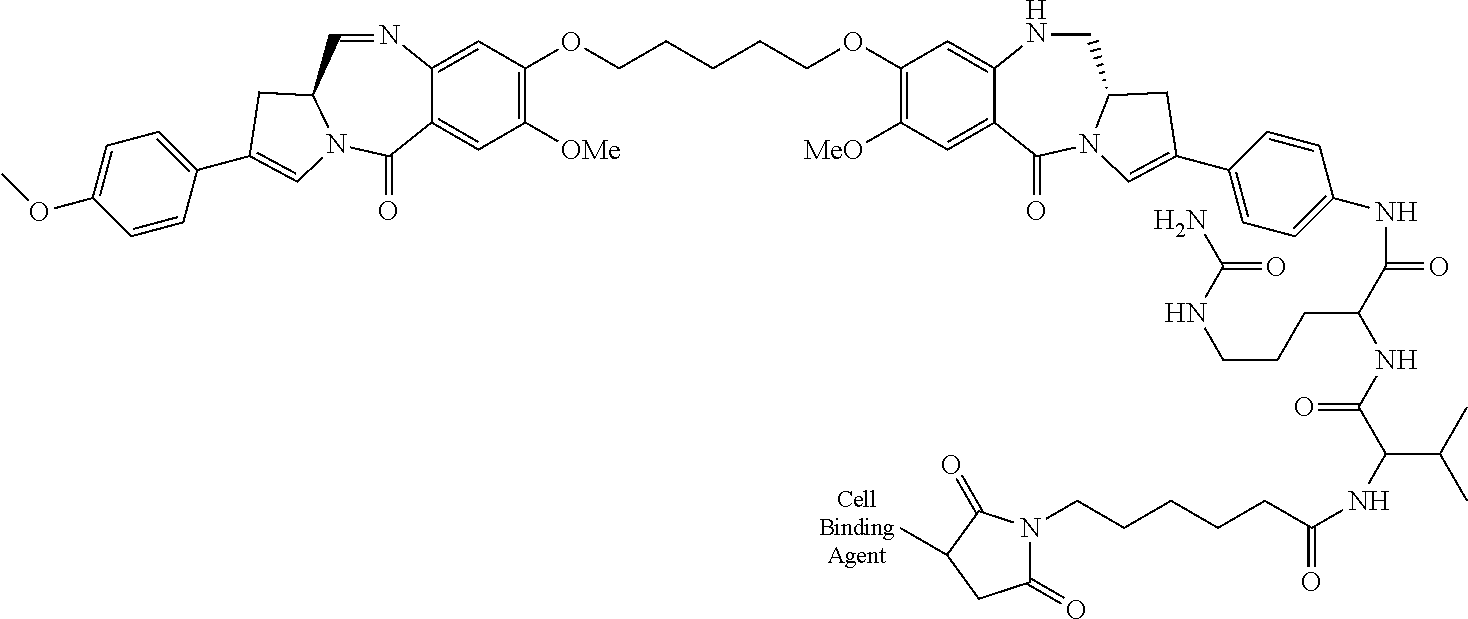 |
 |
 |
 |
 |

-
- Q is Q1-Ar-Q2;
- Q′ is Q1′-Ar′-Q2′;
- Q1 and Q1′ are each independently absent, a linear, branched or cyclic alkyl from 1 to 6 carbon atoms or a CH═CH unit;
- Ar and Ar′ are each independently absent or represent an aryl group;
- Q2 and Q2′ are each independently selected from —H, a linking group, a substituted or unsubstituted linear, branched or cyclic alkyl, alkenyl or alkynyl having from 1 to 10 carbon atoms, a polyethylene glycol unit Rc′(OCH2CH2)n—Rc, or a substituent selected from a halogen, guanidinium [—NH(C═NH)NH2], OR, NR′R″, NO2, —NCO, NR′COR″, SR, a sulfoxide represented by SOR′, a sulfone represented by —SO2R′, —SO2M, a sulfonate —SO3M, a sulfate —OSO3M, a sulfonamide represented by SO2NR′R″, cyano, an azido, —COR′, OCOR′ or OCONR′R″;
- Rc′ is absent or selected from linear or branched alkyl, alkenyl or alkynyl having 1 to 5 carbon atoms;
- Rc is —H or a linear or branched alkyl having 1 to 4 carbon atoms, or a linking group; and the remainder of the variables are as described above for formula (VIIa), provided that at least one of the double line between N and C represents a double bond.
-
- the double line between N and C represents a single bond or a double bond, provided that when it is a double bond X is absent and Y is —H. Preferably, the double linebetween N and C represents a double bond;
- when the double line between N and C represents a single bond, X is —H or an amine protecting group (preferably, X is —H); and
- Y is selected from —OR, —OCOR′, —SR, —NR′R″, an optionally substituted 5 or 6-membered nitrogen-containing heterocycle (e.g., piperidine, tetrahydropyrrole, pyrazole, morpholine, etc.), —SO3M, —SO2M or a sulfate —OSO3M, wherein M is —H or a cation such as Na+ or K+. Preferably, M is —H or Na+. Preferably, Y is selected from —SO3M, —OH, —OMe, —OEt or —NHOH. More preferably, Y is —SO3M or —OH.
- R, for each occurrence, is independently selected from the group consisting of —H, an optionally substituted linear, branched or cyclic alkyl, alkenyl or alkynyl having from 1 to 10 carbon atoms or phenyl;
- R′ and R″ are same or different and are independently selected from —H, —OH, —OR, an optionally substituted linear, branched or cyclic alkyl, alkenyl or alkynyl having from 1 to 10 carbon atoms or phenyl;
- W is C═O.
- R6 is —ORc or —SRc, wherein Rc is H, a linear or branched alkyl having 1 to 4 carbon atoms. Preferably, R6 is —OMe or —SMe. Even more preferably, R6 is OMe.
- X′ is selected from the group consisting of —H, —OH, an optionally substituted linear, branched or cyclic alkyl, alkenyl or alkynyl having from 1 to 10 carbon atoms, phenyl, a linking group, and an amine-protecting group. Preferably, X′ is —H, —OH, -Me or a linking group. More preferably, X′ is —H.
- Y′ is selected from the group consisting of —H, an oxo group, a substituted or unsubstituted linear, branched or cyclic alkyl, alkenyl or alkynyl having from 1 to 10 carbon atoms. Preferably, Y′ is selected from —H or oxo. More preferably, Y′ is —H;
- A and A′ are the same or different and are selected from O, S, NR5 and oxo (C═O). Preferably, A and A′ are same or different and selected from O and S. More preferably, A and A′ are O.
- D and D′ are same or different and independently selected from a polyethylene glycol unit —(—OCH2CH2)n—, wherein n is an integer from 1 to 24, an amino acid, a peptide bearing 2 to 6 amino acids, or a linear, branched or cyclic alkyl, alkenyl or alkynyl having 1 to 10 carbon atoms, wherein the alkyl, alkenyl and alkynyl are optionally substituted with one or more (e.g., 2, 3, 4, 5, 6 or more) substituents independently selected from the group consisting of halogen, —OR, —NR′COR″, —SR and —COR′.
- Preferably, D and D′ are same or different and independently selected from linear, branched or cyclic alkyl, alkenyl or alkynyl having from 1 to 10 carbon atoms. More preferably, D and D′ are linear or branched alkyl bearing 1 to 4 carbon atoms. Still more preferably, D and D′ are same or different and selected from a linear alkyl having 1 to 4 carbon atoms.
- L is absent, or is selected from an optionally substituted phenyl group and an optionally substituted pyridyl group, wherein the phenyl and the pyridyl group bears a linking group that enables linkage to a cell binding agent via a covalent bond, or L is an amine group bearing a linking group that enables linkage to a cell binding agent via a covalent bond (i.e., —N(linking group)-), or L is a linear, branched or cyclic alkyl or alkenyl having from 1 to 6 carbon atoms and bearing a linking group that enables linkage to a cell binding agent via a covalent bond.
- the double line

-
- wherein the values and preferred values for X, Y, L′, L″, L′″, and R6 are as described above for formulas (IA) and (IIA), including any of the alternative specific embodiments; Q1, Q1′, Ar and Ar′ are as described above for formula (B1); and one of Q2 and Q2′ is selected from —H, R, OR, NR′R″, NR′(C═O)OR″, SR and NO2, the other is a linking group. Preferably, Y″ is O, S or NR′. More preferably, Y″ is O.
—W′—Rx—V—Ry-J,
-
- W′, Rx, V, Ry and J are as defined in the alternative 4th specific embodiment above.
- More preferably, W′ is absent, —CRe′Re—, —O—, —O—C(═O)—, —S—, —CH2—S—, —O—(C═O)O—, —O—(C═O)N(Re)—, —N(Re)—, —N(Re)—C(═O)—, —N(Re)—C(═O)O—, or —C(═O)—;
- Rx is absent or an optionally substituted linear, branched or cyclic alkyl, alkenyl or alkynyl having 1 to 10 carbon atoms;
- V is absent, —(CH2—CH2—O)n—, —O—, —O—C(═O)—, —S—, —O—(C═O)O—, O—(C═O)N(Re)—, —N(Re)—, —N(Re)—C(═O)—, —N(Re)—C(═O)O—, —C(═O)—, an amino acid, or a peptide having 2 to 8 amino acids;
- Ry is absent or a linear, branched or cyclic alkyl having 1 to 10 carbon atoms;
- Re′ is —H or a linear or branched alkyl having 1 to 4 carbon atoms;
- Re is H, a linear, branched or cyclic alkyl, alkenyl or alkynyl having 1 to 10 carbon atoms or —(CH2—CH2—O)n—Rc,
- n is an integer from 1 to 24.

-
- ---- represents an optional single bond;
- represents either a single bond or a double bond;

- provided that at least one of represents a double bond, and whenrepresents a single bond, U and U′, the same or different, independently represent H, and W and W′, the same or different, are independently selected from the group consisting of —OH, an ether such as —OR, an ester (e.g. an acetate), such as —OCOR, a carbonate such as —OCOOR, a carbamate such as —OCONRR′, a cyclic carbamate, such that N10 and C11 are a part of the cycle, a urea such as —NRCONRR′, a thiocarbamate such as —OCSNHR, a cyclic thiocarbamate such that N10 and C11 are a part of the cycle, —SH, a sulfide such as —SR, a sulphoxide such as —SOR, a sulfone such as —SOOR, a sulphite such as —SO3, a bisulphite such as —OSO3, a sulfonamide such as —NRSOOR, an amine such as —NRR′, optionally cyclic amine such that N10 and C11 are a part of the cycle, a hydroxylamine derivative such as —NROR′, an amide such as —NRCOR, an azido such as —N3, a cyano, a halo, a trialkyl or triarylphosphonium, an aminoacid-derived group; Preferably W and W′ are the same or different and are OH, OMe, OEt, NHCONH2, SMe;
- and when represents a double bond, U and U′ are absent and W and W′ represent H;
- R1, R2, R1′, R2′ are the same or different and independently chosen from Halide or Alkyl optionally substituted by one or more Hal, CN, NRR′, CF3, OR, Aryl, Het, S(O)qR, or R1 and R2 and R1′ and R2′ form together a double bond containing group ═B and ═B′ respectively. Preferably, R1=R2=R1′=R2′=H, or more preferably R1 and R2 and R1′ and R2′ form together a double bond containing group ═B and ═B′ respectively.
- B and B′ are the same or different and independently chosen from Alkyl being optionally substituted by one or more Hal, CN, NRR′, CF3, OR, Aryl, Het, S(O)qR or B and B′ represent an oxygen atom. Preferably, B═B′. More preferably, B═B′═CH2 or ═CH—CH3;
- X, X′ are the same or different and independently chosen from one or more —O—, —NR—, —(C═O)— and —S(O)q—. Preferably, X═X′. More preferably, X═X′═O.
- A, A′ are the same or different and independently chosen from Alkyl or Alkenyl optionally containing an oxygen, a nitrogen or a sulfur atom and optionally substituted by one or more Hal, CN, NRR′, CF3, OR, S(O)qR, Aryl, Het, Alkyl, Alkenyl. Preferably, A=A′. More preferably, A=A′=linear unsubstituted alkyl.
- Y, Y′ are the same or different and independently chosen from H, OR. Preferably, Y═Y′. More preferably, Y═Y′═OAlkyl, more preferably OMethyl.
- T is —NR—, —O—, —S(O)q—, or a 4 to 10-membered aryl or heteroaryl, all being optionally substituted by one or more Hal, CN, NRR′, CF3, OR, S(O)qR, Alkyl, and/or linker(s), or a branched Alkyl, optionally substituted by one or more Hal, CN, NRR′, CF3, OR, S(O)qR and/or linker(s), or a linear Alkyl substituted by one or more Hal, CN, NRR′, CF3, OR, S(O)qR and/or linker(s).
-
- Z′ is H, a thiol protecting group such as Ac, R19′ or SR19′,
-
- R19′ and R12 are the same or different and are linear alkyl, branched alkyl or cyclic alkyl having from 1 to 10 carbon atoms, or simple or substituted aryl or heterocyclic, and R12 can in addition be H,
- R13, R14, R15 and R16 are the same or different and are H or a linear or branched alkyl having from 1 to 4 carbon atoms,
- R17, R18 and R19 are H or alkyl,
- u is an integer from 1 to 10 and can also be 0,
- t is an integer from 1 to 10 and can also be 0,
- y is an integer from 1 to 20 and can also be 0.
- m, n, m′, n′, equal or different are 0 or 1.
- q is 0, 1 or 2.
- R, R′ are equal or different and independently chosen from H, Alkyl, Aryl, optionally substituted by Hal, CN, NRR′, CF3, OR, Aryl, Het;
- or their pharmaceutically acceptable salts, hydrates, or hydrated salts, or the polymorphic crystalline structures of these compounds or their optical isomers, racemates, diastereomers or enantiomers.
- 8,8′-[1,3-benzenediylbis(methyleneoxy)]-bis[(S)-2-eth-(E)-ylidene-7-methoxy-1,2,3,11a-tetrahydro-5H-pyrrolo[2,1-c][1,4]benzodiazepin-5-one]
- 8,8′-[5-methoxy-1,3-benzenediylbis(methyleneoxy)]-bis[(S)-2-eth-(E)-ylidene-7-methoxy-1,2,3,11a-tetrahydro-5H-pyrrolo[2,1-c][1,4]benzodiazepin-5-one]
- 8,8′-[3-methyl-1,5-pentanediylbis(oxy)]-bis[(S)-2-eth-(E)-ylidene-7-methoxy-1,2,3,11a-tetrahydro-5H-pyrrolo[2,1-c][1,4]benzodiazepin-5-one]
- 8,8′-[2,6-pyridinediylbis(oxy)]-bis[(S)-2-eth-(E)-ylidene-7-methoxy-1,2,3,11a-tetrahydro-5H-pyrrolo[2,1-c][1,4]benzodiazepin-5-one]
- 8,8′-[4-(3-tert-butoxycarbonylaminopropyloxy)-2,6-pyridinediylbis(methyleneoxy)]-bis[(S)-2-eth-(E)-ylidene-7-methoxy-1,2,3,11a-tetrahydro-5H-pyrrolo[2,1-c][1,4]benzodiazepin-5-one]
- 8,8′-[5-(3-aminopropyloxy)-1,3-benzenediylbis(methyleneoxy)]-bis[(S)-2-eth-(E)-ylidene-7-methoxy-1,2,3,11a-tetrahydro-5H-pyrrolo[2,1-c][1,4]benzodiazepin-5-one]
- 8,8′-[5-(N-methyl-3-tert-butoxycarbonylaminopropyl)-1,3-benzenediylbis(methyleneoxy)]-bis[(S)-2-eth-(E)-ylidene-7-methoxy-1,2,3,11a-tetrahydro-5H-pyrrolo[2,1-c][1,4]benzodiazepin-5-one]
- 8,8′-{5-[3-(4-methyl-4-methyldisulfanyl-pentanoylamino)propyloxy]-1,3-benzenediylbis(methyleneoxy)}-bis[(S)-2-eth-(E)-ylidene-7-methoxy-1,2,3,11a-tetrahydro-5H-pyrrolo[2,1-c][1,4]benzodiazepin-5-one]
- 8,8′-[5-acetylthiomethyl-1,3-benzenediylbis(methyleneoxy)]-bis[(S)-2-methylene-7-methoxy-1,2,3,11a-tetrahydro-5H-pyrrolo[2,1-c][1,4]benzodiazepin-5-one]
- bis-{2-[(S)-2-methylene-7-methoxy-5-oxo-1,3,11a-tetrahydro-5H-pyrrolo[2,1-c][1,4]benzodiazepin-8-yloxy]-ethyl-}-carbamic acid tert-butyl ester
- 8,8′-[3-(2-acetylthioethyl)-1,5-pentanediylbis(oxy)]-bis[(S)-2-methylene-7-methoxy-1,2,3,11a-tetrahydro-5H-pyrrolo[2,1-c][1,4]benzodiazepin-5-one]
- or their pharmaceutically acceptable salts, hydrates, or hydrated salts, or the polymorphic crystalline structures of these compounds or their optical isomers, racemates, diastereomers or enantiomers.


-
- ---- represents an optional single bond;
- represents either a single bond or a double bond;
- provided that at least one of the represents a double bond and whenrepresents a single bond, U and U′, the same or different, independently represent H, and W and W′, the same or different, are independently selected from the group consisting of OH, an ether such as —OR, an ester (e.g. an acetate), such as —OCOR, a carbonate such as —OCOOR, a carbamate such as —OCONRR′, a cyclic carbamate, such that N10 and C11 are a part of the cycle, a urea such as —NRCONRR′, a thiocarbamate such as —OCSNHR, a cyclic thiocarbamate such that N10 and C11 are a part of the cycle, —SH, a sulfide such as —SR, a sulphoxide such as —SOR, a sulfone such as —SOOR, a sulphonate such as —SO3 −, a sulfonamide such as —NRSOOR′, an amine such as NRR′, optionally cyclic amine such that N10 and C11 are a part of the cycle, a hydroxylamine derivative such as —NROR′, an amide such as NRCOR′, an azido such as —N3, a cyano, a halo, a trialkyl or triarylphosphonium, an aminoacid-derived group; Preferably W and W′ are the same or different and are OH, OMe, OEt, NHCONH2, SMe;
- and when represents a double bond, U and U′ are absent and W and W′ represent H.
- R1, R2, R1′, R2′ are the same or different and independently chosen from H, Halide or Alkyl optionally substituted by one or more Hal, CN, NRR′, CF3, OR, Aryl, Het, S(O)qR, or R1 and R2 and R1′ and R2′ form together a double bond containing group ═B and ═B′ respectively. Preferably, R1 and R2 and R1′ and R2′ form together a double bond containing group: ═B and ═B′ respectively.
- B and B′ are the same or different and independently chosen from Alkenyl being optionally substituted by one or more Hal, CN, NRR′, CF3, OR, Aryl, Het, S(O)qR or B and B′ represent an oxygen atom. Preferably, B═B′. More preferably, B═B′=═CH2 or ═CH—CH3,
- X, X′ are the same or different and independently chosen from one or more —O—, —NR—, —(C═O)—, —S(O)q—. Preferably, X═X′. More preferably, X═X′═O.
- A, A′ are the same or different and independently chosen from Alkyl or Alkenyl optionally containing an oxygen, a nitrogen or a sulfur atom, each being optionally substituted by one or more Hal, CN, NRR′, CF3, OR, S(O)qR, Aryl, Het, Alkyl, Alkenyl. Preferably, A=A′. More preferably, A=A′=linear unsubstituted alkyl.
- Y, Y′ are the same or different and independently chosen from H and OR. Preferably, Y═Y′. More preferably, Y═Y′═OAlkyl, more preferably OMethyl.
- T is —NR— or a 4 to 10-membered aryl, cycloalkyl, heterocyclic, heteroaryl or a linear or branched alkyl, each being substituted by one or more non-cleavable linker(s) and optionally substituted by one or more of Hal, CN, NRR′, CF3, R, OR, S(O)qR. Preferably, T is a 4 to 10-membered aryl or heteroaryl, more preferably phenyl or pyridyl, substituted by one or more non-cleavable linker(s) and optionally substituted by one or more of Hal, CN, NRR′, CF3, R, OR, S(O)qR; the non-cleavable linker comprises a chain terminated by a linking group. Preferably, said linker does not contain cleavable groups such as disulfide groups, acid labile groups, photolabile groups, peptidase labile groups and esterase labile groups. According to the present invention, said linker contains non-cleavable groups. The non-cleavable linker comprises a terminal linking group. Said terminal linking group is preferably a carboxy or amide group, at the terminal end of the side chain. The side chain can be linear or branched, aromatic or heterocyclic. One of ordinary skill in the art can readily identify suitable side chains. Preferred linkers are composed of linear chains containing solubilizing functions such as amino, hydroxy, ether, sulfonic and carboxylic groups.
-G-D-(Z)p—C(═O)—Z′R″
-
- G is a single, a double or a triple bond, —O—, —S— or NR—;
- D is a single bond or -E-, -E-NR—, -E-NR—F—, -E-O—, -E-O—F—, -E-NR—CO—, -E-CO—NR—, -E-NR—CO—F—, -E-CO—NR—F—, -E-CO—, —CO-E-, -E-CO—F, -E-S—, -E-S—F—, -E-NR—CS—, -E-CS—NR—, -E-NR—CS—F—, -E-CS—NR—F—;
- where E and F are the same or different and are independently chosen from linear or branched —(OCH2CH2)iAlkyl(OCH2CH2)j—, -Alkyl(OCH2CH2)i-Alkyl-, —(OCH2CH2)j—, —(OCH2CH2)iCycloalkyl(OCH2CH2)j—, —(OCH2CH2)iHeterocyclic(OCH2CH2)j—, —(OCH2CH2)iAryl(OCH2CH2)j—, —(OCH2CH2)iHeteroaryl(OCH2CH2)j—, -Alkyl-(OCH2CH2)iAlkyl(OCH2CH2)j—, -Alkyl-(OCH2CH2)i—, -Alkyl-(OCH2CH2)iCycloalkyl(OCH2CH2)j—, Alkyl(OCH2CH2)iHeterocyclic(OCH2CH2)j—, -Alkyl-(OCH2CH2)iAryl(OCH2CH2)j—, -Alkyl(OCH2CH2)iHeteroaryl(OCH2CH2)j—, -Cycloalkyl-Alkyl-,-Alkyl-Cycloalkyl-,-Heterocyclic-Alkyl-,-Alkyl- Heterocyclic-,-Alkyl-Aryl-,-Aryl-Alkyl-,-Alkyl-Heteroaryl-,-Heteroaryl-Alkyl-;
- where i and j, identical or different are integers and independently chosen from 0, 1 to 2000;
- Z is linear or branched Alkyl, cycloalkyl, Aryl, heteroaryl, heterocyclyl, aralkyl, cycloalkyl, heteroaralkyl, or heterocyclylalkyl, optionally substituted by solubilizing functions such as amino, ether, sulfonic and carboxylic groups;
- p is 0 or 1;
- —C(═O)—Z′R″ is a carbonyl containing function wherein
- Z′ represents a single bond or substituted O, —S(O)q—, NR— and
- R″ represents H, Alkyl, Cycloalkyl, Aryl, heteroaryl or heterocyclic, each being optionally substituted by one or more Hal, CN, NRR′, CF3, R, OR, S(O)qR, Aryl, Het.
- n, n′, equal or different are 0 or 1.
- q is 0, 1 or 2.
- R, R′ are equal or different and independently chosen from H, Alkyl, Aryl, each being optionally substituted by Hal, CN, NRR′, CF3, R, OR, S(O)qR, Aryl, Het; or their pharmaceutically acceptable salts, hydrates, or hydrated salts, or the polymorphic crystalline structures of these compounds or their optical isomers, racemates, diastereomers or enantiomers.
-
- G is a single, a double or a triple bond or —O—, —S— or —NR—;
- G is a single bond or —O—;
- D is a single bond or -E- or -E-O—;
- D is -E-;
- E is linear or branched -Alkyl-, -Alk(OCH2CH2)i—;
- Z is linear or branched -Alkyl-;
- p is 0;
- Z′ is a single bond or O;
- Z′ is O;
- R″ is H or linear or branched -Alkyl- or optionally substituted heterocyclic;
- R″ is H or alkyl or a succinimide group.
-
- Q is a direct link or a linear alkyl or branched alkyl having from 1-10 carbon atoms or a polyethylene glycol spacer with 2 to 20 repeating ethylene oxy units;
- R19 and R12 are the same or different and are linear alkyl, branched alkyl or cyclic alkyl having from 1 to 10 carbon atoms, or simple or substituted aryl or heterocyclic, and R12 can in addition be H,
- R13, R14, R15 and R16 are the same or different and are H or a linear or branched alkyl having from 1 to 4 carbon atoms,
- R17 and R18 are H or alkyl,
- u is an integer from 1 to 10 and can also be 0,
- t is an integer from 1 to 10 and can also be 0,
- y is an integer from 1 to 20 and can also be 0.
- 4-(3,5-Bis-[(S)-2-eth-(E)-ylidene-7-dimethoxy-1,2,3,11a-tetrahydro-pyrrolo[2,1c][1,4]benzodiazepin-5-one-8-yloxymethyl]-phenoxy)-butyric acid
- 4-(3,5-Bis-[(S)-2-eth-(E)-ylidene-7-dimethoxy-1,2,3,11a-tetrahydro-pyrrolo[2,1c][1,4]benzodiazepin-5-one-8-yloxymethyl]-phenoxy)-butyric acid methyl ester
- 4-(3,5-Bis-[(S)-2-eth-(E)-ylidene-7-dimethoxy-1,2,3,11a-tetrahydro-pyrrolo[2,1c][1,4]benzodiazepin-5-one-8-yloxymethyl]-phenoxy)-acetic acid
- 4-(3,5-Bis-[(S)-2-eth-(E)-ylidene-7-dimethoxy-1,2,3,11a-tetrahydro-pyrrolo[2,1c][1,4]benzodiazepin-5-one-8-yloxymethyl]-phenoxy)-acetic acid methyl ester
- 4-(3,5-Bis-[(S)-2-methylidene-7-dimethoxy-1,2,3,11a-tetrahydro-pyrrolo[2,1c][1,4]benzodiazepin-5-one-8-yloxymethyl]-phenyl)-propanoic acid methyl ester
- 4-(3,5-Bis-[(S)-2-methylidene-7-dimethoxy-1,2,3,11a-tetrahydro-pyrrolo[2,1c][1,4]benzodiazepin-5-one-8-yloxymethyl]-phenyl)-propanoic acid
- (2-{2-[2-(2-{3-[3,5-Bis-(7-methoxy-2-methylene-5-oxo-2,3,5,11a-tetrahydro-1H-benzo[e]pyrrolo[1,2-a][1,4]diazepin-8-yloxymethyl)-phenyl]-propoxy}-ethoxy)ethoxy]-ethoxy}-ethoxy)-acetic acid methyl ester
- (2-{2-[2-(2-{3-[3,5-Bis-(7-methoxy-2-methylene-5-oxo-2,3,5,11a-tetrahydro-1H-benzo[e]pyrrolo[1,2-a][1,4]diazepin-8-yloxymethyl)-phenyl]-propoxy}-ethoxy)ethoxy]-ethoxy}-ethoxy)-acetic acid as well as their corresponding N-hydroxysuccinimide ester or their pharmaceutically acceptable salts, hydrates, or hydrated salts, or the polymorphic crystalline structures of these compounds or their optical isomers, racemates, diastereomers or enantiomers.


-
- Y is a leaving group, and is a sulfite (HSO3, HSO2 or a salt of HSO3 −, SO3 2− or HSO2 − formed with a cation), metabisulfite (H2S2O5 or a salt of S2O5 2− formed with a cation), mono-, di-, tri-, and tetra-thiophosphate (PO3SH3, PO2S2H2, POS3H2, PS4H2 or a salt of PO3S3−, PO2S2 3−, POS3 3− or PS4 3− formed with a cation), thio phosphate ester (RiO)2PS(ORi), RiS—, RiSO, RiSO2, RiSO3, thiosulfate (HS2O3 or a salt of S2O3 2− formed with a cation), dithionite (HS2O4 or a salt of S2O4 2− formed with a cation), phosphorodithioate (P(═S)(ORk′)(S)(OH) or a salt thereof formed with a cation), hydroxamic acid (Rk′C(═O)NOH or a salt formed with a cation), formaldehyde sulfoxylate (HOCH2SO2 − or a salt of HOCH2SO2 − formed with a cation, such as HOCH2SO2 −Na+) or a mixture thereof, wherein Ri is a linear or branched alkyl having 1 to 10 carbon atoms and is substituted with at least one substituent selected from —N(Rj)2, —CO2H, —SO3H, and —PO3H; Ri can be further optionally substituted with a substituent for an alkyl described herein; Rj is a linear or branched alkyl having 1 to 6 carbon atoms; Rk′ is a linear, branched or cyclic alkyl, alkenyl or alkynyl having 1 to 10 carbon atoms, aryl, heterocyclyl or heteroaryl; preferably, Y is an adduct of a bisulfite, a hydrosulfite, or a metabisulfite, or salts thereof (such as sodium salt).


Claims (28)

—W′—Rx—V—Ry-J,
—W′—[CR1″R2″]a—V-[Cy]0-1-[CR3″R4″]b—COE,

—NRe—[CR1″R2″]a—S—[CR3″R4″]b—COE.

—NRe—[CR1″R2″]a—S-Cy-[CR3″R4″]b—COE.

—W′—Rx—S—Zs


Priority Applications (1)
| Application Number | Priority Date | Filing Date | Title |
|---|---|---|---|
| US13/984,762 US9534000B2 (en) | 2011-02-15 | 2012-02-15 | Cytotoxic benzodiazepine derivatives and methods of preparation |
Applications Claiming Priority (5)
| Application Number | Priority Date | Filing Date | Title |
|---|---|---|---|
| US201161443092P | 2011-02-15 | 2011-02-15 | |
| US201161443062P | 2011-02-15 | 2011-02-15 | |
| US201161483499P | 2011-05-06 | 2011-05-06 | |
| PCT/US2012/025292 WO2012112708A1 (en) | 2011-02-15 | 2012-02-15 | Cytotoxic benzodiazepine derivatives and methods of preparation |
| US13/984,762 US9534000B2 (en) | 2011-02-15 | 2012-02-15 | Cytotoxic benzodiazepine derivatives and methods of preparation |
Related Parent Applications (1)
| Application Number | Title | Priority Date | Filing Date |
|---|---|---|---|
| US201161483499P Substitution | 2011-02-15 | 2011-05-06 |
Publications (2)
| Publication Number | Publication Date |
|---|---|
| US20140088089A1 US20140088089A1 (en) | 2014-03-27 |
| US9534000B2 true US9534000B2 (en) | 2017-01-03 |
Family
ID=45755579
Family Applications (12)
| Application Number | Title | Priority Date | Filing Date |
|---|---|---|---|
| US13/397,195 Active 2032-08-30 US8765740B2 (en) | 2011-02-15 | 2012-02-15 | Cytotoxic benzodiazepine derivatives |
| US13/984,762 Expired - Fee Related US9534000B2 (en) | 2011-02-15 | 2012-02-15 | Cytotoxic benzodiazepine derivatives and methods of preparation |
| US13/397,205 Active 2034-06-28 US9353127B2 (en) | 2011-02-15 | 2012-02-15 | Methods of preparation of conjugates |
| US13/827,355 Active US8889669B2 (en) | 2011-02-15 | 2013-03-14 | Cytotoxic benzodiazepine derivatives |
| US14/512,059 Active US9169272B2 (en) | 2011-02-15 | 2014-10-10 | Cytotoxic benzodiazepine derivatives |
| US14/849,270 Expired - Fee Related US9434748B2 (en) | 2011-02-15 | 2015-09-09 | Cytotoxic benzodiazepine derivatives |
| US15/097,979 Expired - Fee Related US9868791B2 (en) | 2011-02-15 | 2016-04-13 | Methods of preparation of conjugates |
| US15/221,255 Active US9840564B2 (en) | 2011-02-15 | 2016-07-27 | Cytotoxic benzodiazepine derivatives |
| US15/645,597 Active US10179818B2 (en) | 2011-02-15 | 2017-07-10 | Cytotoxic benzodiazepine derivatives |
| US15/677,846 Expired - Fee Related US10364294B2 (en) | 2011-02-15 | 2017-08-15 | Methods of preparation of conjugates |
| US16/205,609 Ceased US10570212B2 (en) | 2011-02-15 | 2018-11-30 | Cytotoxic benzodiazepine derivatives |
| US17/316,241 Active USRE49918E1 (en) | 2011-02-15 | 2021-05-10 | Cytotoxic benzodiazepine derivatives |
Family Applications Before (1)
| Application Number | Title | Priority Date | Filing Date |
|---|---|---|---|
| US13/397,195 Active 2032-08-30 US8765740B2 (en) | 2011-02-15 | 2012-02-15 | Cytotoxic benzodiazepine derivatives |
Family Applications After (10)
| Application Number | Title | Priority Date | Filing Date |
|---|---|---|---|
| US13/397,205 Active 2034-06-28 US9353127B2 (en) | 2011-02-15 | 2012-02-15 | Methods of preparation of conjugates |
| US13/827,355 Active US8889669B2 (en) | 2011-02-15 | 2013-03-14 | Cytotoxic benzodiazepine derivatives |
| US14/512,059 Active US9169272B2 (en) | 2011-02-15 | 2014-10-10 | Cytotoxic benzodiazepine derivatives |
| US14/849,270 Expired - Fee Related US9434748B2 (en) | 2011-02-15 | 2015-09-09 | Cytotoxic benzodiazepine derivatives |
| US15/097,979 Expired - Fee Related US9868791B2 (en) | 2011-02-15 | 2016-04-13 | Methods of preparation of conjugates |
| US15/221,255 Active US9840564B2 (en) | 2011-02-15 | 2016-07-27 | Cytotoxic benzodiazepine derivatives |
| US15/645,597 Active US10179818B2 (en) | 2011-02-15 | 2017-07-10 | Cytotoxic benzodiazepine derivatives |
| US15/677,846 Expired - Fee Related US10364294B2 (en) | 2011-02-15 | 2017-08-15 | Methods of preparation of conjugates |
| US16/205,609 Ceased US10570212B2 (en) | 2011-02-15 | 2018-11-30 | Cytotoxic benzodiazepine derivatives |
| US17/316,241 Active USRE49918E1 (en) | 2011-02-15 | 2021-05-10 | Cytotoxic benzodiazepine derivatives |
Country Status (29)
| Country | Link |
|---|---|
| US (12) | US8765740B2 (en) |
| EP (6) | EP3498303A1 (en) |
| JP (8) | JP5826863B2 (en) |
| KR (6) | KR20190089048A (en) |
| CN (5) | CN113896731A (en) |
| AU (5) | AU2012217719B2 (en) |
| BR (2) | BR112013019913B1 (en) |
| CA (4) | CA3110544A1 (en) |
| CY (2) | CY1117340T1 (en) |
| DK (2) | DK2675479T3 (en) |
| ES (2) | ES2717657T3 (en) |
| HR (2) | HRP20160164T1 (en) |
| HU (2) | HUE028736T2 (en) |
| IL (6) | IL279304B (en) |
| LT (1) | LT2675480T (en) |
| ME (1) | ME02381B (en) |
| MX (3) | MX384514B (en) |
| MY (2) | MY169448A (en) |
| PL (2) | PL2675479T3 (en) |
| PT (1) | PT2675480T (en) |
| RS (2) | RS58620B1 (en) |
| RU (4) | RU2631498C2 (en) |
| SG (4) | SG10202007640VA (en) |
| SI (2) | SI2675479T1 (en) |
| SM (2) | SMT201900181T1 (en) |
| TW (1) | TWI617555B (en) |
| UA (1) | UA120696C2 (en) |
| WO (3) | WO2012112687A1 (en) |
| ZA (2) | ZA201305386B (en) |
Cited By (7)
| Publication number | Priority date | Publication date | Assignee | Title |
|---|---|---|---|---|
| US20160324980A1 (en) * | 2011-02-15 | 2016-11-10 | Immunogen, Inc. | Methods of preparation of conjugates |
| US10208127B2 (en) | 2009-02-05 | 2019-02-19 | Immunogen, Inc. | Benzodiazepine derivatives |
| US10399970B2 (en) | 2015-06-09 | 2019-09-03 | Femtogenix Limited | Pyrridinobenzodiazepine and benzopyrridodiazecine compounds |
| US10899775B2 (en) | 2015-07-21 | 2021-01-26 | Immunogen, Inc. | Methods of preparing cytotoxic benzodiazepine derivatives |
| US10975072B2 (en) | 2015-08-21 | 2021-04-13 | Femtogenix Limited | Substituted 6a,7,8,9,10,12-hexahydrobenzo[e]pyrido[1,2-a][1,4]diazepines as anti-proliferative agents |
| US10975074B2 (en) | 2015-08-21 | 2021-04-13 | Femtogenix Limited | Anti-liferative agents comprising substituted benzo[e]pyrido[1,2-a][1,4]diazepines |
| US11116845B2 (en) | 2014-09-03 | 2021-09-14 | Immunogen, Inc. | Cytotoxic benzodiazepine derivatives |
Families Citing this family (160)
| Publication number | Priority date | Publication date | Assignee | Title |
|---|---|---|---|---|
| CN101098854B (en) | 2004-07-23 | 2012-12-05 | 恩多塞特公司 | Bivalent linkers and conjugates thereof |
| CA3000520C (en) | 2005-08-24 | 2023-04-04 | Immunogen, Inc. | Process for preparing antibody maytansinoid conjugates |
| CN101784565B (en) | 2007-06-25 | 2014-12-10 | 恩多塞特公司 | Conjugates containing a hydrophilic spacer linker |
| US9877965B2 (en) | 2007-06-25 | 2018-01-30 | Endocyte, Inc. | Vitamin receptor drug delivery conjugates for treating inflammation |
| SG10201810743WA (en) | 2009-06-03 | 2018-12-28 | Immunogen Inc | Conjugation methods |
| CA2795349C (en) | 2010-04-15 | 2016-11-29 | Seattle Genetics, Inc. | Targeted pyrrolobenzodiazepine conjugates |
| JP5875083B2 (en) | 2010-04-15 | 2016-03-02 | メディミューン リミテッド | Pyrrolobenzodiazepine for the treatment of proliferative diseases |
| ME03353B (en) * | 2011-03-29 | 2019-10-20 | Immunogen Inc | MAYTANSINOID ANTIBODY CONJUGATE PREPARATION BY ONE-STEP PROCESS |
| SG11201400770SA (en) | 2011-09-20 | 2014-04-28 | Spirogen Sarl | Pyrrolobenzodiazepines as unsymmetrical dimeric pbd compounds for inclusion in targeted conjugates |
| CA2850373C (en) | 2011-10-14 | 2019-07-16 | Seattle Genetics, Inc. | Pyrrolobenzodiazepines and targeted conjugates |
| CN103997893B (en) | 2011-10-14 | 2019-04-12 | 西雅图基因公司 | Pyrrolobenzodiazepines and targeted conjugates |
| AU2012322932B2 (en) | 2011-10-14 | 2016-11-10 | Medimmune Limited | Pyrrolobenzodiazepines |
| EP2751111B1 (en) | 2011-10-14 | 2017-04-26 | MedImmune Limited | Asymmetrical bis-(5H-Pyrrolo[2,1-c][1,4]benzodiazepin-5-one) derivatives for the treatment of proliferative or autoimmune diseases |
| EP2793947B1 (en) | 2011-12-23 | 2021-02-03 | Innate Pharma | Enzymatic conjugation of polypeptides |
| CA2869704A1 (en) * | 2012-04-04 | 2013-10-10 | Perseus Proteomics Inc. | Drug conjugate comprising anti-cdh3 (pcadherin) antibody |
| US9504756B2 (en) | 2012-05-15 | 2016-11-29 | Seattle Genetics, Inc. | Self-stabilizing linker conjugates |
| WO2013173337A2 (en) | 2012-05-15 | 2013-11-21 | Seattle Genetics, Inc. | Self-stabilizing linker conjugates |
| US10132799B2 (en) | 2012-07-13 | 2018-11-20 | Innate Pharma | Screening of conjugated antibodies |
| HK1211208A1 (en) | 2012-08-22 | 2016-05-20 | Immunogen, Inc. | Cytotoxic benzodiazepine derivative |
| RU2661083C2 (en) | 2012-10-04 | 2018-07-11 | Иммуноджен, Инк. | Use of pvdf membrane to purify cell-binding agent - cytotoxic agent conjugates |
| EP2906296B1 (en) * | 2012-10-12 | 2018-03-21 | ADC Therapeutics SA | Pyrrolobenzodiazepine-antibody conjugates |
| EP2906249B1 (en) | 2012-10-12 | 2018-06-27 | MedImmune Limited | Synthesis and intermediates of pyrrolobenzodiazepine derivatives for conjugation |
| EP2906297B1 (en) * | 2012-10-12 | 2017-12-06 | ADC Therapeutics SA | Pyrrolobenzodiazepine-antibody conjugates |
| JP6392765B2 (en) | 2012-10-12 | 2018-09-19 | エイディーシー・セラピューティクス・エス・アーAdc Therapeutics Sa | Pyrrolobenzodiazepine-antibody conjugate |
| HRP20190366T1 (en) | 2012-10-12 | 2019-04-19 | Medimmune Limited | Pyrrolobenzodiazepines and conjugates thereof |
| RS57694B1 (en) | 2012-10-12 | 2018-11-30 | Adc Therapeutics Sa | Pyrrolobenzodiazepine - anti-psma antibody conjugates |
| HRP20182129T1 (en) * | 2012-10-12 | 2019-02-08 | Adc Therapeutics Sa | CONJUGATES ANTIBODY - PIROLOBENZODIAZEPINE |
| ES2680153T3 (en) | 2012-10-12 | 2018-09-04 | Adc Therapeutics Sa | Anti-PSMA-pyrrolobenzodiazepine antibody conjugates |
| WO2014057118A1 (en) * | 2012-10-12 | 2014-04-17 | Adc Therapeutics Sarl | Pyrrolobenzodiazepine-anti-cd22 antibody conjugates |
| MX338711B (en) | 2012-10-12 | 2016-04-28 | Medimmune Ltd | Pyrrolobenzodiazepines and conjugates thereof. |
| EP3564259A3 (en) | 2012-11-09 | 2020-02-12 | Innate Pharma | Recognition tags for tgase-mediated conjugation |
| AU2013341711A1 (en) * | 2012-11-12 | 2015-05-21 | Redwood Bioscience, Inc. | Compounds and methods for producing a conjugate |
| WO2014089177A2 (en) | 2012-12-04 | 2014-06-12 | Massachusetts Institute Of Technology | Compounds, conjugates and compositions of epipolythiodiketopiperazines and polythiodiketopiperazines |
| US9089614B2 (en) | 2012-12-21 | 2015-07-28 | Bioalliance C.V. | Hydrophilic self-immolative linkers and conjugates thereof |
| CN105189507A (en) | 2012-12-21 | 2015-12-23 | 斯皮罗根有限公司 | Pyrrolobenzodiazepines and conjugates thereof |
| CN110627797A (en) * | 2012-12-21 | 2019-12-31 | 麦迪穆有限责任公司 | Asymmetric pyrrolobenzodiazepine dimers for the treatment of proliferative and autoimmune diseases |
| AU2014248640B2 (en) | 2013-03-13 | 2018-03-01 | Seagen Inc. | Cyclodextrin and antibody-drug conjugate formulations |
| DK2968494T3 (en) | 2013-03-13 | 2019-03-04 | Seattle Genetics Inc | ACTIVATED CARBON FILTERING FOR CLEANING BENZODIAZEPINE ADCs |
| AU2014229529B2 (en) | 2013-03-13 | 2018-02-15 | Medimmune Limited | Pyrrolobenzodiazepines and conjugates thereof |
| TWI680766B (en) * | 2013-03-13 | 2020-01-01 | 英商梅迪繆思有限公司 | Pyrrolobenzodiazepines and conjugates thereof |
| US10611824B2 (en) | 2013-03-15 | 2020-04-07 | Innate Pharma | Solid phase TGase-mediated conjugation of antibodies |
| EP3010547B1 (en) | 2013-06-20 | 2021-04-21 | Innate Pharma | Enzymatic conjugation of polypeptides |
| CN105517577A (en) * | 2013-06-21 | 2016-04-20 | 先天制药公司 | Enzymatic conjugation of polypeptides |
| US10208125B2 (en) | 2013-07-15 | 2019-02-19 | University of Pittsburgh—of the Commonwealth System of Higher Education | Anti-mucin 1 binding agents and uses thereof |
| SG11201601424PA (en) | 2013-08-28 | 2016-03-30 | Stemcentrx Inc | Site-specific antibody conjugation methods and compositions |
| CN105792836A (en) | 2013-08-28 | 2016-07-20 | 施特姆森特克斯股份有限公司 | Novel SEZ6 modulators and methods of use |
| KR20160047567A (en) * | 2013-08-28 | 2016-05-02 | 스템센트알엑스 인코포레이티드 | Engineered anti-dll3 conjugates and methods of use |
| EP3041846B1 (en) * | 2013-09-02 | 2018-11-07 | Hangzhou Dac Biotech Co., Ltd | Novel cytotoxic agents for conjugation of drugs to cell binding molecule |
| EP3054983B1 (en) | 2013-10-11 | 2019-03-20 | Medimmune Limited | Pyrrolobenzodiazepine-antibody conjugates |
| GB201317981D0 (en) | 2013-10-11 | 2013-11-27 | Spirogen Sarl | Pyrrolobenzodiazepines and conjugates thereof |
| WO2015052535A1 (en) | 2013-10-11 | 2015-04-16 | Spirogen Sàrl | Pyrrolobenzodiazepine-antibody conjugates |
| WO2015052534A1 (en) | 2013-10-11 | 2015-04-16 | Spirogen Sàrl | Pyrrolobenzodiazepine-antibody conjugates |
| NZ758049A (en) | 2013-10-15 | 2024-03-22 | Seagen Inc | Pegylated drug-linkers for improved ligand-drug conjugate pharmacokinetics |
| KR20230088389A (en) | 2014-02-11 | 2023-06-19 | 씨젠 인크. | Selective reduction of proteins |
| CA2939941A1 (en) | 2014-02-21 | 2015-08-27 | Abbvie Stemcentrx Llc | Anti-dll3 antibodies and drug conjugates for use in melanoma |
| US10550190B2 (en) * | 2014-04-04 | 2020-02-04 | Merck Sharp & Dohme Corp. | Phosphate based linkers for intracellular delivery of drug conjugates |
| EP3145542A4 (en) * | 2014-05-20 | 2018-01-17 | ImmunoGen, Inc. | Methods for characterizing and treating acute myeloid leukemia |
| US9950077B2 (en) * | 2014-06-20 | 2018-04-24 | Bioalliance C.V. | Anti-folate receptor alpha (FRA) antibody-drug conjugates and methods of using thereof |
| WO2016008112A1 (en) | 2014-07-16 | 2016-01-21 | Medshine Discovery Inc. | Linkers and application towards adc thereof |
| SG11201701328XA (en) * | 2014-09-02 | 2017-03-30 | Immunogen Inc | Methods for formulating antibody drug conjugate compositions |
| WO2016036804A1 (en) | 2014-09-03 | 2016-03-10 | Immunogen, Inc. | Cytotoxic benzodiazepine derivatives |
| KR102508023B1 (en) * | 2014-09-03 | 2023-03-10 | 이뮤노젠 아이엔씨 | Conjugates comprising cell-binding agents and cytotoxic agents |
| GB201416112D0 (en) * | 2014-09-12 | 2014-10-29 | Medimmune Ltd | Pyrrolobenzodiazepines and conjugates thereof |
| LT3191135T (en) | 2014-09-12 | 2020-11-25 | Genentech, Inc. | ANTI-HER2 ANTIBODIES AND IMMUNOCONJUGATES |
| MX2017003472A (en) * | 2014-09-17 | 2017-10-31 | Genentech Inc | Immunoconjugates comprising anti-her2 antibodies and pyrrolobenzodiazepines. |
| GB201419108D0 (en) | 2014-10-27 | 2014-12-10 | Glythera Ltd | Materials and methods relating to linkers for use in antibody drug conjugates |
| US10413615B2 (en) * | 2014-11-19 | 2019-09-17 | Immunogen, Inc. | Process for preparing cell-binding agent-cytotoxic agent conjugates |
| CN107148285B (en) | 2014-11-25 | 2022-01-04 | Adc治疗股份有限公司 | Pyrrolobenzodiazepine-antibody conjugates |
| CN113209306A (en) * | 2014-12-09 | 2021-08-06 | 艾伯维公司 | Antibody drug conjugates with cell permeable BCL-XL inhibitors |
| JP6800853B2 (en) | 2014-12-11 | 2020-12-16 | ピエール、ファーブル、メディカマン | Anti-C10ORF54 antibody and its use |
| BR112017014937A2 (en) | 2015-01-14 | 2018-03-13 | Bristol-Myers Squibb Company | heteroarylene bridged benzodiazepine dimers, conjugates thereof, and methods of preparation and use |
| MX2017009145A (en) | 2015-01-14 | 2017-11-22 | Bristol Myers Squibb Co | Benzodiazepine dimers, conjugates thereof, and methods of making and using. |
| WO2016148674A1 (en) * | 2015-03-13 | 2016-09-22 | Endocyte, Inc. | Conjugates for treating diseases |
| EP3270903B1 (en) | 2015-03-17 | 2020-05-06 | Arrowhead Pharmaceuticals, Inc. | Disulfide-containing alkyne linking agents |
| US9504694B2 (en) | 2015-03-19 | 2016-11-29 | Cellerant Therapeutics, Inc. | Isoquinolidinobenzodiazepines |
| GB201506411D0 (en) | 2015-04-15 | 2015-05-27 | Bergenbio As | Humanized anti-axl antibodies |
| GB201506402D0 (en) | 2015-04-15 | 2015-05-27 | Berkel Patricius H C Van And Howard Philip W | Site-specific antibody-drug conjugates |
| EA039619B1 (en) * | 2015-05-20 | 2022-02-17 | Иммуноджен, Инк. | Method for producing indolinobenzodiazepine compounds |
| CA2990030A1 (en) | 2015-06-23 | 2016-12-29 | Bristol-Myers Squibb Company | Macrocyclic benzodiazepine dimers, conjugates thereof, preparation and uses |
| SMT202000614T1 (en) * | 2015-06-29 | 2021-01-05 | Immunogen Inc | Conjugates of cysteine engineered antibodies |
| AU2016285552B2 (en) * | 2015-06-29 | 2022-10-13 | Immunogen, Inc. | Anti-CD123 antibodies and conjugates and derivatives thereof |
| CR20180243A (en) | 2015-10-02 | 2018-07-31 | Genentech Inc | PIRROLOBENZODIAZEPIN ANTIBODY-DRUG CONJUGATES AND METHODS OF USE |
| US20170189548A1 (en) * | 2015-11-25 | 2017-07-06 | Immunogen, Inc. | Pharmaceutical formulations and methods of use thereof |
| IL260289B (en) | 2016-01-08 | 2022-08-01 | Bioalliance Cv | Quadrivalent anti-psgl-1 antibodies and uses thereof |
| GB201601431D0 (en) | 2016-01-26 | 2016-03-09 | Medimmune Ltd | Pyrrolobenzodiazepines |
| TW201731532A (en) * | 2016-02-05 | 2017-09-16 | 伊繆諾金公司 | Efficient process for preparing cell-binding agent-cytotoxic agent conjugates |
| EA201891723A1 (en) * | 2016-02-05 | 2018-12-28 | Милленниум Фармасьютикалз, Инк. | GCC-directed anti-body drug conjugates |
| GB201602356D0 (en) | 2016-02-10 | 2016-03-23 | Medimmune Ltd | Pyrrolobenzodiazepine Conjugates |
| GB201602359D0 (en) | 2016-02-10 | 2016-03-23 | Medimmune Ltd | Pyrrolobenzodiazepine Conjugates |
| CN109843919A (en) | 2016-03-25 | 2019-06-04 | 西雅图基因公司 | The method for being used to prepare the agent-linker and its intermediate of Pegylation |
| WO2017172930A1 (en) * | 2016-03-29 | 2017-10-05 | Endocyte, Inc. | Pbd conjugates for treating diseases |
| BR112018071465A2 (en) * | 2016-04-20 | 2019-02-05 | Hangzhou Dac Biotech Co Ltd | amanita toxin derivatives and their conjugation to a cell binding molecule |
| JP2019522960A (en) | 2016-04-21 | 2019-08-22 | アッヴィ・ステムセントルクス・エル・エル・シー | Novel anti-BMPR1B antibody and method of use |
| GB201607478D0 (en) | 2016-04-29 | 2016-06-15 | Medimmune Ltd | Pyrrolobenzodiazepine Conjugates |
| WO2017197045A1 (en) | 2016-05-11 | 2017-11-16 | Movassaghi Mohammad | Convergent and enantioselective total synthesis of communesin analogs |
| TW201808936A (en) | 2016-05-18 | 2018-03-16 | 美商梅爾莎納醫療公司 | Pyrrolobenzodiazepines and conjugates thereof |
| CN109641910A (en) | 2016-06-24 | 2019-04-16 | 梅尔莎纳医疗公司 | Pyrroles acene phenodiazine * and its conjugate |
| TWI851531B (en) | 2016-08-09 | 2024-08-11 | 美商思進公司 | Drug conjugates with self-stabilizing linkers having improved physiochemical properties |
| GB201617466D0 (en) | 2016-10-14 | 2016-11-30 | Medimmune Ltd | Pyrrolobenzodiazepine conjugates |
| RU2019114863A (en) | 2016-11-02 | 2020-12-03 | Иммуноджен, Инк. | COMBINED TREATMENT WITH ANTIBODY-DRUG CONJUGATES AND PARP INHIBITORS |
| MY200695A (en) * | 2016-11-03 | 2024-01-11 | Bristol Myers Squibb Co | Activatable anti-ctla-4 antibodies and uses thereof |
| WO2018098258A2 (en) | 2016-11-23 | 2018-05-31 | Immunogen, Inc. | Selective sulfonation of benzodiazepine derivatives |
| JP7244987B2 (en) | 2016-12-14 | 2023-03-23 | シージェン インコーポレイテッド | Multidrug Antibody Drug Conjugates |
| EP3554544A4 (en) | 2016-12-16 | 2020-07-29 | Bluefin Biomedicine, Inc. | ANTI-CUB-CONTAINING PROTEIN 1 (CDCP1) ANTIBODIES, ANTIBODY-ACTIVE SUBSTANCE CONJUGATES AND METHOD FOR USE THEREOF |
| PL3558391T3 (en) | 2016-12-23 | 2022-05-16 | Immunogen, Inc. | ADAM9 PROTEIN IMMUNOCONIUGATES AND THEIR APPLICATION |
| US20180230218A1 (en) | 2017-01-04 | 2018-08-16 | Immunogen, Inc. | Met antibodies and immunoconjugates and uses thereof |
| CN110300765B (en) | 2017-01-24 | 2024-08-23 | 依奈特制药公司 | Nkp46 binders |
| EP4148044A1 (en) | 2017-01-25 | 2023-03-15 | ImmunoGen, Inc. | Methods of preparing cytotoxic benzodiazepine derivatives |
| EP3577138A1 (en) | 2017-02-06 | 2019-12-11 | Innate Pharma | Immunomodulatory antibody drug conjugates binding to a human mica polypeptide |
| RS61795B1 (en) | 2017-02-08 | 2021-06-30 | Adc Therapeutics Sa | Pyrrolobenzodiazepine-antibody conjugates |
| GB201702031D0 (en) | 2017-02-08 | 2017-03-22 | Medlmmune Ltd | Pyrrolobenzodiazepine-antibody conjugates |
| KR102648564B1 (en) | 2017-03-24 | 2024-03-19 | 씨젠 인크. | Manufacturing process of glucuronide drug-linker and its intermediates |
| WO2018183494A1 (en) | 2017-03-31 | 2018-10-04 | Immunogen, Inc. | Cd19-targeting antibody-drug conjugates |
| CN106841192B (en) * | 2017-04-18 | 2019-05-03 | 乐凯(沈阳)科技产业有限责任公司 | A kind of diazepine structure directing agent detection carbaldehyde Method and its application |
| CN110582505B (en) | 2017-04-18 | 2021-04-02 | 免疫医疗有限公司 | Pyrrolobenzodiazepine* conjugates |
| IL305224B2 (en) * | 2017-04-20 | 2024-09-01 | Immunogen Inc | Methods for the preparation of indolinobenzodiazepine derivatives |
| WO2018195243A1 (en) | 2017-04-20 | 2018-10-25 | Immunogen, Inc. | Cytotoxic benzodiazepine derivatives and conjugates thereof |
| WO2018193102A1 (en) | 2017-04-20 | 2018-10-25 | Adc Therapeutics Sa | Combination therapy with an anti-axl antibody-drug conjugate |
| US11932650B2 (en) | 2017-05-11 | 2024-03-19 | Massachusetts Institute Of Technology | Potent agelastatin derivatives as modulators for cancer invasion and metastasis |
| CA3064804A1 (en) | 2017-06-14 | 2018-12-20 | Adc Therapeutics Sa | Dosage regimes for the administration of an anti-cd19 adc |
| US11566044B2 (en) | 2017-07-26 | 2023-01-31 | The University Of Queensland | Disulfide bond containing compounds and uses thereof |
| KR102270107B1 (en) | 2017-08-18 | 2021-06-30 | 메디뮨 리미티드 | pyrrolobenzodiazepine conjugate |
| NZ762505A (en) | 2017-09-29 | 2026-03-27 | Daiichi Sankyo Co Ltd | Antibody-pyrrolobenzodiazepine derivative conjugate |
| US10640508B2 (en) | 2017-10-13 | 2020-05-05 | Massachusetts Institute Of Technology | Diazene directed modular synthesis of compounds with quaternary carbon centers |
| US20190160089A1 (en) | 2017-10-31 | 2019-05-30 | Immunogen, Inc. | Combination treatment with antibody-drug conjugates and cytarabine |
| WO2019092148A1 (en) | 2017-11-10 | 2019-05-16 | Innate Pharma | Antibodies with functionalized glutamine residues |
| WO2019104289A1 (en) | 2017-11-27 | 2019-05-31 | Mersana Therapeutics, Inc. | Pyrrolobenzodiazepine antibody conjugates |
| US11793885B2 (en) | 2017-12-28 | 2023-10-24 | Immunogen, Inc. | Substituted benzo[5,6][1,4]diazepino[1,2-a]indoles for the treatment of proliferative disorders |
| US11274121B2 (en) | 2018-01-12 | 2022-03-15 | Immunogen, Inc. | Methods for antibody drug conjugation, purification, and formulation |
| GB201803342D0 (en) | 2018-03-01 | 2018-04-18 | Medimmune Ltd | Methods |
| EP3774923A4 (en) | 2018-03-28 | 2021-12-29 | Mitsubishi Tanabe Pharma Corporation | Drug conjugates of cmet monoclonal binding agents, and uses thereof |
| GB201806022D0 (en) | 2018-04-12 | 2018-05-30 | Medimmune Ltd | Pyrrolobenzodiazepines and conjugates thereof |
| WO2019222130A1 (en) | 2018-05-15 | 2019-11-21 | Immunogen, Inc. | Combination treatment with antibody-drug conjugates and flt3 inhibitors |
| TWI897855B (en) * | 2018-10-26 | 2025-09-21 | 美商免疫遺傳股份有限公司 | Epcam antibodies, activatable antibodies, and immunoconjugates, and uses thereof |
| CN113166053A (en) | 2018-11-12 | 2021-07-23 | 伊缪诺金公司 | Method for preparing cytotoxic benzodiazepine derivatives |
| MA54228A (en) | 2018-11-12 | 2021-09-22 | Immunogen Inc | METHODS FOR PREPARING CYTOTOXIC BENZODIAZEPINE DERIVATIVES |
| CN111393502B (en) * | 2019-01-03 | 2022-04-29 | 北京京东方技术开发有限公司 | A kind of peptoid and its preparation method and use |
| GB201901197D0 (en) | 2019-01-29 | 2019-03-20 | Femtogenix Ltd | G-A Crosslinking cytotoxic agents |
| MY206596A (en) | 2019-02-08 | 2024-12-25 | Janssen Pharmaceuticals Inc | Method of safe administration of phosphorylated tau peptide vaccine |
| CN113631560B (en) | 2019-03-15 | 2025-02-18 | 麦迪穆有限责任公司 | Azetidine benzodiazepine dimers and conjugates containing them for treating cancer |
| CN113661172A (en) * | 2019-03-29 | 2021-11-16 | 伊缪诺金公司 | Cytotoxic bisbenzodiazepine derivatives and their conjugates with cell-binding agents for inhibiting abnormal cell growth or treating proliferative diseases |
| SG11202110922QA (en) | 2019-04-26 | 2021-10-28 | Immunogen Inc | Camptothecin derivatives |
| US11535634B2 (en) | 2019-06-05 | 2022-12-27 | Massachusetts Institute Of Technology | Compounds, conjugates, and compositions of epipolythiodiketopiperazines and polythiodiketopiperazines and uses thereof |
| AU2021251875A1 (en) | 2020-04-10 | 2022-11-03 | Seagen Inc. | Charge variant linkers |
| MX2023005873A (en) | 2020-11-25 | 2023-06-05 | Innate Pharma | Treatment of cancer. |
| WO2022182415A1 (en) | 2021-02-24 | 2022-09-01 | Massachusetts Institute Of Technology | Himastatin derivatives, and processes of preparation thereof, and uses thereof |
| BR112023018676A2 (en) | 2021-03-18 | 2023-10-10 | Seagen Inc | ANTIBODY-DRUG CONJUGATE, PHARMACEUTICAL COMPOSITION, METHODS OF TREATMENT OF A DISEASE OR CONDITION AND A CANCER, AND, LINDER-DRUG CONJUGATE COMPOSITION |
| CA3213625A1 (en) | 2021-03-18 | 2022-09-22 | Seagen Inc. | Selective drug release from internalized conjugates of biologically active compounds |
| CA3228268A1 (en) | 2021-08-13 | 2023-02-16 | Andrew Brian Hague | Improved methods for preparing cytotoxic benzodiazepine derivatives |
| JP7707943B2 (en) * | 2022-01-25 | 2025-07-15 | 株式会社三洋物産 | Gaming Machines |
| JP7707941B2 (en) * | 2022-01-25 | 2025-07-15 | 株式会社三洋物産 | Gaming Machines |
| JP7707942B2 (en) * | 2022-01-25 | 2025-07-15 | 株式会社三洋物産 | Gaming Machines |
| JP7707940B2 (en) * | 2022-01-25 | 2025-07-15 | 株式会社三洋物産 | Gaming Machines |
| JP2025517476A (en) | 2022-05-25 | 2025-06-05 | イナート・ファルマ・ソシエテ・アノニム | Nectin-4 binding agent |
| EP4548932A1 (en) | 2022-06-30 | 2025-05-07 | Toray Industries, Inc. | Pharmaceutical composition for treating and/or preventing cancer |
| JP2025524628A (en) | 2022-07-12 | 2025-07-30 | シートムエックス セラピューティクス,インコーポレイテッド | EPCAM immunoconjugates and uses thereof |
| TW202409080A (en) * | 2022-07-26 | 2024-03-01 | 美商沙塔克實驗室股份有限公司 | Combination therapy for treatment of ovarian cancer |
| WO2024076973A1 (en) * | 2022-10-04 | 2024-04-11 | Brown University | Compositions and methods of delivering large proteins |
| WO2024129756A1 (en) | 2022-12-13 | 2024-06-20 | Seagen Inc. | Site-specific engineered cysteine antibody drug conjugates |
| WO2025149947A1 (en) | 2024-01-12 | 2025-07-17 | Seagen Inc. | Antibody-drug conjugates |
Citations (26)
| Publication number | Priority date | Publication date | Assignee | Title |
|---|---|---|---|---|
| US3763183A (en) | 1972-07-10 | 1973-10-02 | Sterling Drug Inc | 1,2,3,10,11,11a-hexahydro-5h-pyrrolo (2,1-c)(1,4)benzodiazepines |
| US3860600A (en) | 1972-07-10 | 1975-01-14 | Sterling Drug Inc | Octahydropyrrido{8 2,1-c{9 {8 1,4{9 benzodiazepines |
| JPS57131791A (en) | 1980-12-31 | 1982-08-14 | Fujisawa Pharmaceut Co Ltd | Benzodiazepine derivative and its preparation |
| EP0219292A2 (en) | 1985-10-07 | 1987-04-22 | McNeilab, Inc. | Use of indolobenzodiazepines for antagonizing luteinizing hormone releasing hormone |
| WO1993018045A1 (en) | 1992-03-09 | 1993-09-16 | Cancer Research Campaign Technology Limited | Anti-cancer pyrrolobenzodiazepine derivatives |
| WO2000012508A2 (en) | 1998-08-27 | 2000-03-09 | Spirogen Limited | Pyrrolbenzodiazepines |
| WO2000012507A2 (en) | 1998-08-27 | 2000-03-09 | Spirogen Limited | Pyrrolobenzodiazepines |
| WO2004087717A1 (en) | 2003-03-31 | 2004-10-14 | Council Of Scientific And Industrial Research | Non-cross-linking pyrrolo[2,1-c][1,4]benzodiazepines as potential antitumour agents and process thereof |
| WO2004087716A1 (en) | 2003-03-31 | 2004-10-14 | Council Of Scientific And Industrial Research | Pyrrolo[(2,1-c)(1,4) benzodiazepines dimers as antitumour agents and process thereof |
| WO2005040170A2 (en) | 2003-10-22 | 2005-05-06 | Government Of The United States Of America, Represented By The Secretary, Department Of Health And Human Services | Pyrrolobenzodiazepine derivatives, compositions comprising the same and methods related thereto |
| WO2005085250A1 (en) | 2004-03-01 | 2005-09-15 | Spirogen Limited | C8, c8' linked 5-oxo-1,2,3,11a-tetrahydro-5h-pyrrolo[2,1-c][1,4]benzodiazepine dimers with 1h-pyrrole-dicarboxylic acid amide linkers and oligomeric analogs therof as well as related compounds for the treatment of proliferative diseases |
| WO2005110423A2 (en) | 2004-05-13 | 2005-11-24 | Spirogen Limited | Pyrrolobenzodiazepine therapeutic agents useful in the treatment of leukaemias |
| RU2005133443A (en) | 2003-03-31 | 2006-04-27 | Каунсил Оф Сайентифик Энд Индастриал Рисерч (In) | NOT crosslinked pyrrolo [2.1-C] [1.4] ENZODIAZEPINES AS POTENTIAL ANTITUMOR AGENTS AND METHOD FOR PRODUCING THEM |
| RU2005133442A (en) | 2003-03-31 | 2006-05-10 | Каунсил Оф Сайентифик Энд Индастриал Рисерч (In) | PYRROLO DIMERS [2, 1-C] [1, 4] BENZODIAZEPINE AS ANTITUMOR AGENTS AND METHOD FOR PRODUCING THEM |
| WO2007039752A1 (en) | 2005-10-05 | 2007-04-12 | Spirogen Limited | Alkyl 4- [4- (5-oxo-2, 3, 5, 11a-tetrahyd0-5h-pyrr0l0 [2, 1-c] [1, 4] benzodiazepine-8-yloxy) -butyrylamino]-1h-pyrrole-2-carboxylate derivatives and related compounds for the treatment of a proliferative disease |
| EP2019104A1 (en) | 2007-07-19 | 2009-01-28 | Sanofi-Aventis | Cytotoxic agents comprising new tomaymycin derivatives and their therapeutic use |
| WO2009016647A1 (en) | 2007-08-01 | 2009-02-05 | Council Of Scientific & Industrial Research | Pyrrolo [2,1-c][1, 4] benzodiazepine-glycoside prodrugs useful as a selective anti tumor agent |
| US20090036431A1 (en) | 2006-01-25 | 2009-02-05 | Sanofi-Aventis | Cytotoxic Agents Comprising New Tomaymycin Derivatives |
| WO2010043880A1 (en) | 2008-10-17 | 2010-04-22 | Spirogen Limited | Unsymmetrical pyrrolobenzodiazepine-dimers for treatment of proliferative diseases |
| WO2010091150A1 (en) | 2009-02-05 | 2010-08-12 | Immunogen, Inc. | Novel benzodiazepine derivatives |
| WO2011106528A1 (en) | 2010-02-24 | 2011-09-01 | Immunogen, Inc. | Folate receptor 1 antibodies and immunoconjugates and uses thereof |
| WO2011130613A1 (en) | 2010-04-15 | 2011-10-20 | Seattle Genetics, Inc. | Targeted pyrrolobenzodiazapine conjugates |
| US20110256157A1 (en) | 2010-04-15 | 2011-10-20 | Spirogen Limited | Pyrrolobenzodiazepines and conjugates thereof |
| WO2011130616A1 (en) | 2010-04-15 | 2011-10-20 | Spirogen Limited | Pyrrolobenzodiazepines used to treat proliferative diseases |
| WO2012112687A1 (en) | 2011-02-15 | 2012-08-23 | Immunogen, Inc. | Methods of preparation of conjugates |
| WO2014031566A1 (en) | 2012-08-22 | 2014-02-27 | Immunogen, Inc. | Cytotoxic benzodiazepine derivatives |
Family Cites Families (102)
| Publication number | Priority date | Publication date | Assignee | Title |
|---|---|---|---|---|
| SU11248A1 (en) | 1927-03-29 | 1929-09-30 | В.С. Григорьев | Anthracene cleaning method |
| US3453266A (en) | 1966-03-14 | 1969-07-01 | American Home Prod | 1,2,5-benzothiadiazepine 1,1-dioxides |
| US3506646A (en) | 1966-06-27 | 1970-04-14 | American Home Prod | Process for the preparation of 7h-pyrido (1,2-b)(1,2,5)benzothiadiazepine 5,5 - dioxides and pyrrolo(1,2-b)(1,2,5)benzothiadiazepine 5,5-dioxides |
| US3875162A (en) | 1973-07-26 | 1975-04-01 | Squibb & Sons Inc | Certain 6H-pyrimido{8 1,2-c{9 {8 1,3,5{9 benzothiadiaza compounds |
| US4003905A (en) | 1974-12-11 | 1977-01-18 | E. R. Squibb & Sons, Inc. | Diels-alder adducts of benzdiazepines |
| US4342771A (en) | 1981-01-02 | 1982-08-03 | Pfizer Inc. | Hypoglycemic 5-substituted oxazolidine-2,4-diones |
| US4444688A (en) | 1981-05-11 | 1984-04-24 | Ciba-Geigy Corporation | Imidazobenzothiadiazepines |
| JP2920385B2 (en) | 1988-08-18 | 1999-07-19 | 武田薬品工業株式会社 | 1,2,5-benzothiadiazepine derivatives, their production and use |
| GB8827305D0 (en) | 1988-11-23 | 1988-12-29 | British Bio Technology | Compounds |
| US5208020A (en) | 1989-10-25 | 1993-05-04 | Immunogen Inc. | Cytotoxic agents comprising maytansinoids and their therapeutic use |
| GB9015198D0 (en) | 1990-07-10 | 1990-08-29 | Brien Caroline J O | Binding substance |
| PT1024191E (en) | 1991-12-02 | 2008-12-22 | Medical Res Council | Production of anti-self antibodies from antibody segment repertoires and displayed on phage |
| EP0563475B1 (en) | 1992-03-25 | 2000-05-31 | Immunogen Inc | Cell binding agent conjugates of derivatives of CC-1065 |
| US5639641A (en) | 1992-09-09 | 1997-06-17 | Immunogen Inc. | Resurfacing of rodent antibodies |
| US5455258A (en) | 1993-01-06 | 1995-10-03 | Ciba-Geigy Corporation | Arylsulfonamido-substituted hydroxamic acids |
| JPH08176070A (en) | 1994-12-19 | 1996-07-09 | Mitsubishi Chem Corp | Didepside derivative and PI3 kinase inhibitor |
| JPH08175990A (en) | 1994-12-19 | 1996-07-09 | Mitsubishi Chem Corp | PI3 kinase inhibitor and method for producing the same |
| US5863949A (en) | 1995-03-08 | 1999-01-26 | Pfizer Inc | Arylsulfonylamino hydroxamic acid derivatives |
| ES2153031T4 (en) | 1995-04-20 | 2001-05-16 | Pfizer | ARILSULFONIL HYDROXAMIC ACID DERIVATIVES AS INHIBITORS OF MMP AND TNF. |
| GB9521987D0 (en) | 1995-10-26 | 1996-01-03 | Ludwig Inst Cancer Res | Phosphoinositide 3-kinase modulators |
| GB9624482D0 (en) | 1995-12-18 | 1997-01-15 | Zeneca Phaema S A | Chemical compounds |
| ATE225343T1 (en) | 1995-12-20 | 2002-10-15 | Hoffmann La Roche | MATRIX METALLOPROTEASE INHIBITORS |
| DE69720965T2 (en) | 1996-02-13 | 2004-02-05 | Astrazeneca Ab | CHINAZOLE DERIVATIVES AND THEIR USE AS VEGF INHIBITORS |
| NZ331191A (en) | 1996-03-05 | 2000-03-27 | Zeneca Ltd | 4-anilinoquinazoline derivatives and pharmaceutical compositions thereof |
| EP0818442A3 (en) | 1996-07-12 | 1998-12-30 | Pfizer Inc. | Cyclic sulphone derivatives as inhibitors of metalloproteinases and of the production of tumour necrosis factor |
| KR20000067904A (en) | 1996-07-18 | 2000-11-25 | 디. 제이. 우드, 스피겔 알렌 제이 | Phosphinate Based Inhibitors of Matrix Metalloproteases |
| KR20000068248A (en) | 1996-08-23 | 2000-11-25 | 디. 제이. 우드, 스피겔 알렌 제이 | Arylsulfonylamino Hydroxamic Acid Derivatives |
| GB9718972D0 (en) | 1996-09-25 | 1997-11-12 | Zeneca Ltd | Chemical compounds |
| JP3338064B2 (en) | 1997-01-06 | 2002-10-28 | ファイザー・インク | Cyclic sulfone derivative |
| NZ336840A (en) | 1997-02-03 | 2001-01-26 | Pfizer Prod Inc | Arylsulfonylamino hydroxamic acid derivatives useful in the treatment of tumor necrosis factor and matrix metalloproteinase mediated diseases |
| JP2000507975A (en) | 1997-02-07 | 2000-06-27 | ファイザー・インク | N-hydroxy-β-sulfonylpropionamide derivatives and their use as matrix metalloproteinase inhibitors |
| EP0960098A1 (en) | 1997-02-11 | 1999-12-01 | Pfizer Inc. | Arylsulfonyl hydroxamic acid derivatives |
| CA2280930C (en) | 1997-02-12 | 2010-04-06 | The Regents Of The University Of Michigan | Protein markers for lung cancer and use thereof |
| WO1999006587A2 (en) | 1997-08-01 | 1999-02-11 | Morphosys Ag | Novel method and phage for the identification of nucleic acid sequences encoding members of a multimeric (poly)peptide complex |
| CA2299355C (en) | 1997-08-08 | 2005-09-27 | Pfizer Products Inc. | Aryloxyarylsulfonylamino hydroxamic acid derivatives |
| GB9725782D0 (en) | 1997-12-05 | 1998-02-04 | Pfizer Ltd | Therapeutic agents |
| GB9801690D0 (en) | 1998-01-27 | 1998-03-25 | Pfizer Ltd | Therapeutic agents |
| JP4462654B2 (en) | 1998-03-26 | 2010-05-12 | ソニー株式会社 | Video material selection device and video material selection method |
| PA8469501A1 (en) | 1998-04-10 | 2000-09-29 | Pfizer Prod Inc | HYDROXAMIDES OF THE ACID (4-ARILSULFONILAMINO) -TETRAHIDROPIRAN-4-CARBOXILICO |
| PA8469401A1 (en) | 1998-04-10 | 2000-05-24 | Pfizer Prod Inc | BICYCLE DERIVATIVES OF HYDROXAMIC ACID |
| US6156746A (en) | 1998-08-25 | 2000-12-05 | Bristol-Myers Squibb Company | 1,2,5-benzothiadiazepine-1,1-dioxides with n-2 imidazolylalkyl substituents |
| EP1004578B1 (en) | 1998-11-05 | 2004-02-25 | Pfizer Products Inc. | 5-oxo-pyrrolidine-2-carboxylic acid hydroxamide derivatives |
| US7115396B2 (en) | 1998-12-10 | 2006-10-03 | Compound Therapeutics, Inc. | Protein scaffolds for antibody mimics and other binding proteins |
| PT1154774E (en) | 1999-02-10 | 2005-10-31 | Astrazeneca Ab | QUINAZOLINE DERIVATIVES AS ANGIOGENESE INHIBITORS |
| FR2800507B1 (en) | 1999-10-27 | 2002-01-04 | Valeo Systemes Dessuyage | ROTARY ELECTRIC SWITCH, PARTICULARLY FOR A MOTOR VEHICLE WINDSCREEN WIPER MOTOR |
| JP3287409B2 (en) | 1999-10-28 | 2002-06-04 | 日本精工株式会社 | Seat belt device with seat belt retractor with locking mechanism |
| KR100881105B1 (en) | 1999-11-05 | 2009-02-02 | 아스트라제네카 아베 | Quinazolin Derivatives as VEGF Inhibitors |
| CA2388063C (en) | 1999-11-24 | 2010-06-08 | Immunogen, Inc. | Cytotoxic agents comprising taxanes and their therapeutic use |
| JP3663382B2 (en) | 2000-02-15 | 2005-06-22 | スージェン・インコーポレーテッド | Pyrrole-substituted 2-indolinone protein kinase inhibitor |
| JP2001247477A (en) | 2000-03-03 | 2001-09-11 | Teikoku Hormone Mfg Co Ltd | Antitumor agent |
| US6608053B2 (en) | 2000-04-27 | 2003-08-19 | Yamanouchi Pharmaceutical Co., Ltd. | Fused heteroaryl derivatives |
| US6403588B1 (en) | 2000-04-27 | 2002-06-11 | Yamanouchi Pharmaceutical Co., Ltd. | Imidazopyridine derivatives |
| CN1318084C (en) * | 2000-05-26 | 2007-05-30 | 奥索-麦克尼尔药品公司 | Neuroprotective peptides |
| EP1332209B1 (en) | 2000-09-08 | 2009-11-11 | Universität Zürich | Collections of repeat proteins comprising repeat modules |
| DE60203260T2 (en) | 2001-01-16 | 2006-02-02 | Glaxo Group Ltd., Greenford | PHARMACEUTICAL COMBINATION CONTAINING A 4-CHINA-ZININAMINE AND PACLITAXEL, CARBOPLATIN OR VINORELBINE FOR THE TREATMENT OF CANCER |
| US6441163B1 (en) | 2001-05-31 | 2002-08-27 | Immunogen, Inc. | Methods for preparation of cytotoxic conjugates of maytansinoids and cell binding agents |
| CA2454976C (en) | 2001-07-26 | 2011-05-10 | Santen Pharmaceutical Co., Ltd. | Therapeutic agent for glaucoma comprising compound having pi3 kinase inhibitory action as active ingredient |
| US6703414B2 (en) | 2001-09-14 | 2004-03-09 | Arizona Board Of Regents On Behalf Of The University Of Arizona | Device and method for treating restenosis |
| AU2002357667A1 (en) | 2001-10-24 | 2003-05-06 | Iconix Pharmaceuticals, Inc. | Modulators of phosphoinositide 3-kinase |
| WO2003035618A2 (en) | 2001-10-24 | 2003-05-01 | Iconix Pharmaceuticals, Inc. | Modulators of phosphoinositide 3-kinase |
| JP2005509645A (en) | 2001-10-30 | 2005-04-14 | ファルマシア・コーポレーション | Heteroaromatic carboxamide derivatives for the treatment of inflammation |
| US6716821B2 (en) | 2001-12-21 | 2004-04-06 | Immunogen Inc. | Cytotoxic agents bearing a reactive polyethylene glycol moiety, cytotoxic conjugates comprising polyethylene glycol linking groups, and methods of making and using the same |
| US6756397B2 (en) | 2002-04-05 | 2004-06-29 | Immunogen, Inc. | Prodrugs of CC-1065 analogs |
| GB0209467D0 (en) | 2002-04-25 | 2002-06-05 | Astrazeneca Ab | Chemical compounds |
| US7538195B2 (en) * | 2002-06-14 | 2009-05-26 | Immunogen Inc. | Anti-IGF-I receptor antibody |
| US20040092561A1 (en) | 2002-11-07 | 2004-05-13 | Thomas Ruckle | Azolidinone-vinyl fused -benzene derivatives |
| JP4782564B2 (en) | 2002-07-10 | 2011-09-28 | メルク セローノ ソシエテ アノニム | Azolidinone-vinyl condensation-benzene derivative |
| AU2003255529B2 (en) | 2002-07-10 | 2008-11-20 | Laboratoires Serono Sa | Use of compounds for increasing spermatozoa motility |
| BR0313197A (en) | 2002-08-02 | 2005-08-09 | Immunogen Inc | Cytotoxic agents containing potent taxanes and their therapeutic use |
| DE60336149D1 (en) | 2002-08-16 | 2011-04-07 | Immunogen Inc | Highly reactive and soluble crosslinkers and their use in the preparation of conjugates for the targeted delivery of small-molecule drugs |
| AU2003255845A1 (en) | 2002-08-22 | 2004-03-11 | Piramed Limited | Phosphadidylinositol 3,5-biphosphate inhibitors as anti-viral agents |
| ZA200503075B (en) | 2002-11-07 | 2006-09-27 | Immunogen Inc | Anti-CD33 antibodies and method for treatment of acute myeloid leukemia using the same |
| FR2850654A1 (en) | 2003-02-03 | 2004-08-06 | Servier Lab | NOVEL TRICYCLIC AZEPINE DERIVATIVES, PROCESS FOR PREPARING THEM AND PHARMACEUTICAL COMPOSITIONS CONTAINING THEM |
| US8088387B2 (en) | 2003-10-10 | 2012-01-03 | Immunogen Inc. | Method of targeting specific cell populations using cell-binding agent maytansinoid conjugates linked via a non-cleavable linker, said conjugates, and methods of making said conjugates |
| US7276497B2 (en) | 2003-05-20 | 2007-10-02 | Immunogen Inc. | Cytotoxic agents comprising new maytansinoids |
| WO2005085260A1 (en) | 2004-03-09 | 2005-09-15 | Spirogen Limited | Pyrrolobenzodiazepines |
| NZ579482A (en) | 2004-06-01 | 2011-02-25 | Genentech Inc | Antibody drug conjugates and methods |
| DK1791565T3 (en) | 2004-09-23 | 2016-08-01 | Genentech Inc | Cysteingensplejsede antibodies and conjugates |
| GB0423653D0 (en) | 2004-10-25 | 2004-11-24 | Piramed Ltd | Pharmaceutical compounds |
| JP2008521828A (en) | 2004-11-29 | 2008-06-26 | シアトル ジェネティックス, インコーポレイテッド | Engineered antibodies and immunoconjugates |
| US7301019B2 (en) | 2005-01-21 | 2007-11-27 | Immunogen, Inc. | Method for the preparation of maytansinoid esters |
| ES2503719T3 (en) | 2005-02-11 | 2014-10-07 | Immunogen, Inc. | Procedure for preparing antibody and maitansinoid conjugates |
| BRPI0613593A2 (en) | 2005-07-08 | 2011-01-18 | Univ Zuerich | filamentous phage display test method, phage or phagemid vector and phage or phagemid vector library |
| US7772485B2 (en) | 2005-07-14 | 2010-08-10 | Konarka Technologies, Inc. | Polymers with low band gaps and high charge mobility |
| ITRM20050416A1 (en) | 2005-08-03 | 2007-02-04 | Uni Degli Studi Di Roma Tor Vergata | BENZODIAZEPINE DERIVATIVES AND THEIR USE IN MEDICAL FIELD. |
| ATE535529T1 (en) | 2005-08-09 | 2011-12-15 | Millennium Pharm Inc | METHOD FOR ACYLATION OF MAYTANSINOL WITH CHIRAL AMINO ACIDS |
| CA3000520C (en) | 2005-08-24 | 2023-04-04 | Immunogen, Inc. | Process for preparing antibody maytansinoid conjugates |
| GB0520657D0 (en) | 2005-10-11 | 2005-11-16 | Ludwig Inst Cancer Res | Pharmaceutical compounds |
| WO2007093873A1 (en) | 2006-02-13 | 2007-08-23 | Council Of Scientific And Industrial Research | Bis-pyrr0l0[2,l-c] [1, 4] benzodiazepine- anthraquinone conjugates as antitumour agents and a process for the preparation thereof |
| EP2032606B1 (en) | 2006-05-30 | 2013-11-27 | Genentech, Inc. | Antibodies and immunoconjugates and uses therefor |
| EP1864682A1 (en) | 2006-06-09 | 2007-12-12 | Sanofi-Aventis | Leptomycin derivatives |
| CL2008001334A1 (en) | 2007-05-08 | 2008-09-22 | Genentech Inc | ANTI-MUC16 ANTIBODY DESIGNED WITH CISTEINE; CONJUGADO THAT UNDERSTANDS IT; METHOD OF PRODUCTION; PHARMACEUTICAL FORMULATION THAT UNDERSTANDS IT; AND ITS USE TO TREAT CANCER. |
| US20100003641A1 (en) | 2007-08-15 | 2010-01-07 | Hansen John P | Dental crown system |
| US9365629B2 (en) | 2007-09-24 | 2016-06-14 | University Of Zurich | Designed armadillo repeat proteins |
| SG189817A1 (en) | 2008-04-30 | 2013-05-31 | Immunogen Inc | Potent conjugates and hydrophilic linkers |
| NZ610239A (en) | 2008-04-30 | 2014-11-28 | Immunogen Inc | Cross-linkers and their uses |
| BRPI1008532B1 (en) | 2009-02-12 | 2021-12-14 | Janssen Biotech, Inc | ISOLATED PROTEIN FRAMEWORK, METHOD FOR BUILDING AN ISOLATED PROTEIN FRAMEWORK LIBRARY, ISOLATED NUCLEIC ACID MOLECULE, ISOLATED NUCLEIC ACID VECTOR, BACTERIAL OR FUNGUS HOST CELL, COMPOSITION, MEDICAL DEVICE AND MANUFACTURING ARTICLE FOR PRODUCT USE IN HUMAN BEINGS |
| WO2010122038A1 (en) * | 2009-04-24 | 2010-10-28 | F. Hoffmann-La Roche Ag | Inhibitors of bruton's tyrosine kinase |
| WO2010134437A1 (en) | 2009-05-18 | 2010-11-25 | Nishiyama Shuhei | Meta-information sharing distributed database system in virtual single memory storage |
| CN102596922A (en) * | 2009-10-06 | 2012-07-18 | 免疫基因公司 | Potent conjugates and hydrophilic linkers |
| US20120121615A1 (en) | 2010-11-17 | 2012-05-17 | Flygare John A | Alaninyl maytansinol antibody conjugates |
| JP2015202619A (en) * | 2014-04-14 | 2015-11-16 | 独立行政法人 国立印刷局 | Intaglio |
-
2012
- 2012-02-15 JP JP2013554574A patent/JP5826863B2/en not_active Expired - Fee Related
- 2012-02-15 RS RS20190394A patent/RS58620B1/en unknown
- 2012-02-15 RS RS20160186A patent/RS54667B1/en unknown
- 2012-02-15 AU AU2012217719A patent/AU2012217719B2/en not_active Ceased
- 2012-02-15 CA CA3110544A patent/CA3110544A1/en not_active Abandoned
- 2012-02-15 EP EP18213740.6A patent/EP3498303A1/en not_active Withdrawn
- 2012-02-15 TW TW101104846A patent/TWI617555B/en not_active IP Right Cessation
- 2012-02-15 RU RU2013141829A patent/RU2631498C2/en active
- 2012-02-15 MX MX2017004016A patent/MX384514B/en unknown
- 2012-02-15 SM SM20190181T patent/SMT201900181T1/en unknown
- 2012-02-15 KR KR1020197018885A patent/KR20190089048A/en not_active Ceased
- 2012-02-15 EP EP16150802.3A patent/EP3053600B1/en active Active
- 2012-02-15 KR KR1020207035392A patent/KR20200141534A/en not_active Ceased
- 2012-02-15 BR BR112013019913-0A patent/BR112013019913B1/en not_active IP Right Cessation
- 2012-02-15 KR KR1020207035369A patent/KR20200140939A/en not_active Ceased
- 2012-02-15 LT LTEP12705761.0T patent/LT2675480T/en unknown
- 2012-02-15 CN CN202110553208.6A patent/CN113896731A/en active Pending
- 2012-02-15 WO PCT/US2012/025257 patent/WO2012112687A1/en not_active Ceased
- 2012-02-15 HR HRP20160164TT patent/HRP20160164T1/en unknown
- 2012-02-15 KR KR1020197012764A patent/KR20190051081A/en not_active Ceased
- 2012-02-15 PT PT12705761T patent/PT2675480T/en unknown
- 2012-02-15 BR BR112013020540-7A patent/BR112013020540B1/en not_active IP Right Cessation
- 2012-02-15 SG SG10202007640VA patent/SG10202007640VA/en unknown
- 2012-02-15 ME MEP-2016-59A patent/ME02381B/en unknown
- 2012-02-15 EP EP12705600.0A patent/EP2675479B1/en active Active
- 2012-02-15 UA UAA201310945A patent/UA120696C2/en unknown
- 2012-02-15 AU AU2012231640A patent/AU2012231640B2/en not_active Ceased
- 2012-02-15 SG SG2013053632A patent/SG191955A1/en unknown
- 2012-02-15 IL IL279304A patent/IL279304B/en unknown
- 2012-02-15 RU RU2017131902A patent/RU2748733C2/en active
- 2012-02-15 EP EP12707186.8A patent/EP2675481A1/en not_active Withdrawn
- 2012-02-15 WO PCT/US2012/025252 patent/WO2012128868A1/en not_active Ceased
- 2012-02-15 IL IL293365A patent/IL293365A/en unknown
- 2012-02-15 KR KR1020137023868A patent/KR20140010067A/en not_active Ceased
- 2012-02-15 EP EP20153273.6A patent/EP3666289A1/en not_active Withdrawn
- 2012-02-15 SG SG2013053780A patent/SG191965A1/en unknown
- 2012-02-15 MY MYPI2013002959A patent/MY169448A/en unknown
- 2012-02-15 DK DK12705600.0T patent/DK2675479T3/en active
- 2012-02-15 ES ES12705761T patent/ES2717657T3/en active Active
- 2012-02-15 MX MX2013009417A patent/MX343337B/en active IP Right Grant
- 2012-02-15 RU RU2017117634A patent/RU2017117634A/en unknown
- 2012-02-15 EP EP12705761.0A patent/EP2675480B1/en active Active
- 2012-02-15 KR KR1020137024312A patent/KR20140010076A/en not_active Ceased
- 2012-02-15 US US13/397,195 patent/US8765740B2/en active Active
- 2012-02-15 SI SI201230460T patent/SI2675479T1/en unknown
- 2012-02-15 HU HUE12705600A patent/HUE028736T2/en unknown
- 2012-02-15 CA CA3034596A patent/CA3034596C/en active Active
- 2012-02-15 US US13/984,762 patent/US9534000B2/en not_active Expired - Fee Related
- 2012-02-15 SG SG10201601046QA patent/SG10201601046QA/en unknown
- 2012-02-15 CN CN201280014480.6A patent/CN103687623B/en not_active Expired - Fee Related
- 2012-02-15 CA CA2824864A patent/CA2824864C/en active Active
- 2012-02-15 MX MX2013009420A patent/MX346635B/en active IP Right Grant
- 2012-02-15 CN CN201280018499.8A patent/CN103702686B/en not_active Expired - Fee Related
- 2012-02-15 WO PCT/US2012/025292 patent/WO2012112708A1/en not_active Ceased
- 2012-02-15 PL PL12705600.0T patent/PL2675479T3/en unknown
- 2012-02-15 JP JP2013554575A patent/JP6049642B2/en not_active Expired - Fee Related
- 2012-02-15 CA CA2825919A patent/CA2825919C/en active Active
- 2012-02-15 PL PL12705761T patent/PL2675480T3/en unknown
- 2012-02-15 RU RU2013142179A patent/RU2621035C2/en active
- 2012-02-15 CN CN201710188948.8A patent/CN107335061B/en not_active Expired - Fee Related
- 2012-02-15 US US13/397,205 patent/US9353127B2/en active Active
- 2012-02-15 DK DK12705761.0T patent/DK2675480T3/en active
- 2012-02-15 HU HUE12705761A patent/HUE043976T2/en unknown
- 2012-02-15 MY MYPI2013002960A patent/MY183977A/en unknown
- 2012-02-15 SI SI201231578T patent/SI2675480T1/en unknown
- 2012-02-15 ES ES12705600.0T patent/ES2567418T3/en active Active
- 2012-02-15 CN CN201610950438.5A patent/CN107050468A/en active Pending
- 2012-02-15 HR HRP20190576TT patent/HRP20190576T1/en unknown
-
2013
- 2013-03-14 US US13/827,355 patent/US8889669B2/en active Active
- 2013-07-17 ZA ZA2013/05386A patent/ZA201305386B/en unknown
- 2013-08-14 IL IL227963A patent/IL227963A/en active IP Right Grant
- 2013-08-14 IL IL227964A patent/IL227964A/en active IP Right Grant
-
2014
- 2014-10-10 US US14/512,059 patent/US9169272B2/en active Active
-
2015
- 2015-09-09 US US14/849,270 patent/US9434748B2/en not_active Expired - Fee Related
- 2015-10-14 JP JP2015202619A patent/JP6216356B2/en not_active Expired - Fee Related
-
2016
- 2016-02-05 AU AU2016200752A patent/AU2016200752B2/en not_active Ceased
- 2016-03-24 CY CY20161100252T patent/CY1117340T1/en unknown
- 2016-04-08 SM SM201600099T patent/SMT201600099B/en unknown
- 2016-04-13 US US15/097,979 patent/US9868791B2/en not_active Expired - Fee Related
- 2016-07-27 US US15/221,255 patent/US9840564B2/en active Active
-
2017
- 2017-07-10 US US15/645,597 patent/US10179818B2/en active Active
- 2017-07-14 ZA ZA2017/04808A patent/ZA201704808B/en unknown
- 2017-08-15 US US15/677,846 patent/US10364294B2/en not_active Expired - Fee Related
- 2017-08-17 IL IL254055A patent/IL254055A0/en active IP Right Grant
- 2017-08-23 IL IL254128A patent/IL254128A0/en unknown
- 2017-09-22 JP JP2017182007A patent/JP6526138B2/en not_active Expired - Fee Related
- 2017-11-28 AU AU2017268554A patent/AU2017268554B2/en not_active Ceased
-
2018
- 2018-11-30 US US16/205,609 patent/US10570212B2/en not_active Ceased
-
2019
- 2019-03-22 CY CY20191100338T patent/CY1121532T1/en unknown
- 2019-04-24 JP JP2019082629A patent/JP6703632B2/en not_active Expired - Fee Related
- 2019-11-13 AU AU2019264595A patent/AU2019264595A1/en not_active Abandoned
-
2020
- 2020-05-08 JP JP2020082654A patent/JP2020143102A/en active Pending
-
2021
- 2021-05-10 US US17/316,241 patent/USRE49918E1/en active Active
- 2021-10-13 JP JP2021167884A patent/JP2022009073A/en active Pending
-
2023
- 2023-11-29 JP JP2023201247A patent/JP2024026207A/en active Pending
Patent Citations (36)
| Publication number | Priority date | Publication date | Assignee | Title |
|---|---|---|---|---|
| US3763183A (en) | 1972-07-10 | 1973-10-02 | Sterling Drug Inc | 1,2,3,10,11,11a-hexahydro-5h-pyrrolo (2,1-c)(1,4)benzodiazepines |
| US3860600A (en) | 1972-07-10 | 1975-01-14 | Sterling Drug Inc | Octahydropyrrido{8 2,1-c{9 {8 1,4{9 benzodiazepines |
| JPS57131791A (en) | 1980-12-31 | 1982-08-14 | Fujisawa Pharmaceut Co Ltd | Benzodiazepine derivative and its preparation |
| EP0219292A2 (en) | 1985-10-07 | 1987-04-22 | McNeilab, Inc. | Use of indolobenzodiazepines for antagonizing luteinizing hormone releasing hormone |
| WO1993018045A1 (en) | 1992-03-09 | 1993-09-16 | Cancer Research Campaign Technology Limited | Anti-cancer pyrrolobenzodiazepine derivatives |
| WO2000012507A2 (en) | 1998-08-27 | 2000-03-09 | Spirogen Limited | Pyrrolobenzodiazepines |
| WO2000012508A2 (en) | 1998-08-27 | 2000-03-09 | Spirogen Limited | Pyrrolbenzodiazepines |
| WO2004087717A1 (en) | 2003-03-31 | 2004-10-14 | Council Of Scientific And Industrial Research | Non-cross-linking pyrrolo[2,1-c][1,4]benzodiazepines as potential antitumour agents and process thereof |
| WO2004087716A1 (en) | 2003-03-31 | 2004-10-14 | Council Of Scientific And Industrial Research | Pyrrolo[(2,1-c)(1,4) benzodiazepines dimers as antitumour agents and process thereof |
| RU2005133443A (en) | 2003-03-31 | 2006-04-27 | Каунсил Оф Сайентифик Энд Индастриал Рисерч (In) | NOT crosslinked pyrrolo [2.1-C] [1.4] ENZODIAZEPINES AS POTENTIAL ANTITUMOR AGENTS AND METHOD FOR PRODUCING THEM |
| RU2005133442A (en) | 2003-03-31 | 2006-05-10 | Каунсил Оф Сайентифик Энд Индастриал Рисерч (In) | PYRROLO DIMERS [2, 1-C] [1, 4] BENZODIAZEPINE AS ANTITUMOR AGENTS AND METHOD FOR PRODUCING THEM |
| WO2005040170A2 (en) | 2003-10-22 | 2005-05-06 | Government Of The United States Of America, Represented By The Secretary, Department Of Health And Human Services | Pyrrolobenzodiazepine derivatives, compositions comprising the same and methods related thereto |
| WO2005085250A1 (en) | 2004-03-01 | 2005-09-15 | Spirogen Limited | C8, c8' linked 5-oxo-1,2,3,11a-tetrahydro-5h-pyrrolo[2,1-c][1,4]benzodiazepine dimers with 1h-pyrrole-dicarboxylic acid amide linkers and oligomeric analogs therof as well as related compounds for the treatment of proliferative diseases |
| WO2005110423A2 (en) | 2004-05-13 | 2005-11-24 | Spirogen Limited | Pyrrolobenzodiazepine therapeutic agents useful in the treatment of leukaemias |
| WO2007039752A1 (en) | 2005-10-05 | 2007-04-12 | Spirogen Limited | Alkyl 4- [4- (5-oxo-2, 3, 5, 11a-tetrahyd0-5h-pyrr0l0 [2, 1-c] [1, 4] benzodiazepine-8-yloxy) -butyrylamino]-1h-pyrrole-2-carboxylate derivatives and related compounds for the treatment of a proliferative disease |
| US20090036431A1 (en) | 2006-01-25 | 2009-02-05 | Sanofi-Aventis | Cytotoxic Agents Comprising New Tomaymycin Derivatives |
| WO2009016516A2 (en) | 2007-07-19 | 2009-02-05 | Sanofi-Aventis | Cytotoxic agents comprising new tomaymycin derivatives and their therapeutic use |
| EP2019104A1 (en) | 2007-07-19 | 2009-01-28 | Sanofi-Aventis | Cytotoxic agents comprising new tomaymycin derivatives and their therapeutic use |
| US20100316656A1 (en) | 2007-07-19 | 2010-12-16 | Sanofi-Aventis | Cytotoxic agents comprising new tomaymycin derivatives and their therapeutic use |
| WO2009016647A1 (en) | 2007-08-01 | 2009-02-05 | Council Of Scientific & Industrial Research | Pyrrolo [2,1-c][1, 4] benzodiazepine-glycoside prodrugs useful as a selective anti tumor agent |
| WO2010043880A1 (en) | 2008-10-17 | 2010-04-22 | Spirogen Limited | Unsymmetrical pyrrolobenzodiazepine-dimers for treatment of proliferative diseases |
| WO2010091150A1 (en) | 2009-02-05 | 2010-08-12 | Immunogen, Inc. | Novel benzodiazepine derivatives |
| US8802667B2 (en) | 2009-02-05 | 2014-08-12 | Immunogen, Inc. | Benzodiazepine derivatives |
| US8426402B2 (en) | 2009-02-05 | 2013-04-23 | Immunogen, Inc. | Benzodiazepine derivatives |
| US8809320B2 (en) | 2009-02-05 | 2014-08-19 | Immunogen, Inc. | Benzodiazepine derivatives |
| WO2011106528A1 (en) | 2010-02-24 | 2011-09-01 | Immunogen, Inc. | Folate receptor 1 antibodies and immunoconjugates and uses thereof |
| WO2011130616A1 (en) | 2010-04-15 | 2011-10-20 | Spirogen Limited | Pyrrolobenzodiazepines used to treat proliferative diseases |
| US20110256157A1 (en) | 2010-04-15 | 2011-10-20 | Spirogen Limited | Pyrrolobenzodiazepines and conjugates thereof |
| WO2011130613A1 (en) | 2010-04-15 | 2011-10-20 | Seattle Genetics, Inc. | Targeted pyrrolobenzodiazapine conjugates |
| WO2012112687A1 (en) | 2011-02-15 | 2012-08-23 | Immunogen, Inc. | Methods of preparation of conjugates |
| US8765740B2 (en) | 2011-02-15 | 2014-07-01 | Immunogen, Inc. | Cytotoxic benzodiazepine derivatives |
| US20130302359A1 (en) | 2011-02-15 | 2013-11-14 | Wei Li | Cytotoxic benzodiazepine derivatives |
| US20120238731A1 (en) | 2011-02-15 | 2012-09-20 | Immunogen, Inc. | Methods of preparation of conjugates |
| US8889669B2 (en) | 2011-02-15 | 2014-11-18 | Immunogen, Inc. | Cytotoxic benzodiazepine derivatives |
| US9169272B2 (en) | 2011-02-15 | 2015-10-27 | Immunogen, Inc. | Cytotoxic benzodiazepine derivatives |
| WO2014031566A1 (en) | 2012-08-22 | 2014-02-27 | Immunogen, Inc. | Cytotoxic benzodiazepine derivatives |
Non-Patent Citations (17)
| Title |
|---|
| Guo et al., "Synthesis and Evaluation of a Cyclic Imine Derivative Conjugated to a Fluorescent Molecule for Labeling Proteins," Bioorg. Med. Chem. Lett., 19(4):1210-1213 (2009). |
| Internationa Preliminary Report on Patentability on International Application PCT/US2010/023150, dated Aug. 9, 2011. |
| Internationa Preliminary Report on Patentability on International Application PCT/US2012/025252 dated Jun. 14, 2013. |
| International Preliminary Report on Patentability on International Application PCT/US2012/025257, dated Aug 21, 2013. |
| International Preliminary report on Patentability on the Application PCT/US2012/025292, dated Aug 21, 2013. |
| International Search Report and Written Opinion dated Mar. 31, 2010, issued in International Application No. PCT/US10/23150. |
| International Search report and Written Opinion issued in International application PCT/US2012/025252, dated Jun. 26, 2012. |
| International Search Report and Wrtten Opinion issued in International Application PCT/US2012/025257, dated Jun. 29, 2012. |
| Kamal et al., "Design, synthesis, and evaluation of mixed imine-amine pyrrolobenzodiazepine dimers wtih efficient DNA binding affinity and potent cytotoxicity," Bioorg. Med. Chem. (2004) 12:5427-5436. |
| Kamal et al., "Development of Pyrrolo[2,1-c][1,4]benzodiazepine beta-Galactoside Prodrugs for Selective Therapy of Cancer by ADEPT and PMT," ChemMedChem (2008) 3:794-802. |
| Kamal et al., "Development of Pyrrolo[2,1-c][1,4]benzodiazepine β-Galactoside Prodrugs for Selective Therapy of Cancer by ADEPT and PMT," ChemMedChem (2008) 3:794-802. |
| Li et al., "Design, Synthesis and Evalaution of a Novel NDA-Interactive Agent: A Promising New Class of Cytotoxic Molecules for Use in Antibody-Drug Conjugates," 239th ACS National Meeting, San Francisco, CA 2010 [MEDI 251]. |
| Masterson et al "Synthesis and biological evalaution of Novel pyrrolo[2,1-c][1,4]benzodiazepine prodrugs for use in antibody-directed enzyme prodrug therapy," Bioorg. Med. Chem. Lett. (2006) 16:252-256. |
| Miller et al., "Abstract B126, Potent antigen-specific anti-tumor activity observed with antibody-drug conjugates (ADCs) made using a new class of DNA-crosslinking agents," Mol. Cancer Ther., 8(12) Suppl 1 (2009). |
| Miller et al., "Potent antigen-specific anti-tumor activity observed with antibody-drug conjugates (ADCs) made using a new class of DNA-crosslinking agents," poster presentation at the AACR-NCI-EORTC, Abstract B126 (Nov. 2009). |
| Thurston et al., "Synthesis and reactivity of a novel oxazolo[2,3-c][1,4]benziodiazepine ring system with DNA recognition potential: a new class of anthramycins," J. Chem. Soc., No. 12, p. 874 (1990). |
| Tozuka et al., "Studies on tomamycin. III. Syntheses and antitumor activity of tomamycin analogs", J. Antibiotics., 36 (12):1699-1708 (1983). |
Cited By (15)
| Publication number | Priority date | Publication date | Assignee | Title |
|---|---|---|---|---|
| US10208127B2 (en) | 2009-02-05 | 2019-02-19 | Immunogen, Inc. | Benzodiazepine derivatives |
| US10947315B2 (en) | 2009-02-05 | 2021-03-16 | Immunogen, Inc. | Benzodiazepine derivatives |
| US11505617B2 (en) | 2009-02-05 | 2022-11-22 | Immunogen, Inc. | Benzodiazepine derivatives |
| US9868791B2 (en) * | 2011-02-15 | 2018-01-16 | Immunogen, Inc. | Methods of preparation of conjugates |
| US10364294B2 (en) | 2011-02-15 | 2019-07-30 | Immunogen, Inc. | Methods of preparation of conjugates |
| US10570212B2 (en) | 2011-02-15 | 2020-02-25 | Immunogen, Inc. | Cytotoxic benzodiazepine derivatives |
| US20160324980A1 (en) * | 2011-02-15 | 2016-11-10 | Immunogen, Inc. | Methods of preparation of conjugates |
| USRE49918E1 (en) | 2011-02-15 | 2024-04-16 | Immunogen, Inc. | Cytotoxic benzodiazepine derivatives |
| US11116845B2 (en) | 2014-09-03 | 2021-09-14 | Immunogen, Inc. | Cytotoxic benzodiazepine derivatives |
| US10399970B2 (en) | 2015-06-09 | 2019-09-03 | Femtogenix Limited | Pyrridinobenzodiazepine and benzopyrridodiazecine compounds |
| US10899775B2 (en) | 2015-07-21 | 2021-01-26 | Immunogen, Inc. | Methods of preparing cytotoxic benzodiazepine derivatives |
| US10975074B2 (en) | 2015-08-21 | 2021-04-13 | Femtogenix Limited | Anti-liferative agents comprising substituted benzo[e]pyrido[1,2-a][1,4]diazepines |
| US11912700B2 (en) | 2015-08-21 | 2024-02-27 | Pheon Therapeutics Ltd | Anti-proliferative agents comprising substituted benzo[e]pyrido[1,2-a][1,4]diazepines |
| US10975072B2 (en) | 2015-08-21 | 2021-04-13 | Femtogenix Limited | Substituted 6a,7,8,9,10,12-hexahydrobenzo[e]pyrido[1,2-a][1,4]diazepines as anti-proliferative agents |
| US12583857B2 (en) | 2015-08-21 | 2026-03-24 | Pheon Therapeutics Ltd | Anti-liferative agents comprising substituted benzo[e]pyrido[1,2-a][1,4]diazepines |
Also Published As
Similar Documents
| Publication | Publication Date | Title |
|---|---|---|
| USRE49918E1 (en) | Cytotoxic benzodiazepine derivatives | |
| US9156854B2 (en) | Maytansinoid derivatives with sulfoxide linker | |
| AU2019206132B2 (en) | Cytotoxic benzodiazepine derivatives | |
| HK40030962A (en) | Cytotoxic benzodiazepine derivatives | |
| HK1226944A (en) | Cytotoxic benzodiazepine derivatives | |
| HK1226944A1 (en) | Cytotoxic benzodiazepine derivatives | |
| HK1186686B (en) | Cytotoxic benzodiazepine derivatives | |
| NZ613121B2 (en) | Cytotoxic benzodiazepine derivatives |
Legal Events
| Date | Code | Title | Description |
|---|---|---|---|
| AS | Assignment |
Owner name: IMMUNOGEN, INC., MASSACHUSETTS Free format text: ASSIGNMENT OF ASSIGNORS INTEREST;ASSIGNOR:CHARI, RAVI V.J., MR.;REEL/FRAME:027925/0007 Effective date: 20120312 |
|
| STCF | Information on status: patent grant |
Free format text: PATENTED CASE |
|
| CC | Certificate of correction | ||
| MAFP | Maintenance fee payment |
Free format text: PAYMENT OF MAINTENANCE FEE, 4TH YEAR, LARGE ENTITY (ORIGINAL EVENT CODE: M1551); ENTITY STATUS OF PATENT OWNER: LARGE ENTITY Year of fee payment: 4 |
|
| FEPP | Fee payment procedure |
Free format text: MAINTENANCE FEE REMINDER MAILED (ORIGINAL EVENT CODE: REM.); ENTITY STATUS OF PATENT OWNER: LARGE ENTITY |
|
| LAPS | Lapse for failure to pay maintenance fees |
Free format text: PATENT EXPIRED FOR FAILURE TO PAY MAINTENANCE FEES (ORIGINAL EVENT CODE: EXP.); ENTITY STATUS OF PATENT OWNER: LARGE ENTITY |
|
| STCH | Information on status: patent discontinuation |
Free format text: PATENT EXPIRED DUE TO NONPAYMENT OF MAINTENANCE FEES UNDER 37 CFR 1.362 |
|
| FP | Lapsed due to failure to pay maintenance fee |
Effective date: 20250103 |