US9527798B2 - Cyclopropylboronic compounds, preparation process thereof and use thereof - Google Patents
Cyclopropylboronic compounds, preparation process thereof and use thereof Download PDFInfo
- Publication number
- US9527798B2 US9527798B2 US14/651,832 US201314651832A US9527798B2 US 9527798 B2 US9527798 B2 US 9527798B2 US 201314651832 A US201314651832 A US 201314651832A US 9527798 B2 US9527798 B2 US 9527798B2
- Authority
- US
- United States
- Prior art keywords
- carbon atoms
- optionally substituted
- aromatic
- radicals
- branched
- Prior art date
- Legal status (The legal status is an assumption and is not a legal conclusion. Google has not performed a legal analysis and makes no representation as to the accuracy of the status listed.)
- Expired - Fee Related
Links
- 150000001875 compounds Chemical class 0.000 title claims abstract description 285
- 238000002360 preparation method Methods 0.000 title claims abstract description 87
- 125000004432 carbon atom Chemical group C* 0.000 claims description 273
- 125000003118 aryl group Chemical group 0.000 claims description 213
- 238000006243 chemical reaction Methods 0.000 claims description 182
- -1 B(OR)2 Inorganic materials 0.000 claims description 159
- 238000000034 method Methods 0.000 claims description 149
- 230000008569 process Effects 0.000 claims description 131
- 229910052701 rubidium Inorganic materials 0.000 claims description 118
- 229910052705 radium Inorganic materials 0.000 claims description 98
- 125000000217 alkyl group Chemical group 0.000 claims description 86
- 125000003342 alkenyl group Chemical group 0.000 claims description 84
- 125000000304 alkynyl group Chemical group 0.000 claims description 84
- 125000004122 cyclic group Chemical group 0.000 claims description 79
- 125000006615 aromatic heterocyclic group Chemical group 0.000 claims description 69
- 125000000524 functional group Chemical group 0.000 claims description 68
- 229910003827 NRaRb Inorganic materials 0.000 claims description 62
- 125000003178 carboxy group Chemical group [H]OC(*)=O 0.000 claims description 57
- 125000001072 heteroaryl group Chemical group 0.000 claims description 52
- 125000000623 heterocyclic group Chemical group 0.000 claims description 52
- LFQSCWFLJHTTHZ-UHFFFAOYSA-N Ethanol Chemical compound CCO LFQSCWFLJHTTHZ-UHFFFAOYSA-N 0.000 claims description 50
- 239000003054 catalyst Substances 0.000 claims description 47
- 229910017711 NHRa Inorganic materials 0.000 claims description 46
- 125000006239 protecting group Chemical group 0.000 claims description 40
- 230000015572 biosynthetic process Effects 0.000 claims description 37
- 150000003254 radicals Chemical class 0.000 claims description 33
- 229910052723 transition metal Inorganic materials 0.000 claims description 29
- 150000003624 transition metals Chemical class 0.000 claims description 29
- 230000009471 action Effects 0.000 claims description 23
- ZHXTWWCDMUWMDI-UHFFFAOYSA-N dihydroxyboron Chemical compound O[B]O ZHXTWWCDMUWMDI-UHFFFAOYSA-N 0.000 claims description 23
- 229910052744 lithium Inorganic materials 0.000 claims description 23
- ZLMJMSJWJFRBEC-UHFFFAOYSA-N Potassium Chemical compound [K] ZLMJMSJWJFRBEC-UHFFFAOYSA-N 0.000 claims description 22
- 229910052700 potassium Inorganic materials 0.000 claims description 22
- 239000011591 potassium Substances 0.000 claims description 22
- 125000004430 oxygen atom Chemical group O* 0.000 claims description 21
- 230000009467 reduction Effects 0.000 claims description 21
- 150000001412 amines Chemical group 0.000 claims description 20
- 229910052796 boron Inorganic materials 0.000 claims description 20
- YJVFFLUZDVXJQI-UHFFFAOYSA-L palladium(ii) acetate Chemical compound [Pd+2].CC([O-])=O.CC([O-])=O YJVFFLUZDVXJQI-UHFFFAOYSA-L 0.000 claims description 20
- 239000000460 chlorine Substances 0.000 claims description 18
- WKBOTKDWSSQWDR-UHFFFAOYSA-N Bromine atom Chemical compound [Br] WKBOTKDWSSQWDR-UHFFFAOYSA-N 0.000 claims description 17
- ZAMOUSCENKQFHK-UHFFFAOYSA-N Chlorine atom Chemical compound [Cl] ZAMOUSCENKQFHK-UHFFFAOYSA-N 0.000 claims description 17
- GDTBXPJZTBHREO-UHFFFAOYSA-N bromine Substances BrBr GDTBXPJZTBHREO-UHFFFAOYSA-N 0.000 claims description 17
- 229910052794 bromium Inorganic materials 0.000 claims description 17
- 229910052801 chlorine Inorganic materials 0.000 claims description 17
- CBOIHMRHGLHBPB-UHFFFAOYSA-N hydroxymethyl Chemical group O[CH2] CBOIHMRHGLHBPB-UHFFFAOYSA-N 0.000 claims description 17
- 229910001415 sodium ion Inorganic materials 0.000 claims description 16
- OKTJSMMVPCPJKN-UHFFFAOYSA-N Carbon Chemical group [C] OKTJSMMVPCPJKN-UHFFFAOYSA-N 0.000 claims description 14
- PXGOKWXKJXAPGV-UHFFFAOYSA-N Fluorine Chemical compound FF PXGOKWXKJXAPGV-UHFFFAOYSA-N 0.000 claims description 14
- 238000005804 alkylation reaction Methods 0.000 claims description 14
- 239000010949 copper Substances 0.000 claims description 14
- 229910052731 fluorine Inorganic materials 0.000 claims description 14
- 239000011737 fluorine Substances 0.000 claims description 14
- 125000005843 halogen group Chemical group 0.000 claims description 14
- 230000029936 alkylation Effects 0.000 claims description 13
- 150000001408 amides Chemical class 0.000 claims description 13
- 239000011734 sodium Substances 0.000 claims description 13
- 150000005840 aryl radicals Chemical class 0.000 claims description 12
- QGZKDVFQNNGYKY-UHFFFAOYSA-O Ammonium Chemical compound [NH4+] QGZKDVFQNNGYKY-UHFFFAOYSA-O 0.000 claims description 11
- DGAQECJNVWCQMB-PUAWFVPOSA-M Ilexoside XXIX Chemical compound C[C@@H]1CC[C@@]2(CC[C@@]3(C(=CC[C@H]4[C@]3(CC[C@@H]5[C@@]4(CC[C@@H](C5(C)C)OS(=O)(=O)[O-])C)C)[C@@H]2[C@]1(C)O)C)C(=O)O[C@H]6[C@@H]([C@H]([C@@H]([C@H](O6)CO)O)O)O.[Na+] DGAQECJNVWCQMB-PUAWFVPOSA-M 0.000 claims description 11
- WHXSMMKQMYFTQS-UHFFFAOYSA-N Lithium Chemical compound [Li] WHXSMMKQMYFTQS-UHFFFAOYSA-N 0.000 claims description 11
- 229910052792 caesium Inorganic materials 0.000 claims description 11
- TVFDJXOCXUVLDH-UHFFFAOYSA-N caesium atom Chemical compound [Cs] TVFDJXOCXUVLDH-UHFFFAOYSA-N 0.000 claims description 11
- 229910001417 caesium ion Inorganic materials 0.000 claims description 11
- 150000001721 carbon Chemical class 0.000 claims description 11
- ZKXWKVVCCTZOLD-FDGPNNRMSA-N copper;(z)-4-hydroxypent-3-en-2-one Chemical compound [Cu].C\C(O)=C\C(C)=O.C\C(O)=C\C(C)=O ZKXWKVVCCTZOLD-FDGPNNRMSA-N 0.000 claims description 11
- 150000002500 ions Chemical class 0.000 claims description 11
- 229910001416 lithium ion Inorganic materials 0.000 claims description 11
- MUJIDPITZJWBSW-UHFFFAOYSA-N palladium(2+) Chemical compound [Pd+2] MUJIDPITZJWBSW-UHFFFAOYSA-N 0.000 claims description 11
- 229910001414 potassium ion Inorganic materials 0.000 claims description 11
- 229910052708 sodium Inorganic materials 0.000 claims description 11
- ARUVKPQLZAKDPS-UHFFFAOYSA-L copper(II) sulfate Chemical compound [Cu+2].[O-][S+2]([O-])([O-])[O-] ARUVKPQLZAKDPS-UHFFFAOYSA-L 0.000 claims description 10
- 229910000366 copper(II) sulfate Inorganic materials 0.000 claims description 10
- SBTSVTLGWRLWOD-UHFFFAOYSA-L copper(ii) triflate Chemical compound [Cu+2].[O-]S(=O)(=O)C(F)(F)F.[O-]S(=O)(=O)C(F)(F)F SBTSVTLGWRLWOD-UHFFFAOYSA-L 0.000 claims description 10
- 229910052702 rhenium Inorganic materials 0.000 claims description 10
- JPVYNHNXODAKFH-UHFFFAOYSA-N Cu2+ Chemical compound [Cu+2] JPVYNHNXODAKFH-UHFFFAOYSA-N 0.000 claims description 9
- 125000002485 formyl group Chemical group [H]C(*)=O 0.000 claims description 9
- JKDRQYIYVJVOPF-FDGPNNRMSA-L palladium(ii) acetylacetonate Chemical compound [Pd+2].C\C([O-])=C\C(C)=O.C\C([O-])=C\C(C)=O JKDRQYIYVJVOPF-FDGPNNRMSA-L 0.000 claims description 9
- VMQMZMRVKUZKQL-UHFFFAOYSA-N Cu+ Chemical compound [Cu+] VMQMZMRVKUZKQL-UHFFFAOYSA-N 0.000 claims description 8
- PNDPGZBMCMUPRI-UHFFFAOYSA-N iodine Chemical compound II PNDPGZBMCMUPRI-UHFFFAOYSA-N 0.000 claims description 8
- ZOXJGFHDIHLPTG-UHFFFAOYSA-N Boron Chemical group [B] ZOXJGFHDIHLPTG-UHFFFAOYSA-N 0.000 claims description 7
- 229910020364 ClSO2 Inorganic materials 0.000 claims description 7
- 238000005903 acid hydrolysis reaction Methods 0.000 claims description 7
- 230000003647 oxidation Effects 0.000 claims description 7
- 238000007254 oxidation reaction Methods 0.000 claims description 7
- YBBRCQOCSYXUOC-UHFFFAOYSA-N sulfuryl dichloride Chemical compound ClS(Cl)(=O)=O YBBRCQOCSYXUOC-UHFFFAOYSA-N 0.000 claims description 7
- 239000010948 rhodium Substances 0.000 claims description 6
- CPRMKOQKXYSDML-UHFFFAOYSA-M rubidium hydroxide Inorganic materials [OH-].[Rb+] CPRMKOQKXYSDML-UHFFFAOYSA-M 0.000 claims description 6
- NGNBDVOYPDDBFK-UHFFFAOYSA-N 2-[2,4-di(pentan-2-yl)phenoxy]acetyl chloride Chemical compound CCCC(C)C1=CC=C(OCC(Cl)=O)C(C(C)CCC)=C1 NGNBDVOYPDDBFK-UHFFFAOYSA-N 0.000 claims description 5
- 239000007818 Grignard reagent Substances 0.000 claims description 5
- 150000004795 grignard reagents Chemical class 0.000 claims description 5
- BHELIUBJHYAEDK-OAIUPTLZSA-N Aspoxicillin Chemical compound C1([C@H](C(=O)N[C@@H]2C(N3[C@H](C(C)(C)S[C@@H]32)C(O)=O)=O)NC(=O)[C@H](N)CC(=O)NC)=CC=C(O)C=C1 BHELIUBJHYAEDK-OAIUPTLZSA-N 0.000 claims description 3
- WWZKQHOCKIZLMA-UHFFFAOYSA-M octanoate Chemical compound CCCCCCCC([O-])=O WWZKQHOCKIZLMA-UHFFFAOYSA-M 0.000 claims description 3
- YNWSXIWHOSSPCO-UHFFFAOYSA-N rhodium(2+) Chemical compound [Rh+2] YNWSXIWHOSSPCO-UHFFFAOYSA-N 0.000 claims description 3
- SYBXSZMNKDOUCA-UHFFFAOYSA-J rhodium(2+);tetraacetate Chemical compound [Rh+2].[Rh+2].CC([O-])=O.CC([O-])=O.CC([O-])=O.CC([O-])=O SYBXSZMNKDOUCA-UHFFFAOYSA-J 0.000 claims description 3
- 0 [1*]C1(C)C([4*])([5*])C1([2*])[W] Chemical compound [1*]C1(C)C([4*])([5*])C1([2*])[W] 0.000 description 258
- HEDRZPFGACZZDS-MICDWDOJSA-N Trichloro(2H)methane Chemical compound [2H]C(Cl)(Cl)Cl HEDRZPFGACZZDS-MICDWDOJSA-N 0.000 description 146
- RTZKZFJDLAIYFH-UHFFFAOYSA-N Diethyl ether Chemical compound CCOCC RTZKZFJDLAIYFH-UHFFFAOYSA-N 0.000 description 86
- 238000005160 1H NMR spectroscopy Methods 0.000 description 81
- 229910052760 oxygen Inorganic materials 0.000 description 64
- XEKOWRVHYACXOJ-UHFFFAOYSA-N Ethyl acetate Chemical compound CCOC(C)=O XEKOWRVHYACXOJ-UHFFFAOYSA-N 0.000 description 61
- YMWUJEATGCHHMB-UHFFFAOYSA-N Dichloromethane Chemical compound ClCCl YMWUJEATGCHHMB-UHFFFAOYSA-N 0.000 description 54
- WYURNTSHIVDZCO-UHFFFAOYSA-N Tetrahydrofuran Chemical compound C1CCOC1 WYURNTSHIVDZCO-UHFFFAOYSA-N 0.000 description 50
- 125000001626 borono group Chemical group [H]OB([*])O[H] 0.000 description 45
- XLYOFNOQVPJJNP-UHFFFAOYSA-N water Substances O XLYOFNOQVPJJNP-UHFFFAOYSA-N 0.000 description 44
- CSNNHWWHGAXBCP-UHFFFAOYSA-L Magnesium sulfate Chemical compound [Mg+2].[O-][S+2]([O-])([O-])[O-] CSNNHWWHGAXBCP-UHFFFAOYSA-L 0.000 description 42
- YXFVVABEGXRONW-UHFFFAOYSA-N Toluene Chemical compound CC1=CC=CC=C1 YXFVVABEGXRONW-UHFFFAOYSA-N 0.000 description 42
- IAZDPXIOMUYVGZ-WFGJKAKNSA-N Dimethyl sulfoxide Chemical compound [2H]C([2H])([2H])S(=O)C([2H])([2H])[2H] IAZDPXIOMUYVGZ-WFGJKAKNSA-N 0.000 description 40
- MZRVEZGGRBJDDB-UHFFFAOYSA-N N-Butyllithium Chemical compound [Li]CCCC MZRVEZGGRBJDDB-UHFFFAOYSA-N 0.000 description 40
- VYPSYNLAJGMNEJ-UHFFFAOYSA-N Silicium dioxide Chemical compound O=[Si]=O VYPSYNLAJGMNEJ-UHFFFAOYSA-N 0.000 description 39
- 238000003786 synthesis reaction Methods 0.000 description 37
- WEVYAHXRMPXWCK-UHFFFAOYSA-N Acetonitrile Chemical compound CC#N WEVYAHXRMPXWCK-UHFFFAOYSA-N 0.000 description 36
- 239000000203 mixture Substances 0.000 description 35
- 239000000243 solution Substances 0.000 description 33
- OKKJLVBELUTLKV-UHFFFAOYSA-N Methanol Chemical compound OC OKKJLVBELUTLKV-UHFFFAOYSA-N 0.000 description 30
- 238000004895 liquid chromatography mass spectrometry Methods 0.000 description 30
- 239000003921 oil Substances 0.000 description 30
- 235000019198 oils Nutrition 0.000 description 30
- 238000010511 deprotection reaction Methods 0.000 description 29
- IJGRMHOSHXDMSA-UHFFFAOYSA-N Atomic nitrogen Chemical compound N#N IJGRMHOSHXDMSA-UHFFFAOYSA-N 0.000 description 28
- 229910052721 tungsten Inorganic materials 0.000 description 28
- 239000012429 reaction media Substances 0.000 description 27
- 125000002496 methyl group Chemical group [H]C([H])([H])* 0.000 description 26
- 239000000047 product Substances 0.000 description 26
- 150000004820 halides Chemical class 0.000 description 25
- 229910052500 inorganic mineral Inorganic materials 0.000 description 24
- 235000010755 mineral Nutrition 0.000 description 24
- 239000011707 mineral Substances 0.000 description 24
- 239000000741 silica gel Substances 0.000 description 24
- 229910002027 silica gel Inorganic materials 0.000 description 24
- 230000007062 hydrolysis Effects 0.000 description 23
- 238000006460 hydrolysis reaction Methods 0.000 description 23
- IMNFDUFMRHMDMM-UHFFFAOYSA-N N-Heptane Chemical compound CCCCCCC IMNFDUFMRHMDMM-UHFFFAOYSA-N 0.000 description 22
- 150000007530 organic bases Chemical class 0.000 description 22
- 239000002841 Lewis acid Substances 0.000 description 21
- 238000004587 chromatography analysis Methods 0.000 description 21
- 150000007517 lewis acids Chemical class 0.000 description 21
- 229910052943 magnesium sulfate Inorganic materials 0.000 description 21
- VLKZOEOYAKHREP-UHFFFAOYSA-N n-Hexane Chemical compound CCCCCC VLKZOEOYAKHREP-UHFFFAOYSA-N 0.000 description 21
- HBAQYPYDRFILMT-UHFFFAOYSA-N 8-[3-(1-cyclopropylpyrazol-4-yl)-1H-pyrazolo[4,3-d]pyrimidin-5-yl]-3-methyl-3,8-diazabicyclo[3.2.1]octan-2-one Chemical class C1(CC1)N1N=CC(=C1)C1=NNC2=C1N=C(N=C2)N1C2C(N(CC1CC2)C)=O HBAQYPYDRFILMT-UHFFFAOYSA-N 0.000 description 20
- 235000019341 magnesium sulphate Nutrition 0.000 description 20
- 239000012074 organic phase Substances 0.000 description 20
- 238000001644 13C nuclear magnetic resonance spectroscopy Methods 0.000 description 19
- 238000006722 reduction reaction Methods 0.000 description 19
- CSCPPACGZOOCGX-UHFFFAOYSA-N Acetone Chemical compound CC(C)=O CSCPPACGZOOCGX-UHFFFAOYSA-N 0.000 description 18
- 229910052739 hydrogen Inorganic materials 0.000 description 18
- 239000003208 petroleum Substances 0.000 description 17
- 239000003480 eluent Substances 0.000 description 16
- 239000007787 solid Substances 0.000 description 16
- 238000003756 stirring Methods 0.000 description 16
- 239000008346 aqueous phase Substances 0.000 description 15
- 150000002009 diols Chemical class 0.000 description 15
- FJDQFPXHSGXQBY-UHFFFAOYSA-L caesium carbonate Chemical compound [Cs+].[Cs+].[O-]C([O-])=O FJDQFPXHSGXQBY-UHFFFAOYSA-L 0.000 description 14
- 235000019439 ethyl acetate Nutrition 0.000 description 14
- 229910052757 nitrogen Inorganic materials 0.000 description 14
- 150000002148 esters Chemical class 0.000 description 13
- 239000002904 solvent Substances 0.000 description 13
- NLXLAEXVIDQMFP-UHFFFAOYSA-N Ammonia chloride Chemical compound [NH4+].[Cl-] NLXLAEXVIDQMFP-UHFFFAOYSA-N 0.000 description 12
- KXGIHANULGVVSI-PGMHMLKASA-N FB(F)FC[C@H]1C[C@@H]1[W] Chemical compound FB(F)FC[C@H]1C[C@@H]1[W] KXGIHANULGVVSI-PGMHMLKASA-N 0.000 description 12
- 238000006932 Simmons-Smith cyclopropanation reaction Methods 0.000 description 12
- WGOPGODQLGJZGL-UHFFFAOYSA-N lithium;butane Chemical compound [Li+].CC[CH-]C WGOPGODQLGJZGL-UHFFFAOYSA-N 0.000 description 12
- 125000000896 monocarboxylic acid group Chemical group 0.000 description 12
- CXNIUSPIQKWYAI-UHFFFAOYSA-N xantphos Chemical compound C=12OC3=C(P(C=4C=CC=CC=4)C=4C=CC=CC=4)C=CC=C3C(C)(C)C2=CC=CC=1P(C=1C=CC=CC=1)C1=CC=CC=C1 CXNIUSPIQKWYAI-UHFFFAOYSA-N 0.000 description 12
- ZMANZCXQSJIPKH-UHFFFAOYSA-N Triethylamine Chemical compound CCN(CC)CC ZMANZCXQSJIPKH-UHFFFAOYSA-N 0.000 description 11
- 239000000725 suspension Substances 0.000 description 11
- 229910052727 yttrium Inorganic materials 0.000 description 11
- XJBVJAVMNISUTK-UHFFFAOYSA-N CC(C)C(=O)NC(C)C1=CC=C(NS(C)(=O)=O)C(F)=C1 Chemical compound CC(C)C(=O)NC(C)C1=CC=C(NS(C)(=O)=O)C(F)=C1 XJBVJAVMNISUTK-UHFFFAOYSA-N 0.000 description 10
- NOPJTMRYVXHDEM-PGMHMLKASA-N C[C@H]1C[C@@H]1[W] Chemical compound C[C@H]1C[C@@H]1[W] NOPJTMRYVXHDEM-PGMHMLKASA-N 0.000 description 10
- 125000001797 benzyl group Chemical group [H]C1=C([H])C([H])=C(C([H])=C1[H])C([H])([H])* 0.000 description 10
- 239000000706 filtrate Substances 0.000 description 10
- IVDFJHOHABJVEH-UHFFFAOYSA-N pinacol Chemical compound CC(C)(O)C(C)(C)O IVDFJHOHABJVEH-UHFFFAOYSA-N 0.000 description 10
- UHOVQNZJYSORNB-UHFFFAOYSA-N Benzene Chemical compound C1=CC=CC=C1 UHOVQNZJYSORNB-UHFFFAOYSA-N 0.000 description 9
- WVDDGKGOMKODPV-UHFFFAOYSA-N Benzyl alcohol Chemical compound OCC1=CC=CC=C1 WVDDGKGOMKODPV-UHFFFAOYSA-N 0.000 description 9
- CDBYLPFSWZWCQE-UHFFFAOYSA-L Sodium Carbonate Chemical compound [Na+].[Na+].[O-]C([O-])=O CDBYLPFSWZWCQE-UHFFFAOYSA-L 0.000 description 9
- HEMHJVSKTPXQMS-UHFFFAOYSA-M Sodium hydroxide Chemical compound [OH-].[Na+] HEMHJVSKTPXQMS-UHFFFAOYSA-M 0.000 description 9
- 238000006161 Suzuki-Miyaura coupling reaction Methods 0.000 description 9
- 125000003158 alcohol group Chemical group 0.000 description 9
- 150000001299 aldehydes Chemical class 0.000 description 9
- 125000000753 cycloalkyl group Chemical group 0.000 description 9
- 125000001559 cyclopropyl group Chemical group [H]C1([H])C([H])([H])C1([H])* 0.000 description 9
- 239000012071 phase Substances 0.000 description 9
- ZMXDDKWLCZADIW-UHFFFAOYSA-N N,N-Dimethylformamide Chemical compound CN(C)C=O ZMXDDKWLCZADIW-UHFFFAOYSA-N 0.000 description 8
- KDLHZDBZIXYQEI-UHFFFAOYSA-N Palladium Chemical compound [Pd] KDLHZDBZIXYQEI-UHFFFAOYSA-N 0.000 description 8
- DKGAVHZHDRPRBM-UHFFFAOYSA-N Tert-Butanol Chemical compound CC(C)(C)O DKGAVHZHDRPRBM-UHFFFAOYSA-N 0.000 description 8
- QARVLSVVCXYDNA-UHFFFAOYSA-N bromobenzene Chemical compound BrC1=CC=CC=C1 QARVLSVVCXYDNA-UHFFFAOYSA-N 0.000 description 8
- 239000007864 aqueous solution Substances 0.000 description 7
- 229910000024 caesium carbonate Inorganic materials 0.000 description 7
- 238000002451 electron ionisation mass spectrometry Methods 0.000 description 7
- 238000000746 purification Methods 0.000 description 7
- 229910002666 PdCl2 Inorganic materials 0.000 description 6
- XSTXAVWGXDQKEL-UHFFFAOYSA-N Trichloroethylene Chemical compound ClC=C(Cl)Cl XSTXAVWGXDQKEL-UHFFFAOYSA-N 0.000 description 6
- COERJHDMQUPDCV-UHFFFAOYSA-N [K].FB(F)F Chemical class [K].FB(F)F COERJHDMQUPDCV-UHFFFAOYSA-N 0.000 description 6
- 235000019270 ammonium chloride Nutrition 0.000 description 6
- LHCGBIFHSCCRRG-UHFFFAOYSA-N dichloroborane Chemical compound ClBCl LHCGBIFHSCCRRG-UHFFFAOYSA-N 0.000 description 6
- PIBWKRNGBLPSSY-UHFFFAOYSA-L palladium(II) chloride Chemical compound Cl[Pd]Cl PIBWKRNGBLPSSY-UHFFFAOYSA-L 0.000 description 6
- 229920006395 saturated elastomer Polymers 0.000 description 6
- 238000000926 separation method Methods 0.000 description 6
- 150000004072 triols Chemical class 0.000 description 6
- RYHBNJHYFVUHQT-UHFFFAOYSA-N 1,4-Dioxane Chemical compound C1COCCO1 RYHBNJHYFVUHQT-UHFFFAOYSA-N 0.000 description 5
- VFNVTWLHBJRHDH-UHFFFAOYSA-N 3-phenylmethoxyprop-2-enylbenzene Chemical compound C(C1=CC=CC=C1)OC=CCC1=CC=CC=C1 VFNVTWLHBJRHDH-UHFFFAOYSA-N 0.000 description 5
- ZAFNJMIOTHYJRJ-UHFFFAOYSA-N Diisopropyl ether Chemical compound CC(C)OC(C)C ZAFNJMIOTHYJRJ-UHFFFAOYSA-N 0.000 description 5
- IAZDPXIOMUYVGZ-UHFFFAOYSA-N Dimethylsulphoxide Chemical compound CS(C)=O IAZDPXIOMUYVGZ-UHFFFAOYSA-N 0.000 description 5
- 239000003153 chemical reaction reagent Substances 0.000 description 5
- 239000003446 ligand Substances 0.000 description 5
- 125000002524 organometallic group Chemical group 0.000 description 5
- LXNAVEXFUKBNMK-UHFFFAOYSA-N palladium(II) acetate Substances [Pd].CC(O)=O.CC(O)=O LXNAVEXFUKBNMK-UHFFFAOYSA-N 0.000 description 5
- 150000003839 salts Chemical class 0.000 description 5
- YLQBMQCUIZJEEH-UHFFFAOYSA-N tetrahydrofuran Natural products C=1C=COC=1 YLQBMQCUIZJEEH-UHFFFAOYSA-N 0.000 description 5
- SJYANQASGIOIKV-UHFFFAOYSA-N C=CCFB(F)F Chemical compound C=CCFB(F)F SJYANQASGIOIKV-UHFFFAOYSA-N 0.000 description 4
- ATUOYWHBWRKTHZ-UHFFFAOYSA-N Propane Chemical compound CCC ATUOYWHBWRKTHZ-UHFFFAOYSA-N 0.000 description 4
- 239000004809 Teflon Substances 0.000 description 4
- 229920006362 Teflon® Polymers 0.000 description 4
- CSCPPACGZOOCGX-WFGJKAKNSA-N acetone d6 Chemical compound [2H]C([2H])([2H])C(=O)C([2H])([2H])[2H] CSCPPACGZOOCGX-WFGJKAKNSA-N 0.000 description 4
- 230000001476 alcoholic effect Effects 0.000 description 4
- YCOXTKKNXUZSKD-UHFFFAOYSA-N as-o-xylenol Natural products CC1=CC=C(O)C=C1C YCOXTKKNXUZSKD-UHFFFAOYSA-N 0.000 description 4
- QVGXLLKOCUKJST-UHFFFAOYSA-N atomic oxygen Chemical compound [O] QVGXLLKOCUKJST-UHFFFAOYSA-N 0.000 description 4
- 125000005842 heteroatom Chemical group 0.000 description 4
- 150000004678 hydrides Chemical class 0.000 description 4
- SNHMUERNLJLMHN-UHFFFAOYSA-N iodobenzene Chemical compound IC1=CC=CC=C1 SNHMUERNLJLMHN-UHFFFAOYSA-N 0.000 description 4
- 239000001301 oxygen Substances 0.000 description 4
- 238000001953 recrystallisation Methods 0.000 description 4
- WLPUWLXVBWGYMZ-UHFFFAOYSA-N tricyclohexylphosphine Chemical compound C1CCCCC1P(C1CCCCC1)C1CCCCC1 WLPUWLXVBWGYMZ-UHFFFAOYSA-N 0.000 description 4
- RIOQSEWOXXDEQQ-UHFFFAOYSA-N triphenylphosphine Chemical compound C1=CC=CC=C1P(C=1C=CC=CC=1)C1=CC=CC=C1 RIOQSEWOXXDEQQ-UHFFFAOYSA-N 0.000 description 4
- SZUVGFMDDVSKSI-WIFOCOSTSA-N (1s,2s,3s,5r)-1-(carboxymethyl)-3,5-bis[(4-phenoxyphenyl)methyl-propylcarbamoyl]cyclopentane-1,2-dicarboxylic acid Chemical compound O=C([C@@H]1[C@@H]([C@](CC(O)=O)([C@H](C(=O)N(CCC)CC=2C=CC(OC=3C=CC=CC=3)=CC=2)C1)C(O)=O)C(O)=O)N(CCC)CC(C=C1)=CC=C1OC1=CC=CC=C1 SZUVGFMDDVSKSI-WIFOCOSTSA-N 0.000 description 3
- QAFBDGXIYRHBDO-UHFFFAOYSA-N 2-diazoethyl acetate Chemical compound CC(=O)OCC=[N+]=[N-] QAFBDGXIYRHBDO-UHFFFAOYSA-N 0.000 description 3
- UFHFLCQGNIYNRP-UHFFFAOYSA-N Hydrogen Chemical compound [H][H] UFHFLCQGNIYNRP-UHFFFAOYSA-N 0.000 description 3
- NFHFRUOZVGFOOS-UHFFFAOYSA-N Pd(PPh3)4 Substances [Pd].C1=CC=CC=C1P(C=1C=CC=CC=1)C1=CC=CC=C1.C1=CC=CC=C1P(C=1C=CC=CC=1)C1=CC=CC=C1.C1=CC=CC=C1P(C=1C=CC=CC=1)C1=CC=CC=C1.C1=CC=CC=C1P(C=1C=CC=CC=1)C1=CC=CC=C1 NFHFRUOZVGFOOS-UHFFFAOYSA-N 0.000 description 3
- KWYUFKZDYYNOTN-UHFFFAOYSA-M Potassium hydroxide Chemical compound [OH-].[K+] KWYUFKZDYYNOTN-UHFFFAOYSA-M 0.000 description 3
- KJTLSVCANCCWHF-UHFFFAOYSA-N Ruthenium Chemical compound [Ru] KJTLSVCANCCWHF-UHFFFAOYSA-N 0.000 description 3
- NINIDFKCEFEMDL-UHFFFAOYSA-N Sulfur Chemical compound [S] NINIDFKCEFEMDL-UHFFFAOYSA-N 0.000 description 3
- 239000005864 Sulphur Substances 0.000 description 3
- 125000002777 acetyl group Chemical group [H]C([H])([H])C(*)=O 0.000 description 3
- 239000002253 acid Substances 0.000 description 3
- 125000003236 benzoyl group Chemical group [H]C1=C([H])C([H])=C(C([H])=C1[H])C(*)=O 0.000 description 3
- 235000019445 benzyl alcohol Nutrition 0.000 description 3
- 150000001732 carboxylic acid derivatives Chemical class 0.000 description 3
- PJGJQVRXEUVAFT-UHFFFAOYSA-N chloroiodomethane Chemical compound ClCI PJGJQVRXEUVAFT-UHFFFAOYSA-N 0.000 description 3
- IJOOHPMOJXWVHK-UHFFFAOYSA-N chlorotrimethylsilane Chemical compound C[Si](C)(C)Cl IJOOHPMOJXWVHK-UHFFFAOYSA-N 0.000 description 3
- 229940126543 compound 14 Drugs 0.000 description 3
- 229940126214 compound 3 Drugs 0.000 description 3
- 238000005859 coupling reaction Methods 0.000 description 3
- HQWPLXHWEZZGKY-UHFFFAOYSA-N diethylzinc Chemical compound CC[Zn]CC HQWPLXHWEZZGKY-UHFFFAOYSA-N 0.000 description 3
- OLMGMXTWRRUPLQ-RKDXNWHRSA-N ethyl (1r,2s)-2-[6-(trifluoromethyl)pyridin-3-yl]cyclopropane-1-carboxylate Chemical compound CCOC(=O)[C@@H]1C[C@@H]1C1=CC=C(C(F)(F)F)N=C1 OLMGMXTWRRUPLQ-RKDXNWHRSA-N 0.000 description 3
- 239000001257 hydrogen Substances 0.000 description 3
- 239000000543 intermediate Substances 0.000 description 3
- 239000012280 lithium aluminium hydride Substances 0.000 description 3
- 239000003791 organic solvent mixture Substances 0.000 description 3
- 229940072033 potash Drugs 0.000 description 3
- BWHMMNNQKKPAPP-UHFFFAOYSA-L potassium carbonate Substances [K+].[K+].[O-]C([O-])=O BWHMMNNQKKPAPP-UHFFFAOYSA-L 0.000 description 3
- 235000015320 potassium carbonate Nutrition 0.000 description 3
- VBKNTGMWIPUCRF-UHFFFAOYSA-M potassium;fluoride;hydrofluoride Chemical compound F.[F-].[K+] VBKNTGMWIPUCRF-UHFFFAOYSA-M 0.000 description 3
- BDERNNFJNOPAEC-UHFFFAOYSA-N propan-1-ol Chemical compound CCCO BDERNNFJNOPAEC-UHFFFAOYSA-N 0.000 description 3
- RZWZRACFZGVKFM-UHFFFAOYSA-N propanoyl chloride Chemical compound CCC(Cl)=O RZWZRACFZGVKFM-UHFFFAOYSA-N 0.000 description 3
- 239000011541 reaction mixture Substances 0.000 description 3
- 238000010992 reflux Methods 0.000 description 3
- 229910052707 ruthenium Inorganic materials 0.000 description 3
- 239000000377 silicon dioxide Substances 0.000 description 3
- 229910000029 sodium carbonate Inorganic materials 0.000 description 3
- 150000003573 thiols Chemical group 0.000 description 3
- ITMCEJHCFYSIIV-UHFFFAOYSA-M triflate Chemical compound [O-]S(=O)(=O)C(F)(F)F ITMCEJHCFYSIIV-UHFFFAOYSA-M 0.000 description 3
- 125000003088 (fluoren-9-ylmethoxy)carbonyl group Chemical group 0.000 description 2
- KZPYGQFFRCFCPP-UHFFFAOYSA-N 1,1'-bis(diphenylphosphino)ferrocene Chemical compound [Fe+2].C1=CC=C[C-]1P(C=1C=CC=CC=1)C1=CC=CC=C1.C1=CC=C[C-]1P(C=1C=CC=CC=1)C1=CC=CC=C1 KZPYGQFFRCFCPP-UHFFFAOYSA-N 0.000 description 2
- RGDPYGJFXILIQP-UHFFFAOYSA-N 1,1-dibromocyclopropane Chemical compound BrC1(Br)CC1 RGDPYGJFXILIQP-UHFFFAOYSA-N 0.000 description 2
- ONBQEOIKXPHGMB-VBSBHUPXSA-N 1-[2-[(2s,3r,4s,5r)-3,4-dihydroxy-5-(hydroxymethyl)oxolan-2-yl]oxy-4,6-dihydroxyphenyl]-3-(4-hydroxyphenyl)propan-1-one Chemical compound O[C@@H]1[C@H](O)[C@@H](CO)O[C@H]1OC1=CC(O)=CC(O)=C1C(=O)CCC1=CC=C(O)C=C1 ONBQEOIKXPHGMB-VBSBHUPXSA-N 0.000 description 2
- UNILWMWFPHPYOR-KXEYIPSPSA-M 1-[6-[2-[3-[3-[3-[2-[2-[3-[[2-[2-[[(2r)-1-[[2-[[(2r)-1-[3-[2-[2-[3-[[2-(2-amino-2-oxoethoxy)acetyl]amino]propoxy]ethoxy]ethoxy]propylamino]-3-hydroxy-1-oxopropan-2-yl]amino]-2-oxoethyl]amino]-3-[(2r)-2,3-di(hexadecanoyloxy)propyl]sulfanyl-1-oxopropan-2-yl Chemical compound O=C1C(SCCC(=O)NCCCOCCOCCOCCCNC(=O)COCC(=O)N[C@@H](CSC[C@@H](COC(=O)CCCCCCCCCCCCCCC)OC(=O)CCCCCCCCCCCCCCC)C(=O)NCC(=O)N[C@H](CO)C(=O)NCCCOCCOCCOCCCNC(=O)COCC(N)=O)CC(=O)N1CCNC(=O)CCCCCN\1C2=CC=C(S([O-])(=O)=O)C=C2CC/1=C/C=C/C=C/C1=[N+](CC)C2=CC=C(S([O-])(=O)=O)C=C2C1 UNILWMWFPHPYOR-KXEYIPSPSA-M 0.000 description 2
- NHDODQWIKUYWMW-UHFFFAOYSA-N 1-bromo-4-chlorobenzene Chemical compound ClC1=CC=C(Br)C=C1 NHDODQWIKUYWMW-UHFFFAOYSA-N 0.000 description 2
- DPGSPRJLAZGUBQ-UHFFFAOYSA-N 2-ethenyl-4,4,5,5-tetramethyl-1,3,2-dioxaborolane Chemical compound CC1(C)OB(C=C)OC1(C)C DPGSPRJLAZGUBQ-UHFFFAOYSA-N 0.000 description 2
- FLJVEXCGBADRNM-UHFFFAOYSA-N 4-bromo-2,3-dihydro-1-benzofuran Chemical compound BrC1=CC=CC2=C1CCO2 FLJVEXCGBADRNM-UHFFFAOYSA-N 0.000 description 2
- QGZKDVFQNNGYKY-UHFFFAOYSA-N Ammonia Chemical compound N QGZKDVFQNNGYKY-UHFFFAOYSA-N 0.000 description 2
- OHMSIQGCETUNGD-UHFFFAOYSA-N C.CC1CC1CFB(F)F.CC1CC1[W] Chemical compound C.CC1CC1CFB(F)F.CC1CC1[W] OHMSIQGCETUNGD-UHFFFAOYSA-N 0.000 description 2
- JAWNVNZUROXGEU-UHFFFAOYSA-N C.CC1CC1[W].COC(=O)C1CC1C Chemical compound C.CC1CC1[W].COC(=O)C1CC1C JAWNVNZUROXGEU-UHFFFAOYSA-N 0.000 description 2
- XGBFVVOWACVTNZ-UHFFFAOYSA-N C.COC(=O)C1CC1CFB(F)F.FB(F)FCC1CC1[W] Chemical compound C.COC(=O)C1CC1CFB(F)F.FB(F)FCC1CC1[W] XGBFVVOWACVTNZ-UHFFFAOYSA-N 0.000 description 2
- HGZBSOXVYOQGJT-HZPDHXFCSA-N C1=CC=C(CO[C@@H]2C[C@@H]2C2=CC=CC=C2)C=C1 Chemical compound C1=CC=C(CO[C@@H]2C[C@@H]2C2=CC=CC=C2)C=C1 HGZBSOXVYOQGJT-HZPDHXFCSA-N 0.000 description 2
- PRVAYNWBPRHYGF-LHQWMYFLSA-N CC(=O)[C@H]1C[C@@H]1[B-](F)(F)F.CC(C)(C)OC(=O)[C@@H]1C[C@@H]1[B-](F)(F)F.CC(C)(C)OC(=O)[C@H]1C[C@@H]1[B-](F)(F)F.CCOC(=O)C1(C(=O)OCC)C[C@@H]1[B-](F)(F)F.CCOC(=O)[C@@]1(C(=O)N2CCCC2)C[C@@H]1[B-](F)(F)F.CCOC(=O)[C@]1(C(=O)N2CCCC2)C[C@@H]1[B-](F)(F)F.O=C(O)[C@H]1C[C@@H]1[B-](F)(F)F.O=C(OCC1=CC=CC=C1)[C@@H]1C[C@@H]1[B-](F)(F)F.O=C(OCC1=CC=CC=C1)[C@H]1C[C@@H]1[B-](F)(F)F.[K+].[K+].[K+].[K+].[K+].[K+].[K+].[K+].[K+] Chemical compound CC(=O)[C@H]1C[C@@H]1[B-](F)(F)F.CC(C)(C)OC(=O)[C@@H]1C[C@@H]1[B-](F)(F)F.CC(C)(C)OC(=O)[C@H]1C[C@@H]1[B-](F)(F)F.CCOC(=O)C1(C(=O)OCC)C[C@@H]1[B-](F)(F)F.CCOC(=O)[C@@]1(C(=O)N2CCCC2)C[C@@H]1[B-](F)(F)F.CCOC(=O)[C@]1(C(=O)N2CCCC2)C[C@@H]1[B-](F)(F)F.O=C(O)[C@H]1C[C@@H]1[B-](F)(F)F.O=C(OCC1=CC=CC=C1)[C@@H]1C[C@@H]1[B-](F)(F)F.O=C(OCC1=CC=CC=C1)[C@H]1C[C@@H]1[B-](F)(F)F.[K+].[K+].[K+].[K+].[K+].[K+].[K+].[K+].[K+] PRVAYNWBPRHYGF-LHQWMYFLSA-N 0.000 description 2
- YWHHROOGEYNTJK-UHFFFAOYSA-N CC(C)C1=C(F)C=CC=C1.CC(C)C1=C2/C=C\C=C/C2=CC=N1.CC(C)C1=C2/C=C\C=C/C2=CN=C1.CC(C)C1=CC(C(F)(F)F)=CC=C1.CC(C)C1=CC2=CC=CC=C2N=C1.CC(C)C1=CC=C(C#N)C=N1.CC(C)C1=CC=C(C(F)(F)F)N=C1.CC(C)C1=CC=C(Cl)N=C1.CC(C)C1=CC=C(F)N=C1.CC(C)C1=CC=C2OC(F)(F)OC2=C1.CC(C)C1=CC=CC=C1.CC(C)C1=CC=CN=C1.CC(C)C1=CN=CC(F)=C1.CC(C)C1=CN=CN=C1.CC(C)C1=CSC=C1.COC1=C(OC)C=C(C(C)C)C=C1.COC1=CC=C(C(C)C)C=C1.COC1=CC=CC(C(C)C)=C1.[H]C(=O)C1=CC=C(C(C)C)O1 Chemical compound CC(C)C1=C(F)C=CC=C1.CC(C)C1=C2/C=C\C=C/C2=CC=N1.CC(C)C1=C2/C=C\C=C/C2=CN=C1.CC(C)C1=CC(C(F)(F)F)=CC=C1.CC(C)C1=CC2=CC=CC=C2N=C1.CC(C)C1=CC=C(C#N)C=N1.CC(C)C1=CC=C(C(F)(F)F)N=C1.CC(C)C1=CC=C(Cl)N=C1.CC(C)C1=CC=C(F)N=C1.CC(C)C1=CC=C2OC(F)(F)OC2=C1.CC(C)C1=CC=CC=C1.CC(C)C1=CC=CN=C1.CC(C)C1=CN=CC(F)=C1.CC(C)C1=CN=CN=C1.CC(C)C1=CSC=C1.COC1=C(OC)C=C(C(C)C)C=C1.COC1=CC=C(C(C)C)C=C1.COC1=CC=CC(C(C)C)=C1.[H]C(=O)C1=CC=C(C(C)C)O1 YWHHROOGEYNTJK-UHFFFAOYSA-N 0.000 description 2
- WLXALCKAKGDNAT-UHFFFAOYSA-N CC=[N+]=[N-] Chemical compound CC=[N+]=[N-] WLXALCKAKGDNAT-UHFFFAOYSA-N 0.000 description 2
- QMMPGNFAUDKFJZ-UAICHKPOSA-N CCOC(=O)[C@@H]1C(C)[C@@H]1[B-](F)(F)F.CCOC(=O)[C@@H]1C(C2=CC=CC=C2)[C@@H]1[B-](F)(F)F.CCOC(=O)[C@@H]1C(C2CC2)[C@@H]1[B-](F)(F)F.CCOC(=O)[C@@H]1C[C@@H]1[B-](F)(F)F.CCOC(=O)[C@@H]1C[C@]1(C)[B-](F)(F)F.CCOC(=O)[C@@H]1C[C@]1(C1=CC=CC=C1)[B-](F)(F)F.CCOC(=O)[C@@H]1[C@@H]([B-](F)(F)F)C1(C)C.CCOC(=O)[C@H]1C(C)[C@@H]1[B-](F)(F)F.CCOC(=O)[C@H]1C(C2=CC=CC=C2)[C@@H]1[B-](F)(F)F.CCOC(=O)[C@H]1C(C2CC2)[C@@H]1[B-](F)(F)F.CCOC(=O)[C@H]1C[C@@H]1[B-](F)(F)F.CCOC(=O)[C@H]1C[C@]1(C)[B-](F)(F)F.CCOC(=O)[C@H]1C[C@]1(C1=CC=CC=C1)[B-](F)(F)F.CCOC(=O)[C@H]1[C@@H]([B-](F)(F)F)C1(C)C.[K+].[K+].[K+].[K+].[K+].[K+].[K+].[K+].[K+].[K+].[K+].[K+].[K+].[K+] Chemical compound CCOC(=O)[C@@H]1C(C)[C@@H]1[B-](F)(F)F.CCOC(=O)[C@@H]1C(C2=CC=CC=C2)[C@@H]1[B-](F)(F)F.CCOC(=O)[C@@H]1C(C2CC2)[C@@H]1[B-](F)(F)F.CCOC(=O)[C@@H]1C[C@@H]1[B-](F)(F)F.CCOC(=O)[C@@H]1C[C@]1(C)[B-](F)(F)F.CCOC(=O)[C@@H]1C[C@]1(C1=CC=CC=C1)[B-](F)(F)F.CCOC(=O)[C@@H]1[C@@H]([B-](F)(F)F)C1(C)C.CCOC(=O)[C@H]1C(C)[C@@H]1[B-](F)(F)F.CCOC(=O)[C@H]1C(C2=CC=CC=C2)[C@@H]1[B-](F)(F)F.CCOC(=O)[C@H]1C(C2CC2)[C@@H]1[B-](F)(F)F.CCOC(=O)[C@H]1C[C@@H]1[B-](F)(F)F.CCOC(=O)[C@H]1C[C@]1(C)[B-](F)(F)F.CCOC(=O)[C@H]1C[C@]1(C1=CC=CC=C1)[B-](F)(F)F.CCOC(=O)[C@H]1[C@@H]([B-](F)(F)F)C1(C)C.[K+].[K+].[K+].[K+].[K+].[K+].[K+].[K+].[K+].[K+].[K+].[K+].[K+].[K+] QMMPGNFAUDKFJZ-UAICHKPOSA-N 0.000 description 2
- RMLNOVQLFIUVHT-NCQDSJSESA-N CCOC(=O)[C@@H]1CC1[BH-](F)F.CCOC(=O)[C@H]1C[C@@H]1[B-](F)(F)F.F.[K+].[K+] Chemical compound CCOC(=O)[C@@H]1CC1[BH-](F)F.CCOC(=O)[C@H]1C[C@@H]1[B-](F)(F)F.F.[K+].[K+] RMLNOVQLFIUVHT-NCQDSJSESA-N 0.000 description 2
- RMLNOVQLFIUVHT-FTFYRZJGSA-N CCOC(=O)[C@@H]1C[C@@H]1[B-](F)(F)F.CCOC(=O)[C@H]1CC1[BH-](F)F.F.[K+].[K+] Chemical compound CCOC(=O)[C@@H]1C[C@@H]1[B-](F)(F)F.CCOC(=O)[C@H]1CC1[BH-](F)F.F.[K+].[K+] RMLNOVQLFIUVHT-FTFYRZJGSA-N 0.000 description 2
- ZMOXNJBPBINVIF-NEPJUHHUSA-N CCOC(=O)[C@H]1C[C@@H]1C1=C2CCOC2=CC=C1 Chemical compound CCOC(=O)[C@H]1C[C@@H]1C1=C2CCOC2=CC=C1 ZMOXNJBPBINVIF-NEPJUHHUSA-N 0.000 description 2
- CGCKBDAKLXETGQ-IUCAKERBSA-N CCOC(=O)[C@H]1C[C@@H]1C1=CC=C(C(F)(F)F)C=N1 Chemical compound CCOC(=O)[C@H]1C[C@@H]1C1=CC=C(C(F)(F)F)C=N1 CGCKBDAKLXETGQ-IUCAKERBSA-N 0.000 description 2
- BTDDKOHNRBQUOE-IUCAKERBSA-N CCOC(=O)[C@H]1C[C@@H]1C1=CC=C(C=O)O1 Chemical compound CCOC(=O)[C@H]1C[C@@H]1C1=CC=C(C=O)O1 BTDDKOHNRBQUOE-IUCAKERBSA-N 0.000 description 2
- DPOZBCNKLCURCP-ZJUUUORDSA-N CCOC(=O)[C@H]1C[C@@H]1C1=CC=C2OCOC2=C1 Chemical compound CCOC(=O)[C@H]1C[C@@H]1C1=CC=C2OCOC2=C1 DPOZBCNKLCURCP-ZJUUUORDSA-N 0.000 description 2
- UUECEFNCEYSUCB-ZJUUUORDSA-N CCOC(=O)[C@H]1C[C@@H]1C1=CN=CC(F)=C1 Chemical compound CCOC(=O)[C@H]1C[C@@H]1C1=CN=CC(F)=C1 UUECEFNCEYSUCB-ZJUUUORDSA-N 0.000 description 2
- GKUOFPKWBDRZNO-WHFBIAKZSA-N CCOC(=O)[C@H]1C[C@@H]1[B-](F)(F)F.[K+] Chemical compound CCOC(=O)[C@H]1C[C@@H]1[B-](F)(F)F.[K+] GKUOFPKWBDRZNO-WHFBIAKZSA-N 0.000 description 2
- JGQABMHLPLBAKG-UHFFFAOYSA-N COC(=O)C1CC1CFB(F)F Chemical compound COC(=O)C1CC1CFB(F)F JGQABMHLPLBAKG-UHFFFAOYSA-N 0.000 description 2
- MIVRMHJOEYRXQB-UHFFFAOYSA-N COC(=O)C=[N+]=[N-] Chemical compound COC(=O)C=[N+]=[N-] MIVRMHJOEYRXQB-UHFFFAOYSA-N 0.000 description 2
- GMHDWCJPGCXYCI-RFZPGFLSSA-N C[C@@H]1C[C@@H]1CFB(F)F Chemical compound C[C@@H]1C[C@@H]1CFB(F)F GMHDWCJPGCXYCI-RFZPGFLSSA-N 0.000 description 2
- KXDHJXZQYSOELW-UHFFFAOYSA-M Carbamate Chemical compound NC([O-])=O KXDHJXZQYSOELW-UHFFFAOYSA-M 0.000 description 2
- 229920000742 Cotton Polymers 0.000 description 2
- KXGIHANULGVVSI-UHFFFAOYSA-N FB(F)FCC1CC1[W] Chemical compound FB(F)FCC1CC1[W] KXGIHANULGVVSI-UHFFFAOYSA-N 0.000 description 2
- VEXZGXHMUGYJMC-UHFFFAOYSA-N Hydrochloric acid Chemical compound Cl VEXZGXHMUGYJMC-UHFFFAOYSA-N 0.000 description 2
- 229910010084 LiAlH4 Inorganic materials 0.000 description 2
- WMFOQBRAJBCJND-UHFFFAOYSA-M Lithium hydroxide Chemical compound [Li+].[OH-] WMFOQBRAJBCJND-UHFFFAOYSA-M 0.000 description 2
- ZOKXTWBITQBERF-UHFFFAOYSA-N Molybdenum Chemical compound [Mo] ZOKXTWBITQBERF-UHFFFAOYSA-N 0.000 description 2
- PXHVJJICTQNCMI-UHFFFAOYSA-N Nickel Chemical compound [Ni] PXHVJJICTQNCMI-UHFFFAOYSA-N 0.000 description 2
- DHKFEWFGYLMEKW-GDBMZVCRSA-N O=C(NC[C@H]1C[C@@H]1C1=CC(F)=CN=C1)OCC1=CC=CC=C1 Chemical compound O=C(NC[C@H]1C[C@@H]1C1=CC(F)=CN=C1)OCC1=CC=CC=C1 DHKFEWFGYLMEKW-GDBMZVCRSA-N 0.000 description 2
- OFBQJSOFQDEBGM-UHFFFAOYSA-N Pentane Chemical compound CCCCC OFBQJSOFQDEBGM-UHFFFAOYSA-N 0.000 description 2
- NQRYJNQNLNOLGT-UHFFFAOYSA-N Piperidine Chemical compound C1CCNCC1 NQRYJNQNLNOLGT-UHFFFAOYSA-N 0.000 description 2
- 229910003910 SiCl4 Inorganic materials 0.000 description 2
- BLRPTPMANUNPDV-UHFFFAOYSA-N Silane Chemical compound [SiH4] BLRPTPMANUNPDV-UHFFFAOYSA-N 0.000 description 2
- PXIPVTKHYLBLMZ-UHFFFAOYSA-N Sodium azide Chemical compound [Na+].[N-]=[N+]=[N-] PXIPVTKHYLBLMZ-UHFFFAOYSA-N 0.000 description 2
- DTQVDTLACAAQTR-UHFFFAOYSA-N Trifluoroacetic acid Chemical compound OC(=O)C(F)(F)F DTQVDTLACAAQTR-UHFFFAOYSA-N 0.000 description 2
- QYKIQEUNHZKYBP-UHFFFAOYSA-N Vinyl ether Chemical compound C=COC=C QYKIQEUNHZKYBP-UHFFFAOYSA-N 0.000 description 2
- DXUUWMRIIMVSNV-RFZPGFLSSA-N [(1R,2R)-2-ethoxycarbonylcyclopropyl]boronic acid Chemical compound C(C)OC(=O)[C@H]1[C@@H](C1)B(O)O DXUUWMRIIMVSNV-RFZPGFLSSA-N 0.000 description 2
- 230000000840 anti-viral effect Effects 0.000 description 2
- HTJWUNNIRKDDIV-UHFFFAOYSA-N bis(1-adamantyl)-butylphosphane Chemical compound C1C(C2)CC(C3)CC2CC13P(CCCC)C1(C2)CC(C3)CC2CC3C1 HTJWUNNIRKDDIV-UHFFFAOYSA-N 0.000 description 2
- 150000001642 boronic acid derivatives Chemical class 0.000 description 2
- LKXYJYDRLBPHRS-UHFFFAOYSA-N bromocyclopropane Chemical compound BrC1CC1 LKXYJYDRLBPHRS-UHFFFAOYSA-N 0.000 description 2
- DIKBFYAXUHHXCS-UHFFFAOYSA-N bromoform Chemical compound BrC(Br)Br DIKBFYAXUHHXCS-UHFFFAOYSA-N 0.000 description 2
- UZDWIWGMKWZEPE-UHFFFAOYSA-K chromium(iii) bromide Chemical compound [Cr+3].[Br-].[Br-].[Br-] UZDWIWGMKWZEPE-UHFFFAOYSA-K 0.000 description 2
- 229940126142 compound 16 Drugs 0.000 description 2
- 230000008878 coupling Effects 0.000 description 2
- 238000010168 coupling process Methods 0.000 description 2
- 125000000392 cycloalkenyl group Chemical group 0.000 description 2
- 150000001942 cyclopropanes Chemical class 0.000 description 2
- GPAYUJZHTULNBE-UHFFFAOYSA-N diphenylphosphine Chemical compound C=1C=CC=CC=1PC1=CC=CC=C1 GPAYUJZHTULNBE-UHFFFAOYSA-N 0.000 description 2
- WSLQHGMJTGELSF-UHFFFAOYSA-L dipotassium;difluoride Chemical compound [F-].[F-].[K+].[K+] WSLQHGMJTGELSF-UHFFFAOYSA-L 0.000 description 2
- KPUWHANPEXNPJT-UHFFFAOYSA-N disiloxane Chemical class [SiH3]O[SiH3] KPUWHANPEXNPJT-UHFFFAOYSA-N 0.000 description 2
- 150000002084 enol ethers Chemical class 0.000 description 2
- AZDCYKCDXXPQIK-UHFFFAOYSA-N ethenoxymethylbenzene Chemical compound C=COCC1=CC=CC=C1 AZDCYKCDXXPQIK-UHFFFAOYSA-N 0.000 description 2
- 150000002170 ethers Chemical class 0.000 description 2
- 125000003754 ethoxycarbonyl group Chemical group C(=O)(OCC)* 0.000 description 2
- 125000005448 ethoxyethyl group Chemical group [H]C([H])([H])C([H])([H])OC([H])([H])C([H])([H])* 0.000 description 2
- DPOZBCNKLCURCP-NXEZZACHSA-N ethyl (1r,2s)-2-(1,3-benzodioxol-5-yl)cyclopropane-1-carboxylate Chemical compound CCOC(=O)[C@@H]1C[C@@H]1C1=CC=C(OCO2)C2=C1 DPOZBCNKLCURCP-NXEZZACHSA-N 0.000 description 2
- KNSMQNROMFPXHH-GHMZBOCLSA-N ethyl (1r,2s)-2-[3-(trifluoromethyl)phenyl]cyclopropane-1-carboxylate Chemical compound CCOC(=O)[C@@H]1C[C@@H]1C1=CC=CC(C(F)(F)F)=C1 KNSMQNROMFPXHH-GHMZBOCLSA-N 0.000 description 2
- 238000001704 evaporation Methods 0.000 description 2
- 238000001914 filtration Methods 0.000 description 2
- 238000003818 flash chromatography Methods 0.000 description 2
- 239000002917 insecticide Substances 0.000 description 2
- 150000002576 ketones Chemical class 0.000 description 2
- UBJFKNSINUCEAL-UHFFFAOYSA-N lithium;2-methylpropane Chemical compound [Li+].C[C-](C)C UBJFKNSINUCEAL-UHFFFAOYSA-N 0.000 description 2
- 229940126601 medicinal product Drugs 0.000 description 2
- 229910052750 molybdenum Inorganic materials 0.000 description 2
- 239000011733 molybdenum Substances 0.000 description 2
- 235000011837 pasties Nutrition 0.000 description 2
- 238000012746 preparative thin layer chromatography Methods 0.000 description 2
- 239000001294 propane Substances 0.000 description 2
- 229910000077 silane Inorganic materials 0.000 description 2
- FDNAPBUWERUEDA-UHFFFAOYSA-N silicon tetrachloride Chemical compound Cl[Si](Cl)(Cl)Cl FDNAPBUWERUEDA-UHFFFAOYSA-N 0.000 description 2
- 239000012279 sodium borohydride Substances 0.000 description 2
- 229910000033 sodium borohydride Inorganic materials 0.000 description 2
- VNFWTIYUKDMAOP-UHFFFAOYSA-N sphos Chemical compound COC1=CC=CC(OC)=C1C1=CC=CC=C1P(C1CCCCC1)C1CCCCC1 VNFWTIYUKDMAOP-UHFFFAOYSA-N 0.000 description 2
- 229960000660 tasimelteon Drugs 0.000 description 2
- FYSNRJHAOHDILO-UHFFFAOYSA-N thionyl chloride Chemical compound ClS(Cl)=O FYSNRJHAOHDILO-UHFFFAOYSA-N 0.000 description 2
- JOXIMZWYDAKGHI-UHFFFAOYSA-N toluene-4-sulfonic acid Chemical compound CC1=CC=C(S(O)(=O)=O)C=C1 JOXIMZWYDAKGHI-UHFFFAOYSA-N 0.000 description 2
- PBIMIGNDTBRRPI-UHFFFAOYSA-N trifluoro borate Chemical compound FOB(OF)OF PBIMIGNDTBRRPI-UHFFFAOYSA-N 0.000 description 2
- LWIHDJKSTIGBAC-UHFFFAOYSA-K tripotassium phosphate Chemical compound [K+].[K+].[K+].[O-]P([O-])([O-])=O LWIHDJKSTIGBAC-UHFFFAOYSA-K 0.000 description 2
- BWHDROKFUHTORW-UHFFFAOYSA-N tritert-butylphosphane Chemical compound CC(C)(C)P(C(C)(C)C)C(C)(C)C BWHDROKFUHTORW-UHFFFAOYSA-N 0.000 description 2
- 125000000391 vinyl group Chemical group [H]C([*])=C([H])[H] 0.000 description 2
- VJJABIMANCDOSQ-RNFRBKRXSA-N (1R,2R)-2-(4,4,5,5-tetramethyl-1,3,2-dioxaborolan-2-yl)cyclopropane-1-carboxylic acid Chemical compound CC1(OB(OC1(C)C)[C@H]1[C@@H](C1)C(=O)O)C VJJABIMANCDOSQ-RNFRBKRXSA-N 0.000 description 1
- IGLYMJRIWWIQQE-QUOODJBBSA-N (1S,2R)-2-phenylcyclopropan-1-amine (1R,2S)-2-phenylcyclopropan-1-amine Chemical compound N[C@H]1C[C@@H]1C1=CC=CC=C1.N[C@@H]1C[C@H]1C1=CC=CC=C1 IGLYMJRIWWIQQE-QUOODJBBSA-N 0.000 description 1
- XRLXKSFGYLIQMC-UHFFFAOYSA-N 1,1,1-tribromo-2-(2,2,2-tribromoethoxy)ethane Chemical compound BrC(Br)(Br)COCC(Br)(Br)Br XRLXKSFGYLIQMC-UHFFFAOYSA-N 0.000 description 1
- HAJNKVQTLRYJHB-UHFFFAOYSA-N 2,2,2-tribromoethoxymethylbenzene Chemical compound BrC(Br)(Br)COCC1=CC=CC=C1 HAJNKVQTLRYJHB-UHFFFAOYSA-N 0.000 description 1
- YQTCQNIPQMJNTI-UHFFFAOYSA-N 2,2-dimethylpropan-1-one Chemical group CC(C)(C)[C]=O YQTCQNIPQMJNTI-UHFFFAOYSA-N 0.000 description 1
- HBEDSQVIWPRPAY-UHFFFAOYSA-N 2,3-dihydrobenzofuran Chemical class C1=CC=C2OCCC2=C1 HBEDSQVIWPRPAY-UHFFFAOYSA-N 0.000 description 1
- XWSGEVNYFYKXCP-UHFFFAOYSA-N 2-[carboxymethyl(methyl)amino]acetic acid Chemical compound OC(=O)CN(C)CC(O)=O XWSGEVNYFYKXCP-UHFFFAOYSA-N 0.000 description 1
- 125000003903 2-propenyl group Chemical group [H]C([*])([H])C([H])=C([H])[H] 0.000 description 1
- LZPWAYBEOJRFAX-UHFFFAOYSA-N 4,4,5,5-tetramethyl-1,3,2$l^{2}-dioxaborolane Chemical compound CC1(C)O[B]OC1(C)C LZPWAYBEOJRFAX-UHFFFAOYSA-N 0.000 description 1
- ZYEMHEAFVUUSCA-ZIAGYGMSSA-N 4,4,5,5-tetramethyl-2-[(1r,2r)-2-phenylmethoxycyclopropyl]-1,3,2-dioxaborolane Chemical compound O1C(C)(C)C(C)(C)OB1[C@H]1[C@H](OCC=2C=CC=CC=2)C1 ZYEMHEAFVUUSCA-ZIAGYGMSSA-N 0.000 description 1
- QJPJQTDYNZXKQF-UHFFFAOYSA-N 4-bromoanisole Chemical compound COC1=CC=C(Br)C=C1 QJPJQTDYNZXKQF-UHFFFAOYSA-N 0.000 description 1
- WKQHEEKEHWHBJY-VDXOJYAPSA-N Br/C=C\OCC1=CC=CC=C1.BrC(Br)(Br)COCC1=CC=CC=C1 Chemical compound Br/C=C\OCC1=CC=CC=C1.BrC(Br)(Br)COCC1=CC=CC=C1 WKQHEEKEHWHBJY-VDXOJYAPSA-N 0.000 description 1
- QQONPINXEJRJFM-UBBPJOAZSA-N Br/C=C\OCC1=CC=CC=C1.Br[C@H]1C[C@H]1OCC1=CC=CC=C1 Chemical compound Br/C=C\OCC1=CC=CC=C1.Br[C@H]1C[C@H]1OCC1=CC=CC=C1 QQONPINXEJRJFM-UBBPJOAZSA-N 0.000 description 1
- IAJXVNPFXXPGPB-UHFFFAOYSA-N BrC(Br)(Br)COCC1=CC=CC=C1.OCC(Br)(Br)Br Chemical compound BrC(Br)(Br)COCC1=CC=CC=C1.OCC(Br)(Br)Br IAJXVNPFXXPGPB-UHFFFAOYSA-N 0.000 description 1
- IPCGGPINAAZCLK-XBBCLKKTSA-N BrC1(Br)CC1OCC1=CC=CC=C1.Br[C@H]1C[C@@H]1OCC1=CC=CC=C1 Chemical compound BrC1(Br)CC1OCC1=CC=CC=C1.Br[C@H]1C[C@@H]1OCC1=CC=CC=C1 IPCGGPINAAZCLK-XBBCLKKTSA-N 0.000 description 1
- WOXUTNXDPAJIBI-UHFFFAOYSA-N BrC1(Br)CC1OCC1=CC=CC=C1.C=COCC1=CC=CC=C1 Chemical compound BrC1(Br)CC1OCC1=CC=CC=C1.C=COCC1=CC=CC=C1 WOXUTNXDPAJIBI-UHFFFAOYSA-N 0.000 description 1
- CHCAPCHQWHGZJF-IODNYQNNSA-N BrC1(Br)CC1OCC1=CC=CC=C1.CC1(C)OB([C@H]2C[C@@H]2OCC2=CC=CC=C2)OC1(C)C Chemical compound BrC1(Br)CC1OCC1=CC=CC=C1.CC1(C)OB([C@H]2C[C@@H]2OCC2=CC=CC=C2)OC1(C)C CHCAPCHQWHGZJF-IODNYQNNSA-N 0.000 description 1
- ROQORQPQEMEJDY-FHVYKPJBSA-N BrC1=C2CCOC2=CC=C1.CCC(=O)NC[C@H]1CC1C1=C2CCOC2=CC=C1.CCOC(=O)[C@H]1CC1C1=C2CCOC2=CC=C1.NC[C@H]1CC1C1=C2CCOC2=CC=C1.O=C(N[C@H]1CC1C1=C2CCOC2=CC=C1)OCC1=CC=CC=C1 Chemical compound BrC1=C2CCOC2=CC=C1.CCC(=O)NC[C@H]1CC1C1=C2CCOC2=CC=C1.CCOC(=O)[C@H]1CC1C1=C2CCOC2=CC=C1.NC[C@H]1CC1C1=C2CCOC2=CC=C1.O=C(N[C@H]1CC1C1=C2CCOC2=CC=C1)OCC1=CC=CC=C1 ROQORQPQEMEJDY-FHVYKPJBSA-N 0.000 description 1
- SDWIJVYABZDEKB-PONTZHHDSA-N BrC1=CC=CC=C1.C1=CC=C(CC=COCC2=CC=CC=C2)C=C1.C1=CC=C(CO[C@H]2C[C@@H]2C2=CC=CC=C2)C=C1.FB(F)F.IC1=CC=CC=C1.[K][C@H]1C[C@@H]1OCC1=CC=CC=C1 Chemical compound BrC1=CC=CC=C1.C1=CC=C(CC=COCC2=CC=CC=C2)C=C1.C1=CC=C(CO[C@H]2C[C@@H]2C2=CC=CC=C2)C=C1.FB(F)F.IC1=CC=CC=C1.[K][C@H]1C[C@@H]1OCC1=CC=CC=C1 SDWIJVYABZDEKB-PONTZHHDSA-N 0.000 description 1
- GEOYZUZEFNCPLU-TZENCWFRSA-N BrC1=CC=CC=C1.C1=CC=C(CO[C@@H]2C[C@@H]2C2=CC=CC=C2)C=C1.FB(F)F.IC1=CC=CC=C1.[K][C@H]1C[C@H]1OCC1=CC=CC=C1 Chemical compound BrC1=CC=CC=C1.C1=CC=C(CO[C@@H]2C[C@@H]2C2=CC=CC=C2)C=C1.FB(F)F.IC1=CC=CC=C1.[K][C@H]1C[C@H]1OCC1=CC=CC=C1 GEOYZUZEFNCPLU-TZENCWFRSA-N 0.000 description 1
- DZANMBGIQHFFIN-RIFOFNRTSA-N Br[C@H]1C[C@@H]1OCC1=CC=CC=C1.CC1(C)OB([C@H]2C[C@@H]2OCC2=CC=CC=C2)OC1(C)C Chemical compound Br[C@H]1C[C@@H]1OCC1=CC=CC=C1.CC1(C)OB([C@H]2C[C@@H]2OCC2=CC=CC=C2)OC1(C)C DZANMBGIQHFFIN-RIFOFNRTSA-N 0.000 description 1
- DZANMBGIQHFFIN-HPLKTXFASA-N Br[C@H]1C[C@H]1OCC1=CC=CC=C1.CC1(C)OB([C@H]2C[C@H]2OCC2=CC=CC=C2)OC1(C)C Chemical compound Br[C@H]1C[C@H]1OCC1=CC=CC=C1.CC1(C)OB([C@H]2C[C@H]2OCC2=CC=CC=C2)OC1(C)C DZANMBGIQHFFIN-HPLKTXFASA-N 0.000 description 1
- DHKFEWFGYLMEKW-HOCLYGCPSA-N C(C1=CC=CC=C1)OC(NC[C@H]1[C@@H](C1)C=1C=NC=C(C=1)F)=O Chemical compound C(C1=CC=CC=C1)OC(NC[C@H]1[C@@H](C1)C=1C=NC=C(C=1)F)=O DHKFEWFGYLMEKW-HOCLYGCPSA-N 0.000 description 1
- ZYEMHEAFVUUSCA-KGLIPLIRSA-N C(C1=CC=CC=C1)O[C@@H]1[C@@H](C1)B1OC(C(O1)(C)C)(C)C Chemical compound C(C1=CC=CC=C1)O[C@@H]1[C@@H](C1)B1OC(C(O1)(C)C)(C)C ZYEMHEAFVUUSCA-KGLIPLIRSA-N 0.000 description 1
- AJIGTPKVZNGPJU-GZINRBGASA-L C.C=C/B=F/[K](F)F.FB(F)(F)[C@H]1C[C@@H]1[W].FB(F)(F)[C@H]1C[C@H]1[W].[K+].[K+].[N-]=[N+]=C[W] Chemical compound C.C=C/B=F/[K](F)F.FB(F)(F)[C@H]1C[C@@H]1[W].FB(F)(F)[C@H]1C[C@H]1[W].[K+].[K+].[N-]=[N+]=C[W] AJIGTPKVZNGPJU-GZINRBGASA-L 0.000 description 1
- ZDUZYTYFTBDXOQ-UHFFFAOYSA-N C.COC(=O)C1CC1C.COC(=O)C1CC1CFB(F)F Chemical compound C.COC(=O)C1CC1C.COC(=O)C1CC1CFB(F)F ZDUZYTYFTBDXOQ-UHFFFAOYSA-N 0.000 description 1
- JYHRAPXPZBPTAZ-PLDAEJNYSA-N C/C=C/[K].CCOC(=O)C=[N+]=[N-].CCOC(=O)[C@@H]1C(C)[C@@H]1[BH-](F)F.CCOC(=O)[C@H]1C(C)[C@@H]1[BH-](F)F.F.F.FB(F)F.[K+].[K+] Chemical compound C/C=C/[K].CCOC(=O)C=[N+]=[N-].CCOC(=O)[C@@H]1C(C)[C@@H]1[BH-](F)F.CCOC(=O)[C@H]1C(C)[C@@H]1[BH-](F)F.F.F.FB(F)F.[K+].[K+] JYHRAPXPZBPTAZ-PLDAEJNYSA-N 0.000 description 1
- HGZBSOXVYOQGJT-CVEARBPZSA-N C1=CC=C(CO[C@H]2C[C@@H]2C2=CC=CC=C2)C=C1 Chemical compound C1=CC=C(CO[C@H]2C[C@@H]2C2=CC=CC=C2)C=C1 HGZBSOXVYOQGJT-CVEARBPZSA-N 0.000 description 1
- XWJKJQTWUBRGQR-ACMQOCMOSA-L C1CCOC1.C=C[K].CC(=O)O[Pd]OC(C)=O.CCOC(=O)C=[N+]=[N-].CCOC(=O)[C@@H]1C[C@@H]1[BH-](F)F.CCOC(=O)[C@H]1C[C@@H]1[BH-](F)F.F.F.FB(F)F.[K+].[K+] Chemical compound C1CCOC1.C=C[K].CC(=O)O[Pd]OC(C)=O.CCOC(=O)C=[N+]=[N-].CCOC(=O)[C@@H]1C[C@@H]1[BH-](F)F.CCOC(=O)[C@H]1C[C@@H]1[BH-](F)F.F.F.FB(F)F.[K+].[K+] XWJKJQTWUBRGQR-ACMQOCMOSA-L 0.000 description 1
- VAVGHPFBUQNZGC-OYTUERDISA-N C=C(C)C(C)C.C=CC(C)C.CC(=O)C1=CC=CC=C1C(C)C.CC(C)/C=C/C1=C2/C=C\C=C/C2=CC=C1.CC(C)/C=C/C1=CC=CC=C1.CC(C)C/C=C/C1=CC=CC=C1.CC(C)C1=C2CCOC2=CC=C1.CC(C)C1=CC(OCC2CCN2)=CN=C1.CC(C)C1=CC=C(C(F)(F)F)C=N1.CC(C)C1=CC=C(F)C=N1.CC(C)C1=CC=C2OCOC2=C1.CC(C)C1=CC=NC(F)=C1.CC(C)C1=CN=C(N)N=C1.CC(C)C1=CN=C([N+](=O)[O-])C=C1.CC(C)C1=CON=C1.CC(C)C1C=CCCC1.CC1=CC=C(C(C)C)C=N1.CC1=CC=NC(C(C)C)=C1.CC1=NNC=C1C(C)C.CCOC(=O)/C=C\C(C)C.COC1=C(C(C)C)C=C(N)C=N1 Chemical compound C=C(C)C(C)C.C=CC(C)C.CC(=O)C1=CC=CC=C1C(C)C.CC(C)/C=C/C1=C2/C=C\C=C/C2=CC=C1.CC(C)/C=C/C1=CC=CC=C1.CC(C)C/C=C/C1=CC=CC=C1.CC(C)C1=C2CCOC2=CC=C1.CC(C)C1=CC(OCC2CCN2)=CN=C1.CC(C)C1=CC=C(C(F)(F)F)C=N1.CC(C)C1=CC=C(F)C=N1.CC(C)C1=CC=C2OCOC2=C1.CC(C)C1=CC=NC(F)=C1.CC(C)C1=CN=C(N)N=C1.CC(C)C1=CN=C([N+](=O)[O-])C=C1.CC(C)C1=CON=C1.CC(C)C1C=CCCC1.CC1=CC=C(C(C)C)C=N1.CC1=CC=NC(C(C)C)=C1.CC1=NNC=C1C(C)C.CCOC(=O)/C=C\C(C)C.COC1=C(C(C)C)C=C(N)C=N1 VAVGHPFBUQNZGC-OYTUERDISA-N 0.000 description 1
- JRDTXLZZVFOTON-YNBLIUDCSA-N C=C(C)[K].CCOC(=O)C=[N+]=[N-].CCOC(=O)[C@@H]1C[C@]1(C)[BH-](F)F.CCOC(=O)[C@H]1C[C@]1(C)[BH-](F)F.F.F.FB(F)F.[K+].[K+] Chemical compound C=C(C)[K].CCOC(=O)C=[N+]=[N-].CCOC(=O)[C@@H]1C[C@]1(C)[BH-](F)F.CCOC(=O)[C@H]1C[C@]1(C)[BH-](F)F.F.F.FB(F)F.[K+].[K+] JRDTXLZZVFOTON-YNBLIUDCSA-N 0.000 description 1
- SSKVXVHPHAGSFO-XXPNSQQKSA-N C=C([K])C1=CC=CC=C1.CCOC(=O)C=[N+]=[N-].CCOC(=O)[C@@H]1C[C@@]1([BH-](F)F)C1=CC=CC=C1.CCOC(=O)[C@H]1C[C@@]1([BH-](F)F)C1=CC=CC=C1.F.F.FB(F)F.[K+].[K+] Chemical compound C=C([K])C1=CC=CC=C1.CCOC(=O)C=[N+]=[N-].CCOC(=O)[C@@H]1C[C@@]1([BH-](F)F)C1=CC=CC=C1.CCOC(=O)[C@H]1C[C@@]1([BH-](F)F)C1=CC=CC=C1.F.F.FB(F)F.[K+].[K+] SSKVXVHPHAGSFO-XXPNSQQKSA-N 0.000 description 1
- HBXKTJNKLQYVIJ-YVNCAVGISA-N C=C/C=C\CC1=C(C)[C@@H](OC(=O)[C@@H]2[C@@H](C=C(C)C)C2(C)C)CC1=O.CC(C)=C[C@@H]1[C@@H](C(=O)O)C1(C)C Chemical compound C=C/C=C\CC1=C(C)[C@@H](OC(=O)[C@@H]2[C@@H](C=C(C)C)C2(C)C)CC1=O.CC(C)=C[C@@H]1[C@@H](C(=O)O)C1(C)C HBXKTJNKLQYVIJ-YVNCAVGISA-N 0.000 description 1
- SDKFSCHLHJNGME-UJBJPVOZSA-L C=CB1OC(C)(C)C(C)(C)O1.C=COCC1=CC=CC=C1.CC1(C)OB(/C=C/OCC2=CC=CC=C2)OC1(C)C.Cl.Cl[Ru]([PH](C1CCCCC1)(C1CCCCC1)C1CCCCC1)[PH](C1CCCCC1)(C1CCCCC1)C1CCCCC1.[Ru]I Chemical compound C=CB1OC(C)(C)C(C)(C)O1.C=COCC1=CC=CC=C1.CC1(C)OB(/C=C/OCC2=CC=CC=C2)OC1(C)C.Cl.Cl[Ru]([PH](C1CCCCC1)(C1CCCCC1)C1CCCCC1)[PH](C1CCCCC1)(C1CCCCC1)C1CCCCC1.[Ru]I SDKFSCHLHJNGME-UJBJPVOZSA-L 0.000 description 1
- GNMPJPYKLHKZCI-UHFFFAOYSA-N C=COC(C)=O.C=COCC1=CC=CC=C1.OCC1=CC=CC=C1 Chemical compound C=COC(C)=O.C=COCC1=CC=CC=C1.OCC1=CC=CC=C1 GNMPJPYKLHKZCI-UHFFFAOYSA-N 0.000 description 1
- WVXGXYNLALFHJQ-SVLMRMCQSA-N C=C[C@@H]1C[C@]1(CC(=O)[C@@H]1C[C@@H](OC2=CC(C3=CC=CC=C3)=NC3=CC(OC)=CC=C32)CN1C(=O)[C@@H](NC(=O)N1CCCCC1)C(C)(C)C)C(=O)CS(=O)(=O)C1CC1.C=C[C@@H]1C[C@]1(CC(=O)[C@@H]1C[C@@H]2CN1C(=O)[C@H](C(C)(C)C)CC(=O)OC1C[C@@H]1CCCCCC1=NC3=CC=C(OC)C=C3N=C1O2)C(=O)CS(=O)(=O)C1CC1.C=C[C@@H]1C[C@]1(CC(=O)[C@@H]1C[C@@H]2CN1C(=O)[C@H](C(C)(C)C)CC(=O)OCC(C)(C)CCCCC1=CC=CC3=C1CN(C3)C(=O)O2)C(=O)CS(=O)(=O)C1CC1 Chemical compound C=C[C@@H]1C[C@]1(CC(=O)[C@@H]1C[C@@H](OC2=CC(C3=CC=CC=C3)=NC3=CC(OC)=CC=C32)CN1C(=O)[C@@H](NC(=O)N1CCCCC1)C(C)(C)C)C(=O)CS(=O)(=O)C1CC1.C=C[C@@H]1C[C@]1(CC(=O)[C@@H]1C[C@@H]2CN1C(=O)[C@H](C(C)(C)C)CC(=O)OC1C[C@@H]1CCCCCC1=NC3=CC=C(OC)C=C3N=C1O2)C(=O)CS(=O)(=O)C1CC1.C=C[C@@H]1C[C@]1(CC(=O)[C@@H]1C[C@@H]2CN1C(=O)[C@H](C(C)(C)C)CC(=O)OCC(C)(C)CCCCC1=CC=CC3=C1CN(C3)C(=O)O2)C(=O)CS(=O)(=O)C1CC1 WVXGXYNLALFHJQ-SVLMRMCQSA-N 0.000 description 1
- XGYGMQVSEIJUER-GUDOOZAQSA-N C=C[C@@H]1C[C@]1(CC(=O)[C@@H]1C[C@@H](OC2=NC=C(OC)C3=CC=C(Cl)C=C32)CN1C(=O)[C@@H](NC(=O)OC(C)(C)C)C(C)(C)C)C(=O)CS(=O)(=O)C1CC1.CC(C)(C)OC(=O)N[C@H]1CCCCC/C=C\[C@@H]2C[C@@]2(C(=O)CS(=O)(=O)C2CC2)CC(=O)[C@@H]2C[C@@H](OC(=O)N3CC4=C(C3)C(F)=CC=C4)CN2C1=O.COC1=CC=C2C(O[C@H]3C[C@H]4C(=O)N5CCCC/C=C\[C@@H]6C[C@@]6(C(=O)NS(=O)(=O)C6CC6)CC(=O5)[C@@H]4C3)=CC(C3=NC(C(C)C)=CS3)=NC2=C1C Chemical compound C=C[C@@H]1C[C@]1(CC(=O)[C@@H]1C[C@@H](OC2=NC=C(OC)C3=CC=C(Cl)C=C32)CN1C(=O)[C@@H](NC(=O)OC(C)(C)C)C(C)(C)C)C(=O)CS(=O)(=O)C1CC1.CC(C)(C)OC(=O)N[C@H]1CCCCC/C=C\[C@@H]2C[C@@]2(C(=O)CS(=O)(=O)C2CC2)CC(=O)[C@@H]2C[C@@H](OC(=O)N3CC4=C(C3)C(F)=CC=C4)CN2C1=O.COC1=CC=C2C(O[C@H]3C[C@H]4C(=O)N5CCCC/C=C\[C@@H]6C[C@@]6(C(=O)NS(=O)(=O)C6CC6)CC(=O5)[C@@H]4C3)=CC(C3=NC(C(C)C)=CS3)=NC2=C1C XGYGMQVSEIJUER-GUDOOZAQSA-N 0.000 description 1
- RWNKCPNROMXSHU-CBOIDWIOSA-N C=C[K].CC(=O)C(=[N+]=[N-])C(=O)N1CCCC1.CCOC(=O)[C@@]1(C(=O)N2CCCC2)C[C@@H]1[B-](F)(F)F.CCOC(=O)[C@]1(C(=O)N2CCCC2)C[C@@H]1[B-](F)(F)F.FB(F)F.[K+].[K+] Chemical compound C=C[K].CC(=O)C(=[N+]=[N-])C(=O)N1CCCC1.CCOC(=O)[C@@]1(C(=O)N2CCCC2)C[C@@H]1[B-](F)(F)F.CCOC(=O)[C@]1(C(=O)N2CCCC2)C[C@@H]1[B-](F)(F)F.FB(F)F.[K+].[K+] RWNKCPNROMXSHU-CBOIDWIOSA-N 0.000 description 1
- LEGJMENZVKKBDD-NCHGFVCMSA-N C=C[K].CC(C)(C)OC(=O)C=[N+]=[N-].CC(C)(C)OC(=O)[C@@H]1C[C@@H]1[B-](F)(F)F.CC(C)(C)OC(=O)[C@H]1C[C@@H]1[B-](F)(F)F.FB(F)F.[K+].[K+] Chemical compound C=C[K].CC(C)(C)OC(=O)C=[N+]=[N-].CC(C)(C)OC(=O)[C@@H]1C[C@@H]1[B-](F)(F)F.CC(C)(C)OC(=O)[C@H]1C[C@@H]1[B-](F)(F)F.FB(F)F.[K+].[K+] LEGJMENZVKKBDD-NCHGFVCMSA-N 0.000 description 1
- BSXQYMWHLBTZGZ-WVSASELKSA-N C=C[K].CCOC(=O)C(=[N+]=[N-])C(C)=O.CCOC(=O)C1(C(=O)OCC)C[C@@H]1[BH-](F)F.F.FB(F)F.[K+] Chemical compound C=C[K].CCOC(=O)C(=[N+]=[N-])C(C)=O.CCOC(=O)C1(C(=O)OCC)C[C@@H]1[BH-](F)F.F.FB(F)F.[K+] BSXQYMWHLBTZGZ-WVSASELKSA-N 0.000 description 1
- BPHAQRNIBMICOP-BTHAGBSYSA-N C=C[K].FB(F)F.O=C(OCC1=CC=CC=C1)[C@@H]1C[C@@H]1[B-](F)(F)F.O=C(OCC1=CC=CC=C1)[C@H]1C[C@@H]1[B-](F)(F)F.[K+].[K+].[N-]=[N+]=CC(=O)OCC1=CC=CC=C1 Chemical compound C=C[K].FB(F)F.O=C(OCC1=CC=CC=C1)[C@@H]1C[C@@H]1[B-](F)(F)F.O=C(OCC1=CC=CC=C1)[C@H]1C[C@@H]1[B-](F)(F)F.[K+].[K+].[N-]=[N+]=CC(=O)OCC1=CC=CC=C1 BPHAQRNIBMICOP-BTHAGBSYSA-N 0.000 description 1
- INDHUDHBCJDXHS-WEXPQDFSSA-N CC(=O)C1=CC=CC=C1C(C)C.CC(C)C/C=C/C1=CC=CC=C1.CC(C)C1=C2CCOC2=CC=C1.CC(C)C1=CC(OCC2CCN2)=CN=C1.CC(C)C1=CC=C(C(F)(F)F)C=N1.CC(C)C1=CC=C(F)C=N1.CC(C)C1=CC=C2OCOC2=C1.CC(C)C1=CC=NC(F)=C1.CC1=CC=C(C(C)C)C=N1.CC1=CC=NC(C(C)C)=C1.CCOC(=O)/C=C\C(C)C.COC1=C(C(C)C)C=C(N)C=N1 Chemical compound CC(=O)C1=CC=CC=C1C(C)C.CC(C)C/C=C/C1=CC=CC=C1.CC(C)C1=C2CCOC2=CC=C1.CC(C)C1=CC(OCC2CCN2)=CN=C1.CC(C)C1=CC=C(C(F)(F)F)C=N1.CC(C)C1=CC=C(F)C=N1.CC(C)C1=CC=C2OCOC2=C1.CC(C)C1=CC=NC(F)=C1.CC1=CC=C(C(C)C)C=N1.CC1=CC=NC(C(C)C)=C1.CCOC(=O)/C=C\C(C)C.COC1=C(C(C)C)C=C(N)C=N1 INDHUDHBCJDXHS-WEXPQDFSSA-N 0.000 description 1
- OQJYBQOBCVRIAR-APWZRJJASA-N CC(=O)C1=CC=CC=C1[C@H]1C[C@@H]1CNC(=O)OCC1=CC=CC=C1 Chemical compound CC(=O)C1=CC=CC=C1[C@H]1C[C@@H]1CNC(=O)OCC1=CC=CC=C1 OQJYBQOBCVRIAR-APWZRJJASA-N 0.000 description 1
- CBUYTUQWNYTZGI-OHHJXREZSA-N CC(=O)[C@@H]1C[C@@H]1[B-](F)(F)F.CC(=O)[C@H]1C[C@@H]1[B-](F)(F)F.CC(C)(C)CC(=O)[C@@H]1C[C@@H]1[B-](F)(F)F.CC(C)(C)CC(=O)[C@H]1C[C@@H]1[B-](F)(F)F.CCOC(=O)[C@@H]1C(C2=CC=CC=C2)[C@@H]1[B-](F)(F)F.CCOC(=O)[C@@H]1C(CCC2=CC=CC=C2)[C@@H]1[B-](F)(F)F.CCOC(=O)[C@@H]1C2COCC[C@]21[B-](F)(F)F.CCOC(=O)[C@@H]1C[C@]1(C1=CC=CC=C1)[B-](F)(F)F.CCOC(=O)[C@H]1C(C2=CC=CC=C2)[C@@H]1[B-](F)(F)F.CCOC(=O)[C@H]1C(CCC2=CC=CC=C2)[C@@H]1[B-](F)(F)F.CCOC(=O)[C@H]1C2COCC[C@]21[B-](F)(F)F.CCOC(=O)[C@H]1C[C@]1(C1=CC=CC=C1)[B-](F)(F)F.O=C(OCC1=CC=CC=C1)[C@@H]1C[C@@H]1[B-](F)(F)F.O=C(OCC1=CC=CC=C1)[C@H]1C[C@@H]1[B-](F)(F)F.[K+].[K+].[K+].[K+].[K+].[K+].[K+].[K+].[K+].[K+].[K+].[K+].[K+].[K+] Chemical compound CC(=O)[C@@H]1C[C@@H]1[B-](F)(F)F.CC(=O)[C@H]1C[C@@H]1[B-](F)(F)F.CC(C)(C)CC(=O)[C@@H]1C[C@@H]1[B-](F)(F)F.CC(C)(C)CC(=O)[C@H]1C[C@@H]1[B-](F)(F)F.CCOC(=O)[C@@H]1C(C2=CC=CC=C2)[C@@H]1[B-](F)(F)F.CCOC(=O)[C@@H]1C(CCC2=CC=CC=C2)[C@@H]1[B-](F)(F)F.CCOC(=O)[C@@H]1C2COCC[C@]21[B-](F)(F)F.CCOC(=O)[C@@H]1C[C@]1(C1=CC=CC=C1)[B-](F)(F)F.CCOC(=O)[C@H]1C(C2=CC=CC=C2)[C@@H]1[B-](F)(F)F.CCOC(=O)[C@H]1C(CCC2=CC=CC=C2)[C@@H]1[B-](F)(F)F.CCOC(=O)[C@H]1C2COCC[C@]21[B-](F)(F)F.CCOC(=O)[C@H]1C[C@]1(C1=CC=CC=C1)[B-](F)(F)F.O=C(OCC1=CC=CC=C1)[C@@H]1C[C@@H]1[B-](F)(F)F.O=C(OCC1=CC=CC=C1)[C@H]1C[C@@H]1[B-](F)(F)F.[K+].[K+].[K+].[K+].[K+].[K+].[K+].[K+].[K+].[K+].[K+].[K+].[K+].[K+] CBUYTUQWNYTZGI-OHHJXREZSA-N 0.000 description 1
- OQJYBQOBCVRIAR-QFBILLFUSA-N CC(=O)c1ccccc1[C@@H]1C[C@H]1CNC(=O)OCc1ccccc1 Chemical compound CC(=O)c1ccccc1[C@@H]1C[C@H]1CNC(=O)OCc1ccccc1 OQJYBQOBCVRIAR-QFBILLFUSA-N 0.000 description 1
- CHVCSUVIFHLRCW-UHFFFAOYSA-N CC(C)C#CC1=CC=CC=C1.CCCC#CC(C)C Chemical compound CC(C)C#CC1=CC=CC=C1.CCCC#CC(C)C CHVCSUVIFHLRCW-UHFFFAOYSA-N 0.000 description 1
- OZKPXDDTHIOYLQ-XVEPIIDVSA-N CC1(C)OB(/C=C/OCC2=CC=CC=C2)OC1(C)C.CC1(C)OB([C@H]2C[C@@H]2OCC2=CC=CC=C2)OC1(C)C Chemical compound CC1(C)OB(/C=C/OCC2=CC=CC=C2)OC1(C)C.CC1(C)OB([C@H]2C[C@@H]2OCC2=CC=CC=C2)OC1(C)C OZKPXDDTHIOYLQ-XVEPIIDVSA-N 0.000 description 1
- HWNGOVAXJXKGTD-QEJJIMAHSA-N CC1(C)OB([C@H]2C[C@@H]2C(=O)O)OC1(C)C.CCOC(=O)[C@H]1C[C@@H]1[BH-](F)F.F.[K+] Chemical compound CC1(C)OB([C@H]2C[C@@H]2C(=O)O)OC1(C)C.CCOC(=O)[C@H]1C[C@@H]1[BH-](F)F.F.[K+] HWNGOVAXJXKGTD-QEJJIMAHSA-N 0.000 description 1
- IOYVGQYVXGWUCM-LBHKRDFDSA-N CC1(C)OB([C@H]2C[C@@H]2C(=O)O)OC1(C)C.F.O=C(N[C@H]1C[C@@H]1[BH-](F)F)OCC1=CC=CC=C1.[K+] Chemical compound CC1(C)OB([C@H]2C[C@@H]2C(=O)O)OC1(C)C.F.O=C(N[C@H]1C[C@@H]1[BH-](F)F)OCC1=CC=CC=C1.[K+] IOYVGQYVXGWUCM-LBHKRDFDSA-N 0.000 description 1
- UWUPNALQXSMITI-AHWUOKOKSA-N CC1(C)OB([C@H]2C[C@@H]2OCC2=CC=CC=C2)OC1(C)C.CC1(C)OB([C@H]2C[C@H]2OCC2=CC=CC=C2)OC1(C)C.CCOC(=O)C1(C(=O)OCC)C[C@@H]1[B-](F)(F)F.CCOC(=O)[C@@]1(C#N)C[C@@H]1[B-](F)(F)F.CCOC(=O)[C@@]1(C(=O)N2CCCC2)C[C@@H]1[B-](F)(F)F.CCOC(=O)[C@]1(C#N)C[C@@H]1[B-](F)(F)F.CCOC(=O)[C@]1(C(=O)N2CCCC2)C[C@@H]1[B-](F)(F)F.FB(F)(F)[C@H]1C[C@@H]1CCC1=CC=CC=C1.FB(F)(F)[C@H]1C[C@@H]1OCC1=CC=CC=C1.FB(F)(F)[C@H]1C[C@H]1NCC1=CC=CC=C1.FB(F)(F)[C@H]1C[C@H]1OCC1=CC=CC=C1.NC(=O)[C@H]1C[C@@H]1[B-](F)(F)F.O=C(O)[C@H]1C[C@@H]1[B-](F)(F)F.[K+].[K+].[K+].[K+].[K+].[K+].[K+].[K+].[K+].[K+].[K+] Chemical compound CC1(C)OB([C@H]2C[C@@H]2OCC2=CC=CC=C2)OC1(C)C.CC1(C)OB([C@H]2C[C@H]2OCC2=CC=CC=C2)OC1(C)C.CCOC(=O)C1(C(=O)OCC)C[C@@H]1[B-](F)(F)F.CCOC(=O)[C@@]1(C#N)C[C@@H]1[B-](F)(F)F.CCOC(=O)[C@@]1(C(=O)N2CCCC2)C[C@@H]1[B-](F)(F)F.CCOC(=O)[C@]1(C#N)C[C@@H]1[B-](F)(F)F.CCOC(=O)[C@]1(C(=O)N2CCCC2)C[C@@H]1[B-](F)(F)F.FB(F)(F)[C@H]1C[C@@H]1CCC1=CC=CC=C1.FB(F)(F)[C@H]1C[C@@H]1OCC1=CC=CC=C1.FB(F)(F)[C@H]1C[C@H]1NCC1=CC=CC=C1.FB(F)(F)[C@H]1C[C@H]1OCC1=CC=CC=C1.NC(=O)[C@H]1C[C@@H]1[B-](F)(F)F.O=C(O)[C@H]1C[C@@H]1[B-](F)(F)F.[K+].[K+].[K+].[K+].[K+].[K+].[K+].[K+].[K+].[K+].[K+] UWUPNALQXSMITI-AHWUOKOKSA-N 0.000 description 1
- QJVAAFRGAPOGEJ-XKQDWIMOSA-N CC1(C)OB([C@H]2C[C@@H]2OCC2=CC=CC=C2)OC1(C)C.FB(F)(F)[C@H]1C[C@@H]1OCC1=CC=CC=C1.FF.[K+].[KH] Chemical compound CC1(C)OB([C@H]2C[C@@H]2OCC2=CC=CC=C2)OC1(C)C.FB(F)(F)[C@H]1C[C@@H]1OCC1=CC=CC=C1.FF.[K+].[KH] QJVAAFRGAPOGEJ-XKQDWIMOSA-N 0.000 description 1
- AJIQFNXNEXHNMS-XYVCUPEGSA-N CC1(C)OB([C@H]2C[C@H]2OCC2=CC=CC=C2)OC1(C)C.FB(F)([F-])[C@H]1C[C@H]1OCC1=CC=CC=C1.[K+] Chemical compound CC1(C)OB([C@H]2C[C@H]2OCC2=CC=CC=C2)OC1(C)C.FB(F)([F-])[C@H]1C[C@H]1OCC1=CC=CC=C1.[K+] AJIQFNXNEXHNMS-XYVCUPEGSA-N 0.000 description 1
- IRFLINZFWJMFRD-UHFFFAOYSA-L CC1=CC(C)=C(N2CCN(C3=C(C)C=C(C)C=C3C)C2[Ru](Cl)([Cu])(=CC2=CC=CC=C2)[PH](C2CCCCC2)(C2CCCCC2)C2CCCCC2)C(C)=C1.[H][Ru](Cl)([Cu])([PH](C1CCCCC1)(C1CCCCC1)C1CCCCC1)[PH](C1CCCCC1)(C1CCCCC1)C1CCCCC1 Chemical compound CC1=CC(C)=C(N2CCN(C3=C(C)C=C(C)C=C3C)C2[Ru](Cl)([Cu])(=CC2=CC=CC=C2)[PH](C2CCCCC2)(C2CCCCC2)C2CCCCC2)C(C)=C1.[H][Ru](Cl)([Cu])([PH](C1CCCCC1)(C1CCCCC1)C1CCCCC1)[PH](C1CCCCC1)(C1CCCCC1)C1CCCCC1 IRFLINZFWJMFRD-UHFFFAOYSA-L 0.000 description 1
- JDXYXOCWFUSKEN-AVWRADIUSA-N CCC(=O)NCC1C[C@@H]1C1=C2CCOC2=CC=C1.NC(=O)C1C[C@@H]1C1=C2CCOC2=CC=C1 Chemical compound CCC(=O)NCC1C[C@@H]1C1=C2CCOC2=CC=C1.NC(=O)C1C[C@@H]1C1=C2CCOC2=CC=C1 JDXYXOCWFUSKEN-AVWRADIUSA-N 0.000 description 1
- OEXIKEHHMBKNAB-DQNPZHHMSA-N CCC(=O)NC[C@H]1C[C@@H]1C1=CC=CC2=C1CCO2.COC(=O)[C@]1(C2=CC=CC=C2)C[C@@H]1CN1CCC(O)(C2=CC=C(Cl)C=C2)CC1.NC1C2CN(C3=NC=C4C(=C3F)C(=O)C(C(=O)O)=CN4C3=CC=C(F)C=C3F)CC12.N[C@H]1C[C@@H]1C1=CC=CC=C1 Chemical compound CCC(=O)NC[C@H]1C[C@@H]1C1=CC=CC2=C1CCO2.COC(=O)[C@]1(C2=CC=CC=C2)C[C@@H]1CN1CCC(O)(C2=CC=C(Cl)C=C2)CC1.NC1C2CN(C3=NC=C4C(=C3F)C(=O)C(C(=O)O)=CN4C3=CC=C(F)C=C3F)CC12.N[C@H]1C[C@@H]1C1=CC=CC=C1 OEXIKEHHMBKNAB-DQNPZHHMSA-N 0.000 description 1
- PTOIAAWZLUQTIO-VUUHIHSGSA-N CCC(NC[C@@H](C1)C1c1c(CCO2)c2ccc1)=O Chemical compound CCC(NC[C@@H](C1)C1c1c(CCO2)c2ccc1)=O PTOIAAWZLUQTIO-VUUHIHSGSA-N 0.000 description 1
- KPOMVAUKCQLVOG-VTGRYROASA-N CCC/C=C/[K].CCCC1C([BH-](F)F)[C@@H]1C(=O)OCC.CCCC1C([BH-](F)F)[C@H]1C(=O)OCC.CCOC(=O)C=[N+]=[N-].F.F.FB(F)F.[K+].[K+] Chemical compound CCC/C=C/[K].CCCC1C([BH-](F)F)[C@@H]1C(=O)OCC.CCCC1C([BH-](F)F)[C@H]1C(=O)OCC.CCOC(=O)C=[N+]=[N-].F.F.FB(F)F.[K+].[K+] KPOMVAUKCQLVOG-VTGRYROASA-N 0.000 description 1
- JLJIQLDQJJKLSE-LOACHALJSA-N CCC[O](CC1)c2c1c(C(C1)[C@H]1C(OCC)=O)ccc2 Chemical compound CCC[O](CC1)c2c1c(C(C1)[C@H]1C(OCC)=O)ccc2 JLJIQLDQJJKLSE-LOACHALJSA-N 0.000 description 1
- NKCXVZJXRBWDHN-CHVDZCGESA-N CCOC(=O)/C=C\[C@H]1C[C@@H]1C(=O)OCC Chemical compound CCOC(=O)/C=C\[C@H]1C[C@@H]1C(=O)OCC NKCXVZJXRBWDHN-CHVDZCGESA-N 0.000 description 1
- GKUOFPKWBDRZNO-UHFFFAOYSA-N CCOC(=O)C1CC1[B-](F)(F)F.[K+] Chemical compound CCOC(=O)C1CC1[B-](F)(F)F.[K+] GKUOFPKWBDRZNO-UHFFFAOYSA-N 0.000 description 1
- LCPZJHRUQBHBCW-UHFFFAOYSA-N CCOC(=O)C1CC1[BH-](F)F.F.[K+] Chemical compound CCOC(=O)C1CC1[BH-](F)F.F.[K+] LCPZJHRUQBHBCW-UHFFFAOYSA-N 0.000 description 1
- SBYXAPDGPFBXAN-LOCZVLSLSA-N CCOC(=O)C1C[C@@H]1C1=C2CCOC2=CC=C1.CCOC(=O)[C@H]1CC1[B-](F)(F)F.[K+] Chemical compound CCOC(=O)C1C[C@@H]1C1=C2CCOC2=CC=C1.CCOC(=O)[C@H]1CC1[B-](F)(F)F.[K+] SBYXAPDGPFBXAN-LOCZVLSLSA-N 0.000 description 1
- XZXINLJWESCSNY-QEMDNRATSA-N CCOC(=O)C1C[C@@H]1C1=C2CCOC2=CC=C1.O=C(O)C1C[C@@H]1C1=C2CCOC2=CC=C1 Chemical compound CCOC(=O)C1C[C@@H]1C1=C2CCOC2=CC=C1.O=C(O)C1C[C@@H]1C1=C2CCOC2=CC=C1 XZXINLJWESCSNY-QEMDNRATSA-N 0.000 description 1
- AYPCHXDHSZMEPS-PERXRZGISA-N CCOC(=O)C=[N+]=[N-].CCOC(=O)[C@@H]1C(C2=CC=CC=C2)[C@@H]1[BH-](F)F.CCOC(=O)[C@H]1C(C2=CC=CC=C2)[C@@H]1[BH-](F)F.F.F.FB(F)F.[K+].[K+].[K]/C=C/C1=CC=CC=C1 Chemical compound CCOC(=O)C=[N+]=[N-].CCOC(=O)[C@@H]1C(C2=CC=CC=C2)[C@@H]1[BH-](F)F.CCOC(=O)[C@H]1C(C2=CC=CC=C2)[C@@H]1[BH-](F)F.F.F.FB(F)F.[K+].[K+].[K]/C=C/C1=CC=CC=C1 AYPCHXDHSZMEPS-PERXRZGISA-N 0.000 description 1
- FLAFPEJONRQESJ-DLJABTSUSA-N CCOC(=O)C=[N+]=[N-].CCOC(=O)[C@@H]1C(C2CC2)[C@@H]1[BH-](F)F.CCOC(=O)[C@H]1C(C2CC2)[C@@H]1[BH-](F)F.F.F.FB(F)F.[K+].[K+].[K]/C=C/C1CC1 Chemical compound CCOC(=O)C=[N+]=[N-].CCOC(=O)[C@@H]1C(C2CC2)[C@@H]1[BH-](F)F.CCOC(=O)[C@H]1C(C2CC2)[C@@H]1[BH-](F)F.F.F.FB(F)F.[K+].[K+].[K]/C=C/C1CC1 FLAFPEJONRQESJ-DLJABTSUSA-N 0.000 description 1
- NPCDHTRAAZKPCK-KIGFBKBKSA-N CCOC(=O)[C@@H]1C(C)[C@@H]1[B-](F)(F)F.CCOC(=O)[C@@H]1C(C2CC2)[C@@H]1[B-](F)(F)F.CCOC(=O)[C@@H]1C2CCCC[C@]21[B-](F)(F)F.CCOC(=O)[C@@H]1C2CN(BC=O)CC[C@]21[B-](F)(F)F.CCOC(=O)[C@@H]1C2CSCC[C@]21[B-](F)(F)F.CCOC(=O)[C@@H]1C[C@@H]1[B-](F)(F)F.CCOC(=O)[C@@H]1C[C@]1(C)[B-](F)(F)F.CCOC(=O)[C@@H]1[C@@H]([B-](F)(F)F)C1(C)C.CCOC(=O)[C@H]1C(C)[C@@H]1[B-](F)(F)F.CCOC(=O)[C@H]1C(C2CC2)[C@@H]1[B-](F)(F)F.CCOC(=O)[C@H]1C2CCCC[C@]21[B-](F)(F)F.CCOC(=O)[C@H]1C2CN(BC=O)CC[C@]21[B-](F)(F)F.CCOC(=O)[C@H]1C2CSCC[C@]21[B-](F)(F)F.CCOC(=O)[C@H]1C[C@@H]1[B-](F)(F)F.CCOC(=O)[C@H]1C[C@]1(C)[B-](F)(F)F.CCOC(=O)[C@H]1[C@@H]([B-](F)(F)F)C1(C)C.[K+].[K+].[K+].[K+].[K+].[K+].[K+].[K+].[K+].[K+].[K+].[K+].[K+].[K+].[K+].[K+] Chemical compound CCOC(=O)[C@@H]1C(C)[C@@H]1[B-](F)(F)F.CCOC(=O)[C@@H]1C(C2CC2)[C@@H]1[B-](F)(F)F.CCOC(=O)[C@@H]1C2CCCC[C@]21[B-](F)(F)F.CCOC(=O)[C@@H]1C2CN(BC=O)CC[C@]21[B-](F)(F)F.CCOC(=O)[C@@H]1C2CSCC[C@]21[B-](F)(F)F.CCOC(=O)[C@@H]1C[C@@H]1[B-](F)(F)F.CCOC(=O)[C@@H]1C[C@]1(C)[B-](F)(F)F.CCOC(=O)[C@@H]1[C@@H]([B-](F)(F)F)C1(C)C.CCOC(=O)[C@H]1C(C)[C@@H]1[B-](F)(F)F.CCOC(=O)[C@H]1C(C2CC2)[C@@H]1[B-](F)(F)F.CCOC(=O)[C@H]1C2CCCC[C@]21[B-](F)(F)F.CCOC(=O)[C@H]1C2CN(BC=O)CC[C@]21[B-](F)(F)F.CCOC(=O)[C@H]1C2CSCC[C@]21[B-](F)(F)F.CCOC(=O)[C@H]1C[C@@H]1[B-](F)(F)F.CCOC(=O)[C@H]1C[C@]1(C)[B-](F)(F)F.CCOC(=O)[C@H]1[C@@H]([B-](F)(F)F)C1(C)C.[K+].[K+].[K+].[K+].[K+].[K+].[K+].[K+].[K+].[K+].[K+].[K+].[K+].[K+].[K+].[K+] NPCDHTRAAZKPCK-KIGFBKBKSA-N 0.000 description 1
- WSMPHWKVDAPDLI-SXAZAZMHSA-N CCOC(=O)[C@@H]1C[C@@H]1C1=CC=C(Cl)C=C1.CCOC(=O)[C@@H]1C[C@@H]1[K].ClC1=CC=C(Br)C=C1.FB(F)F Chemical compound CCOC(=O)[C@@H]1C[C@@H]1C1=CC=C(Cl)C=C1.CCOC(=O)[C@@H]1C[C@@H]1[K].ClC1=CC=C(Br)C=C1.FB(F)F WSMPHWKVDAPDLI-SXAZAZMHSA-N 0.000 description 1
- GKUOFPKWBDRZNO-UHNVWZDZSA-N CCOC(=O)[C@@H]1C[C@@H]1[B-](F)(F)F.[K+] Chemical compound CCOC(=O)[C@@H]1C[C@@H]1[B-](F)(F)F.[K+] GKUOFPKWBDRZNO-UHNVWZDZSA-N 0.000 description 1
- LCPZJHRUQBHBCW-JBUOLDKXSA-N CCOC(=O)[C@@H]1C[C@@H]1[BH-](F)F.F.[K+] Chemical compound CCOC(=O)[C@@H]1C[C@@H]1[BH-](F)F.F.[K+] LCPZJHRUQBHBCW-JBUOLDKXSA-N 0.000 description 1
- YFATYHHYNVOGHZ-VGDSHCDCSA-N CCOC(=O)[C@H]1CC1[B-](F)(F)F.CCOC(=O)[C@H]1C[C@@H]1C1=CC=C(OC)C=C1.[K+] Chemical compound CCOC(=O)[C@H]1CC1[B-](F)(F)F.CCOC(=O)[C@H]1C[C@@H]1C1=CC=C(OC)C=C1.[K+] YFATYHHYNVOGHZ-VGDSHCDCSA-N 0.000 description 1
- UCNVIEQQLSNTFX-MBNIOOCRSA-N CCOC(=O)[C@H]1CC1[B-]12OC(=O)C[N+]1(C)CC(=O)O2.CCOC(=O)[C@H]1C[C@@H]1B(O)O Chemical compound CCOC(=O)[C@H]1CC1[B-]12OC(=O)C[N+]1(C)CC(=O)O2.CCOC(=O)[C@H]1C[C@@H]1B(O)O UCNVIEQQLSNTFX-MBNIOOCRSA-N 0.000 description 1
- CQMVHWUIKIGXHO-JHNJPSDUSA-N CCOC(=O)[C@H]1C[C@@H]1B(O)O.CCOC(=O)[C@H]1C[C@@H]1[B-](F)(F)F.[K+] Chemical compound CCOC(=O)[C@H]1C[C@@H]1B(O)O.CCOC(=O)[C@H]1C[C@@H]1[B-](F)(F)F.[K+] CQMVHWUIKIGXHO-JHNJPSDUSA-N 0.000 description 1
- QUMJYZRSMNVSOG-HXUSNMGPSA-N CCOC(=O)[C@H]1C[C@@H]1C/C=C/C1=CC=CC=C1 Chemical compound CCOC(=O)[C@H]1C[C@@H]1C/C=C/C1=CC=CC=C1 QUMJYZRSMNVSOG-HXUSNMGPSA-N 0.000 description 1
- KVUOSEPUSAHMKX-ZJUUUORDSA-N CCOC(=O)[C@H]1C[C@@H]1C1=C(F)C=CC=C1 Chemical compound CCOC(=O)[C@H]1C[C@@H]1C1=C(F)C=CC=C1 KVUOSEPUSAHMKX-ZJUUUORDSA-N 0.000 description 1
- DRJWZSBWBNIMBB-OLZOCXBDSA-N CCOC(=O)[C@H]1C[C@@H]1C1=C/C2=CC=CC=C2/N=C\1 Chemical compound CCOC(=O)[C@H]1C[C@@H]1C1=C/C2=CC=CC=C2/N=C\1 DRJWZSBWBNIMBB-OLZOCXBDSA-N 0.000 description 1
- SZPDHYNZFKRCBN-STQMWFEESA-N CCOC(=O)[C@H]1C[C@@H]1C1=C2/C=C\C=C/C2=CC=N1 Chemical compound CCOC(=O)[C@H]1C[C@@H]1C1=C2/C=C\C=C/C2=CC=N1 SZPDHYNZFKRCBN-STQMWFEESA-N 0.000 description 1
- UIGPTHOLWBCOTJ-STQMWFEESA-N CCOC(=O)[C@H]1C[C@@H]1C1=C2/C=C\C=C/C2=CN=C1 Chemical compound CCOC(=O)[C@H]1C[C@@H]1C1=C2/C=C\C=C/C2=CN=C1 UIGPTHOLWBCOTJ-STQMWFEESA-N 0.000 description 1
- KNSMQNROMFPXHH-MNOVXSKESA-N CCOC(=O)[C@H]1C[C@@H]1C1=CC(C(F)(F)F)=CC=C1 Chemical compound CCOC(=O)[C@H]1C[C@@H]1C1=CC(C(F)(F)F)=CC=C1 KNSMQNROMFPXHH-MNOVXSKESA-N 0.000 description 1
- AFHBEXJYAOZYNK-UWVGGRQHSA-N CCOC(=O)[C@H]1C[C@@H]1C1=CC(C)=CC=N1 Chemical compound CCOC(=O)[C@H]1C[C@@H]1C1=CC(C)=CC=N1 AFHBEXJYAOZYNK-UWVGGRQHSA-N 0.000 description 1
- MCVUSFDTTKHVFK-MNOVXSKESA-N CCOC(=O)[C@H]1C[C@@H]1C1=CC(OC)=C(OC)C=C1 Chemical compound CCOC(=O)[C@H]1C[C@@H]1C1=CC(OC)=C(OC)C=C1 MCVUSFDTTKHVFK-MNOVXSKESA-N 0.000 description 1
- PJGRLHKICHVEIJ-NEPJUHHUSA-N CCOC(=O)[C@H]1C[C@@H]1C1=CC(OC)=CC=C1 Chemical compound CCOC(=O)[C@H]1C[C@@H]1C1=CC(OC)=CC=C1 PJGRLHKICHVEIJ-NEPJUHHUSA-N 0.000 description 1
- ZQKUICPBYJCPIA-UWVGGRQHSA-N CCOC(=O)[C@H]1C[C@@H]1C1=CC=C(C#N)C=N1 Chemical compound CCOC(=O)[C@H]1C[C@@H]1C1=CC=C(C#N)C=N1 ZQKUICPBYJCPIA-UWVGGRQHSA-N 0.000 description 1
- OLMGMXTWRRUPLQ-BDAKNGLRSA-N CCOC(=O)[C@H]1C[C@@H]1C1=CC=C(C(F)(F)F)N=C1 Chemical compound CCOC(=O)[C@H]1C[C@@H]1C1=CC=C(C(F)(F)F)N=C1 OLMGMXTWRRUPLQ-BDAKNGLRSA-N 0.000 description 1
- BOHGDLNSPYNXGS-MNOVXSKESA-N CCOC(=O)[C@H]1C[C@@H]1C1=CC=C(C)N=C1 Chemical compound CCOC(=O)[C@H]1C[C@@H]1C1=CC=C(C)N=C1 BOHGDLNSPYNXGS-MNOVXSKESA-N 0.000 description 1
- YZZVTFHYXBZJAC-BDAKNGLRSA-N CCOC(=O)[C@H]1C[C@@H]1C1=CC=C(Cl)N=C1 Chemical compound CCOC(=O)[C@H]1C[C@@H]1C1=CC=C(Cl)N=C1 YZZVTFHYXBZJAC-BDAKNGLRSA-N 0.000 description 1
- JJDUMAYPHAECTP-IUCAKERBSA-N CCOC(=O)[C@H]1C[C@@H]1C1=CC=C(F)C=N1 Chemical compound CCOC(=O)[C@H]1C[C@@H]1C1=CC=C(F)C=N1 JJDUMAYPHAECTP-IUCAKERBSA-N 0.000 description 1
- RFEQIVAQXNMZSS-BDAKNGLRSA-N CCOC(=O)[C@H]1C[C@@H]1C1=CC=C(F)N=C1 Chemical compound CCOC(=O)[C@H]1C[C@@H]1C1=CC=C(F)N=C1 RFEQIVAQXNMZSS-BDAKNGLRSA-N 0.000 description 1
- BETDIJOSKJBYED-BDAKNGLRSA-N CCOC(=O)[C@H]1C[C@@H]1C1=CC=C2OC(F)(F)OC2=C1 Chemical compound CCOC(=O)[C@H]1C[C@@H]1C1=CC=C2OC(F)(F)OC2=C1 BETDIJOSKJBYED-BDAKNGLRSA-N 0.000 description 1
- AWUJRLFYGNIHAR-ZJUUUORDSA-N CCOC(=O)[C@H]1C[C@@H]1C1=CC=CN=C1 Chemical compound CCOC(=O)[C@H]1C[C@@H]1C1=CC=CN=C1 AWUJRLFYGNIHAR-ZJUUUORDSA-N 0.000 description 1
- ARKOHGVWZXLFOB-BDAKNGLRSA-N CCOC(=O)[C@H]1C[C@@H]1C1=CC=NC(F)=C1 Chemical compound CCOC(=O)[C@H]1C[C@@H]1C1=CC=NC(F)=C1 ARKOHGVWZXLFOB-BDAKNGLRSA-N 0.000 description 1
- BZGIPLXJMCAOAB-BDAKNGLRSA-N CCOC(=O)[C@H]1C[C@@H]1C1=CN=CN=C1 Chemical compound CCOC(=O)[C@H]1C[C@@H]1C1=CN=CN=C1 BZGIPLXJMCAOAB-BDAKNGLRSA-N 0.000 description 1
- QKJVBJJLTFLGHE-BDAKNGLRSA-N CCOC(=O)[C@H]1C[C@@H]1C1=CSC=C1 Chemical compound CCOC(=O)[C@H]1C[C@@H]1C1=CSC=C1 QKJVBJJLTFLGHE-BDAKNGLRSA-N 0.000 description 1
- MBJPATUIODMIKJ-GHMZBOCLSA-N CCOC([C@H](C1)[C@H]1c(cc1)ccc1Cl)=O Chemical compound CCOC([C@H](C1)[C@H]1c(cc1)ccc1Cl)=O MBJPATUIODMIKJ-GHMZBOCLSA-N 0.000 description 1
- VWGGQIKCEWJRMS-UHFFFAOYSA-N COC(=O)C1CC1C.COC(=O)C1CC1CFB(F)F Chemical compound COC(=O)C1CC1C.COC(=O)C1CC1CFB(F)F VWGGQIKCEWJRMS-UHFFFAOYSA-N 0.000 description 1
- YZMKNCSFHCAJGF-SJLPKXTDSA-N COC1=CC([C@H]2C[C@@H]2CNC(=O)OCC2=CC=CC=C2)=CC=C1 Chemical compound COC1=CC([C@H]2C[C@@H]2CNC(=O)OCC2=CC=CC=C2)=CC=C1 YZMKNCSFHCAJGF-SJLPKXTDSA-N 0.000 description 1
- OVQKTHGXGVJZOA-SJLPKXTDSA-N COC1=CC=C([C@H]2C[C@@H]2CNC(=O)OCC2=CC=CC=C2)C=C1 Chemical compound COC1=CC=C([C@H]2C[C@@H]2CNC(=O)OCC2=CC=CC=C2)C=C1 OVQKTHGXGVJZOA-SJLPKXTDSA-N 0.000 description 1
- OVQKTHGXGVJZOA-WMZOPIPTSA-N COc1ccc(cc1)[C@@H]1C[C@H]1CNC(=O)OCc1ccccc1 Chemical compound COc1ccc(cc1)[C@@H]1C[C@H]1CNC(=O)OCc1ccccc1 OVQKTHGXGVJZOA-WMZOPIPTSA-N 0.000 description 1
- XLOPRKKSAJMMEW-SFYZADRCSA-N Chrysanthemic acid Natural products CC(C)=C[C@@H]1[C@@H](C(O)=O)C1(C)C XLOPRKKSAJMMEW-SFYZADRCSA-N 0.000 description 1
- LVZWSLJZHVFIQJ-UHFFFAOYSA-N Cyclopropane Chemical compound C1CC1 LVZWSLJZHVFIQJ-UHFFFAOYSA-N 0.000 description 1
- CNABWDXSRLRHAV-GOEBONIOSA-N Fc1ccccc1[C@@H]1C[C@H]1CNC(=O)OCc1ccccc1 Chemical compound Fc1ccccc1[C@@H]1C[C@H]1CNC(=O)OCc1ccccc1 CNABWDXSRLRHAV-GOEBONIOSA-N 0.000 description 1
- 208000005176 Hepatitis C Diseases 0.000 description 1
- XEEYBQQBJWHFJM-UHFFFAOYSA-N Iron Chemical compound [Fe] XEEYBQQBJWHFJM-UHFFFAOYSA-N 0.000 description 1
- 229910021578 Iron(III) chloride Inorganic materials 0.000 description 1
- 241001139947 Mida Species 0.000 description 1
- MQLAOZYMILJACX-BZTMMMHLSA-N NC(=O)C1C[C@@H]1C1=C2CCOC2=CC=C1.O=C(O)C1C[C@@H]1C1=C2CCOC2=CC=C1 Chemical compound NC(=O)C1C[C@@H]1C1=C2CCOC2=CC=C1.O=C(O)C1C[C@@H]1C1=C2CCOC2=CC=C1 MQLAOZYMILJACX-BZTMMMHLSA-N 0.000 description 1
- FXYHNSKFBUUONP-RZZZFEHKSA-N NC[C@@H](C1)C1c1cccc2c1CCO2 Chemical compound NC[C@@H](C1)C1c1cccc2c1CCO2 FXYHNSKFBUUONP-RZZZFEHKSA-N 0.000 description 1
- CNABWDXSRLRHAV-ZBFHGGJFSA-N O=C(NC[C@H]1C[C@@H]1C1=C(F)C=CC=C1)OCC1=CC=CC=C1 Chemical compound O=C(NC[C@H]1C[C@@H]1C1=C(F)C=CC=C1)OCC1=CC=CC=C1 CNABWDXSRLRHAV-ZBFHGGJFSA-N 0.000 description 1
- HPYHOJVSQVKTPM-MJGOQNOKSA-N O=C(NC[C@H]1C[C@@H]1C1=C2/C=C\C=C/C2=CC=N1)OCC1=CC=CC=C1 Chemical compound O=C(NC[C@H]1C[C@@H]1C1=C2/C=C\C=C/C2=CC=N1)OCC1=CC=CC=C1 HPYHOJVSQVKTPM-MJGOQNOKSA-N 0.000 description 1
- JPOLRSIDADDSDU-HZPDHXFCSA-N O=C(NC[C@H]1C[C@@H]1C1=CC=CN=C1)OCC1=CC=CC=C1 Chemical compound O=C(NC[C@H]1C[C@@H]1C1=CC=CN=C1)OCC1=CC=CC=C1 JPOLRSIDADDSDU-HZPDHXFCSA-N 0.000 description 1
- BEOIYXPWNLWSIL-HIFRSBDPSA-N O=C(NC[C@H]1C[C@@H]1C1=CN=CN=C1)OCC1=CC=CC=C1 Chemical compound O=C(NC[C@H]1C[C@@H]1C1=CN=CN=C1)OCC1=CC=CC=C1 BEOIYXPWNLWSIL-HIFRSBDPSA-N 0.000 description 1
- SVBKDDASVIFNBX-HUUCEWRRSA-N O=C(NC[C@H]1C[C@@H]1C1=CSC=C1)OCC1=CC=CC=C1 Chemical compound O=C(NC[C@H]1C[C@@H]1C1=CSC=C1)OCC1=CC=CC=C1 SVBKDDASVIFNBX-HUUCEWRRSA-N 0.000 description 1
- AIUVLGRVSAYVOH-VYWMPTPCSA-N O=C(O)[C@H]1CC1[B-](F)(F)F.O=C(OCC1=CC=CC=C1)[C@H]1CC1[B-](F)(F)F.[K+].[K+] Chemical compound O=C(O)[C@H]1CC1[B-](F)(F)F.O=C(OCC1=CC=CC=C1)[C@H]1CC1[B-](F)(F)F.[K+].[K+] AIUVLGRVSAYVOH-VYWMPTPCSA-N 0.000 description 1
- 235000019502 Orange oil Nutrition 0.000 description 1
- ATTZFSUZZUNHBP-UHFFFAOYSA-N Piperonyl sulfoxide Chemical compound CCCCCCCCS(=O)C(C)CC1=CC=C2OCOC2=C1 ATTZFSUZZUNHBP-UHFFFAOYSA-N 0.000 description 1
- 235000017372 Piretro di Dalmazia Nutrition 0.000 description 1
- MHFMTUBUVQZIRE-WINRQGAFSA-N Sovaprevir Chemical compound C([C@H](C(=O)N1[C@@H](C[C@H](C1)OC=1C2=CC=C(C=C2N=C(C=1)C=1C=CC=CC=1)OC)C(=O)N[C@]1([C@@H](C1)C=C)C(=O)NS(=O)(=O)C1CC1)C(C)(C)C)C(=O)N1CCCCC1 MHFMTUBUVQZIRE-WINRQGAFSA-N 0.000 description 1
- 238000006859 Swern oxidation reaction Methods 0.000 description 1
- 241000250966 Tanacetum cinerariifolium Species 0.000 description 1
- XTXRWKRVRITETP-UHFFFAOYSA-N Vinyl acetate Chemical compound CC(=O)OC=C XTXRWKRVRITETP-UHFFFAOYSA-N 0.000 description 1
- BJOYPBMWZAYKAX-VHSXEESVSA-N [(1R,2S)-2-bromocyclopropyl]oxymethylbenzene Chemical compound C(C1=CC=CC=C1)O[C@H]1[C@H](C1)Br BJOYPBMWZAYKAX-VHSXEESVSA-N 0.000 description 1
- BJOYPBMWZAYKAX-NXEZZACHSA-N [(1r,2r)-2-bromocyclopropyl]oxymethylbenzene Chemical compound Br[C@@H]1C[C@H]1OCC1=CC=CC=C1 BJOYPBMWZAYKAX-NXEZZACHSA-N 0.000 description 1
- VXSIXFKKSNGRRO-MXOVTSAMSA-N [(1s)-2-methyl-4-oxo-3-[(2z)-penta-2,4-dienyl]cyclopent-2-en-1-yl] (1r,3r)-2,2-dimethyl-3-(2-methylprop-1-enyl)cyclopropane-1-carboxylate;[(1s)-2-methyl-4-oxo-3-[(2z)-penta-2,4-dienyl]cyclopent-2-en-1-yl] (1r,3r)-3-[(e)-3-methoxy-2-methyl-3-oxoprop-1-enyl Chemical class CC1(C)[C@H](C=C(C)C)[C@H]1C(=O)O[C@@H]1C(C)=C(C\C=C/C=C)C(=O)C1.CC1(C)[C@H](/C=C(\C)C(=O)OC)[C@H]1C(=O)O[C@@H]1C(C)=C(C\C=C/C=C)C(=O)C1 VXSIXFKKSNGRRO-MXOVTSAMSA-N 0.000 description 1
- TUBHZAWWHVWEGN-WDJGXTGXSA-N [H]N(C[C@H]1C[C@@H]1B(O)O)C(=O)OCC1=CC=CC=C1.[H]N(C[C@H]1C[C@@H]1C1=C2CCOC2=CC=C1)C(=O)OCC1=CC=CC=C1 Chemical compound [H]N(C[C@H]1C[C@@H]1B(O)O)C(=O)OCC1=CC=CC=C1.[H]N(C[C@H]1C[C@@H]1C1=C2CCOC2=CC=C1)C(=O)OCC1=CC=CC=C1 TUBHZAWWHVWEGN-WDJGXTGXSA-N 0.000 description 1
- NHTQEFFHGXIBTR-NSBBMUHASA-N [H]N(C[C@H]1C[C@@H]1B(O)O)C(=O)OCC1=CC=CC=C1.[H]N(C[C@H]1C[C@@H]1[B-](F)(F)F)C(=O)OCC1=CC=CC=C1.[K+] Chemical compound [H]N(C[C@H]1C[C@@H]1B(O)O)C(=O)OCC1=CC=CC=C1.[H]N(C[C@H]1C[C@@H]1[B-](F)(F)F)C(=O)OCC1=CC=CC=C1.[K+] NHTQEFFHGXIBTR-NSBBMUHASA-N 0.000 description 1
- HJPQIFIKMIIJCL-WCABBBEASA-N [H]N(C[C@H]1C[C@@H]1C1=C2CCOC2=CC=C1)C(=O)CC.[H]N(C[C@H]1C[C@@H]1C1=C2CCOC2=CC=C1)C(=O)OCC1=CC=CC=C1 Chemical compound [H]N(C[C@H]1C[C@@H]1C1=C2CCOC2=CC=C1)C(=O)CC.[H]N(C[C@H]1C[C@@H]1C1=C2CCOC2=CC=C1)C(=O)OCC1=CC=CC=C1 HJPQIFIKMIIJCL-WCABBBEASA-N 0.000 description 1
- DHKHKXVYLBGOIT-UHFFFAOYSA-N acetaldehyde Diethyl Acetal Natural products CCOC(C)OCC DHKHKXVYLBGOIT-UHFFFAOYSA-N 0.000 description 1
- 239000003377 acid catalyst Substances 0.000 description 1
- 150000007513 acids Chemical class 0.000 description 1
- 150000001298 alcohols Chemical class 0.000 description 1
- 150000001350 alkyl halides Chemical class 0.000 description 1
- 125000003368 amide group Chemical group 0.000 description 1
- 150000001413 amino acids Chemical class 0.000 description 1
- 229910021529 ammonia Inorganic materials 0.000 description 1
- 230000000843 anti-fungal effect Effects 0.000 description 1
- 230000000259 anti-tumor effect Effects 0.000 description 1
- 229940121375 antifungal agent Drugs 0.000 description 1
- 239000003443 antiviral agent Substances 0.000 description 1
- 229940121357 antivirals Drugs 0.000 description 1
- XRWSZZJLZRKHHD-WVWIJVSJSA-N asunaprevir Chemical compound O=C([C@@H]1C[C@H](CN1C(=O)[C@@H](NC(=O)OC(C)(C)C)C(C)(C)C)OC1=NC=C(C2=CC=C(Cl)C=C21)OC)N[C@]1(C(=O)NS(=O)(=O)C2CC2)C[C@H]1C=C XRWSZZJLZRKHHD-WVWIJVSJSA-N 0.000 description 1
- 229960002118 asunaprevir Drugs 0.000 description 1
- AGEZXYOZHKGVCM-UHFFFAOYSA-N benzyl bromide Chemical compound BrCC1=CC=CC=C1 AGEZXYOZHKGVCM-UHFFFAOYSA-N 0.000 description 1
- PNPBGYBHLCEVMK-UHFFFAOYSA-N benzylidene(dichloro)ruthenium;tricyclohexylphosphanium Chemical compound Cl[Ru](Cl)=CC1=CC=CC=C1.C1CCCCC1[PH+](C1CCCCC1)C1CCCCC1.C1CCCCC1[PH+](C1CCCCC1)C1CCCCC1 PNPBGYBHLCEVMK-UHFFFAOYSA-N 0.000 description 1
- FCDPQMAOJARMTG-UHFFFAOYSA-M benzylidene-[1,3-bis(2,4,6-trimethylphenyl)imidazolidin-2-ylidene]-dichlororuthenium;tricyclohexylphosphanium Chemical compound C1CCCCC1[PH+](C1CCCCC1)C1CCCCC1.CC1=CC(C)=CC(C)=C1N(CCN1C=2C(=CC(C)=CC=2C)C)C1=[Ru](Cl)(Cl)=CC1=CC=CC=C1 FCDPQMAOJARMTG-UHFFFAOYSA-M 0.000 description 1
- 230000000975 bioactive effect Effects 0.000 description 1
- 230000003115 biocidal effect Effects 0.000 description 1
- 230000004071 biological effect Effects 0.000 description 1
- 210000000988 bone and bone Anatomy 0.000 description 1
- ZADPBFCGQRWHPN-UHFFFAOYSA-N boronic acid Chemical compound OBO ZADPBFCGQRWHPN-UHFFFAOYSA-N 0.000 description 1
- 125000005620 boronic acid group Chemical class 0.000 description 1
- 229950005228 bromoform Drugs 0.000 description 1
- ZCDOYSPFYFSLEW-UHFFFAOYSA-N chromate(2-) Chemical compound [O-][Cr]([O-])(=O)=O ZCDOYSPFYFSLEW-UHFFFAOYSA-N 0.000 description 1
- XLOPRKKSAJMMEW-UHFFFAOYSA-N chrysanthemic acid Chemical compound CC(C)=CC1C(C(O)=O)C1(C)C XLOPRKKSAJMMEW-UHFFFAOYSA-N 0.000 description 1
- 229940125773 compound 10 Drugs 0.000 description 1
- HCRZXNOSPPHATK-UHFFFAOYSA-L copper;3-oxobutanoate Chemical compound [Cu+2].CC(=O)CC([O-])=O.CC(=O)CC([O-])=O HCRZXNOSPPHATK-UHFFFAOYSA-L 0.000 description 1
- OOXWYYGXTJLWHA-UHFFFAOYSA-N cyclopropene Chemical compound C1C=C1 OOXWYYGXTJLWHA-UHFFFAOYSA-N 0.000 description 1
- ZVTDLPBHTSMEJZ-UPZRXNBOSA-N danoprevir Chemical compound O=C([C@@]12C[C@H]1\C=C/CCCCC[C@H](C(N1C[C@@H](C[C@H]1C(=O)N2)OC(=O)N1CC2=C(F)C=CC=C2C1)=O)NC(=O)OC(C)(C)C)NS(=O)(=O)C1CC1 ZVTDLPBHTSMEJZ-UPZRXNBOSA-N 0.000 description 1
- 229950002891 danoprevir Drugs 0.000 description 1
- 239000002274 desiccant Substances 0.000 description 1
- NKLCNNUWBJBICK-UHFFFAOYSA-N dess–martin periodinane Chemical compound C1=CC=C2I(OC(=O)C)(OC(C)=O)(OC(C)=O)OC(=O)C2=C1 NKLCNNUWBJBICK-UHFFFAOYSA-N 0.000 description 1
- 125000000664 diazo group Chemical group [N-]=[N+]=[*] 0.000 description 1
- 235000014113 dietary fatty acids Nutrition 0.000 description 1
- 238000001035 drying Methods 0.000 description 1
- 235000013399 edible fruits Nutrition 0.000 description 1
- 239000012039 electrophile Substances 0.000 description 1
- 150000002081 enamines Chemical class 0.000 description 1
- MCVUSFDTTKHVFK-WDEREUQCSA-N ethyl (1R,2R)-2-(3,4-dimethoxyphenyl)cyclopropane-1-carboxylate Chemical compound C(C)OC(=O)[C@H]1[C@@H](C1)C1=CC(=C(C=C1)OC)OC MCVUSFDTTKHVFK-WDEREUQCSA-N 0.000 description 1
- JJDUMAYPHAECTP-RKDXNWHRSA-N ethyl (1R,2R)-2-(5-fluoropyridin-2-yl)cyclopropane-1-carboxylate Chemical compound C(C)OC(=O)[C@H]1[C@@H](C1)C1=NC=C(C=C1)F JJDUMAYPHAECTP-RKDXNWHRSA-N 0.000 description 1
- UUECEFNCEYSUCB-VHSXEESVSA-N ethyl (1R,2R)-2-(5-fluoropyridin-3-yl)cyclopropane-1-carboxylate Chemical compound C(C)OC(=O)[C@H]1[C@@H](C1)C=1C=NC=C(C=1)F UUECEFNCEYSUCB-VHSXEESVSA-N 0.000 description 1
- BTDDKOHNRBQUOE-RKDXNWHRSA-N ethyl (1R,2R)-2-(5-formylfuran-2-yl)cyclopropane-1-carboxylate Chemical compound C(C)OC(=O)[C@H]1[C@@H](C1)C=1OC(=CC=1)C=O BTDDKOHNRBQUOE-RKDXNWHRSA-N 0.000 description 1
- YZZVTFHYXBZJAC-DTWKUNHWSA-N ethyl (1R,2R)-2-(6-chloropyridin-3-yl)cyclopropane-1-carboxylate Chemical compound C(C)OC(=O)[C@H]1[C@@H](C1)C=1C=NC(=CC=1)Cl YZZVTFHYXBZJAC-DTWKUNHWSA-N 0.000 description 1
- BOHGDLNSPYNXGS-WDEREUQCSA-N ethyl (1R,2R)-2-(6-methylpyridin-3-yl)cyclopropane-1-carboxylate Chemical compound C(C)OC(=O)[C@H]1[C@@H](C1)C=1C=NC(=CC=1)C BOHGDLNSPYNXGS-WDEREUQCSA-N 0.000 description 1
- SZPDHYNZFKRCBN-CHWSQXEVSA-N ethyl (1R,2R)-2-isoquinolin-1-ylcyclopropane-1-carboxylate Chemical compound C(C)OC(=O)[C@H]1[C@@H](C1)C1=NC=CC2=CC=CC=C12 SZPDHYNZFKRCBN-CHWSQXEVSA-N 0.000 description 1
- UIGPTHOLWBCOTJ-CHWSQXEVSA-N ethyl (1R,2R)-2-isoquinolin-4-ylcyclopropane-1-carboxylate Chemical compound C(C)OC(=O)[C@H]1[C@@H](C1)C1=CN=CC2=CC=CC=C12 UIGPTHOLWBCOTJ-CHWSQXEVSA-N 0.000 description 1
- BZGIPLXJMCAOAB-DTWKUNHWSA-N ethyl (1R,2R)-2-pyrimidin-5-ylcyclopropane-1-carboxylate Chemical compound C(C)OC(=O)[C@H]1[C@@H](C1)C=1C=NC=NC=1 BZGIPLXJMCAOAB-DTWKUNHWSA-N 0.000 description 1
- DPOZBCNKLCURCP-VHSXEESVSA-N ethyl (1r,2r)-2-(1,3-benzodioxol-5-yl)cyclopropane-1-carboxylate Chemical compound CCOC(=O)[C@@H]1C[C@H]1C1=CC=C(OCO2)C2=C1 DPOZBCNKLCURCP-VHSXEESVSA-N 0.000 description 1
- BETDIJOSKJBYED-DTWKUNHWSA-N ethyl (1r,2r)-2-(2,2-difluoro-1,3-benzodioxol-5-yl)cyclopropane-1-carboxylate Chemical compound CCOC(=O)[C@@H]1C[C@H]1C1=CC=C(OC(F)(F)O2)C2=C1 BETDIJOSKJBYED-DTWKUNHWSA-N 0.000 description 1
- ZMOXNJBPBINVIF-NWDGAFQWSA-N ethyl (1r,2r)-2-(2,3-dihydro-1-benzofuran-4-yl)cyclopropane-1-carboxylate Chemical compound CCOC(=O)[C@@H]1C[C@H]1C1=CC=CC2=C1CCO2 ZMOXNJBPBINVIF-NWDGAFQWSA-N 0.000 description 1
- KVUOSEPUSAHMKX-VHSXEESVSA-N ethyl (1r,2r)-2-(2-fluorophenyl)cyclopropane-1-carboxylate Chemical compound CCOC(=O)[C@@H]1C[C@H]1C1=CC=CC=C1F KVUOSEPUSAHMKX-VHSXEESVSA-N 0.000 description 1
- ARKOHGVWZXLFOB-DTWKUNHWSA-N ethyl (1r,2r)-2-(2-fluoropyridin-4-yl)cyclopropane-1-carboxylate Chemical compound CCOC(=O)[C@@H]1C[C@H]1C1=CC=NC(F)=C1 ARKOHGVWZXLFOB-DTWKUNHWSA-N 0.000 description 1
- PJGRLHKICHVEIJ-NWDGAFQWSA-N ethyl (1r,2r)-2-(3-methoxyphenyl)cyclopropane-1-carboxylate Chemical compound CCOC(=O)[C@@H]1C[C@H]1C1=CC=CC(OC)=C1 PJGRLHKICHVEIJ-NWDGAFQWSA-N 0.000 description 1
- AFHBEXJYAOZYNK-NXEZZACHSA-N ethyl (1r,2r)-2-(4-methylpyridin-2-yl)cyclopropane-1-carboxylate Chemical compound CCOC(=O)[C@@H]1C[C@H]1C1=CC(C)=CC=N1 AFHBEXJYAOZYNK-NXEZZACHSA-N 0.000 description 1
- ZQKUICPBYJCPIA-NXEZZACHSA-N ethyl (1r,2r)-2-(5-cyanopyridin-2-yl)cyclopropane-1-carboxylate Chemical compound CCOC(=O)[C@@H]1C[C@H]1C1=CC=C(C#N)C=N1 ZQKUICPBYJCPIA-NXEZZACHSA-N 0.000 description 1
- RFEQIVAQXNMZSS-DTWKUNHWSA-N ethyl (1r,2r)-2-(6-fluoropyridin-3-yl)cyclopropane-1-carboxylate Chemical compound CCOC(=O)[C@@H]1C[C@H]1C1=CC=C(F)N=C1 RFEQIVAQXNMZSS-DTWKUNHWSA-N 0.000 description 1
- QUMJYZRSMNVSOG-VAIDBEGPSA-N ethyl (1r,2r)-2-[(e)-3-phenylprop-2-enyl]cyclopropane-1-carboxylate Chemical compound CCOC(=O)[C@@H]1C[C@H]1C\C=C\C1=CC=CC=C1 QUMJYZRSMNVSOG-VAIDBEGPSA-N 0.000 description 1
- KNSMQNROMFPXHH-WDEREUQCSA-N ethyl (1r,2r)-2-[3-(trifluoromethyl)phenyl]cyclopropane-1-carboxylate Chemical compound CCOC(=O)[C@@H]1C[C@H]1C1=CC=CC(C(F)(F)F)=C1 KNSMQNROMFPXHH-WDEREUQCSA-N 0.000 description 1
- CGCKBDAKLXETGQ-RKDXNWHRSA-N ethyl (1r,2r)-2-[5-(trifluoromethyl)pyridin-2-yl]cyclopropane-1-carboxylate Chemical compound CCOC(=O)[C@@H]1C[C@H]1C1=CC=C(C(F)(F)F)C=N1 CGCKBDAKLXETGQ-RKDXNWHRSA-N 0.000 description 1
- OLMGMXTWRRUPLQ-DTWKUNHWSA-N ethyl (1r,2r)-2-[6-(trifluoromethyl)pyridin-3-yl]cyclopropane-1-carboxylate Chemical compound CCOC(=O)[C@@H]1C[C@H]1C1=CC=C(C(F)(F)F)N=C1 OLMGMXTWRRUPLQ-DTWKUNHWSA-N 0.000 description 1
- AWUJRLFYGNIHAR-VHSXEESVSA-N ethyl (1r,2r)-2-pyridin-3-ylcyclopropane-1-carboxylate Chemical compound CCOC(=O)[C@@H]1C[C@H]1C1=CC=CN=C1 AWUJRLFYGNIHAR-VHSXEESVSA-N 0.000 description 1
- DRJWZSBWBNIMBB-QWHCGFSZSA-N ethyl (1r,2r)-2-quinolin-3-ylcyclopropane-1-carboxylate Chemical compound CCOC(=O)[C@@H]1C[C@H]1C1=CN=C(C=CC=C2)C2=C1 DRJWZSBWBNIMBB-QWHCGFSZSA-N 0.000 description 1
- QKJVBJJLTFLGHE-DTWKUNHWSA-N ethyl (1r,2r)-2-thiophen-3-ylcyclopropane-1-carboxylate Chemical compound CCOC(=O)[C@@H]1C[C@H]1C1=CSC=C1 QKJVBJJLTFLGHE-DTWKUNHWSA-N 0.000 description 1
- NKCXVZJXRBWDHN-JJKLJZTJSA-N ethyl (1r,2s)-2-[(z)-3-ethoxy-3-oxoprop-1-enyl]cyclopropane-1-carboxylate Chemical compound CCOC(=O)\C=C/[C@@H]1C[C@H]1C(=O)OCC NKCXVZJXRBWDHN-JJKLJZTJSA-N 0.000 description 1
- JJSMLRPQMOXYSM-CMPLNLGQSA-N ethyl 2-[(1S,2S)-2-(4-chlorophenyl)cyclopropyl]acetate Chemical compound C(C)OC(C[C@H]1[C@H](C1)C1=CC=C(C=C1)Cl)=O JJSMLRPQMOXYSM-CMPLNLGQSA-N 0.000 description 1
- YCWQMKXWAQXCCD-AAEUAGOBSA-N ethyl 2-[(1s,2r)-2-(4-methoxyphenyl)cyclopropyl]acetate Chemical compound CCOC(=O)C[C@@H]1C[C@H]1C1=CC=C(OC)C=C1 YCWQMKXWAQXCCD-AAEUAGOBSA-N 0.000 description 1
- RIFGWPKJUGCATF-UHFFFAOYSA-N ethyl chloroformate Chemical compound CCOC(Cl)=O RIFGWPKJUGCATF-UHFFFAOYSA-N 0.000 description 1
- 125000004494 ethyl ester group Chemical group 0.000 description 1
- 239000000194 fatty acid Substances 0.000 description 1
- 229930195729 fatty acid Natural products 0.000 description 1
- 150000004665 fatty acids Chemical class 0.000 description 1
- 125000005519 fluorenylmethyloxycarbonyl group Chemical group 0.000 description 1
- 238000007429 general method Methods 0.000 description 1
- OBMNJSNZOWALQB-NCQNOWPTSA-N grazoprevir Chemical compound O=C([C@@H]1C[C@@H]2CN1C(=O)[C@@H](NC(=O)O[C@@H]1C[C@H]1CCCCCC1=NC3=CC=C(C=C3N=C1O2)OC)C(C)(C)C)N[C@]1(C(=O)NS(=O)(=O)C2CC2)C[C@H]1C=C OBMNJSNZOWALQB-NCQNOWPTSA-N 0.000 description 1
- 229960002914 grazoprevir Drugs 0.000 description 1
- 239000011984 grubbs catalyst Substances 0.000 description 1
- 238000007327 hydrogenolysis reaction Methods 0.000 description 1
- 150000002466 imines Chemical class 0.000 description 1
- 238000011065 in-situ storage Methods 0.000 description 1
- RBTARNINKXHZNM-UHFFFAOYSA-K iron trichloride Chemical compound Cl[Fe](Cl)Cl RBTARNINKXHZNM-UHFFFAOYSA-K 0.000 description 1
- ZLVXBBHTMQJRSX-VMGNSXQWSA-N jdtic Chemical compound C1([C@]2(C)CCN(C[C@@H]2C)C[C@H](C(C)C)NC(=O)[C@@H]2NCC3=CC(O)=CC=C3C2)=CC=CC(O)=C1 ZLVXBBHTMQJRSX-VMGNSXQWSA-N 0.000 description 1
- 238000002844 melting Methods 0.000 description 1
- 230000008018 melting Effects 0.000 description 1
- 239000002207 metabolite Substances 0.000 description 1
- HZVOZRGWRWCICA-UHFFFAOYSA-N methanediyl Chemical compound [CH2] HZVOZRGWRWCICA-UHFFFAOYSA-N 0.000 description 1
- OKKJLVBELUTLKV-VMNATFBRSA-N methanol-d1 Chemical compound [2H]OC OKKJLVBELUTLKV-VMNATFBRSA-N 0.000 description 1
- 125000004184 methoxymethyl group Chemical group [H]C([H])([H])OC([H])([H])* 0.000 description 1
- 125000004092 methylthiomethyl group Chemical group [H]C([H])([H])SC([H])([H])* 0.000 description 1
- 239000002808 molecular sieve Substances 0.000 description 1
- 229930014626 natural product Natural products 0.000 description 1
- 229910052759 nickel Inorganic materials 0.000 description 1
- 239000012038 nucleophile Substances 0.000 description 1
- 230000000269 nucleophilic effect Effects 0.000 description 1
- 239000010502 orange oil Substances 0.000 description 1
- 239000003960 organic solvent Substances 0.000 description 1
- 230000001590 oxidative effect Effects 0.000 description 1
- 239000008188 pellet Substances 0.000 description 1
- 239000003016 pheromone Substances 0.000 description 1
- 238000006552 photochemical reaction Methods 0.000 description 1
- 230000008635 plant growth Effects 0.000 description 1
- 229910000160 potassium phosphate Inorganic materials 0.000 description 1
- 235000011009 potassium phosphates Nutrition 0.000 description 1
- 239000000843 powder Substances 0.000 description 1
- QDLYEPXRLHYMJV-UHFFFAOYSA-N propan-2-yloxyboronic acid Chemical compound CC(C)OB(O)O QDLYEPXRLHYMJV-UHFFFAOYSA-N 0.000 description 1
- 238000010926 purge Methods 0.000 description 1
- HYJYGLGUBUDSLJ-UHFFFAOYSA-N pyrethrin Natural products CCC(=O)OC1CC(=C)C2CC3OC3(C)C2C2OC(=O)C(=C)C12 HYJYGLGUBUDSLJ-UHFFFAOYSA-N 0.000 description 1
- 229940070846 pyrethrins Drugs 0.000 description 1
- 239000002728 pyrethroid Substances 0.000 description 1
- 230000009257 reactivity Effects 0.000 description 1
- 230000005070 ripening Effects 0.000 description 1
- 238000007127 saponification reaction Methods 0.000 description 1
- JTZZSQYMACOLNN-VDWJNHBNSA-N simeprevir Chemical compound O=C([C@@]12C[C@H]1\C=C/CCCCN(C)C(=O)[C@H]1[C@H](C(N2)=O)C[C@H](C1)OC=1C2=CC=C(C(=C2N=C(C=1)C=1SC=C(N=1)C(C)C)C)OC)NS(=O)(=O)C1CC1 JTZZSQYMACOLNN-VDWJNHBNSA-N 0.000 description 1
- 229960002091 simeprevir Drugs 0.000 description 1
- URGAHOPLAPQHLN-UHFFFAOYSA-N sodium aluminosilicate Chemical compound [Na+].[Al+3].[O-][Si]([O-])=O.[O-][Si]([O-])=O URGAHOPLAPQHLN-UHFFFAOYSA-N 0.000 description 1
- 229950010695 sovaprevir Drugs 0.000 description 1
- 150000003431 steroids Chemical class 0.000 description 1
- 125000001424 substituent group Chemical group 0.000 description 1
- PTOIAAWZLUQTIO-GXFFZTMASA-N tasimelteon Chemical compound CCC(=O)NC[C@@H]1C[C@H]1C1=CC=CC2=C1CCO2 PTOIAAWZLUQTIO-GXFFZTMASA-N 0.000 description 1
- 150000003505 terpenes Chemical class 0.000 description 1
- 235000007586 terpenes Nutrition 0.000 description 1
- DPKBAXPHAYBPRL-UHFFFAOYSA-M tetrabutylazanium;iodide Chemical compound [I-].CCCC[N+](CCCC)(CCCC)CCCC DPKBAXPHAYBPRL-UHFFFAOYSA-M 0.000 description 1
- ZXUCBXRTRRIBSO-UHFFFAOYSA-L tetrabutylazanium;sulfate Chemical compound [O-]S([O-])(=O)=O.CCCC[N+](CCCC)(CCCC)CCCC.CCCC[N+](CCCC)(CCCC)CCCC ZXUCBXRTRRIBSO-UHFFFAOYSA-L 0.000 description 1
- 125000001412 tetrahydropyranyl group Chemical group 0.000 description 1
- 125000002088 tosyl group Chemical group [H]C1=C([H])C(=C([H])C([H])=C1C([H])([H])[H])S(*)(=O)=O 0.000 description 1
- 229960003741 tranylcypromine Drugs 0.000 description 1
- YFDSDPIBEUFTMI-UHFFFAOYSA-N tribromoethanol Chemical compound OCC(Br)(Br)Br YFDSDPIBEUFTMI-UHFFFAOYSA-N 0.000 description 1
- 125000002221 trityl group Chemical group [H]C1=C([H])C([H])=C([H])C([H])=C1C([*])(C1=C(C(=C(C(=C1[H])[H])[H])[H])[H])C1=C([H])C([H])=C([H])C([H])=C1[H] 0.000 description 1
- WVPSKSLAZQPAKQ-CDMJZVDBSA-N trovafloxacin Chemical compound C([C@H]1[C@@H]([C@H]1C1)N)N1C(C(=CC=1C(=O)C(C(O)=O)=C2)F)=NC=1N2C1=CC=C(F)C=C1F WVPSKSLAZQPAKQ-CDMJZVDBSA-N 0.000 description 1
- 229960000497 trovafloxacin Drugs 0.000 description 1
- WFKWXMTUELFFGS-UHFFFAOYSA-N tungsten Chemical compound [W] WFKWXMTUELFFGS-UHFFFAOYSA-N 0.000 description 1
- 239000010937 tungsten Substances 0.000 description 1
- KOZCZZVUFDCZGG-UHFFFAOYSA-N vinyl benzoate Chemical compound C=COC(=O)C1=CC=CC=C1 KOZCZZVUFDCZGG-UHFFFAOYSA-N 0.000 description 1
- 229920002554 vinyl polymer Polymers 0.000 description 1
Classifications
-
- C—CHEMISTRY; METALLURGY
- C07—ORGANIC CHEMISTRY
- C07C—ACYCLIC OR CARBOCYCLIC COMPOUNDS
- C07C67/00—Preparation of carboxylic acid esters
- C07C67/30—Preparation of carboxylic acid esters by modifying the acid moiety of the ester, such modification not being an introduction of an ester group
- C07C67/333—Preparation of carboxylic acid esters by modifying the acid moiety of the ester, such modification not being an introduction of an ester group by isomerisation; by change of size of the carbon skeleton
- C07C67/343—Preparation of carboxylic acid esters by modifying the acid moiety of the ester, such modification not being an introduction of an ester group by isomerisation; by change of size of the carbon skeleton by increase in the number of carbon atoms
-
- C—CHEMISTRY; METALLURGY
- C07—ORGANIC CHEMISTRY
- C07C—ACYCLIC OR CARBOCYCLIC COMPOUNDS
- C07C269/00—Preparation of derivatives of carbamic acid, i.e. compounds containing any of the groups, the nitrogen atom not being part of nitro or nitroso groups
- C07C269/06—Preparation of derivatives of carbamic acid, i.e. compounds containing any of the groups, the nitrogen atom not being part of nitro or nitroso groups by reactions not involving the formation of carbamate groups
-
- C—CHEMISTRY; METALLURGY
- C07—ORGANIC CHEMISTRY
- C07C—ACYCLIC OR CARBOCYCLIC COMPOUNDS
- C07C271/00—Derivatives of carbamic acids, i.e. compounds containing any of the groups, the nitrogen atom not being part of nitro or nitroso groups
- C07C271/06—Esters of carbamic acids
- C07C271/08—Esters of carbamic acids having oxygen atoms of carbamate groups bound to acyclic carbon atoms
- C07C271/10—Esters of carbamic acids having oxygen atoms of carbamate groups bound to acyclic carbon atoms with the nitrogen atoms of the carbamate groups bound to hydrogen atoms or to acyclic carbon atoms
- C07C271/14—Esters of carbamic acids having oxygen atoms of carbamate groups bound to acyclic carbon atoms with the nitrogen atoms of the carbamate groups bound to hydrogen atoms or to acyclic carbon atoms to carbon atoms of hydrocarbon radicals substituted by halogen atoms or by nitro or nitroso groups
-
- C—CHEMISTRY; METALLURGY
- C07—ORGANIC CHEMISTRY
- C07C—ACYCLIC OR CARBOCYCLIC COMPOUNDS
- C07C271/00—Derivatives of carbamic acids, i.e. compounds containing any of the groups, the nitrogen atom not being part of nitro or nitroso groups
- C07C271/06—Esters of carbamic acids
- C07C271/08—Esters of carbamic acids having oxygen atoms of carbamate groups bound to acyclic carbon atoms
- C07C271/10—Esters of carbamic acids having oxygen atoms of carbamate groups bound to acyclic carbon atoms with the nitrogen atoms of the carbamate groups bound to hydrogen atoms or to acyclic carbon atoms
- C07C271/16—Esters of carbamic acids having oxygen atoms of carbamate groups bound to acyclic carbon atoms with the nitrogen atoms of the carbamate groups bound to hydrogen atoms or to acyclic carbon atoms to carbon atoms of hydrocarbon radicals substituted by singly-bound oxygen atoms
-
- C—CHEMISTRY; METALLURGY
- C07—ORGANIC CHEMISTRY
- C07C—ACYCLIC OR CARBOCYCLIC COMPOUNDS
- C07C271/00—Derivatives of carbamic acids, i.e. compounds containing any of the groups, the nitrogen atom not being part of nitro or nitroso groups
- C07C271/06—Esters of carbamic acids
- C07C271/08—Esters of carbamic acids having oxygen atoms of carbamate groups bound to acyclic carbon atoms
- C07C271/10—Esters of carbamic acids having oxygen atoms of carbamate groups bound to acyclic carbon atoms with the nitrogen atoms of the carbamate groups bound to hydrogen atoms or to acyclic carbon atoms
- C07C271/18—Esters of carbamic acids having oxygen atoms of carbamate groups bound to acyclic carbon atoms with the nitrogen atoms of the carbamate groups bound to hydrogen atoms or to acyclic carbon atoms to carbon atoms of hydrocarbon radicals substituted by doubly-bound oxygen atoms
-
- C—CHEMISTRY; METALLURGY
- C07—ORGANIC CHEMISTRY
- C07C—ACYCLIC OR CARBOCYCLIC COMPOUNDS
- C07C41/00—Preparation of ethers; Preparation of compounds having groups, groups or groups
- C07C41/01—Preparation of ethers
- C07C41/18—Preparation of ethers by reactions not forming ether-oxygen bonds
- C07C41/30—Preparation of ethers by reactions not forming ether-oxygen bonds by increasing the number of carbon atoms, e.g. by oligomerisation
-
- C—CHEMISTRY; METALLURGY
- C07—ORGANIC CHEMISTRY
- C07C—ACYCLIC OR CARBOCYCLIC COMPOUNDS
- C07C43/00—Ethers; Compounds having groups, groups or groups
- C07C43/02—Ethers
- C07C43/18—Ethers having an ether-oxygen atom bound to a carbon atom of a ring other than a six-membered aromatic ring
- C07C43/188—Unsaturated ethers
-
- C—CHEMISTRY; METALLURGY
- C07—ORGANIC CHEMISTRY
- C07C—ACYCLIC OR CARBOCYCLIC COMPOUNDS
- C07C69/00—Esters of carboxylic acids; Esters of carbonic or haloformic acids
- C07C69/74—Esters of carboxylic acids having an esterified carboxyl group bound to a carbon atom of a ring other than a six-membered aromatic ring
- C07C69/743—Esters of carboxylic acids having an esterified carboxyl group bound to a carbon atom of a ring other than a six-membered aromatic ring of acids with a three-membered ring and with unsaturation outside the ring
-
- C—CHEMISTRY; METALLURGY
- C07—ORGANIC CHEMISTRY
- C07C—ACYCLIC OR CARBOCYCLIC COMPOUNDS
- C07C69/00—Esters of carboxylic acids; Esters of carbonic or haloformic acids
- C07C69/74—Esters of carboxylic acids having an esterified carboxyl group bound to a carbon atom of a ring other than a six-membered aromatic ring
- C07C69/753—Esters of carboxylic acids having an esterified carboxyl group bound to a carbon atom of a ring other than a six-membered aromatic ring of polycyclic acids
-
- C—CHEMISTRY; METALLURGY
- C07—ORGANIC CHEMISTRY
- C07C—ACYCLIC OR CARBOCYCLIC COMPOUNDS
- C07C69/00—Esters of carboxylic acids; Esters of carbonic or haloformic acids
- C07C69/74—Esters of carboxylic acids having an esterified carboxyl group bound to a carbon atom of a ring other than a six-membered aromatic ring
- C07C69/757—Esters of carboxylic acids having an esterified carboxyl group bound to a carbon atom of a ring other than a six-membered aromatic ring having any of the groups OH, O—metal, —CHO, keto, ether, acyloxy, groups, groups, or in the acid moiety
-
- C—CHEMISTRY; METALLURGY
- C07—ORGANIC CHEMISTRY
- C07D—HETEROCYCLIC COMPOUNDS
- C07D213/00—Heterocyclic compounds containing six-membered rings, not condensed with other rings, with one nitrogen atom as the only ring hetero atom and three or more double bonds between ring members or between ring members and non-ring members
- C07D213/02—Heterocyclic compounds containing six-membered rings, not condensed with other rings, with one nitrogen atom as the only ring hetero atom and three or more double bonds between ring members or between ring members and non-ring members having three double bonds between ring members or between ring members and non-ring members
- C07D213/04—Heterocyclic compounds containing six-membered rings, not condensed with other rings, with one nitrogen atom as the only ring hetero atom and three or more double bonds between ring members or between ring members and non-ring members having three double bonds between ring members or between ring members and non-ring members having no bond between the ring nitrogen atom and a non-ring member or having only hydrogen or carbon atoms directly attached to the ring nitrogen atom
- C07D213/24—Heterocyclic compounds containing six-membered rings, not condensed with other rings, with one nitrogen atom as the only ring hetero atom and three or more double bonds between ring members or between ring members and non-ring members having three double bonds between ring members or between ring members and non-ring members having no bond between the ring nitrogen atom and a non-ring member or having only hydrogen or carbon atoms directly attached to the ring nitrogen atom with substituted hydrocarbon radicals attached to ring carbon atoms
- C07D213/54—Radicals substituted by carbon atoms having three bonds to hetero atoms with at the most one bond to halogen, e.g. ester or nitrile radicals
- C07D213/55—Acids; Esters
-
- C—CHEMISTRY; METALLURGY
- C07—ORGANIC CHEMISTRY
- C07D—HETEROCYCLIC COMPOUNDS
- C07D213/00—Heterocyclic compounds containing six-membered rings, not condensed with other rings, with one nitrogen atom as the only ring hetero atom and three or more double bonds between ring members or between ring members and non-ring members
- C07D213/02—Heterocyclic compounds containing six-membered rings, not condensed with other rings, with one nitrogen atom as the only ring hetero atom and three or more double bonds between ring members or between ring members and non-ring members having three double bonds between ring members or between ring members and non-ring members
- C07D213/04—Heterocyclic compounds containing six-membered rings, not condensed with other rings, with one nitrogen atom as the only ring hetero atom and three or more double bonds between ring members or between ring members and non-ring members having three double bonds between ring members or between ring members and non-ring members having no bond between the ring nitrogen atom and a non-ring member or having only hydrogen or carbon atoms directly attached to the ring nitrogen atom
- C07D213/60—Heterocyclic compounds containing six-membered rings, not condensed with other rings, with one nitrogen atom as the only ring hetero atom and three or more double bonds between ring members or between ring members and non-ring members having three double bonds between ring members or between ring members and non-ring members having no bond between the ring nitrogen atom and a non-ring member or having only hydrogen or carbon atoms directly attached to the ring nitrogen atom with hetero atoms or with carbon atoms having three bonds to hetero atoms with at the most one bond to halogen, e.g. ester or nitrile radicals, directly attached to ring carbon atoms
- C07D213/61—Halogen atoms or nitro radicals
-
- C—CHEMISTRY; METALLURGY
- C07—ORGANIC CHEMISTRY
- C07D—HETEROCYCLIC COMPOUNDS
- C07D213/00—Heterocyclic compounds containing six-membered rings, not condensed with other rings, with one nitrogen atom as the only ring hetero atom and three or more double bonds between ring members or between ring members and non-ring members
- C07D213/02—Heterocyclic compounds containing six-membered rings, not condensed with other rings, with one nitrogen atom as the only ring hetero atom and three or more double bonds between ring members or between ring members and non-ring members having three double bonds between ring members or between ring members and non-ring members
- C07D213/04—Heterocyclic compounds containing six-membered rings, not condensed with other rings, with one nitrogen atom as the only ring hetero atom and three or more double bonds between ring members or between ring members and non-ring members having three double bonds between ring members or between ring members and non-ring members having no bond between the ring nitrogen atom and a non-ring member or having only hydrogen or carbon atoms directly attached to the ring nitrogen atom
- C07D213/60—Heterocyclic compounds containing six-membered rings, not condensed with other rings, with one nitrogen atom as the only ring hetero atom and three or more double bonds between ring members or between ring members and non-ring members having three double bonds between ring members or between ring members and non-ring members having no bond between the ring nitrogen atom and a non-ring member or having only hydrogen or carbon atoms directly attached to the ring nitrogen atom with hetero atoms or with carbon atoms having three bonds to hetero atoms with at the most one bond to halogen, e.g. ester or nitrile radicals, directly attached to ring carbon atoms
- C07D213/78—Carbon atoms having three bonds to hetero atoms, with at the most one bond to halogen, e.g. ester or nitrile radicals
- C07D213/84—Nitriles
- C07D213/85—Nitriles in position 3
-
- C—CHEMISTRY; METALLURGY
- C07—ORGANIC CHEMISTRY
- C07D—HETEROCYCLIC COMPOUNDS
- C07D215/00—Heterocyclic compounds containing quinoline or hydrogenated quinoline ring systems
- C07D215/02—Heterocyclic compounds containing quinoline or hydrogenated quinoline ring systems having no bond between the ring nitrogen atom and a non-ring member or having only hydrogen atoms or carbon atoms directly attached to the ring nitrogen atom
- C07D215/12—Heterocyclic compounds containing quinoline or hydrogenated quinoline ring systems having no bond between the ring nitrogen atom and a non-ring member or having only hydrogen atoms or carbon atoms directly attached to the ring nitrogen atom with substituted hydrocarbon radicals attached to ring carbon atoms
- C07D215/14—Radicals substituted by oxygen atoms
-
- C—CHEMISTRY; METALLURGY
- C07—ORGANIC CHEMISTRY
- C07D—HETEROCYCLIC COMPOUNDS
- C07D217/00—Heterocyclic compounds containing isoquinoline or hydrogenated isoquinoline ring systems
- C07D217/12—Heterocyclic compounds containing isoquinoline or hydrogenated isoquinoline ring systems with radicals, substituted by hetero atoms, attached to carbon atoms of the nitrogen-containing ring
- C07D217/14—Heterocyclic compounds containing isoquinoline or hydrogenated isoquinoline ring systems with radicals, substituted by hetero atoms, attached to carbon atoms of the nitrogen-containing ring other than aralkyl radicals
- C07D217/16—Heterocyclic compounds containing isoquinoline or hydrogenated isoquinoline ring systems with radicals, substituted by hetero atoms, attached to carbon atoms of the nitrogen-containing ring other than aralkyl radicals substituted by oxygen atoms
-
- C—CHEMISTRY; METALLURGY
- C07—ORGANIC CHEMISTRY
- C07D—HETEROCYCLIC COMPOUNDS
- C07D231/00—Heterocyclic compounds containing 1,2-diazole or hydrogenated 1,2-diazole rings
- C07D231/02—Heterocyclic compounds containing 1,2-diazole or hydrogenated 1,2-diazole rings not condensed with other rings
- C07D231/10—Heterocyclic compounds containing 1,2-diazole or hydrogenated 1,2-diazole rings not condensed with other rings having two or three double bonds between ring members or between ring members and non-ring members
- C07D231/12—Heterocyclic compounds containing 1,2-diazole or hydrogenated 1,2-diazole rings not condensed with other rings having two or three double bonds between ring members or between ring members and non-ring members with only hydrogen atoms, hydrocarbon or substituted hydrocarbon radicals, directly attached to ring carbon atoms
-
- C—CHEMISTRY; METALLURGY
- C07—ORGANIC CHEMISTRY
- C07D—HETEROCYCLIC COMPOUNDS
- C07D239/00—Heterocyclic compounds containing 1,3-diazine or hydrogenated 1,3-diazine rings
- C07D239/02—Heterocyclic compounds containing 1,3-diazine or hydrogenated 1,3-diazine rings not condensed with other rings
- C07D239/24—Heterocyclic compounds containing 1,3-diazine or hydrogenated 1,3-diazine rings not condensed with other rings having three or more double bonds between ring members or between ring members and non-ring members
- C07D239/26—Heterocyclic compounds containing 1,3-diazine or hydrogenated 1,3-diazine rings not condensed with other rings having three or more double bonds between ring members or between ring members and non-ring members with only hydrogen atoms, hydrocarbon or substituted hydrocarbon radicals, directly attached to ring carbon atoms
-
- C—CHEMISTRY; METALLURGY
- C07—ORGANIC CHEMISTRY
- C07D—HETEROCYCLIC COMPOUNDS
- C07D307/00—Heterocyclic compounds containing five-membered rings having one oxygen atom as the only ring hetero atom
- C07D307/02—Heterocyclic compounds containing five-membered rings having one oxygen atom as the only ring hetero atom not condensed with other rings
- C07D307/34—Heterocyclic compounds containing five-membered rings having one oxygen atom as the only ring hetero atom not condensed with other rings having two or three double bonds between ring members or between ring members and non-ring members
- C07D307/38—Heterocyclic compounds containing five-membered rings having one oxygen atom as the only ring hetero atom not condensed with other rings having two or three double bonds between ring members or between ring members and non-ring members with substituted hydrocarbon radicals attached to ring carbon atoms
- C07D307/40—Radicals substituted by oxygen atoms
- C07D307/46—Doubly bound oxygen atoms, or two oxygen atoms singly bound to the same carbon atom
-
- C—CHEMISTRY; METALLURGY
- C07—ORGANIC CHEMISTRY
- C07D—HETEROCYCLIC COMPOUNDS
- C07D307/00—Heterocyclic compounds containing five-membered rings having one oxygen atom as the only ring hetero atom
- C07D307/02—Heterocyclic compounds containing five-membered rings having one oxygen atom as the only ring hetero atom not condensed with other rings
- C07D307/34—Heterocyclic compounds containing five-membered rings having one oxygen atom as the only ring hetero atom not condensed with other rings having two or three double bonds between ring members or between ring members and non-ring members
- C07D307/38—Heterocyclic compounds containing five-membered rings having one oxygen atom as the only ring hetero atom not condensed with other rings having two or three double bonds between ring members or between ring members and non-ring members with substituted hydrocarbon radicals attached to ring carbon atoms
- C07D307/54—Radicals substituted by carbon atoms having three bonds to hetero atoms with at the most one bond to halogen, e.g. ester or nitrile radicals
-
- C—CHEMISTRY; METALLURGY
- C07—ORGANIC CHEMISTRY
- C07D—HETEROCYCLIC COMPOUNDS
- C07D307/00—Heterocyclic compounds containing five-membered rings having one oxygen atom as the only ring hetero atom
- C07D307/77—Heterocyclic compounds containing five-membered rings having one oxygen atom as the only ring hetero atom ortho- or peri-condensed with carbocyclic rings or ring systems
- C07D307/78—Benzo [b] furans; Hydrogenated benzo [b] furans
- C07D307/79—Benzo [b] furans; Hydrogenated benzo [b] furans with only hydrogen atoms, hydrocarbon or substituted hydrocarbon radicals, directly attached to carbon atoms of the hetero ring
-
- C—CHEMISTRY; METALLURGY
- C07—ORGANIC CHEMISTRY
- C07D—HETEROCYCLIC COMPOUNDS
- C07D317/00—Heterocyclic compounds containing five-membered rings having two oxygen atoms as the only ring hetero atoms
- C07D317/08—Heterocyclic compounds containing five-membered rings having two oxygen atoms as the only ring hetero atoms having the hetero atoms in positions 1 and 3
- C07D317/44—Heterocyclic compounds containing five-membered rings having two oxygen atoms as the only ring hetero atoms having the hetero atoms in positions 1 and 3 ortho- or peri-condensed with carbocyclic rings or ring systems
- C07D317/46—Heterocyclic compounds containing five-membered rings having two oxygen atoms as the only ring hetero atoms having the hetero atoms in positions 1 and 3 ortho- or peri-condensed with carbocyclic rings or ring systems condensed with one six-membered ring
-
- C—CHEMISTRY; METALLURGY
- C07—ORGANIC CHEMISTRY
- C07D—HETEROCYCLIC COMPOUNDS
- C07D333/00—Heterocyclic compounds containing five-membered rings having one sulfur atom as the only ring hetero atom
- C07D333/02—Heterocyclic compounds containing five-membered rings having one sulfur atom as the only ring hetero atom not condensed with other rings
- C07D333/04—Heterocyclic compounds containing five-membered rings having one sulfur atom as the only ring hetero atom not condensed with other rings not substituted on the ring sulphur atom
- C07D333/06—Heterocyclic compounds containing five-membered rings having one sulfur atom as the only ring hetero atom not condensed with other rings not substituted on the ring sulphur atom with only hydrogen atoms, hydrocarbon or substituted hydrocarbon radicals, directly attached to the ring carbon atoms
- C07D333/14—Radicals substituted by singly bound hetero atoms other than halogen
- C07D333/16—Radicals substituted by singly bound hetero atoms other than halogen by oxygen atoms
-
- C—CHEMISTRY; METALLURGY
- C07—ORGANIC CHEMISTRY
- C07D—HETEROCYCLIC COMPOUNDS
- C07D333/00—Heterocyclic compounds containing five-membered rings having one sulfur atom as the only ring hetero atom
- C07D333/02—Heterocyclic compounds containing five-membered rings having one sulfur atom as the only ring hetero atom not condensed with other rings
- C07D333/04—Heterocyclic compounds containing five-membered rings having one sulfur atom as the only ring hetero atom not condensed with other rings not substituted on the ring sulphur atom
- C07D333/06—Heterocyclic compounds containing five-membered rings having one sulfur atom as the only ring hetero atom not condensed with other rings not substituted on the ring sulphur atom with only hydrogen atoms, hydrocarbon or substituted hydrocarbon radicals, directly attached to the ring carbon atoms
- C07D333/24—Radicals substituted by carbon atoms having three bonds to hetero atoms with at the most one bond to halogen, e.g. ester or nitrile radicals
-
- C—CHEMISTRY; METALLURGY
- C07—ORGANIC CHEMISTRY
- C07F—ACYCLIC, CARBOCYCLIC OR HETEROCYCLIC COMPOUNDS CONTAINING ELEMENTS OTHER THAN CARBON, HYDROGEN, HALOGEN, OXYGEN, NITROGEN, SULFUR, SELENIUM OR TELLURIUM
- C07F5/00—Compounds containing elements of Groups 3 or 13 of the Periodic Table
- C07F5/02—Boron compounds
-
- C—CHEMISTRY; METALLURGY
- C07—ORGANIC CHEMISTRY
- C07F—ACYCLIC, CARBOCYCLIC OR HETEROCYCLIC COMPOUNDS CONTAINING ELEMENTS OTHER THAN CARBON, HYDROGEN, HALOGEN, OXYGEN, NITROGEN, SULFUR, SELENIUM OR TELLURIUM
- C07F5/00—Compounds containing elements of Groups 3 or 13 of the Periodic Table
- C07F5/02—Boron compounds
- C07F5/025—Boronic and borinic acid compounds
-
- C—CHEMISTRY; METALLURGY
- C07—ORGANIC CHEMISTRY
- C07B—GENERAL METHODS OF ORGANIC CHEMISTRY; APPARATUS THEREFOR
- C07B2200/00—Indexing scheme relating to specific properties of organic compounds
- C07B2200/09—Geometrical isomers
-
- C07C2102/02—
-
- C—CHEMISTRY; METALLURGY
- C07—ORGANIC CHEMISTRY
- C07C—ACYCLIC OR CARBOCYCLIC COMPOUNDS
- C07C2602/00—Systems containing two condensed rings
- C07C2602/02—Systems containing two condensed rings the rings having only two atoms in common
Definitions
- a subject of the present invention is cyclopropylboronic compounds, the preparation process thereof and the use thereof.
- the cyclopropane unit is present in numerous natural products (terpenes, steroids, polycetides, pheromones, metabolites of fatty acids, unusual amino acids) having very varied biological activities (antibiotic, antiviral, antifungal, antitumour, neuromediator, insecticide, regulation of plant growth, ripening of fruit).
- Chrysanthemic acid and the pyrethrins, insecticides isolated from the flower Chrysanthemum cinerariaefolium can be mentioned as examples of natural bioactive cyclopropanes:
- the cyclopropane unit in particular substituted by a heteroatom (nitrogen or oxygen) is found in numerous medicinal products currently on the market, and candidate medicinal products in development, for example Tranylcypromine, Trovafloxacin, Tasimelteon and anti-virals against hepatitis C, in particular MR 200 ( J. Med. Chem. 2011, 54(10), 3669), Simeprevir, Danoprevir, Asunaprevir, MK 5172, Sovaprevir and Vanipevir.
- Tranylcypromine Trovafloxacin
- Tasimelteon anti-virals against hepatitis C
- MR 200 J. Med. Chem. 2011, 54(10), 3669
- Simeprevir Danoprevir
- Asunaprevir MK 5172
- Sovaprevir Vanipevir
- the cyclopropanic compounds also constitute important intermediates in organic synthesis. According to the nature of the substituents and their electronic properties, the ring with three members can be opened by thermal, photochemical reactions, promoted by electrophiles, nucleophiles, radicals or catalyzed by organometallic complexes, the motive force of which is the release of the ring strain.
- the organotrifluoroborates have numerous advantages as reagents compared to the boronic acids and the esters of said acids: said organotrifluoroborates are tetravalent “ate” complexes having exceptional stability in air, humidity the nucleophilic compounds. The vast majority can be stored indefinitely at ambient temperature without specific precautions. Finally, despite this stability, the organotrifluoroborate derivatives have a very high reactivity over a wide range of reactions and particularly the organometallic couplings catalyzed by a transition metal.
- one of the objectives of the present invention consists of providing functionalized cyclopropyl trifluoroborate compounds.
- Another objective of the invention consists of preparing said compounds by a simple and rapid process.
- Another objective of the invention is the use of said functionalized cyclopropyl trifluoroborate compounds in an organometallic coupling reaction catalyzed by a transition metal in order to introduce a functionalized cyclopropyl unit into a molecule of interest.
- a subject of the invention is a process for the preparation of a compound corresponding to the following formula (I):
- X represents a substituted boron atom chosen from the group comprising B(OH) 2 , B(OR) 2 , BF 3 M, B(OR′) 3 M in which:
- R 1 , R 4 and R 5 are chosen from the group constituted by:
- aryls comprising rings with 6 to 15 carbon atoms, optionally substituted
- heterocycles or heteroaryls comprising rings with 2 to 15 carbon atoms, optionally substituted;
- linear or branched alkenyls comprising 1 to 12 carbon atoms, optionally substituted, or carbon rings comprising 3 to 12 carbon atoms and one or more C ⁇ C double bonds, optionally substituted;
- R 1 and R 4 , or R 1 and R 5 being able to form a ring with 5, 6, or 7 members optionally comprising a heteroatom chosen from oxygen, nitrogen and sulphur, said ring being able to be substituted;
- R 2 is chosen from the group constituted by the groups being able to be represented by R 1 , R 4 or R 5 , as well as —COR a , —COOR a , —CONH 2 , —CONHR a , —CONR a R b , —CN and —NO 2 ,
- R a and R b identical or different, represent linear, cyclic or branched, aromatic, or aromatic or non-aromatic heterocyclic alkyl, alkenyl, alkynyl groups comprising 1 to 15 carbon atoms, optionally substituted;
- R a and R b being able to be linked in order to form a ring, optionally substituted
- W represents a functional group chosen from —CHO, —COR a , —COOH, —COOR a , —CONH 2 , —CONHR a , —CONR a R b , —CONH—SO 2 —R a , —CH 2 OH, —CH 2 OR a , —CHR b OH, —CHR b OR a , —CR b R b′ OH, —CR b R b′ OR a , —CH 2 NH 2 , —CH 2 NHZ, —CHR a NHZ, —CH 2 —NH—COR′, —OH, —OR a , —OZ′, —NH 2 , —NHR a , —NR a R b , —NHZ and —NZZ 2 ,
- Z and Z 2 represent a protective group of an amine function
- Z′ represents a protective group of an alcohol function
- R a , R b and R b′ identical or different, represent linear, cyclic or branched, aromatic, or aromatic or non-aromatic heterocyclic alkyl, alkenyl, alkynyl groups comprising 1 to 15 carbon atoms, optionally substituted;
- W represents a functional group chosen from —CHO, —COR a , —COOH, —COOR a , —CONH 2 , —CONHR a , —CONR a R b , —CH 2 OH, —CH 2 OR a , —CHR b OH, —CHR b OR a , —CR b R b′ H, —CR b R b′ OR a , —CH 2 NH 2 , —CH 2 NHZ, —CHR a NHZ, said process comprising:
- W represents a functional group chosen from —OH, —OR a , —OZ′, —NH 2 , —NHR a , —NR a R b , —NHZ and —NZZ 2 , in particular from —OH, —OR a and —OZ′, said process comprising:
- R a , R b and R b′ groups represent linear or branched cycloalkyl, cycloalkenyl, aromatic, or aromatic or non-aromatic heterocyclic alkyl, alkenyl, alkynyl groups comprising 1 to 15 carbon atoms, optionally substituted.
- protective group of an alcohol function represents a group intended to protect an alcohol against undesirable reactions during the synthesis steps.
- the protective groups of the alcohols which are commonly used are described in Greene, “Protective Groups In Organic Synthesis” (John Wiley & Sons, New York (1981).
- Examples of such groups are the acetyl, benzoyl, benzyl pivaloyl, trityl, methoxytrityl, dimethoxytrityl, tetrahydropyranyl groups, and ethers such as the methyl, benzyl, allyl, ethoxyethyl, ⁇ -methoxyethoxymethyl, methoxymethyl, p-methoxybenzyl, methylthiomethyl, and silyl ethers.
- protecting group of a thiol function represents a group intended to protect a thiol against undesirable reactions during the synthesis steps.
- the protective groups of the thiols commonly used are described in Greene, “Protective Groups In Organic Synthesis” (John Wiley & Sons, New York (1981). Examples of such groups are the benzoyl groups and ethers such as the methyl, ethoxyethyl, benzyl, p-methoxybenzyl and silyl ethers.
- protective group of an amine function represents a group intended to protect an amine against undesirable reactions during the synthesis steps.
- the protective groups of the amines commonly used are described in Greene (ibid.). Examples of such groups are the carbamate, amide groups and the N-alkyl, acetal, N-benzyl, imine, enamine and N-heteroatom derivatives.
- the protective groups of the amines comprise the formyl, acetyl, benzoyl, pivaloyl, phenysulphonyl, p-toluenesulphonyl (tosyl), benzyl, t-butyloxycarbonyl (Boc), benzyloxycarbonyl (Cbz) and fluorenylmethyloxycarbonyl (Fmoc) groups.
- the conversion of an ester —COOR a to the corresponding acid can be carried out by methods well known to a person skilled in the art, for example by saponification, or by acid hydrolysis.
- the acid thus obtained can be converted to the corresponding aldehyde by passing via a Weinreb amide of CONR—OR′ type then subsequent reduction by a hydride, for example DIBALH, in a solvent, for example THF, at low temperature.
- a hydride for example DIBALH
- the conversion of an ester to the corresponding aldehyde can for example be carried out by reduction of the ester by a hydride, in particular DIBAlH, in a solvent, for example THF, at low temperature, or by reduction to alcohol by the action of a hydride, in particular NaBH 4 or LiAlH 4 , then subsequent oxidation to aldehyde by the action of an oxidizing reagent, for example a chromate reagent of PDC or PCC type, a periodinane of the Dess-Martin reagent or IBX type, a sulphoxide in the presence of a base according to the Swern reaction.
- a hydride in particular DIBAlH
- a solvent for example THF
- an oxidizing reagent for example a chromate reagent of PDC or PCC type, a periodinane of the Dess-Martin reagent or IBX type, a sulphoxide in the presence of a base according to the
- the conversion of a ketone —COR a to the corresponding alcohol —CHR a OH can for example be carried out by a reduction reaction under standard conditions known to a person skilled in the art, in particular the action of a borohydride, preferentially NaBH 4 , in an alcoholic solvent, in particular methanol.
- Said alcohol —CHR a OH can be converted to —CHR a OR b by the action of a strong base such as NaH or LDA then alkylation by an alkyl halide R b —X.
- the conversion of a ketone —COR a to a corresponding alcohol —CR a R b OH can for example be carried out by the action of a Grignard reagent of R b —MgX type in a THF or diethyl ether type solvent.
- Said alcohol —CR a R b OH can be converted to —CR a R b OR b′ by an alkylation reaction as described previously.
- the conversion of an amide —CONH 2 , —CONHR a or —CONR a R b to the corresponding amine —CH 2 NH 2 , —CH 2 NHR a and —CH 2 NR a R b respectively can for example be carried out by a reduction reaction of the amide function by the action of a hydride, preferentially LiAlH 4 , in a solvent, in particular THF.
- a hydride preferentially LiAlH 4
- the protection of the amine by a protective group for example the CBz group is carried out according to a procedure known to a person skilled in the art; when the protective group is for example an amide, the action of an acid chloride R a COCl (for example EtCOCl) in the presence of a mineral or organic base in a solvent, preferentially dimethylformamide, makes it possible to form the corresponding amide.
- a protective group for example an amide
- the conversion of —CONH 2 to —CONHSO 2 R a is for example carried out by the action of sulphonyl chloride ClSO 2 R a on the amide.
- the deprotection of Z′, Z and/or Z 2 is carried out according to procedures well known to a person skilled in the art.
- a catalyst preferentially Pd/C
- the conversion of a —BF3M to a —B(OH) 2 group can for example be carried out by basic hydrolysis in the presence of a mineral or organic base, for example Na 2 CO 3 or LiOH, in a water/organic solvent mixture, for example dichloromethane, acetonitrile or THF, or by acid hydrolysis in the presence of a Lewis acid, for example FeCl 3 , or preferentially by passing to a dihalogenoborane by treatment with a silane, for example SiCl 4 or TMSCl, in a water/organic solvent mixture, for example dichloromethane, acetonitrile, THF, dioxane or acetone at ambient temperature then in situ hydrolysis.
- a mineral or organic base for example Na 2 CO 3 or LiOH
- a water/organic solvent mixture for example dichloromethane, acetonitrile or THF
- a Lewis acid for example FeCl 3
- a silane for example SiCl 4 or
- the conversion of a —BF 3 M to a B(OR) 2 group can for example be carried out by intermediate passing via B(OH) 2 as described previously then subsequent protection in boronic ester, for example B(Opinacol) 2 , by the action of the alcohol protective group (for example diol pinacol) in an alcoholic solvent in the optional presence of an acid catalyst, for example PTSA, and of a drying agent, for example MgSO 4 or a molecular sieve in a solvent, in particular an alcohol, toluene, or diethyl ether at ambient temperature or under reflux of the solvent or preferentially by passing to a dihalogenoborane by treatment with a silane, in particular SiCl 4 or TMSCl, in a water/organic solvent mixture, for example dichloromethane, acetonitrile, THF, dioxane or acetone, at ambient temperature then treatment with the protective group in the form of diol, for example the diol pinacol, in an
- the conversion of a —BF 3 M to a B(OR′) 3 M group can for example be carried out by intermediate passing via B(OH) 2 as described previously then treatment with an alcohol R′OH in the presence of a strong mineral base, preferentially potash, in a solvent, preferentially warm toluene.
- said conversion step is in particular in the presence of MHF 2 when X represents BF 3 M, or is in particular a hydrolysis, more particularly in the presence of a mineral, organic base or in the presence of a Lewis acid, when X represents B(OH) 2 .
- the conversion of a —B(OR) 2 to a B(OR′) 3 M group can for example be carried out by treatment with an alcohol R′OH in the presence of a strong mineral base, preferentially potash, in a solvent, preferentially warm toluene.
- the present invention relates to a process for the preparation of a compound corresponding to formula (I), in which W represents a functional group chosen from —CHO, —COR a , —COOH, —COOR a , —CONH 2 , —CONHR a , —CONR a R b , —CH 2 OH, —CH 2 OR a , —CHR b OH, —CHR b OR a , —CR b R b′ OH, —CR b R b′ OR a , —CH 2 NH 2 , —CH 2 NHZ, —CHR a NHZ, said process comprising:
- the present invention relates to a process for the preparation of a compound corresponding to formula (I), in which W represents a functional W 1 group chosen from —COR a , —COOR a , —CONH 2 , —CONHR a , and —CONR a R b , said process comprising:
- the present invention relates to a process for the preparation of a compound corresponding to formula (I), in which W represents a functional group chosen from —CHO, —CH 2 OH, —CH 2 OR a , —CHR b OH, —CHR b OR a , —CR b R b′ OH, —CR b R b′ OR a , —CH 2 NH 2 , —CH 2 NHZ, —CHR a NHZ, said process comprising:
- the present invention relates to a process for the preparation of a compound corresponding to formula (I), in which W represents a functional W 1 group chosen from —COR a , —COOR a , —CONH 2 , —CONHR a , and —CONR a R b , said process comprising:
- the present invention relates to a process for the preparation of a compound corresponding to formula (I), in which W represents a functional group chosen from —CHO, —CH 2 OH, —CH 2 OR a , —CHR b OH, —CHR b OR a , —CR b R b′ OH, —CR b R b′ OR a , —CH 2 NH 2 , —CH 2 NHZ, —CHR a NHZ, said process comprising:
- the present invention relates to a preparation process in which said catalyst containing a transition metal, said catalyst being in particular a palladium (II) complex, more particularly Pd(OAc) 2 or Pd(acac) 2 , a copper (II) complex, more particularly CuSO 4 , Cu(acac) 2 , Cu(tBuSalen) 2 , Cu(OTf) 2 , a copper (I) complex, more particularly CuI or Cu(OTf), or a rhodium (II) complex, more particularly Rh 2 (OAc) 4 , Rh 2 (Octanoate) 4 or Rh 2 (5S-MEPY) 4 (Doyle catalyst).
- a palladium (II) complex more particularly Pd(OAc) 2 or Pd(acac) 2
- a copper (II) complex more particularly CuSO 4 , Cu(acac) 2 , Cu(tBuSalen) 2 , Cu(OTf) 2
- a copper (I) complex
- the present invention relates to a preparation process, in which W 1 represents —COOR a , R a being as defined previously.
- the present invention relates to a preparation process, in which R 2 is chosen from the group constituted by the —COR a , —COOR a , —CONH 2 , —CONHR a , —CONR a R b , —CN and —NO 2 groups,
- R a and R b identical or different, represent linear, cyclic or branched, aromatic, or aromatic or non-aromatic heterocyclic alkyl, alkenyl, alkynyl groups comprising 1 to 15 carbon atoms, optionally substituted;
- R a and R b being able to be linked in order to form a ring, optionally substituted.
- the present invention relates to a preparation process, in which R 2 represents H.
- the present invention relates to a preparation process, in which R 1 , R 4 and R 5 represent H, an aryl, a heterocycle, a heteroaryl or an alkyl as defined previously.
- the present invention relates to a preparation process, in which R 1 , R 2 , R 4 and R 5 represent H.
- the present invention relates to a preparation process, in which W represents a functional group chosen from —CONH—SO 2 -cyclopropyl, —CH 2 —NH—CO—CH 2 —CH 3 , and the group of the following formula:
- the present invention relates to a process for the preparation of a compound corresponding to the following formula (I-A)
- X represents a substituted boron atom chosen from the group comprising B(OH) 2 , B(OR) 2 , BF 3 M, B(OR′) 3 M in which:
- R 1 and R 4 are chosen from the group constituted by:
- aryls comprising rings with 6 to 15 carbon atoms, optionally substituted
- heterocycles or heteroaryls comprising rings with 2 to 15 carbon atoms, optionally substituted;
- linear or branched alkenyls comprising 1 to 12 carbon atoms, optionally substituted, or carbon rings comprising 3 to 12 carbon atoms and one or more C ⁇ C double bonds, optionally substituted;
- R 2 is chosen from the group constituted by the groups being able to be represented by R 1 or R 4 , as well as —COR a , —COOR a , —CONH 2 , —CONHR a , —CONR a R b , —CN and —NO 2 ,
- R a and R b identical or different, represent linear, cyclic or branched, aromatic, or aromatic or non-aromatic heterocyclic alkyl, alkenyl, alkynyl groups comprising 1 to 15 carbon atoms, optionally substituted;
- R a and R b being able to be linked in order to form a ring, optionally substituted
- W represents a functional group chosen from —CHO, —COR a , —COOH, —COOR a , —CONH 2 , —CONHR a , —CONR a R b , —CONH—SO 2 —R a , —CH 2 OH, —CH 2 OR a , —CHR b OH, —CHR b OR a , —CR b R b′ OH, —CR b R b′ OR a , —CH 2 NH 2 , —CH 2 NHZ, —CHR a NHZ, —CH 2 —NH—COR a ,
- R a , R b and R b′ identical or different, represent linear, cyclic or branched, aromatic, or aromatic or non-aromatic heterocyclic alkyl, alkenyl, alkynyl groups comprising 1 to 15 carbon atoms, optionally substituted;
- the present invention relates to a process for the preparation of a compound corresponding to the following formula (I-B)
- R a and R b identical or different, represent linear, cyclic or branched, aromatic, or aromatic or non-aromatic heterocyclic alkyl, alkenyl, alkynyl groups comprising 1 to 15 carbon atoms, optionally substituted;
- R a and R b being able to be linked in order to form a ring, optionally substituted
- W represents a functional group chosen from —CHO, —COR a , —COOH, —COOR a , —CONH 2 , —CONHR a , —CONR a R b , —CONH—SO 2 —R a , —CH 2 OH, —CH 2 OR a , —CHR b OH, —CHR b OR a , —CR b R b′ OH, —CR b R b′ OR a , —CH 2 NH 2 , —CH 2 NHZ, —CHR a NHZ, —CH 2 —NH—COR a ,
- R a , R b and R b′ identical or different, represent linear, cyclic or branched, aromatic, or aromatic or non-aromatic heterocyclic alkyl, alkenyl, alkynyl groups comprising 1 to 15 carbon atoms, optionally substituted;
- the present invention relates to a process for the preparation of a compound of formula (I-A), in which:
- the present invention relates to a process for the preparation of a compound of formula (I-B), in which:
- the present invention relates to a process for the preparation of a compound of formula (I-A) or (I-B) in which said catalyst containing a transition metal is a palladium (II) complex, more particularly Pd(OAc) 2 or Pd(acac) 2 , a copper (II) complex, more particularly CuSO 4 , Cu(acac) 2 , Cu(tBuSalen) 2 , Cu(OTf) 2 , a copper (I) complex, more particularly CuI or Cu(OTf), or a rhodium (II) complex, more particularly Rh 2 (OAc) 4 , Rh 2 (Octanoate) 4 or Rh 2 (5S-MEPY) 4 (Doyle catalyst).
- a palladium (II) complex more particularly Pd(OAc) 2 or Pd(acac) 2
- a copper (II) complex more particularly CuSO 4 , Cu(acac) 2 , Cu(tBuSalen) 2 , Cu
- the present invention relates to a process for the preparation of a compound of formula (I-A) or (I-B) in which said catalyst containing a transition metal is a palladium (II) complex, more particularly Pd(OAc) 2 or Pd(acac) 2 , or a copper (II) complex, more particularly CuSO 4 , Cu(acac) 2 , Cu(tBuSalen) 2 , Cu(OTf) 2 .
- a palladium (II) complex more particularly Pd(OAc) 2 or Pd(acac) 2
- a copper (II) complex more particularly CuSO 4 , Cu(acac) 2 , Cu(tBuSalen) 2 , Cu(OTf) 2 .
- the present invention relates to a process for the preparation of a compound of formula (I-A) or (I-B), in which W 1 is chosen from the group constituted by —COOR a , —CONH 2 , —CONHR a , and —CONR a R b , R a and R b being as defined previously.
- the present invention relates to a process for the preparation of a compound of formula (I-A) or (I-B) in which W represents a functional group chosen from —CHO, —COR a , —COOH, —COOR a , —CONH 2 , —CONHR a , —CONR a R b , —CONH—SO 2 —R a , W 1 being in particular chosen from the group constituted by —COOR a , —CONH 2 , —CONHR a , and —CONR a R b , R a and R b being as defined previously, W 1 representing more particularly —COOR a , R a being as defined previously, R a representing in particular an alkyl, a cycloalkyl, a benzyl, optionally substituted.
- W represents a functional group chosen from —CHO, —COR a , —COOH, —COOR a , —CON
- the present invention relates to a process for the preparation of a compound of formula (I-A) or (I-B) in which W represents a functional group chosen from —CHO, —COR a , —COOH and —COOR a , W 1 representing in particular —COOR a , R a being as defined previously, R a representing in particular an alkyl, a cycloalkyl, a benzyl, optionally substituted.
- W represents a functional group chosen from —CHO, —COR a , —COOH and —COOR a
- W 1 representing in particular —COOR a
- R a being as defined previously
- R a representing in particular an alkyl, a cycloalkyl, a benzyl, optionally substituted.
- the present invention relates to a process for the preparation of a compound of formula (I-A) or (I-B) in which W and W 1 represent —COOR a , R a being as defined previously, R a representing in particular an alkyl, a cycloalkyl, a benzyl, optionally substituted.
- the present invention relates to a process for the preparation of a compound of formula (I-A) or (I-B) in which W represents a functional group chosen from —CONH—SO 2 -cyclopropyl, —CH 2 —NH—CO—CH 2 —CH 3 and the group of the following formula:
- the present invention relates to a process for the preparation of a compound of formula (I-A) or (I-B) in which R 2 represents H.
- the present invention relates to a process for the preparation of a compound of formula (I-A) or (I-B) in which R 2 is chosen from the group constituted by the —COR a , —COOR a , —CONH 2 , —CONHR a , —CONR a R b , —CN and —NO 2 groups,
- R a and R b identical or different, represent linear, cyclic or branched, aromatic, or aromatic or non-aromatic heterocyclic alkyl, alkenyl, alkynyl groups comprising 1 to 15 carbon atoms, optionally substituted;
- R a and R b being able to be linked in order to form a ring, optionally substituted.
- the present invention relates to a process for the preparation of a compound of formula (I-A) or (I-B) in which R 2 is chosen from the group constituted by the —COR a , —COOR a , —CONH 2 , —CONHR a , —CONR a R b and —NO 2 groups,
- R a and R b identical or different, represent linear, cyclic or branched, aromatic, or aromatic or non-aromatic heterocyclic alkyl, alkenyl, alkynyl groups comprising 1 to 15 carbon atoms, optionally substituted;
- R a and R b being able to be linked in order to form a ring, optionally substituted.
- the present invention relates to a process for the preparation of a compound of formula (I-A) or (I-B) in which R 2 is chosen from the group constituted by the —COOR a , —CONH 2 , —CONHR a and —CONR a R b groups,
- R a and R b identical or different, represent linear, cyclic or branched, aromatic, or aromatic or non-aromatic heterocyclic alkyl, alkenyl, alkynyl groups comprising 1 to 15 carbon atoms, optionally substituted;
- R a and R b being able to be linked in order to form a ring, optionally substituted.
- the present invention relates to a process for the preparation of a compound of formula (I-A) or (I-B) in which R 1 , R 2 and R 4 represent H.
- the present invention relates to a process for the preparation of a compound of formula (I-A) or (I-B) in which R 1 represents H.
- the present invention relates to a process for the preparation of a compound of formula (I-A) or (I-B) in which R 1 represents H and R 4 represents an aryl, a heterocycle, a heteroaryl or an alkyl as defined previously.
- the present invention relates to a process for the preparation of a compound of formula (I-A) or (I-B) in which R 4 represents H.
- the present invention relates to a process for the preparation of a compound of formula (I-A) or (I-B) in which R 4 represents H and R 1 represents an aryl, a heterocycle, a heteroaryl or an alkyl as defined previously.
- the present invention relates to a process for the preparation of a compound of formula (I-A) or (I-B) in which R 1 and R 2 represent H and R 4 represents an aryl, a heterocycle, a heteroaryl or an alkyl as defined previously.
- the present invention relates to a process for the preparation of a compound of formula (I-A) or (I-B) in which R 2 and R 4 represent H and R 1 represents an aryl, a heterocycle, a heteroaryl or an alkyl as defined previously.
- the present invention relates to a process for the preparation of a compound of formula (I-A) or (I-B) in which R 1 represents H, R 4 represents an aryl, a heterocycle, a heteroaryl or an alkyl as defined previously, and R 2 is chosen from the group constituted by the —COR a , —COOR a , —CONH 2 , —CONHR a , —CONR a R b and —NO 2 groups,
- R a and R b identical or different, represent linear, cyclic or branched, aromatic, or aromatic or non-aromatic heterocyclic alkyl, alkenyl, alkynyl groups comprising 1 to 15 carbon atoms, optionally substituted;
- R a and R b being able to be linked in order to form a ring, optionally substituted.
- the present invention relates to a process for the preparation of a compound of formula (I-A) or (I-B) in which R 4 represents H, R 1 represents an aryl, a heterocycle, a heteroaryl or an alkyl as defined previously, and R 2 is chosen from the group constituted by the —COR a , —COOR a , —CONH 2 , —CONHR a , —CONR a R b and —NO 2 groups,
- R a and R b identical or different, represent linear, cyclic or branched, aromatic, or aromatic or non-aromatic heterocyclic alkyl, alkenyl, alkynyl groups comprising 1 to 15 carbon atoms, optionally substituted;
- R a and R b being able to be linked in order to form a ring, optionally substituted.
- the present invention relates to a process for the preparation of a compound of formula (I-A) or (I-B) in which R 1 and R 4 represent H, and R 2 is chosen from the group constituted by the —COR a , —COOR a , —CONH 2 , —CONHR a , —CONR a R b and —NO 2 groups,
- R a and R b identical or different, represent linear, cyclic or branched, aromatic, or aromatic or non-aromatic heterocyclic alkyl, alkenyl, alkynyl groups comprising 1 to 15 carbon atoms, optionally substituted;
- R a and R b being able to be linked in order to form a ring, optionally substituted.
- the present invention relates to a process for the preparation of a compound of formula (I-A) or (I-B) in which R 1 represents H, said catalyst being a palladium (II) complex, more particularly Pd(OAc) 2 or Pd(acac) 2 .
- the present invention relates to a process for the preparation of a compound of formula (I-A) or (I-B) in which R 4 represents H, said catalyst being a copper (II) complex, in particular CuSO 4 , Cu(acac) 2 , Cu(tBuSalen) 2 , Cu(OTf) 2 , or a copper (I) complex, in particular CuI or Cu(OTf), said catalyst being more particularly CuSO 4 , Cu(acac) 2 , Cu(tBuSalen) 2 or Cu(OTf) 2 .
- the present invention relates to a process for the preparation of a compound corresponding to the following formula (I-C)
- X represents a substituted boron atom chosen from the group comprising B(OH) 2 , B(OR) 2 , BF 3 M, B(OR′) 3 M in which:
- R 1 and R 4 are chosen from the group constituted by:
- aryls comprising rings with 6 to 15 carbon atoms, optionally substituted
- heterocycles or heteroaryls comprising rings with 2 to 15 carbon atoms, optionally substituted;
- linear or branched alkenyls comprising 1 to 12 carbon atoms, optionally substituted, or carbon rings comprising 3 to 12 carbon atoms and one or more C ⁇ C double bonds, optionally substituted;
- R 2 is chosen from the group constituted by H and the —COR a , —COOR a , —CONH 2 , —CONHR a , —CONR a R b and —NO 2 groups,
- R a and R b identical or different, represent linear, cyclic or branched, aromatic, or aromatic or non-aromatic heterocyclic alkyl, alkenyl, alkynyl groups comprising 1 to 15 carbon atoms, optionally substituted;
- R a and R b being able to be linked in order to form a ring, optionally substituted
- W represents a functional group chosen from —CHO, —COR a , —COOH, —COOR a , —CONH 2 , —CONHR a , —CONR a R b ,
- R a and R b identical or different, represent linear, cyclic or branched, aromatic, or aromatic or non-aromatic heterocyclic alkyl, alkenyl, alkynyl groups comprising 1 to 15 carbon atoms, optionally substituted;
- the present invention relates to a process for the preparation of a compound corresponding to the following formula (I-D)
- M represents the lithium Li + ion, the sodium Na + ion, the potassium K + ion, the caesium Cs + ion, the ammonium R c R d R e R f N + ion where R c , R d R e , R f are chosen from H or a saturated carbon-containing chain comprising in particular 1 to 6 carbon atoms chosen independently of one another,
- R 1 and R 4 are chosen from the group constituted by:
- aryls comprising rings with 6 to 15 carbon atoms, optionally substituted
- heterocycles or heteroaryls comprising rings with 2 to 15 carbon atoms, optionally substituted;
- linear or branched alkenyls comprising 1 to 12 carbon atoms, optionally substituted, or carbon rings comprising 3 to 12 carbon atoms and one or more C ⁇ C double bonds, optionally substituted;
- R 2 is chosen from the group constituted by H and the —COR a , —COOR a , —CONH 2 , —CONHR a , —CONR a R b and —NO 2 groups,
- R a and R b identical or different, represent linear, cyclic or branched, aromatic, or aromatic or non-aromatic heterocyclic alkyl, alkenyl, alkynyl groups comprising 1 to 15 carbon atoms, optionally substituted;
- R a and R b being able to be linked in order to form a ring, optionally substituted
- W represents a functional group chosen from —CHO, —COR a , —COOH, —COOR a , —CONH 2 , —CONHR a , —CONR a R b ,
- R a and R b identical or different, represent linear, cyclic or branched, aromatic, or aromatic or non-aromatic heterocyclic alkyl, alkenyl, alkynyl groups comprising 1 to 15 carbon atoms, optionally substituted;
- the present invention relates to a process for the preparation of a compound of formula (I-C), in which:
- the present invention relates to a process for the preparation of a compound of formula (I-C) or (I-D), in which W 1 represents —COOR a , R a being as defined previously, R a representing in particular an alkyl, a cycloalkyl, a benzyl, optionally substituted.
- the present invention relates to a process for the preparation of a compound of formula (I-C) or (I-D) in which W represents a functional group chosen from —CHO, —COR a , —COOH and —COOR a , W 1 representing in particular —COOR a , R a being as defined previously, R a representing in particular an alkyl, a cycloalkyl, a benzyl, optionally substituted.
- W represents a functional group chosen from —CHO, —COR a , —COOH and —COOR a
- W 1 representing in particular —COOR a
- R a being as defined previously
- R a representing in particular an alkyl, a cycloalkyl, a benzyl, optionally substituted.
- the present invention relates to a process for the preparation of a compound of formula (I-C) or (I-D) in which W and W 1 represent —COOR a , R a being as defined previously, R a representing in particular an alkyl, a cycloalkyl, a benzyl, optionally substituted.
- the present invention relates to a process for the preparation of a compound of formula (I-C) or (I-D) in which R 2 represents H.
- the present invention relates to a process for the preparation of a compound of formula (I-C) or (I-D) in which R 2 is chosen from the group constituted by the —COOR a , —CONH 2 , —CONHR a and —CONR a R b groups,
- R a and R b identical or different, represent linear, cyclic or branched, aromatic, or aromatic or non-aromatic heterocyclic alkyl, alkenyl, alkynyl groups comprising 1 to 15 carbon atoms, optionally substituted;
- R a and R b being able to be linked in order to form a ring, optionally substituted.
- the present invention relates to a process for the preparation of a compound of formula (I-C) or (I-D) in which R 1 , R 2 and R 4 represent H.
- the present invention relates to a process for the preparation of a compound of formula (I-C) or (I-D) in which R 1 represents H.
- the present invention relates to a process for the preparation of a compound of formula (I-C) or (I-D) in which R 1 represents H and R 4 represents an aryl, a heterocycle, a heteroaryl or an alkyl as defined previously.
- the present invention relates to a process for the preparation of a compound of formula (I-C) or (I-D) in which R 4 represents H.
- the present invention relates to a process for the preparation of a compound of formula (I-C) or (I-D) in which R 4 represents H and R 1 represents an aryl, a heterocycle, a heteroaryl or an alkyl as defined previously.
- the present invention relates to a process for the preparation of a compound of formula (I-C) or (I-D) in which R 1 and R 2 represent H and R 4 represents an aryl, a heterocycle, a heteroaryl or an alkyl as defined previously.
- the present invention relates to a process for the preparation of a compound of formula (I-C) or (I-D) in which R 2 and R 4 represent H and R 1 represents an aryl, a heterocycle, a heteroaryl or an alkyl as defined previously.
- the present invention relates to a process for the preparation of a compound of formula (I-C) or (I-D) in which R 1 represents H, R 4 represents an aryl, a heterocycle, a heteroaryl or an alkyl as defined previously, and R 2 is chosen from the group constituted by the —COR a , —COOR a , —CONH 2 , —CONHR a , —CONR a R b and —NO 2 groups,
- R a and R b identical or different, represent linear, cyclic or branched, aromatic, or aromatic or non-aromatic heterocyclic alkyl, alkenyl, alkynyl groups comprising 1 to 15 carbon atoms, optionally substituted;
- R a and R b being able to be linked in order to form a ring, optionally substituted.
- the present invention relates to a process for the preparation of a compound of formula (I-C) or (I-D) in which R 4 represents H, R 1 represents an aryl, a heterocycle, a heteroaryl or an alkyl as defined previously, and R 2 is chosen from the group constituted by the —COR a , —COOR a , —CONH 2 , —CONHR a , —CONR a R b and —NO 2 groups,
- R a and R b identical or different, represent linear, cyclic or branched, aromatic, or aromatic or non-aromatic heterocyclic alkyl, alkenyl, alkynyl groups comprising 1 to 15 carbon atoms, optionally substituted;
- R a and R b being able to be linked in order to form a ring, optionally substituted.
- the present invention relates to a process for the preparation of a compound of formula (I-C) or (I-D) in which R 1 and R 4 represent H, and R 2 is chosen from the group constituted by the —COR a , —COOR a , —CONH 2 , —CONHR a , —CONR a R b and —NO 2 groups,
- R a and R b identical or different, represent linear, cyclic or branched, aromatic, or aromatic or non-aromatic heterocyclic alkyl, alkenyl, alkynyl groups comprising 1 to 15 carbon atoms, optionally substituted;
- R a and R b being able to be linked in order to form a ring, optionally substituted.
- the present invention relates to a preparation process, in which W represents —COOR a , —CONH 2 , —CONHR a , —CONR a R b , —CH 2 OH, —CH 2 OR a , —CHR b OH, —CHR b OR a , —CR b R b′ OH, —CR b R b′ OR a , —CH 2 NH 2 , —CH 2 NHZ, —CHR a NHZ, said process comprising:
- the present invention relates to a process for the preparation of a compound of formula (I), in the form of a trans racemic compound of formula (I-1):
- trans relates to the X group and the W group, and signifies that said X and W groups are not in the same half space, with respect to the plane defined by the cyclopropyl.
- the present invention relates to a process for the preparation of a compound of formula (I), in which R 1 , R 2 , R 4 and R 5 represent H, in the form of a racemic trans compound of formula (I-1a):
- the present invention relates to a process for the preparation of a compound of formula (I), in the form of a racemic cis compound of formula (I-2):
- the present invention relates to a process for the preparation of a compound of formula (I), in which R 1 , R 2 , R 4 and R 5 represent H, in the form of a racemic cis compound of formula (I-2a):
- the present invention relates to a process for the preparation of a compound corresponding to formula (I), in which W represents a functional group chosen from —OH, —OR a , —OZ′, —NH 2 , —NHR a , —NR a R b , —NHZ and —NZZ 2 , in particular from —OH, —OR a and —OZ′, said process comprising:
- the present invention relates to a process for the preparation of a compound corresponding to formula (I), in which W represents a functional W 2 group chosen from —OR a , —OZ′, —NR a R b and —NZZ 2 , in particular from —OR′ and —OZ′, said process comprising:
- the present invention relates to a process for the preparation of a compound corresponding to formula (I), in which W represents an —OH or —NH 2 functional group, in particular —OH:
- the present invention relates to a process for the preparation of a compound corresponding to formula (I), in which W represents a functional W 2 group chosen from —OR a , —OZ′, —NR a R b and —NZZ 2 , in particular from —OR a and —OZ′, said process comprising:
- the present invention relates to a process for the preparation of a compound corresponding to formula (I), in which W represents a —OH or —NH 2 functional group, in particular —OH, said process comprising:
- the present invention relates to a process for the preparation of a compound corresponding to formula (I), in which W represents a functional group chosen from —OH, —OR a , —OZ′, —NH 2 , —NHR a , —NR a R b , —NHZ and —NZZ 2 , in particular from —OH, —OR a and —OZ′, said process comprising:
- the present invention relates to a preparation process, in which R 2 represents H.
- the present invention relates to a preparation process, in which R 2 represents a linear, cyclic or branched alkyl group comprising 1 to 15 carbon atoms, optionally substituted.
- the present invention relates to a process for the preparation of a compound corresponding to formula (I), in which W represents a functional group chosen from —OH, —OR a , —OZ′, —NH 2 , —NHR a , —NR a R b , —NHZ and —NZZ 2 , in particular from —OH, —OR a and —OZ′, said process comprising:
- the present invention relates to a preparation process, in which R 1 and R 2 represent H.
- the present invention relates to a preparation process, in which R 1 and R 2 represent, independently of one another, H or a linear, cyclic or branched alkyl group comprising 1 to 15 carbon atoms, optionally substituted.
- the present invention relates to a process for the preparation of a compound corresponding to formula (I), in which W represents a functional group chosen from —OH, —OR a , —OZ′, —NH 2 , —NHR a , —NR a R b , —NHZ and —NZZ 2 , in particular from —OH, —OR a and —OZ′,
- the present invention relates to a process for the preparation of a compound corresponding to formula (I), in which W represents a functional group chosen from —OH, —OR a , —OZ′, —NH 2 , —NHR a , —NR a R b , —NHZ and —NZZ 2 , in particular from —OH, —OR a and —OZ′,
- the present invention relates to a process for the preparation of a compound corresponding to formula (I), in which W represents a functional group chosen from —OH, —OR a , —OZ′, —NH 2 , —NHR a , —NR a R b , —NHZ and —NZZ 2 , in particular from —OH, —OR a and —OZ′,
- the present invention relates to a process for the preparation of a compound corresponding to formula (I), in which W represents a functional group chosen from —OH, —OR a , —OZ′, —NH 2 , —NHR a , —NR a R b , —NHZ and —NZZ 2 , in particular from —OH, —OR a and —OZ′,
- the invention also relates to a compound corresponding to the following formula (I)
- R 2 is chosen from the group constituted by the groups being able to be represented by R 1 , R 4 or R 5 , as well as —COR a , —COOR a , —CONH 2 , —CONHR a , —CONR a R b , —CN and —NO 2 ,
- R a and R b being able to be linked in order to form a ring, optionally substituted
- W represents a functional group chosen from —CHO, —COR a , —COOH, —COOR a , —CONH 2 , —CONHR a , —CONR a R b , —CH 2 OH, —CH 2 OR a , —CHR b OH, —CHR b OR a , —CR b R b′ OH, —CR b R b′ OR a , —CH 2 NH 2 , —CH 2 NHZ, —CHR a NHZ, —OH, —OR a , —OZ′, —NH 2 , —NHR a , —NR a R b , —NHZ and —NZZ 2 ,
- Z and Z 2 represent a protective group of an amine function
- Z′ represents a protective group of an alcohol function
- R a , R b and R b′ identical or different, represent linear, cyclic or branched, aromatic, or aromatic or non-aromatic heterocyclic alkyl, alkenyl, alkynyl groups comprising 1 to 15 carbon atoms, optionally substituted;
- the present invention relates to a compound in which W represents a functional group chosen from —CHO, —COR a , —COOH, —COOR a , —CONH 2 , —CONHR a , —CONR a R b , —CH 2 OH, —CH 2 OR a , —CHR b OH, —CHR b OR a , —CR b R b′ OH, —CR b R b′ OR a , —CH 2 NH 2 , —CH 2 NHZ, —CHR a NHZ.
- W represents a functional group chosen from —CHO, —COR a , —COOH, —COOR a , —CONH 2 , —CONHR a , —CONR a R b , —CH 2 OH, —CH 2 OR a , —CHR b OH, —CHR b OR a
- the present invention relates to a compound in which W represents a functional group chosen from —CHO, —COR a , —COOH, —COOR a , —CONH 2 , —CONHR a , —CONR a R b , —CH 2 OH, —CH 2 OR a , —CHR b OH, —CHR b OR a , —CR b R b′ OH, —CR b R b′ OR a .
- W represents a functional group chosen from —CHO, —COR a , —COOH, —COOR a , —CONH 2 , —CONHR a , —CONR a R b , —CH 2 OH, —CH 2 OR a , —CHR b OH, —CHR b OR a , —CR b R b′ OH, —CR b R b′ OR a
- the present invention relates to a compound in which W represents a functional group chosen from —CHO, —COR a , —COOH, —COOR a , —CONH 2 , —CONHR a , —CONR a R b .
- the present invention relates to a compound in which W represents a functional group chosen from —CONH—SO 2 -cyclopropyl, —CH 2 —NH—CO—CH 2 —CH 3 and the group of the following formula:
- the present invention relates to a compound in which R 2 represents H.
- the present invention relates to a compound in which R 2 is chosen from the group constituted by the —COR a , —COOR a , —CONH 2 , —CONHR a , —CONR a R b , —CN and —NO 2 groups,
- R a and R b identical or different, represent linear, cyclic or branched, aromatic, or aromatic or non-aromatic heterocyclic alkyl, alkenyl, alkynyl groups comprising 1 to 15 carbon atoms, optionally substituted;
- R a and R b being able to be linked in order to form a ring, optionally substituted.
- the present invention relates to a compound in which R 1 , R 4 and R 5 represent H, an aryl, a heterocycle, a heteroaryl or an alkyl as defined previously.
- the present invention relates to a compound in which R 1 , R 2 , R 4 and R 5 represent H.
- the present invention relates to a compound in which W represents a functional group chosen from —OH, —OR a , —OZ′, —NH 2 , —NHR a , —NR a R b , —NHZ and —NZZ 2 ,
- R 1 , R 2 , R 4 and R 5 representing in particular H.
- the present invention relates to a compound in which R 4 and R 5 represent H.
- the present invention relates to a compound in which R 1 , R 4 and R 5 represent H.
- the present invention relates to a compound in which R 2 , R 4 and R 5 represent H.
- the present invention relates to a compound in which R 1 , R 2 , R 4 and R 5 represent H.
- the present invention relates to a compound in which R 1 and R 2 represent, independently of one another, H or a linear, cyclic or branched alkyl group comprising 1 to 15 carbon atoms, optionally substituted.
- the present invention relates to a compound in which R 2 represents H or a linear, cyclic or branched alkyl group comprising 1 to 15 carbon atoms, optionally substituted.
- the present invention relates to a compound corresponding to the following formula (I-A)
- R 2 is chosen from the group constituted by the groups being able to be represented by R 1 or R 4 , as well as —COR a , —COOR a , —CONH 2 , —CONHR a , —CONR a R b , —CN and —NO 2 ,
- R a and R b identical or different, represent linear, cyclic or branched, aromatic, or aromatic or non-aromatic heterocyclic alkyl, alkenyl, alkynyl groups comprising 1 to 15 carbon atoms, optionally substituted;
- R a and R b being able to be linked in order to form a ring, optionally substituted
- W represents a functional group chosen from —CHO, —COR a , —COOH, —COOR a , —CONH 2 , —CONHR a , —CONR a R b , —CONH—SO 2 —R a , —CH 2 OH, —CH 2 OR a , —CHR b OH, —CHR b OR a , —CR b R b′ OH, —CR b R b′ OR a , —CH 2 NH 2 , —CH 2 NHZ, —CHR a NHZ, —CH 2 —NH—COR a ,
- R a , R b and R b′ identical or different, represent linear, cyclic or branched, aromatic, or aromatic or non-aromatic heterocyclic alkyl, alkenyl, alkynyl groups comprising 1 to 15 carbon atoms, optionally substituted;
- the present invention relates to a compound corresponding to the following formula (I-B)
- M represents the lithium Li + ion, the sodium Na + ion, the potassium K + ion, the caesium Cs + ion, the ammonium R c R d R e R f N + ion where R c , R d R e , R f are chosen from H or a saturated carbon-containing chain comprising in particular 1 to 6 carbon atoms chosen independently of one another,
- R 1 and R 4 are chosen from the group constituted by:
- aryls comprising rings with 6 to 15 carbon atoms, optionally substituted
- heterocycles or heteroaryls comprising rings with 2 to 15 carbon atoms, optionally substituted;
- linear or branched alkenyls comprising 1 to 12 carbon atoms, optionally substituted, or carbon rings comprising 3 to 12 carbon atoms and one or more C ⁇ C double bonds, optionally substituted;
- R 2 is chosen from the group constituted by the groups being able to be represented by R 1 or R 4 , as well as —COR a , —COOR a , —CONH 2 , —CONHR a , —CONR a R b , —CN and —NO 2 ,
- R a and R b identical or different, represent linear, cyclic or branched, aromatic, or aromatic or non-aromatic heterocyclic alkyl, alkenyl, alkynyl groups comprising 1 to 15 carbon atoms, optionally substituted;
- R a and R b being able to be linked in order to form a ring, optionally substituted
- W represents a functional group chosen from —CHO, —COR a , —COOH, —COOR a , —CONH 2 , —CONHR a , —CONR a R b , —CONH—SO 2 —R a , —CH 2 OH, —CH 2 OR a , —CHR b OH, —CHR b OR a , —CR b R b′ OH, —CR b R b′ OR a , —CH 2 NH 2 , —CH 2 NHZ, —CHR a NHZ, —CH 2 —NH—COR a ,
- R a , R b and R b′ identical or different, represent linear, cyclic or branched, aromatic, or aromatic or non-aromatic heterocyclic alkyl, alkenyl, alkynyl groups comprising 1 to 15 carbon atoms, optionally substituted;
- the present invention relates to a compound of formula (I-A) or (I-B) in which W represents a functional group chosen from —CHO, —COR a , —COOH, —COOR a , —CONH 2 , —CONHR a , —CONR a R b , —CONH—SO 2 —R a .
- the present invention relates to a compound of formula (I-A) or (I-B) in which W represents a functional group chosen from —CHO, —COR a , —COOH and —COOR a , W representing in particular —COOR a .
- the present invention relates to a compound of formula (I-A) or (I-B) in which W represents a functional group chosen from —CONH—SO 2 -cyclopropyl, —CH 2 —NH—CO—CH 2 —CH 3 and the group of the following formula:
- the present invention relates to a compound of formula (I-A) or (I-B) in which R 2 represents H.
- the present invention relates to a compound of formula (I-A) or (I-B) in which R 2 is chosen from the group constituted by the —COR a , —COOR a , —CONH 2 , —CONHR a , —CONR a R b and —NO 2 groups,
- R a and R b identical or different, represent linear, cyclic or branched, aromatic, or aromatic or non-aromatic heterocyclic alkyl, alkenyl, alkynyl groups comprising 1 to 15 carbon atoms, optionally substituted;
- R a and R b being able to be linked in order to form a ring, optionally substituted.
- the present invention relates to a compound of formula (I-A) or (I-B) in which R 1 , R 2 and R 4 represent H.
- the present invention relates to a compound of formula (I-A) or (I-B) in which R 1 represents H.
- the present invention relates to a compound of formula (I-A) or (I-B) in which R 1 represents H and R 4 represents an aryl, a heterocycle, a heteroaryl or an alkyl as defined previously.
- the present invention relates to a compound of formula (I-A) or (I-B) in which R 4 represents H.
- the present invention relates to a compound of formula (I-A) or (I-B) in which R 4 represents H and R1 represents an aryl, a heterocycle, a heteroaryl or an alkyl as defined previously.
- the present invention relates to a compound of formula (I-A) or (I-B) in which R 1 and R 2 represent H and R 4 represents an aryl, a heterocycle, a heteroaryl or an alkyl as defined previously.
- the present invention relates to a compound of formula (I-A) or (I-B) in which R 2 and R 4 represent H and R 1 represents an aryl, a heterocycle, a heteroaryl or an alkyl as defined previously.
- the present invention relates to a compound of formula (I-A) or (I-B) in which R 1 represents H, R 4 represents an aryl, a heterocycle, a heteroaryl or an alkyl as defined previously, and R 2 is chosen from the group constituted by the —COR a , —COOR a , —CONH 2 , —CONHR a , —CONR a R b and —NO 2 groups,
- R a and R b identical or different, represent linear, cyclic or branched, aromatic, or aromatic or non-aromatic heterocyclic alkyl, alkenyl, alkynyl groups comprising 1 to 15 carbon atoms, optionally substituted;
- R a and R b being able to be linked in order to form a ring, optionally substituted.
- the present invention relates to a compound of formula (I-A) or (I-B) in which R 4 represents H, R 1 represents an aryl, a heterocycle, a heteroaryl or an alkyl as defined previously, and R 2 is chosen from the group constituted by the —COR a , —COOR a , —CONH 2 , —CONHR a , —CONR a R b and —NO 2 groups,
- R a and R b identical or different, represent linear, cyclic or branched, aromatic, or aromatic or non-aromatic heterocyclic alkyl, alkenyl, alkynyl groups comprising 1 to 15 carbon atoms, optionally substituted;
- R a and R b being able to be linked in order to form a ring, optionally substituted.
- the present invention relates to a compound of formula (I-A) or (I-B) in which R 1 and R 4 represent H, and R 2 is chosen from the group constituted by the —COR a , —COOR a , —CONH 2 , —CONHR a , —CONR a R b and —NO 2 groups,
- R a and R b identical or different, represent linear, cyclic or branched, aromatic, or aromatic or non-aromatic heterocyclic alkyl, alkenyl, alkynyl groups comprising 1 to 15 carbon atoms, optionally substituted;
- R a and R b being able to be linked in order to form a ring, optionally substituted.
- the present invention relates to a compound corresponding to the following formula (I-C)
- R 2 is chosen from the group constituted by H and the —COR a , —COOR a , —CONH 2 , —CONHR a , —CONR a R b and —NO 2 groups,
- R a and R b identical or different, represent linear, cyclic or branched, aromatic, or aromatic or non-aromatic heterocyclic alkyl, alkenyl, alkynyl groups comprising 1 to 15 carbon atoms, optionally substituted;
- R a and R b being able to be linked in order to form a ring, optionally substituted
- W represents a functional group chosen from —CHO, —COR a , —COOH, —COOR a , —CONH 2 , —CONHR a , —CONR a R b ,
- R a , R b and R b′ identical or different, represent linear, cyclic or branched, aromatic, or aromatic or non-aromatic heterocyclic alkyl, alkenyl, alkynyl groups comprising 1 to 15 carbon atoms, optionally substituted;
- the present invention relates to a compound corresponding to the following formula (I-D)
- M represents the lithium Li + ion, the sodium Na + ion, the potassium K + ion, the caesium Cs + ion, the ammonium R c R d R e R f N + ion where R c , R d R e , R f are chosen from H or a saturated carbon-containing chain comprising in particular 1 to 6 carbon atoms chosen independently of one another,
- R 1 and R 4 are chosen from the group constituted by:
- aryls comprising rings with 6 to 15 carbon atoms, optionally substituted
- heterocycles or heteroaryls comprising rings with 2 to 15 carbon atoms, optionally substituted;
- linear or branched alkenyls comprising 1 to 12 carbon atoms, optionally substituted, or carbon rings comprising 3 to 12 carbon atoms and one or more C ⁇ C double bonds, optionally substituted;
- R 2 is chosen from the group constituted by H and the —COR a , —COOR a , —CONH 2 , —CONHR a , —CONR a R b and —NO 2 groups,
- R a and R b identical or different, represent linear, cyclic or branched, aromatic, or aromatic or non-aromatic heterocyclic alkyl, alkenyl, alkynyl groups comprising 1 to 15 carbon atoms, optionally substituted;
- R a and R b being able to be linked in order to form a ring, optionally substituted
- W represents a functional group chosen from —CHO, —COR a , —COOH, —COOR a , —CONH 2 , —CONHR a , —CONR a R b ,
- R a , R b and R b′ identical or different, represent linear, cyclic or branched, aromatic, or aromatic or non-aromatic heterocyclic alkyl, alkenyl, alkynyl groups comprising 1 to 15 carbon atoms, optionally substituted.
- the present invention relates to a compound of formula (I-C) or (I-D) in which W represents a functional group chosen from —CHO, —COR a , —COOH and —COOR a , W representing in particular —COOR a .
- the present invention relates to a compound of formula (I-C) or (I-D) in which R 2 represents H.
- the present invention relates to a process for the preparation of a compound of formula (I-C) or (I-D) in which R 2 is chosen from the group constituted by the —COOR a , —CONH 2 , —CONHR a and —CONR a R b groups,
- R a and R b identical or different, represent linear, cyclic or branched, aromatic, or aromatic or non-aromatic heterocyclic alkyl, alkenyl, alkynyl groups comprising 1 to 15 carbon atoms, optionally substituted;
- R a and R b being able to be linked in order to form a ring, optionally substituted.
- the present invention relates to a compound of formula (I-C) or (I-D) in which R 1 , R 2 and R 4 represent H.
- the present invention relates to a compound of formula (I-C) or (I-D) in which R 1 represents H.
- the present invention relates to a compound of formula (I-C) or (I-D) in which R 1 represents H and R 4 represents an aryl, a heterocycle, a heteroaryl or an alkyl as defined previously.
- the present invention relates to a compound of formula (I-C) or (I-D) in which R 4 represents H.
- the present invention relates to a compound of formula (I-C) or (I-D) in which R 4 represents H and R 1 represents an aryl, a heterocycle, a heteroaryl or an alkyl as defined previously.
- the present invention relates to a compound of formula (I-C) or (I-D) in which R 1 and R 2 represent H and R 4 represents an aryl, a heterocycle, a heteroaryl or an alkyl as defined previously.
- the present invention relates to a compound of formula (I-C) or (I-D) in which R 2 and R 4 represent H and R 1 represents an aryl, a heterocycle, a heteroaryl or an alkyl as defined previously.
- the present invention relates to a compound of formula (I-C) or (I-D) in which R 1 represents H, R 4 represents an aryl, a heterocycle, a heteroaryl or an alkyl as defined previously, and R 2 is chosen from the group constituted by the —COR a , —COOR a , —CONH 2 , —CONHR a , —CONR a R b and —NO 2 groups,
- R a and R b identical or different, represent linear, cyclic or branched, aromatic, or aromatic or non-aromatic heterocyclic alkyl, alkenyl, alkynyl groups comprising 1 to 15 carbon atoms, optionally substituted;
- R a and R b being able to be linked in order to form a ring, optionally substituted.
- the present invention relates to a compound of formula (I-C) or (I-D) in which R 4 represents H, R 1 represents an aryl, a heterocycle, a heteroaryl or an alkyl as defined previously, and R 2 is chosen from the group constituted by the —COR a , —COOR a , —CONH 2 , —CONHR a , —CONR a R b and —NO 2 groups,
- R a and R b identical or different, represent linear, cyclic or branched, aromatic, or aromatic or non-aromatic heterocyclic alkyl, alkenyl, alkynyl groups comprising 1 to 15 carbon atoms, optionally substituted;
- R a and R b being able to be linked in order to form a ring, optionally substituted.
- the present invention relates to a compound of formula (I-C) or (I-D) in which R 1 and R 4 represent H, and R 2 is chosen from the group constituted by the —COR a , —COOR a , —CONH 2 , —CONHR a , —CONR a R b and —NO 2 groups,
- R a and R b identical or different, represent linear, cyclic or branched, aromatic, or aromatic or non-aromatic heterocyclic alkyl, alkenyl, alkynyl groups comprising 1 to 15 carbon atoms, optionally substituted;
- R a and R b being able to be linked in order to form a ring, optionally substituted.
- the present invention relates to a compound chosen from the group constituted by the compounds of the following formula and their enantiomer:
- the present invention relates to a compound chosen from the group constituted by the compounds of the following formulae and their enantiomers:
- the invention also relates to the use of a compound of formula (I), for the preparation of compounds of the following formula (II):
- R 1 , R 3 , R 4 and R 5 are chosen from the group constituted by:
- aryls comprising rings with 6 to 15 carbon atoms, optionally substituted
- heterocycles or heteroaryls comprising rings with 2 to 15 carbon atoms, optionally substituted;
- linear or branched alkenyls comprising 1 to 12 carbon atoms, optionally substituted, or carbon rings comprising 3 to 12 carbon atoms and one or more C ⁇ C double bonds, optionally substituted;
- R 1 and R 4 , or R 1 and R 5 being able to form a ring with 5, 6, or 7 members optionally comprising a heteroatom chosen from oxygen, nitrogen and sulphur, said ring being able to be substituted;
- R 2 is chosen from the group constituted by the groups being able to be represented by R 1 , R 4 or R 5 , as well as —COR a , —COOR a , —CONH 2 , —CONHR a , —CONR a R b , —CN and —NO 2 ,
- R a and R b identical or different, represent linear, cyclic or branched, aromatic, or aromatic or non-aromatic heterocyclic alkyl, alkenyl, alkynyl groups comprising 1 to 15 carbon atoms, optionally substituted;
- R a and R b being able to be linked in order to form a ring, optionally substituted
- W represents a functional group chosen from —CHO, —COR a , —COOH, —COOR a , —CONH 2 , —CONHR a , —CONR a R b , —CH 2 OH, —CH 2 OR a , —CHR b OH, —CHR b OR a , —CR b R b′ OH, —CR b R b′ OR a , —CH 2 NH 2 , —CH 2 NHZ, —CHR a NHZ, —OH, —OR a , —OZ′, —NH 2 , —NHR a , —NR a R b , —NHZ and —NZZ 2 ,
- Z represents a protective group of an amine function
- Z′ represents a protective group of an alcohol function
- R a , R b and R b′ identical or different, represent linear, cyclic or branched, aromatic, or aromatic or non-aromatic heterocyclic alkyl, alkenyl, alkynyl groups comprising 1 to 15 carbon atoms, optionally substituted;
- the present invention relates to a use in which said transition metal is palladium (0) or palladium (II), said catalyst being in particular chosen from the group constituted by Pd(PPh 3 ) 4 , Pd(OAc) 2 , PdCl 2 (dppf), PdCl 2 and PdCl 2 (CN) 2 .
- the present invention relates to a use, said use being in the presence of a ligand chosen from the group constituted by PPh 3 , P(tBu) 3 , n-BuPAd 2 , 1,2-bis(diphenylphosphine)propane (dpp), tricyclohexylphosphane (PCy 3 ), S-Phos and Xantphos.
- a ligand chosen from the group constituted by PPh 3 , P(tBu) 3 , n-BuPAd 2 , 1,2-bis(diphenylphosphine)propane (dpp), tricyclohexylphosphane (PCy 3 ), S-Phos and Xantphos.
- the present invention relates to a use in which W represents a functional group chosen from —CHO, —COR a , —COOH, —COOR a , —CONH 2 , —CONHR a , —CONR a R b , —CH 2 OH, —CH 2 OR a , —CHR b OH, —CHR b OR a , —CR b R b′ H, —CR b R b′ OR a , —CH 2 NH 2 , —CH 2 NHZ, —CHR a NHZ.
- W represents a functional group chosen from —CHO, —COR a , —COOH, —COOR a , —CONH 2 , —CONHR a , —CONR a R b , —CH 2 OH, —CH 2 OR a , —CHR b OH, —CHR b OR a
- the present invention relates to a use in which W represents a functional group chosen from —CONH—SO 2 -cyclopropyl, —CH 2 —NH—CO—CH 2 —CH 3 , and the group of the following formula:
- the present invention relates to a use in which R 2 represents H.
- the present invention relates to a use in which R 2 is chosen from the group constituted by the groups —COR a , —COOR a , —CONH 2 , —CONHR a , —CONR a R b , —CN and —NO 2 ,
- R a and R b identical or different, represent linear, cyclic or branched, aromatic, or aromatic or non-aromatic heterocyclic alkyl, alkenyl, alkynyl groups comprising 1 to 15 carbon atoms, optionally substituted;
- R a and R b being able to be linked in order to form a ring, optionally substituted.
- the present invention relates to a use in which R 1 , R 4 and R 5 represent H, an aryl, a heterocycle, a heteroaryl or an alkyl as defined previously.
- the present invention relates to a use in which R 1 , R 2 , R 4 and R 5 represent H.
- the present invention relates to a use in which W represents a functional group chosen from —OH, —OR a , —OZ′, —NH 2 , —NHR a , —NR a R b , —NHZ and —NZZ 2 ,
- R 1 , R 2 , R 4 and R 5 representing in particular H.
- the present invention relates to a use in which R 1 and R 2 represent, independently of one another, H or a linear, cyclic or branched alkyl group comprising 1 to 15 carbon atoms, optionally substituted.
- the present invention relates to a use in which R 2 represents H or a linear, cyclic or branched alkyl group comprising 1 to 15 carbon atoms, optionally substituted.
- the present invention relates to the use of a compound of formula (I-A) as described previously, for the preparation of compounds of the following formula (II-A):
- R 1 , R 3 and R 4 are chosen from the group constituted by:
- aryls comprising rings with 6 to 15 carbon atoms, optionally substituted
- heterocycles or heteroaryls comprising rings with 2 to 15 carbon atoms, optionally substituted;
- linear or branched alkenyls comprising 1 to 12 carbon atoms, optionally substituted, or carbon rings comprising 3 to 12 carbon atoms and one or more C ⁇ C double bonds, optionally substituted;
- R 2 is chosen from the group constituted by the groups being able to be represented by R 1 , R 4 or R 5 , as well as —COR a , —COOR a , —CONH 2 , —CONHR a , —CONR a R b , —CN and —NO 2 ,
- R a and R b identical or different, represent linear, cyclic or branched, aromatic, or aromatic or non-aromatic heterocyclic alkyl, alkenyl, alkynyl groups comprising 1 to 15 carbon atoms, optionally substituted;
- R a and R b being able to be linked in order to form a ring, optionally substituted
- W represents a functional group chosen from —CHO, —COR a , —COOH, —COOR a , —CONH 2 , —CONHR a , —CONR a R b , —CONH—SO 2 —R a , —CH 2 OH, —CH 2 OR a , —CHR b OH, —CHR b OR a , —CR b R b′ OH, —CR b R b′ OR a , —CH 2 NH 2 , —CH 2 NHZ, —CHR a NHZ, —CH 2 —NH—COR a ,
- R a , R b and R b′ identical or different, represent linear, cyclic or branched, aromatic, or aromatic or non-aromatic heterocyclic alkyl, alkenyl, alkynyl groups comprising 1 to 15 carbon atoms, optionally substituted;
- the present invention relates to the use of a compound of formula (I-B) as described previously, for the preparation of compounds of the following formula (II-A):
- R 1 , R 3 and R 4 are chosen from the group constituted by:
- aryls comprising rings with 6 to 15 carbon atoms, optionally substituted
- heterocycles or heteroaryls comprising rings with 2 to 15 carbon atoms, optionally substituted;
- linear or branched alkenyls comprising 1 to 12 carbon atoms, optionally substituted, or carbon rings comprising 3 to 12 carbon atoms and one or more C ⁇ C double bonds, optionally substituted;
- R 2 is chosen from the group constituted by the groups being able to be represented by R 1 , R 4 or R 5 , as well as —COR a , —COOR a , —CONH 2 , —CONHR a , —CONR a R b , —CN and —NO 2 ,
- R a and R b identical or different, represent linear, cyclic or branched, aromatic, or aromatic or non-aromatic heterocyclic alkyl, alkenyl, alkynyl groups comprising 1 to 15 carbon atoms, optionally substituted;
- R a and R b being able to be linked in order to form a ring, optionally substituted
- W represents a functional group chosen from —CHO, —COR a , —COOH, —COOR a , —CONH 2 , —CONHR a , —CONR a R b , —CONH—SO 2 —R a , —CH 2 OH, —CH 2 OR a , —CHR b OH, —CHR b OR a , —CR b R b′ OH, —CR b R b′ OR a , —CH 2 NH 2 , —CH 2 NHZ, —CHR a NHZ, —CH 2 —NH—COR a ,
- R a , R b and R b′ identical or different, represent linear, cyclic or branched, aromatic, or aromatic or non-aromatic heterocyclic alkyl, alkenyl, alkynyl groups comprising 1 to 15 carbon atoms, optionally substituted;
- the present invention relates to the use of a compound of formula (I-A) or (I-B) in which said transition metal is palladium (0) or palladium (II), said catalyst being in particular chosen from the group constituted by Pd(PPh 3 ) 4 , Pd(OAc) 2 , PdCl 2 (dppf), PdCl 2 and PdCl 2 (CN) 2 .
- the present invention relates to the use of a compound of formula (I-A) or (I-B), said use being in the presence of a ligand chosen from the group constituted by PPh 3 , P(tBu) 3 , n-BuPAd 2 , 1,2-bis(diphenylphosphine)propane (dpp), tricyclohexylphosphane (PCy 3 ), S-Phos and Xantphos.
- a ligand chosen from the group constituted by PPh 3 , P(tBu) 3 , n-BuPAd 2 , 1,2-bis(diphenylphosphine)propane (dpp), tricyclohexylphosphane (PCy 3 ), S-Phos and Xantphos.
- the present invention relates to the use of a compound of formula (I-A) or (I-B) in which W represents a functional group chosen from —CHO, —COR a , —COOH, —COOR a , —CH 2 OH, —CH 2 OR a , —CHR b OH, —CHR b OR a , —CR b R b′ OH and —CR b R b′ OR a .
- W represents a functional group chosen from —CHO, —COR a , —COOH, —COOR a , —CH 2 OH, —CH 2 OR a , —CHR b OH, —CHR b OR a , —CR b R b′ OH and —CR b R b′ OR a .
- the present invention relates to the use of a compound of formula (I-A) or (I-B) in which W represents a functional group chosen from —CHO, —COR a , —COOH and —COOR a , W representing in particular —COOR a .
- the present invention relates to the use of a compound of formula (I-A) or (I-B) in which W represents a functional group chosen from —CONH—SO 2 -cyclopropyl, —CH 2 —NH—CO—CH 2 —CH 3 , and the group of the following formula:
- the present invention relates to the use of a compound of formula (I-A) or (I-B) in which R 2 represents H.
- the present invention relates to the use of a compound of formula (I-A) or (I-B) in which R 2 is chosen from the group constituted by the —COR a , —COOR a , —CONH 2 , —CONHR a , —CONR a R b and —NO 2 groups,
- R a and R b identical or different, represent linear, cyclic or branched, aromatic, or aromatic or non-aromatic heterocyclic alkyl, alkenyl, alkynyl groups comprising 1 to 15 carbon atoms, optionally substituted;
- R a and R b being able to be linked in order to form a ring, optionally substituted.
- the present invention relates to the use of a compound of formula (I-A) or (I-B) in which R 1 , R 2 and R 4 represent H.
- the present invention relates to the use of a compound of formula (I-A) or (I-B) in which R 1 represents H.
- the present invention relates to the use of a compound of formula (I-A) or (I-B) in which R 1 represents H and R 4 represents an aryl, a heterocycle, a heteroaryl or an alkyl as defined previously.
- the present invention relates to the use of a compound of formula (I-A) or (I-B) in which R 4 represents H.
- the present invention relates to the use of a compound of formula (I-A) or (I-B) in which R 4 represents H and R1 represents an aryl, a heterocycle, a heteroaryl or an alkyl as defined previously.
- the present invention relates to the use of a compound of formula (I-A) or (I-B) in which R 1 and R 2 represent H and R 4 represents an aryl, a heterocycle, a heteroaryl or an alkyl as defined previously.
- the present invention relates to the use of a compound of formula (I-A) or (I-B) in which R 2 and R 4 represent H and R 1 represents an aryl, a heterocycle, a heteroaryl or an alkyl as defined previously.
- the present invention relates to the use of a compound of formula (I-A) or (I-B) in which R 1 represents H, R 4 represents an aryl, a heterocycle, a heteroaryl or an alkyl as defined previously, and R 2 is chosen from the group constituted by the —COR a , —COOR a , —CONH 2 , —CONHR a , —CONR a R b and —NO 2 groups,
- R a and R b identical or different, represent linear, cyclic or branched, aromatic, or aromatic or non-aromatic heterocyclic alkyl, alkenyl, alkynyl groups comprising 1 to 15 carbon atoms, optionally substituted;
- R a and R b being able to be linked in order to form a ring, optionally substituted.
- the present invention relates to the use of a compound of formula (I-A) or (I-B) in which R 4 represents H, R 1 represents an aryl, a heterocycle, a heteroaryl or an alkyl as defined previously, and R 2 is chosen from the group constituted by the —COR a , —COOR a , —CONH 2 , —CONHR a , —CONR a R b and —NO 2 groups,
- R a and R b identical or different, represent linear, cyclic or branched, aromatic, or aromatic or non-aromatic heterocyclic alkyl, alkenyl, alkynyl groups comprising 1 to 15 carbon atoms, optionally substituted;
- R a and R b being able to be linked in order to form a ring, optionally substituted.
- the present invention relates to the use of a compound of formula (I-A) or (I-B) in which R 1 and R 4 represent H, and R 2 is chosen from the group constituted by the —COR a , —COOR a , —CONH 2 , —CONHR a , —CONR a R b and —NO 2 groups,
- R a and R b identical or different, represent linear, cyclic or branched, aromatic, or aromatic or non-aromatic heterocyclic alkyl, alkenyl, alkynyl groups comprising 1 to 15 carbon atoms, optionally substituted;
- R a and R b being able to be linked in order to form a ring, optionally substituted.
- the present invention relates to the use of a compound of formula (I-A) or (I-B), respectively of particular formula (I-C) or (I-D) as defined previously.
- the present invention relates to a use in which R 3 represents a group chosen from:
- the present invention relates to a use in which R 3 represents a group chosen from:
- the present invention relates to the use of a compound chosen from the group constituted by the compounds of the following formulae and their enantiomers:
- Potassium vinyl trifluoroborate (888 g, 6.63 mole) is solubilized in THF (9 L). Palladium acetate (14.88 g, 66 mmol) is added. The mixture is heated to 35° C. and a solution of diazo ethyl acetate (902 ml, 7.72 mole) in THF (1 L) is added dropwise over 3 hours 40 (exothermicity). The mixture is stirred for an additional 30 minutes. Heptane is added to the solution. The suspension thus obtained is stirred for 30 minutes, then filtered. The solid is crystallized from 9 L of acetone at ⁇ 18° C.
- the solid is filtered and dried in order to produce the expected cis product (335 g, 1.52 mole, 23%).
- the filtrate is washed with bone black, filtered and concentrated to dryness.
- the product is crystallized from 10 L of ethanol in order to produce the expected trans product (903 g, 4.1 mmol, 62%).
- the product is obtained according to the general procedure.
- the product is obtained according to the general procedure.
- the product is obtained according to the general procedure.
- the product is obtained according to the general procedure.
- the product is obtained according to the general procedure.
- Catalyst Pd(OAc) 2 or Cu(acac) 2 (0.02-0.2 eq.) is added to a solution of potassium vinyltrifluoroborate (1 eq) in THF or a toluene/dioxane mixture.
- the reaction medium is heated to 40-70° C. then the diazo derivative (2-5 eq.) is added slowly dropwise. The medium is stirred at this temperature for 1-10 h until conversion is complete. After returning to ambient temperature, heptane is added to the solution. The suspension thus obtained is stirred for 30 minutes, then filtered.
- the cis derivative is sufficiently abundant in the crude reaction medium, it can be crystallized from acetone at low temperature ( ⁇ 20° C.).
- the trans compound it is crystallized from an acetonitrile/diethyl ether mixture or methanol.
- the product is obtained according to the general procedure.
- the product is obtained according to the general procedure.
- the product is obtained according to the general procedure.
- the product is obtained according to the general procedure.
- the potassium trifluoroborate derivative (Example 1, 15 g, 68.2 mmol) is solubilized in THF (150 ml). Trimethylsilane chloride (18.2 g, 143.2 mmol) is added dropwise. The medium is stirred at ambient temperature for 30 minutes. The reaction medium is poured into 600 ml of water. The THF is concentrated with a rotary evaporator and a molar solution of sodium hydroxide is added until a basic pH is reached (approximately 50 ml). The medium is stirred at ambient temperature overnight. NaOH in pellets (2 g) and a solution of sodium hydroxide (6N) are added and the medium is stirred overnight.
- the medium is concentrated to dryness, taken up in 700 ml of toluene and pinacol (8.46 g, 71.6 mmol) is added.
- the medium is filtered on Celite and concentrated to dryness.
- the amorphous oil is triturated in pentane (50 ml) in order to obtain a white solid (2.85 g, 13.4 mmol).
- the filtrate is placed in the freezer in order to produce a second batch of product (5.8 g, 27.4 mmol, overall yield 60%).
- Carboxylic acid (Example 4, 8.65 g, 40.8 mmol) is solubilized in THF (216 ml). The medium is cooled down to 0° C. and triethylamine is added (8.5 ml, 61.2 mmol). Then ethylchloroformate (6.64 g, 61.2 mmol) is added dropwise. The medium is stirred at ambient temperature for 1 hour, cooled down to 0° C. and a solution of sodium azide (132.6 g, 2.04 mole) in water (325 ml) is added dropwise. The medium is stirred at ambient temperature overnight. Water (200 ml) is added and the expected product is extracted twice with isopropyl ether.
- the organic phase is dried over magnesium sulphate and filtered.
- Toluene (50 ml) and benzyl alcohol (4.3 ml) are added and the medium is heated to 105° C.
- the THF and isopropyl ether are distilled off from the medium. After being left overnight at 105° C., the medium is concentrated to dryness.
- the crude reaction medium is purified twice by chromatography on silica gel which does not allow removal of the excess benzyl alcohol.
- the product (6.48 g) is then put back in a water (16.2 ml)/methanol (78 ml) mixture and KHF 2 (11.17 g) is added and the medium is stirred at ambient temperature overnight.
- N-methyliminodiacetic acid (1 eq.) is added to a solution of boronic acid derivative (Example 10, 1 eq.) in a toluene/DMSO mixture.
- the reaction medium is heated under reflux with a Dean-Stark apparatus until the starting product has completely disappeared. After returning to ambient temperature, the medium is hydrolyzed by the addition of water and extracted 3 times with a THF/Et 2 O mixture 2/1.
- the organic phases are dried over magnesium sulphate, filtered on frit and concentrated to dryness in order to produce a crude reaction medium. Purification by chromatography on silica (eluent: Heptane/AcOEt) produces the expected derivative.
- n-Butyllithium (860 ⁇ L, 2.5 M in hexane, 2.14 mmol, 1.2 equivalents) is added dropwise to a solution of dibromo-cyclopropane (Example 15, 546 mg, 1.78 mmol) in THF (10 mL) at ⁇ 78° C. After stirring for 10 minutes at ⁇ 78° C., 4 ml of methanol is added. The reaction medium is stirred for 15 minutes then left to return to ambient temperature. After stirring for 30 minutes at this temperature, water (10 mL) and diethyl ether (10 mL) are added, then the aqueous phase is extracted with diethyl ether.
- Example 14 Starting from Example 14: Diethylzinc (450 ⁇ L, 1 M in hexane, 0.448 mmol, 2.0 equivalents) then chloroiodomethane (65.3 ⁇ L, 0.896 mmol, 4.0 equivalents) are added to a solution of vinyl ether (Example 14, 58.3 mg, 0.224 mmol) in dichloromethane (2.5 mL) at 0° C. After 1.5 hours at 0° C., the reaction is hydrolyzed by the addition of a saturated aqueous solution of ammonium chloride (10 mL) then the aqueous phase is extracted with dichloromethane (10 mL).
- Example 15 Starting from Example 15: n-Butyllithium (144 ⁇ L, 2.5 M in hexane, 0.360 mmol, 1.2 equivalents) is added to a solution of dibromocyclopropane (Example 15, 91.8 mg, 0.300 mmol) in THF (3.0 mL) at ⁇ 78° C. After 15 minutes at ⁇ 78° C., pinacolborane (600 ⁇ L, 1 M in THF, 2.0 equivalents) is added and the reaction mixture is heated at 50° C. for 16 hours. The reaction is then cooled down to ambient temperature then hydrolyzed by the addition of a saturated aqueous solution of ammonium chloride.
- aqueous phase is extracted with diethyl ether then the combined organic phases are dried over magnesium sulphate, filtered and evaporated to dryness under reduced pressure.
- the residue is purified by chromatography on silica gel (Eluent: petroleum ether/AcOEt: 90/10) in order to produce Compound 3 in the form of a pale yellow oil.
- the medium is hydrolyzed by the addition of a saturated aqueous solution of ammonium chloride (150 mL), the phases are separated then the aqueous phase is extracted with diethyl ether. The combined organic phases are dried over magnesium sulphate, filtered then evaporated to dryness under reduced pressure. The residue is purified by chromatography on silica gel (Eluent: petroleum ether/AcOEt: 90/10) in order to produce 4.51 g (83%) of Compound 3 in the form of a yellow oil.
- a saturated aqueous solution of ammonium chloride 150 mL
- the combined organic phases are dried over magnesium sulphate, filtered then evaporated to dryness under reduced pressure.
- the residue is purified by chromatography on silica gel (Eluent: petroleum ether/AcOEt: 90/10) in order to produce 4.51 g (83%) of Compound 3 in the form of a yellow oil.
- Benzyl bromide (8.41 mL, 70.7 mmol, 2.0 equivalents), tetrabutylammonium iodide (653 mg, 1.77 mmol, 5 mol %) then 25 ml of an aqueous solution of soda (2.12 g, 53.0 mmol, 1.5 equivalents) are added to a solution of 2,2,2-tribromoethanol (10.0 g, 35.3 mmol) in dichloromethane (25 mL) at 0° C. After stirring for 3 hours at ambient temperature, the phases are separated and the aqueous phase is extracted with dichloromethane. The combined organic phases are dried over magnesium sulphate, filtered then evaporated to dryness under reduced pressure.
- Lithium aluminium hydride (61.1 mg, 1.61 mmol, 0.6 equivalents) is added to a suspension of anhydrous chromium tribromide (prepared by drying under vacuum at 90° C. a finely divided powder of hexahydrated chromium tribromide) (948 mg, 3.22 mmol, 1.2 equivalents) and iron powder (599 mg, 10.7 mmol, 4.0 equivalents) in THF (40 mL) at 0° C. After stirring for 30 minutes at ambient temperature, 2,2,2-tribromoethyl ether (Example 20, 1.00 g, 2.68 mmol) is added in one portion.
- anhydrous chromium tribromide prepared by drying under vacuum at 90° C. a finely divided powder of hexahydrated chromium tribromide
- iron powder 599 mg, 10.7 mmol, 4.0 equivalents
- reaction medium is stirred for 2.5 hours before being filtered on a pad of silica gel then rinsed with diethyl ether. 200 ml of water is added to the filtrate, the phases are separated and the aqueous phase is extracted with diethyl ether. The combined organic phases are dried over magnesium sulphate, filtered then evaporated to dryness under reduced pressure. The residue is purified by chromatography on silica gel (Eluent: petroleum ether/AcOEt: 96/4) in order to produce 487 mg (85%) of Compound 10 in the form of a pale yellow oil.
- the medium is hydrolyzed by the addition, at 0° C., of a saturated aqueous solution of ammonium chloride (15 mL), the phases are separated and the aqueous phase is extracted with dichloromethane. The combined organic phases are dried over magnesium sulphate, filtered then evaporated to dryness under reduced pressure. The residue is purified by chromatography on silica gel (Eluent: petroleum ether/AcOEt: 95/5 to 90/10) in order to produce the expected compound in the form of a pale yellow oil.
- tert-Butyllithium (1.82 mL, 1.7 M in hexane, 3.09 mmol, 2.0 equivalents) is added dropwise to a solution of bromocyclopropane (Example 22, 351 mg, 1.55 mmol) in diethyl ether (10 mL) at ⁇ 78° C. After stirring for 30 minutes at this temperature, pinacol isopropoxyborate (946 ⁇ L, 4.64 mmol, 3.0 equivalents) is added dropwise and the reaction medium is left to return slowly to ambient temperature over 2 hours. After stirring for 30 minutes at this temperature, the medium is hydrolyzed by the addition of a saturated aqueous solution of ammonium chloride (20 mL).
- the phases are separated and the aqueous phase is extracted with diethyl ether.
- the combined organic phases are dried over magnesium sulphate, filtered then evaporated to dryness under reduced pressure.
- the residue is purified by chromatography on silica gel (Eluent: petroleum ether/AcOEt: 90/10) in order to produce 254 mg (60%) of expected compound in the form of a pale yellow oil.
- the potassium trifluoroborate reagent (Example 1, 2.5 g, 11.4 mmol) is solubilized in a mixture of toluene (62.5 ml) and water (6.25 ml). 4-bromo-anisole (2.1 ml, 17 mmol), palladium acetate (51 mg, 0.23 mmol) and n-butyl-di-adamantylphosphine (122 mg, 0.34 mmol) are added. Nitrogen is bubbled through the medium for 10 minutes. Caesium carbonate (10 g, 30.7 mmol) is added and the mixture is heated under nitrogen at 100° C. overnight. Water is added and the expected product is extracted 3 times with ethyl acetate.
- the combined organic phases are dried over magnesium sulphate, filtered and concentrated in order to produce 5.4 g of a brown solid.
- the expected product is purified by chromatography on silica gel (heptane/ethyl acetate gradient). The expected product is obtained in the form of an orange solid (1.25 g, 5.7 mmol, yield 50%).
- Example 26 The following products are obtained according to the procedure presented in Example 26, starting from the potassium trifluoroborate reagent described in Example 9.
Landscapes
- Chemical & Material Sciences (AREA)
- Organic Chemistry (AREA)
- Chemical Kinetics & Catalysis (AREA)
- Organic Low-Molecular-Weight Compounds And Preparation Thereof (AREA)
- Steroid Compounds (AREA)
Abstract
Description


in which:
-
- R is an alkyl group comprising 1 to 14 carbon atoms or an aryl group, optionally substituted, or is such that (OR)2 forms a ring between the two oxygen atoms, (OR)2 being in particular chosen from the group comprising the bivalent radicals deriving from diols, such as O—CH2—CH2—O, O—CH2—CH2—CH2—O, O—CH2—C(CH3)2—CH2—O, O—C(CH3)2—CH2—CH2—C(CH3)2—O, O—CH(CH3)—CH2—CH2—CH(CH3)—O, O—CH(Ph)-CH(Ph)-O, O—CH(CH3)—CH2—C(CH3)2—O, O-o-Ph-O, O—CH2—CH2—NH—CH2—CH2—O, O—CH2—CH2—N(CH2—CH2—CH2—CH3)—CH2—CH2—O, O—CH(COOH)—CH(COOH)—O and its esters, and the bivalent radicals deriving from diacids, such as OCO—CH2—N(CH3)—CH2—COO,
- R′ is an alkyl group comprising 1 to 14 carbon atoms or is such that:
- (OR′)3 forms a ring between two of the oxygen atoms, (OR′)3 then being in the form OR′(OR)2, where R′ is an alkyl group comprising 1 to 14 carbon atoms and (OR)2 is as defined above, or
- (OR′)3 forms a bicycle between the three oxygen atoms, (OR′)3 being in particular chosen from the group comprising the trivalent radicals deriving from triols, such as H3C—C—(CH2—O)3,
- M represents the lithium Li+ ion, the sodium Na+ ion, the potassium K+ ion, the caesium Cs+ ion, the ammonium RcRdReRfN+ ion where Rc, Rd, Re, Rf are chosen from H or a saturated carbon-containing chain comprising in particular 1 to 6 carbon atoms chosen independently of one another, and in particular X represents B(OH)2, B(OR)2 or BF3K,
-
- a step of reaction between:
- a diazoic derivative of the following formula:
- a step of reaction between:

-
-
- in which R2 is as defined above, W1 being chosen from the group constituted by —CORa, —COORa, —CONH2, —CONHRa, and —CONRaRb,
- and
- a vinyltrifluoroborate compound of the following formula:
-

-
-
- in which R1, R4, R5 and M are as defined above,
- in the presence of a catalyst containing a transition metal, in order to obtain a compound of the following formula:
-

-
-
- in which R1, R2, R4, R5, W1 and M are as defined above,
if W is different from W1 and/or X is different from MF3B, said process also comprising the following steps:
- in which R1, R2, R4, R5, W1 and M are as defined above,
- a step of conversion of W1 to W making it possible to obtain
-

-
- and
- a step of conversion of —BF3M to —X making it possible to obtain

-
- in particular, when X=B(OH)2, by basic or acid hydrolysis, or by passing via a dihalogenoborane, more particularly a dichloroborane, when X=B(OR)2, by passing via X=B(OH)2 as described previously then by the action of an alcohol, in particular an alcohol of formula ROH, a diol or a triol, or by passing via a dihalogenoborane, more particularly a dichloroborane, then by the action of an alcohol, in particular an alcohol of formula ROH, a diol or a triol,
- or
- a step of conversion of —BF3M to —X making it possible to obtain

-
- and
- a step of conversion of W1 to W making it possible to obtain

-
- the treatment of a compound of the following formula:

-
- in which R2 is as defined above,
- and in which W2 represents a functional group chosen from —ORa, —OZ′, —NRaRb and —NZZ2, in particular from —ORa and —OZ′, Y being a halide, in particular —Br, Y′ being a halide, in particular —Br, or H, by:
- a strong base, in particular an alkyl lithium, more particularly n-butyllithium or sec-butyllithium, then
- a compound of formula X″—B(OR)2, R being as defined above, X″ representing H, an O-alkyl group comprising 1 to 14 carbon atoms or an O-aryl group, optionally substituted,
- in order to obtain a compound of the following formula:

-
- in which R, R2 and W2 are as defined above,
- or
- a reaction of the Simmons-Smith type starting from a compound of the following formula:

-
- in which R1 and R2 are as defined previously, W2 representing a functional group chosen from —ORa, —OZ′, —NRaRb and —NZZ2, in particular from —ORa and —OZ′, X′ representing B(OR)2 or BF3M, in particular B(OR)2, in which R and M are as defined previously,
- in order to obtain a compound of the following formula:

-
- in which R1, R2, X′ and W2 are as defined above,
if W represents —OH or —NH2, and/or X is different from B(OR)2, said process also comprising the following steps, R1 representing in particular H: - a step of conversion of W2 to W, in particular the deprotection of the Z′ group when W2 represents —OZ′ and of the Z and Z2 groups when W2 represents —NZZ2, making it possible to obtain
- in which R1, R2, X′ and W2 are as defined above,

-
- and
- a step of conversion of B(OR)2 to —X making it possible to obtain

-
- said conversion step being in particular in the presence of MHF2 when X represents BF3M, or in particular a hydrolysis, more particularly in the presence of a mineral, organic base or in the presence of a Lewis acid, when X represents B(OH)2,
- or
- a step of conversion of B(OR)2 to —X making it possible to obtain

-
- said conversion step being in particular in the presence of MHF2 when X represents BF3M, or in particular a hydrolysis, more particularly in the presence of a mineral, organic base or in the presence of a Lewis acid, when X represents B(OH)2,
- and
- a step of conversion of W2 to W, in particular the deprotection of the Z′ group when W2 represents —OZ′ and of the Z and Z2 groups when W2 represents —NZZ2, making it possible to obtain

-
- or, when X′ represents BF3M, W representing —OH or —NH2,
- a step of conversion of W2 to W, in particular the deprotection of the Z′ group when W2 represents —OZ′ or of the Z and Z2 groups when W2 represents —NZZ2, making it possible to obtain

-
- one or more halogen atoms comprising fluorine, chlorine, bromine or iodine,
- hydroxy, amino or thio radicals optionally protected by “ad hoc” protective groups,
- —ORa, —NHRa, —NRaRb, —SRa, —OCORa, —OCONHRa, —OCONRaRb, —CHO, —CORa, —COOH, —CN, —COORa, —CONHRa, —CONRaRb, —CF3, —NO2, —N═C—NHRa, —N═C—NRaRb, —N═C—NH2, —N═C—NHCORa, —N═C—NH—COORa, —N(C═NH)NH2, —N—(C═NCORa)NHCORb, —N(C═NCOORa)NHCOORb radicals, in which Ra and Rb, identical or different, represent the linear or branched cycloalkyl, cycloalkenyl, aromatic, or aromatic or non-aromatic heterocyclic alkyl, alkenyl, alkynyl groups comprising 1 to 15 carbon atoms, optionally substituted,
- by alkyl radicals comprising 1 to 15 carbon atoms, optionally substituted,
- by linear or branched alkenyl radicals comprising 1 to 15 carbon atoms, optionally substituted,
- by linear or branched alkynyl radicals comprising 1 to 15 carbon atoms, optionally substituted,
- by linear or branched aryl radicals comprising 6 to 12 carbon atoms, optionally substituted,
- by aromatic or non-aromatic heterocycles comprising 2 to 12 carbon atoms, optionally substituted.
-
- a step of reaction between:
- a diazoic derivative of the following formula:
- a step of reaction between:

-
-
- in which R2 is as defined previously, W1 being chosen from the group constituted by —CORa, —COORa, —CONH2, —CONHRa, and —CONRaRb, and
- a vinyltrifluoroborate compound of the following formula:
-

-
-
- in which R1, R4, R5 and M are as defined previously,
- in the presence of a catalyst containing a transition metal, in order to obtain a compound of the following formula:
-

-
- in which R1, R2, R4, R5, W1 and M are as defined previously,
if W is different from W1 and/or X is different from MF3B, said process also comprising the following steps: - a step of conversion of W1 to W making it possible to obtain
- in which R1, R2, R4, R5, W1 and M are as defined previously,

-
- and
- a step of conversion of —BF3M to —X making it possible to obtain

-
- or
- a step of conversion of —BF3M to —X making it possible to obtain

-
- and
- a step of conversion of W1 to W making it possible to obtain

-
- a step of reaction between:
- a diazoic derivative of the following formula:
- a step of reaction between:

-
-
- in which R2 is as defined previously, W1 being as defined above,
- and
- a vinyltrifluoroborate compound of the following formula:
-

-
-
- in which R1, R4, R5 and M are as defined previously,
- in the presence of a catalyst containing a transition metal, in order to obtain a compound of the following formula:
-

-
- in which R1, R2, R4, R5, W1 and M are as defined above.
-
- a step of reaction between:
- a diazoic derivative of the following formula:
- a step of reaction between:

-
-
- in which R2 is as defined previously, W1 being chosen from the group constituted by —CORa, —COORa, —CONH2, —CONHRa, and —CONRaRb,
- and
- a vinyltrifluoroborate compound of the following formula:
-

-
-
- in which R1, R4, R5 and M are as defined previously,
- in the presence of a catalyst containing a transition metal, in order to obtain a compound of the following formula:
-

-
- in which R1, R2, R4, R5, W1 and M are as defined previously, said process also comprising the following step:
- a step of conversion of W1 to W making it possible to obtain

-
- a step of reaction between:
- a diazoic derivative of the following formula:
- a step of reaction between:

-
-
- in which R2 is as defined previously, W1 being as defined above,
- and
- a vinyltrifluoroborate compound of the following formula:
-

-
-
- in which R1, R4, R5 and M are as defined previously,
- in the presence of a catalyst containing a transition metal, in order to obtain a compound of the following formula:
-

-
- in which R1, R2, R4, R5, W1 and M are as defined above, said process also comprising the following step:
- a step of conversion of BF3M to X, X representing B(OH)2, B(OR)2, or B(OR′)3M, making it possible to obtain

-
- a step of reaction between:
- a diazoic derivative of the following formula:
- a step of reaction between:

-
-
- in which R2 is as defined previously, W1 being chosen from the group constituted by —CORa, —COORa, —CONH2, —CONHRa, and —CONRaRb,
- and
- a vinyltrifluoroborate compound of the following formula:
-

-
-
- in which R1, R4, R5 and M are as defined previously,
- in the presence of a catalyst containing a transition metal, in order to obtain a compound of the following formula:
-

-
- in which R1, R2, R4, R5, W1 and M are as defined previously,
said process also comprising the following steps: - a step of conversion of W1 to W making it possible to obtain
- in which R1, R2, R4, R5, W1 and M are as defined previously,

-
- and
- a step of conversion of BF3M to X, X representing B(OH)2, B(OR)2, or B(OR′)3M, making it possible to obtain

-
- or
- a step of conversion of BF3M to X, X representing B(OH)2, B(OR)2, or B(OR′)3M, making it possible to obtain

-
- and
- a step of conversion of W1 to W making it possible to obtain


in which:
-
- R is an alkyl group comprising 1 to 14 carbon atoms or an aryl group, optionally substituted, or is such that (OR)2 forms a ring between the two oxygen atoms, (OR)2 being in particular chosen from the group comprising the bivalent radicals deriving from diols, such as O—CH2—CH2—O, O—CH2—CH2—CH2—O, O—CH2—C(CH3)2—CH2—O, O—C(CH3)2—CH2—CH2—C(CH3)2—O, O—CH(CH3)—CH2—CH2—CH(CH3)—O, O—CH(Ph)-CH(Ph)-O, O—CH(CH3)—CH2—C(CH3)2—O, O-o-Ph-O, O—CH2—CH2—NH—CH2—CH2—O, O—CH2—CH2—N(CH2—CH2—CH2—CH3)—CH2—CH2—O, O—CH(COOH)—CH(COOH)—O and its esters, and the bivalent radicals deriving from diacids, such as OCO—CH2—N(CH3)—CH2—COO,
- R′ is an alkyl group comprising 1 to 14 carbon atoms or is such that:
- (OR′)3 forms a ring between two of the oxygen atoms, (OR′)3 then being in the form OR′(OR)2, where R′ is an alkyl group comprising 1 to 14 carbon atoms and (OR)2 is as defined above, or
- (OR′)3 forms a bicycle between the three oxygen atoms, (OR′)3 being in particular chosen from the group comprising the trivalent radicals deriving from triols, such as H3C—C—(CH2—O)3,
- M represents the lithium Li+ ion, the sodium Na+ ion, the potassium K+ ion, the caesium Cs+ ion, the ammonium RcRdReRfN+ ion where Rc, Rd Re, Rf are chosen from H or a saturated carbon-containing chain comprising in particular 1 to 6 carbon atoms chosen independently of one another,
- and in particular X represents B(OH)2, B(OR)2 or BF3K,
-
- a step of reaction between:
- a diazoic derivative of the following formula:
- a step of reaction between:

-
-
- in which R2 is as defined above, W1 being chosen from the group constituted by —CORa, —COORa, —CONH2, —CONHRa, and —CONRaRb,
- and
- a vinyltrifluoroborate compound of the following formula:
-

-
-
- in which R1, R4 and M are as defined above,
- in the presence of a catalyst containing a transition metal, in order to obtain a compound of the following formula:
-

-
- in which R1, R2, R4, W1 and M are as defined above,
if W is different from W1 and/or X is different from MF3B, said process also comprising the following steps: - a step of conversion of W1 to W making it possible to obtain
- in which R1, R2, R4, W1 and M are as defined above,

-
- in particular, when W1=COORa and W=CHO, by reduction in order to form the corresponding alcohol, then oxidation of said alcohol, when W1=—COORa and W=CH2OH or —CH2ORb, by the formation of an aldehyde as described previously, then by reduction of said aldehyde and optional alkylation, when W1=—CORa and W=—CHRaOH, —CHRaORb, by reduction then optional alkylation of the alcohol obtained, when W1=—CORa and W=CRaRbOH or —CRaRbORb′ by addition of a Grignard reagent then optional alkylation of the alcohol obtained, when W1=—CONH2, —CONHRa or —CONRaRb and W=—CH2NH2, —CH2NHRa, —CH2NRaRb, —CH2NHZ or —CH2—NH—CORa, by reduction then optional protection by Z of the amine obtained or optional reaction with the acid chloride RaCOCl, when W1=—CONH2 and W=—CONHSO2Ra, by the action of sulphonyl chloride ClSO2Ra on the amide, and
- a step of conversion of —BF3M to —X making it possible to obtain

-
- in particular, when X=B(OH)2, by basic or acid hydrolysis, or by passing via a dihalogenoborane, more particularly a dichloroborane, when X=B(OR)2, by passing via X=B(OH)2 as described previously then by the action of an alcohol, in particular an alcohol of formula ROH, a diol or a triol, or by passing via a dihalogenoborane, more particularly a dichloroborane, then by the action of an alcohol, in particular an alcohol of formula ROH, a diol or a triol,
- or
- a step of conversion of —BF3M to —X making it possible to obtain

-
- and
- a step of conversion of W1 to W making it possible to obtain


in which:
-
- M represents the lithium Li+ ion, the sodium Na+ ion, the potassium K+ ion, the caesium Cs+ ion, the ammonium RcRdReRfN+ ion where Rc, Rd Re, Rf are chosen from H or a saturated carbon-containing chain comprising in particular 1 to 6 carbon atoms chosen independently of one another,
-
- R1 and R4, identical or different, are chosen from the group constituted by:
1. H
2. the aryls comprising rings with 6 to 15 carbon atoms, optionally substituted;
3. the heterocycles or heteroaryls comprising rings with 2 to 15 carbon atoms, optionally substituted;
4. the linear or branched alkenyls comprising 1 to 12 carbon atoms, optionally substituted, or carbon rings comprising 3 to 12 carbon atoms and one or more C═C double bonds, optionally substituted;
5. the linear or branched alkynyls comprising 1 to 15 carbon atoms, optionally substituted;
6. the linear, cyclic or branched alkyl groups comprising 1 to 15 carbon atoms, optionally substituted;
at least one of the R1 and R4 groups representing H,
- R1 and R4, identical or different, are chosen from the group constituted by:
-
- a step of reaction between:
- a diazoic derivative of the following formula:
- a step of reaction between:

-
-
- in which R2 is as defined above, W1 being chosen from the group constituted by —CORa, —COORa, —CONH2, —CONHRa, and —CONRaRb,
- and
- a vinyltrifluoroborate compound of the following formula:
-

-
-
- in which R1, R4 and M are as defined above,
- in the presence of a catalyst containing a transition metal, in order to obtain a compound of the following formula:
-

-
-
- in which R1, R2, R4, W1 and M are as defined above,
if W is different from W1, said process also comprising the following steps:
- in which R1, R2, R4, W1 and M are as defined above,
- a step of conversion of W1 to W making it possible to obtain
-

-
- in particular, when W1=COORa and W=CHO, by reduction in order to form the corresponding alcohol, then oxidation of said alcohol, when W1=—COORa and W=CH2OH or —CH2ORb, by the formation of an aldehyde as described previously, then by reduction of said aldehyde and optional alkylation, when W1=—CORa and W=—CHRaOH, —CHRaORb, by reduction then optional alkylation of the alcohol obtained, when W1=—CORa and W=CRaRbOH or —CRaRbORb′ by addition of a Grignard reagent then optional alkylation of the alcohol obtained, when W1=—CONH2, —CONHRa or —CONRaRb and W=—CH2NH2, —CH2NHRa, —CH2NRaRb, —CH2NHZ or —CH2—NH—CORa, by reduction then optional protection by Z of the amine obtained or optional reaction with the acid chloride RaCOCl, when W1=—CONH2 and W=—CONHSO2Ra, by the action of sulphonyl chloride ClSO2Ra on the amide.
-
- when R1, R2 and R4 represent H and B represents B(OH)2, B(OR)2, or B(OR′)3M, then W is chosen from —CORa, —CONH2, —CONHRa, —CONRaRb,
- when R1, R2 and R4 represent H and B represents BF3M, then W is chosen from —COOH, —COORa, —CHO, —CORa—CONH2, —CONHRa, —CONRaRb,
- when W represents CH2OH, —CH2ORa, —CHRbOH, —CHRbORa, —CRbRb′OH, or —CRbRb′ORa, and B represents B(OH)2, B(OR)2, or B(OR′)3M, then:
- R1 does not represent H, or
- R2 and R4 do not represent H,
- when W represents CH2OH, —CH2ORa, —CHRbOH, —CHRbORa, —CRbRb′OH, or —CRbRb′ORa, and B represents BF3M, then R1 or R2 do not represent H.
- when W represents —COOH or —COORa, and B represents B(OH)2, B(OR)2, or B(OR′)3M, then:
- R1 does not represent H, or
- R2 and R4 do not represent H.
-
- when R1, R2 and R4 represent H, then W is chosen from —COOH, —COORa, —CHO, —CORa—CONH2, —CONHRa, —CONRaRb,
- when W represents CH2OH, —CH2ORa, —CHRbOH, —CHRbORa, —CRbRb′OH, or —CRbRb′ORa, then R1 or R2 do not represent H.


in which:
-
- R is an alkyl group comprising 1 to 14 carbon atoms or an aryl group, optionally substituted, or is such that (OR)2 forms a ring between the two oxygen atoms, (OR)2 being in particular chosen from the group comprising the bivalent radicals deriving from diols, such as O—CH2—CH2—O, O—CH2—CH2—CH2—O, O—CH2—C(CH3)2—CH2—O, O—C(CH3)2—CH2—CH2—C(CH3)2—O, O—CH(CH3)—CH2—CH2—CH(CH3)—O, O—CH(Ph)-CH(Ph)-O, O—CH(CH3)—CH2—C(CH3)2—O, O-o-Ph-O, O—CH2—CH2—NH—CH2—CH2—O, O—CH2—CH2—N(CH2—CH2—CH2—CH3)—CH2—CH2—O, O—CH(COOH)—CH(COOH)—O and its esters, and the bivalent radicals deriving from diacids, such as OCO—CH2—N(CH3)—CH2—COO,
- R′ is an alkyl group comprising 1 to 14 carbon atoms or is such that:
- (OR′)3 forms a ring between two of the oxygen atoms, (OR′)3 then being in the form OR′(OR)2, where R′ is an alkyl group comprising 1 to 14 carbon atoms and (OR)2 is as defined above, or
- (OR′)3 forms a bicycle between the three oxygen atoms, (OR′)3 being in particular chosen from the group comprising the trivalent radicals deriving from triols, such as H3C—C—(CH2—O)3,
- M represents the lithium Li+ ion, the sodium Na+ ion, the potassium K+ ion, the caesium Cs+ ion, the ammonium RcRdReRfN+ ion where Rc, Rd Re, Rf are chosen from H or a saturated carbon-containing chain comprising in particular 1 to 6 carbon atoms chosen independently of one another,
- and in particular X represents B(OH)2, B(OR)2 or BF3K,
-
- a step of reaction between:
- a diazoic derivative of the following formula:
- a step of reaction between:

-
-
- in which R2 is as defined above, W1 being chosen from the group constituted by —COORa, —CONH2, —CONHRa, and —CONRaRb,
- and
- a vinyltrifluoroborate compound of the following formula:
-
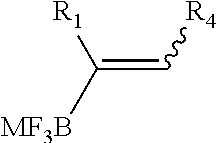
-
-
- in which R1, R4 and M are as defined above,
- in the presence of a catalyst containing a transition metal, said catalyst being a palladium (II) complex, more particularly Pd(OAc)2 or Pd(acac)2, or a copper (II) complex, more particularly CuSO4, Cu(acac)2, Cu(tBuSalen)2, Cu(OTf)2,
- said catalyst being in particular a palladium (II) complex, more particularly Pd(OAc)2 or Pd(acac)2, when R1 represents H,
- said catalyst being in particular a copper (II) complex, in particular CuSO4, Cu(acac)2, Cu(tBuSalen)2, Cu(OTf)2, when R4 represents H,
- in order to obtain a compound of the following formula:
-

-
-
- in which R1, R2, R4, W1 and M are as defined above,
if W is different from W1 and/or X is different from MF3B, said process also comprising the following steps:
- in which R1, R2, R4, W1 and M are as defined above,
- a step of conversion of W1 to W making it possible to obtain
-

-
- in particular, when W1=COORa and W=CHO, by reduction in order to form the corresponding alcohol, then oxidation of said alcohol, when W1=—CONH2 and W=—CONHSO2Ra, by the action of sulphonyl chloride ClSO2Ra on the amide,
- and
- a step of conversion of —BF3M to —X making it possible to obtain

-
- in particular, when X=B(OH)2, by basic or acid hydrolysis, or by passing via a dihalogenoborane, more particularly a dichloroborane, when X=B(OR)2, by passing via X=B(OH)2 as described previously then by the action of an alcohol, in particular an alcohol of formula ROH, a diol or a triol, or by passing via a dihalogenoborane, more particularly a dichloroborane, then by the action of an alcohol, in particular an alcohol of formula ROH, a diol or a triol,
- or
- a step of conversion of —BF3M to —X making it possible to obtain

-
- and
- a step of conversion of W1 to W making it possible to obtain


in which:
-
- a step of reaction between:
- a diazoic derivative of the following formula:
- a step of reaction between:

-
-
- in which R2 is as defined above, W1 being chosen from the group constituted by —COORa, —CONH2, —CONHRa, and —CONRaRb,
- and
- a vinyltrifluoroborate compound of the following formula:
-

-
-
- in which R1, R4 and M are as defined above,
- in the presence of a catalyst containing a transition metal, said catalyst being a palladium (II) complex, more particularly Pd(OAc)2 or Pd(acac)2, or a copper (II) complex, more particularly CuSO4, Cu(acac)2, Cu(tBuSalen)2, Cu(OTf)2,
- said catalyst being in particular a palladium (II) complex, more particularly Pd(OAc)2 or Pd(acac)2, when R1 represents H,
- said catalyst being in particular a copper (II) complex, in particular CuSO4, Cu(acac)2, Cu(tBuSalen)2, Cu(OTf)2, when R4 represents H,
- in order to obtain a compound of the following formula:
-

-
-
- in which R1, R2, R4, W1 and M are as defined above,
if W is different from W1, said process also comprising the following steps:
- in which R1, R2, R4, W1 and M are as defined above,
- a step of conversion of W1 to W making it possible to obtain
-

-
- in particular, when W1=COORa and W=CHO, by reduction in order to form the corresponding alcohol, then oxidation of said alcohol, when W1=—CONH2 and W=—CONHSO2Ra, by the action of sulphonyl chloride ClSO2Ra on the amide.
-
- when R1, R2 and R4 represent H and B represents B(OH)2, B(OR)2, or B(OR′)3M, then W is chosen from —CORa, —CONH2, —CONHRa, —CONRaRb,
- when W represents —COOH or —COORa, and B represents B(OH)2, B(OR)2, or B(OR′)3M, then:
- R1 does not represent H, or
- R2 and R4 do not represent H.
-
- a step of reaction between:
- a diazoic derivative of the following formula:
- a step of reaction between:

-
-
- in which Ra is as defined previously,
- and
- a vinyltrifluoroborate compound of the following formula:
-

-
-
- in which M is as defined previously, M representing in particular K,
- in the presence of a catalyst containing a transition metal, in order to obtain a compound of the following formula:
-

-
- in which Ra and M are as defined above,
if W is different from —COORa and/or X is different from MF3B, said process also comprising the following steps: - a step of conversion of —COORa to W making it possible to obtain
- in which Ra and M are as defined above,

-
- and
- a step of conversion of —BF3M to —X making it possible to obtain

-
- or
- a step of conversion of —BF3M to —X making it possible to obtain

-
- and
- a step of conversion of —COORa to W making it possible to obtain


and its enantiomer, (I-1)
in which X, R1, R2, R4, R5 and W are as defined previously, said process comprising:
-
- a step of reaction between:
- a diazoic derivative of the following formula:
- a step of reaction between:

-
-
- in which R2 is as defined above, W1 being chosen from the group constituted by —CORa, —COORa, —CONH2, —CONHRa, and —CONRaRb,
- and
- a vinyltrifluoroborate compound of the following formula:
-

-
-
- in which R1, R4, R5 and M are as defined above,
- in the presence of a catalyst containing a transition metal, in order to obtain a compound of the following formula:
-

-
- in which R1, R2, R4, R5, W1 and M are as defined above, in the form of a mixture comprising the pairs of enantiomers of the following formulae:

-
- and its enantiomer, and

-
- and its enantiomer,
- a step of separation of said pairs of enantiomers, in particular by recrystallization, in order to obtain the following pair of trans enantiomers:

-
- and its enantiomer,
if W is different from W1 and/or X is different from MF3B, said process also comprising the following steps: - a step of conversion of W1 to W making it possible to obtain
- and its enantiomer,

-
- and its enantiomer from

-
- and its enantiomer,
- and
- a step of conversion of —BF3M to —X making it possible to obtain

-
- and its enantiomer from

-
- and its enantiomer
- or
- a step of conversion of —BF3M to —X making it possible to obtain

-
- and its enantiomer from

-
- and its enantiomer,
- and
- a step of conversion of W1 to W making it possible to obtain

-
- and its enantiomer from

-
- and its enantiomer.

is trans.

are trans.

it refers to the following pair of enantiomers:


and its enantiomer, (I-1a)
in which X and W are as defined previously, said process comprising:
-
- a step of reaction between:
- a diazoic derivative of the following formula:
- a step of reaction between:

-
-
- W1 being chosen from the group constituted by —CORa, —COORa, —CONH2, —CONHRa, and —CONRaRb, W1 representing in particular —COORa,
- and
- a vinyltrifluoroborate compound of the following formula:
-

-
-
- in which M is as defined above,
- in the presence of a catalyst containing a transition metal, in order to obtain a compound of the following formula:
-

-
- in which W1 and M are as defined above, in the form of a mixture comprising the pairs of enantiomers of the following formulae:

-
- and its enantiomer, and

-
- and its enantiomer,
- a step of separation of said pairs of enantiomers, in particular by recrystallization, in order to obtain the following pair of trans enantiomers:

-
- and its enantiomer,
if W is different from W1 and/or X is different from MF3B, said process also comprising the following steps: - a step of conversion of W1 to W making it possible to obtain
- and its enantiomer,

-
- and its enantiomer from

-
- and its enantiomer,
- and
- a step of conversion of —BF3M to —X making it possible to obtain

-
- and its enantiomer from

-
- and its enantiomer
- or
- a step of conversion of —BF3M to —X making it possible to obtain

-
- and its enantiomer from

-
- and its enantiomer,
- and
- a step of conversion of W1 to W making it possible to obtain

-
- and its enantiomer from

-
- and its enantiomer.

and its enantiomer, (I-2)
in which X, R1, R2, R4, R5 and W are as defined previously, said process comprising:
-
- a step of reaction between:
- a diazoic derivative of the following formula:
- a step of reaction between:

-
-
- in which R2 is as defined above, W1 being chosen from the group constituted by —CORa, —COORa, —CONH2, —CONHRa, and —CONRaRb,
- and
- a vinyltrifluoroborate compound of the following formula:
-

-
-
- in which R1, R4, R5 and M are as defined above,
- in the presence of a catalyst containing a transition metal, in order to obtain a compound of the following formula:
-

-
- in which R1, R2, R4, R5, W1 and M are as defined above, in the form of a mixture comprising the pairs of enantiomers of the following formulae:

-
- and its enantiomer, and

-
- and its enantiomer,
- a step of separation of said pairs of enantiomers, in particular by recrystallization, in order to obtain the following pair of trans enantiomers:

-
- and its enantiomer,
if W is different from W1 and/or X is different from MF3B, said process also comprising the following steps: - a step of conversion of W1 to W making it possible to obtain
- and its enantiomer,

-
- and its enantiomer from

-
- and its enantiomer,
- and
- a step of conversion of —BF3M to —X making it possible to obtain
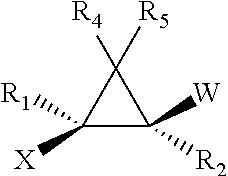
-
- and its enantiomer from

-
- and its enantiomer,
- or
- a step of conversion of —BF3M to —X making it possible to obtain

-
- and its enantiomer from

-
- and its enantiomer,
- and
- a step of conversion of W1 to W making it possible to obtain

-
- and its enantiomer from

-
- and its enantiomer.

is cis.

are cis.

it refers to the following pair of enantiomers:


and its enantiomer, (I-2a)
in which X and W are as defined previously, said process comprising:
-
- a step of reaction between:
- a diazoic derivative of the following formula:
- a step of reaction between:

-
-
- W1 being chosen from the group constituted by —CORa, —COORa, —CONH2, —CONHRa, and —CONRaRb, W1 representing in particular —COORa,
- and
- a vinyltrifluoroborate compound of the following formula:
-

-
-
- in which M is as defined above,
- in the presence of a catalyst containing a transition metal, in order to obtain a compound of the following formula:
-

-
- in which W1 and M are as defined above, in the form of a mixture comprising the pairs of enantiomers of the following formulae:

-
- and its enantiomer, and

-
- and its enantiomer,
- a step of separation of said pairs of enantiomers, in particular by recrystallization, in order to obtain the following pair of cis enantiomers:

-
- and its enantiomer,
if W is different from W1 and/or X is different from MF3B, said process also comprising the following steps: - a step of conversion of W1 to W making it possible to obtain
- and its enantiomer,

-
- and its enantiomer from

-
- and its enantiomer,
- and
- a step of conversion of —BF3M to —X making it possible to obtain

-
- and its enantiomer from

-
- and its enantiomer,
- or
- a step of conversion of —BF3M to —X making it possible to obtain

-
- and its enantiomer from

-
- and its enantiomer,
- and
- a step of conversion of W1 to W making it possible to obtain

-
- and its enantiomer from

-
- and its enantiomer.
-
- the treatment of a compound of the following formula:

-
- in which R2 is as defined previously, R2 representing in particular H,
- and in which W2 represents a functional group chosen from —ORa, —OZ′, —NRaRb and —NZZ2, in particular from —ORa and —OZ′, Y being a halide, in particular —Br, Y′ being a halide, in particular —Br, or H,
- by:
- a strong base, in particular an alkyl lithium, more particularly n-butyllithium or sec-butyllithium, then
- a compound of formula X″—B(OR)2, R being as defined above, X″ representing H, an O-alkyl group comprising 1 to 14 carbon atoms or an O-aryl group, optionally substituted,
- in order to obtain a compound of the following formula:

-
- in which R, R2 and W2 are as defined above,
- or
- a reaction of the Simmons-Smith type starting from a compound of the following formula:

-
- in which R1 and R2 are as defined previously, R1 and R2 representing in particular H, W2 representing a functional group chosen from —ORa, —OZ′, —NRaRb and —NZZ2, in particular from —ORa and —OZ′, X′ representing B(OR)2 or BF3M, in particular B(OR)2,
- in which R and M are as defined previously,
- in order to obtain a compound of the following formula:

-
- in which R1, R2, X′ and W2 are as defined above,
if W represents —OH or —NH2, and/or X is different from B(OR)2, said process also comprising the following steps, R1 representing in particular H: - a step of conversion of W2 to W, in particular the deprotection of the Z′ group when W2 represents —OZ′ or of the Z and Z2 groups when W2 represents —NZZ2, making it possible to obtain
- in which R1, R2, X′ and W2 are as defined above,

-
- and
- a step of conversion of B(OR)2 to —X making it possible to obtain

-
- said conversion step being in particular in the presence of MHF2 when X represents BF3M, or in particular a hydrolysis, more particularly in the presence of a mineral, organic base or in the presence of a Lewis acid, when X represents B(OH)2,
- or
- a step of conversion of B(OR)2 to —X making it possible to obtain

-
- said conversion step being in particular in the presence of MHF2 when X represents BF3M, or in particular a hydrolysis, more particularly in the presence of a mineral, organic base or in the presence of a Lewis acid, when X represents B(OH)2,
- and
- a step of conversion of W2 to W, in particular the deprotection of the Z′ group when W2 represents —OZ′ or of the Z and Z2 groups when W2 represents —NZZ2, making it possible to obtain

-
- or, when X′ represents BF3M, W representing —OH or —NH2,
- a step of conversion of W2 to W, in particular the deprotection of the Z′ group when W2 represents —OZ′ or of the Z and Z2 groups when W2 represents —NZZ2, making it possible to obtain

-
- the treatment of a compound of the following formula:

-
- in which R2 is as defined previously,
- and in which W2 is as described above, Y being a halide, in particular —Br, Y′ being a halide, in particular —Br, or H, by:
- a strong base, in particular butyllithium, more particularly n-butyllithium, then
- a compound of formula X″—B(OR)2, R being as defined above, X″ representing H, an O-alkyl group comprising 1 to 14 carbon atoms or an O-aryl group, optionally substituted,
- in order to obtain a compound of the following formula:

-
- in which R and W2 are as defined above,
- or
- a reaction of the Simmons-Smith type starting from a compound of the following formula:

-
- in which W2, R1 and R2 are as defined previously, X′ representing B(OR)2 or BF3M, in particular B(OR)2, in which R and M are as defined previously,
- in order to obtain a compound of the following formula:

-
- in which R1, R2, X′ and W2 are as defined above.
-
- the treatment of a compound of the following formula:

-
- in which R2 is as defined previously,
- and in which W2 represents a functional group chosen from —ORa, —OZ′ and —NZZ2, in particular from —ORa and —OZ′, W2 representing in particular —OZ′, Y being a halide, in particular —Br, Y′ being a halide, in particular —Br, or H, by:
- a strong base, in particular an alkyl lithium, more particularly n-butyllithium or sec-butyllithium, then
- a compound of formula X″—B(OR)2, R being as defined above, X″ representing H, an O-alkyl group comprising 1 to 14 carbon atoms or an O-aryl group, optionally substituted,
- in order to obtain a compound of the following formula:

-
- in which R and W2 are as defined above,
- or
- a reaction of the Simmons-Smith type starting from a compound of the following formula:

-
- in which R1 and R2 are as defined previously, W2 representing a functional group chosen from —ORa, —OZ′ and —NZZ2, in particular from —ORa and —OZ′, W2 representing in particular —OZ′, X′ representing B(OR)2 or BF3M, in particular B(OR)2, in which R and M are as defined previously,
- in order to obtain a compound of the following formula:

-
- in which R1, R2, X′ and W2 are as defined above,
said process also comprising the following step, R1 representing in particular H: - a step of conversion of W2 to W, in particular the deprotection of the Z′ group when W2 represents —OZ′ or of the Z and Z2 groups when W2 represents —NZZ2, making it possible to obtain
- in which R1, R2, X′ and W2 are as defined above,

-
- or, when X′ represents BF3M,
- a step of conversion of W2 to W, in particular the deprotection of the Z′ group when W2 represents —OZ′ or of the Z and Z2 groups when W2 represents —NZZ2, making it possible to obtain

-
- the treatment of a compound of the following formula:

-
- in which R2 is as defined previously,
- and in which W2 is as described above, Y being a halide, in particular —Br, Y′ being a halide, in particular —Br, or H, by:
- a strong base, in particular an alkyl lithium, more particularly n-butyllithium or sec-butyllithium then
- a compound of formula X″—B(OR)2, R being as defined above, X″ representing H, an O-alkyl group comprising 1 to 14 carbon atoms or an O-aryl group, optionally substituted,
- in order to obtain a compound of the following formula:

-
- in which R and W2 are as defined above,
- or
- a reaction of the Simmons-Smith type starting from a compound of the following formula:

-
- in which W2, R1 and R2 are as defined previously, X′ representing B(OR)2 or BF3M, in particular B(OR)2, in which R and M are as defined previously,
- in order to obtain a compound of the following formula:

-
- in which R1, R2, X′ and W2 are as defined above,
said process also comprising the following step, R1 representing in particular H: - a step of conversion of B(OR)2 to X, X representing B(OH)2, BF3M or B(OR′)3M, making it possible to obtain
- in which R1, R2, X′ and W2 are as defined above,

-
- said conversion step being in particular in the presence of MHF2 when X represents BF3M, or in particular a hydrolysis, more particularly in the presence of a mineral, organic base or in the presence of a Lewis acid, when X represents B(OH)2.
-
- the treatment of a compound of the following formula:

-
- in which R2 is as defined previously,
- and in which W2 represents a functional group chosen from —ORa, —OZ′ and —NZZ2, in particular from —ORa and —OZ′, W2 representing in particular —OZ′, Y being a halide, in particular —Br, Y′ being a halide, in particular —Br, or H, by:
- a strong base, in particular butyllithium, more particularly n-butyllithium, then
- a compound of formula X″—B(OR)2, R being as defined above, X″ representing H, an O-alkyl group comprising 1 to 14 carbon atoms or an O-aryl group, optionally substituted,
- in order to obtain a compound of the following formula:

-
- in which R and W2 are as defined above,
- or
- a reaction of the Simmons-Smith type starting from a compound of the following formula:

-
- in which R1 and R2 are as defined previously, W2 representing a functional group chosen from —ORa, —OZ′ and —NZZ2, in particular from —ORa and —OZ′, W2 representing in particular —OZ′, X′ representing B(OR)2 or BF3M, in particular B(OR)2, in which R and M are as defined previously,
- in order to obtain a compound of the following formula:

-
- in which R1, R2, X′ and W2 are as defined above,
said process also comprising the following steps, R1 representing in particular H: - a step of conversion of W2 to W, in particular the deprotection of the Z′ group when W2 represents —OZ′ or of the Z and Z2 groups when W2 represents —NZZ2, making it possible to obtain
- in which R1, R2, X′ and W2 are as defined above,

-
- and
- a step of conversion of B(OR)2 to X, X representing B(OH)2, BF3M or B(OR′)3M, making it possible to obtain

-
- said conversion step being in particular in the presence of MHF2 when X represents BF3M, or in particular a hydrolysis, more particularly in the presence of a mineral, organic base or in the presence of a Lewis acid, when X represents B(OH)2,
- or
- a step of conversion of B(OR)2 to X, X representing B(OH)2, BF3M or B(OR′)3M, making it possible to obtain

-
- said conversion step being in particular in the presence of MHF2 when X represents BF3M, or in particular a hydrolysis, more particularly in the presence of a mineral, organic base or in the presence of a Lewis acid, when X represents B(OH)2,
- and
- a step of conversion of W2 to W, in particular the deprotection of the Z′ group when W2 represents —OZ′ or of the Z and Z2 groups when W2 represents —NZZ2, making it possible to obtain

-
- or, when X′ represents BF3M, W representing —OH or —NH2,
- a step of conversion of W2 to W, in particular the deprotection of the Z′ group when W2 represents —OZ′ or of the Z and Z2 groups when W2 represents —NZZ2, making it possible to obtain

-
- the treatment of a compound of the following formula:

-
- in which R2 is as defined previously,
- and in which W2 represents a functional group chosen from —ORa, —OZ′, —NRaRb and —NZZ2, in particular from —ORa and —OZ′, Y being a halide, in particular —Br, Y′ being a halide, in particular —Br, or H, by:
- a strong base, in particular an alkyl lithium, more particularly n-butyllithium or sec-butyllithium then
- a compound of formula X″—B(OR)2, R being as defined above, X″ representing H, an O-alkyl group comprising 1 to 14 carbon atoms or an O-aryl group, optionally substituted,
- in order to obtain a compound of the following formula:

-
- in which R, R2 and W2 are as defined above,
if W represents —OH or —NH2, and/or X is different from B(OR)2, said process also comprising the following steps: - a step of conversion of W2 to W, in particular the deprotection of the Z′ group when W2 represents —OZ′ or of the Z and Z2 groups when W2 represents —NZZ2, making it possible to obtain
- in which R, R2 and W2 are as defined above,

-
- and
- a step of conversion of B(OR)2 to —X making it possible to obtain

-
- said conversion step being in particular in the presence of MHF2 when X represents BF3M, or in particular a hydrolysis, more particularly in the presence of a mineral, organic base or in the presence of a Lewis acid, when X represents B(OH)2,
- or
- a step of conversion of B(OR)2 to —X making it possible to obtain

-
- said conversion step being in particular in the presence of MHF2 when X represents BF3M, or in particular a hydrolysis, more particularly in the presence of a mineral, organic base or in the presence of a Lewis acid, when X represents B(OH)2,
- and
- a step of conversion of W2 to W, in particular the deprotection of the Z′ group when W2 represents —OZ′ or of the Z and Z2 groups when W2 represents —NZZ2, making it possible to obtain

-
- a reaction of the Simmons-Smith type starting from a compound of the following formula:

-
- in which R1 and R2 are as defined previously, W2 representing a functional group chosen from —ORa, —OZ′, —NRaRb and —NZZ2, in particular from —ORa and —OZ′, X′ representing B(OR)2 or BF3M, in particular B(OR)2, in which R and M are as defined previously,
- in order to obtain a compound of the following formula:

-
- in which R1, R2, X′ and W2 are as defined above,
if W represents —OH or —NH2, and/or X is different from B(OR)2, said process also comprising the following steps: - when X′ represents B(OR)2,
- a step of conversion of W2 to W, in particular the deprotection of the Z′ group when W2 represents —OZ′ or of the Z and Z2 groups when W2 represents —NZZ2, making it possible to obtain
- in which R1, R2, X′ and W2 are as defined above,

-
- and
- a step of conversion of B(OR)2 to —X making it possible to obtain

-
- said conversion step being in particular in the presence of MHF2 when X represents BF3M, or in particular a hydrolysis, more particularly in the presence of a mineral, organic base or in the presence of a Lewis acid, when X represents B(OH)2, or
- a step of conversion of B(OR)2 to —X making it possible to obtain

-
- said conversion step being in particular in the presence of MHF2 when X represents BF3M, or in particular a hydrolysis, more particularly in the presence of a mineral, organic base or in the presence of a Lewis acid, when X represents B(OH)2, and
- a step of conversion of W2 to W, in particular the deprotection of the Z′ group when W2 represents —OZ′ or of the Z and Z2 groups when W2 represents —NZZ2, making it possible to obtain

-
- or, when X′ represents BF3M, W representing —OH or —NH2,
- a step of conversion of W2 to W, in particular the deprotection of the Z′ group when W2 represents —OZ′ or of the Z and Z2 groups when W2 represents —NZZ2, making it possible to obtain


and its enantiomer, (I-1c)
in which X and W are as defined previously, said process comprising:
-
- the treatment of a compound of the following formula:

-
- in which R2 is as defined previously,
- and in which W2 represents a functional group chosen from —ORa, —OZ′, —NRaRb and —NZZ2, in particular from —ORa and —OZ′, Y being a halide, in particular —Br, Y′ being a halide, in particular —Br, by:
- a strong base, in particular an alkyl lithium, more particularly n-butyllithium or sec-butyllithium then
- a compound of formula X″—B(OR)2, R being as defined above, X″ representing H, an O-alkyl group comprising 1 to 14 carbon atoms or an O-aryl group, optionally substituted,
- in order to obtain a compound of the following formula:

-
- and its enantiomer,
- in which R and W are as defined above,
or the following steps: - the treatment of a compound of the following formula:

-
- in which R2 is as defined previously,
- and in which W2 represents a functional group chosen from —ORa, —OZ′, —NRaRb and —NHZ, in particular from —ORa and —OZ′, Y being a halide, in particular —Br, Y′ being a halide, in particular —Br,
- by a strong base, in particular butyllithium, more particularly n-butyllithium, in order to obtain a compound of the following formula:

-
- and its enantiomer,
- in which W is as defined above,
- the treatment of the compound of the following formula:

-
- and its enantiomer,
- in which W is as defined above,
- by:
- a strong base, in particular an alkyl lithium, more particularly n-butyllithium or sec-butyllithium, then
- a compound of formula X″—B(OR)2, R being as defined above, X″ representing H, an O-alkyl group comprising 1 to 14 carbon atoms or an O-aryl group, optionally substituted,
- in order to obtain a compound of the following formula:

-
- and its enantiomer,
- in which R and W are as defined above,
or the following step: - a reaction of the Simmons-Smith type starting from a compound of the following formula:

-
- in which R1 and R2 are as defined previously, W2 representing a functional group chosen from —ORa, —OZ′, —NRaRb and —NZZ2, in particular from —ORa and —OZ′, X′ representing B(OR)2 or BF3M, in particular B(OR)2, in which R and M are as defined previously,
- in order to obtain a compound of the following formula:

-
- and its enantiomer,
- in which R1, R2, X′ and W2 are as defined above,
if W represents —OH or —NH2, and/or X is different from B(OR)2, said process also comprising the following steps, R1 representing in particular H: - a step of conversion of W2 to W, in particular the deprotection of the Z′ group when W2 represents —OZ′ or of the Z and Z2 groups when W2 represents —NZZ2, making it possible to obtain

-
- and its enantiomer from

-
- and its enantiomer,
- and
- a step of conversion of B(OR)2 to —X making it possible to obtain

-
- and its enantiomer from

-
- and its enantiomer, said conversion step being in particular in the presence of MHF2 when X represents BF3M, or in particular a hydrolysis, more particularly in the presence of a mineral, organic base or in the presence of a Lewis acid, when X represents B(OH)2,
- or
- a step of conversion of B(OR)2 to —X making it possible to obtain

-
- and its enantiomer from

-
- and its enantiomer,
- said conversion step being in particular in the presence of MHF2 when X represents BF3M, or in particular a hydrolysis, more particularly in the presence of a mineral, organic base or in the presence of a Lewis acid, when X represents B(OH)2, and
- a step of conversion of W2 to W, in particular the deprotection of the Z′ group when W2 represents —OZ′ or of the Z and Z2 groups when W2 represents —NZZ2, making it possible to obtain

-
- and its enantiomer from

-
- and its enantiomer,
- or, when X′ represents BF3M, W representing —OH or —NH2,
- a step of conversion of W2 to W, in particular the deprotection of the Z′ group when W2 represents —OZ′ or of the Z and Z2 groups when W2 represents —NZZ2, making it possible to obtain

-
- and its enantiomer from

-
- and its enantiomer.

and its enantiomer, (I-1b)
in which X and W are as defined previously, said process comprising:
-
- the treatment of a compound of the following formula:

-
- in which R2 is as defined previously,
- and in which W2 represents a functional group chosen from —ORa, —OZ′, —NRaRb and —NZZ2, in particular from —ORa and —OZ′, Y being a halide, in particular —Br, Y′ being a halide, in particular —Br,
- by:
- a strong base, in particular an alkyl lithium, more particularly n-butyllithium or sec-butyllithium, then
- a compound of formula X″—B(OR)2, R being as defined above, X″ representing H, an O-alkyl group comprising 1 to 14 carbon atoms or an O-aryl group, optionally substituted,
- in order to obtain a compound of the following formula:

-
- and its enantiomer,
- in which R and W are as defined above,
or the following steps: - the treatment of a compound of the following formula:

-
- in which R2 is as defined previously,
- and in which W2 represents a functional group chosen from —ORa, —OZ′, —NRaRb and —NZZ2, in particular from —ORa and —OZ′, Y being a halide, in particular —Br, Y′ being a halide, in particular —Br,
- by a strong base, in particular an alkyl lithium, more particularly n-butyllithium or sec-butyllithium, in order to obtain a compound of the following formula:

-
- and its enantiomer,
- in which W is as defined above,
- the treatment of the compound of the following formula:

-
- and its enantiomer,
- in which W is as defined above,
- by:
- a strong base, in particular an alkyl lithium, more particularly n-butyllithium or sec-butyllithium, then
- a compound of formula X″—B(OR)2, R being as defined above, X″ representing H, an O-alkyl group comprising 1 to 14 carbon atoms or an O-aryl group, optionally substituted,
- in order to obtain a compound of the following formula:

-
- and its enantiomer,
- in which R and W are as defined above,
if W represents —OH or —NH2, and/or X is different from B(OR)2, said process also comprising the following steps: - a step of conversion of W2 to W, in particular the deprotection of the Z′ group when W2 represents —OZ′ or of the Z and Z2 groups when W2 represents —NZZ2, making it possible to obtain

-
- and its enantiomer from

-
- and its enantiomer,
- and
- a step of conversion of B(OR)2 to —X making it possible to obtain

-
- and its enantiomer from

-
- and its enantiomer, said conversion step being in particular in the presence of MHF2 when X represents BF3M, or in particular a hydrolysis, more particularly in the presence of a mineral, organic base or in the presence of a Lewis acid, when X represents B(OH)2, or
- a step of conversion of B(OR)2 to —X making it possible to obtain

-
- and its enantiomer from

-
- and its enantiomer,
- said conversion step being in particular in the presence of MHF2 when X represents BF3M, or in particular a hydrolysis, more particularly in the presence of a mineral, organic base or in the presence of a Lewis acid, when X represents B(OH)2, and
- a step of conversion of W2 to W, in particular the deprotection of the Z′ group when W2 represents —OZ′ or of the Z and Z2 groups when W2 represents —NZZ2, making it possible to obtain

-
- and its enantiomer from

-
- and its enantiomer,
- or, when X′ represents BF3M, W representing —OH or —NH2,
- a step of conversion of W2 to W, in particular the deprotection of the Z′ group when W2 represents —OZ′ or of the Z and Z2 groups when W2 represents —NZZ2, making it possible to obtain

-
- and its enantiomer from

-
- and its enantiomer.

and its enantiomer, (I-1c)
in which X and W are as defined previously, said process comprising:
-
- a step of reaction between a compound of the following formula:

-
- R2 being as defined previously, W2 representing a functional group chosen from —ORa, —OZ′, —NRaRb and —NZZ2, in particular from —ORa and —OZ′,
- and a compound of the following formula:

-
- R1 being as defined previously, X′ representing B(OR)2 or BF3M, in particular B(OR)2, in the presence of a catalyst comprising a transition metal chosen from the group constituted by nickel, molybdenum, tungsten, ruthenium, in particular molybdenum or ruthenium, said catalyst being more particularly a Shrock catalyst, a 1st generation Grubbs catalyst, a 2nd generation Grubbs catalyst, or a catalyst of the following formula:

-
- in order to form a compound of the following formula:

-
- in which R1, R2, X′ and W2 are as defined above,
- a reaction of the Simmons-Smith type starting from a compound of the following formula:

-
- in which R1, R2, X′ and W2 are as defined above, in order to obtain a compound of the following formula:

-
- and its enantiomer,
- in which R1, R2, X′ and W2 are as defined above,
if W represents —OH or —NH2, and/or X is different from B(OR)2, said process also comprising the following steps: - when X′ represents B(OR)2,
- a step of conversion of W2 to W, in particular the deprotection of the Z′ group when W2 represents —OZ′ or of the Z and Z2 groups when W2 represents —NZZ2, making it possible to obtain

-
- and its enantiomer from

-
- and its enantiomer,
- and
- a step of conversion of B(OR)2 to —X making it possible to obtain

-
- and its enantiomer from

-
- and its enantiomer,
- said conversion step being in particular in the presence of MHF2 when X represents BF3M, or in particular a hydrolysis, more particularly in the presence of a mineral, organic base or in the presence of a Lewis acid, when X represents B(OH)2, or
- a step of conversion of B(OR)2 to —X making it possible to obtain

-
- and its enantiomer from

-
- and its enantiomer,
- said conversion step being in particular in the presence of MHF2 when X represents BF3M, or in particular a hydrolysis, more particularly in the presence of a mineral, organic base or in the presence of a Lewis acid, when X represents B(OH)2,
- and
- a step of conversion of W2 to W, in particular the deprotection of the Z′ group when W2 represents —OZ′ or of the Z and Z2 groups when W2 represents —NZZ2, making it possible to obtain

-
- and its enantiomer from

-
- and its enantiomer,
- or, when X′ represents BF3M, W representing —OH or —NH2,
- a step of conversion of W2 to W, in particular the deprotection of the Z′ group when W2 represents —OZ′ or of the Z and Z2 groups when W2 represents —NZZ2, making it possible to obtain

-
- and its enantiomer from

-
- and its enantiomer.

and its enantiomer, (I-2b)
in which X and W are as defined previously, said process comprising:
-
- a reaction of the Simmons-Smith type starting from a compound of the following formula:

-
- in which Y is as defined previously, W2 representing a functional group chosen from —ORa, —OZ′, —NRaRb and —NZZ2, in particular from —ORa and —OZ′,
- in order to obtain a compound of the following formula:

-
- and its enantiomer,
- in which Y and W2 are as defined above, and
- the treatment of a compound of the following formula:

-
- and its enantiomer,
- in which Y and W2 are as defined above,
- by:
- a strong base, in particular an alkyl lithium, more particularly n-butyllithium or sec-butyllithium, then
- a compound of formula X″—B(OR)2, R being as defined above, X″ representing H, an O-alkyl group comprising 1 to 14 carbon atoms or an O-aryl group, optionally substituted,
- in order to obtain a compound of the following formula:

-
- and its enantiomer,
- in which R and W are as defined above,
- or
- the treatment of a compound of the following formula:

-
- in which Y and W2 are as defined above,
- by:
- a strong base, in particular an alkyl lithium, more particularly n-butyllithium or sec-butyllithium, then
- a compound of formula X′—B(OR)2, R being as defined above, X′ representing H, an O-alkyl group comprising 1 to 14 carbon atoms or an O-aryl group, optionally substituted,
- in order to obtain a compound of the following formula:

-
- in which R and W2 are as defined above, and
- a reaction of the Simmons-Smith type starting from a compound of the following formula:

-
- in which Y is as defined previously, W2 representing a functional group chosen from —ORa, —OZ′, —NRaRb and —NZZ2,
- in order to obtain a compound of the following formula:

-
- and its enantiomer,
- in which R and W2 are as defined above;
if W represents —OH or —NH2, and/or X is different from B(OR)2, said process also comprising the following steps: - a step of conversion of W2 to W, in particular the deprotection of the Z′ group when W2 represents —OZ′ or of the Z and Z2 groups when W2 represents —NZZ2, making it possible to obtain

-
- and its enantiomer from

-
- and its enantiomer,
- and
- a step of conversion of B(OR)2 to —X making it possible to obtain

-
- and its enantiomer from

-
- and its enantiomer,
- said conversion step being in particular in the presence of MHF2 when X represents BF3M, or in particular a hydrolysis, more particularly in the presence of a mineral, organic base or in the presence of a Lewis acid, when X represents B(OH)2,
- or
- a step of conversion of B(OR)2 to —X making it possible to obtain

-
- and its enantiomer from

-
- and its enantiomer,
- said conversion step being in particular in the presence of MHF2 when X represents BF3M, or in particular a hydrolysis, more particularly in the presence of a mineral, organic base or in the presence of a Lewis acid, when X represents B(OH)2, and
- a step of conversion of W2 to W, in particular the deprotection of the Z′ group when W2 represents —OZ′ or of the Z and Z2 groups when W2 represents —NZZ2, making it possible to obtain

-
- and its enantiomer from

-
- and its enantiomer.

in which:
-
- X represents a substituted boron atom chosen from the group comprising B(OH)2, B(OR)2, BF3M, B(OR′)3M in which:
- R is an alkyl group comprising 1 to 14 carbon atoms, an aryl group, optionally substituted, or is such that (OR)2 forms a ring between the two oxygen atoms, (OR)2 being in particular chosen from the group comprising the bivalent radicals deriving from diols, such as O—CH2—CH2—O, O—CH2—CH2—CH2—O, O—CH2—C(CH3)2—CH2—O, O—C(CH3)2—CH2—CH2—C(CH3)2—O, O—CH(CH3)—CH2—CH2—CH(CH3)—O, O—CH(Ph)-CH(Ph)-O, O—CH(CH3)—CH2—C(CH3)2—O, O-o-Ph-O, O—CH2—CH2—NH—CH2—CH2—O, O—CH2—CH2—N(CH2—CH2—CH2—CH3)—CH2—CH2—O, O—CH(COOH)—CH(COOH)—O and its esters, and the bivalent radicals deriving from diacids, such as OCO—CH2—N(CH3)—CH2—COO,
- R′ is an alkyl group comprising 1 to 14 carbon atoms or is such that:
- (OR′)3 forms a ring between two of the oxygen atoms, (OR′)3 then being in the form OR′(OR)2, where R′ is an alkyl group comprising 1 to 14 carbon atoms and (OR)2 is as defined above, or
- (OR′)3 forms a bicycle between the three oxygen atoms, (OR′)3 being in particular chosen from the group comprising the trivalent radicals deriving from triols, such as H3C—C—(CH2—O)3,
- M represents the lithium Li+ ion, the sodium Na+ ion, the potassium K+ ion, the caesium Cs+ ion, the ammonium RcRdReRfN+ ion where Rc, Rd Re, Rf are chosen from H or a saturated carbon-containing chain comprising in particular 1 to 6 carbon atoms chosen independently of one another,
- and in particular X represents B(OH)2, B(OR)2 or BF3K,
R1, R4 and R5, identical or different, are chosen from the group constituted by:
1. H
2. the aryls comprising rings with 6 to 15 carbon atoms, optionally substituted;
3. the heterocycles or heteroaryls comprising rings with 2 to 15 carbon atoms, optionally substituted;
4. the linear or branched alkenyls comprising 1 to 12 carbon atoms, optionally substituted, or carbon rings comprising 3 to 12 carbon atoms and one or more C═C double bonds, optionally substituted;
5. the linear or branched alkynyls comprising 1 to 15 carbon atoms, optionally substituted;
6. the linear, cyclic or branched alkyl groups comprising 1 to 15 carbon atoms, optionally substituted;
R1 and R4, or R1 and R5 being able to form a ring with 5, 6, or 7 members optionally comprising a heteroatom chosen from oxygen, nitrogen and sulphur, said ring being able to be substituted;
- X represents a substituted boron atom chosen from the group comprising B(OH)2, B(OR)2, BF3M, B(OR′)3M in which:
-
- when R1, R2, R4 and R5 represent H and B represents B(OH)2, B(OR)2, or B(OR′)3M, then
- W is chosen from —CORa, —CONH2, —CONHRa, —CONRaRb, —OH, —ORa and —OZ′,
- when R1, R2, R4 and R5 represent H and B represents BF3M, then W is chosen from —COOH, —COORa, —CHO, —CORa—CONH2, —CONHRa, —CONRaRb, —OH, —ORa and —OZ′,
- when W represents CH2OH, —CH2ORa, —CHRbOH, —CHRbORa, —CRbRb′OH, or —CRbRb′ORa, and B represents B(OH)2, B(OR)2, or B(OR′)3M, then:
- R1 does not represent H, or
- R2 and R4 do not represent H, or
- R2 and R5 do not represent H.
- when W represents CH2OH, —CH2ORa, —CHRbOH, —CHRbORa, —CRbRb′OH, or —CRbRb′ORa, and B represents BF3M, then R1 or R2 do not represent H.
- when W represents —COOH or —COORa, and B represents B(OH)2, B(OR)2, or B(OR′)3M, then:
- R1 does not represent H, or
- R2 and R4 do not represent H, or
- R2 and R5 do not represent H.


in which:
-
- X represents a substituted boron atom chosen from the group comprising B(OH)2, B(OR)2, BF3M, B(OR′)3M in which:
- R is an alkyl group comprising 1 to 14 carbon atoms, an aryl group, optionally substituted, or is such that (OR)2 forms a ring between the two oxygen atoms, (OR)2 being in particular chosen from the group comprising the bivalent radicals deriving from diols, such as O—CH2—CH2—O, O—CH2—CH2—CH2—O, O—CH2—C(CH3)2—CH2—O, O—C(CH3)2—CH2—CH2—C(CH3)2—O, O—CH(CH3)—CH2—CH2—CH(CH3)—O, O—CH(Ph)-CH(Ph)-O, O—CH(CH3)—CH2—C(CH3)2—O, O-o-Ph-O, O—CH2—CH2—NH—CH2—CH2—O, O—CH2—CH2—N(CH2—CH2—CH2—CH3)—CH2—CH2—O, O—CH(COOH)—CH(COOH)—O and its esters, and the bivalent radicals deriving from diacids, such as OCO—CH2—N(CH3)—CH2—COO,
- R′ is an alkyl group comprising 1 to 14 carbon atoms or is such that:
- (OR′)3 forms a ring between two of the oxygen atoms, (OR′)3 then being in the form OR′(OR)2, where R′ is an alkyl group comprising 1 to 14 carbon atoms and (OR)2 is as defined above, or
- (OR′)3 forms a bicycle between the three oxygen atoms, (OR′)3 being in particular chosen from the group comprising the trivalent radicals deriving from triols, such as H3C—C—(CH2—O)3,
- M represents the lithium Li+ ion, the sodium Na+ ion, the potassium K+ ion, the caesium Cs+ ion, the ammonium RcRdReRfN+ ion where Rc, Rd Re, Rf are chosen from H or a saturated carbon-containing chain comprising in particular 1 to 6 carbon atoms chosen independently of one another,
- and in particular X represents B(OH)2, B(OR)2 or BF3K,
R1 and R4, identical or different, are chosen from the group constituted by:
1. H
2. the aryls comprising rings with 6 to 15 carbon atoms, optionally substituted;
3. the heterocycles or heteroaryls comprising rings with 2 to 15 carbon atoms, optionally substituted;
4. the linear or branched alkenyls comprising 1 to 12 carbon atoms, optionally substituted, or carbon rings comprising 3 to 12 carbon atoms and one or more C═C double bonds, optionally substituted;
5. the linear or branched alkynyls comprising 1 to 15 carbon atoms, optionally substituted;
6. the linear, cyclic or branched alkyl groups comprising 1 to 15 carbon atoms, optionally substituted;
at least one of the R1 and R4 groups representing H,
- X represents a substituted boron atom chosen from the group comprising B(OH)2, B(OR)2, BF3M, B(OR′)3M in which:
-
- when R1, R2 and R4 represent H and B represents B(OH)2, B(OR)2, or B(OR′)3M, then W is chosen from —CORa, —CONH2, —CONHRa, —CONRaRb,
- when R1, R2 and R4 represent H and B represents BF3M, then W is chosen from —COOH, —COORa, —CHO, —CORa—CONH2, —CONHRa, —CONRaRb,
- when W represents CH2OH, —CH2ORa, —CHRbOH, —CHRbORa, —CRbRb′OH, or —CRbRb′ORa, and B represents B(OH)2, B(OR)2, or B(OR′)3M, then:
- R1 does not represent H, or
- R2 and R4 do not represent H,
- when W represents CH2OH, —CH2ORa, —CHRbOH, —CHRbORa, —CRbRb′OH, or —CRbRb′ORa, and B represents BF3M, then R1 or R2 do not represent H.
- when W represents —COOH or —COORa, and B represents B(OH)2, B(OR)2, or B(OR′)3M, then:
- R1 does not represent H, or
- R2 and R4 do not represent H.

in which:
-
- when R1, R2 and R4 represent H, then W is chosen from —COOH, —COORa, —CHO, —CORa—CONH2, —CONHRa, —CONRaRb,
- when W represents CH2OH, —CH2ORa, —CHRbOH, —CHRbORa, —CRbRb′OH, or —CRbRb′ORa, then R1 or R2 do not represent H.


in which:
-
- X represents a substituted boron atom chosen from the group comprising B(OH)2, B(OR)2, BF3M, B(OR′)3M in which:
- R is an alkyl group comprising 1 to 14 carbon atoms, an aryl group, optionally substituted, or is such that (OR)2 forms a ring between the two oxygen atoms, (OR)2 being in particular chosen from the group comprising the bivalent radicals deriving from diols, such as O—CH2—CH2—O, O—CH2—CH2—CH2—O, O—CH2—C(CH3)2—CH2—O, O—C(CH3)2—CH2—CH2—C(CH3)2—O, O—CH(CH3)—CH2—CH2—CH(CH3)—O, O—CH(Ph)-CH(Ph)-O, O—CH(CH3)—CH2—C(CH3)2—O, O-o-Ph-O, O—CH2—CH2—NH—CH2—CH2—O, O—CH2—CH2—N(CH2—CH2—CH2—CH3)—CH2—CH2—O, O—CH(COOH)—CH(COOH)—O and its esters, and the bivalent radicals deriving from diacids, such as OCO—CH2—N(CH3)—CH2—COO,
- R′ is an alkyl group comprising 1 to 14 carbon atoms or is such that:
- (OR′)3 forms a ring between two of the oxygen atoms, (OR′)3 then being in the form OR′(OR)2, where R′ is an alkyl group comprising 1 to 14 carbon atoms and (OR)2 is as defined above, or
- (OR′)3 forms a bicycle between the three oxygen atoms, (OR′)3 being in particular chosen from the group comprising the trivalent radicals deriving from triols, such as H3C—C—(CH2—O)3,
- M represents the lithium Li+ ion, the sodium Na+ ion, the potassium K+ ion, the caesium Cs+ ion, the ammonium RcRdReRfN+ ion where Rc, Rd R2, Rf are chosen from H or a saturated carbon-containing chain comprising in particular 1 to 6 carbon atoms chosen independently of one another,
- and in particular X represents B(OH)2, B(OR)2 or BF3K,
R1 and R4, identical or different, are chosen from the group constituted by:
1. H
2. the aryls comprising rings with 6 to 15 carbon atoms, optionally substituted;
3. the heterocycles or heteroaryls comprising rings with 2 to 15 carbon atoms, optionally substituted;
4. the linear or branched alkenyls comprising 1 to 12 carbon atoms, optionally substituted, or carbon rings comprising 3 to 12 carbon atoms and one or more C═C double bonds, optionally substituted;
5. the linear or branched alkynyls comprising 1 to 15 carbon atoms, optionally substituted;
6. the linear, cyclic or branched alkyl groups comprising 1 to 15 carbon atoms, optionally substituted;
at least one of the R1 and R4 groups representing H,
- X represents a substituted boron atom chosen from the group comprising B(OH)2, B(OR)2, BF3M, B(OR′)3M in which:
-
- when R1, R2 and R4 represent H and B represents B(OH)2, B(OR)2, or B(OR′)3M, then W is chosen from —CORa, —CONH2, —CONHRa, —CONRaRb,
- when W represents —COOH or —COORa, and B represents B(OH)2, B(OR)2, or B(OR′)3M, then:
- R1 does not represent H, or
- R2 and R4 do not represent H.

in which:


in which:
-
- when R1, R2, R4 and R5 represent H and B represents B(OH)2, B(OR)2, or B(OR′)3M, then W is chosen from —CORa, —CONH2, —CONHRa, and —CONRaRb,
- when R1, R2, R4 and R5 represent H and B represents BF3M, then W is chosen from —COOH, —COORa, —CHO, —CORa—CONH2, —CONHRa, —CONRaRb,
- when W represents CH2OH, —CH2ORa, —CHRbOH, —CHRbORa, —CRbRb′OH, or —CRbRb′ORa, and B represents B(OH)2, B(OR)2, or B(OR′)3M, then:
- R1 does not represent H, or
- R2 and R4 do not represent H, or
- R2 and R5 do not represent H.
- when W represents CH2OH, —CH2ORa, —CHRbOH, —CHRbORa, —CRbRb′OH, or —CRbRb′ORa, and B represents BF3M, then R1 or R2 do not represent H.
- when W represents —COOH or —COORa, and B represents B(OH)2, B(OR)2, or B(OR′)3M, then:
- R1 does not represent H, or
- R2 and R4 do not represent H, or
- R2 and R5 do not represent H,
by reaction of said compound of formula (I) with a compound of the following formula (III):
R3—X2,
in which R3 is as defined above, and X2 is chosen from the group constituted by the halides, in particular iodine, bromine and chlorine, and triflate (OTf), in the presence of a catalyst containing a transition metal, and, optionally, a ligand.


in which:
-
- when R1, R2 and R4 represent H and B represents B(OH)2, B(OR)2, or B(OR′)3M, then W is chosen from —CORa, —CONH2, —CONHRa, —CONRaRb,
- when R1, R2 and R4 represent H and B represents BF3M, then W is chosen from —COOH, —COORa, —CHO, —CORa—CONH2, —CONHRa, —CONRaRb,
- when W represents CH2OH, —CH2ORa, —CHRbOH, —CHRbORa, —CRbRb′OH, or —CRbRb′ORa, and B represents B(OH)2, B(OR)2, or B(OR′)3M, then:
- R1 does not represent H, or
- R2 and R4 do not represent H,
- when W represents CH2OH, —CH2ORa, —CHRbOH, —CHRbORa, —CRbRb′OH, or —CRbRb′ORa, and B represents BF3M, then R1 or R2 does not represent H.
- when W represents —COOH or —COORa, and B represents B(OH)2, B(OR)2, or B(OR′)3M, then:
- R1 does not represent H, or
- R2 and R4 do not represent H,
by reaction of said compound of formula (I) with a compound of the following formula (III):
R3—X2,
in which R3 is as defined above, and X2 is chosen from the group constituted by the halides, in particular iodine, bromine and chlorine, and triflate (OTf), in the presence of a catalyst containing a transition metal, and, optionally, of a ligand.

in which:
-
- when R1, R2 and R4 represent H and B represents BF3M, then W is chosen from —COOH, —COORa, —CHO, —CORa—CONH2, —CONHRa, —CONRaRb,
- when W represents CH2OH, —CH2ORa, —CHRbOH, —CHRbORa, —CRbRb′OH, or —CRbRb′ORa, and B represents BF3M, then R1 or R2 do not represent H,
by reaction of said compound of formula (I) with a compound of the following formula (III):
R3—X2,
in which R3 is as defined above, and X2 is chosen from the group constituted by the halides, in particular iodine, bromine and chlorine, and triflate (OTf), in the presence of a catalyst containing a transition metal, and, optionally, of a ligand.


General Procedure:
Method A:


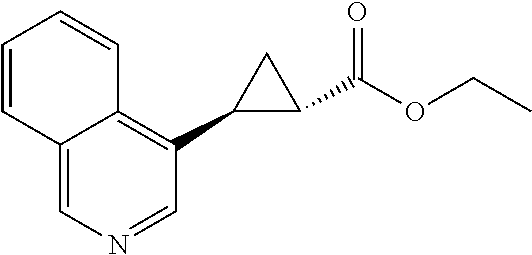


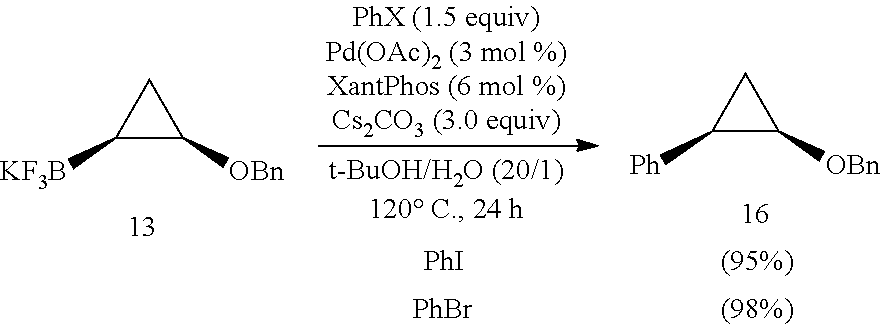


Claims (7)


Applications Claiming Priority (3)
| Application Number | Priority Date | Filing Date | Title |
|---|---|---|---|
| FR1261973 | 2012-12-12 | ||
| FR1261973A FR2999183A1 (en) | 2012-12-12 | 2012-12-12 | BORONIC CYCLOPROPYL COMPOUNDS, PROCESS FOR THE PREPARATION OF SAID COMPOUNDS, AND USE THEREOF |
| PCT/FR2013/053057 WO2014091167A2 (en) | 2012-12-12 | 2013-12-12 | Cyclopropylboronic compounds, method for preparing same and use thereof |
Publications (2)
| Publication Number | Publication Date |
|---|---|
| US20150329566A1 US20150329566A1 (en) | 2015-11-19 |
| US9527798B2 true US9527798B2 (en) | 2016-12-27 |
Family
ID=48237038
Family Applications (1)
| Application Number | Title | Priority Date | Filing Date |
|---|---|---|---|
| US14/651,832 Expired - Fee Related US9527798B2 (en) | 2012-12-12 | 2013-12-12 | Cyclopropylboronic compounds, preparation process thereof and use thereof |
Country Status (4)
| Country | Link |
|---|---|
| US (1) | US9527798B2 (en) |
| EP (1) | EP2931708B1 (en) |
| FR (1) | FR2999183A1 (en) |
| WO (1) | WO2014091167A2 (en) |
Families Citing this family (11)
| Publication number | Priority date | Publication date | Assignee | Title |
|---|---|---|---|---|
| EP3105212A1 (en) | 2014-02-12 | 2016-12-21 | Vanda Pharmaceuticals Inc. | Highly purified pharmaceutical grade tasimelteon |
| US12304896B2 (en) | 2014-12-04 | 2025-05-20 | Vanda Pharmaceuticals Inc. | Highly purified pharmaceutical grade tasimelteon |
| CN105001249B (en) * | 2015-06-12 | 2017-03-01 | 沧州普瑞东方科技有限公司 | A kind of method preparing cyclopropylboronic acid |
| WO2017027435A1 (en) * | 2015-08-07 | 2017-02-16 | The Board Of Trustees Of The University Of Illinois | Protected organoboronic acids with tunable reactivity, and methods of use thereof |
| EP3497089B1 (en) * | 2016-08-12 | 2020-07-29 | Bayer CropScience Aktiengesellschaft | Process for the preparation of 4-substituted 2,3-dihydro-1-benzofurane derivatives by cyclisation of 2-(2-diazonium-6-substituted-phenyl)ethanol salts |
| WO2018149940A1 (en) | 2017-02-17 | 2018-08-23 | Quimica Sintetica, S. A. | Process for the preparation of enantiomerically enriched dihydrobenzofurans and intermediate compounds obtained in the process |
| CN107954873B (en) * | 2017-12-07 | 2020-06-19 | 安徽师范大学 | A kind of polysubstituted alkenoate derivative and preparation method thereof |
| CN107986969B (en) * | 2017-12-07 | 2020-06-19 | 安徽师范大学 | A kind of dodecahydro is used as benzodiaindenophenanthrene derivative and its synthetic method |
| CN107986970B (en) * | 2017-12-07 | 2020-06-19 | 安徽师范大学 | A kind of polysubstituted aromatic hydrocarbon derivatives and preparation method thereof |
| CN116601146A (en) | 2020-10-07 | 2023-08-15 | 伊莱利利公司 | Phenyl-3,4-dihydroisoquinolin-2(1H)-yl-ethan-1-one derivatives as positive allosteric modulators of dopamine D1 receptors |
| CN114689763B (en) * | 2020-12-25 | 2026-02-10 | 上海奥博生物医药股份有限公司 | An analytical method for determining the content of compound I in sodium oxagorlin |
Citations (1)
| Publication number | Priority date | Publication date | Assignee | Title |
|---|---|---|---|---|
| WO2007025144A1 (en) | 2005-08-24 | 2007-03-01 | University Of Illinois - Chicago | 5-ht2c receptor agonists as anorectic agents |
-
2012
- 2012-12-12 FR FR1261973A patent/FR2999183A1/en not_active Withdrawn
-
2013
- 2013-12-12 WO PCT/FR2013/053057 patent/WO2014091167A2/en not_active Ceased
- 2013-12-12 US US14/651,832 patent/US9527798B2/en not_active Expired - Fee Related
- 2013-12-12 EP EP13815083.4A patent/EP2931708B1/en not_active Not-in-force
Patent Citations (2)
| Publication number | Priority date | Publication date | Assignee | Title |
|---|---|---|---|---|
| WO2007025144A1 (en) | 2005-08-24 | 2007-03-01 | University Of Illinois - Chicago | 5-ht2c receptor agonists as anorectic agents |
| US20090203750A1 (en) | 2005-08-24 | 2009-08-13 | Alan Kozikowski | 5-HT2C Receptor Agonists as Anorectic Agents |
Non-Patent Citations (6)
| Title |
|---|
| Fontani et al., "Synthesis of Cyclopropylboronic Acid Esters by Carbene Transfer to 1-Alkenylboronic Acid Esters," Synthesis, vol. 1991. No. 8, Jan. 1, 1991, pp. 605-609. |
| French search report, dated Sep. 11, 2013; Application No. FR 1261973. |
| Hohn et al., "Synthesis of Enantiomerically Pure Cyclopropyl Trifluoroborates," Synlett, vol. 2006, No. 10, Jun. 12, 2006, pp. 1531-1534. |
| International search report, dated Jun. 4, 2014; Application No. PCT/FR2013/053057. |
| Pietruszka et al., "Enantiomerically Pure Cyclopropylboronic Esters," European Journal of Organic Chemistry, vol. 2009, No. 34, Dec. 1, 2009, pp. 5998-6008. |
| Vaultier et al., "Product subclass 28: Vinylboranes," Science of Synthesis, Dec. 23, 2004, pp. 721-853. |
Also Published As
| Publication number | Publication date |
|---|---|
| WO2014091167A2 (en) | 2014-06-19 |
| US20150329566A1 (en) | 2015-11-19 |
| EP2931708A2 (en) | 2015-10-21 |
| FR2999183A1 (en) | 2014-06-13 |
| WO2014091167A3 (en) | 2014-08-07 |
| EP2931708B1 (en) | 2017-05-10 |
Similar Documents
| Publication | Publication Date | Title |
|---|---|---|
| US20150329566A1 (en) | Cyclopropylboronic compounds, method for preparing same and use thereof | |
| US20060079715A1 (en) | Production of 2-amino-2-(4-alkylphenyl)ethyl]propane-1,3-diols | |
| US8674117B2 (en) | Organoboron compound and method for manufacturing the same | |
| JP2004051592A (en) | Method for producing 5-(2'-pyridyl)-2-pyridone derivative | |
| US20110237832A1 (en) | Synthesis of hdac inhibitors: trichostatin a and analogues | |
| US20090253918A1 (en) | Novel intermediate for glyt1 inhibitor | |
| JP2018505179A (en) | Process for the preparation of compounds such as 3-arylbutanal useful for the synthesis of medetomidine | |
| JP7353295B2 (en) | Method for producing 2,6-dialkylphenylacetic acid | |
| JP2012012307A (en) | Method for producing crosslinked indene | |
| JP5536458B2 (en) | Process for producing 6-halogeno-3-arylpyridine derivatives | |
| US5091595A (en) | Reduction of diethyl phenylmalonate to 2-phenyl-1,3-propanediol | |
| US4231962A (en) | 3-Phenoxybenzylideneamines and 3-benzylbenzylideneamines | |
| US20170305937A1 (en) | Process for the preparation of aminoaryl- and aminoheteroaryl boronic acids and esters | |
| US20160074853A1 (en) | Ligand, nickel complex comprising the ligand, and reaction using the nickel complex | |
| US7087755B1 (en) | Substituted pyridines | |
| JP2000080082A (en) | Method for producing 5-halogeno-2-substituted pyridine | |
| US20070105857A1 (en) | Process for Making Heteroaryl Amine Intermediate Compounds | |
| JPS6212770B2 (en) | ||
| US8211820B2 (en) | Catalyst composition, and process for production of cross-coupling compound using the same | |
| JP4509327B2 (en) | Process for producing N, N-disubstituted-4-aminocrotonic acid ester | |
| JP4267125B2 (en) | Method for producing pyridine alcohol derivative | |
| CN109836373B (en) | Environment-friendly preparation method of vitamin B6 and tail gas recycling method | |
| JPH07145098A (en) | Alkoxyl group-containing compound | |
| JP4800933B2 (en) | Process for producing cyclopropane monoacetal derivative and its intermediate | |
| WO1998017666A2 (en) | Process for the preparation of tetrahydro-5-oxo-pyrrolizine derivatives |
Legal Events
| Date | Code | Title | Description |
|---|---|---|---|
| AS | Assignment |
Owner name: DIVERCHIM, FRANCE Free format text: ASSIGNMENT OF ASSIGNORS INTEREST;ASSIGNORS:OOSTING, PETER;THOMAS, EMMANUEL;PAMUK, RUKIYE;AND OTHERS;SIGNING DATES FROM 20150616 TO 20150831;REEL/FRAME:036587/0558 |
|
| STCF | Information on status: patent grant |
Free format text: PATENTED CASE |
|
| FEPP | Fee payment procedure |
Free format text: MAINTENANCE FEE REMINDER MAILED (ORIGINAL EVENT CODE: REM.); ENTITY STATUS OF PATENT OWNER: LARGE ENTITY |
|
| LAPS | Lapse for failure to pay maintenance fees |
Free format text: PATENT EXPIRED FOR FAILURE TO PAY MAINTENANCE FEES (ORIGINAL EVENT CODE: EXP.); ENTITY STATUS OF PATENT OWNER: LARGE ENTITY |
|
| STCH | Information on status: patent discontinuation |
Free format text: PATENT EXPIRED DUE TO NONPAYMENT OF MAINTENANCE FEES UNDER 37 CFR 1.362 |
|
| FP | Lapsed due to failure to pay maintenance fee |
Effective date: 20201227 |