US9525197B2 - Stable non-aqueous electrolyte promoting ideal reaction process in rechargeable lithium-air batteries - Google Patents
Stable non-aqueous electrolyte promoting ideal reaction process in rechargeable lithium-air batteries Download PDFInfo
- Publication number
- US9525197B2 US9525197B2 US14/350,903 US201114350903A US9525197B2 US 9525197 B2 US9525197 B2 US 9525197B2 US 201114350903 A US201114350903 A US 201114350903A US 9525197 B2 US9525197 B2 US 9525197B2
- Authority
- US
- United States
- Prior art keywords
- lithium
- carbon
- group
- air battery
- battery according
- Prior art date
- Legal status (The legal status is an assumption and is not a legal conclusion. Google has not performed a legal analysis and makes no representation as to the accuracy of the status listed.)
- Active, expires
Links
Images




Classifications
-
- H—ELECTRICITY
- H01—ELECTRIC ELEMENTS
- H01M—PROCESSES OR MEANS, e.g. BATTERIES, FOR THE DIRECT CONVERSION OF CHEMICAL ENERGY INTO ELECTRICAL ENERGY
- H01M12/00—Hybrid cells; Manufacture thereof
- H01M12/08—Hybrid cells; Manufacture thereof composed of a half-cell of a fuel-cell type and a half-cell of the secondary-cell type
-
- H—ELECTRICITY
- H01—ELECTRIC ELEMENTS
- H01M—PROCESSES OR MEANS, e.g. BATTERIES, FOR THE DIRECT CONVERSION OF CHEMICAL ENERGY INTO ELECTRICAL ENERGY
- H01M10/00—Secondary cells; Manufacture thereof
- H01M10/05—Accumulators with non-aqueous electrolyte
- H01M10/056—Accumulators with non-aqueous electrolyte characterised by the materials used as electrolytes, e.g. mixed inorganic/organic electrolytes
- H01M10/0564—Accumulators with non-aqueous electrolyte characterised by the materials used as electrolytes, e.g. mixed inorganic/organic electrolytes the electrolyte being constituted of organic materials only
- H01M10/0566—Liquid materials
- H01M10/0567—Liquid materials characterised by the additives
-
- H—ELECTRICITY
- H01—ELECTRIC ELEMENTS
- H01M—PROCESSES OR MEANS, e.g. BATTERIES, FOR THE DIRECT CONVERSION OF CHEMICAL ENERGY INTO ELECTRICAL ENERGY
- H01M10/00—Secondary cells; Manufacture thereof
- H01M10/05—Accumulators with non-aqueous electrolyte
- H01M10/056—Accumulators with non-aqueous electrolyte characterised by the materials used as electrolytes, e.g. mixed inorganic/organic electrolytes
- H01M10/0564—Accumulators with non-aqueous electrolyte characterised by the materials used as electrolytes, e.g. mixed inorganic/organic electrolytes the electrolyte being constituted of organic materials only
- H01M10/0566—Liquid materials
- H01M10/0569—Liquid materials characterised by the solvents
-
- H—ELECTRICITY
- H01—ELECTRIC ELEMENTS
- H01M—PROCESSES OR MEANS, e.g. BATTERIES, FOR THE DIRECT CONVERSION OF CHEMICAL ENERGY INTO ELECTRICAL ENERGY
- H01M12/00—Hybrid cells; Manufacture thereof
- H01M12/04—Hybrid cells; Manufacture thereof composed of a half-cell of the fuel-cell type and of a half-cell of the primary-cell type
- H01M12/06—Hybrid cells; Manufacture thereof composed of a half-cell of the fuel-cell type and of a half-cell of the primary-cell type with one metallic and one gaseous electrode
-
- H—ELECTRICITY
- H01—ELECTRIC ELEMENTS
- H01M—PROCESSES OR MEANS, e.g. BATTERIES, FOR THE DIRECT CONVERSION OF CHEMICAL ENERGY INTO ELECTRICAL ENERGY
- H01M10/00—Secondary cells; Manufacture thereof
- H01M10/05—Accumulators with non-aqueous electrolyte
- H01M10/056—Accumulators with non-aqueous electrolyte characterised by the materials used as electrolytes, e.g. mixed inorganic/organic electrolytes
- H01M10/0564—Accumulators with non-aqueous electrolyte characterised by the materials used as electrolytes, e.g. mixed inorganic/organic electrolytes the electrolyte being constituted of organic materials only
- H01M10/0566—Liquid materials
- H01M10/0568—Liquid materials characterised by the solutes
-
- H—ELECTRICITY
- H01—ELECTRIC ELEMENTS
- H01M—PROCESSES OR MEANS, e.g. BATTERIES, FOR THE DIRECT CONVERSION OF CHEMICAL ENERGY INTO ELECTRICAL ENERGY
- H01M2300/00—Electrolytes
- H01M2300/0017—Non-aqueous electrolytes
- H01M2300/0025—Organic electrolyte
-
- Y—GENERAL TAGGING OF NEW TECHNOLOGICAL DEVELOPMENTS; GENERAL TAGGING OF CROSS-SECTIONAL TECHNOLOGIES SPANNING OVER SEVERAL SECTIONS OF THE IPC; TECHNICAL SUBJECTS COVERED BY FORMER USPC CROSS-REFERENCE ART COLLECTIONS [XRACs] AND DIGESTS
- Y02—TECHNOLOGIES OR APPLICATIONS FOR MITIGATION OR ADAPTATION AGAINST CLIMATE CHANGE
- Y02E—REDUCTION OF GREENHOUSE GAS [GHG] EMISSIONS, RELATED TO ENERGY GENERATION, TRANSMISSION OR DISTRIBUTION
- Y02E60/00—Enabling technologies; Technologies with a potential or indirect contribution to GHG emissions mitigation
- Y02E60/10—Energy storage using batteries
Definitions
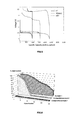
- FIG. 10 ( b ) represents the Specific capacity as a function of cycle number
- FIG. 12 represents the charge curve of air composite cathodes containing Li 2 O 2 using electrolyte from Example 1 tested in presence of various salts (LiClO 4 , LiPF 6 or LiTFSI) tested at 50 mA/g-C.
- the theoretical capacity of Li 2 O 2 is 1000 mAh/g-C.
Landscapes
- Chemical & Material Sciences (AREA)
- Engineering & Computer Science (AREA)
- Manufacturing & Machinery (AREA)
- Chemical Kinetics & Catalysis (AREA)
- Electrochemistry (AREA)
- General Chemical & Material Sciences (AREA)
- Physics & Mathematics (AREA)
- Condensed Matter Physics & Semiconductors (AREA)
- General Physics & Mathematics (AREA)
- Inorganic Chemistry (AREA)
- Hybrid Cells (AREA)
- Inert Electrodes (AREA)
Abstract
Description
-
- metal anode (preferentially Li),
- non-aqueous electrolyte,
- air cathode (preferentially O2 cathode) most commonly and usually preferably based on carbon (but other cathode materials are known in this context), binder and sometimes catalyst.
At anode: Li→Li+ +e −
At air cathode: 2Li+ +x/2O2+2e −→Li2Ox
Upon charge:
At anode: Li+ +e −→Li
At air cathode: Li2Ox→2Li+ +x/2O2+2e −
-
- Problem 1: Low initial capacity. This is a problem for both primary and secondary metal-air non-aqueous batteries.
- Problem 2: Low efficiency of system, characterized by a large voltage gap between charge and discharge voltages. This is only an issue for secondary metal-air non-aqueous batteries subjected to charging and discharging cycles.
- Problem 3: Poor capacity retention, which leads to bad cyclability of the system and a low number of cycles because the capacity drops rapidly. This also is only an issue for secondary metal-air non-aqueous batteries.
- Problem 4: The reaction process is slow and charge/discharge performances at high current are lower.
- [Reference 1 (non-patent): J. Read, J. Electrochem. Soc. 149 (9), A1190-A1195, (2002)] describes the use of an electrolyte comprising LiPF6 in solvents selected from propylene carbonate (PC), γ-butyrolactone (γ-BL), ethylene carbonate (EC), diethyl carbonate (DEC), dimethyl carbonate (DMC), 1,2-dimethoxyethane (DME), tetrahydrofuran (THF), and combinations thereof. Electrolytes with high O2 solubility correlated with high discharge capacity. PC:DEC was the preferred solvent combination.
- [Reference 2 (non-patent): J. Read, J. Electrochem. Soc. 150 (10), A1351-A1356 (2003)] teaches that the discharge capacity is increased if electrolyte viscosity is decreased. It is taught that by increasing the O2 concentration and/or partial pressure, discharge capacities can be increased.
- [Reference 3 (non-patent): J. Read, J. Electrochem. Soc. 153, (1), A96-A100, 2006] describes the use of ether-based electrolytes, such as 1,2-dimethoxyethane (DME), 1,3-dioxolane (DOL), with different salts. Rate capabilities are said to be improved by optimizing the electrolyte viscosity.
- [Reference 4 (non-patent): W. Xu, J. Xiao, J. Zhang, D. Y. Wang, J. G. Zhang, J. Electrochem. Soc. 2009, 156, A773] teach that electrolyte polarity is a more important factor influencing the electrochemical performances than the oxygen solubility in the electrolyte. It is described that the effect of electrolyte viscosity and conductivity on performances is limited. The O2 diffusion rate through the open channels of the air electrode is several orders of magnitude higher than that through the liquid electrolyte. The open channels are strongly dependent on the polarity of solvent. Thus an electrolyte based on ethers & glymes can easily wet the surface of the carbon surface of the air electrode because these electrolytes have low polarity as well.
- [Reference 5 (non-patent): W. Xu, J. Xiao, D. Wang, J. Zhuang, J-G. Zhang, JES, 157, (2), A219-A224, (2010)] teach that maximum capacity varies as a function of the amount of electrolyte. Also, the effect of TPFPB (tris(pentafluorophenyl)borane) as an additive in the electrolyte is studied. TPFPB facilitates the dissolution of large amounts of Li salts (such as LiF, Li2O and Li2O2) normally insoluble in organic solvents, but an increase in TPFPB % also leads to an increase of viscosity, which leads to a decrease of discharge capacity.
- [Reference 6 (patent): US 2011/0059355 A1 (Battelle Memorial Institute)] describes how oxygen permeable membranes may be prepared to reduce overall battery weight and improve specific energy. The use of crown ethers as additive (e.g. 12-crown-4 or 15-crown-5) is described as increasing discharge capacity.
- [Reference 7 (non-patent): W. Xu, J. Xiao, D. Wang, J. Zhang, J-G. Zhang, Electrochem. And Solid State Letters, 13, (4), A48-A51, (2010)] teaches the use of crown ethers used as additive with 1M lithium bis(trifluormethan-sulfonyl)imide (LiTFSI), propylene carbonate/ethylene carbonate (PC/EC) solvent. It is reported that when 15 wt % of 12-crown-4 or 15-crown-5 is added to the electrolyte, the capacity of Li/air cell increases by 28% and 16%, respectively.
- [Reference 8 (non-patent): T. Kukobi, T. Okuyama, T. Ohsaki, N. Takami, J. Power Sources, 146, (2005), 766-769] describes a study of the influence of hydrophobic room temperature ionic liquids on discharge capacity.
- [Reference 9 (non-patent): H. Ye, J. Xu, ECS Transactions, 3, (42), 73-81, (2008)] describes polymer electrolytes based on ionic liquids, such as salts of the TFSI anion (bis(trifluoromethanesulfonyl)imide), such as P13TFSI (P13 cation is 1-methyl-3-propylpyrrolidinium). The materials developed are taught to enable protection of Li, and reversible Li plating/stripping.
- [Reference 10 (non-patent): D. Zhang, R. Li, T. Huang, A. Yu, Journal of Power Sources, 195, (2010), 1202-1206] discloses a composite polymer electrolyte for a Li-air battery. The principal goal is the protection of Li from water. A composite polymer electrolyte medium is prepared using a polymer component (PvDF-HFP), a lithium salt-ionic liquid (LiTFSI-PMMITFSI) and hydrophobic silica in a weight ratio of 27:70:3 wt %.
- [Reference 11 (non-patent): J. Hassoun, F. Croce, M. Armand, B. Scosati, Angewandte Chemie Int. Ed. 2011, 50, 1-5] describe solid state ZrO2 added to PEO-LiCF3SO3 as solvent-free polymer electrolyte.
- [Reference 12 (non-patent): Cormac O. Laoire, S. Mukerjee, E. J. Plitcha, M. A. Hendrickson, K. M. Abraham J. Phys. Chem. (2010)] describe a study of electrolytes TBAPF6 (tetrabutylammonium hexafluorophosphate) or LiPF6 in DMSO, DME, TEGDME, acetonitrile.
- [Reference 13 (non-patent): Cormac O Laoire, S. Mukerjee, E. J. Plitcha, M. A. Hendrickson, K. M. Abraham J. Electrochem. Soc. 158 (3), A302-A308 (2011)] disclose a rechargeable Li-air cell using an electrolyte composed of LiPF6 in TEGDME (tetraethylene glycol dimethyl ether).
- [Reference 14 (non-patent): S. A. Freunberger, Y. Chen, N. E. Drewett, L. J. Hardwick, F. Bardé, P. G. Bruce Angew. Chem. Int. Ed., 50, 1-6, (2011)] describe a lithium-oxygen battery with ether-based electrolytes. It is described that Li2O2 is formed as major discharge product during discharge. However, Li2O2 is not the main discharged product any more after just five cycles.
- [Reference 15 (patent): US2010/0266907 A1, R. Yazami] describes electrochemical systems with a solvent having metal-ions and oxygen dissolved therein, a fluorinated or metalloprotein oxygen dissolution enhancer provided in the solvent for enhancing dissolution of the oxygen in the solvent, a metal oxide dissolution enhancer, and a current collector in electrical contact with the solvent.
- [Reference 16 (non-patent): S. S. Zhang, J. Read, J. Power Sources 196, 2011, 2867] discloses the use of tris(2,2,2-trifluoroethyl)phosphite (TTFP) (30% wt) as co-solvent in propylene carbonate (PC) to improve the discharge performances of Li-air batteries. However TTFP-based electrolytes might not be suitable for use in rechargeable Li-air batteries since the valence of the phosphorus is +3, and so it can potentially be oxidized to +5 to form tris(2,2,2-trifluoroethyl)phosphate TFP.
- [Reference 17 (non-patent): S. S. Zhang, K. Xu, J. Read, J. Power Sources 196, 2011, 3906-3910] similarly teaches the use of LiCF3SO3 in PC/TFP as solvent blend with different concentrations.
- [Reference 18 (patent): US2009/0239113 A1, Hase et al.] discloses systems in which the positive electrode and the non-aqueous electrolyte solution of the Li-air battery contain a compound having a stable radical skeleton (e.g. nitroxyl radical).
-
- High ionic conductivity
- Thermal and chemical stability
- Wide potential window (electrochemical stability)
- Low reactivity toward other components in the battery (separator, current collectors, electrodes . . . )
Additionally, it is best if those electrolytes are also: - Non-toxic
- Safe, non-flammable
- Inexpensive
-
- a decrease of the voltage gap by a combination of increasing discharge voltage and decreasing charging voltage (partially resolving
problem 2 as set out above) - an increase of discharge performances (partially resolving
problem 1 as set out above) - a capability of the electrolyte to promote the ideal reaction (i.e. Li2Ox formation and decomposition) in the Li-Air and Li—O2 battery and this for several cycles.
- a decrease of the voltage gap by a combination of increasing discharge voltage and decreasing charging voltage (partially resolving
-
- a negative electrode containing a negative-electrode active material;
- a positive electrode using oxygen as a positive-electrode active material; and an electrolyte medium arranged between the negative electrode and the positive electrode;
-
- N,N-dimethylformamide (DMF), boiling point: 153° C.

-
- dimethylacetamide, boiling point: 164-166° C.

-
- N-methylpyrrolidone, boiling point: 202-204° C.


-
- tetraethylurea (TEU)

-
- N-methyl-formamide

-
- formamide

-
- urea

Charging capability (Example 2)>(Example 1)
Capacity (BP2000)˜Capacity (Ketjen Black)>>Capacity (Super P).
| TABLE 1 |
| Comparison of lithium-air battery performances during the |
| |
| Comparative | Comparative | ||||
| Example 1 | Example 2 | example 1 | example 2 | ||
| Discharge capacity | 1640 | 1430 | 1200 | 2600 |
| (mAh/g-C) | ||||
| Total Charge | 1460 | 1430 | 50 | 150 |
| capacity <4.2 V | ||||
| (mAh/g-C) | ||||
| Charge capacity | 1390 | 1430 | 0 | 100 |
| <4 V (mAh/g-C) | ||||
| Charge capacity | 675 | 1072 | 0 | 50 |
| <3.65 V (mAh/g-C) | ||||
| % Recharge | 41.2 | 75 | 0 | 1.9 |
| <3.65 V | ||||
| TABLE 2 |
| Comparison of lithium-air battery performances during |
| using Example 1 as electrolyte combined with various carbon sources |
| to prepare the air cathodes |
| Example 1 | Example 1 | |||
| Example 1 | combined | combined | ||
| combined | with | with | ||
| with | BP | 2000 | Ketjen | |
| Discharge capacity |
| 1600 | 5800 | 5850 | |
| (mAh/g-C) | |||
| |
1400 | 3800 | 4850 |
| <4.2 V (mAh/g-C) | |||
| Charge capacity <4 V | 1250 | 3200 | 4800 |
| (mAh/g-C) | |||
| Charge capacity <3.65 |
600 | 2900 | 3150 |
| (mAh/g-C) | |||
| % Recharge <3.65 V | 37.5 | 50 | 53.8 |
Claims (13)
Applications Claiming Priority (1)
| Application Number | Priority Date | Filing Date | Title |
|---|---|---|---|
| PCT/EP2011/067652 WO2013053378A1 (en) | 2011-10-10 | 2011-10-10 | Stable non-aqueous electrolyte promoting ideal reaction process in rechargeable lithium-air batteries |
Publications (2)
| Publication Number | Publication Date |
|---|---|
| US20140255802A1 US20140255802A1 (en) | 2014-09-11 |
| US9525197B2 true US9525197B2 (en) | 2016-12-20 |
Family
ID=44802049
Family Applications (1)
| Application Number | Title | Priority Date | Filing Date |
|---|---|---|---|
| US14/350,903 Active 2032-05-03 US9525197B2 (en) | 2011-10-10 | 2011-10-10 | Stable non-aqueous electrolyte promoting ideal reaction process in rechargeable lithium-air batteries |
Country Status (3)
| Country | Link |
|---|---|
| US (1) | US9525197B2 (en) |
| GB (1) | GB2508787B (en) |
| WO (1) | WO2013053378A1 (en) |
Families Citing this family (15)
| Publication number | Priority date | Publication date | Assignee | Title |
|---|---|---|---|---|
| JP6578611B2 (en) * | 2013-11-25 | 2019-09-25 | 独立行政法人国立高等専門学校機構 | Positive electrode for air battery and air battery using the positive electrode |
| EP3235053B1 (en) * | 2014-12-18 | 2019-09-18 | Robert Bosch GmbH | Metal/air battery with gas separations unit and load-leveling oxygen storage system |
| US10707526B2 (en) | 2015-03-27 | 2020-07-07 | New Dominion Enterprises Inc. | All-inorganic solvents for electrolytes |
| US10707531B1 (en) | 2016-09-27 | 2020-07-07 | New Dominion Enterprises Inc. | All-inorganic solvents for electrolytes |
| US20200343581A1 (en) * | 2018-01-10 | 2020-10-29 | Mazda Motor Corporation | Electrolyte solution for lithium ion secondary battery, and lithium ion secondary battery |
| US11316199B2 (en) | 2018-01-16 | 2022-04-26 | International Business Machines Corporation | Rechargeable metal halide battery |
| CA3097217A1 (en) * | 2018-04-27 | 2019-10-31 | Dow Global Technologies Llc | Solvent systems for use in lithium ion battery production |
| US11165093B2 (en) | 2019-03-08 | 2021-11-02 | International Business Machines Corporation | Rechargeable metal halide battery |
| WO2020200416A1 (en) | 2019-04-01 | 2020-10-08 | Toyota Motor Europe | 3d ordered nanomesh for metal-air battery |
| CN110190282B (en) * | 2019-04-22 | 2020-11-13 | 深圳烯湾科技有限公司 | Carbon nano tube conductive slurry and preparation method and application thereof |
| US12288877B2 (en) | 2020-07-13 | 2025-04-29 | International Business Machines Corporation | Rechargeable metal halide battery with intercalation anode |
| US11824199B2 (en) * | 2020-07-17 | 2023-11-21 | International Business Machines Corporation | Metal halide cathode with enriched conductive additive |
| CN113363577A (en) * | 2021-06-02 | 2021-09-07 | 北京理工大学 | Multifunctional lithium air battery electrolyte additive |
| CN114530656A (en) * | 2022-02-08 | 2022-05-24 | 中国电子科技集团公司第十八研究所 | Preparation method of high DN (DN) value electrolyte applied to lithium-gas battery and electrolyte |
| CN115650218B (en) * | 2022-11-16 | 2024-05-24 | 西安交通大学 | A room-temperature molten salt with a wide potential window and its preparation method and application |
Citations (10)
| Publication number | Priority date | Publication date | Assignee | Title |
|---|---|---|---|---|
| US5053375A (en) * | 1990-01-08 | 1991-10-01 | Alupower, Inc. | Electrochemical cathode and materials therefor |
| EP1096591A1 (en) | 1999-10-26 | 2001-05-02 | MERCK PATENT GmbH | Polymer electrolyte membrane for use in lithium batteries |
| US20070117007A1 (en) * | 2005-11-23 | 2007-05-24 | Polyplus Battery Company | Li/air non-aqueous batteries |
| US7282295B2 (en) | 2004-02-06 | 2007-10-16 | Polyplus Battery Company | Protected active metal electrode and battery cell structures with non-aqueous interlayer architecture |
| US7491458B2 (en) | 2003-11-10 | 2009-02-17 | Polyplus Battery Company | Active metal fuel cells |
| US20090053594A1 (en) * | 2007-08-23 | 2009-02-26 | Johnson Lonnie G | Rechargeable air battery and manufacturing method |
| US20090239113A1 (en) | 2008-03-24 | 2009-09-24 | Kabushiki Kaisha Toyota Chuo Kenkyusho | Alkali metal air battery |
| US20100266907A1 (en) | 2008-11-04 | 2010-10-21 | Rachid Yazami | Metal air battery system |
| US20100273066A1 (en) | 2007-08-23 | 2010-10-28 | Excellatron Solid State Llc | Rechargeable Lithium Air Battery Cell Having Electrolyte with Alkylene Additive |
| US20110059355A1 (en) | 2009-09-10 | 2011-03-10 | Battelle Memorial Institute | High-energy metal air batteries |
Family Cites Families (1)
| Publication number | Priority date | Publication date | Assignee | Title |
|---|---|---|---|---|
| WO2013040326A1 (en) * | 2011-09-15 | 2013-03-21 | Robert Bosch Gmbh | Stable electrolyte materials for li-air battery systems |
-
2011
- 2011-10-10 WO PCT/EP2011/067652 patent/WO2013053378A1/en not_active Ceased
- 2011-10-10 US US14/350,903 patent/US9525197B2/en active Active
- 2011-10-10 GB GB1406334.1A patent/GB2508787B/en not_active Expired - Fee Related
Patent Citations (10)
| Publication number | Priority date | Publication date | Assignee | Title |
|---|---|---|---|---|
| US5053375A (en) * | 1990-01-08 | 1991-10-01 | Alupower, Inc. | Electrochemical cathode and materials therefor |
| EP1096591A1 (en) | 1999-10-26 | 2001-05-02 | MERCK PATENT GmbH | Polymer electrolyte membrane for use in lithium batteries |
| US7491458B2 (en) | 2003-11-10 | 2009-02-17 | Polyplus Battery Company | Active metal fuel cells |
| US7282295B2 (en) | 2004-02-06 | 2007-10-16 | Polyplus Battery Company | Protected active metal electrode and battery cell structures with non-aqueous interlayer architecture |
| US20070117007A1 (en) * | 2005-11-23 | 2007-05-24 | Polyplus Battery Company | Li/air non-aqueous batteries |
| US20090053594A1 (en) * | 2007-08-23 | 2009-02-26 | Johnson Lonnie G | Rechargeable air battery and manufacturing method |
| US20100273066A1 (en) | 2007-08-23 | 2010-10-28 | Excellatron Solid State Llc | Rechargeable Lithium Air Battery Cell Having Electrolyte with Alkylene Additive |
| US20090239113A1 (en) | 2008-03-24 | 2009-09-24 | Kabushiki Kaisha Toyota Chuo Kenkyusho | Alkali metal air battery |
| US20100266907A1 (en) | 2008-11-04 | 2010-10-21 | Rachid Yazami | Metal air battery system |
| US20110059355A1 (en) | 2009-09-10 | 2011-03-10 | Battelle Memorial Institute | High-energy metal air batteries |
Non-Patent Citations (24)
| Title |
|---|
| Apr. 15, 2014 Written Opinion issued in International Application No. PCT/EP2011/067652. |
| Bryantsev et al., "Computational Study of the Mechanisms of Superoxide-Induced Decomposition of Organic Carbonate-Based Electrolytes," The Journal of Physical Chemistry Letters, 2011, pp. 379-383, vol. 2. |
| Croce et al., "Role of the Ceramic Fillers in Enhancing the Transport Properties of Composite Polymer Electrolytes," Electrochimica Acta, 2001, pp. 2457-2461, vol. 46. |
| Freunberger et al., "The Lithium-Oxygen Battery with Ether-Based Electrolytes," Angewandte Chemie International Edition, 2011, pp. 1-6, vol. 50. |
| Hassoun et al., "Investigation of the O2 Electrochemistry in a Polymer Electrolyte Solid-State Cell," Angewandte Chemie International Edition, 2011, pp. 1-5, vol. 50. |
| Kamaya et al., "A Lithium Superionic Conductor," Nature Materials, Jul. 31, 2011, pp. 682-686, vol. 10. |
| Kuboki et al., "Lithium-Air Batteries Using Hydrophobic Room Temperature Ionic Liquid Electrolyte," Journal of Source Powers, May 31, 2005, pp. 766-769, vol. 146. |
| Laoire et al., "Influence of Nonaqueous Solvents on the Electrochemistry of Oxygen in the Rechargeable Lithium-Air Battery," Journal of Physical Chemistry, Apr. 12, 2010, pp. 9178-9186, vol. 114. |
| Laoire et al., "Rechargeable Lithium/TEGDME-LiPF6/O2 Battery," Journal of the Electrochemical Society, Jan. 19, 2011, pp. A302-A308, vol. 158 No. 3. |
| Nov. 17, 2011 International Search Report issued in International Application No. PCT/EP2011/067652. |
| Ogasawara et al., "Rechargeable Li2O2 Electrode for Lithium Batteries," JACS Articles, Jan. 5, 2006, pp. 1390-1393, vol. 128. |
| Read et al., "Oxygen Transport Properties of Organic Electrolytes and Performance of Lithium/Oxygen Battery," Journal of the Electrochemical Society, Aug. 27, 2003, pp. A1351-A1356, vol. 150, No. 10. |
| Read, "Characterization of Lithium/Oxygen Organic Electrolyte Battery," Journal of the Electrochemical Society, Jul. 29, 2002, pp. A1190-A1195; vol. 149 No. 9. |
| Read, "Ether-Based Electrolytes for the Lithium/Oxygen Organic Electrolyte Battery," Journal of the Electrochemical Society, Dec. 2, 2005, pp. A96-A100, vol. 153 No. 1. |
| Song et al., "Review of Gel-Type Polymer Electrolytes for Lithium-Ion Batteries," Journal of Power Sources, 1999, pp. 183-197, vol. 77. |
| Swierczynski et al., "Composite Polymeric Electrolytes from the PEODME-LiClO4-SiO4 System," Chemistry of Materials, Mar. 24, 2001, pp. 1560-1564, vol. 13 No. 5. |
| Świerczynski et al., "Composite Polymeric Electrolytes from the PEODME-LiClO4-SiO4 System," Chemistry of Materials, Mar. 24, 2001, pp. 1560-1564, vol. 13 No. 5. |
| Xu et al., "Crown Ethers in Nonaqueous Electrolytes for Lithium/Air Batteries," Electrochemical and Solid-State Letters, Feb. 4, 2010, pp. A48-A51, vol. 13 No. 4. |
| Xu et al., "Effects of Nonaqueous Electrolytes on the Performance of Lithium/Air Batteries," Journal of the Electrochemical Society, Dec. 18, 2009, pp. A219-A224, vol. 157 No. 2. |
| Xu et al., "Optimization of Nonaqueous Electrolytes for Primary Lithium/Air Batteries Operated in Ambient Environment," Journal of the Electrochemical Society, Jul. 27, 2009, pp. A773-A779, vol. 156. No. 10. |
| Ye et al., "Polymer Electrolytes Based on Ionic Liquids and Their Application to Solid-state Thin-film Li-Oxygen Batteries," ECS Transactions, 2008, pp. 73-81, vol. 3 No. 42. |
| Zhang et al., "A Non-Aqueous Electrolyte for the Operation of Li/Air Battery in Ambient Environment," Journal of Power Sources, Jan. 8, 2011, pp. 3906-3910, vol. 196. |
| Zhang et al., "Novel Composite Polymer Electrolyte for Lithium Air Batteries," Journal of Source Powers, Aug. 31, 2009, pp. 1202-1206, vol. 195. |
| Zhang et al., "Partially Flourinated Solvent as a Co-Solvent for the Non-Aqueous Electrolyte of Li/Air Battery," Journal of Power Sources, Nov. 11, 2010, pp. 2867-2870, vol. 196. |
Also Published As
| Publication number | Publication date |
|---|---|
| GB2508787B (en) | 2018-06-20 |
| WO2013053378A1 (en) | 2013-04-18 |
| US20140255802A1 (en) | 2014-09-11 |
| GB2508787A (en) | 2014-06-11 |
| GB201406334D0 (en) | 2014-05-21 |
| GB2508787A8 (en) | 2014-09-10 |
Similar Documents
| Publication | Publication Date | Title |
|---|---|---|
| US20140255802A1 (en) | Stable non-aqueous electrolyte promoting ideal reaction process in rechargeable lithium-air batteries | |
| US10153527B2 (en) | Three-dimensional carbon foam-supported electrode for metal-air batteries | |
| CN101960664B (en) | Lithium air battery | |
| JP5290247B2 (en) | Electrolytic solution for lithium battery, lithium battery, and operating method of lithium battery | |
| CN103370830B (en) | Nonaqueous electrolyte air cell | |
| US20130202974A1 (en) | Air cathode, metal-air battery and method for producing air cathode for metal-air battery | |
| CN103069626B (en) | Liquid air electrode for metal-air battery and metal-air battery having said liquid air electrode | |
| CN111602277B (en) | Rechargeable metal halide battery | |
| CN101821897A (en) | Air secondary battery | |
| CN103026545A (en) | Cathode catalyst for rechargeable metal-air battery and rechargeable metal-air battery | |
| EP3698420B1 (en) | Additives and methods to add additives in a rechargeable non-aqueous lithium-air battery | |
| JP5215146B2 (en) | Lithium air secondary battery and method for producing lithium air secondary battery | |
| US12095068B2 (en) | Rechargeable non-aqueous lithium-air battery cell comprising a solid organic catalyst | |
| US12166177B2 (en) | Stable electrolyte based on a fluorinated ionic liquid and its use in high current rate lithium-air batteries | |
| EP2835859B1 (en) | Electrolyte solution for lithium-air batteries, and lithium-air battery comprising the same | |
| KR101299666B1 (en) | Electrolyte for lithium air rechargeable battery and lithium air rechargeable battery using the same | |
| WO2021148836A1 (en) | Naphthalene based lithium compounds, a process for their preparation, their use as solid organic catalyst, and their use in rechargeable non-aqueous lithium-air battery cells | |
| CN104577186A (en) | lithium battery comprising tricynoalkylborate electrolyte additive. | |
| KR102452938B1 (en) | Electrolyte for lithium metal battery and lithium metal battery comprising the same | |
| US20230187610A1 (en) | Composition, lithium-ion battery and lithium-air battery |
Legal Events
| Date | Code | Title | Description |
|---|---|---|---|
| AS | Assignment |
Owner name: TOYOTA MOTOR EUROPE NV/SA, BELGIUM Free format text: ASSIGNMENT OF ASSIGNORS INTEREST;ASSIGNORS:BARDE, FANNY JEANNE JULIE;BRUCE, PETER GEORGE;CHEN, YUHUI;AND OTHERS;SIGNING DATES FROM 20141009 TO 20141110;REEL/FRAME:034251/0095 Owner name: THE UNIVERSITY COURT OF THE UNIVERSITY OF ST. ANDR Free format text: ASSIGNMENT OF ASSIGNORS INTEREST;ASSIGNORS:BARDE, FANNY JEANNE JULIE;BRUCE, PETER GEORGE;CHEN, YUHUI;AND OTHERS;SIGNING DATES FROM 20141009 TO 20141110;REEL/FRAME:034251/0095 |
|
| STCF | Information on status: patent grant |
Free format text: PATENTED CASE |
|
| AS | Assignment |
Owner name: TOYOTA JIDOSHA KABUSHIKI KAISHA, JAPAN Free format text: ASSIGNMENT OF ASSIGNORS INTEREST;ASSIGNOR:TOYOTA MOTOR EUROPE NV/SA;REEL/FRAME:041749/0455 Effective date: 20170206 |
|
| MAFP | Maintenance fee payment |
Free format text: PAYMENT OF MAINTENANCE FEE, 4TH YEAR, LARGE ENTITY (ORIGINAL EVENT CODE: M1551); ENTITY STATUS OF PATENT OWNER: LARGE ENTITY Year of fee payment: 4 |
|
| MAFP | Maintenance fee payment |
Free format text: PAYMENT OF MAINTENANCE FEE, 8TH YEAR, LARGE ENTITY (ORIGINAL EVENT CODE: M1552); ENTITY STATUS OF PATENT OWNER: LARGE ENTITY Year of fee payment: 8 |