US9520400B2 - NOR structure flash memory and manufacturing method thereof - Google Patents

NOR structure flash memory and manufacturing method thereof Download PDF

Info

Publication number
US9520400B2
US9520400B2 US14/398,849 US201314398849A US9520400B2 US 9520400 B2 US9520400 B2 US 9520400B2 US 201314398849 A US201314398849 A US 201314398849A US 9520400 B2 US9520400 B2 US 9520400B2
Authority
US
United States
Prior art keywords
layer
flash memory
dielectric layer
polysilicon layer
mask dielectric
Prior art date
Legal status (The legal status is an assumption and is not a legal conclusion. Google has not performed a legal analysis and makes no representation as to the accuracy of the status listed.)
Active
Application number
US14/398,849
Other versions
US20150118838A1 (en
Inventor
Shizhen Sun
Hao Fang
Yong Gu
Current Assignee (The listed assignees may be inaccurate. Google has not performed a legal analysis and makes no representation or warranty as to the accuracy of the list.)
CSMC Technologies Fab2 Co Ltd
Original Assignee
CSMC Technologies Fab1 Co Ltd
Priority date (The priority date is an assumption and is not a legal conclusion. Google has not performed a legal analysis and makes no representation as to the accuracy of the date listed.)
Filing date
Publication date
Application filed by CSMC Technologies Fab1 Co Ltd filed Critical CSMC Technologies Fab1 Co Ltd
Assigned to CSMC TECHNOLOGIES FAB1 CO., LTD. reassignment CSMC TECHNOLOGIES FAB1 CO., LTD. ASSIGNMENT OF ASSIGNORS INTEREST (SEE DOCUMENT FOR DETAILS). Assignors: GU, YONG, SUN, Shizhen, FANG, HAO
Publication of US20150118838A1 publication Critical patent/US20150118838A1/en
Application granted granted Critical
Publication of US9520400B2 publication Critical patent/US9520400B2/en
Assigned to CSMC TECHNOLOGIES FAB2 CO., LTD. reassignment CSMC TECHNOLOGIES FAB2 CO., LTD. MERGER (SEE DOCUMENT FOR DETAILS). Assignors: CSMC TECHNOLOGIES FAB1 CO., LTD.
Active legal-status Critical Current
Anticipated expiration legal-status Critical

Links

Images

Classifications

    • H01L27/1052
    • HELECTRICITY
    • H10SEMICONDUCTOR DEVICES; ELECTRIC SOLID-STATE DEVICES NOT OTHERWISE PROVIDED FOR
    • H10BELECTRONIC MEMORY DEVICES
    • H10B41/00Electrically erasable-and-programmable ROM [EEPROM] devices comprising floating gates
    • H10B41/30Electrically erasable-and-programmable ROM [EEPROM] devices comprising floating gates characterised by the memory core region
    • HELECTRICITY
    • H10SEMICONDUCTOR DEVICES; ELECTRIC SOLID-STATE DEVICES NOT OTHERWISE PROVIDED FOR
    • H10DINORGANIC ELECTRIC SEMICONDUCTOR DEVICES
    • H10D30/00Field-effect transistors [FET]
    • H10D30/01Manufacture or treatment
    • H10D30/021Manufacture or treatment of FETs having insulated gates [IGFET]
    • H10D30/0411Manufacture or treatment of FETs having insulated gates [IGFET] of FETs having floating gates
    • H01L21/28273
    • HELECTRICITY
    • H01ELECTRIC ELEMENTS
    • H01LSEMICONDUCTOR DEVICES NOT COVERED BY CLASS H10
    • H01L21/00Processes or apparatus adapted for the manufacture or treatment of semiconductor or solid state devices or of parts thereof
    • H01L21/02Manufacture or treatment of semiconductor devices or of parts thereof
    • H01L21/04Manufacture or treatment of semiconductor devices or of parts thereof the devices having potential barriers, e.g. a PN junction, depletion layer or carrier concentration layer
    • H01L21/18Manufacture or treatment of semiconductor devices or of parts thereof the devices having potential barriers, e.g. a PN junction, depletion layer or carrier concentration layer the devices having semiconductor bodies comprising elements of Group IV of the Periodic Table or AIIIBV compounds with or without impurities, e.g. doping materials
    • H01L21/28Manufacture of electrodes on semiconductor bodies using processes or apparatus not provided for in groups H01L21/20 - H01L21/268
    • H01L21/283Deposition of conductive or insulating materials for electrodes conducting electric current
    • H01L27/11521
    • H01L27/11524
    • H01L29/42324
    • H01L29/66825
    • H01L29/7881
    • HELECTRICITY
    • H10SEMICONDUCTOR DEVICES; ELECTRIC SOLID-STATE DEVICES NOT OTHERWISE PROVIDED FOR
    • H10BELECTRONIC MEMORY DEVICES
    • H10B41/00Electrically erasable-and-programmable ROM [EEPROM] devices comprising floating gates
    • HELECTRICITY
    • H10SEMICONDUCTOR DEVICES; ELECTRIC SOLID-STATE DEVICES NOT OTHERWISE PROVIDED FOR
    • H10BELECTRONIC MEMORY DEVICES
    • H10B41/00Electrically erasable-and-programmable ROM [EEPROM] devices comprising floating gates
    • H10B41/30Electrically erasable-and-programmable ROM [EEPROM] devices comprising floating gates characterised by the memory core region
    • H10B41/35Electrically erasable-and-programmable ROM [EEPROM] devices comprising floating gates characterised by the memory core region with a cell select transistor, e.g. NAND
    • HELECTRICITY
    • H10SEMICONDUCTOR DEVICES; ELECTRIC SOLID-STATE DEVICES NOT OTHERWISE PROVIDED FOR
    • H10DINORGANIC ELECTRIC SEMICONDUCTOR DEVICES
    • H10D30/00Field-effect transistors [FET]
    • H10D30/60Insulated-gate field-effect transistors [IGFET]
    • H10D30/68Floating-gate IGFETs
    • H10D30/681Floating-gate IGFETs having only two programming levels
    • HELECTRICITY
    • H10SEMICONDUCTOR DEVICES; ELECTRIC SOLID-STATE DEVICES NOT OTHERWISE PROVIDED FOR
    • H10DINORGANIC ELECTRIC SEMICONDUCTOR DEVICES
    • H10D30/00Field-effect transistors [FET]
    • H10D30/60Insulated-gate field-effect transistors [IGFET]
    • H10D30/68Floating-gate IGFETs
    • H10D30/6891Floating-gate IGFETs characterised by the shapes, relative sizes or dispositions of the floating gate electrode
    • HELECTRICITY
    • H10SEMICONDUCTOR DEVICES; ELECTRIC SOLID-STATE DEVICES NOT OTHERWISE PROVIDED FOR
    • H10DINORGANIC ELECTRIC SEMICONDUCTOR DEVICES
    • H10D64/00Electrodes of devices having potential barriers
    • H10D64/01Manufacture or treatment
    • H10D64/031Manufacture or treatment of data-storage electrodes
    • H10D64/035Manufacture or treatment of data-storage electrodes comprising conductor-insulator-conductor-insulator-semiconductor structures
    • H10P14/40

Definitions

  • the present invention relates to flash memories, and more particularly relates to a NOR (EPROM Tunnel Oxide) flash memory and its manufacturing method.
  • NOR EPROM Tunnel Oxide
  • Flash memory is a common memory, which has been widely used in various kinds of digital storage devices.
  • the flash memory usually stores information using a floating gate structure.
  • Various kinds of flash memories are developed according to the difference of the floating structure.
  • NOR flash memory is an important kind of flash memory. Intel has introduced ETOXTM NOR flash memory in the last century, the NOR flash memory has a large market share in the memory market.
  • FIG. 1 is a schematic view of a conventional NOR flash memory.
  • two NOR flash memory units i.e. 10 a and 10 b of the NOR flash memory, are symmetric to each other and share a source (S), and the flash memory units 10 a and 10 b are symmetric.
  • a metal silicide layer 130 is located on a floating gate, and can be used to bias a gate signal on the floating gate.
  • 160 is a dielectric layer at least surrounding the floating gate
  • 140 is an ILD (interlayer dielectric) barrier layer
  • 150 is a drain electrode (it is usually a drain contacting hole) led out by the drain (D) of the NOR flash memory unit.
  • the drain electrode 150 is floating.
  • the drain electrode 150 is electrical isolated from the gate electrode through the dielectric layer 160 and/or the ILD barrier layer 140 (the actual thicknesses of the dielectric layer 160 and the ILD layer 140 are much smaller than that shown in FIG. 1 ).
  • the voltage difference between the gate electrode and the drain electrode 150 is very large, a drain current shown in FIG. 1 will be induced.
  • the NOR flash memory continuously scales down, for example, as the critical dimension of the NOR flash memory is smaller than 0.13 ⁇ m, an isolation layer (such as the dielectric layer 160 and the ILD barrier layer 140 ) between the drain electrode 150 and the gate electrode become much thinner, a drain current problem during the erasing process of the gate electrode and the drain electrode 150 become much worse.
  • an isolation layer such as the dielectric layer 160 and the ILD barrier layer 140
  • An object of the present disclosure is to decrease a drain current between the gate electrode and the drain electrode of the NOR flash memory.
  • NOR flash memory a method for manufacturing the NOR flash memory, which includes:
  • a gate stack structure comprising a floating gate and configured to form the NOR flash memory, the gate stack structure comprising a tunneling dielectric layer, a first polysilicon layer, an inter-poly layer dielectric, a second polysilicon layer, which are sequentially laminated from low to up;
  • two symmetric flash memory units share a source to form a common source.
  • part of the mask dielectric layer is etched when a corresponding dielectric layer on the common source of the NOR flash memory is etched.
  • an inclined surface is formed on the exposed second polysilicon layer.
  • the method further comprising:
  • the thickness of the mask dielectric layer is in the range of from 30 nm to 100 nm.
  • the mask dielectric layer is made of silica.
  • the etching is an anisotropic etching.
  • the metal silicide is cobalt silicide or tungsten silicide.
  • a 0.13 ⁇ m or less technology is used in the method.
  • NOR flash memory manufactured according to the above method, the NOR flash memory includes unetched mask dielectric layer, the unetched mask dielectric layer is substantially located between a metal silicide layer and a drain contacting hole of the NOR flash memory.
  • the thickness of the unetched mask dielectric layer is in the range of from 30 nm to 100 nm.
  • a critical dimension of the NOR flash memory is 0.18 ⁇ m or less.
  • a mask dielectric layer is formed and partially etched to expose part of the second polysilicon layer, thus a relative position between the metal silicide layer and the drain contacting hole can be defined
  • the unetched mask dielectric layer is substantially located between the metal silicide layer and the drain contacting hole of the NOR flash memory, thus, it is advantageous to decrease the drain current between the gate electrode and the drain electrode, especially the drain current in the erasing process.
  • the above manufacturing process is not complex, a process window is large, and a side effect is small, which are advantageous to large scale production.
  • FIG. 1 is a schematic view of a conventional NOR flash memory
  • FIGS. 2 to 5 show a manufacturing process of the NOR flash memory shown in FIG. 6 according to one embodiment
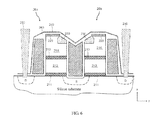
  • FIG. 6 is a schematic view of the NOR flash memory according to an embodiment of the disclosure.
  • direction terms e. g. ‘up’, ‘low’ etc.
  • a direction parallel to the direction of the channel between the source (S) and the drain (D) of the NOR flash memory is defined as the direction of Y axis
  • a direction perpendicular to the surface of the silicon surface is defined as the direction of Z axis.
  • a first method is to use an etching method with etching selectivity to etch a drain contacting hole, thus a side etching effect of an ILD barrier layer can be reduced, and the thickness of the ILD barrier layer 140 will not decrease.
  • a second method is to increase the thickness of the ILD barrier layer 140 .
  • a third method is to decrease position errors between the floating gate and the drain contacting hole, and decrease a thickness drift of an isolating layer between the floating gate and the drain.
  • the above methods for decreasing drain current have side effect (e.g., it can lead to stress induced leakage), which is not conducive to mass production of the NOR flash memory.
  • FIG. 6 is a schematic view of the NOR flash memory according to one embodiment.
  • FIGS. 2 to 5 show a manufacturing method of the NOR flash memory shown in FIG. 6 . The method of manufacturing the NOR flash memory is described more fully with reference to FIGS. 2 to 6 .
  • a gate stack structure configured to form the NOR flash memory
  • the gate stack structure includes the floating gate.
  • the gate stack structure includes a tunneling dielectric layer 211 , a first polysilicon layer 212 , an inter-poly layer dielectric (IPD) 213 , a second polysilicon layer 214 , a mask dielectric layer 220 ′′ formed by patterning the second polysilicon layer 214 , which are sequentially laminated from low to up (along the direction of Z axis).
  • IPD inter-poly layer dielectric
  • the NOR flash memory has a common source
  • the mask dielectric layer 220 ′′ is patterned synchronously when the tunneling dielectric layer 211 , the first polysilicon layer 212 , the IPD 213 , the second polysilicon layer 214 are patterned and etched, thus the mask dielectric layer 220 ′′ is formed on the second polysilicon layer 214 with alignment.
  • the first polysilicon layer 212 is configured to store electrons to form the floating gate
  • the second polysilicon layer 214 is configured to form the gate electrode of the NOR flash memory.
  • the sizes of the tunneling dielectric layer 211 , the first polysilicon layer 212 , the IPD 213 , and the second polysilicon layer 214 can be varied without limiting.
  • the mask dielectric layer 220 ′′ can be made of insulating dielectric material, such as silica, and specific manufacturing processes of the mask dielectric layer 220 ′′ are not limited.
  • the mask dielectric layer 220 ′′ is made of silica, it can be manufactured by different processes, such as LPTEOS (Low-Pressure Tetraethylorthosilicate), PETEOS (Plasma Enhanced Tetraethylorthosilicate), HTO (high temperature silicon oxide), ISSG (In-Situ Steam Generation).
  • the thickness of the mask dielectric layer 220 ′′ can be varied from 30 nm to 100 nm, for example, the thickness of the mask dielectric layer 220 ′′ is 45 nm.
  • a photoresist layer 290 is formed, and the mask dielectric layer 220 ′′ is ready to be etched patternedly.
  • part of the mask dielectric layer 220 ′′ to be etched is defined, position of exposed part of the of the second polysilicon layer is defined, thus positions between the remaining part of the mask dielectric layer and the metal silicide layer formed based on the self alignment of the exposed second polysilicon layer can be determined.
  • part of the second polysilicon layer which is close to the common source i.e. away from drain contacting hole
  • An area of the second polysilicon layer exposed through the photoresist layer 290 is about 50% of the area of the second polysilicon layer 214 .
  • the mask dielectric layer 220 ′′ is etched using the photoresist layer 290 as a mask. Part of the mask dielectric layer 220 ′′ is removed to form the mask dielectric layer 220 ′.
  • a dielectric layer corresponded to the common source (S) is etched synchronously to expose the silicon substrate of the source, the exposed substrate is ready to be doped to form the source.
  • the mask dielectric layer 220 ′′ is etched synchronously with the etching of the common source.
  • an anisotropic etching method e.g. reactive ion etching
  • the mask dielectric layer is etched to expose part of the second polysilicon layer, the exposed part of the second polysilicon layer will be etched synchronously, thus an inclined surface of the second polysilicon layer shown in FIG. 4 is formed, an end of an inclined surface 2141 which is close to the mask dielectric layer is higher than the end which is close to the common source.
  • the exposed second polysilicon layer is self aligned to form the metal silicide layer 230 .
  • a metal layer is deposited on the inclined surface 2141 , then a metal silicide layer 230 is formed, the metal silicide layer is formed on a side of the gate which is close to the common source.
  • the metal silicide layer 230 can be made of CoSi (cobalt silicide) or WSi (tungsten silicide), etc.
  • the metal silicide layer 230 is configured to form a gate electrode of the gate, in an erasing process of the formed NOR flash memory, a higher voltage is biased to the metal silicide layer 230 , then the voltage is worked on the floating gate.
  • an isolating layer 260 and an ILD barrier layer 240 covering the gate are formed, the ILD is formed and flattened, the drain contacting hole 250 of the drain electrode is formed by patterning.
  • the above etching process may etch the mask dielectric layer 220 ′, thus the mask dielectric layer 220 ′ is further thinned to form the mask dielectric layer 220 .
  • the mask dielectric layer 220 (i.e. the unetched mask dielectric layer) retained in the NOR flash memory can effectively increase electric isolation between the metal silicide layer 230 and the drain contacting hole 250 , thus drain current between the metal silicide layer 230 and the drain contacting hole 250 can be reduced.
  • NOR flash memory units 20 a and 20 b in the NOR flash memory 20 are symmetrical units and share a common source.
  • the mask dielectric layer 220 is approximately located between the metal silicide layer 230 and the drain contacting hole 250 , thus the mask dielectric layer 220 can have a good insulating effect.
  • the mask dielectric layer 220 is thinner than the mask dielectric layer 220 ′′, the thickness of the mask dielectric layer 220 is in the range of from 30 nm to 100 nm, for example, the thickness of the mask dielectric layer 220 is about 20 nm.
  • the role of the mask oxide layer in forming of the metal silicide layer 230 through patterning and position relation among the mask oxide layer, the metal silicide layer 230 , and the drain contacting hole 250 are utilized, the drain current between the gate electrode and the drain electrode of the NOR flash memory can be reduced.
  • the above manufacturing process is not complex compared to the manufacturing process of the NOR flash memory of the prior art, a manufacturing process window is large (in the above third method, a position accuracy requirement are relatively low), a side effect is small, the above manufacturing process is advantageous to large scale production.
  • the above manufacturing method is appropriate to manufacture the NOR flash memory with a critical dimension of less than or equal to 0.18 ⁇ m, the drain current of the NOR flash memory can be reduced compared to the conventional NOR flash memory.

Landscapes

  • Non-Volatile Memory (AREA)
  • Semiconductor Memories (AREA)
  • Engineering & Computer Science (AREA)
  • Physics & Mathematics (AREA)
  • Condensed Matter Physics & Semiconductors (AREA)
  • General Physics & Mathematics (AREA)
  • Manufacturing & Machinery (AREA)
  • Computer Hardware Design (AREA)
  • Microelectronics & Electronic Packaging (AREA)
  • Power Engineering (AREA)

Abstract

A NOR flash memory and its manufacturing method are provided in the present disclosure, they are in the field of flash memory. In the manufacturing method, a mask dielectric layer is formed on a second polysilicon layer of a gate stack structure. In addition, part of the mask dielectric layer is etched patternedly to expose part of the second polysilicon layer which is close to a source. Furthermore, the exposed second polysilicon layer is self aligned to form a metal silicide layer. Thus in the NOR flash memory, an unetched mask dielectric layer is substantially located between a metal silicide layer and a drain contacting hole of the NOR flash memory. A drain current between the gate electrode and the drain electrode is small, the above manufacturing method is not complex, a process window is large, a side effect is small, which are advantageous to large scale production.

Description

RELATED APPLICATIONS
This application is a United States National Stage Application filed under 35 U.S.C 371 of PCT Patent Application Serial No. PCT/CN2013/075422, filed May 9, 2013, which claims priority of Chinese Patent Application Serial No. CN/201210140898.3, filed May 9, 2012, the disclosure of all of which are hereby incorporated by reference in their entireties.
FIELD OF THE INVENTION
The present invention relates to flash memories, and more particularly relates to a NOR (EPROM Tunnel Oxide) flash memory and its manufacturing method.
BACKGROUND OF THE INVENTION
Flash memory is a common memory, which has been widely used in various kinds of digital storage devices. The flash memory usually stores information using a floating gate structure. Various kinds of flash memories are developed according to the difference of the floating structure. NOR flash memory is an important kind of flash memory. Intel has introduced ETOX™ NOR flash memory in the last century, the NOR flash memory has a large market share in the memory market.
FIG. 1 is a schematic view of a conventional NOR flash memory. Referring to FIG. 1, two NOR flash memory units, i.e. 10 a and 10 b of the NOR flash memory, are symmetric to each other and share a source (S), and the flash memory units 10 a and 10 b are symmetric. A metal silicide layer 130 is located on a floating gate, and can be used to bias a gate signal on the floating gate. 160 is a dielectric layer at least surrounding the floating gate, 140 is an ILD (interlayer dielectric) barrier layer, 150 is a drain electrode (it is usually a drain contacting hole) led out by the drain (D) of the NOR flash memory unit.
In an erasing operation of the NOR flash memory, electrons in the floating gate are erased through an F-N tunneling effect. Referring to FIG. 1, during erasing process, the metal silicide layer 130 on the floating gate is biased a 16 V or larger voltage, the drain electrode 150 is floating. The drain electrode 150 is electrical isolated from the gate electrode through the dielectric layer 160 and/or the ILD barrier layer 140 (the actual thicknesses of the dielectric layer 160 and the ILD layer 140 are much smaller than that shown in FIG. 1). When the voltage difference between the gate electrode and the drain electrode 150 is very large, a drain current shown in FIG. 1 will be induced.
The NOR flash memory continuously scales down, for example, as the critical dimension of the NOR flash memory is smaller than 0.13 μm, an isolation layer (such as the dielectric layer 160 and the ILD barrier layer 140) between the drain electrode 150 and the gate electrode become much thinner, a drain current problem during the erasing process of the gate electrode and the drain electrode 150 become much worse.
SUMMARY OF THE INVENTION
An object of the present disclosure is to decrease a drain current between the gate electrode and the drain electrode of the NOR flash memory.
In order to achieve the above object, following technical solutions are provided.
According to one aspect of the present disclosure, a method for manufacturing the NOR flash memory is provided, which includes:
providing a gate stack structure comprising a floating gate and configured to form the NOR flash memory, the gate stack structure comprising a tunneling dielectric layer, a first polysilicon layer, an inter-poly layer dielectric, a second polysilicon layer, which are sequentially laminated from low to up;
forming a mask dielectric layer on the second polysilicon layer;
etching patternedly part of the mask dielectric layer to expose part of the second polysilicon layer which is close to the source of the NOR flash memory; and
self aligning an exposed second polysilicon layer to form a metal silicide layer.
According to one embodiment, in the NOR flash memory, two symmetric flash memory units share a source to form a common source.
According to one embodiment, part of the mask dielectric layer is etched when a corresponding dielectric layer on the common source of the NOR flash memory is etched.
According to one embodiment, an inclined surface is formed on the exposed second polysilicon layer.
According to one embodiment, after the metal silicide layer is formed, the method further comprising:
forming an isolating layer covering a gate;
forming a barrier layer of an interlayer dielectric;
forming an interlayer dielectric on the barrier layer;
flattening the interlayer dielectric; and
patterning to form a drain contacting hole leading out a drain electrode.
According to one embodiment, the thickness of the mask dielectric layer is in the range of from 30 nm to 100 nm.
According to one embodiment, the mask dielectric layer is made of silica.
According to one embodiment, the etching is an anisotropic etching.
According to one embodiment, the metal silicide is cobalt silicide or tungsten silicide.
According to one embodiment, a 0.13 μm or less technology is used in the method.
According to another aspect, a NOR flash memory manufactured according to the above method is provided, the NOR flash memory includes unetched mask dielectric layer, the unetched mask dielectric layer is substantially located between a metal silicide layer and a drain contacting hole of the NOR flash memory.
According to one embodiment, the thickness of the unetched mask dielectric layer is in the range of from 30 nm to 100 nm.
According to one embodiment, a critical dimension of the NOR flash memory is 0.18 μm or less.
Technical effects of the present disclosure are: a mask dielectric layer is formed and partially etched to expose part of the second polysilicon layer, thus a relative position between the metal silicide layer and the drain contacting hole can be defined, the unetched mask dielectric layer is substantially located between the metal silicide layer and the drain contacting hole of the NOR flash memory, thus, it is advantageous to decrease the drain current between the gate electrode and the drain electrode, especially the drain current in the erasing process. Moreover, the above manufacturing process is not complex, a process window is large, and a side effect is small, which are advantageous to large scale production.
BRIEF DESCRIPTION OF THE DRAWINGS
These and other objects, advantages, purposes and features will become apparent upon review of the following specification in conjunction with the drawings, wherein identical or similar elements are denoted by identical reference numerals.
FIG. 1 is a schematic view of a conventional NOR flash memory;
FIGS. 2 to 5 show a manufacturing process of the NOR flash memory shown in FIG. 6 according to one embodiment;
FIG. 6 is a schematic view of the NOR flash memory according to an embodiment of the disclosure.
DETAILED DESCRIPTION OF THE EMBODIMENTS
Some of many possible embodiments of the invention will be described hereinafter in order to provide a basic understanding of the invention. It is not intended to identify critical or crucial elements of the invention or define the scope of protection. It is apparent to those skilled in the art that a variety of modifications and changes may be made without departing from the scope of the present invention, which is intended to be defined by the appended claims. Embodiments and figures below are only exemplary descriptions of the technical solutions of the present disclosure, which cannot be understood as the whole of the present disclosure, or which cannot limit or define the technical solutions of the present disclosure.
In the figures, for the sake of clarity, the thickness of the layer and the area are much larger than that in the actual situation. Characteristics of rounded shapes caused by etching are not shown in the figures.
In the present disclosure, direction terms (e. g. ‘up’, ‘low’ etc.) and the like are used to describe directions in the figures, or directions which can be understood by those skilled in the field. In the embodiments, a direction parallel to the direction of the channel between the source (S) and the drain (D) of the NOR flash memory is defined as the direction of Y axis, a direction perpendicular to the surface of the silicon surface is defined as the direction of Z axis.
In order to decrease a drain current between the gate electrode and the drain electrode shown in FIG. 1, a first method is to use an etching method with etching selectivity to etch a drain contacting hole, thus a side etching effect of an ILD barrier layer can be reduced, and the thickness of the ILD barrier layer 140 will not decrease. A second method is to increase the thickness of the ILD barrier layer 140. A third method is to decrease position errors between the floating gate and the drain contacting hole, and decrease a thickness drift of an isolating layer between the floating gate and the drain. However, the above methods for decreasing drain current have side effect (e.g., it can lead to stress induced leakage), which is not conducive to mass production of the NOR flash memory.
FIG. 6 is a schematic view of the NOR flash memory according to one embodiment. FIGS. 2 to 5 show a manufacturing method of the NOR flash memory shown in FIG. 6. The method of manufacturing the NOR flash memory is described more fully with reference to FIGS. 2 to 6.
First, referring to FIG. 2, a gate stack structure configured to form the NOR flash memory is provided, the gate stack structure includes the floating gate. The gate stack structure includes a tunneling dielectric layer 211, a first polysilicon layer 212, an inter-poly layer dielectric (IPD) 213, a second polysilicon layer 214, a mask dielectric layer 220″ formed by patterning the second polysilicon layer 214, which are sequentially laminated from low to up (along the direction of Z axis). In the illustrated embodiment, the NOR flash memory has a common source, the mask dielectric layer 220″ is patterned synchronously when the tunneling dielectric layer 211, the first polysilicon layer 212, the IPD 213, the second polysilicon layer 214 are patterned and etched, thus the mask dielectric layer 220″ is formed on the second polysilicon layer 214 with alignment. Generally, the first polysilicon layer 212 is configured to store electrons to form the floating gate, the second polysilicon layer 214 is configured to form the gate electrode of the NOR flash memory. The sizes of the tunneling dielectric layer 211, the first polysilicon layer 212, the IPD 213, and the second polysilicon layer 214 can be varied without limiting.
In the illustrated embodiment, the mask dielectric layer 220″ can be made of insulating dielectric material, such as silica, and specific manufacturing processes of the mask dielectric layer 220″ are not limited. When the mask dielectric layer 220″ is made of silica, it can be manufactured by different processes, such as LPTEOS (Low-Pressure Tetraethylorthosilicate), PETEOS (Plasma Enhanced Tetraethylorthosilicate), HTO (high temperature silicon oxide), ISSG (In-Situ Steam Generation). The thickness of the mask dielectric layer 220″ can be varied from 30 nm to 100 nm, for example, the thickness of the mask dielectric layer 220″ is 45 nm. When configuring the thickness of the mask dielectric layer 220″, an affection of other etching processes to the thickness of the metal silicide layer 230 should be considered, after the metal silicide layer 230 (referring to FIG. 5) is formed. It should be assured that the mask dielectric layer 220 is partially retained on the second polysilicon layer 214 to form continuous dielectric film.
Furthermore, referring to FIG. 3, a photoresist layer 290 is formed, and the mask dielectric layer 220″ is ready to be etched patternedly. In the above step, part of the mask dielectric layer 220″ to be etched is defined, position of exposed part of the of the second polysilicon layer is defined, thus positions between the remaining part of the mask dielectric layer and the metal silicide layer formed based on the self alignment of the exposed second polysilicon layer can be determined.
Referring to FIG. 3, in the mask dielectric layer 220″, part of the second polysilicon layer which is close to the common source (i.e. away from drain contacting hole) is exposed through the photoresist layer 290. An area of the second polysilicon layer exposed through the photoresist layer 290 is about 50% of the area of the second polysilicon layer 214.
Furthermore, referring to FIG. 4, the mask dielectric layer 220″ is etched using the photoresist layer 290 as a mask. Part of the mask dielectric layer 220″ is removed to form the mask dielectric layer 220′. In the illustrated embodiment, when the mask dielectric layer 220″ is etched, a dielectric layer corresponded to the common source (S) is etched synchronously to expose the silicon substrate of the source, the exposed substrate is ready to be doped to form the source. Thus, the mask dielectric layer 220″ is etched synchronously with the etching of the common source. Preferably, an anisotropic etching method (e.g. reactive ion etching) is used to improve the etching conformality.
In the illustrated embodiment, the mask dielectric layer is etched to expose part of the second polysilicon layer, the exposed part of the second polysilicon layer will be etched synchronously, thus an inclined surface of the second polysilicon layer shown in FIG. 4 is formed, an end of an inclined surface 2141 which is close to the mask dielectric layer is higher than the end which is close to the common source.
Furthermore, referring to FIG. 5, the exposed second polysilicon layer is self aligned to form the metal silicide layer 230. Specifically, in the illustrated embodiment, a metal layer is deposited on the inclined surface 2141, then a metal silicide layer 230 is formed, the metal silicide layer is formed on a side of the gate which is close to the common source. The metal silicide layer 230 can be made of CoSi (cobalt silicide) or WSi (tungsten silicide), etc. The metal silicide layer 230 is configured to form a gate electrode of the gate, in an erasing process of the formed NOR flash memory, a higher voltage is biased to the metal silicide layer 230, then the voltage is worked on the floating gate.
Furthermore, referring to FIG. 6, an isolating layer 260 and an ILD barrier layer 240 covering the gate are formed, the ILD is formed and flattened, the drain contacting hole 250 of the drain electrode is formed by patterning. It should be noted that, in the above processes, the above etching process may etch the mask dielectric layer 220′, thus the mask dielectric layer 220′ is further thinned to form the mask dielectric layer 220. The mask dielectric layer 220 (i.e. the unetched mask dielectric layer) retained in the NOR flash memory can effectively increase electric isolation between the metal silicide layer 230 and the drain contacting hole 250, thus drain current between the metal silicide layer 230 and the drain contacting hole 250 can be reduced.
At this point, the NOR flash memory 20 shown in FIG. 6 is substantially formed. Referring to FIG. 6, NOR flash memory units 20 a and 20 b in the NOR flash memory 20 are symmetrical units and share a common source. In each NOR flash memory unit, the mask dielectric layer 220 is approximately located between the metal silicide layer 230 and the drain contacting hole 250, thus the mask dielectric layer 220 can have a good insulating effect. In the illustrated embodiment, the mask dielectric layer 220 is thinner than the mask dielectric layer 220″, the thickness of the mask dielectric layer 220 is in the range of from 30 nm to 100 nm, for example, the thickness of the mask dielectric layer 220 is about 20 nm.
In the method of manufacturing the NOR flash memory shown in FIGS. 2 to 6, the role of the mask oxide layer in forming of the metal silicide layer 230 through patterning and position relation among the mask oxide layer, the metal silicide layer 230, and the drain contacting hole 250 are utilized, the drain current between the gate electrode and the drain electrode of the NOR flash memory can be reduced. Moreover, the above manufacturing process is not complex compared to the manufacturing process of the NOR flash memory of the prior art, a manufacturing process window is large (in the above third method, a position accuracy requirement are relatively low), a side effect is small, the above manufacturing process is advantageous to large scale production.
It should be noted that, the above manufacturing method is appropriate to manufacture the NOR flash memory with a critical dimension of less than or equal to 0.18 μm, the drain current of the NOR flash memory can be reduced compared to the conventional NOR flash memory.
Although the present invention has been described with reference to the embodiments thereof and the best modes for carrying out the present invention, it is apparent to those skilled in the art that a variety of modifications and changes may be made without departing from the scope of the present invention, which is intended to be defined by the appended claims.

Claims (16)

What is claimed is:
1. A method of manufacturing a NOR flash memory having a substrate, comprising the following steps:
providing a gate stack structure configured to form the NOR flash memory, the gate stack structure comprising a tunneling dielectric layer, a first polysilicon layer, an inter-poly layer dielectric, a second polysilicon layer having a surface inclined at a non-zero angle relative to the first polysilicon layer, which are sequentially laminated from low to up;
forming a mask dielectric layer on the second polysilicon layer;
etching patternedly part of the mask dielectric layer to expose part of the second polysilicon layer which is close to a source of the NOR flash memory; and
self aligning the part of second polysilicon layer exposed during the etching to form a metal silicide layer;
wherein the entire top surface of the first polysilicon layer is horizontal relative to the substrate; and
wherein a portion of the top surface of the second polysilicon layer is inclined relative to the substrate.
2. The method according to claim 1, wherein in the NOR flash memory, two symmetric flash memory units share a source to form a common source.
3. The method according to claim 2, wherein part of the mask dielectric layer is etched when a corresponding dielectric layer on the common source of the NOR flash memory is etched.
4. The method according to claim 3, wherein the thickness of the mask dielectric layer is in the range of from 30 nm to 100 nm.
5. The method according to claim 3, wherein the etching is an anisotropic etching.
6. The method according to claim 3, wherein the metal silicide is cobalt silicide or tungsten silicide.
7. The method according to claim 1, wherein after the metal silicide layer is formed, the method further comprises:
forming a barrier layer of an interlayer dielectric;
forming an interlayer dielectric on the barrier layer;
flattening the interlayer dielectric; and
patterning to form a drain contacting hole leading out a drain electrode.
8. The method according to claim 1, wherein the thickness of the mask dielectric layer is in the range of from 30 nm to 100 nm.
9. The method according to claim 1, wherein the mask dielectric layer is made of silica.
10. The method according to claim 1, wherein the etching is an anisotropic etching.
11. The method according to claim 1, wherein the metal silicide is cobalt silicide or tungsten silicide.
12. The method according to claim 1, wherein a 0.13 μm or less technology is used in the method.
13. A NOR flash memory manufactured according to the method of claim 1, wherein the NOR flash memory comprises an unetched mask dielectric layer, the unetched mask dielectric layer is substantially located between a metal silicide layer and a drain contacting hole of the NOR flash memory.
14. The NOR flash memory according to claim 13, wherein the thickness of the unetched mask dielectric layer is in the range of from 30 nm to 100 nm.
15. The NOR flash memory according to claim 13, wherein a critical dimension of the NOR flash memory is 0.18 μm or less.
16. The method of claim 1, wherein a portion of the top surface of the first polysilicon layer is horizontal, and a portion of the top surface of the second polysilicon layer directly above the first portion of the top surface of the first polysilicon layer is non-horizontal.
US14/398,849 2012-05-09 2013-05-19 NOR structure flash memory and manufacturing method thereof Active US9520400B2 (en)

Applications Claiming Priority (4)

Application Number Priority Date Filing Date Title
CN201210140898 2012-05-09
CN201210140898.3 2012-05-09
CN201210140898.3A CN103390589B (en) 2012-05-09 2012-05-09 NOR structure flash memory and preparation method thereof
PCT/CN2013/075422 WO2013166981A1 (en) 2012-05-09 2013-05-09 Nor structure flash memory and manufacturing method thereof

Publications (2)

Publication Number Publication Date
US20150118838A1 US20150118838A1 (en) 2015-04-30
US9520400B2 true US9520400B2 (en) 2016-12-13

Family

ID=49534820

Family Applications (1)

Application Number Title Priority Date Filing Date
US14/398,849 Active US9520400B2 (en) 2012-05-09 2013-05-19 NOR structure flash memory and manufacturing method thereof

Country Status (4)

Country Link
US (1) US9520400B2 (en)
KR (1) KR102078246B1 (en)
CN (1) CN103390589B (en)
WO (1) WO2013166981A1 (en)

Families Citing this family (3)

* Cited by examiner, † Cited by third party
Publication number Priority date Publication date Assignee Title
KR20220164640A (en) 2021-06-05 2022-12-13 한동호 spray spraying towards the user
CN113809004A (en) * 2021-09-17 2021-12-17 恒烁半导体(合肥)股份有限公司 Manufacturing method, circuit and application of a memory
KR20240053195A (en) 2022-10-17 2024-04-24 윤길중 a flow control spray

Citations (10)

* Cited by examiner, † Cited by third party
Publication number Priority date Publication date Assignee Title
US5502321A (en) * 1993-11-08 1996-03-26 Sharp Kabushiki Kaisha Flash memory having inclined channel
US5736442A (en) * 1995-09-14 1998-04-07 Kabushiki Kaisha Toshiba Method of manufacturing a semiconductor memory device
US6642112B1 (en) * 2001-07-30 2003-11-04 Zilog, Inc. Non-oxidizing spacer densification method for manufacturing semiconductor devices
US20040065917A1 (en) 2002-10-07 2004-04-08 Der-Tsyr Fan Flash memory cells with separated self-aligned select and erase gates, and process of fabrication
CN1812107A (en) 2004-12-27 2006-08-02 株式会社东芝 Semiconductor device and manufacturing method thereof
EP1884956A1 (en) 2006-07-27 2008-02-06 Samsung Electronics Co., Ltd. Non-volatile memory device having pass transistors and method of operating the same
CN101369585A (en) 2007-08-14 2009-02-18 东部高科股份有限公司 NOR flash memory device and manufacturing method thereof
US20090267132A1 (en) 2008-04-23 2009-10-29 Samsung Electronics Co., Ltd. Gate structures in semiconductor devices
US20110129984A1 (en) * 2009-12-01 2011-06-02 Renesas Electronics Corporation Method of manufacturing semiconductor integrated circuit device
CN102136456A (en) 2010-01-27 2011-07-27 中芯国际集成电路制造(上海)有限公司 Method for manufacturing grid structure of storage

Family Cites Families (2)

* Cited by examiner, † Cited by third party
Publication number Priority date Publication date Assignee Title
KR20030080738A (en) * 2002-04-10 2003-10-17 주식회사 하이닉스반도체 Method of manufacturing a flash memory device
US7238566B2 (en) * 2003-10-08 2007-07-03 Taiwan Semiconductor Manufacturing Company Method of forming one-transistor memory cell and structure formed thereby

Patent Citations (10)

* Cited by examiner, † Cited by third party
Publication number Priority date Publication date Assignee Title
US5502321A (en) * 1993-11-08 1996-03-26 Sharp Kabushiki Kaisha Flash memory having inclined channel
US5736442A (en) * 1995-09-14 1998-04-07 Kabushiki Kaisha Toshiba Method of manufacturing a semiconductor memory device
US6642112B1 (en) * 2001-07-30 2003-11-04 Zilog, Inc. Non-oxidizing spacer densification method for manufacturing semiconductor devices
US20040065917A1 (en) 2002-10-07 2004-04-08 Der-Tsyr Fan Flash memory cells with separated self-aligned select and erase gates, and process of fabrication
CN1812107A (en) 2004-12-27 2006-08-02 株式会社东芝 Semiconductor device and manufacturing method thereof
EP1884956A1 (en) 2006-07-27 2008-02-06 Samsung Electronics Co., Ltd. Non-volatile memory device having pass transistors and method of operating the same
CN101369585A (en) 2007-08-14 2009-02-18 东部高科股份有限公司 NOR flash memory device and manufacturing method thereof
US20090267132A1 (en) 2008-04-23 2009-10-29 Samsung Electronics Co., Ltd. Gate structures in semiconductor devices
US20110129984A1 (en) * 2009-12-01 2011-06-02 Renesas Electronics Corporation Method of manufacturing semiconductor integrated circuit device
CN102136456A (en) 2010-01-27 2011-07-27 中芯国际集成电路制造(上海)有限公司 Method for manufacturing grid structure of storage

Non-Patent Citations (1)

* Cited by examiner, † Cited by third party
Title
International Search Report dated Aug. 15, 2013.

Also Published As

Publication number Publication date
US20150118838A1 (en) 2015-04-30
CN103390589A (en) 2013-11-13
KR20150018772A (en) 2015-02-24
CN103390589B (en) 2015-08-26
WO2013166981A1 (en) 2013-11-14
KR102078246B1 (en) 2020-02-19

Similar Documents

Publication Publication Date Title
US9245897B2 (en) Flash memory device and related manufacturing method
US8778761B2 (en) Method of manufacturing semiconductor device
CN103165615B (en) Split-gate flash memory and forming method thereof
US9793279B2 (en) Split gate non-volatile memory cell having a floating gate, word line, erase gate, and method of manufacturing
US20190363097A1 (en) Flash memory device and manufacture thereof
JP5781733B2 (en) Nonvolatile memory cell and manufacturing method thereof
US20160336415A1 (en) Memory cell structure for improving erase speed
US10312246B2 (en) Split-gate flash memory cell with improved scaling using enhanced lateral control gate to floating gate coupling
US7253470B1 (en) Floating gate with unique profile by means of undercutting for split-gate flash memory device
US8674427B2 (en) Nonvolatile memory device and method of manufacturing thereof
US9520400B2 (en) NOR structure flash memory and manufacturing method thereof
US9935119B2 (en) Dual control gate spacer structure for embedded flash memory
US20150129947A1 (en) Nonvolatile semiconductor storage device
US8049265B2 (en) Semiconductor device and method of fabricating the same
US7094646B2 (en) Flash memory device having a split gate and method of manufacturing the same
US7485917B2 (en) Split gate flash memory cell and fabrication method thereof
CN106206442A (en) Method for manufacturing deep trench semiconductor device and deep trench semiconductor device
CN100411151C (en) Manufacturing method of flash memory device
US20150372079A1 (en) Non-volatile semiconductor memory device and method of manufacturing non-volatile semiconductor memory device
TWI601271B (en) Flash memory having a floating gate in the shape of a curved segment
US20060192245A1 (en) Semiconductor memory device and method for manufacturing the same
US8629491B2 (en) Semiconductor memory device and method of manufacturing the same
CN100536115C (en) Split gate flash memory cell and method of forming the same
US20100124819A1 (en) Method of manufacturing nonvolatile semiconductor memory device
US20080099822A1 (en) Nonvolatile memory devices and methods of fabricating the same

Legal Events

Date Code Title Description
AS Assignment

Owner name: CSMC TECHNOLOGIES FAB1 CO., LTD., CHINA

Free format text: ASSIGNMENT OF ASSIGNORS INTEREST;ASSIGNORS:SUN, SHIZHEN;FANG, HAO;GU, YONG;SIGNING DATES FROM 20141031 TO 20141103;REEL/FRAME:034100/0571

STCF Information on status: patent grant

Free format text: PATENTED CASE

AS Assignment

Owner name: CSMC TECHNOLOGIES FAB2 CO., LTD., CHINA

Free format text: MERGER;ASSIGNOR:CSMC TECHNOLOGIES FAB1 CO., LTD.;REEL/FRAME:049018/0616

Effective date: 20170822

MAFP Maintenance fee payment

Free format text: PAYMENT OF MAINTENANCE FEE, 4TH YEAR, LARGE ENTITY (ORIGINAL EVENT CODE: M1551); ENTITY STATUS OF PATENT OWNER: LARGE ENTITY

Year of fee payment: 4

MAFP Maintenance fee payment

Free format text: PAYMENT OF MAINTENANCE FEE, 8TH YEAR, LARGE ENTITY (ORIGINAL EVENT CODE: M1552); ENTITY STATUS OF PATENT OWNER: LARGE ENTITY

Year of fee payment: 8