US9517805B2 - Notification system for an assembly process at an assembly plant and a method - Google Patents

Notification system for an assembly process at an assembly plant and a method Download PDF

Info

Publication number
US9517805B2
US9517805B2 US14/741,085 US201514741085A US9517805B2 US 9517805 B2 US9517805 B2 US 9517805B2 US 201514741085 A US201514741085 A US 201514741085A US 9517805 B2 US9517805 B2 US 9517805B2
Authority
US
United States
Prior art keywords
hose
base unit
component
reader
product
Prior art date
Legal status (The legal status is an assumption and is not a legal conclusion. Google has not performed a legal analysis and makes no representation as to the accuracy of the status listed.)
Expired - Fee Related
Application number
US14/741,085
Other versions
US20160210485A1 (en
Inventor
Tamara E Perry
Current Assignee (The listed assignees may be inaccurate. Google has not performed a legal analysis and makes no representation or warranty as to the accuracy of the list.)
GM Global Technology Operations LLC
Original Assignee
GM Global Technology Operations LLC
Priority date (The priority date is an assumption and is not a legal conclusion. Google has not performed a legal analysis and makes no representation as to the accuracy of the date listed.)
Filing date
Publication date
Priority claimed from US14/597,282 external-priority patent/US9517804B2/en
Application filed by GM Global Technology Operations LLC filed Critical GM Global Technology Operations LLC
Priority to US14/741,085 priority Critical patent/US9517805B2/en
Assigned to GM Global Technology Operations LLC reassignment GM Global Technology Operations LLC ASSIGNMENT OF ASSIGNORS INTEREST (SEE DOCUMENT FOR DETAILS). Assignors: PERRY, TAMARA E
Priority to DE102015122953.6A priority patent/DE102015122953B4/en
Priority to CN201610024072.9A priority patent/CN105809212B/en
Publication of US20160210485A1 publication Critical patent/US20160210485A1/en
Application granted granted Critical
Publication of US9517805B2 publication Critical patent/US9517805B2/en
Expired - Fee Related legal-status Critical Current
Anticipated expiration legal-status Critical

Links

Images

Classifications

    • GPHYSICS
    • G06COMPUTING OR CALCULATING; COUNTING
    • G06KGRAPHICAL DATA READING; PRESENTATION OF DATA; RECORD CARRIERS; HANDLING RECORD CARRIERS
    • G06K17/00Methods or arrangements for effecting co-operative working between equipments covered by two or more of main groups G06K1/00 - G06K15/00, e.g. automatic card files incorporating conveying and reading operations
    • G06K17/0022Methods or arrangements for effecting co-operative working between equipments covered by two or more of main groups G06K1/00 - G06K15/00, e.g. automatic card files incorporating conveying and reading operations arrangements or provisions for transferring data to distant stations, e.g. from a sensing device
    • G06K17/0029Methods or arrangements for effecting co-operative working between equipments covered by two or more of main groups G06K1/00 - G06K15/00, e.g. automatic card files incorporating conveying and reading operations arrangements or provisions for transferring data to distant stations, e.g. from a sensing device the arrangement being specially adapted for wireless interrogation of grouped or bundled articles tagged with wireless record carriers
    • HELECTRICITY
    • H04ELECTRIC COMMUNICATION TECHNIQUE
    • H04BTRANSMISSION
    • H04B5/00Near-field transmission systems, e.g. inductive or capacitive transmission systems
    • H04B5/70Near-field transmission systems, e.g. inductive or capacitive transmission systems specially adapted for specific purposes
    • H04B5/77Near-field transmission systems, e.g. inductive or capacitive transmission systems specially adapted for specific purposes for interrogation
    • BPERFORMING OPERATIONS; TRANSPORTING
    • B62LAND VEHICLES FOR TRAVELLING OTHERWISE THAN ON RAILS
    • B62DMOTOR VEHICLES; TRAILERS
    • B62D65/00Designing, manufacturing, e.g. assembling, facilitating disassembly, or structurally modifying motor vehicles or trailers, not otherwise provided for
    • B62D65/005Inspection and final control devices
    • FMECHANICAL ENGINEERING; LIGHTING; HEATING; WEAPONS; BLASTING
    • F16ENGINEERING ELEMENTS AND UNITS; GENERAL MEASURES FOR PRODUCING AND MAINTAINING EFFECTIVE FUNCTIONING OF MACHINES OR INSTALLATIONS; THERMAL INSULATION IN GENERAL
    • F16LPIPES; JOINTS OR FITTINGS FOR PIPES; SUPPORTS FOR PIPES, CABLES OR PROTECTIVE TUBING; MEANS FOR THERMAL INSULATION IN GENERAL
    • F16L33/00Arrangements for connecting hoses to rigid members; Rigid hose-connectors, i.e. single members engaging both hoses
    • F16L33/02Hose-clips
    • FMECHANICAL ENGINEERING; LIGHTING; HEATING; WEAPONS; BLASTING
    • F16ENGINEERING ELEMENTS AND UNITS; GENERAL MEASURES FOR PRODUCING AND MAINTAINING EFFECTIVE FUNCTIONING OF MACHINES OR INSTALLATIONS; THERMAL INSULATION IN GENERAL
    • F16LPIPES; JOINTS OR FITTINGS FOR PIPES; SUPPORTS FOR PIPES, CABLES OR PROTECTIVE TUBING; MEANS FOR THERMAL INSULATION IN GENERAL
    • F16L33/00Arrangements for connecting hoses to rigid members; Rigid hose-connectors, i.e. single members engaging both hoses
    • F16L33/02Hose-clips
    • F16L33/025Hose-clips tightened by deforming radially extending loops or folds
    • BPERFORMING OPERATIONS; TRANSPORTING
    • B65CONVEYING; PACKING; STORING; HANDLING THIN OR FILAMENTARY MATERIAL
    • B65CLABELLING OR TAGGING MACHINES, APPARATUS, OR PROCESSES
    • B65C7/00Affixing tags
    • FMECHANICAL ENGINEERING; LIGHTING; HEATING; WEAPONS; BLASTING
    • F16ENGINEERING ELEMENTS AND UNITS; GENERAL MEASURES FOR PRODUCING AND MAINTAINING EFFECTIVE FUNCTIONING OF MACHINES OR INSTALLATIONS; THERMAL INSULATION IN GENERAL
    • F16LPIPES; JOINTS OR FITTINGS FOR PIPES; SUPPORTS FOR PIPES, CABLES OR PROTECTIVE TUBING; MEANS FOR THERMAL INSULATION IN GENERAL
    • F16L11/00Hoses, i.e. flexible pipes
    • FMECHANICAL ENGINEERING; LIGHTING; HEATING; WEAPONS; BLASTING
    • F16ENGINEERING ELEMENTS AND UNITS; GENERAL MEASURES FOR PRODUCING AND MAINTAINING EFFECTIVE FUNCTIONING OF MACHINES OR INSTALLATIONS; THERMAL INSULATION IN GENERAL
    • F16LPIPES; JOINTS OR FITTINGS FOR PIPES; SUPPORTS FOR PIPES, CABLES OR PROTECTIVE TUBING; MEANS FOR THERMAL INSULATION IN GENERAL
    • F16L13/00Non-disconnectable pipe joints, e.g. soldered, adhesive, or caulked joints
    • FMECHANICAL ENGINEERING; LIGHTING; HEATING; WEAPONS; BLASTING
    • F16ENGINEERING ELEMENTS AND UNITS; GENERAL MEASURES FOR PRODUCING AND MAINTAINING EFFECTIVE FUNCTIONING OF MACHINES OR INSTALLATIONS; THERMAL INSULATION IN GENERAL
    • F16LPIPES; JOINTS OR FITTINGS FOR PIPES; SUPPORTS FOR PIPES, CABLES OR PROTECTIVE TUBING; MEANS FOR THERMAL INSULATION IN GENERAL
    • F16L19/00Joints in which sealing surfaces are pressed together by means of a member, e.g. a swivel nut, screwed on, or into, one of the joint parts
    • FMECHANICAL ENGINEERING; LIGHTING; HEATING; WEAPONS; BLASTING
    • F16ENGINEERING ELEMENTS AND UNITS; GENERAL MEASURES FOR PRODUCING AND MAINTAINING EFFECTIVE FUNCTIONING OF MACHINES OR INSTALLATIONS; THERMAL INSULATION IN GENERAL
    • F16LPIPES; JOINTS OR FITTINGS FOR PIPES; SUPPORTS FOR PIPES, CABLES OR PROTECTIVE TUBING; MEANS FOR THERMAL INSULATION IN GENERAL
    • F16L33/00Arrangements for connecting hoses to rigid members; Rigid hose-connectors, i.e. single members engaging both hoses
    • H04B5/0062
    • YGENERAL TAGGING OF NEW TECHNOLOGICAL DEVELOPMENTS; GENERAL TAGGING OF CROSS-SECTIONAL TECHNOLOGIES SPANNING OVER SEVERAL SECTIONS OF THE IPC; TECHNICAL SUBJECTS COVERED BY FORMER USPC CROSS-REFERENCE ART COLLECTIONS [XRACs] AND DIGESTS
    • Y02TECHNOLOGIES OR APPLICATIONS FOR MITIGATION OR ADAPTATION AGAINST CLIMATE CHANGE
    • Y02PCLIMATE CHANGE MITIGATION TECHNOLOGIES IN THE PRODUCTION OR PROCESSING OF GOODS
    • Y02P90/00Enabling technologies with a potential contribution to greenhouse gas [GHG] emissions mitigation
    • Y02P90/02Total factory control, e.g. smart factories, flexible manufacturing systems [FMS] or integrated manufacturing systems [IMS]
    • Y02P90/04
    • YGENERAL TAGGING OF NEW TECHNOLOGICAL DEVELOPMENTS; GENERAL TAGGING OF CROSS-SECTIONAL TECHNOLOGIES SPANNING OVER SEVERAL SECTIONS OF THE IPC; TECHNICAL SUBJECTS COVERED BY FORMER USPC CROSS-REFERENCE ART COLLECTIONS [XRACs] AND DIGESTS
    • Y10TECHNICAL SUBJECTS COVERED BY FORMER USPC
    • Y10TTECHNICAL SUBJECTS COVERED BY FORMER US CLASSIFICATION
    • Y10T29/00Metal working
    • Y10T29/49Method of mechanical manufacture
    • Y10T29/49826Assembling or joining

Definitions

  • the present disclosure relates to a notification system for an assembly process at an assembly plant and a method of notifying a user about a product during the assembly process at the assembly plant.
  • Various products are generally assembled at an assembly plant. Many components are coupled together to form, e.g., a vehicle, an aircraft, an appliance, etc., hereinafter a “product”.
  • Various assembly procedures have been developed to assist with the assembly of products, in particular, the process of assembling hoses to components.
  • a hose clamp surrounds a hose and a pop clamp is utilized to hold the hose clamp open.
  • the pop clamp is removed by an operator or user which causes the hose clamp to clamp around the hose.
  • the operator places the pop clamp in a hopper.
  • the hopper can count when the pop clamp is placed therein. However, the hopper cannot distinguish between different objects, so if an object other than the pop clamp is placed therein, the hopper will count it.
  • some hose clamps do not use the pop clamp discussed above. Instead, the hose clamp stays open by a tab integrated on the hose clamp.
  • the user utilizes a tool that releases the tab which causes the hose clamp to clamp around the hose.
  • the tool is removed from a sleeve when being utilized and is placed back in the sleeve once the task is complete at that particular assembly station.
  • the sleeve can identify when the tool is removed and placed back in the sleeve.
  • the tool cannot identify whether all of the hose clamps have been released at that station.
  • Another type of tool that can be utilized to release the tab of the hose clamps is an electric tool that can identify if the tool has been used to release the tab. However, this tool cannot identify if another part has been engaged instead of the tab.
  • a camera system has been developed that can visually identify the pop clamp.
  • the camera system is set up after a particular assembly station, and as the product moves along the assembly line past the camera system, the camera system visually looks at the product. If the camera system can visually see the pop clamp, the camera system will indicate to the operator that the pop clamp needs to be removed and the operator will then remove that pop clamp. However, the camera system cannot visually see every location of the product.
  • hose clamps include a threaded screw and a band to clamp the hose clamp around the hose.
  • An electric torque controlled tool threads the screw which tightens the band around the hose.
  • the present disclosure provides a notification system for an assembly process at an assembly plant.
  • the system includes a base unit of part of a product located in the assembly plant and a first component coupled to the base unit at a station in the assembly plant to further define the product.
  • the system further includes a tag coupled to one of the base unit and the first component.
  • the system also includes a reader disposed downstream from the station at the assembly plant. The reader is configured to detect if the tag is coupled to one of the base unit and the first component when the product is scanned by the reader.
  • the present disclosure provides another notification system for an assembly process at an assembly plant.
  • a base unit of part of a product is located in the assembly plant and a first component is coupled to the base unit at a station in the assembly plant to further define the product.
  • a hose is coupled to one of the base unit and the first component to further define the product.
  • a hose clamp surrounds an end portion of the hose.
  • a tag includes a body configured as a clip, with the clip being engagable with the hose clamp to hold the hose clamp open. The clip is removable from the hose clamp after connecting the end portion of the hose to cause the hose clamp to contract around the end portion of the hose which secures the hose to one of the base unit and the first component.
  • a reader is disposed downstream from the station at the assembly plant and configured to detect the tag. A failure of the reader to detect the tag when the product is scanned by the reader is indicative of the hose clamp being released to clamp the hose to one of the base unit and the first component.
  • the present disclosure also provides a method of notifying a user about a product during an assembly process at an assembly plant.
  • the method includes providing a base unit being part of the product of the assembly process at the assembly plant and coupling a first component to the base unit at a station in the assembly plant to further assemble the product.
  • the method also includes coupling a tag to one of the base unit and the first component.
  • the method further includes scanning the product, via a reader that is disposed downstream from the station at the assembly plant, to detect if the tag is coupled to one of the base unit and the first component.
  • FIG. 1 is a schematic perspective view of a notification system disposed along an assembly line, with components of a product at one station and illustrating the progression of those components to another station with a reader disposed between the stations.
  • FIG. 2 is a schematic fragmentary view of a base unit and a first component coupled together to further define the product.
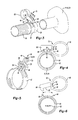
  • FIG. 3 is a schematic exploded-fragmentary perspective view of a component of the product and a hose with a hose clamp therearound, and with a clip holding the hose clamp open.
  • FIG. 4 is a schematic partial cross-sectional view of the clip holding the hose clamp open with the hose surrounding a portion of the component from FIG. 3 .
  • FIG. 5 is a schematic perspective view of another configuration of a clip.
  • FIG. 6 is a schematic partial cross-sectional view of the clip removed from the hose clamp with the hose clamp contracted around the hose and the portion of the component from FIG. 4 .
  • FIG. 7 is a schematic perspective view of another configuration of a reader.
  • a notification system 10 for an assembly process at an assembly plant 11 is generally shown in FIG. 1 .
  • the notification system 10 can be disposed along an assembly line 12 of the assembly process as shown in FIG. 1 .
  • the notification system 10 can improve the assembly process by confirming various assembly procedures have occurred.
  • components 14 , 16 are assembled together to form a product, such as an appliance, a vehicle or any other suitable product that can utilize the notification system 10 as discussed herein.
  • a product such as an appliance, a vehicle or any other suitable product that can utilize the notification system 10 as discussed herein.
  • the appliance can include a washing machine, a dryer, a refrigerator, a dish washer, etc.
  • the vehicle can include a car, a truck, an airplane, a boat, a water craft, a utility vehicle, etc.
  • These components 14 , 16 are assembled together at the assembly plant 11 to form the product.
  • Various components e.g., parts, subsystems, etc.
  • these preassembled components can then be coupled to various other components of the product during the assembly process.
  • various individual components or parts can be coupled to various components of the product during the assembly process.
  • the notification system 10 includes a base unit 18 of part of the product located in the assembly plant 11 and a first component 14 coupled to the base unit 18 at a station 20 in the assembly plant 11 to further define the product.
  • the base unit 18 can be one or more components of the product. Therefore, for example, the base unit 18 can be a frame 22 or support structure, as shown in FIG. 2 , etc.
  • the first component 14 can be any component that is coupled to another component of the product to further define the product. Therefore, for example, the first component 14 can be a valve (one non-limiting example is an inlet valve), a pump (one non-limiting example is a drain pump), a radiator, a power steering mechanism, etc.
  • the base unit 18 and the first component 14 are shown schematically in the Figures since the base unit 18 and the first component 14 can be any parts of the product.
  • One example of the base unit 18 is the frame 22 with a wheel hub coupled thereto, and one example of the first component 14 is a radiator.
  • the base unit 18 of FIG. 1 is the component(s) of the product that arrive at the station 20 of the first component 14 . Therefore, after the first component 14 is coupled to the base unit 18 at the station 20 of FIG. 1 , the product moves to a next station 28 , the first component 14 is incorporated with the base unit 18 to further assemble the product. As such, at the next station 28 , a second component 16 is coupled to the updated base unit 18 , and so on for any preceding station(s) along the assembly line 12 .
  • the second component 16 can be any component that is coupled to another component of the product to further define the product. It is to be appreciated that the second component 16 can be any suitable configuration, and thus can be configured the same or differently from the first component 14 .
  • first and second components 14 , 16 can be seats that are configured the same, or alternatively, the first component 14 can be a radiator and the second component 16 can be a pump. As another example, the first component 14 can be an inlet valve and the second component 16 can be a drain pump.
  • a plurality of products are assembled at the assembly plant 11 .
  • the same or different types of products can be assembled along the same assembly line 12 . Therefore, a plurality of components 14 , 16 are disposed at each station 20 awaiting coupling to the base unit 18 of each product.
  • the first component 14 can be further defined as a plurality of first components 14 that are disposed at one station 20 to await assembly to another base unit 18 and the second component 16 can be further defined as a plurality of second components 16 that are disposed at the same station 20 or a different station 28 to await assembly to another base unit 18 .
  • FIG. 1 illustrates the next first component 14 disposed adjacent to the assembly line 12 at the station 20 awaiting assembly to the next base unit 18 and also illustrates the next second component 16 disposed adjacent to the assembly line 12 at the next station 28 awaiting assembly to the next base unit 18 . It is to be appreciated that pallets or bins of components 14 , 16 can be disposed at the stations 20 .
  • one or more of the stations 20 can assemble more than one component 14 , 16 to the base unit 18 . Therefore, for example, the first components 14 and the second components 16 can be combined into a single station 20 with both of these components 14 , 16 assembled to the base unit 18 at that station 20 . Alternatively, the first and second components 14 , 16 can be combined into a single station 20 but an operator or user chooses either the first component 14 to couple to that particular base unit 18 or chooses the second component 16 to couple to that particular base unit 18 . To illustrate such a situation, when the first component 14 is a valve for one type of dishwasher and the second component 16 is a valve for another type of dishwasher, the operator chooses one or the other depending on the particular base unit 18 at that station 20 .
  • the notification system 10 further includes a tag 30 coupled to one of the base unit 18 and the first component 14 .
  • coupling the tag 30 to one of the base unit 18 and the first component 14 can be via attaching the tag 30 by any suitable method, some of which can be fastener(s), clip(s), adhesive, welding, molding, etc.
  • coupling the tag 30 to one of the base unit 18 and the first component 14 can be via embedding or integrally forming at one piece, etc., the tag 30 into one of the base unit 18 and the first component 14 .
  • the notification system 10 also includes a reader 32 disposed downstream from the station 20 at the assembly plant 11 , as shown in FIG. 1 .
  • the reader 32 is configured to detect the tag 30 .
  • the reader 32 is configured to detect if the tag 30 is coupled to one of the base unit 18 and the first component 14 when the product is scanned by the reader 32 .
  • the tag 30 and the reader 32 cooperate with each other such that information can be communicated therebetween.
  • the tag 30 and the reader 32 can communicate with each other by any suitable devices, mechanisms, methods, etc., and various non-limiting examples are discussed below.
  • the tag 30 and the reader 32 can communicate with each other through an active system or a passive system. It is to be appreciated that a plurality of tags 30 can be utilized along the assembly process and/or a plurality of readers 32 can be utilized along the assembly process. Therefore, readers 32 can be set up at various stages of assembly of the product to minimize downtime of the assembly process.
  • the tag 30 is a transponder, and the transponder communicates with the reader 32 .
  • the transponder can send an identifying signal in response to a signal sent by the reader 32 . Therefore, various information can be sent/received between the tag 30 and the reader 32 .
  • the tag 30 can include a microchip 34 as best shown in FIGS. 3-6 .
  • the microchip 34 is configured to store information, and therefore, can include a memory 36 for storing information.
  • the microchip 34 can include a battery 38 (this optional battery 38 is shown in FIG. 3 only) such that the tag 30 can emit a signal. Therefore, the tag 30 can be powered or unpowered.
  • the reader 32 can include a transceiver that receives a signal when the microchip 34 is detected.
  • the reader 32 can include an antenna 40 (as shown in FIGS. 1 and 7 ) that receives a signal when the microchip 34 is detected. Therefore, when the reader 32 scans the product, the antenna 40 sends out a signal that the microchip 34 can identify and the tag 30 sends information back to the antenna 40 , and thus the reader 32 .
  • the tag 30 and the reader 32 communicate with each other utilizing radio frequency identification (RFID).
  • RFID radio frequency identification
  • the antenna 40 of the reader 32 sends out a radio frequency that activates the microchip 34 to send information back to the antenna 40 and thus the reader 32 . Therefore, in certain embodiments, active RFID or passive RFID can be utilized.
  • the reader 32 can include a processor 42 and a memory 44 on which is recorded instructions for communicating information regarding the tag 30 .
  • the reader 32 is configured to execute the instructions from the memory 44 , via the processor 42 .
  • the memory 44 can be, tangible, non-transitory computer-readable memory such as read-only memory (ROM) or flash memory.
  • the reader 32 can also have random access memory (RAM), electrically erasable programmable read only memory (EEPROM), a high-speed clock, analog-to-digital (A/D) and/or digital-to-analog (D/A) circuitry, and any required input/output circuitry and associated devices, as well as any required signal conditioning and/or signal buffering circuitry. Therefore, the reader 32 can include all software, hardware, memory 44 , algorithms, connections, sensors, etc., necessary to execute instructions based on the information received from the tag 30 .
  • the tag 30 can be any suitable configuration.
  • the tag 30 can be embedded in a body 46 as shown in FIGS. 2-6 .
  • the body 46 can be in any suitable configuration and FIGS. 4 and 5 illustrate two different examples of the body 46 .
  • FIG. 4 illustrates the tag 30 embedded in the body 46 or integrally formed as one piece with the body 46 .
  • the tag 30 can be attached to the body 46 .
  • the tag 30 can be attached to the body 46 by any suitable method, such as adhesive, molding, fastener(s), welding, etc.
  • the tag 30 can be attached or embedded in any component of the product.
  • the tag 30 can be attached or embedded in a valve, an inlet valve, a pump, a drain pump, a rear-view mirror, airbag assemblies, a steering wheel, seat(s), an instrument panel, a radiator, a transmission, a final drive, an engine, a clip, etc.
  • the body 46 can be configured as any suitable component(s) of the appliance, the vehicle, etc., some of which are discussed immediately above.
  • the reader 32 can be disposed downstream to one or more stations 20 , 28 as shown in FIG. 1 . Therefore, for example, components 14 , 16 at a plurality of stations 20 , 28 can be coupled to the product and then the reader 32 can be utilized to scan the product.
  • the product can be scanned by the reader 32 in any suitable method.
  • the product can move past a stationary reader 32
  • the reader 32 can move past a stationary product or both the reader 32 and the product can move relative to each other.
  • the reader 32 can be a hand-held wand, etc., and the operator moves the wand relative to the product.
  • the stationary reader 32 examples are shown in the Figures for illustrative purposes, and are not to be limiting. As indicated above, the reader 32 can be any suitable configuration, and therefore, two different examples are shown in the Figures for illustrative purposes.
  • the reader 32 can also include a stand 48 , and the antenna 40 can be supported by the stand 48 .
  • the antenna 40 can be defined as a plurality of antennas 40 spaced from each other and each supported by the stand 48 .
  • the stand 48 can be defined as a plurality of stands 48 which can be configured differently from FIG. 7 .
  • At least one antenna 40 can be supported by one of the stands 48 and at least one antenna 40 can be supported by another one of the stands 48 .
  • the stands 48 and/or antennas 40 of FIG. 1 can be spaced from each other and substantially align with each other.
  • the antennas 40 of FIG. 1 can be incorporated inside the stands 48 or the stands 48 can be eliminated.
  • the product, whether fully assembled or not, can pass between the stands 48 of FIG. 1 .
  • a hose 50 can be coupled to one of the base unit 18 and the first component 14 to further define the product.
  • the hose 50 can be another component of the product.
  • one end of the hose 50 can be preassembled to the first component 14 while another end of the hose 50 is to be attached to the base unit 18 after the first component 14 is coupled to the base unit 18 .
  • both ends of the hose 50 can be assembled to one or more components 14 , 16 at the station 20 .
  • a plurality of hoses 50 can be utilized along the assembly process as shown in FIG. 2 .
  • a hose clamp 52 can surround an end portion 54 of the hose 50 .
  • one hose clamp 52 can surround the end portion 54 of one hose 50 and, if another hose 50 is desired, another hose clamp 52 can surround the end portion 54 of that other hose 50 .
  • the hose clamps 52 are held open until the end portion 54 of the respective hoses 50 are coupled to the desired component(s). Therefore, in certain embodiments, the body 46 is configured as the clip. The clip is engagable with the hose clamp 52 to hold the hose clamp 52 open.
  • the clip engages the hose clamp 52 to hold the hose clamp 52 open to connect the end portion 54 of the hose 50 with one of the base unit 18 and the first component 14 .
  • the tag 30 is attached or embedded in the body 46 , and therefore, the hose clamp 52 is tagged when the clip is holding the hose clamp 52 open.
  • FIG. 2 illustrates two hose clamps 52 being held open by clips, and thus, these hose clamps 52 are tagged.
  • the clip is removed from the hose clamp 52 .
  • the clip is removable from the hose clamp 52 after connecting the end portion 54 of the hose 50 to cause the hose clamp 52 to contract around the end portion 54 of the hose 50 which secures the hose 50 to one of the base unit 18 and the first component 14 . Therefore, the hose clamp 52 is biased open when the clip is connected thereto and the hose clamp 52 is biased closed when the clip releases the hose clamp 52 .
  • a failure of the reader 32 to detect the tag 30 when the product is scanned by the reader 32 is indicative of the hose clamp 52 being released to clamp the hose 50 to one of the base unit 18 and the first component 14 .
  • the reader 32 does not detect the tag 30 when the product is scanned by the reader 32 due to the removal of the clip which indicates that the hose clamp 52 is released to clamp the hose 50 to one of the base unit 18 and the first component 14 . Therefore, the clip will not be part of the product as the product moves to the next station 28 and the reader 32 will not detect that removed clip.
  • the hose clamp 52 can include a pair of tabs 56 or ears, and the clip can include a finger 58 defining a recess 60 that receives the tabs 56 to hold the hose clamp 52 open.
  • the clip can also include a handle 62 for grasping to remove the clip from the hose clamp 52 .
  • the finger 58 extends outwardly away from the handle 62 .
  • the handle 62 can be any suitable configuration, and non-limiting examples are shown in FIGS. 2-6 in which the handle 62 is a ring.
  • the handle 62 can be configured ergonomically to minimize fatigue, and the ring is one example.
  • the microchip 34 can be embedded in at least one of the finger 58 and the handle 62 . In one embodiment, the microchip 34 is embedded in the finger 58 . In another embodiment, the microchip 34 is embedded in the handle 62 . In yet another embodiment, the microchip 34 is partially embedded in the finger 58 and partially embedded in the handle 62 . Alternatively, the microchip 34 can be attached to at least one of the finger 58 and the handle 62 . Therefore, the microchip 34 can be any suitable location along the clip.
  • the reader 32 can include an indicator 64 that is activated if the reader 32 detects the tag 30 when the product is being scanned by the reader 32 . Therefore, the indicator 64 can be in communication with the reader 32 to cue the operator that the product needs to be looked at. When the indicator 64 cues the operator, optionally, the assembly line 12 can stop.
  • the indicator 64 can be in any suitable form and a few non-limiting examples are discussed below.
  • the indicator 64 can be a visible light, i.e., a light lights up as a visual indicator.
  • the indicator 64 can be an audible mechanism, i.e., an audible noise that can be heard as an audible indicator.
  • the indicator 64 can be a display 66 , i.e., information is displayed on a screen. It is to be appreciated that more than one indicator 64 can be utilized, therefore, for example, more than one of the visible light, the audible mechanism and/or the display 66 can be utilized together.
  • a computer 68 can be in communication with the reader 32 .
  • the display 66 can be in communication with the computer 68 to convey information regarding the tag 30 .
  • the display 66 can be in communication with the reader 32 , instead of the computer 68 , to convey information regarding the tag 30 .
  • the computer 68 includes a processor 70 and a memory 72 on which is recorded instructions for communicating information regarding the tag 30 .
  • the computer 68 is configured to execute the instructions from the memory 72 , via the processor 70 .
  • the computer 68 can be a host machine or distributed system, e.g., a computer 68 such as a digital computer 68 or microcomputer.
  • the memory 72 can be, tangible, non-transitory computer-readable memory such as read-only memory (ROM) or flash memory.
  • the computer 68 can also have random access memory (RAM), electrically erasable programmable read only memory (EEPROM), a high-speed clock, analog-to-digital (A/D) and/or digital-to-analog (D/A) circuitry, and any required input/output circuitry and associated devices, as well as any required signal conditioning and/or signal buffering circuitry. Therefore, the computer 68 can include all software, hardware, memory 72 , algorithms, connections, sensors, etc., necessary to execute instructions based on the information received from the tag 30 .
  • the present disclosure also provides a method of notifying the user or operator about the product during the assembly process at the assembly plant 11 . For example, various assembly procedures can be confirmed before the assembled product leaves the assembly plant 11 .
  • the method includes providing the base unit 18 which is part of the product of the assembly process at the assembly plant 11 .
  • the base unit 18 can be one or more components of the product.
  • the method also includes coupling the first component 14 to the base unit 18 at the station 20 in the assembly plant 11 to further assemble the product, and coupling the tag 30 to one of the base unit 18 and the first component 14 .
  • coupling the tag 30 to one of the base unit 18 and the first component 14 can be further defined as coupling the tag 30 to one of the base unit 18 and the first component 14 prior to coupling the first component 14 to the base unit 18 at the station 20 . Therefore, the base unit 18 and/or the first component 14 can arrive at the assembly plant 11 with the tag 30 already attached/embedded, etc. Alternatively, at the assembly plant 11 , the tag 30 can be attached to the base unit 18 and/or the first component 14 before or when coupling the base unit 18 and the first component 14 together.
  • the method further includes scanning the product, via the reader 32 that is disposed downstream from the station 20 at the assembly plant 11 , to detect if the tag 30 is coupled to one of the base unit 18 and the first component 14 .
  • the product can, for example, proceed to the next station 28 or be stopped for further analysis. The outcomes are discussed further below.
  • the method can also include engaging the clip with the hose clamp 52 that surrounds the end portion 54 of the hose 50 to hold the hose clamp 52 open and connecting the end portion 54 of the hose 50 with one of the base unit 18 and the first component 14 as the clip holds the hose clamp 52 open.
  • the clip can be removed to release the hose clamp 52 . Therefore, the method can also include removing the clip from the hose clamp 52 after connecting the end portion 54 of the hose 50 to cause the hose clamp 52 to contract around the end portion 54 of the hose 50 which secures the hose 50 to one of the base unit 18 and the first component 14 .
  • the clip can be preassembled to the hose clamp 52 before arriving at the assembly plant 11 or the clip can be preassembled to the hose clamp 52 at the assembly plant 11 .
  • the clip can be coupled to the hose clamp 52 just prior to coupling the hose 50 to one of the components 14 , 16 of the product.
  • the removed clips can then be placed in a hopper that counts the clips that have been removed. It is to be appreciated that the removed clips can be reused, thus providing cost savings.
  • the reader 32 can indicate to the operator when one or more tags 30 are detected. As such, when the product progresses through one or more stations 20 , 28 , the reader 32 can be positioned in a desired location to determine whether any tag 30 that was supposed to be removed from the product remains. Therefore, scanning the product via the reader 32 occurs after removing the clip from the hose clamp 52 . Generally, the reader 32 can compare an expected response with an actual response and outputs an appropriate response.
  • a failure of the reader 32 to detect the tag 30 when the product is being scanned by the reader 32 is indicative of the hose clamp 52 being released to clamp the hose 50 to one of the base unit 18 and the first component 14 , and the product passes to the next station 28 .
  • the product passes to the next station 28 if the reader 32 does not detect the tag 30 which indicates that the hose clamp 52 is released to clamp the hose 50 to one of the base unit 18 and the first component 14 . Therefore, the expected response, i.e., no tag 30 is detected, matches the actual response, i.e., no tag 30 is detected. With this outcome, the product passes to the next station 28 and the reader 32 does not activate the indicator 64 .
  • the assembly line 12 can be stopped to stop the product if the reader 32 detects the tag 30 which indicates that the hose clamp 52 has not been released. Therefore, for this outcome, the expected response, i.e., no tag 30 is detected, does not match the actual response, i.e., tag 30 is detected, and when this occurs, the reader 32 activates the indicator 64 .
  • the location of the tag(s) 30 can be determined. For example, information retrieved from the tag(s) 30 can assist in locating the tag(s) 30 . If utilizing the display 66 , the display 66 can provide the information regarding the location of the clip(s) that have not been removed and the operator can then go to that location and remove the clip(s).
  • the operator can go to the product and look for the clip(s) to be removed.
  • the reader 32 can rescan the product and the reader 32 again compares between expected and actual responses.
  • the reader 32 can confirm that the expected components 14 , 16 have been assembled together to create the desired product.
  • the reader 32 can be positioned in a desired location to determine whether the components 14 , 16 that have been coupled together to form the product obtain the expected information.
  • the reader 32 can compare an expected response with an actual response and outputs an appropriate response.
  • the method can include comparing the actual response received by the reader 32 from scanning the product with the expected response expected by the reader 32 .
  • the actual response matches the expected response, this is indicative of the appropriate first component 14 being coupled to that base unit 18 , and that product passes to the next station 28 .
  • the reader 32 can confirm that the expected part identification or serial numbers of the various components 14 , 16 match the components 14 , 16 that are to be assembled to a specific product. Therefore, scanning the product via the reader 32 occurs after the station 20 , and the product passes to the next station 28 if the information of the tag 30 matches the information expected to be received via the reader 32 for that product.
  • the product passes to the next station 28 .
  • the reader 32 does not activate the indicator 64 .
  • the assembly line 12 can be stopped to stop the product if the reader 32 detects different information than expected from one or more tag(s) 30 , which indicates that one or more components 14 , 16 were to be assembled on a different product. Therefore, for this outcome, the expected response, i.e., expects part identification A, does not match the actual response, i.e., the scanned component is identified as part identification B, and when this occurs, the reader 32 activates the indicator 64 .
  • further analysis of the location of the tag(s) 30 can be determined. For example, information retrieved from the tag(s) 30 can assist in locating the tag(s) 30 .
  • the display 66 can provide the information regarding the location of the tag(s) 30 for the component 14 , 16 to be removed and replaced by the operator.
  • the reader 32 can rescan the product and the reader 32 again compares between expected and actual responses.
  • one or more readers 32 can be placed at the end of the assembly line 12 and the reader(s) 32 can retrieve and/or store all of the part identifications or serial numbers from the tag(s) 30 for that particular product for historical records.
  • This record storage option can be utilized on each product assembled at the assembly plant 11 . The historical records of any of the products can then be retrieved at any later time as desired.
  • the method discussed above can include other features not specifically identified in the method.
  • the term “substantially” can refer to a slight imprecision or slight variance of a condition, quantity, value, or dimension, etc., some of which that are within manufacturing variance or tolerance ranges that can be subject to human error during installation.

Landscapes

  • Engineering & Computer Science (AREA)
  • General Engineering & Computer Science (AREA)
  • Mechanical Engineering (AREA)
  • Computer Networks & Wireless Communication (AREA)
  • Signal Processing (AREA)
  • Chemical & Material Sciences (AREA)
  • Manufacturing & Machinery (AREA)
  • Combustion & Propulsion (AREA)
  • Transportation (AREA)
  • Physics & Mathematics (AREA)
  • Theoretical Computer Science (AREA)
  • General Physics & Mathematics (AREA)
  • Automatic Assembly (AREA)
  • Health & Medical Sciences (AREA)
  • Toxicology (AREA)
  • Electromagnetism (AREA)
  • General Health & Medical Sciences (AREA)
  • Artificial Intelligence (AREA)
  • Computer Vision & Pattern Recognition (AREA)

Abstract

A notification system for an assembly process at an assembly plant includes a base unit of part of a product at the assembly plant and a first component coupled to the base unit at a station in the assembly plant to further define the product. A tag is coupled to one of the base unit and the first component. A reader is disposed downstream from the station at the assembly plant. The reader is configured to detect if the tag is coupled to one of the base unit and the first component when the product is scanned by the reader. Furthermore, a method of notifying a user during the assembly process at the assembly plant includes scanning the product, via the reader that is disposed downstream from the station at the assembly plant, to detect if the tag is coupled to one of the base unit and the first component.

Description

CROSS-REFERENCE TO RELATED APPLICATIONS
This application is a continuation-in-part of U.S. patent application Ser. No. 14/597,282, filed on Jan. 15, 2015.
TECHNICAL FIELD
The present disclosure relates to a notification system for an assembly process at an assembly plant and a method of notifying a user about a product during the assembly process at the assembly plant.
BACKGROUND
Various products are generally assembled at an assembly plant. Many components are coupled together to form, e.g., a vehicle, an aircraft, an appliance, etc., hereinafter a “product”. Various assembly procedures have been developed to assist with the assembly of products, in particular, the process of assembling hoses to components.
For example, a hose clamp surrounds a hose and a pop clamp is utilized to hold the hose clamp open. Once the hose is positioned on a component of the product, the pop clamp is removed by an operator or user which causes the hose clamp to clamp around the hose. The operator then places the pop clamp in a hopper. The hopper can count when the pop clamp is placed therein. However, the hopper cannot distinguish between different objects, so if an object other than the pop clamp is placed therein, the hopper will count it.
As another example, some hose clamps do not use the pop clamp discussed above. Instead, the hose clamp stays open by a tab integrated on the hose clamp. Once the hose is positioned on the component of the product, the user utilizes a tool that releases the tab which causes the hose clamp to clamp around the hose. The tool is removed from a sleeve when being utilized and is placed back in the sleeve once the task is complete at that particular assembly station. The sleeve can identify when the tool is removed and placed back in the sleeve. However, the tool cannot identify whether all of the hose clamps have been released at that station.
Another type of tool that can be utilized to release the tab of the hose clamps is an electric tool that can identify if the tool has been used to release the tab. However, this tool cannot identify if another part has been engaged instead of the tab.
As yet another example, a camera system has been developed that can visually identify the pop clamp. The camera system is set up after a particular assembly station, and as the product moves along the assembly line past the camera system, the camera system visually looks at the product. If the camera system can visually see the pop clamp, the camera system will indicate to the operator that the pop clamp needs to be removed and the operator will then remove that pop clamp. However, the camera system cannot visually see every location of the product.
Other hose clamps include a threaded screw and a band to clamp the hose clamp around the hose. An electric torque controlled tool threads the screw which tightens the band around the hose. These tools cannot identify whether all of the hose clamps have been tightened and are cumbersome to use.
SUMMARY
The present disclosure provides a notification system for an assembly process at an assembly plant. The system includes a base unit of part of a product located in the assembly plant and a first component coupled to the base unit at a station in the assembly plant to further define the product. The system further includes a tag coupled to one of the base unit and the first component. The system also includes a reader disposed downstream from the station at the assembly plant. The reader is configured to detect if the tag is coupled to one of the base unit and the first component when the product is scanned by the reader.
The present disclosure provides another notification system for an assembly process at an assembly plant. A base unit of part of a product is located in the assembly plant and a first component is coupled to the base unit at a station in the assembly plant to further define the product. A hose is coupled to one of the base unit and the first component to further define the product. A hose clamp surrounds an end portion of the hose. A tag includes a body configured as a clip, with the clip being engagable with the hose clamp to hold the hose clamp open. The clip is removable from the hose clamp after connecting the end portion of the hose to cause the hose clamp to contract around the end portion of the hose which secures the hose to one of the base unit and the first component. A reader is disposed downstream from the station at the assembly plant and configured to detect the tag. A failure of the reader to detect the tag when the product is scanned by the reader is indicative of the hose clamp being released to clamp the hose to one of the base unit and the first component.
The present disclosure also provides a method of notifying a user about a product during an assembly process at an assembly plant. The method includes providing a base unit being part of the product of the assembly process at the assembly plant and coupling a first component to the base unit at a station in the assembly plant to further assemble the product. The method also includes coupling a tag to one of the base unit and the first component. The method further includes scanning the product, via a reader that is disposed downstream from the station at the assembly plant, to detect if the tag is coupled to one of the base unit and the first component.
The detailed description and the drawings or Figures are supportive and descriptive of the disclosure, but the claim scope of the disclosure is defined solely by the claims. While some of the best modes and other embodiments for carrying out the claims have been described in detail, various alternative designs and embodiments exist for practicing the disclosure defined in the appended claims.
BRIEF DESCRIPTION OF THE DRAWINGS
FIG. 1 is a schematic perspective view of a notification system disposed along an assembly line, with components of a product at one station and illustrating the progression of those components to another station with a reader disposed between the stations.
FIG. 2 is a schematic fragmentary view of a base unit and a first component coupled together to further define the product.
FIG. 3 is a schematic exploded-fragmentary perspective view of a component of the product and a hose with a hose clamp therearound, and with a clip holding the hose clamp open.
FIG. 4 is a schematic partial cross-sectional view of the clip holding the hose clamp open with the hose surrounding a portion of the component from FIG. 3.
FIG. 5 is a schematic perspective view of another configuration of a clip.
FIG. 6 is a schematic partial cross-sectional view of the clip removed from the hose clamp with the hose clamp contracted around the hose and the portion of the component from FIG. 4.
FIG. 7 is a schematic perspective view of another configuration of a reader.
DETAILED DESCRIPTION
Referring to the Figures, wherein like numerals indicate like or corresponding parts throughout the several views, a notification system 10 for an assembly process at an assembly plant 11 is generally shown in FIG. 1. The notification system 10 can be disposed along an assembly line 12 of the assembly process as shown in FIG. 1. The notification system 10 can improve the assembly process by confirming various assembly procedures have occurred.
Generally, many components 14, 16, e.g., parts, subsystems, etc., are assembled together to form a product, such as an appliance, a vehicle or any other suitable product that can utilize the notification system 10 as discussed herein. Non-limiting examples of the appliance can include a washing machine, a dryer, a refrigerator, a dish washer, etc., and non-limiting examples of the vehicle can include a car, a truck, an airplane, a boat, a water craft, a utility vehicle, etc. These components 14, 16 are assembled together at the assembly plant 11 to form the product. Various components, e.g., parts, subsystems, etc., can be preassembled before arriving at the assembly plant 11, and these preassembled components can then be coupled to various other components of the product during the assembly process. Furthermore, various individual components or parts can be coupled to various components of the product during the assembly process.
The notification system 10 includes a base unit 18 of part of the product located in the assembly plant 11 and a first component 14 coupled to the base unit 18 at a station 20 in the assembly plant 11 to further define the product. The base unit 18 can be one or more components of the product. Therefore, for example, the base unit 18 can be a frame 22 or support structure, as shown in FIG. 2, etc. The first component 14 can be any component that is coupled to another component of the product to further define the product. Therefore, for example, the first component 14 can be a valve (one non-limiting example is an inlet valve), a pump (one non-limiting example is a drain pump), a radiator, a power steering mechanism, etc. The base unit 18 and the first component 14 are shown schematically in the Figures since the base unit 18 and the first component 14 can be any parts of the product. One example of the base unit 18 is the frame 22 with a wheel hub coupled thereto, and one example of the first component 14 is a radiator.
Simply stated, the base unit 18 of FIG. 1 is the component(s) of the product that arrive at the station 20 of the first component 14. Therefore, after the first component 14 is coupled to the base unit 18 at the station 20 of FIG. 1, the product moves to a next station 28, the first component 14 is incorporated with the base unit 18 to further assemble the product. As such, at the next station 28, a second component 16 is coupled to the updated base unit 18, and so on for any preceding station(s) along the assembly line 12. The second component 16 can be any component that is coupled to another component of the product to further define the product. It is to be appreciated that the second component 16 can be any suitable configuration, and thus can be configured the same or differently from the first component 14. For example, the first and second components 14, 16 can be seats that are configured the same, or alternatively, the first component 14 can be a radiator and the second component 16 can be a pump. As another example, the first component 14 can be an inlet valve and the second component 16 can be a drain pump.
Generally, a plurality of products are assembled at the assembly plant 11. The same or different types of products can be assembled along the same assembly line 12. Therefore, a plurality of components 14, 16 are disposed at each station 20 awaiting coupling to the base unit 18 of each product. As such, the first component 14 can be further defined as a plurality of first components 14 that are disposed at one station 20 to await assembly to another base unit 18 and the second component 16 can be further defined as a plurality of second components 16 that are disposed at the same station 20 or a different station 28 to await assembly to another base unit 18. FIG. 1 illustrates the next first component 14 disposed adjacent to the assembly line 12 at the station 20 awaiting assembly to the next base unit 18 and also illustrates the next second component 16 disposed adjacent to the assembly line 12 at the next station 28 awaiting assembly to the next base unit 18. It is to be appreciated that pallets or bins of components 14, 16 can be disposed at the stations 20.
Optionally, one or more of the stations 20 can assemble more than one component 14, 16 to the base unit 18. Therefore, for example, the first components 14 and the second components 16 can be combined into a single station 20 with both of these components 14, 16 assembled to the base unit 18 at that station 20. Alternatively, the first and second components 14, 16 can be combined into a single station 20 but an operator or user chooses either the first component 14 to couple to that particular base unit 18 or chooses the second component 16 to couple to that particular base unit 18. To illustrate such a situation, when the first component 14 is a valve for one type of dishwasher and the second component 16 is a valve for another type of dishwasher, the operator chooses one or the other depending on the particular base unit 18 at that station 20.
Referring to FIG. 2, the notification system 10 further includes a tag 30 coupled to one of the base unit 18 and the first component 14. For example, coupling the tag 30 to one of the base unit 18 and the first component 14 can be via attaching the tag 30 by any suitable method, some of which can be fastener(s), clip(s), adhesive, welding, molding, etc. As another example, coupling the tag 30 to one of the base unit 18 and the first component 14 can be via embedding or integrally forming at one piece, etc., the tag 30 into one of the base unit 18 and the first component 14.
The notification system 10 also includes a reader 32 disposed downstream from the station 20 at the assembly plant 11, as shown in FIG. 1. The reader 32 is configured to detect the tag 30. For example, the reader 32 is configured to detect if the tag 30 is coupled to one of the base unit 18 and the first component 14 when the product is scanned by the reader 32. The tag 30 and the reader 32 cooperate with each other such that information can be communicated therebetween. The tag 30 and the reader 32 can communicate with each other by any suitable devices, mechanisms, methods, etc., and various non-limiting examples are discussed below.
Generally, the tag 30 and the reader 32 can communicate with each other through an active system or a passive system. It is to be appreciated that a plurality of tags 30 can be utilized along the assembly process and/or a plurality of readers 32 can be utilized along the assembly process. Therefore, readers 32 can be set up at various stages of assembly of the product to minimize downtime of the assembly process.
In certain embodiments, the tag 30 is a transponder, and the transponder communicates with the reader 32. The transponder can send an identifying signal in response to a signal sent by the reader 32. Therefore, various information can be sent/received between the tag 30 and the reader 32.
The tag 30 can include a microchip 34 as best shown in FIGS. 3-6. The microchip 34 is configured to store information, and therefore, can include a memory 36 for storing information. Depending on the type of active or passive system that is being utilized, optionally, the microchip 34 can include a battery 38 (this optional battery 38 is shown in FIG. 3 only) such that the tag 30 can emit a signal. Therefore, the tag 30 can be powered or unpowered.
In certain embodiments, the reader 32 can include a transceiver that receives a signal when the microchip 34 is detected. For example, the reader 32 can include an antenna 40 (as shown in FIGS. 1 and 7) that receives a signal when the microchip 34 is detected. Therefore, when the reader 32 scans the product, the antenna 40 sends out a signal that the microchip 34 can identify and the tag 30 sends information back to the antenna 40, and thus the reader 32. For example, in certain embodiments, the tag 30 and the reader 32 communicate with each other utilizing radio frequency identification (RFID). For this example, the antenna 40 of the reader 32 sends out a radio frequency that activates the microchip 34 to send information back to the antenna 40 and thus the reader 32. Therefore, in certain embodiments, active RFID or passive RFID can be utilized.
The reader 32 can include a processor 42 and a memory 44 on which is recorded instructions for communicating information regarding the tag 30. The reader 32 is configured to execute the instructions from the memory 44, via the processor 42. The memory 44 can be, tangible, non-transitory computer-readable memory such as read-only memory (ROM) or flash memory. The reader 32 can also have random access memory (RAM), electrically erasable programmable read only memory (EEPROM), a high-speed clock, analog-to-digital (A/D) and/or digital-to-analog (D/A) circuitry, and any required input/output circuitry and associated devices, as well as any required signal conditioning and/or signal buffering circuitry. Therefore, the reader 32 can include all software, hardware, memory 44, algorithms, connections, sensors, etc., necessary to execute instructions based on the information received from the tag 30.
Generally, the tag 30 can be any suitable configuration. For example, the tag 30 can be embedded in a body 46 as shown in FIGS. 2-6. The body 46 can be in any suitable configuration and FIGS. 4 and 5 illustrate two different examples of the body 46. FIG. 4 illustrates the tag 30 embedded in the body 46 or integrally formed as one piece with the body 46. As shown in FIG. 5, the tag 30 can be attached to the body 46. The tag 30 can be attached to the body 46 by any suitable method, such as adhesive, molding, fastener(s), welding, etc.
Furthermore, the tag 30 can be attached or embedded in any component of the product. For example, the tag 30 can be attached or embedded in a valve, an inlet valve, a pump, a drain pump, a rear-view mirror, airbag assemblies, a steering wheel, seat(s), an instrument panel, a radiator, a transmission, a final drive, an engine, a clip, etc. Therefore, the body 46 can be configured as any suitable component(s) of the appliance, the vehicle, etc., some of which are discussed immediately above.
The reader 32 can be disposed downstream to one or more stations 20, 28 as shown in FIG. 1. Therefore, for example, components 14, 16 at a plurality of stations 20, 28 can be coupled to the product and then the reader 32 can be utilized to scan the product. The product can be scanned by the reader 32 in any suitable method. For example, the product can move past a stationary reader 32, the reader 32 can move past a stationary product or both the reader 32 and the product can move relative to each other. As another example, the reader 32 can be a hand-held wand, etc., and the operator moves the wand relative to the product.
Examples of the stationary reader 32 are shown in the Figures for illustrative purposes, and are not to be limiting. As indicated above, the reader 32 can be any suitable configuration, and therefore, two different examples are shown in the Figures for illustrative purposes. For example, as shown in FIG. 7, the reader 32 can also include a stand 48, and the antenna 40 can be supported by the stand 48. As also shown in FIG. 7, the antenna 40 can be defined as a plurality of antennas 40 spaced from each other and each supported by the stand 48. As another example, the stand 48 can be defined as a plurality of stands 48 which can be configured differently from FIG. 7. At least one antenna 40 can be supported by one of the stands 48 and at least one antenna 40 can be supported by another one of the stands 48. The stands 48 and/or antennas 40 of FIG. 1 can be spaced from each other and substantially align with each other. Optionally, the antennas 40 of FIG. 1 can be incorporated inside the stands 48 or the stands 48 can be eliminated. The product, whether fully assembled or not, can pass between the stands 48 of FIG. 1.
A hose 50, as best shown in FIG. 3, can be coupled to one of the base unit 18 and the first component 14 to further define the product. As such, the hose 50 can be another component of the product. In certain embodiments, one end of the hose 50 can be preassembled to the first component 14 while another end of the hose 50 is to be attached to the base unit 18 after the first component 14 is coupled to the base unit 18. Alternatively, both ends of the hose 50 can be assembled to one or more components 14, 16 at the station 20. A plurality of hoses 50 can be utilized along the assembly process as shown in FIG. 2.
Continuing with FIG. 2, a hose clamp 52 can surround an end portion 54 of the hose 50. As shown in FIG. 2, one hose clamp 52 can surround the end portion 54 of one hose 50 and, if another hose 50 is desired, another hose clamp 52 can surround the end portion 54 of that other hose 50. The hose clamps 52 are held open until the end portion 54 of the respective hoses 50 are coupled to the desired component(s). Therefore, in certain embodiments, the body 46 is configured as the clip. The clip is engagable with the hose clamp 52 to hold the hose clamp 52 open. Specifically, the clip engages the hose clamp 52 to hold the hose clamp 52 open to connect the end portion 54 of the hose 50 with one of the base unit 18 and the first component 14. As discussed above, the tag 30 is attached or embedded in the body 46, and therefore, the hose clamp 52 is tagged when the clip is holding the hose clamp 52 open. As such, FIG. 2 illustrates two hose clamps 52 being held open by clips, and thus, these hose clamps 52 are tagged.
Referring to FIG. 6, to release the hose clamp 52 and secure the hose 50 to the base unit 18 or another component, the clip is removed from the hose clamp 52. The clip is removable from the hose clamp 52 after connecting the end portion 54 of the hose 50 to cause the hose clamp 52 to contract around the end portion 54 of the hose 50 which secures the hose 50 to one of the base unit 18 and the first component 14. Therefore, the hose clamp 52 is biased open when the clip is connected thereto and the hose clamp 52 is biased closed when the clip releases the hose clamp 52. A failure of the reader 32 to detect the tag 30 when the product is scanned by the reader 32 is indicative of the hose clamp 52 being released to clamp the hose 50 to one of the base unit 18 and the first component 14. Said differently, the reader 32 does not detect the tag 30 when the product is scanned by the reader 32 due to the removal of the clip which indicates that the hose clamp 52 is released to clamp the hose 50 to one of the base unit 18 and the first component 14. Therefore, the clip will not be part of the product as the product moves to the next station 28 and the reader 32 will not detect that removed clip.
In certain embodiments, the hose clamp 52 can include a pair of tabs 56 or ears, and the clip can include a finger 58 defining a recess 60 that receives the tabs 56 to hold the hose clamp 52 open. The clip can also include a handle 62 for grasping to remove the clip from the hose clamp 52. Generally, the finger 58 extends outwardly away from the handle 62. The handle 62 can be any suitable configuration, and non-limiting examples are shown in FIGS. 2-6 in which the handle 62 is a ring. The handle 62 can be configured ergonomically to minimize fatigue, and the ring is one example.
The microchip 34 can be embedded in at least one of the finger 58 and the handle 62. In one embodiment, the microchip 34 is embedded in the finger 58. In another embodiment, the microchip 34 is embedded in the handle 62. In yet another embodiment, the microchip 34 is partially embedded in the finger 58 and partially embedded in the handle 62. Alternatively, the microchip 34 can be attached to at least one of the finger 58 and the handle 62. Therefore, the microchip 34 can be any suitable location along the clip.
Referring to FIGS. 1 and 7, the reader 32 can include an indicator 64 that is activated if the reader 32 detects the tag 30 when the product is being scanned by the reader 32. Therefore, the indicator 64 can be in communication with the reader 32 to cue the operator that the product needs to be looked at. When the indicator 64 cues the operator, optionally, the assembly line 12 can stop. The indicator 64 can be in any suitable form and a few non-limiting examples are discussed below. For example, the indicator 64 can be a visible light, i.e., a light lights up as a visual indicator. As another example, the indicator 64 can be an audible mechanism, i.e., an audible noise that can be heard as an audible indicator. As yet another example, the indicator 64 can be a display 66, i.e., information is displayed on a screen. It is to be appreciated that more than one indicator 64 can be utilized, therefore, for example, more than one of the visible light, the audible mechanism and/or the display 66 can be utilized together.
In certain embodiments, a computer 68 can be in communication with the reader 32. When the indicator 64 is the display 66, the display 66 can be in communication with the computer 68 to convey information regarding the tag 30. Alternatively, the display 66 can be in communication with the reader 32, instead of the computer 68, to convey information regarding the tag 30. The computer 68 includes a processor 70 and a memory 72 on which is recorded instructions for communicating information regarding the tag 30. The computer 68 is configured to execute the instructions from the memory 72, via the processor 70. For example, the computer 68 can be a host machine or distributed system, e.g., a computer 68 such as a digital computer 68 or microcomputer. The memory 72 can be, tangible, non-transitory computer-readable memory such as read-only memory (ROM) or flash memory. The computer 68 can also have random access memory (RAM), electrically erasable programmable read only memory (EEPROM), a high-speed clock, analog-to-digital (A/D) and/or digital-to-analog (D/A) circuitry, and any required input/output circuitry and associated devices, as well as any required signal conditioning and/or signal buffering circuitry. Therefore, the computer 68 can include all software, hardware, memory 72, algorithms, connections, sensors, etc., necessary to execute instructions based on the information received from the tag 30.
The present disclosure also provides a method of notifying the user or operator about the product during the assembly process at the assembly plant 11. For example, various assembly procedures can be confirmed before the assembled product leaves the assembly plant 11. The method includes providing the base unit 18 which is part of the product of the assembly process at the assembly plant 11. As discussed above, the base unit 18 can be one or more components of the product.
The method also includes coupling the first component 14 to the base unit 18 at the station 20 in the assembly plant 11 to further assemble the product, and coupling the tag 30 to one of the base unit 18 and the first component 14. In certain embodiments, coupling the tag 30 to one of the base unit 18 and the first component 14 can be further defined as coupling the tag 30 to one of the base unit 18 and the first component 14 prior to coupling the first component 14 to the base unit 18 at the station 20. Therefore, the base unit 18 and/or the first component 14 can arrive at the assembly plant 11 with the tag 30 already attached/embedded, etc. Alternatively, at the assembly plant 11, the tag 30 can be attached to the base unit 18 and/or the first component 14 before or when coupling the base unit 18 and the first component 14 together.
The method further includes scanning the product, via the reader 32 that is disposed downstream from the station 20 at the assembly plant 11, to detect if the tag 30 is coupled to one of the base unit 18 and the first component 14. Depending on the desired outcome when the product is scanned, the product can, for example, proceed to the next station 28 or be stopped for further analysis. The outcomes are discussed further below.
The method can also include engaging the clip with the hose clamp 52 that surrounds the end portion 54 of the hose 50 to hold the hose clamp 52 open and connecting the end portion 54 of the hose 50 with one of the base unit 18 and the first component 14 as the clip holds the hose clamp 52 open. Once the hose 50 is positioned as desired, the clip can be removed to release the hose clamp 52. Therefore, the method can also include removing the clip from the hose clamp 52 after connecting the end portion 54 of the hose 50 to cause the hose clamp 52 to contract around the end portion 54 of the hose 50 which secures the hose 50 to one of the base unit 18 and the first component 14. The clip can be preassembled to the hose clamp 52 before arriving at the assembly plant 11 or the clip can be preassembled to the hose clamp 52 at the assembly plant 11. Alternatively, the clip can be coupled to the hose clamp 52 just prior to coupling the hose 50 to one of the components 14, 16 of the product. Optionally, the removed clips can then be placed in a hopper that counts the clips that have been removed. It is to be appreciated that the removed clips can be reused, thus providing cost savings.
When it is desirable to confirm that the tags 30 have been removed from the product during assembly, the reader 32 can indicate to the operator when one or more tags 30 are detected. As such, when the product progresses through one or more stations 20, 28, the reader 32 can be positioned in a desired location to determine whether any tag 30 that was supposed to be removed from the product remains. Therefore, scanning the product via the reader 32 occurs after removing the clip from the hose clamp 52. Generally, the reader 32 can compare an expected response with an actual response and outputs an appropriate response.
A failure of the reader 32 to detect the tag 30 when the product is being scanned by the reader 32 is indicative of the hose clamp 52 being released to clamp the hose 50 to one of the base unit 18 and the first component 14, and the product passes to the next station 28. Said differently, the product passes to the next station 28 if the reader 32 does not detect the tag 30 which indicates that the hose clamp 52 is released to clamp the hose 50 to one of the base unit 18 and the first component 14. Therefore, the expected response, i.e., no tag 30 is detected, matches the actual response, i.e., no tag 30 is detected. With this outcome, the product passes to the next station 28 and the reader 32 does not activate the indicator 64.
As an alternative outcome, the assembly line 12 can be stopped to stop the product if the reader 32 detects the tag 30 which indicates that the hose clamp 52 has not been released. Therefore, for this outcome, the expected response, i.e., no tag 30 is detected, does not match the actual response, i.e., tag 30 is detected, and when this occurs, the reader 32 activates the indicator 64. By stopping the product, further analysis of the location of the tag(s) 30 can be determined. For example, information retrieved from the tag(s) 30 can assist in locating the tag(s) 30. If utilizing the display 66, the display 66 can provide the information regarding the location of the clip(s) that have not been removed and the operator can then go to that location and remove the clip(s). If utilizing a different indicator 64, the operator can go to the product and look for the clip(s) to be removed. Optionally, once the missed tag(s) 30 is/are removed, the reader 32 can rescan the product and the reader 32 again compares between expected and actual responses.
Alternatively or in addition to confirming that the clips have been removed, the reader 32 can confirm that the expected components 14, 16 have been assembled together to create the desired product. When the product progresses through one or more stations 20, 28, the reader 32 can be positioned in a desired location to determine whether the components 14, 16 that have been coupled together to form the product obtain the expected information. Generally again, the reader 32 can compare an expected response with an actual response and outputs an appropriate response.
The method can include comparing the actual response received by the reader 32 from scanning the product with the expected response expected by the reader 32. When the actual response matches the expected response, this is indicative of the appropriate first component 14 being coupled to that base unit 18, and that product passes to the next station 28. For example, the reader 32 can confirm that the expected part identification or serial numbers of the various components 14, 16 match the components 14, 16 that are to be assembled to a specific product. Therefore, scanning the product via the reader 32 occurs after the station 20, and the product passes to the next station 28 if the information of the tag 30 matches the information expected to be received via the reader 32 for that product. In other words, if the expected response, i.e., expects part identification A, matches the actual response, i.e., the scanned component is identified as part identification A, then the product passes to the next station 28. With this outcome, the product passes to the next station 28 and the reader 32 does not activate the indicator 64.
As an alternative outcome, the assembly line 12 can be stopped to stop the product if the reader 32 detects different information than expected from one or more tag(s) 30, which indicates that one or more components 14, 16 were to be assembled on a different product. Therefore, for this outcome, the expected response, i.e., expects part identification A, does not match the actual response, i.e., the scanned component is identified as part identification B, and when this occurs, the reader 32 activates the indicator 64. By stopping the product, further analysis of the location of the tag(s) 30 can be determined. For example, information retrieved from the tag(s) 30 can assist in locating the tag(s) 30. The display 66 can provide the information regarding the location of the tag(s) 30 for the component 14, 16 to be removed and replaced by the operator. Optionally, once the component(s) 14, 16 is/are replaced with the intended component for that product, the reader 32 can rescan the product and the reader 32 again compares between expected and actual responses.
Optionally, when the product is fully assembled and ready for storage until being shipped, one or more readers 32 can be placed at the end of the assembly line 12 and the reader(s) 32 can retrieve and/or store all of the part identifications or serial numbers from the tag(s) 30 for that particular product for historical records. This record storage option can be utilized on each product assembled at the assembly plant 11. The historical records of any of the products can then be retrieved at any later time as desired.
It is to also be appreciated that the method discussed above can include other features not specifically identified in the method. Furthermore, the term “substantially” can refer to a slight imprecision or slight variance of a condition, quantity, value, or dimension, etc., some of which that are within manufacturing variance or tolerance ranges that can be subject to human error during installation.
While the best modes and other embodiments for carrying out the disclosure have been described in detail, those familiar with the art to which this disclosure relates will recognize various alternative designs and embodiments for practicing the disclosure within the scope of the appended claims. Furthermore, the embodiments shown in the drawings or the characteristics of various embodiments mentioned in the present description are not necessarily to be understood as embodiments independent of each other. Rather, it is possible that each of the characteristics described in one of the examples of an embodiment can be combined with one or a plurality of other desired characteristics from other embodiments, resulting in other embodiments not described in words or by reference to the drawings. Accordingly, such other embodiments fall within the framework of the scope of the appended claims.

Claims (20)

The invention claimed is:
1. A notification system for an assembly process at an assembly plant, the system comprising:
a base unit of part of a product located in the assembly plant;
a first component coupled to the base unit at a station in the assembly plant to further define the product;
a tag coupled to one of the base unit and the first component;
a reader disposed downstream from the station at the assembly plant and configured to detect if the tag is coupled to one of the base unit and the first component when the product is scanned by the reader;
wherein the tag includes a body that is configured as a clip; and
a clamp coupled to one of the base unit and the first component, and wherein the clip holds the clamp open during coupling of the clamp to one of the base unit and the first component.
2. The system as set forth in claim 1:
further including a hose coupled to one of the base unit and the first component to further define the product;
wherein the clamp is configured as a hose clamp that surrounds an end portion of the hose; and
wherein the clip engages the hose clamp to hold the hose clamp open to connect the end portion of the hose to one of the base unit and the first component.
3. The system as set forth in claim 2 wherein the clip is removable from the hose clamp after connecting the end portion of the hose to cause the hose clamp to contract around the end portion of the hose which secures the hose to one of the base unit and the first component, and wherein a failure of the reader to detect the tag when the product is scanned by the reader is indicative of the hose clamp being released to clamp the hose to one of the base unit and the first component.
4. The system as set forth in claim 2 wherein the hose clamp includes a pair of tabs and the clip includes a finger defining a recess that receives the tabs to hold the hose clamp open.
5. The system as set forth in claim 4 wherein the clip includes a handle for grasping to remove the clip from the hose clamp, with the finger extending outwardly away from the handle.
6. The system as set forth in claim 5:
wherein the tag includes a microchip configured to store information, and
wherein the microchip is embedded in at least one of the finger and the handle.
7. The system as set forth in claim 6 wherein the tag is a transponder, and the reader includes a transceiver that receives a signal when the microchip is detected.
8. The system as set forth in claim 1 wherein the reader includes an indicator that is activated if the reader detects the tag when the product is being scanned by the reader.
9. The system as set forth in claim 8 wherein the reader includes a stand and an antenna being supported by the stand.
10. The system as set forth in claim 8 further including a computer in communication with the reader, and wherein the indicator is a display in communication with the computer to convey information regarding the tag.
11. The system as set forth in claim 1 wherein the tag and the reader communicate with each other utilizing radio frequency identification (RFID).
12. The system as set forth in claim 1 wherein the tag includes a microchip configured to store information, and the reader includes an antenna that receives a signal when the microchip is detected.
13. A method of notifying a user about a product during an assembly process at an assembly plant, the method comprising:
providing a base unit which is part of the product of the assembly process at the assembly plant;
coupling a first component to the base unit at a station in the assembly plant to further assemble the product;
coupling a tag to one of the base unit and the first component;
scanning the product, via a reader that is disposed downstream from the station at the assembly plant, to detect if the tag is coupled to one of the base unit and the first component;
wherein the tag includes a body that is configured as a clip; and
the method further comprising coupling a clamp to one of the base unit and the first component as the clip holds the clamp open.
14. The method as set forth in claim 13 wherein coupling the tag to one of the base unit and the first component is further defined as coupling the tag to one of the base unit and the first component prior to coupling the first component to the base unit at the station.
15. The method as set forth in claim 13:
wherein the clamp is configured as a hose clamp;
further comprising engaging the clip with the hose clamp that surrounds an end portion of a hose to hold the hose clamp open; and
further comprising connecting the end portion of the hose to one of the base unit and the first component as the clip holds the hose clamp open.
16. The method as set forth in claim 15 further comprising removing the clip from the hose clamp after connecting the end portion of the hose to cause the hose clamp to contract around the end portion of the hose which secures the hose to one of the base unit and the first component.
17. The method as set forth in claim 16 wherein scanning the product via the reader occurs after removing the clip from the hose clamp, and wherein a failure of the reader to detect the tag when the product is being scanned by the reader is indicative of the hose clamp being released to clamp the hose to one of the base unit and the first component, and the product passes to the next station.
18. The method as set forth in claim 13 wherein scanning the product via the reader occurs after the station, and wherein the product passes to the next station if the information of the tag matches the information expected to be received via the reader for that product.
19. The method as set forth in claim 13 further comprising comparing an actual response received by the reader from scanning the product with an expected response expected by the reader, and wherein the actual response matches the expected response is indicative of the appropriate first component being coupled to that base unit, and that product passes to the next station.
20. A notification system for an assembly process at an assembly plant, the system comprising:
a base unit of part of a product located in the assembly plant;
a first component coupled to the base unit at a station in the assembly plant to further define the product;
a hose coupled to one of the base unit and the first component to further define the product;
a hose clamp surrounding an end portion of the hose;
a tag includes a body configured as a clip, with the clip being engageable with the hose clamp to hold the hose clamp open;
wherein the clip is removable from the hose clamp after connecting the end portion of the hose to cause the hose clamp to contract around the end portion of the hose which secures the hose to one of the base unit and the first component;
a reader disposed downstream from the station at the assembly plant and configured to detect the tag; and
wherein a failure of the reader to detect the tag when the product is scanned by the reader is indicative of the hose clamp being released to clamp the hose to one of the base unit and the first component.
US14/741,085 2015-01-15 2015-06-16 Notification system for an assembly process at an assembly plant and a method Expired - Fee Related US9517805B2 (en)

Priority Applications (3)

Application Number Priority Date Filing Date Title
US14/741,085 US9517805B2 (en) 2015-01-15 2015-06-16 Notification system for an assembly process at an assembly plant and a method
DE102015122953.6A DE102015122953B4 (en) 2015-01-15 2015-12-30 Notification system for an assembly process on an assembly plant and method
CN201610024072.9A CN105809212B (en) 2015-01-15 2016-01-14 For assembling the notice system and method for the assembling process of factory and office

Applications Claiming Priority (2)

Application Number Priority Date Filing Date Title
US14/597,282 US9517804B2 (en) 2015-01-15 2015-01-15 Notification system for a vehicle assembly process at an assembly plant and a method
US14/741,085 US9517805B2 (en) 2015-01-15 2015-06-16 Notification system for an assembly process at an assembly plant and a method

Related Parent Applications (1)

Application Number Title Priority Date Filing Date
US14/597,282 Continuation-In-Part US9517804B2 (en) 2015-01-15 2015-01-15 Notification system for a vehicle assembly process at an assembly plant and a method

Publications (2)

Publication Number Publication Date
US20160210485A1 US20160210485A1 (en) 2016-07-21
US9517805B2 true US9517805B2 (en) 2016-12-13

Family

ID=56293639

Family Applications (1)

Application Number Title Priority Date Filing Date
US14/741,085 Expired - Fee Related US9517805B2 (en) 2015-01-15 2015-06-16 Notification system for an assembly process at an assembly plant and a method

Country Status (3)

Country Link
US (1) US9517805B2 (en)
CN (1) CN105809212B (en)
DE (1) DE102015122953B4 (en)

Cited By (2)

* Cited by examiner, † Cited by third party
Publication number Priority date Publication date Assignee Title
US20190137007A1 (en) * 2017-11-07 2019-05-09 Piolax, Inc. Hose clamp
US11441712B2 (en) * 2019-05-24 2022-09-13 Piolax, Inc. Hose clamp

Families Citing this family (4)

* Cited by examiner, † Cited by third party
Publication number Priority date Publication date Assignee Title
AU2017426490B2 (en) * 2017-08-04 2024-01-04 Electrolux Appliances Aktiebolag A method for assembling a cooling apparatus, an assembling line implementing the same, and a compartment of said cooling apparatus
CN109436494B (en) * 2018-12-03 2024-03-19 博众精工科技股份有限公司 LOGO strip assembling equipment for notebook computer
DE102019121098B3 (en) * 2019-08-05 2020-11-26 Norma Germany Gmbh Clamp and method of tightening a clamp
CN113460377B (en) * 2019-09-19 2022-12-23 明门(中国)幼童用品有限公司 Automatic assembling system for child chair

Citations (5)

* Cited by examiner, † Cited by third party
Publication number Priority date Publication date Assignee Title
US5749603A (en) * 1995-05-20 1998-05-12 Rasmussen Gmbh Holding device for a hose clip
US20050149216A1 (en) * 2004-01-02 2005-07-07 Hal Popplewell Method for manufacturing an item
DE102007047279A1 (en) 2007-10-02 2009-04-09 Wilhelm Karmann Gmbh Production system for production of e.g. driving cabs of lorry, has control device controlling processing modules and transport system and generating operating information dependent on actual status of processing steps in processing modules
DE102010042535A1 (en) 2010-10-15 2012-04-19 Geisler-Tannhoff Ingenieur Gmbh Portable barcode handheld scanner used in automobile industry, has location system that locates vehicle component based on transponder signal
US20140253333A1 (en) * 2013-03-11 2014-09-11 Tyco Fire & Security Gmbh Systems and methods for verification of security tag detachment

Family Cites Families (1)

* Cited by examiner, † Cited by third party
Publication number Priority date Publication date Assignee Title
CN104221035A (en) * 2012-03-06 2014-12-17 A-1包装解决方案有限公司 A radio frequency identification system for tracking and managing materials in a manufacturing process

Patent Citations (5)

* Cited by examiner, † Cited by third party
Publication number Priority date Publication date Assignee Title
US5749603A (en) * 1995-05-20 1998-05-12 Rasmussen Gmbh Holding device for a hose clip
US20050149216A1 (en) * 2004-01-02 2005-07-07 Hal Popplewell Method for manufacturing an item
DE102007047279A1 (en) 2007-10-02 2009-04-09 Wilhelm Karmann Gmbh Production system for production of e.g. driving cabs of lorry, has control device controlling processing modules and transport system and generating operating information dependent on actual status of processing steps in processing modules
DE102010042535A1 (en) 2010-10-15 2012-04-19 Geisler-Tannhoff Ingenieur Gmbh Portable barcode handheld scanner used in automobile industry, has location system that locates vehicle component based on transponder signal
US20140253333A1 (en) * 2013-03-11 2014-09-11 Tyco Fire & Security Gmbh Systems and methods for verification of security tag detachment

Non-Patent Citations (1)

* Cited by examiner, † Cited by third party
Title
Article entitled "Radio-frequency identification" from the Wikipedia website page: https://en.wikipedia.org/wiki/Radio-frequency-identification; download date: Jan. 2, 2015; 27 pages.

Cited By (3)

* Cited by examiner, † Cited by third party
Publication number Priority date Publication date Assignee Title
US20190137007A1 (en) * 2017-11-07 2019-05-09 Piolax, Inc. Hose clamp
US10876656B2 (en) * 2017-11-07 2020-12-29 Piolax, Inc. Hose clamp
US11441712B2 (en) * 2019-05-24 2022-09-13 Piolax, Inc. Hose clamp

Also Published As

Publication number Publication date
CN105809212A (en) 2016-07-27
DE102015122953A1 (en) 2016-07-21
US20160210485A1 (en) 2016-07-21
DE102015122953B4 (en) 2017-03-02
CN105809212B (en) 2018-12-14

Similar Documents

Publication Publication Date Title
US9517804B2 (en) Notification system for a vehicle assembly process at an assembly plant and a method
US9517805B2 (en) Notification system for an assembly process at an assembly plant and a method
US10576941B2 (en) Pump with tire fill assist
US10703279B2 (en) Automatic trailer detection and vehicle configuration
US9043357B2 (en) System and method for identifying a component for a tire pressure monitoring system
US9982464B2 (en) Security device with multiple control states
US10037023B2 (en) Dynamic repair system
JP5596527B2 (en) Valve identification information registration system
HK1146195A2 (en) Rfid system and method for detecting medical articles
US20190329608A1 (en) Method for monitoring vehicle tires with a tire pressure control system
MX2013005481A (en) Drive unit for a power operated tool.
EP2399678A3 (en) A system for the processing of reusable gloves
CA3046214C (en) Systems and methods for processing objects provided in vehicles
KR20190011250A (en) Systems and methods for tracking boxes and correlating the quality characteristics of boxes to overall equipment efficiency of packaging lines operating boxes during the product packaging process
CN115210089A (en) Distribution and programming device and method for electronic transmission device
EP3441839A3 (en) Information processing method and information processing system
US10073445B2 (en) Quality control system and method
EP2900485B1 (en) A combination of a wheel center cap and a hub centering ring
US12319099B2 (en) Tire fitting system and a method therein for sensor discrimination
JP3183209U (en) Valve for propane gas cylinder
US20140055306A1 (en) Antenna mast detection methods and systems
DE102017002998A1 (en) Picking device, picking system and picking process
US9842303B2 (en) Method for coupling quality control data of a subassembly of components to a main product assembly
US20160307375A1 (en) Vehicle safety-inspection apparatus
JP5034718B2 (en) Article management method

Legal Events

Date Code Title Description
AS Assignment

Owner name: GM GLOBAL TECHNOLOGY OPERATIONS LLC, MICHIGAN

Free format text: ASSIGNMENT OF ASSIGNORS INTEREST;ASSIGNOR:PERRY, TAMARA E;REEL/FRAME:035851/0698

Effective date: 20150612

FEPP Fee payment procedure

Free format text: PAYOR NUMBER ASSIGNED (ORIGINAL EVENT CODE: ASPN); ENTITY STATUS OF PATENT OWNER: LARGE ENTITY

STCF Information on status: patent grant

Free format text: PATENTED CASE

MAFP Maintenance fee payment

Free format text: PAYMENT OF MAINTENANCE FEE, 4TH YEAR, LARGE ENTITY (ORIGINAL EVENT CODE: M1551); ENTITY STATUS OF PATENT OWNER: LARGE ENTITY

Year of fee payment: 4

FEPP Fee payment procedure

Free format text: MAINTENANCE FEE REMINDER MAILED (ORIGINAL EVENT CODE: REM.); ENTITY STATUS OF PATENT OWNER: LARGE ENTITY

LAPS Lapse for failure to pay maintenance fees

Free format text: PATENT EXPIRED FOR FAILURE TO PAY MAINTENANCE FEES (ORIGINAL EVENT CODE: EXP.); ENTITY STATUS OF PATENT OWNER: LARGE ENTITY

STCH Information on status: patent discontinuation

Free format text: PATENT EXPIRED DUE TO NONPAYMENT OF MAINTENANCE FEES UNDER 37 CFR 1.362

FP Lapsed due to failure to pay maintenance fee

Effective date: 20241213