US9515202B2 - Composition for forming solar cell electrode, and electrode produced from composition - Google Patents
Composition for forming solar cell electrode, and electrode produced from composition Download PDFInfo
- Publication number
- US9515202B2 US9515202B2 US14/739,875 US201514739875A US9515202B2 US 9515202 B2 US9515202 B2 US 9515202B2 US 201514739875 A US201514739875 A US 201514739875A US 9515202 B2 US9515202 B2 US 9515202B2
- Authority
- US
- United States
- Prior art keywords
- composition
- rpm
- viscosity
- formula
- solar cell
- Prior art date
- Legal status (The legal status is an assumption and is not a legal conclusion. Google has not performed a legal analysis and makes no representation as to the accuracy of the status listed.)
- Active
Links
Images

Classifications
-
- H—ELECTRICITY
- H10—SEMICONDUCTOR DEVICES; ELECTRIC SOLID-STATE DEVICES NOT OTHERWISE PROVIDED FOR
- H10K—ORGANIC ELECTRIC SOLID-STATE DEVICES
- H10K10/00—Organic devices specially adapted for rectifying, amplifying, oscillating or switching; Organic capacitors or resistors having potential barriers
- H10K10/80—Constructional details
- H10K10/82—Electrodes
-
- H—ELECTRICITY
- H10—SEMICONDUCTOR DEVICES; ELECTRIC SOLID-STATE DEVICES NOT OTHERWISE PROVIDED FOR
- H10F—INORGANIC SEMICONDUCTOR DEVICES SENSITIVE TO INFRARED RADIATION, LIGHT, ELECTROMAGNETIC RADIATION OF SHORTER WAVELENGTH OR CORPUSCULAR RADIATION
- H10F77/00—Constructional details of devices covered by this subclass
- H10F77/20—Electrodes
- H10F77/206—Electrodes for devices having potential barriers
- H10F77/211—Electrodes for devices having potential barriers for photovoltaic cells
-
- H01L31/022425—
-
- H—ELECTRICITY
- H01—ELECTRIC ELEMENTS
- H01B—CABLES; CONDUCTORS; INSULATORS; SELECTION OF MATERIALS FOR THEIR CONDUCTIVE, INSULATING OR DIELECTRIC PROPERTIES
- H01B1/00—Conductors or conductive bodies characterised by the conductive materials; Selection of materials as conductors
- H01B1/14—Conductive material dispersed in non-conductive inorganic material
- H01B1/16—Conductive material dispersed in non-conductive inorganic material the conductive material comprising metals or alloys
-
- H—ELECTRICITY
- H01—ELECTRIC ELEMENTS
- H01B—CABLES; CONDUCTORS; INSULATORS; SELECTION OF MATERIALS FOR THEIR CONDUCTIVE, INSULATING OR DIELECTRIC PROPERTIES
- H01B1/00—Conductors or conductive bodies characterised by the conductive materials; Selection of materials as conductors
- H01B1/20—Conductive material dispersed in non-conductive organic material
- H01B1/22—Conductive material dispersed in non-conductive organic material the conductive material comprising metals or alloys
-
- H01L31/18—
-
- H—ELECTRICITY
- H10—SEMICONDUCTOR DEVICES; ELECTRIC SOLID-STATE DEVICES NOT OTHERWISE PROVIDED FOR
- H10F—INORGANIC SEMICONDUCTOR DEVICES SENSITIVE TO INFRARED RADIATION, LIGHT, ELECTROMAGNETIC RADIATION OF SHORTER WAVELENGTH OR CORPUSCULAR RADIATION
- H10F19/00—Integrated devices, or assemblies of multiple devices, comprising at least one photovoltaic cell covered by group H10F10/00, e.g. photovoltaic modules
-
- H—ELECTRICITY
- H10—SEMICONDUCTOR DEVICES; ELECTRIC SOLID-STATE DEVICES NOT OTHERWISE PROVIDED FOR
- H10F—INORGANIC SEMICONDUCTOR DEVICES SENSITIVE TO INFRARED RADIATION, LIGHT, ELECTROMAGNETIC RADIATION OF SHORTER WAVELENGTH OR CORPUSCULAR RADIATION
- H10F71/00—Manufacture or treatment of devices covered by this subclass
-
- Y—GENERAL TAGGING OF NEW TECHNOLOGICAL DEVELOPMENTS; GENERAL TAGGING OF CROSS-SECTIONAL TECHNOLOGIES SPANNING OVER SEVERAL SECTIONS OF THE IPC; TECHNICAL SUBJECTS COVERED BY FORMER USPC CROSS-REFERENCE ART COLLECTIONS [XRACs] AND DIGESTS
- Y02—TECHNOLOGIES OR APPLICATIONS FOR MITIGATION OR ADAPTATION AGAINST CLIMATE CHANGE
- Y02E—REDUCTION OF GREENHOUSE GAS [GHG] EMISSIONS, RELATED TO ENERGY GENERATION, TRANSMISSION OR DISTRIBUTION
- Y02E10/00—Energy generation through renewable energy sources
- Y02E10/50—Photovoltaic [PV] energy
Definitions
- Embodiments relate to a composition for solar cell electrodes and electrodes produced using the same.
- Solar cells generate electricity using the photovoltaic effect of a p-n junction that converts photons of sunlight into electricity.
- front and rear electrodes are formed on upper and lower surfaces of a semiconductor wafer or substrate with the p-n junctions, respectively. Then, the photovoltaic effect at the p-n junction is induced by sunlight entering the semiconductor wafer. Electrons generated by the photovoltaic effect at the p-n junction provide electric current to the outside through the electrodes.
- Embodiments are directed to a composition for solar cell electrodes, the composition including a conductive powder, a glass fit, an organic vehicle, and a thixotropic agent, the composition satisfying each of the following Formulae 1 to 7: 3 ⁇ TI 10(viscosity at 1 rpm/viscosity at 10 rpm) ⁇ 5.5; [Formula 1] 4 ⁇ TI 20(viscosity at 2 rpm/viscosity at 20 rpm) ⁇ 7; [Formula 2] 6 ⁇ TI 50(viscosity at 5 rpm/viscosity at 50 rpm) ⁇ 7.5; [Formula 3] 6 ⁇ TI 100(viscosity at 10 rpm/viscosity at 100 rpm) ⁇ 7.5; [Formula 4] 1 ⁇
- each thixotropic index (TI) is calculated by substituting the respective viscosities measured by a rotary viscometer at the stated revolutions per minute (rpm) using a No. 14 spindle at 23° C.
- the composition may include about 50 wt % to about 90 wt % of the conductive powder, about 1 wt % to about 15 wt % of the glass fit, about 3 wt % to about 40 wt % of the organic vehicle, and about 0.01 wt % to about 2 wt % of the thixotropic agent.
- the conductive powder may include one or more of silver, gold, palladium, platinum, copper, chromium, cobalt, aluminum, tin, lead, zinc, iron, iridium, osmium, rhodium, tungsten, molybdenum, nickel, or indium tin oxide.
- the glass frit may include a leaded glass frit, a lead-free glass frit, or a mixture thereof.
- the thixotropic agent may include one or more of an amine compound, a castor oil compound, a carbon black compound, a fatty acid amide compound, a fumed silica compound, an organo clay compound, or nano-scale organic-inorganic hybrid particles.
- the glass frit may have an average particle diameter (D 50 ) of about 0.1 ⁇ m to about 5 ⁇ m.
- the composition may further include one or more of a dispersant, a plasticizer, a viscosity stabilizer, an anti-foaming agent, a pigment, a UV stabilizer, an antioxidant, and a coupling agent.
- a pattern printed with the composition may have a linewidth of about 75 ⁇ m to about 90 ⁇ m, line thickness of about 15 ⁇ m to about 20 ⁇ m, and an aspect ratio (line thickness/linewidth) of about 0.15 or more.
- Embodiments are also directed to a solar cell electrode produced from the composition for solar cell electrodes according to an embodiment.
- Embodiments are also directed to a method of manufacturing a solar cell and a solar cell manufactured thereby, the method including printing the composition according to an embodiment in a predetermined pattern over a front surface of a wafer, and firing the printed composition pattern to form at least electrode.
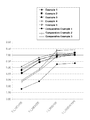
- FIG. 1 illustrates a graph representing TI values measured in Examples 1 to 5 and Comparative Examples 1 to 3.
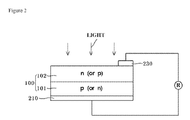
- FIG. 2 illustrates a schematic view of a solar cell structure in accordance with an example embodiment.
- a composition for solar cell electrodes includes a conductive powder, a glass frit, an organic vehicle, and a thixotropic agent, and satisfies the following Formulae 1 to 7.
- thixotropic index is calculated by substituting viscosity values measured at each revolutions per minute (rpm) using a No. 14 spindle by a rotary viscometer at 23° C.
- the composition may include about 50 wt % to about 90 wt % of the conductive powder; about 1 wt % to about 15 wt % of the glass fit; about 3 wt % to about 40 wt % of the organic vehicle; and about 0.01 wt % to about 2 wt % of the thixotropic agent.
- the conductive powder may include at least one selected from the group of silver (Ag), gold (Au), palladium (Pd), platinum (Pt), copper (Cu), chromium (Cr), cobalt (Co), aluminum (Al), tin (Sn), lead (Pb), zinc (Zn), iron (Fe), iridium (Ir), osmium (Os), rhodium (Rh), tungsten (W), molybdenum (Mo), nickel (Ni), and indium tin oxide (ITO).
- the glass frit may include leaded glass frits, lead-free glass frits, or mixtures thereof.
- the thixotropic agent may include at least one compound selected from the group of amine compounds, castor oil compounds, carbon black compounds, fatty acid amide compounds, fumed silica compounds, organo clay compounds, and nano-scale organic-inorganic hybrid particles.
- the glass fit may have an average particle diameter (D 50 ) of about 0.1 ⁇ m to about 5 ⁇ m.
- the composition may further include at least one additive selected from the group of dispersants, plasticizers, viscosity stabilizers, anti-foaming agents, pigments, UV stabilizers, antioxidants, and coupling agents.
- a pattern printed with the composition has a linewidth of about 75 ⁇ m to about 90 ⁇ m, a line thickness of about 15 ⁇ m to about 20 ⁇ m, and an aspect ratio (line thickness/linewidth) of 0.15 or more.
- solar cell electrodes may be fabricated using the composition according to an embodiment.
- a composition for solar cell electrodes according to the present example embodiment includes a conductive powder (A), a glass frit (B), an organic vehicle (C), and a thixotropic agent (D), and may be printed in fine linewidth on a substrate by screen-printing, and may provide high conversion efficiency.
- the conductive powder a suitable organic or inorganic powder having conductivity may be used.
- the conductive powder includes one or more of silver (Ag), gold (Au), palladium (Pd), platinum (Pt), copper (Cu), chromium (Cr), cobalt (Co), aluminum (Al), tin (Sn), lead (Pb), zinc (Zn), iron (Fe), iridium (Ir), osmium (Os), rhodium (Rh), tungsten (W), molybdenum (Mo), nickel (Ni), or indium tin oxide (ITO) powder.
- These conductive powders may be used alone or in combination of two or more thereof.
- the conductive powder may include silver (Ag) particle, and may further include nickel (Ni), cobalt (Co), iron (Fe), zinc (Zn), or copper (Cu) particles.
- the conductive powder may have an average particle diameter (D50) of about 0.1 ⁇ m to about 10 ⁇ m.
- D50 average particle diameter
- the conductive powder may have an average particle diameter of about 0.2 ⁇ m to about 7 ⁇ m, or about 0.5 ⁇ m to about 5 ⁇ m.
- the conductive powder may be present in an amount of about 50 wt % to about 90 wt % based on the total weight of the composition.
- the conductive powder may be present in an amount of about 70 wt % to about 90 wt %.
- the conductive powder may help prevent deterioration in conversion efficiency due to resistance increase, and help prevent difficulties in forming the paste due to relative reduction in amount of the organic vehicle, while providing suitable dispersion, fluidity and printability to the composition.
- the glass frits may generate silver crystal grains in an emitter region by etching an anti-reflection layer and melting the silver powder so as to reduce contact resistance during the baking process of the paste for electrodes. Further, the glass frits serve to enhance adhesion between the conductive powder and the wafer, and are softened to decrease the baking temperature during the baking process.
- the glass frit may be at least one of leaded glass frits and lead-free glass frits, such as those generally used in compositions for solar cell electrodes.
- the glass frit may include one or mixture of two or more metal oxide such as lead oxide, silicon oxide, tellurium oxide, bismuth oxide, zinc oxide, boron oxide, aluminum oxide, tungsten oxide, etc.
- the glass frit may include zinc oxide-silicon oxide (ZnO—SiO 2 ), zinc oxide-boron oxide-silicon oxide (ZnO—B 2 O 3 —SiO 2 ), zinc oxide-boron oxide-silicon oxide-aluminum oxide (ZnO—B 2 O 3 —SiO 2 —Al 2 O 3 ), bismuth oxide-silicon oxide (Bi 2 O 3 —SiO 2 ), bismuth oxide-boron oxide-silicon oxide (Bi 2 O 3 —B 2 O 3 —SiO 2 ), bismuth oxide-boron oxide-silicon oxide (Bi 2 O 3 —B 2 O 3 —SiO 2 ), bismuth oxide-boron oxide-silicon oxide-aluminum oxide (Bi 2 O 3
- the glass frit may be prepared from such metal oxides by a suitable method.
- the metal oxides may be mixed in a predetermined ratio. Mixing may be carried out using a ball mill or a planetary mill. The mixture may be melted at about 900° C. to about 1300° C., followed by quenching to about 25° C. The obtained resultant may be subjected to pulverization using a disc mill, a planetary mill, or the like, thereby preparing a glass frit.
- the glass frit may have a spherical or amorphous shape.
- the glass frit may be purchased or may be prepared by selectively melting, for example, silicon dioxide (SiO 2 ), aluminum oxide (Al 2 O 3 ), boron oxide (B 2 O 3 ), bismuth oxide (Bi 2 O 3 ), sodium oxide (Na 2 O), zinc oxide (ZnO), and the like, so as to have a desired composition.
- silicon dioxide SiO 2
- Al 2 O 3 aluminum oxide
- B 2 O 3 boron oxide
- Bi 2 O 3 bismuth oxide
- Na 2 O sodium oxide
- ZnO zinc oxide
- the glass fit may be present in an amount of about 1 wt % to about 15 wt %, for example about 2 wt % to about 10 wt %, based on the total weight of the composition. Within this content range, the glass frit may provide suitable dispersibility, fluidity, and printability to the composition.
- the organic vehicle imparts suitable viscosity and rheological characteristics for printing to the composition for solar cell electrodes through mechanical mixing with the inorganic component of the composition.
- the organic vehicle may be a suitable organic vehicle used in solar cell electrode compositions, and may include a binder resin, a solvent, and the like.
- acrylate resins or cellulose resins may be used as the binder resin.
- Ethyl cellulose may be used as the binder resin.
- ethyl hydroxyethyl cellulose, nitro cellulose, blends of ethyl cellulose and phenol resins, alkyd resins, phenolic resins, acrylate ester resins, xylene resins, polybutene resins, polyester resins, urea resins, melamine resins, vinyl acetate resins, wood rosins, polymethacrylates of alcohols, and the like may be used.
- the solvent may be include one or more of, for example, hexane, toluene, ethyl cellosolve, cyclohexanone, butyl cellosolve, butyl carbitol (diethylene glycol monobutyl ether), dibutyl carbitol (diethylene glycol dibutyl ether), butyl carbitol acetate (diethylene glycol monobutyl ether acetate), propylene glycol monomethyl ether, hexylene glycol, terpineol, methylethylketone, benzylalcohol, ⁇ -butyrolactone, ethyl lactate, etc.
- butyl carbitol diethylene glycol monobutyl ether
- dibutyl carbitol diethylene glycol dibutyl ether
- butyl carbitol acetate diethylene glycol monobutyl ether acetate
- propylene glycol monomethyl ether
- the organic vehicle may be present in an amount of about 3 wt % to about 40 wt % based on the total weight of the composition. Within this range, the organic vehicle may provide sufficient adhesive strength and excellent printability to the composition.
- the composition includes a thixotropic agent.
- the thixotropic agent may include at least one compound selected from the group of amine compounds, castor oil compounds, carbon black compounds, fatty acid amide compounds, fumed silica compounds, organo clay compounds, and nano-scale organic-inorganic hybrid particles.
- examples of thixotropic agent may include THIXATROL P600 (Elementis Co.) as the amine compounds, THIXATROL ST (Elementis Co.) as the castor oil compounds, VULCAN XC72 (Cabot Co.) as the carbon black compounds, Flownon (Kyoeisha Co.) as the fatty acid amide compounds, A200 (Evonik Co.) as the fumed silica compounds, BENTONE SD-3 (Elementis Co.) as the organo clay compounds, etc.
- the thixotropic agent may be present in an amount of about 0.01 wt % to about 2 wt %, for example about 0.05 wt % to about 1 wt %, based on the total weight of the composition. Within this range, the thixotropic agent may provide sufficient adhesive strength and excellent printability to the composition.
- the composition may further include general additives to enhance flow and process properties and stability.
- the additives may include dispersants, plasticizers, viscosity stabilizers, anti-foaming agents, pigments, UV stabilizers, antioxidants, coupling agents, and the like. These additives may be used alone or as mixtures thereof. These additives may be present in an amount of, for example, 0.1 wt % to 5 wt % based on the total weight of the composition.
- the composition for solar cell electrodes according to the present example embodiment may be applied using screen-printing.
- the composition satisfies the following Formulae 1 to 7.
- the composition may exhibit fine pattern printability and high conversion efficiency. 3 ⁇ TI 10(viscosity at 1 rpm/viscosity at 10 rpm) ⁇ 5.5; [Formula 1] 4 ⁇ TI 20(viscosity at 2 rpm/viscosity at 20 rpm) ⁇ 7; [Formula 2] 6 ⁇ TI 50(viscosity at 5 rpm/viscosity at 50 rpm) ⁇ 7.5; [Formula 3] 6 ⁇ TI 100(viscosity at 10 rpm/viscosity at 100 rpm) ⁇ 7.5; [Formula 4] 1 ⁇
- a thixotropic index is calculated by substituting the viscosity values measured at each different revolutions per minute (rpm) and at 23° C. with a No. 14 Spindle using a rotary viscometer.
- the thixotropic index (TI) may be defined as a ratio of viscosity values measured at different revolutions per minute (rpm) of a rotary viscometer.
- the thixotropic index TI 10 means a ratio of viscosity at 1 rpm to viscosity at 10 rpm as measured using a No. 14 spindle by the rotary viscometer at 23° C.
- the thixotropic index TI 20 means a ratio of viscosity at 2 rpm to viscosity at 20 rpm as measured using a No. 14 spindle by the rotary viscometer at 23° C.
- the rotary viscometer may include HBDV-II+Pro (Brookfield Co., Ltd.).
- the composition for solar cell electrodes may have a viscosity of about 200 Pa ⁇ s to about 600 Pa ⁇ s in terms of printability.
- the viscosity is measured by the rotary viscometer at 23° C. and 10 rpm.
- a printed pattern may have a linewidth of about 75 ⁇ m to about 90 ⁇ m and a line thickness of about 15 ⁇ m to about 20 ⁇ m. Further, the composition may provide an aspect ratio (line thickness/linewidth) of about 0.15 or more, for example about 0.15 to about 0.20, or about 0.16 to about 0.18. Within this range of aspect ratio, the composition may exhibit excellent printability.
- FIG. 2 shows a solar cell in accordance with an example embodiment.
- a rear electrode 210 and a front electrode 230 may be formed by printing and baking the composition on a wafer or substrate 100 that includes a p-layer (or n-layer) 101 and an n-layer (or p-layer) 102 , which will serve as an emitter.
- a preliminary process of preparing the rear electrode may be performed by printing the composition on the rear surface of the wafer and drying the printed composition at about 200° C. to about 400° C. for about 10 seconds to about 60 seconds.
- a preliminary process for preparing the front electrode may be performed by printing the paste on the front surface of the wafer and drying the printed composition.
- the front electrode and the rear electrode may be formed by baking or firing the wafer at about 400° C. to about 950° C., for example, at about 750° C. to about 950° C., for about 30 seconds to about 50 seconds.
- ethyl cellulose STD4, SDT200, Dow Chemical Company
- Texanol 3-hydroxy-2,2,4,4-tetramethyl pentyl isobutyrate
- composition was printed in a predetermined pattern over a front surface of a wafer by screen-printing. Properties of the composition were measured by the following method and results are shown in the following Table 2.
- compositions for solar cell electrodes were prepared in the same manner as in Example 1 except that the components of the compositions were used in amounts as listed in Table 1. Thereafter, the compositions were printed by screen-printing
- Thixotropic index was calculated using the ratio of viscosity values measured at 23° C. using a No. 14 spindle by a rotary viscometer HBDV-II+Pro (Brookfield Co., Ltd.). For measurement of viscosity, a sample cup was completely filled with a specimen and equipped with the spindle. After temperature stabilization for 5 minutes, viscosity was measured at the following maintenance time.
- compositions for solar cell electrodes prepared as above were printed in a predetermined pattern over a surface of a wafer using a screen mask designed to have a linewidth of 30 ⁇ m by screen-printing.
- the printed wafer was dried, baked, and observed at 9 portions of the pattern through a three-dimensional microscope, followed by confirmation of disconnection of the pattern through an EL analyzer.
- compositions for solar cell electrodes prepared as above were printed in a predetermined pattern over a surface of a wafer using a screen mask designed to have a linewidth of 30 ⁇ m by screen-printing.
- the printed wafer was dried, baked, and observed at 9 portions of the pattern through a three-dimensional microscope.
- the aspect ratio was obtained as an average value.
- the electrodes of a solar cell may be formed on the wafer by applying, patterning, and baking an electrode composition.
- a method of printing a composition for solar cell electrodes on a substrate may include gravure offset printing or screen-printing. It is important to use a composition for solar cell electrode that can be printed in fine linewidth and high aspect ratio on a substrate. Gravure offset printing is significantly influenced by viscosity, dryness, and adhesion of the composition. And screen-printing is significantly influenced by rheology or thixotropy.
- compositions for solar cell electrodes which may be printed in fine linewidth and high aspect ratio on a substrate by screen-printing and may provide high conversion efficiency, and electrodes produced using the same.
- a composition for solar cell electrodes according to embodiments may provide a printed pattern in fine linewidth and high aspect ratio.
- a composition for solar cell electrodes according to embodiments may provide high conversion efficiency.
Landscapes
- Chemical & Material Sciences (AREA)
- Dispersion Chemistry (AREA)
- Physics & Mathematics (AREA)
- Spectroscopy & Molecular Physics (AREA)
- Inorganic Chemistry (AREA)
- Photovoltaic Devices (AREA)
- Conductive Materials (AREA)
- Engineering & Computer Science (AREA)
- Manufacturing & Machinery (AREA)
- Life Sciences & Earth Sciences (AREA)
- Sustainable Development (AREA)
- Sustainable Energy (AREA)
Abstract
Description
3<TI 10(viscosity at 1 rpm/viscosity at 10 rpm)<5.5; [Formula 1]
4<TI 20(viscosity at 2 rpm/viscosity at 20 rpm)<7; [Formula 2]
6<TI 50(viscosity at 5 rpm/viscosity at 50 rpm)<7.5; [Formula 3]
6<TI 100(viscosity at 10 rpm/viscosity at 100 rpm)<7.5; [Formula 4]
1<|TI 10−TI 20|<2; [Formula 5]
0.5<|TI 20−
0≦|
3<TI 10(viscosity at 1 rpm/viscosity at 10 rpm)<5.5; [Formula 1]
4<TI 20(viscosity at 2 rpm/viscosity at 20 rpm)<7; [Formula 2]
6<TI 50(viscosity at 5 rpm/viscosity at 50 rpm)<7.5; [Formula 3]
6<TI 100(viscosity at 10 rpm/viscosity at 100 rpm)<7.5; [Formula 4]
1<|TI 10−TI 20|<2; [Formula 5]
0.5<|TI 20−
0≦|
3<TI 10(viscosity at 1 rpm/viscosity at 10 rpm)<5.5; [Formula 1]
4<TI 20(viscosity at 2 rpm/viscosity at 20 rpm)<7; [Formula 2]
6<TI 50(viscosity at 5 rpm/viscosity at 50 rpm)<7.5; [Formula 3]
6<TI 100(viscosity at 10 rpm/viscosity at 100 rpm)<7.5; [Formula 4]
1<|TI 10−TI 20|<2; [Formula 5]
0.5<|TI 20−
0≦|
| TABLE 1 | ||||||||
| 1 | 2 | 5 | 10 | 20 | 50 | 100 | ||
| rpm | rpm | rpm | rpm | rpm | rpm | rpm | ||
| Maintenance | 60 | 30 | 15 | 15 | 15 | 15 | 15 |
| time | sec | sec | sec | sec | sec | sec | sec |
| TABLE 2 | |||||||||
| Comp. | Comp. | Comp. | |||||||
| Ex. 1 | Ex. 2 | Ex. 3 | Ex. 4 | Ex. 5 | Ex. 1 | Ex. 2 | Ex. 3 | ||
| (A) Conductive | 88 | 88 | 88 | 88 | 88 | 89 | 88 | 88 |
| powder | ||||||||
| (B) Glass frit | 2.7 | 2.7 | 2.5 | 2.7 | 3.5 | 2.1 | 3 | 2.7 |
| (C) | Organic | 0.7 | 1.2 | 0.8 | 0.6 | 0.7 | 0.5 | 0.8 | 0.6 |
| Organ- | binder | ||||||||
| ic | Solvent | 3.3 | 3.1 | 3.4 | 2.9 | 3.3 | 2.6 | 3.7 | 3.4 |
| vehicle |
| (D) Thixotropic | 0.4 | 0.4 | 0.4 | 0.4 | 0.5 | 0.5 | 0.3 | 0.4 |
| agent | ||||||||
| (E) total Additive | 4.9 | 4.6 | 4.9 | 5.4 | 4 | 5.3 | 4.2 | 4.9 |
| (E-1) Dispersant | 0.6 | 0.6 | 0.6 | 0.6 | 0.6 | 0.6 | 0.6 | 0.6 |
| (E-2) Plasticizer | 4.3 | 4.0 | 4.3 | 4.8 | 3.4 | 4.7 | 3.6 | 4.3 |
| TI | TI 10 | 4.12 | 4.61 | 4.76 | 5.21 | 4.02 | 1.63 | 2.93 | 2.73 |
| TI 20 | 5.91 | 6.34 | 6.33 | 6.60 | 5.86 | 2.79 | 4.71 | 4.52 | |
| TI 50 | 6.86 | 7.02 | 7.28 | 7.32 | 6.63 | 5.53 | 7.70 | 6.71 | |
| TI 100 | 7.40 | 7.01 | 7.21 | 7.28 | 7.30 | 5.74 | 7.82 | 7.04 |
| |TI 10 − TI 20| | 1.79 | 1.73 | 1.57 | 1.39 | 1.84 | 1.16 | 1.79 | 1.79 |
| |TI 20 − TI 50| | 0.95 | 0.68 | 0.95 | 0.72 | 0.77 | 2.75 | 2.99 | 2.19 |
| |TI 50 − TI 100| | 0.54 | 0.00 | 0.00 | 0.00 | 0.67 | 0.20 | 0.11 | 0.33 |
| Short circuit | 8.739 | 8.745 | 8.732 | 8.754 | 8.756 | 8.723 | 8.692 | 8.809 |
| current [A] | ||||||||
| Serial resistance | 4.93 | 4.95 | 4.94 | 4.98 | 5.04 | 5.23 | 5.03 | 7.22 |
| [m ohm] | ||||||||
| Conversion | 17.35 | 17.45 | 17.30 | 17.40 | 17.32 | 17.1 | 16.9 | 16.42 |
| efficiency (%) | ||||||||
| 30 μm printability | <10 | <10 | <10 | <10 | <10 | <20 | <20 | >40 |
| (number of | ||||||||
| disconnected | ||||||||
| lines) | ||||||||
| Aspect ratio | 0.17 | 0.16 | 0.17 | 0.16 | 0.18 | 0.15 | 0.14 | 0.18 |
| (higher values are | ||||||||
| better) | ||||||||
Claims (14)
3<TI 10(viscosity at 1 rpm/viscosity at 10 rpm)<5.5; [Formula 1]
4<TI 20(viscosity at 2 rpm/viscosity at 20 rpm)<7; [Formula 2]
6<TI 50(viscosity at 5 rpm/viscosity at 50 rpm)<7.5; [Formula 3]
6<TI 100(viscosity at 10 rpm/viscosity at 100 rpm)<7.5; [Formula 4]
1<|TI 10−TI 20|<2; [Formula 5]
0.5<|TI 20−TI 50|<1.5; and [Formula 6]
0≦|TI 50−TI 100|<0.8, [Formula 7]
3<TI 10(viscosity at 1 rpm/viscosity at 10 rpm)<5.5; [Formula 1]
4<TI 20(viscosity at 2 rpm/viscosity at 20 rpm)<7; [Formula 2]
6<TI 50(viscosity at 5 rpm/viscosity at 50 rpm)<7.5; [Formula 3]
6<TI 100(viscosity at 10 rpm/viscosity at 100 rpm)<7.5; [Formula 4]
1<|TI 10−TI 20|<2; [Formula 5]
0.5<|TI 20−TI 50|<1.5; and [Formula 6]
0≦|TI 50−TI 100|<0.8, [Formula 7]
Applications Claiming Priority (5)
| Application Number | Priority Date | Filing Date | Title |
|---|---|---|---|
| KR20130110719 | 2013-09-13 | ||
| KR10-2013-0110719 | 2013-09-13 | ||
| KR10-2014-0016947 | 2014-02-13 | ||
| KR1020140016947A KR101648253B1 (en) | 2013-09-13 | 2014-02-13 | Composition for forming solar cell and electrode prepared using the same |
| PCT/KR2014/001223 WO2015037798A1 (en) | 2013-09-13 | 2014-02-14 | Composition for forming solar cell electrode, and electrode produced from composition |
Related Parent Applications (1)
| Application Number | Title | Priority Date | Filing Date |
|---|---|---|---|
| PCT/KR2014/001223 Continuation WO2015037798A1 (en) | 2013-09-13 | 2014-02-14 | Composition for forming solar cell electrode, and electrode produced from composition |
Publications (2)
| Publication Number | Publication Date |
|---|---|
| US20150280024A1 US20150280024A1 (en) | 2015-10-01 |
| US9515202B2 true US9515202B2 (en) | 2016-12-06 |
Family
ID=53024919
Family Applications (1)
| Application Number | Title | Priority Date | Filing Date |
|---|---|---|---|
| US14/739,875 Active US9515202B2 (en) | 2013-09-13 | 2015-06-15 | Composition for forming solar cell electrode, and electrode produced from composition |
Country Status (7)
| Country | Link |
|---|---|
| US (1) | US9515202B2 (en) |
| EP (1) | EP3026674B1 (en) |
| JP (1) | JP2016533019A (en) |
| KR (1) | KR101648253B1 (en) |
| CN (1) | CN104903973B (en) |
| TW (1) | TWI559335B (en) |
| WO (1) | WO2015037798A1 (en) |
Families Citing this family (13)
| Publication number | Priority date | Publication date | Assignee | Title |
|---|---|---|---|---|
| KR101882525B1 (en) * | 2013-04-11 | 2018-07-26 | 삼성에스디아이 주식회사 | Composition for forming solar cell and electrode prepared using the same |
| KR101693841B1 (en) * | 2015-02-27 | 2017-01-09 | 대주전자재료 주식회사 | silver paste composition, a front electrode for solar cell formed using it, and a solar cell employing it |
| KR101816236B1 (en) | 2015-04-28 | 2018-01-08 | 삼성에스디아이 주식회사 | Composition forforming electrode, electrode manufactured using the same and solar cell |
| KR101974839B1 (en) * | 2015-12-15 | 2019-05-03 | 삼성에스디아이 주식회사 | Composition for forming electrode, electrode manufactured using the same and solar cell |
| JP6804255B2 (en) | 2015-12-15 | 2020-12-23 | 三星エスディアイ株式会社Samsung SDI Co., Ltd. | Electrode forming composition and electrodes and solar cells manufactured using the composition |
| JP6236557B1 (en) * | 2016-03-18 | 2017-11-22 | Dowaエレクトロニクス株式会社 | Silver tellurium-coated glass powder and method for producing the same, and conductive paste and method for producing the same |
| WO2018032351A1 (en) * | 2016-08-16 | 2018-02-22 | Zhejiang Kaiying New Materials Co., Ltd. | Thick-film paste for front-side metallization in silicon solar cells |
| CN106373633A (en) * | 2016-08-31 | 2017-02-01 | 浙江凯盈新材料有限公司 | A method of improving the line aspect ratio of conductive paste screen printing |
| JP6246877B1 (en) | 2016-09-08 | 2017-12-13 | Dowaエレクトロニクス株式会社 | Conductive paste, method for producing the same, and method for producing solar cell |
| MY189222A (en) | 2016-12-20 | 2022-01-31 | Zhejiang Kaiying New Mat Co Ltd | Siloxane-containing solar cell metallization pastes |
| MY190562A (en) | 2016-12-20 | 2022-04-27 | Zhejiang Kaiying New Mat Co Ltd | Interdigitated back contact metal-insulator-semiconductor solar cell with printed oxide tunnel junctions |
| US10622502B1 (en) | 2019-05-23 | 2020-04-14 | Zhejiang Kaiying New Materials Co., Ltd. | Solar cell edge interconnects |
| US10749045B1 (en) | 2019-05-23 | 2020-08-18 | Zhejiang Kaiying New Materials Co., Ltd. | Solar cell side surface interconnects |
Citations (12)
| Publication number | Priority date | Publication date | Assignee | Title |
|---|---|---|---|---|
| KR20070055489A (en) | 2004-07-16 | 2007-05-30 | 신에쓰 가가꾸 고교 가부시끼가이샤 | Electrode Materials, Solar Cells and Methods of Manufacturing Solar Cells |
| KR20090110739A (en) | 2008-04-18 | 2009-10-22 | 계명대학교 산학협력단 | Solar cell electrode paste composition and electrode formation method using same |
| KR20100000685A (en) | 2008-06-25 | 2010-01-06 | 에스에스씨피 주식회사 | Conductive paste composition and preparation of electrode using same |
| KR20100069950A (en) | 2008-12-17 | 2010-06-25 | 에스에스씨피 주식회사 | Solar cell's electrode, manufacturing method thereof, and solar cell |
| KR20110040713A (en) | 2009-10-13 | 2011-04-20 | 주식회사 엘지화학 | Silver paste composition and solar cell using same |
| US20110197961A1 (en) * | 2010-02-12 | 2011-08-18 | Chun-Min Wu | Conductive aluminum paste and the fabrication method thereof, the solar cell and the module thereof |
| JP2012023088A (en) | 2010-07-12 | 2012-02-02 | Yokohama Rubber Co Ltd:The | Paste for solar cell electrode, and solar cell |
| US20120061624A1 (en) * | 2010-09-15 | 2012-03-15 | Seok Hyun Jung | Paste for solar cell electrode and solar cell prepared using the same |
| CN101796650B (en) | 2007-08-31 | 2012-11-28 | 费罗公司 | Layered contact structure for solar cells |
| CN103077764A (en) | 2013-02-01 | 2013-05-01 | 李春生 | Electrocondution slurry for front side electrode of solar cell |
| US20130255766A1 (en) * | 2012-03-30 | 2013-10-03 | Jung-hwan Shin | Conductive paste compositions and solar cells using the same |
| US20140306166A1 (en) * | 2013-04-11 | 2014-10-16 | Seok Hyun Jung | Composition for solar cell electrodes and electrode fabricated using the same |
Family Cites Families (7)
| Publication number | Priority date | Publication date | Assignee | Title |
|---|---|---|---|---|
| JP2004355862A (en) * | 2003-05-27 | 2004-12-16 | Ngk Spark Plug Co Ltd | Conductor paste, ceramic wiring board and method of manufacturing the same |
| JP2011228481A (en) * | 2010-04-20 | 2011-11-10 | Sumitomo Electric Printed Circuit Inc | Conductive paste, flexible printed-wiring board and electronic equipment |
| KR101374359B1 (en) * | 2010-09-15 | 2014-03-18 | 제일모직주식회사 | Paste for forming electrode of solar cell and solar cell using the same |
| EP2691963B1 (en) * | 2011-03-29 | 2015-02-18 | Sun Chemical Corporation | High-aspect ratio screen printable thick film paste compositions containing wax thixotropes |
| JP6185229B2 (en) * | 2011-11-04 | 2017-08-23 | ヘレウス プレシャス メタルズ ノース アメリカ コンショホーケン エルエルシー | Organic medium for conductive paste |
| CN103137239B (en) | 2011-11-25 | 2015-11-25 | 比亚迪股份有限公司 | A kind of front electrode of solar battery silver slurry and preparation method thereof and a kind of solar battery sheet |
| CN102629496B (en) | 2012-04-27 | 2015-02-18 | 西安银泰新能源材料科技有限公司 | Crystalline silicon solar battery front side electrode lead-free conductive lead slurry and preparation method of crystalline silicon solar battery front side electrode lead-free conductive lead slurry |
-
2014
- 2014-02-13 KR KR1020140016947A patent/KR101648253B1/en active Active
- 2014-02-14 WO PCT/KR2014/001223 patent/WO2015037798A1/en not_active Ceased
- 2014-02-14 EP EP14843591.0A patent/EP3026674B1/en active Active
- 2014-02-14 JP JP2016542622A patent/JP2016533019A/en active Pending
- 2014-02-14 CN CN201480003843.5A patent/CN104903973B/en active Active
- 2014-08-12 TW TW103127631A patent/TWI559335B/en active
-
2015
- 2015-06-15 US US14/739,875 patent/US9515202B2/en active Active
Patent Citations (15)
| Publication number | Priority date | Publication date | Assignee | Title |
|---|---|---|---|---|
| KR20070055489A (en) | 2004-07-16 | 2007-05-30 | 신에쓰 가가꾸 고교 가부시끼가이샤 | Electrode Materials, Solar Cells and Methods of Manufacturing Solar Cells |
| CN1985360A (en) | 2004-07-16 | 2007-06-20 | 信越化学工业株式会社 | Electrode material, solar cell and process for producing solar cell |
| CN101796650B (en) | 2007-08-31 | 2012-11-28 | 费罗公司 | Layered contact structure for solar cells |
| KR20090110739A (en) | 2008-04-18 | 2009-10-22 | 계명대학교 산학협력단 | Solar cell electrode paste composition and electrode formation method using same |
| CN102077301A (en) | 2008-06-25 | 2011-05-25 | Sscp有限公司 | Conductive paste composition and method of preparing electrode using the same |
| KR20100000685A (en) | 2008-06-25 | 2010-01-06 | 에스에스씨피 주식회사 | Conductive paste composition and preparation of electrode using same |
| KR20100069950A (en) | 2008-12-17 | 2010-06-25 | 에스에스씨피 주식회사 | Solar cell's electrode, manufacturing method thereof, and solar cell |
| CN102257629A (en) | 2008-12-17 | 2011-11-23 | Sscp株式会社 | Electrode for solar cell, method for producing same, and solar cell |
| KR20110040713A (en) | 2009-10-13 | 2011-04-20 | 주식회사 엘지화학 | Silver paste composition and solar cell using same |
| US20110197961A1 (en) * | 2010-02-12 | 2011-08-18 | Chun-Min Wu | Conductive aluminum paste and the fabrication method thereof, the solar cell and the module thereof |
| JP2012023088A (en) | 2010-07-12 | 2012-02-02 | Yokohama Rubber Co Ltd:The | Paste for solar cell electrode, and solar cell |
| US20120061624A1 (en) * | 2010-09-15 | 2012-03-15 | Seok Hyun Jung | Paste for solar cell electrode and solar cell prepared using the same |
| US20130255766A1 (en) * | 2012-03-30 | 2013-10-03 | Jung-hwan Shin | Conductive paste compositions and solar cells using the same |
| CN103077764A (en) | 2013-02-01 | 2013-05-01 | 李春生 | Electrocondution slurry for front side electrode of solar cell |
| US20140306166A1 (en) * | 2013-04-11 | 2014-10-16 | Seok Hyun Jung | Composition for solar cell electrodes and electrode fabricated using the same |
Non-Patent Citations (3)
| Title |
|---|
| Chinese Office Action dated Apr. 15, 2016 in Corresponding Chinese Patent Application No. 201480003843.5 |
| Korean Office Action mailed Dec. 4, 2015. |
| Office Action mailed Sep. 17, 2015 in corresponding Taiwanese Patent Application No. 103127631. |
Also Published As
| Publication number | Publication date |
|---|---|
| CN104903973A (en) | 2015-09-09 |
| KR101648253B1 (en) | 2016-08-12 |
| JP2016533019A (en) | 2016-10-20 |
| EP3026674B1 (en) | 2021-04-21 |
| EP3026674A1 (en) | 2016-06-01 |
| WO2015037798A1 (en) | 2015-03-19 |
| TWI559335B (en) | 2016-11-21 |
| EP3026674A4 (en) | 2017-02-22 |
| KR20150031150A (en) | 2015-03-23 |
| TW201513134A (en) | 2015-04-01 |
| CN104903973B (en) | 2017-09-22 |
| US20150280024A1 (en) | 2015-10-01 |
Similar Documents
| Publication | Publication Date | Title |
|---|---|---|
| US9515202B2 (en) | Composition for forming solar cell electrode, and electrode produced from composition | |
| US8968607B2 (en) | Paste composition for solar cell electrodes and electrode fabricated using the same | |
| US9512032B2 (en) | Glass frit, composition for solar cell electrodes including the same, and electrode fabricated using the same | |
| US9608137B2 (en) | Composition for solar cell electrodes and electrode fabricated using the same | |
| KR20140022511A (en) | Electrode paste for solar cell, electrode prepared from the same and solar cell comprising the same | |
| JP2016538708A (en) | Composition for forming solar cell electrode and electrode produced thereby | |
| US10544314B2 (en) | Composition for solar cell electrodes and electrode fabricated using the same | |
| US9748417B2 (en) | Composition for forming solar cell electrode and electrode produced from same | |
| CN105190779A (en) | Composition for forming electrode of solar cell and electrode formed therefrom | |
| CN103915129A (en) | Composition for solar cell electrodes and electrode fabricated using the same | |
| US9818889B2 (en) | Composition for solar cell electrodes and electrode fabricated using the same | |
| TWI655784B (en) | Front electrode for solar cell and solar cell including the same | |
| TWI681410B (en) | Composition for solar cell electrode and solar cell electrode prepared using the same | |
| KR101955759B1 (en) | Composition for forming p-type solar cell electrode, electrode prepared and p-type solar cell prepared by using the same | |
| KR20140123205A (en) | Composition for forming solar cell electrode and electrode prepared using the same | |
| CN111354803B (en) | Method for forming solar cell electrode and solar cell | |
| KR20200015318A (en) | Composition for forming electrode for solar cell including aluminum oxide layer, electrode prepared using the same and solar cell comprising electrode prepared using the same | |
| KR20160121474A (en) | Composition for forming solar cell and electrode prepared using the same | |
| JP2017112097A (en) | Composition for forming electrode, electrode manufactured using the same, and solar cell | |
| KR20170025892A (en) | Composition forforming electrode, electrode manufactured using the same and solar cell |
Legal Events
| Date | Code | Title | Description |
|---|---|---|---|
| AS | Assignment |
Owner name: CHEIL INDUSTRIES, INC., KOREA, DEMOCRATIC PEOPLE'S Free format text: ASSIGNMENT OF ASSIGNORS INTEREST;ASSIGNORS:BAE, DAE SUB;KIM, JAE HO;YANG, SANG HYUN;AND OTHERS;REEL/FRAME:035910/0743 Effective date: 20150520 |
|
| AS | Assignment |
Owner name: CHEIL INDUSTRIES, INC., KOREA, REPUBLIC OF Free format text: CORRECTIVE ASSIGNMENT TO CORRECT THE NAME OF THE FIRST INVENTOR PREVIOUSLY RECORDED AT REEL: 035910 FRAME: 0743. ASSIGNOR(S) HEREBY CONFIRMS THE ASSIGNMENT;ASSIGNORS:SONG, DAE SUB;KIM, JAE HO;YANG, SANG HYUN;AND OTHERS;REEL/FRAME:036035/0303 Effective date: 20150520 |
|
| STCF | Information on status: patent grant |
Free format text: PATENTED CASE |
|
| MAFP | Maintenance fee payment |
Free format text: PAYMENT OF MAINTENANCE FEE, 4TH YEAR, LARGE ENTITY (ORIGINAL EVENT CODE: M1551); ENTITY STATUS OF PATENT OWNER: LARGE ENTITY Year of fee payment: 4 |
|
| AS | Assignment |
Owner name: SAMSUNG SDI CO., LTD., KOREA, REPUBLIC OF Free format text: MERGER AND CHANGE OF NAME;ASSIGNORS:CHEIL INDUSTRIES, INC.;SAMSUNG SDI CO., LTD.;REEL/FRAME:054866/0956 Effective date: 20140702 |
|
| AS | Assignment |
Owner name: CHANGZHOU FUSION NEW MATERIAL CO. LTD, CHINA Free format text: ASSIGNMENT OF ASSIGNORS INTEREST;ASSIGNOR:SAMSUNG SDI CO., LTD.;REEL/FRAME:056005/0177 Effective date: 20210330 |
|
| MAFP | Maintenance fee payment |
Free format text: PAYMENT OF MAINTENANCE FEE, 8TH YEAR, LARGE ENTITY (ORIGINAL EVENT CODE: M1552); ENTITY STATUS OF PATENT OWNER: LARGE ENTITY Year of fee payment: 8 |