US9513077B2 - Magazine lock and portable firearm - Google Patents

Magazine lock and portable firearm Download PDF

Info

Publication number
US9513077B2
US9513077B2 US14/759,840 US201314759840A US9513077B2 US 9513077 B2 US9513077 B2 US 9513077B2 US 201314759840 A US201314759840 A US 201314759840A US 9513077 B2 US9513077 B2 US 9513077B2
Authority
US
United States
Prior art keywords
magazine
lock
firearm
receiver
firearm receiver
Prior art date
Legal status (The legal status is an assumption and is not a legal conclusion. Google has not performed a legal analysis and makes no representation as to the accuracy of the status listed.)
Expired - Fee Related
Application number
US14/759,840
Other versions
US20150338180A1 (en
Inventor
Kazutoshi NORO
Takao Murase
Current Assignee (The listed assignees may be inaccurate. Google has not performed a legal analysis and makes no representation or warranty as to the accuracy of the list.)
Howa Machinery Ltd
Original Assignee
Howa Machinery Ltd
Priority date (The priority date is an assumption and is not a legal conclusion. Google has not performed a legal analysis and makes no representation as to the accuracy of the date listed.)
Filing date
Publication date
Application filed by Howa Machinery Ltd filed Critical Howa Machinery Ltd
Assigned to HOWA MACHINERY, LTD. reassignment HOWA MACHINERY, LTD. ASSIGNMENT OF ASSIGNORS INTEREST (SEE DOCUMENT FOR DETAILS). Assignors: MURASE, TAKAO, NORO, Kazutoshi
Publication of US20150338180A1 publication Critical patent/US20150338180A1/en
Application granted granted Critical
Publication of US9513077B2 publication Critical patent/US9513077B2/en
Expired - Fee Related legal-status Critical Current
Anticipated expiration legal-status Critical

Links

Images

Classifications

    • FMECHANICAL ENGINEERING; LIGHTING; HEATING; WEAPONS; BLASTING
    • F41WEAPONS
    • F41AFUNCTIONAL FEATURES OR DETAILS COMMON TO BOTH SMALLARMS AND ORDNANCE, e.g. CANNONS; MOUNTINGS FOR SMALLARMS OR ORDNANCE
    • F41A17/00Safety arrangements, e.g. safeties
    • F41A17/34Magazine safeties
    • F41A17/36Magazine safeties locking the gun automatically in a safety condition when the magazine is empty or removed
    • FMECHANICAL ENGINEERING; LIGHTING; HEATING; WEAPONS; BLASTING
    • F41WEAPONS
    • F41AFUNCTIONAL FEATURES OR DETAILS COMMON TO BOTH SMALLARMS AND ORDNANCE, e.g. CANNONS; MOUNTINGS FOR SMALLARMS OR ORDNANCE
    • F41A17/00Safety arrangements, e.g. safeties
    • F41A17/34Magazine safeties
    • F41A17/38Magazine mountings, e.g. for locking the magazine in the gun
    • FMECHANICAL ENGINEERING; LIGHTING; HEATING; WEAPONS; BLASTING
    • F41WEAPONS
    • F41AFUNCTIONAL FEATURES OR DETAILS COMMON TO BOTH SMALLARMS AND ORDNANCE, e.g. CANNONS; MOUNTINGS FOR SMALLARMS OR ORDNANCE
    • F41A19/00Firing or trigger mechanisms; Cocking mechanisms
    • F41A19/06Mechanical firing mechanisms, e.g. counterrecoil firing, recoil actuated firing mechanisms
    • F41A19/11Trigger guards; Trigger-guard mountings
    • FMECHANICAL ENGINEERING; LIGHTING; HEATING; WEAPONS; BLASTING
    • F41WEAPONS
    • F41AFUNCTIONAL FEATURES OR DETAILS COMMON TO BOTH SMALLARMS AND ORDNANCE, e.g. CANNONS; MOUNTINGS FOR SMALLARMS OR ORDNANCE
    • F41A9/00Feeding or loading of ammunition; Magazines; Guiding means for the extracting of cartridges
    • F41A9/61Magazines
    • F41A9/64Magazines for unbelted ammunition
    • FMECHANICAL ENGINEERING; LIGHTING; HEATING; WEAPONS; BLASTING
    • F41WEAPONS
    • F41AFUNCTIONAL FEATURES OR DETAILS COMMON TO BOTH SMALLARMS AND ORDNANCE, e.g. CANNONS; MOUNTINGS FOR SMALLARMS OR ORDNANCE
    • F41A9/00Feeding or loading of ammunition; Magazines; Guiding means for the extracting of cartridges
    • F41A9/61Magazines
    • F41A9/64Magazines for unbelted ammunition
    • F41A9/65Box magazines having a cartridge follower
    • F41A9/69Box magazines having a cartridge follower characterised by multiple-row or zigzag arrangement of cartridges

Definitions

  • the present invention relates to a magazine look for attaching and detaching a magazine with respect to a firearm receiver. Further, the present invention relates to a portable firearm which is provided with such a magazine lock.
  • An automatic portable firearm is provided with a magazine in which a number of cartridges are held.
  • the magazine is usually attached to the bottom side of the firearm receiver at the rear part of the barrel. It is desirable that the magazine can be attached and detached with respect to the portable firearm to quickly reload the cartridges.
  • the portable firearm as shown in PLT 1, is provided with a magazine lock.
  • PLT 1 U.S. Pat. No. 5,899,013
  • the cartridges in the magazine are biased upward by a spring and abut against the top part of the magazine.
  • a bolt action system a bolt is slid forward in the firearm receiver to push the cartridge at the topmost part of the magazine to the muzzle side whereby the cartridge is loaded into the chamber for firing. If the height of attachment of the magazine to the firearm receiver is low, the contact area of the bolt and cartridge becomes smaller, so the bolt cannot push the cartridge at the topmost part of the magazine and in turn the cartridge jams.
  • the system called the “double column-double feed” system As the method of holding a large number of cartridges in a magazine, the system called the “double column-double feed” system is known.
  • the double column-double feed system as shown in FIG. 14 , two columns of cartridges are alternately stacked in the magazine in a partially overlapping state. The cartridges of the different columns are alternately fed from the magazine into the chamber. With this system, the dead space in the magazine can be made smaller, so the magazine can hold more cartridges.
  • the center of the bolt and the center of a cartridge are offset in the direction vertical to the stacking direction of the cartridges (left-right direction of FIG. 14 ), so the contact area between the bolt and the cartridge becomes smaller. For this reason, a cartridge easily jams, so the allowable deviation of the height of attachment of the magazine to the firearm receiver from the design value is smaller.
  • the firearm receiver and a trigger guard are attached to the stock.
  • the trigger guard is positioned with respect to the firearm receiver via the stock.
  • the magazine lock which is described in PLT 1
  • the magazine is attached to the trigger guard by a lever and pin which are arranged before and after the magazine. Therefore, the magazine is positioned with respect to the firearm receiver via the trigger guard and stock. For this reason, the height of attachment of the magazine to the firearm receiver can deviate from the design value by the amounts of tolerance of the parts of the stock and trigger guard. As explained above, if the height of attachment of the magazine with respect to the firearm receiver is low, a cartridge can jam.
  • the unit costs of the parts of the stock and trigger guard will increase. Further, if setting a threshold value of the height of attachment of the magazine to the firearm receiver and separating out defective products in the assembly process of the portable firearm, the man-hours required will increase and therefore the manufacturing costs will increase and the mass production effect will fall.
  • the present invention was made in consideration of the above situation and has as its object the provision of a magazine lock which decreases the deviation of the height of attachment of the magazine to the firearm receiver from the design value and thereby can prevent a cartridge from jamming without causing a decline in the strength of the firearm receiver.
  • a magazine lock which comprises projections which extend downward from a mesh firearm receiver and lock parts which are movably attached to the projections and attach and detach a magazine with respect the firearm receiver, wherein the lock parts move between a fastening position where they fasten the magazine and a release position where they release the magazine so as to attach and detach the magazine.
  • the firearm receiver side of the magazine lock is defined as the “top” side of the magazine lock, while the opposite side from the firearm receiver along the short direction of the bash firearm receiver is defined as the “bottom” side of the magazine lock.
  • the magazine is a double column-double feed type of magazine.
  • the lock parts include two engagement members which engage with the front side and rear side of the magazine.
  • muzzle side of the firearm receiver is defined as the “front” side of the magazine lock, while the opposite side from the muzzle along the longitudinal direction of the breech fire rm receiver is defined as the “rear” side of the magazine lock.
  • the magazine lock further comprises a link mechanism which links the two engagement members, and the link mechanism makes the two engagement members simultaneously move between the fastening position and the release position.
  • a portable firearm which is provided with a magazine lock of the first aspect of the present invention.
  • the portable firearm includes a trigger guard which is positioned with respect to the magazine lock via the stock and firearm receiver, and the trigger guard has an access hole which enables the lock part to be directly accessed from the bottom side of the trigger guard.
  • FIG. 1 is a partial perspective view of a portable firearm which is provided with a magazine lock according to the present invention.
  • FIG. 2 is a partial front view of a portable firearm which is provided with a magazine lock according to the present invention.
  • FIG. 3 is a partial plan view of a portable firearm which is provided with a magazine lock according to the present invention.
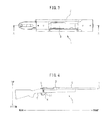
  • FIG. 4 is a front view of a portable firearm according to the present invention.
  • FIG. 5 is a disassembled perspective view of part of a portable firearm according to the present invention.
  • FIG. 6 is a cross-sectional view along the line X-X of FIG. 3 .
  • FIG. 7 is an enlarged view of a part A of FIG. 6 .
  • FIG. 8 is an enlarged view of a part B of FIG. 6 .
  • FIG. 9 is a disassembled perspective view of a magazine lock according to the present invention.
  • FIG. 10 is a perspective view which shows a rear side of a magazine.
  • FIG. 11 is a perspective view which shows a front side of a magazine.
  • FIG. 12 is a perspective view of a magazine in which cartridges are held.
  • FIG. 13 is a front view of a magazine in which cartridges are held.
  • FIG. 14 is a cross-sectional view along the line Y-Y of FIG. 13 .
  • FIG. 1 to FIG. 3 are respectively a partial perspective view, a partial front view, and a partial plan view of a portable firearm 1 which is provided with a magazine lock 10 according to the present invention (see FIG. 9 ).
  • FIG. 1 and FIG. 2 show a firearm receiver 2 , a magazine 3 which is attached by the magazine lock 10 to the bottom side of the firearm receiver 2 , and a trigger guard 4 which is arranged so as to surround the bottom part of the magazine 3 . Details of the magazine lock 10 will be explained later.
  • FIG. 4 is a front view of a portable firearm 1 according to the present invention.
  • a rifle 1 is shown.
  • the firearm receiver 2 is arranged at the rear of the barrel 5 .
  • the magazine 3 is attached to the bottom side of the firearm receiver 2 and is held inside a stock 6 .
  • the trigger guard 4 is attached to the stock 6 and is positioned with respect to the magazine lock 10 via the stock 6 and firearm receiver 2 . Note that, as shown in FIG. 2 and FIG.
  • the muzzle 7 sides of the portable firearm 1 and firearm receiver 2 are defined as the “front” sides of the portable firearm 1 and magazine lock 10
  • the sides opposite to the muzzle 7 along the longitudinal direction of the portable firearm 1 and firearm receiver 2 are defined as the “rear” sides of the portable firearm 1 and magazine lock 10
  • the firearm receiver 2 sides of the portable firearm 1 and magazine lock 10 are defined as the “top” sides of the portable firearm 1 and magazine lock 10
  • the sides opposite to the firearm receiver 2 along the short direction of the portable firearm 1 and firearm receiver 2 are defined as the “bottom” sides of the portable firearm 1 and magazine lock 10 .
  • FIG. 5 is a disassembled perspective view of part of the portable firearm 1 according to the present invention.
  • the magazine 3 can be detached from the body of the portable firearm by the magazine lock 10 .
  • an empty magazine and another magazine in which cartridges are loaded can be switched, so a large number of cartridges can be quickly reloaded.
  • FIG. 12 and FIG. 13 are respectively a perspective view and front view of a magazine 3 in which cartridges 8 are held.
  • FIG. 14 is a cross-sectional view along the line Y-Y of FIG. 13 .
  • the system of holding cartridges 8 which is shown in FIG. 12 to FIG. 14 is called a “double column-double feed” system.
  • the double column-double feed system as shown in FIG. 14 , two columns of cartridges 8 are alternately stacked in the magazine 3 in a partially overlapping state.
  • the cartridges 8 of the different columns are alternately fed from the magazine 3 into the chamber. With this system, the dead space in the magazine 3 can be made smaller, so the magazine 3 can hold more cartridges 8 .
  • a bolt 9 is slid forward in the firearm receiver 2 to push the cartridge 8 at the topmost part of the magazine 3 to the muzzle 7 side whereby the cartridge 8 is loaded into the chamber for firing.
  • the shape of the bolt 9 is shown best in FIG. 5 .
  • a user can operate a handle 91 of the bolt 9 to make the bolt 9 move back and forth inside the firearm receiver 2 .
  • the bolt 9 and the cartridge 8 at the topmost part inside the magazine 3 come into contact, so the cartridge 8 at the topmost part is pushed by the bolt 9 and loaded from the magazine 3 to the chamber.
  • a cartridge 8 of a different column from the cartridge 8 which was loaded is biased upward by a spring 31 which is set at the bottom part of the magazine 3 and abuts against the top part 32 of the magazine 3 .
  • the handle 91 is operated to make the bolt 9 retract whereby the spent round is ejected. If again sliding forward the bolt 9 , the other cartridge 8 at the topmost part in the magazine 3 is loaded into the chamber. In this way, by back and forth motion of the bolt 9 , it becomes possible to continuously fire rounds without hand loading a cartridge 8 into the magazine 3 each time.
  • FIG. 6 is a cross-sectional view along the line X-X of FIG. 3 .
  • FIG. 9 is a disassembled perspective view of the magazine lock 10 .
  • the magazine lock 10 is provided with projections 11 a , 11 b which extend downward from the firearm receiver 2 and lock parts 12 which are movably attached to the projections 11 a and 11 b and attach and detach the magazine 3 with respect to the firearm receiver 2 .
  • the lock parts 12 can move between a fastening position where they fasten the magazine 3 with respect to the firearm receiver 2 and a release position where they release the magazine 3 . Due to this, the magazine 3 can be attached and detached with respect to the firearm receiver 2 .
  • the projections 11 a , 11 b are fastened to the firearm receiver 2 by bolts 30 in this embodiment, but may also be formed integrally with the firearm receiver 2 .
  • the magazine 3 is directly fastened by the magazine lock 10 to the firearm receiver 2 . Due to this, in the present invention, the tolerance of the parts of the stock 6 and trigger guard 4 does not affect at all to the height of attachment of the magazine 3 with respect to the firearm receiver 2 . Therefore, it is possible to make the deviation of the height of attachment of the magazine 3 with respect to the 14 firearm receiver 2 from the design value decrease. For this reason, even if the magazine 3 is a double column-double feed system magazine, there is no need to provide a projection of the bolt 9 and a groove of the firearm receiver 2 . Therefore, it is possible to prevent a cartridge 8 from jamming without causing the strength of the firearm receiver 2 to decrease. Due to this, the portable firearm can use high powered rounds like magnum rounds as cartridges 8 .
  • the lock parts 12 include two engagement members 12 a , 12 b which respectively engage with a front side and rear &de of the magazine 3 .
  • FIG. 10 and FIG. 11 are respectively perspective views which show the rear side and front side of the magazine 3 .
  • a hole 33 is provided for the rear side engagement member 12 b to engage with, while at the front side of the magazine 3 , a projecting part 34 is provided for the front side engagement member 12 a to engage with.
  • the two engagement members 12 a , 12 b respectively engage with the front side projecting part 34 and the rear side hole 33 of the magazine 3 , whereby the magazine 3 is fastened with respect to the firearm receiver 2 .
  • the magazine 3 By fastening the both sides of the front side and the rear side, compared with fastening one side of the front side or the rear side, the magazine 3 can be fastened more strongly with respect to the firearm receiver 2 . Due to this, after attachment of the magazine 3 , the magazine 3 is kept from descending from the firearm receiver 2 due to vibration etc.
  • the engagement parts of the magazine 3 may both be holes or projecting parts or may be other shapes such as recesses.
  • FIG. 7 and FIG. 8 are respectively enlarged views of the part A and part B of FIG. 6 .
  • the engagement members 12 a , 12 b which have been made to move to a release position where they release the magazine 3 are shown by broken ones.
  • the two engagement members 12 a , 12 b respectively move between the fastening position (solid lines) where they fasten the magazine 3 and the release position (broken lines) where they release the magazine 3 and thereby can attach and detach the magazine 3 with respect to the firearm receiver 2 .
  • the mode of movement of the engagement members 12 a , 12 b is not limited to rotational motion such as in the embodiment and may also be translational motion.
  • the magazine lock 10 is preferably further provided with a link mechanism 20 which links the two engagement members 12 a , 12 b .
  • the link mechanism 20 can, by the later explained configuration, make the two engagement members 12 a , 12 b simultaneously move between the fastening position and the release position. By doing this, it is possible to make only the one engagement member 12 a move and thereby easily detach the magazine 3 .
  • the link mechanism 20 is provided with two elongated links 21 a , 21 b which link the two engagement members 12 a , 12 b , two pins 22 a , 22 b which serve as rotation center axes for the engagement members, and two sets of connecting members 23 a , 23 b which connect the links 21 a , 21 b with the engagement members 12 a , 12 b .
  • the connecting members 23 a , 23 b are provided with guide bars 24 a , 24 b which extend inside the engagement members 12 a , 12 b and the projections 11 a , 11 b , collars 25 a , 25 b which receive the guide bars 24 a , 24 b outside of the projections 11 a , 11 b , and two snap rings 26 a , 26 b which fasten the two ends of the guide bars to the link.
  • holes 110 a , 110 b through which the pins 22 a , 22 b pass long holes 111 a , 111 b through which the guide bars 24 a , 24 b pass and which limit the range of movement of the engagement members 12 a , 12 b , and bolt holes 112 a , 112 b through which the bolts 30 pass are provided.
  • the engagement members 12 a , 12 b are also provided with holes 120 a , 120 b through which the pins 22 a , 22 b pass and holes 121 a , 121 b through which the guide bars 24 a , 24 b pass.
  • the front side pin 22 a and guide bar 24 a and the rear side pin 22 b and guide bar 24 b are arranged at the top and bottom facing each other. More specifically, at the front side, the pin 22 a is arranged at the bottom side from the guide bar 24 a , while at the rear side, the pin 22 b is arranged at the top side from the guide bar 24 b . Due to this configuration, as explained later, the front side engagement member 12 a and the rear side engagement member 12 b simultaneously rotate in opposite directions due to the link mechanism 20 .
  • the engagement members 12 a , 12 b are respectively attached to the projections 11 a , 11 b to be able to rotate about the pins 22 a , 22 b .
  • the bottom part of the front side engagement member 12 a can be accessed from the access hole 41 of the trigger guard 4 .
  • the front side engagement member 12 a can be rotated by a finger from the bottom of the trigger guard 4 .
  • the front side engagement member 12 a rotates together with the guide bar 24 a clockwise about the pin 22 a , so disengages from the projecting part 34 of the magazine 3 .
  • the links 21 a , 21 b which are fastened to the guide bar 24 a move forward.
  • the guide bar 24 b which is fastened to the links 21 a , 21 b rotates together with the rear side engagement member 12 b about the pin 22 b counterclockwise. Due to this, the rear side engagement member 12 b is disengaged from the hole 33 of the magazine 3 .
  • the link mechanism 20 can make the two engagement members 12 a , 12 b move simultaneously between the fastening position and the release position. Further, if, in the state with the palm of the hand placed below the magazine 3 , the finger of the same hand is used to push down the front side engagement member 12 a through the access hole 41 of the trigger guard 4 , the detached magazine 3 can be received by the palm of the hand. Therefore, the link mechanism 20 can be used to quickly detach the magazine 3 by a single hand.
  • a magazine 3 is pushed into the body of the portable firearm by the palm of the hand from below the trigger guard 4 .
  • the front side engagement member 12 a is pushed upward by a finger of the same hand through the access hole 41 of the trigger guard 4 . If doing this, the two engagement members 12 a , 12 b are rotated from the release position to the fastening position.
  • the front side engagement member 12 a and the rear side engagement member 12 b respectively engage with the projecting part 34 and hole 33 of the magazine, so the magazine 3 is fastened with respect to the firearm receiver 2 . Therefore, the link mechanism 20 enables the magazine 3 to be quickly attached by a single hand.

Landscapes

  • Engineering & Computer Science (AREA)
  • General Engineering & Computer Science (AREA)
  • Portable Nailing Machines And Staplers (AREA)
  • Aiming, Guidance, Guns With A Light Source, Armor, Camouflage, And Targets (AREA)

Abstract

A magazine attachment/detachment mechanism (10) is equipped with; protrusions (11 a, 11 b) extending downward from a receiver (2); and an attachment/detachment unit (12) that is movably attached to the protrusions (11 a, 11 b) and that attaches a magazine (3) to the receiver (2) in a detachable manner. The attachment/detachment unit (12) attaches/detaches the magazine (3) to/from the receiver (2) by moving between a securing position that secures the magazine (3) and a release position that releases the magazine (3). Thus, the magazine (3) is attached directly to the receiver (2), so deviation from the design value for the attachment height of the magazine (3) with respect to the receiver (2) can be reduced. Accordingly, it is possible to prevent defects in the chambering of cartridges without reducing the strength of the receiver (2).

Description

TECHNICAL FIELD
The present invention relates to a magazine look for attaching and detaching a magazine with respect to a firearm receiver. Further, the present invention relates to a portable firearm which is provided with such a magazine lock.
BACKGROUND ART
An automatic portable firearm is provided with a magazine in which a number of cartridges are held. The magazine is usually attached to the bottom side of the firearm receiver at the rear part of the barrel. It is desirable that the magazine can be attached and detached with respect to the portable firearm to quickly reload the cartridges. In this case, the portable firearm, as shown in PLT 1, is provided with a magazine lock.
CITATIONS LIST Patent Literature
PLT 1: U.S. Pat. No. 5,899,013
SUMMARY OF INVENTION Technical Problem
The cartridges in the magazine are biased upward by a spring and abut against the top part of the magazine. In a so-called “bolt action” system, a bolt is slid forward in the firearm receiver to push the cartridge at the topmost part of the magazine to the muzzle side whereby the cartridge is loaded into the chamber for firing. If the height of attachment of the magazine to the firearm receiver is low, the contact area of the bolt and cartridge becomes smaller, so the bolt cannot push the cartridge at the topmost part of the magazine and in turn the cartridge jams.
As the method of holding a large number of cartridges in a magazine, the system called the “double column-double feed” system is known. In the double column-double feed system, as shown in FIG. 14, two columns of cartridges are alternately stacked in the magazine in a partially overlapping state. The cartridges of the different columns are alternately fed from the magazine into the chamber. With this system, the dead space in the magazine can be made smaller, so the magazine can hold more cartridges.
However, with the double column-double feed system, the center of the bolt and the center of a cartridge are offset in the direction vertical to the stacking direction of the cartridges (left-right direction of FIG. 14), so the contact area between the bolt and the cartridge becomes smaller. For this reason, a cartridge easily jams, so the allowable deviation of the height of attachment of the magazine to the firearm receiver from the design value is smaller.
Usually, at the time of assembly, the firearm receiver and a trigger guard are attached to the stock. In other words, the trigger guard is positioned with respect to the firearm receiver via the stock. In the magazine lock which is described in PLT 1, the magazine is attached to the trigger guard by a lever and pin which are arranged before and after the magazine. Therefore, the magazine is positioned with respect to the firearm receiver via the trigger guard and stock. For this reason, the height of attachment of the magazine to the firearm receiver can deviate from the design value by the amounts of tolerance of the parts of the stock and trigger guard. As explained above, if the height of attachment of the magazine with respect to the firearm receiver is low, a cartridge can jam.
If, to prevent jamming of a cartridge, strictly limiting the tolerances of the parts of the stock and trigger guard, the unit costs of the parts of the stock and trigger guard will increase. Further, if setting a threshold value of the height of attachment of the magazine to the firearm receiver and separating out defective products in the assembly process of the portable firearm, the man-hours required will increase and therefore the manufacturing costs will increase and the mass production effect will fall.
As another method for preventing jamming of a cartridge, it is known to provide a projection at the bottom part of the bolt so as to make the contact area of the bolt and the cartridge increase. In this case, it is necessary to provide a groove for the passage of the projection of the bolt at the inside surface of the firearm receiver. This causes the thickness of the firearm receiver to decrease and in turn causes a drop in the strength of the firearm receiver. The firearm receiver also has the role of receiving the recoil when a cartridge is fired. For this reason, if the strength of the firearm receiver is low, it is not possible to use high powered rounds like magnum rounds, so the types of cartridges which can be used become limited. Further, a special bolt at which the projection is provided and a special firearm receiver at which the groove is provided become necessary, so the firearm receiver and bolt and in turn the portable firearm become more expensive.
The present invention was made in consideration of the above situation and has as its object the provision of a magazine lock which decreases the deviation of the height of attachment of the magazine to the firearm receiver from the design value and thereby can prevent a cartridge from jamming without causing a decline in the strength of the firearm receiver.
Solution to Problem
In a first aspect of the present invention, there is provided a magazine lock which comprises projections which extend downward from a mesh firearm receiver and lock parts which are movably attached to the projections and attach and detach a magazine with respect the firearm receiver, wherein the lock parts move between a fastening position where they fasten the magazine and a release position where they release the magazine so as to attach and detach the magazine. Note that the firearm receiver side of the magazine lock is defined as the “top” side of the magazine lock, while the opposite side from the firearm receiver along the short direction of the bash firearm receiver is defined as the “bottom” side of the magazine lock.
In the first aspect of the present invention, preferably the magazine is a double column-double feed type of magazine.
In the first aspect of the present invention, preferably the lock parts include two engagement members which engage with the front side and rear side of the magazine.
Note that the muzzle side of the firearm receiver is defined as the “front” side of the magazine lock, while the opposite side from the muzzle along the longitudinal direction of the breech fire rm receiver is defined as the “rear” side of the magazine lock.
In the first aspect of the present invention, preferably the magazine lock further comprises a link mechanism which links the two engagement members, and the link mechanism makes the two engagement members simultaneously move between the fastening position and the release position.
In a second aspect of the present invention, there is provided a portable firearm which is provided with a magazine lock of the first aspect of the present invention.
In the second aspect of the present invention, preferably the portable firearm includes a trigger guard which is positioned with respect to the magazine lock via the stock and firearm receiver, and the trigger guard has an access hole which enables the lock part to be directly accessed from the bottom side of the trigger guard.
Advantageous Effects of Invention
According to the present invention, it is possible to provide a magazine lock which can reduce the deviation of the height of attachment of the magazine to the breech firearm receiver from the design value and thereby prevent a cartridge from jamming without lowering the strength of the firearm receiver,
Below, the present invention will be much more sufficiently understood from the description of the preferred embodiments of the present invention and the attached drawings.
BRIEF DESCRIPTION OF DRAWINGS
FIG. 1 is a partial perspective view of a portable firearm which is provided with a magazine lock according to the present invention.
FIG. 2 is a partial front view of a portable firearm which is provided with a magazine lock according to the present invention.
FIG. 3 is a partial plan view of a portable firearm which is provided with a magazine lock according to the present invention.
FIG. 4 is a front view of a portable firearm according to the present invention.
FIG. 5 is a disassembled perspective view of part of a portable firearm according to the present invention.
FIG. 6 is a cross-sectional view along the line X-X of FIG. 3.
FIG. 7 is an enlarged view of a part A of FIG. 6.
FIG. 8 is an enlarged view of a part B of FIG. 6.
FIG. 9 is a disassembled perspective view of a magazine lock according to the present invention.
FIG. 10 is a perspective view which shows a rear side of a magazine.
FIG. 11 is a perspective view which shows a front side of a magazine.
FIG. 12 is a perspective view of a magazine in which cartridges are held.
FIG. 13 is a front view of a magazine in which cartridges are held.
FIG. 14 is a cross-sectional view along the line Y-Y of FIG. 13.
DESCRIPTION OF EMBODIMENTS
Below, referring to the attached drawings, an embodiment of the present invention will be explained. Further, in the attached drawings, the same components are assigned the same reference notations.
First, referring to FIG. 1 to FIG. 5 and FIG. 12 to FIG. 14, the mechanism by which a cartridge which is held in the magazine is loaded into the chamber for firing will be briefly explained.
FIG. 1 to FIG. 3 are respectively a partial perspective view, a partial front view, and a partial plan view of a portable firearm 1 which is provided with a magazine lock 10 according to the present invention (see FIG. 9). FIG. 1 and FIG. 2 show a firearm receiver 2, a magazine 3 which is attached by the magazine lock 10 to the bottom side of the firearm receiver 2, and a trigger guard 4 which is arranged so as to surround the bottom part of the magazine 3. Details of the magazine lock 10 will be explained later.
FIG. 4 is a front view of a portable firearm 1 according to the present invention. In FIG. 4, as an example of the portable firearm 1, a rifle 1 is shown. The firearm receiver 2 is arranged at the rear of the barrel 5. The magazine 3 is attached to the bottom side of the firearm receiver 2 and is held inside a stock 6. The trigger guard 4 is attached to the stock 6 and is positioned with respect to the magazine lock 10 via the stock 6 and firearm receiver 2. Note that, as shown in FIG. 2 and FIG. 4, in the Description, the muzzle 7 sides of the portable firearm 1 and firearm receiver 2 are defined as the “front” sides of the portable firearm 1 and magazine lock 10, while the sides opposite to the muzzle 7 along the longitudinal direction of the portable firearm 1 and firearm receiver 2 are defined as the “rear” sides of the portable firearm 1 and magazine lock 10. Further, the firearm receiver 2 sides of the portable firearm 1 and magazine lock 10 are defined as the “top” sides of the portable firearm 1 and magazine lock 10, while the sides opposite to the firearm receiver 2 along the short direction of the portable firearm 1 and firearm receiver 2 are defined as the “bottom” sides of the portable firearm 1 and magazine lock 10.
FIG. 5 is a disassembled perspective view of part of the portable firearm 1 according to the present invention. As shown in FIG. 5, the magazine 3 can be detached from the body of the portable firearm by the magazine lock 10. By doing this, an empty magazine and another magazine in which cartridges are loaded can be switched, so a large number of cartridges can be quickly reloaded.
FIG. 12 and FIG. 13 are respectively a perspective view and front view of a magazine 3 in which cartridges 8 are held. FIG. 14 is a cross-sectional view along the line Y-Y of FIG. 13. The system of holding cartridges 8 which is shown in FIG. 12 to FIG. 14 is called a “double column-double feed” system. In the double column-double feed system, as shown in FIG. 14, two columns of cartridges 8 are alternately stacked in the magazine 3 in a partially overlapping state. The cartridges 8 of the different columns are alternately fed from the magazine 3 into the chamber. With this system, the dead space in the magazine 3 can be made smaller, so the magazine 3 can hold more cartridges 8.
In a so-called “bolt action” system, a bolt 9 is slid forward in the firearm receiver 2 to push the cartridge 8 at the topmost part of the magazine 3 to the muzzle 7 side whereby the cartridge 8 is loaded into the chamber for firing. The shape of the bolt 9 is shown best in FIG. 5. A user can operate a handle 91 of the bolt 9 to make the bolt 9 move back and forth inside the firearm receiver 2. When the bolt 9 is slid forward in the firearm receiver 2 and passes over the magazine 3, as shown in FIG. 14, the bolt 9 and the cartridge 8 at the topmost part inside the magazine 3 come into contact, so the cartridge 8 at the topmost part is pushed by the bolt 9 and loaded from the magazine 3 to the chamber. After that, in the magazine 3, a cartridge 8 of a different column from the cartridge 8 which was loaded is biased upward by a spring 31 which is set at the bottom part of the magazine 3 and abuts against the top part 32 of the magazine 3.
After the cartridge is fired, the handle 91 is operated to make the bolt 9 retract whereby the spent round is ejected. If again sliding forward the bolt 9, the other cartridge 8 at the topmost part in the magazine 3 is loaded into the chamber. In this way, by back and forth motion of the bolt 9, it becomes possible to continuously fire rounds without hand loading a cartridge 8 into the magazine 3 each time.
Next, the magazine lock 10 according to the present invention will be explained in detail.
FIG. 6 is a cross-sectional view along the line X-X of FIG. 3. FIG. 9 is a disassembled perspective view of the magazine lock 10. As shown in FIG. 6 and FIG. 9, the magazine lock 10 is provided with projections 11 a, 11 b which extend downward from the firearm receiver 2 and lock parts 12 which are movably attached to the projections 11 a and 11 b and attach and detach the magazine 3 with respect to the firearm receiver 2. The lock parts 12, as explained later, can move between a fastening position where they fasten the magazine 3 with respect to the firearm receiver 2 and a release position where they release the magazine 3. Due to this, the magazine 3 can be attached and detached with respect to the firearm receiver 2. The projections 11 a, 11 b, as shown in FIG. 1, are fastened to the firearm receiver 2 by bolts 30 in this embodiment, but may also be formed integrally with the firearm receiver 2.
In the present invention, the magazine 3 is directly fastened by the magazine lock 10 to the firearm receiver 2. Due to this, in the present invention, the tolerance of the parts of the stock 6 and trigger guard 4 does not affect at all to the height of attachment of the magazine 3 with respect to the firearm receiver 2. Therefore, it is possible to make the deviation of the height of attachment of the magazine 3 with respect to the 14 firearm receiver 2 from the design value decrease. For this reason, even if the magazine 3 is a double column-double feed system magazine, there is no need to provide a projection of the bolt 9 and a groove of the firearm receiver 2. Therefore, it is possible to prevent a cartridge 8 from jamming without causing the strength of the firearm receiver 2 to decrease. Due to this, the portable firearm can use high powered rounds like magnum rounds as cartridges 8.
The lock parts 12 include two engagement members 12 a, 12 b which respectively engage with a front side and rear &de of the magazine 3. FIG. 10 and FIG. 11 are respectively perspective views which show the rear side and front side of the magazine 3. At the rear side of the magazine 3, a hole 33 is provided for the rear side engagement member 12 b to engage with, while at the front side of the magazine 3, a projecting part 34 is provided for the front side engagement member 12 a to engage with. As shown in FIG. 6, the two engagement members 12 a, 12 b respectively engage with the front side projecting part 34 and the rear side hole 33 of the magazine 3, whereby the magazine 3 is fastened with respect to the firearm receiver 2. By fastening the both sides of the front side and the rear side, compared with fastening one side of the front side or the rear side, the magazine 3 can be fastened more strongly with respect to the firearm receiver 2. Due to this, after attachment of the magazine 3, the magazine 3 is kept from descending from the firearm receiver 2 due to vibration etc. Note that, the engagement parts of the magazine 3 may both be holes or projecting parts or may be other shapes such as recesses.
FIG. 7 and FIG. 8 are respectively enlarged views of the part A and part B of FIG. 6. In FIG. 7 and FIG. 8, the engagement members 12 a, 12 b which have been made to move to a release position where they release the magazine 3 are shown by broken ones. As shown in FIG. 7 and FIG. 8, the two engagement members 12 a, 12 b respectively move between the fastening position (solid lines) where they fasten the magazine 3 and the release position (broken lines) where they release the magazine 3 and thereby can attach and detach the magazine 3 with respect to the firearm receiver 2. Note that the mode of movement of the engagement members 12 a, 12 b is not limited to rotational motion such as in the embodiment and may also be translational motion.
As shown in FIG. 2 and FIG. 9, the magazine lock 10 is preferably further provided with a link mechanism 20 which links the two engagement members 12 a, 12 b. The link mechanism 20 can, by the later explained configuration, make the two engagement members 12 a, 12 b simultaneously move between the fastening position and the release position. By doing this, it is possible to make only the one engagement member 12 a move and thereby easily detach the magazine 3.
Below, the link mechanism 20 will be explained in detail.
As shown in FIG. 9, the link mechanism 20 is provided with two elongated links 21 a, 21 b which link the two engagement members 12 a, 12 b, two pins 22 a, 22 b which serve as rotation center axes for the engagement members, and two sets of connecting members 23 a, 23 b which connect the links 21 a, 21 b with the engagement members 12 a, 12 b. The connecting members 23 a, 23 b are provided with guide bars 24 a, 24 b which extend inside the engagement members 12 a, 12 b and the projections 11 a, 11 b, collars 25 a, 25 b which receive the guide bars 24 a, 24 b outside of the projections 11 a, 11 b, and two snap rings 26 a, 26 b which fasten the two ends of the guide bars to the link. At the projections 11 a, 11 b, holes 110 a, 110 b through which the pins 22 a, 22 b pass, long holes 111 a, 111 b through which the guide bars 24 a, 24 b pass and which limit the range of movement of the engagement members 12 a, 12 b, and bolt holes 112 a, 112 b through which the bolts 30 pass are provided. The engagement members 12 a, 12 b are also provided with holes 120 a, 120 b through which the pins 22 a, 22 b pass and holes 121 a, 121 b through which the guide bars 24 a, 24 b pass. The front side pin 22 a and guide bar 24 a and the rear side pin 22 b and guide bar 24 b are arranged at the top and bottom facing each other. More specifically, at the front side, the pin 22 a is arranged at the bottom side from the guide bar 24 a, while at the rear side, the pin 22 b is arranged at the top side from the guide bar 24 b. Due to this configuration, as explained later, the front side engagement member 12 a and the rear side engagement member 12 b simultaneously rotate in opposite directions due to the link mechanism 20.
The engagement members 12 a, 12 b are respectively attached to the projections 11 a, 11 b to be able to rotate about the pins 22 a, 22 b. As shown in FIG. 1, the bottom part of the front side engagement member 12 a can be accessed from the access hole 41 of the trigger guard 4. For this reason, the front side engagement member 12 a can be rotated by a finger from the bottom of the trigger guard 4.
As shown in FIG. 8, if pushing down the front side engagement member 12 a, the front side engagement member 12 a rotates together with the guide bar 24 a clockwise about the pin 22 a, so disengages from the projecting part 34 of the magazine 3. At this time, the links 21 a, 21 b which are fastened to the guide bar 24 a move forward. Next, as shown in FIG. 7, the guide bar 24 b which is fastened to the links 21 a, 21 b rotates together with the rear side engagement member 12 b about the pin 22 b counterclockwise. Due to this, the rear side engagement member 12 b is disengaged from the hole 33 of the magazine 3. Therefore, the link mechanism 20 can make the two engagement members 12 a, 12 b move simultaneously between the fastening position and the release position. Further, if, in the state with the palm of the hand placed below the magazine 3, the finger of the same hand is used to push down the front side engagement member 12 a through the access hole 41 of the trigger guard 4, the detached magazine 3 can be received by the palm of the hand. Therefore, the link mechanism 20 can be used to quickly detach the magazine 3 by a single hand.
Next, the method of attaching another magazine in which cartridges have been loaded after the empty magazine is detached will be explained. A magazine 3 is pushed into the body of the portable firearm by the palm of the hand from below the trigger guard 4. In that state, the front side engagement member 12 a is pushed upward by a finger of the same hand through the access hole 41 of the trigger guard 4. If doing this, the two engagement members 12 a, 12 b are rotated from the release position to the fastening position. At this time, the front side engagement member 12 a and the rear side engagement member 12 b respectively engage with the projecting part 34 and hole 33 of the magazine, so the magazine 3 is fastened with respect to the firearm receiver 2. Therefore, the link mechanism 20 enables the magazine 3 to be quickly attached by a single hand.
The present invention has been explained based on a specific embodiment, but a person skilled in the art could make various changes, corrections, etc. without departing from the and concept of the present invention.
REFERENCE SIGNS LIST
    • 1. portable firearm (rifle)
    • 2. firearm receiver
    • 3. magazine
    • 31. spring
    • 32. top part
    • 33. hole
    • 34. projecting part
    • 4. trigger guard
    • 41. access hole
    • 5. barrel
    • 6. stock
    • 7. muzzle
    • 8. cartridge
    • 9. belt
    • 91. handle
    • 101. magazine lock
    • 11 a, 11 b. projections
    • 110 a, 110 b. holes
    • 111 a, 111 b. long holes
    • 112 a, 112 b. bolt holes
    • 12. lock part
    • 12 a, 12 b. engagement members
    • 120 a, 120 b. holes
    • 121 a, 121 b. holes
    • 20. link mechanism
    • 21 a, 21 b. links
    • 22 a, 22 b. pins
    • 23 a, 23 b. connecting members
    • 24 a, 24 b. guide bars
    • 25 a, 25 b. collars
    • 26 a, 26 b. snap rings
    • 30. bolt

Claims (6)

The invention claimed is:
1. A magazine lock of a portable firearm comprising a barrel, a firearm receiver arranged at a rear of the barrel, a stock, and a trigger guard attached to the stock, the magazine lock comprising
projections which extend downward from the firearm receiver and
a lock part which is directly movably attached to the projections and attaches and detaches a magazine with respect the firearm receiver, wherein
the lock part moves between a fastening position where the lock part fastens the magazine and a release position where the lock part releases the magazine so as to attach and detach the magazine.
2. The magazine lock according to claim 1 wherein said magazine is a double column-double feed type of magazine.
3. The magazine lock according to claim 1 wherein the lock part includes two engagement members which engage with a front side and a rear side of the magazine.
4. The magazine lock according to claim 3 wherein the magazine lock further comprises a link mechanism which links the two engagement members, and the link mechanism makes the two engagement members simultaneously move between the fastening position and the release position.
5. A portable firearm which is provided with a magazine lock according to any one of claims 1 to 4.
6. The portable firearm according to claim 5 wherein the trigger guard has an access hole which enables the lock part to be directly accessed from a bottom side of the trigger guard.
US14/759,840 2013-01-11 2013-01-11 Magazine lock and portable firearm Expired - Fee Related US9513077B2 (en)

Applications Claiming Priority (1)

Application Number Priority Date Filing Date Title
PCT/JP2013/050478 WO2014109060A1 (en) 2013-01-11 2013-01-11 Magazine attachment/detachment mechanism and portable firearm

Publications (2)

Publication Number Publication Date
US20150338180A1 US20150338180A1 (en) 2015-11-26
US9513077B2 true US9513077B2 (en) 2016-12-06

Family

ID=51166727

Family Applications (1)

Application Number Title Priority Date Filing Date
US14/759,840 Expired - Fee Related US9513077B2 (en) 2013-01-11 2013-01-11 Magazine lock and portable firearm

Country Status (4)

Country Link
US (1) US9513077B2 (en)
AU (1) AU2013373409B2 (en)
GB (1) GB2523289B (en)
WO (1) WO2014109060A1 (en)

Cited By (5)

* Cited by examiner, † Cited by third party
Publication number Priority date Publication date Assignee Title
US20160258700A1 (en) * 2015-03-06 2016-09-08 Iron Claw Tactical LLC Firearm magazine guidance and ejection device
US20190107347A1 (en) * 2015-07-31 2019-04-11 Magpul Industries Corp. Magazine well for a firearm
US20190162498A1 (en) * 2017-11-29 2019-05-30 Chad Amodio Trigger guard for a firearm comprising a projection
USD889586S1 (en) * 2019-01-21 2020-07-07 Daniel Defense, Inc. Firearm chassis
USD897479S1 (en) * 2019-01-21 2020-09-29 Daniel Defense, Inc. Trigger guard and magazine latch assembly

Families Citing this family (2)

* Cited by examiner, † Cited by third party
Publication number Priority date Publication date Assignee Title
US9482478B2 (en) * 2014-12-12 2016-11-01 Dark Storm Industries, LLC Non-detachable magazine lower receiver
US10371475B2 (en) * 2016-09-21 2019-08-06 Browning Firearm magazine

Citations (14)

* Cited by examiner, † Cited by third party
Publication number Priority date Publication date Assignee Title
US1044983A (en) * 1912-02-20 1912-11-19 Milton W H Brown Box-magazine for firearms.
US2386722A (en) 1944-09-29 1945-10-09 Olin Ind Inc Box magazine latch mechanism for repeating firearms
US2715355A (en) * 1945-07-23 1955-08-16 John C Garand Fire control mechanism
US2956363A (en) 1959-06-23 1960-10-18 Alfred L Montana Side cam magazine catch for firearms
US3019542A (en) * 1958-06-13 1962-02-06 Atlee G Manthos Cartridge magazine conversion
US3235994A (en) 1964-07-28 1966-02-22 Louis S Grippo Detachable magazine
US3584533A (en) 1969-01-21 1971-06-15 Harold D Allyn Autoloading firearm of the blowback type
US3619929A (en) * 1969-03-13 1971-11-16 Colt S Inc Magazine with anti-double-feed indentations in the side walls
US3711983A (en) 1969-01-21 1973-01-23 H Allyn Autoloading firearm
US4056038A (en) * 1976-05-12 1977-11-01 Rath Hans M Dual purpose semi-automatic convertible rifle
WO1995002799A1 (en) * 1993-07-16 1995-01-26 Maurice Ferretti Improved firearm with a pivoting magazine
US5899013A (en) * 1997-10-01 1999-05-04 Sig Arms International Ag Magazine lock for a portable firearm
US20110010977A1 (en) 2009-07-16 2011-01-20 Tomas Quis Magazine quick-release blocking apparatus and method
US8104209B1 (en) * 2011-02-03 2012-01-31 Krow Innovation, Inc. Dynamic latch for a tube mounted magazine well

Patent Citations (14)

* Cited by examiner, † Cited by third party
Publication number Priority date Publication date Assignee Title
US1044983A (en) * 1912-02-20 1912-11-19 Milton W H Brown Box-magazine for firearms.
US2386722A (en) 1944-09-29 1945-10-09 Olin Ind Inc Box magazine latch mechanism for repeating firearms
US2715355A (en) * 1945-07-23 1955-08-16 John C Garand Fire control mechanism
US3019542A (en) * 1958-06-13 1962-02-06 Atlee G Manthos Cartridge magazine conversion
US2956363A (en) 1959-06-23 1960-10-18 Alfred L Montana Side cam magazine catch for firearms
US3235994A (en) 1964-07-28 1966-02-22 Louis S Grippo Detachable magazine
US3584533A (en) 1969-01-21 1971-06-15 Harold D Allyn Autoloading firearm of the blowback type
US3711983A (en) 1969-01-21 1973-01-23 H Allyn Autoloading firearm
US3619929A (en) * 1969-03-13 1971-11-16 Colt S Inc Magazine with anti-double-feed indentations in the side walls
US4056038A (en) * 1976-05-12 1977-11-01 Rath Hans M Dual purpose semi-automatic convertible rifle
WO1995002799A1 (en) * 1993-07-16 1995-01-26 Maurice Ferretti Improved firearm with a pivoting magazine
US5899013A (en) * 1997-10-01 1999-05-04 Sig Arms International Ag Magazine lock for a portable firearm
US20110010977A1 (en) 2009-07-16 2011-01-20 Tomas Quis Magazine quick-release blocking apparatus and method
US8104209B1 (en) * 2011-02-03 2012-01-31 Krow Innovation, Inc. Dynamic latch for a tube mounted magazine well

Non-Patent Citations (1)

* Cited by examiner, † Cited by third party
Title
English-language International Search Report from the Japanese Patent Office, for International Application No. PCT/JP2013/050478, mailed Apr. 23, 2013.

Cited By (8)

* Cited by examiner, † Cited by third party
Publication number Priority date Publication date Assignee Title
US20160258700A1 (en) * 2015-03-06 2016-09-08 Iron Claw Tactical LLC Firearm magazine guidance and ejection device
US9803943B2 (en) * 2015-03-06 2017-10-31 Iron Claw Tactical LLC Firearm magazine guidance and ejection device
US20190107347A1 (en) * 2015-07-31 2019-04-11 Magpul Industries Corp. Magazine well for a firearm
US10996008B2 (en) * 2015-07-31 2021-05-04 Magpul Industries Corp. Magazine well for a firearm
US20190162498A1 (en) * 2017-11-29 2019-05-30 Chad Amodio Trigger guard for a firearm comprising a projection
US10571210B2 (en) * 2017-11-29 2020-02-25 Chad Amodio Trigger guard for a firearm comprising a projection
USD889586S1 (en) * 2019-01-21 2020-07-07 Daniel Defense, Inc. Firearm chassis
USD897479S1 (en) * 2019-01-21 2020-09-29 Daniel Defense, Inc. Trigger guard and magazine latch assembly

Also Published As

Publication number Publication date
US20150338180A1 (en) 2015-11-26
AU2013373409A1 (en) 2015-07-23
AU2013373409B2 (en) 2016-05-12
WO2014109060A1 (en) 2014-07-17
GB2523289A (en) 2015-08-19
GB2523289B (en) 2018-12-26
GB201511345D0 (en) 2015-08-12

Similar Documents

Publication Publication Date Title
US9513077B2 (en) Magazine lock and portable firearm
US7261029B1 (en) Firearm bolt locking mechanism
US8037800B2 (en) Drum magazine for firearm
US11022386B2 (en) Firearm breech cover interlock
US10234227B2 (en) Conversion device for a firearm
US20130269231A1 (en) Magazine guide assembly with dual latching system
US8919021B2 (en) Method and apparatus for stripping and feeding cartridges
WO2019147723A1 (en) Ambidextrous firearm bolt
US7669512B2 (en) Ammunition feed system with an automatic clutch
US9377262B2 (en) Barrel with cam followers
KR20120090959A (en) Magazine-integrated ammunition
BR112020004260B1 (en) MACHINE GUN
JP2020533551A (en) machine gun
US8789302B1 (en) Magazine guide assembly with dual latching system
EP3698095B1 (en) Blowback type firearm
CN101660886A (en) Drum magazine without fake cartridge
US10132589B1 (en) Ambidextrous compact firearm
JP2020533549A (en) machine gun
AU2024254158B2 (en) Machine gun
US514490A (en) Breech-loading firearm
KR200332597Y1 (en) Magazine follower
BR112020004258B1 (en) MACHINE GUN
BR112020004259B1 (en) MACHINE GUN
BR112020004261B1 (en) MACHINE GUN
WO2009067099A1 (en) Magazine conversion for a semi-automatic rifle

Legal Events

Date Code Title Description
AS Assignment

Owner name: HOWA MACHINERY, LTD., JAPAN

Free format text: ASSIGNMENT OF ASSIGNORS INTEREST;ASSIGNORS:NORO, KAZUTOSHI;MURASE, TAKAO;REEL/FRAME:036043/0388

Effective date: 20150618

STCF Information on status: patent grant

Free format text: PATENTED CASE

CC Certificate of correction
MAFP Maintenance fee payment

Free format text: PAYMENT OF MAINTENANCE FEE, 4TH YEAR, LARGE ENTITY (ORIGINAL EVENT CODE: M1551); ENTITY STATUS OF PATENT OWNER: LARGE ENTITY

Year of fee payment: 4

FEPP Fee payment procedure

Free format text: MAINTENANCE FEE REMINDER MAILED (ORIGINAL EVENT CODE: REM.); ENTITY STATUS OF PATENT OWNER: LARGE ENTITY

LAPS Lapse for failure to pay maintenance fees

Free format text: PATENT EXPIRED FOR FAILURE TO PAY MAINTENANCE FEES (ORIGINAL EVENT CODE: EXP.); ENTITY STATUS OF PATENT OWNER: LARGE ENTITY

STCH Information on status: patent discontinuation

Free format text: PATENT EXPIRED DUE TO NONPAYMENT OF MAINTENANCE FEES UNDER 37 CFR 1.362

FP Lapsed due to failure to pay maintenance fee

Effective date: 20241206