US9512150B2 - Thermal conductive compositions and methods for their preparation and use - Google Patents
Thermal conductive compositions and methods for their preparation and use Download PDFInfo
- Publication number
- US9512150B2 US9512150B2 US14/448,938 US201414448938A US9512150B2 US 9512150 B2 US9512150 B2 US 9512150B2 US 201414448938 A US201414448938 A US 201414448938A US 9512150 B2 US9512150 B2 US 9512150B2
- Authority
- US
- United States
- Prior art keywords
- formula
- alkyl
- ocn
- compound
- halo
- Prior art date
- Legal status (The legal status is an assumption and is not a legal conclusion. Google has not performed a legal analysis and makes no representation as to the accuracy of the status listed.)
- Expired - Fee Related, expires
Links
- 0 [1*]C1C[N@@]2([H])C([2*])C[N@@]3([H])C([3*])C[N@@]4([H])C([4*])C[N@]1([H])C234 Chemical compound [1*]C1C[N@@]2([H])C([2*])C[N@@]3([H])C([3*])C[N@@]4([H])C([4*])C[N@]1([H])C234 0.000 description 65
- AYCDBMRVKSXYKW-UHFFFAOYSA-N CC1=C(C)C=C(N=C=O)C=C1 Chemical compound CC1=C(C)C=C(N=C=O)C=C1 AYCDBMRVKSXYKW-UHFFFAOYSA-N 0.000 description 1
- HMMGMWAXVFQUOA-UHFFFAOYSA-N C[Si]1(C)O[Si](C)(C)O[Si](C)(C)O[Si](C)(C)O1 Chemical compound C[Si]1(C)O[Si](C)(C)O[Si](C)(C)O[Si](C)(C)O1 HMMGMWAXVFQUOA-UHFFFAOYSA-N 0.000 description 1
- NVAPNRUTDQOXEH-XOTATHCQSA-N [H]N12CCN3([H])CCN4([H])C(CC(C)(CCC)CC(C)CC(C)(C)CC)CN([H])(CC1)[C@@]234.[H]N12CCN3([H])CCN4([H])C(CC)CN([H])(CC1)[C@@]234.[H]N12CCN3([H])CCN4([H])C(CCC#N)CN([H])(CC1)[C@@]234 Chemical compound [H]N12CCN3([H])CCN4([H])C(CC(C)(CCC)CC(C)CC(C)(C)CC)CN([H])(CC1)[C@@]234.[H]N12CCN3([H])CCN4([H])C(CC)CN([H])(CC1)[C@@]234.[H]N12CCN3([H])CCN4([H])C(CCC#N)CN([H])(CC1)[C@@]234 NVAPNRUTDQOXEH-XOTATHCQSA-N 0.000 description 1
- DNIAPMSPPWPWGF-UHFFFAOYSA-N [H]OC(C)CO Chemical compound [H]OC(C)CO DNIAPMSPPWPWGF-UHFFFAOYSA-N 0.000 description 1
Classifications
-
- C—CHEMISTRY; METALLURGY
- C07—ORGANIC CHEMISTRY
- C07F—ACYCLIC, CARBOCYCLIC OR HETEROCYCLIC COMPOUNDS CONTAINING ELEMENTS OTHER THAN CARBON, HYDROGEN, HALOGEN, OXYGEN, NITROGEN, SULFUR, SELENIUM OR TELLURIUM
- C07F5/00—Compounds containing elements of Groups 3 or 13 of the Periodic Table
- C07F5/06—Aluminium compounds
- C07F5/069—Aluminium compounds without C-aluminium linkages
-
- C—CHEMISTRY; METALLURGY
- C08—ORGANIC MACROMOLECULAR COMPOUNDS; THEIR PREPARATION OR CHEMICAL WORKING-UP; COMPOSITIONS BASED THEREON
- C08F—MACROMOLECULAR COMPOUNDS OBTAINED BY REACTIONS ONLY INVOLVING CARBON-TO-CARBON UNSATURATED BONDS
- C08F110/00—Homopolymers of unsaturated aliphatic hydrocarbons having only one carbon-to-carbon double bond
- C08F110/04—Monomers containing three or four carbon atoms
- C08F110/06—Propene
-
- C—CHEMISTRY; METALLURGY
- C08—ORGANIC MACROMOLECULAR COMPOUNDS; THEIR PREPARATION OR CHEMICAL WORKING-UP; COMPOSITIONS BASED THEREON
- C08G—MACROMOLECULAR COMPOUNDS OBTAINED OTHERWISE THAN BY REACTIONS ONLY INVOLVING UNSATURATED CARBON-TO-CARBON BONDS
- C08G18/00—Polymeric products of isocyanates or isothiocyanates
- C08G18/06—Polymeric products of isocyanates or isothiocyanates with compounds having active hydrogen
- C08G18/28—Polymeric products of isocyanates or isothiocyanates with compounds having active hydrogen characterised by the compounds used containing active hydrogen
- C08G18/30—Low-molecular-weight compounds
- C08G18/32—Polyhydroxy compounds; Polyamines; Hydroxyamines
- C08G18/3225—Polyamines
- C08G18/3228—Polyamines acyclic
-
- C—CHEMISTRY; METALLURGY
- C08—ORGANIC MACROMOLECULAR COMPOUNDS; THEIR PREPARATION OR CHEMICAL WORKING-UP; COMPOSITIONS BASED THEREON
- C08G—MACROMOLECULAR COMPOUNDS OBTAINED OTHERWISE THAN BY REACTIONS ONLY INVOLVING UNSATURATED CARBON-TO-CARBON BONDS
- C08G18/00—Polymeric products of isocyanates or isothiocyanates
- C08G18/06—Polymeric products of isocyanates or isothiocyanates with compounds having active hydrogen
- C08G18/28—Polymeric products of isocyanates or isothiocyanates with compounds having active hydrogen characterised by the compounds used containing active hydrogen
- C08G18/40—High-molecular-weight compounds
- C08G18/42—Polycondensates having carboxylic or carbonic ester groups in the main chain
-
- C—CHEMISTRY; METALLURGY
- C08—ORGANIC MACROMOLECULAR COMPOUNDS; THEIR PREPARATION OR CHEMICAL WORKING-UP; COMPOSITIONS BASED THEREON
- C08G—MACROMOLECULAR COMPOUNDS OBTAINED OTHERWISE THAN BY REACTIONS ONLY INVOLVING UNSATURATED CARBON-TO-CARBON BONDS
- C08G18/00—Polymeric products of isocyanates or isothiocyanates
- C08G18/06—Polymeric products of isocyanates or isothiocyanates with compounds having active hydrogen
- C08G18/70—Polymeric products of isocyanates or isothiocyanates with compounds having active hydrogen characterised by the isocyanates or isothiocyanates used
- C08G18/72—Polyisocyanates or polyisothiocyanates
- C08G18/74—Polyisocyanates or polyisothiocyanates cyclic
- C08G18/76—Polyisocyanates or polyisothiocyanates cyclic aromatic
- C08G18/7614—Polyisocyanates or polyisothiocyanates cyclic aromatic containing only one aromatic ring
- C08G18/7621—Polyisocyanates or polyisothiocyanates cyclic aromatic containing only one aromatic ring being toluene diisocyanate including isomer mixtures
-
- C—CHEMISTRY; METALLURGY
- C08—ORGANIC MACROMOLECULAR COMPOUNDS; THEIR PREPARATION OR CHEMICAL WORKING-UP; COMPOSITIONS BASED THEREON
- C08G—MACROMOLECULAR COMPOUNDS OBTAINED OTHERWISE THAN BY REACTIONS ONLY INVOLVING UNSATURATED CARBON-TO-CARBON BONDS
- C08G77/00—Macromolecular compounds obtained by reactions forming a linkage containing silicon with or without sulfur, nitrogen, oxygen or carbon in the main chain of the macromolecule
- C08G77/04—Polysiloxanes
-
- C—CHEMISTRY; METALLURGY
- C08—ORGANIC MACROMOLECULAR COMPOUNDS; THEIR PREPARATION OR CHEMICAL WORKING-UP; COMPOSITIONS BASED THEREON
- C08G—MACROMOLECULAR COMPOUNDS OBTAINED OTHERWISE THAN BY REACTIONS ONLY INVOLVING UNSATURATED CARBON-TO-CARBON BONDS
- C08G77/00—Macromolecular compounds obtained by reactions forming a linkage containing silicon with or without sulfur, nitrogen, oxygen or carbon in the main chain of the macromolecule
- C08G77/04—Polysiloxanes
- C08G77/38—Polysiloxanes modified by chemical after-treatment
- C08G77/382—Polysiloxanes modified by chemical after-treatment containing atoms other than carbon, hydrogen, oxygen or silicon
- C08G77/398—Polysiloxanes modified by chemical after-treatment containing atoms other than carbon, hydrogen, oxygen or silicon containing boron or metal atoms
-
- C—CHEMISTRY; METALLURGY
- C08—ORGANIC MACROMOLECULAR COMPOUNDS; THEIR PREPARATION OR CHEMICAL WORKING-UP; COMPOSITIONS BASED THEREON
- C08G—MACROMOLECULAR COMPOUNDS OBTAINED OTHERWISE THAN BY REACTIONS ONLY INVOLVING UNSATURATED CARBON-TO-CARBON BONDS
- C08G77/00—Macromolecular compounds obtained by reactions forming a linkage containing silicon with or without sulfur, nitrogen, oxygen or carbon in the main chain of the macromolecule
- C08G77/48—Macromolecular compounds obtained by reactions forming a linkage containing silicon with or without sulfur, nitrogen, oxygen or carbon in the main chain of the macromolecule in which at least two but not all the silicon atoms are connected by linkages other than oxygen atoms
- C08G77/54—Nitrogen-containing linkages
-
- C—CHEMISTRY; METALLURGY
- C08—ORGANIC MACROMOLECULAR COMPOUNDS; THEIR PREPARATION OR CHEMICAL WORKING-UP; COMPOSITIONS BASED THEREON
- C08G—MACROMOLECULAR COMPOUNDS OBTAINED OTHERWISE THAN BY REACTIONS ONLY INVOLVING UNSATURATED CARBON-TO-CARBON BONDS
- C08G79/00—Macromolecular compounds obtained by reactions forming a linkage containing atoms other than silicon, sulfur, nitrogen, oxygen, and carbon with or without the latter elements in the main chain of the macromolecule
- C08G79/10—Macromolecular compounds obtained by reactions forming a linkage containing atoms other than silicon, sulfur, nitrogen, oxygen, and carbon with or without the latter elements in the main chain of the macromolecule a linkage containing aluminium
-
- C—CHEMISTRY; METALLURGY
- C08—ORGANIC MACROMOLECULAR COMPOUNDS; THEIR PREPARATION OR CHEMICAL WORKING-UP; COMPOSITIONS BASED THEREON
- C08K—Use of inorganic or non-macromolecular organic substances as compounding ingredients
- C08K5/00—Use of organic ingredients
- C08K5/0091—Complexes with metal-heteroatom-bonds
-
- C—CHEMISTRY; METALLURGY
- C08—ORGANIC MACROMOLECULAR COMPOUNDS; THEIR PREPARATION OR CHEMICAL WORKING-UP; COMPOSITIONS BASED THEREON
- C08L—COMPOSITIONS OF MACROMOLECULAR COMPOUNDS
- C08L83/00—Compositions of macromolecular compounds obtained by reactions forming in the main chain of the macromolecule a linkage containing silicon with or without sulfur, nitrogen, oxygen or carbon only; Compositions of derivatives of such polymers
- C08L83/04—Polysiloxanes
-
- C—CHEMISTRY; METALLURGY
- C07—ORGANIC CHEMISTRY
- C07F—ACYCLIC, CARBOCYCLIC OR HETEROCYCLIC COMPOUNDS CONTAINING ELEMENTS OTHER THAN CARBON, HYDROGEN, HALOGEN, OXYGEN, NITROGEN, SULFUR, SELENIUM OR TELLURIUM
- C07F7/00—Compounds containing elements of Groups 4 or 14 of the Periodic Table
- C07F7/02—Silicon compounds
- C07F7/08—Compounds having one or more C—Si linkages
- C07F7/0803—Compounds with Si-C or Si-Si linkages
-
- C—CHEMISTRY; METALLURGY
- C07—ORGANIC CHEMISTRY
- C07F—ACYCLIC, CARBOCYCLIC OR HETEROCYCLIC COMPOUNDS CONTAINING ELEMENTS OTHER THAN CARBON, HYDROGEN, HALOGEN, OXYGEN, NITROGEN, SULFUR, SELENIUM OR TELLURIUM
- C07F7/00—Compounds containing elements of Groups 4 or 14 of the Periodic Table
- C07F7/02—Silicon compounds
- C07F7/21—Cyclic compounds having at least one ring containing silicon, but no carbon in the ring
-
- C—CHEMISTRY; METALLURGY
- C08—ORGANIC MACROMOLECULAR COMPOUNDS; THEIR PREPARATION OR CHEMICAL WORKING-UP; COMPOSITIONS BASED THEREON
- C08G—MACROMOLECULAR COMPOUNDS OBTAINED OTHERWISE THAN BY REACTIONS ONLY INVOLVING UNSATURATED CARBON-TO-CARBON BONDS
- C08G77/00—Macromolecular compounds obtained by reactions forming a linkage containing silicon with or without sulfur, nitrogen, oxygen or carbon in the main chain of the macromolecule
- C08G77/04—Polysiloxanes
- C08G77/14—Polysiloxanes containing silicon bound to oxygen-containing groups
Definitions
- thermal sink that uses a thermal conductive matrix is one of the common requirements for electronic applications to dissipate the heat generated during operation of the encapsulated microelectronics in the polymer matrix.
- Metals can act as good thermal conductors, however, because they are also good electrical conductors they are not very useful as thermal sinks.
- polymer matrices can act as electrical insulators but are very poor thermal conductors and accordingly when the temperature rises the polymer will thermally decompose and not function as a thermal sink.
- compositions that can function as thermal sinks with better properties than what are currently available.
- present disclosure overcomes at least some, or all of the disadvantages of previous compositions as well as provides other advantages as discussed herein.
- thermal conductive compositions are provided.
- the thermal conductive compositions comprising least one of a compound of Formula (I):
- the composition is a siloxane polymer cross linked or cured with a compound of Formula (I) or (II).
- the siloxane polymer cured or cross linked with a compound of Formula (I) or (II) has a formula of:
- the composition is a polyurethane cross linked with a compound of Formula (I) or (II).
- the polyurethane cross linked with a compound of Formula (I) or (II) is a compound of Formula (III):
- the composition is a polyolefin copolymerized or grafted with a compound of Formula (I) or (II). In some embodiments, the composition has a formula of:
- heat sinks comprising at least one of a compound of Formula (I) are provided:
- heat transfer systems are provided.
- the heat transfer systems comprise at least one heat source; at least one heat sink; and at least one thermal conductive composition comprising at least one of a compound of Formula (I)
- Embodiments disclosed herein provide electronic devices, the electronic devices at least partially encapsulated by a thermal conductive composition comprising at least one of a compound of Formula (I):
- methods of preparing a polyurethane cross-linked compound of Formula (I) or (II) comprising contacting a compound of Formula (I) or Formula (II)
- methods of preparing a siloxane polymer cross linked or cured with a compound of Formula (I) or (II) comprising contacting a compound of Formula (I) or (II)
- methods of preparing a polyolefin copolymerized or grafted with a compound of Formula (I) or (II) comprising contacting a compound of a compound of Formula (I) or (II)
- methods of preparing a polyolefin grafted with a compound of Formula (I) or (II) comprising contacting a polyolefin with a compound of Formula (I) or (II),
- alkyl means a saturated or unsaturated hydrocarbon group which is straight-chained or branched.
- An unsaturated alkyl group refers to an alkyl group that contains at least one double bond, which can also be referred to as an “alkenyl.”
- the alkyl chain can also be substituted.
- An alkyl group can contain from 1 to 24, from 1 to 22, from 1 to 20, from 1 to 18, from 1 to 16, from 1 to 14, from 1 to 12, from 2 to 20, from 1 to 10, from 2 to 10, from 1 to 10, from 1 to 8, from 2 to 8, from 1 to 6, from 2 to 6, from 1 to 4, from 2 to 4, from 1 to 3, or 2 or 3 carbon atoms.
- alkyl groups include, but are not limited to, methyl (Me), ethyl (Et), propyl (for example, n-propyl and isopropyl), butyl (for example, n-butyl, t-butyl, isobutyl), pentyl (for example, n-pentyl, isopentyl, neopentyl), hexyl, isohexyl, heptyl, 4,4 dimethylpentyl, octyl, 2,2,4-trimethylpentyl, nonyl, decyl, undecyl, dodecyl, 2-methyl-1-propyl, 2-methyl-2-propyl, 2-methyl-1-butyl, 3-methyl-1-butyl, 2-methyl-3-butyl, 2-methyl-1-pentyl, 2,2-dimethyl-1-propyl, 3-methyl-1-pentyl, 4-methyl-1-pentyl, 2-methyl-2-pent
- C 1 -C 24 alkyl, optionally comprising at least one alkenyl group refers to a C 1 -C 24 alkyl carbon chain that can have at least one alkenyl group located anywhere in the chain.
- the length of the C 1 -C 24 alkyl carbon chain is at least two carbons.
- the carbons in the alkenyl group are counted as carbons in the C 1 -C 24 alkyl carbon chain.
- alkenyl means a straight or branched alkyl group having one or more double carbon-carbon bonds and 2-20 carbon atoms, including, but not limited to, ethenyl, 1-propenyl, 2-propenyl, 2-methyl-1-propenyl, 1-butenyl, 2-butenyl, and the like.
- the alkenyl chain is from 2 to 24 carbon atoms in length, from 2 to 22 carbon atoms in length, from 2 to 20 carbon atoms in length, from 2 to 18 carbon atoms in length, from 2 to 16 carbon atoms in length, from 2 to 14 carbon atoms in length, from 2 to 12 carbon atoms in length, from 2 to 10 carbon atoms in length, from 2 to 8 carbon atoms in length, from 2 to 6 carbon atoms in length, or from 2 to 4 carbon atoms in length.
- the alkenyl group has 1, 2, 3, 4, 5, or 6 double bonds.
- alkenylaryl refers to an alkenyl group substituted with an aryl group.
- compositions, methods, and devices are described in terms of “comprising” various components or steps (interpreted as meaning “including, but not limited to”), the compositions, methods, and devices can also “consist essentially of” or “consist of” the various components and steps, and such terminology should be interpreted as defining essentially closed-member groups.
- Embodiments disclosed herein provide new thermal conductors that can act, for example, as heat sinks.
- a thermal conductive composition is provided.
- the thermal conductive composition includes at least one of a compound of Formula (I):
- y is about 10, about 50, about 100, about 150, about 200, about 250, about 300, about 350, about 400, about 450, about 500, or a value between any of these values.
- the metal, M is Al.
- R 1 , R 2 , R 3 , and R 4 are each independently H, or NH 2 , —Si(OR 5 )2CH 2 CH 2 NH 2 , Si(OR 5 ) 3 , N(CH 3 ) 3 OH, CH 2 CH(O)CH 2 , —CH 3 , —CH ⁇ CH 2 , —CH 2 CH ⁇ CH 2 , —CH 2 CH(O)CH 2 , —CH ⁇ CH—CN, —OCN, —CH 2 OH, CH 2 Cl, CH 2 OCN, or —CH( ⁇ O).
- none of R 1 , R 2 , R 3 , and R 4 are H.
- At least one of R 1 , R 2 , R 3 , and R 4 is Si(R 5 ) 2 CH 2 CH 2 NH 2 , Si(OR 5 ) 2 CH 2 CH 2 NH 2 , or Si(OR 5 ) 3 . In some embodiments, at least one of R 1 , R 2 , R 3 , and R 4 is Si(OR 5 ) 2 CH 2 CH 2 NH 2 , or Si(OR 5 ) 3 .
- R 7 is H, or NH 2 , —Si(OR 9 ) 2 CH 2 CH 2 NH 2 , Si(OR 9 ) 3 , —N + (CH 3 ) 3 ⁇ OH, CH 2 CH(O)CH 2 , —CH 3 , —CH ⁇ CH 2 , —CH 2 CH ⁇ CH 2 , —CH 2 CH(O)CH 2 , —CH ⁇ CH—CN, —OCN, —CH 2 OH, CH 2 Cl, CH 2 OCN, or —CH( ⁇ O).
- R 7 is —Si(R 9 ) 2 CH 2 CH 2 NH 2 .
- the composition is a siloxane polymer cross linked or cured with a compound of Formula (I) or (II).
- the siloxane polymer cured or cross linked with a compound of Formula (I) or (II) has a formula of:
- z is about 10, about 100, about 200, about 300, about 400, about 500, about 600, about 700, about 800, about 900, about 1000, or a value between any of these values.
- the composition is a polyurethane cross linked with a compound of Formula (I) or (II).
- the polyurethane cross linked with a compound of Formula (I) or (II) is a compound of Formula (III):
- the composition is a polyolefin copolymerized or grafted with a compound of Formula (I) or (II). In some embodiments, the composition has a formula of:
- q is about 100, about 500, about 1000, about 1500, about 2000, about 2500, about 3000, about 3500, about 4000, about 4500, about 5000, about 5500, about 6000, about 6500, about 7000, about 7500, about 8000, about 8500, about 9000, about 9500, about 10000, or a value between any of these values.
- the compositions described herein have a thermal conductivity of about 10 W/(m.K) to about 50 W/(m.K). In some embodiments, the compositions described herein have a thermal conductivity of about 10 W/(m.K), about 20 W/(m.K), about 30 W/(m.K), about 40 W/(m.K), about 50 W/(m.K), or a thermal conductivity between any of these values.
- Heat sinks are also provided herein.
- a heat sink is generally a passive heat exchanger that cools a device by dissipating heat from a system that generates heat through its normal function into the surrounding medium.
- heat sinks are often used to cool CPUs in a computer.
- the compositions described herein can be used as heat sinks, amongst other uses.
- a heat sink comprising at least one of a compound of Formula (I):
- the metal, M is Al.
- R 1 is —CH 3 , —CH 2 CH 3 , or halo.
- R 1 is Si(R 5 ) 2 CH 2 CH 2 NH 2 .
- R 7 is H, —NH 2 , —Si(OR 9 ) 2 CH 2 CH 2 NH 2 , —Si(OR 9 ) 3 , —N + (CH 3 ) 3 ⁇ OH, —CH 2 CH(O)CH 2 , —CH 3 , —CH ⁇ CH 2 , —CH 2 CH ⁇ CH 2 , —CH 2 CH(O)CH 2 , —CH ⁇ CHCN, —OCN, —CH 2 OH, —CH 2 Cl, —CH 2 OCN, —CH( ⁇ O).
- R 7 is —Si(R 9 ) 2 CH 2 CH 2 NH 2 .
- the heat sink comprises a siloxane polymer cured or cross linked with a compound of Formula (I) or (II).
- the siloxane polymer cured or cross linked with a compound of Formula (I) or (II) a formula of:
- z is about 10, about 100, about 200, about 300, about 400, about 500, about 600, about 700, about 800, about 900, about 1000, or a value between any of these values.
- the heat sink comprises a polyurethane cross linked with a compound of Formula (I) or (II).
- the polyurethane cross linked with a compound of Formula (I) or (II) is a compound of Formula (III):
- the heat sink comprises a polyolefin copolymerized or grafted with a compound of Formula (I) or (II).
- the polyolefin copolymerized or grafted with a compound of Formula (I) or (II) has a formula of:
- the heat sinks described herein are configured to have a thermal conductivity of about 10 W/(m.K) to about 50 W/(m.K). In some embodiments, the heatsinks described herein are configured to have a thermal conductivity of about 10 W/(m.K), about 20 W/(m.K), about 30 W/(m.K), about 40 W/(m.K), about 50 W/(m.K), or a thermal conductivity between any of these values.
- a heat transfer system comprising at least one heat source; at least one heat sink; and at least one thermal conductive composition are provided.
- the at least one thermal conductive composition comprises includes at least one of a compound of Formula (I):
- R 1 , R 2 , R 3 , and R 4 are each independently H, or NH 2 , —Si(OR 5 ) 2 CH 2 CH 2 NH 2 , Si(OR 5 ) 3 , N(CH 3 ) 3 OH, CH 2 CH(O)CH 2 , —CH 3 , —CH ⁇ CH 2 , —CH 2 CH ⁇ CH 2 , —CH 2 CH(O)CH 2 , —CH ⁇ CH—CN, —OCN, —CH 2 OH, CH 2 Cl, CH 2 OCN, or —CH( ⁇ O).
- R 7 is H, or NH 2 , —Si(OR 9 ) 2 CH 2 CH 2 NH 2 , Si(OR 9 ) 3 , —N + (CH 3 ) 3 ⁇ OH, CH 2 CH(O)CH 2 , —CH 3 , —CH ⁇ CH 2 , —CH 2 CH ⁇ CH 2 , —CH 2 CH(O)CH 2 , —CH ⁇ CH—CN, —OCN, —CH 2 OH, CH 2 Cl, CH 2 OCN, or —CH( ⁇ O).
- the thermal conductive composition is a siloxane polymer cross linked with a compound of Formula (I) or (II).
- the siloxane polymer cured or cross linked with a compound of Formula (I) or (II) has a formula of:
- z is about 10, about 100, about 200, about 300, about 400, about 500, about 600, about 700, about 800, about 900, about 1000, or a value between any of these values.
- thermal conductive composition comprises at least one of a compound of Formula (I):
- M is Al. In some embodiments, y is about 10, about 50, about 100, about 150, about 200, about 250, about 300, about 350, about 400, about 450, about 500, or a value between any of these values.
- the thermal composition is as described above, wherein R 1 , R 2 , R 3 , and R 4 are each independently H, or NH 2 , —Si(OR 5 ) 2 CH 2 CH 2 NH 2 , Si(OR 5 ) 2 , N(CH 3 ) 3 OH, CH 2 CH(O)CH 2 , —CH 3 , —CH ⁇ CH 2 , —CH 2 CH ⁇ CH 2 , —CH 2 CH(O)CH 2 , —CH ⁇ CH—CN, —OCN, —CH 2 OH, CH 2 Cl, CH 2 OCN, or —CH( ⁇ O).
- R 7 is H, or NH 2 , —Si(OR 9 ) 2 CH 2 CH 2 NH 2 , Si(OR 9 ) 2 , —N + (CH 3 ) 3 ⁇ OH, CH 2 CH(O)CH 2 , —CH 3 , —CH ⁇ CH 2 , —CH 2 CH ⁇ CH 2 , —CH 2 CH(O)CH 2 , —CH ⁇ CH—CN, —OCN, —CH 2 OH, CH 2 Cl, CH 2 OCN, or —CH( ⁇ O).
- the thermal composition is a siloxane polymer cross linked with a compound of Formula (I) or (II).
- the siloxane polymer cured or cross linked with a compound of Formula (I) or (II) has a formula of:
- the electronic device is encapsulated by the composition.
- other types of electronic devices can also be used in conjunctions with the compositions described herein and the types of device should not be limited unless explicitly limited by the present description.
- the aza crown ethers of selective metals from group III and IV of periodic table can act as nano thermal conductive ingredients to replace commercial thermal conductive fillers when their structures are present as aza crown ether compounds, and/or as grafted on polymeric chains and/or as polymers and copolymers of aza crown ether complexes and or as master batch used with commercial polymers or in combination.
- compounds of Formula (I) or (II) as described herein are contacted with a siloxane cyclic monomer or silicone oil in the presence of active cross linking agents such as, but not limited to, CH 3 Si(OCH 2 CH 3 ) 3 , C 6 H 5 Si(OCH 3 ) 3 , C 4 H 9 Si(OCH 3 ) 3 , CH 2 (O)CHCH 2 Si(OCH 3 ) 3 , and NH 2 CH 2 CH 2 NHCH 2 CH 2 Si(OCH 3 ) 3 under conditions sufficient to prepare the polymers described herein.
- active cross linking agents such as, but not limited to, CH 3 Si(OCH 2 CH 3 ) 3 , C 6 H 5 Si(OCH 3 ) 3 , C 4 H 9 Si(OCH 3 ) 3 , CH 2 (O)CHCH 2 Si(OCH 3 ) 3 , and NH 2 CH 2 CH 2 NHCH 2 CH 2 Si(OCH 3 ) 3 under conditions sufficient to prepare the polymers described herein.
- the compounds of Formula (I) or (II) are contacted with the siloxane cyclic monomer or the silicone oil in the presence of the cross linking agent under dry conditions at temperature of about 0-30° C. to form a siloxane polymers.
- the polymers can then be used as composites, sealants, and for encapsulating products, rubber and others uses as described herein.
- a non-limiting example of a siloxane cyclic monomer is
- the derivative is formed, for example, by anionic ring opening polymerization of the siloxane cyclic monomer in the presence of anionic initiators such as, but not limited to LiNH 2 , under, for example, dry conditions, in the presence of aprotic solvents.
- anionic initiators such as, but not limited to LiNH 2
- aprotic solvents include, but are not limited to, tetrahydrofuran, dioxane, trimethylamine, and the like.
- the reaction can take place at any suitable temperature, including but not limited to, a temperatures of about 0 to 30 C.
- siloxane derivatives can be formed by a compound of Formula (I) or (II), wherein R 1 , R 2 , R 3 , R 4 , and R 7 are each independently glycidyl ether groups (for example, such as but not limited to CH 2 (O)CHCH 2 —) with about an equivalent weight of an epoxy curing hardener (for example, amine compounds that contain active hydrogen) of the general formula NH 2 R 12 NH 2 wherein R 12 is alkenyl, alkenylaryl, aryl or alicyclic.
- the reaction takes place at a temperature range of about 20-30 C.
- the reaction includes the addition of at least one phenolic activator.
- the polyurethane cross linked with a compound of Formula (I) or (II) are prepared by contacting a compound of Formula (I) or (II), wherein R 1 , R 2 , R 3 , R 4 and R 7 respectively as described herein with
- R 13 , R 14 , or R 15 are independently C 1 -C 6 alkyl and q is about 100 to about 1000.
- R 13 , R 14 , or R 15 are independently C 1 -C 6 alkyl and q is about 100 to about 1000.
- R 13 , R 14 , or R 15 are independently C 1 -C 6 alkyl and q is about 100 to about 1000.
- the structures can also be referred to as polyether polyol or polyester polyol.
- the reaction occurs as the amino aza crown ether complexes act as catalyst and as crosslinking agent.
- the product that is formed can take shape of the mold.
- the polyolefins are prepared by copolymerizing compounds of formula (I) or (II), wherein R 1 , R 2 , R 3 , R 4 , and R 7 are vinyl groups such as, but not limited to, CH 2 ⁇ CH—,or CH 2 ⁇ CH CH 2 —, or CH 2 ⁇ CH(CN)—, with olefin monomers by free radical polymerization or anionic polymerization implementing standard well known procedures.
- olefin monomers include, but are not limited to, ethylene, propylene, acrylonitrile, vinylchloride, butadiene, and the like and those that are described herein.
- the polyolefin are grafted with a compound of Formula (I) or (II) are prepared by contacting a polyolefin (for example, polyethylene or polypropylene) with a compound of Formula (I) or (II), wherein R 1 , R 2 , R 3 , R 4 , and R 7 are CH 3 in the presence of di-t-butyl peroxide in a reactive extruder.
- the azacrown ether complexes can be grafted on the polyolefin chains.
- the conditions include performing reactive extrusion, which can be performed in the presence of high decomposition temperature peroxides such as di-butyl peroxide.
- the aza crown ether compounds can be prepared according to generally any method. Specific examples of making specific species are described herein. In some embodiments, the methods described herein are modified to yield the different species that are desired to be produced according to the substituent groups required to be linked with aza crown ether. In some embodiments, standard procedures are used by contacting the alkylene diamine or its derivatives with trialkyl metals (for example, AlR 3 ) or metal halides (for example, AlCl 3 ) under dry or extremely dry conditions. In some embodiments, cyclization to form aza crown ethers and their derivatives include performing the reaction in dilute solution and/or presence of catalyst as indicated in the examples described herein.
- a three necked reaction vessel is fitted with a stirrer, a condenser connected to a drying tube packed with anhydrous calcium chloride, and a separating funnel equipped with a pressure equalizing tube immersed into an oil bath that is temperature controlled by a thermostat.
- the reaction vessel is charged with two moles of 1,2-ethylenediamine.
- a dropping funnel is charged with one mole of anhydrous tri-methyl aluminium (TMA).
- TMA tri-methyl aluminium
- unreacted TMA is separated from the product by adding methanol and water (1:1 volume ratio) into the reaction vessel to dissolve the unreacted TMA.
- the product is a viscous liquid that easily separates from the dissolved TMA.
- the product is then removed and dried to yield a low molecular weight polymer, which is set aside for characterization.
- the polymer is used as a curing agent for several commercial resins as shown in the following examples.
- the polymer that is produced according to this example can be represented by the formula of:
- R 8 is —NH—CH 2 (CH 3 )CH 2 NH 2 and y is about 10 to about 500.
- Example 2 The same reaction set-up used in Example 1 is used in the preparation of aluminum ethylenediamine methyl derivative aza crown ether. One mole of trimethylaluminum is added portion wise to six moles of 1-methylethylenediamine (excess) at 80° C. The reaction is allowed to continue overnight. The obtained aluminum ethylenediamine azacrown ether complex is separated purified and characterized and used as a grafting agent to improve thermal conductivity of several commercial polymers. The procedure can be used to prepare a compound of the following formula:
- Example 2 The same reaction procedure and set-up used in Example 2 are implemented replacing 1-methylethylene diamine by 1-aminoethylenediamine.
- the obtained product is used as curing agent or crosslinking agent for several commercial resins.
- polyurethane is prepared by curing 20 g of toluenediisocyanate with 20 g of polyesterpolyol, and 5 g of (PAEDACE), which can be prepared according to Example 1, and are mixed gently and used in encapsulation of electrical circuits. Pressure is applied to obtain a high density polyurethane encapsulated sample. Similar encapsulated electrical circuit samples in commercial polyurethane are prepared. The two samples are evaluated. The break down voltage is measured and higher breakdown voltage is indication of enhanced thermal conductivity.
- the procedure described herein can be modified by replacing PAEDACE with AAEDACE.
- siloxane cyclic monomer is mixed with 0.1 mole of (PAEDACE), which can be prepared according to Example 1 in the presence of 0.01 mole of butyl-tris(glycidylether)siloxane as a crosslinking agent.
- PAEDACE butyl-tris(glycidylether)siloxane
- the obtained resin is poured into a mold containing an electrical circuit.
- the sample is left to cure overnight and is evaluated via measuring the breakdown voltage.
- a similar sample is prepared by using commercial composition for silicon rubber. The sample is evaluated for comparison. It is expected that the material used herein performs better than the commercial composition for silicon rubber.
- a semiconductor chip is at least partially encapsulated by
- composition can be prepared by contacting
- the compound is formed by anionic ring opening polymerization of the siloxane cyclic monomer as described herein.
- the procedure can also be modified by replacing PAEDACE with AAEDACE.
- (MAEDACE) 100 g of (MAEDACE), prepared according to Example 2, are transferred to 50% master batch implementing high melt flow rate polypropylene.
- Polypropylene pellets were mixed the (MAEDACE) master batch by 10% and 0.05% benzoyl peroxide and extruded to the final objects using reactive extruder.
- the produced electronic cartridges contain grafted (MAEDACE) on the polypropylene chains having the following chemical structure are evaluated and compared with commercial polypropylene:
- compositions and materials described herein can provide for superior thermal sinks with better properties than what are currently available. The superior properties could not have been predicted.
Landscapes
- Chemical & Material Sciences (AREA)
- Organic Chemistry (AREA)
- Health & Medical Sciences (AREA)
- Chemical Kinetics & Catalysis (AREA)
- Medicinal Chemistry (AREA)
- Polymers & Plastics (AREA)
- General Chemical & Material Sciences (AREA)
- Compositions Of Macromolecular Compounds (AREA)
Abstract
Description

-
- wherein:
- M is Al, Ga, Si, Ge, In, or Sn;
- R1, R2, R3, and R4 are each independently —H, or —NH2, —Si(OR5)3, —Si(OR5)2CH2CH2NH2, —Si(R5)2CH2CH2NH2, —N+(CH3)3 −OH, —CH2CH(O)CH2, —Si(R5)2CH2CH(O)CH2, —CH3, —CH═CH2, —CH2CH═CH2, —CH═CH—CN, —OCN, —CH2OH, CH2X, CH2OCN, —CH(═O), provided that R1, R2, R3, and R4 are not all H,
- wherein:
- X is halo;
- R5 is C1-C6 alkyl;
- and a compound of Formula (II):

-
- wherein:
- y is about 10 to about 500;
- R6 is C1-C6 alkyl or halo;
- each R7 is independently —H, or —NH2, —Si(OR9)3, —Si(OR9)2CH2CH2NH2, —Si(R9)2CH2CH2NH2,
- —N+(CH3)3 −OH, —CH2CH(O)CH2, —Si(R9)2CH2CH(O)CH2, —CH3, —CH═CH2, —CH2CH═CH2, —CH═CH—CN, —OCN, —CH2OH, CH2X, CH2OCN, or —CH(═O), provided that each R7 are not both H;
- R8 is —NH—CH2—CH2—NH2 or Al(R10)2;
- R9 is C1-C6 alkyl; and
- R10 is C1-C6 alkyl or halo.

wherein
- each R12 is alkenyl, alkenylaryl, aryl or alicyclic; and
- each z is independently about 1 to about 100.

-
- wherein:
- M is Al, Ga, Si, Ge, In, or Sn;
- R2, R3, and R4 are each independently —H, or —NH2, —Si(OR5)3, —Si(OR5)2CH2CH2NH2, —Si(R5)2CH2CH2NH2, —N+(CH3)3 −OH, —CH2CH(O)CH2, —Si(R5)2CH2CH(O)CH2, —CH3, —CH═CH2, —CH2CH═CH2, —CH═CH—CN, —OCN, —CH2OH, CH2X, CH2OCN, —CH(═O);
- wherein:
- X is halo;
- R5 is C1-C6 alkyl; and
- R11 is a polyurethane chain.

wherein
- M is Al, Ga, Si, Ge, In, or Sn; and
- q is about 100 to about 10000.

-
- wherein:
- M is Al, Ga, Si, Ge, In, or Sn;
- R1, R2, R3, and R4 are each independently —H, or —NH2, —Si(OR5)3, —Si(OR5)2CH2CH2NH2, —Si(R5)2CH2CH2NH2, —N+(CH3)3 −OH, —CH2CH(O)CH2, —Si(R5)2CH2CH(O)CH2, —CH3, —CH═CH2, —CH2CH═CH2, —CH═CH—CN, —OCN, —CH2OH, CH2X, CH2OCN, —CH(═O), provided that R1, R2, R3, and R4 are not all H,
- wherein:
- X is halo;
- R5 is C1-C6 alkyl;
- and a compound of Formula (II):

wherein:
- y is about 10 to about 500;
- R6 is C1-C6 alkyl or halo;
- each R7 is independently —H, or —NH2, —Si(OR9)3, —Si(OR9)2CH2CH2NH2, —Si(R9)2CH2CH2NH2, —N+(CH3)3 −OH, —CH2CH(O)CH2, —Si(R9)2CH2CH(O)CH2, —CH3, —CH═CH2, —CH2CH═CH2, —CH═CH—CN, —OCN, —CH2OH, CH2X, CH2OCN, or —CH(═O), provided that each R7 are not both H;
- R8 is —NH—CH2—CH2—NH2 or Al(R10)2;
- R9 is C1-C6 alkyl; and
- R10 is C1-C6 alkyl or halo.

wherein:
- M is Al, Ga, Si, Ge, In, or Sn;
- R1, R2, R3, and R4 are each independently —H, or —NH2, —Si(OR5)3, —Si(OR5)2CH2CH2NH2, —Si(R5)2CH2CH2NH2, —N+(CH3)3 −OH, —CH2CH(O)CH2, —Si(R5)2CH2CH(O)CH2, —CH3, —CH═CH2, —CH2CH═CH2, —CH═CH—CN, —OCN, —CH2OH, CH2X, CH2OCN, —CH(═O), provided that R1, R2, R3, and R4 are not all H,
wherein: - X is halo;
- R5 is C1-C6 alkyl;
- or a compound of Formula (II):

wherein:
- y is about 10 to about 500
- R6 is C1-C6 alkyl or halo;
- each R7 is independently —H, or —NH2, —Si(OR9)3, —Si(OR9)2CH2CH2NH2, —Si(R9)2CH2CH2NH2, —N+(CH3)3 −OH, —CH2CH(O)CH2, —Si(R9)2CH2CH(O)CH2, —CH3, —CH═CH2, —CH2CH═CH2, —CH═CH—CN, —OCN, —CH2OH, CH2X, CH2OCN, or —CH(═O), provided that each R7 are not both H;
- R8 is —NH—CH2—CH2—NH2 or Al(R10)2;
- R9 is C1-C6 alkyl; and
- R10 is C1-C6 alkyl or halo,
wherein at least a portion of the thermal conductive composition is positioned substantially between the heat source and the heat sink and provides thermal communication between the heat source and heat sink.

wherein:
- M is Al, Ga, Si, Ge, In, or Sn;
- R1, R2, R3, and R4 are each independently —H, or —NH2, —Si(OR5)3, —Si(OR5)2CH2CH2NH2, —Si(R5)2CH2CH2NH2, —N+(CH3)3 −OH, —CH2CH(O)CH2, —Si(R5)2CH2CH(O)CH2, —CH3, —CH═CH2, —CH2CH═CH2, —CH═CH—CN, —OCN, —CH2OH, CH2X, CH2OCN, —CH(═O), provided that R1, R2, R3, and R4 are not all H,
wherein: - X is halo;
- R5 is C1-C6 alkyl;
- and a compound of Formula (II):

wherein:
- y is about 10 to about 500;
- R6 is C1-C6 alkyl or halo;
- each R7 is independently —H, or —NH2, —Si(OR9)3, —Si(OR9)2CH2CH2NH2, —Si(R9)2CH2CH2NH2, —N+(CH3)3 −OH, —CH2CH(O)CH2, —Si(R9)2CH2CH(O)CH2, —CH3, —CH═CH2, —CH2CH═CH2, —CH═CH—CN, —OCN, —CH2OH, CH2X, CH2OCN, or —CH(═O), provided that each R7 are not both H;
- R8 is —NH—CH2—CH2—NH2 or Al(R10)2;
- R9 is C1-C6 alkyl; and
- R10 is C1-C6 alkyl or halo.

wherein:
- M is Al, Ga, Si, Ge, In, or Sn;
- R1, R2, R3, and R4 are each independently —H, or —NH2, —Si(OR5)3, —Si(OR5)2CH2CH2NH2, —Si(R5)2CH2CH2NH2, —N+(CH3)3 −OH, —CH2CH(O)CH2, —Si(R5)2CH2CH(O)CH2, —CH3, —CH═CH2, —CH2CH═CH2, —CH═CH—CN, —OCN, —CH2OH, CH2X, CH2OCN, —CH(═O), provided that R1, R2, R3, and R4 are not all H,
wherein: - X is halo;
- R5 is C1-C6 alkyl;

wherein:
- y is about 10 to about 500;
- R6 is C1-C6 alkyl or halo;
- each R7 is independently —H, or —NH2, —Si(OR9)3, —Si(OR9)2CH2CH2NH2, —Si(R9)2CH2CH2NH2, —N+(CH3)3 −OH, —CH2CH(O)CH2, —Si(R9)2CH2CH(O)CH2, —CH3, —CH═CH2, —CH2CH═CH2, —CH═CH—CN, —OCN, —CH2OH, CH2X, CH2OCN, or —CH(═O), provided that each R7 are not both H;
- R8 is —NH—CH2—CH2—NH2 or Al(R10)2;
- R9 is C1-C6 alkyl; and
- R10 is C1-C6 alkyl or halo,
- with a diisocyanate and a polyol under conditions sufficient to form a polyurethane cross-linked compound of Formula (I) or (II).

wherein:
-
- M is Al, Ga, Si, Ge, In, or Sn;
- R1, R2, R3, and R4 are each independently —H, or —NH2, —Si(OR5)3, —Si(OR5)2CH2CH2NH2, —Si(R5)2CH2CH2NH2, —N+(CH3)3 −OH, —CH2CH(O)CH2, —Si(R5)2CH2CH(O)CH2, —CH3, —CH═CH2, —CH2CH═CH2, —CH═CH—CN, —OCN, —CH2OH, CH2X, CH2OCN, —CH(═O), provided that R1, R2, R3, and R4 are not all H,
- wherein:
- X is halo;
- R5 is C1-C6 alkyl;

-
- wherein:
- y is about 10 to about 500;
- R6 is C1-C6 alkyl or halo;
- each R7 is independently —H, or —NH2, —Si(OR9)3, —Si(OR9)2CH2CH2NH2, —Si(R9)2CH2CH2NH2,
- —N+(CH3)3 −OH, —CH2CH(O)CH2, —Si(R9)2CH2CH(O)CH2, —CH3, —CH═CH2, —CH2CH═CH2, —CH═CH—CN, —OCN, —CH2OH, CH2X, CH2OCN, or —CH(═O), provided that each R7 are not both H;
- R8 is —NH—CH2—CH2—NH2 or Al(R10)2;
- R9 is C1-C6 alkyl; and
- R10 is C1-C6 alkyl or halo,
with a siloxane cyclic monomer or silicone oil in the presence of a crosslinking agent to form the siloxane polymer cross linked or cured with a compound of Formula (I) or (II).

wherein:
- M is Al, Ga, Si, Ge, In, or Sn;
- R1, R2, R3, and R4 are each independently —CH2═CH—, CH2═CH CH2—, or —CH2═CH(CN),
wherein: - X is halo;
- R5 is C1-C6 alkyl;

wherein:
- y is about 10 to about 500;
- R6 is C1-C6 alkyl or halo;
- each R7 is independently CH2═CH—, or CH2═CHCH2—, or CH2═CH(CN)—;
- R8 is —NH—CH2—CH2—NH2 or Al(R10)2;
- R9 is C1-C6 alkyl; and
- R10 is C1-C6 alkyl or halo,
- with an olefin monomer under conditions suitable for free radical polymerization or anionic polymerization.

wherein:
- M is Al, Ga, Si, Ge, In, or Sn;
- R1, R2, R3, and R4 are —CH3,
wherein: - X is halo;
- R5 is C1-C6 alkyl;

wherein:
- y is about 10 to about 500;
- R6 is C1-C6 alkyl or halo;
- R7 is —CH3;
- R8 is —NH—CH2—CH2—NH2 or Al(R10)2;
- R9 is C1-C6 alkyl; and
- R10 is C1-C6 alkyl or halo,
- in the presence of a peroxide in a reactive extruder.

wherein:
- M is Al, Ga, Si, Ge, In, or Sn;
- R1, R2, R3, and R4 are each independently —H, or —NH2, —Si(OR5)3, —Si(OR5)2CH2CH2NH2, —Si(R5)2CH2CH2NH2, —N+(CH3)3 −OH, —CH2CH(O)CH2, —Si(R5)2CH2CH(O)CH2, —CH3, —CH═CH2, —CH2CH═CH2, —CH═CH—CN, —OCN, —CH2OH, CH2X, CH2OCN, —CH(═O), provided that R1, R2, R3, and R4 are not all H,
wherein: - X is halo;
- R5 is C1-C6 alkyl;
- or a compound of Formula (II):

wherein:
- y=about 10 to about 500;
- R6 is C1-C6 alkyl or halo;
- each R7 is independently —H, or —NH2, —Si(OR9)3, —Si(OR9)2CH2CH2NH2, —Si(R9)2CH2CH2NH2, —N+(CH3)3 −OH, —CH2CH(O)CH2, —Si(R9)2CH2CH(O)CH2, —CH3, —CH═CH2, —CH2CH═CH2, —CH═CH—CN, —OCN, —CH2OH, CH2X, CH2OCN, or —CH(═O), provided that each R7 are not both H;
- R8 is —NH—CH2—CH2—NH2 or Al(R10)2;
- R9 is C1-C6 alkyl; and
- R10 is C1-C6 alkyl or halo.

wherein
- each R12 is alkenyl, alkenylaryl, aryl or alicyclic; and
- each z is independently about 10 to about 1000.

wherein:
- M is Al, Ga, Si, Ge, In, or Sn;
- R2, R3, and R4 are each independently —H, or —NH2, —Si(OR5)3, —Si(OR5)2CH2CH2NH2, —Si(R5)2CH2CH2NH2, —N+(CH3)3 −OH, —CH2CH(O)CH2, —Si(R5)2CH2CH(O)CH2, —CH3, —CH═CH2, —CH2CH═CH2, —CH═CH—CN, —OCN, —CH2OH, CH2X, CH2OCN, —CH(═O);
wherein: - X is halo;
- R5 is C1-C6 alkyl; and
- R11 is a polyurethane chain.

wherein
- M is Al, Ga, Si, Ge, In, or Sn; and
- q is about 100 to about 10000.

wherein:
- M is Al, Ga, Si, Ge, In, or Sn;
- R1, R2, R3, and R4 are each independently —H, or —NH2, —Si(OR5)3, —Si(OR5)2CH2CH2NH2, —Si(R5)2CH2CH2NH2, —N+(CH3)3 −OH, —CH2CH(O)CH2, —Si(R5)2CH2CH(O)CH2, —CH3, —CH═CH2, —CH2CH═CH2, —CH═CH—CN, —OCN, —CH2OH, CH2X, CH2OCN, —CH(═O), provided that R1, R2, R3, and R4 are not all H,
wherein: - X is halo;
- R5 is C1-C6 alkyl;
- or a compound of Formula (II):

wherein:
- y is about 10 to about 500;
- R6 is C1-C6 alkyl or halo;
- each R7 is independently —H, or —NH2, —Si(OR9)3, —Si(OR9)2CH2CH2NH2, —Si(R9)2CH2CH2NH2, —N+(CH3)3 −OH, —CH2CH(O)CH2, —Si(R9)2CH2CH(O)CH2, —CH3, —CH═CH2, —CH2CH═CH2, —CH═CH—CN, —OCN, —CH2OH, CH2X, CH2OCN, or —CH(═O), provided that each R7 are not both H;
- R8 is —NH—CH2—CH2—NH2 or Al(R10)2;
- R9 is C1-C6 alkyl; and
- R10 is C1-C6 alkyl or halo. In some embodiments, y is about 10, about 50, about 100, about 150, about 200, about 250, about 300, about 350, about 400, about 450, about 500, or a value between any of these values.

wherein
- each R12 is alkenyl, alkenylaryl, aryl or alicyclic; and
- each z is independently about 10 to about 1000.

wherein:
- M is Al, Ga, Si, Ge, In, or Sn;
- R2, R3, and R4 are each independently —H, or —NH2, —Si(OR5)3, —Si(OR5)2CH2CH2NH2, —Si(R5)2CH2CH2NH2, —N+(CH3)3 −OH, —CH2CH(O)CH2, —Si(R5)2CH2CH(O)CH2, —CH3, —CH═CH2, —CH2CH═CH2, —CH═CH—CN, —OCN, —CH2OH, CH2X, CH2OCN, —CH(═O);
wherein: - X is halo;
- R5 is C1-C6 alkyl; and
- R11 is a polyurethane chain.
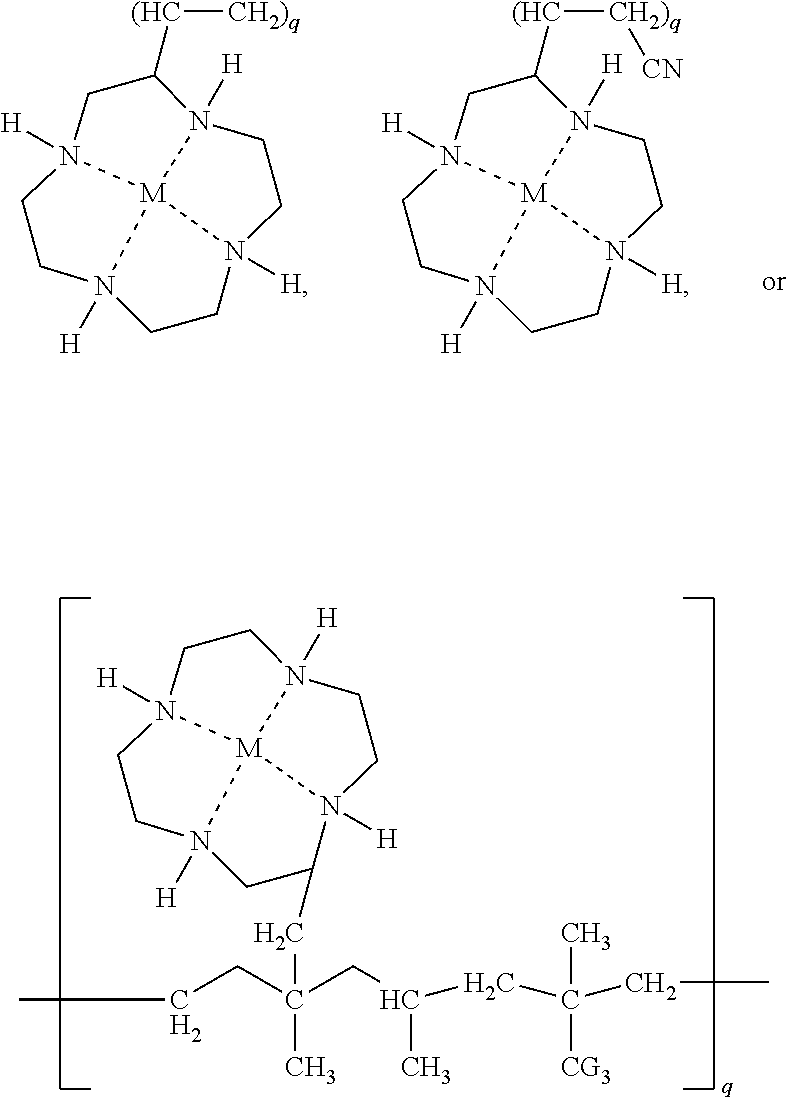
wherein
- M is Al, Ga, Si, Ge, In, or Sn; and
- q is about 100 to about 10000. In some embodiments, q is about 100, about 500, about 1000, about 1500, about 2000, about 2500, about 3000, about 3500, about 4000, about 4500, about 5000, about 5500, about 6000, about 6500, about 7000, about 7500, about 8000, about 8500, about 9000, about 9500, about 10000, or a value between any of these values.

wherein:
- M is Al, Ga, Si, Ge, In, or Sn;
- R1, R2, R3, and R4 are each independently —H, or —NH2, —Si(OR5)3, —Si(OR5)2CH2CH2NH2, —Si(R5)2CH2CH2NH2, —N+(CH3)3 −OH, —CH2CH(O)CH2, —Si(R5)2CH2CH(O)CH2, —CH3, —CH═CH2, —CH2CH═CH2, —CH═CH—CN, —OCN, —CH2OH, CH2X, CH2OCN, —CH(═O), provided that R1, R2, R3, and R4 are not all H,
wherein: - X is halo;
- R5 is C1-C6 alkyl;
- or a compound of Formula (II):

wherein:
- y is about 10 to about 500;
- R6 is C1-C6 alkyl or halo;
- each R7 is independently —H, or —NH2, —Si(OR9)3, —Si(OR9)2CH2CH2NH2, —Si(R9)2CH2CH2NH2, —N+(CH3)3 −OH, —CH2CH(O)CH2, —Si(R9)2CH2CH(O)CH2, —CH3, —CH═CH2, —CH2CH═CH2, —CH═CH—CN, —OCN, —CH2OH, CH2X, CH2OCN, or —CH(═O), provided that each R7 are not both H;
- R8 is —NH—CH2—CH2—NH2 or Al(R10)2;
- R9 is C1-C6 alkyl; and
- R10 is C1-C6 alkyl or halo;
wherein at least a portion of the thermal conductive composition is positioned substantially between the heat source and the heat sink and provides thermal communication between the heat source and heat sink. In some embodiments, M is Al. In some embodiments, y is about 10, about 50, about 100, about 150, about 200, about 250, about 300, about 350, about 400, about 450, about 500, or a value between any of these values.

wherein
- each R12 is alkenyl, alkenylaryl, aryl or alicyclic; and
- each z is independently about 10 to about 1000.

wherein:
- M is Al, Ga, Si, Ge, In, or Sn;
- R1, R2, R3, and R4 are each independently —H, or —NH2, —Si(OR5)3, —Si(OR5)2CH2CH2NH2, —Si(R5)2CH2CH2NH2, —N+(CH3)3 −OH, —CH2CH(O)CH2, —Si(R5)2CH2CH(O)CH2, —CH3, —CH═CH2, —CH2CH═CH2, —CH═CH—CN, —OCN, —CH2OH, CH2X, CH2OCN, —CH(═O), provided that R1, R2, R3, and R4 are not all H,
wherein: - X is halo;
- R5 is C1-C6 alkyl;
- or a compound of Formula (II):

wherein:
- y is about 10 to about 500;
- R6 is C1-C6 alkyl or halo;
- each R7 is independently —H, or —NH2, —Si(OR9)2, —Si(OR9)2CH2CH2NH2, —Si(R9)2CH2CH2NH2, —N+(CH3)3 −OH, —CH2CH(O)CH2, —Si(R9)2CH2CH(O)CH2, —CH3, —CH═CH2, —CH2CH═CH2, —CH═CH—CN, —OCN, —CH2OH, CH2X, CH2OCN, or —CH(═O), provided that each R7 are not both H;
- R8 is —NH—CH2—CH2—NH2 or Al(R10)2;
- R9 is C1-C6 alkyl; and
- R10 is C1-C6 alkyl or halo.

wherein
- each R12 is alkenyl, alkenylaryl, aryl or alicyclic; and
- each z is independently about 10 to about 1000.

The derivative is formed, for example, by anionic ring opening polymerization of the siloxane cyclic monomer in the presence of anionic initiators such as, but not limited to LiNH2, under, for example, dry conditions, in the presence of aprotic solvents. Examples of aprotic solvents include, but are not limited to, tetrahydrofuran, dioxane, trimethylamine, and the like. The reaction can take place at any suitable temperature, including but not limited to, a temperatures of about 0 to 30 C. Other siloxane derivatives can be formed by a compound of Formula (I) or (II), wherein R1, R2, R3, R4, and R7 are each independently glycidyl ether groups (for example, such as but not limited to CH2(O)CHCH2—) with about an equivalent weight of an epoxy curing hardener (for example, amine compounds that contain active hydrogen) of the general formula NH2R12NH2 wherein R12 is alkenyl, alkenylaryl, aryl or alicyclic. In some embodiments, the reaction takes place at a temperature range of about 20-30 C. In some embodiments, the reaction includes the addition of at least one phenolic activator.

or other commercial diisocyanate compounds which can also be referred to as toluene-2,4-diisocyanate, and

or HO{—R13—O—C(O)R14-C(O)OR15—O—)qH, wherein R13, R14, or R15 are independently C1-C6 alkyl and q is about 100 to about 1000. These compounds and can also be referred to as a polyol. The structures can also be referred to as polyether polyol or polyester polyol. Without wishing to be bound by any theory, the reaction occurs as the amino aza crown ether complexes act as catalyst and as crosslinking agent. The product that is formed can take shape of the mold.
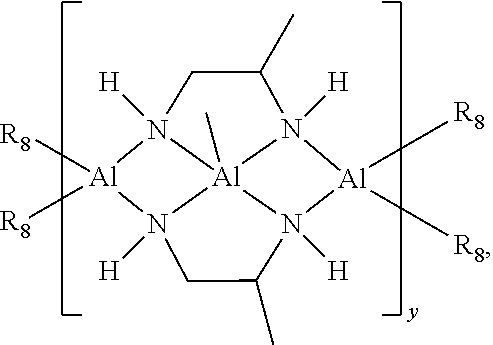
wherein R8 is —NH—CH2(CH3)CH2NH2 and y is about 10 to about 500.


wherein z is 50, which can act to dissipate the heat away from the semiconductor chip. The composition can be prepared by contacting

where the compound is formed by anionic ring opening polymerization of the siloxane cyclic monomer as described herein. The procedure can also be modified by replacing PAEDACE with AAEDACE.

wherein q is about 100 to about 10000.
Claims (19)


Priority Applications (1)
| Application Number | Priority Date | Filing Date | Title |
|---|---|---|---|
| US14/448,938 US9512150B2 (en) | 2014-07-31 | 2014-07-31 | Thermal conductive compositions and methods for their preparation and use |
Applications Claiming Priority (1)
| Application Number | Priority Date | Filing Date | Title |
|---|---|---|---|
| US14/448,938 US9512150B2 (en) | 2014-07-31 | 2014-07-31 | Thermal conductive compositions and methods for their preparation and use |
Publications (2)
| Publication Number | Publication Date |
|---|---|
| US20160031914A1 US20160031914A1 (en) | 2016-02-04 |
| US9512150B2 true US9512150B2 (en) | 2016-12-06 |
Family
ID=55179322
Family Applications (1)
| Application Number | Title | Priority Date | Filing Date |
|---|---|---|---|
| US14/448,938 Expired - Fee Related US9512150B2 (en) | 2014-07-31 | 2014-07-31 | Thermal conductive compositions and methods for their preparation and use |
Country Status (1)
| Country | Link |
|---|---|
| US (1) | US9512150B2 (en) |
Citations (3)
| Publication number | Priority date | Publication date | Assignee | Title |
|---|---|---|---|---|
| JPH0481469A (en) | 1990-07-04 | 1992-03-16 | Nippon Shokubai Co Ltd | Conductive resin composition |
| US5589595A (en) * | 1995-03-10 | 1996-12-31 | Nycomed Imaging As | Process for tetraazacycloalkane preparation |
| US20090030120A1 (en) | 2005-02-09 | 2009-01-29 | Josephina Cornelia Maria Zijp | Electrical Conductive Polymer Composition |
-
2014
- 2014-07-31 US US14/448,938 patent/US9512150B2/en not_active Expired - Fee Related
Patent Citations (3)
| Publication number | Priority date | Publication date | Assignee | Title |
|---|---|---|---|---|
| JPH0481469A (en) | 1990-07-04 | 1992-03-16 | Nippon Shokubai Co Ltd | Conductive resin composition |
| US5589595A (en) * | 1995-03-10 | 1996-12-31 | Nycomed Imaging As | Process for tetraazacycloalkane preparation |
| US20090030120A1 (en) | 2005-02-09 | 2009-01-29 | Josephina Cornelia Maria Zijp | Electrical Conductive Polymer Composition |
Non-Patent Citations (12)
| Title |
|---|
| Aluminium nitride, http://en.wikipedia.org/wiki/Aluminium-nitride, May 12, 2014. |
| Alzeer et al., An efficient two-step synthesis of metal-free phthalocyanines using a Zn(II) template, Chemical communications, (15) pp. 1970-1971 (2009). |
| Janssen et al., Thermally-conductive plastics: balancing material properties with application needs, Compounding World (Feb. 2010), pp. 38-42. |
| Jiang, et al. "Synthesis Structure and Pyrolysis of Organoaluminum Amides Derivede from Reactions of Trialkylaluminium compounds with Ethylenediamine in a 3:2 ratio" Inorganic Chemistry, 30(5), 995-1000, Mar. 1, 1991. * |
| Lu et al., Aluminum phthalocyanine complex covalently bonded to MCM-41 silica as heterogeneous catalyst for the synthesis of cyclic carbonates, Journal of Molecular Catalysis A: Chemical, (Jul. 2002), 186(1-2):33-42. |
| Saravanan et al., Dielectric and Conductivity Studies on Cobalt Phthalocyanine Tetramers, Journal of Applied Polymer Science, 91, pp. 2529-2535 (2004). |
| Sauls et al., Coordination compounds of aluminum as precursors to aluminium nitride, Coordination Chemistry Reviews, (1993), 128:193-207. |
| Sherman, Hot topic: adding thermal conductivity to plastics, Compounding World (Feb. 2010), pp. 28-36. |
| Thermal Conductivity, accessed at https://web.archive.org/web/20160121075719/http://hyperphysics.phy-astr.gsu.edu/hbase/tables/thrcn.html, accessed on Feb. 2, 2016, pp. 2. |
| Thomas, Electro-Optical Propeties of Metal Phthalocyanines and Naphthalocyanines, Department of Applied Chemistry, Cochin University of Science and Technology, pp. 140 (Dec. 1995). |
| Xu et al., Increasing the thermal conductivity of boron nitride and aluminum nitride particle epoxy-matrix composites by particle surface treatments, Composite Interfaces, (2000), 7(4):243-256. |
| Xu et al., Thermally conducting aluminum nitride polymer-matrix composites, Composites: Part A (2001), 32:1749-1757. |
Also Published As
| Publication number | Publication date |
|---|---|
| US20160031914A1 (en) | 2016-02-04 |
Similar Documents
| Publication | Publication Date | Title |
|---|---|---|
| CN103131381B (en) | High-performance environmentally-friendly flame retardant type organic electron pouring sealant and preparation method thereof | |
| JP6972028B2 (en) | Thermally conductive resin composition, heat dissipation sheet, heat dissipation member and its manufacturing method | |
| EP2201079B1 (en) | Thermally conductive composition | |
| KR101357514B1 (en) | Heat dissipating member and semiconductor device using same | |
| EP3166999B1 (en) | Thermal interface material with ion scavenger | |
| CN103764713B (en) | Resin composition, resin sheet, resin sheet with metal foil, cured resin sheet, structure, and semiconductor device for power or light source | |
| CN107636071B (en) | Epoxy molding compound with high adhesion to nickel surface, method for its preparation and use | |
| JP2008266406A (en) | Dispersant, Boron Nitride Particles with Dispersant Supported on Surface, Epoxy Resin Composition Containing Dispersant, and Method for Producing the Same | |
| CN103430645B (en) | The manufacture method of conducting strip and conducting strip | |
| JP2019515968A (en) | Phase change material | |
| US10047264B2 (en) | Polymer composite thermal interface material with high thermal conductivity | |
| CN111621152A (en) | Molding material composition for element sealing and electronic component device | |
| KR102799378B1 (en) | Resin compositions, resin cured products and composite molded articles | |
| JP2015147849A (en) | Resin composition and semiconductor device | |
| EP4095187A1 (en) | Thermally conductive silicone composition and cured product thereof | |
| JP2018095691A (en) | Thermal conductive sheet and heat dissipation device using the thermal conductive sheet | |
| JP2016104862A (en) | Resin composition, resin sheet, resin sheet with metal foil, resin cured article sheet, semiconductor device for power source or for light source | |
| CN108603034A (en) | The manufacturing method of heat conduction component and heat conduction component | |
| KR101284764B1 (en) | Epoxy Compositions Having Enhanced Heat Conductivity | |
| US9512150B2 (en) | Thermal conductive compositions and methods for their preparation and use | |
| JP2002194057A (en) | Thermosetting resin composition | |
| WO2015152037A1 (en) | Phenolic resin, epoxy resin composition containing said phenolic resin, cured product of said epoxy resin composition, and semiconductor device equipped with said cured product | |
| CN100432143C (en) | Thermoset resin compsns. and its mfg. method | |
| CN112724684B (en) | Modified heat-conducting silicone grease and preparation method thereof | |
| JP2004161856A (en) | Composition for thermally conductive resin molding and molding obtained therefrom |
Legal Events
| Date | Code | Title | Description |
|---|---|---|---|
| AS | Assignment |
Owner name: EMPIRE TECHNOLOGY DEVELOPMENT LLC, DELAWARE Free format text: ASSIGNMENT OF ASSIGNORS INTEREST;ASSIGNOR:MORDEHAI MARGALIT HOLDINGS LTD.;REEL/FRAME:033439/0645 Effective date: 20130823 Owner name: EMPIRE TECHNOLOGY DEVELOPMENT LLC, DELAWARE Free format text: ASSIGNMENT OF ASSIGNORS INTEREST;ASSIGNORS:ROBERTS, BRADLEY KIRK;WAN, FENG;REEL/FRAME:033439/0668 Effective date: 20130823 Owner name: ADAMS INVENTION CONSULTING PTY LTD, AUSTRALIA Free format text: ASSIGNMENT OF ASSIGNORS INTEREST;ASSIGNOR:ADAM, GEORGIUS ABIDAL;REEL/FRAME:033439/0583 Effective date: 20130507 Owner name: MORDEHAI MARGALIT HOLDINGS LTD., ISRAEL Free format text: ASSIGNMENT OF ASSIGNORS INTEREST;ASSIGNOR:MARGALIT, MORDEHAI;REEL/FRAME:033439/0640 Effective date: 20130507 Owner name: EMPIRE TECHNOLOGY DEVELOPMENT LLC, DELAWARE Free format text: ASSIGNMENT OF ASSIGNORS INTEREST;ASSIGNOR:ADAMS INVENTION CONSULTING PTY LTD;REEL/FRAME:033453/0449 Effective date: 20130823 |
|
| STCF | Information on status: patent grant |
Free format text: PATENTED CASE |
|
| CC | Certificate of correction | ||
| AS | Assignment |
Owner name: CRESTLINE DIRECT FINANCE, L.P., TEXAS Free format text: SECURITY INTEREST;ASSIGNOR:EMPIRE TECHNOLOGY DEVELOPMENT LLC;REEL/FRAME:048373/0217 Effective date: 20181228 |
|
| FEPP | Fee payment procedure |
Free format text: MAINTENANCE FEE REMINDER MAILED (ORIGINAL EVENT CODE: REM.); ENTITY STATUS OF PATENT OWNER: LARGE ENTITY |
|
| LAPS | Lapse for failure to pay maintenance fees |
Free format text: PATENT EXPIRED FOR FAILURE TO PAY MAINTENANCE FEES (ORIGINAL EVENT CODE: EXP.); ENTITY STATUS OF PATENT OWNER: LARGE ENTITY |
|
| STCH | Information on status: patent discontinuation |
Free format text: PATENT EXPIRED DUE TO NONPAYMENT OF MAINTENANCE FEES UNDER 37 CFR 1.362 |
|
| FP | Lapsed due to failure to pay maintenance fee |
Effective date: 20201206 |