US9501301B2 - Flexible instruction sets for obfuscated virtual machines - Google Patents
Flexible instruction sets for obfuscated virtual machines Download PDFInfo
- Publication number
- US9501301B2 US9501301B2 US14/632,879 US201514632879A US9501301B2 US 9501301 B2 US9501301 B2 US 9501301B2 US 201514632879 A US201514632879 A US 201514632879A US 9501301 B2 US9501301 B2 US 9501301B2
- Authority
- US
- United States
- Prior art keywords
- instructions
- section
- virtual
- handler
- virtual instructions
- Prior art date
- Legal status (The legal status is an assumption and is not a legal conclusion. Google has not performed a legal analysis and makes no representation as to the accuracy of the status listed.)
- Active, expires
Links
Images




Classifications
-
- G—PHYSICS
- G06—COMPUTING OR CALCULATING; COUNTING
- G06F—ELECTRIC DIGITAL DATA PROCESSING
- G06F9/00—Arrangements for program control, e.g. control units
- G06F9/06—Arrangements for program control, e.g. control units using stored programs, i.e. using an internal store of processing equipment to receive or retain programs
- G06F9/44—Arrangements for executing specific programs
- G06F9/455—Emulation; Interpretation; Software simulation, e.g. virtualisation or emulation of application or operating system execution engines
-
- G—PHYSICS
- G06—COMPUTING OR CALCULATING; COUNTING
- G06F—ELECTRIC DIGITAL DATA PROCESSING
- G06F21/00—Security arrangements for protecting computers, components thereof, programs or data against unauthorised activity
- G06F21/10—Protecting distributed programs or content, e.g. vending or licensing of copyrighted material ; Digital rights management [DRM]
- G06F21/12—Protecting executable software
- G06F21/14—Protecting executable software against software analysis or reverse engineering, e.g. by obfuscation
-
- G—PHYSICS
- G06—COMPUTING OR CALCULATING; COUNTING
- G06F—ELECTRIC DIGITAL DATA PROCESSING
- G06F21/00—Security arrangements for protecting computers, components thereof, programs or data against unauthorised activity
- G06F21/50—Monitoring users, programs or devices to maintain the integrity of platforms, e.g. of processors, firmware or operating systems
- G06F21/52—Monitoring users, programs or devices to maintain the integrity of platforms, e.g. of processors, firmware or operating systems during program execution, e.g. stack integrity ; Preventing unwanted data erasure; Buffer overflow
- G06F21/53—Monitoring users, programs or devices to maintain the integrity of platforms, e.g. of processors, firmware or operating systems during program execution, e.g. stack integrity ; Preventing unwanted data erasure; Buffer overflow by executing in a restricted environment, e.g. sandbox or secure virtual machine
-
- G—PHYSICS
- G06—COMPUTING OR CALCULATING; COUNTING
- G06F—ELECTRIC DIGITAL DATA PROCESSING
- G06F21/00—Security arrangements for protecting computers, components thereof, programs or data against unauthorised activity
- G06F21/50—Monitoring users, programs or devices to maintain the integrity of platforms, e.g. of processors, firmware or operating systems
- G06F21/55—Detecting local intrusion or implementing counter-measures
- G06F21/56—Computer malware detection or handling, e.g. anti-virus arrangements
- G06F21/562—Static detection
- G06F21/563—Static detection by source code analysis
-
- G—PHYSICS
- G06—COMPUTING OR CALCULATING; COUNTING
- G06F—ELECTRIC DIGITAL DATA PROCESSING
- G06F8/00—Arrangements for software engineering
- G06F8/70—Software maintenance or management
- G06F8/74—Reverse engineering; Extracting design information from source code
Definitions
- Computer software is often subjected to reverse-engineering attempts or other attempts to tamper with the computer software.
- a successful attempt to reverse-engineer or tamper with the computer software can result in, for example, unauthorized use of the computer software or impermissible access to user information (e.g., user identities, passwords, financial information, etc.).
- code protection techniques are often implemented with the intent to increase the complexity of reverse-engineering or other tampering attempts to levels that are impractical to solve.
- Obfuscation is a deliberate attempt to make computer code (source or machine) more difficult to read and, thus, more difficult to reverse-engineer or tamper with.
- Computer code can be obfuscated in many ways.
- virtual machines can be used to implement crafted instruction sets on imaginary processors in order to obfuscate the computer code. Because the instruction sets are crafted for imaginary processors, the function of the instructions in the instruction sets are typically unknown and, thus, unintelligible to parties attempting to reverse-engineer or otherwise tamper with computer software. While obfuscated virtual machines using crafted instruction sets have been effective at increasing the complexity of reverse-engineering or other tampering attempts, the technique can have a negative impact on the execution speed of computer software.
- a method for protecting computer software code involves receiving instructions corresponding to computer software code for an application, the instructions including a first section of instructions to protect that is indicated by a first indicator and a second section of the instructions to protect that is indicated by a second indicator, rewriting the first section of instructions into a first section of virtual instructions, and rewriting the second section of instructions into a second section of virtual instructions, wherein the first section of instructions includes a first virtual instruction that corresponds to a first handler and the second section of virtual instructions includes a second virtual instruction that corresponds to a second handler, the first handler having different properties than the second handler.
- a non-transitory computer-readable storage medium stores instructions that, when executed by a computer, perform steps for protecting computer software code, the steps involving receiving instructions corresponding to computer software code for an application, the instructions including a first section of instructions to protect that is indicated by a first indicator and a second section of instructions to protect that is indicated by a second indicator, rewriting the first section of instructions into a first section of virtual instructions, and rewriting the second section of instructions into a second section of virtual instructions, wherein the first section of instructions includes a first virtual instruction that corresponds to a first handler and the second set of virtual instructions includes a second virtual instructions that corresponds to a second handler, the first handler having different properties than the second handler.
- a computer-implemented system for protecting computer software code includes one or more processors and memory storing instructions that, when executed by the one or more processors, perform steps involving receiving instructions corresponding to computer software code for an application, the instructions including a first section of instructions to protect that is indicated by a first indicator and a second section of instructions to protect that is indicated by a second indicator, rewriting the first section of instructions into a first section of virtual instructions, and rewriting the second section of instructions into a second section of virtual instructions, wherein the first section of instructions includes a first virtual instruction that corresponds to a first handler and the second set of virtual instructions includes a second virtual instructions that corresponds to a second handler, the first handler having different properties than the second handler.
- FIG. 1 illustrates the compilation of a section of source code into assembly code.
- FIG. 2A illustrates the compilation of a section of source code into bytecode.
- FIG. 2B illustrates the interpretation of bytecode to execute a program.
- FIG. 3A illustrates the compilation of sections of source code into obfuscated bytecode using indicators.
- FIG. 3B illustrates the interpretation of sections of obfuscated bytecode, as indicated by indicators, to execute a program.
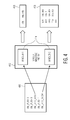
- FIG. 4 illustrates a virtual machine engine receiving obfuscated bytecode and executing functions called by two different handlers.
- FIG. 5 illustrates a virtual machine engine receiving obfuscated bytecode and executing functions called by two handlers selected from a set of handlers that correspond to degrees of obfuscation and execution speeds.
- FIG. 6 illustrates a virtual machine engine receiving obfuscated bytecode and executing functions called by two different handlers from two different sets of handlers based on the run mode of the virtual machine engine.
- FIG. 7 illustrates a virtual machine engine receiving obfuscated bytecode and executing functions called by two different handlers from two different sets of handlers based on the run mode of the virtual machine engine.
- FIG. 8A is a table that indicates a mapping of bytecodes to virtual machine instructions depending on the mode of the virtual machine.
- FIG. 8B illustrates a virtual machine engine receiving obfuscated bytecode with instructions from two different instructions sets associated with a single bytecode and executing functions called by handlers corresponding to the obfuscated bytecode.
- FIG. 9 is a flow chart diagram of a method for protecting computer software code in accordance with an embodiment of the invention.
- FIG. 10 is a block diagram of computer in which a virtual machine engine can run.
- FIG. 1 illustrates the compilation of a section of source code 102 into assembly code 104 .
- the section of source code is passed to a compiler 110 and the compiler generates assembly code for execution by a computer processing unit (CPU).
- CPU computer processing unit
- Compilation of code using a virtual machine includes an additional step that allows the compiled source code to be executed on any architecture (e.g., x86 or 8086) by first compiling source code into bytecode and then interpreting the bytecode to execute corresponding handlers.
- FIG. 2A illustrates the compilation of a section of source code 202 into bytecode 206 .
- the section of source code is passed to a compiler 210 .
- the compiler generates specialized bytecode.
- the bytecode is passed to a specialized interpreter specific to the architecture of the execution environment and the interpreter executes handlers to perform various functions of a program.
- FIG. 1 illustrates the compilation of a section of source code 202 into bytecode 206 .
- the section of source code is passed to a compiler 210 .
- the compiler generates specialized bytecode.
- the bytecode is passed to a specialized interpreter specific to the architecture of the execution environment and the interpreter executes handlers to perform various
- FIG. 2B illustrates the interpretation of bytecode 206 to execute a program.
- the bytecode of FIG. 2A is passed to a virtual machine interpreter 212 and the virtual machine interpreter is configured with handlers to interpret the bytecode and to perform functions 208 as needed to execute the program.
- the attacker When an attacker attempts to reverse-engineer or tamper with a program, the attacker typically records the functions performed by the computer processor and attempts to correlate the functions performed with various sections of the bytecode. Once the correlation is deduced, the attacker can then modify the bytecode and pass the modified bytecode to the interpreter to execute the program in a potentially malicious or otherwise unintended manner.
- code obfuscation can be used to increase the complexity of reverse-engineering or other tampering attempts by adding complexity, changing code words, or otherwise obfuscating the resulting bytecode such that a specialized interpreter is required for execution. Thus, the code is more protected.
- a method for protecting computer software code involves receiving instructions corresponding to computer software code for an application, the instructions including a first section of instructions to protect that is indicated by a first indicator and a second section of the instructions to protect that is indicated by a second indicator, rewriting the first section of instructions into a first section of virtual instructions, and rewriting the second section of instructions into a second section of virtual instructions, wherein the first section of virtual instructions includes a first indicator that corresponds to a first handler and the second section of virtual instructions includes a second indicator that corresponds to a second handler, the first handler having different properties than the second handler.
- each handler is defined by one or more properties including, for example, the number of instructions needed to perform a given function, the instruction set architecture (including data types, instructions, registers, addressing modes, etc.), the number of registers used, or the number of fake or dummy instructions in the instruction set.
- the instruction set architecture including data types, instructions, registers, addressing modes, etc.
- the number of registers used or the number of fake or dummy instructions in the instruction set.
- one level of obfuscation need not be used for all instructions in a computer program, but rather can be selected on a section by section basis. Since some sections of instructions can have low obfuscation with quick execution and some sections can have high obfuscation with slow execution, the execution time can be increased while still maintaining high levels of obfuscation when needed.
- FIG. 3A illustrates the compilation of sections of source code 302 into obfuscated bytecode 306 using indicators 320 .
- obfuscated bytecode is formed from a set of virtual instructions such as portable code (p-code) for use with JAVA, Python, or PHP based virtual machines.
- the source code includes a first indicator (“#pragma OBFUSC fast”) and a second indicator (“#pragma OBFUSC slow”).
- the indicators are C pragmas, but other operators that can be embedded in the source code could be used as indicators as well.
- the section of source code that is indicated by the first indicator is compiled to include the instruction “VM_ADD_FAST,” while the section of source code that is indicated by the second indicator is compiled to include the instruction “VM_ADD_SLOW.” Then, when the program is executed, the two ADD instructions will be interpreted differently.
- FIG. 3B illustrates the interpretation of sections of obfuscated bytecode 306 , as indicated by indicators 322 , to execute a program.
- the bytecode of FIG. 3A is passed to a virtual machine interpreter 312 and handlers (not shown) that correspond to indicators (e.g., the VM_ADD_FAST or VM_ADD_SLOW instruction) perform functions 308 as needed to execute the program.
- handlers correspond to VM_ADD_FAST than correspond to VM_ADD_SLOW, functions with different degrees of complexity can be called by each handler.
- functions with different degrees of complexity can be called by each handler.
- the increase in the execution time of the program varies based on the complexity of the functions called by each handler. For example, if ADD_FAST( ) has less complexity that results in a faster execution time than ADD_SLOW( ) then executing ADD_FAST( ) and ADD_SLOW( ) will result in a faster overall execution speed than executing ADD_SLOW( ) twice.
- handlers correspond to instructions in bytecode and each handler can be configured to call a different function when a program is executed.
- FIG. 4 illustrates a virtual machine engine 412 receiving obfuscated bytecode 406 and executing functions 408 called by two different handlers 414 .
- the virtual machine engine includes an interpreter (such as the virtual machine interpreter described with reference to FIG. 3B ).
- the first handler corresponds to bytecode for performing an add function that favors speed of execution over obfuscation.
- the second handler corresponds to bytecode for performing an add function that favors obfuscation over speed of execution.
- the handlers call the corresponding functions, a sequence of assembly code is generated and executed.
- the sequence of assembly code generated by the second handler e.g., the handler that calls a function that favors obfuscation over speed of execution
- an attacker reading the assembly code generated by the virtual machine engine will receive assembly code with several unnecessary and/or convoluted steps and, therefore, determining which portions of the assembly code are superfluous or what the function of the assembly code is can be difficult and time consuming. This difficulty may discourage an attacker from, for example, reverse-engineering the section of bytecode to which the second handler corresponds and, thus, protect the section of bytecode from attack.
- bytecode that corresponds to the second handler can be used, while bytecode that corresponds to the first handler can be used when increased protection is not needed, thus, allowing a developer to limit the impact of obfuscation on the speed of performance.
- each handler can correspond to degrees of obfuscation or execution speeds.
- handlers that correspond to very slow execution, slow execution, normal execution, fast execution, and very fast execution can be used.
- the execution speeds are determined relative to each other, but could be determined based on fixed criteria such as the number of functions executed by a handler or the average number of clock cycles required to execute the functions called by a handler.
- FIG. 5 illustrates a virtual machine engine 512 receiving obfuscated bytecode 506 and executing functions 508 called by two handlers 514 selected from handlers corresponding to degrees of obfuscation and execution speeds.
- the handler 1 generates “fast” assembly code.
- fast assembly code is assembly code that includes a single opcode. Accordingly, a CPU processing the assembly code can process the code very quickly, but the function of the code is barely, if at all, obfuscated.
- the handler 2 generates “very slow” assembly code.
- very slow assembly code is assembly code that includes several opcodes and utilizes several registers to achieve a result that could be achieved with fewer opcodes and/or registers. Accordingly, a CPU processing the assembly code would require a greater amount of time to process the very slow assembly code than to process the fast assembly code, but the very slow assembly code is more obfuscated by comparison.
- FIG. 6 illustrates a virtual machine engine 612 receiving obfuscated bytecode 606 and executing functions 608 called by two different handlers 614 from two different sets of handlers 618 based on the run mode 616 - 1 , 616 - 2 of the virtual machine engine.
- a run mode of a virtual machine can be initially set on a global level (e.g., by a global variable in bytecode) or to a default run mode (e.g., by configuration settings of the virtual machine engine). The run mode can then be modified by subsequent instructions.
- the obfuscated bytecode contains instructions that modify the run mode of a virtual machine engine (e.g., VM_RUN_FAST and VM_RUN_SLOW).
- a virtual machine engine when an instruction that modifies the run mode of a virtual machine engine is processed by a virtual machine engine, the virtual machine engine enters a mode, as indicated by the instruction, and matches subsequent instructions only with handlers of the mode until a subsequent instruction that modifies the run mode of a virtual machine engine is processed.
- an instruction is processed that causes the virtual machine engine to enter into a “fast” run mode 616 - 1 .
- the instruction when the “VM_ADD” instruction is processed, the instruction will correspond to handler 1 and the corresponding assembly code will be generated.
- a subsequent instruction is processed that causes the mode of the virtual machine engine to enter into a “slow” run mode 616 - 2 , the virtual machine engine enters into a slow run mode.
- the instruction when processing the “VM_ADD” instruction again, the instruction will correspond to handler 2 and the corresponding assembly code will be generated.
- the run mode of a virtual machine engine can be changed to control the level of obfuscation and execution speed, but the same bytecode instructions can be used.
- FIG. 7 illustrates a virtual machine engine 712 receiving obfuscated bytecode 706 and executing functions 708 called by two different handlers 714 from a set of handlers 718 based on the run mode 716 - 1 - 716 -N of the virtual machine engine.
- a virtual machine engine can have five run modes running from high obfuscation with slow execution speed to low obfuscation with fast execution speed.
- run mode 2 716 - 2 corresponds to a run mode where handlers call functions to generate assembly code that favors obfuscation over execution speed
- run mode 4 716 - 1 corresponds to a run mode where handlers call functions to generate assembly code that favors execution speed over obfuscation.
- an instruction is processed that causes the virtual machine engine to enter into “run mode 4.” Accordingly, when “VM_ADD” is then processed, handler 1 is selected from the handlers of run mode 4 and corresponding assembly code is generated.
- the “VM_ADD” instruction is processed using handler 2 selected from the handlers of run mode 2 and corresponding assembly code is generated.
- the run mode of the virtual machine engine can be changed to control the level of obfuscation and execution speed in varying amounts while using the same bytecode instructions.
- FIG. 8A depicts a table 802 that indicates a mapping of bytecodes to virtual machine instructions depending on the mode of the virtual machine.
- a virtual machine can be in one of two modes and can be transitioned from a first mode to a second mode by a special instruction. In the table depicted in FIG.
- FIG. 8A illustrates a virtual machine engine 812 receiving obfuscated bytecode 806 with two different instructions associated with a single bytecode and executing functions 808 called by handlers 814 corresponding to the obfuscated bytecode.
- the instruction set can be indicated similarly to the run mode or run state as described with references to FIGS. 6 and 7 .
- the virtual machine engine begins in a default mode 816 - 1 and, when bytecode “23” is processed, handler 1 from a first set of handlers 818 is used to call a function to generate the appropriate assembly code for “VM1_ADD”.
- handler 1 from a first set of handlers 818 is used to call a function to generate the appropriate assembly code for “VM1_ADD”.
- special instruction “VMX_MODE 2” is performed and the virtual machine engine enters into VMX Mode 2 816 - 2 .
- subsequent bytecodes will be mapped to different instructions and be processed using a second set of handlers 818 .
- bytecode “23” is mapped to instruction “VM2_SUB” and when “VM2_SUB” is processed, handler 2 is used.
- handler 2 is used.
- an attacker may be confused when trying to correlate sections of the bytecode to sections of the generated assembly code because two seemingly identical sections of the bytecode produced different assembly code if the attacker is unaware of the mode transition between the two sections.
- superfluous code was not inserted into the assembly code, the execution speed of the assembly code is typically faster than techniques in which the assembly code includes superfluous code.
- FIG. 9 is a flow chart diagram of a method for protecting computer software code in accordance with an embodiment of the invention.
- instructions corresponding to a computer software code are received.
- the instructions are source code received by a compiler and include, at least, a first indicator and a second indicator used to indicate a level of obfuscation to be applied to a section of the source code.
- a section of instructions indicated by a first indicator is rewritten into a first set of virtual instructions and, at block 906 , a section of instructions indicated by a second indicator is rewritten into a second set of virtual instructions.
- the first and second indicators are C pragmas, but other indicators can be used.
- the first section of instructions is rewritten into virtual instructions including an indicator that, when interpreted, result in assembly code that favors execution speed over obfuscation
- the second section of instructions is rewritten into virtual instructions including an indicator that, when interpreted, result in assembly code that favors obfuscation over execution speed.
- a higher level of obfuscation can be achieved for the second section of instructions than if the first and second sections of instructions were rewritten as a whole using virtual instructions that favor execution speed over obfuscation.
- greater obfuscation and protection can be achieved when needed without unnecessarily degrading performance.
- FIG. 10 is a block diagram of a computer 1000 in which a virtual machine engine can run.
- the computer includes a processor 1002 , memory 1004 , a user interface 1006 , and a communications interface 1008 .
- the processor executes instructions stored in the memory and, when the instruction are executed, the above-described techniques are performed.
- the user interface facilitates the interaction between a user and the computer.
- the user interface is a browser-based interface accessible to a user via interface devices with browser capability.
- the communications interface can be a standard I/O bus for communication with a keyboard and mouse or the communications interface can be a network interface card (NIC) configured to receive input over standard TCP/IP.
- NIC network interface card
- an embodiment of a computer program product includes a non-transitory computer useable storage medium to store a computer readable program that, when executed on a computer, causes the computer to perform operations, as described herein.
- embodiments of at least portions of the invention can take the form of a computer program product accessible from a non-transitory computer-usable or computer-readable medium providing program code for use by or in connection with a computer or any instruction execution system.
- a computer-usable or computer readable medium can be any apparatus that can contain, store, communicate, propagate, or transport the program for use by or in connection with the instruction execution system, apparatus, or device.
- the computer-useable or computer-readable medium can be an electronic, magnetic, optical, electromagnetic, infrared, or semiconductor system (or apparatus or device), or a propagation medium.
- Examples of a non-transitory computer-readable medium include a semiconductor or solid state memory, magnetic tape, a removable computer diskette, a random access memory (RAM), a read-only memory (ROM), a rigid magnetic disc, and an optical disc.
- Current examples of optical discs include a compact disc with read only memory (CD-ROM), a compact disc with read/write (CD-R/W), a digital video disc (DVD), and a Blu-ray disc.
Landscapes
- Engineering & Computer Science (AREA)
- Software Systems (AREA)
- Theoretical Computer Science (AREA)
- General Engineering & Computer Science (AREA)
- Computer Security & Cryptography (AREA)
- General Physics & Mathematics (AREA)
- Physics & Mathematics (AREA)
- Computer Hardware Design (AREA)
- Multimedia (AREA)
- Technology Law (AREA)
- Health & Medical Sciences (AREA)
- General Health & Medical Sciences (AREA)
- Virology (AREA)
- Devices For Executing Special Programs (AREA)
Priority Applications (3)
| Application Number | Priority Date | Filing Date | Title |
|---|---|---|---|
| US14/632,879 US9501301B2 (en) | 2015-02-26 | 2015-02-26 | Flexible instruction sets for obfuscated virtual machines |
| EP15203095.3A EP3062256B1 (en) | 2015-02-26 | 2015-12-30 | Flexible instructions sets for obfuscated virtual machines |
| CN201610105133.4A CN105930694B (zh) | 2015-02-26 | 2016-02-25 | 用于模糊虚拟机的灵活指令集 |
Applications Claiming Priority (1)
| Application Number | Priority Date | Filing Date | Title |
|---|---|---|---|
| US14/632,879 US9501301B2 (en) | 2015-02-26 | 2015-02-26 | Flexible instruction sets for obfuscated virtual machines |
Publications (2)
| Publication Number | Publication Date |
|---|---|
| US20160253189A1 US20160253189A1 (en) | 2016-09-01 |
| US9501301B2 true US9501301B2 (en) | 2016-11-22 |
Family
ID=55068901
Family Applications (1)
| Application Number | Title | Priority Date | Filing Date |
|---|---|---|---|
| US14/632,879 Active 2035-04-11 US9501301B2 (en) | 2015-02-26 | 2015-02-26 | Flexible instruction sets for obfuscated virtual machines |
Country Status (3)
| Country | Link |
|---|---|
| US (1) | US9501301B2 (e) |
| EP (1) | EP3062256B1 (e) |
| CN (1) | CN105930694B (e) |
Cited By (2)
| Publication number | Priority date | Publication date | Assignee | Title |
|---|---|---|---|---|
| US20160379131A1 (en) * | 2015-06-26 | 2016-12-29 | Nxp B.V. | Fuzzy opaque predicates |
| US11741197B1 (en) | 2019-10-15 | 2023-08-29 | Shape Security, Inc. | Obfuscating programs using different instruction set architectures |
Families Citing this family (7)
| Publication number | Priority date | Publication date | Assignee | Title |
|---|---|---|---|---|
| US9760736B2 (en) * | 2015-09-29 | 2017-09-12 | International Business Machines Corporation | CPU obfuscation for cloud applications |
| JP6919570B2 (ja) * | 2015-11-30 | 2021-08-18 | 日本電気株式会社 | ソフトウェア解析装置、ソフトウェア解析方法、及び、ソフトウェア解析プログラム |
| US10394554B1 (en) * | 2016-09-09 | 2019-08-27 | Stripe, Inc. | Source code extraction via monitoring processing of obfuscated byte code |
| FR3056787B1 (fr) * | 2016-09-27 | 2018-11-23 | Tages | Methode de protection d’un programme logiciel par offuscation par virtualisation |
| CN111680271A (zh) * | 2020-06-02 | 2020-09-18 | 浙江大学 | 基于智能合约字节码特征的合约代码混淆平台和混淆方法 |
| US12561184B2 (en) * | 2022-01-26 | 2026-02-24 | Nvidia Corporation | Application programming interface to cause operator to be used by compiler |
| CN117992173A (zh) * | 2022-10-31 | 2024-05-07 | 华为技术有限公司 | 一种函数保护方法及装置 |
Citations (11)
| Publication number | Priority date | Publication date | Assignee | Title |
|---|---|---|---|---|
| US5596755A (en) * | 1992-11-03 | 1997-01-21 | Microsoft Corporation | Mechanism for using common code to handle hardware interrupts in multiple processor modes |
| US6272636B1 (en) * | 1997-04-11 | 2001-08-07 | Preview Systems, Inc | Digital product execution control and security |
| US20030093685A1 (en) * | 2001-11-15 | 2003-05-15 | Tobin John P.E. | Method and system for obfuscation of computer program execution flow to increase computer program security |
| US6848111B1 (en) * | 1999-02-02 | 2005-01-25 | Sun Microsystems, Inc. | Zero overhead exception handling |
| US20060036426A1 (en) * | 2004-04-30 | 2006-02-16 | Cornell Research Foundation Inc. | System for and method of improving discrete event simulation using virtual machines |
| US20100153776A1 (en) * | 2008-12-12 | 2010-06-17 | Sun Microsystems, Inc. | Using safepoints to provide precise exception semantics for a virtual machine |
| US20100180346A1 (en) | 2007-01-18 | 2010-07-15 | Nicolson Kenneth Alexander | Obfuscation assisting aparatus |
| EP2482184A1 (en) | 2011-02-01 | 2012-08-01 | Irdeto B.V. | Adaptive obfuscated virtual machine |
| US20130080773A1 (en) * | 2010-05-07 | 2013-03-28 | Zhuo Lu | File protecting method and a system therefor |
| EP2942727A1 (en) | 2014-05-06 | 2015-11-11 | Nxp B.V. | Return-oriented programming as an obfuscation technique |
| US9251090B1 (en) * | 2014-06-03 | 2016-02-02 | Amazon Technologies, Inc. | Hypervisor assisted virtual memory obfuscation |
Family Cites Families (3)
| Publication number | Priority date | Publication date | Assignee | Title |
|---|---|---|---|---|
| GB2405958A (en) * | 2003-08-20 | 2005-03-16 | Macrovision Europ Ltd | Code obfuscation and controlling a processor by emulation |
| US10095847B2 (en) * | 2012-05-25 | 2018-10-09 | Koninklijke Philips N.V. | Method, system and device for protection against reverse engineering and/or tampering with programs |
| US9116712B2 (en) * | 2013-02-28 | 2015-08-25 | Microsoft Technology Licensing, Llc | Compile based obfuscation |
-
2015
- 2015-02-26 US US14/632,879 patent/US9501301B2/en active Active
- 2015-12-30 EP EP15203095.3A patent/EP3062256B1/en active Active
-
2016
- 2016-02-25 CN CN201610105133.4A patent/CN105930694B/zh active Active
Patent Citations (11)
| Publication number | Priority date | Publication date | Assignee | Title |
|---|---|---|---|---|
| US5596755A (en) * | 1992-11-03 | 1997-01-21 | Microsoft Corporation | Mechanism for using common code to handle hardware interrupts in multiple processor modes |
| US6272636B1 (en) * | 1997-04-11 | 2001-08-07 | Preview Systems, Inc | Digital product execution control and security |
| US6848111B1 (en) * | 1999-02-02 | 2005-01-25 | Sun Microsystems, Inc. | Zero overhead exception handling |
| US20030093685A1 (en) * | 2001-11-15 | 2003-05-15 | Tobin John P.E. | Method and system for obfuscation of computer program execution flow to increase computer program security |
| US20060036426A1 (en) * | 2004-04-30 | 2006-02-16 | Cornell Research Foundation Inc. | System for and method of improving discrete event simulation using virtual machines |
| US20100180346A1 (en) | 2007-01-18 | 2010-07-15 | Nicolson Kenneth Alexander | Obfuscation assisting aparatus |
| US20100153776A1 (en) * | 2008-12-12 | 2010-06-17 | Sun Microsystems, Inc. | Using safepoints to provide precise exception semantics for a virtual machine |
| US20130080773A1 (en) * | 2010-05-07 | 2013-03-28 | Zhuo Lu | File protecting method and a system therefor |
| EP2482184A1 (en) | 2011-02-01 | 2012-08-01 | Irdeto B.V. | Adaptive obfuscated virtual machine |
| EP2942727A1 (en) | 2014-05-06 | 2015-11-11 | Nxp B.V. | Return-oriented programming as an obfuscation technique |
| US9251090B1 (en) * | 2014-06-03 | 2016-02-02 | Amazon Technologies, Inc. | Hypervisor assisted virtual memory obfuscation |
Non-Patent Citations (22)
| Title |
|---|
| "Fighting Oreans' VM"; http://www.woodmann.com/forum/showthread.php?12015-Fighting-OreansVM: pp. 1-7; Aug. 2008. |
| Anonymous:, "Enterprise Obfuscation Technology Process and Control", Dec. 31, 2013 (Dec. 31, 2013), XP055281576, Retrieved from the Internet: URL: https;//www.preemptive.com/images/white-papers/Enterprise-Obfuscation-Technology-Process-and-Control.pdf. |
| Coogan, Kevin Patrick; "Deobfuscating of of Virtualization-Obfuscated Software"; hhttp://www.cs.arizona.edu/~debray/Publications/ccs-unvirtualize.pdf; 10 pgs.; Oct. 2011. |
| Coogan, Kevin Patrick; "Deobfuscating of of Virtualization-Obfuscated Software"; hhttp://www.cs.arizona.edu/˜debray/Publications/ccs-unvirtualize.pdf; 10 pgs.; Oct. 2011. |
| Coogan, Kevin Patrick; "Deobfuscation of Packed and Virtualization Obfuscation Protected Binaries"; http://arizona.openrepository.com/arizona/bitstream/10150/202716/1/azu-etd-11707-sip1-m.pdf; pp. 1-117; 2011. |
| Deathway; "Oreans UnVirtualizer ODBG Plugin"; http://forum.exetools.com/showthread.php?t=13391; 6 pgs.; Jan. 2014. |
| Falliere, Nicolas et al.; "Inside the Jaws of Trojan.Clampi"; http://www.symantec.com/content/en/us/enterprise/media/security-response/whitepapers/inside-trojan-clampi.pdf; pp. 1-24; Sep. 2009. |
| Ghosh, Sudeep et al.; "Replacement Attacks Against VM-protected Applications"; http://www.cl.cam.ac.uk/research/srg/netos/vee-2012/papers/p203.pdf; pp. 203-214; 2012. |
| Kholia, Dhiru et al.; "Looking inside the (Drop) box"; http://www.openwall.com/presentations/WOOT13-Security-Analysis-of-Dropbox/woot13-kholia.pdf; 7 pgs.; Aug. 2013. |
| Kinder, Johannes; "Towards Static Analysis of Virtualization Obfuscated Binaries"; http://infoscience.epfl.ch/record/181023/files/wcre12.pdf; pp. 1-10; Oct. 2012. |
| Kot, Paul; "Decompiler for Code Virtualizer (Oreans)"; http://gdtr.wordpress.com/2012/10/03/decv-a-decompiler-for-code-virtualizer-by-oreans/; 10 pgs.; Oct. 2012. |
| Lau, Boris; "Dealing with Virtualization packer"; CARO 2008, Amsterdam; 67 pgs.; May 2008. |
| OpenRCE.org; "Compiler 1, X86 Virtualizer 0"; http://www.openrce.org/blog/view/1110/; pp. 1-6; Apr. 4, 2008. |
| Rolles, R.; "Unpacking Virtualization Obfuscators"; http://static.usenix.org/event/woot09/tech/full-papers/rolles.pdf; 7 pgs.; 2009. |
| Rolles, Rolf; "Unpacking VMProtect"; OpenRCE.org; http://www.openrce.org/blog/view/1238/; pp. 1-3; Aug. 2008. |
| Scherzo; "Inside Code Virtualizer"; Code Virtualizer; Total Obfuscation against Reverse Engineering, x32/x64 Edition; pp. 1-28; Feb. 16, 2007. |
| Sharif, M. et al.; "Automatic Reverse Engineering of Malware Emulators"; 16 pgs.; 2009. |
| Sharif, M. et al.; "Rotalume: A Tool for Automatic Reverse Engineering of Malware Emulators"; http://www.iseclab.org/people/andrew/download/GT-CS-09-05.pdf; 21 pgs.; May 2009. |
| Souchet, Axel; "Breaking Kryptonite's Obfuscation: A Static Analysis Approach Relying on Symbolic Execution"; http://doar-e.github.io/blog/2013/09/16/breaking-kyptonites-obfuscation-with-symbolic-execution/; 14 pgs.; Sep. 2013. |
| Wang, Zhenxiang Jim; "How to recover virtualized x86 instructions by Themida"; http://www.virusbtn.com/conference/vb2009/abstracts/Wang.xml; pp. 1-2; 2009. |
| Wikipedia; "Concolic Testing"; https://en.wikipedia.org/wiki/Concolic-testing; 8 pgs.; Dec. 9, 2014. |
| Yadegari, Babak et al.; "Automatic Deobfuscation of Emulation-Obfuscated Software"; 11 pgs.; Nov. 2013. |
Cited By (2)
| Publication number | Priority date | Publication date | Assignee | Title |
|---|---|---|---|---|
| US20160379131A1 (en) * | 2015-06-26 | 2016-12-29 | Nxp B.V. | Fuzzy opaque predicates |
| US11741197B1 (en) | 2019-10-15 | 2023-08-29 | Shape Security, Inc. | Obfuscating programs using different instruction set architectures |
Also Published As
| Publication number | Publication date |
|---|---|
| EP3062256A1 (en) | 2016-08-31 |
| US20160253189A1 (en) | 2016-09-01 |
| EP3062256B1 (en) | 2019-04-03 |
| CN105930694A (zh) | 2016-09-07 |
| CN105930694B (zh) | 2020-12-04 |
Similar Documents
| Publication | Publication Date | Title |
|---|---|---|
| US9501301B2 (en) | Flexible instruction sets for obfuscated virtual machines | |
| US11507671B1 (en) | Detection and healing of vulnerabilities in computer code | |
| Xu et al. | Controlled-channel attacks: Deterministic side channels for untrusted operating systems | |
| US8646050B2 (en) | System and method for supporting JIT in a secure system with randomly allocated memory ranges | |
| EP4092551B1 (en) | Dynamically generated code process sandboxing using authenticated pointers | |
| US20160210216A1 (en) | Application Control Flow Models | |
| US20190377574A1 (en) | Memory access instructions with additional protection flag enforcement | |
| CN107577925B (zh) | 基于双重ARM指令虚拟的Android应用程序保护方法 | |
| JP5933938B2 (ja) | オブジェクト指向言語で記述されたアプリケーションのクラスの複数のメソッドのうち1つを選択的にプロテクトするメソッド又はデバイス | |
| EP2942727B1 (en) | Return-oriented programming as an obfuscation technique | |
| CN110717181B (zh) | 基于新型程序依赖图的非控制数据攻击检测方法及装置 | |
| US8140809B2 (en) | Computer implemented masked representation of data tables | |
| US20150363580A1 (en) | Protecting software through a fake cryptographic layer | |
| Giner et al. | Repurposing Segmentation as a Practical {LVI-NULL} Mitigation in {SGX} | |
| Larmuseau et al. | A secure compiler for ML modules | |
| Lackner et al. | Countering type confusion and buffer overflow attacks on Java smart cards by data type sensitive obfuscation | |
| Zhao et al. | IMPULP: A hardware approach for in-process memory protection via user-level partitioning | |
| Palmaro et al. | Beware of Unknown Areas to Notify Adversaries: Detecting Dynamic Binary Instrumentation Runtimes with Low-Level Memory Scanning | |
| Bratus et al. | ‘Weird machine’patterns | |
| AU2013202876B2 (en) | System and method for supporting JIT in a secure system with randomly allocated memory ranges | |
| Sang | Hardening and Adapting Trusted Execution Environments for Emerging Platforms | |
| McNamara | Object-Level Hardware Tracking for Out-of-Bounds Read and Write Protection | |
| Fedler et al. | ISA R: Improving Software Attack and Analysis Resilience via Compiler-Level Software Diversity | |
| KR20230067329A (ko) | 데이터 재사용 공격에 대한 방어 방법 및 시스템 | |
| Patrignani et al. | Secure Compilation of Object-Oriented Components to Untyped Machine Code |
Legal Events
| Date | Code | Title | Description |
|---|---|---|---|
| AS | Assignment |
Owner name: NXP B.V., NETHERLANDS Free format text: ASSIGNMENT OF ASSIGNORS INTEREST;ASSIGNOR:TEUWEN, PHILIPPE;REEL/FRAME:035043/0980 Effective date: 20150226 |
|
| STCF | Information on status: patent grant |
Free format text: PATENTED CASE |
|
| MAFP | Maintenance fee payment |
Free format text: PAYMENT OF MAINTENANCE FEE, 4TH YEAR, LARGE ENTITY (ORIGINAL EVENT CODE: M1551); ENTITY STATUS OF PATENT OWNER: LARGE ENTITY Year of fee payment: 4 |
|
| MAFP | Maintenance fee payment |
Free format text: PAYMENT OF MAINTENANCE FEE, 8TH YEAR, LARGE ENTITY (ORIGINAL EVENT CODE: M1552); ENTITY STATUS OF PATENT OWNER: LARGE ENTITY Year of fee payment: 8 |