US9499667B2 - Biodegradable surfactant, preparation method and use thereof - Google Patents
Biodegradable surfactant, preparation method and use thereof Download PDFInfo
- Publication number
- US9499667B2 US9499667B2 US14/762,763 US201314762763A US9499667B2 US 9499667 B2 US9499667 B2 US 9499667B2 US 201314762763 A US201314762763 A US 201314762763A US 9499667 B2 US9499667 B2 US 9499667B2
- Authority
- US
- United States
- Prior art keywords
- methoxypoly
- ethylene glycol
- block copolymer
- lactide
- poly
- Prior art date
- Legal status (The legal status is an assumption and is not a legal conclusion. Google has not performed a legal analysis and makes no representation as to the accuracy of the status listed.)
- Expired - Fee Related
Links
- 239000004094 surface-active agent Substances 0.000 title claims description 38
- 238000002360 preparation method Methods 0.000 title abstract description 7
- 229920001400 block copolymer Polymers 0.000 claims abstract description 73
- LYCAIKOWRPUZTN-UHFFFAOYSA-N Ethylene glycol Chemical compound OCCO LYCAIKOWRPUZTN-UHFFFAOYSA-N 0.000 claims abstract description 54
- 229920000747 poly(lactic acid) Polymers 0.000 claims abstract description 54
- -1 poly(lactide) Polymers 0.000 claims abstract description 39
- 229940065514 poly(lactide) Drugs 0.000 claims abstract description 35
- 125000003277 amino group Chemical group 0.000 claims abstract description 8
- 125000002252 acyl group Chemical group 0.000 claims abstract description 7
- 239000000047 product Substances 0.000 claims description 46
- YMWUJEATGCHHMB-UHFFFAOYSA-N Dichloromethane Chemical compound ClCCl YMWUJEATGCHHMB-UHFFFAOYSA-N 0.000 claims description 36
- 229920001427 mPEG Polymers 0.000 claims description 30
- RTZKZFJDLAIYFH-UHFFFAOYSA-N Diethyl ether Chemical compound CCOCC RTZKZFJDLAIYFH-UHFFFAOYSA-N 0.000 claims description 27
- 150000001413 amino acids Chemical class 0.000 claims description 25
- 238000000034 method Methods 0.000 claims description 25
- 239000003795 chemical substances by application Substances 0.000 claims description 18
- 239000000243 solution Substances 0.000 claims description 18
- XLYOFNOQVPJJNP-UHFFFAOYSA-N water Chemical compound O XLYOFNOQVPJJNP-UHFFFAOYSA-N 0.000 claims description 18
- 125000000539 amino acid group Chemical group 0.000 claims description 15
- 239000003495 polar organic solvent Substances 0.000 claims description 10
- 125000001797 benzyl group Chemical group [H]C1=C([H])C([H])=C(C([H])=C1[H])C([H])([H])* 0.000 claims description 9
- 239000007787 solid Substances 0.000 claims description 9
- HEDRZPFGACZZDS-UHFFFAOYSA-N Chloroform Chemical compound ClC(Cl)Cl HEDRZPFGACZZDS-UHFFFAOYSA-N 0.000 claims description 8
- WYURNTSHIVDZCO-UHFFFAOYSA-N Tetrahydrofuran Chemical compound C1CCOC1 WYURNTSHIVDZCO-UHFFFAOYSA-N 0.000 claims description 8
- 239000000203 mixture Substances 0.000 claims description 8
- 239000002244 precipitate Substances 0.000 claims description 8
- LMDZBCPBFSXMTL-UHFFFAOYSA-N 1-ethyl-3-(3-dimethylaminopropyl)carbodiimide Chemical group CCN=C=NCCCN(C)C LMDZBCPBFSXMTL-UHFFFAOYSA-N 0.000 claims description 7
- JJTUDXZGHPGLLC-IMJSIDKUSA-N 4511-42-6 Chemical compound C[C@@H]1OC(=O)[C@H](C)OC1=O JJTUDXZGHPGLLC-IMJSIDKUSA-N 0.000 claims description 7
- OKKJLVBELUTLKV-UHFFFAOYSA-N Methanol Chemical compound OC OKKJLVBELUTLKV-UHFFFAOYSA-N 0.000 claims description 6
- 238000006243 chemical reaction Methods 0.000 claims description 6
- 239000012045 crude solution Substances 0.000 claims description 6
- 239000000706 filtrate Substances 0.000 claims description 6
- VLKZOEOYAKHREP-UHFFFAOYSA-N n-Hexane Chemical compound CCCCCC VLKZOEOYAKHREP-UHFFFAOYSA-N 0.000 claims description 6
- 238000006116 polymerization reaction Methods 0.000 claims description 6
- 239000011541 reaction mixture Substances 0.000 claims description 6
- 230000003833 cell viability Effects 0.000 claims description 5
- 239000012153 distilled water Substances 0.000 claims description 5
- 238000001035 drying Methods 0.000 claims description 5
- 230000001376 precipitating effect Effects 0.000 claims description 5
- KSBAEPSJVUENNK-UHFFFAOYSA-L tin(ii) 2-ethylhexanoate Chemical compound [Sn+2].CCCCC(CC)C([O-])=O.CCCCC(CC)C([O-])=O KSBAEPSJVUENNK-UHFFFAOYSA-L 0.000 claims description 5
- 238000001914 filtration Methods 0.000 claims description 4
- 238000001556 precipitation Methods 0.000 claims description 4
- YLQBMQCUIZJEEH-UHFFFAOYSA-N tetrahydrofuran Natural products C=1C=COC=1 YLQBMQCUIZJEEH-UHFFFAOYSA-N 0.000 claims description 4
- 239000012224 working solution Substances 0.000 claims description 4
- 239000012298 atmosphere Substances 0.000 claims description 2
- 238000001816 cooling Methods 0.000 claims description 2
- 239000012467 final product Substances 0.000 claims description 2
- 238000010438 heat treatment Methods 0.000 claims description 2
- 229910052757 nitrogen Inorganic materials 0.000 claims description 2
- IJGRMHOSHXDMSA-UHFFFAOYSA-N nitrogen Substances N#N IJGRMHOSHXDMSA-UHFFFAOYSA-N 0.000 claims description 2
- QJGQUHMNIGDVPM-UHFFFAOYSA-N nitrogen group Chemical group [N] QJGQUHMNIGDVPM-UHFFFAOYSA-N 0.000 claims description 2
- 239000003208 petroleum Substances 0.000 claims description 2
- 238000007789 sealing Methods 0.000 claims description 2
- 238000003756 stirring Methods 0.000 claims description 2
- COLNVLDHVKWLRT-QMMMGPOBSA-N phenylalanine group Chemical group N[C@@H](CC1=CC=CC=C1)C(=O)O COLNVLDHVKWLRT-QMMMGPOBSA-N 0.000 abstract description 11
- 229940024606 amino acid Drugs 0.000 description 22
- 235000001014 amino acid Nutrition 0.000 description 22
- 239000004626 polylactic acid Substances 0.000 description 19
- DCAYPVUWAIABOU-UHFFFAOYSA-N hexadecane Chemical compound CCCCCCCCCCCCCCCC DCAYPVUWAIABOU-UHFFFAOYSA-N 0.000 description 18
- 238000005227 gel permeation chromatography Methods 0.000 description 13
- 210000004027 cell Anatomy 0.000 description 12
- 0 *OC(C)C(=O)OC(C)C(=O)OCCOC Chemical compound *OC(C)C(=O)OC(C)C(=O)OCCOC 0.000 description 11
- 239000000463 material Substances 0.000 description 9
- VEXZGXHMUGYJMC-UHFFFAOYSA-N Hydrochloric acid Chemical compound Cl VEXZGXHMUGYJMC-UHFFFAOYSA-N 0.000 description 8
- 238000005481 NMR spectroscopy Methods 0.000 description 7
- 239000002537 cosmetic Substances 0.000 description 7
- 229920000642 polymer Polymers 0.000 description 7
- 239000002904 solvent Substances 0.000 description 7
- 239000000126 substance Substances 0.000 description 7
- XEKOWRVHYACXOJ-UHFFFAOYSA-N Ethyl acetate Chemical compound CCOC(C)=O XEKOWRVHYACXOJ-UHFFFAOYSA-N 0.000 description 6
- DHMQDGOQFOQNFH-UHFFFAOYSA-N Glycine Chemical compound NCC(O)=O DHMQDGOQFOQNFH-UHFFFAOYSA-N 0.000 description 6
- 238000004519 manufacturing process Methods 0.000 description 6
- COLNVLDHVKWLRT-UHFFFAOYSA-N phenylalanine Natural products OC(=O)C(N)CC1=CC=CC=C1 COLNVLDHVKWLRT-UHFFFAOYSA-N 0.000 description 6
- 229960005190 phenylalanine Drugs 0.000 description 6
- 239000004475 Arginine Substances 0.000 description 5
- QNAYBMKLOCPYGJ-REOHCLBHSA-N L-alanine Chemical compound C[C@H](N)C(O)=O QNAYBMKLOCPYGJ-REOHCLBHSA-N 0.000 description 5
- 235000004279 alanine Nutrition 0.000 description 5
- ODKSFYDXXFIFQN-UHFFFAOYSA-N arginine Natural products OC(=O)C(N)CCCNC(N)=N ODKSFYDXXFIFQN-UHFFFAOYSA-N 0.000 description 5
- 235000009697 arginine Nutrition 0.000 description 5
- 230000008901 benefit Effects 0.000 description 5
- 230000008878 coupling Effects 0.000 description 5
- 238000010168 coupling process Methods 0.000 description 5
- 238000005859 coupling reaction Methods 0.000 description 5
- 239000004615 ingredient Substances 0.000 description 5
- IAZDPXIOMUYVGZ-UHFFFAOYSA-N Dimethylsulphoxide Chemical compound CS(C)=O IAZDPXIOMUYVGZ-UHFFFAOYSA-N 0.000 description 4
- IAYPIBMASNFSPL-UHFFFAOYSA-N Ethylene oxide Chemical compound C1CO1 IAYPIBMASNFSPL-UHFFFAOYSA-N 0.000 description 4
- 238000004566 IR spectroscopy Methods 0.000 description 4
- KZSNJWFQEVHDMF-UHFFFAOYSA-N Valine Natural products CC(C)C(N)C(O)=O KZSNJWFQEVHDMF-UHFFFAOYSA-N 0.000 description 4
- 239000007864 aqueous solution Substances 0.000 description 4
- 238000003556 assay Methods 0.000 description 4
- 238000009826 distribution Methods 0.000 description 4
- 239000002609 medium Substances 0.000 description 4
- 230000000704 physical effect Effects 0.000 description 4
- CQIUZHAQYHXKRY-UHFFFAOYSA-N 2-amino-3-phenylpropanal Chemical group O=CC(N)CC1=CC=CC=C1 CQIUZHAQYHXKRY-UHFFFAOYSA-N 0.000 description 3
- 108091003079 Bovine Serum Albumin Proteins 0.000 description 3
- 239000006144 Dulbecco’s modified Eagle's medium Substances 0.000 description 3
- LFQSCWFLJHTTHZ-UHFFFAOYSA-N Ethanol Chemical compound CCO LFQSCWFLJHTTHZ-UHFFFAOYSA-N 0.000 description 3
- 239000004471 Glycine Substances 0.000 description 3
- 238000003889 chemical engineering Methods 0.000 description 3
- 231100000135 cytotoxicity Toxicity 0.000 description 3
- 230000003013 cytotoxicity Effects 0.000 description 3
- 239000003599 detergent Substances 0.000 description 3
- ZBCBWPMODOFKDW-UHFFFAOYSA-N diethanolamine Chemical compound OCCNCCO ZBCBWPMODOFKDW-UHFFFAOYSA-N 0.000 description 3
- 230000007613 environmental effect Effects 0.000 description 3
- 239000012091 fetal bovine serum Substances 0.000 description 3
- 230000004048 modification Effects 0.000 description 3
- 238000012986 modification Methods 0.000 description 3
- 238000000655 nuclear magnetic resonance spectrum Methods 0.000 description 3
- 239000012074 organic phase Substances 0.000 description 3
- 230000008569 process Effects 0.000 description 3
- BOLDJAUMGUJJKM-LSDHHAIUSA-N renifolin D Natural products CC(=C)[C@@H]1Cc2c(O)c(O)ccc2[C@H]1CC(=O)c3ccc(O)cc3O BOLDJAUMGUJJKM-LSDHHAIUSA-N 0.000 description 3
- JOXIMZWYDAKGHI-UHFFFAOYSA-N toluene-4-sulfonic acid Chemical compound CC1=CC=C(S(O)(=O)=O)C=C1 JOXIMZWYDAKGHI-UHFFFAOYSA-N 0.000 description 3
- 239000004474 valine Substances 0.000 description 3
- GVJHHUAWPYXKBD-UHFFFAOYSA-N (±)-α-Tocopherol Chemical compound OC1=C(C)C(C)=C2OC(CCCC(C)CCCC(C)CCCC(C)C)(C)CCC2=C1C GVJHHUAWPYXKBD-UHFFFAOYSA-N 0.000 description 2
- IEORSVTYLWZQJQ-UHFFFAOYSA-N 2-(2-nonylphenoxy)ethanol Chemical compound CCCCCCCCCC1=CC=CC=C1OCCO IEORSVTYLWZQJQ-UHFFFAOYSA-N 0.000 description 2
- CIWBSHSKHKDKBQ-JLAZNSOCSA-N Ascorbic acid Chemical compound OC[C@H](O)[C@H]1OC(=O)C(O)=C1O CIWBSHSKHKDKBQ-JLAZNSOCSA-N 0.000 description 2
- QOSSAOTZNIDXMA-UHFFFAOYSA-N Dicylcohexylcarbodiimide Chemical compound C1CCCCC1N=C=NC1CCCCC1 QOSSAOTZNIDXMA-UHFFFAOYSA-N 0.000 description 2
- 238000002965 ELISA Methods 0.000 description 2
- ODKSFYDXXFIFQN-BYPYZUCNSA-N L-arginine Chemical compound OC(=O)[C@@H](N)CCCN=C(N)N ODKSFYDXXFIFQN-BYPYZUCNSA-N 0.000 description 2
- KZSNJWFQEVHDMF-BYPYZUCNSA-N L-valine Chemical compound CC(C)[C@H](N)C(O)=O KZSNJWFQEVHDMF-BYPYZUCNSA-N 0.000 description 2
- 231100000002 MTT assay Toxicity 0.000 description 2
- 238000000134 MTT assay Methods 0.000 description 2
- 208000034530 PLAA-associated neurodevelopmental disease Diseases 0.000 description 2
- FAPWRFPIFSIZLT-UHFFFAOYSA-M Sodium chloride Chemical compound [Na+].[Cl-] FAPWRFPIFSIZLT-UHFFFAOYSA-M 0.000 description 2
- 238000002835 absorbance Methods 0.000 description 2
- 238000010521 absorption reaction Methods 0.000 description 2
- POJWUDADGALRAB-UHFFFAOYSA-N allantoin Chemical compound NC(=O)NC1NC(=O)NC1=O POJWUDADGALRAB-UHFFFAOYSA-N 0.000 description 2
- 238000004140 cleaning Methods 0.000 description 2
- 229920001577 copolymer Polymers 0.000 description 2
- 239000006071 cream Substances 0.000 description 2
- 230000002500 effect on skin Effects 0.000 description 2
- 230000000694 effects Effects 0.000 description 2
- 238000002474 experimental method Methods 0.000 description 2
- 239000012847 fine chemical Substances 0.000 description 2
- 238000009472 formulation Methods 0.000 description 2
- 125000000524 functional group Chemical group 0.000 description 2
- 239000001963 growth medium Substances 0.000 description 2
- 229920001519 homopolymer Polymers 0.000 description 2
- 230000007794 irritation Effects 0.000 description 2
- 239000007788 liquid Substances 0.000 description 2
- VMGAPWLDMVPYIA-HIDZBRGKSA-N n'-amino-n-iminomethanimidamide Chemical compound N\N=C\N=N VMGAPWLDMVPYIA-HIDZBRGKSA-N 0.000 description 2
- 229920000847 nonoxynol Polymers 0.000 description 2
- 231100000956 nontoxicity Toxicity 0.000 description 2
- 239000002674 ointment Substances 0.000 description 2
- QELSKZZBTMNZEB-UHFFFAOYSA-N propylparaben Chemical compound CCCOC(=O)C1=CC=C(O)C=C1 QELSKZZBTMNZEB-UHFFFAOYSA-N 0.000 description 2
- 238000011160 research Methods 0.000 description 2
- 239000008257 shaving cream Substances 0.000 description 2
- 208000024891 symptom Diseases 0.000 description 2
- 238000012360 testing method Methods 0.000 description 2
- FYSNRJHAOHDILO-UHFFFAOYSA-N thionyl chloride Chemical compound ClS(Cl)=O FYSNRJHAOHDILO-UHFFFAOYSA-N 0.000 description 2
- 230000035899 viability Effects 0.000 description 2
- 238000009736 wetting Methods 0.000 description 2
- MTCFGRXMJLQNBG-REOHCLBHSA-N (2S)-2-Amino-3-hydroxypropansäure Chemical compound OC[C@H](N)C(O)=O MTCFGRXMJLQNBG-REOHCLBHSA-N 0.000 description 1
- PYIDGJJWBIBVIA-IHAUNJBESA-N (3r,4s,5s,6r)-2-dodecoxy-6-(hydroxymethyl)oxane-3,4,5-triol Chemical compound CCCCCCCCCCCCOC1O[C@H](CO)[C@@H](O)[C@H](O)[C@H]1O PYIDGJJWBIBVIA-IHAUNJBESA-N 0.000 description 1
- LYCAIKOWRPUZTN-NMQOAUCRSA-N 1,2-dideuteriooxyethane Chemical compound [2H]OCCO[2H] LYCAIKOWRPUZTN-NMQOAUCRSA-N 0.000 description 1
- RYHBNJHYFVUHQT-UHFFFAOYSA-N 1,4-Dioxane Chemical compound C1COCCO1 RYHBNJHYFVUHQT-UHFFFAOYSA-N 0.000 description 1
- 238000005160 1H NMR spectroscopy Methods 0.000 description 1
- QDGAVODICPCDMU-UHFFFAOYSA-N 2-amino-3-[3-[bis(2-chloroethyl)amino]phenyl]propanoic acid Chemical compound OC(=O)C(N)CC1=CC=CC(N(CCCl)CCCl)=C1 QDGAVODICPCDMU-UHFFFAOYSA-N 0.000 description 1
- QGZCUOLOTMJILH-UHFFFAOYSA-N 2h-tetrazol-2-ium;bromide Chemical compound [Br-].C1=N[NH+]=NN1 QGZCUOLOTMJILH-UHFFFAOYSA-N 0.000 description 1
- AZKSAVLVSZKNRD-UHFFFAOYSA-M 3-(4,5-dimethylthiazol-2-yl)-2,5-diphenyltetrazolium bromide Chemical compound [Br-].S1C(C)=C(C)N=C1[N+]1=NC(C=2C=CC=CC=2)=NN1C1=CC=CC=C1 AZKSAVLVSZKNRD-UHFFFAOYSA-M 0.000 description 1
- FPQQSJJWHUJYPU-UHFFFAOYSA-N 3-(dimethylamino)propyliminomethylidene-ethylazanium;chloride Chemical compound Cl.CCN=C=NCCCN(C)C FPQQSJJWHUJYPU-UHFFFAOYSA-N 0.000 description 1
- POJWUDADGALRAB-PVQJCKRUSA-N Allantoin Natural products NC(=O)N[C@@H]1NC(=O)NC1=O POJWUDADGALRAB-PVQJCKRUSA-N 0.000 description 1
- 235000002961 Aloe barbadensis Nutrition 0.000 description 1
- 244000186892 Aloe vera Species 0.000 description 1
- DCXYFEDJOCDNAF-UHFFFAOYSA-N Asparagine Natural products OC(=O)C(N)CC(N)=O DCXYFEDJOCDNAF-UHFFFAOYSA-N 0.000 description 1
- 206010003694 Atrophy Diseases 0.000 description 1
- 206010007269 Carcinogenicity Diseases 0.000 description 1
- XDTMQSROBMDMFD-UHFFFAOYSA-N Cyclohexane Chemical compound C1CCCCC1 XDTMQSROBMDMFD-UHFFFAOYSA-N 0.000 description 1
- ZZZCUOFIHGPKAK-UHFFFAOYSA-N D-erythro-ascorbic acid Natural products OCC1OC(=O)C(O)=C1O ZZZCUOFIHGPKAK-UHFFFAOYSA-N 0.000 description 1
- 201000004624 Dermatitis Diseases 0.000 description 1
- WQZGKKKJIJFFOK-GASJEMHNSA-N Glucose Natural products OC[C@H]1OC(O)[C@H](O)[C@@H](O)[C@@H]1O WQZGKKKJIJFFOK-GASJEMHNSA-N 0.000 description 1
- WHUUTDBJXJRKMK-UHFFFAOYSA-N Glutamic acid Natural products OC(=O)C(N)CCC(O)=O WHUUTDBJXJRKMK-UHFFFAOYSA-N 0.000 description 1
- DGAQECJNVWCQMB-PUAWFVPOSA-M Ilexoside XXIX Chemical compound C[C@@H]1CC[C@@]2(CC[C@@]3(C(=CC[C@H]4[C@]3(CC[C@@H]5[C@@]4(CC[C@@H](C5(C)C)OS(=O)(=O)[O-])C)C)[C@@H]2[C@]1(C)O)C)C(=O)O[C@H]6[C@@H]([C@H]([C@@H]([C@H](O6)CO)O)O)O.[Na+] DGAQECJNVWCQMB-PUAWFVPOSA-M 0.000 description 1
- XUJNEKJLAYXESH-REOHCLBHSA-N L-Cysteine Chemical compound SC[C@H](N)C(O)=O XUJNEKJLAYXESH-REOHCLBHSA-N 0.000 description 1
- ONIBWKKTOPOVIA-BYPYZUCNSA-N L-Proline Chemical compound OC(=O)[C@@H]1CCCN1 ONIBWKKTOPOVIA-BYPYZUCNSA-N 0.000 description 1
- 229930064664 L-arginine Natural products 0.000 description 1
- 235000014852 L-arginine Nutrition 0.000 description 1
- ODKSFYDXXFIFQN-BYPYZUCNSA-P L-argininium(2+) Chemical compound NC(=[NH2+])NCCC[C@H]([NH3+])C(O)=O ODKSFYDXXFIFQN-BYPYZUCNSA-P 0.000 description 1
- DCXYFEDJOCDNAF-REOHCLBHSA-N L-asparagine Chemical compound OC(=O)[C@@H](N)CC(N)=O DCXYFEDJOCDNAF-REOHCLBHSA-N 0.000 description 1
- CKLJMWTZIZZHCS-REOHCLBHSA-N L-aspartic acid Chemical compound OC(=O)[C@@H](N)CC(O)=O CKLJMWTZIZZHCS-REOHCLBHSA-N 0.000 description 1
- WHUUTDBJXJRKMK-VKHMYHEASA-N L-glutamic acid Chemical compound OC(=O)[C@@H](N)CCC(O)=O WHUUTDBJXJRKMK-VKHMYHEASA-N 0.000 description 1
- ZDXPYRJPNDTMRX-VKHMYHEASA-N L-glutamine Chemical compound OC(=O)[C@@H](N)CCC(N)=O ZDXPYRJPNDTMRX-VKHMYHEASA-N 0.000 description 1
- HNDVDQJCIGZPNO-YFKPBYRVSA-N L-histidine Chemical compound OC(=O)[C@@H](N)CC1=CN=CN1 HNDVDQJCIGZPNO-YFKPBYRVSA-N 0.000 description 1
- AGPKZVBTJJNPAG-WHFBIAKZSA-N L-isoleucine Chemical compound CC[C@H](C)[C@H](N)C(O)=O AGPKZVBTJJNPAG-WHFBIAKZSA-N 0.000 description 1
- ROHFNLRQFUQHCH-YFKPBYRVSA-N L-leucine Chemical compound CC(C)C[C@H](N)C(O)=O ROHFNLRQFUQHCH-YFKPBYRVSA-N 0.000 description 1
- KDXKERNSBIXSRK-YFKPBYRVSA-N L-lysine Chemical compound NCCCC[C@H](N)C(O)=O KDXKERNSBIXSRK-YFKPBYRVSA-N 0.000 description 1
- FFEARJCKVFRZRR-BYPYZUCNSA-N L-methionine Chemical compound CSCC[C@H](N)C(O)=O FFEARJCKVFRZRR-BYPYZUCNSA-N 0.000 description 1
- AYFVYJQAPQTCCC-GBXIJSLDSA-N L-threonine Chemical compound C[C@@H](O)[C@H](N)C(O)=O AYFVYJQAPQTCCC-GBXIJSLDSA-N 0.000 description 1
- QIVBCDIJIAJPQS-VIFPVBQESA-N L-tryptophane Chemical compound C1=CC=C2C(C[C@H](N)C(O)=O)=CNC2=C1 QIVBCDIJIAJPQS-VIFPVBQESA-N 0.000 description 1
- OUYCCCASQSFEME-QMMMGPOBSA-N L-tyrosine Chemical compound OC(=O)[C@@H](N)CC1=CC=C(O)C=C1 OUYCCCASQSFEME-QMMMGPOBSA-N 0.000 description 1
- ROHFNLRQFUQHCH-UHFFFAOYSA-N Leucine Natural products CC(C)CC(N)C(O)=O ROHFNLRQFUQHCH-UHFFFAOYSA-N 0.000 description 1
- KDXKERNSBIXSRK-UHFFFAOYSA-N Lysine Natural products NCCCCC(N)C(O)=O KDXKERNSBIXSRK-UHFFFAOYSA-N 0.000 description 1
- 239000004472 Lysine Substances 0.000 description 1
- 244000062730 Melissa officinalis Species 0.000 description 1
- 235000010654 Melissa officinalis Nutrition 0.000 description 1
- 229920003171 Poly (ethylene oxide) Polymers 0.000 description 1
- 239000004698 Polyethylene Substances 0.000 description 1
- ONIBWKKTOPOVIA-UHFFFAOYSA-N Proline Natural products OC(=O)C1CCCN1 ONIBWKKTOPOVIA-UHFFFAOYSA-N 0.000 description 1
- 230000010757 Reduction Activity Effects 0.000 description 1
- MTCFGRXMJLQNBG-UHFFFAOYSA-N Serine Natural products OCC(N)C(O)=O MTCFGRXMJLQNBG-UHFFFAOYSA-N 0.000 description 1
- PMZURENOXWZQFD-UHFFFAOYSA-L Sodium Sulfate Chemical compound [Na+].[Na+].[O-]S([O-])(=O)=O PMZURENOXWZQFD-UHFFFAOYSA-L 0.000 description 1
- 102000019259 Succinate Dehydrogenase Human genes 0.000 description 1
- 108010012901 Succinate Dehydrogenase Proteins 0.000 description 1
- 206010043275 Teratogenicity Diseases 0.000 description 1
- AYFVYJQAPQTCCC-UHFFFAOYSA-N Threonine Natural products CC(O)C(N)C(O)=O AYFVYJQAPQTCCC-UHFFFAOYSA-N 0.000 description 1
- 239000004473 Threonine Substances 0.000 description 1
- QIVBCDIJIAJPQS-UHFFFAOYSA-N Tryptophan Natural products C1=CC=C2C(CC(N)C(O)=O)=CNC2=C1 QIVBCDIJIAJPQS-UHFFFAOYSA-N 0.000 description 1
- 229930003268 Vitamin C Natural products 0.000 description 1
- 229930003427 Vitamin E Natural products 0.000 description 1
- 230000001154 acute effect Effects 0.000 description 1
- 238000007259 addition reaction Methods 0.000 description 1
- 150000004996 alkyl benzenes Chemical class 0.000 description 1
- 229960000458 allantoin Drugs 0.000 description 1
- 229940069521 aloe extract Drugs 0.000 description 1
- 235000011399 aloe vera Nutrition 0.000 description 1
- BTBJBAZGXNKLQC-UHFFFAOYSA-N ammonium lauryl sulfate Chemical compound [NH4+].CCCCCCCCCCCCOS([O-])(=O)=O BTBJBAZGXNKLQC-UHFFFAOYSA-N 0.000 description 1
- 229940063953 ammonium lauryl sulfate Drugs 0.000 description 1
- 238000010171 animal model Methods 0.000 description 1
- 230000002421 anti-septic effect Effects 0.000 description 1
- 125000000637 arginyl group Chemical group N[C@@H](CCCNC(N)=N)C(=O)* 0.000 description 1
- 235000009582 asparagine Nutrition 0.000 description 1
- 229960001230 asparagine Drugs 0.000 description 1
- 235000003704 aspartic acid Nutrition 0.000 description 1
- 230000037444 atrophy Effects 0.000 description 1
- OQFSQFPPLPISGP-UHFFFAOYSA-N beta-carboxyaspartic acid Natural products OC(=O)C(N)C(C(O)=O)C(O)=O OQFSQFPPLPISGP-UHFFFAOYSA-N 0.000 description 1
- 230000000711 cancerogenic effect Effects 0.000 description 1
- 150000001732 carboxylic acid derivatives Chemical group 0.000 description 1
- 231100000315 carcinogenic Toxicity 0.000 description 1
- 231100000260 carcinogenicity Toxicity 0.000 description 1
- 230000007670 carcinogenicity Effects 0.000 description 1
- 239000003054 catalyst Substances 0.000 description 1
- 230000010261 cell growth Effects 0.000 description 1
- 230000008859 change Effects 0.000 description 1
- 238000012512 characterization method Methods 0.000 description 1
- 239000007795 chemical reaction product Substances 0.000 description 1
- 239000003153 chemical reaction reagent Substances 0.000 description 1
- 230000001684 chronic effect Effects 0.000 description 1
- 239000012459 cleaning agent Substances 0.000 description 1
- 229940080421 coco glucoside Drugs 0.000 description 1
- 238000007398 colorimetric assay Methods 0.000 description 1
- 239000008406 cosmetic ingredient Substances 0.000 description 1
- XUJNEKJLAYXESH-UHFFFAOYSA-N cysteine Natural products SCC(N)C(O)=O XUJNEKJLAYXESH-UHFFFAOYSA-N 0.000 description 1
- 235000018417 cysteine Nutrition 0.000 description 1
- 238000002784 cytotoxicity assay Methods 0.000 description 1
- 231100000263 cytotoxicity test Toxicity 0.000 description 1
- 230000007547 defect Effects 0.000 description 1
- 239000002781 deodorant agent Substances 0.000 description 1
- 238000011161 development Methods 0.000 description 1
- 229920000359 diblock copolymer Polymers 0.000 description 1
- 125000004177 diethyl group Chemical group [H]C([H])([H])C([H])([H])* 0.000 description 1
- 229940079868 disodium laureth sulfosuccinate Drugs 0.000 description 1
- YGAXLGGEEQLLKV-UHFFFAOYSA-L disodium;4-dodecoxy-4-oxo-2-sulfonatobutanoate Chemical compound [Na+].[Na+].CCCCCCCCCCCCOC(=O)CC(C([O-])=O)S([O-])(=O)=O YGAXLGGEEQLLKV-UHFFFAOYSA-L 0.000 description 1
- 238000004090 dissolution Methods 0.000 description 1
- GVGUFUZHNYFZLC-UHFFFAOYSA-N dodecyl benzenesulfonate;sodium Chemical compound [Na].CCCCCCCCCCCCOS(=O)(=O)C1=CC=CC=C1 GVGUFUZHNYFZLC-UHFFFAOYSA-N 0.000 description 1
- 239000003937 drug carrier Substances 0.000 description 1
- 230000001804 emulsifying effect Effects 0.000 description 1
- 239000000839 emulsion Substances 0.000 description 1
- 210000003743 erythrocyte Anatomy 0.000 description 1
- 238000005886 esterification reaction Methods 0.000 description 1
- 210000003754 fetus Anatomy 0.000 description 1
- 238000005187 foaming Methods 0.000 description 1
- 239000003205 fragrance Substances 0.000 description 1
- 229920001002 functional polymer Polymers 0.000 description 1
- WIGCFUFOHFEKBI-UHFFFAOYSA-N gamma-tocopherol Natural products CC(C)CCCC(C)CCCC(C)CCCC1CCC2C(C)C(O)C(C)C(C)C2O1 WIGCFUFOHFEKBI-UHFFFAOYSA-N 0.000 description 1
- 239000008103 glucose Substances 0.000 description 1
- 235000013922 glutamic acid Nutrition 0.000 description 1
- 239000004220 glutamic acid Substances 0.000 description 1
- ZDXPYRJPNDTMRX-UHFFFAOYSA-N glutamine Natural products OC(=O)C(N)CCC(N)=O ZDXPYRJPNDTMRX-UHFFFAOYSA-N 0.000 description 1
- 125000005456 glyceride group Chemical group 0.000 description 1
- 125000003630 glycyl group Chemical group [H]N([H])C([H])([H])C(*)=O 0.000 description 1
- 231100001261 hazardous Toxicity 0.000 description 1
- 210000003494 hepatocyte Anatomy 0.000 description 1
- IIRDTKBZINWQAW-UHFFFAOYSA-N hexaethylene glycol Chemical compound OCCOCCOCCOCCOCCOCCO IIRDTKBZINWQAW-UHFFFAOYSA-N 0.000 description 1
- HNDVDQJCIGZPNO-UHFFFAOYSA-N histidine Natural products OC(=O)C(N)CC1=CN=CN1 HNDVDQJCIGZPNO-UHFFFAOYSA-N 0.000 description 1
- 125000001165 hydrophobic group Chemical group 0.000 description 1
- 238000000338 in vitro Methods 0.000 description 1
- 238000011534 incubation Methods 0.000 description 1
- 230000008595 infiltration Effects 0.000 description 1
- 238000001764 infiltration Methods 0.000 description 1
- 238000001802 infusion Methods 0.000 description 1
- 230000010354 integration Effects 0.000 description 1
- 230000003993 interaction Effects 0.000 description 1
- 239000002085 irritant Substances 0.000 description 1
- 231100000021 irritant Toxicity 0.000 description 1
- 229960000310 isoleucine Drugs 0.000 description 1
- AGPKZVBTJJNPAG-UHFFFAOYSA-N isoleucine Natural products CCC(C)C(N)C(O)=O AGPKZVBTJJNPAG-UHFFFAOYSA-N 0.000 description 1
- JVTAAEKCZFNVCJ-UHFFFAOYSA-N lactic acid Chemical class CC(O)C(O)=O JVTAAEKCZFNVCJ-UHFFFAOYSA-N 0.000 description 1
- 235000014655 lactic acid Nutrition 0.000 description 1
- PYIDGJJWBIBVIA-UYTYNIKBSA-N lauryl glucoside Chemical compound CCCCCCCCCCCCO[C@@H]1O[C@H](CO)[C@@H](O)[C@H](O)[C@H]1O PYIDGJJWBIBVIA-UYTYNIKBSA-N 0.000 description 1
- 229940048848 lauryl glucoside Drugs 0.000 description 1
- 230000003902 lesion Effects 0.000 description 1
- 231100001231 less toxic Toxicity 0.000 description 1
- 239000000865 liniment Substances 0.000 description 1
- 210000004185 liver Anatomy 0.000 description 1
- 238000011068 loading method Methods 0.000 description 1
- 239000006210 lotion Substances 0.000 description 1
- 231100000053 low toxicity Toxicity 0.000 description 1
- 229920002521 macromolecule Polymers 0.000 description 1
- 238000005259 measurement Methods 0.000 description 1
- 239000012528 membrane Substances 0.000 description 1
- 229930182817 methionine Natural products 0.000 description 1
- 235000010270 methyl p-hydroxybenzoate Nutrition 0.000 description 1
- 239000004292 methyl p-hydroxybenzoate Substances 0.000 description 1
- LXCFILQKKLGQFO-UHFFFAOYSA-N methylparaben Chemical compound COC(=O)C1=CC=C(O)C=C1 LXCFILQKKLGQFO-UHFFFAOYSA-N 0.000 description 1
- 229960002216 methylparaben Drugs 0.000 description 1
- 239000000693 micelle Substances 0.000 description 1
- 231100000017 mucous membrane irritation Toxicity 0.000 description 1
- 231100000219 mutagenic Toxicity 0.000 description 1
- 230000003505 mutagenic effect Effects 0.000 description 1
- 231100000299 mutagenicity Toxicity 0.000 description 1
- 230000007886 mutagenicity Effects 0.000 description 1
- 239000002736 nonionic surfactant Substances 0.000 description 1
- 238000010899 nucleation Methods 0.000 description 1
- 235000016709 nutrition Nutrition 0.000 description 1
- 230000035764 nutrition Effects 0.000 description 1
- WWZKQHOCKIZLMA-UHFFFAOYSA-N octanoic acid Chemical compound CCCCCCCC(O)=O WWZKQHOCKIZLMA-UHFFFAOYSA-N 0.000 description 1
- 230000003287 optical effect Effects 0.000 description 1
- 150000002894 organic compounds Chemical class 0.000 description 1
- 125000006353 oxyethylene group Chemical group 0.000 description 1
- 229940086539 peg-7 glyceryl cocoate Drugs 0.000 description 1
- 239000002304 perfume Substances 0.000 description 1
- ISWSIDIOOBJBQZ-UHFFFAOYSA-N phenol group Chemical group C1(=CC=CC=C1)O ISWSIDIOOBJBQZ-UHFFFAOYSA-N 0.000 description 1
- 229920000052 poly(p-xylylene) Polymers 0.000 description 1
- 229920000573 polyethylene Polymers 0.000 description 1
- 239000002861 polymer material Substances 0.000 description 1
- 235000010232 propyl p-hydroxybenzoate Nutrition 0.000 description 1
- 239000004405 propyl p-hydroxybenzoate Substances 0.000 description 1
- 229960003415 propylparaben Drugs 0.000 description 1
- 235000018102 proteins Nutrition 0.000 description 1
- 108090000623 proteins and genes Proteins 0.000 description 1
- 102000004169 proteins and genes Human genes 0.000 description 1
- 230000005855 radiation Effects 0.000 description 1
- 229920005604 random copolymer Polymers 0.000 description 1
- 230000009257 reactivity Effects 0.000 description 1
- 230000001953 sensory effect Effects 0.000 description 1
- 239000002453 shampoo Substances 0.000 description 1
- 239000000344 soap Substances 0.000 description 1
- 229910052708 sodium Inorganic materials 0.000 description 1
- 239000011734 sodium Substances 0.000 description 1
- 239000011780 sodium chloride Substances 0.000 description 1
- 229940080264 sodium dodecylbenzenesulfonate Drugs 0.000 description 1
- 235000019333 sodium laurylsulphate Nutrition 0.000 description 1
- 239000011343 solid material Substances 0.000 description 1
- 230000003381 solubilizing effect Effects 0.000 description 1
- 230000003393 splenic effect Effects 0.000 description 1
- QAOWNCQODCNURD-UHFFFAOYSA-N sulfuric acid Substances OS(O)(=O)=O QAOWNCQODCNURD-UHFFFAOYSA-N 0.000 description 1
- 239000000829 suppository Substances 0.000 description 1
- 239000000375 suspending agent Substances 0.000 description 1
- 231100000378 teratogenic Toxicity 0.000 description 1
- 230000003390 teratogenic effect Effects 0.000 description 1
- 231100000211 teratogenicity Toxicity 0.000 description 1
- 125000000335 thiazolyl group Chemical group 0.000 description 1
- 239000002562 thickening agent Substances 0.000 description 1
- 238000013334 tissue model Methods 0.000 description 1
- 239000000606 toothpaste Substances 0.000 description 1
- 231100000419 toxicity Toxicity 0.000 description 1
- 230000001988 toxicity Effects 0.000 description 1
- 229920000428 triblock copolymer Polymers 0.000 description 1
- 230000005740 tumor formation Effects 0.000 description 1
- OUYCCCASQSFEME-UHFFFAOYSA-N tyrosine Natural products OC(=O)C(N)CC1=CC=C(O)C=C1 OUYCCCASQSFEME-UHFFFAOYSA-N 0.000 description 1
- 125000002987 valine group Chemical group [H]N([H])C([H])(C(*)=O)C([H])(C([H])([H])[H])C([H])([H])[H] 0.000 description 1
- 235000019154 vitamin C Nutrition 0.000 description 1
- 239000011718 vitamin C Substances 0.000 description 1
- 235000019165 vitamin E Nutrition 0.000 description 1
- 229940046009 vitamin E Drugs 0.000 description 1
- 239000011709 vitamin E Substances 0.000 description 1
- 239000000080 wetting agent Substances 0.000 description 1
Images


Classifications
-
- C—CHEMISTRY; METALLURGY
- C08—ORGANIC MACROMOLECULAR COMPOUNDS; THEIR PREPARATION OR CHEMICAL WORKING-UP; COMPOSITIONS BASED THEREON
- C08G—MACROMOLECULAR COMPOUNDS OBTAINED OTHERWISE THAN BY REACTIONS ONLY INVOLVING UNSATURATED CARBON-TO-CARBON BONDS
- C08G63/00—Macromolecular compounds obtained by reactions forming a carboxylic ester link in the main chain of the macromolecule
- C08G63/66—Polyesters containing oxygen in the form of ether groups
- C08G63/664—Polyesters containing oxygen in the form of ether groups derived from hydroxy carboxylic acids
-
- C—CHEMISTRY; METALLURGY
- C08—ORGANIC MACROMOLECULAR COMPOUNDS; THEIR PREPARATION OR CHEMICAL WORKING-UP; COMPOSITIONS BASED THEREON
- C08G—MACROMOLECULAR COMPOUNDS OBTAINED OTHERWISE THAN BY REACTIONS ONLY INVOLVING UNSATURATED CARBON-TO-CARBON BONDS
- C08G73/00—Macromolecular compounds obtained by reactions forming a linkage containing nitrogen with or without oxygen or carbon in the main chain of the macromolecule, not provided for in groups C08G12/00 - C08G71/00
- C08G73/02—Polyamines
- C08G73/024—Polyamines containing oxygen in the form of ether bonds in the main chain
-
- A61K47/48215—
-
- A—HUMAN NECESSITIES
- A61—MEDICAL OR VETERINARY SCIENCE; HYGIENE
- A61K—PREPARATIONS FOR MEDICAL, DENTAL OR TOILETRY PURPOSES
- A61K47/00—Medicinal preparations characterised by the non-active ingredients used, e.g. carriers or inert additives; Targeting or modifying agents chemically bound to the active ingredient
- A61K47/50—Medicinal preparations characterised by the non-active ingredients used, e.g. carriers or inert additives; Targeting or modifying agents chemically bound to the active ingredient the non-active ingredient being chemically bound to the active ingredient, e.g. polymer-drug conjugates
- A61K47/51—Medicinal preparations characterised by the non-active ingredients used, e.g. carriers or inert additives; Targeting or modifying agents chemically bound to the active ingredient the non-active ingredient being chemically bound to the active ingredient, e.g. polymer-drug conjugates the non-active ingredient being a modifying agent
- A61K47/56—Medicinal preparations characterised by the non-active ingredients used, e.g. carriers or inert additives; Targeting or modifying agents chemically bound to the active ingredient the non-active ingredient being chemically bound to the active ingredient, e.g. polymer-drug conjugates the non-active ingredient being a modifying agent the modifying agent being an organic macromolecular compound, e.g. an oligomeric, polymeric or dendrimeric molecule
- A61K47/59—Medicinal preparations characterised by the non-active ingredients used, e.g. carriers or inert additives; Targeting or modifying agents chemically bound to the active ingredient the non-active ingredient being chemically bound to the active ingredient, e.g. polymer-drug conjugates the non-active ingredient being a modifying agent the modifying agent being an organic macromolecular compound, e.g. an oligomeric, polymeric or dendrimeric molecule obtained otherwise than by reactions only involving carbon-to-carbon unsaturated bonds, e.g. polyureas or polyurethanes
- A61K47/60—Medicinal preparations characterised by the non-active ingredients used, e.g. carriers or inert additives; Targeting or modifying agents chemically bound to the active ingredient the non-active ingredient being chemically bound to the active ingredient, e.g. polymer-drug conjugates the non-active ingredient being a modifying agent the modifying agent being an organic macromolecular compound, e.g. an oligomeric, polymeric or dendrimeric molecule obtained otherwise than by reactions only involving carbon-to-carbon unsaturated bonds, e.g. polyureas or polyurethanes the organic macromolecular compound being a polyoxyalkylene oligomer, polymer or dendrimer, e.g. PEG, PPG, PEO or polyglycerol
-
- A—HUMAN NECESSITIES
- A61—MEDICAL OR VETERINARY SCIENCE; HYGIENE
- A61K—PREPARATIONS FOR MEDICAL, DENTAL OR TOILETRY PURPOSES
- A61K8/00—Cosmetics or similar toiletry preparations
- A61K8/18—Cosmetics or similar toiletry preparations characterised by the composition
- A61K8/72—Cosmetics or similar toiletry preparations characterised by the composition containing organic macromolecular compounds
- A61K8/90—Block copolymers
-
- C—CHEMISTRY; METALLURGY
- C08—ORGANIC MACROMOLECULAR COMPOUNDS; THEIR PREPARATION OR CHEMICAL WORKING-UP; COMPOSITIONS BASED THEREON
- C08G—MACROMOLECULAR COMPOUNDS OBTAINED OTHERWISE THAN BY REACTIONS ONLY INVOLVING UNSATURATED CARBON-TO-CARBON BONDS
- C08G63/00—Macromolecular compounds obtained by reactions forming a carboxylic ester link in the main chain of the macromolecule
- C08G63/02—Polyesters derived from hydroxycarboxylic acids or from polycarboxylic acids and polyhydroxy compounds
- C08G63/06—Polyesters derived from hydroxycarboxylic acids or from polycarboxylic acids and polyhydroxy compounds derived from hydroxycarboxylic acids
- C08G63/08—Lactones or lactides
-
- C—CHEMISTRY; METALLURGY
- C08—ORGANIC MACROMOLECULAR COMPOUNDS; THEIR PREPARATION OR CHEMICAL WORKING-UP; COMPOSITIONS BASED THEREON
- C08G—MACROMOLECULAR COMPOUNDS OBTAINED OTHERWISE THAN BY REACTIONS ONLY INVOLVING UNSATURATED CARBON-TO-CARBON BONDS
- C08G63/00—Macromolecular compounds obtained by reactions forming a carboxylic ester link in the main chain of the macromolecule
- C08G63/68—Polyesters containing atoms other than carbon, hydrogen and oxygen
- C08G63/685—Polyesters containing atoms other than carbon, hydrogen and oxygen containing nitrogen
- C08G63/6852—Polyesters containing atoms other than carbon, hydrogen and oxygen containing nitrogen derived from hydroxy carboxylic acids
-
- C—CHEMISTRY; METALLURGY
- C08—ORGANIC MACROMOLECULAR COMPOUNDS; THEIR PREPARATION OR CHEMICAL WORKING-UP; COMPOSITIONS BASED THEREON
- C08G—MACROMOLECULAR COMPOUNDS OBTAINED OTHERWISE THAN BY REACTIONS ONLY INVOLVING UNSATURATED CARBON-TO-CARBON BONDS
- C08G65/00—Macromolecular compounds obtained by reactions forming an ether link in the main chain of the macromolecule
- C08G65/02—Macromolecular compounds obtained by reactions forming an ether link in the main chain of the macromolecule from cyclic ethers by opening of the heterocyclic ring
- C08G65/32—Polymers modified by chemical after-treatment
- C08G65/329—Polymers modified by chemical after-treatment with organic compounds
- C08G65/331—Polymers modified by chemical after-treatment with organic compounds containing oxygen
- C08G65/332—Polymers modified by chemical after-treatment with organic compounds containing oxygen containing carboxyl groups, or halides, or esters thereof
-
- C—CHEMISTRY; METALLURGY
- C08—ORGANIC MACROMOLECULAR COMPOUNDS; THEIR PREPARATION OR CHEMICAL WORKING-UP; COMPOSITIONS BASED THEREON
- C08G—MACROMOLECULAR COMPOUNDS OBTAINED OTHERWISE THAN BY REACTIONS ONLY INVOLVING UNSATURATED CARBON-TO-CARBON BONDS
- C08G65/00—Macromolecular compounds obtained by reactions forming an ether link in the main chain of the macromolecule
- C08G65/02—Macromolecular compounds obtained by reactions forming an ether link in the main chain of the macromolecule from cyclic ethers by opening of the heterocyclic ring
- C08G65/32—Polymers modified by chemical after-treatment
- C08G65/329—Polymers modified by chemical after-treatment with organic compounds
- C08G65/331—Polymers modified by chemical after-treatment with organic compounds containing oxygen
- C08G65/332—Polymers modified by chemical after-treatment with organic compounds containing oxygen containing carboxyl groups, or halides, or esters thereof
- C08G65/3324—Polymers modified by chemical after-treatment with organic compounds containing oxygen containing carboxyl groups, or halides, or esters thereof cyclic
-
- C—CHEMISTRY; METALLURGY
- C08—ORGANIC MACROMOLECULAR COMPOUNDS; THEIR PREPARATION OR CHEMICAL WORKING-UP; COMPOSITIONS BASED THEREON
- C08G—MACROMOLECULAR COMPOUNDS OBTAINED OTHERWISE THAN BY REACTIONS ONLY INVOLVING UNSATURATED CARBON-TO-CARBON BONDS
- C08G65/00—Macromolecular compounds obtained by reactions forming an ether link in the main chain of the macromolecule
- C08G65/02—Macromolecular compounds obtained by reactions forming an ether link in the main chain of the macromolecule from cyclic ethers by opening of the heterocyclic ring
- C08G65/32—Polymers modified by chemical after-treatment
- C08G65/329—Polymers modified by chemical after-treatment with organic compounds
- C08G65/333—Polymers modified by chemical after-treatment with organic compounds containing nitrogen
- C08G65/33303—Polymers modified by chemical after-treatment with organic compounds containing nitrogen containing amino group
-
- C—CHEMISTRY; METALLURGY
- C08—ORGANIC MACROMOLECULAR COMPOUNDS; THEIR PREPARATION OR CHEMICAL WORKING-UP; COMPOSITIONS BASED THEREON
- C08G—MACROMOLECULAR COMPOUNDS OBTAINED OTHERWISE THAN BY REACTIONS ONLY INVOLVING UNSATURATED CARBON-TO-CARBON BONDS
- C08G65/00—Macromolecular compounds obtained by reactions forming an ether link in the main chain of the macromolecule
- C08G65/34—Macromolecular compounds obtained by reactions forming an ether link in the main chain of the macromolecule from hydroxy compounds or their metallic derivatives
- C08G65/48—Polymers modified by chemical after-treatment
-
- C—CHEMISTRY; METALLURGY
- C11—ANIMAL OR VEGETABLE OILS, FATS, FATTY SUBSTANCES OR WAXES; FATTY ACIDS THEREFROM; DETERGENTS; CANDLES
- C11D—DETERGENT COMPOSITIONS; USE OF SINGLE SUBSTANCES AS DETERGENTS; SOAP OR SOAP-MAKING; RESIN SOAPS; RECOVERY OF GLYCEROL
- C11D1/00—Detergent compositions based essentially on surface-active compounds; Use of these compounds as a detergent
- C11D1/66—Non-ionic compounds
-
- C—CHEMISTRY; METALLURGY
- C11—ANIMAL OR VEGETABLE OILS, FATS, FATTY SUBSTANCES OR WAXES; FATTY ACIDS THEREFROM; DETERGENTS; CANDLES
- C11D—DETERGENT COMPOSITIONS; USE OF SINGLE SUBSTANCES AS DETERGENTS; SOAP OR SOAP-MAKING; RESIN SOAPS; RECOVERY OF GLYCEROL
- C11D1/00—Detergent compositions based essentially on surface-active compounds; Use of these compounds as a detergent
- C11D1/66—Non-ionic compounds
- C11D1/74—Carboxylates or sulfonates esters of polyoxyalkylene glycols
Definitions
- the present invention belongs to the technical field of biodegradable materials, which relates to a biodegradable copolymer, the preparation method and its uses in surfactant.
- the present invention relates to a methoxypoly(ethylene glycol)-poly(lactide) block copolymer capped with amino acid group, the preparation method and its uses.
- Surfactant is generally defined by containing both hydrophilic group (head) and hydrophobic group (tail) which has an orientation to form aggregates or micelles in aqueous solutions.
- the amphiphilic properties of surfactant significantly lower the surface tension or interfacial tension between two liquids or between a liquid and a solid material. Owing to their functional properties resulted by chemical and physical actions, such as wetting, anti-sticking, emulsifying/demulsifying, foaming/defoaming, solubilizing, dispersing, cleaning, antiseptic, and antistatic, surfactants are applied extensively and practically, and thus become a fine chemical engineering agent with diversified usability.
- Surfactants have been developed for more than a half century. Surfactants were initially used for detergents, and they are applied in all fields of fine chemical engineering nowadays. Surfactants are developed rapidly in cosmetic industry, and become the most important component of cosmetic ingredients, which play crucial roles in cosmetics including the formulation, the manufacture, the carriage, and the usage. In order to obtain ideal performance of cosmetics consistently to finally satisfy the sensory demands of customers, people have to control the parameters of rheological property critically.
- coco-glucoside, lauryl D-glucoside, lauryl glucose carboxylate, sodium dodecylpoly(oxyethylene) sulfate, sodium lauryl sulfate, ammonium lauryl sulfate, and other tested irritant surfactants can potentially cause mild, moderate, or even severe irritation.
- Chlorinated organic surfactants and phenolic surfactants may cause defects in fetus and tumor formation in animal models.
- sodium dodecyl benzene sulfonate can be absorbed dermally (through skin) to cause chronic symptoms such as liver lesion and splenic atrophy, and those surfactants are teratogenic and carcinogenic.
- Low molecular polyethylene oxide belongs to nonionic surfactant, which is considered to be mutagenic and thus brings up safety concerns. For example, when conducting addition reaction with ethylene oxide (EO), excessive ethylene oxide results in unreacted ethylene oxide, low molecular polyethylene and 1,4-dioxane cyclized by diethyl dioxide.
- EO ethylene oxide
- surfactants can be environmentally hazardous because the surfactants are discharged down the drain with the dirty wash water.
- bio-safety concerns of various surfactants widely used today including nonylphenol ethoxylate (NPE), diethanolamine (DEA) and linear alkylbenzene/linear alkylbenzene sulfonate (LAB/LAS) are existing unsolved problems.
- NPE nonylphenol ethoxylate
- DEA diethanolamine
- LAB/LAS linear alkylbenzene/linear alkylbenzene sulfonate
- environmentally-safe surfactants are required to have 90% of average biodegradability, and 80% of initial biodegradability.
- An aspect of the present invention is to provide a surfactant which is structurally capped with amino acid, and therefore the surfactant according to the present invention can be widely applied to replace the current commercial surfactants.
- the present invention provides a block copolymer having a methoxypoly(ethylene glycol) block component and a poly(lactide) block component; and the block copolymer is capped with an amino acid group and is represented by formula (I) below:
- R represents an acyl amine group
- a is an integer of 11-455, preferably 20-200
- b is an integer of 3-300, preferably 5-50;
- the average molecular weight of the block copolymer ranging from 1000-70000, preferably from 2000-20000;
- the average molecular weight a methoxypoly(ethylene glycol) block component ranging from 500-20000, preferably from 1000-5000;
- the average molecular weight a poly(lactide) block component ranging from 500-50000, preferably from 1000-10000.
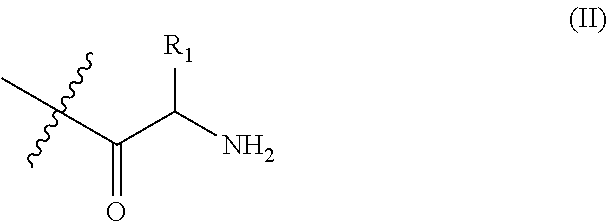
- R of the block copolymer as previously described is represented by formula (II) below:
- R 1 is H, CH 3 , (CH 3 ) 2 CH, PhCH 2 , or (CH 2 ) 3 NHC(NH)NH 2 .
- R 1 of the block copolymer as previously described is PhCH 2 or (CH 2 ) 3 NHC(NH)NH 2 .
- Another aspect of the present invention is to provide a method of preparing a block copolymer represented by formula (I) as described previously, wherein R represents an acyl amine group, a is an integer of 11-455, preferably 20-200; and b is an integer of 3-300, preferably 5-50; the average molecular weight of the block copolymer ranging from 1000-70000, preferably 2000-20000; the average molecular weight a methoxypoly(ethylene glycol) block component ranging from 500-20000, preferably 1000-5000; and the average molecular weight a poly(lactide) block component ranging from 500-50000, preferably 1000-10000.
- R represents an acyl amine group
- a is an integer of 11-455, preferably 20-200
- b is an integer of 3-300, preferably 5-50
- the average molecular weight of the block copolymer ranging from 1000-70000, preferably 2000-20000
- the method includes the steps of: dissolving a methoxypoly(ethylene glycol)-poly(lactide) block copolymer and an amino acid in distilled water to form a working solution; adding a condensing agent into the working solution for reaction at room temperature for 4 to 48 hours to obtain a product solution; filtering the product solution to obtain a filtrate; extracting the filtrate by using a polar organic solvent and precipitating the filtrate by a non-polar organic solvent to obtain a precipitation; and drying the precipitation to obtain the final product.
- the molar ratio of the methoxypoly(ethylene glycol)-poly(lactide) block copolymer:amino acid:condensing agent ranges from 1:1-10:0.1-10, preferably from 1:1-3:0.1-1.
- the condensing agent is 3-(ethyliminomethyleneamino)-N,N-dimethyl-propan-1-amine (EDC).
- R 1 of the block copolymer as previously described is represented by formula (II) is H, CH 3 , (CH 3 ) 2 CH, PhCH 2 , or (CH 2 ) 3 NHC(NH)NH 2 .
- R 1 of the block copolymer as previously described represented by formula (II) is PhCH 2 or (CH 2 ) 3 NHC(NH)NH 2 .
- the methoxypoly(ethylene glycol)-poly(lactide) block copolymer can be prepared by the method includes the steps of: adding methoxypoly(ethylene glycol) and D,L-Lactide together into a dry flask, wherein the weight ratio of methoxypoly(ethylene glycol) to D,L-Lactide is 1:1; adding 0.1 g/mL of stannous octoate dissolved in dichloromethane into the flask, wherein the weight of the stannous octoate dissolved in dichloromethane is 1/2000-1/500 to the weight of either methoxypoly(ethylene glycol) or D,L-Lactide to form a reaction mixture; heating the reaction mixture to 80-100° C.
- the molar ratio of the previously described methoxypoly(ethylene glycol)-poly(lactide) block copolymer:amino acid:condensing agent ranges from 1:3:1.
- the previously described polar organic solvent is selected from the group consisting of dichloromethane, methanol, chloroform and tetrahydrofuran, wherein dichloromethane is preferable.
- the previously described non-polar organic solvent is selected form the group consisting of diethyl ether, petroleum ether and n-hexane, wherein diethyl ether is preferable.
- Another object of the present invention is providing the use of the previously described methoxypoly(ethylene glycol)-poly(lactide) block copolymer capped with amino acid group for a surfactant.
- Still another aspect of the present invention is providing a methoxypoly(ethylene glycol)-poly(lactide) block copolymer characterized in that the block copolymer is represented by formula (I) below:
- R represents an 2-amino-3-phenylpropanal group
- a represents the number of the methoxypoly(ethylene glycol) block component and is an integer of 11-455, preferably 20-200
- b represents the number of the poly(lactide) block component and is an integer of 3-300, preferably 5-50; the average molecular weight of the block copolymer ranges from 1000-70000, preferably from 2000-20000.
- the block copolymer has at least three peaks in a 1 H-NMR measurement corresponding to the methoxypoly(ethylene glycol) block component, the poly(lactide) block component and the 2-amino-3-phenylpropanal group, including one peak corresponding to the methoxypoly(ethylene glycol) block component at a signal position of from 3.5 to 4 ppm, two peaks corresponding to the poly(lactide) block component at two signal positions of from 1 to 2 ppm and 5 to 5.5 ppm respectively, and three peaks corresponding to the 2-amino-3-phenylpropanal group at three signal positions of from 7 to 7.5 ppm, 3 to 3.5 ppm, and 4.5 to 5 ppm respectively.
- the present invention does not limit the amino acid used to cap the block copolymer, and any type and grade of amino acid can be used.
- the present invention does not limit the source of agents and solvents, and any type and grade of commercial agent and solvent can be used.
- the present invention provides a material having the following advantages and benefits: the present invention provides a material having better performance on the environmental compatibility, the non-toxicity, and the degradability compared to other types of chemically synthesized surfactants; and therefore it is more environmentally friendly.
- the present invention provides a material with better biocompatibility, and this advantage is particularly significant when the material is used in high concentration, which means the material according to the present invention is an ideal choice for daily personal body care products.
- the triblock copolymer according to the present invention is capable of carrying more encapsulated ingredients. Therefore, more diverse or enriched functional ingredients can be added to the daily personal care products by using the material according to the present invention; and it ultimately enhances the market competitiveness of those products.
- FIG. 1 is a gel permeation chromatography (GPC) chromatogram showing the distribution and the molecular weight of the block copolymer according to Example 1.
- the polydispersity index (PDI) is 1.05 and the peak shape is nearly symmetrical; both indicate excellent purity of the block copolymer.
- FIG. 2 shows H1 NMR spectrum of the block copolymer according to Example 1.
- FIGS. 3A and 3B shows respectively the experimental results of cytotoxicity assay of block copolymer according to Example 1 and conventional MPEG-PLA.
- FIG. 4 is a gel permeation chromatography (GPC) chromatogram showing the distribution and the molecular weight of the block copolymer according to Example 2.
- the polydispersity index (PDI) is 1.05 and the peak shape is nearly symmetrical; both indicate excellent purity of the block copolymer.
- FIG. 5 is a gel permeation chromatography (GPC) chromatogram showing the distribution and the molecular weight of the block copolymer according to Example 3.
- the polydispersity index (PDI) is 1.05 and the peak shape is nearly symmetrical; both indicate excellent purity of the block copolymer.
- amino acid is generally defined as an organic compound having amine group and carboxylic acid functional group. Specifically, there are approximately 20 common amino acids for human body including, but not limited to, glycine, alanine, valine, leucine, isoleucine, serine, threonine, aspartic acid, asparagine, glutamic acid, glutamine, arginine, lysine, histidine, cysteine, methionine, phenylalanine, tyrosine, tryptophan, proline.
- Amino acids are the unit molecule of bio-functional protein macromolecules as well as the nutrition source. Amino acids are readily available and are safe to use.
- amino acid group described in the present invention is defined as a functional group derived from the corresponding amino acid, and the simplified formula can be represented and as formula (II) below:
- Formula (II) also represents an acyl amine group, and R 1 is selected from the group of H, CH 3 , (CH 3 ) 2 CH, PhCH 2 , or (CH 2 ) 3 NHC(NH)NH 2 . More specifically, when R 1 is H, the amino acid group of the block copolymer is glycine (Gly or G); when R 1 is CH 3 , the amino acid group of the block copolymer is alaine (Ala or A); when R 1 is (CH 3 ) 2 CH, the amino acid group of the block copolymer is valine (Val or V); when R 1 is PhCH 2 , the amino acid group of the block copolymer is phenylalanine (Phe or F); and when R 1 is (CH 2 ) 3 NHC(NH)NH 2 , the amino acid group of the block copolymer is arginine (Arg or R).
- R 1 is H, the amino acid group of the block copolymer is glycine (Gly or G); when R
- the “block copolymer” described in the present invention means copolymers comprise two or more homopolymer subunits linked by covalent bonds.
- the block copolymer integrates the advantageous properties of various polymers to obtain a more excellent functional polymer material.
- the block copolymer has the characteristics of: controllable molecular weight, narrower distribution of molecular weight, designable molecular structure with desired block component.
- the specific structure of a block polymer usually gives the block polymer a simple linear conformation and other distinguishable characteristics from the random copolymers and the mixture of homopolymers. Therefore, it broadens the applications of block polymers in biomedical, architectural, and chemical engineering fields.
- polar organic solvent means solvents having significant charge polarity, including, but not limited to: dichloromethane, ethyl acetate, chloroform, and tetrahydrofuran (THF).
- non-polar organic solvent means solvents having no significant charge polarity, including, but not limited to: ethyl ether, n-hexane, and cyclohexane.
- the “condensing agent” described in the present invention means the catalysts for the esterification reactions, which catalyze those reactions, including, but not limited to: dicyclohexylcarbodiimide (DCC), 1-(3-dimethylaminopropyl)-3-ethylcarbodiimide hydrochloride (EDC), concentrated sulfuric acid, concentrated hydrochloric acid, 4-methylbenzenesulfonic acid (PTSA) and sulfurous dichloride (SOCl 2 ).
- DCC dicyclohexylcarbodiimide
- EDC 1-(3-dimethylaminopropyl)-3-ethylcarbodiimide hydrochloride
- concentrated sulfuric acid concentrated hydrochloric acid
- PTSA 4-methylbenzenesulfonic acid
- SOCl 2 sulfurous dichloride
- room temperature described in the present invention is also described as ordinary temperature or normal temperature, and the actual temperature depends on environment. Generally, the room temperature means the typical or preferred indoor temperature, denoting the small range of temperatures, approximately 25° C. or 300K (about 27° C.) for absolute temperature.
- methoxypoly(ethylene glycol), also called MPEG has excellent solubility in aqueous environment, capability of wetting, lubricity; and it is biologically inert and irritant-free to human body. With these mild characteristics, methoxypoly(ethylene glycol) is widely used in cosmetic industry and pharmaceutical industry. Variously graded types methoxypoly(ethylene glycol) are utilized to modify the viscosity, hygroscopicity, and structure of the end product.
- Methoxypoly(ethylene glycol) products with relatively low molecular weight are suitably used as wetting agents and pasting agents for modifying the consistency; and therefore, those low-molecular products are widely used in manufacturing ointment, cream, lotion, toothpastes, shaving cream, and so on.
- Methoxypoly(ethylene glycol) products with relatively high molecular weight are suitably used in manufacturing lipstick, deodorant, soap, shaving cream, foundation cream, various cosmetics, and so on. When being used in manufacturing detergents, those high-molecular products are used as suspending agents and thickening agents. When being used in pharmaceutical industry, those high-molecular products are used as a groundmass of emulsion, balm, ointment, cleaning agent and suppository
- poly lactic acid also called poly(lactide)
- PHA poly(lactide)
- Poly lactic acid becomes a group of “green polymers” based on the following advantages: the source of the poly lactic acids is naturally abundant; the poly lactic acid is renewable; the manufacturing processes of the poly lactic acid are usually pollution-free; the product polymers are biodegradable; as well as other excellent properties including ideal biocompatibility, glossiness, transparency, feel in operation, and heat endurance.
- Poly lactic acid is characteristic of excellent compatibility and degradability, it is widely applied in medical and pharmaceutical field, for example, poly lactic acid is used to manufacture disposable infusion devices for a single use, bio-absorbable suture; and the low-molecular poly lactic acid is used as a slow-releasing drug carrier.
- the present invention provides a methoxypoly(ethylene glycol)-poly(lactide) block copolymer capped with an amino acid group.
- the block copolymer has a methoxypoly(ethylene glycol) block component and a poly(lactide) block component, it is represented by formula (I) below:
- R represents an acyl amine group
- a represent the number of the methoxypoly(ethylene glycol) block component
- a is an integer of 11-455, preferably 20-200
- b represent the number of the poly(lactide) block component and b is an integer of 3-300, preferably 5-50;
- the average molecular weight of the block copolymer ranging from 1000-70000, preferably from 2000-20000;
- the average molecular weight a methoxypoly(ethylene glycol) block component ranging from 500-20000, preferably from 1000-5000;
- the average molecular weight a poly(lactide) block component ranging from 500-50000, preferably from 1000-10000.
- R is represented by represented by formula (II):
- R 1 of the formula (II) is H, CH 3 , (CH 3 ) 2 CH, PhCH 2 , or (CH 2 ) 3 NHC(NH)NH 2 .
- Different R is derived from different amino acids of distinguish features, such as non-polar amino acids (glycine, alanine, Valine and phenylalanine) and basic amino acid (arginine).
- the amino acid used is phenylalanine, and thus the amino acid capping the block copolymer is derived from phenylalanine.
- the block copolymer product according to Example 1 is called MPEG-PLA-Phe hereinafter.
- MPEG-PLA methoxypoly(ethylene glycol)-poly(lactide)
- the desired product of MPEG-PLA-Phe is characterized by nuclear magnetic resonance spectroscopy (NMR), infrared spectroscopy (IR) and gel permeation chromatography (GPC) methods, to determine their physical properties including spatial structure, monocular weight, and polydispersity.
- NMR nuclear magnetic resonance spectroscopy
- IR infrared spectroscopy
- GPC gel permeation chromatography
- the polydispersity index (PDI) of the desired product is 1.05 and the peak shape is nearly symmetrical, and those features indicate that the purity of the desired product is excellent.
- the desired product of Example 1 is a specific methoxypoly(ethylene glycol)-poly(lactide) block copolymer.
- the structural features of the block copolymer are determined by NMR and the results are shown in FIG. 2 .
- the H 1 -NMR is applied for characterization, and the details related to this method are well-known in the field of the present invention; thus the procedure of the method is not detailed herein.
- the structural features are characterized primarily by parameters of the chemical shift and the coupling constant.
- the chemical shift reflects the specific electronic environment of the resonating nuclei, and the resultant resonance frequency is profiled by the different absorption peak in the H 1 -NMR spectrum.
- the difference between absorption peaks (hereinafter “peak”) is reflected by chemical shift, usually expressed in parts per million (ppm), and is calculate by specific equation.
- the coupling constant affects significantly the shape of peak, for example, a multi-peak profile usually relates to the interaction of different functional groups.
- the coupling constant reflects the level of spin coupling and provides information on the connectivity of molecules.
- the coupling constant is usually represented by “J” and expressed in hertz (Hz).
- the intensity of the peak provides key information. Specifically, the atomic nucleus in the same electronic environment will be reflected by the same peak in NMR spectrum, and the intensity of the peak (calculated by integration) is analyzed to estimate the number of the nucleus, and ultimately unveils the structure of the assayed molecules.
- Peaks attributing to the same component of the block polymer is indicated by the same symbol (a, b, c, d, e, f), and the peaks are described expressly by chemical shift in the unit of ppm: the peak “a” at a signal position of from 3.5 to 4 corresponds to the methoxypoly(ethylene glycol) block component; the peak “e” and “f” respectively at signal positions of from 1 to 2 represent and from 5 to 5.5 corresponds to poly(lactide) block component; and the peak “b”, “c”, and “d” respectively at signal positions of from 7 to 7.5, from 3 to 3.5 and from 4.5 to 5 corresponds to the phenylalanine component.
- the peaks of chemical shift as well as the peak shape will correspondingly change in accordance with the number of methoxypoly(ethylene glycol) block component, the number of poly(lactide) block component and the different amino acid group. These peak characteristics are used to feature other block copolymers obtained according to other embodiments of the present invention.
- Example 1 To examine the surfactant property, add 60 mL water and 8 mL hexadecane into a 12-cm culture dish, and the hexadecane spreads and forms an oil film on the surface of water. Dissolve the quantified product of Example 1 in water to form a 30% of aqueous solution and then drop this solution into the center of the hexadecane oil film. It's observe that the oil spreads toward radially. This phenomenon demonstrates that the product obtained according to Example 1 has the feature of surfactant.
- This assay is based on the colorimetric feature of (3-(4,5-Dimethylthiazol-2-yl)-2,5-diphenyltetrazolium bromide), also called MTT or thiazolyl nlue tetrazolium bromide, which is widely used in vitro for determine whether a stimuli (e.g., medicinal agents and radiation).
- the principle is based on that the succinate dehydrogenase in live cells can reduce the exogenous MTT to form insoluble formazan with blue or purple appearance and then the formazan deposits inside the cells; while dead cells have no reduction activity.
- Dimethyl sulfoxide (DMSO) can dissolve the formazon deposited inside the cells, and the amount of dissolved formazon can be measured by detecting the optical density (OD) at specific absorbance using the colorimetric meter or ELISA Reader, which reflects the quantities of live cells. More intense the OD value represents better activity of live cells, which means the stimuli or the tested agent is less toxic to cells.
- the assay includes the following steps:
- culture L-02 cells human hepatic cells
- the methoxypoly(ethylene glycol)-poly(lactide) block copolymer capped with phenylalanine group is diluted and suspended in culture medium (DMEM medium with 10% FBS) in serial concentrations (10 to 1000 ⁇ g/mL). And the suspended medium are loading into the wells of the plate for further 24 hours of incubation.
- MTT assay is conducted to determine the cytotoxicity of the block copolymers. More specifically, the assay steps includes:
- the MPEG-PLA is also used for conducting MTT assay as described previously, and the effects of MPEG-PLA and MPEG-PLA-Phe on cell cytotoxicity are compared side by side, as shown in Table 1 and FIG. 3A and FIG. 3B .
- the OD values of the assay result are calculated to be expressed in percentage to determine the cell viability (%).
- the biocompatibility of the methoxypoly(ethylene glycol)-poly(lactide) block copolymer capped with phenylalanine group is superior to conventional MPEG-PLA without any amino acid cap, and this phenomenon is particularly significant when the MPEG-PLA and MPEG-PLA-Phe are assayed in high concentrations.
- the biocompatibility of MPEG-PLA-Phe is superior than any of the known surfactant products. It is clear that the present invention provides an ideal solution of capping the block copolymers with an amino acid for greatly reducing the toxicity and improving biodegradability of the surfactant.
- the amino acid used is arginine, and thus the amino acid capping the block copolymer is derived from arginine.
- the block copolymer product according to Example 2 is called MPEG-PLA-Arg hereinafter.
- MPEG-PLA is prepared as previously described in Example 1.
- the desired product of MPEG-PLA-Arg is characterized by NMR, IR and GPC methods, to determine their physical properties including spatial structure, monocular weight, and polydispersity.
- the results of structural characteristics of the desired product are respectively shown in FIG. 4 .
- the polydispersity index (PDI) of the desired product is 1.05 and the peak shape is nearly symmetrical, and those features indicate that the purity of the desired product is excellent.
- Example 2 To examine the surfactant property, add 60 mL water and 8 mL hexadecane into a 12-cm culture dish, and the hexadecane spreads and forms an oil film on the surface of water. Dissolve the quantified product of Example 2 in water to form a 20% of aqueous solution and then drop this solution into the center of the hexadecane oil film. It's observe that the oil spreads toward radially. This phenomenon demonstrates that the product obtained according to Example 2 has the feature of surfactant.
- the amino acid used is alanine, and thus the amino acid capping the block copolymer is derived from alanine.
- the block copolymer product according to Example 3 is called MPEG-PLA-Ala hereinafter.
- MPEG-PLA is prepared as previously described in Example 1.
- the desired product of MPEG-PLA-Ala is characterized by NMR, IR and GPC methods, to determine their physical properties including spatial structure, monocular weight, and polydispersity.
- the results of structural characteristics of the desired product are respectively shown in FIG. 5 .
- the polydispersity index (PDI) of the desired product is 1.05 and the peak shape is nearly symmetrical, and those features indicate that the purity of the desired product is excellent.
- Example 2 To examine the surfactant property, add 60 mL water and 8 mL hexadecane into a 12-cm culture dish, and the hexadecane spreads and forms an oil film on the surface of water. Dissolve the quantified product of Example 2 in water to form a 15% of aqueous solution and then drop this solution into the center of the hexadecane oil film. It's observe that the oil spreads toward radially. This phenomenon demonstrates that the product obtained according to Example 2 has the feature of surfactant.
- the above formulation examples show the use of the block copolymer according to the present invention for producing detergents.
- the overall performance, including the cleaning capability and the skin comfort level, of the products formulated by the block copolymer according to the present invention is excellent; and is comparable to the currently popular commercial products, such as PANTENE, BEE FLOWER and T JOY.
- the block copolymer according to the present invention can be widely used as a surfactant to be formulated in various cleaners to fully satisfy the demands of customers and earn more business opportunities.
Landscapes
- Chemical & Material Sciences (AREA)
- Health & Medical Sciences (AREA)
- Chemical Kinetics & Catalysis (AREA)
- Medicinal Chemistry (AREA)
- Organic Chemistry (AREA)
- Polymers & Plastics (AREA)
- General Chemical & Material Sciences (AREA)
- Life Sciences & Earth Sciences (AREA)
- Engineering & Computer Science (AREA)
- Epidemiology (AREA)
- Public Health (AREA)
- Veterinary Medicine (AREA)
- Animal Behavior & Ethology (AREA)
- General Health & Medical Sciences (AREA)
- Oil, Petroleum & Natural Gas (AREA)
- Bioinformatics & Cheminformatics (AREA)
- Pharmacology & Pharmacy (AREA)
- Wood Science & Technology (AREA)
- Birds (AREA)
- Medicinal Preparation (AREA)
- Polyesters Or Polycarbonates (AREA)
- Biological Depolymerization Polymers (AREA)
- Emulsifying, Dispersing, Foam-Producing Or Wetting Agents (AREA)
Abstract

Description


wherein R1 is H, CH3, (CH3)2CH, PhCH2, or (CH2)3NHC(NH)NH2.

wherein R represents an 2-amino-3-phenylpropanal group; a represents the number of the methoxypoly(ethylene glycol) block component and is an integer of 11-455, preferably 20-200; b represents the number of the poly(lactide) block component and is an integer of 3-300, preferably 5-50; the average molecular weight of the block copolymer ranges from 1000-70000, preferably from 2000-20000. The block copolymer has at least three peaks in a 1H-NMR measurement corresponding to the methoxypoly(ethylene glycol) block component, the poly(lactide) block component and the 2-amino-3-phenylpropanal group, including one peak corresponding to the methoxypoly(ethylene glycol) block component at a signal position of from 3.5 to 4 ppm, two peaks corresponding to the poly(lactide) block component at two signal positions of from 1 to 2 ppm and 5 to 5.5 ppm respectively, and three peaks corresponding to the 2-amino-3-phenylpropanal group at three signal positions of from 7 to 7.5 ppm, 3 to 3.5 ppm, and 4.5 to 5 ppm respectively.


| TABLE 1 | |||||
| MPEG-PLA-Phe | Cell | MPEG-PLA | Cell | ||
| concentration | Viability | Error | concentration | Viability | Error |
| (μg/mL) | % | % | (μg/mL) | % | % |
| 0 | 100 | 3.23 | 0 | 96 | 4.22 |
| 10 | 99.72 | 6.53 | 10 | 91.24 | 3.25 |
| 100 | 98.95 | 2.32 | 100 | 93.41 | 4.77 |
| 250 | 97.23 | 3.51 | 250 | 90.07 | 3.34 |
| 500 | 97.16 | 2.53 | 500 | 85.45 | 5.72 |
| 1000 | 96.31 | 2.34 | 1000 | 76.28 | 5.28 |
| Ingredient | Percentage (wt %) | ||
| MPEG-PLA-Phe 1 | 4.70% | ||
| pure water | 84.50% | ||
| ethanol | 4.50 | ||
| ethylene glycol | |||
| 2 | |||
| aloe extract | |||
| 2 | 2% | ||
| PEG-6 caprylic/ |
2% | ||
| Allantoin | 0.30% | ||
| 1 Refer to Example 1 for the synthetic process of MPEG-PLA-Phe | |||
| 2 Full name: Aloe barbadensis extract (CAS: 85507-69-3) | |||
| 3 CAS: 361459-38-3/8, manufactured by EVONIK-DEGUSSA(product name: TEGOSOFT ® GMC 6) | |||
| Ingredient | Percentage (wt %) | ||
| MPEG-PLA-Arg 4 | 28 | ||
| cocoamide DEA | |||
| 6% | |||
| methyl parahydroxybenzoate | 0.2% | ||
| propylparaben | 0.1% | ||
| parfum oil | 0.5% | ||
| vitamin E | 0.1% | ||
| vitamin C | 0.1% | ||
| Pure water | 65% | ||
| 4 Refer to Example 2 for the synthetic process of MPEG-PLA-Arg | |||
| Ingredient | Percentage (wt %) | ||
| MPEG-PLA-Ala 5 | 17% | ||
| disodium laureth sulfosuccinate | 14% | ||
| lauryl glucoside 6 | 17% | ||
| PEG-7 |
5 | ||
| sodium chloride | |||
| 3 | |||
| fragrance | |||
| 1% | |||
| pure water | 43% | ||
| 5 Refer to Example 3 for the synthetic process of MPEG-PLA-Ala | |||
| 6 CAS: 110615-47-9, manufactured by Shanghai Fine Chemical Co. Ltd | |||
| 7 Supplier: GATTEFOSS (product name: GELUCIRE 44/14) | |||
Claims (8)


Applications Claiming Priority (1)
| Application Number | Priority Date | Filing Date | Title |
|---|---|---|---|
| PCT/CN2013/000453 WO2014169403A1 (en) | 2013-04-19 | 2013-04-19 | Biodegradable surfactant, preparation method and use thereof |
Publications (2)
| Publication Number | Publication Date |
|---|---|
| US20150361219A1 US20150361219A1 (en) | 2015-12-17 |
| US9499667B2 true US9499667B2 (en) | 2016-11-22 |
Family
ID=51730649
Family Applications (1)
| Application Number | Title | Priority Date | Filing Date |
|---|---|---|---|
| US14/762,763 Expired - Fee Related US9499667B2 (en) | 2013-04-19 | 2013-04-19 | Biodegradable surfactant, preparation method and use thereof |
Country Status (4)
| Country | Link |
|---|---|
| US (1) | US9499667B2 (en) |
| JP (1) | JP6035593B2 (en) |
| GB (1) | GB2523952B (en) |
| WO (1) | WO2014169403A1 (en) |
Cited By (1)
| Publication number | Priority date | Publication date | Assignee | Title |
|---|---|---|---|---|
| US20170157050A1 (en) * | 2014-07-15 | 2017-06-08 | Xin Teng | Pharmaceutical composition containing docetaxel |
Families Citing this family (5)
| Publication number | Priority date | Publication date | Assignee | Title |
|---|---|---|---|---|
| CN107754722A (en) * | 2017-10-26 | 2018-03-06 | 湖南华腾制药有限公司 | A kind of Pegylation Guerbet alcohol surfactant and preparation method thereof |
| CN110156971A (en) | 2018-02-13 | 2019-08-23 | 上海时莱生物技术有限公司 | A kind of amphipathic nature block polymer and preparation method thereof and nano-micelle drug-loading system |
| CN110893172B (en) * | 2019-12-04 | 2022-07-08 | 四川省人民医院 | Elemene polymer micelle preparation and preparation method and application thereof |
| EP4386074B1 (en) | 2022-12-16 | 2025-12-03 | The Procter & Gamble Company | Fabric and home care composition |
| DE102023135175A1 (en) | 2022-12-16 | 2024-06-27 | Basf Se | Process for the preparation of amino acid esters and organic sulfonic acid salts as well as amino acid esters and their salts |
Citations (2)
| Publication number | Priority date | Publication date | Assignee | Title |
|---|---|---|---|---|
| WO2011011978A1 (en) | 2009-07-31 | 2011-02-03 | 西安力邦医药科技有限责任公司 | Nanosphere or microsphere drug carrier, preparation method, composition and use thereof |
| CN102219892A (en) | 2010-06-30 | 2011-10-19 | 上海谊众生物技术有限公司 | Preparation method of polyethylene glycol monomethyl ether-dl-polylactic acid block copolymer |
-
2013
- 2013-04-19 JP JP2015555514A patent/JP6035593B2/en not_active Expired - Fee Related
- 2013-04-19 GB GB1512141.1A patent/GB2523952B/en not_active Expired - Fee Related
- 2013-04-19 WO PCT/CN2013/000453 patent/WO2014169403A1/en not_active Ceased
- 2013-04-19 US US14/762,763 patent/US9499667B2/en not_active Expired - Fee Related
Patent Citations (3)
| Publication number | Priority date | Publication date | Assignee | Title |
|---|---|---|---|---|
| WO2011011978A1 (en) | 2009-07-31 | 2011-02-03 | 西安力邦医药科技有限责任公司 | Nanosphere or microsphere drug carrier, preparation method, composition and use thereof |
| US20120121711A1 (en) * | 2009-07-31 | 2012-05-17 | Xi'an Libang Medical Technology Co., Ltd. | Microsphere drug carrier, preparation method, composition and use thereof |
| CN102219892A (en) | 2010-06-30 | 2011-10-19 | 上海谊众生物技术有限公司 | Preparation method of polyethylene glycol monomethyl ether-dl-polylactic acid block copolymer |
Non-Patent Citations (1)
| Title |
|---|
| Han et al, "Preparation of PLA-mPEG Block Copolymer Micelle and Their Surface Tension," Chinese Journal of Applied Chemistry, 2005, p. 403-406, vol. 22, No. 4. |
Cited By (2)
| Publication number | Priority date | Publication date | Assignee | Title |
|---|---|---|---|---|
| US20170157050A1 (en) * | 2014-07-15 | 2017-06-08 | Xin Teng | Pharmaceutical composition containing docetaxel |
| US10080720B2 (en) * | 2014-07-15 | 2018-09-25 | Gainia (Shanghai) Patent Technology Ltd. | Pharmaceutical composition containing docetaxel |
Also Published As
| Publication number | Publication date |
|---|---|
| GB2523952B (en) | 2021-02-24 |
| GB201512141D0 (en) | 2015-08-19 |
| JP2016516833A (en) | 2016-06-09 |
| US20150361219A1 (en) | 2015-12-17 |
| JP6035593B2 (en) | 2016-11-30 |
| WO2014169403A1 (en) | 2014-10-23 |
| GB2523952A (en) | 2015-09-09 |
Similar Documents
| Publication | Publication Date | Title |
|---|---|---|
| US20150361219A1 (en) | Biodegradable surfactant, preparation method and use thereof | |
| ES2803024T3 (en) | Colloidal dispersions of poly-alpha-1,3-glucan-based polymers | |
| US6723688B1 (en) | Cleanser that is gentle to human skin | |
| CN100544702C (en) | Lipid composition and skin care preparation containing the lipid composition | |
| Ribeiro et al. | Solubilisation capacity of Brij surfactants | |
| CN106511270A (en) | Block copolymers for stable micelles | |
| TWI262213B (en) | Cleaning agent composition | |
| CN108024935A (en) | Compositions comprising zwitterionic alkyl-alkanoylamides and/or alkylalkanoates | |
| BRPI1105643A2 (en) | Polyglyceryl compounds and compositions | |
| EP3221384A1 (en) | Water-soluble supramolecular complexes | |
| JP2010280643A (en) | Skin cleanser composition | |
| Vorobyova et al. | Synthesis of gold nanoparticles using plum waste extract with green solvents | |
| CN118845510B (en) | Surfactant composition, surfactant system and application thereof | |
| WO2001023517A1 (en) | Cleanser that is gentle to human skin | |
| JP2015124183A (en) | Cosmetic | |
| CN105407863B (en) | Skin whitening composition containing arbutin derivative | |
| Tanaka et al. | Properties of the aqueous vesicle dispersion formed with poly (oxyethylene) hydrogenated castor oil | |
| KR102475100B1 (en) | Preparing method of highly functional peptide derived from keratinocyte protein | |
| JP7436109B2 (en) | Cosmetic compositions comprising certain hyperbranched copolymers and organic UV filters | |
| BR112012013246A2 (en) | composition, personal care product, and method for producing a composition containing a substituted polyalkyl (meta) acrylate | |
| Wojcieszak-Michalak et al. | Emulgels for dermal delivery based on amphiphilic polymers bearing cholesteryl moiety: tuning surface properties via polymer chain length | |
| JPH04122797A (en) | Detergent composition | |
| JPH0665038A (en) | Melanism suppressing agent using monascus pigment compound and skin external preparation blended therewith | |
| CN114213662B (en) | A kind of rhamnolipid derivative and its preparation method and application | |
| JP2023062897A (en) | Collagen production promoter, cell proliferation promoter and anti-wrinkle agent |
Legal Events
| Date | Code | Title | Description |
|---|---|---|---|
| AS | Assignment |
Owner name: POLYMER CHEMICAL CO. LTD, CHINA Free format text: ASSIGNMENT OF ASSIGNORS INTEREST;ASSIGNORS:GU, XIAOJUN;TENG, XIN;REEL/FRAME:036205/0663 Effective date: 20150618 |
|
| AS | Assignment |
Owner name: GAINIA (SHANGHAI) PATENT TECHNOLOGY LTD., CHINA Free format text: ASSIGNMENT OF ASSIGNORS INTEREST;ASSIGNOR:POLYMER CHEMICAL CO. LTD;REEL/FRAME:039996/0883 Effective date: 20161008 Owner name: POLYMER CHEMICAL CO. LTD, CHINA Free format text: ASSIGNMENT OF ASSIGNORS INTEREST;ASSIGNOR:POLYMER CHEMICAL CO. LTD;REEL/FRAME:039996/0883 Effective date: 20161008 |
|
| STCF | Information on status: patent grant |
Free format text: PATENTED CASE |
|
| AS | Assignment |
Owner name: GAINIA(SHANGHAI) PATENT TECHNOLOGY LTD., CHINA Free format text: ASSIGNMENT OF ASSIGNORS INTEREST;ASSIGNORS:GAINIA(SHANGHAI) PATENT TECHNOLOGY LTD.;POLYMER CHEMICAL CO. LTD;REEL/FRAME:047382/0914 Effective date: 20180903 Owner name: SHANGHAI SIMPLE BIOTECH LTD., CHINA Free format text: ASSIGNMENT OF ASSIGNORS INTEREST;ASSIGNORS:GAINIA(SHANGHAI) PATENT TECHNOLOGY LTD.;POLYMER CHEMICAL CO. LTD;REEL/FRAME:047382/0914 Effective date: 20180903 |
|
| FEPP | Fee payment procedure |
Free format text: MAINTENANCE FEE REMINDER MAILED (ORIGINAL EVENT CODE: REM.); ENTITY STATUS OF PATENT OWNER: SMALL ENTITY |
|
| LAPS | Lapse for failure to pay maintenance fees |
Free format text: PATENT EXPIRED FOR FAILURE TO PAY MAINTENANCE FEES (ORIGINAL EVENT CODE: EXP.); ENTITY STATUS OF PATENT OWNER: SMALL ENTITY |
|
| STCH | Information on status: patent discontinuation |
Free format text: PATENT EXPIRED DUE TO NONPAYMENT OF MAINTENANCE FEES UNDER 37 CFR 1.362 |
|
| FP | Lapsed due to failure to pay maintenance fee |
Effective date: 20201122 |