US9499664B2 - Polyimide polymer, polyimide film having the same and polyimide laminate having the same - Google Patents
Polyimide polymer, polyimide film having the same and polyimide laminate having the same Download PDFInfo
- Publication number
- US9499664B2 US9499664B2 US14/615,286 US201514615286A US9499664B2 US 9499664 B2 US9499664 B2 US 9499664B2 US 201514615286 A US201514615286 A US 201514615286A US 9499664 B2 US9499664 B2 US 9499664B2
- Authority
- US
- United States
- Prior art keywords
- polyimide
- group
- fluorine
- formula
- aromatic
- Prior art date
- Legal status (The legal status is an assumption and is not a legal conclusion. Google has not performed a legal analysis and makes no representation as to the accuracy of the status listed.)
- Active, expires
Links
- 229920001721 polyimide Polymers 0.000 title claims abstract description 116
- 239000004642 Polyimide Substances 0.000 title claims abstract description 70
- 229920000642 polymer Polymers 0.000 title claims abstract description 47
- 125000003118 aryl group Chemical group 0.000 claims abstract description 42
- 229910052731 fluorine Inorganic materials 0.000 claims abstract description 32
- 239000011737 fluorine Substances 0.000 claims abstract description 32
- 229910052796 boron Inorganic materials 0.000 claims abstract description 28
- 239000003086 colorant Substances 0.000 claims abstract description 19
- 239000002105 nanoparticle Substances 0.000 claims abstract description 18
- PXGOKWXKJXAPGV-UHFFFAOYSA-N Fluorine Chemical compound FF PXGOKWXKJXAPGV-UHFFFAOYSA-N 0.000 claims abstract 16
- 239000010409 thin film Substances 0.000 claims description 45
- VYPSYNLAJGMNEJ-UHFFFAOYSA-N Silicium dioxide Chemical compound O=[Si]=O VYPSYNLAJGMNEJ-UHFFFAOYSA-N 0.000 claims description 20
- 125000003983 fluorenyl group Chemical group C1(=CC=CC=2C3=CC=CC=C3CC12)* 0.000 claims description 20
- GWEVSGVZZGPLCZ-UHFFFAOYSA-N Titan oxide Chemical compound O=[Ti]=O GWEVSGVZZGPLCZ-UHFFFAOYSA-N 0.000 claims description 18
- 239000000377 silicon dioxide Substances 0.000 claims description 10
- 239000004408 titanium dioxide Substances 0.000 claims description 9
- PNEYBMLMFCGWSK-UHFFFAOYSA-N Alumina Chemical compound [O-2].[O-2].[O-2].[Al+3].[Al+3] PNEYBMLMFCGWSK-UHFFFAOYSA-N 0.000 claims description 6
- IRERQBUNZFJFGC-UHFFFAOYSA-L azure blue Chemical compound [Na+].[Na+].[Na+].[Na+].[Na+].[Na+].[Na+].[Na+].[Al+3].[Al+3].[Al+3].[Al+3].[Al+3].[Al+3].[S-]S[S-].[O-][Si]([O-])([O-])[O-].[O-][Si]([O-])([O-])[O-].[O-][Si]([O-])([O-])[O-].[O-][Si]([O-])([O-])[O-].[O-][Si]([O-])([O-])[O-].[O-][Si]([O-])([O-])[O-] IRERQBUNZFJFGC-UHFFFAOYSA-L 0.000 claims description 5
- VTYYLEPIZMXCLO-UHFFFAOYSA-L Calcium carbonate Chemical compound [Ca+2].[O-]C([O-])=O VTYYLEPIZMXCLO-UHFFFAOYSA-L 0.000 claims description 4
- OSGAYBCDTDRGGQ-UHFFFAOYSA-L calcium sulfate Chemical compound [Ca+2].[O-]S([O-])(=O)=O OSGAYBCDTDRGGQ-UHFFFAOYSA-L 0.000 claims description 4
- 235000012239 silicon dioxide Nutrition 0.000 claims description 4
- 229910052582 BN Inorganic materials 0.000 claims description 2
- PZNSFCLAULLKQX-UHFFFAOYSA-N Boron nitride Chemical compound N#B PZNSFCLAULLKQX-UHFFFAOYSA-N 0.000 claims description 2
- 229910000019 calcium carbonate Inorganic materials 0.000 claims description 2
- 239000006229 carbon black Substances 0.000 claims description 2
- 239000004927 clay Substances 0.000 claims description 2
- 229910052570 clay Inorganic materials 0.000 claims description 2
- FPAFDBFIGPHWGO-UHFFFAOYSA-N dioxosilane;oxomagnesium;hydrate Chemical compound O.[Mg]=O.[Mg]=O.[Mg]=O.O=[Si]=O.O=[Si]=O.O=[Si]=O.O=[Si]=O FPAFDBFIGPHWGO-UHFFFAOYSA-N 0.000 claims description 2
- RBTKNAXYKSUFRK-UHFFFAOYSA-N heliogen blue Chemical compound [Cu].[N-]1C2=C(C=CC=C3)C3=C1N=C([N-]1)C3=CC=CC=C3C1=NC([N-]1)=C(C=CC=C3)C3=C1N=C([N-]1)C3=CC=CC=C3C1=N2 RBTKNAXYKSUFRK-UHFFFAOYSA-N 0.000 claims description 2
- 239000010445 mica Substances 0.000 claims description 2
- 229910052618 mica group Inorganic materials 0.000 claims description 2
- 229910052751 metal Inorganic materials 0.000 abstract description 3
- 239000002184 metal Substances 0.000 abstract description 3
- 229920005575 poly(amic acid) Polymers 0.000 description 88
- WKDNYTOXBCRNPV-UHFFFAOYSA-N bpda Chemical compound C1=C2C(=O)OC(=O)C2=CC(C=2C=C3C(=O)OC(C3=CC=2)=O)=C1 WKDNYTOXBCRNPV-UHFFFAOYSA-N 0.000 description 52
- 239000000203 mixture Substances 0.000 description 45
- NVKGJHAQGWCWDI-UHFFFAOYSA-N 4-[4-amino-2-(trifluoromethyl)phenyl]-3-(trifluoromethyl)aniline Chemical compound FC(F)(F)C1=CC(N)=CC=C1C1=CC=C(N)C=C1C(F)(F)F NVKGJHAQGWCWDI-UHFFFAOYSA-N 0.000 description 40
- FXHOOIRPVKKKFG-UHFFFAOYSA-N N,N-Dimethylacetamide Chemical compound CN(C)C(C)=O FXHOOIRPVKKKFG-UHFFFAOYSA-N 0.000 description 39
- 230000000052 comparative effect Effects 0.000 description 23
- 238000006243 chemical reaction Methods 0.000 description 22
- 125000004122 cyclic group Chemical group 0.000 description 21
- 230000018044 dehydration Effects 0.000 description 20
- 238000006297 dehydration reaction Methods 0.000 description 20
- 238000002834 transmittance Methods 0.000 description 17
- YCKRFDGAMUMZLT-UHFFFAOYSA-N Fluorine atom Chemical compound [F] YCKRFDGAMUMZLT-UHFFFAOYSA-N 0.000 description 16
- 239000000758 substrate Substances 0.000 description 16
- 239000007787 solid Substances 0.000 description 12
- 238000003756 stirring Methods 0.000 description 11
- GTDPSWPPOUPBNX-UHFFFAOYSA-N ac1mqpva Chemical compound CC12C(=O)OC(=O)C1(C)C1(C)C2(C)C(=O)OC1=O GTDPSWPPOUPBNX-UHFFFAOYSA-N 0.000 description 10
- 0 C*N1C(=O)B2(C(=O)N(C)C2=O)C1=O.C*N1C(=O)C2(C(=O)N(C)C2=O)C1=O.C*N1C(=O)C2(C(=O)N(C)C2=O)C1=O Chemical compound C*N1C(=O)B2(C(=O)N(C)C2=O)C1=O.C*N1C(=O)C2(C(=O)N(C)C2=O)C1=O.C*N1C(=O)C2(C(=O)N(C)C2=O)C1=O 0.000 description 9
- 150000004985 diamines Chemical class 0.000 description 9
- SECXISVLQFMRJM-UHFFFAOYSA-N N-Methylpyrrolidone Chemical compound CN1CCCC1=O SECXISVLQFMRJM-UHFFFAOYSA-N 0.000 description 8
- 230000003287 optical effect Effects 0.000 description 7
- 239000000126 substance Substances 0.000 description 7
- ZMXDDKWLCZADIW-UHFFFAOYSA-N N,N-Dimethylformamide Chemical compound CN(C)C=O ZMXDDKWLCZADIW-UHFFFAOYSA-N 0.000 description 6
- 229910052681 coesite Inorganic materials 0.000 description 6
- 229910052906 cristobalite Inorganic materials 0.000 description 6
- 229920003023 plastic Polymers 0.000 description 6
- 229910052682 stishovite Inorganic materials 0.000 description 6
- 229910052905 tridymite Inorganic materials 0.000 description 6
- YEJRWHAVMIAJKC-UHFFFAOYSA-N 4-Butyrolactone Chemical compound O=C1CCCO1 YEJRWHAVMIAJKC-UHFFFAOYSA-N 0.000 description 5
- UOLXDVKBOKRFGH-UHFFFAOYSA-N CC(C)C1=C(C(C)C)C=C(C(C)(C2=CC(C(C)C)=C(C(C)C)C=C2)C(F)(F)F)C=C1.CC(C)C1=C(C(C)C)C=C(OC2=CC=C(C(C)(C)C3=CC=C(OC4=CC(C(C)C)=C(C(C)C)C=C4)C=C3)C=C2)C=C1.CC(C)C1=C(C)(C(C)C)C=CC(C2(C3=CC=C(C)(C(C)C)C(C)(C(C)C)=C3)C3=C(C=CC=C3)C3=C/C=C/C=C\32)=C1.CC(C)C1=CC=C(C(C)C)C2=C(C(C)C)C=CC(C(C)C)=C12.CC(C)C1=CC=C(OC2=CC=C(C3(C4=CC=C(OC5=CC(C)(C(C)C)=C(C)(C(C)C)C=C5)C=C4)C4=C(C=CC=C4)C4=C/C=C/C=C\43)C=C2)C=C1(C)C(C)C.CC(C)C1=CC=C([Si](C)(C)C2=CC(C(C)C)=C(C(C)C)C=C2)C=C1C(C)C.CC(C)C1=CC=C([Si](C)(C)O[Si](C)(C)C2=CC(C(C)C)=C(C(C)C)C=C2)C=C1C(C)C.CC(C)C1=CC=C2C(=C1C(C)C)C=CC(C(C)C)=C2C(C)C Chemical compound CC(C)C1=C(C(C)C)C=C(C(C)(C2=CC(C(C)C)=C(C(C)C)C=C2)C(F)(F)F)C=C1.CC(C)C1=C(C(C)C)C=C(OC2=CC=C(C(C)(C)C3=CC=C(OC4=CC(C(C)C)=C(C(C)C)C=C4)C=C3)C=C2)C=C1.CC(C)C1=C(C)(C(C)C)C=CC(C2(C3=CC=C(C)(C(C)C)C(C)(C(C)C)=C3)C3=C(C=CC=C3)C3=C/C=C/C=C\32)=C1.CC(C)C1=CC=C(C(C)C)C2=C(C(C)C)C=CC(C(C)C)=C12.CC(C)C1=CC=C(OC2=CC=C(C3(C4=CC=C(OC5=CC(C)(C(C)C)=C(C)(C(C)C)C=C5)C=C4)C4=C(C=CC=C4)C4=C/C=C/C=C\43)C=C2)C=C1(C)C(C)C.CC(C)C1=CC=C([Si](C)(C)C2=CC(C(C)C)=C(C(C)C)C=C2)C=C1C(C)C.CC(C)C1=CC=C([Si](C)(C)O[Si](C)(C)C2=CC(C(C)C)=C(C(C)C)C=C2)C=C1C(C)C.CC(C)C1=CC=C2C(=C1C(C)C)C=CC(C(C)C)=C2C(C)C UOLXDVKBOKRFGH-UHFFFAOYSA-N 0.000 description 5
- XNCIKFZIPKBFRV-UHFFFAOYSA-N CC(C)C1=C(C(C)C)C=C(C2=CC(C(C)C)=C(C(C)C)C=C2)C=C1.CC(C)C1=C(C(C)C)C=C(OC2=CC=CC(C(C)C)=C2C(C)C)C=C1.CC(C)C1=CC(C(C)C)=C(C(C)C)C=C1C(C)C.CC(C)C1=CC=C(C(=O)C2=CC(C(C)C)=C(C(C)C)C=C2)C=C1C(C)C.CC(C)C1=CC=C(C(C)(C2=CC(C(C)C)=C(C(C)C)C=C2)C(F)(F)F)C=C1C(C)C.CC(C)C1=CC=C(C2=CC(C(C)C)=C(C(C)C)C=C2)C=C1C(C)C.CC(C)C1=CC=C(OC2=CC(C(C)C)=C(C(C)C)C=C2)C=C1C(C)C.CC(C)C1=CC=C(S(=O)(=O)C2=CC(C(C)C)=C(C(C)C)C=C2)C=C1C(C)C.CC(C)C1=CC=CC(C2=CC(C(C)C)=C(C(C)C)C=C2)=C1C(C)C Chemical compound CC(C)C1=C(C(C)C)C=C(C2=CC(C(C)C)=C(C(C)C)C=C2)C=C1.CC(C)C1=C(C(C)C)C=C(OC2=CC=CC(C(C)C)=C2C(C)C)C=C1.CC(C)C1=CC(C(C)C)=C(C(C)C)C=C1C(C)C.CC(C)C1=CC=C(C(=O)C2=CC(C(C)C)=C(C(C)C)C=C2)C=C1C(C)C.CC(C)C1=CC=C(C(C)(C2=CC(C(C)C)=C(C(C)C)C=C2)C(F)(F)F)C=C1C(C)C.CC(C)C1=CC=C(C2=CC(C(C)C)=C(C(C)C)C=C2)C=C1C(C)C.CC(C)C1=CC=C(OC2=CC(C(C)C)=C(C(C)C)C=C2)C=C1C(C)C.CC(C)C1=CC=C(S(=O)(=O)C2=CC(C(C)C)=C(C(C)C)C=C2)C=C1C(C)C.CC(C)C1=CC=CC(C2=CC(C(C)C)=C(C(C)C)C=C2)=C1C(C)C XNCIKFZIPKBFRV-UHFFFAOYSA-N 0.000 description 5
- 239000010408 film Substances 0.000 description 5
- 239000011521 glass Substances 0.000 description 5
- VZSRBBMJRBPUNF-UHFFFAOYSA-N 2-(2,3-dihydro-1H-inden-2-ylamino)-N-[3-oxo-3-(2,4,6,7-tetrahydrotriazolo[4,5-c]pyridin-5-yl)propyl]pyrimidine-5-carboxamide Chemical compound C1C(CC2=CC=CC=C12)NC1=NC=C(C=N1)C(=O)NCCC(N1CC2=C(CC1)NN=N2)=O VZSRBBMJRBPUNF-UHFFFAOYSA-N 0.000 description 4
- QAWXOEAYVTUTMC-UHFFFAOYSA-N CC(C)C1=CC(C(F)(F)F)=C(OC2=CC=C(OC3=C(C(F)(F)F)C=C(C(C)C)C=C3)C=C2)C=C1.CC(C)C1=CC=C(OC2=C(C(F)(F)F)C=C(C(C)C)C=C2)C(C(F)(F)F)=C1.CC(C)C1=CC=C(OC2=CC=C(C(C)(C3=CC=C(OC4=CC=C(C(C)C)C=C4)C=C3)C(F)(F)F)C=C2)C=C1.CC1=CC(C(C)C)=CC=C1C1=CC=C(C(C)C)C=C1C(F)(F)F Chemical compound CC(C)C1=CC(C(F)(F)F)=C(OC2=CC=C(OC3=C(C(F)(F)F)C=C(C(C)C)C=C3)C=C2)C=C1.CC(C)C1=CC=C(OC2=C(C(F)(F)F)C=C(C(C)C)C=C2)C(C(F)(F)F)=C1.CC(C)C1=CC=C(OC2=CC=C(C(C)(C3=CC=C(OC4=CC=C(C(C)C)C=C4)C=C3)C(F)(F)F)C=C2)C=C1.CC1=CC(C(C)C)=CC=C1C1=CC=C(C(C)C)C=C1C(F)(F)F QAWXOEAYVTUTMC-UHFFFAOYSA-N 0.000 description 4
- CPPDAVQRHMGRFB-UHFFFAOYSA-N CC(C)C1=CC(OC2=CC(C3(C4=CC(OC5=CC(C(C)C)=C(F)C=C5)=CC=C4)C4=C(C=CC=C4)C4=C/C=C/C=C\43)=CC=C2)=CC=C1F.CC(C)C1=CC=C(C2(C3=CC(F)=C(C(C)C)C=C3)C3=C(C=CC=C3)C3=C/C=C/C=C\32)C=C1F Chemical compound CC(C)C1=CC(OC2=CC(C3(C4=CC(OC5=CC(C(C)C)=C(F)C=C5)=CC=C4)C4=C(C=CC=C4)C4=C/C=C/C=C\43)=CC=C2)=CC=C1F.CC(C)C1=CC=C(C2(C3=CC(F)=C(C(C)C)C=C3)C3=C(C=CC=C3)C3=C/C=C/C=C\32)C=C1F CPPDAVQRHMGRFB-UHFFFAOYSA-N 0.000 description 4
- 238000004519 manufacturing process Methods 0.000 description 4
- 239000000725 suspension Substances 0.000 description 4
- 238000012360 testing method Methods 0.000 description 4
- YLZOPXRUQYQQID-UHFFFAOYSA-N 3-(2,4,6,7-tetrahydrotriazolo[4,5-c]pyridin-5-yl)-1-[4-[2-[[3-(trifluoromethoxy)phenyl]methylamino]pyrimidin-5-yl]piperazin-1-yl]propan-1-one Chemical compound N1N=NC=2CN(CCC=21)CCC(=O)N1CCN(CC1)C=1C=NC(=NC=1)NCC1=CC(=CC=C1)OC(F)(F)F YLZOPXRUQYQQID-UHFFFAOYSA-N 0.000 description 3
- AFCARXCZXQIEQB-UHFFFAOYSA-N N-[3-oxo-3-(2,4,6,7-tetrahydrotriazolo[4,5-c]pyridin-5-yl)propyl]-2-[[3-(trifluoromethoxy)phenyl]methylamino]pyrimidine-5-carboxamide Chemical compound O=C(CCNC(=O)C=1C=NC(=NC=1)NCC1=CC(=CC=C1)OC(F)(F)F)N1CC2=C(CC1)NN=N2 AFCARXCZXQIEQB-UHFFFAOYSA-N 0.000 description 3
- MUBZPKHOEPUJKR-UHFFFAOYSA-N Oxalic acid Chemical compound OC(=O)C(O)=O MUBZPKHOEPUJKR-UHFFFAOYSA-N 0.000 description 3
- 239000003054 catalyst Substances 0.000 description 3
- 230000009477 glass transition Effects 0.000 description 3
- 238000006068 polycondensation reaction Methods 0.000 description 3
- 239000002904 solvent Substances 0.000 description 3
- HMUNWXXNJPVALC-UHFFFAOYSA-N 1-[4-[2-(2,3-dihydro-1H-inden-2-ylamino)pyrimidin-5-yl]piperazin-1-yl]-2-(2,4,6,7-tetrahydrotriazolo[4,5-c]pyridin-5-yl)ethanone Chemical compound C1C(CC2=CC=CC=C12)NC1=NC=C(C=N1)N1CCN(CC1)C(CN1CC2=C(CC1)NN=N2)=O HMUNWXXNJPVALC-UHFFFAOYSA-N 0.000 description 2
- LDXJRKWFNNFDSA-UHFFFAOYSA-N 2-(2,4,6,7-tetrahydrotriazolo[4,5-c]pyridin-5-yl)-1-[4-[2-[[3-(trifluoromethoxy)phenyl]methylamino]pyrimidin-5-yl]piperazin-1-yl]ethanone Chemical compound C1CN(CC2=NNN=C21)CC(=O)N3CCN(CC3)C4=CN=C(N=C4)NCC5=CC(=CC=C5)OC(F)(F)F LDXJRKWFNNFDSA-UHFFFAOYSA-N 0.000 description 2
- HHLMWQDRYZAENA-UHFFFAOYSA-N 4-[4-[2-[4-(4-aminophenoxy)phenyl]-1,1,1,3,3,3-hexafluoropropan-2-yl]phenoxy]aniline Chemical compound C1=CC(N)=CC=C1OC1=CC=C(C(C=2C=CC(OC=3C=CC(N)=CC=3)=CC=2)(C(F)(F)F)C(F)(F)F)C=C1 HHLMWQDRYZAENA-UHFFFAOYSA-N 0.000 description 2
- LACZRKUWKHQVKS-UHFFFAOYSA-N 4-[4-[4-amino-2-(trifluoromethyl)phenoxy]phenoxy]-3-(trifluoromethyl)aniline Chemical compound FC(F)(F)C1=CC(N)=CC=C1OC(C=C1)=CC=C1OC1=CC=C(N)C=C1C(F)(F)F LACZRKUWKHQVKS-UHFFFAOYSA-N 0.000 description 2
- NKYXYJFTTIPZDE-UHFFFAOYSA-N 4-[4-amino-2-(trifluoromethyl)phenoxy]-3-(trifluoromethyl)aniline Chemical compound FC(F)(F)C1=CC(N)=CC=C1OC1=CC=C(N)C=C1C(F)(F)F NKYXYJFTTIPZDE-UHFFFAOYSA-N 0.000 description 2
- QHHKLPCQTTWFSS-UHFFFAOYSA-N 5-[2-(1,3-dioxo-2-benzofuran-5-yl)-1,1,1,3,3,3-hexafluoropropan-2-yl]-2-benzofuran-1,3-dione Chemical compound C1=C2C(=O)OC(=O)C2=CC(C(C=2C=C3C(=O)OC(=O)C3=CC=2)(C(F)(F)F)C(F)(F)F)=C1 QHHKLPCQTTWFSS-UHFFFAOYSA-N 0.000 description 2
- MQAHXEQUBNDFGI-UHFFFAOYSA-N 5-[4-[2-[4-[(1,3-dioxo-2-benzofuran-5-yl)oxy]phenyl]propan-2-yl]phenoxy]-2-benzofuran-1,3-dione Chemical compound C1=C2C(=O)OC(=O)C2=CC(OC2=CC=C(C=C2)C(C)(C=2C=CC(OC=3C=C4C(=O)OC(=O)C4=CC=3)=CC=2)C)=C1 MQAHXEQUBNDFGI-UHFFFAOYSA-N 0.000 description 2
- FMACFWAQBPYRFO-UHFFFAOYSA-N 5-[9-(1,3-dioxo-2-benzofuran-5-yl)fluoren-9-yl]-2-benzofuran-1,3-dione Chemical compound C1=C2C(=O)OC(=O)C2=CC(C2(C3=CC=CC=C3C3=CC=CC=C32)C=2C=C3C(=O)OC(C3=CC=2)=O)=C1 FMACFWAQBPYRFO-UHFFFAOYSA-N 0.000 description 2
- CONKBQPVFMXDOV-QHCPKHFHSA-N 6-[(5S)-5-[[4-[2-(2,3-dihydro-1H-inden-2-ylamino)pyrimidin-5-yl]piperazin-1-yl]methyl]-2-oxo-1,3-oxazolidin-3-yl]-3H-1,3-benzoxazol-2-one Chemical compound C1C(CC2=CC=CC=C12)NC1=NC=C(C=N1)N1CCN(CC1)C[C@H]1CN(C(O1)=O)C1=CC2=C(NC(O2)=O)C=C1 CONKBQPVFMXDOV-QHCPKHFHSA-N 0.000 description 2
- 239000012024 dehydrating agents Substances 0.000 description 2
- NIHNNTQXNPWCJQ-UHFFFAOYSA-N fluorene Chemical compound C1=CC=C2CC3=CC=CC=C3C2=C1 NIHNNTQXNPWCJQ-UHFFFAOYSA-N 0.000 description 2
- 239000000463 material Substances 0.000 description 2
- 238000000034 method Methods 0.000 description 2
- 239000003880 polar aprotic solvent Substances 0.000 description 2
- 239000004065 semiconductor Substances 0.000 description 2
- 230000007704 transition Effects 0.000 description 2
- FYYYKXFEKMGYLZ-UHFFFAOYSA-N 4-(1,3-dioxo-2-benzofuran-5-yl)-2-benzofuran-1,3-dione Chemical compound C=1C=C2C(=O)OC(=O)C2=CC=1C1=CC=CC2=C1C(=O)OC2=O FYYYKXFEKMGYLZ-UHFFFAOYSA-N 0.000 description 1
- LFBALUPVVFCEPA-UHFFFAOYSA-N 4-(3,4-dicarboxyphenyl)phthalic acid Chemical compound C1=C(C(O)=O)C(C(=O)O)=CC=C1C1=CC=C(C(O)=O)C(C(O)=O)=C1 LFBALUPVVFCEPA-UHFFFAOYSA-N 0.000 description 1
- OPVHOFITDJSMOD-UHFFFAOYSA-N 4-[(1,3-dioxo-2-benzofuran-5-yl)oxy]-2-benzofuran-1,3-dione Chemical compound C=1C=C2C(=O)OC(=O)C2=CC=1OC1=CC=CC2=C1C(=O)OC2=O OPVHOFITDJSMOD-UHFFFAOYSA-N 0.000 description 1
- HNHQPIBXQALMMN-UHFFFAOYSA-N 4-[(3,4-dicarboxyphenyl)-dimethylsilyl]phthalic acid Chemical compound C=1C=C(C(O)=O)C(C(O)=O)=CC=1[Si](C)(C)C1=CC=C(C(O)=O)C(C(O)=O)=C1 HNHQPIBXQALMMN-UHFFFAOYSA-N 0.000 description 1
- VQVIHDPBMFABCQ-UHFFFAOYSA-N 5-(1,3-dioxo-2-benzofuran-5-carbonyl)-2-benzofuran-1,3-dione Chemical compound C1=C2C(=O)OC(=O)C2=CC(C(C=2C=C3C(=O)OC(=O)C3=CC=2)=O)=C1 VQVIHDPBMFABCQ-UHFFFAOYSA-N 0.000 description 1
- QQGYZOYWNCKGEK-UHFFFAOYSA-N 5-[(1,3-dioxo-2-benzofuran-5-yl)oxy]-2-benzofuran-1,3-dione Chemical compound C1=C2C(=O)OC(=O)C2=CC(OC=2C=C3C(=O)OC(C3=CC=2)=O)=C1 QQGYZOYWNCKGEK-UHFFFAOYSA-N 0.000 description 1
- ZHBXLZQQVCDGPA-UHFFFAOYSA-N 5-[(1,3-dioxo-2-benzofuran-5-yl)sulfonyl]-2-benzofuran-1,3-dione Chemical compound C1=C2C(=O)OC(=O)C2=CC(S(=O)(=O)C=2C=C3C(=O)OC(C3=CC=2)=O)=C1 ZHBXLZQQVCDGPA-UHFFFAOYSA-N 0.000 description 1
- DLKXIGVTZZHTMN-UHFFFAOYSA-N CC(C)C1=CC(C(F)(F)F)=C(OC2=CC=C(OC3=C(C(F)(F)F)C=C(C(C)C)C=C3)C=C2)C=C1.CC(C)C1=CC(OC2=CC(C3(C4=CC(OC5=CC(C(C)C)=C(F)C=C5)=CC=C4)C4=C(C=CC=C4)C4=C/C=C/C=C\43)=CC=C2)=CC=C1F.CC(C)C1=CC=C(OC2=C(C(F)(F)F)C=C(C(C)C)C=C2)C(C(F)(F)F)=C1.CC(C)C1=CC=C(OC2=CC=C(C(C)(C3=CC=C(OC4=CC=C(C(C)C)C=C4)C=C3)C(F)(F)F)C=C2)C=C1.CC1=CC(C(C)C)=CC=C1C1=CC=C(C(C)C)C=C1C(F)(F)F.CC1=CC(C2(C3=CC(F)=C(C(C)C)C=C3)C3=C(C=CC=C3)C3=C/C=C/C=C\32)=CC=C1C(C)C Chemical compound CC(C)C1=CC(C(F)(F)F)=C(OC2=CC=C(OC3=C(C(F)(F)F)C=C(C(C)C)C=C3)C=C2)C=C1.CC(C)C1=CC(OC2=CC(C3(C4=CC(OC5=CC(C(C)C)=C(F)C=C5)=CC=C4)C4=C(C=CC=C4)C4=C/C=C/C=C\43)=CC=C2)=CC=C1F.CC(C)C1=CC=C(OC2=C(C(F)(F)F)C=C(C(C)C)C=C2)C(C(F)(F)F)=C1.CC(C)C1=CC=C(OC2=CC=C(C(C)(C3=CC=C(OC4=CC=C(C(C)C)C=C4)C=C3)C(F)(F)F)C=C2)C=C1.CC1=CC(C(C)C)=CC=C1C1=CC=C(C(C)C)C=C1C(F)(F)F.CC1=CC(C2(C3=CC(F)=C(C(C)C)C=C3)C3=C(C=CC=C3)C3=C/C=C/C=C\32)=CC=C1C(C)C DLKXIGVTZZHTMN-UHFFFAOYSA-N 0.000 description 1
- MHABMANUFPZXEB-UHFFFAOYSA-N O-demethyl-aloesaponarin I Natural products O=C1C2=CC=CC(O)=C2C(=O)C2=C1C=C(O)C(C(O)=O)=C2C MHABMANUFPZXEB-UHFFFAOYSA-N 0.000 description 1
- JQMRGZNJBIYGCB-UHFFFAOYSA-N OCC1=CC=CC=C1.OC1=C(C=CC=C1)C Chemical compound OCC1=CC=CC=C1.OC1=C(C=CC=C1)C JQMRGZNJBIYGCB-UHFFFAOYSA-N 0.000 description 1
- 150000008065 acid anhydrides Chemical class 0.000 description 1
- 150000001412 amines Chemical class 0.000 description 1
- 239000000038 blue colorant Substances 0.000 description 1
- 238000011161 development Methods 0.000 description 1
- 230000000694 effects Effects 0.000 description 1
- 238000002474 experimental method Methods 0.000 description 1
- ANSXAPJVJOKRDJ-UHFFFAOYSA-N furo[3,4-f][2]benzofuran-1,3,5,7-tetrone Chemical compound C1=C2C(=O)OC(=O)C2=CC2=C1C(=O)OC2=O ANSXAPJVJOKRDJ-UHFFFAOYSA-N 0.000 description 1
- 238000000227 grinding Methods 0.000 description 1
- 238000010438 heat treatment Methods 0.000 description 1
- 238000002156 mixing Methods 0.000 description 1
- 239000000178 monomer Substances 0.000 description 1
- OBKARQMATMRWQZ-UHFFFAOYSA-N naphthalene-1,2,5,6-tetracarboxylic acid Chemical compound OC(=O)C1=C(C(O)=O)C=CC2=C(C(O)=O)C(C(=O)O)=CC=C21 OBKARQMATMRWQZ-UHFFFAOYSA-N 0.000 description 1
- 235000006408 oxalic acid Nutrition 0.000 description 1
- 125000001997 phenyl group Chemical group [H]C1=C([H])C([H])=C(*)C([H])=C1[H] 0.000 description 1
- 239000004033 plastic Substances 0.000 description 1
- 238000002310 reflectometry Methods 0.000 description 1
- 238000012546 transfer Methods 0.000 description 1
- 230000009466 transformation Effects 0.000 description 1
Classifications
-
- C—CHEMISTRY; METALLURGY
- C09—DYES; PAINTS; POLISHES; NATURAL RESINS; ADHESIVES; COMPOSITIONS NOT OTHERWISE PROVIDED FOR; APPLICATIONS OF MATERIALS NOT OTHERWISE PROVIDED FOR
- C09D—COATING COMPOSITIONS, e.g. PAINTS, VARNISHES OR LACQUERS; FILLING PASTES; CHEMICAL PAINT OR INK REMOVERS; INKS; CORRECTING FLUIDS; WOODSTAINS; PASTES OR SOLIDS FOR COLOURING OR PRINTING; USE OF MATERIALS THEREFOR
- C09D179/00—Coating compositions based on macromolecular compounds obtained by reactions forming in the main chain of the macromolecule a linkage containing nitrogen, with or without oxygen, or carbon only, not provided for in groups C09D161/00 - C09D177/00
- C09D179/04—Polycondensates having nitrogen-containing heterocyclic rings in the main chain; Polyhydrazides; Polyamide acids or similar polyimide precursors
- C09D179/08—Polyimides; Polyester-imides; Polyamide-imides; Polyamide acids or similar polyimide precursors
-
- C—CHEMISTRY; METALLURGY
- C08—ORGANIC MACROMOLECULAR COMPOUNDS; THEIR PREPARATION OR CHEMICAL WORKING-UP; COMPOSITIONS BASED THEREON
- C08G—MACROMOLECULAR COMPOUNDS OBTAINED OTHERWISE THAN BY REACTIONS ONLY INVOLVING UNSATURATED CARBON-TO-CARBON BONDS
- C08G69/00—Macromolecular compounds obtained by reactions forming a carboxylic amide link in the main chain of the macromolecule
- C08G69/02—Polyamides derived from amino-carboxylic acids or from polyamines and polycarboxylic acids
- C08G69/26—Polyamides derived from amino-carboxylic acids or from polyamines and polycarboxylic acids derived from polyamines and polycarboxylic acids
- C08G69/32—Polyamides derived from amino-carboxylic acids or from polyamines and polycarboxylic acids derived from polyamines and polycarboxylic acids from aromatic diamines and aromatic dicarboxylic acids with both amino and carboxylic groups aromatically bound
-
- B—PERFORMING OPERATIONS; TRANSPORTING
- B32—LAYERED PRODUCTS
- B32B—LAYERED PRODUCTS, i.e. PRODUCTS BUILT-UP OF STRATA OF FLAT OR NON-FLAT, e.g. CELLULAR OR HONEYCOMB, FORM
- B32B27/00—Layered products comprising a layer of synthetic resin
- B32B27/28—Layered products comprising a layer of synthetic resin comprising synthetic resins not wholly covered by any one of the sub-groups B32B27/30 - B32B27/42
- B32B27/281—Layered products comprising a layer of synthetic resin comprising synthetic resins not wholly covered by any one of the sub-groups B32B27/30 - B32B27/42 comprising polyimides
-
- C—CHEMISTRY; METALLURGY
- C08—ORGANIC MACROMOLECULAR COMPOUNDS; THEIR PREPARATION OR CHEMICAL WORKING-UP; COMPOSITIONS BASED THEREON
- C08G—MACROMOLECULAR COMPOUNDS OBTAINED OTHERWISE THAN BY REACTIONS ONLY INVOLVING UNSATURATED CARBON-TO-CARBON BONDS
- C08G73/00—Macromolecular compounds obtained by reactions forming a linkage containing nitrogen with or without oxygen or carbon in the main chain of the macromolecule, not provided for in groups C08G12/00 - C08G71/00
- C08G73/06—Polycondensates having nitrogen-containing heterocyclic rings in the main chain of the macromolecule
- C08G73/10—Polyimides; Polyester-imides; Polyamide-imides; Polyamide acids or similar polyimide precursors
- C08G73/1039—Polyimides; Polyester-imides; Polyamide-imides; Polyamide acids or similar polyimide precursors comprising halogen-containing substituents
-
- C—CHEMISTRY; METALLURGY
- C08—ORGANIC MACROMOLECULAR COMPOUNDS; THEIR PREPARATION OR CHEMICAL WORKING-UP; COMPOSITIONS BASED THEREON
- C08G—MACROMOLECULAR COMPOUNDS OBTAINED OTHERWISE THAN BY REACTIONS ONLY INVOLVING UNSATURATED CARBON-TO-CARBON BONDS
- C08G73/00—Macromolecular compounds obtained by reactions forming a linkage containing nitrogen with or without oxygen or carbon in the main chain of the macromolecule, not provided for in groups C08G12/00 - C08G71/00
- C08G73/06—Polycondensates having nitrogen-containing heterocyclic rings in the main chain of the macromolecule
- C08G73/10—Polyimides; Polyester-imides; Polyamide-imides; Polyamide acids or similar polyimide precursors
- C08G73/1042—Copolyimides derived from at least two different tetracarboxylic compounds or two different diamino compounds
-
- C—CHEMISTRY; METALLURGY
- C08—ORGANIC MACROMOLECULAR COMPOUNDS; THEIR PREPARATION OR CHEMICAL WORKING-UP; COMPOSITIONS BASED THEREON
- C08G—MACROMOLECULAR COMPOUNDS OBTAINED OTHERWISE THAN BY REACTIONS ONLY INVOLVING UNSATURATED CARBON-TO-CARBON BONDS
- C08G73/00—Macromolecular compounds obtained by reactions forming a linkage containing nitrogen with or without oxygen or carbon in the main chain of the macromolecule, not provided for in groups C08G12/00 - C08G71/00
- C08G73/06—Polycondensates having nitrogen-containing heterocyclic rings in the main chain of the macromolecule
- C08G73/10—Polyimides; Polyester-imides; Polyamide-imides; Polyamide acids or similar polyimide precursors
- C08G73/1067—Wholly aromatic polyimides, i.e. having both tetracarboxylic and diamino moieties aromatically bound
-
- C—CHEMISTRY; METALLURGY
- C08—ORGANIC MACROMOLECULAR COMPOUNDS; THEIR PREPARATION OR CHEMICAL WORKING-UP; COMPOSITIONS BASED THEREON
- C08G—MACROMOLECULAR COMPOUNDS OBTAINED OTHERWISE THAN BY REACTIONS ONLY INVOLVING UNSATURATED CARBON-TO-CARBON BONDS
- C08G73/00—Macromolecular compounds obtained by reactions forming a linkage containing nitrogen with or without oxygen or carbon in the main chain of the macromolecule, not provided for in groups C08G12/00 - C08G71/00
- C08G73/06—Polycondensates having nitrogen-containing heterocyclic rings in the main chain of the macromolecule
- C08G73/10—Polyimides; Polyester-imides; Polyamide-imides; Polyamide acids or similar polyimide precursors
- C08G73/1067—Wholly aromatic polyimides, i.e. having both tetracarboxylic and diamino moieties aromatically bound
- C08G73/1071—Wholly aromatic polyimides containing oxygen in the form of ether bonds in the main chain
-
- H—ELECTRICITY
- H05—ELECTRIC TECHNIQUES NOT OTHERWISE PROVIDED FOR
- H05K—PRINTED CIRCUITS; CASINGS OR CONSTRUCTIONAL DETAILS OF ELECTRIC APPARATUS; MANUFACTURE OF ASSEMBLAGES OF ELECTRICAL COMPONENTS
- H05K1/00—Printed circuits
- H05K1/02—Details
- H05K1/03—Use of materials for the substrate
- H05K1/0313—Organic insulating material
- H05K1/032—Organic insulating material consisting of one material
- H05K1/0346—Organic insulating material consisting of one material containing N
-
- C—CHEMISTRY; METALLURGY
- C08—ORGANIC MACROMOLECULAR COMPOUNDS; THEIR PREPARATION OR CHEMICAL WORKING-UP; COMPOSITIONS BASED THEREON
- C08L—COMPOSITIONS OF MACROMOLECULAR COMPOUNDS
- C08L79/00—Compositions of macromolecular compounds obtained by reactions forming in the main chain of the macromolecule a linkage containing nitrogen with or without oxygen or carbon only, not provided for in groups C08L61/00 - C08L77/00
- C08L79/04—Polycondensates having nitrogen-containing heterocyclic rings in the main chain; Polyhydrazides; Polyamide acids or similar polyimide precursors
- C08L79/08—Polyimides; Polyester-imides; Polyamide-imides; Polyamide acids or similar polyimide precursors
-
- C—CHEMISTRY; METALLURGY
- C09—DYES; PAINTS; POLISHES; NATURAL RESINS; ADHESIVES; COMPOSITIONS NOT OTHERWISE PROVIDED FOR; APPLICATIONS OF MATERIALS NOT OTHERWISE PROVIDED FOR
- C09D—COATING COMPOSITIONS, e.g. PAINTS, VARNISHES OR LACQUERS; FILLING PASTES; CHEMICAL PAINT OR INK REMOVERS; INKS; CORRECTING FLUIDS; WOODSTAINS; PASTES OR SOLIDS FOR COLOURING OR PRINTING; USE OF MATERIALS THEREFOR
- C09D1/00—Coating compositions, e.g. paints, varnishes or lacquers, based on inorganic substances
-
- H—ELECTRICITY
- H05—ELECTRIC TECHNIQUES NOT OTHERWISE PROVIDED FOR
- H05K—PRINTED CIRCUITS; CASINGS OR CONSTRUCTIONAL DETAILS OF ELECTRIC APPARATUS; MANUFACTURE OF ASSEMBLAGES OF ELECTRICAL COMPONENTS
- H05K2201/00—Indexing scheme relating to printed circuits covered by H05K1/00
- H05K2201/01—Dielectrics
- H05K2201/0137—Materials
- H05K2201/0154—Polyimide
-
- H—ELECTRICITY
- H05—ELECTRIC TECHNIQUES NOT OTHERWISE PROVIDED FOR
- H05K—PRINTED CIRCUITS; CASINGS OR CONSTRUCTIONAL DETAILS OF ELECTRIC APPARATUS; MANUFACTURE OF ASSEMBLAGES OF ELECTRICAL COMPONENTS
- H05K2201/00—Indexing scheme relating to printed circuits covered by H05K1/00
- H05K2201/02—Fillers; Particles; Fibers; Reinforcement materials
- H05K2201/0203—Fillers and particles
- H05K2201/0206—Materials
- H05K2201/0209—Inorganic, non-metallic particles
-
- H—ELECTRICITY
- H05—ELECTRIC TECHNIQUES NOT OTHERWISE PROVIDED FOR
- H05K—PRINTED CIRCUITS; CASINGS OR CONSTRUCTIONAL DETAILS OF ELECTRIC APPARATUS; MANUFACTURE OF ASSEMBLAGES OF ELECTRICAL COMPONENTS
- H05K2203/00—Indexing scheme relating to apparatus or processes for manufacturing printed circuits covered by H05K3/00
- H05K2203/16—Inspection; Monitoring; Aligning
- H05K2203/161—Using chemical substances, e.g. colored or fluorescent, for facilitating optical or visual inspection
Definitions
- the disclosure relates to a polyimide polymer, a polyimide film having the same and a polyimide laminate plate having the same, and more particularly to a polyimide polymer with high transparency, high heat resistance and good flexibility, a polyimide film having the same and a polyimide laminate plate having the same.
- glass substrates are good enough to meet the requirement of optical transmittance.
- the glass substrate is thick, heavy and fragile so that another kind of substrate is developed to replace the glass substrate for being flexible and thinner.
- flexible electronic products require flexible transparent substrates.
- Plastic substrates which are flexible and have high transmittance are in the limelight in the field.
- the transparent plastic substrates are designed to have good heat endurance.
- the transparent plastic substrates must endure the temperature above 250° C. such that there is no damage on the transparent plastic substrates during the process.
- Polyimide thin film has good characteristics of flexibility, lightness, heat endurance and is widely used in semiconductor products. However, owing to the charge transfer complex effect of polyimide thin film, the color of the polyimide becomes yellow or red-brown. The color transition is unfavorable to the substrate of the display panels and touch panels.
- polyimide thin film when utilized in the flexible display panels and touch panels of flexible electronic products, polyimide thin film has a trilemma that good optical transmittance, flexibility and heat endurance cannot maintain at the same time. Thus, manufactures try to develop the polyimide to have good transmittance, good flexibility and high heat endurance at the same time.
- An embodiment of the disclosure provides a polyimide polymer.
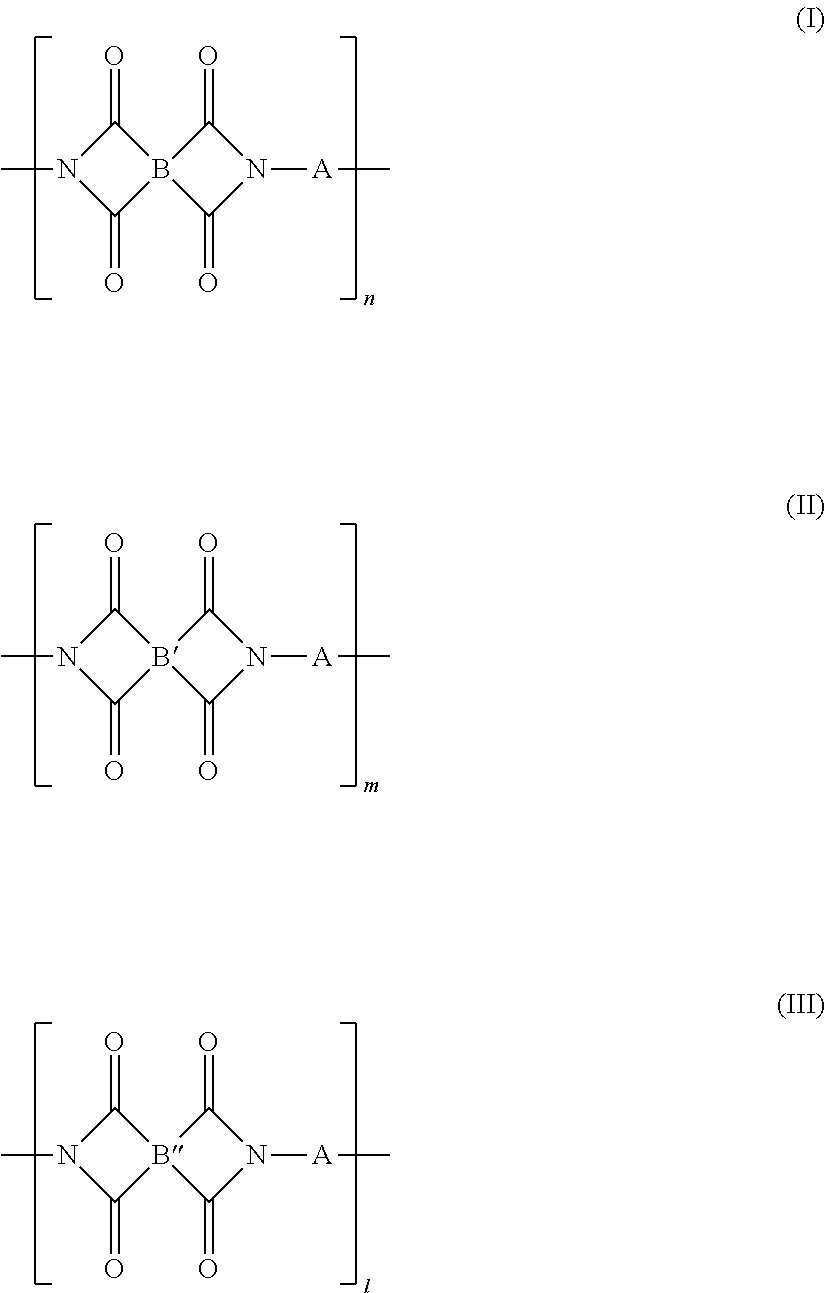
- the polyimide polymer comprises a first repeat unit represented by formula (I), a second repeat unit represented by formula (II) and a third repeat unit represented by formula (III).
- A is aromatic group with fluorine
- B, B′ and B′′ are aromatic groups different from one another.
- the polyimide polymer satisfies following conditions: B/(B+B′+B′′)>0, B′/(B+B′+B′′)>0, and B′′/(B+B′+B′′)>0.
- An embodiment of the disclosure provides a polyimide film.
- the polyimide film comprises a thin film layer.
- the thin film layer comprises a polyimide polymer.
- the polyimide polymer comprises a first repeat unit represented by formula (I), a second repeat unit represented by formula (II) and a third repeat unit represented by formula (III).
- A is aromatic group with fluorine
- B, B′ and B′′ are aromatic groups different from one another.
- the polyimide polymer satisfies following conditions: B/(B+B′+B′′)>0, B′/(B+B′+B′′)>0, and B′′/(B+B′+B′′)>0.
- An embodiment of the disclosure provides a polyimide laminate plate.
- the polyimide laminate plate comprises a thin film layer.
- the thin film layer comprises a polyimide polymer.
- the polyimide polymer comprises a first repeat unit represented by formula (I), a second repeat unit represented by formula (II) and a third repeat unit represented by formula (III).
- A is aromatic group with fluorine
- B, B′ and B′′ are aromatic groups different from one another.
- the polyimide polymer satisfies following conditions: B/(B+B′+B′′)>0, B′/(B+B′+B′′)>0, and B′′/(B+B′+B′′)>0.
- a first embodiment of the disclosure provides a polyimide polymer.
- the polyimide polymer comprises a first repeat unit represented by formula (I), a second repeat unit represented by formula (II) and a third repeat unit represented by formula (III).
- A is an aromatic group with fluorine selected from the group consisting of
- B, B′ and B′′ are aromatic groups different from one another.
- B, B′ and B′′ are selected from the group consisting of
- the polyimide polymer satisfies following conditions:
- a second embodiment of the disclosure provides a polyimide polymer.
- the polyimide polymer comprises a first repeat unit represented by formula (I), a second repeat unit represented by formula (II) and a third repeat unit represented by formula (III).
- A is an aromatic group with fluorine.
- A comprises A′ and A′′.
- A′ is aromatic group with fluorine but without fluorenyl group
- A′′ is an aromatic group with fluorine and fluorenyl group.
- a ratio of A′:A′′ is between 1:1 and 9:1.
- A′ is an aromatic group with fluorine but without fluorenyl group.
- the aromatic group with fluorine but without fluorenyl group is selected from the group consisting of
- A′′ is an aromatic group with fluorine and fluorenyl group.
- the aromatic group with fluorine and fluorenyl group is selected from the group consisting of
- B, B′ and B′′ are aromatic groups different from one another.
- B, B′ and B′′ are selected from the group consisting of
- the polyimide polymer satisfies following conditions:
- a third embodiment of the disclosure provides a polyimide film with good transmittance, high heat durance and good flexibility.
- the polyimide film comprises a thin film layer, and the thin film layer comprises the polyimide polymer described above. Therefore, since the polyimide film has good optical transmittance, high heat durance and good flexibility in the disclosure, a substrate can be made from the polyimide film rather than glass.
- a fourth embodiment of the disclosure provides a polyimide laminate plate.
- the polyimide laminate plate comprises at least one thin film layer.
- the thin film layer is disposed on a metal thin film, and the thin film layer comprises the polyimide polymer described above. Therefore, a flexible printed circuit board can be made from the polyimide laminate plate with high heat durance and good flexibility.
- the polyimide film in the disclosure is almost colorless and transparent, different kinds of colorants can be blended into the thin film layers so that the polyimide films can show different colors in this and some embodiments of the disclosure.
- the colorant is selected from the group consisting of titanium dioxide, aluminium oxide, calcium carbonate, calcium sulfate, silicon dioxide, boron nitride, carbon black, ultramarine, copper phthalocyanine and combinations thereof.
- the disclosure is not limited to the colorants.
- the polyimide film is used as the cover layer of light emitting diode of light bar, not only the titanium dioxide is added to increase reflectivity, but also some blue colorants are added to adjust the color space of light emitted from a light emitting diode of a light bar.
- some inorganic nanoparticles are blended into the thin film layers so that the heat endurance and optical transmittance of the polyimide film are increased.
- the inorganic nanoparticles are selected from the group consisting of silicon dioxide, talcum powder, mica, clay, titanium dioxide and combinations thereof.
- the disclosure is not limited to the foregoing examples of the inorganic nanoparticles.
- the polyimide polymer is synthesized by a polycondensation reaction involving the reaction of some diamine components and some dianhydride components.
- the diamine component is selected from a group consisting of 2,2′-Bis(trifluoromethyl)benzidine (TFMB, CAS No. 341-58-2), 2,2-Bis[4-(4-aminophenoxy)phenyl]hexafluoropropane (HFBAPP, CAS No. 69563-88-8), 4,4′-oxybis[3-(trifluoromethyl)benzeneamine] (BTFDPE, CAS No.
- the dianhydride component is selected from a group consisting of 1,2,4,5 benzene tetracarboxylic dianhydride, 3,3′,4,4′-biphenyl tetracarboxylic dianhydride (BPDA), 3,4,3′,4′-biphenyl tetracarboxylic dianhydride, 2,3,3′,4′-biphenyl tetracarboxylic dianhydride, 4,4′-oxydiphthalic anhydride, 3,4′-oxydiphthalic anhydride, benzophenonetetracarboxylic dianhydride, 2,2-bis[4-(3,4dicarboxyphenoxy)phenyl] propane dianhydride (BPADA), 2,2-bis(3,4-anhydrodicarboxyphenyl)hexafluoropropane (6FDA), 3,3′,4,4′-diphenyl sulfonetetracarboxylic dianhydride, 9,9-bis(3,4
- the polyimide polymer of the disclosure may be prepared by variety of manufacturing methods with respect to how the components (i.e., the monomers and solvents) are introduced to (e.g., mixed with) one another.
- the diamine components are dissolved in a polar aprotic solvent to form a diamine solution.
- the polar aprotic solvent for example, is selected from dimethylformamide (DMF), dimethylacetamide (DMAc), N-methyl-2-pyrrolidone (NMP), hydroxytoluene (Cresol) and gamma-Butyrolactone ( ⁇ -butyrolactone or GBL).
- the dianhydride components are added and mixed with the diamine solution so that the diamine components and the dianhydride components react to form a polyamic acid (PAA).
- PAA polyamic acid
- PAA polyamic acid
- PAA polyamic acid
- an imidization is performed on the polyamic acid (PAA).
- the process of imidization comprises a cyclic reaction and a dehydration.
- the cyclic reaction and the dehydration can be performed by heating at 250° C. to 400° C., adding a dehydrating agent (e.g., acid anhydride) or adding a catalyst (e.g., polymer incarcerated catalyst).
- a dehydrating agent e.g., acid anhydride
- a catalyst e.g., polymer incarcerated catalyst
- the cyclic reaction and the dehydration performed by adding the dehydrating agent or the catalyst is called chemical cyclic reaction. Thereby, a polyimide film is formed.
- the polyamic acid can be applied on a metal thin film directly, and baked to perform imidization to form the polyimide laminate.
- the colorants and/or the inorganic nanoparticles are blended into the diamine components to form a thin film layer with the colorants and/or the inorganic nanoparticles.
- the followings are the manufacturing process of the thin film layer with the colorants and/or the inorganic nanoparticles.
- the colorants and/or the inorganic nanoparticles are added into the solvent and dispersed by grinding or stirring at the frequency of 20 Hz to 100 Hz to form a suspension solution with the colorants and/or the inorganic nanoparticles.
- the diamine components are added and dissolved into the suspension solution with the colorants and/or the inorganic nanoparticles.
- the dianhydride components are added to perform polycondensation reaction with the diamine components in the suspension solution with the colorants and/or the inorganic nanoparticles so that a polyamic acid mixture with viscosity between 10 poises (ps) and 1,000 poises (ps) (i.e., between 1,000 cps and 100,000 cps) is performed.
- the polyamic acid mixture is dried at a temperature between 120° C. and 200° C. to form a film made by the polyamic acid mixture.
- the film made by the polyamic acid mixture is heated at a temperature between 250° C. and 400° C.
- the polyamic acid mixture can also be prepared by blending suspension solution of the colorants and/or the inorganic nanoparticles into the polyamic acid prepared by polycondensation of the amine components and the dianhydride components.
- BPDA 3,3′,4,4′-Biphenyltetracarboxylic dianhydride
- BPADA 2,2-bis[4-(3,4dicarboxyphenoxy)phenyl] propane dianhydride
- 6FDA 4,4′-(Hexafluoroisopropylidene)diphthalic anhydride
- a DMAc solution with 8.63 g of 2,2′-Bis(trifluoromethyl)benzidine (TFMB, CAS No. 341-58-2) dissolved in is added into the DMAc solution with BPDA, BPADA and 6FDA to form a mixture of BPDA, BPADA, 6FDA and TFMB.
- TFMB 2,2′-Bis(trifluoromethyl)benzidine
- a molar ratio of BPDA:BPADA:6FDA:TFMB is 0.15:0.15:0.2:0.5.
- the mixture of BPDA, BPADA, 6FDA and TFMB is stirred for at least 1 hour so that the TFMB is completely reacted to form a polyamic acid (PAA) solution.
- PAA polyamic acid
- the PAA solution is applied on the support and dried to form a thin film at 120° C. for 10 minutes. And then, the imidization is performed at 300° C. for 10 minutes for cyclic reaction and dehydration of the polyamic acid (PAA) so that a polyimide film is formed.
- PAA polyamic acid
- BPDA, 4.2 g of BPADA and 3.66 g of 6FDA are mixed in DMAc to form a DMAc solution with BPDA, BPADA and 6FDA.
- BPDA, BPADA and 6FDA are completely dissolved in the DMAc solution
- a DMAc solution with 8.81 g of TFMB dissolved in is added into the DMAC solution with BPDA, BPADA and 6FDA to form a mixture of BPDA, BPADA, 6FDA and TFMB.
- a molar ratio of BPDA:BPADA:6FDA:TFMB is 0.2:0.15:0.15:0.5.
- the mixture of BPDA, BPADA, 6FDA and TFMB is stirred for at least 1 hour so that the TFMB is completely reacted to form a polyamic acid (PAA) solution.
- PAA polyamic acid
- the PAA solution is applied on the support and dried to form a thin film at 120° C. for 10 minutes.
- the imidization is performed at 300° C. for 10 minutes for cyclic reaction and dehydration of the PAA so that a polyimide film is formed.
- Example 2 6.6 g of titanium dioxide and 0.2 g of ultramarine are added into 100 g of the PAA solution in Example 2 and stirring the solution for at least 1 hour to form a colored PAA mixture. Then, the colored PAA mixture is applied on the support and dried to form a thin film at 120° C. for 10 minutes. And then, the imidization is performed at 300° C. for 10 minutes for cyclic reaction and dehydration of the PAA so that a polyimide film is formed.
- BPDA 3.18 g of BPDA, 4.22 g of BPADA and 3.6 g of 6FDA are mixed in DMAc to form a DMAc solution with BPDA, BPADA and 6FDA.
- BPDA, BPADA and 6FDA are completely dissolved in the DMAc solution
- a DMAc solution with 6.92 g of TFMB and 2.08 g of 9,9-Bis(4-amino-3-fluorophenyl)fluorine (FFDA, CAS No. 127926-65-2) dissolved in is added into the DMAc solution with BPDA, BPADA and 6FDA to form a mixture of BPDA, BPADA, 6FDA, TFMB and FFDA.
- FFDA 9,9-Bis(4-amino-3-fluorophenyl)fluorine
- a molar ratio of BPDA:BPADA:6FDA:TFMB:FFDA is 0.2:0.15:0.15:0.4:0.1.
- the mixture of BPDA, BPADA, 6FDA, TFMB and FFDA is stirred for at least 1 hour so that the TFMB and FFDA are completely reacted to form a polyamic acid (PAA) solution.
- PAA polyamic acid
- the PAA solution is applied on the support and dried to form a thin film at 120° C. for 10 minutes.
- the imidization is performed at 300° C. for 10 minutes for cyclic reaction and dehydration of the PAA so that a polyimide film is formed.
- Example 3 6.6 g of titanium dioxide and 0.2 g of ultramarine are added into 100 g of the PAA solution in Example 3 and stirring the solution for at least 1 hour to form a colored PAA mixture. Then, the colored PAA mixture is applied on the support and dried to form a thin film at 120° C. for 10 minutes. And then, the imidization is performed at 300° C. for 10 minutes for cyclic reaction and dehydration of the PAA so that a polyimide film is formed.
- BPDA, 5.31 g of BPADA and 3.41 g of 6FDA are mixed in DMAc to form a DMAc solution with BPDA, BPADA and 6FDA.
- BPDA, BPADA and 6FDA are completely dissolved in the DMAc solution
- a DMAc solution with 4.1 g of TFMB and 4.92 g of FFDA dissolved in is added into the DMAc solution with BPDA, BPADA and 6FDA to form a mixture of BPDA, BPADA, 6FDA, TFMB and FFDA.
- a molar ratio of BPDA:BPADA:6FDA:TFMB:FFDA is 0.15:0.2:0.15:0.25:0.25.
- the mixture of BPDA, BPADA, 6FDA, TFMB and FFDA is stirred for at least 1 hour so that the TFMB and FFDA are completely reacted to form a polyamic acid (PAA) solution.
- PAA polyamic acid
- the PAA solution is applied on the support and dried to form a thin film at 120° C. for 10 minutes.
- the imidization is performed at 300° C. for 10 minutes for cyclic reaction and dehydration of the PAA so that a polyimide film is formed.
- BPDA, 2.84 g of BPADA and 6.04 g of 6FDA are mixed in DMAc to form a DMAc solution with BPDA, BPADA and 6FDA.
- BPDA, BPADA and 6FDA are completely dissolved in the DMAc solution
- a DMAc solution with 4.1 g of TFMB dissolved in is added into the DMAc solution with BPDA, BPADA and 6FDA to form a mixture of BPDA, BPADA, 6FDA and TFMB.
- a molar ratio of BPDA:BPADA:6FDA:TFMB is 0.15:0.1:0.25:0.5.
- the mixture of BPDA, BPADA, 6FDA and TFMB is stirred for at least 1 hour so that the TFMB is completely reacted to form a polyamic acid (PAA) solution.
- PAA polyamic acid
- the PAA solution is applied on the support and dried to form a thin film at 120° C. for 10 minutes.
- the imidization is performed at 300° C. for 10 minutes for cyclic reaction and dehydration of the PAA so that a polyimide film is formed.
- BPDA and BPADA are mixed in DMAc to form a DMAc solution with BPDA and BPADA.
- BPDA and BPADA are completely dissolved in the DMAc solution
- a DMAc solution with 8.8 g of TFMB dissolved in is added into the DMAc solution with BPDA and BPADA to form a mixture of BPDA, BPADA and TFMB.
- a molar ratio of BPDA:BPADA:TFMB is 0.25:0.25:0.5.
- the mixture of BPDA, BPADA and TFMB is stirred for at least 1 hour so that the TFMB is completely reacted to form a polyamic acid (PAA) solution.
- PAA polyamic acid
- the PAA solution is applied on the support and dried to form a thin film at 120° C. for 10 minutes. And then, the imidization is performed at 300° C. for 10 minutes for cyclic reaction and dehydration of the PAA so that a polyimide film is formed.
- BPDA and 6.44 g of 6FDA are mixed in DMAc to form a DMAc solution with BPDA and 6FDA.
- a DMAc solution with 9.29 g of TFMB dissolved in is added into the DMAc solution with BPDA and 6FDA to form a mixture of BPDA, 6FDA and TFMB.
- a molar ratio of BPDA:6FDA:TFMB is 0.25:0.25:0.5.
- the mixture of BPDA, 6FDA and TFMB is stirred for at least 1 hour so that the TFMB is completely reacted to form a polyamic acid (PAA) solution.
- PAA polyamic acid
- the PAA solution is applied on the support and dried to form a thin film at 120° C. for 10 minutes. And then, the imidization is performed at 300° C. for 10 minutes for cyclic reaction and dehydration of the PAA so that a polyimide film is formed.
- the polyimide polymers in the examples and the comparative examples above are tested, and the test result are shown in Table 1 to Table 3.
- the test of chemical resistance is that the polyimide polymers of the examples and the comparative examples described above are immersed in N-Methyl-2-pyrrolidone (NMP), dimethylacetamide (DMAc), oxalic acid, the developer and stripper at 50° C. for an hour.
- NMP N-Methyl-2-pyrrolidone
- DMAc dimethylacetamide
- oxalic acid the developer and stripper at 50° C. for an hour.
- the solubility of the thin films in the solvent described above is observed to obtain the chemical resistance of the thin films.
- the test results represented by “good” means the test results fulfill the requirement as being substrates of display panels and touch panels.
- Example 2-2 good good good good 1.8 250
- Example 3-2 good good good 1.9 290 Comparative good good good good 2.2 220 example 1-2 Comparative fragile — — — — example 2-2
- the polyimide film having the same and the polyimide laminate plate having the same of the embodiments of the disclosure when the polyimide polymer comprises the first repeat unit represented by formula (I), the second repeat unit represented by formula (II) and the third repeat unit represented by formula (III), and the ratio of the aromatic group with fluorine and fluorenyl group, the aromatic group with fluorine but without fluorenyl group and the aromatic group is in a range described above, the polyimide film formed by polyimide polymer has good transmittance, good flexibility and high heat endurance at the same time.
- the comparative example 2 has good transmittance, good flexibility and high heat endurance, the comparative example 2 becomes fragile when the inorganic nanoparticles are added in the polyimide film to further increase the transmittance and the heat endurance.
- the polyimide polymer of the embodiments of the disclosure maintain good transmittance (i.e., 92%), high heat endurance (i.e., the glass transition temperature is 310° C.), good flexibility and good chemical resistance when the inorganic nanoparticles are added into the polyimide polymer to further increase the optical transmittance and the heat endurance.
- the substrates of display panels and touch panels can be made from the polyimide film with good transmittance, high heat durance and good flexibility in the disclosure.
- the examples of the disclosure with colorants have better color stability than the comparative example 1-2. Therefore, the color transformation is reduced when panel made of the polyimide polymer in the disclosure are heated in use.
Landscapes
- Chemical & Material Sciences (AREA)
- Chemical Kinetics & Catalysis (AREA)
- Organic Chemistry (AREA)
- Health & Medical Sciences (AREA)
- Polymers & Plastics (AREA)
- Medicinal Chemistry (AREA)
- Engineering & Computer Science (AREA)
- Materials Engineering (AREA)
- Wood Science & Technology (AREA)
- Life Sciences & Earth Sciences (AREA)
- Microelectronics & Electronic Packaging (AREA)
- Macromolecular Compounds Obtained By Forming Nitrogen-Containing Linkages In General (AREA)
- Laminated Bodies (AREA)
- Compositions Of Macromolecular Compounds (AREA)
- Manufacturing & Machinery (AREA)
- Manufacture Of Macromolecular Shaped Articles (AREA)
Abstract

Description




| TABLE 1 | ||||||
| Glass | ||||||
| transition | ||||||
| Film | flexi- | Chemical | Transmittance | temperature, | ||
| forming | bility | resistance | (%) | Tg (° C.) | ||
| Example 1 | good | good | good | 90% | 250 |
| Example 2 | good | good | good | 90% | 250 |
| Example 3 | good | good | good | 90% | 290 |
| Example 4 | good | good | good | 88% | 300 |
| Example 5 | good | good | good | 90% | 280 |
| Comparative | good | good | good | 86% | 190 |
| example 1 | |||||
| Comparative | good | good | good | 90% | 300 |
| example 2 | |||||
| TABLE 2 | ||||||
| Glass | ||||||
| transition | ||||||
| Film | flexi- | Chemical | Transmittance | temperature, | ||
| forming | bility | resistance | (%) | Tg (° C.) | ||
| Example 1-1 | good | good | good | 92% | 270 |
| Example 2-1 | good | good | good | 92% | 290 |
| Example 3-1 | good | good | good | 92% | 310 |
| Example 5-1 | good | good | good | 92% | 300 |
| Comparative | good | good | good | 88% | 220 |
| example 1-1 | |||||
| Comparative | fragile | — | — | — | — |
| example 2-1 | |||||
| TABLE 3 | ||||||
| Glass | ||||||
| Color | transition | |||||
| Film | flexi- | Chemical | stability, | temperature, | ||
| forming | bility | resistance | Δb* | Tg (° C.) | ||
| Example 2-2 | good | good | good | 1.8 | 250 |
| Example 3-2 | good | good | good | 1.9 | 290 |
| Comparative | good | good | good | 2.2 | 220 |
| example 1-2 | |||||
| Comparative | fragile | — | — | — | — |
| example 2-2 | |||||
Claims (17)

B/(B+B′+B″)>0;
B′(B+B′+B″)>0; and
B″/(B+B′+B″)>0;


B/(B+B′+B″)>0;
B′(B+B′+B″)>0; and
B″/(B+B′+B″)>0;


B/(B+B′+B″)>0;
B′(B+B′+B″)>0; and
B″/(B+B′+B″)>0;


Applications Claiming Priority (3)
| Application Number | Priority Date | Filing Date | Title |
|---|---|---|---|
| TW103137496A TWI490274B (en) | 2014-10-29 | 2014-10-29 | Polyimide polymer, polyimide film including the same and polyimide laminate plate including the same |
| TW103137496 | 2014-10-29 | ||
| TW103137496A | 2014-10-29 |
Publications (2)
| Publication Number | Publication Date |
|---|---|
| US20160122483A1 US20160122483A1 (en) | 2016-05-05 |
| US9499664B2 true US9499664B2 (en) | 2016-11-22 |
Family
ID=54151521
Family Applications (1)
| Application Number | Title | Priority Date | Filing Date |
|---|---|---|---|
| US14/615,286 Active 2035-03-21 US9499664B2 (en) | 2014-10-29 | 2015-02-05 | Polyimide polymer, polyimide film having the same and polyimide laminate having the same |
Country Status (3)
| Country | Link |
|---|---|
| US (1) | US9499664B2 (en) |
| JP (1) | JP6081509B2 (en) |
| TW (1) | TWI490274B (en) |
Families Citing this family (7)
| Publication number | Priority date | Publication date | Assignee | Title |
|---|---|---|---|---|
| TWI544031B (en) * | 2015-07-07 | 2016-08-01 | 律勝科技股份有限公司 | Polyimide resin, thin film and method for manufacturing thereof |
| TWI607058B (en) * | 2015-10-07 | 2017-12-01 | 達勝科技股份有限公司 | Polyimide film |
| KR102271023B1 (en) * | 2016-09-29 | 2021-06-29 | 코오롱인더스트리 주식회사 | Polyamic acid, Polyimide, Polyimide Film and Display Device Comprising Thereof and mothod of preparing the Polyamic acid |
| TWI635139B (en) * | 2017-03-02 | 2018-09-11 | 律勝科技股份有限公司 | Transparent photosensitive resin |
| CN109796590A (en) * | 2017-11-16 | 2019-05-24 | 宁波长阳科技股份有限公司 | A kind of polyimide resin and transparent polyimide film |
| US11256001B2 (en) | 2018-10-23 | 2022-02-22 | Dupont Electronics, Inc. | Low haze polymer films and electronic devices |
| TWI685523B (en) * | 2018-11-09 | 2020-02-21 | 國立中興大學 | Composite with multi-dimensions hollow structures and application thereof |
Citations (5)
| Publication number | Priority date | Publication date | Assignee | Title |
|---|---|---|---|---|
| US4912197A (en) * | 1987-08-14 | 1990-03-27 | E. I. Du Pont De Nemours And Company | Highly soluble clear polyimides |
| US20060124693A1 (en) * | 2004-12-15 | 2006-06-15 | Meloni Paul A | Thermally conductive polyimide film composites having high mechanical elongation useful as a heat conducting portion of an electronic device |
| EP1749850A1 (en) | 2005-08-03 | 2007-02-07 | E.I. Dupont De Nemours And Company | Low color polyimide compositions useful in optical type applications and methods and compositions related thereto |
| US20090226642A1 (en) * | 2005-08-03 | 2009-09-10 | E. I. Du Pont De Nemours And Company | Low color polyimide compositions useful in optical type applications and methods and compositions relating thereto |
| US8461257B2 (en) | 2010-10-18 | 2013-06-11 | Taimide Technology Incorporation | White polymide film and manufacture thereof |
Family Cites Families (4)
| Publication number | Priority date | Publication date | Assignee | Title |
|---|---|---|---|---|
| JPH03244635A (en) * | 1990-02-23 | 1991-10-31 | Hitachi Chem Co Ltd | Production of both polyimide and polyimide precursor |
| JP2011202059A (en) * | 2010-03-26 | 2011-10-13 | Toray Ind Inc | Resin and positive photosensitive resin composition |
| KR101968258B1 (en) * | 2012-02-07 | 2019-04-12 | 삼성전자주식회사 | Poly(amide-imide) block copolymer, article including same, and display device including the article |
| EP2690124B1 (en) * | 2012-07-27 | 2015-09-16 | Samsung Electronics Co., Ltd | Composition Comprising Polyimide Block Copolymer And Inorganic Particles, Method Of Preparing The Same, Article Including The Same, And Display Device Including The Article |
-
2014
- 2014-10-29 TW TW103137496A patent/TWI490274B/en active
-
2015
- 2015-02-05 US US14/615,286 patent/US9499664B2/en active Active
- 2015-02-17 JP JP2015029081A patent/JP6081509B2/en active Active
Patent Citations (6)
| Publication number | Priority date | Publication date | Assignee | Title |
|---|---|---|---|---|
| US4912197A (en) * | 1987-08-14 | 1990-03-27 | E. I. Du Pont De Nemours And Company | Highly soluble clear polyimides |
| US20060124693A1 (en) * | 2004-12-15 | 2006-06-15 | Meloni Paul A | Thermally conductive polyimide film composites having high mechanical elongation useful as a heat conducting portion of an electronic device |
| EP1749850A1 (en) | 2005-08-03 | 2007-02-07 | E.I. Dupont De Nemours And Company | Low color polyimide compositions useful in optical type applications and methods and compositions related thereto |
| US7550194B2 (en) | 2005-08-03 | 2009-06-23 | E. I. Du Pont De Nemours And Company | Low color polyimide compositions useful in optical type applications and methods and compositions relating thereto |
| US20090226642A1 (en) * | 2005-08-03 | 2009-09-10 | E. I. Du Pont De Nemours And Company | Low color polyimide compositions useful in optical type applications and methods and compositions relating thereto |
| US8461257B2 (en) | 2010-10-18 | 2013-06-11 | Taimide Technology Incorporation | White polymide film and manufacture thereof |
Also Published As
| Publication number | Publication date |
|---|---|
| TW201615753A (en) | 2016-05-01 |
| US20160122483A1 (en) | 2016-05-05 |
| JP2016089142A (en) | 2016-05-23 |
| TWI490274B (en) | 2015-07-01 |
| JP6081509B2 (en) | 2017-02-15 |
Similar Documents
| Publication | Publication Date | Title |
|---|---|---|
| US9499664B2 (en) | Polyimide polymer, polyimide film having the same and polyimide laminate having the same | |
| JP6694034B2 (en) | Polyimide resin, method for producing the same, and thin film | |
| EP2690124B1 (en) | Composition Comprising Polyimide Block Copolymer And Inorganic Particles, Method Of Preparing The Same, Article Including The Same, And Display Device Including The Article | |
| TWI713782B (en) | Transparent polyimide precursor resin composition with improved resin stability and heat resistance, method for manufacturing polyimide film using the same, and polyimide film prepared therefrom | |
| KR102741017B1 (en) | Composition for preparing transparent polymer filman article including polyimide or poly(imide-amide) copoplymer, articletransparent polymer film, and electronic device including the same | |
| US12552900B2 (en) | Polyimide-based polymer film, substrate for display device, and optical device using the same | |
| CN112204084B (en) | Polyimide-based polymer film, substrate for display device using same, and optical device | |
| WO2024185763A1 (en) | Polyimide precursor composition, polyimide film, multilayer body, electronic device, method for producing multilayer body, method for producing polyimide film, and method for producing electronic device | |
| KR20240011963A (en) | Polyamic resin and polyimide film using the same | |
| CN101928460B (en) | Preparation method of linear polyimide-maleimide copolymer film containing active groups | |
| KR102427760B1 (en) | Polyimide-based polymer film, substrate for display device, and optical device using the same | |
| TWI709592B (en) | Polyimide film, and manufacturing method of polyimide film | |
| TWI782790B (en) | Substrate for display device or flexible display device, and display device or flexible display device using the same | |
| CN111234215A (en) | Polyimide polymer, polyimide film using the same, and method for producing polyimide film | |
| CN114149583A (en) | Polyimide-based polymer film, substrate for display device, and optical device | |
| JP7604740B2 (en) | Polyimide resin film, display device substrate and optical device using same | |
| KR102427758B1 (en) | Polyimide-based polymer film, substrate for display device, and optical device using the same | |
| TWI515230B (en) | Polyimide polymer and polyimide film including the same | |
| WO2024172112A1 (en) | Polyimide precursor composition, polyimide film, layered product, electronic device, method for producing layered product, method for producing polyimide film, and method for producing electronic device | |
| TW202319441A (en) | Polyimide-based resin film, substrate for display device, and optical device using the same | |
| TWI607058B (en) | Polyimide film | |
| KR20220033036A (en) | Polyimide-based polymer film, substrate for display device, and optical device using the same | |
| KR20210063162A (en) | Polyamide-imide resin composite and production method for polyamide-imide resin |
Legal Events
| Date | Code | Title | Description |
|---|---|---|---|
| AS | Assignment |
Owner name: MORTECH CORPORATION, TAIWAN Free format text: ASSIGNMENT OF ASSIGNORS INTEREST;ASSIGNORS:SUN, DER-JUN;CHEN, CHI-SHENG;LI, KUO-WEI;AND OTHERS;REEL/FRAME:034911/0361 Effective date: 20150123 |
|
| STCF | Information on status: patent grant |
Free format text: PATENTED CASE |
|
| MAFP | Maintenance fee payment |
Free format text: PAYMENT OF MAINTENANCE FEE, 4TH YR, SMALL ENTITY (ORIGINAL EVENT CODE: M2551); ENTITY STATUS OF PATENT OWNER: SMALL ENTITY Year of fee payment: 4 |
|
| MAFP | Maintenance fee payment |
Free format text: PAYMENT OF MAINTENANCE FEE, 8TH YR, SMALL ENTITY (ORIGINAL EVENT CODE: M2552); ENTITY STATUS OF PATENT OWNER: SMALL ENTITY Year of fee payment: 8 |