US9496504B2 - Materials for organic electroluminescent devices - Google Patents
Materials for organic electroluminescent devices Download PDFInfo
- Publication number
- US9496504B2 US9496504B2 US13/521,266 US201013521266A US9496504B2 US 9496504 B2 US9496504 B2 US 9496504B2 US 201013521266 A US201013521266 A US 201013521266A US 9496504 B2 US9496504 B2 US 9496504B2
- Authority
- US
- United States
- Prior art keywords
- atoms
- group
- radicals
- aromatic
- aromatic ring
- Prior art date
- Legal status (The legal status is an assumption and is not a legal conclusion. Google has not performed a legal analysis and makes no representation as to the accuracy of the status listed.)
- Expired - Fee Related, expires
Links
- 0 C.C.C.C.CN(C)C*CN(C)C Chemical compound C.C.C.C.CN(C)C*CN(C)C 0.000 description 61
- KEBYHQZNRPBOTM-UHFFFAOYSA-N CC1(C)C2=C3C(=CC=C2F)[Ir]2(N4N=C(C(F)(F)F)C=C4C4=CC=CC=N42)N2=C3C3=C1/C=C/C=C\3C=C2 Chemical compound CC1(C)C2=C3C(=CC=C2F)[Ir]2(N4N=C(C(F)(F)F)C=C4C4=CC=CC=N42)N2=C3C3=C1/C=C/C=C\3C=C2 KEBYHQZNRPBOTM-UHFFFAOYSA-N 0.000 description 2
- WTAZVZFIFJUSCQ-LWFKIUJUSA-M CC1=CC(C)=O[Ir]2(O1)C1=C(C=CC=C1)C1=N2C2=CC=CC=C2/C=C\1C Chemical compound CC1=CC(C)=O[Ir]2(O1)C1=C(C=CC=C1)C1=N2C2=CC=CC=C2/C=C\1C WTAZVZFIFJUSCQ-LWFKIUJUSA-M 0.000 description 2
- PBPUBKICGLWZMS-UHFFFAOYSA-N FC1=CC(F)=C2C(=C1)[Ir]1(N3=CC=CC=C3C3N=C(C(F)(F)F)N=N31)N1=C2/C=C\C=C/1 Chemical compound FC1=CC(F)=C2C(=C1)[Ir]1(N3=CC=CC=C3C3N=C(C(F)(F)F)N=N31)N1=C2/C=C\C=C/1 PBPUBKICGLWZMS-UHFFFAOYSA-N 0.000 description 2
- FFWHEMGQGJULDY-UHFFFAOYSA-N FC1=CC(F)=C2C(=C1)[Ir]N1=C2C=CC=C1 Chemical compound FC1=CC(F)=C2C(=C1)[Ir]N1=C2C=CC=C1 FFWHEMGQGJULDY-UHFFFAOYSA-N 0.000 description 2
- ZSNWXACZXJEVNL-UHFFFAOYSA-N FC1=CC(F)=C2C(=C1)[Pt]13C4=C(C(F)=CC(F)=C4)C4=CC=CC(=N41)C1(C4=CC=CC2=N43)C2=C(C=CC=C2)C2=C1C=CC=C2 Chemical compound FC1=CC(F)=C2C(=C1)[Pt]13C4=C(C(F)=CC(F)=C4)C4=CC=CC(=N41)C1(C4=CC=CC2=N43)C2=C(C=CC=C2)C2=C1C=CC=C2 ZSNWXACZXJEVNL-UHFFFAOYSA-N 0.000 description 2
- NDIDTZATWHPEKO-UHFFFAOYSA-N [H]CC1=N2[Ir]C3=C(C=CC=C3)C2=CC=C1 Chemical compound [H]CC1=N2[Ir]C3=C(C=CC=C3)C2=CC=C1 NDIDTZATWHPEKO-UHFFFAOYSA-N 0.000 description 2
- NLOYPWWUYYYAEG-UHFFFAOYSA-N B=NS.BrC1=CC=C(N(C2=CC=CC=C2)C2=CC=CC=C2)C=C1.BrC1=CC=C(N(C2=NC(C3=CC=CC=C3)=NC(C3=CC=CC=C3)=N2)C2=NC(C3=CC=CC=C3)=NC(C3=CC=CC=C3)=N2)C=C1.BrC1=CC=C(NC2=NC(C3=CC=CC=C3)=NC(C3=CC=CC=C3)=N2)C=C1.C1=CC=C(C2=NC(C3=CC=CC=C3)=NC(N(C3=CC=C(C4=CC=C(N(C5=CC=CC=C5)C5=CC=CC=C5)C=C4)C=C3)C3=NC(C4=CC=CC=C4)=NC(C4=CC=CC=C4)=N3)=N2)C=C1.C1=CC=C(N(C2=CC=CC=C2)C2=CC=CC=C2)C=C1.ClC1=NC(C2=CC=CC=C2)=NC(C2=CC=CC=C2)=N1.ClC1=NC(C2=CC=CC=C2)=NC(C2=CC=CC=C2)=N1.NC1=CC=C(Br)C=C1.OB(O)C1=CC=C(N(C2=CC=CC=C2)C2=CC=CC=C2)C=C1 Chemical compound B=NS.BrC1=CC=C(N(C2=CC=CC=C2)C2=CC=CC=C2)C=C1.BrC1=CC=C(N(C2=NC(C3=CC=CC=C3)=NC(C3=CC=CC=C3)=N2)C2=NC(C3=CC=CC=C3)=NC(C3=CC=CC=C3)=N2)C=C1.BrC1=CC=C(NC2=NC(C3=CC=CC=C3)=NC(C3=CC=CC=C3)=N2)C=C1.C1=CC=C(C2=NC(C3=CC=CC=C3)=NC(N(C3=CC=C(C4=CC=C(N(C5=CC=CC=C5)C5=CC=CC=C5)C=C4)C=C3)C3=NC(C4=CC=CC=C4)=NC(C4=CC=CC=C4)=N3)=N2)C=C1.C1=CC=C(N(C2=CC=CC=C2)C2=CC=CC=C2)C=C1.ClC1=NC(C2=CC=CC=C2)=NC(C2=CC=CC=C2)=N1.ClC1=NC(C2=CC=CC=C2)=NC(C2=CC=CC=C2)=N1.NC1=CC=C(Br)C=C1.OB(O)C1=CC=C(N(C2=CC=CC=C2)C2=CC=CC=C2)C=C1 NLOYPWWUYYYAEG-UHFFFAOYSA-N 0.000 description 1
- JUEZJKXIGIFDCV-UHFFFAOYSA-N BrC1=CC=C(Br)C=C1.BrC1=CC=C([Si](C2=CC=CC=C2)(C2=CC=CC=C2)C2=CC=C(Br)C=C2)C=C1.Cl[Si](Cl)(C1=CC=CC=C1)C1=CC=CC=C1 Chemical compound BrC1=CC=C(Br)C=C1.BrC1=CC=C([Si](C2=CC=CC=C2)(C2=CC=CC=C2)C2=CC=C(Br)C=C2)C=C1.Cl[Si](Cl)(C1=CC=CC=C1)C1=CC=CC=C1 JUEZJKXIGIFDCV-UHFFFAOYSA-N 0.000 description 1
- SEDKEKVAHFYNGL-UHFFFAOYSA-N BrC1=CC=C(N(C2=CC=CC=C2)C2=CC=CC=C2)C=C1.BrC1=CC=C(N(C2=NC(C3=CC=CC=C3)=NC(C3=CC=CC=C3)=N2)C2=NC(C3=CC=CC=C3)=NC(C3=CC=CC=C3)=N2)C=C1.C1=CC=C(C2=NC(C3=CC=CC=C3)=NC(N(C3=CC=C(C4=CC=C(CCCCCCC5=CC=C(C6=CC=C(N(C7=CC=CC=C7)C7=CC=CC=C7)C=C6)C=C5)C=C4)C=C3)C3=NC(C4=CC=CC=C4)=NC(C4=CC=CC=C4)=N3)=N2)C=C1.CC1(C)OB(C2=CC=C(CCCCCCC3=CC=C(B4OC(C)(C)C(C)(C)O4)C=C3)C=C2)OC1(C)C Chemical compound BrC1=CC=C(N(C2=CC=CC=C2)C2=CC=CC=C2)C=C1.BrC1=CC=C(N(C2=NC(C3=CC=CC=C3)=NC(C3=CC=CC=C3)=N2)C2=NC(C3=CC=CC=C3)=NC(C3=CC=CC=C3)=N2)C=C1.C1=CC=C(C2=NC(C3=CC=CC=C3)=NC(N(C3=CC=C(C4=CC=C(CCCCCCC5=CC=C(C6=CC=C(N(C7=CC=CC=C7)C7=CC=CC=C7)C=C6)C=C5)C=C4)C=C3)C3=NC(C4=CC=CC=C4)=NC(C4=CC=CC=C4)=N3)=N2)C=C1.CC1(C)OB(C2=CC=C(CCCCCCC3=CC=C(B4OC(C)(C)C(C)(C)O4)C=C3)C=C2)OC1(C)C SEDKEKVAHFYNGL-UHFFFAOYSA-N 0.000 description 1
- KMJPKBBQHYKCGV-UHFFFAOYSA-N BrC1=CC=C(N(C2=CC=CC=C2)C2=CC=CC=C2)C=C1.BrC1=CC=C(N(C2=NC(C3=CC=CC=C3)=NC(C3=CC=CC=C3)=N2)C2=NC(C3=CC=CC=C3)=NC(C3=CC=CC=C3)=N2)C=C1.C1=CC=C(C2=NC(C3=CC=CC=C3)=NC(N(C3=CC=C(C4=CC=C([Si](C5=CC=CC=C5)(C5=CC=CC=C5)C5=CC=C(C6=CC=C(N(C7=CC=CC=C7)C7=CC=CC=C7)C=C6)C=C5)C=C4)C=C3)C3=NC(C4=CC=CC=C4)=NC(C4=CC=CC=C4)=N3)=N2)C=C1.CC1(C)OB(C2=CC=C([Si](C3=CC=CC=C3)(C3=CC=CC=C3)C3=CC=C(B4OC(C)(C)C(C)(C)O4)C=C3)C=C2)OC1(C)C Chemical compound BrC1=CC=C(N(C2=CC=CC=C2)C2=CC=CC=C2)C=C1.BrC1=CC=C(N(C2=NC(C3=CC=CC=C3)=NC(C3=CC=CC=C3)=N2)C2=NC(C3=CC=CC=C3)=NC(C3=CC=CC=C3)=N2)C=C1.C1=CC=C(C2=NC(C3=CC=CC=C3)=NC(N(C3=CC=C(C4=CC=C([Si](C5=CC=CC=C5)(C5=CC=CC=C5)C5=CC=C(C6=CC=C(N(C7=CC=CC=C7)C7=CC=CC=C7)C=C6)C=C5)C=C4)C=C3)C3=NC(C4=CC=CC=C4)=NC(C4=CC=CC=C4)=N3)=N2)C=C1.CC1(C)OB(C2=CC=C([Si](C3=CC=CC=C3)(C3=CC=CC=C3)C3=CC=C(B4OC(C)(C)C(C)(C)O4)C=C3)C=C2)OC1(C)C KMJPKBBQHYKCGV-UHFFFAOYSA-N 0.000 description 1
- QJBAGHQZYBVOML-UHFFFAOYSA-N BrC1=CC=C(N(C2=NC(C3=CC=CC=C3)=NC(C3=CC=CC=C3)=N2)C2=NC(C3=CC=CC=C3)=NC(C3=CC=CC=C3)=N2)C=C1.BrC1=CC=C(NC2=NC(C3=CC=CC=C3)=NC(C3=CC=CC=C3)=N2)C=C1.ClC1=NC(C2=CC=CC=C2)=NC(C2=CC=CC=C2)=N1 Chemical compound BrC1=CC=C(N(C2=NC(C3=CC=CC=C3)=NC(C3=CC=CC=C3)=N2)C2=NC(C3=CC=CC=C3)=NC(C3=CC=CC=C3)=N2)C=C1.BrC1=CC=C(NC2=NC(C3=CC=CC=C3)=NC(C3=CC=CC=C3)=N2)C=C1.ClC1=NC(C2=CC=CC=C2)=NC(C2=CC=CC=C2)=N1 QJBAGHQZYBVOML-UHFFFAOYSA-N 0.000 description 1
- VHKAKIGMDNBTJZ-UHFFFAOYSA-N BrC1=CC=C(N(C2=NC(C3=CC=CC=C3)=NC(C3=CC=CC=C3)=N2)C2=NC(C3=CC=CC=C3)=NC(C3=CC=CC=C3)=N2)C=C1.C1=CC=C(C2=NC(C3=CC=CC=C3)=NC(N(C3=CC=C(C4=CC=C(N(C5=CC=CC=C5)C5=CC=CC=C5)C=C4)C=C3)C3=NC(C4=CC=CC=C4)=NC(C4=CC=CC=C4)=N3)=N2)C=C1.OB(O)C1=CC=C(N(C2=CC=CC=C2)C2=CC=CC=C2)C=C1 Chemical compound BrC1=CC=C(N(C2=NC(C3=CC=CC=C3)=NC(C3=CC=CC=C3)=N2)C2=NC(C3=CC=CC=C3)=NC(C3=CC=CC=C3)=N2)C=C1.C1=CC=C(C2=NC(C3=CC=CC=C3)=NC(N(C3=CC=C(C4=CC=C(N(C5=CC=CC=C5)C5=CC=CC=C5)C=C4)C=C3)C3=NC(C4=CC=CC=C4)=NC(C4=CC=CC=C4)=N3)=N2)C=C1.OB(O)C1=CC=C(N(C2=CC=CC=C2)C2=CC=CC=C2)C=C1 VHKAKIGMDNBTJZ-UHFFFAOYSA-N 0.000 description 1
- FFNGSELETNNCHH-UHFFFAOYSA-N BrC1=CC=C(NC2=NC(C3=CC=CC=C3)=NC(C3=CC=CC=C3)=N2)C=C1.ClC1=NC(C2=CC=CC=C2)=NC(C2=CC=CC=C2)=N1.NC1=CC=C(Br)C=C1 Chemical compound BrC1=CC=C(NC2=NC(C3=CC=CC=C3)=NC(C3=CC=CC=C3)=N2)C=C1.ClC1=NC(C2=CC=CC=C2)=NC(C2=CC=CC=C2)=N1.NC1=CC=C(Br)C=C1 FFNGSELETNNCHH-UHFFFAOYSA-N 0.000 description 1
- VEARDRSTCDYTCQ-UHFFFAOYSA-N BrC1=CC=C([Si](C2=CC=CC=C2)(C2=CC=CC=C2)C2=CC=C(Br)C=C2)C=C1.CC1(C)OB(C2=CC=C([Si](C3=CC=CC=C3)(C3=CC=CC=C3)C3=CC=C(B4OC(C)(C)C(C)(C)O4)C=C3)C=C2)OC1(C)C Chemical compound BrC1=CC=C([Si](C2=CC=CC=C2)(C2=CC=CC=C2)C2=CC=C(Br)C=C2)C=C1.CC1(C)OB(C2=CC=C([Si](C3=CC=CC=C3)(C3=CC=CC=C3)C3=CC=C(B4OC(C)(C)C(C)(C)O4)C=C3)C=C2)OC1(C)C VEARDRSTCDYTCQ-UHFFFAOYSA-N 0.000 description 1
- VUEGYIDGUJKTMI-UHFFFAOYSA-N C#CC#CCOC1=C(OCC#CC#C)C=C2C(=C1)C1=C(C=C(OC#CC#CC)C(OC#CC#CC)=C1)C21C2=C(C=C(C3=CC4=C(C=C3)[Ir]N3=CC=CC=C43)C=C2)C2=C1/C=C\C=C/2 Chemical compound C#CC#CCOC1=C(OCC#CC#C)C=C2C(=C1)C1=C(C=C(OC#CC#CC)C(OC#CC#CC)=C1)C21C2=C(C=C(C3=CC4=C(C=C3)[Ir]N3=CC=CC=C43)C=C2)C2=C1/C=C\C=C/2 VUEGYIDGUJKTMI-UHFFFAOYSA-N 0.000 description 1
- VPWQXAXUOMJAJO-UHFFFAOYSA-N C#CC#CCOC1=C(OCC#CC#C)C=C2C(=C1)C1=C(C=C(OC#CC#CC)C(OC#CC#CC)=C1)C21C2=C(C=CC=C2)C2=C1/C=C\C(C1=CC3=C(C=C1)[Ir]N1=CC=C4C=CC=CC4=C31)=C/2 Chemical compound C#CC#CCOC1=C(OCC#CC#C)C=C2C(=C1)C1=C(C=C(OC#CC#CC)C(OC#CC#CC)=C1)C21C2=C(C=CC=C2)C2=C1/C=C\C(C1=CC3=C(C=C1)[Ir]N1=CC=C4C=CC=CC4=C31)=C/2 VPWQXAXUOMJAJO-UHFFFAOYSA-N 0.000 description 1
- ZPVHHZPPYASOAR-UHFFFAOYSA-N C#CC#COC1=CC=C(C2=CC3=C(C=C2)[Ir]N2=CC=CC=C32)C=C1OC#CC#C Chemical compound C#CC#COC1=CC=C(C2=CC3=C(C=C2)[Ir]N2=CC=CC=C32)C=C1OC#CC#C ZPVHHZPPYASOAR-UHFFFAOYSA-N 0.000 description 1
- GUOIMVQDGTYEHO-UHFFFAOYSA-N C1=CC2=C(C=C1)/C1=C(\S2)C2=CC=CC3=N2[Pt]12/C1=C(/SC4=C1C=CC=C4)C1=N2C(=CC=C1)C3 Chemical compound C1=CC2=C(C=C1)/C1=C(\S2)C2=CC=CC3=N2[Pt]12/C1=C(/SC4=C1C=CC=C4)C1=N2C(=CC=C1)C3 GUOIMVQDGTYEHO-UHFFFAOYSA-N 0.000 description 1
- SMZSYGAUGZNTDZ-UHFFFAOYSA-N C1=CC2=C(C=C1)/C1=C(\S2)C2=CC=CC3=N2[Pt]12/C1=C(/SC4=C1C=CC=C4)C1=N2C(=CC=C1)C31C2=C(C=CC=C2)C2=C1C=CC=C2 Chemical compound C1=CC2=C(C=C1)/C1=C(\S2)C2=CC=CC3=N2[Pt]12/C1=C(/SC4=C1C=CC=C4)C1=N2C(=CC=C1)C31C2=C(C=CC=C2)C2=C1C=CC=C2 SMZSYGAUGZNTDZ-UHFFFAOYSA-N 0.000 description 1
- ZIBMOMRUIPOUQK-UHFFFAOYSA-N C1=CC2=C(C=C1)C1=N(C=CC=C1)[Ir]2 Chemical compound C1=CC2=C(C=C1)C1=N(C=CC=C1)[Ir]2 ZIBMOMRUIPOUQK-UHFFFAOYSA-N 0.000 description 1
- YAGGJXVXTYGVQI-UHFFFAOYSA-N C1=CC2=C(C=C1)N1C(NC3C=CC=CC31)[Ir]2 Chemical compound C1=CC2=C(C=C1)N1C(NC3C=CC=CC31)[Ir]2 YAGGJXVXTYGVQI-UHFFFAOYSA-N 0.000 description 1
- YPNIDRIMWIRSAI-UHFFFAOYSA-N C1=CC2=C(C=N1)C1=C(/C=C\C=C/1)O2.C1=CC2=C(C=N1)C1=C(/C=C\N=C/1)O2.C1=CC2=C(C=N1)OC1=C2/C=C\C=C/1.C1=CC2=C(C=N1)OC1=C2/C=C\N=C/1.C1=CC2=C(N=C1)C1=C(/C=C\C=C/1)O2.C1=CC2=C(N=C1)C1=C(/C=C\C=N/1)O2.C1=CC2=C(N=C1)C1=C(/C=C\C=N/1)S2.C1=CC2=C(N=C1)OC1=C2/C=C\C=C/1.C1=CC2=C(N=C1)OC1=C2/C=C\C=N/1.CC.CC.CC.CC.CC.CC.CC.CC.CC.CC.CC.CC.CC.CC.CC.CC.CC Chemical compound C1=CC2=C(C=N1)C1=C(/C=C\C=C/1)O2.C1=CC2=C(C=N1)C1=C(/C=C\N=C/1)O2.C1=CC2=C(C=N1)OC1=C2/C=C\C=C/1.C1=CC2=C(C=N1)OC1=C2/C=C\N=C/1.C1=CC2=C(N=C1)C1=C(/C=C\C=C/1)O2.C1=CC2=C(N=C1)C1=C(/C=C\C=N/1)O2.C1=CC2=C(N=C1)C1=C(/C=C\C=N/1)S2.C1=CC2=C(N=C1)OC1=C2/C=C\C=C/1.C1=CC2=C(N=C1)OC1=C2/C=C\C=N/1.CC.CC.CC.CC.CC.CC.CC.CC.CC.CC.CC.CC.CC.CC.CC.CC.CC YPNIDRIMWIRSAI-UHFFFAOYSA-N 0.000 description 1
- DAQJMBWEZIZZBU-SVXKRPBISA-N C1=CC2=C3C(=C1)C1=N4C(=CC=C1)C1(C5=C(C=CC=C5)C5=C1C=CC=C5)C1=N5C(=CC=C1)C1=C(C(=CC=C1)/C=C\2)[Pt]345 Chemical compound C1=CC2=C3C(=C1)C1=N4C(=CC=C1)C1(C5=C(C=CC=C5)C5=C1C=CC=C5)C1=N5C(=CC=C1)C1=C(C(=CC=C1)/C=C\2)[Pt]345 DAQJMBWEZIZZBU-SVXKRPBISA-N 0.000 description 1
- PMEDTYMNOUDFLL-UHFFFAOYSA-N C1=CC2=C3C(=C1)C1=N4C(=CC=C1)C1(C5=C(C=CC=C5)C5=C1C=CC=C5)C1=N5C(=CC=C1)C1=C(C(=CC=C1)CC2)[Pt]345 Chemical compound C1=CC2=C3C(=C1)C1=N4C(=CC=C1)C1(C5=C(C=CC=C5)C5=C1C=CC=C5)C1=N5C(=CC=C1)C1=C(C(=CC=C1)CC2)[Pt]345 PMEDTYMNOUDFLL-UHFFFAOYSA-N 0.000 description 1
- BOMQPBFWVQUQAE-UHFFFAOYSA-N C1=CC2=C3C(=C1)N(C1=CC=NC=C1)C1=C4C(=CC=C1)C1=N(C=CN=C1)[Pt]34N1=CC=NC=C21 Chemical compound C1=CC2=C3C(=C1)N(C1=CC=NC=C1)C1=C4C(=CC=C1)C1=N(C=CN=C1)[Pt]34N1=CC=NC=C21 BOMQPBFWVQUQAE-UHFFFAOYSA-N 0.000 description 1
- RAJINZIPYUCEBP-UHFFFAOYSA-N C1=CC2=CC3=CC=C4[Ir]N5=C(C=CC=C5)C4=C3C=C2C=C1 Chemical compound C1=CC2=CC3=CC=C4[Ir]N5=C(C=CC=C5)C4=C3C=C2C=C1 RAJINZIPYUCEBP-UHFFFAOYSA-N 0.000 description 1
- NRVPNTLMZJECCO-UHFFFAOYSA-N C1=CC2=CC=C3[Ir]N4=C(C=CC=C4)C3=C2C=C1 Chemical compound C1=CC2=CC=C3[Ir]N4=C(C=CC=C4)C3=C2C=C1 NRVPNTLMZJECCO-UHFFFAOYSA-N 0.000 description 1
- SPGCXEMPUKYTBZ-UHFFFAOYSA-N C1=CC2=N3C(=C1)C1=C(N=CO1)[Pt]31C3=C(OC=N3)C3=N1C(=CC=C3)C2 Chemical compound C1=CC2=N3C(=C1)C1=C(N=CO1)[Pt]31C3=C(OC=N3)C3=N1C(=CC=C3)C2 SPGCXEMPUKYTBZ-UHFFFAOYSA-N 0.000 description 1
- NHYZLMSGHZCYTO-UHFFFAOYSA-N C1=CC2=N3C(=C1)C1=C(N=CS1)[Pt]31C3=C(SC=N3)C3=N1C(=CC=C3)C2 Chemical compound C1=CC2=N3C(=C1)C1=C(N=CS1)[Pt]31C3=C(SC=N3)C3=N1C(=CC=C3)C2 NHYZLMSGHZCYTO-UHFFFAOYSA-N 0.000 description 1
- VMLOTKGDFCIHCL-UHFFFAOYSA-N C1=CC=C(C2=CC(C3=CC=CC=C3)=NC(N(C3=CC(C4=CC(N(C5=CC=CC=C5)C5=CC=CC=C5)=CC=C4)=CC=C3)C3=NC(C4=CC=CC=C4)=CC(C4=CC=CC=C4)=N3)=N2)C=C1.C1=CC=C(C2=NC(C3=CC=CC=C3)=NC(N(C3=CC(C4=CC(N(C5=CC=CC=C5)C5=CC=CC=C5)=CC=C4)=CC=C3)C3=NC(C4=CC=CC=C4)=NC(C4=CC=CC=C4)=N3)=N2)C=C1.C1=CC=C(C2=NC(C3=CC=CC=C3)=NC(N(C3=NC(C4=CC=CC=C4)=NC(C4=CC=CC=C4)=N3)C3=C4C=CC=CC4=C(N(C4=CC=CC=C4)C4=CC=CC=C4)C=C3)=N2)C=C1.CC1(C)C2=CC(N(C3=CC=CC=C3)C3=CC=CC=C3)=CC=C2C2=C1C=C(N(C1=NC(C3=CC=CC=C3)=NC(C3=CC=CC=C3)=N1)C1=NC(C3=CC=CC=C3)=NC(C3=CC=CC=C3)=N1)C=C2.CC1=CC=C(N(C2=CC=CC=C2)C2=CC=CC=C2)C=C1C1=C(C)C=CC(N(C2=NC(C3=CC=CC=C3)=CC(C3=CC=CC=C3)=N2)C2=NC(C3=CC=CC=C3)=CC(C3=CC=CC=C3)=N2)=C1.CC1=CC=C(N(C2=CC=CC=C2)C2=CC=CC=C2)C=C1C1=C(C)C=CC(N(C2=NC(C3=CC=CC=C3)=NC(C3=CC=CC=C3)=N2)C2=NC(C3=CC=CC=C3)=NC(C3=CC=CC=C3)=N2)=C1 Chemical compound C1=CC=C(C2=CC(C3=CC=CC=C3)=NC(N(C3=CC(C4=CC(N(C5=CC=CC=C5)C5=CC=CC=C5)=CC=C4)=CC=C3)C3=NC(C4=CC=CC=C4)=CC(C4=CC=CC=C4)=N3)=N2)C=C1.C1=CC=C(C2=NC(C3=CC=CC=C3)=NC(N(C3=CC(C4=CC(N(C5=CC=CC=C5)C5=CC=CC=C5)=CC=C4)=CC=C3)C3=NC(C4=CC=CC=C4)=NC(C4=CC=CC=C4)=N3)=N2)C=C1.C1=CC=C(C2=NC(C3=CC=CC=C3)=NC(N(C3=NC(C4=CC=CC=C4)=NC(C4=CC=CC=C4)=N3)C3=C4C=CC=CC4=C(N(C4=CC=CC=C4)C4=CC=CC=C4)C=C3)=N2)C=C1.CC1(C)C2=CC(N(C3=CC=CC=C3)C3=CC=CC=C3)=CC=C2C2=C1C=C(N(C1=NC(C3=CC=CC=C3)=NC(C3=CC=CC=C3)=N1)C1=NC(C3=CC=CC=C3)=NC(C3=CC=CC=C3)=N1)C=C2.CC1=CC=C(N(C2=CC=CC=C2)C2=CC=CC=C2)C=C1C1=C(C)C=CC(N(C2=NC(C3=CC=CC=C3)=CC(C3=CC=CC=C3)=N2)C2=NC(C3=CC=CC=C3)=CC(C3=CC=CC=C3)=N2)=C1.CC1=CC=C(N(C2=CC=CC=C2)C2=CC=CC=C2)C=C1C1=C(C)C=CC(N(C2=NC(C3=CC=CC=C3)=NC(C3=CC=CC=C3)=N2)C2=NC(C3=CC=CC=C3)=NC(C3=CC=CC=C3)=N2)=C1 VMLOTKGDFCIHCL-UHFFFAOYSA-N 0.000 description 1
- QEUVAJXHCOGKFX-UHFFFAOYSA-N C1=CC=C(C2=CC(C3=CC=CC=C3)=NC(N(C3=CC=C(C4=CC=C([Si](C5=CC=CC=C5)(C5=CC=CC=C5)C5=CC=C(C6=CC=C(N(C7=CC=CC=C7)C7=CC=CC=C7)C=C6)C=C5)C=C4)C=C3)C3=NC(C4=CC=CC=C4)=CC(C4=CC=CC=C4)=N3)=N2)C=C1.C1=CC=C(C2=CC(C3=CC=CC=C3)=NC(N(C3=CC=C(C4=CC=C([Si](C5=CC=CC=C5)(C5=CC=CC=C5)C5=CC=C(C6=CC=C(N(C7=CC=CC=C7)C7=CC=CC=C7)C=C6)C=C5)C=C4)C=C3)C3=NC(C4=CC=CC=C4)=NC(C4=CC=CC=C4)=N3)=N2)C=C1.C1=CC=C(C2=NC(N(C3=CC=C(C4=CC=C([Si](C5=CC=CC=C5)(C5=CC=CC=C5)C5=CC=C(C6=CC=C(N(C7=CC=CC=C7)C7=CC=CC=C7)C=C6)C=C5)C=C4)C=C3)C3=NC(C4=CC=CC=C4)=NC(C4=CC=CC=C4)=N3)=NC=C2)C=C1.C1=CC=C(C2=NC(N(C3=NC(C4=CC=CC=C4)=NC(C4=CC=CC=C4)=N3)C3=C4C=CC=CC4=C(C4=CC=C([Si](C5=CC=CC=C5)(C5=CC=CC=C5)C5=CC=C(C6=C7C=CC=CC7=C(N(C7=CC=CC=C7)C7=CC=CC=C7)C=C6)C=C5)C=C4)C=C3)=NC=C2)C=C1 Chemical compound C1=CC=C(C2=CC(C3=CC=CC=C3)=NC(N(C3=CC=C(C4=CC=C([Si](C5=CC=CC=C5)(C5=CC=CC=C5)C5=CC=C(C6=CC=C(N(C7=CC=CC=C7)C7=CC=CC=C7)C=C6)C=C5)C=C4)C=C3)C3=NC(C4=CC=CC=C4)=CC(C4=CC=CC=C4)=N3)=N2)C=C1.C1=CC=C(C2=CC(C3=CC=CC=C3)=NC(N(C3=CC=C(C4=CC=C([Si](C5=CC=CC=C5)(C5=CC=CC=C5)C5=CC=C(C6=CC=C(N(C7=CC=CC=C7)C7=CC=CC=C7)C=C6)C=C5)C=C4)C=C3)C3=NC(C4=CC=CC=C4)=NC(C4=CC=CC=C4)=N3)=N2)C=C1.C1=CC=C(C2=NC(N(C3=CC=C(C4=CC=C([Si](C5=CC=CC=C5)(C5=CC=CC=C5)C5=CC=C(C6=CC=C(N(C7=CC=CC=C7)C7=CC=CC=C7)C=C6)C=C5)C=C4)C=C3)C3=NC(C4=CC=CC=C4)=NC(C4=CC=CC=C4)=N3)=NC=C2)C=C1.C1=CC=C(C2=NC(N(C3=NC(C4=CC=CC=C4)=NC(C4=CC=CC=C4)=N3)C3=C4C=CC=CC4=C(C4=CC=C([Si](C5=CC=CC=C5)(C5=CC=CC=C5)C5=CC=C(C6=C7C=CC=CC7=C(N(C7=CC=CC=C7)C7=CC=CC=C7)C=C6)C=C5)C=C4)C=C3)=NC=C2)C=C1 QEUVAJXHCOGKFX-UHFFFAOYSA-N 0.000 description 1
- GWTUBAJWHOZAAP-UHFFFAOYSA-N C1=CC=C(C2=CC(C3=CC=CC=C3)=NC(N(C3=CC=C([Si](C4=CC=CC=C4)(C4=CC=CC=C4)C4=CC=C(N(C5=CC=CC=C5)C5=CC=CC=C5)C=C4)C=C3)C3=NC(C4=CC=CC=C4)=CC(C4=CC=CC=C4)=N3)=N2)C=C1.C1=CC=C(C2=CC(C3=CC=CC=C3)=NC(N(C3=CC=C([Si](C4=CC=CC=C4)(C4=CC=CC=C4)C4=CC=C(N(C5=CC=CC=C5)C5=CC=CC=C5)C=C4)C=C3)C3=NC(C4=CC=CC=C4)=NC(C4=CC=CC=C4)=N3)=N2)C=C1.C1=CC=C(C2=NC(C3=CC=CC=C3)=NC(N(C3=CC=C(C4=CC=C([Si](C5=CC=CC=C5)(C5=CC=CC=C5)C5=CC=C(C6=CC=C(N(C7=CC=CC=C7)C7=CC=CC=C7)C=C6)C=C5)C=C4)C=C3)C3=NC(C4=CC=CC=C4)=NC(C4=CC=CC=C4)=N3)=N2)C=C1.C[Si](C)(C1=CC=C(N(C2=CC=CC=C2)C2=CC=CC=C2)C=C1)C1=CC=C(N(C2=NC(C3=CC=CC=C3)=NC(C3=CC=CC=C3)=N2)C2=NC(C3=CC=CC=C3)=NC(C3=CC=CC=C3)=N2)C=C1 Chemical compound C1=CC=C(C2=CC(C3=CC=CC=C3)=NC(N(C3=CC=C([Si](C4=CC=CC=C4)(C4=CC=CC=C4)C4=CC=C(N(C5=CC=CC=C5)C5=CC=CC=C5)C=C4)C=C3)C3=NC(C4=CC=CC=C4)=CC(C4=CC=CC=C4)=N3)=N2)C=C1.C1=CC=C(C2=CC(C3=CC=CC=C3)=NC(N(C3=CC=C([Si](C4=CC=CC=C4)(C4=CC=CC=C4)C4=CC=C(N(C5=CC=CC=C5)C5=CC=CC=C5)C=C4)C=C3)C3=NC(C4=CC=CC=C4)=NC(C4=CC=CC=C4)=N3)=N2)C=C1.C1=CC=C(C2=NC(C3=CC=CC=C3)=NC(N(C3=CC=C(C4=CC=C([Si](C5=CC=CC=C5)(C5=CC=CC=C5)C5=CC=C(C6=CC=C(N(C7=CC=CC=C7)C7=CC=CC=C7)C=C6)C=C5)C=C4)C=C3)C3=NC(C4=CC=CC=C4)=NC(C4=CC=CC=C4)=N3)=N2)C=C1.C[Si](C)(C1=CC=C(N(C2=CC=CC=C2)C2=CC=CC=C2)C=C1)C1=CC=C(N(C2=NC(C3=CC=CC=C3)=NC(C3=CC=CC=C3)=N2)C2=NC(C3=CC=CC=C3)=NC(C3=CC=CC=C3)=N2)C=C1 GWTUBAJWHOZAAP-UHFFFAOYSA-N 0.000 description 1
- RIGGEWBLNZYVMK-UHFFFAOYSA-N C1=CC=C(C2=CC(N(C3=CC(N(C4=CC=CC=C4)C4=CC=CC=C4)=CC=C3)C3=NC(C4=CC=CC=C4)=NC(C4=CC=CC=C4)=N3)=CC(C3=CC=CC=C3)=N2)C=C1.C1=CC=C(C2=NC(C3=CC=CC=C3)=NC(N(C3=CC=C(C4=CC=CC(N(C5=CC=CC=C5)C5=CC=CC=C5)=C4)C=C3)C3=NC(C4=CC=CC=C4)=NC(C4=CC=CC=C4)=N3)=N2)C=C1.C1=CC=C(C2=NC(C3=CC=CC=C3)=NC(N(C3=CC=C(N(C4=CC=CC=C4)C4=CC=CC=C4)C=C3)C3=NC(C4=CC=CC=C4)=NC(C4=CC=CC=C4)=N3)=N2)C=C1.CC1=CC(N(C2=CC=CC=C2)C2=CC=C(C3=CC=CC=C3)C=C2)=CC=C1C1=C(C)C=C(N(C2=NC(C3=CC=CC=C3)=NC(C3=CC=CC=C3)=N2)C2=NC(C3=CC=CC=C3)=NC(C3=CC=CC=C3)=N2)C=C1 Chemical compound C1=CC=C(C2=CC(N(C3=CC(N(C4=CC=CC=C4)C4=CC=CC=C4)=CC=C3)C3=NC(C4=CC=CC=C4)=NC(C4=CC=CC=C4)=N3)=CC(C3=CC=CC=C3)=N2)C=C1.C1=CC=C(C2=NC(C3=CC=CC=C3)=NC(N(C3=CC=C(C4=CC=CC(N(C5=CC=CC=C5)C5=CC=CC=C5)=C4)C=C3)C3=NC(C4=CC=CC=C4)=NC(C4=CC=CC=C4)=N3)=N2)C=C1.C1=CC=C(C2=NC(C3=CC=CC=C3)=NC(N(C3=CC=C(N(C4=CC=CC=C4)C4=CC=CC=C4)C=C3)C3=NC(C4=CC=CC=C4)=NC(C4=CC=CC=C4)=N3)=N2)C=C1.CC1=CC(N(C2=CC=CC=C2)C2=CC=C(C3=CC=CC=C3)C=C2)=CC=C1C1=C(C)C=C(N(C2=NC(C3=CC=CC=C3)=NC(C3=CC=CC=C3)=N2)C2=NC(C3=CC=CC=C3)=NC(C3=CC=CC=C3)=N2)C=C1 RIGGEWBLNZYVMK-UHFFFAOYSA-N 0.000 description 1
- LBFWRUPHMZOZGV-UHFFFAOYSA-N C1=CC=C(C2=CC(N(C3=CC=C(C4=CC=C(N(C5=CC=CC=C5)C5=CC=CC=C5)C=C4)C=C3)C3=NC(C4=CC=CC=C4)=NC(C4=CC=CC=C4)=N3)=CC(C3=CC=CC=C3)=N2)C=C1.C1=CC=C(C2=NC(C3=CC=CC=C3)=NC(N(C3=CC=C(C4=CC=C(N(C5=CC=CC=C5)C5=CC=CC=C5)C=C4)C=C3)C3=NC(C4=CC=CC=C4)=NC(C4=CC=CC=C4)=N3)=N2)C=C1.CC1=CC(N(C2=CC=CC=C2)C2=CC=CC=C2)=CC=C1C1=C(C)C=C(N(C2=NC(C3=CC=CC=C3)=CC(C3=CC=CC=C3)=N2)C2=NC(C3=CC=CC=C3)=CC(C3=CC=CC=C3)=N2)C=C1.CC1=CC(N(C2=CC=CC=C2)C2=CC=CC=C2)=CC=C1C1=C(C)C=C(N(C2=NC(C3=CC=CC=C3)=NC(C3=CC=CC=C3)=N2)C2=NC(C3=CC=CC=C3)=NC(C3=CC=CC=C3)=N2)C=C1 Chemical compound C1=CC=C(C2=CC(N(C3=CC=C(C4=CC=C(N(C5=CC=CC=C5)C5=CC=CC=C5)C=C4)C=C3)C3=NC(C4=CC=CC=C4)=NC(C4=CC=CC=C4)=N3)=CC(C3=CC=CC=C3)=N2)C=C1.C1=CC=C(C2=NC(C3=CC=CC=C3)=NC(N(C3=CC=C(C4=CC=C(N(C5=CC=CC=C5)C5=CC=CC=C5)C=C4)C=C3)C3=NC(C4=CC=CC=C4)=NC(C4=CC=CC=C4)=N3)=N2)C=C1.CC1=CC(N(C2=CC=CC=C2)C2=CC=CC=C2)=CC=C1C1=C(C)C=C(N(C2=NC(C3=CC=CC=C3)=CC(C3=CC=CC=C3)=N2)C2=NC(C3=CC=CC=C3)=CC(C3=CC=CC=C3)=N2)C=C1.CC1=CC(N(C2=CC=CC=C2)C2=CC=CC=C2)=CC=C1C1=C(C)C=C(N(C2=NC(C3=CC=CC=C3)=NC(C3=CC=CC=C3)=N2)C2=NC(C3=CC=CC=C3)=NC(C3=CC=CC=C3)=N2)C=C1 LBFWRUPHMZOZGV-UHFFFAOYSA-N 0.000 description 1
- PZCLCBPSMZVMSH-UHFFFAOYSA-N C1=CC=C(C2=CC(N(C3=CC=C(C4=CC=C([Si](C5=CC=CC=C5)(C5=CC=CC=C5)C5=CC=C(C6=CC=C(N(C7=CC=CC=C7)C7=CC=CC=C7)C=C6)C=C5)C=C4)C=C3)C3=NC(C4=CC=CC=C4)=NC(C4=CC=CC=C4)=N3)=CC(C3=CC=CC=C3)=N2)C=C1.C1=CC=C(C2=CC(N(C3=CC=C([Si](C4=CC=CC=C4)(C4=CC=CC=C4)C4=CC=C(N(C5=CC=CC=C5)C5=CC=CC=C5)C=C4)C=C3)C3=NC(C4=CC=CC=C4)=NC(C4=CC=CC=C4)=N3)=CC(C3=CC=CC=C3)=N2)C=C1.C1=CC=C(C2=NC(C3=CC=CC=C3)=NC(N(C3=CC=NC=C3)C3=CC=C(C4=CC=C([Si](C5=CC=CC=C5)(C5=CC=CC=C5)C5=CC=C(C6=CC=C(N(C7=CC=CC=C7)C7=CC=CC=C7)C=C6)C=C5)C=C4)C=C3)=N2)C=C1.C1=CC=C(N(C2=CC=CC=C2)C2=CC=C(C3=CC=C([Si](C4=CC=CC=C4)(C4=CC=CC=C4)C4=CC=C(C5=CC=C(N(C6=CN=CN=C6)C6=CN=CN=C6)C=C5)C=C4)C=C3)C=C2)C=C1.C1=CC=C(N(C2=CC=CC=C2)C2=CC=C(C3=CC=C([Si](C4=CC=CC=C4)(C4=CC=CC=C4)C4=CC=C(C5=CC=C(N(C6=NC=CC=N6)C6=NC=CC=N6)C=C5)C=C4)C=C3)C=C2)C=C1 Chemical compound C1=CC=C(C2=CC(N(C3=CC=C(C4=CC=C([Si](C5=CC=CC=C5)(C5=CC=CC=C5)C5=CC=C(C6=CC=C(N(C7=CC=CC=C7)C7=CC=CC=C7)C=C6)C=C5)C=C4)C=C3)C3=NC(C4=CC=CC=C4)=NC(C4=CC=CC=C4)=N3)=CC(C3=CC=CC=C3)=N2)C=C1.C1=CC=C(C2=CC(N(C3=CC=C([Si](C4=CC=CC=C4)(C4=CC=CC=C4)C4=CC=C(N(C5=CC=CC=C5)C5=CC=CC=C5)C=C4)C=C3)C3=NC(C4=CC=CC=C4)=NC(C4=CC=CC=C4)=N3)=CC(C3=CC=CC=C3)=N2)C=C1.C1=CC=C(C2=NC(C3=CC=CC=C3)=NC(N(C3=CC=NC=C3)C3=CC=C(C4=CC=C([Si](C5=CC=CC=C5)(C5=CC=CC=C5)C5=CC=C(C6=CC=C(N(C7=CC=CC=C7)C7=CC=CC=C7)C=C6)C=C5)C=C4)C=C3)=N2)C=C1.C1=CC=C(N(C2=CC=CC=C2)C2=CC=C(C3=CC=C([Si](C4=CC=CC=C4)(C4=CC=CC=C4)C4=CC=C(C5=CC=C(N(C6=CN=CN=C6)C6=CN=CN=C6)C=C5)C=C4)C=C3)C=C2)C=C1.C1=CC=C(N(C2=CC=CC=C2)C2=CC=C(C3=CC=C([Si](C4=CC=CC=C4)(C4=CC=CC=C4)C4=CC=C(C5=CC=C(N(C6=NC=CC=N6)C6=NC=CC=N6)C=C5)C=C4)C=C3)C=C2)C=C1 PZCLCBPSMZVMSH-UHFFFAOYSA-N 0.000 description 1
- QUTOEFOSKKGCOI-UHFFFAOYSA-N C1=CC=C(C2=CC(N(C3=CC=CC=C3)C3=CC=C(C4=CC=C([Si](C5=CC=CC=C5)(C5=CC=CC=C5)C5=CC=C(C6=CC=C(N(C7=NC(C8=CC=CC=C8)=NC(C8=CC=CC=C8)=N7)C7=NC(C8=CC=CC=C8)=NC(C8=CC=CC=C8)=N7)C=C6)C=C5)C=C4)C=C3)=CC=C2)C=C1.C1=CC=C(C2=CC=C(N(C3=CC=CC=C3)C3=CC=C([Si](C4=CC=CC=C4)(C4=CC=CC=C4)C4=CC=C(N(C5=NC(C6=CC=CC=C6)=NC(C6=CC=CC=C6)=N5)C5=NC(C6=CC=CC=C6)=NC(C6=CC=CC=C6)=N5)C=C4)C=C3)C=C2)C=C1.C1=CC=C(C2=NC(C3=CC=CC=C3)=NC(N(C3=CC=C([Si](C4=CC=CC=C4)(C4=CC=CC=C4)C4=CC=C(N(C5=CC=CC=C5)C5=C6C=CC=CC6=CC=C5)C=C4)C=C3)C3=NC(C4=CC=CC=C4)=NC(C4=CC=CC=C4)=N3)=N2)C=C1.CC1(C)C2=CC(N(C3=CC=CC=C3)C3=CC=C([Si](C4=CC=CC=C4)(C4=CC=CC=C4)C4=CC=C(N(C5=NC(C6=CC=CC=C6)=NC(C6=CC=CC=C6)=N5)C5=NC(C6=CC=CC=C6)=NC(C6=CC=CC=C6)=N5)C=C4)C=C3)=CC=C2C2=C1C=CC=C2 Chemical compound C1=CC=C(C2=CC(N(C3=CC=CC=C3)C3=CC=C(C4=CC=C([Si](C5=CC=CC=C5)(C5=CC=CC=C5)C5=CC=C(C6=CC=C(N(C7=NC(C8=CC=CC=C8)=NC(C8=CC=CC=C8)=N7)C7=NC(C8=CC=CC=C8)=NC(C8=CC=CC=C8)=N7)C=C6)C=C5)C=C4)C=C3)=CC=C2)C=C1.C1=CC=C(C2=CC=C(N(C3=CC=CC=C3)C3=CC=C([Si](C4=CC=CC=C4)(C4=CC=CC=C4)C4=CC=C(N(C5=NC(C6=CC=CC=C6)=NC(C6=CC=CC=C6)=N5)C5=NC(C6=CC=CC=C6)=NC(C6=CC=CC=C6)=N5)C=C4)C=C3)C=C2)C=C1.C1=CC=C(C2=NC(C3=CC=CC=C3)=NC(N(C3=CC=C([Si](C4=CC=CC=C4)(C4=CC=CC=C4)C4=CC=C(N(C5=CC=CC=C5)C5=C6C=CC=CC6=CC=C5)C=C4)C=C3)C3=NC(C4=CC=CC=C4)=NC(C4=CC=CC=C4)=N3)=N2)C=C1.CC1(C)C2=CC(N(C3=CC=CC=C3)C3=CC=C([Si](C4=CC=CC=C4)(C4=CC=CC=C4)C4=CC=C(N(C5=NC(C6=CC=CC=C6)=NC(C6=CC=CC=C6)=N5)C5=NC(C6=CC=CC=C6)=NC(C6=CC=CC=C6)=N5)C=C4)C=C3)=CC=C2C2=C1C=CC=C2 QUTOEFOSKKGCOI-UHFFFAOYSA-N 0.000 description 1
- OWLSKXSAULYEFP-QRCILWTGSA-N C1=CC=C(C2=CC3=C(C=C2)C2=C(C=CC=C2)N3C2=CC=C(C3=CC=C(N4C5=C(C=CC=C5)C5=C4/C=C(C4=CC=CC=C4)\C=C/5)C=C3)C=C2)C=C1.C1=CC=C(C2=NC(C3=CC=CC=C3)=NC(N(C3=CC=C(C4=CC=C(N(C5=CC=CC=C5)C5=CC=CC=C5)C=C4)C=C3)C3=NC(C4=CC=CC=C4)=NC(C4=CC=CC=C4)=N3)=N2)C=C1.C1=CC=C(C2=NC(C3=CC=CC=C3)=NC(N(C3=CC=C(C4=CC=C([Si](C5=CC=CC=C5)(C5=CC=CC=C5)C5=CC=C(C6=CC=C(N(C7=CC=CC=C7)C7=CC=CC=C7)C=C6)C=C5)C=C4)C=C3)C3=NC(C4=CC=CC=C4)=NC(C4=CC=CC=C4)=N3)=N2)C=C1.CC1=CC=C(C)C(C2=CC3=C(C=C2)[Ir]N2=CC=CC=C32)=C1.[3H]CC.[3H]CC.[3H]CC Chemical compound C1=CC=C(C2=CC3=C(C=C2)C2=C(C=CC=C2)N3C2=CC=C(C3=CC=C(N4C5=C(C=CC=C5)C5=C4/C=C(C4=CC=CC=C4)\C=C/5)C=C3)C=C2)C=C1.C1=CC=C(C2=NC(C3=CC=CC=C3)=NC(N(C3=CC=C(C4=CC=C(N(C5=CC=CC=C5)C5=CC=CC=C5)C=C4)C=C3)C3=NC(C4=CC=CC=C4)=NC(C4=CC=CC=C4)=N3)=N2)C=C1.C1=CC=C(C2=NC(C3=CC=CC=C3)=NC(N(C3=CC=C(C4=CC=C([Si](C5=CC=CC=C5)(C5=CC=CC=C5)C5=CC=C(C6=CC=C(N(C7=CC=CC=C7)C7=CC=CC=C7)C=C6)C=C5)C=C4)C=C3)C3=NC(C4=CC=CC=C4)=NC(C4=CC=CC=C4)=N3)=N2)C=C1.CC1=CC=C(C)C(C2=CC3=C(C=C2)[Ir]N2=CC=CC=C32)=C1.[3H]CC.[3H]CC.[3H]CC OWLSKXSAULYEFP-QRCILWTGSA-N 0.000 description 1
- JYCHXQNOLNMNEB-UHFFFAOYSA-N C1=CC=C(C2=CC=C(N(C3=CC=CC=C3)C3=CC=C(C4=CC=C(N(C5=NC(C6=CC=CC=C6)=NC(C6=CC=CC=C6)=N5)C5=NC(C6=CC=CC=C6)=NC(C6=CC=CC=C6)=N5)C=C4)C=C3)C=C2)C=C1.C1=CC=C(C2=NC(C3=CC=CC=C3)=NC(N(C3=CC=C(N(C4=CC=CC=C4)C4=CC=CC=C4)C4=CC=CC=C43)C3=NC(C4=CC=CC=C4)=NC(C4=CC=CC=C4)=N3)=N2)C=C1.C1=CC=C(C2=NC(C3=CC=CC=C3)=NC(N(C3=CC=CC=C3C3=C(N(C4=CC=CC=C4)C4=CC=CC=C4)C=CC=C3)C3=NC(C4=CC=CC=C4)=NC(C4=CC=CC=C4)=N3)=N2)C=C1.C1=CC=C(C2=NC(C3=CC=CC=C3)=NC(N(C3=CC=CC=C3C3=CC=C(N(C4=CC=CC=C4)C4=CC=CC=C4)C=C3)C3=NC(C4=CC=CC=C4)=NC(C4=CC=CC=C4)=N3)=N2)C=C1.C1=CC=C(N(C2=CC=CC=C2)C2=CC=C(C3=CC=C(N(C4=NC=NC=N4)C4=NC=NC=N4)C=C3)C=C2)C=C1.CC1(C)C2=C(C=CC=C2)C2=C1C=C(N(C1=CC=CC=C1)C1=CC=C(N(C3=NC(C4=CC=CC=C4)=NC(C4=CC=CC=C4)=N3)C3=NC(C4=CC=CC=C4)=NC(C4=CC=CC=C4)=N3)C3=CC=CC=C31)C=C2 Chemical compound C1=CC=C(C2=CC=C(N(C3=CC=CC=C3)C3=CC=C(C4=CC=C(N(C5=NC(C6=CC=CC=C6)=NC(C6=CC=CC=C6)=N5)C5=NC(C6=CC=CC=C6)=NC(C6=CC=CC=C6)=N5)C=C4)C=C3)C=C2)C=C1.C1=CC=C(C2=NC(C3=CC=CC=C3)=NC(N(C3=CC=C(N(C4=CC=CC=C4)C4=CC=CC=C4)C4=CC=CC=C43)C3=NC(C4=CC=CC=C4)=NC(C4=CC=CC=C4)=N3)=N2)C=C1.C1=CC=C(C2=NC(C3=CC=CC=C3)=NC(N(C3=CC=CC=C3C3=C(N(C4=CC=CC=C4)C4=CC=CC=C4)C=CC=C3)C3=NC(C4=CC=CC=C4)=NC(C4=CC=CC=C4)=N3)=N2)C=C1.C1=CC=C(C2=NC(C3=CC=CC=C3)=NC(N(C3=CC=CC=C3C3=CC=C(N(C4=CC=CC=C4)C4=CC=CC=C4)C=C3)C3=NC(C4=CC=CC=C4)=NC(C4=CC=CC=C4)=N3)=N2)C=C1.C1=CC=C(N(C2=CC=CC=C2)C2=CC=C(C3=CC=C(N(C4=NC=NC=N4)C4=NC=NC=N4)C=C3)C=C2)C=C1.CC1(C)C2=C(C=CC=C2)C2=C1C=C(N(C1=CC=CC=C1)C1=CC=C(N(C3=NC(C4=CC=CC=C4)=NC(C4=CC=CC=C4)=N3)C3=NC(C4=CC=CC=C4)=NC(C4=CC=CC=C4)=N3)C3=CC=CC=C31)C=C2 JYCHXQNOLNMNEB-UHFFFAOYSA-N 0.000 description 1
- XNYCMZIGPXONGH-UHFFFAOYSA-N C1=CC=C(C2=CC=C(N3C4=CC(C5=CC=CC=C5)=CC5=C4[Pt]4(C6=C3C=C(C3=CC=CC=C3)C=C6C3=N4C=CC=C3)N3=CC=CC=C53)C=C2)C=C1 Chemical compound C1=CC=C(C2=CC=C(N3C4=CC(C5=CC=CC=C5)=CC5=C4[Pt]4(C6=C3C=C(C3=CC=CC=C3)C=C6C3=N4C=CC=C3)N3=CC=CC=C53)C=C2)C=C1 XNYCMZIGPXONGH-UHFFFAOYSA-N 0.000 description 1
- USTJQMGYTCDHNJ-UHFFFAOYSA-N C1=CC=C(C2=CC=C(N3C4=CC=CC5=C4[Pt]4(C6=C3C=CC=C6C3=N4C=CC(C4=CC=CC=C4)=C3)N3=CC=C(C4=CC=CC=C4)C=C53)C=C2)C=C1 Chemical compound C1=CC=C(C2=CC=C(N3C4=CC=CC5=C4[Pt]4(C6=C3C=CC=C6C3=N4C=CC(C4=CC=CC=C4)=C3)N3=CC=C(C4=CC=CC=C4)C=C53)C=C2)C=C1 USTJQMGYTCDHNJ-UHFFFAOYSA-N 0.000 description 1
- YNJXFUHAGIEBAK-UHFFFAOYSA-N C1=CC=C(C2=CC=C(N3C4=CC=CC5=C4[Pt]4(C6=C3C=CC=C6C3=N4C=CC=C3)N3=CC=CC=C53)C=C2)C=C1 Chemical compound C1=CC=C(C2=CC=C(N3C4=CC=CC5=C4[Pt]4(C6=C3C=CC=C6C3=N4C=CC=C3)N3=CC=CC=C53)C=C2)C=C1 YNJXFUHAGIEBAK-UHFFFAOYSA-N 0.000 description 1
- MGGJYMDBCZTFPL-UHFFFAOYSA-N C1=CC=C(C2=CC=N3C(=C2)C2=C4C(=CC=C2)N(C2=CC=CC=C2)C2=C5C(=CC=C2)C2=N(C=CC(C6=CC=CC=C6)=C2)[Pt]453)C=C1 Chemical compound C1=CC=C(C2=CC=N3C(=C2)C2=C4C(=CC=C2)N(C2=CC=CC=C2)C2=C5C(=CC=C2)C2=N(C=CC(C6=CC=CC=C6)=C2)[Pt]453)C=C1 MGGJYMDBCZTFPL-UHFFFAOYSA-N 0.000 description 1
- UECFWWIWARONIO-UHFFFAOYSA-N C1=CC=C(C2=CN3=C(C4=CC=CC=C4[Ir]3)C3=C2C=CC=C3)C=C1 Chemical compound C1=CC=C(C2=CN3=C(C4=CC=CC=C4[Ir]3)C3=C2C=CC=C3)C=C1 UECFWWIWARONIO-UHFFFAOYSA-N 0.000 description 1
- TVXJIJJERHEVBX-UHFFFAOYSA-N C1=CC=C(C2=NC(C3=CC=CC=C3)=NC(N(C3=CC(C4=CC(N(C5=CC=CC=C5)C5=CC=CC=C5)=CC=C4)=CC=C3)C3=NC(C4=CC=CC=C4)=NC(C4=CC=CC=C4)=N3)=N2)C=C1.C1=CC=C(C2=NC(C3=CC=CC=C3)=NC(N(C3=CC=C(C4=CC=C(N(C5=CC=CC=C5)C5=CC=CC=C5)C=C4)C=C3)C3=NC(C4=CC=CC=C4)=NC(C4=CC=CC=C4)=N3)=N2)C=C1.C1=CC=C(C2=NC(C3=CC=CC=C3)=NC(N(C3=CC=C([Si](C4=CC=CC=C4)(C4=CC=CC=C4)C4=CC=C(N(C5=CC=CC=C5)C5=CC=CC=C5)C=C4)C=C3)C3=NC(C4=CC=CC=C4)=NC(C4=CC=CC=C4)=N3)=N2)C=C1.C1=CC=C(C2=NC(C3=CC=CC=C3)=NC(N(C3=NC(C4=CC=CC=C4)=NC(C4=CC=CC=C4)=N3)C3=NC(C4=CC(N(C5=CC=CC=C5)C5=CC=CC=C5)=CC=C4)=NC(C4=CC=CC=C4)=N3)=N2)C=C1.CC1=C(C2=C(C)C=C(N(C3=NC(C4=CC=CC=C4)=NC(C4=CC=CC=C4)=N3)C3=NC(C4=CC=CC=C4)=NC(C4=CC=CC=C4)=N3)C=C2)C=CC(N(C2=CC=CC=C2)C2=CC=CC=C2)=C1.CC1=C(C2=C(C)C=C(N(C3=NC=NC=N3)C3=NC=NC=N3)C=C2)C=CC(N(C2=CC=CC=C2)C2=CC=CC=C2)=C1.CC1=C(C2=CC=CC(N(C3=NC(C4=CC=CC=C4)=NC(C4=CC=CC=C4)=N3)C3=NC(C4=CC=CC=C4)=NC(C4=CC=CC=C4)=N3)=C2C)C=CC=C1N(C1=CC=CC=C1)C1=CC=CC=C1 Chemical compound C1=CC=C(C2=NC(C3=CC=CC=C3)=NC(N(C3=CC(C4=CC(N(C5=CC=CC=C5)C5=CC=CC=C5)=CC=C4)=CC=C3)C3=NC(C4=CC=CC=C4)=NC(C4=CC=CC=C4)=N3)=N2)C=C1.C1=CC=C(C2=NC(C3=CC=CC=C3)=NC(N(C3=CC=C(C4=CC=C(N(C5=CC=CC=C5)C5=CC=CC=C5)C=C4)C=C3)C3=NC(C4=CC=CC=C4)=NC(C4=CC=CC=C4)=N3)=N2)C=C1.C1=CC=C(C2=NC(C3=CC=CC=C3)=NC(N(C3=CC=C([Si](C4=CC=CC=C4)(C4=CC=CC=C4)C4=CC=C(N(C5=CC=CC=C5)C5=CC=CC=C5)C=C4)C=C3)C3=NC(C4=CC=CC=C4)=NC(C4=CC=CC=C4)=N3)=N2)C=C1.C1=CC=C(C2=NC(C3=CC=CC=C3)=NC(N(C3=NC(C4=CC=CC=C4)=NC(C4=CC=CC=C4)=N3)C3=NC(C4=CC(N(C5=CC=CC=C5)C5=CC=CC=C5)=CC=C4)=NC(C4=CC=CC=C4)=N3)=N2)C=C1.CC1=C(C2=C(C)C=C(N(C3=NC(C4=CC=CC=C4)=NC(C4=CC=CC=C4)=N3)C3=NC(C4=CC=CC=C4)=NC(C4=CC=CC=C4)=N3)C=C2)C=CC(N(C2=CC=CC=C2)C2=CC=CC=C2)=C1.CC1=C(C2=C(C)C=C(N(C3=NC=NC=N3)C3=NC=NC=N3)C=C2)C=CC(N(C2=CC=CC=C2)C2=CC=CC=C2)=C1.CC1=C(C2=CC=CC(N(C3=NC(C4=CC=CC=C4)=NC(C4=CC=CC=C4)=N3)C3=NC(C4=CC=CC=C4)=NC(C4=CC=CC=C4)=N3)=C2C)C=CC=C1N(C1=CC=CC=C1)C1=CC=CC=C1 TVXJIJJERHEVBX-UHFFFAOYSA-N 0.000 description 1
- PYASXKTZCANHLA-UHFFFAOYSA-N C1=CC=C(C2=NC(C3=CC=CC=C3)=NC(N(C3=CC4=C(C=C3)C3=C\C=C(N(C5=CC=CC=C5)C5=CC=CC=C5)/C=C\3N4C3=CC=CC=C3)C3=NC(C4=CC=CC=C4)=NC(C4=CC=CC=C4)=N3)=N2)C=C1.C1=CC=C(C2=NC(C3=CC=CC=C3)=NC(N(C3=CC4=C(C=C3)N(C3=CC=CC=C3)/C3=C/C=C(N(C5=CC=CC=C5)C5=CC=CC=C5)\C=C\43)C3=NC(C4=CC=CC=C4)=NC(C4=CC=CC=C4)=N3)=N2)C=C1.CC1(C)C2=C(C=CC(N(C3=CC=CC=C3)C3=CC=CC=C3)=C2)C2=C1/C=C1/C3=C(C=C(N(C4=NC(C5=CC=CC=C5)=NC(C5=CC=CC=C5)=N4)C4=NC(C5=CC=CC=C5)=NC(C5=CC=CC=C5)=N4)C=C3)C(C)(C)/C1=C/2.CC1(C)C2=C(C=CC(N(C3=CC=CC=C3)C3=CC=CC=C3)=C2)C2=CC=C3C4=C(C=C(N(C5=NC(C6=CC=CC=C6)=NC(C6=CC=CC=C6)=N5)C5=NC(C6=CC=CC=C6)=NC(C6=CC=CC=C6)=N5)C=C4)C(C)(C)C3=C21 Chemical compound C1=CC=C(C2=NC(C3=CC=CC=C3)=NC(N(C3=CC4=C(C=C3)C3=C\C=C(N(C5=CC=CC=C5)C5=CC=CC=C5)/C=C\3N4C3=CC=CC=C3)C3=NC(C4=CC=CC=C4)=NC(C4=CC=CC=C4)=N3)=N2)C=C1.C1=CC=C(C2=NC(C3=CC=CC=C3)=NC(N(C3=CC4=C(C=C3)N(C3=CC=CC=C3)/C3=C/C=C(N(C5=CC=CC=C5)C5=CC=CC=C5)\C=C\43)C3=NC(C4=CC=CC=C4)=NC(C4=CC=CC=C4)=N3)=N2)C=C1.CC1(C)C2=C(C=CC(N(C3=CC=CC=C3)C3=CC=CC=C3)=C2)C2=C1/C=C1/C3=C(C=C(N(C4=NC(C5=CC=CC=C5)=NC(C5=CC=CC=C5)=N4)C4=NC(C5=CC=CC=C5)=NC(C5=CC=CC=C5)=N4)C=C3)C(C)(C)/C1=C/2.CC1(C)C2=C(C=CC(N(C3=CC=CC=C3)C3=CC=CC=C3)=C2)C2=CC=C3C4=C(C=C(N(C5=NC(C6=CC=CC=C6)=NC(C6=CC=CC=C6)=N5)C5=NC(C6=CC=CC=C6)=NC(C6=CC=CC=C6)=N5)C=C4)C(C)(C)C3=C21 PYASXKTZCANHLA-UHFFFAOYSA-N 0.000 description 1
- UJVBSNJZRBOUDB-UHFFFAOYSA-N C1=CC=C(C2=NC(C3=CC=CC=C3)=NC(N(C3=CC4=C(C=C3)C3=C\C=C(N(C5=CC=CC=C5)C5=CC=CC=C5)/C=C\3S4)C3=NC(C4=CC=CC=C4)=NC(C4=CC=CC=C4)=N3)=N2)C=C1.C1=CC=C(C2=NC(C3=CC=CC=C3)=NC(N(C3=CC4=C(C=C3)N(C3=CC=CC=C3)/C3=C/C5=C(\C=C/43)N(C3=CC=CC=C3)C3=CCC(N(C4=CC=CC=C4)C4=CC=CC=C4)C=C35)C3=NC(C4=CC=CC=C4)=NC(C4=CC=CC=C4)=N3)=N2)C=C1.C1=CC=C(C2=NC(C3=CC=CC=C3)=NC(N(C3=CC4=C(C=C3)N(C3=CC=CC=C3)C3=C5C(=CC=C43)C3=C(C=CC(N(C4=CC=CC=C4)C4=CC=CC=C4)=C3)N5C3=CC=CC=C3)C3=NC(C4=CC=CC=C4)=NC(C4=CC=CC=C4)=N3)=N2)C=C1.C1=CC=C(C2=NC(C3=CC=CC=C3)=NC(N(C3=CC4=C(C=C3)S/C3=C/C=C(N(C5=CC=CC=C5)C5=CC=CC=C5)\C=C\43)C3=NC(C4=CC=CC=C4)=NC(C4=CC=CC=C4)=N3)=N2)C=C1 Chemical compound C1=CC=C(C2=NC(C3=CC=CC=C3)=NC(N(C3=CC4=C(C=C3)C3=C\C=C(N(C5=CC=CC=C5)C5=CC=CC=C5)/C=C\3S4)C3=NC(C4=CC=CC=C4)=NC(C4=CC=CC=C4)=N3)=N2)C=C1.C1=CC=C(C2=NC(C3=CC=CC=C3)=NC(N(C3=CC4=C(C=C3)N(C3=CC=CC=C3)/C3=C/C5=C(\C=C/43)N(C3=CC=CC=C3)C3=CCC(N(C4=CC=CC=C4)C4=CC=CC=C4)C=C35)C3=NC(C4=CC=CC=C4)=NC(C4=CC=CC=C4)=N3)=N2)C=C1.C1=CC=C(C2=NC(C3=CC=CC=C3)=NC(N(C3=CC4=C(C=C3)N(C3=CC=CC=C3)C3=C5C(=CC=C43)C3=C(C=CC(N(C4=CC=CC=C4)C4=CC=CC=C4)=C3)N5C3=CC=CC=C3)C3=NC(C4=CC=CC=C4)=NC(C4=CC=CC=C4)=N3)=N2)C=C1.C1=CC=C(C2=NC(C3=CC=CC=C3)=NC(N(C3=CC4=C(C=C3)S/C3=C/C=C(N(C5=CC=CC=C5)C5=CC=CC=C5)\C=C\43)C3=NC(C4=CC=CC=C4)=NC(C4=CC=CC=C4)=N3)=N2)C=C1 UJVBSNJZRBOUDB-UHFFFAOYSA-N 0.000 description 1
- DDJVTDJIIYGHOG-UHFFFAOYSA-N C1=CC=C(C2=NC(C3=CC=CC=C3)=NC(N(C3=CC=C(C4=CC(N(C5=CC=CC=C5)C5=CC=CC=C5)=CC=C4)C=C3)C3=NC(C4=CC=CC=C4)=NC(C4=CC=CC=C4)=N3)=N2)C=C1.C1=CC=C(C2=NC(C3=CC=CC=C3)=NC(N(C3=CC=CC=C3C3=CC(N(C4=CC=CC=C4)C4=CC=CC=C4)=CC=C3)C3=NC(C4=CC=CC=C4)=NC(C4=CC=CC=C4)=N3)=N2)C=C1.CC1(C)C2=CC(N(C3=CC=CC=C3)C3=CC=C(C4=CC=C(N(C5=NC(C6=CC=CC=C6)=NC(C6=CC=CC=C6)=N5)C5=NC(C6=CC=CC=C6)=NC(C6=CC=CC=C6)=N5)C=C4)C=C3)=CC=C2C2=C1C=CC=C2.O=S1C2=C(C=CC(N(C3=NC(C4=CC=CC=C4)=CC(C4=CC=CC=C4)=C3)C3=NC(C4=CC=CC=C4)=NC(C4=CC=CC=C4)=N3)=C2)C2=C\C=C(N(C3=CC=CC=C3)C3=CC=CC=C3)/C=C\21 Chemical compound C1=CC=C(C2=NC(C3=CC=CC=C3)=NC(N(C3=CC=C(C4=CC(N(C5=CC=CC=C5)C5=CC=CC=C5)=CC=C4)C=C3)C3=NC(C4=CC=CC=C4)=NC(C4=CC=CC=C4)=N3)=N2)C=C1.C1=CC=C(C2=NC(C3=CC=CC=C3)=NC(N(C3=CC=CC=C3C3=CC(N(C4=CC=CC=C4)C4=CC=CC=C4)=CC=C3)C3=NC(C4=CC=CC=C4)=NC(C4=CC=CC=C4)=N3)=N2)C=C1.CC1(C)C2=CC(N(C3=CC=CC=C3)C3=CC=C(C4=CC=C(N(C5=NC(C6=CC=CC=C6)=NC(C6=CC=CC=C6)=N5)C5=NC(C6=CC=CC=C6)=NC(C6=CC=CC=C6)=N5)C=C4)C=C3)=CC=C2C2=C1C=CC=C2.O=S1C2=C(C=CC(N(C3=NC(C4=CC=CC=C4)=CC(C4=CC=CC=C4)=C3)C3=NC(C4=CC=CC=C4)=NC(C4=CC=CC=C4)=N3)=C2)C2=C\C=C(N(C3=CC=CC=C3)C3=CC=CC=C3)/C=C\21 DDJVTDJIIYGHOG-UHFFFAOYSA-N 0.000 description 1
- XWXWWQCQGQUNBL-KGFLUWQMSA-N C1=CC=C(C2=NC(C3=CC=CC=C3)=NC(N(C3=CC=C(C4=CC=C(C(C5=CC=CC=C5)(C5=CC=CC=C5)C5=CC=C(C6=CC=C(N(C7=CC=CC=C7)C7=CC=CC=C7)C=C6)C=C5)C=C4)C=C3)C3=NC(C4=CC=CC=C4)=NC(C4=CC=CC=C4)=N3)=N2)C=C1.C1=CC=C(C2=NC(C3=CC=CC=C3)=NC(N(C3=CC=C(C4=CC=C(CCCCCCC5=CC=C(C6=CC=C(N(C7=CC=CC=C7)C7=CC=CC=C7)C=C6)C=C5)C=C4)C=C3)C3=NC(C4=CC=CC=C4)=NC(C4=CC=CC=C4)=N3)=N2)C=C1.CC(C)(C1=CC=C(C2=CC=C(N(C3=CC=CC=C3)C3=CC=CC=C3)C=C2)C=C1)C1=CC=C(C2=CC=C(N(C3=NC(C4=CC=CC=C4)=NC(C4=CC=CC=C4)=N3)C3=NC(C4=CC=CC=C4)=NC(C4=CC=CC=C4)=N3)C=C2)C=C1.[3H]CC.[3H]CC.[3H]CC Chemical compound C1=CC=C(C2=NC(C3=CC=CC=C3)=NC(N(C3=CC=C(C4=CC=C(C(C5=CC=CC=C5)(C5=CC=CC=C5)C5=CC=C(C6=CC=C(N(C7=CC=CC=C7)C7=CC=CC=C7)C=C6)C=C5)C=C4)C=C3)C3=NC(C4=CC=CC=C4)=NC(C4=CC=CC=C4)=N3)=N2)C=C1.C1=CC=C(C2=NC(C3=CC=CC=C3)=NC(N(C3=CC=C(C4=CC=C(CCCCCCC5=CC=C(C6=CC=C(N(C7=CC=CC=C7)C7=CC=CC=C7)C=C6)C=C5)C=C4)C=C3)C3=NC(C4=CC=CC=C4)=NC(C4=CC=CC=C4)=N3)=N2)C=C1.CC(C)(C1=CC=C(C2=CC=C(N(C3=CC=CC=C3)C3=CC=CC=C3)C=C2)C=C1)C1=CC=C(C2=CC=C(N(C3=NC(C4=CC=CC=C4)=NC(C4=CC=CC=C4)=N3)C3=NC(C4=CC=CC=C4)=NC(C4=CC=CC=C4)=N3)C=C2)C=C1.[3H]CC.[3H]CC.[3H]CC XWXWWQCQGQUNBL-KGFLUWQMSA-N 0.000 description 1
- QJLCUAIFNSYYKS-UHFFFAOYSA-N C1=CC=C(C2=NC(C3=CC=CC=C3)=NC(N(C3=CC=C(C4=CC=C(N(C5=CC=CC=C5)C5=CC=CC=C5)C=C4)C=C3)C3=NC(C4=CC=CC=C4)=NC(C4=CC=CC=C4)=N3)=N2)C=C1 Chemical compound C1=CC=C(C2=NC(C3=CC=CC=C3)=NC(N(C3=CC=C(C4=CC=C(N(C5=CC=CC=C5)C5=CC=CC=C5)C=C4)C=C3)C3=NC(C4=CC=CC=C4)=NC(C4=CC=CC=C4)=N3)=N2)C=C1 QJLCUAIFNSYYKS-UHFFFAOYSA-N 0.000 description 1
- KICFNQDJPYWBCB-UHFFFAOYSA-N C1=CC=C(C2=NC(C3=CC=CC=C3)=NC(N(C3=CC=C(C4=CC=C([Si](C5=CC=CC=C5)(C5=CC=CC=C5)C5=CC=C(C6=CC=C(N(C7=CC=CC=C7)C7=CC=CC=C7)C=C6)C=C5)C=C4)C=C3)C3=NC(C4=CC=CC=C4)=NC(C4=CC=CC=C4)=N3)=N2)C=C1 Chemical compound C1=CC=C(C2=NC(C3=CC=CC=C3)=NC(N(C3=CC=C(C4=CC=C([Si](C5=CC=CC=C5)(C5=CC=CC=C5)C5=CC=C(C6=CC=C(N(C7=CC=CC=C7)C7=CC=CC=C7)C=C6)C=C5)C=C4)C=C3)C3=NC(C4=CC=CC=C4)=NC(C4=CC=CC=C4)=N3)=N2)C=C1 KICFNQDJPYWBCB-UHFFFAOYSA-N 0.000 description 1
- QSHFOHKKQUWXSQ-UHFFFAOYSA-N C1=CC=C(C2=NC(C3=CC=CC=C3)=NC(N(C3=CC=CC=C3C3=C(N(C4=CC=CC=C4)C4=CC=CC=C4)C=CC=C3)C3=NC(C4=CC=CC=C4)=NC(C4=CC=CC=C4)=N3)=N2)C=C1.C1=CC=C(C2=NC(C3=CC=CC=C3)=NC(N(C3=CC=CC=C3C3=CC(N(C4=CC=CC=C4)C4=CC=CC=C4)=CC=C3)C3=NC(C4=CC=CC=C4)=NC(C4=CC=CC=C4)=N3)=N2)C=C1.C1=CC=C(C2=NC(C3=CC=CC=C3)=NC(N(C3=CC=CC=C3C3=CC=C(N(C4=CC=CC=C4)C4=CC=CC=C4)C=C3)C3=NC(C4=CC=CC=C4)=NC(C4=CC=CC=C4)=N3)=N2)C=C1.C1=CC=C(N(C2=CC=CC=C2)C2=C(C3=CC=CC=C3N(C3=NC=CC=N3)C3=NC=CC=N3)C=CC=C2)C=C1.CC1(C)C2=CC(N(C3=CC=CC=C3)C3=CC=CC(C4=CC=CC(N(C5=NC(C6=CC=CC=C6)=CC(C6=CC=CC=C6)=N5)C5=NC(C6=CC=CC=C6)=CC(C6=CC=CC=C6)=N5)=C4)=C3)=CC=C2C2=C1C=CC=C2.CC1=CC=C(N(C2=CC=CC=C2)C2=CC=CC=C2)C=C1C1=C(C)C=CC(N(C2=NC(C3=CC=CC=C3)=NC(C3=CC=CC=C3)=N2)C2=NC(C3=CC=CC=C3)=NC(C3=CC=CC=C3)=N2)=C1 Chemical compound C1=CC=C(C2=NC(C3=CC=CC=C3)=NC(N(C3=CC=CC=C3C3=C(N(C4=CC=CC=C4)C4=CC=CC=C4)C=CC=C3)C3=NC(C4=CC=CC=C4)=NC(C4=CC=CC=C4)=N3)=N2)C=C1.C1=CC=C(C2=NC(C3=CC=CC=C3)=NC(N(C3=CC=CC=C3C3=CC(N(C4=CC=CC=C4)C4=CC=CC=C4)=CC=C3)C3=NC(C4=CC=CC=C4)=NC(C4=CC=CC=C4)=N3)=N2)C=C1.C1=CC=C(C2=NC(C3=CC=CC=C3)=NC(N(C3=CC=CC=C3C3=CC=C(N(C4=CC=CC=C4)C4=CC=CC=C4)C=C3)C3=NC(C4=CC=CC=C4)=NC(C4=CC=CC=C4)=N3)=N2)C=C1.C1=CC=C(N(C2=CC=CC=C2)C2=C(C3=CC=CC=C3N(C3=NC=CC=N3)C3=NC=CC=N3)C=CC=C2)C=C1.CC1(C)C2=CC(N(C3=CC=CC=C3)C3=CC=CC(C4=CC=CC(N(C5=NC(C6=CC=CC=C6)=CC(C6=CC=CC=C6)=N5)C5=NC(C6=CC=CC=C6)=CC(C6=CC=CC=C6)=N5)=C4)=C3)=CC=C2C2=C1C=CC=C2.CC1=CC=C(N(C2=CC=CC=C2)C2=CC=CC=C2)C=C1C1=C(C)C=CC(N(C2=NC(C3=CC=CC=C3)=NC(C3=CC=CC=C3)=N2)C2=NC(C3=CC=CC=C3)=NC(C3=CC=CC=C3)=N2)=C1 QSHFOHKKQUWXSQ-UHFFFAOYSA-N 0.000 description 1
- RZOBGIPSVXDJMQ-UHFFFAOYSA-N C1=CC=C(C2=NC(C3=CC=CC=C3)=NC(N(C3=NC(C4=CC=CC=C4)=NC(C4=CC=CC=C4)=N3)C3=C/C4=C(\C=C/3)C3=C(C=C(N(C5=CC=CC=C5)C5=CC=CC=C5)C=C3)C43C4=CC=CC=C4C4=C3C=CC=C4)=N2)C=C1.CC1(C)C2=C(C=CC(N(C3=CC=CC=C3)C3=CC=CC=C3)=C2)C2=C1/C=C1C(=C/2)\C2=C(C=CC(N(C3=NC(C4=CC=CC=C4)=NC(C4=CC=CC=C4)=N3)C3=NC(C4=CC=CC=C4)=NC(C4=CC=CC=C4)=N3)=C2)N\1C1=CC=CC=C1.CC1(C)C2=C(C=CC(N(C3=NC(C4=CC=CC=C4)=NC(C4=CC=CC=C4)=N3)C3=NC(C4=CC=CC=C4)=NC(C4=CC=CC=C4)=N3)=C2)C2=C1C=C1C(=C2)C2=C(C=CC(N(C3=CC=CC=C3)C3=CC=CC=C3)=C2)N1C1=CC=CC=C1.O=S1C2=C(C=CC(N(C3=NC(C4=CC=CC=C4)=NC(C4=CC=CC=C4)=N3)C3=NC(C4=CC=CC=C4)=NC(C4=CC=CC=C4)=N3)=C2)C2=C\C=C(N(C3=CC=CC=C3)C3=CC=CC=C3)/C=C\21 Chemical compound C1=CC=C(C2=NC(C3=CC=CC=C3)=NC(N(C3=NC(C4=CC=CC=C4)=NC(C4=CC=CC=C4)=N3)C3=C/C4=C(\C=C/3)C3=C(C=C(N(C5=CC=CC=C5)C5=CC=CC=C5)C=C3)C43C4=CC=CC=C4C4=C3C=CC=C4)=N2)C=C1.CC1(C)C2=C(C=CC(N(C3=CC=CC=C3)C3=CC=CC=C3)=C2)C2=C1/C=C1C(=C/2)\C2=C(C=CC(N(C3=NC(C4=CC=CC=C4)=NC(C4=CC=CC=C4)=N3)C3=NC(C4=CC=CC=C4)=NC(C4=CC=CC=C4)=N3)=C2)N\1C1=CC=CC=C1.CC1(C)C2=C(C=CC(N(C3=NC(C4=CC=CC=C4)=NC(C4=CC=CC=C4)=N3)C3=NC(C4=CC=CC=C4)=NC(C4=CC=CC=C4)=N3)=C2)C2=C1C=C1C(=C2)C2=C(C=CC(N(C3=CC=CC=C3)C3=CC=CC=C3)=C2)N1C1=CC=CC=C1.O=S1C2=C(C=CC(N(C3=NC(C4=CC=CC=C4)=NC(C4=CC=CC=C4)=N3)C3=NC(C4=CC=CC=C4)=NC(C4=CC=CC=C4)=N3)=C2)C2=C\C=C(N(C3=CC=CC=C3)C3=CC=CC=C3)/C=C\21 RZOBGIPSVXDJMQ-UHFFFAOYSA-N 0.000 description 1
- WDPKUHODPWDLIT-UHFFFAOYSA-N C1=CC=C(N(C2=CC=CC=C2)C2=CC3=C(C=C2)[Ir]N2=CC=CC=C32)C=C1 Chemical compound C1=CC=C(N(C2=CC=CC=C2)C2=CC3=C(C=C2)[Ir]N2=CC=CC=C32)C=C1 WDPKUHODPWDLIT-UHFFFAOYSA-N 0.000 description 1
- YILAQQYCSGPNDU-UHFFFAOYSA-N C1=CC=C(N2C3=CC=CC4=C3[Pt]3(C5=C2C=CC=C5C2=N3C=C3C=CC=CC3=C2)N2=CC3=CC=CC=C3C=C42)C=C1 Chemical compound C1=CC=C(N2C3=CC=CC4=C3[Pt]3(C5=C2C=CC=C5C2=N3C=C3C=CC=CC3=C2)N2=CC3=CC=CC=C3C=C42)C=C1 YILAQQYCSGPNDU-UHFFFAOYSA-N 0.000 description 1
- LGWXPPOZCHTZKT-UHFFFAOYSA-N C1=CC=C(N2C3=CC=CC4=C3[Pt]3(C5=C2C=CC=C5C2=N3C=CC=C2)N2=CC=CC=C42)C=C1 Chemical compound C1=CC=C(N2C3=CC=CC4=C3[Pt]3(C5=C2C=CC=C5C2=N3C=CC=C2)N2=CC=CC=C42)C=C1 LGWXPPOZCHTZKT-UHFFFAOYSA-N 0.000 description 1
- NSIUZHZWQLKUCN-UHFFFAOYSA-N C1=CC=C(N2C3=CC=CC4=N3[Pt]3(C5=CC=CC=C54)C4=C(C=CC=C4)C4=CC=CC2=N43)C=C1 Chemical compound C1=CC=C(N2C3=CC=CC4=N3[Pt]3(C5=CC=CC=C54)C4=C(C=CC=C4)C4=CC=CC2=N43)C=C1 NSIUZHZWQLKUCN-UHFFFAOYSA-N 0.000 description 1
- RXYWBWMEUSWRRL-UHFFFAOYSA-N C1=CC=C2C(=C1)C1=N3C(=CC=C1)C1(C4=C(C=CC=C4)C4=C1C=CC=C4)C1=N4C(=CC=C1)C1=C(C=CC=C1)[Pt]234 Chemical compound C1=CC=C2C(=C1)C1=N3C(=CC=C1)C1(C4=C(C=CC=C4)C4=C1C=CC=C4)C1=N4C(=CC=C1)C1=C(C=CC=C1)[Pt]234 RXYWBWMEUSWRRL-UHFFFAOYSA-N 0.000 description 1
- WNZDWXFIVALFRP-UHFFFAOYSA-N C1=CC=C2C(=C1)C=C1CC3=C4C(=C5C=CC=CC5=C3)C3=N(C=CC=C3)[Pt]43C1=C2C1=CC=CC=N13 Chemical compound C1=CC=C2C(=C1)C=C1CC3=C4C(=C5C=CC=CC5=C3)C3=N(C=CC=C3)[Pt]43C1=C2C1=CC=CC=N13 WNZDWXFIVALFRP-UHFFFAOYSA-N 0.000 description 1
- KHZXHXQUBOLTAA-UHFFFAOYSA-N C1=CC=C2C(=C1)C=C1N3=C2C2=CC=CC=C2[Pt]32C3=C(C=CC=C3)C3=C4C=CC=CC4=CC(=N32)C12C1=C(C=CC=C1)C1=C2C=CC=C1 Chemical compound C1=CC=C2C(=C1)C=C1N3=C2C2=CC=CC=C2[Pt]32C3=C(C=CC=C3)C3=C4C=CC=CC4=CC(=N32)C12C1=C(C=CC=C1)C1=C2C=CC=C1 KHZXHXQUBOLTAA-UHFFFAOYSA-N 0.000 description 1
- BEEMACGOQKBNAZ-UHFFFAOYSA-N C1=CC=C2C(=C1)C=CC1=C2C2=CC=CC=N2[Ir]12C1=CC=CC=C1C1=N2C=CC2=CC=CC=C21 Chemical compound C1=CC=C2C(=C1)C=CC1=C2C2=CC=CC=N2[Ir]12C1=CC=CC=C1C1=N2C=CC2=CC=CC=C21 BEEMACGOQKBNAZ-UHFFFAOYSA-N 0.000 description 1
- IVYGYJYWFPPDPU-UHFFFAOYSA-N C1=CC=C2C(=C1)C=CC=C2N(C1=CC2=C(C=C1)[Ir]N1=CC=CC=C21)C1=CC=CC2=CC=CC=C21 Chemical compound C1=CC=C2C(=C1)C=CC=C2N(C1=CC2=C(C=C1)[Ir]N1=CC=CC=C21)C1=CC=CC2=CC=CC=C21 IVYGYJYWFPPDPU-UHFFFAOYSA-N 0.000 description 1
- FEDALDXWLJZPFW-UHFFFAOYSA-N C1=CC=C2C(=C1)C=CN1=C2C2=CC=CC3=C2[Pt]12C1=C(C=CC=C1C3)C1=C3C=CC=CC3=CC=N12 Chemical compound C1=CC=C2C(=C1)C=CN1=C2C2=CC=CC3=C2[Pt]12C1=C(C=CC=C1C3)C1=C3C=CC=CC3=CC=N12 FEDALDXWLJZPFW-UHFFFAOYSA-N 0.000 description 1
- XODPXIHFMJALPX-UHFFFAOYSA-N C1=CC=C2C(=C1)C=CN1=C2C2=CC=CC=C2[Ir]12C1=C(C=CC=C1)C1=CC=CC=N12 Chemical compound C1=CC=C2C(=C1)C=CN1=C2C2=CC=CC=C2[Ir]12C1=C(C=CC=C1)C1=CC=CC=N12 XODPXIHFMJALPX-UHFFFAOYSA-N 0.000 description 1
- WSRDOIYIJTVGRB-UHFFFAOYSA-N C1=CC=C2C(=C1)CCN1=C2C2=CC=CC=C2[Ir]1 Chemical compound C1=CC=C2C(=C1)CCN1=C2C2=CC=CC=C2[Ir]1 WSRDOIYIJTVGRB-UHFFFAOYSA-N 0.000 description 1
- HXWLCVYLRPMRDY-UHFFFAOYSA-N C1=CC=C2C(=C1)[Ir]N1=C2C2=C(C=CC=C2)C=C1 Chemical compound C1=CC=C2C(=C1)[Ir]N1=C2C2=C(C=CC=C2)C=C1 HXWLCVYLRPMRDY-UHFFFAOYSA-N 0.000 description 1
- KMLRATZSXCJOEK-UHFFFAOYSA-N C1=CC=C2C=C3C(=CC2=C1)[Ir]N1=C3C2=C(C=CC=C2)C=C1 Chemical compound C1=CC=C2C=C3C(=CC2=C1)[Ir]N1=C3C2=C(C=CC=C2)C=C1 KMLRATZSXCJOEK-UHFFFAOYSA-N 0.000 description 1
- NQGHGUBYOAFTLE-UHFFFAOYSA-N C1=CC=N2C(=C1)C1=C3C(=CC=C1)/C1=C/C=C\C4=CC=C5C(=C41)[Pt]32N1=C5C=CC=C1 Chemical compound C1=CC=N2C(=C1)C1=C3C(=CC=C1)/C1=C/C=C\C4=CC=C5C(=C41)[Pt]32N1=C5C=CC=C1 NQGHGUBYOAFTLE-UHFFFAOYSA-N 0.000 description 1
- QFVQEMJJLCLPPA-UHFFFAOYSA-N C1=CC=N2C(=C1)C1=C3C(=CC=C1)C1(C4=C(C=CC=C4)C4=C1C=CC=C4)C1=C4C(=CC=C1)C1=N(C=CC=C1)[Pt]342 Chemical compound C1=CC=N2C(=C1)C1=C3C(=CC=C1)C1(C4=C(C=CC=C4)C4=C1C=CC=C4)C1=C4C(=CC=C1)C1=N(C=CC=C1)[Pt]342 QFVQEMJJLCLPPA-UHFFFAOYSA-N 0.000 description 1
- QQDVRXDORGABBH-UHFFFAOYSA-N C1=CC=N2C(=C1)C1=C3C(=CC=C1)N(C1=CC=NC=C1)C1=C4C(=CC=C1)C1=N(C=CC=C1)[Pt]342 Chemical compound C1=CC=N2C(=C1)C1=C3C(=CC=C1)N(C1=CC=NC=C1)C1=C4C(=CC=C1)C1=N(C=CC=C1)[Pt]342 QQDVRXDORGABBH-UHFFFAOYSA-N 0.000 description 1
- VDNMESXRQQCHCR-UHFFFAOYSA-N C1=CC=N2[Ir]C3=C(C=C(N4C5=C(C=CC=C5)C5=C4C=CC=C5)C=C3)C2=C1 Chemical compound C1=CC=N2[Ir]C3=C(C=C(N4C5=C(C=CC=C5)C5=C4C=CC=C5)C=C3)C2=C1 VDNMESXRQQCHCR-UHFFFAOYSA-N 0.000 description 1
- CQFKBVYLHZYYAT-UHFFFAOYSA-N C1=CC=N2[Ir]C3=C(SC4=C3C=CC=C4)C2=C1 Chemical compound C1=CC=N2[Ir]C3=C(SC4=C3C=CC=C4)C2=C1 CQFKBVYLHZYYAT-UHFFFAOYSA-N 0.000 description 1
- ZSDOUNCKHCISAZ-HXIBTQJOSA-M CC(C)(C)C1=CC(C(C)(C)C)=O[Ir]2(O1)C1=CC=CC=C1C1=N2C=CC2=CC=CC=C21 Chemical compound CC(C)(C)C1=CC(C(C)(C)C)=O[Ir]2(O1)C1=CC=CC=C1C1=N2C=CC2=CC=CC=C21 ZSDOUNCKHCISAZ-HXIBTQJOSA-M 0.000 description 1
- VPPYFEYAQJGBKQ-UHFFFAOYSA-N CC(C)(C)C1=CC(N2C3=CC=CC4=C3[Pt]3(C5=C(C=CC=C5)C5=CC=CC2=N53)N2=CC=CC=C42)=CC(C(C)(C)C)=C1 Chemical compound CC(C)(C)C1=CC(N2C3=CC=CC4=C3[Pt]3(C5=C(C=CC=C5)C5=CC=CC2=N53)N2=CC=CC=C42)=CC(C(C)(C)C)=C1 VPPYFEYAQJGBKQ-UHFFFAOYSA-N 0.000 description 1
- OBCVKHKWJKOMBX-UHFFFAOYSA-N CC(C)(C)C1=CC(N2C3=CC=CC4=C3[Pt]3(C5=C2C=CC=C5C2=N3C=CC=C2)N2=CC=C(C3=CC=CC=C3)C=C42)=CC(C(C)(C)C)=C1 Chemical compound CC(C)(C)C1=CC(N2C3=CC=CC4=C3[Pt]3(C5=C2C=CC=C5C2=N3C=CC=C2)N2=CC=C(C3=CC=CC=C3)C=C42)=CC(C(C)(C)C)=C1 OBCVKHKWJKOMBX-UHFFFAOYSA-N 0.000 description 1
- JBFMONVTNKFUMX-UHFFFAOYSA-N CC(C)(C)C1=CC(N2C3=CC=CC4=C3[Pt]3(C5=C2C=CC=C5C2=N3C=CC=C2)N2=CC=CC=C42)=CC(C(C)(C)C)=C1 Chemical compound CC(C)(C)C1=CC(N2C3=CC=CC4=C3[Pt]3(C5=C2C=CC=C5C2=N3C=CC=C2)N2=CC=CC=C42)=CC(C(C)(C)C)=C1 JBFMONVTNKFUMX-UHFFFAOYSA-N 0.000 description 1
- UCAMQNFZDQQSID-UHFFFAOYSA-N CC(C)(C)C1=CC(N2C3=CC=CC4=N3[Pt]3(C5=CC=CC=C54)C4=C(C=CC=C4)C4=CC=CC2=N43)=CC(C(C)(C)C)=C1 Chemical compound CC(C)(C)C1=CC(N2C3=CC=CC4=N3[Pt]3(C5=CC=CC=C54)C4=C(C=CC=C4)C4=CC=CC2=N43)=CC(C(C)(C)C)=C1 UCAMQNFZDQQSID-UHFFFAOYSA-N 0.000 description 1
- DFQXXTFXLJMCDU-UHFFFAOYSA-N CC(C)(C)C1=CC2=C(C=C1)C1=C(C=C(C(C)(C)C)C=C1)C21C2=CC=CC3=N2[Pt]2(C4=CC=CC=C43)C3=C(C=CC=C3)C3=CC=CC1=N32 Chemical compound CC(C)(C)C1=CC2=C(C=C1)C1=C(C=C(C(C)(C)C)C=C1)C21C2=CC=CC3=N2[Pt]2(C4=CC=CC=C43)C3=C(C=CC=C3)C3=CC=CC1=N32 DFQXXTFXLJMCDU-UHFFFAOYSA-N 0.000 description 1
- OIJYKHKCXASKCO-UHFFFAOYSA-N CC(C)(C)C1=CC2=C(S1)C1=CC=CC3=N1[Pt]21C2=C(SC(C(C)(C)C)=C2)C2=N1C(=CC=C2)C3 Chemical compound CC(C)(C)C1=CC2=C(S1)C1=CC=CC3=N1[Pt]21C2=C(SC(C(C)(C)C)=C2)C2=N1C(=CC=C2)C3 OIJYKHKCXASKCO-UHFFFAOYSA-N 0.000 description 1
- HBNWFBQCTCQMNH-UHFFFAOYSA-N CC(C)(C)C1=CC=C(C2=NN=C(C3=CC=C4[Ir]N5=CC=CC=C5C4=C3)O2)C=C1 Chemical compound CC(C)(C)C1=CC=C(C2=NN=C(C3=CC=C4[Ir]N5=CC=CC=C5C4=C3)O2)C=C1 HBNWFBQCTCQMNH-UHFFFAOYSA-N 0.000 description 1
- JYWXOHOBSPSACZ-UHFFFAOYSA-N CC(C)(C)C1=CC=C(N2C3=CC=CC4=C3[Pt]3(C5=C2C=CC=C5C2=N3C=CC=C2)N2=CC=CC=C42)C=C1 Chemical compound CC(C)(C)C1=CC=C(N2C3=CC=CC4=C3[Pt]3(C5=C2C=CC=C5C2=N3C=CC=C2)N2=CC=CC=C42)C=C1 JYWXOHOBSPSACZ-UHFFFAOYSA-N 0.000 description 1
- ZIULTKFJSSSCRX-UHFFFAOYSA-N CC(C)(C)C1=CC=C(N2C3=CC=CC4=N3[Pt]3(C5=CC=CC=C54)C4=C(C=CC=C4)C4=CC=CC2=N43)C=C1 Chemical compound CC(C)(C)C1=CC=C(N2C3=CC=CC4=N3[Pt]3(C5=CC=CC=C54)C4=C(C=CC=C4)C4=CC=CC2=N43)C=C1 ZIULTKFJSSSCRX-UHFFFAOYSA-N 0.000 description 1
- FFPDNJJXSZRNAJ-UHFFFAOYSA-N CC(C)(C)C1=CC=C2C(=C1)C1=N3C(=CC=C1)C1(C4=C(C=CC=C4)C4=C1C=CC=C4)C1=N4C(=CC=C1)C1=C(C=CC(C(C)(C)C)=C1)[Pt]234 Chemical compound CC(C)(C)C1=CC=C2C(=C1)C1=N3C(=CC=C1)C1(C4=C(C=CC=C4)C4=C1C=CC=C4)C1=N4C(=CC=C1)C1=C(C=CC(C(C)(C)C)=C1)[Pt]234 FFPDNJJXSZRNAJ-UHFFFAOYSA-N 0.000 description 1
- WRLAMZFCZUJJNA-UHFFFAOYSA-N CC(C)(C)C1=CC=C2C(=C1)[Pt]13C4=C(C=CC(C(C)(C)C)=C4)C4=CC=CC(=N41)C1(C4=CC=CC2=N43)C2=C(C=CC=C2)C2=C1C=CC=C2 Chemical compound CC(C)(C)C1=CC=C2C(=C1)[Pt]13C4=C(C=CC(C(C)(C)C)=C4)C4=CC=CC(=N41)C1(C4=CC=CC2=N43)C2=C(C=CC=C2)C2=C1C=CC=C2 WRLAMZFCZUJJNA-UHFFFAOYSA-N 0.000 description 1
- ZFJYMCAFHZYKSY-UHFFFAOYSA-N CC(C)(C)C1=NN2C(=C1)C1=N(C=CC=C1)[Ir]21C2=CC=C(F)C3=C2C2=N1C=C/C1=C/C=C\C(=C/21)C3(C)C Chemical compound CC(C)(C)C1=NN2C(=C1)C1=N(C=CC=C1)[Ir]21C2=CC=C(F)C3=C2C2=N1C=C/C1=C/C=C\C(=C/21)C3(C)C ZFJYMCAFHZYKSY-UHFFFAOYSA-N 0.000 description 1
- LVEBESSDZHERFS-UHFFFAOYSA-N CC(C)(C)C1=NN2C(=C1)C1=N(C=CC=C1)[Ir]21C2=CC=CC=C2C2=N1C=NC1=CC=CC=C12 Chemical compound CC(C)(C)C1=NN2C(=C1)C1=N(C=CC=C1)[Ir]21C2=CC=CC=C2C2=N1C=NC1=CC=CC=C12 LVEBESSDZHERFS-UHFFFAOYSA-N 0.000 description 1
- YCXNPUKZQYLOGE-UUDWHHQQSA-M CC1(C)C2=C3C(=CC=C2)C=CN2=C3C3=C1/C(F)=C/C=C\3[Ir]21OC(C2=CC=CC=C2)=CC(C2=CC=CC=C2)O1 Chemical compound CC1(C)C2=C3C(=CC=C2)C=CN2=C3C3=C1/C(F)=C/C=C\3[Ir]21OC(C2=CC=CC=C2)=CC(C2=CC=CC=C2)O1 YCXNPUKZQYLOGE-UUDWHHQQSA-M 0.000 description 1
- NOROUBVXWLDDIG-UHFFFAOYSA-N CC1(C)C2=C3C(=CC=C2)C=CN2=C3C3=C1C(F)=CC=C3[Ir]21C2=CC=C(F)C3=C2C2=N1C=C/C1=C/C=C\C(=C/21)C3(C)C Chemical compound CC1(C)C2=C3C(=CC=C2)C=CN2=C3C3=C1C(F)=CC=C3[Ir]21C2=CC=C(F)C3=C2C2=N1C=C/C1=C/C=C\C(=C/21)C3(C)C NOROUBVXWLDDIG-UHFFFAOYSA-N 0.000 description 1
- XOBRJDKEVNRMDO-UHFFFAOYSA-N CC1(C)C2=C3C(=CC=C2)[Ir]N2=C3C3=C1/C=C\C=C\3C=C2 Chemical compound CC1(C)C2=C3C(=CC=C2)[Ir]N2=C3C3=C1/C=C\C=C\3C=C2 XOBRJDKEVNRMDO-UHFFFAOYSA-N 0.000 description 1
- BTWDIXWINNJCID-UHFFFAOYSA-N CC1(C)C2=C3C(=CC=C2F)[Ir]2(C4=C(C=CC=C4)C4=C5C=CC=CC5=CC=N42)N2=C3C3=C1/C=C/C=C\3C=C2 Chemical compound CC1(C)C2=C3C(=CC=C2F)[Ir]2(C4=C(C=CC=C4)C4=C5C=CC=CC5=CC=N42)N2=C3C3=C1/C=C/C=C\3C=C2 BTWDIXWINNJCID-UHFFFAOYSA-N 0.000 description 1
- VSCJXRFXZGCTCW-UHFFFAOYSA-N CC1(C)C2=C3C(=CC=C2F)[Ir]2(C4=C(C=CC=C4)C4=CC=CC=N42)N2=C3C3=C1/C=C/C=C\3C=C2 Chemical compound CC1(C)C2=C3C(=CC=C2F)[Ir]2(C4=C(C=CC=C4)C4=CC=CC=N42)N2=C3C3=C1/C=C/C=C\3C=C2 VSCJXRFXZGCTCW-UHFFFAOYSA-N 0.000 description 1
- DVLLTOKEULPSNO-UHFFFAOYSA-N CC1(C)C2=C3C(=CC=C2F)[Ir]N2=C3C3=C1/C=C\C=C\3C=C2 Chemical compound CC1(C)C2=C3C(=CC=C2F)[Ir]N2=C3C3=C1/C=C\C=C\3C=C2 DVLLTOKEULPSNO-UHFFFAOYSA-N 0.000 description 1
- FZRCFJRFBMOHIS-UHFFFAOYSA-N CC1(C)C2=CC(N3C4=CC=CC5=C4[Pt]4(C6=C3C=CC=C6C3=N4C=CC=C3)N3=CC=CC=C53)=CC=C2C2=C1C=CC=C2 Chemical compound CC1(C)C2=CC(N3C4=CC=CC5=C4[Pt]4(C6=C3C=CC=C6C3=N4C=CC=C3)N3=CC=CC=C53)=CC=C2C2=C1C=CC=C2 FZRCFJRFBMOHIS-UHFFFAOYSA-N 0.000 description 1
- VKIDYDUREMQAIP-UHFFFAOYSA-N CC1(C)C2=CC=CC3=C2C2=C4C(=CC=N2[Ir]32C3=CC=C(F)C5=C3C3=N2C=C/C2=C/C=C\C(=C/32)C5(C)C)/C=C\C=C/41 Chemical compound CC1(C)C2=CC=CC3=C2C2=C4C(=CC=N2[Ir]32C3=CC=C(F)C5=C3C3=N2C=C/C2=C/C=C\C(=C/32)C5(C)C)/C=C\C=C/41 VKIDYDUREMQAIP-UHFFFAOYSA-N 0.000 description 1
- IRQWVSHVEPSVCX-UHFFFAOYSA-N CC1(C)C2=CC=CC3=CC=N4C(=C32)C2=C3C(=CC=C21)N(C1=CC=CC=C1)C1=CC=C2C5=C1[Pt]34N1=CC=C3C=CC=C(C3=C51)C2(C)C Chemical compound CC1(C)C2=CC=CC3=CC=N4C(=C32)C2=C3C(=CC=C21)N(C1=CC=CC=C1)C1=CC=C2C5=C1[Pt]34N1=CC=C3C=CC=C(C3=C51)C2(C)C IRQWVSHVEPSVCX-UHFFFAOYSA-N 0.000 description 1
- AUJYVNOTFMFMEW-UHFFFAOYSA-N CC1(F)C2=CC=CC3=N2[Pt]2(/C4=C(/SC5=C4C=CC=C5)C4=CC=CC1=N42)/C1=C\3SC2=C1C=CC=C2 Chemical compound CC1(F)C2=CC=CC3=N2[Pt]2(/C4=C(/SC5=C4C=CC=C5)C4=CC=CC1=N42)/C1=C\3SC2=C1C=CC=C2 AUJYVNOTFMFMEW-UHFFFAOYSA-N 0.000 description 1
- UCKOKGJSGGWBAS-UHFFFAOYSA-N CC1=C(C)C2=N(C=C1)[Ir]C1=C2C=CC=C1 Chemical compound CC1=C(C)C2=N(C=C1)[Ir]C1=C2C=CC=C1 UCKOKGJSGGWBAS-UHFFFAOYSA-N 0.000 description 1
- SAOKWDRHECZPFM-UHFFFAOYSA-N CC1=C(C)C=C2C(=C1)[Ir]N1=C2C2=C(C=CC=C2)C=C1 Chemical compound CC1=C(C)C=C2C(=C1)[Ir]N1=C2C2=C(C=CC=C2)C=C1 SAOKWDRHECZPFM-UHFFFAOYSA-N 0.000 description 1
- QTUMGNOQZPNXNZ-UHFFFAOYSA-N CC1=C(F)C2=C3C(=C1)[Ir]N1=C3C3=C(/C=C/C=C/3C=C1)C2(C)C Chemical compound CC1=C(F)C2=C3C(=C1)[Ir]N1=C3C3=C(/C=C/C=C/3C=C1)C2(C)C QTUMGNOQZPNXNZ-UHFFFAOYSA-N 0.000 description 1
- SKUCRZGHRPVIEV-UHFFFAOYSA-N CC1=C(F)C=C2[Ir]N3=C(C2=C1)C1=C(C=CC=C1)C=C3 Chemical compound CC1=C(F)C=C2[Ir]N3=C(C2=C1)C1=C(C=CC=C1)C=C3 SKUCRZGHRPVIEV-UHFFFAOYSA-N 0.000 description 1
- HEJPTNSBORQNCO-UHFFFAOYSA-N CC1=C/C2=C3/C4=N(C=C\C3=C/1F)[Ir]C1=CC=C(F)C(=C14)C2(C)C Chemical compound CC1=C/C2=C3/C4=N(C=C\C3=C/1F)[Ir]C1=CC=C(F)C(=C14)C2(C)C HEJPTNSBORQNCO-UHFFFAOYSA-N 0.000 description 1
- VUQWRYBUEWJIFF-UHFFFAOYSA-N CC1=C2C=CC=CC2=C(C(CC(C2=CC=CC=C2)(C2=CC=CC=C2)C2=C3C=CC=CC3=C(C)C=C2)(C2=CC=CC=C2)C2=CC=CC=C2)C=C1.CC1=CC=C(C(CC(C2=CC=CC=C2)(C2=CC=CC=C2)C2=CC=C(C)C=C2)(C2=CC=CC=C2)C2=CC=CC=C2)C=C1.CC1=CC=C(CC(C2=CC=CC=C2)(C2=CC=CC=C2)C2=CC=C(C)C=C2)C=C1.CC1=CC=C(CCC(C2=CC=CC=C2)(C2=CC=CC=C2)C2=CC=C(C)C=C2)C=C1.CC1=CC=C([Si](C2=CC=CC=C2)(C2=CC=CC=C2)C2=C3C=CC=CC3=C(C)C=C2)C=C1.CC1=CC=C([Si](C2=CC=CC=C2)(C2=CC=CC=C2)C2=CC=C(C)C=C2)C=C1 Chemical compound CC1=C2C=CC=CC2=C(C(CC(C2=CC=CC=C2)(C2=CC=CC=C2)C2=C3C=CC=CC3=C(C)C=C2)(C2=CC=CC=C2)C2=CC=CC=C2)C=C1.CC1=CC=C(C(CC(C2=CC=CC=C2)(C2=CC=CC=C2)C2=CC=C(C)C=C2)(C2=CC=CC=C2)C2=CC=CC=C2)C=C1.CC1=CC=C(CC(C2=CC=CC=C2)(C2=CC=CC=C2)C2=CC=C(C)C=C2)C=C1.CC1=CC=C(CCC(C2=CC=CC=C2)(C2=CC=CC=C2)C2=CC=C(C)C=C2)C=C1.CC1=CC=C([Si](C2=CC=CC=C2)(C2=CC=CC=C2)C2=C3C=CC=CC3=C(C)C=C2)C=C1.CC1=CC=C([Si](C2=CC=CC=C2)(C2=CC=CC=C2)C2=CC=C(C)C=C2)C=C1 VUQWRYBUEWJIFF-UHFFFAOYSA-N 0.000 description 1
- PIKNIBBSRGCEAA-UHFFFAOYSA-N CC1=C2C=CC=CC2=C(CCCC[Si](C[Si](C2=CC=CC=C2)(C2=CC=CC=C2)C2=C3C=CC=CC3=C(C)C=C2)(C2=CC=CC=C2)C2=CC=CC=C2)C=C1.CC1=C2C=CC=CC2=C(C[Si](C[Si](C2=CC=CC=C2)(C2=CC=CC=C2)C2=C3C=CC=CC3=C(C)C=C2)(C2=CC=CC=C2)C2=CC=CC=C2)C=C1.CC1=CC=C(C2=CC=C(CC[Si](C3=CC=CC=C3)(C3=CC=CC=C3)C3=CC=C(C4=CC=C(C)C=C4)C=C3)C=C2)C=C1.CC1=CC=C(CC[Si](C2=CC=CC=C2)(C2=CC=CC=C2)C2=CC=C(C)C=C2)C=C1.CC1=CC=C(CC[Si](C[Si](C2=CC=CC=C2)(C2=CC=CC=C2)C2=CC=C(C)C=C2)(C2=CC=CC=C2)C2=CC=CC=C2)C=C1.CC1=CC=C(C[Si](C2=CC=CC=C2)(C2=CC=CC=C2)C2=CC=C(C)C=C2)C=C1 Chemical compound CC1=C2C=CC=CC2=C(CCCC[Si](C[Si](C2=CC=CC=C2)(C2=CC=CC=C2)C2=C3C=CC=CC3=C(C)C=C2)(C2=CC=CC=C2)C2=CC=CC=C2)C=C1.CC1=C2C=CC=CC2=C(C[Si](C[Si](C2=CC=CC=C2)(C2=CC=CC=C2)C2=C3C=CC=CC3=C(C)C=C2)(C2=CC=CC=C2)C2=CC=CC=C2)C=C1.CC1=CC=C(C2=CC=C(CC[Si](C3=CC=CC=C3)(C3=CC=CC=C3)C3=CC=C(C4=CC=C(C)C=C4)C=C3)C=C2)C=C1.CC1=CC=C(CC[Si](C2=CC=CC=C2)(C2=CC=CC=C2)C2=CC=C(C)C=C2)C=C1.CC1=CC=C(CC[Si](C[Si](C2=CC=CC=C2)(C2=CC=CC=C2)C2=CC=C(C)C=C2)(C2=CC=CC=C2)C2=CC=CC=C2)C=C1.CC1=CC=C(C[Si](C2=CC=CC=C2)(C2=CC=CC=C2)C2=CC=C(C)C=C2)C=C1 PIKNIBBSRGCEAA-UHFFFAOYSA-N 0.000 description 1
- OJLKPGYLVCBHLV-UHFFFAOYSA-N CC1=C2C=CC=CC2=C([Si](C[Si](C2=CC=CC=C2)(C2=CC=CC=C2)C2=C3C=CC=CC3=C(C)C=C2)(C2=CC=CC=C2)C2=CC=CC=C2)C=C1.CC1=CC=C(C2=CC=C([Si](C3=CC=CC=C3)(C3=CC=CC=C3)C3=CC=C(C4=CC=C(C)C=C4)C=C3)C=C2)C=C1.CC1=CC=C(C2=CC=C([Si](C3=CC=CC=C3)(C3=CC=CC=C3)C3=CC=C(C4=CC=C(C)C=C4)C=C3)C=C2)C=C1.CC1=CC=C([Si](C2=CC=CC=C2)(C2=CC=CC=C2)C2=C3C=CC=C(C)C3=CC=C2)C=C1.CC1=CC=C([Si](C[Si](C2=CC=CC=C2)(C2=CC=CC=C2)C2=CC=C(C)C=C2)(C2=CC=CC=C2)C2=CC=CC=C2)C=C1.CC1=CC=CC2=C([Si](C3=CC=CC=C3)(C3=CC=CC=C3)C3=C4C=CC=CC4=C(C)C=C3)C=CC=C12 Chemical compound CC1=C2C=CC=CC2=C([Si](C[Si](C2=CC=CC=C2)(C2=CC=CC=C2)C2=C3C=CC=CC3=C(C)C=C2)(C2=CC=CC=C2)C2=CC=CC=C2)C=C1.CC1=CC=C(C2=CC=C([Si](C3=CC=CC=C3)(C3=CC=CC=C3)C3=CC=C(C4=CC=C(C)C=C4)C=C3)C=C2)C=C1.CC1=CC=C(C2=CC=C([Si](C3=CC=CC=C3)(C3=CC=CC=C3)C3=CC=C(C4=CC=C(C)C=C4)C=C3)C=C2)C=C1.CC1=CC=C([Si](C2=CC=CC=C2)(C2=CC=CC=C2)C2=C3C=CC=C(C)C3=CC=C2)C=C1.CC1=CC=C([Si](C[Si](C2=CC=CC=C2)(C2=CC=CC=C2)C2=CC=C(C)C=C2)(C2=CC=CC=C2)C2=CC=CC=C2)C=C1.CC1=CC=CC2=C([Si](C3=CC=CC=C3)(C3=CC=CC=C3)C3=C4C=CC=CC4=C(C)C=C3)C=CC=C12 OJLKPGYLVCBHLV-UHFFFAOYSA-N 0.000 description 1
- DOYGEIBANSPTER-UHFFFAOYSA-N CC1=C2\C=CN3=C4C5=C(C(F)=CC=C5[Ir]3)C(C)(C)C(=C\42)\C=C\1 Chemical compound CC1=C2\C=CN3=C4C5=C(C(F)=CC=C5[Ir]3)C(C)(C)C(=C\42)\C=C\1 DOYGEIBANSPTER-UHFFFAOYSA-N 0.000 description 1
- AKPBYHYVICXWSD-UHFFFAOYSA-N CC1=CC(C)=C(B2C3=CC=CC4=N3[Pt]3(C5=CC=CC=C54)C4=C(C=CC=C4)C4=CC=CC2=N43)C(C)=C1 Chemical compound CC1=CC(C)=C(B2C3=CC=CC4=N3[Pt]3(C5=CC=CC=C54)C4=C(C=CC=C4)C4=CC=CC2=N43)C(C)=C1 AKPBYHYVICXWSD-UHFFFAOYSA-N 0.000 description 1
- UXFPXZSWJGDGMT-UHFFFAOYSA-N CC1=CC(C)=C(N2C3=CC=CC4=N3[Pt]3(C5=CC=CC=C54)C4=C(C=CC=C4)C4=CC=CC2=N43)C(C)=C1 Chemical compound CC1=CC(C)=C(N2C3=CC=CC4=N3[Pt]3(C5=CC=CC=C54)C4=C(C=CC=C4)C4=CC=CC2=N43)C(C)=C1 UXFPXZSWJGDGMT-UHFFFAOYSA-N 0.000 description 1
- OJNAZBGMXMCMIB-LWFKIUJUSA-M CC1=CC(C)=O[Ir]2(O1)C1=C(SC3=C1C=CC=C3)C1=N2C=CC=C1 Chemical compound CC1=CC(C)=O[Ir]2(O1)C1=C(SC3=C1C=CC=C3)C1=N2C=CC=C1 OJNAZBGMXMCMIB-LWFKIUJUSA-M 0.000 description 1
- IGOXVFMFJNPHLW-LWFKIUJUSA-M CC1=CC(C)=O[Ir]2(O1)C1=CC=C(F)C3=C1C1=N2C=C(C2=CC=CC=C2)/C2=C/C=C\C(=C/12)C3(C)C Chemical compound CC1=CC(C)=O[Ir]2(O1)C1=CC=C(F)C3=C1C1=N2C=C(C2=CC=CC=C2)/C2=C/C=C\C(=C/12)C3(C)C IGOXVFMFJNPHLW-LWFKIUJUSA-M 0.000 description 1
- IHPUBIGXYBHSQI-LWFKIUJUSA-M CC1=CC(C)=O[Ir]2(O1)C1=CC=C(F)C3=C1C1=N2C=C/C2=C/C=C\C(=C/12)C3(C)C Chemical compound CC1=CC(C)=O[Ir]2(O1)C1=CC=C(F)C3=C1C1=N2C=C/C2=C/C=C\C(=C/12)C3(C)C IHPUBIGXYBHSQI-LWFKIUJUSA-M 0.000 description 1
- BAOOYKZKLIMZCS-LWFKIUJUSA-M CC1=CC(C)=O[Ir]2(O1)C1=CC=C3C=CC=CC3=C1C1=N2C2=CC=CC=C2/C(C)=C\1 Chemical compound CC1=CC(C)=O[Ir]2(O1)C1=CC=C3C=CC=CC3=C1C1=N2C2=CC=CC=C2/C(C)=C\1 BAOOYKZKLIMZCS-LWFKIUJUSA-M 0.000 description 1
- JUAAPYSWFORFFK-LWFKIUJUSA-M CC1=CC(C)=O[Ir]2(O1)C1=CC=CC3=C1C1=N2C=C/C2=C/C4=C(OCCO4)\C(=C/12)C3(C)C Chemical compound CC1=CC(C)=O[Ir]2(O1)C1=CC=CC3=C1C1=N2C=C/C2=C/C4=C(OCCO4)\C(=C/12)C3(C)C JUAAPYSWFORFFK-LWFKIUJUSA-M 0.000 description 1
- UANWBLRWTGLOTP-LWFKIUJUSA-M CC1=CC(C)=O[Ir]2(O1)C1=CC=CC3=C1C1=N2C=C/C2=C/C=C\C(=C/12)C3(C)C Chemical compound CC1=CC(C)=O[Ir]2(O1)C1=CC=CC3=C1C1=N2C=C/C2=C/C=C\C(=C/12)C3(C)C UANWBLRWTGLOTP-LWFKIUJUSA-M 0.000 description 1
- XSOKHDJSQGWTCW-LWFKIUJUSA-M CC1=CC(C)=O[Ir]2(O1)C1=CC=CC=C1C1=N2C2=CC=CC=C2C2=CC=CC=C21 Chemical compound CC1=CC(C)=O[Ir]2(O1)C1=CC=CC=C1C1=N2C2=CC=CC=C2C2=CC=CC=C21 XSOKHDJSQGWTCW-LWFKIUJUSA-M 0.000 description 1
- SFBJXBVMTPPEAT-LWFKIUJUSA-M CC1=CC(C)=O[Ir]2(O1)C1=CC=CC=C1C1=N2C=CC2=CC=CC=C21 Chemical compound CC1=CC(C)=O[Ir]2(O1)C1=CC=CC=C1C1=N2C=CC2=CC=CC=C21 SFBJXBVMTPPEAT-LWFKIUJUSA-M 0.000 description 1
- FQHZITKUOOFGDL-FMFSYIAASA-M CC1=CC(C)O[Ir]2(O1)C1=CC=CC3=C1C1=C(N=C(C)C=N12)C1=C3C=CC=C1 Chemical compound CC1=CC(C)O[Ir]2(O1)C1=CC=CC3=C1C1=C(N=C(C)C=N12)C1=C3C=CC=C1 FQHZITKUOOFGDL-FMFSYIAASA-M 0.000 description 1
- PBDPVUHQFKMRDN-UHFFFAOYSA-N CC1=CC(C2=CC=C(OC3=CC=C(C4=C(C)C=CC=C4)C=C3)C=C2)=CC=C1.CC1=CC=C(C2=CC(OC3=CC=C(C4=CC=CC(C)=C4)C=C3)=CC=C2)C=C1.CC1=CC=C(C2=CC=C(SC3=CC=C(C4=CC=C(C)C=C4)C=C3)C=C2)C=C1.CC1=CC=C(C2=CC=CC(OC3=CC=CC(C4=CC=C(C)C=C4)=C3)=C2)C=C1.CC1=CC=C(CCCCCCSC2=CC(C)=CC=C2)C=C1.CC1=CC=C(CCCCSC2=CC(C)=CC=C2)C=C1.CC1=CC=C(SC2=CC=C(C)C=C2)C=C1.CC1=CC=C(SC2=CC=C(C)C=C2)C=C1.CC1=CC=C(SC2=CC=CC(C)=C2)C=C1.CC1=CC=CC(SC2=CC=CC(C)=C2)=C1 Chemical compound CC1=CC(C2=CC=C(OC3=CC=C(C4=C(C)C=CC=C4)C=C3)C=C2)=CC=C1.CC1=CC=C(C2=CC(OC3=CC=C(C4=CC=CC(C)=C4)C=C3)=CC=C2)C=C1.CC1=CC=C(C2=CC=C(SC3=CC=C(C4=CC=C(C)C=C4)C=C3)C=C2)C=C1.CC1=CC=C(C2=CC=CC(OC3=CC=CC(C4=CC=C(C)C=C4)=C3)=C2)C=C1.CC1=CC=C(CCCCCCSC2=CC(C)=CC=C2)C=C1.CC1=CC=C(CCCCSC2=CC(C)=CC=C2)C=C1.CC1=CC=C(SC2=CC=C(C)C=C2)C=C1.CC1=CC=C(SC2=CC=C(C)C=C2)C=C1.CC1=CC=C(SC2=CC=CC(C)=C2)C=C1.CC1=CC=CC(SC2=CC=CC(C)=C2)=C1 PBDPVUHQFKMRDN-UHFFFAOYSA-N 0.000 description 1
- HHXBXQHXPSDDCJ-UHFFFAOYSA-N CC1=CC(C2=CC=C(SC3=CC=C(C4=C(C)C=CC=C4)C=C3)C=C2)=CC=C1.CC1=CC=C(C2=CC(SC3=CC=C(C4=CC=CC(C)=C4)C=C3)=CC=C2)C=C1.CC1=CC=C(C2=CC=CC(SC3=CC=CC(C4=CC=C(C)C=C4)=C3)=C2)C=C1 Chemical compound CC1=CC(C2=CC=C(SC3=CC=C(C4=C(C)C=CC=C4)C=C3)C=C2)=CC=C1.CC1=CC=C(C2=CC(SC3=CC=C(C4=CC=CC(C)=C4)C=C3)=CC=C2)C=C1.CC1=CC=C(C2=CC=CC(SC3=CC=CC(C4=CC=C(C)C=C4)=C3)=C2)C=C1 HHXBXQHXPSDDCJ-UHFFFAOYSA-N 0.000 description 1
- TYDYLORRQPJCHF-UHFFFAOYSA-N CC1=CC2=C(C=C1)N1/C(C3=C(C)C=CC=C3C)=C\N3=C/1C1=C(C=CC=C21)[Ir]3 Chemical compound CC1=CC2=C(C=C1)N1/C(C3=C(C)C=CC=C3C)=C\N3=C/1C1=C(C=CC=C21)[Ir]3 TYDYLORRQPJCHF-UHFFFAOYSA-N 0.000 description 1
- COJYCTIQLDWXKY-UHFFFAOYSA-N CC1=CC2=C(C=C1)[Ir]1(C3=C4C(=C(F)C=C3)C(C)(C)C3=C5\C4=N1C=C\C5=C\C=C\3)N1=CC=C3C=CC=CC3=C21 Chemical compound CC1=CC2=C(C=C1)[Ir]1(C3=C4C(=C(F)C=C3)C(C)(C)C3=C5\C4=N1C=C\C5=C\C=C\3)N1=CC=C3C=CC=CC3=C21 COJYCTIQLDWXKY-UHFFFAOYSA-N 0.000 description 1
- WBGYHQBOACPNLJ-UHFFFAOYSA-N CC1=CC2=C(C=C1)[Ir]N1=C2C=C(C)C=C1 Chemical compound CC1=CC2=C(C=C1)[Ir]N1=C2C=C(C)C=C1 WBGYHQBOACPNLJ-UHFFFAOYSA-N 0.000 description 1
- QAWLLECFZUCVID-UHFFFAOYSA-N CC1=CC2=C(C=C1C)[Pt]13C4=CC(C)=C(C)C=C4C4=N1C(=CC=C4)C1(C4=C(C=CC=C4)C4=C1C=CC=C4)C1=N3C2=CC=C1 Chemical compound CC1=CC2=C(C=C1C)[Pt]13C4=CC(C)=C(C)C=C4C4=N1C(=CC=C4)C1(C4=C(C=CC=C4)C4=C1C=CC=C4)C1=N3C2=CC=C1 QAWLLECFZUCVID-UHFFFAOYSA-N 0.000 description 1
- BQULHNFTFVIKLT-UHFFFAOYSA-N CC1=CC2=C(S1)C1=CC=CC3=N1[Pt]21C2=C(SC(C)=C2)C2=N1C(=CC=C2)C3 Chemical compound CC1=CC2=C(S1)C1=CC=CC3=N1[Pt]21C2=C(SC(C)=C2)C2=N1C(=CC=C2)C3 BQULHNFTFVIKLT-UHFFFAOYSA-N 0.000 description 1
- VTVNPVDTYDJFRH-UHFFFAOYSA-N CC1=CC2=N(C=C1)[Ir]C1=C2C=CC=C1 Chemical compound CC1=CC2=N(C=C1)[Ir]C1=C2C=CC=C1 VTVNPVDTYDJFRH-UHFFFAOYSA-N 0.000 description 1
- GAGJFBRMZDBUGR-UHFFFAOYSA-N CC1=CC2=N(C=C1C)[Ir]C1=CC=C3C=CC=CC3=C12 Chemical compound CC1=CC2=N(C=C1C)[Ir]C1=CC=C3C=CC=CC3=C12 GAGJFBRMZDBUGR-UHFFFAOYSA-N 0.000 description 1
- BADJJIARRYRFJQ-UHFFFAOYSA-N CC1=CC=C(C(C2=CC=CC=C2)(C2=CC=CC=C2)C2=C3C=CC=C(C)C3=CC=C2)C=C1.CC1=CC=C(C(C2=CC=CC=C2)(C2=CC=CC=C2)C2=C3C=CC=CC3=C(C)C=C2)C=C1.CC1=CC=C(C(C2=CC=CC=C2)(C2=CC=CC=C2)C2=CC=C(C)C=C2)C=C1.CC1=CC=C(C2=CC=C(C(C3=CC=CC=C3)(C3=CC=CC=C3)C3=CC=C(C4=CC=C(C)C=C4)C=C3)C=C2)C=C1.CC1=CC=C(C2=CC=C(C(C3=CC=CC=C3)(C3=CC=CC=C3)C3=CC=C(C4=CC=C(C)C=C4)C=C3)C=C2)C=C1.CC1=CC=CC2=C(C(C3=CC=CC=C3)(C3=CC=CC=C3)C3=C4C=CC=CC4=C(C)C=C3)C=CC=C12 Chemical compound CC1=CC=C(C(C2=CC=CC=C2)(C2=CC=CC=C2)C2=C3C=CC=C(C)C3=CC=C2)C=C1.CC1=CC=C(C(C2=CC=CC=C2)(C2=CC=CC=C2)C2=C3C=CC=CC3=C(C)C=C2)C=C1.CC1=CC=C(C(C2=CC=CC=C2)(C2=CC=CC=C2)C2=CC=C(C)C=C2)C=C1.CC1=CC=C(C2=CC=C(C(C3=CC=CC=C3)(C3=CC=CC=C3)C3=CC=C(C4=CC=C(C)C=C4)C=C3)C=C2)C=C1.CC1=CC=C(C2=CC=C(C(C3=CC=CC=C3)(C3=CC=CC=C3)C3=CC=C(C4=CC=C(C)C=C4)C=C3)C=C2)C=C1.CC1=CC=CC2=C(C(C3=CC=CC=C3)(C3=CC=CC=C3)C3=C4C=CC=CC4=C(C)C=C3)C=CC=C12 BADJJIARRYRFJQ-UHFFFAOYSA-N 0.000 description 1
- RMBIASIERKSUAO-UHFFFAOYSA-N CC1=CC=C(C)C(C2=CC3=C(C=C2)[Ir]N2=CC=CC=C32)=C1 Chemical compound CC1=CC=C(C)C(C2=CC3=C(C=C2)[Ir]N2=CC=CC=C32)=C1 RMBIASIERKSUAO-UHFFFAOYSA-N 0.000 description 1
- UQIUTHUATSIAOL-UHFFFAOYSA-M CC1=CC=C(C2=CC3=N4C(=C2)C2=C(C=CC=C2)[Ir]425(OC3=O)C3=C(C=C(C4=CC=CC=C4)C=C3C3=CC=CC=N32)C2=N5C=CC3=CC=CC=C32)C=C1 Chemical compound CC1=CC=C(C2=CC3=N4C(=C2)C2=C(C=CC=C2)[Ir]425(OC3=O)C3=C(C=C(C4=CC=CC=C4)C=C3C3=CC=CC=N32)C2=N5C=CC3=CC=CC=C32)C=C1 UQIUTHUATSIAOL-UHFFFAOYSA-M 0.000 description 1
- UBWNKHCEEQAEPW-UHFFFAOYSA-M CC1=CC=C(C2=CC3=N4C(=C2)C2=C(C=CC=C2)[Ir]425(OC3=O)C3=C(C=CC=C3C3=CC=CC=N32)C2=N5C=CC3=CC=CC=C32)C=C1 Chemical compound CC1=CC=C(C2=CC3=N4C(=C2)C2=C(C=CC=C2)[Ir]425(OC3=O)C3=C(C=CC=C3C3=CC=CC=N32)C2=N5C=CC3=CC=CC=C32)C=C1 UBWNKHCEEQAEPW-UHFFFAOYSA-M 0.000 description 1
- FQVVCXKOTJZFRS-UHFFFAOYSA-N CC1=CC=C(C2=CC=C(CC[Ge](C3=CC=CC=C3)(C3=CC=CC=C3)C3=CC=C(C4=CC=C(C)C=C4)C=C3)C=C2)C=C1.CC1=CC=C(C2=CC=C([Ge](C3=CC=CC=C3)(C3=CC=CC=C3)C3=CC=C(C4=CC=C(C)C=C4)C=C3)C=C2)C=C1.CC1=CC=C(C2=CC=C([Ge](C3=CC=CC=C3)(C3=CC=CC=C3)C3=CC=C(C4=CC=C(C)C=C4)C=C3)C=C2)C=C1.CC1=CC=C(CC[Ge](C2=CC=CC=C2)(C2=CC=CC=C2)C2=CC=C(C)C=C2)C=C1.CC1=CC=C(CC[Ge](C2=CC=CC=C2)(C2=CC=CC=C2)C2=CC=CC(C)=C2)C=C1.CC1=CC=C(C[Ge](C2=CC=CC=C2)(C2=CC=CC=C2)C2=CC=C(C)C=C2)C=C1 Chemical compound CC1=CC=C(C2=CC=C(CC[Ge](C3=CC=CC=C3)(C3=CC=CC=C3)C3=CC=C(C4=CC=C(C)C=C4)C=C3)C=C2)C=C1.CC1=CC=C(C2=CC=C([Ge](C3=CC=CC=C3)(C3=CC=CC=C3)C3=CC=C(C4=CC=C(C)C=C4)C=C3)C=C2)C=C1.CC1=CC=C(C2=CC=C([Ge](C3=CC=CC=C3)(C3=CC=CC=C3)C3=CC=C(C4=CC=C(C)C=C4)C=C3)C=C2)C=C1.CC1=CC=C(CC[Ge](C2=CC=CC=C2)(C2=CC=CC=C2)C2=CC=C(C)C=C2)C=C1.CC1=CC=C(CC[Ge](C2=CC=CC=C2)(C2=CC=CC=C2)C2=CC=CC(C)=C2)C=C1.CC1=CC=C(C[Ge](C2=CC=CC=C2)(C2=CC=CC=C2)C2=CC=C(C)C=C2)C=C1 FQVVCXKOTJZFRS-UHFFFAOYSA-N 0.000 description 1
- ZRZRMIJOWOBRSS-UHFFFAOYSA-N CC1=CC=C(C2=CC=C(OC3=CC=C(C4=CC=C(C)C=C4)C=C3)C=C2)C=C1.CC1=CC=C(CCCCCC[Ge](C2=CC=CC=C2)(C2=CC=CC=C2)C2=C3C=CC=CC3=C(C)C=C2)C=C1.CC1=CC=C(CCCCOC2=C(C)C=CC=C2)C=C1.CC1=CC=C(CCCCOC2=CC=C(C)C=C2)C=C1.CC1=CC=C(OC2=C(C)C=CC=C2)C=C1.CC1=CC=C(OC2=CC=C(C)C=C2)C=C1.CC1=CC=C(OC2=CC=CC(C)=C2)C=C1.CC1=CC=C([Ge](CCCCC2=C3C=CC=CC3=C(C)C=C2)(C2=CC=CC=C2)C2=CC=CC=C2)C=C1.CC1=CC=CC(OC2=CC=CC(C)=C2)=C1 Chemical compound CC1=CC=C(C2=CC=C(OC3=CC=C(C4=CC=C(C)C=C4)C=C3)C=C2)C=C1.CC1=CC=C(CCCCCC[Ge](C2=CC=CC=C2)(C2=CC=CC=C2)C2=C3C=CC=CC3=C(C)C=C2)C=C1.CC1=CC=C(CCCCOC2=C(C)C=CC=C2)C=C1.CC1=CC=C(CCCCOC2=CC=C(C)C=C2)C=C1.CC1=CC=C(OC2=C(C)C=CC=C2)C=C1.CC1=CC=C(OC2=CC=C(C)C=C2)C=C1.CC1=CC=C(OC2=CC=CC(C)=C2)C=C1.CC1=CC=C([Ge](CCCCC2=C3C=CC=CC3=C(C)C=C2)(C2=CC=CC=C2)C2=CC=CC=C2)C=C1.CC1=CC=CC(OC2=CC=CC(C)=C2)=C1 ZRZRMIJOWOBRSS-UHFFFAOYSA-N 0.000 description 1
- FWQWEGGOUJLPEU-UHFFFAOYSA-N CC1=CC=C(CCCCCC[Si](C2=CC=CC=C2)(C2=CC=CC=C2)C2=C3C=CC=CC3=C(C)C=C2)C=C1.CC1=CC=C([Ge](C2=CC=CC=C2)(C2=CC=CC=C2)C2=C3C=CC=C(C)C3=CC=C2)C=C1.CC1=CC=C([Ge](C2=CC=CC=C2)(C2=CC=CC=C2)C2=C3C=CC=CC3=C(C)C=C2)C=C1.CC1=CC=C([Ge](C2=CC=CC=C2)(C2=CC=CC=C2)C2=CC=C(C)C=C2)C=C1.CC1=CC=C([Si](CCCCC2=C3C=CC=CC3=C(C)C=C2)(C2=CC=CC=C2)C2=CC=CC=C2)C=C1.CC1=CC=CC2=C([Ge](C3=CC=CC=C3)(C3=CC=CC=C3)C3=C4C=CC=CC4=C(C)C=C3)C=CC=C12 Chemical compound CC1=CC=C(CCCCCC[Si](C2=CC=CC=C2)(C2=CC=CC=C2)C2=C3C=CC=CC3=C(C)C=C2)C=C1.CC1=CC=C([Ge](C2=CC=CC=C2)(C2=CC=CC=C2)C2=C3C=CC=C(C)C3=CC=C2)C=C1.CC1=CC=C([Ge](C2=CC=CC=C2)(C2=CC=CC=C2)C2=C3C=CC=CC3=C(C)C=C2)C=C1.CC1=CC=C([Ge](C2=CC=CC=C2)(C2=CC=CC=C2)C2=CC=C(C)C=C2)C=C1.CC1=CC=C([Si](CCCCC2=C3C=CC=CC3=C(C)C=C2)(C2=CC=CC=C2)C2=CC=CC=C2)C=C1.CC1=CC=CC2=C([Ge](C3=CC=CC=C3)(C3=CC=CC=C3)C3=C4C=CC=CC4=C(C)C=C3)C=CC=C12 FWQWEGGOUJLPEU-UHFFFAOYSA-N 0.000 description 1
- DDIRZNISTVEPLD-UHFFFAOYSA-N CC1=CC=C(N(C2=CC=C(C)C=C2)C2=CC3=C(C=C2)[Ir]N2=CC=CC=C32)C=C1 Chemical compound CC1=CC=C(N(C2=CC=C(C)C=C2)C2=CC3=C(C=C2)[Ir]N2=CC=CC=C32)C=C1 DDIRZNISTVEPLD-UHFFFAOYSA-N 0.000 description 1
- CRGASUDBRWGPFF-UHFFFAOYSA-N CC1=CC=C(N2C3=CC=CC4=C3[Pt]3(C5=C2C=CC=C5C2=N3C=CC=C2)N2=CC=CC=C42)C=C1 Chemical compound CC1=CC=C(N2C3=CC=CC4=C3[Pt]3(C5=C2C=CC=C5C2=N3C=CC=C2)N2=CC=CC=C42)C=C1 CRGASUDBRWGPFF-UHFFFAOYSA-N 0.000 description 1
- QJTPVXRZWHULFT-LWFKIUJUSA-M CC1=CC=C2C(=C1)C1=N(C3=CC(C)=CC=C3/C=C\1)[Ir]21OC(C)=CC(C)=O1 Chemical compound CC1=CC=C2C(=C1)C1=N(C3=CC(C)=CC=C3/C=C\1)[Ir]21OC(C)=CC(C)=O1 QJTPVXRZWHULFT-LWFKIUJUSA-M 0.000 description 1
- DWSBGRMEGYTVPO-UHFFFAOYSA-N CC1=CC=C2C(=C1)C1=N(C=CC(C)=C1)[Ir]21C2=CC=C(F)C3=C2C2=N1C=C/C1=C/C=C\C(=C/21)C3(C)C Chemical compound CC1=CC=C2C(=C1)C1=N(C=CC(C)=C1)[Ir]21C2=CC=C(F)C3=C2C2=N1C=C/C1=C/C=C\C(=C/21)C3(C)C DWSBGRMEGYTVPO-UHFFFAOYSA-N 0.000 description 1
- NSLALZLNSQIAIG-UHFFFAOYSA-N CC1=CC=C2[Ir]N3=C(C2=C1)C1=C(C=CC=C1)C=C3 Chemical compound CC1=CC=C2[Ir]N3=C(C2=C1)C1=C(C=CC=C1)C=C3 NSLALZLNSQIAIG-UHFFFAOYSA-N 0.000 description 1
- GUDHMYXEELTKBZ-UHFFFAOYSA-N CC1=CC=CC(C)=C1/C1=C/N2=C3/C4=C(C=CC=C4C4=C(C=CC(CC(C)(C)C)=C4)N13)[Ir]2 Chemical compound CC1=CC=CC(C)=C1/C1=C/N2=C3/C4=C(C=CC=C4C4=C(C=CC(CC(C)(C)C)=C4)N13)[Ir]2 GUDHMYXEELTKBZ-UHFFFAOYSA-N 0.000 description 1
- YXFVVABEGXRONW-UHFFFAOYSA-N CC1=CC=CC=C1 Chemical compound CC1=CC=CC=C1 YXFVVABEGXRONW-UHFFFAOYSA-N 0.000 description 1
- RVICSUOIBUJDOX-UHFFFAOYSA-N CC1=CC=CN2=C1C1=C(C=CC=C1)[Ir]2 Chemical compound CC1=CC=CN2=C1C1=C(C=CC=C1)[Ir]2 RVICSUOIBUJDOX-UHFFFAOYSA-N 0.000 description 1
- DMBXGCUOVIGXOS-UHFFFAOYSA-N CC1=CC=CN2=C1C1=C(F)C=C(F)C=C1[Ir]2 Chemical compound CC1=CC=CN2=C1C1=C(F)C=C(F)C=C1[Ir]2 DMBXGCUOVIGXOS-UHFFFAOYSA-N 0.000 description 1
- RXCXVMPELGWTPR-UHFFFAOYSA-N CC1=CN2=C(C(C)=C1)C1=C(C=CC=C1)[Ir]2 Chemical compound CC1=CN2=C(C(C)=C1)C1=C(C=CC=C1)[Ir]2 RXCXVMPELGWTPR-UHFFFAOYSA-N 0.000 description 1
- CJOLJMZWKAUZIM-UHFFFAOYSA-P CC1=NN2C(=C1)C1=N(/C=C\C=C/1)[Os]21([PH](C)(C)C2=CC=CC=C2)([PH](C)(C)C2=CC=CC=C2)N2N=C(C(F)(F)F)C=C2C2=N1C=CC=C2 Chemical compound CC1=NN2C(=C1)C1=N(/C=C\C=C/1)[Os]21([PH](C)(C)C2=CC=CC=C2)([PH](C)(C)C2=CC=CC=C2)N2N=C(C(F)(F)F)C=C2C2=N1C=CC=C2 CJOLJMZWKAUZIM-UHFFFAOYSA-P 0.000 description 1
- YLESOMMTWBOSFA-UHFFFAOYSA-N CC1=O[Ir]2(OC(C)C1)C1=CC=CC=C1C1=N2C2=CC=CC=C2N1C1=CC=CC=C1 Chemical compound CC1=O[Ir]2(OC(C)C1)C1=CC=CC=C1C1=N2C2=CC=CC=C2N1C1=CC=CC=C1 YLESOMMTWBOSFA-UHFFFAOYSA-N 0.000 description 1
- WLQZTPCEFANXLW-UHFFFAOYSA-N CCC(C)C1=CC=C(N(C2=CC=C(C)C=C2)C2=CC=C(C)C=C2)C=C1.CCCCCCCCC1(CCCCCCCC)C2=CC(C)=CC=C2C2=C1/C=C1/C3=C(C=C(C)C=C3)C(CCCCCCCC)(CCCCCCCC)/C1=C/2 Chemical compound CCC(C)C1=CC=C(N(C2=CC=C(C)C=C2)C2=CC=C(C)C=C2)C=C1.CCCCCCCCC1(CCCCCCCC)C2=CC(C)=CC=C2C2=C1/C=C1/C3=C(C=C(C)C=C3)C(CCCCCCCC)(CCCCCCCC)/C1=C/2 WLQZTPCEFANXLW-UHFFFAOYSA-N 0.000 description 1
- KFQIYMSXOMMTIF-UHFFFAOYSA-N CCCCCCCCCCOC1=CC(C2=CC3=C(C=C2)[Ir]N2=CC=C4C=CC=CC4=C32)=CC=C1 Chemical compound CCCCCCCCCCOC1=CC(C2=CC3=C(C=C2)[Ir]N2=CC=C4C=CC=CC4=C32)=CC=C1 KFQIYMSXOMMTIF-UHFFFAOYSA-N 0.000 description 1
- MUYTVBBFOWUTCV-UHFFFAOYSA-N CCCCCOC1=CC=C(C2=CC3=C(C=C2)[Ir]N2=CC=C4C=CC=CC4=C32)C=C1OCCCCC Chemical compound CCCCCOC1=CC=C(C2=CC3=C(C=C2)[Ir]N2=CC=C4C=CC=CC4=C32)C=C1OCCCCC MUYTVBBFOWUTCV-UHFFFAOYSA-N 0.000 description 1
- LFZLHLWMUUPQHH-UHFFFAOYSA-N CN(C)C1=CC2=N(C=C1)[Ir]C1=CC(F)=C(C#N)C(F)=C12 Chemical compound CN(C)C1=CC2=N(C=C1)[Ir]C1=CC(F)=C(C#N)C(F)=C12 LFZLHLWMUUPQHH-UHFFFAOYSA-N 0.000 description 1
- JAWAHGQBHGUETM-UHFFFAOYSA-N CN(C)C1=CC2=N(C=C1)[Ir]C1=CC=C(C#N)C=C12 Chemical compound CN(C)C1=CC2=N(C=C1)[Ir]C1=CC=C(C#N)C=C12 JAWAHGQBHGUETM-UHFFFAOYSA-N 0.000 description 1
- IYPGUVKOXAFLCG-UHFFFAOYSA-N CN(C)C1=CC=C2C(=C1)C1=N(C=CC=C1)[Ir]21C2=CC=C(F)C3=C2C2=N1C=C/C1=C/C=C\C(=C/21)C3(C)C Chemical compound CN(C)C1=CC=C2C(=C1)C1=N(C=CC=C1)[Ir]21C2=CC=C(F)C3=C2C2=N1C=C/C1=C/C=C\C(=C/21)C3(C)C IYPGUVKOXAFLCG-UHFFFAOYSA-N 0.000 description 1
- QMCQUAZKJGMUDW-UHFFFAOYSA-N CN(C)C1=CC=C2C(=C1)C1=N(C=CC=C1)[Ir]21C2=CC=CC3=C2C2=N1C=C/C1=C/C=C\C(=C/21)C3(C)C Chemical compound CN(C)C1=CC=C2C(=C1)C1=N(C=CC=C1)[Ir]21C2=CC=CC3=C2C2=N1C=C/C1=C/C=C\C(=C/21)C3(C)C QMCQUAZKJGMUDW-UHFFFAOYSA-N 0.000 description 1
- SCDYCFCSTGGAQU-UHFFFAOYSA-N CN(C)C1=CN2=C(C=C1)C1=C(F)C=C(F)C=C1[Ir]2 Chemical compound CN(C)C1=CN2=C(C=C1)C1=C(F)C=C(F)C=C1[Ir]2 SCDYCFCSTGGAQU-UHFFFAOYSA-N 0.000 description 1
- BPBCGDAGVIKDDK-UHFFFAOYSA-N CN1/C=C\N2C3=C(C=CC=C3)[Ir]C12 Chemical compound CN1/C=C\N2C3=C(C=CC=C3)[Ir]C12 BPBCGDAGVIKDDK-UHFFFAOYSA-N 0.000 description 1
- NYBTXPJJNPWKJR-QGANLEANSA-N CN1=C(C2=CC=CC=C2)C2=CC=CC3=C2[Pt]12C1=C(C=CC=C1N3C1=CC=C(C3=CC=CC=C3)C=C1)/C(C1=CC=CC=C1)=N\2C Chemical compound CN1=C(C2=CC=CC=C2)C2=CC=CC3=C2[Pt]12C1=C(C=CC=C1N3C1=CC=C(C3=CC=CC=C3)C=C1)/C(C1=CC=CC=C1)=N\2C NYBTXPJJNPWKJR-QGANLEANSA-N 0.000 description 1
- OPPHKPBVAFITPP-NYARZROUSA-N CN1=CC2=CC=CC3=C2[Pt]12C1=C(C=CC=C1N3C1=CC=CC=C1)/C=N\2C Chemical compound CN1=CC2=CC=CC3=C2[Pt]12C1=C(C=CC=C1N3C1=CC=CC=C1)/C=N\2C OPPHKPBVAFITPP-NYARZROUSA-N 0.000 description 1
- BOLLFLMOGBWEIC-UHFFFAOYSA-N CN1C2=C(C=CC=C2)C2=C1C1=CC=CC3=N1[Pt]21C2=C(C4=N1C(=CC=C4)C3)N(C)C1=C2C=CC=C1 Chemical compound CN1C2=C(C=CC=C2)C2=C1C1=CC=CC3=N1[Pt]21C2=C(C4=N1C(=CC=C4)C3)N(C)C1=C2C=CC=C1 BOLLFLMOGBWEIC-UHFFFAOYSA-N 0.000 description 1
- BTGGALXDPFMLSB-UHFFFAOYSA-N CN1C=CN2C3=C(C=C(C#N)C=C3)[Ir]3(C4=C(C=CC(C#N)=C4)N4/C=C\N(C)C43)C12 Chemical compound CN1C=CN2C3=C(C=C(C#N)C=C3)[Ir]3(C4=C(C=CC(C#N)=C4)N4/C=C\N(C)C43)C12 BTGGALXDPFMLSB-UHFFFAOYSA-N 0.000 description 1
- KVJQWSDDTLSOMG-UHFFFAOYSA-N CN1C=NC2=C1C1=CC=CC3=N1[Pt]21C2=C(C4=N1C(=CC=C4)C3)N(C)C=N2 Chemical compound CN1C=NC2=C1C1=CC=CC3=N1[Pt]21C2=C(C4=N1C(=CC=C4)C3)N(C)C=N2 KVJQWSDDTLSOMG-UHFFFAOYSA-N 0.000 description 1
- UYBIKMBHAUHINW-UHFFFAOYSA-N COC1=CC=C(N(C2=CC=C(OC)C=C2)C2=CC3=C(C=C2)[Ir]N2=CC=CC=C32)C=C1 Chemical compound COC1=CC=C(N(C2=CC=C(OC)C=C2)C2=CC3=C(C=C2)[Ir]N2=CC=CC=C32)C=C1 UYBIKMBHAUHINW-UHFFFAOYSA-N 0.000 description 1
- CDSLSJYHNPDVAJ-UHFFFAOYSA-N COC1=CC=C2C(=C1)C1=N(C=CC=C1)[Ir]21C2=CC=C(F)C3=C2C2=N1C=C/C1=C/C=C\C(=C/21)C3(C)C Chemical compound COC1=CC=C2C(=C1)C1=N(C=CC=C1)[Ir]21C2=CC=C(F)C3=C2C2=N1C=C/C1=C/C=C\C(=C/21)C3(C)C CDSLSJYHNPDVAJ-UHFFFAOYSA-N 0.000 description 1
- PSMCIASTCFTZSY-UHFFFAOYSA-N FC(F)(F)C1=CC(C(F)(F)F)=C2[Ir]N3=C(C=CC=C3)C2=C1 Chemical compound FC(F)(F)C1=CC(C(F)(F)F)=C2[Ir]N3=C(C=CC=C3)C2=C1 PSMCIASTCFTZSY-UHFFFAOYSA-N 0.000 description 1
- IZQXKHMSSIOCIG-UHFFFAOYSA-N FC(F)(F)C1=CC=C(C2=NN=C(C3=CC=C4[Ir]N5=CC=CC=C5C4=C3)O2)C=C1 Chemical compound FC(F)(F)C1=CC=C(C2=NN=C(C3=CC=C4[Ir]N5=CC=CC=C5C4=C3)O2)C=C1 IZQXKHMSSIOCIG-UHFFFAOYSA-N 0.000 description 1
- NMPMRRPVXSCHMH-UHFFFAOYSA-N FC1=CC(F)=C2C(=C1)[Ir]1(N3=CC=CC=C3C3N=NN=N31)N1=C2/C=C\C=C/1 Chemical compound FC1=CC(F)=C2C(=C1)[Ir]1(N3=CC=CC=C3C3N=NN=N31)N1=C2/C=C\C=C/1 NMPMRRPVXSCHMH-UHFFFAOYSA-N 0.000 description 1
- XQIOXIMBHIJOSQ-UHFFFAOYSA-N FC1=CC2=C(C(F)=C1)C1=N(C=CC=C1)[Ir]213(C2=C(C(F)=CC(F)=C2)C2=N1C=CC=C2)N1=CCC=N1B(N1=CCC=N1)(N1=CCC=N1)N1=CCC=N13 Chemical compound FC1=CC2=C(C(F)=C1)C1=N(C=CC=C1)[Ir]213(C2=C(C(F)=CC(F)=C2)C2=N1C=CC=C2)N1=CCC=N1B(N1=CCC=N1)(N1=CCC=N1)N1=CCC=N13 XQIOXIMBHIJOSQ-UHFFFAOYSA-N 0.000 description 1
- ZHIWGIQMNCLGNY-UHFFFAOYSA-N FC1=CC=C(N2C3=CC=CC4=C3[Pt]3(C5=C2C=CC=C5C2=N3C=CC=C2)N2=CC=CC=C42)C=C1 Chemical compound FC1=CC=C(N2C3=CC=CC4=C3[Pt]3(C5=C2C=CC=C5C2=N3C=CC=C2)N2=CC=CC=C42)C=C1 ZHIWGIQMNCLGNY-UHFFFAOYSA-N 0.000 description 1
- PMXQTEICFQDYRP-UHFFFAOYSA-N FC1=CC=C(N2C3=CC=CC4=C3[Pt]3(C5=C2C=CC=C5C2=N3C=CN=C2)N2=CC=NC=C42)C=C1 Chemical compound FC1=CC=C(N2C3=CC=CC4=C3[Pt]3(C5=C2C=CC=C5C2=N3C=CN=C2)N2=CC=NC=C42)C=C1 PMXQTEICFQDYRP-UHFFFAOYSA-N 0.000 description 1
- GRKFQOSLOIGKEI-UHFFFAOYSA-N FC1=CN2=C(C=C1)C1=CC=CC=C1[Ir]2 Chemical compound FC1=CN2=C(C=C1)C1=CC=CC=C1[Ir]2 GRKFQOSLOIGKEI-UHFFFAOYSA-N 0.000 description 1
- MSGOXQRRDDTYMP-UHFFFAOYSA-N FCC1=N2[Ir]C3=C(C=CC=C3)C2=CC=C1 Chemical compound FCC1=N2[Ir]C3=C(C=CC=C3)C2=CC=C1 MSGOXQRRDDTYMP-UHFFFAOYSA-N 0.000 description 1
- HYAYEGIOTVQSEI-UHFFFAOYSA-N N#CC1=C(F)C=C2[Ir]N3=C(/C=C\C=C/3)C2=C1 Chemical compound N#CC1=C(F)C=C2[Ir]N3=C(/C=C\C=C/3)C2=C1 HYAYEGIOTVQSEI-UHFFFAOYSA-N 0.000 description 1
- JZEFLWDQUHLKRB-UHFFFAOYSA-N N#CC1=CC=C2[Ir]N3=C(/C=C\C=C/3)C2=C1 Chemical compound N#CC1=CC=C2[Ir]N3=C(/C=C\C=C/3)C2=C1 JZEFLWDQUHLKRB-UHFFFAOYSA-N 0.000 description 1
- LBWUIEMCUYSDTN-UHFFFAOYSA-M O=C1O[Ir]2(C3=CC(F)=CC(F)=C3C3=C/C=C/C=N\32)N2=C1C=CC=C2 Chemical compound O=C1O[Ir]2(C3=CC(F)=CC(F)=C3C3=C/C=C/C=N\32)N2=C1C=CC=C2 LBWUIEMCUYSDTN-UHFFFAOYSA-M 0.000 description 1
- STBDJOUFVPFHDZ-UHFFFAOYSA-M O=C1O[Ir]2(C3=CC=CC=C3C3=N2C=CC2=CC=CC=C23)N2=C1C=CC=C2 Chemical compound O=C1O[Ir]2(C3=CC=CC=C3C3=N2C=CC2=CC=CC=C23)N2=C1C=CC=C2 STBDJOUFVPFHDZ-UHFFFAOYSA-M 0.000 description 1
- AXGMKYRUJHXJKI-UHFFFAOYSA-N O=P1(C2=CC=CC=C2)C2=CC=CC3=C2[Pt]2(C4=C1C=CC=C4C1=N2C=CC=C1)N1=CC=CC=C31 Chemical compound O=P1(C2=CC=CC=C2)C2=CC=CC3=C2[Pt]2(C4=C1C=CC=C4C1=N2C=CC=C1)N1=CC=CC=C31 AXGMKYRUJHXJKI-UHFFFAOYSA-N 0.000 description 1
- NPJBXZIUMUJAMQ-UHFFFAOYSA-N O=PC1=N2[Ir]C3=C(C=CC=C3)C2=CC=C1 Chemical compound O=PC1=N2[Ir]C3=C(C=CC=C3)C2=CC=C1 NPJBXZIUMUJAMQ-UHFFFAOYSA-N 0.000 description 1
- CIYJKNIYGVHVNM-UHFFFAOYSA-N O=S1(=O)C2=C(C=CC(N(C3=CC(C4=CC=CC=C4)=CC(C4=CC=CC=C4)=C3)C3=NC(C4=CC=CC=C4)=NC(C4=CC=CC=C4)=N3)=C2)C2=C\C=C(N(C3=CC=CC=C3)C3=CC=CC=C3)/C=C\21.O=S1(=O)C2=C(C=CC(N(C3=CC(C4=CC=CC=C4)=NC(C4=CC=CC=C4)=C3)C3=NC(C4=CC=CC=C4)=NC(C4=CC=CC=C4)=N3)=C2)C2=C\C=C(N(C3=CC=CC=C3)C3=CC=CC=C3)/C=C\21.O=S1(=O)C2=C(C=CC(N(C3=NC(C4=CC=CC=C4)=NC(C4=CC=CC=C4)=C3)C3=NC(C4=CC=CC=C4)=NC(C4=CC=CC=C4)=N3)=C2)C2=C\C=C(N(C3=CC=CC=C3)C3=CC=CC=C3)/C=C\21.O=S1(=O)C2=C(C=CC(N(C3=NC(C4=CC=CC=C4)=NC(C4=CC=CC=C4)=N3)C3=NC(C4=CC=CC=C4)=NC(C4=CC=CC=C4)=N3)=C2)C2=C\C=C(N(C3=CC=CC=C3)C3=CC=CC=C3)/C=C\21 Chemical compound O=S1(=O)C2=C(C=CC(N(C3=CC(C4=CC=CC=C4)=CC(C4=CC=CC=C4)=C3)C3=NC(C4=CC=CC=C4)=NC(C4=CC=CC=C4)=N3)=C2)C2=C\C=C(N(C3=CC=CC=C3)C3=CC=CC=C3)/C=C\21.O=S1(=O)C2=C(C=CC(N(C3=CC(C4=CC=CC=C4)=NC(C4=CC=CC=C4)=C3)C3=NC(C4=CC=CC=C4)=NC(C4=CC=CC=C4)=N3)=C2)C2=C\C=C(N(C3=CC=CC=C3)C3=CC=CC=C3)/C=C\21.O=S1(=O)C2=C(C=CC(N(C3=NC(C4=CC=CC=C4)=NC(C4=CC=CC=C4)=C3)C3=NC(C4=CC=CC=C4)=NC(C4=CC=CC=C4)=N3)=C2)C2=C\C=C(N(C3=CC=CC=C3)C3=CC=CC=C3)/C=C\21.O=S1(=O)C2=C(C=CC(N(C3=NC(C4=CC=CC=C4)=NC(C4=CC=CC=C4)=N3)C3=NC(C4=CC=CC=C4)=NC(C4=CC=CC=C4)=N3)=C2)C2=C\C=C(N(C3=CC=CC=C3)C3=CC=CC=C3)/C=C\21 CIYJKNIYGVHVNM-UHFFFAOYSA-N 0.000 description 1
- DQJATKFGCXARFK-UHFFFAOYSA-N O=S1(=O)C2=C(C=CC(N(C3=CC(C4=CC=CC=C4)=NC(C4=CC=CC=C4)=C3)C3=NC(C4=CC=CC=C4)=CC(C4=CC=CC=C4)=C3)=C2)C2=C\C=C(N(C3=CC=CC=C3)C3=CC=CC=C3)/C=C\21.O=S1(=O)C2=C(C=CC(N(C3=NC(C4=CC=CC=C4)=CC(C4=CC=CC=C4)=N3)C3=NC(C4=CC=CC=C4)=CC(C4=CC=CC=C4)=N3)=C2)C2=C\C=C(N(C3=CC=CC=C3)C3=CC=CC=C3)/C=C\21.O=S1(=O)C2=C(C=CC(N(C3=NC(C4=CC=CC=C4)=NC(C4=CC=CC=C4)=C3)C3=NC(C4=CC=CC=C4)=NC(C4=CC=CC=C4)=C3)=C2)C2=C\C=C(N(C3=CC=CC=C3)C3=CC=CC=C3)/C=C\21.O=S1(=O)C2=C(C=CC(N(C3=NC(C4=CC=CC=C4)=NC(C4=CC=CC=C4)=N3)C3=NC(C4=CC=CC=C4)=NC(C4=CC=CC=C4)=N3)=C2)C2=C\C=C(N(C3=CC=CC=C3)C3=CC=CC=C3)/C=C\21 Chemical compound O=S1(=O)C2=C(C=CC(N(C3=CC(C4=CC=CC=C4)=NC(C4=CC=CC=C4)=C3)C3=NC(C4=CC=CC=C4)=CC(C4=CC=CC=C4)=C3)=C2)C2=C\C=C(N(C3=CC=CC=C3)C3=CC=CC=C3)/C=C\21.O=S1(=O)C2=C(C=CC(N(C3=NC(C4=CC=CC=C4)=CC(C4=CC=CC=C4)=N3)C3=NC(C4=CC=CC=C4)=CC(C4=CC=CC=C4)=N3)=C2)C2=C\C=C(N(C3=CC=CC=C3)C3=CC=CC=C3)/C=C\21.O=S1(=O)C2=C(C=CC(N(C3=NC(C4=CC=CC=C4)=NC(C4=CC=CC=C4)=C3)C3=NC(C4=CC=CC=C4)=NC(C4=CC=CC=C4)=C3)=C2)C2=C\C=C(N(C3=CC=CC=C3)C3=CC=CC=C3)/C=C\21.O=S1(=O)C2=C(C=CC(N(C3=NC(C4=CC=CC=C4)=NC(C4=CC=CC=C4)=N3)C3=NC(C4=CC=CC=C4)=NC(C4=CC=CC=C4)=N3)=C2)C2=C\C=C(N(C3=CC=CC=C3)C3=CC=CC=C3)/C=C\21 DQJATKFGCXARFK-UHFFFAOYSA-N 0.000 description 1
- BNLPTTCPYBZUKS-UHFFFAOYSA-N O=S1(=O)C2=C(C=CC(N(C3=CC(C4=CC=CC=C4)=NC(C4=CC=CC=C4)=C3)C3=NC(C4=CC=CC=C4)=NC(C4=CC=CC=C4)=N3)=C2)C2=C\C=C(N(C3=CC=CC=C3)C3=CC=CC=C3)/C=C\21.O=S1(=O)C2=C(C=CC(N(C3=NC(C4=CC=CC=C4)=NC(C4=CC=CC=C4)=C3)C3=NC(C4=CC=CC=C4)=NC(C4=CC=CC=C4)=N3)=C2)C2=C\C=C(N(C3=CC=CC=C3)C3=CC=CC=C3)/C=C\21.O=S1C2=C(C=C(N(C3=CC(C4=CC=CC=C4)=NC(C4=CC=CC=C4)=C3)C3=NC(C4=CC=CC=C4)=NC(C4=CC=CC=C4)=N3)C=C2)C2=C\C(N(C3=CC=CC=C3)C3=CC=CC=C3)=C/C=C\21.O=S1C2=C(C=C(N(C3=NC(C4=CC=CC=C4)=NC(C4=CC=CC=C4)=N3)C3=C(C4=CC=CC=C4)N=CN=C3)C=C2)C2=C\C(N(C3=CC=CC=C3)C3=CC=CC=C3)=C/C=C\21 Chemical compound O=S1(=O)C2=C(C=CC(N(C3=CC(C4=CC=CC=C4)=NC(C4=CC=CC=C4)=C3)C3=NC(C4=CC=CC=C4)=NC(C4=CC=CC=C4)=N3)=C2)C2=C\C=C(N(C3=CC=CC=C3)C3=CC=CC=C3)/C=C\21.O=S1(=O)C2=C(C=CC(N(C3=NC(C4=CC=CC=C4)=NC(C4=CC=CC=C4)=C3)C3=NC(C4=CC=CC=C4)=NC(C4=CC=CC=C4)=N3)=C2)C2=C\C=C(N(C3=CC=CC=C3)C3=CC=CC=C3)/C=C\21.O=S1C2=C(C=C(N(C3=CC(C4=CC=CC=C4)=NC(C4=CC=CC=C4)=C3)C3=NC(C4=CC=CC=C4)=NC(C4=CC=CC=C4)=N3)C=C2)C2=C\C(N(C3=CC=CC=C3)C3=CC=CC=C3)=C/C=C\21.O=S1C2=C(C=C(N(C3=NC(C4=CC=CC=C4)=NC(C4=CC=CC=C4)=N3)C3=C(C4=CC=CC=C4)N=CN=C3)C=C2)C2=C\C(N(C3=CC=CC=C3)C3=CC=CC=C3)=C/C=C\21 BNLPTTCPYBZUKS-UHFFFAOYSA-N 0.000 description 1
- DVQIFDOOWZBJCA-UHFFFAOYSA-N O=S1C2=C(C=C(N(C3=NC(C4=CC=CC=C4)=CC(C4=CC=CC=C4)=C3)C3=NC(C4=CC=CC=C4)=NC(C4=CC=CC=C4)=N3)C=C2)C2=C\C(N(C3=CC=CC=C3)C3=CC=CC=C3)=C/C=C\21.O=S1C2=C(C=C(N(C3=NC(C4=CC=CC=C4)=CC(C4=CC=CC=C4)=N3)C3=NC(C4=CC=CC=C4)=CC(C4=CC=CC=C4)=N3)C=C2)C2=C\C(N(C3=CC=CC=C3)C3=CC=CC=C3)=C/C=C\21.O=S1C2=C(C=C(N(C3=NC(C4=CC=CC=C4)=CC(C4=CC=CC=C4)=N3)C3=NC(C4=CC=CC=C4)=NC(C4=CC=CC=C4)=N3)C=C2)C2=C\C(N(C3=CC=CC=C3)C3=CC=CC=C3)=C/C=C\21.O=S1C2=C(C=C(N(C3=NC(C4=CC=CC=C4)=NC(C4=CC=CC=C4)=N3)C3=NC(C4=CC=CC=C4)=NC(C4=CC=CC=C4)=N3)C=C2)C2=C\C(N(C3=CC=CC=C3)C3=CC=CC=C3)=C/C=C\21 Chemical compound O=S1C2=C(C=C(N(C3=NC(C4=CC=CC=C4)=CC(C4=CC=CC=C4)=C3)C3=NC(C4=CC=CC=C4)=NC(C4=CC=CC=C4)=N3)C=C2)C2=C\C(N(C3=CC=CC=C3)C3=CC=CC=C3)=C/C=C\21.O=S1C2=C(C=C(N(C3=NC(C4=CC=CC=C4)=CC(C4=CC=CC=C4)=N3)C3=NC(C4=CC=CC=C4)=CC(C4=CC=CC=C4)=N3)C=C2)C2=C\C(N(C3=CC=CC=C3)C3=CC=CC=C3)=C/C=C\21.O=S1C2=C(C=C(N(C3=NC(C4=CC=CC=C4)=CC(C4=CC=CC=C4)=N3)C3=NC(C4=CC=CC=C4)=NC(C4=CC=CC=C4)=N3)C=C2)C2=C\C(N(C3=CC=CC=C3)C3=CC=CC=C3)=C/C=C\21.O=S1C2=C(C=C(N(C3=NC(C4=CC=CC=C4)=NC(C4=CC=CC=C4)=N3)C3=NC(C4=CC=CC=C4)=NC(C4=CC=CC=C4)=N3)C=C2)C2=C\C(N(C3=CC=CC=C3)C3=CC=CC=C3)=C/C=C\21 DVQIFDOOWZBJCA-UHFFFAOYSA-N 0.000 description 1
- KAKJNPAKSZHGOQ-UHFFFAOYSA-N O=S1C2=C(C=CC(N(C3=CC(C4=CC=CC=C4)=NC(C4=CC=CC=C4)=C3)C3=NC(C4=CC=CC=C4)=NC(C4=CC=CC=C4)=N3)=C2)C2=C\C=C(N(C3=CC=CC=C3)C3=CC=CC=C3)/C=C\21.O=S1C2=C(C=CC(N(C3=NC(C4=CC=CC=C4)=CC(C4=CC=CC=C4)=N3)C3=NC(C4=CC=CC=C4)=CC(C4=CC=CC=C4)=N3)=C2)C2=C\C=C(N(C3=CC=CC=C3)C3=CC=CC=C3)/C=C\21.O=S1C2=C(C=CC(N(C3=NC(C4=CC=CC=C4)=CC(C4=CC=CC=C4)=N3)C3=NC(C4=CC=CC=C4)=NC(C4=CC=CC=C4)=N3)=C2)C2=C\C=C(N(C3=CC=CC=C3)C3=CC=CC=C3)/C=C\21.O=S1C2=C(C=CC(N(C3=NC(C4=CC=CC=C4)=NC(C4=CC=CC=C4)=N3)C3=C(C4=CC=CC=C4)N=CN=C3)=C2)C2=C\C=C(N(C3=CC=CC=C3)C3=CC=CC=C3)/C=C\21 Chemical compound O=S1C2=C(C=CC(N(C3=CC(C4=CC=CC=C4)=NC(C4=CC=CC=C4)=C3)C3=NC(C4=CC=CC=C4)=NC(C4=CC=CC=C4)=N3)=C2)C2=C\C=C(N(C3=CC=CC=C3)C3=CC=CC=C3)/C=C\21.O=S1C2=C(C=CC(N(C3=NC(C4=CC=CC=C4)=CC(C4=CC=CC=C4)=N3)C3=NC(C4=CC=CC=C4)=CC(C4=CC=CC=C4)=N3)=C2)C2=C\C=C(N(C3=CC=CC=C3)C3=CC=CC=C3)/C=C\21.O=S1C2=C(C=CC(N(C3=NC(C4=CC=CC=C4)=CC(C4=CC=CC=C4)=N3)C3=NC(C4=CC=CC=C4)=NC(C4=CC=CC=C4)=N3)=C2)C2=C\C=C(N(C3=CC=CC=C3)C3=CC=CC=C3)/C=C\21.O=S1C2=C(C=CC(N(C3=NC(C4=CC=CC=C4)=NC(C4=CC=CC=C4)=N3)C3=C(C4=CC=CC=C4)N=CN=C3)=C2)C2=C\C=C(N(C3=CC=CC=C3)C3=CC=CC=C3)/C=C\21 KAKJNPAKSZHGOQ-UHFFFAOYSA-N 0.000 description 1
- LEICKXLPNOHEBZ-UHFFFAOYSA-N [C-]#[N+]C1=C(F)C=C2C(=C1)C1=N3C(=CC=C1)C1(C4=C(C=CC=C4)C4=C1C=CC=C4)C1=N4C(=CC=C1)C1=C(C=C(F)C(C#N)=C1)[Pt]234 Chemical compound [C-]#[N+]C1=C(F)C=C2C(=C1)C1=N3C(=CC=C1)C1(C4=C(C=CC=C4)C4=C1C=CC=C4)C1=N4C(=CC=C1)C1=C(C=C(F)C(C#N)=C1)[Pt]234 LEICKXLPNOHEBZ-UHFFFAOYSA-N 0.000 description 1
- KQFIAXISPKAKPX-UHFFFAOYSA-N [C-]#[N+]C1=C(F)C=C2C(=C1F)C1=N3C(=CC=C1)C1(C4=C(C=CC=C4)C4=C1C=CC=C4)C1=N4C(=CC=C1)C1=C(C=C(F)C(C#N)=C1F)[Pt]234 Chemical compound [C-]#[N+]C1=C(F)C=C2C(=C1F)C1=N3C(=CC=C1)C1(C4=C(C=CC=C4)C4=C1C=CC=C4)C1=N4C(=CC=C1)C1=C(C=C(F)C(C#N)=C1F)[Pt]234 KQFIAXISPKAKPX-UHFFFAOYSA-N 0.000 description 1
Images


Classifications
-
- C—CHEMISTRY; METALLURGY
- C07—ORGANIC CHEMISTRY
- C07D—HETEROCYCLIC COMPOUNDS
- C07D209/00—Heterocyclic compounds containing five-membered rings, condensed with other rings, with one nitrogen atom as the only ring hetero atom
- C07D209/56—Ring systems containing three or more rings
- C07D209/80—[b, c]- or [b, d]-condensed
- C07D209/82—Carbazoles; Hydrogenated carbazoles
- C07D209/86—Carbazoles; Hydrogenated carbazoles with only hydrogen atoms, hydrocarbon or substituted hydrocarbon radicals, directly attached to carbon atoms of the ring system
-
- H01L51/0061—
-
- C—CHEMISTRY; METALLURGY
- C07—ORGANIC CHEMISTRY
- C07D—HETEROCYCLIC COMPOUNDS
- C07D251/00—Heterocyclic compounds containing 1,3,5-triazine rings
- C07D251/02—Heterocyclic compounds containing 1,3,5-triazine rings not condensed with other rings
- C07D251/12—Heterocyclic compounds containing 1,3,5-triazine rings not condensed with other rings having three double bonds between ring members or between ring members and non-ring members
- C07D251/14—Heterocyclic compounds containing 1,3,5-triazine rings not condensed with other rings having three double bonds between ring members or between ring members and non-ring members with hydrogen or carbon atoms directly attached to at least one ring carbon atom
- C07D251/22—Heterocyclic compounds containing 1,3,5-triazine rings not condensed with other rings having three double bonds between ring members or between ring members and non-ring members with hydrogen or carbon atoms directly attached to at least one ring carbon atom to two ring carbon atoms
-
- C—CHEMISTRY; METALLURGY
- C09—DYES; PAINTS; POLISHES; NATURAL RESINS; ADHESIVES; COMPOSITIONS NOT OTHERWISE PROVIDED FOR; APPLICATIONS OF MATERIALS NOT OTHERWISE PROVIDED FOR
- C09B—ORGANIC DYES OR CLOSELY-RELATED COMPOUNDS FOR PRODUCING DYES, e.g. PIGMENTS; MORDANTS; LAKES
- C09B11/00—Diaryl- or thriarylmethane dyes
- C09B11/04—Diaryl- or thriarylmethane dyes derived from triarylmethanes, i.e. central C-atom is substituted by amino, cyano, alkyl
-
- C—CHEMISTRY; METALLURGY
- C09—DYES; PAINTS; POLISHES; NATURAL RESINS; ADHESIVES; COMPOSITIONS NOT OTHERWISE PROVIDED FOR; APPLICATIONS OF MATERIALS NOT OTHERWISE PROVIDED FOR
- C09B—ORGANIC DYES OR CLOSELY-RELATED COMPOUNDS FOR PRODUCING DYES, e.g. PIGMENTS; MORDANTS; LAKES
- C09B57/00—Other synthetic dyes of known constitution
-
- C—CHEMISTRY; METALLURGY
- C09—DYES; PAINTS; POLISHES; NATURAL RESINS; ADHESIVES; COMPOSITIONS NOT OTHERWISE PROVIDED FOR; APPLICATIONS OF MATERIALS NOT OTHERWISE PROVIDED FOR
- C09B—ORGANIC DYES OR CLOSELY-RELATED COMPOUNDS FOR PRODUCING DYES, e.g. PIGMENTS; MORDANTS; LAKES
- C09B57/00—Other synthetic dyes of known constitution
- C09B57/007—Squaraine dyes
-
- C—CHEMISTRY; METALLURGY
- C09—DYES; PAINTS; POLISHES; NATURAL RESINS; ADHESIVES; COMPOSITIONS NOT OTHERWISE PROVIDED FOR; APPLICATIONS OF MATERIALS NOT OTHERWISE PROVIDED FOR
- C09B—ORGANIC DYES OR CLOSELY-RELATED COMPOUNDS FOR PRODUCING DYES, e.g. PIGMENTS; MORDANTS; LAKES
- C09B57/00—Other synthetic dyes of known constitution
- C09B57/008—Triarylamine dyes containing no other chromophores
-
- C—CHEMISTRY; METALLURGY
- C09—DYES; PAINTS; POLISHES; NATURAL RESINS; ADHESIVES; COMPOSITIONS NOT OTHERWISE PROVIDED FOR; APPLICATIONS OF MATERIALS NOT OTHERWISE PROVIDED FOR
- C09B—ORGANIC DYES OR CLOSELY-RELATED COMPOUNDS FOR PRODUCING DYES, e.g. PIGMENTS; MORDANTS; LAKES
- C09B57/00—Other synthetic dyes of known constitution
- C09B57/10—Metal complexes of organic compounds not being dyes in uncomplexed form
-
- C—CHEMISTRY; METALLURGY
- C09—DYES; PAINTS; POLISHES; NATURAL RESINS; ADHESIVES; COMPOSITIONS NOT OTHERWISE PROVIDED FOR; APPLICATIONS OF MATERIALS NOT OTHERWISE PROVIDED FOR
- C09B—ORGANIC DYES OR CLOSELY-RELATED COMPOUNDS FOR PRODUCING DYES, e.g. PIGMENTS; MORDANTS; LAKES
- C09B69/00—Dyes not provided for by a single group of this subclass
- C09B69/10—Polymeric dyes; Reaction products of dyes with monomers or with macromolecular compounds
- C09B69/109—Polymeric dyes; Reaction products of dyes with monomers or with macromolecular compounds containing other specific dyes
-
- H—ELECTRICITY
- H10—SEMICONDUCTOR DEVICES; ELECTRIC SOLID-STATE DEVICES NOT OTHERWISE PROVIDED FOR
- H10K—ORGANIC ELECTRIC SOLID-STATE DEVICES
- H10K85/00—Organic materials used in the body or electrodes of devices covered by this subclass
- H10K85/60—Organic compounds having low molecular weight
- H10K85/631—Amine compounds having at least two aryl rest on at least one amine-nitrogen atom, e.g. triphenylamine
- H10K85/636—Amine compounds having at least two aryl rest on at least one amine-nitrogen atom, e.g. triphenylamine comprising heteroaromatic hydrocarbons as substituents on the nitrogen atom
-
- H01L51/0059—
-
- H01L51/0508—
-
- H01L51/42—
-
- H01L51/5012—
-
- H01L51/5048—
-
- H01L51/5096—
-
- H—ELECTRICITY
- H10—SEMICONDUCTOR DEVICES; ELECTRIC SOLID-STATE DEVICES NOT OTHERWISE PROVIDED FOR
- H10K—ORGANIC ELECTRIC SOLID-STATE DEVICES
- H10K10/00—Organic devices specially adapted for rectifying, amplifying, oscillating or switching; Organic capacitors or resistors having potential barriers
- H10K10/40—Organic transistors
- H10K10/46—Field-effect transistors, e.g. organic thin-film transistors [OTFT]
-
- H—ELECTRICITY
- H10—SEMICONDUCTOR DEVICES; ELECTRIC SOLID-STATE DEVICES NOT OTHERWISE PROVIDED FOR
- H10K—ORGANIC ELECTRIC SOLID-STATE DEVICES
- H10K30/00—Organic devices sensitive to infrared radiation, light, electromagnetic radiation of shorter wavelength or corpuscular radiation
-
- H—ELECTRICITY
- H10—SEMICONDUCTOR DEVICES; ELECTRIC SOLID-STATE DEVICES NOT OTHERWISE PROVIDED FOR
- H10K—ORGANIC ELECTRIC SOLID-STATE DEVICES
- H10K50/00—Organic light-emitting devices
- H10K50/10—OLEDs or polymer light-emitting diodes [PLED]
- H10K50/11—OLEDs or polymer light-emitting diodes [PLED] characterised by the electroluminescent [EL] layers
-
- H—ELECTRICITY
- H10—SEMICONDUCTOR DEVICES; ELECTRIC SOLID-STATE DEVICES NOT OTHERWISE PROVIDED FOR
- H10K—ORGANIC ELECTRIC SOLID-STATE DEVICES
- H10K50/00—Organic light-emitting devices
- H10K50/10—OLEDs or polymer light-emitting diodes [PLED]
- H10K50/14—Carrier transporting layers
-
- H—ELECTRICITY
- H10—SEMICONDUCTOR DEVICES; ELECTRIC SOLID-STATE DEVICES NOT OTHERWISE PROVIDED FOR
- H10K—ORGANIC ELECTRIC SOLID-STATE DEVICES
- H10K50/00—Organic light-emitting devices
- H10K50/10—OLEDs or polymer light-emitting diodes [PLED]
- H10K50/18—Carrier blocking layers
-
- H—ELECTRICITY
- H10—SEMICONDUCTOR DEVICES; ELECTRIC SOLID-STATE DEVICES NOT OTHERWISE PROVIDED FOR
- H10K—ORGANIC ELECTRIC SOLID-STATE DEVICES
- H10K85/00—Organic materials used in the body or electrodes of devices covered by this subclass
- H10K85/60—Organic compounds having low molecular weight
- H10K85/631—Amine compounds having at least two aryl rest on at least one amine-nitrogen atom, e.g. triphenylamine
-
- Y—GENERAL TAGGING OF NEW TECHNOLOGICAL DEVELOPMENTS; GENERAL TAGGING OF CROSS-SECTIONAL TECHNOLOGIES SPANNING OVER SEVERAL SECTIONS OF THE IPC; TECHNICAL SUBJECTS COVERED BY FORMER USPC CROSS-REFERENCE ART COLLECTIONS [XRACs] AND DIGESTS
- Y02—TECHNOLOGIES OR APPLICATIONS FOR MITIGATION OR ADAPTATION AGAINST CLIMATE CHANGE
- Y02E—REDUCTION OF GREENHOUSE GAS [GHG] EMISSIONS, RELATED TO ENERGY GENERATION, TRANSMISSION OR DISTRIBUTION
- Y02E10/00—Energy generation through renewable energy sources
- Y02E10/50—Photovoltaic [PV] energy
- Y02E10/549—Organic PV cells
Definitions
- the present invention relates to materials for use in electronic devices, in particular in organic electroluminescent devices, and to electronic devices containing these materials.
- OLEDs organic electroluminescent devices
- the structure of organic electroluminescent devices (OLEDs) in which organic semiconductors are employed as functional materials is described, for example, in U.S. Pat. No. 4,539,507, U.S. Pat. No. 5,151,629, EP 0676461 and WO 98/27136.
- the emitting materials employed here are increasingly organometallic complexes which exhibit phosphorescence instead of fluorescence (M. A. Baldo et al., Appl. Phys. Lett. 1999, 75, 4-6). For quantum-mechanical reasons, an up to four-fold energy and power efficiency is possible using organometallic compounds as phosphorescence emitters.
- OLEDs In general, however, there is still a need for improvement in OLEDs, in particular also in OLEDs which exhibit triplet emission (phosphorescence), for example with respect to efficiency, operating voltage and in particular lifetime. This applies, in particular, to OLEDs which emit in the relatively short-wave range, for example green.
- the properties of phosphorescent OLEDs are determined not only by the triplet emitters employed.
- the other materials used such as matrix materials, hole-blocking materials, electron-transport materials, hole-transport materials and electron- or exciton-blocking materials, are also of particular importance here. Improvements in these materials can thus also result in significant improvements in the OLED properties. There is also still a need for improvement in these materials for fluorescent OLEDs.
- ketones for example in accordance with WO 2004/093207 or in accordance with the unpublished application DE 102008033943.1
- phosphine oxides for example in accordance with WO 05/003253
- triazine derivatives are used as matrix materials for phosphorescent emitters (for example in accordance with WO 2007/063754 or WO 2008/056746).
- the object of the present invention is the provision of compounds which are suitable for use in a fluorescent or phosphorescent OLED, in particular a phosphorescent OLED, for example as matrix material or as hole-transport/electron-blocking material or exciton-blocking material or as electron-transport or hole-blocking material.
- a fluorescent or phosphorescent OLED in particular a phosphorescent OLED
- the object of the present invention is furthermore to provide matrix materials for phosphorescent emitters which have a small separation between the S 1 level and the T 1 level, since compounds of this type are particularly suitable for use as triplet matrix material.
- the present invention therefore relates to a compound of the following formula (1),
- FIG. 1 illustrates OLED1 to OLED4 having a structure in accordance with the prior art.
- An aryl group in the sense of this invention contains 6 to 60 C atoms; a heteroaryl group in the sense of this invention contains 1 to 59 C atoms and at least one heteroatom, with the proviso that the sum of C atoms and heteroatoms is at least 5.
- the heteroatoms are preferably selected from N, O and/or S.
- An aryl group or heteroaryl group here is taken to mean either a simple aromatic ring, i.e.
- Aromatic rings linked to one another by a single bond such as, for example, biphenyl or bipyridine, are, by contrast, not referred to as an aryl or heteroaryl group, but instead as an aromatic or heteroaromatic ring system.
- An aromatic ring system in the sense of this invention contains 6 to 60 C atoms in the ring system.
- a heteroaromatic ring system in the sense of this invention contains 1 to 59 C atoms and at least one heteroatom in the ring system, with the proviso that the sum of C atoms and heteroatoms is at least 5.
- the heteroatoms are preferably selected from N, O and/or S.
- An aromatic or heteroaromatic ring system in the sense of this invention is also intended to be taken to mean, in particular, a system in which, in addition, a plurality of aryl and/or heteroaryl groups are linked to one another directly or via a carbon atom.
- systems such as biphenyl, terphenyl, fluorene, indenofluorene, 9,9′-spirobifluorene, 9,9-diarylfluorene, etc., in particular, are also intended to be taken to be aromatic ring systems in the sense of this invention.
- an aromatic or heteroaromatic ring system which has not more than two six-membered rings condensed directly onto one another is taken to mean an aromatic ring system which either contains only non-condensed aryl or heteroaryl groups, such as, for example, phenyl or pyridine, or which contains aryl or heteroaryl groups having precisely two aromatic six-membered rings condensed directly onto one another, such as, for example, naphthalene or quinoline, or which, if it contains relatively large condensed aryl- or heteroaryl groups, then only contains those in which not only six-membered aromatic rings, but also five-membered aromatic rings, are condensed on and in which not more than two six-membered rings are condensed directly onto one another.
- anthracene, phenanthrene, pyrene, perylene, etc. are excluded from the definition of Ar 3 , Ar 4 and L, since three, four or five aromatic six-membered rings therein are condensed directly onto one another; by contrast, fluorene, spirobifluorene, indenofluorene, carbazole, indenocarbazole or indolocarbazole, for example, are encompassed by the definition of Ar 3 , Ar 4 and L, since in no aromatic six-membered rings in these groups are condensed directly onto one another, but instead only saturated (aliphatic) five-membered rings or heteroaromatic five-membered rings.
- an aliphatic hydrocarbon radical or an alkyl group or an alkenyl or alkynyl group which may typically contain 1 to 40 or also 1 to 20 C atoms and in which, in addition, individual H atoms or CH 2 groups may be substituted by the above-mentioned groups, is preferably taken to mean the radicals methyl, ethyl, n-propyl, i-propyl, n-butyl, i-butyl, s-butyl, t-butyl, 2-methylbutyl, n-pentyl, s-pentyl, neopentyl, cyclopentyl, n-hexyl, neohexyl, cyclohexyl, n-heptyl, cycloheptyl, n-octyl, cyclooctyl, 2-ethylhexyl, trifluoromethyl, pen
- An alkoxy group having 1 to 40 C atoms is preferably taken to mean methoxy, trifluoromethoxy, ethoxy, n-propoxy, i-propoxy, n-butoxy, i-butoxy, s-butoxy, t-butoxy, n-pentoxy, s-pentoxy, 2-methylbutoxy, n-hexoxy, cyclohexyloxy, n-heptoxy, cycloheptyloxy, n-octyloxy, cyclooctyloxy, 2-ethylhexyloxy, pentafluoroethoxy and 2,2,2-trifluoroethoxy.
- a thioalkyl group having 1 to 40 C atoms is taken to mean, in particular, methylthio, ethylthio, n-propylthio, i-propylthio, n-butylthio, i-butylthio, s-butylthio, t-butylthio, n-pentylthio, s-pentylthio, n-hexylthio, cyclohexylthio, n-heptylthio, cycloheptylthio, n-octylthio, cyclooctylthio, 2-ethylhexylthio, trifluoromethylthio, pentafluoroethylthio, 2,2,2-trifluoroethylthio, ethenylthio, propenylthio, butenylthio, pentenylthio, cyclopenten
- alkyl, alkoxy or thioalkyl groups in accordance with the present invention may be straight-chain, branched or cyclic, where one or more non-adjacent CH 2 groups may be replaced by the above-mentioned groups; furthermore, one or more H atoms may also be replaced by D, F, Cl, Br, I, CN or NO 2 , preferably F, Cl or CN, furthermore preferably F or CN, particularly preferably CN.
- An aromatic or heteroaromatic ring system having 5-80 aromatic ring atoms which may also in each case be substituted by the above-mentioned radicals R 2 or a hydrocarbon radical and which may be linked via any desired positions on the aromatic or heteroaromatic ring system, is taken to mean, in particular, groups derived from benzene, naphthalene, anthracene, benzanthracene, phenanthrene, benzphenanthrene, pyrene, chrysene, perylene, fluoranthene, naphthacene, pentacene, benzopyrene, biphenyl, biphenylene, terphenyl, triphenylene, fluorene, spirobifluorene, dihydrophenanthrene, dihydropyrene, tetrahydropyrene, cis- or transindenofluorene, cis- or trans-indenocarbazole, cis- or trans-
- Ar 1 and Ar 2 are not connected via a single bond and thus preferably, together with the nitrogen to which they are bonded, do not represent a carbazole or carbazole derivative.
- Preferred embodiments of the group of the formula (2) are, for Ar 5 , selected from the group consisting of 1,3,5-triazine, 1,2,4-triazine, pyrazine, pyrimidine and pyridazine and, for Ar 6 , from the group consisting of 1,3,5-triazine, 1,2,4-triazine, pyrazine, pyrimidine, pyridazine, pyridine, and phenyl, where these groups may in each case be substituted by one or more radicals R.
- the radical R here is as defined above and, if Ar 5 stands for a triazine, does not represent an alkoxy group, thioalkoxy group, chlorine or substituted or unsubstituted amino group.
- the group Ar 6 contains at least one nitrogen in the ring.
- two or three groups X in each group of the formula (2) stand, identically or differently on each occurrence, for N, and the remaining groups X stand for CR.
- Preferred groups Ar 6 apart from the groups of the formulae (3) to (11) shown above, are the groups of the following formulae (12) to (15),
- the groups Ar 5 of the above-mentioned formulae (3) to (11) can be combined with one another as desired with the groups Ar 6 of the above-mentioned formulae (3) to (15).
- the groups of the formulae (3), (6), (7) and (8) are particularly preferred.
- Preferred groups —NAr 5 Ar 6 in compounds of the formula (1) are the groups of the following formulae (16) to (27):
- Ar 1 and Ar 2 stand, identically or differently on each occurrence, for an aromatic or heteroaromatic ring system having 5 to 30 aromatic ring atoms, particularly preferably having 5 to 24 aromatic ring atoms, in particular for an aromatic ring system, which may in each case also be substituted by one or more radicals R.
- the aromatic or heteroaromatic ring system here preferably contains not more than three, in particular not more than two, aromatic six-membered rings condensed directly onto one another.
- the groups Ar 1 and Ar 2 are preferably selected, identically or differently on each occurrence, from the following formulae (28) to (42),
- At least one group Ar 1 or Ar 2 is a phenyl group or a meta- or para-biphenyl group, which may be substituted by one or more radicals R, i.e. a group of the above-mentioned formulae (28), (29) or (30).
- Examples of preferred groups —NAr 1 Ar 2 in compounds of the formula (1) are the groups of the following formulae (43) to (50):
- L is, apart from the preferred embodiments mentioned above, preferably selected from O, S or N(Ar).
- L here, as defined above, does not contain any aryl groups having more than two aromatic six-membered rings condensed directly onto one another.
- L also preferably contains no naphthyl groups or other aryl groups having two aromatic six-membered rings condensed directly onto one another.
- L stands for an aromatic or heteroaromatic ring system
- L is then preferably selected from structures of the following formulae (51) to (144),
- Ar 3 and Ar 4 are selected, identically or differently on each occurrence, from structures of the above-mentioned formulae (51) to (144).
- the indices m and n 1, i.e. the bridging unit has the structure —Ar 3 -L-Ar 4 —.
- the bridging unit L here preferably has a structure of the following formula (145): —(CR 2 ) p —(Y) q — formula (145) where R has the meaning given above, and furthermore:
- R is selected, identically or differently on each occurrence, from the group consisting of H, D, F, Cl, Br, CN, C( ⁇ O)Ar, a straight-chain alkyl or alkoxy group having 1 to 10 C atoms or a branched or cyclic alkyl or alkoxy group having 3 to 10 C atoms, each of which may be substituted by one or more radicals R 1 , where one or more non-adjacent CH 2 groups may be replaced by O and where one or more H atoms may be replaced by D or F, an aromatic or heteroaromatic ring system having 5 to 30 aromatic ring atoms, which may in each case be substituted by one or more radicals R 1 , or an aryloxy or heteroaryloxy group having 5 to 30 aromatic ring atoms, which may be substituted by one or more radicals R 1 .
- R is selected, identically or differently on each occurrence, from the group consisting of H, D, F, CN, a straight-chain alkyl group having 1 to 10 C atoms or a branched or cyclic alkyl group having 3 to 10 C atoms, each of which may be substituted by one or more radicals R 1 , where one or more H atoms may be replaced by D or F, or an aromatic or heteroaromatic ring system having 5 to 18 aromatic ring atoms, which may in each case be substituted by one or more radicals R 1 .
- the radical R which is bonded to Ar 5 or Ar 6 i.e. which is bonded to the structure of the formula (2), is particularly preferably selected, identically or differently on each occurrence, from the group consisting of H, D or an aromatic or heteroaromatic ring system having 6 to 18 aromatic ring atoms, where the aromatic or heteroaromatic ring system is selected, in particular, from the group consisting of phenyl, ortho-, meta- or para-biphenyl, ortho-, meta-, para- or branched terphenyl and quaterphenyl.
- the alkyl groups preferably have not more than four C atoms, particularly preferably not more than 1 C atom.
- R 1 is selected, identically or differently on each occurrence, from the group consisting of H, D, F, CN, a straight-chain alkyl group having 1 to 10 C atoms or a branched or cyclic alkyl group having 3 to 10 C atoms, where one or more H atoms may be replaced by D or F, or an aromatic or heteroaromatic ring system having 5 to 30 aromatic ring atoms, which may in each case be substituted by one or more radicals R 2 .
- R 1 is selected, identically or differently on each occurrence, from the group consisting of H, D, F, CN, a straight-chain alkyl group having 1 to 5 C atoms or a branched or cyclic alkyl group having 3 to 5 C atoms, or an aromatic or heteroaromatic ring system having 5 to 18 aromatic ring atoms.
- Examples of preferred compounds of the above-mentioned embodiments are the compounds of the following structures.
- the compounds according to the invention can be prepared by synthetic steps known to the person skilled in the art, such as, for example, bromination, Ullmann arylation, Hartwig-Buchwald coupling, etc., as depicted for two example compounds in Scheme 1 and 2. Further derivatives of the compounds according to the invention can be prepared entirely analogously.
- a group L, L-Ar 4 , Ar 4 or Ar 3 -L-Ar 4 which is simultaneously substituted by a reactive leaving group, for example chlorine, bromine or iodine, and by an amino group can be reacted with a derivative of the group Ar 5 which is substituted by a reactive leaving group, for example fluorine, chlorine, bromine or iodine.
- This reaction can be carried out either as a nucleophilic aromatic substitution, if necessary with addition of a base, or in a metal-catalysed coupling reaction, for example a Hartwig-Buchwald coupling.
- the group Ar 6 can be introduced entirely analogously in a further step.
- the reactive leaving group on Ar 3 or L can then be reacted, in a subsequent step, with a compound Ar 1 Ar 2 NH in a metal-promoted coupling reaction, for example an Ullmann coupling or a Hartwig-Buchwald coupling.
- the reactive leaving group on L can furthermore be reacted, in a subsequent step, with a compound Ar 1 Ar 2 NAr 4 , or the reactive leaving group on Ar 4 can be reacted, in a subsequent step, with a compound Ar 1 Ar 2 NAr 3 or Ar 1 Ar 2 NAr 3 L, which is substituted by a reactive group, for example a boronic acid or a boronic acid ester, to give the compound of the formula (1) according to the invention.
- Suitable coupling reactions are, for example, Suzuki coupling or Stille coupling.
- the present invention therefore furthermore relates to a process for the preparation of a compound of the formula (1), comprising the reaction steps:
- the reactive leaving group in step b) is preferably selected from Cl, Br, I, boronic acid or boronic acid derivatives, in particular boronic acid esters, triflate or tosylate.
- the compounds according to the invention described above in particular compounds which are substituted by reactive leaving groups, such as bromine, iodine, chlorine, boronic acid or boronic acid ester, or by reactive, polymerisable groups, such as olefins or oxetanes, can be used as monomers for the preparation of corresponding oligomers, dendrimers or polymers.
- the oligomerisation or polymerisation here is preferably carried out via the halogen functionality or the boronic acid functionality or via the polymerisable group. It is furthermore possible to crosslink the polymers via groups of this type.
- the compounds and polymers according to the invention can be employed as crosslinked or uncrosslinked layer.
- the invention therefore furthermore relates to oligomers, polymers or dendrimers comprising one or more of the compounds according to the invention mentioned above, where one or more bonds are present from the compound according to the invention to the polymer, oligomer or dendrimer.
- this therefore forms a side chain of the oligomer or polymer or is linked in the main chain.
- the polymers, oligomers or dendrimers may be conjugated, partially conjugated or non-conjugated.
- the oligomers or polymers may be linear, branched or dendritic. The same preferences as described above apply to the recurring units of the compounds according to the invention in oligomers, dendrimers and polymers.
- the monomers according to the invention are homopolymerised or copolymerised with further monomers. Preference is given to homopolymers or copolymers, where the units of the formula (1) are present in a proportion of 0.01 to 99.9 mol %, preferably 5 to 90 mol %, particularly preferably 20 to 80 mol %.
- Suitable and preferred comonomers which form the polymer backbone are selected from fluorenes (for example in accordance with EP 842208 or WO 2000/22026), spirobifluorenes (for example in accordance with EP 707020, EP 894107 or WO 2006/061181), para-phenylenes (for example in accordance with WO 92/18552), carbazoles (for example in accordance with WO 2004/070772 or WO 2004/113468), thiophenes (for example in accordance with EP 1028136), dihydrophenanthrenes (for example in accordance with WO 2005/014689), cis- and trans-indenofluorenes (for example in accordance with WO 2004/041901 or WO 2004/113412), ketones (for example in accordance with WO 2005/040302), phenanthrenes (for example in accordance with WO 2005/104264 or WO 2007/017066) or also a plurality of these units.
- the polymers, oligomers and dendrimers may also comprise further units, for example hole-transport units, in particular those based on triarylamines, and/or electron-transport units.
- the polymers can either comprise triplet emitters in copolymerised form or mixed in as a blend. Precisely the combination of units of the formula (1) with triplet emitters gives particularly good results.
- the compounds of the formula (1) may also be functionalised further and thus converted into extended structures.
- An example which may be mentioned here is the reaction with arylboronic acids by the Suzuki method or with primary or secondary amines by the Hartwig-Buchwald method.
- the compounds of the formula (1) can also be bonded directly to phosphorescent metal complexes or also to other metal complexes.
- the compounds according to the invention are suitable for use in an electronic device.
- An electronic device here is taken to mean a device which comprises at least one layer which comprises at least one organic compound.
- the component here may also comprise inorganic materials or also layers built up entirely from inorganic materials.
- the present invention therefore furthermore relates to the use of the compounds according to the invention mentioned above in an electronic device, in particular in an organic electroluminescent device.
- the present invention again furthermore relates to an electronic device comprising at least one of the compounds according to the invention mentioned above.
- the preferences stated above likewise apply to the electronic devices.
- the electronic device is preferably selected from the group consisting of organic electroluminescent devices (organic light-emitting diodes, OLEDs), organic integrated circuits (O-ICs), organic field-effect transistors (O-FETs), organic thin-film transistors (O-TFTs), organic light-emitting transistors (O-LETs), organic solar cells (O-SCs), organic dye-sensitized solar cells (ODSSCs), organic optical detectors, organic photoreceptors, organic field-quench devices (O-FQDs), light-emitting electrochemical cells (LECs), organic laser diodes (O-lasers) and “organic plasmon emitting devices” (D. M. Koller et al., Nature Photonics 2008, 1-4), but preferably organic electroluminescent devices (OLEDs), particularly preferably phosphorescent OLEDs.
- OLEDs organic light-emitting diodes
- OLEDs organic integrated circuits
- O-FETs organic field-effect transistor
- the organic electroluminescent devices and the light-emitting electrochemical cells can be used for various applications, for example for monochromatic or polychromatic displays, for lighting applications or for medical or cosmetic applications, for example in phototherapy.
- the organic electroluminescent device comprises a cathode, an anode and at least one emitting layer. Apart from these layers, it may also comprise further layers, for example in each case one or more hole-injection layers, hole-transport layers, hole-blocking layers, electron-transport layers, electron-injection layers, exciton-blocking layers, electron-blocking layers and/or charge-generation layers. It is likewise possible for interlayers, which have, for example, an exciton-blocking function, to be introduced between two emitting layers. However, it should be pointed out that each of these layers does not necessarily have to be present.
- the organic electroluminescent device may comprise one emitting layer or a plurality of emitting layers. If a plurality of emission layers are present, these preferably have in total a plurality of emission maxima between 380 nm and 750 nm, resulting overall in white emission, i.e. various emitting compounds which are able to fluoresce or phosphoresce are used in the emitting layers. Particular preference is given to systems having three emitting layers, where the three layers exhibit blue, green and orange or red emission (for the basic structure see, for example, WO 05/011013). It is possible here for all emitting layers to be fluorescent or for all emitting layers to be phosphorescent or for one or more emitting layers to be fluorescent and one or more other layers to be phosphorescent.
- the compound according to the invention in accordance with the embodiments indicated above can be employed in various layers, depending on the precise structure.
- Preference is given to an organic electroluminescent device comprising a compound of the formula (1) as matrix material for fluorescent or phosphorescent emitters, in particular for phosphorescent emitters, and/or in a hole-blocking layer and/or in an electron-transport layer and/or in an electron-blocking or exciton-blocking layer and/or in a hole-transport layer, depending on the precise substitution.
- the preferred embodiments indicated above also apply to the use of the materials in organic electronic devices.
- the compound of the formula (1) is employed as matrix material for a fluorescent or phosphorescent compound, in particular for a phosphorescent compound, in an emitting layer.
- the organic electroluminescent device here may comprise one emitting layer or a plurality of emitting layers, where at least one emitting layer comprises at least one compound according to the invention as matrix material.
- the compound of the formula (1) is employed as matrix material for an emitting compound in an emitting layer, it is preferably employed in combination with one or more phosphorescent materials (triplet emitters).
- Phosphorescence in the sense of this invention is taken to mean the luminescence from an excited state of relatively high spin multiplicity, i.e. a spin state>1, in particular from an excited triplet state.
- all luminescent complexes containing transition metals or lanthanoids in particular all luminescent iridium, platinum and copper complexes, are to be regarded as phosphorescent compounds.
- the mixture of the compound of the formula (1) and the emitting compound comprises between 99 and 1% by weight, preferably between 98 and 10% by weight, particularly preferably between 97 and 60% by weight, in particular between 95 and 80% by weight, of the compound of the formula (1), based on the entire mixture comprising emitter and matrix material.
- the mixture comprises between 1 and 99% by weight, preferably between 2 and 90% by weight, particularly preferably between 3 and 40% by weight, in particular between 5 and 20% by weight, of the emitter, based on the entire mixture comprising emitter and matrix material.
- a further preferred embodiment of the present invention is the use of the compound of the formula (1) as matrix material for a phosphorescent emitter in combination with a further matrix material.
- Particularly suitable matrix materials which can be employed in combination with the compounds of the formulae (1) are aromatic ketones, aromatic phosphine oxides or aromatic sulfoxides or sulfones, for example in accordance with WO 2004/013080, WO 2004/093207, WO 2006/005627 or WO 2010/006680, triarylamines, carbazole derivatives, for example CBP(N,N-biscarbazolylbiphenyl), m-CBP or the carbazole derivatives disclosed in WO 05/039246, US 2005/0069729, JP 2004/288381, EP 1205527 or WO 2008/086851, indolocarbazole derivatives, example in accordance with WO 2007/063754 or WO 2008/056746, indenocarbazole derivatives, for example in
- the emitter which emits at relatively short wavelength, is used here as co-host in the mixture.
- Suitable phosphorescent compounds are, in particular, compounds which emit light, preferably in the visible region, on suitable excitation and in addition contain at least one atom having an atomic number greater than 20, preferably greater than 38 and less than 84, particularly preferably greater than 56 and less than 80, in particular a metal having this atomic number.
- the phosphorescence emitters used are preferably compounds which contain copper, molybdenum, tungsten, rhenium, ruthenium, osmium, rhodium, iridium, palladium, platinum, silver, gold or europium, in particular compounds which contain iridium, platinum or copper.
- Examples of the emitters described above are revealed by the applications WO 2000/70655, WO 2001/41512, WO 2002/02714, WO 2002/15645, EP 1191613, EP 1191612, EP 1191614, WO 2005/033244, WO 2005/019373, US 2005/0258742, WO 2009/146770, WO 2010/015307, WO 2010/031485, WO 2010/054731, WO 2010/054728, WO 2010/086089, WO 2010/099852 and WO 2010/102709.
- the organic electroluminescent device does not comprise a separate hole-injection layer and/or hole-transport layer and/or hole-blocking layer and/or electron-transport layer, i.e. the emitting layer is directly adjacent to the hole-injection layer or the anode, and/or the emitting layer is directly adjacent to the electron-transport layer or the electron-injection layer or the cathode, as described, for example, in WO 2005/053051. It is furthermore possible to use a metal complex which is identical or similar to the metal complex in the emitting layer as hole-transport or hole-injection material directly adjacent to the emitting layer, as described, for example, in WO 2009/030981.
- the compound of the formula (1) is employed as electron-transport material in an electron-transport or electron-injection layer.
- the emitting layer here may be fluorescent or phosphorescent. If the compound is employed as electron-transport material, it may be preferred for it to be doped, for example with alkali-metal complexes, such as, for example, Liq (lithium hydroxyquinolinate).
- the compound of the formula (1) is employed in a hole-blocking layer.
- a hole-blocking layer is taken to mean a layer which is directly adjacent to an emitting layer on the cathode side.
- an organic electroluminescent device characterised in that one or more layers are applied by means of a sublimation process, in which the materials are vapour-deposited in vacuum sublimation units at an initial pressure of usually less than 10 ⁇ 5 mbar, preferably less than 10 ⁇ 6 mbar.
- the initial pressure it is also possible for the initial pressure to be even lower, for example less than 10 ⁇ 7 mbar.
- an organic electroluminescent device characterised in that one or more layers are applied by means of the OVPD (organic vapour phase deposition) process or with the aid of carrier-gas sublimation, in which the materials are applied at a pressure between 10 ⁇ 5 mbar and 1 bar.
- OVPD organic vapour phase deposition
- carrier-gas sublimation in which the materials are applied at a pressure between 10 ⁇ 5 mbar and 1 bar.
- OVJP organic vapour jet printing
- an organic electroluminescent device characterised in that one or more layers are produced from solution, such as, for example, by spin coating, or by means of any desired printing process, such as, for example, LITI (light induced thermal imaging, thermal transfer printing), ink-jet printing, screen printing, flexographic printing or offset printing.
- LITI light induced thermal imaging, thermal transfer printing
- Soluble compounds which are obtained, for example, by suitable substitution, are necessary for this purpose.
- These processes are also suitable for oligomers, dendrimers and polymers.
- These processes are also particularly suitable for the compounds according to the invention, since they generally have very good solubility in organic solvents.
- hybrid processes in which, for example, one or more layers are applied from solution and one or more further layers are applied by vapour deposition.
- the emitting layer can be applied from solution and the electron-transport layer can be applied by vapour deposition.
- Formulations of the compounds according to the invention are necessary for the processing of the compounds according to the invention from the liquid phase, for example by spin coating or by printing processes. These formulations can be, for example, solutions, dispersions or mini emulsions. It may be preferred to use mixtures of two or more solvents for this purpose. Suitable and preferred solvents are, for example, toluene, anisole, o-, m- or p-xylene, methyl benzoate, dimethylanisole, mesitylene, tetralin, veratrol, THF, methyl-THF, THP, chlorobenzene, dioxane or mixtures of these solvents.
- the present invention therefore furthermore relates to a formulation, in particular a solution, dispersion or mini emulsion, comprising at least one compound of the formula (1) or a corresponding oligomer, polymer or dendrimer according to the invention and at least one solvent, in particular an organic solvent.
- a formulation in particular a solution, dispersion or mini emulsion, comprising at least one compound of the formula (1) or a corresponding oligomer, polymer or dendrimer according to the invention and at least one solvent, in particular an organic solvent.
- the present invention furthermore relates to mixtures comprising at least one compound of the formula (1) or a corresponding oligomer, polymer or dendrimer according to the invention and at least one further compound.
- the further compound can be, for example, a fluorescent or phosphorescent dopant if the compound according to the invention is used as matrix material. Suitable fluorescent and phosphorescent dopants are mentioned above in connection with the organic electroluminescent devices and are also preferred for the mixtures according to the invention.
- the reaction mixture is evaporated to dryness in a rotary evaporator, and the solid is recrystallised from toluene and then from n-butanol.
- the yield is 10 g (0.21 mmol), corresponding to 81% of theory.
- TMM1 is a reference matrix material in accordance with the prior art (WO 2008/086851).
- TMM2, TMM3 and TMM4 are matrix materials according to the invention, the syntheses of which are described in Examples 1 to 3.
- the abbreviation TMM here stands for triplet matrix material.
- TEG1 is a phosphorescent emitter, where TEG stands for triplet emitter green.
- Polymer IL1 which is used as interlayer, is a copolymer of the following monomers, which is synthesised by Suzuki coupling, as disclosed in WO 2003/048225:
- the quantum-chemical simulations for TMM1 to TMM6 and TEG1 are carried out in Gaussian 03W (Gaussian Inc.): firstly, AM1 is used in order to optimise the molecular geometry, and TD-DFT (time-dependent density function theory) with correction functional B3PW9 and base set 6-31 G(d) is used for the energy calculation, which include the positions of HOMO and LUMO and the energies of the triplet state and the excited singlet state. The first triplet state and the first excited singlet state are the most important states. These are denoted below by T1 and S1.
- the HOMO and LUMO values are corrected by cyclic voltammetry (CV) as follows: a series of materials are measured by CV and also calculated by Gaussian 03W using the same method, for example using B3PW91 and the same base set 6-31G(d). The calculated values are then calibrated in accordance with the measured values. This calibration factor is used for the further calculations.
- CV cyclic voltammetry
- TMM1 to TMM4 are furthermore measured by time-resolved spectroscopy at low temperature as follows: a film of TMM1 to TMM4 is coated onto quartz in a thickness of 100 nm and then excited using a YAG laser (355 nm) or an N 2 laser (337 nm) at liquid-helium temperature (10 K). The delayed photoluminescence spectrum after 10 ⁇ s is recorded. The T1 level is then determined by the onset of delayed photoluminescence.
- the simulated and measured energy levels are summarised in Table 1.
- the T1 level of TEG1 is derived from the onset of the photoluminescence spectrum of TEG1 in toluene.
- the T1 levels of TMM1 to TMM6, both the simulated and calculated values, are higher than those of TEG1, which indicates that all these materials are suitable matrix materials for TEG1.
- the reference matrix TMM1 has a large band separation and a large S1-T1 gap (about 0.43 eV), which can result in difficulties with charge injection.
- TMM2 to TMM6 have a much smaller S1-T1 separation (only about 0.2 eV), and their HOMO and LUMO levels are more suitable for charge injection.
- Solutions as summarised in Table 2 are prepared as follows: firstly, 200 mg of the TMM and 50 mg of TEG1 are dissolved in 10 ml of chlorobenzene and stirred until the solution is clear. The solution is filtered using a Millipore Millex LS, hydrophobic PTFE 5.0 ⁇ m filter.
- Solutions 1 to 4 are used to coat the emitting layer of OLEDs.
- the corresponding solid composition can be obtained by evaporating the solvent from the solutions. This can be used for the preparation of further formulations.
- OLED1 to OLED4 having a structure in accordance with the prior art, as depicted in FIG. 1 are produced using the corresponding solutions, as summarised in Table 2, in accordance with the following procedure:
- the OLEDs obtained in this way are characterised by standard methods. The following properties are measured: UIL characteristic, electroluminescence spectrum, colour coordinates, efficiency, operating voltage and lifetime.
- UIL characteristic the electroluminescence spectrum
- colour coordinates the efficiency
- operating voltage the voltage at 1000 cd/m 2 .
Landscapes
- Chemical & Material Sciences (AREA)
- Organic Chemistry (AREA)
- Physics & Mathematics (AREA)
- Spectroscopy & Molecular Physics (AREA)
- Engineering & Computer Science (AREA)
- Materials Engineering (AREA)
- Electroluminescent Light Sources (AREA)
- Heterocyclic Carbon Compounds Containing A Hetero Ring Having Oxygen Or Sulfur (AREA)
Abstract
Description

where the following applies to the symbols and indices used:
- Ar1, Ar2 is on each occurrence, identically or differently, an aromatic or heteroaromatic ring system having 5 to 60 aromatic ring atoms, which may be substituted by one or more radicals R; Ar1 and Ar2 here may also be connected to one another by a single bond and thus form a carbazole;
- Ar3, Ar4 is on each occurrence, identically or differently, a divalent aromatic or heteroaromatic ring system having 5 to 30 aromatic ring atoms, which may be substituted by one or more radicals R, with the proviso that Ar3 and Ar4 do not contain any aryl groups having more than two aromatic six-membered rings condensed directly onto one another;
- Ar5, Ar6 stands, identically or differently on each occurrence, for a group of the following formula (2), where the dashed bond indicates the position of the link to N;

- X is on each occurrence, identically or differently, CR or N, with the proviso that at least two groups X in Ar5 stand for N, and with the proviso that in each case a maximum of three symbols X in the group of the formula (2) stand for N; and furthermore with the proviso that, if the formula (2) stands for a triazine, the radicals R are not equal to an alkoxy group, a thioalkoxy group, chlorine or a substituted or unsubstituted amino group;
- L is a divalent straight-chain alkylene, alkylidene, alkyleneoxy or thioalkyleneoxy group having 1 to 40 C atoms or a branched or cyclic alkylene, alkylidene, alkyleneoxy or thioalkyleneoxy group having 3 to 40 C atoms, which may be substituted by in each case one or more radicals R, where one or more CH2 groups, which are preferably not adjacent, may be replaced by Si(R)2, Ge(R)2, Sn(R)2, C═O, C═S, C═Se, C═NR, P(═O)R, S═O, SO2, —O—, —S— or —CONR— and where one or more H atoms may be replaced by D, F, Cl, Br, I, CN or NO2, or a divalent aromatic or heteroaromatic ring system having 5 to 30 aromatic ring atoms, which may be substituted by one or more radicals R, where L does not contain any aryl groups having more than two aromatic six-membered rings condensed directly onto one another, or L is Si(R)2, Ge(R)2, O, S, C(═O), S(═O), SO2, SF4, PR, P(═O)(R), PF3, P(═S)(R), AsR, As(═O)(R), As(═S)(R), Sb, Sb(═O)(R), Sb(═S)(R), N(Ar), or L is a combination of two, three, four or five of the above-mentioned systems;
- R is selected on each occurrence, identically or differently, from the group consisting of H, D, F, Cl, Br, I, CN, NO2, N(Ar)2, N(R1)2, C(═O)Ar, C(═O)R1, P(═O)(Ar)2, B(R1)2, B(OR1)2, Si(R1)3, a straight-chain alkyl, alkoxy or thioalkyl group having 1 to 40 C atoms or a branched or cyclic alkyl, alkoxy or thioalkyl group having 3 to 40 C atoms or an alkenyl or alkynyl group having 2 to 40 C atoms, each of which may be substituted by one or more radicals R1, where one or more non-adjacent CH2 groups may be replaced by R1C═CR1, C≡C, Si(R1)2, Ge(R1)2, Sn(R1)2, C═O, C═S, C═Se, C═NR1, P(═O)(R1), SO, SO2, NR1, O, S or CONR1 and where one or more H atoms may be replaced by D, F, Cl, Br, I, CN or NO2, an aromatic or heteroaromatic ring system having 5 to 60 aromatic ring atoms, which may in each case be substituted by one or more radicals R1, an aryloxy or heteroaryloxy group having 5 to 60 aromatic ring atoms, which may be substituted by one or more radicals R1, or an aralkyl or heteroaralkyl group having 5 to 60 aromatic ring atoms, which may in each case be substituted by one or more radicals R1, where two or more adjacent substituents R may optionally form a mono- or polycyclic, aliphatic, aromatic or heteroaromatic ring system, which may be substituted by one or more radicals R1;
- R1 is selected on each occurrence, identically or differently, from the group consisting of H, D, F, Cl, Br, I, CN, NO2, N(Ar)2, N(R2)2, C(═O)Ar, C(═O)R2, P(═O)(Ar)2, B(R2)2, B(OR2)2, Si(R2)3, a straight-chain alkyl, alkoxy or thioalkyl group having 1 to 40 C atoms or a branched or cyclic alkyl, alkoxy or thioalkyl group having 3 to 40 C atoms or an alkenyl or alkynyl group having 2 to 40 C atoms, each of which may be substituted by one or more radicals R2, where one or more non-adjacent CH2 groups may be replaced by R2C═CR2, C≡C, Si(R2)2, Ge(R2)2, Sn(R2)2, C═O, C═S, C═Se, C═NR2, P(═O)(R2), SO, SO2, NR2, O, S or CONR2 and where one or more H atoms may be replaced by D, F, Cl, Br, I, CN or NO2, an aromatic or heteroaromatic ring system having 5 to 60 aromatic ring atoms, which may in each case be substituted by one or more radicals R2, an aryloxy or heteroaryloxy group having 5 to 60 aromatic ring atoms, which may be substituted by one or more radicals R2, or an aralkyl or heteroaralkyl group having 5 to 60 aromatic ring atoms, which may be substituted by one or more radicals R2, where two or more adjacent substituents R1 may optionally form a mono- or polycyclic, aliphatic, aromatic or heteroaromatic ring system, which may be substituted by one or more radicals R2;
- Ar is on each occurrence, identically or differently, an aromatic or heteroaromatic ring system having 5-30 aromatic ring atoms, which may be substituted by one or more non-aromatic radicals R2; two radicals Ar which are bonded to the same N atom or P atom may also be bridged to one another by a single bond or a bridge selected from N(R2), C(R2)2, O or S;
- R2 is selected from the group consisting of H, D, F, CN, an aliphatic hydrocarbon radical having 1 to 20 C atoms, an aromatic or heteroaromatic ring system having 5 to 30 aromatic ring atoms, in which one or more H atoms may be replaced by D, F, Cl, Br, I or CN, where two or more adjacent substituents R2 may form a mono- or polycyclic, aliphatic, aromatic or heteroaromatic ring system with one another;
- m, n is on each occurrence, identically or differently, 0 or 1, where m=n=1 if L stands for O, S or N(Ar).

where the symbols used have the meanings given above; the dashed bond here indicates the position of the bond from the group to the nitrogen.

where the symbols used have the meanings given above; the dashed bond here indicates the position of the bond from the group to the nitrogen.


where the symbols used have the meanings given above, and the dashed bond indicates the bond from this group to L or Ar4.


where the symbols used have the meanings given above, and the dashed bond indicates the bond from this group to the nitrogen.


where the symbols used have the meanings given above, and the dashed bond indicates the bond from this group to Ar3 or to L.


where the symbols used have the meanings given above, and the dashed bonds indicate the bonds to N or Ar3 or Ar4. If a precise position of the bond is not indicated, this means that the bond can be in any desired position.
—(CR2)p—(Y)q— formula (145)
where R has the meaning given above, and furthermore:
- Y is, identically or differently on each occurrence, CR2, SiR2, GeR2, S, O or NR;
- p is a number from 0 to 14, preferably 0, 1, 2, 3, 4, 5 or 6;
- q is 0, 1, 2, 3 or 4, preferably 0, 1 or 2;
- p+q>0;
- with the proviso that a plurality of heteroatoms are not bonded directly to one another.


- a) synthesis of a compound G-(Ar3)n-L-(Ar4)m—NAr5Ar6 by reaction of a compound G-(Ar3)n-L-(Ar4)m—NH2 with a compound G-Ar5 and G-Ar6, optionally with addition of a base and/or a catalyst, where G stands for a reactive leaving group, in particular fluorine, chlorine, bromine or iodine; and
- b) introduction of the group Ar1Ar2N— by coupling a group Ar1Ar2NH to Ar3 or L, for example by Ullmann or Hartwig-Buchwald coupling, or by coupling a group Ar1Ar2—N—Ar3-G to L, for example by Suzuki coupling.
 |
 |
 |
 |
 |
 |
 |
 |
 |
 |
 |
 |
 |
 |
 |
 |
 |
 |
 |
 |
 |
 |
 |
 |
 |
 |
 |
 |
 |
 |
 |
 |
 |
 |
 |
 |
 |
 |
 |
 |
 |
 |
 |
 |
 |
 |
 |
 |
 |
 |
 |
 |
 |
 |
 |
 |
 |
 |
 |
 |
 |
 |
 |
 |
 |
 |
 |
 |
 |
 |
 |
 |
 |
 |
 |
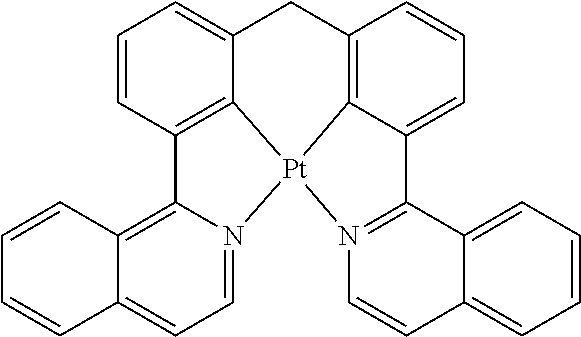 |
 |
 |
 |
 |
 |
 |
 |
 |
 |
 |
 |
 |
 |
 |
 |
 |
 |
 |
 |
 |
 |
 |
 |
 |
 |
 |
 |
 |
 |
 |
 |
 |
 |
 |
 |
 |
 |
 |
 |
 |
 |
 |
 |
 |
 |
 |
 |
 |
 |
 |
 |
 |
 |
 |
 |
 |
 |
 |
 |
 |
 |
 |
 |
 |
 |
 |
 |
- 1. The compounds according to the invention or compounds of the formulae (1), employed as matrix material for fluorescent or phosphorescent emitters, result in very high efficiencies and long lifetimes. This applies, in particular, if the compounds are employed as matrix material for a phosphorescent emitter.
- 2. The compounds according to the invention or compounds of the formulae (1) are suitable not only as matrix for red- and green-phosphorescent compounds, but also for blue-phosphorescent compounds.
- 3. The compounds according to the invention or compounds of the formula (1) have a very small separation between the S1 level, i.e. the first excited singlet level, and the T1 level, i.e. the first excited triplet level, and are therefore particularly suitable for use as matrix in phosphorescent OLEDs.
- 4. The compounds according to the invention, employed in organic electroluminescent devices, result in high efficiencies and in steep current/voltage curves with low use and operating voltages.


| TABLE 1 |
| Summary of the energy levels of TMM1 to TMM6 and TEG1 |
| TD-DFT |
| Homo | Measured | |||||
| Corr. [eV] | Lumo Corr. [eV] | T1 [eV] | S1 [eV] | T1 [eV] | ||
| TMM1 | −5.69 | −2.39 | 2.85 | 3.28 | 2.82 |
| TMM2 | −5.37 | −2.75 | 2.70 | 2.94 | 2.73 |
| TMM3 | −5.33 | −2.80 | 2.72 | 2.95 | 2.71 |
| TMM4 | −5.28 | −2.79 | 2.75 | 2.96 | 2.72 |
| TMM5 | −5.29 | −2.79 | 2.71 | 2.92 | |
| TMM6 | −5.29 | −7.28 | 2.74 | 2.92 | |
| TEG1 | −5.33 | −2.41 | 2.68 | 2.91 | 2.52 |
| TABLE 2 |
| Composition of the solutions |
| Ratio | |||||
| (based on | Con- | ||||
| Composition | weight) | Solvent | centration | ||
| Solution 1 | TMM1 + TEG1 | 75%:25% | chlorobenzene | 25 mg/ml |
| Solution 2 | TMM2 + TEG1 | 75%:25% | chlorobenzene | 25 mg/ml |
| Solution 3 | TMM3 + TEG1 | 75%:25% | chlorobenzene | 25 mg/ml |
| Solution 4 | TMM4 + TEG1 | 75%:25% | chlorobenzene | 25 mg/ml |
| TABLE 3 |
| Measurement results with OLED1 to OLED4 |
| Max. eff. | CIE @ | |||||
| [cd/A] | Uon [V] | U(100) [V] | U(1000) [V] | 100 cd/m2 | ||
| OLED1 | 8.15 | 3.85 | 6.60 | 8.80 | 0.33/0.62 |
| (comp.) | |||||
| OLED2 | 31.79 | 2.64 | 4.06 | 5.80 | 0.34/0.62 |
| OLED3 | 32.34 | 2.61 | 3.99 | 5.70 | 0.34/0.62 |
| OLED4 | 35.12 | 2.57 | 3.91 | 5.65 | 0.34/0.62 |
Claims (21)


—(CR2)p—(Y)q— formula (145)


Applications Claiming Priority (4)
| Application Number | Priority Date | Filing Date | Title |
|---|---|---|---|
| DE102010004803 | 2010-01-16 | ||
| DE102010004803A DE102010004803A1 (en) | 2010-01-16 | 2010-01-16 | Materials for organic electroluminescent devices |
| DE102010004803.8 | 2010-01-16 | ||
| PCT/EP2010/007744 WO2011085781A1 (en) | 2010-01-16 | 2010-12-17 | Materials for organic electroluminescent devices |
Publications (2)
| Publication Number | Publication Date |
|---|---|
| US20120305851A1 US20120305851A1 (en) | 2012-12-06 |
| US9496504B2 true US9496504B2 (en) | 2016-11-15 |
Family
ID=43495110
Family Applications (1)
| Application Number | Title | Priority Date | Filing Date |
|---|---|---|---|
| US13/521,266 Expired - Fee Related US9496504B2 (en) | 2010-01-16 | 2010-12-17 | Materials for organic electroluminescent devices |
Country Status (4)
| Country | Link |
|---|---|
| US (1) | US9496504B2 (en) |
| JP (1) | JP5902097B2 (en) |
| DE (1) | DE102010004803A1 (en) |
| WO (1) | WO2011085781A1 (en) |
Families Citing this family (6)
| Publication number | Priority date | Publication date | Assignee | Title |
|---|---|---|---|---|
| KR101202351B1 (en) * | 2010-07-16 | 2012-11-16 | 삼성디스플레이 주식회사 | Dendrimer and organic light emitting device using the same |
| CN103172652A (en) * | 2011-12-22 | 2013-06-26 | 海洋王照明科技股份有限公司 | Tetraphenyl silicon containing organic semiconductor material and preparation method thereof and organic electroluminescent device |
| CN103172651A (en) * | 2011-12-22 | 2013-06-26 | 海洋王照明科技股份有限公司 | Dibenzothiophene sulphone containing organic semiconductor material and preparation method thereof and organic electroluminescent device |
| CN103305211B (en) * | 2012-03-09 | 2016-01-13 | 海洋王照明科技股份有限公司 | Phosphorescent light body material and preparation method thereof and organic electroluminescence device |
| CN104017185A (en) * | 2013-02-28 | 2014-09-03 | 海洋王照明科技股份有限公司 | Polymer containing tetraphenyl silicane and triphenylamine unit as well as preparation method and application of polymer |
| CN107827873B (en) * | 2017-10-23 | 2020-02-07 | 长春海谱润斯科技有限公司 | Triarylamine derivative and organic light-emitting device thereof |
Citations (7)
| Publication number | Priority date | Publication date | Assignee | Title |
|---|---|---|---|---|
| US20080036373A1 (en) | 2006-08-10 | 2008-02-14 | Takasago International Corporation | Platinum complex and light-emitting device |
| JP2008110946A (en) | 2006-10-31 | 2008-05-15 | Kyocera Mita Corp | Triphenylamine derivative and electrophotographic photoreceptor |
| WO2008056746A1 (en) | 2006-11-09 | 2008-05-15 | Nippon Steel Chemical Co., Ltd. | Compound for organic electroluminescent device and organic electroluminescent device |
| WO2008117826A1 (en) | 2007-03-27 | 2008-10-02 | Nippon Steel Chemical Co., Ltd. | Compound for organic electroluminescent device and organic electroluminescent device |
| WO2008123189A1 (en) | 2007-03-26 | 2008-10-16 | Nippon Steel Chemical Co., Ltd. | Compound for organic electroluminescent device and organic electroluminescent device |
| US20090256468A1 (en) * | 2008-02-29 | 2009-10-15 | Gracel Display Inc. | Novel organic electroluminescent compounds and organic electroluminescent device using the same |
| US20100155712A1 (en) * | 2008-12-22 | 2010-06-24 | Fujifilm Corporation | Organic electroluminescent device |
Family Cites Families (70)
| Publication number | Priority date | Publication date | Assignee | Title |
|---|---|---|---|---|
| US4539507A (en) | 1983-03-25 | 1985-09-03 | Eastman Kodak Company | Organic electroluminescent devices having improved power conversion efficiencies |
| DE4111878A1 (en) | 1991-04-11 | 1992-10-15 | Wacker Chemie Gmbh | LADDER POLYMERS WITH CONJUGATED DOUBLE BINDINGS |
| US5151629A (en) | 1991-08-01 | 1992-09-29 | Eastman Kodak Company | Blue emitting internal junction organic electroluminescent device (I) |
| JPH07133483A (en) | 1993-11-09 | 1995-05-23 | Shinko Electric Ind Co Ltd | Organic light emitting material for EL device and EL device |
| EP0676461B1 (en) | 1994-04-07 | 2002-08-14 | Covion Organic Semiconductors GmbH | Spiro compounds and their application as electroluminescence materials |
| DE4436773A1 (en) | 1994-10-14 | 1996-04-18 | Hoechst Ag | Conjugated polymers with spirocenters and their use as electroluminescent materials |
| CN1229415C (en) | 1995-07-28 | 2005-11-30 | 陶氏环球技术公司 | 2,7-aryl-9-substituted fluorenes and oligomers and polymers of 9-substituted fluorenes |
| DE19614971A1 (en) | 1996-04-17 | 1997-10-23 | Hoechst Ag | Polymers with spiro atoms and their use as electroluminescent materials |
| DE19652261A1 (en) | 1996-12-16 | 1998-06-18 | Hoechst Ag | Aryl-substituted poly (p-arylenevinylenes), process for their preparation and their use in electroluminescent devices |
| DE19846766A1 (en) | 1998-10-10 | 2000-04-20 | Aventis Res & Tech Gmbh & Co | A conjugated fluorene-based polymer useful as an organic semiconductor, electroluminescence material, and for display elements |
| US6166172A (en) | 1999-02-10 | 2000-12-26 | Carnegie Mellon University | Method of forming poly-(3-substituted) thiophenes |
| EP1729327B2 (en) | 1999-05-13 | 2022-08-10 | The Trustees Of Princeton University | Use of a phosphorescent iridium compound as emissive molecule in an organic light emitting device |
| EP2911211B1 (en) | 1999-12-01 | 2018-05-02 | The Trustees of Princeton University | Complexes of form l2mx |
| TW532048B (en) | 2000-03-27 | 2003-05-11 | Idemitsu Kosan Co | Organic electroluminescence element |
| US20020121638A1 (en) | 2000-06-30 | 2002-09-05 | Vladimir Grushin | Electroluminescent iridium compounds with fluorinated phenylpyridines, phenylpyrimidines, and phenylquinolines and devices made with such compounds |
| JP5241053B2 (en) | 2000-08-11 | 2013-07-17 | ザ、トラスティーズ オブ プリンストン ユニバーシティ | Organometallic compounds and radiation-transfer organic electrophosphors |
| JP4154138B2 (en) | 2000-09-26 | 2008-09-24 | キヤノン株式会社 | Light emitting element, display device and metal coordination compound |
| JP4154139B2 (en) | 2000-09-26 | 2008-09-24 | キヤノン株式会社 | Light emitting element |
| JP4154140B2 (en) | 2000-09-26 | 2008-09-24 | キヤノン株式会社 | Metal coordination compounds |
| KR100939468B1 (en) | 2001-03-10 | 2010-01-29 | 메르크 파텐트 게엠베하 | Organic Semiconductor Solutions and Dispersions |
| DE10141624A1 (en) | 2001-08-24 | 2003-03-06 | Covion Organic Semiconductors | Solutions of polymeric semiconductors |
| DE10159946A1 (en) | 2001-12-06 | 2003-06-18 | Covion Organic Semiconductors | Process for the production of aryl-aryl coupled compounds |
| ITRM20020411A1 (en) | 2002-08-01 | 2004-02-02 | Univ Roma La Sapienza | SPIROBIFLUORENE DERIVATIVES, THEIR PREPARATION AND USE. |
| GB0226010D0 (en) | 2002-11-08 | 2002-12-18 | Cambridge Display Tech Ltd | Polymers for use in organic electroluminescent devices |
| DE10304819A1 (en) | 2003-02-06 | 2004-08-19 | Covion Organic Semiconductors Gmbh | Carbazole-containing conjugated polymers and blends, their preparation and use |
| JP4411851B2 (en) | 2003-03-19 | 2010-02-10 | コニカミノルタホールディングス株式会社 | Organic electroluminescence device |
| KR101162933B1 (en) | 2003-04-15 | 2012-07-05 | 메르크 파텐트 게엠베하 | Mixtures of matrix materials and organic semiconductors capable of emission, use of the same and electronic components containing said mixtures |
| EP2236579B1 (en) | 2003-04-23 | 2014-04-09 | Konica Minolta Holdings, Inc. | Organic electroluminescent element and display |
| EP1491568A1 (en) | 2003-06-23 | 2004-12-29 | Covion Organic Semiconductors GmbH | Semiconductive Polymers |
| DE10328627A1 (en) | 2003-06-26 | 2005-02-17 | Covion Organic Semiconductors Gmbh | New materials for electroluminescence |
| JP4773346B2 (en) | 2003-07-07 | 2011-09-14 | メルク パテント ゲーエムベーハー | Mixtures of organic light emitting semiconductors and matrix materials, their use and electronic components comprising said materials. |
| DE10333232A1 (en) | 2003-07-21 | 2007-10-11 | Merck Patent Gmbh | Organic electroluminescent element |
| DE10337346A1 (en) | 2003-08-12 | 2005-03-31 | Covion Organic Semiconductors Gmbh | Conjugated polymers containing dihydrophenanthrene units and their use |
| DE10338550A1 (en) | 2003-08-19 | 2005-03-31 | Basf Ag | Transition metal complexes with carbene ligands as emitters for organic light-emitting diodes (OLEDs) |
| DE10345572A1 (en) | 2003-09-29 | 2005-05-19 | Covion Organic Semiconductors Gmbh | metal complexes |
| US7795801B2 (en) | 2003-09-30 | 2010-09-14 | Konica Minolta Holdings, Inc. | Organic electroluminescent element, illuminator, display and compound |
| EP1675930B1 (en) | 2003-10-22 | 2018-05-30 | Merck Patent GmbH | New materials for electroluminescence and the utilization thereof |
| EP1687859B1 (en) | 2003-11-25 | 2013-08-07 | Merck Patent GmbH | Organic electroluminescent element |
| US7790890B2 (en) | 2004-03-31 | 2010-09-07 | Konica Minolta Holdings, Inc. | Organic electroluminescence element material, organic electroluminescence element, display device and illumination device |
| DE102004020298A1 (en) | 2004-04-26 | 2005-11-10 | Covion Organic Semiconductors Gmbh | Electroluminescent polymers and their use |
| DE102004023277A1 (en) | 2004-05-11 | 2005-12-01 | Covion Organic Semiconductors Gmbh | New material mixtures for electroluminescence |
| US7598388B2 (en) | 2004-05-18 | 2009-10-06 | The University Of Southern California | Carbene containing metal complexes as OLEDs |
| JP4862248B2 (en) | 2004-06-04 | 2012-01-25 | コニカミノルタホールディングス株式会社 | Organic electroluminescence element, lighting device and display device |
| ITRM20040352A1 (en) | 2004-07-15 | 2004-10-15 | Univ Roma La Sapienza | OLIGOMERIC DERIVATIVES OF SPIROBIFLUORENE, THEIR PREPARATION AND THEIR USE. |
| EP1669386A1 (en) | 2004-12-06 | 2006-06-14 | Covion Organic Semiconductors GmbH | Conjugated polymers, representation thereof, and use |
| WO2006117052A1 (en) | 2005-05-03 | 2006-11-09 | Merck Patent Gmbh | Organic electroluminescent device and boric acid and borinic acid derivatives used therein |
| DE102005037734B4 (en) | 2005-08-10 | 2018-02-08 | Merck Patent Gmbh | Electroluminescent polymers, their use and bifunctional monomeric compounds |
| KR101082258B1 (en) | 2005-12-01 | 2011-11-09 | 신닛테츠가가쿠 가부시키가이샤 | Compound for organic electroluminescent element and organic electroluminescent element |
| DE102006025777A1 (en) | 2006-05-31 | 2007-12-06 | Merck Patent Gmbh | New materials for organic electroluminescent devices |
| KR101118808B1 (en) | 2006-12-28 | 2012-03-22 | 유니버셜 디스플레이 코포레이션 | Long lifetime phosphorescent organic light emitting deviceoled structures |
| DE102007002714A1 (en) | 2007-01-18 | 2008-07-31 | Merck Patent Gmbh | New materials for organic electroluminescent devices |
| DE102007053771A1 (en) | 2007-11-12 | 2009-05-14 | Merck Patent Gmbh | Organic electroluminescent devices |
| US7862908B2 (en) | 2007-11-26 | 2011-01-04 | National Tsing Hua University | Conjugated compounds containing hydroindoloacridine structural elements, and their use |
| DE102008017591A1 (en) | 2008-04-07 | 2009-10-08 | Merck Patent Gmbh | New materials for organic electroluminescent devices |
| DE102008027005A1 (en) | 2008-06-05 | 2009-12-10 | Merck Patent Gmbh | Organic electronic device containing metal complexes |
| DE102008033943A1 (en) | 2008-07-18 | 2010-01-21 | Merck Patent Gmbh | New materials for organic electroluminescent devices |
| DE102008036247A1 (en) | 2008-08-04 | 2010-02-11 | Merck Patent Gmbh | Electronic devices containing metal complexes |
| DE102008036982A1 (en) | 2008-08-08 | 2010-02-11 | Merck Patent Gmbh | Organic electroluminescent device |
| DE102008048336A1 (en) | 2008-09-22 | 2010-03-25 | Merck Patent Gmbh | Mononuclear neutral copper (I) complexes and their use for the production of optoelectronic devices |
| DE102008056688A1 (en) | 2008-11-11 | 2010-05-12 | Merck Patent Gmbh | Materials for organic electroluminescent devices |
| JP5701766B2 (en) | 2008-11-11 | 2015-04-15 | メルク パテント ゲーエムベーハー | Organic electroluminescent device |
| DE102008057050B4 (en) | 2008-11-13 | 2021-06-02 | Merck Patent Gmbh | Materials for organic electroluminescent devices |
| DE102008057051B4 (en) | 2008-11-13 | 2021-06-17 | Merck Patent Gmbh | Materials for organic electroluminescent devices |
| DE102009007038A1 (en) | 2009-02-02 | 2010-08-05 | Merck Patent Gmbh | metal complexes |
| DE102009011223A1 (en) | 2009-03-02 | 2010-09-23 | Merck Patent Gmbh | metal complexes |
| DE102009013041A1 (en) | 2009-03-13 | 2010-09-16 | Merck Patent Gmbh | Materials for organic electroluminescent devices |
| DE102009014513A1 (en) | 2009-03-23 | 2010-09-30 | Merck Patent Gmbh | Organic electroluminescent device |
| DE102009023155A1 (en) | 2009-05-29 | 2010-12-02 | Merck Patent Gmbh | Materials for organic electroluminescent devices |
| DE102009031021A1 (en) | 2009-06-30 | 2011-01-05 | Merck Patent Gmbh | Materials for organic electroluminescent devices |
| DE102009048791A1 (en) | 2009-10-08 | 2011-04-14 | Merck Patent Gmbh | Materials for organic electroluminescent devices |
-
2010
- 2010-01-16 DE DE102010004803A patent/DE102010004803A1/en not_active Withdrawn
- 2010-12-17 WO PCT/EP2010/007744 patent/WO2011085781A1/en not_active Ceased
- 2010-12-17 JP JP2012548348A patent/JP5902097B2/en not_active Expired - Fee Related
- 2010-12-17 US US13/521,266 patent/US9496504B2/en not_active Expired - Fee Related
Patent Citations (11)
| Publication number | Priority date | Publication date | Assignee | Title |
|---|---|---|---|---|
| US20080036373A1 (en) | 2006-08-10 | 2008-02-14 | Takasago International Corporation | Platinum complex and light-emitting device |
| JP2008037848A (en) | 2006-08-10 | 2008-02-21 | Takasago Internatl Corp | Platinum complex and light emitting device |
| JP2008110946A (en) | 2006-10-31 | 2008-05-15 | Kyocera Mita Corp | Triphenylamine derivative and electrophotographic photoreceptor |
| WO2008056746A1 (en) | 2006-11-09 | 2008-05-15 | Nippon Steel Chemical Co., Ltd. | Compound for organic electroluminescent device and organic electroluminescent device |
| EP2080762A1 (en) | 2006-11-09 | 2009-07-22 | Nippon Steel Chemical Co., Ltd. | Compound for organic electroluminescent device and organic electroluminescent device |
| WO2008123189A1 (en) | 2007-03-26 | 2008-10-16 | Nippon Steel Chemical Co., Ltd. | Compound for organic electroluminescent device and organic electroluminescent device |
| US20100044695A1 (en) | 2007-03-26 | 2010-02-25 | Nippon Steel Chemical Co., Ltd. | Compound for organic electroluminescent device and organic electroluminescent device |
| WO2008117826A1 (en) | 2007-03-27 | 2008-10-02 | Nippon Steel Chemical Co., Ltd. | Compound for organic electroluminescent device and organic electroluminescent device |
| EP2141152A1 (en) | 2007-03-27 | 2010-01-06 | Nippon Steel Chemical Co., Ltd. | Compound for organic electroluminescent device and organic electroluminescent device |
| US20090256468A1 (en) * | 2008-02-29 | 2009-10-15 | Gracel Display Inc. | Novel organic electroluminescent compounds and organic electroluminescent device using the same |
| US20100155712A1 (en) * | 2008-12-22 | 2010-06-24 | Fujifilm Corporation | Organic electroluminescent device |
Non-Patent Citations (3)
| Title |
|---|
| International Search Report for PCT/EP2010/007744 mailed Jun. 8, 2011. |
| Japanese Office Action from corresponding Japanese Patent Application No. 2012-548348 dated Oct. 28, 2014. |
| Schnabel et al., "The Synthesis of Substituted Melams", The Journal of Organic Chemistry, vol. 27, pp. 2514-2519 (1962). |
Also Published As
| Publication number | Publication date |
|---|---|
| DE102010004803A1 (en) | 2011-07-21 |
| US20120305851A1 (en) | 2012-12-06 |
| JP5902097B2 (en) | 2016-04-13 |
| WO2011085781A1 (en) | 2011-07-21 |
| JP2013517227A (en) | 2013-05-16 |
Similar Documents
| Publication | Publication Date | Title |
|---|---|---|
| US9356243B2 (en) | Materials for organic electroluminescent devices | |
| US10135003B2 (en) | Materials for electronic devices | |
| US10749117B2 (en) | Materials for electronic devices | |
| US11098019B2 (en) | Materials for organic electroluminescent devices | |
| US9012599B2 (en) | Nitrogen-containing condensed heterocyclic compounds for OLEDs | |
| US9217006B2 (en) | Materials for organic electroluminescent devices | |
| US9139582B2 (en) | Organic electroluminescent devices | |
| US8785636B2 (en) | Substituted indoloacridines for organic electroluminescent devices | |
| US10141518B2 (en) | Compounds for electronic devices | |
| US9425401B2 (en) | 9,9′-spirobixanthene derivatives for electroluminescent devices | |
| KR102660538B1 (en) | Materials for organic electroluminescent devices | |
| US20130053558A1 (en) | Organic compounds for electroluminescent devices | |
| US20110095281A1 (en) | Materials for organic electroluminescent devices | |
| KR102760292B1 (en) | Materials for organic electroluminescent devices | |
| US20130193382A1 (en) | Compounds for electronic devices | |
| US9876171B2 (en) | Materials for electronic devices | |
| US20230389423A1 (en) | Heterocyclic compounds for organic electroluminescent devices | |
| US9496504B2 (en) | Materials for organic electroluminescent devices | |
| US20230147279A1 (en) | Heterocyclic compounds for organic electroluminescent devices | |
| US20230312612A1 (en) | Heteroaromatic compounds for organic electroluminescent devices | |
| US9593087B2 (en) | Materials for organic electroluminescent devices | |
| US9768385B2 (en) | Compounds for electronic devices | |
| US20230183269A1 (en) | Polycyclic compounds for organic electroluminescent devices |
Legal Events
| Date | Code | Title | Description |
|---|---|---|---|
| AS | Assignment |
Owner name: MERCK PATENT GMBH, GERMANY Free format text: ASSIGNMENT OF ASSIGNORS INTEREST;ASSIGNORS:PAN, JUNYOU;BUCHHOLZ, HERWIG;MUJICA-FERNAUD, TERESA;AND OTHERS;REEL/FRAME:028579/0219 Effective date: 20120525 |
|
| STCF | Information on status: patent grant |
Free format text: PATENTED CASE |
|
| FEPP | Fee payment procedure |
Free format text: MAINTENANCE FEE REMINDER MAILED (ORIGINAL EVENT CODE: REM.); ENTITY STATUS OF PATENT OWNER: LARGE ENTITY |
|
| LAPS | Lapse for failure to pay maintenance fees |
Free format text: PATENT EXPIRED FOR FAILURE TO PAY MAINTENANCE FEES (ORIGINAL EVENT CODE: EXP.); ENTITY STATUS OF PATENT OWNER: LARGE ENTITY |
|
| STCH | Information on status: patent discontinuation |
Free format text: PATENT EXPIRED DUE TO NONPAYMENT OF MAINTENANCE FEES UNDER 37 CFR 1.362 |
|
| FP | Lapsed due to failure to pay maintenance fee |
Effective date: 20201115 |