CROSS-REFERENCE AND RELATED APPLICATIONS
The subject application claims priority on Chinese patent application No. CN 201410410122.8 filed on Aug. 20, 2014. The contents and subject matter of the Chinese priority application is incorporated herein by reference.
FIELD OF TECHNOLOGY
The present invention relates to large-scale networking of a data center, and in particular, relates to an arrayed waveguide grating (AWG) based modular interconnection network and methods for constructing and applying the same.
BACKGROUND OF THE INVENTION
In the past decade, fast global information development push data centers to evolve along the direction of super large scale. In 2012, each data center of Amazon has about 60,000 servers, and that for Google, the number exceeds 50,000 servers, while Microsoft is building a data center containing over 300,000 servers. Current data centers generally adopt the layered tree topology, such as the ‘Fat Tree’ topology. The advantage of the tree topology is its large bi-directional bandwidth, while the disadvantage is its lack of scalability. As pointed out in the Article entitled “60 GHz Data-Center Networking: Wireless
Worry less,” topological and cabling complexity in data centers is reaching unimaginable proportions, leading to maintenance challenges, inefficient cooling, and substantial operational costs.
To tackle the interconnecting issue, the following proposals have been put forth in the industry:
The first is to replace wires with wireless interconnects. Wireless networking has signals prone to interference, small bandwidth, and high consumption of stations, making it only a topic at the academies, and not fit for practical application.
The second is to develop a unified structure based on integrated and enhanced Ethernets, with Cisco and Brocade being the major proponents. Although the method decreases the number of cables, trunk adapters, and network interfaces, the cost of equipping and integrating network adapters is huge, further, main boards for Ethernet optical fiber channels are not yet available.
The third is to adopt structured cabling. The main idea is to divide the cabling system in a data center into a main cabling area and a device area based on different devices. The main cabling area and the device area are connected with optical cables, while servers, switchers, and storage devices are jumper-connected via cable distribution frames in the main cabling area and the device area. The proposed solution simplifies cable management to some extent, making it possible to move or modify the system by merely changing jumpers. But it does not decrease the number of system cables, thus interconnecting complexity remains and the operating difficulty is still high.
Because of the above reasons, a method of module networking based on Arrayed Waveguide Grating (AWG) and directed at cabling complexity and management in a data center is in need.
SUMMARY OF THE INVENTION
The present invention solves the problem of the cabling complexity and related management issues by providing a design method of AWG-based modular interconnection networks to reduce cabling complexity so as to simplify networking maintenance and management.
The present invention provides an AWG-based modular interconnection network comprising left nodes, the number of the left nodes being N1, with each left node having N2 ports; right nodes, the number of the right nodes being N2, with each right node having N1 ports; N1 and N2 each representing a positive integer, N1≧N2, and N1 and N2 having a greatest common divisor r, and each port having an optical transceiver associated with a fixed wavelength, characterized in that it further comprises:
N2×1 wavelength multiplexers, the number of the N2×1 wavelength multiplexers being N1, with each of the N2×1 wavelength multiplexers having N2 input ports being respectively connected with the N2 ports of each of the left nodes;
1×N1 wavelength demultiplexers, the number of the 1×N1 wavelength demultiplexers being N2, with each of the 1×N1 wavelength demultiplexers having N1 output ports respectively connected with the N1 ports of each of the right nodes; and
an N1×N2 AWG connecting the N2×1 wavelength multiplexers and the 1×N1 wavelength demultiplexers, the N1×N2 AWG having N1 input ports and N2 output ports, and being associated with a wavelength set Λ={λ0, λ1, . . . , λN 1 −1}.
The present invention further provides an AWG-based modular interconnection network, comprising left nodes, the number of the left nodes being N1, with each of the left nodes having N2 ports, right nodes, the number of the right nodes being N2, with each of the right nodes having N1 ports; N1 and N2 are integers, N1≧N2, N1 and N2 having the greatest common divisor r, and each port having an optical transceiver associated with a fixed wavelength, characterized in that it further comprises:
r×1 wavelength multiplexers, the number of the r×1 wavelength multiplexers being N1n2 (N1n2 stands for the product of N1 and n2, and same goes for the same styled numbers in the subject application), and n2 r×1 wavelength multiplexers having their input ports respectively connected with the N2 ports of one of the left nodes, where n2=N2/r;
1×r wavelength demultiplexers, the number of the 1×r wavelength demultiplexers being N2n1, and n 1 1×r wavelength demultiplexers having output ports respectively connected with the N1 ports of one of the right nodes, where n1=N1/r; and
r×r AWGs connecting the r×1 wavelength multiplexers and the 1×r wavelength demultiplexers, the number of the r×r AWGs being n1n2, and each of the r×r AWGs being associated with a wavelength subset {λk|k=0, 1, . . . , r−1}.
The present invention also provides an AWG-based modular interconnection network, comprising left nodes, the number of the left nodes being N1, with each of the left nodes having N2 ports; right nodes, the number of the right nodes being N2 with each of the right node having N1 ports; N1, N2, and K are integers, where N1=KN2; and each port having an optical transceiver associated with a fixed wavelength, characterized in that it further comprises:
N2×1 wavelength multiplexers, the number of the N2×1 wavelength multiplexers being N1, each of the N2×1 wavelength multiplexers having N2 input ports respectively connected with the N2 ports of each of the left nodes;
1×N2 wavelength demultiplexers, the number of the 1×N2 wavelength demultiplexers being KN2, the K 1×N2 wavelength demultiplexers having their output ports respectively connected with the N1 ports of one of the right nodes; and
N2×N2 AWGs connecting the N2×1 wavelength multiplexers and the 1×N2 wavelength demultiplexers, the number of the N2×N2 AWGs being K, each of the N2×N2 AWGs being associated with a wavelength subset {λk|k=0, 1, . . . , N2−1}.
The present invention further provides a method for constructing an AWG-based modular interconnection network having N1 left nodes, with each left node having N2 ports; the N2 right nodes, with each right node having N1 ports; N1≧N2, N1 and N2 being integers having a greatest common divisor r; and each port having an optical transceiver associated with a fixed wavelength, characterized in that the method comprises the following steps:
Step 1: providing N1 N2×1 wavelength multiplexers, labeled by L0, L1, . . . , LN 1 −1, for the N1 left nodes, the ith N2×1 wavelength multiplexer having its jth input port connected with the jth port of the ith left node, and the jth port of the ith left node is associated with wavelength
where i=0, 1, . . . , N1−1, j=0, 1, . . . , N2−1;
Step 2: providing N 2 1×N1 wavelength demultiplexers labeled by R0, R1, . . . , RN 2 −1, for N2 right nodes, the jth 1×N1 wavelength demultiplexer having its ith output port connected separately with the ith port of the jth right node, and the ith port of the jth right node is associated with wavelength
Step 3: interconnecting the N1 wavelength multiplexers on the left with the N2 wavelength demultiplexers on the right via an N1×N2 AWG, the N1×N2 AWG having N1 input ports and N2 output ports, and being associated with a wavelength set Λ={λ0, λ1, . . . , λN 1 −1}.
The method further comprises:
Step 4: substituting the N1×N2 AWG with a three-stage AWG network SA(n1,r1,mA,n2,r2), the AWG network SA comprising N1=r1n1 input ports on its input side, with each input port being a 1×n2 wavelength demultiplexer, and N2=r2n2 output ports on its output side, with each output port being an n1×1 wavelength multiplexer, mA r1×r2 AWGs in the central stage, where r1=r2=r, n1=N1/r, n2=N2/r, and mA=n1n2;
In the AWG network SA, the ith input port is labeled by DA1(αA,aA), where αA=└i/n1┘ and αA=[i]n 1 , and the jth output port is labeled by MA1(βA,bA), where βA└j/n2┘ and bA=[j]n 2 , and each of the AWGs in the central stage is labeled by GA1(αA,bA); the αAth input port of GA1(αA,bA) is connected with the bAth output port of DA1(αA,aA), the βA th output port of GA1(αA,bA) is connected with the αAth input port of MA1(βA,bA), and GA1(αA,bA) is associated with a wavelength subset Λ[α λ +b λ ] n1 ={λ[α λ +b λ ] n1 r+k|k=0, 1, . . . , r−1};
Step 5: substituting the ith N2×1 wavelength multiplexer Li and the 1×n2 wavelength demultiplexer DA1(αA,aA) with n2 r×1 wavelength multiplexers, each of which is labeled by DA2(αA,aA,bA);
substituting the jth 1×N1 wavelength demultiplexer Rj and the n1×1 wavelength multiplexer MA1(βA,bA) with n r×1 wavelength demultiplexers, each of the r×1 wavelength demultiplexers being labeled by MA2(βA,bA,aA);
associating each r1×r2 AWG, labeled by DA2(αA,bA), with a wavelength subset (λk|k=0, 1, . . . , r−1);
where the output port of DA2(αA,aA,bA) is connected with the αAth input port of GA2(aA,bA), and the input port of MA2(βA,bA,aA) is connected with the βAth output port of GA2(αA,bA).
Alternatively, the method further comprises:
Step 4: in the case of N1=KN2, substituting the N1×N2 AWG with a two-stage network SB(K,N2,K,1,N2), where each input port of the AWG network SB is a link, there are K N2×N2 AWGs in the central stage, and each output port is a K×1 wavelength multiplexer; the ith input port is labeled by DB1(αB,aB), where αB=└i/N2┘ and aB=[i]N 2 , the jth output port is labeled by MB1(γB), where γB=j, and each AWG in the central stage is labeled by GB1(αB), and further, the AWG in the central stage is associated with a wavelength subset Λα B ={λα B N 2 +k|k=0, 1, . . . , N2−1}; the aBth input port of GB1(αB) is thus DB1(αB,aB), the γBth output port of GB1(αB) is connected with the αBth input port of MB1(γB);
Step 5: denoting each of the N1×1 wavelength multiplexers as DB2(αB,aB);
Substituting the jth 1×N1 demultiplexer Rj and the K×1 multiplexer MB1(γB) with K N2×1 wavelength multiplexers, each of which is labeled by MB2(γB,αB);
associating each N2×N2 AWG, labeled by GB2(αB), with a wavelength subset {λk|k=0, 1, . . . , N2−1};
where DB2(αB,aB) is connected with the aBth input port of GB2(αB), and MB2(γB,αB) is connected with the γBth output port of GB2(αB).
The method further comprises:
Step 6: in the case of the dimension of the AWG in the central stage still being large, returning to Step 4, and substituting the AWG in the central stage with a module constituted of a three-stage network of small AWGs.
The present invention further provides an application of AWGs in an interconnection network. Compared with the previous works, the present invention has the following advantages:
(1) By constructing the N1×N2 interconnection network with the r×r AWGs, the number of the interconnection links is reduced r times.
(2) Wavelengths are reused in the AWG-based interconnection network, i.e., the r×r AWGs in the network reuses the same wavelength subset {λ0, . . . , λr−1}, which improves the scalability of the AWG-based interconnection system.
(3) If r is still very large, the method in Step 4 can be employed to decompose the r×r AWG into an r×r three-stage AWG network.
BRIEF DESCRIPTION OF THE DRAWINGS
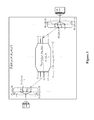
FIG. 1 shows an N
1×N
2 interconnection network
1 of the present invention;
FIG. 2 shows an AWG-based N
1×N
2 interconnection network
2 of the present invention;
FIG. 3 shows an N
1×N
2 interconnection network
A1 comprising a three-stage AWG network S
A of the present invention;
FIG. 4 shows a KN
2×N
2 interconnection network
B1 comprising a two-stage AWG network S
B of the present invention;
FIG. 5 shows an N
1×N
2 AWG-based modular interconnection network
A2 of the present invention;
FIG. 6 shows a KN
2×N
2 AWG-based modular interconnection network
B2 of the present invention;
FIG. 7 shows a 15×10 interconnection network
1 of the present invention;
FIG. 8 shows a 15×10 AWG-based interconnection network
2 of the present invention;
FIG. 9 shows a 15×10 interconnection network
A1 comprising an AWG network S
A of the present invention;
FIG. 10 shows a 15×10 AWG-based modular interconnection network
A2 of the present invention;
FIG. 11 shows a 12×6 interconnection network
1 of the present invention;
FIG. 12 shows a 12×6 AWG-based interconnection network
2 of the present invention;
FIG. 13 shows a 12×6 AWG-based interconnection network
B1 comprising a two-stage AWG network S
B of the present invention;
FIG. 14 shows a 12×6 AWG-based modular interconnection network
B2 of the present invention.
DETAILED DESCRIPTION OF THE INVENTION AND PREFERRED EMBODIMENTS
In combination with drawings and embodiments hereunder provided, the present invention will be further expounded. The embodiments are intended as illustrating the present invention rather than limiting its scope. Various equivalent modifications by a person skilled in the art shall fall within the scope of the claims.
An N
1×N
2 (N
1≧N
2, and N
1 and N
2 having a maximum divisor r) interconnection network
1 contains N
1 left nodes, with each node comprising N
2 ports, and each port having an optical transceiver; N
2 right nodes, with each node comprising N
1 ports, and each port having an optical transceiver. All the optical transceivers are associated with the same wavelength λ
0. For each of the paired left node and right node, there is one and only one link between them, and thus, there are altogether N
1N
2 links in the interconnection network, as shown in
FIG. 1, where the small block on each port of the node represents an optical transceiver.
An AWG-based modular interconnection network for reducing the cabling complexity of a data center mainly via the wavelength division multiplexing property of AWGs, comprises the following parameters:
N1×N2 AWG: having N1 input ports, N2 output ports, and being associated with a wavelength set Λ={λ0, λ1, . . . , λN 1 −1}, as shown in FIG. 2;
N2×N2 AWG: having N2 input ports, N2 output ports, and being associated with a wavelength set Λ={λ0, λ1, . . . , λN 2 −1};
N1×1 wavelength multiplexer/demultiplexer: N1×1 AWG;
N2×1 wavelength multiplexer/demultiplexer: N2×1 AWG;
n1×1 wavelength multiplexer/demultiplexer: n1×1 AWG;
n2×1 wavelength multiplexer/demultiplexer: n2×1 AWG;
N1×N2 AWG network SA(n1, r1, n1, n2, r2): a three-stage AWG network, which comprises N1=r1n1 input ports on the input side, each input port being a 1×n2 demultiplexer, N2=r2n2 output ports on the output side, each output port being an n1×1 multiplexer, and mA r1×r2 AWGs on the central stage, where r1=r2=r, n1=N1/r, n2=N2/r, and mA=n1n2, as shown in FIG. 3;
KN2×N2 AWG network SB(K, N2, K, 1, N2): an AWG network, with K N2×N2 AWGs in the first stage, and N2 K×1 multiplexers in the second stage, as shown in FIG. 4;
N
1×N
2 interconnection network
2:N
1 left nodes and N
1 N
2×1 multiplexers on the left side, N
2 right nodes and
N 2 1×N
1 demultiplexers on the right side, and an N
1×N
2 AWG on the central stage;
N
1×N
2 interconnection network
A1: consists of N
1 left nodes and N
1 N
2×1 multiplexers, N
2 right nodes and
N 2 1×N
1 demultiplexers, and an N
1×N
2 AWG network S
A on the central stage, as shown in
FIG. 3;
N
1×N
2 interconnection network
B1: consists of N
1 left nodes and N
1 N
2×1 multiplexers; N
2 right nodes and
N 2 1×N
1 demultiplexers, and an N
1×N
2 AWG network S
B on the central stage, as shown in
FIG. 4;
N
1×N
2 interconnection network
A2: consists of N
1 left nodes and N
1n
2r×1 multiplexers, N
2 right nodes and N
2n
11×r demultiplexers, and n
1n
2 identical r×r AWGs on the central stage, as shown in
FIG. 5;
N
1×N
2 interconnection network
B2: consists of N
1 left nodes and N
1 N
2×1 multiplexers, N
2 right nodes and
KN 2 1×N
1 demultiplexers, and K identical N
2×N
2 AWGs on the central stage, as shown in
FIG. 6.
A method of construction of an AWG-based modular interconnection network comprises the following steps:
(1) Remove all the N
1N
2 cables in the N
1×N
2 interconnection network
1 as shown in
FIG. 1, then provide N
1 N
2×1 wavelength multiplexers, labeled by L
0, L
1, . . . , L
N 1 −1 for N
1 left nodes, the ith N
2×1 wavelength multiplexer having its jth input port connected with the jth port of the ith left node, and the jth port of the ith left node is associated with wavelength λ
[i+j] N1 , where i=0, 1, . . . , N
1−1, and j=0, 1, . . . , N
2−1; provide
N 2 1×N
1 wavelength demultiplexers labeled by R
0, R
1, . . . , R
N 2 -1, for N
2 right nodes, the jth 1×N
1 wavelength demultiplexer having its ith output port connected separately with the ith port of the jth right node, and the ith port of the jth right node is associated with wavelength λ
[i+r] N1 . Use N
1×N
2 AWG to connect N
1 N
2×1 wavelength multiplexers on the left with
N 21×N
1 wavelength demultiplexers on the right. This step transforms the
1 into an
2, with all the optical fibers being replaced by an AWG, as shown in
FIG. 2, where the ith left node connects with the jth right node through wavelength λ
[i+j] N1 .
As the fabrication of AWGs with very large N
1 and N
2 is impractical, it is necessary to decompose the AWG into a network of small AWGs: substitute the N
1×N
2 AWG with an AWG network S
A(n
1,r
1,m
A,n
2,r
2), as shown in
FIG. 3. In S
A, each input port is a 1×n
2 demultiplexer and the ith input port is labeled by D
A1(α
A,a
A), where α
A=└i/n
1┘ and a
A=[i]
n 1 , and each output port is a n
1×1 multiplexer and the jth output port is labeled by M
A1(β
A,b
A), where β
A=└j/n
2┘, and b
A=[j]
n 2 , and an AWG in the central stage is labeled by G
A1(a
A,b
A); the α
Ath port of G
A1(a
A,b
A) is connected with the bath port of D
A1(α
A,a
A), the β
Ath port of G
A1(a
A,b
A) is connected with the a
Ath port of M
A1(β
A,b
A), and G
A1(a
A,b
A) is associated with a wavelength subset Λ
[a A +b A ] n1 ={λ
[a A +b A ] n1 r+k|k=0, 1, . . . , r−1}. This step transforms
2 to
A1, in which the ith left node connects with the jth right node via wavelength λ
[a A +b A ] n1 r+[α A +β A ] r along the path as follows:
- Left Node i→output bA of DA1(αA,aA)→input αA of GA1(aA,bA)→output βA of GA1(aA,bA)→input aA of MA1(βA,bA)→Right Node j.
As shown in
FIG. 4, when N
1=KN
2, the three-stage network S
A degenerates into a two-stage network S
B (K,N
2,K,1,N
2), where each input port degenerates into a 1×1 demultiplexer, i.e., a fiber link, the dimension of the AWGs in the central stage is N
2×N
2, and each output port becomes a K×1 multiplexer. The ith input port is labeled by D
B1(α
B,a
B), where α
B=└i/N
2┘, and a
B=[i]
N 2 , the jth output port is labeled by M
B1(γ
B), where γ
B=j, and an AWG in the central stage is labeled by G
B1(α
B), and further, an AWG in the central stage is associated with a wavelength subset Λ
α B ={λ
α B N 2 +k|k=0, 1, . . . , N
2−1}; the a
Bth input port of G
B1(α
B) is thus D
B1(α
B,a
B), and the γ
Bth output port of G
B1(α
H) is connected with the α
Bth input port of M
B1(γ
B). This step transforms
2 into
B1, where the ith left node connects with the jth right node via wavelength λ
α B N 2 +[α B +γ B ]N 2 along the path as follows:
-
- Left Node i→DB1(αB,aB)→input aB of GB1(αB)→output γB of GB1(αB)→input αB of MB1(γB)→Right Node j.
Wavelengths are precious resources in an optical communication window, and the number of wavelengths required by the system should not increase with the dimension of the interconnection network, and therefore, wavelength reuse must be taken into account. As shown in
FIG. 5, substitute the ith N
2×1 multiplexer L
i on the left side of
A1 and the 1×n
2 demultiplexer D
B1(α
B,a
B) of S
A with n
2 r×1 multiplexers, each of which is labeled by D
A2(α
A,a
A,b
A), and substitute the jth 1×N
1 demultiplexer R
j on the right side of
A1 and the n
1×1 multiplexer M
A1(β
A,b
A) of S
A with
n 1 1×r demultiplexers, each of which is labeled by M
A1(β
A,b
A,a
A). As the optical transceivers in the left and right nodes can perform wavelength isolation, each r×r AWG can reuse the same wavelength subset {λ
k|k=0, 1, . . . , r−1}. The r×r AWG in the central stage is labeled by G
A2(a
A,b
A). The output port of D
A2(α
A,a
A,b
A) is connected with the α
Ath input port of G
A2(a
A,b
A), and the input port of M
A2(β
A,b
A,a
A) is connected with the β
Ath output port of G
A2(a
A,b
A). Accordingly
A1 is transformed into
A2, where the ith left node connects with the jth right node via wavelength λ
[λα A +β A ] r , along the path as follows:
-
- Left Node i→DA2(αA,aA,bA)→input αA of GA2(αA,bA)→output βA of GA2(aA,bA)→MA1(βA,bA,aA)→Right Node j.
As shown in
FIG. 6, if the outcome of step (2) is
B1, substitute the
ith 1×N
1 demultiplexer R
j on the right side of
B1 and the jth K×1 multiplexer M
B1(γ
B) on the output side of S
B with K N
2×1 demultiplexers, each of which is labeled by M
B2(γ
B,α
B). Each N
2×N
2 AWG in the central stage is labeled by G
B2(α
B) and can be associated with the same wavelength subset {λ
k|k=0, 1, . . . , N
2−1}. The input port is labeled by D
B2(α
B,a
B). D
B2(α
B,a
B) is connected with the a
Bth input port of G
B2(α
B), and M
B2(γ
B,α
B) is connected with the γ
Bth output port of G
B2(α
B). As a result,
B1 is transformed into
B2, in which the ith left node connects with the jth right node via wavelength λ
[α B +γ B ]N 2 along the path as follows:
- Left Node i→DB2(αB,aB)→input aB of GB2(αB)→output γB of GB2(αB)→MB2(γB,αB)→Right Node j.
(2) If the dimension of the AWG in the central stage is still very large, the method of step (2) can be employed to substitute each AWG in the central stage with a module encapsulated with a three-stage AWG network.
Example 1
A method for constructing an AWG-based modular interconnection network is shown. As for a 15×10 interconnection network
1, as shown in
FIG. 7, where the greatest common divisor of 15 and 10 is 5, the construction method of an AWG-based modular interconnection network comprises the following steps:
1. Substitute the 150 cables on
FIG. 7 with a 15×10 AWG, which is associated with Λ={λ
0, λ
1, . . . , λ
14).
1 is thus transformed into
2. Compared with
1,
2 does not need optical fiber links, as shown in
FIG. 8;
2. Decompose the 15×10 AWG in
2 into an AWG network S
A(3,5,6,2,5), which consists of fifteen (15) 1×2 demultiplexers, six (6) 5×5 AWGs, and ten (10) 3×1 multiplexers. Accordingly, the wavelength set Λ=(λ
0, λ
1, . . . , λ
14} is divided to 3 subsets Λ
0={λ
0, . . . , λ
4}, Λ
1={λ
5, . . . , λ
9}, and Λ
2={λ
10, . . . , λ
14}, which are respectively associated with the six (6) 5×5 AWGs in the central stage. As shown in
FIG. 9, this step transforms
2 into
A1. Compared with the 150 optical fiber links of
1,
A1 needs only 60 optical fiber links. The reduction ratio of the number of required optical fiber links in this example is 2.5;
3. Substitute a 1×2 demultiplexer of S
A and a 10×1 multiplexer on the left side of
2 with two (2) 5×1 AWGs, and substitute a 3×1 multiplexer of S
A and the 1×15 demultiplexer on the right side of
2 with three (3) 1×5 AWG Wavelength dependence among the 6 5×5 AWGs is eliminated due to the transceivers equipped on both sides of
2. Thus, these AWGs can be associated with the same wavelength subset Λ
0, which indicates that the wavelength reuse property is achieved. As shown in
FIG. 10, an AWG-based modular interconnection network
2 is obtained. The number of required optical fibers in
A2 is 60. After the construction of an AWG-based modular interconnection network, the number of optical fiber links is reduced from 150 to 60, and the reduction of the number of optical fiber links remarkably cuts down the network complexity and thus simplifies system maintenance. In general, the number of optical fiber links is reduced r/2 times. In practical applications, N
1 and N
2 might be very large, which results in that the dimension of the AWGs in the central stage is still large. In this case, the method in step (2) can be employed to substitute each AWG in the central stage with a module that consists of a three-stage network of small AWGs.
A method for constructing an AWG-based modular interconnection network, as for a 12×6 interconnection network
1 as shown in
FIG. 11, where 12 is a multiple of 6, the construction comprises the following steps:
1. Substitute the 72 linking cables in the middle of
FIG. 11 with a 12×6 AWG, which is associated with Λ={λ
0, λ
1, . . . , λ
11}. This operation transforms
1 to
2. Compared with
1,
2 does not need optical fiber links, as shown in
FIG. 12.
2. Decompose the 12×6 AWG in N
2 into an AWG network S
B(2,6,2,1,6) that consists of six (6) 1×2 multiplexers, two (2) 6×6 AWGs. Accordingly, Λ={λ
0, λ
1, . . . , λ
14} is divided into 2 subsets Λ
0={λ
0, . . . , λ
5} and Λ
1={λ
6, . . . , λ
11}, which are respectively associated with the two (2) 6×6 AWGs in the central stage. As shown in
FIG. 13, this step transforms into
2 Compared with the optical fiber links of
1,
B1 needs only 12 optical fiber links. The reduction ratio of the number of optical fiber links in this example is 6.
3. Substitute a 2×1 multiplexer of S
B and a 1×12 demultiplexer on the right side of
2 with two (2) 1×6 AWGs. Wavelength dependence between the two (2) 6×6 AWGs is eliminated due to the transceivers provided on both sides of
2. Thus, these AWGs can be associated with the same wavelength subset Λ
0, which indicates that the wavelength reuse property is achieved. As shown in
FIG. 14, an AWG-based modular interconnection network
B2 is obtained. The number of required optical fibers in
B2 is 12. In practical applications, N
1 and N
2 might become very large, resulting in large AWGs in the central stage. In such a case, the method in step (2) can be employed to substitute the AWG in the central stage with a module that consists of a three-stage network of small AWGs. This is the idea of modulization of the present invention. After the construction of an AWG-based modular interconnection network, the number of optical fiber links is reduced from 72 to 12, a 6 time reduction. General speaking, when N
1 is a multiple of N
2, the number of optical fiber links can be reduced from N
1N
2 to N
1, by employing the method. The reduction of the number of optical fiber links cuts down the network complexity and thus simplifies network maintenance.