US9489930B1 - Wrist alignment device for stringed musical instruments - Google Patents
Wrist alignment device for stringed musical instruments Download PDFInfo
- Publication number
- US9489930B1 US9489930B1 US14/887,437 US201514887437A US9489930B1 US 9489930 B1 US9489930 B1 US 9489930B1 US 201514887437 A US201514887437 A US 201514887437A US 9489930 B1 US9489930 B1 US 9489930B1
- Authority
- US
- United States
- Prior art keywords
- wrist
- player
- attachment
- instrument
- neck
- Prior art date
- Legal status (The legal status is an assumption and is not a legal conclusion. Google has not performed a legal analysis and makes no representation as to the accuracy of the status listed.)
- Expired - Fee Related
Links
- 210000000707 wrist Anatomy 0.000 title claims abstract description 32
- 210000000245 forearm Anatomy 0.000 claims abstract description 6
- 241000405217 Viola <butterfly> Species 0.000 claims description 3
- 239000003562 lightweight material Substances 0.000 claims description 3
- 229920006328 Styrofoam Polymers 0.000 claims description 2
- 239000008261 styrofoam Substances 0.000 claims description 2
- 239000000463 material Substances 0.000 description 5
- 210000003813 thumb Anatomy 0.000 description 4
- 125000000391 vinyl group Chemical group [H]C([*])=C([H])[H] 0.000 description 4
- 229920002554 vinyl polymer Polymers 0.000 description 4
- 229910000831 Steel Inorganic materials 0.000 description 3
- 210000003811 finger Anatomy 0.000 description 3
- 238000000034 method Methods 0.000 description 3
- 235000013550 pizza Nutrition 0.000 description 3
- 239000010959 steel Substances 0.000 description 3
- XAGFODPZIPBFFR-UHFFFAOYSA-N aluminium Chemical compound [Al] XAGFODPZIPBFFR-UHFFFAOYSA-N 0.000 description 2
- 229910052782 aluminium Inorganic materials 0.000 description 2
- 238000010276 construction Methods 0.000 description 2
- 210000004247 hand Anatomy 0.000 description 2
- 230000001737 promoting effect Effects 0.000 description 2
- 239000000853 adhesive Substances 0.000 description 1
- 230000001070 adhesive effect Effects 0.000 description 1
- 230000003466 anti-cipated effect Effects 0.000 description 1
- 230000001419 dependent effect Effects 0.000 description 1
- 229920006248 expandable polystyrene Polymers 0.000 description 1
- 239000006260 foam Substances 0.000 description 1
- 230000002401 inhibitory effect Effects 0.000 description 1
- 230000007794 irritation Effects 0.000 description 1
- 210000004936 left thumb Anatomy 0.000 description 1
- 238000004519 manufacturing process Methods 0.000 description 1
- 238000003825 pressing Methods 0.000 description 1
- 230000002787 reinforcement Effects 0.000 description 1
Images

Classifications
-
- G—PHYSICS
- G10—MUSICAL INSTRUMENTS; ACOUSTICS
- G10D—STRINGED MUSICAL INSTRUMENTS; WIND MUSICAL INSTRUMENTS; ACCORDIONS OR CONCERTINAS; PERCUSSION MUSICAL INSTRUMENTS; AEOLIAN HARPS; SINGING-FLAME MUSICAL INSTRUMENTS; MUSICAL INSTRUMENTS NOT OTHERWISE PROVIDED FOR
- G10D3/00—Details of, or accessories for, stringed musical instruments, e.g. slide-bars
- G10D3/18—Chin-rests, hand-rests, shoulder rests or guards being removable from, or integral with the instrument
-
- G—PHYSICS
- G10—MUSICAL INSTRUMENTS; ACOUSTICS
- G10D—STRINGED MUSICAL INSTRUMENTS; WIND MUSICAL INSTRUMENTS; ACCORDIONS OR CONCERTINAS; PERCUSSION MUSICAL INSTRUMENTS; AEOLIAN HARPS; SINGING-FLAME MUSICAL INSTRUMENTS; MUSICAL INSTRUMENTS NOT OTHERWISE PROVIDED FOR
- G10D1/00—General design of stringed musical instruments
- G10D1/02—Bowed or rubbed string instruments, e.g. violins or hurdy-gurdies
Definitions
- the disclosed invention is directed generally to devices that help promote proper hand posture in use of a musical instrument and more specifically to devices directed to promoting an ergonomic (vertical) alignment of the wrist-to-hand posture of a player of a stringed instrument such as but not limited to a violin.
- Maintaining the correct wrist posture is critical when playing an instrument such as the violin, viola or fiddle as it affects a player's ability to reach all of the strings on the fingerboard and the ability to perform more advanced playing techniques such as vibrato.
- the ideal position of a player's wrist is upright, meaning approximately in a vertical, linear alignment between the player's left hand and left forearm.
- Disclosed is a device that inhibits the player's ability to collapse his/her wrist against the neck of the instrument, a condition commonly referred to as “pizza hand” or “waiter hand.”
- a player, especially a novice is tempted to adopt a pizza hand posture for the wrist, to support the instrument's neck similar to the wrist-hand posture adopted by a waiter carrying a tray.
- a pizza hand is not desired for ergonomic reasons and for the reason that such a posture inhibits a player's ability to reach the strings of the instrument.
- the majority of a player's time is spent in independent practice and outside of the traditional lesson setting with an instructor present who can prompt the player to correct and adopt the preferred wristband posture. Time spent in independent practice creates a risk of learning the incorrect posture which then needs to be corrected or consistently re-taught in lessons.
- U.S. Pat. No. 7,897,857 to Lockwood entitled “Self-Corrective Wrist Positioning Practice Device” is directed to a device that is placed on the hand and forearm of the player.
- the device employs negative reinforcement to promote proper wrist alignment by physically applying pressure to the player's forearm and hand area potentially causing discomfort and irritation.
- the known device which offers an invasive solution is not readily independently usable by very young players because of its manner of attachment and the use of the device may require the assistance of an adult instructor who will place, adjust the device properly.
- the present invention relates to training, promoting or correcting the wrist posture of players of instruments such as for example and not by way of limitation the violin, viola and fiddle.
- the disclosed device is designed for attachment to the instrument and not the player's hand as per known prior art.
- the disclosed wrist alignment device promotes approximately vertical alignment of the player's left wrist while allowing rotation of the wrist as needed for finger placement on the fingerboard of the instrument.
- ball of the hand refers to the fleshy, rounded portion of the hand that is located approximately between the base of the thumb and the wrist.
- a wrist alignment system for attachment to a stringed musical instrument comprising a the system comprising a device comprising a three-dimensional smooth body comprising a substantially flat planar end, a substantially oblong end opposite the flat planar end, a top rounded edge, a substantially flat bottom edge and integral first and second attachment elements, the first attachment element attached to the flat planar end, the second attachment element attached to the substantially flat bottom edge, the first and second attachment elements being substantially arcical in shape and comprising gripping ends adapted to removably attach the device to the neck and the nose of the instrument, respectively, wherein the device places a player's wrist in substantially vertical alignment with the corresponding forearm of the player and allows rotation of the wrist for placement of the player's fingers on the fingerboard.
- the first and second attachment elements are each preferably constructed of a strong yet lightweight material such as aluminum or steel wires which are coated in a vinyl material or similar material where the material is chosen so that it allows for a secure but gentle gripping of the surface of the nose and neck of the instrument, respectively. It will be obvious to one of ordinary skill in the relevant art that alternative materials of construction are possible for the first and second attachment elements.
- the three-dimensional body is preferably constructed from extruded or expandable polystyrene foam (e.g., Styrofoam) or similar lightweight material and is sized and adapted to be smooth so that its substantially oblong-shaped surface comes in gentle and non-invasive contact with the ball of the player's hand.
- the oblong shape is the preferred shape for the intended purpose.
- the size of the three dimensional body is adapted for the size of the instrument and the size of the ball of the player's hand such that the oblong device allows the ball of the player's band to come into contact with the oblong, rounded portion of the body of the device while allowing the player's fingers to properly reach all of the strings.
- the applicant has experimented with various methods of construction for the first and second attachment elements. Bendable but strong aluminum or steel wires were found to be suitable. Per a preferred embodiment, for illustration and not by way of limitation, for a larger size wrist alignment device adapted for larger instruments and larger player hands, the vinyl coated wires used for the neck and nose attachment elements are preferably 1 ⁇ 2 inch in width, 1.5625 to 2.4375 inches in length and 0.03125 inches in thickness.
- the wires are bent to form an arcical, semi-circular shape with resultant grips that gently, securely, and removably attach the device to the neck of the instrument (the flat planar end of the three-dimensional body with the integral neck attachment element facing the neck of the instrument and the substantially oblong-shaped surface of the three-dimensional body facing out away from the neck).
- a smaller steel wire measuring 3/16 inch in width, 1.4375 in length and 0.03125 inches in thickness may preferably be used.
- the disclosed device comprising integral neck and nose attachment elements is thus adapted to allow for quick (e.g. ‘push in place) attachment and removal of the device from the instrument.
- the arcical-shaped vinyl-coated wire grips of the neck and nose attachment elements allow for the ready, on demand removal of the device from the instrument to allow for play without the aid of the wrist alignment device. It will be obvious to ones of ordinary skill in the relevant art that alternative designs for the attachment of the disclosed device to the instrument are possible and are deemed to be within the scope of this invention.
- the device is attached to the neck of the instrument on the side of the neck that is opposite the fingerboard and generally near the nose of the instrument and over the nose of the instrument where the neck and nose meet.
- the curved grips of the neck attachment element portion of the device and the nose attachment element portion of the device are preferably each coated in a vinyl or similar material so to be smooth.
- the oblong-shaped portion of the three-dimensional body of the disclosed device is sized and shaped to come into contact with the ball of the left band of the player thus serving as a non-invasive, consistent guide for holding the wrist in an upright position during instrument play and inhibiting “waiter hand.”
- the size of the disclosed wrist alignment device, and the component parts used in the manner of attachment of the device to the instrument is dependent upon the size of the instrument, the expected width of the player's left thumb pad, and the anticipated size or length of the ball of the left hand, where that is defined as the rounded area of the palm located between the base of the thumb and the wrist. This placement is based on the thumb being placed in what is recognized in the industry as 1 st position however, the multiple sizes of the device available accommodate the various teaching methods (Ie. thumb placement between 1 st and 2 nd position).
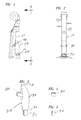
- FIG. 1 is a side perspective showing the disclosed device attached to a stringed musical instrument (violin).
- FIG. 2 is a top perspective of the back side of the stringed instrument with the disclosed device attached.
- FIG. 3 is a side perspective of the disclosed device.
- FIG. 4 is a side perspective of a first attachment element per the preferred embodiment of the disclosed device.
- FIG. 5 is side perspective of a second attachment element per the preferred embodiment of the disclosed device.
- FIG. 1 is a side perspective showing the disclosed device 30 attached to a stringed musical instrument. Shown is the three-dimensional body 30 with a neck attachment element 40 gripping the neck 10 of the instrument and a nose attachment element 50 gripping the nose 60 of the instrument.
- FIG. 2 is a top perspective of the back side of the stringed instrument with the disclosed device attached showing the neck attachment element 40 and the nose attachment element 50 .
- FIG. 3 is a side perspective of the disclosed device showing the three-dimensional body 30 , the substantially flat planar end 35 of the body 30 that is opposite the substantially oblong-shaped side, the integral neck attachment element 40 attached to the flat planar end 35 and the integral nose attachment element 50 attached to the substantially flat bottom end 31 of the device which is opposite the top rounded edge 32 of the device.
- FIG. 4 is a side perspective of a first attachment element (neck attachment element) per the preferred embodiment of the disclosed device.
- FIG. 5 is side perspective of a second attachment (nose attachment element) element per the preferred embodiment of the disclosed device.
Landscapes
- Physics & Mathematics (AREA)
- Engineering & Computer Science (AREA)
- Acoustics & Sound (AREA)
- Multimedia (AREA)
- Stringed Musical Instruments (AREA)
Abstract
A wrist alignment system for attachment to a stringed musical instrument comprising a neck and a nose, the system comprising a device comprising a three-dimensional smooth body comprising a substantially flat planar end, a substantially oblong end opposite the flat planar end, a top rounded edge, a substantially flat bottom edge and integral first and second attachment elements, the first attachment element attached to the flat planar end, the second attachment element attached to the substantially flat bottom edge, the first and second attachment elements being substantially arcical in shape and comprising two gripping ends adapted to removably attach the device to the neck and the nose of the instrument, respectively, wherein the device places a player's wrist in substantially vertical alignment with the corresponding forearm of the player and allows rotation of the wrist for placement of the player's fingers on the fingerboard.
Description
The disclosed invention is directed generally to devices that help promote proper hand posture in use of a musical instrument and more specifically to devices directed to promoting an ergonomic (vertical) alignment of the wrist-to-hand posture of a player of a stringed instrument such as but not limited to a violin.
Maintaining the correct wrist posture is critical when playing an instrument such as the violin, viola or fiddle as it affects a player's ability to reach all of the strings on the fingerboard and the ability to perform more advanced playing techniques such as vibrato. The ideal position of a player's wrist is upright, meaning approximately in a vertical, linear alignment between the player's left hand and left forearm. Disclosed is a device that inhibits the player's ability to collapse his/her wrist against the neck of the instrument, a condition commonly referred to as “pizza hand” or “waiter hand.” A player, especially a novice, is tempted to adopt a pizza hand posture for the wrist, to support the instrument's neck similar to the wrist-hand posture adopted by a waiter carrying a tray. However, a pizza hand is not desired for ergonomic reasons and for the reason that such a posture inhibits a player's ability to reach the strings of the instrument. The majority of a player's time is spent in independent practice and outside of the traditional lesson setting with an instructor present who can prompt the player to correct and adopt the preferred wristband posture. Time spent in independent practice creates a risk of learning the incorrect posture which then needs to be corrected or consistently re-taught in lessons.
U.S. Pat. No. 7,897,857 to Lockwood entitled “Self-Corrective Wrist Positioning Practice Device” is directed to a device that is placed on the hand and forearm of the player. The device employs negative reinforcement to promote proper wrist alignment by physically applying pressure to the player's forearm and hand area potentially causing discomfort and irritation. The known device which offers an invasive solution is not readily independently usable by very young players because of its manner of attachment and the use of the device may require the assistance of an adult instructor who will place, adjust the device properly.
U.S. Pat. No. 8,829,317 to Applicant entitled “Wrist Alignment Device for Stringed Musical Instruments” discloses embodiments for wrist alignment devices which are designed to be attached to the stringed instrument, and the U.S. Pat. No. 8,829,317 discloses attachment means for the devices, including attachment means comprising magnets. The Applicant discovered an improved attachment means disclosed herein that does not comprise magnets, does not utilize adhesives and is cheaper and easier to manufacture. The disclosed invention may be understood with the help of the disclosure below and including the attached drawings.
The present invention relates to training, promoting or correcting the wrist posture of players of instruments such as for example and not by way of limitation the violin, viola and fiddle. The disclosed device is designed for attachment to the instrument and not the player's hand as per known prior art. The disclosed wrist alignment device promotes approximately vertical alignment of the player's left wrist while allowing rotation of the wrist as needed for finger placement on the fingerboard of the instrument. It is noted that in this disclosure the term ‘ball of the hand’ refers to the fleshy, rounded portion of the hand that is located approximately between the base of the thumb and the wrist. Thus, in accordance with a preferred embodiment of the disclosed invention, described is a wrist alignment system for attachment to a stringed musical instrument comprising a the system comprising a device comprising a three-dimensional smooth body comprising a substantially flat planar end, a substantially oblong end opposite the flat planar end, a top rounded edge, a substantially flat bottom edge and integral first and second attachment elements, the first attachment element attached to the flat planar end, the second attachment element attached to the substantially flat bottom edge, the first and second attachment elements being substantially arcical in shape and comprising gripping ends adapted to removably attach the device to the neck and the nose of the instrument, respectively, wherein the device places a player's wrist in substantially vertical alignment with the corresponding forearm of the player and allows rotation of the wrist for placement of the player's fingers on the fingerboard. The first and second attachment elements are each preferably constructed of a strong yet lightweight material such as aluminum or steel wires which are coated in a vinyl material or similar material where the material is chosen so that it allows for a secure but gentle gripping of the surface of the nose and neck of the instrument, respectively. It will be obvious to one of ordinary skill in the relevant art that alternative materials of construction are possible for the first and second attachment elements.
The three-dimensional body is preferably constructed from extruded or expandable polystyrene foam (e.g., Styrofoam) or similar lightweight material and is sized and adapted to be smooth so that its substantially oblong-shaped surface comes in gentle and non-invasive contact with the ball of the player's hand. The oblong shape is the preferred shape for the intended purpose. The size of the three dimensional body is adapted for the size of the instrument and the size of the ball of the player's hand such that the oblong device allows the ball of the player's band to come into contact with the oblong, rounded portion of the body of the device while allowing the player's fingers to properly reach all of the strings.
The applicant has experimented with various methods of construction for the first and second attachment elements. Bendable but strong aluminum or steel wires were found to be suitable. Per a preferred embodiment, for illustration and not by way of limitation, for a larger size wrist alignment device adapted for larger instruments and larger player hands, the vinyl coated wires used for the neck and nose attachment elements are preferably ½ inch in width, 1.5625 to 2.4375 inches in length and 0.03125 inches in thickness. The wires are bent to form an arcical, semi-circular shape with resultant grips that gently, securely, and removably attach the device to the neck of the instrument (the flat planar end of the three-dimensional body with the integral neck attachment element facing the neck of the instrument and the substantially oblong-shaped surface of the three-dimensional body facing out away from the neck). Per an alternative embodiment for a smaller sized device for smaller instruments and smaller player hands, a smaller steel wire measuring 3/16 inch in width, 1.4375 in length and 0.03125 inches in thickness may preferably be used.
The disclosed device comprising integral neck and nose attachment elements is thus adapted to allow for quick (e.g. ‘push in place) attachment and removal of the device from the instrument. The arcical-shaped vinyl-coated wire grips of the neck and nose attachment elements allow for the ready, on demand removal of the device from the instrument to allow for play without the aid of the wrist alignment device. It will be obvious to ones of ordinary skill in the relevant art that alternative designs for the attachment of the disclosed device to the instrument are possible and are deemed to be within the scope of this invention.
The device is attached to the neck of the instrument on the side of the neck that is opposite the fingerboard and generally near the nose of the instrument and over the nose of the instrument where the neck and nose meet. The curved grips of the neck attachment element portion of the device and the nose attachment element portion of the device are preferably each coated in a vinyl or similar material so to be smooth.
The oblong-shaped portion of the three-dimensional body of the disclosed device is sized and shaped to come into contact with the ball of the left band of the player thus serving as a non-invasive, consistent guide for holding the wrist in an upright position during instrument play and inhibiting “waiter hand.” The size of the disclosed wrist alignment device, and the component parts used in the manner of attachment of the device to the instrument, is dependent upon the size of the instrument, the expected width of the player's left thumb pad, and the anticipated size or length of the ball of the left hand, where that is defined as the rounded area of the palm located between the base of the thumb and the wrist. This placement is based on the thumb being placed in what is recognized in the industry as 1st position however, the multiple sizes of the device available accommodate the various teaching methods (Ie. thumb placement between 1st and 2nd position).
Claims (5)
1. A wrist alignment system for attachment to a stringed musical instrument comprising a neck and a nose, the system comprising a device comprising a three-dimensional smooth body comprising a substantially flat planar end, a substantially oblong end opposite the flat planar end, a top rounded edge, a substantially flat bottom edge and integral first and second attachment elements, the first attachment element attached to the flat planar end, the second attachment element attached to the substantially flat bottom edge, the first and second attachment elements being substantially arcical in shape and each comprising gripping ends adapted to removably attach the device to the neck and the nose of the instrument, respectively, wherein the device places a player's wrist in substantially vertical alignment with the corresponding forearm of the player and allows rotation of the wrist for placement of the player's fingers on the fingerboard.
2. The wrist alignment device per claim 1 wherein the musical instrument is a violin.
3. The wrist alignment device per claim 1 wherein the musical instrument is a viola.
4. The wrist alignment device per claim 1 wherein the musical instrument is a fiddle.
5. The wrist alignment device per claim 1 wherein the oblong body is constructed of Styrofoam or similar lightweight material.
Priority Applications (1)
| Application Number | Priority Date | Filing Date | Title |
|---|---|---|---|
| US14/887,437 US9489930B1 (en) | 2015-10-20 | 2015-10-20 | Wrist alignment device for stringed musical instruments |
Applications Claiming Priority (1)
| Application Number | Priority Date | Filing Date | Title |
|---|---|---|---|
| US14/887,437 US9489930B1 (en) | 2015-10-20 | 2015-10-20 | Wrist alignment device for stringed musical instruments |
Publications (1)
| Publication Number | Publication Date |
|---|---|
| US9489930B1 true US9489930B1 (en) | 2016-11-08 |
Family
ID=57210874
Family Applications (1)
| Application Number | Title | Priority Date | Filing Date |
|---|---|---|---|
| US14/887,437 Expired - Fee Related US9489930B1 (en) | 2015-10-20 | 2015-10-20 | Wrist alignment device for stringed musical instruments |
Country Status (1)
| Country | Link |
|---|---|
| US (1) | US9489930B1 (en) |
Cited By (1)
| Publication number | Priority date | Publication date | Assignee | Title |
|---|---|---|---|---|
| US11138900B1 (en) * | 2019-10-01 | 2021-10-05 | Laurie P. Scott | Apparatus, system and method for violin and viola vibrato training |
Citations (18)
| Publication number | Priority date | Publication date | Assignee | Title |
|---|---|---|---|---|
| US247796A (en) * | 1881-10-04 | Arm-rest for violinists | ||
| US542278A (en) * | 1895-07-09 | Wrist-support for violin-players | ||
| US776434A (en) * | 1903-11-16 | 1904-11-29 | James W Smith | Violin wrist-brace. |
| US896721A (en) * | 1907-01-30 | 1908-08-25 | Albert A Goldenberg | Violin-rest. |
| US1271460A (en) * | 1917-11-15 | 1918-07-02 | Ruben Handel | Violin hand-support. |
| US1740824A (en) * | 1925-11-30 | 1929-12-24 | Linprun Inka Von | Violin support |
| US1764162A (en) * | 1929-08-26 | 1930-06-17 | Glucksman Isidore | Means for positioning the left elbow of alpha pupil with relation to the violin |
| US1824901A (en) * | 1931-01-05 | 1931-09-29 | Joel H Kessler | Violin attachment |
| US1886070A (en) * | 1931-11-09 | 1932-11-01 | Herbert O Weber | Finger position indicating means for violins and the like |
| US1906584A (en) * | 1931-09-19 | 1933-05-02 | Will C Hays | Means for positioning the arm, wrist, and hand on a violin |
| US2056819A (en) * | 1935-11-16 | 1936-10-06 | George P Bodee | Violin support member |
| US2240696A (en) * | 1938-01-25 | 1941-05-06 | Gusman Akibo | Attachment for violins and the like |
| US2761346A (en) * | 1954-05-14 | 1956-09-04 | Kenneth G Kuchler | Wrist support during violin playing |
| US3619470A (en) * | 1970-04-03 | 1971-11-09 | George Dee Harris | Hand-positioning device for violinists |
| US20080271585A1 (en) * | 2007-05-05 | 2008-11-06 | Jones Pearl R | Apparatus and method for teaching the playing of a stringed instrument |
| US7615698B2 (en) * | 2007-02-02 | 2009-11-10 | James Harvey Woodhouse | Vibarato trainer |
| US7897857B2 (en) * | 2009-03-09 | 2011-03-01 | Aaron Lockwood | Self-corrective wrist positioning practice device |
| US8829317B1 (en) * | 2013-03-15 | 2014-09-09 | Harmonious Designs, LLC | Wrist alignment device for stringed musical instruments |
-
2015
- 2015-10-20 US US14/887,437 patent/US9489930B1/en not_active Expired - Fee Related
Patent Citations (18)
| Publication number | Priority date | Publication date | Assignee | Title |
|---|---|---|---|---|
| US542278A (en) * | 1895-07-09 | Wrist-support for violin-players | ||
| US247796A (en) * | 1881-10-04 | Arm-rest for violinists | ||
| US776434A (en) * | 1903-11-16 | 1904-11-29 | James W Smith | Violin wrist-brace. |
| US896721A (en) * | 1907-01-30 | 1908-08-25 | Albert A Goldenberg | Violin-rest. |
| US1271460A (en) * | 1917-11-15 | 1918-07-02 | Ruben Handel | Violin hand-support. |
| US1740824A (en) * | 1925-11-30 | 1929-12-24 | Linprun Inka Von | Violin support |
| US1764162A (en) * | 1929-08-26 | 1930-06-17 | Glucksman Isidore | Means for positioning the left elbow of alpha pupil with relation to the violin |
| US1824901A (en) * | 1931-01-05 | 1931-09-29 | Joel H Kessler | Violin attachment |
| US1906584A (en) * | 1931-09-19 | 1933-05-02 | Will C Hays | Means for positioning the arm, wrist, and hand on a violin |
| US1886070A (en) * | 1931-11-09 | 1932-11-01 | Herbert O Weber | Finger position indicating means for violins and the like |
| US2056819A (en) * | 1935-11-16 | 1936-10-06 | George P Bodee | Violin support member |
| US2240696A (en) * | 1938-01-25 | 1941-05-06 | Gusman Akibo | Attachment for violins and the like |
| US2761346A (en) * | 1954-05-14 | 1956-09-04 | Kenneth G Kuchler | Wrist support during violin playing |
| US3619470A (en) * | 1970-04-03 | 1971-11-09 | George Dee Harris | Hand-positioning device for violinists |
| US7615698B2 (en) * | 2007-02-02 | 2009-11-10 | James Harvey Woodhouse | Vibarato trainer |
| US20080271585A1 (en) * | 2007-05-05 | 2008-11-06 | Jones Pearl R | Apparatus and method for teaching the playing of a stringed instrument |
| US7897857B2 (en) * | 2009-03-09 | 2011-03-01 | Aaron Lockwood | Self-corrective wrist positioning practice device |
| US8829317B1 (en) * | 2013-03-15 | 2014-09-09 | Harmonious Designs, LLC | Wrist alignment device for stringed musical instruments |
Cited By (1)
| Publication number | Priority date | Publication date | Assignee | Title |
|---|---|---|---|---|
| US11138900B1 (en) * | 2019-10-01 | 2021-10-05 | Laurie P. Scott | Apparatus, system and method for violin and viola vibrato training |
Similar Documents
| Publication | Publication Date | Title |
|---|---|---|
| EP2277168B1 (en) | Bow hold training device | |
| US20220005375A1 (en) | Violin training apparatus and process | |
| US9489930B1 (en) | Wrist alignment device for stringed musical instruments | |
| JP2023027381A (en) | Stringed instrument performance assisting device | |
| US7582818B2 (en) | Violin thumb pad | |
| US8829317B1 (en) | Wrist alignment device for stringed musical instruments | |
| US10984673B2 (en) | Training device for stringed instrument player | |
| US9530392B2 (en) | Method for increasing the shape and effective thickness of the neck of a stringed musical instrument | |
| US8969691B1 (en) | Extension block for a stringed instrument | |
| JP6209805B1 (en) | Finger support method and finger support when practicing keyboard instruments | |
| JP5695262B1 (en) | Left-handed aid for the violin neck | |
| US20180286270A1 (en) | Violin training apparatus and process | |
| HK40093236A (en) | Bow hold training device | |
| JP6133469B1 (en) | Holding corrector and shamisen repellent for practice and holding correction structure used for these | |
| KR200476745Y1 (en) | Finger position guide of bow using stringed instrument | |
| HK40026883B (en) | Bow hold training device | |
| KR20150012172A (en) | Auxiliary device for correcting playing posture of a violin trainee | |
| HK40026883A (en) | Bow hold training device | |
| WO2018091399A1 (en) | Hand support for a bow | |
| KR200313020Y1 (en) | Bow drawing correction equipment for string instrument | |
| US9978348B2 (en) | Thumb guard apparatus and method of using same | |
| RU107383U1 (en) | DEVICE FOR FORMING BOW SKILLS (OPTIONS) AND KITS CONTAINING THE INDICATED DEVICE | |
| GB2451090A (en) | Spacer for ensuring correct hand position on a guitar neck | |
| JPS5919996A (en) | Pick for musician | |
| KR20090011858U (en) | Violinist's wrist posture correction aid |
Legal Events
| Date | Code | Title | Description |
|---|---|---|---|
| STCF | Information on status: patent grant |
Free format text: PATENTED CASE |
|
| MAFP | Maintenance fee payment |
Free format text: PAYMENT OF MAINTENANCE FEE, 4TH YEAR, MICRO ENTITY (ORIGINAL EVENT CODE: M3551); ENTITY STATUS OF PATENT OWNER: MICROENTITY Year of fee payment: 4 |
|
| LAPS | Lapse for failure to pay maintenance fees |
Free format text: PATENT EXPIRED FOR FAILURE TO PAY MAINTENANCE FEES (ORIGINAL EVENT CODE: EXP.); ENTITY STATUS OF PATENT OWNER: MICROENTITY |
|
| STCH | Information on status: patent discontinuation |
Free format text: PATENT EXPIRED DUE TO NONPAYMENT OF MAINTENANCE FEES UNDER 37 CFR 1.362 |
|
| FP | Lapsed due to failure to pay maintenance fee |
Effective date: 20241108 |