US9482909B2 - Liquid crystal display - Google Patents

Liquid crystal display Download PDF

Info

Publication number
US9482909B2
US9482909B2 US14/710,185 US201514710185A US9482909B2 US 9482909 B2 US9482909 B2 US 9482909B2 US 201514710185 A US201514710185 A US 201514710185A US 9482909 B2 US9482909 B2 US 9482909B2
Authority
US
United States
Prior art keywords
liquid crystal
plate portion
electrode
subpixel electrode
crystal display
Prior art date
Legal status (The legal status is an assumption and is not a legal conclusion. Google has not performed a legal analysis and makes no representation as to the accuracy of the status listed.)
Active
Application number
US14/710,185
Other versions
US20160147118A1 (en
Inventor
Se Hyun Lee
Hak Sun Chang
Ki Chul Shin
Jang Wi Ryu
Cheol Shin
Ho Kil OH
Current Assignee (The listed assignees may be inaccurate. Google has not performed a legal analysis and makes no representation or warranty as to the accuracy of the list.)
Samsung Display Co Ltd
Original Assignee
Samsung Display Co Ltd
Priority date (The priority date is an assumption and is not a legal conclusion. Google has not performed a legal analysis and makes no representation as to the accuracy of the date listed.)
Filing date
Publication date
Application filed by Samsung Display Co Ltd filed Critical Samsung Display Co Ltd
Assigned to SAMSUNG DISPLAY CO., LTD reassignment SAMSUNG DISPLAY CO., LTD ASSIGNMENT OF ASSIGNORS INTEREST (SEE DOCUMENT FOR DETAILS). Assignors: CHANG, HAK SUN, LEE, SE HYUN, OH, HO KIL, RYU, JANG WI, SHIN, CHEOL, SHIN, KI CHUL
Publication of US20160147118A1 publication Critical patent/US20160147118A1/en
Application granted granted Critical
Publication of US9482909B2 publication Critical patent/US9482909B2/en
Active legal-status Critical Current
Anticipated expiration legal-status Critical

Links

Images

Classifications

    • GPHYSICS
    • G02OPTICS
    • G02FOPTICAL DEVICES OR ARRANGEMENTS FOR THE CONTROL OF LIGHT BY MODIFICATION OF THE OPTICAL PROPERTIES OF THE MEDIA OF THE ELEMENTS INVOLVED THEREIN; NON-LINEAR OPTICS; FREQUENCY-CHANGING OF LIGHT; OPTICAL LOGIC ELEMENTS; OPTICAL ANALOGUE/DIGITAL CONVERTERS
    • G02F1/00Devices or arrangements for the control of the intensity, colour, phase, polarisation or direction of light arriving from an independent light source, e.g. switching, gating or modulating; Non-linear optics
    • G02F1/01Devices or arrangements for the control of the intensity, colour, phase, polarisation or direction of light arriving from an independent light source, e.g. switching, gating or modulating; Non-linear optics for the control of the intensity, phase, polarisation or colour 
    • G02F1/13Devices or arrangements for the control of the intensity, colour, phase, polarisation or direction of light arriving from an independent light source, e.g. switching, gating or modulating; Non-linear optics for the control of the intensity, phase, polarisation or colour  based on liquid crystals, e.g. single liquid crystal display cells
    • G02F1/133Constructional arrangements; Operation of liquid crystal cells; Circuit arrangements
    • G02F1/1333Constructional arrangements; Manufacturing methods
    • G02F1/1343Electrodes
    • G02F1/134309Electrodes characterised by their geometrical arrangement
    • GPHYSICS
    • G02OPTICS
    • G02FOPTICAL DEVICES OR ARRANGEMENTS FOR THE CONTROL OF LIGHT BY MODIFICATION OF THE OPTICAL PROPERTIES OF THE MEDIA OF THE ELEMENTS INVOLVED THEREIN; NON-LINEAR OPTICS; FREQUENCY-CHANGING OF LIGHT; OPTICAL LOGIC ELEMENTS; OPTICAL ANALOGUE/DIGITAL CONVERTERS
    • G02F1/00Devices or arrangements for the control of the intensity, colour, phase, polarisation or direction of light arriving from an independent light source, e.g. switching, gating or modulating; Non-linear optics
    • G02F1/01Devices or arrangements for the control of the intensity, colour, phase, polarisation or direction of light arriving from an independent light source, e.g. switching, gating or modulating; Non-linear optics for the control of the intensity, phase, polarisation or colour 
    • G02F1/13Devices or arrangements for the control of the intensity, colour, phase, polarisation or direction of light arriving from an independent light source, e.g. switching, gating or modulating; Non-linear optics for the control of the intensity, phase, polarisation or colour  based on liquid crystals, e.g. single liquid crystal display cells
    • G02F1/133Constructional arrangements; Operation of liquid crystal cells; Circuit arrangements
    • G02F1/1333Constructional arrangements; Manufacturing methods
    • G02F1/133345Insulating layers
    • GPHYSICS
    • G02OPTICS
    • G02FOPTICAL DEVICES OR ARRANGEMENTS FOR THE CONTROL OF LIGHT BY MODIFICATION OF THE OPTICAL PROPERTIES OF THE MEDIA OF THE ELEMENTS INVOLVED THEREIN; NON-LINEAR OPTICS; FREQUENCY-CHANGING OF LIGHT; OPTICAL LOGIC ELEMENTS; OPTICAL ANALOGUE/DIGITAL CONVERTERS
    • G02F1/00Devices or arrangements for the control of the intensity, colour, phase, polarisation or direction of light arriving from an independent light source, e.g. switching, gating or modulating; Non-linear optics
    • G02F1/01Devices or arrangements for the control of the intensity, colour, phase, polarisation or direction of light arriving from an independent light source, e.g. switching, gating or modulating; Non-linear optics for the control of the intensity, phase, polarisation or colour 
    • G02F1/13Devices or arrangements for the control of the intensity, colour, phase, polarisation or direction of light arriving from an independent light source, e.g. switching, gating or modulating; Non-linear optics for the control of the intensity, phase, polarisation or colour  based on liquid crystals, e.g. single liquid crystal display cells
    • G02F1/133Constructional arrangements; Operation of liquid crystal cells; Circuit arrangements
    • G02F1/1333Constructional arrangements; Manufacturing methods
    • G02F1/1337Surface-induced orientation of the liquid crystal molecules, e.g. by alignment layers
    • G02F1/133707Structures for producing distorted electric fields, e.g. bumps, protrusions, recesses, slits in pixel electrodes
    • GPHYSICS
    • G02OPTICS
    • G02FOPTICAL DEVICES OR ARRANGEMENTS FOR THE CONTROL OF LIGHT BY MODIFICATION OF THE OPTICAL PROPERTIES OF THE MEDIA OF THE ELEMENTS INVOLVED THEREIN; NON-LINEAR OPTICS; FREQUENCY-CHANGING OF LIGHT; OPTICAL LOGIC ELEMENTS; OPTICAL ANALOGUE/DIGITAL CONVERTERS
    • G02F1/00Devices or arrangements for the control of the intensity, colour, phase, polarisation or direction of light arriving from an independent light source, e.g. switching, gating or modulating; Non-linear optics
    • G02F1/01Devices or arrangements for the control of the intensity, colour, phase, polarisation or direction of light arriving from an independent light source, e.g. switching, gating or modulating; Non-linear optics for the control of the intensity, phase, polarisation or colour 
    • G02F1/13Devices or arrangements for the control of the intensity, colour, phase, polarisation or direction of light arriving from an independent light source, e.g. switching, gating or modulating; Non-linear optics for the control of the intensity, phase, polarisation or colour  based on liquid crystals, e.g. single liquid crystal display cells
    • G02F1/133Constructional arrangements; Operation of liquid crystal cells; Circuit arrangements
    • G02F1/136Liquid crystal cells structurally associated with a semi-conducting layer or substrate, e.g. cells forming part of an integrated circuit
    • G02F1/1362Active matrix addressed cells
    • G02F1/136286Wiring, e.g. gate line, drain line
    • GPHYSICS
    • G02OPTICS
    • G02FOPTICAL DEVICES OR ARRANGEMENTS FOR THE CONTROL OF LIGHT BY MODIFICATION OF THE OPTICAL PROPERTIES OF THE MEDIA OF THE ELEMENTS INVOLVED THEREIN; NON-LINEAR OPTICS; FREQUENCY-CHANGING OF LIGHT; OPTICAL LOGIC ELEMENTS; OPTICAL ANALOGUE/DIGITAL CONVERTERS
    • G02F1/00Devices or arrangements for the control of the intensity, colour, phase, polarisation or direction of light arriving from an independent light source, e.g. switching, gating or modulating; Non-linear optics
    • G02F1/01Devices or arrangements for the control of the intensity, colour, phase, polarisation or direction of light arriving from an independent light source, e.g. switching, gating or modulating; Non-linear optics for the control of the intensity, phase, polarisation or colour 
    • G02F1/13Devices or arrangements for the control of the intensity, colour, phase, polarisation or direction of light arriving from an independent light source, e.g. switching, gating or modulating; Non-linear optics for the control of the intensity, phase, polarisation or colour  based on liquid crystals, e.g. single liquid crystal display cells
    • G02F1/133Constructional arrangements; Operation of liquid crystal cells; Circuit arrangements
    • G02F1/1333Constructional arrangements; Manufacturing methods
    • G02F1/1343Electrodes
    • G02F1/134309Electrodes characterised by their geometrical arrangement
    • G02F1/134345Subdivided pixels, e.g. for grey scale or redundancy
    • G02F2001/134345

Definitions

  • the present disclosure relates to a liquid crystal display.
  • a liquid crystal display generally includes two sheets of panels with field generating electrodes such as a pixel electrode, a common electrode, and the like, and a liquid crystal layer interposed between the two sheets of panels.
  • the liquid crystal display generates an electric field in the liquid crystal layer by applying a voltage to the field generating electrodes.
  • the strength of the generated electric field determines the alignment direction of the liquid crystal molecules in the liquid crystal layer, which in turn determines the polarization of incident light by the liquid crystal layer.
  • the liquid crystal display controls the polarization of incident light to display images.
  • a vertically aligned mode liquid crystal display is a liquid crystal display in which the long axis of the liquid crystal molecules is aligned perpendicular to a planar surface of the display panels while the electric field is not applied.
  • a method of forming a plurality of domains in which the liquid crystal molecules in adjacent domains are tilted in different directions e.g., forming cutouts such as minute slits in the field generating electrode, and the like
  • a method of forming cutouts or patterns in the common electrode is used.
  • the present disclosure provides a liquid crystal display having advantages of improved side visibility and improved light transmittance.
  • the present disclosure also provides a liquid crystal display having advantages of reducing deterioration in image quality that may occur due to misalignment of a lower panel and an upper panel.
  • An exemplary embodiment of the present system and method provides a liquid crystal display including: a lower panel including a pixel electrode having a first subpixel electrode and a second subpixel electrode and an insulating layer disposed between the first subpixel electrode and the second subpixel electrode; an upper panel including a common electrode; and a liquid crystal layer disposed between the lower panel and the upper panel.
  • the first subpixel electrode may include a first plate portion, a first stem having a cross portion extending from the first plate portion in a cross shape and a protrusion extending from the cross portion, and a plurality of first branches extending from the first plate portion and the first stem.
  • the second subpixel electrode may include a second plate portion having an opening therein and a plurality of second branches extending from the second plate portion. The cross portion may be free from overlap with the second plate portion and the protrusion may overlap with the second plate portion.
  • the first subpixel electrode may be positioned on the insulating layer and the second subpixel electrode may be positioned below the insulating layer.
  • the common electrode may be formed as a plate.
  • the second plate portion may surround the plurality of first branches.
  • the opening of the second plate portion may have a planar, rhombus shape.
  • An edge of the first branch and an edge of the second plate portion adjacent to the first branch may coincide with each other.
  • An edge of the first branch and an edge of the second plate portion adjacent to the first branch may overlap with each other.
  • the first plate portion may have a planar, rhombus shape.
  • a length corresponding to a distance from the center of the rhombus shaped first plate portion to one side may be about 14 ⁇ m or less.
  • the first stem may extend in a diagonal direction of the rhombus shaped first plate portion.
  • the first subpixel electrode may be configured to receive a first voltage
  • the second subpixel electrode may be configured to receive a second voltage
  • a ratio of the second voltage to the first voltage may be about 0.83 or less.
  • the plurality of first branches may include a plurality of minute branches extending in four different directions
  • the plurality of second branches may include a plurality of minute branches extending in the four different directions.
  • the four different directions may be orthogonal to each other or parallel to each other.
  • the plurality of first branches may extend from portions of the first stem excluding the protrusion.
  • liquid crystal display of the present system and method it is possible to suppress texturing without deteriorating transmittance while approximating side visibility to front visibility. Further, since cutouts need not to be formed in the common electrode to improve the control force of the liquid crystal molecules, texturing or deterioration in transmittance due to misalignment of the cutouts of the common electrode and the pixel electrode does not occur.
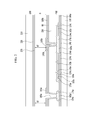
  • FIG. 1 is a layout view of a liquid crystal display, according to an exemplary embodiment of the present system and method.
  • FIG. 2 is a cross-sectional view of the liquid crystal display of FIG. 1 taken along line II-II.
  • FIG. 3 is a plan view illustrating a basic electrode of a field generating electrode of the liquid crystal display exemplified in FIG. 1 .
  • FIG. 4 is a plan view illustrating a first subpixel electrode separated from the basic electrode of the field generating electrode of FIG. 3 .
  • FIG. 5 is a plan view illustrating a second subpixel electrode separated from the basic electrode of the field generating electrode of FIG. 3 .
  • FIG. 6 is a plan view illustrating a common electrode separated from the basic electrode of the field generating electrode of FIG. 3 .
  • FIG. 7 is a schematic view illustrating alignment directions of directors of the liquid crystal molecules of the liquid crystal display according to an exemplary embodiment of the present system and method.
  • FIGS. 8 and 9 are cross-sectional views illustrating alignment directions of directors of the liquid crystal molecules of the liquid crystal display according to an exemplary embodiment of the present system and method.
  • FIGS. 10A, 10B, 10C and 10D are electron microphotographs illustrating results of a first experimental example of the present system and method.
  • FIGS. 11A, 11B and 11C are electron microphotographs illustrating results of a second experimental example of the present system and method.
  • FIGS. 12 and 13 are graphs illustrating results of a third experimental example of the present system and method.
  • FIGS. 14A, 14B, 15A and 15B illustrate structures of a first subpixel electrode, and corresponding electron microphotographs, used in a fourth experimental example and a result thereof.
  • FIG. 1 is a layout view of a liquid crystal display according to an exemplary embodiment of the present system and method.
  • FIG. 2 is a cross-sectional view of the liquid crystal display of FIG. 1 taken along line II-II.
  • FIG. 3 is a plan view illustrating a basic electrode of a field generating electrode of the liquid crystal display exemplified in FIG. 1 .
  • FIG. 4 is a plan view illustrating a first subpixel electrode separated from the basic electrode of the field generating electrode of FIG. 3 .
  • FIG. 5 is a plan view illustrating a second subpixel electrode separated from the basic electrode of the field generating electrode of FIG. 3 .
  • FIG. 6 is a plan view illustrating a common electrode separated from the basic electrode of the field generating electrode of FIG. 3 .
  • the liquid crystal display includes a lower panel 100 and an upper panel 200 facing each other, a liquid crystal layer 3 interposed between the two panels 100 and 200 , and a pair of polarizer films (not illustrated) attached to outer surfaces of the panels 100 and 200 .
  • a gate line 121 , a reference voltage line 131 , and a storage electrode 135 are formed on a first insulation substrate 110 .
  • the gate line 121 mainly extends in a horizontal direction and transfers a gate signal.
  • the gate line 121 includes a first gate electrode 124 a , a second gate electrode 124 b , a third gate electrode 124 c , and a wide end portion (not illustrated) for connection with other layers or an external driving circuit.
  • the reference voltage line 131 may extend in parallel with the gate line 121 and includes the storage electrode 135 surrounding a pixel area.
  • the reference voltage line 131 may have an extension 136 .
  • the extension 136 may be connected with a third drain electrode 175 c , which is described below.
  • a gate insulating layer 140 is formed on the gate line 121 , the reference voltage line 131 , and the storage electrode 135 .
  • a first semiconductor 154 a , a second semiconductor 154 b , and a third semiconductor 154 c which may be made of amorphous or crystalline silicon, are formed on the gate insulating layer 140 .
  • a plurality of ohmic contacts 163 a , 163 b , 163 c , 165 a , 165 b , and 165 c is formed on the first semiconductor 154 a , the second semiconductor 154 b , and the third semiconductor 154 c . If the semiconductors 154 a , 154 b , and 154 c are oxide semiconductors, the ohmic contacts may be omitted.
  • a data line 171 including a first source electrode 173 a and a second source electrode 173 b , a first drain electrode 175 a , a second drain electrode 175 b , a third source electrode 173 c , a third drain electrode 175 c are formed.
  • the constituent elements 171 , 173 a , 173 b , 173 c , 175 a , 175 b , and 175 c are herein referred to as a data conductor.
  • the second drain electrode 175 b is connected with the third source electrode 173 c.
  • the first gate electrode 124 a , the first source electrode 173 a , the first drain electrode 175 a , and the first semiconductor 154 a together form a first switching element Qa, which is a thin film transistor.
  • a channel of the thin film transistor is formed in the semiconductor portion between the first source electrode 173 a and the first drain electrode 175 a .
  • the second gate electrode 124 b , the second source electrode 173 b , the second drain electrode 175 b , and the second semiconductor 154 b together form a second switching element Qb, also a thin film transistor, and a channel of the thin film transistor is formed in the semiconductor portion between the second source electrode 173 b and the second drain electrode 175 b .
  • the third gate electrode 124 c , the third source electrode 173 c , the third drain electrode 175 c , and the third semiconductor 154 c together form a third switching element Qc, also a thin film transistor, and a channel of the thin film transistor is formed in the semiconductor portion between the third source electrode 173 c and the third drain electrode 175 c.
  • the first drain electrode 175 a , and the second drain electrode 175 b , a first passivation layer 180 a are formed on the data line 171 .
  • the first passivation layer 180 a made of an inorganic insulating material, such as silicon nitride or silicon oxide, is formed on the data conductor 171 , 173 a , 173 b , 173 c , 175 a , 175 b , 175 c and the exposed portions of the semiconductors 154 a , 154 b , and 154 c.
  • an inorganic insulating material such as silicon nitride or silicon oxide
  • a color filter 230 is formed on the first passivation layer 180 a .
  • a light blocking member (not illustrated) may be positioned on a region where the color filter 230 is not positioned and overlap a part of the color filter 230 .
  • the light blocking member is herein referred to as a black matrix and blocks light leakage.
  • a capping layer 80 is positioned on the color filter 230 .
  • the capping layer 80 prevents the color filter 230 from being lifted and suppresses the contamination of the liquid crystal layer 3 due to an organic material, such as a solvent flowing from the color filter, thereby preventing defects that may otherwise result when a screen is driven, such as an afterimage.
  • a second subpixel electrode 191 b is formed on the capping layer 80 .
  • the second subpixel electrode 191 b forms part of a basic electrode 199 illustrated in FIG. 3 or one or more modifications thereof.
  • the basic electrode 199 includes a pixel electrode 191 including a first subpixel electrode 191 a and the second subpixel electrode 191 b , and a common electrode 270 .
  • a plurality of patterns of the basic electrode 199 may be connected to each other in one pixel area.
  • the liquid crystal display may include two to four basic electrodes 199 in one pixel area.
  • the pixel electrode 191 including the first and second subpixel electrodes 191 a and 191 b is described with respect to the basic electrode 199 .
  • a second passivation layer 180 b is formed on the second subpixel electrode 191 b
  • the first subpixel electrode 191 a is formed on the second passivation layer 180 b
  • the first subpixel electrode 191 a includes a basic electrode 199 illustrated in FIG. 3 or one or more modifications thereof.
  • the second subpixel electrode 191 b is formed to substantially surround the first subpixel electrode 191 a.
  • the first subpixel electrode 191 a includes a first plate portion 192 a , a first stem 193 a , and a plurality of first branches 194 a (e.g., including 194 a 1 , 194 a 2 , 194 a 3 and 194 a 4 ).
  • the first subpixel electrode 191 a has a substantially rhombus shape except for a protrusion 193 a 2 , which is an end portion of the first stem 193 a and described below.
  • the outline of the rhombus shape coincides with a virtual line connecting edges of the first branches 194 a .
  • the first plate portion 192 a is positioned at the center of the first subpixel electrode 191 a , the first stem 193 a extends from the first plate portion 192 a in a cross shape, and the first branches 194 a extend from the first plate portion 192 a and the first stem 193 a.
  • the first plate portion 192 a has a substantially rhombus shape and is formed as an entire plate that does not include any cutout inside, and the perimeter thereof is surrounded by the first stem 193 a and the first branch 194 a .
  • a diagonal direction of the rhombus shape formed by the first plate portion 192 a may coincide with a diagonal direction of the rhombus shape formed by the first subpixel electrode 191 a.
  • a first length l 1 corresponding to a distance from the center of the first plate portion 192 a to one side may be about 14 ⁇ m or less.
  • control force for the liquid crystal molecules decreases in a first region A 1 (see FIG. 7 ) around the first plate portion 192 a and a driving time of the liquid crystal display increases.
  • texturing in the first region A 1 may occur and the transmittance may deteriorate.
  • the length of the first branches 194 a may be relatively increased.
  • first branches 194 a allows the liquid crystal molecules to be controlled by a fringe field generated in the first branches 194 a (more specifically, a cross portion 194 a 1 ) in the first region A 1 .
  • a detailed experimental result for the first length l 1 is described below.
  • the first stem 193 a extends through a vertex of the rhombus shape of the first subpixel electrode 191 a from a corresponding vertex of the rhombus shape of the first plate portion 192 a .
  • the protrusion 193 a 2 extending through the vertex of the rhombus shape overlaps with a second plate portion 192 b of the second subpixel electrode 191 b to be described below.
  • the first stem 193 a includes a cross portion 193 a 1 that is disposed inside the rhombus shape of the first subpixel electrode 191 a and free from overlap with (i.e., does not overlap) with the second plate portion 192 b , and includes a protrusion 193 a 2 that extends from the cross portion 193 a 1 beyond the rhombus shape of the first subpixel electrode 191 a and overlaps with the second plate portion 192 b.
  • the first branches 194 a extending from the first plate portion 192 a and the first stem 193 a extend in four directions. That is, the first branches 194 a include a plurality of first minute branches 194 a 1 extending obliquely in an upper right direction from the first plate portion 192 a and the first stem 193 a , a plurality of second minute branches 194 a 2 extending obliquely in a lower right direction, a plurality of third minute branches 194 a 3 extending obliquely in a lower left direction, and a plurality of fourth minute branches 194 a 4 extending obliquely in an upper right direction, such as shown in FIG. 4 .
  • the outline of the outer edges of the minute branches 194 a 1 to 194 a 4 forms the rhombus shape of the first subpixel electrode 191 a.
  • the second subpixel electrode 191 b includes a second plate portion 192 b and a plurality of second branches 194 b .
  • the second plate portion 192 b surrounds the plurality of first branches 194 a of the first subpixel electrode 191 a on a plane, and the second branches 194 b extend from the second plate portion 192 b.
  • the second plate portion 192 b has a similar shape to a shape in which four parallelogram plates positioned outside the first to fourth minute branches 194 a 1 to 194 a 4 of the first subpixel electrode 191 a are combined.
  • the second plate portion 192 b generally has an overall shape of a rhombus that has its vertex portions removed and includes an opening 192 bo in the shape of a rhombus. Accordingly, the second plate portion 192 b generally has a shape similar to a quadrangular ring.
  • the second branches 194 b of the second subpixel electrode 191 b include a plurality of fifth minute branches 194 b 1 extending obliquely in an upper right direction from the second plate portion 192 b , a plurality of sixth minute branches 194 b 2 extending obliquely in a lower right direction, a plurality of seventh minute branches 194 b 3 extending obliquely in a lower left direction, and a plurality of eighth minute branches 194 b 4 extending obliquely in an upper right direction, such as shown in FIG. 5 .
  • the directions in which the first to fourth minute branches 194 a 1 to 194 a 4 and the fifth to eighth minute branches 194 b 1 to 194 b 4 extend may form angles of about 45 degrees or 135 degrees with the direction in which the gate line 121 extends.
  • the first to fourth minute branches 194 a 1 to 194 a 4 and the fifth to eighth minute branches 194 b 1 to 194 b 4 may form angles of about 45 degrees or 135 degrees with the first stem 193 a .
  • minute branches extending in different directions may be orthogonal to each other (for example, the first minute branches 194 a 1 and the second minute branches 194 a 2 ) or parallel to each other (for example, the first minute branches 194 a 1 and the third minute branches 194 a 3 ).
  • the first branches 194 a of the first subpixel electrode 191 a and the second branches 194 b of the second subpixel electrode 191 b have the plurality of minute branches ( 194 a 1 , 194 b 1 ; 194 a 2 , 194 b 2 ; 194 a 3 , 194 b 3 ; 194 a 4 , 194 b 4 ) extending in different directions to form four domains in which tilted directions of the liquid crystal molecules are differently controlled. As a result, a viewing angle of the liquid crystal display is increased.
  • the outer edges/edge portions of the first to fourth minute branches 194 a 1 to 194 a 4 may coincide with or slightly overlap with the edges/edge portions of the opening 192 bo .
  • an edge adjacent to the second plate portion 192 b among the outer edges of the first branches 194 a of the first subpixel electrode 191 a and an edge adjacent to the first subpixel electrode 191 a among the inner edges of the second plate portion 192 b of the second subpixel electrode 191 b may coincide each other or slightly overlap with each other.
  • the rhombus shape formed the outline of the outer edges of the first branches 194 a and the rhombus shape of the opening 192 bo of the second plate portion 192 b may substantially coincide with each other.
  • the protrusion 193 a 2 of the first stem 193 a of the first subpixel electrode 191 a may generally overlap with the second plate portion 192 b , such as shown in FIG. 3 .
  • the protrusion 193 a 2 may extend past a most outer edge of the second plate portion 192 b . In this case, the end of the protrusion 193 a 2 may not overlap with the second plate portion 192 b.
  • a first contact hole 185 a exposing a part of the first drain electrode 175 a and a second contact hole 185 b exposing a part of the second drain electrode 175 b are formed in the first passivation layer 180 a , the color filter 230 , the capping layer 80 , and the second passivation layer 180 b .
  • An extension 136 of the reference voltage line 131 and a third contact hole 185 c exposing the third drain electrode 175 c are formed in the gate insulating layer 140 , the first passivation layer 180 a , the color filter 230 , the capping layer 80 , and the second passivation layer 180 b.
  • a first extension 195 a of the first subpixel electrode 191 a is physically and electrically connected to the first drain electrode 175 a through the first contact hole 185 a .
  • a second extension 195 b of the second subpixel electrode 191 b is physically and electrically connected to the second drain electrode 175 b through the second contact hole 185 b.
  • the first subpixel electrode 191 a and the second subpixel electrode 191 b receive data voltages from the first drain electrode 175 a and the second drain electrode 175 b through the first contact hole 185 a and the second contact hole 185 b , respectively.
  • a connecting member 195 is formed on the extension 136 of the reference voltage line 131 exposed through the third contact hole 185 c and the third drain electrode 175 c .
  • the third drain electrode 175 c is physically and electrically connected to the extension 136 of the reference voltage line 131 through the connecting member 195 .
  • a light blocking member 220 and a common electrode 270 are formed on a second insulation substrate 210 .
  • the common electrode 270 may be formed as a plate that does not include cutouts and patterns, such as shown in FIG. 6 .
  • FIG. 2 shows the light blocking member 220 as being formed on the upper panel 200 , the light blocking member 220 may be positioned on the lower panel 100 .
  • the color filter 230 is described above as being positioned on the lower panel 100 , the color filter 230 may be positioned on the upper panel 200 .
  • Alignment layers may be formed on the inner surfaces of the lower and upper panels 100 and 200 (i.e., the surfaces of the two panels facing each other) and may be vertical alignment layers.
  • a polarizer (not illustrated) may be provided on each of the two outer surfaces of the lower and upper panels 100 and 200 .
  • the transmissive axes of the two polarizers may be orthogonal to each other.
  • One of the transmissive axes may be parallel to the gate line 121 .
  • the liquid crystal layer 3 may have negative dielectric anisotropy, in which case, the long axis of the liquid crystal molecules of the liquid crystal layer 3 is aligned orthogonal to the surfaces of the two panels 100 and 200 when the electric field is not applied. Accordingly, incident light does not pass through the display panel and is blocked by the two polarizers having orthogonal transmissive axes when the electric field is not applied.
  • the first subpixel electrode 191 a and the second subpixel electrode 191 b to which the data voltages are applied generate the electric field together with the common electrode 270 of the upper panel 200 .
  • the liquid crystal molecules of the liquid crystal layer 3 which are aligned so as to be orthogonal to the surfaces of the two electrodes 191 and 270 when the electric field is not applied, are tilted in a horizontal direction with respect to the surfaces of the two electrodes 191 and 270 .
  • the amount of light passing through the display panel varies according to the tilted degree of the liquid crystal molecules, and thus, the luminance of the pixels may be changed.
  • a liquid crystal display according to an exemplary embodiment of the present system and method is described above. Hereinafter, a driving method is described.
  • the gate-on signal When a gate-on signal is applied to the gate line 121 , the gate-on signal is applied to the first gate electrode 124 a , the second gate electrode 124 b , and the third gate electrode 124 c to turn on the first switching element Qa, the second switching element Qb, and the third switching element Qc. Accordingly, the data voltage applied to the data line 171 is transmitted to the first subpixel electrode 191 a and the second subpixel electrode 191 b through the turned-on first switching element Qa and second switching element Qb as a first voltage and a second voltage, respectively.
  • the second voltage applied to the second subpixel electrode 191 b is divided through the third switching element Qc connected in series with the second switching element Qb. Accordingly, the second voltage applied to the second subpixel electrode 191 b is smaller than the first voltage applied to the first subpixel electrode 191 a.
  • the difference in voltage between the first subpixel electrode 191 a and the common electrode 270 is larger than the difference in voltage between the second subpixel electrode 191 b and the common electrode 270 . Accordingly, charging voltages of a first liquid crystal capacitor formed between the first subpixel electrode 191 a and the common electrode 270 and a second liquid crystal capacitor formed between the second subpixel electrode 191 b and the common electrode 270 represent different gamma curves, and a gamma curve of one pixel voltage becomes a curve combining the gamma curves.
  • a combined gamma curve at the front side coincides with a reference gamma curve at the front, which is most appropriately determined, and a combined gamma curve at the side closely approximates the reference gamma curve at the front. As such, side visibility is improved.
  • a ratio of the second voltage applied to the second subpixel electrode 191 b to the first voltage applied to the first subpixel electrode 191 a may be about 0.83 or less.
  • the voltage ratio increases, particularly, in a second region A 2 (see FIG. 7 ) around a portion where the second plate portion 192 b of the second subpixel electrode 191 b and the protrusion 193 a 2 of the first stem 193 a of the first subpixel electrode 191 a overlap with each other, the intensity of the fringe field generated at the edge of the protrusion 193 a 2 due to the second voltage decreases.
  • an output terminal of the second switching element Qb connected to the second subpixel electrode 191 b configuring the second liquid crystal capacitor and the third switching element Qc connected to the divided reference voltage line are included so that the voltage charged in the first liquid crystal capacitor and the voltage charged in the second liquid crystal capacitor are different.
  • various techniques for making the voltages charged in the first liquid crystal capacitor and the second liquid crystal capacitor different may be applied to the present system and method.
  • the liquid crystal display does not include the third switching element Qc and constituent elements related with the switching element Qc (for example, the extension 136 of the reference voltage line 131 , the connecting member 195 , and the like), the side visibility may be improved, which is described below.
  • the first subpixel electrode 191 a is formed on the second passivation layer 180 b
  • the second subpixel electrode 191 b is formed below the second passivation layer 180 b . Accordingly, a first gap g 1 between the first subpixel electrode 191 a and the common electrode 270 is smaller than a second gap g 2 between the second subpixel electrode 191 b and the common electrode 270 .
  • the intensity of the electric field generated between the first subpixel electrode 191 a and the common electrode 270 is larger than the intensity of the electric field generated between the second subpixel electrode 191 b and the common electrode 270 .
  • the difference between the intensity of the electric field generated between the first subpixel electrode 191 a and the common electrode 270 and the intensity of the electric field generated between the second subpixel electrode 191 b and the common electrode 270 may be controlled.
  • charging voltages of a first liquid crystal capacitor formed between the first subpixel electrode 191 a and the common electrode 270 and a second liquid crystal capacitor formed between the second subpixel electrode 191 b and the common electrode 270 represent different gamma curves, and a gamma curve of one pixel voltage becomes a curve combining the gamma curves.
  • a combined gamma curve at the front coincides with a reference gamma curve at the front, which is most appropriately determined, and a combined gamma curve at the side closely approximates the reference gamma curve at the front. As such, side visibility is improved.
  • the liquid crystal display may include an output terminal of the second switching element Qb connected to the second subpixel electrode 191 b configuring the second liquid crystal capacitor and a third switching element Qc connected to a step-down capacitor.
  • the third switching element Qc may be connected to a different gate line from the gate line to which the first switching element Qa and the second switching element Qb are connected.
  • the third switching element Qc may be turned on after the first switching element Qa and the second switching element Qb are turned on and then turned off.
  • the third switching element Qc When the third switching element Qc is turned on after switching elements Qa and Qb are turned off, charges move to the step-down capacitor through the third switching element Qc from the second subpixel electrode 191 b . This causes the charging voltage of the second liquid crystal capacitor to decrease and the step-down capacitor to charge. Since the charging voltage of the second liquid crystal capacitor is decreased by the step-down capacitor, the charging voltage of the second liquid crystal capacitor is smaller than the charging voltage of the first liquid crystal capacitor.
  • first liquid crystal capacitor and the second liquid crystal capacitor may be connected to different data lines and thus receive different data voltages.
  • the charged voltages between the first liquid crystal capacitor and the second liquid crystal capacitor may be different from each other.
  • the charged voltages between the first liquid crystal capacitor and the second liquid crystal capacitor may be differently set.
  • FIG. 7 is a schematic view illustrating alignment directions of directors of the liquid crystal molecules of the liquid crystal display according to an exemplary embodiment of the present system and method.
  • FIGS. 8 and 9 are cross-sectional views illustrating alignment directions of directors of the liquid crystal molecules of the liquid crystal display according to an exemplary embodiment of the present system and method.
  • a first fringe field F 1 is generated in a direction vertical to an edge (a first edge) of the second branches 194 b of the second subpixel electrode 191 b . Due to the effect of the first fringe field F 1 , first liquid crystal molecules 31 a positioned around the second branches 194 b are tilted in a direction parallel with the direction of the first fringe field F 1 and parallel with a longitudinal direction in which the second branch 194 b extends.
  • a second fringe field F 2 is generated at an edge (a second edge) of the second plate portion 192 b of the second subpixel electrode 191 b adjacent to the second branch 194 b . Due to the effect of the second fringe field F 2 , second liquid crystal molecules 31 b positioned around the second edge are tilted in a direction vertical to the second edge, which is the same as the tilted direction of the first liquid crystal molecules 31 a.
  • a third fringe field F 3 is generated at an edge (a third edge) of the second plate portion 192 b of the second subpixel electrode 191 b adjacent to the first branches 194 a .
  • Third liquid crystal molecules 31 c positioned around the third edge are influenced by the third fringe field F 3 to be tilted in a direction vertical to the third edge of the second plate portion 192 b .
  • the direction is opposite to the tilted directions of the first liquid crystal molecules 31 a and the second liquid crystal molecules 31 b.
  • a fourth fringe field F 4 is generated at an edge (a fourth edge) of the first branches 194 a adjacent to the second plate portion 192 b of the second subpixel electrode 191 b .
  • Fourth liquid crystal molecules 31 d near the fourth edge are tilted in a direction vertical to the fourth fringe field F 4 .
  • the direction is the same as the tilted directions of the first liquid crystal molecule 31 a and the second liquid crystal molecule 31 b.
  • the intensity of the electric field formed between the first subpixel electrode 191 a and the common electrode 270 is greater than the intensity of the electric field formed between the second subpixel electrode 191 b and the common electrode 270 .
  • the intensity of the third fringe field F 3 is reduced due to shielding by the first branches 194 a . Therefore, the intensity of the fourth fringe field F 4 is larger than that of the third fringe field F 3 . Accordingly, the liquid crystal molecules positioned around the boundary of the first subpixel electrode 191 a and the second subpixel electrode 191 b are influenced to a greater extent by the fourth fringe field F 4 , which has a greater intensity than the third fringe field F 3 .
  • the third liquid crystal molecules 31 c are tilted in a direction parallel to that of the nearby second and fourth liquid crystal molecules 31 b and 31 d . Accordingly, texturing does not occur around the boundary of the first subpixel electrode 191 a and the second subpixel electrode 191 b , and the luminance of the liquid crystal display is increased.
  • a fifth fringe field F 5 is generated at an edge (fifth edge) of the first branch 194 a .
  • Fifth liquid crystal molecules 31 e near the first branch 194 a of the first subpixel electrode 191 a are influenced by the fifth fringe field F 5 to be tilted in a direction parallel with the fifth fringe field F 5 and parallel with the longitudinal direction in which the first branch 194 a extends.
  • a sixth fringe field F 6 is generated at an edge (sixth edge) of the first plate portion 192 a .
  • Sixth liquid crystal molecules 31 f near the first plate portion 192 a of the first subpixel electrode 191 a are influenced by the sixth fringe field F 6 to be tilted in the same direction as the tilted direction of the fifth liquid crystal molecules 31 e.
  • a seventh fringe field F 7 and an eighth fringe field F 8 are generated at both edges (seventh and eighth edges) of the protrusion 193 a 2 , respectively.
  • Seventh liquid crystal molecules 31 g positioned around the seventh edge are tilted in a direction vertical to the seventh edge by the seventh fringe field F 7 and parallel with the extending direction of the first branch 194 a by influence of neighboring liquid crystal molecules, which are also tilted in the direction parallel with the extending direction of the first branch 194 a .
  • Eighth liquid crystal molecules 31 h positioned around the eighth edge are also tilted in a direction parallel with the extending direction of the first branch 194 a by the seventh fringe field F 7 and the tilted direction of the neighboring liquid crystal molecules.
  • the seventh and eighth liquid crystal molecules in the second region A 2 are controlled by the protrusion 193 a 2 of the first stem 193 a of the first subpixel electrode 191 a , thereby suppressing texturing that may otherwise be generated in the second region A 2 and improving the luminance.
  • the cutouts are not formed at the common electrode 270 to prevent a loss of transmittance which may be generated by misalignment of the cutouts of the common electrode 270 and the pixel electrode 191 . Further, a mask and a process for forming the cutouts at the common electrode 270 are not required.
  • FIGS. 10A, 10B, 10C and 10D are electron microphotographs illustrating results of a first experimental example of the present system and method.
  • FIGS. 10A, 10B, 10C and 10D in the liquid crystal display having the pixel structure according to the exemplary embodiment of FIGS. 1 to 6 , changes in luminance by varying the ratio of the second voltage applied to the second subpixel electrode 191 b to the first voltage applied to the first subpixel electrode 191 a are illustrated in electron microphotographs.
  • FIGS. 10A, 10B, 10C and 10D illustrate results when the voltage ratios are 0.77, 0.8, 0.83, and 0.86, respectively. Since the tilted direction of the liquid crystal molecules are opposite to each other on a domain boundary, which substantially coincides with the first branches 194 of the first subpixel electrode 191 a , the domain boundary is illustrated to be relatively dark.
  • the voltage ratio is 0.83 or less, it can be seen that the direction of the liquid crystal molecules on the domain boundary is controlled well except for typical transmittance deterioration.
  • the voltage ratio is 0.86, texturing having a ring shape is generated in the second region A 2 , and as a result, the transmittance is reduced as compared with the cases in which the voltage ratio is 0.83 or less. It is understood that the texturing occurs because the size of the fringe field controlling the liquid crystal molecules in the second region A 2 becomes so small that it cannot suppress the generation of the textures when the voltage ratio is larger than 0.83.
  • FIGS. 11A, 11B and 11C are electron microphotographs illustrating results of a second experimental example of the present system and method.
  • FIGS. 11A, 11B and 11C illustrate cases in which lengths l 1 , l 2 , l 3 , and l 4 of the pixel electrode 191 (see FIG. 3 ) are formed to be 11 ⁇ m, 25 ⁇ m, 21 ⁇ m, and 29 ⁇ m; 14 ⁇ m, 22 ⁇ m, 25 ⁇ m, and 25 ⁇ m; and 17 ⁇ m, 22 ⁇ m, 23.5 ⁇ m, and 23.5 ⁇ m, respectively.
  • the first length l 1 corresponds to a distance from the center of the first plate portion 192 a to one side.
  • the second length l 2 corresponds to a length of the first branch 194 a extending from one side of the first plate portion 192 a .
  • the third length l 3 represents corresponds to a gap between an inner side and a right side of the second plate portion 192 b that are adjacent to each other.
  • the fourth length l 4 corresponds to a largest length of the second branch 194 b .
  • the sum of the lengths l 1 , l 2 , l 3 , and l 4 is substantially equal to half of the diagonal length of the pixel electrode 191 configuring the basic electrode 199 .
  • FIGS. 11A, 11B and 11C are electron microphotographs taken 130 ms after each case is driven.
  • the three lower photographs of FIGS. 11A, 11B and 11C are electron microphotographs taken 300 ms after each case is driven.
  • the first distance l 1 is 11 ⁇ m and 14 ⁇ m, respectively.
  • the first distance l 1 is 17 ⁇ m
  • the control force for the liquid crystal molecules is decreased and the transmittance is reduced. It is understood that this is caused because the length of the first branches 194 a is decreased as the size of the first plate portion 192 a is increased, and thus, influence by the fringe field of the first branches 194 a in the first region A 1 is reduced.
  • FIGS. 12 and 13 are graphs illustrating results of a third experimental example of the present system and method.
  • FIG. 12 is a graph illustrating a change in transmittance over time for varying sizes of the first plate portion 192 a .
  • FIG. 13 is a graph of the transmittance of FIG. 12 normalized as luminance.
  • a one-dot dashed line represents a case in which l 1 and l 2 are 8 ⁇ m and 28 ⁇ m, respectively
  • a two-dot dashed line represents a case in which l 1 and l 2 are 11 ⁇ m and 25 ⁇ m, respectively
  • a solid line represents a case in which l 1 and l 2 are 14 ⁇ m and 22 ⁇ m, respectively
  • a dotted line represents a case in which l 1 and l 2 are 17 ⁇ m and 19 ⁇ m, respectively.
  • FIGS. 14A, 14B, 15A and 15B illustrate structures of a first subpixel electrode, and their corresponding electron microphotographs, used in a fourth experimental example and a result thereof.
  • FIG. 14 illustrates a case in which the first stem 193 a of the first subpixel electrode 191 a includes the protrusion 193 a 2 and the second plate portion 192 b of the second subpixel electrode 191 b overlaps with the protrusion 193 a 2 in the second region A 2 , like the exemplary embodiment of FIGS. 1 to 6 .
  • FIG. 15 illustrates a case in which the first stem 193 a of the first subpixel electrode 191 a does not include the protrusion 193 a 2 but only includes a part corresponding to the cross portion 193 a 1 .
  • FIGS. 14A and 15A illustrate the structure of the first subpixel electrode 191 a .
  • FIGS. 14B and 15B illustrate the electron microphotographs.
  • the luminance is deteriorated only on the boundary of the domain, meaning the liquid crystal molecules in the second region A 2 are controlled well.
  • FIG. 15B it can be seen that the luminance is deteriorated on the boundary of the domain and around the boundary. It is understood that the difference in the result occurs because the liquid crystal molecules in the second region A 2 are controlled by the fringe field generated in the protrusion 193 a 2 according to the exemplary embodiment of the present system and method.

Landscapes

  • Physics & Mathematics (AREA)
  • Nonlinear Science (AREA)
  • Mathematical Physics (AREA)
  • Chemical & Material Sciences (AREA)
  • Crystallography & Structural Chemistry (AREA)
  • General Physics & Mathematics (AREA)
  • Optics & Photonics (AREA)
  • Geometry (AREA)
  • Spectroscopy & Molecular Physics (AREA)
  • Liquid Crystal (AREA)
  • Engineering & Computer Science (AREA)
  • Microelectronics & Electronic Packaging (AREA)

Abstract

A liquid crystal display according to an embodiment includes: a lower panel including a pixel electrode having a first subpixel electrode and a second subpixel electrode and an insulating layer between the first subpixel electrode and the second subpixel electrode; an upper panel including a common electrode; and a liquid crystal layer disposed between the lower panel and the upper panel. The first subpixel electrode includes a first plate portion, a first stem having a cross portion extending from the first plate portion and a protrusion extending from the cross portion, and a plurality of first branches extending from the first plate portion and the first stem. The second subpixel electrode includes a second plate portion having an opening and a plurality of second branches extending from the second plate portion. The cross portion does not overlap with the second plate portion. The protrusion overlaps with the second plate portion.

Description

CROSS-REFERENCE TO RELATED APPLICATION
This application claims priority to and the benefit of Korean Patent Application No. 10-2014-0165474 filed in the Korean Intellectual Property Office on Nov. 25, 2014, the entire contents of which are incorporated herein by reference.
BACKGROUND
(a) Technical Field
The present disclosure relates to a liquid crystal display.
(b) Description of the Related Art
A liquid crystal display generally includes two sheets of panels with field generating electrodes such as a pixel electrode, a common electrode, and the like, and a liquid crystal layer interposed between the two sheets of panels. The liquid crystal display generates an electric field in the liquid crystal layer by applying a voltage to the field generating electrodes. The strength of the generated electric field determines the alignment direction of the liquid crystal molecules in the liquid crystal layer, which in turn determines the polarization of incident light by the liquid crystal layer. Thus, by controlling the voltage being applied to the field generating electrodes, thereby controlling the strength of the generated electric field, the liquid crystal display controls the polarization of incident light to display images.
A vertically aligned mode liquid crystal display is a liquid crystal display in which the long axis of the liquid crystal molecules is aligned perpendicular to a planar surface of the display panels while the electric field is not applied. To provide a wide viewing angle for the vertically aligned mode liquid crystal display, a method of forming a plurality of domains in which the liquid crystal molecules in adjacent domains are tilted in different directions (e.g., forming cutouts such as minute slits in the field generating electrode, and the like) is used. Further, to suppress texturing or deterioration in luminance around a domain boundary, a method of forming cutouts or patterns in the common electrode is used.
Also, a method of improving the side visibility of the vertically aligned mode liquid crystal display to approximate its front visibility, a technology of varying transmittance by dividing one pixel into two subpixels and differently applying voltages of the two subpixels has been developed.
SUMMARY
The present disclosure provides a liquid crystal display having advantages of improved side visibility and improved light transmittance.
The present disclosure also provides a liquid crystal display having advantages of reducing deterioration in image quality that may occur due to misalignment of a lower panel and an upper panel.
An exemplary embodiment of the present system and method provides a liquid crystal display including: a lower panel including a pixel electrode having a first subpixel electrode and a second subpixel electrode and an insulating layer disposed between the first subpixel electrode and the second subpixel electrode; an upper panel including a common electrode; and a liquid crystal layer disposed between the lower panel and the upper panel. The first subpixel electrode may include a first plate portion, a first stem having a cross portion extending from the first plate portion in a cross shape and a protrusion extending from the cross portion, and a plurality of first branches extending from the first plate portion and the first stem. The second subpixel electrode may include a second plate portion having an opening therein and a plurality of second branches extending from the second plate portion. The cross portion may be free from overlap with the second plate portion and the protrusion may overlap with the second plate portion.
The first subpixel electrode may be positioned on the insulating layer and the second subpixel electrode may be positioned below the insulating layer.
The common electrode may be formed as a plate.
The second plate portion may surround the plurality of first branches.
The opening of the second plate portion may have a planar, rhombus shape.
An edge of the first branch and an edge of the second plate portion adjacent to the first branch may coincide with each other.
An edge of the first branch and an edge of the second plate portion adjacent to the first branch may overlap with each other.
The first plate portion may have a planar, rhombus shape.
A length corresponding to a distance from the center of the rhombus shaped first plate portion to one side may be about 14 μm or less.
The first stem may extend in a diagonal direction of the rhombus shaped first plate portion.
The first subpixel electrode may be configured to receive a first voltage, the second subpixel electrode may be configured to receive a second voltage, and a ratio of the second voltage to the first voltage may be about 0.83 or less.
The plurality of first branches may include a plurality of minute branches extending in four different directions, and the plurality of second branches may include a plurality of minute branches extending in the four different directions.
The four different directions may be orthogonal to each other or parallel to each other.
The plurality of first branches may extend from portions of the first stem excluding the protrusion.
According to the liquid crystal display of the present system and method, it is possible to suppress texturing without deteriorating transmittance while approximating side visibility to front visibility. Further, since cutouts need not to be formed in the common electrode to improve the control force of the liquid crystal molecules, texturing or deterioration in transmittance due to misalignment of the cutouts of the common electrode and the pixel electrode does not occur.
BRIEF DESCRIPTION OF THE DRAWINGS
FIG. 1 is a layout view of a liquid crystal display, according to an exemplary embodiment of the present system and method.
FIG. 2 is a cross-sectional view of the liquid crystal display of FIG. 1 taken along line II-II.
FIG. 3 is a plan view illustrating a basic electrode of a field generating electrode of the liquid crystal display exemplified in FIG. 1.
FIG. 4 is a plan view illustrating a first subpixel electrode separated from the basic electrode of the field generating electrode of FIG. 3.
FIG. 5 is a plan view illustrating a second subpixel electrode separated from the basic electrode of the field generating electrode of FIG. 3.
FIG. 6 is a plan view illustrating a common electrode separated from the basic electrode of the field generating electrode of FIG. 3.
FIG. 7 is a schematic view illustrating alignment directions of directors of the liquid crystal molecules of the liquid crystal display according to an exemplary embodiment of the present system and method.
FIGS. 8 and 9 are cross-sectional views illustrating alignment directions of directors of the liquid crystal molecules of the liquid crystal display according to an exemplary embodiment of the present system and method.
FIGS. 10A, 10B, 10C and 10D are electron microphotographs illustrating results of a first experimental example of the present system and method.
FIGS. 11A, 11B and 11C are electron microphotographs illustrating results of a second experimental example of the present system and method.
FIGS. 12 and 13 are graphs illustrating results of a third experimental example of the present system and method.
FIGS. 14A, 14B, 15A and 15B illustrate structures of a first subpixel electrode, and corresponding electron microphotographs, used in a fourth experimental example and a result thereof.
DETAILED DESCRIPTION OF THE EMBODIMENTS
The present system and method are described hereinafter with reference to the accompanying drawings in which exemplary embodiments are shown. Those of ordinary skill in the art would realize that the described embodiments may be modified in various different ways without departing from the spirit or scope of the present system and method.
In the drawings, the thickness of layers, films, panels, regions, etc., is exaggerated for clarity. When an element such as a layer, film, region, or substrate is referred to as being “on” another element, it may be directly on the other element, or intervening elements may also be present. In contrast, when an element is referred to as being “directly on” another element, there are no intervening elements present.
A liquid crystal display according to an exemplary embodiment of the present system and method is described in detail with reference to the accompanying drawings.
FIG. 1 is a layout view of a liquid crystal display according to an exemplary embodiment of the present system and method. FIG. 2 is a cross-sectional view of the liquid crystal display of FIG. 1 taken along line II-II. FIG. 3 is a plan view illustrating a basic electrode of a field generating electrode of the liquid crystal display exemplified in FIG. 1. FIG. 4 is a plan view illustrating a first subpixel electrode separated from the basic electrode of the field generating electrode of FIG. 3. FIG. 5 is a plan view illustrating a second subpixel electrode separated from the basic electrode of the field generating electrode of FIG. 3. FIG. 6 is a plan view illustrating a common electrode separated from the basic electrode of the field generating electrode of FIG. 3.
Referring to FIGS. 1 to 6, the liquid crystal display includes a lower panel 100 and an upper panel 200 facing each other, a liquid crystal layer 3 interposed between the two panels 100 and 200, and a pair of polarizer films (not illustrated) attached to outer surfaces of the panels 100 and 200.
First, the lower panel 100 is described.
A gate line 121, a reference voltage line 131, and a storage electrode 135 are formed on a first insulation substrate 110. The gate line 121 mainly extends in a horizontal direction and transfers a gate signal.
The gate line 121 includes a first gate electrode 124 a, a second gate electrode 124 b, a third gate electrode 124 c, and a wide end portion (not illustrated) for connection with other layers or an external driving circuit.
The reference voltage line 131 may extend in parallel with the gate line 121 and includes the storage electrode 135 surrounding a pixel area. The reference voltage line 131 may have an extension 136. The extension 136 may be connected with a third drain electrode 175 c, which is described below.
A gate insulating layer 140 is formed on the gate line 121, the reference voltage line 131, and the storage electrode 135.
A first semiconductor 154 a, a second semiconductor 154 b, and a third semiconductor 154 c, which may be made of amorphous or crystalline silicon, are formed on the gate insulating layer 140.
A plurality of ohmic contacts 163 a, 163 b, 163 c, 165 a, 165 b, and 165 c is formed on the first semiconductor 154 a, the second semiconductor 154 b, and the third semiconductor 154 c. If the semiconductors 154 a, 154 b, and 154 c are oxide semiconductors, the ohmic contacts may be omitted.
On the ohmic contacts 163 a, 163 b, 163 c, 165 a, 165 b, and 165 c and the gate insulating layer 140, a data line 171 including a first source electrode 173 a and a second source electrode 173 b, a first drain electrode 175 a, a second drain electrode 175 b, a third source electrode 173 c, a third drain electrode 175 c are formed. The constituent elements 171, 173 a, 173 b, 173 c, 175 a, 175 b, and 175 c are herein referred to as a data conductor. The second drain electrode 175 b is connected with the third source electrode 173 c.
The first gate electrode 124 a, the first source electrode 173 a, the first drain electrode 175 a, and the first semiconductor 154 a together form a first switching element Qa, which is a thin film transistor. A channel of the thin film transistor is formed in the semiconductor portion between the first source electrode 173 a and the first drain electrode 175 a. Similarly, the second gate electrode 124 b, the second source electrode 173 b, the second drain electrode 175 b, and the second semiconductor 154 b together form a second switching element Qb, also a thin film transistor, and a channel of the thin film transistor is formed in the semiconductor portion between the second source electrode 173 b and the second drain electrode 175 b. Likewise, the third gate electrode 124 c, the third source electrode 173 c, the third drain electrode 175 c, and the third semiconductor 154 c together form a third switching element Qc, also a thin film transistor, and a channel of the thin film transistor is formed in the semiconductor portion between the third source electrode 173 c and the third drain electrode 175 c.
The first drain electrode 175 a, and the second drain electrode 175 b, a first passivation layer 180 a are formed on the data line 171.
The first passivation layer 180 a made of an inorganic insulating material, such as silicon nitride or silicon oxide, is formed on the data conductor 171, 173 a, 173 b, 173 c, 175 a, 175 b, 175 c and the exposed portions of the semiconductors 154 a, 154 b, and 154 c.
A color filter 230 is formed on the first passivation layer 180 a. A light blocking member (not illustrated) may be positioned on a region where the color filter 230 is not positioned and overlap a part of the color filter 230. The light blocking member is herein referred to as a black matrix and blocks light leakage.
A capping layer 80 is positioned on the color filter 230. The capping layer 80 prevents the color filter 230 from being lifted and suppresses the contamination of the liquid crystal layer 3 due to an organic material, such as a solvent flowing from the color filter, thereby preventing defects that may otherwise result when a screen is driven, such as an afterimage.
A second subpixel electrode 191 b is formed on the capping layer 80. The second subpixel electrode 191 b forms part of a basic electrode 199 illustrated in FIG. 3 or one or more modifications thereof. Here, the basic electrode 199 includes a pixel electrode 191 including a first subpixel electrode 191 a and the second subpixel electrode 191 b, and a common electrode 270. A plurality of patterns of the basic electrode 199 may be connected to each other in one pixel area. For example, the liquid crystal display may include two to four basic electrodes 199 in one pixel area. Hereinafter, the pixel electrode 191 including the first and second subpixel electrodes 191 a and 191 b is described with respect to the basic electrode 199.
A second passivation layer 180 b is formed on the second subpixel electrode 191 b, and the first subpixel electrode 191 a is formed on the second passivation layer 180 b. The first subpixel electrode 191 a includes a basic electrode 199 illustrated in FIG. 3 or one or more modifications thereof.
The second subpixel electrode 191 b is formed to substantially surround the first subpixel electrode 191 a.
The first subpixel electrode 191 a includes a first plate portion 192 a, a first stem 193 a, and a plurality of first branches 194 a (e.g., including 194 a 1, 194 a 2, 194 a 3 and 194 a 4). The first subpixel electrode 191 a has a substantially rhombus shape except for a protrusion 193 a 2, which is an end portion of the first stem 193 a and described below. The outline of the rhombus shape coincides with a virtual line connecting edges of the first branches 194 a. The first plate portion 192 a is positioned at the center of the first subpixel electrode 191 a, the first stem 193 a extends from the first plate portion 192 a in a cross shape, and the first branches 194 a extend from the first plate portion 192 a and the first stem 193 a.
The first plate portion 192 a has a substantially rhombus shape and is formed as an entire plate that does not include any cutout inside, and the perimeter thereof is surrounded by the first stem 193 a and the first branch 194 a. A diagonal direction of the rhombus shape formed by the first plate portion 192 a may coincide with a diagonal direction of the rhombus shape formed by the first subpixel electrode 191 a.
A first length l1 corresponding to a distance from the center of the first plate portion 192 a to one side may be about 14 μm or less. When the first length l1 is longer than about 14 μm, control force for the liquid crystal molecules decreases in a first region A1 (see FIG. 7) around the first plate portion 192 a and a driving time of the liquid crystal display increases. As a result, texturing in the first region A1 may occur and the transmittance may deteriorate. When the size of the first plate portion 192 a is limited, the length of the first branches 194 a may be relatively increased. Longer first branches 194 a allows the liquid crystal molecules to be controlled by a fringe field generated in the first branches 194 a (more specifically, a cross portion 194 a 1) in the first region A1. A detailed experimental result for the first length l1 is described below.
The first stem 193 a extends through a vertex of the rhombus shape of the first subpixel electrode 191 a from a corresponding vertex of the rhombus shape of the first plate portion 192 a. The protrusion 193 a 2 extending through the vertex of the rhombus shape overlaps with a second plate portion 192 b of the second subpixel electrode 191 b to be described below. That is, the first stem 193 a includes a cross portion 193 a 1 that is disposed inside the rhombus shape of the first subpixel electrode 191 a and free from overlap with (i.e., does not overlap) with the second plate portion 192 b, and includes a protrusion 193 a 2 that extends from the cross portion 193 a 1 beyond the rhombus shape of the first subpixel electrode 191 a and overlaps with the second plate portion 192 b.
The first branches 194 a extending from the first plate portion 192 a and the first stem 193 a (more specifically, the cross portion 193 a 1) extend in four directions. That is, the first branches 194 a include a plurality of first minute branches 194 a 1 extending obliquely in an upper right direction from the first plate portion 192 a and the first stem 193 a, a plurality of second minute branches 194 a 2 extending obliquely in a lower right direction, a plurality of third minute branches 194 a 3 extending obliquely in a lower left direction, and a plurality of fourth minute branches 194 a 4 extending obliquely in an upper right direction, such as shown in FIG. 4. The outline of the outer edges of the minute branches 194 a 1 to 194 a 4 forms the rhombus shape of the first subpixel electrode 191 a.
The second subpixel electrode 191 b includes a second plate portion 192 b and a plurality of second branches 194 b. The second plate portion 192 b surrounds the plurality of first branches 194 a of the first subpixel electrode 191 a on a plane, and the second branches 194 b extend from the second plate portion 192 b.
The second plate portion 192 b has a similar shape to a shape in which four parallelogram plates positioned outside the first to fourth minute branches 194 a 1 to 194 a 4 of the first subpixel electrode 191 a are combined. The second plate portion 192 b generally has an overall shape of a rhombus that has its vertex portions removed and includes an opening 192 bo in the shape of a rhombus. Accordingly, the second plate portion 192 b generally has a shape similar to a quadrangular ring.
Similar to the first branches 194 a of the first subpixel electrode 191 a, the second branches 194 b of the second subpixel electrode 191 b include a plurality of fifth minute branches 194 b 1 extending obliquely in an upper right direction from the second plate portion 192 b, a plurality of sixth minute branches 194 b 2 extending obliquely in a lower right direction, a plurality of seventh minute branches 194 b 3 extending obliquely in a lower left direction, and a plurality of eighth minute branches 194 b 4 extending obliquely in an upper right direction, such as shown in FIG. 5.
The directions in which the first to fourth minute branches 194 a 1 to 194 a 4 and the fifth to eighth minute branches 194 b 1 to 194 b 4 extend may form angles of about 45 degrees or 135 degrees with the direction in which the gate line 121 extends. The first to fourth minute branches 194 a 1 to 194 a 4 and the fifth to eighth minute branches 194 b 1 to 194 b 4 may form angles of about 45 degrees or 135 degrees with the first stem 193 a. Further, the minute branches extending in different directions may be orthogonal to each other (for example, the first minute branches 194 a 1 and the second minute branches 194 a 2) or parallel to each other (for example, the first minute branches 194 a 1 and the third minute branches 194 a 3). As such, the first branches 194 a of the first subpixel electrode 191 a and the second branches 194 b of the second subpixel electrode 191 b have the plurality of minute branches (194 a 1, 194 b 1; 194 a 2, 194 b 2; 194 a 3, 194 b 3; 194 a 4, 194 b 4) extending in different directions to form four domains in which tilted directions of the liquid crystal molecules are differently controlled. As a result, a viewing angle of the liquid crystal display is increased.
When the first subpixel electrode 191 a and the second subpixel electrode 191 b are overlay as shown in FIG. 3, the outer edges/edge portions of the first to fourth minute branches 194 a 1 to 194 a 4 may coincide with or slightly overlap with the edges/edge portions of the opening 192 bo. In more detail, in a plan view, an edge adjacent to the second plate portion 192 b among the outer edges of the first branches 194 a of the first subpixel electrode 191 a and an edge adjacent to the first subpixel electrode 191 a among the inner edges of the second plate portion 192 b of the second subpixel electrode 191 b may coincide each other or slightly overlap with each other. In other words, the rhombus shape formed the outline of the outer edges of the first branches 194 a and the rhombus shape of the opening 192 bo of the second plate portion 192 b may substantially coincide with each other. However, the protrusion 193 a 2 of the first stem 193 a of the first subpixel electrode 191 a may generally overlap with the second plate portion 192 b, such as shown in FIG. 3. According to an exemplary embodiment, the protrusion 193 a 2 may extend past a most outer edge of the second plate portion 192 b. In this case, the end of the protrusion 193 a 2 may not overlap with the second plate portion 192 b.
A first contact hole 185 a exposing a part of the first drain electrode 175 a and a second contact hole 185 b exposing a part of the second drain electrode 175 b are formed in the first passivation layer 180 a, the color filter 230, the capping layer 80, and the second passivation layer 180 b. An extension 136 of the reference voltage line 131 and a third contact hole 185 c exposing the third drain electrode 175 c are formed in the gate insulating layer 140, the first passivation layer 180 a, the color filter 230, the capping layer 80, and the second passivation layer 180 b.
A first extension 195 a of the first subpixel electrode 191 a is physically and electrically connected to the first drain electrode 175 a through the first contact hole 185 a. A second extension 195 b of the second subpixel electrode 191 b is physically and electrically connected to the second drain electrode 175 b through the second contact hole 185 b.
The first subpixel electrode 191 a and the second subpixel electrode 191 b receive data voltages from the first drain electrode 175 a and the second drain electrode 175 b through the first contact hole 185 a and the second contact hole 185 b, respectively.
A connecting member 195 is formed on the extension 136 of the reference voltage line 131 exposed through the third contact hole 185 c and the third drain electrode 175 c. The third drain electrode 175 c is physically and electrically connected to the extension 136 of the reference voltage line 131 through the connecting member 195.
Next, the upper panel 200 is described.
A light blocking member 220 and a common electrode 270 are formed on a second insulation substrate 210.
The common electrode 270 may be formed as a plate that does not include cutouts and patterns, such as shown in FIG. 6.
Although FIG. 2 shows the light blocking member 220 as being formed on the upper panel 200, the light blocking member 220 may be positioned on the lower panel 100. Similarly, although the color filter 230 is described above as being positioned on the lower panel 100, the color filter 230 may be positioned on the upper panel 200.
Alignment layers (not illustrated) may be formed on the inner surfaces of the lower and upper panels 100 and 200 (i.e., the surfaces of the two panels facing each other) and may be vertical alignment layers.
A polarizer (not illustrated) may be provided on each of the two outer surfaces of the lower and upper panels 100 and 200. The transmissive axes of the two polarizers may be orthogonal to each other. One of the transmissive axes may be parallel to the gate line 121.
The liquid crystal layer 3 may have negative dielectric anisotropy, in which case, the long axis of the liquid crystal molecules of the liquid crystal layer 3 is aligned orthogonal to the surfaces of the two panels 100 and 200 when the electric field is not applied. Accordingly, incident light does not pass through the display panel and is blocked by the two polarizers having orthogonal transmissive axes when the electric field is not applied.
The first subpixel electrode 191 a and the second subpixel electrode 191 b to which the data voltages are applied generate the electric field together with the common electrode 270 of the upper panel 200. As a result, the liquid crystal molecules of the liquid crystal layer 3, which are aligned so as to be orthogonal to the surfaces of the two electrodes 191 and 270 when the electric field is not applied, are tilted in a horizontal direction with respect to the surfaces of the two electrodes 191 and 270. The amount of light passing through the display panel varies according to the tilted degree of the liquid crystal molecules, and thus, the luminance of the pixels may be changed.
A liquid crystal display according to an exemplary embodiment of the present system and method is described above. Hereinafter, a driving method is described.
When a gate-on signal is applied to the gate line 121, the gate-on signal is applied to the first gate electrode 124 a, the second gate electrode 124 b, and the third gate electrode 124 c to turn on the first switching element Qa, the second switching element Qb, and the third switching element Qc. Accordingly, the data voltage applied to the data line 171 is transmitted to the first subpixel electrode 191 a and the second subpixel electrode 191 b through the turned-on first switching element Qa and second switching element Qb as a first voltage and a second voltage, respectively. In this case, although the same data voltage is applied to the data line 171, the second voltage applied to the second subpixel electrode 191 b is divided through the third switching element Qc connected in series with the second switching element Qb. Accordingly, the second voltage applied to the second subpixel electrode 191 b is smaller than the first voltage applied to the first subpixel electrode 191 a.
Because the magnitude of the second voltage applied to the second subpixel electrode 191 b is smaller than the magnitude of the first voltage applied to the first subpixel electrode 191 a, the difference in voltage between the first subpixel electrode 191 a and the common electrode 270 is larger than the difference in voltage between the second subpixel electrode 191 b and the common electrode 270. Accordingly, charging voltages of a first liquid crystal capacitor formed between the first subpixel electrode 191 a and the common electrode 270 and a second liquid crystal capacitor formed between the second subpixel electrode 191 b and the common electrode 270 represent different gamma curves, and a gamma curve of one pixel voltage becomes a curve combining the gamma curves. A combined gamma curve at the front side coincides with a reference gamma curve at the front, which is most appropriately determined, and a combined gamma curve at the side closely approximates the reference gamma curve at the front. As such, side visibility is improved.
A ratio of the second voltage applied to the second subpixel electrode 191 b to the first voltage applied to the first subpixel electrode 191 a (second voltage/first voltage) may be about 0.83 or less. As the voltage ratio increases, particularly, in a second region A2 (see FIG. 7) around a portion where the second plate portion 192 b of the second subpixel electrode 191 b and the protrusion 193 a 2 of the first stem 193 a of the first subpixel electrode 191 a overlap with each other, the intensity of the fringe field generated at the edge of the protrusion 193 a 2 due to the second voltage decreases. When the voltage ratio is larger than about 0.83, the control force for the liquid crystal molecules in the second region A2 may deteriorate and fail to suppress texturing and as a result, the transmittance and the image quality may deteriorate. Experimental results for various voltage ratios are described below.
As described above with respect to the exemplary embodiment of FIG. 1, an output terminal of the second switching element Qb connected to the second subpixel electrode 191 b configuring the second liquid crystal capacitor and the third switching element Qc connected to the divided reference voltage line are included so that the voltage charged in the first liquid crystal capacitor and the voltage charged in the second liquid crystal capacitor are different. In addition, various techniques for making the voltages charged in the first liquid crystal capacitor and the second liquid crystal capacitor different may be applied to the present system and method. Thus, even if the liquid crystal display does not include the third switching element Qc and constituent elements related with the switching element Qc (for example, the extension 136 of the reference voltage line 131, the connecting member 195, and the like), the side visibility may be improved, which is described below.
For example, as FIG. 2 shows, the first subpixel electrode 191 a is formed on the second passivation layer 180 b, and the second subpixel electrode 191 b is formed below the second passivation layer 180 b. Accordingly, a first gap g1 between the first subpixel electrode 191 a and the common electrode 270 is smaller than a second gap g2 between the second subpixel electrode 191 b and the common electrode 270. As a result, even though the first subpixel electrode 191 a and the second subpixel electrode 191 b receive the data voltage having the same magnitude from the data line 171, as described above, the intensity of the electric field generated between the first subpixel electrode 191 a and the common electrode 270 is larger than the intensity of the electric field generated between the second subpixel electrode 191 b and the common electrode 270. Further, according to a dielectric constant of the second passivation layer 180 b, the difference between the intensity of the electric field generated between the first subpixel electrode 191 a and the common electrode 270 and the intensity of the electric field generated between the second subpixel electrode 191 b and the common electrode 270 may be controlled.
Accordingly, charging voltages of a first liquid crystal capacitor formed between the first subpixel electrode 191 a and the common electrode 270 and a second liquid crystal capacitor formed between the second subpixel electrode 191 b and the common electrode 270 represent different gamma curves, and a gamma curve of one pixel voltage becomes a curve combining the gamma curves. A combined gamma curve at the front coincides with a reference gamma curve at the front, which is most appropriately determined, and a combined gamma curve at the side closely approximates the reference gamma curve at the front. As such, side visibility is improved.
As another example, the liquid crystal display may include an output terminal of the second switching element Qb connected to the second subpixel electrode 191 b configuring the second liquid crystal capacitor and a third switching element Qc connected to a step-down capacitor. In this case, the third switching element Qc may be connected to a different gate line from the gate line to which the first switching element Qa and the second switching element Qb are connected. The third switching element Qc may be turned on after the first switching element Qa and the second switching element Qb are turned on and then turned off. When the third switching element Qc is turned on after switching elements Qa and Qb are turned off, charges move to the step-down capacitor through the third switching element Qc from the second subpixel electrode 191 b. This causes the charging voltage of the second liquid crystal capacitor to decrease and the step-down capacitor to charge. Since the charging voltage of the second liquid crystal capacitor is decreased by the step-down capacitor, the charging voltage of the second liquid crystal capacitor is smaller than the charging voltage of the first liquid crystal capacitor.
As another example, the first liquid crystal capacitor and the second liquid crystal capacitor may be connected to different data lines and thus receive different data voltages. As a result, the charged voltages between the first liquid crystal capacitor and the second liquid crystal capacitor may be different from each other. In addition, by various different methods, the charged voltages between the first liquid crystal capacitor and the second liquid crystal capacitor may be differently set.
An alignment of the liquid crystal molecules in a region of the field generating electrode of the liquid crystal display according to an exemplary embodiment of the present system and method is described with reference to FIGS. 7 and 8.
FIG. 7 is a schematic view illustrating alignment directions of directors of the liquid crystal molecules of the liquid crystal display according to an exemplary embodiment of the present system and method. FIGS. 8 and 9 are cross-sectional views illustrating alignment directions of directors of the liquid crystal molecules of the liquid crystal display according to an exemplary embodiment of the present system and method.
Referring to FIGS. 7 to 9, a first fringe field F1 is generated in a direction vertical to an edge (a first edge) of the second branches 194 b of the second subpixel electrode 191 b. Due to the effect of the first fringe field F1, first liquid crystal molecules 31 a positioned around the second branches 194 b are tilted in a direction parallel with the direction of the first fringe field F1 and parallel with a longitudinal direction in which the second branch 194 b extends.
A second fringe field F2 is generated at an edge (a second edge) of the second plate portion 192 b of the second subpixel electrode 191 b adjacent to the second branch 194 b. Due to the effect of the second fringe field F2, second liquid crystal molecules 31 b positioned around the second edge are tilted in a direction vertical to the second edge, which is the same as the tilted direction of the first liquid crystal molecules 31 a.
A third fringe field F3 is generated at an edge (a third edge) of the second plate portion 192 b of the second subpixel electrode 191 b adjacent to the first branches 194 a. Third liquid crystal molecules 31 c positioned around the third edge are influenced by the third fringe field F3 to be tilted in a direction vertical to the third edge of the second plate portion 192 b. The direction is opposite to the tilted directions of the first liquid crystal molecules 31 a and the second liquid crystal molecules 31 b.
Further, a fourth fringe field F4 is generated at an edge (a fourth edge) of the first branches 194 a adjacent to the second plate portion 192 b of the second subpixel electrode 191 b. Fourth liquid crystal molecules 31 d near the fourth edge are tilted in a direction vertical to the fourth fringe field F4. The direction is the same as the tilted directions of the first liquid crystal molecule 31 a and the second liquid crystal molecule 31 b.
As described above, the intensity of the electric field formed between the first subpixel electrode 191 a and the common electrode 270 is greater than the intensity of the electric field formed between the second subpixel electrode 191 b and the common electrode 270. Further, the intensity of the third fringe field F3 is reduced due to shielding by the first branches 194 a. Therefore, the intensity of the fourth fringe field F4 is larger than that of the third fringe field F3. Accordingly, the liquid crystal molecules positioned around the boundary of the first subpixel electrode 191 a and the second subpixel electrode 191 b are influenced to a greater extent by the fourth fringe field F4, which has a greater intensity than the third fringe field F3. Thus, the third liquid crystal molecules 31 c are tilted in a direction parallel to that of the nearby second and fourth liquid crystal molecules 31 b and 31 d. Accordingly, texturing does not occur around the boundary of the first subpixel electrode 191 a and the second subpixel electrode 191 b, and the luminance of the liquid crystal display is increased.
A fifth fringe field F5 is generated at an edge (fifth edge) of the first branch 194 a. Fifth liquid crystal molecules 31 e near the first branch 194 a of the first subpixel electrode 191 a are influenced by the fifth fringe field F5 to be tilted in a direction parallel with the fifth fringe field F5 and parallel with the longitudinal direction in which the first branch 194 a extends.
A sixth fringe field F6 is generated at an edge (sixth edge) of the first plate portion 192 a. Sixth liquid crystal molecules 31 f near the first plate portion 192 a of the first subpixel electrode 191 a are influenced by the sixth fringe field F6 to be tilted in the same direction as the tilted direction of the fifth liquid crystal molecules 31 e.
In the second region A2 around the portion where the second plate portion 192 b of the second subpixel electrode 191 b and the protrusion 193 a 2 of the first stem 193 a of the first subpixel electrode 191 a overlap each other, a seventh fringe field F7 and an eighth fringe field F8 are generated at both edges (seventh and eighth edges) of the protrusion 193 a 2, respectively. Seventh liquid crystal molecules 31 g positioned around the seventh edge are tilted in a direction vertical to the seventh edge by the seventh fringe field F7 and parallel with the extending direction of the first branch 194 a by influence of neighboring liquid crystal molecules, which are also tilted in the direction parallel with the extending direction of the first branch 194 a. Eighth liquid crystal molecules 31 h positioned around the eighth edge are also tilted in a direction parallel with the extending direction of the first branch 194 a by the seventh fringe field F7 and the tilted direction of the neighboring liquid crystal molecules.
Accordingly, even though cutouts for controlling the seventh and eighth liquid crystal molecules in the second region A2 are not formed at the common electrode 270, the seventh and eighth liquid crystal molecules are controlled by the protrusion 193 a 2 of the first stem 193 a of the first subpixel electrode 191 a, thereby suppressing texturing that may otherwise be generated in the second region A2 and improving the luminance. According to the exemplary embodiment shown in FIG. 6, the cutouts are not formed at the common electrode 270 to prevent a loss of transmittance which may be generated by misalignment of the cutouts of the common electrode 270 and the pixel electrode 191. Further, a mask and a process for forming the cutouts at the common electrode 270 are not required.
Next, some Experimental Examples of the present system and method are described with reference to FIGS. 10 to 15.
FIGS. 10A, 10B, 10C and 10D are electron microphotographs illustrating results of a first experimental example of the present system and method.
Referring to FIGS. 10A, 10B, 10C and 10D, in the liquid crystal display having the pixel structure according to the exemplary embodiment of FIGS. 1 to 6, changes in luminance by varying the ratio of the second voltage applied to the second subpixel electrode 191 b to the first voltage applied to the first subpixel electrode 191 a are illustrated in electron microphotographs. FIGS. 10A, 10B, 10C and 10D illustrate results when the voltage ratios are 0.77, 0.8, 0.83, and 0.86, respectively. Since the tilted direction of the liquid crystal molecules are opposite to each other on a domain boundary, which substantially coincides with the first branches 194 of the first subpixel electrode 191 a, the domain boundary is illustrated to be relatively dark. When the voltage ratio is 0.83 or less, it can be seen that the direction of the liquid crystal molecules on the domain boundary is controlled well except for typical transmittance deterioration. However, when the voltage ratio is 0.86, texturing having a ring shape is generated in the second region A2, and as a result, the transmittance is reduced as compared with the cases in which the voltage ratio is 0.83 or less. It is understood that the texturing occurs because the size of the fringe field controlling the liquid crystal molecules in the second region A2 becomes so small that it cannot suppress the generation of the textures when the voltage ratio is larger than 0.83.
FIGS. 11A, 11B and 11C are electron microphotographs illustrating results of a second experimental example of the present system and method.
Referring to FIGS. 11A, 11B and 11C, in the liquid crystal display having the pixel structure according to the exemplary embodiment of FIGS. 1 to 6, results of experiments in which the ratio of the first plate portion 192 a and the first branch 194 a of the first subpixel electrode 191 a and the second plate portion 192 b and the second branch 194 b of the second subpixel electrode 191 b is changed while maintaining the entire size of the pixel electrode 191 is illustrated.
FIGS. 11A, 11B and 11C illustrate cases in which lengths l1, l2, l3, and l4 of the pixel electrode 191 (see FIG. 3) are formed to be 11 μm, 25 μm, 21 μm, and 29 μm; 14 μm, 22 μm, 25 μm, and 25 μm; and 17 μm, 22 μm, 23.5 μm, and 23.5 μm, respectively. The first length l1 corresponds to a distance from the center of the first plate portion 192 a to one side. The second length l2 corresponds to a length of the first branch 194 a extending from one side of the first plate portion 192 a. The third length l3 represents corresponds to a gap between an inner side and a right side of the second plate portion 192 b that are adjacent to each other. And the fourth length l4 corresponds to a largest length of the second branch 194 b. The sum of the lengths l1, l2, l3, and l4 is substantially equal to half of the diagonal length of the pixel electrode 191 configuring the basic electrode 199.
The three upper photographs of FIGS. 11A, 11B and 11C are electron microphotographs taken 130 ms after each case is driven. The three lower photographs of FIGS. 11A, 11B and 11C are electron microphotographs taken 300 ms after each case is driven. In the cases of FIGS. 11A and 11B in which the first distance l1 is 11 μm and 14 μm, respectively, it can be seen that even though the driving time elapses, the liquid crystal molecules are controlled well over the entire area. However, when the first distance l1 is 17 μm, as in the case of FIG. 11C, it can be seen that in the first region A1 around the first plate portion 192 a, the control force for the liquid crystal molecules is decreased and the transmittance is reduced. It is understood that this is caused because the length of the first branches 194 a is decreased as the size of the first plate portion 192 a is increased, and thus, influence by the fringe field of the first branches 194 a in the first region A1 is reduced.
Data measured with respect to a change in luminance according to the size of the first plate portion 192 a are described with reference to FIGS. 12 and 13.
FIGS. 12 and 13 are graphs illustrating results of a third experimental example of the present system and method.
FIG. 12 is a graph illustrating a change in transmittance over time for varying sizes of the first plate portion 192 a. FIG. 13 is a graph of the transmittance of FIG. 12 normalized as luminance. An experiment is performed with respect to four cases in which the sum of the first length l1 and the second length l2 of the first subpixel electrode 191 a is maintained at 36 μm, while increasing the first length l1 and decreasing the second length l2. The size of the second subpixel electrode 191 b is also maintained in the four cases so as to maintain the area ratio. In each graph, a one-dot dashed line represents a case in which l1 and l2 are 8 μm and 28 μm, respectively, a two-dot dashed line represents a case in which l1 and l2 are 11 μm and 25 μm, respectively, a solid line represents a case in which l1 and l2 are 14 μm and 22 μm, respectively, and a dotted line represents a case in which l1 and l2 are 17 μm and 19 μm, respectively.
As illustrated in the two graphs, it can be seen that when the first length l1 is 14 μm, deterioration of luminance over time after reaching maximum luminance is significantly less than when the first length l1 is 17 μm. Accordingly, when the first length l1 is larger than 14 μm, defects of image quality such as deterioration of luminance or generation of afterimages may become problematic.
FIGS. 14A, 14B, 15A and 15B illustrate structures of a first subpixel electrode, and their corresponding electron microphotographs, used in a fourth experimental example and a result thereof.
FIG. 14 illustrates a case in which the first stem 193 a of the first subpixel electrode 191 a includes the protrusion 193 a 2 and the second plate portion 192 b of the second subpixel electrode 191 b overlaps with the protrusion 193 a 2 in the second region A2, like the exemplary embodiment of FIGS. 1 to 6. On the other hand, FIG. 15 illustrates a case in which the first stem 193 a of the first subpixel electrode 191 a does not include the protrusion 193 a 2 but only includes a part corresponding to the cross portion 193 a 1. FIGS. 14A and 15A illustrate the structure of the first subpixel electrode 191 a. FIGS. 14B and 15B illustrate the electron microphotographs.
Referring to FIG. 14B, it can be seen that the luminance is deteriorated only on the boundary of the domain, meaning the liquid crystal molecules in the second region A2 are controlled well. However, referring to FIG. 15B, it can be seen that the luminance is deteriorated on the boundary of the domain and around the boundary. It is understood that the difference in the result occurs because the liquid crystal molecules in the second region A2 are controlled by the fringe field generated in the protrusion 193 a 2 according to the exemplary embodiment of the present system and method.
While the present system and method are described above in connection with exemplary embodiments, the present system and method are not limited to the disclosed embodiments. On the contrary, the present system and method are intended to cover various modifications and equivalent arrangements.

Claims (14)

What is claimed is:
1. A liquid crystal display, comprising:
a lower panel including a pixel electrode having a first subpixel electrode and a second subpixel electrode and an insulating layer disposed between the first subpixel electrode and the second subpixel electrode;
an upper panel including a common electrode; and
a liquid crystal layer disposed between the lower panel and the upper panel,
wherein the first subpixel electrode includes a first plate portion, a first stem having a cross portion extending from the first plate portion in a cross shape and a protrusion extending from the cross portion, and a plurality of first branches extending from the first plate portion and the first stem,
the second subpixel electrode includes a second plate portion having an opening therein and a plurality of second branches extending from the second plate portion, and
the cross portion is free from overlap with the second plate portion and the protrusion overlaps with the second plate portion.
2. The liquid crystal display of claim 1, wherein:
the first subpixel electrode is positioned on the insulating layer and the second subpixel electrode is positioned below the insulating layer.
3. The liquid crystal display of claim 2, wherein:
the common electrode is formed as a plate.
4. The liquid crystal display of claim 2, wherein:
the second plate portion surrounds the plurality of first branches.
5. The liquid crystal display of claim 4, wherein:
the opening of the second plate portion has a planar, rhombus shape.
6. The liquid crystal display of claim 5, wherein:
an edge of the first branch and an edge of the second plate portion adjacent to the first branch coincide with each other.
7. The liquid crystal display of claim 5, wherein:
an edge of the first branch and an edge of the second plate portion adjacent to the first branch overlap with each other.
8. The liquid crystal display of claim 1, wherein:
the first plate portion has a planar, rhombus shape.
9. The liquid crystal display of claim 8, wherein:
a length corresponding to a distance from the center of the rhombus shaped first plate portion to one side is about 14 μm or less.
10. The liquid crystal display of claim 8, wherein:
the first stem extends in a diagonal direction of the rhombus shaped first plate portion.
11. The liquid crystal display of claim 1, wherein:
the first subpixel electrode is configured to receive a first voltage, the second subpixel electrode is configured to receive a second voltage, and
a ratio of the second voltage to the first voltage is about 0.83 or less.
12. The liquid crystal display of claim 1, wherein:
the plurality of first branches includes a plurality of minute branches extending in four different directions, and
the plurality of second branches includes a plurality of minute branches extending in the four different directions.
13. The liquid crystal display of claim 12, wherein:
the four different directions are orthogonal to each other or parallel to each other.
14. The liquid crystal display of claim 1, wherein:
the plurality of first branches extends from portions of the first stem excluding the protrusion.
US14/710,185 2014-11-25 2015-05-12 Liquid crystal display Active US9482909B2 (en)

Applications Claiming Priority (2)

Application Number Priority Date Filing Date Title
KR1020140165474A KR102217151B1 (en) 2014-11-25 2014-11-25 Liquid crystal display
KR10-2014-0165474 2014-11-25

Publications (2)

Publication Number Publication Date
US20160147118A1 US20160147118A1 (en) 2016-05-26
US9482909B2 true US9482909B2 (en) 2016-11-01

Family

ID=56010068

Family Applications (1)

Application Number Title Priority Date Filing Date
US14/710,185 Active US9482909B2 (en) 2014-11-25 2015-05-12 Liquid crystal display

Country Status (2)

Country Link
US (1) US9482909B2 (en)
KR (1) KR102217151B1 (en)

Families Citing this family (3)

* Cited by examiner, † Cited by third party
Publication number Priority date Publication date Assignee Title
KR102345437B1 (en) * 2017-06-28 2021-12-30 삼성디스플레이 주식회사 Display device
KR102399910B1 (en) * 2017-10-30 2022-05-20 삼성디스플레이 주식회사 Display device
CN111338135B (en) * 2020-04-10 2021-07-06 Tcl华星光电技术有限公司 Display panel and display device

Citations (4)

* Cited by examiner, † Cited by third party
Publication number Priority date Publication date Assignee Title
KR20070079614A (en) 2006-02-03 2007-08-08 삼성전자주식회사 Liquid Crystal Display and Manufacturing Method Thereof
KR20100032324A (en) 2008-09-17 2010-03-25 삼성전자주식회사 Liquid crystal display and manufacturing method of the same
KR20120031801A (en) 2010-09-27 2012-04-04 삼성전자주식회사 Liquid crystal display
KR20120074967A (en) 2010-12-28 2012-07-06 삼성전자주식회사 Liquid crystal display and method of manufacturing the same

Family Cites Families (1)

* Cited by examiner, † Cited by third party
Publication number Priority date Publication date Assignee Title
KR101995919B1 (en) * 2013-01-30 2019-07-04 삼성디스플레이 주식회사 Liquid crystal desplay

Patent Citations (4)

* Cited by examiner, † Cited by third party
Publication number Priority date Publication date Assignee Title
KR20070079614A (en) 2006-02-03 2007-08-08 삼성전자주식회사 Liquid Crystal Display and Manufacturing Method Thereof
KR20100032324A (en) 2008-09-17 2010-03-25 삼성전자주식회사 Liquid crystal display and manufacturing method of the same
KR20120031801A (en) 2010-09-27 2012-04-04 삼성전자주식회사 Liquid crystal display
KR20120074967A (en) 2010-12-28 2012-07-06 삼성전자주식회사 Liquid crystal display and method of manufacturing the same

Also Published As

Publication number Publication date
KR102217151B1 (en) 2021-02-18
KR20160062818A (en) 2016-06-03
US20160147118A1 (en) 2016-05-26

Similar Documents

Publication Publication Date Title
US9213205B2 (en) Liquid crystal display having multiple pixel regions for improved transmittance
US9256106B2 (en) Liquid crystal display
US20140267962A1 (en) Liquid crystal display
US9519194B2 (en) Liquid crystal display
US20150009465A1 (en) Liquid crystal display
US20150049128A1 (en) Liquid crystal drive method and liquid crystal display device
US9041890B2 (en) Pixel structure, array substrate, and liquid crystal display panel
US9298032B2 (en) Liquid crystal display
US10809579B2 (en) Liquid crystal display
US9709858B2 (en) Liquid crystal display
US9417487B2 (en) Liquid crystal display having improved transmittance and luminance characteristics
US9547203B2 (en) Liquid crystal display
US9482909B2 (en) Liquid crystal display
US20160195776A1 (en) Liquid crystal display device
US11150519B2 (en) Liquid crystal display device
US9927669B2 (en) Liquid crystal display
US9651833B2 (en) Liquid crystal display device
US9541804B2 (en) Liquid crystal display
US20150362766A1 (en) Curved liquid crystal display device
US9007289B2 (en) Thin film transistor array panel and liquid crystal display
CN105319791A (en) Liquid crystal display device
US9568783B2 (en) Liquid crystal display
US20160097955A1 (en) Liquid crystal display
US20160109766A1 (en) Liquid crystal display having improved response speed and side visibility
US8994903B2 (en) Liquid crystal display

Legal Events

Date Code Title Description
AS Assignment

Owner name: SAMSUNG DISPLAY CO., LTD, KOREA, REPUBLIC OF

Free format text: ASSIGNMENT OF ASSIGNORS INTEREST;ASSIGNORS:LEE, SE HYUN;CHANG, HAK SUN;SHIN, KI CHUL;AND OTHERS;REEL/FRAME:035621/0090

Effective date: 20150402

STCF Information on status: patent grant

Free format text: PATENTED CASE

FEPP Fee payment procedure

Free format text: PAYOR NUMBER ASSIGNED (ORIGINAL EVENT CODE: ASPN); ENTITY STATUS OF PATENT OWNER: LARGE ENTITY

MAFP Maintenance fee payment

Free format text: PAYMENT OF MAINTENANCE FEE, 4TH YEAR, LARGE ENTITY (ORIGINAL EVENT CODE: M1551); ENTITY STATUS OF PATENT OWNER: LARGE ENTITY

Year of fee payment: 4

MAFP Maintenance fee payment

Free format text: PAYMENT OF MAINTENANCE FEE, 8TH YEAR, LARGE ENTITY (ORIGINAL EVENT CODE: M1552); ENTITY STATUS OF PATENT OWNER: LARGE ENTITY

Year of fee payment: 8