US9481849B2 - Polymer useful as viscosity index improver - Google Patents

Polymer useful as viscosity index improver Download PDF

Info

Publication number
US9481849B2
US9481849B2 US13/576,098 US201113576098A US9481849B2 US 9481849 B2 US9481849 B2 US 9481849B2 US 201113576098 A US201113576098 A US 201113576098A US 9481849 B2 US9481849 B2 US 9481849B2
Authority
US
United States
Prior art keywords
polymer
formula
units
ethylenically unsaturated
unsaturated ester
Prior art date
Legal status (The legal status is an assumption and is not a legal conclusion. Google has not performed a legal analysis and makes no representation as to the accuracy of the status listed.)
Active, expires
Application number
US13/576,098
Other versions
US20120302477A1 (en
Inventor
Justin August Langston
Jen-Lung Wang
Peter Moore
Current Assignee (The listed assignees may be inaccurate. Google has not performed a legal analysis and makes no representation or warranty as to the accuracy of the list.)
Evonik Operations GmbH
Original Assignee
Evonik Oil Additives GmbH
Priority date (The priority date is an assumption and is not a legal conclusion. Google has not performed a legal analysis and makes no representation as to the accuracy of the date listed.)
Filing date
Publication date
Application filed by Evonik Oil Additives GmbH filed Critical Evonik Oil Additives GmbH
Priority to US13/576,098 priority Critical patent/US9481849B2/en
Assigned to EVONIK ROHMAX ADDITIVES GMBH reassignment EVONIK ROHMAX ADDITIVES GMBH ASSIGNMENT OF ASSIGNORS INTEREST (SEE DOCUMENT FOR DETAILS). Assignors: MOORE, PETER, LANGSTON, JUSTIN AUGUST, WANG, JEN-LUNG
Publication of US20120302477A1 publication Critical patent/US20120302477A1/en
Assigned to EVONIK OIL ADDITIVES GMBH reassignment EVONIK OIL ADDITIVES GMBH CHANGE OF NAME (SEE DOCUMENT FOR DETAILS). Assignors: EVONIK ROHMAX ADDITIVES GMBH
Application granted granted Critical
Publication of US9481849B2 publication Critical patent/US9481849B2/en
Assigned to EVONIK DEGUSSA GMBH reassignment EVONIK DEGUSSA GMBH MERGER (SEE DOCUMENT FOR DETAILS). Assignors: EVONIK OIL ADDITIVES GMBH
Assigned to EVONIK OPERATIONS GMBH reassignment EVONIK OPERATIONS GMBH CHANGE OF NAME (SEE DOCUMENT FOR DETAILS). Assignors: EVONIK DEGUSSA GMBH
Active legal-status Critical Current
Adjusted expiration legal-status Critical

Links

Classifications

    • CCHEMISTRY; METALLURGY
    • C08ORGANIC MACROMOLECULAR COMPOUNDS; THEIR PREPARATION OR CHEMICAL WORKING-UP; COMPOSITIONS BASED THEREON
    • C08FMACROMOLECULAR COMPOUNDS OBTAINED BY REACTIONS ONLY INVOLVING CARBON-TO-CARBON UNSATURATED BONDS
    • C08F220/00Copolymers of compounds having one or more unsaturated aliphatic radicals, each having only one carbon-to-carbon double bond, and only one being terminated by only one carboxyl radical or a salt, anhydride ester, amide, imide or nitrile thereof
    • C08F220/02Monocarboxylic acids having less than ten carbon atoms; Derivatives thereof
    • C08F220/10Esters
    • CCHEMISTRY; METALLURGY
    • C10PETROLEUM, GAS OR COKE INDUSTRIES; TECHNICAL GASES CONTAINING CARBON MONOXIDE; FUELS; LUBRICANTS; PEAT
    • C10MLUBRICATING COMPOSITIONS; USE OF CHEMICAL SUBSTANCES EITHER ALONE OR AS LUBRICATING INGREDIENTS IN A LUBRICATING COMPOSITION
    • C10M145/00Lubricating compositions characterised by the additive being a macromolecular compound containing oxygen
    • C10M145/02Macromolecular compounds obtained by reactions only involving carbon-to-carbon unsaturated bonds
    • C10M145/10Macromolecular compounds obtained by reactions only involving carbon-to-carbon unsaturated bonds containing monomers having an unsaturated radical bound to a carboxyl radical, e.g. acrylate
    • C10M145/12Macromolecular compounds obtained by reactions only involving carbon-to-carbon unsaturated bonds containing monomers having an unsaturated radical bound to a carboxyl radical, e.g. acrylate monocarboxylic
    • C10M145/14Acrylate; Methacrylate
    • CCHEMISTRY; METALLURGY
    • C08ORGANIC MACROMOLECULAR COMPOUNDS; THEIR PREPARATION OR CHEMICAL WORKING-UP; COMPOSITIONS BASED THEREON
    • C08FMACROMOLECULAR COMPOUNDS OBTAINED BY REACTIONS ONLY INVOLVING CARBON-TO-CARBON UNSATURATED BONDS
    • C08F220/00Copolymers of compounds having one or more unsaturated aliphatic radicals, each having only one carbon-to-carbon double bond, and only one being terminated by only one carboxyl radical or a salt, anhydride ester, amide, imide or nitrile thereof
    • C08F220/02Monocarboxylic acids having less than ten carbon atoms; Derivatives thereof
    • C08F220/10Esters
    • C08F220/12Esters of monohydric alcohols or phenols
    • C08F220/16Esters of monohydric alcohols or phenols of phenols or of alcohols containing two or more carbon atoms
    • C08F220/18Esters of monohydric alcohols or phenols of phenols or of alcohols containing two or more carbon atoms with acrylic or methacrylic acids
    • CCHEMISTRY; METALLURGY
    • C08ORGANIC MACROMOLECULAR COMPOUNDS; THEIR PREPARATION OR CHEMICAL WORKING-UP; COMPOSITIONS BASED THEREON
    • C08FMACROMOLECULAR COMPOUNDS OBTAINED BY REACTIONS ONLY INVOLVING CARBON-TO-CARBON UNSATURATED BONDS
    • C08F220/00Copolymers of compounds having one or more unsaturated aliphatic radicals, each having only one carbon-to-carbon double bond, and only one being terminated by only one carboxyl radical or a salt, anhydride ester, amide, imide or nitrile thereof
    • C08F220/02Monocarboxylic acids having less than ten carbon atoms; Derivatives thereof
    • C08F220/10Esters
    • C08F220/12Esters of monohydric alcohols or phenols
    • C08F220/16Esters of monohydric alcohols or phenols of phenols or of alcohols containing two or more carbon atoms
    • C08F220/18Esters of monohydric alcohols or phenols of phenols or of alcohols containing two or more carbon atoms with acrylic or methacrylic acids
    • C08F220/1818C13or longer chain (meth)acrylate, e.g. stearyl (meth)acrylate
    • CCHEMISTRY; METALLURGY
    • C08ORGANIC MACROMOLECULAR COMPOUNDS; THEIR PREPARATION OR CHEMICAL WORKING-UP; COMPOSITIONS BASED THEREON
    • C08LCOMPOSITIONS OF MACROMOLECULAR COMPOUNDS
    • C08L33/00Compositions of homopolymers or copolymers of compounds having one or more unsaturated aliphatic radicals, each having only one carbon-to-carbon double bond, and only one being terminated by only one carboxyl radical, or of salts, anhydrides, esters, amides, imides or nitriles thereof; Compositions of derivatives of such polymers
    • C08L33/04Homopolymers or copolymers of esters
    • C08L33/06Homopolymers or copolymers of esters of esters containing only carbon, hydrogen and oxygen, which oxygen atoms are present only as part of the carboxyl radical
    • CCHEMISTRY; METALLURGY
    • C10PETROLEUM, GAS OR COKE INDUSTRIES; TECHNICAL GASES CONTAINING CARBON MONOXIDE; FUELS; LUBRICANTS; PEAT
    • C10MLUBRICATING COMPOSITIONS; USE OF CHEMICAL SUBSTANCES EITHER ALONE OR AS LUBRICATING INGREDIENTS IN A LUBRICATING COMPOSITION
    • C10M145/00Lubricating compositions characterised by the additive being a macromolecular compound containing oxygen
    • C10M145/02Macromolecular compounds obtained by reactions only involving carbon-to-carbon unsaturated bonds
    • C10M145/10Macromolecular compounds obtained by reactions only involving carbon-to-carbon unsaturated bonds containing monomers having an unsaturated radical bound to a carboxyl radical, e.g. acrylate
    • C10M145/16Macromolecular compounds obtained by reactions only involving carbon-to-carbon unsaturated bonds containing monomers having an unsaturated radical bound to a carboxyl radical, e.g. acrylate polycarboxylic
    • CCHEMISTRY; METALLURGY
    • C10PETROLEUM, GAS OR COKE INDUSTRIES; TECHNICAL GASES CONTAINING CARBON MONOXIDE; FUELS; LUBRICANTS; PEAT
    • C10MLUBRICATING COMPOSITIONS; USE OF CHEMICAL SUBSTANCES EITHER ALONE OR AS LUBRICATING INGREDIENTS IN A LUBRICATING COMPOSITION
    • C10M2203/00Organic non-macromolecular hydrocarbon compounds and hydrocarbon fractions as ingredients in lubricant compositions
    • C10M2203/10Petroleum or coal fractions, e.g. tars, solvents, bitumen
    • C10M2203/102Aliphatic fractions
    • C10M2203/1025Aliphatic fractions used as base material
    • CCHEMISTRY; METALLURGY
    • C10PETROLEUM, GAS OR COKE INDUSTRIES; TECHNICAL GASES CONTAINING CARBON MONOXIDE; FUELS; LUBRICANTS; PEAT
    • C10MLUBRICATING COMPOSITIONS; USE OF CHEMICAL SUBSTANCES EITHER ALONE OR AS LUBRICATING INGREDIENTS IN A LUBRICATING COMPOSITION
    • C10M2209/00Organic macromolecular compounds containing oxygen as ingredients in lubricant compositions
    • C10M2209/02Macromolecular compounds obtained by reactions only involving carbon-to-carbon unsaturated bonds
    • C10M2209/08Macromolecular compounds obtained by reactions only involving carbon-to-carbon unsaturated bonds containing monomers having an unsaturated radical bound to a carboxyl radical, e.g. acrylate type
    • C10M2209/084Acrylate; Methacrylate
    • CCHEMISTRY; METALLURGY
    • C10PETROLEUM, GAS OR COKE INDUSTRIES; TECHNICAL GASES CONTAINING CARBON MONOXIDE; FUELS; LUBRICANTS; PEAT
    • C10MLUBRICATING COMPOSITIONS; USE OF CHEMICAL SUBSTANCES EITHER ALONE OR AS LUBRICATING INGREDIENTS IN A LUBRICATING COMPOSITION
    • C10M2209/00Organic macromolecular compounds containing oxygen as ingredients in lubricant compositions
    • C10M2209/02Macromolecular compounds obtained by reactions only involving carbon-to-carbon unsaturated bonds
    • C10M2209/08Macromolecular compounds obtained by reactions only involving carbon-to-carbon unsaturated bonds containing monomers having an unsaturated radical bound to a carboxyl radical, e.g. acrylate type
    • C10M2209/086Macromolecular compounds obtained by reactions only involving carbon-to-carbon unsaturated bonds containing monomers having an unsaturated radical bound to a carboxyl radical, e.g. acrylate type polycarboxylic, e.g. maleic acid
    • CCHEMISTRY; METALLURGY
    • C10PETROLEUM, GAS OR COKE INDUSTRIES; TECHNICAL GASES CONTAINING CARBON MONOXIDE; FUELS; LUBRICANTS; PEAT
    • C10NINDEXING SCHEME ASSOCIATED WITH SUBCLASS C10M RELATING TO LUBRICATING COMPOSITIONS
    • C10N2030/00Specified physical or chemical properties which is improved by the additive characterising the lubricating composition, e.g. multifunctional additives
    • C10N2030/02Pour-point; Viscosity index
    • CCHEMISTRY; METALLURGY
    • C10PETROLEUM, GAS OR COKE INDUSTRIES; TECHNICAL GASES CONTAINING CARBON MONOXIDE; FUELS; LUBRICANTS; PEAT
    • C10NINDEXING SCHEME ASSOCIATED WITH SUBCLASS C10M RELATING TO LUBRICATING COMPOSITIONS
    • C10N2030/00Specified physical or chemical properties which is improved by the additive characterising the lubricating composition, e.g. multifunctional additives
    • C10N2030/68Shear stability
    • CCHEMISTRY; METALLURGY
    • C10PETROLEUM, GAS OR COKE INDUSTRIES; TECHNICAL GASES CONTAINING CARBON MONOXIDE; FUELS; LUBRICANTS; PEAT
    • C10NINDEXING SCHEME ASSOCIATED WITH SUBCLASS C10M RELATING TO LUBRICATING COMPOSITIONS
    • C10N2040/00Specified use or application for which the lubricating composition is intended
    • C10N2040/04Oil-bath; Gear-boxes; Automatic transmissions; Traction drives
    • C10N2040/042Oil-bath; Gear-boxes; Automatic transmissions; Traction drives for automatic transmissions
    • CCHEMISTRY; METALLURGY
    • C10PETROLEUM, GAS OR COKE INDUSTRIES; TECHNICAL GASES CONTAINING CARBON MONOXIDE; FUELS; LUBRICANTS; PEAT
    • C10NINDEXING SCHEME ASSOCIATED WITH SUBCLASS C10M RELATING TO LUBRICATING COMPOSITIONS
    • C10N2040/00Specified use or application for which the lubricating composition is intended
    • C10N2040/04Oil-bath; Gear-boxes; Automatic transmissions; Traction drives
    • C10N2040/045Oil-bath; Gear-boxes; Automatic transmissions; Traction drives for continuous variable transmission [CVT]
    • CCHEMISTRY; METALLURGY
    • C10PETROLEUM, GAS OR COKE INDUSTRIES; TECHNICAL GASES CONTAINING CARBON MONOXIDE; FUELS; LUBRICANTS; PEAT
    • C10NINDEXING SCHEME ASSOCIATED WITH SUBCLASS C10M RELATING TO LUBRICATING COMPOSITIONS
    • C10N2040/00Specified use or application for which the lubricating composition is intended
    • C10N2040/04Oil-bath; Gear-boxes; Automatic transmissions; Traction drives
    • C10N2040/046Oil-bath; Gear-boxes; Automatic transmissions; Traction drives for traction drives
    • CCHEMISTRY; METALLURGY
    • C10PETROLEUM, GAS OR COKE INDUSTRIES; TECHNICAL GASES CONTAINING CARBON MONOXIDE; FUELS; LUBRICANTS; PEAT
    • C10NINDEXING SCHEME ASSOCIATED WITH SUBCLASS C10M RELATING TO LUBRICATING COMPOSITIONS
    • C10N2070/00Specific manufacturing methods for lubricant compositions
    • C10N2230/02
    • C10N2230/68
    • C10N2240/042
    • C10N2240/045
    • C10N2240/046
    • C10N2260/02
    • C10N2270/00

Definitions

  • the present application relates to polymers useful as viscosity index improvers and to lubricant compositions comprising said polymers.
  • VI viscosity index
  • VI viscosity index improver
  • the primary requirement is stability and solubility of the polymer in the target oil at varying concentrations and temperatures. It is further preferred that the polymer is soluble in a variety of liquids. For automotive lubricant applications, solubility can be related to the nature of the base oil.
  • the molecular weight of the additive polymer influences the value of VI.
  • a polymer's ability to withstand degradation via mechanical shear stress is referred to as the shear stability or permanent shear stability index (PSSI). It is very common for an application to have a specified shear stability limit.
  • the document JP 2008 031459 A discloses a polymer useful as viscosity index improver.
  • the viscosity index improver consists of copolymer having weight average molecular weight of 5000-1000000 and containing essential monomer of CH 2 ⁇ C(R 1 )—COO(A-O) n —(CH 2 ) p —CH(R 2 )—R 3 ; where R 1 is H or Me, R 2 and R 3 are independent C 1 -C 16 linear alkyl or C 3 -C 34 branched alkyl ( ⁇ 16 of sequential methylene group, 18-36 of total carbon of R 2 , R 3 , and (CH 2 ) p ), A is C 2 -C 4 alkylene, n and p are integers of 0-20 and 0-15, respectively. Similar viscosity index improvers are disclosed in JP 2008-024908 A, JP 2003-292938 A, US 2004/0077509 A1 and EP-A-2 00
  • the known polymers show a good efficiency as viscosity index improvers. Accordingly, most of these polymers exhibit a satisfactory property profile.
  • the polymers should be producible in a simple and inexpensive manner, and especially commercially available components should be used. In this context, they should be producible on the industrial scale without new plants or plants of complicated construction being required for this purpose.
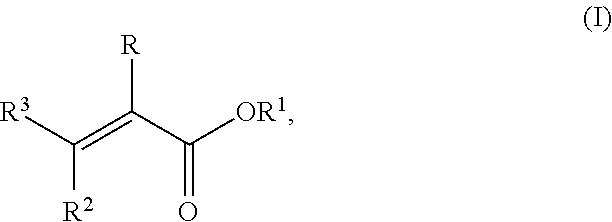
  • the present invention accordingly provides a polymer useful as viscosity index improver comprising units derived from one or more ethylenically unsaturated ester compounds of formula (I)
  • R is hydrogen or methyl
  • R 1 means a linear, branched or cyclic alkyl residue with 1-6 carbon atoms
  • R 2 and R 3 independently represent hydrogen or a group of the formula —COOR′, where R′ means hydrogen or a alkyl group with 1-6 carbon atoms
  • R is hydrogen or methyl
  • R 4 means a 2-alkyl branched alkyl residue with 12-18 carbon atoms
  • R 5 and R 6 independently are hydrogen or a group of the formula —COOR′′, where R′′ means hydrogen or an alkyl group with 12-18 carbon atoms, and units of one or more ethylenically unsaturated ester compounds of formula (III)
  • R is hydrogen or methyl
  • R 7 means a linear alkyl residue with 12-24 carbon atoms
  • R 8 and R 9 independently are hydrogen or a group of the formula —COOR′′, where R′′ means hydrogen or an alkyl group with 12-24 carbon atoms, characterized in that
  • said polymer comprises at least 10% by weight units derived from one or more ethylenically unsaturated ester compounds of formula (I), based on the total weight of the polymer,
  • said polymer comprises at least 10% by weight units derived from one or more ethylenically unsaturated ester compounds of formula (II), based on the total weight of the polymer, and
  • said polymer comprises at least 10% by weight units derived from one or more ethylenically unsaturated ester compounds of formula (III), based on the total weight of the polymer.
  • the present polymers provide a high efficiency as viscosity index improvers while retaining high shear stability.
  • inventive polymers allow a series of further advantages to be achieved. These include:
  • the inventive polymers have a particularly high viscosity index-improving effectiveness in lubricant oils. These properties are achieved by low treating rates and high shear stabilities.
  • the polymers of the present invention can be prepared in a particularly easy and simple manner. It is possible to use customary industrial scale plants.
  • the present polymers impart fuel efficiency to vehicles using the inventive lubricants.
  • hydraulic fluids comprising the present polymers show very low fuel consumption.
  • the present polymers have a high compatibility with very different base oils. This is especially true with regard to high performance base oils and GTL base oils.
  • the present polymers show an astonishing low temperature performance.
  • the polymer according to the present invention comprises units derived from one or more ethylenically unsaturated ester compounds of formula (I)
  • R is hydrogen or methyl
  • R 1 means a linear, branched or cyclic alkyl residue with 1-6 carbon atoms, especially 1 to 5 and preferably 1 to 3 carbon atoms
  • R 2 and R 3 independently represent hydrogen or a group of the formula —COOR′, where R′ means hydrogen or a alkyl group with 1 to 6 carbon atoms.
  • Monomers according to formula (I) enclose (meth)acrylates, fumarates and maleates, with alkyl methacrylates having 1 to 5, especially 1 to 3 carbon atoms in the alkyl residue being preferred.
  • methacrylates includes (meth)acrylates and acrylates as well as mixtures thereof. These monomers are well known in the art.
  • the alkyl residue of the ester compounds can be linear, cyclic or branched.
  • Examples of monomers according to formula (I) are, among others, (meth)acrylates, fumarates and maleates, which derived from saturated alcohols such as methyl(meth)acrylate, ethyl(meth)acrylate, n-propyl(meth)acrylate, isopropyl(meth)acrylate, n-butyl(meth)acrylate, tert-butyl(meth)acrylate, pentyl(meth)acrylate and hexyl(meth)acrylate; cycloalkyl(meth)acrylates, like cyclopentyl(meth)acrylate and cyclohexyl(meth)acrylate.
  • the polymer comprises units being derived from methyl(meth)acrylate.
  • the polymer of the present invention comprises at least 10% by weight units derived from one or more ethylenically unsaturated ester compounds of formula (I), based on the total weight of the polymer.
  • the polymer preferably comprises about 15 to 85% by weight, more preferably about 25 to 45% by weight and most preferably about 32 to 40% by weight of units derived from monomers according to formula (I).
  • the polymer comprises at least 25% by weight and particularly at least 32% by weight of units being derived from methyl methacrylate.
  • the polymer may be obtained preferably by free-radical polymerization. Accordingly the weight fraction of the units of the polymer as mentioned in the present application is a result of the weight fractions of corresponding monomers that are used for preparing the inventive polymer.
  • the polymer of the present invention comprises units of one or more ethylenically unsaturated ester compounds of formula (II)
  • R is hydrogen or methyl
  • R 4 means a 2-alkyl branched alkyl residue with 12-18 carbon atoms
  • R 5 and R 6 independently are hydrogen or a group of the formula —COOR′′, where R′′ means hydrogen or an alkyl group with 12-18 carbon atoms.
  • Examples of monomers according to formula (II) are, among others, (meth)acrylates, fumarates and maleates, which derived from saturated alcohols, such as 2-methylpentadecyl(meth)acrylate, 2-ethyltetradecyl(meth)acrylate, 2-propyltridecyl(meth)acrylate, 2-butyldodecyl(meth)acrylate, 2-methyl hexadecyl(meth)acrylate, 2-pentyldodecyl(meth)acrylate, 2-butylhexadecyl(meth)acrylate, 2-hexyldecyl(meth)acrylate or 2-hexylundecyl(meth)acrylate.
  • saturated alcohols such as 2-methylpentadecyl(meth)acrylate, 2-ethyltetradecyl(meth)acrylate, 2-propyltridecyl(meth)acrylate, 2-buty
  • Especially preferred compounds include 2-hexyldecyl(meth)acrylate and 2-hexylundecyl(meth)acrylate.
  • Astonishing improvements could be achieved with polymers comprising a mixture of units derived from ethylenically unsaturated ester compounds of formula (II) and the mixture preferably comprises units having a 2-methyl branched alkyl residue as residue R 4 and units having a 2-ethyl branched alkyl residue as residue R 4 .
  • the polymer may comprise a mixture of units derived from ethylenically unsaturated ester compounds of formula (II) and the mixture may particularly comprise units having a 2-propyl branched alkyl residue as residue R 4 and units having a 2-butyl or higher branched alkyl residue as residue R 4 .
  • the polymer according to the present invention may comprise units of one or more ethylenically unsaturated ester compounds of formula (II) having a 2-methyl branched alkyl residue as residue R 4 and the units having a 2-methyl branched alkyl residue as residue R 4 may especially comprise at least 10% by weight, more preferably at least 20% by weight based on the units derived from ethylenically unsaturated ester compounds of formula (II).
  • the polymer according to the present invention may comprise units of one or more ethylenically unsaturated ester compounds of formula (II) having a 2-ethyl branched alkyl residue as residue R 4 and the units having a 2-ethyl branched alkyl residue as residue R 4 may especially comprise at least 10% by weight, more preferably at least 20% by weight based on the units derived from ethylenically unsaturated ester compounds of formula (II).
  • the polymer according to the present invention may comprise units of one or more ethylenically unsaturated ester compounds of formula (II) having a 2-propyl branched alkyl residue as residue R 4 and the units having a 2-propyl branched alkyl residue as residue R 4 may especially comprise at least 10% by weight, more preferably at least 20% by weight based on the units derived from ethylenically unsaturated ester compounds of formula (II).
  • the polymer according to the present invention may comprise units of one or more ethylenically unsaturated ester compounds of formula (II) having a 2-butyl or higher branched alkyl residue as residue R 4 and the units having a 2-butyl or higher branched alkyl residue as residue R 4 may especially comprise at least 10% by weight, more preferably at least 20% by weight based on the units derived from ethylenically unsaturated ester compounds of formula (II).
  • the units of one or more ethylenically unsaturated ester compounds of formula (II) comprise units having residues R 4 with 12 to 16 carbon atoms and the units having residues R 4 with 12 to 16 carbon atoms may preferably comprise at least 50% by weight, more preferably at least 70% by weight based on the units derived from ethylenically unsaturated ester compounds of formula (II).
  • the type of branching and the position of the branching can be determined via Nuclear magnetic resonance spectroscopy (NMR).
  • NMR Nuclear magnetic resonance spectroscopy
  • the monomers being used for preparing the polymers are employed and, if these monomers are a mixture, the mixture can be preferably separated before analyzing.
  • 13 C- and 1 H-NMR experiments may be performed and analysed.
  • Useful information is provided in “Determination of the Oligomer Distribution in Ethoxylated Linear and Branched Alkanols using 13 C-NMR”, Li Yang et al. Eur. Polym, J. Vol. 33 (2), 143 (1997) and “Quantitative assessment of Alkyl Chain Branching in Alcohol-Based Surfactants by Nuclear Magnetic Resonance”, J. Duynhoven, A.
  • 2-butyl or higher branched alkyl residue includes 2-pentyl and 2-hexyl branched residues.
  • the polymer of the present invention comprises at least 10% by weight units derived from one or more ethylenically unsaturated ester compounds of formula (II), based on the total weight of the polymer.
  • the polymer comprises preferably about 10 to 75% by weight, especially 20 to 55% by weight, more preferably about 25 to 45% by weight of units derived from monomers according to formula (II).
  • the polymer of the present invention comprises units of one or more ethylenically unsaturated ester compounds of formula (III)
  • R is hydrogen or methyl
  • R 7 means a linear alkyl residue with 12-24 carbon atoms
  • R 8 and R 9 independently are hydrogen or a group of the formula —COOR′′, where R′′ means hydrogen or an alkyl group with 12-24 carbon atoms.
  • Examples of monomers according to formula (III) are, among others, (meth)acrylates, fumarates and maleates which are derived from saturated alcohols, such as n-dodecyl(meth)acrylate, n-tetradecyl(meth)acrylate, n-pentadecyl(meth)acrylate, n-hexadecyl(meth)acrylate, n-octadecyl(meth)acrylate, n-eicosyl(meth)acrylate, n-docosyl(meth)acrylate or n-tetracosyl(meth)acrylate.
  • saturated alcohols such as n-dodecyl(meth)acrylate, n-tetradecyl(meth)acrylate, n-pentadecyl(meth)acrylate, n-hexadecyl(meth)acrylate, n-octadecyl(meth
  • the polymer of the present invention comprises at least 10% by weight units derived from one or more ethylenically unsaturated ester compounds of formula (III), based on the total weight of the polymer.
  • the polymer comprises preferably about 10 to 75% by weight, especially about 20 to 40% by weight, more preferably about 25 to 35% by weight of units derived from monomers according to formula (III).
  • ester compounds with a long-chain alcohol residue can be obtained, for example, by reacting (meth)acrylates, fumarates, maleates and/or the corresponding acids with long chain fatty alcohols, where in general a mixture of esters such as (meth)acrylates with different long chain alcohol residues results.
  • These fatty alcohols include, among others, Oxo Alcohol® 7911 and Oxo Alcohol® 7900, Oxo Alcohol® 1100 (Monsanto); Alphanol® 79 (ICI); Nafol® 1620, Alfol® 610 and Alfol® 810 (Sasol); Epal® 610 and Epal® 810 (Ethyl Corporation); Linevol® 79, Linevol® 911 and Dobanol® 25L (Shell AG); Lial 125 (Sasol); Dehydad® and Dehydad® and Lorol® (Cognis).
  • the (meth)acrylates are particularly preferred over the maleates and furmarates, i.e., R 2 , R 3 , R 5 , R 6 , R 8 , R 9 of formulas (I), (II) and (III) represent hydrogen in particularly preferred embodiments.
  • the weight ratio of the units derived from one or more ethylenically unsaturated ester compounds of formula (II) and the units derived from one or more ethylenically unsaturated ester compounds of formula (III) is preferably in the range of 8:1 to 1:8, especially in the range of 4:1 to 1:4, and more preferably in the range of 2:1 to 1:2.
  • the proportion of the units of formula (II) and formula (III) including the amount of the carbon atom number and the amount of branching can be determined by conventional methods, especially using the ethylenically unsaturated ester compounds of formula (II) and formula (III), respectively. These methods include gas chromatography (GC) and NMR.
  • the polymer may contain units derived from comonomers as an optional component.
  • the comonomers include, among others, ethylenically unsaturated ester compounds being different to the ethylenically unsaturated ester compounds of formula (I), (II) and (III).
  • R is hydrogen or methyl
  • R 10 means a linear, branched or cyclic alkyl residue with 7-11 carbon atoms
  • R 11 and R 12 independently are hydrogen or a group of the formula —COOR′′, where R′′ means hydrogen or an alkyl group with 7-11 carbon atoms.
  • (meth)acrylates fumarates and maleates derived from saturated alcohols, such as 2-ethylhexyl(meth)acrylate, heptyl(meth)acrylate, 2-tert-butylheptyl(meth)acrylate, n-octyl methacrylate, 3-isopropylheptyl(meth)acrylate, nonyl(meth)acrylate, decyl(meth)acrylate or undecyl(meth)acrylate;
  • saturated alcohols such as 2-ethylhexyl(meth)acrylate, heptyl(meth)acrylate, 2-tert-butylheptyl(meth)acrylate, n-octyl methacrylate, 3-isopropylheptyl(meth)acrylate, nonyl(meth)acrylate, decyl(meth)acrylate or undecyl(meth)acrylate;
  • cycloalkyl(meth)acrylates such as cyclohexyl(meth)acrylate having a ring substituent, such as tert-butylcyclohexyl(meth)acrylate and trimethylcyclohexyl(meth)acrylate, bornyl(meth)acrylate and isobornyl(meth)acrylate; and the corresponding fumarates and maleates.
  • the (meth)acrylates are particularly preferred over the maleates and furmarates, i.e. R 11 , R 12 of formula (IV) represent hydrogen in particularly preferred embodiments.
  • the polymer may contain units of one or more ethylenically unsaturated ester compounds of formula (V)
  • R is hydrogen or methyl
  • R 13 means a 3-branched alkyl residue with 12-18 carbon atoms
  • R 14 and R 15 independently are hydrogen or a group of the formula —COOR′′, where R′′ means hydrogen or an alkyl group with 12-18 carbon atoms.
  • Examples of monomers according to formula (v) are, among others, (meth)acrylates, fumarates and maleates, which derived from saturated alcohols, such as 3-methylpentadecyl(meth)acrylate, 3-ethyltetradecyl(meth)acrylate, 3-propyltridecyl(meth)acrylate, 3-butyldodecyl(meth)acrylate, 3-methyl hexadecyl(meth)acrylate, 3-pentyldodecyl(meth)acrylate, 3-butylhexadecyl(meth)acrylate, 3-hexyldecyl(meth)acrylate or 3-hexylundecyl(meth)acrylate.
  • saturated alcohols such as 3-methylpentadecyl(meth)acrylate, 3-ethyltetradecyl(meth)acrylate, 3-propyltridecyl(meth)acrylate, 3-butyl
  • the (meth)acrylates are particularly preferred over the maleates and furmarates, i.e. R 14 , R 15 of formula (IV) represent hydrogen in particularly preferred embodiments.
  • useful comonomers include hydroxyalkyl(meth)acrylates such as 3-hydroxypropyl(meth)acrylate, 3,4-dihydroxybutyl(meth)acrylate, 2-hydroxyethyl(meth)acrylate, 2-hydroxypropyl(meth)acrylate, 2,5-dimethyl-1,6-hexanediol(meth)acrylate, 1,10-decanediol(meth)acrylate;
  • aminoalkyl methacrylates and aminoalkyl methacrylamides like dimethylaminopropyl(meth)acrylamide, diethylaminopentyl(meth)acrylate, dibutylaminohexadecyl(meth)acrylate and morpholinoethyl(meth)acrylate;
  • nitriles of (meth)acrylic acid and other nitrogen-containing (meth)acrylates like N-(methacryloyloxyethyl)diisobutylketimine, N-(methacryloyloxyethyl)dihexadecylketimine, (meth)acryloylamidoacetonitrile, 2-methacryloyloxyethylmethylcyanamide, cyanomethyl(meth)acrylate;
  • acryl(meth)acrylates like benzyl(meth)acrylate or phenyl(meth)acrylate, where the acryl residue in each case can be unsubstituted or substituted up to four times;
  • (meth)acrylates of halogenated alcohols like 2,3-dibromopropyl(meth)acrylate, 4-bromophenyl(meth)acrylate, 1,3-dichloro-2-propyl(meth)acrylate, 2-bromoethyl(meth)acrylate, 2-iodoethyl(meth)acrylate, chloromethyl(meth)acrylate;
  • oxiranyl(meth)acrylate like 2,3-epoxybutyl(meth)acrylate, 3,4-epoxybutyl(meth)acrylate, 10,11 epoxyundecyl(meth)acrylate, 2,3-epoxycyclohexyl(meth)acrylate, oxiranyl(meth)acrylates such as 10,11-epoxyhexadecyl(meth)acrylate, glycidyl(meth)acrylate;
  • phosphorus-, boron- and/or silicon-containing (meth)acrylates like 2-(dimethylphosphato)propyl(meth)acrylate, 2-(ethylphosphito)propyl(meth)acrylate, 2-dimethylphosphinomethyl(meth)acrylate, dimethylphosphonoethyl(meth)acrylate, diethylmethacryloyl phosphonate, dipropylmethacryloyl phosphate, 2-(dibutylphosphono)ethyl(meth)acrylate, 2,3-butylenemethacryloylethyl borate, methyldiethoxymethacryloylethoxysiliane, diethylphosphatoethyl(meth)acrylate;
  • sulfur-containing (meth)acrylates like ethylsulfinylethyl(meth)acrylate, 4-thiocyanatobutyl(meth)acrylate, ethylsulfonylethyl(meth)acrylate, thiocyanatomethyl(meth)acrylate, methylsulfinylmethyl(meth)acrylate, bis(methacryloyloxyethyl)sulfide;
  • heterocyclic(meth)acrylates like 2-(1-imidazolyl)ethyl(meth)acrylate, 2-(4-morpholinyl)ethyl(meth)acrylate and 1-(2-methacryloyloxyethyl)-2-pyrrolidone;
  • vinyl halides such as, for example, vinyl chloride, vinyl fluoride, vinylidene chloride and vinylidene fluoride;
  • heterocyclic vinyl compounds like 2-vinylpyridine, 3-vinylpyridine, 2-methyl-5-vinylpyridine, 3-ethyl-4-vinylpyridine, 2,3-dimethyl-5-vinylpyridine, vinylpyrimidine, vinylpiperidine, 9-vinylcarbazole, 3-vinylcarbazole, 4-vinylcarbazole, 1-vinylimidazole, 2-methyl-1-vinylimidazole, N-vinylpyrrolidone, 2-vinylpyrrolidone, N-vinylpyrrolidine, 3-vinylpyrrolidine, N-vinylcaprolactam, N-vinylbutyrolactam, vinyloxolane, vinylfuran, vinylthiophene, vinylthiolane, vinylthiazoles and hydrogenated vinylthiazoles, vinyloxazoles and hydrogenated vinyloxazoles;
  • maleic acid derivatives such as maleic anhydride, methylmaleic anhydride, maleinimide, methylmaleinimide;
  • fumaric acid and fumaric acid derivatives such as, for example, mono- and diesters of fumaric acid.
  • Monomers that have dispersing functionality can also be used as comonomers. These monomers are well known in the art and contain usually hetero atoms such as oxygen and/or nitrogen. For example the previously mentioned hydroxyalkyl(meth)acrylates, aminoalkyl(meth)acrylates and aminoalkyl(meth)acrylamides, (meth)acrylates of ether alcohols, heterocyclic(meth)acrylates and heterocyclic vinyl compounds are considered as dispersing comononers.
  • the polymer according to the present invention may preferably comprise 0 to 70% by weight, especially 0.1 to 50% by weight, more preferably 1 to 20% by weight of units derived from comonomers.
  • the polymer may comprise 0 to 20% by weight, more preferably 0 to 10% by weight of units derived from one or more ethylenically unsaturated ester compounds of formula (IV) based on the weight of the polymer.
  • the polymer may preferably comprise 0 to 20% by weight of units more preferably 0 to 10% by weight derived from one or more ethylenically unsaturated ester compounds of formula (V) based on the weight of the polymer.
  • the polymer comprises units derived from one or more ethylenically unsaturated ester compounds being different to the ethylenically unsaturated ester compounds of formula (I), (II) and (III) as mentioned above.
  • the weight ratio of the units derived from one or more ethylenically unsaturated ester compounds of formula (I) and the units derived from one or more ethylenically unsaturated ester compounds being different to the ethylenically unsaturated ester compounds of formula (I), (II) and (III) may be situated in the range of 100:1 to 1:1, more preferably in the range of 20:1 to 2:1 and most preferably in the range of 15:1 to 4:1.
  • the polymers according to the present invention have a molecular weight in the range of 5,000 to 2,000,000 g/mol, preferably in the range of range of 20,000 g/mol to 200,000 and more preferably in the range of 50,000 to 100,000 g/mol. These values refer to the weight average molecular weight of the polymers.
  • the polymers of the present invention exhibit a polydispersity, given by the ratio of the weight average molecular weight to the number average molecular weight Mw/Mn, in the range of 1 to 15, preferably 1.1 to 10, especially preferably 1.2 to 5.
  • the polydispersity and the weight average molecular weight may be determined by gel permeation chromatography (GPC) using a polymethyl methacrylate standard.
  • the polymers can be obtained by polymerizing mixtures comprising the monomers described above by any known method.
  • Conventional radical initiators can be used to perform a classic radical polymerization. These initiators are well known in the art. Examples for these radical initiators are azo initiators like 2,2′-azodiisobutyronitrile (AIBN), 2,2′-azobis(2-methylbutyronitrile) and 1,1 azobiscyclohexane carbonitrile; peroxide compounds, e.g.
  • ethyl ketone peroxide methyl ethyl ketone peroxide, acetyl acetone peroxide, dilauryl peroxide, tert.-butyl per-2-ethyl hexanoate, ketone peroxide, methyl isobutyl ketone peroxide, cyclohexanone peroxide, dibenzoyl peroxide, tert.-butyl perbenzoate, tert.-butyl peroxy isopropyl carbonate, 2,5-bis(2-ethylhexanoyl-peroxy)-2,5-dimethyl hexane, tert.-butyl peroxy 2-ethyl hexanoate, tert.-butyl peroxy-3,5,5-trimethyl hexanoate, dicumene peroxide, 1,1 bis(tert. butyl peroxy)cyclohexane, 1,1 bis(tert.
  • Chain transfer agents Low molecular weight polymers, especially poly(meth)acrylates can be obtained by using chain transfer agents. This technology is ubiquitously known and practiced in the polymer industry and is described in Odian, Principles of Polymerization, 1991.
  • chain transfer agents are sulfur containing compounds such as thiols, e.g. n- and t-dodecanethiol, 2-mercaptoethanol, and mercapto carboxylic acid esters, e.g. methyl-3-mercaptopropionate.
  • Preferred chain transfer agents contain up to 20, especially up to 15 and more preferably up to 12 carbon atoms.
  • chain transfer agents may contain at least 1, especially at least 2 oxygen atoms.
  • the low molecular weight polymers, especially poly(meth)acrylates can be obtained by using transition metal complexes, such as low spin cobalt complexes.
  • transition metal complexes such as low spin cobalt complexes.
  • ATRP Atom Transfer Radical Polymerization
  • RAFT Reversible Addition Fragmentation Chain Transfer
  • the polymerization can be carried out at normal pressure, reduced pressure or elevated pressure.
  • the polymerization temperature is also not critical. However, in general it lies in the range of ⁇ 20-200° C., preferably 0-130° C. and especially preferably 60-120° C., without any limitation intended by this.
  • solvent is to be broadly understood here.
  • suitable solvents are hydrocarbon solvents, for example, aromatic solvents (aromatic C 6-15 hydrocarbons, such as benzene, toluene, xylene, ethylbenzene, C 9-15 alkyl benzenes, trimethyl benzene, ethyl toluene and mixtures of them), mineral oils (such as paraffinic oils, naphthenic oils, solvent-refined oils, isoparaffin-containing high VI oils and hydrocracked high VI oils), and synthetic hydrocarbon lubricants (such as poly- ⁇ -olefin synthetic lubricant); ketone solvents, such as butanone and methyl ethyl ketone; and ester solvents, including, fatty oils, and synthetic ester lubricants (for example, di-C 4-12 alkyl C 4-12 dicarboxylates, such as diocty
  • the polymer is obtainable by a polymerization in API Group I, Group II, Group III, Group IV or Group V oils.
  • the inventive polymer can preferably be used in a lubricant oil composition.
  • a lubricant oil composition comprises at least one type of lubricant oil.
  • the lubricant oils include especially mineral oils, synthetic oils and natural oils.
  • the lubricant oil is based on mineral oil from API Group I, II, or III.
  • a mineral oil containing at least 90% by weight saturates and at most about 0.03% sulfur measured by elemental analysis is used.
  • API Group II or Group III oils are preferred.
  • Mineral oils are known per se and commercially available. They are generally obtained from mineral oil or crude oil by distillation and/or refining and optionally further purification and finishing processes, the term mineral oil including in particular the higher-boiling fractions of crude or mineral oil. In general, the boiling point of mineral oil is higher than 200° C., preferably higher than 300° C., at 5000 Pa. The production by low-temperature carbonization of shale oil, coking of bituminous coal, distillation of brown coal with exclusion of air and also hydrogenation of bituminous or brown coal is likewise possible. Accordingly, mineral oils have, depending on their origin, different proportions of aromatic, cyclic, branched and linear hydrocarbons.
  • paraffin-base fraction represents longer-chain or highly branched isoalkanes
  • naphthenic fraction represents cyclo-alkanes
  • Synthetic oils are, among other substances, organic esters, for example diesters and polyesters, like carboxylic esters and phosphate esters; organic ethers like silicone oils, perfluoro-alkyl ethers and polyalkylene glycol; and synthetic hydrocarbons, especially polyolefins and Gas to liquids oils (GTL), among which preference is given to polyalphaolefins (PAO) and GTL oils. They are for the most part somewhat more expensive than the mineral oils, but they have advantages with regard to performance.
  • organic esters for example diesters and polyesters, like carboxylic esters and phosphate esters
  • organic ethers like silicone oils, perfluoro-alkyl ethers and polyalkylene glycol
  • synthetic hydrocarbons especially polyolefins and Gas to liquids oils (GTL), among which preference is given to polyalphaolefins (PAO) and GTL oils. They are for the most part somewhat more expensive than the mineral oils, but they have advantages with regard to performance.
  • PAO polyalphaolefins
  • These compounds are obtainable by polymerization of alkenes, especially alkenes having 3 to 12 carbon atoms, like propene, hexene-1, octene-1, and dodecene-1.
  • Preferred PAOs have a number average molecular weight in the range of 200 to 10000 g/mol, more preferably 500 to 5000 g/mol.
  • GTL oils are useful as base fluid. These synthetic oils are obtained by a special refinery process converting natural gas or other gaseous hydrocarbons into longer-chain hydrocarbons such as gasoline or diesel fuel.
  • Natural oils are animal or vegetable oils, for example neatsfoot oils or jojoba oils.
  • API American Petroleum Institute
  • Base oils preferably have a kinematic viscosity (hereinafter referred to as KV) of 1-15 mm 2 /s, particularly 2-5 mm 2 /s, at 100° C.
  • KV kinematic viscosity
  • Base oils preferably have a VI of at least 80, particularly at least 100 and preferably at least 120. Especially, the VI of the base oil may be 180 or less, particularly 150 or less and more preferably 140 or less. Base oils preferably have a cloud point (defined in JIS K2269) of ⁇ 5° C. or less, particularly ⁇ 10° C. or less, more particularly ⁇ 15° C. or less, in view of low-temperature viscosity behavior, with little wax deposition at low temperature.
  • lubricant oils may also be used as mixtures and are in many cases commercially available.
  • concentration of the inventive polymer in the lubricant oil composition is preferably in the range from 0.5 to 40% by weight, more preferably in the range from 1 to 23% by weight, based on the total weight of the composition.
  • the amount of base oil in the lubricant is usually at least 60% by weight, more preferably at least 75% by weight.
  • a lubricant oil composition may comprise further additives.
  • additives include antioxidants, corrosion inhibitors, antifoams, antiwear components, dyes, dye stabilizers, detergents, pour point depressants and/or DI additives.
  • these additives encompass further viscosity index improvers, dispersing assistants and/or friction modifiers, which are more preferably based on a polyalkyl(meth)acrylate.
  • These polyalkyl(meth)acrylates are different to the present polymers and are described especially in the prior art discussed by way of introduction, and these polymers may have dispersing monomers.
  • Preferred polymers useful as viscosity improvers and methods for their preparation are disclosed in US 2003/0104955 filed Aug. 3, 2002 with the USPTO having the application Ser. No. 10/212,784 and JP 2008-031459 A filed Jun. 29, 2007 with the Japanese Patent Office having the application number JP 2007-172420, both of which are incorporated herein by reference.
  • Preferred lubricant oil compositions have a viscosity in the range from 10 to 120 mm 2 /s, more preferably in the range from 22 to 100 mm 2 /s measured at 40° C. according to ASTM D 445.
  • preferred lubricant oil compositions have a viscosity index, determined to ASTM D 2270, in the range from 100 to 400, more preferably in the range from 150 to 350 and most preferably in the range from 200 to 300.
  • the present lubricant composition can be used, for example, as engine oils (oils used in engines such as an engine for means of transportation and engine for machine tools); gear oils; transmission lube oils, particularly automatic transmission fluid (ATF), such as stepped automatic transmission fluid and continuously variable transmission fluid (CVTF); and traction oils, shock-absorber oils, power steering oils, hydraulic oils and the like.
  • engine oils oil used in engines such as an engine for means of transportation and engine for machine tools
  • gear oils transmission lube oils, particularly automatic transmission fluid (ATF), such as stepped automatic transmission fluid and continuously variable transmission fluid (CVTF); and traction oils, shock-absorber oils, power steering oils, hydraulic oils and the like.
  • ATF automatic transmission fluid
  • CVTF continuously variable transmission fluid
  • traction oils shock-absorber oils, power steering oils, hydraulic oils and the like.
  • a 4-neck glass round bottom flask equipped with condenser and glass stirrer was initially charged with a 375 g of monomer(s), 2.8 g of n-DDM and 30 g of Calumet's Hydrocal 3145.
  • the reaction mixture was heated to 110° C. and a free radical initiator solution of 0.94 g of t-butyl peroctoate and 60.0 g of Hydrocal 3145 was added to the flask over 165 minutes. 10% of this free radical initiator solution was added in the first 60 minutes, followed by 20% in the next 60 minutes and the remainder in the final 45 minutes.
  • the reaction mixture was held 60 minutes after complete addition of the initiator mixture and then diluted with Hydrocal 3145 to obtain the desired polymer concentration.
  • compositions of monomer mixtures according to the Examples are shown in table 1.
  • the C13-Spectra were taken at 30° C. using conventional pulse-sequences for quantitative determining of 13 C peaks. To ensure quantitative accuracy, a relaxation delay of at least 10 sec between pulses had been used and pulse schemes had been applied in order to suppress Nuclear-Overhauser-Effects. At least 10000 scans had been taken to achieve an appropriate S/N-ratio.
  • the 13 C-NMR-data sets were processed by using a line broadening of 3 Hz to improve the S/N-ratio.
  • 13 C-NMR-Signals were assigned using 2D-NMR experiments and 13 C-shift increment calculations (e.g. software package MestreNova from MestreLab Research).
  • the integrals of one of the following 13 C-signal-area are used to calculate the isomer-distribution:
  • Substructure 13 C-Chemical Shift Unbranched n-alkanol 62.93 ppm (C1) 2-Methyl-1-alkanol: 69.30 ppm (C1), 16.68 ppm (C1, side chain) 2-Ethyl-1-alkanol 65.23 ppm (C1), 42.12 ppm (C2) 2-Propyl-1-alkanol 20.10 ppm (C2, side chain), 40.43 ppm (C2) 2-Butyl+*-1-alkanol 65.61 ppm(C1) includes 2-Propyl(C1), *Butyl and chains >C4 40.64 ppm (C2)
  • the peak areas had been normalized by setting the sum of the averaged peak areas to 100% to get the distribution of the branched alkanols in percent. Due to the fact, that the chemical shift is sensitive to structural changes in the range of 4 bonds away from the observed nucleus.
  • the results had been cross-validated by Proton-NMR. Especially the degree of branching had been checked by the ratio of the peak area of ⁇ -Methyls (0.88 ppm) to ⁇ -CH 2 (3.3-3.7 ppm).
  • MMA had been obtained from Evonik Röhm GmbH.
  • the long chain methacrylates had been obtained by transesterification of MMA with appropriate alcohols.
  • L125MA a mixture of alcohols had been used being available from Sasol North America Inc. under the trade name Lial 125 having an average molecular weight of 207 g/mol.
  • L167MA a mixture of alcohols had been used being available from Sasol North America Inc. under the trade name Lial 167 having an average molecular weight of 246 g/mol.
  • For preparation of 1167MA a mixture of alcohols had been used being available from Sasol North America Inc. under the trade name Isalchem 167 having an average molecular weight of 242 g/mol.
  • A1618MA a mixture of alcohols had been used being available from Condea under the trade name Alfol 1618 having an average molecular weight of 354 g/mol.
  • the weight average molecular weights had been determined by GPC in tetrahydrofuran at 35° C. using a polymethyl(meth)acrylate calibration curve composed of a broad molecular weight standard. A combination of two Waters Styragel 5E columns was used.
  • Viscosity index improver compositions which illustrate the inventive nature of the claims Example Examples Number 1 2 3 4 5 MMA 20 35 30 35 25 L125MA — — — — 65 A1618MA — — 25 10 10 L167MA 80 65 — 55 — I167MA — — 45 — — Mw ( ⁇ 10 4 ) 8.5 9.0 8.0 8.0 9.0
  • the polymers obtained according to Examples 1 to 5 had been evaluated in a lubricant oil composition.
  • base oil Group 3 oil having kinematic viscosity of 3.02 mm 2 /s at 100° C. commercially available from SK Energy Co., Ltd. under the trade name Yubase 3 had been used.
  • Yubase 3 the lubricant oil compositions were adjusted to a KV 100 of about 6.8.
  • the amount of viscosity index improver and the results obtained are shown in table 2.
  • the VI was determined according to ASTM D 2270.
  • the kinematic viscosity at 100° C. (KV100) was determined according to ASTM D 445.
  • the shear stability is displayed as percent kinematic viscosity at 100° C. loss and was determined via a 40 minute sonic shear according to ASTM D 2603.
  • polymers of the present invention provide excellent properties. These include a high viscosity index, a low treating rate, a high shear stability and exceptional low temperature performance.

Landscapes

  • Chemical & Material Sciences (AREA)
  • Chemical Kinetics & Catalysis (AREA)
  • Organic Chemistry (AREA)
  • General Chemical & Material Sciences (AREA)
  • Oil, Petroleum & Natural Gas (AREA)
  • Health & Medical Sciences (AREA)
  • Medicinal Chemistry (AREA)
  • Polymers & Plastics (AREA)
  • Addition Polymer Or Copolymer, Post-Treatments, Or Chemical Modifications (AREA)
  • Lubricants (AREA)
  • Compositions Of Macromolecular Compounds (AREA)

Abstract

The present invention describes a polymer useful as viscosity index improver comprising units derived from one or more ethylenically unsaturated ester compounds of formula (I), where R is hydrogen or methyl, R1 means a linear, branched or cyclic alkyl residue with 1-6 carbon atoms, R2 and R3 independently represent hydrogen or a group of the formula —COOR′, where R′ means hydrogen or a alkyl group with 1-6 carbon atoms, units of one or more ethylenically unsaturated ester compounds of formula (II), where R is hydrogen or methyl, R4 means a 2-alkyl branched alkyl residue with 12-18 carbon atoms, R5 and R6 independently are hydrogen or a group of the formula —COOR″, where R″ means hydrogen or an alkyl group with 12-18 carbon atoms, and units of one or more ethylenically unsaturated ester compounds of formula (III), where R is hydrogen or methyl, R7 means a linear alkyl residue with 12-24 carbon atoms, R8 and R9 independently are hydrogen or a group of the formula —COOR″, where R″ means hydrogen or an alkyl group with 12-24 carbon atoms wherein said polymer comprises at least 10% by weight units derived from one or more ethylenically unsaturated ester compounds of formula (I), based on the total weight of the polymer, said polymer comprises at least 10% by weight units derived from one or more ethylenically unsaturated ester compounds of formula (II), based on the total weight of the polymer, and said polymer comprises at least 10% by weight units derived from one or more ethylenically unsaturated ester compounds of formula (III), based on the total weight of the polymer.
Figure US09481849-20161101-C00001

Description

“This application is a 371 of PCT/EP2011/052710, filed 02/24/2011, which claims benefit of 61/327,917, filed 04/26/2010. ”
The present application relates to polymers useful as viscosity index improvers and to lubricant compositions comprising said polymers.
For more than 50 years, improvements in the temperature-viscosity properties of lubricating oils have been achieved via addition of relatively high molecular weight polymers. The automotive lubricant industry commonly measures these temperature-viscosity properties as the viscosity index (VI). Lubricants with higher values of VI have viscosities which change less with changes in temperature.
There are a number of factors which must be considered when selecting or developing a polymer for applications as a viscosity index improver (VII). The primary requirement is stability and solubility of the polymer in the target oil at varying concentrations and temperatures. It is further preferred that the polymer is soluble in a variety of liquids. For automotive lubricant applications, solubility can be related to the nature of the base oil.
Also well known and commonly understood is that the molecular weight of the additive polymer influences the value of VI. The higher the molecular weight the more effective the polymer becomes at increasing the VI. Increasing the VI in this manner is limited, because as the molecular weight of the polymer increases so does the tendency to degrade under shear stresses. A polymer's ability to withstand degradation via mechanical shear stress is referred to as the shear stability or permanent shear stability index (PSSI). It is very common for an application to have a specified shear stability limit.
Further increases in VI can be obtained through modification of the polymer composition. The effectiveness of a VII is closely related to interactions between the polymer and lubricant oil. The addition of comonomers which can affect these interactions can lead to improved or reduced performance of the VI.
The document JP 2008 031459 A discloses a polymer useful as viscosity index improver. The viscosity index improver consists of copolymer having weight average molecular weight of 5000-1000000 and containing essential monomer of CH2═C(R1)—COO(A-O)n—(CH2)p—CH(R2)—R3; where R1 is H or Me, R2 and R3 are independent C1-C16 linear alkyl or C3-C34 branched alkyl (≦16 of sequential methylene group, 18-36 of total carbon of R2, R3, and (CH2)p), A is C2-C4 alkylene, n and p are integers of 0-20 and 0-15, respectively. Similar viscosity index improvers are disclosed in JP 2008-024908 A, JP 2003-292938 A, US 2004/0077509 A1 and EP-A-2 009 074.
The known polymers show a good efficiency as viscosity index improvers. Accordingly, most of these polymers exhibit a satisfactory property profile. However, there is a permanent effort to improve the relationship of thickening action, viscosity index and shear stability in order to achieve a desired viscosity with minimum use of additive in lubricant oils over a wide temperature range without impairing this property through premature degradation of the polymers.
Furthermore, the polymers should be producible in a simple and inexpensive manner, and especially commercially available components should be used. In this context, they should be producible on the industrial scale without new plants or plants of complicated construction being required for this purpose.
These objects and also further objects which are not stated explicitly but are immediately derivable or discernible from the connections discussed herein by way of introduction are achieved by polymers having all features of claim 1. Appropriate modifications to the inventive polymers are protected in the claims referring back to claim 1. With regard to the lubricant composition, claim 20 provides a solution to the underlying problem.
The present invention accordingly provides a polymer useful as viscosity index improver comprising units derived from one or more ethylenically unsaturated ester compounds of formula (I)
Figure US09481849-20161101-C00002
where R is hydrogen or methyl, R1 means a linear, branched or cyclic alkyl residue with 1-6 carbon atoms, R2 and R3 independently represent hydrogen or a group of the formula —COOR′, where R′ means hydrogen or a alkyl group with 1-6 carbon atoms,
units of one or more ethylenically unsaturated ester compounds of formula (II)
Figure US09481849-20161101-C00003
where R is hydrogen or methyl, R4 means a 2-alkyl branched alkyl residue with 12-18 carbon atoms, R5 and R6 independently are hydrogen or a group of the formula —COOR″, where R″ means hydrogen or an alkyl group with 12-18 carbon atoms, and units of one or more ethylenically unsaturated ester compounds of formula (III)
Figure US09481849-20161101-C00004
where R is hydrogen or methyl, R7 means a linear alkyl residue with 12-24 carbon atoms, R8 and R9 independently are hydrogen or a group of the formula —COOR″, where R″ means hydrogen or an alkyl group with 12-24 carbon atoms, characterized in that
said polymer comprises at least 10% by weight units derived from one or more ethylenically unsaturated ester compounds of formula (I), based on the total weight of the polymer,
said polymer comprises at least 10% by weight units derived from one or more ethylenically unsaturated ester compounds of formula (II), based on the total weight of the polymer, and
said polymer comprises at least 10% by weight units derived from one or more ethylenically unsaturated ester compounds of formula (III), based on the total weight of the polymer.
The present polymers provide a high efficiency as viscosity index improvers while retaining high shear stability. At the same time, the inventive polymers allow a series of further advantages to be achieved. These include:
The inventive polymers have a particularly high viscosity index-improving effectiveness in lubricant oils. These properties are achieved by low treating rates and high shear stabilities. The polymers of the present invention can be prepared in a particularly easy and simple manner. It is possible to use customary industrial scale plants. Furthermore, the present polymers impart fuel efficiency to vehicles using the inventive lubricants. In addition, hydraulic fluids comprising the present polymers show very low fuel consumption. Moreover, the present polymers have a high compatibility with very different base oils. This is especially true with regard to high performance base oils and GTL base oils.
Moreover, the present polymers show an astonishing low temperature performance.
The polymer according to the present invention comprises units derived from one or more ethylenically unsaturated ester compounds of formula (I)
Figure US09481849-20161101-C00005
where R is hydrogen or methyl, R1 means a linear, branched or cyclic alkyl residue with 1-6 carbon atoms, especially 1 to 5 and preferably 1 to 3 carbon atoms, R2 and R3 independently represent hydrogen or a group of the formula —COOR′, where R′ means hydrogen or a alkyl group with 1 to 6 carbon atoms.
Monomers according to formula (I) enclose (meth)acrylates, fumarates and maleates, with alkyl methacrylates having 1 to 5, especially 1 to 3 carbon atoms in the alkyl residue being preferred. The term methacrylates includes (meth)acrylates and acrylates as well as mixtures thereof. These monomers are well known in the art. The alkyl residue of the ester compounds can be linear, cyclic or branched.
Examples of monomers according to formula (I) are, among others, (meth)acrylates, fumarates and maleates, which derived from saturated alcohols such as methyl(meth)acrylate, ethyl(meth)acrylate, n-propyl(meth)acrylate, isopropyl(meth)acrylate, n-butyl(meth)acrylate, tert-butyl(meth)acrylate, pentyl(meth)acrylate and hexyl(meth)acrylate; cycloalkyl(meth)acrylates, like cyclopentyl(meth)acrylate and cyclohexyl(meth)acrylate. Preferably, the polymer comprises units being derived from methyl(meth)acrylate.
The polymer of the present invention comprises at least 10% by weight units derived from one or more ethylenically unsaturated ester compounds of formula (I), based on the total weight of the polymer. According to a preferred aspect of the present invention, the polymer preferably comprises about 15 to 85% by weight, more preferably about 25 to 45% by weight and most preferably about 32 to 40% by weight of units derived from monomers according to formula (I). Preferably, the polymer comprises at least 25% by weight and particularly at least 32% by weight of units being derived from methyl methacrylate.
The polymer may be obtained preferably by free-radical polymerization. Accordingly the weight fraction of the units of the polymer as mentioned in the present application is a result of the weight fractions of corresponding monomers that are used for preparing the inventive polymer.
In addition to the units derived from the monomers according to formula (I), the polymer of the present invention comprises units of one or more ethylenically unsaturated ester compounds of formula (II)
Figure US09481849-20161101-C00006
where R is hydrogen or methyl, R4 means a 2-alkyl branched alkyl residue with 12-18 carbon atoms, R5 and R6 independently are hydrogen or a group of the formula —COOR″, where R″ means hydrogen or an alkyl group with 12-18 carbon atoms.
Examples of monomers according to formula (II) are, among others, (meth)acrylates, fumarates and maleates, which derived from saturated alcohols, such as 2-methylpentadecyl(meth)acrylate, 2-ethyltetradecyl(meth)acrylate, 2-propyltridecyl(meth)acrylate, 2-butyldodecyl(meth)acrylate, 2-methyl hexadecyl(meth)acrylate, 2-pentyldodecyl(meth)acrylate, 2-butylhexadecyl(meth)acrylate, 2-hexyldecyl(meth)acrylate or 2-hexylundecyl(meth)acrylate.
Especially preferred compounds include 2-hexyldecyl(meth)acrylate and 2-hexylundecyl(meth)acrylate.
Astonishing improvements could be achieved with polymers comprising a mixture of units derived from ethylenically unsaturated ester compounds of formula (II) and the mixture preferably comprises units having a 2-methyl branched alkyl residue as residue R4 and units having a 2-ethyl branched alkyl residue as residue R4.
According to a special aspect of the present invention the polymer may comprise a mixture of units derived from ethylenically unsaturated ester compounds of formula (II) and the mixture may particularly comprise units having a 2-propyl branched alkyl residue as residue R4 and units having a 2-butyl or higher branched alkyl residue as residue R4.
With further preference the polymer according to the present invention may comprise units of one or more ethylenically unsaturated ester compounds of formula (II) having a 2-methyl branched alkyl residue as residue R4 and the units having a 2-methyl branched alkyl residue as residue R4 may especially comprise at least 10% by weight, more preferably at least 20% by weight based on the units derived from ethylenically unsaturated ester compounds of formula (II).
Preferably, the polymer according to the present invention may comprise units of one or more ethylenically unsaturated ester compounds of formula (II) having a 2-ethyl branched alkyl residue as residue R4 and the units having a 2-ethyl branched alkyl residue as residue R4 may especially comprise at least 10% by weight, more preferably at least 20% by weight based on the units derived from ethylenically unsaturated ester compounds of formula (II).
Moreover, the polymer according to the present invention may comprise units of one or more ethylenically unsaturated ester compounds of formula (II) having a 2-propyl branched alkyl residue as residue R4 and the units having a 2-propyl branched alkyl residue as residue R4 may especially comprise at least 10% by weight, more preferably at least 20% by weight based on the units derived from ethylenically unsaturated ester compounds of formula (II).
Particularly, the polymer according to the present invention may comprise units of one or more ethylenically unsaturated ester compounds of formula (II) having a 2-butyl or higher branched alkyl residue as residue R4 and the units having a 2-butyl or higher branched alkyl residue as residue R4 may especially comprise at least 10% by weight, more preferably at least 20% by weight based on the units derived from ethylenically unsaturated ester compounds of formula (II).
According to a preferred embodiment of the present invention the units of one or more ethylenically unsaturated ester compounds of formula (II) comprise units having residues R4 with 12 to 16 carbon atoms and the units having residues R4 with 12 to 16 carbon atoms may preferably comprise at least 50% by weight, more preferably at least 70% by weight based on the units derived from ethylenically unsaturated ester compounds of formula (II).
The type of branching and the position of the branching can be determined via Nuclear magnetic resonance spectroscopy (NMR). Preferably, the monomers being used for preparing the polymers are employed and, if these monomers are a mixture, the mixture can be preferably separated before analyzing. Especially 13C- and 1H-NMR experiments may be performed and analysed. Useful information is provided in “Determination of the Oligomer Distribution in Ethoxylated Linear and Branched Alkanols using 13C-NMR”, Li Yang et al. Eur. Polym, J. Vol. 33 (2), 143 (1997) and “Quantitative assessment of Alkyl Chain Branching in Alcohol-Based Surfactants by Nuclear Magnetic Resonance”, J. Duynhoven, A. Leika and P. C. van der Hoeven, J. of Surfactants and Detergents Vol 8 (1), 73 (2005). Using the NMR method usually does not provide any distinction between butyl branching and pentyl-oder hexyl branching. Therefore, the expression 2-butyl or higher branched alkyl residue includes 2-pentyl and 2-hexyl branched residues.
The polymer of the present invention comprises at least 10% by weight units derived from one or more ethylenically unsaturated ester compounds of formula (II), based on the total weight of the polymer. According to a preferred aspect of the present invention, the polymer comprises preferably about 10 to 75% by weight, especially 20 to 55% by weight, more preferably about 25 to 45% by weight of units derived from monomers according to formula (II).
In addition to the units derived from the monomers according to formula (I) and (II), the polymer of the present invention comprises units of one or more ethylenically unsaturated ester compounds of formula (III)
Figure US09481849-20161101-C00007
where R is hydrogen or methyl, R7 means a linear alkyl residue with 12-24 carbon atoms, R8 and R9 independently are hydrogen or a group of the formula —COOR″, where R″ means hydrogen or an alkyl group with 12-24 carbon atoms.
Examples of monomers according to formula (III) are, among others, (meth)acrylates, fumarates and maleates which are derived from saturated alcohols, such as n-dodecyl(meth)acrylate, n-tetradecyl(meth)acrylate, n-pentadecyl(meth)acrylate, n-hexadecyl(meth)acrylate, n-octadecyl(meth)acrylate, n-eicosyl(meth)acrylate, n-docosyl(meth)acrylate or n-tetracosyl(meth)acrylate.
The polymer of the present invention comprises at least 10% by weight units derived from one or more ethylenically unsaturated ester compounds of formula (III), based on the total weight of the polymer. According to a preferred aspect of the present invention, the polymer comprises preferably about 10 to 75% by weight, especially about 20 to 40% by weight, more preferably about 25 to 35% by weight of units derived from monomers according to formula (III).
The ester compounds with a long-chain alcohol residue, especially monomers according to formula (II) and (III), can be obtained, for example, by reacting (meth)acrylates, fumarates, maleates and/or the corresponding acids with long chain fatty alcohols, where in general a mixture of esters such as (meth)acrylates with different long chain alcohol residues results. These fatty alcohols include, among others, Oxo Alcohol® 7911 and Oxo Alcohol® 7900, Oxo Alcohol® 1100 (Monsanto); Alphanol® 79 (ICI); Nafol® 1620, Alfol® 610 and Alfol® 810 (Sasol); Epal® 610 and Epal® 810 (Ethyl Corporation); Linevol® 79, Linevol® 911 and Dobanol® 25L (Shell AG); Lial 125 (Sasol); Dehydad® and Dehydad® and Lorol® (Cognis).
Of the ethylenically unsaturated ester compounds, the (meth)acrylates are particularly preferred over the maleates and furmarates, i.e., R2, R3, R5, R6, R8, R9 of formulas (I), (II) and (III) represent hydrogen in particularly preferred embodiments.
According to a special aspect of the present invention, the weight ratio of the units derived from one or more ethylenically unsaturated ester compounds of formula (II) and the units derived from one or more ethylenically unsaturated ester compounds of formula (III) is preferably in the range of 8:1 to 1:8, especially in the range of 4:1 to 1:4, and more preferably in the range of 2:1 to 1:2.
The proportion of the units of formula (II) and formula (III) including the amount of the carbon atom number and the amount of branching can be determined by conventional methods, especially using the ethylenically unsaturated ester compounds of formula (II) and formula (III), respectively. These methods include gas chromatography (GC) and NMR.
The polymer may contain units derived from comonomers as an optional component. The comonomers include, among others, ethylenically unsaturated ester compounds being different to the ethylenically unsaturated ester compounds of formula (I), (II) and (III).
These monomers embrace ethylenically unsaturated ester compounds of formula (IV)
Figure US09481849-20161101-C00008
where R is hydrogen or methyl, R10 means a linear, branched or cyclic alkyl residue with 7-11 carbon atoms, R11 and R12 independently are hydrogen or a group of the formula —COOR″, where R″ means hydrogen or an alkyl group with 7-11 carbon atoms.
Among these are (meth)acrylates, fumarates and maleates derived from saturated alcohols, such as 2-ethylhexyl(meth)acrylate, heptyl(meth)acrylate, 2-tert-butylheptyl(meth)acrylate, n-octyl methacrylate, 3-isopropylheptyl(meth)acrylate, nonyl(meth)acrylate, decyl(meth)acrylate or undecyl(meth)acrylate;
cycloalkyl(meth)acrylates such as cyclohexyl(meth)acrylate having a ring substituent, such as tert-butylcyclohexyl(meth)acrylate and trimethylcyclohexyl(meth)acrylate, bornyl(meth)acrylate and isobornyl(meth)acrylate; and the corresponding fumarates and maleates.
Of the ethylenically unsaturated ester compounds, the (meth)acrylates are particularly preferred over the maleates and furmarates, i.e. R11, R12 of formula (IV) represent hydrogen in particularly preferred embodiments.
Furthermore, the polymer may contain units of one or more ethylenically unsaturated ester compounds of formula (V)
Figure US09481849-20161101-C00009
where R is hydrogen or methyl, R13 means a 3-branched alkyl residue with 12-18 carbon atoms, R14 and R15 independently are hydrogen or a group of the formula —COOR″, where R″ means hydrogen or an alkyl group with 12-18 carbon atoms.
Examples of monomers according to formula (v) are, among others, (meth)acrylates, fumarates and maleates, which derived from saturated alcohols, such as 3-methylpentadecyl(meth)acrylate, 3-ethyltetradecyl(meth)acrylate, 3-propyltridecyl(meth)acrylate, 3-butyldodecyl(meth)acrylate, 3-methyl hexadecyl(meth)acrylate, 3-pentyldodecyl(meth)acrylate, 3-butylhexadecyl(meth)acrylate, 3-hexyldecyl(meth)acrylate or 3-hexylundecyl(meth)acrylate.
Of the ethylenically unsaturated ester compounds, the (meth)acrylates are particularly preferred over the maleates and furmarates, i.e. R14, R15 of formula (IV) represent hydrogen in particularly preferred embodiments.
Moreover, useful comonomers include hydroxyalkyl(meth)acrylates such as 3-hydroxypropyl(meth)acrylate, 3,4-dihydroxybutyl(meth)acrylate, 2-hydroxyethyl(meth)acrylate, 2-hydroxypropyl(meth)acrylate, 2,5-dimethyl-1,6-hexanediol(meth)acrylate, 1,10-decanediol(meth)acrylate;
aminoalkyl methacrylates and aminoalkyl methacrylamides like dimethylaminopropyl(meth)acrylamide, diethylaminopentyl(meth)acrylate, dibutylaminohexadecyl(meth)acrylate and morpholinoethyl(meth)acrylate;
nitriles of (meth)acrylic acid and other nitrogen-containing (meth)acrylates like N-(methacryloyloxyethyl)diisobutylketimine, N-(methacryloyloxyethyl)dihexadecylketimine, (meth)acryloylamidoacetonitrile, 2-methacryloyloxyethylmethylcyanamide, cyanomethyl(meth)acrylate;
acryl(meth)acrylates like benzyl(meth)acrylate or phenyl(meth)acrylate, where the acryl residue in each case can be unsubstituted or substituted up to four times;
carbonyl-containing (meth)acrylates like 2-carboxyethyl(meth)acrylate, carboxymethyl(meth)acrylate, oxazolidinylethyl(meth)acrylate, N-methyacryloyloxy)formamide, acetonyl(meth)acrylate, N-methacryloylmorpholine, N-methacryloyl-2-pyrrolidinone, N-(2-methyacryloxyoxyethyl)-2-pyrrolidinone, N-(3-methacryloyloxypropyl)-2-pyrrolidinone, N-(2-methyacryloyloxypentadecyl(-2-pyrrolidinone, N-(3-methacryloyloxyheptadecyl-2-pyrrolidinone;(meth)acrylates of ether alcohols like tetrahydrofurfuryl(meth)acrylate, vinyloxyethoxyethyl(meth)acrylate, methoxyethoxyethyl(meth)acrylate, 1-butoxypropyl(meth)acrylate, 1-methyl-(2-vinyloxy)ethyl(meth)acrylate, cyclohexyloxymethyl(meth)acrylate, methoxymethoxyethyl(meth)acrylate, benzyloxymethyl(meth)acrylate, furfuryl(meth)acrylate, 2-butoxyethyl(meth)acrylate, 2-ethoxyethoxymethyl(meth)acrylate, 2-ethoxyethyl(meth)acrylate, ethoxylated(meth)acrylates, allyloxymethyl(meth)acrylate, 1-ethoxybutyl(meth)acrylate, methoxymethyl(meth)acrylate, 1-ethoxyethyl(meth)acrylate, ethoxymethyl(meth)acrylate;
(meth)acrylates of halogenated alcohols like 2,3-dibromopropyl(meth)acrylate, 4-bromophenyl(meth)acrylate, 1,3-dichloro-2-propyl(meth)acrylate, 2-bromoethyl(meth)acrylate, 2-iodoethyl(meth)acrylate, chloromethyl(meth)acrylate;
oxiranyl(meth)acrylate like 2,3-epoxybutyl(meth)acrylate, 3,4-epoxybutyl(meth)acrylate, 10,11 epoxyundecyl(meth)acrylate, 2,3-epoxycyclohexyl(meth)acrylate, oxiranyl(meth)acrylates such as 10,11-epoxyhexadecyl(meth)acrylate, glycidyl(meth)acrylate;
phosphorus-, boron- and/or silicon-containing (meth)acrylates like 2-(dimethylphosphato)propyl(meth)acrylate, 2-(ethylphosphito)propyl(meth)acrylate, 2-dimethylphosphinomethyl(meth)acrylate, dimethylphosphonoethyl(meth)acrylate, diethylmethacryloyl phosphonate, dipropylmethacryloyl phosphate, 2-(dibutylphosphono)ethyl(meth)acrylate, 2,3-butylenemethacryloylethyl borate, methyldiethoxymethacryloylethoxysiliane, diethylphosphatoethyl(meth)acrylate;
sulfur-containing (meth)acrylates like ethylsulfinylethyl(meth)acrylate, 4-thiocyanatobutyl(meth)acrylate, ethylsulfonylethyl(meth)acrylate, thiocyanatomethyl(meth)acrylate, methylsulfinylmethyl(meth)acrylate, bis(methacryloyloxyethyl)sulfide;
heterocyclic(meth)acrylates like 2-(1-imidazolyl)ethyl(meth)acrylate, 2-(4-morpholinyl)ethyl(meth)acrylate and 1-(2-methacryloyloxyethyl)-2-pyrrolidone;
vinyl halides such as, for example, vinyl chloride, vinyl fluoride, vinylidene chloride and vinylidene fluoride;
vinyl esters like vinyl acetate;
vinyl monomers containing aromatic groups like styrene, substituted styrenes with an alkyl substituent in the side chain, such as α-methylstyrene and α-ethylstyrene, substituted styrenes with an alkyl substituent on the ring such as vinyltoluene and p-methylstyrene, halogenated styrenes such as monochlorostyrenes, dichlorostyrenes, tribromostyrenes and tetrabromostyrenes;
heterocyclic vinyl compounds like 2-vinylpyridine, 3-vinylpyridine, 2-methyl-5-vinylpyridine, 3-ethyl-4-vinylpyridine, 2,3-dimethyl-5-vinylpyridine, vinylpyrimidine, vinylpiperidine, 9-vinylcarbazole, 3-vinylcarbazole, 4-vinylcarbazole, 1-vinylimidazole, 2-methyl-1-vinylimidazole, N-vinylpyrrolidone, 2-vinylpyrrolidone, N-vinylpyrrolidine, 3-vinylpyrrolidine, N-vinylcaprolactam, N-vinylbutyrolactam, vinyloxolane, vinylfuran, vinylthiophene, vinylthiolane, vinylthiazoles and hydrogenated vinylthiazoles, vinyloxazoles and hydrogenated vinyloxazoles;
vinyl and isoprenyl ethers;
maleic acid derivatives such as maleic anhydride, methylmaleic anhydride, maleinimide, methylmaleinimide;
fumaric acid and fumaric acid derivatives such as, for example, mono- and diesters of fumaric acid.
Monomers that have dispersing functionality can also be used as comonomers. These monomers are well known in the art and contain usually hetero atoms such as oxygen and/or nitrogen. For example the previously mentioned hydroxyalkyl(meth)acrylates, aminoalkyl(meth)acrylates and aminoalkyl(meth)acrylamides, (meth)acrylates of ether alcohols, heterocyclic(meth)acrylates and heterocyclic vinyl compounds are considered as dispersing comononers.
The polymer according to the present invention may preferably comprise 0 to 70% by weight, especially 0.1 to 50% by weight, more preferably 1 to 20% by weight of units derived from comonomers.
Preferably, the polymer may comprise 0 to 20% by weight, more preferably 0 to 10% by weight of units derived from one or more ethylenically unsaturated ester compounds of formula (IV) based on the weight of the polymer.
According to a special aspect of the present invention the polymer may preferably comprise 0 to 20% by weight of units more preferably 0 to 10% by weight derived from one or more ethylenically unsaturated ester compounds of formula (V) based on the weight of the polymer.
According to a preferred embodiment, the polymer comprises units derived from one or more ethylenically unsaturated ester compounds being different to the ethylenically unsaturated ester compounds of formula (I), (II) and (III) as mentioned above. Preferably, the weight ratio of the units derived from one or more ethylenically unsaturated ester compounds of formula (I) and the units derived from one or more ethylenically unsaturated ester compounds being different to the ethylenically unsaturated ester compounds of formula (I), (II) and (III) may be situated in the range of 100:1 to 1:1, more preferably in the range of 20:1 to 2:1 and most preferably in the range of 15:1 to 4:1.
The polymers according to the present invention have a molecular weight in the range of 5,000 to 2,000,000 g/mol, preferably in the range of range of 20,000 g/mol to 200,000 and more preferably in the range of 50,000 to 100,000 g/mol. These values refer to the weight average molecular weight of the polymers.
Without intending any limitation by this, the polymers of the present invention exhibit a polydispersity, given by the ratio of the weight average molecular weight to the number average molecular weight Mw/Mn, in the range of 1 to 15, preferably 1.1 to 10, especially preferably 1.2 to 5. The polydispersity and the weight average molecular weight may be determined by gel permeation chromatography (GPC) using a polymethyl methacrylate standard.
The polymers can be obtained by polymerizing mixtures comprising the monomers described above by any known method. Conventional radical initiators can be used to perform a classic radical polymerization. These initiators are well known in the art. Examples for these radical initiators are azo initiators like 2,2′-azodiisobutyronitrile (AIBN), 2,2′-azobis(2-methylbutyronitrile) and 1,1 azobiscyclohexane carbonitrile; peroxide compounds, e.g. methyl ethyl ketone peroxide, acetyl acetone peroxide, dilauryl peroxide, tert.-butyl per-2-ethyl hexanoate, ketone peroxide, methyl isobutyl ketone peroxide, cyclohexanone peroxide, dibenzoyl peroxide, tert.-butyl perbenzoate, tert.-butyl peroxy isopropyl carbonate, 2,5-bis(2-ethylhexanoyl-peroxy)-2,5-dimethyl hexane, tert.-butyl peroxy 2-ethyl hexanoate, tert.-butyl peroxy-3,5,5-trimethyl hexanoate, dicumene peroxide, 1,1 bis(tert. butyl peroxy)cyclohexane, 1,1 bis(tert. butyl peroxy) 3,3,5-trimethyl cyclohexane, cumene hydroperoxide and tert.-butyl hydroperoxide.
Low molecular weight polymers, especially poly(meth)acrylates can be obtained by using chain transfer agents. This technology is ubiquitously known and practiced in the polymer industry and is described in Odian, Principles of Polymerization, 1991. Examples of chain transfer agents are sulfur containing compounds such as thiols, e.g. n- and t-dodecanethiol, 2-mercaptoethanol, and mercapto carboxylic acid esters, e.g. methyl-3-mercaptopropionate. Preferred chain transfer agents contain up to 20, especially up to 15 and more preferably up to 12 carbon atoms. Furthermore, chain transfer agents may contain at least 1, especially at least 2 oxygen atoms.
Furthermore, the low molecular weight polymers, especially poly(meth)acrylates can be obtained by using transition metal complexes, such as low spin cobalt complexes. These technologies are well known and for example described in USSR patent 940,487-A and by Heuts, et al., Macromolecules 1999, pp 2511-2519 and 3907-3912.
Furthermore, novel polymerization techniques such as ATRP (Atom Transfer Radical Polymerization) and or RAFT (Reversible Addition Fragmentation Chain Transfer) can be applied to obtain useful polymers derived from alkyl esters. These methods are well known. The ATRP reaction method is described, for example, by J-S. Wang, et al., J. Am. Chem. Soc., Vol. 117, pp. 5614-5615 (1995), and by Matyjaszewski, Macromolecules, Vol. 28, pp. 7901-7910 (1995). Moreover, the patent applications WO 96/30421, WO 97/47661, WO 97/18247, WO 98/40415 and WO 99/10387 disclose variations of the ATRP explained above to which reference is expressly made for purposes of the disclosure. The RAFT method is extensively presented in WO 98/01478, for example, to which reference is expressly made for purposes of the disclosure.
The polymerization can be carried out at normal pressure, reduced pressure or elevated pressure. The polymerization temperature is also not critical. However, in general it lies in the range of −20-200° C., preferably 0-130° C. and especially preferably 60-120° C., without any limitation intended by this.
The polymerization can be carried out with or without solvents. The term solvent is to be broadly understood here. Illustrative of suitable solvents are hydrocarbon solvents, for example, aromatic solvents (aromatic C6-15 hydrocarbons, such as benzene, toluene, xylene, ethylbenzene, C9-15 alkyl benzenes, trimethyl benzene, ethyl toluene and mixtures of them), mineral oils (such as paraffinic oils, naphthenic oils, solvent-refined oils, isoparaffin-containing high VI oils and hydrocracked high VI oils), and synthetic hydrocarbon lubricants (such as poly-α-olefin synthetic lubricant); ketone solvents, such as butanone and methyl ethyl ketone; and ester solvents, including, fatty oils, and synthetic ester lubricants (for example, di-C4-12 alkyl C4-12 dicarboxylates, such as dioctyl sebacate and dioctyl adipate, polyol poly-C4-12 alkanoates, such as pentaerythritol tetra-caproate; and tri-C4-12 hydrocarbyl phosphates, such as tri-2-ethylhexyl phosphate, dibutyl phenyl phosphate, di-2-ethylhexyl phenyl phosphate, 2-ethylhexyl diphenyl phosphate and tricresyl phosphate).
According to a preferred embodiment, the polymer is obtainable by a polymerization in API Group I, Group II, Group III, Group IV or Group V oils.
The inventive polymer can preferably be used in a lubricant oil composition. A lubricant oil composition comprises at least one type of lubricant oil. The lubricant oils include especially mineral oils, synthetic oils and natural oils.
Preferably, the lubricant oil is based on mineral oil from API Group I, II, or III. According to a preferred embodiment of the present invention, a mineral oil containing at least 90% by weight saturates and at most about 0.03% sulfur measured by elemental analysis is used. Especially, API Group II or Group III oils are preferred.
Mineral oils are known per se and commercially available. They are generally obtained from mineral oil or crude oil by distillation and/or refining and optionally further purification and finishing processes, the term mineral oil including in particular the higher-boiling fractions of crude or mineral oil. In general, the boiling point of mineral oil is higher than 200° C., preferably higher than 300° C., at 5000 Pa. The production by low-temperature carbonization of shale oil, coking of bituminous coal, distillation of brown coal with exclusion of air and also hydrogenation of bituminous or brown coal is likewise possible. Accordingly, mineral oils have, depending on their origin, different proportions of aromatic, cyclic, branched and linear hydrocarbons. In general, a distinction is drawn between paraffin-base, naphthenic and aromatic fractions in crude oils or mineral oils, in which the term paraffin-base fraction represents longer-chain or highly branched isoalkanes, and naphthenic fraction represents cyclo-alkanes.
Valuable information with regard to the analysis of mineral oils and a list of mineral oils which have a different composition can be found, for example, in Ullmann's Encyclopedia of Industrial Chemistry, 5th Edition on CD-ROM, 1997, under “lubricants and related products”.
Synthetic oils are, among other substances, organic esters, for example diesters and polyesters, like carboxylic esters and phosphate esters; organic ethers like silicone oils, perfluoro-alkyl ethers and polyalkylene glycol; and synthetic hydrocarbons, especially polyolefins and Gas to liquids oils (GTL), among which preference is given to polyalphaolefins (PAO) and GTL oils. They are for the most part somewhat more expensive than the mineral oils, but they have advantages with regard to performance.
Especially polyalphaolefins (PAO) are preferred. These compounds are obtainable by polymerization of alkenes, especially alkenes having 3 to 12 carbon atoms, like propene, hexene-1, octene-1, and dodecene-1. Preferred PAOs have a number average molecular weight in the range of 200 to 10000 g/mol, more preferably 500 to 5000 g/mol. Furthermore, GTL oils are useful as base fluid. These synthetic oils are obtained by a special refinery process converting natural gas or other gaseous hydrocarbons into longer-chain hydrocarbons such as gasoline or diesel fuel.
Natural oils are animal or vegetable oils, for example neatsfoot oils or jojoba oils.
For an explanation reference is made to the 5 API classes of base oil types (API: American Petroleum Institute).
American Petroleum Institute (API) Base Oil Classifications
Base stock Viscosity Sulfur Saturates
Group Index (weight %) (weight %)
Group I 80-120 >0.03 <90
Group II 80-120 <0.03 >90
Group III >120 <0.03 >90
Group IV all synthetic >120 <0.03 >99
Polyalphaolefins (PAO)
Group V all not included in >120 <0.03
Groups I-IV, e.g. esters,
polyalkylene glycols
Base oils preferably have a kinematic viscosity (hereinafter referred to as KV) of 1-15 mm2/s, particularly 2-5 mm2/s, at 100° C.
Base oils preferably have a VI of at least 80, particularly at least 100 and preferably at least 120. Especially, the VI of the base oil may be 180 or less, particularly 150 or less and more preferably 140 or less. Base oils preferably have a cloud point (defined in JIS K2269) of −5° C. or less, particularly −10° C. or less, more particularly −15° C. or less, in view of low-temperature viscosity behavior, with little wax deposition at low temperature.
These lubricant oils may also be used as mixtures and are in many cases commercially available. The concentration of the inventive polymer in the lubricant oil composition is preferably in the range from 0.5 to 40% by weight, more preferably in the range from 1 to 23% by weight, based on the total weight of the composition. The amount of base oil in the lubricant is usually at least 60% by weight, more preferably at least 75% by weight.
In addition to the aforementioned components, a lubricant oil composition may comprise further additives.
These additives include antioxidants, corrosion inhibitors, antifoams, antiwear components, dyes, dye stabilizers, detergents, pour point depressants and/or DI additives.
In addition, these additives encompass further viscosity index improvers, dispersing assistants and/or friction modifiers, which are more preferably based on a polyalkyl(meth)acrylate. These polyalkyl(meth)acrylates are different to the present polymers and are described especially in the prior art discussed by way of introduction, and these polymers may have dispersing monomers. Preferred polymers useful as viscosity improvers and methods for their preparation are disclosed in US 2003/0104955 filed Aug. 3, 2002 with the USPTO having the application Ser. No. 10/212,784 and JP 2008-031459 A filed Jun. 29, 2007 with the Japanese Patent Office having the application number JP 2007-172420, both of which are incorporated herein by reference.
Preferred lubricant oil compositions have a viscosity in the range from 10 to 120 mm2/s, more preferably in the range from 22 to 100 mm2/s measured at 40° C. according to ASTM D 445.
In a particular aspect of the present invention, preferred lubricant oil compositions have a viscosity index, determined to ASTM D 2270, in the range from 100 to 400, more preferably in the range from 150 to 350 and most preferably in the range from 200 to 300.
The present lubricant composition can be used, for example, as engine oils (oils used in engines such as an engine for means of transportation and engine for machine tools); gear oils; transmission lube oils, particularly automatic transmission fluid (ATF), such as stepped automatic transmission fluid and continuously variable transmission fluid (CVTF); and traction oils, shock-absorber oils, power steering oils, hydraulic oils and the like.
The invention will be illustrated in detail hereinafter with reference to examples, without any intention that this should impose a restriction. All amounts are displayed in weight percent unless otherwise stated.
EXAMPLES 1 TO 5
A 4-neck glass round bottom flask equipped with condenser and glass stirrer was initially charged with a 375 g of monomer(s), 2.8 g of n-DDM and 30 g of Calumet's Hydrocal 3145. The reaction mixture was heated to 110° C. and a free radical initiator solution of 0.94 g of t-butyl peroctoate and 60.0 g of Hydrocal 3145 was added to the flask over 165 minutes. 10% of this free radical initiator solution was added in the first 60 minutes, followed by 20% in the next 60 minutes and the remainder in the final 45 minutes. The reaction mixture was held 60 minutes after complete addition of the initiator mixture and then diluted with Hydrocal 3145 to obtain the desired polymer concentration.
The compositions of monomer mixtures according to the Examples are shown in table 1.
List of Abbreviations:
  • MMA=methyl meth acrylate
  • L125MA=alkyl meth acrylate prepared from Sasol's LIAL 125; the alkyl residue is a mixture of linear and branched residues
    • (about 12 wt. % branched C12; about 11.3 wt. % linear C12;
    • about 17.3 wt. % branched C13; about 13.5 wt. % linear C13;
    • about 15.7 wt. % branched C14; about 11.9 wt. % linear C14;
    • about 9.8 wt. % branched C15; about 6.2 wt. % linear C15;
    • 2-methyl branching about 14%, 2-ethyl branching about 10%, 2-propyl branching about 10%, 2-butyl and higher 2-alkyl branching about 17%, based on the total of the linear and branched residues)
  • L167MA=alkyl meth acrylate prepared from Sasol's LIAL 167; the alkyl residue is a mixture of linear and branched residues
    • (about 4.7 wt. % linear C15;
    • about 39.5 wt. % branched C16; about 22.3 wt. % linear C16;
    • about 22.4 wt. % branched C17; about 10.3 wt. % linear C17)
  • I167MA=alkyl meth acrylate prepared from Sasol's ISALCHEM 167, the alkyl residue is a mixture of predominatly branched residues
    • (about 1.3 wt. % linear C15;
    • about 60.7 wt. % branched C16; about 1.4 wt. % linear C16;
    • about 34.6 wt. % branched C17)
  • A1618MA=stearyl meth acrylate prepared from Condea's Alfol 1618; the alkyl residue is a mixture of predominantly linear residues
    • (about 30 wt. % linear C16; about 70 wt. % linear C18)
The proportion of linear and branched alkyl residues had been determined via GC and GC and 13C- and 1H-NMR.
The C13-Spectra were taken at 30° C. using conventional pulse-sequences for quantitative determining of 13C peaks. To ensure quantitative accuracy, a relaxation delay of at least 10 sec between pulses had been used and pulse schemes had been applied in order to suppress Nuclear-Overhauser-Effects. At least 10000 scans had been taken to achieve an appropriate S/N-ratio.
The 13C-NMR-data sets were processed by using a line broadening of 3 Hz to improve the S/N-ratio. 13C-NMR-Signals were assigned using 2D-NMR experiments and 13C-shift increment calculations (e.g. software package MestreNova from MestreLab Research). The integrals of one of the following 13C-signal-area are used to calculate the isomer-distribution:
Substructure 13C-Chemical Shift
Unbranched n-alkanol 62.93 ppm (C1)
2-Methyl-1-alkanol: 69.30 ppm (C1), 16.68 ppm (C1, side chain)
2-Ethyl-1-alkanol 65.23 ppm (C1), 42.12 ppm (C2)
2-Propyl-1-alkanol 20.10 ppm (C2, side chain), 40.43 ppm (C2)
2-Butyl+*-1-alkanol 65.61 ppm(C1) includes 2-Propyl(C1),
*Butyl and chains >C4 40.64 ppm (C2)
The peak areas had been normalized by setting the sum of the averaged peak areas to 100% to get the distribution of the branched alkanols in percent. Due to the fact, that the chemical shift is sensitive to structural changes in the range of 4 bonds away from the observed nucleus. The results had been cross-validated by Proton-NMR. Especially the degree of branching had been checked by the ratio of the peak area of □-Methyls (0.88 ppm) to □-CH2 (3.3-3.7 ppm).
Substructure 1H-Chemical Shift
Unbranched n-Alkanol 3.61 ppm (2H, t)
2-Methyl-1-alkanol 3.37 ppm (1H, B-Part of the ABX-system)
All other branched alkanols 3.50 ppm (2H, d)
MMA had been obtained from Evonik Röhm GmbH. The long chain methacrylates had been obtained by transesterification of MMA with appropriate alcohols. For preparation of L125MA a mixture of alcohols had been used being available from Sasol North America Inc. under the trade name Lial 125 having an average molecular weight of 207 g/mol. For preparation of L167MA a mixture of alcohols had been used being available from Sasol North America Inc. under the trade name Lial 167 having an average molecular weight of 246 g/mol. For preparation of 1167MA a mixture of alcohols had been used being available from Sasol North America Inc. under the trade name Isalchem 167 having an average molecular weight of 242 g/mol. For preparation of A1618MA a mixture of alcohols had been used being available from Condea under the trade name Alfol 1618 having an average molecular weight of 354 g/mol.
Moreover, the weight average molecular weights had been determined by GPC in tetrahydrofuran at 35° C. using a polymethyl(meth)acrylate calibration curve composed of a broad molecular weight standard. A combination of two Waters Styragel 5E columns was used.
TABLE 1
Viscosity index improver compositions which
illustrate the inventive nature of the claims
Example Examples
Number 1 2 3 4 5
MMA 20 35 30 35 25
L125MA 65
A1618MA 25 10 10
L167MA 80 65 55
I167MA 45
Mw (×104)   8.5   9.0   8.0   8.0   9.0
The polymers obtained according to Examples 1 to 5 had been evaluated in a lubricant oil composition. As base oil Group 3 oil having kinematic viscosity of 3.02 mm2/s at 100° C. commercially available from SK Energy Co., Ltd. under the trade name Yubase 3 had been used. For the sake of comparability the lubricant oil compositions were adjusted to a KV 100 of about 6.8. The amount of viscosity index improver and the results obtained are shown in table 2.
The VI was determined according to ASTM D 2270. The kinematic viscosity at 100° C. (KV100) was determined according to ASTM D 445. The shear stability is displayed as percent kinematic viscosity at 100° C. loss and was determined via a 40 minute sonic shear according to ASTM D 2603.
TABLE 2
Performance of the viscosity index improvers (VII)
Results
Exam- VII Shear
ple Exp Amt KV100 VI Stability BF-40C
Application 6 1 21 6.8 241 9.1 5700
Examples 7 2 23 6.8 251 7.9 7300
8 3 21 6.8 236 6.5 70000
9 4 22 6.8 251 6.5 20300
10 5 17 6.8 249 10.0 10200
The Examples clearly indicate that the polymers of the present invention provide excellent properties. These include a high viscosity index, a low treating rate, a high shear stability and exceptional low temperature performance.

Claims (23)

The invention claimed is:
1. A polymer, comprising:
at least 10% by weight, based on a total weight of the polymer, of units derived from one or more ethylenically unsaturated ester compounds of formula (I):
Figure US09481849-20161101-C00010
from 20 to 55% by weight, based on the total weight of the polymer, of units of one or more ethylenically unsaturated ester compounds of formula (II):
Figure US09481849-20161101-C00011
 and
from 20 to 40% by weight, based on the total weight of the polymer, of units of one or more ethylenically unsaturated ester compounds of formula (III):
Figure US09481849-20161101-C00012
wherein R is hydrogen or methyl,
R1 is a linear, branched, or cyclic alkyl residue with from I to 6 ca bon atoms,
R2 and R3 are hydrogen,
R4 is a 2-alkyl branched alkyl residue with from 12 to 18 carbon atoms,
R5 and R6 are hydrogen,
R7 is a linear alkyl residue with from 12 to 24 carbon atoms,
R8 and R9 are hydrogen,
wherein
units derived from ethylenically unsaturated ester compounds of formula (II)are a mixture, and
the mixture comprises as R4:
units having a 2-methyl branched alkyl residue, and
units having a 2-ethyl branched alkyl residue, and/or
units having a 2-propvl branched alkyl residue, and
units having a 2-butvl or hiaher branched alkyl residue,
a weight ratio of total units of the one or more ethylenically unsaturated ester compounds of formula (II) to total units of the one or mor e ethylenically unsaturated ester compounds of formula (III) is from 4:1 to 1:1 and
the polymer is suitable as a viscosity index improver.
2. The polymer of claim 1, wherein polymer comprises from 25 to 45% by weight of units derived from one or more ethylenically unsaturated ester compounds of formula (I) based on the total weight of the polymer.
3. The polymer of claim 1, wherein the polymer comprises from 25 to 45% by weight of units of one or more ethylenically unsaturated ester compounds of formula (II) based on the total weight of the polymer.
4. The polymer of claim 1, wherein the polymer comprises from 25 to 35% by weight of units of one or more ethylenically unsaturated ester compounds of formula (III) based on the total weight of the polymer.
5. The polymer of claim 1, wherein the polymer has a weight average molecular weight of from 5,000 to 2,000,000 g/mol.
6. The polymer of claim 1, wherein the ethylenically unsaturated ester compounds of formula (II) comprises units having a 2-methyl branched alkyl residue as residue R4 and units having a 2-ethyl branched alkyl residue as residue R4.
7. The polymer of claim 1, wherein the ethylenically unsaturated ester compounds of formula (II) comprises units having a 2-propyl branched alkyl residue as residue R4 and units having a 2-butyl or higher branched alkyl residue as residue R4.
8. The polymer of claim 1, wherein the ethylenically unsaturated ester compounds of formula (II) comprise at least 10% by weight of units having a 2-methyl branched alkyl residue as residue R4 based on the units of one or more ethylenically unsaturated ester compounds of formula (II).
9. The polymer of claim 1, wherein the ethylenically unsaturated ester compounds of formula (II) comprise at least 10% by weight of units having a 2-ethyl branched alkyl residue as residue R4 based on the units of one or more ethylenically unsaturated ester compounds of formula (II).
10. The polymer of claim 1, wherein the ethylenically unsaturated ester compounds of formula (II) comprise at least 10% by weight of units having a 2-propyl branched alkyl residue as residue R4 based on the units of one or more ethylenically unsaturated ester compounds of formula (II).
11. The polymer of claim 1, wherein the ethylenically unsaturated ester compounds of formula (II) comprise at least 10% by weight of units having a 2-butyl or higher branched alkyl residue as residue R4 based on the units of one or more ethylenically unsaturated ester compounds of formula (II).
12. The polymer of claim 1, wherein the ethylenically unsaturated ester compounds of formula (II) comprise at least 50% by weight of units having residues R4 with from 12 to 16 carbon atoms based on the units of one or more ethylenically unsaturated ester compounds of formula (II).
13. The polymer of claim 1, wherein the polymer further comprises from 0.1 to 50% by weight of units derived from comonomers.
14. The polymer of claim 1, further comprising:
a unit derived from an ethylenically unsaturated ester compound not of formula (I), (II), or (III).
15. The polymer of claim 14, wherein the unit derived from an ethylenically unsaturated ester compound not of formula (I), (II) or (III) is of formula (IV):
Figure US09481849-20161101-C00013
wherein R is hydrogen or methyl,
R10 is a linear, branched, or cyclic alkyl residue with from 7 to 11 carbon atoms, and
R11 and R12 are hydrogen.
16. The polymer of claim 15, wherein the polymer comprises from greater than 0 to 20% by weight of units of one or more ethylenically unsaturated ester compounds of formula (IV) based on the total weight of the polymer.
17. The polymer of claim 14, wherein the unit derived from an ethylenically unsaturated ester compound not of formula (I), (II) or (III) is of formula (V):
Figure US09481849-20161101-C00014
wherein R is hydrogen or methyl,
R13 is a 3-branched alkyl residue with from 12 to 18 carbon atoms, and
R14 and R15 are hydrogen.
18. The polymer of claim 17, wherein the polymer comprises from greater than 0 to 20% by weight of units of one or more ethylenically unsaturated ester compounds of formula (V) based on the total weight of the polymer.
19. A lubricant composition comprising the polymer of claim 1.
20. The lubricant composition of claim 19, wherein a content of the poly er in the lubricant is from 0.5 to 40% by weight.
21. The lubricant composition of claim 19, wherein a base fluid content in the lubricant is at least 60% by weight.
22. A method of providing an automatic transmission fluid to an automatic transmission, comprising:
providing the lubricant composition of claim 19 as an automatic transmission fluid (ATF).
23. A method of improving a viscosity index of a lubricant oil, comprising adding the polymer of claim 1 to the lubricant oil in need thereof.
US13/576,098 2010-04-26 2011-02-24 Polymer useful as viscosity index improver Active 2031-12-07 US9481849B2 (en)

Priority Applications (1)

Application Number Priority Date Filing Date Title
US13/576,098 US9481849B2 (en) 2010-04-26 2011-02-24 Polymer useful as viscosity index improver

Applications Claiming Priority (3)

Application Number Priority Date Filing Date Title
US32791710P 2010-04-26 2010-04-26
PCT/EP2011/052710 WO2011134694A1 (en) 2010-04-26 2011-02-24 A polymer useful as viscosity index improver
US13/576,098 US9481849B2 (en) 2010-04-26 2011-02-24 Polymer useful as viscosity index improver

Publications (2)

Publication Number Publication Date
US20120302477A1 US20120302477A1 (en) 2012-11-29
US9481849B2 true US9481849B2 (en) 2016-11-01

Family

ID=43920309

Family Applications (1)

Application Number Title Priority Date Filing Date
US13/576,098 Active 2031-12-07 US9481849B2 (en) 2010-04-26 2011-02-24 Polymer useful as viscosity index improver

Country Status (9)

Country Link
US (1) US9481849B2 (en)
EP (1) EP2571907B1 (en)
JP (1) JP5748841B2 (en)
KR (1) KR101828098B1 (en)
CN (1) CN102770470B (en)
BR (1) BR112012027294B1 (en)
RU (1) RU2572620C2 (en)
SG (1) SG183825A1 (en)
WO (1) WO2011134694A1 (en)

Cited By (1)

* Cited by examiner, † Cited by third party
Publication number Priority date Publication date Assignee Title
US20220289650A1 (en) * 2020-12-17 2022-09-15 SCION Holdings LLC Branched Technologies

Families Citing this family (19)

* Cited by examiner, † Cited by third party
Publication number Priority date Publication date Assignee Title
DE102010028195A1 (en) * 2010-04-26 2011-10-27 Evonik Rohmax Additives Gmbh Lubricant for transmissions
WO2012076285A1 (en) * 2010-12-10 2012-06-14 Evonik Rohmax Additives Gmbh A lubricant composition
CN104395444B (en) 2012-07-24 2018-10-16 吉坤日矿日石能源株式会社 Poly- (methyl) acrylic ester viscosity index improver and the lube oil additive containing the viscosity index improver and lubricant oil composite
JP6129173B2 (en) * 2012-07-24 2017-05-17 Jxtgエネルギー株式会社 Lubricating oil composition
JP6498084B2 (en) * 2014-09-10 2019-04-10 株式会社日本触媒 Viscosity index improver and lubricating oil composition
US20160168504A1 (en) * 2014-12-10 2016-06-16 Hyundai Motor Company Low viscosity gear oil composition providing enhanced fuel efficiency
EP3192857A1 (en) 2016-01-13 2017-07-19 Basf Se Use of poly(meth)acrylate copolymers with branched c17 alkyl chains in lubricant oil compositions
JP6871977B2 (en) * 2018-08-09 2021-05-19 三洋化成工業株式会社 Viscosity index improver and lubricating oil composition
EP3715432A1 (en) * 2019-03-27 2020-09-30 3M Innovative Properties Company Pressure-sensitive adhesive composition with transparency characteristics
FR3096985B1 (en) * 2019-06-05 2021-05-14 S N F Sa PROCESS FOR PREPARING STRUCTURED POLYMERS IN THE FORM OF POWDER BY GEL ROUTING
KR20220020897A (en) * 2019-06-14 2022-02-21 바스프 에스이 Lubricants comprising polyacrylates based on C13/15 acrylates
US11085006B2 (en) * 2019-07-12 2021-08-10 Afton Chemical Corporation Lubricants for electric and hybrid vehicle applications
WO2021028297A1 (en) * 2019-08-09 2021-02-18 Merck Patent Gmbh Low dielectric constant siliceous film manufacturing composition and methods for producing cured film and electronic device using the same
EP3851507B1 (en) * 2020-01-15 2023-01-18 Infineum International Limited Polymers and lubricating compositions containing polymers
US12221404B2 (en) 2020-06-05 2025-02-11 SCION Holdings LLC Composition comprising branched aldehydes
US20220176361A1 (en) * 2020-06-05 2022-06-09 SCION Holdings LLC Branched Products
CN116848163B (en) * 2020-09-14 2025-03-04 三洋化成工业株式会社 Viscosity index improver and lubricating oil composition
US12145904B2 (en) 2020-12-17 2024-11-19 SCION Holdings LLC Branched products
EP4446398B1 (en) * 2023-04-13 2025-12-31 Afton Chemical Corporation Lubricant composition for durability and improved fuel savings

Citations (17)

* Cited by examiner, † Cited by third party
Publication number Priority date Publication date Assignee Title
EP0140274A2 (en) 1983-10-28 1985-05-08 Röhm Gmbh Lubricating oil additives
EP0225598A2 (en) 1985-12-13 1987-06-16 Röhm Gmbh High shear-stable multifunctional lubricating oil with an improved viscosity index
GB2189495A (en) 1986-04-25 1987-10-28 Roehm Gmbh Oil flow-improving additives
US6391996B1 (en) 1999-11-30 2002-05-21 Rohmax Additives Gmbh Copolymers obtainable by the ATRP method and a method for their preparation and their use
JP2003147332A (en) 2001-08-29 2003-05-21 Sanyo Chem Ind Ltd Viscosity-index improver and lubricating oil composition
JP2003292938A (en) 2002-03-29 2003-10-15 Sanyo Chem Ind Ltd Viscosity index improver and lubricating oil composition
US20040077509A1 (en) 2002-08-02 2004-04-22 Tsuyoshi Yuki Viscosity index improver and lube oil containing the same
JP2006233196A (en) 2005-01-28 2006-09-07 Sanyo Chem Ind Ltd Viscosity index improver and lubricating oil composition
US20060240999A1 (en) * 2005-04-22 2006-10-26 Rohmax Additives Gmbh Use of a polyalkylmethacrylate polymer
JP2008024908A (en) 2006-06-19 2008-02-07 Sanyo Chem Ind Ltd Viscosity index improver and lubricating oil composition
JP2008031459A (en) 2006-06-30 2008-02-14 Sanyo Chem Ind Ltd Viscosity index improver and lubricating oil composition
JP2008088215A (en) 2006-09-29 2008-04-17 Sanyo Chem Ind Ltd Viscosity index improver and lubricating oil composition
EP2009074A1 (en) 2006-03-28 2008-12-31 Sanyo Chemical Industries, Ltd. Viscosity index improver and lubricant composition
US20090143262A1 (en) * 2005-03-30 2009-06-04 Fujifilm Corporation Lubricant Composition
US20120053100A1 (en) 2009-06-12 2012-03-01 Evonik Rohmax Additives Gmbh Fluid having improved lubricity properties
WO2012076676A1 (en) 2010-12-10 2012-06-14 Evonik Rohmax Additives Gmbh A viscosity index improver comprising a polyalkyl(meth)acrylate polymer
WO2012076285A1 (en) 2010-12-10 2012-06-14 Evonik Rohmax Additives Gmbh A lubricant composition

Family Cites Families (13)

* Cited by examiner, † Cited by third party
Publication number Priority date Publication date Assignee Title
US940487A (en) 1906-06-07 1909-11-16 Gardner L Stanbro Electromagnetic traction system.
IT1270673B (en) * 1994-10-19 1997-05-07 Euron Spa MULTIFUNCTIONAL ADDITIVE FOR LUBRICANTS COMPATIBLE WITH FLUOROELASTOMERS
US5763548A (en) 1995-03-31 1998-06-09 Carnegie-Mellon University (Co)polymers and a novel polymerization process based on atom (or group) transfer radical polymerization
US5807937A (en) 1995-11-15 1998-09-15 Carnegie Mellon University Processes based on atom (or group) transfer radical polymerization and novel (co) polymers having useful structures and properties
US6310149B1 (en) 1996-06-12 2001-10-30 University Of Warwick Polymerization catalyst and process
BR9710219A (en) 1996-07-10 1999-08-10 Du Pont Process for the synthesis of polymer and chain transfer agent polymers
TW593347B (en) 1997-03-11 2004-06-21 Univ Carnegie Mellon Improvements in atom or group transfer radical polymerization
US6071980A (en) 1997-08-27 2000-06-06 E. I. Du Pont De Nemours And Company Atom transfer radical polymerization
US6124249A (en) * 1998-12-22 2000-09-26 The Lubrizol Corporation Viscosity improvers for lubricating oil compositions
US6746993B2 (en) 2001-04-06 2004-06-08 Sanyo Chemical Industries, Ltd. Viscosity index improver and lube oil containing the same
RU2280652C1 (en) * 2004-12-21 2006-07-27 Федеральное государственное унитарное предприятие "Научно-исследовательский институт химии и технологии полимеров им. академика В.А. Каргина с опытным заводом" (ФГУП "НИИ полимеров") Method for production of polyalkylmethacrylate additive (variants) and polyalkylmethacrylate additive (variants)
JP2007172420A (en) 2005-12-23 2007-07-05 Sobal Kk Communication protocol between r/w using rfid tag as medium
JP2009074068A (en) 2007-08-29 2009-04-09 Sanyo Chem Ind Ltd Viscosity index improver and lubricant composition

Patent Citations (20)

* Cited by examiner, † Cited by third party
Publication number Priority date Publication date Assignee Title
EP0140274A2 (en) 1983-10-28 1985-05-08 Röhm Gmbh Lubricating oil additives
US4968444A (en) 1983-10-28 1990-11-06 Rohm Gmbh Lubricating oil additives
EP0225598A2 (en) 1985-12-13 1987-06-16 Röhm Gmbh High shear-stable multifunctional lubricating oil with an improved viscosity index
US4822508A (en) 1985-12-13 1989-04-18 Rohm Gmbh Shear stable multirange oils having an improved viscosity index
GB2189495A (en) 1986-04-25 1987-10-28 Roehm Gmbh Oil flow-improving additives
US5043087A (en) 1986-04-25 1991-08-27 Rohn Gmbh Addives for paraffinic lubricants
US6391996B1 (en) 1999-11-30 2002-05-21 Rohmax Additives Gmbh Copolymers obtainable by the ATRP method and a method for their preparation and their use
JP2003147332A (en) 2001-08-29 2003-05-21 Sanyo Chem Ind Ltd Viscosity-index improver and lubricating oil composition
JP2003292938A (en) 2002-03-29 2003-10-15 Sanyo Chem Ind Ltd Viscosity index improver and lubricating oil composition
US20040077509A1 (en) 2002-08-02 2004-04-22 Tsuyoshi Yuki Viscosity index improver and lube oil containing the same
JP2006233196A (en) 2005-01-28 2006-09-07 Sanyo Chem Ind Ltd Viscosity index improver and lubricating oil composition
US20090143262A1 (en) * 2005-03-30 2009-06-04 Fujifilm Corporation Lubricant Composition
US20060240999A1 (en) * 2005-04-22 2006-10-26 Rohmax Additives Gmbh Use of a polyalkylmethacrylate polymer
EP2009074A1 (en) 2006-03-28 2008-12-31 Sanyo Chemical Industries, Ltd. Viscosity index improver and lubricant composition
JP2008024908A (en) 2006-06-19 2008-02-07 Sanyo Chem Ind Ltd Viscosity index improver and lubricating oil composition
JP2008031459A (en) 2006-06-30 2008-02-14 Sanyo Chem Ind Ltd Viscosity index improver and lubricating oil composition
JP2008088215A (en) 2006-09-29 2008-04-17 Sanyo Chem Ind Ltd Viscosity index improver and lubricating oil composition
US20120053100A1 (en) 2009-06-12 2012-03-01 Evonik Rohmax Additives Gmbh Fluid having improved lubricity properties
WO2012076676A1 (en) 2010-12-10 2012-06-14 Evonik Rohmax Additives Gmbh A viscosity index improver comprising a polyalkyl(meth)acrylate polymer
WO2012076285A1 (en) 2010-12-10 2012-06-14 Evonik Rohmax Additives Gmbh A lubricant composition

Non-Patent Citations (5)

* Cited by examiner, † Cited by third party
Title
First Office Action issued Feb. 24, 2015 in Russian Patent Application No. 2012150069, filed Feb. 24, 2011.
International Search Report Issued May 18, 2011 in PCT/EP11/52710 filed Feb. 24, 2011.
Office Action issued Jan. 17, 2014 in European Patent Application No. 11707141.5.
Office Action issued Sep. 8, 2014 in Japanese Patent Application No. 2013-506552 with partial English language translation.
U.S. Appl. No. 13/636,034, filed Sep. 19, 2012, Ghahary, et al.

Cited By (1)

* Cited by examiner, † Cited by third party
Publication number Priority date Publication date Assignee Title
US20220289650A1 (en) * 2020-12-17 2022-09-15 SCION Holdings LLC Branched Technologies

Also Published As

Publication number Publication date
KR20130096146A (en) 2013-08-29
JP5748841B2 (en) 2015-07-15
WO2011134694A1 (en) 2011-11-03
EP2571907B1 (en) 2015-04-08
BR112012027294A2 (en) 2017-12-26
CN102770470B (en) 2015-04-01
RU2012150069A (en) 2014-06-10
JP2013529231A (en) 2013-07-18
CN102770470A (en) 2012-11-07
KR101828098B1 (en) 2018-02-09
SG183825A1 (en) 2012-11-29
US20120302477A1 (en) 2012-11-29
RU2572620C2 (en) 2016-01-20
EP2571907A1 (en) 2013-03-27
BR112012027294B1 (en) 2020-01-28

Similar Documents

Publication Publication Date Title
US9481849B2 (en) Polymer useful as viscosity index improver
US9617495B2 (en) Transmission lubricant
US6391996B1 (en) Copolymers obtainable by the ATRP method and a method for their preparation and their use
JP5675660B2 (en) Use of comb polymers to improve scuffing capacity
KR101676064B1 (en) A fluid having improved viscosity index
CA2603633C (en) Use of polyalkylmethacrylate polymer in functional fluids
JP6218924B2 (en) Gear oil formulation to reduce fuel consumption
US6403745B1 (en) Gradient copolymers, as well as a method for their preparation and their use
US20190071615A1 (en) Viscosity Index Improvers with defined Molecular Weight Distributions
CA2519555A1 (en) Lubricating oil composition with good frictional properties
CA2669762C (en) Improvement in quality control of a functional fluid
US20190233757A1 (en) Graft copolymers based on polyolefin backbone and methacrylate side chains
US20140135242A1 (en) Lubricant composition with phosphorus-functionalized polymers
JP7508663B2 (en) Sulfur-free polyalkyl (meth)acrylate copolymers as viscosity index improvers in lubricants
BR102018067829B1 (en) COMB-TYPE POLYMERS AND THEIR USE, ADDITIVE COMPOSITION AND ITS USE, LUBRICATING OIL COMPOSITION AND PROCESS FOR PREPARING COMB-TYPE POLYMERS

Legal Events

Date Code Title Description
AS Assignment

Owner name: EVONIK ROHMAX ADDITIVES GMBH, GERMANY

Free format text: ASSIGNMENT OF ASSIGNORS INTEREST;ASSIGNORS:LANGSTON, JUSTIN AUGUST;WANG, JEN-LUNG;MOORE, PETER;SIGNING DATES FROM 20120511 TO 20120521;REEL/FRAME:028716/0318

FEPP Fee payment procedure

Free format text: PAYOR NUMBER ASSIGNED (ORIGINAL EVENT CODE: ASPN); ENTITY STATUS OF PATENT OWNER: LARGE ENTITY

AS Assignment

Owner name: EVONIK OIL ADDITIVES GMBH, GERMANY

Free format text: CHANGE OF NAME;ASSIGNOR:EVONIK ROHMAX ADDITIVES GMBH;REEL/FRAME:037175/0522

Effective date: 20120829

STCF Information on status: patent grant

Free format text: PATENTED CASE

AS Assignment

Owner name: EVONIK DEGUSSA GMBH, GERMANY

Free format text: MERGER;ASSIGNOR:EVONIK OIL ADDITIVES GMBH;REEL/FRAME:051505/0590

Effective date: 20190724

Owner name: EVONIK OPERATIONS GMBH, GERMANY

Free format text: CHANGE OF NAME;ASSIGNOR:EVONIK DEGUSSA GMBH;REEL/FRAME:051505/0797

Effective date: 20191002

MAFP Maintenance fee payment

Free format text: PAYMENT OF MAINTENANCE FEE, 4TH YEAR, LARGE ENTITY (ORIGINAL EVENT CODE: M1551); ENTITY STATUS OF PATENT OWNER: LARGE ENTITY

Year of fee payment: 4

MAFP Maintenance fee payment

Free format text: PAYMENT OF MAINTENANCE FEE, 8TH YEAR, LARGE ENTITY (ORIGINAL EVENT CODE: M1552); ENTITY STATUS OF PATENT OWNER: LARGE ENTITY

Year of fee payment: 8