US9461333B2 - Electrolytes for rechargeable lithium battery and rechargeable lithium battery comprising same - Google Patents

Electrolytes for rechargeable lithium battery and rechargeable lithium battery comprising same Download PDF

Info

Publication number
US9461333B2
US9461333B2 US13/946,939 US201313946939A US9461333B2 US 9461333 B2 US9461333 B2 US 9461333B2 US 201313946939 A US201313946939 A US 201313946939A US 9461333 B2 US9461333 B2 US 9461333B2
Authority
US
United States
Prior art keywords
electrolyte
compound
alkyl group
lithium battery
battery
Prior art date
Legal status (The legal status is an assumption and is not a legal conclusion. Google has not performed a legal analysis and makes no representation as to the accuracy of the status listed.)
Active, expires
Application number
US13/946,939
Other versions
US20140199599A1 (en
Inventor
Jung-Yi Yu
Woo-Cheol Shin
Sang-Il Han
Tae-Hyun Bae
Myung-Hwan Jeong
Sang-Geun Kim
Current Assignee (The listed assignees may be inaccurate. Google has not performed a legal analysis and makes no representation or warranty as to the accuracy of the list.)
Samsung SDI Co Ltd
Original Assignee
Samsung SDI Co Ltd
Priority date (The priority date is an assumption and is not a legal conclusion. Google has not performed a legal analysis and makes no representation as to the accuracy of the date listed.)
Filing date
Publication date
Application filed by Samsung SDI Co Ltd filed Critical Samsung SDI Co Ltd
Assigned to SAMSUNG SDI CO., LTD. reassignment SAMSUNG SDI CO., LTD. ASSIGNMENT OF ASSIGNORS INTEREST (SEE DOCUMENT FOR DETAILS). Assignors: Bae, Tae-Hyun, HAN, SANG-IL, JEONG, MYUNG-HWAN, KIM, SANG-GEUN, SHIN, WOO-CHEOL, YU, JUNG-YI
Publication of US20140199599A1 publication Critical patent/US20140199599A1/en
Application granted granted Critical
Publication of US9461333B2 publication Critical patent/US9461333B2/en
Active legal-status Critical Current
Adjusted expiration legal-status Critical

Links

Images

Classifications

    • HELECTRICITY
    • H01ELECTRIC ELEMENTS
    • H01MPROCESSES OR MEANS, e.g. BATTERIES, FOR THE DIRECT CONVERSION OF CHEMICAL ENERGY INTO ELECTRICAL ENERGY
    • H01M10/00Secondary cells; Manufacture thereof
    • H01M10/05Accumulators with non-aqueous electrolyte
    • H01M10/056Accumulators with non-aqueous electrolyte characterised by the materials used as electrolytes, e.g. mixed inorganic/organic electrolytes
    • H01M10/0564Accumulators with non-aqueous electrolyte characterised by the materials used as electrolytes, e.g. mixed inorganic/organic electrolytes the electrolyte being constituted of organic materials only
    • H01M10/0566Liquid materials
    • H01M10/0567Liquid materials characterised by the additives
    • HELECTRICITY
    • H01ELECTRIC ELEMENTS
    • H01MPROCESSES OR MEANS, e.g. BATTERIES, FOR THE DIRECT CONVERSION OF CHEMICAL ENERGY INTO ELECTRICAL ENERGY
    • H01M10/00Secondary cells; Manufacture thereof
    • H01M10/05Accumulators with non-aqueous electrolyte
    • H01M10/052Li-accumulators
    • HELECTRICITY
    • H01ELECTRIC ELEMENTS
    • H01MPROCESSES OR MEANS, e.g. BATTERIES, FOR THE DIRECT CONVERSION OF CHEMICAL ENERGY INTO ELECTRICAL ENERGY
    • H01M10/00Secondary cells; Manufacture thereof
    • H01M10/42Methods or arrangements for servicing or maintenance of secondary cells or secondary half-cells
    • H01M10/4235Safety or regulating additives or arrangements in electrodes, separators or electrolyte
    • HELECTRICITY
    • H01ELECTRIC ELEMENTS
    • H01MPROCESSES OR MEANS, e.g. BATTERIES, FOR THE DIRECT CONVERSION OF CHEMICAL ENERGY INTO ELECTRICAL ENERGY
    • H01M10/00Secondary cells; Manufacture thereof
    • H01M10/05Accumulators with non-aqueous electrolyte
    • H01M10/056Accumulators with non-aqueous electrolyte characterised by the materials used as electrolytes, e.g. mixed inorganic/organic electrolytes
    • H01M10/0564Accumulators with non-aqueous electrolyte characterised by the materials used as electrolytes, e.g. mixed inorganic/organic electrolytes the electrolyte being constituted of organic materials only
    • H01M10/0566Liquid materials
    • H01M10/0568Liquid materials characterised by the solutes
    • HELECTRICITY
    • H01ELECTRIC ELEMENTS
    • H01MPROCESSES OR MEANS, e.g. BATTERIES, FOR THE DIRECT CONVERSION OF CHEMICAL ENERGY INTO ELECTRICAL ENERGY
    • H01M10/00Secondary cells; Manufacture thereof
    • H01M10/05Accumulators with non-aqueous electrolyte
    • H01M10/056Accumulators with non-aqueous electrolyte characterised by the materials used as electrolytes, e.g. mixed inorganic/organic electrolytes
    • H01M10/0564Accumulators with non-aqueous electrolyte characterised by the materials used as electrolytes, e.g. mixed inorganic/organic electrolytes the electrolyte being constituted of organic materials only
    • H01M10/0566Liquid materials
    • H01M10/0569Liquid materials characterised by the solvents
    • YGENERAL TAGGING OF NEW TECHNOLOGICAL DEVELOPMENTS; GENERAL TAGGING OF CROSS-SECTIONAL TECHNOLOGIES SPANNING OVER SEVERAL SECTIONS OF THE IPC; TECHNICAL SUBJECTS COVERED BY FORMER USPC CROSS-REFERENCE ART COLLECTIONS [XRACs] AND DIGESTS
    • Y02TECHNOLOGIES OR APPLICATIONS FOR MITIGATION OR ADAPTATION AGAINST CLIMATE CHANGE
    • Y02EREDUCTION OF GREENHOUSE GAS [GHG] EMISSIONS, RELATED TO ENERGY GENERATION, TRANSMISSION OR DISTRIBUTION
    • Y02E60/00Enabling technologies; Technologies with a potential or indirect contribution to GHG emissions mitigation
    • Y02E60/10Energy storage using batteries
    • Y02E60/122

Definitions

  • An electrolyte for a rechargeable lithium battery and a rechargeable lithium battery including the same are disclosed.
  • Rechargeable lithium batteries capable of being repeatedly charged and discharged has a high voltage and a high energy density and excellent storage performance and operation performance at a low temperature and thus, are widely used as a power source for portable electronic devices.
  • rechargeable lithium batteries have been researched as being large-sized and applied to an electric vehicle or a domestic electricity storage device.
  • rechargeable lithium batteries may be internally short-cut and even destroyed or exploded when they meet abnormal conditions such as overcharge and the like due to impurities therein or various reasons.
  • an electrolyte including a flame-retardant additive or an ionic liquid as an assistant solvent has been suggested to prevent these abnormal battery problems.
  • the electrolyte has high stability but high viscosity and may deteriorate efficiency characteristic and decrease cycle-life characteristics of the rechargeable lithium battery.
  • the flame-retardant additive may have a stable electrochemical window, it is easily coordinated with lithium in the electrolyte and oxidized or reduction-decomposed on the interface which results in and the formation of a film and accordingly, increase interface resistance during the operation of the rechargeable lithium battery for a long period and deteriorate its cycle-life characteristics.
  • One embodiment provides an electrolyte for a rechargeable lithium battery having improved flame-retardant characteristics and maintaining/improving battery characteristic.
  • Another embodiment provides a rechargeable lithium battery including the electrolyte.
  • an electrolyte for a rechargeable lithium battery includes an organic solvent; a lithium salt; a flame retardant; and an acrylate compound having a fluorinated alkyl group.
  • the organic solvent may include carbonate, ester, ether, ketone, alcohol, an aprotic solvent, or a combination thereof.
  • the lithium salt may be at least one selected from LiPF 6 , LiBF 4 , LiSbF 6 , LiAsF 6 , LiC 4 F 9 SO 3 , LiClO 4 , LiAlO 2 , LiAlCl 4 , LiN(C x F 2x+1 SO 2 )(C y F 2y+1 SO 2 ) (wherein, x and y are natural numbers), LiCl, LiI, LiB(C 2 O 4 ) 2 (LiBOB), and a combination thereof.
  • the flame retardant may include at least one selected from a phosphazene-based compound and a phosphoric acid ester-based compound.
  • the phosphazene compound may be represented by the following Chemical Formula 1:
  • n is an integer of 3 or 4
  • R a and R b are the same or different and include, for example, F, NR 1 2 , or OR 1 , wherein R 1 is a C 1 to C 10 alkyl group.
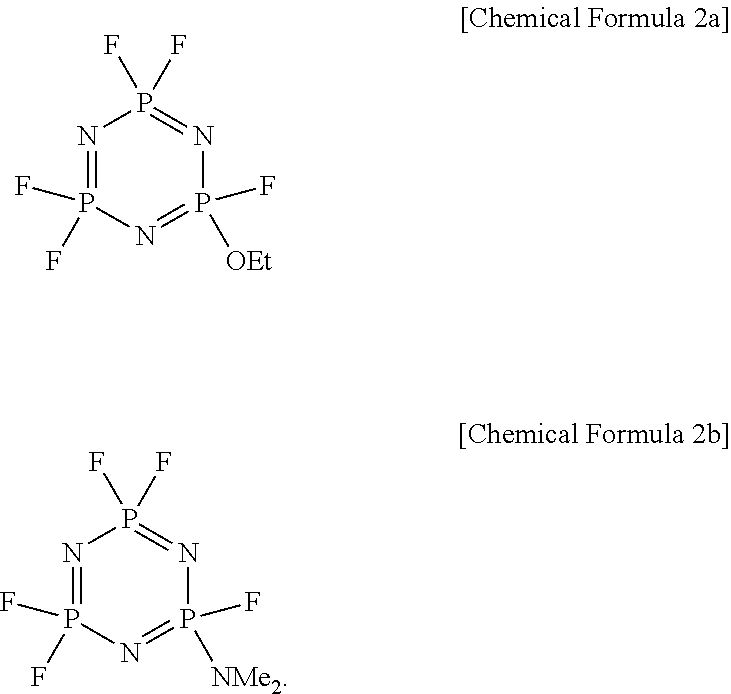
  • the phosphazene compound may be a compound represented by Chemical Formula 2a or Chemical Formula 2b:
  • the acrylate compound having a fluorinated alkyl group may be represented by Chemical Formula 3:
  • R c , R d and R e are the same or different and are hydrogen or a methyl group
  • R 2 are the same or different and are independently hydrogen or a C 1 to C 10 fluorinated alkyl group, provided at least one R 2 is a C 1 to C 10 fluorinated alkyl group.
  • R 2 may include —CF 3 , —(CF 2 ) n CHF 2 , —(CF 2 ) n CF 3 (wherein, n is 1 to 5), —CF 2n C 2m H 2m+1 (n and m are 1 to 5), —(CF 2 ) n OC 2m F 2m+1 (n and m are 1 to 5), —(CF 2 ) n OCF 2 H (wherein, n is 1 to 5).
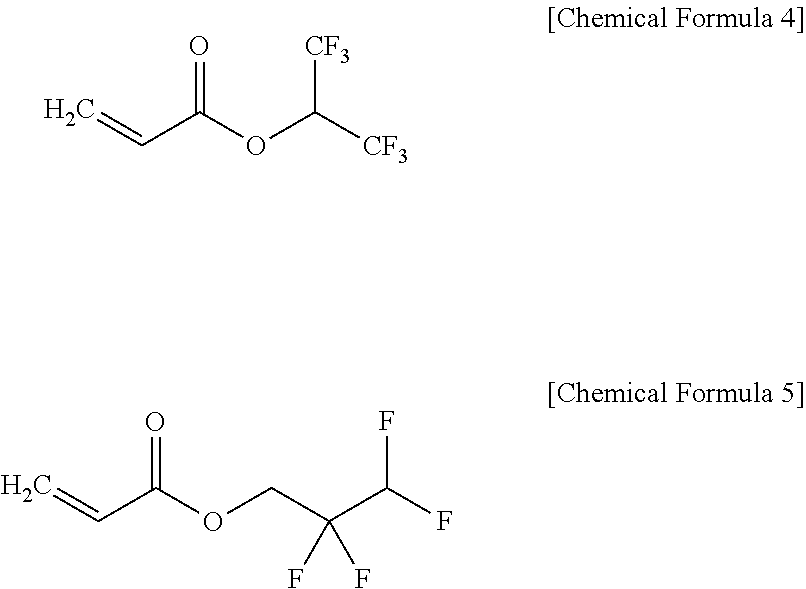
  • the compound represented by the above Chemical Formula 3 may include hexafluoroisopropyl acrylate represented by the Chemical Formula 4, 2,2,3,3-tetrafluoropropyl acrylate represented by represented by the Chemical Formula 5, or a mixture thereof:
  • a rechargeable lithium battery including a positive electrode including a positive active material; a negative electrode including a negative active material; and the electrolyte is provided.
  • the present embodiments provide an electrolyte for a rechargeable lithium battery having no cycle-life deterioration at room temperature and improved battery properties such as resistance decrease and the like as well as flame-retardant characteristics.
  • FIG. 1 is an exploded perspective view showing a rechargeable lithium battery according to one embodiment.
  • One embodiment provides an electrolyte for a rechargeable lithium battery including an organic solvent; a lithium salt; a flame retardant; and an acrylate compound having a fluorinated alkyl group.
  • the organic solvent may be a general solvent that is used in a lithium battery without limitation, for example, carbonates, esters, ethers, ketones, alcohols, or aprotic solvents.
  • the carbonates as the organic solvent may include dimethyl carbonate (DMC), diethyl carbonate (DEC), dipropyl carbonate (DPC), methylpropyl carbonate (MPC), ethylpropyl carbonate (EPC), ethylmethyl carbonate (EMC), ethylene carbonate (EC), propylene carbonate (PC), butylene carbonate (BC), and the like.
  • the esters as the organic solvent may include methyl acetate, ethyl acetate, n-propyl acetate, dimethylacetate, methylpropinonate, ethylpropinonate, ⁇ -butyrolactone, decanolide, valerolactone, mevalonolactone, caprolactone, and the like.
  • the ethers as the organic solvent may include dibutyl ether, tetraglyme, diglyme, dimethoxyethane, 2-methyltetrahydrofuran, tetrahydrofuran, and the like.
  • the ketones as the organic solvent may include cyclohexanone, and the like.
  • the alcohols as the organic solvent may include ethanol, isopropyl alcohol, and the like.
  • the aprotic solvents as the organic solvent may include R—CN (wherein, R is a C 2 to C 20 linear, branched or cyclic hydrocarbon group and may include a double bond, an aromatic cycle, or an ether bond), amides such as dimethyl formamide, dioxolanes such as 1,3-dioxolane, sulforanes, and the like.
  • the organic solvent may be used singularly or in a mixture.
  • the mixture ratio can be controlled in accordance with a desirable battery performance.
  • the organic solvent may include a mixture of ethylene carbonate (EC)/ethylmethyl carbonate (EMC)/dimethyl carbonate (DMC) in a volume ratio of 1 to 4.5/1 to 6.5/1 to 6, specifically, 2.7/3.6/2.7, 3/4/3, 1/4.5/4.5, 1.5/6.5/2, 2/4/4, and the like.
  • the lithium salt may be selected from LiPF 6 , LiBF 4 , LiSbF 6 , LiAsF 6 , LiC 4 F 9 SO 3 , LiClO 4 , LiAlO 2 , LiAlCl 4 , LiN(C x F 2x+1 SO 2 )(C y F 2y+1 SO 2 ) (wherein, x and y are natural numbers), LiCl, LiI, LiB(C 2 O 4 ) 2 (LiBOB), and a combination thereof.
  • the lithium salt may be used in a concentration of from about 0.5M to about 2.0 M.
  • the flame retardant of the electrolyte may include a compound having flame-retardant characteristics in an electrolyte for a rechargeable battery.
  • the flame retardant may preferably be at least one selected from a phosphazene compound and a phosphoric acid ester compound.
  • the phosphoric acid ester compound may include trimethyl phosphate, triethylphosphate, tributyl phosphate, triphenyl phosphate, tricresyl phosphate, trixylenyl phosphate, tris(2,2,2-trifluoroethyl)phosphate, tris(2,2-difluoroethyl)phosphate, tris(2-fluoroethyl)phosphate, and the like.
  • the flame retardant may be a phosphazene compound represented by the following Chemical Formula 1:
  • n is an integer of 3 or 4
  • R a and R b are the same or different, for example, F, NR 1 2 , or OR 1 , wherein R 1 is a C 1 to C 105 alkyl group, and in one embodiment, R 1 is a C 1 to C 5 alkyl group.
  • the phosphazene compound may be a compound represented by Chemical Formula 2a or Chemical Formula 2b.
  • the flame retardant may be included in an appropriate amount depending on a kind thereof and a desired battery characteristic.
  • the phosphazene compound represented by Chemical Formula 2a or Chemical Formula 2b, as the flame retardant may be used in an amount of about 3 vol % to about 15 vol % and specifically, about 3 vol % to about 12 vol % based on the total volume of the electrolyte.
  • the electrolyte according to one embodiment includes an acrylate compound having a fluorinated alkyl group.
  • the acrylate compound may be represented by the following Chemical Formula 3:
  • R c , R d and R e are the same or different and are hydrogen or a methyl group
  • R 2 are the same or different and are independently hydrogen or a C 1 to C 10 fluorinated alkyl group, provided that at least one R 2 is a C 1 to C 10 fluorinated alkyl group.
  • Examples of the fluorinated alkyl group may include —CF 3 , —(CF 2 ) n CHF 2 , —(CF 2 ) n CF 3 (wherein, n is 1 to 5), —CF 2n C 2m H 2m+1 (n and m are 1 to 5), —(CF 2 ) n OC 2m F 2m+1 (n and m are 1 to 5), —(CF 2 ) n OCF 2 H (wherein, n is 1 to 5).
  • the acrylate compound may be hexafluoroisopropyl acrylate or 2,2,3,3-tetrafluoropropyl acrylate represented by the following Chemical Formulae 4 and 5, respectively:
  • the electrolyte may maintain flame-retardant characteristics without deteriorating cycle-life, increasing resistance, and the like despite addition of the flame retardant.
  • the acrylate compound is hexafluoroisopropyl acrylate, this compound may prevent cycle-life deterioration of a battery and decrease resistance through the following mechanism when the flame retardant is added thereto:
  • the acrylate compound may undergo an ion polymerization reaction in the electrolyte and form a stable film on the surface of an electrode, and a bulky fluorinated alkyl group at the terminal end thereof in the film has high electron density at —CF 3 due to fluorine having high electric affinity. Accordingly, Li + ions are more easily coordinated on the surface of the electrode despite the flame retardant and resultantly, smoothly intercalated and may form the film to have smaller resistance.
  • a carbonyl compound included in the film formed by the acrylate compound may involve the nucleophilic substitution by the lithium ions and thus, have a second reaction in the reaction mechanisms during the charge and discharge.
  • the electrolyte according to one embodiment may not deteriorate battery cycle-life nor decrease resistance despite addition of the flame retardant.
  • the acrylate compound may be included in an amount appropriate adjusted depending on a kind of the flame retardant and desired battery properties.
  • HC10 or HC10P as the acrylate compound may be included in an amount of about 0.05 wt % to about 5 wt % and specifically, about 0.08 wt % to about 4 wt % based on the total weight of the electrolyte.
  • a rechargeable battery including the electrolyte in another embodiment, includes constituent elements such as a positive electrode including a positive active material and a negative electrode including a negative active material, and a separator as well as the electrolyte.
  • the rechargeable lithium battery including the electrolyte is not limited to specific kinds or shapes.
  • the rechargeable lithium battery according to one embodiment includes a lithium ion battery, or a lithium (ion) polymer battery, and may be a cylindrical, prismatic, coin-type, or pouch, or a bulk type or thin film type. Structures and manufacturing methods for lithium ion batteries are well known in the art.
  • a positive electrode including a positive active material may be manufactured according to a well-known method in the related arts, and structures and manufacturing methods thereof are not particularly limited thereto.
  • the positive active material may be a material being reversibly intercalating/deintercalating lithium ions, for example, a lithium transition element compound. More specifically, the positive active material may be at least one composite oxide of a metal selected from cobalt, manganese, nickel, and a combination thereof, and lithium.
  • Examples of the positive active material may be a compound represented by one of the following chemical formulae: Li a A 1-b R b D 2 (0.90 ⁇ a ⁇ 1.8 and 0 ⁇ b ⁇ 0.5); Li a E 1-b R b O 2-c D c (0.90 ⁇ a ⁇ 1.8, 0 ⁇ b ⁇ 0.5 and 0 ⁇ c ⁇ 0.05); Li a E 2-b R b O 4-c D c (0.90 ⁇ a ⁇ 1.8, 0 ⁇ b ⁇ 0.5, 0 ⁇ c ⁇ 0.05); Li a Ni 1-b-c Co b R c D ⁇ (0.90 ⁇ a ⁇ 1.8, 0 ⁇ b ⁇ 0.5, 0 ⁇ c ⁇ 0.05 and 0 ⁇ 2); Li a Ni 1-b-c Co b R c O 2- ⁇ Z ⁇ (0.90 ⁇ a ⁇ 1.8, 0 ⁇ b ⁇ 0.5, 0 ⁇ c ⁇ 0.05 and 0 ⁇ 2); Li a Ni 1-b-c Co b R c O 2- ⁇ Z 2 (0.90 ⁇ a ⁇ 1.8, 0 ⁇ b ⁇ 0.5, 0 ⁇ c ⁇ 0.05 and
  • A is Ni, Co, Mn, or a combination thereof;
  • R is Al, Ni, Co, Mn, Cr, Fe, Mg, Sr, V, a rare earth element, or a combination thereof;
  • D is O, F, S, P, or a combination thereof;
  • E is Co, Mn, or a combination thereof;
  • Z is F, S, P, or a combination thereof;
  • G is Al, Cr, Mn, Fe, Mg, La, Ce, Sr, V, or a combination thereof;
  • Q is Ti, Mo, Mn, or a combination thereof;
  • a negative electrode including a negative active material may be manufactured according to a well-known method in the related arts, and structures and manufacturing methods thereof are not particularly limited thereto.
  • the negative active material includes a material that reversibly intercalates/deintercalates lithium ions, a lithium metal, a lithium metal alloy, a material being capable of doping lithium, or a transition metal oxide.
  • the material that reversibly intercalates/deintercalates lithium ions includes carbon materials.
  • the carbon material may be any generally-used carbon-based negative active material in a lithium ion secondary battery.
  • Examples of the carbon material include crystalline carbon, amorphous carbon, and a combination thereof.
  • the crystalline carbon may be non-shaped, or sheet, flake, spherical, or fiber shaped natural graphite or artificial graphite.
  • the amorphous carbon may be a soft carbon, a hard carbon, a mesophase pitch carbonized product, fired coke, and the like.
  • the lithium metal alloy may be an alloy of lithium and a metal of Na, K, Rb, Cs, Fr, Be, Mg, Ca, Sr, Si, Sb, Pb, In, Zn, Ba, Ra, Ge, Al, or Sn.
  • the material being capable of doping and dedoping lithium may include Si, SiO x (0 ⁇ x ⁇ 2), a Si-Q alloy (wherein Q is an alkali metal, an alkaline-earth metal, Group 13 to 16 elements, a transition element, a rare earth element, or a combination thereof, and not Si), Sn, SnO 2 , a Sn—R alloy (wherein R is an alkali metal, an alkaline-earth metal, Group 13 to 16 elements, a transition element, a rare earth element, or a combination thereof and is not Sn), and the like. At least one of the forgoing materials may be mixed with SiO 2 .
  • the elements Q and R may be Mg, Ca, Sr, Ba, Ra, Sc, Y, Ti, Zr, Hf, Rf, V, Nb, Ta, Db, Cr, Mo, W, Sg, Tc, Re, Bh, Fe, Pb, Ru, Os, Hs, Rh, Ir, Pd, Pt, Cu, Ag, Au, Zn, Cd, B, Al, Ga, Sn, In, Tl, Ge, P, As, Sb, Bi, S, Se, Te, Po, or a combination thereof.
  • the transition metal oxide may include vanadium oxide, lithium vanadium oxide, and the like.
  • the positive active material layer and negative active material layer may further include a binder, and a conductive material as needed.
  • the binder improves binding properties of active material particles with one another and with a current collector.
  • the binder may include a non-water-soluble binder, a water-soluble binder, or a combination thereof.
  • non-water-soluble binder examples include polyvinylchloride, carboxylated polyvinylchloride, polyvinylfluoride, an ethylene oxide-containing polymer, polyvinylpyrrolidone, polyurethane, polytetrafluoroethylene, polyvinylidene fluoride, polyethylene, polypropylene, polyamideimide, polyimide, and combinations thereof.
  • the water-soluble binder includes a styrene-butadiene rubber, an acrylated styrene-butadiene rubber, polyvinyl alcohol, sodium polyacrylate, a copolymer including propylene and a C2 to C8 olefin, a copolymer of (meth)acrylic acid and (meth)acrylic acid alkyl ester, or a combination thereof.
  • a cellulose-based compound may be further used to provide viscosity.
  • the cellulose-based compound includes one or more of carboxylmethyl cellulose, hydroxypropylmethyl cellulose, methyl cellulose, or alkaline metal salts thereof.
  • the alkaline metal may be sodium (Na), potassium (K), or lithium (Li).
  • the cellulose-based compound may be included in an amount of 0.1 to 3 parts by weight based on 100 parts by weight of the negative active material.
  • the conductive material may improve electrical conductivity of a negative electrode. Any electrically conductive material can be used as a conductive agent unless it causes a chemical change. Examples of the conductive material include a carbon-based material of natural graphite, artificial graphite, carbon black, acetylene black, ketjen black, a carbon fiber, and the like; a metal-based material of a metal powder or a metal fiber including copper, nickel, aluminum, silver, and the like; a conductive polymer such as a polyphenylene; or a mixture thereof.
  • the rechargeable lithium battery may further include a separator between a negative electrode and a positive electrode, as needed.
  • the separator may include polyethylene, polypropylene, polyvinylidene fluoride or and multi-layers thereof such as a polyethylene/polypropylene double-layered separator, a polyethylene/polypropylene/polyethylene triple-layered separator, a polypropylene/polyethylene/polypropylene triple-layered separator, and the like.
  • a rechargeable lithium battery according to one embodiment including the electrolyte may have a desired type and structure, and such a type and structure, and a manufacturing method is well-known in the art of the rechargeable lithium battery.
  • FIG. 1 is an exploded perspective view of an example rechargeable lithium battery according to one embodiment.
  • a rechargeable lithium battery 100 includes a cylindrical battery that includes a negative electrode 112 , a positive electrode 114 and a separator 113 disposed between the negative electrode 112 and positive electrode 114 , an electrolyte (not shown) impregnated in the negative electrode 112 , positive electrode 114 , and separator 113 , a battery case 120 , and a sealing member 140 sealing the battery case 120 .
  • the negative electrode 112 , positive electrode 114 , and separator 113 are sequentially stacked, spirally wound, and placed in a battery case 120 to fabricate such a lithium secondary battery 100 .
  • the negative and positive electrodes may be fabricated by mixing the active material, a conductive material, and a binder into an active material composition and coating the composition on a current collector.
  • the electrode manufacturing method is well known and thus, is not described in detail in the present specification.
  • the solvent may be N-methylpyrrolidone but it is not limited thereto.
  • water as a solvent may be used to prepare a negative active material composition.
  • An organic solvent was prepared by mixing ethylenecarbonate (EC)/ethylmethylcarbonate (EMC)/dimethylcarbonate (DMC) in a volume ratio of 3/4/3 (v/v/v).
  • EC ethylenecarbonate
  • EMC ethylmethylcarbonate
  • DMC dimethylcarbonate
  • 1.3M LiPF 6 was added to the organic solvent, 5 vol % of a phosphazene compound represented by the following Chemical formula 2a (hereinafter, referred to be HC10) as a flame retardant was added thereto.
  • 0.1 wt % of hexafluoroisopropyl acrylate as an additive was added to the solution based on the total weight of the electrolyte solution, obtaining a final electrolyte solution.
  • An electrolyte solution was prepared according to the same method as Preparation Example 1 except for using 1 wt % of the hexafluoroisopropyl acrylate as an additive.
  • An electrolyte solution was prepared according to the same method as Preparation Example 1 except for using 3 wt % of the hexafluoroisopropyl acrylate as an additive.
  • An electrolyte solution was prepared according to the same method as Preparation Example 1 except for using 0.1 wt % of 2,2,3,3-tetrafluoropropyl acrylate as an additive.
  • An electrolyte solution was prepared according to the same method as Preparation Example 1 except for using 1 wt % of the 2,2,3,3-tetrafluoropropyl acrylate as an additive.
  • An electrolyte solution was prepared according to the same method as Preparation Example 1 except for using 3 wt % of the 2,2,3,3-tetrafluoropropyl acrylate as an additive.
  • An electrolyte solution was prepared according to the same method as Preparation Example 1 except for using 10 vol % of HC10 as a flame retardant.
  • An electrolyte solution was prepared according to the same method as Preparation Example 1 except for using 10 vol % of HC10 as a flame retardant and 1 wt % of the hexafluoroisopropyl acrylate as an additive.
  • An electrolyte solution was prepared according to the same method as Preparation Example 1 except for using 10 vol % of HC10 as a flame retardant and 3 wt % of the hexafluoroisopropyl acrylate as an additive.
  • An electrolyte solution was prepared according to the same method as Preparation Example 1 except for using 10 vol % of HC10 as a flame retardant and 0.1 wt % of the 2,2,3,3-tetrafluoropropyl acrylate as an additive.
  • An electrolyte solution was prepared according to the same method as Preparation Example 1 except for using 10 vol % of HC10 as a flame retardant and 1 wt % of the 2,2,3,3-tetrafluoropropyl acrylate as an additive.
  • An electrolyte solution was prepared according to the same method as Preparation Example 1 except for using 10 vol % of HC10 as a flame retardant and 1 wt % of the 2,2,3,3-tetrafluoropropyl acrylate as an additive.
  • the following positive and negative electrodes and a separator were used to fabricate a coin-type lithium cells.
  • Positive electrode A Li(Ni 0.5 Co 0.2 Mn 0.3 )O 2 (NCM) positive active material, a polyvinylidene fluoride binder, and a denkablack conductive material in a ratio of 92:4:4 wt % were mixed in an N-methylpyrrolidone solvent, preparing positive active material slurry.
  • the positive active material slurry was coated on an Al current collector, dried, and compressed, fabricating a positive electrode.
  • Negative electrode An artificial graphite negative active material and a carboxy metayl cellulose/styrene-butadiene rubber binder were mixed in a H 2 O solvent in a ratio of 97.5:1:1.5 wt %, preparing negative active material slurry. The negative active material slurry was coated on a Cu current collector and then, dried and compressed, fabricating a negative electrode.
  • Celgard 2320 polypropylene/polyethylene/polypropylene triple layer, thickness: 20 ⁇ m.
  • the positive and negative electrodes and the separator were used to fabricate a 2016 type coin cell (a 15 mm disk-shaped positive electrode and a 16 mm disk-shaped negative electrode), and the electrolyte solutions according to Preparation Examples 1 to 12 were respectively injected therein, fabricating a lithium ion battery cell.
  • An organic solvent was prepared by mixing ethylene carbonate (EC)/ethylmethylcarbonate (EMC)/dimethyl carbonate (DMC) in a volume ratio of 3/4/3 (v/v/v). Then, a lithium ion battery cell was fabricated according to the same method as Example 1 except for preparing an electrolyte solution by adding 1.3M LiPF 6 to the organic solvent.
  • the lithium ion battery cells according to Examples 2, 7, and 10 and Comparative Example 1 were evaluated regarding discharge C-rate characteristic. The test was performed by charging and discharging the lithium ion battery cells at each C rate for once. The results are provided in Table 1.
  • the lithium ion battery cells according to Examples 2, 7, and 10 had improved high rate discharge characteristic compared with the one Comparative Example 1.
  • the lithium ion battery cells according to Examples 1, 3, 4, 6 to 8, and 11 to 12 and Comparative Example 1 were measured regarding cycle-life characteristic under the following condition.
  • the lithium ion battery cells were charged and discharged at 0.5 C with 4.2V of a charge potential (0.02 C of a current cut-off) and 2.8V of a discharge potential in the first cycle, at 0.5 C with 4.2V of a charge potential (0.05 C of a current cut-off) and 2.8V of a discharge potential in the second cycle, at 1 C with 4.2V of a charge potential (0.05 C of a current cut-off) and 2.8V of a discharge potential in the third cycle, and at 2 C with 4.2V of a charge potential (0.05 C of a current cut-off) and 2.8V of a discharge potential in the fourth cycle and then, at 1 C with 4.2V of a charge potential (0.05 C of a current cut-off) and 2.8V of a discharge potential up to 60 cycles.
  • the lithium ion battery cells were measured regarding charge and discharge retention at the 30th cycle.
  • the discharge retention was obtained from percentages of the discharge capacity after 60 cycles to the discharge capacity after the fourth cycle. The results are provided in the following Table 2:
  • Example 1 99%
  • Example 3 100%
  • Example 4 99%
  • Example 6 99%
  • Example 7 100%
  • Example 8 99.2%
  • Example 11 99.5%
  • Example 12 98.8%
  • the lithium ion battery cells according to Examples 1, 3, 4, 6, 7 to 11 had a high charge/discharge retention of greater than or equal to 99%, which is higher than that of the one according to Comparative Example 1.
  • the lithium ion battery cells according to Examples 1, 3, 4, 6, 7, and 11 Comparative Example 1 had the following charge and discharge retention at the 55th cycle as shown in Table 3:
  • the lithium ion battery cells according to the Examples were remarkably suppressed from cycle-life characteristic deterioration compared with the one according to Comparative Example.

Landscapes

  • Chemical & Material Sciences (AREA)
  • Engineering & Computer Science (AREA)
  • Manufacturing & Machinery (AREA)
  • Chemical Kinetics & Catalysis (AREA)
  • Electrochemistry (AREA)
  • General Chemical & Material Sciences (AREA)
  • Inorganic Chemistry (AREA)
  • Physics & Mathematics (AREA)
  • Condensed Matter Physics & Semiconductors (AREA)
  • General Physics & Mathematics (AREA)
  • Secondary Cells (AREA)

Abstract

Disclosed is an electrolyte for a rechargeable lithium battery including an organic solvent; a lithium salt; a flame retardant; and at least one acrylate compound having a fluorinated alkyl group. The electrolyte for a rechargeable battery may provide a rechargeable lithium battery having flame-retardant characteristics without decrease of cycle-life and battery performance.

Description

CROSS-REFERENCE TO RELATED APPLICATIONS
This application claims priority to and the benefit of Korean Patent Application No. 10-2013-0005097 filed in the Korean Intellectual Property Office on Jan. 16, 2013, the entire contents of which are incorporated herein by reference.
BACKGROUND
1. Field
An electrolyte for a rechargeable lithium battery and a rechargeable lithium battery including the same are disclosed.
2. Description of the Related Technology
Rechargeable lithium batteries capable of being repeatedly charged and discharged has a high voltage and a high energy density and excellent storage performance and operation performance at a low temperature and thus, are widely used as a power source for portable electronic devices.
Accordingly, rechargeable lithium batteries have been researched as being large-sized and applied to an electric vehicle or a domestic electricity storage device. However, rechargeable lithium batteries may be internally short-cut and even destroyed or exploded when they meet abnormal conditions such as overcharge and the like due to impurities therein or various reasons.
Accordingly, an electrolyte including a flame-retardant additive or an ionic liquid as an assistant solvent has been suggested to prevent these abnormal battery problems. However, the electrolyte has high stability but high viscosity and may deteriorate efficiency characteristic and decrease cycle-life characteristics of the rechargeable lithium battery.
Although the flame-retardant additive may have a stable electrochemical window, it is easily coordinated with lithium in the electrolyte and oxidized or reduction-decomposed on the interface which results in and the formation of a film and accordingly, increase interface resistance during the operation of the rechargeable lithium battery for a long period and deteriorate its cycle-life characteristics.
SUMMARY
One embodiment provides an electrolyte for a rechargeable lithium battery having improved flame-retardant characteristics and maintaining/improving battery characteristic.
Another embodiment provides a rechargeable lithium battery including the electrolyte.
According to one embodiment, an electrolyte for a rechargeable lithium battery includes an organic solvent; a lithium salt; a flame retardant; and an acrylate compound having a fluorinated alkyl group.
The organic solvent may include carbonate, ester, ether, ketone, alcohol, an aprotic solvent, or a combination thereof.
The lithium salt may be at least one selected from LiPF6, LiBF4, LiSbF6, LiAsF6, LiC4F9SO3, LiClO4, LiAlO2, LiAlCl4, LiN(CxF2x+1SO2)(CyF2y+1SO2) (wherein, x and y are natural numbers), LiCl, LiI, LiB(C2O4)2(LiBOB), and a combination thereof.
The flame retardant may include at least one selected from a phosphazene-based compound and a phosphoric acid ester-based compound.
The phosphazene compound may be represented by the following Chemical Formula 1:
Figure US09461333-20161004-C00001
In the above Chemical Formula 1, n is an integer of 3 or 4, and Ra and Rb are the same or different and include, for example, F, NR1 2, or OR1, wherein R1 is a C1 to C10 alkyl group.
In one embodiment, the phosphazene compound may be a compound represented by Chemical Formula 2a or Chemical Formula 2b:
Figure US09461333-20161004-C00002
In one embodiment, the acrylate compound having a fluorinated alkyl group may be represented by Chemical Formula 3:
Figure US09461333-20161004-C00003
In the above Chemical Formula 3, Rc, Rd and Re are the same or different and are hydrogen or a methyl group, R2 are the same or different and are independently hydrogen or a C1 to C10 fluorinated alkyl group, provided at least one R2 is a C1 to C10 fluorinated alkyl group. R2 may include —CF3, —(CF2)nCHF2, —(CF2)nCF3 (wherein, n is 1 to 5), —CF2nC2mH2m+1 (n and m are 1 to 5), —(CF2)nOC2mF2m+1 (n and m are 1 to 5), —(CF2)nOCF2H (wherein, n is 1 to 5).
In one embodiment, the compound represented by the above Chemical Formula 3 may include hexafluoroisopropyl acrylate represented by the Chemical Formula 4, 2,2,3,3-tetrafluoropropyl acrylate represented by represented by the Chemical Formula 5, or a mixture thereof:
Figure US09461333-20161004-C00004
According to another embodiment, a rechargeable lithium battery including a positive electrode including a positive active material; a negative electrode including a negative active material; and the electrolyte is provided.
The present embodiments provide an electrolyte for a rechargeable lithium battery having no cycle-life deterioration at room temperature and improved battery properties such as resistance decrease and the like as well as flame-retardant characteristics.
BRIEF DESCRIPTION OF THE DRAWING
FIG. 1 is an exploded perspective view showing a rechargeable lithium battery according to one embodiment.
DETAILED DESCRIPTION
Example embodiments of the present disclosure will hereinafter be described in detail. However, these embodiments are only examples, and this disclosure is not limited thereto.
One embodiment provides an electrolyte for a rechargeable lithium battery including an organic solvent; a lithium salt; a flame retardant; and an acrylate compound having a fluorinated alkyl group.
The organic solvent may be a general solvent that is used in a lithium battery without limitation, for example, carbonates, esters, ethers, ketones, alcohols, or aprotic solvents. The carbonates as the organic solvent may include dimethyl carbonate (DMC), diethyl carbonate (DEC), dipropyl carbonate (DPC), methylpropyl carbonate (MPC), ethylpropyl carbonate (EPC), ethylmethyl carbonate (EMC), ethylene carbonate (EC), propylene carbonate (PC), butylene carbonate (BC), and the like. The esters as the organic solvent may include methyl acetate, ethyl acetate, n-propyl acetate, dimethylacetate, methylpropinonate, ethylpropinonate, γ-butyrolactone, decanolide, valerolactone, mevalonolactone, caprolactone, and the like. The ethers as the organic solvent may include dibutyl ether, tetraglyme, diglyme, dimethoxyethane, 2-methyltetrahydrofuran, tetrahydrofuran, and the like. The ketones as the organic solvent may include cyclohexanone, and the like. The alcohols as the organic solvent may include ethanol, isopropyl alcohol, and the like. The aprotic solvents as the organic solvent may include R—CN (wherein, R is a C2 to C20 linear, branched or cyclic hydrocarbon group and may include a double bond, an aromatic cycle, or an ether bond), amides such as dimethyl formamide, dioxolanes such as 1,3-dioxolane, sulforanes, and the like.
The organic solvent may be used singularly or in a mixture. When the organic solvent is used in a mixture, the mixture ratio can be controlled in accordance with a desirable battery performance. For example, the organic solvent may include a mixture of ethylene carbonate (EC)/ethylmethyl carbonate (EMC)/dimethyl carbonate (DMC) in a volume ratio of 1 to 4.5/1 to 6.5/1 to 6, specifically, 2.7/3.6/2.7, 3/4/3, 1/4.5/4.5, 1.5/6.5/2, 2/4/4, and the like.
The lithium salt may be selected from LiPF6, LiBF4, LiSbF6, LiAsF6, LiC4F9SO3, LiClO4, LiAlO2, LiAlCl4, LiN(CxF2x+1SO2)(CyF2y+1SO2) (wherein, x and y are natural numbers), LiCl, LiI, LiB(C2O4)2 (LiBOB), and a combination thereof.
In one embodiment, the lithium salt may be used in a concentration of from about 0.5M to about 2.0 M.
According to one embodiment, the flame retardant of the electrolyte may include a compound having flame-retardant characteristics in an electrolyte for a rechargeable battery. In one embodiment, the flame retardant may preferably be at least one selected from a phosphazene compound and a phosphoric acid ester compound. The phosphoric acid ester compound may include trimethyl phosphate, triethylphosphate, tributyl phosphate, triphenyl phosphate, tricresyl phosphate, trixylenyl phosphate, tris(2,2,2-trifluoroethyl)phosphate, tris(2,2-difluoroethyl)phosphate, tris(2-fluoroethyl)phosphate, and the like.
In one embodiment, the flame retardant may be a phosphazene compound represented by the following Chemical Formula 1:
Figure US09461333-20161004-C00005
In the above Chemical Formula 1, n is an integer of 3 or 4, and Ra and Rb are the same or different, for example, F, NR1 2, or OR1, wherein R1 is a C1 to C105 alkyl group, and in one embodiment, R1 is a C1 to C5 alkyl group.
In one embodiment, the phosphazene compound may be a compound represented by Chemical Formula 2a or Chemical Formula 2b.
Figure US09461333-20161004-C00006
The flame retardant may be included in an appropriate amount depending on a kind thereof and a desired battery characteristic. For example, the phosphazene compound represented by Chemical Formula 2a or Chemical Formula 2b, as the flame retardant may be used in an amount of about 3 vol % to about 15 vol % and specifically, about 3 vol % to about 12 vol % based on the total volume of the electrolyte.
The electrolyte according to one embodiment includes an acrylate compound having a fluorinated alkyl group. In one embodiment, the acrylate compound may be represented by the following Chemical Formula 3:
Figure US09461333-20161004-C00007
In the above Chemical Formula 3, Rc, Rd and Re are the same or different and are hydrogen or a methyl group, and R2 are the same or different and are independently hydrogen or a C1 to C10 fluorinated alkyl group, provided that at least one R2 is a C1 to C10 fluorinated alkyl group. Examples of the fluorinated alkyl group may include —CF3, —(CF2)nCHF2, —(CF2)nCF3 (wherein, n is 1 to 5), —CF2nC2mH2m+1 (n and m are 1 to 5), —(CF2)nOC2mF2m+1 (n and m are 1 to 5), —(CF2)nOCF2H (wherein, n is 1 to 5). In one embodiment, the acrylate compound may be hexafluoroisopropyl acrylate or 2,2,3,3-tetrafluoropropyl acrylate represented by the following Chemical Formulae 4 and 5, respectively:
Figure US09461333-20161004-C00008
When the acrylate compound is included in the electrolyte, the electrolyte may maintain flame-retardant characteristics without deteriorating cycle-life, increasing resistance, and the like despite addition of the flame retardant. Without being bound to a specific theory, when the acrylate compound is hexafluoroisopropyl acrylate, this compound may prevent cycle-life deterioration of a battery and decrease resistance through the following mechanism when the flame retardant is added thereto:
Figure US09461333-20161004-C00009
Specifically, the acrylate compound may undergo an ion polymerization reaction in the electrolyte and form a stable film on the surface of an electrode, and a bulky fluorinated alkyl group at the terminal end thereof in the film has high electron density at —CF3 due to fluorine having high electric affinity. Accordingly, Li+ ions are more easily coordinated on the surface of the electrode despite the flame retardant and resultantly, smoothly intercalated and may form the film to have smaller resistance. A carbonyl compound included in the film formed by the acrylate compound may involve the nucleophilic substitution by the lithium ions and thus, have a second reaction in the reaction mechanisms during the charge and discharge. However, since carbon bonded with CF3 has relatively low electron density due to the fluoroalkyl group, electrons relatively slowly move toward oxygen bonded with the carbon. Accordingly, the electrolyte according to one embodiment may not deteriorate battery cycle-life nor decrease resistance despite addition of the flame retardant.
The acrylate compound may be included in an amount appropriate adjusted depending on a kind of the flame retardant and desired battery properties. For example, HC10 or HC10P as the acrylate compound may be included in an amount of about 0.05 wt % to about 5 wt % and specifically, about 0.08 wt % to about 4 wt % based on the total weight of the electrolyte.
In another embodiment, a rechargeable battery including the electrolyte is provided. The rechargeable battery according to one embodiment includes constituent elements such as a positive electrode including a positive active material and a negative electrode including a negative active material, and a separator as well as the electrolyte. The rechargeable lithium battery including the electrolyte is not limited to specific kinds or shapes. For example, the rechargeable lithium battery according to one embodiment includes a lithium ion battery, or a lithium (ion) polymer battery, and may be a cylindrical, prismatic, coin-type, or pouch, or a bulk type or thin film type. Structures and manufacturing methods for lithium ion batteries are well known in the art.
In a rechargeable lithium battery according to one embodiment, a positive electrode including a positive active material may be manufactured according to a well-known method in the related arts, and structures and manufacturing methods thereof are not particularly limited thereto. The positive active material may be a material being reversibly intercalating/deintercalating lithium ions, for example, a lithium transition element compound. More specifically, the positive active material may be at least one composite oxide of a metal selected from cobalt, manganese, nickel, and a combination thereof, and lithium. Examples of the positive active material may be a compound represented by one of the following chemical formulae: LiaA1-bRbD2 (0.90≦a≦1.8 and 0≦b≦0.5); LiaE1-bRbO2-cDc (0.90≦a≦1.8, 0≦b≦0.5 and 0≦c≦0.05); LiaE2-bRbO4-cDc (0.90≦a≦1.8, 0≦b≦0.5, 0≦c≦0.05); LiaNi1-b-cCobRcDα (0.90≦a≦1.8, 0≦b≦0.5, 0≦c≦0.05 and 0<α≦2); LiaNi1-b-cCobRcO2-αZα (0.90≦a≦1.8, 0≦b≦0.5, 0≦c≦0.05 and 0<α<2); LiaNi1-b-cCobRcO2-αZ2 (0.90≦a≦1.8, 0≦b≦0.5, 0≦c≦0.05 and 0<α<2); LiaNi1-b-cMnbRcDα (0.90≦a≦1.8, 0≦b≦0.5, 0≦c≦0.05 and 0<α≦2); LiaNi1-b-cMnbRcO2-αZα (0.90≦a≦1.8, 0≦b≦0.5, 0≦c≦0.05 and 0<α<2); LiaNi1-b-cMnbRcO2-αZ2 (0.90≦a≦1.8, 0≦b≦0.5, 0≦c≦0.05 and 0<α<2); LiaNibEcGdO2 (0.90≦a≦1.8, 0≦b≦0.9, 0≦c≦0.5 and 0.001≦d≦0.1.); LiaNibCocMndGeO2 (0.90≦a≦1.8, 0≦b≦0.9, 0≦c≦0.5, 0≦d≦0.5 and 0.001≦e≦0.1.); LiaNiGbO2 (0.90≦a≦1.8 and 0.001≦b≦0.1.); LiaCoGbO2 (0.90≦a≦1.8 and 0.001≦b≦0.1.); LiaMnGbO2 (0.90≦a≦1.8 and 0.001≦b≦0.1.); LiaMn2GbO4 (0.90≦a≦1.8 and 0.001≦b≦0.1.); QO2; QS2; LiQS2; V2O5; LiV2O5; LiTO2; LiNiVO4; Li(3-f)J2(PO4)3 (0≦f≦2); Li(3-f)Fe2(PO4)3; and LiFePO4.
In the above chemical formulae, A is Ni, Co, Mn, or a combination thereof; R is Al, Ni, Co, Mn, Cr, Fe, Mg, Sr, V, a rare earth element, or a combination thereof; D is O, F, S, P, or a combination thereof; E is Co, Mn, or a combination thereof; Z is F, S, P, or a combination thereof; G is Al, Cr, Mn, Fe, Mg, La, Ce, Sr, V, or a combination thereof; Q is Ti, Mo, Mn, or a combination thereof; T is Cr, V, Fe, Sc, Y, or a combination thereof; and J is V, Cr, Mn, Co, Ni, Cu, or a combination thereof.
In a rechargeable lithium battery according to one embodiment, a negative electrode including a negative active material may be manufactured according to a well-known method in the related arts, and structures and manufacturing methods thereof are not particularly limited thereto. The negative active material includes a material that reversibly intercalates/deintercalates lithium ions, a lithium metal, a lithium metal alloy, a material being capable of doping lithium, or a transition metal oxide.
The material that reversibly intercalates/deintercalates lithium ions includes carbon materials. The carbon material may be any generally-used carbon-based negative active material in a lithium ion secondary battery. Examples of the carbon material include crystalline carbon, amorphous carbon, and a combination thereof. The crystalline carbon may be non-shaped, or sheet, flake, spherical, or fiber shaped natural graphite or artificial graphite. The amorphous carbon may be a soft carbon, a hard carbon, a mesophase pitch carbonized product, fired coke, and the like.
The lithium metal alloy may be an alloy of lithium and a metal of Na, K, Rb, Cs, Fr, Be, Mg, Ca, Sr, Si, Sb, Pb, In, Zn, Ba, Ra, Ge, Al, or Sn.
The material being capable of doping and dedoping lithium may include Si, SiOx(0<x<2), a Si-Q alloy (wherein Q is an alkali metal, an alkaline-earth metal, Group 13 to 16 elements, a transition element, a rare earth element, or a combination thereof, and not Si), Sn, SnO2, a Sn—R alloy (wherein R is an alkali metal, an alkaline-earth metal, Group 13 to 16 elements, a transition element, a rare earth element, or a combination thereof and is not Sn), and the like. At least one of the forgoing materials may be mixed with SiO2. The elements Q and R may be Mg, Ca, Sr, Ba, Ra, Sc, Y, Ti, Zr, Hf, Rf, V, Nb, Ta, Db, Cr, Mo, W, Sg, Tc, Re, Bh, Fe, Pb, Ru, Os, Hs, Rh, Ir, Pd, Pt, Cu, Ag, Au, Zn, Cd, B, Al, Ga, Sn, In, Tl, Ge, P, As, Sb, Bi, S, Se, Te, Po, or a combination thereof.
The transition metal oxide may include vanadium oxide, lithium vanadium oxide, and the like.
The positive active material layer and negative active material layer may further include a binder, and a conductive material as needed.
The binder improves binding properties of active material particles with one another and with a current collector. The binder may include a non-water-soluble binder, a water-soluble binder, or a combination thereof.
Examples of the non-water-soluble binder include polyvinylchloride, carboxylated polyvinylchloride, polyvinylfluoride, an ethylene oxide-containing polymer, polyvinylpyrrolidone, polyurethane, polytetrafluoroethylene, polyvinylidene fluoride, polyethylene, polypropylene, polyamideimide, polyimide, and combinations thereof.
The water-soluble binder includes a styrene-butadiene rubber, an acrylated styrene-butadiene rubber, polyvinyl alcohol, sodium polyacrylate, a copolymer including propylene and a C2 to C8 olefin, a copolymer of (meth)acrylic acid and (meth)acrylic acid alkyl ester, or a combination thereof.
When the water-soluble binder is used as a negative electrode binder, a cellulose-based compound may be further used to provide viscosity. The cellulose-based compound includes one or more of carboxylmethyl cellulose, hydroxypropylmethyl cellulose, methyl cellulose, or alkaline metal salts thereof. The alkaline metal may be sodium (Na), potassium (K), or lithium (Li). The cellulose-based compound may be included in an amount of 0.1 to 3 parts by weight based on 100 parts by weight of the negative active material.
The conductive material may improve electrical conductivity of a negative electrode. Any electrically conductive material can be used as a conductive agent unless it causes a chemical change. Examples of the conductive material include a carbon-based material of natural graphite, artificial graphite, carbon black, acetylene black, ketjen black, a carbon fiber, and the like; a metal-based material of a metal powder or a metal fiber including copper, nickel, aluminum, silver, and the like; a conductive polymer such as a polyphenylene; or a mixture thereof.
The rechargeable lithium battery may further include a separator between a negative electrode and a positive electrode, as needed. The separator may include polyethylene, polypropylene, polyvinylidene fluoride or and multi-layers thereof such as a polyethylene/polypropylene double-layered separator, a polyethylene/polypropylene/polyethylene triple-layered separator, a polypropylene/polyethylene/polypropylene triple-layered separator, and the like.
As described above, a rechargeable lithium battery according to one embodiment including the electrolyte may have a desired type and structure, and such a type and structure, and a manufacturing method is well-known in the art of the rechargeable lithium battery.
FIG. 1 is an exploded perspective view of an example rechargeable lithium battery according to one embodiment. Referring to FIG. 1, a rechargeable lithium battery 100 includes a cylindrical battery that includes a negative electrode 112, a positive electrode 114 and a separator 113 disposed between the negative electrode 112 and positive electrode 114, an electrolyte (not shown) impregnated in the negative electrode 112, positive electrode 114, and separator 113, a battery case 120, and a sealing member 140 sealing the battery case 120. The negative electrode 112, positive electrode 114, and separator 113 are sequentially stacked, spirally wound, and placed in a battery case 120 to fabricate such a lithium secondary battery 100.
The negative and positive electrodes may be fabricated by mixing the active material, a conductive material, and a binder into an active material composition and coating the composition on a current collector. The electrode manufacturing method is well known and thus, is not described in detail in the present specification. The solvent may be N-methylpyrrolidone but it is not limited thereto. In addition, when a water-soluble binder is used for a negative electrode, water as a solvent may be used to prepare a negative active material composition.
The following examples illustrate the present embodiments in more detail. These examples, however, are not in any sense to be interpreted as limiting the scope of this disclosure.
EXAMPLES Preparation Example 1
An organic solvent was prepared by mixing ethylenecarbonate (EC)/ethylmethylcarbonate (EMC)/dimethylcarbonate (DMC) in a volume ratio of 3/4/3 (v/v/v). Next, 1.3M LiPF6 was added to the organic solvent, 5 vol % of a phosphazene compound represented by the following Chemical formula 2a (hereinafter, referred to be HC10) as a flame retardant was added thereto. Then, 0.1 wt % of hexafluoroisopropyl acrylate as an additive was added to the solution based on the total weight of the electrolyte solution, obtaining a final electrolyte solution.
Figure US09461333-20161004-C00010
Preparation Example 2
An electrolyte solution was prepared according to the same method as Preparation Example 1 except for using 1 wt % of the hexafluoroisopropyl acrylate as an additive.
Preparation Example 3
An electrolyte solution was prepared according to the same method as Preparation Example 1 except for using 3 wt % of the hexafluoroisopropyl acrylate as an additive.
Preparation Example 4
An electrolyte solution was prepared according to the same method as Preparation Example 1 except for using 0.1 wt % of 2,2,3,3-tetrafluoropropyl acrylate as an additive.
Preparation Example 5
An electrolyte solution was prepared according to the same method as Preparation Example 1 except for using 1 wt % of the 2,2,3,3-tetrafluoropropyl acrylate as an additive.
Preparation Example 6
An electrolyte solution was prepared according to the same method as Preparation Example 1 except for using 3 wt % of the 2,2,3,3-tetrafluoropropyl acrylate as an additive.
Preparation Example 7
An electrolyte solution was prepared according to the same method as Preparation Example 1 except for using 10 vol % of HC10 as a flame retardant.
Preparation Example 8
An electrolyte solution was prepared according to the same method as Preparation Example 1 except for using 10 vol % of HC10 as a flame retardant and 1 wt % of the hexafluoroisopropyl acrylate as an additive.
Preparation Example 9
An electrolyte solution was prepared according to the same method as Preparation Example 1 except for using 10 vol % of HC10 as a flame retardant and 3 wt % of the hexafluoroisopropyl acrylate as an additive.
Preparation Example 10
An electrolyte solution was prepared according to the same method as Preparation Example 1 except for using 10 vol % of HC10 as a flame retardant and 0.1 wt % of the 2,2,3,3-tetrafluoropropyl acrylate as an additive.
Preparation Example 11
An electrolyte solution was prepared according to the same method as Preparation Example 1 except for using 10 vol % of HC10 as a flame retardant and 1 wt % of the 2,2,3,3-tetrafluoropropyl acrylate as an additive.
Preparation Example 12
An electrolyte solution was prepared according to the same method as Preparation Example 1 except for using 10 vol % of HC10 as a flame retardant and 1 wt % of the 2,2,3,3-tetrafluoropropyl acrylate as an additive.
Examples 1 to 12 Manufacture of Lithium Battery Cell
The following positive and negative electrodes and a separator were used to fabricate a coin-type lithium cells.
Positive electrode: A Li(Ni0.5Co0.2Mn0.3)O2 (NCM) positive active material, a polyvinylidene fluoride binder, and a denkablack conductive material in a ratio of 92:4:4 wt % were mixed in an N-methylpyrrolidone solvent, preparing positive active material slurry. The positive active material slurry was coated on an Al current collector, dried, and compressed, fabricating a positive electrode.
Negative electrode: An artificial graphite negative active material and a carboxy metayl cellulose/styrene-butadiene rubber binder were mixed in a H2O solvent in a ratio of 97.5:1:1.5 wt %, preparing negative active material slurry. The negative active material slurry was coated on a Cu current collector and then, dried and compressed, fabricating a negative electrode.
Separator: Celgard 2320 (polypropylene/polyethylene/polypropylene triple layer, thickness: 20 μm).
The positive and negative electrodes and the separator were used to fabricate a 2016 type coin cell (a 15 mm disk-shaped positive electrode and a 16 mm disk-shaped negative electrode), and the electrolyte solutions according to Preparation Examples 1 to 12 were respectively injected therein, fabricating a lithium ion battery cell.
Comparative Example 1
An organic solvent was prepared by mixing ethylene carbonate (EC)/ethylmethylcarbonate (EMC)/dimethyl carbonate (DMC) in a volume ratio of 3/4/3 (v/v/v). Then, a lithium ion battery cell was fabricated according to the same method as Example 1 except for preparing an electrolyte solution by adding 1.3M LiPF6 to the organic solvent.
Experimental Example Discharge C-Rate Characteristics and Cycle-Life Characteristics of Battery Cells
The lithium ion battery cells according to Examples 2, 7, and 10 and Comparative Example 1 were evaluated regarding discharge C-rate characteristic. The test was performed by charging and discharging the lithium ion battery cells at each C rate for once. The results are provided in Table 1.
TABLE 1
Discharge Capacity (mAh/g)
Comparative
Discharge C-rate Example 1 Example 2 Example 7 Example 10
0.5 C 152.9 155.3 152.5 154.0
  1 C 139.6 145.4 142.9 144.2
  2 C 131.9 138.6 136.2 136.9
Referring to Table 2, the lithium ion battery cells according to Examples 2, 7, and 10 had improved high rate discharge characteristic compared with the one Comparative Example 1.
The lithium ion battery cells according to Examples 1, 3, 4, 6 to 8, and 11 to 12 and Comparative Example 1 were measured regarding cycle-life characteristic under the following condition.
The lithium ion battery cells were charged and discharged at 0.5 C with 4.2V of a charge potential (0.02 C of a current cut-off) and 2.8V of a discharge potential in the first cycle, at 0.5 C with 4.2V of a charge potential (0.05 C of a current cut-off) and 2.8V of a discharge potential in the second cycle, at 1 C with 4.2V of a charge potential (0.05 C of a current cut-off) and 2.8V of a discharge potential in the third cycle, and at 2 C with 4.2V of a charge potential (0.05 C of a current cut-off) and 2.8V of a discharge potential in the fourth cycle and then, at 1 C with 4.2V of a charge potential (0.05 C of a current cut-off) and 2.8V of a discharge potential up to 60 cycles.
The lithium ion battery cells were measured regarding charge and discharge retention at the 30th cycle. The discharge retention was obtained from percentages of the discharge capacity after 60 cycles to the discharge capacity after the fourth cycle. The results are provided in the following Table 2:
TABLE 2
Discharge Retention
Comparative Example 1   98%
Example 1    99%
Example 3   100%
Example 4    99%
Example 6    99%
Example 7   100%
Example 8  99.2%
Example 11 99.5%
Example 12 98.8%
Referring to Table 1, the lithium ion battery cells according to Examples 1, 3, 4, 6, 7 to 11 had a high charge/discharge retention of greater than or equal to 99%, which is higher than that of the one according to Comparative Example 1.
The lithium ion battery cells according to Examples 1, 3, 4, 6, 7, and 11 Comparative Example 1 had the following charge and discharge retention at the 55th cycle as shown in Table 3:
TABLE 3
Discharge Retention
Comparative Example 1   97%
Example 1    98%
Example 3    99%
Example 4   100%
Example 6  97.2
Example 7   100%
Example 11 97.5%
Based on the results, the lithium ion battery cells according to the Examples were remarkably suppressed from cycle-life characteristic deterioration compared with the one according to Comparative Example.
While the present embodiments has been described in connection with what is presently considered to be practical example embodiments, it is to be understood that the embodiments are not limited to the disclosed embodiments, but, on the contrary, is intended to cover various modifications and equivalent arrangements included within the spirit and scope of the appended claims.

Claims (16)

What is claimed is:
1. An electrolyte for a rechargeable lithium battery, comprising
an organic solvent; a lithium salt; a flame retardant; and a compound having a fluorinated alkyl group selected from hexafluoroisopropyl acrylate, 2,2,3,3-tetrafluoropropyl acrylate, and a mixture thereof,
wherein the flame retardant is included in an amount of about 3 vol % to about 15 vol % based on the total volume of the electrolyte,
wherein the compound having a fluorinated alkyl group is included in an amount of about 0.05 wt % to about 5 wt % based on the total weight of the electrolyte.
2. The electrolyte for a rechargeable lithium battery of claim 1, wherein the compound having a fluorinated alkyl group is hexafluoroisopropyl acrylate.
3. The electrolyte for a rechargeable lithium battery of claim 1, wherein the flame retardant is at least one phosphazene-based compound represented by the following Chemical Formula 1:
Figure US09461333-20161004-C00011
wherein, n is an integer of 3 or 4, and Ra and Rb are the same or different, and are F, NR1 2, or OR1, wherein R1 is a C1 to C10 alkyl group.
4. The electrolyte for a rechargeable lithium battery of claim 3, wherein the phosphazene-based compound is a compound represented by Chemical Formula 2a or Chemical Formula 2b:
Figure US09461333-20161004-C00012
5. The electrolyte for a rechargeable lithium battery of claim 1, wherein the compound having a fluorinated alkyl group is 2,2,3,3-tetrafluoropropyl acrylate.
6. The electrolyte for a rechargeable lithium battery of claim 5, wherein the compound having a fluorinated alkyl group is a mixture of hexafluoroisopropyl acrylate, and 2,2,3,3-tetrafluoropropyl acrylate.
7. The electrolyte for a rechargeable lithium battery of claim 1, wherein the lithium salt is at least one selected from LiPF6, LiBF4, LiSbF6, LiAsF6, LiC4F9SO3, LiClO4, LiAlO2, LiAlCl4, LiN(CxF2x+1SO2)(CyF2y+1SO2) (wherein, x and y are natural numbers), LiCl, LiI, LiB(C2O4)2 (LiBOB), and a combination thereof.
8. The electrolyte for a rechargeable lithium battery of claim 1, wherein the organic solvent is at least one selected from carbonate, ester, ether, ketone, alcohol, an aprotic solvent, and a combination thereof.
9. A rechargeable lithium battery, comprising
a positive electrode including a positive active material;
a negative electrode including a negative active material; and
an electrolyte comprising an organic solvent; a lithium salt; a flame retardant; and
a compound having a fluorinated alkyl group selected from hexafluoroisopropyl acrylate, 2,2,3,3-tetrafluoropropyl acrylate, and a mixture thereof,
wherein the flame retardant is included in an amount of about 3 vol % to about 15 vol % based on the total volume of the electrolyte,
wherein the compound having a fluorinated alkyl group is included in an amount of about 0.05 wt % to about 5 wt % based on the total weight of the electrolyte.
10. The rechargeable battery of claim 9, wherein the compound having a fluorinated alkyl group is hexafluoroisopropyl acrylate.
11. The rechargeable battery of claim 9, wherein the flame retardant is at least one phosphazene-based compound represented by the following Chemical Formula 1:
Figure US09461333-20161004-C00013
wherein, n is an integer of 3 or 4, and Ra and Rb are the same or different, and are F, NR1 2, or OR1, wherein R1 is a C1 to C10 alkyl group.
12. The rechargeable battery of claim 11, wherein the phosphazene-based compound is a compound represented by Chemical Formula 2a or Chemical Formula 2b:
Figure US09461333-20161004-C00014
13. The rechargeable battery of claim 12, wherein the compound having a fluorinated alkyl group is a mixture of hexafluoroisopropyl acrylate, and 2,2,3,3-tetrafluoropropyl acrylate.
14. The rechargeable battery of claim 9, wherein the compound having a fluorinated alkyl group is 2,2,3,3-tetrafluoropropyl acrylate.
15. The rechargeable battery of claim 9, wherein
the lithium salt is at least one selected from LiPF6, LiBF4, LiSbF6, LiAsF6, LiC4F9SO3, LiClO4, LiAlO2, LiAlCl4, LiN(CxF2x-1SO2)(CyF2y+1SO2) (wherein, x and y are natural numbers), LiCl, LiI, LiB(C2O4)2 (LiBOB), and a combination thereof.
16. The rechargeable battery of claim 9, wherein the organic solvent is at least one selected from carbonate, ester, ether, ketone, alcohol, an aprotic solvent, and a combination thereof.
US13/946,939 2013-01-16 2013-07-19 Electrolytes for rechargeable lithium battery and rechargeable lithium battery comprising same Active 2034-10-22 US9461333B2 (en)

Applications Claiming Priority (2)

Application Number Priority Date Filing Date Title
KR1020130005097A KR101733738B1 (en) 2013-01-16 2013-01-16 Electrolytes for rechargeable lithium batteries and rechargeable lithium battery comprising the same
KR10-2013-0005097 2013-01-16

Publications (2)

Publication Number Publication Date
US20140199599A1 US20140199599A1 (en) 2014-07-17
US9461333B2 true US9461333B2 (en) 2016-10-04

Family

ID=51165382

Family Applications (1)

Application Number Title Priority Date Filing Date
US13/946,939 Active 2034-10-22 US9461333B2 (en) 2013-01-16 2013-07-19 Electrolytes for rechargeable lithium battery and rechargeable lithium battery comprising same

Country Status (2)

Country Link
US (1) US9461333B2 (en)
KR (1) KR101733738B1 (en)

Cited By (2)

* Cited by examiner, † Cited by third party
Publication number Priority date Publication date Assignee Title
WO2018176980A1 (en) * 2017-03-31 2018-10-04 比亚迪股份有限公司 Flame-retardant package and lithium-ion battery thereof
US10707531B1 (en) 2016-09-27 2020-07-07 New Dominion Enterprises Inc. All-inorganic solvents for electrolytes

Families Citing this family (6)

* Cited by examiner, † Cited by third party
Publication number Priority date Publication date Assignee Title
JP6047458B2 (en) * 2013-07-29 2016-12-21 富士フイルム株式会社 Non-aqueous secondary battery
US10707526B2 (en) 2015-03-27 2020-07-07 New Dominion Enterprises Inc. All-inorganic solvents for electrolytes
CN108110317A (en) * 2016-11-25 2018-06-01 深圳新宙邦科技股份有限公司 A kind of non-aqueous electrolyte for lithium ion cell and lithium ion battery
WO2021020005A1 (en) * 2019-07-31 2021-02-04 ダイキン工業株式会社 Alkali metal electrode treatment agent, electrolytic solution for alkali metal secondary battery, alkali metal electrode, alkali metal secondary battery, and module
CN114556658B (en) * 2019-10-07 2024-05-28 三菱化学株式会社 Non-aqueous electrolyte and non-aqueous electrolyte secondary battery
US20230155174A1 (en) * 2021-11-12 2023-05-18 GM Global Technology Operations LLC Lithium metal battery electrolytes including flame retardant additives

Citations (6)

* Cited by examiner, † Cited by third party
Publication number Priority date Publication date Assignee Title
KR20010030178A (en) 1999-09-20 2001-04-16 가나이 쓰도무 Non-aqueous electrolyte, lithium primary battery, lithium secondary battery, and electrochemical capacitor using same, polymer electrolyte using same, and polymer lithium secondary battery using same
KR20050041093A (en) 2003-10-29 2005-05-04 삼성에스디아이 주식회사 Electrolyte for lithium metal battery and lithium metal battery comprising same
KR20050083532A (en) 2004-02-23 2005-08-26 삼성에스디아이 주식회사 Gel polymer electrolyte and lithium secondary battery
KR20110005066A (en) 2009-07-09 2011-01-17 주식회사 엘지화학 Non-aqueous electrolyte for lithium secondary battery and lithium secondary battery having same
US20110117443A1 (en) * 2009-11-19 2011-05-19 Lee Yong-Beom Electrolyte for lithium battery and lithium battery including the same
US20120164519A1 (en) * 2010-12-22 2012-06-28 Samsung Sdi Co., Ltd. Electrolyte for lithium secondary battery and lithium secondary battery comprising the same

Patent Citations (10)

* Cited by examiner, † Cited by third party
Publication number Priority date Publication date Assignee Title
KR20010030178A (en) 1999-09-20 2001-04-16 가나이 쓰도무 Non-aqueous electrolyte, lithium primary battery, lithium secondary battery, and electrochemical capacitor using same, polymer electrolyte using same, and polymer lithium secondary battery using same
US6495293B1 (en) 1999-09-20 2002-12-17 Hitachi, Ltd. Non-aqueous electrolyte comprising a fluorinated solvent
KR20050041093A (en) 2003-10-29 2005-05-04 삼성에스디아이 주식회사 Electrolyte for lithium metal battery and lithium metal battery comprising same
KR20050083532A (en) 2004-02-23 2005-08-26 삼성에스디아이 주식회사 Gel polymer electrolyte and lithium secondary battery
KR20110005066A (en) 2009-07-09 2011-01-17 주식회사 엘지화학 Non-aqueous electrolyte for lithium secondary battery and lithium secondary battery having same
US20120034533A1 (en) 2009-07-09 2012-02-09 Lg Chem, Ltd. Non-aqueous electrolyte solution for lithium secondary battery and lithium secondary battery including the same
US20110117443A1 (en) * 2009-11-19 2011-05-19 Lee Yong-Beom Electrolyte for lithium battery and lithium battery including the same
US8524401B2 (en) * 2009-11-19 2013-09-03 Samsung Sdi Co., Ltd. Electrolyte for lithium battery and lithium battery including the same
US20120164519A1 (en) * 2010-12-22 2012-06-28 Samsung Sdi Co., Ltd. Electrolyte for lithium secondary battery and lithium secondary battery comprising the same
US9123973B2 (en) * 2010-12-22 2015-09-01 Samsung Sdi Co., Ltd. Electrolyte for lithium secondary battery and lithium secondary battery comprising the same

Cited By (2)

* Cited by examiner, † Cited by third party
Publication number Priority date Publication date Assignee Title
US10707531B1 (en) 2016-09-27 2020-07-07 New Dominion Enterprises Inc. All-inorganic solvents for electrolytes
WO2018176980A1 (en) * 2017-03-31 2018-10-04 比亚迪股份有限公司 Flame-retardant package and lithium-ion battery thereof

Also Published As

Publication number Publication date
US20140199599A1 (en) 2014-07-17
KR20140093375A (en) 2014-07-28
KR101733738B1 (en) 2017-05-10

Similar Documents

Publication Publication Date Title
US9196928B2 (en) Electrolyte solution for rechargeable lithium battery, and rechargeable lithium battery including the same
US8349499B2 (en) Electrolyte for rechargeable lithium battery and rechargeable lithium battery including the same
US10461358B2 (en) Rechargeable lithium battery
US9263764B2 (en) Electrolyte for lithium ion battery, and lithium ion battery including same
US9461333B2 (en) Electrolytes for rechargeable lithium battery and rechargeable lithium battery comprising same
US9088036B2 (en) Rechargeable lithium battery
US9406976B2 (en) Electrolyte for rechargeable lithium battery and rechargeable lithium battery including the same
US20120070737A1 (en) Binder composition for rechargeable lithium battery, and electrode and rechargeable lithium battery including the same
EP2999033B1 (en) Rechargeable lithium battery
US9905854B2 (en) Electrode for rechargeable lithium battery and rechargeable lithium battery including the same
US8936881B2 (en) Rechargeable lithium battery
US9012077B2 (en) Positive electrode including a binder for rechargeable lithium battery and rechargeable lithium battery including the same
US10581079B2 (en) Positive active material composition for rechargeable lithium battery and rechargeable lithium battery
US9385375B2 (en) Positive electrode for rechargeable lithium battery and rechargeable lithium battery including same
US20150017531A1 (en) Binder composition for rechargeable lithium battery, and negative electrode and rechargeable lithium battery including the same
US10879524B2 (en) Positive electrode for rechargeable lithium battery and rechargeable lithium battery including the same
US9005823B2 (en) Electrolyte for rechargeable lithium battery and rechargeable lithium battery including the same
US20150118575A1 (en) Rechargeable lithium battery
US20150140435A1 (en) Rechargeable lithium battery
US10205171B2 (en) Negative electrode for rechargeable lithium battery and rechargeable lithium battery including same
US10050276B2 (en) Negative electrode for rechargeable lithium battery and rechargeable lithium battery including same

Legal Events

Date Code Title Description
AS Assignment

Owner name: SAMSUNG SDI CO., LTD., KOREA, REPUBLIC OF

Free format text: ASSIGNMENT OF ASSIGNORS INTEREST;ASSIGNORS:YU, JUNG-YI;SHIN, WOO-CHEOL;HAN, SANG-IL;AND OTHERS;REEL/FRAME:030843/0426

Effective date: 20130709

FEPP Fee payment procedure

Free format text: PAYER NUMBER DE-ASSIGNED (ORIGINAL EVENT CODE: RMPN); ENTITY STATUS OF PATENT OWNER: LARGE ENTITY

FEPP Fee payment procedure

Free format text: PAYOR NUMBER ASSIGNED (ORIGINAL EVENT CODE: ASPN); ENTITY STATUS OF PATENT OWNER: LARGE ENTITY

STCF Information on status: patent grant

Free format text: PATENTED CASE

FEPP Fee payment procedure

Free format text: PAYOR NUMBER ASSIGNED (ORIGINAL EVENT CODE: ASPN); ENTITY STATUS OF PATENT OWNER: LARGE ENTITY

MAFP Maintenance fee payment

Free format text: PAYMENT OF MAINTENANCE FEE, 4TH YEAR, LARGE ENTITY (ORIGINAL EVENT CODE: M1551); ENTITY STATUS OF PATENT OWNER: LARGE ENTITY

Year of fee payment: 4

MAFP Maintenance fee payment

Free format text: PAYMENT OF MAINTENANCE FEE, 8TH YEAR, LARGE ENTITY (ORIGINAL EVENT CODE: M1552); ENTITY STATUS OF PATENT OWNER: LARGE ENTITY

Year of fee payment: 8