US9456448B2 - Method of pattern-based message transmission - Google Patents
Method of pattern-based message transmission Download PDFInfo
- Publication number
- US9456448B2 US9456448B2 US14/346,038 US201214346038A US9456448B2 US 9456448 B2 US9456448 B2 US 9456448B2 US 201214346038 A US201214346038 A US 201214346038A US 9456448 B2 US9456448 B2 US 9456448B2
- Authority
- US
- United States
- Prior art keywords
- pattern information
- base station
- message
- user equipment
- transmission
- Prior art date
- Legal status (The legal status is an assumption and is not a legal conclusion. Google has not performed a legal analysis and makes no representation as to the accuracy of the status listed.)
- Expired - Fee Related
Links
Images


Classifications
-
- H—ELECTRICITY
- H04—ELECTRIC COMMUNICATION TECHNIQUE
- H04W—WIRELESS COMMUNICATION NETWORKS
- H04W28/00—Network traffic management; Network resource management
- H04W28/16—Central resource management; Negotiation of resources or communication parameters, e.g. negotiating bandwidth or QoS [Quality of Service]
- H04W28/18—Negotiating wireless communication parameters
-
- H04W72/048—
-
- H—ELECTRICITY
- H04—ELECTRIC COMMUNICATION TECHNIQUE
- H04W—WIRELESS COMMUNICATION NETWORKS
- H04W72/00—Local resource management
- H04W72/50—Allocation or scheduling criteria for wireless resources
- H04W72/51—Allocation or scheduling criteria for wireless resources based on terminal or device properties
-
- H—ELECTRICITY
- H04—ELECTRIC COMMUNICATION TECHNIQUE
- H04W—WIRELESS COMMUNICATION NETWORKS
- H04W24/00—Supervisory, monitoring or testing arrangements
- H04W24/10—Scheduling measurement reports ; Arrangements for measurement reports
-
- H04W4/005—
-
- H—ELECTRICITY
- H04—ELECTRIC COMMUNICATION TECHNIQUE
- H04W—WIRELESS COMMUNICATION NETWORKS
- H04W4/00—Services specially adapted for wireless communication networks; Facilities therefor
- H04W4/70—Services for machine-to-machine communication [M2M] or machine type communication [MTC]
-
- H—ELECTRICITY
- H04—ELECTRIC COMMUNICATION TECHNIQUE
- H04W—WIRELESS COMMUNICATION NETWORKS
- H04W72/00—Local resource management
- H04W72/02—Selection of wireless resources by user or terminal
-
- H04W72/0406—
-
- H—ELECTRICITY
- H04—ELECTRIC COMMUNICATION TECHNIQUE
- H04W—WIRELESS COMMUNICATION NETWORKS
- H04W72/00—Local resource management
- H04W72/20—Control channels or signalling for resource management
Definitions
- the present invention relates to a method of message transmission, and particularly to a method of pattern-based message transmission.
- Machine Type Communication is a project newly introduced in a Long Term Evolution (LTE) system.
- LTE Long Term Evolution
- the LTE is an OFDM-based system where a signaling connection setup, allocation of resources and communication over the prescribed resource is required for communication.
- LTE system there is a specific match relationship between signaling and data, and interaction of a lot of signaling is required for the data transmission.
- a machine simply reports a parameter (e.g., temperature, a reading of an electric meter, etc.).
- the system can support data transmission of a user but can not bear signaling, that is, the system can support only a small number of users at the signaling aspect.
- the problem of a signaling overload as a result thereof will also influence communication efficiency.
- PDCCH Physical Downlink Control Channel
- the drawback of the prior art is that considerable signaling overheads for MTC have to be consumed for the transmission of a low amount of data, while it will also influence the total resource in a cell, for is example, the allocation of PDCCH resources.
- the excessive signaling overheads may restrict the communication of another user in the cell, so how to reduce the signaling overheads is a challenging issue.
- UEs User Equipments
- MTC Mobility Management Entity
- the cell has a large number of users but the application is unique, and the UEs of MTC typically perform similar operations in the progress of network access, security authentication, data uploading and link releasing each time they access a network, so communication resulting therefrom is based on a same flow.
- a pattern can be predetermined for the transmission of these messages.
- the invention provides a method of performing pattern-based message transmission in a user equipment served by a base station, the method including the steps of: A. transmitting an equipment identifier of the user equipment to the base station; B. receiving pattern information from the base station, the pattern information being determined by the base station; and C. performing message transmission with the base station based on the pattern information.
- the pattern information includes at least one parameter associated with the message transmission, and the parameter includes at least one of a message delay and a message size.
- the invention further provides a method of performing pattern-based message transmission in a base station serving a user equipment, the method including the steps of: A. receiving an equipment identifier of the user equipment from the user equipment; B. determining pattern information for the user equipment according to the equipment identifier; C. transmitting the pattern information to the user equipment; and D. performing message transmission with the user equipment based on the pattern information.
- the step B further is includes: the base station pre-stores the equipment identifier and the pattern information corresponding to the equipment identifier, and determines the pattern information for the user equipment according to the equipment identifier.
- the pattern information includes at least one parameter associated with the message transmission, and the parameter includes at least one of a message delay and a message size.
- the invention further provides a method of performing pattern-based message transmission in a user equipment served by a base station, the method including the steps of: A. receiving system information from the base station via a broadcast of the base station, the system information including equipment identifiers of respective user equipments and corresponding pattern information; and B. selecting the corresponding pattern information from the system information according to the equipment identifier to perform message transmission with the base station based on the pattern information.
- the system information further includes service identifiers
- the step B further comprises: selecting the corresponding pattern information from the system information according to the equipment identifier and the service identifier to perform message transmission with the base station based on the pattern information.
- the pattern information includes at least one parameter associated with the message transmission, and the parameter includes at least one of a message delay and a message size.
- the invention further provides a method of performing pattern-based message transmission in a base station serving a user equipment, the method including the steps of: A. broadcasting system information to respective user equipments, the system information including equipment is identifiers of the respective user equipments and corresponding pattern information; and B. performing message transmission with the user equipment based on the pattern information selected by the user equipment.
- the system information further includes service identifiers so that the user equipment selects the corresponding pattern information from the system information according to the equipment identifier and the service identifier to perform message transmission with the base station based on the pattern information.
- the pattern information includes at least one parameter associated with the message transmission, and the parameter includes at least one of a message delay and a message size.
- the invention further provides a method of performing pattern-based message transmission in a user equipment served by a base station, the method including the steps of: A. transmitting pattern information to the base station; B. receiving from the base station the pattern information confirmed and/or altered by the base station; and C. performing message transmission with the base station based on the pattern information confirmed and/or altered by the base station.
- the pattern information includes at least one parameter associated with the message transmission, and the parameter includes at least one of a message delay and a message size.
- the invention further provides a method of performing pattern-based message transmission in a base station serving a user equipment, the method including the steps of: A. receiving pattern information from the user equipment; B. confirming and/or altering the pattern information according to a practical condition; C. transmitting the confirmed and/or altered pattern information to the user equipment; and D. performing message transmission with the user equipment based on the confirmed is and/or altered pattern information.
- the pattern information includes at least one parameter associated with the message transmission, and the parameter includes at least one of a message delay and a message size; and/or the practical condition includes at least one of current allocation of physical resources, a real protocol flow and a process delay.
- an acknowledgement message and subsequent signalings and/or data could be encapsulated in a same data packet for transmission and reception, thereby resources are further saved. This improves the efficiency of utilizing signaling greatly in general, reduces signaling overheads, and also facilitates various communication between other users in the cell, improves the efficiency of economy and saves cost.
- FIG. 1 illustrates a schematic diagram of a UE of MTC performing message transmission with a base station in the prior art
- FIG. 2 illustrates a schematic diagram of a systematic method of a method of pattern-based message transmission according to an embodiment of the invention
- FIG. 3 and FIG. 4 illustrate method flow charts at a base station and at a user equipment for a method of pattern-based message transmission according to another embodiment of the invention.
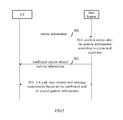
- FIG. 5 illustrates a schematic diagram of a systematic method of a method of pattern-based message transmission according to a further embodiment of the invention.
- FIG. 1 illustrates a schematic diagram of a UE of MTC performing message transmission with a base station in the prior art.
- the process is a process starting from UE accessing a network until UE releasing a connection through Radio Resource Control (RRC).
- RRC Radio Resource Control
- a base station does not know the specific conditions of the transmission interval, content and etc. of each message, the resources of a system have to be scheduled each time when signaling or data is transmitted.
- RRC Radio Resource Control
- More signaling interaction steps may be further required if the UE of MTC further activates, for example, security and other functions.
- more signaling interaction will be required for delayed transmission or retransmission.
- more PDCCH signaling resources tend to be consumed. This will is further increase signaling overheads and thus result in numerous serious problems.
- a transmission pattern can be defined for identical and/or similar services of different UEs and/or the same UE, for example, for a typical application, e.g., in which a water meter reports a reading (that is, a corresponding transmission pattern can be defined for a UE with a single service according to an equipment identifier and a corresponding transmission pattern can be defined for a UE with a plurality of services according to the equipment identifier and a current service identifier thereof); and the pattern information of the service can be determined to predefine the exchange of messages (data and signaling) to be performed.
- the pattern information includes at least one parameter associated with the message transmission.
- the parameter includes, but not limited to, the size of each exchanged message, the delay between the respective messages, etc.
- the pattern information can include the size of a message in the figure and the delay between messages.
- the base station can acquire the flow and content of the whole communication in advance (for example, acquire when to transmit each message, the content of each message and etc.).
- it is not necessary to schedule each message, but it only needs to schedule the first message of the communication started in a pattern after the pattern is determined.
- signaling overheads and thus resources can be greatly saved due to the pattern-based message transmission of the invention.
- FIG. 2 illustrates a schematic diagram of a systematic method of a method of pattern-based message transmission according to an embodiment of the invention.
- a UE transmits an is equipment identifier to a base station.
- this transmission step can be performed by transmitting an International Mobile Subscriber Identification Number (IMS) to the base station in an Msg3 RRC Connection Request in FIG. 1 .
- IMS International Mobile Subscriber Identification Number
- the base station receives the equipment identifier of the UE from the UE.
- the base station determines pattern information for the UE according to a type to which the UE belongs based on the received equipment identifier.
- the base station pre-stores the equipment identifiers and the pattern information corresponding to the equipment identifiers and can hereby determine the pattern information for the user equipment according to the equipment identifier.
- the pattern information includes, for examples, the size of each exchanged message, the delay between respective messages and etc.
- the base station transmits the determined pattern information to the UE.
- the base station can transmit the determined pattern information to the UE during the setup of an RRC connection.
- the UE receives the pattern information from the base station.
- the base station can transmits the pattern information to the UE as a part of Quality of Service (QoS).
- QoS Quality of Service
- the UE and the base station start message transmission based on the pattern information, for example, the message transmission numbered from 3 to 24 in FIG. 1 . Since the base station acquires specific steps of the message transmission to be performed in advance, for example, the transmission time, the transmission content, the time interval and etc., it is only necessary to schedule them once instead of scheduling all the remaining transmission of each message, thereby greatly saving signaling resources.
- FIG. 3 and FIG. 4 illustrate method flow charts at a user equipment and at a base station for a method of pattern-based message transmission according to another embodiment of the invention.
- a base station broadcasts system information to respective user equipments, the is system information including equipment identifiers of the respective user equipments and the corresponding pattern information.
- the respective user equipments receive the system information from the base station via the broadcast of the base station.
- the user equipment selects the corresponding pattern information from the system information according to the equipment identifier in order to perform message transmission with the base station based on the pattern information.
- the base station performs message transmission with the user equipment based on the pattern information selected by the user equipment. For example, the user equipment can transmit the selected pattern information to the base station in an RRC Connection Request to hereby perform pattern-based communication with the base station.
- the pattern information includes at least one parameter associated with message transmission, for example, including but not limited to the size of each exchanged message, the delay between respective messages, and etc.
- the system information can further include service identifiers.
- the service identifiers correspond to a variety of services that can be performed by the corresponding user equipments. If a user equipment has a variety of services, then it can select the corresponding pattern information from the system information according to the equipment identifier and the service identifier in the system information in order to perform message transmission with the base station based on the pattern information.
- FIG. 5 illustrates a schematic diagram of a systematic method of a method of pattern-based message transmission according to a further embodiment of the invention.
- a user equipment transmits pattern information to a base station, for example, transmits the pattern information to the base station in an RRC Connect Request, and the base station receives the pattern information from the user equipment.
- the is pattern information is defined by the user equipment according to its service(s) and the specific content and the size of a message and can include but will not be limited to the size of each exchanged message, the delay between respective messages, and etc.
- the base station confirms and/or alters the received pattern information according to a practical condition.
- the practical condition can include at least one of current allocation of physical resources, a real protocol flow and a process delay.
- the base station transmits the confirmed and/or altered pattern information to the user equipment, and the user equipment receives the pattern information confirmed and/or altered by the base station from the base station.
- the base station and the user equipment perform message transmission based on the pattern information confirmed and/or altered by the base station.
- the user equipment and the base station can acquire the pattern information from a shared database in advance and perform message transmission based on the pattern information.
- the user equipment and the base station can determine the pattern information in a predefined protocol in order to perform message transmission based on the pattern information.
- the user equipment can negotiate with the base station about the pattern information when it performs data transmission with the base station at the first time and use the pattern information directly and perform data transmission with the base station when it subsequently performs data transmission with the base station.
- the size of a message can be preset according to the specific content transmitted in the message, and the delay of each message can be set appropriately for a practical application.
- the retransmission, the time period for processing each message at a is background and other factors could also be taken into account.
- an acknowledgement message and subsequent signalings and/or data could be encapsulated in a same data packet for transmission and reception, thereby resources are further saved. This improves the efficiency of utilizing signaling greatly in general, reduces signaling overheads, and also facilitates various communication between other users in the cell, improves the efficiency of economy and saves cost.
- the base station can make a Hybrid Automatic Repeat Request (HARQ) based on a Cell Radio Network Temporary Identifier of the user equipment of MTC without any influence on the performance of the whole flow, because the delay in the transmission of each message can be set appropriately to be compatible with a delay caused by a potential HARQ retransmission.
- HARQ Hybrid Automatic Repeat Request
Landscapes
- Engineering & Computer Science (AREA)
- Computer Networks & Wireless Communication (AREA)
- Signal Processing (AREA)
- Quality & Reliability (AREA)
- Mobile Radio Communication Systems (AREA)
Abstract
Description
Claims (15)
Applications Claiming Priority (4)
| Application Number | Priority Date | Filing Date | Title |
|---|---|---|---|
| CN201110296341.4A CN103037512B (en) | 2011-09-30 | 2011-09-30 | A kind of method that message based on pattern is transmitted |
| CN201110296341 | 2011-09-30 | ||
| CN20111296341.4 | 2011-09-30 | ||
| PCT/IB2012/002168 WO2013046022A1 (en) | 2011-09-30 | 2012-09-19 | A method of pattern-based message transmission |
Publications (2)
| Publication Number | Publication Date |
|---|---|
| US20140302811A1 US20140302811A1 (en) | 2014-10-09 |
| US9456448B2 true US9456448B2 (en) | 2016-09-27 |
Family
ID=47278339
Family Applications (1)
| Application Number | Title | Priority Date | Filing Date |
|---|---|---|---|
| US14/346,038 Expired - Fee Related US9456448B2 (en) | 2011-09-30 | 2012-09-19 | Method of pattern-based message transmission |
Country Status (7)
| Country | Link |
|---|---|
| US (1) | US9456448B2 (en) |
| EP (1) | EP2761957A1 (en) |
| JP (1) | JP5959649B2 (en) |
| KR (1) | KR101603454B1 (en) |
| CN (1) | CN103037512B (en) |
| TW (1) | TWI469600B (en) |
| WO (1) | WO2013046022A1 (en) |
Cited By (1)
| Publication number | Priority date | Publication date | Assignee | Title |
|---|---|---|---|---|
| US20170134521A1 (en) * | 2014-07-10 | 2017-05-11 | Telefonaktiebolaget Lm Ericsson (Publ) | Methods and devices for signalling in a communication network |
Families Citing this family (10)
| Publication number | Priority date | Publication date | Assignee | Title |
|---|---|---|---|---|
| US10075877B1 (en) * | 2014-05-12 | 2018-09-11 | Google Llc | Systems and methods for using radio layer information to enhance network transfer protocols |
| EP3166274B1 (en) * | 2014-07-21 | 2019-09-04 | Huawei Technologies Co., Ltd. | Method and device for controlling data transmission |
| US9699627B2 (en) * | 2014-12-10 | 2017-07-04 | Pismo Labs Technology Limited | Methods and systems for processing messages at a network node |
| US10270724B2 (en) | 2015-03-02 | 2019-04-23 | Pismo Labs Technology Limited | Methods and systems for processing messages at a multi-SIM network node |
| WO2016191962A1 (en) | 2015-05-29 | 2016-12-08 | 华为技术有限公司 | Method and device for establishing bearer |
| CN107113812B (en) * | 2015-10-30 | 2020-02-14 | 华为技术有限公司 | Information transmission method, information processing method, base station and user equipment |
| CN109041078B (en) * | 2017-06-09 | 2021-05-18 | 华为技术有限公司 | A service data transmission method and device |
| CN110366140B (en) * | 2018-04-11 | 2021-04-20 | 华为技术有限公司 | A data transmission method and device |
| KR102617896B1 (en) * | 2018-06-11 | 2023-12-26 | 삼성전자주식회사 | Method and apparatus for transmitting and receiving data channel in wireless communication system |
| CN111163435B (en) * | 2018-11-07 | 2022-06-28 | 大唐移动通信设备有限公司 | Method for acquiring and sending terminal transmission mode, base station, terminal and core network |
Citations (13)
| Publication number | Priority date | Publication date | Assignee | Title |
|---|---|---|---|---|
| KR20040077806A (en) | 2002-01-28 | 2004-09-06 | 퀄컴 인코포레이티드 | Method and apparatus for negotiation of transmission parameters for broadcast/multicast services |
| JP2008005233A (en) | 2006-06-22 | 2008-01-10 | Mitsubishi Electric Corp | Multicast data distribution method |
| US20100144360A1 (en) * | 2007-08-31 | 2010-06-10 | Fujitsu Limited | Message exchange method, wireless communication system, wireless terminal, and wireless base station |
| US20100188990A1 (en) | 2009-01-28 | 2010-07-29 | Gregory G. Raleigh | Network based service profile management with user preference, adaptive policy, network neutrality, and user privacy |
| US20100238872A1 (en) * | 2006-08-23 | 2010-09-23 | Samsung Electronics Co., Ltd. | Method for transmitting response message of random access in cellular system and method of random access using the same |
| CN101931989A (en) | 2009-06-26 | 2010-12-29 | 华为技术有限公司 | A kind of feedback method and device |
| WO2011041459A1 (en) | 2009-09-29 | 2011-04-07 | Qualcomm Incorporated | Signaling identification of machine to machine devices and services |
| CN102036310A (en) | 2009-09-29 | 2011-04-27 | 大唐移动通信设备有限公司 | Data transmission method and equipment |
| WO2011053219A1 (en) | 2009-10-30 | 2011-05-05 | Telefonaktiebolaget L M Ericsson (Publ) | Method for contacting a group of terminals within a communication network, arrangement and terminal within a communication network |
| WO2011060707A1 (en) | 2009-11-19 | 2011-05-26 | 华为技术有限公司 | Common bearer processing methods, network node and communication system |
| WO2011065407A1 (en) | 2009-11-25 | 2011-06-03 | シャープ株式会社 | Wireless communication system |
| CN102158963A (en) | 2010-02-11 | 2011-08-17 | 电信科学技术研究院 | Resource allocation method and base station |
| US20120295580A1 (en) * | 2011-05-19 | 2012-11-22 | Boku, Inc. | Systems and Methods to Detect Fraudulent Payment Requests |
Family Cites Families (1)
| Publication number | Priority date | Publication date | Assignee | Title |
|---|---|---|---|---|
| WO2011110566A1 (en) * | 2010-03-10 | 2011-09-15 | Nokia Siemens Networks Oy | A method of switching between a data exchange mode and a measurement mode in a communications system |
-
2011
- 2011-09-30 CN CN201110296341.4A patent/CN103037512B/en active Active
-
2012
- 2012-09-06 TW TW101132542A patent/TWI469600B/en not_active IP Right Cessation
- 2012-09-19 KR KR1020147011229A patent/KR101603454B1/en not_active Expired - Fee Related
- 2012-09-19 US US14/346,038 patent/US9456448B2/en not_active Expired - Fee Related
- 2012-09-19 EP EP12794759.6A patent/EP2761957A1/en not_active Withdrawn
- 2012-09-19 JP JP2014532496A patent/JP5959649B2/en not_active Expired - Fee Related
- 2012-09-19 WO PCT/IB2012/002168 patent/WO2013046022A1/en not_active Ceased
Patent Citations (14)
| Publication number | Priority date | Publication date | Assignee | Title |
|---|---|---|---|---|
| KR20040077806A (en) | 2002-01-28 | 2004-09-06 | 퀄컴 인코포레이티드 | Method and apparatus for negotiation of transmission parameters for broadcast/multicast services |
| JP2008005233A (en) | 2006-06-22 | 2008-01-10 | Mitsubishi Electric Corp | Multicast data distribution method |
| US20100238872A1 (en) * | 2006-08-23 | 2010-09-23 | Samsung Electronics Co., Ltd. | Method for transmitting response message of random access in cellular system and method of random access using the same |
| US20100144360A1 (en) * | 2007-08-31 | 2010-06-10 | Fujitsu Limited | Message exchange method, wireless communication system, wireless terminal, and wireless base station |
| US20100188990A1 (en) | 2009-01-28 | 2010-07-29 | Gregory G. Raleigh | Network based service profile management with user preference, adaptive policy, network neutrality, and user privacy |
| CN101931989A (en) | 2009-06-26 | 2010-12-29 | 华为技术有限公司 | A kind of feedback method and device |
| WO2011041459A1 (en) | 2009-09-29 | 2011-04-07 | Qualcomm Incorporated | Signaling identification of machine to machine devices and services |
| CN102036310A (en) | 2009-09-29 | 2011-04-27 | 大唐移动通信设备有限公司 | Data transmission method and equipment |
| JP2013506387A (en) | 2009-09-29 | 2013-02-21 | クゥアルコム・インコーポレイテッド | Signaling identification information for machine-to-machine devices and services |
| WO2011053219A1 (en) | 2009-10-30 | 2011-05-05 | Telefonaktiebolaget L M Ericsson (Publ) | Method for contacting a group of terminals within a communication network, arrangement and terminal within a communication network |
| WO2011060707A1 (en) | 2009-11-19 | 2011-05-26 | 华为技术有限公司 | Common bearer processing methods, network node and communication system |
| WO2011065407A1 (en) | 2009-11-25 | 2011-06-03 | シャープ株式会社 | Wireless communication system |
| CN102158963A (en) | 2010-02-11 | 2011-08-17 | 电信科学技术研究院 | Resource allocation method and base station |
| US20120295580A1 (en) * | 2011-05-19 | 2012-11-22 | Boku, Inc. | Systems and Methods to Detect Fraudulent Payment Requests |
Non-Patent Citations (6)
Cited By (3)
| Publication number | Priority date | Publication date | Assignee | Title |
|---|---|---|---|---|
| US20170134521A1 (en) * | 2014-07-10 | 2017-05-11 | Telefonaktiebolaget Lm Ericsson (Publ) | Methods and devices for signalling in a communication network |
| US10419579B2 (en) * | 2014-07-10 | 2019-09-17 | Telefonaktiebolaget Lm Ericsson (Publ) | Methods and devices for signalling in a communication network |
| US11218564B2 (en) | 2014-07-10 | 2022-01-04 | Telefonaktiebolaget Lm Ericsson (Publ) | Methods and devices for signalling in a communication network |
Also Published As
| Publication number | Publication date |
|---|---|
| CN103037512B (en) | 2016-06-01 |
| KR20140080513A (en) | 2014-06-30 |
| TW201322701A (en) | 2013-06-01 |
| KR101603454B1 (en) | 2016-03-14 |
| TWI469600B (en) | 2015-01-11 |
| CN103037512A (en) | 2013-04-10 |
| WO2013046022A1 (en) | 2013-04-04 |
| JP5959649B2 (en) | 2016-08-02 |
| US20140302811A1 (en) | 2014-10-09 |
| JP2014531848A (en) | 2014-11-27 |
| EP2761957A1 (en) | 2014-08-06 |
Similar Documents
| Publication | Publication Date | Title |
|---|---|---|
| US20140302811A1 (en) | Method of pattern-based message transmission | |
| CN108112087B (en) | V2X network resource information indication method and base station | |
| KR102181920B1 (en) | Communications device and method for improving the transmission of random access messages | |
| US20200137814A1 (en) | Devices and methods for cloud-based sidelink scheduling and base station interface therefor | |
| CN104349308B (en) | Method for distributing wireless network temporary identification in double connection, communication device and network terminal | |
| CN108293260B (en) | Random access procedure for latency reduction | |
| CN103491643B (en) | The method for building up and equipment of group communication connection | |
| US8619617B2 (en) | Data transmission method, system and device in multi-carrier system | |
| CN103796315B (en) | The Physical Resource Block configuration method and device of user equipment specific search space | |
| US20120163311A1 (en) | Data transmission method for use in mobile communication systems | |
| CN107769898A (en) | The user equipment (ue) device and its operating method operated in a wireless communication system | |
| CN102316582A (en) | Uplink resource allocation method and system | |
| WO2015074270A1 (en) | Resource scheduling, user equipment coordination scheduling method, device and system | |
| TWI722426B (en) | Method to reduce access delay and a user equipment thereof | |
| WO2014103537A1 (en) | Method for controlling transmission of buffer status report, user device, and wireless communication system | |
| US20140376480A1 (en) | Connection Setup With an Access Selection of a Terminal | |
| CN102625461A (en) | Method and system for random access to heterogeneous network | |
| US8867470B2 (en) | Mobile communication method, radio base station, and mobile station | |
| CN102845119B (en) | Method and device for processing physical random access channel transmission based on carrier aggregation | |
| US9326223B2 (en) | Method and apparatus for system access |
Legal Events
| Date | Code | Title | Description |
|---|---|---|---|
| AS | Assignment |
Owner name: CREDIT SUISSE AG, NEW YORK Free format text: SECURITY INTEREST;ASSIGNOR:ALCATEL LUCENT;REEL/FRAME:032845/0465 Effective date: 20140505 |
|
| AS | Assignment |
Owner name: ALCATEL LUCENT, FRANCE Free format text: RELEASE OF SECURITY INTEREST;ASSIGNOR:CREDIT SUISSE AG;REEL/FRAME:033677/0617 Effective date: 20140819 |
|
| AS | Assignment |
Owner name: ALCATEL LUCENT, FRANCE Free format text: ASSIGNMENT OF ASSIGNORS INTEREST;ASSIGNORS:CHEN, YU;ZOU, JIALIN;PALAT, SUDEEP;SIGNING DATES FROM 20140226 TO 20140318;REEL/FRAME:035768/0206 |
|
| STCF | Information on status: patent grant |
Free format text: PATENTED CASE |
|
| FEPP | Fee payment procedure |
Free format text: MAINTENANCE FEE REMINDER MAILED (ORIGINAL EVENT CODE: REM.); ENTITY STATUS OF PATENT OWNER: LARGE ENTITY |
|
| LAPS | Lapse for failure to pay maintenance fees |
Free format text: PATENT EXPIRED FOR FAILURE TO PAY MAINTENANCE FEES (ORIGINAL EVENT CODE: EXP.); ENTITY STATUS OF PATENT OWNER: LARGE ENTITY |
|
| STCH | Information on status: patent discontinuation |
Free format text: PATENT EXPIRED DUE TO NONPAYMENT OF MAINTENANCE FEES UNDER 37 CFR 1.362 |
|
| FP | Lapsed due to failure to pay maintenance fee |
Effective date: 20200927 |