US9444054B2 - Compound for organic optoelectronic device and organic light emitting diode including the same - Google Patents
Compound for organic optoelectronic device and organic light emitting diode including the same Download PDFInfo
- Publication number
- US9444054B2 US9444054B2 US14/062,222 US201314062222A US9444054B2 US 9444054 B2 US9444054 B2 US 9444054B2 US 201314062222 A US201314062222 A US 201314062222A US 9444054 B2 US9444054 B2 US 9444054B2
- Authority
- US
- United States
- Prior art keywords
- substituted
- unsubstituted
- group
- compound
- organic
- Prior art date
- Legal status (The legal status is an assumption and is not a legal conclusion. Google has not performed a legal analysis and makes no representation as to the accuracy of the status listed.)
- Active, expires
Links
- 150000001875 compounds Chemical class 0.000 title claims abstract description 164
- 230000005693 optoelectronics Effects 0.000 title claims abstract description 97
- 239000000126 substance Substances 0.000 claims abstract description 45
- 125000003118 aryl group Chemical group 0.000 claims description 64
- 239000000463 material Substances 0.000 claims description 47
- 125000001072 heteroaryl group Chemical group 0.000 claims description 42
- 238000002347 injection Methods 0.000 claims description 36
- 239000007924 injection Substances 0.000 claims description 36
- YZCKVEUIGOORGS-OUBTZVSYSA-N Deuterium Chemical group [2H] YZCKVEUIGOORGS-OUBTZVSYSA-N 0.000 claims description 21
- 229910052805 deuterium Inorganic materials 0.000 claims description 21
- 150000002431 hydrogen Chemical group 0.000 claims description 21
- 229910052739 hydrogen Inorganic materials 0.000 claims description 21
- 239000001257 hydrogen Substances 0.000 claims description 21
- 230000005525 hole transport Effects 0.000 claims description 18
- -1 dibenzofuranyl Chemical group 0.000 claims description 14
- 125000004450 alkenylene group Chemical group 0.000 claims description 12
- 125000004419 alkynylene group Chemical group 0.000 claims description 12
- 125000000732 arylene group Chemical group 0.000 claims description 12
- 125000005549 heteroarylene group Chemical group 0.000 claims description 12
- 229910052760 oxygen Inorganic materials 0.000 claims description 11
- 125000005264 aryl amine group Chemical group 0.000 claims description 9
- 125000000609 carbazolyl group Chemical group C1(=CC=CC=2C3=CC=CC=C3NC12)* 0.000 claims description 9
- 125000003960 triphenylenyl group Chemical group C1(=CC=CC=2C3=CC=CC=C3C3=CC=CC=C3C12)* 0.000 claims description 9
- 125000004076 pyridyl group Chemical group 0.000 claims description 8
- 230000000903 blocking effect Effects 0.000 claims description 7
- 125000005509 dibenzothiophenyl group Chemical group 0.000 claims description 7
- 125000006267 biphenyl group Chemical group 0.000 claims description 5
- 125000000843 phenylene group Chemical group C1(=C(C=CC=C1)*)* 0.000 claims description 5
- 125000004306 triazinyl group Chemical group 0.000 claims description 5
- 125000002178 anthracenyl group Chemical group C1(=CC=CC2=CC3=CC=CC=C3C=C12)* 0.000 claims description 4
- 239000004020 conductor Substances 0.000 claims description 4
- 125000001624 naphthyl group Chemical group 0.000 claims description 4
- 125000001997 phenyl group Chemical group [H]C1=C([H])C([H])=C(*)C([H])=C1[H] 0.000 claims description 4
- 125000001725 pyrenyl group Chemical group 0.000 claims description 4
- YJTKZCDBKVTVBY-UHFFFAOYSA-N 1,3-Diphenylbenzene Chemical group C1=CC=CC=C1C1=CC=CC(C=2C=CC=CC=2)=C1 YJTKZCDBKVTVBY-UHFFFAOYSA-N 0.000 claims description 3
- XJKSTNDFUHDPQJ-UHFFFAOYSA-N 1,4-diphenylbenzene Chemical group C1=CC=CC=C1C1=CC=C(C=2C=CC=CC=2)C=C1 XJKSTNDFUHDPQJ-UHFFFAOYSA-N 0.000 claims description 3
- 125000002676 chrysenyl group Chemical group C1(=CC=CC=2C3=CC=C4C=CC=CC4=C3C=CC12)* 0.000 claims description 3
- 125000003983 fluorenyl group Chemical group C1(=CC=CC=2C3=CC=CC=C3CC12)* 0.000 claims description 3
- 125000003454 indenyl group Chemical group C1(C=CC2=CC=CC=C12)* 0.000 claims description 3
- 125000002080 perylenyl group Chemical group C1(=CC=C2C=CC=C3C4=CC=CC5=CC=CC(C1=C23)=C45)* 0.000 claims description 3
- 125000005561 phenanthryl group Chemical group 0.000 claims description 3
- 125000000714 pyrimidinyl group Chemical group 0.000 claims description 3
- 125000001935 tetracenyl group Chemical group C1(=CC=CC2=CC3=CC4=CC=CC=C4C=C3C=C12)* 0.000 claims description 3
- 239000010410 layer Substances 0.000 description 122
- OKKJLVBELUTLKV-UHFFFAOYSA-N Methanol Chemical compound OC OKKJLVBELUTLKV-UHFFFAOYSA-N 0.000 description 30
- 238000006243 chemical reaction Methods 0.000 description 21
- 0 *C.[1*]C1=C([2*])C([3*])=C([4*])C2=C1N(CC1C3=C(C=CC=C3)C3=C1C=CC=C3)C(C[Ar])=N2.[5*]C.[7*]C.[8*]C Chemical compound *C.[1*]C1=C([2*])C([3*])=C([4*])C2=C1N(CC1C3=C(C=CC=C3)C3=C1C=CC=C3)C(C[Ar])=N2.[5*]C.[7*]C.[8*]C 0.000 description 17
- 125000001424 substituent group Chemical group 0.000 description 17
- YMWUJEATGCHHMB-UHFFFAOYSA-N Dichloromethane Chemical compound ClCCl YMWUJEATGCHHMB-UHFFFAOYSA-N 0.000 description 15
- IAZDPXIOMUYVGZ-UHFFFAOYSA-N Dimethylsulphoxide Chemical compound CS(C)=O IAZDPXIOMUYVGZ-UHFFFAOYSA-N 0.000 description 15
- 230000015572 biosynthetic process Effects 0.000 description 15
- 239000000243 solution Substances 0.000 description 15
- 238000003786 synthesis reaction Methods 0.000 description 15
- 125000000217 alkyl group Chemical group 0.000 description 14
- 239000007787 solid Substances 0.000 description 11
- IJGRMHOSHXDMSA-UHFFFAOYSA-N Atomic nitrogen Chemical compound N#N IJGRMHOSHXDMSA-UHFFFAOYSA-N 0.000 description 10
- VYPSYNLAJGMNEJ-UHFFFAOYSA-N Silicium dioxide Chemical compound O=[Si]=O VYPSYNLAJGMNEJ-UHFFFAOYSA-N 0.000 description 10
- 230000000052 comparative effect Effects 0.000 description 10
- 239000002019 doping agent Substances 0.000 description 10
- 239000012044 organic layer Substances 0.000 description 10
- BWHMMNNQKKPAPP-UHFFFAOYSA-L potassium carbonate Chemical compound [K+].[K+].[O-]C([O-])=O BWHMMNNQKKPAPP-UHFFFAOYSA-L 0.000 description 10
- 239000011368 organic material Substances 0.000 description 9
- 238000004458 analytical method Methods 0.000 description 8
- 238000000034 method Methods 0.000 description 7
- 239000000203 mixture Substances 0.000 description 7
- 239000000758 substrate Substances 0.000 description 7
- KFZMGEQAYNKOFK-UHFFFAOYSA-N Isopropanol Chemical compound CC(C)O KFZMGEQAYNKOFK-UHFFFAOYSA-N 0.000 description 6
- 229910052782 aluminium Inorganic materials 0.000 description 6
- XAGFODPZIPBFFR-UHFFFAOYSA-N aluminium Chemical compound [Al] XAGFODPZIPBFFR-UHFFFAOYSA-N 0.000 description 6
- XLYOFNOQVPJJNP-UHFFFAOYSA-N water Substances O XLYOFNOQVPJJNP-UHFFFAOYSA-N 0.000 description 6
- XNWFRZJHXBZDAG-UHFFFAOYSA-N 2-METHOXYETHANOL Chemical compound COCCO XNWFRZJHXBZDAG-UHFFFAOYSA-N 0.000 description 5
- WEUBIWJPIRTWDF-UHFFFAOYSA-N 2-n-(4-chlorophenyl)benzene-1,2-diamine Chemical compound NC1=CC=CC=C1NC1=CC=C(Cl)C=C1 WEUBIWJPIRTWDF-UHFFFAOYSA-N 0.000 description 5
- UJOBWOGCFQCDNV-UHFFFAOYSA-N 9H-carbazole Chemical compound C1=CC=C2C3=CC=CC=C3NC2=C1 UJOBWOGCFQCDNV-UHFFFAOYSA-N 0.000 description 5
- CSNNHWWHGAXBCP-UHFFFAOYSA-L Magnesium sulfate Chemical compound [Mg+2].[O-][S+2]([O-])([O-])[O-] CSNNHWWHGAXBCP-UHFFFAOYSA-L 0.000 description 5
- DGEZNRSVGBDHLK-UHFFFAOYSA-N [1,10]phenanthroline Chemical compound C1=CN=C2C3=NC=CC=C3C=CC2=C1 DGEZNRSVGBDHLK-UHFFFAOYSA-N 0.000 description 5
- 230000008901 benefit Effects 0.000 description 5
- MVPPADPHJFYWMZ-UHFFFAOYSA-N chlorobenzene Chemical compound ClC1=CC=CC=C1 MVPPADPHJFYWMZ-UHFFFAOYSA-N 0.000 description 5
- ORTQZVOHEJQUHG-UHFFFAOYSA-L copper(II) chloride Chemical compound Cl[Cu]Cl ORTQZVOHEJQUHG-UHFFFAOYSA-L 0.000 description 5
- 125000000524 functional group Chemical group 0.000 description 5
- 238000004519 manufacturing process Methods 0.000 description 5
- 238000005259 measurement Methods 0.000 description 5
- 229910052757 nitrogen Inorganic materials 0.000 description 5
- 239000003960 organic solvent Substances 0.000 description 5
- 229910000027 potassium carbonate Inorganic materials 0.000 description 5
- 238000010992 reflux Methods 0.000 description 5
- 239000000741 silica gel Substances 0.000 description 5
- 229910002027 silica gel Inorganic materials 0.000 description 5
- 239000002904 solvent Substances 0.000 description 5
- ISDBWOPVZKNQDW-UHFFFAOYSA-N 4-phenylbenzaldehyde Chemical compound C1=CC(C=O)=CC=C1C1=CC=CC=C1 ISDBWOPVZKNQDW-UHFFFAOYSA-N 0.000 description 4
- CSCPPACGZOOCGX-UHFFFAOYSA-N Acetone Chemical compound CC(C)=O CSCPPACGZOOCGX-UHFFFAOYSA-N 0.000 description 4
- XLOMVQKBTHCTTD-UHFFFAOYSA-N Zinc monoxide Chemical compound [Zn]=O XLOMVQKBTHCTTD-UHFFFAOYSA-N 0.000 description 4
- UFVXQDWNSAGPHN-UHFFFAOYSA-K bis[(2-methylquinolin-8-yl)oxy]-(4-phenylphenoxy)alumane Chemical compound [Al+3].C1=CC=C([O-])C2=NC(C)=CC=C21.C1=CC=C([O-])C2=NC(C)=CC=C21.C1=CC([O-])=CC=C1C1=CC=CC=C1 UFVXQDWNSAGPHN-UHFFFAOYSA-K 0.000 description 4
- 230000008859 change Effects 0.000 description 4
- 239000011521 glass Substances 0.000 description 4
- 229910052751 metal Inorganic materials 0.000 description 4
- 239000002184 metal Substances 0.000 description 4
- 125000003003 spiro group Chemical group 0.000 description 4
- XEBQRDWEKYUGFU-UHFFFAOYSA-N C1=CC(C2=CC=CC(C3=NC4=C(C=CC=C4)N3C3=CC=C(N4C5=C(C=CC=C5)C5=C4C=CC(C4=CC6=C(C=C4)C4=C(C=CC=C4)C4=C6C=CC=C4)=C5)C=C3)=C2)=CN=C1.C1=CC(C2=NC3=C(C=CC=C3)N2C2=CC=C(N3C4=C(C=CC=C4)C4=C3C=CC(C3=CC5=C(C=C3)C3=C(C=CC=C3)C3=C5C=CC=C3)=C4)C=C2)=CC(C2=CC=NC=C2)=C1.C1=CC=C(C2=CC=C(C3=NC4=C(C=CC=C4)N3C3=CC=C(N4C5=C(C=CC=C5)C5=C4C=CC(C4=CC6=C(C=C4)C4=C(C=CC=C4)C4=C6C=CC=C4)=C5)C=C3)C=C2)N=C1.C1=CN=C(C2=CC=CC(C3=NC4=C(C=CC=C4)N3C3=CC=C(N4C5=C(C=CC=C5)C5=C4C=CC(C4=CC6=C(C=C4)C4=C(C=CC=C4)C4=C6C=CC=C4)=C5)C=C3)=C2)C=C1 Chemical compound C1=CC(C2=CC=CC(C3=NC4=C(C=CC=C4)N3C3=CC=C(N4C5=C(C=CC=C5)C5=C4C=CC(C4=CC6=C(C=C4)C4=C(C=CC=C4)C4=C6C=CC=C4)=C5)C=C3)=C2)=CN=C1.C1=CC(C2=NC3=C(C=CC=C3)N2C2=CC=C(N3C4=C(C=CC=C4)C4=C3C=CC(C3=CC5=C(C=C3)C3=C(C=CC=C3)C3=C5C=CC=C3)=C4)C=C2)=CC(C2=CC=NC=C2)=C1.C1=CC=C(C2=CC=C(C3=NC4=C(C=CC=C4)N3C3=CC=C(N4C5=C(C=CC=C5)C5=C4C=CC(C4=CC6=C(C=C4)C4=C(C=CC=C4)C4=C6C=CC=C4)=C5)C=C3)C=C2)N=C1.C1=CN=C(C2=CC=CC(C3=NC4=C(C=CC=C4)N3C3=CC=C(N4C5=C(C=CC=C5)C5=C4C=CC(C4=CC6=C(C=C4)C4=C(C=CC=C4)C4=C6C=CC=C4)=C5)C=C3)=C2)C=C1 XEBQRDWEKYUGFU-UHFFFAOYSA-N 0.000 description 3
- DQLPTCQEFJSOFT-UHFFFAOYSA-N C1=CC(C2=NC3=C(C=CC=C3)N2C2=CC=C(N3C4=C(C=CC=C4)C4=C3C=CC(C3=CC5=C(C=C3)C3=C(C=CC=C3)C3=C5C=CC=C3)=C4)C=C2)=CC(C2=CN=CN=C2)=C1.C1=CC2=C(C=C1)N(C1=CC=C(N3C4=C(C=CC=C4)C4=C3C=CC(C3=CC5=C(C=C3)C3=C(C=CC=C3)C3=C5C=CC=C3)=C4)C=C1)C(C1=CC=C(C3=CN=CN=C3)C=C1)=N2.C1=CC2=C(C=C1)N(C1=CC=C(N3C4=C(C=CC=C4)C4=C3C=CC(C3=CC5=C(C=C3)C3=C(C=CC=C3)C3=C5C=CC=C3)=C4)C=C1)C(C1=CC=C(C3=NC=CN=C3)C=C1)=N2.C1=CN=C(C2=CC=C(C3=NC4=C(C=CC=C4)N3C3=CC=C(N4C5=C(C=CC=C5)C5=C4C=CC(C4=CC6=C(C=C4)C4=C(C=CC=C4)C4=C6C=CC=C4)=C5)C=C3)C=C2)N=C1 Chemical compound C1=CC(C2=NC3=C(C=CC=C3)N2C2=CC=C(N3C4=C(C=CC=C4)C4=C3C=CC(C3=CC5=C(C=C3)C3=C(C=CC=C3)C3=C5C=CC=C3)=C4)C=C2)=CC(C2=CN=CN=C2)=C1.C1=CC2=C(C=C1)N(C1=CC=C(N3C4=C(C=CC=C4)C4=C3C=CC(C3=CC5=C(C=C3)C3=C(C=CC=C3)C3=C5C=CC=C3)=C4)C=C1)C(C1=CC=C(C3=CN=CN=C3)C=C1)=N2.C1=CC2=C(C=C1)N(C1=CC=C(N3C4=C(C=CC=C4)C4=C3C=CC(C3=CC5=C(C=C3)C3=C(C=CC=C3)C3=C5C=CC=C3)=C4)C=C1)C(C1=CC=C(C3=NC=CN=C3)C=C1)=N2.C1=CN=C(C2=CC=C(C3=NC4=C(C=CC=C4)N3C3=CC=C(N4C5=C(C=CC=C5)C5=C4C=CC(C4=CC6=C(C=C4)C4=C(C=CC=C4)C4=C6C=CC=C4)=C5)C=C3)C=C2)N=C1 DQLPTCQEFJSOFT-UHFFFAOYSA-N 0.000 description 3
- FWSVNCOUIUTJCY-UHFFFAOYSA-N C1=CC2=C(C=C1)C(C1=NC3=C(C=CC=C3)N1C1=CC=C(N3C4=C(C=CC=C4)C4=C3C=CC(C3=C5OC6=C(C=CC=C6)C5=CC=C3)=C4)C=C1)=CC=C2.C1=CC2=C(C=C1)N(C1=CC=C(N3C4=C(C=CC=C4)C4=C3C=CC(C3=C5SC6=C(C=CC=C6)C5=CC=C3)=C4)C=C1)C(C1=CC=NC=C1)=N2.C1=CC=C(C2=CC=C(C3=NC4=C(C=CC=C4)N3C3=CC=C(N4C5=C(C=CC=C5)C5=C4C=CC(C4=C6OC7=C(C=CC=C7)C6=CC=C4)=C5)C=C3)C=C2)C=C1.C1=CN=CC(C2=NC3=C(C=CC=C3)N2C2=CC=C(N3C4=C(C=CC=C4)C4=C3C=CC(C3=C5SC6=C(C=CC=C6)C5=CC=C3)=C4)C=C2)=C1 Chemical compound C1=CC2=C(C=C1)C(C1=NC3=C(C=CC=C3)N1C1=CC=C(N3C4=C(C=CC=C4)C4=C3C=CC(C3=C5OC6=C(C=CC=C6)C5=CC=C3)=C4)C=C1)=CC=C2.C1=CC2=C(C=C1)N(C1=CC=C(N3C4=C(C=CC=C4)C4=C3C=CC(C3=C5SC6=C(C=CC=C6)C5=CC=C3)=C4)C=C1)C(C1=CC=NC=C1)=N2.C1=CC=C(C2=CC=C(C3=NC4=C(C=CC=C4)N3C3=CC=C(N4C5=C(C=CC=C5)C5=C4C=CC(C4=C6OC7=C(C=CC=C7)C6=CC=C4)=C5)C=C3)C=C2)C=C1.C1=CN=CC(C2=NC3=C(C=CC=C3)N2C2=CC=C(N3C4=C(C=CC=C4)C4=C3C=CC(C3=C5SC6=C(C=CC=C6)C5=CC=C3)=C4)C=C2)=C1 FWSVNCOUIUTJCY-UHFFFAOYSA-N 0.000 description 3
- TUOYUROWTPODPT-UHFFFAOYSA-N C1=CC2=C(C=C1)C(C1=NC3=C(C=CC=C3)N1C1=CC=C(N3C4=C(C=CC=C4)C4=C3C=CC(C3=C5SC6=C(C=CC=C6)C5=CC=C3)=C4)C=C1)=CC=C2.C1=CC=C(C2=CC=C(C3=NC4=C(C=CC=C4)N3C3=CC=C(N4C5=C(C=CC=C5)C5=C4C=CC(C4=C6SC7=C(C=CC=C7)C6=CC=C4)=C5)C=C3)C=C2)C=C1.C1=CC=C(C2=NC3=C(C=CC=C3)N2C2=CC=C(N3C4=C(C=CC=C4)C4=C3C=CC(C3=C5OC6=C(C=CC=C6)C5=CC=C3)=C4)C=C2)C=C1.C1=CC=C(C2=NC3=C(C=CC=C3)N2C2=CC=C(N3C4=C(C=CC=C4)C4=C3C=CC(C3=C5SC6=C(C=CC=C6)C5=CC=C3)=C4)C=C2)C=C1 Chemical compound C1=CC2=C(C=C1)C(C1=NC3=C(C=CC=C3)N1C1=CC=C(N3C4=C(C=CC=C4)C4=C3C=CC(C3=C5SC6=C(C=CC=C6)C5=CC=C3)=C4)C=C1)=CC=C2.C1=CC=C(C2=CC=C(C3=NC4=C(C=CC=C4)N3C3=CC=C(N4C5=C(C=CC=C5)C5=C4C=CC(C4=C6SC7=C(C=CC=C7)C6=CC=C4)=C5)C=C3)C=C2)C=C1.C1=CC=C(C2=NC3=C(C=CC=C3)N2C2=CC=C(N3C4=C(C=CC=C4)C4=C3C=CC(C3=C5OC6=C(C=CC=C6)C5=CC=C3)=C4)C=C2)C=C1.C1=CC=C(C2=NC3=C(C=CC=C3)N2C2=CC=C(N3C4=C(C=CC=C4)C4=C3C=CC(C3=C5SC6=C(C=CC=C6)C5=CC=C3)=C4)C=C2)C=C1 TUOYUROWTPODPT-UHFFFAOYSA-N 0.000 description 3
- DNSQXLXHQZMVSJ-UHFFFAOYSA-N C1=CC2=C(C=C1)C(C1=NC3=C(C=CC=C3)N1C1=CC=C(N3C4=C(C=CC=C4)C4=C3C=CC(C3=CC5=C(C=C3)C3=C(C=CC=C3)C3=C5C=CC=C3)=C4)C=C1)=CC=C2.C1=CC2=C(C=C1)N(C1=CC=C(N3C4=C(C=CC=C4)C4=C3C=CC(C3=CC5=C(C=C3)C3=C(C=CC=C3)C3=C5C=CC=C3)=C4)C=C1)C(C1=CC=NC=C1)=N2.C1=CC=C(C2=CC=C(C3=NC4=C(C=CC=C4)N3C3=CC=C(N4C5=C(C=CC=C5)C5=C4C=CC(C4=CC6=C(C=C4)C4=C(C=CC=C4)C4=C6C=CC=C4)=C5)C=C3)C=C2)C=C1.C1=CC=C(C2=NC3=C(C=CC=C3)N2C2=CC=C(N3C4=C(C=CC=C4)C4=C3C=CC(C3=CC5=C(C=C3)C3=C(C=CC=C3)C3=C5C=CC=C3)=C4)C=C2)C=C1 Chemical compound C1=CC2=C(C=C1)C(C1=NC3=C(C=CC=C3)N1C1=CC=C(N3C4=C(C=CC=C4)C4=C3C=CC(C3=CC5=C(C=C3)C3=C(C=CC=C3)C3=C5C=CC=C3)=C4)C=C1)=CC=C2.C1=CC2=C(C=C1)N(C1=CC=C(N3C4=C(C=CC=C4)C4=C3C=CC(C3=CC5=C(C=C3)C3=C(C=CC=C3)C3=C5C=CC=C3)=C4)C=C1)C(C1=CC=NC=C1)=N2.C1=CC=C(C2=CC=C(C3=NC4=C(C=CC=C4)N3C3=CC=C(N4C5=C(C=CC=C5)C5=C4C=CC(C4=CC6=C(C=C4)C4=C(C=CC=C4)C4=C6C=CC=C4)=C5)C=C3)C=C2)C=C1.C1=CC=C(C2=NC3=C(C=CC=C3)N2C2=CC=C(N3C4=C(C=CC=C4)C4=C3C=CC(C3=CC5=C(C=C3)C3=C(C=CC=C3)C3=C5C=CC=C3)=C4)C=C2)C=C1 DNSQXLXHQZMVSJ-UHFFFAOYSA-N 0.000 description 3
- FPNOMSYQTZHPKD-UHFFFAOYSA-N C1=CC2=C(C=C1)N(C1=CC=C(N3C4=C(C=C(C5=C/C6=C(\C=C/5)OC5=C6C=CC=C5)C=C4)C4=C3C=CC(C3=C/C5=C(\C=C/3)OC3=C5C=CC=C3)=C4)C=C1)C(C1=CC=C(C3=CC=NC=C3)C=C1)=N2.C1=CC=C(C2=CC=C(C3=NC4=C(C=CC=C4)N3C3=CC=C(N4C5=C(C=C(C6=C/C7=C(\C=C/6)OC6=C7C=CC=C6)C=C5)C5=C4C=CC(C4=C/C6=C(\C=C/4)OC4=C6C=CC=C4)=C5)C=C3)C=C2)C=C1 Chemical compound C1=CC2=C(C=C1)N(C1=CC=C(N3C4=C(C=C(C5=C/C6=C(\C=C/5)OC5=C6C=CC=C5)C=C4)C4=C3C=CC(C3=C/C5=C(\C=C/3)OC3=C5C=CC=C3)=C4)C=C1)C(C1=CC=C(C3=CC=NC=C3)C=C1)=N2.C1=CC=C(C2=CC=C(C3=NC4=C(C=CC=C4)N3C3=CC=C(N4C5=C(C=C(C6=C/C7=C(\C=C/6)OC6=C7C=CC=C6)C=C5)C5=C4C=CC(C4=C/C6=C(\C=C/4)OC4=C6C=CC=C4)=C5)C=C3)C=C2)C=C1 FPNOMSYQTZHPKD-UHFFFAOYSA-N 0.000 description 3
- XAKLCYITDMOQKS-UHFFFAOYSA-N C1=CC2=C(C=C1)N(C1=CC=C(N3C4=C(C=C(C5=C/C6=C(\C=C/5)SC5=C6C=CC=C5)C=C4)C4=C3C=CC(C3=C/C5=C(\C=C/3)SC3=C5C=CC=C3)=C4)C=C1)C(C1=CC=C(C3=CC=NC=C3)C=C1)=N2.C1=CC=C(C2=NC3=C(C=CC=C3)N2C2=CC=C(N3C4=C(C=C(C5=C/C6=C(\C=C/5)OC5=C6C=CC=C5)C=C4)C4=C3C=CC(C3=C/C5=C(\C=C/3)OC3=C5C=CC=C3)=C4)C=C2)C=C1 Chemical compound C1=CC2=C(C=C1)N(C1=CC=C(N3C4=C(C=C(C5=C/C6=C(\C=C/5)SC5=C6C=CC=C5)C=C4)C4=C3C=CC(C3=C/C5=C(\C=C/3)SC3=C5C=CC=C3)=C4)C=C1)C(C1=CC=C(C3=CC=NC=C3)C=C1)=N2.C1=CC=C(C2=NC3=C(C=CC=C3)N2C2=CC=C(N3C4=C(C=C(C5=C/C6=C(\C=C/5)OC5=C6C=CC=C5)C=C4)C4=C3C=CC(C3=C/C5=C(\C=C/3)OC3=C5C=CC=C3)=C4)C=C2)C=C1 XAKLCYITDMOQKS-UHFFFAOYSA-N 0.000 description 3
- CTMOSPDATDKEEB-UHFFFAOYSA-N C1=CC2=C(C=C1)N(C1=CC=C(N3C4=C(C=CC=C4)C4=C3C=CC(C3=C5OC6=C(C=CC=C6)C5=CC=C3)=C4)C=C1)C(C1=CC=NC=C1)=N2.C1=CC=C(C2=NC3=C(C=CC=C3)N2C2=CC=C(N3C4=C(C=CC=C4)C4=C3C=CC(C3=C5OC6=C(C=CC=C6)C5=CC=C3)=C4)C=C2)N=C1.C1=CC=C(C2=NC3=C(C=CC=C3)N2C2=CC=C(N3C4=C(C=CC=C4)C4=C3C=CC(C3=C5SC6=C(C=CC=C6)C5=CC=C3)=C4)C=C2)N=C1.C1=CN=CC(C2=NC3=C(C=CC=C3)N2C2=CC=C(N3C4=C(C=CC=C4)C4=C3C=CC(C3=C5OC6=C(C=CC=C6)C5=CC=C3)=C4)C=C2)=C1 Chemical compound C1=CC2=C(C=C1)N(C1=CC=C(N3C4=C(C=CC=C4)C4=C3C=CC(C3=C5OC6=C(C=CC=C6)C5=CC=C3)=C4)C=C1)C(C1=CC=NC=C1)=N2.C1=CC=C(C2=NC3=C(C=CC=C3)N2C2=CC=C(N3C4=C(C=CC=C4)C4=C3C=CC(C3=C5OC6=C(C=CC=C6)C5=CC=C3)=C4)C=C2)N=C1.C1=CC=C(C2=NC3=C(C=CC=C3)N2C2=CC=C(N3C4=C(C=CC=C4)C4=C3C=CC(C3=C5SC6=C(C=CC=C6)C5=CC=C3)=C4)C=C2)N=C1.C1=CN=CC(C2=NC3=C(C=CC=C3)N2C2=CC=C(N3C4=C(C=CC=C4)C4=C3C=CC(C3=C5OC6=C(C=CC=C6)C5=CC=C3)=C4)C=C2)=C1 CTMOSPDATDKEEB-UHFFFAOYSA-N 0.000 description 3
- LLJRYRIEXNYKDN-UHFFFAOYSA-N C1=CC2=C(C=C1)N(C1=CC=C(N3C4=C(C=CC=C4)C4=C3C=CC(C3=CC5=C(C=C3)C3=C(C=CC=C3)C3=C5C=CC=C3)=C4)C=C1)C(C1=CC=C(C3=CC=NC=C3)C=C1)=N2.C1=CC=C(C2=NC3=C(C=CC=C3)N2C2=CC=C(N3C4=C(C=CC=C4)C4=C3C=CC(C3=CC5=C(C=C3)C3=C(C=CC=C3)C3=C5C=CC=C3)=C4)C=C2)N=C1.C1=CN=CC(C2=CC=C(C3=NC4=C(C=CC=C4)N3C3=CC=C(N4C5=C(C=CC=C5)C5=C4C=CC(C4=CC6=C(C=C4)C4=C(C=CC=C4)C4=C6C=CC=C4)=C5)C=C3)C=C2)=C1.C1=CN=CC(C2=NC3=C(C=CC=C3)N2C2=CC=C(N3C4=C(C=CC=C4)C4=C3C=CC(C3=CC5=C(C=C3)C3=C(C=CC=C3)C3=C5C=CC=C3)=C4)C=C2)=C1 Chemical compound C1=CC2=C(C=C1)N(C1=CC=C(N3C4=C(C=CC=C4)C4=C3C=CC(C3=CC5=C(C=C3)C3=C(C=CC=C3)C3=C5C=CC=C3)=C4)C=C1)C(C1=CC=C(C3=CC=NC=C3)C=C1)=N2.C1=CC=C(C2=NC3=C(C=CC=C3)N2C2=CC=C(N3C4=C(C=CC=C4)C4=C3C=CC(C3=CC5=C(C=C3)C3=C(C=CC=C3)C3=C5C=CC=C3)=C4)C=C2)N=C1.C1=CN=CC(C2=CC=C(C3=NC4=C(C=CC=C4)N3C3=CC=C(N4C5=C(C=CC=C5)C5=C4C=CC(C4=CC6=C(C=C4)C4=C(C=CC=C4)C4=C6C=CC=C4)=C5)C=C3)C=C2)=C1.C1=CN=CC(C2=NC3=C(C=CC=C3)N2C2=CC=C(N3C4=C(C=CC=C4)C4=C3C=CC(C3=CC5=C(C=C3)C3=C(C=CC=C3)C3=C5C=CC=C3)=C4)C=C2)=C1 LLJRYRIEXNYKDN-UHFFFAOYSA-N 0.000 description 3
- LLXZGNCWDVGAER-UHFFFAOYSA-N C1=CC=C(C2=CC=C(C3=NC4=C(C=CC=C4)N3C3=CC=C(N4C5=C(C=CC=C5)C5=C4C=CC(C4=C/C=C6C(=C/4)/C4=C(C=CC=C4)N/6C4=CC=C(C6=CC=CC=C6)C=C4)=C5)C=C3)C=C2)C=C1.C1=CC=C(C2=CC=C(N3C4=C(C=CC=C4)C4=C/C(C5=CC6=C(C=C5)N(C5=CC=C(N7C(C8=CC=CC9=C8C=CC=C9)=NC8=C7C=CC=C8)C=C5)C5=C6C=CC=C5)=C\C=C\43)C=C2)C=C1.C1=CC=C(N2C3=C(C=CC=C3)C3=C/C(C4=CC5=C(C=C4)N(C4=CC=C(N6C(C7=CC=CN=C7)=NC7=C6C=CC=C7)C=C4)C4=C5C=CC=C4)=C\C=C\32)C=C1.C1=CC=C(N2C3=C(C=CC=C3)C3=C/C(C4=CC5=C(C=C4)N(C4=CC=C(N6C(C7=CC=NC=C7)=NC7=C6C=CC=C7)C=C4)C4=C5C=CC=C4)=C\C=C\32)C=C1 Chemical compound C1=CC=C(C2=CC=C(C3=NC4=C(C=CC=C4)N3C3=CC=C(N4C5=C(C=CC=C5)C5=C4C=CC(C4=C/C=C6C(=C/4)/C4=C(C=CC=C4)N/6C4=CC=C(C6=CC=CC=C6)C=C4)=C5)C=C3)C=C2)C=C1.C1=CC=C(C2=CC=C(N3C4=C(C=CC=C4)C4=C/C(C5=CC6=C(C=C5)N(C5=CC=C(N7C(C8=CC=CC9=C8C=CC=C9)=NC8=C7C=CC=C8)C=C5)C5=C6C=CC=C5)=C\C=C\43)C=C2)C=C1.C1=CC=C(N2C3=C(C=CC=C3)C3=C/C(C4=CC5=C(C=C4)N(C4=CC=C(N6C(C7=CC=CN=C7)=NC7=C6C=CC=C7)C=C4)C4=C5C=CC=C4)=C\C=C\32)C=C1.C1=CC=C(N2C3=C(C=CC=C3)C3=C/C(C4=CC5=C(C=C4)N(C4=CC=C(N6C(C7=CC=NC=C7)=NC7=C6C=CC=C7)C=C4)C4=C5C=CC=C4)=C\C=C\32)C=C1 LLXZGNCWDVGAER-UHFFFAOYSA-N 0.000 description 3
- CPHDQHITFAFNJX-UHFFFAOYSA-N C1=CC=C(C2=CC=C(C3=NC4=C(C=CC=C4)N3C3=CC=C(N4C5=C(C=CC=C5)C5=C4C=CC(C4=C/C=C6C(=C/4)/C4=C(C=CC=C4)N/6C4=CC=CC=C4)=C5)C=C3)C=C2)C=C1.C1=CC=C(C2=CC=C(N3C4=C(C=CC=C4)C4=C/C(C5=CC6=C(C=C5)N(C5=CC=C(N7C(C8=CC=CC=C8)=NC8=C7C=CC=C8)C=C5)C5=C6C=CC=C5)=C\C=C\43)C=C2)C=C1.C1=CC=C(C2=NC3=C(C=CC=C3)N2C2=CC=C(N3C4=C(C=CC=C4)C4=C3C=CC(C3=C/C=C5C(=C/3)/C3=C(C=CC=C3)N/5C3=CC=CC=C3)=C4)C=C2)C=C1.C1=CC=C(N2C3=C(C=CC=C3)C3=C/C(C4=CC5=C(C=C4)N(C4=CC=C(N6C(C7=CC=CC8=C7C=CC=C8)=NC7=C6C=CC=C7)C=C4)C4=C5C=CC=C4)=C\C=C\32)C=C1 Chemical compound C1=CC=C(C2=CC=C(C3=NC4=C(C=CC=C4)N3C3=CC=C(N4C5=C(C=CC=C5)C5=C4C=CC(C4=C/C=C6C(=C/4)/C4=C(C=CC=C4)N/6C4=CC=CC=C4)=C5)C=C3)C=C2)C=C1.C1=CC=C(C2=CC=C(N3C4=C(C=CC=C4)C4=C/C(C5=CC6=C(C=C5)N(C5=CC=C(N7C(C8=CC=CC=C8)=NC8=C7C=CC=C8)C=C5)C5=C6C=CC=C5)=C\C=C\43)C=C2)C=C1.C1=CC=C(C2=NC3=C(C=CC=C3)N2C2=CC=C(N3C4=C(C=CC=C4)C4=C3C=CC(C3=C/C=C5C(=C/3)/C3=C(C=CC=C3)N/5C3=CC=CC=C3)=C4)C=C2)C=C1.C1=CC=C(N2C3=C(C=CC=C3)C3=C/C(C4=CC5=C(C=C4)N(C4=CC=C(N6C(C7=CC=CC8=C7C=CC=C8)=NC7=C6C=CC=C7)C=C4)C4=C5C=CC=C4)=C\C=C\32)C=C1 CPHDQHITFAFNJX-UHFFFAOYSA-N 0.000 description 3
- AOSOGCQXCAXIBJ-UHFFFAOYSA-N C1=CC=C(C2=CC=C(N3C4=C(C=CC=C4)C4=C/C(C5=CC6=C(C=C5)N(C5=CC=C(N7C(C8=CC(C9=CC=NC=C9)=CC=C8)=NC8=C7C=CC=C8)C=C5)C5=C6C=CC=C5)=C\C=C\43)C=C2)C=C1.C1=CC=C(C2=CC=C(N3C4=C(C=CC=C4)C4=C/C(C5=CC6=C(C=C5)N(C5=CC=C(N7C(C8=CC(C9=CN=CC=C9)=CC=C8)=NC8=C7C=CC=C8)C=C5)C5=C6C=CC=C5)=C\C=C\43)C=C2)C=C1.C1=CC=C(C2=CC=C(N3C4=C(C=CC=C4)C4=C/C(C5=CC6=C(C=C5)N(C5=CC=C(N7C(C8=CC(C9=NC=CC=C9)=CC=C8)=NC8=C7C=CC=C8)C=C5)C5=C6C=CC=C5)=C\C=C\43)C=C2)C=C1.C1=CC=C(N2C3=C(C=CC=C3)C3=C/C(C4=CC5=C(C=C4)N(C4=CC=C(N6C(C7=CC(C8=NC=CC=C8)=CC=C7)=NC7=C6C=CC=C7)C=C4)C4=C5C=CC=C4)=C\C=C\32)C=C1 Chemical compound C1=CC=C(C2=CC=C(N3C4=C(C=CC=C4)C4=C/C(C5=CC6=C(C=C5)N(C5=CC=C(N7C(C8=CC(C9=CC=NC=C9)=CC=C8)=NC8=C7C=CC=C8)C=C5)C5=C6C=CC=C5)=C\C=C\43)C=C2)C=C1.C1=CC=C(C2=CC=C(N3C4=C(C=CC=C4)C4=C/C(C5=CC6=C(C=C5)N(C5=CC=C(N7C(C8=CC(C9=CN=CC=C9)=CC=C8)=NC8=C7C=CC=C8)C=C5)C5=C6C=CC=C5)=C\C=C\43)C=C2)C=C1.C1=CC=C(C2=CC=C(N3C4=C(C=CC=C4)C4=C/C(C5=CC6=C(C=C5)N(C5=CC=C(N7C(C8=CC(C9=NC=CC=C9)=CC=C8)=NC8=C7C=CC=C8)C=C5)C5=C6C=CC=C5)=C\C=C\43)C=C2)C=C1.C1=CC=C(N2C3=C(C=CC=C3)C3=C/C(C4=CC5=C(C=C4)N(C4=CC=C(N6C(C7=CC(C8=NC=CC=C8)=CC=C7)=NC7=C6C=CC=C7)C=C4)C4=C5C=CC=C4)=C\C=C\32)C=C1 AOSOGCQXCAXIBJ-UHFFFAOYSA-N 0.000 description 3
- KJDHOKUXXIKVEO-UHFFFAOYSA-N C1=CC=C(C2=CC=C(N3C4=C(C=CC=C4)C4=C/C(C5=CC6=C(C=C5)N(C5=CC=C(N7C(C8=CC(C9=CN=CN=C9)=CC=C8)=NC8=C7C=CC=C8)C=C5)C5=C6C=CC=C5)=C\C=C\43)C=C2)C=C1.C1=CC=C(C2=CC=C(N3C4=C(C=CC=C4)C4=C/C(C5=CC6=C(C=C5)N(C5=CC=C(N7C(C8=CC(C9=NC=CC=N9)=CC=C8)=NC8=C7C=CC=C8)C=C5)C5=C6C=CC=C5)=C\C=C\43)C=C2)C=C1.C1=CC=C(C2=CC=C(N3C4=C(C=CC=C4)C4=C/C(C5=CC6=C(C=C5)N(C5=CC=C(N7C(C8=CC(C9=NC=CN=C9)=CC=C8)=NC8=C7C=CC=C8)C=C5)C5=C6C=CC=C5)=C\C=C\43)C=C2)C=C1.C1=CC=C(N2C3=C(C=CC=C3)C3=C/C(C4=CC5=C(C=C4)N(C4=CC=C(N6C(C7=CC(C8=NC=CC=N8)=CC=C7)=NC7=C6C=CC=C7)C=C4)C4=C5C=CC=C4)=C\C=C\32)C=C1 Chemical compound C1=CC=C(C2=CC=C(N3C4=C(C=CC=C4)C4=C/C(C5=CC6=C(C=C5)N(C5=CC=C(N7C(C8=CC(C9=CN=CN=C9)=CC=C8)=NC8=C7C=CC=C8)C=C5)C5=C6C=CC=C5)=C\C=C\43)C=C2)C=C1.C1=CC=C(C2=CC=C(N3C4=C(C=CC=C4)C4=C/C(C5=CC6=C(C=C5)N(C5=CC=C(N7C(C8=CC(C9=NC=CC=N9)=CC=C8)=NC8=C7C=CC=C8)C=C5)C5=C6C=CC=C5)=C\C=C\43)C=C2)C=C1.C1=CC=C(C2=CC=C(N3C4=C(C=CC=C4)C4=C/C(C5=CC6=C(C=C5)N(C5=CC=C(N7C(C8=CC(C9=NC=CN=C9)=CC=C8)=NC8=C7C=CC=C8)C=C5)C5=C6C=CC=C5)=C\C=C\43)C=C2)C=C1.C1=CC=C(N2C3=C(C=CC=C3)C3=C/C(C4=CC5=C(C=C4)N(C4=CC=C(N6C(C7=CC(C8=NC=CC=N8)=CC=C7)=NC7=C6C=CC=C7)C=C4)C4=C5C=CC=C4)=C\C=C\32)C=C1 KJDHOKUXXIKVEO-UHFFFAOYSA-N 0.000 description 3
- MTVOFNUQBSGGCH-UHFFFAOYSA-N C1=CC=C(C2=CC=C(N3C4=C(C=CC=C4)C4=C/C(C5=CC6=C(C=C5)N(C5=CC=C(N7C(C8=CC=C(C9=CC=CC=N9)C=C8)=NC8=C7C=CC=C8)C=C5)C5=C6C=CC=C5)=C\C=C\43)C=C2)C=C1.C1=CC=C(C2=CC=C(N3C4=C(C=CC=C4)C4=C/C(C5=CC6=C(C=C5)N(C5=CC=C(N7C(C8=CC=C(C9=CC=CN=C9)C=C8)=NC8=C7C=CC=C8)C=C5)C5=C6C=CC=C5)=C\C=C\43)C=C2)C=C1.C1=CC=C(N2C3=C(C=CC=C3)C3=C/C(C4=CC5=C(C=C4)N(C4=CC=C(N6C(C7=CC(C8=CC=NC=C8)=CC=C7)=NC7=C6C=CC=C7)C=C4)C4=C5C=CC=C4)=C\C=C\32)C=C1.C1=CC=C(N2C3=C(C=CC=C3)C3=C/C(C4=CC5=C(C=C4)N(C4=CC=C(N6C(C7=CC(C8=CN=CC=C8)=CC=C7)=NC7=C6C=CC=C7)C=C4)C4=C5C=CC=C4)=C\C=C\32)C=C1 Chemical compound C1=CC=C(C2=CC=C(N3C4=C(C=CC=C4)C4=C/C(C5=CC6=C(C=C5)N(C5=CC=C(N7C(C8=CC=C(C9=CC=CC=N9)C=C8)=NC8=C7C=CC=C8)C=C5)C5=C6C=CC=C5)=C\C=C\43)C=C2)C=C1.C1=CC=C(C2=CC=C(N3C4=C(C=CC=C4)C4=C/C(C5=CC6=C(C=C5)N(C5=CC=C(N7C(C8=CC=C(C9=CC=CN=C9)C=C8)=NC8=C7C=CC=C8)C=C5)C5=C6C=CC=C5)=C\C=C\43)C=C2)C=C1.C1=CC=C(N2C3=C(C=CC=C3)C3=C/C(C4=CC5=C(C=C4)N(C4=CC=C(N6C(C7=CC(C8=CC=NC=C8)=CC=C7)=NC7=C6C=CC=C7)C=C4)C4=C5C=CC=C4)=C\C=C\32)C=C1.C1=CC=C(N2C3=C(C=CC=C3)C3=C/C(C4=CC5=C(C=C4)N(C4=CC=C(N6C(C7=CC(C8=CN=CC=C8)=CC=C7)=NC7=C6C=CC=C7)C=C4)C4=C5C=CC=C4)=C\C=C\32)C=C1 MTVOFNUQBSGGCH-UHFFFAOYSA-N 0.000 description 3
- DIDIXNIXVYHPLD-UHFFFAOYSA-N C1=CC=C(C2=CC=C(N3C4=C(C=CC=C4)C4=C/C(C5=CC6=C(C=C5)N(C5=CC=C(N7C(C8=CC=C(C9=CC=NC=C9)C=C8)=NC8=C7C=CC=C8)C=C5)C5=C6C=CC=C5)=C\C=C\43)C=C2)C=C1.C1=CC=C(N2C3=C(C=CC=C3)C3=C/C(C4=CC5=C(C=C4)N(C4=CC=C(N6C(C7=CC=C(C8=CC=CC=N8)C=C7)=NC7=C6C=CC=C7)C=C4)C4=C5C=CC=C4)=C\C=C\32)C=C1.C1=CC=C(N2C3=C(C=CC=C3)C3=C/C(C4=CC5=C(C=C4)N(C4=CC=C(N6C(C7=CC=C(C8=CC=CN=C8)C=C7)=NC7=C6C=CC=C7)C=C4)C4=C5C=CC=C4)=C\C=C\32)C=C1.C1=CC=C(N2C3=C(C=CC=C3)C3=C/C(C4=CC5=C(C=C4)N(C4=CC=C(N6C(C7=CC=C(C8=CC=NC=C8)C=C7)=NC7=C6C=CC=C7)C=C4)C4=C5C=CC=C4)=C\C=C\32)C=C1 Chemical compound C1=CC=C(C2=CC=C(N3C4=C(C=CC=C4)C4=C/C(C5=CC6=C(C=C5)N(C5=CC=C(N7C(C8=CC=C(C9=CC=NC=C9)C=C8)=NC8=C7C=CC=C8)C=C5)C5=C6C=CC=C5)=C\C=C\43)C=C2)C=C1.C1=CC=C(N2C3=C(C=CC=C3)C3=C/C(C4=CC5=C(C=C4)N(C4=CC=C(N6C(C7=CC=C(C8=CC=CC=N8)C=C7)=NC7=C6C=CC=C7)C=C4)C4=C5C=CC=C4)=C\C=C\32)C=C1.C1=CC=C(N2C3=C(C=CC=C3)C3=C/C(C4=CC5=C(C=C4)N(C4=CC=C(N6C(C7=CC=C(C8=CC=CN=C8)C=C7)=NC7=C6C=CC=C7)C=C4)C4=C5C=CC=C4)=C\C=C\32)C=C1.C1=CC=C(N2C3=C(C=CC=C3)C3=C/C(C4=CC5=C(C=C4)N(C4=CC=C(N6C(C7=CC=C(C8=CC=NC=C8)C=C7)=NC7=C6C=CC=C7)C=C4)C4=C5C=CC=C4)=C\C=C\32)C=C1 DIDIXNIXVYHPLD-UHFFFAOYSA-N 0.000 description 3
- GRIGJANCGLKHKK-UHFFFAOYSA-N C1=CC=C(C2=CC=C(N3C4=C(C=CC=C4)C4=C/C(C5=CC6=C(C=C5)N(C5=CC=C(N7C(C8=CC=C(C9=NC=CC=N9)C=C8)=NC8=C7C=CC=C8)C=C5)C5=C6C=CC=C5)=C\C=C\43)C=C2)C=C1.C1=CC=C(C2=CC=C(N3C4=C(C=CC=C4)C4=C/C(C5=CC6=C(C=C5)N(C5=CC=C(N7C(C8=CC=C(C9=NC=CN=C9)C=C8)=NC8=C7C=CC=C8)C=C5)C5=C6C=CC=C5)=C\C=C\43)C=C2)C=C1.C1=CC=C(N2C3=C(C=CC=C3)C3=C/C(C4=CC5=C(C=C4)N(C4=CC=C(N6C(C7=CC(C8=CN=CN=C8)=CC=C7)=NC7=C6C=CC=C7)C=C4)C4=C5C=CC=C4)=C\C=C\32)C=C1.C1=CC=C(N2C3=C(C=CC=C3)C3=C/C(C4=CC5=C(C=C4)N(C4=CC=C(N6C(C7=CC(C8=NC=CN=C8)=CC=C7)=NC7=C6C=CC=C7)C=C4)C4=C5C=CC=C4)=C\C=C\32)C=C1 Chemical compound C1=CC=C(C2=CC=C(N3C4=C(C=CC=C4)C4=C/C(C5=CC6=C(C=C5)N(C5=CC=C(N7C(C8=CC=C(C9=NC=CC=N9)C=C8)=NC8=C7C=CC=C8)C=C5)C5=C6C=CC=C5)=C\C=C\43)C=C2)C=C1.C1=CC=C(C2=CC=C(N3C4=C(C=CC=C4)C4=C/C(C5=CC6=C(C=C5)N(C5=CC=C(N7C(C8=CC=C(C9=NC=CN=C9)C=C8)=NC8=C7C=CC=C8)C=C5)C5=C6C=CC=C5)=C\C=C\43)C=C2)C=C1.C1=CC=C(N2C3=C(C=CC=C3)C3=C/C(C4=CC5=C(C=C4)N(C4=CC=C(N6C(C7=CC(C8=CN=CN=C8)=CC=C7)=NC7=C6C=CC=C7)C=C4)C4=C5C=CC=C4)=C\C=C\32)C=C1.C1=CC=C(N2C3=C(C=CC=C3)C3=C/C(C4=CC5=C(C=C4)N(C4=CC=C(N6C(C7=CC(C8=NC=CN=C8)=CC=C7)=NC7=C6C=CC=C7)C=C4)C4=C5C=CC=C4)=C\C=C\32)C=C1 GRIGJANCGLKHKK-UHFFFAOYSA-N 0.000 description 3
- UBPRUBZSALHMNY-UHFFFAOYSA-N C1=CC=C(C2=CC=C(N3C4=C(C=CC=C4)C4=C/C(C5=CC6=C(C=C5)N(C5=CC=C(N7C(C8=CC=CC=N8)=NC8=C7C=CC=C8)C=C5)C5=C6C=CC=C5)=C\C=C\43)C=C2)C=C1.C1=CC=C(C2=CC=C(N3C4=C(C=CC=C4)C4=C/C(C5=CC6=C(C=C5)N(C5=CC=C(N7C(C8=CC=CN=C8)=NC8=C7C=CC=C8)C=C5)C5=C6C=CC=C5)=C\C=C\43)C=C2)C=C1.C1=CC=C(C2=CC=C(N3C4=C(C=CC=C4)C4=C/C(C5=CC6=C(C=C5)N(C5=CC=C(N7C(C8=CC=NC=C8)=NC8=C7C=CC=C8)C=C5)C5=C6C=CC=C5)=C\C=C\43)C=C2)C=C1.C1=CC=C(N2C3=C(C=CC=C3)C3=C/C(C4=CC5=C(C=C4)N(C4=CC=C(N6C(C7=CC=CC=N7)=NC7=C6C=CC=C7)C=C4)C4=C5C=CC=C4)=C\C=C\32)C=C1 Chemical compound C1=CC=C(C2=CC=C(N3C4=C(C=CC=C4)C4=C/C(C5=CC6=C(C=C5)N(C5=CC=C(N7C(C8=CC=CC=N8)=NC8=C7C=CC=C8)C=C5)C5=C6C=CC=C5)=C\C=C\43)C=C2)C=C1.C1=CC=C(C2=CC=C(N3C4=C(C=CC=C4)C4=C/C(C5=CC6=C(C=C5)N(C5=CC=C(N7C(C8=CC=CN=C8)=NC8=C7C=CC=C8)C=C5)C5=C6C=CC=C5)=C\C=C\43)C=C2)C=C1.C1=CC=C(C2=CC=C(N3C4=C(C=CC=C4)C4=C/C(C5=CC6=C(C=C5)N(C5=CC=C(N7C(C8=CC=NC=C8)=NC8=C7C=CC=C8)C=C5)C5=C6C=CC=C5)=C\C=C\43)C=C2)C=C1.C1=CC=C(N2C3=C(C=CC=C3)C3=C/C(C4=CC5=C(C=C4)N(C4=CC=C(N6C(C7=CC=CC=N7)=NC7=C6C=CC=C7)C=C4)C4=C5C=CC=C4)=C\C=C\32)C=C1 UBPRUBZSALHMNY-UHFFFAOYSA-N 0.000 description 3
- 125000002009 alkene group Chemical group 0.000 description 3
- 125000002355 alkine group Chemical group 0.000 description 3
- 239000011575 calcium Substances 0.000 description 3
- 238000000576 coating method Methods 0.000 description 3
- 239000003086 colorant Substances 0.000 description 3
- 125000004122 cyclic group Chemical group 0.000 description 3
- 230000000694 effects Effects 0.000 description 3
- 230000005283 ground state Effects 0.000 description 3
- 125000005842 heteroatom Chemical group 0.000 description 3
- 125000005647 linker group Chemical group 0.000 description 3
- 239000000376 reactant Substances 0.000 description 3
- 238000001953 recrystallisation Methods 0.000 description 3
- GKTLHQFSIDFAJH-UHFFFAOYSA-N 3-(9h-carbazol-3-yl)-9-phenylcarbazole Chemical group C1=CC=CC=C1N1C2=CC=C(C=3C=C4C5=CC=CC=C5NC4=CC=3)C=C2C2=CC=CC=C21 GKTLHQFSIDFAJH-UHFFFAOYSA-N 0.000 description 2
- FPBCXDCBMOYGAI-UHFFFAOYSA-N 3-dibenzothiophen-2-yl-9h-carbazole Chemical compound C1=CC=C2C3=CC(C4=CC=C5NC=6C(C5=C4)=CC=CC=6)=CC=C3SC2=C1 FPBCXDCBMOYGAI-UHFFFAOYSA-N 0.000 description 2
- NDLQORKLMRIDAF-UHFFFAOYSA-N C1=CC(C2=NC3=C(C=CC=C3)N2C2=CC=C(N3C4=C(C=CC=C4)C4=C3C=CC(C3=CC5=C(C=C3)C3=C(C=CC=C3)C3=C5C=CC=C3)=C4)C=C2)=CC(C2=NC=CN=C2)=C1.C1=CC2=C(C=C1)N(C1=CC=C(N3C4=C(C=CC=C4)C4=C3C=CC(C3=CC5=C(C=C3)C3=C(C=CC=C3)C3=C5C=CC=C3)=C4)C=C1)C(C1=CN=CN=C1)=N2.C1=CN=C(C2=CC=CC(C3=NC4=C(C=CC=C4)N3C3=CC=C(N4C5=C(C=CC=C5)C5=C4C=CC(C4=CC6=C(C=C4)C4=C(C=CC=C4)C4=C6C=CC=C4)=C5)C=C3)=C2)N=C1 Chemical compound C1=CC(C2=NC3=C(C=CC=C3)N2C2=CC=C(N3C4=C(C=CC=C4)C4=C3C=CC(C3=CC5=C(C=C3)C3=C(C=CC=C3)C3=C5C=CC=C3)=C4)C=C2)=CC(C2=NC=CN=C2)=C1.C1=CC2=C(C=C1)N(C1=CC=C(N3C4=C(C=CC=C4)C4=C3C=CC(C3=CC5=C(C=C3)C3=C(C=CC=C3)C3=C5C=CC=C3)=C4)C=C1)C(C1=CN=CN=C1)=N2.C1=CN=C(C2=CC=CC(C3=NC4=C(C=CC=C4)N3C3=CC=C(N4C5=C(C=CC=C5)C5=C4C=CC(C4=CC6=C(C=C4)C4=C(C=CC=C4)C4=C6C=CC=C4)=C5)C=C3)=C2)N=C1 NDLQORKLMRIDAF-UHFFFAOYSA-N 0.000 description 2
- TZXIXXMESLLRFQ-UHFFFAOYSA-N C1=CC2=C(C=C1)N(C1=CC=C(N3C4=C(C=CC=C4)C4=C3C=CC(C3=C/C=C5\OC6=C(C=CC=C6)\C5=C\3)=C4)C=C1)C(C1=CC=C(C3=CC=NC=C3)C=C1)=N2.C1=CC=C(C2=CC=C(C3=NC4=C(C=CC=C4)N3C3=CC=C(N4C5=C(C=C(C6=C/C=C7\SC8=C(C=CC=C8)\C7=C\6)C=C5)C5=C4C=CC(C4=C/C6=C(\C=C/4)SC4=C6C=CC=C4)=C5)C=C3)C=C2)C=C1.C1=CC=C(C2=NC3=C(C=CC=C3)N2C2=CC=C(N3C4=C(C=C(C5=C/C=C6\SC7=C(C=CC=C7)\C6=C\5)C=C4)C4=C3C=CC(C3=C/C5=C(\C=C/3)SC3=C5C=CC=C3)=C4)C=C2)C=C1 Chemical compound C1=CC2=C(C=C1)N(C1=CC=C(N3C4=C(C=CC=C4)C4=C3C=CC(C3=C/C=C5\OC6=C(C=CC=C6)\C5=C\3)=C4)C=C1)C(C1=CC=C(C3=CC=NC=C3)C=C1)=N2.C1=CC=C(C2=CC=C(C3=NC4=C(C=CC=C4)N3C3=CC=C(N4C5=C(C=C(C6=C/C=C7\SC8=C(C=CC=C8)\C7=C\6)C=C5)C5=C4C=CC(C4=C/C6=C(\C=C/4)SC4=C6C=CC=C4)=C5)C=C3)C=C2)C=C1.C1=CC=C(C2=NC3=C(C=CC=C3)N2C2=CC=C(N3C4=C(C=C(C5=C/C=C6\SC7=C(C=CC=C7)\C6=C\5)C=C4)C4=C3C=CC(C3=C/C5=C(\C=C/3)SC3=C5C=CC=C3)=C4)C=C2)C=C1 TZXIXXMESLLRFQ-UHFFFAOYSA-N 0.000 description 2
- XUNANGPWOOGXQK-UHFFFAOYSA-N C1=CC2=C(C=C1)N(C1=CC=C(N3C4=C(C=CC=C4)C4=C3C=CC(C3=C/C=C5\SC6=C(C=CC=C6)\C5=C\3)=C4)C=C1)C(C1=CC=C(C3=CC=NC=C3)C=C1)=N2.C1=CC=C(C2=CC=C(C3=NC4=C(C=CC=C4)N3C3=CC=C(N4C5=C(C=CC=C5)C5=C4C=CC(C4=C/C=C6\OC7=C(C=CC=C7)\C6=C\4)=C5)C=C3)C=C2)C=C1.C1=CC=C(C2=NC3=C(C=CC=C3)N2C2=CC=C(N3C4=C(C=CC=C4)C4=C3C=CC(C3=C/C=C5\OC6=C(C=CC=C6)\C5=C\3)=C4)C=C2)C=C1 Chemical compound C1=CC2=C(C=C1)N(C1=CC=C(N3C4=C(C=CC=C4)C4=C3C=CC(C3=C/C=C5\SC6=C(C=CC=C6)\C5=C\3)=C4)C=C1)C(C1=CC=C(C3=CC=NC=C3)C=C1)=N2.C1=CC=C(C2=CC=C(C3=NC4=C(C=CC=C4)N3C3=CC=C(N4C5=C(C=CC=C5)C5=C4C=CC(C4=C/C=C6\OC7=C(C=CC=C7)\C6=C\4)=C5)C=C3)C=C2)C=C1.C1=CC=C(C2=NC3=C(C=CC=C3)N2C2=CC=C(N3C4=C(C=CC=C4)C4=C3C=CC(C3=C/C=C5\OC6=C(C=CC=C6)\C5=C\3)=C4)C=C2)C=C1 XUNANGPWOOGXQK-UHFFFAOYSA-N 0.000 description 2
- IPDJCAKDCZWLSA-UHFFFAOYSA-N C1=CC2=C(C=C1)N(C1=CC=C(N3C4=C(C=CC=C4)C4=C3C=CC(C3=C5OC6=C(C=CC=C6)C5=CC=C3)=C4)C=C1)C(C1=CC=C(C3=CC=NC=C3)C=C1)=N2.C1=CC2=C(C=C1)N(C1=CC=C(N3C4=C(C=CC=C4)C4=C3C=CC(C3=C5SC6=C(C=CC=C6)C5=CC=C3)=C4)C=C1)C(C1=CC=C(C3=CC=NC=C3)C=C1)=N2.C1=CC=C(C2=CC=C(C3=NC4=C(C=CC=C4)N3C3=CC=C(N4C5=C(C=CC=C5)C5=C4C=CC(C4=C6SC7=C(C=CC=C7)C6=CC=C4)=C5)C=C3)C=C2)N=C1.C1=CN=CC(C2=CC=C(C3=NC4=C(C=CC=C4)N3C3=CC=C(N4C5=C(C=CC=C5)C5=C4C=CC(C4=C6SC7=C(C=CC=C7)C6=CC=C4)=C5)C=C3)C=C2)=C1 Chemical compound C1=CC2=C(C=C1)N(C1=CC=C(N3C4=C(C=CC=C4)C4=C3C=CC(C3=C5OC6=C(C=CC=C6)C5=CC=C3)=C4)C=C1)C(C1=CC=C(C3=CC=NC=C3)C=C1)=N2.C1=CC2=C(C=C1)N(C1=CC=C(N3C4=C(C=CC=C4)C4=C3C=CC(C3=C5SC6=C(C=CC=C6)C5=CC=C3)=C4)C=C1)C(C1=CC=C(C3=CC=NC=C3)C=C1)=N2.C1=CC=C(C2=CC=C(C3=NC4=C(C=CC=C4)N3C3=CC=C(N4C5=C(C=CC=C5)C5=C4C=CC(C4=C6SC7=C(C=CC=C7)C6=CC=C4)=C5)C=C3)C=C2)N=C1.C1=CN=CC(C2=CC=C(C3=NC4=C(C=CC=C4)N3C3=CC=C(N4C5=C(C=CC=C5)C5=C4C=CC(C4=C6SC7=C(C=CC=C7)C6=CC=C4)=C5)C=C3)C=C2)=C1 IPDJCAKDCZWLSA-UHFFFAOYSA-N 0.000 description 2
- DVLBMLPUBRJMQV-UHFFFAOYSA-N C1=CC2=C(C=C1)N(C1=CC=C(N3C4=C(C=CC=C4)C4=C3C=CC(C3=C5OC6=C(C=CC=C6)C5=CC=C3)=C4)C=C1)C(C1=CC=C(C3=CN=CC=N3)C=C1)=N2.C1=CC2=C(C=C1)N(C1=CC=C(N3C4=C(C=CC=C4)C4=C3C=CC(C3=C5OC6=C(C=CC=C6)C5=CC=C3)=C4)C=C1)C(C1=CC=C(C3=NC=CN=C3)C=C1)=N2.C1=CN=C(C2=CC=C(C3=NC4=C(C=CC=C4)N3C3=CC=C(N4C5=C(C=CC=C5)C5=C4C=CC(C4=C6OC7=C(C=CC=C7)C6=CC=C4)=C5)C=C3)C=C2)N=C1.C1=CN=C(C2=CC=C(C3=NC4=C(C=CC=C4)N3C3=CC=C(N4C5=C(C=CC=C5)C5=C4C=CC(C4=C6SC7=C(C=CC=C7)C6=CC=C4)=C5)C=C3)C=C2)N=C1 Chemical compound C1=CC2=C(C=C1)N(C1=CC=C(N3C4=C(C=CC=C4)C4=C3C=CC(C3=C5OC6=C(C=CC=C6)C5=CC=C3)=C4)C=C1)C(C1=CC=C(C3=CN=CC=N3)C=C1)=N2.C1=CC2=C(C=C1)N(C1=CC=C(N3C4=C(C=CC=C4)C4=C3C=CC(C3=C5OC6=C(C=CC=C6)C5=CC=C3)=C4)C=C1)C(C1=CC=C(C3=NC=CN=C3)C=C1)=N2.C1=CN=C(C2=CC=C(C3=NC4=C(C=CC=C4)N3C3=CC=C(N4C5=C(C=CC=C5)C5=C4C=CC(C4=C6OC7=C(C=CC=C7)C6=CC=C4)=C5)C=C3)C=C2)N=C1.C1=CN=C(C2=CC=C(C3=NC4=C(C=CC=C4)N3C3=CC=C(N4C5=C(C=CC=C5)C5=C4C=CC(C4=C6SC7=C(C=CC=C7)C6=CC=C4)=C5)C=C3)C=C2)N=C1 DVLBMLPUBRJMQV-UHFFFAOYSA-N 0.000 description 2
- MAPSMRJLTVGZIP-UHFFFAOYSA-N C1=CC2=C(C=C1)N(C1=CC=C(N3C4=C(C=CC=C4)C4=C3C=CC(C3=C5OC6=C(C=CC=C6)C5=CC=C3)=C4)C=C1)C(C1=CN=CN=C1)=N2.C1=CC2=C(C=C1)N(C1=CC=C(N3C4=C(C=CC=C4)C4=C3C=CC(C3=C5SC6=C(C=CC=C6)C5=CC=C3)=C4)C=C1)C(C1=CN=CN=C1)=N2.C1=CC2=C(C=C1)N(C1=CC=C(N3C4=C(C=CC=C4)C4=C3C=CC(C3=C5SC6=C(C=CC=C6)C5=CC=C3)=C4)C=C1)C(C1=NC=CN=C1)=N2.C1=CN=C(C2=NC3=C(C=CC=C3)N2C2=CC=C(N3C4=C(C=CC=C4)C4=C3C=CC(C3=C5SC6=C(C=CC=C6)C5=CC=C3)=C4)C=C2)N=C1 Chemical compound C1=CC2=C(C=C1)N(C1=CC=C(N3C4=C(C=CC=C4)C4=C3C=CC(C3=C5OC6=C(C=CC=C6)C5=CC=C3)=C4)C=C1)C(C1=CN=CN=C1)=N2.C1=CC2=C(C=C1)N(C1=CC=C(N3C4=C(C=CC=C4)C4=C3C=CC(C3=C5SC6=C(C=CC=C6)C5=CC=C3)=C4)C=C1)C(C1=CN=CN=C1)=N2.C1=CC2=C(C=C1)N(C1=CC=C(N3C4=C(C=CC=C4)C4=C3C=CC(C3=C5SC6=C(C=CC=C6)C5=CC=C3)=C4)C=C1)C(C1=NC=CN=C1)=N2.C1=CN=C(C2=NC3=C(C=CC=C3)N2C2=CC=C(N3C4=C(C=CC=C4)C4=C3C=CC(C3=C5SC6=C(C=CC=C6)C5=CC=C3)=C4)C=C2)N=C1 MAPSMRJLTVGZIP-UHFFFAOYSA-N 0.000 description 2
- XSABPYRKYVUUGZ-UHFFFAOYSA-N C1=CC2=C(C=C1)N(C1=CC=C(N3C4=C(C=CC=C4)C4=C3C=CC(C3=C5OC6=C(C=CC=C6)C5=CC=C3)=C4)C=C1)C(C1=NC=CN=C1)=N2.C1=CC=C(C2=CC=C(C3=NC4=C(C=CC=C4)N3C3=CC=C(N4C5=C(C=CC=C5)C5=C4C=CC(C4=C/C=C6\SC7=C(C=CC=C7)\C6=C\4)=C5)C=C3)C=C2)C=C1.C1=CC=C(C2=NC3=C(C=CC=C3)N2C2=CC=C(N3C4=C(C=CC=C4)C4=C3C=CC(C3=C/C=C5\SC6=C(C=CC=C6)\C5=C\3)=C4)C=C2)C=C1.C1=CN=C(C2=NC3=C(C=CC=C3)N2C2=CC=C(N3C4=C(C=CC=C4)C4=C3C=CC(C3=C5OC6=C(C=CC=C6)C5=CC=C3)=C4)C=C2)N=C1 Chemical compound C1=CC2=C(C=C1)N(C1=CC=C(N3C4=C(C=CC=C4)C4=C3C=CC(C3=C5OC6=C(C=CC=C6)C5=CC=C3)=C4)C=C1)C(C1=NC=CN=C1)=N2.C1=CC=C(C2=CC=C(C3=NC4=C(C=CC=C4)N3C3=CC=C(N4C5=C(C=CC=C5)C5=C4C=CC(C4=C/C=C6\SC7=C(C=CC=C7)\C6=C\4)=C5)C=C3)C=C2)C=C1.C1=CC=C(C2=NC3=C(C=CC=C3)N2C2=CC=C(N3C4=C(C=CC=C4)C4=C3C=CC(C3=C/C=C5\SC6=C(C=CC=C6)\C5=C\3)=C4)C=C2)C=C1.C1=CN=C(C2=NC3=C(C=CC=C3)N2C2=CC=C(N3C4=C(C=CC=C4)C4=C3C=CC(C3=C5OC6=C(C=CC=C6)C5=CC=C3)=C4)C=C2)N=C1 XSABPYRKYVUUGZ-UHFFFAOYSA-N 0.000 description 2
- FKVBEPSOYCVZDU-UHFFFAOYSA-N C1=CC2=C(C=C1)N(C1=CC=C(N3C4=C(C=CC=C4)C4=C3C=CC(C3=C5SC6=C(C=CC=C6)C5=CC=C3)=C4)C=C1)C(C1=CC=C(C3=CN=CN=C3)C=C1)=N2.C1=CC2=C(C=C1)N(C1=CC=C(N3C4=C(C=CC=C4)C4=C3C=CC(C3=C5SC6=C(C=CC=C6)C5=CC=C3)=C4)C=C1)C(C1=CC=C(C3=NC=CN=C3)C=C1)=N2.C1=CC=C(C2=CC=C(C3=NC4=C(C=CC=C4)N3C3=CC=C(N4C5=C(C=CC=C5)C5=C4C=CC(C4=C6OC7=C(C=CC=C7)C6=CC=C4)=C5)C=C3)C=C2)N=C1.C1=CN=CC(C2=CC=C(C3=NC4=C(C=CC=C4)N3C3=CC=C(N4C5=C(C=CC=C5)C5=C4C=CC(C4=C6OC7=C(C=CC=C7)C6=CC=C4)=C5)C=C3)C=C2)=C1 Chemical compound C1=CC2=C(C=C1)N(C1=CC=C(N3C4=C(C=CC=C4)C4=C3C=CC(C3=C5SC6=C(C=CC=C6)C5=CC=C3)=C4)C=C1)C(C1=CC=C(C3=CN=CN=C3)C=C1)=N2.C1=CC2=C(C=C1)N(C1=CC=C(N3C4=C(C=CC=C4)C4=C3C=CC(C3=C5SC6=C(C=CC=C6)C5=CC=C3)=C4)C=C1)C(C1=CC=C(C3=NC=CN=C3)C=C1)=N2.C1=CC=C(C2=CC=C(C3=NC4=C(C=CC=C4)N3C3=CC=C(N4C5=C(C=CC=C5)C5=C4C=CC(C4=C6OC7=C(C=CC=C7)C6=CC=C4)=C5)C=C3)C=C2)N=C1.C1=CN=CC(C2=CC=C(C3=NC4=C(C=CC=C4)N3C3=CC=C(N4C5=C(C=CC=C5)C5=C4C=CC(C4=C6OC7=C(C=CC=C7)C6=CC=C4)=C5)C=C3)C=C2)=C1 FKVBEPSOYCVZDU-UHFFFAOYSA-N 0.000 description 2
- ZSUHFKIWNYNOMQ-UHFFFAOYSA-N C1=CC2=C(C=C1)N(C1=CC=C(N3C4=C(C=CC=C4)C4=C3C=CC(C3=CC5=C(C=C3)C3=C(C=CC=C3)C3=C5C=CC=C3)=C4)C=C1)C(C1=NC=CN=C1)=N2.C1=CN=C(C2=NC3=C(C=CC=C3)N2C2=CC=C(N3C4=C(C=CC=C4)C4=C3C=CC(C3=CC5=C(C=C3)C3=C(C=CC=C3)C3=C5C=CC=C3)=C4)C=C2)N=C1 Chemical compound C1=CC2=C(C=C1)N(C1=CC=C(N3C4=C(C=CC=C4)C4=C3C=CC(C3=CC5=C(C=C3)C3=C(C=CC=C3)C3=C5C=CC=C3)=C4)C=C1)C(C1=NC=CN=C1)=N2.C1=CN=C(C2=NC3=C(C=CC=C3)N2C2=CC=C(N3C4=C(C=CC=C4)C4=C3C=CC(C3=CC5=C(C=C3)C3=C(C=CC=C3)C3=C5C=CC=C3)=C4)C=C2)N=C1 ZSUHFKIWNYNOMQ-UHFFFAOYSA-N 0.000 description 2
- OKMBJUDTGAEVPE-UHFFFAOYSA-K C1=CC2=C3/C(=C\C=C/2)O[AlH]N3=C1.CC1=N2C3=C(C=C1)/C=C\C=C/3O[Al]2OC1=CC=C(C2=CC=CC=C2)C=C1 Chemical compound C1=CC2=C3/C(=C\C=C/2)O[AlH]N3=C1.CC1=N2C3=C(C=C1)/C=C\C=C/3O[Al]2OC1=CC=C(C2=CC=CC=C2)C=C1 OKMBJUDTGAEVPE-UHFFFAOYSA-K 0.000 description 2
- SUMNORMWRGGJED-UHFFFAOYSA-N C1=CC=C(C2=CC=C(N(C3=CC=C(C4=C/C5=C(\C=C/4)N(C4=CC=CC=C4)C4=C5C=CC=C4)C=C3)C3=CC=C4C(=C3)C(C3=CC=CC=C3)(C3=CC=CC=C3)C3=C4C=CC=C3)C=C2)C=C1 Chemical compound C1=CC=C(C2=CC=C(N(C3=CC=C(C4=C/C5=C(\C=C/4)N(C4=CC=CC=C4)C4=C5C=CC=C4)C=C3)C3=CC=C4C(=C3)C(C3=CC=CC=C3)(C3=CC=CC=C3)C3=C4C=CC=C3)C=C2)C=C1 SUMNORMWRGGJED-UHFFFAOYSA-N 0.000 description 2
- WWYFKQRROOXTAQ-UHFFFAOYSA-N C1=CC=C(C2=CC=C(N3C4=CC=C(C5=CC6=C(C=C5)N(C5=CC=C(N7C(C8=CC=C(C9=CN=CN=C9)C=C8)=NC8=C7C=CC=C8)C=C5)C5=C6C=CC=C5)C=C4C4=C3C=CC=C4)C=C2)C=C1.C1=CC=C(N2C3=CC=C(C4=CC5=C(C=C4)N(C4=CC=C(N6C(C7=CC=C(C8=CN=CN=C8)C=C7)=NC7=C6C=CC=C7)C=C4)C4=C5C=CC=C4)C=C3C3=C2C=CC=C3)C=C1.C1=CC=C(N2C3=CC=C(C4=CC5=C(C=C4)N(C4=CC=C(N6C(C7=CC=C(C8=NC=CC=N8)C=C7)=NC7=C6C=CC=C7)C=C4)C4=C5C=CC=C4)C=C3C3=C2C=CC=C3)C=C1.C1=CC=C(N2C3=CC=C(C4=CC5=C(C=C4)N(C4=CC=C(N6C(C7=CC=C(C8=NC=CN=C8)C=C7)=NC7=C6C=CC=C7)C=C4)C4=C5C=CC=C4)C=C3C3=C2C=CC=C3)C=C1 Chemical compound C1=CC=C(C2=CC=C(N3C4=CC=C(C5=CC6=C(C=C5)N(C5=CC=C(N7C(C8=CC=C(C9=CN=CN=C9)C=C8)=NC8=C7C=CC=C8)C=C5)C5=C6C=CC=C5)C=C4C4=C3C=CC=C4)C=C2)C=C1.C1=CC=C(N2C3=CC=C(C4=CC5=C(C=C4)N(C4=CC=C(N6C(C7=CC=C(C8=CN=CN=C8)C=C7)=NC7=C6C=CC=C7)C=C4)C4=C5C=CC=C4)C=C3C3=C2C=CC=C3)C=C1.C1=CC=C(N2C3=CC=C(C4=CC5=C(C=C4)N(C4=CC=C(N6C(C7=CC=C(C8=NC=CC=N8)C=C7)=NC7=C6C=CC=C7)C=C4)C4=C5C=CC=C4)C=C3C3=C2C=CC=C3)C=C1.C1=CC=C(N2C3=CC=C(C4=CC5=C(C=C4)N(C4=CC=C(N6C(C7=CC=C(C8=NC=CN=C8)C=C7)=NC7=C6C=CC=C7)C=C4)C4=C5C=CC=C4)C=C3C3=C2C=CC=C3)C=C1 WWYFKQRROOXTAQ-UHFFFAOYSA-N 0.000 description 2
- NSOGFXBQCHBCJV-UHFFFAOYSA-N C1=CC=C(C2=CC=C(N3C4=CC=C(C5=CC6=C(C=C5)N(C5=CC=C(N7C(C8=CN=CN=C8)=NC8=C7C=CC=C8)C=C5)C5=C6C=CC=C5)C=C4C4=C3C=CC=C4)C=C2)C=C1.C1=CC=C(C2=CC=C(N3C4=CC=C(C5=CC6=C(C=C5)N(C5=CC=C(N7C(C8=NC=CC=N8)=NC8=C7C=CC=C8)C=C5)C5=C6C=CC=C5)C=C4C4=C3C=CC=C4)C=C2)C=C1.C1=CC=C(C2=CC=C(N3C4=CC=C(C5=CC6=C(C=C5)N(C5=CC=C(N7C(C8=NC=CN=C8)=NC8=C7C=CC=C8)C=C5)C5=C6C=CC=C5)C=C4C4=C3C=CC=C4)C=C2)C=C1 Chemical compound C1=CC=C(C2=CC=C(N3C4=CC=C(C5=CC6=C(C=C5)N(C5=CC=C(N7C(C8=CN=CN=C8)=NC8=C7C=CC=C8)C=C5)C5=C6C=CC=C5)C=C4C4=C3C=CC=C4)C=C2)C=C1.C1=CC=C(C2=CC=C(N3C4=CC=C(C5=CC6=C(C=C5)N(C5=CC=C(N7C(C8=NC=CC=N8)=NC8=C7C=CC=C8)C=C5)C5=C6C=CC=C5)C=C4C4=C3C=CC=C4)C=C2)C=C1.C1=CC=C(C2=CC=C(N3C4=CC=C(C5=CC6=C(C=C5)N(C5=CC=C(N7C(C8=NC=CN=C8)=NC8=C7C=CC=C8)C=C5)C5=C6C=CC=C5)C=C4C4=C3C=CC=C4)C=C2)C=C1 NSOGFXBQCHBCJV-UHFFFAOYSA-N 0.000 description 2
- RWLGJPQAGSFQIC-UHFFFAOYSA-N C1=CC=C(N2C3=CC=C(C4=CC5=C(C=C4)N(C4=CC=C(N6C(C7=CN=CN=C7)=NC7=C6C=CC=C7)C=C4)C4=C5C=CC=C4)C=C3C3=C2C=CC=C3)C=C1.C1=CC=C(N2C3=CC=C(C4=CC5=C(C=C4)N(C4=CC=C(N6C(C7=NC=CC=N7)=NC7=C6C=CC=C7)C=C4)C4=C5C=CC=C4)C=C3C3=C2C=CC=C3)C=C1.C1=CC=C(N2C3=CC=C(C4=CC5=C(C=C4)N(C4=CC=C(N6C(C7=NC=CN=C7)=NC7=C6C=CC=C7)C=C4)C4=C5C=CC=C4)C=C3C3=C2C=CC=C3)C=C1 Chemical compound C1=CC=C(N2C3=CC=C(C4=CC5=C(C=C4)N(C4=CC=C(N6C(C7=CN=CN=C7)=NC7=C6C=CC=C7)C=C4)C4=C5C=CC=C4)C=C3C3=C2C=CC=C3)C=C1.C1=CC=C(N2C3=CC=C(C4=CC5=C(C=C4)N(C4=CC=C(N6C(C7=NC=CC=N7)=NC7=C6C=CC=C7)C=C4)C4=C5C=CC=C4)C=C3C3=C2C=CC=C3)C=C1.C1=CC=C(N2C3=CC=C(C4=CC5=C(C=C4)N(C4=CC=C(N6C(C7=NC=CN=C7)=NC7=C6C=CC=C7)C=C4)C4=C5C=CC=C4)C=C3C3=C2C=CC=C3)C=C1 RWLGJPQAGSFQIC-UHFFFAOYSA-N 0.000 description 2
- RVICSUOIBUJDOX-UHFFFAOYSA-N CC1=C2C3=C(/C=C\C=C/3)[Ir]N2=CC=C1 Chemical compound CC1=C2C3=C(/C=C\C=C/3)[Ir]N2=CC=C1 RVICSUOIBUJDOX-UHFFFAOYSA-N 0.000 description 2
- 238000005481 NMR spectroscopy Methods 0.000 description 2
- PXHVJJICTQNCMI-UHFFFAOYSA-N Nickel Chemical compound [Ni] PXHVJJICTQNCMI-UHFFFAOYSA-N 0.000 description 2
- CBENFWSGALASAD-UHFFFAOYSA-N Ozone Chemical compound [O-][O+]=O CBENFWSGALASAD-UHFFFAOYSA-N 0.000 description 2
- YTPLMLYBLZKORZ-UHFFFAOYSA-N Thiophene Chemical compound C=1C=CSC=1 YTPLMLYBLZKORZ-UHFFFAOYSA-N 0.000 description 2
- HEDRZPFGACZZDS-MICDWDOJSA-N Trichloro(2H)methane Chemical compound [2H]C(Cl)(Cl)Cl HEDRZPFGACZZDS-MICDWDOJSA-N 0.000 description 2
- 239000007983 Tris buffer Substances 0.000 description 2
- 229910045601 alloy Inorganic materials 0.000 description 2
- 239000000956 alloy Substances 0.000 description 2
- 239000010405 anode material Substances 0.000 description 2
- 125000004432 carbon atom Chemical group C* 0.000 description 2
- 239000011203 carbon fibre reinforced carbon Substances 0.000 description 2
- 239000010406 cathode material Substances 0.000 description 2
- 238000004140 cleaning Methods 0.000 description 2
- 238000005520 cutting process Methods 0.000 description 2
- 230000005611 electricity Effects 0.000 description 2
- 125000001495 ethyl group Chemical group [H]C([H])([H])C([H])([H])* 0.000 description 2
- 230000005284 excitation Effects 0.000 description 2
- 238000004770 highest occupied molecular orbital Methods 0.000 description 2
- AMGQUBHHOARCQH-UHFFFAOYSA-N indium;oxotin Chemical compound [In].[Sn]=O AMGQUBHHOARCQH-UHFFFAOYSA-N 0.000 description 2
- 125000000959 isobutyl group Chemical group [H]C([H])([H])C([H])(C([H])([H])[H])C([H])([H])* 0.000 description 2
- 125000001449 isopropyl group Chemical group [H]C([H])([H])C([H])(*)C([H])([H])[H] 0.000 description 2
- 238000004768 lowest unoccupied molecular orbital Methods 0.000 description 2
- 125000002496 methyl group Chemical group [H]C([H])([H])* 0.000 description 2
- 150000002894 organic compounds Chemical class 0.000 description 2
- 229910052698 phosphorus Inorganic materials 0.000 description 2
- BASFCYQUMIYNBI-UHFFFAOYSA-N platinum Chemical compound [Pt] BASFCYQUMIYNBI-UHFFFAOYSA-N 0.000 description 2
- 229920000642 polymer Polymers 0.000 description 2
- 125000001436 propyl group Chemical group [H]C([*])([H])C([H])([H])C([H])([H])[H] 0.000 description 2
- 230000004044 response Effects 0.000 description 2
- 238000004528 spin coating Methods 0.000 description 2
- 229910052717 sulfur Inorganic materials 0.000 description 2
- 125000000999 tert-butyl group Chemical group [H]C([H])([H])C(*)(C([H])([H])[H])C([H])([H])[H] 0.000 description 2
- XOLBLPGZBRYERU-UHFFFAOYSA-N tin dioxide Chemical compound O=[Sn]=O XOLBLPGZBRYERU-UHFFFAOYSA-N 0.000 description 2
- TVIVIEFSHFOWTE-UHFFFAOYSA-K tri(quinolin-8-yloxy)alumane Chemical compound [Al+3].C1=CN=C2C([O-])=CC=CC2=C1.C1=CN=C2C([O-])=CC=CC2=C1.C1=CN=C2C([O-])=CC=CC2=C1 TVIVIEFSHFOWTE-UHFFFAOYSA-K 0.000 description 2
- 239000011787 zinc oxide Substances 0.000 description 2
- FJFLPJAEZXISSG-UHFFFAOYSA-N *.B.C.C.ClC1=CC=C(N2C3=CC=CC=C3N=C2C2=CC=C(C3=CC=CC=C3)C=C2)C=C1.ClC1=CC=C(N2C3=CC=CC=C3N=C2C2=CC=C(C3=CC=CC=C3)C=C2)C=C1.O=CC1=CC=C(C2=CC=CC=C2)C=C1.[H]N(C1=CC=C(Cl)C=C1)C1=C(N)C=CC=C1.[H]N1C2=C(C=CC=C2)C2=C1/C=C\C(C1=CC=C3C(=C1)C1=C(/C=C\C=C/1)N3C1=CC=CC=C1)=C/2 Chemical compound *.B.C.C.ClC1=CC=C(N2C3=CC=CC=C3N=C2C2=CC=C(C3=CC=CC=C3)C=C2)C=C1.ClC1=CC=C(N2C3=CC=CC=C3N=C2C2=CC=C(C3=CC=CC=C3)C=C2)C=C1.O=CC1=CC=C(C2=CC=CC=C2)C=C1.[H]N(C1=CC=C(Cl)C=C1)C1=C(N)C=CC=C1.[H]N1C2=C(C=CC=C2)C2=C1/C=C\C(C1=CC=C3C(=C1)C1=C(/C=C\C=C/1)N3C1=CC=CC=C1)=C/2 FJFLPJAEZXISSG-UHFFFAOYSA-N 0.000 description 1
- SQAINHDHICKHLX-UHFFFAOYSA-N 1-naphthaldehyde Chemical compound C1=CC=C2C(C=O)=CC=CC2=C1 SQAINHDHICKHLX-UHFFFAOYSA-N 0.000 description 1
- AFQVANOOZJLECP-UHFFFAOYSA-N B.C.C.ClC1=CC=C(N2C3=CC=CC=C3N=C2C2=C3C=CC=CC3=CC=C2)C=C1.ClC1=CC=C(N2C3=CC=CC=C3N=C2C2=C3C=CC=CC3=CC=C2)C=C1.O=CC1=CC=CC2=CC=CC=C12.[H]N(C1=CC=C(Cl)C=C1)C1=C(N)C=CC=C1.[H]N1C2=C(C=CC=C2)C2=C1/C=C\C(C1=CC=C3C(=C1)C1=C(/C=C\C=C/1)N3C1=CC=[C+]C=C1)=C/2 Chemical compound B.C.C.ClC1=CC=C(N2C3=CC=CC=C3N=C2C2=C3C=CC=CC3=CC=C2)C=C1.ClC1=CC=C(N2C3=CC=CC=C3N=C2C2=C3C=CC=CC3=CC=C2)C=C1.O=CC1=CC=CC2=CC=CC=C12.[H]N(C1=CC=C(Cl)C=C1)C1=C(N)C=CC=C1.[H]N1C2=C(C=CC=C2)C2=C1/C=C\C(C1=CC=C3C(=C1)C1=C(/C=C\C=C/1)N3C1=CC=[C+]C=C1)=C/2 AFQVANOOZJLECP-UHFFFAOYSA-N 0.000 description 1
- RJGALNYYLMRITH-UHFFFAOYSA-N BB(B)B(B)B(B(B)B)B(B(B)B)B(B)B.C1=CC=C(C2=CC=C(N3C4=CC=C(C5=C/C6=C(\C=C/5)N(C5=CC=C(N7C(C8=CC=C(C9=CC=NC=C9)C=C8)=NC8=C7C=CC=C8)C=C5)C5=C6C=CC=C5)C=C4C4=C3/C=C\C=C/4)C=C2)C=C1 Chemical compound BB(B)B(B)B(B(B)B)B(B(B)B)B(B)B.C1=CC=C(C2=CC=C(N3C4=CC=C(C5=C/C6=C(\C=C/5)N(C5=CC=C(N7C(C8=CC=C(C9=CC=NC=C9)C=C8)=NC8=C7C=CC=C8)C=C5)C5=C6C=CC=C5)C=C4C4=C3/C=C\C=C/4)C=C2)C=C1 RJGALNYYLMRITH-UHFFFAOYSA-N 0.000 description 1
- PQQQPQNPBWRZDE-UHFFFAOYSA-N BB.C1=CC=C(C2=CC=C(C3=NC4=C(C=CC=C4)N3C3=CC=C(N4C5=C(C=CC=C5)C5=C4/C=C\C(C4=CC=C6C(=C4)C4=C(/C=C\C=C/4)N6C4=CC=CC=C4)=C/5)C=C3)C=C2)C=C1 Chemical compound BB.C1=CC=C(C2=CC=C(C3=NC4=C(C=CC=C4)N3C3=CC=C(N4C5=C(C=CC=C5)C5=C4/C=C\C(C4=CC=C6C(=C4)C4=C(/C=C\C=C/4)N6C4=CC=CC=C4)=C/5)C=C3)C=C2)C=C1 PQQQPQNPBWRZDE-UHFFFAOYSA-N 0.000 description 1
- YALXSAUGPMHMAO-UHFFFAOYSA-N BBB.C1=CC=C(N2C3=CC=C(C4=C/C5=C(\C=C/4)N(C4=CC=C(N6C(C7=CC=CC8=C7C=CC=C8)=NC7=C6C=CC=C7)C=C4)C4=C5C=CC=C4)C=C3C3=C2/C=C\C=C/3)C=C1 Chemical compound BBB.C1=CC=C(N2C3=CC=C(C4=C/C5=C(\C=C/4)N(C4=CC=C(N6C(C7=CC=CC8=C7C=CC=C8)=NC7=C6C=CC=C7)C=C4)C4=C5C=CC=C4)C=C3C3=C2/C=C\C=C/3)C=C1 YALXSAUGPMHMAO-UHFFFAOYSA-N 0.000 description 1
- VOLXORCSXRGJSI-UHFFFAOYSA-N C#CC#CC#CC#CC#CC#CC#CC#CC#CC#CC#CC#CC#CC#CC#CC#CC.C1=CC=C2C(=C1)N=C(C1=CC=C(C3=CC=NC=C3)C=C1)N2C1=CC=C(N2C3=C(C=CC=C3)C3=C2C=CC(C2=CC=C4SC5=C(C=CC=C5)C4=C2)=C3)C=C1 Chemical compound C#CC#CC#CC#CC#CC#CC#CC#CC#CC#CC#CC#CC#CC#CC#CC#CC.C1=CC=C2C(=C1)N=C(C1=CC=C(C3=CC=NC=C3)C=C1)N2C1=CC=C(N2C3=C(C=CC=C3)C3=C2C=CC(C2=CC=C4SC5=C(C=CC=C5)C4=C2)=C3)C=C1 VOLXORCSXRGJSI-UHFFFAOYSA-N 0.000 description 1
- SQOIKDVVZPJELG-UHFFFAOYSA-N C.C.C.ClC1=CC=C(N2C3=CC=CC=C3N=C2C2=CC=C(C3=CC=CC=C3)C=C2)C=C1.ClC1=CC=C(N2C3=CC=CC=C3N=C2C2=CC=C(C3=CC=CC=C3)C=C2)C=C1.F.O=CC1=CC=C(C2=CC=CC=C2)C=C1.[H]N(C1=CC=C(Cl)C=C1)C1=C(N)C=CC=C1.[H]N1C2=C(C=CC=C2)C2=C1/C=C\C(C1=CC=C3SC4=C(/C=C\C=C/4)C3=C1)=C/2 Chemical compound C.C.C.ClC1=CC=C(N2C3=CC=CC=C3N=C2C2=CC=C(C3=CC=CC=C3)C=C2)C=C1.ClC1=CC=C(N2C3=CC=CC=C3N=C2C2=CC=C(C3=CC=CC=C3)C=C2)C=C1.F.O=CC1=CC=C(C2=CC=CC=C2)C=C1.[H]N(C1=CC=C(Cl)C=C1)C1=C(N)C=CC=C1.[H]N1C2=C(C=CC=C2)C2=C1/C=C\C(C1=CC=C3SC4=C(/C=C\C=C/4)C3=C1)=C/2 SQOIKDVVZPJELG-UHFFFAOYSA-N 0.000 description 1
- XEGQXQBEGIFWRD-CIZYBWJASA-N C.C.C.ClC1=CC=C(N2C3=CC=CC=C3N=C2C2=CC=C(C3=CC=NC=C3)C=C2)C=C1.ClC1=CC=C(N2C3=CC=CC=C3N=C2C2=CC=C(C3=CC=NC=C3)C=C2)C=C1.O=CC1=CC=C(C2=CC=NC=C2)C=C1.[2HH].[H]N(C1=CC=C(Cl)C=C1)C1=C(N)C=CC=C1.[H]N1C2=C(C=CC=C2)C2=C1/C=C\C(C1=CC=C3C(=C1)C1=C(/C=C\C=C/1)N3C1=CC=C(C3=CC=CC=C3)C=C1)=C/2 Chemical compound C.C.C.ClC1=CC=C(N2C3=CC=CC=C3N=C2C2=CC=C(C3=CC=NC=C3)C=C2)C=C1.ClC1=CC=C(N2C3=CC=CC=C3N=C2C2=CC=C(C3=CC=NC=C3)C=C2)C=C1.O=CC1=CC=C(C2=CC=NC=C2)C=C1.[2HH].[H]N(C1=CC=C(Cl)C=C1)C1=C(N)C=CC=C1.[H]N1C2=C(C=CC=C2)C2=C1/C=C\C(C1=CC=C3C(=C1)C1=C(/C=C\C=C/1)N3C1=CC=C(C3=CC=CC=C3)C=C1)=C/2 XEGQXQBEGIFWRD-CIZYBWJASA-N 0.000 description 1
- YEYVPXYEMPNYMK-UHFFFAOYSA-N C1=CC(C2=NC3=C(C=CC=C3)N2C2=CC=C(N3C4=C(C=CC=C4)C4=C3C=CC(C3=CC5=C(C=C3)C3=C(C=CC=C3)C3=C5C=CC=C3)=C4)C=C2)=CC(C2=NC=CN=C2)=C1.C1=CC2=C(C=C1)N(C1=CC=C(N3C4=C(C=CC=C4)C4=C3C=CC(C3=CC5=C(C=C3)C3=C(C=CC=C3)C3=C5C=CC=C3)=C4)C=C1)C(C1=CN=CN=C1)=N2.C1=CC2=C(C=C1)N(C1=CC=C(N3C4=C(C=CC=C4)C4=C3C=CC(C3=CC5=C(C=C3)C3=C(C=CC=C3)C3=C5C=CC=C3)=C4)C=C1)C(C1=NC=CN=C1)=N2.C1=CN=C(C2=CC=CC(C3=NC4=C(C=CC=C4)N3C3=CC=C(N4C5=C(C=CC=C5)C5=C4C=CC(C4=CC6=C(C=C4)C4=C(C=CC=C4)C4=C6C=CC=C4)=C5)C=C3)=C2)N=C1 Chemical compound C1=CC(C2=NC3=C(C=CC=C3)N2C2=CC=C(N3C4=C(C=CC=C4)C4=C3C=CC(C3=CC5=C(C=C3)C3=C(C=CC=C3)C3=C5C=CC=C3)=C4)C=C2)=CC(C2=NC=CN=C2)=C1.C1=CC2=C(C=C1)N(C1=CC=C(N3C4=C(C=CC=C4)C4=C3C=CC(C3=CC5=C(C=C3)C3=C(C=CC=C3)C3=C5C=CC=C3)=C4)C=C1)C(C1=CN=CN=C1)=N2.C1=CC2=C(C=C1)N(C1=CC=C(N3C4=C(C=CC=C4)C4=C3C=CC(C3=CC5=C(C=C3)C3=C(C=CC=C3)C3=C5C=CC=C3)=C4)C=C1)C(C1=NC=CN=C1)=N2.C1=CN=C(C2=CC=CC(C3=NC4=C(C=CC=C4)N3C3=CC=C(N4C5=C(C=CC=C5)C5=C4C=CC(C4=CC6=C(C=C4)C4=C(C=CC=C4)C4=C6C=CC=C4)=C5)C=C3)=C2)N=C1 YEYVPXYEMPNYMK-UHFFFAOYSA-N 0.000 description 1
- UVGWLUOOHYCEDW-UHFFFAOYSA-N C1=CC2=C(C=C1)N(C1=CC=C(N3C4=C(C=CC=C4)C4=C3C=CC(C3=C/C5=C(\C=C/3)OC3=C5C=CC=C3)=C4)C=C1)C(C1=CC=C(C3=CC=NC=C3)C=C1)=N2.C1=CC=C(C2=CC=C(C3=NC4=C(C=CC=C4)N3C3=CC=C(N4C5=C(C=CC=C5)C5=C4C=CC(C4=C/C6=C(\C=C/4)OC4=C6C=CC=C4)=C5)C=C3)C=C2)C=C1.C1=CC=C(C2=NC3=C(C=CC=C3)N2C2=CC=C(N3C4=C(C=CC=C4)C4=C3C=CC(C3=C/C5=C(\C=C/3)OC3=C5C=CC=C3)=C4)C=C2)C=C1 Chemical compound C1=CC2=C(C=C1)N(C1=CC=C(N3C4=C(C=CC=C4)C4=C3C=CC(C3=C/C5=C(\C=C/3)OC3=C5C=CC=C3)=C4)C=C1)C(C1=CC=C(C3=CC=NC=C3)C=C1)=N2.C1=CC=C(C2=CC=C(C3=NC4=C(C=CC=C4)N3C3=CC=C(N4C5=C(C=CC=C5)C5=C4C=CC(C4=C/C6=C(\C=C/4)OC4=C6C=CC=C4)=C5)C=C3)C=C2)C=C1.C1=CC=C(C2=NC3=C(C=CC=C3)N2C2=CC=C(N3C4=C(C=CC=C4)C4=C3C=CC(C3=C/C5=C(\C=C/3)OC3=C5C=CC=C3)=C4)C=C2)C=C1 UVGWLUOOHYCEDW-UHFFFAOYSA-N 0.000 description 1
- VROLVQXNUOHQEJ-UHFFFAOYSA-N C1=CC2=C(C=C1)N(C1=CC=C(N3C4=C(C=CC=C4)C4=C3C=CC(C3=C/C5=C(\C=C/3)SC3=C5C=CC=C3)=C4)C=C1)C(C1=CC=C(C3=CC=NC=C3)C=C1)=N2.C1=CC=C(C2=CC=C(C3=NC4=C(C=CC=C4)N3C3=CC=C(N4C5=C(C=CC=C5)C5=C4C=CC(C4=C/C6=C(\C=C/4)SC4=C6C=CC=C4)=C5)C=C3)C=C2)C=C1.C1=CC=C(C2=NC3=C(C=CC=C3)N2C2=CC=C(N3C4=C(C=CC=C4)C4=C3C=CC(C3=C/C5=C(\C=C/3)SC3=C5C=CC=C3)=C4)C=C2)C=C1 Chemical compound C1=CC2=C(C=C1)N(C1=CC=C(N3C4=C(C=CC=C4)C4=C3C=CC(C3=C/C5=C(\C=C/3)SC3=C5C=CC=C3)=C4)C=C1)C(C1=CC=C(C3=CC=NC=C3)C=C1)=N2.C1=CC=C(C2=CC=C(C3=NC4=C(C=CC=C4)N3C3=CC=C(N4C5=C(C=CC=C5)C5=C4C=CC(C4=C/C6=C(\C=C/4)SC4=C6C=CC=C4)=C5)C=C3)C=C2)C=C1.C1=CC=C(C2=NC3=C(C=CC=C3)N2C2=CC=C(N3C4=C(C=CC=C4)C4=C3C=CC(C3=C/C5=C(\C=C/3)SC3=C5C=CC=C3)=C4)C=C2)C=C1 VROLVQXNUOHQEJ-UHFFFAOYSA-N 0.000 description 1
- OBGURRDXKRHRIV-UHFFFAOYSA-N C1=CC2=C(C=C1)N(C1=CC=C(N3C4=C(C=CC=C4)C4=C3C=CC(C3=C5OC6=C(C=CC=C6)C5=CC=C3)=C4)C=C1)C(C1=CC=C(C3=CC=NC=C3)C=C1)=N2.C1=CC=C(C2=CC=C(C3=NC4=C(C=CC=C4)N3C3=CC=C(N4C5=C(C=CC=C5)C5=C4C=CC(C4=C6OC7=C(C=CC=C7)C6=CC=C4)=C5)C=C3)C=C2)N=C1.C1=CN=CC(C2=CC=C(C3=NC4=C(C=CC=C4)N3C3=CC=C(N4C5=C(C=CC=C5)C5=C4C=CC(C4=C6OC7=C(C=CC=C7)C6=CC=C4)=C5)C=C3)C=C2)=C1 Chemical compound C1=CC2=C(C=C1)N(C1=CC=C(N3C4=C(C=CC=C4)C4=C3C=CC(C3=C5OC6=C(C=CC=C6)C5=CC=C3)=C4)C=C1)C(C1=CC=C(C3=CC=NC=C3)C=C1)=N2.C1=CC=C(C2=CC=C(C3=NC4=C(C=CC=C4)N3C3=CC=C(N4C5=C(C=CC=C5)C5=C4C=CC(C4=C6OC7=C(C=CC=C7)C6=CC=C4)=C5)C=C3)C=C2)N=C1.C1=CN=CC(C2=CC=C(C3=NC4=C(C=CC=C4)N3C3=CC=C(N4C5=C(C=CC=C5)C5=C4C=CC(C4=C6OC7=C(C=CC=C7)C6=CC=C4)=C5)C=C3)C=C2)=C1 OBGURRDXKRHRIV-UHFFFAOYSA-N 0.000 description 1
- UZGWGNKSJUBXBC-UHFFFAOYSA-N C1=CC2=C(C=C1)N(C1=CC=C(N3C4=C(C=CC=C4)C4=C3C=CC(C3=C5OC6=C(C=CC=C6)C5=CC=C3)=C4)C=C1)C(C1=CC=C(C3=CN=CN=C3)C=C1)=N2.C1=CC2=C(C=C1)N(C1=CC=C(N3C4=C(C=CC=C4)C4=C3C=CC(C3=C5SC6=C(C=CC=C6)C5=CC=C3)=C4)C=C1)C(C1=CC=C(C3=CN=CN=C3)C=C1)=N2.C1=CC2=C(C=C1)N(C1=CC=C(N3C4=C(C=CC=C4)C4=C3C=CC(C3=C5SC6=C(C=CC=C6)C5=CC=C3)=C4)C=C1)C(C1=CC=C(C3=NC=CN=C3)C=C1)=N2.C1=CN=C(C2=CC=C(C3=NC4=C(C=CC=C4)N3C3=CC=C(N4C5=C(C=CC=C5)C5=C4C=CC(C4=C6SC7=C(C=CC=C7)C6=CC=C4)=C5)C=C3)C=C2)N=C1 Chemical compound C1=CC2=C(C=C1)N(C1=CC=C(N3C4=C(C=CC=C4)C4=C3C=CC(C3=C5OC6=C(C=CC=C6)C5=CC=C3)=C4)C=C1)C(C1=CC=C(C3=CN=CN=C3)C=C1)=N2.C1=CC2=C(C=C1)N(C1=CC=C(N3C4=C(C=CC=C4)C4=C3C=CC(C3=C5SC6=C(C=CC=C6)C5=CC=C3)=C4)C=C1)C(C1=CC=C(C3=CN=CN=C3)C=C1)=N2.C1=CC2=C(C=C1)N(C1=CC=C(N3C4=C(C=CC=C4)C4=C3C=CC(C3=C5SC6=C(C=CC=C6)C5=CC=C3)=C4)C=C1)C(C1=CC=C(C3=NC=CN=C3)C=C1)=N2.C1=CN=C(C2=CC=C(C3=NC4=C(C=CC=C4)N3C3=CC=C(N4C5=C(C=CC=C5)C5=C4C=CC(C4=C6SC7=C(C=CC=C7)C6=CC=C4)=C5)C=C3)C=C2)N=C1 UZGWGNKSJUBXBC-UHFFFAOYSA-N 0.000 description 1
- JWCUZICRFGOZDZ-UHFFFAOYSA-N C1=CC2=C(C=C1)N(C1=CC=C(N3C4=C(C=CC=C4)C4=C3C=CC(C3=C5OC6=C(C=CC=C6)C5=CC=C3)=C4)C=C1)C(C1=CC=C(C3=NC=CN=C3)C=C1)=N2.C1=CC2=C(C=C1)N(C1=CC=C(N3C4=C(C=CC=C4)C4=C3C=CC(C3=C5SC6=C(C=CC=C6)C5=CC=C3)=C4)C=C1)C(C1=CN=CN=C1)=N2.C1=CC2=C(C=C1)N(C1=CC=C(N3C4=C(C=CC=C4)C4=C3C=CC(C3=C5SC6=C(C=CC=C6)C5=CC=C3)=C4)C=C1)C(C1=NC=CN=C1)=N2.C1=CN=C(C2=CC=C(C3=NC4=C(C=CC=C4)N3C3=CC=C(N4C5=C(C=CC=C5)C5=C4C=CC(C4=C6OC7=C(C=CC=C7)C6=CC=C4)=C5)C=C3)C=C2)N=C1 Chemical compound C1=CC2=C(C=C1)N(C1=CC=C(N3C4=C(C=CC=C4)C4=C3C=CC(C3=C5OC6=C(C=CC=C6)C5=CC=C3)=C4)C=C1)C(C1=CC=C(C3=NC=CN=C3)C=C1)=N2.C1=CC2=C(C=C1)N(C1=CC=C(N3C4=C(C=CC=C4)C4=C3C=CC(C3=C5SC6=C(C=CC=C6)C5=CC=C3)=C4)C=C1)C(C1=CN=CN=C1)=N2.C1=CC2=C(C=C1)N(C1=CC=C(N3C4=C(C=CC=C4)C4=C3C=CC(C3=C5SC6=C(C=CC=C6)C5=CC=C3)=C4)C=C1)C(C1=NC=CN=C1)=N2.C1=CN=C(C2=CC=C(C3=NC4=C(C=CC=C4)N3C3=CC=C(N4C5=C(C=CC=C5)C5=C4C=CC(C4=C6OC7=C(C=CC=C7)C6=CC=C4)=C5)C=C3)C=C2)N=C1 JWCUZICRFGOZDZ-UHFFFAOYSA-N 0.000 description 1
- CEFJYZCFBQSZNE-UHFFFAOYSA-N C1=CC2=C(C=C1)N(C1=CC=C(N3C4=C(C=CC=C4)C4=C3C=CC(C3=C5OC6=C(C=CC=C6)C5=CC=C3)=C4)C=C1)C(C1=CN=CN=C1)=N2.C1=CC2=C(C=C1)N(C1=CC=C(N3C4=C(C=CC=C4)C4=C3C=CC(C3=C5OC6=C(C=CC=C6)C5=CC=C3)=C4)C=C1)C(C1=NC=CN=C1)=N2.C1=CN=C(C2=NC3=C(C=CC=C3)N2C2=CC=C(N3C4=C(C=CC=C4)C4=C3C=CC(C3=C5OC6=C(C=CC=C6)C5=CC=C3)=C4)C=C2)N=C1.C1=CN=C(C2=NC3=C(C=CC=C3)N2C2=CC=C(N3C4=C(C=CC=C4)C4=C3C=CC(C3=C5SC6=C(C=CC=C6)C5=CC=C3)=C4)C=C2)N=C1 Chemical compound C1=CC2=C(C=C1)N(C1=CC=C(N3C4=C(C=CC=C4)C4=C3C=CC(C3=C5OC6=C(C=CC=C6)C5=CC=C3)=C4)C=C1)C(C1=CN=CN=C1)=N2.C1=CC2=C(C=C1)N(C1=CC=C(N3C4=C(C=CC=C4)C4=C3C=CC(C3=C5OC6=C(C=CC=C6)C5=CC=C3)=C4)C=C1)C(C1=NC=CN=C1)=N2.C1=CN=C(C2=NC3=C(C=CC=C3)N2C2=CC=C(N3C4=C(C=CC=C4)C4=C3C=CC(C3=C5OC6=C(C=CC=C6)C5=CC=C3)=C4)C=C2)N=C1.C1=CN=C(C2=NC3=C(C=CC=C3)N2C2=CC=C(N3C4=C(C=CC=C4)C4=C3C=CC(C3=C5SC6=C(C=CC=C6)C5=CC=C3)=C4)C=C2)N=C1 CEFJYZCFBQSZNE-UHFFFAOYSA-N 0.000 description 1
- UXBOTRYSUJYKCX-UHFFFAOYSA-N C1=CC2=C(C=C1)N(C1=CC=C(N3C4=C(C=CC=C4)C4=C3C=CC(C3=C5SC6=C(C=CC=C6)C5=CC=C3)=C4)C=C1)C(C1=CC=C(C3=CC=NC=C3)C=C1)=N2.C1=CC=C(C2=CC=C(C3=NC4=C(C=CC=C4)N3C3=CC=C(N4C5=C(C=CC=C5)C5=C4C=CC(C4=C6SC7=C(C=CC=C7)C6=CC=C4)=C5)C=C3)C=C2)N=C1.C1=CN=CC(C2=CC=C(C3=NC4=C(C=CC=C4)N3C3=CC=C(N4C5=C(C=CC=C5)C5=C4C=CC(C4=C6SC7=C(C=CC=C7)C6=CC=C4)=C5)C=C3)C=C2)=C1 Chemical compound C1=CC2=C(C=C1)N(C1=CC=C(N3C4=C(C=CC=C4)C4=C3C=CC(C3=C5SC6=C(C=CC=C6)C5=CC=C3)=C4)C=C1)C(C1=CC=C(C3=CC=NC=C3)C=C1)=N2.C1=CC=C(C2=CC=C(C3=NC4=C(C=CC=C4)N3C3=CC=C(N4C5=C(C=CC=C5)C5=C4C=CC(C4=C6SC7=C(C=CC=C7)C6=CC=C4)=C5)C=C3)C=C2)N=C1.C1=CN=CC(C2=CC=C(C3=NC4=C(C=CC=C4)N3C3=CC=C(N4C5=C(C=CC=C5)C5=C4C=CC(C4=C6SC7=C(C=CC=C7)C6=CC=C4)=C5)C=C3)C=C2)=C1 UXBOTRYSUJYKCX-UHFFFAOYSA-N 0.000 description 1
- PNTSHAISCUGZGR-UHFFFAOYSA-N C1=CC=C(C2=CC=C(C3=NC4=C(C=CC=C4)N3C3=CC=C(N4C5=C(C=C(C6=C/C7=C(\C=C/6)SC6=C7C=CC=C6)C=C5)C5=C4C=CC(C4=C/C6=C(\C=C/4)SC4=C6C=CC=C4)=C5)C=C3)C=C2)C=C1.C1=CC=C(C2=NC3=C(C=CC=C3)N2C2=CC=C(N3C4=C(C=C(C5=C/C6=C(\C=C/5)SC5=C6C=CC=C5)C=C4)C4=C3C=CC(C3=C/C5=C(\C=C/3)SC3=C5C=CC=C3)=C4)C=C2)C=C1 Chemical compound C1=CC=C(C2=CC=C(C3=NC4=C(C=CC=C4)N3C3=CC=C(N4C5=C(C=C(C6=C/C7=C(\C=C/6)SC6=C7C=CC=C6)C=C5)C5=C4C=CC(C4=C/C6=C(\C=C/4)SC4=C6C=CC=C4)=C5)C=C3)C=C2)C=C1.C1=CC=C(C2=NC3=C(C=CC=C3)N2C2=CC=C(N3C4=C(C=C(C5=C/C6=C(\C=C/5)SC5=C6C=CC=C5)C=C4)C4=C3C=CC(C3=C/C5=C(\C=C/3)SC3=C5C=CC=C3)=C4)C=C2)C=C1 PNTSHAISCUGZGR-UHFFFAOYSA-N 0.000 description 1
- ZYVUMTJRFHVHHZ-UHFFFAOYSA-N C1=CC=C(C2=CC=C(C3=NC4=C(C=CC=C4)N3C3=CC=C(N4C5=C(C=CC=C5)C5=C4/C=C\C(C4=CC=C6SC7=C(/C=C\C=C/7)C6=C4)=C/5)C=C3)C=C2)C=C1.CC#CC#CC#CC#CC#CC#CC#CC#CC#CC#CC#CC#CC#CC#CC#CC Chemical compound C1=CC=C(C2=CC=C(C3=NC4=C(C=CC=C4)N3C3=CC=C(N4C5=C(C=CC=C5)C5=C4/C=C\C(C4=CC=C6SC7=C(/C=C\C=C/7)C6=C4)=C/5)C=C3)C=C2)C=C1.CC#CC#CC#CC#CC#CC#CC#CC#CC#CC#CC#CC#CC#CC#CC#CC ZYVUMTJRFHVHHZ-UHFFFAOYSA-N 0.000 description 1
- VZPFTZILKHSQQK-UHFFFAOYSA-N C1=CC=C(C2=CC=C(N3C4=C(C=CC=C4)C4=C/C(C5=CC6=C(C=C5)N(C5=CC=C(N7C(C8=CN=CN=C8)=NC8=C7C=CC=C8)C=C5)C5=C6C=CC=C5)=C\C=C\43)C=C2)C=C1.C1=CC=C(N2C3=C(C=CC=C3)C3=C/C(C4=CC5=C(C=C4)N(C4=CC=C(N6C(C7=CN=CN=C7)=NC7=C6C=CC=C7)C=C4)C4=C5C=CC=C4)=C\C=C\32)C=C1.C1=CC=C(N2C3=C(C=CC=C3)C3=C/C(C4=CC5=C(C=C4)N(C4=CC=C(N6C(C7=NC=CC=N7)=NC7=C6C=CC=C7)C=C4)C4=C5C=CC=C4)=C\C=C\32)C=C1.C1=CC=C(N2C3=C(C=CC=C3)C3=C/C(C4=CC5=C(C=C4)N(C4=CC=C(N6C(C7=NC=CN=C7)=NC7=C6C=CC=C7)C=C4)C4=C5C=CC=C4)=C\C=C\32)C=C1 Chemical compound C1=CC=C(C2=CC=C(N3C4=C(C=CC=C4)C4=C/C(C5=CC6=C(C=C5)N(C5=CC=C(N7C(C8=CN=CN=C8)=NC8=C7C=CC=C8)C=C5)C5=C6C=CC=C5)=C\C=C\43)C=C2)C=C1.C1=CC=C(N2C3=C(C=CC=C3)C3=C/C(C4=CC5=C(C=C4)N(C4=CC=C(N6C(C7=CN=CN=C7)=NC7=C6C=CC=C7)C=C4)C4=C5C=CC=C4)=C\C=C\32)C=C1.C1=CC=C(N2C3=C(C=CC=C3)C3=C/C(C4=CC5=C(C=C4)N(C4=CC=C(N6C(C7=NC=CC=N7)=NC7=C6C=CC=C7)C=C4)C4=C5C=CC=C4)=C\C=C\32)C=C1.C1=CC=C(N2C3=C(C=CC=C3)C3=C/C(C4=CC5=C(C=C4)N(C4=CC=C(N6C(C7=NC=CN=C7)=NC7=C6C=CC=C7)C=C4)C4=C5C=CC=C4)=C\C=C\32)C=C1 VZPFTZILKHSQQK-UHFFFAOYSA-N 0.000 description 1
- WQOWHUWTBWVVOC-UHFFFAOYSA-N C1=CC=C(C2=CC=C(N3C4=C(C=CC=C4)C4=C/C(C5=CC6=C(C=C5)N(C5=CC=C(N7C(C8=NC=CC=N8)=NC8=C7C=CC=C8)C=C5)C5=C6C=CC=C5)=C\C=C\43)C=C2)C=C1.C1=CC=C(C2=CC=C(N3C4=C(C=CC=C4)C4=C/C(C5=CC6=C(C=C5)N(C5=CC=C(N7C(C8=NC=CN=C8)=NC8=C7C=CC=C8)C=C5)C5=C6C=CC=C5)=C\C=C\43)C=C2)C=C1 Chemical compound C1=CC=C(C2=CC=C(N3C4=C(C=CC=C4)C4=C/C(C5=CC6=C(C=C5)N(C5=CC=C(N7C(C8=NC=CC=N8)=NC8=C7C=CC=C8)C=C5)C5=C6C=CC=C5)=C\C=C\43)C=C2)C=C1.C1=CC=C(C2=CC=C(N3C4=C(C=CC=C4)C4=C/C(C5=CC6=C(C=C5)N(C5=CC=C(N7C(C8=NC=CN=C8)=NC8=C7C=CC=C8)C=C5)C5=C6C=CC=C5)=C\C=C\43)C=C2)C=C1 WQOWHUWTBWVVOC-UHFFFAOYSA-N 0.000 description 1
- IOEXUVQDKOIHII-UHFFFAOYSA-N C1=CC=C(N2=CC=C(N3C4=C(C=CC=C4)C4=C/C(C5=CC6=C(C=C5)N(C5=CC=C(N7C(C8=CC=C(C9=CN=CN=C9)C=C8)=NC8=C7C=CC=C8)C=C5)C5=C6C=CC=C5)=C\C=C\43)C=C2)C=C1.C1=CC=C(N2C3=C(C=CC=C3)C3=C/C(C4=CC5=C(C=C4)N(C4=CC=C(N6C(C7=CC=C(C8=CN=CN=C8)C=C7)=NC7=C6C=CC=C7)C=C4)C4=C5C=CC=C4)=C\C=C\32)C=C1.C1=CC=C(N2C3=C(C=CC=C3)C3=C/C(C4=CC5=C(C=C4)N(C4=CC=C(N6C(C7=CC=C(C8=NC=CC=N8)C=C7)=NC7=C6C=CC=C7)C=C4)C4=C5C=CC=C4)=C\C=C\32)C=C1.C1=CC=C(N2C3=C(C=CC=C3)C3=C/C(C4=CC5=C(C=C4)N(C4=CC=C(N6C(C7=CC=C(C8=NC=CN=C8)C=C7)=NC7=C6C=CC=C7)C=C4)C4=C5C=CC=C4)=C\C=C\32)C=C1 Chemical compound C1=CC=C(N2=CC=C(N3C4=C(C=CC=C4)C4=C/C(C5=CC6=C(C=C5)N(C5=CC=C(N7C(C8=CC=C(C9=CN=CN=C9)C=C8)=NC8=C7C=CC=C8)C=C5)C5=C6C=CC=C5)=C\C=C\43)C=C2)C=C1.C1=CC=C(N2C3=C(C=CC=C3)C3=C/C(C4=CC5=C(C=C4)N(C4=CC=C(N6C(C7=CC=C(C8=CN=CN=C8)C=C7)=NC7=C6C=CC=C7)C=C4)C4=C5C=CC=C4)=C\C=C\32)C=C1.C1=CC=C(N2C3=C(C=CC=C3)C3=C/C(C4=CC5=C(C=C4)N(C4=CC=C(N6C(C7=CC=C(C8=NC=CC=N8)C=C7)=NC7=C6C=CC=C7)C=C4)C4=C5C=CC=C4)=C\C=C\32)C=C1.C1=CC=C(N2C3=C(C=CC=C3)C3=C/C(C4=CC5=C(C=C4)N(C4=CC=C(N6C(C7=CC=C(C8=NC=CN=C8)C=C7)=NC7=C6C=CC=C7)C=C4)C4=C5C=CC=C4)=C\C=C\32)C=C1 IOEXUVQDKOIHII-UHFFFAOYSA-N 0.000 description 1
- XBFQYJGJVFSCQO-UHFFFAOYSA-N C1=CN=C(C2=NC3=C(C=CC=C3)N2C2=CC=C(N3C4=C(C=CC=C4)C4=C3C=CC(C3=CC5=C(C=C3)C3=C(C=CC=C3)C3=C5C=CC=C3)=C4)C=C2)N=C1 Chemical compound C1=CN=C(C2=NC3=C(C=CC=C3)N2C2=CC=C(N3C4=C(C=CC=C4)C4=C3C=CC(C3=CC5=C(C=C3)C3=C(C=CC=C3)C3=C5C=CC=C3)=C4)C=C2)N=C1 XBFQYJGJVFSCQO-UHFFFAOYSA-N 0.000 description 1
- OYPRJOBELJOOCE-UHFFFAOYSA-N Calcium Chemical compound [Ca] OYPRJOBELJOOCE-UHFFFAOYSA-N 0.000 description 1
- OKTJSMMVPCPJKN-UHFFFAOYSA-N Carbon Chemical compound [C] OKTJSMMVPCPJKN-UHFFFAOYSA-N 0.000 description 1
- VYZAMTAEIAYCRO-UHFFFAOYSA-N Chromium Chemical compound [Cr] VYZAMTAEIAYCRO-UHFFFAOYSA-N 0.000 description 1
- KZUIQNRHRZXELP-KTTJZPQESA-N ClC1=CC=C(N2C3=CC=CC=C3N=C2C2=CC=C(C3=CC=NC=C3)C=C2)C=C1.ClC1=CC=C(N2C3=CC=CC=C3N=C2C2=CC=C(C3=CC=NC=C3)C=C2)C=C1.F.O=CC1=CC=C(C2=CC=NC=C2)C=C1.[2HH].[H]N(C1=CC=C(Cl)C=C1)C1=C(N)C=CC=C1.[H]N1C2=C(C=CC=C2)C2=C1/C=C\C(C1=CC=C3SC4=C(C=CC=C4)C3=C1)=C/2 Chemical compound ClC1=CC=C(N2C3=CC=CC=C3N=C2C2=CC=C(C3=CC=NC=C3)C=C2)C=C1.ClC1=CC=C(N2C3=CC=CC=C3N=C2C2=CC=C(C3=CC=NC=C3)C=C2)C=C1.F.O=CC1=CC=C(C2=CC=NC=C2)C=C1.[2HH].[H]N(C1=CC=C(Cl)C=C1)C1=C(N)C=CC=C1.[H]N1C2=C(C=CC=C2)C2=C1/C=C\C(C1=CC=C3SC4=C(C=CC=C4)C3=C1)=C/2 KZUIQNRHRZXELP-KTTJZPQESA-N 0.000 description 1
- 229940126062 Compound A Drugs 0.000 description 1
- RYGMFSIKBFXOCR-UHFFFAOYSA-N Copper Chemical compound [Cu] RYGMFSIKBFXOCR-UHFFFAOYSA-N 0.000 description 1
- 229910052688 Gadolinium Inorganic materials 0.000 description 1
- NLDMNSXOCDLTTB-UHFFFAOYSA-N Heterophylliin A Natural products O1C2COC(=O)C3=CC(O)=C(O)C(O)=C3C3=C(O)C(O)=C(O)C=C3C(=O)OC2C(OC(=O)C=2C=C(O)C(O)=C(O)C=2)C(O)C1OC(=O)C1=CC(O)=C(O)C(O)=C1 NLDMNSXOCDLTTB-UHFFFAOYSA-N 0.000 description 1
- DGAQECJNVWCQMB-PUAWFVPOSA-M Ilexoside XXIX Chemical compound C[C@@H]1CC[C@@]2(CC[C@@]3(C(=CC[C@H]4[C@]3(CC[C@@H]5[C@@]4(CC[C@@H](C5(C)C)OS(=O)(=O)[O-])C)C)[C@@H]2[C@]1(C)O)C)C(=O)O[C@H]6[C@@H]([C@H]([C@@H]([C@H](O6)CO)O)O)O.[Na+] DGAQECJNVWCQMB-PUAWFVPOSA-M 0.000 description 1
- WHXSMMKQMYFTQS-UHFFFAOYSA-N Lithium Chemical compound [Li] WHXSMMKQMYFTQS-UHFFFAOYSA-N 0.000 description 1
- FYYHWMGAXLPEAU-UHFFFAOYSA-N Magnesium Chemical compound [Mg] FYYHWMGAXLPEAU-UHFFFAOYSA-N 0.000 description 1
- ZLMJMSJWJFRBEC-UHFFFAOYSA-N Potassium Chemical compound [K] ZLMJMSJWJFRBEC-UHFFFAOYSA-N 0.000 description 1
- BQCADISMDOOEFD-UHFFFAOYSA-N Silver Chemical compound [Ag] BQCADISMDOOEFD-UHFFFAOYSA-N 0.000 description 1
- ATJFFYVFTNAWJD-UHFFFAOYSA-N Tin Chemical compound [Sn] ATJFFYVFTNAWJD-UHFFFAOYSA-N 0.000 description 1
- RTAQQCXQSZGOHL-UHFFFAOYSA-N Titanium Chemical compound [Ti] RTAQQCXQSZGOHL-UHFFFAOYSA-N 0.000 description 1
- 206010047571 Visual impairment Diseases 0.000 description 1
- HCHKCACWOHOZIP-UHFFFAOYSA-N Zinc Chemical compound [Zn] HCHKCACWOHOZIP-UHFFFAOYSA-N 0.000 description 1
- 125000001931 aliphatic group Chemical group 0.000 description 1
- 125000003545 alkoxy group Chemical group 0.000 description 1
- 125000005103 alkyl silyl group Chemical group 0.000 description 1
- 150000001412 amines Chemical class 0.000 description 1
- 229910001632 barium fluoride Inorganic materials 0.000 description 1
- 125000002529 biphenylenyl group Chemical group C1(=CC=CC=2C3=CC=CC=C3C12)* 0.000 description 1
- 239000000872 buffer Substances 0.000 description 1
- 125000004369 butenyl group Chemical group C(=CCC)* 0.000 description 1
- 125000000484 butyl group Chemical group [H]C([*])([H])C([H])([H])C([H])([H])C([H])([H])[H] 0.000 description 1
- 229910052791 calcium Inorganic materials 0.000 description 1
- 150000001716 carbazoles Chemical class 0.000 description 1
- 229910052799 carbon Inorganic materials 0.000 description 1
- 229910052804 chromium Inorganic materials 0.000 description 1
- 239000011651 chromium Substances 0.000 description 1
- 239000011248 coating agent Substances 0.000 description 1
- 229920001940 conductive polymer Polymers 0.000 description 1
- 230000021615 conjugation Effects 0.000 description 1
- 229910052802 copper Inorganic materials 0.000 description 1
- 239000010949 copper Substances 0.000 description 1
- 238000002425 crystallisation Methods 0.000 description 1
- 230000008025 crystallization Effects 0.000 description 1
- 125000004093 cyano group Chemical group *C#N 0.000 description 1
- 125000000753 cycloalkyl group Chemical group 0.000 description 1
- 125000001995 cyclobutyl group Chemical group [H]C1([H])C([H])([H])C([H])(*)C1([H])[H] 0.000 description 1
- 125000000113 cyclohexyl group Chemical group [H]C1([H])C([H])([H])C([H])([H])C([H])(*)C([H])([H])C1([H])[H] 0.000 description 1
- 125000001511 cyclopentyl group Chemical group [H]C1([H])C([H])([H])C([H])([H])C([H])(*)C1([H])[H] 0.000 description 1
- 125000001559 cyclopropyl group Chemical group [H]C1([H])C([H])([H])C1([H])* 0.000 description 1
- 230000003247 decreasing effect Effects 0.000 description 1
- 238000000151 deposition Methods 0.000 description 1
- 238000007598 dipping method Methods 0.000 description 1
- 239000007772 electrode material Substances 0.000 description 1
- 125000005678 ethenylene group Chemical group [H]C([*:1])=C([H])[*:2] 0.000 description 1
- 125000005677 ethinylene group Chemical group [*:2]C#C[*:1] 0.000 description 1
- 230000008020 evaporation Effects 0.000 description 1
- 238000001704 evaporation Methods 0.000 description 1
- 239000010408 film Substances 0.000 description 1
- 125000001153 fluoro group Chemical group F* 0.000 description 1
- UIWYJDYFSGRHKR-UHFFFAOYSA-N gadolinium atom Chemical compound [Gd] UIWYJDYFSGRHKR-UHFFFAOYSA-N 0.000 description 1
- 230000009477 glass transition Effects 0.000 description 1
- PCHJSUWPFVWCPO-UHFFFAOYSA-N gold Chemical compound [Au] PCHJSUWPFVWCPO-UHFFFAOYSA-N 0.000 description 1
- 229910052737 gold Inorganic materials 0.000 description 1
- 239000010931 gold Substances 0.000 description 1
- 125000004051 hexyl group Chemical group [H]C([H])([H])C([H])([H])C([H])([H])C([H])([H])C([H])([H])C([H])([H])* 0.000 description 1
- 125000002883 imidazolyl group Chemical group 0.000 description 1
- 229910052738 indium Inorganic materials 0.000 description 1
- APFVFJFRJDLVQX-UHFFFAOYSA-N indium atom Chemical compound [In] APFVFJFRJDLVQX-UHFFFAOYSA-N 0.000 description 1
- 229910003437 indium oxide Inorganic materials 0.000 description 1
- PJXISJQVUVHSOJ-UHFFFAOYSA-N indium(iii) oxide Chemical compound [O-2].[O-2].[O-2].[In+3].[In+3] PJXISJQVUVHSOJ-UHFFFAOYSA-N 0.000 description 1
- 238000007641 inkjet printing Methods 0.000 description 1
- 230000003993 interaction Effects 0.000 description 1
- 238000007733 ion plating Methods 0.000 description 1
- 239000011133 lead Substances 0.000 description 1
- 239000004973 liquid crystal related substance Substances 0.000 description 1
- 229910052744 lithium Inorganic materials 0.000 description 1
- 239000011777 magnesium Substances 0.000 description 1
- 229910052749 magnesium Inorganic materials 0.000 description 1
- 229910044991 metal oxide Inorganic materials 0.000 description 1
- 150000004706 metal oxides Chemical class 0.000 description 1
- 125000002950 monocyclic group Chemical group 0.000 description 1
- 125000004108 n-butyl group Chemical group [H]C([H])([H])C([H])([H])C([H])([H])C([H])([H])* 0.000 description 1
- UFWIBTONFRDIAS-UHFFFAOYSA-N naphthalene-acid Natural products C1=CC=CC2=CC=CC=C21 UFWIBTONFRDIAS-UHFFFAOYSA-N 0.000 description 1
- 150000002790 naphthalenes Chemical class 0.000 description 1
- 229910052759 nickel Inorganic materials 0.000 description 1
- 230000003647 oxidation Effects 0.000 description 1
- 238000007254 oxidation reaction Methods 0.000 description 1
- 125000001147 pentyl group Chemical group C(CCCC)* 0.000 description 1
- 125000001792 phenanthrenyl group Chemical group C1(=CC=CC=2C3=CC=CC=C3C=CC12)* 0.000 description 1
- 238000007747 plating Methods 0.000 description 1
- 229910052697 platinum Inorganic materials 0.000 description 1
- 229920000767 polyaniline Polymers 0.000 description 1
- 125000003367 polycyclic group Chemical group 0.000 description 1
- 229920000128 polypyrrole Polymers 0.000 description 1
- 229910052700 potassium Inorganic materials 0.000 description 1
- 239000011591 potassium Substances 0.000 description 1
- 238000002360 preparation method Methods 0.000 description 1
- 125000004368 propenyl group Chemical group C(=CC)* 0.000 description 1
- 125000005551 pyridylene group Chemical group 0.000 description 1
- 125000005576 pyrimidinylene group Chemical group 0.000 description 1
- 230000000171 quenching effect Effects 0.000 description 1
- 230000027756 respiratory electron transport chain Effects 0.000 description 1
- 229920006395 saturated elastomer Polymers 0.000 description 1
- 125000002914 sec-butyl group Chemical group [H]C([H])([H])C([H])([H])C([H])(*)C([H])([H])[H] 0.000 description 1
- 239000004065 semiconductor Substances 0.000 description 1
- 238000007086 side reaction Methods 0.000 description 1
- 229910052709 silver Inorganic materials 0.000 description 1
- 239000004332 silver Substances 0.000 description 1
- 229910052708 sodium Inorganic materials 0.000 description 1
- 239000011734 sodium Substances 0.000 description 1
- 238000004544 sputter deposition Methods 0.000 description 1
- 238000006467 substitution reaction Methods 0.000 description 1
- 238000005979 thermal decomposition reaction Methods 0.000 description 1
- 239000010409 thin film Substances 0.000 description 1
- 229930192474 thiophene Natural products 0.000 description 1
- 229910052718 tin Inorganic materials 0.000 description 1
- 239000011135 tin Substances 0.000 description 1
- 229910052719 titanium Inorganic materials 0.000 description 1
- 239000010936 titanium Substances 0.000 description 1
- 125000005558 triazinylene group Chemical group 0.000 description 1
- 125000004950 trifluoroalkyl group Chemical group 0.000 description 1
- 125000002023 trifluoromethyl group Chemical group FC(F)(F)* 0.000 description 1
- 125000004417 unsaturated alkyl group Chemical group 0.000 description 1
- 238000001771 vacuum deposition Methods 0.000 description 1
- 229910052720 vanadium Inorganic materials 0.000 description 1
- GPPXJZIENCGNKB-UHFFFAOYSA-N vanadium Chemical compound [V]#[V] GPPXJZIENCGNKB-UHFFFAOYSA-N 0.000 description 1
- 125000000391 vinyl group Chemical group [H]C([*])=C([H])[H] 0.000 description 1
- 229910052727 yttrium Inorganic materials 0.000 description 1
- VWQVUPCCIRVNHF-UHFFFAOYSA-N yttrium atom Chemical compound [Y] VWQVUPCCIRVNHF-UHFFFAOYSA-N 0.000 description 1
- 229910052725 zinc Inorganic materials 0.000 description 1
- 239000011701 zinc Substances 0.000 description 1
- YVTHLONGBIQYBO-UHFFFAOYSA-N zinc indium(3+) oxygen(2-) Chemical compound [O--].[Zn++].[In+3] YVTHLONGBIQYBO-UHFFFAOYSA-N 0.000 description 1
Images


Classifications
-
- H—ELECTRICITY
- H10—SEMICONDUCTOR DEVICES; ELECTRIC SOLID-STATE DEVICES NOT OTHERWISE PROVIDED FOR
- H10K—ORGANIC ELECTRIC SOLID-STATE DEVICES
- H10K85/00—Organic materials used in the body or electrodes of devices covered by this subclass
- H10K85/60—Organic compounds having low molecular weight
- H10K85/649—Aromatic compounds comprising a hetero atom
- H10K85/657—Polycyclic condensed heteroaromatic hydrocarbons
- H10K85/6572—Polycyclic condensed heteroaromatic hydrocarbons comprising only nitrogen in the heteroaromatic polycondensed ring system, e.g. phenanthroline or carbazole
-
- H01L51/0067—
-
- C—CHEMISTRY; METALLURGY
- C07—ORGANIC CHEMISTRY
- C07D—HETEROCYCLIC COMPOUNDS
- C07D209/00—Heterocyclic compounds containing five-membered rings, condensed with other rings, with one nitrogen atom as the only ring hetero atom
- C07D209/56—Ring systems containing three or more rings
- C07D209/80—[b, c]- or [b, d]-condensed
- C07D209/82—Carbazoles; Hydrogenated carbazoles
-
- C—CHEMISTRY; METALLURGY
- C07—ORGANIC CHEMISTRY
- C07D—HETEROCYCLIC COMPOUNDS
- C07D403/00—Heterocyclic compounds containing two or more hetero rings, having nitrogen atoms as the only ring hetero atoms, not provided for by group C07D401/00
- C07D403/14—Heterocyclic compounds containing two or more hetero rings, having nitrogen atoms as the only ring hetero atoms, not provided for by group C07D401/00 containing three or more hetero rings
-
- C—CHEMISTRY; METALLURGY
- C07—ORGANIC CHEMISTRY
- C07D—HETEROCYCLIC COMPOUNDS
- C07D409/00—Heterocyclic compounds containing two or more hetero rings, at least one ring having sulfur atoms as the only ring hetero atoms
- C07D409/14—Heterocyclic compounds containing two or more hetero rings, at least one ring having sulfur atoms as the only ring hetero atoms containing three or more hetero rings
-
- C—CHEMISTRY; METALLURGY
- C09—DYES; PAINTS; POLISHES; NATURAL RESINS; ADHESIVES; COMPOSITIONS NOT OTHERWISE PROVIDED FOR; APPLICATIONS OF MATERIALS NOT OTHERWISE PROVIDED FOR
- C09B—ORGANIC DYES OR CLOSELY-RELATED COMPOUNDS FOR PRODUCING DYES, e.g. PIGMENTS; MORDANTS; LAKES
- C09B57/00—Other synthetic dyes of known constitution
-
- C—CHEMISTRY; METALLURGY
- C09—DYES; PAINTS; POLISHES; NATURAL RESINS; ADHESIVES; COMPOSITIONS NOT OTHERWISE PROVIDED FOR; APPLICATIONS OF MATERIALS NOT OTHERWISE PROVIDED FOR
- C09K—MATERIALS FOR MISCELLANEOUS APPLICATIONS, NOT PROVIDED FOR ELSEWHERE
- C09K11/00—Luminescent, e.g. electroluminescent, chemiluminescent materials
- C09K11/06—Luminescent, e.g. electroluminescent, chemiluminescent materials containing organic luminescent materials
-
- H01L51/0072—
-
- H01L51/0074—
-
- H—ELECTRICITY
- H05—ELECTRIC TECHNIQUES NOT OTHERWISE PROVIDED FOR
- H05B—ELECTRIC HEATING; ELECTRIC LIGHT SOURCES NOT OTHERWISE PROVIDED FOR; CIRCUIT ARRANGEMENTS FOR ELECTRIC LIGHT SOURCES, IN GENERAL
- H05B33/00—Electroluminescent light sources
- H05B33/12—Light sources with substantially two-dimensional radiating surfaces
- H05B33/14—Light sources with substantially two-dimensional radiating surfaces characterised by the chemical or physical composition or the arrangement of the electroluminescent material, or by the simultaneous addition of the electroluminescent material in or onto the light source
-
- H—ELECTRICITY
- H10—SEMICONDUCTOR DEVICES; ELECTRIC SOLID-STATE DEVICES NOT OTHERWISE PROVIDED FOR
- H10K—ORGANIC ELECTRIC SOLID-STATE DEVICES
- H10K85/00—Organic materials used in the body or electrodes of devices covered by this subclass
- H10K85/30—Coordination compounds
- H10K85/321—Metal complexes comprising a group IIIA element, e.g. Tris (8-hydroxyquinoline) gallium [Gaq3]
- H10K85/324—Metal complexes comprising a group IIIA element, e.g. Tris (8-hydroxyquinoline) gallium [Gaq3] comprising aluminium, e.g. Alq3
-
- H—ELECTRICITY
- H10—SEMICONDUCTOR DEVICES; ELECTRIC SOLID-STATE DEVICES NOT OTHERWISE PROVIDED FOR
- H10K—ORGANIC ELECTRIC SOLID-STATE DEVICES
- H10K85/00—Organic materials used in the body or electrodes of devices covered by this subclass
- H10K85/30—Coordination compounds
- H10K85/341—Transition metal complexes, e.g. Ru(II)polypyridine complexes
- H10K85/342—Transition metal complexes, e.g. Ru(II)polypyridine complexes comprising iridium
-
- H—ELECTRICITY
- H10—SEMICONDUCTOR DEVICES; ELECTRIC SOLID-STATE DEVICES NOT OTHERWISE PROVIDED FOR
- H10K—ORGANIC ELECTRIC SOLID-STATE DEVICES
- H10K85/00—Organic materials used in the body or electrodes of devices covered by this subclass
- H10K85/60—Organic compounds having low molecular weight
- H10K85/649—Aromatic compounds comprising a hetero atom
- H10K85/654—Aromatic compounds comprising a hetero atom comprising only nitrogen as heteroatom
-
- H—ELECTRICITY
- H10—SEMICONDUCTOR DEVICES; ELECTRIC SOLID-STATE DEVICES NOT OTHERWISE PROVIDED FOR
- H10K—ORGANIC ELECTRIC SOLID-STATE DEVICES
- H10K85/00—Organic materials used in the body or electrodes of devices covered by this subclass
- H10K85/60—Organic compounds having low molecular weight
- H10K85/649—Aromatic compounds comprising a hetero atom
- H10K85/657—Polycyclic condensed heteroaromatic hydrocarbons
- H10K85/6576—Polycyclic condensed heteroaromatic hydrocarbons comprising only sulfur in the heteroaromatic polycondensed ring system, e.g. benzothiophene
-
- C—CHEMISTRY; METALLURGY
- C09—DYES; PAINTS; POLISHES; NATURAL RESINS; ADHESIVES; COMPOSITIONS NOT OTHERWISE PROVIDED FOR; APPLICATIONS OF MATERIALS NOT OTHERWISE PROVIDED FOR
- C09K—MATERIALS FOR MISCELLANEOUS APPLICATIONS, NOT PROVIDED FOR ELSEWHERE
- C09K2211/00—Chemical nature of organic luminescent or tenebrescent compounds
- C09K2211/10—Non-macromolecular compounds
- C09K2211/1018—Heterocyclic compounds
- C09K2211/1025—Heterocyclic compounds characterised by ligands
- C09K2211/1029—Heterocyclic compounds characterised by ligands containing one nitrogen atom as the heteroatom
-
- C—CHEMISTRY; METALLURGY
- C09—DYES; PAINTS; POLISHES; NATURAL RESINS; ADHESIVES; COMPOSITIONS NOT OTHERWISE PROVIDED FOR; APPLICATIONS OF MATERIALS NOT OTHERWISE PROVIDED FOR
- C09K—MATERIALS FOR MISCELLANEOUS APPLICATIONS, NOT PROVIDED FOR ELSEWHERE
- C09K2211/00—Chemical nature of organic luminescent or tenebrescent compounds
- C09K2211/10—Non-macromolecular compounds
- C09K2211/1018—Heterocyclic compounds
- C09K2211/1025—Heterocyclic compounds characterised by ligands
- C09K2211/1044—Heterocyclic compounds characterised by ligands containing two nitrogen atoms as heteroatoms
-
- H01L51/0081—
-
- H01L51/0085—
-
- H01L51/5016—
-
- H—ELECTRICITY
- H10—SEMICONDUCTOR DEVICES; ELECTRIC SOLID-STATE DEVICES NOT OTHERWISE PROVIDED FOR
- H10K—ORGANIC ELECTRIC SOLID-STATE DEVICES
- H10K2101/00—Properties of the organic materials covered by group H10K85/00
- H10K2101/10—Triplet emission
-
- H—ELECTRICITY
- H10—SEMICONDUCTOR DEVICES; ELECTRIC SOLID-STATE DEVICES NOT OTHERWISE PROVIDED FOR
- H10K—ORGANIC ELECTRIC SOLID-STATE DEVICES
- H10K50/00—Organic light-emitting devices
- H10K50/10—OLEDs or polymer light-emitting diodes [PLED]
- H10K50/11—OLEDs or polymer light-emitting diodes [PLED] characterised by the electroluminescent [EL] layers
-
- Y—GENERAL TAGGING OF NEW TECHNOLOGICAL DEVELOPMENTS; GENERAL TAGGING OF CROSS-SECTIONAL TECHNOLOGIES SPANNING OVER SEVERAL SECTIONS OF THE IPC; TECHNICAL SUBJECTS COVERED BY FORMER USPC CROSS-REFERENCE ART COLLECTIONS [XRACs] AND DIGESTS
- Y02—TECHNOLOGIES OR APPLICATIONS FOR MITIGATION OR ADAPTATION AGAINST CLIMATE CHANGE
- Y02E—REDUCTION OF GREENHOUSE GAS [GHG] EMISSIONS, RELATED TO ENERGY GENERATION, TRANSMISSION OR DISTRIBUTION
- Y02E10/00—Energy generation through renewable energy sources
- Y02E10/50—Photovoltaic [PV] energy
- Y02E10/549—Organic PV cells
Definitions
- Embodiments relate to a compound for an organic optoelectronic device and an organic light emitting diode including the same.
- An organic optoelectronic device is a device using a charge exchange between an electrode and an organic material by using holes or electrons.
- An organic optoelectronic device may be classified as follows in accordance with its driving principles.
- a first organic optoelectronic device is an electronic device driven as follows: excitons are generated in an organic material layer by photons from an external light source; the excitons are separated into electrons and holes; and the electrons and holes are transferred to different electrodes as a current source (voltage source).
- a second organic optoelectronic device is an electronic device driven as follows: a voltage or a current is applied to at least two electrodes to inject holes and/or electrons into an organic material semiconductor positioned at an interface of the electrodes, and the device is driven by the injected electrons and holes.
- Examples of an organic optoelectronic device include an organic photoelectric device, an organic light emitting diode, an organic solar cell, an organic photo conductor drum, an organic transistor, or the like, which use a hole injecting or transport material, an electron injecting or transport material, or a light emitting material.
- organic light emitting diode For example, an organic light emitting diode (OLED) has recently drawn attention due to an increase in demand for flat panel displays.
- organic light emission refers to conversion of electrical energy into photo-energy.
- Such an organic light emitting diode converts electrical energy into light by applying current to an organic light emitting material. It has a structure in which a functional organic material layer is interposed between an anode and a cathode.
- the organic material layer may include a multi-layer including different materials, for example a hole injection layer, a hole transport layer, an emission layer, an electron transport layer, and an electron injection layer, in order to improve efficiency and stability of an organic optoelectronic device.
- an organic light emitting diode when a voltage is applied between an anode and a cathode, holes from the anode and electrons from the cathode are injected to an organic material layer and recombined to generate excitons having high energy.
- the generated excitons generate light having certain wavelengths while shifting to a ground state.
- a phosphorescent light emitting material may be used for a light emitting material of an organic optoelectronic device in addition to the fluorescent light emitting material.
- a phosphorescent material emits lights by transporting the electrons from a ground state to an exited state, non-radiance transiting of a singlet exciton to a triplet exciton through intersystem crossing, and transiting a triplet exciton to a ground state to emit light.
- an organic material layer includes a light emitting material and a charge transport material, for example a hole injection material, a hole transport material, an electron transport material, an electron injection material, or the like.
- the light emitting material is classified as blue, green, and red light emitting materials according to emitted colors, and yellow and orange light emitting materials to emit colors approaching natural colors.
- a maximum light emitting wavelength may be shifted to a long wavelength or color purity may decrease because of interactions between molecules, or device efficiency may decrease because of a light emitting quenching effect. Therefore, a host/dopant system may be included as a light emitting material in order to improve color purity and increase luminous efficiency and stability through energy transfer.
- a material constituting an organic material layer for example a hole injection material, a hole transport material, a light emitting material, an electron transport material, an electron injection material, and a light emitting material such as a host and/or a dopant, that is stable and has good efficiency may enhance performance of an organic light emitting diode.
- a low molecular weight organic light emitting diode may be manufactured as a thin film in a vacuum deposition method, and may have good efficiency and life-span performance.
- a polymer organic light emitting diode may be manufactured in an inkjet or spin coating method, and may have an advantage of low initial cost and being large-sized.
- Both low molecular weight organic light emitting and polymer organic light emitting diodes may have an advantage of self-light emitting, high speed response, wide viewing angle, ultra-thin form, high image quality, durability, large driving temperature range, or the like. They may have good visibility due to self-light emitting characteristics compared with a LCD (liquid crystal display), and may have an advantage of decreasing thickness and weight of LCD up to a third, because they do not need a backlight.
- Embodiments are directed to a compound for an organic optoelectronic device represented by the following Chemical Formula 1:
- L 1 and L 2 may each independently be a single bond, a substituted or unsubstituted C2 to C6 alkenylene group, a substituted or unsubstituted C2 to C6 alkynylene group, a substituted or unsubstituted C6 to C30 arylene group, a substituted or unsubstituted C3 to C30 heteroarylene group, or a combination thereof,
- n and m may each independently be integers ranging from 0 to 3,
- Ar may be a substituted or unsubstituted C6 to C30 aryl group, a substituted or unsubstituted C3 to C30 heteroaryl group, or a combination thereof,
- R 1 to R 8 may each independently be hydrogen, deuterium, a substituted or unsubstituted C1 to C20 alkyl group, a substituted or unsubstituted C6 to C30 aryl group, a substituted or unsubstituted C3 to C30 heteroaryl group, or a combination thereof, and
- R 5 to R 8 may be a substituted or unsubstituted C3 to C30 heteroaryl group having hole characteristics, a substituted or unsubstituted C6 to C30 aryl group having hole characteristics, a substituted or unsubstituted arylamine group having hole characteristics, or a combination thereof.
- At least one of the R 5 to R 8 may be the substituted or unsubstituted C6 to C30 aryl group having hole characteristics, the substituted or unsubstituted C6 to C30 aryl group having hole characteristics being a substituted or unsubstituted triphenylenyl group.
- the compound for an organic optoelectronic device may be represented by the following Chemical Formula 2:
- L 1 and L 2 may each independently be a single bond, a substituted or unsubstituted C2 to C6 alkenylene group, a substituted or unsubstituted C2 to C6 alkynylene group, a substituted or unsubstituted C6 to C30 arylene group, a substituted or unsubstituted C3 to C30 heteroarylene group, or a combination thereof,
- n and m may each independently be integers ranging from 0 to 3,
- Ar may be a substituted or unsubstituted C6 to C30 aryl group, a substituted or unsubstituted C3 to C30 heteroaryl group, or a combination thereof,
- R 1 to R 7 and R 9 to R 11 may each independently be hydrogen, deuterium, a substituted or unsubstituted C1 to C20 alkyl group, a substituted or unsubstituted C6 to C30 aryl group, a substituted or unsubstituted C3 to C30 heteroaryl group, or a combination thereof, and
- X may be NR′, O, or S, wherein the R′ may be hydrogen, deuterium, a substituted or unsubstituted C1 to C20 alkyl group, a substituted or unsubstituted C6 to C30 aryl group, a substituted or unsubstituted C3 to C30 heteroaryl group, or a combination thereof.
- the compound for an organic optoelectronic device may be represented by the following Chemical Formula 3:
- L 1 and L 2 may each independently be a single bond, a substituted or unsubstituted C2 to C6 alkenylene group, a substituted or unsubstituted C2 to C6 alkynylene group, a substituted or unsubstituted C6 to C30 arylene group, a substituted or unsubstituted C3 to C30 heteroarylene group, or a combination thereof,
- n and m may each independently be integers ranging from 0 to 3,
- Ar may be a substituted or unsubstituted C6 to C30 aryl group, a substituted or unsubstituted C3 to C30 heteroaryl group, or a combination thereof,
- R 1 to R 7 and R 9 to R 11 may each independently be hydrogen, deuterium, a substituted or unsubstituted C1 to C20 alkyl group, a substituted or unsubstituted C6 to C30 aryl group, a substituted or unsubstituted C3 to C30 heteroaryl group, or a combination thereof, and
- X may be NR′, O, or S, wherein the R′ may be hydrogen, deuterium, a substituted or unsubstituted C1 to C20 alkyl group, a substituted or unsubstituted C6 to C30 aryl group, a substituted or unsubstituted C3 to C30 heteroaryl group, or a combination thereof.
- the compound for an organic optoelectronic device may be represented by the following Chemical Formula 4:
- L 1 and L 2 may each independently be a single bond, a substituted or unsubstituted C2 to C6 alkenylene group, a substituted or unsubstituted C2 to C6 alkynylene group, a substituted or unsubstituted C6 to C30 arylene group, a substituted or unsubstituted C3 to C30 heteroarylene group, or a combination thereof,
- n and m may each independently be integers ranging from 0 to 3,
- Ar may be a substituted or unsubstituted C6 to C30 aryl group, a substituted or unsubstituted C3 to C30 heteroaryl group, or a combination thereof,
- R 1 to R 7 and R 9 to R 11 may each independently be hydrogen, deuterium, a substituted or unsubstituted C1 to C20 alkyl group, a substituted or unsubstituted C6 to C30 aryl group, a substituted or unsubstituted C3 to C30 heteroaryl group, or a combination thereof, and
- X may be NR′, O, or S, wherein the R′ may be hydrogen, deuterium, a substituted or unsubstituted C1 to C20 alkyl group, a substituted or unsubstituted C6 to C30 aryl group, a substituted or unsubstituted C3 to C30 heteroaryl group, or a combination thereof.
- the Ar may be a substituted or unsubstituted biphenyl group, a substituted or unsubstituted pyridinyl group, a substituted or unsubstituted pyrimidinyl group, a substituted or unsubstituted triazinyl group, or a combination thereof.
- the L 1 may be a substituted or unsubstituted phenylene group.
- the n may be 1, and the m may be 0 or 1.
- the substituted or unsubstituted C3 to C30 heteroaryl group having hole characteristics may be a substituted or unsubstituted carbazolyl-based derivative, a substituted or unsubstituted dibenzofuranyl-based derivative, a substituted or unsubstituted dibenzothiophenyl-based derivative, or a combination thereof.
- the substituted or unsubstituted C6 to C30 aryl group having hole characteristics may be a substituted or unsubstituted fluorenyl group, a substituted or unsubstituted spiro-fluorenyl group, or a combination thereof.
- the substituted or unsubstituted arylamine group having hole characteristics may include a single aryl group or a plurality of aryl groups, and
- the single aryl group or a plurality of aryl groups may independently be a substituted or unsubstituted phenyl group, a substituted or unsubstituted naphthyl group, a substituted or unsubstituted anthracenyl group, a substituted or unsubstituted phenanthryl group, a substituted or unsubstituted naphthacenyl group, a substituted or unsubstituted pyrenyl group, a substituted or unsubstituted biphenylyl group, a substituted or unsubstituted p-terphenyl group, a substituted or unsubstituted m-terphenyl group, a substituted or unsubstituted chrysenyl group, a substituted or unsubstituted triphenylenyl group, a substituted or unsubstituted perylenyl group, a substituted or unsubstit
- Embodiments are also directed to a compound for an organic optoelectronic device represented by one of the following Chemical Formulae A1 to A21:
- Embodiments are also directed to a compound for an organic optoelectronic device represented by one of the following Chemical Formulae B1 to B42:
- Embodiments are also directed to a compound for an organic optoelectronic device represented by one of the following Chemical Formulae C1 to C42:
- the organic optoelectronic device may be selected from an organic photoelectric device, an organic light emitting diode, organic solar cell, an organic transistor, an organic photo conductor drum, and an organic memory device.
- Embodiments are also directed to an organic light emitting diode, including an anode, a cathode, and one or more organic thin layers between the anode and the cathode. At least one of the organic thin layers may include a compound for an organic optoelectronic device according to an embodiment.
- the organic thin layer may be an emission layer, a hole transport layer, a hole injection layer, an electron transport layer, an electron injection layer, a hole blocking layer, or a combination thereof.
- the compound for an organic optoelectronic device may be included in an emission layer.
- the compound for an organic optoelectronic device may be a phosphorescent or fluorescent host material in an emission layer.
- the compound for an organic optoelectronic device may be a material of a hole transport layer, a hole injection layer, an electron transport layer, an electron injection layer, or a hole blocking layer.
- FIGS. 1 to 5 illustrate cross-sectional views showing organic light emitting diodes according to example embodiments including a compound for an organic optoelectronic device according to an embodiment.
- substituted refers to one substituted with a C1 to C30 alkyl group, a C1 to C10 alkylsilyl group, a C3 to C30 cycloalkyl group, a C6 to C30 aryl group, a C1 to C10 alkoxy group, a fluoro group, a C1 to C10 trifluoroalkyl group such as a trifluoromethyl group and the like, or a cyano group.
- hetero refers to one including 1 to 3 hetero atoms selected from N, O, S, and P, and remaining carbons in one compound or substituent.
- alkyl group refers to an aliphatic hydrocarbon group.
- the alkyl group may be “a saturated alkyl group” that does not any alkene group or alkyne group.
- the alkyl group may be “an unsaturated alkyl group” that includes at least one alkene group or alkyne group.
- the “alkene group” refers to a functional group of at least one carbon-carbon double bond of at least two carbons
- the “alkyne group” refers to a functional group of at least one carbon-carbon triple bond of at least two carbons. Regardless of being saturated or unsaturated, the alkyl group may be branched, linear or cyclic.
- the alkyl group may be a C1 to C20 alkyl group.
- the alkyl group may be a C1 to C10 medium-sized alkyl group.
- the alkyl group may be a C1 to C6 lower alkyl group.
- a C1 to C4 alkyl group may have 1 to 4 carbon atoms in an alkyl chain which may be selected from methyl, ethyl, propyl, iso-propyl, n-butyl, iso-butyl, sec-butyl, and t-butyl.
- alkyl group may be individually and independently a functional group substituted with one or more selected from a methyl group, an ethyl group, a propyl group, an isopropyl group, a butyl group, an isobutyl group, a t-butyl group, a pentyl group, a hexyl group, an ethenyl group, a propenyl group, a butenyl group, a cyclopropyl group, a cyclobutyl group, a cyclopentyl group, a cyclohexyl group, or the like.
- “Aromatic group” refers to a cyclic functional group where all elements have p-orbitals, and these p-orbitals forms conjugation. Specific examples are aryl group and a heteroaryl group.
- Aryl group includes monocyclic or fused ring polycyclic (i.e., rings sharing adjacent pairs of carbon atoms) groups.
- Heteroaryl group refers to aryl group including 1 to 3 hetero atoms selected from N, O, S, and P, and remaining carbons.
- “Spiro structure” refers to a plurality of cyclic structures having a contact point of one carbon.
- the spiro structure may include a compound having a spiro structure or a substituent having a spiro structure.
- an organic optoelectronic device may include an organic compound and a device to convert light into electricity and/or a device to convert electricity into light.
- a compound for an organic optoelectronic device has a structure where a core includes a substituted or unsubstituted imidazole group and a substituted or unsubstituted carbazolyl group, and a substituent having hole characteristics is bonded with the core.
- the compound including the core structure may have excellent electron characteristics selectively reinforced by hole characteristics, and thus may be satisfactory for use in an emission layer.
- the compound may be used as a host material of an emission layer.
- the compound for an organic optoelectronic device may include a core part and various substituents for a substituent for substituting the core part, and thus may have various energy bandgaps.
- the compound may be used in a hole transport layer, a hole injection layer, an electron transport layer, an electron injection layer, or a hole blocking layer.
- the compound may have an appropriate energy level depending on the substituents, and thus may fortify electron transfer capability of an organic optoelectronic device and bring about excellent effects on efficiency and driving voltage and also, have excellent electrochemical and thermal stability, and thus improve life-span characteristics during the operation of the organic optoelectronic device.
- a compound for an organic optoelectronic device represented by the following Chemical Formula 1 is provided.
- L 1 and L 2 are each independently a single bond, a substituted or unsubstituted C2 to C6 alkenylene group, a substituted or unsubstituted C2 to C6 alkynylene group, a substituted or unsubstituted C6 to C30 arylene group, a substituted or unsubstituted C3 to C30 heteroarylene group, or a combination thereof
- n and m are each independently integers ranging from 0 to 3
- Ar is a substituted or unsubstituted C6 to C30 aryl group, a substituted or unsubstituted C3 to C30 heteroaryl group, or a combination thereof
- R 1 to R 8 are each independently hydrogen, deuterium, a substituted or unsubstituted C1 to C20 alkyl group, a substituted or unsubstituted C6 to C30 aryl group, a substituted or unsubstituted C3
- the hole characteristics refer to characteristics that a hole formed in the anode is easily injected into the emission layer and transported in the emission layer due to conductive characteristics according to HOMO level.
- Electron characteristics as compared to the hole characteristics, refer to characteristics that an electron formed in the cathode is easily injected into the emission layer and transported in the emission layer due to conductive characteristics according to LUMO level.
- At least one of the R 5 to R 8 may be a substituted or unsubstituted triphenylenyl group.
- the triphenylenyl group of the compound has a bulky structure and may cause a resonance effect, and thus may suppress a side reaction possibly occurring in a solid state and improve performance of an organic light emitting diode.
- triphenylenyl group may make the compound bulky, and thus may have an effect on lowering crystallinity and increasing life-span.
- the triphenylenyl group may have a wider band gap and high triplet excitation energy that other substituents, and thus when bonded with carbazole may does not decrease the band gap or triplet excitation energy of the compound.
- the compound for an organic optoelectronic device may be represented by the following Chemical Formula 2.
- L 1 and L 2 are each independently a single bond, a substituted or unsubstituted C2 to C6 alkenylene group, a substituted or unsubstituted C2 to C6 alkynylene group, a substituted or unsubstituted C6 to C30 arylene group, a substituted or unsubstituted C3 to C30 heteroarylene group, or a combination thereof
- n and m are each independently integers ranging from 0 to 3
- Ar is a substituted or unsubstituted C6 to C30 aryl group, a substituted or unsubstituted C3 to C30 heteroaryl group, or a combination thereof
- R 1 to R 7 and R 9 to R 11 are each independently hydrogen, deuterium, a substituted or unsubstituted C1 to C20 alkyl group, a substituted or unsubstituted C6 to C30 aryl group, a substituted or unsub
- the compound represented by the above Chemical Formula 2 may be a structure including a substituted or unsubstituted carbazole-based derivative, a substituted or unsubstituted dibenzofuranyl-based derivative, or a substituted or unsubstituted dibenzothiophenyl-based derivative.
- the carbazolyl-based derivative may include more than two substituents bonded with a carbazolyl group and forming a fused ring, as may the dibenzofuranyl-based derivative and the dibenzothiophenyl-based derivative.
- the compound represented by the above Chemical Formula 2 may include the carbazole-based derivative, which may help provide hole characteristics when used for an organic optoelectronic device.
- the L 1 and L 2 may independently be a substituted or unsubstituted ethenylene, a substituted or unsubstituted ethynylene, a substituted or unsubstituted phenylene, a substituted or unsubstituted biphenylene, a substituted or unsubstituted naphthalene, a substituted or unsubstituted pyridinylene, a substituted or unsubstituted pyrimidinylene, a substituted or unsubstituted triazinylene, or the like.
- a substituent having a pi-bond of the substituents may increase a triplet energy bandgap by controlling the total ⁇ -conjugation length of compound, which may enable use for the emission layer of organic optoelectronic device as a phosphorescent host.
- the linking groups such as the L 1 and L 2 may not be present.
- the n may be 1, and the m may be 0 or 1.
- the compound for an organic optoelectronic device according to an example embodiment may have various energy levels.
- the L 1 and L 2 may be a substituted or unsubstituted carbazolyl-based derivative, a substituted or unsubstituted dibenzothiophenyl-based derivative, a substituted or unsubstituted dibenzofuranyl-based derivative, or the like.
- a linking group itself may have hole characteristics, and the substituent may further reinforce the hole characteristics of the entire compound.
- a pi bond may be selectively adjusted depending on bonding position of the carbazolyl-based derivative, and an energy bandgap of the entire compound may be adjusted.
- the L 1 may be a substituted or unsubstituted phenylene group.
- the compound for an organic optoelectronic device according to an example embodiment may be easily synthesized.
- the compound for an organic optoelectronic device may be represented by the following Chemical Formula 3 or 4.
- L 1 and L 2 are each independently a single bond, a substituted or unsubstituted C2 to C6 alkenylene group, a substituted or unsubstituted C2 to C6 alkynylene group, a substituted or unsubstituted C6 to C30 arylene group, a substituted or unsubstituted C3 to C30 heteroarylene group, or a combination thereof
- n and m are each independently integers ranging from 0 to 3
- Ar is a substituted or unsubstituted C6 to C30 aryl group, a substituted or unsubstituted C3 to C30 heteroaryl group, or a combination thereof
- R 1 to R 7 and R 9 to R 11 are each independently hydrogen, deuterium, a substituted or unsubstituted C1 to C20 alkyl group, a substituted or unsubstituted C6 to C30 aryl group, a substituted or unsub
- L 1 and L 2 are each independently a single bond, a substituted or unsubstituted C2 to C6 alkenylene group, a substituted or unsubstituted C2 to C6 alkynylene group, a substituted or unsubstituted C6 to C30 arylene group, a substituted or unsubstituted C3 to C30 heteroarylene group, or a combination thereof
- n and m are each independently integers ranging from 0 to 3
- Ar is a substituted or unsubstituted C6 to C30 aryl group, a substituted or unsubstituted C3 to C30 heteroaryl group, or a combination thereof
- R 1 to R 7 and R 9 to R 11 are each independently hydrogen, deuterium, a substituted or unsubstituted C1 to C20 alkyl group, a substituted or unsubstituted C6 to C30 aryl group, a substituted or unsub
- the Ar may be a substituted or unsubstituted C6 to C30 aryl group, a substituted or unsubstituted C3 to C30 heteroaryl group, or a combination thereof.
- the Ar may be a substituted or unsubstituted phenyl group, a substituted or unsubstituted naphthyl group, a substituted or unsubstituted anthracenyl group, a substituted or unsubstituted phenanthrenyl group, a substituted or unsubstituted pyrenyl group, a substituted or unsubstituted biphenyl group, a substituted or unsubstituted pyridinyl group, a substituted or unsubstituted pyridinyl group, a substituted or unsubstituted triazinyl group, or a combination thereof.
- the Ar may be a substituted or unsubstituted biphenyl group, a substituted or unsubstituted pyridinyl group, a substituted or unsubstituted pyrimidinyl group, a substituted or unsubstituted triazinyl group, or a combination thereof.
- the compound for an organic optoelectronic device may have an appropriate energy level and thermal stability.
- electron mobility of the compound may be controlled according to a substitution position of the pyridinyl group, and a device including the compound including the pyridinyl group may have improved efficiency characteristics.
- the compound for an organic optoelectronic device may have improved electron mobility characteristics.
- the substituted or unsubstituted C3 to C30 heteroaryl group having hole characteristics may be a substituted or unsubstituted carbazolyl-based derivative, a substituted or unsubstituted dibenzofuranyl-based derivative, a substituted or unsubstituted dibenzothiophenyl-based derivative, or a combination thereof.
- the substituted or unsubstituted C6 to C30 aryl group having hole characteristics may be a substituted or unsubstituted fluorenyl group, a substituted or unsubstituted spiro-fluorenyl group, or a combination thereof.
- the substituted or unsubstituted arylamine group having hole characteristics may include a single aryl group or a plurality of aryl groups.
- the substituted or unsubstituted arylamine group having hole characteristics may be an amine that includes a single aryl group or a plurality of aryl groups.
- the single aryl group or a plurality of aryl groups may be the same or different, and may independently be a substituted or unsubstituted phenyl group, a substituted or unsubstituted naphthyl group, a substituted or unsubstituted anthracenyl group, a substituted or unsubstituted phenanthryl group, a substituted or unsubstituted naphthacenyl group, a substituted or unsubstituted pyrenyl group, a substituted or unsubstituted biphenylyl group, a substituted or unsubstituted p-terphenyl group, a substituted or unsubstituted m-terphenyl group, a substituted or unsubstituted chrysenyl group, a substituted or unsubstituted triphenylenyl group, a substituted or unsubstituted perylenyl group,
- energy bandgap of a compound may be controlled.
- a compound having appropriate characteristics for an emission layer of an organic light emitting diode may be prepared.
- an appropriate combination of the substituents may provide a compound having excellent thermal stability or resistance against oxidation.
- An appropriate combination of the substituents may provide a compound having asymmetric bipolar characteristics.
- the asymmetric bipolar characteristics may improve hole and electron transport capability, and thus luminous efficiency and performance of a device.
- substituents may be adjusted to make the structure of a compound bulky, and thus decrease crystallinity of the compound.
- a compound having low crystallinity may improve life-span of a device.
- a compound for an organic optoelectronic device may be represented by, e.g., the following Chemical Formulae A1 to A21.
- a compound for an organic optoelectronic device may be represented by, e.g., the following Chemical Formulae B1 to B42.
- the compound for an organic optoelectronic device may be represented by, e.g., the following Chemical Formulae C1 to C42.
- a functional group having the electron characteristics may be introduced to improve life-span of an organic light emitting diode and decrease its driving voltage, and the compound may provide both electron and hole characteristics.
- the compound according to the above-described example embodiment may have a maximum light emitting wavelength ranging from about 320 to 500 nm and triplet exciton energy (T1) of greater than or equal to 2.0 eV, e.g., from 2.0 to 4.0 eV.
- T1 triplet exciton energy
- a host material having high triplet exciton energy may well transport a charge to a dopant and increase luminous efficiency.
- the compound according to an example embodiment may be applied as a host material or a charge transport material, and may provide a decrease in driving voltage by adjusting HOMO and LUMO energy levels.
- the compound for an organic optoelectronic device including the above compounds may have a glass transition temperature of greater than or equal to 110° C. and a thermal decomposition temperature of greater than or equal to 400° C., which may provide improved thermal stability, and an organic optoelectronic device having a high efficiency may be provided.
- the compound for an organic optoelectronic device including the above compounds may play a role for emitting light or injecting and/or transporting electrons, and also act as a light emitting host with an appropriate dopant.
- the compound for an organic optoelectronic device may be used as, e.g., a phosphorescent or fluorescent host material, a blue light emitting dopant material, or an electron transport material.
- the compound for an organic optoelectronic device according to an example embodiment may be used for an organic thin layer, and it may improve the life-span characteristics, efficiency characteristics, electrochemical stability, and thermal stability of an organic optoelectronic device and decrease the driving voltage.
- an organic optoelectronic device that includes the compound for an organic optoelectronic device.
- the organic optoelectronic device may include an organic photoelectric device, an organic light emitting diode, an organic solar cell, an organic transistor, an organic photo-conductor drum, an organic memory device, or the like.
- the compound for an organic optoelectronic device according to an example embodiment may be included in an electrode or an electrode buffer layer in the organic solar cell, which may improve the quantum efficiency, and it may be used as an electrode material for a gate, a source-drain electrode, or the like in the organic transistor.
- an anode, a cathode, and one or more organic thin layers between the anode and the cathode may be provided, and at least one of the organic thin layers may include the compound for an organic optoelectronic device according to an example embodiment.
- the organic thin layer including the compound for an organic optoelectronic device may include a layer selected from an emission layer, a hole transport layer, a hole injection layer, an electron transport layer, an electron injection layer, a hole blocking layer, or a combination thereof. At least one of the organic thin layers may include the compound for an organic optoelectronic device according to an example embodiment.
- the compound for an organic optoelectronic device according to an example embodiment may be included in an electron transport layer or electron injection layer.
- the compound for an organic optoelectronic device may be included in the emission layer, and the compound for an organic optoelectronic device may be included as a phosphorescent or fluorescent host, or as a fluorescent blue dopant material.
- FIGS. 1 to 5 illustrate cross-sectional views showing organic light emitting diodes according to example embodiments including a compound for an organic optoelectronic device according to an embodiment.
- organic light emitting diodes 100 , 200 , 300 , 400 , and 500 include at least one organic thin layer 105 interposed between an anode 120 and a cathode 110 .
- the anode 120 includes an anode material having a large work function to help hole injection into an organic thin layer.
- the anode material includes: a metal such as nickel, platinum, vanadium, chromium, copper, zinc, and gold, or alloys thereof; a metal oxide such as zinc oxide, indium oxide, indium tin oxide (ITO), and indium zinc oxide (IZO); a combination of metal and oxide such as ZnO:Al or SnO 2 :Sb; or a conductive polymer such as poly(3-methylthiophene), poly[3,4-(ethylene-1,2-dioxy)thiophene] (PEDT), polypyrrole, and polyaniline, etc.
- a transparent electrode including indium tin oxide (ITO) may be included as an anode.
- the cathode 110 includes a cathode material having a small work function to help electron injection into an organic thin layer.
- the cathode material includes: a metal such as magnesium, calcium, sodium, potassium, titanium, indium, yttrium, lithium, gadolinium, aluminum, silver, tin, and lead, or alloys thereof; or a multi-layered material such as LiF/Al, Liq/Al, LiO 2 /Al, LiF/Ca, LiF/Al, and BaF 2 /Ca, etc.
- a metal electrode including aluminum may be included as a cathode.
- the organic light emitting diode 100 includes an organic thin layer 105 including only an emission layer 130 .
- a double-layered organic light emitting diode 200 includes an organic thin layer 105 including an emission layer 230 including an electron transport layer, and a hole transport layer 140 .
- the organic thin layer 105 includes a double layer of the emission layer 230 and hole transport layer 140 .
- the emission layer 130 also functions as an electron transport layer, and the hole transport layer 140 layer may have an excellent binding property with a transparent electrode such as ITO or an excellent hole transport capability.
- a three-layered organic light emitting diode 300 includes an organic thin layer 105 including an electron transport layer 150 , an emission layer 130 , and a hole transport layer 140 .
- the emission layer 130 is independently installed, and layers having an excellent electron transport capability or an excellent hole transport capability may be separately stacked.
- a four-layered organic light emitting diode 400 includes an organic thin layer 105 including an electron injection layer 160 , an emission layer 130 , a hole transport layer 140 , and a hole injection layer 170 , which may enhance adherence with the cathode of ITO.
- a five-layered organic light emitting diode 500 includes an organic thin layer 105 including an electron transport layer 150 , an emission layer 130 , a hole transport layer 140 , and a hole injection layer 170 , and further includes an electron injection layer 160 , which may help achieve a low voltage.
- the organic thin layer 105 including at least one selected from an electron transport layer 150 , an electron injection layer 160 , emission layers 130 and 230 , a hole transport layer 140 , a hole injection layer 170 , or a combination thereof includes a compound for an organic optoelectronic device according to an embodiment.
- the compound for an organic optoelectronic device may be used for an electron transport layer 150 including the electron transport layer 150 or electron injection layer 160 .
- the compound for an organic optoelectronic device when included in the emission layers 130 and 230 , the compound for the organic optoelectronic device may be included as a phosphorescent or fluorescent host or a fluorescent blue dopant.
- the organic light emitting diode may be manufactured by: forming an anode on a substrate; forming an organic thin layer in accordance with a dry coating method such as evaporation, sputtering, plasma plating, and ion plating or a wet coating method such as spin coating, dipping, and flow coating; and providing a cathode thereon.
- a dry coating method such as evaporation, sputtering, plasma plating, and ion plating
- a wet coating method such as spin coating, dipping, and flow coating
- Another example embodiment provides a display device including the organic light emitting diode according to the above embodiment.
- a compound represented by Chemical Formula B2 as a specific example of a compound for an organic optoelectronic device according to an example embodiment was synthesized according to the following Reaction Scheme 1.
- the compound (A) was atomically analyzed, and the results are provided.
- the compound B2 was atomically analyzed, and the results are provided as follows.
- a compound represented by Chemical Formula B3 as a specific example for an organic optoelectronic device according to an example embodiment was synthesized according to a method of the following Reaction Scheme 2.
- the obtained compound (C) was analyzed with a Nuclear Magnetic Resonance analyzer (NMR), and the results are provided as follows.
- a compound represented by Chemical Formula C32 as a specific example of a compound for an organic optoelectronic device according to an example embodiment was synthesized according to the following Reaction Scheme 4.
- a compound represented by Chemical Formula C33 as a specific example of a compound for an organic optoelectronic device according to an example embodiment was synthesized according to the following Reaction Scheme 5.
- an anode was manufactured by cutting an ITO glass substrate having sheet resistance of 15 ⁇ /cm 2 into a size of 50 mm ⁇ 50 mm ⁇ 0.7 mm, cleaning the ITO glass substrate with an ultrasonic wave in acetone, isopropyl alcohol, and pure water respectively for 15 minutes, and then with a UV ozone for 30 minutes.
- the ITO transparent electrode was used as an anode, and the following HTM compound was vacuum-deposited to form a 1200 ⁇ -thick hole injection layer on the ITO substrate.
- the compound according to Example 1 as a host was doped with 7 wt % of the following PhGD compound as a phosphorescent green dopant, and the doped compound was vacuum-deposited to form a 300 ⁇ -thick emission layer. 1000 ⁇ -thick ITO was used as an anode, and 1000 ⁇ -thick aluminum (Al) was used as a cathode.
- BAlq bis(2-methyl-8-quinolinolato-N1,O8)-(1,1′-biphenyl-4-olato)aluminum
- Alq3 tris(8-hydroxyquinolinato)aluminum
- An organic light emitting diode was manufactured according to the same method as Example 6 except for using the compound according to Example 3 instead of the compound according to Example 6.
- an anode was manufactured by cutting an ITO glass substrate having 15 ⁇ /cm 2 of sheet resistance into a size of 50 mm ⁇ 50 mm ⁇ 0.7 mm, and then cleaning the ITO glass substrate with an ultrasonic wave in acetone, isopropyl alcohol, and pure water respectively for 15 minutes, and with a UV ozone for 30 minutes.
- This ITO transparent electrode was used as an anode, and a 1200 ⁇ -thick hole injection layer was formed on the ITO substrate upper by vacuum-depositing the following HTM compound and the compound according to Example 1.
- CBP 4,4-N,N-dicarbazolebiphenyl
- BAlq bis(2-methyl-8-quinolinolato-N1,O8)-(1,1′-biphenyl-4-olato)aluminum
- Alq3 tris(8-hydroxyquinolinato)aluminum
- An organic light emitting diode was manufactured according to the same method as Example 8 except for using the compound according to Example 3 instead of the compound according to Example 1.
- An organic light emitting diode was manufactured according to the same method as Example 6 except for using 4,4-N,N-dicarbazolebiphenyl (CBP) as a host for an emission layer instead of the compound according to Example 1.
- CBP 4,4-N,N-dicarbazolebiphenyl
- the manufactured organic light emitting diodes were measured for current value flowing in the unit device, while increasing the voltage from 0 V to 10 V using a current-voltage meter (Keithley 2400), and the measured current value was divided by an area to provide the results.
- the organic light emitting diodes were measured for luminance, while increasing the voltage form 0 V to 10 V using a luminance meter (Minolta Cs-1000A).
- the organic light emitting diodes according to Examples 6 and 7 showed improved efficiency compared with the organic light emitting diodes manufactured by applying CBP as a host for an emission layer according to Comparative Example 1.
- the organic light emitting diodes including an intermediate layer according to Examples 8 and 9 showed improved efficiency compared with the organic light emitting diode using CBP as a single host for an emission layer according to Comparative Example 1.
- Luminous efficiency benefits from smooth combination between holes and electrons in an emission layer. If an organic material in general has slower electron mobility than hole mobility, it may provide relatively inefficient combination between holes and electrons. Accordingly, increasing electron injection and mobility from a cathode, and simultaneously preventing movement of holes is desired.
- Preventing a material crystallization caused by Joule heats generated during device operating may improve life-span.
- An organic compound having excellent electron injection and mobility, and high electrochemical stability is desirable.
- embodiments relate to a compound for an organic optoelectronic device, which may provide an organic optoelectronic device having excellent life-span, efficiency, electrochemical stability, and thermal stability.
- Embodiments also relate to an organic light emitting diode including the compound, and a display device including the organic light emitting diode.
- Embodiments may provide a compound for an organic optoelectronic device that may act as a hole injection and transport material or an electron injection and transport material, and also act as a light emitting host along with an appropriate dopant.
- Embodiments may provide an organic light emitting diode having excellent life-span, efficiency, driving voltage, electrochemical stability, and thermal stability, and a display device including the same.
- Embodiments may provide a compound having high hole or electron transport properties, film stability, thermal stability, and high triplet exciton energy.
- a compound may be used as a hole injection/transport material, host material, or electron injection/transport material of an emission layer.
- An organic optoelectronic device using the same may use the compounds singularly or in a mixture thereof, and may have high luminous efficiency at a low driving voltage along with excellent electrochemical and thermal stability.
Landscapes
- Chemical & Material Sciences (AREA)
- Organic Chemistry (AREA)
- Engineering & Computer Science (AREA)
- Materials Engineering (AREA)
- Physics & Mathematics (AREA)
- Spectroscopy & Molecular Physics (AREA)
- Inorganic Chemistry (AREA)
- Crystallography & Structural Chemistry (AREA)
- Electroluminescent Light Sources (AREA)
Abstract

Description


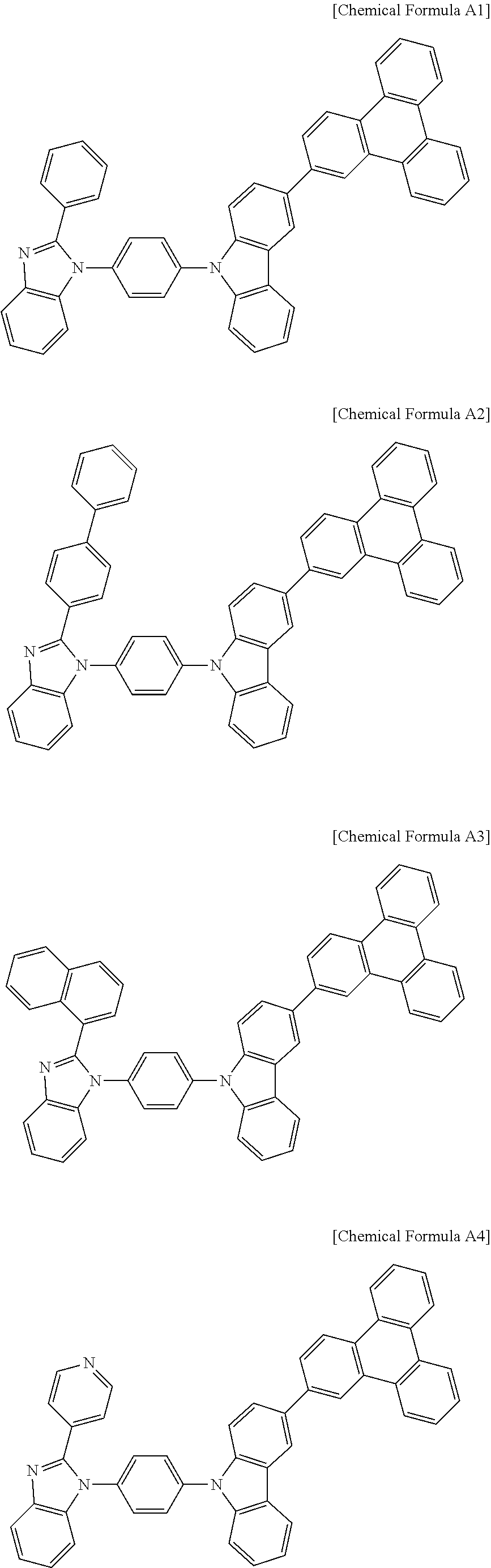


| TABLE 1 | |||||||
| Driving | Current | Power | Color | Color | |||
| voltage | efficiency | efficiency | Luminance | coordinate | coordinate | ||
| (Vd, V) | (cd/A) | (lm/W) | (cd/m2) | (CIEx) | (CIEy) | ||
| Comparative | 4.90 | 44.8 | 28.7 | 3000 | 0.329 | 0.626 |
| Example 1 | ||||||
| Example 6 | 5.07 | 48.8 | 30.2 | 3000 | 0.325 | 0.629 |
| Example 7 | 5.14 | 49.0 | 30.0 | 3000 | 0.330 | 0.625 |
| TABLE 2 | |||||||
| Driving | Current | Power | Color | Color | |||
| voltage | efficiency | efficiency | Luminance | coordinate | coordinate | ||
| (Vd, V) | (cd/A) | (lm/W) | (cd/m2) | (CIEx) | (CIEy) | ||
| Comparative | 4.90 | 44.8 | 28.7 | 3000 | 0.329 | 0.626 |
| Example 1 | ||||||
| Example 8 | 4.75 | 62.4 | 41.2 | 3000 | 0.295 | 0.674 |
| Example 9 | 5.10 | 68.4 | 42.1 | 3000 | 0.322 | 0.654 |
Claims (20)


Applications Claiming Priority (3)
| Application Number | Priority Date | Filing Date | Title |
|---|---|---|---|
| KR10-2011-0078815 | 2011-08-08 | ||
| KR1020110078815A KR101474797B1 (en) | 2011-08-08 | 2011-08-08 | Compound for organic optoelectronic device and organic light emitting diode including the same |
| PCT/KR2011/007384 WO2013022145A1 (en) | 2011-08-08 | 2011-10-06 | Organic optoelectronic device compound and organic light-emitting element including same |
Related Parent Applications (1)
| Application Number | Title | Priority Date | Filing Date |
|---|---|---|---|
| PCT/KR2011/007384 Continuation WO2013022145A1 (en) | 2011-08-08 | 2011-10-06 | Organic optoelectronic device compound and organic light-emitting element including same |
Publications (2)
| Publication Number | Publication Date |
|---|---|
| US20140048789A1 US20140048789A1 (en) | 2014-02-20 |
| US9444054B2 true US9444054B2 (en) | 2016-09-13 |
Family
ID=47668636
Family Applications (1)
| Application Number | Title | Priority Date | Filing Date |
|---|---|---|---|
| US14/062,222 Active 2033-02-06 US9444054B2 (en) | 2011-08-08 | 2013-10-24 | Compound for organic optoelectronic device and organic light emitting diode including the same |
Country Status (5)
| Country | Link |
|---|---|
| US (1) | US9444054B2 (en) |
| EP (1) | EP2700695B1 (en) |
| KR (1) | KR101474797B1 (en) |
| CN (1) | CN103597052B (en) |
| WO (1) | WO2013022145A1 (en) |
Families Citing this family (12)
| Publication number | Priority date | Publication date | Assignee | Title |
|---|---|---|---|---|
| GB201200823D0 (en) * | 2012-01-18 | 2012-02-29 | Cambridge Display Tech Ltd | Electroluminescence |
| US9512136B2 (en) * | 2012-11-26 | 2016-12-06 | Universal Display Corporation | Organic electroluminescent materials and devices |
| EP3053918B1 (en) * | 2015-02-06 | 2018-04-11 | Idemitsu Kosan Co., Ltd. | 2-carbazole substituted benzimidazoles for electronic applications |
| EP3093288A1 (en) * | 2015-05-12 | 2016-11-16 | Novaled GmbH | Organic light-emitting diode comprising different matrix compounds in the first and second electron transport layer |
| CN107683281A (en) | 2015-06-10 | 2018-02-09 | 默克专利有限公司 | Materials for Organic Electroluminescent Devices |
| KR101976662B1 (en) * | 2016-02-18 | 2019-05-09 | 삼성에스디아이 주식회사 | Organic compound and organic optoelectric device and display device |
| CN107973786B (en) * | 2016-10-25 | 2021-07-09 | 株式会社Lg化学 | Novel compound and organic light-emitting element using the same |
| CN106753340A (en) * | 2016-12-20 | 2017-05-31 | 中节能万润股份有限公司 | A kind of benzimidazole electroluminescent organic material and its preparation method and application |
| KR102148199B1 (en) * | 2017-12-19 | 2020-08-26 | 재단법인대구경북과학기술원 | Organic semiconductor for electron transport |
| CN110818696A (en) * | 2018-08-09 | 2020-02-21 | 昱镭光电科技股份有限公司 | Benzimidazole compound and its organic electronic device |
| CN110143952A (en) * | 2019-06-17 | 2019-08-20 | 上海天马有机发光显示技术有限公司 | A kind of compound, display panel and display device |
| CN112300146B (en) * | 2019-07-30 | 2022-02-01 | 江苏三月科技股份有限公司 | Organic compound taking carbazole as core and organic electroluminescent device comprising organic compound |
Citations (12)
| Publication number | Priority date | Publication date | Assignee | Title |
|---|---|---|---|---|
| JP2000095766A (en) | 1998-09-24 | 2000-04-04 | Minolta Co Ltd | Novel benzommidazole compound, its production and use |
| JP2002047274A (en) | 2000-08-02 | 2002-02-12 | Matsushita Electric Ind Co Ltd | Organic electroluminescent device |
| WO2004080975A1 (en) | 2003-03-13 | 2004-09-23 | Idemitsu Kosan Co., Ltd. | Nitrogen-containing heterocycle derivative and organic electroluminescent element using the same |
| KR20070023676A (en) | 2004-04-07 | 2007-02-28 | 이데미쓰 고산 가부시키가이샤 | Heterocyclic derivatives containing nitrogen and organic electroluminescent device using same |
| US20070200490A1 (en) | 2004-04-07 | 2007-08-30 | Idemitsu Kason Co.Ltd | Nitrogenous Heterocycle Derivative, And Organic Electroluminescent Element Employing The Same |
| CN101104795A (en) | 2007-08-07 | 2008-01-16 | 中国科学院长春应用化学研究所 | Dendritic green-emitting iridium complex, its preparation method and organic electroluminescent device of the complex |
| KR100857655B1 (en) | 2008-06-05 | 2008-09-08 | 주식회사 두산 | New organic compound and organic light emitting device using same |
| KR20090073852A (en) | 2007-12-31 | 2009-07-03 | 제일모직주식회사 | Low molecular organic compound, and organic photoelectric device comprising the same |
| KR20100041690A (en) | 2008-10-14 | 2010-04-22 | 제일모직주식회사 | Benzimidazole compounds and organic photoelectric device with the same |
| JP2010092960A (en) | 2008-10-06 | 2010-04-22 | Sony Corp | Organic electroluminescent device and display apparatus |
| KR20100099459A (en) | 2009-03-03 | 2010-09-13 | 덕산하이메탈(주) | Bis(benzoimidazole) chemiclal and organic electroric element using the same, terminal thererof |
| KR20110048840A (en) | 2009-11-03 | 2011-05-12 | 제일모직주식회사 | Compound for organic photoelectric device and organic photoelectric device comprising same |
-
2011
- 2011-08-08 KR KR1020110078815A patent/KR101474797B1/en active Active
- 2011-10-06 CN CN201180071548.XA patent/CN103597052B/en active Active
- 2011-10-06 WO PCT/KR2011/007384 patent/WO2013022145A1/en not_active Ceased
- 2011-10-06 EP EP11870589.6A patent/EP2700695B1/en active Active
-
2013
- 2013-10-24 US US14/062,222 patent/US9444054B2/en active Active
Patent Citations (15)
| Publication number | Priority date | Publication date | Assignee | Title |
|---|---|---|---|---|
| JP2000095766A (en) | 1998-09-24 | 2000-04-04 | Minolta Co Ltd | Novel benzommidazole compound, its production and use |
| JP2002047274A (en) | 2000-08-02 | 2002-02-12 | Matsushita Electric Ind Co Ltd | Organic electroluminescent device |
| WO2004080975A1 (en) | 2003-03-13 | 2004-09-23 | Idemitsu Kosan Co., Ltd. | Nitrogen-containing heterocycle derivative and organic electroluminescent element using the same |
| US20060147747A1 (en) | 2003-03-13 | 2006-07-06 | Hiroshi Yamamoto | Nitrogen-containing heterocycle derivative and organic electroluminescent element using the same |
| KR20070023676A (en) | 2004-04-07 | 2007-02-28 | 이데미쓰 고산 가부시키가이샤 | Heterocyclic derivatives containing nitrogen and organic electroluminescent device using same |
| US20070200490A1 (en) | 2004-04-07 | 2007-08-30 | Idemitsu Kason Co.Ltd | Nitrogenous Heterocycle Derivative, And Organic Electroluminescent Element Employing The Same |
| CN101104795A (en) | 2007-08-07 | 2008-01-16 | 中国科学院长春应用化学研究所 | Dendritic green-emitting iridium complex, its preparation method and organic electroluminescent device of the complex |
| KR20090073852A (en) | 2007-12-31 | 2009-07-03 | 제일모직주식회사 | Low molecular organic compound, and organic photoelectric device comprising the same |
| KR100857655B1 (en) | 2008-06-05 | 2008-09-08 | 주식회사 두산 | New organic compound and organic light emitting device using same |
| JP2010092960A (en) | 2008-10-06 | 2010-04-22 | Sony Corp | Organic electroluminescent device and display apparatus |
| US20110198577A1 (en) | 2008-10-06 | 2011-08-18 | Sony Corporation | Organic electroluminescent element and display device |
| KR20100041690A (en) | 2008-10-14 | 2010-04-22 | 제일모직주식회사 | Benzimidazole compounds and organic photoelectric device with the same |
| US20130256641A1 (en) | 2008-10-14 | 2013-10-03 | Ja-Hyun Kim | Benzimidazole compound, organic photoelectric device including the same, and display element including the same |
| KR20100099459A (en) | 2009-03-03 | 2010-09-13 | 덕산하이메탈(주) | Bis(benzoimidazole) chemiclal and organic electroric element using the same, terminal thererof |
| KR20110048840A (en) | 2009-11-03 | 2011-05-12 | 제일모직주식회사 | Compound for organic photoelectric device and organic photoelectric device comprising same |
Non-Patent Citations (13)
| Title |
|---|
| Bin Du, et al., "Novel chemosensory materials based on polyfluorenes with 2-(2'-pyridy1)- benzimidazole and 5-methyl-3-(pyridin-2-y1)-1,2,4-triazole groups in the side chain", Polymer 48 (2007) pp. 1245-1254. |
| Chen, et al. "Versatile, Benzimidazole/Amine-Based Ambipolar Compounds for Electroluminescent Applications: Single-Layer, Blue, Fluorescent OLEDs, Hosts for Single-Layer, Phosphorescent OLEDs" Advanced Functional Materials.; 2009; pp. 2661-2670; 19; WILEY-VCH Verlag GmbH & Co. KGaA, Weinheim; Federal Republic of Germany. |
| Dansong Zhang, "Novel green-emitting copper(I) complexes with electron donors incorporated ligands: Synthesis, photophysical properties, and electroluminescence performances", Journal of Luminescence 130 (2010) pp. 1419-1424. |
| Dongfang Qiu, et al., "Synthesis, crystal structure, photophysical property and electropolymerization of Pt(II) complexes with carbazole-grafting 2-(2-pyridyl) benzimidazole", Inorganic Chemistry Communications 14 (2011) pp. 1520-1524. |
| International Search Report in PCT/KR2011/007384, dated Aug. 24, 2012 (Park, et al.). |
| Jing Wu, et al., Synthesis and Photoluminescent Properties of Series Ternary Lanthanide (Eu(III), Sm(III), Nd(III), Er(III), Yb(III)) complexes containing 4,4,4-trifluoro-1-(2-naphthyl)-1,3butanedionate and carbazole-functionalized ligand, Inorganica Chemica Acta 363 (2010) pp. 2394-2400. |
| Junqiao Ding, et al., "Bifunctional Green Iridium Dendrimers with a "Self-Host" Feature for Highly Efficient Nondoped Electrophosphorescent Devices", Angew. Chem. Int. Ed. 2009, 48, pp. 6664-6666. |
| Junqiao Ding, et al., "Highly Efficient Green-Emitting Phosphorescent Iridium Dendrimers Based on Carbazole Dendrons", Adv. Funct. Mater. 2006, 16, pp. 575-581. |
| Lingcheng Chen, et al. "Bipolar Heteroleptic Green Iridium Dendrimers Containing Oligocarbazole and Oxadiazole Dendrons for Bright and Efficient Nondoped Electrophosphorescent Devices", Chem. Asian J. 2011, 6, pp. 1372-1380. |
| Search Report mailed Aug. 19, 2014 in corresponding Chinese Patent Application No. 201180071548.X. |
| Search Report mailed Jan. 7, 2015 in corresponding European Patent Application No. 11870589.6. |
| Si et al., Synthesis, Structural Characterzation, and Electrophosphorescent Properties of Rhenium(I) Complexes Containing Carrier-Transporting Groups, 2007, Inorganic Chemistry, vol. 46, pp. 6155-6163. * |
| Takizawa, et al.; "Phenylbenzimidazole-Based New Bipolar Host Materials for Efficient Phosphorescent Organic Light-Emitting Diodes," Chem. Mater.; 2009; pp. 2452-2458; 21; American Chemical Society; USA. |
Also Published As
| Publication number | Publication date |
|---|---|
| CN103597052A (en) | 2014-02-19 |
| EP2700695A4 (en) | 2015-01-28 |
| WO2013022145A1 (en) | 2013-02-14 |
| US20140048789A1 (en) | 2014-02-20 |
| WO2013022145A9 (en) | 2013-11-07 |
| KR101474797B1 (en) | 2014-12-19 |
| EP2700695A1 (en) | 2014-02-26 |
| EP2700695B1 (en) | 2017-12-06 |
| CN103597052B (en) | 2016-08-17 |
| KR20130016711A (en) | 2013-02-18 |
Similar Documents
| Publication | Publication Date | Title |
|---|---|---|
| US9559309B2 (en) | Compound for organic optoelectronic device, organic light emitting diode including the same, and display device including the organic light emitting diode | |
| US9444054B2 (en) | Compound for organic optoelectronic device and organic light emitting diode including the same | |
| US9543530B2 (en) | Compound for organic optoelectronic device, organic light emitting diode including the same and display including the organic light emitting diode | |
| US9548460B2 (en) | Compound for organic optoelectronic device, organic light emitting diode including the same and display including the organic light emitting diode | |
| US10121973B2 (en) | Compound for organic optoelectronic device, organic light-emitting diode including same, and display device including organic light-emitting diode | |
| US9419230B2 (en) | Compound for organic optoelectronic device, organic light emitting diode including the same, and display device including the organic light emitting diode | |
| US9136481B2 (en) | Compound for an organic photoelectric device, organic photoelectric device including the same, and display device including the organic photoelectric device | |
| US10153436B2 (en) | Compound for an organic optoelectronic element, organic light-emitting element comprising same, and display device comprising the organic light-emitting element | |
| US9450193B2 (en) | Compound for organic photoelectric device and organic photoelectric device including the same | |
| US9324948B2 (en) | Compound for organic optoelectronic device, organic light emitting diode including the same and display including the organic light emitting diode | |
| US8796917B2 (en) | Compound for an organic optoelectronic device, organic light emitting diode including the same, and display including the organic light emitting diode | |
| US9199966B2 (en) | Compound for an organic photoelectric device, organic photoelectric device, and display device including the same | |
| US9472768B2 (en) | Material for an organic optoelectronic device, organic light emitting diode including the same, and display device including the organic light emitting diode | |
| US20130299794A1 (en) | Compound for organic optoelectronic device, organic light emitting diode including the same and display including the organic light emitting diode | |
| TWI548628B (en) | Compound for organic photoelectric element, organic light emitting diode comprising the same, and display comprising the organic light emitting diode | |
| US20150263294A1 (en) | Compound for organic optoelectronic device, organic light-emitting device including same, and display device including the organic light- emitting diode | |
| US9793488B2 (en) | Compound for organic optoelectronic element, organic light-emitting element comprising same, and display device comprising the organic light-emitting element | |
| US20130087776A1 (en) | Compound for organic photoelectric device and organic photoelectric device including the same | |
| US20130256644A1 (en) | Compound for organic optoelectronic device, organic light emitting diode including the same and display including the organic light emitting diode | |
| US20150021563A1 (en) | Compound for organic optoelectronic device, organic light emitting diode including the same and display including the organic light emitting diode | |
| US9825242B2 (en) | Compound for organic optoelectric device, organic light-emitting diode including same, display device including organic light-emitting diode |
Legal Events
| Date | Code | Title | Description |
|---|---|---|---|
| AS | Assignment |
Owner name: CHEIL INDUSTRIES, INC., KOREA, REPUBLIC OF Free format text: ASSIGNMENT OF ASSIGNORS INTEREST;ASSIGNORS:PARK, MOO-JIN;YU, EUN-SUN;CHAE, MI-YOUNG;REEL/FRAME:031471/0204 Effective date: 20131008 |
|
| STCF | Information on status: patent grant |
Free format text: PATENTED CASE |
|
| MAFP | Maintenance fee payment |
Free format text: PAYMENT OF MAINTENANCE FEE, 4TH YEAR, LARGE ENTITY (ORIGINAL EVENT CODE: M1551); ENTITY STATUS OF PATENT OWNER: LARGE ENTITY Year of fee payment: 4 |
|
| MAFP | Maintenance fee payment |
Free format text: PAYMENT OF MAINTENANCE FEE, 8TH YEAR, LARGE ENTITY (ORIGINAL EVENT CODE: M1552); ENTITY STATUS OF PATENT OWNER: LARGE ENTITY Year of fee payment: 8 |