US9442076B2 - Infrared radiometric imaging inspection of steel parts - Google Patents
Infrared radiometric imaging inspection of steel parts Download PDFInfo
- Publication number
- US9442076B2 US9442076B2 US14/569,172 US201414569172A US9442076B2 US 9442076 B2 US9442076 B2 US 9442076B2 US 201414569172 A US201414569172 A US 201414569172A US 9442076 B2 US9442076 B2 US 9442076B2
- Authority
- US
- United States
- Prior art keywords
- steel part
- defects
- infrared
- image
- imaging
- Prior art date
- Legal status (The legal status is an assumption and is not a legal conclusion. Google has not performed a legal analysis and makes no representation as to the accuracy of the status listed.)
- Expired - Fee Related
Links
Images




Classifications
-
- G—PHYSICS
- G01—MEASURING; TESTING
- G01N—INVESTIGATING OR ANALYSING MATERIALS BY DETERMINING THEIR CHEMICAL OR PHYSICAL PROPERTIES
- G01N25/00—Investigating or analyzing materials by the use of thermal means
- G01N25/72—Investigating presence of flaws
-
- C—CHEMISTRY; METALLURGY
- C23—COATING METALLIC MATERIAL; COATING MATERIAL WITH METALLIC MATERIAL; CHEMICAL SURFACE TREATMENT; DIFFUSION TREATMENT OF METALLIC MATERIAL; COATING BY VACUUM EVAPORATION, BY SPUTTERING, BY ION IMPLANTATION OR BY CHEMICAL VAPOUR DEPOSITION, IN GENERAL; INHIBITING CORROSION OF METALLIC MATERIAL OR INCRUSTATION IN GENERAL
- C23F—NON-MECHANICAL REMOVAL OF METALLIC MATERIAL FROM SURFACE; INHIBITING CORROSION OF METALLIC MATERIAL OR INCRUSTATION IN GENERAL; MULTI-STEP PROCESSES FOR SURFACE TREATMENT OF METALLIC MATERIAL INVOLVING AT LEAST ONE PROCESS PROVIDED FOR IN CLASS C23 AND AT LEAST ONE PROCESS COVERED BY SUBCLASS C21D OR C22F OR CLASS C25
- C23F1/00—Etching metallic material by chemical means
-
- G—PHYSICS
- G01—MEASURING; TESTING
- G01J—MEASUREMENT OF INTENSITY, VELOCITY, SPECTRAL CONTENT, POLARISATION, PHASE OR PULSE CHARACTERISTICS OF INFRARED, VISIBLE OR ULTRAVIOLET LIGHT; COLORIMETRY; RADIATION PYROMETRY
- G01J5/00—Radiation pyrometry, e.g. infrared or optical thermometry
- G01J5/10—Radiation pyrometry, e.g. infrared or optical thermometry using electric radiation detectors
-
- G—PHYSICS
- G01—MEASURING; TESTING
- G01N—INVESTIGATING OR ANALYSING MATERIALS BY DETERMINING THEIR CHEMICAL OR PHYSICAL PROPERTIES
- G01N21/00—Investigating or analysing materials by the use of optical means, i.e. using sub-millimetre waves, infrared, visible or ultraviolet light
- G01N21/84—Systems specially adapted for particular applications
- G01N21/88—Investigating the presence of flaws or contamination
- G01N21/8806—Specially adapted optical and illumination features
-
- G—PHYSICS
- G01—MEASURING; TESTING
- G01N—INVESTIGATING OR ANALYSING MATERIALS BY DETERMINING THEIR CHEMICAL OR PHYSICAL PROPERTIES
- G01N21/00—Investigating or analysing materials by the use of optical means, i.e. using sub-millimetre waves, infrared, visible or ultraviolet light
- G01N21/84—Systems specially adapted for particular applications
- G01N21/88—Investigating the presence of flaws or contamination
- G01N21/95—Investigating the presence of flaws or contamination characterised by the material or shape of the object to be examined
- G01N21/9515—Objects of complex shape, e.g. examined with use of a surface follower device
-
- G—PHYSICS
- G06—COMPUTING OR CALCULATING; COUNTING
- G06T—IMAGE DATA PROCESSING OR GENERATION, IN GENERAL
- G06T7/00—Image analysis
- G06T7/0002—Inspection of images, e.g. flaw detection
- G06T7/0004—Industrial image inspection
- G06T7/0008—Industrial image inspection checking presence/absence
-
- H—ELECTRICITY
- H04—ELECTRIC COMMUNICATION TECHNIQUE
- H04N—PICTORIAL COMMUNICATION, e.g. TELEVISION
- H04N23/00—Cameras or camera modules comprising electronic image sensors; Control thereof
- H04N23/10—Cameras or camera modules comprising electronic image sensors; Control thereof for generating image signals from different wavelengths
- H04N23/11—Cameras or camera modules comprising electronic image sensors; Control thereof for generating image signals from different wavelengths for generating image signals from visible and infrared light wavelengths
-
- G—PHYSICS
- G01—MEASURING; TESTING
- G01J—MEASUREMENT OF INTENSITY, VELOCITY, SPECTRAL CONTENT, POLARISATION, PHASE OR PULSE CHARACTERISTICS OF INFRARED, VISIBLE OR ULTRAVIOLET LIGHT; COLORIMETRY; RADIATION PYROMETRY
- G01J5/00—Radiation pyrometry, e.g. infrared or optical thermometry
- G01J2005/0077—Imaging
-
- G—PHYSICS
- G01—MEASURING; TESTING
- G01N—INVESTIGATING OR ANALYSING MATERIALS BY DETERMINING THEIR CHEMICAL OR PHYSICAL PROPERTIES
- G01N2201/00—Features of devices classified in G01N21/00
- G01N2201/06—Illumination; Optics
- G01N2201/061—Sources
-
- G—PHYSICS
- G06—COMPUTING OR CALCULATING; COUNTING
- G06T—IMAGE DATA PROCESSING OR GENERATION, IN GENERAL
- G06T2207/00—Indexing scheme for image analysis or image enhancement
- G06T2207/10—Image acquisition modality
- G06T2207/10048—Infrared image
-
- G—PHYSICS
- G06—COMPUTING OR CALCULATING; COUNTING
- G06T—IMAGE DATA PROCESSING OR GENERATION, IN GENERAL
- G06T2207/00—Indexing scheme for image analysis or image enhancement
- G06T2207/10—Image acquisition modality
- G06T2207/10141—Special mode during image acquisition
- G06T2207/10152—Varying illumination
-
- G—PHYSICS
- G06—COMPUTING OR CALCULATING; COUNTING
- G06T—IMAGE DATA PROCESSING OR GENERATION, IN GENERAL
- G06T2207/00—Indexing scheme for image analysis or image enhancement
- G06T2207/30—Subject of image; Context of image processing
- G06T2207/30108—Industrial image inspection
- G06T2207/30136—Metal
-
- G—PHYSICS
- G06—COMPUTING OR CALCULATING; COUNTING
- G06T—IMAGE DATA PROCESSING OR GENERATION, IN GENERAL
- G06T2207/00—Indexing scheme for image analysis or image enhancement
- G06T2207/30—Subject of image; Context of image processing
- G06T2207/30108—Industrial image inspection
- G06T2207/30164—Workpiece; Machine component
Definitions
- This disclosure relates to the inspection of parts, e.g., components of a machine.
- This disclosure describes technologies relating to inspecting metallic parts with infrared radiometric imaging.
- a method includes heating a ground steel part that has been chemical-etched. The method also includes detecting defects caused by grinding and watermarks caused by chemical etching by imaging the steel part with an infrared camera to capture infrared radiation from regions of the steel part that include defects and watermarks.
- Imaging the steel part can include imaging regions of the steel part at long-wavelengths of infrared radiation to detect defects on the regions of the steel part and generating a first image wherein the defects are visible in the image and the watermarks are not visible in the image.
- Long-wavelengths of infrared radiation can include wavelengths greater than or equal to 6 microns.
- Imaging the steel part can include imaging the regions of the steel part at mid-wavelengths of infrared radiation to detect defects and watermarks on the regions of the steel part and generating a second image wherein the defects and the watermarks are visible in the image.
- Mid-wavelengths of infrared radiation can include infrared wavelengths less than 6 microns.
- Imaging the steel part can include detecting infrared emittance from a region on the steel part that includes defects. Imaging the steel part can include detecting infrared reflectance from a region on the steel part that includes defects.
- a chemical etchant can be applied to a portion of the surface of the steel part. The chemical etchant can be a nital etch.
- the steel part can be a gear. Heating the steel part can include irradiating the steel part with a light source. Heating the steel part can include placing the steel part in thermal contact with a heated surface.
- a method includes applying a chemical etchant to a surface of a steel part, exposing the steel part to a heat source, imaging the steel part with an infrared camera to generate an infrared image of a region of the steel part, and identifying defects on the region of the steel part.
- the chemical etchant can be a nital etch.
- Heating the steel part can include irradiating the steel part with a light source. Defects can be visible in the infrared image of the region of the steel part.
- the steel part can be a gear.
- a method includes applying a chemical etchant to a surface of a gear for a rotorcraft, heating the gear by exposing the gear to a heat source, imaging the heated gear with an infrared camera to generate an infrared image of a region of the gear, and identifying defects on the region of the gear.
- the chemical etchant can be a nital etch. Defects can be visible in the infrared image of the region of the gear.
- FIG. 1 is a flowchart showing an example process for inspecting a part.
- FIGS. 2A-2B are schematic diagrams showing examples of a system for inspecting a part.
- FIG. 3A is a schematic diagram of an example part inspection.
- FIGS. 3B-3C are example images of a part inspection.
- FIG. 4 is a schematic diagram showing an example of a rotorcraft.
- FIG. 5 is a schematic diagram showing an example of a tiltrotor aircraft.
- This disclosure relates to the inspection of metallic parts using infrared radiometric imaging.
- During the manufacture of metallic parts localized regions of the parts can experience high temperatures that cause thermal damage, resulting in damaged regions with defects called “burns.” Any machining operation that produces friction or results in the part being heated and/or portions of the part being removed can cause defects.
- a machining or grinding process can produce defects on the surface of the ground part. Defects can also be produced by directly heating the part, for example during a heat treatment of the part.
- the defects introduce regions of weakness relative to regions without the defects. Regions with the defect can be prone to cracking, breaking, or other failure. Thus, identification of defects on a part is an important safety consideration.
- the metallic part can be made of a metal such as steel (e.g., a hardened carbon steel) or another metal.
- a machined part is treated with chemicals such as those described below.
- the chemical treatment can identify defects, e.g., burns or other defects, on the surface of the machined part while also leaving residual watermarks on the surface.
- the chemically treated part is heated, and then the heated part is imaged at infrared wavelengths.
- the images are inspected to detect the defects caused by the machining and the watermarks caused by chemical etching.
- the defects and watermarks can be distinguished by their different characteristics apparent in the infrared image.
- the techniques described here can be implemented to distinguish defects in machined parts from residual watermarks left by chemical treatment of the machined parts, ensuring that damaged parts are properly identified.
- the inspection process can be used to inspect any metallic part manufactured for any applicable industry, e.g., rotorcraft, aircraft, automobiles, and other industries.
- the part could be a hardened steel gear or other transmission component.
- the inspection process can use multiple wavelengths of infrared radiation (e.g., mid-wavelength infrared, long-wavelength infrared) to inspect the part.
- defects and residual watermarks When examined in the visual spectrum (e.g. using the human eye), defects and residual watermarks can appear very similar and be mistaken for one another. Defects and residual watermarks can have different appearances and characteristics when inspected in infrared wavelengths, and thus burns can be distinguished from watermarks using infrared imaging. Furthermore, contrast between defects and undamaged regions can be enhanced using infrared cameras because infrared cameras are not as sensitive to microscopic surface features, films, or contaminates. For example, an infrared image can show greater contrast between defects or watermarks and the surrounding regions of the part.
- the inspection process allows digital reproduction of inspection images, and the inspection process is reproducible.
- the digital and reproducible nature of the inspection process can allow calibration of the infrared images to quantitatively determine infrared reflectivity and emissivity.
- the infrared images can be correlated to burn characteristics (e.g., burn depth, burn severity, etc.) with greater precision and reliability than a visual inspection of the burn.
- burn characteristics e.g., burn depth, burn severity, etc.
- the digital and reproducible nature of the inspection process can allow a standardization and gradation of burn characteristics.
- FIG. 1 shows an example infrared inspection process 100 .
- the inspection process 100 can be used to inspect a machined, ground, or otherwise processed metallic part, e.g., a hardened steel part or other metallic part.
- the part can be any metallic part manufactured by grinding such as a gear, shaft, spline, bearing, screw, rod, or other part.
- the part can be a ground gear used in a rotorcraft transmission.
- a chemical etchant is applied to the surface of the part.
- the chemical etchant is an etchant that delineates (e.g. darkens, discolors) defects on the part.
- the chemical etchant can be a nital etch, a picral etch, or some other etchant.
- the chemical etchant can be applied to a portion of the part or the entire part (e.g., by immersion in the etchant or other techniques).
- the part is rinsed and/or dried after application to remove the chemical etchant.
- the chemical-etched part is heated by exposure to a heat source.
- the part can be heated to a temperature greater than the ambient temperature (e.g., greater than room temperature).
- the entire part is heated to a temperature, and in some implementations, a portion of the part is heated to a temperature.
- the part can be heated by any suitable heat source, such as the light source 204 shown in FIG. 2A or the heat source 210 shown in FIG. 2B , or another heat source.
- the heated part is imaged with an infrared camera.
- Imaging regions of the part in the infrared spectrum can detect defects on the part with greater contrast and reliability than imaging in the visible spectrum.
- imaging regions of the part at long-wavelengths of infrared radiation can detect defects on the regions of the part.
- imaging a chemical-etched and heated part at long-wavelength infrared can generate an image in which defects are less visible in the image than watermarks.
- imaging regions of the part at mid-wavelengths of infrared radiation can detect defects and watermarks on the regions of the part.
- imaging the part at mid-wavelength infrared can generate an image in which both defects and the watermarks are visible in the image.
- defects and watermarks are identified based on the images of the part. For example, defects could be identified by their greater visibility in infrared images compared with watermarks and regions without defects. Conversely, watermarks could be identified by their reduced visibility in infrared images compared with defects.
- FIG. 2A and FIG. 2B illustrate schematic diagrams of example inspection systems 200 and 250 , respectively.
- the example inspection systems 200 , 250 can implement the inspection process 100 .
- Each of the example inspection systems 200 , 250 includes an example part 202 and an example infrared camera 206 .
- the part 202 is shown as a ground gear that has been chemical-etched.
- an inspection system 200 includes an example light source 204 .
- the light source 204 irradiates the part 202 .
- the part 202 absorbs the light emitted from light source 204 , and as such, the light source 204 serves to heat the part 202 .
- the light source 204 can be an incandescent lamp, a halogen lamp, a heat lamp, a laser, or another type of light source.
- the light source 204 can be positioned a distance away from the part 202 , e.g. 3 inches away, 1 foot away, or another distance away. A portion of the part 202 or all of the part 202 can be irradiated by the light source 204 .
- Optical components e.g., lenses, mirrors, or other optical components
- the infrared camera 206 can capture a portion of infrared radiation 208 from the part 202 .
- the infrared camera can be an FSI Phoenix MWIR FPA infrared camera, an FSI Phoenix LWIR FPA infrared camera, or another infrared camera.
- the infrared camera can also be implemented by an infrared detector such as an InSb infrared detector or an InGaAs infrared detector, or another type of infrared detector.
- the infrared camera 206 detects infrared radiation 208 as emittance from a heated part 202 .
- the light source 204 irradiates the part 202 , and the infrared camera 206 detects infrared radiation 208 as reflectance from the part 202 .
- the light source 204 is turned off during detection of infrared radiation 208 , and the infrared radiation 208 is detected as emittance from the part 202 .
- the light source 204 is modulated, and the infrared camera 206 is connected to a lock-in amplifier to enhance detection of the infrared radiation 208 .
- the infrared camera 206 is used to generate an image of one or more regions of the part 202 in an infrared spectrum.
- the infrared camera 206 can capture infrared radiation and convert a portion of the captured infrared radiation into signals.
- the infrared camera 206 can transmit the signals to another device (e.g. a computer, a module, an amplifier, or another device) that can generate images from the signals.
- the infrared camera 206 captures long-wavelength infrared radiation (i.e., wavelengths greater than or equal to 6 microns).
- the infrared camera 206 captures mid-wavelength infrared radiation (i.e., infrared wavelengths between about 2 and 6 microns).
- multiple infrared cameras 206 are used.
- the multiple infrared cameras 206 can be configured to capture different infrared spectra.
- the infrared spectra can include different wavelengths or the same wavelengths. For example, one camera can capture mid-wavelength infrared radiation and another camera can capture long-wavelength infrared radiation.
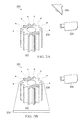
- FIG. 3A shows a schematic diagram of an example part 300 as seen in the visible spectrum.
- the example part 300 has been ground and chemical-etched with nital etch. Representative defects are apparent on part 300 at region 312 A.
- the defects in region 312 A appear as dark spots on the surface of the part 300 (one example defect is labeled).
- the part 300 also shows representative watermarks in region 314 A, the watermarks also appearing as dark spots (one example watermark is labeled).
- the dark spots of the defects in region 312 A are similar in appearance to the dark spots of the watermarks in region 314 A, and each could possibly be misidentified as the other.
- FIG. 3A is representative of parts on which both defects and watermarks are apparent in the visual spectrum.
- FIG. 3B shows an example image 310 of example parts 302 and 304 imaged with a mid-wavelength infrared camera. Parts 302 and 304 have been ground, chemical-etched with nital etch, and heated using a light source, similar to inspection system 200 implementing inspection process 100 .
- Image 310 in FIG. 3B is an image of mid-wavelength infrared emittance from parts 302 , 304 . In FIG. 3B , stronger intensity (shown in false-color) corresponds to greater radiative emittance from the parts 302 , 304 .
- the mid-wavelength infrared image 310 shows defects present in region 312 B as spots of stronger intensity (one example defect has been labeled). Watermarks are also apparent in region 314 B as spots of higher intensity (one example watermark has been labeled). Imaging in mid-wavelength infrared can show burns and watermarks with greater clarity and greater conspicuity than imaging in the visible spectrum.
- FIG. 3C shows an example image 320 of parts 302 and 304 imaged with a long-wavelength infrared camera.
- Image 320 in FIG. 3C is an image of long-wavelength infrared emittance from parts 302 , 304 .
- stronger intensity shown in false-color
- regions 312 C, 314 C in FIG. 3C are the same regions on parts 302 , 304 as regions 312 B, 314 B shown in FIG. 3B .
- Defects are apparent in FIG. 3C as spots of stronger long-wavelength infrared intensity in region 312 C (one example defect has been labeled). However, watermarks are not apparent in region 314 C in the long-wavelength infrared image of FIG. 3C .
- the defects on parts can be positively identified or verified by their long-wavelength infrared emission, and the watermarks on parts can be positively identified or verified by relatively weak long-wavelength emission or their lack of long-wavelength infrared emission.
- the watermarks can be positively identified by their weaker long-wavelength infrared emission relative to the long-wavelength infrared emission from defects. In this manner, infrared inspection of parts in a process such as process 100 can identify and distinguish defects and watermarks more reliably than visible spectrum inspection.
- an inspection system 250 includes an example heat source 210 that heats the part 202 .
- the heat source 210 is shown as a heated surface (e.g., a hot plate) that is proximate to or in contact with the part 202 .
- the part 202 can rest on the heat source 210 or can be heated by the heated surface 210 through an intermediate material (not shown) or be near but not in physical contact with the heat source 210 .
- another type of heat source is used, such as hot gas convection (e.g., via a heat gun, a hair dryer, or other hot gas supply), a flame, a furnace, a space heater, or other heat source.
- multiple heat sources of the same type or of different types are used to heat the part 202 .
- the inspection system 250 could be used to generate images similar to images 300 , 310 , 320 shown in FIGS. 3A-3C .
- the parts 302 , 304 could be heated with a hot plate instead of with a light source.
- the heat source 210 is turned off during detection of infrared radiation 208 .
- the part 202 is removed from proximity to the heat source 210 prior to detection of the infrared radiation 208 .
- the heat source 210 is modulated, and the infrared camera 206 is connected to a lock-in amplifier to enhance detection of the infrared radiation 208 .
- FIG. 4 shows a schematic diagram of an example rotorcraft 401 .
- Rotorcraft 401 has a rotor system 403 with multiple rotor blades 405 .
- Rotorcraft 401 can further include a fuselage 407 , anti-torque system 409 , and an empennage 411 .
- the rotorcraft 401 can also include parts 202 that can be inspected by inspection process 100 .
- Part 202 is shown in an example location within the transmission of the rotorcraft 401 .
- FIG. 5 shows a schematic diagram of an example tiltrotor aircraft 501 .
- Aircraft 501 includes a fuselage 507 with attached wings 505 .
- Nacelles 503 are carried at the outboard ends of wings 505 and are rotatable between the helicopter-mode position shown and a forward-facing airplane-mode position (not shown).
- Nacelles 503 carry engines and transmissions for powering rotor systems 511 in rotation.
- An engine may be an internal combustion engine, an electrical power source and associated motor, or any other suitable technique for powering rotor system 511 .
- the tiltrotor aircraft 501 can include parts 202 that can be inspected by inspection process 100 . Part 202 is shown in an example location within the transmission of the tiltrotor aircraft 501 .
Landscapes
- Chemical & Material Sciences (AREA)
- Physics & Mathematics (AREA)
- General Physics & Mathematics (AREA)
- Engineering & Computer Science (AREA)
- General Health & Medical Sciences (AREA)
- Biochemistry (AREA)
- Analytical Chemistry (AREA)
- Life Sciences & Earth Sciences (AREA)
- Immunology (AREA)
- Pathology (AREA)
- Health & Medical Sciences (AREA)
- Signal Processing (AREA)
- Multimedia (AREA)
- Metallurgy (AREA)
- Mechanical Engineering (AREA)
- Materials Engineering (AREA)
- Organic Chemistry (AREA)
- Spectroscopy & Molecular Physics (AREA)
- General Chemical & Material Sciences (AREA)
- Chemical Kinetics & Catalysis (AREA)
- Quality & Reliability (AREA)
- Computer Vision & Pattern Recognition (AREA)
- Theoretical Computer Science (AREA)
- Investigating Materials By The Use Of Optical Means Adapted For Particular Applications (AREA)
- Investigating Or Analyzing Materials Using Thermal Means (AREA)
Abstract
Description
Claims (17)
Priority Applications (2)
| Application Number | Priority Date | Filing Date | Title |
|---|---|---|---|
| US14/569,172 US9442076B2 (en) | 2014-12-12 | 2014-12-12 | Infrared radiometric imaging inspection of steel parts |
| US15/225,419 US9983156B2 (en) | 2014-12-12 | 2016-08-01 | Infrared radiometric imaging inspection of steel parts |
Applications Claiming Priority (1)
| Application Number | Priority Date | Filing Date | Title |
|---|---|---|---|
| US14/569,172 US9442076B2 (en) | 2014-12-12 | 2014-12-12 | Infrared radiometric imaging inspection of steel parts |
Related Child Applications (1)
| Application Number | Title | Priority Date | Filing Date |
|---|---|---|---|
| US15/225,419 Continuation US9983156B2 (en) | 2014-12-12 | 2016-08-01 | Infrared radiometric imaging inspection of steel parts |
Publications (2)
| Publication Number | Publication Date |
|---|---|
| US20160169813A1 US20160169813A1 (en) | 2016-06-16 |
| US9442076B2 true US9442076B2 (en) | 2016-09-13 |
Family
ID=56110903
Family Applications (2)
| Application Number | Title | Priority Date | Filing Date |
|---|---|---|---|
| US14/569,172 Expired - Fee Related US9442076B2 (en) | 2014-12-12 | 2014-12-12 | Infrared radiometric imaging inspection of steel parts |
| US15/225,419 Active 2035-06-06 US9983156B2 (en) | 2014-12-12 | 2016-08-01 | Infrared radiometric imaging inspection of steel parts |
Family Applications After (1)
| Application Number | Title | Priority Date | Filing Date |
|---|---|---|---|
| US15/225,419 Active 2035-06-06 US9983156B2 (en) | 2014-12-12 | 2016-08-01 | Infrared radiometric imaging inspection of steel parts |
Country Status (1)
| Country | Link |
|---|---|
| US (2) | US9442076B2 (en) |
Cited By (1)
| Publication number | Priority date | Publication date | Assignee | Title |
|---|---|---|---|---|
| US12573180B2 (en) | 2023-06-21 | 2026-03-10 | Insight Direct Usa, Inc. | Collection of image data for use in training a machine-learning model |
Families Citing this family (4)
| Publication number | Priority date | Publication date | Assignee | Title |
|---|---|---|---|---|
| US10634631B2 (en) * | 2017-02-14 | 2020-04-28 | Itt Manufacturing Enterprises Llc | Methods and systems for detecting defects in layered devices and other materials |
| CN112001899B (en) * | 2020-08-13 | 2024-05-31 | 中冶建筑研究总院(深圳)有限公司 | Method and device for detecting steel structure coating in hot and humid climate, server and storage medium |
| US12590844B2 (en) | 2022-10-28 | 2026-03-31 | International Business Machines Corporation | Thermographic imaging for quality analysis |
| CN116465837A (en) * | 2023-05-15 | 2023-07-21 | 中国第一汽车股份有限公司 | A vehicle health detection device and display method |
Citations (4)
| Publication number | Priority date | Publication date | Assignee | Title |
|---|---|---|---|---|
| US20020160612A1 (en) * | 2001-04-27 | 2002-10-31 | Yasutaka Kobayashi | Manufacturing method of semiconductor device |
| US20050221229A1 (en) * | 2004-03-22 | 2005-10-06 | Mehran Nasser-Ghodsi | Methods and systems for measuring a characteristic of a substrate or preparing a substrate for analysis |
| US20150001421A1 (en) * | 2013-06-26 | 2015-01-01 | Kla-Tencor Corporation | System and Method for Defect Detection and Photoluminescence Measurement of a Sample |
| US20150193919A1 (en) * | 2014-01-03 | 2015-07-09 | Bell Helicopter Textron Inc. | Automated nital etch inspection system |
-
2014
- 2014-12-12 US US14/569,172 patent/US9442076B2/en not_active Expired - Fee Related
-
2016
- 2016-08-01 US US15/225,419 patent/US9983156B2/en active Active
Patent Citations (4)
| Publication number | Priority date | Publication date | Assignee | Title |
|---|---|---|---|---|
| US20020160612A1 (en) * | 2001-04-27 | 2002-10-31 | Yasutaka Kobayashi | Manufacturing method of semiconductor device |
| US20050221229A1 (en) * | 2004-03-22 | 2005-10-06 | Mehran Nasser-Ghodsi | Methods and systems for measuring a characteristic of a substrate or preparing a substrate for analysis |
| US20150001421A1 (en) * | 2013-06-26 | 2015-01-01 | Kla-Tencor Corporation | System and Method for Defect Detection and Photoluminescence Measurement of a Sample |
| US20150193919A1 (en) * | 2014-01-03 | 2015-07-09 | Bell Helicopter Textron Inc. | Automated nital etch inspection system |
Cited By (1)
| Publication number | Priority date | Publication date | Assignee | Title |
|---|---|---|---|---|
| US12573180B2 (en) | 2023-06-21 | 2026-03-10 | Insight Direct Usa, Inc. | Collection of image data for use in training a machine-learning model |
Also Published As
| Publication number | Publication date |
|---|---|
| US9983156B2 (en) | 2018-05-29 |
| US20160341683A1 (en) | 2016-11-24 |
| US20160169813A1 (en) | 2016-06-16 |
Similar Documents
| Publication | Publication Date | Title |
|---|---|---|
| US9983156B2 (en) | Infrared radiometric imaging inspection of steel parts | |
| US5111048A (en) | Apparatus and method for detecting fatigue cracks using infrared thermography | |
| US8204294B2 (en) | Systems and methods for detecting defects in coatings utilizing color-based thermal mismatch | |
| JP3220690B2 (en) | Apparatus and method for detecting defects in substrate | |
| US20070036199A1 (en) | Thermal imaging method and apparatus | |
| JP6937846B2 (en) | Laser thermography | |
| CN101846501B (en) | System and method for valve seat gap evaluation | |
| JP5830229B2 (en) | Wafer defect inspection system | |
| Just et al. | Infrared particle detection for battery electrode foils | |
| Schaumberger et al. | Improving process reliability by means of detection of weld seam irregularities in copper via thermographic process monitoring | |
| US20230050381A1 (en) | Method for detecting thermal anomaly in composite structure | |
| JPH10311811A (en) | Method and device for detecting defect of ceramic main body | |
| US12546728B2 (en) | Device and method for optically capturing an object | |
| KR20190002944A (en) | Method for evaluating the soundness of led heat sink by passive infrared thermography | |
| EP1006553B1 (en) | Process for determination of blackening of a lamp | |
| JP7603682B2 (en) | Photothermal analysis of some solid materials | |
| JP2016020875A (en) | Thermal barrier coating film defect damage evaluation method and evaluation apparatus | |
| CN116900483A (en) | Method for monitoring laser welding process, device for implementing the method and application of the method | |
| Zalameda | Synchronized electronic shutter system (SESS) for thermal nondestructive evaluation | |
| CN113567492A (en) | A non-destructive testing method and testing device for thermal barrier coatings of turbine blades based on infrared heat dissipation | |
| Gilblas et al. | Detection of micro-cracks on highly specular reflectors: Dimensioning a vision machine based on optical properties | |
| US20250137954A1 (en) | System and Method for Inspection of Low Emissivity Surfaces Using a Pulsed Light Emitting Diode Heat Source for Thermal Nondestructive Evaluation | |
| Ingold et al. | Selecting a Nondestructive Testing Method, Part VI: Thermal/Infrared Inspection Techniques–Thermography | |
| CN109313148B (en) | Method and associated apparatus for inspecting metal surfaces | |
| JP2024172774A (en) | Defect Inspection System |
Legal Events
| Date | Code | Title | Description |
|---|---|---|---|
| FEPP | Fee payment procedure |
Free format text: PAYOR NUMBER ASSIGNED (ORIGINAL EVENT CODE: ASPN); ENTITY STATUS OF PATENT OWNER: LARGE ENTITY |
|
| ZAAA | Notice of allowance and fees due |
Free format text: ORIGINAL CODE: NOA |
|
| ZAAB | Notice of allowance mailed |
Free format text: ORIGINAL CODE: MN/=. |
|
| AS | Assignment |
Owner name: BELL HELICOPTER TEXTRON INC., TEXAS Free format text: ASSIGNMENT OF ASSIGNORS INTEREST;ASSIGNORS:SCHLICHTE, DAVID R.;FERRIE, CATHERINE;SIGNING DATES FROM 20141121 TO 20141209;REEL/FRAME:039267/0225 Owner name: BELL HELICOPTER TEXTRON INC., TEXAS Free format text: ASSIGNMENT OF ASSIGNORS INTEREST;ASSIGNOR:SHEPHERD, ROBERT A.;REEL/FRAME:039267/0272 Effective date: 19940523 |
|
| STCF | Information on status: patent grant |
Free format text: PATENTED CASE |
|
| MAFP | Maintenance fee payment |
Free format text: PAYMENT OF MAINTENANCE FEE, 4TH YEAR, LARGE ENTITY (ORIGINAL EVENT CODE: M1551); ENTITY STATUS OF PATENT OWNER: LARGE ENTITY Year of fee payment: 4 |
|
| FEPP | Fee payment procedure |
Free format text: MAINTENANCE FEE REMINDER MAILED (ORIGINAL EVENT CODE: REM.); ENTITY STATUS OF PATENT OWNER: LARGE ENTITY |
|
| LAPS | Lapse for failure to pay maintenance fees |
Free format text: PATENT EXPIRED FOR FAILURE TO PAY MAINTENANCE FEES (ORIGINAL EVENT CODE: EXP.); ENTITY STATUS OF PATENT OWNER: LARGE ENTITY |
|
| STCH | Information on status: patent discontinuation |
Free format text: PATENT EXPIRED DUE TO NONPAYMENT OF MAINTENANCE FEES UNDER 37 CFR 1.362 |
|
| FP | Lapsed due to failure to pay maintenance fee |
Effective date: 20240913 |