US9429149B2 - Polyetherimide pump - Google Patents
Polyetherimide pump Download PDFInfo
- Publication number
- US9429149B2 US9429149B2 US13/842,517 US201313842517A US9429149B2 US 9429149 B2 US9429149 B2 US 9429149B2 US 201313842517 A US201313842517 A US 201313842517A US 9429149 B2 US9429149 B2 US 9429149B2
- Authority
- US
- United States
- Prior art keywords
- pump
- polyetherimide
- component
- iso
- pump according
- Prior art date
- Legal status (The legal status is an assumption and is not a legal conclusion. Google has not performed a legal analysis and makes no representation as to the accuracy of the status listed.)
- Expired - Fee Related, expires
Links
Images


Classifications
-
- F—MECHANICAL ENGINEERING; LIGHTING; HEATING; WEAPONS; BLASTING
- F04—POSITIVE - DISPLACEMENT MACHINES FOR LIQUIDS; PUMPS FOR LIQUIDS OR ELASTIC FLUIDS
- F04B—POSITIVE-DISPLACEMENT MACHINES FOR LIQUIDS; PUMPS
- F04B19/00—Machines or pumps having pertinent characteristics not provided for in, or of interest apart from, groups F04B1/00 - F04B17/00
- F04B19/20—Other positive-displacement pumps
-
- F—MECHANICAL ENGINEERING; LIGHTING; HEATING; WEAPONS; BLASTING
- F01—MACHINES OR ENGINES IN GENERAL; ENGINE PLANTS IN GENERAL; STEAM ENGINES
- F01C—ROTARY-PISTON OR OSCILLATING-PISTON MACHINES OR ENGINES
- F01C21/00—Component parts, details or accessories not provided for in groups F01C1/00 - F01C20/00
- F01C21/10—Outer members for co-operation with rotary pistons; Casings
-
- F—MECHANICAL ENGINEERING; LIGHTING; HEATING; WEAPONS; BLASTING
- F04—POSITIVE - DISPLACEMENT MACHINES FOR LIQUIDS; PUMPS FOR LIQUIDS OR ELASTIC FLUIDS
- F04C—ROTARY-PISTON, OR OSCILLATING-PISTON, POSITIVE-DISPLACEMENT MACHINES FOR LIQUIDS; ROTARY-PISTON, OR OSCILLATING-PISTON, POSITIVE-DISPLACEMENT PUMPS
- F04C15/00—Component parts, details or accessories of machines, pumps or pumping installations, not provided for in groups F04C2/00 - F04C14/00
- F04C15/06—Arrangements for admission or discharge of the working fluid, e.g. constructional features of the inlet or outlet
-
- F—MECHANICAL ENGINEERING; LIGHTING; HEATING; WEAPONS; BLASTING
- F04—POSITIVE - DISPLACEMENT MACHINES FOR LIQUIDS; PUMPS FOR LIQUIDS OR ELASTIC FLUIDS
- F04C—ROTARY-PISTON, OR OSCILLATING-PISTON, POSITIVE-DISPLACEMENT MACHINES FOR LIQUIDS; ROTARY-PISTON, OR OSCILLATING-PISTON, POSITIVE-DISPLACEMENT PUMPS
- F04C2/00—Rotary-piston machines or pumps
- F04C2/08—Rotary-piston machines or pumps of intermeshing-engagement type, i.e. with engagement of co-operating members similar to that of toothed gearing
- F04C2/082—Details specially related to intermeshing engagement type machines or pumps
- F04C2/084—Toothed wheels
-
- F—MECHANICAL ENGINEERING; LIGHTING; HEATING; WEAPONS; BLASTING
- F04—POSITIVE - DISPLACEMENT MACHINES FOR LIQUIDS; PUMPS FOR LIQUIDS OR ELASTIC FLUIDS
- F04C—ROTARY-PISTON, OR OSCILLATING-PISTON, POSITIVE-DISPLACEMENT MACHINES FOR LIQUIDS; ROTARY-PISTON, OR OSCILLATING-PISTON, POSITIVE-DISPLACEMENT PUMPS
- F04C2/00—Rotary-piston machines or pumps
- F04C2/08—Rotary-piston machines or pumps of intermeshing-engagement type, i.e. with engagement of co-operating members similar to that of toothed gearing
- F04C2/10—Rotary-piston machines or pumps of intermeshing-engagement type, i.e. with engagement of co-operating members similar to that of toothed gearing of internal-axis type with the outer member having more teeth or tooth-equivalents, e.g. rollers, than the inner member
- F04C2/102—Rotary-piston machines or pumps of intermeshing-engagement type, i.e. with engagement of co-operating members similar to that of toothed gearing of internal-axis type with the outer member having more teeth or tooth-equivalents, e.g. rollers, than the inner member the two members rotating simultaneously around their respective axes
-
- F—MECHANICAL ENGINEERING; LIGHTING; HEATING; WEAPONS; BLASTING
- F04—POSITIVE - DISPLACEMENT MACHINES FOR LIQUIDS; PUMPS FOR LIQUIDS OR ELASTIC FLUIDS
- F04C—ROTARY-PISTON, OR OSCILLATING-PISTON, POSITIVE-DISPLACEMENT MACHINES FOR LIQUIDS; ROTARY-PISTON, OR OSCILLATING-PISTON, POSITIVE-DISPLACEMENT PUMPS
- F04C2/00—Rotary-piston machines or pumps
- F04C2/08—Rotary-piston machines or pumps of intermeshing-engagement type, i.e. with engagement of co-operating members similar to that of toothed gearing
- F04C2/12—Rotary-piston machines or pumps of intermeshing-engagement type, i.e. with engagement of co-operating members similar to that of toothed gearing of other than internal-axis type
- F04C2/14—Rotary-piston machines or pumps of intermeshing-engagement type, i.e. with engagement of co-operating members similar to that of toothed gearing of other than internal-axis type with toothed rotary pistons
-
- F—MECHANICAL ENGINEERING; LIGHTING; HEATING; WEAPONS; BLASTING
- F04—POSITIVE - DISPLACEMENT MACHINES FOR LIQUIDS; PUMPS FOR LIQUIDS OR ELASTIC FLUIDS
- F04C—ROTARY-PISTON, OR OSCILLATING-PISTON, POSITIVE-DISPLACEMENT MACHINES FOR LIQUIDS; ROTARY-PISTON, OR OSCILLATING-PISTON, POSITIVE-DISPLACEMENT PUMPS
- F04C2/00—Rotary-piston machines or pumps
- F04C2/30—Rotary-piston machines or pumps having the characteristics covered by two or more groups F04C2/02, F04C2/08, F04C2/22, F04C2/24 or having the characteristics covered by one of these groups together with some other type of movement between co-operating members
- F04C2/34—Rotary-piston machines or pumps having the characteristics covered by two or more groups F04C2/02, F04C2/08, F04C2/22, F04C2/24 or having the characteristics covered by one of these groups together with some other type of movement between co-operating members having the movement defined in groups F04C2/08 or F04C2/22 and relative reciprocation between the co-operating members
- F04C2/344—Rotary-piston machines or pumps having the characteristics covered by two or more groups F04C2/02, F04C2/08, F04C2/22, F04C2/24 or having the characteristics covered by one of these groups together with some other type of movement between co-operating members having the movement defined in groups F04C2/08 or F04C2/22 and relative reciprocation between the co-operating members with vanes reciprocating with respect to the inner member
- F04C2/3446—Rotary-piston machines or pumps having the characteristics covered by two or more groups F04C2/02, F04C2/08, F04C2/22, F04C2/24 or having the characteristics covered by one of these groups together with some other type of movement between co-operating members having the movement defined in groups F04C2/08 or F04C2/22 and relative reciprocation between the co-operating members with vanes reciprocating with respect to the inner member the inner and outer member being in contact along more than one line or surface
- F04C2/3447—Rotary-piston machines or pumps having the characteristics covered by two or more groups F04C2/02, F04C2/08, F04C2/22, F04C2/24 or having the characteristics covered by one of these groups together with some other type of movement between co-operating members having the movement defined in groups F04C2/08 or F04C2/22 and relative reciprocation between the co-operating members with vanes reciprocating with respect to the inner member the inner and outer member being in contact along more than one line or surface the vanes having the form of rollers, slippers or the like
-
- B—PERFORMING OPERATIONS; TRANSPORTING
- B29—WORKING OF PLASTICS; WORKING OF SUBSTANCES IN A PLASTIC STATE IN GENERAL
- B29C—SHAPING OR JOINING OF PLASTICS; SHAPING OF MATERIAL IN A PLASTIC STATE, NOT OTHERWISE PROVIDED FOR; AFTER-TREATMENT OF THE SHAPED PRODUCTS, e.g. REPAIRING
- B29C45/00—Injection moulding, i.e. forcing the required volume of moulding material through a nozzle into a closed mould; Apparatus therefor
- B29C45/0001—Injection moulding, i.e. forcing the required volume of moulding material through a nozzle into a closed mould; Apparatus therefor characterised by the choice of material
-
- B—PERFORMING OPERATIONS; TRANSPORTING
- B29—WORKING OF PLASTICS; WORKING OF SUBSTANCES IN A PLASTIC STATE IN GENERAL
- B29K—INDEXING SCHEME ASSOCIATED WITH SUBCLASSES B29B, B29C OR B29D, RELATING TO MOULDING MATERIALS OR TO MATERIALS FOR MOULDS, REINFORCEMENTS, FILLERS OR PREFORMED PARTS, e.g. INSERTS
- B29K2079/00—Use of polymers having nitrogen, with or without oxygen or carbon only, in the main chain, not provided for in groups B29K2061/00 - B29K2077/00, as moulding material
- B29K2079/08—PI, i.e. polyimides or derivatives thereof
- B29K2079/085—Thermoplastic polyimides, e.g. polyesterimides, PEI, i.e. polyetherimides, or polyamideimides; Derivatives thereof
-
- B—PERFORMING OPERATIONS; TRANSPORTING
- B29—WORKING OF PLASTICS; WORKING OF SUBSTANCES IN A PLASTIC STATE IN GENERAL
- B29L—INDEXING SCHEME ASSOCIATED WITH SUBCLASS B29C, RELATING TO PARTICULAR ARTICLES
- B29L2031/00—Other particular articles
- B29L2031/748—Machines or parts thereof not otherwise provided for
- B29L2031/7498—Rotors
-
- F—MECHANICAL ENGINEERING; LIGHTING; HEATING; WEAPONS; BLASTING
- F04—POSITIVE - DISPLACEMENT MACHINES FOR LIQUIDS; PUMPS FOR LIQUIDS OR ELASTIC FLUIDS
- F04C—ROTARY-PISTON, OR OSCILLATING-PISTON, POSITIVE-DISPLACEMENT MACHINES FOR LIQUIDS; ROTARY-PISTON, OR OSCILLATING-PISTON, POSITIVE-DISPLACEMENT PUMPS
- F04C14/00—Control of, monitoring of, or safety arrangements for, machines, pumps or pumping installations
- F04C14/18—Control of, monitoring of, or safety arrangements for, machines, pumps or pumping installations characterised by varying the volume of the working chamber
- F04C14/22—Control of, monitoring of, or safety arrangements for, machines, pumps or pumping installations characterised by varying the volume of the working chamber by changing the eccentricity between cooperating members
- F04C14/223—Control of, monitoring of, or safety arrangements for, machines, pumps or pumping installations characterised by varying the volume of the working chamber by changing the eccentricity between cooperating members using a movable cam
- F04C14/226—Control of, monitoring of, or safety arrangements for, machines, pumps or pumping installations characterised by varying the volume of the working chamber by changing the eccentricity between cooperating members using a movable cam by pivoting the cam around an eccentric axis
-
- F—MECHANICAL ENGINEERING; LIGHTING; HEATING; WEAPONS; BLASTING
- F04—POSITIVE - DISPLACEMENT MACHINES FOR LIQUIDS; PUMPS FOR LIQUIDS OR ELASTIC FLUIDS
- F04C—ROTARY-PISTON, OR OSCILLATING-PISTON, POSITIVE-DISPLACEMENT MACHINES FOR LIQUIDS; ROTARY-PISTON, OR OSCILLATING-PISTON, POSITIVE-DISPLACEMENT PUMPS
- F04C2230/00—Manufacture
- F04C2230/10—Manufacture by removing material
-
- F—MECHANICAL ENGINEERING; LIGHTING; HEATING; WEAPONS; BLASTING
- F04—POSITIVE - DISPLACEMENT MACHINES FOR LIQUIDS; PUMPS FOR LIQUIDS OR ELASTIC FLUIDS
- F04C—ROTARY-PISTON, OR OSCILLATING-PISTON, POSITIVE-DISPLACEMENT MACHINES FOR LIQUIDS; ROTARY-PISTON, OR OSCILLATING-PISTON, POSITIVE-DISPLACEMENT PUMPS
- F04C2230/00—Manufacture
- F04C2230/20—Manufacture essentially without removing material
- F04C2230/21—Manufacture essentially without removing material by casting
-
- F—MECHANICAL ENGINEERING; LIGHTING; HEATING; WEAPONS; BLASTING
- F04—POSITIVE - DISPLACEMENT MACHINES FOR LIQUIDS; PUMPS FOR LIQUIDS OR ELASTIC FLUIDS
- F04C—ROTARY-PISTON, OR OSCILLATING-PISTON, POSITIVE-DISPLACEMENT MACHINES FOR LIQUIDS; ROTARY-PISTON, OR OSCILLATING-PISTON, POSITIVE-DISPLACEMENT PUMPS
- F04C2240/00—Components
- F04C2240/30—Casings or housings
-
- F—MECHANICAL ENGINEERING; LIGHTING; HEATING; WEAPONS; BLASTING
- F05—INDEXING SCHEMES RELATING TO ENGINES OR PUMPS IN VARIOUS SUBCLASSES OF CLASSES F01-F04
- F05C—INDEXING SCHEME RELATING TO MATERIALS, MATERIAL PROPERTIES OR MATERIAL CHARACTERISTICS FOR MACHINES, ENGINES OR PUMPS OTHER THAN NON-POSITIVE-DISPLACEMENT MACHINES OR ENGINES
- F05C2225/00—Synthetic polymers, e.g. plastics; Rubber
- F05C2225/08—Thermoplastics
-
- F—MECHANICAL ENGINEERING; LIGHTING; HEATING; WEAPONS; BLASTING
- F05—INDEXING SCHEMES RELATING TO ENGINES OR PUMPS IN VARIOUS SUBCLASSES OF CLASSES F01-F04
- F05C—INDEXING SCHEME RELATING TO MATERIALS, MATERIAL PROPERTIES OR MATERIAL CHARACTERISTICS FOR MACHINES, ENGINES OR PUMPS OTHER THAN NON-POSITIVE-DISPLACEMENT MACHINES OR ENGINES
- F05C2225/00—Synthetic polymers, e.g. plastics; Rubber
- F05C2225/10—Polyimides, e.g. Aurum
-
- F—MECHANICAL ENGINEERING; LIGHTING; HEATING; WEAPONS; BLASTING
- F05—INDEXING SCHEMES RELATING TO ENGINES OR PUMPS IN VARIOUS SUBCLASSES OF CLASSES F01-F04
- F05C—INDEXING SCHEME RELATING TO MATERIALS, MATERIAL PROPERTIES OR MATERIAL CHARACTERISTICS FOR MACHINES, ENGINES OR PUMPS OTHER THAN NON-POSITIVE-DISPLACEMENT MACHINES OR ENGINES
- F05C2225/00—Synthetic polymers, e.g. plastics; Rubber
- F05C2225/12—Polyetheretherketones, e.g. PEEK
-
- Y—GENERAL TAGGING OF NEW TECHNOLOGICAL DEVELOPMENTS; GENERAL TAGGING OF CROSS-SECTIONAL TECHNOLOGIES SPANNING OVER SEVERAL SECTIONS OF THE IPC; TECHNICAL SUBJECTS COVERED BY FORMER USPC CROSS-REFERENCE ART COLLECTIONS [XRACs] AND DIGESTS
- Y10—TECHNICAL SUBJECTS COVERED BY FORMER USPC
- Y10T—TECHNICAL SUBJECTS COVERED BY FORMER US CLASSIFICATION
- Y10T29/00—Metal working
- Y10T29/49—Method of mechanical manufacture
- Y10T29/49229—Prime mover or fluid pump making
- Y10T29/49236—Fluid pump or compressor making
Definitions
- the invention relates generally to positive displacement pumps and more specifically to positive displacement pumps comprising at least one polymeric component with improved properties.
- One embodiment relates to a positive displacement pump comprising a polymeric component, having a density ranging from more than 0 to 3 g/cm 3 , a glass transition temperature (Tg) greater than or equal to 150° C., and a yield strength retention greater than 90% after soaking in engine oil for 7 days at 150° C.
- Tg glass transition temperature
- Another embodiment relates to a method of making a positive displacement pump for pumping liquids.
- the pump comprising a housing defining an inlet and an outlet, a rotor operatively positioned between the inlet and the outlet, the rotor having means for displacing a liquid between the inlet and the outlet, wherein the method comprises forming at least one component of the pump from a polymeric component, such as a polyetherimide.
- a positive displacement pump comprising a polymeric component, wherein the component has a density ranging from more than 0 to 3 g/cm 3 , wherein the component has a glass transition temperature (Tg) greater than or equal to 150° C., and wherein the component has a yield strength retention greater than 90% after soaking in engine oil for 7 days at 150° C.; wherein the polymeric component comprises a member selected from the group of polyetherimide homopolymers, polyetherimide copolymers, and combinations thereof; wherein the component is a rotor operatively positioned between an inlet and an outlet, wherein the inlet and the outlet are defined by a housing, and wherein the rotor comprises a displacement component for displacing a liquid between the inlet and the outlet, wherein the displacing component is one selected from the group consisting of a vane, a gear, and a trachoid.
- Tg glass transition temperature
- the component has a yield strength retention greater than 90% after soaking in engine
- FIG. 1A shows a schematic of a variable roller cell oil pump 1 was made of polyetherimide, commercially available under the brand Ultem® 2300 resin for application in engines, e.g., passenger car engines;
- FIG. 1B shows a schematic cross-sectional view of the roller cell oil pump of FIG. 1A , along line A-A;
- FIGS. 2A-J illustrates a computer-rendered schematics, illustrating the use of simplified Pro/E Mechanical Strength Calculations in redesigning the plastic roller cell pump;
- FIG. 3 shows a functional prototype according to one embodiment
- FIG. 4 shows performance curves of two stage systems and demonstrates the good functionality of the oil pump regulation
- FIG. 5 shows a chart, plotting efficiency versus oil pressure for the pump according to Example 1A and the optimized pump according to comparative Example 1B;
- FIG. 6 shows a chart, plotting oil flow rate versus oil pressure for the pump according to Example 1A and the optimized pump according to comparative Example 1B;
- FIG. 7 shows a plot of efficiency over oil pressure and pump speed
- FIG. 8 shows a crack in a plastic homogeneously reinforced with glass fiber
- FIG. 9A shows crack in an oil pump housing developed after testing
- FIG. 9B shows a magnified view of the fractured surface shown in FIG. 9A ;
- FIG. 10 shows a plot illustrating that Ultem is an amorphous, semi crystalline material.
- the invention is based on the discovery that by using a specific type of polymer, it is now possible to make a positive displacement pump having a polymer component that has improved properties over metal components, e.g. improved density.
- the polymer component has a very useful glass transition temperature (Tg), e.g., greater than or equal to 150° C. and useful yield strength retention properties after soaking in engine oil for several days at high temperatures.
- Tg glass transition temperature
- a first embodiment relates to a positive displacement pump comprising a polymeric component.
- the pump is a roller vane pump, a vane pump, a gear pump, or a trachoid pump.
- the polymeric component can have a density ranging from within a range having a lower limit and/or an upper limit.
- the range can include or exclude the lower limit and/or the upper limit.
- the lower limit and/or upper limit can be selected from greater than 0, 0.1, 0.2, 0.3, 0.4, 0.5, 0.6, 0.7, 0.8, 0.9, 1, 1.1, 1.2, 1.3, 1.4, 1.5, 1.6, 1.7, 1.8, 1.9, 2, 2.1, 2.2, 2.3, 2.4, 2.5, 2.6, 2.7, 2.8, 2.9, 3, 3.1, 3.2, 3.3, 3.4, 3.5, 3.6, 3.7, 3.8, 3.9, 4, 4.1, 4.2, 4.3, 4.4, 4.5, 4.6, 4.7, 4.8, 4.9, 5, 5.1, 5.2, 5.3, 5.4, 5.5, 5.6, 5.7, 5.8, 5.9, 6, 6.1, 6.2, 6.3, 6.4, 6.5, 6.6, 6.7, 6.8, 6.9,
- the component can have a glass transition temperature (Tg) within a range having a lower limit and/or an upper limit.
- the range can include or exclude the lower limit and/or the upper limit.
- the lower limit and/or upper limit can be selected from 130, 135, 140, 145, 150, 155, 160, 165, 170, 175, 180, 185, 190, 195 and 200° C.
- the component can have a glass transition temperature (Tg) greater than or equal to 150° C.
- the component can have a yield strength retention greater than 90% after soaking in engine oil for 7 days within a range having a lower limit and/or an upper limit.
- the range can include or exclude the lower limit and/or the upper limit.
- the lower limit and/or upper limit can be selected from 130, 135, 140, 145, 150, 155, 160, 165, 170, 175, 180, 185, 190, 195 and 200° C.
- the component can have a yield strength retention greater than 90% after soaking in engine oil for 7 days at 150° C.
- the component can have an Izod unnotched (80*10*4 at +23° C. and ⁇ 30 C°) impact strength, as measured according to ISO 180/1U, of within a range having a lower limit and/or an upper limit.
- the range can include or exclude the lower limit and/or the upper limit.
- the lower limit and/or upper limit can be selected from 30, 35, 40, 45, 50, 55, 60, 65, 70, 75, 80, 85, 90, 95 and 100 kj/m 2 .
- the component can have an Izod unnotched (80*10*4 at +23° C. and ⁇ 30 C°) impact strength, as measured according to ISO 180/1U, of at least 40 kJ/m 2 .
- the component can have a Vicat softening temp, rate 13/120, as measured according to ISO 306, within a range having a lower limit and/or an upper limit.
- the range can include or exclude the lower limit and/or the upper limit.
- the lower limit and/or upper limit can be selected from 180, 185, 190, 195, 200, 205, 210, 215, 220, 225, 230, 235, 240, 245, 250, 255, 260, 265, 270, 275, 280, 285, 290, 295 and 300° C.
- the component can have a Vicat softening temp, rate B/120, as measured according to ISO 306, of 220° C.
- the range can include or exclude the lower limit and/or the upper limit.
- the lower limit and/or upper limit can be selected from 170, 175, 180, 185, 190, 195, 200, 205, 210, 215, 220, 225, 230, 235, 240, 245, 250, 255, 260, 265, 270, 275, 280, 285, 290, 295 and 300° C.
- the polymeric component can comprise a polyetherimide (PEI).
- PEI polyetherimide
- the pump can comprise a plurality of additional components, and each of the plurality of additional components can also comprise polyetherimide.
- the component can comprise one selected from the group consisting of a polyetherimide copolymer, a polyetherimide terpolymer, a filled polyetherimide, an unfilled polyetherimide, a polyetherimide blend, and combinations thereof.
- the component can comprise a filled polyetherimide, wherein the polyetherimide is filled with one selected from the group consisting of carbon particles, a polyetherimide filled with metal, ceramic, glass, and combinations thereof.
- the component can further comprise one selected from the group consisting of a polyphenylsulfone (PPSU), a polyether ether ketone (PEEK), a polyphthalamide (PPA), a polyphenylene sulfide (PPS), and combinations thereof.
- PPSU polyphenylsulfone
- PEEK polyether ether ketone
- PPA polyphthalamide
- PPS polyphenylene sulfide
- Preferred polyimides include polyetherimides and polyetherimides copolymers.
- the polyetherimide can be selected from (i) polyetherimide homopolymers, e.g., polyetherimides, (ii) polyetherimide co-polymers, e.g., polyetherimide sulfones, and (iii) combinations thereof.
- Polyetherimides are known polymers and are sold by SABIC Innovative Plastics under the ULTEM®*, EXTEM®*, and Siltem* brands (Trademark of SABIC Innovative Plastics IP B.V.).
- the polyetherimides are of formula (1):
- a is more than 1, for example 10 to 1,000 or more, or more specifically 10 to 500.
- the group V in formula (1) is a tetravalent linker containing an ether group (a “polyetherimide” as used herein) or a combination of an ether groups and arylene sulfone groups (a “polyetherimide sulfone”).
- Such linkers include but are not limited to: (a) substituted or unsubstituted, saturated, unsaturated or aromatic monocyclic and polycyclic groups having 5 to 50 carbon atoms, optionally substituted with ether groups, arylene sulfone groups, or a combination of ether groups and arylene sulfone groups; and (b) substituted or unsubstituted, linear or branched, saturated or unsaturated alkyl groups having 1 to 30 carbon atoms and optionally substituted with ether groups or a combination of ether groups, arylene sulfone groups, and arylene sulfone groups; or combinations comprising at least one of the foregoing.
- Suitable additional substitutions include, but are not limited to, ethers, amides, esters, and combinations comprising at least one of the foregoing.
- the R group in formula (1) includes but is not limited to substituted or unsubstituted divalent organic groups such as: (a) aromatic hydrocarbon groups having 6 to 20 carbon atoms and halogenated derivatives thereof; (b) straight or branched chain alkylene groups having 2 to 20 carbon atoms; (c) cycloalkylene groups having 3 to 20 carbon atoms, or (d) divalent groups of formula (2):
- Q 1 includes but is not limited to a divalent moiety such as —O—, —S—, —C(O)—, —SO 2 —, —SO—, —C y H 2y — (y being an integer from 1 to 5), and halogenated derivatives thereof, including perfluoroalkylene groups.
- linkers V include but are not limited to tetravalent aromatic groups of formula (3):
- W is a divalent moiety including —O—, —SO 2 —, or a group of the formula —O—Z—O— wherein the divalent bonds of the —O— or the —O—Z—O— group are in the 3,3′, 3,4′, 4,3′, or the 4,4′ positions, and wherein Z includes, but is not limited, to divalent groups of formulas (4):
- Q includes, but is not limited to a divalent moiety including —O—, —S—, —C(O), —SO 2 —, —SO—, —C y H 2y — (y being an integer from 1 to 5), and halogenated derivatives thereof, including perfluoroalkylene groups.
- the polyetherimide comprise more than 1, specifically 10 to 1,000, or more specifically, 10 to 500 structural units, of formula (5):
- T is —O— or a group of the formula —O—Z—O— wherein the divalent bonds of the —O— or the —O—Z—O— group are in the 3,3′, 3,4′, 4,3′, or the 4,4′ positions;
- Z is a divalent group of formula (3) as defined above; and
- R is a divalent group of formula (2) as defined above.
- the polyetherimide sulfones are polyetherimides comprising ether groups and sulfone groups wherein at least 50 mole % of the linkers V and the groups R in formula (1) comprise a divalent arylene sulfone group.
- all linkers V, but no groups R can contain an arylene sulfone group; or all groups R but no linkers V can contain an arylene sulfone group; or an arylene sulfone can be present in some fraction of the linkers V and R groups, provided that the total mole fraction of V and R groups containing an aryl sulfone group is greater than or equal to 50 mole %.
- polyetherimide sulfones can comprise more than 1, specifically 10 to 1,000, or more specifically, 10 to 500 structural units of formula (6):
- Y is —O—, —SO 2 —, or a group of the formula —O—Z—O— wherein the divalent bonds of the —O—, SO 2 —, or the —O—Z—O— group are in the 3,3′, 3,4′, 4,3′, or the 4,4′ positions, wherein Z is a divalent group of formula (3) as defined above and R is a divalent group of formula (2) as defined above, provided that greater than 50 mole % of the sum of moles Y+moles R in formula (2) contain —SO 2 — groups.
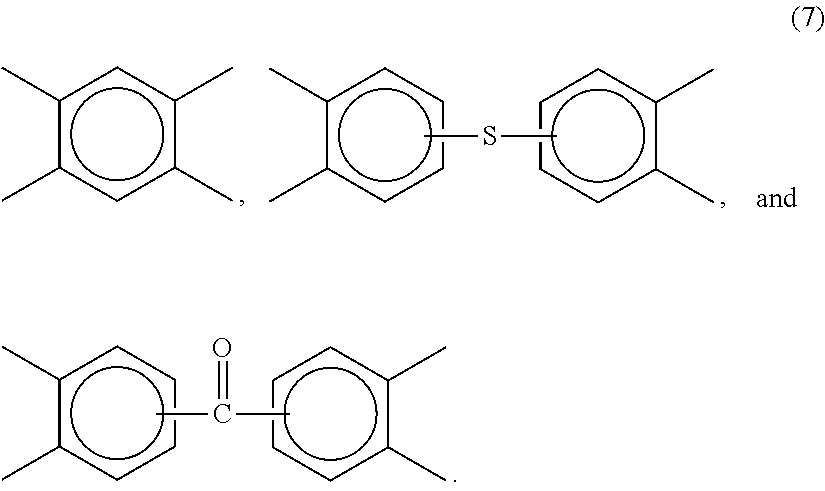
- polyetherimides and polyetherimide sulfones can optionally comprise linkers V that do not contain ether or ether and sulfone groups, for example linkers of formula (7):
- Imide units containing such linkers are generally be present in amounts ranging from 0 to 10 mole % of the total number of units, specifically 0 to 5 mole %. In one embodiment no additional linkers V are present in the polyetherimides and polyetherimide sulfones.
- the polyetherimide comprises 10 to 500 structural units of formula (5) and the polyetherimide sulfone contains 10 to 500 structural units of formula (6).
- polyetherimide and polyetherimide sulfones can be prepared by various methods, including, but not limited to, the reaction of a bis(phthalimide) for formula (8):
- Bis-phthalimides (8) can be formed, for example, by the condensation of the corresponding anhydride of formula (9):
- X is a nitro group or halogen, with an organic diamine of the formula (10): H 2 N—R—NH 2 (10), wherein R is as described above.
- amine compounds of formula (10) include: ethylenediamine, propylenediamine, trimethylenediamine, diethylenetriamine, triethylenetetramine, hexamethylenediamine, heptamethylenediamine, octamethylenediamine, nonamethylenediamine, decamethylenediamine, 1,12-dodecanediamine, 1,18-octadecanediamine, 3-methylheptamethylenediamine, 4,4-dimethylheptamethylenediamine, 4-methylnonamethylenediamine, 5-methylnonamethylenedianmine, 2,5-dimethylhexamethylenediamine, 2,5-dimethylhcptamethylenediamine, 2,2-dimethylpropylenediamine, N-methyl-bis(3-aminopropyl)amine, 3-methoxyhexamethylenediamine, 1,2-bis(3-aminopropoxy)ethane, bis(3-aminopropyl)sulfide
- amine compounds of formula (10) containing sulfone groups include but are not limited to, diamino diphenyl sulfone (DDS) and bis(aminophenoxy phenyl)sulfones (BAPS). Combinations comprising any of the foregoing amines can be used.
- DDS diamino diphenyl sulfone
- BAPS bis(aminophenoxy phenyl)sulfones
- the polyetherimides can be synthesized by the reaction of the bis(phthalimide) (8) with an alkali metal salt of a dihydroxy substituted aromatic hydrocarbon of the formula HO—V—OH wherein V is as described above, in the presence or absence of phase transfer catalyst.
- Suitable phase transfer catalysts are disclosed in U.S. Pat. No. 5,229,482.
- the dihydroxy substituted aromatic hydrocarbon a bisphenol such as bisphenol A, or a combination of an alkali metal salt of a bisphenol and an alkali metal salt of another dihydroxy substituted aromatic hydrocarbon can be used.
- the polyetherimide comprises structural units of formula (5) wherein each R is independently p-phenylene or m-phenylene or a mixture comprising at least one of the foregoing; and T is group of the formula —O—Z—O— wherein the divalent bonds of the —O—Z—O— group are in the 3,3′ positions, and Z is 2,2-diphenylenepropane group (a bisphenol A group).
- the polyetherimide sulfone comprises structural units of formula (6) wherein at least 50 mole % of the R groups are of formula (4) wherein Q is —SO 2 — and the remaining R groups are independently p-phenylene or m-phenylene or a combination comprising at least one of the foregoing; and T is group of the formula —O—Z—O— wherein the divalent bonds of the —O—Z—O— group are in the 3,3′ positions, and Z is a 2,2-diphenylenepropane group.
- polyetherimide and polyetherimide sulfone can be used alone or in combination with each other and/or other of the disclosed polymeric materials in fabricating the polymeric components of the invention. In one embodiment, only the polyetherimide is used. In another embodiment, the weight ratio of polyetherimide: polyetherimide sulfone can be from 99:1 to 50:50.
- the polyetherimides can have a weight average molecular weight (Mw) of 5,000 to 100,000 grams per mole (g/mole) as measured by gel permeation chromatography (GPC). In some embodiments the Mw can be 10,000 to 80,000.
- Mw weight average molecular weight
- GPC gel permeation chromatography
- the polyetherimides can have an intrinsic viscosity greater than or equal to 0.2 deciliters per gram (dl/g) as measured in m-cresol at 25° C. Within this range the intrinsic viscosity can be 0.35 to 1.0 dl/g, as measured in m-cresol at 25° C.
- the polyetherimides can have a glass transition temperature of greater than 180° C., specifically of 200° C. to 500° C., as measured using differential scanning calorimetry (DSC) per ASTM test D3418.
- the polyetherimide and, in particular, a polyetherimide has a glass transition temperature of 240 to 350° C.
- the polyetherimides can have a melt index of 0.1 to 10 grams per minute (g/min), as measured by American Society for Testing Materials (ASTM) DI 238 at 340 to 370° C., using a 6.7 kilogram (kg) weight.
- ASTM American Society for Testing Materials
- nitro-displacement process One process for the preparation of polyetherimides having structure (1) is referred to as the nitro-displacement process (X is nitro in formula (8)).
- N-methyl phthalimide is nitrated with 99% nitric acid to yield a mixture of N-methyl-4-nitrophthalimide (4-NPI) and N-methyl-3-nitrophthalimide (3-NPI).
- 4-NPI N-methyl-4-nitrophthalimide
- 3-NPI N-methyl-3-nitrophthalimide
- the mixture containing approximately 95 parts of 4-NPI and 5 parts of 3-NPI, is reacted in toluene with the disodium salt of bisphenol-A (BPA) in the presence of a phase transfer catalyst. This reaction yields BPA-bisimide and NaNO 2 in what is known as the nitro-displacement step.
- BPA bisphenol-A
- BPA-bisimide is reacted with phthalic anhydride in an imide exchange reaction to afford BPA-dianhydride (BPADA), which in turn is reacted with meta-phenylene diamine (MPD) in ortho-dichlorobenzene in an imidization-polymerization step to afford the product polyetherimide.
- BPADA BPA-dianhydride
- MPD meta-phenylene diamine
- An alternative chemical route to polyetherimides having structure (1) is a process referred to as the chloro-displacement process (X is Cl in formula (8)).
- the chloro-displacement process is illustrated as follows: 4-chloro phthalic anhydride and meta-phenylene diamine are reacted in the presence of a catalytic amount of sodium phenyl phosphinate catalyst to produce the bischloro phthalimide of meta-phenylene diamine (CAS No. 148935-94-8). The bischloro phthalimide is then subjected to polymerization by chloro-displacement reaction with the disodium salt of BPA in the presence of a catalyst in ortho-dichlorobenzene or anisole solvent.
- mixtures of 3-chloro- and 4-chlorophthalic anhydride may be employed to provide a mixture of isomeric bischloro phthalimides which may be polymerized by chloro-displacement with BPA disodium salt as described above.
- Siloxane polyetherimides can include polysiloxane/polyetherimide block copolymers having a siloxane content of greater than 0 and less than 40 weight percent (wt %) based on the total weight of the block copolymer.
- the block copolymer comprises a siloxane block of Formula (I):
- R 1-6 are independently at each occurrence selected from the group consisting of substituted or unsubstituted, saturated, unsaturated, or aromatic monocyclic groups having 5 to 30 carbon atoms, substituted or unsubstituted, saturated, unsaturated, or aromatic polycyclic groups having 5 to 30 carbon atoms, substituted or unsubstituted alkyl groups having 1 to 30 carbon atoms and substituted or unsubstituted alkenyl groups having 2 to 30 carbon atoms
- V is a tetravalent linker selected from the group consisting of substituted or unsubstituted, saturated, unsaturated, or aromatic monocyclic and polycyclic groups having 5 to 50 carbon atoms, substituted or unsubstituted alkyl groups having 1 to 30 carbon atoms, substituted or unsubstituted alkenyl groups having 2 to 30 carbon atoms and combinations comprising at least one of the foregoing linkers, g equals 1 to 30, and d is 2 to 20.
- the polyetherimide resin can have a weight average molecular weight (Mw) within a range having a lower limit and/or an upper limit.
- the range can include or exclude the lower limit and/or the upper limit.
- the lower limit and/or upper limit can be selected from 5000, 6000, 7000, 8000, 9000, 10000, 11000, 12000, 13000, 14000, 15000, 16000, 17000, 18000, 19000, 20000, 21000, 22000, 23000, 24000, 25000, 26000, 27000, 28000, 29000, 30000, 31000, 32000, 33000, 34000, 35000, 36000, 37000, 38000, 39000, 40000, 41000, 42000, 43000, 44000, 45000, 46000, 47000, 48000, 49000, 50000, 51000, 52000, 53000, 54000, 55000, 56000, 57000, 58000, 59000, 60000, 61000, 62000, 63000, 64000, 65000, 6
- the polyetherimide resin can have a weight average molecular weight (Mw) from 5,000 to 100,000 daltons, from 5,000 to 80,000 daltons, or from 5,000 to 70,000 daltons.
- Mw weight average molecular weight
- the primary alkyl amine modified polyetherimide will have lower molecular weight and higher melt flow than the starting, unmodified, polyetherimide.
- the polyetherimide resin can be selected from the group consisting of a polyetherimide, for example as described in U.S. Pat. Nos. 3,875,116; 6,919,422 and 6,355,723 a silicone polyetherimide, for example as described in U.S. Pat. Nos. 4,690,997; 4,808,686 a polyetherimide sulfone resin, as described in U.S. Pat. No. 7,041,773 and combinations thereof, each of these patents are incorporated herein their entirety.
- the polyetherimide resin can have a glass transition temperature within a range having a lower limit and/or an upper limit.
- the range can include or exclude the lower limit and/or the upper limit.
- the lower limit and/or upper limit can be selected from 100, 110, 120, 130, 140, 150, 160, 170, 180, 190, 200, 210, 220, 230, 240, 250, 260, 270, 280, 290, 300 and 310 degrees Celsius.
- the polyetherimide resin can have a glass transition temperature (Tg) greater than about 200 degrees Celsius.
- the polyetherimide resin can be substantially free (less than 100 ppm) of benzylic protons.
- the polyetherimide resin can be free of benzylic protons.
- the polyetherimide resin can have an amount of benzylic protons below 100 ppm. In one embodiment, the amount of benzylic protons ranges from more than 0 to below 100 ppm. In another embodiment, the amount of benzylic protons is not detectable.
- the polyetherimide resin can be substantially free (less than 100 ppm) of halogen atoms.
- the polyetherimide resin can be free of halogen atoms.
- the polyetherimide resin can have an amount of halogen atoms below 100 ppm. In one embodiment, the amount of halogen atoms range from more than 0 to below 100 ppm. In another embodiment, the amount of halogen atoms is not detectable.
- the polyetherimides include a polyetherimide thermoplastic resin composition, comprising: (a) a polyetherimide resin, and (b) a phosphorus-containing stabilizer, in an amount that is effective to increase the melt stability of the poly-etherimide resin, wherein the phosphorus-containing stabilizer exhibits a low volatility such that, as measured by thermogravimetric analysis of an initial amount of a sample of the phosphorus-containing stabilizer, greater than or equal to 10 percent by weight of the initial amount of the sample remains unevaporated upon heating of the sample from room temperature to 300° C. at a heating rate of a 20° C. per minute under an inert atmosphere.
- a polyetherimide thermoplastic resin composition comprising: (a) a polyetherimide resin, and (b) a phosphorus-containing stabilizer, in an amount that is effective to increase the melt stability of the poly-etherimide resin, wherein the phosphorus-containing stabilizer exhibits a low volatility such that, as measured by thermogravimetric analysis of an initial
- the phosphorous-containing stabilizer has a formula P—R′ a , where R′ is independently H, alkyl, alkoxy, aryl, aryloxy, or oxy substituent and a is 3 or 4.
- R′ is independently H, alkyl, alkoxy, aryl, aryloxy, or oxy substituent and a is 3 or 4.
- suitable stabilized polyetherimides can be found in U.S. Pat. No. 6,001,957, incorporated herein in its entirety.
- the pump can have a lower noise vibration harshness compared to a second pump that is identical to the pump except that the corresponding component does not comprise polyetherimide, but rather a metal.
- the lower noise vibration harshness can comprise a reduction in decibel level of within a range having a lower limit and/or an upper limit.
- the range can include or exclude the lower limit and/or the upper limit.
- the lower limit and/or upper limit can be selected from 0.5, 1, 1.5, 2, 2.5, 3, 3.5, 4, 4.5, 5, 5.5, 6, 6.5, 7, 7.5, 8, 8.5, 9, 9.5, 10, 10.5, 11, 11.5, 12, 12.5, 13, 13.5, 14, 14.5, 15, 15.5, 16, 16.5, 17, 17.5, 18, 18.5, 19, 19.5, 20, 25, 30, 35, 40, 45, 50, 55, 60, 65, 70, 75, 80, 85, 90, 95 and 100%.
- the lower noise vibration harshness can comprise a reduction in decibel level of at least 10% and can range from at least 10% to 50% or more.
- the component can be a housing defining an inlet and an outlet of the positive displacement pump.
- the housing can be made of polyetherimide.
- the component can be a rotor operatively positioned between an inlet and an outlet.
- the inlet and the outlet can be defined by a housing, and the rotor can comprise a displacement component for displacing a liquid between the inlet and the outlet, wherein the displacing component is one selected from the group consisting of a vane, a gear, and a trachoid.
- a preferred displacement component is a roller vane.
- the rotor can comprise a polyetherimide.
- the displacement component can comprise polyetherimide.
- the pump according to the first embodiment can be optimized to minimize inner stress levels in the housing.
- the inner stress levels in the housing can range from within a range having a lower limit and/or an upper limit.
- the range can include or exclude the lower limit and/or the upper limit.
- the lower limit and/or upper limit can be selected from 1, 2, 3, 4, 5, 6, 7, 8, 9, 10, 11, 12, 13, 14, 15, 16, 17, 18, 19, 20, 21, 22, 23, 24, 25, 26, 27, 28, 29, 30, 31, 32, 33, 34, 35, 36, 37, 38, 39, 40, 45, 50, 55, 60, 65, 70 and 75 MPa.
- the inner stress levels in the housing can range from 0 to 35 MPa or the inner stress levels in the housing can be about 10 MPa.
- the inner stress levels in the housing can be determined by a method selected from the group consisting of measuring the inner stress levels via wire-resistance-strain gauges, or predicting the inner stress levels via CAE computer simulation software, and combinations thereof.
- a second embodiment relates to a method of making a positive displacement pump for pumping liquids.
- the pump can comprise a housing defining an inlet and an outlet, a rotor operatively positioned between the inlet and the outlet, the rotor having means for displacing a liquid between the inlet and the outlet.
- the method can comprise forming at least one component of the pump from polyetherimide.
- the at least one component can be machined from a solid block of polyetherimide.
- the at least one component can be injection molded from polyetherimide, or formed by casting, forging or transfer/compression molding a polyetherimide based polymer.
- polyetherimides provide better chemical resistance; better stress and strain values; better stability; the same ability to be filled with glass fiber filling (i.e. polyetherimides can be filled with glass fiber in amounts including, but not limited to 0.5 wt. %, 30 wt. %, or 45 wt. % and ranges therein, i.e., between 0.5% to 45%).
- Polyetherimide can also allow for simple production of pump parts through injection molding without after-machining.
- Polyetherimides employed are commercially available under the ULTEM® brand, but preferred polyetherimides are ULTEM® 2300 resin and ULTEM® 3452 resin.
- the polyamide employed was PA66 GF30, which is available from various suppliers. Comparison was made to PA66 GF30, because it is an engineering plastic used in association with automobile engine components.
- ULTEM® 2300 Specific properties of ULTEM® 2300 are summarized in Table 1.
- ULTEM® 2300 can be 30% glass fiber filled by weight, can have flow properties similar to other polyetherimides, can have a glass transition temperature (Tg) of about 217° C.
- Tg glass transition temperature
- ULTEM® 2300 resin can be Restriction of Hazard Substances (RoHS) compliant according to European Union regulations.
- ULTEM® 2300 resin can have a UL94 V0 and 5VA listing.
- ULTEM® 3452 More specific properties of ULTEM® 3452 are summarized in Table 2.
- ULTEM® 3452 can be 45 wt. % Glass fiber and mineral filled, can provide enhanced flow relative to other polyetherimides, can have a glass transition temperature (Tg) of about 217° C., and can have enhanced dimensional stability.
- ULTEM® 3452 resin can be Restriction of Hazard Substances (RoHS) compliant according to European Union regulations.
- ULTEM® 3452 can have a UL94 V0 and 5VA listing in recognized colors.
- Table 3 provides properties of PA66 GF30 black.
- a variable roller cell oil pump 1 was made of Ultem®2300 resin for application in passenger car engines.
- the pump 1 included a guiding ring 2 , a plurality of rolls 3 , a rotor 4 , a first race 7 , a regulation spring 5 , an adjusting ring 8 , a second race 9 , a regulation piston 6 , a spring pressure control 10 , a ball 11 , and a housing 12 .
- FIG. 1B provides a cross-sectional view of the roller cell oil pump of FIG. 1A , along line A-A, showing regulation/control piston 13 , regulation axis 14 , adjusting ring 15 , suction volume 16 , suction tube 17 , pressure room 18 , cold start valve 19 , regulation/control spring 20 , regulation/control volume 21 , and rotor 22 .
- Table 4 provides details of each component of the pump according to Example 1A. Table 4 shows that ULTEM® 2300 and other polymers of similar density can be employed.
- roller cell oil pump was selected for the design of a polymeric component oil pump, because roller cell oil pumps have many benefits. For example, these controllable pumps only take in the amount of oil the engine needs, and can reduce power consumption and CO 2 emissions.
- the pump is suitable for speeds above 6000 rpm and can be used for all car gasoline and diesel motors. Additionally, inner friction of rotational parts is limited compared to other pump design such as gear pumps and potentially enable all polymeric oil pump parts to be made from PEI resin based materials.
- the oil pump prototype was based on an existing oil pump in terms of package and design space restraints used in a high volume 4 cylinder gasoline engine.
- the housing, cap, and adjusting ring of the oil pump prototype were milled from an extruded ULTEM® 2300 block, which is a cost effective approach compared to tool building and injection molding which will eventually be the production technology of choice.
- Other types of forming can include casting, forging, or compression molding.
- Extruded ULTEM® 2300 blocks however, can show inhomogeneous areas of unmolten resin particles which can lead to a structural weakness, which would not be expected in the case of an injection molded part. These unmolten areas can be seen in FIG. 3 as a “marble-like” effect. An injection molded part would show one homogenous amber color.
- the functional prototype shown in FIG. 3 was based on the optimized schematic illustrated in FIGS. 2A-J .
- the pump efficiency can be effected by flow channel shape (whether square or circular), flow channel volume, flow channel surface characteristics (smoothness or roughness), and avoid abrupt transitions between different flow channels.
- FIGS. 2A-J Computer-rendered schematics are shown in FIGS. 2A-J , illustrating the use of simplified Pro/E Mechanical Strength Calculations in redesigning the plastic roller cell pump.
- FIGS. 2A-D show new ribbings implemented as a result of topology optimization results.
- New ribbing 204 can be implemented to address stress 201 ;
- new ribbing 250 can be implemented to address stress 202 ;
- new ribbing 206 can be implemented to address stress 203 ;
- new ribbing 208 can be implemented to address stress 207 .
- FIG. 2E-J show stresses in the pump housing as measured at 7 bar working pressure at 106° C. In FIG. 2G , a stress peak 209 is noted.
- the plastics oil pump deformation and strength was calculated for maximum pressure of 7 bar and chain force loading of 1.2 kN (max. stress level 90 MPa).
- Contemplated production of units is by injection molding each of the cover 301 and housing 302 as individual units with optional metallic bearing surfaces 303 , positioned as illustrated in FIG. 3 .
- Other forms of molding include transfer molding, forging, and stockshape extrusion.
- the use of lost wax process and frangible patterns can be employed as desired to facilitate shaping of the interior portions of the housing.
- additional optimization can be achieved by decreasing the stress level to 35 MPa; stiffening the bottom of the regulation chamber; reducing the deformations and strains; providing a stiffer and clamped suction chamber cover; increasing the radius at the back-side/bottom-side edge of the regulation chamber.
- a traditional metal gear oil pump was evaluated for comparative purposes. All parts are made from metal. Housing and cover normally made from Aluminium alloys, inner parts normally made from steel.
- Example 1B showed improved efficiency compared to the pump of Example 1A. See FIG. 4 .
- FIG. 4 shows performance curves of two stage systems and demonstrates the good functionality of the oil pump regulation.
- FIG. 4 compares Example 1A to Example 1B.
- FIG. 5 is a chart, plotting efficiency versus oil pressure for the pump according to Example 1A and the optimized pump according to comparative Example 1B.
- the results for the pump according to Example 1A are shown in solid shapes.
- the results for the pump according to Example 1B are shown in blue.
- the efficiency of the pump according to Example 1B was improved by about 4 to 10%, depending on the oil pressure at the point of comparison.
- FIG. 6 is a chart, plotting oil flow rate versus oil pressure for the pump according to Example 1A and the optimized pump according to comparative Example 1B.
- the results for the pump according to Example 1A are shown in solid shapes.
- the results for the pump according to Example 1B are shown in blue.
- FIG. 6 demonstrates that requirements for hot idling point have are fulfilled by the pumps of both Examples 1A and 1B.
- the hot idling point requirements are an oil flow rate of at least 5.8 liters per minute at 0.8 bar and 102° C., while the engine idles at about 850 U/min. Additionally, FIG. 6 shows that the pump according to Example 1B shows an improvement.
- FIG. 7 is a plot of efficiency over oil pressure and pump speed.
- Example 1B Compared to the traditional metal pump, according to Comparative Example 2, the optimized prototype of Example 1B weighed 25% less. More specifically, the optimized prototype of Example 1 weighed about 1,250 grams, while the traditional metal pump weighed about 1,650 grams.
- the material costs of the optimized prototype of Example 1 resulted in a lower manufacturing cost. Furthermore, unlike the traditional metal pump, the optimized prototype can achieve further cost reductions through in house and localized production. See Table 1.
- Example 1 Compared to the traditional metal pump, the optimized prototype of Example 1, exhibited better Noise, Vibration, and Harshness (NVH) damping properties.
- the pump was tested.
- a crack in the oil pump housing developed after testing as shown in FIG. 9A .
- the fractured surface was analyzed.
- the material analysis performed by GApT/WTC showed that the fractured surface does not show any evidence of fibers coming out of the cracked surface, as shown in FIG. 9B , which is a magnified view of a fractured surface.
- the weights of roller cell pumps having various parts made from plastic was calculated and compared to similar roller cell pumps having various parts made from metal.
- the pump housing, cover, and adjustment rings can be made from plastic.
- the total weight of the roller cell pump, according to Scenario 1 would be about 1.246 kg.
- the housing and the cover can be made from plastic.
- the total weight of the roller cell pump, according to Scenario 2 would be about 1.496 kg.
- the housing and cover can be made from metal.
- the total weight of the roller cell pump, according to Scenario, 3 would be about 1.915 kg. Therefore, it can be readily seen that manufacturing parts from polymers rather than from metals can result in lower weight pumps.
- the table below summarizes these calculations and also provides exemplary prices of pumps produced according to the respective scenarios.
- Polyetherimide can have a glass transition temperature (Tg) of about 217° C. Therefore, PEI does not exhibit a phase transition in the range of operating temperatures that occur within an internal combustion engine.
- PEI's Tg is within a certain range of the operation temperature.
- FIG. 10 shows that Ultem is an amorphous material, semi-crystalline material. Compared to Polyetherimide, Polyamide will start softening with higher temperature and subsequently lose elastic modulus, rendering the material unsuitable.
- any resins with a glass transition temperature (Tg) below 150° C. would be likely to fail in such a harsh engine environment. This includes, for instance, most PP, PE, ABS, PA, PBT, PC and PPA resin grades. Therefore, a pump component made of one of these resins would not be suitable for use in an internal combustion engine.
- Tg glass transition temperature
- a pump component comprising PP, PE, PPS, PA, PBT, PPA resins would be expected to exhibit a loss in stiffness and strength, resulting in failure, rendering such a pump component unsuitable.
- Polyether ether ketone can have a glass transition temperature (Tg) of about 143° C. and a melt temperature (Tm) of about 340° C. Therefore, a pump component made of PEEK would not be suitable for use in an internal combustion engine.
- PEEK has a lower modulus than PEI over the operating temperature range in an internal combustion engine.
- a pump component comprising PEI, a pump component made from PEEK would be expected to exhibit a loss in stiffness and strength, resulting in failure, rendering such a pump component unsuitable.
- PEEK also has a higher coefficient of thermal expansion (CTE) than PEI over the operating temperature range in an internal combustion engine.
- CTE coefficient of thermal expansion
- a pump component made from PEEK would be expected to exhibit greater dimensional variation than a pump component comprising from PEI that would result in failure unless fillers are also employed.
- the need for fillers to reduce CTE variation would be expected to add weight to the pump component, thereby rendering the pump component less suitable.
- Polyamide (PA66) can have a glass transition temperature (Tg) of about 50° C. and a melt temperature (Tm) of about 260° C. Therefore, a pump component made of PA66 would not be suitable for use in an internal combustion engine.
- PA66 has a lower modulus than PEI over the operating temperature range in an internal combustion engine.
- a pump component comprising PEI, a pump component made from PA66 would be expected to exhibit a loss in stiffness and strength, resulting in failure, rendering such a pump component unsuitable.
- PA66 also has a higher coefficient of thermal expansion (CTE) than PEI over the operating temperature range in an internal combustion engine.
- CTE coefficient of thermal expansion
- a pump component made from PA66 would be expected to exhibit greater dimensional variation than a pump component comprising from PEI that would result in failure unless fillers are also employed.
- the need for fillers to reduce CTE variation would be expected to add weight to the pump component, thereby rendering the pump component less suitable.
- Polyamide (PA6) can have a glass transition temperature (Tg) of about 50° C. and a melt temperature (Tm) of about 223° C. Therefore, a pump component made of PA6 would not be suitable for use in an internal combustion engine.
- PA6 has a lower modulus than PEI over the operating temperature range in an internal combustion engine.
- a pump component comprising PEI, a pump component made from PA6 would be expected to exhibit a loss in stiffness and strength, resulting in failure, rendering such a pump component unsuitable.
- PA6 also has a higher coefficient of thermal expansion (CTE) than PEI over the operating temperature range in an internal combustion engine.
- CTE coefficient of thermal expansion
- a pump component made from PA6 would be expected to exhibit greater dimensional variation than a pump component comprising from PEI that would result in failure unless fillers are also employed.
- the need for fillers to reduce CTE variation would be expected to add weight to the pump component, thereby rendering the pump component less suitable.
- PPA Semi-crystalline polyphthalamide
- Tg glass transition temperature
- Tm melt temperature
- PPA has a lower modulus than PEI over the operating temperature range in an internal combustion engine.
- a pump component comprising PEI, a pump component made from PPA would be expected to exhibit a loss in stiffness and strength, resulting in failure, rendering such a pump component unsuitable.
- PPA also has a higher coefficient of thermal expansion (CTE) than PEI over the operating temperature range in an internal combustion engine.
- CTE coefficient of thermal expansion
- a pump component made from PPA would be expected to exhibit greater dimensional variation than a pump component comprising from PEI that would result in failure unless fillers are also employed.
- the need for fillers to reduce CTE variation would be expected to add weight to the pump component, thereby rendering the pump component less suitable.
- Polybutylene terephthalate can have a glass transition temperature (Tg) of about 50° C. and a melt temperature (Tm) of about 220° C. Therefore, a pump component made of PBT would not be suitable for use in an internal combustion engine.
- PBT has a lower modulus than PEI over the operating temperature range in an internal combustion engine.
- a pump component comprising PEI, a pump component made from PBT would be expected to exhibit a loss in stiffness and strength, resulting in failure, rendering such a pump component unsuitable.
- PBT also has a higher coefficient of thermal expansion (CTE) than PEI over the operating temperature range in an internal combustion engine.
- CTE coefficient of thermal expansion
- a pump component made from PBT would be expected to exhibit greater dimensional variation than a pump component comprising from PEI that would result in failure unless fillers are also employed.
- the need for fillers to reduce CTE variation would be expected to add weight to the pump component, thereby rendering the pump component less suitable.
- Polypropylene (PP) can have a glass transition temperature (Tg) of about ⁇ 15° C. and a melt temperature (Tm) of about 176° C. Therefore, a pump component made of PP would not be suitable for use in an internal combustion engine.
- Tg glass transition temperature
- Tm melt temperature
- PP has a lower modulus than PEI over the operating temperature range in an internal combustion engine.
- a pump component comprising PEI, a pump component made from PP would be expected to exhibit a loss in stiffness and strength, resulting in failure, rendering such a pump component unsuitable.
- PP also has a higher coefficient of thermal expansion (CTE) than PEI over the operating temperature range in an internal combustion engine.
- CTE coefficient of thermal expansion
- a pump component made from PP would be expected to exhibit greater dimensional variation than a pump component comprising from PEI that would result in failure unless fillers are also employed.
- the need for fillers to reduce CTE variation would be expected to add weight to the pump component, thereby rendering the pump component less suitable.
- Polyethylene can have a glass transition temperature (Tg) of about ⁇ 120° C. and a melt temperature (Tm) of about 137° C. Therefore, a pump component made of PE would not be suitable for use in an internal combustion engine.
- PE has a lower modulus than PEI over the operating temperature range in an internal combustion engine.
- a pump component comprising PEI, a pump component made from PE would be expected to exhibit a loss in stiffness and strength, resulting in failure, rendering such a pump component unsuitable.
- PE also has a higher coefficient of thermal expansion (CTE) than PEI over the operating temperature range in an internal combustion engine.
- CTE coefficient of thermal expansion
- a pump component made from PE would be expected to exhibit greater dimensional variation than a pump component comprising from PEI that would result in failure unless fillers are also employed.
- the need for fillers to reduce CTE variation would be expected to add weight to the pump component, thereby rendering the pump component less suitable.
- PC Polycarbonate
- Tg glass transition temperature
- Polysulfone can have a glass transition temperature (Tg) of about 189° C. Therefore, a pump component made of PSU would not be expected to be suitable for use in an internal combustion engine.
- Polyethersulfone can have a glass transition temperature (Tg) of about 225° C. Therefore, a pump component made of PES might be suitable for use in an internal combustion engine.
- Polyphenylsulfone can have a glass transition temperature (Tg) of about 220° C. Therefore, a pump component made of PPSU might be suitable for use in an internal combustion engine.
- PPE/PS blend can have a glass transition temperature (Tg) of about 100-200° C. Therefore, a pump component made of a PPE/PS blend might be suitable for use in an internal combustion engine.
- Tg glass transition temperature
Landscapes
- Engineering & Computer Science (AREA)
- Mechanical Engineering (AREA)
- General Engineering & Computer Science (AREA)
- Compositions Of Macromolecular Compounds (AREA)
- Details And Applications Of Rotary Liquid Pumps (AREA)
- Application Of Or Painting With Fluid Materials (AREA)
- Paper (AREA)
- Rotary Pumps (AREA)
Abstract
Description

wherein a is more than 1, for example 10 to 1,000 or more, or more specifically 10 to 500.

wherein Q1 includes but is not limited to a divalent moiety such as —O—, —S—, —C(O)—, —SO2—, —SO—, —CyH2y— (y being an integer from 1 to 5), and halogenated derivatives thereof, including perfluoroalkylene groups.

wherein W is a divalent moiety including —O—, —SO2—, or a group of the formula —O—Z—O— wherein the divalent bonds of the —O— or the —O—Z—O— group are in the 3,3′, 3,4′, 4,3′, or the 4,4′ positions, and wherein Z includes, but is not limited, to divalent groups of formulas (4):

wherein Q includes, but is not limited to a divalent moiety including —O—, —S—, —C(O), —SO2—, —SO—, —CyH2y— (y being an integer from 1 to 5), and halogenated derivatives thereof, including perfluoroalkylene groups.

wherein T is —O— or a group of the formula —O—Z—O— wherein the divalent bonds of the —O— or the —O—Z—O— group are in the 3,3′, 3,4′, 4,3′, or the 4,4′ positions; Z is a divalent group of formula (3) as defined above; and R is a divalent group of formula (2) as defined above.

wherein Y is —O—, —SO2—, or a group of the formula —O—Z—O— wherein the divalent bonds of the —O—, SO2—, or the —O—Z—O— group are in the 3,3′, 3,4′, 4,3′, or the 4,4′ positions, wherein Z is a divalent group of formula (3) as defined above and R is a divalent group of formula (2) as defined above, provided that greater than 50 mole % of the sum of moles Y+moles R in formula (2) contain —SO2— groups.

wherein R is as described above and X is a nitro group or a halogen. Bis-phthalimides (8) can be formed, for example, by the condensation of the corresponding anhydride of formula (9):

wherein X is a nitro group or halogen, with an organic diamine of the formula (10):
H2N—R—NH2 (10),
wherein R is as described above.

wherein R1-6 are independently at each occurrence selected from the group consisting of substituted or unsubstituted, saturated, unsaturated, or aromatic monocyclic groups having 5 to 30 carbon atoms, substituted or unsubstituted, saturated, unsaturated, or aromatic polycyclic groups having 5 to 30 carbon atoms, substituted or unsubstituted alkyl groups having 1 to 30 carbon atoms and substituted or unsubstituted alkenyl groups having 2 to 30 carbon atoms, V is a tetravalent linker selected from the group consisting of substituted or unsubstituted, saturated, unsaturated, or aromatic monocyclic and polycyclic groups having 5 to 50 carbon atoms, substituted or unsubstituted alkyl groups having 1 to 30 carbon atoms, substituted or unsubstituted alkenyl groups having 2 to 30 carbon atoms and combinations comprising at least one of the foregoing linkers, g equals 1 to 30, and d is 2 to 20. Commercially available siloxane polyetherimides can be obtained from SABIC Innovative Plastics under the brand name SILTEM* (*Trademark of SABIC Innovative Plastics IP B.V.)
| TABLE 1 | |||
| Value | Unit | Standard | |
| MECHANICAL | |||
| Taber Abrasion, CS-17, 1 kg | 20 | mg/1000 cy | SABIC Method |
| Tensile Stress, break, 5 mm/min | 165 | MPa | ISO 527 |
| Tensile Strain, break, 5 mm/min | 2 | % | ISO 527 |
| Tensile Modulus, 1 mm/min | 9500 | MPa | ISO 527 |
| Flexural Stress, break, 2 mm/min | 225 | MPa | ISO 178 |
| Flexural Modulus, 2 mm/min | 8500 | MPa | ISO 178 |
| Hardness, H358/30 | 165 | MPa | ISO 2039-1 |
| IMPACT | |||
| Izod Impact, unnotched 80 * 10 * 4 +23° C. | 40 | kJ/m2 | ISO 180/1U |
| Izod Impact, unnotched 80 * 10 * 4 −30° C. | 40 | kJ/m2 | ISO 180/1U |
| Charpy Impact, notched, 23° C. | 10 | kJ/m2 | ISO 179/2C |
| Charpy 23° C., Unnotch Edgew 80 * 10 * 4 sp = 62 mm | 40 | kJ/m2 | ISO 179/1eU |
| Charpy −30° C., Unnotch Edgew 80 * 10 * 4 sp = 62 mm | 40 | kJ/m2 | ISO 179/1eU |
| THERMAL | |||
| Thermal Conductivity | 0.29 | W/m-° C. | ISO 8302 |
| CTE, 23° C. to 150° C., flow | 2.E−05 | 1/° C. | ISO 11359-2 |
| CTE, 23° C. to 150° C., xflow | 6.E−05 | 1/° C. | ISO 11359-2 |
| Ball Pressure Test, 125° C. +/− 2° C. | PASSES | — | IEC 60695-10-2 |
| Vicat Softening Temp, Rate A/50 | 225 | ° C. | ISO 306 |
| Vicat Softening Temp, Rate B/50 | 213 | ° C. | ISO 306 |
| Vicat Softening Temp, Rate B/120 | 220 | ° C. | ISO 306 |
| HDT/Be, 0.45 MPa Edgew 120 * 10 * 4 sp = 100 mm | 215 | ° C. | ISO 75/Be |
| HDT/Ae, 1.8 MPa Edgew 120 * 10 * 4 sp = 100 mm | 210 | ° C. | ISO 75/Ae |
| Relative Temp Index, Elec | 180 | ° C. | UL 746B |
| Relative Temp Index, Mech w/impact | 170 | ° C. | UL 746B |
| Relative Temp Index, Mech w/o impact | 180 | ° C. | UL 746B |
| PHYSICAL | |||
| Mold Shrinkage on Tensile Bar, flow (2) (5) | 0.2-0.4 | % | SABIC Method |
| Density | 1.51 | g/cm3 | ISO 1183 |
| Water Absorption, (23° C./sat) | 0.9 | % | ISO 62 |
| Moisture Absorption (23° C./50% RH) | 0.5 | % | ISO 62 |
| Melt Volume Rate, MVR at 360° C./5.0 kg | 6 | cm3/10 min | ISO 1133 |
| ELECTRICAL | |||
| Volume Resistivity | 1.E+15 | Ohm-cm | IEC 60093 |
| Surface Resistivity, ROA | >1.E+15 | Ohm | IEC 60093 |
| Dielectric Strength, in oil, 0.8 mm | 35 | kV/mm | IEC 60243-1 |
| Dielectric Strength, in oil, 1.6 mm | 26 | kV/mm | IFC 60243-1 |
| Dielectric Strength, in oil, 3.2 mm | 15 | kV/mm | IEC 60243-1 |
| Relative Permittivity, 1 MHz | 3.4 | — | IEC 60250 |
| Dissipation Factor, 50/60 Hz | 0.001 | — | IEC 60250 |
| Dissipation Factor, 1 MHz | 0.002 | — | IEC 60250 |
| Dissipation Factor, 2450 MHz | 0.005 | — | IEC 60250 |
| Comparative Tracking Index | 150 | V | IEC 60112 |
| Comparative Tracking Index, M | 100 | V | IEC 60112 |
| Relative Permittivity, 50/60 Hz | 3.3 | — | IEC 60250 |
| FLAME CHARACTERISTICS | |||
| UL Recognized, 94V-0 Flame Class Rating (3) | 0.25 | mm | UL 94 |
| UL Recognized, 94-5VA Rating (3) | 1.2 | mm | UL 94 |
| Glow Wire Flammability Index 960° C., passes at | 3.2 | mm | IEC 60695-2-12 |
| Oxygen Index (LOI) | 48 | % | ISO 4589 |
| TABLE 2 | |||
| Value | Unit | Standard | |
| MECHANICAL | |||
| Tensile Stress, break, 50 mm/min | 100 | MPa | ISO 527 |
| Tensile Strain, break, 50 mm/min | 1.5 | % | ISO 527 |
| Tensile Modulus, 1 mm/min | 12500 | MPa | ISO 527 |
| Flexural Stress, break, 2 mm/min | 150 | MPa | ISO 178 |
| Flexural Modulus, 2 mm/min | 12000 | MPa | ISO 178 |
| IMPACT | |||
| Izod Impact, unnotched 80 * 10 * 4 +23° C. | 14 | kJ/m2 | ISO 180/1U |
| Izod Impact, unnotched 80 * 10 * 4 −30° C. | 13 | kJ/m2 | ISO 180/1U |
| Izod Impact, notched 80 * 10 * 4 +23° C. | 5 | kJ/m2 | ISO 180/1A |
| Izod Impact, notched 80 * 10 * 4 −30° C. | 4 | kJ/m2 | ISO 180/1A |
| Charpy 23° C., V-notch Edgew 80 * 10 * 4 sp = 62 mm | 4 | kJ/m2 | ISO 179/1eA |
| Charpy −30° C., V-notch Edgew 80 * 10 * 4 sp = 62 mm | 4 | kJ/m2 | ISO 179/1eA |
| Charpy 23° C., Unnotch Edgew 80 * 10 * 4 sp = 62 mm | 14 | kJ/m2 | ISO 179/1eU |
| Charpy −30° C., Unnotch Edgew 80 * 10 * 4 sp = 62 mm | 14 | kJ/m2 | ISO 179/1eU |
| THERMAL | |||
| CTE, 23° C. to 80° C., flow | 1.9E−05 | 1/° C. | ISO 11359-2 |
| CTE, 23° C. to 80° C., xflow | 3.6E−05 | 1/° C. | ISO 11359-2 |
| Vicat Softening Temp, Rate B/50 | 205 | ° C. | ISO 306 |
| Vicat Softening Temp, Rate B/120 | 205 | ° C. | ISO 306 |
| HDT/Be, 0.45 MPa Edgew 120 * 10 * 4 sp = 100 mm | 207 | ° C. | ISO 75/Be |
| HDT/Ae, 1.8 MPa Edgew 120 * 10 * 4 sp = 100 mm | 200 | ° C. | ISO 75/Ae |
| PHYSICAL | |||
| Mold Shrinkage on Tensile Bar, flow (2) (5) | 0.25 | % | SABIC Method |
| Density | 1.66 | g/cm3 | ISO 1183 |
| Melt Volume Rate, MVR at 360° C./5.0 kg | 8 | cm3/10 min | ISO 1133 |
| ELECTRICAL | |||
| Volume Resistivity | >1.E+13 | Ohm-cm | IEC 60093 |
| Surface Resistivity, ROA | >1.E+15 | Ohm | IEC 60093 |
| Dielectric Strength, in oil, 3.2 mm | 16 | kV/mm | IEC 60243-1 |
| Relative Permittivity, 1 MHz | 3.6 | — | IEC 60250 |
| Dissipation Factor, 50/60 Hz | 0.01 | — | IEC 60250 |
| Dissipation Factor, 1 MHz | 0.015 | — | IEC 60250 |
| Comparative Tracking Index | 125 | V | IEC 60112 |
| Relative Permittivity, 50/60 Hz | 3.7 | — | IEC 60250 |
| FLAME CHARACTERISTICS | |||
| UL Recognized, 94V-0 Flame Class Rating (3) | 0.77 | mm | UL 94 |
| UL Recognized, 94-5VA Rating (3) | 3 | mm | UL 94 |
| TABLE 3 |
| Properties |
| PA66 GF30 black |
| Material Data Sheet | dry/moist | standard | |
| Mechanical | |||
| Tensile strength at break | 110 | MPa | DIN EN ISO 527 |
| Elongation at |
6 | % | DIN EN ISO 527 |
| Modulus of elasticity in |
7000 | MPa | DIN EN ISO 527 |
| Hardness | 200 | ISO 2039/1 (Kugeldruck-Harte) | |
| |
70 | KJ/m2 | DIN EN ISO 179 (Charpy) |
| Time yield limit | 40 | MPa | |
| for 1% elongation after 1000 h | |||
| Co-efficient of friction | 0.45-0.50/0.5 | ||
| p = 0.05 N/mm2v = 0.6 m/s | |||
| on steel, hardened and ground | |||
| Thermal | |||
| Glass transition temperature | 72/5 | ° C. | DIN 53 765 |
| Heat distortion temperature | 250 | ° C. | ISO-R 75 Verfahren A (DIN 53 461) |
| HDT, Method A | |||
| Heat distortion temperature | 250 | ° C. | ISO-R 75 Verfahren B (DIN 53 461) |
| HDT, Method B | |||
| Max. service temperature | |||
| short term | 170 | ° C. | |
| long term | 110 | ° C. | |
| Thermal conductivity (23° C.) | 0.27 | W/(K · m) | |
| Specific heat (23° C.) | 1.5 | J/g · K | |
| Coefficient of thermal expansion | 2-3 | 10−51/K | DIN 53 752 |
| (23-55° C.) | |||
| Electrical | |||
| Miscellaneous | |||
| Density | 1.35 | g/cm3 | DIN 53 479 |
| Moisture absorption | 1.5 | % | DIN EN ISO 62 |
| (23° C./50RH) | |||
| Water absorption to equilibrium | 5.5 | % | DIN EN ISO 62 |
| Flammability acc. to UL standard 94 | HB |
| Resistance to hot water, washing soda: | (+) | (1) Testing of semi-finished products |
| TABLE 4 | |||
| component | material | density [g/cm3] | |
| housing | ULTEM 2300 | 1.51 | |
| cap | ULTEM 2300 | 1.51 | |
| |
steel | 7.85 | |
| adjusting ring | ULTEM 2300 | 1.51 | |
| |
steel | 7.85 | |
| rotor | steel | 7.85 | |
| roll | steel | 7.85 | |
| guiding ring | PEEK-HPV | 1.51 | |
| ball | steel | 7.85 | |
| spring pr.c. | steel | 7.85 | |
| reg. piston | PA66 GF30 | 1.51 | |
| reg. spring | steel | 7.85 | |
| | | | ||
| housing & | housing & | housing & | ||
| cover-adjusting ring | cover | cover | ||
| Summary | in plastics | in plastics | in metal | |
| Total Weight Roller Cell Pump | kg | 1.246 | 1.496 | 1.915 |
| Reference weight (existing external gear oil pump) | kg | 1.650 | 1.650 | 1.650 |
| Delta weight roller cell pump in metal + | kg | −0.40 | −0.15 | 0.27 |
| plastics vs reference pump | ||||
| Delta | kg | −24% | 0% | −16% |
| Production Cost Roller Cell Pump |  | 17.91 | 18.79 | 18.08 |
| Target Price | | 15.00 | 16.00 | 16.00 |
| Reference Price (existing external gear oil pump) | | 19.00 | 19.00 | 19.00 |
| Delta Production Cost to Target Price | | 1.91 | 0.79 | 2.07 |
| Delta Production Cost to Reference Price | | −1.09 | −2.21 | −0.93 |
Purpose
Claims (28)
Priority Applications (8)
| Application Number | Priority Date | Filing Date | Title |
|---|---|---|---|
| US13/842,517 US9429149B2 (en) | 2012-05-15 | 2013-03-15 | Polyetherimide pump |
| PCT/IB2013/053717 WO2013171630A1 (en) | 2012-05-15 | 2013-05-08 | Polyetherimide pump |
| BR112014028240A BR112014028240A8 (en) | 2012-05-15 | 2013-05-08 | POSITIVE DISPLACEMENT PUMP AND METHOD OF MANUFACTURING A POSITIVE DISPLACEMENT PUMP FOR PUMPING LIQUIDS |
| KR1020147034745A KR20150009992A (en) | 2012-05-15 | 2013-05-08 | Polyetherimide pump |
| CN201380023168.8A CN104271952A (en) | 2012-05-15 | 2013-05-08 | Polyetherimide pump |
| JP2015512164A JP2015518934A (en) | 2012-05-15 | 2013-05-08 | Polyetherimide pump |
| EP13731165.0A EP2850320A1 (en) | 2012-05-15 | 2013-05-08 | Polyetherimide pump |
| US15/063,967 US20160245282A1 (en) | 2012-05-15 | 2016-03-08 | Polyetherimide pump |
Applications Claiming Priority (2)
| Application Number | Priority Date | Filing Date | Title |
|---|---|---|---|
| US201261647241P | 2012-05-15 | 2012-05-15 | |
| US13/842,517 US9429149B2 (en) | 2012-05-15 | 2013-03-15 | Polyetherimide pump |
Related Child Applications (1)
| Application Number | Title | Priority Date | Filing Date |
|---|---|---|---|
| US15/063,967 Continuation US20160245282A1 (en) | 2012-05-15 | 2016-03-08 | Polyetherimide pump |
Publications (2)
| Publication Number | Publication Date |
|---|---|
| US20140010697A1 US20140010697A1 (en) | 2014-01-09 |
| US9429149B2 true US9429149B2 (en) | 2016-08-30 |
Family
ID=48692617
Family Applications (2)
| Application Number | Title | Priority Date | Filing Date |
|---|---|---|---|
| US13/842,517 Expired - Fee Related US9429149B2 (en) | 2012-05-15 | 2013-03-15 | Polyetherimide pump |
| US15/063,967 Abandoned US20160245282A1 (en) | 2012-05-15 | 2016-03-08 | Polyetherimide pump |
Family Applications After (1)
| Application Number | Title | Priority Date | Filing Date |
|---|---|---|---|
| US15/063,967 Abandoned US20160245282A1 (en) | 2012-05-15 | 2016-03-08 | Polyetherimide pump |
Country Status (7)
| Country | Link |
|---|---|
| US (2) | US9429149B2 (en) |
| EP (1) | EP2850320A1 (en) |
| JP (1) | JP2015518934A (en) |
| KR (1) | KR20150009992A (en) |
| CN (1) | CN104271952A (en) |
| BR (1) | BR112014028240A8 (en) |
| WO (1) | WO2013171630A1 (en) |
Cited By (3)
| Publication number | Priority date | Publication date | Assignee | Title |
|---|---|---|---|---|
| US11635075B1 (en) | 2014-06-25 | 2023-04-25 | ClearMotion, Inc. | Gerotor pump with bearing |
| US11841035B2 (en) | 2014-08-19 | 2023-12-12 | ClearMotion, Inc. | Apparatus and method for active vehicle suspension |
| US12132366B2 (en) | 2017-07-18 | 2024-10-29 | Hyundai Mobis Co., Ltd. | In-wheel working device |
Families Citing this family (3)
| Publication number | Priority date | Publication date | Assignee | Title |
|---|---|---|---|---|
| WO2017066277A1 (en) * | 2015-10-12 | 2017-04-20 | Sabic Global Technologies B.V. | Engine oil pump |
| JP6907461B2 (en) * | 2016-02-29 | 2021-07-21 | 出光興産株式会社 | Lubricating oil composition, lubricating method, and transmission |
| KR20230118967A (en) | 2020-12-17 | 2023-08-14 | 티코나 엘엘씨 | Fibre-reinforced propylene polymer composition |
Citations (31)
| Publication number | Priority date | Publication date | Assignee | Title |
|---|---|---|---|---|
| GB560591A (en) * | 1942-03-02 | 1944-04-11 | Pump Engineering Service Corp | Improvements in or relating to methods of manufacturing rotors for dry air pumps |
| US2657638A (en) * | 1948-04-12 | 1953-11-03 | Byron Jackson Co | Rotary pump |
| US2868442A (en) | 1953-10-27 | 1959-01-13 | Svenska Rotor Maskiner Ab | Rotary device |
| US3859014A (en) * | 1971-07-20 | 1975-01-07 | Bosch Gmbh Robert | Gear pump |
| US3918838A (en) | 1974-01-04 | 1975-11-11 | Dunham Bush Inc | Metal reinforced plastic helical screw compressor rotor |
| WO1986005555A1 (en) | 1985-03-15 | 1986-09-25 | Svenska Rotor Maskiner Ab | A screw-type rotary machine having at least one rotor made of a plastics material |
| JPH01182585A (en) * | 1988-01-13 | 1989-07-20 | Komatsu Ltd | plastic gear pump |
| GB2214512A (en) | 1987-05-29 | 1989-09-06 | Otsuka Kagaku Kk | Resin composition for scroll type compressor members and process for manufacturing scroll type compressor parts |
| US5011389A (en) * | 1986-09-05 | 1991-04-30 | Svenska Rotor Maskiner Ab | Rotor for a rotary screw machine |
| US5078467A (en) * | 1991-02-07 | 1992-01-07 | Minnesota Mining And Manufacturing Company | Optical fiber connector including integral deformable housing and second-class levers |
| US5219499A (en) * | 1988-04-07 | 1993-06-15 | Svenska Rotor Maskiner Ab | Method for manufacturing screw rotors |
| JPH05245966A (en) | 1991-11-22 | 1993-09-24 | Suzuki Sogyo Co Ltd | Surface finished synthetic resin member and production thereof |
| US6001957A (en) * | 1997-12-23 | 1999-12-14 | General Electric Company | Stabilized polyetherimide resin composition |
| US6006542A (en) | 1997-09-11 | 1999-12-28 | Hitachi, Ltd. | Refrigerant compressor and refrigerating apparatus |
| CA2356718A1 (en) | 2000-09-08 | 2002-03-08 | C. Christopher Blundell | Progressing cavity pump with constant liner thickness |
| US20020098100A1 (en) | 2001-01-19 | 2002-07-25 | Kabushiki Kaisha Toyota Jidoshokki | Scroll-type compressor, scroll, and manufacturing method with partially abbreviated machine working process |
| US20020141894A1 (en) * | 1999-05-27 | 2002-10-03 | Kirtley Kevin R. | Rotary vane pump with continuous fiber reinforced polymeric composite vanes less prone to catastrophic failure |
| US6572502B1 (en) * | 1999-02-10 | 2003-06-03 | Cloyes Gear And Products, Inc. | Chain tensioner device for use in a confined space |
| US20040028547A1 (en) | 2002-07-02 | 2004-02-12 | Tilia Inc. | Rotary pump |
| WO2004109110A1 (en) | 2003-05-23 | 2004-12-16 | Luk Automobiltechnik Gmbh & Co. Kg | Gear pump |
| JP2005188399A (en) | 2003-12-25 | 2005-07-14 | Mitsubishi Materials Corp | Inscribed gear pump |
| EP1701039A1 (en) | 2003-11-28 | 2006-09-13 | Daikin Industries, Ltd. | Scroll fluid machinery |
| JP2007192242A (en) | 2006-01-17 | 2007-08-02 | Mitsui Chemicals Inc | Piston ring made of melt-moldable thermoplastic polyimide resin |
| EP1980752A2 (en) | 2007-04-04 | 2008-10-15 | Emerson Climate Technologies, Inc. | Injection molded scroll form |
| DE102008024307A1 (en) | 2007-05-21 | 2009-01-15 | Denso Corp., Kariya-shi | compressor |
| JP2010095615A (en) | 2008-10-16 | 2010-04-30 | Kaneka Corp | Polyetherether ketone, resin composition containing the same, and molded article of the same |
| US20100326236A1 (en) | 2001-02-15 | 2010-12-30 | Integral Technologies, Inc. | Low cost housings for vehicle mechanical devices and systems manufactured from conductive loaded resin-based materials |
| JP2011057798A (en) | 2009-09-08 | 2011-03-24 | Asahi Kasei Chemicals Corp | Polyamide composition and molded article containing polyamide composition |
| CN201865976U (en) * | 2010-11-24 | 2011-06-15 | 左德峰 | High-efficiency centrifugal pump |
| US20110206880A1 (en) | 2008-10-31 | 2011-08-25 | Yi-Feng Wang | High temperature melt processable semi-crystalline poly(aryl ether ketone) containing a (4-hydroxyphenyl)phthalazin-1(2h)-one comonomer unit |
| US20140010679A1 (en) | 2012-03-30 | 2014-01-09 | Sabic Innovative Plastics Ip B.V. | Compressors including polymeric components |
Family Cites Families (15)
| Publication number | Priority date | Publication date | Assignee | Title |
|---|---|---|---|---|
| US3875116A (en) | 1970-12-29 | 1975-04-01 | Gen Electric | Polyetherimides |
| US4690997A (en) | 1984-01-26 | 1987-09-01 | General Electric Company | Flame retardant wire coating compositions |
| US4808686A (en) | 1987-06-18 | 1989-02-28 | General Electric Company | Silicone-polyimides, and method for making |
| SE463040B (en) * | 1988-04-07 | 1990-10-01 | Svenska Rotor Maskiner Ab | SAET TO MANUFACTURE SCREW ROTORS AND THROUGH SAETT MANUFACTURED SCREW ROTORS |
| JPH03290086A (en) * | 1990-04-06 | 1991-12-19 | Hitachi Ltd | Screw type rotary machine, its rotor surface treatment, and dry system screw type rotary machine and its rotor surface treatment |
| US5229482A (en) | 1991-02-28 | 1993-07-20 | General Electric Company | Phase transfer catalyzed preparation of aromatic polyether polymers |
| US6355723B1 (en) | 2000-06-22 | 2002-03-12 | General Electric Co. | Dark colored thermoplastic compositions, articles molded therefrom, and article preparation methods |
| US6709493B2 (en) * | 2001-03-26 | 2004-03-23 | Gore Enterprise Holdings, Inc. | Device for reducing the presence of moisture within an enclosure containing a heat source |
| US6919422B2 (en) | 2003-06-20 | 2005-07-19 | General Electric Company | Polyimide resin with reduced mold deposit |
| US20050084388A1 (en) * | 2003-07-17 | 2005-04-21 | Hayes Alan E. | Positive displacement liquid pump |
| US7041773B2 (en) | 2003-09-26 | 2006-05-09 | General Electric Company | Polyimide sulfones, method and articles made therefrom |
| JP4859425B2 (en) * | 2005-09-29 | 2012-01-25 | 直樹 宮城 | Pump device and its case assembly method. |
| DE102006018124A1 (en) * | 2006-04-19 | 2007-10-25 | Schwäbische Hüttenwerke Automotive GmbH & Co. KG | Adjustable rotary pump with wear reduction |
| EP2142600B1 (en) * | 2007-04-23 | 2014-07-23 | Solvay Specialty Polymers USA, LLC. | Thermoplastic polymer mixtures, and applications thereof |
| US8444901B2 (en) * | 2007-12-31 | 2013-05-21 | Schlumberger Technology Corporation | Method of fabricating a high temperature progressive cavity motor or pump component |
-
2013
- 2013-03-15 US US13/842,517 patent/US9429149B2/en not_active Expired - Fee Related
- 2013-05-08 JP JP2015512164A patent/JP2015518934A/en active Pending
- 2013-05-08 EP EP13731165.0A patent/EP2850320A1/en not_active Withdrawn
- 2013-05-08 CN CN201380023168.8A patent/CN104271952A/en active Pending
- 2013-05-08 WO PCT/IB2013/053717 patent/WO2013171630A1/en not_active Ceased
- 2013-05-08 BR BR112014028240A patent/BR112014028240A8/en not_active IP Right Cessation
- 2013-05-08 KR KR1020147034745A patent/KR20150009992A/en not_active Withdrawn
-
2016
- 2016-03-08 US US15/063,967 patent/US20160245282A1/en not_active Abandoned
Patent Citations (32)
| Publication number | Priority date | Publication date | Assignee | Title |
|---|---|---|---|---|
| GB560591A (en) * | 1942-03-02 | 1944-04-11 | Pump Engineering Service Corp | Improvements in or relating to methods of manufacturing rotors for dry air pumps |
| US2657638A (en) * | 1948-04-12 | 1953-11-03 | Byron Jackson Co | Rotary pump |
| US2868442A (en) | 1953-10-27 | 1959-01-13 | Svenska Rotor Maskiner Ab | Rotary device |
| US3859014A (en) * | 1971-07-20 | 1975-01-07 | Bosch Gmbh Robert | Gear pump |
| US3918838A (en) | 1974-01-04 | 1975-11-11 | Dunham Bush Inc | Metal reinforced plastic helical screw compressor rotor |
| WO1986005555A1 (en) | 1985-03-15 | 1986-09-25 | Svenska Rotor Maskiner Ab | A screw-type rotary machine having at least one rotor made of a plastics material |
| US5011389A (en) * | 1986-09-05 | 1991-04-30 | Svenska Rotor Maskiner Ab | Rotor for a rotary screw machine |
| GB2214512A (en) | 1987-05-29 | 1989-09-06 | Otsuka Kagaku Kk | Resin composition for scroll type compressor members and process for manufacturing scroll type compressor parts |
| JPH01182585A (en) * | 1988-01-13 | 1989-07-20 | Komatsu Ltd | plastic gear pump |
| US5219499A (en) * | 1988-04-07 | 1993-06-15 | Svenska Rotor Maskiner Ab | Method for manufacturing screw rotors |
| US5078467A (en) * | 1991-02-07 | 1992-01-07 | Minnesota Mining And Manufacturing Company | Optical fiber connector including integral deformable housing and second-class levers |
| JPH05245966A (en) | 1991-11-22 | 1993-09-24 | Suzuki Sogyo Co Ltd | Surface finished synthetic resin member and production thereof |
| US6006542A (en) | 1997-09-11 | 1999-12-28 | Hitachi, Ltd. | Refrigerant compressor and refrigerating apparatus |
| US6001957A (en) * | 1997-12-23 | 1999-12-14 | General Electric Company | Stabilized polyetherimide resin composition |
| US6572502B1 (en) * | 1999-02-10 | 2003-06-03 | Cloyes Gear And Products, Inc. | Chain tensioner device for use in a confined space |
| US20020141894A1 (en) * | 1999-05-27 | 2002-10-03 | Kirtley Kevin R. | Rotary vane pump with continuous fiber reinforced polymeric composite vanes less prone to catastrophic failure |
| CA2356718A1 (en) | 2000-09-08 | 2002-03-08 | C. Christopher Blundell | Progressing cavity pump with constant liner thickness |
| US20020098100A1 (en) | 2001-01-19 | 2002-07-25 | Kabushiki Kaisha Toyota Jidoshokki | Scroll-type compressor, scroll, and manufacturing method with partially abbreviated machine working process |
| US20100326236A1 (en) | 2001-02-15 | 2010-12-30 | Integral Technologies, Inc. | Low cost housings for vehicle mechanical devices and systems manufactured from conductive loaded resin-based materials |
| US20040028547A1 (en) | 2002-07-02 | 2004-02-12 | Tilia Inc. | Rotary pump |
| US6821099B2 (en) * | 2002-07-02 | 2004-11-23 | Tilia International, Inc. | Rotary pump |
| WO2004109110A1 (en) | 2003-05-23 | 2004-12-16 | Luk Automobiltechnik Gmbh & Co. Kg | Gear pump |
| EP1701039A1 (en) | 2003-11-28 | 2006-09-13 | Daikin Industries, Ltd. | Scroll fluid machinery |
| JP2005188399A (en) | 2003-12-25 | 2005-07-14 | Mitsubishi Materials Corp | Inscribed gear pump |
| JP2007192242A (en) | 2006-01-17 | 2007-08-02 | Mitsui Chemicals Inc | Piston ring made of melt-moldable thermoplastic polyimide resin |
| EP1980752A2 (en) | 2007-04-04 | 2008-10-15 | Emerson Climate Technologies, Inc. | Injection molded scroll form |
| DE102008024307A1 (en) | 2007-05-21 | 2009-01-15 | Denso Corp., Kariya-shi | compressor |
| JP2010095615A (en) | 2008-10-16 | 2010-04-30 | Kaneka Corp | Polyetherether ketone, resin composition containing the same, and molded article of the same |
| US20110206880A1 (en) | 2008-10-31 | 2011-08-25 | Yi-Feng Wang | High temperature melt processable semi-crystalline poly(aryl ether ketone) containing a (4-hydroxyphenyl)phthalazin-1(2h)-one comonomer unit |
| JP2011057798A (en) | 2009-09-08 | 2011-03-24 | Asahi Kasei Chemicals Corp | Polyamide composition and molded article containing polyamide composition |
| CN201865976U (en) * | 2010-11-24 | 2011-06-15 | 左德峰 | High-efficiency centrifugal pump |
| US20140010679A1 (en) | 2012-03-30 | 2014-01-09 | Sabic Innovative Plastics Ip B.V. | Compressors including polymeric components |
Non-Patent Citations (5)
| Title |
|---|
| Engineering and High Performance Plastics Market Report; p. 77. |
| International Search Report for International Application No. PCT/IB2013/053717; International Filing Date May 8, 2013; Date of Mailing Sep. 25, 2013; 5 pages. |
| New Thermoset Can Replace Engineering Thermoplastics. |
| Search Report Dated Oct. 25, 2011. |
| Written Opinion for International Application No. PCT/IB2013/053717; International Filing Date May 8, 2013; Date of Mailing Sep. 25, 2013; 6 pages. |
Cited By (4)
| Publication number | Priority date | Publication date | Assignee | Title |
|---|---|---|---|---|
| US11635075B1 (en) | 2014-06-25 | 2023-04-25 | ClearMotion, Inc. | Gerotor pump with bearing |
| US11841035B2 (en) | 2014-08-19 | 2023-12-12 | ClearMotion, Inc. | Apparatus and method for active vehicle suspension |
| US12132366B2 (en) | 2017-07-18 | 2024-10-29 | Hyundai Mobis Co., Ltd. | In-wheel working device |
| US12323019B2 (en) | 2017-07-18 | 2025-06-03 | Hyundai Mobis Co., Ltd. | In-wheel working device |
Also Published As
| Publication number | Publication date |
|---|---|
| BR112014028240A8 (en) | 2018-04-03 |
| CN104271952A (en) | 2015-01-07 |
| BR112014028240A2 (en) | 2017-06-27 |
| KR20150009992A (en) | 2015-01-27 |
| EP2850320A1 (en) | 2015-03-25 |
| WO2013171630A1 (en) | 2013-11-21 |
| US20140010697A1 (en) | 2014-01-09 |
| JP2015518934A (en) | 2015-07-06 |
| US20160245282A1 (en) | 2016-08-25 |
Similar Documents
| Publication | Publication Date | Title |
|---|---|---|
| US20160245282A1 (en) | Polyetherimide pump | |
| US9347441B2 (en) | Compressors including polymeric components | |
| US9006319B2 (en) | Hydrostable polyetherimide blends, methods of manufacture, and articles formed therefrom | |
| US9045636B2 (en) | Blow moldable polyimide/polyamide composition, process for blow molding and articles made thereby | |
| US9382382B2 (en) | Polyetherimides, methods of manufacture, and articles formed therefrom | |
| US9181430B2 (en) | Wear and friction properties of engineering thermoplastics with ultra-high molecular weight polyethylene | |
| EP3458518B1 (en) | Article comprising a composite of a fluoroelastomer and a polyimide on a metal substrate | |
| US10030140B2 (en) | Fiber reinforced polyaryletherketone resin compositions | |
| WO2018130989A1 (en) | High flow polyetherimide compositions, and articles made therefrom | |
| US10081713B2 (en) | Polyetherimide-fiber composites | |
| US20200140686A1 (en) | High flow, low gloss thermoplastic compositions, method for the manufacture thereof, and articles comprising the composition | |
| US10240030B2 (en) | Article comprising a high flow polyetherimide composition | |
| EP3484958B1 (en) | Poly(etherimide-siloxane)/poly(phthalamide) compositions, articles prepared therefrom, and methods for the manufacture thereof |
Legal Events
| Date | Code | Title | Description |
|---|---|---|---|
| AS | Assignment |
Owner name: SABIC GLOBAL TECHNOLOGIES B.V., NETHERLANDS Free format text: CHANGE OF NAME;ASSIGNOR:SABIC INNOVATIVE PLASTICS IP B.V.;REEL/FRAME:033591/0673 Effective date: 20140402 |
|
| AS | Assignment |
Owner name: SABIC GLOBAL TECHNOLOGIES B.V., NETHERLANDS Free format text: CORRECTIVE ASSIGNMENT TO CORRECT REMOVE 10 APPL. NUMBERS PREVIOUSLY RECORDED AT REEL: 033591 FRAME: 0673. ASSIGNOR(S) HEREBY CONFIRMS THE CHANGE OF NAME;ASSIGNOR:SABIC INNOVATIVE PLASTICS IP B.V.;REEL/FRAME:033649/0529 Effective date: 20140402 |
|
| AS | Assignment |
Owner name: SABIC GLOBAL TECHNOLOGIES B.V., NETHERLANDS Free format text: CORRECTIVE ASSIGNMENT TO CORRECT THE 12/116841, 12/123274, 12/345155, 13/177651, 13/234682, 13/259855, 13/355684, 13/904372, 13/956615, 14/146802, 62/011336 PREVIOUSLY RECORDED ON REEL 033591 FRAME 0673. ASSIGNOR(S) HEREBY CONFIRMS THE CHANGE OF NAME;ASSIGNOR:SABIC INNOVATIVE PLASTICS IP B.V.;REEL/FRAME:033663/0427 Effective date: 20140402 |
|
| FEPP | Fee payment procedure |
Free format text: PAYOR NUMBER ASSIGNED (ORIGINAL EVENT CODE: ASPN); ENTITY STATUS OF PATENT OWNER: LARGE ENTITY |
|
| AS | Assignment |
Owner name: SABIC GLOBAL TECHNOLOGIES B.V., NETHERLANDS Free format text: ASSIGNMENT OF ASSIGNORS INTEREST;ASSIGNOR:HAUG, PETER;REEL/FRAME:038061/0204 Effective date: 20160316 |
|
| STCF | Information on status: patent grant |
Free format text: PATENTED CASE |
|
| FEPP | Fee payment procedure |
Free format text: MAINTENANCE FEE REMINDER MAILED (ORIGINAL EVENT CODE: REM.); ENTITY STATUS OF PATENT OWNER: LARGE ENTITY |
|
| LAPS | Lapse for failure to pay maintenance fees |
Free format text: PATENT EXPIRED FOR FAILURE TO PAY MAINTENANCE FEES (ORIGINAL EVENT CODE: EXP.); ENTITY STATUS OF PATENT OWNER: LARGE ENTITY |
|
| STCH | Information on status: patent discontinuation |
Free format text: PATENT EXPIRED DUE TO NONPAYMENT OF MAINTENANCE FEES UNDER 37 CFR 1.362 |
|
| FP | Lapsed due to failure to pay maintenance fee |
Effective date: 20200830 |