US9425446B2 - Assembled battery - Google Patents
Assembled battery Download PDFInfo
- Publication number
- US9425446B2 US9425446B2 US14/034,655 US201314034655A US9425446B2 US 9425446 B2 US9425446 B2 US 9425446B2 US 201314034655 A US201314034655 A US 201314034655A US 9425446 B2 US9425446 B2 US 9425446B2
- Authority
- US
- United States
- Prior art keywords
- electric cells
- case
- projection
- abutment member
- assembled battery
- Prior art date
- Legal status (The legal status is an assumption and is not a legal conclusion. Google has not performed a legal analysis and makes no representation as to the accuracy of the status listed.)
- Active
Links
- 238000005192 partition Methods 0.000 claims description 33
- 238000013459 approach Methods 0.000 claims description 4
- NJPPVKZQTLUDBO-UHFFFAOYSA-N novaluron Chemical compound C1=C(Cl)C(OC(F)(F)C(OC(F)(F)F)F)=CC=C1NC(=O)NC(=O)C1=C(F)C=CC=C1F NJPPVKZQTLUDBO-UHFFFAOYSA-N 0.000 description 89
- 238000012986 modification Methods 0.000 description 7
- 230000004048 modification Effects 0.000 description 7
- 238000003780 insertion Methods 0.000 description 4
- 230000037431 insertion Effects 0.000 description 4
- 238000006073 displacement reaction Methods 0.000 description 3
- 230000002452 interceptive effect Effects 0.000 description 3
- 125000006850 spacer group Chemical group 0.000 description 3
- 239000011347 resin Substances 0.000 description 2
- 229920005989 resin Polymers 0.000 description 2
- 230000002708 enhancing effect Effects 0.000 description 1
- 239000002184 metal Substances 0.000 description 1
- 239000011255 nonaqueous electrolyte Substances 0.000 description 1
Images




Classifications
-
- H—ELECTRICITY
- H01—ELECTRIC ELEMENTS
- H01M—PROCESSES OR MEANS, e.g. BATTERIES, FOR THE DIRECT CONVERSION OF CHEMICAL ENERGY INTO ELECTRICAL ENERGY
- H01M50/00—Constructional details or processes of manufacture of the non-active parts of electrochemical cells other than fuel cells, e.g. hybrid cells
- H01M50/20—Mountings; Secondary casings or frames; Racks, modules or packs; Suspension devices; Shock absorbers; Transport or carrying devices; Holders
- H01M50/204—Racks, modules or packs for multiple batteries or multiple cells
- H01M50/207—Racks, modules or packs for multiple batteries or multiple cells characterised by their shape
-
- H01M2/1077—
-
- H—ELECTRICITY
- H01—ELECTRIC ELEMENTS
- H01M—PROCESSES OR MEANS, e.g. BATTERIES, FOR THE DIRECT CONVERSION OF CHEMICAL ENERGY INTO ELECTRICAL ENERGY
- H01M50/00—Constructional details or processes of manufacture of the non-active parts of electrochemical cells other than fuel cells, e.g. hybrid cells
- H01M50/10—Primary casings; Jackets or wrappings
- H01M50/102—Primary casings; Jackets or wrappings characterised by their shape or physical structure
- H01M50/103—Primary casings; Jackets or wrappings characterised by their shape or physical structure prismatic or rectangular
-
- H01M2/0217—
-
- H—ELECTRICITY
- H01—ELECTRIC ELEMENTS
- H01M—PROCESSES OR MEANS, e.g. BATTERIES, FOR THE DIRECT CONVERSION OF CHEMICAL ENERGY INTO ELECTRICAL ENERGY
- H01M50/00—Constructional details or processes of manufacture of the non-active parts of electrochemical cells other than fuel cells, e.g. hybrid cells
- H01M50/20—Mountings; Secondary casings or frames; Racks, modules or packs; Suspension devices; Shock absorbers; Transport or carrying devices; Holders
- H01M50/204—Racks, modules or packs for multiple batteries or multiple cells
- H01M50/207—Racks, modules or packs for multiple batteries or multiple cells characterised by their shape
- H01M50/209—Racks, modules or packs for multiple batteries or multiple cells characterised by their shape adapted for prismatic or rectangular cells
-
- H—ELECTRICITY
- H01—ELECTRIC ELEMENTS
- H01M—PROCESSES OR MEANS, e.g. BATTERIES, FOR THE DIRECT CONVERSION OF CHEMICAL ENERGY INTO ELECTRICAL ENERGY
- H01M50/00—Constructional details or processes of manufacture of the non-active parts of electrochemical cells other than fuel cells, e.g. hybrid cells
- H01M50/20—Mountings; Secondary casings or frames; Racks, modules or packs; Suspension devices; Shock absorbers; Transport or carrying devices; Holders
- H01M50/262—Mountings; Secondary casings or frames; Racks, modules or packs; Suspension devices; Shock absorbers; Transport or carrying devices; Holders with fastening means, e.g. locks
- H01M50/264—Mountings; Secondary casings or frames; Racks, modules or packs; Suspension devices; Shock absorbers; Transport or carrying devices; Holders with fastening means, e.g. locks for cells or batteries, e.g. straps, tie rods or peripheral frames
-
- H—ELECTRICITY
- H01—ELECTRIC ELEMENTS
- H01M—PROCESSES OR MEANS, e.g. BATTERIES, FOR THE DIRECT CONVERSION OF CHEMICAL ENERGY INTO ELECTRICAL ENERGY
- H01M50/00—Constructional details or processes of manufacture of the non-active parts of electrochemical cells other than fuel cells, e.g. hybrid cells
- H01M50/20—Mountings; Secondary casings or frames; Racks, modules or packs; Suspension devices; Shock absorbers; Transport or carrying devices; Holders
- H01M50/271—Lids or covers for the racks or secondary casings
-
- H—ELECTRICITY
- H01—ELECTRIC ELEMENTS
- H01M—PROCESSES OR MEANS, e.g. BATTERIES, FOR THE DIRECT CONVERSION OF CHEMICAL ENERGY INTO ELECTRICAL ENERGY
- H01M50/00—Constructional details or processes of manufacture of the non-active parts of electrochemical cells other than fuel cells, e.g. hybrid cells
- H01M50/20—Mountings; Secondary casings or frames; Racks, modules or packs; Suspension devices; Shock absorbers; Transport or carrying devices; Holders
- H01M50/289—Mountings; Secondary casings or frames; Racks, modules or packs; Suspension devices; Shock absorbers; Transport or carrying devices; Holders characterised by spacing elements or positioning means within frames, racks or packs
- H01M50/291—Mountings; Secondary casings or frames; Racks, modules or packs; Suspension devices; Shock absorbers; Transport or carrying devices; Holders characterised by spacing elements or positioning means within frames, racks or packs characterised by their shape
-
- H01M2/043—
-
- H01M2/1033—
-
- H—ELECTRICITY
- H01—ELECTRIC ELEMENTS
- H01M—PROCESSES OR MEANS, e.g. BATTERIES, FOR THE DIRECT CONVERSION OF CHEMICAL ENERGY INTO ELECTRICAL ENERGY
- H01M50/00—Constructional details or processes of manufacture of the non-active parts of electrochemical cells other than fuel cells, e.g. hybrid cells
- H01M50/20—Mountings; Secondary casings or frames; Racks, modules or packs; Suspension devices; Shock absorbers; Transport or carrying devices; Holders
- H01M50/267—Mountings; Secondary casings or frames; Racks, modules or packs; Suspension devices; Shock absorbers; Transport or carrying devices; Holders having means for adapting to batteries or cells of different types or different sizes
-
- Y—GENERAL TAGGING OF NEW TECHNOLOGICAL DEVELOPMENTS; GENERAL TAGGING OF CROSS-SECTIONAL TECHNOLOGIES SPANNING OVER SEVERAL SECTIONS OF THE IPC; TECHNICAL SUBJECTS COVERED BY FORMER USPC CROSS-REFERENCE ART COLLECTIONS [XRACs] AND DIGESTS
- Y02—TECHNOLOGIES OR APPLICATIONS FOR MITIGATION OR ADAPTATION AGAINST CLIMATE CHANGE
- Y02E—REDUCTION OF GREENHOUSE GAS [GHG] EMISSIONS, RELATED TO ENERGY GENERATION, TRANSMISSION OR DISTRIBUTION
- Y02E60/00—Enabling technologies; Technologies with a potential or indirect contribution to GHG emissions mitigation
- Y02E60/10—Energy storage using batteries
Definitions
- the present invention relates to an assembled battery (battery module) including a plurality of electric cells (battery cells) electrically connected to each other so as to be modularized.
- An assembled battery disclosed in each of JP 2012-128982 A ( FIGS. 9 and 10 ) and JP 4638528 B1 ( FIGS. 1 and 10 ) includes a case in which a plurality of electric cells are accommodated and an abutment member attached to an upper end opening of the case.
- the plurality of electric cells abuts against a lower side of the abutment member so as to be positioned in a height direction with respect to the case.
- This kind of conventional assembled battery including those disclosed in JP 2012-128982 A and JP 4638528 B1 requires precise alignment of the abutment member with respect to the case and the electric cells accommodated in the case when the abutment member is attached to the case.
- the requirement for the precise alignment deteriorates operability of attaching operation of the abutment member.
- the automatic attaching apparatus is required to align the abutment member precisely.
- An aspect of the present invention provides an assembled battery comprising, a case in which a plurality of electric cells are accommodated and an abutment member which abuts against the electric cells accommodated in the case to position the electric cells with respect to the case.
- the abutment member includes a first projection inserted into a first gap defined by the case and the mutually adjacent electric cells to align the abutment member.
- FIG. 1 is an exploded perspective view of an assembled battery according to an embodiment of the present invention
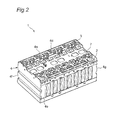
- FIG. 2 is a perspective view of the assembled battery of the embodiment of the invention (a cover is not illustrated.);
- FIG. 3 is a perspective view of a case
- FIG. 4 is a perspective view of an abutment member as viewed from above;
- FIG. 5 is a perspective view of the abutment member as viewed from below;
- FIG. 6 is a perspective view of a first projection (with a pedestal) as viewed from below;
- FIG. 7 is a bottom view of the first projection (with a pedestal);
- FIG. 8 is a perspective view of the first projection (without a pedestal) as viewed from below;
- FIG. 9 is a bottom view of the first projection (without a pedestal).
- FIG. 10 is a perspective view of a second projection as viewed from below;
- FIG. 11 is a schematic plan view of a first gap into which the first projection (without a pedestal) is inserted;
- FIG. 12 is a schematic plan view of a second gap into which the second projection is inserted
- FIG. 13A is a perspective view showing a first modification of the first projection
- FIG. 13B is a perspective view showing a second modification of the first projection.
- FIG. 13C is a perspective view showing a third modification of the first projection.
- An embodiment of the present invention provides an assembled battery comprising, a case in which a plurality of electric cells are accommodated and an abutment member which abuts against the electric cells accommodated in the case to position the electric cells with respect to the case.
- the abutment member includes a first projection inserted into a first gap defined by the case and the mutually adjacent electric cells to align the abutment member.
- the abutment member is aligned by inserting the first projection into the first gap defined by the electric cells and the case. This enables attachment of the abutment member without precisely aligning thereof. In other words, since the first projection guides the abutment member to the aligned position, the attaching operability of the abutment member is enhanced.
- the first projection is tapered from its proximal end toward its distal end. This achieves easy insertion of the first projection into the first gap, thereby further enhancing the attaching operability of the abutment member.
- the abutment member includes a body which abuts against the electric cells and a rib which projects from the body so as to be inserted into the case, and that a length from the body to a distal end of the first projection is longer than a length from the body to a distal end of the rib. Since the distal end of the first projection projects more than the distal end of the rib, the first projection is reliably inserted into the first gap when the abutment member is attached.
- a gap is provided between the first projection and the rib.
- the gap allows the first projection itself to deform to some extent independently from the rib. Therefore, by providing the gap, it is possible to prevent the external force applied to the first projection from being transmitted to other portion of the abutment member through the rib.
- the case includes a sidewall which surrounds the plurality of electric cells.
- the rib includes a main rib which projects from the body so as to be inserted between the electric cells and the sidewall. Furthermore, the first projection projects from a distal end of the main rib.
- the first projection includes a pair of first inclined surfaces, the distance between the first inclined surfaces in an arraying direction of the mutually adjacent electric cells being gradually reduced from the proximal end toward the distal end.
- the pair of first inclined surfaces respectively comes into contact with the electric cells.
- the abutment member is guided by the contact of the first inclined surfaces with the corresponding electric cells so as to be aligned with respect to the opening.
- the electric cell is provided at its corner portion with an arc portion on a side of the sidewall and a straight portion connected to the arc portion and extending in a direction away from the sidewall.
- the proximal end of the first projection inserted into the first gap is located closer to the sidewall than a connected portion between the arc portion and the straight portion.
- the rib may include a partition rib inserted between the mutually adjacent electric cells.
- the first projection is provided at a position of the main rib corresponding to an end of the partition rib.
- the first projection includes a second inclined surface which is provided on an extension line of the partition rib and gradually approaches the main rib from the proximal end toward the distal end.
- the case may include an angle portion formed on a connected portion between the two sidewalls.
- the abutment member may include a second projection tapered from its proximal end toward its distal end and inserted between a second gap defined by the angle portion and the electric cell so that the abutment member is aligned with respect to the opening of the case.
- the abutment member is aligned by inserting the projection (first projection) provided on the abutment member into the gap (first gap) defined by the electric cells and the case. Therefore, it is possible to attach the abutment member without precisely aligning the abutment member. In other words, since the first projection guides the abutment member to the aligned position, the attaching operability of the abutment member is enhanced.
- FIGS. 1 and 2 show an assembled battery (battery module) 1 according to an embodiment of the present invention.
- the assembled battery 1 includes eight angle type electric cells (battery cells) 2 which are non-aqueous electrolyte secondary batteries.
- Each of the electric cells 2 includes a body 2 a (having a flat rectangular parallelepiped shape in this embodiment) in which an electrode assembly and the like are accommodated, and a cover 2 b which closes an upper end opening of the body 2 a .
- a pair of terminals 2 c projects from both ends of the cover 2 b .
- the terminal 2 c of each of the electric cells 2 is electrically connected to the terminal 2 c of the adjacent electric cell 2 via a bus bar 3 .
- the one of two terminals 2 c of the electric cells 2 located on left and right ends respectively functions as a positive electrode and a negative electrode for the entire assembled battery 1 .
- the electric cells 2 are accommodated in a case 4 made of resin in this embodiment.
- the case 4 is of a rectangular parallelepiped as a whole and has a box-shape including an upper end opening 4 a .
- the electric cells 2 accommodated in the case 4 are arrayed in line so that their long sides as viewed from above are opposed to each other.
- a bottom wall 4 b of the case 4 on which the electric cells 2 are placed is provided with a plurality of (seven in this embodiment) partition walls 4 c which are inserted into bottoms of the mutually adjacent two electric cells 2 .
- a spacer 5 is interposed between the mutually adjacent electric cells 2 .
- the case 4 includes sidewalls 4 d and 4 e elongated in a long side direction.
- the sidewalls 4 d and 4 e upwardly extend from the bottom wall 4 b .
- the sidewalls 4 d and 4 e are opposed to a pair of short sides of the respective arrayed electric cells 2 as viewed from above.
- the case 4 includes sidewalls 4 f and 4 g elongated in a short side direction.
- the sidewalls 4 f and 4 g upwardly extend from the bottom wall 4 b .
- the sidewalls 4 f and 4 g are opposed to the long sides of the two electric cells 2 located on both ends of the arrayed electric cells 2 (the electric cells 2 disposed on right and left ends in FIG. 1 ).
- the upper end opening 4 a is defined by upper ends of the sidewalls 4 d , 4 e and the sidewalls 4 f , 4 g.
- An abutment member (intermediate cover) 7 made of resin in this embodiment is attached to the upper end opening 4 a of the case 4 accommodating the electric cells 2 .
- a cover (outer cover) 8 made of metal in this embodiment is attached to the abutment member 7 .
- Sidewalls of the cover 8 elongated in its long side direction are provided with a plurality of engaging pieces 8 a .
- the abutment member 7 includes a body 7 b of substantially rectangular configuration as a whole.
- the body 7 b abuts against top portions of the plurality of (eight in this embodiment) electric cells 2 .
- Through holes 7 c are formed in the body 7 b .
- Terminals 2 c of the electric cells 2 are respectively exposed from the through holes 7 c .
- the body 7 b is provided at its corners with notches 7 d and 7 e for exposing the above-described terminals 2 c functioning as positive and negative electrodes for the entire assembled battery 1 .
- the abutment member 7 includes two pairs of flat plate-shaped main ribs 7 f to 7 i projecting downward from side edges of the body 7 b .
- One pair of main ribs 7 f and 7 g elongated in the long side direction are inserted from above between the side walls 4 d , 4 e of the case 4 and pairs of short sides as viewed from above of respective electric cells 2 arrayed in line.
- the other pair of main ribs 7 h and 7 i elongated in the short side direction are inserted from above between the side walls 4 f , 4 g of the case 4 and the two electric cells 2 located on both ends of the arrayed electric cells 2 as viewed from above.
- the main ribs 7 f to 7 i are provided with a plurality of engaging projections 7 j .
- insertion of the main ribs 7 f to 7 i between the case 4 and the electric cells 2 causes the engaging projections 7 j to be fitted into engaging holes 4 h formed in the sidewalls 4 d to 4 g of the case 4 , and thereby the abutment member 7 and the case 4 are fixed with each other.
- a lower surface of the abutment member 7 is provided with a plurality of (seven in the embodiment) thin and long flat plate-shaped partition ribs 7 k extending from the main rib 7 f to the main rib 7 g .
- Each of the partition ribs 7 k is inserted from above between mutually adjacent two electric cells 2 .
- Both surfaces of each of the partition ribs 7 k are provided with a plurality of fixing ribs 7 m which abut against sides of upper ends of the electric cells 2 when the partition ribs 7 k are inserted between the electric cells 2 .
- first projections 11 are provided at positions where ends of the most left and right side two partition ribs 7 k of the seven partition ribs 7 k in FIG. 5 are connected the ends of the main rib 7 g . Further, the first projection 11 are provided at positions where both ends of the remaining five partition ribs 7 k are connected to the main ribs 7 f and 7 g . Thus, the first projections 11 are provided at positions of the main ribs 7 f and 7 g corresponding to the ends of the partition ribs 7 k.
- the first projections 11 project further downwardly from lower ends of the main ribs 7 f and 7 g .
- a length from the body 7 b of the abutment member 7 to a distal end of the first projection 11 is longer than a length from the body 7 b to distal ends of the main ribs 7 f and 7 g and the partition ribs 7 k .
- Each of the first projections 11 has a shape which is tapered from its upper end (proximal end) connected to the main ribs 7 f and 7 g toward its lower end (distal end). The first projection 11 is inserted from above into a first gap 12 defined by the upper ends of the mutually adjacent electric cells 2 and the sidewalls 4 d and 4 e of the case 4 .
- Each of the first projection 11 includes a first isosceles triangular plate portion 11 a located substantially on the same plane with the main rib 7 f or 7 g . Both side surfaces of the first triangular plate portion 11 a configure a pair of first inclined surfaces 11 b and 11 c . A distance between the first inclined surfaces 11 b and 11 c in an arrangement direction of the mutually adjacent electric cells 2 (see arrows B 1 and B 2 in FIG. 11 ) is gradually reduced from the upper end toward the lower end. As shown in FIG.
- each of the first triangular plate portions 11 a is inserted into a part of the first gap 12 , i.e., a gap defined between the mutually adjacent electric cells 2 and the sidewall 4 d or 4 e of the case 4 .
- Each of the first projections 11 includes a second rectangular triangular plate portion 11 d on the side of an inner surface of the first triangular plate portion 11 a .
- One of two sides of the second triangular plate portion 11 d forming a right angle extends along a symmetric line of the first triangular plate portion 11 a .
- a hypotenuse of the second triangular plate portion 11 d is provided on an extension line of the partition rib 7 k and configures a second inclined surface 11 e which gradually approaches the main ribs 7 f and 7 g from its upper end toward its lower end.
- the second triangular plate portion 11 d is inserted into other part of the first gap 12 , i.e., a gap defined by the mutually adjacent electric cells 2 .
- the first projection 11 is provided so that a gap “G” is formed between the first triangular plate portion 11 a and the partition rib 7 k .
- the first projection 11 of the main rib 7 g is provided at its most proximal end with a substantially trapezoidal columnar pedestal 11 f , but the first projection 11 of the main rib 7 f is not provided with a pedestal.
- angle portions 7 n of the abutment member 7 are formed at connected portions between both ends of the main rib 7 g and one ends of the main ribs 7 h and 7 i
- angle portions 7 p are formed at connected portions between both ends of the main rib 7 f and the partition rib 7 k .
- the angle portions 7 n and 7 p are provided with second projections 14 .
- the second projections 14 project further downward from lower ends of the main ribs 7 h and 7 i .
- Each of the second projections 14 is inserted from above into a second gap 15 defined by the electric cells 2 and the angle portions 7 n or 7 p.
- the second projection 14 includes first and second rectangular triangular plate portions 14 a and 14 b located substantially on the same planes with two wall portions configuring the angle portions 7 n or 7 p .
- Each of the first and second triangular plate portions 14 a and 14 b includes inclined surface 14 c or 14 d and has a shape which is tapered from its upper end toward its lower end.
- This attaching operation may be carried out manually or by an automatic attaching apparatus.
- the attaching operation of the abutment member 7 to the upper end opening 4 a of the case 4 is carried out after all of the electric cells 2 (eight in this embodiment) are accommodated in the case 4 and the terminals 2 c of the adjacent electric cells 2 are connected to each other via the bus bars 3 .
- the abutment member 7 is put on the electric cells 2 in the case 4 from above so that the main ribs 7 f to 7 i of the abutment member 7 are inserted between the electric cells 2 and the sidewalls 4 d to 4 g of the case 4 .
- the engaging projection 7 j of the abutment member 7 is fitted into the engaging hole 4 h of the case 4 , and thereby the abutment member 7 is fixed to the case 4 and the attaching operation is completed.
- the body 7 b of the abutment member 7 abuts against the top portions of the electric cells 2 accommodated in the case 4 so as to determine vertical positions of the electric cells 2 .
- the terminals 2 c of the electric cell 2 are exposed upward from the body 7 b through the through holes 7 c (see FIG. 2 ).
- the lengths (projecting amount from abutment member 7 b ) of the first and second projections 11 and 14 are set longer than those of the main ribs 7 f to 7 i and the partition ribs 7 k . Further, the first and second projections 11 and 14 are tapered. These configurations enable reliable and smooth insertion of the first and second projections 11 and 14 into the first and second gaps 12 and 15 .
- the gap “G” is provided between the first projection 11 and the partition rib 7 k . Therefore, even if an external force is applied to the first projection 11 due to interference between the first projection 11 and the case 4 or the electric cell 2 when the abutment member 7 is attached, the gap “G” allows the first projection 11 itself to deform to some extent independently from the partition rib 7 k . Especially, the first projection 11 relatively and easily deforms in a direction intersecting with the arraying direction of the electric cells 2 , i.e., in the vertical direction in FIGS. 7 and 9 . Therefore, providing the gap “G” can prevent the external force applied to the first projection 11 from being transmitted to other portions of the abutment member 7 through the partition rib 7 k.
- each of the electric cells 2 is provided at its corners with arc portions 2 e on the side of sidewall 7 f or 7 g and a straight portions 2 f connected to the arc portions 2 e and extending in a direction way from the sidewall 7 f or 7 g .
- the proximal end of the first projection 11 inserted into the first gap 12 is located closer to the sidewall 7 f or 7 g than connected portion between the arc portions 2 e and the straight portion 2 f .
- Such positional relation between the proximal end of the first projection 11 and the electric cell 2 allows the maximum width of the first projection 11 , i.e., a distance between the first inclined surfaces 11 b and 11 c at the proximal end, to be set wide. This results in that the strength of the first projection 11 can be enhanced.
- the arc portion 2 e may be of a curved shape not included in an arc shape and may be of a shape composed of a curve and a straight line.
- the first projection 11 is inserted into the first gap 12 , the position of the abutment member 7 with respect to the case 4 as viewed from above is aligned, and the main ribs 7 f to 7 i of the abutment member 7 are smoothly inserted between the case 4 and the electric cells 2 without interfering with the electric cells 2 or the sidewalls 4 d to 4 g of the case 4 .
- the partition ribs 7 k of the abutment member 7 are inserted into the gaps between the adjacent electric cells 2 .
- the position of the abutment member 7 with respect to the case 4 as viewed from above is displaced so that the positional deviations in the directions of the arrows A, B 1 , and B 2 are resolved.
- the main ribs 7 f to 7 i of the abutment member 7 are smoothly inserted between the case 4 and the electric cells 2 without interfering with the electric cells 2 and the sidewalls 4 d , 4 e , 4 f , and 4 g of the case 4 .
- the partition ribs 7 k of the abutment member 7 are inserted into the gaps between the adjacent electric cells 2 .
- the second triangular plate portion 11 d including the second inclined surface 11 e is provided on the extension line of the partition rib 7 k as described above. Further the second inclined surface 11 e is provided in addition to the first inclined surfaces 11 b and 11 c of the first triangular plate portion 11 a . These arrangements enable the partition ribs 7 k to be more smoothly inserted between the adjacent electric cells 2 .
- the first projection 11 is provided, even if the position of the abutment member 7 with respect to the upper end opening 4 a of the case 4 as viewed from above is deviated when the abutment member 7 is attached to the upper end opening 4 a of the case 4 , the first projection 11 is inserted into the first gap 12 so that the abutment member 7 is aligned in position with respect to the case 4 . Therefore, the abutment member 7 is not necessary to be precisely aligned with respect to the upper end opening 4 a of the case 4 , enabling easy attachment of the abutment member 7 .
- the abutment member 7 can be smoothly attached to the case 4 .
- the attaching operability of the abutment member 7 with respect to the case 4 is enhanced.
- the automatic attaching apparatus is not required to exert excessive aligning precision of the abutment member 7 with respect to the case 4 .
- the inclined surfaces 14 c and 14 d of the first and second triangular plate portions 14 a and 14 b are guided by the edge 2 d of the electric cell 2 . Therefore, as the abutment member 7 descends, the position of the abutment member 7 as viewed from above is displaced in the direction where the positional deviation is resolved. By this lateral displacement of the abutment member 7 , the second projection 14 is inserted into the second gap 15 , and thereby the position of the abutment member 7 with respect to the case 4 as viewed from above is aligned.
- the main ribs 7 f to 7 i of the abutment member 7 are smoothly inserted between the case 4 and the electric cells 2 without interfering with the electric cells 2 or the sidewalls 4 d to 4 g of the case 4 .
- the partition ribs 7 k of the abutment member 7 are smoothly inserted into gaps between the adjacent electric cells 2 .
- FIGS. 13A to 13C show modifications of the first projection 11 .
- a first projection 11 is a columnar member projecting from main ribs 7 g and 7 f . If the first projection 11 can be inserted into the first gap 12 (see FIG. 11 ) in this manner, it is not necessary that the first projection 11 is tapered.
- a first projection 11 is a thin and long circular truncated cone projecting from main ribs 7 g and 7 f .
- FIG. 13A shows a first projection 11 is a columnar member projecting from main ribs 7 g and 7 f .
- a first projection 11 is a thin and long circular truncated cone, and the first projection 11 projects not from the main ribs 7 g and 7 f but from a lower surface of a body 7 b of an abutment member 7 . If the first projection 11 can be inserted into the first gap 12 (see FIG. 11 ) in this manner, it is not always necessary that the first projection 11 is provided at the main rib 7 g or 7 f .
- the configurations as shown in FIGS. 13A to 13C can be applied to the second gap 15 also.
- positions of the electric cells 2 in the case 4 are held by the partition walls 4 c of the case 4 , the spacers 5 disposed between the electric cells 2 , and the partition ribs 7 k having the fixing ribs 7 m .
- positions of electric cells 2 in the case 4 are held by the partition walls 4 c of the case 4 , the spacers 5 disposed between the electric cells 2 , and the partition ribs 7 k having the fixing ribs 7 m .
Landscapes
- Chemical & Material Sciences (AREA)
- Chemical Kinetics & Catalysis (AREA)
- Electrochemistry (AREA)
- General Chemical & Material Sciences (AREA)
- Battery Mounting, Suspending (AREA)
- Sealing Battery Cases Or Jackets (AREA)
Abstract
Description
Claims (19)
Applications Claiming Priority (2)
| Application Number | Priority Date | Filing Date | Title |
|---|---|---|---|
| JP2012-213277 | 2012-09-26 | ||
| JP2012213277A JP6036095B2 (en) | 2012-09-26 | 2012-09-26 | Assembled battery |
Publications (2)
| Publication Number | Publication Date |
|---|---|
| US20140087229A1 US20140087229A1 (en) | 2014-03-27 |
| US9425446B2 true US9425446B2 (en) | 2016-08-23 |
Family
ID=49230628
Family Applications (1)
| Application Number | Title | Priority Date | Filing Date |
|---|---|---|---|
| US14/034,655 Active US9425446B2 (en) | 2012-09-26 | 2013-09-24 | Assembled battery |
Country Status (5)
| Country | Link |
|---|---|
| US (1) | US9425446B2 (en) |
| EP (1) | EP2713417B1 (en) |
| JP (1) | JP6036095B2 (en) |
| KR (1) | KR102096912B1 (en) |
| CN (1) | CN103682201B (en) |
Cited By (2)
| Publication number | Priority date | Publication date | Assignee | Title |
|---|---|---|---|---|
| US11444351B2 (en) | 2018-03-16 | 2022-09-13 | Gs Yuasa International Ltd. | Energy storage apparatus |
| US12249731B2 (en) | 2019-10-21 | 2025-03-11 | Contemporary Amperex Technology (Hong Kong) Limited | Battery module, battery pack, and apparatus using battery cell as power supply |
Families Citing this family (15)
| Publication number | Priority date | Publication date | Assignee | Title |
|---|---|---|---|---|
| JP5974918B2 (en) * | 2013-02-01 | 2016-08-23 | 株式会社オートネットワーク技術研究所 | Wiring module |
| KR101737489B1 (en) | 2014-06-05 | 2017-05-18 | 주식회사 엘지화학 | Battery pack having improved structure for supporting torque of terminal bolt |
| US10020534B2 (en) | 2014-09-26 | 2018-07-10 | Johnson Controls Technology Company | Free floating battery cell assembly techniques for lithium ion battery module |
| US10103367B2 (en) | 2014-09-26 | 2018-10-16 | Johnson Controls Technology Company | Lithium ion battery module with free floating prismatic battery cells |
| KR101953759B1 (en) * | 2015-09-25 | 2019-03-04 | 주식회사 엘지화학 | Battery module, battery pack comprising the battery module and vehicle comprising the battery pack |
| JP6685760B2 (en) * | 2016-02-19 | 2020-04-22 | 株式会社Gsユアサ | Power storage device |
| JP2018056093A (en) * | 2016-09-30 | 2018-04-05 | 日立オートモティブシステムズ株式会社 | Power storage device |
| CN106784509A (en) * | 2017-03-10 | 2017-05-31 | 江苏索尔新能源科技股份有限公司 | The battery component that a kind of battery core is longitudinally arranged |
| JP2019145459A (en) * | 2018-02-23 | 2019-08-29 | 株式会社東芝 | Battery pack |
| CN109659463A (en) * | 2019-01-02 | 2019-04-19 | 南京创源天地动力科技有限公司 | A kind of square power battery group block structure |
| US11342620B2 (en) * | 2019-03-04 | 2022-05-24 | Chongqing Jinkang Powertrain New Energy Co., Ltd. | Battery module scalable in three dimensions |
| CN110224090A (en) * | 2019-04-24 | 2019-09-10 | 合肥国轩高科动力能源有限公司 | A thermally conductive prismatic battery pack |
| US12603400B2 (en) | 2019-10-23 | 2026-04-14 | Gs Yuasa International Ltd. | Energy storage apparatus |
| KR102903479B1 (en) * | 2020-04-01 | 2025-12-22 | 삼성에스디아이 주식회사 | Battery pack |
| DE102023119176A1 (en) * | 2023-07-20 | 2025-01-23 | Audi Aktiengesellschaft | side panel for a battery module and battery module |
Citations (9)
| Publication number | Priority date | Publication date | Assignee | Title |
|---|---|---|---|---|
| JP2005150055A (en) | 2003-11-20 | 2005-06-09 | Sony Corp | Battery tray |
| US20050250006A1 (en) * | 2004-05-04 | 2005-11-10 | Yong-Sam Kim | Secondary battery module |
| US20080286640A1 (en) * | 2007-05-16 | 2008-11-20 | Sony Corporation | Battery pack |
| JP2010015760A (en) | 2008-07-02 | 2010-01-21 | Gs Yuasa Corporation | Battery pack and assembly method for battery pack |
| US20110059365A1 (en) * | 2009-09-09 | 2011-03-10 | Gm Global Technology Operations, Inc. | Process for manufacture and assembly of battery modules and sections |
| US20110104547A1 (en) * | 2009-10-29 | 2011-05-05 | Masao Saito | Battery temperature unevenness suppressing power supply |
| US20110293973A1 (en) | 2010-05-26 | 2011-12-01 | Myeongcheol Kim | Battery pack |
| WO2012009090A1 (en) | 2010-07-12 | 2012-01-19 | Coda Automotive, Inc. | Battery assembly |
| JP2012128982A (en) | 2010-12-13 | 2012-07-05 | Lithium Energy Japan:Kk | Battery module |
Family Cites Families (2)
| Publication number | Priority date | Publication date | Assignee | Title |
|---|---|---|---|---|
| JP5056155B2 (en) | 2007-05-16 | 2012-10-24 | ソニー株式会社 | Battery pack |
| JP5155772B2 (en) * | 2008-08-19 | 2013-03-06 | 三菱重工業株式会社 | Battery pack structure |
-
2012
- 2012-09-26 JP JP2012213277A patent/JP6036095B2/en active Active
-
2013
- 2013-08-21 KR KR1020130099065A patent/KR102096912B1/en active Active
- 2013-09-05 CN CN201310399920.0A patent/CN103682201B/en active Active
- 2013-09-24 US US14/034,655 patent/US9425446B2/en active Active
- 2013-09-25 EP EP13185851.6A patent/EP2713417B1/en active Active
Patent Citations (11)
| Publication number | Priority date | Publication date | Assignee | Title |
|---|---|---|---|---|
| JP2005150055A (en) | 2003-11-20 | 2005-06-09 | Sony Corp | Battery tray |
| US20050250006A1 (en) * | 2004-05-04 | 2005-11-10 | Yong-Sam Kim | Secondary battery module |
| US20080286640A1 (en) * | 2007-05-16 | 2008-11-20 | Sony Corporation | Battery pack |
| JP2010015760A (en) | 2008-07-02 | 2010-01-21 | Gs Yuasa Corporation | Battery pack and assembly method for battery pack |
| JP4638528B2 (en) | 2008-07-02 | 2011-02-23 | 株式会社Gsユアサ | Assembled battery and assembled battery assembly method |
| US20110059365A1 (en) * | 2009-09-09 | 2011-03-10 | Gm Global Technology Operations, Inc. | Process for manufacture and assembly of battery modules and sections |
| US20110104547A1 (en) * | 2009-10-29 | 2011-05-05 | Masao Saito | Battery temperature unevenness suppressing power supply |
| US20110293973A1 (en) | 2010-05-26 | 2011-12-01 | Myeongcheol Kim | Battery pack |
| JP2011249309A (en) | 2010-05-26 | 2011-12-08 | Sb Limotive Co Ltd | Battery pack |
| WO2012009090A1 (en) | 2010-07-12 | 2012-01-19 | Coda Automotive, Inc. | Battery assembly |
| JP2012128982A (en) | 2010-12-13 | 2012-07-05 | Lithium Energy Japan:Kk | Battery module |
Non-Patent Citations (1)
| Title |
|---|
| Extended European Search Report dated Jan. 2, 2014. |
Cited By (2)
| Publication number | Priority date | Publication date | Assignee | Title |
|---|---|---|---|---|
| US11444351B2 (en) | 2018-03-16 | 2022-09-13 | Gs Yuasa International Ltd. | Energy storage apparatus |
| US12249731B2 (en) | 2019-10-21 | 2025-03-11 | Contemporary Amperex Technology (Hong Kong) Limited | Battery module, battery pack, and apparatus using battery cell as power supply |
Also Published As
| Publication number | Publication date |
|---|---|
| CN103682201B (en) | 2018-04-20 |
| CN103682201A (en) | 2014-03-26 |
| JP6036095B2 (en) | 2016-11-30 |
| KR102096912B1 (en) | 2020-04-03 |
| US20140087229A1 (en) | 2014-03-27 |
| JP2014067648A (en) | 2014-04-17 |
| KR20140040629A (en) | 2014-04-03 |
| EP2713417A1 (en) | 2014-04-02 |
| EP2713417B1 (en) | 2023-11-22 |
Similar Documents
| Publication | Publication Date | Title |
|---|---|---|
| US20140087229A1 (en) | Assembled battery | |
| US9923183B2 (en) | Busbar module | |
| US10074844B2 (en) | Battery module | |
| US8956744B2 (en) | Battery assembly and electric cell | |
| US9694449B2 (en) | Welding jig for secondary battery | |
| US10665887B2 (en) | Energy storage apparatus including aligning projection contacting energy storage devices | |
| US9196984B2 (en) | Substrate connection structure using substrate connector | |
| US9017840B2 (en) | Battery | |
| EP2207223A1 (en) | Battery pack | |
| US10199625B2 (en) | Bus bar including thick portion connected to thin portion by bend portions and battery module including the same | |
| US9054370B2 (en) | Electric cell and battery assembly | |
| EP2169739B1 (en) | Battery pack | |
| US20140242449A1 (en) | Pack Case for Battery | |
| US11205818B2 (en) | Cover assembly and battery module including the same | |
| US20140329413A1 (en) | Terminal fixation structure and power supply device using the same | |
| US12199308B2 (en) | Bus bar plate | |
| US9257687B2 (en) | Battery assembly | |
| KR20140046847A (en) | Battery pack | |
| US11211659B2 (en) | Battery module comprising housing with connector | |
| KR20130080639A (en) | Battery module | |
| US12300841B2 (en) | Battery module | |
| JP2016207584A (en) | Battery pack and conductive member | |
| KR20210008495A (en) | Membrane electrode assembly, fuel cell stack with membrane electrode assembly, and alignment tool for fuel cell stack | |
| KR101537001B1 (en) | Rechargeable battery pack | |
| CN107431162A (en) | Battery pack |
Legal Events
| Date | Code | Title | Description |
|---|---|---|---|
| AS | Assignment |
Owner name: LITHIUM ENERGY JAPAN, JAPAN Free format text: ASSIGNMENT OF ASSIGNORS INTEREST;ASSIGNORS:WATANABE, MINORU;MASUDA, YOSHIHIRO;HASEGAWA, YO;REEL/FRAME:031377/0161 Effective date: 20130919 |
|
| AS | Assignment |
Owner name: LITHIUM ENERGY JAPAN, JAPAN Free format text: REQUEST TO CORRECT ASSIGNEE'S ADDRESS ON ASSIGNMENT DOCUMENT PREVIOUSLY RECORDED AT REEL 031377 AND FRAME 0161;ASSIGNORS:WATANABE, MINORU;MASUDA, YOSHIHIRO;HASEGAWA, YO;REEL/FRAME:032112/0776 Effective date: 20130919 |
|
| AS | Assignment |
Owner name: GS YUASA INTERNATIONAL LTD., JAPAN Free format text: ASSIGNMENT OF ASSIGNORS INTEREST;ASSIGNOR:LITHIUM ENERGY JAPAN;REEL/FRAME:035947/0377 Effective date: 20150304 |
|
| STCF | Information on status: patent grant |
Free format text: PATENTED CASE |
|
| MAFP | Maintenance fee payment |
Free format text: PAYMENT OF MAINTENANCE FEE, 4TH YEAR, LARGE ENTITY (ORIGINAL EVENT CODE: M1551); ENTITY STATUS OF PATENT OWNER: LARGE ENTITY Year of fee payment: 4 |
|
| MAFP | Maintenance fee payment |
Free format text: PAYMENT OF MAINTENANCE FEE, 8TH YEAR, LARGE ENTITY (ORIGINAL EVENT CODE: M1552); ENTITY STATUS OF PATENT OWNER: LARGE ENTITY Year of fee payment: 8 |